C.S. Lewis, J.R.R. Tolkien & Naomi Mitchison

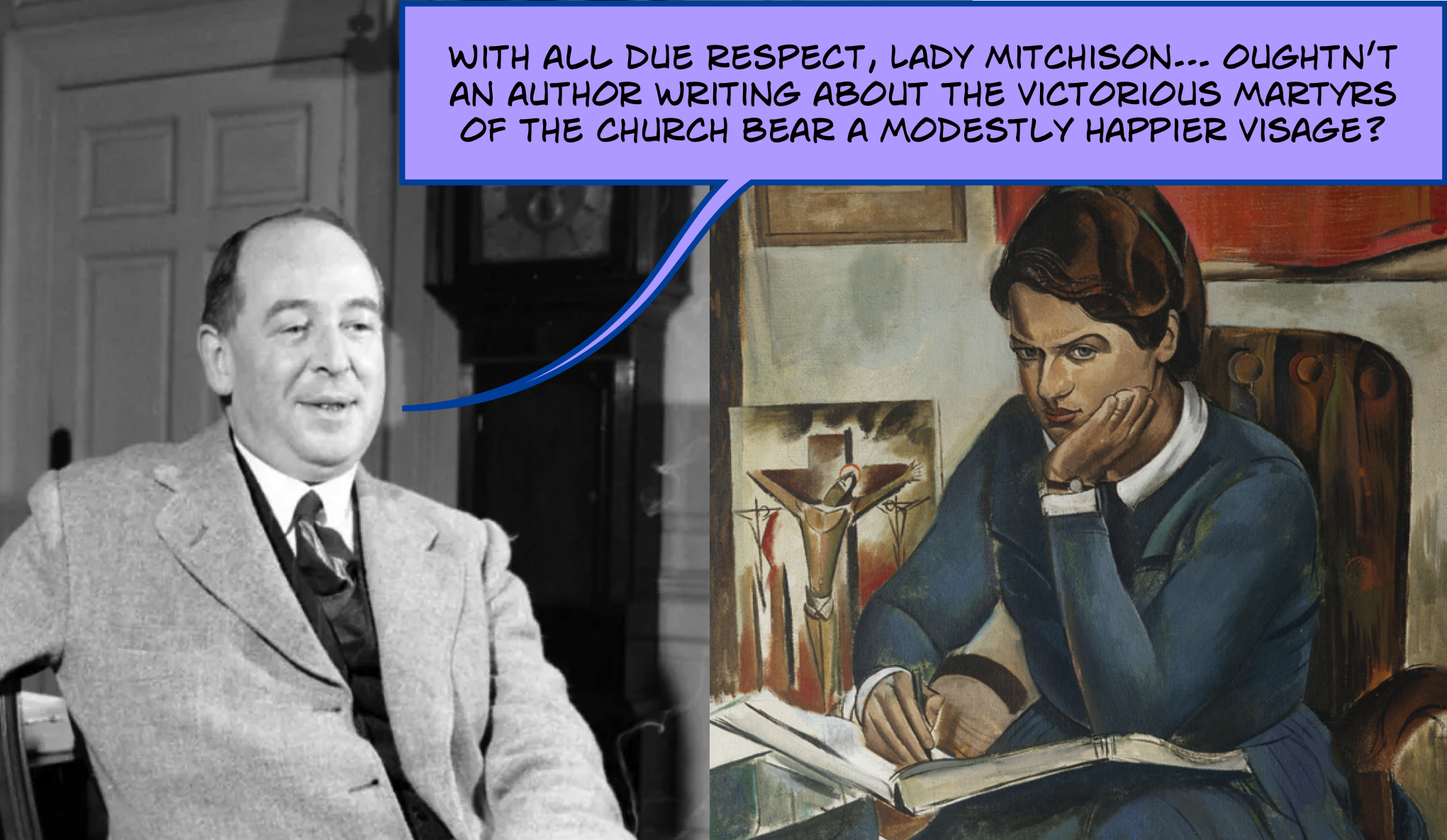
Have your feelings about particular authors changed over time? C.S. Lewis’ attitude toward the work of prolific novelist Naomi Mitchison illustrates this type of progression.

Mitchison’s work possesses a direct link to another Oxford Inkling – J.R.R. Tolkien – whose Fellowship of the Ring she read in proof and favorably reviewed. Brenton Dickieson provides a priceless letter written by Tolkien to Mitchison in 1954.

Naomi Mary Margaret Mitchison was a Scottish novelist who lived more than a century (1897 – 1999). She penned more than ninety books, primarily historical fiction, and including science fiction.

With the outbreak of the First World War, Mitchison joined a Voluntary Air Detachment in a London hospital. (Other familiar women who served in a VAD included Agatha Christie and Amelia Earhart.)

Politically she identified as a Socialist. She was sufficiently leftist that George Orwell regarded her as unsuited for writing anti-Soviet materials for the United Kingdom during the Cold War.

Mitchison’s brother, J.B.S. Haldane, did not equivocate on his radical views, announcing his position as a Marxist. He was a scientist and his atheism brought him into serious disagreement with the Christian views of C.S. Lewis. (I will devote my next post to that interaction.)

Coincidentally, artist Pauline Baynes (who also worked with C.S. Lewis and J.R.R. Tolkien), provided the illustrations for at least one of Mitchison’s children’s books, Graeme and the Dragon. This quick review offers a concise synopsis and discussion of “the charming illustrations [which] go a long way toward making this a fun read.”

An additional coincidence: the same year Lewis published The Lion, the Witch and the Wardrobe, Mitchison also published a fantasy novel for children. The Big House involves time travel and some occultic themes associated with Halloween, etc.

For a thorough synopsis of The Big House and comparison to Lewis’ Chronicles of Narnia, check out this essay from the University of Glasgow. (That reviewer’s preference is clearly for Mitchison’s more complex approach with its themes related to class struggle.)

C.S. Lewis’ Perspective on Naomi Mitchison

I cannot locate any mention of C.S. Lewis by Mitchison, but he did mention her in passing in several pieces of correspondence. In essence, he praised her skill, but was put off by her graphic use of violent imagery.

In a 1932 letter to Arthur Greeves, he writes:

I thought we had talked about Naomi Mitchison before. I have only read one (Black Sparta) and I certainly agree that it ‘holds’ one: indeed I don’t know any historical fiction that is so astonishingly vivid and, on the whole, so true.

I also thought it astonishing how, despite the grimness, she got such an air of beauty–almost dazzling beauty–into it. As to the cruelties, I think her obvious relish is morally wicked, but hardly an artistic fault for she could hardly get some of her effects without it.

But it is, in Black Sparta, a historical falsehood: not that the things she describes did not probably happen in Greece, but that they were not typical–the Greeks being, no doubt, cruel by modern standards, but, by the standards of that age, extremely humane.

She gives you the impression that the cruelty was essentially Greek, whereas it was precisely the opposite. That is, she is unfair as I should be unfair if I wrote a book about some man whose chief characteristic was that he was the tallest of the pigmies, and kept on reminding the reader that he was very short. I should be telling the truth (for of course he would be short by our standards) but missing the real point about the man–viz: that he was, by the standards of his own race, a giant. 

Still, she is a wonderful writer and I fully intend to read more of her when I have a chance.

C.S. Lewis echoed his concern in a 1942 letter to another of his regular correspondents, Sister Penelope. “I gave up Naomi Mitchison some time ago because of her dwelling on scenes of cruelty. But I recognise real imagination and a sort of beauty in the writing.”

In 1951, C.S. Lewis congratulated author Idrisyn Oliver Evans (1894–1977) on the publication of The Coming of a King; A Story of the Stone Age. Ironically, speculative fiction set in this ancient era, referred to as “Prehistoric SF,” was also the setting of works such as H.G. Wells’ Story of the Stone Age series, which you can read here. Naomi Mitchison also dabbled in the prehistoric field. Lewis wrote to Evans: 

I congratulate you. And I think it is a great thing to put that idea of the Stone Age – which is at least as likely to be the true one – into boys’ heads instead of Well’s or Naomi Mitchison’s. It’s all good. The marriage customs are amusing . . . I hope it will be a great success. 

In 1959, C.S. Lewis provided some wise counsel to a young, aspiring author. The American student was contemplating a volume about the Roman subjugation of Gaul, which Lewis encouraged.

A story about Caesar in Gaul sounds very promising. Have you read Naomi Mitchison’s The Conquered? And if not, I wonder should you? It might be too strong an influence if you did (at any rate until your own book is nearly finished). On the other hand, you may need to read it in order to avoid being at any point too like it without knowing you are doing so.

I don’t know what one should read on Gaul. Apart from archaeological finds (Torques and all that) I suppose Caesar himself is our chief evidence? He will be great fun and I hope you will enjoy yourself thoroughly.

Which side will you be on? I’m all for the Gauls myself and I hate all conquerors. But I never knew a woman who was not all for Caesar – just as they were in his life-time.

C.S. Lewis’ most significant mention of Naomi Mitchison occurs in his brief 1943 essay, “Equality.”

It delivers a brilliant discussion of the subject, one that merits full reading. He commends one of Mitchison’s insights into inequality – although, ironically, she relates it to eroticism.* (You must read it in full context to understand how it supports his independent argument.)

This last point needs a little plain speaking. Men have so horribly abused their power over women in the past that to wives, of all people, equality is in danger of appearing as an ideal. But Mrs. Naomi Mitchison has laid her finger on the real point. Have as much equality as you please – the more the better – in our marriage laws, but at some level consent to inequality, nay, delight in inequality, is an erotic necessity.

Mrs. Mitchison [in The Home and a Changing Civilization] speaks of women so fostered on a defiant idea of equality that the mere sensation of the male embrace rouses an undercurrent of resentment. Marriages are thus shipwrecked.

A final reference to Mitchison brings us back around to my early note that she reviewed Fellowship of the Ring. C.S. Lewis refers to her review in his own, suggesting that she has not gone quite far enough in her praise.

Nothing quite like it was ever done before. ‘One takes it,’ says Naomi Mitchison, ‘as seriously as Malory.’ But then the ineluctable sense of reality which we feel in the Morte d’Arthur comes largely from the great weight of other men’s work built up century by century, which has gone into it.

The utterly new achievement of Professor Tolkien is that he carries a comparable sense of reality unaided. Probably no book yet written in the world is quite such a radical instance of what its author has elsewhere called ‘sub-creation.’

Sadly, Naomi Mitchison was less enamored with the subsequent volumes in The Lord of the Rings . . . but this post has already condensed more than enough information.


* An article in Michigan Feminist Studies notes how Naomi Mitchison’s recurrent references to sexual themes distracted from broader matters throughout her literary career.

Despite Mitichison’s attempts to move the discussion of her body of work from the salacious, it is the frank and open inclusion of sexuality that continues to intrigue her critics and reviewers. Racy, heated passages of Mitchison’s historical novels inspired comment from poet W.H. Auden in the 1930s (“Monstrous Sex: The Erotic in Naomi Mitchison’s Science Fiction”).

The essay’s thesis is what one might expect in a journal devoted to contemporary feminism.

I intend to demonstrate that the ribald sexuality of Mitchison’s work registers as more than merely provocative. Sexual encounters between female characters and aliens, as well as those between women, threaten an imperialising capitalism that dictates who may be loved in a gendered, racialised order.
C.S. Lewis & Emotions

Are you one of those people who pride themselves on not being particularly emotional? Probably not, since the pendulum has swung far in the opposite direction in our current day. (Consider how few clicks a Tik Tok influencer with “flat affect” would get.)

Most of us know some people (most commonly men – forgive me the generalization) who keep their emotions under tight rein.

Back when I was a child, in the mid-twentieth century, it was not uncommon for men to “guard” their notion of masculinity by acting emotionless. And various ethnicities, including my own ancestors, possessed a reputation for being staid.

I can’t recall my Norwegian grandfather, who died when I was about ten, ever expressing truly warm sentiments. I know he must have laughed, and my grandmother had a great sense of humor, but I have no memory of it.

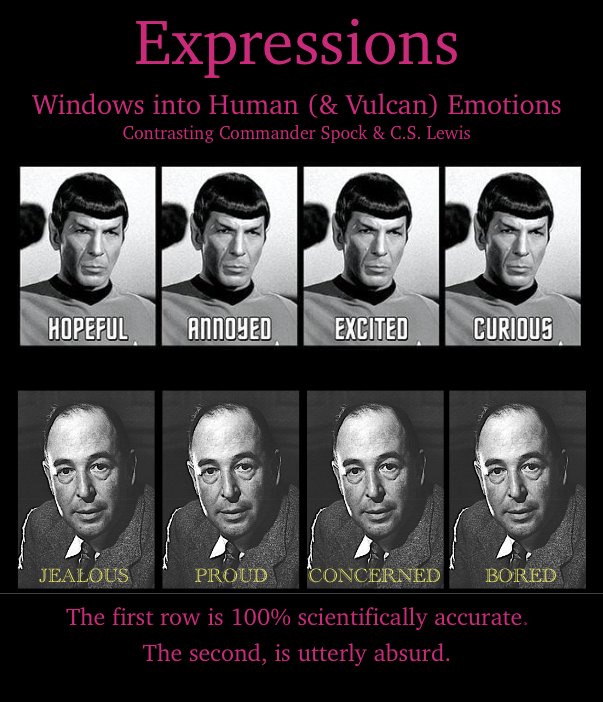
For some reason, many people picture C.S. Lewis as an emotionally sober intellectual. Perhaps it’s because he wrote so many profound essays. The truth is that Lewis was extremely jovial and fun-loving. I have noted some of this humor in the past.

Like most of us, C.S. Lewis’ closest friends saw him most clearly. They witnessed his jocularity in their regular gatherings. His fellow Inklings witnessed it frequently, but I don’t see how anyone can read the Chronicles of Narnia, and perceive their author as reserved, much less grave.

One reason some readers misunderstand C.S. Lewis’ exquisite sense of humor is because it is British. For Americans, for example, appreciating British humor is an acquired taste. As reported by the BBC, the wit often includes elements of “sarcasm, understatement [and] self-deprecation.”

In The Screwtape Letters, C.S. offers an insight into one of the Tempter’s tactics in undermining human nature, in terms of being fashioned in the image of our Creator.

[Englishmen] take their “sense of humour” so seriously that a deficiency in this sense is almost the only deficiency at which they feel shame. Humour is for them the all-consoling and (mark this) the all-excusing, grace of life.

Hence it is invaluable as a means of destroying shame. [. . .] A thousand bawdy, or even blasphemous, jokes do not help towards a man’s damnation so much as his discovery that almost anything he wants to do can be done, not only without the disapproval but with the admiration of his fellows, if only it can get itself treated as a Joke.

And this temptation can be almost entirely hidden from your patient by that English seriousness about Humour. Any suggestion that there might be too much of it can be represented to him as “Puritanical” or as betraying a “lack of humour.”

Lewis’ humor was on full display to his intimate friends, and uninhibitedly on display to the world in a number of his writings. But his openness didn’t end there. 

Just Like the Rest of Us:
a Person of Humor and Grief

I don’t recall anyone labeling C.S. Lewis a “humorist” – likely because his corpus is so diverse and complex – but I think a literary critic could make that case.

Ironically, I once cited an autobiographical reference in which C.S. Lewis applied that very attribute to his own father, a serious solicitor.

In contrast, C.S. Lewis would mature to the point where he was willing to expose that deepest of emotions, grief, with the entire world. In A Grief Observed, he explored his pain in the wake of his wife’s untimely passing. Joy Davidman was the precious wife this confirmed bachelor never anticipated having, and her death crippled him.

His description of his thoughts, doubts, and spiritual struggle in the aftermath has helped many others to survive the nightmare of bereavement. Curiously, for privacy C.S. Lewis initially used a pen name for the volume. (You can read about that here.)

He did not wish to have his authorship of the book distract from its subject matter. He would have known that would only be a temporary tool, since pseudonyms are nearly always uncovered. Initially, however, it was so effective that when it was published, readers recognized it could speak to Lewis’ own grief, and offered him gift copies.

T.S. Eliot was one of its first advocates for the volumes publication, and you can read that story at Faber & Faber.

A Final Lewisian Observation on Emotions

Some people view the intensity of emotions associated with events to be a measure of their validity. If my passions are aroused by an activity, we incorrectly think, it must be real!

This error is particularly dangerous when related to so-called “matters of the heart” and matters of faith. 

C.S. Lewis was cautious in both realms. We already noted his resignation to live out his life as a single man. In terms of faith, he was just as circumspect. His conversion from atheism to Christianity was long, thoughtful, and reluctant. 

And this, I found, was something I had not wanted. But to recognize the ground for my evasion was of course to recognize both its shame and its futility.

I know very well when, but hardly how, the final step was taken. I was driven to Whipsnade [Zoo] one sunny morning. When we set out I did not believe that Jesus Christ is the Son of God, and when we reached the zoo I did.

Yet I had not exactly spent the journey in thought. Nor in great emotion. “Emotional” is perhaps the last word we can apply to some of the most important events.

It was more like when a man, after long sleep, still lying motionless in bed, becomes aware that he is now awake. And it was, like that moment on top of the bus, ambiguous.

Freedom, or necessity? Or do they differ at their maximum? At that maximum a man is what he does; there is nothing of him left over or outside the act.

Certainly, many people are blessed with emotional confirmation in their spiritual lives. The obvious peril, of course, is in evaluating the veracity of something by how giddy it makes us feel. 

After all, there will always come “dark nights of the soul” when the feelings have fled . . . but Jesus, still remains.  

Damnable Typos & the Bible

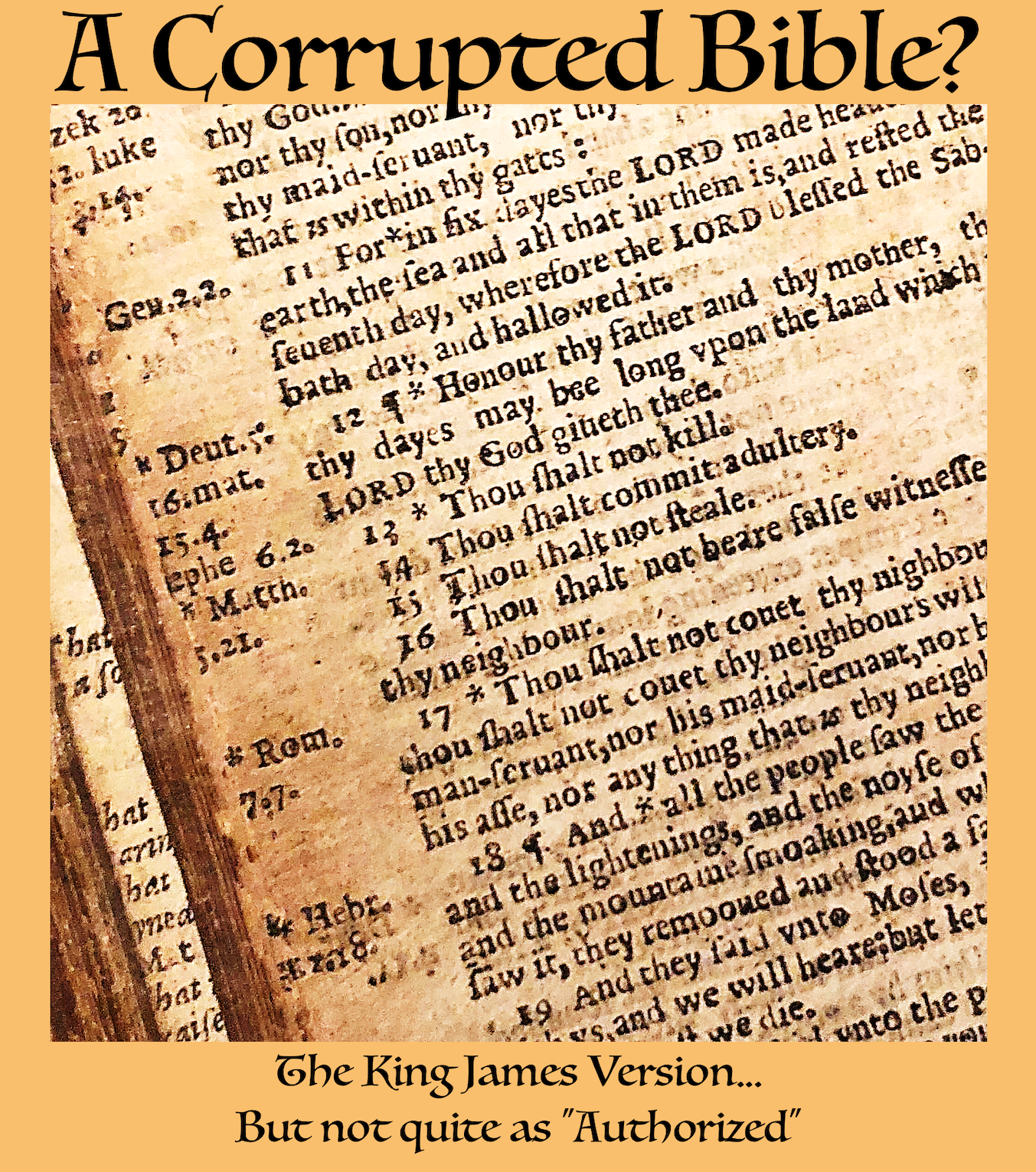
While the title of this post will be shocking to some, it’s far less scandalous than the typographical error discussed below. Due to two misprints appearing in a 1641 edition of the King James Bible (KJV), the publication has been labeled the “Wicked Bible.”

Translating the Scriptures is a necessary, and demanding, task. The early editions of the KJV (which was preceded by the Wycliffe Bible) reveal how vulnerable the words themselves were to being altered during the typesetting process.

I’ve written about this subject a number of times during the past decade, and even devoted a column to “C.S. Lewis’ School of Translation,” which is about something even more important than merely translating words. There I quote one of the great author’s deepest hopes.

What I want is to be the founder of a school of ‘translation . . .’ Where are my successors? (correspondence, 7 October 1945).

Returning to the seventeenth century book with its unfortunate errors, we witness an example of how even a solid translation can be derailed by careless (or malevolent) typesetters.

The magnitude of the mistake discovered in this particular edition caused its suppression, and most copies were destroyed. While some still exist in private hands, only fifteen remain in public collections. One of these made its way to New Zealand before being identified in 2018.

A Truly Scandalous Misprint

It would be one thing if a printer accidently dropped the final “e” from “breathe,” leaving the word “breath.” Even substituting an errant “w” for the “b,” would create an alternate word that would greatly muddle a passage . . . but still not appear remotely “wicked.” 

However, a 1631 mistake in an English Bible literally turned a passage – one of the Ten Commandments, no less – on its head. Rather than reading “Thou shalt not commit adultery,” this edition declares, “Thou shalt commit adultery” (Exodus 20:14).

The consequences of this disaster were significant, particularly for His Majesty’s official printers. In Cyprianus Anglicanus by royalist priest Peter Heylyn (1599-1662), we learn the details. (You can download a free facsimile of the volume which includes many other fascinating facts.) The passage related to the misbegotten tome reads as follows:

His Majesties Printers, at or about this time [1632], had committed a scandalous mistake in our English Bibles, by leaving out the word Not in the Seventh Commandment.

His Majesty being made acquainted with it by the Bishop of London, Order was given for calling the Printers into the High-Commission where upon the Evidence of the Fact, the whole Impression was called in, and the Printers deeply fined, as they justly merited.

Reports of Cases in the Courts of Star Chamber and High Commission, penned by Samuel Rawson Gardiner in 1886, includes a detailed account of the court’s findings. (Due to their uniqueness, I have transposed the full account, as found in two sections, as a footnote below.) One passage describes a second “gross error.”

. . . showed the two grossest errors, vizt. “Shalt commit adultery” and “great asse:” for “shalt not commit adultery” and “greatnesse…”

The second of these blunders occurs in Deuteronomy 5:24, which properly reads “Behold, the Lord our God hath shewed us his glory and his greatness.” (It should be noted that the word asse would most commonly be associated with donkeys.)

The magnitude of these mistakes can only be understood when one recognizes how reverentially the Scriptures were regarded at this time. C.S. Lewis would suggest that during an age when the Bible has been relegated to historic literature, it is difficult for us to comprehend the seriousness of this matter.

It is very generally implied that those who have rejected its theological pretensions nevertheless continue to enjoy it as a treasure house of English prose. It may be so. There may be people who, not having been forced upon familiarity with it by believing parents, have yet been drawn to it by its literary charms and remained as constant readers.

But I never happen to meet them. Perhaps it is because I live in the provinces. But I cannot help suspecting, if I may make an Irish bull, that those who read the Bible as literature do not read the Bible. (“The Literary Impact of the Authorised Version”).

In “Challenges in Printing Early English Bibles,” you can read about other Bibles featuring noteworthy mistakes. In two, “peacemakers” become “placemakers,” and “murmurers” are transformed into “murderers.” Another example, in the very first edition of the KJV, finds Jesus’ ancestor Ruth referred to by the male pronoun, due to the accidental dropping of an “s.”

More troubling is another early KJV Bible where “the text of Psalm 14 [reads], “The fool hath said in his heart there is a God,” rather than “The fool hath said in his heart there is no God.”

Worst of all, in terms of blasphemous connotations, would likely be the so-called “Judas Bible.”

In the 1609 Geneva Bible, the typesetters mistakenly replaced Jesus’s name with that of Judas. John 6:67 reads: “From that time many of his disciples went back, and walked no more with him. Then said Judas unto the twelve, Will ye also go away?”

Fortunately, modern editions of the Jewish and Christian Scriptures undergo thorough proofreading, so this sort of error is rare today. Still, typos will persist as long as the remotest possibility of error exists.

Those among us who have sought to have our writing published by traditional publishers may relate to the example with which we end. C.S. Lewis and J.R.R. Tolkien and even Mark Twain faced challenges working with some of their editors and publishers.

With all of the printing mishaps in the early English Bible, it is only appropriate that one of the editions was called “The Printers Bible.”

This text, published in about 1702, takes its name from a typesetting error found in Psalm 119, which should have read “Princes have per­secuted me without a cause” but was mistakenly printed as “Printers have persecuted me.”


Full references from Reports of Cases in the Courts of Star Chamber and High Commission by Samuel Rawson Gardiner (1886).

Mr Barker the printer. There is a cause begunne against him for false printeing of the Bible in divers places of it, in the Edition of 1631, vizt., in the 20 of Exod[us], “Thou shalt committ adultery”; and in the fifte of Deut[eronomy] “The Lord has shewed his glory, and his great asse”; and for divers other faults; and that they had printed it in very bad paper. And the Bishop of London showed that this would undoe the trade, and was a most dishonorable thing; that they of the church of Rome are soe carefull, that not a word or letter is to be found amisse in their Ladie’s Psalter and other superstitious books; and that we should not be soe carefull in printinge the sacred Scriptures; and that they in Holland, at Amsterdam, had gott up an English presse, and had printed the Bible in better paper, and with a better letter, and can undersell us 18d. in a Bible. Mr Barker and his partners endeavored in partt to excuse themselves, and had advocates to speake for them, and were willing to submitt, and promised to amend their faults; but the Court would not remitt their offense, but the cause was ordered to goe on.

The Printers having answered move the Court to passe by their oversight being the fault of the workmen but the King’s Advocate desired they might make their defense legally and the cause to go onto hearing: and that he might have liberty to put in additional articles against them. The Bishop of London would have the Church sett upright in her reputacion, that we are as carefull in printeing the Bible as they are of their Jesus’ psalter : and whereas the Printers say this is stirred up by the malice of one man against them; The Bishop saith he stirred not till the Bible was sould into his house, bought by his footman: and he saith the printinge is soe bbad and the paper too that, if it be not mended shortlie, they wilbe put downe by those of Amsterdam and their trade spoyled, and showed for the two grossest errors, vizt. “Shalt commit adultery” and “great asse:” for “shalt not commit adultery” and “greatnesse…” The Arch Bishop of Canterbury saith, that the Printers that print for his Matie have a very profitable place, and therefore should be more carefull. I knew the tyme when greater care was had about printeing, the Bibles especiallie, good compositors and the best correctors were gotten being grave and learned men, and the paper and letter rare and faire every way of the best; but now the paper is naught, the composers boyes, and the correctors unlearned: There is a farmer and he makes the benefit, and careth for nothing about it. They heretofore spent their whole time in printeing, but these looke to gaine, gaine, gaine, then they are not to be commended: Well, let them looke to it: and let the cause proceed, saith the ArchBishop. London. “There was a great deale of doo between you of this Citty and those of Cambridge heretofore about the priviledge of printeing the Bible and psalms which they of Cambridge claymed; then the Bible was exactlie printed, now you have forced the Cambridg printer to an agreement, now noe bible is right printed.

[It appears this volume itself would have benefited from having more diligent “correctors.” Perhaps most curiously, two spellings of the word printing – “printinge” and “printeing” – appear in this publication.]

Tinker Bell, the Inklings, and Disney

Poor Tinker Bell. The political prejudices of our day have caught up with the sparkling fairy, and relegated her to a significantly reduced presence in the Disney universe.

Inside the Magic reported “Tinker Bell seems to have left Walt Disney World and is now on her way back to Neverland following a recent change at Walt Disney World Resort.” You can read the tragic tale on their site.

. . . once more, Disney’s animated classic, Peter Pan (1953), is under scrutiny, with Disney issuing a statement regarding Captain Hook and Tinker Bell as characters with potential concerns.

Linking poor Tink to a murderous pirate seems a bit of a stretch, and she has not been fully banished, but she has definitely been demoted. According to TMZ, Disney alleges the company’s “own people felt she wasn’t a good role model for girls in the 21st century.”

Well, eventually she too will be in the public domain, like Mickey Mouse. Actually, her literary portrait as introduced in the play, coincidentally just entered the public domain this year (2024)!

However, should you reside in the United Kingdom, beware that in 1988, the copyright holder, Great Ormond Street Hospital, was granted the rights to Peter Pan “in perpetuity.”

The Creator of Tinker Bell & Peter Pan

Tinker Bell is one of the most memorable characters in Neverland, the creation of James Matthew Barrie (1860-1937). He was a prolific Scottish writer and is best known for his 1911 novel, Peter and Wendy – which initially debuted in the form of a stage play in 1904, as Peter Pan; or, the Boy Who Wouldn’t Grow Up.

Peter Pan was actually introduced to the world as a baby in The Little White Bird. Tinker Bell does not appear in the novel, but the following description of J.M. Barrie’s fairy mythology is quite fanciful.

One of the great differences between the fairies and us is that they never do anything useful. When the first baby laughed for the first time, his laugh broke into a million pieces, and they all went skipping about. That was the beginning of fairies.

They look tremendously busy, you know, as if they had not a moment to spare, but if you were to ask them what they are doing, they could not tell you in the least. They are frightfully ignorant, and everything they do is make-believe.

They have a postman, but he never calls except at Christmas with his little box, and though they have beautiful schools, nothing is taught in them; the youngest child being chief person is always elected mistress, and when she has called the roll, they all go out for a walk and never come back.

It is a very noticeable thing that, in fairy families, the youngest is always chief person, and usually becomes a prince or princess; and children remember this, and think it must be so among humans also, and that is why they are often made uneasy when they come upon their mother furtively putting new frills on the basinette.

Barrie continues, describing how infants are simply following fairy “ways” when they misbehave, and they naturally experience “exasperation, because we don’t understand [them], though [they are] talking an intelligible language . . . fairy.”

Returning to the person of Tinker Bell herself, she outgrew her supporting role as, in the words of her creator, “a common fairy.” She was literally a tinker, who died following the departure of Wendy and her brothers from Neverland. 

Presumably, some of the gatekeepers at Disney would have preferred that the affection of the crowds had not restored her to life. 

The Inklings

The Imaginative Conservative offers an interesting take on C.S. Lewis’ view of fairies. I quote a portion related to our present subject.

Lewis treats the subject of fairies in . . . The Discarded Image. . . . After explaining the medieval understanding of the heavens and planetary systems, Lewis turns to what he calls the Longaevi. He avoids the term “fairies” because it is “tarnished by pantomime and bad children’s books with worse illustrations.” (Probably referring to Barrie’s popular play and Princess Mary’s Gift Book – the book from which Elsie and Frances clipped the pictures they used in their fake photos.)

Jane Douglass, an American actress and playwright, contributed a fascinating essay to C.S. Lewis at the Breakfast Table, and Other Reminiscences. One wonderful portion of “An Enduring Friendship” describes Lewis’ thoughts about the possible dramatization of The Lion, the Witch, and the Wardrobe

C.S. Lewis deemed the prospect absurd on its face, saying “I believe plays should be plays, poems, poems, novels, novels, stories, stories, and certainly the book you mention is pure narrative.” So much for a partially surviving 1967 series, the 1979 animation, the 1988 BBC television series, and the cinematic version(s) which began in 2005. Oh, and there is the matter of the impending Netflix telling which remains a closely guarded secret. Douglass continued with a reference to Disney.

He repeated his dread of such things as radio and television apparatus and expressed his dislike of talking films. I said I quite understood this, and that nothing would distress me more than that he should think that I had in mind anything like the Walt Disney shows; I hoped nobody had suggested the book to Mr. Disney.

This seemed to relieve Mr. Lewis to such an extent that I thought perhaps Mr. Disney had been after the book, but of course I did not ask. And in his usual generous way, Mr. Lewis said, “Too bad we didn’t know Walt Disney before he was spoiled, isn’t it?”

Author Jim Denney has a nice article on “What C.S. Lewis and J.R.R. Tolkien Thought of Walt Disney” in which he describes parallels between the live of Lewis and Disney and concludes, “you might think that, with all that C.S. Lewis and Walt Disney had in common, they might have been mutual admirers – but that was not the case.”

Disney’s Snow White and the Seven Dwarfs debuted in the United States in 1937 and in the United Kingdom in 1938. . . . A few months later, Lewis went to see it again, this time with his good friend (and fellow Oxford professor) J.R.R. Tolkien.

Coincidentally, Tolkien’s first novel The Hobbit had been published in September 1937, just three months before the American debut of Snow White.

Their greatest disappointment was in Disney’s utterly comical take on dwarves and the absence of the slightest air of “the mythic nobility of the dwarves from Germanic folklore.”

Although Snow White is itself a fairy tale, fairy characters are not to be found in the film. In the same way, J.R.R. Tolkien referred to the Lord of the Rings as a “fairy story” for adults, yet they do not appear to dwell in Middle Earth.

In fact, according to The Encyclopedia of Arda, “the name ‘Faerie’ belongs to an early period of Tolkien’s writings, and is never seen in The Lord of the Rings, but it does survive in a single usage in the earlier book The Hobbit.” And even in that case, it refers not to a population, but to a place.

On the Effect of Tinker Bell

Tinker Bell’s significance in the world is not confined to literature, or the interests of children. There is a brilliant application of her legend which has been transposed into the psychological realm. 

It’s call the “Tinker Bell Effect,” and “Be(lie)ve It or Not,” from Psychology Today, offers the following description.

One theory manifesting connections among belief, psychology, and mythology is the Tinkerbell effect named for the fairy Tinker Bell of Peter Pan whose resuscitation depends upon the audience expressing their belief in fairies through clapping . . .

The Tinkerbell effect refers to those things that exist only through imaginative acts and because people believe in them. The Reverse Tinkerbell effect maintains that, somewhat paradoxically, the more people believe in something the more likely it is to disappear. 

In their article, the psychologists parenthetically offer an additional application of Tinker Bell’s nature to their area of study. (It actually appears in the paragraph above, where I replaced it with an ellipsis.)

(because she is so small that she can only hold one feeling at a time, Tinkerbell is also a model for mood disorders and difficulties with emotional self-regulation)

Fascinating. It seems to me this insight opens the door to further literary exploration of the Tinker Bell Phenomenon that would be of interest to writers and literary critics alike. I close with my proposal for a new label for an ancient plague afflicting fictional works. If it interests any scholars among you, I invite you to develop it further and claim it as your own.

Tinker Bell (var. Tinkerbell) Crippling Character Creation Complete Content Complexity Phenomenon: The invention of fictional characters who lack depth and bear no resemblance to real people. Literary tropes that are often referred to as one-dimensional or “flat” characters. (See nearly all Marvel supervillains.)

P.S. – Feel free to abbr. the admittedly verbose proposed title; keeping in mind most readers prefer brief reads.

An Interstellar Accomplishment

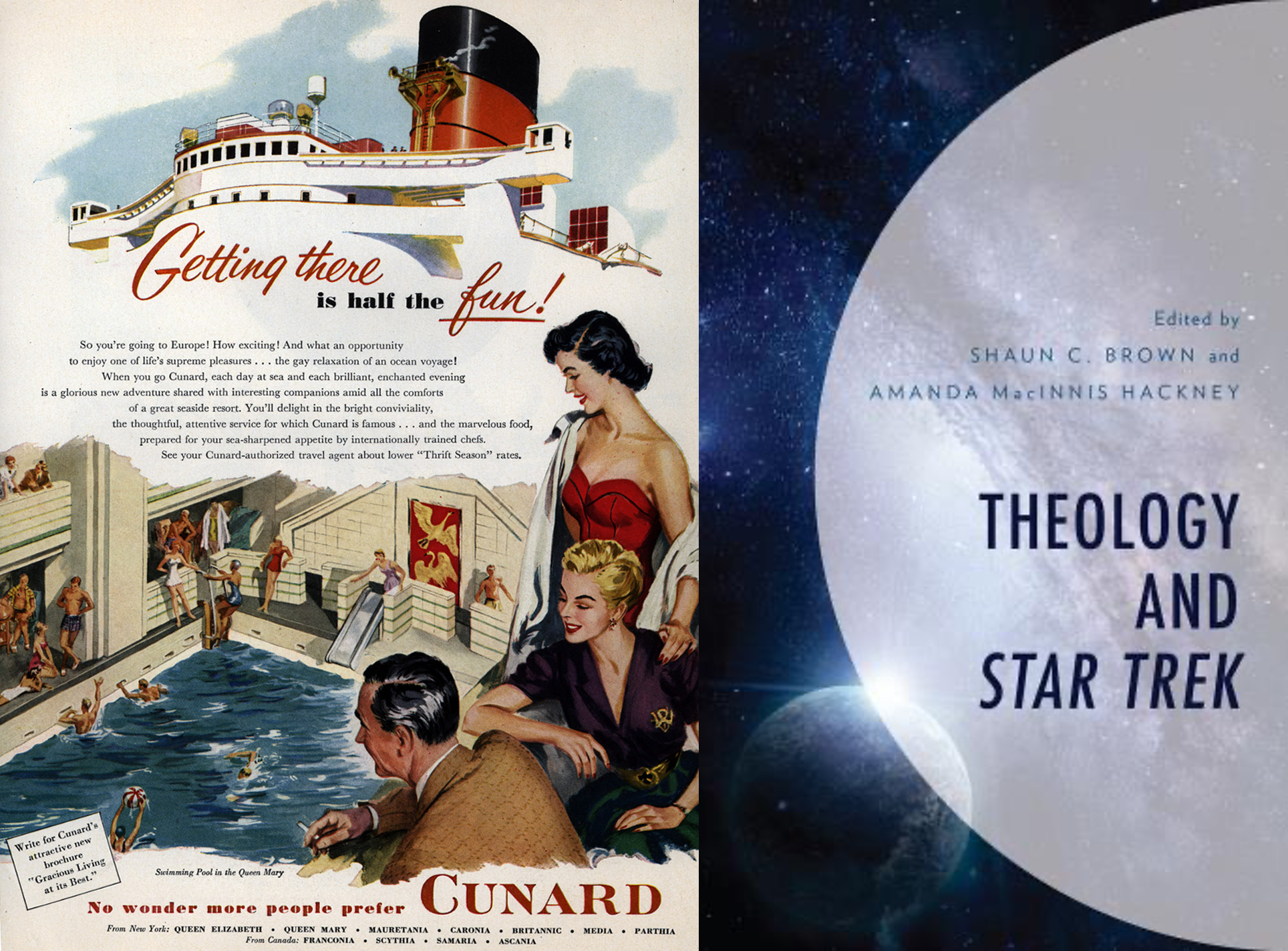
Whoever says “getting there is half the fun” is not referring to the arduous journey undertaken by writers seeking publication.

We writers – I say “we” because odds are you share my literary interests – we writers believe we have something to say that is worth hearing. Something that can genuinely benefit others.

That’s why we undertake the labor of writing, often without any financial reward. That’s why we risk revealing ourselves, becoming vulnerable to criticism and even ridicule.

This desire to share is why we invest the time and emotional energy required to imprint our thoughts and feelings on paper, literal and digital. It’s also the reason we strive to improve our literary skills. Writing well, is not easy.

Some writers enjoy the actual process of writing, but for many of us it is too akin to “work” to be considered fun. A decade ago, I wrote about “The Satisfaction of Writing.” 

In the post I confessed I don’t find the writing process all that grand. It was enlightening when I realized it’s not writing I enjoy, but the “satisfaction of having written.” And, having something published multiplies that level of satisfaction, particularly when what I have written finds a home in a publication edited by others.

And that brings me to my good news.

My Recent Publication

This week I received a complimentary copy of a new volume published by Rowman & Littlefield, an academic publishing house.

Theology and Star Trek gathers a group of scholars from various religious and theological disciplines to reflect upon the connection between theology and Star Trek anew.

Among the twenty chapter essays included in the volume is one written by yours truly. In “Starfleet’s AWOL Chaplain: Why Star Trek’s Federation Lacks Chaplains,” I explore Gene Roddenberry’s firm rejection of chaplains in his fictional universe.

I have been a fan of Star Trek ever since I watched the first episode of the original series air on September 8, 1966. And I am extremely proud to have contributed a chapter to Theology and Star Trek.

Allow me to share with you an insight I gained from this experience. It has to do with the project’s extended timeline. Admittedly, part of the delay was apparently caused by the covid epidemic, but even without that interruption, it takes a long time for an academic collection such as this to finally see print.

In October of 2018, I learned about the project and submitted an initial proposal for inclusion in the book. On New Year’s Eve I received acceptance of the proposal and an invitation to submit a “manuscript of approximately 5,000 words” by the first of May 2019. Deadline was extended to June first. First draft was mailed to the co-editors. After my extensive research, the manuscript numbered an immodest 17,442 words.

On July first I accepted the invitation to abbreviate my manuscript, which might be published in some future day, in an appropriately independent version as “a short book.” Revised chapter forwarded on 11 July: “Full word count now is 5549, but since 1528 are in the endnotes, the actual text for the chapter is only 4011, of which 169 constitute the abstract.”

Nearly a year later, on June 9, 2020, I received editorial suggestions from the editors and on June 30, 2020 I submitted my edited chapter. On September 11, 2021, the editors apologized for delays and said they were sending all of the essays out for peer review. On  June 11, 2022 I inquired with the editors as to whether the project may have been dropped, and was pleased to learn that it was still underway. The editor said the essays had been returned to writers to incorporate peer review comments. Since my essay had “only minor comments,” they were able to amend it without involving me. 

In July 2022 we worked together online with the Index, and reviewed our bio entries for the volume. On March 17, 2023 the publisher’s proofs for Theology and Star Trek were available for our personal review of our essays. April 11, 2023 marked completion of the corrected proof copy, and we added the actual pages for each of the subjects we had added to the index. Sent my final confirmation of the indexing, noticed a minor error in my chapter that was too late to fix, and waited for the arrival of my copy of the finished work . . . which arrived slightly under five years after I asked to join the project.

Lessons learned: (1) be more conscientious about meeting the word length guidelines, (2) be patient, and (3) remain patient.

Even as I share this extended timetable, I’m conscious of the fact I am no expert on the subject. I feel a bit like the people to whom C.S. Lewis referred in a 1952 letter to his publisher, Geoffrey Bles.

I often smile when I compare my ignorance with the knowingness of some people who, on the strength of having published one book, seem to have the whole mystery of publishing, printing, & binding by heart.

Advice to Writers

If you’ve followed Mere Inkling for a while, you’re aware I occasionally offer modest writing tips. 

Two years ago I wrote a post entitled “Are You an Author or an Editor?” In it I discussed some distinctions between different aspects of our writing lives. In “C.S. Lewis and the Oddities of Editors,” I highlighted that great author’s amazement at the arbitrary decisions made by editors.

I discussed a skill I have never mastered in “Brevity & Clear Communication.” In “Does Sincerity Result in Good Writing” I discussed C.S. Lewis’ thoughts about The Pilgrim’s Progress.

In “On Choosing Between a Child and a Book,” I even addressed the delicate subject of whether an individual would prefer to leave a book, rather than a child, as their legacy. Several more articles on related subjects are linked here.

A Word of Encouragement

Sadly, many aspiring writers feel like they will never “arrive” – in terms of seeing their words in “traditional” print. We must, nevertheless, remain persistent since, if we quit writing, that end is all but guaranteed.

However, when we read widely, and physically sit down with pen or keyboard, our chance of seeing our name in print rises geometrically. When we continue to study the art of writing and when we continue to sharpen our skills by stretching beyond our comfort zones, our efforts are often rewarded.

The internet abounds with stories of people who were not published until late in life. And there are many whose work only gained fame after their deaths.

Some popular writers, including C.S. Lewis and J.R.R. Tolkien, were prolific. They enjoyed some renown during their lives, but have only grown in their popularity posthumously. Many writers have left unfinished projects which have been published after their passing. In the case of these Inklings, this effort was spearheaded by Lewis’ secretary Walter Hooper and Tolkien’s son Christopher.

Waterstones, the British bookseller,  goes so far as to say “J.R.R. Tolkien is arguably one of the most posthumously-published authors there has ever been. The Silmarillion was compiled from notes he left behind, likewise The Children of Hurin and, in 2014, Tolkien’s prose translation of Beowulf was released.”

It may be unlikely that you are I will have anything published after our life ends. But, the words we pen might one day prove a blessing to others in a future family memoir. 

I encourage you to continue to write, whether publishers reinforce you or not. However small your audience may seem, virtually everyone recognizes there is value in expressing ourselves in this way. 

And, may the cost of your literary labors be outweighed by the satisfaction you gain as its reward.

Star Trek Postscript

Yes, if you check out the publication site, you will see that my name is listed last among all of Theology and Star Trek’scontributors. Even if this isn’t a consequence of alphabetical considerations, I’m not bothered. My simple inclusion in the volume is sufficient . . . and we struggling writers must never forget the words of Matthew 20:16.

Judging by Appearances

If books should not be judged by their covers, how much more true is it that we should avoid judging people by their initial appearance?

We don’t want others to be hasty in determining who we are, right? We need to take some time to get to know people before coming to “conclusions” about what they are like.

Yet we still tend to look at someone and – right away – assess whether they are trustworthy or not. I confess it is sometimes challenging for me to maintain an open mind. For example, teardrop tattoos (especially when accompanied by neck ink that combines letters and numbers), make me nervous.

First impressions are usually by their very nature superficial. Which means they often prove to be wrong. That’s true about people . . . and books.

Lewis scholar Dale Nelson recently sent me an interesting review of the book The Inklings, written by Humphrey Carpenter in 1978. The fascinating thing about the piece was that it was written by Lord David Cecil (1902-1986), who was himself an Inkling.

One of the things which drew my attention was his physical description of several of the members, especially C.S. Lewis. Without citing the maxim, he declares how misleading first impressions may be.

[Charles] Williams was the most obviously odd. Very tall, and indisputably ugly with a high forehead and with gleaming spectacles, he yet diffused a curious charm that came from an enthusiastic warmth of spirit united to a comic lack of inhibition. . . .

Lewis at first sight appeared less unusual; stocky, red-faced, loud-voiced, he might indeed have been taken for an innkeeper or even a butcher.

Such a mistake would not have displeased him, he liked to think of himself as representing the common man, in contrast to the sophisticated intellectual.

These observations were interesting, but there was something far more thought-provoking in the (excellent, by the way) review. More about that in a moment. First let’s return for a moment to the issue of book covers.

What about the Cover of the Book You are Writing?

I discussed covers, and Lewis’ thoughts thereon, in this post.

It’s unsurprising that with all of their many reprintings, the writings of C.S. Lewis have been published with a wide range of covers. Some of this can be attributed to the artistic fads of the decade in which particular editions saw print. More important, I believe, are the arbitrary tastes of publishers.

When it comes to self-publishing, authors are in complete control over the image that graces their literary creations. While I make no pretense of being an artist, I must confess at being shocked by the shoddy quality of many such works. Surely they are aware that the very best of writing can be marred by dreadful packaging. By the same token, even weak literature has received wider dissemination than it merited, due to stunning or alluring graphics.

The internet is filled with posts on this subject. These are representative:

Against Popular Advice, Books Continue to Be Judged by Their Covers” says, “for some, this can be a bitter pill to swallow, because writers want to believe that their work will speak for itself.”

The reality is that every person who steps into a book shop or browses books online is judging books by their cover, even if only subconsciously. I’m not saying that the judgment is always correct. Some books have amazing covers but are comprised of some pretty bad writing. I’d guess that many more amazing books are hiding behind bad cover art. The challenge is to get readers to pick up your book in the first place. That’s where the artwork comes in.

Another writer contends that potential readers do consider a host of matters. In “Why ‘Don’t Judge a Book by its Cover’ is Bad Advice,” the writer nevertheless admits it is the single most important element in winning an audience (short of a celebrity endorsement).

Readers are going to keep on reading and judging based on a whole host of criteria. The cover is just one of the many factors that are taken into account. Like other aspects of a book, it holds valuable information about the story kept inside.

Disregarding it is bad advice. Instead, why not try judging a book by its cover? Maybe next time you peruse the shelves of your neighborhood bookstore or scroll through the numerous titles listed online, you can select books purely based on the cover.

You never know, that could tell you everything you need to give that book a chance.

Covers are not the only factor in enhancing your book’s reception. Consider as well the nature of the paper in printed copies, as I discussed in “The Ugliest Book,” about a Mayan codex.

Now, back to the book reviewer.

David Cecil’s Thoughts on His Own Identity as an Inkling

After graduating from Oxford, Cecil briefly taught Rhetoric in London, before returning to Oxford, where he taught English. During his career, he wrote various works, including a number of literary biographies. These include: The Stricken Deer or The Life of Cowper, English Poets, Hardy the Novelist.

David Cecil was an accomplished man, and a true Oxford Inkling. The curious aspect is how, as the son of a marquess (bearing a courtesy title), socializing with a different caste, so to speak, would bond so well with the rest of the Inklings. Fortunately, Cecil briefly explains why he valued the fellowship in this book review.

Usually one of them would read aloud a piece from some book he was writing. . . . The meetings were also occasionally attended by persons who did not share The Inklings’ distinctive point of view but who liked spending an evening in their company.

I myself was one of these; I found such evenings enjoyable and stimulating; and all the more because the spirit of The Inklings was in piquant contrast to those of the Oxford circles in which I spent most of my time.

A final gift to those who treasure Lewis and his companions comes in Cecil’s incisive understanding of their unifying bond.

The qualities . . . that gave The Inklings their distinctive personality were not primarily their opinion; rather it was a feeling for literature, which united, in an unusual way, scholarship and imagination.

Their standard of learning was very high. To study a book in translation or without a proper knowledge of its historic background would have been to them unthinkable; they were academic in the best sense of the word.

But – and this is what made them different from most academics – they also read imaginatively. The great books of the past were to them living in the same way as the work of a contemporary. . . .

Simply they read their books in the spirit in which they were written. And they could communicate their sense of this spirit to their hearers so that, for these also, these great books sprang to fresh, full life.

This was a unique achievement in the Oxford of their time.

It appears the Inklings would be among the last to judge a book, or a person, by their cover.

Looking Toward the New Year with the Inklings

If we were to ask C.S. Lewis, J.R.R. Tolkien and the rest of the Inklings for insights about a New Year, what wisdom might they share?

Read on. Mere Inkling answers that question with a few select quotations from their writings. We also include comments from several other writers associated, in spirit, with the Oxford Inklings.

While some of the pithiest of the quotations below are well represented at quotation websites, your humble host has secured the less familiar quotations through the diligent search of obscure manuscripts.

J.R.R. Tolkien:

From a holiday letter to a friend.

“There is small chance of this reaching you tomorrow Jan. 1 to wish you a Happy New Year. I hope you have plenty of food in store! It is my birthday on Jan. 3rd, and I look like spending it in the isolation of a house turned igloo; but the companionship of several bottles of what has turned out a most excellent burgundy (since I helped to select it in its infancy) will no doubt mitigate that: Clos de Tart 1949, just at its top. With that hobbit-like note I will close, wishing you and your wife and children all blessings in 1962.”

As the world conflict raged on, Tolkien wrote to his son Christopher who was serving in the Royal Air Force. “This empty year is fading into a dull grey mournful darkness: so slow-footed and yet so swift and evanescent. What of the new year and the spring? I wonder.”

Christopher Tolkien:

A scholar in his own right, Christopher devoted much of his life to editing his father’s published and unpublished works. In The End of the Third Age, he reminds us that sometimes the jobs on which we embark end up being far more involved than we anticipated. “With this book, my account of the writing of The Lord of the Rings is completed. I regret that I did not manage to keep it even within the compass of three fat volumes.

C.S. Lewis:

“What wonderful adventures we shall have, now that we are all in it together.”

“You are never too old to set another goal or dream a new dream.”

“Isn’t it funny how day by day nothing changes, but when you look back, everything is different.”

“I must keep alive in myself the desire for my true country, which I shall not find till after death; I must never let it get snowed under or turned aside; I must make it the main object of life to press on to that other country and help others to do the same.”

“If you live for the next world, you get this one in the deal; but if you live only for this world, you lose them both.”

“There are far, far better things ahead than any we leave behind.”

“I think that if God forgives us we must forgive ourselves. Otherwise, it is almost like setting up ourselves as a higher tribunal than Him.”

Charles Williams:

“I think in order to move forward into the future, you need to know where you’ve been.”

“Play and pray; but on the whole do not pray when you are playing and do not play when you are praying.”

Owen Barfield:

“. . . the poet, while creating anew, is likely to be in a sense restoring something old.”

In a short story entitled “The Devastated Area,” Barfield, a veteran of WWI, described the way a soldier can view an uncertain future. “Armistice day; the last shot; and the hushed, doubtful little group in the dug-out at 11 o’clock. He is sitting there in uniform, willing for the first time in three years to let his thoughts run on into the future. But they will go back to the past instead . . .”

Adam Fox:

In his history of English hymnody, Fox praises his nation’s people and offers timely advice regarding musical accompaniment. “It takes no long argument to prove that Hymn Singing is a national institution in Great Britain. It is so rather in the same way as cricket. . . . The singing is usually accompanied on an organ, or if there is no organ, then on a piano. The harmonium, though sometimes used for the purpose, cannot be recommended, and is falling into disuse.”

Jack A.W. Bennett:

In The Humane Medievalist, Bennett praises his friend and fellow Inkling, C.S. Lewis. Coincidentally, this essay was his own inaugural lecture as he assumed the Cambridge chair which had been created for Lewis himself. “C.S. Lewis died a year ago today, and the year has deepened not diminished our sense of loss. Those of us who had the good fortune to call him master must feel as the prentice Hoccleve felt about Chaucer: ‘Fain he would me have taught, But I was dull, and learned little or naught.’”

Lord David Cecil:

He begins his biography of Lord Melbourne with a curious sentence suggesting that even we who have lived the most average of lives, may still have great things ahead of us. “William Lamb, second son of the first Viscount Melbourne, had arrived at the age of forty-seven without achieving anything of significance in the world.”

Hugo Dyson:

Discussing the Tragedies written by Shakespeare, Dyson reminds us to recognize potential blessings in the coming year’s challenges. “Our awareness both of ourselves and of the world at large is intensified by confrontation with an unexpected or serious or painful situation. Our wits and imaginations alike grow more acute under difficulties.”

Nevill Coghill:

Referring to Chaucer’s portrayal of the Knight, Coghill describes an ongoing goal for those who will to live nobly. “There is a fundamental answer to those who want to think the Knight’s moral nature . . . was too good to be true, and so can be no better than a romantic illusion. People who think thus can never have thought about Christianity at all; that we can live up to the moral demands that it makes on us, and that at any moment we may fall into the pit that opens beneath us, does not lessen the love we are taught . . . to have, and to attempt. Christianity plainly tells us to be perfect, impossible as it seems, impossible as it proves; but this does not make that demand less real, or even less realistic . . . Coming to the aid of human imperfection, there is grace.”

A Special Bonus for Mere Inkling Readers as the Year Ends

And a few additional thoughts from writers with connections to our favorite Inklings.

George MacDonald:

“A man’s real belief is that which he lives by. What a man believes is the thing he does, not the thing he thinks.”

A reminder to trust God for his daily provision. “It is not the cares of today, but the cares of tomorrow, that weigh a man down. For the needs of today we have corresponding strength given. For the morrow we are told to trust. It is not ours yet. It is when tomorrow’s burden is added to the burden of today that the weight is more than a man can bear.”

“Past tears are present strength.”

Dorothy Sayers:

“Paradoxical as it may seem, to believe in youth is to look backward; to look forward we must believe in age.”

G.K. Chesterton:

“When it comes to life, the critical thing is whether you take things for granted or take them with gratitude.”

Joy Davidman:

“Being a fool for God was not merely alright but liberating.”

“We do not need a world in which there is nothing to be afraid of . . . Nor can we have such a world, for all our strivings; no matter pleasant and safe we make the journey, the end of it is death. What we do need is to remember that we have been redeemed from death and the fear of death, and at a rather high price too.”

Douglas Gresham:

“I am beginning to realize that every point in one’s life at which one loses everything is far more a beginning than an end, for one has lost merely the past, and one has yet to gain the future, and eternity itself.”

And, encouragement for those among us who are writers: “Don’t forget, the rejection by a publisher of a book that you’ve written is not a failure.”

One Final Bit of Wisdom for the New Year

The internet offers lots of valuable information, accessible with the click of a key. Unfortunately, a significant amount of it is unsubstantiated, and downright false. This includes the quotations attributed to various people.

Some largescale quotation “aggregators” consider attribution on other unvalidated sites sufficient justification for loading the questionable citations to their own pages. For example, check out the quotations attributed online to Lord David Cecil. Or, better yet, don’t.

During my research for this post I discovered many of them – or, at least those most beneficial to reflective minds – actually come from the pen of Richard Cecil (1748-1810), an Anglican priest. Here is a grand example of misattribution, particularly appealing to a pastor such as myself: “It requires as much reflection and wisdom to know what is not to be put into a sermon, as what is.”

We’ll close now with an apocryphal C.S. Lewis quote. Despite scores of sites attributing the following thought to Lewis, no one can find it anywhere in his work. It is, however, consistent with his wisdom, and leaves us with an optimistic truth as 2021 draws to a close.

“You can’t go back and change the beginning, but you can start where you are and change the ending.”

Amen. Lord, grant all those who read these words of wisdom, both now and during years to come, a blessed New Year.

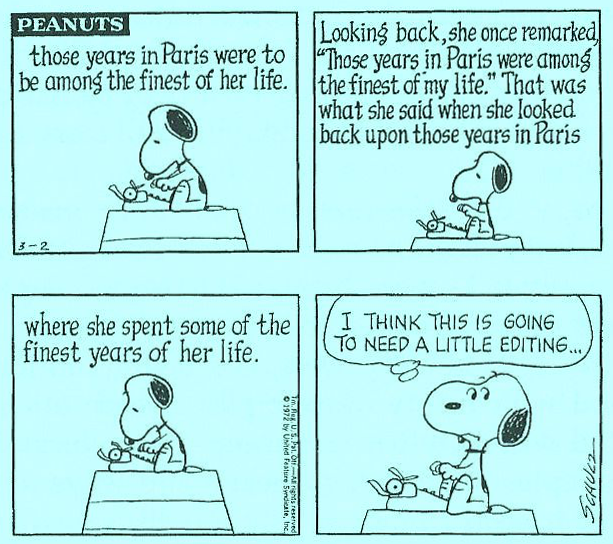
Are You an Author or an Editor?

Each writer brings a unique balance of talents to the task before them. Some excel at the initial writings. Others are especially talented at sharpening their work after the first draft has been created.

Understanding where we fit on that spectrum of author or editor, can be very empowering. Knowing our strengths and non-strengths is a major step in becoming a better writer.

Andy Le Peau worked for four decades at InterVarsity Press. His excellent blog, Andy Unedited, explores “books, life, and writing.” Five years ago he penned a short post that I still find extremely enlightening.

In “Authors are Like Pioneers—Editors Are Like Settlers,” Le Peau uses that unusual analogy to explain a creative tension at play in the lives of most writers I know. And, once we understand this fluid dichotomy, I believe it makes us better writers.

Authors tend to come up with new ideas and push them forward. They like to move into literary territories not explored before. Creating something new is like a shot of caffeine to their systems.

Good editors see how to improve a book, make it read better, clearer. They don’t try to shape the book in their own image. Rather they see the good that is already there and find ways to make it even more effective, better organized, clearer.

Good writers are usually pretty decent editors. Not expert, but adequate enough to recognize ways in which their own work can be improved. That’s why we call the “first draft” a first draft.

Now, if you consider your initial draft a finished product, you are definitely not a settler!

C.S. Lewis was a gifted writer. He also knew a great deal about editing, as I’ve discussed here in the past. I’ve even described his astonishment with the practices of some editors.

Lewis was quite open to revising his own work, even after it was published. In 1959, he wrote to one of his publishers, “Yes, there is one chapter of Miracles that needs revision. The result of the revision will, I think, make it shorter rather than longer. I’ll get onto this job as soon as I can.”

My Perspective on the Writing Process

While I embrace the pioneer or settler symbolism, I expand the analogy by thinking about my own writing process. I tend to think of it in three categories, with

Researching – Writing – Editing

To this process, if we desire to actually share our work, should be added at its end, “Submitting/Publishing.” Submitting refers to presenting it for potential publication in various media. By publishing, I refer to skipping the proverbial middle person, and posting your work online or using one of the self-publishing options readily available today.

In my personal context, I regard researching as a semi-independent stage of the writing process.

This may be due to the fact I focus on nonfiction. (Fiction writers can devote meager attention to it, and get away with it—not that they should ever ignore it.)

There are two additional reasons researching earns its own place in my writing process. First, because it is in my innate nature to be thorough and accurate. Second, I simply love the process. I know I’m in the minority.

Most writers prefer to get on with the task as soon as possible. I, however, am enslaved by my inherent curiosity to learn as much as possible about the undertaking as I can, before embarking on the actual writing. (And, yes, I recognize this may be exaggerated by my mortal tendency to procrastinate.)

To maintain the original analogy, in the spirit of Leif Erikson, I think of it this way:

Explorer – Pioneer – Settler

This works well for me, and I hope this post offers some insight and encouragement to you, as well.

Beware of Publishers

You can write a masterpiece, only to have it ruined by an inattentive publisher.

It would be bad enough if they filled your retelling of Romeo and Juliet with typos, what if you had just penned the ultimate authority on grammar, or perhaps, spelling?

Last month, British lexicographer Susie Dent released Word Perfect, a “brilliant linguistic almanac.” Unfortunately, the wrong (pre-proofed) version was published, and it was anything but “perfect.”

Although thoroughly embarrassed, Dent was gracious in regard to the error. “To be fair to my publishers, Covid has caused an extraordinary rush on pushing books through the production process, and in many ways it has been a laudable achievement getting anything published at all.”

Many of Mere Inkling’s readers are also writers. Some are fortunate enough to have professional publishers. Dent reminds us that we should not take them for granted, despite their occasional shortcomings.

C.S. Lewis was, of course, quite a prolific writer. This led to his interaction with a variety of different editors. Lewis freely expressed appreciation for a job well done, as I noted in his praise of a French translation of his work.

Lewis was also quite comfortable in discussing precisely how his writings should appear in print. In another post, I described his conversation with a publisher about the presentation of a Shakespearean quotation.

Similarly, Lewis possessed an awareness of the importance of the covers chosen for his books. And he lamented the quality of the paper dictated by wartime rationing.

Mere Inkling has included many other references to publishers in the past, although I am still searching for an ancient roman reference to Cave Scribae.*

Publishers and editors are often the targets of disaffected writers. If you have never seen Mark Twain’s delightful sketches on the subject, don’t shut down your computer before checking my post on the subject.

It would be good to pray that our personal attitudes towards publishers reflect those of C.S. Lewis and Susie Dent rather than Samuel Clemens, since Twain once summarized his attitude in this tragic manner:

If ever a publisher gets a non-terminable contract with an author, that author can never buy his freedom from that slavery on any terms. A publisher is by nature so low and vile that he—that he—well from the bottom of my heart I wish all publishers were in hell.


* Cave Scribae translates to “Beware of the Scribes.” It’s a reference to the ancient practice of publishers having scribes reproduce individual copies of a new work for sale or distribution. Since each copy was technically “unique,” one can only guess how many errors must have slipped surreptitiously into the duplicates.

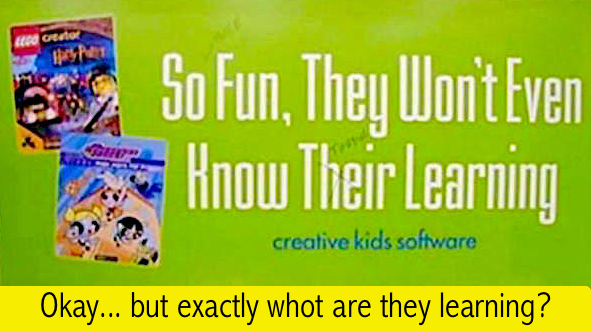
As for the illustration at the top of this column, there are countless examples of similar mistakes online. They are particularly alarming when they come from “educational” institutions. This one, from Oregon State University, offers a variation of the error illustrated above: “Many people know there learning style…”

Historical Font Facts

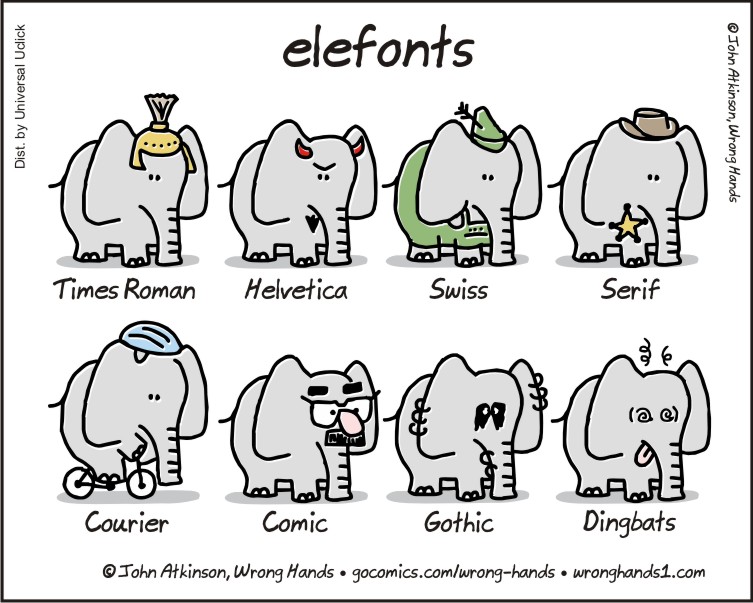
Consider yourself blessed if you’re not a fontaholic. The affliction leads to clogged font directories on your computer, and an unavoidable prejudice toward either serif or sans serif fonts.

People who are intrigued by typography know exactly what I’m talking about. At least two or three times a year they will inextricably find themselves on some font website (there are scores of them) without consciously knowing how they got there or there or there.*

I’ve written about fontaholicism in the past. Unfortunately, despite my advocacy, the Diagnostic and Statistical Manual of Mental Disorders has yet to classify the malady as a recognized illness. That said, the American Psychiatric Association does sound a bit obsessive compulsive in terms of their font guidance for annual meeting posters.

If any or all of the work in this poster was prepared with commercial support, a statement “Supported by funding from [name of company]” must be noted in the lower left corner of the poster in Arial 72 point font, with no bold, italics, special colors, or other enhancement of the company name, product, or any other portions of the statement.

One wonders what sort of reaction a person would get from the APA if they used Times Roman or Comic Sans by mistake.

C.S. Lewis & Fonts

It should be acknowledged up front that C.S. Lewis was not obsessed with fonts. However, he was wise enough to recognize their significant role in communication. Good fonts could be transparent, while problematic fonts blurred the message. He highlighted one of the most significant aspects of a font’s usage—size—in a 1957 letter. He told a fellow Brit, “you’d be much wiser to get my books in the American edition as these now have larger print and better paper than our own.”

A year earlier he had discussed a related issue with his publisher. There was a problem with a Shakespeare quotation intended for the title page of Till We Have Faces.

The quotation would, I agree, look better on a page to itself, but (what is more important) I am very strongly opposed to the idea of dividing it. I agree that it ‘looks wrong as it is’ but I think it will look equally with any division whatever. I do not see why it need be printed ‘absurdly small’ to fit in as one line . . .

Now a line of that length on a page to itself would I believe, look ugly if it came anywhere near the middle of a page–because it would then seem to divide the page into two halves. But would it not look quite nice if put near the top? It would then have the properties of a frieze or dado with plain wall under it.

And we may perfectly well omit the word ‘Shakespeare’ if we think that makes a better design. But I’d prefer even a bad design to a division of the verse.

Free Books about Fonts

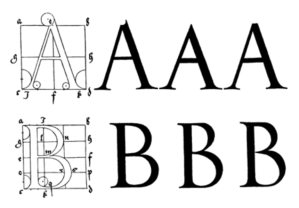
You can find a number of interesting books about fonts at some of the wonderful internet libraries such as Project Gutenberg. During recent historical research about Reformation-era artists, I discovered a book written by Albrecht Dürer (1471–1528). Since his fame is derived from his portraits of prominent people, I was surprised he had written a guide for properly shaping letters, based on geometric principles. The introduction provides a fascinating portrait of sixteenth century artistry in northern Europe.

In our Germany . . . are to be found at the present day many young men of a happy talent for the Art Pictorial, who without any artistic training whatever, but taught only by their daily exercise of it, have run riot like an unpruned tree, so that unhesitatingly and without compunction they turn out their works, purely according to their own judgment.

But when great and ingenious artists behold their so inept performances, not undeservedly do they ridicule the blindness of such men; since sane judgment abhors nothing so much as a picture perpetrated with no technical knowledge, although with plenty of care and diligence.

Now the sole reason why painters of this sort are not aware of their own error is that they have not learnt Geometry, without which no one can either be or become an absolute artist; but the blame for this should be laid upon their masters, who themselves are ignorant of this art.

Since this is in very truth the foundation of the whole graphic art, it seems to me a good thing to set down for studious beginners a few rudiments, in which I might, as it were, furnish them with a handle for using the compass and the rule, and thence, by seeing Truth itself before their eyes, they might become not only zealous of the arts, but even arrive at a great and true understanding of them.

Dürer’s book sparked my curiosity, and a very quick subsequent search hinted at the wealth of typographical information online. For example, you can read about The Typography of Advertisements, circa 1911. There you will be warned that bolder is not always better.

“But,” some one says, “the heavier and bolder type-faces furnish a greater contrast to the white of the paper, and therefore should be easier to read.”

It is true that a greater contrast of color is furnished in the use of the bolder type-faces, but to force these greater contrasts on the eye is to literally club it into reading the text, whether or no. Are the salesman’s statements of better selling value because they are shouted loudly in direct contrast to the quiet of the office?

There may be, and undoubtedly are, some on whom this force is necessary, but to those who are sufficiently educated and intelligent to be reached through the appeal of an advertisement, the quiet dignity of the salesman’s statements made in well-modulated tones will be more attractive.

Gaze back even farther, to what was considered Early Typography in 1872. There you will discover a medieval religious order devoted to worship and manuscripts.

Reference has more than once been made to the impulse given to learning at the end of the fourteenth and the beginning of the fifteenth centuries. This movement was helped forward by no one in Holland and Germany more than by Gerhard Groote, or Magnus, of Deventer, (b. 1326, d. 1370), who after studying theology at Paris, became a canon of Utrecht and Aix-la-Chapelle, and founded the Order of the Brethren and Clerks of the Common Life, generally known as the “Gemeiineslebens,” or “Frères de la Vie Commune . . .”

It was divided into the literary Brethren or Clerks, and the unlearned Brethren, who lived in different houses, but in bonds of the greatest friendship. The Clerks devoted themselves to transcribing books, the cultivation of polite learning, and the instruction of youth; and they erected schools wherever they went. The Brethren laboured with their hands, and pursued various mechanic trades. Neither were under the restraint of religious vows; but still they ate at a common table, and had a general community of goods.

There are many other curious titles available to those who choose to explore obscure typography in greater depth. A person might even wish to begin with 1891’s Specimens Of Book, Jobbing, And Ornamental Printing Type In Use In The Government Central Printing Office, Simla [India].

Fonts, fonts, fonts. As I said above, you are fortunate if they don’t draw you too deeply into their orbit. However, if you recognize you too are a fontaholic, take comfort in the knowledge that you are not alone.


* And here’s another font site I had never seen before writing this post. It has a delightful name, Font Squirrel. Once I finish writing this piece, you can guess where I will be spending some of my web surfing research time.

The Elefonts cartoon at the top of the page is a creation of talented Canadian John Atkinson, and is used with permission.