Do Not Read the Bible

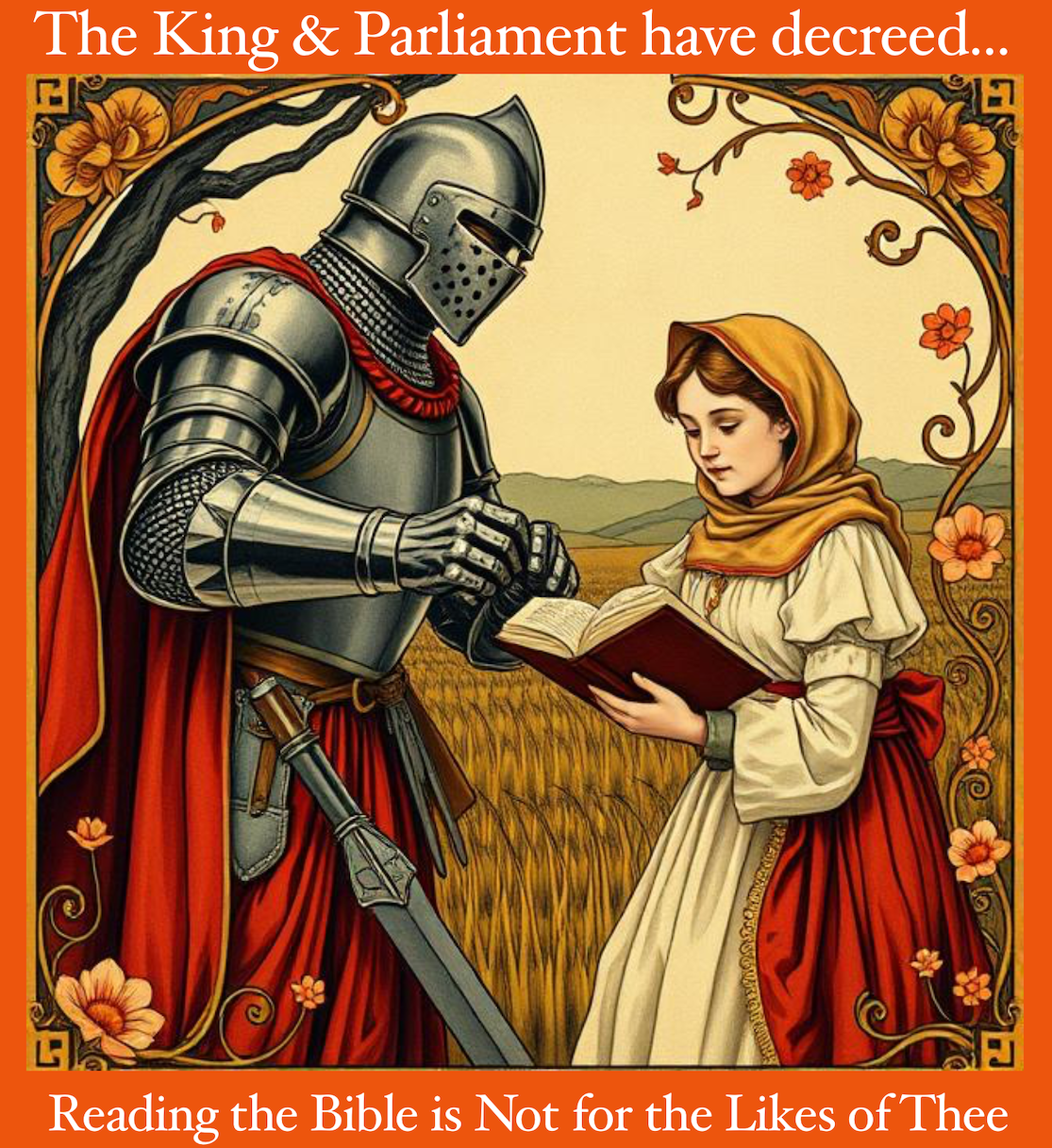
How would you respond if the government prohibited you from reading the Holy Scriptures? That was the situation in Great Britain when the Parliament passed the ironically named “Act for the Advancement of True Religion.”

Nearly five centuries ago, on May 12, 1543, Britain’s enlightened politicians and bishops determined that people of the “lower sort” needed to be protected from reading and interpreting the Bible themselves. 

Just sixty-one years later, King James VI/I would commission the translation of the Authorized Version, making God’s Word more accessible to all who could read English. William Tyndale (c. 1494 – 1536) had actually translated a fair portion of the Scriptures a decade prior to Parliament’s restrictive law. For this, and similar “Protestant” sins, Tyndale was strangled and burned at the stake in Belgium.

Even the so-called Great Bible had been authorized by Henry VIII in 1539. The approval decreed “one book of the bible of the largest volume in English, and the same set up in some convenient place within the said church that ye have care of, whereas your parishioners may most commodiously resort to the same and read it [emphasis mine].”

Nevertheless, not all of the powers that be apparently agreed with making the text of the Bible accessible to the common folk. We will consider this category of “inadequates” momentarily.

First let’s consider the distaste expressed by some for any modern translation of the Scriptures. (If you’ve ever attended a Bible study group you have probably encountered at least one person who insists on using the true KJV, despite the archaic language.

C.S. Lewis addressed this reticence for clear translations in an essay entitled “Christian Apologetics.” It was originally presented to Anglican priests and youth leaders in 1945.

“Do we not already possess,” [some will say] “in the Authorised Version the most beautiful rendering which any language can boast?” Some people whom I have met go even further and feel that a modern translation is not only unnecessary but even offensive.

They cannot bear to see the time-honoured words altered; it seems to them irreverent. There are several answers to such people. In the first place the kind of objection which they feel to a new translation is very like the objection which was once felt to any English translation at all.

Dozens of sincerely pious people in the sixteenth century shuddered at the idea of turning the time-honoured Latin of the Vulgate into our common and (as they thought) ‘barbarous’ English. A sacred truth seemed to them to have lost its sanctity when it was stripped of the polysyllabic Latin, long heard at Mass and at Hours, and put into . . . language steeped in all the commonplace associations of the nursery, the inn, the stable, and the street.

The Biblically Unworthy

So, who were these “lower sort” of individuals deemed unsuited for reading the Scriptures already translated into their native tongue? Well, they included “women, artificers, apprentices, journeymen, serving-men of the rank of yeoman and under, husbandmen and laborers.” Women of the gentry class were allowed an exception, being able to read the Scriptures, but only in private.

Fortunately, the law was short-lived. Henry’s son, Edward VI/I would have it repealed in the Treason Act of 1547. (Of course, this goodwill did not prevent Edward from condemning the translations of the aforementioned martyr, William Tyndale.)

Who Should Read the Bible?

The short answer is “everyone.” Yet the fact exists that some individuals are susceptible to confusion – or even to intentional twisting of the clear meaning of God’s Word. So, while the Scriptures should be accessible to all, it is wise to guide children and the easily-confused in their studies. After all, what we all desire is honest understanding and enlightenment.

This direct access is one reason Martin Luther, William Tyndale and others labored so tirelessly to translate the Bible into the vernacular. Cheerfully, “believers no longer had to read Latin [or Greek, Hebrew or Aramaic] to understand the word of God.”

As for those who would directly attempt to distort God’s inspired words, a clear example is found in the New World version paraphrase invented by Jehovah’s Witnesses. Another example, which I have discussed in the past, is the distorted abomination created by the Chinese Communist Party

There are also “abbreviated” versions of the Bible, which contain properly translated passages, but leave out passages that challenge preconceived positions. This would include Thomas Jefferson’s cut and paste Bible and an edition of the Scriptures developed for teaching slaves to read.


If you are interested in receiving daily notes about Christian history such as the one which prompted this post, visit the Christian History Institute.
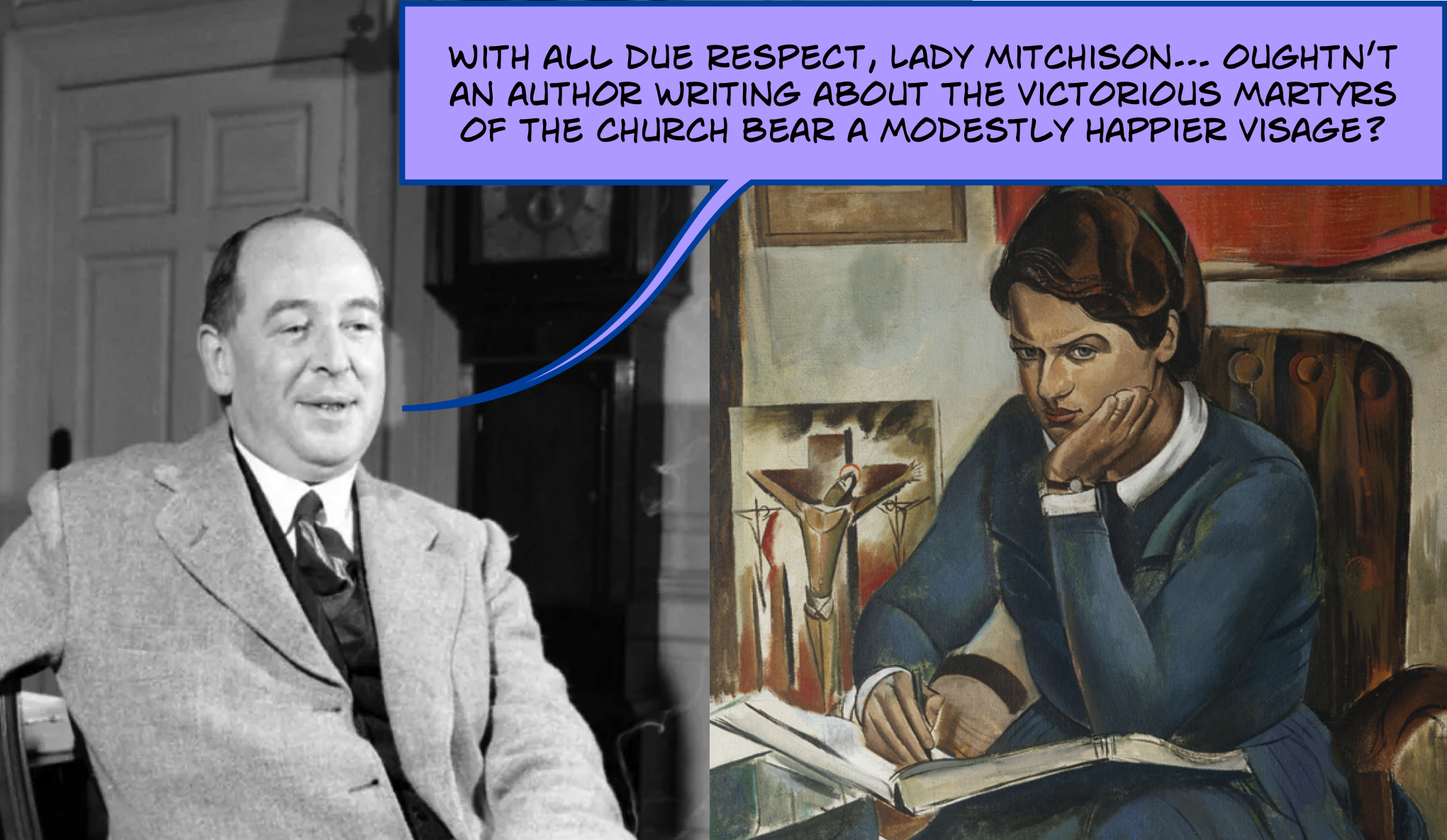
C.S. Lewis, J.R.R. Tolkien & Naomi Mitchison

Have your feelings about particular authors changed over time? C.S. Lewis’ attitude toward the work of prolific novelist Naomi Mitchison illustrates this type of progression.

Mitchison’s work possesses a direct link to another Oxford Inkling – J.R.R. Tolkien – whose Fellowship of the Ring she read in proof and favorably reviewed. Brenton Dickieson provides a priceless letter written by Tolkien to Mitchison in 1954.

Naomi Mary Margaret Mitchison was a Scottish novelist who lived more than a century (1897 – 1999). She penned more than ninety books, primarily historical fiction, and including science fiction.

With the outbreak of the First World War, Mitchison joined a Voluntary Air Detachment in a London hospital. (Other familiar women who served in a VAD included Agatha Christie and Amelia Earhart.)

Politically she identified as a Socialist. She was sufficiently leftist that George Orwell regarded her as unsuited for writing anti-Soviet materials for the United Kingdom during the Cold War.

Mitchison’s brother, J.B.S. Haldane, did not equivocate on his radical views, announcing his position as a Marxist. He was a scientist and his atheism brought him into serious disagreement with the Christian views of C.S. Lewis. (I will devote my next post to that interaction.)

Coincidentally, artist Pauline Baynes (who also worked with C.S. Lewis and J.R.R. Tolkien), provided the illustrations for at least one of Mitchison’s children’s books, Graeme and the Dragon. This quick review offers a concise synopsis and discussion of “the charming illustrations [which] go a long way toward making this a fun read.”

An additional coincidence: the same year Lewis published The Lion, the Witch and the Wardrobe, Mitchison also published a fantasy novel for children. The Big House involves time travel and some occultic themes associated with Halloween, etc.

For a thorough synopsis of The Big House and comparison to Lewis’ Chronicles of Narnia, check out this essay from the University of Glasgow. (That reviewer’s preference is clearly for Mitchison’s more complex approach with its themes related to class struggle.)

C.S. Lewis’ Perspective on Naomi Mitchison

I cannot locate any mention of C.S. Lewis by Mitchison, but he did mention her in passing in several pieces of correspondence. In essence, he praised her skill, but was put off by her graphic use of violent imagery.

In a 1932 letter to Arthur Greeves, he writes:

I thought we had talked about Naomi Mitchison before. I have only read one (Black Sparta) and I certainly agree that it ‘holds’ one: indeed I don’t know any historical fiction that is so astonishingly vivid and, on the whole, so true.

I also thought it astonishing how, despite the grimness, she got such an air of beauty–almost dazzling beauty–into it. As to the cruelties, I think her obvious relish is morally wicked, but hardly an artistic fault for she could hardly get some of her effects without it.

But it is, in Black Sparta, a historical falsehood: not that the things she describes did not probably happen in Greece, but that they were not typical–the Greeks being, no doubt, cruel by modern standards, but, by the standards of that age, extremely humane.

She gives you the impression that the cruelty was essentially Greek, whereas it was precisely the opposite. That is, she is unfair as I should be unfair if I wrote a book about some man whose chief characteristic was that he was the tallest of the pigmies, and kept on reminding the reader that he was very short. I should be telling the truth (for of course he would be short by our standards) but missing the real point about the man–viz: that he was, by the standards of his own race, a giant. 

Still, she is a wonderful writer and I fully intend to read more of her when I have a chance.

C.S. Lewis echoed his concern in a 1942 letter to another of his regular correspondents, Sister Penelope. “I gave up Naomi Mitchison some time ago because of her dwelling on scenes of cruelty. But I recognise real imagination and a sort of beauty in the writing.”

In 1951, C.S. Lewis congratulated author Idrisyn Oliver Evans (1894–1977) on the publication of The Coming of a King; A Story of the Stone Age. Ironically, speculative fiction set in this ancient era, referred to as “Prehistoric SF,” was also the setting of works such as H.G. Wells’ Story of the Stone Age series, which you can read here. Naomi Mitchison also dabbled in the prehistoric field. Lewis wrote to Evans: 

I congratulate you. And I think it is a great thing to put that idea of the Stone Age – which is at least as likely to be the true one – into boys’ heads instead of Well’s or Naomi Mitchison’s. It’s all good. The marriage customs are amusing . . . I hope it will be a great success. 

In 1959, C.S. Lewis provided some wise counsel to a young, aspiring author. The American student was contemplating a volume about the Roman subjugation of Gaul, which Lewis encouraged.

A story about Caesar in Gaul sounds very promising. Have you read Naomi Mitchison’s The Conquered? And if not, I wonder should you? It might be too strong an influence if you did (at any rate until your own book is nearly finished). On the other hand, you may need to read it in order to avoid being at any point too like it without knowing you are doing so.

I don’t know what one should read on Gaul. Apart from archaeological finds (Torques and all that) I suppose Caesar himself is our chief evidence? He will be great fun and I hope you will enjoy yourself thoroughly.

Which side will you be on? I’m all for the Gauls myself and I hate all conquerors. But I never knew a woman who was not all for Caesar – just as they were in his life-time.

C.S. Lewis’ most significant mention of Naomi Mitchison occurs in his brief 1943 essay, “Equality.”

It delivers a brilliant discussion of the subject, one that merits full reading. He commends one of Mitchison’s insights into inequality – although, ironically, she relates it to eroticism.* (You must read it in full context to understand how it supports his independent argument.)

This last point needs a little plain speaking. Men have so horribly abused their power over women in the past that to wives, of all people, equality is in danger of appearing as an ideal. But Mrs. Naomi Mitchison has laid her finger on the real point. Have as much equality as you please – the more the better – in our marriage laws, but at some level consent to inequality, nay, delight in inequality, is an erotic necessity.

Mrs. Mitchison [in The Home and a Changing Civilization] speaks of women so fostered on a defiant idea of equality that the mere sensation of the male embrace rouses an undercurrent of resentment. Marriages are thus shipwrecked.

A final reference to Mitchison brings us back around to my early note that she reviewed Fellowship of the Ring. C.S. Lewis refers to her review in his own, suggesting that she has not gone quite far enough in her praise.

Nothing quite like it was ever done before. ‘One takes it,’ says Naomi Mitchison, ‘as seriously as Malory.’ But then the ineluctable sense of reality which we feel in the Morte d’Arthur comes largely from the great weight of other men’s work built up century by century, which has gone into it.

The utterly new achievement of Professor Tolkien is that he carries a comparable sense of reality unaided. Probably no book yet written in the world is quite such a radical instance of what its author has elsewhere called ‘sub-creation.’

Sadly, Naomi Mitchison was less enamored with the subsequent volumes in The Lord of the Rings . . . but this post has already condensed more than enough information.


* An article in Michigan Feminist Studies notes how Naomi Mitchison’s recurrent references to sexual themes distracted from broader matters throughout her literary career.

Despite Mitichison’s attempts to move the discussion of her body of work from the salacious, it is the frank and open inclusion of sexuality that continues to intrigue her critics and reviewers. Racy, heated passages of Mitchison’s historical novels inspired comment from poet W.H. Auden in the 1930s (“Monstrous Sex: The Erotic in Naomi Mitchison’s Science Fiction”).

The essay’s thesis is what one might expect in a journal devoted to contemporary feminism.

I intend to demonstrate that the ribald sexuality of Mitchison’s work registers as more than merely provocative. Sexual encounters between female characters and aliens, as well as those between women, threaten an imperialising capitalism that dictates who may be loved in a gendered, racialised order.

Must Writing be a Solitary Endeavor?

It’s often said that “writing is a solitary task.” I find that’s only half true.

Sure, each individual is responsible for putting the words on the page (AI-cheats aside), but sharing your work with others before publishing it provides amazing dividends.

Not only can “other eyes” see flaws we are too close to the piece to recognize, good critiques often include suggestions to make our writing stronger.

I’ve occasionally described the benefits I’ve received from being a member of writers [critique] groups around the globe. I titled one of my posts “Be an Inkling,” because this mutual sharing was central to those brilliant minds who gathered together in Oxford.

In 1967, J.R.R. Tolkien described his reason for using that particular word in just such settings. He said he used the word Inkling as “a ‘jest,’ because it was a pleasantly ingenious pun in its way, suggesting people with vague or half-formed intimations and ideas plus those who dabble in ink.”

I too find it “pleasantly ingenious” and have echoed it here in my own domain. 

Conferences can be helpful too, but my experience is that nothing surpasses the encouragement that emanates from the mutual commitment shared by writers who physically gather to share their creations.

I noted above two concrete ways writing friends can contribute to strengthening our work. However, this third element – encouragement – cannot be underestimated. It was precisely this element that brought that masterpiece, The Lord of the Rings, to the world’s attention.

A Pilgrim in Narnia provides a superb account of C.S. Lewis’ essential role in boosting the confidence of his friend J.R.R. Tolkien. He cites a letter in which Tolkien describes how Lewis’ most precious gift was in challenging him to complete his opus.

The unpayable debt that I owe to him was not ‘influence’ as it is ordinarily understood, but sheer encouragement. He was for long my only audience. Only from him did I ever get the idea that my ‘stuff’ could be more than a private hobby. But for his interest and unceasing eagerness for more I should never have brought The L. of the R. to a conclusion.

Melancholy Transitions

Critique groups are weighing on my mind, since the one I’ve been part of for many years has come to its end. The passing of various members during the past decade left too few of us to continue, and we few who were left are mourning the fact that it was not sensible to continue meeting regularly.

It is another reminder of Solomon’s wisdom when he wrote, “For everything there is a season, and a time for every matter under heaven.”

Sadly, I lack the energy to help establish another new writing fellowship at this point in my life. Perhaps I will join one of the online communities. Christian Writers looks promising.

I actually participated in an online critique community back when primitive “bulletin board systems” were giving way to the nascent internet. No doubt the modern equivalent would be far better in every way.

In the meantime, I do have a few readers I trust to review my work before submitting it to an editor. One is my very talented wife. The problem there, however, is that her love (and compassionate nature) make her too gentle when she critiques my work. 

This drawback is one side of the coin to which author Dan Brown refers when he says: “I learned early on not to listen to either critique – the people who love you or the people who don’t like you.”

This does not mean, of course, that those who love us are unsuitable candidates. It simply suggests that we need to (often repeatedly) give them permission to offer genuinely critical comments, especially when they are accompanied by suggestions for how we might improve a given passage.

In essence although people like William Faulkner are correct in stating that “writing is a solitary job,” most of us can benefit from sharing our drafts with others. 

And fortunate are those of us who discover such friendship, where our writing companions are like-minded, trustworthy, self-confident, and honest. (I personally find having a sense of humor an essential trait, as well.)

In a word, we are greatly blessed to personally become part of our own fellowship of Inklings.

George MacDonald’s Poetry

George MacDonald (1824-1905) was a prolific Scot writer. His legacy was amplified due to his influence on G.K. Chesterton and C.S. Lewis. (He was also a friend of Mark Twain.) An essay, originally presented as a speech by G.K. Chesterton, is available online.

Chesterton goes so far as to say, “if to be a great man is to hold the universe in one’s head or heart, Dr. MacDonald is great. No man has carried about with him so naturally heroic an atmosphere.” Listen to his description of that special type of literature that inspired many Inklings, chiefly C.S. Lewis and J.R.R. Tolkien.

Many religious writers have written allegories and fairy tales, which have gone to creating the universal conviction that there is nothing that shows so little spirituality as an allegory, and nothing that contains so little imagination as a fairy tale. But from all these Dr. MacDonald is separated by an abyss of profound originality of intention.

The difference is that the ordinary moral fairy tale is an allegory of real life. Dr. MacDonald’s tales of real life are allegories, or disguised versions, of his fairy tales.

It is not that he dresses up men and movements as knights and dragons, but that he thinks that knights and dragons, really existing in the eternal world, are dressed up here as men and movements.

C.S. Lewis, for his part, praised MacDonald as instrumental in tilling the soil for his eventual conversion to Christianity. He was on the defensive, since the writers which most inspired him shared a common flaw – they were Christians.

All the books were beginning to turn against me. Indeed, I must have been as blind as a bat not to have seen, long before, the ludicrous contradiction between my theory of life and my actual experiences as a reader.

George MacDonald had done more to me than any other writer; of course it was a pity he had that bee in his bonnet about Christianity. He was good in spite of it.

Chesterton had more sense than all the other moderns put together; bating, of course, his Christianity. Johnson was one of the few authors whom I felt I could trust utterly; curiously enough, he had the same kink. Spenser and Milton by a strange coincidence had it too (Surprised by Joy).

Lewis would actually come to edit a selection of MacDonald’s passages for an edifying anthologyThis post includes a link for downloading a copy of George MacDonald: An Anthology.

This week I was reading one of MacDonald’s excellent essays, which appears in The Imagination and Other Essays. I intend to discuss some of his thoughts on age and writing soon. Although I am not an aficionado of poetry – despite having composed poetry from time to time, including quintains, I turned to another of MacDonald’s books.

On to His Poetry

I decided to follow up MacDonald’s brilliant essay with a dip into his poetry. Fortunately, Internet Archive allows you to freely download a complete copy of MacDonald’s Scotch Songs and Ballads, published in 1893. My conscience forces me, however, to provide a single caveat. Be forewarned that the tome is not suited for those intimidated by pronounced dialects.

Before looking at one of his poems in its entirety, allow me to share with you a passage from “The Waesome Carl” which I particularly enjoyed (due to its portrait of a preacher). 

The minister wasna fit to pray
And lat alane to preach;
He nowther had the gift o’ grace
Nor yet the gift o’ speech!
He mind’t him o’ Balaäm’s ass,
Wi’ a differ we micht ken:
The Lord he opened the ass’s mou,
The minister opened’s ain!
He was a’ wrang, and a’ wrang,
And a’thegither a’ wrang;
There wasna a man aboot the toon
But was a’thegither a’ wrang!
The puir precentor couldna sing,
He gruntit like a swine . . .

Not that I claim able to decipher it all, but my impression is that it’s not especially flattering. It is definitely entertaining. And I humbly think I interpret it significantly more accurately than Google’s online translator, which provided the following version.

The minister was not fit to pray
And lat alane to preach;
He nowther had the gift o’ grace
Nor yet the gift o’ speech!
He mind’t him o’ Balaam’s ass,
Wi’ a differ we micht ken:
The Lord he opened the ass’s mou,
The minister opened his eyes!
He was a’ wrang, and a’ wrang,
And a’thegither a’wrang;
There was a man aboot the toon
But thegither was wrong!
The puir precentor couldna sing,
He grunted like a swine. . .

Using the Dictionars o the Scots Leid, you can make perfect sense of the words about which you may be uncertain. (Thank you, Scotland.)

Dialects are interesting things indeed. I will close with another of MacDonald’s poems. I submit it for (1) those who comprehend the dialect, (2) those who deem precious their Scottish ancestry, (3) those with an affinity for Connor MacLeod, and (4) those who simply enjoy a challenge.

Nannie Braw

I like ye weel upo Sundays, Nannie,
I’ yer goon and yer ribbons and a’;
But I like ye better on Mondays, Nannie,
Whan ye’re no sae buskit and braw.

For whan we’re sittin sae douce, Nannie,
Wi’ the lave o’ the worshippin fowk,
That aneth the haly hoose, Nannie,
Ye micht hear a moudiwarp howk,

It will come into my heid, Nannie,
O’ yer braws ye are thinkin a wee;
No alane o’ the Bible-seed, Nannie,
Nor the minister nor me!

Syne hame athort the green, Nannie,
Ye gang wi’ a toss o’ yer chin;
And there walks a shadow atween ‘s, Nannie,
A dark ane though it be thin!

But noo, whan I see ye gang, Nannie,
Eident at what’s to be dune,
Liltin a haiveless sang, Nannie,
I wud kiss yer verra shune!

Wi’ yer silken net on yer hair, Nannie,
I’ yer bonnie blue petticoat,
Wi’ yer kin’ly arms a’ bare, Nannie,
On yer ilka motion I doat.

For, oh, but ye’re canty and free, Nannie,
Airy o’ hert and o’ fit!
A star-beam glents frae yer ee, Nannie–
O’ yersel ye’re no thinkin a bit!

Fillin the cogue frae the coo, Nannie,
Skimmin the yallow ream,
Pourin awa the het broo, Nannie,
Lichtin the lampie’s leme,

Turnin or steppin alang, Nannie,
Liftin and layin doon,
Settin richt what’s aye gaein wrang, Nannie,
Yer motion’s baith dance and tune!

I’ the hoose ye’re a licht and a law, Nannie,
A servan like him ‘at’s abune:
Oh, a woman’s bonniest o’ a’, Nannie,
Doin what maun be dune!

Cled i’ yer Sunday claes, Nannie,
Fair kythe ye to mony an ee;
But cled i’ yer ilka-day’s, Nannie,
Ye draw the hert frae me!

Addendum:

For those interested in pursuing this linguistic subject, I just came across a delightful 1896 collection of works you can download for free. Legends of the Saints: in the Scottish Dialect of the Fourteenth Century is “edited from the unique manuscript in the University Library, Cambridge.”


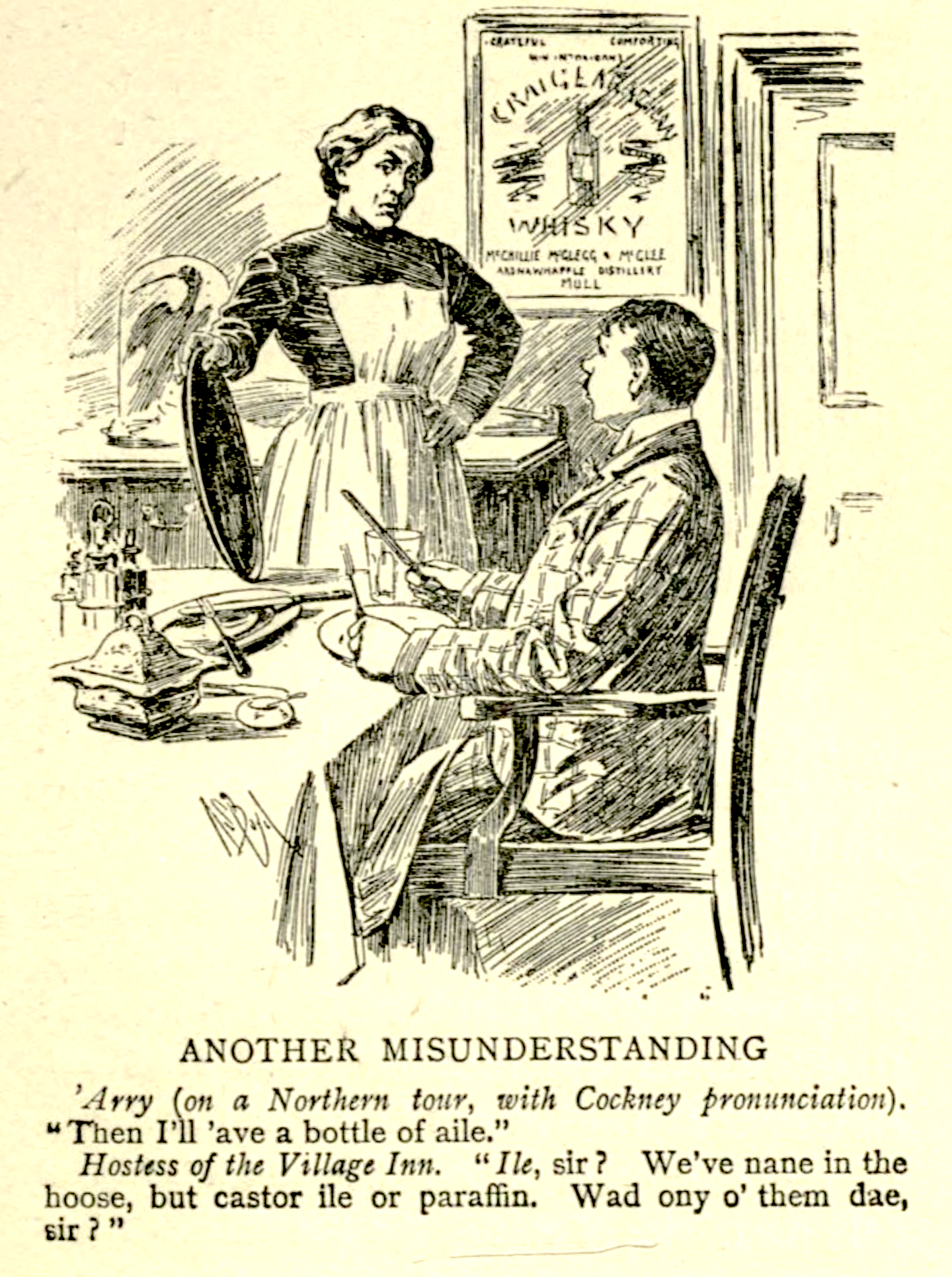
The cartoon above comes from Mr. Punch in the Highlands which was published “with 140 illustrations” more than a century ago. You can download your personal copy of humorous work at Internet Archive.

Books Enjoyed by C.S. Lewis

Reading is not only one of life’s pleasures, the content and ethos of what we read, subtly influences the shape of our very lives.

C.S. Lewis loved books with genuine passion. While many people only perceive books as compilations of information or as sources of fleeting entertainment, he knew them as far more. Only someone sharing Lewis’ affection and wisdom will identify with the following passage from his essay “An Experiment in Criticism.”

The man who is contented to be only himself, and therefore less a self, is in prison. My own eyes are not enough for me, I will see through those of others. Reality, even seen through the eyes of many, is not enough. I will see what others have invented. . . .

Literary experience heals the wound, without undermining the privilege, of individuality. There are mass emotions which heal the wound; but they destroy the privilege. In them our separate selves are pooled and we sink back into sub-individuality.

But in reading great literature I become a thousand men and yet remain myself. Like the night sky in the Greek poem, I see with a myriad eyes, but it is still I who see. Here, as in worship, in love, in moral action, and in knowing, I transcend myself; and am never more myself than when I do.

Lewis scholar and emeritus professor of English, Dale J. Nelson, has been providing a wonderful service in recent years as he explores the books which found a place in C.S. Lewis’ personal library. “Jack and the Bookshelf” is a continuing series which appears in CSL, journal of the New York C.S. Lewis Society. Founded in 1969, the organization “is the oldest society for the ​appreciation and discussion of C.S. Lewis in the world.”

Nelson’s task of editorially archiving C.S. Lewis’ library is complemented by the work of our mutual friend, Dr. Brenton Dickieson. In a “comment” praising Dickieson’s compilation of “C.S. Lewis’ Teenage Bookshelf,” Nelson offers a commendation with which I fully concur.

Thank you for assembling that list of books . . . I’d encourage Lewis’s admirers to take their appreciation of CSL to the next step and delve into the things he liked to read throughout his life.

Nelson’s contribution to the December 2023 issue is the fifty-ninth in his series, and discusses a fantasy work titled The Worm Ouroboros by E.R. Eddison. Eddison (1882-1945) was a Norse scholar, and his fascination with mountains combined with that, to resonate with Lewis’ passion for northernness.

Dr. Nelson, who has added an array of science fiction to his own academic work, possesses superb credentials for exploring the connection between Lewis and Eddison. 

Nelson relates that, at C.S. Lewis’ invitation, Eddison attended two gatherings of the Inklings. At the second, Eddison – who relished critiques of his works in progress, as do many serious writers – read from a project which would not be published due to his death the following year.

Eddison’s themes more closely resembled J.R.R. Tolkien’s than Lewis’ own. In Nelson’s words, both “Tolkien and Eddison wrote masterpieces of heroic fantasy whose values differed markedly.” 

Another distinction is that while Tolkien’s Lord of the Rings has maintained its mythic rigor, Eddison’s oeuvre feels rather anchored to the formative years of the genre, prior to the so-called Golden Age of science fiction (and fantasy).

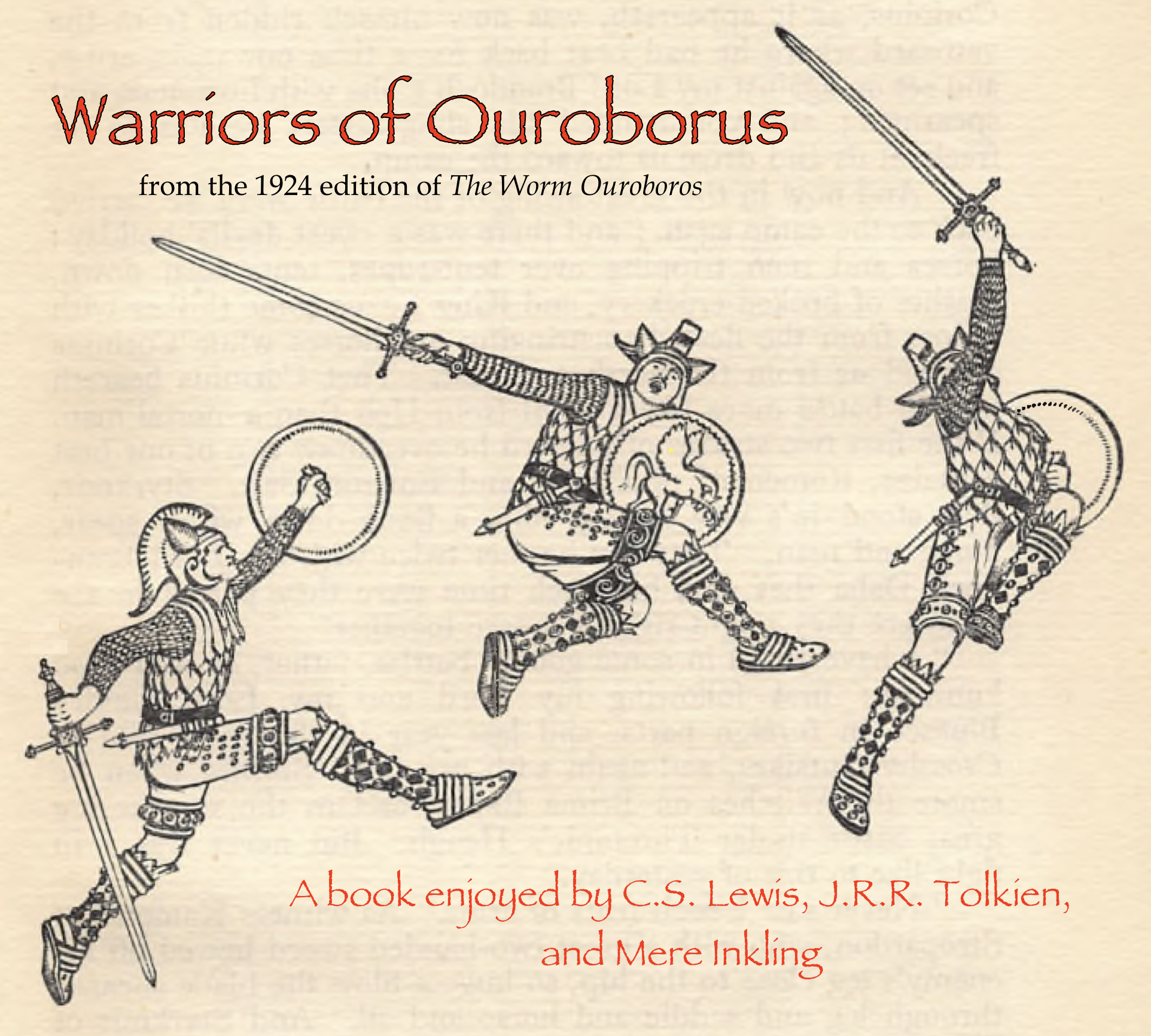
If you would like to read this book, which was enjoyed by both Lewis and Tolkien, you can download a copy of it at Internet Archive. If you enjoy dwarves, goblins, manticores and hippogriffs, you are unlikely to be disappointed.

Fonts that Can Make Your Literary Dreams Come True

Would you be interested in owning a copy of an attractive new font called Middle Earth? If so, read on and you’ll find a link to download this typeface created by Swedish designer Måns Grebäck.

When it comes to fonts, there are basically two types of people – those who pay no attention to them as they read, and others who notice the nuances between similar fonts and are fascinated by extraordinary examples.

Longtime readers of Mere Inkling know I am in the latter category. Every year or two I actually write on the subject. I’ve discussed monastic fonts, legal fonts, trustworthy fonts, uninhibited fonts, a dyslexia font, a memory-enhancing font, fonts based on the handwriting of historical figures, and being a fontaholic.

The reason for my current interest in fonts is due to Microsoft’s decision to jettison Calibri as their default font for Office products. They needed to make room for its replacement, Aptos. Seriously, when you view the two sans serif* fonts, side-by-side, you may be surprised at how little they differ.

To make matters even more confusing, CNBC describes a curious aspect of Aptos saga.

Aptos will remain available in the font list under the old Bierstadt name for people who are accustomed to it. Users can also choose to set any other font as the default.

Apple’s mac computers also allow users to choose their own defaults. One typography community discusses this selection opportunity, even as they bemoan the fact that in many programs, the standard installations include suboptimal fonts.

Unfortunately, many of us work on computers where we have no control over what fonts are loaded onto the machine, so we have created a list of the top 10 most common system fonts everyone should know and how to handle them.

This website offers a brief description and history of ten of the most common fonts we typically encounter. For example:

Times New Roman is a serif typeface designed by Stanley Morison and Victor Lardent in 1931. It was commissioned by the British newspaper The Times, which wanted a new typeface to replace its existing font, Times Old Roman.

And I love their estimation of Comic Sans, one of my wife’s favorite fonts, which I avoid like the proverbial plague. (Delores is a young at heart special education teacher, and I’m more of a Lewisian dinosaur.) 

Do use: if you are designing a comic for 6-year-olds.
Don’t use: if you want to be taken seriously by work colleagues.

Another pastor, who learned this lesson the hard way, shared his advice with the warning: “pastors don’t let your bulletins print out in Comic Sans!”

Apparently, his astute wife preserved his professional reputation by telling him to (1) avoid using a “smorgasbord of fonts” in a single document, and (2) “resist the temptation to print serious things in less than serious fonts.”

Advice for Writers

While authors have little control over the fonts in which their work is published by commercial publishers, they do have freedom to choose the typeface they use for the actual composition. “How To Choose the Best Font for Your Writing” addresses that latitude in the following way.

Do you have a favorite font? Are you dedicated to Times New Roman, or are you more of an “anything-but-Wingdings” kind of writer? Maybe you haven’t given your choice of font much thought.

Quite simply, as research shows, texts that look good make you feel good while interacting with them. This is why it’s so important to choose a font that not only is easy to read, optimizes line length, and has the right mood, but also is one that you like!

MasterClass describes the various aspects of each font that will contribute to your overall impression of each font. In “Typography for Writers: How to Pick the Best Type for Writing,” they explain the significance of bowls, ascenders, spines, counters, and more.

Typographers and type designers have their own universe of special terms, each of which refers to a specific part of a given letter. Understanding these basic elements of typography can help you decide precisely what typographic style you want to employ to grab your reader’s attention.

InDesignSkills goes so far as to match a number of typefaces to specific genres, saying “we judged the legibility, beauty, simplicity and variety of weights available of a huge range of fonts, and whittled them down to these faithful five.” They even offer an ironclad promise, proclaiming their selection will “never let your typesetting down, guaranteed.”

Obviously, personal tastes play a large role in appreciating or disapproving of various fonts. One author describes how the quest for the perfect font is integral to writers’ creativity.

Let’s talk about one of our favourite writing avoidance devices: picking the right font for your manuscript.

The Best and Worst Fonts (and why they’re good or bad),” describes the bond a writer can develop with their typographic fancies.

Fonts are one of the most important design choices to make when developing your brand identity. The best fonts leave you feeling like you’ve made an instant friend while the worst fonts are like a stranger who won’t leave you alone.

The writer offers her personal preferences (and prejudices). I don’t agree with all of her judgments, but I am forced to concur with her inclusion of Jokerman and Bleeding Cowboys on the list of “worst fonts.” And I am pretty sure that C.S. Lewis would agree.

Write in the Spirit of Middle Earth

If you have read this far, your reward is to receive the download link for Middle Earth. 

As noted aboved, Måns Grebäck is a prolific Swedish typographer. He makes many of his creations freely available to individuals for non-commercial use. (Commercial licenses are available as well.) The independent FontSpace describes it thusly:

With the historic charm of ancient manuscripts and the ethereal beauty of elven realms, Middle Earth typeface weaves tales of valor and legends. Its calligraphic allure is accentuated by rounded contours, reminiscent of Tolkien’s enchanted worlds.

Middle Earth truly is ethereally elegant. Enjoy.


* Sans serif fonts are those without serifs, which are the tiny lines or marks that appear at the end of a character’s stroke. Arial would be a common sans serif font, while Times New Roman is a familiar serif font.

Some Fresh Words

Here at Mere Inkling our admiration for C.S. Lewis moves us to emulate some of his practices. Thus, we are avid readers and we also enjoy learning new words.

Some of us even enjoy inventing new words. No, we’re not so presumptuous as to desire to wend our ways into the dictionary. We just find this creative game to be both fun and useful for promoting mental health.

The challenge is providing rational definitions for our neologisms. These meanings can be serious or absurd; that doesn’t matter. Here are four I recently devised. (More, from years past, are available in the links I have included above.)

: Zambaloney : noun

A succulent cut of meat served only in skating rinks while the ice is being resurfaced during formal sporting competitions.

: Teguchigulper : noun

The indigenous name for the Honduran species of Chupacabra.

: Belladonut : noun

The presentation of poison derived from the perennial Atropa belladonna in appealing confectionaries. See also, doughnut. 

: Sinderella : noun

The Brothers Grimm story about a beneficent stepmother who learns her two biological daughters are being terrorized by their physically beautiful yet wicked stepsister.

We’re Not Alone

If you have tried your hand at this, or at least think it’s curious, you might be surprised to learn there are online “word generators” that perform at least part of this function. Let me mention a couple before sharing some more of my own inventions.

Unfortunately, some only toss out made up words, in literary isolation. This is the case of Random Word Generator, which did, however, suggest the intriguing word “picneted.”

Nonsense Word Generator “generates nonsense words based on a frequency list of phonemes as they occur in legitimate English words.” They claim “an actual word may slip through occasionally but it should mostly generate pronounceable gibberish.”

Since gibberish isn’t what I’m after, and I haven’t yet found an artificial intelligence website offering what I seek, it’s up to human beings to fill the gap. I hope you enjoy at least one or two of my other neologisms which follow.

New Words & Apropos Definitions 

: Dramadairy : noun

A business offering various products created from camelid milk. Suspense is generated by the uncertainty as to the particular species from the genus Camelus that provided the day’s primary ingredient.

: Sir Mize : proper noun

A minor noble of the Carolingian dynasty noted for his skill at accurately assessing situations despite lacking clear evidence for his hypotheses.

: Fleedom : verb

The attempt to escape restrictions imposed by an autocratic government.

: Califate : noun

The final destiny awaiting those who seek to impose their religion on others by means of violence rather than through thoughtful conversation and compassionate service.

: Hippocampus : noun

Commonly considered a region of the brain, the word originally referred to the special academies where priestesses of Taweret schooled Egypt’s hippopotami to serve Pharaoh.

: Integreation : verb

The process through which individuals or different groups are incorporated into a common whole, resulting in a truly synergistic benefit to all.

: Sinergy : noun

The crippling illusion that one should embrace diverse expressions of evil simply because they have become a standard practice under a decadent worldview.

: Laboratorinthine : adjective

Applied to extremely complex, often inescapable, research and medical facilities hosting arcane experiments on human subjects. See also, “science fiction and horror tropes.”

: Confort : noun, verb

noun : The false sense of security felt by a vulnerable individual who is being successfully deceived by a criminal. See conforter.

verb : The act of pretending to render aid or support to someone in need while laying the groundwork for a malevolent action toward them.

: Pintacostal : noun

Members of an ecstatic religious sect who allege that their ancestors arrived in America in the fifteenth century aboard one of Christopher Columbus’ smaller caravels.

: Calumknee : noun

Defamatory statements, especially directed toward athletes, related to the largest joint in a particular person’s anatomy.

: Commaraderie : noun

The collegiality felt by writers who advocate the use of the Oxford comma in lists of three or more items.

: Peripathetic : adjective

Traveling from place to place and job to job without ever finding the right fit.

: Lyberry : noun

A fruit concoction comprised of berries cleansed with minute amounts of lye water, which can be fatal if mismeasured. Not to be confused with the tragic mispronunciation of “library.”

: Indogtrination : noun

The process of training people to uncritically embrace a canine belief system and obedience to arbitrary and sometimes self-injurious commands. Antonym of catechesis.

: Banalgesic : noun

A drug designed to reduce the pain induced by participating in a banal conversation.

: Farmageddon : noun

Subterranean postapocalyptic nutrient harvesting plants specializing in either edible algae or plant-based meat alternatives (derived from algae).

: Olympipad : noun

Special edition of Apple’s iPad scheduled for release in conjunction with Olympiad XXXIV in Los Angeles in 2028.

And, as a final tribute to that great writers and saints, C.S. Lewis and J.R.R. Tolkien:

: Nearnia : noun

A fantastical world which does not require a Wardrobe to discover, but is as close as one’s own inspired imagination. See also, “Median Earth.”

An Interstellar Accomplishment

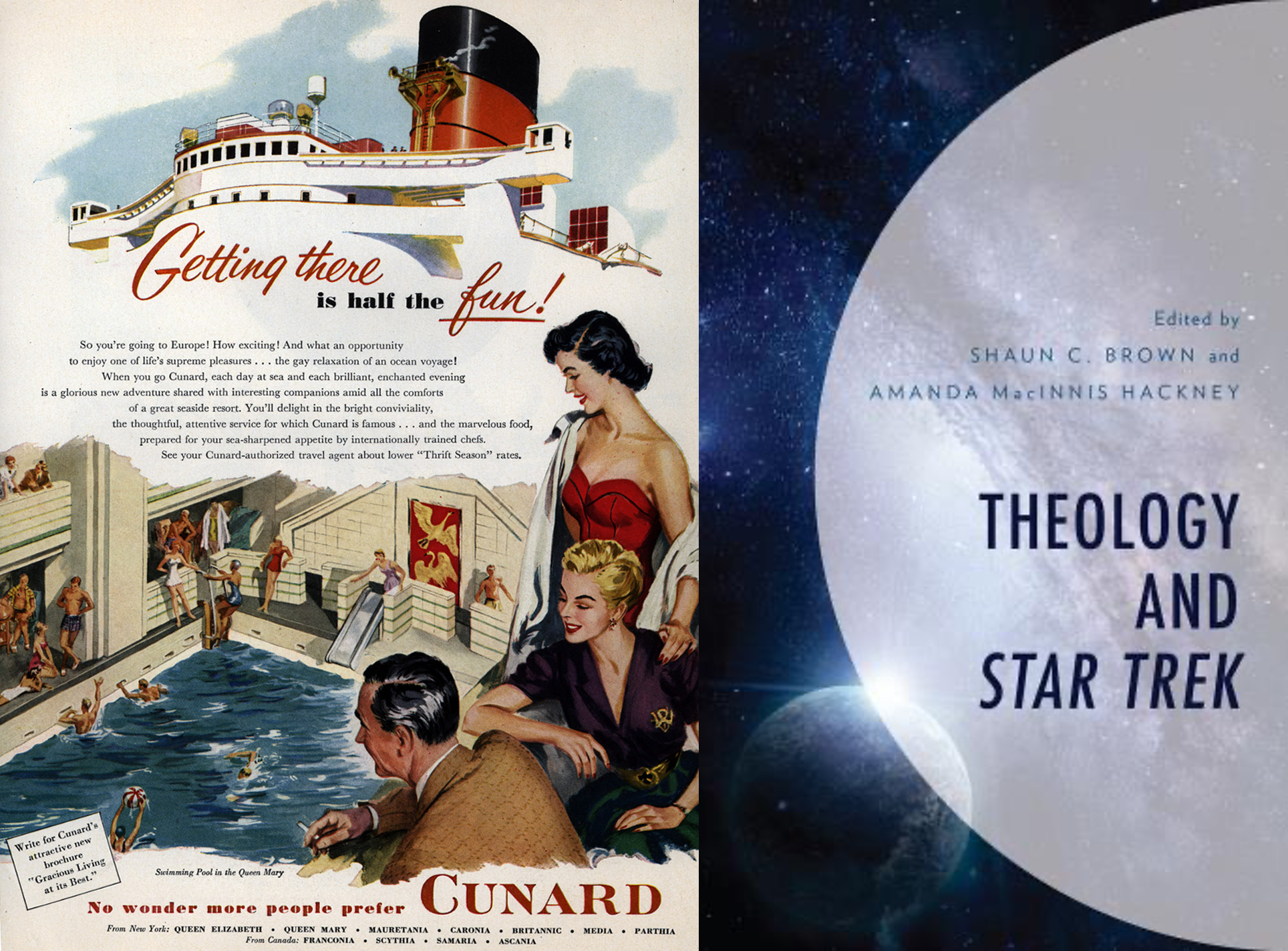
Whoever says “getting there is half the fun” is not referring to the arduous journey undertaken by writers seeking publication.

We writers – I say “we” because odds are you share my literary interests – we writers believe we have something to say that is worth hearing. Something that can genuinely benefit others.

That’s why we undertake the labor of writing, often without any financial reward. That’s why we risk revealing ourselves, becoming vulnerable to criticism and even ridicule.

This desire to share is why we invest the time and emotional energy required to imprint our thoughts and feelings on paper, literal and digital. It’s also the reason we strive to improve our literary skills. Writing well, is not easy.

Some writers enjoy the actual process of writing, but for many of us it is too akin to “work” to be considered fun. A decade ago, I wrote about “The Satisfaction of Writing.” 

In the post I confessed I don’t find the writing process all that grand. It was enlightening when I realized it’s not writing I enjoy, but the “satisfaction of having written.” And, having something published multiplies that level of satisfaction, particularly when what I have written finds a home in a publication edited by others.

And that brings me to my good news.

My Recent Publication

This week I received a complimentary copy of a new volume published by Rowman & Littlefield, an academic publishing house.

Theology and Star Trek gathers a group of scholars from various religious and theological disciplines to reflect upon the connection between theology and Star Trek anew.

Among the twenty chapter essays included in the volume is one written by yours truly. In “Starfleet’s AWOL Chaplain: Why Star Trek’s Federation Lacks Chaplains,” I explore Gene Roddenberry’s firm rejection of chaplains in his fictional universe.

I have been a fan of Star Trek ever since I watched the first episode of the original series air on September 8, 1966. And I am extremely proud to have contributed a chapter to Theology and Star Trek.

Allow me to share with you an insight I gained from this experience. It has to do with the project’s extended timeline. Admittedly, part of the delay was apparently caused by the covid epidemic, but even without that interruption, it takes a long time for an academic collection such as this to finally see print.

In October of 2018, I learned about the project and submitted an initial proposal for inclusion in the book. On New Year’s Eve I received acceptance of the proposal and an invitation to submit a “manuscript of approximately 5,000 words” by the first of May 2019. Deadline was extended to June first. First draft was mailed to the co-editors. After my extensive research, the manuscript numbered an immodest 17,442 words.

On July first I accepted the invitation to abbreviate my manuscript, which might be published in some future day, in an appropriately independent version as “a short book.” Revised chapter forwarded on 11 July: “Full word count now is 5549, but since 1528 are in the endnotes, the actual text for the chapter is only 4011, of which 169 constitute the abstract.”

Nearly a year later, on June 9, 2020, I received editorial suggestions from the editors and on June 30, 2020 I submitted my edited chapter. On September 11, 2021, the editors apologized for delays and said they were sending all of the essays out for peer review. On  June 11, 2022 I inquired with the editors as to whether the project may have been dropped, and was pleased to learn that it was still underway. The editor said the essays had been returned to writers to incorporate peer review comments. Since my essay had “only minor comments,” they were able to amend it without involving me. 

In July 2022 we worked together online with the Index, and reviewed our bio entries for the volume. On March 17, 2023 the publisher’s proofs for Theology and Star Trek were available for our personal review of our essays. April 11, 2023 marked completion of the corrected proof copy, and we added the actual pages for each of the subjects we had added to the index. Sent my final confirmation of the indexing, noticed a minor error in my chapter that was too late to fix, and waited for the arrival of my copy of the finished work . . . which arrived slightly under five years after I asked to join the project.

Lessons learned: (1) be more conscientious about meeting the word length guidelines, (2) be patient, and (3) remain patient.

Even as I share this extended timetable, I’m conscious of the fact I am no expert on the subject. I feel a bit like the people to whom C.S. Lewis referred in a 1952 letter to his publisher, Geoffrey Bles.

I often smile when I compare my ignorance with the knowingness of some people who, on the strength of having published one book, seem to have the whole mystery of publishing, printing, & binding by heart.

Advice to Writers

If you’ve followed Mere Inkling for a while, you’re aware I occasionally offer modest writing tips. 

Two years ago I wrote a post entitled “Are You an Author or an Editor?” In it I discussed some distinctions between different aspects of our writing lives. In “C.S. Lewis and the Oddities of Editors,” I highlighted that great author’s amazement at the arbitrary decisions made by editors.

I discussed a skill I have never mastered in “Brevity & Clear Communication.” In “Does Sincerity Result in Good Writing” I discussed C.S. Lewis’ thoughts about The Pilgrim’s Progress.

In “On Choosing Between a Child and a Book,” I even addressed the delicate subject of whether an individual would prefer to leave a book, rather than a child, as their legacy. Several more articles on related subjects are linked here.

A Word of Encouragement

Sadly, many aspiring writers feel like they will never “arrive” – in terms of seeing their words in “traditional” print. We must, nevertheless, remain persistent since, if we quit writing, that end is all but guaranteed.

However, when we read widely, and physically sit down with pen or keyboard, our chance of seeing our name in print rises geometrically. When we continue to study the art of writing and when we continue to sharpen our skills by stretching beyond our comfort zones, our efforts are often rewarded.

The internet abounds with stories of people who were not published until late in life. And there are many whose work only gained fame after their deaths.

Some popular writers, including C.S. Lewis and J.R.R. Tolkien, were prolific. They enjoyed some renown during their lives, but have only grown in their popularity posthumously. Many writers have left unfinished projects which have been published after their passing. In the case of these Inklings, this effort was spearheaded by Lewis’ secretary Walter Hooper and Tolkien’s son Christopher.

Waterstones, the British bookseller,  goes so far as to say “J.R.R. Tolkien is arguably one of the most posthumously-published authors there has ever been. The Silmarillion was compiled from notes he left behind, likewise The Children of Hurin and, in 2014, Tolkien’s prose translation of Beowulf was released.”

It may be unlikely that you are I will have anything published after our life ends. But, the words we pen might one day prove a blessing to others in a future family memoir. 

I encourage you to continue to write, whether publishers reinforce you or not. However small your audience may seem, virtually everyone recognizes there is value in expressing ourselves in this way. 

And, may the cost of your literary labors be outweighed by the satisfaction you gain as its reward.

Star Trek Postscript

Yes, if you check out the publication site, you will see that my name is listed last among all of Theology and Star Trek’scontributors. Even if this isn’t a consequence of alphabetical considerations, I’m not bothered. My simple inclusion in the volume is sufficient . . . and we struggling writers must never forget the words of Matthew 20:16.

A Bible Translation for Slaves

Only three copies of an abridged Bible printed in the United Kingdom remain in existence. To some, their very existence is scandalous. To others, they evidence the desire of Christians to promote spiritual liberation, even for those shackled by human chains.

The sole copy held in North America is in the possession of Fisk University in Nashville, Tennessee. Fisk is one of the United States’ distinguished  Historically Black Colleges & Universities (HBCUs), and was founded only six months after the end of the Civil War by the American Missionary Association.

Prior to returning the volume to Fisk, this extremely rare Bible was on loan to the Museum of the Bible in Washington, D.C.* During its exhibition there, the museum described it thusly:⁑

The Slave Bible, as it would become known, is a missionary book. It was originally published in London in 1807 on behalf of the Society for the Conversion of Negro Slaves, an organization dedicated to improving the lives of enslaved Africans toiling in Britain’s lucrative Caribbean colonies.

They used the Slave Bible to teach enslaved Africans how to read while at the same time introducing them to the Christian faith.

A Liberty Fund essay on the volume describes the thought process behind the editing. “The unknown editors intended to steer clear of any revolutionary verses that might spark interest in the idea of liberty,” they say.

For example, the selections from Genesis include the first three chapters, which cover the creation of the world and Adam and Eve in Eden but omits chapter four, which tells the story of Cain and Abel and the first murder.

Even an abbreviated Bible, however, retains the power to communicate a divine message. When C.S. Lewis discussed whether the Bible will become fashionable for secular literary study, he said the challenge would come in the fact that it is, in fact, sacred.

Unless the religious claims of the Bible are again acknowledged, its literary claims will, I think, be given only “mouth honour” and that decreasingly. For it is, through and through, a sacred book.

Most of its component parts were written, and all of them were brought together, for a purely religious purpose (“The Literary Impact of the Authorised Version”).

Because of that, I believe that C.S. Lewis would agree with me that this translation (stunted though it is) would retain the power to enlighten its readers. After all, we are not considering a version of the Bible to which human words have been added. What remains is still inspired. 

But in most parts of the Bible everything is implicitly or explicitly introduced with “Thus saith the Lord.” It is, if you like to put it that way, not merely a sacred book but a book so remorselessly and continuously sacred that it does not invite, it excludes or repels, the merely aesthetic approach. . . .

It demands incessantly to be taken on its own terms: it will not continue to give literary delight very long except to those who go to it for something quite different. I predict that it will in the future be read as it always has been read, almost exclusively by Christians (“The Literary Impact of the Authorised Version”).

Thus, I believe the missionaries who devised this edited version of the Scriptures did so with good intent. They would, I am sure, have preferred to deliver to their enslaved hearers the complete Word. However, in cases where slaveowners would bar the Bible altogether because of its themes of rescue, freedom, and the judgment of the powerful, the missionaries compromised their desires.

They deemed the benefits outweighed the compromise. The benefits being the opportunity to learn to read, and even more importantly, the Light that would still shine through the portions of God’s Word to which these precious souls would have access.

As C.S. Lewis noted in a 1952 letter, “it is Christ Himself, not the Bible, who is the true word of God. The Bible, read in the right spirit and with the guidance of good teachers, will bring us to Him.” And, upon making their compromise, these formerly barred missionaries would gain access to those who might otherwise never meet humanity’s Savior, who is the Word incarnate.

So, in order to provide at least a portion of the true Bible, they risked violating the New Testament precedent established in the Book of Revelation.

I warn everyone who hears the words of the prophecy of this book: if anyone adds to them, God will add to him the plagues described in this book, and if anyone takes away from the words of the book of this prophecy, God will take away his share in the tree of life and in the holy city, which are described in this book (22:18-19).

This is a fascinating subject, the various attitudes toward the education of people held in bondage. Various books have been written on the subject, and numerous primary sources describe the differing opinions all those involved. The perspective of “freemen” is particularly poignant. A freeman (or freedman), is a person who has been delivered from a state of slavery.

In the biblical sense, as defined in the International Standard Bible Encyclopedia, it is “one who was born a slave and has received freedom” and is commonly used to describe those who were delivered from “bondage to sin [and] presented with spiritual freedom by the Lord.”

For he who was called in the Lord as a bondservant is a freedman of the Lord. Likewise he who was free when called is a bondservant of Christ (1 Corinthians 7:22).

As we used to pray in the liturgy of my childhood – Grant this, O Lord, unto us all!

Online Resources for Further Reflection

Internet Archive not only offers many public domain works for free download. They also host many great texts that you can “borrow” online. Your local library remains a great place, but they probably don’t offer the following books related to this subject.

“When I can read my title clear:” Literacy, Slavery, and Religion in the Antebellum South

Masters & Slaves in the House of the Lord: Race and Religion in the American South, 1740-1870

Memoir of Mrs. Chloe Spear, a Native of Africa, who was Enslaved in Childhood, and Died in Boston, January 3, 1815

And, even more exciting, there are some period writings you can read and even download. A quick search turned up a copy of The Duty of Masters: a Sermon, Preached in the Presbyterian Church, in Danville, Kentucky. In 1846, the Rev. John C. Young devoted a significant portion of his message to the responsibility of slaveowners to promote literacy.

The duty of attending to the religious improvement of our servants comprises among others two important particulars – teaching and encouraging them to read God’s word, and inducing them to attend his worship. Many have avowed the doctrine that it is not right to teach servants to read the Bible – and in some of the States their instruction is prohibited by law.

Our posterity will doubtless wonder how so monstrous a doctrine could ever prevail to any great extent in a Christian land; and how good men could ever delude themselves into the belief that such a doctrine was consistent with the first principles of that gospel which is sent to the bond as well as the free, and which requires all who receive it to impart a knowledge of it to the utmost of their ability to all who have it not.

Amazingly, you can even download your own copy of Select Parts of the Holy Bible for the Use of the Negro Slaves in the British West-India Islands from Internet Archives. Determine for yourself whether it was better to share with the captives in the British West Indies these “select parts” or to ignore their plight altogether. A wise man once wrote:

The Church exists for nothing else but to draw men into Christ, to make them little Christs. If they are not doing that, all the cathedrals, clergy, missions, sermons, even the Bible itself, are simply a waste of time.

God became Man for no other purpose. It is even doubtful, you know, whether the whole universe was created for any other purpose (Mere Christianity).


* Coincidentally, the Museum of the Bible will also be hosting a live performance this summer of C.S. Lewis’ “The Horse and His Boy.” Check out the promo on their site to see how they creatively present the equine stars of the book on stage!

⁑ Yes, I understand that the “-ly” appended to “thus” is superfluous, since the word itself is an adverb, but it just sounds so right to my (as C.S. Lewis might appreciate) dinosaur ears.

The picture above, “Reading the Scriptures,” was painted in 1874 by Thomas Waterman Wood. 

Caring for Nature with an Inkling Spirit

I never thought I would become an apiarist, but living in forests of America’s Pacific Northwest made this a logical stage in my growth as a naturalist. And I’m convinced that if he had known how simple it is to promote healthy bee populations, C.S. Lewis would have joined me in the hobby.

After all, he delighted in their work ethic, describing the moment of their Narnian creation with the words, “Butterflies fluttered [and] Bees got to work on the flowers as if they hadn’t a second to lose.”

In “An Experiment in Criticism” Lewis discussed the value of seeing the world through the eyes of others. In awe of the majesty of creation he expressed a yearning to explore its myriad facets from perspectives other than his own.

The man who is contented to be only himself, and therefore less a self, is in prison. My own eyes are not enough for me, I will see through those of others. Reality, even seen through the eyes of many, is not enough. . . .

Even the eyes of all humanity are not enough. I regret that the brutes cannot write books. Very gladly would I learn what face things present to a mouse or a bee: more gladly still would I perceive the olfactory world charged with all the information and emotion it carries for a dog.

Like most people, I grew up thinking of beekeepers as the people who dress in protective gear and harvest the honey produced by those tireless little workers. Honeybees, however, are only one type of bee. The Treehugger site offers an illustrated page featuring the bee types, with Hoverflies (good, and in more than 6,000 species) and Wasps (bad, and in more that 100,000 species) thrown in.

The bees I help to encourage in our area are not honeybees or bumblebees, who form colonies. They are mason bees, who are solitary by nature. They don’t have an aggressive bone in their tiny bodies and they are excellent at their jobs. They “pollinate around 95% of the flowers they visit, whereas honey bees generally only pollinate about 5%.” 

C.S. Lewis, like his close friend J.R.R. Tolkien, loved nature. Like most people Lewis either knew nothing about solitary bees, or his attention was directed by default to the honeybees we prize for the honey refined in their hives. In 1930, he wrote to his friend Arthur Greeves about the deeper motivations that drive people such as themselves to become writers.

As for the real motives for writing after one has ‘got over’ the desire for acknowledgement . . . I found and find, that precisely at the moment when you have really put all that out of your mind and decided not to write again . . . precisely then the ideas – which came so rarely in the days when you regarded yourself officially as an author – begin to bubble and simmer, and sooner or later you will have to write . . .

Who knows . . . what will in the end reach the ear of humanity? The successes of our own age may be speedily forgotten: some poem scribbled in pencil on the fly leaf of a schoolbook may survive and be read and be an influence when English is a dead language. . . .

So . . . whether the necessity and duty of writing is laid on a man or not can soon be discovered by his own feelings. With remote consequences we have no concern. We never know enough. I think the thing is to obey the ordinary rules of morality . . . but for ultimate justifications & results to trust to God.

The bee builds its cell and the bird its nest, probably with no knowledge of what purpose they will serve: another sees to that. Nobody knows what the result of your writing, or mine . . . will be. But I think we may depend upon it that endless and devoted work on an object to which a man feels seriously impelled will tell somewhere or other: himself or others, in this world or others, will reap a harvest exactly proportional to the output.

In 1914, C.S. Lewis shared with his father a humorous anecdote from the Roman poet Virgil. 

Did you ever at Lurgan read the 4th Georgic? It is the funniest example of the colossal ignorance of a great poet that I know. It’s about bees, and Virgil’s natural history is very quaint: bees, he thinks, are all males: they find the young in the pollen of flowers. They must be soothed by flute playing when anything goes wrong etc., etc.

C.S. Lewis enjoyed his laugh at Virgil’s poetic ignorance about bees. Coincidentally, he would discuss the humble creatures in a poem of his own. It appears in his posthumous Poems collection, as the fourth and fifth of his “Five Sonnets.”

Pitch your demands heaven-high and they’ll be met.
Ask for the Morning Star and take (thrown in)
Your earthly love. Why, yes; but how to set
One’s foot on the first rung, how to begin?
The silence of one voice upon our ears
Beats like the waves; the coloured morning seems
A lying brag; the face we loved appears
Fainter each night, or ghastlier, in our dreams.
“That long way round which Dante trod was meant
For mighty saints and mystics not for me,”
So Nature cries. Yet if we once assent
To Nature’s voice, we shall be like the bee
That booms against the window-pane for hours
Thinking that way to reach the laden flowers.

“If we could speak to her,” my doctor said,
“And told her, “Not that way! All, all in vain
You weary out your wings and bruise your head,”
Might she not answer, buzzing at the pane,
“Let queens and mystics and religious bees
Talk of such inconceivables as glass;
The blunt lay worker flies at what she sees,
Look there—ahead, ahead—the flowers, the grass!”
We catch her in a handkerchief (who knows
What rage she feels, what terror, what despair?)
And shake her out—and gaily out she goes
Where quivering flowers stand thick in summer air,
To drink their hearts. But left to her own will
She would have died upon the window-sill.”

British Bees

The British are quite enamored with quaint names for their public houses. Because of that, I knew I would be able to find a suitable pub to feature at the top of this post. I was, however, caught off guard by an embarrassment of riches in the return to my google search.

In addition to “The Bumble Bee” in Quedgeley pictured above (which I chose because of the lamppost in the garden), I found images of similarly named pubs in Blackwood, Flitwick, Gloucester, Gwent, Westoning, and Fleur-de-lis, Wales.

I’m sure I could find many other tributes to buzzing pollinators, if I broadened my search to include pubs like “The Beehive” in Egham or “The Golden Bee” in Stratford-upon-Avon.

The story of one more bee will bring our reflections to an end. In his early diary, All My Road Before Me, C.S. Lewis mentioned a number of visits to Bee Cottage, where some of his friends occasionally resided. For example, one summer Sunday in 1922, he recorded:

After lunch I bicycled to Beckley and called at Bee Cottage where I found [Cecil] Harwood alone and reading in a pleasant, stumpy 18th Century Bible. He quoted from Genesis “Whatever Adam called anything, that was the name of the thing,” as an excellent definition of poetry.

Once lost to the mysteries of time, the precise location of Bee Cottage has been discovered, as we can read in Bee and Church Cottage.

Laurence Harwood, C.S. Lewis’s godson, was a lecturer at [the 2009] Summer Seminar on C.S. Lewis Remembered.  His father, Cecil Harwood, was a close personal friend of Lewis as well as fellow Inkling Owen Barfield. 

Harwood and Barfield had often rented a small cottage-Bee Cottage-in Beckley, a few miles from Lewis’s home in the Kilns, and Lewis often visited the place (perhaps while on walking tours though the countryside just like his character Elwin Ransom).  Unfortunately its precise location was lost and remained unknown.

Following the lectures, “Laurence decided that searching for the cottage would be a . . . great way to remember Lewis.” He and several friends “managed to locate the small house, and found that it looked just as anyone would have expected-the waning summer sun sinking behind it, and the bees buzzing about the lavender plants alongside the stairs.”

Bees are important members of our environment. Many would argue they are essential and famine would certainly follow if they became extinct. The Environmentor says,

If all the bees died, humans would become responsible for taking up the slack. This is already happening in China, where a majority of the bees have already died. People take buckets full of pollen and “paint” the pollen on with a paintbrush.

But, this could only be done with a few of the plants that require pollination because there simply aren’t enough humans to perform the task.

The alternative, offered by Brittanica is that we could “robo-pollinate.” But I have already written about where that ominous trend might lead. 

I think it’s best that we diligently care for bees we currently enjoy, and nurture all their future generations. And I believe C.S. Lewis would agree.