C.S. Lewis & Anodyne Writing

Do you practice anodyne writing? Or, perhaps you enjoy reading anodyne literature?

Talk about a phrase with two different meanings!

I must not be reading the right publications, because until recently I was only aware of the medical sense of the word. Apparently I’m not alone in having forgotten the second usage (if I ever knew it). One “publication coach” writes:

I always welcome the chance to learn new words—or to cement the knowledge of words I should know already. Anodyne falls into this latter camp. I probably confer with my dictionary at least once a year to determine the meaning of this word and yet, despite the frequent checking, I can’t seem to hold the definition in my brain.

Like so many words, anodyne enters English, via Latin, from Greek. It’s literal meaning is “without pain.” Thus, it typically refers (as a noun) to medicines or medical treatments devoted to eliminating pain.

By extension, anodyne is also applied (as an adjective) to other things, such as writing. In this context it would refer to writing where the purpose is to comfort, or to alleviate pain. This is the good sense of the word.

An example of this use appears in “L.M. Montgomery’s The Watchman and Other Poems, a Review.” There, Brenton Dickieson expertly describes the value good-but-not-great poetry by affirming its reassuring essence in its historical context. “Any one of these poems is quite nice on its own and an anodyne to the negative poetry of many of the WWI poets.” A positive, and astute, assessment.

There is, however, a second sense in which anodyne is applied to literature.* It may mean something so inoffensive, so innocuous, that it becomes boring.

At one university writing center they describe this evolution of the word.

[An anodyne word] lets a disturbing idea be described in a soothing manner. . . .

The OED Online lists several definitions, all about a procedure or medicine that eases pain, the oldest dating from the 16th Century. Only more recently has the word come to include anything that may avoid a strong response. It can mean something so inoffensive as to be bland, the cafeteria pudding of language.

So, as for anodynic writing, it is admirable when it relieves pain and suffering. If its primary goal is to be innocuous, that’s another matter. Essentially, comfort—good, pablum—not so much.

Lewis’ Use of Anodyne

Unsurprisingly, C.S. Lewis uses this word in its positive sense of alleviating discomfort. Two occurrences in The Screwtape Letters will illustrate. (Remember, these words of the counsel of one demonic tempter to another.)

But hatred is best combined with Fear. Cowardice, alone of all the vices, is purely painful—horrible to anticipate, horrible to feel, horrible to remember; Hatred has its pleasures. It is therefore often the compensation by which a frightened man reimburses himself for the miseries of Fear.

The more he fears, the more he will hate. And Hatred is also a great anodyne for shame. To make a deep wound in his charity, you should therefore first defeat his courage.

Not only do the demons seek to foster hatred in their human targets, they encourage us to seek counterfeit solace in destructive places.

In the first place I have always found that the trough periods of the human undulation provide excellent opportunity for all sensual temptations, particularly those of sex. This may surprise you, because, of course, there is more physical energy, and therefore more potential appetite, at the peak periods; but you must remember that the powers of resistance are then also at their highest.

The health and spirits which you want to use in producing lust can also, alas, be very easily used for work or play or thought or innocuous merriment. The attack has a much better chance of success when the man’s whole inner world is drab and cold and empty. . . .

It is the same with other desires of the flesh. You are much more likely to make your man a sound drunkard by pressing drink on him as an anodyne when he is dull and weary than by encouraging him to use it as a means of merriment among his friends when he is happy and expansive.

Never forget that when we are dealing with any pleasure in its healthy and normal and satisfying form, we are, in a sense, on the Enemy’s [God’s] ground. I know we have won many a soul through pleasure. All the same, it is [God’s]  invention, not ours. He made the pleasures: all our research so far has not enabled us to produce one. All we can do is to encourage the humans to take the pleasures which our Enemy has produced, at times, or in ways, or in degrees, which He has forbidden.

Having read the majority of what C.S. Lewis published, I assert with certitude that his writing is anodyne—it is healing. Some of it may be discomforting (for a moment), and much of it may be demanding (in the sense of requiring our mental and spiritual focus to understand it), but it was all written to edify.

Postscript, Star Date 73890.7

There is one more use of the word anodyne which I did not include above, due to its fictional source. In the Star Trek universe, the starships rely on a massive number elements, including the ubiquitous “anodyne relay.”

The circuits invariably appear to be perfectly reliable during routine missions. However, they are prone to malfunctioning at critical moments and threatening the lives of everyone aboard.


* Anodyne is also applied—in both its positive and negative senses—to music and other activities.
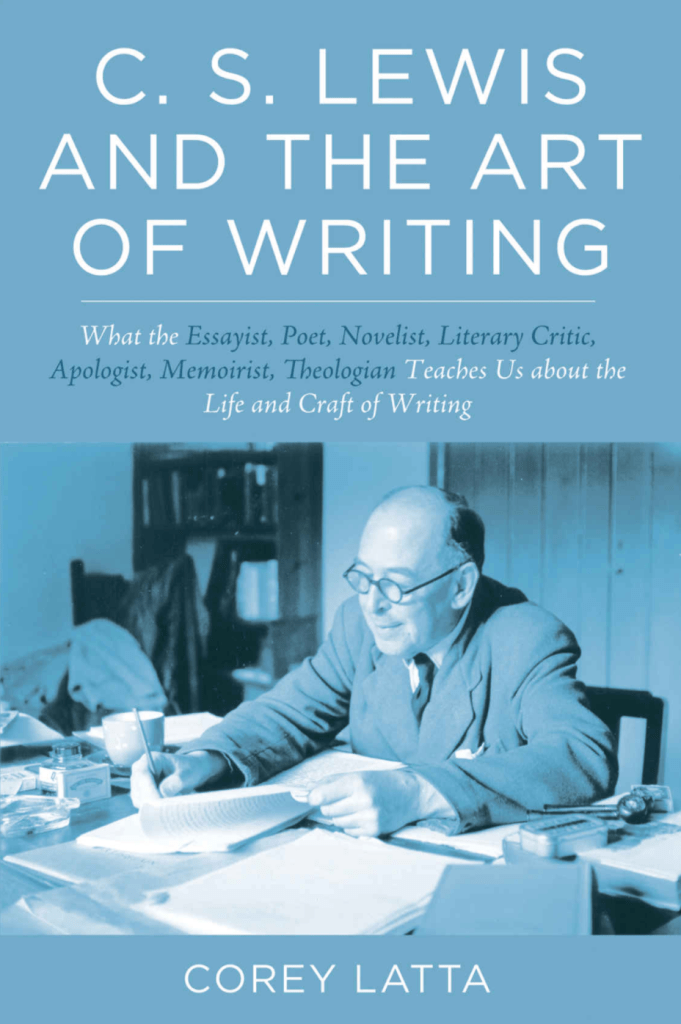
Add this Book to Your Library

No one can teach us to “write like C.S. Lewis.” The great author was definitely one of a kind.

It is possible, however, to study Lewis’ advice about writing. And that is a journey well worth taking.

Many students of C.S. Lewis are quite curious about his advice for writing well. And, for the proverbial “limited time,” the premier study of that subject is available at an unbelievable price.

The kindle version of C. S. Lewis and the Art of Writing: What the Essayist, Poet, Novelist, Literary Critic, Apologist, Memoirist, Theologian Teaches Us about the Life and Craft of Writing is only three dollars at amazon. (Great subtitle, right?)

Coincidentally, I only recently purchased the volume for my Logos library (at a significantly higher cost). I’ve yet to read it, but it appears to be worth what I paid. Still, I don’t want any readers of Mere Inkling to miss out on this opportunity to get such a bargain.

Wipf and Stock, the publishers, regularly place a few titles from their excellent list on sale. The current offering features another book I previously purchased at full price, The Gospel According to Star Trek: The Original Crew. (I mention that, confident there is at least one other trekkie out there reading this.)

Writing about Writing

Many people who follow blogs such as Mere Inkling are bloggers themselves. It’s rare to find a writer who doesn’t also like to read. And because of the complementarity of reading and writing, books about writing always find an audience.

In my “works in progress” (research) files, I have a handful of projects related to writing. One of them is—digital drumroll—C.S. Lewis on Writing.

That’s the main reason I haven’t begun reading the book I’m recommending. While I assume our approaches to the topic will be different enough to avoid any suggestion of plagiarism, I’m reluctant to open the door to unsought influences.

I have never plagiarized, and never will. In fact, I tend to overattribute thoughts. So, eventually I will read the work, since I’m forearmed with my integrity, and I understand that, as a well-known science fiction writer once reminded me . . .

Ideas cannot be copyrighted—only the particular expressions of ideas are protected by copyright.

As the writer of “5 Things that Can’t be Copyrighted” says:

Ideas can not [sic] be copyrighted because they are not fixed into a tangible medium of expression. For a work to be copyrighted, it has to be written down, saved to a hard drive or somehow otherwise fixed.

For example, if you give a speech but fail to write it down first and it isn’t recorded, there is no copyright protection. . . . it is the expression of the idea that is protected. My “5 Things That Can’t Be Copyrighted” post is fixed, but you can certainly write your own post with the same title and idea. However, you can not use my exact words, unless, of course, you follow my CC [Creative Commons] license.

Those of you who are American can learn more about protections covered in the United States at this site. They dispel some of the myths associated with copyrights, such as whether something must be (1) “published” or (2) registered to be protected. (The answer to both is “no.”)

Someday you may have an opportunity to read C.S. Lewis on Writing by yours truly. In the meantime, don’t miss the opportunity to add C.S. Lewis and the Art of Writing to your personal library.

C.S. Lewis and Rabbits

C.S. Lewis loved rabbits. His affection for the cuddly rodents went all the way back to his childhood. And it continued through the whole of his life. In fact, you can read about “C.S. Lewis as an Advocate for Animals” at a Humane Society link below.*

Despite this affection, rabbits do not feature prominently in The Chronicles of Narnia. They are among the “statues” turned to stone by the Witch. In the description of Aslan breathing life back into them, it says, “then [Aslan] pounced on a tall stone dryad which stood beyond the dwarf, turned rapidly aside to deal with a stone rabbit on his right, and rushed on to two centaurs” (The Lion, the Witch and the Wardrobe).

Rabbits helped spread the word about an impending attack on Archenland in The Horse and His Boy. Shasta urges the animals to spread the word.

“Oughtn’t your High King to be told?”

“Certain sure, something ought to be done about it,” said the Hedgehog. “But you see I’m just on my way to bed for a good day’s sleep. Hullo, neighbor!”

The last words were addressed to an immense biscuit-colored rabbit whose head had just popped up from somewhere beside the path. The Hedgehog immediately told the Rabbit what it had just learned from Shasta.

The Rabbit agreed that this was very remarkable news and that somebody ought to tell someone about it with a view to doing something. And so it went on. Every few minutes they were joined by other creatures, some from the branches overhead and some from little underground houses at their feet, till the party consisted of five rabbits, a squirrel, two magpies, a goat-foot faun, and a mouse, who all talked at the same time and all agreed with the Hedgehog.

For the truth was that in that golden age when the Witch and the Winter had gone and Peter the High King ruled at Cair Paravel, the smaller woodland people of Narnia were so safe and happy that they were getting a little careless.

In The Last Battle we see a clear contrast between the types of animals which populate Narnia. Tirian, the last king of Narnia, is leading the children toward their destiny.

First, he had given Jill some practice in archery and found that, though not up to Narnian standards, she was really not too bad.

Indeed she had succeeded in shooting a rabbit (not a Talking rabbit, of course: there are lots of the ordinary kind about in Western Narnia) and it was already skinned, cleaned, and hanging up.

Back to the Beginning

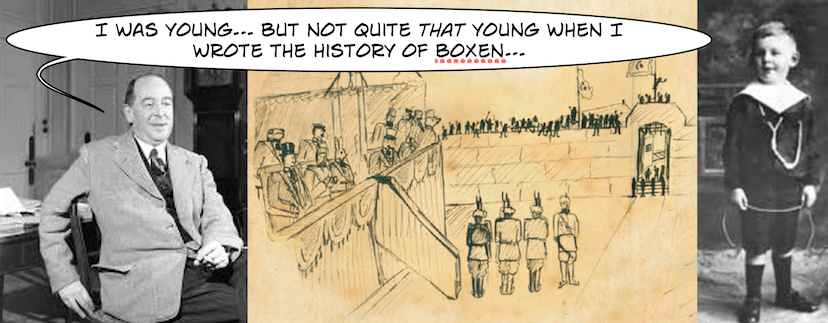
When he was a child, beginning at age eight, Lewis began writing stories about “Animal Land.” His brother Warnie, several years older, joined him in composing stories inspired in part by their reading of the words of Beatrix Potter.

Animal Land is clearly the product of young children—children with wonderful imaginations—but children nonetheless. These various works have been published by Lewis’ stepson in a collection called Boxen. As Douglas Gresham writes, “In developing the world of Boxen, Jack appropriated the ‘dressed animals’ of Beatrix Potter and that part of their fictional world they called ‘Animal-Land,’ while Warnie (whose interests were always a touch more prosaic than Jack’s) made his half ‘India.’”

The world was thoroughly thought out, complete with maps and a historic chronology.

Animal-land is divided into 13 provinces. Bear-land, Wolf-land, Squirrel-land, Mouse-land, Rabbit-land, Pig-land, Bird-land, Horse-land, Fox-land, Land of Typical Animals, Insect-land, Rat-land, With the island of Piscia, or Fishland. . . . Rabbit-land is the first provence in learning and art.

Rabbits feature prominently in Boxen. The very first element is a script, entitled “The King’s Ring (A Comedy).” The introduction is delightfully childlike: “Interesting carictars. Famous ones. For instance, Sir Big, a world-famed gentleman. A very good choreus and nice scenry. (Slight comic tints in and out threw it.)”

The two protagonists are King Bunny, whose ring is stolen, and Sir Peter Mouse, his “knight in waiting” who aids him in finding it. It is filled with silly dialog, despite the serious plot. For example:

KING BUNNY: Tell Sir Goose to tell Sir Big to tell Mr Gold Fish to tell Gollywog to tell Mr Icthus-oress to tell Dorimie to tell the sailors to take Hit [the villain] away.

In his autobiography, Lewis wrote of his childhood home. “Here my first stories were written, and illustrated, with enormous satisfaction. They were an attempt to combine my two chief literary pleasures—‘dressed animals’ and ‘knights-in-armour.’

Drawing Pleasure from Real Life Rabbits

Lewis’ correspondence includes passing references to rabbits, always expressed in an approving way. For instance, in 1947 he mentions enjoying a memorable event during a boring time. “I wonder how you are all getting on? Nothing much has happened to me except that I saw a rabbit yawn. I suppose people who keep tame ones have seen it often but this was a wild rabbit and I thought it a very curious sight. It was a very bored triangular yawn in the middle of a long hot afternoon.”

During WWII, he penned a curious comment about rabbits recently added to his home.

We are keeping rabbits at the Kilns now, in addition to the hens! But they are very much nicer. As I passed the enclosure in which all the young ones are the other evening, I saw they had all got into a box which happened to be lying there.

They were all standing (or sitting) up on their hind legs and all facing in the same direction: so that they looked exactly as if they were conducting some kind of evening service—the box looked just like a pew.

While the rabbits were almost certainly present to supplement food rations during the war, they were not treated as commodities. Lewis appreciated them in the way he respected other creatures designed by God’s hand. Thus, he had what my wife and I would consider to be a well-rounded family—including one or more members of the non-human variety.

Lewis described this diverse household in a 1943 letter to June Flewett,⁑ one of the children evacuated to his home during the war.

Bruce [Lewis’ dog] behaved with great lack of fortitude during the thunderstorm last night and two of the rabbits made it an excuse for absenting themselves without leave. Pushkin [his cat] behaved better, but not well. In fact there is a general lack of keenness and discipline among the four-footed members of the household which I deplore.

One more story about an actual rabbit with which the great author developed an ongoing relationship.

In a 1942 letter to Sister Penelope CSMV, he says, “I am establishing quite a friendship with one of the rabbits which we now keep along with the deer in Magdalen grove. It was done by the discovery that he relishes chestnut leaves which grow too high for his reach. He doesn’t yet allow me any familiarities but he comes and eats from my hand.”

Lewis continues to describe his new friend, and adds a keen theological observation. “But oh!, the great lollipop eyes and the twitching velvet nose! How does [God] come to create both this and the scorpion?”

Later that same year, Lewis updates the Anglican nun on the status of his animal-friend.

The Rabbit and I have quarrelled. I don’t know why, unless I gave him something that disagreed with him. At any rate, he has cut me dead several times lately—so fair and so fickle! Life is full of disappointments.”

At that time he shared his disappointment with his lifelong friend, Arthur Greeves. “Did I tell you in my last letter that I’d struck up quite an acquaintance (almost a friendship) with a rabbit in Magdalen Grove who used to come and eat leaves from my hand? Alas, I must have given something that disagreed with him, for he disappeared for about 10 days, and since his reappearance has refused to look at me.”

It may be that same rabbit, or one of its kin, renewed its relationship with Lewis, because he referred to a similar experience in two 1944 letters to other children.

I live in a College here: a college is something rather like a castle and also like a church. It stands just beside a bridge  over a river. At the back of the part I live in there is a nice grove of Trees. There are a lot of Rabbits there. One very old rabbit is so tame that it will run after me and take things out of my hand. I call her Baroness Bisket because she is a kind of biscuit colour.

It’s not easy, nor is it usually relevant, to determine a bunny’s gender. So, Lewis may be excused for writing the following to the second young correspondent, six months earlier.

I am getting to be quite friends with an old Rabbit who lives in the Wood at Magdalen. I pick leaves off the trees for him because he can’t reach up to the branches and he eats them out of my hand. One day he stood up on his hind legs and put his front paws against me, he was so greedy. I wrote this about it:

A funny old man had a habit
Of giving a leaf to a rabbit.
At first it was shy
But then, by and by,
It got rude and would stand up to grab it.

But it’s a very nice Rabbit all the same: I call him ‘Baron Biscuit.’

Like C.S. Lewis, I adore rabbits. Years ago we had an indoor bunny, appropriately named “Sweetheart.” In her youth she acted like the cartoon character Ricochet Rabbit, pinging from place to place. In her senior years she settled down and was contented to be a cuddly lap bunny. I add my own “thank you” to Lewis’ for these precious parts of God’s creation.


* The Humane Society pdf is available here.

⁑ June Flewett is regarded as the inspiration for Lucy Pevensie in the Chronicles, and grew up to become an actress and theater director. C.S. Lewis paid for her tuition at the Royal Academy of Dramatic Art. When she and her two sisters were sent from London to the Kilns, her favorite author was C.S. Lewis. Ironically, it was a while before she learned that he and their host were one and the same.

The Viking Explanation for Lame Poetry

During the middle ages, Scandinavia’s skálds were poets, storytellers and even musicians. They were the equivalent of bards in medieval British and Gaelic culture. They were oral historians, committed to memorizing their paeans verbatim, which was simpler since they were in poetic form. Not all skálds possessed the talents to create their own memorable epics. These lesser poets, so to speak, could still memorize and recite the classic or popular songs.

A graphic explanation for the difference in the talents of the first tier skálds and their inferiors is found in the Prose Edda which was written by Snorri Sturluson (1179-1241). Sturluson compiled Norse myths in his Edda, and the sagas of her kings in Heimskringla.

The second part of the Prose Edda is entitled Skáldskaparmál, which means the language of poetry. One of the myths it contains describes the Mead of Poetry. Mead, of course, is the rich Viking beverage created by fermenting honey.

As for poetry, I’ve written about it fairly often. (Most recently in respect to my “winning” entry in a Terrible Poetry Contest.) I’ve even offered genuine, albeit feeble, attempts at the art myself. Alas, if I were a classical Greek I would say my Muse is Clio (the Muse of History), rather than Thalia or Erato, Muses of various genres of poetry.

It is well known that C.S. Lewis himself was a frustrated poet. While his literary criticism and historical work was highly respected—and his Christian works are still revered—his poetry never received a warm reception. The Poetry Foundation offers a useful article on the subject here.

My personal opinion is that I am thankful Lewis’ energies were devoted to more profitable fields of writing.

Back to the Vikings

C.S. Lewis and several other Inklings were enamored with Northern sagas. I have touched on this in the past, and discussed the amazing fellowship gathered by J.R.R. Tolkien, as a sort of precursor to the Inklings.

Tolkien named the group Kolbítar, which denoted “Coalbiters,” or Norse storytellers who gathered close to the fire as they discussed the stories of their ancestors. This exploration of Icelandic literature was connected to Tolkien’s conviction, as a professor of Anglo-Saxon, that these works belonged within the study of the English canon.* Old Norse definitely left a mark on English, as I’ve discussed here at Mere Inkling.

In Song of the Vikings: Snorri and the Making of Norse Myths, Nancy Marie Brown gleans some insights about Kolbítar from Lewis correspondence. They gathered to read the literature aloud.

They began with Snorri’s Edda. Reading it in Icelandic was slow going but addictive, Lewis recalls: “Hammered my way through a couple of pages in about an hour, but I am making some headway. It is an exciting experience.” Lewis . . . had also been smitten as a boy by “pure ‘Northernness’” [and] popular versions of Snorri’s tales had inspired Lewis to write an adolescent tragedy about the Norse gods, “Loki Bound.”

There is no record of what the members of the Kolbítars thought of the myth of the Mead of Poetry, but I would imagine that they found its crass distinction between gifted and stumbling poets quite—Norse. To set the stage for the following passage, one should know: (1) the Aesir were the Old Norse gods, (2) Suttung was a Jötunn (belonging to a race of giants at war with the Aesir), (3) Suttung was in possession of the magical mead of poetry, which Odin stole through cunning but immoral means, swallowing all of it, (4) Odin changed into an eagle to effect his escape, and Suttung followed him in the same form, and (5) the Aesir prepared large vessels to receive the disgorged magical mead. Now, from the Edda itself:

When the Æsir saw Odin flying, they placed their vats in the courtyard, and when Odin entered Asgard he spat the mead into the vats. It was such a close call, with Suttung almost catching him, that he blew some of the mead out of his rear. No one paid attention to this part, and whoever wanted it took it; we call this the bad poets’ portion. Odin gave Suttung’s mead to the Æsir and to those men who know how to make poetry. For this reason we call poetry Odin’s catch, find, drink or gift, as well as the drink of the Æsir.

No one said the Norse were above using crass humor. Still, it does offer a quite imaginative explanation for the differences between exceptional and mediocre poets, doesn’t it?


* Tolkien “loved the cold, crisp, unsentimental language of the sagas, their bare, straightforward tone like wind keening over ice. Reading Snorri and his peers was more important than reading Shakespeare, Tolkien argued, because their books were more central to our language and our modern world” (Song of the Vikings).

C.S. Lewis & French Poetry

Ah, the snow is wrapping the world in a thick blanket, and I have no where I need to be. As I sit at my desk gazing out at the whitewashed forest, I attempt now something that I seldom do. I am writing a poem.

I admit that I haven’t read Jane Kenyon’s work, but I can definitely relate to one of her famous quotations: “My ear is not working, my poetry ear. I can’t write a line that doesn’t sound like pots and pans falling out of the cupboard.”

One of the bloggers I follow hosts a weekly poetry contest. I’ve never been tempted to compete, although I’m eminently qualified. You see, this is a “Terrible Poetry Contest.”

I had already begun writing my next post, and it relates to the depression some people feel during the winter. Of course, I do my best to make sure that what I write for Mere Inkling is not “terrible.” But I decided to delay that column and pause to enter this contest. On a whim. I certainly don’t expect to win . . . which in this case is, ironically, good news.

I decided to use an uncommon poetic form, since I can at least have the satisfaction that it offers patient readers an “educational” tidbit. I chose the French descort poetic form, because it seems expressly tailored to generate terrible poetry. According to Writer’s Digest, “the descort differentiates itself from other forms by differentiating its lines from other lines within the poem. That is, the main rule of descort poems is that each line needs to be different from every other line in the poem.”

A descort poem has different line lengths, meters, avoids rhyming with other lines, no refrains, and that goes for stanzas as well. In other words, no two lines in a descort should look like each other, and the same could be said for each descort.

The strength of the form is that it allows utter freedom to the poet. The weakness is that the results are appalling. (Read the example written by the editor of the linked article, if you don’t believe me.) Without further ado, I present my latest experiment with verse.* (There’s really nothing “French” about it, beyond the fact it’s a descort.)⁑

Frigid French Philologies
by Robert C. Stroud

Shards of bleak winter gestate day after day.
The citric cannonade gurgled melodies of complacency.
Echinodermata rides again.

Hagar was not so Horrible.
Beware 48°52.6′S 123°23.6′W.
Fini.
Don’t stare at dark holes.
A Galapagos penguin reads about tobacco.

Captain Kirk sings the National Anthem.
Angkor longed to visit Tenochtitlán.
Sheepish wolves.
From lofty Mount Olympus descended Odin.

Soon comes the summer of our discontent.

A French Poem by C.S. Lewis

C.S. Lewis wrote poetry. There is actually a plaque in his honor in Poet’s Corner in Westminster Abbey. Deservedly so. Nevertheless, Lewis’ poetry was never highly regarded.

I, for one, consider this lack of appreciation providential. By this I mean that even though C.S. Lewis had to suffer the disappointment of not realizing his desires as a poet, it is a blessing to the whole world that his energies were redirected into his other writings. Who knows, if his poetry had been celebrated, whether or not Narnia would ever have existed?

The only book of Lewis’ which is in the public domain (i.e. free for downloading), is Spirits in Bondage: A Cycle of Lyrics. It was published after the First World War, written while he was still an atheist. While it makes for interesting reading, much of the imagery will be a bit disorienting for readers only familiar with Lewis after he encountered Christ.

The following poem is taken from that collection. As Alister McGrath writes in The Telegraph article, Lewis’ hopes were dashed relatively early.

The early poems remain a powerful witness to Lewis’s early atheism, railing against an absent and uncaring God who failed to halt the slaughter the author saw around him. But he never achieved recognition as a “war poet,” like Rupert Brooke and Siegfried Sassoon, who are also commemorated in Poets’ Corner. Indeed, not only did he fail to secure recognition for his war poetry, he was not acclaimed as a poet of any kind, as the lack of interest in his second volume of verse—Dymer (1926)—made painfully clear.

This example of Lewis’ war poetry does stand tall in comparison to the verse of the “acclaimed” war poets (in my modest opinion). It describes a battle site during the war—and the transformation of human beings into beasts.

French Nocturne (Monchy-Le-Preux)

Long leagues on either hand the trenches spread
And all is still; now even this gross line
Drinks in the frosty silences divine
The pale, green moon is riding overhead.

The jaws of a sacked village, stark and grim;
Out on the ridge have swallowed up the sun,
And in one angry streak his blood has run
To left and right along the horizon dim.

There comes a buzzing plane: and now, it seems
Flies straight into the moon. Lo! where he steers
Across the pallid globe and surely nears
In that white land some harbour of dear dreams!

False mocking fancy! Once I too could dream,
Who now can only see with vulgar eye
That he’s no nearer to the moon than I
And she’s a stone that catches the sun’s beam.

What call have I to dream of anything?
I am a wolf. Back to the world again,
And speech of fellow-brutes that once were men
Our throats can bark for slaughter: cannot sing.

I confess (though I did it on purpose) that the heading for this section was a bit misleading. “French poem” may have been interpreted as a poem written in French. While Lewis was certainly fluent in French, he did not write in the language. He did, however, appreciate the tongue.

In 1952 he wrote his publisher about the French translation of The Lion, the Witch and the Wardrobe. He praised quality of the translation, as well as the tone achieved by the translator, in Le Lion et la Sorcière Blanche.

I don’t foresee many occasions for copies of Le Lion, but if you will kindly send me 2, they might come in useful. The translator deserves to be congratulated of course—French is a very powerful language—the children become perfect little Frenchmen, but that is all to the good.

What pleased and surprised me is the passage at the end where I made them talk like characters in Malory, and he has really got some of the quality of the French 13th century prose romances: grande honte en aurions⁂—is exactly right.

C.S. Lewis’ brother, Warnie, was a bit of a Francophile. He knew his subject well enough that he authored a book about its history, The Splendid Century: Life In The France Of Louis XIV. He offers an entertaining account of some literary gatherings where the works of Jean Chapelain (1595-1674) were employed in a novel manner. The writers shared agreed upon rules, and transgressions demanded discipline. Thus the punishment for “the breach of rules was to read a verse of Chapelain’s poetry, or, in aggravated circumstances, a whole page.”

I won’t hold my breath awaiting the results of the poetry contest. Though I periodically enjoy dabbling in poetry, I feel I am destined to share the fate of Lewis when it comes to the way in which the masses assess the quality of our verse.


* I have written poetry in the past. I explored the quintain here, and have a few of my experiments in poetry posted at All Poetry.

⁑ According to Encyclopedia Britannica, descort can also refer to “a poem in medieval Provençal literature with stanzas in different languages.”

⁂ The phrase means “great shame we would have.”

Does Sincerity Result in Good Writing?

Most aspiring writers are sincere. The question is, does the earnestness of their work translate into excellence? In other words, does honesty correlate to quality?

C.S. Lewis addressed this question in an essay about John Bunyan (1628-1688). Bunyan was the English writer and Puritan preacher best known for The Pilgrim’s Progress. At the outset of the allegory Bunyan attempts to “show the profit of my book,” and encourage its reading.

This book is writ in such a dialect
As may the minds of listless men affect:
It seems a novelty, and yet contains
Nothing but sound and honest gospel strains.

While C.S. Lewis respected this classic work, he argues that its value is not simply a consequence of Bunyan’s honesty.

The other thing we must not say is that Bunyan wrote well because he was a sincere, forthright man who had no literary affectations and simply said what he meant. I do not doubt that is the account of the matter that Bunyan would have given himself. But it will not do. (“The Vision of John Bunyan”)

Lewis is not, of course, challenging Bunyan’s claim to honesty. What Lewis does, in fact, is challenge a common misconception. He dismantles the excuse for any who would dismiss grammar and literary rules as unimportant because they are writing earnestly. Basically, Lewis suggests we cannot justify creating a mediocre product and by burnishing it with the declaration that “it is an outpouring of our deepest passion.”

“If [candid honesty] were the real explanation,” states Lewis, “then every sincere, forthright, unaffected man could write as well.”

And we all know that is not the case. Lewis proceeds to offer an illuminating and curious illustration. It recalls the days of the First World War when one of the responsibilities of the officers was to review the correspondence of the troops before they accidentally divulged classified military information to their family at home.

But most people of my age learned from censoring the letters of the troops, when we were subalterns [lieutenants] in the first war, that unliterary people, however sincere and forthright in their talk, no sooner take a pen in hand than cliché and platitude flow from it. The shocking truth is that, while insincerity may be fatal to good writing, sincerity, of itself, never taught anyone to write well. It is a moral virtue, not a literary talent. We may hope it is rewarded in a better world: it is not rewarded on Parnassus.*

Lewis continues, praising Bunyan’s writing.

We must attribute Bunyan’s style to a perfect natural ear, a great sensibility for the idiom and cadence of popular speech, a long experience in addressing unlettered audiences, and a freedom from bad models. I do not add ‘to an intense imagination,’ for that also can shipwreck if a man does not find the right words.

A Lesson for Modern Writers

C.S. Lewis’ keen analysis of Bunyan’s writing is more than a mere history lesson. It offers a lesson to those of us who take up the pen today. By all means, we should exercise the moral virtue of sincerity in our writing. However, we should not rest on the strength of our integrity to ensure the quality of our writing.

We should hone our skills. Likewise, we should welcome the constructive criticism of our peers, as did the Inklings themselves.

Our work will also benefit when we intently listen. Learning the idiom and cadence of our characters (real or fictional) enables them to rise alive from the page.

Lewis’ essay on Bunyan offers another suggestion I would highlight. This will be true for any writer, but I think it is of particular import to Christian authors. Lewis affirms a forthright, honest, and powerful presentation of the truth as we perceive it. He cautions against pulling our punches because we are timid about how the austere truth may be received.

For some readers the ‘unpleasant side’ of The Pilgrim’s Progress [lies] in the intolerable terror which is never far away. Indeed unpleasant is here a ludicrous understatement. The dark doctrine has never been more horrifyingly stated than in the words that conclude Part I: Then I saw that there was a way to Hell, even from the Gates of Heaven, as well as from the City of Destruction.

In my opinion the book would be immeasurably weakened as a work of art if the flames of Hell were not always flickering on the horizon. I do not mean merely that if they were not it would cease to be true to Bunyan’s own vision and would therefore suffer all the effects which a voluntary distortion or expurgation of experience might be expected to produce. I mean also that the image of this is necessary to us while we read.

The urgency, the harsh woodcut energy, the continual sense of momentousness, depend on it. We might even say that, just as Bunyan’s religious theme demanded for its vehicle this kind of story, so the telling of such a story would have required on merely artistic grounds to be thus loaded with a further significance, a significance which is believed by only some, but can be felt (while they read) by all, to be of immeasurable importance.

Keeping this in mind—that we should be faithful to the truth of what we are professing—will serve us well in the final accounting. After all, it is the compromises of the tepid of which we must beware.


* Parnassus refers to a Greek mountain associated by the ancients with Apollo, the Muses and poetry.

The Pilgrim’s Progress is available in a variety of free versions.

The Pilgrim’s Progress, an Allegory features a “Biographical Sketch of the author, by Lord Macaullay.”

In an 1834 edition, we have Bunyan’s Pilgrim’s Progress, Metrically Condensed: In Six Cantos.

The version with the most entertaining title has to be: The Pilgrim’s Progress [by John Bunyan] In Words of One Syllable.

The Child’s Pilgrim’s Progress can be downloaded in not one, but two volumes. It was published in 1860, with the preface:

No endeavour has been made in this little book to improve Bunyan’s Pilgrim’s Progress. To do so would be simply absurd. To bring prominently into view scenes supposed most attractive to children has been attempted; and, while the Dreamer’s narrative is preserved, others of less striking character have been thrown into the back ground. The quaint, simple language of the incomparable Bunyan is, for the most part, retained.

The Pilgrim’s Progress: for the Young was published in 1850. Its introduction includes commentary that echoes the theme of the post above.

John Bunyan, though a very pious and good man, was not a learned one ; for he was by trade a tinker, and had no opportunity to learn much more than to read, in his youth, and when a boy he was wild and wicked. But he made very good use afterward of what he knew ; and very diligently studied his Bible and other good books.

He was also what is called a genius, which means that he had great natural talent. He wrote many works, and one of his books, called the Pilgrim’s Progress, has been read and admired by more people than any other book except the Bible. Learned and unlearned men have read it again and again, and it has been translated into all modern languages.

Peculiarities of Punctuation

I question how we can ever secure world peace, when we can’t even agree on how to punctuate. And this is not only an international controversy—although it certainly possesses intercontinental ramifications.

Writers who have submitted their work to editors know exactly what I’m talking about. The world abounds with critics who are positive they know how to “fix” your manuscript, so you can more effectively communicate what you are trying to say.

A fine example of this is found in the case of Samuel Clemons. As I described several years ago, Mark Twain considered editors to be a plague. He sums up his irritation in a letter to a friend.

I give it up. These printers pay no attention to my punctuation. Nine-tenths of the labor & vexation put upon me by [them] consists in annihilating their ignorant & purposeless punctuation & restoring my own. This latest batch [also has] my punctuation ignored & their insanities substituted for it.

C.S. Lewis experienced similar challenges in working with his editors. In 1959, Lewis was responding to edits made by his longtime editor, Jocelyn Gibb, on the manuscript of The Four Loves.

I enclose my emendations, concessions, and resistances. . . . as regards my emendations, will you be so kind as to type them and send them to Harcourt Brace for the American edition. Otherwise we shall create a ‘textual problem.’

After arguing for several points of substance, Lewis offers a preemptive surrender on the field of punctuation. “Do anything you like (in reason) to the punctuation.” Lewis’ qualified capitulation was in response to this editorial comment from Gibb:

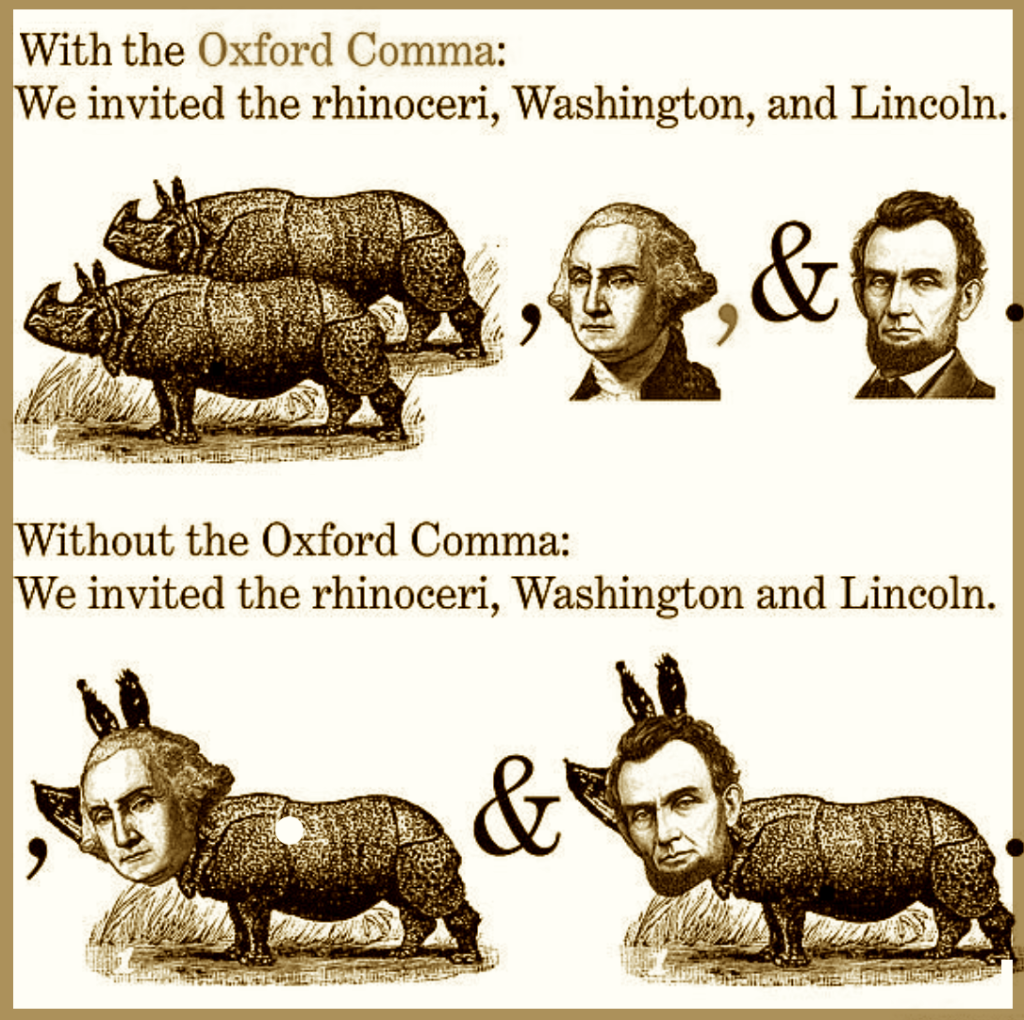
Do you really favour a comma before an “and” which seems to run all through? If so, why not: The Lion, the Witch, and the Wardrobe?

It’s curious Lewis’ editor would question his inclusion of commas in this manner, since it is not uncommon in British literature. In fact, punctuation in this context is often called an “Oxford comma.” You can read a decent discussion of the subject here. And, lest you deem it an inconsequential matter, check out this interesting article describing how it became “the crux of a $10 million class-action lawsuit . . .” The author of the article notes:

Many style guides, including the Chicago Manual of Style, American Psychological Association (APA), and American Medical Association (AMA), recommend the use of the Oxford comma to prevent ambiguity.

Yet others, including the AP style guide, Canadian Press (CP) style guide, and (shockingly) the University of Oxford style guide itself, use the Oxford comma only when a sentence could be misinterpreted by the reader without it.

Here’s the problem, though, for those who do not consistently use the Oxford comma: when writing a sentence, you don’t always realize that what you’re writing could be misinterpreted.

A Nineteenth Century Tribute to Punctuation

Punctuation can provide insights into a writer’s personality, as I have discussed here. Recently I encountered this personally published poem from 1861. You can download Ephemeral Effusions, the quaint volume in which it appears, at no cost via Internet Archive.

Easy Rules for Punctuation

Written for the amusement
of a valued Friend,
who was a great stickler
for correct punctuation.

I.
Whene’er you pause, to dip the pen,
A comma you must place;
If at a loss to find a word,
A semicolon trace.

II.
Should thoughts flow slowly, fill the gap
With colon, or with rest;
And when the sentence is complete,
A period answers best.

III.
A bright idea always claims
A note of admiration;
And, if you doubt, a crooked mark
Implies interrogation.

IV.
Inverted commas indicate,
Your wits are at an end;
And, your ideas failing,
You borrow from a friend.

V.
Parenthesis (example take),
I won’t say much about;
It guards a sentence, which sometimes
Had better be left out.

VI.
The little star of secrecy,
Tho’ last, not least in fame,
Is aide-de-camp to mystery,
And asterisk its name.

These rules are all so clear,
they need no explanation;
And constitute the art
of modern punctuation.

Dangers of Our Modern Age

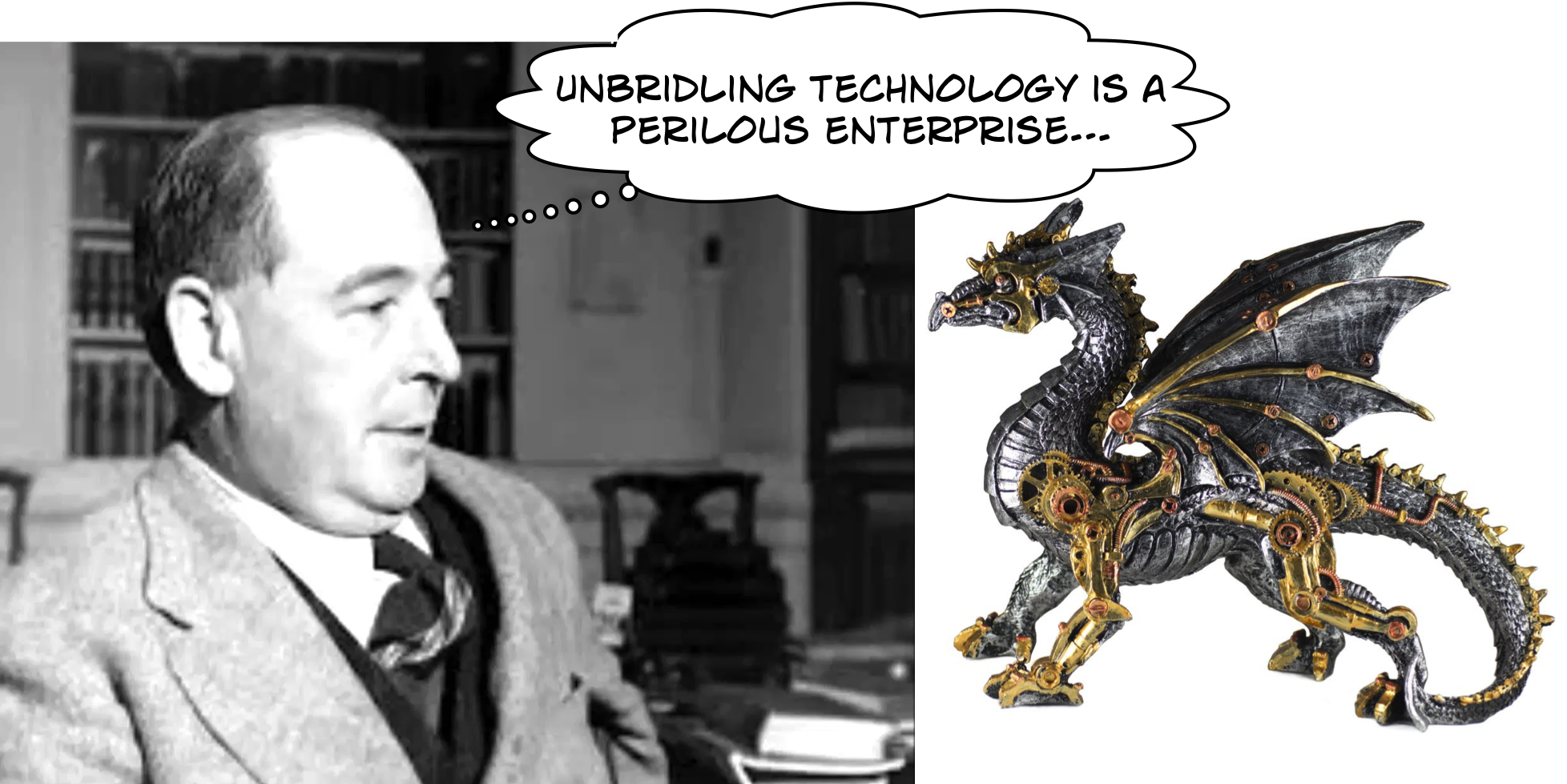
csl dragon.png

In 1957, C.S. Lewis wrote an encouraging letter to a young author whose first book had been written at the age of fourteen. Jane Gaskell’s Strange Evil was described by the Times Literary Supplement as “a fantasy of macabre and gorgeous nonsense.” The review even alluded to Lewis himself in its description of the novel.

Judith, who poses nude for a living, is carried off to a C.S. Lewis-ish land where a monster called Baby conducts his reign of terror and where one extravagantly gory battle follows another.

Miss Gaskell is eloquently fascinated by words, the longer and more lush the better, and her book reveals an undoubted talent for fanciful description.

Gaskell went on to become a journalist. She also authored several more novels, and ultimately became a professional astrologer.

But, returning to the young girl and her first publication . . . Lewis considered the young girl worthy of encouragement.

My wife and I have just been reading your book and I want to tell you that I think it a quite amazing achievement–incomparably beyond anything I could have done at that age. The story runs, on the whole, very well and there is some real imagination in it.

The idea of the gigantic spoiled brat (had you a horrid baby brother once?) is really excellent: perhaps even profound. Unlike most modern fantasies your book also has a firm core of civilised ethics. On all these grounds, hearty congratulations.

Lewis does, however, offer a suggestion for how the book may have been improved. “I hope you will not think it impertinent if I mention (this is only one man’s opinion of course) some mistakes you can avoid in future.”

In a fantasy every precaution must be taken never to break the spell, to do nothing which will wake the reader and bring him back with a bump to the common earth. But this is what you sometimes do.

The moving bar on which they travel is a dull invention at best, because we can’t help conceiving it as mechanical. But when you add upholstered seats, lavatories, and restaurants, I can’t go on believing in faerie for a moment. It has all turned into commonplace technological luxury!

This concept is noteworthy for writers—especially writers of fiction, for whom imagination is an indispensable ingredient. We must avoid elements that derail the story, as inappropriate technology can sometimes do.

Beware of the Temptation

I suspect most writers today experience technology as a more concrete threat to their vocation than the inopportune example Lewis was noting. It’s not that we include too many or too few mechanical or scientific references in our work. The problem is that we are so distracted by the wonders of the world in which we live, that we never get around to putting the pen to paper.

Some of us can lose ourselves in the internet or social media. One fascinating read leads to another and we wonder “where the time has gone.” Vast programming “on demand,” is ready at a moment’s notice to occupy (or, sometimes, numb) our minds. And even when we do sit down at the keyboard, emails and messages interrupt our concentration.*

Technology, of course, is not only dangerous to writers. It can distract any of us from what is most important in life. How many hours have we squandered when we could have spent our time with family or friends? Why do we prefer to anesthetize ourselves with digital opiates, rather than helping a neighbor?

Not long ago, Christianity Today conducted an interview with Richard Foster. Foster’s 1978 book, A Celebration of Discipline, has been extremely influential in calling believers to lives of deeper simplicity and prayer. In their article they mentioned a revision in the preface that speaks powerfully to me.

Oh, for the day when all we had to do was turn off the television if we wanted solitude and silence! . . . we are bombarded by the broad distractions of constant noise, constant demands, constant news. Everyone, it seems, wants us to be accessible 24/7 and to respond instantly to any and every request.

Neuroscience studies are now showing us that the neural pathways of our brains are being rewired accordingly, so that our physical capacity for sustained attention is decreasing.

We, of course, complain endlessly about our wired world. But—let’s be honest—we do enjoy our technological gluttony. There is, however, a better way to live.

I’m going to close this post with a personal prayer. Feel free to join me in it, if you desire.

Gracious Father, forgive me my trespasses, and deliver me from the sin of technological gluttony to which I so often surrender. Draw me away from the table of excess, and lead me on that better path . . . the way that leads to life, and to you. Amen.


* Many of these distractions can be significantly decreased by setting your software to provide fewer “notifications” when various things occur. For example, I recently had to reset my iTunes because the program was throwing up a message every time a new song began.

When I am listening to the soundtrack of The Lord of the Rings, I don’t care to be told that “The Foot of Orthanc” is coming up as the strains of “The Road to Isengard” are fading away.

C.S. Lewis & Animal Authors

dog author

Wouldn’t it be amazing to read about the adventures, struggles, triumphs, thoughts, and dreams of real animals? C.S. Lewis thought so.

Admittedly, referring to the thoughts and dreams of a squirrel or a hummingbird is a bit fanciful. But isn’t it feasible to imagine that a pregnant doe is hoping to find a lush meadow, or that a beaver who’s just finished a fine meal is gratefully contented as he snuggles down for the night in his lodge?

In one of his thought-provoking books—which I enthusiastically recommend to everyone who likes to read—Lewis describes exactly how reading is vital to expanding our world. “Those of us who have been true readers all our life seldom fully realise the enormous extension of our being which we owe to authors” (An Experiment in Criticism).

In this volume, Lewis argues that books are better measured by how they are read,  than by how they are written. In other words, Lewis is making the case that the true value of a book is not determined by the skill the author applied to its creation. Instead, Lewis writes, “so far as I can see . . . the specific value or good of literature [is that] it admits us to experiences other than our own.”

Lewis continues, with a fascinating discussion of his “experiment,” which flips traditional literary criticism on its head. Don’t rush through the following excerpt from the argument. It’s well worth taking your time to ponder his words and see if you agree.

[The experiences of others] are not, any more than our personal experiences, all equally worth having. Some, as we say, ‘interest’ us more than others. The causes of this interest are naturally extremely various and differ from one man to another; it may be the typical (and we say ‘How true!’) or the abnormal (and we say ‘How strange !’); it may be the beautiful, the terrible, the awe-inspiring, the exhilarating, the pathetic , the comic, or the merely piquant. Literature gives the entrée to them all.

Those of us who have been true readers all our life seldom fully realise the enormous extension of our being which we owe to authors. We realise it best when we talk with an unliterary friend. He may be full of goodness and good sense but he inhabits a tiny world. In it, we should be suffocated. The man who is contented to be only himself, and therefore less a self, is in prison.

My own eyes are not enough for me, I will see through those of others. Reality, even seen through the eyes of many, is not enough. I will see what others have invented. Even the eyes of all humanity are not enough.

At this point we arrive at the utterly Lewisian notion that even animals (e.g. uncivilized “brutes”) would be capable of broadening the horizons of our own thinking.

I regret that the brutes cannot write books. Very gladly would I learn what face things present to a mouse or a bee; more gladly still would I perceive the olfactory world charged with all the information and emotion it carries for a dog.

Literary experience heals the wound, without undermining the privilege, of individuality. There are mass emotions which heal the wound; but they destroy the privilege. In them our separate selves are pooled and we sink back into sub-individuality.

But in reading great literature I become a thousand men and yet remain myself. Like the night sky in the Greek poem, I see with a myriad eyes, but it is still I who see. Here, as in worship, in love, in moral action, and in knowing, I transcend myself; and am never more myself than when I do” (An Experiment in Criticism).

On the Subject of Reading & Rereading

If you need any more encouragement to seek out a copy of this wonderful book, allow me to share with you two profound points Lewis makes in support of his distinction between “literary” and “unliterary” people. (Lewis, of course, does not demean the latter. On the contrary, he grieves for the “tiny world” they choose to inhabit.)

The majority [of unliterary people], though they are sometimes frequent readers, do not set much store by reading. They turn to it as a last resource. They abandon it with alacrity as soon as any alternative pastime turns up. It is kept for railway journeys, illnesses, odd moments of enforced solitude, or for the process called ‘reading oneself to sleep.’

They sometimes combine it with desultory conversation; often, with listening to the radio. But literary people are always looking for leisure and silence in which to read and do so with their whole attention (An Experiment in Criticism).

In terms of rereading, Lewis was a fervent advocate of reading good books more than once. Most of us would say lack of time is the greatest deterrent to rereading classics, but most of us do have some favorites that we have returned to more than once.

The majority never read anything twice. The sure mark of an unliterary man is that he considers ‘I’ve read it already’ to be a conclusive argument against reading a work. We have all known women who remembered a novel so dimly that they had to stand for half an hour in the library skimming through it before they were certain they had once read it.

But the moment they became certain, they rejected it immediately. It was for them dead, like a burnt-out match, an old railway ticket, or yesterday’s paper; they had already used it (An Experiment in Criticism).

In contrast, Lewis describes how “those who read great works, on the other hand, will read the same work ten, twenty or thirty times during the course of their life.” Many of us would initially think our rereading frequency falls short of those specific tallies, perhaps we should reconsider. After all, most readers of Mere Inkling reread with great frequency portions of a particular library of sixty-six books,* gathered together in a book called the Bible.


* More books in the Roman Catholic and Eastern Orthodox collection of the Scriptures, which include seven Deuterocanonical books. Fewer, of course, for our Jewish friends who follow the teachings of twenty-four books, which are also included in the Christian Bible.

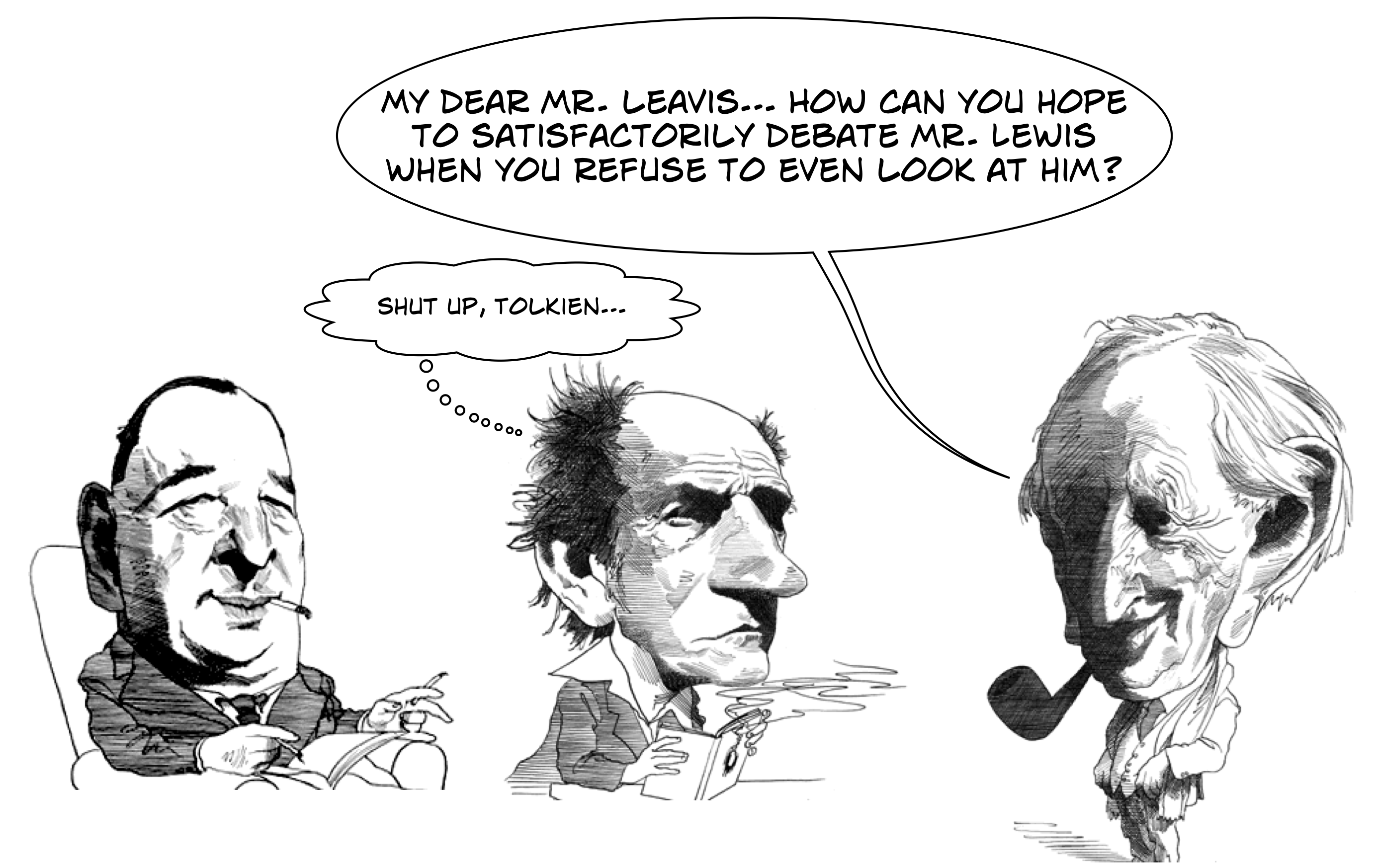
C.S. Lewis’ Nemesis: F.R. Leavis

leavis.png

When C.S. Lewis died, one of his Cambridge colleagues uttered a shocking statement—to his Cambridge students.

“C.S. Lewis is dead,” announced F.R. Leavis to his English literature students at Cambridge University a few days later, while the world mourned for Kennedy (the President was assassinated the same day).

American novelist and essayist D. Keith Mano, then studying at Cambridge, remembers Leavis continuing his brief commentary on Lewis’ passing as follows: “They said in the Times that we will miss him. We will not. We will not.

Who knew the world of literary criticism could be so ill-mannered?

In my readings about C.S. Lewis and his life I’ve noted references to a fellow English professor at Cambridge who waged a lengthy academic argument with Lewis over the heart of English education.

The challenger to Lewis’ history-oriented approach advocated a critical position, which diluted concern for the intentions of the original writers. I’m not a lit major, so I’ll leave the description at that.*

F.R. Leavis, a dynamic influence at Cambridge, dreaded the arrival of Lewis when he moved from Oxford to a distinguished chair tailor-made for him. The two scholars shared several traits which might have disposed them to friendship.

Both were veterans of the Great War.** One difference between the veterans is curious. Leavis declined to join the Officers’ Training Corps while a student, and chose ambulance service when conscription began. Lewis, on the other hand, voluntarily joined the OTC, even though he (as an Irishman) was exempt from the conscription.***

Another similarity between the two was that they inspired many students. Far from the caricature of droning academicians, Lewis and Leavis drew fans and even disciples from the student body. (In a recent post I mentioned the affectionate nickname some of the former’s students had for him: Papa Lewis.)

The Problem

Most writers believe this second “similarity” factored into the strained relationship between the two. Both had strong personalities, and bold convictions. They did not, however, share a common temperament. Lewis was normally respectful of his philosophical adversaries. Leavis, not so much. The following comes from “C.S. Lewis and the Art of Disagreement.”

The fact that Lewis could approve of atheists [and] liberals . . . reinforces Brewer’s point that Lewis would not allow disagreement to become personal. He could always distinguish the man from the man’s opinion, and he knew the difference between an argument and a quarrel. He would not allow himself to be betrayed into aggression, but would, where necessary, draw rein on a dispute with a wry smile and an agreement to disagree.

His public written controversy on literature with E.M.W. Tillyard (later published as The Personal Heresy) was conducted with pugnacity but without personal animus. And though Lewis laid into the arguments of another colleague, F.R. Leavis, with great forcefulness in the pages of An Experiment in Criticism, he never named Leavis within those pages, but covered his opponent in a thoughtfully woven cloak of pseudonymity.

Contrast that to Leavis’ comment with which we began, in which he “celebrates” Lewis’ passing.

Lewis was quite aware of Leavis’ animosity. In a 1961 letter to the publisher of The Screwtape Letters and Screwtape Proposes a Toast, the author strikes the Cambridge Review from the publications scheduled to receive review copies.

I’ve not additions to make, but one subtraction. Delete Cambridge Review. It’s mainly in the hands of Leavisites who will blackguard any book of mine, and I don’t know why we should let them have a free copy for their sport!

Lewis scholar Brenton Dickieson wrote a column about George Watson’s critique of Lewis. Watson met Lewis at Oxford and later joined him on the faculty at Cambridge.

Here are George Watson’s first evaluative words of Lewis: “Like F.R. Leavis, he was an offensive critic.” Awesome. I think it is an evaluation that would have made Lewis chuckle, particularly in his positive comparison with Leavis, the closest thing Lewis ever got to having a Sherlockian arch-nemesis.

However, Watson (note the name) is careful to remind us that Lewis “reveled in diversity as much as Leavis detested it.” That diversity in Lewis is one of the features that (I believe) most draws and repels readers today.

In the aforementioned article, “Lewis and Cambridge,” Barbour candidly describes the disparity between the spirit of the two nemeses.

“[Lewis’] controversies were always impersonal and often ended with the participants finding a good deal of common ground, whereas Leavis’s controversies . . . tended to end in anathematizing and deeply personal wounding.”

Leavis’ reputation for engendering conflict was so pronounced The Guardian actually included the following in his obituary:

Perhaps the most telling counter-assault on him was by C.S. Lewis, who said that the use of subliminal code words like “maturity” and “relevance” smuggled in an entire value system that was never made explicit for scrutiny. Others accused him of being a crypto-Marxist.

Leavis never replied, which was a pity, but then his weapons during his long career of humiliations in the Cambridge English faculty also included silence, internal exile and cunning.

His most murderous and underestimated weapon was ridicule, which he deployed in lectures with the virtuosity of a music-hall star and with an insensitivity verging on paranoia.

The Essence of Their Differences

Exploding English: Criticism, Theory, Culture includes a chapter entitled “Leavis, Lewis, and Other Oppositions.” It’s précis suggests one reason Lewis’ criticisms have possessed a longer lifespan than those of Leavis.

Lewis and Leavis . . . were the dominant figures in literary study in the middle decades of the twentieth century. . . . it is Lewis’s arguments and assumptions that seem to be the more challenging and which have something to contribute to contemporary debates.

This assessment echoes Lewis’ own view that the Leavis tsunami may have crested. Just a month before his death, he wrote to Basil Willey about his retirement. Willey would retire from his own chair two years later.

My dear Basil . . . I have an idea that Cambridge ten years’ hence might suit us both [better] than the Cambridge we have known. . . .

I hope your success will follow you . . . [if not], then our English school, with its neglect of language, becomes purely a school of literary criticism. And criticism, thus isolated, seems to me a positively mischievous instrument of education.

In “C.S. Lewis, Literary Critic: A Reassessment,” which appeared in Mythlore, William Calin describes Lewis’ passionate defense of English authors whose reputations were in jeopardy.

A Preface to Paradise Lost does for Milton what The Allegory of Love did for Spenser, and Lewis does for epic what he had previously done for allegory and fin’ amor [courtly love]. . . . In sum, Lewis defends his authors language from the strictures of Eliot and Leavis; he defends his worldview and its artistic embodiment from the prejudice of 1930s agnostic university faculty in English. . . .

When he tells students “Don’t read criticism” [Lewis] alludes again to Leavis and his disciples, who fetishized the term “critic.” Lewis would have called himself a scholar or an historian.

The following passage from A Preface to Paradise Lost is telling. Leavis is the unnamed standard bearer for the worldview he rejects. It reveals Lewis’ keen discernment in understanding of his unbridgeable difference with Leavis.

It is not that [Leavis] and I see different things when we look at Paradise Lost. He sees and hates the very same that I see and love. Hence the disagreement between us tends to escape from the realm of literary criticism.

We differ not about the nature of Milton’s poetry, but about the nature of man, or even the nature of joy itself.

The Apostle Paul described this difference in his correspondence with the Corinthians.

Now we have received not the spirit of the world, but the Spirit who is from God, that we might understand the things freely given us by God. . . .

The natural person does not accept the things of the Spirit of God, for they are folly to him, and he is not able to understand them because they are spiritually discerned. . . . But we have the mind of Christ.

In an excellent article entitle “Three Great Critics: F.R. Leavis, T.S. Eliot, and C.S. Lewis,” Michael Aeschliman**** closes with a gospel-oriented thought.

It is pleasing to conclude by imagining C.S. Lewis, T.S. Eliot, and F.R. Leavis now conversing together amicably, recollecting emotion in tranquility, in another and better and more luminous realm, toward which all three of them were fervent pilgrims throughout their embattled but noble lives.


* There are ample online sources available to describe the contrast in detail. For example, Brian Barbour’s Modern Philology essay, “Lewis and Cambridge,” provides a superb explanation of the struggle in its broader context.

** Lewis served in the trenches, where he was seriously wounded. Leavis was fortunate enough to avoid frontline combat by serving in the Friends Ambulance Unit. This site provides a helpful account of his service on an Ambulance Train which shuttled the wounded to ports.

*** There is no record of which ambulance train carried Lewis homeward after his injury, but wouldn’t it be ironic he and Leavis had unknowingly encountered one another at that time?

**** Aeschliman is the author of The Restitution of Man: C.S. Lewis and the Case Against Scientism.