A New Source of Oxygen

Most of us have a basic affinity for oxygen. And, air quality being what it is in many places, it is probably good news that there is a newly discovered source on the bottom of the sea.

This morning I asked my ten year old grandson what I should blog about. I said it could be even something like a new discovery (since C.S. Lewis was such a renaissance man that I can find some link to diverse subjects in his writings).

Since it’s summer, and school’s on hiatus, I was surprised when he said something of which I was unaware. “I think they found oxygen coming from some minerals in the ocean.” Odd, I thought, but since he often surprises me with his knowledge, I checked it out. 

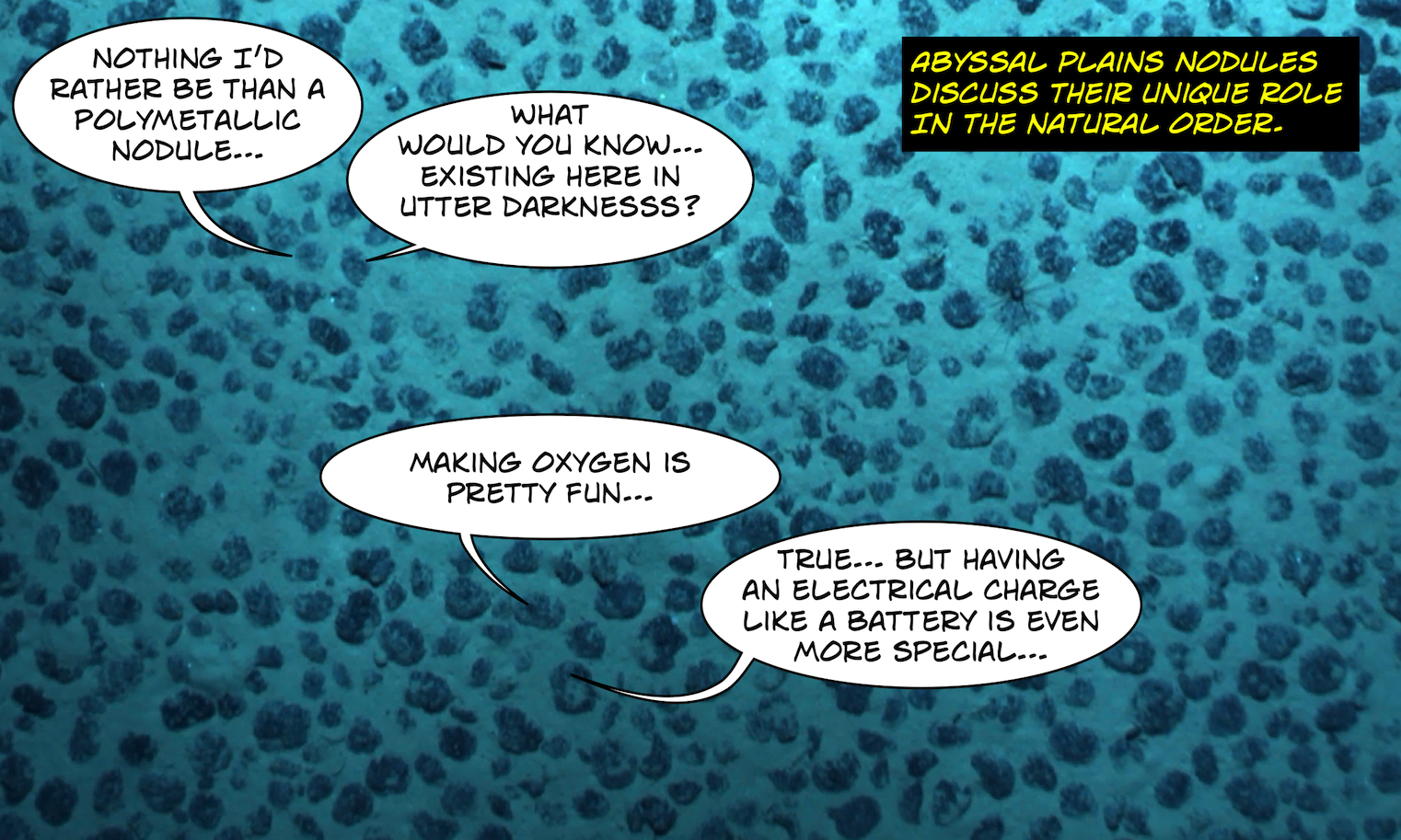
It’s true. Not only does the ocean produce huge amounts of oxygen via algae and the like, but they have recently discovered a source of “dark oxygen.” According to Smithsonian Magazine,

Twelve thousand feet under the ocean surface is a world of eternal midnight. No sunlight can penetrate to this depth to promote photosynthesis, so no plants are producing oxygen there.

Yet, the life-supporting gas is abundant in this darkness-cloaked region, thanks to an unlikely oxygen factory: potato-sized, “battery rocks” on the seafloor.

Those eager to learn more about this wonder can read the entire study, “Evidence of Dark Oxygen Production at the Abyssal Seafloor”  for free in Nature Geoscience.

The necessity of ready access to oxygen is obvious to everyone who knows basic biology. Actually, it isn’t the oxygen molecules [O], which we require, it is actually dioxygen [O2]. We also recognize our primary partners in this gloriously balanced process of exchange (where we trade off our carbon dioxide [CO2] in exchange for the O2) are the various plants God has distributed throughout our world. 

Curiously, oxygen only makes up a small portion of our atmosphere. According to the National Institute of Medicine,

The composition of environmental air is approximately 78% nitrogen, 21% oxygen, 1% argon, and trace percentages of other gases, such as carbon dioxide, neon, methane, helium, krypton, hydrogen, xenon, ozone, nitrogen dioxide, iodine, carbon monoxide, and ammonia.

I’m no scientist, but personal experience with pneumonia, and with training in a military Hypobaric (Altitude) Chamber, have taught me not to take the availability of oxygen for granted.

This fact was reinforced for C.S. Lewis during the final days of his life, as is true for many people. American Nathan Comfort Starr (1896-1981) was an Arthurian scholar. He would later write an Introduction and Commentary for Lewis’ Till We Have Faces in the Religious Dimension in Literature series. Shortly before Lewis’ death, Starr asked if he might be up to a visit from a friend. Lewis’ response evidenced a peaceful resignation to his own passing.

Term will never again begin for me. Last July I was thought to be dying, oxygen-tent and Last Unction and everything en règle.

I am now retired and immobilised on one floor of this house. But glad to be visited (an hour or so) if such an extinct volcano as I now am is worth visiting (4 September 1963).

In Out of the Silent Planet, the first volume of C.S. Lewis’ space trilogy, the protagonist travels to the planet MalacandraPhilologist Edwin Ransom is kidnapped before the voyage and his captors refuse to answer any of his questions.

“Don’t talk,” he said. “We have discussed all that is necessary. The ship does not carry oxygen enough for any unnecessary exertion; not even for talking.”

After landing, Ransom escapes and flees as far as his air lasts in the planet’s thin atmosphere. Nearing the end, a member of one of the intelligent species (Hnau) inhabiting Malacandra, rescues him. Presumably other races also sometimes require supplemental oxygen.

Stretching back into the cave, it took from the wall what looked like a cup. Then Ransom saw that it was attached to a length of flexible tube. The sorn put it into his hands.

“Smell on this,” it said. “The hrossa also need it when they pass this way.” Ransom inhaled and was instantly refreshed. His painful shortness of breath was eased and the tension of chest and temples was relaxed. . . .

“Oxygen?” he asked; but naturally the English word meant nothing to the sorn.

Oxygen is a precious gift to us from our Creator. So too is the scholar and atheist-turned-apologist, C.S. Lewis. 

Just as the revelations of natural creation are ceaselessly amazing, the lessons learned from C.S. Lewis’ life and works continue to inspire others. And, sometimes a little child’s awareness of recent news will lead others into new knowledge.

C.S. Lewis and Time’s Meaning

What is time, and why are we subject to its ofttimes harsh burdens? After his conversion from atheism, C.S. Lewis discovered some comforting truths about time, and the limits of time’s constraints.

Each year the four seasons seem to pass more rapidly. Before we know it, our parents have gown old, and we may well have children of our own. In retrospect, it all happens in the proverbial flash.

Ultimately, there will come a day when our lives reach their own “winter,” and even our most precious memories may drift away from us in time’s relentless breeze.

The C.S. Lewis Institute has an interesting article titled “The Point at which Time Touches Eternity.” They quote some wisdom from The Screwtape Letters, and end with a query which can help us live happier lives.

As you think about your own life, do you sometimes think too much about the Past or the Future, and not chiefly attend to the Present and Eternity?

Lewis answers that very question in his essay “Historicism.” He acknowledges that too often we become slaves to the regrets of our past and the dread of challenges awaiting us in the future. He reminds Christians that “God will supply every need of yours according to his riches in glory in Christ Jesus” (Philippians 4).* Therefore, Lewis encourages us to throw off the bondage of past and future, since “where, except in the present, can the Eternal be met?”

Janie Cheaney recently wrote “Eternity in Our Hearts” for World Magazine. Inspired by Saint Augustine and C.S. Lewis, it is subtitled “What if time astonishes us because we are meant to one day live outside of it.”

More of Lewis’ Thoughts about Time

In Mere Christianity, Lewis describes our universal human experience. “Our life comes to us moment by moment. One moment disappears before the next comes along: and there is room for very little in each. That is what Time is like.” He then describes just how limited our perspective is.

And of course you and I tend to take it for granted that this Time series – this arrangement of past, present, and future – is not simply the way life comes to us but the way all things really exist. We tend to assume that the whole universe and God himself are always moving on from past to future just as we do. But many learned men do not agree with that. Almost certainly God is not in Time. His life does not consist of moments following one another . . .

If you picture Time as a straight line along which we have to travel, then you must picture God as the whole page on which the line is drawn. We come to the parts of the line one by one: we have to leave A behind before we get to B, and cannot reach C until we leave B behind. God, from above or outside or all around, contains the whole line, and sees it all.

In Miracles, C.S. Lewis describes God’s transcendence over time as our Creator’s “eternal Now.”

It is probable that Nature is not really in Time and almost certain that God is not. Time is probably (like perspective) the mode of our perception. There is therefore in reality no question of God’s at one point in time (the moment of creation) adapting the material history of this universe in advance to free acts which you or I are to perform at a later point in Time.

To Him all the physical events and all the human acts are present in an eternal Now. The liberation of finite wills and the creation of the whole material history of the universe (related to the acts of those wills in all the necessary complexity) is to Him a single operation. In this sense God did not create the universe long ago but creates it at this minute – at every minute.

That is pretty deep. The sort of stuff that philosophers love to ponder and debate. Even before his conversion to Christianity, while still clinging to his formal atheism, Lewis contemplated time’s role in existence. In 1918 he wrote to his close friend Arthur Greeves about these matters. 

You see the conviction is gaining ground on me that after all Spirit does exist; and that we come in contact with the spiritual element by means of these “thrills.” I fancy that there is Something right outside time & place, which did not create matter, as the Christians say, but is matter’s great enemy: and that Beauty is the call of the spirit in that something to the spirit in us. You see how frankly I admit that my views have changed.

Sheldon Vanauken (1914-1996) was an American author who preserved in A Severe Mercy several of C.S. Lewis’ letters of consolation following the death of Sheldon’s wife. In some ways, the Vanauken story foreshadowed Lewis’ own marriage and widowhood. Pointing toward the Resurrection, Lewis wrote the following.

You say the materialist universe is “ugly.” I wonder how you discovered that! If you are really a product of a materialistic universe, how is it you don’t feel at home there? Do fish complain of the sea for being wet? Or if they did, would that fact itself not strongly suggest that they had not always been, or would not always be, purely aquatic creatures?

Notice how we are perpetually surprised at Time. (“How time flies! Fancy John being grown-up & married! I can hardly believe it!”) In heaven’s name, why? Unless, indeed, there is something in us which is not temporal.

C.S. Lewis writes much more about time, but we will conclude here with two passages that use the metaphor of author to describe God’s nature. The first comes from an essay entitled “The Seeing Eye.”

My point is that, if God does exist, He is related to the universe more as an author is related to a play than as one object in the universe is related to another. If God created the universe, He created space-time, which is to the universe as the metre is to a poem or the key is to music.

To look for Him as one item within the framework which He Himself invented is nonsensical. If God – such a God as any adult religion believes in – exists, mere movement in space will never bring you any nearer to Him or any farther from Him than you are at this very moment.

You can neither reach Him nor avoid Him by travelling to Alpha Centauri or even to other galaxies. A fish is no more, and no less, in the sea after it has swum a thousand miles than it was when it set out.

This final quotation appears in Mere Christianity. It is most certainly true, and my hope is that all who read this post will come to celebrate this joy. Both now, and for eternity.

God is not hurried along in the Time-stream of this universe any more than an author is hurried along in the imaginary time of his own novel. He has infinite attention to spare for each one of us.

He does not have to deal with us in the mass. You are as much alone with Him as if you were the only being He had ever created. When Christ died, He died for you individually just as much as if you had been the only man in the world.


* This gracious, eternal gift is available to all people.

Errors that Seem to be True (Angels)

Many people have been taught so little about biblical Truth that they believe many errors. For example, many people (and no offense intended if you are among them) mistakenly believe that when people die, they become angels.

That connection is so blatantly contrary to the fact that angels who “see the face [of God] who is in heaven” are completely different creations than the Sons of Adam and Daughters of Eve who are actually human beings, created in the image of God.

In his preface to The Screwtape Letters, C.S. Lewis alludes to how this confusion is reinforced by humanity’s lack of familiarity with angels in their true or natural (for them) form. While there are clear examples in the Bible where God has his angels appear in the likeness of human beings (e,g. before Sodom’s judgment and at the empty tomb), there are also times when their celestial radiance is not disguised (i.e. when the shepherds are informed about birth of the Savior or in John’s visions as recorded in the Book of Revelation).

[Angels] are given human form because man is the only rational creature we know. Creatures higher in the natural order than ourselves, either incorporeal or animating bodies of a sort we cannot experience, must be represented symbolically if they are to be represented at all (Screwtape Letters).

Nevertheless, this myth permeates the thinking of our secular culture. Once, some years past, a pastor friend was relating to me that one of his distant relatives had recently died. He said it comforted him to know that she was now an angel. I started to chuckle in response to his humorous way of lightening his own mood, until I realized he wasn’t joking. This poor, genuinely compassionate minister had been tricked by the spirit of this world into buying into a lie.

C.S. Lewis famously said that anything worth reading once is worth reading again. I’m clearing out some magazines from several years ago, and rereading insightful articles as I go. In a short piece about a complex subject, “What Happens to the Dead?” Ryan Pemberton makes a troubling comment.

Pop culture has done more to shape modern views about death than biblical teaching has.

The brevity of the article prevents the author from exploring other subjects, but his observation is applicable to a wide array of concerns.

I’m confident I could state, without fear of contradiction, that contemporary culture has done more to shape modern views about marriage than biblical teaching has. And, adding only a few additional examples, more about . . . justice . . . demons . . . love . . . mental health . . . responsibility . . . heaven . . . labor . . . creation . . . and Jesus himself.

It’s Not All Bad

It should be admitted that not all contemporary insights have been 100% misguided. One area where modern sensibilities have restored balance to truthful thinking is in the area of care for the environment. Ignoring extreme notions about nature being more important than human life, we can applaud the work of Christian environmentalists who have helped restore a biblical (i.e. true) view of the world around us.

Reacting to twisted notions that humanity’s “dominion” over the earth allows for nature’s misuse and abuse, these men and women helped open our eyes to the fact that God calls us to be trustworthy stewards in our care of, and appreciation for, this amazing world he has made.

The Inklings, C.S. Lewis and J.R.R. Tolkien, in particular, possessed a profound love for nature. Their general antipathy to the ugly and polluting trappings of industrialization are grounded in their belief that the world God created was truly “good.” With that came the recognition that man does little to enhance, and much to undermine, that initial goodness.

When two ideas clash, go with the one that is correct. And, when one of those authorities is the Word of the Creator of all that exists, well, isn’t it obvious which is the right choice?

Angels & People

For more on the angelic subject with which we began, check out the provocatively titled “People Aren’t Downgraded to Angels When They Die.” As the author there so rightly explains,

When Christians die, heaven does not “get another angel.” We cannot become angels any more than we can become giraffes or ocean waves or stars. We are people and will remain so after this present life. God did not make a mistake when he made us human.

Aerial Inspiration

C.S. Lewis and J.R.R. Tolkien are two of the countless authors who have immortalized the beauty and majesty of eagles in their books.

In Narnia, talking eagles such as Farsight serve in Aslan’s councils of war, while their speechless brethren go about their instinctual activities. 

There would have been a splendid view . . . but among all those trees you could see nothing – only, every now and then, some huge pinnacle of rock above the tree-tops, and an eagle or two wheeling high up in the blue air.

“They smell battle,” said Corin, pointing at the birds. “They know we’re preparing a feed for them” (The Horse and His Boy).

Eagles feature even more prominently in Middle Earth. The sapient Great Eagles appear at various key moments, including the rescue of doomed heroes. After the One Ring has been destroyed, an eagle bears news of the defeat of Sauron to Minas Tirith. Its proclamation is voiced in poetry.

Sing now, ye people of the Tower of Anor,
for the Realm of Sauron is ended for ever,
and the Dark Tower is thrown down.

Sing and rejoice, ye people of the Tower of Guard,
for your watch hath not been in vain,
and the Black Gate is broken,
and your King hath passed through,
and he is victorious.

Sing and be glad, all ye children of the West,
for your King shall come again,
and he shall dwell among you
all the days of your life.

And the Tree that was withered shall be renewed,
and he shall plant it in the high places,
and the City shall be blessed.

Sing all ye people!

If that sounds biblical, don’t be surprised. Although Tolkien scrupulously avoided Judeo-Christian references, so his work would not be misconstrued as allegory, the Psalms have exerted great influence on Western literature. The Lord’s entrance into the holy city is celebrated in the following words in Psalms 33 and 24.

Rejoice in the Lord, O ye righteous:
for praise is comely for the upright.
. . . 
Lift up your heads, O ye gates; and be ye lifted up, ye everlasting doors;
and the King of glory shall come in.
Who is this King of glory?
The Lord strong and mighty, the Lord mighty in battle.
Lift up your heads, O ye gates; even lift them up, ye everlasting doors;
and the King of glory shall come in.

Eagles in Our Earthly Realm

My thoughts today rose toward the sky because of an eagle I encountered while enjoying nature with my border collie this morning.

I’m blessed to live in a community near the Hood Canal, one of America’s longest fjords, extending about fifty miles. Near my home, is a nesting ground for Bald Eagles, our national bird and one of the world’s grandest raptors. Their aeries, or nests, are massive.

Even after their crowded gathering to raise their young each year, we have eagles who remain in the area. It was one of these that I contemplated today.

I was almost mesmerized as I watched the creature circle around in the sky. Even with its unrivaled vision, it appeared to be above its normal hunting altitude. Rather, it looked for all the world like it was simply enjoying its nature, celebrating its eaglehood. 

Such sightings are impressive, but not rare. However, one thing truly amazed me. As I watched that eagle soar for many long minutes, not once did it flap its wings. It simply danced in the thermals.

During that riveting time it neither departed its unmapped path in pursuit of food, nor tired of its aerial ecstasy. It savored the gifts of its Creator, and I vicariously experienced shalom as I rested and beheld. 

The Lord is the everlasting God,
    the Creator of the ends of the earth.
He does not faint or grow weary;
    his understanding is unsearchable.
He gives power to the faint,
    and to him who has no might he increases strength.
Even youths shall faint and be weary,
    and young men shall fall exhausted;
but they who wait for the Lord shall renew their strength;
    they shall mount up with wings like eagles;
they shall run and not be weary;
    they shall walk and not faint (Isaiah 40).

Thank you, Lord, for granting me this reminder – and experience – of your holy promise this day.

Caring for Nature with an Inkling Spirit

I never thought I would become an apiarist, but living in forests of America’s Pacific Northwest made this a logical stage in my growth as a naturalist. And I’m convinced that if he had known how simple it is to promote healthy bee populations, C.S. Lewis would have joined me in the hobby.

After all, he delighted in their work ethic, describing the moment of their Narnian creation with the words, “Butterflies fluttered [and] Bees got to work on the flowers as if they hadn’t a second to lose.”

In “An Experiment in Criticism” Lewis discussed the value of seeing the world through the eyes of others. In awe of the majesty of creation he expressed a yearning to explore its myriad facets from perspectives other than his own.

The man who is contented to be only himself, and therefore less a self, is in prison. My own eyes are not enough for me, I will see through those of others. Reality, even seen through the eyes of many, is not enough. . . .

Even the eyes of all humanity are not enough. I regret that the brutes cannot write books. Very gladly would I learn what face things present to a mouse or a bee: more gladly still would I perceive the olfactory world charged with all the information and emotion it carries for a dog.

Like most people, I grew up thinking of beekeepers as the people who dress in protective gear and harvest the honey produced by those tireless little workers. Honeybees, however, are only one type of bee. The Treehugger site offers an illustrated page featuring the bee types, with Hoverflies (good, and in more than 6,000 species) and Wasps (bad, and in more that 100,000 species) thrown in.

The bees I help to encourage in our area are not honeybees or bumblebees, who form colonies. They are mason bees, who are solitary by nature. They don’t have an aggressive bone in their tiny bodies and they are excellent at their jobs. They “pollinate around 95% of the flowers they visit, whereas honey bees generally only pollinate about 5%.” 

C.S. Lewis, like his close friend J.R.R. Tolkien, loved nature. Like most people Lewis either knew nothing about solitary bees, or his attention was directed by default to the honeybees we prize for the honey refined in their hives. In 1930, he wrote to his friend Arthur Greeves about the deeper motivations that drive people such as themselves to become writers.

As for the real motives for writing after one has ‘got over’ the desire for acknowledgement . . . I found and find, that precisely at the moment when you have really put all that out of your mind and decided not to write again . . . precisely then the ideas – which came so rarely in the days when you regarded yourself officially as an author – begin to bubble and simmer, and sooner or later you will have to write . . .

Who knows . . . what will in the end reach the ear of humanity? The successes of our own age may be speedily forgotten: some poem scribbled in pencil on the fly leaf of a schoolbook may survive and be read and be an influence when English is a dead language. . . .

So . . . whether the necessity and duty of writing is laid on a man or not can soon be discovered by his own feelings. With remote consequences we have no concern. We never know enough. I think the thing is to obey the ordinary rules of morality . . . but for ultimate justifications & results to trust to God.

The bee builds its cell and the bird its nest, probably with no knowledge of what purpose they will serve: another sees to that. Nobody knows what the result of your writing, or mine . . . will be. But I think we may depend upon it that endless and devoted work on an object to which a man feels seriously impelled will tell somewhere or other: himself or others, in this world or others, will reap a harvest exactly proportional to the output.

In 1914, C.S. Lewis shared with his father a humorous anecdote from the Roman poet Virgil. 

Did you ever at Lurgan read the 4th Georgic? It is the funniest example of the colossal ignorance of a great poet that I know. It’s about bees, and Virgil’s natural history is very quaint: bees, he thinks, are all males: they find the young in the pollen of flowers. They must be soothed by flute playing when anything goes wrong etc., etc.

C.S. Lewis enjoyed his laugh at Virgil’s poetic ignorance about bees. Coincidentally, he would discuss the humble creatures in a poem of his own. It appears in his posthumous Poems collection, as the fourth and fifth of his “Five Sonnets.”

Pitch your demands heaven-high and they’ll be met.
Ask for the Morning Star and take (thrown in)
Your earthly love. Why, yes; but how to set
One’s foot on the first rung, how to begin?
The silence of one voice upon our ears
Beats like the waves; the coloured morning seems
A lying brag; the face we loved appears
Fainter each night, or ghastlier, in our dreams.
“That long way round which Dante trod was meant
For mighty saints and mystics not for me,”
So Nature cries. Yet if we once assent
To Nature’s voice, we shall be like the bee
That booms against the window-pane for hours
Thinking that way to reach the laden flowers.

“If we could speak to her,” my doctor said,
“And told her, “Not that way! All, all in vain
You weary out your wings and bruise your head,”
Might she not answer, buzzing at the pane,
“Let queens and mystics and religious bees
Talk of such inconceivables as glass;
The blunt lay worker flies at what she sees,
Look there—ahead, ahead—the flowers, the grass!”
We catch her in a handkerchief (who knows
What rage she feels, what terror, what despair?)
And shake her out—and gaily out she goes
Where quivering flowers stand thick in summer air,
To drink their hearts. But left to her own will
She would have died upon the window-sill.”

British Bees

The British are quite enamored with quaint names for their public houses. Because of that, I knew I would be able to find a suitable pub to feature at the top of this post. I was, however, caught off guard by an embarrassment of riches in the return to my google search.

In addition to “The Bumble Bee” in Quedgeley pictured above (which I chose because of the lamppost in the garden), I found images of similarly named pubs in Blackwood, Flitwick, Gloucester, Gwent, Westoning, and Fleur-de-lis, Wales.

I’m sure I could find many other tributes to buzzing pollinators, if I broadened my search to include pubs like “The Beehive” in Egham or “The Golden Bee” in Stratford-upon-Avon.

The story of one more bee will bring our reflections to an end. In his early diary, All My Road Before Me, C.S. Lewis mentioned a number of visits to Bee Cottage, where some of his friends occasionally resided. For example, one summer Sunday in 1922, he recorded:

After lunch I bicycled to Beckley and called at Bee Cottage where I found [Cecil] Harwood alone and reading in a pleasant, stumpy 18th Century Bible. He quoted from Genesis “Whatever Adam called anything, that was the name of the thing,” as an excellent definition of poetry.

Once lost to the mysteries of time, the precise location of Bee Cottage has been discovered, as we can read in Bee and Church Cottage.

Laurence Harwood, C.S. Lewis’s godson, was a lecturer at [the 2009] Summer Seminar on C.S. Lewis Remembered.  His father, Cecil Harwood, was a close personal friend of Lewis as well as fellow Inkling Owen Barfield. 

Harwood and Barfield had often rented a small cottage-Bee Cottage-in Beckley, a few miles from Lewis’s home in the Kilns, and Lewis often visited the place (perhaps while on walking tours though the countryside just like his character Elwin Ransom).  Unfortunately its precise location was lost and remained unknown.

Following the lectures, “Laurence decided that searching for the cottage would be a . . . great way to remember Lewis.” He and several friends “managed to locate the small house, and found that it looked just as anyone would have expected-the waning summer sun sinking behind it, and the bees buzzing about the lavender plants alongside the stairs.”

Bees are important members of our environment. Many would argue they are essential and famine would certainly follow if they became extinct. The Environmentor says,

If all the bees died, humans would become responsible for taking up the slack. This is already happening in China, where a majority of the bees have already died. People take buckets full of pollen and “paint” the pollen on with a paintbrush.

But, this could only be done with a few of the plants that require pollination because there simply aren’t enough humans to perform the task.

The alternative, offered by Brittanica is that we could “robo-pollinate.” But I have already written about where that ominous trend might lead. 

I think it’s best that we diligently care for bees we currently enjoy, and nurture all their future generations. And I believe C.S. Lewis would agree.

CS Lewis | Mountains

Deep Thoughts from the Quill of the Other C.S. Lewis

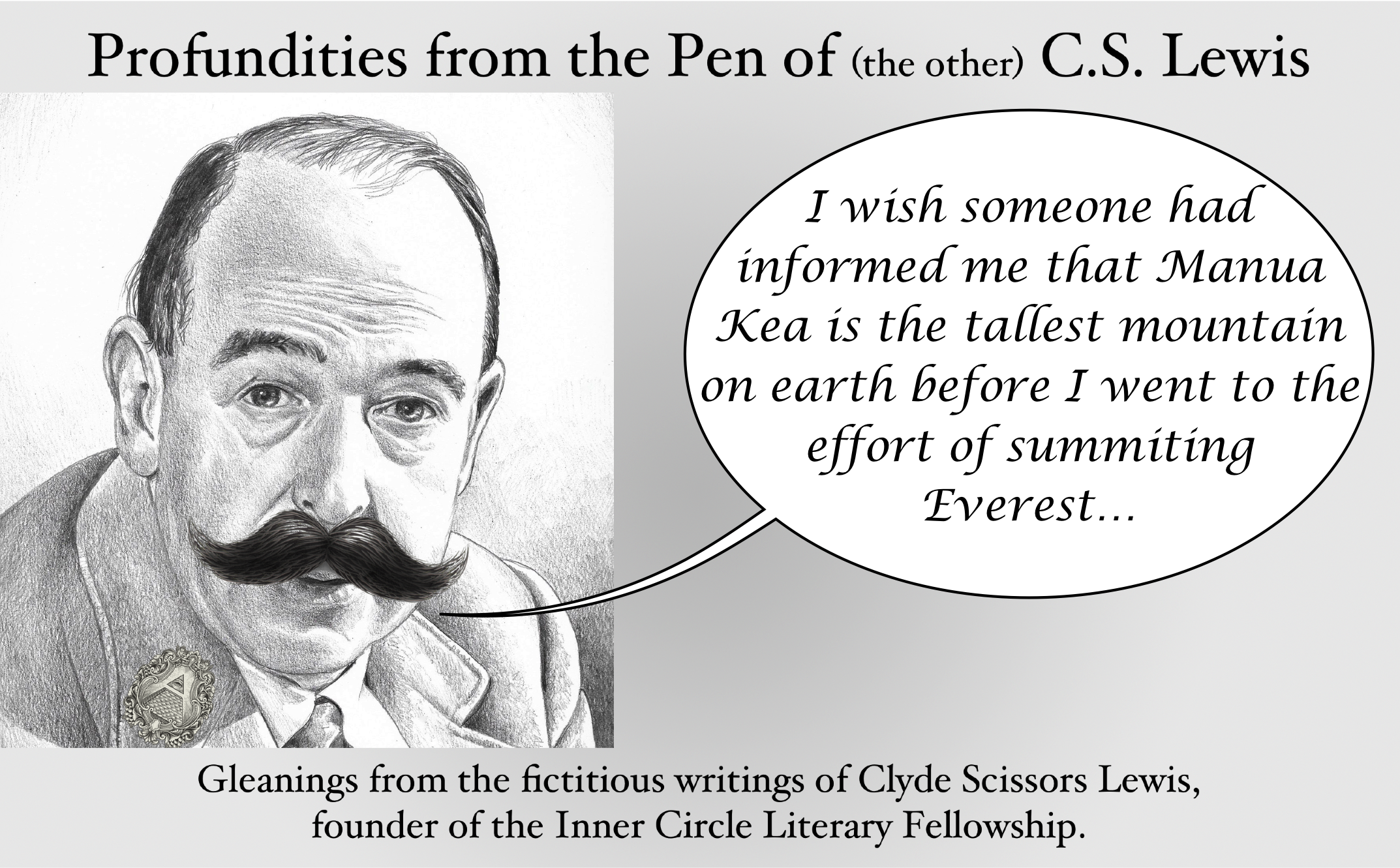
Welcome to another in an occasional series of fictitious quotations from a fabricated contemporary of the great Oxbridge professor, Clive Staples Lewis.

The C.S. Lewis who authored these questionable observations, Clyde Scissors Lewis, possessed a worldview enigmatically different from that of the esteemed Christian author. Despite the fact that their two lives overlapped in a variety of ways, the similarities were superficial.

A brief biography of the lesser Lewis is available at this link.

The Other C.S. Lewis: A Brief Biography

By all means, do not confuse the wisdom of the genuine article with his shadowy counterfeit. Despite any cursory similarities between the two men, this is most definitely not the C.S. Lewis readers have come to know and love.


If one measures from the center of the planet, due to the equatorial bulge, Mount Chimborazo in Ecuador is the “tallest” mountain on our planet.

C.S. Lewis & Summertime

What’s your favorite season of the year? My preference is Autumn, with Spring a close second.

In the United States, Spring comes out on top. Actually, it is the preference in forty (80%) of the states. Probably due to its northern latitude, “the most popular season in the Northeast is Summer.” Unsurprisingly, Winter is the least favorite across the board, although a few hardy souls disagree. “Alaska and Vermont are the only two states that say winter is the most wonderful time of the year.”

Some years ago, Gallup published the result of polls on the subject, which are also analyzed by the ages of respondents.

Americans aged 18 to 29 are the group least likely to prefer spring (24%), while those 65 and older are most likely to prefer it (53%). Younger Americans are much more likely to prefer summer than are those in older age groups, and, in fact, summer is the top choice among this age group. [Editor: I wonder if that has anything to do with the traditional academic calendar?]

Everyone is aware of how the seasons (through length of daylight, etc.) affect our moods. In a 1914 letter to his father in Ireland, C.S. Lewis offers a curious description of the “magnificent summer” he was enjoying in England.

My mental picture of home is disturbed to a certain extent by your mention of a fire. Here, we are in the middle of a magnificent summer: day succeeds day with the same cloudless sky and parched earth, and the nights are hot and comfortless. But on the whole, fine weather is agreeable, and has, I think, a certain effect on the spirits.

At the end of September, he wrote again about the extended summer he was experiencing. It doesn’t sound like the opinion of someone whose seasonal preference was summer. “I suppose the winter has closed in at home by this time: but we are still having quite summer weather here – which I rather resent.” Sometimes, it seems, seasons do overstay their welcome.

The following year, C.S. Lewis again lamented summer’s length. In mid-November he complained to his father.

The weather here is a perfect joke, warmer than July, bright sunshine and gentle breezes. Personally I have had quite enough summer, and should not be sorry to bid it goodbye, though Kirk persistently denounces this as a most unnatural state of mind.

A year later, in 1916, Lewis’ distaste for excessive heat is seen in an October letter to his friend Arthur Greeves. One reason for this was C.S. Lewis’ passion for hiking through the countryside.

The beastly summer is at last over here, and good old Autumn colours & smells and temperatures have come back. Thanks to this we had a most glorious walk on Saturday: it was a fine cool, windy day & we set out after lunch . . .

In a poem entitled “The Day with a White Mark,” Lewis opens with vivid imagery and the notion that mood is normally related to environment and circumstances.

All day I have been tossed and whirled in a preposterous happiness:
Was it an elf in the blood? or a bird in the brain? or even part
Of the cloudily crested, fifty-league-long, loud uplifted wave
Of a journeying angel’s transit roaring over and through my heart?
My garden’s spoiled, my holidays are cancelled, the omens harden;
The plann’d and unplann’d miseries deepen; the knots draw tight.
Reason kept telling me all day my mood was out of season.
It was, too. In the dark ahead the breakers only are white.

One website offers generalized thoughts about “what your favorite season” reveals about you. For example, it says of those who share my preference:

“Delicious autumn! My very soul is wedded to it, and if I were a bird I would fly about the earth seeking the successive autumns,” George Eliot (aka Mary Ann Evans) once wrote of her affection for the fall season.

While parts of the world tend to think of spring as the season of renewal, fall is also a very good time for a fresh start. The vibrant orange colors and cooler weather of autumn appeal to your constant desire for change. The upcoming holidays inspire many to reflect back on the year that was and make plans for the year to come.

A study in England went so far as to link birth months to the frequencies of several psychiatric conditions. If it is correct, your likelihood of suffering from recurrent depressive disorder, bipolar affective disorder and even schizophrenia varies according to your birth month.

Summer does provide a welcome time for vacations and events that would be difficult to wedge into the “busier” seasons of the year. For example, it’s not too late to register for the 2022 C.S. Lewis Summer Institute. The theme is “Surprised by Love: Cultivating Intellectual Hospitality in an Age of Uncertainty.” It is slated for 28 July – 5 August 5, 2022 in Oxford.

C.S. Lewis’ Favorite Season

Last year, the United Kingdom’s National Trust* conducted a poll which determined summer (30%) as the favorite season for Brits. Curiously, for young adults, summer tied with the second overall favorite, autumn.

After autumn colour, Britons’ favourite things about the [autumn] season are spending time in nature – running, walking or cycling (13 per cent) and the weather – cold crisp days, Indian summer, or stormy days (12 per cent).

So what exactly was C.S. Lewis’ favorite season. At the end of his life he wrote the following. As he so often did, he used a familiar subject to make a profound comment about life.

Yes, autumn is really the best of the seasons; and I’m not sure that old age isn’t the best part of life. But of course, like autumn, it doesn’t last.

But then, isn’t it the flow of the seasons that makes each so welcome in turn? Charles Dickens offered just such an observation in a quote which offers a fitting end to our reflections today.

Nature gives to every time and season unique beauty; from morning to night, as  from the cradle to the grave, it’s just a succession of changes so soft and comfortable that we hardly notice the progress.


* The National Trust helps conserve sites of historic and natural significance in England, Wales, and Northern Ireland. Scotland has its own National Trust for Scotland, devoted to the same purposes.

Lewis’ good friend J.R.R. Tolkien also enjoyed autumn. In a post several years ago I shared a portion of a letter to his son where he says, “I have the autumn wanderlust upon me, and would fain be off with a knapsack on my back and no particular destination . . .” Sounds like something someone in Middle Earth might say – although, certainly not a hobbit!

Respecting Animals We Kill

Sometimes even a moral sluggard can say something profoundly true. I was recently visiting the uplifting site of a British pet photographer, and came across this wonderful insight:

“Until one has loved an animal a part of one’s soul remains unawakened.”

As I spent a moment reflecting on the quote, having just enjoyed a morning game with our border collie, it dawned on me these words are not only philosophically true. The more I consider them the stronger the case, it seems to me, can be made for their theological truth.

Turn the statement around. Can someone be considered spiritually awake if they have never possessed a moment of genuine affection for an animal, the pinnacle of God’s natural creation? I tend to think not.

Cultural matters certainly influence one’s connection with nature. It may be that people surviving on the edge of food sufficiency would view animals primarily as a resource. Yet even then, the best among us still possess a regard for the creatures whose lives we curtail to extend our own.

An outstanding example of this is found in a common practice among North America’s first peoples. (First Nations is the common term in Canada). Many of these people would include prayer on behalf of the prey they sought.

In the Cherokee legend “The Little Dear, Awi Usdi,” describes how hunters were taught to only take life when necessary, and to “ask pardon when an animal was killed.”

Another site explains how “Coast Salish women were forbidden from stepping over deer meat, and the men had to look away when uncovering it. All bones had to be thrown into the water, and the viscera not consumed were buried so the dogs would not eat it.”

Post-Kill Rituals: Matters of the Heart,” describes how this “ancient reverence” for hunted animals extended beyond the Americas. It concludes with a valuable thought.

Rituals aren’t a bad idea . . . But you show the utmost respect by concentrating on killing the animal quickly. Hunters’ conduct toward wildlife and nature should be consistent with their conduct toward other humans.

While Christians will necessarily overlook the religious elements of these various traditions,* those most attuned to the love of God – a Creator who viewed the “living creatures” he had fashioned and proclaimed, “it was good” – will possess at least a glimmer of reverence or affection for wildlife.

Not that Christians can’t be avid hunters. The Roman Catholic Church even has a Patron Saint for hunting. St. Hubert, pictured above, was (before his canonization, of course) a worldly nobleman. In the seventh century, Hubert had ignored invitations to attend worship on one of the holiest of days, Good Friday. Yet the Lord met him there, in the forest. His conversion occurred when he saw a vision of a crucifix while hunting. Hubert would later use his skill with a bow to draw crowds for his preaching of the Gospel.

C.S. Lewis & the Hunting of Deer

In an essay entitled “The Seeing Eye,” C.S. Lewis turns the analogy of hunting upside down. Using his own life, in which searching for God was the farthest thing from his desires, Lewis describes his conversion in a fascinating manner. It is interesting that while Lewis reveals he wasn’t desirous of faith, he was seeking honesty within his own conscience. He was also seeking truth.

I never had the experience of looking for God. It was the other way round; He was the hunter (or so it seemed to me) and I was the deer. He stalked me like a [hunter], took unerring aim, and fired. And I am very thankful that that is how the first (conscious) meeting occurred. It forearms one against subsequent fears that the whole thing was only wish fulfilment. Something one didn’t wish for can hardly be that.

But it is significant that this long-evaded encounter happened at a time when I was making a serious effort to obey my conscience. No doubt it was far less serious than I supposed, but it was the most serious I had made for a long time.

So, Who was the Author of the Initial Quote?

I began by saying even moral sluggards can occasionally make a good point. The person who drew the connection between our regard for animals and our souls is Anatole France. Not only was he a serial adulterer, he was a devout atheist. (Not all atheists are adulterers, of course, but rejecting the God of the Bible does make it a lot easier to justify one’s immorality.)

Anatole wrote some curious works ridiculing Christianity, and until I was writing this post I had completely forgotten about my 2014 post about his advocacy for Satan.

Returning to Positive Subjects . . . Like Animals

The site that used the great quotation with which we began, is excellent. It is called “Mad about Greys,” and is the work of a British photographer.

Liz Coleman does an amazing job capturing the hearts and – dare I say, souls – of the pets she shoots. Even though Surrey is quite a ways for most Mere Inkling readers to visit her studio, I encourage you to visit her website today.


* There were additional Native American beliefs and taboos. For example, “the Pentlatch and Squamish buried or hid all deer bones. The West Sanetch were not permitted to eat deer meat and fish at the same meal.”

First the Machines Kill the Weeds

Machinery, one of the fruits of scientific research, is intended to benefit humanity. It often does. However, even machines with totally peaceful purposes – hay balers, for example – can be deadly.

Machines-run-amuck populate many dystopian novels and films. One of the most successful franchises is Terminator. Humanity is brought to the precipice of extinction, after devising machines – and their perilous companion Artificial Intelligence. The very first film, The Terminator (1984) brilliantly uses the biblical allusion “Judgement Day,” to mark the sentience of the genocidal Skynet.

Nearly forty years later, debates about weaponized autonomous systems have moved far beyond speculation. And it does not require a doctorate in computer science to recognize that given a potentially lethal machine the power to make its “own” decisions poses a deadly risk. After all, if software programs can be virally infected, and secure systems can be locked tight and held for ransom, there are no guarantees that “terminators” will not be part of our future.

We’ve seen how weapons can easily be mounted on the robotic dogs that are currently accompanying our troops.

And in a recent Air Force Magazine article, “Unmanned Flying Teammates,” we read the promise that “Robots will join the Combat Air Forces within the next decade.”

The common nomenclature for the current generation of these machines is Lethal Autonomous Weapons Systems. You can read about “slaughterbots” at the Future of Life Institute site.

Whereas in the case of unmanned military drones the decision to take life is made remotely by a human operator, in the case of lethal autonomous weapons the decision is made by algorithms alone.

Slaughterbots are pre-programmed to kill a specific “target profile.” The weapon is then deployed into an environment where its AI searches for that “target profile” using sensor data, such as facial recognition.

While the first generation of such weapons are still being designed, a genuinely wonderful new machine foreshadows what might be an ominous future.

In response to the destructive necessity for pesticides, scientists have come up with a new self-driving farm machine that avoids the need for poisons by selectively zapping individual weeds with lasers. Forbes has a great article on the subject, with the unwieldly but informative title, “Self-Driving Farm Robot Uses Lasers To Kill 100,000 Weeds An Hour, Saving Land And Farmers From Toxic Herbicides.”

The weeding machine is a beast at almost 10,000 pounds. It boasts no fewer than eight independently-aimed 150-watt lasers, typically used for metal cutting, that can fire 20 times per second.

They’re guided by 12 high-resolution cameras connected to AI systems that can recognize good crops from bad weeds. The Laserweeder drives itself with computer vision, finding the furrows in the fields, positioning itself with GPS, and searching for obstacles with LIDAR.

I applaud this invention, with one major caveat. How large a step is required between zapping weeds and burning holes through human bodies?

Ironically, they have even named this agricultural prototype for human-hunting machines “Terminator technology.”

Terminator technology is the genetic modification of plants to make them produce sterile seeds. They are also known as suicide seeds. Terminator’s official name – used by the UN and scientists – is Genetic Use Restriction Technologies (GURTs).

Actually, this is a very positive breakthrough in terms of increasing harvests while preserving the natural health of the earth (and the Earth). C.S. Lewis, I believe, would have welcomed this new technological achievement.

The affinity of C.S. Lewis and fellow Inkling J.R.R. Tolkien for nature is well recognized. The two WWI veterans were averse to industrialized landscapes, and much preferred bucolic images. You can see that in Lewis’ fiction, although it’s much more evident in Tolkien’s Lord of the Rings. (Even Tolkien’s truest fans must admit that some readers find his elaborate discussion of the Hobbits’ harmony with nature almost mundane.)

True science is a good thing, but one must remain vigilant against an idolatry that masks itself as science.

Beware of Scientism

C.S. Lewis’ role as a an apologist for Christianity – and for what was worthwhile in past history – brought him into more direct conflict with technology. Of course, it was not scientific advances per se of which he was wary. It was the creeping idolatry of scientism, which assumes the trappings of faith in its disciples’ eyes. Tolkien shared his concerns regarding the matter, but confronting such lies was not part of his vocation.

Lewis’ clearest exposition of humanity’s lust for progress may be his 1954 Inaugural Lecture as the Chair of Mediaeval and Renaissance Literature at Cambridge University. De Descriptione Temporum (A Description of the Times) should be read in one sitting, as it was delivered. It is included in several collections, but available online here. The quotation below offers a very small slice of his influential lecture. (Coincidentally, A Pilgrim in Narnia featured a superb column on the address just yesterday.)

[The birth of the machines] is on a level with the change from stone to bronze, or from a pastoral to an agricultural economy. It alters Man’s place in nature. . . . What concerns us . . . is its psychological effect. How has it come about that we use the highly emotive word “stagnation,” with all its malodorous and malarial overtones, for what other ages would have called “permanence”?

Why does the word “primitive” at once suggest to us clumsiness, inefficiency, barbarity? When our ancestors talked of the primitive church or the primitive purity of our constitution they meant nothing of that sort. . . . Why does “latest” in advertisements mean “best”?

Well, let us admit that these semantic developments owe something to the nineteenth-century belief in spontaneous progress which itself owes something either to Darwin’s theorem of biological evolution or to that myth of universal evolutionism which is really so different from it, and earlier. . . . But I submit that what has imposed this climate of opinion so firmly on the human mind is a new archetypal image.

It is the image of old machines being superseded by new and better ones. For in the world of machines the new most often really is better and the primitive really is the clumsy. And this image, potent in all our minds, reigns almost without rival in the minds of the uneducated. For to them, after their marriage and the births of their children, the very milestones of life are technical advances. . . .

Our assumption that everything is provisional and soon to be superseded, that the attainment of goods we have never yet had, rather than the defence and conservation of those we have already, is the cardinal business of life, would most shock and bewilder [all of those who have gone before us.]

A thought-provoking article, “The Folly of Scientism,” offers the argument of a professor of Biology, which is independent of C.S. Lewis, while echoing many of his cautions.*

Of all the fads and foibles in the long history of human credulity, scientism in all its varied guises — from fanciful cosmology to evolutionary epistemology and ethics – seems among the more dangerous, both because it pretends to be something very different from what it really is and because it has been accorded widespread and uncritical adherence.

An excellent work on this subject is available for purchase, entitled The Restoration of Man: C.S. Lewis and the Continuing Case Against Scientism. Michael Aeschliman’s excellent treatment is evidenced by the fact the 2019 version is the third edition of the title.

But why should this central civilizing truth about the “res sacra homo,” [the fact that “humanity is a sacred thing”] . . . need C.S. Lewis’s [reaffirmation]? The answer to that question is philosophical, historical, and complex, but it should not be as obscure or little understood as it is today.

Although there was never a “golden age” of civilization within historical time, this radically noble idea was often better understood in the past, even the recent past.

Back to the Robots

Wait, I just noticed some armed drones flying overhead, and what appeared to be a silhouette resembling a GURT-101 Terminator skulking through the woods outside my office . . . Perhaps I’ve already written too much.


* This article appears in The New Atlantis, where they say “Our aim is a culture in which science and technology work for, not on, human beings.”

Using Quotations in Your Writing

Do you consider quotations good or bad? As a reader, do you think quotations enhance what you are reading . . . or do they detract from the text?

My personal opinion is that the educated use of quotations enriches writing. (Sloppy quotation is another matter.) Positive contributions made by quotes would include:

They can offer “authoritative” support of a point being made by the writer.
Quotations can offer a refreshing change of pace in a lengthy work.
The selection of the individuals quoted gives me insight into the mind of the current writer.
A well-chosen epigraph piques my curiosity about the chapter which follows.
And, frankly, I simply enjoy a brilliant turn of phrase or a timeless but fresh insight.

I’m not alone in appreciating quotations. It’s no accident The Oxford Dictionary of Quotations is in its seventh edition. Why Do We Quote? describes it this way:

The demand for ODQ remains substantial. It has also spawned numerous sister dictionaries, many themselves appearing in several editions. We have The Oxford Dictionary of Humorous Quotations,… of Literary Quotations,… of Political Quotations,… of Biographical Quotations,… of Medical Quotations,… of American Legal Quotations,…. of Scientific Quotations.… of Phrase, Saying, and Quotation,… of Thematic Quotations,… of Quotations by Subject,… of Modern Quotation,… of Twentieth-Century Quotations, The Concise Oxford Dictionary of Quotation. A Little Oxford Dictionary of Quotations has gone through successive editions. There have also been several editions of The Oxford Dictionary of English Proverbs, the first in 1936. There is an avid market, it seems, for quotation collections.

The number of quotation collections is staggering. Read on, and I’ll provide links to some of the compilations available for free download, thanks to public domain laws.

The sheer weight of these books reveals their popularity. And quotations collections are marketable today. In “How Inspirational Quotes became a Whole Social Media Industry,” the author cites a Canadian whose “interest in motivational quotes has proven lucrative, and while he still has a day job in the wireless technology industry, he says that he’s recently been taking home two to three times his regular income from advertising on his website.”

And it all began when, “One day when he was a teenager, he was browsing in a book shop and came across a small book of famous quotations. Something about these pithy sayings appealed to him, and he started to compile his own collection of quotes that particularly resonated.”

Before the birth of the internet, I invested in several quotation collections—a not uncommon purchase for pastors. I confess to still referring on occasion to The Quotable Lewis to suggest new themes to explore here at Mere Inkling.

C.S. Lewis and Quotations

A beloved lecturer, C.S. Lewis recognized the value of worthy quotation. While few of us have his “eidetic memory,” we can certainly follow his example in using apt quotations to illustrate our points.

Lewis even regarded quotation collections highly enough to compile one. In 1946, he published George MacDonald: An Anthology. It was a tribute to the writings of his “mentor,” who appears in his fictional masterpiece about heaven and hell, The Great Divorce. The anthology remains in print. However, Canadian readers of Mere Inkling can benefit from it falling into public domain status in their Commonwealth. Canadians will find it available for download at this site.

While every reader is capable of enjoying the 365 selections in the volume, Lewis did have a specific intent in the passages he chose.

This collection, as I have said, was designed not to revive MacDonald’s literary reputation but to spread his religious teaching. Hence most of my extracts are taken from the three volumes of Unspoken Sermons. My own debt to this book is almost as great as one man can owe to another: and nearly all serious inquirers to whom I have introduced it acknowledge that it has given them great help—sometimes indispensable help towards the very acceptance of the Christian faith.

Scores of Free Quotation Collections Available to All

Internet Archive has an enormous (free) lending library of books featuring collections of quotations. Many can be “checked out” for temporary use. Other older books are available for download.

Project Gutenberg offers a smaller number, but includes titles they have edited themselves by gleaning pithy phrases from books in their public domain library. Many* of these free (public domain) compilations are linked below.

The massive selection of quotation collections (I quit counting as I approached 100) is daunting. Among those not available for download (which are still accessible for reading) you will note ever more esoteric subject matter. As a whole, we find a small number are collected from prolific individuals, such as Shakespeare, Mark Twain, or John F. Kennedy. Many are generalist, featuring “popular” quotations on a wide range of subjects. Others are thematic, focusing on subjects such as friendship, humor, women, sports, country music, dog [or cat] lovers, climbers, business, motor racing, the military, lawyers, saints, atheists, rock ‘n’ roll, or any of fourscore more themes. Some featuring national or cultural quotations, for example French, Jewish, Scottish, German, etc. And, for those up to the challenge, you can even read Wit and Wisdom of the American Presidents: A Book of Quotations.

🚧 Feel Free to Ignore Everything Below 🚧

Only the smallest attempt has been made here to sort the free volumes. You will find a few general headings below, and a multitude of similarly titled books. One wonders how many of the quotations cited in the larger volumes are common to all of them. Perhaps as you glance through this list, you will see a title or two you might appreciate perusing.

General Quotation Collections

The Oxford Dictionary Of Quotations
(Second Edition: 1953)

The Book of Familiar Quotations
Unnamed Compiler (London: 1860)

Familiar Quotations
John Bartlett (Boston: 1876)

Dictionary of Contemporary Quotations (English)
Helena Swan (London and New York: 1904)

What Great Men have Said about Great Men: a Dictionary of Quotations
William Wale (London: 1902)

A Cyclopaedia of Sacred Poetical Quotations
H.G. Adams (London: 1854)

The International Encyclopedia of Prose and Poetical Quotations from the Literature of the World
William Shepard Walsh (Philadelphia: 1908)

The Book of Familiar Quotations; being a Collection of Popular Extracts and Aphorisms from the Works of the Best Authors
Unnamed Compiler (London: 1866)

The Book of Familiar Quotations; being a Collection of Popular Extracts and Aphorisms from the Works of the Best Authors
L.C. Gent (London: 1866)

Dictionary of Quotations (English)
Philip Hugh Dalbiac (Long & New York: 1908)

A Dictionary Of Quotations
Everyman’s Library (London: 1868)

Forty Thousand Quotations: Prose and Poetical
by Charles Noel Douglas (New York: 1904)

Three Thousand Selected Quotations From Brilliant Writers
Josiah H. Gilbert (Hartford, Connecticut: 1905)

Stokes’ Encyclopedia of Familiar Quotations: Containing Five Thousand Selections from Six Hundred Authors
Elford Eveleigh Treffry (New York: 1906)

Historical Lights: a Volume of Six Thousand Quotations from Standard Histories and Biographies
Charles Eugene Little (London & New York: 1886)

Great Truths by Great Authors: A Dictionary of Aids to Reflection, Quotations of Maxims, Metaphors, Counsels, Cautions, Aphorisms, Proverbs, &c., &c. from Writers of All Ages and Both Hemispheres
William M. White (Philadelphia: 1856)

Truths Illustrated by Great Authors: A Dictionary of Nearly Four Thousand Aids to Reflection, Quotations of Maxims, Metaphors, Counsels, Cautions, Aphorisms, Proverbs, &c., &c.
William M. White (Philadelphia: 1868)

Handy Dictionary of Prose Quotations
George Whitefield Powers (New York: 1901)

Letters, Sentences and Maxims
Philip Dormer Stanhope Chesterfield (London & New York: 1888)

Poetical Quotations from Chaucer to Tennyson: With Copious Indexes
Samuel Austin Allibone (Philadelphia: 1875)

Prose Quotations from Socrates to Macaulay
Samuel Austin Allibone (Philadelphia: 1880)

Cassell’s Book Of Quotations, Proverbs and Household Words
William Gurney Benham (London & New York, 1907)

Putnam’s Complete Book of Quotations, Proverbs and Household Words
William Gurney Benham (New York, 1926)

Benham’s Book Of Quotations
William Gurney Benham (London: 1949)

Hoyt’s New Cyclopedia Of Practical Quotations
by Kate Louise Roberts (New York: 1927)

Classic Quotations: A Thought-Book of the Wise Spirits of All Ages and all Countries, Fit for All Men and All Hours
James Elmes (New York: 1863)

A Dictionary of Quotations from the English Poets
Henry George Bohn (London: 1902)

A Complete Dictionary Of Poetical Quotations
Sarah Josepha Hale (Philadelphia: 1855)

The Handbook of Quotations: Gleanings from the English and American Fields of Poetic Literature
Edith B. Ordway (New York: 1913)

Carleton’s Hand-Book of Popular Quotations
G.W. Carleton (New York: 1877)

Many Thoughts of Many Minds
George W. Carleton (New York: 1882)

Many Thoughts Of Many Minds
Henry Southgate (London: 1930)

A Manual of Quotations (forming a new and considerably enlarged edition of MacDonnel’s Dictionary of Quotations)
E.H. Michelsen (London: 1856)

A Dictionary of Quotations from Various Authors in Ancient and Modern Languages
Hugh Moore (London: 1831)

Dictionary Of Quotations: from Ancient and Modern, English and Foreign Sources
James Wood (London: 1893)

A Dictionary of Quotations in Prose: from American and Foreign Authors
Anna L. Ward (New York: 1889)

Webster’s Dictionary Of Quotations: A Book of Ready Reference
(London: undated)

Collections of Individual Authors

Quotations from Browning
Ruth White Lawton (Springfield, Massachusetts: 1903)

The Wesley Yearbook: or, Practical Quotations from the Rev. John Wesley
Mary Yandell Kelly (Nashville: 1899)

Quotes and Images From The Works of Mark Twain
David Widger (Project Gutenberg: 2002)

Widger’s Quotations from the Project Gutenberg Editions of Paine’s Writings on Mark Twain
David Widger (Project Gutenberg: 2003)

Quotes and Images From The Diary of Samuel Pepys
David Widger (Project Gutenberg: 2004)

Quotes and Images From Memoirs of Louis XIV
David Widger (Project Gutenberg: 2004)

Quotes and Images From Memoirs of Louis XV and XVI
David Widger (Project Gutenberg: 2005)

Quotes and Images from the Memoirs of Jacques Casanova de Seingalt
David Widger (Project Gutenberg: 2004)

Quotes and Images From Motley’s History of the Netherlands
David Widger (Project Gutenberg: 2004)

Quotes and Images from the Writings of Abraham
David Widger (Project Gutenberg: 2004)

Quotes and Images From The Tales and Novels of Jean de La Fontaine
David Widger (Project Gutenberg: 2004)

Quotes and Images From The Works of George Meredith
David Widger (Project Gutenberg: 2004)

Quotes and Images From Memoirs of Cardinal De Retz
David Widger (Project Gutenberg: 2005)

Quotes and Images From Memoirs of Count Grammont by Count Anthony Hamilton
David Widger (Project Gutenberg: 2005)

Widger’s Quotations from the Project Gutenberg Editions of the Works of Montaigne
David Widger (Project Gutenberg: 2003)

Widger’s Quotations from Project Gutenberg Edition of Memoirs of Napoleon
David Widger (Project Gutenberg: 2003)

Quotes and Images From the Works of John Galsworthy
David Widger (Project Gutenberg: 2005)

Quotes and Images From The Confessions of Jean Jacques Rousseau
David Widger (Project Gutenberg: 2004)

The French Immortals: Quotes and Images
David Widger (Project Gutenberg: 2009)

Quotes and Images From The Works of Charles Dudley Warner
David Widger (Project Gutenberg: 2004)

Quotes and Images From Memoirs of Marie Antoinette
David Widger (Project Gutenberg: 2005)

Quotes and Images From The Works of Gilbert Parker
David Widger (Project Gutenberg: 2004)

Quotes and Images From The Confessions of Harry Lorrequer by Charles James Lever
David Widger (Project Gutenberg: 2004)

Quotes and Images From Memoirs of Madame De Montespan
David Widger (Project Gutenberg: 2005)

Quotes and Images From the Works of Oliver Wendell Holmes, Sr.
David Widger (Project Gutenberg: 2004)

Quotes and Images From The Works of William Dean Howells
David Widger (Project Gutenberg: 2004)

The Spalding Year-Book: Quotations from the Writings of Bishop [John Lancaster] Spalding for Each Day of the Year
Minnie R. Cowan (Chicago: 1905)

Worldly Wisdom; Being Extracts from the Letters of the Earl of Chesterfield to His Son
William L. Sheppard (New York: 1899)

A Year Book of Quotations: From the Writings of Henry Wadsworth Longfellow
with spaces for Autographs and Records (New York: 1896)

The Bernhardt Birthday Book: Being Quotations from the Chief Plays of Madame Sarah Bernhardt’s Repertoire and Other Works
E.M. Evors (London: 1912)

Beauties of Robert Hall
John S. Taylor (New York: 1839)

Shakespeare Gets His Own Section

Everyman’s Dictionary Of Shakespeare Quotations
D.C. Browning (London: 1961)

Shakespearean Quotations
Charles Sheridan Rex (Philadelphia: 1910)

Shakespeare Quotations
Emma Maria Rawlins (New York: 1900)

Quotations from Shakespeare
Edmund Routledge (London: 1867)

A Dictionary of Shakspere Quotations
C.J. Walbran (London: 1849)

The New Shaksperian Dictionary of Quotations
G. Somers Bellamy (London: 1875)

Longer Moral Quotations From Shakespeare
M. Venkatasiah (Mysore/Mysuru, India: 1923)

Dictionary of Shakespearian Quotations: Exhibiting the Most Forceful Passages Illustrative of the Various Passions, Affections and Emotions of the Human Mind
Thomas Dolby (New York: 1880)

Odd, Quaint and Queer Shaksperian Quotations Handsomely and Strikingly Illustrated
Henry McCobb [using pseudonym Shakspere Snug] (New York: 1892)

Thematic Quotation Collections

Quotations from Negro Authors
Katherine D. Tillman (Fort Scott, Kansas: 1921)

Sovereign Woman Versus Mere Man: a Medley of Quotations
Jennie Day Haines (San Francisco: 1905)

About Women: What Men have Said
Rose Porter (New York: 1894)

The Dixie Book of Days
Matthew Page Andrews (London & Philadelphia: 1912)

Living Waters
Alice L. Williams (Boston: 1889)

Green Pastures and Still Waters
Louis Kinney Harlow (Boston: 1887)

Out-of-Doors; Quotations from Nature Lovers
Rosalie Arthur

Ye Gardeyn Boke: a Collection of Quotations Instructive and Sentimental
Jennie Day Haines (San Francisco & New York: 1906)

The Optimist’s Good Morning
Florence Hobart Perin (Boston: 1909)

The Optimist’s Good Night
Florence Hobart Perin (Boston: 1910)

The Book of Love
Jennie Day Haines (Philadelphia: 1911)

Author’s Calendar 1889
Alice Flora McClary Stevens (Boston: 1888)

Proverbs and Quotations for School and Home
John Keitges (Chicago: 1905)

Excellent Quotations for Home and School
Julia B. Hoitt (Boston: 1890)

Borrowings: A Compilation of Helpful Thoughts from Great Authors
Sarah S.B. Yule & Mary S. Keene (San Francisco: 1894)

More Borrowings: the Ladies of First Unitarian Church of Oakland, California
Sarah S.B. Yule & Mary S. Keene (San Francisco: 1891)

Quotations
Norwood Methodist Church (Edmonton, Alberta: 1910).

Goodly Company: a Book of Quotations and Proverbs for Character Development
Jessie E. Logan (Chicago: 1930)

The Atlantic Year Book: Being a Collection of Quotations from the Atlantic Monthly
Teresa J. Fitzpatrick & Elizabeth M. Watts (Boston: 1920)

Here and There: Quaint Quotations, a Book of Wit
H.L. Sidney Lear

Author’s Calendar 1890
Alice Flora McClary Stevens (Boston: 1889)

Catch Words of Cheer
Sara A. Hubbard (Chicago: 1903)

Catch Words of Cheer (new series)
Sara A. Hubbard (Chicago: 1905)

Catch Words of Cheer (third series)
Sara A. Hubbard (Chicago: 1911)

How to Get On, Being, the Book of Good Devices: a Thousand Precepts for Practice
Godfrey Golding (London: 1877)

The Dictionary of Legal Quotations: or, Selected Dicta of English Chancellors and Judges from the Earliest Periods to the Present Time . . . embracing many epigrams and quaint sayings
James William Norton-Kyshe

The Vocabulary of Philosophy, Mental, Moral and Metaphysical: with Quotations and References
William Fleming (Philadelphia: 1860)

Manual of Forensic Quotations
Leon Mead and F. Newell Gilbert (New York: 1903)

Toaster’s Handbook Jokes Stories And Quotations
Peggy Edmund and Harold W. Williams (New York: 1932)

The Banquet Book: A Classified Collection of Quotations Designed for General Reference, and Also an Aid in the Preparation of the Toast List
Cuyler Reynolds (London & New York: 1902)

Like Expressions: a Compilation from Homer to the Present Time
A.B. Black (Chicago: 1900)

Oracles from the Poets: a Fanciful Diversion for the Drawing-Room
Caroline Howard Gilman (London & New York: 1844)

The Sibyl: or, New Oracles from the Poets
Caroline Howard Gilman (New York: 1848)

A Book of Golden Thoughts
Henry Attwell (London & New York: 1888)

A Little Book of Naval Wisdom
Harold Felix Baker Wheeler (London: 1929)

Medical Quotations from English Prose
John Hathaway Lindsey (Boston: 1924)

Psychological Year Book: Quotations Showing the Laws, the Ways, the Means, the Methods for Gaining Lasting Health, Happiness, Peace and Prosperity
Janet Young (San Francisco: 1905)

The Oshawa Book of Favorite Quotations
(Oshawa, Ontario: 1900)

The Pocket Book Of Quotations
Henry Davidoff (New York: 1942)

Quotations for Occasions
Katharine B. Wood (New York: 1896)

Quotations For Special Occasions
Maud Van Buren (New York: 1939)

A Complete Collection of the Quotations and Inscriptions in the Library of Congress
Emily Loiseau Walter

Words and Days: a Table-Book of Prose and Verse
Bowyer Nichols (London: 1895)

The Book of Good Cheer: “A Little Bundle of Cheery Thoughts”
Edwin Osgood Grover (New York: 1916)

The Good Cheer Book
Blanche E. Herbert (Boston: 1919)

Just Being Happy: a Little Book of Happy Thoughts
Edwin Osgood Grover (New York: 1916)

Pastor’s Ideal Funeral Book: Scripture Selections, Topics, Texts and Outlines, Suggestive Themes and Prayers, Quotations and Illustrations
Arthur H. DeLong (New York: 1910)

Quips and Quiddities: a Quintessence of Quirks, Quaint, Quizzical, and Quotable
William Davenport Adams (London: 1881)

The Book of Ready-Made Speeches: with Appropriate Quotations, Toasts, and Sentiments
Charles Hindley (London: 1893)

Suggestive Thoughts on Religious Subjects
Henry Southgate (London: 1881)

Two Thousand Gospel Quotations from the Bible, Book of Mormon, Doctrine and Covenants, and Pearl of Great Price
Henry H. Rolapp (Salt Lake City, Utah: 1918)

Selected Quotations on Peace and War: with Especial Reference to a Course of Lessons on International Peace, a Study in Christian Fraternity
Federal Council of the Churches of Christ in America (New York: 1915)

Book of Science and Nature Quotations
Isaac Asimov & Jason A. Shulman (New York: 1988)
From an Indian Library Collection (not generally public domain)

Foreign (i.e. non-English) Collections

Dictionary of Quotations (Spanish)
[With English Translations]
Thomas Benfield Harbottle and Martin Hume (New York: 1907)

A Literary Manual of Foreign Quotations Ancient and Modern, with Illustrations from American and English Authors
John Devoe Belton (New York: 1891)

Dictionary of Quotations (Classical)
Thomas Benfield Harbottle (London: 1897)

Dictionary of Latin Quotations, Proverbs, Maxims, and Mottos, Classical and Medieval
Henry Thomas Riley (London: 1866)

Treasury of Latin Gems: a Companion Book and Introduction to the Treasures of Latin Literature
Edwin Newton Brown (Hastings, Nebraska: 1894)

A Dictionary of Oriental Quotations (Arabic and Persian)
Claud Field (London & New York: 1911)

A Little Book of German Wisdom
Claud Field (London: 1912)

Dictionary Of Foreign Phrases And Classical Quotations
Hugh Percy Jones (Edinburgh: 1908)

Dictionary Of Quotations: in Most Frequent Use, Taken Chiefly from the Latin and French, but Comprising Many from the Greek, Spanish and Italian Languages
[Translated into English]
D.E. MacDonnel (London: 1826)

A Dictionary Of English Quotations And Proverbs
With translations into Marathi
C.D. Deshmukh (Poona/Pune, India: 1973)

Classical and Foreign Quotations: a Polyglot Manual of Historical and Literary Sayings, Noted Passages in Poetry and Prose Phrases, Proverbs, and Bons Mots
Wm. Francis Henry King (London: 1904)


* Too many.

⁑ A bit of irony in this title, since it was written over 115 years ago.