
What would you do if tomorrow you awoke never again able to remember the births of your three children? Never to remember your marriage or your college years? How would you rebuild your life with children and a husband you no longer knew?
In Out of the Silent Planet, C.S. Lewis described a fundamental expectation we possess – “Every day in a life fills the whole life with expectation and memory.” this makes the fragility of the human brain and mind all the more sad.
The question above sounds like the plot to some novel or film, but this was a real life experience for Marcy Gregg. She has written a detailed account of the amazing story in Blank Canvas, and an account of the experience is available online at Focus on the Family.
Before you rush to read it, though, I would like to share a few thoughts about memory. Today, increasing life expectancies make senility and dementia far too familiar to families. Dismissing such disorders related to causes such as brain injuries or drug abuse, we still hear of so many cases of Alzheimer’s and other neurodegenerative diseases. Many of us have been touched by this pain, as it has destroyed the lives of people we love.
Happily, there are growing options for residences equipped with skilled nursing care trained especially for “memory care.” The problem, of course, is not just the availability, but also the significant cost. AARP reported that in 2021, “the average memory care monthly rent is $6,935 in the U.S.”
That’s significantly more than assisted living, which averages $5,380 a month, but a lot less than the $10,562 average monthly cost of a nursing home.
Since we identify our personhood so heavily with our minds, we do not like to think about things like the multiple types of amnesia. Some are terrible, and one is nearly universal. WebMD includes six in their list. The woman above experienced anterograde amnesia which they describe as the loss of “your ability to recall events that happened just before the event that caused your amnesia.” Fortunately, though not the case for Marcy, they add, “usually this affects recently made memories, not those from years ago.”
One form of amnesia listed by WebMD may come as a surprise to you, as it did to me. It is referred to as infantile or childhood amnesia. It describes how our young brains were not yet developed well enough to consolidate and store memories for retrieval. Many of us lack early memories, and rely on stories and media to fill in that long gap in our lives.
A brief article from the University of Queensland describes how “memories aren’t stored in just one part of the brain.” Differing types are stored “across different, interconnected brain regions.”
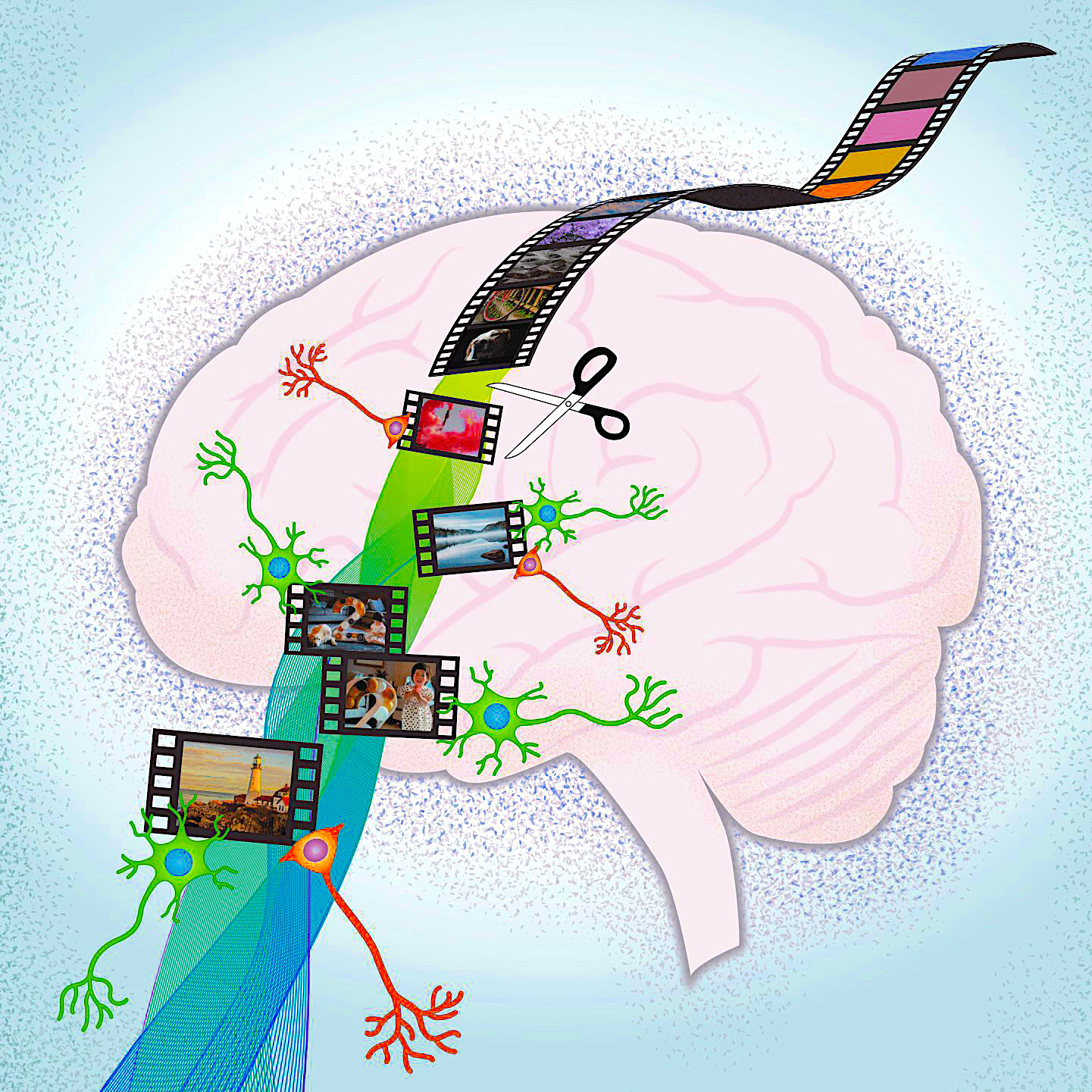
Cedars-Sinai has “discovered two types of brain cells that play a key role in creating memories.”
“One of the reasons we can’t offer significant help for somebody who suffers from a memory disorder is that we don’t know enough about how the memory system works,” said [a] senior author of the study, adding that memory is foundational to us as human beings.
Human experience is continuous, but psychologists believe, based on observations of people’s behavior, that memories are divided by the brain into distinct events, a concept known as event segmentation.
Forgetfulness is, for most who live long enough, an unavoidable aspect of aging. But it may not be quite so bad as it appears to us, as C.S. Lewis related in a letter written several years before his death.
About forgetting things. Dr. Johnson* said “If, on leaving the company, a young man cannot remember where he has left his hat, it is nothing. But when an old man forgets, everyone says, Ah, his memory is going.”
So with ourselves. We have always been forgetting things: but now, when we do so, we attribute it to our age.
Why, it was years ago that, on finishing my work before lunch, I stopped myself only just in time from putting my cigarette-end into my spectacle case and throwing my spectacles into the fire!
Forgetfulness is a common part of human experience, but clinical amnesia is something altogether different.
Tragically, some suffer from anterograde amnesia. One of the saintly matrons at our church carries this cross, assisted by her loving daughter and son-in-law. This cruel disease prevents the retention of new memories. While it is often linked with geriatric considerations, and can affect all of one’s memories, this article from the National Library of Medicine describes a particularly tragic case in which a child “had an abrupt onset of amnesia due to a respiratory arrest at the age of 8 years.”
Cases such as this move Christians to prayer, and many others to despair. While miracles do happen, they are rarer than we desire. Ultimately the Christian hope is in a Lord who keeps his promises, and one of these is that he will come again and will take us to himself, so that where he is, we may be also (John 14). And, in heaven, we will receive a new body like Christ’s resurrection body (Philippians 3).
* Samuel Johnson (1709-1784), a prolific and influential English writer, was often referred to simply as “Dr. Johnson.” Many volumes of the good doctor’s writings are available as free downloads from Internet Archive. For example, volume 7 of the 1810 collection, includes the following essay discussing human shallowness. He begins by contemplating the ability of animals to remember and to anticipate the future.
The Idler
Numb. 24. Saturday, September 30, 1758.When man sees one of the inferiour creatures perched upon a tree, or basking in the sunshine, without any apparent endeavour or pursuit, he often asks himself or his companion, On what that animal can be supposed to be thinking?
Of this question, since neither bird nor beast can answer it, we must be content to live without the resolution. We know not how much the brutes recollect of the past, or anticipate of the future; what power they have of comparing and preferring; or whether their faculties may not rest in motionless indifference, till they are moved by the presence of their proper object, or stimulated to act by corporal sensations.
I am the less inclined to these superfluous inquiries, because I have always been able to find sufficient matter for curiosity in my own species. It is useless to go far in quest of that which may be found at home; a very narrow circle of observation will supply a sufficient number of men and women, who might be asked, with equal propriety, On what they can be thinking?
It is reasonable to believe, that thought, like every thing else, has its causes and effects; that, it must proceed from something known, done, or suffered; and must produce some action or event. Yet how great is the number of those in whose minds no source of thought has ever been opened, in whose life no consequence of thought is ever discovered; who have learned nothing upon which they can reflect; who have neither seen nor felt any thing which could leave its traces on the memory; who neither foresee nor desire any change of their condition, and have therefore neither fear, hope, nor design, and yet are supposed to be thinking beings.
To every act a subject is required. He that thinks must think upon something. But tell me, ye that pierce deepest into nature, ye that take the widest surveys of life, inform me, kind shades of Malbranche [Nicolas Malebranche] and of [John] Locke, what that something can be, which excites and continues thoughts in maiden aunts with small fortunes; in younger brothers that live upon annuities; in traders retired from business; in soldiers absent from their regiments; or in widows, that have no children?
Life is commonly considered as either active or contemplative; but surely this division, how long soever it has been received, is inadequate and fallacious. There are mortals whose life is certainly not active, for they do neither good nor evil; and whose life cannot be properly called contemplative, for they never attend either to the conduct of men, or the works of nature, but rise in the morning, look round them till night: in careless stupidity, go to bed and sleep, and rise again in the morning.
Johnson’s essay continues with a discussion of the soul and its distinction from the mental processes themselves. Obviously, he is not considering the subject of amnesia, but he reminds us never to become too doctrinaire, since that “supposes what cannot be proved, that the nature of mind is properly defined.”
His purpose in the essay is not to discuss the abilities of the brain but, at least in part, to critique those who choose to be unthinking. Those who spend not a moment in reflection or contemplation.
I encourage you to read the entire essay, as it demonstrates Johnson’s brilliance. I close this extended “footnote” with a passage in his concluding section which keenly describes our common human experience with memory.
We every day do something which we forget when it is done, and know to have been done only by consequence. The waking hours are not denied to have been passed in thought; yet he that shall endeavour to recollect on one day the ideas of the former, will only turn the eye of reflection upon vacancy; he will find, that the greater part is irrevocably vanished, and wonder how the moments could come and go, and leave so little behind them.


This was very interesting reading on memory. I had amnesia after a ski accident in Germany when I was young. My memory came back except for the three days right after the accident, which are still gone. I am also fascinated by the fact that our memory is associative. I come back to a place or hear a song I haven’t heard in a long time, and suddenly I remember things I had entirely forgotten. Alzheimer’s is tragic. I have two aunts with Alzheimer’s.
Your personal experience with this subject is amazing. And the three days duration for the lost memories highlights the arbitrariness of amnesia. And sorry to hear about your aunts.
Yes, the associative nature of memories is fascinating. “Meaningful” things connected to the moment make sense — like places and songs. Less familiar things are even more intriguing. Smell can trigger memories. I have experienced that in connection with a military activity from years ago. It’s rare now, but can still occur.
That is quite interesting. I appreciate your fascinating post.
I believe some consider it a great insult to be told “I’ve forgotten more than you’ll ever know.” But if forgotten, what does it matter, especially if we are simply the sum of our memories. How grievous though to lose the memory of self, of one’s past life, especially loved ones! I wonder how much of our personality is shaped by these things and whether in a frightening way we lose “ourselves” in losing such memories. But thank God that because of Christ we are always pressing forward into a future with Him. On that day … “Eye has not seen, nor ear heard,
Nor have entered into the heart of man
The things which God has prepared for those who love Him.”
As you say, there seems a lot of truth considering ourselves the “sum of our memories.” In one sense, what else could we consider our unique personhood connected to?
As a child of God you understand that all that is good that has been lost, will likely be restored one day to us. In the meantime, I pray that any season of dementia that might lie in my future will be brief.
Amen. Whatever the future holds as He wills, may our strength be as our days, knowing “the eternal God is your refuge,
and underneath are the everlasting arms.”
Very interesting..
It certainly is a complex and fascinating subject.
I’ve known firsthand people w/ Alzheimer’s Disease, frontal lobe dementia, and Parkinson’s Disease — all of which impact memory. It is crushing to see a loved one disappear before our eyes, though still physically present. As you say, these illnesses move Christians to prayer.
Whatever may befall us in this life, God knows us. He knew us before we were born, and He will know us to the very end (even if we no longer know ourselves). “Your eyes saw my substance, being yet unformed. And in Your book they all were written, The days fashioned for me, When as yet there were none of them” (Ps. 139: 16).
In fact, He promises us eternal life, if we will but trust in Him.
“Crushing” is the right word to describe the hopeless despair that comes as we watch our loved ones fade away. But — as you so eloquently express it — “God knows us.” And, he will ultimately restore our memories one day. Healed, healthy, happy and whole.
We know with real certainty not very much about the inner experience of animals. Does any animal ever realize that it forgot something or misremembered something? I suppose not; but we do that from early years.
Mankind might be defined as the animal that makes promises. Unlike the angels, we are animals in that we draw physical life from food, we propagate, and so on. But I suppose no animal (other than ourselves) makes promises. To do that one has to have a sense of oneself as a persisting being, one has to have a sense of the future, and one must possess verbal language — at least I don’t see how one could make a promise while never using words.
Have I already here mentioned a piece I wrote about memory, taking substance from Out of the Silent Planet?
Click to access PortableStorage-09.pdf
The fanzine it was published in was not a Christian magazine, but its editor was hospitable to my writing as a Christian.
If anyone wants to read my article, perhaps he or she should think of it as mimicking reverie, in which mental activity flows from thought to thought or memory to memory, not necessarily in an immediately obvious way. Read with this understanding, perhaps the style will enhance the presentation of the content rather than seeming to be disjointed.
Thank you for the link, Dale. I’ve downloaded it and look forward to reading it tonight. Out of the Silent Planet was the first of C.S. Lewis’ works I read. Each volume of the trilogy was so distinct from the others, but I found each one more inspiring than the previous one.
The making of promises… an interesting question. Now, the keeping of our promises… is another matter worthy of pondering.
I enjoyed your superb article. I could relate to many of the elements of your story (including remembering the theme son of “Branded”). One thing, however, is beyond my experience… to possess correspondence from Owen Barfield!
Well, I do have a letter from Walter Hooper… and a couple of brief emails from Doug Gresham. So I guess I am similarly blessed. Thanks for “reminding” me.
Thanks for reading the article, Rob. Lewis’s insight about “a pleasure full grown” is something in line with Holy Scripture — Bless the Lord and forget not all His benefits, etc.
Pingback: C.S. Lewis and Time’s Meaning – Mere Inkling Press