C.S. Lewis & Medicine

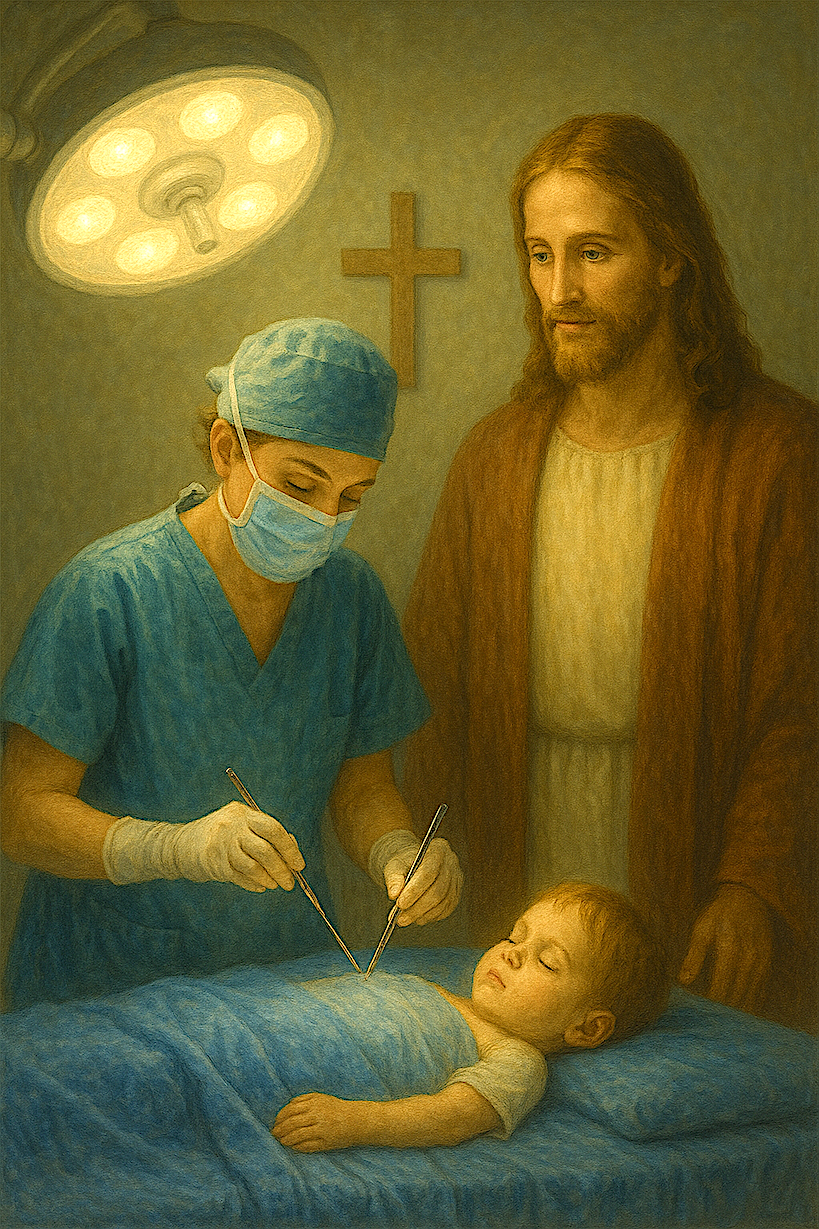
[I originally penned this post in 2020, but delayed its publication due to failing in my attempt to secure permission to receive this perfect illustration. Five years later, AI allowed me to create the image shown above. Since the message remains pertinent, I’m offering my thoughts on this subject today.]

Medicines are precious. Right now we are seeing the release of the first antiviral drugs devised to protect us from the covid plague. The trials have been positive, and now the caregivers on the frontlines are receiving these protective injections.

Unfortunately, some so-called medicines are not effective. They can even be harmful. That’s the case with “patent medicines” hawked by shysters lying about their results. Originally the term was positive. According to one museum, “patent medicines originally referred to medications whose ingredients had been granted government protection for exclusivity.”

Sadly, though, “the recipes of most 19th century patent medicines were not officially patented. Most producers (often small family operations) used ingredients quite similar to their competitors—vegetable extracts laced with ample doses of alcohol.

In a previous post, I shared Lewis’ view of God’s role in healing.

In his essay entitled “Miracles,” C.S. Lewis described during World War II the Christian viewpoint that God is the author of healing. After discussing the natural order of creation, he argues that God is at work in restoring the health of the those who are ailing.

In 1962, Lewis commiserated with a correspondent complaining about the number of pills she needed to take. He acknowledges the problem, and then points to a very positive corollary.

Yes, and one gets bored with the medicines too–besides always wondering ‘Did I remember to take them after breakfast?’ and then wondering whether the risk of missing a dose or the risk of an over dose is the worst!

Yes, one gets sick of pills. But thank God we don’t live in the age of horrible medicines such as our grandparents had to swallow.

In A Grief Observed, Lewis used an illustration of physical pain to explore the emotional pain caused by his sorrow at his wife’s passing.

I once read the sentence “I lay awake all night with a toothache, thinking about the toothache and about lying awake.” That’s true to life. Part of every misery is, so to speak, the misery’s shadow or reflection: the fact that you don’t merely suffer but have to keep on thinking about the fact that you suffer. I not only live each endless day in grief, but live each day thinking about living each day in grief.

In some ways, psychological suffering is particularly painful. The mentally ill have historically been ostracized. For all of the neurological discoveries that have been made in recent years, the human brain remains a mystery.

Fortunately, medical science has experienced some success formulating medicines that are helpful in treating mental disorders. One problem, however, is that (like nearly all meds) psychological formulas occasionally produce extreme side effects.

C.S. Lewis’ primary experience of psychological suffering came through grief. Tweaking Optimism, a great blog, has gathered a number of Lewis’ thoughts on mental anguish. One passage he cites from The Problem of Pain aptly contrasts physical and mental suffering.

Mental pain is less dramatic than physical pain, but it is more common and frequently more difficult to bear. The common attempt to conceal mental pain increases the burden: it is easier to say “My tooth is aching” than to say “My heart is broken.”

In the same book, Lewis lifts up the truth about suffering. In cases where no cure can bring relief, he beautifully describes various ways to survive journeying through the valley.

When pain is to be born, a little courage helps more than much knowledge, a little human sympathy more than much courage, and the least tincture of the love of God more than all.

C.S. Lewis’ Prescription for Christians Today

We live in an uncertain and turbulent time. Only God knows how long this world will last, but he has promised to deliver from death and hell those who call on his name. Thus, Jesus’ followers need not live in dread or despair.

We live with hope, and look forward with enthusiasm to our Lord’s return. It is to that glorious day, the Parousia, that Lewis refers in his essay “The World’s Last Night.”

The doctrine of the Second Coming, then, is not to be rejected because it conflicts with our favorite modern mythology. It is, for that very reason, to be the more valued and made more frequently the subject of meditation. It is the medicine our condition especially needs.

An Entertaining Tolkien “Game”

The inspiration for this revisitation of Lewis’ thoughts about medicine came from a fun website I recently encountered. Some creative soul noticed the similarity between two dissimilar matters—antidepressant medications and residents of Middle Earth.

The game offers 24 words, and you are challenged to identify the group into which it falls. Is it the name of a pharmaceutical, or is it one of the characters created by J.R.R. Tolkien? One name is a giveaway, but you may find many of the others rather difficult to discern.

Kudos to anyone who gets over twenty correct. (I almost did . . . well, if sixteen is close.) Have fun, and learn something, at the very same time!
Antidepressants or Tolkien Character?

Military Hymns & Ents

The United States is schizophrenic about its religious heritage, and the armed forces provide us with today’s example. Most people, including veterans themselves, are unaware of the fact that while we have official songs for the different branches of the armed forces, we don’t have any official hymns.

C.S. Lewis and J.R.R. Tolkien, both combat veterans, were quite familiar with martial music. However, as members of a (nominally) Christian kingdom, neither would have been uncomfortable with explicitly Christian elements in their military’s hymnody. Across the ocean in the former colonies, it’s a different matter. 

Here, the confusion about the “official” status of religious military hymns abounds because spiritual hymnody has been part of our nation’s martial history ever since the colonies decided to band together and seek independence. Yet, some consider that to be unlawful.

The rejection of music expressing faith in God can be attributed to the modern crusade against such hymns by strident anti-theists. Many in this camp are practicing atheists, who misinterpret the two clauses of the First Amendment which the nation’s founders did not consider mutually exclusive. 

Congress shall make no law respecting an establishment of religion, or prohibiting the free exercise thereof . . .

Since most of the creators of the Constitution – and the majority of American citizens up to this day – have been theists (believing in a Supreme Being), it is self-evident that they did not intend to exorcise all expressions of faith from the public forum. Some states, in fact, already had their own “established churches when the First Amendment was ratified.”

Up until this generation, generic references to a heavenly Father or a benevolent Creator have traditionally remained welcome at civic events.

Even the non-Christian Thomas Jefferson (who argued against religious establishment) was essentially a Deist, acknowledging “the god who gave us life, gave us liberty at the same time . . .”

Jefferson even edited the New Testament Gospels, deleting “objectionable passages” and producing his personally-sanctioned Life and Morals of Jesus of Nazareth

So, What about the Music?

My goal is not to discuss the First Amendment per se – though I included the introductory note above for the benefit of the many international readers who find their way to Mere Inkling.

Rather, I wish to discuss the premise above, that America celebrates generally secular martial music, while remaining wary of military hymnody with religious themes. 

Ironically, soldiers throughout the nation’s history passively assumed that the songs they heard at rallies and civic events had the government’s tacit imprimatur, that was questionable. Take the “Battle Hymn of the Republic,” for example. Composed in 1861 by abolitionist Julia Ward Howe, Union soldiers would have been shocked to learn that some would deem its use in the ranks as a violation of the First Amendment.

Mine eyes have seen the glory of the coming of the Lord;
He is trampling out the vintage where the grapes of wrath are stored;
He hath loosed the fateful lightning of His terrible swift sword:
His truth is marching on.

I have read a fiery gospel writ in burnished rows of steel:
“As ye deal with My contemners, so with you My grace shall deal;”
Let the Hero, born of woman, crush the serpent with His heel,
Since God is marching on.

Modern Military Hymns

The Department of Defense hosts a website titled Guide to U.S. Military Bands and Music. It describes the wide repertoire of military musicians. 

Whether you like jazz music, a marching band or orchestra music, the U.S. military has you covered. Each branch of the military boasts a diverse offering of musical talent that serves for ceremonial purposes but also for entertainment and outreach. Check out these bands to stay in tune with military music.

One Christian hymn has deep roots in the military community. The song traditionally referred to as “The Navy Hymn” in America, originated in Britain. It is also used by the French. Its maritime themes make it popular in civilian communities as well. 

Eternal Father, strong to save,
Whose arm does bind the restless wave,
Who bids the mighty ocean deep
Its own appointed limits keep;
O hear us when we cry to Thee
For those in peril on the sea.

O Savior, whose almighty word
The winds and waves submissive heard,
Who walked upon the foaming deep,
And calm amid the rage did sleep;
O hear us when we cry to Thee
For those in peril on the sea.

“There exist a myriad of alternate verses to the hymn. One, for example, was written by David B. Miller in 1965 and specially dedicated to naval submariners.”

Musicians were not just present for official ceremonies and off-duty entertainment. They could also inspire the troops in the violent din of battle. More common in distant ages, even in twentieth century Europe, we find a dramatic illustration.

In the military archives of the Irish Republican Army, Michael J. Crowley described the inspiration provided by the brigade’s musician in the heat of the battle called the “Battle of Crossbarry” and the “Crossbarry Ambush,” by the IRA and the Brits respectively.

From the opening shot of the engagement, our piper, Florrie Begley of Brandon, played warlike airs on the bagpipes until the last shot was fired.

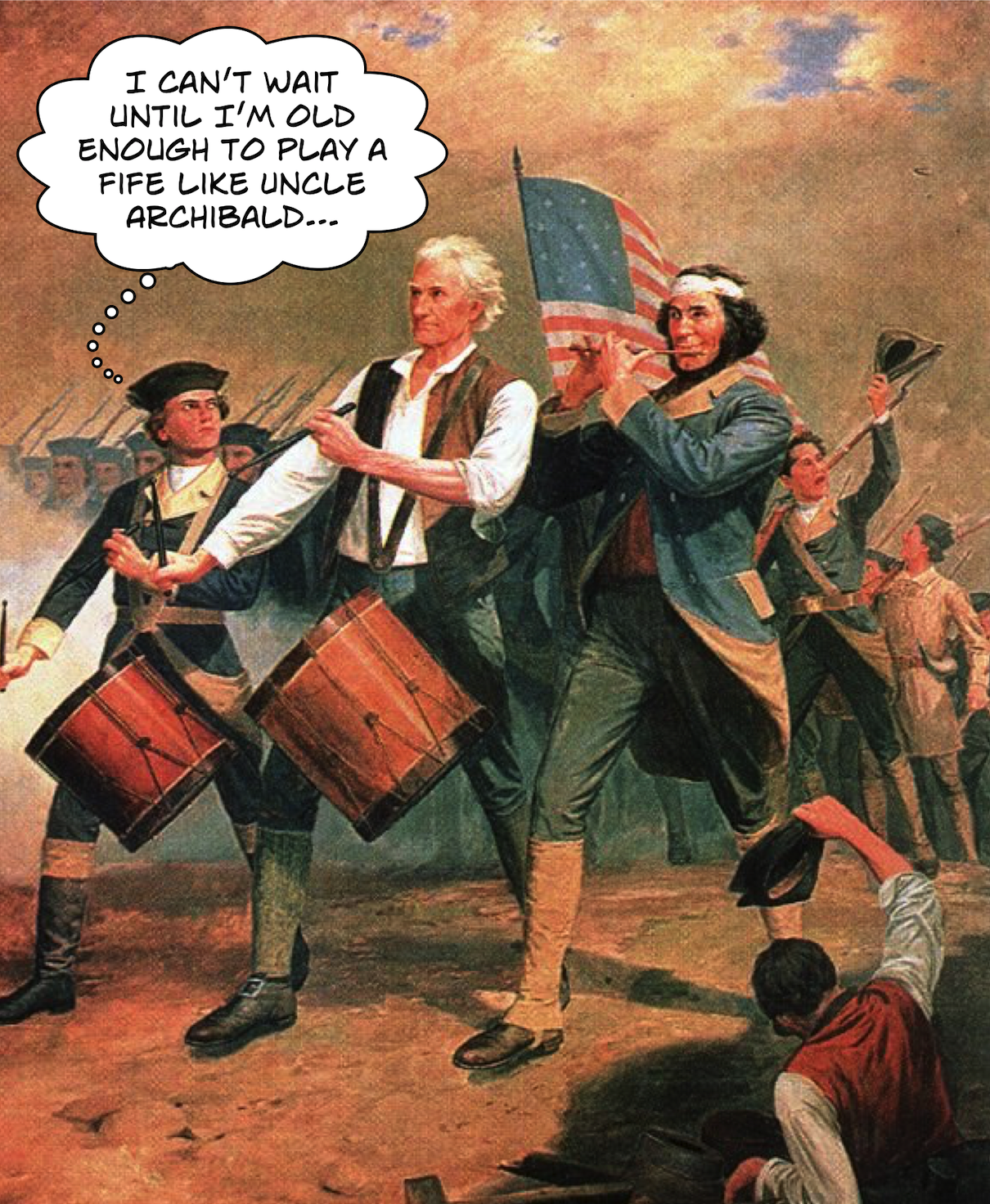
The illustration above provides an idealized portrait of military musicians bravely facing enemy fire. “The Spirit of ’76,” painted for the centenary of the American Revolution, met with tepid enthusiasm during the 1876 Centennial Exposition in Philadelphia. However, it rose in popularity when it subsequently toured the country.

For centuries, armies used music as the means to communicate the military orders of the day to soldiers. The high pitch of the fife and the sharp sound of the drum allowed messages to be heard at great distance . . .

Leaping from the Revolution to the twenty-first century, the recently birthed United States Space Force now has a hymn. Well, sort of. It is an unsolicited hymn composed by a former Air Force officer. You can hear “Creator of the Universe” here.

For more space music, check out the official anthem of “the mighty watchful eye.” Some consider this proposed anthem far more inspiring.

My personal favorite is the version of the Space Force Anthem proposed by its original, cinematic commander, General Naird, played by Steve Carell. (Carell even plays his own fife in the episode.)

The Middle Earth Military March

Howard Shore composed a powerful soundtrack for Lord of the Rings. Yet he wasn’t the first to create music for the great saga. One Tolkienist writes:

My first contact with Tolkien-inspired music dates back to the late 1980s . . . I was watching TV with my parents seeing a performance of Military Bands. Later I would discover that it was the Dutch composer Johan de Meij’s Symphony No. 1 (The Lord of the Rings) I’d heard.

From among the ranks of the Inklings, only one writer wrote an explicit military song. J.R.R. Tolkien provided the timeless Ents with a somber marching song as they face the powers of Isengard.

We come, we come with roll of drum: ta-runda runda runda rom!
We come, we come with horn and drum: ta-rūna rūna rūna rom!

To Isengard! Though Isengard be ringed and barred with doors of stone;
Though Isengard be strong and hard, as cold as stone and bare as bone,
We go, we go, we go to war, to hew the stone and break the door;
For bole and bough are burning now, the furnace roars – we go to war!
To land of gloom with tramp of doom, with roll of drum, we come, we come;
To Isengard with doom we come!
With doom we come, with doom we come!

If you have a moment, you will likely enjoy the performance of this song as arranged by Clamavi De Profundis.

Pilfering Tolkien Linguistics

When a great author, say of the magnitude of J.R.R. Tolkien, creates ingenious new words, and even entire languages, there are several common reactions. Most readers simply respond with silent awe. Others are inspired to emulate their efforts. A small number reuse those very words as a sincere homage

And a handful of “admirers” go so far as to “appropriate” the words themselves, for their personal benefit.

C.S. Lewis, no mean linguist himself, recognized his friend Tolkien’s brilliance. In his preface to That Hideous Strength he praised Tolkien’s yet-to-be-published Silmarillion. In a 1951 letter he mentions misspelling the word Numenor.

My Numinor was a mispelling: it ought to be Numenor. The private mythology to which it belongs grew out of the private language which Tolkien had invented: a real language with roots and sound-laws such as only a great philologist could invent.

He says he found that it was impossible to invent a language without at the same time inventing a mythology.

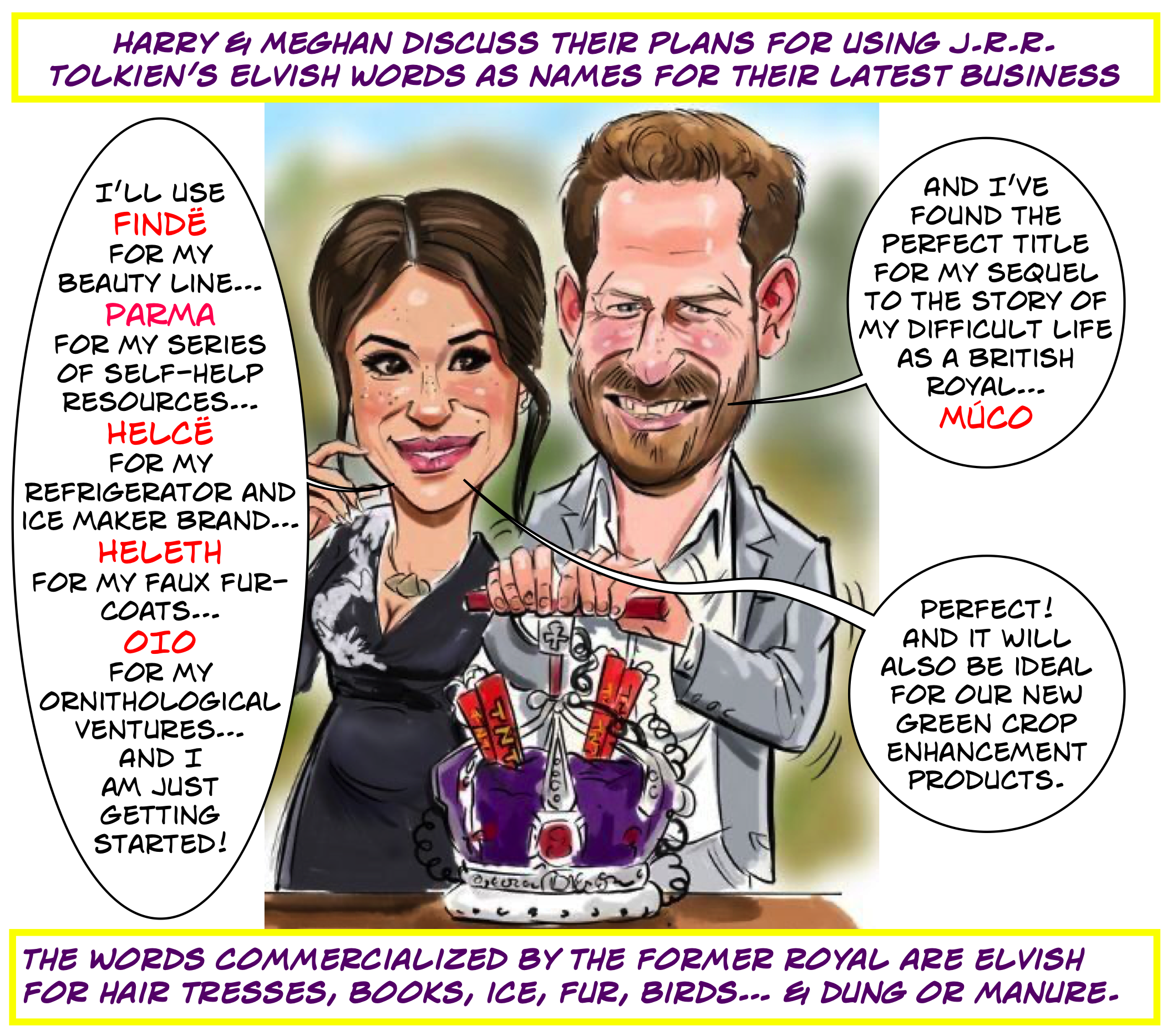
J.R.R. Tolkien was an internationally renowned philologist, and his impressive skill is one of the great wonders we encounter in Middle Earth. A number of words from his created languages – particularly his ethereal Elvish tongues – have been lifted to be used in commercial activities unconnected to Tolkien’s interests.

For example, Palantir. This was the word for the “seeing stone,” which played a prominent role in The Two Towers. In light of Tolkien’s love of nature, and corresponding suspicion of technological advancement, it is especially odd that the company adopting this label is on the leading edge of Artificial Intelligence.

Perhaps Tolkien’s dread would have been dispelled by one of Palantir’s disarming mottos: “We believe in augmenting human intelligence, not replacing it.”

A combat veteran of WWI, like his fellow Inkling C.S. Lewis, Tolkien was appalled by war’s horrors. Even in the War of the Rings, with its moments of glorious heroism and sacrifice, the bloody heart of Mars remains nearly invincible. Because of this mixed attitude toward war, some have wondered how he would have felt about a defense (i.e. military) corporation adopting one of his creations.

Andúril was the name of the most important weapon forged in Middle Earth. It was actually reforged from the broken fragments of Narsil, the longsword which defeated Sauron by severing the One Ring from his hand.

While this description from the Anduril company resonates with our modern ear, I am not convinced that it sounds very Tolkienesque. Anduril: “Transforming defense capabilities with advanced technology. The battlefield has changed. How we deter & defend needs to change too.”

For an article about a billionaire investor who is consumed by mining Tolkien’s tomes for the businesses he founds (PayPal excepted), check out “The hidden logic of Peter Thiel’s ‘Lord of the Rings’-inspired company names.”

C.S. Lewis’ Unconscious Sharing

In a 1965 letter, written after Lewis’ death, Tolkien commented on how his friend had used subtle variations of several Elvish words in several of his fictional works.

Tolkien says Lewis “had the peculiarity that he liked to be read to. All that he knew of my ‘matter’ was what his capacious but not infallible memory retained from my reading to him as sole audience.” Thus, he surmises that:

C.S. Lewis was one of the only three persons who have so far read all or a considerable part of my ‘mythology’ of the First and Second Ages, which had already been in the main lines constructed before we met. . . . His spelling numinor is a hearing error, aided, no doubt, by his association of the name with Latin nūmennūmina, and the adjective ‘numinous.’

Lewis was, I think, impressed by ‘the Silmarillion and all that,’ and certainly retained some vague memories of it and of its names in mind. For instance, since he had heard it, before he composed or thought of Out of the Silent Planet, I imagine that Eldil is an echo of the Eldar; in Perelandra ‘Tor and Tinidril’ are certainly an echo, since Tuor and Idril, parents of Eärendil, are major characters in ‘The Fall of Gondolin,’ the earliest written of the legends of the First Age. But his own mythology (incipient and never fully realized) was quite different.

An Entertaining Diversion

Years ago I linked to an entertaining game that plays on the linguistic eloquence and mystery Tolkien exhibited in naming his characters. I was delighted to see now that it is still available online.

Antidepressants or Tolkien challenges players – you can play solo, but it’s more fun with others – to guess if a given word is an antidepressant drug or the name of one of Tolkien’s characters. Don’t expect to score 100%, but do expect to smile at some of the examples.

Tinker Bell, the Inklings, and Disney

Poor Tinker Bell. The political prejudices of our day have caught up with the sparkling fairy, and relegated her to a significantly reduced presence in the Disney universe.

Inside the Magic reported “Tinker Bell seems to have left Walt Disney World and is now on her way back to Neverland following a recent change at Walt Disney World Resort.” You can read the tragic tale on their site.

. . . once more, Disney’s animated classic, Peter Pan (1953), is under scrutiny, with Disney issuing a statement regarding Captain Hook and Tinker Bell as characters with potential concerns.

Linking poor Tink to a murderous pirate seems a bit of a stretch, and she has not been fully banished, but she has definitely been demoted. According to TMZ, Disney alleges the company’s “own people felt she wasn’t a good role model for girls in the 21st century.”

Well, eventually she too will be in the public domain, like Mickey Mouse. Actually, her literary portrait as introduced in the play, coincidentally just entered the public domain this year (2024)!

However, should you reside in the United Kingdom, beware that in 1988, the copyright holder, Great Ormond Street Hospital, was granted the rights to Peter Pan “in perpetuity.”

The Creator of Tinker Bell & Peter Pan

Tinker Bell is one of the most memorable characters in Neverland, the creation of James Matthew Barrie (1860-1937). He was a prolific Scottish writer and is best known for his 1911 novel, Peter and Wendy – which initially debuted in the form of a stage play in 1904, as Peter Pan; or, the Boy Who Wouldn’t Grow Up.

Peter Pan was actually introduced to the world as a baby in The Little White Bird. Tinker Bell does not appear in the novel, but the following description of J.M. Barrie’s fairy mythology is quite fanciful.

One of the great differences between the fairies and us is that they never do anything useful. When the first baby laughed for the first time, his laugh broke into a million pieces, and they all went skipping about. That was the beginning of fairies.

They look tremendously busy, you know, as if they had not a moment to spare, but if you were to ask them what they are doing, they could not tell you in the least. They are frightfully ignorant, and everything they do is make-believe.

They have a postman, but he never calls except at Christmas with his little box, and though they have beautiful schools, nothing is taught in them; the youngest child being chief person is always elected mistress, and when she has called the roll, they all go out for a walk and never come back.

It is a very noticeable thing that, in fairy families, the youngest is always chief person, and usually becomes a prince or princess; and children remember this, and think it must be so among humans also, and that is why they are often made uneasy when they come upon their mother furtively putting new frills on the basinette.

Barrie continues, describing how infants are simply following fairy “ways” when they misbehave, and they naturally experience “exasperation, because we don’t understand [them], though [they are] talking an intelligible language . . . fairy.”

Returning to the person of Tinker Bell herself, she outgrew her supporting role as, in the words of her creator, “a common fairy.” She was literally a tinker, who died following the departure of Wendy and her brothers from Neverland. 

Presumably, some of the gatekeepers at Disney would have preferred that the affection of the crowds had not restored her to life. 

The Inklings

The Imaginative Conservative offers an interesting take on C.S. Lewis’ view of fairies. I quote a portion related to our present subject.

Lewis treats the subject of fairies in . . . The Discarded Image. . . . After explaining the medieval understanding of the heavens and planetary systems, Lewis turns to what he calls the Longaevi. He avoids the term “fairies” because it is “tarnished by pantomime and bad children’s books with worse illustrations.” (Probably referring to Barrie’s popular play and Princess Mary’s Gift Book – the book from which Elsie and Frances clipped the pictures they used in their fake photos.)

Jane Douglass, an American actress and playwright, contributed a fascinating essay to C.S. Lewis at the Breakfast Table, and Other Reminiscences. One wonderful portion of “An Enduring Friendship” describes Lewis’ thoughts about the possible dramatization of The Lion, the Witch, and the Wardrobe

C.S. Lewis deemed the prospect absurd on its face, saying “I believe plays should be plays, poems, poems, novels, novels, stories, stories, and certainly the book you mention is pure narrative.” So much for a partially surviving 1967 series, the 1979 animation, the 1988 BBC television series, and the cinematic version(s) which began in 2005. Oh, and there is the matter of the impending Netflix telling which remains a closely guarded secret. Douglass continued with a reference to Disney.

He repeated his dread of such things as radio and television apparatus and expressed his dislike of talking films. I said I quite understood this, and that nothing would distress me more than that he should think that I had in mind anything like the Walt Disney shows; I hoped nobody had suggested the book to Mr. Disney.

This seemed to relieve Mr. Lewis to such an extent that I thought perhaps Mr. Disney had been after the book, but of course I did not ask. And in his usual generous way, Mr. Lewis said, “Too bad we didn’t know Walt Disney before he was spoiled, isn’t it?”

Author Jim Denney has a nice article on “What C.S. Lewis and J.R.R. Tolkien Thought of Walt Disney” in which he describes parallels between the live of Lewis and Disney and concludes, “you might think that, with all that C.S. Lewis and Walt Disney had in common, they might have been mutual admirers – but that was not the case.”

Disney’s Snow White and the Seven Dwarfs debuted in the United States in 1937 and in the United Kingdom in 1938. . . . A few months later, Lewis went to see it again, this time with his good friend (and fellow Oxford professor) J.R.R. Tolkien.

Coincidentally, Tolkien’s first novel The Hobbit had been published in September 1937, just three months before the American debut of Snow White.

Their greatest disappointment was in Disney’s utterly comical take on dwarves and the absence of the slightest air of “the mythic nobility of the dwarves from Germanic folklore.”

Although Snow White is itself a fairy tale, fairy characters are not to be found in the film. In the same way, J.R.R. Tolkien referred to the Lord of the Rings as a “fairy story” for adults, yet they do not appear to dwell in Middle Earth.

In fact, according to The Encyclopedia of Arda, “the name ‘Faerie’ belongs to an early period of Tolkien’s writings, and is never seen in The Lord of the Rings, but it does survive in a single usage in the earlier book The Hobbit.” And even in that case, it refers not to a population, but to a place.

On the Effect of Tinker Bell

Tinker Bell’s significance in the world is not confined to literature, or the interests of children. There is a brilliant application of her legend which has been transposed into the psychological realm. 

It’s call the “Tinker Bell Effect,” and “Be(lie)ve It or Not,” from Psychology Today, offers the following description.

One theory manifesting connections among belief, psychology, and mythology is the Tinkerbell effect named for the fairy Tinker Bell of Peter Pan whose resuscitation depends upon the audience expressing their belief in fairies through clapping . . .

The Tinkerbell effect refers to those things that exist only through imaginative acts and because people believe in them. The Reverse Tinkerbell effect maintains that, somewhat paradoxically, the more people believe in something the more likely it is to disappear. 

In their article, the psychologists parenthetically offer an additional application of Tinker Bell’s nature to their area of study. (It actually appears in the paragraph above, where I replaced it with an ellipsis.)

(because she is so small that she can only hold one feeling at a time, Tinkerbell is also a model for mood disorders and difficulties with emotional self-regulation)

Fascinating. It seems to me this insight opens the door to further literary exploration of the Tinker Bell Phenomenon that would be of interest to writers and literary critics alike. I close with my proposal for a new label for an ancient plague afflicting fictional works. If it interests any scholars among you, I invite you to develop it further and claim it as your own.

Tinker Bell (var. Tinkerbell) Crippling Character Creation Complete Content Complexity Phenomenon: The invention of fictional characters who lack depth and bear no resemblance to real people. Literary tropes that are often referred to as one-dimensional or “flat” characters. (See nearly all Marvel supervillains.)

P.S. – Feel free to abbr. the admittedly verbose proposed title; keeping in mind most readers prefer brief reads.

Fonts that Can Make Your Literary Dreams Come True

Would you be interested in owning a copy of an attractive new font called Middle Earth? If so, read on and you’ll find a link to download this typeface created by Swedish designer Måns Grebäck.

When it comes to fonts, there are basically two types of people – those who pay no attention to them as they read, and others who notice the nuances between similar fonts and are fascinated by extraordinary examples.

Longtime readers of Mere Inkling know I am in the latter category. Every year or two I actually write on the subject. I’ve discussed monastic fonts, legal fonts, trustworthy fonts, uninhibited fonts, a dyslexia font, a memory-enhancing font, fonts based on the handwriting of historical figures, and being a fontaholic.

The reason for my current interest in fonts is due to Microsoft’s decision to jettison Calibri as their default font for Office products. They needed to make room for its replacement, Aptos. Seriously, when you view the two sans serif* fonts, side-by-side, you may be surprised at how little they differ.

To make matters even more confusing, CNBC describes a curious aspect of Aptos saga.

Aptos will remain available in the font list under the old Bierstadt name for people who are accustomed to it. Users can also choose to set any other font as the default.

Apple’s mac computers also allow users to choose their own defaults. One typography community discusses this selection opportunity, even as they bemoan the fact that in many programs, the standard installations include suboptimal fonts.

Unfortunately, many of us work on computers where we have no control over what fonts are loaded onto the machine, so we have created a list of the top 10 most common system fonts everyone should know and how to handle them.

This website offers a brief description and history of ten of the most common fonts we typically encounter. For example:

Times New Roman is a serif typeface designed by Stanley Morison and Victor Lardent in 1931. It was commissioned by the British newspaper The Times, which wanted a new typeface to replace its existing font, Times Old Roman.

And I love their estimation of Comic Sans, one of my wife’s favorite fonts, which I avoid like the proverbial plague. (Delores is a young at heart special education teacher, and I’m more of a Lewisian dinosaur.) 

Do use: if you are designing a comic for 6-year-olds.
Don’t use: if you want to be taken seriously by work colleagues.

Another pastor, who learned this lesson the hard way, shared his advice with the warning: “pastors don’t let your bulletins print out in Comic Sans!”

Apparently, his astute wife preserved his professional reputation by telling him to (1) avoid using a “smorgasbord of fonts” in a single document, and (2) “resist the temptation to print serious things in less than serious fonts.”

Advice for Writers

While authors have little control over the fonts in which their work is published by commercial publishers, they do have freedom to choose the typeface they use for the actual composition. “How To Choose the Best Font for Your Writing” addresses that latitude in the following way.

Do you have a favorite font? Are you dedicated to Times New Roman, or are you more of an “anything-but-Wingdings” kind of writer? Maybe you haven’t given your choice of font much thought.

Quite simply, as research shows, texts that look good make you feel good while interacting with them. This is why it’s so important to choose a font that not only is easy to read, optimizes line length, and has the right mood, but also is one that you like!

MasterClass describes the various aspects of each font that will contribute to your overall impression of each font. In “Typography for Writers: How to Pick the Best Type for Writing,” they explain the significance of bowls, ascenders, spines, counters, and more.

Typographers and type designers have their own universe of special terms, each of which refers to a specific part of a given letter. Understanding these basic elements of typography can help you decide precisely what typographic style you want to employ to grab your reader’s attention.

InDesignSkills goes so far as to match a number of typefaces to specific genres, saying “we judged the legibility, beauty, simplicity and variety of weights available of a huge range of fonts, and whittled them down to these faithful five.” They even offer an ironclad promise, proclaiming their selection will “never let your typesetting down, guaranteed.”

Obviously, personal tastes play a large role in appreciating or disapproving of various fonts. One author describes how the quest for the perfect font is integral to writers’ creativity.

Let’s talk about one of our favourite writing avoidance devices: picking the right font for your manuscript.

The Best and Worst Fonts (and why they’re good or bad),” describes the bond a writer can develop with their typographic fancies.

Fonts are one of the most important design choices to make when developing your brand identity. The best fonts leave you feeling like you’ve made an instant friend while the worst fonts are like a stranger who won’t leave you alone.

The writer offers her personal preferences (and prejudices). I don’t agree with all of her judgments, but I am forced to concur with her inclusion of Jokerman and Bleeding Cowboys on the list of “worst fonts.” And I am pretty sure that C.S. Lewis would agree.

Write in the Spirit of Middle Earth

If you have read this far, your reward is to receive the download link for Middle Earth. 

As noted aboved, Måns Grebäck is a prolific Swedish typographer. He makes many of his creations freely available to individuals for non-commercial use. (Commercial licenses are available as well.) The independent FontSpace describes it thusly:

With the historic charm of ancient manuscripts and the ethereal beauty of elven realms, Middle Earth typeface weaves tales of valor and legends. Its calligraphic allure is accentuated by rounded contours, reminiscent of Tolkien’s enchanted worlds.

Middle Earth truly is ethereally elegant. Enjoy.


* Sans serif fonts are those without serifs, which are the tiny lines or marks that appear at the end of a character’s stroke. Arial would be a common sans serif font, while Times New Roman is a familiar serif font.

Aerial Inspiration

C.S. Lewis and J.R.R. Tolkien are two of the countless authors who have immortalized the beauty and majesty of eagles in their books.

In Narnia, talking eagles such as Farsight serve in Aslan’s councils of war, while their speechless brethren go about their instinctual activities. 

There would have been a splendid view . . . but among all those trees you could see nothing – only, every now and then, some huge pinnacle of rock above the tree-tops, and an eagle or two wheeling high up in the blue air.

“They smell battle,” said Corin, pointing at the birds. “They know we’re preparing a feed for them” (The Horse and His Boy).

Eagles feature even more prominently in Middle Earth. The sapient Great Eagles appear at various key moments, including the rescue of doomed heroes. After the One Ring has been destroyed, an eagle bears news of the defeat of Sauron to Minas Tirith. Its proclamation is voiced in poetry.

Sing now, ye people of the Tower of Anor,
for the Realm of Sauron is ended for ever,
and the Dark Tower is thrown down.

Sing and rejoice, ye people of the Tower of Guard,
for your watch hath not been in vain,
and the Black Gate is broken,
and your King hath passed through,
and he is victorious.

Sing and be glad, all ye children of the West,
for your King shall come again,
and he shall dwell among you
all the days of your life.

And the Tree that was withered shall be renewed,
and he shall plant it in the high places,
and the City shall be blessed.

Sing all ye people!

If that sounds biblical, don’t be surprised. Although Tolkien scrupulously avoided Judeo-Christian references, so his work would not be misconstrued as allegory, the Psalms have exerted great influence on Western literature. The Lord’s entrance into the holy city is celebrated in the following words in Psalms 33 and 24.

Rejoice in the Lord, O ye righteous:
for praise is comely for the upright.
. . . 
Lift up your heads, O ye gates; and be ye lifted up, ye everlasting doors;
and the King of glory shall come in.
Who is this King of glory?
The Lord strong and mighty, the Lord mighty in battle.
Lift up your heads, O ye gates; even lift them up, ye everlasting doors;
and the King of glory shall come in.

Eagles in Our Earthly Realm

My thoughts today rose toward the sky because of an eagle I encountered while enjoying nature with my border collie this morning.

I’m blessed to live in a community near the Hood Canal, one of America’s longest fjords, extending about fifty miles. Near my home, is a nesting ground for Bald Eagles, our national bird and one of the world’s grandest raptors. Their aeries, or nests, are massive.

Even after their crowded gathering to raise their young each year, we have eagles who remain in the area. It was one of these that I contemplated today.

I was almost mesmerized as I watched the creature circle around in the sky. Even with its unrivaled vision, it appeared to be above its normal hunting altitude. Rather, it looked for all the world like it was simply enjoying its nature, celebrating its eaglehood. 

Such sightings are impressive, but not rare. However, one thing truly amazed me. As I watched that eagle soar for many long minutes, not once did it flap its wings. It simply danced in the thermals.

During that riveting time it neither departed its unmapped path in pursuit of food, nor tired of its aerial ecstasy. It savored the gifts of its Creator, and I vicariously experienced shalom as I rested and beheld. 

The Lord is the everlasting God,
    the Creator of the ends of the earth.
He does not faint or grow weary;
    his understanding is unsearchable.
He gives power to the faint,
    and to him who has no might he increases strength.
Even youths shall faint and be weary,
    and young men shall fall exhausted;
but they who wait for the Lord shall renew their strength;
    they shall mount up with wings like eagles;
they shall run and not be weary;
    they shall walk and not faint (Isaiah 40).

Thank you, Lord, for granting me this reminder – and experience – of your holy promise this day.

Some Fresh Words

Here at Mere Inkling our admiration for C.S. Lewis moves us to emulate some of his practices. Thus, we are avid readers and we also enjoy learning new words.

Some of us even enjoy inventing new words. No, we’re not so presumptuous as to desire to wend our ways into the dictionary. We just find this creative game to be both fun and useful for promoting mental health.

The challenge is providing rational definitions for our neologisms. These meanings can be serious or absurd; that doesn’t matter. Here are four I recently devised. (More, from years past, are available in the links I have included above.)

: Zambaloney : noun

A succulent cut of meat served only in skating rinks while the ice is being resurfaced during formal sporting competitions.

: Teguchigulper : noun

The indigenous name for the Honduran species of Chupacabra.

: Belladonut : noun

The presentation of poison derived from the perennial Atropa belladonna in appealing confectionaries. See also, doughnut. 

: Sinderella : noun

The Brothers Grimm story about a beneficent stepmother who learns her two biological daughters are being terrorized by their physically beautiful yet wicked stepsister.

We’re Not Alone

If you have tried your hand at this, or at least think it’s curious, you might be surprised to learn there are online “word generators” that perform at least part of this function. Let me mention a couple before sharing some more of my own inventions.

Unfortunately, some only toss out made up words, in literary isolation. This is the case of Random Word Generator, which did, however, suggest the intriguing word “picneted.”

Nonsense Word Generator “generates nonsense words based on a frequency list of phonemes as they occur in legitimate English words.” They claim “an actual word may slip through occasionally but it should mostly generate pronounceable gibberish.”

Since gibberish isn’t what I’m after, and I haven’t yet found an artificial intelligence website offering what I seek, it’s up to human beings to fill the gap. I hope you enjoy at least one or two of my other neologisms which follow.

New Words & Apropos Definitions 

: Dramadairy : noun

A business offering various products created from camelid milk. Suspense is generated by the uncertainty as to the particular species from the genus Camelus that provided the day’s primary ingredient.

: Sir Mize : proper noun

A minor noble of the Carolingian dynasty noted for his skill at accurately assessing situations despite lacking clear evidence for his hypotheses.

: Fleedom : verb

The attempt to escape restrictions imposed by an autocratic government.

: Califate : noun

The final destiny awaiting those who seek to impose their religion on others by means of violence rather than through thoughtful conversation and compassionate service.

: Hippocampus : noun

Commonly considered a region of the brain, the word originally referred to the special academies where priestesses of Taweret schooled Egypt’s hippopotami to serve Pharaoh.

: Integreation : verb

The process through which individuals or different groups are incorporated into a common whole, resulting in a truly synergistic benefit to all.

: Sinergy : noun

The crippling illusion that one should embrace diverse expressions of evil simply because they have become a standard practice under a decadent worldview.

: Laboratorinthine : adjective

Applied to extremely complex, often inescapable, research and medical facilities hosting arcane experiments on human subjects. See also, “science fiction and horror tropes.”

: Confort : noun, verb

noun : The false sense of security felt by a vulnerable individual who is being successfully deceived by a criminal. See conforter.

verb : The act of pretending to render aid or support to someone in need while laying the groundwork for a malevolent action toward them.

: Pintacostal : noun

Members of an ecstatic religious sect who allege that their ancestors arrived in America in the fifteenth century aboard one of Christopher Columbus’ smaller caravels.

: Calumknee : noun

Defamatory statements, especially directed toward athletes, related to the largest joint in a particular person’s anatomy.

: Commaraderie : noun

The collegiality felt by writers who advocate the use of the Oxford comma in lists of three or more items.

: Peripathetic : adjective

Traveling from place to place and job to job without ever finding the right fit.

: Lyberry : noun

A fruit concoction comprised of berries cleansed with minute amounts of lye water, which can be fatal if mismeasured. Not to be confused with the tragic mispronunciation of “library.”

: Indogtrination : noun

The process of training people to uncritically embrace a canine belief system and obedience to arbitrary and sometimes self-injurious commands. Antonym of catechesis.

: Banalgesic : noun

A drug designed to reduce the pain induced by participating in a banal conversation.

: Farmageddon : noun

Subterranean postapocalyptic nutrient harvesting plants specializing in either edible algae or plant-based meat alternatives (derived from algae).

: Olympipad : noun

Special edition of Apple’s iPad scheduled for release in conjunction with Olympiad XXXIV in Los Angeles in 2028.

And, as a final tribute to that great writers and saints, C.S. Lewis and J.R.R. Tolkien:

: Nearnia : noun

A fantastical world which does not require a Wardrobe to discover, but is as close as one’s own inspired imagination. See also, “Median Earth.”

We Found Hobbits in Our Yard

Yes, we found hobbits in our yard, when we weren’t even looking. True, I have a sign on our property welcoming “all true Narnians,” but true fans of the Oxford Inklings will recognize that hobbits are actually residents of Middle Earth.

I suppose, though, that doesn’t mean that Middle Earth’s hobbits, elves, and Ents can’t be Narnians at heart. As for dwarves and humans, they already reside in Narnia and are welcome here even if they are traveling through on their way to Valinor, in the Blessed Realm.

To be honest, it wasn’t actual hobbits we discovered. It is a small field of Eryngium planum, which is also known to botanists as Blue Hobbit, Sea Holly.

Noted for its petite size, Eryngium planum ‘Blue Hobbit’ (Sea Holly) is a compact perennial boasting a profusion of spiny, egg-shaped, purplish-blue flower heads throughout the summer.

They are produced on silver-blue stems and stand high above the basal rosette of deeply toothed, smooth textured leaves. Its beautiful texture, unique color, long-lasting flowering, easy care and remarkable qualities as cut flowers make it a favorite of florists, gardeners, bees and butterflies.

The plant’s size is the apparent premise for its popular name. I mean, there were Blue Wizards in Middle Earth, but no blue hobbits I can recall.

According to an interesting article in a Canadian newspaper, there are several plants “eagerly adopted by Tolkien fans, at least ones with a love of houseplants.”

The author describes his new acquisition named in honor of Gollum, a Stoor, which was an old breed of hobbits that preferred riversides and marshes. Gollum, of course, devolved from his life as Sméagol, due to the corrupting influence of the Ring.

Despite the name, the plant is kinda cute. Its full name is Crassula ovata ‘Gollum,’ and if you’re keeping up with your botanical Latin, or still have the tag stuck in one of your houseplants, you’ll know that Crassula ovata is the jade plant.

J.R.R. Tolkien and C.S. Lewis loved nature. And, not just from a distance. Their frequent cross country walks were of great delight to both scholars.

Lewis’ fascination with gardens began in his childhood. In his autobiography, he includes “a garden (which then seemed large)” as one of his initial “blessings” (Surprised by Joy). He also relates a pivotal experience in the development of his imagination.

Once in those very early days my brother brought into the nursery the lid of a biscuit tin which he had covered with moss and garnished with twigs and flowers so as to make it a toy garden or a toy forest. That was the first beauty I ever knew. What the real garden had failed to do, the toy garden did.

It made me aware of nature—not, indeed, as a storehouse of forms and colors but as something cool, dewy, fresh, exuberant. I do not think the impression was very important at the moment, but it soon became important in memory.

As long as I live my imagination of Paradise will retain something of my brother’s toy garden. And every day there were what we called “the Green Hills;” that is, the low line of the Castlereagh Hills which we saw from the nursery windows. They were not very far off but they were, to children, quite unattainable. They taught me longing—Sehnsucht; made me for good or ill, and before I was six years old, a votary of the Blue Flower.

The blue flower to which Lewis refers is not the Blue Hobbit. It is actually a symbol which grew to reference the Romanticism movement. Among other things, such as an emphasis on intense emotion, Romanticism fostered an idealized image of nature. In an essay about the German writer Novalis,* Norwegian-American author Hjalmar Hjorth Boyesen (1848-1895)⁑ offers the following description.

In the very first chapter we meet with all the conventional machinery of Romantic fiction: night, moonlight, dreams, and the longing for the blue flower. This blue flower is the watchword and the sacred symbol of the school. It is meant to symbolize the deep and nameless longings of a poet’s soul.

Romantic poetry invariably deals with longing; not a definite, formulated desire for some attainable object, but a dim, mysterious aspiration, a trembling unrest, a vague sense of kinship with the infinite, and a consequent dissatisfaction with every form of happiness which the world has to offer. The object of the Romantic longing, therefore, so far as it has any object, is the ideal—the ideal of happiness . . .

The blue flower, like the absolute ideal, is never found in this world . . .

The blue flower, as a metaphor, may remain out of reach, but selective breeding of cultivars has provided us with genuine examples in our modern era. And, since cultivars are named according to binomial nomenclature – which uses their scientific name, followed by a vernacular epithet – we may be introduced to more Inkling plants in the future.

I imagine both C.S. Lewis and J.R.R. Tolkien would be pleased to know that people have commemorated their literary creations with lovely flora. Learning of their existence, I’m thrilled to have Blue Hobbit spreading across our property. Perhaps it’s time to add a Gollum Jade plant to our home?


* For some reason, Romantic poet Georg Philipp Friedrich Freiherr von Hardenberg (1772- 1801), was commonly known by his pen name, Novalis, rather than his given name.

⁑ You can download a free copy of Boyesen’s Essays on German Literature at Internet Archive.

Inkling Action Figures

Have you ever dreamt of having an action figure made in your honor? No, neither have I.

Well, that was until I saw this picture of product knockoffs published last week by The Power of Story.

One of the characters portrayed above raised the notion in my mind because of the counterfeit’s “name.” No, it wasn’t the muscular hero with the S emblazoned on his chest (even though my family frequently reminds me that I am “special”).

The figure that inspired me was Robert Cop. Not because I wore a police uniform for seven years (as a volunteer chaplain for the Kitsap County Sheriff’s Office). But because Robert is my own name.

By the way, the Social Security Administration says that it’s still the 80th most popular boy’s name in America (down from 29th twenty years ago). For those curious about the frequency of their own names, I’ll provide a link to the SSA website below.*

“Robert” was number three in the 1950s when I received it (superseded only by James and Michael). That’s not to suggest frequency of usage bears any significance. One could easily argue that having a less common name makes a person more “special.”

Take C.S. Lewis, for example. His full name was Clive Staples Lewis—Clive came from Major-General Robert Clive (1725-1774) and Staples was a great-grandmother’s family name.

In fact, Lewis published his two early poetic works, (Spirits in Bondage in 1919 and Dymer in 1926) under the name Clive Hamilton, using his mother’s original surname.

Later, Lewis chose to use his first two initials for publication and official purposes. To his family and friends, however, he was always known as “Jack.” This oddity was a consequence of his conscious decision as a very young (and, apparently, precocious) child to choose his own name.

In his ‘Memoir’ of his brother, Warren – or ‘Warnie’ as he was known – said that when Clive was about four years old he “made the momentous decision to change his name. Disliking ‘Clive’…he marched up to my mother, put a forefinger on his chest, and announced ‘He is Jacksie.’ He stuck to this next day, and thereafter . . . a name contracted to Jacks and then to Jack” (C.S. Lewis: Apostle to the Sceptics).

C.S. Lewis also, like most of us, had a variety of nicknames. I’ve written about some of them here.

Inkling Action Figures

Sure, heroic characters from Narnia and Middle Earth have been memorialized as action figures. Many have even made it into the hallowed halls of Lego figurines.

But where are their creators (or subcreators, to use Tolkien’s parlance)? I know I’m not alone in yearning for some great Inkling figures. (And I’m confident there must be at least two or three other potential customers.)

Just think of all the dynamic action poses a creative manufacturer could include. You could have C.S. Lewis lecturing at a podium. Or J.R.R. Tolkien busy at his desk working on his translation of Beowulf.

You might pose Charles Williams proofreading a volume of the Oxford English Dictionary. Or Owen Barfield conscientiously administrating C.S. Lewis’ estate. What about Hugo Dyson lecturing about Shakespeare on a 1960s television soundstage?

And these exciting scenes around the campus environment are merely the beginning. Can you imagine a group of them seated around a table at the Eagle and Child pub? Or, getting them off of their bums [British usage], you could pose them in the midst of one of their thrilling walks.

Seriously, several of the Inklings did exhibit heroic actions that would provide forceful images. Take Tolkien and Lewis, for example, during their combat service during the First World War.

Warnie Lewis was a veteran as well, and a career Royal Army officer to boot. Nevill Coghill served in the artillery during the First World War, and occasional member Christopher Tolkien was in the Royal Air Force during the second global conflict.

In one of his essays, Lewis described the use of particular things for alternative purposes. In making his case, he illustrates it with several examples. One is apropos here. And, although he would never have dreamed of it being applied to him personally, I believe it fits the manner in which many of us regard him and his friend Tolkien.

You can use a poet, not as a poet, but as a saint or hero; and if your poet happens to have been a saintly or heroic man as well as a poet you may even be acting wisely. (The Personal Heresy).

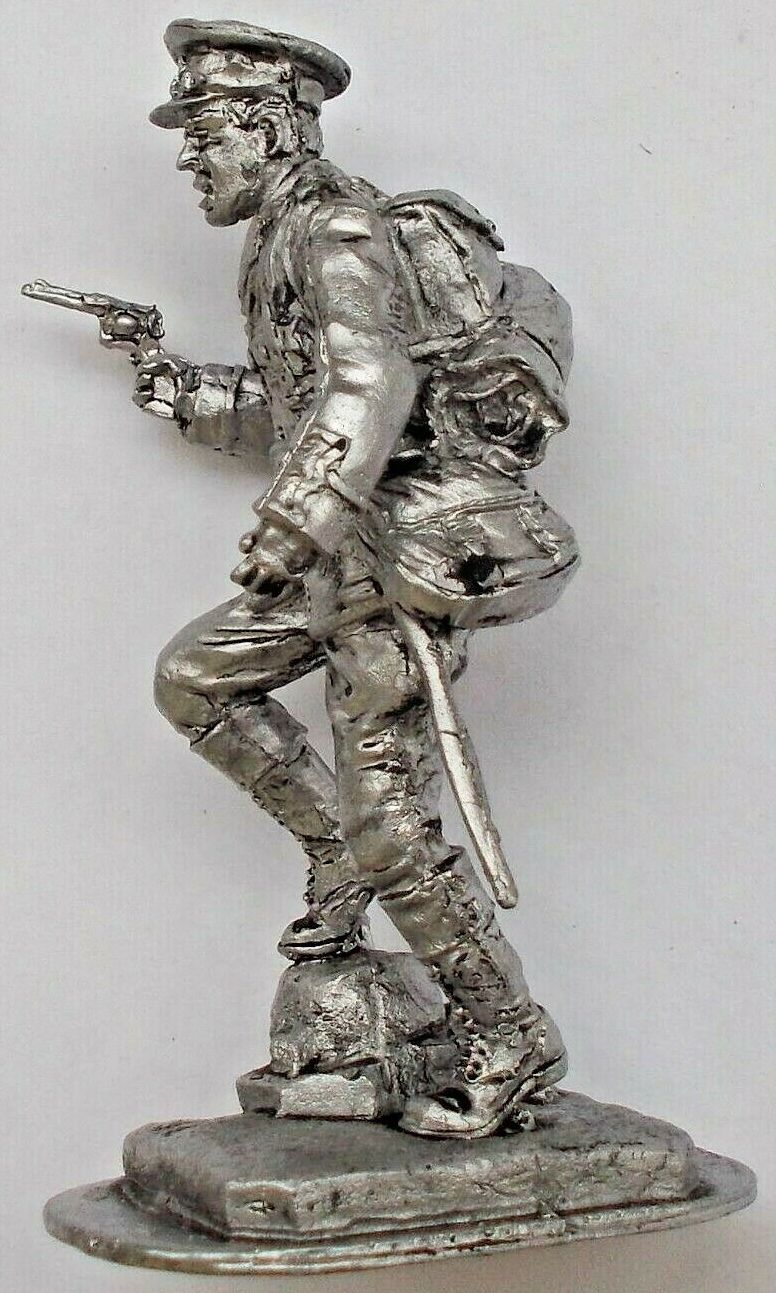
Both men were talented writers. Each was a sincere disciple of Jesus. And both responded to their nation’s call to face the horrors of the Western Front. In light of their service, it seems a skillful designer could base exciting Tolkien and Lewis figurines on something like this generic WWI British officer.

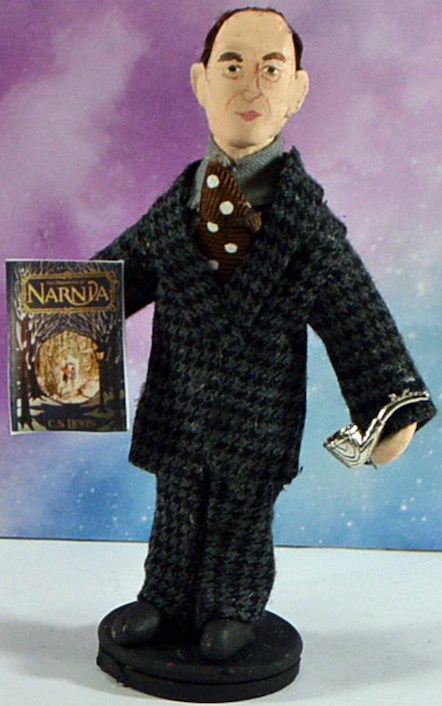
Just do everyone a favor, please don’t use a doll as a template for my literary and spiritual hero.

After all, real heroes are not always cuddly. But they are definitely epic! Just like Robert Cop and Special Man.


* If you are curious about where your first name ranks in popularity, now or during various decades back to the 1880s, you can find out here.

The Patina of the Inklings

Some antiques boast lovely patinas. Some old words do, as well. In fact, I would argue the legacy of, and the deep respect for, the Oxford fellowship known as the Inklings, has created a rich patina of its own.*

The community gifted scholars, especially in the persons of J.R.R. Tolkien and C.S. Lewis, accrued a reputation that continues to gain a deeper luster with each new generation.

When I was a young man, I collected American coins. I also studied what Americans call “World coins.” The latter reinforced my love for geography as well as history.

To me, the most fascinating period of history has long been that of the Roman empire.

 So you can imagine my awe when I learned how simple it was to collect genuine Roman coins.

 This remains true today for common coins, such as bronzes of the fourth century (when the first Christian emperors reigned). This article describes “Collecting Roman Coins on a Budget.”

A surprising number of ancient coins, all readily identifiable and of historical interest, can be acquired for less than $100—and often in the $5-to-$25 range. This is especially true with Roman coins . . .

When I began collecting ancient coins, I learned the multifaceted meaning of a word unfamiliar to me at the time. That word was “patina” (pə’tēnə). As you probably know, it literally refers to the green or brown film (not rust) that appears on bronze and other metals under suitable conditions over a period of time. A handful of coins in my collection possess stunning patinas.

Metaphorical Patina

Many people are also acquainted with the figurative use of the word, as I employed it in my introduction It refers to an appearance or impression of distinction or luster associated with a person, idea or object. It is often linked to esteem held for the past. The following provocative quote comes from a contemporary Swiss artist.

“Life is one long decay, no? There’s a lot of beauty in it. Like the patina in an old city” (Urs Fischer).

Chad Walsh applied it to one of C.S. Lewis’ early books in The Literary Legacy of C.S. Lewis. Writing more than forty years ago, in a discussion of Pilgrim’s Regress, he said:

Regress has permanent value. It is, first of all, a spiritual autobiography, no matter how much Lewis may wish to minimize the personal quality of the quest and make his John into a potential Everyman. . . .

The Regress is already taking on a patina of age, a pleasant chronological quaintness, but time does not render it obsolete.

Four decades after he offered this comment, I believe I am correct in ascribing a warm patina to the Inklings as a fellowship.

Patinas can be added to items, to affect a more aged appearance. While “acquired” patina is always considered desirable, “applied” patina is often quite acceptable. It does not become problematic until the application is used to intentionally misrepresent the age of an item. An example of the proper use of applied patina is seen in these modern busts of C.S. Lewis.

In reviewing Lewis’ writings, I only uncovered one occasion where he used the concept of patina. It occurred in a 1946 letter to his friend, Ruth Pitter. Lewis is contributing to one of their ongoing conversations.

The truth is that there are a great many different kinds of poetry and extreme roughness (or smoothness) evocative epithet (or plain statement), the metaphorical (or literal) the colloquial (or rhetorical) may all, in their place, rise to perfection. . . .

 Once more, read Barfield on Poetic Diction.⁑ That is why Spender’s objection to the ‘willed quality’ in Milton seems to me so bats’-eyed. It is the glory of one kind of poetry to sound un-willed, as if it had dropped out of the sky like Blake or else arisen spontaneously in conversation like Donne.

But then it is equally the glory of another kind to sound willed: to sound as if one were watching, or even sharing, the building of a huge tower.

To demand that Milton should have the spontaneity of Catullus or Blake is like demanding that a King at his coronation or a celebrant approaching the altar should have the same charm as a child dancing in the waves. Don’t we want both: both frolics and rituals? At any rate I do. . . .

Of course you are very right about Patina–again see Barfield. No old French poetry got that peculiar Old-Frenchness which is to us part of the charm. Half the beauties of the Old Testament did not exist for the writers. I wouldn’t be too sure, though, that it is wholly a question of our ‘projecting’ qualities into the old lines.

Ending on a Numismatic Note

Although I have not actively collected coins for many years, I commend it as a rewarding pastime. Seven years ago⁂ I wrote a column about religious likenesses on coins, which included a moving poem written by C.S. Lewis. You can read it here.

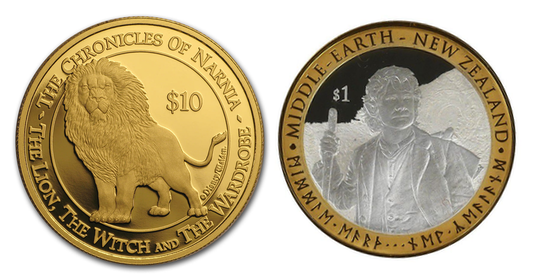
While writing this column I came across some genuine Narnian coins that were minted in New Zealand. They are genuine in the sense that they possess actual face values for legal tender in the island nation, which minted similar coins in honor of Middle Earth.

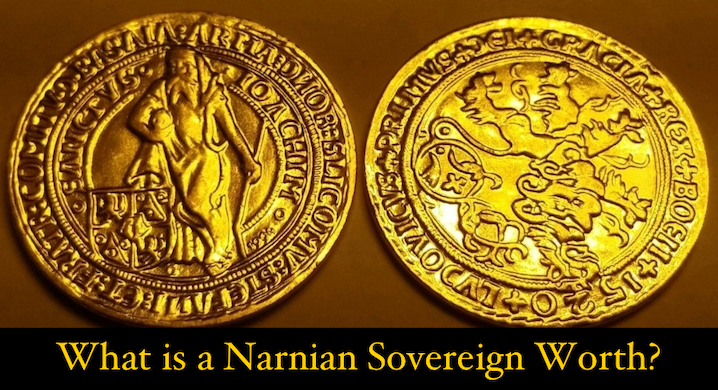
In terms of Narnian coins which circulated in Narnia itself, I learned that you can purchase “coins” which were used as actual props “appearing” in the recent Chronicles of Narnia films.

For an Inkling cinema buff such as myself, deciding to grab one for my personal collection was a no-brainer.


* The writings of the Inklings have even enhanced the patina of Oxford itself. This is especially true for those who live “across the pond,” and will never journey to the city itself. In a succinct review of The Inklings of Oxford: C.S. Lewis, J.R.R. Tolkien, and their Friends, one Aussie architect refers to the stately oxidation of the city’s copper, brass and bronze: Picturesque book of picturesque Oxford focusing on C.S. Lewis and J.R.R. Tolkien and the elegant, much patina-ed Oxford environment that they lived in.” I imagine he would concur with my suggestion that the Inklings themselves also bear a splendid patina.

⁑ Owen Barfield dedicated this book to his good friend with the inscription: “To C.S. Lewis ‘Opposition is true friendship’”

⁂ Seven years of blogging does sound like a lengthy time, but it’s not long enough for even the best of posts to accrue a patina of their own.