Must Writing be a Solitary Endeavor?

It’s often said that “writing is a solitary task.” I find that’s only half true.

Sure, each individual is responsible for putting the words on the page (AI-cheats aside), but sharing your work with others before publishing it provides amazing dividends.

Not only can “other eyes” see flaws we are too close to the piece to recognize, good critiques often include suggestions to make our writing stronger.

I’ve occasionally described the benefits I’ve received from being a member of writers [critique] groups around the globe. I titled one of my posts “Be an Inkling,” because this mutual sharing was central to those brilliant minds who gathered together in Oxford.

In 1967, J.R.R. Tolkien described his reason for using that particular word in just such settings. He said he used the word Inkling as “a ‘jest,’ because it was a pleasantly ingenious pun in its way, suggesting people with vague or half-formed intimations and ideas plus those who dabble in ink.”

I too find it “pleasantly ingenious” and have echoed it here in my own domain. 

Conferences can be helpful too, but my experience is that nothing surpasses the encouragement that emanates from the mutual commitment shared by writers who physically gather to share their creations.

I noted above two concrete ways writing friends can contribute to strengthening our work. However, this third element – encouragement – cannot be underestimated. It was precisely this element that brought that masterpiece, The Lord of the Rings, to the world’s attention.

A Pilgrim in Narnia provides a superb account of C.S. Lewis’ essential role in boosting the confidence of his friend J.R.R. Tolkien. He cites a letter in which Tolkien describes how Lewis’ most precious gift was in challenging him to complete his opus.

The unpayable debt that I owe to him was not ‘influence’ as it is ordinarily understood, but sheer encouragement. He was for long my only audience. Only from him did I ever get the idea that my ‘stuff’ could be more than a private hobby. But for his interest and unceasing eagerness for more I should never have brought The L. of the R. to a conclusion.

Melancholy Transitions

Critique groups are weighing on my mind, since the one I’ve been part of for many years has come to its end. The passing of various members during the past decade left too few of us to continue, and we few who were left are mourning the fact that it was not sensible to continue meeting regularly.

It is another reminder of Solomon’s wisdom when he wrote, “For everything there is a season, and a time for every matter under heaven.”

Sadly, I lack the energy to help establish another new writing fellowship at this point in my life. Perhaps I will join one of the online communities. Christian Writers looks promising.

I actually participated in an online critique community back when primitive “bulletin board systems” were giving way to the nascent internet. No doubt the modern equivalent would be far better in every way.

In the meantime, I do have a few readers I trust to review my work before submitting it to an editor. One is my very talented wife. The problem there, however, is that her love (and compassionate nature) make her too gentle when she critiques my work. 

This drawback is one side of the coin to which author Dan Brown refers when he says: “I learned early on not to listen to either critique – the people who love you or the people who don’t like you.”

This does not mean, of course, that those who love us are unsuitable candidates. It simply suggests that we need to (often repeatedly) give them permission to offer genuinely critical comments, especially when they are accompanied by suggestions for how we might improve a given passage.

In essence although people like William Faulkner are correct in stating that “writing is a solitary job,” most of us can benefit from sharing our drafts with others. 

And fortunate are those of us who discover such friendship, where our writing companions are like-minded, trustworthy, self-confident, and honest. (I personally find having a sense of humor an essential trait, as well.)

In a word, we are greatly blessed to personally become part of our own fellowship of Inklings.

Elven Inspiration from Space

A newly captured image of a supernova remnant in our Milky Way galaxy has me curious about where J.R.R. Tolkien may have gained inspiration for the elegant style of his Elvish scripts.*

America’s NASA has gifted all of Earth’s citizens with an array of stunning, and enlightening images. Recently, the James Webb Space Telescope directed its focus to Cassiopeia A, created thousands of years ago when a star 11,000 light years away went supernova. 

It may be my imagination, or perhaps its an elevated mental talent for “core object recognition,” but for some inscrutable reason, I have recognized in the aftermath of the explosion faint echoes of Elvish script.

The light from Cassiopeia A (or Cas A, as we pseudo-astronomers refer to it) “first reached us around 340 years ago. As that was approximately 272 years before The Lord of the Rings was published, Tolkien had ample time to analyze the spectacular light source. Even factoring in the fact that the stories were composed between 1937 and 1949, the supernova’s existence had been known for a millennia and a half before LOR was written. 

I will leave it to other researchers to determine just how Tolkien was able to gain a detailed view of the explosion’s aftermath. My purpose here is to simply alert the public to the unexplainable parallel between the cosmic residue and Tolkien’s own renditions of Elvish writing as he perceived it. 

In a moment, I will allow the self-evident facts to speak for themselves.

Like his friend C.S. Lewis, Tolkien was a student of astronomy. As Professor Kristine Larsen says, “J.R.R. Tolkien based the stars and constellations of his created world of Middle-earth on ‘real world’ astronomy.” Dr. Larsen, a preeminent “Tolkienian Astronomer,” has published widely on the subject. 

Of particular interest to readers of Mere Inkling will be “Medieval Cosmology and Middle-earth: A Lewisian Walk Under Tolkienian Skies,” which can be downloaded here. In the essay, Larsen points out,

. . . as is well known in Tolkien scholarship, during and after writing The Lord of the Rings Tolkien made various attempts to more closely align his cosmology with 20th century astronomical knowledge.

Fortunately for those of us who are drawn to the mythological textures of his legendarium, Tolkien never completed this “radical transformation of the astronomical myth” (as son Christopher termed it), but it is important to understand that this tension existed within Tolkien’s mind.

Having narrowly escaped the snare of surrendering to twentieth century astronomical theories, Tolkien preserved the mythical spirit of his cosmology. Larsen’s essay considers “whether or not Tolkien’s subcreation would, in reality, pass muster as a medieval cosmology, as defined by Lewis.” Thesis established, she takes readers on a pleasing journey. “So let us take a stroll under Middle-earth skies, and observe just how well the Dome of Varda matches with Lewis’s challenge.”

Returning to Cas A

As the images below will clearly illustrate, the preservation of the medieval nature of Middle Earth’s heavens does not mean that Tolkien ignored the realities of interstellar space. As I said a moment ago, the visual proof is definitive.

The fluid strokes of Tolkien’s Elven scripts are clearly foreshadowed in the plumes of this cosmic canvas. 

This image speaks fluently for itself.

This pair of images from NASA contrasts the Near-Infrared and Mid-Infrared observations. It is quite possible the second influenced J.R.R. Tolkien’s perceptualization of Sauron’s eye. (Admit it, you see the dramatic similarities.)

We may never learn how Tolkien was able vividly see the details of Cassiopeia A with the earthbound telescopes accessible eighty years ago. Nevertheless, the evidence provided herein is irrefutable.

It seems fitting, when pondering the majesty of the stars as echoed in a masterpiece of literary subcreation, to close with an observation by Tolkien’s friend, C.S. Lewis. In an early letter to a close friend, Lewis described the wonder he experienced in reading Dante’s Paradise.

Here Lewis lyrically shares an experience of spiritual ecstasy which, this writer humbly suggests, can be shared by many, as we stand in awe of the majestic intricacy of the universe our Creator has fashioned.

[I read] Aristotle’s Ethics all morning, walk after lunch, and then Dante’s Paradiso for the rest of the day. The latter has really opened a new world to me. I don’t know whether it is really very different from the Inferno [Owen Barfield] says it’s as different as chalk from cheese – heaven from hell, would be more appropriate!) or whether I was specially receptive, but it certainly seemed to me that I had never seen at all what Dante was like before.

Unfortunately the impression is one so unlike anything else that I can hardly describe it for your benefit – a sort of mixture of intense, even crabbed, complexity in language and thought with (what seems impossible) at the very same time a feeling of spacious gliding movement, like a slow dance, or like flying. It is like the stars – endless mathematical subtility of orb, cycle, epicycle and ecliptic, unthinkable & unpicturable, & yet at the same time the freedom and liquidity of empty space and the triumphant certainty of movement.

I should describe it as feeling more important than any poetry I have ever read. . . . Its blend of complexity and beauty is very like Catholic theology – wheel within wheel, but wheels of glory, and the One radiated through the Many (The Letters of C.S. Lewis to Arthur Greeves).

Perhaps it was one of these very wheels – or rings – that Tolkien observed so many years ago in the heavens?


* For those who are interested in fonts for your computers, you can download Tolkien-inspired typefaces here.

Timothy Keller & C.S. Lewis

The spiritual legacy of C.S. Lewis continues to bear abundant fruit. And, although his humility would prevent him from accepting it, Lewis shares credit in the blessings being passed on to new generations by those whose lives he directly touched.

Some of these gifted Gospel communicators have publicly praised Lewis for his role in their own conversions or moments of deeper epiphany into the work of our Creator. 

One such Christian leader was Timothy Keller, who recently died at the age of 72. Although he was just a few years older than me, Keller and I shared a number of traits. Raised Lutheran, we accepted the truths about Jesus’s work as kids, but it wasn’t until our young adulthood that we were confronted with the fact that trusting Christ as a loving Savior falls far short of taking up our own crosses and following him as Lord.

It’s no accident that our mutual spiritual awakenings coincided with our introduction to the writings of C.S. Lewis during our collegiate years. Both of us became pastors, although the paths of ministry we followed differed, as befits children of a heavenly Father who guides each of his children as the unique person he has created them to be. 

Keller was ordained in the Presbyterian tradition, and devoted most of his energy to helping the Christian Church establish a far more intentional ministry in cities. I was ordained in the Lutheran branch of the Body of Christ, and served much of my ministry as a military chaplain. Both of us were pastors in evangelical, Scripture-affirming denominations within our respective traditions.

I’m sure there are other parallels, such as both being married since the mid-70s and having three kids, but the last similarity I wish to note is that we both have writing as part of our vocations. Not that I would compare my own modest talents to Keller’s.

Tim Keller was a prolific author. And the influence of C.S. Lewis on his thinking, and writing, is pervasive in Keller’s work. Last year The Evangelical Christian Publishers Association presented him with the prestigious “Pinnacle Award.”

Timothy Keller has written more than 35 books, published by a variety of companies, with some co-authored by his wife Kathy.  His published body of work represents a variety of categories including apologetics, biblical studies, theology, prayer, devotionals, marriage, Bible study, the Church, and cultural engagement – with sales exceeding 7.5 million units and translated into more than 25 languages.

Keller’s prodigious literary output is one reason he has been likened to C.S. Lewis. Another obvious reason is the subject matter, particularly the prominent place occupied by Christian apologetics.

Like Lewis, Keller was an avid reader. This trait provided the foundation for both authors’ literary contributions to Christian thinking. “A Reading List to Understand Tim Keller” includes a number of the works of great importance to him.

Read This Twice, which gathers book endorsements found on the internet, provides a list of 64 books endorsed by Tim Keller. What makes this curious site special is they provide quotations for his recommendations and the sources from which they are gleaned. Oddly, the aggregator appears to lean heavily on contemporary Twitter sources. Consequently, it includes not a single book written by C.S. Lewis himself, belying the Inkling’s seminal influence on Keller.

The endorsement website also offers access to book recommendations on subjects of a visitor’s choice, compliments of Sona. Sona, as a caution to those among us who are wary of artificial intelligence, is an “AI-driven book recommendation assistant that makes it easy for you to discover your next read. Just provide your specific preferences, and [she] will quickly search through a large database of books to offer you options that closely align with your request.” The invitation closes with: “Try ‘Sona’ and enjoy a seamless, personalized book-finding experience.”

In “Remembering Tim Keller – Today’s C.S. Lewis,” the writer plays with his title.

It is often said that Dr. Timothy Keller, who died last Friday at his home in Manhattan, was this generation’s C.S. Lewis. The dust jacket for The Reason for God says so.

Tim would have had none of it. He just wasn’t that kind of person. I remember sitting down with him after yet another remarkable talk that he had delivered, sparkling with ideas and insight, with lots more to explore, and all he wanted to talk about was his kids and how great they were. Tim was a simple child of God with, like all of us, the normal joys and worries in life.

And yet . . . that impact! It was enormous. Although it might be an overstatement to ascribe C.S. Lewis status to his contribution, it would only be a slight overstatement.

Tim Keller certainly shared some of C.S. Lewis’ righteous qualities, but some writers are adamant about acknowledging their distinctions. A fellow Presbyterian pastor has a great post on this subject titled “Tim Keller is NOT this generation’s C.S. Lewis.” The author persuasively argues that their vocations were too different to make such a claim. 

But please, can we not call him another C.S. Lewis?  Any time we call a great person “another” anybody, we are doing disservice to both figures.  Lewis’ vocation was to serve as a man of letters who wove his faith into his writing.  Keller’s vocation is to be a pastor and equipper who employs writing as but one of his tools.

There are even some conservative Reformed authorities who view Keller (and C.S. Lewis) with suspicion. According to Christian Network Europe “Laurens van der Tang . . . wrote in De Wachter Sions (The Watchman of Sion) . . . that the books of Christian writers, such as Lewis, Dietrich Bonhoeffer and Tim Keller” may possess positive elements but are incomplete. “He argues that they did not pay enough attention to man’s death state, the need for repentance and God’s holy wrath on sin.”

He concludes that “distancing is appropriate” and that these “authors cannot replace theologians from the Reformation or the Dutch Second Reformation.” Also, the Dutch Rev. A. Schreuder writes that “whoever reads the works of the Big Three misses the ultimate point of the personal appropriation of salvation.”

Fortunately, such opinions are in the minority. Most Christians find all three writers inspiring. As this very article reports, “the combination of reason, feeling and imagination is also why Christians in many different surveys indicate that they see Lewis . . . as one of the most influential theologians of the 20th century.”

A glance at virtually any one of Keller’s books will reveal at least one reference to the writings of C.S. Lewis. In Shaped by the Gospel, he references four of Lewis’ books and essays. In his book On Death, Keller discusses that when we stand in God’s very presence – a joy he even now knows – and alludes to a powerful metaphor offered by C.S. Lewis in The Weight of Glory.

C.S. Lewis says if these lower reaches of the stream of God’s glory are so intoxicating, what will it be like to drink from the fountainhead?

The Atlantic published a poignant essay by Keller as he faced his impending death. “Growing My Faith in the Face of Death: I spent a lifetime counseling others before my diagnosis. Will I be able to take my own advice?”

The subtitle says it all. It’s a challenge many Christians one day face, and it is particularly sobering for pastors. In the article, Keller relates an acutely tragic conversation.

A significant number of believers in God find their faith shaken or destroyed when they learn that they will die at a time and in a way that seems unfair to them. Before my diagnosis, I had seen this in people of many faiths. One woman with cancer told me years ago, “I’m not a believer anymore—that doesn’t work for me. I can’t believe in a personal God who would do something like this to me.” Cancer killed her God.

Yes, reality and the suffering consequences of the Fall may have shattered the spectral image of her god (lower case “g”), but I hope that through the ministry of Keller and others that unfortunate woman came to know the true God before she stood in his presence.

For I am sure that neither death nor life, nor angels nor rulers, nor things present nor things to come, nor powers, nor height nor depth, nor anything else in all creation, will be able to separate us from the love of God in Christ Jesus our Lord (Romans 8).

Timothy Keller, like C.S. Lewis before him, who served as one of Keller’s mentors, left us with a treasure trove of edifying literature. In the past I’ve often been too busy to read much of Keller’s work. However, as of now I am in the process of rectifying that problem. If you join me in that journey, I’m sure neither of us will be disappointed.

Music, Muses & C.S. Lewis

Why do so many modern musicians – including some who are commercially successful – appear to suffer from amusia?

Well, I suppose that diagnosis is a matter of opinion, since “amusia” has come to refer to a particular medical disorder related to “the inability to recognize musical tones or to reproduce them.” More on that in a moment. First let’s consider the original meaning of the word.

It begins with the Greek Muses. While “muse” has morphed into anything that inspires a creative soul, it did not begin that way. The Muses began as personifications devoted to nine children of Zeus and Mnemosyne (Memory). During Europe’s revival of Classical themes, they were associated not only with the arts, but with culture and refinement in general.

In Surprised by Joy, C.S. Lewis records his admiration for one of his early teachers. This man taught him to love poetry, and although he practiced corporal punishment (standard for the era), embodied “perfect courtesy.” On an occasion he was sent to the headmaster, who misperceived that Lewis had acted inappropriately. After dispelling the confusion, this teacher, who treated his students as “gentlemen,” matter-of-factly said “you will have to be whipped if you don’t do better at your Greek Grammar next week, but naturally that has nothing to do with your manners or mine.”

The idea that the tone of conversation between one gentleman and another should be altered by a flogging (any more than by a duel) was ridiculous. His manner was perfect: no familiarity, no hostility, no threadbare humor; mutual respect; decorum.

“Never let us live with amousia” was one of his favorite maxims: amousia, the absence of the Muses. And he knew, as Spenser knew, that courtesy was of the Muses. 

Muses, from this perspective, undergird civilization. But the Muses are fickle. One cannot create their own Muse. Inspiration comes to us of its own volition. It can’t be commanded.

Nearly four years ago, I posed this question in Mere Inkling: “Who is Your Muse?” Various literary figures have written paeans to the muses which inspire their work. In that column I also noted how our animal companions* often exert an influence on our own creativity.

The link between inspirational Muses and music itself is strongly intertwined. Consider, for instance, Friedrich Nietzsche (1844-1900), who was brilliant, but much to be pitied. He despised God, but he did love music. In “Amousia: Living Without the Muses,” Classicist Stephen Halliwell discusses the importance of music for enjoying a meaningful existence. He begins with a quote from Nietzsche, and points out a Platonic corollary. 

Without music life would be a mistake . . . So, famously, wrote Friedrich Nietzsche in . . . Twilight of the Idols. As always, Nietzsche had deeply personal reasons for the force and pathos of this aphorism; music did indeed help to keep him alive. . . .

[W]e can detect in Nietzsche’s stark utterance, I would like to suggest, a trace and resonance of Greek feeling. We might even wonder whether in formulating his maxim Nietzsche was subconsciously remembering the passage in Plato’s Philebus where Protarchus, asked by Socrates whether music, as one of the ‘impure’ arts, is needed for the mixture of a humanly desirable life, says that he certainly takes it to be necessary – ‘at any rate,’ as he puts it, ‘if our life is really to be a life of some kind.’

Without music, Protarchus . . . seems to take the idea to be practically self-evident, human ‘life’ would hardly be worth the name at all.

Amusia as a Medical Condition

I suggested above that the caterwauling of some musicians suggests they are tone deaf, but in fact there is a genuine medical condition called amusia. It traces its beginning to the Muses we have been speaking about, and suggests their absence.

In “The Genetics of Congenital Amusia (Tone Deafness),” we learn that “congenital amusia . . . is a lifelong impairment of music perception that affects 4% of the population.” What’s more, “the pitch disorder has a hereditary component.”

In amusic families, 39% of first-degree relatives have the same cognitive disorder, whereas only 3% have it in the control families.

As the husband of a gifted music teacher, the father-in-law of another, and the grandfather of a number of extremely talented children, I understand the Greek principle. While I would miss music’s grace if I was stricken with amusia, I know a number of precious people for whom that would be one of the most terrible fates imaginable.

C.S. Lewis and Music

Like most of us, C.S. Lewis enjoyed some forms of music while others left him exasperated. Wagner, bravo. Church hymnody, not so much. A recent article by John MacInnis, a professor of music, goes so far as to claim: “music listening and discussion factored regularly in C.S. Lewis’s relationships, and love for music inspired his creative endeavors and prompted his best thinking.”

I agree with the first part of this, and will attribute the “best thinking” declaration to the hyperbole of one who has devoted his own life to music.

The author of “A Medium for Meeting God” explores in  detail the effect of Wagner’s work, and the sense of Northernness it imprinted on Lewis’ psyche.

In 1934, Lewis, along with his brother Warnie and J.R.R. Tolkien read Wagner’s operas together in German, in anticipation of attending performances of the Ring cycle. MacInnis points out that Lewis enjoyed the music of Sibelius (also “evocative of Northern landscapes) and likened it to Wagner as an expression of natural or earthy music. This he contrasted to Beethoven, which he also enjoyed, and thought of as “noble” and even spiritual.

As for church music, Lewis had mixed feelings. I’ve written about that in the past, in “Good, Bad and Ugly Hymns.” Most of us would agree that music enriches our lives. Our tastes vary, of course, just as they do with literature.

And, speaking of which, just as there are tone deaf individuals who should avoid recording music . . . most of us have encountered writers who suffer from a literary variant of amusia. And, lacking the influence of anything remotely like a muse, would not the world be a more harmonious place if they simply laid down their pens.


* When we got our youngest border collie as a puppy, I named her Calli. Actually, that’s what we call her, but her given name is actually Calliope. I named her after the Muse of epic poetry with the hope she might inspire my writing.

Since she’s our fifth border collie, I should have known better. The very last thing Calli wants me to do is sit at the computer composing documents (no matter how interesting or edifying). “Get out of that chair and get some exercise with me,” she says plaintively with her body, voice, and pleading eyes.

She’s plenty loving, and her insistence on activity may well add years to my life, but if I look to her to help me write more productively, I’m guaranteed disappointment.

Using Quotations in Your Writing

Do you consider quotations good or bad? As a reader, do you think quotations enhance what you are reading . . . or do they detract from the text?

My personal opinion is that the educated use of quotations enriches writing. (Sloppy quotation is another matter.) Positive contributions made by quotes would include:

They can offer “authoritative” support of a point being made by the writer.
Quotations can offer a refreshing change of pace in a lengthy work.
The selection of the individuals quoted gives me insight into the mind of the current writer.
A well-chosen epigraph piques my curiosity about the chapter which follows.
And, frankly, I simply enjoy a brilliant turn of phrase or a timeless but fresh insight.

I’m not alone in appreciating quotations. It’s no accident The Oxford Dictionary of Quotations is in its seventh edition. Why Do We Quote? describes it this way:

The demand for ODQ remains substantial. It has also spawned numerous sister dictionaries, many themselves appearing in several editions. We have The Oxford Dictionary of Humorous Quotations,… of Literary Quotations,… of Political Quotations,… of Biographical Quotations,… of Medical Quotations,… of American Legal Quotations,…. of Scientific Quotations.… of Phrase, Saying, and Quotation,… of Thematic Quotations,… of Quotations by Subject,… of Modern Quotation,… of Twentieth-Century Quotations, The Concise Oxford Dictionary of Quotation. A Little Oxford Dictionary of Quotations has gone through successive editions. There have also been several editions of The Oxford Dictionary of English Proverbs, the first in 1936. There is an avid market, it seems, for quotation collections.

The number of quotation collections is staggering. Read on, and I’ll provide links to some of the compilations available for free download, thanks to public domain laws.

The sheer weight of these books reveals their popularity. And quotations collections are marketable today. In “How Inspirational Quotes became a Whole Social Media Industry,” the author cites a Canadian whose “interest in motivational quotes has proven lucrative, and while he still has a day job in the wireless technology industry, he says that he’s recently been taking home two to three times his regular income from advertising on his website.”

And it all began when, “One day when he was a teenager, he was browsing in a book shop and came across a small book of famous quotations. Something about these pithy sayings appealed to him, and he started to compile his own collection of quotes that particularly resonated.”

Before the birth of the internet, I invested in several quotation collections—a not uncommon purchase for pastors. I confess to still referring on occasion to The Quotable Lewis to suggest new themes to explore here at Mere Inkling.

C.S. Lewis and Quotations

A beloved lecturer, C.S. Lewis recognized the value of worthy quotation. While few of us have his “eidetic memory,” we can certainly follow his example in using apt quotations to illustrate our points.

Lewis even regarded quotation collections highly enough to compile one. In 1946, he published George MacDonald: An Anthology. It was a tribute to the writings of his “mentor,” who appears in his fictional masterpiece about heaven and hell, The Great Divorce. The anthology remains in print. However, Canadian readers of Mere Inkling can benefit from it falling into public domain status in their Commonwealth. Canadians will find it available for download at this site.

While every reader is capable of enjoying the 365 selections in the volume, Lewis did have a specific intent in the passages he chose.

This collection, as I have said, was designed not to revive MacDonald’s literary reputation but to spread his religious teaching. Hence most of my extracts are taken from the three volumes of Unspoken Sermons. My own debt to this book is almost as great as one man can owe to another: and nearly all serious inquirers to whom I have introduced it acknowledge that it has given them great help—sometimes indispensable help towards the very acceptance of the Christian faith.

Scores of Free Quotation Collections Available to All

Internet Archive has an enormous (free) lending library of books featuring collections of quotations. Many can be “checked out” for temporary use. Other older books are available for download.

Project Gutenberg offers a smaller number, but includes titles they have edited themselves by gleaning pithy phrases from books in their public domain library. Many* of these free (public domain) compilations are linked below.

The massive selection of quotation collections (I quit counting as I approached 100) is daunting. Among those not available for download (which are still accessible for reading) you will note ever more esoteric subject matter. As a whole, we find a small number are collected from prolific individuals, such as Shakespeare, Mark Twain, or John F. Kennedy. Many are generalist, featuring “popular” quotations on a wide range of subjects. Others are thematic, focusing on subjects such as friendship, humor, women, sports, country music, dog [or cat] lovers, climbers, business, motor racing, the military, lawyers, saints, atheists, rock ‘n’ roll, or any of fourscore more themes. Some featuring national or cultural quotations, for example French, Jewish, Scottish, German, etc. And, for those up to the challenge, you can even read Wit and Wisdom of the American Presidents: A Book of Quotations.

🚧 Feel Free to Ignore Everything Below 🚧

Only the smallest attempt has been made here to sort the free volumes. You will find a few general headings below, and a multitude of similarly titled books. One wonders how many of the quotations cited in the larger volumes are common to all of them. Perhaps as you glance through this list, you will see a title or two you might appreciate perusing.

General Quotation Collections

The Oxford Dictionary Of Quotations
(Second Edition: 1953)

The Book of Familiar Quotations
Unnamed Compiler (London: 1860)

Familiar Quotations
John Bartlett (Boston: 1876)

Dictionary of Contemporary Quotations (English)
Helena Swan (London and New York: 1904)

What Great Men have Said about Great Men: a Dictionary of Quotations
William Wale (London: 1902)

A Cyclopaedia of Sacred Poetical Quotations
H.G. Adams (London: 1854)

The International Encyclopedia of Prose and Poetical Quotations from the Literature of the World
William Shepard Walsh (Philadelphia: 1908)

The Book of Familiar Quotations; being a Collection of Popular Extracts and Aphorisms from the Works of the Best Authors
Unnamed Compiler (London: 1866)

The Book of Familiar Quotations; being a Collection of Popular Extracts and Aphorisms from the Works of the Best Authors
L.C. Gent (London: 1866)

Dictionary of Quotations (English)
Philip Hugh Dalbiac (Long & New York: 1908)

A Dictionary Of Quotations
Everyman’s Library (London: 1868)

Forty Thousand Quotations: Prose and Poetical
by Charles Noel Douglas (New York: 1904)

Three Thousand Selected Quotations From Brilliant Writers
Josiah H. Gilbert (Hartford, Connecticut: 1905)

Stokes’ Encyclopedia of Familiar Quotations: Containing Five Thousand Selections from Six Hundred Authors
Elford Eveleigh Treffry (New York: 1906)

Historical Lights: a Volume of Six Thousand Quotations from Standard Histories and Biographies
Charles Eugene Little (London & New York: 1886)

Great Truths by Great Authors: A Dictionary of Aids to Reflection, Quotations of Maxims, Metaphors, Counsels, Cautions, Aphorisms, Proverbs, &c., &c. from Writers of All Ages and Both Hemispheres
William M. White (Philadelphia: 1856)

Truths Illustrated by Great Authors: A Dictionary of Nearly Four Thousand Aids to Reflection, Quotations of Maxims, Metaphors, Counsels, Cautions, Aphorisms, Proverbs, &c., &c.
William M. White (Philadelphia: 1868)

Handy Dictionary of Prose Quotations
George Whitefield Powers (New York: 1901)

Letters, Sentences and Maxims
Philip Dormer Stanhope Chesterfield (London & New York: 1888)

Poetical Quotations from Chaucer to Tennyson: With Copious Indexes
Samuel Austin Allibone (Philadelphia: 1875)

Prose Quotations from Socrates to Macaulay
Samuel Austin Allibone (Philadelphia: 1880)

Cassell’s Book Of Quotations, Proverbs and Household Words
William Gurney Benham (London & New York, 1907)

Putnam’s Complete Book of Quotations, Proverbs and Household Words
William Gurney Benham (New York, 1926)

Benham’s Book Of Quotations
William Gurney Benham (London: 1949)

Hoyt’s New Cyclopedia Of Practical Quotations
by Kate Louise Roberts (New York: 1927)

Classic Quotations: A Thought-Book of the Wise Spirits of All Ages and all Countries, Fit for All Men and All Hours
James Elmes (New York: 1863)

A Dictionary of Quotations from the English Poets
Henry George Bohn (London: 1902)

A Complete Dictionary Of Poetical Quotations
Sarah Josepha Hale (Philadelphia: 1855)

The Handbook of Quotations: Gleanings from the English and American Fields of Poetic Literature
Edith B. Ordway (New York: 1913)

Carleton’s Hand-Book of Popular Quotations
G.W. Carleton (New York: 1877)

Many Thoughts of Many Minds
George W. Carleton (New York: 1882)

Many Thoughts Of Many Minds
Henry Southgate (London: 1930)

A Manual of Quotations (forming a new and considerably enlarged edition of MacDonnel’s Dictionary of Quotations)
E.H. Michelsen (London: 1856)

A Dictionary of Quotations from Various Authors in Ancient and Modern Languages
Hugh Moore (London: 1831)

Dictionary Of Quotations: from Ancient and Modern, English and Foreign Sources
James Wood (London: 1893)

A Dictionary of Quotations in Prose: from American and Foreign Authors
Anna L. Ward (New York: 1889)

Webster’s Dictionary Of Quotations: A Book of Ready Reference
(London: undated)

Collections of Individual Authors

Quotations from Browning
Ruth White Lawton (Springfield, Massachusetts: 1903)

The Wesley Yearbook: or, Practical Quotations from the Rev. John Wesley
Mary Yandell Kelly (Nashville: 1899)

Quotes and Images From The Works of Mark Twain
David Widger (Project Gutenberg: 2002)

Widger’s Quotations from the Project Gutenberg Editions of Paine’s Writings on Mark Twain
David Widger (Project Gutenberg: 2003)

Quotes and Images From The Diary of Samuel Pepys
David Widger (Project Gutenberg: 2004)

Quotes and Images From Memoirs of Louis XIV
David Widger (Project Gutenberg: 2004)

Quotes and Images From Memoirs of Louis XV and XVI
David Widger (Project Gutenberg: 2005)

Quotes and Images from the Memoirs of Jacques Casanova de Seingalt
David Widger (Project Gutenberg: 2004)

Quotes and Images From Motley’s History of the Netherlands
David Widger (Project Gutenberg: 2004)

Quotes and Images from the Writings of Abraham
David Widger (Project Gutenberg: 2004)

Quotes and Images From The Tales and Novels of Jean de La Fontaine
David Widger (Project Gutenberg: 2004)

Quotes and Images From The Works of George Meredith
David Widger (Project Gutenberg: 2004)

Quotes and Images From Memoirs of Cardinal De Retz
David Widger (Project Gutenberg: 2005)

Quotes and Images From Memoirs of Count Grammont by Count Anthony Hamilton
David Widger (Project Gutenberg: 2005)

Widger’s Quotations from the Project Gutenberg Editions of the Works of Montaigne
David Widger (Project Gutenberg: 2003)

Widger’s Quotations from Project Gutenberg Edition of Memoirs of Napoleon
David Widger (Project Gutenberg: 2003)

Quotes and Images From the Works of John Galsworthy
David Widger (Project Gutenberg: 2005)

Quotes and Images From The Confessions of Jean Jacques Rousseau
David Widger (Project Gutenberg: 2004)

The French Immortals: Quotes and Images
David Widger (Project Gutenberg: 2009)

Quotes and Images From The Works of Charles Dudley Warner
David Widger (Project Gutenberg: 2004)

Quotes and Images From Memoirs of Marie Antoinette
David Widger (Project Gutenberg: 2005)

Quotes and Images From The Works of Gilbert Parker
David Widger (Project Gutenberg: 2004)

Quotes and Images From The Confessions of Harry Lorrequer by Charles James Lever
David Widger (Project Gutenberg: 2004)

Quotes and Images From Memoirs of Madame De Montespan
David Widger (Project Gutenberg: 2005)

Quotes and Images From the Works of Oliver Wendell Holmes, Sr.
David Widger (Project Gutenberg: 2004)

Quotes and Images From The Works of William Dean Howells
David Widger (Project Gutenberg: 2004)

The Spalding Year-Book: Quotations from the Writings of Bishop [John Lancaster] Spalding for Each Day of the Year
Minnie R. Cowan (Chicago: 1905)

Worldly Wisdom; Being Extracts from the Letters of the Earl of Chesterfield to His Son
William L. Sheppard (New York: 1899)

A Year Book of Quotations: From the Writings of Henry Wadsworth Longfellow
with spaces for Autographs and Records (New York: 1896)

The Bernhardt Birthday Book: Being Quotations from the Chief Plays of Madame Sarah Bernhardt’s Repertoire and Other Works
E.M. Evors (London: 1912)

Beauties of Robert Hall
John S. Taylor (New York: 1839)

Shakespeare Gets His Own Section

Everyman’s Dictionary Of Shakespeare Quotations
D.C. Browning (London: 1961)

Shakespearean Quotations
Charles Sheridan Rex (Philadelphia: 1910)

Shakespeare Quotations
Emma Maria Rawlins (New York: 1900)

Quotations from Shakespeare
Edmund Routledge (London: 1867)

A Dictionary of Shakspere Quotations
C.J. Walbran (London: 1849)

The New Shaksperian Dictionary of Quotations
G. Somers Bellamy (London: 1875)

Longer Moral Quotations From Shakespeare
M. Venkatasiah (Mysore/Mysuru, India: 1923)

Dictionary of Shakespearian Quotations: Exhibiting the Most Forceful Passages Illustrative of the Various Passions, Affections and Emotions of the Human Mind
Thomas Dolby (New York: 1880)

Odd, Quaint and Queer Shaksperian Quotations Handsomely and Strikingly Illustrated
Henry McCobb [using pseudonym Shakspere Snug] (New York: 1892)

Thematic Quotation Collections

Quotations from Negro Authors
Katherine D. Tillman (Fort Scott, Kansas: 1921)

Sovereign Woman Versus Mere Man: a Medley of Quotations
Jennie Day Haines (San Francisco: 1905)

About Women: What Men have Said
Rose Porter (New York: 1894)

The Dixie Book of Days
Matthew Page Andrews (London & Philadelphia: 1912)

Living Waters
Alice L. Williams (Boston: 1889)

Green Pastures and Still Waters
Louis Kinney Harlow (Boston: 1887)

Out-of-Doors; Quotations from Nature Lovers
Rosalie Arthur

Ye Gardeyn Boke: a Collection of Quotations Instructive and Sentimental
Jennie Day Haines (San Francisco & New York: 1906)

The Optimist’s Good Morning
Florence Hobart Perin (Boston: 1909)

The Optimist’s Good Night
Florence Hobart Perin (Boston: 1910)

The Book of Love
Jennie Day Haines (Philadelphia: 1911)

Author’s Calendar 1889
Alice Flora McClary Stevens (Boston: 1888)

Proverbs and Quotations for School and Home
John Keitges (Chicago: 1905)

Excellent Quotations for Home and School
Julia B. Hoitt (Boston: 1890)

Borrowings: A Compilation of Helpful Thoughts from Great Authors
Sarah S.B. Yule & Mary S. Keene (San Francisco: 1894)

More Borrowings: the Ladies of First Unitarian Church of Oakland, California
Sarah S.B. Yule & Mary S. Keene (San Francisco: 1891)

Quotations
Norwood Methodist Church (Edmonton, Alberta: 1910).

Goodly Company: a Book of Quotations and Proverbs for Character Development
Jessie E. Logan (Chicago: 1930)

The Atlantic Year Book: Being a Collection of Quotations from the Atlantic Monthly
Teresa J. Fitzpatrick & Elizabeth M. Watts (Boston: 1920)

Here and There: Quaint Quotations, a Book of Wit
H.L. Sidney Lear

Author’s Calendar 1890
Alice Flora McClary Stevens (Boston: 1889)

Catch Words of Cheer
Sara A. Hubbard (Chicago: 1903)

Catch Words of Cheer (new series)
Sara A. Hubbard (Chicago: 1905)

Catch Words of Cheer (third series)
Sara A. Hubbard (Chicago: 1911)

How to Get On, Being, the Book of Good Devices: a Thousand Precepts for Practice
Godfrey Golding (London: 1877)

The Dictionary of Legal Quotations: or, Selected Dicta of English Chancellors and Judges from the Earliest Periods to the Present Time . . . embracing many epigrams and quaint sayings
James William Norton-Kyshe

The Vocabulary of Philosophy, Mental, Moral and Metaphysical: with Quotations and References
William Fleming (Philadelphia: 1860)

Manual of Forensic Quotations
Leon Mead and F. Newell Gilbert (New York: 1903)

Toaster’s Handbook Jokes Stories And Quotations
Peggy Edmund and Harold W. Williams (New York: 1932)

The Banquet Book: A Classified Collection of Quotations Designed for General Reference, and Also an Aid in the Preparation of the Toast List
Cuyler Reynolds (London & New York: 1902)

Like Expressions: a Compilation from Homer to the Present Time
A.B. Black (Chicago: 1900)

Oracles from the Poets: a Fanciful Diversion for the Drawing-Room
Caroline Howard Gilman (London & New York: 1844)

The Sibyl: or, New Oracles from the Poets
Caroline Howard Gilman (New York: 1848)

A Book of Golden Thoughts
Henry Attwell (London & New York: 1888)

A Little Book of Naval Wisdom
Harold Felix Baker Wheeler (London: 1929)

Medical Quotations from English Prose
John Hathaway Lindsey (Boston: 1924)

Psychological Year Book: Quotations Showing the Laws, the Ways, the Means, the Methods for Gaining Lasting Health, Happiness, Peace and Prosperity
Janet Young (San Francisco: 1905)

The Oshawa Book of Favorite Quotations
(Oshawa, Ontario: 1900)

The Pocket Book Of Quotations
Henry Davidoff (New York: 1942)

Quotations for Occasions
Katharine B. Wood (New York: 1896)

Quotations For Special Occasions
Maud Van Buren (New York: 1939)

A Complete Collection of the Quotations and Inscriptions in the Library of Congress
Emily Loiseau Walter

Words and Days: a Table-Book of Prose and Verse
Bowyer Nichols (London: 1895)

The Book of Good Cheer: “A Little Bundle of Cheery Thoughts”
Edwin Osgood Grover (New York: 1916)

The Good Cheer Book
Blanche E. Herbert (Boston: 1919)

Just Being Happy: a Little Book of Happy Thoughts
Edwin Osgood Grover (New York: 1916)

Pastor’s Ideal Funeral Book: Scripture Selections, Topics, Texts and Outlines, Suggestive Themes and Prayers, Quotations and Illustrations
Arthur H. DeLong (New York: 1910)

Quips and Quiddities: a Quintessence of Quirks, Quaint, Quizzical, and Quotable
William Davenport Adams (London: 1881)

The Book of Ready-Made Speeches: with Appropriate Quotations, Toasts, and Sentiments
Charles Hindley (London: 1893)

Suggestive Thoughts on Religious Subjects
Henry Southgate (London: 1881)

Two Thousand Gospel Quotations from the Bible, Book of Mormon, Doctrine and Covenants, and Pearl of Great Price
Henry H. Rolapp (Salt Lake City, Utah: 1918)

Selected Quotations on Peace and War: with Especial Reference to a Course of Lessons on International Peace, a Study in Christian Fraternity
Federal Council of the Churches of Christ in America (New York: 1915)

Book of Science and Nature Quotations
Isaac Asimov & Jason A. Shulman (New York: 1988)
From an Indian Library Collection (not generally public domain)

Foreign (i.e. non-English) Collections

Dictionary of Quotations (Spanish)
[With English Translations]
Thomas Benfield Harbottle and Martin Hume (New York: 1907)

A Literary Manual of Foreign Quotations Ancient and Modern, with Illustrations from American and English Authors
John Devoe Belton (New York: 1891)

Dictionary of Quotations (Classical)
Thomas Benfield Harbottle (London: 1897)

Dictionary of Latin Quotations, Proverbs, Maxims, and Mottos, Classical and Medieval
Henry Thomas Riley (London: 1866)

Treasury of Latin Gems: a Companion Book and Introduction to the Treasures of Latin Literature
Edwin Newton Brown (Hastings, Nebraska: 1894)

A Dictionary of Oriental Quotations (Arabic and Persian)
Claud Field (London & New York: 1911)

A Little Book of German Wisdom
Claud Field (London: 1912)

Dictionary Of Foreign Phrases And Classical Quotations
Hugh Percy Jones (Edinburgh: 1908)

Dictionary Of Quotations: in Most Frequent Use, Taken Chiefly from the Latin and French, but Comprising Many from the Greek, Spanish and Italian Languages
[Translated into English]
D.E. MacDonnel (London: 1826)

A Dictionary Of English Quotations And Proverbs
With translations into Marathi
C.D. Deshmukh (Poona/Pune, India: 1973)

Classical and Foreign Quotations: a Polyglot Manual of Historical and Literary Sayings, Noted Passages in Poetry and Prose Phrases, Proverbs, and Bons Mots
Wm. Francis Henry King (London: 1904)


* Too many.

⁑ A bit of irony in this title, since it was written over 115 years ago.

The Viking Explanation for Lame Poetry

During the middle ages, Scandinavia’s skálds were poets, storytellers and even musicians. They were the equivalent of bards in medieval British and Gaelic culture. They were oral historians, committed to memorizing their paeans verbatim, which was simpler since they were in poetic form. Not all skálds possessed the talents to create their own memorable epics. These lesser poets, so to speak, could still memorize and recite the classic or popular songs.

A graphic explanation for the difference in the talents of the first tier skálds and their inferiors is found in the Prose Edda which was written by Snorri Sturluson (1179-1241). Sturluson compiled Norse myths in his Edda, and the sagas of her kings in Heimskringla.

The second part of the Prose Edda is entitled Skáldskaparmál, which means the language of poetry. One of the myths it contains describes the Mead of Poetry. Mead, of course, is the rich Viking beverage created by fermenting honey.

As for poetry, I’ve written about it fairly often. (Most recently in respect to my “winning” entry in a Terrible Poetry Contest.) I’ve even offered genuine, albeit feeble, attempts at the art myself. Alas, if I were a classical Greek I would say my Muse is Clio (the Muse of History), rather than Thalia or Erato, Muses of various genres of poetry.

It is well known that C.S. Lewis himself was a frustrated poet. While his literary criticism and historical work was highly respected—and his Christian works are still revered—his poetry never received a warm reception. The Poetry Foundation offers a useful article on the subject here.

My personal opinion is that I am thankful Lewis’ energies were devoted to more profitable fields of writing.

Back to the Vikings

C.S. Lewis and several other Inklings were enamored with Northern sagas. I have touched on this in the past, and discussed the amazing fellowship gathered by J.R.R. Tolkien, as a sort of precursor to the Inklings.

Tolkien named the group Kolbítar, which denoted “Coalbiters,” or Norse storytellers who gathered close to the fire as they discussed the stories of their ancestors. This exploration of Icelandic literature was connected to Tolkien’s conviction, as a professor of Anglo-Saxon, that these works belonged within the study of the English canon.* Old Norse definitely left a mark on English, as I’ve discussed here at Mere Inkling.

In Song of the Vikings: Snorri and the Making of Norse Myths, Nancy Marie Brown gleans some insights about Kolbítar from Lewis correspondence. They gathered to read the literature aloud.

They began with Snorri’s Edda. Reading it in Icelandic was slow going but addictive, Lewis recalls: “Hammered my way through a couple of pages in about an hour, but I am making some headway. It is an exciting experience.” Lewis . . . had also been smitten as a boy by “pure ‘Northernness’” [and] popular versions of Snorri’s tales had inspired Lewis to write an adolescent tragedy about the Norse gods, “Loki Bound.”

There is no record of what the members of the Kolbítars thought of the myth of the Mead of Poetry, but I would imagine that they found its crass distinction between gifted and stumbling poets quite—Norse. To set the stage for the following passage, one should know: (1) the Aesir were the Old Norse gods, (2) Suttung was a Jötunn (belonging to a race of giants at war with the Aesir), (3) Suttung was in possession of the magical mead of poetry, which Odin stole through cunning but immoral means, swallowing all of it, (4) Odin changed into an eagle to effect his escape, and Suttung followed him in the same form, and (5) the Aesir prepared large vessels to receive the disgorged magical mead. Now, from the Edda itself:

When the Æsir saw Odin flying, they placed their vats in the courtyard, and when Odin entered Asgard he spat the mead into the vats. It was such a close call, with Suttung almost catching him, that he blew some of the mead out of his rear. No one paid attention to this part, and whoever wanted it took it; we call this the bad poets’ portion. Odin gave Suttung’s mead to the Æsir and to those men who know how to make poetry. For this reason we call poetry Odin’s catch, find, drink or gift, as well as the drink of the Æsir.

No one said the Norse were above using crass humor. Still, it does offer a quite imaginative explanation for the differences between exceptional and mediocre poets, doesn’t it?


* Tolkien “loved the cold, crisp, unsentimental language of the sagas, their bare, straightforward tone like wind keening over ice. Reading Snorri and his peers was more important than reading Shakespeare, Tolkien argued, because their books were more central to our language and our modern world” (Song of the Vikings).

C.S. Lewis & Tattoos

How is this for an odd New Year resolution? Getting a new tattoo—with a connection to the writings of C.S. Lewis.

I suppose I’m betraying my age here. Being a retired pastor, my body remains a totally uninked canvas. Not that I’ve never considered getting a tattoo. In fact, if I end up making a pilgrimage to Jerusalem before I journey to the New Jerusalem, I may still opt to get inked. In Jerusalem there is a tattooist whose family traces their art back for 700 years to when their Coptic family lived in Egypt.

Our ancestors  used tattoos to mark Christian Copts with a small cross on the inside of the wrist to grant them access to churches . . and from a very young age (sometimes even a few months old) Christians would tattoo their children with the cross identifying them as Copts. . . .

One of the most famous of Christian types of tattoos, however, is still in use today—that of the pilgrimage tattoo. At least as early as the 1500s, visitors to the Holy Land . . . often acquired a Christian tattoo symbol to commemorate their visit, particularly the Jerusalem Cross.

In Bethlehem, another Christian tattooist practices his art “near the Church of the Nativity, offering pilgrims ink to permanently mark their visit.” He offers designs featuring scriptural texts in Hebrew and Aramaic, the language spoken by Jesus.

Tattoos have a fascinating history, and it should be noted some people consider Torah prohibition to bar even religious tattoos. “You shall not make any cuts on your body for the dead or tattoo yourselves: I am the Lord” (Leviticus 19:28). However, most Christians* and increasing numbers of Jews do not agree that the passage forbids the current practice.

That doesn’t mean all tattoos are appropriate, of course. Most tattoos are innocuous. Some are humorous. A small number are actually witty. Yet some tattoos can be downright malevolent.

Like so many human activities, the significance of a tattoo depends in great part on the intention of the person asking for this permanent mark. For example, my wife and I approved of our son and his wife having their wedding rings tattooed in recognition of God’s desire⁑ that a marriage will last as long as both individuals live.

What has this to do with C.S. Lewis?

Precious few writers have penned more inspiring and enlightening words than Lewis, that great scholar of Oxford and Cambridge. Because of this, it should come as no surprise that there are many Lewis-inspired tattoos gracing bodies. There is even a website devoted to C.S. Lewis-inspired body ink.

I imagine that Lewis himself would regard this as quite peculiar. I don’t believe he had any tattoos of his own, but it’s quite possible his brother Warnie—a retired veteran of the Royal Army—may have sported one or more.

In 1932, Lewis wrote to Warnie about his recent walking trip. Warnie was his frequent companion, when he was not elsewhere deployed. In this fascinating piece of correspondence, Lewis described his most recent excursion. I include a lengthy excerpt (comprising the first half of the journey) not because of its single passing mention of tattoos. Rather, because of the portrait it paints of the young and vigorous scholar in the prime of life. If you would prefer to skip to the mention of inking, see the sixth paragraph.

Since last writing I have had my usual Easter walk. It was in every way an abnormal one. First of all, Harwood was to bring a new Anthroposophical Anthroposophical member (not very happily phrased!) and I was bringing a new Christian one to balance him, in the person of my ex-pupil Griffiths. Then Harwood and his satellite ratted, and the walk finally consisted of Beckett, Barfield, Griffiths, and me.

As Harwood never missed before, and Beckett seldom comes, and Griffiths was new, the atmosphere I usually look for on these jaunts was lacking. At least that is how I explain a sort of disappointment I have been feeling ever since. Then, owing to some affairs of Barfield’s, we had to alter at the last minute our idea of going to Wales, and start (of all places!) from Eastbourne instead.

All the same, I would not have you think it was a bad walk: it was rather like Hodge who, though nowhere in a competition of Johnsonian cats, was, you will remember, ‘a very fine cat, a very fine cat indeed.’

The first day we made Lewes, walking over the bare chalky South Downs all day. The country, except for an occasional gleam of the distant sea—we were avoiding the coast for fear of hikers—is almost exactly the same as the Berkshire downs or the higher parts of Salisbury Plain. The descent into Lewes offered a view of the kind I had hitherto seen only on posters—rounded hill with woods on the top, and one side quarried into a chalk cliff: sticking up dark and heavy against this a little town climbing up to a central Norman castle.

We had a very poor inn here, but I was fortunate in sharing a room with Griffiths who carried his asceticism so far as to fling off his eiderdown—greatly to my comfort. Next day we had a delicious morning—just such a day as downs are made for, with endless round green slopes in the sunshine, crossed by cloud shadows. The landscape was less like the Plain now. The sides of the hill—we were on a ridgeway—were steep and wooded, giving rather the same effect as the narrower parts of Malvern hills beyond the Wych.

We had a fine outlook over variegated blue country to the North Downs. After we had dropped into a village for lunch and climbed onto the ridge again for the afternoon, our troubles began. The sun disappeared: an icy wind took us in the flank: and soon there came a torrent of the sort of rain that feels as if one’s face were being tattooed and turns the mackintosh on the weather side into a sort of wet suit of tights.

At the same time Griffiths began to show his teeth (as I learned afterwards) having engaged Barfield in a metaphysico-religious conversation of such appalling severity and egotism that it included the speaker’s life history and a statement that most of us were infallibly damned. As Beckett and I, half a mile ahead, looked back over that rain beaten ridgeway we could always see the figures in close discussion. Griffiths very tall, thin, high-shouldered, stickless, with enormous pack: arrayed in perfectly cylindrical knickerbockers, very tight in the crutch. Barfield, as you know, with that peculiarly blowsy air, and an ever more expressive droop and shuffle.

For two mortal hours we walked nearly blind in the rain, our shoes full of water, and finally limped into the ill omened village of Bramber. Here, as we crowded to the fire in our inn, I tried to make room for us by shoving back a little miniature billiard table which stood in our way.

I was in that state of mind in which I discovered without the least surprise, a moment too late, that it was only a board supported on trestles. The trestles, of course, collapsed, and the board crashed to the ground. Slate broken right across. I haven’t had the bill yet, but I suppose it will equal the whole expences of the tour.

Wouldn’t it have been amazing to join C.S. Lewis on one of these walking trips? A Lewisian tattoo is no substitute, to be sure, but I imagine it does offer certain people a sense of connection to the great author. Perhaps, if I were a younger man . . .


* Two recent converts to Christianity, Kanye West and Justin Bieber have made public their recent religious additions to their vast tattoo collections.

⁑ As Jesus said, “So they are no longer two but one flesh. What therefore God has joined together, let not man separate.”

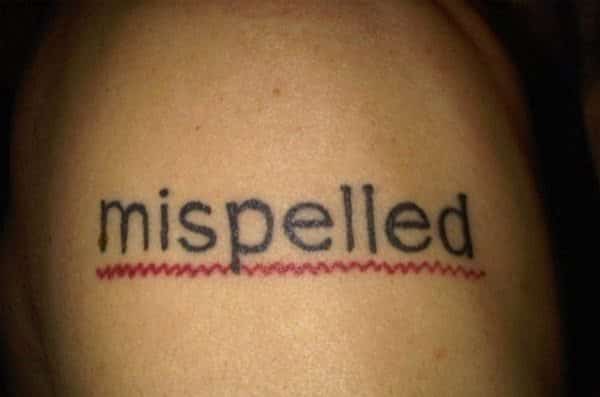
The motivational poster above was created by Mere Inkling, and represents only an infinitesimal number of the misspelled tattoos adorning human bodies. What a travesty . . . one that may have been prevented by remaining sober. The tattoo below, on the other hand, strikes me (being a writer) as quite clever.

Tolkien’s Inspiration

night patrolThe poetry of a dead veteran spoke to me today. He was a close friend of J.R.R. Tolkien, and in a sense his life lives on in the descriptions of Middle Earth.

In a recent column my Canadian friend Brenton Dickieson, introduced me to one of the many poets whose lives tragically ended on the battlefields of WWI.

Professor Dickieson describes the context of a new film about the impact of the war on J.R.R. Tolkien. It is called Tolkien’s Great War. It is based on the book Tolkien and the Great War: The Threshold of Middle-earth.

You will find a link to the half hour documentary below, and I strongly—yes, strongly—encourage you to watch it. It is quite moving.

Like most members of their generation, Tolkien and C.S. Lewis were deeply moved by the horrors of the First World War. Both served on the front lines, in the grim trenches, during the bloody conflict. And they lost friends. I’ve written in the past about their military service, including posts herehere, and here.

The Deceased Poet

The documentary describes the untimely deaths of two of Tolkien’s closest friends during the war. One of them, Geoffrey Bache Smith, was a poet.

Following his death, Tolkien gathered together his writings and published them as a tribute to his friend. It was one of the earliest contributions to a wealth of soldier’s poetry that would deluge grieving Europeans by the close of the conflict.

Due to the brevity of his life, the collection, published as A Spring Harvest, is short. Tolkien also penned an introduction to the work which is equally Spartan. The literary austerity is fitting, given the sad reason for the volume’s brevity. The introduction, in full, reads:

The poems of this book were written at very various times, one (“Wind over the Sea”) I believe even as early as 1910, but the order in which they are here given is not chronological beyond the fact that the third part contains only poems written after the outbreak of the war. Of these some were written in England (at Oxford in particular), some in Wales and very many during a year in France from November 1915 to December 1916, which was broken by one leave in the middle of May.

“The Burial of Sophocles,” which is here placed at the end, was begun before the war and continued at odd times and in various circumstances afterwards; the final version was sent me from the trenches.

Beyond these few facts no prelude and no envoi is needed other than those here printed as their author left them.

J.R.R.T., 1918.

The poems themselves run the gamut of emotions. This is unsurprising, given that some were born during the idyll dreams of youth, while others were forged by the anvil of war.

The limited press run of the book has made it difficult to find. Fortunately, it is now available for free via Project Gutenberg.

While the poems include the familiar references to the “old gods” so common to the period, there are also some moving references to a more Christian ethos.

Creator Spiritus

The wind that scatters dying leaves

And whirls them from the autumn tree

Is grateful to the ship that cleaves

With stately prow the scurrying sea.

Heedless about the world we play

Like children in a garden close:

A postern bars the outward way

And what’s beyond it no man knows:

For careless days, a life at will,

A little laughter, and some tears,

These are sufficiency to fill

The early, vain, untroubled years,

Till at the last the wind upheaves

His unimagined strength, and we

Are scattered far, like autumn leaves,

Or proudly sail, like ships at sea.

Tolkien and Smith formed half of the T.C.B.S., a communion knit together during the school years. The war would cut that number in half, as poignantly described in Tolkien and the Great War. The first of the companions had already died, and five months later Smith was spending the final moments of his own life encouraging his friend to press on, whatever might befall him.

Before reading Smith’s “So We Lay Down the Pen,” consider his final letter to Tolkien. He wrote it as he prepared to lead a night scout through dead man’s land at the front. It was dangerous duty which did indeed, that very evening, cost him his life.

My chief consolation is that if I am scuppered [ambushed and killed] tonight—I am off on duty in a few minutes—there will still be left a member of the great T.C.B.S. to voice what I dreamed and what we all agreed upon. For the death of one of its members cannot, I am determined, dissolve the T.C.B.S.

Death can make us loathsome and helpless as individuals, but it cannot put an end to the immortal four! A discovery I am going to communicate to Rob before I go off tonight. And do you write it also to Christopher. May God bless you my dear John Ronald and may you say things I have tried to say long after I am not there to say them if such be my lot.

Yours ever,

G.B.S.

Tolkien compiled Smith’s poems as a tribute. And, when he wrote his masterpieces, there is a profound sense in which he truly did say things his friends had tried to say, long after they were not there to say them.

So We Lay Down the Pen

So we lay down the pen,

So we forbear the building of the rime,

And bid our hearts be steel for times and a time

Till ends the strife, and then,

When the New Age is verily begun,

God grant that we may do the things undone.


The Bible’s Complexity

locustsWhy is it people say the Bible has many writers, but only one Author? The answer to that question is simpler than it seems.

Many different people, over a span of centuries, wrote the various books we find in the Scriptures. At the same time, each of these diverse individuals was inspired by the same Person—the Holy Spirit. Thus it is said by orthodox Christians that the Scriptures are the “Word of God.”*

The word “scripture” itself simply means a written work, although it is almost always applied to books regarded as sacred.

For Christians, Scripture/s can be singular or plural since the Bible possesses both aspects, being inspired by a single Author, yet compiled by numerous individual scribes.

The current issue of World magazine offers a satisfying interview** with David Skeel, a professor at the University of Pennsylvania Law School.

Skeel was raised with minimal exposure to Christianity, and while majoring in English, he found his ignorance of biblical allusions to be a serious handicap.

To rectify that problem, he decided to read the Bible over the summer after his sophomore year. Riding on a cross country trip with some classmates, he says “by the time I’d gotten a few chapters into Genesis I was persuaded it was true. I had never read anything so beautiful, so psychologically real.”

I was especially intrigued by the following insight offered by Skeel.

Christianity impressed you because it’s complicated?

Absolutely. The psychological complexity of Christianity was really powerful for me, as was the complexity of the language of the Bible. Truth can’t be conveyed in a single genre, so the Bible’s mix of genres, language and images is part of the evidence of its veracity.***

I don’t recall ever thinking of it that way, but he is right. God’s revelation of his mercy and grace is far too vast to be “conveyed in a single genre.”

Back to Oxford

Skeel doesn’t mention C.S. Lewis in his interview, and I have no idea whether Lewis’ work has influenced his life.

Despite that, his response to the question above reinforced for me one of the reasons Lewis has proven to be such a powerful blessing in my own pilgrimage.

Lewis intuitively recognized that same truth. God’s message is too boundless to be restrained to a single means of proclaiming it. And because of that, he used every genre at his command to celebrate it.

Essays, debates, poetry, fantasies and history were all fair game.

Which brings me to a corollary to Skeel’s observation. Not only is Truth too immeasurable to be limited to a single genre . . . by God’s design, humanity’s diversity is too abundant to allow for a single manner of communication to speak with the same power.

Some are moved by God’s poetry in a singing brook. Others by his majesty in the face of a snow-capped summit.

Some are drawn to his embrace through stories of human struggle and redemption. Others by logical arguments that appeal to their confidence in reason.

This is precisely why different individuals favor different books in the Scriptures, just as they prefer various writings over others within the Lewis “canon.”

Fortunately, Skeel’s literary interest in the Bible led him to pick it up without any life-changing expectations. That makes him one of the rare exceptions to Lewis’ observation with which we will close.

It may be asked whether now, when only a minority of Englishmen regard the Bible as a sacred book, we may anticipate an increase of its literary influence. I think we might if it continued to be widely read. But this is not very likely.

Our age has, indeed, coined the expression “the Bible as literature.” It is very generally implied that those who have rejected its theological pretensions nevertheless continue to enjoy it as a treasure house of English prose. It may be so.

There may be people who, not having been forced upon familiarity with it by believing parents, have yet been drawn to it by its literary charms and remained as constant readers. But I never happen to meet them.

Perhaps it is because I live in the provinces. But I cannot help suspecting, if I may make an Irish bull [an incongruous statement], that those who read the Bible as literature do not read the Bible. (“The Literary Impact of the Authorised Version”).

_____

* Although the Bible is commonly referred to as the “Word of God,” it is more properly referred to as the written Word of God. The actual Word is none other than Jesus Christ himself, through whom all things were spoken into existence. This is clear when you compare the following passages from the Scriptures. If you have any questions about this, feel free to write to me here at Mere Inkling.

Creation as described in the book of Genesis, chapter 1.

Echo of creation in the Gospel according to John, chapter 1.

** You can read the interview here.

*** In his response, Skeel wisely answers the actual question by substituting the word “complex” for “complicated.” The latter implies unnecessary complexity and a problem. The former, complexity, simply states the facts. It is impossible to adequately describe an infinite God with finite words.

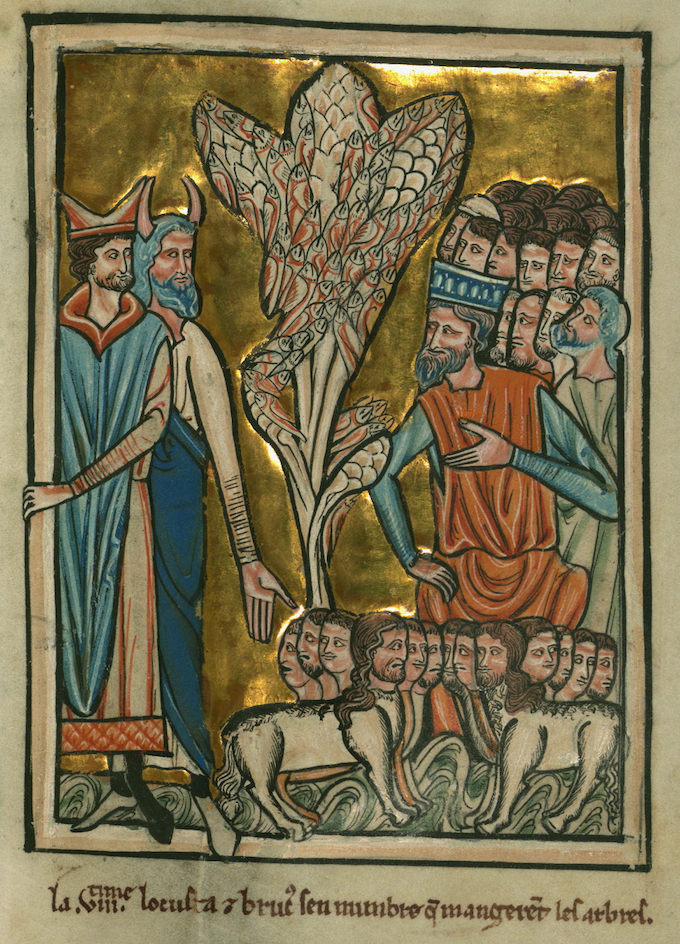
The illustration on this page is from the Walters Art Museum and portrays the plague of locusts visited upon the Egyptians.

Who is Your Muse?

reposeWhich Muse provides your inspiration? Poetry, history, music, dance, epic?

I’ve always been fascinated by the Greek & Roman concept of the Muse. While I don’t regard these personifications as true “beings,” they provide wonderful insight into the multifaceted nature of inspiration.

The Muses were personifications (representations of abstract concepts in human form). It’s not the same thing as believing in a “god,” although devotional exercises could be offered in “their” honor. (The simple people, in fact, may have regarded them as minor deities.)

The number of Muses—who represented the arts and fields of knowledge—varied in the ancient world. However, nine constituted the final Roman tabulation.

Possessing a historical nature, my “matron” Muse would necessarily be Clio (History).

Sadly, I’ve learned Muses don’t always fulfill their promises. At my suggestion, my wife agreed to name our puppy Calli, abbreviated from Calliope, the Muse of epic poetry. Unfortunately, at ten months her raucous barking sounds anything but poetic.

In his biography, Surprised by Joy: The Shape of My Early Life, C.S. Lewis includes an interesting reference to Muses. It relates to one of their secondary qualities, civility. In the following passage, Lewis had been sent to the Headmaster of his school for review due to “bad work” (i.e. inadequate academic performance).

The Headmaster misunderstood Smewgy’s report and thought there had been some complaint about my manners. Afterward Smewgy got wind of the Head’s actual words and at once corrected the mistake, drawing me aside and saying, “There has been some curious misunderstanding. I said nothing of the sort about you. You will have to be whipped if you don’t do better at your Greek Grammar next week, but naturally that has nothing to do with your manners or mine.”

The idea that the tone of conversation between one gentleman and another should be altered by a flogging (any more than by a duel) was ridiculous. His manner was perfect: no familiarity, no hostility, no threadbare humor; mutual respect; decorum. “Never let us live with amousia” was one of his favorite maxims: amousia, the absence of the Muses. And he knew, as Spenser knew, that courtesy was of the Muses.

For Lewis’ instructor, the concept of the Muse meant more than simply inspiring some form of art or literature. The influence of the Muses flowed into the broader culture. In a sense, it reflected the distinction the Greeks held between themselves and the barbarians. Surely the uncivilized savages had no Muses of their own!

Sources of Inspiration

It isn’t uncommon today for people to use muse (lower case) as a shorthand for a person who inspires them. Pablo Picasso, for example, considered his favorite model (and mistress) to be his muse. The portrait of Marie-Thérèse Walter above, entitled “Repose,” surely conveys the profound vision she provided him.

In cinema, there was the 1999 movie aptly named The Muse, which posits a deflated screenwriter seeking the aid of the supposed “daughter of Zeus.”

Speaking of Christians . . . they too identify a source for their inspiration. In addition to other human beings, who may offer wisdom, insight or encouragement, the preeminent source of inspiration is the Holy Spirit.

There is a danger in considering God himself to be the source of one’s inspiration. When taken to an extreme, it results in God being blamed for a lot of maudlin prose and gross violations of grammar.

Fortunately, few Christians believe their own writing is infallible. That divine quality is reserved for the Scriptures themselves.

Editors at Christian publishing houses would probably argue with my statement that few Christian authors are so presumptuous as to claim God “breathed” into them every word found in their manuscripts.

So, who is your Muse? When I said Clio is mine, it is because History—the story of humanity and especially God’s hand in it—fascinates me more intensely than any other subject. For you, it could be music or poetry.

Even astronomy has its own Muse, Urania. And, gazing at the boundless heavens God spoke into existence, it is no wonder that many would find their inspiration there.

A Classical Lewisian Poem

C.S. Lewis wrote a number of poems that are satires of Greek and Roman poetry. Some of them are quite witty.

For those interested in reading one such poem, I am pleased to offer “A Cliche Came Out of Its Cage.” In C.S. Lewis: Fantasist, Mythmaker, and Poet, Bruce Edwards describes it as “a sharp attack upon moderns who believe they are heralds of a return to the ‘golden age’ of paganism.” Included in his critique are F.R. Leavis and Bertrand Russell whose philosophy he rejected.

A Cliche Came Out of Its Cage

You said ‘The world is going back to Paganism.’
Oh bright Vision! I saw our dynasty in the bar of the House
Spill from their tumblers a libation to the Erinyes,
And [F.R.] Leavis with Lord Russell wreathed in flowers,
heralded with flutes,
Leading white bulls to the cathedral of the solemn Muses
To pay where due the glory of their latest theorem.
Hestia’s fire in every flat, rekindled, burned before
The Lardergods. Unmarried daughters with obedient hands
Tended it. By the hearth the white-armed venerable mother
Domum servabat, lanam faciebat. At the hour
Of sacrifice their brothers came, silent, corrected, grave
Before their elders; on their downy cheeks easily the blush
Arose (it is the mark of freemen’s children) as they trooped,
Gleaming with oil, demurely home from the palaestra or the dance.
Walk carefully, do not wake the envy of the happy gods,
Shun Hubris. The middle of the road, the middle sort of men,
Are best. Aidos surpasses gold. Reverence for the aged
Is wholesome as seasonable rain, and for a man to die
Defending the city in battle is a harmonious thing.
Thus with magistral hand the Puritan Sophrosune
Cooled and schooled and tempered our uneasy motions;
Heathendom came again, the circumspection and the holy fears …
You said it. Did you mean it? Oh inordinate liar, stop.

Or did you mean another kind of heathenry?
Think, then, that under heaven-roof the little disc of the earth,
Fortified Midgard, lies encircled by the ravening Worm.
Over its icy bastions faces of giant and troll
Look in, ready to invade it. The Wolf, admittedly, is bound;
But the bond will break, the Beast run free. The weary gods,
Scarred with old wounds the one-eyed Odin, Tyr who has lost a hand,
Will limp to their stations for the Last Defence. Make it your hope
To be counted worthy on that day to stand beside them;
For the end of man is to partake of their defeat and die
His second, final death in good company. The stupid, strong
Unteachable monsters are certain to be victorious at last,
And every man of decent blood is on the losing side.
Take as your model the tall women with yellow hair in plaits
Who walked back into burning houses to die with men,
Or him who as the death spear entered into his vitals
Made critical comments on its workmanship and aim.
Are these the Pagans you spoke of? Know your betters and crouch, dogs;
You that have Vichy water in your veins and worship the event
Your goddess History (whom your fathers called the strumpet Fortune).

_____

You can read about my true Muse here.