C.S. Lewis & Cinderella

C.S. Lewis did not write a Cinderella story of his own, but he did refer to one of his books as his “Cinderella,” for a different reason.

The Cinderella folk tale is familiar to many cultures. Like the Ugly Duckling, it celebrates real life occasions where events turn upside down, and the disadvantaged are vindicated.

More than two thousand years ago, the Greeks told the story of Rhodopis, a Greek slave girl whose sandal was snatched by an eagle and dropped into the lap of the Egyptian pharaoh. His search for the lovely foot that graced the footwear culminated in a joyous marriage.

I was thinking about step parenting recently, and how some people care for their own children differently than they treat children brought into the union from a spouse’s previous relationship. The subject arose during my prayers, when I thought to offer thanks to God for the depth of love he has given me for my “step-grandchildren.” It is, as far as I can tell, indistinguishable from the love I hold for my biological grandkids.

Following my prayers, I reflected further on family. And—because it reflects real life in terms of raising children, I thought of the story of Cinderella. In particular, I was wondering whether the “wicked stepsisters” were destined to be cruel simply because they were raised by their “wicked stepmother.”

The answer to that dilemma is obvious. Do bad parents raise bad kids? Sometimes, but thankfully, not always. Do good parents raise good kids? Sometimes, but sadly, not always.

If you remove the outliers—the saints on one side and the sociopaths on the other—kids have a reasonable chance to turn out “okay.” Basically, just because someone’s parents are disreputable, doesn’t mean the kids will grow up to be bums as well.

This comes as no shock to any of us, of course. We are too sophisticated to impute the sins of the parents to their children. But are we really? In truth, we often make judgments based upon things utterly beyond a child’s control. Nationality, social status, physical or mental disability . . . some people default to an unconscious ranking of desirability.

I’m reminded of the rewards of working with orphans and the tragic manner in which even these victims are “ranked” in terms of their perceived worth. So much for viewing the world through carnal eyes.

C.S. Lewis described the way a children’s story can flip things around in a way that reveals truth. In 1947 he described this to an American correspondent.

About stories for children. (a) Don’t the ordinary fairy tales really already contain much of the Spirit, in solution? Does not Cinderella give us exaltavit humiles,* and is not Redemption figured in The Sleeping Beauty? (b) For something a little more explicit, what about Geo. MacDonald’s⁑ The Princess & the Goblins, Curdie & the Princess, The Wise Woman, and The Golden Key?

In a 1943 letter to Sister Penelope, Lewis commented on a manuscript she had sent for his review. He suggests a “longish speech” by Melchizedek would be better presented in a different manner.

He’s got to have the sense of mystery about him. That means, for purposes of these plays, he must sound like a king out of a fairy tale. Actually in this speech he sounds more like a Bampton Lecturer! Represents, condemnation, include, mediator all strike the wrong note. I am referring only to the style: the matter is perfectly right. It is easier, of course, to pick holes than to mend them!

He then offers a note about the power of stories to communicate facts and deeper truths.

If I were trying to do it myself I should make it a speech about the Kings of Salem, not about ‘kingship’ in general—like a special magic in that family. (The Kings of Salem are not ordinary kings. . . .)

On the imaginative level I think the deepest truths enter the mind much better as arbitrary marvels than as universal theorems. Cinderella had to be back at midnight—Psyche must not see Cupid’s face—Adam and Eve must not eat the fruit: how much better these statements are than any philosophical generalities about obedience.

C.S. Lewis’ Personal Cinderella

Each reader of C.S. Lewis has their personal favorite, thoughtfully selected from the rich buffet of his diverse works. While I treasure many of his works, my personal favorite is The Great Divorce. It pleases me that the title also occupied a special place in Lewis’ own estimation.

Lewis described the underappreciated volume as his “Cinderella.” The beauty and nobility were there all of the time, though unrecognized.

Writing in 1954 to his editor, Jocelyn Gibb, he expresses appreciation for two handsomely bound copies of his books. He says, “perhaps these two charming volumes will teach me at last to have for the bodies of my own books the same reverence I have for the bodies of all other books.” In the same letter he writes, “I am always glad to hear of anyone’s taking up that Cinderella, The Great Divorce.”

Kathryn Lindskoog wrote an article about the book, calling the volume “C.S. Lewis’s Divine Comedy.” She begins with a personal anecdote.

C. S. Lewis beamed, then said “It’s my Cinderella.” I had just told him how much I loved The Great Divorce. (If I had been forced to choose one favorite of all his books, that would have been my choice.) He said he didn’t understand why Screwtape Letters got all the attention when The Great Divorce was so much better.

The Screwtape Letters is another of Lewis’ works that continues to impress me for its unique and effective way of illustrating the malevolent mind that shapes so many of the temptations that assail us. But, for sheer pleasure, I too prefer the wisdom, and the witness to heaven’s reality, that shine so brightly in The Great Divorce.

——

* Exaltavit humiles comes from the Magnificat (Luke 1:46-55) and means God “has exalted the humble.”

⁑ Most of MacDonald’s books are available for free download at Google and Kindle.
C.S. Lewis & Anodyne Writing

Do you practice anodyne writing? Or, perhaps you enjoy reading anodyne literature?

Talk about a phrase with two different meanings!

I must not be reading the right publications, because until recently I was only aware of the medical sense of the word. Apparently I’m not alone in having forgotten the second usage (if I ever knew it). One “publication coach” writes:

I always welcome the chance to learn new words—or to cement the knowledge of words I should know already. Anodyne falls into this latter camp. I probably confer with my dictionary at least once a year to determine the meaning of this word and yet, despite the frequent checking, I can’t seem to hold the definition in my brain.

Like so many words, anodyne enters English, via Latin, from Greek. It’s literal meaning is “without pain.” Thus, it typically refers (as a noun) to medicines or medical treatments devoted to eliminating pain.

By extension, anodyne is also applied (as an adjective) to other things, such as writing. In this context it would refer to writing where the purpose is to comfort, or to alleviate pain. This is the good sense of the word.

An example of this use appears in “L.M. Montgomery’s The Watchman and Other Poems, a Review.” There, Brenton Dickieson expertly describes the value good-but-not-great poetry by affirming its reassuring essence in its historical context. “Any one of these poems is quite nice on its own and an anodyne to the negative poetry of many of the WWI poets.” A positive, and astute, assessment.

There is, however, a second sense in which anodyne is applied to literature.* It may mean something so inoffensive, so innocuous, that it becomes boring.

At one university writing center they describe this evolution of the word.

[An anodyne word] lets a disturbing idea be described in a soothing manner. . . .

The OED Online lists several definitions, all about a procedure or medicine that eases pain, the oldest dating from the 16th Century. Only more recently has the word come to include anything that may avoid a strong response. It can mean something so inoffensive as to be bland, the cafeteria pudding of language.

So, as for anodynic writing, it is admirable when it relieves pain and suffering. If its primary goal is to be innocuous, that’s another matter. Essentially, comfort—good, pablum—not so much.

Lewis’ Use of Anodyne

Unsurprisingly, C.S. Lewis uses this word in its positive sense of alleviating discomfort. Two occurrences in The Screwtape Letters will illustrate. (Remember, these words of the counsel of one demonic tempter to another.)

But hatred is best combined with Fear. Cowardice, alone of all the vices, is purely painful—horrible to anticipate, horrible to feel, horrible to remember; Hatred has its pleasures. It is therefore often the compensation by which a frightened man reimburses himself for the miseries of Fear.

The more he fears, the more he will hate. And Hatred is also a great anodyne for shame. To make a deep wound in his charity, you should therefore first defeat his courage.

Not only do the demons seek to foster hatred in their human targets, they encourage us to seek counterfeit solace in destructive places.

In the first place I have always found that the trough periods of the human undulation provide excellent opportunity for all sensual temptations, particularly those of sex. This may surprise you, because, of course, there is more physical energy, and therefore more potential appetite, at the peak periods; but you must remember that the powers of resistance are then also at their highest.

The health and spirits which you want to use in producing lust can also, alas, be very easily used for work or play or thought or innocuous merriment. The attack has a much better chance of success when the man’s whole inner world is drab and cold and empty. . . .

It is the same with other desires of the flesh. You are much more likely to make your man a sound drunkard by pressing drink on him as an anodyne when he is dull and weary than by encouraging him to use it as a means of merriment among his friends when he is happy and expansive.

Never forget that when we are dealing with any pleasure in its healthy and normal and satisfying form, we are, in a sense, on the Enemy’s [God’s] ground. I know we have won many a soul through pleasure. All the same, it is [God’s]  invention, not ours. He made the pleasures: all our research so far has not enabled us to produce one. All we can do is to encourage the humans to take the pleasures which our Enemy has produced, at times, or in ways, or in degrees, which He has forbidden.

Having read the majority of what C.S. Lewis published, I assert with certitude that his writing is anodyne—it is healing. Some of it may be discomforting (for a moment), and much of it may be demanding (in the sense of requiring our mental and spiritual focus to understand it), but it was all written to edify.

Postscript, Star Date 73890.7

There is one more use of the word anodyne which I did not include above, due to its fictional source. In the Star Trek universe, the starships rely on a massive number elements, including the ubiquitous “anodyne relay.”

The circuits invariably appear to be perfectly reliable during routine missions. However, they are prone to malfunctioning at critical moments and threatening the lives of everyone aboard.


* Anodyne is also applied—in both its positive and negative senses—to music and other activities.

Epitaphs & C.S. Lewis

Have you already decided on an epitaph for your headstone? Or are you trusting others to sum up your life in familiar, traditional words of relationship? C.S. Lewis was of the opinion that a unique sentiment was most appropriate for such occasions.

My own decision has been made by default. At the present time I’m leaning towards simply using a military marker. They look distinguished, and the money that is saved can benefit the living, or perhaps one of the charities we support.

Basically, they have name, rank (I just want “Chaplain” instead of “Lieutenant Colonel”), dates and sometimes a very short personalized element. I think I’ll opt for the simple “Christian cross” which is familiar to those who have visited military cemeteries. I am tempted though, to use the agnus dei, even though it is listed as the official emblem of the United Moravian Church.

Due to the religious diversity (and confusion) in the United States, the Veterans Administration offers a theological smorgasbord of options. You can see the seventy-five options currently available here.

They include established American faiths such as Zoroastrianism and the Tenrikyo Church as well as more contemporary favorites Wicca and Eckankar (which claimed not to be a religion when I encountered its missionaries during my college years). Not to be ignored, are Humanism and its sibling, Atheism. For those preferring ethnic options, we have the Medicine Wheel, ancestor worship (African Ancestral Traditionalist), and the Hammer of Thor.

How Much Should an Epitaph Say?

I’ve seen some headstones that record only a name. Leaves only questions. Some give a brief observation, such as Boot Hill’s marker for Dan Dowd who perished in 1884. It records single word, “Hanged.”*

There are a few longer epitaphs, such as this one, sounding almost like an apology. “Here lies George Johnson hanged by mistake 1882. He was right we was wrong. But we strung him up and now he’s gone.” Sadly, they learned too late the horse they assumed he had stolen, was purchased legally.

In New Hampshire, there is a headstone with a 150 word inscription. Apparently, the woman’s husband had quite an axe to grind with a local congregation.

Caroline H., Wife of Calvin Cutter, M.D. Murdered by the Baptist Ministry and Baptist Churches As follows: Sep’t. 28, 1838; aged 33 She was accused of lying in church meeting by the Rev. D. D. Pratt and Deacon Albert Adams. Was condemned by the church unheard. She was reduced to poverty by Deacon William Wallace. When an exparte council was asked of the Milford Baptist Church, by the advice of their committee, George Raymond, Calvin Averill, and Andrew Hutchinson They voted not to receive any communication on the subject. The Rev. Mark Carpenter said he thought as the good old Deacon said, “We’ve got Cutter down and it’s best to keep him down.” The intentional and malicious destruction of her character And happiness as above described destroyed her life. Her last words upon the subject were “Tell the Truth and The Iniquity will come out.”

C.S. Lewis’ Epitaph

Lewis wrote a moving epitaph for his wife, Joy Davidman. It was based upon one he had written for his good friend Charles Williams. The phrase “Lenten Lands” was used by his stepson David Gresham, as the title of his story of his parents’ marriage.

Here the whole world (stars, water, air,
And field, and forest, as they were
Reflected in a single mind)
Like cast off clothes was left behind
In ashes, yet with hopes that she,
Re-born from holy poverty,
In Lenten lands, hereafter may
Resume them on her Easter Day.

To adorn C.S. Lewis’ own grave, his brother Warnie opted for simpler verse. It was taken from a passage in Shakespeare’s King Lear.

“Men must endure their going hence.”

C.S. Lewis wrote another noteworthy epigraph. It was in a poem by that very name. It was originally published in 1949 in Time and Tide magazine. It has been included in the collection of Lewis Poems as a stanza in “Epigrams and Epitaphs.” He shared it with his fellow poet, Ruth Pitter when it was first written, writing “I append my latest Short, your most obliged C.S. Lewis.”

My grave my pillory, by this blabbing stone
Forbidden to rest unknown,
I feel like fire my neighbours’ eyes, because
All here know what I was.
Think, stranger, of that moment when I too
First, and forever, knew.

In 2013, C.S. Lewis received the great honor of having a memorial stone placed in Poet’s Corner of Westminster Abbey. The inscription was chosen from one of his talks.

I believe in Christianity as I believe that the Sun has risen,
not only because I see it but because by it I see everything else.

I began with the question of what each of us might hope is inscribed as the legacy of our life. In truth, I don’t care if my marker even bears my name, since the Lord knows me as a member of his flock. But what I would like to see gracing my passing, are the words, “Well done, good and faithful servant” (Matthew 25:23).


The photograph adorning this post comes from side-by-side monuments for two Yale chemists. You can read the curious story about them, and the reason for the “Etc.” that adorns the second. Apparently it was added by the family at a later date, since they regarded “Nobel Laureate” as insufficient.

* The most famous epitaph in Arizona’s Boot Hill Cemetery reads “Here lies Lester Moore. Four slugs from a 44. No Les. No More.”

Pubs & Pandemics

How would the Inklings have conducted their meetings during a pandemic? Would they have continued secret rendezvous at the Eagle and Child?

Of course not. They were a law-abiding group of thinkers, and would never have thought to visit a pub if the Queen or Prime Minister told them to remain at home. After all, even the University of Oxford is following government directives: “All non-essential staff members must work from home. . . . Students have been asked to leave the University unless they have a compelling reason to stay.”

My guess is that C.S. Lewis would have relished the opportunity to settle in at home to work on his correspondence and perhaps a new essay. He would, of course, still want to enjoy a good walk during the day—although Lewis would doubtless wear a mask and maintain safe distances.

Pubs are on my mind due to a recent article entitled “How the Black Death Gave Rise to British Pub Culture: For centuries-old bars, a pandemic is nothing new.”

The piece featured two ancient public houses that lay “claim to the contentious title of Britain’s oldest pub and [are] no stranger[s] to pandemics.” While we lived in the U.K., I don’t recall ever visiting Ye Olde Fighting Cocks in Saint Albans.* However, we did enjoy visiting Ye Olde Trip to Jerusalem in Nottingham.

In times of tribulation, such as war, pubs provide a warm respite for many. An alcoholic can drink happily in solitude at home.⁑ But one express purpose of a pub is to foster a casual and comfortable social environment.

C.S. Lewis and his fellow Inklings enjoyed pubs in Oxford. When Lewis moved to the environs of Cambridge, he naturally sought out a similar setting in which to relax and entertain. In 1954, he wrote the following to a friend.

There are excellent pubs at Cambridge; and I speak from first-hand knowledge, having just returned from a week of spying out the land there. I’m afraid one must admit that, architecturally, Cambridge beats Oxford; there is so much more variety in Cambridge.

Here in the United States, only “essential” functions have remained accessible during the various restrictions imposed by “stay-at-home orders.” It’s sobering to ponder what our culture values most important, weigh those deemed necessary (e.g. marijuana dispensaries) against those deemed nonessential (e.g. churches).

Gradually now they intend to transition toward a restoration of some of our Constitutional rights. The New York Times is updating the state-by-state status on a regular basis.

It will be interesting to see if this progresses forward gradually, or if unanticipated events cause any locales to reverse their course.

Hopefully, life will return to “normalcy” sooner rather than later. The scars will last though, whatever happens. Lives lost. Businesses closed, with hopes shattered and dreams dispelled. In the aftermath of this global tragedy, it may well be that cordial, familiar gathering places, will once again play a role in reestablishing balance.

The previously cited article about the Black Plague says, “For Brits, a pub has always been more than just a place that sells beer . . .” That sentiment is true in many other cultures, as well. We humans are, by our very nature, social beings. Being deprived of these social settings has caused some people to experience a sort of shell shock. It may well take some time—and perhaps even a pint or two—to begin the healing.   


* Our family did visit the spectacular Roman ruins of Verulamium. One of the Romans’ largest cities, it was destroyed by Boudicca during the rebellion she led. It was later renamed in honor of Alban, one of the first British martyrs.

⁑ Some alcoholics do prefer to get plastered in bars. Examples include Ernest Hemingway and Dylan Thomas. The latter had his final drink at New York City’s White Horse Tavern. “After downing 18 shots, Thomas collapsed outside the tavern and later died at St. Vincent’s Hospital.”

Sand, Sand, Everywhere

Sand is a fascinating, and awe-inspiring, substance. It evokes a variety of reactions, depending on our personal histories and preferences. Some smile as they contemplate lounging on warm, smooth beaches. Others may grimace as they recall desert experiences where they struggled to remain hydrated, and sandy grit seemed to work its way into all those places it didn’t belong.

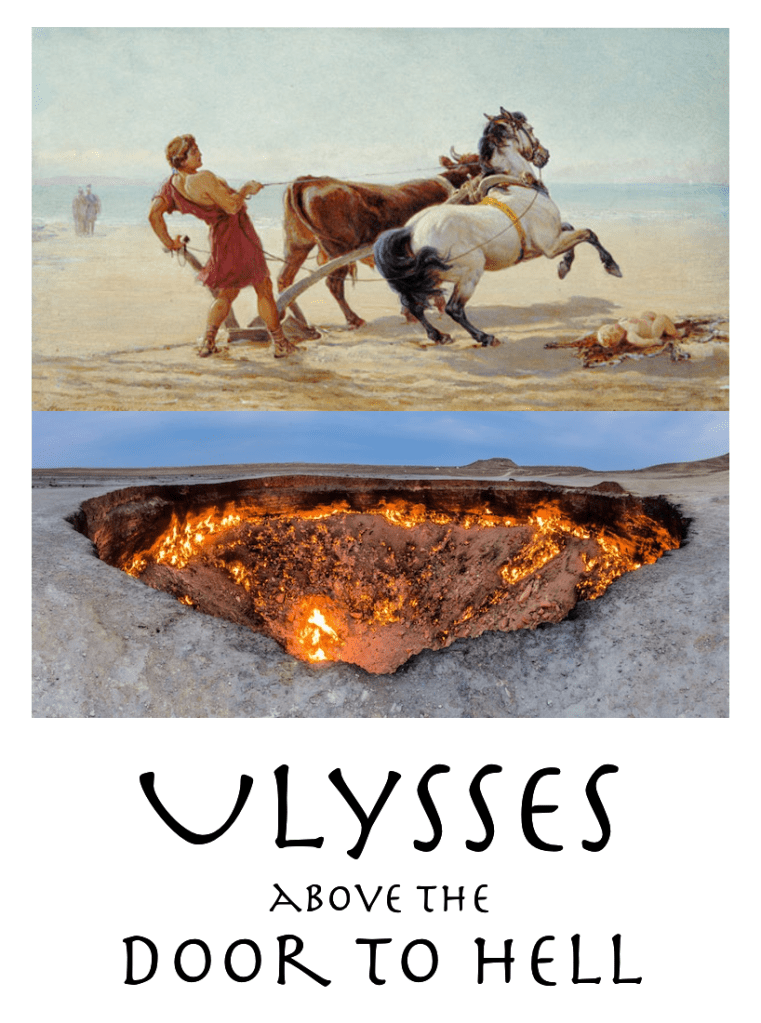
Some places have lots of sand. For example, 80% of Turkmenistan is covered by sand. And yet, this doesn’t stop them from wanting more! Turkmenistan determined theirs wasn’t appropriate for building a racing track, so they paid $1.3 million for British sand.

Turkmenistan is so stark that one of its main tourist attractions is a fiery crater on a barren landscape that is called the “Door to Hell.” National Geographic participated in an expedition which included a descent into the 100 foot deep inferno.

The idea of a nation of unending sand purchasing even more, brought to my mind a familiar verse from Coleridge’s “Rime of the Ancient Mariner.” And recalling the relentless flames of their methane pit, inspired me to pen my own variation of that theme.

Water, water, every where,
And all the boards did shrink;
Water, water, every where,
Nor any drop to drink.
(Samuel Coleridge)

Sand, sand, everywhere,
But not a grain to sell;
Sand, sand, everywhere,
A scorched foretaste of hell.
(Robert Stroud)

Lewis and Irish Sand

It is no surprise to readers of Mere Inkling, that we can find a Lewisian connection to even something so inconsequential as rocks* which have been weathered and worn into small fragments.

Like most of us, Lewis encountered sand in a variety of settings. In the 1950s he made a trip to Donegal, where he noted its distinctive beaches.

My correspondence has lately been in much the same state as yours: that is, on coming back from a holiday in Ireland I found about 60 letters to deal with. I had a lovely time over there: the best part in Donegal, all Atlantic breakers & golden sand and peat and heather and donkeys and mountains and (what is most unusual there) a heat wave and cloudless skies. Walks were much interrupted by blackberries: so big and juicy, and sweet that you just couldn’t pass without picking them.

To another friend, he wrote:

I was with a friend in Donegal which is a very fine, wild country with green mountains, rich secretive valleys, and Atlantic breakers on innumerable desolate sands.

But alas!, they get less desolate every year and it will soon be just a holiday resort like so many other places. (One always disapproves of all holiday-makers except oneself!)

Sand as a Metaphor

Everyone knows sand. That is especially true of the people who populated the lands of the Bible. From Ur to Egypt to Jerusalem, they encountered more than their share.

Because of its familiarity, and its unique traits, sand provides fertile soil [sorry] for producing metaphors. A couple, for example, from the Scriptures themselves.

[God speaking to Jacob] “I will surely bless you, and I will surely multiply your offspring as the stars of heaven and as the sand that is on the seashore.”
(Genesis 22:17)

[Description of the combined army facing the Hebrews in Canaan] “And they came out with all their troops, a great horde, in number like the sand that is on the seashore, with very many horses and chariots. And all these kings joined their forces . . .”
(Joshua 11:4)

“How precious to me are your thoughts, O God!
    How vast is the sum of them!
If I would count them, they are more than the sand.”
(Psalm 139:17-18)

But sand is not simply used to illustrate multitudes or numbers.

“A stone is heavy, and sand is weighty,
    but a fool’s provocation is heavier than both.”
(Proverbs 27:3)

[From a description of the Messianic Age]
“Then the eyes of the blind shall be opened,
    and the ears of the deaf unstopped;
then shall the lame man leap like a deer,
    and the tongue of the mute sing for joy.
For waters break forth in the wilderness,
    and streams in the desert;
the burning sand shall become a pool,
    and the thirsty ground springs of water . . .”
(Isaiah 35:7)

[God declares his power]
“Do you not fear me? declares the Lord.
    Do you not tremble before me?
I placed the sand as the boundary for the sea,
    a perpetual barrier that it cannot pass;
though the waves toss, they cannot prevail;
    though they roar, they cannot pass over it.”
(Jeremiah 5:22)

[Jesus said] “Everyone who hears these words of mine and does not do them will be like a foolish man who built his house on the sand.” (Matthew 7:26)

C.S. Lewis’ Use of Sand as a Metaphor

In Mere Christianity, Lewis alludes to Jesus’ words when he says even the best human beings will disappoint. Only the trust placed in Christ will never disappoint.

We must go on to recognise the real Giver. It is madness not to. Because, if we do not, we shall be relying on human beings. And that is going to let us down. The best of them will make mistakes; all of them will die. We must be thankful to all the people who have helped us, we must honour them and love them.

But never, never pin your whole faith on any human being: not if he is the best and wisest in the whole world. There are lots of nice things you can do with sand: but do not try building a house on it.

In Surprised by Joy, Lewis explains his concept of Joy and how it relates to longing for heaven and being in the presence of God. In his description of how flashes of wonder grace our lives, he warns we should not confuse them with the ultimate joy for which we yearn.

I saw that all my waitings and watchings for Joy, all my vain hopes to find some mental content on which I could, so to speak, lay my finger and say, “This is it,” had been a futile attempt to contemplate the enjoyed.

All that such watching and waiting ever could find would be [merely] an image . . . I knew now that they were merely the mental track left by the passage of Joy—not the wave but the wave’s imprint on the sand.

A final example comes from Lewis’ under-appreciated Pilgrim’s Regress. One of the archetypal characters, Mr. Savage, attempts to waylay young Christian from following the Landlord (i.e. God).

“But as [belief in the Landlord] is not true, there remains only one way of life fit for a man.” This other way of life was something he called Heroism, or Master-Morality, or Violence. “All the other people in between,” he said, “are ploughing the sand.”

Plowing the sand is an ancient idiom. And its meaning is fairly evident, even to those encountering it for the first time. An online dictionary says “ploughing the sand has been a proverbial image of fruitless activity since the late 16th century.” In truth, wasting one’s energies in this fruitless pursuit possesses far deeper roots.

In The Story of Troy, the author describes the efforts of Ulysses to avoid crossing the Aegean to fight a war for which he had forcibly argued. He feigned insanity to stay home.

[Ulysses] paid no heed, however, to the messages sent to him asking him to join the army at Aulis. Agamemnon resolved, therefore, to go himself to Ithaca to persuade Ulysses to take part in the expedition. He was accompanied by his brother Menelaus, and by a chief named Palamedes, a very wise and learned man as well as a brave warrior.

As soon as Ulysses heard of their arrival in Ithaca, he pretended to be insane, and he tried by a very amusing stratagem to make them believe that he was really mad. Dressing himself in his best clothes, and going down to the seashore, he began to plow the beach with a horse and an ox yoked together, and to scatter salt upon the sand instead of seed.

Fortunately for the great author, Homer, Ulysses’ ruse was exposed. And it was revealed in an act worthy of Solomon that gave dual meaning to the hero’s fruitless plowing of sand.

Palamedes, however, was more than a match in artifice for the Ithacan king. Taking Telemachus from the arms of his nurse, he placed the infant on the sand in front of the plowing team. Ulysses quickly turned the animals aside to avoid injuring his child, thus proving that he was not mad but in full possession of his senses. The king of Ithaca was therefore obliged to join the expedition to Troy.

It is my hope that you have found this post informative and entertaining . . . and that writing it does not constitute my own example of plowing the sand.


* Most sand was originally rock, although some beaches are predominantly composed of other materials. Many beaches are “almost entirely composed of worn down dead animal bits.” White sand beaches often have a different source, parrotfish excrement.

Parrotfish eat the algae that grow on coral. [Their] large, beak-like teeth (which inspire their name) help them break off and eat small pieces of coral. They have another set of teeth, called pharyngeal teeth [that] grind up the coral into small grains of sediment, which parrotfish then excrete in clouds of white powdery sand. (A single large parrotfish can produce hundreds of pounds of sand a year!) The sediment is distributed onto the reef and, eventually, can pile up above the surface of the water, forming islands like the Maldives . . .

C.S. Lewis and Times of Crisis

Dark days demand two seemingly contradictory things. Serious reflection and diversion (often in the form of entertainment).

Things are serious. The ultimate toll of the current pandemic remains unknown. Even if we regard ourselves as safe due to age, health and isolation, the simple fact is thousands are dying. Beyond our compassionate concern for those who are suffering, only a fool would fail to reflect on their own mortality during this plague.

Christians, who recently “celebrated” Good Friday are quite conscious of the fact that “we are dust and to dust we shall return” (Genesis 3:19).

Yet this awareness doesn’t leave us in despair, because Easter has come. Our Lord’s resurrection means that for those who trust in him, death does not have the final word.

I pray for those who are overcome by worry during these days. Because dwelling solely on the negative robs life of its present joys, and worsens the impact of the pandemic on individual lives.

Rather than feed your anxiety with troubling reports and thoughts, I urge you to take the opportunity to read, watch a classic program, or play a game. Distracting activities are healthy, as long as they do not displace serious awareness of our circumstances.

Seriously Assessing Our Predicament

Others have written eloquently about Lewis’ response to situations such as that in which we find ourselves today.

For example, the Gospel Coalition offers an excerpt from C.S. Lewis’ 72 year old essay about atomic weapons. They suggest we “just replace ‘atomic bomb’ with ‘coronavirus.’” Lewis’ advice holds up well in our turbulent era.

Annie Holmquist of Intellectual Takeout elaborates on Lewis’ essay. “How C.S. Lewis Would Tell Us to Handle Coronavirus” is well worth a read.

Several weeks ago, the Wade Center (which hosts the Western Hemisphere’s finest Inkling collection) struck the balance I am suggesting. They acknowledged the danger, and offered advice on spending our time well. Their blog included an excellent suggestion in “Those Who Lived to see Such Times: Suggested Readings from the Wade Authors during Times of Uncertainty.” The Wade Center provides links to a number of fine text and audio resources that will offer encouragement from authors who “witnessed both world wars, and . . . lived to see the unsettling days of nuclear weapons.”

Enjoying Life Despite the Danger

Those who are working during this time remain in need of our prayerful support. For the majority of us, however, the cancellation of most of our normal social activities has provided us with an abundance of leisure time. In addition to attacking postponed chores around the house, we should fill some of this interval by enjoying old pleasures and discovering new interests.

Take advantage of treasures such as those mentioned in the Wade Center post. Hundreds—even thousands—of free, public domain books are available online. For those whose preference is visual, there are plenty of free video options, including many vintage television shows you can view on YouTube.

If you’re craving a humorous treat, check out the great satire at The Babylon Bee and The Salty Cee.

A recent article on the former site reveals the sad tale of a boy whose childhood has been ruined by modern online games. It’s entitled, “Boy Discovers Wondrous Land Of Narnia, Leaves Negative Yelp Review.”

Lutherans (and self-confident Christians of other traditions) will enjoy the Lutheran Satire site. For people who don’t object to listening in on a demonic press conference, a fictional Easter interview on their main page is enlightening.

A bit lighter, is this rendition of Saint Patrick explaining the Trinity to the Irish pagans. It will help you sharpen your Christology.

There is a vast, unexplored world of literature out there. I recently read this illuminating post about one of George MacDonald’s fairy tales. MacDonald exerted a great influence on C.S. Lewis. With a curious twist on light and dark, the post also provides a link to a film based on MacDonald’s The Light Princess. I haven’t viewed it yet—but if you have a high tolerance for 1980s BBC productions combining animation and live action, you could be in for a treat.

Where to Begin?

Before exploring some of these links I’ve included, I encourage you to view “The Age of the Coronavirus.” The videographer has done what was suggested in one of the articles mentioned above. He has substituted the virus for the threat of nuclear war in C.S. Lewis’ abbreviated essay.

The video is good enough that you may well desire to share it with others. It can help to know the threats of our day are not unique to history. I suggest that you also include the amazing C.S. Lewis Doodle which offers an illustrated version of the entire essay.

The Viking Explanation for Lame Poetry

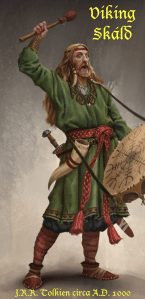
During the middle ages, Scandinavia’s skálds were poets, storytellers and even musicians. They were the equivalent of bards in medieval British and Gaelic culture. They were oral historians, committed to memorizing their paeans verbatim, which was simpler since they were in poetic form. Not all skálds possessed the talents to create their own memorable epics. These lesser poets, so to speak, could still memorize and recite the classic or popular songs.

A graphic explanation for the difference in the talents of the first tier skálds and their inferiors is found in the Prose Edda which was written by Snorri Sturluson (1179-1241). Sturluson compiled Norse myths in his Edda, and the sagas of her kings in Heimskringla.

The second part of the Prose Edda is entitled Skáldskaparmál, which means the language of poetry. One of the myths it contains describes the Mead of Poetry. Mead, of course, is the rich Viking beverage created by fermenting honey.

As for poetry, I’ve written about it fairly often. (Most recently in respect to my “winning” entry in a Terrible Poetry Contest.) I’ve even offered genuine, albeit feeble, attempts at the art myself. Alas, if I were a classical Greek I would say my Muse is Clio (the Muse of History), rather than Thalia or Erato, Muses of various genres of poetry.

It is well known that C.S. Lewis himself was a frustrated poet. While his literary criticism and historical work was highly respected—and his Christian works are still revered—his poetry never received a warm reception. The Poetry Foundation offers a useful article on the subject here.

My personal opinion is that I am thankful Lewis’ energies were devoted to more profitable fields of writing.

Back to the Vikings

C.S. Lewis and several other Inklings were enamored with Northern sagas. I have touched on this in the past, and discussed the amazing fellowship gathered by J.R.R. Tolkien, as a sort of precursor to the Inklings.

Tolkien named the group Kolbítar, which denoted “Coalbiters,” or Norse storytellers who gathered close to the fire as they discussed the stories of their ancestors. This exploration of Icelandic literature was connected to Tolkien’s conviction, as a professor of Anglo-Saxon, that these works belonged within the study of the English canon.* Old Norse definitely left a mark on English, as I’ve discussed here at Mere Inkling.

In Song of the Vikings: Snorri and the Making of Norse Myths, Nancy Marie Brown gleans some insights about Kolbítar from Lewis correspondence. They gathered to read the literature aloud.

They began with Snorri’s Edda. Reading it in Icelandic was slow going but addictive, Lewis recalls: “Hammered my way through a couple of pages in about an hour, but I am making some headway. It is an exciting experience.” Lewis . . . had also been smitten as a boy by “pure ‘Northernness’” [and] popular versions of Snorri’s tales had inspired Lewis to write an adolescent tragedy about the Norse gods, “Loki Bound.”

There is no record of what the members of the Kolbítars thought of the myth of the Mead of Poetry, but I would imagine that they found its crass distinction between gifted and stumbling poets quite—Norse. To set the stage for the following passage, one should know: (1) the Aesir were the Old Norse gods, (2) Suttung was a Jötunn (belonging to a race of giants at war with the Aesir), (3) Suttung was in possession of the magical mead of poetry, which Odin stole through cunning but immoral means, swallowing all of it, (4) Odin changed into an eagle to effect his escape, and Suttung followed him in the same form, and (5) the Aesir prepared large vessels to receive the disgorged magical mead. Now, from the Edda itself:

When the Æsir saw Odin flying, they placed their vats in the courtyard, and when Odin entered Asgard he spat the mead into the vats. It was such a close call, with Suttung almost catching him, that he blew some of the mead out of his rear. No one paid attention to this part, and whoever wanted it took it; we call this the bad poets’ portion. Odin gave Suttung’s mead to the Æsir and to those men who know how to make poetry. For this reason we call poetry Odin’s catch, find, drink or gift, as well as the drink of the Æsir.

No one said the Norse were above using crass humor. Still, it does offer a quite imaginative explanation for the differences between exceptional and mediocre poets, doesn’t it?


* Tolkien “loved the cold, crisp, unsentimental language of the sagas, their bare, straightforward tone like wind keening over ice. Reading Snorri and his peers was more important than reading Shakespeare, Tolkien argued, because their books were more central to our language and our modern world” (Song of the Vikings).

Historical Font Facts

Consider yourself blessed if you’re not a fontaholic. The affliction leads to clogged font directories on your computer, and an unavoidable prejudice toward either serif or sans serif fonts.

People who are intrigued by typography know exactly what I’m talking about. At least two or three times a year they will inextricably find themselves on some font website (there are scores of them) without consciously knowing how they got there or there or there.*

I’ve written about fontaholicism in the past. Unfortunately, despite my advocacy, the Diagnostic and Statistical Manual of Mental Disorders has yet to classify the malady as a recognized illness. That said, the American Psychiatric Association does sound a bit obsessive compulsive in terms of their font guidance for annual meeting posters.

If any or all of the work in this poster was prepared with commercial support, a statement “Supported by funding from [name of company]” must be noted in the lower left corner of the poster in Arial 72 point font, with no bold, italics, special colors, or other enhancement of the company name, product, or any other portions of the statement.

One wonders what sort of reaction a person would get from the APA if they used Times Roman or Comic Sans by mistake.

C.S. Lewis & Fonts

It should be acknowledged up front that C.S. Lewis was not obsessed with fonts. However, he was wise enough to recognize their significant role in communication. Good fonts could be transparent, while problematic fonts blurred the message. He highlighted one of the most significant aspects of a font’s usage—size—in a 1957 letter. He told a fellow Brit, “you’d be much wiser to get my books in the American edition as these now have larger print and better paper than our own.”

A year earlier he had discussed a related issue with his publisher. There was a problem with a Shakespeare quotation intended for the title page of Till We Have Faces.

The quotation would, I agree, look better on a page to itself, but (what is more important) I am very strongly opposed to the idea of dividing it. I agree that it ‘looks wrong as it is’ but I think it will look equally with any division whatever. I do not see why it need be printed ‘absurdly small’ to fit in as one line . . .

Now a line of that length on a page to itself would I believe, look ugly if it came anywhere near the middle of a page–because it would then seem to divide the page into two halves. But would it not look quite nice if put near the top? It would then have the properties of a frieze or dado with plain wall under it.

And we may perfectly well omit the word ‘Shakespeare’ if we think that makes a better design. But I’d prefer even a bad design to a division of the verse.

Free Books about Fonts

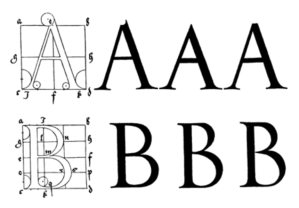
You can find a number of interesting books about fonts at some of the wonderful internet libraries such as Project Gutenberg. During recent historical research about Reformation-era artists, I discovered a book written by Albrecht Dürer (1471–1528). Since his fame is derived from his portraits of prominent people, I was surprised he had written a guide for properly shaping letters, based on geometric principles. The introduction provides a fascinating portrait of sixteenth century artistry in northern Europe.

In our Germany . . . are to be found at the present day many young men of a happy talent for the Art Pictorial, who without any artistic training whatever, but taught only by their daily exercise of it, have run riot like an unpruned tree, so that unhesitatingly and without compunction they turn out their works, purely according to their own judgment.

But when great and ingenious artists behold their so inept performances, not undeservedly do they ridicule the blindness of such men; since sane judgment abhors nothing so much as a picture perpetrated with no technical knowledge, although with plenty of care and diligence.

Now the sole reason why painters of this sort are not aware of their own error is that they have not learnt Geometry, without which no one can either be or become an absolute artist; but the blame for this should be laid upon their masters, who themselves are ignorant of this art.

Since this is in very truth the foundation of the whole graphic art, it seems to me a good thing to set down for studious beginners a few rudiments, in which I might, as it were, furnish them with a handle for using the compass and the rule, and thence, by seeing Truth itself before their eyes, they might become not only zealous of the arts, but even arrive at a great and true understanding of them.

Dürer’s book sparked my curiosity, and a very quick subsequent search hinted at the wealth of typographical information online. For example, you can read about The Typography of Advertisements, circa 1911. There you will be warned that bolder is not always better.

“But,” some one says, “the heavier and bolder type-faces furnish a greater contrast to the white of the paper, and therefore should be easier to read.”

It is true that a greater contrast of color is furnished in the use of the bolder type-faces, but to force these greater contrasts on the eye is to literally club it into reading the text, whether or no. Are the salesman’s statements of better selling value because they are shouted loudly in direct contrast to the quiet of the office?

There may be, and undoubtedly are, some on whom this force is necessary, but to those who are sufficiently educated and intelligent to be reached through the appeal of an advertisement, the quiet dignity of the salesman’s statements made in well-modulated tones will be more attractive.

Gaze back even farther, to what was considered Early Typography in 1872. There you will discover a medieval religious order devoted to worship and manuscripts.

Reference has more than once been made to the impulse given to learning at the end of the fourteenth and the beginning of the fifteenth centuries. This movement was helped forward by no one in Holland and Germany more than by Gerhard Groote, or Magnus, of Deventer, (b. 1326, d. 1370), who after studying theology at Paris, became a canon of Utrecht and Aix-la-Chapelle, and founded the Order of the Brethren and Clerks of the Common Life, generally known as the “Gemeiineslebens,” or “Frères de la Vie Commune . . .”

It was divided into the literary Brethren or Clerks, and the unlearned Brethren, who lived in different houses, but in bonds of the greatest friendship. The Clerks devoted themselves to transcribing books, the cultivation of polite learning, and the instruction of youth; and they erected schools wherever they went. The Brethren laboured with their hands, and pursued various mechanic trades. Neither were under the restraint of religious vows; but still they ate at a common table, and had a general community of goods.

There are many other curious titles available to those who choose to explore obscure typography in greater depth. A person might even wish to begin with 1891’s Specimens Of Book, Jobbing, And Ornamental Printing Type In Use In The Government Central Printing Office, Simla [India].

Fonts, fonts, fonts. As I said above, you are fortunate if they don’t draw you too deeply into their orbit. However, if you recognize you too are a fontaholic, take comfort in the knowledge that you are not alone.


* And here’s another font site I had never seen before writing this post. It has a delightful name, Font Squirrel. Once I finish writing this piece, you can guess where I will be spending some of my web surfing research time.

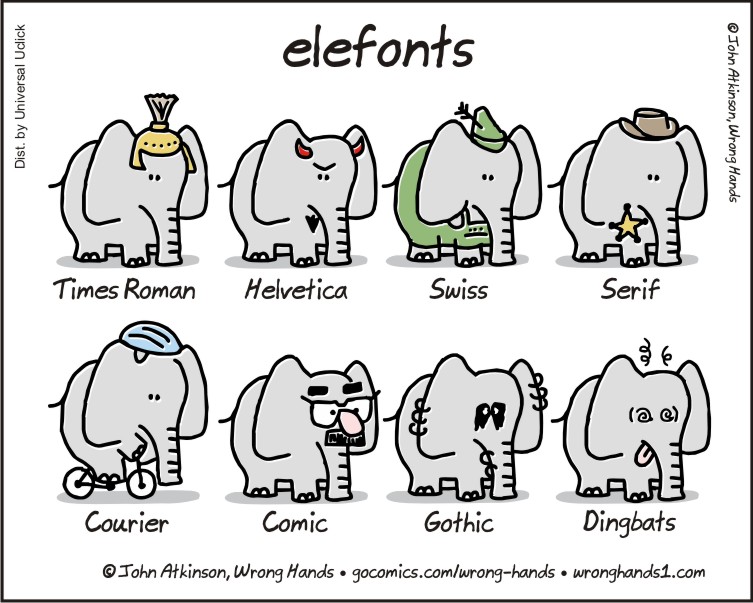
The Elefonts cartoon at the top of the page is a creation of talented Canadian John Atkinson, and is used with permission.

C.S. Lewis & Nuns

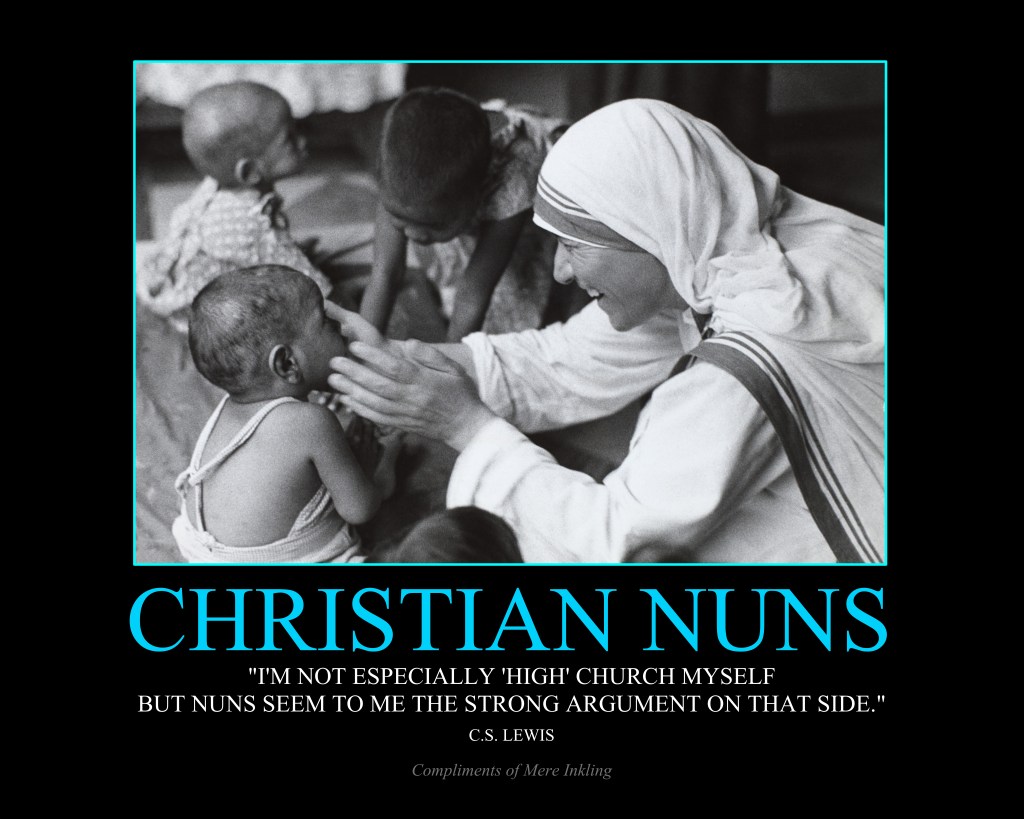
One of the great disappointments of Roman Catholic fans of C.S. Lewis is that he never converted to their communion. Lewis did, however, sincerely respect Roman Catholic nuns. In fact, he considered the reverence and joy of the nuns he encountered to be one of the church’s most commendable elements.

In 1947 he wrote to one of his regular correspondents who wondered why he had not forsaken his “low church” loyalties for a more elevated perspective. His response reveals his perception of the virtues of consecrated nuns.

I am particularly pleased to have been of any help as a bridge between the parish and the convent. I’m not especially ‘high’ Church myself but Nuns seem to me the strong argument on that side.

They are in my experience almost invariably so very nice—and so happy: much more so either than the same number of married women picked at random or the same number of monks. I don’t know why this should be so.

One does not have to be Catholic to appreciate people who consecrate their lives to God, willing to make radical sacrifices like living a life of celibacy. Nearly four decades ago, while I was serving a congregation in Citrus Heights, California, I earned a (post-M.Div.) Master of Theology degree. Since I was focused on Patristics, I was enrolled at a Jesuit seminary in the Bay area.

One day during my studies, an Episcopal priest and I were having lunch with a half dozen Roman Catholics, most of whom were religious sisters.* The conversation turned to a celebration by the sisters present that they no longer had to wear habits. The respectful person I am, I remained silent as they discussed their “family” business. Apparently, though, I was softly grinning, because of one them (it may even have been my thesis advisor) asked, “what are you smiling about?”

My response was that it wasn’t my place to offer an opinion, but when they pressed, I said, “well, throughout my life, whenever I’ve seen a nun in her habit, it’s been an encouraging thing, and I think—there goes a life that is consecrated to God.” My companions were shocked and at a loss for words. In retrospect, I believe that C.S. Lewis might have offered a similar comment.

Due to the century during which he lived, and his setting in the British Isles, Lewis encountered nuns far more frequently than I do. In fact, since their “liberation” from the habit, we can’t know precisely how many religious sisters cross our paths. In 1947 he describes to a close friend a trip to see his brother who was hospitalized in Ireland. His colorful description of the town he visited ends with an uplifting remark.

My Brother, thank God, was out of danger when I reached him on Monday morning last but was at the unearthly city of Drogheda where almost every building is a church or a tavern⁑  and what men do but pray and drink or how life is supported in their bodies I can’t conceive. . . . And you hear more wit and humour in one day of London than in a week of Drogheda. My Brother was in the care of the most charming nuns.

Nuns are found in various Christian traditions. In addition to those who take such vows in the Roman Catholic Church, the Eastern Orthodox churches trace the lineage of these female monastics back to the ancient eremites. ⁂ There are also Anglican and Lutheran convents. In fact, one of C.S. Lewis’ close friends was an Anglican nun. Sister Penelope, CSMV (1890-1977), was a member of the Community of St Mary the Virgin. Lewis dedicated his novel, Perelandra, “to some ladies at Wantage,” her convent.

In a 1941 letter to the BBC, Lewis pleads that he is unable to add to his current speaking commitments. These apparently included specific presentations to nuns.  

I’m afraid in view of my other commitments I should be ‘over-talked’ if I accepted the job you kindly suggest for me. I’m talking already to the R.A.F., to the general public, to nuns, to undergraduates, to societies. The gramophone will wear out if I don’t take care! With thanks and much regret.

Lewis’ Three Theses

Mary Willis Shelburne was a widow in Washington, D.C., with whom Lewis corresponded for a number of years. Beginning in 1950, they exchanged more than a hundred letters, which were collected in the volume Letters to an American Lady. Lewis arranged for her to receive financial support from the sales of his books in the United States. This support continued after his own passing. In 1952 Shelburne converted to Roman Catholicism, and proposed that Lewis follow her example. His response was gracious.

It is a little difficult to explain how I feel that tho’ you have taken a way which is not for me. I nevertheless can congratulate you—I suppose because your faith and joy are so obviously increased. Naturally, I do not draw from that the same conclusions as you—but there is no need for us to start a controversial correspondence! I believe we are very near to one another, but not because I am at all on the Romeward frontier of my own communion.

In a short note written four years later, Lewis thanks her for a picture of herself and a nun. He uses the occasion to voice his sentiment that nuns are happy and pleasant. He then proposes three curious theses, noting that his presumption is subjective and she may disagree with him. Do you agree with his opinions here?

Problem: why are nuns nicer than monks and schoolgirls nicer than schoolboys, when women are not in general nicer than men? But perhaps you deny all three statements! All blessings.

My own experience with the first category are limited, but the monks I’ve met have all been very kind, as have the nuns. I fully agree with his second contention. Girls are much nicer than boys. That seems to me a no-brainer . . . although I assume there are many girls who have been bullied by their peers and would disagree.

As for the final thesis, that neither women nor men are better than each other as a group, I would strongly disagree. While it is only a generalization, of course, I believe men tend far more toward cruelty and greed than do women. On the other end of the spectrum, experience tells me that women are significantly more disposed toward virtues such as nurture, mercy and compassion, than their Y chromosome counterparts.

Obviously, C.S. Lewis proposed this question to his correspondent off the cuff. Given the opportunity to discuss it at greater length, say over a pint at the Eagle and Child, it’s certainly possible he could persuade me that his ideas on this matter are correct. After all, we both share a respect for women who feel called to a religious life.


* The essential difference between nuns and sisters is that the former normally live in monasteries, while the latter takes a more tempered vow and often serves in a non-cloistered setting.

⁑ Although this article focuses on England, it provides details on a sad trend in which church buildings are being converted for use as pubs and bars.

⁂ Eremites are Christian hermits. This was the earliest form of monasticism, with individuals removing themselves from secular society. Communal monasticism developed later.

C.S. Lewis & Tattoos

How is this for an odd New Year resolution? Getting a new tattoo—with a connection to the writings of C.S. Lewis.

I suppose I’m betraying my age here. Being a retired pastor, my body remains a totally uninked canvas. Not that I’ve never considered getting a tattoo. In fact, if I end up making a pilgrimage to Jerusalem before I journey to the New Jerusalem, I may still opt to get inked. In Jerusalem there is a tattooist whose family traces their art back for 700 years to when their Coptic family lived in Egypt.

Our ancestors  used tattoos to mark Christian Copts with a small cross on the inside of the wrist to grant them access to churches . . and from a very young age (sometimes even a few months old) Christians would tattoo their children with the cross identifying them as Copts. . . .

One of the most famous of Christian types of tattoos, however, is still in use today—that of the pilgrimage tattoo. At least as early as the 1500s, visitors to the Holy Land . . . often acquired a Christian tattoo symbol to commemorate their visit, particularly the Jerusalem Cross.

In Bethlehem, another Christian tattooist practices his art “near the Church of the Nativity, offering pilgrims ink to permanently mark their visit.” He offers designs featuring scriptural texts in Hebrew and Aramaic, the language spoken by Jesus.

Tattoos have a fascinating history, and it should be noted some people consider Torah prohibition to bar even religious tattoos. “You shall not make any cuts on your body for the dead or tattoo yourselves: I am the Lord” (Leviticus 19:28). However, most Christians* and increasing numbers of Jews do not agree that the passage forbids the current practice.

That doesn’t mean all tattoos are appropriate, of course. Most tattoos are innocuous. Some are humorous. A small number are actually witty. Yet some tattoos can be downright malevolent.

Like so many human activities, the significance of a tattoo depends in great part on the intention of the person asking for this permanent mark. For example, my wife and I approved of our son and his wife having their wedding rings tattooed in recognition of God’s desire⁑ that a marriage will last as long as both individuals live.

What has this to do with C.S. Lewis?

Precious few writers have penned more inspiring and enlightening words than Lewis, that great scholar of Oxford and Cambridge. Because of this, it should come as no surprise that there are many Lewis-inspired tattoos gracing bodies. There is even a website devoted to C.S. Lewis-inspired body ink.

I imagine that Lewis himself would regard this as quite peculiar. I don’t believe he had any tattoos of his own, but it’s quite possible his brother Warnie—a retired veteran of the Royal Army—may have sported one or more.

In 1932, Lewis wrote to Warnie about his recent walking trip. Warnie was his frequent companion, when he was not elsewhere deployed. In this fascinating piece of correspondence, Lewis described his most recent excursion. I include a lengthy excerpt (comprising the first half of the journey) not because of its single passing mention of tattoos. Rather, because of the portrait it paints of the young and vigorous scholar in the prime of life. If you would prefer to skip to the mention of inking, see the sixth paragraph.

Since last writing I have had my usual Easter walk. It was in every way an abnormal one. First of all, Harwood was to bring a new Anthroposophical Anthroposophical member (not very happily phrased!) and I was bringing a new Christian one to balance him, in the person of my ex-pupil Griffiths. Then Harwood and his satellite ratted, and the walk finally consisted of Beckett, Barfield, Griffiths, and me.

As Harwood never missed before, and Beckett seldom comes, and Griffiths was new, the atmosphere I usually look for on these jaunts was lacking. At least that is how I explain a sort of disappointment I have been feeling ever since. Then, owing to some affairs of Barfield’s, we had to alter at the last minute our idea of going to Wales, and start (of all places!) from Eastbourne instead.

All the same, I would not have you think it was a bad walk: it was rather like Hodge who, though nowhere in a competition of Johnsonian cats, was, you will remember, ‘a very fine cat, a very fine cat indeed.’

The first day we made Lewes, walking over the bare chalky South Downs all day. The country, except for an occasional gleam of the distant sea—we were avoiding the coast for fear of hikers—is almost exactly the same as the Berkshire downs or the higher parts of Salisbury Plain. The descent into Lewes offered a view of the kind I had hitherto seen only on posters—rounded hill with woods on the top, and one side quarried into a chalk cliff: sticking up dark and heavy against this a little town climbing up to a central Norman castle.

We had a very poor inn here, but I was fortunate in sharing a room with Griffiths who carried his asceticism so far as to fling off his eiderdown—greatly to my comfort. Next day we had a delicious morning—just such a day as downs are made for, with endless round green slopes in the sunshine, crossed by cloud shadows. The landscape was less like the Plain now. The sides of the hill—we were on a ridgeway—were steep and wooded, giving rather the same effect as the narrower parts of Malvern hills beyond the Wych.

We had a fine outlook over variegated blue country to the North Downs. After we had dropped into a village for lunch and climbed onto the ridge again for the afternoon, our troubles began. The sun disappeared: an icy wind took us in the flank: and soon there came a torrent of the sort of rain that feels as if one’s face were being tattooed and turns the mackintosh on the weather side into a sort of wet suit of tights.

At the same time Griffiths began to show his teeth (as I learned afterwards) having engaged Barfield in a metaphysico-religious conversation of such appalling severity and egotism that it included the speaker’s life history and a statement that most of us were infallibly damned. As Beckett and I, half a mile ahead, looked back over that rain beaten ridgeway we could always see the figures in close discussion. Griffiths very tall, thin, high-shouldered, stickless, with enormous pack: arrayed in perfectly cylindrical knickerbockers, very tight in the crutch. Barfield, as you know, with that peculiarly blowsy air, and an ever more expressive droop and shuffle.

For two mortal hours we walked nearly blind in the rain, our shoes full of water, and finally limped into the ill omened village of Bramber. Here, as we crowded to the fire in our inn, I tried to make room for us by shoving back a little miniature billiard table which stood in our way.

I was in that state of mind in which I discovered without the least surprise, a moment too late, that it was only a board supported on trestles. The trestles, of course, collapsed, and the board crashed to the ground. Slate broken right across. I haven’t had the bill yet, but I suppose it will equal the whole expences of the tour.

Wouldn’t it have been amazing to join C.S. Lewis on one of these walking trips? A Lewisian tattoo is no substitute, to be sure, but I imagine it does offer certain people a sense of connection to the great author. Perhaps, if I were a younger man . . .


* Two recent converts to Christianity, Kanye West and Justin Bieber have made public their recent religious additions to their vast tattoo collections.

⁑ As Jesus said, “So they are no longer two but one flesh. What therefore God has joined together, let not man separate.”

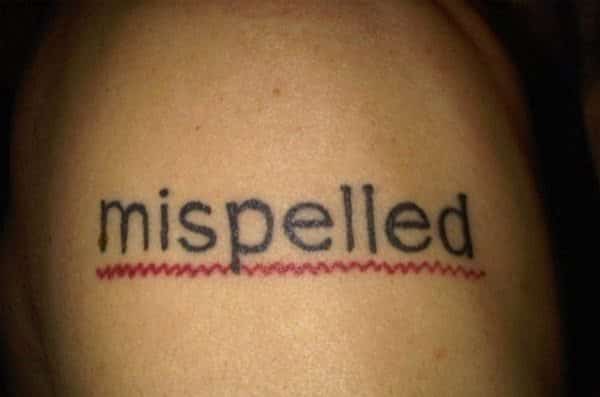
The motivational poster above was created by Mere Inkling, and represents only an infinitesimal number of the misspelled tattoos adorning human bodies. What a travesty . . . one that may have been prevented by remaining sober. The tattoo below, on the other hand, strikes me (being a writer) as quite clever.