Prayers, Barbers & Saints

Barbers, and hairdressers, play a unique role in society. Let’s consider now two barbers whose interactions with great Christians contributed to our understanding of prayer.

Before we do, however, I wish to share another aspect of C.S. Lewis’ life which parallels many of our own. The great professor and author was exceptional for his knowledge, but in most other ways was just like us.

One example of Lewis’ normalness, is seen in his interactions with barbers. Due to the survival of much of his correspondence, we can witness a perennial tension—the desire of fathers that their sons cut their hair.

As a veteran whose adult son had a ponytail for several years, I understand the frustration of Lewis’ father, the Irish solicitor, when his son Jack lacked diligence in maintaining a neat appearance. In my own case, the die had been cast from my youth. Growing up in the late sixties, I did manage to sport a thick contemporary mane which chafed my own father, but too much of my youth was spent with a crewcut, the haircut-of-choice for my dad, the Marine Corps sergeant.

Presumably, while young Jack was still at home, his parents saw to it his hair was attended to. After his mother Florence’s death, and his move to boarding school, haircuts were a curious recurring theme in Lewis’ correspondence with his “Papy.” Below are a few of young Jack’s passing remarks on the subject.

Today I did a thing that would have gladdened your heart: walked to Leatherhead (for Bookham does not boast a barber) to get my hair cut. And am now looking like a convict (1914).

My dear Papy, Thanks very much for the photographs, which I have duly received and studied. They are artistically got up and touched in: in fact everything that could be desired–only, do I really tie my tie like that? Do I really brush my hair like that? Am I really as fat as that? Do I really look so sleepy? However, I suppose that thing in the photo is the one thing I am saddled with for ever and ever, so I had better learn to like it. Isn’t it curious that we know any one else better than we do ourselves? Possibly a merciful delusion (1914).

I am very sorry to hear that you were laid up so long, and hope that you now have quite shaken it off. I have had a bit of a cold, but it is now gone, and beyond the perennial need of having my hair cut, I think you would pass me as ‘all present and correct’ (1921).

I am afraid this has been an egotistical letter. But it is dull work asking questions which you can’t (at any rate for the moment) give a reply to. You do not need to be told that I hope you are keeping fairly well and that I shall be glad to hear if this is the case. For myself—if you came into the room now you would certainly say that I had a cold and that my hair needed cutting: what is more remarkable: you would (this time) be right in both judgements. Your loving son, Jack (1928)

Lewis’ High Street Barber

In the early 1950s, C.S. Lewis developed a meaningful relationship with his barber, based on their shared faith. Before we consider an essay inspired, in part, by this friendship, this 1951 letter reveals the affection Lewis held for the man.

My brother joins me in great thanks for all your kindnesses, and especially on behalf of dear little comical Victor Drewe—our barber, as you know.

When he cut my hair last week he spoke in the most charming way of his wife who has just been ill and (he said) ‘She looks so pretty, Sir, so pretty, but terribly frail.’ It made one want to laugh & cry at the same time—the lover’s speech, and the queer little pot-bellied, grey-headed, unfathomably respectable figure.

You don’t misunderstand my wanting to laugh, do you? We shall, I hope, all enjoy one another’s funniness openly in a better world.

Years later, C.S. Lewis would write a profound essay on “The Efficacy of Prayer.”

Some years ago I got up one morning intending to have my hair cut in preparation for a visit to London, and the first letter I opened made it clear I need not go to London. So I decided to put the haircut off too.

But then there began the most unaccountable little nagging in my mind, almost like a voice saying, “Get it cut all the same. Go and get it cut.” In the end I could stand it no longer. I went.

Now my barber at that time was a fellow Christian and a man of many troubles whom my brother and I had sometimes been able to help. The moment I opened his shop door he said, “Oh, I was praying you might come today.” And in fact if I had come a day or so later I should have been of no use to him.

It awed me; it awes me still. But of course one cannot rigorously prove a causal connection between the barber’s prayers and my visit. It might be telepathy. It might be accident. . . .

Our assurance—if we reach an assurance—that God always hears and sometimes grants our prayers, and that apparent grantings are not merely fortuitous, can only come [through a relationship which knows the promiser’s trustworthiness].

There can be no question of tabulating successes and failures and trying to decide whether the successes are too numerous to be accounted for by chance. Those who best know a man best know whether, when he did what they asked, he did it because they asked.

I think those who best know God will best know whether He sent me to the barber’s shop because the barber prayed.

You can read “The Efficacy of Prayer” in its entirety here. Or, should you prefer, you can hear it expertly read here.

The Story of Another Godly Barber

Four centuries before C.S. Lewis honored his barber by forever associating his name with the subject of prayer, the church reformer Martin Luther did the same. Luther’s friend was named Peter, and he lived during an age when skilled barbers also served as surgeons. According to the Barber Surgeons Guild,

The early versions of the Hippocratic Oath cautioned physicians from practicing surgery due to their limited knowledge on its invasive nature.  During the Renaissance, Universities did not provide education on surgery, which was deemed as a low trade of manual nature.

Barber surgeons who were expertly trained in handling sharp instruments for invasive procedures quickly filled this role in society. Barber surgeons were soon welcomed by the nobility and given residence in the castles of Europe where they continued their practice for the wealthy. These noble tradesmen, armed with the sharpest of blades, performed haircuts, surgeries and even amputations.

One church historian describes the Reformation context in an article entitled “Praying with Peter the Barber.”

Early in the year 1535, Peter Beskendorf became the most famous hairdresser of the reformation. He was Martin Luther’s barber and wrote to the great reformer asking for advice on how to pray.

Peter not only had a reputation as the master barber of Wittenberg, but he had a reputation for godliness and sincerity in his love for the Word of God. He was one of Luther’s oldest and best friends, so his request is not all that surprising.

What is surprising, however, is that Luther took the time out of his immensely busy reformation schedule to write him a thirty-four-page reply with theological reflections and practical suggestions about how he ought to approach prayer to the Almighty God.

In “Cutting Hair and Saying Prayers,” a lay theologian describes the focus of Martin Luther’s counsel.

When Luther’s barber, Peter Beskendorf, asked him how to pray, Luther wrote him an open letter that has become a classic expression of the “when, how, and what” of prayer. It is as instructive today as when it was first penned in 1535. . . .

Luther spends the bulk of his letter discussing what to pray. Implicitly in his letter, Luther teaches that God’s word is the content of our prayers.

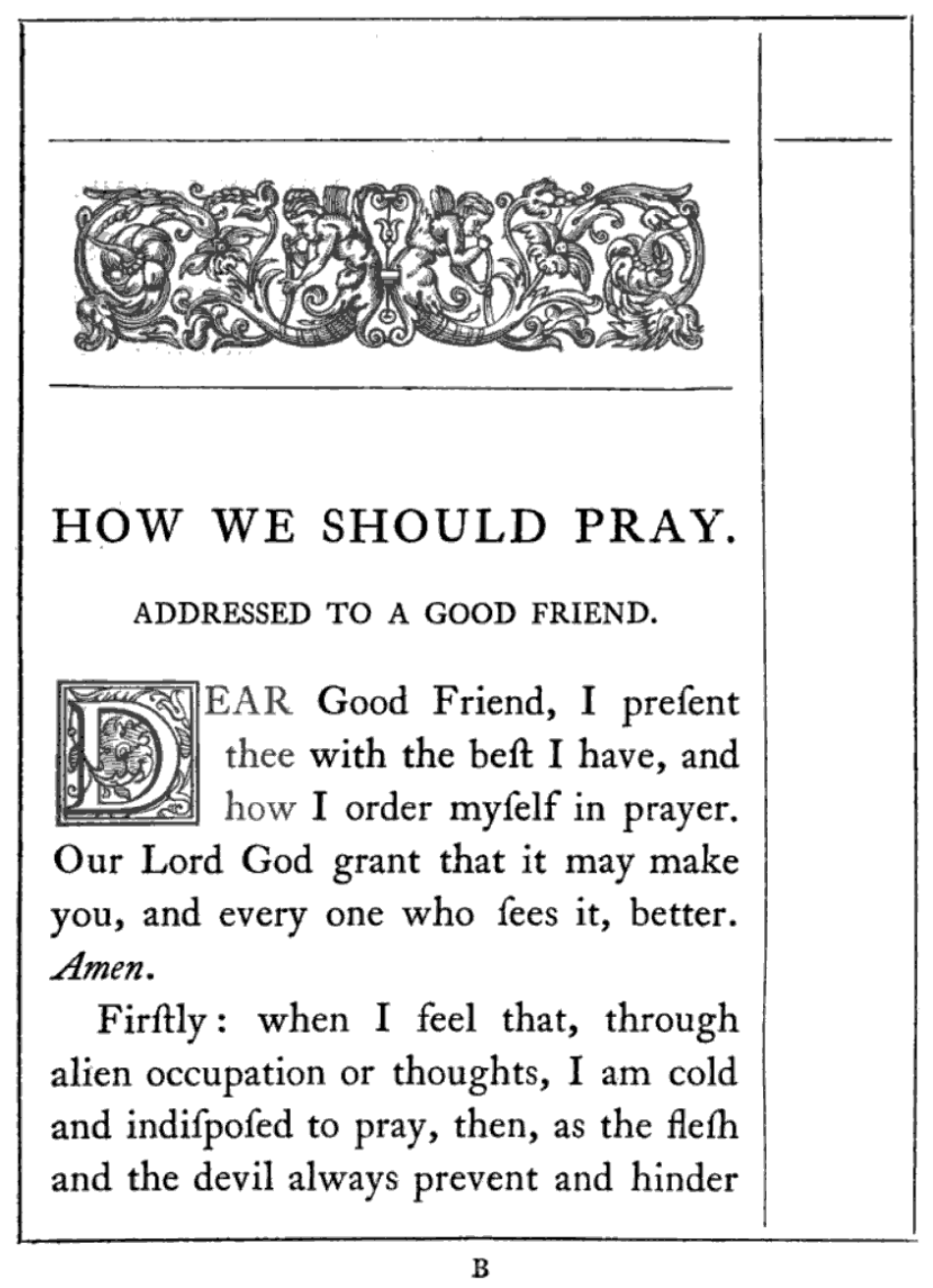
Luther graces the beginning of the book with a sincere prayer of blessing. “Dear Master Peter: I will tell you as best I can what I do personally when I pray. May our dear Lord grant to you and to everybody to do it better than I! Amen.”

In a very interesting essay entitled “Warrior Saints,” a Marquette professor commends the “sweet and practical booklet,” writing that “today this work is justly celebrated as a minor classic that both epitomizes Luther’s spirituality and powerfully suggests what a deep and lasting impact he would make on the lives of his many followers.”

Volume 43 of Luther’s Works includes the treatise. In the collection’s introduction to the document, it includes a heartbreaking event that followed its publication.

Luther wrote the book early in 1535 and it was so popular that four editions were printed that year.

At Easter a tragedy befell Peter. He was invited to the home of his son-in-law, Dietrich, for a convivial meal the Saturday before Easter, March 27, 1535. Dietrich, an army veteran, boasted that he had survived battle because he possessed the art of making himself invulnerable to any wound. Thereupon the old barber, doubtlessly intoxicated, plunged a knife into the soldier’s body to test his boast. The stab was fatal.

Master Peter’s friends, including Luther, intervened for him, and the court finally sent him into exile. . . . He lost all his property and, ruined and impoverished, spent the rest of his life in Dessau.

Such was the sad course of Beskendorf’s life. One can only hope that, as his life itself had been spared, Peter experienced some sort of healing and peace. Such blessings, after all, are often the fruit of prayer.

Luther’s humble essay on prayer remains in print today. If you would like to read or own it for free, I have found a London edition entitled The Way to Prayer.

One caveat, which might trouble some readers: since the translation was published in 1846, it employs the “medial S,” the one that looks more like a lower case “F.”* Whichever edition you choose to read, you will not be disappointed.


* The medial S is sometime referred to as the long S. You can read about its history in this interesting article.

The history of S is a twisting, turning path. Until around the 1100s or so, the medial S was the lowercase form of the letter, while the curvy line we use today was the uppercase form. But over time, the regular S, technically known as the “round S” or “short S,” started being used as a lowercase letter, too.

By the 1400s, a new set of S usage rules was established: The medial S would be used at the beginning of a lowercase word or in the middle of a word, while the round S would appear either at the end of a word or after a medial S within a word, as in “Congreſs” (which appears in the first line of Article I of the Constitution).

An Audience of Angels

Most writers are content to have humans read their works. Not so, William Blake (1757-1827). He indicated on various occasions that his audience included angels.

Blake was a very odd man. Talented, true. Inspired, likely. (Though by whom, debatable.) Christian, I think not. C.S. Lewis had a mixed opinion of him, affirming some of his poetry, and challenging one of his most prominent theological errors.*

True, Blake drew most of his imagery from Christian themes, but that is to be expected by someone writing and painting around the turn of the nineteenth century in Britain. His views of Christian faith were anything but consistent with orthodoxy.

Indeed, Blake appears to have fashioned his own religion, with an unrestrained syncretistic impulse, and an unhealthy measure of sinuous semantics.

The source of many of Blake’s unorthodox musings appears to have been spiritual sources. He reported seeing visions, beginning in his childhood. Apparently, he would sketch the likenesses of spirits that presented themselves to him. At an 1819 séance he saw and communicated with the ghost of a flea (portrayed above).

The British Library offers a brief and informative video about Blake’s spiritual visions which is available here.

He sees angels—they’re angels to him. He sees figures at the window of his bedroom and as life goes on, these visions become more challenging. The old prophets, or Raphael, the painter, or some great figure he wants to discuss things with, appears in his chamber—it’s a kind of séance.

Eventually Blake’s conflated visions of heavenly beings and departed humans, developed into his own peculiar blend of spiritualism. In 1800, he wrote to comfort a friend whose son had died.

I know that our deceased friends are more really with us than when they were apparent to our mortal part. Thirteen years ago I lost a brother, and with his spirit I converse daily and hourly in the spirit, and see him in my remembrance, in the region of my imagination. I hear his advice, and even now write from his dictate.⁑

Despite William Blake’s flaws, C.S. Lewis was capable of appreciating his poetry.

I am just back from my Easter walking tour with Barfield and co., this year in Derbyshire. Have you been there? It is appreciably more like my ideal country than any I have yet been [to].

It is limestone mountains: which means, from the practical point of view, that it has the jagg’d sky lines and deep valleys of ordinary mountainous country, but with this important difference, that owing to the paleness of the rock and the extreme clarity of the rivers, it is light instead of sombre–sublime yet smiling–like the delectable mountains. It gives you something [like] the same sensation as Blake’s songs.

Lewis is referring here to Blake’s collection, Songs of Innocence. From that collection, I particularly enjoy “The Lamb,” which you can read in the footnote section below.⁂

When I previously wrote about C.S. Lewis’ visits to the home of William Butler Yeats (1865-1939), I shared Lewis’ impression of the occultic flavor of the residence. In a 1921 letter to a close friend, Lewis writes the following:

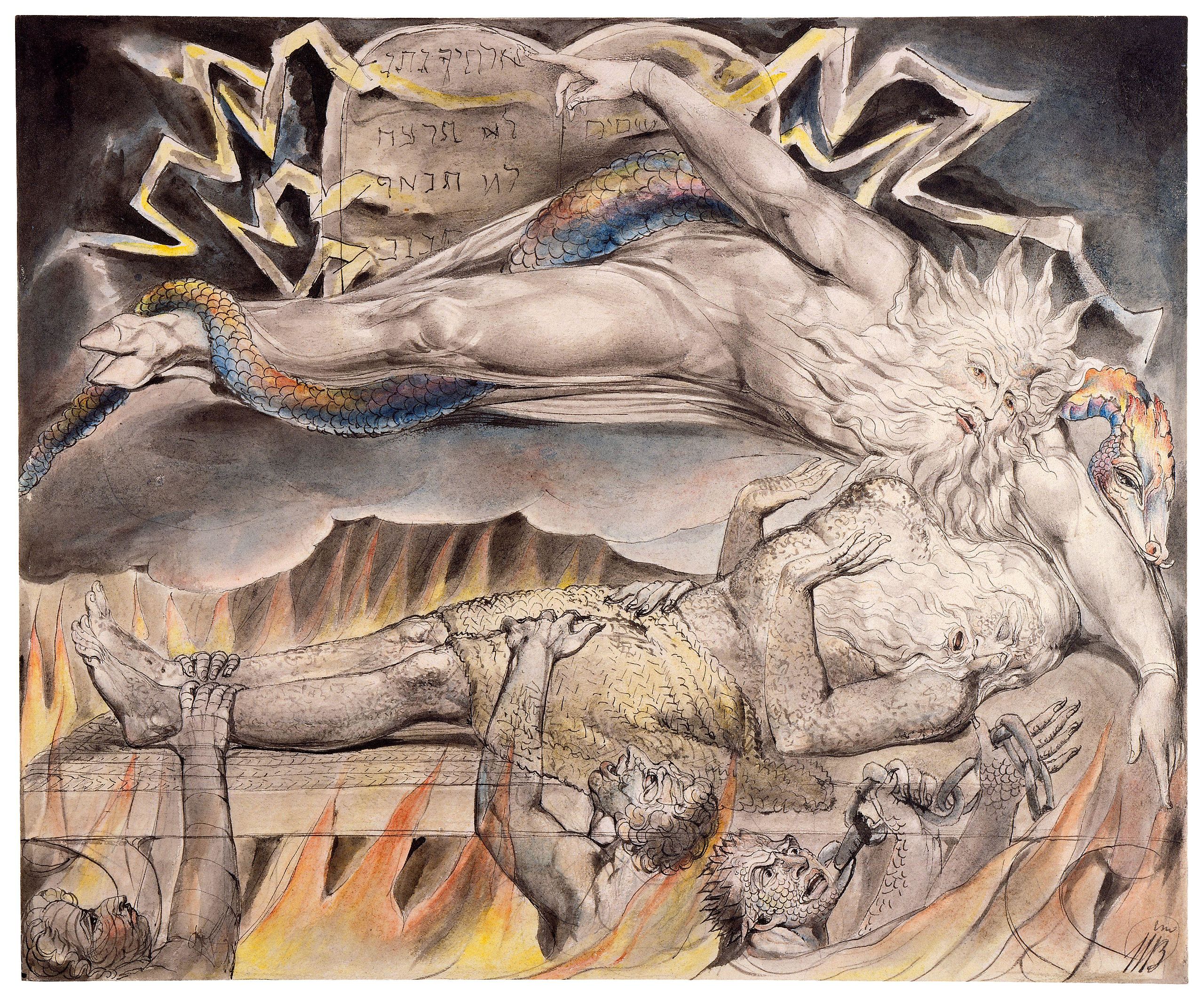
His house is in Broad Street: you go up a long staircase lined with pictures by Blake–chiefly the ‘Book of Job’ and the ‘Paradise Lost’ ones, which thus, en masse, have a somewhat diabolical appearance.

We cannot know exactly which images adorned Yeats’ stairwell, but this sample comes from Blake’s Illustrations of the Book of Job.

Returning to Spiritual Matters

Not only did Blake’s angelic audience laud his work, their praise was so great he could pen this bizarre description of the celestial realms. (How much is irreligious satire, and what part is genuinely inspired by actual visions and belief, remains debatable.)

I am more famed in Heaven for my works than I could well conceive. In my Brain are studies & Chambers filled with books & pictures of old, which I wrote & painted in ages of Eternity before my mortal life; & those works are the delight & Study of Archangels.

Perhaps C.S. Lewis’ most direct response to the confusion promoted by William Blake’s beliefs is found in his classic, The Great Divorce. This illuminating exploration of the gulf between heaven and hell was written, in part, as a response to Blake’s volume, The Marriage of Heaven and Hell. But, the comparison between the two requires an examination more than worthy of its independent discussion.

Suffice it here to include an example of Blake’s advocacy for hell. Blake describes a confrontation between “a Devil in a flame of fire, who arose before an Angel that sat on a cloud.” After their brief argument about God, the Angel “stretched out his arms embracing the flame of fire, and he was consumed . . .” That was not his end, however, for Blake adds a “Note.”

This Angel, who is now become a Devil, is my particular friend; we often read the Bible together in its infernal or diabolical sense . . . (William Blake, The Marriage of Heaven and Hell).

As noted, the matter of whether Blake’s championing of Satan was sincere or simply an arcane literary device is debatable.⁑⁑ However, his correspondence reveals his belief in the supernatural was certainly genuine.

In the end, there’s no question that C.S. Lewis’ assessment of William Blake was accurate. Unsurprisingly, it is one I share. The poet Blake possessed talent, and some of his poetry is quite good. However, as a theologian, this confused mystic is utterly unreliable.

Of course, Christians may be wrong regarding Blake’s spiritual enlightenment. What if, after all, Blake’s vision of his distinguished reputation with the angelic hosts was not a mere delusion? In the unimaginable possibility that this odd man truly is “famed in Heaven,” you must count me among those due to be the most surprised.  


* Even as he challenged one of Blake’s major works, C.S. Lewis wrote, “if I have written [disagreeing with Blake] this is not because I think myself a fit antagonist for so great a genius . . .”

⁑ Some might contend that Blake is referring here to “imagining” the presence of his brother in some sentimental fashion. That is clearly not the case. The fact that he states his brother is, at that moment, advising him on what to write, is intended to be understood as fact. It should be noted he is not referring to the spiritualist practice of “automatic writing,” which is done in a state of trance or spirit possession. Blake’s description of the process is more that of conversational interaction and “advice.”

⁂ “The Lamb,” by William Blake
Little lamb, who made thee?
Dost thou know who made thee,
Gave thee life, and bade thee feed
By the stream and o’er the mead;
Gave thee clothing of delight,
Softest clothing, woolly, bright;
Gave thee such a tender voice,
Making all the vales rejoice?
   Little lamb, who made thee?
   Dost thou know who made thee?
   Little lamb, I’ll tell thee;
   Little lamb, I’ll tell thee:
He is called by thy name,
For He calls Himself a lamb.
He is meek, and He is mild,
He became a little child,
I a child and thou a lamb,
We are called by His name.
  Little lamb, God bless thee!
   Little lamb, God bless thee!

⁑⁑ Like most literary expressions, Blake’s was likely an amalgam of his beliefs and his fancies. A fascinating article on this subject is Peter A. Schock’s, “The Marriage of Heaven and Hell: Blake’s Myth of Satan and Its Cultural Matrix,” published in 1993. Shock says, “The Marriage of Heaven and Hell presents a programmatic expression of [Blake’s] interconnected political, moral and metaphysical thought . . .”

Beijing’s Murderous Jesus

Communist China* hates Christianity. They do everything they can to destroy the Gospel, with its power to free people from bondage. That’s because China is all about keeping human beings in bondage.

Mere Inkling is not a political blog, so I have no incentive to go through the litany of communist China’s demagoguery. Besides, listing their crimes would take far too long.

In terms of their persecution of the Christian Church, however, many agnostics know little.⁑ The Red Chinese began their war against Christianity in the days of Mao. Millions have been denied their civil rights, imprisoned, and even murdered. Even with their “enlightened” and “tolerant” policies, they continue to deface and destroy church buildings and harass and imprison believers.

But now, they have done the unimaginable.

They have sought to replace the various Chinese translations of the Bible with a new, official edition. The regime’s Bible, though, is not a genuine translation.

It is an intentional corruption of God’s Word, and it is no exaggeration that some of its inspiration comes from the Father of Lies,  an honored commissar in all Communist nations.

In a superb essay discussing the pseudo-bible, Cameron Hilditch reveals how the Communists are attempting to co-opt the Messiah and present him as the herald of the Marxist gospel.

Put simply, the Chinese Communist Party “plans to turn the Scriptures into another piece of regime propaganda by rewriting them beyond all recognition.”

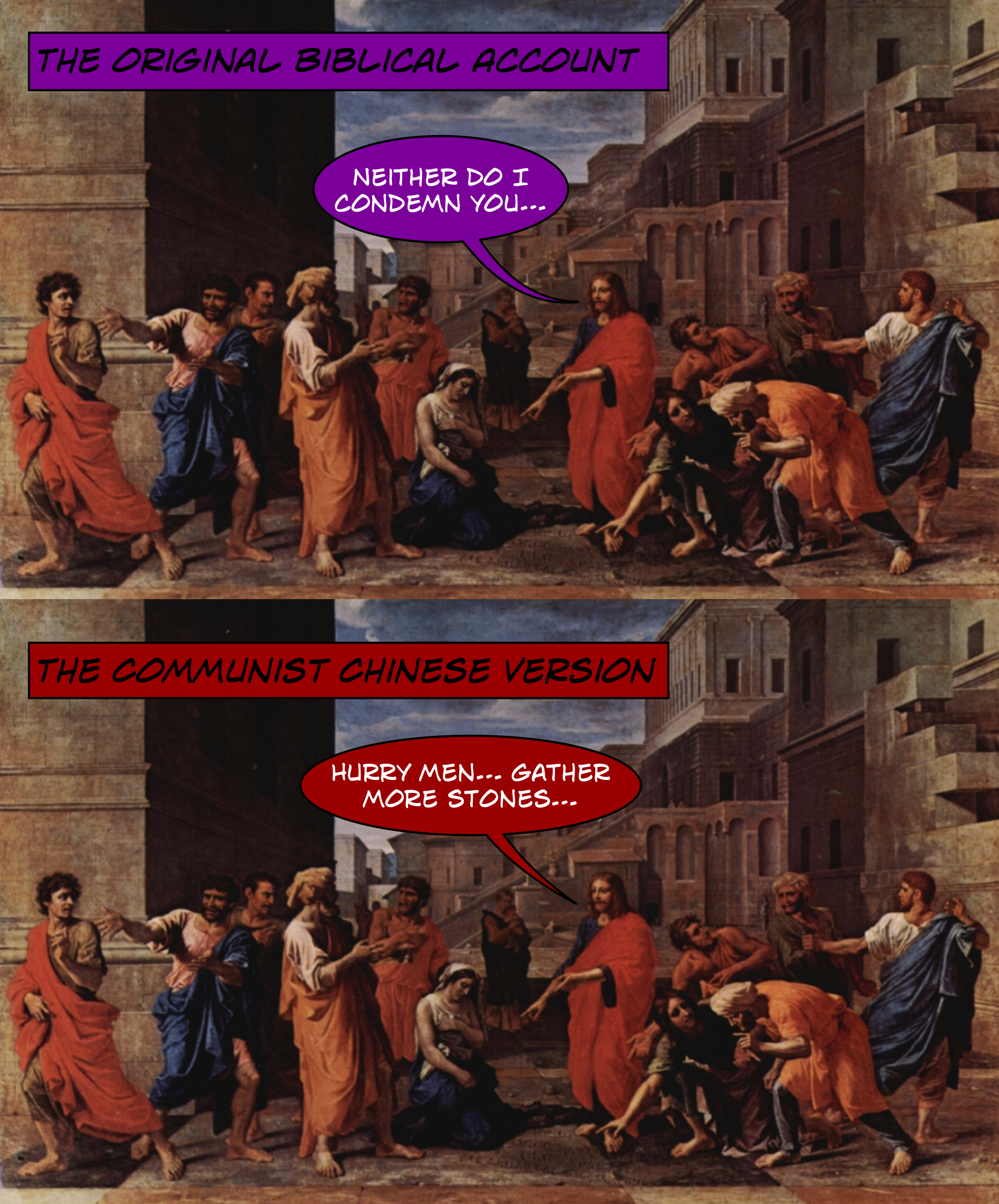
Beyond all recognition indeed. Before looking at their perversion of Jesus’ message of mercy, let’s consider the actual biblical account. We read that in Jerusalem,

Jesus went to the Mount of Olives. Early in the morning he came again to the temple. All the people came to him, and he sat down and taught them. The scribes and the Pharisees brought a woman who had been caught in adultery, and placing her in their midst they said to him, “Teacher, this woman has been caught in the act of adultery. Now in the Law, Moses commanded us to stone such women. So what do you say?”

This they said to test him, that they might have some charge to bring against him. Jesus bent down and wrote with his finger on the ground. And as they continued to ask him, he stood up and said to them, “Let him who is without sin among you be the first to throw a stone at her.”

And once more he bent down and wrote on the ground. But when they heard it, they went away one by one, beginning with the older ones, and

Jesus was left alone with the woman standing before him. Jesus stood up and said to her, “Woman, where are they? Has no one condemned you?” She said, “No one, Lord.” And Jesus said, “Neither do I condemn you; go, and from now on sin no more.”

Here is the communist mistranslation⁂ of the end of this powerful example of God’s grace and mercy.

When the crowd disappeared, Jesus stoned the sinner to death saying, “I too am a sinner. But if the law could only be executed by men without blemish, the law would be dead.”

Twisting the Scriptures

The act of translating the Scriptures is not controversial. In fact, it is necessary. C.S. Lewis noted this in his essay “Modern Translations of the Bible.”

The truth is that if we are to have translation at all we must have periodical re-translation. There is no such thing as translating a book into another language once and for all, for a language is a changing thing.

If your son is to have clothes it is no good buying him a suit once and for all: he will grow out of it and have to be re-clothed.

However, the re-translation must be an honest one.

There are several warnings in the Bible itself not to alter the words in the Scriptures either by deleting or adding to the text. Substituting the actual words, as the Communist Chinese have done, would violate both of those prohibitions.

Some people argue that mainland China exerts a benign influence on the world. “We have short memories,” says Christian attorney and advocate for the poor, Anna Waldherr. Rather than praise China for its increased engagement with the world, she reminds us of the true situation.

These days, the United States and China have mutual economic, political, and security interests.  But China remains a Communist nation with a totalitarian government and unresolved issues involving human rights.

The evil purposes of communist China’s ruling elite do not extend to their people. On the contrary the residents of that historic nation are its primary victims. The Chinese people and their culture possess much nobility. As I have written before, “C.S. Lewis held great respect for Chinese civilization. He was interested in the Chinese philosophical concept of the Tao.”

I share Lewis’ high regard for all that is good in China along with a genuine compassion for the Chinese people. May God deliver them from the dark principalities that reign over them.


* The communist People’s Republic of China is not to be confused with the democratic Republic of China, which is usually called Taiwan, due to the PRC’s coercive actions. For the same reason, the 23 million people living in the Republic of China are denied representation in the United Nations.

⁑ The Communists persecute other religious groups as well, most notably the Uighur (Islamic) people, who are being placed in vast reeducation and labor camps. In addition to rewriting the Jewish and Christian Scriptures, they are presumably also rewriting the Quran with the same, pro-regime agenda. Unsurprisingly, when asked their specific plans, “the Chinese Embassy in Washington declined to comment.”

⁂ As reported in Hilditch’s article, “China’s Communist Christ,” linked to above.

The original painting featured in the illustration above, “Christ and the Woman Taken in Adultery,” was painted in 1653 by Nicolas Poussin.

Why C.S. Lewis Remained Protestant

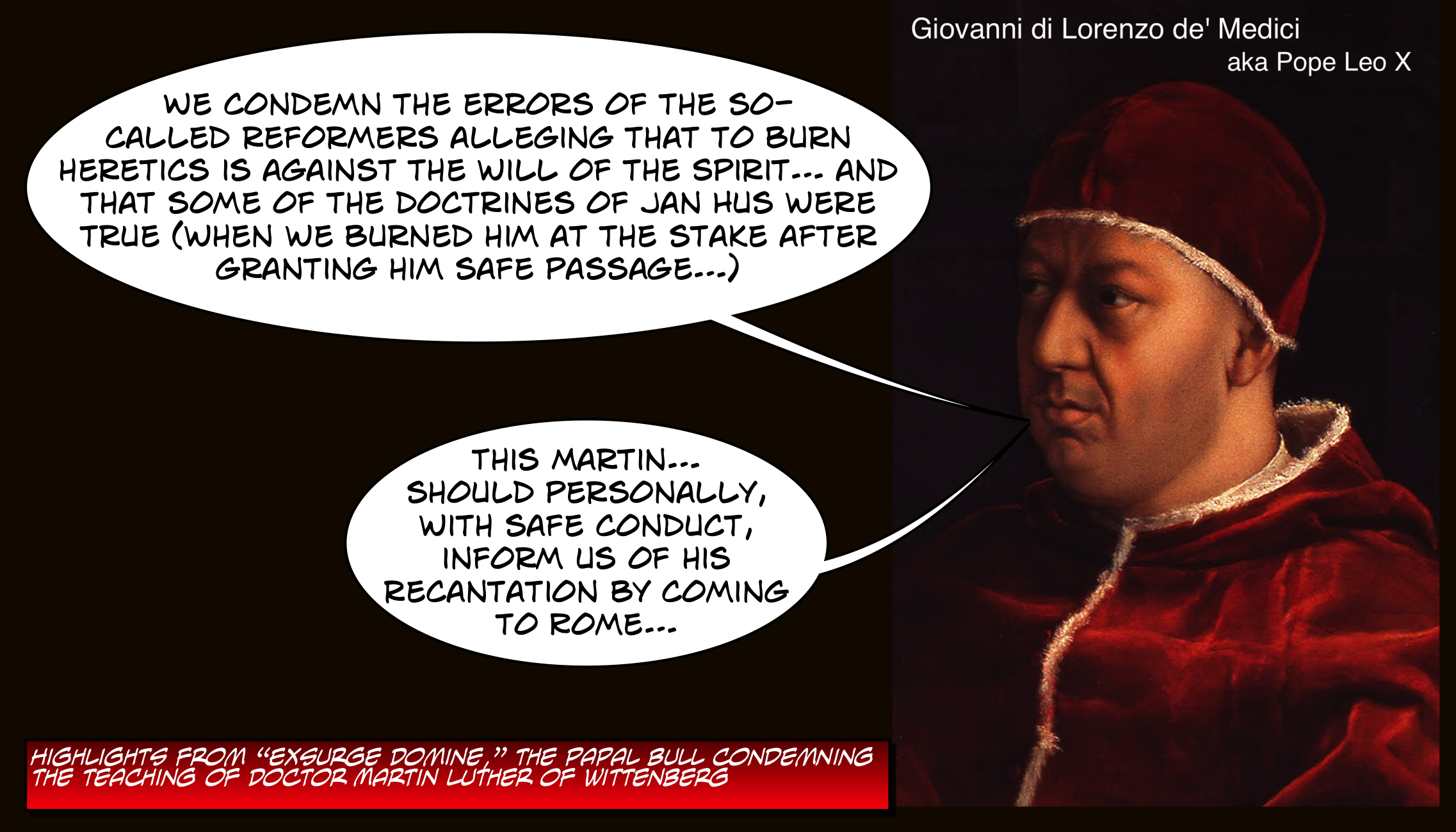
I find it intriguing how so many Roman Catholics wonder why all Protestants don’t find “crossing the Tiber” irresistible. C.S. Lewis disappointed his good friend J.R.R. Tolkien by not joining him in that church.

As we prepare to commemorate another Reformation Day, I would like to share one of C.S. Lewis’ patient responses to that persistent query. In a moment we’ll read a letter Lewis wrote on this subject. Since some still ask the question,* it is important to set the stage for our consideration of this letter.

The letter which follows is part of an ongoing correspondence Lewis had with Peter Milward (1925-2017), a Jesuit priest. Milward had listened to some of Lewis’ lectures at Oxford, and had attended meetings of the Socratic Club.

Milward was among those who was amazed that such an enlightened Christian as C.S. Lewis could not recognize Roman Catholicism’s claim to be the true church. A number of Lewis’ letters to Milward are included in volume three of Lewis’ Collected Letters. (The same volume includes a succinct biography of Milward.)

Four years ago, I shared in Mere Inkling a letter Lewis had written to Father Milward. It related to the latter’s criticism of a point Lewis had (intentionally) not included in one of his books.   

If you sometimes read into my books what I did not know I had put there, neither of us need be surprised, for greater readers have doubtless done the same to far greater authors. Shakespeare would, I suspect, read with astonishment what Goethe, Coleridge, Bradley and Wilson Knight have found in him!

Returning to today’s discussion, we have a letter written by the Oxford and Cambridge professor to the student who would become a professor and literary critic in his own right.

Why Lewis Remained a Mere Christian

Father Peter Milward asked C.S. Lewis during the final year of his life, to explain why he had not followed the natural path of Christian enlightenment into the embrace of Rome. Lewis provided a reasoned and considerate response, in the following letter, which I will allow to speak for itself.

As from Magdalene College, Cambridge
6 May 63

Dear Padre

You ask me in effect why I am not an R.C. If it comes to that, why am I not—and why are you not—a Presbyterian, a Quaker, a Mohammedan, a Hindoo, or a Confucianist? After how prolonged and sympathetic study and on what grounds have we rejected these religions?

I think those who press a man to desert the religion in which he has been bred and in which he believes he has found the means of Grace ought to produce positive reasons for the change—not demand from him reasons against all other religions. It would have to be all, wouldn’t it?

Our Lord prayed that we all might be one ‘as He and His father are one.’ But He and His Father are not one in virtue of both accepting a (third) monarchical sovereign. That unity of rule, or even of credenda, does not necessarily produce unity of charity is apparent from the history of every Church, every religious order, and every parish.

Schism is a very great evil. But if reunion is ever to come, it will in my opinion come from increasing charity. And this, under pressure from the increasing strength & hostility of unbelief, is perhaps beginning: we no longer, thank God, speak of one another as we did even 100 years ago. A single act of even such limited co-operation as is now possible does more towards ultimate reunion than any amount of discussion.

The historical causes of the ‘Reformation’ that actually occurred were (1) The cruelties and commercialism of the Papacy. (2) The lust and greed of Hen[ry] 8. (3) The exploitation of both by politicians. (4) The fatal insouciance of the mere rabble on both sides.

The spiritual drive behind the Reformation that ought to have occurred was a deep re-experience of the Pauline experience.

Memo: a great many of my closest friends are your co-religionists, some of them priests. If I am to embark on a disputation–which could not be a short one, I would much sooner do it with them than by correspondence. We can do much more to heal the schism by our prayers than by a controversy. It is a daily subject of mine.

Yours
C.S. Lewis

Apparently Milward responded to this letter from Lewis, in which he must have further pressed the discussion about Lewis leaving Anglicanism. While Lewis remains courteous, his impatience with the matter is quite evident.

Dear Father Milward

Come, come! You show yourself lacking in the spiritual tact which is so conspicuous among my Jesuit friends in Oxford. Trying to goad a man into controversy when he has already declined it is not the way to convert him. Leave that to the Tee-Totallers and Pacifists who honour me with frequent letters.

Don’t you realise that if I were anxious for a disputatio I have among my friends many learned and delightful masters of your Church and even of your order, with whom the matter could be discussed at any length in comfort over a pot of tea or a pot of beer.

It is not likely I should prefer the manual labour (half my life is spent answering letters anyway) of a vast correspondence with a man at the other end of the world. Don’t you realise that my friends here wd. know the mollia tempora fandi (times favorable for speaking) a great deal better than you.

Peter Milward survived for five decades after Lewis passing. During those years he wrote many works, and in 1995 he penned A Challenge to C.S. Lewis. Fortunately, it was not a theological argument, but a critique of Lewis’ literary criticism. This is how the C.S. Lewis Institute “annotates,” the work: “Milward argues that Lewis fails to fully grasp medieval literature because he understands the background of medieval literature as pagan, rather than seeing the Catholic underpinnings.”

Not having read the book, I cannot comment on its merits. However, the following passage is of value for our present discussion. It is drawn from Milward’s 2013 review of a biography⁑ of C.S. Lewis.

Only when our correspondence came to an end . . . I came to put together my thoughts or feelings of “uneasiness” about the academic writings of Lewis in the form of a book entitled A Challenge to C.S. Lewis . . . I had always been perfectly at ease in reading his imaginative writings, even from Screwtape onwards, culminating in the Narnia stories, but I always had misgivings of various kinds on reading his academic writings.

And as I presented them in my book . . . I came to the conclusion that in his mind Lewis remained a Protestant till the end, with the “Ulsterior motive” he must have imbibed with his mother’s milk, whereas at heart he was at once Pagan and Papist, encouraging many a Catholic . . . to wonder when he would follow Newman and Chesterton on the path to Rome. Nor did he live to take up my challenge, having no doubt passed to what Shakespeare calls “a better life, past fearing death.”

Postscript

Some Roman Catholics have argued that, given the radical changes in Western Anglican theology, Lewis would have joined their denomination had he lived long enough. Such is the contention on a thought provoking article that explores a number of prominent Roman Catholic converts who credit C.S. Lewis with influencing their personal pilgrimages to Rome.


* A 2013 consideration is found in C.S. Lewis and the Catholic Church, written by the Director of the Center for Faith and Culture at Aquinas College.

⁑ Milward was reviewing Alister McGrath’s C.S. Lewis: A Life, in volume 54 of Heythrop Journal. He offers a number of insights into his own relationship with Lewis throughout the review.

Filling the Shoes of Giants

One thing all humans have in common, is that we are mortal. Immortality is not inherent to our nature, and eternal life can only come as a gift from our Creator. All men and women live and die. In the words of Ecclesiastes:

It is the same for all, since the same event [i.e. death] happens to the righteous and the wicked, to the good and the evil, to the clean and the unclean, to him who sacrifices and him who does not sacrifice. As the good one is, so is the sinner, and he who swears is as he who shuns an oath (Ecclesiastes 9:2).

Naturally, there are many metrics by which to measure a person’s life. For my purpose today, I’m thinking about people who exerted an outsized* influence on culture through their testimony for Christ.

Richard John Neuhaus was such a man. Neuhaus served an integrated Lutheran congregation in Brooklyn during the 1960s, where his reputation as a socially conscious pastor began. Following the Roe versus Wade decision, Neuhaus’ involvement in liberal politics ebbed. However, his commitment to applying Christian ethics to society remained strong. In 1990, he became a Roman Catholic. He also founded the Institute on Religion and Public Life which continues to publish its ecumenical journal First Things.⁑

In his tribute to his uncle, “Can the Shoes of Richard John Neuhaus Be Filled?” Pastor Peter A. Speckhard acknowledges the sad prospects of lesser voices.

Sincerely Christian intellectuals who can articulate a solid orthodox take on any subject, but to whom nobody but their students and blog followers feel any urge to listen, are also a dime a dozen.⁂

Speckhard’s point is that there are many who are brilliant and devout, but few who can fill the shoes of giants. Speckhard offers this stark appraisal, however, without seeking to discourage other Christians from speaking to whomever might listen. (Which is much-needed encouragement to bloggers who are disappointed at how few read their posts.)

C.S. Lewis, an Even Taller Giant

As great as Neuhaus’ contribution to the advance of Christianity has been, it cannot match that of C.S. Lewis. Lewis, after all, was the great Christian apologist of the twentieth century. (An “apologist” is a person who argues in the defense of something that is controversial, in this case, the claim of Jesus himself that he “is the way, the truth, and the life [and] no one comes to the Father except through me” (John 14:6).

While Neuhaus’ witness has continued to influence many Americans, Lewis’ impact has been felt around the world. Not only has God used his works to convert many readers, Lewis’ writings continue to teach and encourage those seeking the truth today.

I have not yet had an opportunity to read The Fame of C.S. Lewis. From the reviews, it is not so much about Lewis’ writing, but the way in which his reputation has grown. Thus the subtitle: A Controversialist’s Reception in Britain and America. The author addresses one of the myths that has bothered me for years.

You may have heard the contention that Lewis is more popular in American than he is in Britain. It often carries a negative innuendo and comes across (to me, at least) like: “Lewis is more popular in the naïve, religiously unsophisticated colonies, than he is in enlightened, theologically cultured Britain.” In fact, Stephanie Derrick concludes, “the scale of Lewis’ renown was greater in the States than in Britain in large part because the difference in population there amounted to a much larger audience.”

Derrick addresses “larger question: how is renown made and kept?” She argues that “much of Lewis’s popularity is properly attributed to factors besides Lewis’s talents.”

Indeed, much of The Fame of C.S. Lewis is devoted to exploring the external factors that shaped Lewis’s success—the many actors and circumstances that have contributed to his popularity. Institutions, editors, changing social forces, and audiences have all had a hand in moulding Lewis’s image.

She is certainly correct that a wide range of factors, recognized and unknown, influence how we view people. This is particularly true after the individual (e.g. Rev. Richard Neuhaus) has become a part of history, once death has extinguished them, as Ecclesiastes might say.

However, I disagree that Lewis’ fame is an accident, the result of a unique combination of uncontrolled variables. On the contrary, I believe his reputation is based upon (1) his literary talents, (2) his humility and transparency, and—most importantly—because, (3) at the core of his most significant work, we find truth. The foundation of Lewis’ most precious writing is based on an unchanging, even eternally, relevant foundation.

I have no doubt God will continue to raise up other Christian apologists with anointed and far-reaching ministries. Ravi Zacharias, ⁑⁑ who recently died, is such a champion. There will be others to fill the shoes of C.S. Lewis and Zacharias, but their successors will require very remarkable gifts.

Bonus

One final link. This one is to the Moral Apologetics website, which has some very good articles on C.S. Lewis. And, if you decide to subscribe to their free newsletter, they allow you download The Ichabod Letters: Epistles from a Junior Demon. (Author Elton Higgs says his “study in demonic subterfuge [is] modeled on C.S. Lewis’s Screwtape Letters.”)


* That’s the first time I’ve ever used that word. Seems too slangish for my tastes. But apparently it has been around since it dates to the early 1800s. (By the way, I hope you appreciated my facetious use of “slangish,” which is considerably younger and more slangy.)

First Things is an ecumenical publication, but my subjective estimate is that about 70% of the articles relate rather directly to Roman Catholicism. They offer a worthwhile newsletter featuring free access to a number of their articles.

⁂ Peter A. Speckhard, “Can the Shoes of Richard John Neuhaus Be Filled?” Concordia Theological Quarterly 77 (2013), 342-53. The article is available here.

⁑⁑ Zacharias leaves behind a lasting legacy, particularly in the form of the ministry he founded, RZIM. Check it out for some thoughtful resources from Zacharias and other like minded contemporary Christian apologists.

Translating Foreign Languages

How many languages can you translate into English? If the answer is >0, I envy you. I’ve studied four,* and passed all the tests, but have an actual aptitude in none.

If I were thus gifted, I would be transferring some of the world’s literary wealth into my native tongue—and vice versa.

One of my granddaughters is currently fascinated by language. She wants to speak a dozen or more, and has begun some study in Spanish and Japanese. However, I attribute most of her dream to a young teenager’s excitement at having the entire world before them. In time, we all learn that finite concerns, such as time, finances and obligations, erode our options.

I’ve written about translation before, most extensively in “C.S. Lewis’ School of Translation.”⁑

This week, while writing an article about a Lutheran approach to ministry with the newly bereaved, I came across an entertaining reference to translation, in the letters of Martin Luther. Luther, of course, was the Reformation leader who, among other things, strongly believed the Bible should be accessible to lay people in their own language.

Translating the Holy Scriptures

Martin Luther was a scholar. Yet, even scholars lack expertise in all subjects. Thus, when translating the Bible into German, he welcomed the cooperation of others. This was particularly wise, since the so-called “Luther Bible” was the first German translation from the original languages rather than the Latin Vulgate. Unsurprisingly, the New Testament was published first. The longer Jewish Scriptures required more time.

The following letter was written in 1524 to Luther’s friend George Spalatin, another German theologian. Luther playfully explains how faithfulness to the original Hebrew text has delayed the publication of the final portion of the Bible.  

All is well with us. We have so much trouble in translating Job, on account of the grandeur of his sublime style, that he seems to be much more impatient of our efforts to turn him into German than he was of the consolation of his friends.

Either he always wishes to sit on his dunghill, or else he is jealous of the translator who would share with him the credit of writing his book. This keeps the third part of the Bible from being printed.

This casual identification with Job, one of God’s most faithful followers, appeals to me. The older I become, the greater is my sense of connection with the “cloud of witnesses,” the saints who have gone before us. In fact, I am also growing progressively more eager to fellowship with the angels. Though different from humanity in countless ways, we share the wonder of being beloved creatures of God.

In The Four Loves, Lewis writes that “friendship . . . This love, free from instinct, free from all duties but those which love has freely assumed, almost wholly free from jealousy, and free without qualification from the need to be needed, is eminently spiritual. It is the sort of love one can imagine between angels.” In my mind, phileo is also the sort of love we will one day experience between angels and humans.

C.S. Lewis’ Work with the Hebrew Language

Lewis did not read Hebrew. That shortcoming is certainly quite forgivable, given the numerous arenas in which his talents excelled. In his Reflections on the Psalms, he acknowledges his limitation. At the same time, he notes that we have many accessible resources by those acquainted with the ancient language.

I have worked in the main from the translation which Anglicans find in their Prayer Book; that of Coverdale. Even of the old translators he is by no means the most accurate; and of course a sound modern scholar has more Hebrew in his little finger than poor Coverdale had in his whole body. But in beauty, in poetry, he, and St. Jerome, the great Latin translator, are beyond all whom I know. I have usually checked, and sometimes corrected, his version from that of Dr. Moffatt.

In his explanation, Lewis notes the value in referring to several authoritative sources. This is especially wise when words are rare or unclear in their usage. Even people fluent in various languages would be negligent to ignore such resources where there is a question regarding significant interpretations.

In the meantime, Luther’s reminder of Job’s “grandeur of his sublime style,” along with the book’s remarkable message, has me preparing to read that book once again. In translation, of course.


* Spanish in junior high, Latin in high school, classical Greek in college, and Hebrew in seminary. As the Austrian-British philosopher, Ludwig Wittgenstein, said: “the limits of my language mean the limits of my world.” I am quite impressed by the fact that many of Mere Inkling’s readers from outside the States are at least bilingual.

⁑ If you’re interested in the subject, you might want to also (re)visit “C.S. Lewis as a Translator.”

What is Your Epithet?

Everyone has epithets, even though we’re probably not aware of most of them. Some might be unflattering, but we could be pleasantly surprised by positive descriptive phrases people associate with our names.

First, it’s necessary for us to clear the air. Although the modern usage of the word “epithet” is usually negative, that is not the sole—or even primary—use of epithet. Far from being derogatory, most epithets are affirming. That’s because “epithet” is derived from the Greek verb epitithenai which simply means “to put on.” Basically, an epithet is anything that’s added to a person’s name to distinguish them as a particular individual.

Let me offer a simple quiz. What common epithet is often linked to all of the following historical figures?

Charlemagne, King of the Franks
Catherine, the Empress of Russia
Peter, Tsar of Russia
Alexander, the King of Macedonia
Kamehameha I, King of Hawaii
Constantine I, first Christian Emperor of Rome
Frederick, King of Prussia
Rhodri, King of Gwynedd

We can expand this list with several historical figures recorded in the holy Scriptures:

Herod, King of Judea
Cyrus, Founder of the Persian Empire
Darius, Third Shahanshah of the Persian Empire

Obviously, I provided far more options than necessary for you to discern the common epithet. Each of them is, of course, called “the Great.” (Bonus points to anyone recognizing Rhodri the Great; I assume only Mere Inkling’s Welsh readers will know who he was.)

If you think my list is lengthy, check out the wikipedia list of people referred to as “the Great.” And feel free to supplement it, if you recall someone they missed.

A common Christian epithet is “Apostle.” It’s not really a title, though it’s frequently used that way, especially when applied to the original fourteen.⁑ This Orthodox Christian website provides a list of early missionaries who earned the same epithet, including Patrick the Apostle to Ireland and Ansgar, the Apostle to the North.

Back to the Question

So, given that epithets can be neutral or positive, are you aware of any of yours? Our ten grandchildren are developing wonderful senses of humor. I’ve joked with them all ever since they were tiny. More than once they’ve called me their “Funny Grandpa.” That’s an epithet I can be proud of.

Back in my high school years, because I spoke with (assumed) authority on nearly any subject, a couple people called me the “Voice of Experience.” Which just reminded me—literally, as I was typing this—that back at my first active duty assignment, our wing commander publicly bestowed on me an epithet.

There at Reese Air Force Base we were conducting our very first Military Tattoo ceremony. Quite unexpectedly, after doing the yeoman’s work* in composing the lengthy ceremony, he selected me to be the emcee for the extravagant community event. The event flowed flawlessly. The next day, Colonel (later General) Lillard referred to me as the “Voice of Reese.” My wife was suitably impressed!

Now, I have no doubt I’ve accumulated a number of pejorative epithets during my life as well. The good thing about those though, is that people usually don’t share them to our face.

As for your own epithets, you might think of words that friends repeatedly use to describe you. If you’ve been called humble, trustworthy, brave, patient or witty by more than one person, you might be surprised to learn how many others associate that trait with you as well. Talented and smart are also common appellations from those who admire your your various skills or intellect. Sensitive is a nice epithet to own, although I confess it’s seldom applied to me.

Ruth Pitter, C.S. Lewis’ Friend

Pitter (1897-1992) was a highly regarded British poet. Living in artistic circles, it’s unsurprising that she describes her early life as “bohemian.” Bohemians tend to regard that epithet as admirable, while practical people such as myself consider it a negative term. Bohemian, of course, refers to “socially unconventional” behavior which may cover a multitude of alternative lifestyles.

Pitter, however, was also a friend of C.S. Lewis. And it was through his writings and their conversations that she became a Christian. In 1985, two decades after his death, she wrote,

As to my faith, I owe it to C.S. Lewis. For much of my life I lived more or less as a Bohemian, but when the second war broke out, Lewis broadcast several times, and also published some little books (notably The Screwtape Letters), and I was fairly hooked. I came to know him personally, and he came here several times. Lewis’s stories, so very entertaining but always about the war between good and evil, became a permanent part of my mental and spiritual equipment.

At one point in Lewis’ life he said although he was a confirmed bachelor, if he were to propose marriage, it would be to Ruth.

The two writers often critiqued one another’s works. In 1946, Lewis sent the following letter to Pitter. I reproduce the first half of it here not for its content per se, but because of its literary use of the word “epithet.” Presumably, seventy years ago its deprecatory usage had not gained dominance. (What strikes me as the most amazing thing about this letter, is the way in which the two share such a comprehensive knowledge that Lewis did not even need to cite the sources of the quotations to which he refers!)

Dear Miss Pitter–

Certainly a great many good lines have an epithet in them and depend principally on that epithet. But by no means all. Sometimes the work is done by a special use of a Noun:

multosque per annos sustentata ruet moles et machina mundi. (a)

or

how sweetly flows
That liquefaction of her clothes. (b)

sometimes by a verb:

J’ai mendiee la mort chez les peuples sauvages (c)
—where to get the effect one would almost have to translate “I have begged death as bread.” Or

Forever climbing up the climbing wave (d)

Though here something else, the “Figure” of repetition, comes in. Sometimes it turns on a Noun metaphorical:

Oh my America, my Newfoundland! (e)

Again and again it turns on Metaphor:

The expense of spirit in a waste of shame. (f)

That from the nunnery
Of thy chaste breast. (g)

But I beneath a rougher sea
And whelmed in deeper gulfs than he. (h)

But in all these there is something you may regard as equivalent to an epithet. There is another kind of poetry which seems to do it by simple statement:

Thou’ll break my heart, thou bonnie bird,
That sings on yonder bough. (i)

or

Twenty days and twenty nights
They went in red blood to the knee,
And he saw neither sun nor moon
But heard the roaring of the sea. (j)

No one will say that bonnie in the first or red in the second has much to do with the result. One might at a pinch say that the apostrophe to a bird in the first and the whole myth in the second are the same kind of thing as an epithet. But then there are still passages where the statement is of the most factual kind and yet (in its context) it is very poetry:

Ronsard me célébrait du temps que j’étais belle (k)

or

Fulsere quondam candidi tibi soles
Cum uentitabas quo puella ducebat
Amata tantum quantum amabitur nulla. (l)

Oh, and what about the chansons de gestes?

Roland is dead. God has his soul to Heaven (m)
(Roland est mort. Dieux en ad l’anme aux cieulx)

or

Paien unt tort et Chestien unt dreit
(Paynims [non-Christians] are wrong and Christians are right) (n)

The truth is that there are a great many different kinds of poetry and extreme roughness (or smoothness) evocative epithet (or plain statement), the metaphorical (or literal) the colloquial (or rhetorical) may all, in their place, rise to perfection.

And Finally, For Dessert

That was a lengthy quotation—particularly for readers who don’t thrive on poetry or literary criticism. Here, however, is a delightful use of the word epithet from C.S. Lewis’ youth. In a 1915 letter to his closest friend, Arthur Greeves, Lewis gently chides him for his application of an “impertinent epithet.”

It may be true that it is easier to assign music to people we know, than to conjure up people to fit the music, but I deny that anyone’s character is really unlike their appearance. The physical appearance, to my mind, is the expression and result of the other thing—soul, ego, psyche, intellect—call it what you will. And this outward expression cannot really differ from the soul.

If the correspondence between a soul & body is not obvious at first, then your conception either of that soul or that body must be wrong. Thus, I am “chubby”—to use your impertinent epithet, because I have a material side to me: because I like sleeping late, good food & clothes etc. as well as sonnets & thunderstorms.


* Yes, I’m consciously mixing my military metaphors. While I served as a USAF “airman,” the term yeoman is a junior Navy rating or rank (i.e. the people who do most of the work).
⁑ The original fourteen include Matthias, who replaced Judas, and Paul, the Apostle to the Gentiles.

Sources for the citations in Lewis’ letter to Pitter:
(a) Lucretius, De Rerum Natura: “The mighty and complex system of the world, upheld through many years, shall crash into ruins.”
(b) Robert Herrick, “Upon Julia’s Clothes” (1648).
(c) “I begged for death among the savages.”
(d) Tennyson, “The Lotus-Eaters” (1833).
(e) John Donne, Elegies, “To His Mistress Going to Bed” (c. 1595).
(f) Shakespeare, Sonnet 129 (1609).
(g) Richard Lovelace, “To Lucasta, Going to the Wars” (1649).
(h) William Cowper, “The Cast-Away.”
(i) Robert Burns, “The Banks o’ Doon” (1791).
(j) Thomas Rymer and Queen of Elfland.
(k) Pierre de Ronsard, Sonnets pour Hélène: “Ronsard would sing my praise at the time when I was beautiful.”
(l) Catullus, Carmen: “Once the sun shone bright for you,/when you would go whither your sweetheart led,/she who was loved by me as none will ever be loved.”
(m) The Song of Roland (12th century).
(n) The Song of Roland.

Disobeying Evil Rulers

Don’t appease evil rulers.

Have you heard the fascinating story of the successor to William the Conqueror? William, of course, is the Norman who conquered England after King Harold’s army had been battered during its victory over a Viking invasion in the preceding weeks. William’s heir was proved far worse than his father.  

William II, also called William Rufus, reigned three years. He was an impious, carnal ruler who refused to replace the Archbishop of Canterbury who died on his watch, so that he could pilfer the church’s wealth. During a serious illness, he reconsidered his choice and forced a reluctant monastic abbot, Anselm, to assume the purple.

Because of his integrity, Anselm became a thorn in Rufus’ side. It led the monarch to proclaim:

“Yesterday I hated him with great hatred, today I hate him with yet greater hatred and he can be certain that tomorrow and thereafter I shall hate him continually with ever fiercer and more bitter hatred.”

You must be doing something right if an evil ruler hates you.

The Bible records a number of stories where courageous prophets spoke unwelcome words to corrupt leaders. A wonderful example, delightfully recorded in a single chapter of First Kings,

In essence, the king of Israel (Ahab) asks the king of Judah (Jehoshaphat) to join him on a military venture. Jehoshaphat agrees, but requests that Ahab “inquire first for the word of the Lord.” Ahab brings in 400 loyal yes-men who promise God will deliver the city “into the hand of the king.”

Well, that settles that. But, wait a minute. Jehoshaphat, having his own court prophets, knows the ropes. He asks, “is there not another prophet of the Lord of whom we may inquire?”

You can feel Ahab squirming. Finally he responds, “there is yet one man by whom we may inquire of the Lord, Micaiah…”

Then Ahab offers this magnificent, self-implicating testimony: “…but I hate him, for he never prophesies good concerning me, but evil.”

The messenger arrives at Micaiah’s home and tells him the king’s prophets are unanimous, and he “warns” him, “let your word be like the word of one of them, and speak favorably.”

When Micaiah mockingly gives the desired response to the king, Ahab realizes Jehoshaphat will recognize the tone of ridicule, and he demands the prophet be honest. “How many times shall I make you swear that you speak to me nothing but the truth in the name of the Lord?” When he receives the genuine divine word, he turns to his fellow king and moans, “Did I not tell you that he would not prophesy good concerning me, but evil?”

The confrontation continues and Ahab has the true prophet imprisoned on “meager rations of bread and water” until his safe return from the battle. Micaiah calmly responds, “If you return in peace, the Lord has not spoken by me.” This is not the dramatic end of the story, which is well worth reading (after you finish reading this post).

Ahab was a miserable king. It’s no wonder he hated the faithful Prophet Micaiah. If the scribes had recorded Ahab’s entire rant, it may well have gone, “Yesterday I hated him with great hatred, today I hate him with yet greater hatred and he can be certain that tomorrow and thereafter I shall hate him continually with ever fiercer and more bitter hatred.”

C.S. Lewis and Anselm

In addition to being a courageous prophet, Anselm was a gifted theologian. Lewis was familiar with his contributions to theology, and also to philosophy. In one of the most influential scenes in the Chronicles of Narnia, humble Puddleglum explains why he would still believe in Aslan even in the face of all the world’s lies.

For the philosophically minded, I commend this extended essay on the subject: “Anselm and Aslan: C.S. Lewis and the Ontological Argument.”*

Lewis used the ontological argument apologetically only once in his public writings, and it was in a rather surprising place. This most sophisticated of philosophical arguments shows up in a presentation to the least sophisticated audience: the children for whom the Narnia books were written. It is the debate between Puddleglum and the Green Witch in The Silver Chair.

Five hundred years later, philosopher René Descartes would follow Anselm’s example, providing ontological arguments for the existence of a benevolent God.

Lewis discussed the passage in a letter written the final year of his life. This was penned to a family with a son who would become a Senior Lecturer in Philosophy at the University of Warwick.

Please remember me to your third son. I was very sorry the course of events separated us. He is not only a very promising scholar but the best mannered man of his generation I have ever met. I suppose your philosopher son—what a family you have been privileged to bring into the world!—means the chapter in which Puddleglum puts out the fire with his foot.

He must thank Anselm and Descartes for it, not me. I have simply put the “Ontological Proof” in a form suitable for children. And even that is not so remarkable a feat as you might think. You can get into children’s heads a good deal which is quite beyond the Bishop of Woolwich.

C.S. Lewis’ witty note about the inability of the “Bishop of Woolwich” to understand what is clear to a child, was apparently directed toward John Robinson (1919-1983). Robinson was a very liberal (possibly heretical) Anglican bishop whom Episcopal Bishop John Shelby Spong (definitely heretical) considered his mentor.

My guess is that whenever Bishop Robinson thought of C.S. Lewis and the unadorned “mere Christianity” that he championed, the self-satisfied hierarch thought:

“Yesterday I hated him with great hatred, today I hate him with yet greater hatred and he can be certain that tomorrow and thereafter I shall hate him continually with ever fiercer and more bitter hatred.”

It is not always bad to be spurned by those who pursue the world’s approval, and treat the truth with disdain. May God find us in the company of C.S. Lewis and Anselm.

——

* A simpler discussion of “How C. S. Lewis Put the Ontological Argument for God in Narnia” can be found here.

If you are interested in reading about Anselm and His Work, this links to a free biography available at Internet Archive.

Historical Font Facts

Consider yourself blessed if you’re not a fontaholic. The affliction leads to clogged font directories on your computer, and an unavoidable prejudice toward either serif or sans serif fonts.

People who are intrigued by typography know exactly what I’m talking about. At least two or three times a year they will inextricably find themselves on some font website (there are scores of them) without consciously knowing how they got there or there or there.*

I’ve written about fontaholicism in the past. Unfortunately, despite my advocacy, the Diagnostic and Statistical Manual of Mental Disorders has yet to classify the malady as a recognized illness. That said, the American Psychiatric Association does sound a bit obsessive compulsive in terms of their font guidance for annual meeting posters.

If any or all of the work in this poster was prepared with commercial support, a statement “Supported by funding from [name of company]” must be noted in the lower left corner of the poster in Arial 72 point font, with no bold, italics, special colors, or other enhancement of the company name, product, or any other portions of the statement.

One wonders what sort of reaction a person would get from the APA if they used Times Roman or Comic Sans by mistake.

C.S. Lewis & Fonts

It should be acknowledged up front that C.S. Lewis was not obsessed with fonts. However, he was wise enough to recognize their significant role in communication. Good fonts could be transparent, while problematic fonts blurred the message. He highlighted one of the most significant aspects of a font’s usage—size—in a 1957 letter. He told a fellow Brit, “you’d be much wiser to get my books in the American edition as these now have larger print and better paper than our own.”

A year earlier he had discussed a related issue with his publisher. There was a problem with a Shakespeare quotation intended for the title page of Till We Have Faces.

The quotation would, I agree, look better on a page to itself, but (what is more important) I am very strongly opposed to the idea of dividing it. I agree that it ‘looks wrong as it is’ but I think it will look equally with any division whatever. I do not see why it need be printed ‘absurdly small’ to fit in as one line . . .

Now a line of that length on a page to itself would I believe, look ugly if it came anywhere near the middle of a page–because it would then seem to divide the page into two halves. But would it not look quite nice if put near the top? It would then have the properties of a frieze or dado with plain wall under it.

And we may perfectly well omit the word ‘Shakespeare’ if we think that makes a better design. But I’d prefer even a bad design to a division of the verse.

Free Books about Fonts

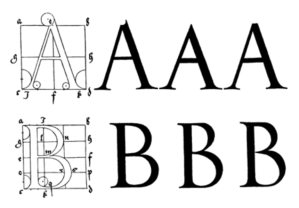
You can find a number of interesting books about fonts at some of the wonderful internet libraries such as Project Gutenberg. During recent historical research about Reformation-era artists, I discovered a book written by Albrecht Dürer (1471–1528). Since his fame is derived from his portraits of prominent people, I was surprised he had written a guide for properly shaping letters, based on geometric principles. The introduction provides a fascinating portrait of sixteenth century artistry in northern Europe.

In our Germany . . . are to be found at the present day many young men of a happy talent for the Art Pictorial, who without any artistic training whatever, but taught only by their daily exercise of it, have run riot like an unpruned tree, so that unhesitatingly and without compunction they turn out their works, purely according to their own judgment.

But when great and ingenious artists behold their so inept performances, not undeservedly do they ridicule the blindness of such men; since sane judgment abhors nothing so much as a picture perpetrated with no technical knowledge, although with plenty of care and diligence.

Now the sole reason why painters of this sort are not aware of their own error is that they have not learnt Geometry, without which no one can either be or become an absolute artist; but the blame for this should be laid upon their masters, who themselves are ignorant of this art.

Since this is in very truth the foundation of the whole graphic art, it seems to me a good thing to set down for studious beginners a few rudiments, in which I might, as it were, furnish them with a handle for using the compass and the rule, and thence, by seeing Truth itself before their eyes, they might become not only zealous of the arts, but even arrive at a great and true understanding of them.

Dürer’s book sparked my curiosity, and a very quick subsequent search hinted at the wealth of typographical information online. For example, you can read about The Typography of Advertisements, circa 1911. There you will be warned that bolder is not always better.

“But,” some one says, “the heavier and bolder type-faces furnish a greater contrast to the white of the paper, and therefore should be easier to read.”

It is true that a greater contrast of color is furnished in the use of the bolder type-faces, but to force these greater contrasts on the eye is to literally club it into reading the text, whether or no. Are the salesman’s statements of better selling value because they are shouted loudly in direct contrast to the quiet of the office?

There may be, and undoubtedly are, some on whom this force is necessary, but to those who are sufficiently educated and intelligent to be reached through the appeal of an advertisement, the quiet dignity of the salesman’s statements made in well-modulated tones will be more attractive.

Gaze back even farther, to what was considered Early Typography in 1872. There you will discover a medieval religious order devoted to worship and manuscripts.

Reference has more than once been made to the impulse given to learning at the end of the fourteenth and the beginning of the fifteenth centuries. This movement was helped forward by no one in Holland and Germany more than by Gerhard Groote, or Magnus, of Deventer, (b. 1326, d. 1370), who after studying theology at Paris, became a canon of Utrecht and Aix-la-Chapelle, and founded the Order of the Brethren and Clerks of the Common Life, generally known as the “Gemeiineslebens,” or “Frères de la Vie Commune . . .”

It was divided into the literary Brethren or Clerks, and the unlearned Brethren, who lived in different houses, but in bonds of the greatest friendship. The Clerks devoted themselves to transcribing books, the cultivation of polite learning, and the instruction of youth; and they erected schools wherever they went. The Brethren laboured with their hands, and pursued various mechanic trades. Neither were under the restraint of religious vows; but still they ate at a common table, and had a general community of goods.

There are many other curious titles available to those who choose to explore obscure typography in greater depth. A person might even wish to begin with 1891’s Specimens Of Book, Jobbing, And Ornamental Printing Type In Use In The Government Central Printing Office, Simla [India].

Fonts, fonts, fonts. As I said above, you are fortunate if they don’t draw you too deeply into their orbit. However, if you recognize you too are a fontaholic, take comfort in the knowledge that you are not alone.


* And here’s another font site I had never seen before writing this post. It has a delightful name, Font Squirrel. Once I finish writing this piece, you can guess where I will be spending some of my web surfing research time.

The Elefonts cartoon at the top of the page is a creation of talented Canadian John Atkinson, and is used with permission.

C.S. Lewis & Nuns

One of the great disappointments of Roman Catholic fans of C.S. Lewis is that he never converted to their communion. Lewis did, however, sincerely respect Roman Catholic nuns. In fact, he considered the reverence and joy of the nuns he encountered to be one of the church’s most commendable elements.

In 1947 he wrote to one of his regular correspondents who wondered why he had not forsaken his “low church” loyalties for a more elevated perspective. His response reveals his perception of the virtues of consecrated nuns.

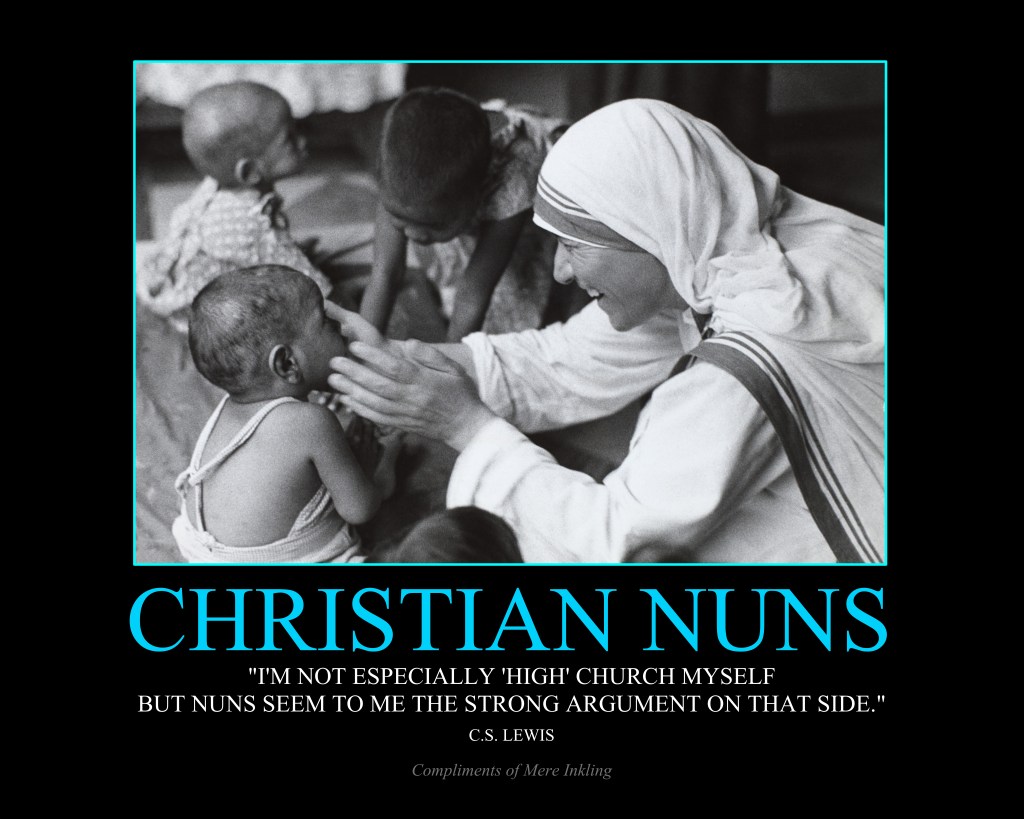
I am particularly pleased to have been of any help as a bridge between the parish and the convent. I’m not especially ‘high’ Church myself but Nuns seem to me the strong argument on that side.

They are in my experience almost invariably so very nice—and so happy: much more so either than the same number of married women picked at random or the same number of monks. I don’t know why this should be so.

One does not have to be Catholic to appreciate people who consecrate their lives to God, willing to make radical sacrifices like living a life of celibacy. Nearly four decades ago, while I was serving a congregation in Citrus Heights, California, I earned a (post-M.Div.) Master of Theology degree. Since I was focused on Patristics, I was enrolled at a Jesuit seminary in the Bay area.

One day during my studies, an Episcopal priest and I were having lunch with a half dozen Roman Catholics, most of whom were religious sisters.* The conversation turned to a celebration by the sisters present that they no longer had to wear habits. The respectful person I am, I remained silent as they discussed their “family” business. Apparently, though, I was softly grinning, because of one them (it may even have been my thesis advisor) asked, “what are you smiling about?”

My response was that it wasn’t my place to offer an opinion, but when they pressed, I said, “well, throughout my life, whenever I’ve seen a nun in her habit, it’s been an encouraging thing, and I think—there goes a life that is consecrated to God.” My companions were shocked and at a loss for words. In retrospect, I believe that C.S. Lewis might have offered a similar comment.

Due to the century during which he lived, and his setting in the British Isles, Lewis encountered nuns far more frequently than I do. In fact, since their “liberation” from the habit, we can’t know precisely how many religious sisters cross our paths. In 1947 he describes to a close friend a trip to see his brother who was hospitalized in Ireland. His colorful description of the town he visited ends with an uplifting remark.

My Brother, thank God, was out of danger when I reached him on Monday morning last but was at the unearthly city of Drogheda where almost every building is a church or a tavern⁑  and what men do but pray and drink or how life is supported in their bodies I can’t conceive. . . . And you hear more wit and humour in one day of London than in a week of Drogheda. My Brother was in the care of the most charming nuns.

Nuns are found in various Christian traditions. In addition to those who take such vows in the Roman Catholic Church, the Eastern Orthodox churches trace the lineage of these female monastics back to the ancient eremites. ⁂ There are also Anglican and Lutheran convents. In fact, one of C.S. Lewis’ close friends was an Anglican nun. Sister Penelope, CSMV (1890-1977), was a member of the Community of St Mary the Virgin. Lewis dedicated his novel, Perelandra, “to some ladies at Wantage,” her convent.

In a 1941 letter to the BBC, Lewis pleads that he is unable to add to his current speaking commitments. These apparently included specific presentations to nuns.  

I’m afraid in view of my other commitments I should be ‘over-talked’ if I accepted the job you kindly suggest for me. I’m talking already to the R.A.F., to the general public, to nuns, to undergraduates, to societies. The gramophone will wear out if I don’t take care! With thanks and much regret.

Lewis’ Three Theses

Mary Willis Shelburne was a widow in Washington, D.C., with whom Lewis corresponded for a number of years. Beginning in 1950, they exchanged more than a hundred letters, which were collected in the volume Letters to an American Lady. Lewis arranged for her to receive financial support from the sales of his books in the United States. This support continued after his own passing. In 1952 Shelburne converted to Roman Catholicism, and proposed that Lewis follow her example. His response was gracious.

It is a little difficult to explain how I feel that tho’ you have taken a way which is not for me. I nevertheless can congratulate you—I suppose because your faith and joy are so obviously increased. Naturally, I do not draw from that the same conclusions as you—but there is no need for us to start a controversial correspondence! I believe we are very near to one another, but not because I am at all on the Romeward frontier of my own communion.

In a short note written four years later, Lewis thanks her for a picture of herself and a nun. He uses the occasion to voice his sentiment that nuns are happy and pleasant. He then proposes three curious theses, noting that his presumption is subjective and she may disagree with him. Do you agree with his opinions here?

Problem: why are nuns nicer than monks and schoolgirls nicer than schoolboys, when women are not in general nicer than men? But perhaps you deny all three statements! All blessings.

My own experience with the first category are limited, but the monks I’ve met have all been very kind, as have the nuns. I fully agree with his second contention. Girls are much nicer than boys. That seems to me a no-brainer . . . although I assume there are many girls who have been bullied by their peers and would disagree.

As for the final thesis, that neither women nor men are better than each other as a group, I would strongly disagree. While it is only a generalization, of course, I believe men tend far more toward cruelty and greed than do women. On the other end of the spectrum, experience tells me that women are significantly more disposed toward virtues such as nurture, mercy and compassion, than their Y chromosome counterparts.

Obviously, C.S. Lewis proposed this question to his correspondent off the cuff. Given the opportunity to discuss it at greater length, say over a pint at the Eagle and Child, it’s certainly possible he could persuade me that his ideas on this matter are correct. After all, we both share a respect for women who feel called to a religious life.


* The essential difference between nuns and sisters is that the former normally live in monasteries, while the latter takes a more tempered vow and often serves in a non-cloistered setting.

⁑ Although this article focuses on England, it provides details on a sad trend in which church buildings are being converted for use as pubs and bars.

⁂ Eremites are Christian hermits. This was the earliest form of monasticism, with individuals removing themselves from secular society. Communal monasticism developed later.