Reading is not only one of life’s pleasures, the content and ethos of what we read, subtly influences the shape of our very lives.
C.S. Lewis loved books with genuine passion. While many people only perceive books as compilations of information or as sources of fleeting entertainment, he knew them as far more. Only someone sharing Lewis’ affection and wisdom will identify with the following passage from his essay “An Experiment in Criticism.”
The man who is contented to be only himself, and therefore less a self, is in prison. My own eyes are not enough for me, I will see through those of others. Reality, even seen through the eyes of many, is not enough. I will see what others have invented. . . .
Literary experience heals the wound, without undermining the privilege, of individuality. There are mass emotions which heal the wound; but they destroy the privilege. In them our separate selves are pooled and we sink back into sub-individuality.
But in reading great literature I become a thousand men and yet remain myself. Like the night sky in the Greek poem, I see with a myriad eyes, but it is still I who see. Here, as in worship, in love, in moral action, and in knowing, I transcend myself; and am never more myself than when I do.
Lewis scholar and emeritus professor of English, Dale J. Nelson, has been providing a wonderful service in recent years as he explores the books which found a place in C.S. Lewis’ personal library. “Jack and the Bookshelf” is a continuing series which appears in CSL, journal of the New York C.S. Lewis Society. Founded in 1969, the organization “is the oldest society for the appreciation and discussion of C.S. Lewis in the world.”
Nelson’s task of editorially archiving C.S. Lewis’ library is complemented by the work of our mutual friend, Dr. Brenton Dickieson. In a “comment” praising Dickieson’s compilation of “C.S. Lewis’ Teenage Bookshelf,” Nelson offers a commendation with which I fully concur.
Thank you for assembling that list of books . . . I’d encourage Lewis’s admirers to take their appreciation of CSL to the next step and delve into the things he liked to read throughout his life.
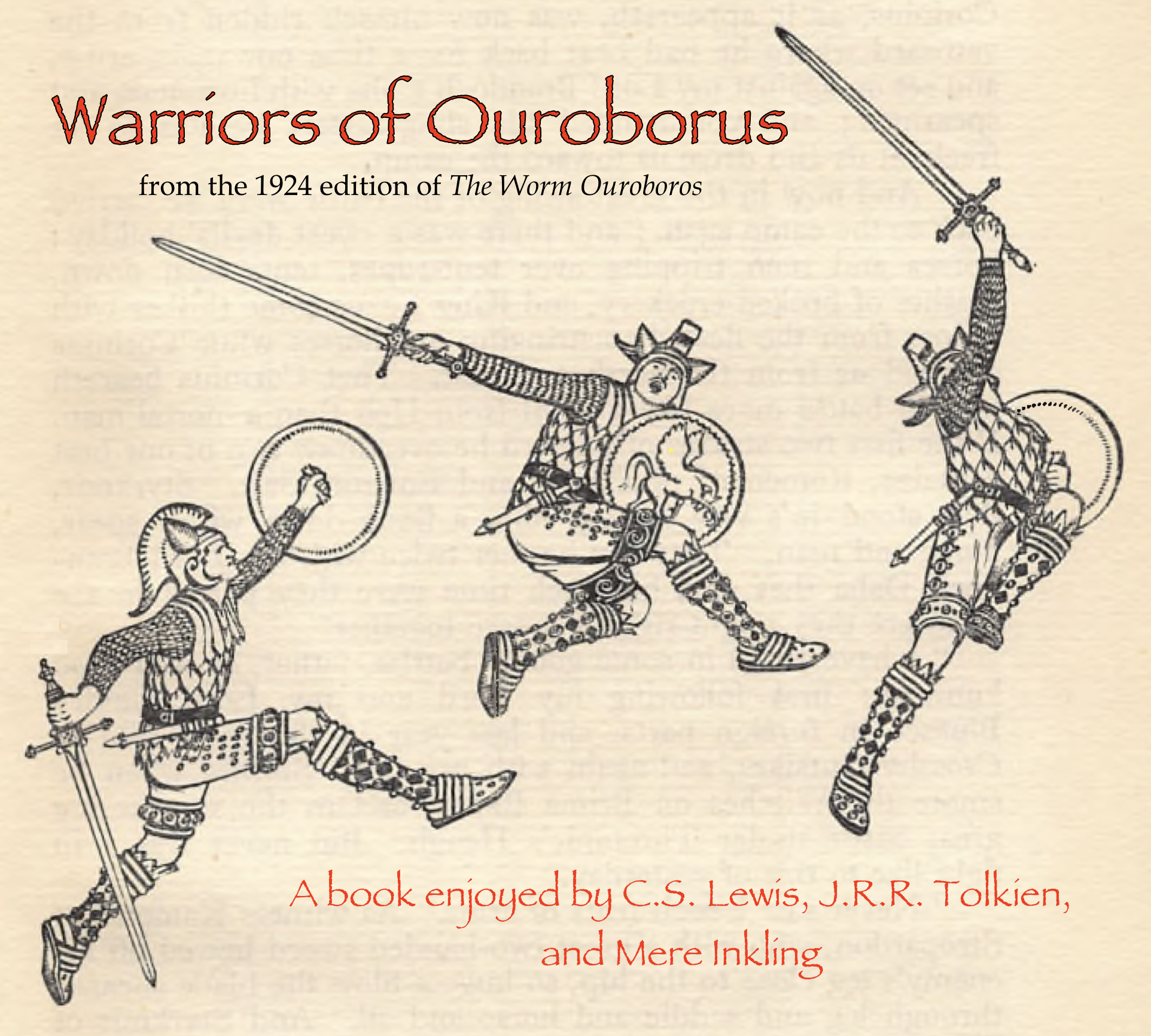
Nelson’s contribution to the December 2023 issue is the fifty-ninth in his series, and discusses a fantasy work titled The Worm Ouroboros by E.R. Eddison. Eddison (1882-1945) was a Norse scholar, and his fascination with mountains combined with that, to resonate with Lewis’ passion for northernness.
Dr. Nelson, who has added an array of science fiction to his own academic work, possesses superb credentials for exploring the connection between Lewis and Eddison.
Nelson relates that, at C.S. Lewis’ invitation, Eddison attended two gatherings of the Inklings. At the second, Eddison – who relished critiques of his works in progress, as do many serious writers – read from a project which would not be published due to his death the following year.
Eddison’s themes more closely resembled J.R.R. Tolkien’s than Lewis’ own. In Nelson’s words, both “Tolkien and Eddison wrote masterpieces of heroic fantasy whose values differed markedly.”
Another distinction is that while Tolkien’s Lord of the Rings has maintained its mythic rigor, Eddison’s oeuvre feels rather anchored to the formative years of the genre, prior to the so-called Golden Age of science fiction (and fantasy).
If you would like to read this book, which was enjoyed by both Lewis and Tolkien, you can download a copy of it at Internet Archive. If you enjoy dwarves, goblins, manticores and hippogriffs, you are unlikely to be disappointed.
Would you be interested in owning a copy of an attractive new font called Middle Earth? If so, read on and you’ll find a link to download this typeface created by Swedish designer Måns Grebäck.
When it comes to fonts, there are basically two types of people – those who pay no attention to them as they read, and others who notice the nuances between similar fonts and are fascinated by extraordinary examples.
The reason for my current interest in fonts is due to Microsoft’s decision to jettison Calibri as their default font for Office products. They needed to make room for its replacement, Aptos. Seriously, when you view the two sans serif* fonts, side-by-side, you may be surprised at how little they differ.
To make matters even more confusing, CNBC describes a curious aspect of Aptos saga.
Aptos will remain available in the font list under the old Bierstadt name for people who are accustomed to it. Users can also choose to set any other font as the default.
Apple’s mac computers also allow users to choose their own defaults. One typography community discusses this selection opportunity, even as they bemoan the fact that in many programs, the standard installations include suboptimal fonts.
Unfortunately, many of us work on computers where we have no control over what fonts are loaded onto the machine, so we have created a list of the top 10 most common system fonts everyone should know and how to handle them.
This website offers a brief description and history of ten of the most common fonts we typically encounter. For example:
Times New Roman is a serif typeface designed by Stanley Morison and Victor Lardent in 1931. It was commissioned by the British newspaper The Times, which wanted a new typeface to replace its existing font, Times Old Roman.
And I love their estimation of Comic Sans, one of my wife’s favorite fonts, which I avoid like the proverbial plague. (Delores is a young at heart special education teacher, and I’m more of a Lewisian dinosaur.)
Do use: if you are designing a comic for 6-year-olds. Don’t use: if you want to be taken seriously by work colleagues.
Another pastor, who learned this lesson the hard way, shared his advice with the warning: “pastors don’t let your bulletins print out in Comic Sans!”
Apparently, his astute wife preserved his professional reputation by telling him to (1) avoid using a “smorgasbord of fonts” in a single document, and (2) “resist the temptation to print serious things in less than serious fonts.”
Advice for Writers
While authors have little control over the fonts in which their work is published by commercial publishers, they do have freedom to choose the typeface they use for the actual composition. “How To Choose the Best Font for Your Writing” addresses that latitude in the following way.
Do you have a favorite font? Are you dedicated to Times New Roman, or are you more of an “anything-but-Wingdings” kind of writer? Maybe you haven’t given your choice of font much thought.
Quite simply, as research shows, texts that look good make you feel good while interacting with them. This is why it’s so important to choose a font that not only is easy to read, optimizes line length, and has the right mood, but also is one that you like!
MasterClass describes the various aspects of each font that will contribute to your overall impression of each font. In “Typography for Writers: How to Pick the Best Type for Writing,” they explain the significance of bowls, ascenders, spines, counters, and more.
Typographers and type designers have their own universe of special terms, each of which refers to a specific part of a given letter. Understanding these basic elements of typography can help you decide precisely what typographic style you want to employ to grab your reader’s attention.
InDesignSkills goes so far as to match a number of typefaces to specific genres, saying “we judged the legibility, beauty, simplicity and variety of weights available of a huge range of fonts, and whittled them down to these faithful five.” They even offer an ironclad promise, proclaiming their selection will “never let your typesetting down, guaranteed.”
Obviously, personal tastes play a large role in appreciating or disapproving of various fonts. One author describes how the quest for the perfect font is integral to writers’ creativity.
Let’s talk about one of our favourite writing avoidance devices: picking the right font for your manuscript.
“The Best and Worst Fonts (and why they’re good or bad),” describes the bond a writer can develop with their typographic fancies.
Fonts are one of the most important design choices to make when developing your brand identity. The best fonts leave you feeling like you’ve made an instant friend while the worst fonts are like a stranger who won’t leave you alone.
The writer offers her personal preferences (and prejudices). I don’t agree with all of her judgments, but I am forced to concur with her inclusion of Jokerman and Bleeding Cowboys on the list of “worst fonts.” And I am pretty sure that C.S. Lewis would agree.
Write in the Spirit of Middle Earth
If you have read this far, your reward is to receive the download link for Middle Earth.
As noted aboved, Måns Grebäck is a prolific Swedish typographer. He makes many of his creations freely available to individuals for non-commercial use. (Commercial licenses are available as well.) The independent FontSpace describes it thusly:
With the historic charm of ancient manuscripts and the ethereal beauty of elven realms, Middle Earth typeface weaves tales of valor and legends. Its calligraphic allure is accentuated by rounded contours, reminiscent of Tolkien’s enchanted worlds.
Middle Earth truly is ethereally elegant. Enjoy.
* Sans serif fonts are those without serifs, which are the tiny lines or marks that appear at the end of a character’s stroke. Arial would be a common sans serif font, while Times New Roman is a familiar serif font.
Here at Mere Inkling our admiration for C.S. Lewis moves us to emulate some of his practices. Thus, we are avid readers and we also enjoy learning new words.
Some of us even enjoy inventing new words. No, we’re not so presumptuous as to desire to wend our ways into the dictionary. We just find this creative game to be both fun and useful for promoting mental health.
The challenge is providing rational definitions for our neologisms. These meanings can be serious or absurd; that doesn’t matter. Here are four I recently devised. (More, from years past, are available in the links I have included above.)
: Zambaloney : noun
A succulent cut of meat served only in skating rinks while the ice is being resurfaced during formal sporting competitions.
: Teguchigulper : noun
The indigenous name for the Honduran species of Chupacabra.
: Belladonut : noun
The presentation of poison derived from the perennial Atropa belladonna in appealing confectionaries. See also, doughnut.
: Sinderella : noun
The Brothers Grimm story about a beneficent stepmother who learns her two biological daughters are being terrorized by their physically beautiful yet wicked stepsister.
We’re Not Alone
If you have tried your hand at this, or at least think it’s curious, you might be surprised to learn there are online “word generators” that perform at least part of this function. Let me mention a couple before sharing some more of my own inventions.
Unfortunately, some only toss out made up words, in literary isolation. This is the case of Random Word Generator, which did, however, suggest the intriguing word “picneted.”
Nonsense Word Generator “generates nonsense words based on a frequency list of phonemes as they occur in legitimate English words.” They claim “an actual word may slip through occasionally but it should mostly generate pronounceable gibberish.”
Since gibberish isn’t what I’m after, and I haven’t yet found an artificial intelligence website offering what I seek, it’s up to human beings to fill the gap. I hope you enjoy at least one or two of my other neologisms which follow.
New Words & Apropos Definitions
: Dramadairy : noun
A business offering various products created from camelid milk. Suspense is generated by the uncertainty as to the particular species from the genus Camelus that provided the day’s primary ingredient.
: Sir Mize : proper noun
A minor noble of the Carolingian dynasty noted for his skill at accurately assessing situations despite lacking clear evidence for his hypotheses.
: Fleedom : verb
The attempt to escape restrictions imposed by an autocratic government.
: Califate : noun
The final destiny awaiting those who seek to impose their religion on others by means of violence rather than through thoughtful conversation and compassionate service.
: Hippocampus : noun
Commonly considered a region of the brain, the word originally referred to the special academies where priestesses of Taweret schooled Egypt’s hippopotami to serve Pharaoh.
: Integreation : verb
The process through which individuals or different groups are incorporated into a common whole, resulting in a truly synergistic benefit to all.
: Sinergy : noun
The crippling illusion that one should embrace diverse expressions of evil simply because they have become a standard practice under a decadent worldview.
: Laboratorinthine : adjective
Applied to extremely complex, often inescapable, research and medical facilities hosting arcane experiments on human subjects. See also, “science fiction and horror tropes.”
: Confort : noun, verb
noun : The false sense of security felt by a vulnerable individual who is being successfully deceived by a criminal. See conforter.
verb : The act of pretending to render aid or support to someone in need while laying the groundwork for a malevolent action toward them.
: Pintacostal : noun
Members of an ecstatic religious sect who allege that their ancestors arrived in America in the fifteenth century aboard one of Christopher Columbus’ smaller caravels.
: Calumknee : noun
Defamatory statements, especially directed toward athletes, related to the largest joint in a particular person’s anatomy.
: Commaraderie : noun
The collegiality felt by writers who advocate the use of the Oxford comma in lists of three or more items.
: Peripathetic : adjective
Traveling from place to place and job to job without ever finding the right fit.
: Lyberry : noun
A fruit concoction comprised of berries cleansed with minute amounts of lye water, which can be fatal if mismeasured. Not to be confused with the tragic mispronunciation of “library.”
: Indogtrination : noun
The process of training people to uncritically embrace a canine belief system and obedience to arbitrary and sometimes self-injurious commands. Antonym of catechesis.
: Banalgesic : noun
A drug designed to reduce the pain induced by participating in a banal conversation.
: Farmageddon : noun
Subterranean postapocalyptic nutrient harvesting plants specializing in either edible algae or plant-based meat alternatives (derived from algae).
: Olympipad : noun
Special edition of Apple’s iPad scheduled for release in conjunction with Olympiad XXXIV in Los Angeles in 2028.
And, as a final tribute to that great writers and saints, C.S. Lewis and J.R.R. Tolkien:
: Nearnia : noun
A fantastical world which does not require a Wardrobe to discover, but is as close as one’s own inspired imagination. See also, “Median Earth.”
Only three copies of an abridged Bible printed in the United Kingdom remain in existence. To some, their very existence is scandalous. To others, they evidence the desire of Christians to promote spiritual liberation, even for those shackled by human chains.
The sole copy held in North America is in the possession of Fisk University in Nashville, Tennessee. Fisk is one of the United States’ distinguished Historically Black Colleges & Universities (HBCUs), and was founded only six months after the end of the Civil War by the American Missionary Association.
Prior to returning the volume to Fisk, this extremely rare Bible was on loan to the Museum of the Bible in Washington, D.C.* During its exhibition there, the museum described it thusly:⁑
The Slave Bible, as it would become known, is a missionary book. It was originally published in London in 1807 on behalf of the Society for the Conversion of Negro Slaves, an organization dedicated to improving the lives of enslaved Africans toiling in Britain’s lucrative Caribbean colonies.
They used the Slave Bible to teach enslaved Africans how to read while at the same time introducing them to the Christian faith.
A Liberty Fund essay on the volume describes the thought process behind the editing. “The unknown editors intended to steer clear of any revolutionary verses that might spark interest in the idea of liberty,” they say.
For example, the selections from Genesis include the first three chapters, which cover the creation of the world and Adam and Eve in Eden but omits chapter four, which tells the story of Cain and Abel and the first murder.
Even an abbreviated Bible, however, retains the power to communicate a divine message. When C.S. Lewis discussed whether the Bible will become fashionable for secular literary study, he said the challenge would come in the fact that it is, in fact, sacred.
Unless the religious claims of the Bible are again acknowledged, its literary claims will, I think, be given only “mouth honour” and that decreasingly. For it is, through and through, a sacred book.
Most of its component parts were written, and all of them were brought together, for a purely religious purpose (“The Literary Impact of the Authorised Version”).
Because of that, I believe that C.S. Lewis would agree with me that this translation (stunted though it is) would retain the power to enlighten its readers. After all, we are not considering a version of the Bible to which human words have been added. What remains is still inspired.
But in most parts of the Bible everything is implicitly or explicitly introduced with “Thus saith the Lord.” It is, if you like to put it that way, not merely a sacred book but a book so remorselessly and continuously sacred that it does not invite, it excludes or repels, the merely aesthetic approach. . . .
It demands incessantly to be taken on its own terms: it will not continue to give literary delight very long except to those who go to it for something quite different. I predict that it will in the future be read as it always has been read, almost exclusively by Christians (“The Literary Impact of the Authorised Version”).
Thus, I believe the missionaries who devised this edited version of the Scriptures did so with good intent. They would, I am sure, have preferred to deliver to their enslaved hearers the complete Word. However, in cases where slaveowners would bar the Bible altogether because of its themes of rescue, freedom, and the judgment of the powerful, the missionaries compromised their desires.
They deemed the benefits outweighed the compromise. The benefits being the opportunity to learn to read, and even more importantly, the Light that would still shine through the portions of God’s Word to which these precious souls would have access.
As C.S. Lewis noted in a 1952 letter, “it is Christ Himself, not the Bible, who is the true word of God. The Bible, read in the right spirit and with the guidance of good teachers, will bring us to Him.” And, upon making their compromise, these formerly barred missionaries would gain access to those who might otherwise never meet humanity’s Savior, who is the Word incarnate.
So, in order to provide at least a portion of the true Bible, they risked violating the New Testament precedent established in the Book of Revelation.
I warn everyone who hears the words of the prophecy of this book: if anyone adds to them, God will add to him the plagues described in this book, and if anyone takes away from the words of the book of this prophecy, God will take away his share in the tree of life and in the holy city, which are described in this book (22:18-19).
This is a fascinating subject, the various attitudes toward the education of people held in bondage. Various books have been written on the subject, and numerous primary sources describe the differing opinions all those involved. The perspective of “freemen” is particularly poignant. A freeman (or freedman), is a person who has been delivered from a state of slavery.
In the biblical sense, as defined in the International Standard Bible Encyclopedia, it is “one who was born a slave and has received freedom” and is commonly used to describe those who were delivered from “bondage to sin [and] presented with spiritual freedom by the Lord.”
For he who was called in the Lord as a bondservant is a freedman of the Lord. Likewise he who was free when called is a bondservant of Christ (1 Corinthians 7:22).
As we used to pray in the liturgy of my childhood – Grant this, O Lord, unto us all!
Online Resources for Further Reflection
Internet Archive not only offers many public domain works for free download. They also host many great texts that you can “borrow” online. Your local library remains a great place, but they probably don’t offer the following books related to this subject.
The duty of attending to the religious improvement of our servants comprises among others two important particulars – teaching and encouraging them to read God’s word, and inducing them to attend his worship. Many have avowed the doctrine that it is not right to teach servants to read the Bible – and in some of the States their instruction is prohibited by law.
Our posterity will doubtless wonder how so monstrous a doctrine could ever prevail to any great extent in a Christian land; and how good men could ever delude themselves into the belief that such a doctrine was consistent with the first principles of that gospel which is sent to the bond as well as the free, and which requires all who receive it to impart a knowledge of it to the utmost of their ability to all who have it not.
The Church exists for nothing else but to draw men into Christ, to make them little Christs. If they are not doing that, all the cathedrals, clergy, missions, sermons, even the Bible itself, are simply a waste of time.
God became Man for no other purpose. It is even doubtful, you know, whether the whole universe was created for any other purpose (Mere Christianity).
* Coincidentally, the Museum of the Bible will also be hosting a live performance this summer of C.S. Lewis’ “The Horse and His Boy.” Check out the promo on their site to see how they creatively present the equine stars of the book on stage!
⁑ Yes, I understand that the “-ly” appended to “thus” is superfluous, since the word itself is an adverb, but it just sounds so right to my (as C.S. Lewis might appreciate) dinosaur ears.
The picture above, “Reading the Scriptures,” was painted in 1874 by Thomas Waterman Wood.
The spiritual legacy of C.S. Lewis continues to bear abundant fruit. And, although his humility would prevent him from accepting it, Lewis shares credit in the blessings being passed on to new generations by those whose lives he directly touched.
Some of these gifted Gospel communicators have publicly praised Lewis for his role in their own conversions or moments of deeper epiphany into the work of our Creator.
One such Christian leader was Timothy Keller, who recently died at the age of 72. Although he was just a few years older than me, Keller and I shared a number of traits. Raised Lutheran, we accepted the truths about Jesus’s work as kids, but it wasn’t until our young adulthood that we were confronted with the fact that trusting Christ as a loving Savior falls far short of taking up our own crosses and following him as Lord.
It’s no accident that our mutual spiritual awakenings coincided with our introduction to the writings of C.S. Lewis during our collegiate years. Both of us became pastors, although the paths of ministry we followed differed, as befits children of a heavenly Father who guides each of his children as the unique person he has created them to be.
Keller was ordained in the Presbyterian tradition, and devoted most of his energy to helping the Christian Church establish a far more intentional ministry in cities. I was ordained in the Lutheran branch of the Body of Christ, and served much of my ministry as a military chaplain. Both of us were pastors in evangelical, Scripture-affirming denominations within our respective traditions.
I’m sure there are other parallels, such as both being married since the mid-70s and having three kids, but the last similarity I wish to note is that we both have writing as part of our vocations. Not that I would compare my own modest talents to Keller’s.
Tim Keller was a prolific author. And the influence of C.S. Lewis on his thinking, and writing, is pervasive in Keller’s work. Last year The Evangelical Christian Publishers Association presented him with the prestigious “Pinnacle Award.”
Timothy Keller has written more than 35 books, published by a variety of companies, with some co-authored by his wife Kathy. His published body of work represents a variety of categories including apologetics, biblical studies, theology, prayer, devotionals, marriage, Bible study, the Church, and cultural engagement – with sales exceeding 7.5 million units and translated into more than 25 languages.
Keller’s prodigious literary output is one reason he has been likened to C.S. Lewis. Another obvious reason is the subject matter, particularly the prominent place occupied by Christian apologetics.
Like Lewis, Keller was an avid reader. This trait provided the foundation for both authors’ literary contributions to Christian thinking. “A Reading List to Understand Tim Keller” includes a number of the works of great importance to him.
Read This Twice, which gathers book endorsements found on the internet, provides a list of 64 books endorsed by Tim Keller. What makes this curious site special is they provide quotations for his recommendations and the sources from which they are gleaned. Oddly, the aggregator appears to lean heavily on contemporary Twitter sources. Consequently, it includes not a single book written by C.S. Lewis himself, belying the Inkling’s seminal influence on Keller.
The endorsement website also offers access to book recommendations on subjects of a visitor’s choice, compliments of Sona. Sona, as a caution to those among us who are wary of artificial intelligence, is an “AI-driven book recommendation assistant that makes it easy for you to discover your next read. Just provide your specific preferences, and [she] will quickly search through a large database of books to offer you options that closely align with your request.” The invitation closes with: “Try ‘Sona’ and enjoy a seamless, personalized book-finding experience.”
It is often said that Dr. Timothy Keller, who died last Friday at his home in Manhattan, was this generation’s C.S. Lewis. The dust jacket for The Reason for God says so.
Tim would have had none of it. He just wasn’t that kind of person. I remember sitting down with him after yet another remarkable talk that he had delivered, sparkling with ideas and insight, with lots more to explore, and all he wanted to talk about was his kids and how great they were. Tim was a simple child of God with, like all of us, the normal joys and worries in life.
And yet . . . that impact! It was enormous. Although it might be an overstatement to ascribe C.S. Lewis status to his contribution, it would only be a slight overstatement.
Tim Keller certainly shared some of C.S. Lewis’ righteous qualities, but some writers are adamant about acknowledging their distinctions. A fellow Presbyterian pastor has a great post on this subject titled “Tim Keller is NOT this generation’s C.S. Lewis.” The author persuasively argues that their vocations were too different to make such a claim.
But please, can we not call him another C.S. Lewis? Any time we call a great person “another” anybody, we are doing disservice to both figures. Lewis’ vocation was to serve as a man of letters who wove his faith into his writing. Keller’s vocation is to be a pastor and equipper who employs writing as but one of his tools.
There are even some conservative Reformed authorities who view Keller (and C.S. Lewis) with suspicion. According to Christian Network Europe “Laurens van der Tang . . . wrote in De Wachter Sions (The Watchman of Sion) . . . that the books of Christian writers, such as Lewis, Dietrich Bonhoeffer and Tim Keller” may possess positive elements but are incomplete. “He argues that they did not pay enough attention to man’s death state, the need for repentance and God’s holy wrath on sin.”
He concludes that “distancing is appropriate” and that these “authors cannot replace theologians from the Reformation or the Dutch Second Reformation.” Also, the Dutch Rev. A. Schreuder writes that “whoever reads the works of the Big Three misses the ultimate point of the personal appropriation of salvation.”
Fortunately, such opinions are in the minority. Most Christians find all three writers inspiring. As this very article reports, “the combination of reason, feeling and imagination is also why Christians in many different surveys indicate that they see Lewis . . . as one of the most influential theologians of the 20th century.”
A glance at virtually any one of Keller’s books will reveal at least one reference to the writings of C.S. Lewis. In Shaped by the Gospel, he references four of Lewis’ books and essays. In his book On Death, Keller discusses that when we stand in God’s very presence – a joy he even now knows – and alludes to a powerful metaphor offered by C.S. Lewis in The Weight of Glory.
C.S. Lewis says if these lower reaches of the stream of God’s glory are so intoxicating, what will it be like to drink from the fountainhead?
The Atlantic published a poignant essay by Keller as he faced his impending death. “Growing My Faith in the Face of Death: I spent a lifetime counseling others before my diagnosis. Will I be able to take my own advice?”
The subtitle says it all. It’s a challenge many Christians one day face, and it is particularly sobering for pastors. In the article, Keller relates an acutely tragic conversation.
A significant number of believers in God find their faith shaken or destroyed when they learn that they will die at a time and in a way that seems unfair to them. Before my diagnosis, I had seen this in people of many faiths. One woman with cancer told me years ago, “I’m not a believer anymore—that doesn’t work for me. I can’t believe in a personal God who would do something like this to me.” Cancer killed her God.
Yes, reality and the suffering consequences of the Fall may have shattered the spectral image of her god (lower case “g”), but I hope that through the ministry of Keller and others that unfortunate woman came to know the true God before she stood in his presence.
For I am sure that neither death nor life, nor angels nor rulers, nor things present nor things to come, nor powers, nor height nor depth, nor anything else in all creation, will be able to separate us from the love of God in Christ Jesus our Lord (Romans 8).
Timothy Keller, like C.S. Lewis before him, who served as one of Keller’s mentors, left us with a treasure trove of edifying literature. In the past I’ve often been too busy to read much of Keller’s work. However, as of now I am in the process of rectifying that problem. If you join me in that journey, I’m sure neither of us will be disappointed.
I hope my confusion is not due to a decline in my mental faculties. But it seems to me politicians are becoming even more incoherent than they’ve always been.
Is it me? Or, are you also amazed at how some of them appear to be babbling half the time?
C.S. Lewis was a master of communication. And some of his observations about how poorly some people communicate can be insightful.
Listen to this verse from a poem entitled “The Prudent Jailer” which he wrote in 1947. (It deserves to be read out loud.)
Some walls cannot a prison make Half so secure as rigmarole.*
Lewis wasn’t referring to political jargon when he wrote this poem, but it seems quite apropos in a number of contexts.
For example, consider a recent article from the American Institute for Economic Research. Jon Sanders applies Lewis’ poem to foreboding aspects the government’s response to the pandemic.
The poem originated not in political allegory, but as a critique of unimaginative literary criticism. Notwithstanding, the Jailer is a diabolical figure, and his prudence is this: he imprisons with words, not walls. . . .
The Jailer has them imprisoned by their own thoughts, while he keeps them focused ever on the presumption of a prison. He doesn’t want them thinking of anything else.
This post isn’t about politics. I detest the subject as a whole, and find it particularly corrosive to conversation as elections draw near.
The verse I cited above simply evoked for me the power of words to distort and, yes, imprison. Lewis’ use of rigmarole⁑ (a word sadly out of vogue) highlights the fact that the crippling words themselves are often nonsensical.
Other colorful synonyms that we might hear in the company of our seniors could include balderdash, poppycock, or perhaps even malarkey.
In a 1940 letter to Dom Bede Griffiths, Lewis applies “balderdash” to describe art and literature done “for their own sake.”
I do most thoroughly agree with what you say about Art and Literature. To my mind they are only healthy when they are either (a) Definitely the handmaids of religious, or at least moral, truth – or (b) Admittedly aiming at nothing but innocent recreation or entertainment. . . .
But the great serious irreligious art – art for art’s sake – is all balderdash; and, incidentally, never exists when art is really flourishing.
Fortunately, such words rarely become completely obsolete.
A noteworthy mythopoeic⁂ scholar, Brenton Dickieson, used “balderdash” quite skillfully not that long ago.
“The Prudent Jailer” was originally published in 1947 under the mundane title, “The Romantics.”
Since you’ve read this column to its conclusion, allow me to reward your diligence by presenting the poem in its entirety.
The Prudent Jailer
Always the old nostalgia? Yes. We still remember times before We had learned to wear the prison dress Or steel rings rubbed our ankles sore.
Escapists? Yes. Looking at bars And chains, we think of files; and then Of black nights without moon or stars And luck befriending hunted men.
Still when we hear the trains at night We envy the free travelers, whirled In how few moments past the sight Of the blind wall that bounds our world.
Our Jailer (well may he) prefers Our thoughts should keep a narrower range. ‘The proper study of prisoners is prison,’ he tells us. Is it strange?
And if old freedom in our glance Betrays itself, he calls it names ‘Dope’-‘Wishful thinking’-or ‘Romance,’ Till tireless propaganda tames.
All but the strong whose hearts they break, All but the few whose faith is whole. Some walls cannot a prison make Half so secure as rigmarole.
* Thank you to Jon whose comment below pointed out the connection between Lewis’ allusion to the very famous poem “To Althea, from Prison,” written by Richard Lovelace in 1642. “Stone walls doe not a prison make, Nor iron bars a cage…”
⁑ Some people in the States will be more familiar with the variant “rigamarole.”
⁂ Mythopoeia is a modern literary genre in which the author creates a fictional mythology. The finest example of such writing comes from the pen of J.R.R. Tolkien, the creator of Middle Earth.
Recently I read about an African Christian who was raised in a family that practiced ancestral worship. His grandfather was considered a witchdoctor, and it was expected that this young man would assume his duties.
The only problem is that when I initially viewed the passage, I read that his grandfather was a whichdoctor.
My once 20/20 vision is long gone. I still read without glasses (for the most part), but when I have yet to wash the sleep from my eyes, I encounter some surprising words.
“Whichdoctor” actually made some sense. I acknowledge it hasn’t been an English word (until now) but is so clear and so utilitarian that it cries out for recognition.
Whichdoctor: An interrogative used when attempting to ascertain which physician’s attention an individual should be seeking. Especially useful in a hospital setting with numerous specialists. As in: Whichdoctor should I talk to, the podiatrist, the pediatrician, the pulmonologist, the psychiatrist, the pathologist, or the proctologist?
Last year I posted a column entitled “Create a Word Today.” It was inspired by an article I cited about making up useful words with pertinent definitions. I included 22 examples in my first column. They touched on a variety of subjects.
Mannekin: A boring, sedentary relative, who rarely rises from the couch.
Purrification: The activity of forgiveness and restoration that occurs when any cat makes a sincere confession of its sins.
Several were ecclesiastical in flavor.
Cathedroll: A large church led by a senior minister given to quaint and unintentionally comic humor.
Concupiscents: Hollywood’s obsession with including graphic sexual themes in all of their productions, resulting in the selling of their souls for pennies on the dollar.
And some related to the field of writing.
Manuskipped: The sad condition when the article or book into which you poured your blood, sweat and tears has been tossed into a slush pile to lie forgotten.
Proofreaper: Someone you invited to read your manuscript for misspellings who advises you to delete entire sections of your precious creation.
If you’re curious, there are 16 additional words included in the original post linked above.
So, allow me to offer here a few recent efforts, inspired by the misreading I referred to at the top of the page. How about 22 more?
But, before that, let’s look at a passage from C.S. Lewis’ autobiography, Surprised by Joy. As a person who has always appreciated a good vocabulary – and who is blessed to have grandchildren who are articulate beyond their years – I am saddened by Lewis’ youthful experience.
Reading much and mixing little with children of my own age, I had, before I went to school, developed a vocabulary which must (I now see) have sounded very funny from the lips of a chubby urchin in an Eton jacket.
When I brought out my “long words” adults not unnaturally thought I was showing off. In this they were quite mistaken. I used the only words I knew.
The position was indeed the exact reverse of what they supposed; my pride would have been gratified by using such schoolboy slang as I possessed, not at all by using the bookish language which (inevitably in my circumstances) came naturally to my tongue.
And there were not lacking adults who would egg me on with feigned interest and feigned seriousness – on and on till the moment at which I suddenly knew I was being laughed at.
Then, of course, my mortification was intense; and after one or two such experiences I made it a rigid rule that at “social functions” (as I secretly called them) I must never on any account speak of any subject in which I felt the slightest interest nor in any words that naturally occurred to me. And I kept my rule only too well . . .
Hooplaw: The two, vastly different legal disciplines dealing with (1) basketball contracts, and (2) litigation related to injuries caused by overly excited commotion.
Interdisciplinairy: The entire field of specialty studies related to the atmosphere.
Marvelouse: A creep or cad who considers himself something quite extraordinary.
Atrofee: The medical bills associated with the care of patients suffering an enduring coma.
Predilicktion: A preference for the sensation of taste over the other four basic human means of perceiving the world around us.
Ammunishun: The attitude of some activists seeking to restrict Second Amendment rights.
Megalowmaniac: The true stature of power hungry narcissists.
Gratuitruss: The unnecessary wear of a device to restrain a nonexistent hernia.
Calumknee: Malicious misrepresentations of political figures who frequently stumble.
Misscalibration: The awkward occasion when footwear retailers suggest to a young lady try on size 20 Air Jordans.
Patriought: The noble, often self-sacrificial, behavior of citizens who truly love their country.
Hypnothetically: The wide range of potentially embarrassing acts a person might be directed to perform under the influence of mesmerism.
Enlightenmint: The experience of achieve a spiritual pinnacle, accompanied by an aromatic scent.
Raspewtin: What Russia’s last Tsar should have done to Grigori.
Canonball: An elegant celebration lacking minuets, due the participants’ vows of celibacy, but not lacking in a wide selection of vinted and distilled beverages.
Immaculatte: A perfectly balanced beverage prepared by one of the world’s finest baristas.
Telegraft: Crimes committed over the phone by telemarketers, or via the airwaves and internet by televangelists.
Archietype: Ideas and symbols that recur in stories from many cultures and eras which bear a clear likeness to Archibald Andrews, who was often accompanied by his companion Jughead.
Syruptitious: The practice of slipping secrets past the unsuspecting by applying sticky sentimentality to one’s words.
Youphemism: The substitution of a mild or neutral description of someone to replace what you truly think of them.
Boulebard: The landscaped avenues of Stratford-upon-Avon by William Shakespeare.
Hagographer: An author who prefers to write the biographies of harpies rather than saints.
Admittedly, these words are not all top tier, but I challenge you to do better. If you have one or two winners, please cite them in the comments below. Oh, I just thought of another:
Religioscity: The religious devotion expressed by the residents of an urban environment.
Now I need to think about something else so I’ll be able to sleep tonight without jumbled word running through my mind.
As the sainted C.S. Lewis once described some troubled days in a boarding school while a youth:
Consciousness itself was becoming the supreme evil; sleep, the prime good. To lie down, to be out of the sound of voices, to pretend and grimace and evade and slink no more, that was the object of all desire—if only there were not another morning ahead—if only sleep could last for ever! (Surprised by Joy)
If you would like to join C.S. Lewis in one of his Lenten experiences, read on, because I have the perfect suggestion for you.
During Lent, the forty days preceding Easter, many Christians undertake special “disciplines.” This practice is different from the familiar exercise of “giving things up” for the season.
These disciplines often include fasting and devoting more time to reading the Scriptures and inspiring Christian literature.
Two of C.S. Lewis’ letters mention that he was rereading, as part of his Lenten pilgrimage, two ancient classics that have inspired believers for nearly seventeen centuries.
In 1936, he wrote to Dom Bede Griffiths, a regular correspondent who was a Roman Catholic priest.
I re-read St. Augustine’s Confessions during Lent, and found it better than I remember, tho’ still it is the explicitly devotional parts that edify me least.
The following year he wrote the following in a letter to his childhood friend, Arthur Greeves.
I have been progressing all this lent through the first volume of a v[ery] nice edition of St Augustine’s City of God only to find that the other volume has been so wrongly bound that it begins and ends in the middle of sentences. What a tragedy this would once have been!
Lewis’ regard for Augustine lasted throughout his life. In 1961, Lewis responded to a correspondent who asked what books he would recommend to a recent convert. He included Augustine in that list, writing “St. Augustine’s Confessions will give you the record of an earlier adult convert, with many v. great devotional passages intermixed.”
Saint Augustine was a bishop in Hippo Regius, a city in north Africa. Augustine was a brilliant scholar who desperately sought the truth, and intently studied many religions and philosophies before finding Truth in the person of Jesus Christ.
His life is fascinating, in part because he lived during the turbulent era when Rome itself was sacked by the Vandals, who went on to conquer North Africa.
Augustine was a native African, a member of the Christian Berbers, who along with the Romans in the regions were destined to be overrun by Islamic armies.
Augustine was a prolific writer, and due to their spiritual value, many of his works are readily available today.
If you would like to read one of the volumes mentioned by C.S. Lewis, you can download copies of early translations at Internet Archives. Here are the links, with two biographical studies thrown in for good measure.
If you choose to follow C.S. Lewis’ example of reading one of these works for Lent, you will have the added joy of sharing with him a Lenten discipline which he found rewarding.
If you prefer listening to the Confessions, you can download a free Librivox version here.
What could possibly be more fun than making up a witty new word?
Well, to be honest, lots of things. But inventing words is still an enjoyable creative exercise. I made up several in less than an hour this evening, while half-watching an old movie. A few may be lame, but I hope you will discover one or two you enjoy.
I’ve touched on the subject of inventing words in the past. But this approach involves a different process.
This article from The Guardian asks, “English speakers already have over a million words at our disposal – so why are we adding 1,000 new ones a year to the lexicon?” That’s certainly a fair question. However, it doesn’t pertain to my thoughts here. I’m not attempting to birth any neologisms. These are simply humorous tweaks to existing words. A form of wordplay.
I got the idea when I read a short article, “The Best Made Up Words Ever,” by Bill Bouldin.* He admits to including a number of words from an online site I won’t name here (due to its preponderance of vulgar terms). While Bouldin doesn’t indicate which examples are his own contributions, and which are reproduced, I found a couple of the words quite entertaining.
The first of these reminded me of many group meetings where we consider all sorts of opportunities and possibilities. Blamestorming – The act of attempting to identify the person who is most at fault for a plan’s failure.
As a pastor I couldn’t resist modifying this gem. Sinergy – When performing two bad acts make you feel as guilty as if you had committed three.
This one struck home since it’s a play on one of the words in the title of the Narnian classic, The Lion, the Witch and the Wardrobe. Chairdrobe – A chair on which one piles clothes that belong in the closet. Not to be confused with a floordrobe.
The final example will resonate with everyone who enjoys reading and writing. “Illiteration – The mistaken impression that you know more about rhetorical devices than you really do.
At the risk of revealing myself to be an illiterator, I’ve included below some of the words I conjured up during an idle hour. I don’t claim any are masterpieces, but you may find one or two that bring a smile to your face. And, who doesn’t need an extra smile during these trying times?
My Initial Experiment
Caution: Before proceeding, keep in mind these are not real words. As genuine and utilitarian as they may appear, I advise you not to use them in conversation or composition. They are offered by Mere Inkling purely for entertainment purposes. Feel free to add some of your own in a comment.
Miscellaneous Vocabulary
Subbatical: the period when some temp like you is hired to fill in for some privileged person who has a job that has sent him or her off for an extended paid vacation.
Dippididude: Confused men who use hair gel designed for young girls and women.
Cemetarry: The unwillingness of some people to ponder the reality of their own mortality.
Mannekin: A boring, sedentary relative, who rarely rises from the couch.
Candlelablouse: The name for candlesticks with multiple arms in the homes of prudes.
Carnivirus: Individuals who strive to draw blood from those who view the coronavirus and its implications differently than they do.
Brigadeer: A domineering deer who tries to order all the other members of its herd around (antlers optional).
Altruistick: Actions that appear on the surface to be selfless, but include a hidden agenda.
Monumentill: Descriptor for someone of little worth who builds a significant reputation with the sole purpose of lining their pockets.
Blasphemee: An individual’s personal inability to consistently observe the Second Commandment.
Concupiscents: Hollywood’s obsession with including graphic sexual themes in all of their productions, resulting in the selling of their souls for pennies on the dollar.
Cathedroll: A large church led by a senior minister given to quaint and unintentionally comic humor.
Cadaversary, pl., cadaversaries: A member of the endless hordes of the undead during a zombie apocalypse.
Writing Vocabulary
Literasee: The capacity of one’s imagination to visualize what you are reading.
Bloggrr: An essentially angry person, given to writing unbridled tirades on various digital formats.
Gerdprocessing: When whatever you are typing just doesn’t work, and causes you severe heartburn instead.
Manuskipped: The sad condition when the article or book into which you poured your blood, sweat and tears has been tossed into a slush pile to lie forgotten.
Editteen: The maturity level of the editor who did not recognize the merits of your manuscript and rejected it without comment.
Subliminil: When the word you are reading or writing possesses no hidden or subconscious message.
Proofreaper: Someone you invited to read your manuscript for misspellings who advises you to delete entire sections of your precious creation.
Skulldigory: Misbehavior by the English professor, Digory Kirke, who, as a child, introduced evil into Narnia.
I will close now with two words that cat-lovers may find objectionable. If you are a devoted feline-fancier, you are advised to cease reading now.
Lucifur: The anonymous leader of that faction of felines devoted to serving evil.
Purrification: The activity of forgiveness and restoration that occurs when any cat makes a sincere confession of its sins.
* This columnist cites various words from the Bouldin’s piece, and others from a book entitled The Emotionary: a Dictionary of Words That Don’t Exist for Feelings That Do.
Do you suppose that if we gathered together all of the volumes written by the Inklings, along with all of the books and articles written about these gifted authors, we could fill a library? I am uncertain, but I think the effort would prove a quite enjoyable undertaking.
Libraries have always been important to Christians. The preservation of documents during the so-called “dark ages” was one of the major duties assumed by monasteries. It’s no accident the oldest continuously operating library is found in a monastery. The library at Saint Catherine Monastery contains “3,300 manuscripts, and some 8,000 early printed books, together with 5,000 new books.”
When Egeria visited the Sinai in 383-384, she wrote approvingly of the way the monks read to her the scriptural accounts concerning the various events that had taken place there. Thus we can speak of manuscripts at Sinai in the fourth century.
It is written of Saint John Climacus that, while living as a hermit, he spent much time in prayer and in the copying of books. This is evidence of manuscript production at Sinai in the sixth century. The library at the Holy Monastery of Sinai is thus the inheritor of texts and of traditions that date to the earliest years of a monastic presence in the Sinai.
It comes as no surprise that libraries played a prominent role in the life of C.S. Lewis. The three volumes of his letters include well over a hundred references to them. I offer just a small sampling to illustrate.
In 1914, Jack (at boarding school in England) wrote his father about some renovation work being done in their Northern Ireland home. He refers to the existence of two libraries. The second was the one the boys, Jack and his brother Warnie, shared.
I hope that by the time this letter reaches you, the study wall will have been replaced and the stately hall of Leeborough will smile upon guest and inhabitant with its pristine splendour and hospitality. Of course in restoring the ‘main library’ you are careful to alter the appearance of the room as little as possible. It would be a pity if I came home to a strange house. In the meantime I hope that the small library has been allowed to remain untouched?
The next year he wrote to his father, apparently in response to an accounting of the collection in the “small library.” One wonders how his father responded to his comment about the octavo book format. After all, he was himself an educated man, a solicitor. But then, most of the legal publications with which he was acquainted would have published in such a format. [See the video* below for an explanation of book sizes.]
The state of our library at Leeborough must be perfectly appalling: how such a collection of ignorances and carelessnesses could have got together on the shelves of our room passes my comprehension. As well, where is the beautiful quarto edition? What is a quarto? I don’t believe you have the vaguest idea, and should not be surprised if the edition in question is merely an 8vo., (no, that doesn’t mean ‘in eight volumes,’ though I too thought so once.)
Meanwhile, Lewis spent considerable time in the library of his school, Malvern College. The library was not only a valued place of learning and reflection. It also served as a refuge from the bullying that was a daily reality at the boarding school. (As we know, the tormenting of vulnerable students is not restricted to schools that double as temporary homes; it seems to be endemic to educational settings for children and adolescents.)
[In a letter to his father, Lewis wrote:] The worst part of the summer term is the fact that we have to keep out of doors nearly all our time; but here one notices the great advantage of being in the Upper School, and therefore allowed to go into the Grundy Library at all hours of the day—it proves a great refuge when the ‘house’ is out of bounds.
In 1915 he chided his close friend, Arthur Greeves, about treating businesses like libraries. I offer an extended passage since it offers a rare insight into Lewis’ musical interests.
Odeon records are the most fascinating and delusive bait on the Gramaphone market. Cheap, classical, performed by good artistes, they present a jolly attractive list: but they wear out in a month.
Of course there are exceptions, and I can play you some selections from Lohengrin which I have on that make, and which have worn well. On the whole however, I wouldn’t advise anyone to get Odeon records, as a short-lived record is one of the most disappointing of things.
I foresee, by the way, that your way of getting records is like Jane McNeil’s way of getting books—that is you use a shop like a free library: whenever a record is worn out, back it goes to the shop, and you have a new one in its place.
The same year, in another letter to the same friend, Lewis displays a bit of prejudice in exactly what sort of volume belongs in a library. “Your little edition [of Faerie Queene] is very nice, but rather too small, and not enough of a library-looking book.” In the same context he later bemoans paying to have a volume professionally bound.
Never, never get a book bound. You will gather from this that ‘Tristan’ has arrived and is a complete and absolute failure. When I told them to bind it in brown leather, with corner pieces etc., I imagined that it would look something like Kelsie’s Dickens . . . Well as a matter of fact, though in a sense they have done what I told them, yet the total effect, instead of being booky and library like, is somehow exactly like a bank book or a ledger.
The following year he informs Greeves about his current reading. Due to his unhappiness at Malvern, his father had transferred him to be tutored by William Kirkpatrick. Lewis was fifteen when he moved to Gaston. His two and a half years there were intellectually stimulating, but spiritually deadening.
Talking of books—you might ask, when do I talk of anything else—I have read and finished ‘The Green Knight,’ which is absolutely top-hole: in fact the only fault I have to find with it is that it is too short—in itself a compliment. . . .
Since finishing it I have started—don’t be surprised—‘Rob Roy,’ which I suppose you have read long ago. I really don’t know how I came to open it: I was just looking for a book in the horribly scanty library of Gastons, and this caught my eye. I must admit that it was a very lucky choice, as I am now revelling in it.
Next it was off to University College at Oxford, where Lewis celebrated an amazing library. Once again, these letters were written to Greeves.
The book shops here are rather adorable, and also our college library. Still better is the Library of the Union Society (a club everyone belongs to) where I spent this morning turning over one book after another and enjoying myself hugely.
13 May 1917 So about 11.30 we arrived back at college and I am come straight thence to the Union. ‘The Union’ is a club to which nearly everyone in the varsity belongs. It has a writing room of strictest silence, where I am scribbling this, and an admirable library where I have already passed many happy hours and hope to pass many more. Oh, Galahad,⁑ you simply must come up after the war.
Lewis not only pursued focused research in the library at his college. He also explored.
I have also been spending more time than usual in the College Library, dipping here and there. Did I tell you that there was a queer little volume in Latin by Cornelius Agrippa⁂ the great magician . . ?
Unfortunately the print is so execrable and the worms have done their work so well that I cannot make much of it: but I love to have it in my hands, and think of all the wizards who have centred their hopes on it—perhaps on this very copy, for it is some 300 years old.
In 1919, Lewis visited the historic Dr. Steevens’ Hospital in Dublin. He described the memorable visit to Greeves.
We had quite a pleasant day in Dublin. I liked Warnie’s friend, who is house-surgeon in Steeven’s hospital where he has a very pleasing little set of rooms. Have you ever been in Steeven’s? There is a fine little library—despite some shocking portraits—containing some letters of Swift’s. This letter begins to read like a guide book, so I will pass on.
In 1924, Lewis’ father apparently inquired into the amount of money he was spending on books. That is a quite natural question from a parent supporting a graduate student. Jack explained:
The book bill was naturally increased by my turning to a new subject. I try to use the libraries as much as possible: but when one is reading for a particular exam there are over a hundred other people taking the same books out of the libraries–and of course there are some things one must have at command. My expenditure on books will be less in future.
I’m confident Lewis kept his word, and cut back on his book purchases in 1925. However, true bibliophiles will ultimately find a way, even when it’s a choice between books and food. Lewis continued to build an impressive personal library in the years that followed.
A Final Thought about Our Personal Libraries
Wouldn’t you enjoy only a book that came from the personal library of someone you admire? I certainly would. C.S. Lewis did, as well. In 1953 Lewis received a copy of In Brief Authority from his fellow Inkling, Roger Lancelyn Green.
My dear Roger Oh angel! What a lovely present, and all the more valuable for being the copy from that enchanted place your own library. I re-read it at once. It is perhaps the most complete of his books: as funny, or very nearly as funny, as Vice Versa but with a beauty which V.V. did not attempt. The ogre is somehow a very real character. Very, very many thanks.
The Wade Center at Wheaton College owns almost 400 books from C.S. Lewis’ personal library. Some are undergoing conservation treatment, but the others are available to visitors. However, “requests to view books from the Author Libraries should be placed at least 24-hours in advance.”
The essays collected in God in the Dock include a peculiar little piece, entitled “Scraps.” The article, which was originally published in 1945, describes four brief scenes. The first describes the nature of our heavenly library.
“Yes,” my friend said. “I don’t see why there shouldn’t be books in Heaven. But you will find that your library in Heaven contains only some of the books you had on earth.” “Which?” I asked. “The ones you gave away or lent.” “I hope the lent ones won’t still have all the borrowers’ dirty thumb marks,” said I. “Oh yes they will,” said he. “But just as the wounds of the martyrs will have turned into beauties, so you will find that the thumb-marks have turned into beautiful illuminated capitals or exquisite marginal woodcuts.”
Reading these words renewed my enthusiasm for lending out my books. As you know, sharing one’s library is much like the biblical injunction about extending aid: “and if you lend to those from whom you expect to receive, what credit is that to you? . . . do good, and lend, expecting nothing in return . . .” (Luke 6:34-35)
C.S. Lewis employs this same illustration in a 1947 letter to one of his correspondents. The context for his remark is how deeply the woman misses the house from which she had recently moved. I’m no philosopher, but Lewis’ argument for how the essential essence of a thing can last, reminds me of Plato’s conception of forms.
I think that about Houses the answer is this. Nothing rises again which has not died. The natural and possessive love for a house if it has been crucified, if it has become disinterested, if it has submitted to sacrifice, will rise again: i.e. the love for a house you were willing to give up will rise again.
The willful, grasping love will not—or only rise as a horror. About the house itself, if the love rises, then all that is necessary to bless it will, I believe, be there. It may not be very like what you would now call ‘a house:’ but you’ll see then that it was what you really meant by the house.
But the whole point is that you can keep forever only what you give up: beginning with the thing it is hardest to give up—one’s self. What you grab you lose: what you offer freely and patiently to God or your neighbour, you will have. (Your heavenly library will contain only the books you have given or lent! And the dirty thumb marks on the latter will have turned into beautiful marginal decorations—I’m joking of course, but to illustrate a serious principle.)
A love of libraries is something shared by most of us “readers.” We can only imagine with joyous anticipation the collection of biographies and stories of adventures, sacrifice, tribulation, rescue, and resurrection that await us in the New Jerusalem. And we’ve already savored a foretaste of that banquet, since the Bible itself is a library in its own right.
* This short video explains different sizes for books. For a comprehensive listing of the options, see this chart at AbeBooks.
⁑ Galahad was C.S. Lewis’ nickname for his lifelong friend, Arthur Greeves. It was inspired by Greeves’ “idealistic turn of mind.” (Into the Wardrobe: C.S. Lewis and the Narnia Chronicles)
⁂ Henricus Cornelius Agrippa (1486-1535) was a brilliant German who excelled in a number of fields. He served as a soldier, physician and lawyer. He even became a Professor of Theology at the University of Dôle for a time, and later lectured on theology at the University of Turin.
Most curiously, he wrote several books on the magic and the occult. If your Latin is competent, you can read some of his magical writing here. Or, you may find the first English translation more accessible.
Of potentially greater interest is a proto-feminist volume he dedicated to Margaret of Austria. Declamatio de nobilitate et praeccellentia foeminei sexus (Declamation on the Nobility and Preeminence of the Female Sex) defended the equality of the sexes and attributed women’s inferior social status to cultural traditions, inequality in access to education, and the domination of men.
As for Agrippa’s confused bonds with the occult and Christian theology, consider this repudiation of the occult written near the end of his life.
But of magic I wrote whilst I was very young three large books, which I called Of Occult Philosophy, in which what was then through the curiosity of my youth erroneous, I now being more advised, am willing to have retracted, by this recantation; I formerly spent much time and costs in these vanities. At last I grew so wise as to be able to dissuade others from this destruction.
For whosoever do not in the truth, nor in the power of God, but in the deceits of devils, according to the operation of wicked spirits presume to divine and prophesy, and practising through magical vanities, exorcisms, incantations and other demoniacal works and deceits of idolatry, boasting of delusions, and phantasms, presently ceasing, brag that they can do miracles, I say all these shall with Jannes, and Jambres, and Simon Magus, be destined to the torments of eternal fire.






 Mere Inkling Press