Pilfering Tolkien Linguistics

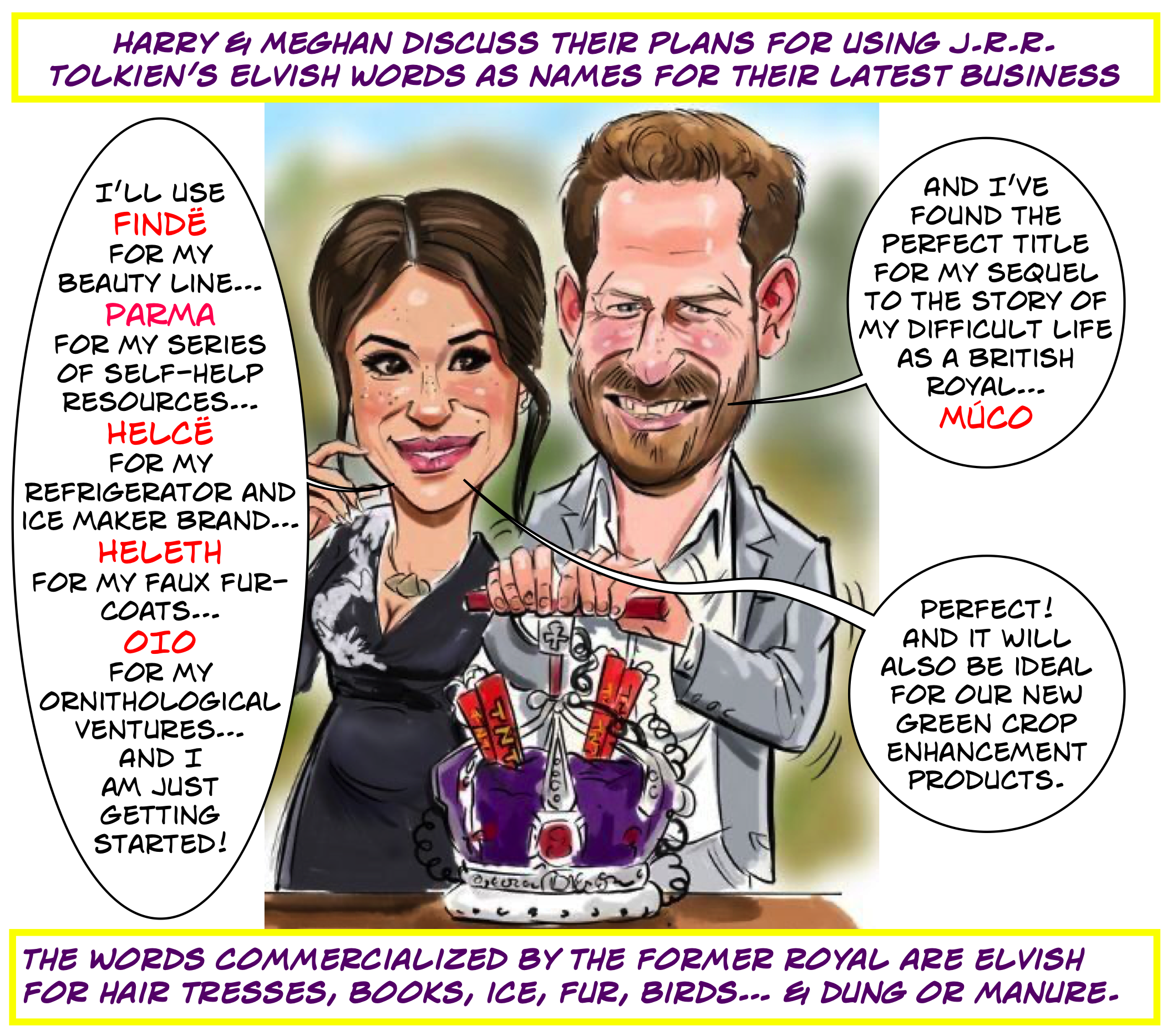
When a great author, say of the magnitude of J.R.R. Tolkien, creates ingenious new words, and even entire languages, there are several common reactions. Most readers simply respond with silent awe. Others are inspired to emulate their efforts. A small number reuse those very words as a sincere homage

And a handful of “admirers” go so far as to “appropriate” the words themselves, for their personal benefit.

C.S. Lewis, no mean linguist himself, recognized his friend Tolkien’s brilliance. In his preface to That Hideous Strength he praised Tolkien’s yet-to-be-published Silmarillion. In a 1951 letter he mentions misspelling the word Numenor.

My Numinor was a mispelling: it ought to be Numenor. The private mythology to which it belongs grew out of the private language which Tolkien had invented: a real language with roots and sound-laws such as only a great philologist could invent.

He says he found that it was impossible to invent a language without at the same time inventing a mythology.

J.R.R. Tolkien was an internationally renowned philologist, and his impressive skill is one of the great wonders we encounter in Middle Earth. A number of words from his created languages – particularly his ethereal Elvish tongues – have been lifted to be used in commercial activities unconnected to Tolkien’s interests.

For example, Palantir. This was the word for the “seeing stone,” which played a prominent role in The Two Towers. In light of Tolkien’s love of nature, and corresponding suspicion of technological advancement, it is especially odd that the company adopting this label is on the leading edge of Artificial Intelligence.

Perhaps Tolkien’s dread would have been dispelled by one of Palantir’s disarming mottos: “We believe in augmenting human intelligence, not replacing it.”

A combat veteran of WWI, like his fellow Inkling C.S. Lewis, Tolkien was appalled by war’s horrors. Even in the War of the Rings, with its moments of glorious heroism and sacrifice, the bloody heart of Mars remains nearly invincible. Because of this mixed attitude toward war, some have wondered how he would have felt about a defense (i.e. military) corporation adopting one of his creations.

Andúril was the name of the most important weapon forged in Middle Earth. It was actually reforged from the broken fragments of Narsil, the longsword which defeated Sauron by severing the One Ring from his hand.

While this description from the Anduril company resonates with our modern ear, I am not convinced that it sounds very Tolkienesque. Anduril: “Transforming defense capabilities with advanced technology. The battlefield has changed. How we deter & defend needs to change too.”

For an article about a billionaire investor who is consumed by mining Tolkien’s tomes for the businesses he founds (PayPal excepted), check out “The hidden logic of Peter Thiel’s ‘Lord of the Rings’-inspired company names.”

C.S. Lewis’ Unconscious Sharing

In a 1965 letter, written after Lewis’ death, Tolkien commented on how his friend had used subtle variations of several Elvish words in several of his fictional works.

Tolkien says Lewis “had the peculiarity that he liked to be read to. All that he knew of my ‘matter’ was what his capacious but not infallible memory retained from my reading to him as sole audience.” Thus, he surmises that:

C.S. Lewis was one of the only three persons who have so far read all or a considerable part of my ‘mythology’ of the First and Second Ages, which had already been in the main lines constructed before we met. . . . His spelling numinor is a hearing error, aided, no doubt, by his association of the name with Latin nūmennūmina, and the adjective ‘numinous.’

Lewis was, I think, impressed by ‘the Silmarillion and all that,’ and certainly retained some vague memories of it and of its names in mind. For instance, since he had heard it, before he composed or thought of Out of the Silent Planet, I imagine that Eldil is an echo of the Eldar; in Perelandra ‘Tor and Tinidril’ are certainly an echo, since Tuor and Idril, parents of Eärendil, are major characters in ‘The Fall of Gondolin,’ the earliest written of the legends of the First Age. But his own mythology (incipient and never fully realized) was quite different.

An Entertaining Diversion

Years ago I linked to an entertaining game that plays on the linguistic eloquence and mystery Tolkien exhibited in naming his characters. I was delighted to see now that it is still available online.

Antidepressants or Tolkien challenges players – you can play solo, but it’s more fun with others – to guess if a given word is an antidepressant drug or the name of one of Tolkien’s characters. Don’t expect to score 100%, but do expect to smile at some of the examples.

Tinker Bell, the Inklings, and Disney

Poor Tinker Bell. The political prejudices of our day have caught up with the sparkling fairy, and relegated her to a significantly reduced presence in the Disney universe.

Inside the Magic reported “Tinker Bell seems to have left Walt Disney World and is now on her way back to Neverland following a recent change at Walt Disney World Resort.” You can read the tragic tale on their site.

. . . once more, Disney’s animated classic, Peter Pan (1953), is under scrutiny, with Disney issuing a statement regarding Captain Hook and Tinker Bell as characters with potential concerns.

Linking poor Tink to a murderous pirate seems a bit of a stretch, and she has not been fully banished, but she has definitely been demoted. According to TMZ, Disney alleges the company’s “own people felt she wasn’t a good role model for girls in the 21st century.”

Well, eventually she too will be in the public domain, like Mickey Mouse. Actually, her literary portrait as introduced in the play, coincidentally just entered the public domain this year (2024)!

However, should you reside in the United Kingdom, beware that in 1988, the copyright holder, Great Ormond Street Hospital, was granted the rights to Peter Pan “in perpetuity.”

The Creator of Tinker Bell & Peter Pan

Tinker Bell is one of the most memorable characters in Neverland, the creation of James Matthew Barrie (1860-1937). He was a prolific Scottish writer and is best known for his 1911 novel, Peter and Wendy – which initially debuted in the form of a stage play in 1904, as Peter Pan; or, the Boy Who Wouldn’t Grow Up.

Peter Pan was actually introduced to the world as a baby in The Little White Bird. Tinker Bell does not appear in the novel, but the following description of J.M. Barrie’s fairy mythology is quite fanciful.

One of the great differences between the fairies and us is that they never do anything useful. When the first baby laughed for the first time, his laugh broke into a million pieces, and they all went skipping about. That was the beginning of fairies.

They look tremendously busy, you know, as if they had not a moment to spare, but if you were to ask them what they are doing, they could not tell you in the least. They are frightfully ignorant, and everything they do is make-believe.

They have a postman, but he never calls except at Christmas with his little box, and though they have beautiful schools, nothing is taught in them; the youngest child being chief person is always elected mistress, and when she has called the roll, they all go out for a walk and never come back.

It is a very noticeable thing that, in fairy families, the youngest is always chief person, and usually becomes a prince or princess; and children remember this, and think it must be so among humans also, and that is why they are often made uneasy when they come upon their mother furtively putting new frills on the basinette.

Barrie continues, describing how infants are simply following fairy “ways” when they misbehave, and they naturally experience “exasperation, because we don’t understand [them], though [they are] talking an intelligible language . . . fairy.”

Returning to the person of Tinker Bell herself, she outgrew her supporting role as, in the words of her creator, “a common fairy.” She was literally a tinker, who died following the departure of Wendy and her brothers from Neverland. 

Presumably, some of the gatekeepers at Disney would have preferred that the affection of the crowds had not restored her to life. 

The Inklings

The Imaginative Conservative offers an interesting take on C.S. Lewis’ view of fairies. I quote a portion related to our present subject.

Lewis treats the subject of fairies in . . . The Discarded Image. . . . After explaining the medieval understanding of the heavens and planetary systems, Lewis turns to what he calls the Longaevi. He avoids the term “fairies” because it is “tarnished by pantomime and bad children’s books with worse illustrations.” (Probably referring to Barrie’s popular play and Princess Mary’s Gift Book – the book from which Elsie and Frances clipped the pictures they used in their fake photos.)

Jane Douglass, an American actress and playwright, contributed a fascinating essay to C.S. Lewis at the Breakfast Table, and Other Reminiscences. One wonderful portion of “An Enduring Friendship” describes Lewis’ thoughts about the possible dramatization of The Lion, the Witch, and the Wardrobe

C.S. Lewis deemed the prospect absurd on its face, saying “I believe plays should be plays, poems, poems, novels, novels, stories, stories, and certainly the book you mention is pure narrative.” So much for a partially surviving 1967 series, the 1979 animation, the 1988 BBC television series, and the cinematic version(s) which began in 2005. Oh, and there is the matter of the impending Netflix telling which remains a closely guarded secret. Douglass continued with a reference to Disney.

He repeated his dread of such things as radio and television apparatus and expressed his dislike of talking films. I said I quite understood this, and that nothing would distress me more than that he should think that I had in mind anything like the Walt Disney shows; I hoped nobody had suggested the book to Mr. Disney.

This seemed to relieve Mr. Lewis to such an extent that I thought perhaps Mr. Disney had been after the book, but of course I did not ask. And in his usual generous way, Mr. Lewis said, “Too bad we didn’t know Walt Disney before he was spoiled, isn’t it?”

Author Jim Denney has a nice article on “What C.S. Lewis and J.R.R. Tolkien Thought of Walt Disney” in which he describes parallels between the live of Lewis and Disney and concludes, “you might think that, with all that C.S. Lewis and Walt Disney had in common, they might have been mutual admirers – but that was not the case.”

Disney’s Snow White and the Seven Dwarfs debuted in the United States in 1937 and in the United Kingdom in 1938. . . . A few months later, Lewis went to see it again, this time with his good friend (and fellow Oxford professor) J.R.R. Tolkien.

Coincidentally, Tolkien’s first novel The Hobbit had been published in September 1937, just three months before the American debut of Snow White.

Their greatest disappointment was in Disney’s utterly comical take on dwarves and the absence of the slightest air of “the mythic nobility of the dwarves from Germanic folklore.”

Although Snow White is itself a fairy tale, fairy characters are not to be found in the film. In the same way, J.R.R. Tolkien referred to the Lord of the Rings as a “fairy story” for adults, yet they do not appear to dwell in Middle Earth.

In fact, according to The Encyclopedia of Arda, “the name ‘Faerie’ belongs to an early period of Tolkien’s writings, and is never seen in The Lord of the Rings, but it does survive in a single usage in the earlier book The Hobbit.” And even in that case, it refers not to a population, but to a place.

On the Effect of Tinker Bell

Tinker Bell’s significance in the world is not confined to literature, or the interests of children. There is a brilliant application of her legend which has been transposed into the psychological realm. 

It’s call the “Tinker Bell Effect,” and “Be(lie)ve It or Not,” from Psychology Today, offers the following description.

One theory manifesting connections among belief, psychology, and mythology is the Tinkerbell effect named for the fairy Tinker Bell of Peter Pan whose resuscitation depends upon the audience expressing their belief in fairies through clapping . . .

The Tinkerbell effect refers to those things that exist only through imaginative acts and because people believe in them. The Reverse Tinkerbell effect maintains that, somewhat paradoxically, the more people believe in something the more likely it is to disappear. 

In their article, the psychologists parenthetically offer an additional application of Tinker Bell’s nature to their area of study. (It actually appears in the paragraph above, where I replaced it with an ellipsis.)

(because she is so small that she can only hold one feeling at a time, Tinkerbell is also a model for mood disorders and difficulties with emotional self-regulation)

Fascinating. It seems to me this insight opens the door to further literary exploration of the Tinker Bell Phenomenon that would be of interest to writers and literary critics alike. I close with my proposal for a new label for an ancient plague afflicting fictional works. If it interests any scholars among you, I invite you to develop it further and claim it as your own.

Tinker Bell (var. Tinkerbell) Crippling Character Creation Complete Content Complexity Phenomenon: The invention of fictional characters who lack depth and bear no resemblance to real people. Literary tropes that are often referred to as one-dimensional or “flat” characters. (See nearly all Marvel supervillains.)

P.S. – Feel free to abbr. the admittedly verbose proposed title; keeping in mind most readers prefer brief reads.

Tortured Writing & the Inklings

Amanda McKittrick Ros (1860-1939) was an Irish poet and novelist beloved by the Oxford Inklings. “Beloved” here is used in the sense of treasured for its distinctiveness, rather than admired for its artistry.

An article about Ros in Smithsonian Magazine is subtitled: “Amanda McKittrick Ros predicted she would achieve lasting fame as a novelist. Unfortunately, she did.”

So how is it that a writer described by the Oxford Companion to Irish Literature (OCIL) as authoring “unconscious comedy of a very high order” came to occupy a special place within the company of C.S. Lewis, J.R.R. Tolkien and their literary fellows? Why did they begin reading her works as a sort of contest, with the challenge of neither laughing nor smiling as they did so?

It was not because her mother (or she herself) christened her after a character in The Children of the Abbey, published in 1796. (Her initial name was “Anna.”)

No, it was due to an intrinsic element of her frequently alliterative artistry, described by OCIL in the following manner.

She published two sentimental romances, Irene Iddlesleigh (1897) and Delina Delany (1898), both in an idiosyncratic manner that provides unconscious comedy of a very high order. . . .

Most of her published writings appeared posthumously as a result of literary curiosity.

Many writers would agree that writing comedy is quite challenging. Comedy Crowd is devoted to helping writers gain some skill in this arena, and if you take a moment to check out their video about failed puns – after you finish reading this post – you won’t be disappointed. 

As one commenter on SleuthSayers puts it, “. . . writing humor isn’t easy. It’s even dangerous: trying to be funny and failing would be almost as bad as being funny when you’re trying to be serious.” Sadly, the worst of these options proved to be the fortune of poor Amanda.

Even her native Northern Ireland Library Authority confesses that her “writing style can only be described as elaborate, melodramatic, using startling descriptions with mixed metaphors and inappropriate alliteration with the result being unintentionally hilarious.”

In her collection “Poems of Puncture,” I came across a piece titled “Reverend Goliath Ginbottle.” Being a reverend myself, I eagerly listened to a LibriVox recording of the poem (which you can download for free from Internet Archive), and I was not disappointed. Her description of this “viper of vanity” and her joy at his ultimate judgment was delightfully colorful. Or, should you prefer to hear a diatribe against a corrupt lawyer, listen to Mickey Monkeyface McBlear, who bore “a mouth like a moneybox.”

TV Tropes has an article about Ros which attributes a dozen tropes to her pen.

In the Style of: Aldous Huxley noted that Ros wrote in the 16th century style of Euphuism. Susan Sontag decades later stated that Euphuism was the progenitor of camp, which would explain why literary greats found her writing so hilarious.

Those curious about euphuism can read John Lyly’s Euphues: the Anatomy of Wit; Euphues and His England which is filled with delights unnumbered. Originally two volumes, the books were published in the sixteenth century.

C.S. Lewis was a serious enough “fan” of Ros’ writings to share his affection for them with Cambridge Classicist Nan Dunbar. C.S. Lewis scholar Joel Heck has written a worthwhile article about the ongoing friendship between the two professors.

For a detailed study of the literary relationship between Amanda McKittrick Ros and the Inklings, I highly recommend the article by Anita Gorman and Leslie R. Mateer which appeared in Mythlore.

As they describe, even before the Inklings added occasional readings of her work to their gatherings, as early as 1907 there was in Oxford a society devoted to weekly readings of her works. The authors pose, and then proceed to answer, the following question.

What . . . impelled C.S. Lewis and his mates to read aloud Ros’s work? Yes, the improbable plots, silly characters, and nonexistent themes may have played a role, but were those enough to captivate the Inklings and to give rise to Delina Delaney dinners and Amanda Ros societies?

After all, many writers have written improbable plots about improbable people, and these writers have enjoyed short-lived reputations, if any reputations at all. Yet Amanda lives on.

For Those with Stout Constitutions

Mere Inkling offers one final look back at the transcendent poetry of Amanda McKittrick Ros. This infamous selection can be found at the aptly named Pity the Readers: Horribly Excellent Writing website.

“Visiting Westminster Abbey”
(from Fumes of Formation)

Holy Moses! Have a look!
Flesh decayed in every nook!
Some rare bits of brain lie here,
Mortal loads of beef and beer,

Some of whom are turned to dust,
Every one bids lost to lust;
Royal flesh so tinged with ‘blue’
Undergoes the same as you.

These morose words bring to mind another verse, composed in the form of a song by the artists of Monty Python. It appeared on Monty Python’s Contractual Obligation Album as “Decomposing Composers.”

They’re decomposing composers.
There’s nothing much anyone can do.
You can still hear Beethoven,
But Beethoven cannot hear you. . . .

Verdi and Wagner delighted the crowds
With their highly original sound.
The pianos they played are still working,
But they’re both six feet underground.

They’re decomposing composers.
There’s less of them every year.
You can say what you like to Debussy,
But there’s not much of him left to hear.

Yes, similarly morbid verse, but offered here to provide a sharp contrast between types of humor. Monty Python is the epitome of Camp, which according to Susan Sontag,

sees everything in quotation marks. It’s not a lamp, but a “lamp;” not a woman, but a “woman.” To perceive Camp in objects and persons is to understand Being-as-Playing-a-Role. It is the farthest extension, in sensibility, of the metaphor of life as theater.

Although Sontag notes “one must distinguish between naïve and deliberate Camp,” she argues the “pure examples of Camp are unintentional.” She considers self-conscious efforts, such as Noel Coward (and presumably Monty Python as well) as “usually less satisfying.”

Another perspective offers a helpful dichotomy to distinguish between “intentionality: whether camp deliberately cultivated (‘high’ camp) is the same to that of the unintentional kind (‘low’ camp).”

Personally, I often enjoy high (nonvulgar) camp humor – witty silliness that scoffs at life’s peculiarities. As for unintentional, “low” camp such as we find in Ros, I typically feel a flash of guilt at hurting (even posthumously) the feelings of a writer. Most of us writers are, after all, a sensitive and vulnerable breed.


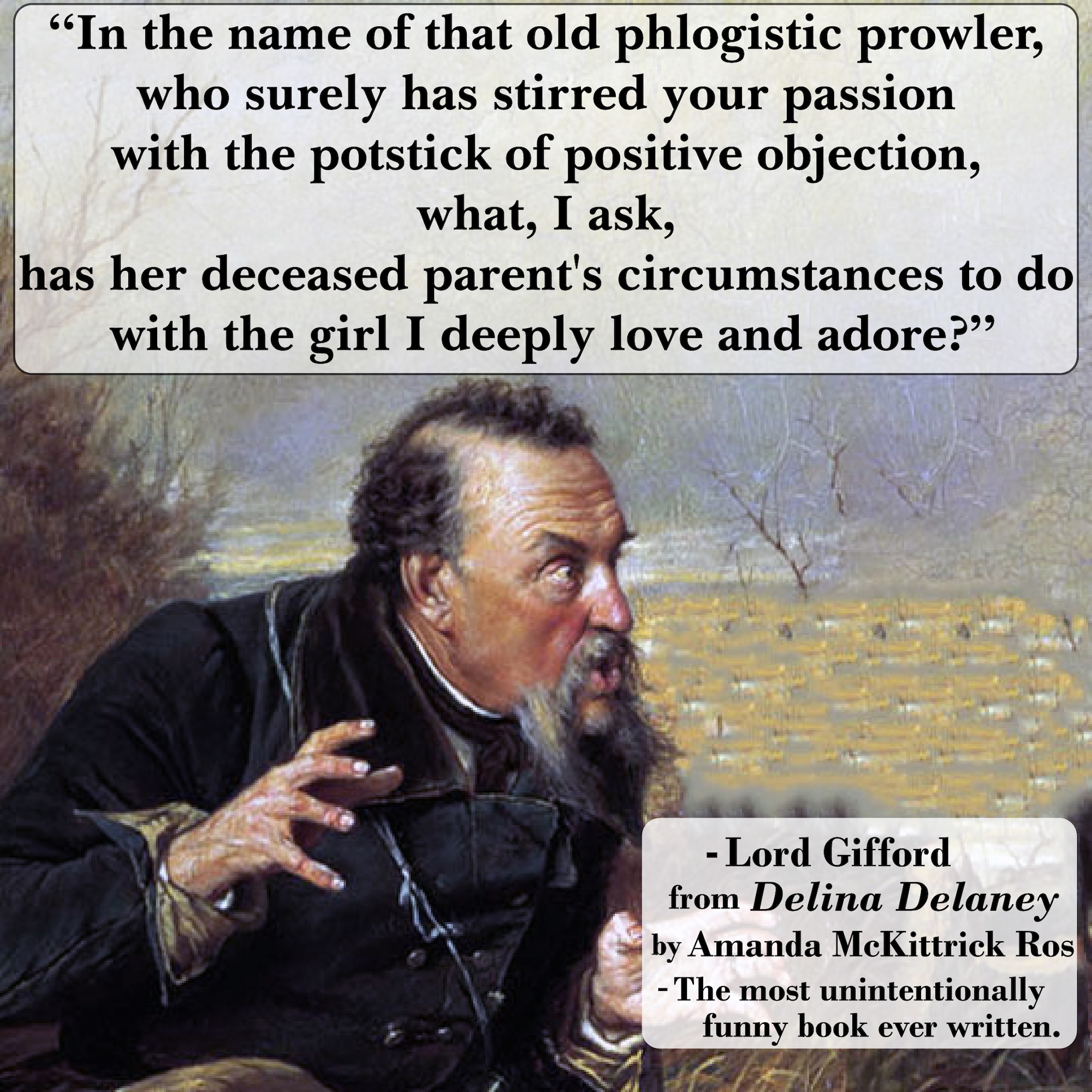
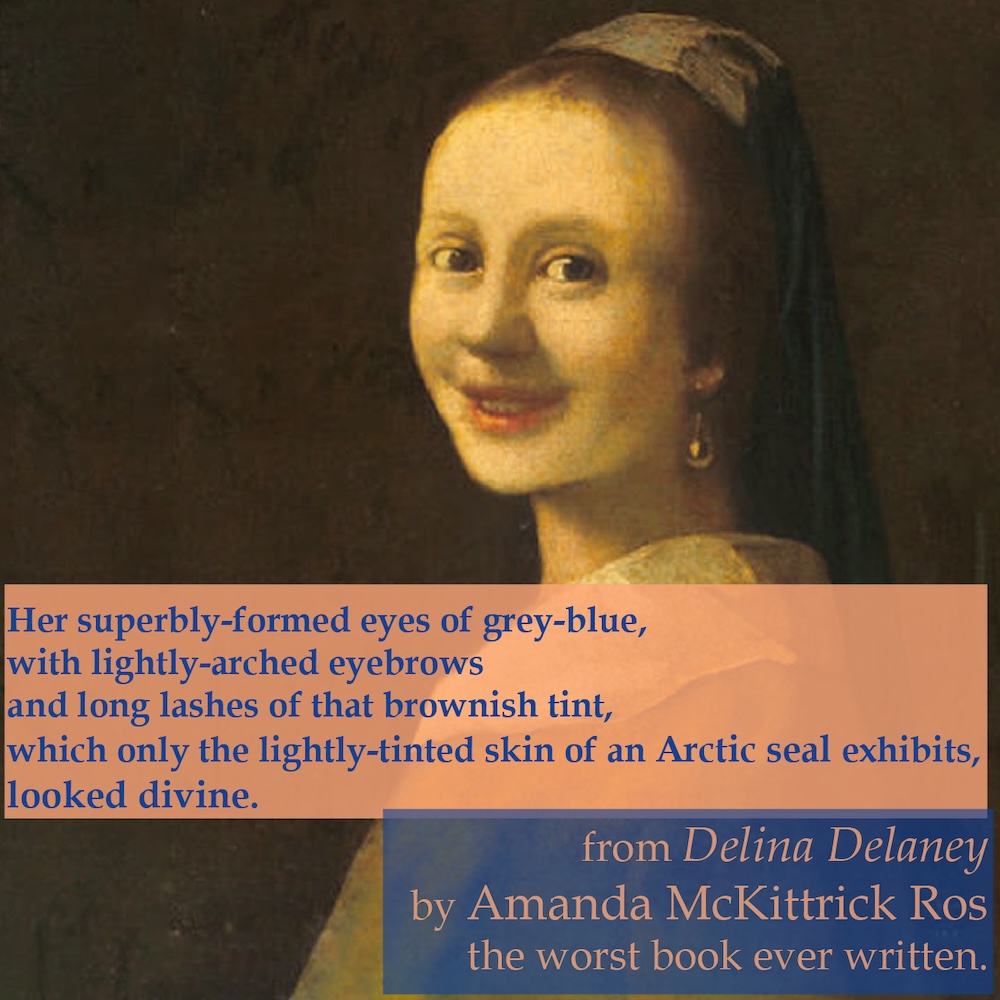
The enlightening illustrations accompanying this article are from Amanda McKittrick Ros Society Promotional Memes, ably captained by Dan Morgan.

George MacDonald’s Poetry

George MacDonald (1824-1905) was a prolific Scot writer. His legacy was amplified due to his influence on G.K. Chesterton and C.S. Lewis. (He was also a friend of Mark Twain.) An essay, originally presented as a speech by G.K. Chesterton, is available online.

Chesterton goes so far as to say, “if to be a great man is to hold the universe in one’s head or heart, Dr. MacDonald is great. No man has carried about with him so naturally heroic an atmosphere.” Listen to his description of that special type of literature that inspired many Inklings, chiefly C.S. Lewis and J.R.R. Tolkien.

Many religious writers have written allegories and fairy tales, which have gone to creating the universal conviction that there is nothing that shows so little spirituality as an allegory, and nothing that contains so little imagination as a fairy tale. But from all these Dr. MacDonald is separated by an abyss of profound originality of intention.

The difference is that the ordinary moral fairy tale is an allegory of real life. Dr. MacDonald’s tales of real life are allegories, or disguised versions, of his fairy tales.

It is not that he dresses up men and movements as knights and dragons, but that he thinks that knights and dragons, really existing in the eternal world, are dressed up here as men and movements.

C.S. Lewis, for his part, praised MacDonald as instrumental in tilling the soil for his eventual conversion to Christianity. He was on the defensive, since the writers which most inspired him shared a common flaw – they were Christians.

All the books were beginning to turn against me. Indeed, I must have been as blind as a bat not to have seen, long before, the ludicrous contradiction between my theory of life and my actual experiences as a reader.

George MacDonald had done more to me than any other writer; of course it was a pity he had that bee in his bonnet about Christianity. He was good in spite of it.

Chesterton had more sense than all the other moderns put together; bating, of course, his Christianity. Johnson was one of the few authors whom I felt I could trust utterly; curiously enough, he had the same kink. Spenser and Milton by a strange coincidence had it too (Surprised by Joy).

Lewis would actually come to edit a selection of MacDonald’s passages for an edifying anthologyThis post includes a link for downloading a copy of George MacDonald: An Anthology.

This week I was reading one of MacDonald’s excellent essays, which appears in The Imagination and Other Essays. I intend to discuss some of his thoughts on age and writing soon. Although I am not an aficionado of poetry – despite having composed poetry from time to time, including quintains, I turned to another of MacDonald’s books.

On to His Poetry

I decided to follow up MacDonald’s brilliant essay with a dip into his poetry. Fortunately, Internet Archive allows you to freely download a complete copy of MacDonald’s Scotch Songs and Ballads, published in 1893. My conscience forces me, however, to provide a single caveat. Be forewarned that the tome is not suited for those intimidated by pronounced dialects.

Before looking at one of his poems in its entirety, allow me to share with you a passage from “The Waesome Carl” which I particularly enjoyed (due to its portrait of a preacher). 

The minister wasna fit to pray
And lat alane to preach;
He nowther had the gift o’ grace
Nor yet the gift o’ speech!
He mind’t him o’ Balaäm’s ass,
Wi’ a differ we micht ken:
The Lord he opened the ass’s mou,
The minister opened’s ain!
He was a’ wrang, and a’ wrang,
And a’thegither a’ wrang;
There wasna a man aboot the toon
But was a’thegither a’ wrang!
The puir precentor couldna sing,
He gruntit like a swine . . .

Not that I claim able to decipher it all, but my impression is that it’s not especially flattering. It is definitely entertaining. And I humbly think I interpret it significantly more accurately than Google’s online translator, which provided the following version.

The minister was not fit to pray
And lat alane to preach;
He nowther had the gift o’ grace
Nor yet the gift o’ speech!
He mind’t him o’ Balaam’s ass,
Wi’ a differ we micht ken:
The Lord he opened the ass’s mou,
The minister opened his eyes!
He was a’ wrang, and a’ wrang,
And a’thegither a’wrang;
There was a man aboot the toon
But thegither was wrong!
The puir precentor couldna sing,
He grunted like a swine. . .

Using the Dictionars o the Scots Leid, you can make perfect sense of the words about which you may be uncertain. (Thank you, Scotland.)

Dialects are interesting things indeed. I will close with another of MacDonald’s poems. I submit it for (1) those who comprehend the dialect, (2) those who deem precious their Scottish ancestry, (3) those with an affinity for Connor MacLeod, and (4) those who simply enjoy a challenge.

Nannie Braw

I like ye weel upo Sundays, Nannie,
I’ yer goon and yer ribbons and a’;
But I like ye better on Mondays, Nannie,
Whan ye’re no sae buskit and braw.

For whan we’re sittin sae douce, Nannie,
Wi’ the lave o’ the worshippin fowk,
That aneth the haly hoose, Nannie,
Ye micht hear a moudiwarp howk,

It will come into my heid, Nannie,
O’ yer braws ye are thinkin a wee;
No alane o’ the Bible-seed, Nannie,
Nor the minister nor me!

Syne hame athort the green, Nannie,
Ye gang wi’ a toss o’ yer chin;
And there walks a shadow atween ‘s, Nannie,
A dark ane though it be thin!

But noo, whan I see ye gang, Nannie,
Eident at what’s to be dune,
Liltin a haiveless sang, Nannie,
I wud kiss yer verra shune!

Wi’ yer silken net on yer hair, Nannie,
I’ yer bonnie blue petticoat,
Wi’ yer kin’ly arms a’ bare, Nannie,
On yer ilka motion I doat.

For, oh, but ye’re canty and free, Nannie,
Airy o’ hert and o’ fit!
A star-beam glents frae yer ee, Nannie–
O’ yersel ye’re no thinkin a bit!

Fillin the cogue frae the coo, Nannie,
Skimmin the yallow ream,
Pourin awa the het broo, Nannie,
Lichtin the lampie’s leme,

Turnin or steppin alang, Nannie,
Liftin and layin doon,
Settin richt what’s aye gaein wrang, Nannie,
Yer motion’s baith dance and tune!

I’ the hoose ye’re a licht and a law, Nannie,
A servan like him ‘at’s abune:
Oh, a woman’s bonniest o’ a’, Nannie,
Doin what maun be dune!

Cled i’ yer Sunday claes, Nannie,
Fair kythe ye to mony an ee;
But cled i’ yer ilka-day’s, Nannie,
Ye draw the hert frae me!

Addendum:

For those interested in pursuing this linguistic subject, I just came across a delightful 1896 collection of works you can download for free. Legends of the Saints: in the Scottish Dialect of the Fourteenth Century is “edited from the unique manuscript in the University Library, Cambridge.”


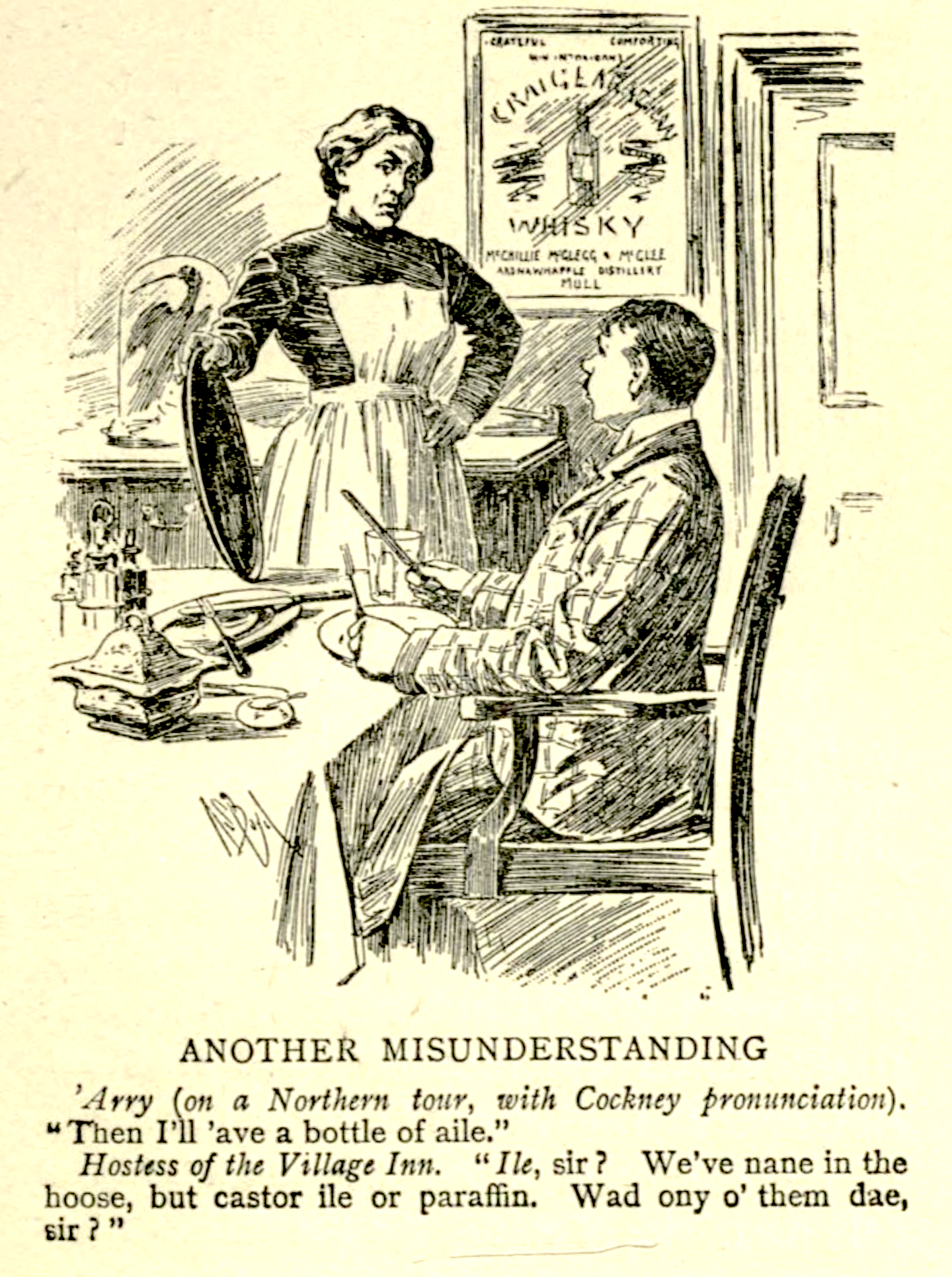
The cartoon above comes from Mr. Punch in the Highlands which was published “with 140 illustrations” more than a century ago. You can download your personal copy of humorous work at Internet Archive.

Following C.S. Lewis’ Military Example

Like his friend J.R.R. Tolkien, and many of the British men of their generation, C.S. Lewis served in the grim battlefields of the First World War. (However, since Lewis was actually Irish, he could not be drafted, and instead volunteered to serve.)

In recent years a number of books have appeared related to the military service of the Inklings. In A Hobbit, a Wardrobe, and a Great War, the author introduces his discussion with a succinct summary.

For a generation of men and women, [WWI] brought the end of innocence – and the end of faith. Yet for two extraordinary authors and friends, J.R.R. Tolkien and C.S. Lewis, the Great War deepened their spiritual quest. Both men served as soldiers on the Western Front, survived the trenches, and used the experience of that conflict to shape their Christian imagination. . . .

By the time of the Armistice, more than nine million soldiers lay dead and roughly thirty-seven million wounded. On average, there were about 6,046 men killed every day of the war, a war that lasted 1,566 days. In Great Britain, almost six million men—a quarter of Britain’s adult male population – passed through the ranks of the army. About one in eight perished. Tolkien and Lewis might easily have been among their number.

In 1939, a correspondent inquired if Lewis was going to reassume his commission in the army for the new conflict, and he responded with sentiments I have heard voiced by a number of other combat veterans.

No, I haven’t joined the Territorials. I am too old. It would be hypocrisy to say that I regret this. My memories of the last war haunted my dreams for years.

C.S. Lewis proceeded to graphically explain the cost of serving under such pressure. 

Military service, to be plain, includes the threat of every temporal evil: pain and death which is what we fear from sickness: isolation from those we love which is what we fear from exile: toil under arbitrary masters, injustice and humiliation, which is what we fear from slavery: hunger, thirst, cold and exposure which is what we fear from poverty.

I’m not a pacifist. If it’s got to be, it’s got to be. But the flesh is weak and selfish and I think death would be much better than to live through another war.

A new announcement from the United States’ Department of Defense brought Lewis’ situation to mind. It appears that due to a number of factors – not least of which the emphasis on Diversity, Equity and Inclusion,* which (imo) has discouraged veterans from encouraging their children to serve in the armed forces – some services are repeatedly falling short of their recruiting goals. 

In light of the fact that the world is inarguably growing more dangerous – the Doomsday Clock is set at “90 seconds to midnight” – it is alarming that we are unable to fully staff our shrunken military.

Just today my sixteen year old grandson expressed concerns about the resumption of a draft. I could not muster a persuasive argument that it won’t happen. Ironically, the last time the U.S. involuntarily conscripted troops was 1972, the year I turned eighteen. Oh, in the process of including a link to the Selective Service Sytem, I was surprised to learn that a “Medical Draft is in Standby Mode.” 

It is designed to be implemented in connection with a national mobilization in an emergency, and then only if Congress and the President approve the plan and pass and sign legislation to enact it. . . .

[The plan will] provide a fair and equitable draft of doctors, nurses, medical technicians and those with certain other health care skills if, in some future emergency, the military’s existing medical capability proved insufficient and there is a shortage of volunteers. . . .

[If implemented, the plan will] begin a mass registration of male and female health care workers between the ages of 20 and 45. . . . HCPDS [the innocuously named Health Care Personnel Delivery System] would provide medical personnel from a pool of 3.4 million doctors, nurses, specialists and allied health professionals in more than 60 fields of medicine.

No Draft Yet

Since we are not currently at war, the specter of a draft remains ephemeral. Still, the shortage of volunteers has led to a variety of initiatives, such as lowering service qualification standards. These efforts have proven inadequate, resulting in the aforementioned announcement.

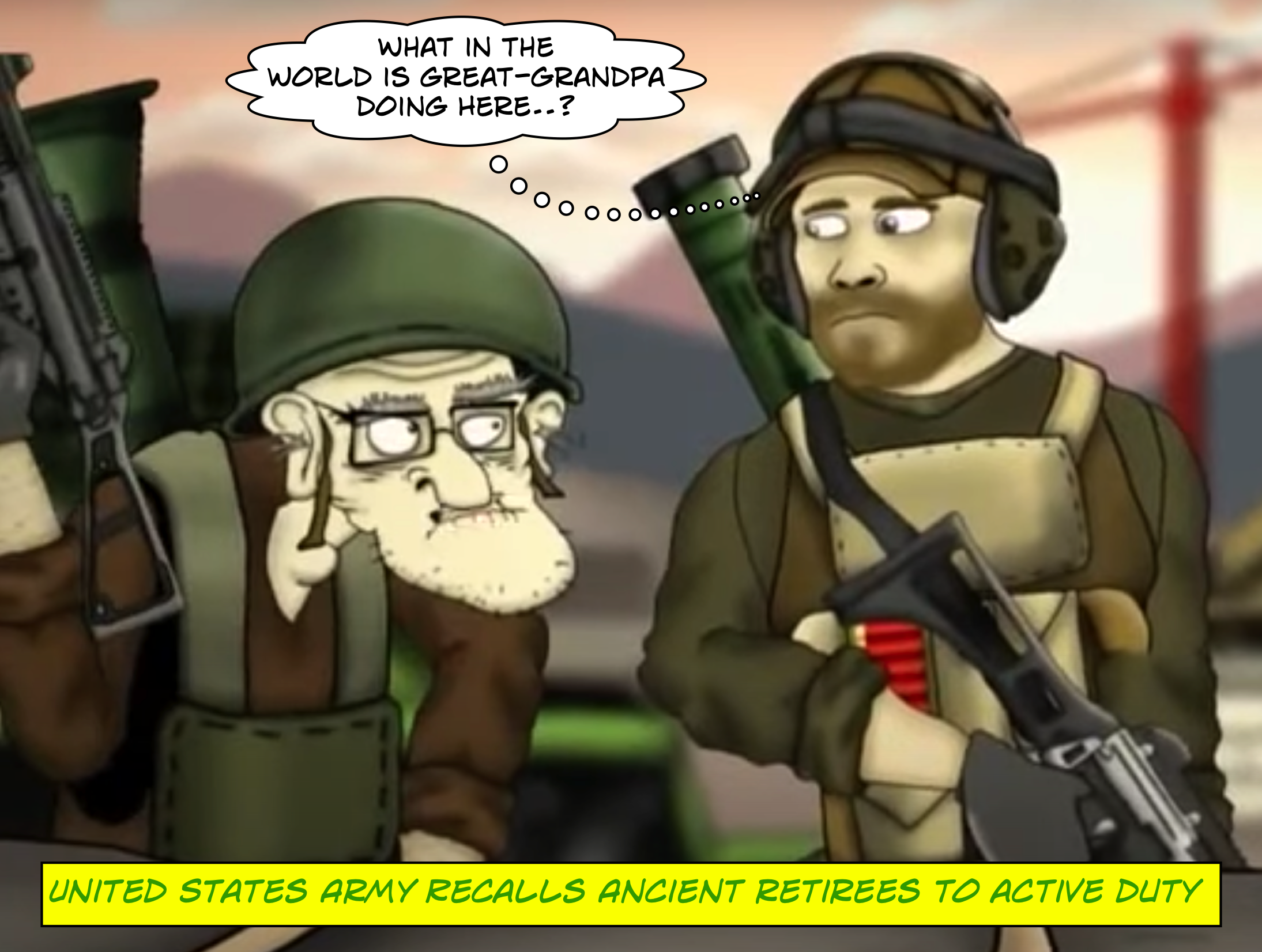
Both the Army and the Air Force have begun Retiree Recalls. Yes, that is just what it sounds like. People who have actually retired from the armed forces, normally after 20+ years of active duty, are being recalled to serve again. 

When I heard this news I was stunned. It is legally possible for the military to recall former members via a tiered process, but the first thing that came to my mind was my favorite high school teacher. He had served in Viet Nam as a draftee and finished his enlistment. He once told me that he felt safe, having survived, because now he was in the same call-up status as a “pregnant nun.” (Rather hyperbolic, but comforting to him.)

Fortunately, the current recalls are all voluntary. Only retirees whose personal circumstances make the offer appealing, will respond. As the Air Force Times reports, “Regret retiring? Here’s your shot at a second chance in the Air Force.”

I suspect that even vets who enjoyed their military service will be inclined to consider redonning the uniform as “too much of a good thing.” And if they witnessed the bloody horrors of war, as seen by C.S. Lewis, returning to the ranks would be even less tempting.

Since I, myself, have no desire to resume the demands of military life, I haven’t researched the age requirements for the Air Force recall program. Like Lewis, “I am too old.” 

But amazingly, depending on individual factors, the Army is willing to recall retired volunteers up to the age of seventy. That’s not a typo. As someone reaching that very milestone this summer, I can’t imagine returning to work side-by-side with troops half a century younger than me. 

Now, I pray for peace, knowing that being prepared for war is one way to increase that likelihood. So, I hope the military can throw off some of its political shackles and return to its necessary focus.

Furthermore, like C.S. Lewis, I have a pragmatic view of the effects of war. In “Learning in War-Time,” Lewis summarized the effects of military service during a war. As always, his insights are profound.

What does war do to death? It certainly does not make it more frequent: 100 per cent of us die, and the percentage cannot be increased. . . . Does it increase our chances of painful death? I doubt it. . . .

Does it decrease our chances of dying at peace with God? I cannot believe it. If active service does not persuade a man to prepare for death, what conceivable concatenation of circumstances would?


* This reference is to the convoluted and inequitable DEI philosophy and program(s) being mandated today. In truth, most people value diversity, and all people of goodwill believe in the importance of equity and inclusion. Along with Martin Luther King, Jr., they long for a day when people are not “judged by the color of their skin, but by the content of their character.”

Books Enjoyed by C.S. Lewis

Reading is not only one of life’s pleasures, the content and ethos of what we read, subtly influences the shape of our very lives.

C.S. Lewis loved books with genuine passion. While many people only perceive books as compilations of information or as sources of fleeting entertainment, he knew them as far more. Only someone sharing Lewis’ affection and wisdom will identify with the following passage from his essay “An Experiment in Criticism.”

The man who is contented to be only himself, and therefore less a self, is in prison. My own eyes are not enough for me, I will see through those of others. Reality, even seen through the eyes of many, is not enough. I will see what others have invented. . . .

Literary experience heals the wound, without undermining the privilege, of individuality. There are mass emotions which heal the wound; but they destroy the privilege. In them our separate selves are pooled and we sink back into sub-individuality.

But in reading great literature I become a thousand men and yet remain myself. Like the night sky in the Greek poem, I see with a myriad eyes, but it is still I who see. Here, as in worship, in love, in moral action, and in knowing, I transcend myself; and am never more myself than when I do.

Lewis scholar and emeritus professor of English, Dale J. Nelson, has been providing a wonderful service in recent years as he explores the books which found a place in C.S. Lewis’ personal library. “Jack and the Bookshelf” is a continuing series which appears in CSL, journal of the New York C.S. Lewis Society. Founded in 1969, the organization “is the oldest society for the ​appreciation and discussion of C.S. Lewis in the world.”

Nelson’s task of editorially archiving C.S. Lewis’ library is complemented by the work of our mutual friend, Dr. Brenton Dickieson. In a “comment” praising Dickieson’s compilation of “C.S. Lewis’ Teenage Bookshelf,” Nelson offers a commendation with which I fully concur.

Thank you for assembling that list of books . . . I’d encourage Lewis’s admirers to take their appreciation of CSL to the next step and delve into the things he liked to read throughout his life.

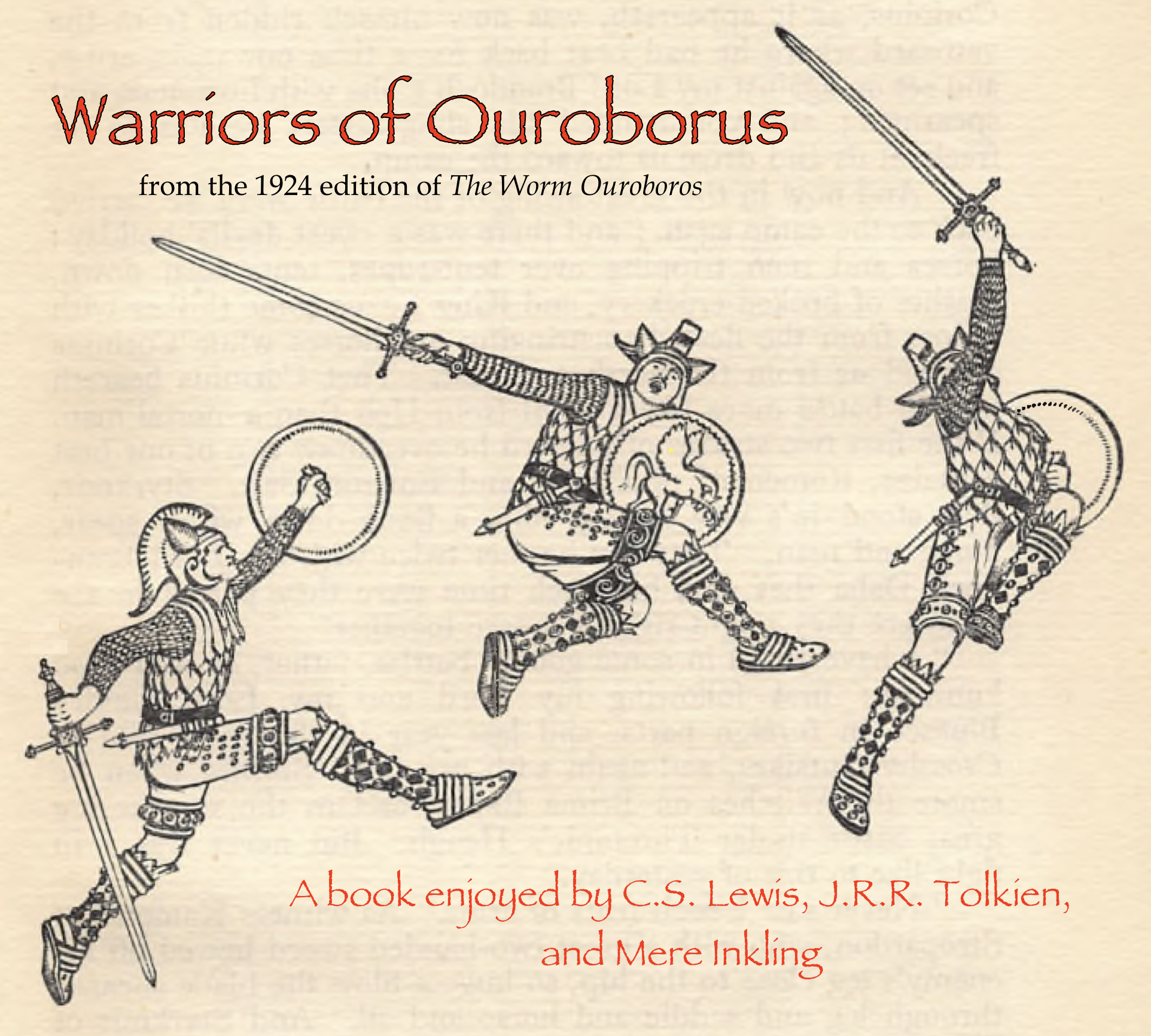
Nelson’s contribution to the December 2023 issue is the fifty-ninth in his series, and discusses a fantasy work titled The Worm Ouroboros by E.R. Eddison. Eddison (1882-1945) was a Norse scholar, and his fascination with mountains combined with that, to resonate with Lewis’ passion for northernness.

Dr. Nelson, who has added an array of science fiction to his own academic work, possesses superb credentials for exploring the connection between Lewis and Eddison. 

Nelson relates that, at C.S. Lewis’ invitation, Eddison attended two gatherings of the Inklings. At the second, Eddison – who relished critiques of his works in progress, as do many serious writers – read from a project which would not be published due to his death the following year.

Eddison’s themes more closely resembled J.R.R. Tolkien’s than Lewis’ own. In Nelson’s words, both “Tolkien and Eddison wrote masterpieces of heroic fantasy whose values differed markedly.” 

Another distinction is that while Tolkien’s Lord of the Rings has maintained its mythic rigor, Eddison’s oeuvre feels rather anchored to the formative years of the genre, prior to the so-called Golden Age of science fiction (and fantasy).

If you would like to read this book, which was enjoyed by both Lewis and Tolkien, you can download a copy of it at Internet Archive. If you enjoy dwarves, goblins, manticores and hippogriffs, you are unlikely to be disappointed.

Fonts that Can Make Your Literary Dreams Come True

Would you be interested in owning a copy of an attractive new font called Middle Earth? If so, read on and you’ll find a link to download this typeface created by Swedish designer Måns Grebäck.

When it comes to fonts, there are basically two types of people – those who pay no attention to them as they read, and others who notice the nuances between similar fonts and are fascinated by extraordinary examples.

Longtime readers of Mere Inkling know I am in the latter category. Every year or two I actually write on the subject. I’ve discussed monastic fonts, legal fonts, trustworthy fonts, uninhibited fonts, a dyslexia font, a memory-enhancing font, fonts based on the handwriting of historical figures, and being a fontaholic.

The reason for my current interest in fonts is due to Microsoft’s decision to jettison Calibri as their default font for Office products. They needed to make room for its replacement, Aptos. Seriously, when you view the two sans serif* fonts, side-by-side, you may be surprised at how little they differ.

To make matters even more confusing, CNBC describes a curious aspect of Aptos saga.

Aptos will remain available in the font list under the old Bierstadt name for people who are accustomed to it. Users can also choose to set any other font as the default.

Apple’s mac computers also allow users to choose their own defaults. One typography community discusses this selection opportunity, even as they bemoan the fact that in many programs, the standard installations include suboptimal fonts.

Unfortunately, many of us work on computers where we have no control over what fonts are loaded onto the machine, so we have created a list of the top 10 most common system fonts everyone should know and how to handle them.

This website offers a brief description and history of ten of the most common fonts we typically encounter. For example:

Times New Roman is a serif typeface designed by Stanley Morison and Victor Lardent in 1931. It was commissioned by the British newspaper The Times, which wanted a new typeface to replace its existing font, Times Old Roman.

And I love their estimation of Comic Sans, one of my wife’s favorite fonts, which I avoid like the proverbial plague. (Delores is a young at heart special education teacher, and I’m more of a Lewisian dinosaur.) 

Do use: if you are designing a comic for 6-year-olds.
Don’t use: if you want to be taken seriously by work colleagues.

Another pastor, who learned this lesson the hard way, shared his advice with the warning: “pastors don’t let your bulletins print out in Comic Sans!”

Apparently, his astute wife preserved his professional reputation by telling him to (1) avoid using a “smorgasbord of fonts” in a single document, and (2) “resist the temptation to print serious things in less than serious fonts.”

Advice for Writers

While authors have little control over the fonts in which their work is published by commercial publishers, they do have freedom to choose the typeface they use for the actual composition. “How To Choose the Best Font for Your Writing” addresses that latitude in the following way.

Do you have a favorite font? Are you dedicated to Times New Roman, or are you more of an “anything-but-Wingdings” kind of writer? Maybe you haven’t given your choice of font much thought.

Quite simply, as research shows, texts that look good make you feel good while interacting with them. This is why it’s so important to choose a font that not only is easy to read, optimizes line length, and has the right mood, but also is one that you like!

MasterClass describes the various aspects of each font that will contribute to your overall impression of each font. In “Typography for Writers: How to Pick the Best Type for Writing,” they explain the significance of bowls, ascenders, spines, counters, and more.

Typographers and type designers have their own universe of special terms, each of which refers to a specific part of a given letter. Understanding these basic elements of typography can help you decide precisely what typographic style you want to employ to grab your reader’s attention.

InDesignSkills goes so far as to match a number of typefaces to specific genres, saying “we judged the legibility, beauty, simplicity and variety of weights available of a huge range of fonts, and whittled them down to these faithful five.” They even offer an ironclad promise, proclaiming their selection will “never let your typesetting down, guaranteed.”

Obviously, personal tastes play a large role in appreciating or disapproving of various fonts. One author describes how the quest for the perfect font is integral to writers’ creativity.

Let’s talk about one of our favourite writing avoidance devices: picking the right font for your manuscript.

The Best and Worst Fonts (and why they’re good or bad),” describes the bond a writer can develop with their typographic fancies.

Fonts are one of the most important design choices to make when developing your brand identity. The best fonts leave you feeling like you’ve made an instant friend while the worst fonts are like a stranger who won’t leave you alone.

The writer offers her personal preferences (and prejudices). I don’t agree with all of her judgments, but I am forced to concur with her inclusion of Jokerman and Bleeding Cowboys on the list of “worst fonts.” And I am pretty sure that C.S. Lewis would agree.

Write in the Spirit of Middle Earth

If you have read this far, your reward is to receive the download link for Middle Earth. 

As noted aboved, Måns Grebäck is a prolific Swedish typographer. He makes many of his creations freely available to individuals for non-commercial use. (Commercial licenses are available as well.) The independent FontSpace describes it thusly:

With the historic charm of ancient manuscripts and the ethereal beauty of elven realms, Middle Earth typeface weaves tales of valor and legends. Its calligraphic allure is accentuated by rounded contours, reminiscent of Tolkien’s enchanted worlds.

Middle Earth truly is ethereally elegant. Enjoy.


* Sans serif fonts are those without serifs, which are the tiny lines or marks that appear at the end of a character’s stroke. Arial would be a common sans serif font, while Times New Roman is a familiar serif font.

Mickey Mouse Is Now Ours

He’s no Reepicheep, but the earliest iteration of Mickey Mouse just became public property!

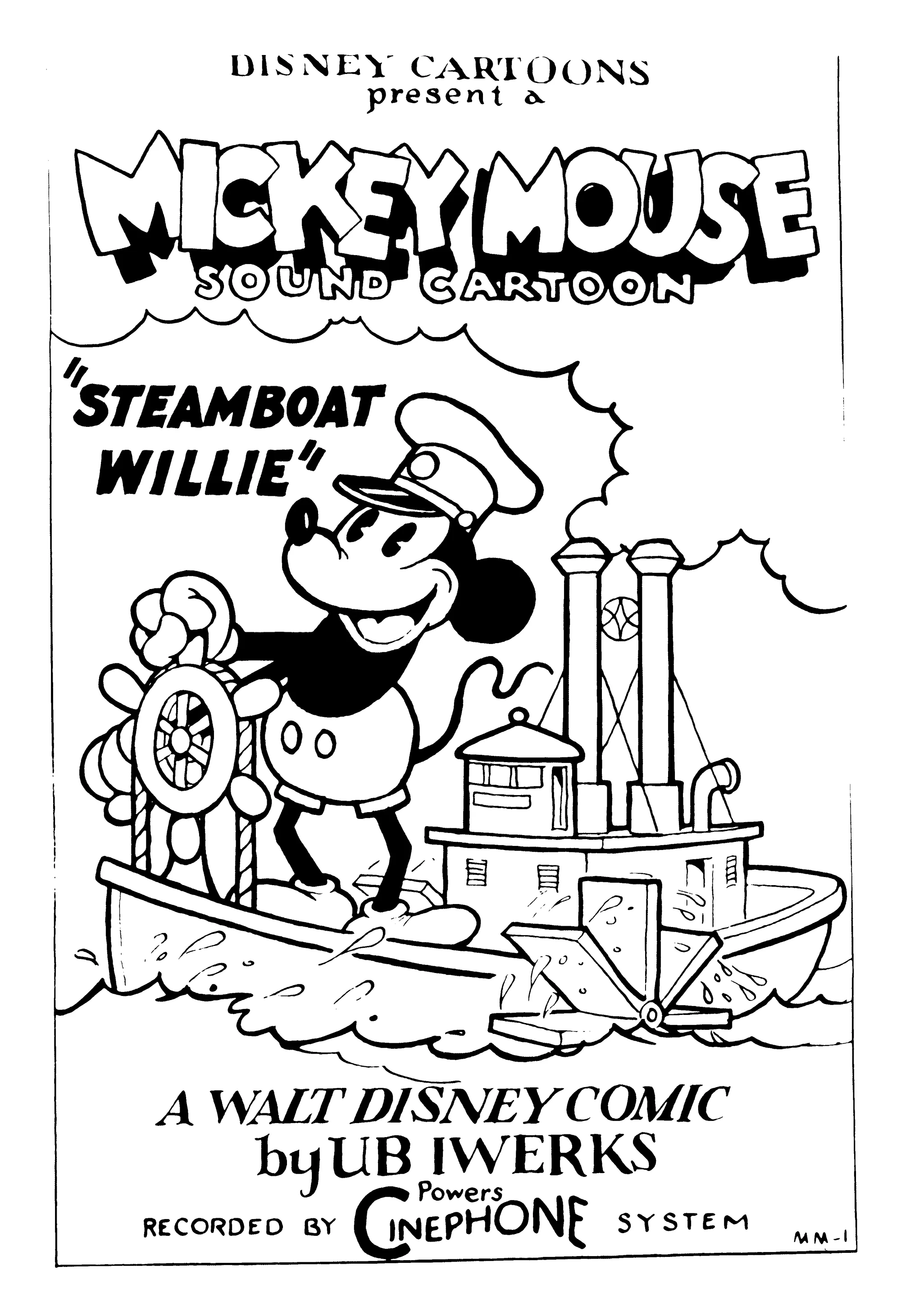
One of the little-heralded New Year’s Day events was the entry of the Steamboat Willie version of Mickey into public domain. Now anyone who desires can use the image without infringing on Disney’s copyrights.

Actually, my headline is not 100% accurate. As I just noted, it’s the earliest version of the most famous mouse in the world. However, the rodent’s name, and his subsequent graphic version remains protected. That’s because while copyrights eventually expire, trademarks don’t.

Therefore, as reported in Fortune magazine, “current artists and creators will be able to make use of Mickey, but with major limits. It is only the more mischievous, rat-like, non-speaking boat captain in ‘Steamboat Willie’ that has become public.”

The 1928 poster advertising Mickey’s cinematic debut comes from a great article at Animation Scoop. Without comparing measurements of Mickey’s initial and contemporary snouts, it doesn’t appear to me the public domain version is that much more “rat-like.”

As for differences between the two . . . well, I’m not an attorney, but it appears Mickey’s onscreen persona in 1928 wasn’t wearing his standard white gloves. The poster, nevertheless, shows a Mickey closely resembling the cartoon mouse who was part of many of our childhoods. As noted in the Fortune piece:

Not every feature or personality trait a character displays is necessarily copyrightable, however, and courts could be busy in the coming years determining what’s inside and outside Disney’s ownership.

My question, and perhaps one of you intelligent readers can answer this, is about the image’s “name.” His full name, with his surname “Mouse,” is undebatably trademarked. Can a person legally use the name “Mickey” with the 1928 likeness? My guess is that the first name is not restricted, no matter how much Disney protests.

Speaking of Disney, a company which has become a disappointment in recent years, the Inklings were not big fans. If you are interested in learning more about the Inklings’ opinion about Disney Studios, check out author Jim Denney’s “What C.S. Lewis and J.R.R. Tolkien Thought of Walt Disney.”

After identifying a number of parallels in their lives, he explores the irony that “you might think that, with all that C.S. Lewis and Walt Disney had in common, they might have been mutual admirers—but that was not the case.”

And, there is always another option. As Britannica reminds us, Mickey wasn’t even his original name. Walt’s first choice (vetoed by his wife) was “Mortimer.”

That’s it for today. Now I’m off to write a book about Mickey’s alliance with Reepicheep. Oh wait, Reepicheep won’t be in the public domain until after I’m enjoying heaven with my Lord, and with the Christian members of the Inklings.

And, even if one could pair the two up for an adventure, they wouldn’t prove compatible. The reason should be obvious, but for an enjoyable exploration of that subject, I commend to you, “Reepicheep and Mickey.” 

Father Christmas & Crackers

J.R.R. Tolkien wrote, for his children’s enjoyment, an entertaining little story about Father Christmas’ stash of explosives. Read on to see what a mischievous polar bear did with them.

Merry Christmas. No, I’m not late in wishing you a blessed celebration of Christ’s Nativity. The church calendar recognizes Christmas is too big to celebrate just for a single day. The Inklings knew it – Christmas is a season.

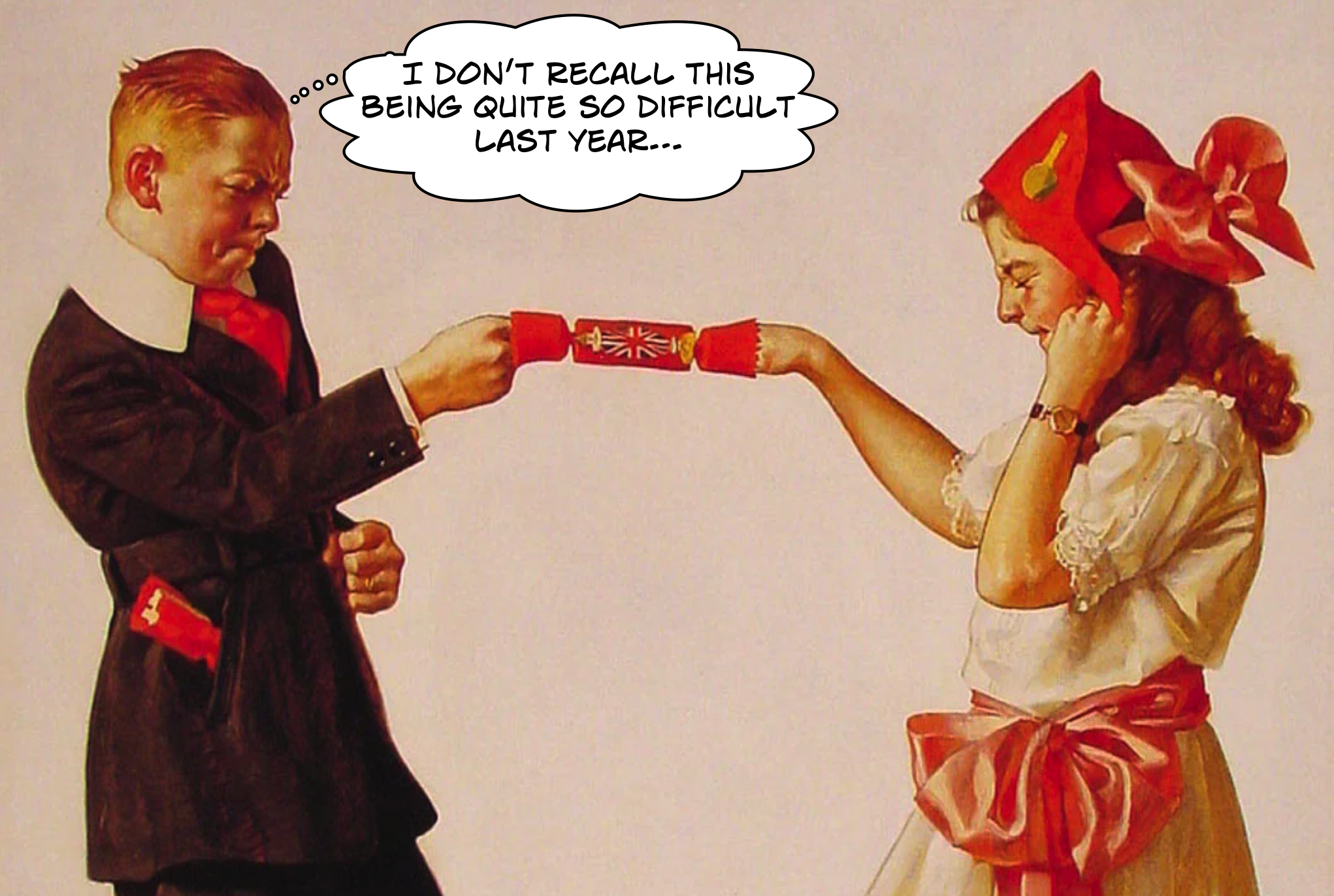
One nineteenth century invention has become a part of many families’ celebration of the season. They’re called “Christmas crackers,” and although birthed in Britain, they’ve found a home in many other countries. We adopted them as an annual tradition after living in England for several years.

Their beginning was modest. While many now lack edible treats, they were conceived as a means for selling confectionaries. Their inventor wanted to increase sales of a French treat.

For seven years he worked to develop the bon-bon into something more exciting, but it was not until he sat one evening in front of his fireplace that his great idea came to him. Watching the logs crackle, he imagined a bon-bon with a pop.

He made a coloured paper wrapper and put in it another strip of paper impregnated with chemicals which, when rubbed, created enough friction to produce a noise. He knew that bangs excited children (and were said to frighten evil spirits) – and the mottoes and poems he inserted inside the crackers amused adults (BBC).

Sadly, many of the crackers marketed today have been neutered. To improve their safety (and, no doubt, save production costs), some crackers no longer crack. They contain no “chemicals” to produce the customary bang. Seems like a misnomer to call these variants crackers, at all.

Tolkien’s Father Christmas Letters

Tolkien and his wife were blessed with four children, and they were doting parents. Each Christmas between 1920 and 1943, the famed author wrote and illustrated a pseudonymous letter to his kids. In 1976 they were posthumously published, and facsimiles of the correspondence appears in some editions of the letters.

They offer an intimate insight into the secular side of a Christian family’s celebration of the holiday (holy day). In fact, on Christmas Eve this very year, a selection from the letters was part of the Royal Carol Service, celebrated at Westminster Abbey.

The Christmas story was told in readings from Luke 2 given by The Prince of Wales and by Michael Ward. Jim Broadbent read from JRR Tolkien’s The Father Christmas Letters, and Leonie Elliot read Growing Tomorrow, a poem by Children’s Laureate Joseph Coelho commissioned specially for the service.

The following excerpt from the 1931 letter comes from the pen of Father Christmas himself. (It also features a fun notation from North Pole Bear.)

I should hardly feel it was Christmas if [the North Polar Bear] didn’t do something ridiculous. You will never guess what he did this time! I sent him down into one of my cellars – the Cracker-hole we call it – where I keep thousands of boxes of crackers (you would like to see them, rows upon rows, all with their lids off to show the kinds of colours.)

Well, I wanted 20 boxes, and was busy sorting soldiers and farm things, so I sent him; and he was so lazy he took his two Snowboys (who aren’t allowed down there) to help him. 

They started pulling crackers out of boxes, and he tried to box them (the boys’ ears I mean), and they dodged and he fell over, and let his candle fall right POOF! into my firework crackers and boxes of sparklers.

I could hear the noise, and smell the smell in the hall and when I rushed down I saw nothing but smoke and fizzing stars, and old Polar Bear was rolling over on the floor with sparks sizzling in his coat: he has quite a bare patch burnt on his back.

[NPB] It looked fine! That’s where Father Christmas spilled the gravy on my back at dinner!

The Snowboys roared with laughter and then ran away. They said it was a splendid sight – but they won’t come to my party on St. Stephen’s Day; they have had more than their share already.

The story goes on, relating the troublesome exploits of “two of the Polar Bear’s nephews” who have been visiting. However, the passage above suffices to illustrate the humor resident in the Tolkien household.

And, in light of this vignette, we just may have uncovered why modern manufacturers are forgoing the more explosive elements of Christmas crackers. No “pop,” no “poof.”

And, if you have a creative bent, consider making your own for next year!

Elven Inspiration from Space

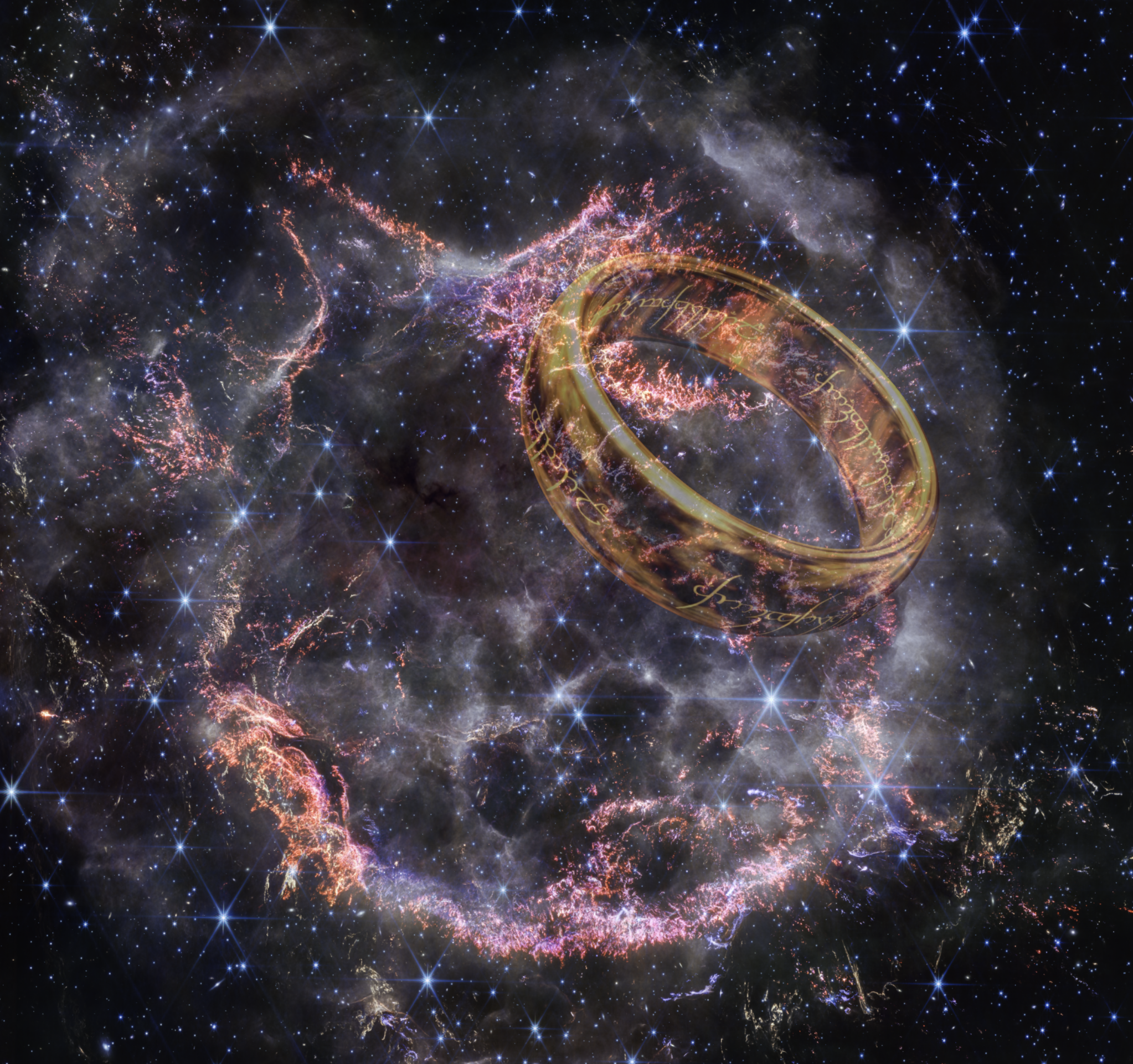
A newly captured image of a supernova remnant in our Milky Way galaxy has me curious about where J.R.R. Tolkien may have gained inspiration for the elegant style of his Elvish scripts.*

America’s NASA has gifted all of Earth’s citizens with an array of stunning, and enlightening images. Recently, the James Webb Space Telescope directed its focus to Cassiopeia A, created thousands of years ago when a star 11,000 light years away went supernova. 

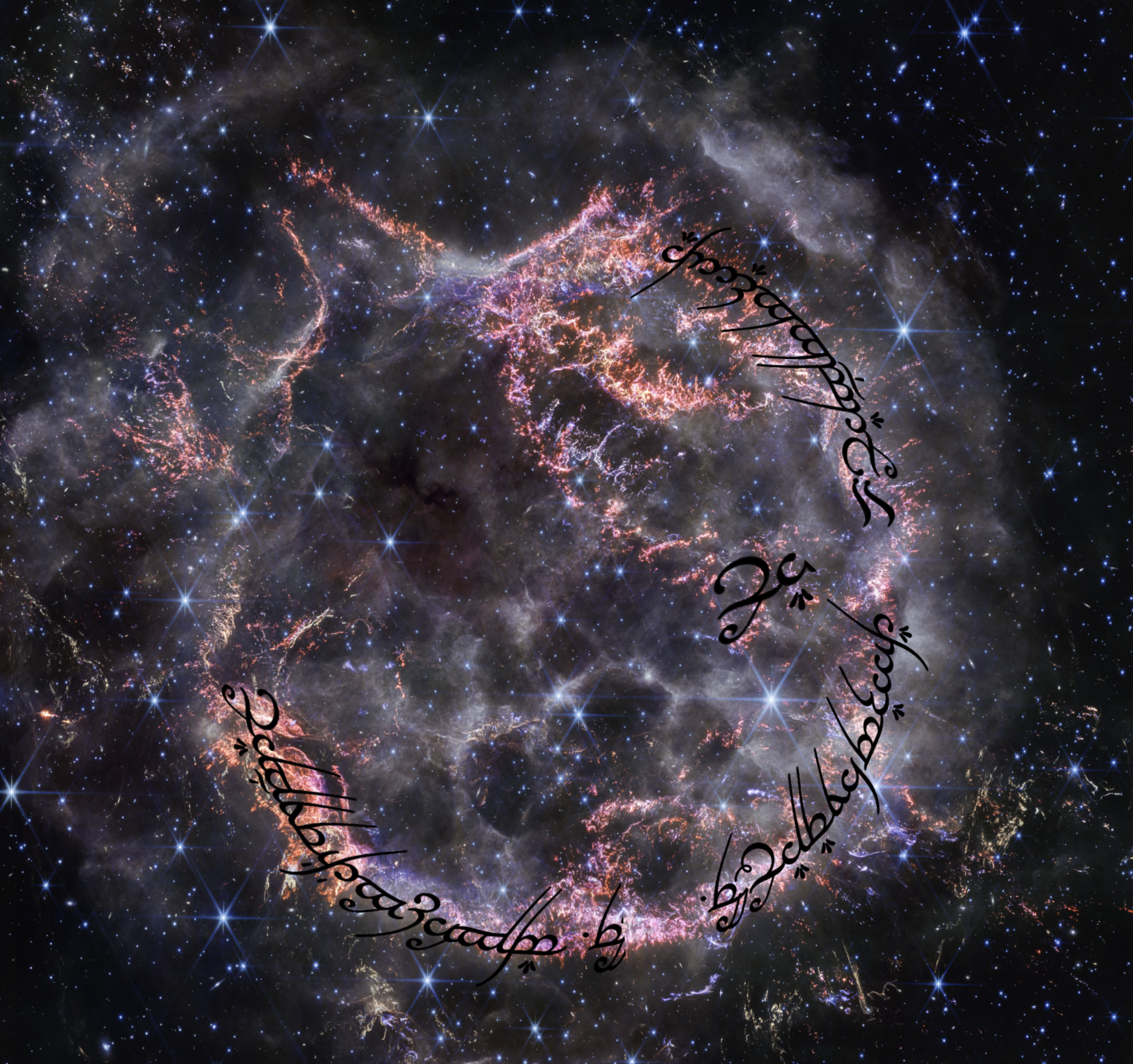
It may be my imagination, or perhaps its an elevated mental talent for “core object recognition,” but for some inscrutable reason, I have recognized in the aftermath of the explosion faint echoes of Elvish script.

The light from Cassiopeia A (or Cas A, as we pseudo-astronomers refer to it) “first reached us around 340 years ago. As that was approximately 272 years before The Lord of the Rings was published, Tolkien had ample time to analyze the spectacular light source. Even factoring in the fact that the stories were composed between 1937 and 1949, the supernova’s existence had been known for a millennia and a half before LOR was written. 

I will leave it to other researchers to determine just how Tolkien was able to gain a detailed view of the explosion’s aftermath. My purpose here is to simply alert the public to the unexplainable parallel between the cosmic residue and Tolkien’s own renditions of Elvish writing as he perceived it. 

In a moment, I will allow the self-evident facts to speak for themselves.

Like his friend C.S. Lewis, Tolkien was a student of astronomy. As Professor Kristine Larsen says, “J.R.R. Tolkien based the stars and constellations of his created world of Middle-earth on ‘real world’ astronomy.” Dr. Larsen, a preeminent “Tolkienian Astronomer,” has published widely on the subject. 

Of particular interest to readers of Mere Inkling will be “Medieval Cosmology and Middle-earth: A Lewisian Walk Under Tolkienian Skies,” which can be downloaded here. In the essay, Larsen points out,

. . . as is well known in Tolkien scholarship, during and after writing The Lord of the Rings Tolkien made various attempts to more closely align his cosmology with 20th century astronomical knowledge.

Fortunately for those of us who are drawn to the mythological textures of his legendarium, Tolkien never completed this “radical transformation of the astronomical myth” (as son Christopher termed it), but it is important to understand that this tension existed within Tolkien’s mind.

Having narrowly escaped the snare of surrendering to twentieth century astronomical theories, Tolkien preserved the mythical spirit of his cosmology. Larsen’s essay considers “whether or not Tolkien’s subcreation would, in reality, pass muster as a medieval cosmology, as defined by Lewis.” Thesis established, she takes readers on a pleasing journey. “So let us take a stroll under Middle-earth skies, and observe just how well the Dome of Varda matches with Lewis’s challenge.”

Returning to Cas A

As the images below will clearly illustrate, the preservation of the medieval nature of Middle Earth’s heavens does not mean that Tolkien ignored the realities of interstellar space. As I said a moment ago, the visual proof is definitive.

The fluid strokes of Tolkien’s Elven scripts are clearly foreshadowed in the plumes of this cosmic canvas. 

This image speaks fluently for itself.

This pair of images from NASA contrasts the Near-Infrared and Mid-Infrared observations. It is quite possible the second influenced J.R.R. Tolkien’s perceptualization of Sauron’s eye. (Admit it, you see the dramatic similarities.)

We may never learn how Tolkien was able vividly see the details of Cassiopeia A with the earthbound telescopes accessible eighty years ago. Nevertheless, the evidence provided herein is irrefutable.

It seems fitting, when pondering the majesty of the stars as echoed in a masterpiece of literary subcreation, to close with an observation by Tolkien’s friend, C.S. Lewis. In an early letter to a close friend, Lewis described the wonder he experienced in reading Dante’s Paradise.

Here Lewis lyrically shares an experience of spiritual ecstasy which, this writer humbly suggests, can be shared by many, as we stand in awe of the majestic intricacy of the universe our Creator has fashioned.

[I read] Aristotle’s Ethics all morning, walk after lunch, and then Dante’s Paradiso for the rest of the day. The latter has really opened a new world to me. I don’t know whether it is really very different from the Inferno [Owen Barfield] says it’s as different as chalk from cheese – heaven from hell, would be more appropriate!) or whether I was specially receptive, but it certainly seemed to me that I had never seen at all what Dante was like before.

Unfortunately the impression is one so unlike anything else that I can hardly describe it for your benefit – a sort of mixture of intense, even crabbed, complexity in language and thought with (what seems impossible) at the very same time a feeling of spacious gliding movement, like a slow dance, or like flying. It is like the stars – endless mathematical subtility of orb, cycle, epicycle and ecliptic, unthinkable & unpicturable, & yet at the same time the freedom and liquidity of empty space and the triumphant certainty of movement.

I should describe it as feeling more important than any poetry I have ever read. . . . Its blend of complexity and beauty is very like Catholic theology – wheel within wheel, but wheels of glory, and the One radiated through the Many (The Letters of C.S. Lewis to Arthur Greeves).

Perhaps it was one of these very wheels – or rings – that Tolkien observed so many years ago in the heavens?


* For those who are interested in fonts for your computers, you can download Tolkien-inspired typefaces here.