Do you remember when you were making decisions about your future career? C.S. Lewis’ comment on the subject of careers remains quite valuable in today’s rapidly changing world.
Toward the end of high school, I recall filling out some educational assessments that projected how successful I might be in a number of different pursuits. Employability appeared to be the primary focus for the assessments.
Not taken into much account at that time (a half century ago), was what sort of job satisfaction one might anticipate following those various pursuits.
This “graduation” life milestone is on my mind, since several of my grandchildren are presently finishing their own high school years. None have yet “chosen” a career – they are approaching their futures with open minds. However, we have chatted about the major options before them: college, vocational training, directly entering the workplace, the military, or burying themselves in social media and living off of their parents for the next decade or two.
Most lean towards college, without specific programs in mind. Still, I have encouraged them to consider the marketability of various studies. As most are aware, AI is a growing threat. In “ChatGPT May be Coming for Our Jobs,” you can see ten particularly vulnerable fields.
I’ve been thinking about two career fields at opposite ends of the spectrum, in regard to the viability of their futures: Newspaper Reporters (that’s not the positive example) and Security (and not just cyber-security).
The United States Department of Labor enthusiastically declares “the cybersecurity field is booming.”
As of August 2022, there were over 700,000 open roles in cybersecurity in the United States and, according to Bureau of Labor Statistics projections, jobs for information security analysts are expected to grow 32% from 2022 to 2032. It’s clear that cyber talent is in demand.
Compare that to opportunities for newspaper reporters. Just last week the Los Angeles Times (established in 1881) and the Baltimore Sun (1837) announced (additional) major job cuts for their editorial staffs. Whether these two “venerable” publications will exist in print form a decade or two from now is a valid question. And they are simply part of an unrelenting media transformation.
My undergrad degree in editorial journalism has served me well, but would I recommend a similar path to my grandkids? Hardly. I believe the Georgetown University Center on Education and the Workforce is overly optimistic in stating “journalism employment is projected to decrease about 3 percent from 2022 to 2031.” But even with that minor drop, “it will have decreased by 35 percent since 2002.”
Now, many people may say, “of course cyber-security is expanding, but I am not computer literate enough to pursue that.” Well, that is not the only type of security opportunity that’s exploding.
It turns out that the U.S. is not the only place where criminals often roam the streets with little fear of a defanged judicial system. Here, the ill-advised “defund the police” movement has given rise to the need for many more private security firms. Private security is an established norm in many countries. Their expansion in Western nations is more recent.
In one American city, at least, the police welcome the addition of security guards to the safety mix.
Detroit Police’s top brass do not view the growth in private security as any sort of affront or threat to officers’ jobs. In fact, Chief James Craig has encouraged officers to work off-duty security as a way to earn extra cash.
Your Job is not You
Fortunately, as C.S. Lewis reminds us, our job does not define who we are. Nor does it affect the attitudes of those who regard us as friends. In The Four Loves, Lewis reveals how little such considerations mean among “true friends” (and who needs any more of the other, pretend, variety?).
In a circle of true Friends each man is simply what he is: stands for nothing but himself. No one cares twopence about any one else’s family, profession, class, income, race, or previous history. . . .
That is the kingliness of Friendship. We meet like sovereign princes of independent states, abroad, on neutral ground, freed from our contexts. This love (essentially) ignores not only our physical bodies but that whole embodiment which consists of our family, job, past and connections.
In Perelandra, a work of fiction, C.S. Lewis includes a sobering insight for those of us who may be tempted to think that our profession or job makes us “better” than someone else. If you ever begin to feel like your position marks you as someone who is uniquely special, remember these words:
One never can see, or not till long afterwards, why any one was selected for any job. And when one does, it is usually some reason that leaves no room for vanity.
I am sympathetic to young people today as they seek the right path for their life. The future appears more uncertain and convoluted than ever before. One piece of advice that I can confidently offer to those who are Christian, is to pray and seek God’s leading in your quest. And know that whatever vocation the Lord leads you to, will be the ideal one for you.
Learning is fun. Education can be enjoyable too. But obviously, they are not the same.
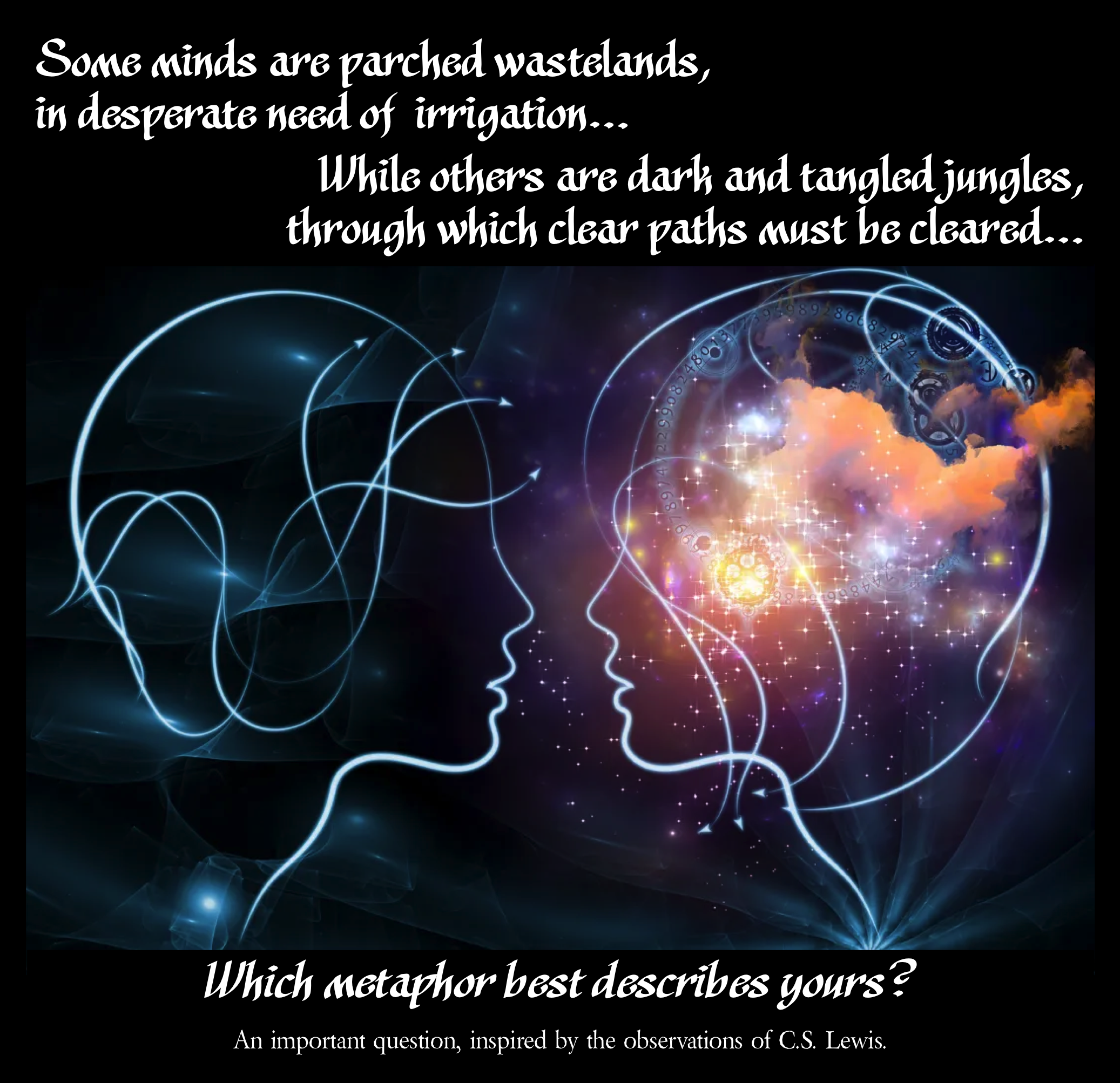
C.S. Lewis wrote a great deal about learning. A master of metaphors, he brilliantly described two distinct challenges faced by educators. In The Abolition of Man, he stated “the task of the modern educator is not to cut down jungles but to irrigate deserts.”
Wheaton professor, Robert McKenzie, offers a concise explanation of Lewis’ keen observation.
‘Cutting down jungles,’ as I understand that phrase, means helping students with passionate convictions to evaluate critically their world views, to examine what lies beneath the personal beliefs they profess.
‘Irrigating deserts,’ conversely, involves nurturing in apathetic or cynical students the hope that there is meaning and purpose in human existence.
Quite true, and I believe Lewis’ insight is more timely today than it was during the past century.
Classical Versus Modern Education
Today I read a passage that reminded me just how dramatically contemporary curricula deviate from the traditional educational materials used before the modern era.
While conducting research for a book about imperial Rome, which I hope to complete this year, I came upon the following passage.
It would have been easy to swell this little volume to a very considerable bulk, by appending notes filled with quotations; but to a learned reader such notes are not necessary; for an unlearned reader they would have little interest; and the judgment passed both by the learned and by the unlearned on a work of the imagination will always depend much more on the general character and spirit of such a work than on minute details.
It appears in Lays of Ancient Rome by Thomas Babington Macaulay, which is available for free download at Internet Archive.
Macaulay (1834-59) was a prominent British historian and politician. His histories were thoroughly researched and widely respected, especially by those on the (liberal) Whig* end of the political spectrum.
A contemporary of Macaulay described his preparation for writing in poetic fashion. According to novelist William Makepeace Thackeray (1811-63), “he reads twenty books to write a sentence; he travels one hundred miles to make a line of description.”
It appears that, like C.S. Lewis, Macaulay possessed a lasting recollection of all he read.
Returning to our beginning dichotomy – jungles versus deserts – both writers were a product of wide and critical literary study. Their minds were, in a sense, like a “rain forest.” Albeit, with C.S. Lewis it was certainly an orderly, well-tended forest. For some less stably grounded and more scatterbrained, the result is a jungle which requires radical clearing.
Alas, today’s more common problem, the unceasing pursuit of entertainment and distraction, leaves many with barren mental landscapes. In consequence, our calling as parents, educators, and friends, becomes one of irrigating the sparse flora and planting healthy new seeds in the hope that they will one day bloom.
* There is an interesting Mythlore article about C.S. Lewis’ view of history you can read here. In it, the author notes that “Lewis rejected a Whig history of unidirectional progress…” For a succinct article on the dangers of Whiggishness, I recommend “Evangelicals and Whig History” at First Things.
⁑ The brain truly can resemble a jungle, as a “digital reconstruction” reproduced on BrainFacts illustrates.
Immediately recognizable by its intricate folds and grooves, the cerebral cortex is the wrinkly, outer layer of the brain responsible for awareness, perception, and thought. Its interconnected neurons are arranged in six layers, a bit like the layers of tropical rainforests. . . . The findings may bring scientists closer to understanding how the complex jungle of cortical neurons interpret sensory information.
Artificial intelligence is on the rise. It’s IQ is somewhere above 75, and presumably still climbing. And some very intelligent human beings, are issuing apocalypticwarnings.
“Mitigating the risk of extinction from A.I. should be a global priority alongside other societal-scale risks, such as pandemics and nuclear war,” reads a one-sentence statement released by the Center for AI Safety, a nonprofit organization. The open letter was signed by more than 350 executives, researchers and engineers working in A.I.
Presently, I’m more wary of Russia, China and Iran igniting an end of the world scenario.
But there is one particular aspect of artificial intelligence that intrigues me. And that is the creation of literary works by these programs, which are themselves creations of humankind.
Some people, such as copywriters, feel their livelihoods are being threatened. “My amusement turned to horror: it took ChatGPT 30 seconds to create, for free, an article that would have taken me hours to write.” (And that was clocked way back in January; no telling how quickly the AI could perform the feat today.)
Others – think teachers – are alarmed by how simply this new technology can seduce students to take self-crippling shortcuts. One article refers to this as “the elephant in the room.”
Perhaps all questions centered on AI are inherently questions of ethics, and at the forefront of many teachers’ minds is cheating and plagiarism.
Cheating and plagiarism are two separate concerns, of course. AI is capable of not only drawing together already existing material, and generating new word combinations that cannot be tracked back to any unique original source.
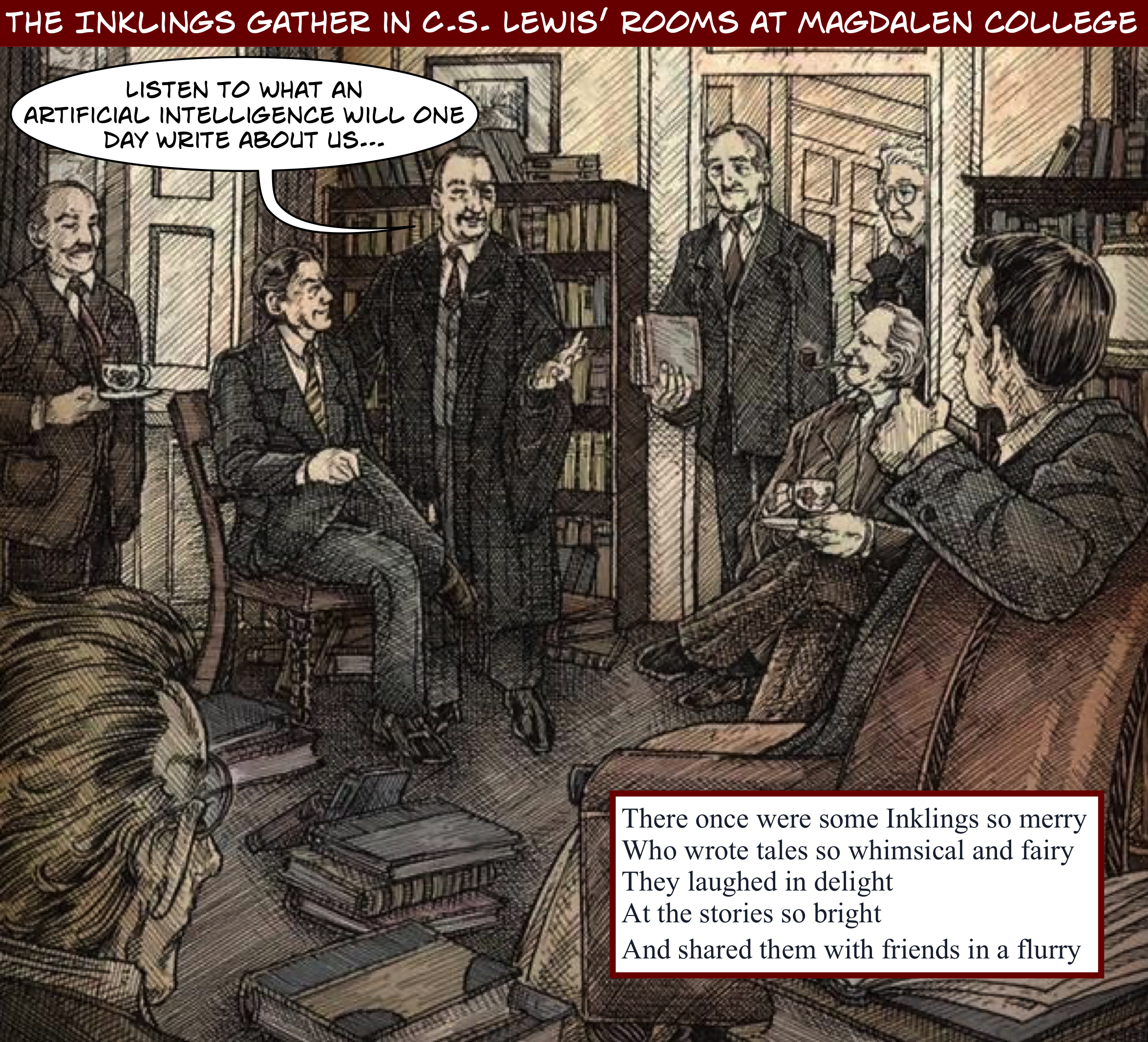
I feel confident that the Inklings would be extremely suspicious of computer-generated “literature.” Yet, at the same time, I think it is a subject they too would find intriguing.
Test-Driving AI
There are a myriad of free sites where a person can enter some basic parameters or directions and await the product of text generated by a synthetic “mind.” I share below some examples of the input—output results of my initial experiment.
I asked Open AI, creators of ChatGPT, to write two limericks, about the Oxford Inklings and C.S. Lewis, respectively.
In Oxford, the Inklings did meet, With words and with wisdom so sweet. Tolkien and Lewis, Their minds in a breeze, Inkling tales made our imaginations fleet.
⁂
C.S. Lewis, a writer so grand, In Narnia’s magical land. With Aslan the Lion, In tales that inspire, He showed us the way to understand.
Next I asked for an Inkling sonnet, followed by two haikus, addressing the Inklings as a fellowship and C.S. Lewis the individual.
In Oxford’s hallowed halls, they gathered ‘round, The Inklings, minds of genius, so profound. With ink-stained fingers, in their fellowship, They wove their tales, from wisdom’s well to sip.
Tolkien, the philologist of ancient lore, In Elvish tongues, his stories did explore. Lewis, the Christian apologist true, In Narnia’s world, he brought God’s message through.
Williams, Barfield, Dyson, and the rest, In literature and faith, they were blessed. Their words a beacon in a world so dark, Igniting minds with sparks from wisdom’s arc.
Oxford’s Inklings, their legacy remains, In timeless tales, where inspiration reigns.
⁂
Inklings’ minds aflame, Oxford’s thinkers left their mark, Words and wisdom’s claim.
⁂
C.S. Lewis penned grace, Faith and fantasy embraced, Words that still embrace.
And finally, I requested: “write a story about C.S. Lewis really traveling to Narnia.” The program has a “regenerate” button to address the same query with a fresh response. Due to their lengths, I’ve included them as “footnotes” below.
Shockingly, to me at least, it took less than 10 minutes to complete all of this. Each response, in fact, took mere seconds . . . not much longer than the time required to type the requests.
There are a growing number of companies offering AI services. Most offer free opportunities to test their wares. I decided to try one such vendor.
WriterHand declares “our tool is 100% free, allowing you to create limitless text and blog content with the assistance of artificial intelligence.” I requested of them a sonnet and haiku, as well. The first follows, with two other variants in the footnotes below.
The Oxford Inklings, a literary group Of J.R.R. Tolkien, C.S. Lewis and more Created stories that still make us droop And have us seeking out their lore.
Their works of fantasy and myth Fill our imaginations with delight We all search for the answers they lit To the depths of our inner sight.
They wrote of worlds we can explore Of knights, dragons and magical things We follow their tales and come back for more And find joy in their musings.
The Oxford Inklings have a special charm Their words bring us together in song And we are forever in their warm Enchanting arms of wonder and long.
⁂
Inklings of Oxford Stories of fantasy told Enchantment forever
As with ChatGPT, I ended by requesting a brief, fictional story. My request was for a story about:
C.S. Lewis Meeting an Actual Talking Marsupial
On a recent summer day, C.S. Lewis, the famed author of the Chronicles of Narnia series, had a very extraordinary encounter. He had the chance to meet an actual talking marsupial.
The marsupial was a small wallaby, and it was found on the grounds of Lewis’ estate. It was not long before the wallaby began speaking to Lewis in a highly sophisticated manner. The wallaby spoke in a dialect that sounded similar to English, and was even able to converse with Lewis about the various topics he enjoyed discussing.
The wallaby was quite curious about Lewis and seemed to be quite eager to learn more about him and his works. It asked numerous questions about the Narnia series and the world that Lewis had created. It seemed to be quite fascinated by the various creatures and wonders that he had described.
The wallaby seemed to be quite intelligent and even asked for Lewis’ advice on certain topics. Lewis found the wallaby’s interest in the Narnia series quite amusing and was quite impressed by its intelligence and wit.
This meeting between Lewis and the talking marsupial was one that Lewis would never forget. It was an experience that he found both fascinating and enlightening. He was amazed by the marsupial’s intelligence and ability to converse on a level that exceeded many humans.
Lewis was quite taken aback by the talking marsupial’s presence and the conversation that ensued. He was quite intrigued by the creature’s intelligence and the fact that it could understand complex topics. This experience would later serve to further inspire Lewis’ writing and help him create some of the most beloved characters in literature.
This experience between Lewis and the talking marsupial was truly extraordinary and one that will never be forgotten. It was a meeting that allowed Lewis to learn more about the creatures that inhabit his beloved Narnia and to gain a better understanding of the power of imagination and creativity.
A Final Thought from C.S. Lewis
One of C.S. Lewis’ countless correspondents was the famous British author Arthur C. Clarke. In 1954, they exchanged letters discussing the human element of literature. I suppose it’s a subject for philosophers to explore, but one wonders how clearly the “humanity” element is communicated through a nonhuman mechanism. Sadly, Lewis’ letter is not so prescient as to address our current question, but it was sufficient to raise the matter in my own thoughts.
Dear Clarke,
Human interest, yes. But that is inevitably present if the fears and hopes and wonders of the astronauts are vividly realised – e.g. as in Bedford & Cavor on the Moon [he refers here to H.G. Wells’ The First Men in the Moon] or even Crusoe on the island. And an author who can’t do that won’t mend matters by dragging in Crooks, Crutches, or Conspiracies: for the sort of story he drags in will be just as lacking in Human interest as his space story.
About ‘escapism,’ never let that flea stick in your ear. I was liberated from it once & for all when a friend said ‘These critics are v. sensitive to the least hint of Escape. Now what class of men would one expect to be thus worked-up about Escape? – Jailers.’ Turn-key critics: people who want to keep the world in some ideological prison because a glimpse at any remote prospect would make their stuff seem less exclusively important.
Fantasy & S-F. is by miles the best. Some of the most serious satire of our age appears in it. What is called ‘serious’ literature now – Dylan Thomas & Pound and all that – is really the most frivolous. All the best. Yours C.S. Lewis
The two brief stories below were generated by ChatGPT in response to the request for a story about Lewis actually visiting Narnia.
In the quiet confines of his cozy Oxford study, C.S. Lewis sat by his flickering fireplace, a manuscript of his latest book on theology resting on his desk. The clock on the wall ticked away the minutes, marking the time as late evening gave way to the inky embrace of night. Lewis’s eyes grew heavy, and he decided it was time to retire to bed.
As he settled into his comfortable bed, he couldn’t shake the feeling of restlessness that had gripped him that evening. He stared at the wardrobe across the room, the same wardrobe that had once belonged to his grandparents and had always fascinated him as a child. He closed his eyes and drifted into a dream, or so he thought.
To his astonishment, Lewis found himself standing before the wardrobe, which now seemed more magnificent than ever. It loomed like a gateway to another world, and he couldn’t resist the urge to open its creaking doors. With a sense of wonder and trepidation, he stepped inside.
Instead of feeling wood beneath his feet, Lewis’s toes sank into soft, cool earth. He looked around and found himself standing in a dense, snow-covered forest. The air was crisp and carried a scent of pine and adventure. He realized that he was in Narnia.
Before him stood a lamppost, its light casting a warm and inviting glow. Lewis recognized it from his own stories. He couldn’t help but smile, realizing that he had somehow stepped into the world he had created through his Chronicles of Narnia.
As he ventured deeper into the forest, Lewis encountered creatures of myth and magic—talking animals, fauns, and even a majestic lion named Aslan. They welcomed him with open arms, for they knew him as the one who had brought their world to life through his words.
Days turned into weeks, and Lewis explored Narnia with childlike wonder. He sailed on the Dawn Treader, encountered the White Witch, and witnessed the coronation of King Caspian. He marveled at the beauty of Narnia’s landscapes, the bravery of its inhabitants, and the profound wisdom of Aslan.
Throughout his journey, Lewis engaged in deep conversations with the creatures of Narnia, discussing matters of faith, morality, and the nature of storytelling. Each encounter enriched his understanding of the Christian faith he had embraced in the real world.
Eventually, Lewis knew that he had to return to his own world. With a heavy heart, he stood before the same lamppost where he had first arrived and closed his eyes. When he opened them again, he was back in his Oxford bedroom, the wardrobe standing silent and ordinary once more.
He sat at his desk, the manuscript still awaiting him, but now with a newfound sense of purpose and inspiration. The memories of Narnia, his journey, and the lessons he had learned would forever shape his writing and his faith.
C.S. Lewis had indeed traveled to Narnia, not in body, but in spirit and imagination, and his stories would continue to transport readers to that magical world for generations to come.
⁂
Using the “regenerate” option with the same command: “write a story about C.S. Lewis really traveling to Narnia.”
Once upon a time in the quiet town of Oxford, C.S. Lewis, the renowned author and scholar, found himself embarking on a remarkable adventure. It was a crisp, autumn evening when he was invited to attend a secret gathering by a mysterious stranger who had slipped an enigmatic note under his door. The note simply read, “Come, Narnia awaits.”
Intrigued and a bit skeptical, Lewis decided to follow the call. He put on his overcoat, grabbed his umbrella, and stepped out into the cool night. The moon was a silvery crescent in the sky, casting an eerie glow on the cobblestone streets.
As he followed the directions given in the note, Lewis found himself walking through an old, secluded part of Oxford that he had never seen before. The air seemed to grow colder, and the world around him took on an otherworldly quality. Suddenly, he stumbled upon a large, ancient wardrobe tucked away in the corner of a park.
With a sense of déjà vu, Lewis remembered writing about such a wardrobe in one of his stories. He cautiously opened the wardrobe door, half-expecting it to be filled with coats and mothballs. To his astonishment, the wardrobe seemed to stretch and expand, and he found himself tumbling headfirst into a land covered in snow and surrounded by towering fir trees.
He had arrived in Narnia.
The moment his feet touched the snowy ground, Mr. Tumnus, the faun, rushed forward with a smile and exclaimed, “Welcome, dear friend! We’ve been waiting for you.”
Lewis was both bewildered and delighted. As he explored Narnia, he met talking animals, dwarves, and even the great lion, Aslan, whom he had created in his own stories. The world he had once imagined had come to life before his eyes.
Days turned into weeks, and Lewis became a beloved member of the Narnian community. He marveled at the beauty and wonder of this magical land. He listened to the tales of its inhabitants, learned from their wisdom, and shared stories of his own.
But as all adventures must come to an end, Lewis knew he couldn’t stay in Narnia forever. With a heavy heart, he approached the wardrobe once more and stepped back into his own world, leaving Narnia behind.
Back in Oxford, Lewis couldn’t help but wonder if his journey to Narnia had been a dream or a product of his imagination. Yet, the memories were vivid, and the lessons he had learned about faith, courage, and the power of imagination remained with him for the rest of his days.
And so, the story of C.S. Lewis’s extraordinary voyage to Narnia remained a secret he carried with him, a testament to the enduring magic of literature and the boundless possibilities of the human imagination.
⁂
Variants of the sonnet and haiku produced by WriterHand follow.
The Oxford Inklings were a group of friends Whose conversations filled the air with wit and wit; Their words of wisdom still live on to this day, Their legacy of literature still stands tall and lit.
From C.S. Lewis to J.R.R. Tolkien They bantered and debated through the night; Their words and stories filled us all with joy, A source of inspiration, both dark and light.
From fantasy to science fiction, The Inklings had a way with words; Their genres and stories still stand the test of time, And their influence still continues to be heard.
The Oxford Inklings and their works Will live on in the hearts of many; Their words will inspire generations to come, A lasting legacy of literary plenty.
⁂
The Inkling’s works shine A legacy of wisdom still In our hearts, forever
⁂
The Oxford Inklings were a unique group Formed in the city of dreaming spires A gathering of friends with a shared goal To explore the depths of their desires
A fellowship of authors, poets, and more Including Tolkien, Lewis, and Williams Discussing literature, theology, and lore In the Eagle and Child’s hidden realms
From the Inklings came works of great fame The Chronicles of Narnia and The Lord of the Rings Legends of Middle Earth and tales of great shame A legacy that will last through the ages
The Oxford Inklings were a brilliant crew Inspiring writers and readers anew.
⁂
Oxford Inklings’ lore In tales of fantasy and truth Lives on forever
The halls of academia are a curious place. Dark wooden walls and well-worn stairways hearken back to legions of students and professors who have invested portions of their lives in the academies’ life. Some of us are drawn to the air of knowledge and residue of research that made them what they are.
At the same time, however, many universities have become parodies of what they once were. Some self-important leaders and faculty cry out for satire and parody. As one liberal American journalist, a defender of academic elitism, admitted: “academics can be condescending and arrogant.”
Through the years I’ve known many brilliant men and women who retained their humility. Sadly, I’ve also encountered many whose view of themselves was so exaggerated that one could only respond with disbelief. Do they really believe no one sees through the façade?
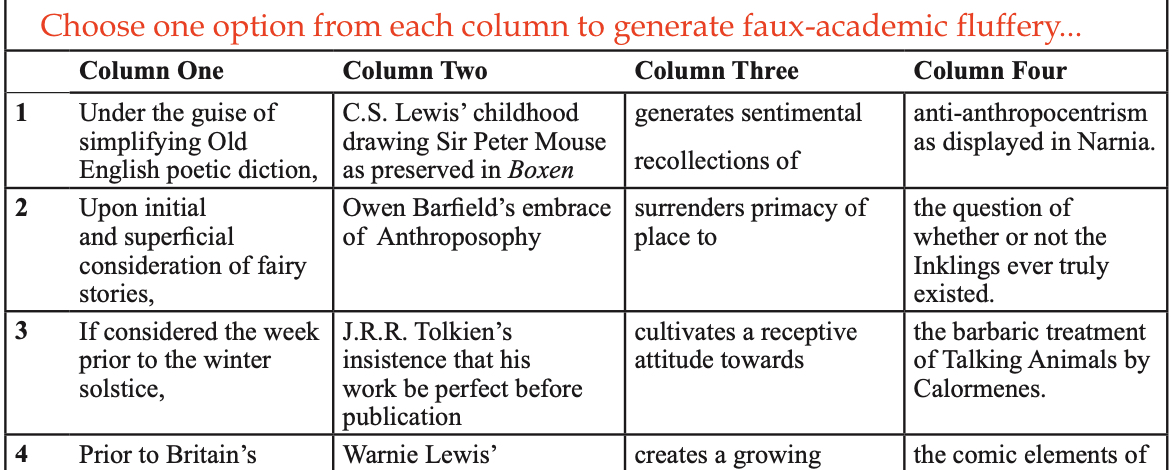
Rather than write a longer column here, I want to provide a link to an unusual article I recently wrote related to this subject. If you have a sense of humor, and are not afflicted with academic grandiosity, please check it out. It appeared this past week in the latest issue of CSL: The Bulletin of the New York C.S. Lewis Society.
CSL is a small but mighty (think Reepicheep) publication. It’s worth subscribing to, even for those of us thousands of miles from their regular meetings in the Empire State.
My article is brief, but it includes “the Mere Oxford Inkling Erudition Chart,” which promises countless hours of educational entertainment.
The people my satire seeks to unmask are the type of academics who attempted to make Oxford and Cambridge Universities so inhospitable to C.S. Lewis. Read this interview with one of his former student who critiques the opinions of lesser minds.
The BBC [invited him to broadcast the] talks that ultimately became Mere Christianity. The BBC was astounded by the response to these talks. As you know, Mere Christianity has never been out of print since.
He then became very unpopular with the senior faculty at Magdalen College. Magdalen was a godless college and a very famous college, very atheistical. . . . So [Lewis] got a rough ride there. He never made professor at Oxford.
So much for the civility one would expect in such environs.
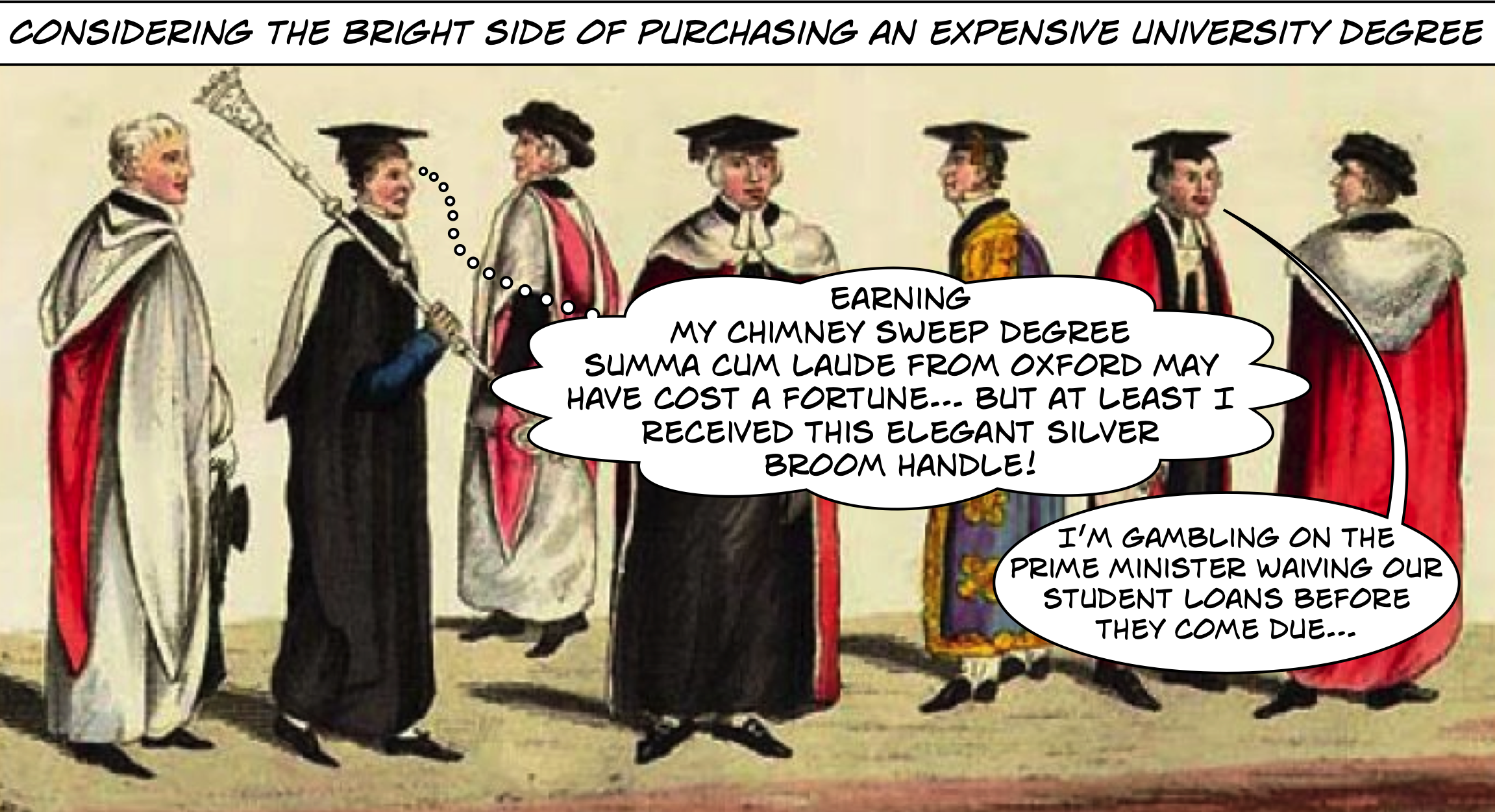
Rich people don’t need to worry about the cost of college educations. The rest of us do (or, at least, we should). C.S. Lewis could not rely on family wealth to pursue his academic dreams, and we can learn from his example.
My wife and I were the first members of our respective families to attend college. Without assistance from our parents, we did chose the most fiscally responsible path. We opted for a public university (in my own case, via “community college”) and worked as many hours a week as we could while maintaining our grades.
Even this would have been far more difficult without receiving student loans, which we diligently repaid following our graduations.
Years later, we were in a position to help our own children pursue their higher educational aspirations. Still, graduate degrees are not inexpensive, and all three of them received government-backed loans to get them to the finish line.
They have been diligently repaying that borrowed money since graduation and never complained about the debt, since no one coerced them to accept it.
Our daughter, in fact, made significant sacrifices to pay off her student loans as quickly as possible, and accomplished that goal far earlier than we imagined she would.
Here at Mere Inkling, we go to great lengths to avoid political partisanship. In addition to that, I’ve made it quite clear I have no illusions about understanding economics.
Nevertheless, it requires no genius intellect to imagine how people who sacrificed to pay off their personal debts feel about now having to (thorough their taxes) also pay off the sometimes-delinquent debts of their peers. Our middle class family is only one of presumably millions who are experiencing this personally today.
Who Paid for C.S. Lewis’ Collegiate Studies?
The world has changed much since C.S. Lewis left home for boarding school and ultimately, for the university. It was unsurprising that when his father was widowed while his sons were young, he entrusted them to schools where he assumed they would be safe, and well prepared for their future professions.
Once the boys were old enough to choose career paths, Warnie (1895-1973) pursued a military profession. Following graduation from the U.K.’s Royal Military Academy Sandhurst, he served in both World Wars. However, as one writer accurately notes, “perhaps Warnie could have accomplished far more, but his lifelong struggles with alcoholism kept him from doing so. Some have speculated Warnie’s alcoholism resulted in an earlier retirement from the military than he would have wished.”
As for the younger Lewis scion, Clive would eventually make major contributions on the faculties of both Oxford and Cambridge Universities.
Getting there took some time, and was interrupted by the First World War. After his recuperation as a seriously wounded veteran of the trenches, Lewis renewed his academic studies. Discovery Institute has an excellent article describing “C.S. Lewis and the Ceremonies at Oxford University (1917-1925).” I particularly enjoy Kathryn Lindskoog’s understatement that “Oxford University, in Lewis’s time and since, is not the best place to learn Christian humility . . .”
As a student, Lewis was reliant on continuing support from his father. Only after graduating and beginning to receive a stipend as a Fellow of Magdalen College in 1925, did Lewis consider himself financially independent. (The year prior he had received a modest salary from the college, as an employee of the College, but it was inadequate to meet his needs.)
During his college studies, despite a scholarship, he relied on his father’s generosity. His opening in a 1919 letter to his father illustrates this relationship.
Many thanks for your letter and also for the enclosed cheque for £19.12.8. That amount includes all the charges both for tuition and college expenses and may serve as a base for future calculation, tho’ of course there may be slight differences from term to term.
Still, even in the best of families, financial considerations may become a matter of concern. Five years later, as he was at the end of his life as a student, his father was wondering when he would become satisfactorily employed. (That’s a conversation replayed around the globe on a daily basis.) The first two paragraphs illustrate the theme, but you won’t be disappointed if you have the time to read the entire passage.
And now to business. The Univ. Fellowship has not been filled up. You may have read in the papers that a new ‘Chaplain Fellow’ has been elected, but that of course is a different job. If I don’t mention it, it is because there is nothing new to say about it. Just at present a new and very good vacancy at Trinity (I mean Trinity, Oxford of course) has appeared, for which an election is to be held in the summer, and I shall certainly go in for it.
As to money: I had rather you had explained in detail what you ‘don’t follow’ in my arithmetic, but I trust there is nothing seriously wrong with the figures I gave you and will proceed accordingly. What is more serious is your reference to £30 extras last year. The only part of this which I can at present identify are the extra tuition and the book bill. The former of course was purely abnormal and will not occur again. The book bill was naturally increased by my turning to a new subject.
I try to use the libraries as much as possible: but when one is reading for a particular exam there are over a hundred other people taking the same books out of the libraries – and of course there are some things one must have at command. My expenditure on books will be less in future. I have a book bill due to be paid some time soon which is under five pounds: if you will pay that I think I can undertake to find myself for books in the future – tho’ since you tell me to be frank, I will say that this may not always be easy.
The rest of the £30 you mention is, I suppose, made up by items of clothing. I presume it does not include my two suits? As to clothing, I’m afraid that even if you increase my allowance as you suggest, I cannot undertake to find myself.
I mean that my loss of the scholarship and my outlay on clothes would not be balanced by an addition of £40 or £50. I cannot see how to cut down my expenses on clothing. You know I think that it does not go to fancy waistcoats or kid gloves. And I have some ties that date from before the war!
Flannel trousers are an item that I have to repeat pretty often: they ARE ill wearing things, but if I didn’t wear them I should need suits more often than I do. On shoes I admit that I am hard and have to get a good deal of ‘soling’ done: but I am afraid this reads rather as if I were defending myself against a charge of extravagance, which you will justly reply you never made: but you must not think that. I am only trying to put down the facts of the question as they actually occur to me from day to day in order to make my conclusion more reasonable and intelligible to you.
And the conclusion is this. You ask me where £85 a term to ‘cover everything’ would be sufficient. If by ‘covering everything’ you mean covering my books, shoes, shirts, socks and other items that I have hitherto sent you, I am afraid it would not. As I said, if you wish it, I will try to undertake my own books in the future, and, at any rate to cut them down.
I will also abandon the new dinner jacket suit that was mooted, and you must not imagine that I would feel that sort of curtailment as any hardship. As for a new overcoat, the one you gave me when I left home suits and fits me so well that the question need not be considered. But I do not think that I can manage to keep myself in minor articles of clothing.
I’m afraid this may seem to you but a charter of indefinite expenses for the future. Well then, to say all, if it is too much, you must tell me so. You have done all and more than all I can expect of you, and if you tell me that these extra years are too heavy, I assure you that I shall never, even in my secret thought, criticise such a decision.
If on the other hand, you see fit to lodge £85 a year and to pay for such extras in the way of clothing, etc. as may occur, I will try to make them as little as I can. I must point out however that it is much easier to save on the big items I have mentioned – the dress suit and overcoat – than on those necessary articles which have so often to be replaced.
If you will give me a dress suit when I get a job, I ought to be able to tide over these years without any more ‘suitings’ from you at all. If, till they are over, you can lodge £85 a term and make it retrospective for the present year, while paying for my smaller articles of clothing, I think I can manage. And whether you can do this or not, I have nothing but deepest gratitude for the past.
So, once again we see that C.S. Lewis’ experiences were not all that different from our own. Most people who have accepted their parents’ financial aid during their adulthood, can identify with Lewis’ mixture of sincere gratitude and muted frustration.
Perhaps it is a very good thing that today we have so many different assistance programs for potential students. Good things, I believe, as long as they are not abused – and borrowers pay them back, as they promised.
I clearly remember my mother preparing to attend her fortieth high school reunion. I was struck by the thought wow, my mom is really old!
A few days ago, I attended my own fiftieth reunion. Needless to say, the milestone was sobering.
Read on and I’ll share two insights – the first of which is widely recognized, the second thought is a personal insight to the emotional trauma that can accompany these gatherings.
As the decades advance, most such events add a moment where the names of classmates who are deceased are read. Naturally, the list continues to grow. From my class of 220, 38 are no longer alive. One can only imagine how many of the 74 graduates the steering committee couldn’t reach belong on that list as well.
Seeing the names of people you remember as energetic teenagers, who have already perished, reminds us of our own mortality. Not a single person can be sure their own name won’t appear on that memorial roster, when next the class of 1972 gathers.
Death is rarely a welcome specter, but as a Christian who is confident of the resurrection, reading those names does not elicit fear. True, I do feel some sadness, knowing that each of their families and friends have suffered deep personal loss. But I am resigned to the brevity of life in this world.
I’ve arrived at peace with the fact that we “do not know what tomorrow will bring . . . for [we] are a mist that appears for a little time and then vanishes” (James 4).
King David declared our utter dependence on God for everything, and the short duration of our earthly life.
O Lord, make me know my end and what is the measure of my days; let me know how fleeting I am! Behold, you have made my days a few handbreadths, and my lifetime is as nothing before you. Surely all mankind stands as a mere breath! (Psalm 39).
Fortunately, however, as most people have at least heard, if not (yet) believed: “For God so loved the world, that he gave his only Son, that whoever believes in him should not perish but have eternal life. For God did not send his Son into the world to condemn the world, but in order that the world might be saved through him” (John 3).
This aspect of class reunions is self-evident. The next, less so.
The Legacy of Isolation
Why is it that so many of my classmates opted to skip the reunion – when I know for a fact that a number of them still live in the local area? I suppose the cost may have discouraged some. But I recognize the most significant reason for the majority who were absent.
They felt they were never part of “the In Crowd.” They watched other people standing in the limelight, getting all of the attention, and pretending to be happy and carefree.
The truth is that adolescence is a challenge for everyone. And it’s quite possible that the most “popular” kids are actually the most angst-ridden. The people we considered safely nestled in the popular cliques were frequently stressed by their insecurities about continuing to be perceived as winners.
In many cases, the years after high school are great equalizers. And, it’s not uncommon for the people who appeared to have the easiest social paths during their teens to be the least equipped to live successful adult lives.
So far, what I’ve said is not too surprising. But here I am going to take a bit of a leap. I make no claims to being a psychologist, but as a dedicated student of humanity, and a pastor who has heard many private, personal stories, I believe this observation to be true.
While we were teenagers attending school, nearly all of us felt like we were on the fringe of our school’s social core. And the handful who didn’t could well have been nascent narcissists. Trust me, the few who experienced actual delusions of grandeur at that time, were destined to take the greatest falls as they left that insulated environment.
So, this is what I think. Most of those who choose not to attend their class reunions, lacked a feeling of truly belonging. But, on the other side of the very same coin, most of those who choose to attend those very same gatherings also felt like they were insignificant people on the periphery of what was “happening.”
The Lord of this world (Lucifer) invests a great deal of energy trying to destroy the self-image of women and men who were created in the very image of God. My prayer is that if you have read this far, you consider what I’ve written. You are precious. You have always been precious, even when you considered yourself most ugly.
Attending your next class reunion may not be something you desire to do. But, don’t allow a false perception that you are unimportant be the reason you skip the event.
C.S. Lewis wrote a superb essay on the subject of “The Inner Ring,” and the temptation people have to compromise their integrity trying to fit in. He presented it as a lecture at King’s College, University of London, in 1944. In his words, “Of all the passions, the passion for the Inner Ring is most skillful in making a man who is not yet a very bad man do very bad things.”
If you read the essay, which I heartily recommend, recognize that he was speaking to a student audience which consisted only of men. The truths he describes are applicable, of course, to both genders. Lewis’ observations certainly ring true with me.
I believe that in all men’s lives at certain periods, and in many men’s lives at all periods between infancy and extreme old age, one of the most dominant elements is the desire to be inside the local Ring and the terror of being left outside.
Sketch the development of human thought, estimate its significance. Compare with the development of any other kind of thought.
In contrast to the serious tone of the last two posts, today I am offering some edifying entertainment. As a gift to you, I have edited a perennial favorite of internet humorists. I recently came across my copy of this comprehensive knowledge examination, which motivated me to tweak it for Mere Inkling’s erudite audience.
You have probably seen versions of this exam in the past. The basic questions have remained surprisingly stable despite its age. I encountered it in the University of Washington campus paper in 1973. One writer claims “the Graduation Exam—Authentic Assessment has been in circulation since at least the 1950’s.”
The exam certainly makes the rounds, as this Navy veteran described.
The pressures of comprehensive exams were apparent to many, which resulted in one of the few officially sanctioned jokes in Naval Nuclear Power. In one of the official publications of Naval Reactors, someone inserted a sample “final exam” from Nuclear Power School.
In 2012 elements of the examination created confusion in the People’s Republic of China. It was included in an article about how Chinese nationals could prepare for an American State Department exam required for positions at the United States embassy in Beijing. According to China’s Global Times, “US embassy spokesman Richard Buangan made clear on his Sina microblog Sunday that an alleged ‘recruitment test for expatriate employees at the US embassy’ is fake.”
A June 2008 issue of Foreign Service Journal carried a story, which includes an English version of the [exam stating] the questions are from the US State Department’s entrance exam, in a bid to “measure the stability of perspective Foreign Service officers and to weed out the dummies.”
The Function of Examinations
Testing and documenting competence is obviously important. This is especially true for people in critical roles, such as prescribing drugs, designing aircraft engines, and manufacturing ice cream.
Of course, not everyone is able to pass every test. Which is precisely how things should be.
C.S. Lewis noted how educators truly familiar with their students readily recognize when it is a waste of time for them to continue repeating an exam they obviously cannot pass. He said an academic “master often knows, when boys and parents do not, that it is really useless to send a boy in for a certain examination again” (The Problem of Pain).
I have met very few people who enjoy being tested. Yet, for many faculty members (C.S. Lewis included), being on the “other side” of exams is not particularly enjoyable either. This delightful passage comes from a 1927 letter to his brother, Warnie.
My period of examining passed over with its usual accompaniment of neuralgia and oaths, relieved by the one excellent boy who defined ‘a genie’ correctly, yet more than correctly, as ‘an eastern spirit inhabiting bottles and buttons and rings.’ Pretty good for a boy.
I was also pleased with a youth who, being asked to write a letter to a friend recommending Guy Mannering,* wrote to his brother recommending it and saying ‘I think you would be interested in the character of Colonel Mannering, he is so like our father’: and then later in a paper on Guy Mannering in which I had set the question ‘Would you have liked Colonel Mannering as a father?’—illustrate your answer etc.—began decisively ‘I would not have liked Colonel Mannering as a father in the least.’
Well, it’s time now to offer you the opportunity to prove your worthiness. If you wish to evidence the breadth and depth of your knowledge, proceed now to the exam. (Astute readers will note I’ve added a personal twist to a couple of the exam questions.)
Comprehensive Knowledge Exam
HISTORY: Describe the history of the papacy from its origins to the present day, concentrating especially, but not exclusively, on its social, political, economic, religious, and philosophical impact on Europe, Asia, North and South America, and Africa. Be brief, concise, and specific. Now do the same for the Zoroastrian priesthood. [Bonus credit for including Antarctica in your response.]
MEDICINE: You have been provided with a razor blade, a piece of gauze and a bottle of scotch. Remove your appendix. Do not suture until your work has been inspected. You have fifteen minutes. [Option: if you feel the scotch would impair your responses to the remaining questions, you may defer this portion of the exam to the end of the exam.]
PUBLIC SPEAKING: Two thousand riot-crazed anarchists are storming the campus. Calm them. You may use any ancient language except Latin, Greek or Sanskrit. [Pig Latin is allowed.]
BIOLOGY: Postulate the 500 million year progression of a life form based on silicon, ranking its likely preference for form of government Enumerate the pros and cons it would associate with democracy, monarchy, socialism, theocracy, and totalitarianism. [Caution: any references to the Horta of Janus VI will result in disqualification of your answer, since Star Trek is a fictional resource.]
MUSIC: Write a piano concerto. Orchestrate and perform it with flute and digeridoo. You will find a piano under your seat. The wind instruments, of course, were among the items you were directed to bring with you to the examination.
PSYCHOLOGY: Based on your knowledge of their works, evaluate the emotional stability, degree of adjustment, and repressed frustrations of each of the following: Alexander of Aphrodisias, Hildegard of Bingen, Rābi’a bint Ka’b al-Quzdārī and Simeon the Stylite. Support your evaluation with quotations from each individual’s work, citing original sources. It is not necessary to translate.
SOCIOLOGY: Using the pretext of Planet of the Apes, where homo sapiens have been subordinated to various primate species, assess the prospects for achieving mutual toleration and equilibrium before one group is driven to extinction. [Caution: confusion of apes (which lack tails) and monkeys (which lack an appendix) will result in disqualification of your response.]
CHEMISTRY: Transform lead into gold. You will find a beaker, a three hundred count box of matches and five lead sinkers under your seat. Show all work including Feynman diagrams and quantum functions for all steps. [Transformation into silver will provide half credit.]
ENGINEERING: The disassembled parts of a high-powered rifle have been placed on your desk. You will also find an instruction manual, printed in Swahili. In 10 minutes a hungry Bengal tiger will be admitted to the room. [Special Consideration: Satisfactorily explain the differences between Fahrenheit and Celsius to the tiger, and it will be replaced by a rabid ferret.]
ECONOMICS: Develop a realistic plan for refinancing global debt, without hypothesizing a benevolent intergalactic alliance with unlimited resources coming to the planet’s aid. Trace the possible effects of your plan in the following areas: Cubism, the Donatist controversy, and the 1913 foundation of Hôpital Albert Schweitzer in Gabon.
POLITICAL SCIENCE: Devise an infallible, seven-step plan to transform the United Nations into an organization that will successfully foster peace and goodwill in all international relationships. [Bonus credit for providing a major role for two of the following nations: Dominica, Liechtenstein, Tuvalu.]
AGRICULTURAL SCIENCE: Outline the steps involved in breeding your own super high yield, all weather hybrid strain of wheat. Describe its chemical and physical properties and estimate its impact on world food supplies. Construct a model for dealing with world-wide surpluses. Draft your Nobel Prize acceptance speech.
PHYSICS: Explain the nature of matter. Include in your answer an evaluation of the impact of the development of mathematics on astronomy, botany and numismatics. [Bonus Credit: write today’s date in metric.]
PHILOSOPHY: Sketch the development of human thought, estimate its significance. Compare with the development of any other kind of thought. Be sure to include an analysis of the influence exerted on philosophy by Diogenes the Cynic.
CREATIVE WRITING: Compose an epic poem based on the events of your own life in which you see and footnote allusions from T.S. Eliot, Titus Lucretius Carus, Miguel de Cervantes, Dante Alighieri, Þorbjörn Hornklofi, Gilgamesh and Stephen King. Critique your poem with a full discussion of its syntax and metrics. [Bonus Credit for writing alternating stanzas between free and rhyming verse.]
EDUCATION: Formulate an examination which accurately measures an individual’s comprehensive knowledge base without cultural or linguistic prejudice. Limit the question parameters to what can reasonably be covered during a four hour testing block.
LITERATURE: Discuss in detail at least three major literary figures from each of the following civilizations: the Xia Dynasty, the Akkadian Empire, the Mayan Empire, the Aksumite Empire, the Polynesian Tuʻi Tonga Empire, and nineteenth century United Kingdom. [Caution: failure to include J.R.R. Tolkien and/or C.S. Lewis will result in disqualification of your answer to this question.]
Congratulations on finishing the exam. You are encouraged to use any remaining time to review your answers in light of the fact that grammatical errors and misspellings will significantly impact your final grade.
* You can download a personal copy of Guy Mannering, one of Sir Walter Scott’s Waverly novels, at Internet Archive.
If you should question the distinctions I noted between apes and monkeys, please know that the facts are genuine. However, for future examinations, you should be aware that not all monkeys have tails.
How
should Christians relate to modern culture? Should they try to identify with
culture so they are indistinguishable from their secular peers? Or, would it be
better for them to stand aloof from a society espousing a worldview
diametrically opposed to their own?
C.S.
Lewis would recommend a different course. He would be saddened by Christians
who felt compelled to pander to the ideals of contemporary culture. At the same
time, he would be offended by disciples of Jesus who deemed themselves too
enlightened—or, God forbid, holy—to stoop to engage with modern civilization.
In his essay “Christianity and Culture,”* Lewis begins by pointing out that the omnipresence of culture makes us unconscious of its independence from our religious worldview.
At an early age I came to believe that the life of culture (that is, of intellectual and aesthetic activity) was very good for its own sake, or even that it was good for man. After my conversion, which occurred in my later twenties, I continued to hold this belief without consciously asking how it could be reconciled with my new belief that the end of human life was salvation in Christ and the glorifying of God.
After
this epiphany, Lewis began to consciously explore the proper relationship a
believer should have with culture. And, his conclusion rejected both of the aforementioned
extremes.
Culture has been on my mind since reading the 2019-20 schedule of the Fellowship of Performing Arts. I have written about two of the Lewis-related plays presented by this wonderful theatrical community in the past. The Great Divorce and C.S. Lewis Onstage: The Most Reluctant Convert were both superb. I’m hoping that The Screwtape Letters will return to Seattle soon. All of their work is deeply inspiring.
The founder of FPA, Max McLean, affirms how their mission—producing quality “theatre from a Christian worldview meant to engage a diverse audience”—continues to guide their efforts. This includes a new rendition of Paradise Lost which will debut on Theater Row in New York in January. You won’t get to see the new play outside of New York City, but check this site for a list of their touring casts to see what wondrous performances may be available near you.
McLean
writes, “In the arts world, Christians are seen as cultural critics, not
culture makers. Mainstream opinion is that Christianity is a regressive idea
that has nothing to add to the cultural conversation.”
McLean, like C.S. Lewis, encourages us to challenge this misinterpretation. After all, even if some Christian communions have retreated from the modern Areopagus, most of the great cultural accomplishments of the Western world owe a great deal to Christianity. And that is a debt of gratitude we can increase when we choose.
Culture is Not Our Enemy
Lewis
posed an interesting contrast in “Christianity and Culture.” Speaking of the
positive aspects of culture (for there are assuredly many shortcomings), he
writes:
Culture is a storehouse of the best (sub-Christian) values. These values are in themselves of the soul, not the spirit. But God created the soul. Its values may be expected, therefore, to contain some reflection or antepast of the spiritual values. They will save no man. They resemble the regenerate life only as affection resembles charity, or honour resembles virtue, or the moon the sun.
But though “like is not the same,” it is better than unlike. Imitation may pass into initiation. For some it is a good beginning. For others it is not; culture is not everyone’s road into Jerusalem, and for some it is a road out.
This
final observation—that immersion in culture can lead one on a path away from Life—is profound. I have
witnessed this in the action of some who make cultural sophistication an end in
itself.
In
a far different essay, “Learning in War-Time,” C.S. Lewis elucidates how
culture is a given. Even the most earnest prayers of the eremites can dispel it.
No cloister has walls so impenetrable that they make culture irrelevant.
In
the context, then, of education, Lewis describes the necessity of Christians
engaging deeply with culture.
If all the world were Christian, it might not matter if all the world were uneducated. But, as it is, a cultural life will exist outside the Church whether it exists inside or not. To be ignorant and simple now—not to be able to meet enemies on their own ground—would be to throw down our weapons, and to betray our uneducated brethren who have, under God, no defence but us against the intellectual attacks of the heathen.
Good philosophy must exist, if for no other reason, because bad philosophy needs to be answered. The cool intellect must work not only against cool intellect on the other side, but against the muddy heathen mysticisms which deny intellect altogether.
Most of all, perhaps, we need intimate knowledge of the past. Not that the past has any magic about it, but because we cannot study the future, and yet need something to set against the present, to remind us that the basic assumptions have been quite different in different periods and that much which seems certain to the uneducated is merely temporary fashion.
A man who has lived in many places is not likely to be deceived by the local errors of his native village: the scholar has lived in many times and is therefore in some degree immune from the great cataract of nonsense that pours from the press and the microphone of his own age. The learned life then is, for some, a duty.
And
so, just as the “learned life” is a duty for some, so too is an “artistic life.”
It is a good thing, perhaps even an excellent
thing, when Christians excel at the arts and talents esteemed by one’s local culture.
What
might change if Christians decided to forego their identity as mere cultural
critics and strove to become cultural leaders? Now that’s a question worth
pondering.
* T.S. Eliot wrote a book with the same title. Published seventy years ago, he assessed a cultural conflict that has only grown more acute.
The problem of leading a Christian life in a non-Christian society is now very present to us, and it is a very different problem from that of the accommodation between an Established Church and dissenters. It is not merely the problem of a minority in a society of individuals holding an alien belief.
It is the problem constituted by our implication in a network of institutions from which we cannot dissociate ourselves: institutions the operation of which appears no longer neutral, but non-Christian. And as for the Christian who is not conscious of his dilemma—and he is in the majority—he is becoming more and more de-Christianized by all sorts of unconscious pressure: paganism holds all the most valuable advertising space.
Wouldn’t it be amazing to read about the adventures, struggles, triumphs, thoughts, and dreams of real animals? C.S. Lewis thought so.
Admittedly, referring to the thoughts and dreams of a squirrel or a hummingbird is a bit fanciful. But isn’t it feasible to imagine that a pregnant doe is hoping to find a lush meadow, or that a beaver who’s just finished a fine meal is gratefully contented as he snuggles down for the night in his lodge?
In one of his thought-provoking books—which I enthusiastically recommend to everyone who likes to read—Lewis describes exactly how reading is vital to expanding our world. “Those of us who have been true readers all our life seldom fully realise the enormous extension of our being which we owe to authors” (An Experiment in Criticism).
In this volume, Lewis argues that books are better measured by how they are read, than by how they are written. In other words, Lewis is making the case that the true value of a book is not determined by the skill the author applied to its creation. Instead, Lewis writes, “so far as I can see . . . the specific value or good of literature [is that] it admits us to experiences other than our own.”
Lewis continues, with a fascinating discussion of his “experiment,” which flips traditional literary criticism on its head. Don’t rush through the following excerpt from the argument. It’s well worth taking your time to ponder his words and see if you agree.
[The experiences of others] are not, any more than our personal experiences, all equally worth having. Some, as we say, ‘interest’ us more than others. The causes of this interest are naturally extremely various and differ from one man to another; it may be the typical (and we say ‘How true!’) or the abnormal (and we say ‘How strange !’); it may be the beautiful, the terrible, the awe-inspiring, the exhilarating, the pathetic , the comic, or the merely piquant. Literature gives the entrée to them all.
Those of us who have been true readers all our life seldom fully realise the enormous extension of our being which we owe to authors. We realise it best when we talk with an unliterary friend. He may be full of goodness and good sense but he inhabits a tiny world. In it, we should be suffocated. The man who is contented to be only himself, and therefore less a self, is in prison.
My own eyes are not enough for me, I will see through those of others. Reality, even seen through the eyes of many, is not enough. I will see what others have invented. Even the eyes of all humanity are not enough.
At this point we arrive at the utterly Lewisian notion that even animals (e.g. uncivilized “brutes”) would be capable of broadening the horizons of our own thinking.
I regret that the brutes cannot write books. Very gladly would I learn what face things present to a mouse or a bee; more gladly still would I perceive the olfactory world charged with all the information and emotion it carries for a dog.
Literary experience heals the wound, without undermining the privilege, of individuality. There are mass emotions which heal the wound; but they destroy the privilege. In them our separate selves are pooled and we sink back into sub-individuality.
But in reading great literature I become a thousand men and yet remain myself. Like the night sky in the Greek poem, I see with a myriad eyes, but it is still I who see. Here, as in worship, in love, in moral action, and in knowing, I transcend myself; and am never more myself than when I do” (An Experiment in Criticism).
On the Subject of Reading & Rereading
If you need any more encouragement to seek out a copy of this wonderful book, allow me to share with you two profound points Lewis makes in support of his distinction between “literary” and “unliterary” people. (Lewis, of course, does not demean the latter. On the contrary, he grieves for the “tiny world” they choose to inhabit.)
The majority [of unliterary people], though they are sometimes frequent readers, do not set much store by reading. They turn to it as a last resource. They abandon it with alacrity as soon as any alternative pastime turns up. It is kept for railway journeys, illnesses, odd moments of enforced solitude, or for the process called ‘reading oneself to sleep.’
They sometimes combine it with desultory conversation; often, with listening to the radio. But literary people are always looking for leisure and silence in which to read and do so with their whole attention (An Experiment in Criticism).
In terms of rereading, Lewis was a fervent advocate of reading good books more than once. Most of us would say lack of time is the greatest deterrent to rereading classics, but most of us do have some favorites that we have returned to more than once.
The majority never read anything twice. The sure mark of an unliterary man is that he considers ‘I’ve read it already’ to be a conclusive argument against reading a work. We have all known women who remembered a novel so dimly that they had to stand for half an hour in the library skimming through it before they were certain they had once read it.
But the moment they became certain, they rejected it immediately. It was for them dead, like a burnt-out match, an old railway ticket, or yesterday’s paper; they had already used it (An Experiment in Criticism).
In contrast, Lewis describes how “those who read great works, on the other hand, will read the same work ten, twenty or thirty times during the course of their life.” Many of us would initially think our rereading frequency falls short of those specific tallies, perhaps we should reconsider. After all, most readers of Mere Inkling reread with great frequency portions of a particular library of sixty-six books,* gathered together in a book called the Bible.
* More books in the Roman Catholic and Eastern Orthodox collection of the Scriptures, which include seven Deuterocanonical books. Fewer, of course, for our Jewish friends who follow the teachings of twenty-four books, which are also included in the Christian Bible.
If C.S. Lewis had desired to teach English in China he would probably have succeeded. However, due to some rather peculiar requirements, he may not have passed muster.
In that Asian nation, you need four years of college to become a teacher. At 山西师范大学 (Shaanxi Normal University) they include another odd requirement. Shaanxi has a minimal height standard. Men must be at least 5-foot-1 and women must be no shorter than 4-foot-7.
C.S. Lewis would have passed this mandate; he was just shy of 5-foot-11. But who knows what other arbitrary dictates may have barred him from sharing his brilliant mind.
The university’s policy came to international attention when the plight of a young student who completed her studies only to be informed that she was four inches too short to receive her diploma. As the BBC reports, there is a waiver for those who wish to teach the very young.
Those wanting to teach at nursery are able to apply for special accreditation if they are five centimetres shorter.
The school’s, albeit flimsy, rationale is that teachers may need to reach high on blackboards when they are teaching their students. (So much for using modern technology to compensate.)*
It would be bad enough if they failed to admit such candidates to their program, but obviously some are not informed of the standard until they have completed their university studies. One can hardly imagine how that unfortunate graduate felt.
C.S. Lewis spent his academic life at Oxford and Cambridge. Although he lectured in a variety of venues, no international university was blessed to have him serve as a visiting scholar.
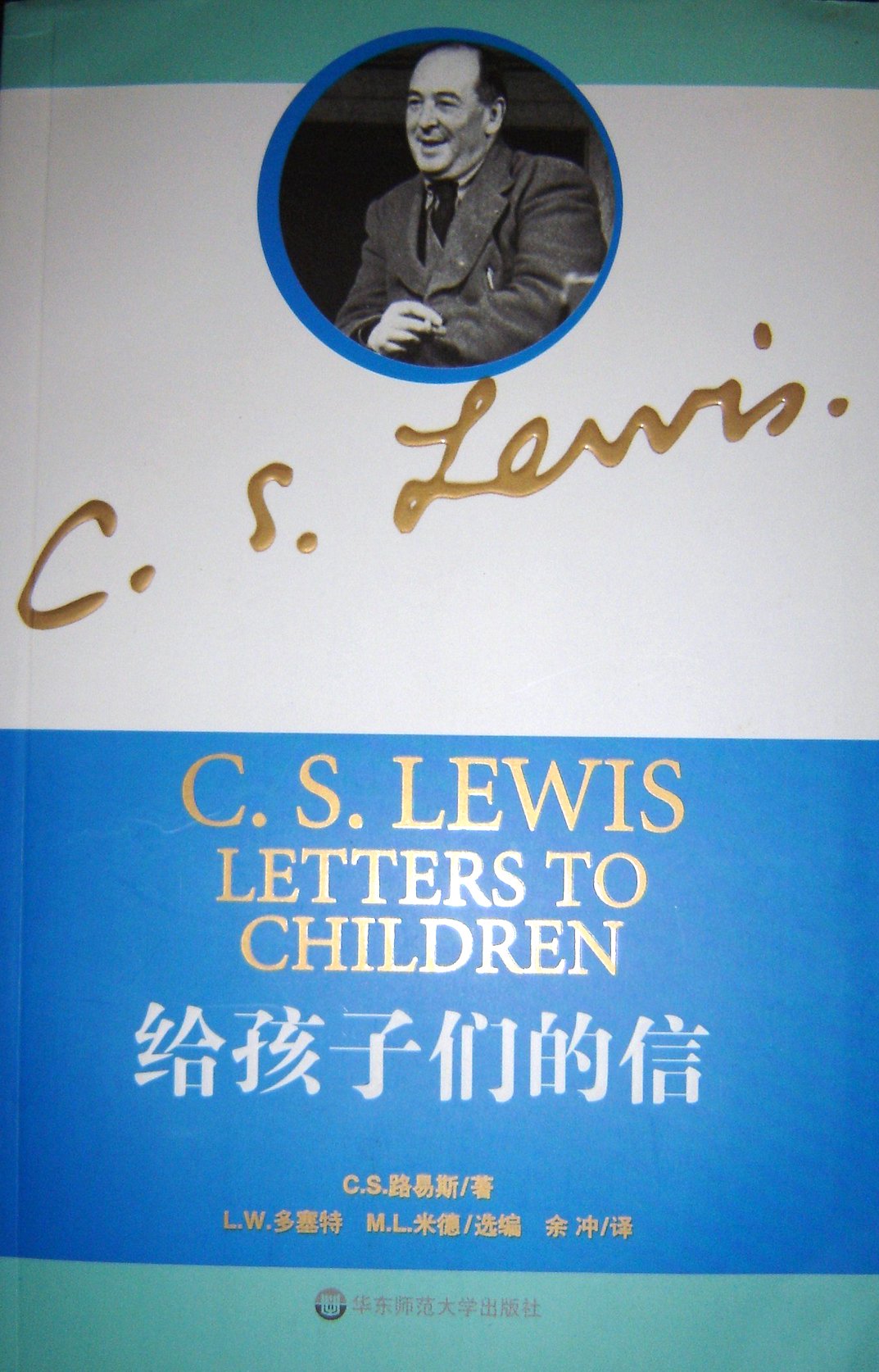
Fortunately, however, his words reached far beyond the campuses of Oxbridge. And, even though Lewis never taught in China (or in Chinese), his words are available today via translation. At Wheaton College, the Marion E. Wade Center preserves a great deal of information about the Inklings, including some original material.
The Wade’s translation collection has a diverse amount of languages represented, even if only by one book. The languages at the Wade include: Afrikaans, Albanian, Arabic, Bulgarian, Catalan, Chinese, Croatian, Czech, Danish, Dutch, Esperanto, Estonian, Faroese, Finnish, French, Gaelic, German, Greek, Hebrew, Hungarian, Indonesian, Italian, Japanese, Korean, Latin, Latvian, Lithuanian, Norwegian, Polish, Portuguese, Romanian, Russian, Serbian, Slovak, Slovenian, Spanish, Swedish, Thai, Turkish, Ukrainian, and Welsh.
A Two-Way Street
Those of us who have taught realize better than others that teachers often learn as much from their students as they offer to them. Preparing to teach demands that we study to know the subject matter as intimately as we can, so we might convey it effectively to others.
Although he was a brilliant teacher, C.S. Lewis was also a diligent lifelong learner.
Lewis held great respect for Chinese civilization. He was interested in the Chinese philosophical concept of the Tao. I’ve written about his thoughts on this subject before.
Lewis viewed the Tao as being similar to what Christian theologians traditionally refer to as Natural Law.
The Tao, which others may call Natural Law or Traditional Morality or the First Principles of Practical Reason or the First Platitudes, is not one among a series of possible systems of value. It is the sole source of all value judgments.
If it is rejected, all value is rejected. If any value is retained, it is retained. The effort to refute it and raise a new system of value in its place is self-contradictory. There has never been, and never will be, a radically new judgment of value in the history of the world.
What purport to be new systems or . . . ideologies . . . all consist of fragments from the Tao itself, arbitrarily wrenched from their context in the whole and then swollen to madness in their isolation, yet still owing to the Tao and to it alone such validity as they possess. (The Abolition of Man)
Lewis was an advocate of what some refer to as Classical Education. It involves loftier goals than simply communicating data. In his essay “Our English Syllabus,” Lewis “propagated education’s end, rather than as the filling of students’ heads with information or their muscles with habits, as the inculcation of virtue.”
Lewis treasured the essence of knowledge rather than its trappings. He was patient with those genuinely hungry for knowledge. But you could also readily apply to him the maxim that he did not suffer fools gladly.
It does not take a genius to discern what C.S. Lewis would have thought about this Chinese height requirement. To prevent a motivated and capable educator from pursuing her vocation simply because she may lack the reach of someone taller, does not pass the test of common sense.
* “The first interactive whiteboard was released in 1991,” and I assume The People’s Republic “magically” secured that very technology no later than 1992.





 Mere Inkling Press