C.S. Lewis and the Five Senses

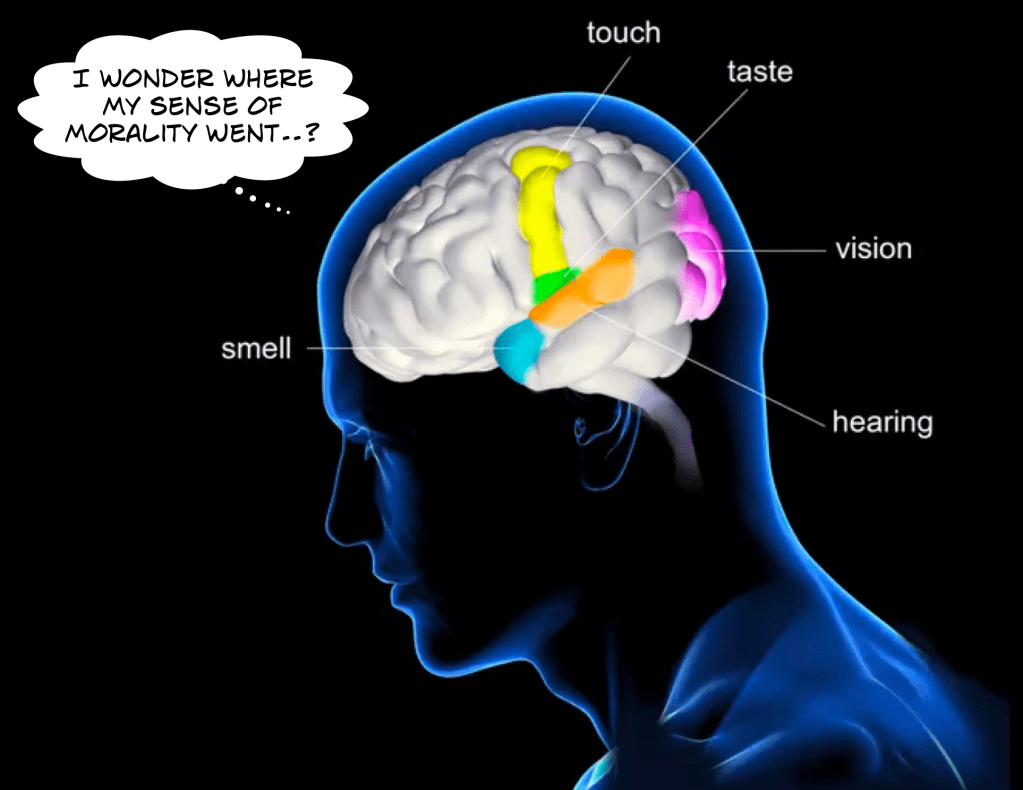
One of the earliest lessons children learn is how many senses the human being possesses. You know the answer off the top of your head, right? Five. But, apparently, that’s no longer correct. Oh, you may think I must be including that long-time poser, extrasensory perception (ESP), which purports to be a sense of sorts beyond the five we all experience. If you thought that . . . sorry, but you are wrong again.

We all agree on the basic five: the faculties of sight, hearing, taste, smell, and touch. To this list, science has recently added several other senses we experience. They’re not actually new; Adam and Eve knew them too (with the possible exception of nociception). They actually make sense (in the other use of the word), as well. Here they are:

Proprioception – perceiving where your body parts are relative to one another, and the strength of effort being employed in movement

Thermoception – sensing temperature

Equilibrioception – perception of balance

Chronoception – sensing the passage of time

Interoception – feeling internal needs such as hunger and thirst

Nociception – experiencing pain

More expansive lists exist as well. Some are discussed online at The United Kingdom’s Sensory Trust. The Trust is devoted to “sensory design . . . [using] nature and the outdoors to improve the health and wellbeing of people living with disability and health issues.” They describe how “neurological classification” can result in numbers up to fifty-three. (It makes one long for the simplicity of the past when we followed Aristotle’s citation of only five.)

C.S. Lewis’ Celebration of Life

You can pick up nearly any one of Lewis’ essays or fiction, open to any page of his autobiography, read almost any of his letters, and you will see his love for nature. And Lewis is often quite vivid in his description of his encounter with God’s creation. The sights, sounds and smells he describes make the depictions real. Consider his description of Tash, the “god” worshipped by the Calormenes, in The Last Battle.

[King Tirian said] “What foul smell is this?”

“Phew!” gasped Eustace. “It’s like something dead. Is there a dead bird somewhere about? And why didn’t we notice it before?”

With a great upheaval Jewel [the unicorn] scrambled to his feet and pointed with his horn. “Look!” he cried. “Look at it! Look, look!” Then all six of them saw; and over all their faces there came an expression of uttermost dismay.

In the shadow of the trees on the far side of the clearing something was moving. It was gliding very slowly Northward. At a first glance you might have mistaken it for smoke, for it was gray and you could see things through it. But the deathly smell was not the smell of smoke. Also, this thing kept its shape instead of billowing and curling as smoke would have done. It was roughly the shape of a man but it had the head of a bird; some bird of prey with a cruel, curved beak. . . . It floated on the grass instead of walking, and the grass seemed to wither beneath it. . . .

[They] watched it for perhaps a minute, until it streamed away into the thicker trees on their right and disappeared. Then the sun came out again, and the birds once more began to sing. Everyone started breathing properly again and moved. They had all been still as statues while it was in sight.

From a more philosophical, even metaphysical perspective, Lewis ponders the senses experienced by angels in his poem, “On Being Human.” He describes the differences between how angels and humanity experience God’s creation. Lewis suggests that in exchange for their unblurred perception of cosmic reality, they lack the more mundane (i.e. earthly) experience of physical perception of creation.*

Angelic minds, they say, by simple intelligence
Behold the Forms of nature. They discern
Unerringly the Archtypes, all the verities
Which mortals lack or indirectly learn.
Transparent in primordial truth, unvarying,
Pure Earthness and right Stonehood from their clear,
High eminence are seen; unveiled, the seminal
Huge Principles appear.

The Tree-ness of the tree they know—the meaning of
Arboreal life, how from earth’s salty lap
The solar beam uplifts it, all the holiness
Enacted by leaves’ fall and rising sap;
But never an angel knows the knife-edged severance
Of sun from shadow where the trees begin,
The blessed cool at every pore caressing us
—An angel has no skin.

They see the Form of Air; but mortals breathing it
Drink the whole summer down into the breast.
The lavish pinks, the field new-mown, the ravishing
Sea-smells, the wood-fire smoke that whispers Rest.
The tremor on the rippled pool of memory
That from each smell in widening circles goes,
The pleasure and the pang—can angels measure it?
An angel has no nose.

The nourishing of life, and how it flourishes
On death, and why, they utterly know; but not
The hill-born, earthy spring, the dark cold bilberries
The ripe peach from the southern wall still hot,
Full-bellied tankards foamy-topped, the delicate
Half-lyric lamb, a new loaf’s billowy curves,
Nor porridge, nor the tingling taste of oranges—
An angel has no nerves.

Far richer they! I know the senses’ witchery
Guards us, like air, from heavens too big to see;
Imminent death to man that barb’d sublimity
And dazzling edge of beauty unsheathed would be.
Yet here, within this tiny, charm’d interior,
This parlour of the brain, their Maker shares
With living men some secrets in a privacy
Forever ours, not theirs.

This notion that we comprehend things the angels cannot—for example, the indwelling of God’s Holy Spirit—is expressed in the spirit of the First Epistle of Peter. These wondrous miracles are “things into which angels long to look.”

As amazing as our human senses are, we should never delude ourselves into thinking they are infallible. Far from it. As precious as they are, due to our fallen nature, they possess two shortcomings. First, they may misperceive reality. Such is the case with allodynia, in which a person “feels pain from non-painful stimuli,” such as a light touch or a cool temperature.⁑

The second limitation comes in the obvious fact of our finite nature. We are simply incapable of perceiving, much less processing, all the information that washes over us. Perhaps you would join me in identifying with C.S. Lewis’ description of himself in A Grief Observed.

Five senses; an incurably abstract intellect; a haphazardly selective memory; a set of preconceptions and assumptions so numerous that I can never examine more than a minority of them-never become even conscious of them all. How much of total reality can such an apparatus let through?

The number of human senses is not important. Our recognition of their divine source is, however, of eternal import.


* Chris Armstrong, Senior Editor of the Christian History Institute, wrote an exceptional article on the importance of our senses. Citing C.S. Lewis’ “On Being Human,” he declares our senses are the only means by which we can “know God.”

Nor is sense-knowledge about God through his Creation, second-class knowledge. Lewis expresses this idea memorably in his poem “On Being Human,” which compares the angels’ incorporeal way of knowing with our way—to the advantage of the latter.

The Christian History Institute publishes the exceptional Christian History magazine, which is offered for a simple donation. They also provide free, downloadable copies of past issues. I strongly encourage your support of this superb ministry.

⁑ From Medical News Today. “Some people feel extreme pain from something minor, such as a paper cut. Feeling increased pain or being hypersensitive to mild pain is called hyperalgesia. Individuals with allodynia, however, feel pain when something is ordinarily painless.”

C.S. Lewis and Rabbits

C.S. Lewis loved rabbits. His affection for the cuddly rodents went all the way back to his childhood. And it continued through the whole of his life. In fact, you can read about “C.S. Lewis as an Advocate for Animals” at a Humane Society link below.*

Despite this affection, rabbits do not feature prominently in The Chronicles of Narnia. They are among the “statues” turned to stone by the Witch. In the description of Aslan breathing life back into them, it says, “then [Aslan] pounced on a tall stone dryad which stood beyond the dwarf, turned rapidly aside to deal with a stone rabbit on his right, and rushed on to two centaurs” (The Lion, the Witch and the Wardrobe).

Rabbits helped spread the word about an impending attack on Archenland in The Horse and His Boy. Shasta urges the animals to spread the word.

“Oughtn’t your High King to be told?”

“Certain sure, something ought to be done about it,” said the Hedgehog. “But you see I’m just on my way to bed for a good day’s sleep. Hullo, neighbor!”

The last words were addressed to an immense biscuit-colored rabbit whose head had just popped up from somewhere beside the path. The Hedgehog immediately told the Rabbit what it had just learned from Shasta.

The Rabbit agreed that this was very remarkable news and that somebody ought to tell someone about it with a view to doing something. And so it went on. Every few minutes they were joined by other creatures, some from the branches overhead and some from little underground houses at their feet, till the party consisted of five rabbits, a squirrel, two magpies, a goat-foot faun, and a mouse, who all talked at the same time and all agreed with the Hedgehog.

For the truth was that in that golden age when the Witch and the Winter had gone and Peter the High King ruled at Cair Paravel, the smaller woodland people of Narnia were so safe and happy that they were getting a little careless.

In The Last Battle we see a clear contrast between the types of animals which populate Narnia. Tirian, the last king of Narnia, is leading the children toward their destiny.

First, he had given Jill some practice in archery and found that, though not up to Narnian standards, she was really not too bad.

Indeed she had succeeded in shooting a rabbit (not a Talking rabbit, of course: there are lots of the ordinary kind about in Western Narnia) and it was already skinned, cleaned, and hanging up.

Back to the Beginning

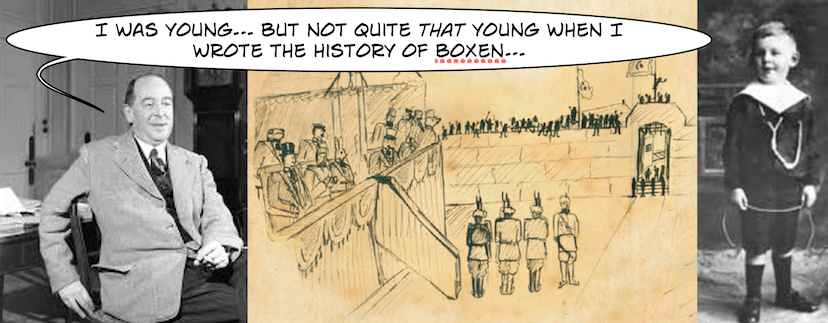
When he was a child, beginning at age eight, Lewis began writing stories about “Animal Land.” His brother Warnie, several years older, joined him in composing stories inspired in part by their reading of the words of Beatrix Potter.

Animal Land is clearly the product of young children—children with wonderful imaginations—but children nonetheless. These various works have been published by Lewis’ stepson in a collection called Boxen. As Douglas Gresham writes, “In developing the world of Boxen, Jack appropriated the ‘dressed animals’ of Beatrix Potter and that part of their fictional world they called ‘Animal-Land,’ while Warnie (whose interests were always a touch more prosaic than Jack’s) made his half ‘India.’”

The world was thoroughly thought out, complete with maps and a historic chronology.

Animal-land is divided into 13 provinces. Bear-land, Wolf-land, Squirrel-land, Mouse-land, Rabbit-land, Pig-land, Bird-land, Horse-land, Fox-land, Land of Typical Animals, Insect-land, Rat-land, With the island of Piscia, or Fishland. . . . Rabbit-land is the first provence in learning and art.

Rabbits feature prominently in Boxen. The very first element is a script, entitled “The King’s Ring (A Comedy).” The introduction is delightfully childlike: “Interesting carictars. Famous ones. For instance, Sir Big, a world-famed gentleman. A very good choreus and nice scenry. (Slight comic tints in and out threw it.)”

The two protagonists are King Bunny, whose ring is stolen, and Sir Peter Mouse, his “knight in waiting” who aids him in finding it. It is filled with silly dialog, despite the serious plot. For example:

KING BUNNY: Tell Sir Goose to tell Sir Big to tell Mr Gold Fish to tell Gollywog to tell Mr Icthus-oress to tell Dorimie to tell the sailors to take Hit [the villain] away.

In his autobiography, Lewis wrote of his childhood home. “Here my first stories were written, and illustrated, with enormous satisfaction. They were an attempt to combine my two chief literary pleasures—‘dressed animals’ and ‘knights-in-armour.’

Drawing Pleasure from Real Life Rabbits

Lewis’ correspondence includes passing references to rabbits, always expressed in an approving way. For instance, in 1947 he mentions enjoying a memorable event during a boring time. “I wonder how you are all getting on? Nothing much has happened to me except that I saw a rabbit yawn. I suppose people who keep tame ones have seen it often but this was a wild rabbit and I thought it a very curious sight. It was a very bored triangular yawn in the middle of a long hot afternoon.”

During WWII, he penned a curious comment about rabbits recently added to his home.

We are keeping rabbits at the Kilns now, in addition to the hens! But they are very much nicer. As I passed the enclosure in which all the young ones are the other evening, I saw they had all got into a box which happened to be lying there.

They were all standing (or sitting) up on their hind legs and all facing in the same direction: so that they looked exactly as if they were conducting some kind of evening service—the box looked just like a pew.

While the rabbits were almost certainly present to supplement food rations during the war, they were not treated as commodities. Lewis appreciated them in the way he respected other creatures designed by God’s hand. Thus, he had what my wife and I would consider to be a well-rounded family—including one or more members of the non-human variety.

Lewis described this diverse household in a 1943 letter to June Flewett,⁑ one of the children evacuated to his home during the war.

Bruce [Lewis’ dog] behaved with great lack of fortitude during the thunderstorm last night and two of the rabbits made it an excuse for absenting themselves without leave. Pushkin [his cat] behaved better, but not well. In fact there is a general lack of keenness and discipline among the four-footed members of the household which I deplore.

One more story about an actual rabbit with which the great author developed an ongoing relationship.

In a 1942 letter to Sister Penelope CSMV, he says, “I am establishing quite a friendship with one of the rabbits which we now keep along with the deer in Magdalen grove. It was done by the discovery that he relishes chestnut leaves which grow too high for his reach. He doesn’t yet allow me any familiarities but he comes and eats from my hand.”

Lewis continues to describe his new friend, and adds a keen theological observation. “But oh!, the great lollipop eyes and the twitching velvet nose! How does [God] come to create both this and the scorpion?”

Later that same year, Lewis updates the Anglican nun on the status of his animal-friend.

The Rabbit and I have quarrelled. I don’t know why, unless I gave him something that disagreed with him. At any rate, he has cut me dead several times lately—so fair and so fickle! Life is full of disappointments.”

At that time he shared his disappointment with his lifelong friend, Arthur Greeves. “Did I tell you in my last letter that I’d struck up quite an acquaintance (almost a friendship) with a rabbit in Magdalen Grove who used to come and eat leaves from my hand? Alas, I must have given something that disagreed with him, for he disappeared for about 10 days, and since his reappearance has refused to look at me.”

It may be that same rabbit, or one of its kin, renewed its relationship with Lewis, because he referred to a similar experience in two 1944 letters to other children.

I live in a College here: a college is something rather like a castle and also like a church. It stands just beside a bridge  over a river. At the back of the part I live in there is a nice grove of Trees. There are a lot of Rabbits there. One very old rabbit is so tame that it will run after me and take things out of my hand. I call her Baroness Bisket because she is a kind of biscuit colour.

It’s not easy, nor is it usually relevant, to determine a bunny’s gender. So, Lewis may be excused for writing the following to the second young correspondent, six months earlier.

I am getting to be quite friends with an old Rabbit who lives in the Wood at Magdalen. I pick leaves off the trees for him because he can’t reach up to the branches and he eats them out of my hand. One day he stood up on his hind legs and put his front paws against me, he was so greedy. I wrote this about it:

A funny old man had a habit
Of giving a leaf to a rabbit.
At first it was shy
But then, by and by,
It got rude and would stand up to grab it.

But it’s a very nice Rabbit all the same: I call him ‘Baron Biscuit.’

Like C.S. Lewis, I adore rabbits. Years ago we had an indoor bunny, appropriately named “Sweetheart.” In her youth she acted like the cartoon character Ricochet Rabbit, pinging from place to place. In her senior years she settled down and was contented to be a cuddly lap bunny. I add my own “thank you” to Lewis’ for these precious parts of God’s creation.


* The Humane Society pdf is available here.

⁑ June Flewett is regarded as the inspiration for Lucy Pevensie in the Chronicles, and grew up to become an actress and theater director. C.S. Lewis paid for her tuition at the Royal Academy of Dramatic Art. When she and her two sisters were sent from London to the Kilns, her favorite author was C.S. Lewis. Ironically, it was a while before she learned that he and their host were one and the same.

Pen Names & Pseudonyms

Many great writers have used pen names, C.S. Lewis (and yours truly) included. Lewis, in fact, employed two.

There are a variety of reasons for writing under a pen name. While it may occasionally be done in order to deceive, most occurrences are utterly benign. For example, particularly in totalitarian states, the truth is dangerous to one’s health. In less authoritarian nations, reticence to use one’s own name might be motivated by fear of damage to one’s livelihood.

It’s also possible the writer simply has a personal desire to remain anonymous. This is the case with one of Lewis’ most important works. After the death of his wife, Joy Davidman, he composed one of his most moving works, A Grief Observed. For this candid reflection on grieving, Lewis attempted to maintain his privacy by ascribing the work to N.W. Clerk.  

My motivation for adopting a new pen name is different from all of these. More about that in a moment.

Here is a small sampling of writers you may know, who used pseudonyms for some of their work:

President John Adams, Isaac Asimov, Ray Bradbury, Anne Brontë, Emily Brontë, Pearl S. Buck, Anton Chekhov, Samuel Langhorne Clemens, Michael Crichton, Agatha Christie, Cecil Day-Lewis, D.B. Wyndham Lewis, Theodor Seuss Geisel, Henrik Ibsen, Washington Irving, Søren Kierkegaard, Stephen King, Dean Koontz, Edna St. Vincent Millay, Joanne Rowling, Aleksey Konstantinovich Tolstoy, just to name a few.

My personal opinion is that the best nom de plumes are not random or simply fanciful. Creating a pen name with an actual connection of some sort to the writer seems—to me—far more skillful. Case in point, Lewis’ use of the pseudonym “N.W. Clerk.” He created this name by combining the Anglo-Saxon “Nat Whilk” (meaning I know not whom) with “Clerk” meaning writer or scholar.

C.S. Lewis’ second pen name was also chosen for its specific meaning. Since boyhood, he had gone by the first name of Jack. With the pseudonym he used his actual name, Clive. For the surname, Lewis used his mother’s maiden name, Hamilton. Thus, Clive Hamilton.

His first two books were attributed in this manner. The first was Spirits in Bondage (1919), a collection of poetry. His second was begun while he was still a teenager. Dymer was a narrative poem with mythic elements. The first title is in the public domain, and available for download at Internet Archive. Both of the volumes were written, of course, while Lewis was an atheist.

My New Nom de Plume

In my own case, I recently devised a pen name for some satirical writing I am exploring. My purpose is not to mislead or confuse. In fact, it is expressly out of a desire to prevent confusion that I’ve assumed a pseudonym for my satire.

Even though I include humor in my writing, most of my work is essentially serious. This makes sense, for subjects such as faith, suffering, life, death, history, and eternity. I do not dissemble. As the Bible counsels, my yes means yes, and my no means no.*

Still, the very nature of satire means you are using language contrary to its face value. You are communicating tongue in cheek. You are frequently turning the language around upon itself so it communicates something quite different from what it literally says. Satire finds its fuel in irony, humor, hyperbole and even ridicule.

Skillful satire isn’t intentionally confusing. On the contrary, its message is almost always clear. Satire may sting the objects of its ridicule, and bring smiles to those who share your scorn for the institutions, policies, and individuals being taunted.

So, where, you may wonder, will this satirical writing be found . . . and under what pen name will you find it? I will be submitting some short pieces to The Salty Cee, a less commercialized alternative to The Babylon Bee. My pseudonym is Robert Charlesson, for reasons you can read about here.

Please check out my first news report: “Liturgical Medical Face Masks Now on Sale.”


* The actual passage I’m referencing, records Jesus criticizing making oaths to assure a person’s veracity. “Let what you say be simply ‘Yes’ or ‘No’; anything more than this comes from evil” (Matthew 5:33-37). I think it is consistent to extend this principle to always speaking honestly, regardless of whether we are making affirmative or negative observations.

C.S. Lewis and Times of Crisis

Dark days demand two seemingly contradictory things. Serious reflection and diversion (often in the form of entertainment).

Things are serious. The ultimate toll of the current pandemic remains unknown. Even if we regard ourselves as safe due to age, health and isolation, the simple fact is thousands are dying. Beyond our compassionate concern for those who are suffering, only a fool would fail to reflect on their own mortality during this plague.

Christians, who recently “celebrated” Good Friday are quite conscious of the fact that “we are dust and to dust we shall return” (Genesis 3:19).

Yet this awareness doesn’t leave us in despair, because Easter has come. Our Lord’s resurrection means that for those who trust in him, death does not have the final word.

I pray for those who are overcome by worry during these days. Because dwelling solely on the negative robs life of its present joys, and worsens the impact of the pandemic on individual lives.

Rather than feed your anxiety with troubling reports and thoughts, I urge you to take the opportunity to read, watch a classic program, or play a game. Distracting activities are healthy, as long as they do not displace serious awareness of our circumstances.

Seriously Assessing Our Predicament

Others have written eloquently about Lewis’ response to situations such as that in which we find ourselves today.

For example, the Gospel Coalition offers an excerpt from C.S. Lewis’ 72 year old essay about atomic weapons. They suggest we “just replace ‘atomic bomb’ with ‘coronavirus.’” Lewis’ advice holds up well in our turbulent era.

Annie Holmquist of Intellectual Takeout elaborates on Lewis’ essay. “How C.S. Lewis Would Tell Us to Handle Coronavirus” is well worth a read.

Several weeks ago, the Wade Center (which hosts the Western Hemisphere’s finest Inkling collection) struck the balance I am suggesting. They acknowledged the danger, and offered advice on spending our time well. Their blog included an excellent suggestion in “Those Who Lived to see Such Times: Suggested Readings from the Wade Authors during Times of Uncertainty.” The Wade Center provides links to a number of fine text and audio resources that will offer encouragement from authors who “witnessed both world wars, and . . . lived to see the unsettling days of nuclear weapons.”

Enjoying Life Despite the Danger

Those who are working during this time remain in need of our prayerful support. For the majority of us, however, the cancellation of most of our normal social activities has provided us with an abundance of leisure time. In addition to attacking postponed chores around the house, we should fill some of this interval by enjoying old pleasures and discovering new interests.

Take advantage of treasures such as those mentioned in the Wade Center post. Hundreds—even thousands—of free, public domain books are available online. For those whose preference is visual, there are plenty of free video options, including many vintage television shows you can view on YouTube.

If you’re craving a humorous treat, check out the great satire at The Babylon Bee and The Salty Cee.

A recent article on the former site reveals the sad tale of a boy whose childhood has been ruined by modern online games. It’s entitled, “Boy Discovers Wondrous Land Of Narnia, Leaves Negative Yelp Review.”

Lutherans (and self-confident Christians of other traditions) will enjoy the Lutheran Satire site. For people who don’t object to listening in on a demonic press conference, a fictional Easter interview on their main page is enlightening.

A bit lighter, is this rendition of Saint Patrick explaining the Trinity to the Irish pagans. It will help you sharpen your Christology.

There is a vast, unexplored world of literature out there. I recently read this illuminating post about one of George MacDonald’s fairy tales. MacDonald exerted a great influence on C.S. Lewis. With a curious twist on light and dark, the post also provides a link to a film based on MacDonald’s The Light Princess. I haven’t viewed it yet—but if you have a high tolerance for 1980s BBC productions combining animation and live action, you could be in for a treat.

Where to Begin?

Before exploring some of these links I’ve included, I encourage you to view “The Age of the Coronavirus.” The videographer has done what was suggested in one of the articles mentioned above. He has substituted the virus for the threat of nuclear war in C.S. Lewis’ abbreviated essay.

The video is good enough that you may well desire to share it with others. It can help to know the threats of our day are not unique to history. I suggest that you also include the amazing C.S. Lewis Doodle which offers an illustrated version of the entire essay.

The Viking Explanation for Lame Poetry

During the middle ages, Scandinavia’s skálds were poets, storytellers and even musicians. They were the equivalent of bards in medieval British and Gaelic culture. They were oral historians, committed to memorizing their paeans verbatim, which was simpler since they were in poetic form. Not all skálds possessed the talents to create their own memorable epics. These lesser poets, so to speak, could still memorize and recite the classic or popular songs.

A graphic explanation for the difference in the talents of the first tier skálds and their inferiors is found in the Prose Edda which was written by Snorri Sturluson (1179-1241). Sturluson compiled Norse myths in his Edda, and the sagas of her kings in Heimskringla.

The second part of the Prose Edda is entitled Skáldskaparmál, which means the language of poetry. One of the myths it contains describes the Mead of Poetry. Mead, of course, is the rich Viking beverage created by fermenting honey.

As for poetry, I’ve written about it fairly often. (Most recently in respect to my “winning” entry in a Terrible Poetry Contest.) I’ve even offered genuine, albeit feeble, attempts at the art myself. Alas, if I were a classical Greek I would say my Muse is Clio (the Muse of History), rather than Thalia or Erato, Muses of various genres of poetry.

It is well known that C.S. Lewis himself was a frustrated poet. While his literary criticism and historical work was highly respected—and his Christian works are still revered—his poetry never received a warm reception. The Poetry Foundation offers a useful article on the subject here.

My personal opinion is that I am thankful Lewis’ energies were devoted to more profitable fields of writing.

Back to the Vikings

C.S. Lewis and several other Inklings were enamored with Northern sagas. I have touched on this in the past, and discussed the amazing fellowship gathered by J.R.R. Tolkien, as a sort of precursor to the Inklings.

Tolkien named the group Kolbítar, which denoted “Coalbiters,” or Norse storytellers who gathered close to the fire as they discussed the stories of their ancestors. This exploration of Icelandic literature was connected to Tolkien’s conviction, as a professor of Anglo-Saxon, that these works belonged within the study of the English canon.* Old Norse definitely left a mark on English, as I’ve discussed here at Mere Inkling.

In Song of the Vikings: Snorri and the Making of Norse Myths, Nancy Marie Brown gleans some insights about Kolbítar from Lewis correspondence. They gathered to read the literature aloud.

They began with Snorri’s Edda. Reading it in Icelandic was slow going but addictive, Lewis recalls: “Hammered my way through a couple of pages in about an hour, but I am making some headway. It is an exciting experience.” Lewis . . . had also been smitten as a boy by “pure ‘Northernness’” [and] popular versions of Snorri’s tales had inspired Lewis to write an adolescent tragedy about the Norse gods, “Loki Bound.”

There is no record of what the members of the Kolbítars thought of the myth of the Mead of Poetry, but I would imagine that they found its crass distinction between gifted and stumbling poets quite—Norse. To set the stage for the following passage, one should know: (1) the Aesir were the Old Norse gods, (2) Suttung was a Jötunn (belonging to a race of giants at war with the Aesir), (3) Suttung was in possession of the magical mead of poetry, which Odin stole through cunning but immoral means, swallowing all of it, (4) Odin changed into an eagle to effect his escape, and Suttung followed him in the same form, and (5) the Aesir prepared large vessels to receive the disgorged magical mead. Now, from the Edda itself:

When the Æsir saw Odin flying, they placed their vats in the courtyard, and when Odin entered Asgard he spat the mead into the vats. It was such a close call, with Suttung almost catching him, that he blew some of the mead out of his rear. No one paid attention to this part, and whoever wanted it took it; we call this the bad poets’ portion. Odin gave Suttung’s mead to the Æsir and to those men who know how to make poetry. For this reason we call poetry Odin’s catch, find, drink or gift, as well as the drink of the Æsir.

No one said the Norse were above using crass humor. Still, it does offer a quite imaginative explanation for the differences between exceptional and mediocre poets, doesn’t it?


* Tolkien “loved the cold, crisp, unsentimental language of the sagas, their bare, straightforward tone like wind keening over ice. Reading Snorri and his peers was more important than reading Shakespeare, Tolkien argued, because their books were more central to our language and our modern world” (Song of the Vikings).

C.S. Lewis & Irish Horses

C.S. Lewis had a deep fondness for horses. I imagine he would have enjoyed a recent report from the historic village of Kilmallock, Ireland. It appears that some stray horses have been attempting to upstage the local ducks.

According to the Independent, one of the horses even proudly trotted into a local gymnasium. The mare (or stallion) appears to be more brazen than last year’s crisis which caused one councillor to call “on gardaí [police] in the Co Limerick town to rein in children as young as six riding sulkies in the town which he claimed was turning into the ‘Wild West.’” Yes, you most certainly need to beware of those rowdy six year old cowboys and cowgirls!

Dog owners have begun raising questions about why they must clean after their animal companions while the horses treat the parks like, shall we say, regular pastures. The city’s senior executive engineer attributes the problem to the fact the equines are just so sneaky. “Any time it is reported we go down but the minute our back is turned they are put back. We can’t be there 24/7.”

The most humorous element of the effort to ban the horses, in my mind, is because they have interrupted the entertainment of local ducks.* Not one, but “two duck races on the river have been affected.”

Lewis’ Thoughts about Horses

One of Lewis’ Chronicles of Narnia presents a pair of horses as two of its major protagonists. The Horse and His Boy features Bree and Hwin, Talking Horses captured from Narnia by the Calormenes. A wonderful passage that illustrates the book’s ethos comes when the two horses and their respective riders decide to journey north together.

Aravis is a Calormene princess fleeing her land’s tyranny. Her mount, Hwin, is a young mare who was stolen as a colt and raised in the south. Bree was a stallion, also captured as a colt, and raised to be a warhorse.

“All right then,” said Aravis. “You’ve guessed it. Hwin and I are running away. We are trying to get to Narnia. And now, what about it?”

“Why, in that case, what is to prevent us all going together?” said Bree. “I trust, Madam Hwin, you will accept such assistance and protection as I may be able to give you on the journey?”

“Why do you keep talking to my horse instead of to me?” asked the girl.

“Excuse me, Tarkheena,” said Bree (with just the slightest backward tilt of his ears), “but that’s Calormene talk. We’re free Narnians, Hwin and I, and I suppose, if you’re running away to Narnia, you want to be one too. In that case Hwin isn’t your horse any longer. One might just as well say you’re her human.”

While technically their own genus, centaurs might be considered “part horse.” Thus the entertaining description from The Silver Chair. The children are surprised that the centaurs are still about their breakfasts, two hours after rising before dawn.

“Why, Son of Adam, don’t you understand? A Centaur has a man-stomach and a horse-stomach. And of course both want breakfast. So first of all he has porridge and pavenders [small fish] and kidneys and bacon and omelette and cold ham and toast and marmalade and coffee and beer.

And after that he attends to the horse part of himself by grazing for an hour or so and finishing up with a hot mash, some oats, and a bag of sugar. That’s why it’s such a serious thing to ask a Centaur to stay for the weekend. A very serious thing indeed.”

In Mere Christianity, Lewis uses the transformation of a horse to a new creation as an analogy for what happens to people when they surrender their lives to God’s mercy and seek to follow him.

“Niceness”—wholesome, integrated personality—is an excellent thing. We must try by every medical, educational, economic, and political means in our power, to produce a world where as many people as possible grow up “nice;” just as we must try to produce a world where all have plenty to eat.

But we must not suppose that even if we succeeded in making everyone nice we should have saved their souls. A world of nice people, content in their own niceness, looking no further, turned away from God, would be just as desperately in need of salvation as a miserable world—and might even be more difficult to save.

For mere improvement is not redemption, though redemption always improves people even here and now and will, in the end, improve them to a degree we cannot yet imagine. God became man to turn creatures into sons: not simply to produce better men of the old kind but to produce a new kind of man. It is not like teaching a horse to jump better and better but like turning a horse into a winged creature.

Of course, once it has got its wings, it will soar over fences which could never have been jumped and thus beat the natural horse at its own game. But there may be a period, while the wings are just beginning to grow, when it cannot do so: and at that stage the lumps on the shoulders—no one could tell by looking at them that they are going to be wings—may even give it an awkward appearance.

For a more in-depth discussion of this subject, I commend to you Leslie Baynes’ column, “The Heavenly Horses of C.S. Lewis,” which you can read at A Pilgrim in Narnia.

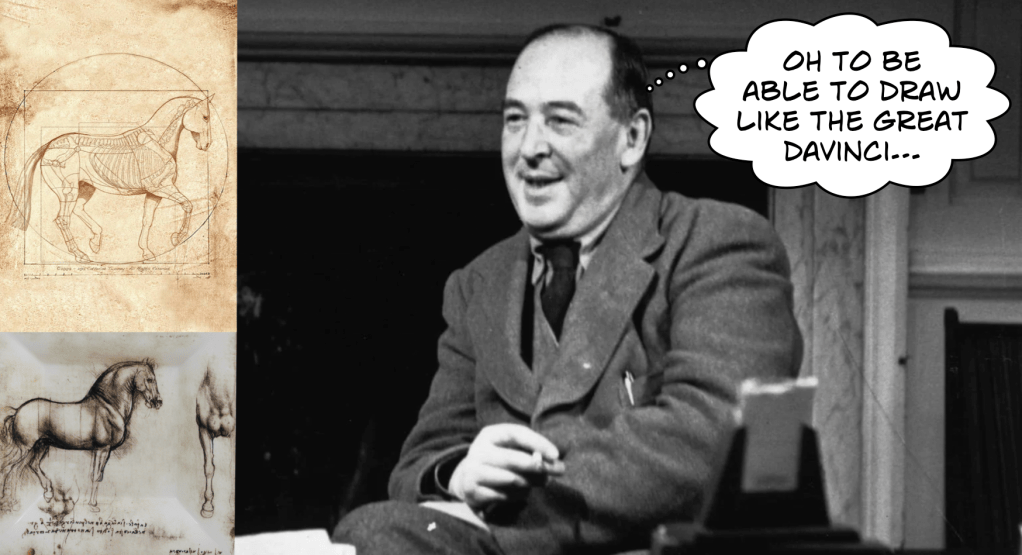
A final comment from Lewis’ youth worth noting. When writing to his friend Arthur Greeves in 1914, he refers to his scribblings and attempts (quite likely involving the Boxen era) when he attempted to sketch horses.

I sympathize with your difficulty in drawing a horse, as I have often made the attempt in the days when I fancied myself in that line. But of course that counts for nothing: as the easiest of your sketches would be impossible for me. But there are heaps of pictures in which you need not introduce the animal.

It was this passage that inspired the graphic created for the top of this post.


* I wish the Irish were cultured enough to allow actual ducks to enjoy the adrenaline rush of a race, rather than using those little rubber ducklings that belong in children’s baths. If it’s the latter, which I fear it could be, I vote to let the horses run free. After all, some of those rubber ducks wash out to sea and become part of the international litter problem. For example, the piece of rubbish pictured on this link presumably polluted the Irish Sea for a full decade before it washed up on a distant shore.

Historical Font Facts

Consider yourself blessed if you’re not a fontaholic. The affliction leads to clogged font directories on your computer, and an unavoidable prejudice toward either serif or sans serif fonts.

People who are intrigued by typography know exactly what I’m talking about. At least two or three times a year they will inextricably find themselves on some font website (there are scores of them) without consciously knowing how they got there or there or there.*

I’ve written about fontaholicism in the past. Unfortunately, despite my advocacy, the Diagnostic and Statistical Manual of Mental Disorders has yet to classify the malady as a recognized illness. That said, the American Psychiatric Association does sound a bit obsessive compulsive in terms of their font guidance for annual meeting posters.

If any or all of the work in this poster was prepared with commercial support, a statement “Supported by funding from [name of company]” must be noted in the lower left corner of the poster in Arial 72 point font, with no bold, italics, special colors, or other enhancement of the company name, product, or any other portions of the statement.

One wonders what sort of reaction a person would get from the APA if they used Times Roman or Comic Sans by mistake.

C.S. Lewis & Fonts

It should be acknowledged up front that C.S. Lewis was not obsessed with fonts. However, he was wise enough to recognize their significant role in communication. Good fonts could be transparent, while problematic fonts blurred the message. He highlighted one of the most significant aspects of a font’s usage—size—in a 1957 letter. He told a fellow Brit, “you’d be much wiser to get my books in the American edition as these now have larger print and better paper than our own.”

A year earlier he had discussed a related issue with his publisher. There was a problem with a Shakespeare quotation intended for the title page of Till We Have Faces.

The quotation would, I agree, look better on a page to itself, but (what is more important) I am very strongly opposed to the idea of dividing it. I agree that it ‘looks wrong as it is’ but I think it will look equally with any division whatever. I do not see why it need be printed ‘absurdly small’ to fit in as one line . . .

Now a line of that length on a page to itself would I believe, look ugly if it came anywhere near the middle of a page–because it would then seem to divide the page into two halves. But would it not look quite nice if put near the top? It would then have the properties of a frieze or dado with plain wall under it.

And we may perfectly well omit the word ‘Shakespeare’ if we think that makes a better design. But I’d prefer even a bad design to a division of the verse.

Free Books about Fonts

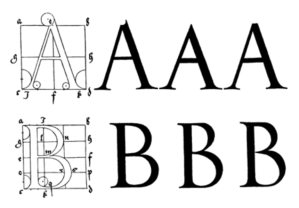
You can find a number of interesting books about fonts at some of the wonderful internet libraries such as Project Gutenberg. During recent historical research about Reformation-era artists, I discovered a book written by Albrecht Dürer (1471–1528). Since his fame is derived from his portraits of prominent people, I was surprised he had written a guide for properly shaping letters, based on geometric principles. The introduction provides a fascinating portrait of sixteenth century artistry in northern Europe.

In our Germany . . . are to be found at the present day many young men of a happy talent for the Art Pictorial, who without any artistic training whatever, but taught only by their daily exercise of it, have run riot like an unpruned tree, so that unhesitatingly and without compunction they turn out their works, purely according to their own judgment.

But when great and ingenious artists behold their so inept performances, not undeservedly do they ridicule the blindness of such men; since sane judgment abhors nothing so much as a picture perpetrated with no technical knowledge, although with plenty of care and diligence.

Now the sole reason why painters of this sort are not aware of their own error is that they have not learnt Geometry, without which no one can either be or become an absolute artist; but the blame for this should be laid upon their masters, who themselves are ignorant of this art.

Since this is in very truth the foundation of the whole graphic art, it seems to me a good thing to set down for studious beginners a few rudiments, in which I might, as it were, furnish them with a handle for using the compass and the rule, and thence, by seeing Truth itself before their eyes, they might become not only zealous of the arts, but even arrive at a great and true understanding of them.

Dürer’s book sparked my curiosity, and a very quick subsequent search hinted at the wealth of typographical information online. For example, you can read about The Typography of Advertisements, circa 1911. There you will be warned that bolder is not always better.

“But,” some one says, “the heavier and bolder type-faces furnish a greater contrast to the white of the paper, and therefore should be easier to read.”

It is true that a greater contrast of color is furnished in the use of the bolder type-faces, but to force these greater contrasts on the eye is to literally club it into reading the text, whether or no. Are the salesman’s statements of better selling value because they are shouted loudly in direct contrast to the quiet of the office?

There may be, and undoubtedly are, some on whom this force is necessary, but to those who are sufficiently educated and intelligent to be reached through the appeal of an advertisement, the quiet dignity of the salesman’s statements made in well-modulated tones will be more attractive.

Gaze back even farther, to what was considered Early Typography in 1872. There you will discover a medieval religious order devoted to worship and manuscripts.

Reference has more than once been made to the impulse given to learning at the end of the fourteenth and the beginning of the fifteenth centuries. This movement was helped forward by no one in Holland and Germany more than by Gerhard Groote, or Magnus, of Deventer, (b. 1326, d. 1370), who after studying theology at Paris, became a canon of Utrecht and Aix-la-Chapelle, and founded the Order of the Brethren and Clerks of the Common Life, generally known as the “Gemeiineslebens,” or “Frères de la Vie Commune . . .”

It was divided into the literary Brethren or Clerks, and the unlearned Brethren, who lived in different houses, but in bonds of the greatest friendship. The Clerks devoted themselves to transcribing books, the cultivation of polite learning, and the instruction of youth; and they erected schools wherever they went. The Brethren laboured with their hands, and pursued various mechanic trades. Neither were under the restraint of religious vows; but still they ate at a common table, and had a general community of goods.

There are many other curious titles available to those who choose to explore obscure typography in greater depth. A person might even wish to begin with 1891’s Specimens Of Book, Jobbing, And Ornamental Printing Type In Use In The Government Central Printing Office, Simla [India].

Fonts, fonts, fonts. As I said above, you are fortunate if they don’t draw you too deeply into their orbit. However, if you recognize you too are a fontaholic, take comfort in the knowledge that you are not alone.


* And here’s another font site I had never seen before writing this post. It has a delightful name, Font Squirrel. Once I finish writing this piece, you can guess where I will be spending some of my web surfing research time.

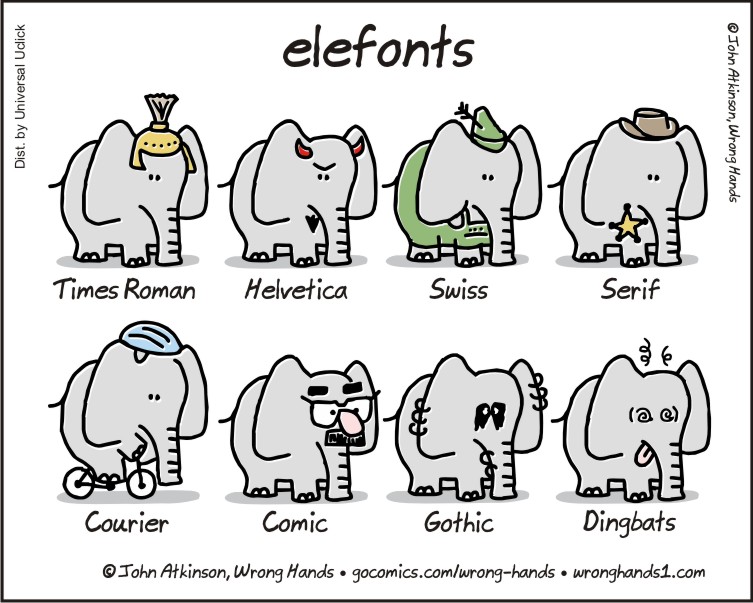
The Elefonts cartoon at the top of the page is a creation of talented Canadian John Atkinson, and is used with permission.

C.S. Lewis and Self-Awareness

Who are you? If you were to fully answer that question, it would require serious introspection. However, if you were to answer it completely, it would also require an honesty that is extremely rare.

That’s because anyone who reveals everything about themself, comes to a point where the qualities and actions are no longer flattering. They ultimately arrive at the place where the exposé becomes a confession.

The truth is that no one actually knows everything about themself. But some of the things we are aware of . . . some of the secrets we desire to hide, even from ourselves . . . are seldom shared. That is one great value of the “confessional.” There, one can unburden themselves and face their demons, so to speak, in a setting where they know their confidence won’t be violated.

As a Protestant pastor, who has never used a physical confessional stall or screen, I note that I have nevertheless heard thousands of confessions. They are, as one would expect, a common element of counseling as people seek to experience healing and restoration. As a Lutheran, I belong to a tradition that guarantees the privacy of these confessions, or what is considered “privileged communication.” Moreover, as a military chaplain, I was grateful to serve a nation that enshrines the same promise in the Uniform Code of Military Justice.

As Lewis wrote, “if there is a particular sin on your conscience, repent and confess it” (Letters to an American Lady). Once that is done, the pastor (or any “confessor”) can assist the individual with working to make as right as possible in the future what was damaged or destroyed by their choices in the past.

From the Psychological Vantage Point

If you have never encountered it before, I commend to you the model called the Johari Window. I have written about it in the past in the context of honesty and dishonesty.

The model illustrates just how complex our personalities are. The arrows on the model below reveal how we can expand the “open” part of ourselves. Naturally, there are some “hidden” aspects that should only be disclosed in certain contexts.

When it comes to the darkness in our lives, that which we strive to keep veiled, psychologists describe it in a variety of ways. One chaplain with whom I worked was particularly enamored with the work of Carl Jung. He loved to toss around the word “shadow,” and suggest there was some dark psychological significance to even the most offhand comment or expression. In essence, the shadow is the part of our personality we don’t want to admit to having. In terms of the Johari Window, you might think of it as the sinister stuff in the Hidden quadrant.*

C.S. Lewis wrote about Jung in an essay entitled “Psycho-Analysis and Literary Criticism.” Lewis disparages the Freudian theory, saying “poetry is not a substitute for sexual satisfaction, nor sexual satisfaction for poetry.” Jung, he argues, presents “a much more civil and humane interpretation of myth and imagery.” Of course, Lewis is discussing these psychoanalysts from the perspective of a literary critic, not a psychologist. In that regard, we can appreciate his assessment of one of Jung’s major works.

Thanks to my training I can suspend my judgement about the scientific value of Jung’s essay on “Mind and the Earth:” but I perceive at once that even if it turns out to be bad science it is excellent poetry.

From the Christian Point of View

I have already described how confession can serve as a means of expanding our self-awareness in a constructive and healing way. That’s why confession and absolution are a formal part of many worship service, going back to the earliest times. If we want to read the finest primer on confession, we need look no further than the book of Psalms.

As King David, in recognition of this great sins, prays in the fifty-first psalm:

Have mercy on me, O God,
according to your steadfast love;
according to your abundant mercy
    blot out my transgressions.
Wash me thoroughly from my iniquity,
    and cleanse me from my sin!

One of the earliest Christian classics (outside the Bible itself) was aptly entitled Confessions. It was written by Augustine, the bishop of a North African city called Hippo. His description of our self-awareness is so deep and profound, it will likely require more than a single reading.

No one knows what he himself is made of, except his own spirit within him, yet there is still some part of him which remains hidden even from his own spirit; but you, Lord, know everything about a human being because you have made him . . .

Let me, then, confess what I know about myself, and confess too what I do not know, because what I know of myself I know only because you shed light on me, and what I do not know I shall remain ignorant about until my darkness becomes like bright noon before your face. (Augustine, The Confessions, translation by Maria Boulding)

One of C.S. Lewis’ many correspondents was a man who was acutely troubled by his own self-awareness, and in particular, the consciousness of his own selfishness and egotism. Lewis offered some comforting and sound spiritual direction to the man. Since I believe the letter has a message for us all, I choose to close with it.

You are of course perfectly right in defining your problem (which is also mine and everyone’s) as “excessive selfness.” But perhaps you don’t fully realise how far you have got by so defining it. All have this disease: fortunate are the minority who know they have it.

To know that one is dreaming is to be already nearly awake, even if, for the present, one can’t wake up fully. And you have actually got further than that. You have got beyond the illusion (very common) that to recognise a chasm is the same thing as building a bridge over it.

Your danger now is that of being hypnotized by the mere sight of the chasm, of constantly looking at this excessive selfness. The important thing now is to go steadily on acting, so far as you can—and you certainly can to some extent, however small—as if it wasn’t there. You can, and I expect you daily do—behave with some degree of unselfishness. You can and do make some attempt at prayer.

The continual voice which tells you that your best actions are secretly filled with subtle self-regard, and your best prayers still wholly egocentric—must for the most part be simply disregarded—as one disregards the impulse to keep on looking under the bandage to see whether the cut is healing. If you are always fidgeting with the bandage, it never will

A text you should keep much in mind is I John iii, 20: “If our heart condemns us God is greater than our heart.” I sometimes pray “Lord give me no more and no less self-knowledge than I can at this moment make a good use of.” Remember He is the artist and you are only the picture. You can’t see it. So quietly submit to be painted—i.e. keep on fulfilling all the obvious duties of your station (you really know quite well enough what they are!), asking forgiveness for each failure and then leaving it alone. You are in the right way. Walk—don’t keep on looking at it.


* In contrast to the insignificant or embarrassing things we are aware of that we may prefer to keep to ourselves. For example, although I sing decently, I am an exceptionally poor instrumentalist. This despite the fact I married a talented and patient music teacher. It’s not my lack of talent which motivates my secrecy, it is the sad fact that I am a total sluggard when it comes to practicing. And this reveals a major flaw in my personality—if something is not inherently fun or doesn’t come easily to me, I have a terribly difficult time applying myself to the task. (And this shortcoming has very real consequences, both in terms of professional success and interpersonal relationships.)

⁑ Several years ago, a member of our Mere Inkling described in her blog how everyone experiences seasons of restlessness.

In his Confessions, Augustine wrote, “Thou hast made us for thyself, O Lord, and our heart is restless until it finds its rest in thee.” Yet even those who have found Christ feel restless at certain times, and these times lead us to a salutary discovery.

Augustine’s Confessions is a Christian classic. You can download a free copy here.

C.S. Lewis & Nuns

One of the great disappointments of Roman Catholic fans of C.S. Lewis is that he never converted to their communion. Lewis did, however, sincerely respect Roman Catholic nuns. In fact, he considered the reverence and joy of the nuns he encountered to be one of the church’s most commendable elements.

In 1947 he wrote to one of his regular correspondents who wondered why he had not forsaken his “low church” loyalties for a more elevated perspective. His response reveals his perception of the virtues of consecrated nuns.

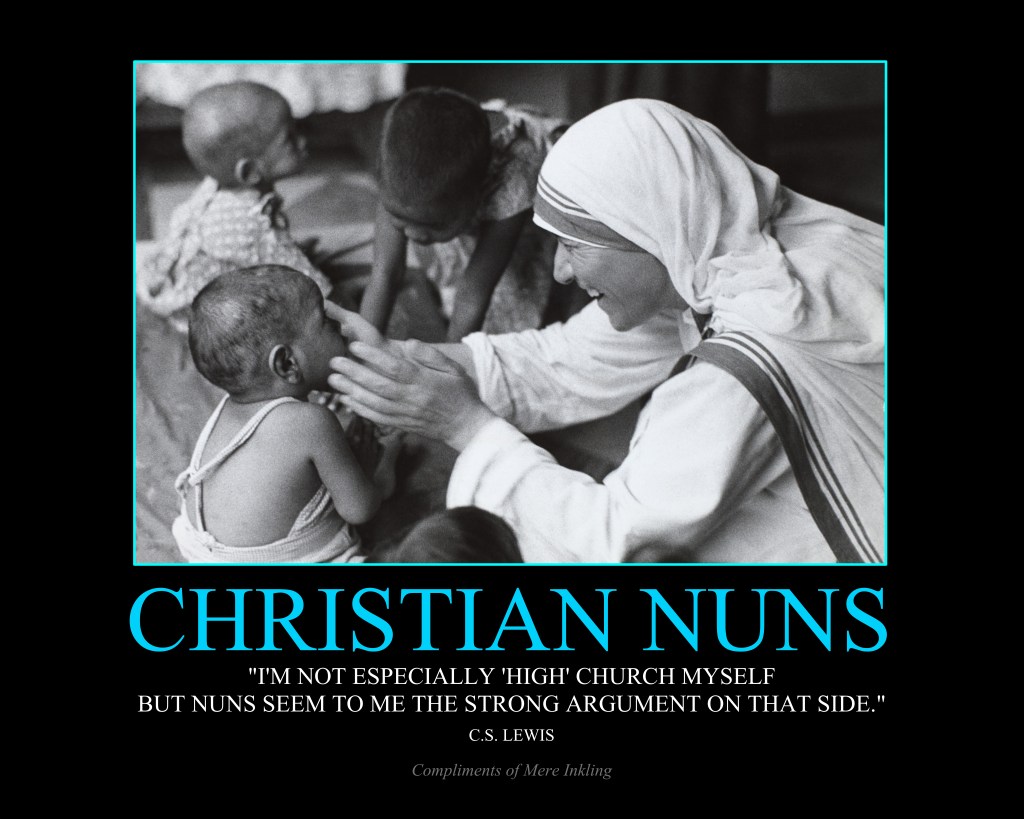
I am particularly pleased to have been of any help as a bridge between the parish and the convent. I’m not especially ‘high’ Church myself but Nuns seem to me the strong argument on that side.

They are in my experience almost invariably so very nice—and so happy: much more so either than the same number of married women picked at random or the same number of monks. I don’t know why this should be so.

One does not have to be Catholic to appreciate people who consecrate their lives to God, willing to make radical sacrifices like living a life of celibacy. Nearly four decades ago, while I was serving a congregation in Citrus Heights, California, I earned a (post-M.Div.) Master of Theology degree. Since I was focused on Patristics, I was enrolled at a Jesuit seminary in the Bay area.

One day during my studies, an Episcopal priest and I were having lunch with a half dozen Roman Catholics, most of whom were religious sisters.* The conversation turned to a celebration by the sisters present that they no longer had to wear habits. The respectful person I am, I remained silent as they discussed their “family” business. Apparently, though, I was softly grinning, because of one them (it may even have been my thesis advisor) asked, “what are you smiling about?”

My response was that it wasn’t my place to offer an opinion, but when they pressed, I said, “well, throughout my life, whenever I’ve seen a nun in her habit, it’s been an encouraging thing, and I think—there goes a life that is consecrated to God.” My companions were shocked and at a loss for words. In retrospect, I believe that C.S. Lewis might have offered a similar comment.

Due to the century during which he lived, and his setting in the British Isles, Lewis encountered nuns far more frequently than I do. In fact, since their “liberation” from the habit, we can’t know precisely how many religious sisters cross our paths. In 1947 he describes to a close friend a trip to see his brother who was hospitalized in Ireland. His colorful description of the town he visited ends with an uplifting remark.

My Brother, thank God, was out of danger when I reached him on Monday morning last but was at the unearthly city of Drogheda where almost every building is a church or a tavern⁑  and what men do but pray and drink or how life is supported in their bodies I can’t conceive. . . . And you hear more wit and humour in one day of London than in a week of Drogheda. My Brother was in the care of the most charming nuns.

Nuns are found in various Christian traditions. In addition to those who take such vows in the Roman Catholic Church, the Eastern Orthodox churches trace the lineage of these female monastics back to the ancient eremites. ⁂ There are also Anglican and Lutheran convents. In fact, one of C.S. Lewis’ close friends was an Anglican nun. Sister Penelope, CSMV (1890-1977), was a member of the Community of St Mary the Virgin. Lewis dedicated his novel, Perelandra, “to some ladies at Wantage,” her convent.

In a 1941 letter to the BBC, Lewis pleads that he is unable to add to his current speaking commitments. These apparently included specific presentations to nuns.  

I’m afraid in view of my other commitments I should be ‘over-talked’ if I accepted the job you kindly suggest for me. I’m talking already to the R.A.F., to the general public, to nuns, to undergraduates, to societies. The gramophone will wear out if I don’t take care! With thanks and much regret.

Lewis’ Three Theses

Mary Willis Shelburne was a widow in Washington, D.C., with whom Lewis corresponded for a number of years. Beginning in 1950, they exchanged more than a hundred letters, which were collected in the volume Letters to an American Lady. Lewis arranged for her to receive financial support from the sales of his books in the United States. This support continued after his own passing. In 1952 Shelburne converted to Roman Catholicism, and proposed that Lewis follow her example. His response was gracious.

It is a little difficult to explain how I feel that tho’ you have taken a way which is not for me. I nevertheless can congratulate you—I suppose because your faith and joy are so obviously increased. Naturally, I do not draw from that the same conclusions as you—but there is no need for us to start a controversial correspondence! I believe we are very near to one another, but not because I am at all on the Romeward frontier of my own communion.

In a short note written four years later, Lewis thanks her for a picture of herself and a nun. He uses the occasion to voice his sentiment that nuns are happy and pleasant. He then proposes three curious theses, noting that his presumption is subjective and she may disagree with him. Do you agree with his opinions here?

Problem: why are nuns nicer than monks and schoolgirls nicer than schoolboys, when women are not in general nicer than men? But perhaps you deny all three statements! All blessings.

My own experience with the first category are limited, but the monks I’ve met have all been very kind, as have the nuns. I fully agree with his second contention. Girls are much nicer than boys. That seems to me a no-brainer . . . although I assume there are many girls who have been bullied by their peers and would disagree.

As for the final thesis, that neither women nor men are better than each other as a group, I would strongly disagree. While it is only a generalization, of course, I believe men tend far more toward cruelty and greed than do women. On the other end of the spectrum, experience tells me that women are significantly more disposed toward virtues such as nurture, mercy and compassion, than their Y chromosome counterparts.

Obviously, C.S. Lewis proposed this question to his correspondent off the cuff. Given the opportunity to discuss it at greater length, say over a pint at the Eagle and Child, it’s certainly possible he could persuade me that his ideas on this matter are correct. After all, we both share a respect for women who feel called to a religious life.


* The essential difference between nuns and sisters is that the former normally live in monasteries, while the latter takes a more tempered vow and often serves in a non-cloistered setting.

⁑ Although this article focuses on England, it provides details on a sad trend in which church buildings are being converted for use as pubs and bars.

⁂ Eremites are Christian hermits. This was the earliest form of monasticism, with individuals removing themselves from secular society. Communal monasticism developed later.

C.S. Lewis & French Poetry

Ah, the snow is wrapping the world in a thick blanket, and I have no where I need to be. As I sit at my desk gazing out at the whitewashed forest, I attempt now something that I seldom do. I am writing a poem.

I admit that I haven’t read Jane Kenyon’s work, but I can definitely relate to one of her famous quotations: “My ear is not working, my poetry ear. I can’t write a line that doesn’t sound like pots and pans falling out of the cupboard.”

One of the bloggers I follow hosts a weekly poetry contest. I’ve never been tempted to compete, although I’m eminently qualified. You see, this is a “Terrible Poetry Contest.”

I had already begun writing my next post, and it relates to the depression some people feel during the winter. Of course, I do my best to make sure that what I write for Mere Inkling is not “terrible.” But I decided to delay that column and pause to enter this contest. On a whim. I certainly don’t expect to win . . . which in this case is, ironically, good news.

I decided to use an uncommon poetic form, since I can at least have the satisfaction that it offers patient readers an “educational” tidbit. I chose the French descort poetic form, because it seems expressly tailored to generate terrible poetry. According to Writer’s Digest, “the descort differentiates itself from other forms by differentiating its lines from other lines within the poem. That is, the main rule of descort poems is that each line needs to be different from every other line in the poem.”

A descort poem has different line lengths, meters, avoids rhyming with other lines, no refrains, and that goes for stanzas as well. In other words, no two lines in a descort should look like each other, and the same could be said for each descort.

The strength of the form is that it allows utter freedom to the poet. The weakness is that the results are appalling. (Read the example written by the editor of the linked article, if you don’t believe me.) Without further ado, I present my latest experiment with verse.* (There’s really nothing “French” about it, beyond the fact it’s a descort.)⁑

Frigid French Philologies
by Robert C. Stroud

Shards of bleak winter gestate day after day.
The citric cannonade gurgled melodies of complacency.
Echinodermata rides again.

Hagar was not so Horrible.
Beware 48°52.6′S 123°23.6′W.
Fini.
Don’t stare at dark holes.
A Galapagos penguin reads about tobacco.

Captain Kirk sings the National Anthem.
Angkor longed to visit Tenochtitlán.
Sheepish wolves.
From lofty Mount Olympus descended Odin.

Soon comes the summer of our discontent.

A French Poem by C.S. Lewis

C.S. Lewis wrote poetry. There is actually a plaque in his honor in Poet’s Corner in Westminster Abbey. Deservedly so. Nevertheless, Lewis’ poetry was never highly regarded.

I, for one, consider this lack of appreciation providential. By this I mean that even though C.S. Lewis had to suffer the disappointment of not realizing his desires as a poet, it is a blessing to the whole world that his energies were redirected into his other writings. Who knows, if his poetry had been celebrated, whether or not Narnia would ever have existed?

The only book of Lewis’ which is in the public domain (i.e. free for downloading), is Spirits in Bondage: A Cycle of Lyrics. It was published after the First World War, written while he was still an atheist. While it makes for interesting reading, much of the imagery will be a bit disorienting for readers only familiar with Lewis after he encountered Christ.

The following poem is taken from that collection. As Alister McGrath writes in The Telegraph article, Lewis’ hopes were dashed relatively early.

The early poems remain a powerful witness to Lewis’s early atheism, railing against an absent and uncaring God who failed to halt the slaughter the author saw around him. But he never achieved recognition as a “war poet,” like Rupert Brooke and Siegfried Sassoon, who are also commemorated in Poets’ Corner. Indeed, not only did he fail to secure recognition for his war poetry, he was not acclaimed as a poet of any kind, as the lack of interest in his second volume of verse—Dymer (1926)—made painfully clear.

This example of Lewis’ war poetry does stand tall in comparison to the verse of the “acclaimed” war poets (in my modest opinion). It describes a battle site during the war—and the transformation of human beings into beasts.

French Nocturne (Monchy-Le-Preux)

Long leagues on either hand the trenches spread
And all is still; now even this gross line
Drinks in the frosty silences divine
The pale, green moon is riding overhead.

The jaws of a sacked village, stark and grim;
Out on the ridge have swallowed up the sun,
And in one angry streak his blood has run
To left and right along the horizon dim.

There comes a buzzing plane: and now, it seems
Flies straight into the moon. Lo! where he steers
Across the pallid globe and surely nears
In that white land some harbour of dear dreams!

False mocking fancy! Once I too could dream,
Who now can only see with vulgar eye
That he’s no nearer to the moon than I
And she’s a stone that catches the sun’s beam.

What call have I to dream of anything?
I am a wolf. Back to the world again,
And speech of fellow-brutes that once were men
Our throats can bark for slaughter: cannot sing.

I confess (though I did it on purpose) that the heading for this section was a bit misleading. “French poem” may have been interpreted as a poem written in French. While Lewis was certainly fluent in French, he did not write in the language. He did, however, appreciate the tongue.

In 1952 he wrote his publisher about the French translation of The Lion, the Witch and the Wardrobe. He praised quality of the translation, as well as the tone achieved by the translator, in Le Lion et la Sorcière Blanche.

I don’t foresee many occasions for copies of Le Lion, but if you will kindly send me 2, they might come in useful. The translator deserves to be congratulated of course—French is a very powerful language—the children become perfect little Frenchmen, but that is all to the good.

What pleased and surprised me is the passage at the end where I made them talk like characters in Malory, and he has really got some of the quality of the French 13th century prose romances: grande honte en aurions⁂—is exactly right.

C.S. Lewis’ brother, Warnie, was a bit of a Francophile. He knew his subject well enough that he authored a book about its history, The Splendid Century: Life In The France Of Louis XIV. He offers an entertaining account of some literary gatherings where the works of Jean Chapelain (1595-1674) were employed in a novel manner. The writers shared agreed upon rules, and transgressions demanded discipline. Thus the punishment for “the breach of rules was to read a verse of Chapelain’s poetry, or, in aggravated circumstances, a whole page.”

I won’t hold my breath awaiting the results of the poetry contest. Though I periodically enjoy dabbling in poetry, I feel I am destined to share the fate of Lewis when it comes to the way in which the masses assess the quality of our verse.


* I have written poetry in the past. I explored the quintain here, and have a few of my experiments in poetry posted at All Poetry.

⁑ According to Encyclopedia Britannica, descort can also refer to “a poem in medieval Provençal literature with stanzas in different languages.”

⁂ The phrase means “great shame we would have.”