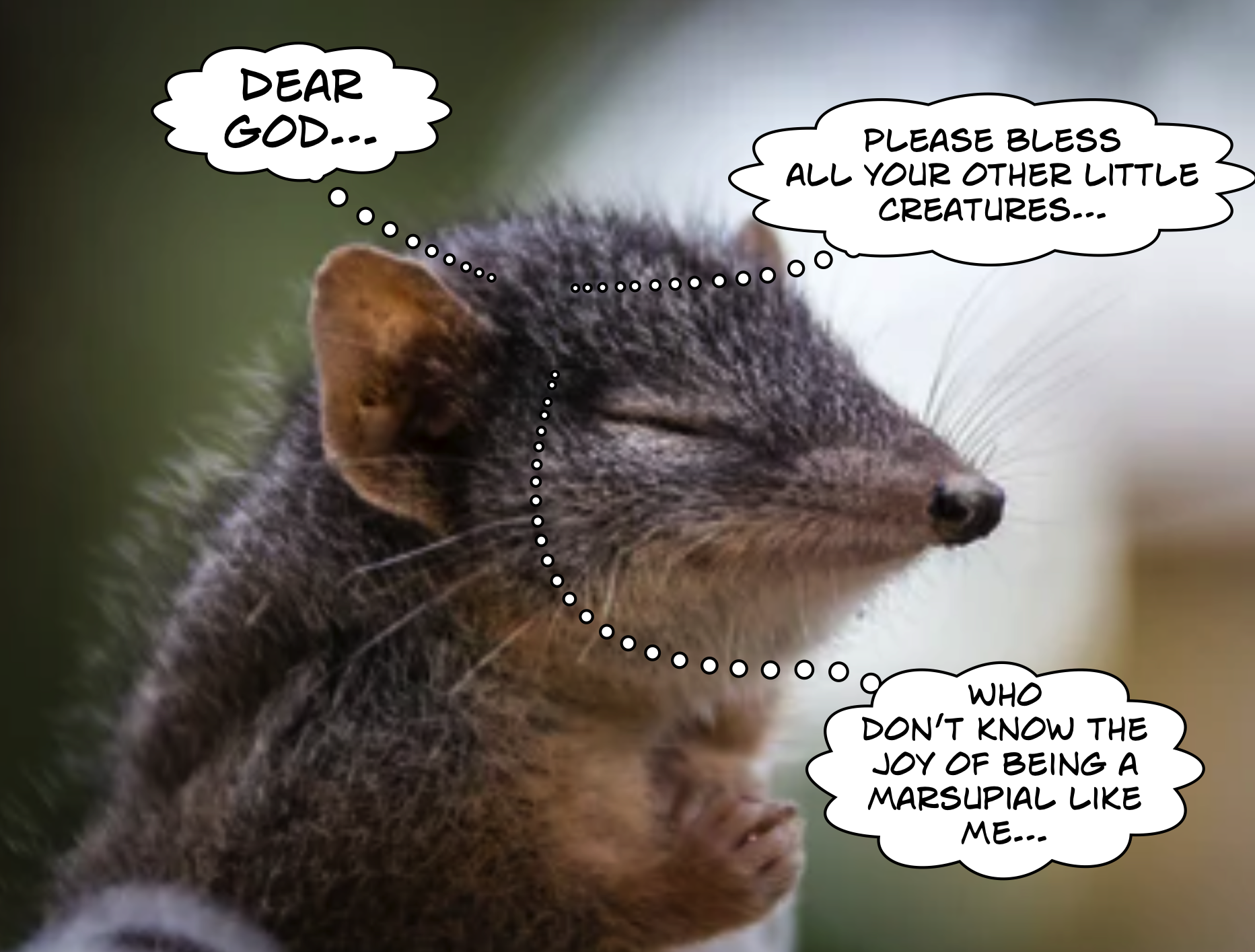
God as the Author of Creation

Satan is powerless versus Christians, especially those who know he exists. Yet, vis-à-vis unbelievers, he “prowls around like [an invisible] lion, seeking someone to devour” (1 Peter 5). Christian “immunity” to Lucifer’s power, if not his temptations, is due to the indwelling presence of God’s Holy Spirit.

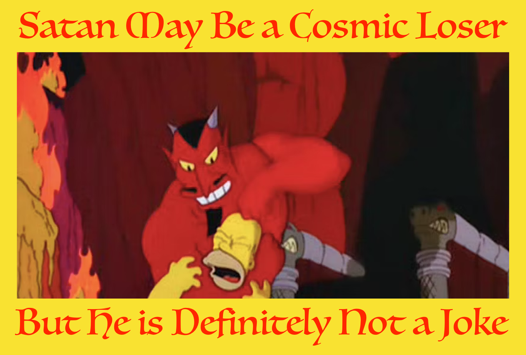
Still, for every human being, whatever their personal belief, the Devil is no mere cartoon, with whom to be trifled. I discussed this briefly in my previous post, “Only God Can Create,” which you might want to read before continuing here.

As for humanity’s vulnerability to the Devil’s influence, the consensus in paradoxically-labeled “enlightened” cultures is that he doesn’t even exist. Sadly, this cosmic lie even tricks self-described “Christians.”

This illusion plays directly into his purposes, as C.S. Lewis described in The Screwtape Letters. Screwtape, a senior demon, instructs his protégée Wormwood in the preferred method of dispelling human wariness about Evil.

The fact that “devils” are predominantly comic figures in the modern imagination will help you. If any faint suspicion of your existence begins to arise in his mind, suggest to him a picture of something in red tights, and persuade him that since he cannot believe in that (it is an old textbook method of confusing them) he therefore cannot believe in you.

Ironically, the populations of less Westernized cultures possess some immunity to this deception. Even in their traditional religions, there is a keen awareness of the existence of evil presences. In the words of The African Study Bible, “we Africans understand instinctively the stories of angelic visitations, spiritual warfare, and demonic oppression that are in the Bible.”

Christians believe in God, not the Devil. While the Scriptures attest to the personal identity of this fallen angel, acknowledgment of his existence is not salvific (i.e. it is not essential to salvation). Thus, C.S. Lewis is correct in his 1944 essay “Answers to Questions on Christianity” when he writes:

No reference to the Devil or devils is included in any Christian Creeds, and it is quite possible to be a Christian without believing in them. I do believe such beings exist, but that is my own affair.

Supposing there to be such beings, the degree to which humans were conscious of their presence would presumably vary very much. I mean, the more a man was in the Devil’s power, the less he would be aware of it, on the principle that a man is still fairly sober as long as he knows he’s drunk. It is the people who are fully awake and trying hard to be good who would be most aware of the Devil. It is when you start arming against Hitler that you first realize your country is full of Nazi agents.

Of course, they don’t want you to believe in the Devil. If devils exist, their first aim is to give you an anaesthetic – to put you off your guard. Only if that fails, do you become aware of them.

On the Matter of Creative Power

Only God can create. That was the core message of our previous discussion. C.S. Lewis recognized, as do biblically-grounded believers, that Satan is merely a sinful, fallen being, little different from humanity in that regard. This truth shatters the pagan philosophy of dualism, or the misguided notion that two equal and opposite forces (e.g. good and evil) exist in some sort of equilibrium. 

In “The Seeing Eye,” C.S. Lewis described the way in which God is beyond his creation. 

Looking for God – or Heaven – by exploring space is like reading or seeing all Shakespeare’s plays in the hope that you will find Shakespeare as one of the characters . . . Shakespeare is in one sense present at every moment in every play. But he is never present in the same way as Falstaff or Lady Macbeth. . . .

If there were an idiot who thought plays existed on their own, without an author . . . our belief in Shakespeare would not be much affected by his saying, quite truly, that he had studied all the plays and never found Shakespeare in them. . . .

My point is that, if God does exist, He is related to the universe more as an author is related to a play than as one object in the universe is related to another. If God created the universe, He created space-time, which is to the universe as the metre is to a poem or the key is to music.

To look for Him as one item within the framework which He Himself invented is nonsensical. If God – such a God as any adult religion believes in – exists, mere movement in space will never bring you any nearer to Him or any farther from Him than you are at this very moment. You can neither reach Him nor avoid Him by travelling to Alpha Centauri or even to other galaxies.

Mark Twain’s Divinized Satan

I had intended to mention Samuel Clemens in my previous article, as one who advanced the assertion that Satan possesses creative ability. Whether Twain regarded the Devil as an actual entity is certainly debatable. What is undeniable, however, is his devoted defense of Lucifer.

As Twain famously wrote in his autobiographical writings, “But who prays for Satan? Who, in eighteen centuries, has had the common humanity to pray for the one sinner that needed it most?” 

Mark Twain was (in)famous for his atheism, or his agnostic antipathy of the Christian understanding of our Creator. Not content to disbelieve, Samuel Clemens actively worked to undermine Christian faith. One of his books, Letters from the Earth, had to be printed posthumously, due its irreverent (or blasphemous) nature.

It bears a superficial resemblance to C.S. Lewis’ amazing Screwtape Letters – insofar as both fictional works present themselves as demonic correspondence. 

The similarity ends there. While Lewis provides keen insight into Evil’s tactics in wreaking havoc in human lives, Twain’s letters present Satan in a positive, even noble, light.

Letters from the Earth is only one of Mark Twain’s anti-Christian works. The Mysterious Stranger is one of his most bizarre. It evidences his long-term preoccupation with Satan, in that it was composed (in various versions) between 1897 and 1908.

The first serious rendition, The Chronicle of Young Satan, was completed in 1900. I mention it here because there is a scene in which the Devil “creates” a miniature world. Obviously it errs in attributing to Lucifer the power to create life – but to its credit, it does reveal Satan as a capricious, vain, cruel, and compassionless lord.

In 1985 a claymation film was released titled The Adventures of Mark Twain. It features the mock scene from Chronicle of Young Satan. It is quite disturbing. However, if one is curious about the subject, and wishes to be forearmed regarding such deceptions, you can view the excerpt here.

Especially for those who do choose to view Twain’s portrayal of the Devil in his fictional “youth,” I desire to end our current discussion on a positive note.

Claymation was also the medium for a long-lived Christian television series. Davey & Goliath, the story of a regular kid and his dog, ran between 1964 and 1975. Many of the episodes can be seen here.

And finally (and forever), we can celebrate with C.S. Lewis the wonder that this world we currently inhabit will not be God’s sole creation. In fact, because of Jesus’ redemptive sacrifice, we can look forward to a new cosmos, untainted by sin.

The New Testament writers speak as if Christ’s achievement in rising from the dead was the first event of its kind in the whole history of the universe. He is the “first fruits”, the “pioneer of life”.

He has forced open a door that has been locked since the death of the first man. He has met, fought, and beaten the King of Death. Everything is different because He has done so. This is the beginning of the New Creation: a new chapter in cosmic history has opened (Miracles).


A More Peaceful Time

It seems like a dream, when I recall a college course I took where Jews and Muslims peacefully discussed the turbulent history of the Middle East. And how we discussed that sad story in a cordial, and even sympathetic, manner.

The contrast between that day and 2023 – when people cannot even agree that tiny infants should not suffer for the sins of their parents – is mind-bending.

We assume that all people desire peace. Would that it were so. In his essay “First and Second Things,” C.S. Lewis offers a timely insight.

As far as peace (which is one ingredient in our idea of civilization) is concerned, I think many would now agree that a foreign policy dominated by desire for peace is one of the many roads that lead to war.

I was an undergrad at the University of Washington in the mid-1970s, when I saw a graduate level course with a fascinating title: “Wars that have Shaped the History of the Middle East.” My high school friend and I “begged” the professor to allow us into the class. He cautioned us that he would have the same requirements for us as he did for everyone else; there would be no mercy extended if we failed to meet the syllabus’ demands.

“No problem,” we said . . . although, being young procrastinators, at the end of the quarter we foolishly required a couple of all-nighters to complete our comprehensive term papers.

We, both Christians, were the only undergraduates in the small class. Our professor was Jewish, as were two of the students. One of these, was Israeli. He was, in fact, a veteran of the recent Yom Kippur War, during which he had served as the commander of a tank. I don’t recall which front on which he fought, but when you look at a map of Israel, it’s clear that every part of that small nation is a potential combat zone.

The remaining members of the class consisted of three Muslim students. One was American and a second was Iranian (back when the Shah was still in power). The third Islamic member of the class taught at a Seattle community college. He was Palestinian. And not merely Palestinian – his family was displaced during the 1948 Arab-Israeli War, which is referred to by the Israelis as the War of Independence.

You can imagine that with a group like that, opinions were deeply entrenched. Yet, although the preexisting opinions were indeed fixed, the individuals were not obstinate. Conversations were civil. Disagreements were conducted with reason rather than emotion. And, most surprisingly of all, we were able to socialize together at the end of the course.

It was a different world, apparently. It’s challenging to conceive of partisans today being capable of treating others with such respect. The last half century has marked a steep decline in the humanity of humanity.

Anti-Semitism is a Curse

It is strange to ponder how we’ve come to define antisemitism, confining it to anti-Jewish sentiment. After all, the word Semite refers to all people who speak a Semitic language, including Arabs.

Etymologically, Semite “comes via Latin from Greek Sēm ‘Shem,’ son of Noah in the Bible, from whom these people were traditionally supposed to be descended.”

If you are interested in an excellent article titled “C.S. Lewis’s Anti-Anti-Semitism in The Great Divorce,” simply follow the link embedded here.

Israel’s Wars

There has been no shortage of blood shed on the land the Romans called Judea and Arabia Petraea. And the history of the past seventy-five years have been violent indeed. For a description of all of the wars and military operations involving Israel, see this website.

We students each had to select one of the Middle Eastern regional wars to research in depth. We also had to make a detailed presentation and lead the discussion based on general readings completed by everyone.

As soon as I saw that requirement in the syllabus, my mind was mired in confusion over which of Israel’s wars would be the least controversial. Fortunately, as I read further I discovered that the purview of the course did not begin with the end of the Palestine Mandate, which was administered by Britain. Due to the influence of the Ottoman Empire, which had overshadowed the region until the end of the First World War, the professor elected to begin the course with the relatively nonconfrontational consideration of the Crimean War. I was the first student to raise my hand and voice my preference.

During the Palestine Mandate, C.S. Lewis had a number of former students serving in the Levant. In a 1940 letter to his brother Warnie, he describes a pleasant visit from one of these who went on to serve in a political capacity throughout the region for several more decades. This statesman refers to a fellow student who would go on to teach at East Anglia University.

I had a visit one night last week from Pirie-Gordon back from leave from Palestine, where (and in Egypt and Turkey) he says everything is “as good as gold.” The last riot was quelled by the cavalry regiment in which Rivière serves . . . In fact as P.G. said “I raised the riot and Rivière quelled it.”

I wonder how the members of the class would relate to one another if we were reunited for a discussion of what has transpired since 1975. With members of the American government at each other’s throats on our nation’s response to Hamas’ war, I doubt our discussions would be as respectful as they were back in the twentieth century. Still, conversations – even painful ones – need to happen if people are ever to get along with one another. That’s true not only for nations, but also for neighbors, and families.

I recommend two things to move us in the right direction. Honest communication, where we do a lot of listening. And prayer. The fact we do so poorly with the first, makes the second all that more essential.

Can We Ignore Modern Slavery?

I can’t answer this question for you, but I know how I want to be able to answer when I stand before our Creator. 

Many Christians include corporate confession and absolution (forgiveness) as part of their regular worship. We often ask forgiveness our sins of commission and omission – the wrongs we do, and the wrongs we are responsible for when we fail to do what we should.

God forbid that any of us would actively support slavery, but . . . how little most of us do to reduce it or free people from its deadly grasp.

In Britain, the National Society for the Prevention of Cruelty to Children, founded in 1884, recognizes modern slavery as one of the world’s greatest challenges. As they say: “Any child is at risk of child trafficking.”

Save the Children states that “children account for 27% of all the human trafficking victims worldwide, and two out of every three child victims are girls.”

Sometimes sold by a family member or an acquaintance, sometimes lured by false promises of education and a “better” life – the reality is that these trafficked and exploited children are held in slave-like conditions without enough food, shelter or clothing, and are often severely abused and cut off from all contact with their families.

The children’s condition is not “slave-like;” these precious victims literally are slaves, in every cruel sense of the word. While no unenslaved person would be so ignorant as to presume they understand slavery, C.S. Lewis mentioned in a 1939 letter several torments it inflicts. At the break of the Second World War, he was reflecting on his experiences in the First.

My memories of the last war haunted my dreams for years. Military service, to be plain, includes the threat of every temporal evil; pain and death which is what we fear from sickness; isolation from those we love which is what we fear from exile: toil under arbitrary masters, injustice, humiliation, which is what we fear from slavery: hunger, thirst and exposure which is what we fear from poverty.

The most shocking part of this description from Save the Children, is the acknowledgment that the children are “sometimes sold by a family member . . .” I discussed this grim truth in my 2014 post, “Loving Prostitutes.”

In that article I express a sentiment I hope you share: “I love prostitutes because God has granted me the vision to see them as he does.”

What You & I Can Do Today

Obviously, if this subject is new to you, you can become informed. The links I’ve provided offer a good starting point.

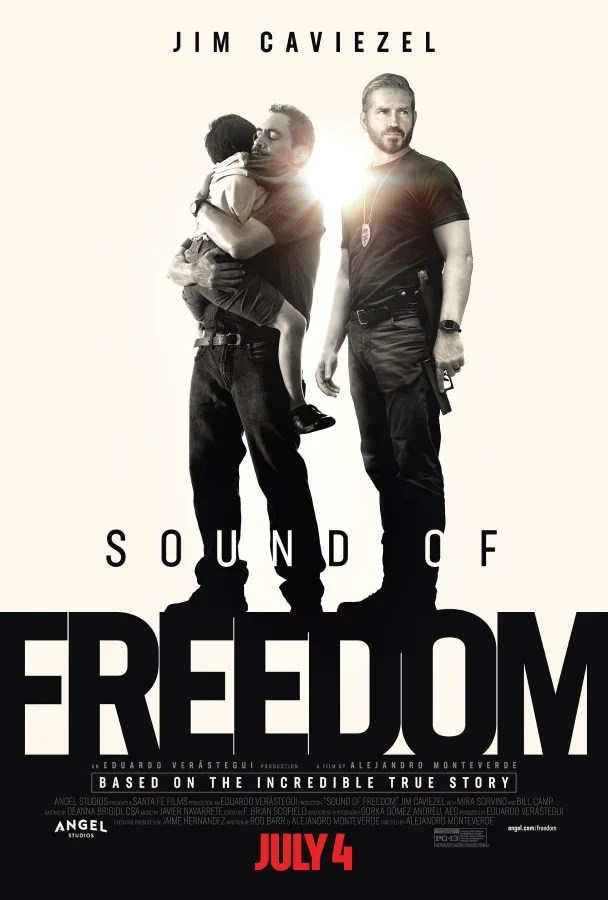
At the present moment we have a truly unique opportunity to make a contribution toward addressing this massive horror. We can support a superb, first-class film that is currently showing in hundreds of cinemas. 

Sound of Freedom is a true story with a superb cast and excellent cinematography. Despite its serious subject, the film is well worth viewing while it is still in theaters. Simply by attending, and even more by encouraging family and friends to join you, we can raise the awareness of this tragedy.

Together, you and I truly can help rescue people from this fate, and promoting this message of hope and deliverance is a small step in that journey. 

When faced with ugly things, the timid response is to turn away and pretend it doesn’t exist. In cases like this, particularly involving children, a cowardly response in ignoring the evil constitutes nothing less than a sin of omission. 

Check with your local theaters today, and reserve a seat at a showing of Sound of Freedom. (And, for those who see this suggestion months or years after the film’s 2023 release, check it out soon on a streaming service.)

Postscript & Resources:

While I was still on active duty, the United States Department of Defense initiated a long-overdue program. In recognition that military members are literally on the “front lines” of encountering modern slavery, Combating Trafficking in Persons is an official program established to confront the crime.

The program includes provisions requiring training for all DoD personnel, civilian as well as uniformed. This site describes the various levels of training required. To actually “take” the training and testing requires login privileges. However, various resources – including some very informative videos – are available to the public.

Similarly, agencies such as INTERPOL restrict their courses to members. Nevertheless, they offer a variety of educational resources and updates on current efforts to battle this crime around the globe.

While I haven’t personally vetted the following, a number of public and governmental organizations offer free training for interested individuals. Among them are: 

the U.S. Department of Homeland Security, and the Office for Victims of Crime. The U.S. Institute Against Human Trafficking lists six free classes, several of which offer certificates of completion.

The Home Office in the United Kingdom hosts a site with a number of related resources. One is “A typology of modern slavery offences in the UK” which breaks “down the broad categories of modern slavery into 17 distinct types of offences identified in the UK.” No doubt, most other enlightened nations promote similar materials.

In a 1943 essay entitled “Equality,” C.S. Lewis discusses the subject of the nature of Democracy, as a form of government. His argument includes the clearest possible reason why slavery never has been, and never could be a good, or morally neutral, thing.

I am a democrat because I believe in the Fall of Man. I think most people are democrats for the opposite reason. A great deal of democratic enthusiasm descends from the ideas of people like Rousseau, who believed in democracy because they thought mankind so wise and good that everyone deserved a share in the government.

The danger of defending democracy on those grounds is that they’re not true. . . . I find that they’re not true without looking further than myself. I don’t deserve a share in governing a hen-roost, much less a nation. . . .

The real reason for democracy is . . . Mankind is so fallen that no man can be trusted with unchecked power over his fellows. Aristotle said that some people were only fit to be slaves. I do not contradict him. But I reject slavery because I see no men fit to be masters.

I know that C.S. Lewis would add his “amen” to my challenge today that each of us might look for ways to help eradicate this plague of slavery, which has cursed humanity for millennia.

A Portuguese Pope & C.S. Lewis

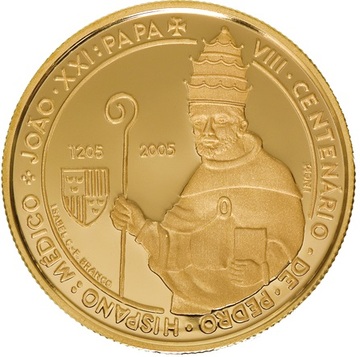
A few days ago marked the anniversary of the 1277 death of Pope John XXI. I knew nothing about this particular Pontiff, but the mention I read described his passing due to the collapse of the ceiling of his residence. That piqued my interest, but the following forced me to spend some time researching to learn more: “The name was a mistake – there was never a John XX.”

One of the very few email lists I’ve never regretted signing up for is “Today in Christian History” produced by Christianity Today.

Each day it provides brief notes about several historical events that happened on that particular day. Most of the notes describe historically watershed incidents. Others are simply curious, though they were naturally momentous to those involved.

The opening of this post offers an example from the latter category. Unlike the reign of Pope Francis, who ascended a decade ago and has indicated he has no intention of “retiring” before death (as did his humble predecessor Benedict XVI), the unfortunate John XXI sat on the papal throne for a mere nine months.

Despite this brief reign, there are several interesting things about Pedro Julião. (I’ll save the one I regard as most important for last.)

First of all, John XXI was Portuguese. Hailing from the Iberian Peninsula, he represents no less than 50% of the popes who came from Portugal. The first, Damasus I (305-84), came from the Roman province of Lusitania, which included a portion of Spain in addition to modern Portugal.

One paradox of the Papacy is that the Pope is the Bishop of the diocese of Rome, presiding over a physical geographic locale, while he is simultaneously the Bishop of the “Holy See,” meaning that he serves as the episcopal head of the entire international Roman Catholic communion.

Due to the physical location of the Roman Patriarchate, it is unsurprising that a majority of the individuals who have followed Saint Peter as Pontiff have been Italian. World Population Review says 217 of the 266 Popes have been from Italy. “A distant second is France, which has had a total of 16 popes.”

J.R.R. Tolkien was a truly devout Roman Catholic, but C.S. Lewis recognized that the church headquartered in Rome was merely one part of the Body of Christ whose unity he argued was founded in an understanding of the Mere Christianity Lewis propounded. Much to Tolkien’s chagrin, his good friend Lewis never converted to Roman Catholicism.

Roman Catholics still seek C.S. Lewis’ imprimatur. One prominent Roman Catholic apologist, Joe Heschmeyer, has a personal blog delightfully titled Shameless Popery. (I highly respect truth in advertising like his website exhibits.) In “C.S. Lewis’ Surprising Argument for the Papacy,” he argues that Lewis’ argument for a traditional view of marriage offers support to the rationale for papal authority.

Unlike some Protestants, C.S. Lewis was not tempted to construct a strawman out of the papacy. In an interesting passage from his monumental history of English Literature in the Sixteenth Century, he emphasizes the shared legacy of Roman Catholicism and robust Protestantism. 

To be sure, there are standards by which the early Protestants could be called “puritanical;” they held adultery, fornication, and perversion for deadly sins. But then so did the Pope. If that is puritanism, all Christendom was then puritanical together.

In much the same way that C.S. might argue that “all Christendom” shared not only a common moral awareness, but also a mutual understanding of God’s self-revealed Triune nature.

In addition to being a rare specimen as a Portuguese Pope, John XXI studied medicine and is thought to have been a noteworthy pharmacologist. In fact, the apartment in the papal palace in Viterbo which collapsed on him was constructed so he would have a quiet place in which to pursue his medical studies.

Second, as already mentioned, another peculiar thing about John XXI, is the choice of his papal name. There never was a Pope John XX. One would imagine the church bureaucracy would keep accurate records of these sorts of things. Even more strangely, there is more than one explanation for why Pedro Julião became John XXI at his consecration.

According to Brittanica “Marianus Scotus and other 11th-century historians mistakenly believed that there had been a pope named John between antipope Boniface VII and the true John XV.” Consequently, “they mistakenly numbered the real popes John XV to XIX as John XVI to XX” requiring that they subsequently be “renumbered XV to XIX.” Yet, for some reason, “John XXI and John XXII continue to bear numbers that they themselves formally adopted on the assumption that there had indeed been 20 Johns before them.”

As a result, the title John XX presumably remains available for any future Bishop of Rome who might wish to further confuse the matter. We may have to wait until the Parousia to learn the full facts in this convoluted matter.

A third distinctive of John XXI is that he rescinded a very common sense decree established by his predecessor Gregory X, only two years prior to John’s ascension. (Actually, Adrian V was elected pope between the two, but Ottobuono de’ Fieschi died shortly after his election, before he could even be ordained to the priesthood. (There must be another interesting tale there.)

Returning to the story of the rescinded canon . . . Apparently there was a long papal vacancy (nearly three years) before Gregory X was elected. To avoid such predicaments in the future, at the Second Council of Lyon Gregory pushed for this sensible rule: if the new pope is not elected in a reasonable time frame, encouragement would be provided to the conclave by having their episcopal meals and other rewards gradually diminish!

The entire, fascinating “constitution” is available at Eternal World Television Network. Here is the essence:

We learn from the past how heavy are the losses sustained by the Roman church in a long vacancy, how perilous it is . . . We intend in no way to detract from [previous rules primarily instituted by Pope Alexander III], but to supply by the present constitution what experience has shown to be missing.

If, which God forbid, within three days after the cardinals have entered the said conclave, the church has not been provided with a shepherd, they are to be content for the next five days, every day both at dinner and supper, with one dish only. If these days also pass without the election of a pope, henceforth only bread, wine and water are to be served to the cardinals until they do provide a pope.

While the election is in process, the cardinals are to receive nothing from the papal treasury, nor any other revenue coming from whatever source to the church while the see is vacant.

For some unrevealed reason, John XXI revoked this rule, and it was back to business as usual. The decision to do so was one of John’s few official acts.

C.S. Lewis, Once Again

One reason Christians of all denominational traditions find much to appreciate in C.S. Lewis comes from the fact he was much more interested in edifying believers than tearing them down. He preferred to promote Christian unity over division.

One of his close friends, with whom he carried on a long term correspondence was a Benedictine monk named Bede Griffiths. Ironically, while Griffiths became renowned for his embrace of elements of Hindu spirituality, the priest appeared less tolerant of C.S. Lewis’ Protestant doctrines. In a letter from 1936, Lewis’ frustration on that score comes through loud and clear.

One of the most important differences between us is our estimate of the importance of the differences. You, in your charity, are anxious to convert me: but I am not in the least anxious to convert you.

You think my specifically Protestant beliefs a tissue of damnable errors: I think your specifically Catholic beliefs a mass of comparatively harmless human tradition which may be fatal to certain souls under special conditions, but which I think suitable for you. . . .

As well – who wants to debate with a man who begins by saying that no argument can possibly move him? Talk sense, man! With other Catholics I find no difficulty in deriving much edification from religious talk on the common ground: but you refuse to show any interest except in differences.

These words were written (1) privately, to a friend, (2) in the form of an extemporaneous letter, and (3) tinged with the frustration of returning to a familiar “debate” with a recalcitrant disputant.

Fortunately, however, we possess an essay written by Lewis on the same subject which was composed in the opposite context. It was intentionally composed for a general audience, written in C.S. Lewis’ natural painstakingly logical and clear literary voice, and composed in his conciliatory spirit with a focus on affirming what is shared and illuminating – but not dwelling upon – differences.

In 1944 C.S. Lewis penned an essay entitled “Christian Reunion.” Sadly, it was never completed for publication during his lifetime. This brief work reveals his deeper thoughts on interdenominational distinctives, and the overriding unity Christians possess through our relationship in Jesus Christ. It is written primarily to a Roman Catholic audience, in a respectful and genuinely compassionate tone.

A Pilgrim in Narnia has provided the universal (“catholic” with a small “c”) Church a great service in reproducing the full text of the essay here.

Dr. Dickieson also provides a concise and helpful introduction. I offer only a selection from Lewis’ essay here, as befits the nature of our current discussion.

I know no way of bridging this gulf [between the major Christian traditions]. Nor do I think it the business of the private layman to offer much advice on bridge-building to his betters. My only function as a Christian writer is to preach “mere Christianity” not ad clerum [to the clergy] but ad populum [to the people].

Any success that has been given me has, I believe, been due to my strict observance of those limits. By attempting to do otherwise I should only add one more recruit (and a very ill qualified recruit) to the ranks of the controversialists. After that I should be no more use to anyone.

When therefore we find a certain heavenly unity existing between really devout persons of differing creeds – a mutual understanding and even a power of mutual edification which each may lack towards a lukewarm member of his own denomination – we must ascribe this to the work of Christ . . . 

Ultimately, C.S. Lewis’ reservations about Roman Catholicism rested where they do for most thinking Christians who belong to other denominations. Its focus can be distilled down to a “disagreement about the seat and nature of doctrinal Authority.” Although he does not expressly state the conviction here that Scripture supersedes the ultimate weight of a single opinion, say of someone such as Pope John XXI, that is the concern.

We will end with C.S. Lewis’ astute analysis of the two parts of the Christian family as they view one another across the proverbial Tiber. In doing so, I offer the fruits of my own recent theological quest. Precipitated by a contemporarily trivial event during the thirteenth century, it culminated in another deep draught from the wisdom of C.S. Lewis.

The difficulty that remains . . . is our disagreement about the seat and nature of doctrinal Authority. The real reason, I take it, why you cannot be in communion with us is not your disagreement with this or that particular Protestant doctrine, so much as the absence of any real “Doctrine,” in your sense of the word, at all.

It is, you feel, like asking a man to say he agrees not with a speaker but with a debating society.

And the real reason why I cannot be in communion with you is not my disagreement with this or that Roman doctrine, but that to accept your Church means, not to accept a given body of doctrine, but to accept in advance any doctrine your Church hereafter produces. It is like being asked to agree not only to what a man has said but to what he’s going to say.

Postscript

As an illustration of the C.S. Lewis’ point about authority resting in the current “successor of Peter,” consider the decisions rendered by Gregory X and John XXI about papal enclaves. It seems to me that the first admonition about not indulging those in attendance was wiser than the subsequent decision to restore the earlier policies. But then, that may simply be due to the fact that I’m a Protestant. Unless the rules have been revised since John’s passing, I assume most Roman Catholics would agree that he was led by the Holy Spirit in reversing the decree of the Second Council of Lyon.

To Pray or Not to Pray

I’m in the midst of a health issue, and it has sharpened some thoughts I have long held about prayer.

I welcome prayer. From anyone, pretty much.

That’s because I believe despite the pray-ers beliefs’, it could possibly help, definitely can’t harm, and may simply possess a positive sociological element, even when the prayers are not efficacious. More on that in a moment.

The Current Concern

I think I’m coming off of a bad cold. Early in the week I experienced a cough, a moderate temp, and a couple other symptoms (minus the scratchy throat) I’ve associated with the Rhinovirus for decades.

I’m vaxxed and boosted against the Coronavirus, but being a super-conscientious pastor (who counts a fair number of seniors in his congregation) I decided it would be best to know whether or not these few sickly days have been caused by omicron, I got tested yesterday. Results are due in today or tomorrow.

Testing is never so easy, of course, as we would like it to be. In my case, my primary medical care provider was referring people like me to other facilities. The one which was the least inconvenient proved to still involve major time and effort.

The hassle came from having to fill out a fistful of forms to verify everything from my insurance providers to my current gender identification. One sheet was an extensive questionnaire about who they could speak to in regard to my health. It was more thorough than ones I’d encountered in the past, and raised an existential question at its end.

It began by asking if they could talk to my spouse (I think they called her a “partner”). I checked “yes” and wrote in her name. Next it asked about other family members. Triple check; I inscribed the names of my three children. After that it asked about sharing information with my other medical providers. Fine (although getting different medical caregivers to communicate on my behalf in the past has proven quite challenging).

I was surprised the form didn’t ask whether I wanted the results made available to the People’s Republic of China, but immediately realized that was a moot question since they have access to every American’s most personal data. And due to their earlier breaches of Department of Defense systems they probably already have my DNA code.

The final question on the form was not surprising. Still, in the (literal) Friday morning fog, I considered responding rather than simply passing on to the next sheet. “Is there anyone else we can speak to about your condition?”

I had an answer to that, and even I doubt anyone will ever read it once the paper is filed, I decided to write it down. “You have my permission to speak to God on my behalf.”

The Theological Ramifications of My Invitation

Being a Lutheran, especially a theologically trained one, means you can never take something simply at face value. You have to critically analyze it to the point where each of the statement’s innate flaws is stripped bare. I’m sure some readers are doing that right now with my words.

The question boils down to whether or not it is a “good” thing to have people from alien worldviews or faiths pray for you. I’ve met people in the past who were quite clear about not wanting Christians, for example, to pray for them.

A few of these were atheists. In such cases I tried to give them the benefit of not desiring to be seen as a hypocrite by “welcoming” such prayers during a crisis – but I sometimes thought they were actually afraid of the turbulence that would result from God showing his divine hand in the pristine secularity of their lives.

Returning to my case, I have never consciously rejected anyone’s offer to silently pray for me. The following ideas guide my thinking on the subject.

1. It could well mean absolutely nothing. The offer to pray is frequently just a reflex. Many people say “I’ll pray for you” the moment they hear about a need, and I think we’d all be disappointed to discover how many actually follow through. While this sort of thinking is not healthy for those who manifest it, it causes no harm to the intended recipient of the prayer.

2. Non-Christians who might be called “spiritual” want to wish others well, and I don’t see any benefit in preventing them. This sort of person may use prayer terminology, but some are more self-aware and say things like “I’m sending you positive thoughts.” To be gracious, they are attempting to communicate their empathy. To be accurate, they are wasting their time. I know I don’t have telepathy, so any thoughts they may be able to transmit in my direct won’t be received at this end. Likewise for the new age trope “positive energy.” That’s the immaterial stuff that gurus have supposedly been harnessing for centuries to make our world a more peaceful place. Since I’m pretty sure it’s 100% sentiment, it doesn’t hurt me, so I don’t mind having it launched toward my vector.

3. Adherents of other religions will sometimes offer to pray for each other. In this too, I find no problem. Those who know me, understand without a shadow of doubt, that I believe Jesus Christ’s declaration that he is the way, the truth and the life, and that no one comes to the Father except through him.

But if they wish to offer me the sincere expression of their friendship by offering to pray for me, I regard that as an honor. Not something that will result in a positive intervention by a deity which does not actually exist.

(By the same token, when I offer to pray on their behalf, I do not expect them to believe in the faith I profess, or even the existence of God himself.)

So, this sort of prayer does me no harm, does not compromise my Christian witness, and can strengthen bonds of friendship and shared humanity with other individuals for whom Jesus died.

4. People who worship real entities. Now, this is really “out there,” as they say, and so uncommon as to be something none of us are likely to ever experience. But let’s discuss it theoretically, since it falls under the umbrella of having “anyone” pray for you. In this scenario, we have a person who worships an actual supernatural entity. Let’s ignore the lower echelons of the “principalities and powers” and skip right to their boss, the broken-winged Lucifer. Let’s also ignore the fact no true Satanist would be inclined to intercede for a Christian who ridicules their Master. But, let’s assume someone did mention my name in their conversations with Screwtape’s “Our Father Below.” It would mean, and accomplish, nothing. Christians, you see, have nothing to fear from Satan. He is powerless against the Holy Spirit of God himself who lives within us.

Update

So, as it turns out, I just got a call from a nurse at the clinic and . . . yes, I do have a case of covid. It was mercifully short, with no temp now and decreasing nasal congestion. Basically back to “normal,” with a future “natural immunity” added to my “vaccine-induced immunity.”

Adding new T cells to my body’s arsenal will be a beneficial consequence of this week’s sickness.

The dangers of covid for people (like myself) possessing so-called comorbidities, are real. I pray regularly for medical breakthroughs in battling the viruses, bacteria and cellular aberrations that plague human life.

But I recognize all too well that life is fleeting, as the Scriptures say, like “a mist that appears for a little time and then vanishes.”

As Larry Norman used to sing, we’re “only visiting this planet,” on our way to a new and unfallen world like the one the Lord first created for us.

This pilgrimage entails many challenges. And, although I know my Savior will see me safely through everything I face, you have my permission to pray for me.

The Value of Money

America exerts a major influence on global financial health. And our current unrestrained printing of new dollars will doubtless have repercussions around the world.

I’m no economist myself, but there seems to be growing concern among professionals of that persuasion that we’re headed for über-inflation. And, if our dollar drops in value the way some people predict . . . well, it seems many nations may be in for the proverbial “rough time of it.”

Shortly after WWII, C.S. Lewis commiserated with an American friend about the effects of inflation on the price of commodities.

I take it that your [comment] indicates not a saturation of the home market, but a shortage of purchasing power due to inflation? That is the situation with which we are faced at the moment; I see that the clothing concessions for instance have not resulted in an increased sale of home market goods.

The stuff is in the shops, but people can’t buy. Though with us the problem is complicated by the inferior quality of so much of the stuff on the home market.

Years later, in 1951, Lewis could still write “war and inflation are still the background of all ordinary conversation over here.”

. . . to which has just been added the railway jam; our new railway organization has succeeded, so far as I can understand, in blocking every goods depot in the country. The trades people are grumbling, and the effect is just becoming apparent to the consumer.

When I was in high school, collecting coins from around the world, I purchased samples of German currency when hyperinflation was destroying their already-shattered economy. These bills were called notgeld, which means “emergency money.”

So much of the worthless paper was printed that you can still purchase genuine pieces for reasonable prices. Many of them are quite interesting, and you can see a variety of examples online.

Some are quite lovely, like this 1 Mark note printed in Prien am Chiemsee in 1920. Lovely indeed, but virtually worthless in terms of its initial value.

Postwar Germany offers a cautionary example. Similarly, Robert Mugabe’s destruction of Zimbabwe after he gained dictatorial powers shows the danger. You can read about the unbelievable crisis in a variety of places, including this thorough article published in a European economics journal.

You might have thought that the picture at the top of this column was a joke. After all, what country prints a one million dollar bill? Well, Zimbabwe did!

In fact, with an inflation rate of 231,000,000% they ended up printing off one hundred billion dollar bills. That’s not a typo. $100,000,000,000 – you can see one in this Guardian article.

And we won’t even consider the one hundred trillion dollar bill.

Inflation Aside, Is Money Moral?

That’s a false question of course. Morality cannot be attributed to objects. After all, it is not money itself that is “the root of all evil.” It is a fallen human being’s love of possessing wealth that may lead “into ruin and destruction.”

C.S. Lewis expands on this truth, and wisely points out that the danger of idolatry and false security extends beyond money itself.

Christ said ‘Blessed are the poor’ and ‘How hard it is for the rich to enter the Kingdom,’ and no doubt He primarily meant the economically rich and economically poor. But do not His words also apply to another kind of riches and poverty?

One of the dangers of having a lot of money is that you may be quite satisfied with the kinds of happiness money can give and so fail to realise your need for God. If everything seems to come simply by signing cheques, you may forget that you are at every moment totally dependent on God.

Now quite plainly, natural gifts carry with them a similar danger. If you have sound nerves and intelligence and health and popularity and a good upbringing, you are likely to be quite satisfied with your character as it is. ‘Why drag God into it?’ you may ask (Mere Christianity).

C.S. Lewis powerfully portrays this peril in his fiction. In Voyage of the Dawn Treader, a boy named Eustace has surrendered to his lust for treasure and the corruption of his soul becomes quite visible.

He had turned into a dragon while he was asleep. Sleeping on a dragon’s hoard with greedy, dragonish thoughts in his heart, he had become a dragon himself.

You can include me among those who like money. First, for its function – allowing free commerce, in contrast to crippled systems of barter. And, for its intrinsic curiosities – I am, after all, a numismatist.

Still, appreciating the existence of money is a far cry from echoing John D. Rockefeller who said “I believe it is a religious duty to get all the money you can.” (To be fair to the robber baron, his full quote was “I believe it is a religious duty to get all the money you can, fairly and honestly; to keep all you can, and to give away all you can.”)

To gain riches honestly is, of course, not objectionable. But as to reconciling the keeping and the giving away . . . Rockefeller’s logic eludes me.

Bonus Insight

As I noted above, I’m no economist. C.S. Lewis declared the very same statement in Mere Christianity as he explored the concept of usury (loaning money with significant interest charges). His thoughts on the matter speak to the entire subject we have been discussing.

As for the entire section you can find Lewis’ position at an interesting site called Generosity Monk, which “is committed to serving the Church by providing spiritual and strategic guidance to help people understand and practice biblical generosity.”

Humorous Examinations

Could you pass this examination?

Sketch the development of human thought, estimate its significance. Compare with the development of any other kind of thought.

In contrast to the serious tone of the last two posts, today I am offering some edifying entertainment. As a gift to you, I have edited a perennial favorite of internet humorists. I recently came across my copy of this comprehensive knowledge examination, which motivated me to tweak it for Mere Inkling’s erudite audience.

You have probably seen versions of this exam in the past. The basic questions have remained surprisingly stable despite its age. I encountered it in the University of Washington campus paper in 1973. One writer claims “the Graduation Exam—Authentic Assessment has been in circulation since at least the 1950’s.”

The exam certainly makes the rounds, as this Navy veteran described.

The pressures of comprehensive exams were apparent to many, which resulted in one of the few officially sanctioned jokes in Naval Nuclear Power. In one of the official publications of Naval Reactors, someone inserted a sample “final exam” from Nuclear Power School.

In 2012 elements of the examination created confusion in the People’s Republic of China. It was included in an article about how Chinese nationals could prepare for an American State Department exam required for positions at the United States embassy in Beijing. According to China’s Global Times, “US embassy spokesman Richard Buangan made clear on his Sina microblog Sunday that an alleged ‘recruitment test for expatriate employees at the US embassy’ is fake.”

A June 2008 issue of Foreign Service Journal carried a story, which includes an English version of the [exam stating] the questions are from the US State Department’s entrance exam, in a bid to “measure the stability of perspective Foreign Service officers and to weed out the dummies.”

The Function of Examinations

Testing and documenting competence is obviously important. This is especially true for people in critical roles, such as prescribing drugs, designing aircraft engines, and manufacturing ice cream.

Of course, not everyone is able to pass every test. Which is precisely how things should be.

C.S. Lewis noted how educators truly familiar with their students readily recognize when it is a waste of time for them to continue repeating an exam they obviously cannot pass. He said an academic “master often knows, when boys and parents do not, that it is really useless to send a boy in for a certain examination again” (The Problem of Pain).

I have met very few people who enjoy being tested. Yet, for many faculty members (C.S. Lewis included), being on the “other side” of exams is not particularly enjoyable either. This delightful passage comes from a 1927 letter to his brother, Warnie.

My period of examining passed over with its usual accompaniment of neuralgia and oaths, relieved by the one excellent boy who defined ‘a genie’ correctly, yet more than correctly, as ‘an eastern spirit inhabiting bottles and buttons and rings.’ Pretty good for a boy.

I was also pleased with a youth who, being asked to write a letter to a friend recommending Guy Mannering,* wrote to his brother recommending it and saying ‘I think you would be interested in the character of Colonel Mannering, he is so like our father’: and then later in a paper on Guy Mannering in which I had set the question ‘Would you have liked Colonel Mannering as a father?’—illustrate your answer etc.—began decisively ‘I would not have liked Colonel Mannering as a father in the least.’

Well, it’s time now to offer you the opportunity to prove your worthiness. If you wish to evidence the breadth and depth of your knowledge, proceed now to the exam. (Astute readers will note I’ve added a personal twist to a couple of the exam questions.)

Comprehensive Knowledge Exam

HISTORY: Describe the history of the papacy from its origins to the present day, concentrating especially, but not exclusively, on its social, political, economic, religious, and philosophical impact on Europe, Asia, North and South America, and Africa. Be brief, concise, and specific. Now do the same for the Zoroastrian priesthood. [Bonus credit for including Antarctica in your response.]

MEDICINE: You have been provided with a razor blade, a piece of gauze and a bottle of scotch. Remove your appendix. Do not suture until your work has been inspected. You have fifteen minutes. [Option: if you feel the scotch would impair your responses to the remaining questions, you may defer this portion of the exam to the end of the exam.]

PUBLIC SPEAKING: Two thousand riot-crazed anarchists are storming the campus. Calm them. You may use any ancient language except Latin, Greek or Sanskrit. [Pig Latin is allowed.]

BIOLOGY: Postulate the 500 million year progression of a life form based on silicon, ranking its likely preference for form of government Enumerate the pros and cons it would associate with democracy, monarchy, socialism, theocracy, and totalitarianism. [Caution: any references to the Horta of Janus VI will result in disqualification of your answer, since Star Trek is a fictional resource.]

MUSIC: Write a piano concerto. Orchestrate and perform it with flute and digeridoo. You will find a piano under your seat. The wind instruments, of course, were among the items you were directed to bring with you to the examination.

PSYCHOLOGY: Based on your knowledge of their works, evaluate the emotional stability, degree of adjustment, and repressed frustrations of each of the following: Alexander of Aphrodisias, Hildegard of Bingen, Rābi’a bint Ka’b al-Quzdārī and Simeon the Stylite. Support your evaluation with quotations from each individual’s work, citing original sources. It is not necessary to translate.

SOCIOLOGY: Using the pretext of Planet of the Apes, where homo sapiens have been subordinated to various primate species, assess the prospects for achieving mutual toleration and equilibrium before one group is driven to extinction. [Caution: confusion of apes (which lack tails) and monkeys (which lack an appendix) will result in disqualification of your response.]

CHEMISTRY: Transform lead into gold. You will find a beaker, a three hundred count box of matches and five lead sinkers under your seat. Show all work including Feynman diagrams and quantum functions for all steps. [Transformation into silver will provide half credit.]

ENGINEERING: The disassembled parts of a high-powered rifle have been placed on your desk. You will also find an instruction manual, printed in Swahili. In 10 minutes a hungry Bengal tiger will be admitted to the room. [Special Consideration: Satisfactorily explain the differences between Fahrenheit and Celsius to the tiger, and it will be replaced by a rabid ferret.]

ECONOMICS: Develop a realistic plan for refinancing global debt, without hypothesizing a benevolent intergalactic alliance with unlimited resources coming to the planet’s aid. Trace the possible effects of your plan in the following areas: Cubism, the Donatist controversy, and the 1913 foundation of Hôpital Albert Schweitzer in Gabon.

POLITICAL SCIENCE: Devise an infallible, seven-step plan to transform the United Nations into an organization that will successfully foster peace and goodwill in all international relationships. [Bonus credit for providing a major role for two of the following nations: Dominica, Liechtenstein, Tuvalu.]

AGRICULTURAL SCIENCE: Outline the steps involved in breeding your own super high yield, all weather hybrid strain of wheat. Describe its chemical and physical properties and estimate its impact on world food supplies. Construct a model for dealing with world-wide surpluses. Draft your Nobel Prize acceptance speech.

PHYSICS: Explain the nature of matter. Include in your answer an evaluation of the impact of the development of mathematics on astronomy, botany and numismatics. [Bonus Credit: write today’s date in metric.]

PHILOSOPHY: Sketch the development of human thought, estimate its significance. Compare with the development of any other kind of thought. Be sure to include an analysis of the influence exerted on philosophy by Diogenes the Cynic.

CREATIVE WRITING: Compose an epic poem based on the events of your own life in which you see and footnote allusions from T.S. Eliot, Titus Lucretius Carus, Miguel de Cervantes, Dante Alighieri, Þorbjörn Hornklofi, Gilgamesh and Stephen King. Critique your poem with a full discussion of its syntax and metrics. [Bonus Credit for writing alternating stanzas between free and rhyming verse.]

EDUCATION: Formulate an examination which accurately measures an individual’s comprehensive knowledge base without cultural or linguistic prejudice. Limit the question parameters to what can reasonably be covered during a four hour testing block.

LITERATURE: Discuss in detail at least three major literary figures from each of the following civilizations: the Xia Dynasty, the Akkadian Empire, the Mayan Empire, the Aksumite Empire, the Polynesian Tuʻi Tonga Empire, and nineteenth century United Kingdom. [Caution: failure to include J.R.R. Tolkien and/or C.S. Lewis will result in disqualification of your answer to this question.]

Congratulations on finishing the exam. You are encouraged to use any remaining time to review your answers in light of the fact that grammatical errors and misspellings will significantly impact your final grade.


* You can download a personal copy of Guy Mannering, one of Sir Walter Scott’s Waverly novels, at Internet Archive.

If you should question the distinctions I noted between apes and monkeys, please know that the facts are genuine. However, for future examinations, you should be aware that not all monkeys have tails.

The White Christ, Red Thor & C.S. Lewis

If you were a Scandinavian living a millennia ago, you would be faced with a critical decision. Would you embrace Jesus Christ and a new life based on mercy, or would you cling to Odin and the Norse pantheon, with its glorification of bloodshed?

When I first heard this choice posed as a choice between the “White Christ” and the blood-drenched Thor, I assumed the white color alluded to traits commonly associated with it today—e.g. purity, innocence, and holiness.*

To my surprise, I recently learned there was a completely different to the Vikings. For them, referring to Christ as “white” was a term of derision.

Before returning to the Northmen, let’s consider for a moment the Inklings. These brilliant writers were well acquainted with white as a biblical metaphor for holiness, etc. They understood how the miracle of the Transfiguration described Jesus’ radiant face shining “like the sun” as the “bright cloud overshadowed them.”

As Mark records in his Gospel, Jesus “was transfigured before them, and his clothes became radiant, intensely white, as no one on earth could bleach them.”

It is no accident Tolkien’s Gandalf the Grey returns as Gandalf the White following his deadly battle with the Balrog.

In C.S. Lewis’ Voyage of the Dawn Treader, Aslan manifests himself to the children as an unblemished lamb.

But between them and the foot of the sky there was something so white on the green grass that even with their eagles’ eyes they could hardly look at it. They came on and saw that it was a Lamb. “Come and have breakfast,” said the Lamb in its sweet milky voice. . . .

“Please Lamb,” said Lucy, “is this the way to Aslan’s country?”

“Not for you,” said the Lamb. “For you the door into Aslan’s country is from your own world.”

“What!” said Edmund. “Is there a way into Aslan’s country from our world too?”

“There is a way into my country from all the worlds,” said the Lamb; but as he spoke his snowy white flushed into tawny gold and his size changed and he was Aslan himself, towering above them and scattering light from his mane.

On the other hand, C.S. Lewis tosses us a curve with the White Witch in his Chronicles of Narnia. The reason for her identification with white is obvious, since she is holding Narnia in an austere, perpetual winter. The witch’s hue carries other messages. Her unthreatening appearance moves Edmund to drop his defenses during their initial encounter.

[Queen Jadis was] a great lady, taller than any woman that Edmund had ever seen. She also was covered in white fur up to her throat and held a long straight golden wand in her right hand and wore a golden crown on her head. Her face was white—not merely pale, but white like snow or paper or icing-sugar, except for her very red mouth. It was a beautiful face in other respects, but proud and cold and stern.

Northern Mythologies

C.S. Lewis was enraptured by Northernness. He and Tolkien spent many hours reading Viking sagas.

However, Lewis was inspired not by the warrior Thor, but the person of Baldur. Several of my online friends and acquaintances have also written about Lewis’ affinity for Baldur. These include Brenton Dickieson, Eleanor Parker, and Bradley Birzer.

Turning from Baldur (Baldr) the Brave to Thor (Þórr), the god of thunder, we find the Norse deity with the largest number of followers. Thor was the ideal divinity for independent adventurers, warriors and violent raiders.

The story of the heroic thunder god still resonates today, as the success of the recent cinematic blockbusters attests. To suit contemporary tastes, the bloody red giant-slayer of myth has shed his more gruesome traits. They have been replaced by nobler aspects, as befitting a modern superhero protecting Midgard (Earth) from danger.

But the medieval period was not the relatively safe world we know. And pleas to turn the other cheek sounded like utter foolishness. The belligerent nature of the Germanic and Scandinavian chieftains of the era, resulted in a modification of the Gospel which was shared by some evangelists. In order to impress a militant population, the pacific nature of Jesus was downplayed. In “Why Trust the White Christ?” we read, “Not until the 1100s did the concept of the suffering Christ take root in Scandinavia; before that Christ was depicted as a triumphant prince—even on the cross!”

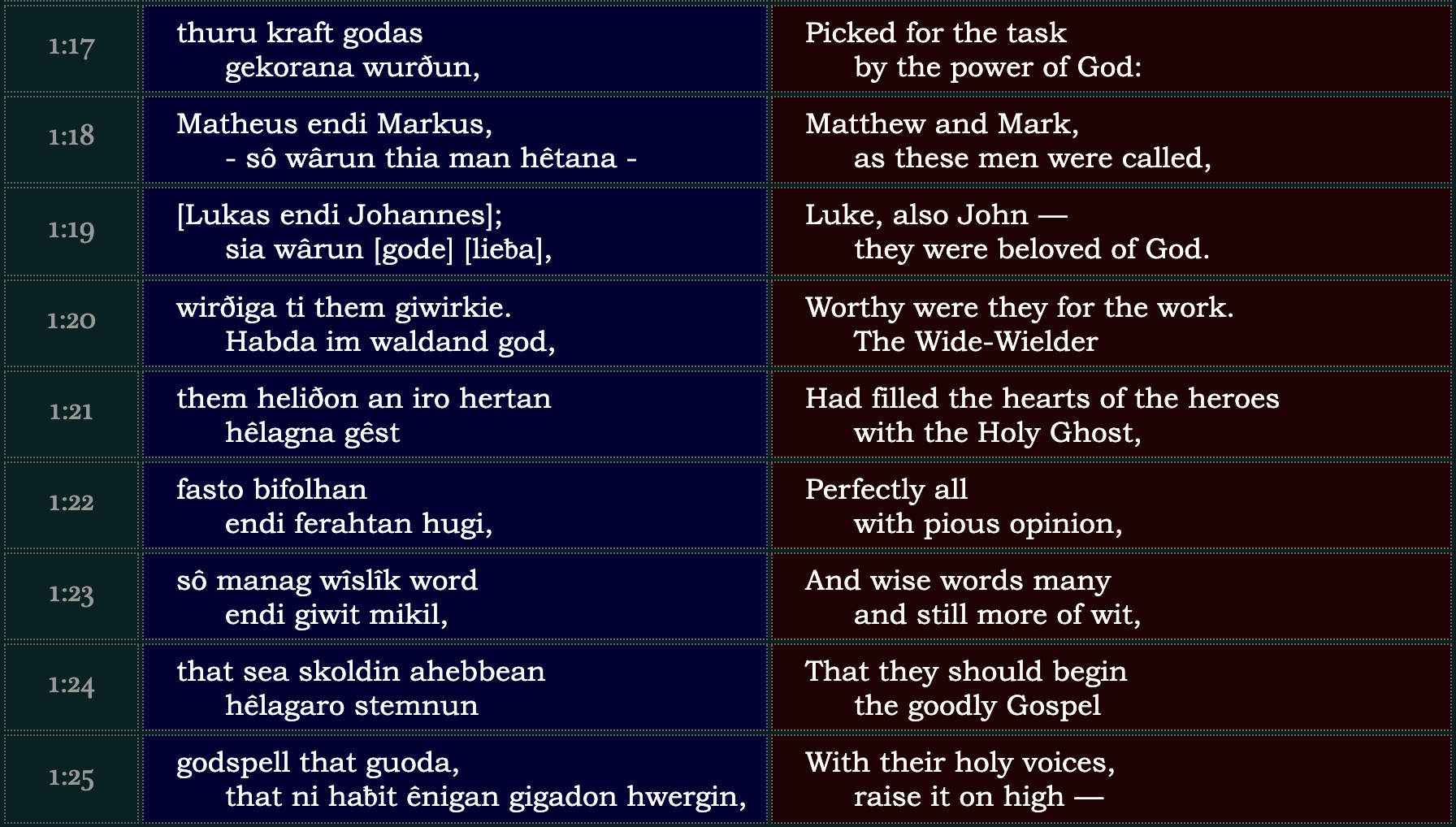
Eventually the Gospel would triumph, but one of its first effective renditions for the northern barbarians came in a gospel harmony⁑ entitled the Heliand. A number of references to the Gospel in J.R.R. Tolkien’s academic writings reveals his familiarity with the Old Saxon work, which he also mentioned in his lectures. The Heliand was commissioned by Charlemagne’s grandson Louis the German (806-876) to reach the Franks’ fellow Germanic tribes who remained Pagan. It was written by a Benedictine monk named Notker, who also wrote The Life of Charlemagne.⁂

The fact that this alliterative Gospel (in poetic form) was composed for the Saxon warrior class (their nobility), makes it particularly interesting.  Knowing it was recited not only in monasteries, but also mead halls, makes one’s personal reading of it feel like a journey into the ancient past.

Mariana Scott’s 1966 translation ⁑⁑ is available here. This site posits her translation beside the original Old Saxon. One of my favorite passages comes in the “introduction,” as the context of the Gospel proper is set for the hearers. It is very serious and describes the four Evangelists as inspired by God.

[The Lord] had filled the hearts of the heroes,
     with the Holy Ghost.
Perfectly all,
     with pious opinion,
And wise words many
     and still more of wit.
That they should begin
     the goodly Gospel
With their holy voices,
     raise it on high—

The Question of the White Christ

Referring to Jesus as the “White Christ” may have been related to the association of white baptismal robes worn by the newly baptized. But it involved more than that.

Apparently, the appellation “white,” especially when linked to Christ, was a Pagan insult. In a Scandinavian Studies article entitled “The Contemptuous Sense of the Old Norse Adjective Hvítr, ‘White, Fair’” we learn that it possessed a pejorative sense.

The [Old Icelandic] heathen religion glorified physical strength and courage in combat, a direct antithesis to the Christian ideal of pacifism based upon the Golden Rule. Hence, the heathen Icelanders interpreted the Christian Hvítakristr ‘The White Christ’ as a cowardly, contemptible counterpart of Thor, the god of courage and strength . . .

And this negative connotation continued, even after the triumph of the new faith.

[Even] after Christianity had become established as the national religion in Iceland, this heathen conception of Christian ‘cowardice’ disappeared but left its traces in the epithet hvítr, especially when one wished to belittle or vilify a personal enemy.

. . .

The double sense (‘fair’ : ‘cowardly’)was characteristic of skaldic poetry and served to enhance the sarcastic effect.

And thus my youthful innocence about the meaning of the White Christ has been dispelled. But, at the same time, my insight into the historic prejudice against the sacrificial Son and Lamb of God has grown.

Jesus was no coward, but he is—now and forever—pure, innocent, and holy.


* It should go without being said that associating the color white with Jesus has absolutely nothing to do with ethnicity. The Incarnation of our Lord makes it abundantly clear that Jesus was a Jew born in Bethlehem and raised in Nazareth. The Bible describes nothing noteworthy about his appearance that would distinguish him from the rest of the Jewish people in ancient Palestine. Thus, whatever Jesus’ complexion, he would have looked little like the pale Anglo-Saxon messiah we have often seen in paintings and cinema.

⁑ A Gospel harmony is a blending together of the four canonical Gospels into a single account. Tatian (c. 120-180), an Assyrian theologian, compiled the Diatessaron, which was prominent in the Syrian church, and is thought to have directly influenced the Germanic harmony, the Heliand.

 ⁂ Notker (c. 840-912) who also composed hymns and poetry. As mentioned above, the Benedictine monk also wrote The Life of Charlemagne which records many fascinating stories about Frankish and Germanic Christianity. Apparently a poor precedent was set by Frankish generosity when a group of Northmen serving as envoys received baptism.

As I have mentioned the Northmen I will show by an incident drawn from the reign of your grandfather in what slight estimation they hold faith and baptism. . . .

The nobles of the palace adopted them almost as children, and each received from the emperor’s chamber a white robe and from their sponsors a full Frankish attire, of costly robes and arms and other decorations.

This was often done and from year to year they came in increasing numbers, not for the sake of Christ but for earthly advantage.

A very enlightening and sadly entertaining account. But what happens when the gifts run out?

⁑⁑ In the foreword to her translation, Scott shares some intriguing thoughts on the challenging labor of translation.

It was important for me to remember that the Heliand was originally intended for recitation. This accounts for the very great emphasis on rhythm. While the exact form of the old alliterative verse, though common to both early English and German poetry, proved too confining, a freer adaptation was possible. Let us remember that much of the effect of modern free verse depends on the interplay of sounds: assonance and alliteration.

Keeping in mind the purpose of the original, I read my translation aloud as I worked, repeating lines several times, varying and checking rhythms, trying to imitate the surge of the meter and yet avoid monotony. The end result was a line of variable feet, usually a rather free alternation of anapests and iambics with a few scattered tribrachs and spondees, divided by the traditional caesura.

I aimed for an alliteration of at least one accented syllable in the first half line with one accented syllable in the second half. If more sounded right, I was delighted. If none worked, I tried to make the rhythm carry the line along to the next cadence. Not all of it, I painedly admit, turned out to be poetry—but then not all of the Old Saxon is!

Beijing’s Murderous Jesus

Communist China* hates Christianity. They do everything they can to destroy the Gospel, with its power to free people from bondage. That’s because China is all about keeping human beings in bondage.

Mere Inkling is not a political blog, so I have no incentive to go through the litany of communist China’s demagoguery. Besides, listing their crimes would take far too long.

In terms of their persecution of the Christian Church, however, many agnostics know little.⁑ The Red Chinese began their war against Christianity in the days of Mao. Millions have been denied their civil rights, imprisoned, and even murdered. Even with their “enlightened” and “tolerant” policies, they continue to deface and destroy church buildings and harass and imprison believers.

But now, they have done the unimaginable.

They have sought to replace the various Chinese translations of the Bible with a new, official edition. The regime’s Bible, though, is not a genuine translation.

It is an intentional corruption of God’s Word, and it is no exaggeration that some of its inspiration comes from the Father of Lies,  an honored commissar in all Communist nations.

In a superb essay discussing the pseudo-bible, Cameron Hilditch reveals how the Communists are attempting to co-opt the Messiah and present him as the herald of the Marxist gospel.

Put simply, the Chinese Communist Party “plans to turn the Scriptures into another piece of regime propaganda by rewriting them beyond all recognition.”

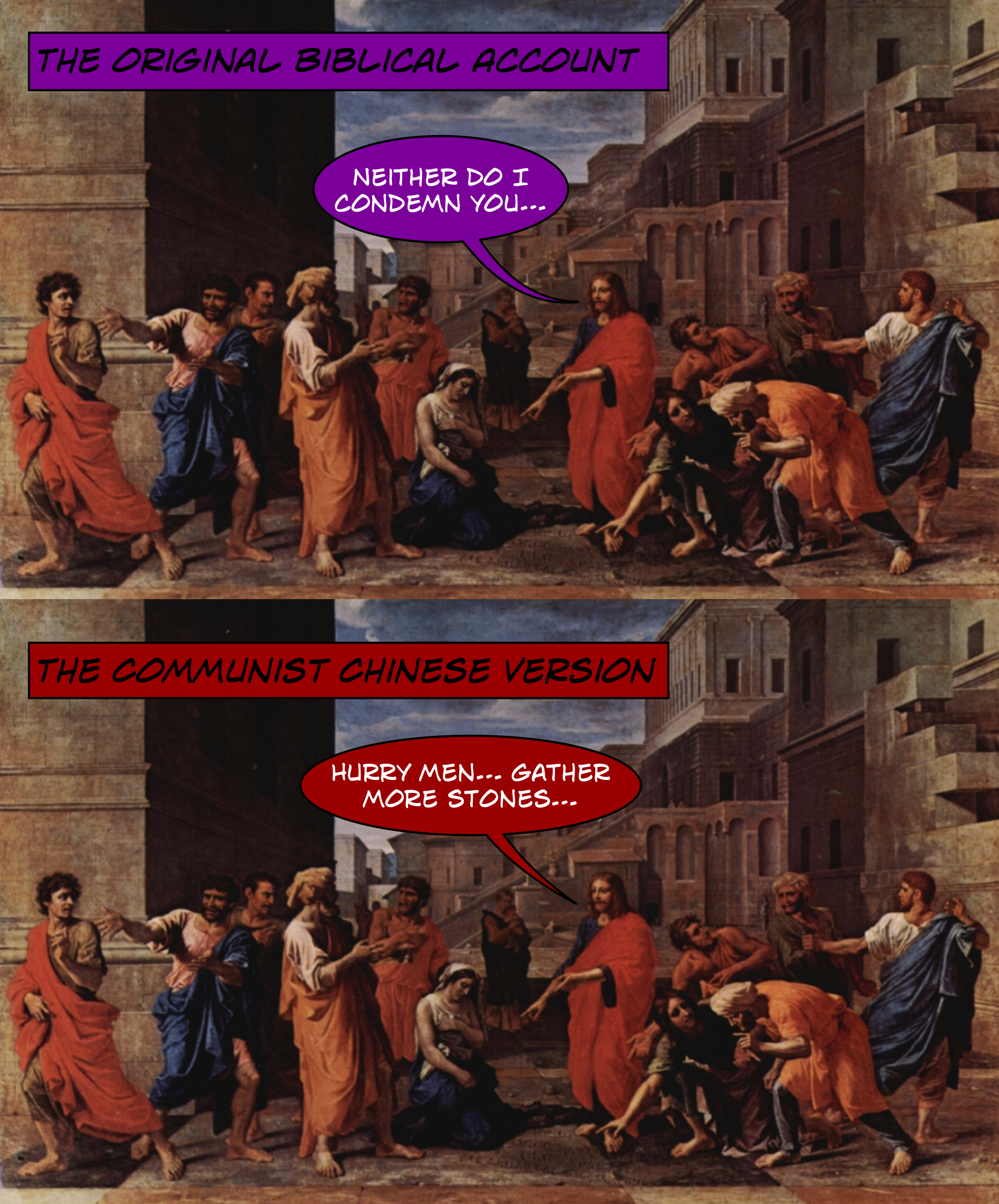
Beyond all recognition indeed. Before looking at their perversion of Jesus’ message of mercy, let’s consider the actual biblical account. We read that in Jerusalem,

Jesus went to the Mount of Olives. Early in the morning he came again to the temple. All the people came to him, and he sat down and taught them. The scribes and the Pharisees brought a woman who had been caught in adultery, and placing her in their midst they said to him, “Teacher, this woman has been caught in the act of adultery. Now in the Law, Moses commanded us to stone such women. So what do you say?”

This they said to test him, that they might have some charge to bring against him. Jesus bent down and wrote with his finger on the ground. And as they continued to ask him, he stood up and said to them, “Let him who is without sin among you be the first to throw a stone at her.”

And once more he bent down and wrote on the ground. But when they heard it, they went away one by one, beginning with the older ones, and

Jesus was left alone with the woman standing before him. Jesus stood up and said to her, “Woman, where are they? Has no one condemned you?” She said, “No one, Lord.” And Jesus said, “Neither do I condemn you; go, and from now on sin no more.”

Here is the communist mistranslation⁂ of the end of this powerful example of God’s grace and mercy.

When the crowd disappeared, Jesus stoned the sinner to death saying, “I too am a sinner. But if the law could only be executed by men without blemish, the law would be dead.”

Twisting the Scriptures

The act of translating the Scriptures is not controversial. In fact, it is necessary. C.S. Lewis noted this in his essay “Modern Translations of the Bible.”

The truth is that if we are to have translation at all we must have periodical re-translation. There is no such thing as translating a book into another language once and for all, for a language is a changing thing.

If your son is to have clothes it is no good buying him a suit once and for all: he will grow out of it and have to be re-clothed.

However, the re-translation must be an honest one.

There are several warnings in the Bible itself not to alter the words in the Scriptures either by deleting or adding to the text. Substituting the actual words, as the Communist Chinese have done, would violate both of those prohibitions.

Some people argue that mainland China exerts a benign influence on the world. “We have short memories,” says Christian attorney and advocate for the poor, Anna Waldherr. Rather than praise China for its increased engagement with the world, she reminds us of the true situation.

These days, the United States and China have mutual economic, political, and security interests.  But China remains a Communist nation with a totalitarian government and unresolved issues involving human rights.

The evil purposes of communist China’s ruling elite do not extend to their people. On the contrary the residents of that historic nation are its primary victims. The Chinese people and their culture possess much nobility. As I have written before, “C.S. Lewis held great respect for Chinese civilization. He was interested in the Chinese philosophical concept of the Tao.”

I share Lewis’ high regard for all that is good in China along with a genuine compassion for the Chinese people. May God deliver them from the dark principalities that reign over them.


* The communist People’s Republic of China is not to be confused with the democratic Republic of China, which is usually called Taiwan, due to the PRC’s coercive actions. For the same reason, the 23 million people living in the Republic of China are denied representation in the United Nations.

⁑ The Communists persecute other religious groups as well, most notably the Uighur (Islamic) people, who are being placed in vast reeducation and labor camps. In addition to rewriting the Jewish and Christian Scriptures, they are presumably also rewriting the Quran with the same, pro-regime agenda. Unsurprisingly, when asked their specific plans, “the Chinese Embassy in Washington declined to comment.”

⁂ As reported in Hilditch’s article, “China’s Communist Christ,” linked to above.

The original painting featured in the illustration above, “Christ and the Woman Taken in Adultery,” was painted in 1653 by Nicolas Poussin.

Why C.S. Lewis Remained Protestant

I find it intriguing how so many Roman Catholics wonder why all Protestants don’t find “crossing the Tiber” irresistible. C.S. Lewis disappointed his good friend J.R.R. Tolkien by not joining him in that church.

As we prepare to commemorate another Reformation Day, I would like to share one of C.S. Lewis’ patient responses to that persistent query. In a moment we’ll read a letter Lewis wrote on this subject. Since some still ask the question,* it is important to set the stage for our consideration of this letter.

The letter which follows is part of an ongoing correspondence Lewis had with Peter Milward (1925-2017), a Jesuit priest. Milward had listened to some of Lewis’ lectures at Oxford, and had attended meetings of the Socratic Club.

Milward was among those who was amazed that such an enlightened Christian as C.S. Lewis could not recognize Roman Catholicism’s claim to be the true church. A number of Lewis’ letters to Milward are included in volume three of Lewis’ Collected Letters. (The same volume includes a succinct biography of Milward.)

Four years ago, I shared in Mere Inkling a letter Lewis had written to Father Milward. It related to the latter’s criticism of a point Lewis had (intentionally) not included in one of his books.   

If you sometimes read into my books what I did not know I had put there, neither of us need be surprised, for greater readers have doubtless done the same to far greater authors. Shakespeare would, I suspect, read with astonishment what Goethe, Coleridge, Bradley and Wilson Knight have found in him!

Returning to today’s discussion, we have a letter written by the Oxford and Cambridge professor to the student who would become a professor and literary critic in his own right.

Why Lewis Remained a Mere Christian

Father Peter Milward asked C.S. Lewis during the final year of his life, to explain why he had not followed the natural path of Christian enlightenment into the embrace of Rome. Lewis provided a reasoned and considerate response, in the following letter, which I will allow to speak for itself.

As from Magdalene College, Cambridge
6 May 63

Dear Padre

You ask me in effect why I am not an R.C. If it comes to that, why am I not—and why are you not—a Presbyterian, a Quaker, a Mohammedan, a Hindoo, or a Confucianist? After how prolonged and sympathetic study and on what grounds have we rejected these religions?

I think those who press a man to desert the religion in which he has been bred and in which he believes he has found the means of Grace ought to produce positive reasons for the change—not demand from him reasons against all other religions. It would have to be all, wouldn’t it?

Our Lord prayed that we all might be one ‘as He and His father are one.’ But He and His Father are not one in virtue of both accepting a (third) monarchical sovereign. That unity of rule, or even of credenda, does not necessarily produce unity of charity is apparent from the history of every Church, every religious order, and every parish.

Schism is a very great evil. But if reunion is ever to come, it will in my opinion come from increasing charity. And this, under pressure from the increasing strength & hostility of unbelief, is perhaps beginning: we no longer, thank God, speak of one another as we did even 100 years ago. A single act of even such limited co-operation as is now possible does more towards ultimate reunion than any amount of discussion.

The historical causes of the ‘Reformation’ that actually occurred were (1) The cruelties and commercialism of the Papacy. (2) The lust and greed of Hen[ry] 8. (3) The exploitation of both by politicians. (4) The fatal insouciance of the mere rabble on both sides.

The spiritual drive behind the Reformation that ought to have occurred was a deep re-experience of the Pauline experience.

Memo: a great many of my closest friends are your co-religionists, some of them priests. If I am to embark on a disputation–which could not be a short one, I would much sooner do it with them than by correspondence. We can do much more to heal the schism by our prayers than by a controversy. It is a daily subject of mine.

Yours
C.S. Lewis

Apparently Milward responded to this letter from Lewis, in which he must have further pressed the discussion about Lewis leaving Anglicanism. While Lewis remains courteous, his impatience with the matter is quite evident.

Dear Father Milward

Come, come! You show yourself lacking in the spiritual tact which is so conspicuous among my Jesuit friends in Oxford. Trying to goad a man into controversy when he has already declined it is not the way to convert him. Leave that to the Tee-Totallers and Pacifists who honour me with frequent letters.

Don’t you realise that if I were anxious for a disputatio I have among my friends many learned and delightful masters of your Church and even of your order, with whom the matter could be discussed at any length in comfort over a pot of tea or a pot of beer.

It is not likely I should prefer the manual labour (half my life is spent answering letters anyway) of a vast correspondence with a man at the other end of the world. Don’t you realise that my friends here wd. know the mollia tempora fandi (times favorable for speaking) a great deal better than you.

Peter Milward survived for five decades after Lewis passing. During those years he wrote many works, and in 1995 he penned A Challenge to C.S. Lewis. Fortunately, it was not a theological argument, but a critique of Lewis’ literary criticism. This is how the C.S. Lewis Institute “annotates,” the work: “Milward argues that Lewis fails to fully grasp medieval literature because he understands the background of medieval literature as pagan, rather than seeing the Catholic underpinnings.”

Not having read the book, I cannot comment on its merits. However, the following passage is of value for our present discussion. It is drawn from Milward’s 2013 review of a biography⁑ of C.S. Lewis.

Only when our correspondence came to an end . . . I came to put together my thoughts or feelings of “uneasiness” about the academic writings of Lewis in the form of a book entitled A Challenge to C.S. Lewis . . . I had always been perfectly at ease in reading his imaginative writings, even from Screwtape onwards, culminating in the Narnia stories, but I always had misgivings of various kinds on reading his academic writings.

And as I presented them in my book . . . I came to the conclusion that in his mind Lewis remained a Protestant till the end, with the “Ulsterior motive” he must have imbibed with his mother’s milk, whereas at heart he was at once Pagan and Papist, encouraging many a Catholic . . . to wonder when he would follow Newman and Chesterton on the path to Rome. Nor did he live to take up my challenge, having no doubt passed to what Shakespeare calls “a better life, past fearing death.”

Postscript

Some Roman Catholics have argued that, given the radical changes in Western Anglican theology, Lewis would have joined their denomination had he lived long enough. Such is the contention on a thought provoking article that explores a number of prominent Roman Catholic converts who credit C.S. Lewis with influencing their personal pilgrimages to Rome.


* A 2013 consideration is found in C.S. Lewis and the Catholic Church, written by the Director of the Center for Faith and Culture at Aquinas College.

⁑ Milward was reviewing Alister McGrath’s C.S. Lewis: A Life, in volume 54 of Heythrop Journal. He offers a number of insights into his own relationship with Lewis throughout the review.