Sharing the Blessings of Books

Oh, the curse of being  a book lover. How can we thin the shelves of our libraries to make room for new additions we absolutely must add?

Digital copies have resolved the worst of that problem for many of us. Yes, holding a physical book in our hands is different altogether from reading off a screen, but when you compare the space requirements . . . or the accessibility when away from home or office . . . well, it is to me a worthwhile tradeoff.

I have always invested a significant (read “huge”) portion of my discretionary income in books. Like C.S. Lewis, I regard a good library as a treasure. While we both appreciate the extensive collections available in public and academic libraries, borrowing a text is not the same as owning it. Lewis alludes to this in a slightly off-handed manner in a 1952 letter to fellow Inkling, Roger Lancelyn Green.

I have re-read The Luck and liked it very much, as I had felt at the first reading . . . As luck would have it I met a lady who was looking for things to “read to the children” & The Luck is now on her list. I think she’s a buyer too, not a library addict.

The full title of the book to which Lewis refers is The Luck of the Lynns, and it was written by Green himself. This essay offers an excellent discussion of the book, and the author himself.

Books shaped Lewis’ life, particularly its beginning. In Surprised by Joy he describes visits to the home of Irish relatives. “In some ways Mountbracken was like our father’s house. There too we found the attics, the indoor silences, the endless bookshelves.”

Unpacking Book Boxes Twenty Years Later

Life has settled down to the point where I have been able to attack the forty to fifty boxes of books that were pulled out of storage when I retired and built our home. They weren’t actually removed from storage. It was more like a transfer—from a commercial storage unit to two-thirds of our three-car garage.

It’s been liberating to feel free to donate about 80% of the books to local charities. Some of those I’m retaining will join them in new libraries after I’ve had a chance to glean a few details from them. Coincidentally, this week one book box I unsealed included a few files, and among them was “Before the Book Sale,” from a 1995 issue of Christian Century.

The author, James M. Wall, was a Methodist pastor. His death this March, at the age of ninety-two, makes the article’s pull quote exceptionally poignant: “As I choose which books go and which stay, I confront my past and my mortality.”

Since the article is not available online, I will make it available as a one page pdf to anyone who requests a copy. The essay begins casually, but moves into a serious conversation that is well worth the read.

My town puts on a book sale every fall. Proceeds go to a worthy cause, and I am told the event is well attended. I never go because I already have too many books on my crowded shelves. But I do participate in the sale as a supplier.

It is for this reason that each summer as the time to turn books in approaches I am seized by an intense feeling of anxiety. I know I have to prune my shelves and I also know that there is no reason to hold onto all the books I have.

As I choose what goes and what stays, I confront my mortality—Who will want all these books when I am gone?—and my past. Each title evokes a memory of an earlier time of intense interest in a particular topic . . . and when I reject a book I once thought had to remain with me forever, I wonder in what ways I’ve changed.

The Final Disposition of One’s Books

In years past, it was not uncommon for exceptional personal libraries to be presented, in toto, to a university library. Today, the largest collection of books that originally graced the office and home of C.S. Lewis are housed at the Wade Center of Wheaton College.

A complete list of titles in the Lewis archive comes replete with indications whether a title includes a signature, underlining, and/or a handwritten annotation.

As for my own library, I hope my children and grandchildren will want to hold onto most of it. I have a feeling that ultimately the bulk of physical texts I still own will relate to the Inklings and related subjects. (I also have a substantial digital library in Logos, but that is primarily theological, and presently beyond the interests of those not headed to a seminary.)

Whatever the shape and size of your own library, the key is to actually use it. And it’s even more fun when you share it (with people who know how to respect books, of course).

Even if you have no funds available to purchase books, there are vast numbers of amazing volumes in the public domain that you can download for free.*

And finally, don’t hesitate to use your local library. Neither C.S. Lewis nor I would ever honestly desire to disparage a “library addict.” After all, he probably spent a hundredfold more hours reading library books than all the regular readers of Mere Inkling combined.


* Internet Archive and Project Gutenberg are my go to sites for public domain titles. Google Books is another option, for those already ensnared in the behemoth’s tentacles. (Just joking, Google. I know you’re watching…)


The cartoon above is used with the permission of its creator, Doug Savage. You can enjoy more of his comics at Savage Chickens.

C.S. Lewis & Automobiles

I just read something funny about automobile commercials. This anonymous comment resonated with me, and may with you as well: “car advertisers grossly overestimate how much time I spend driving across the desert.”

It’s a versatile joke, since the final location is interchangeable. Despite the fact I live off a gravel road in the woods, they also grossly overestimate the time I spend summiting snowy mountains. Despite the “all wheel drive” in our two RAV4s,* I have no desire to race through dangerous or hostile environments.

Well, with one possible exception. I really enjoyed this entertaining advertisement from years ago. Trust me, watching this witty Jeep ad will be a worthwhile use of 31 seconds.

Cars are a ubiquitous presence in our world. In the States, getting a personal driver’s license is a traditional rite of passage for sixteen-year-olds. Even in many developing nations, automobile ownership is commonplace. While some urbanites consider the expenses associated with vehicles a foolish investment, most people find the alternative inconceivable. And, whether one owns, leases, rents, or borrows cars, having a driver’s license is a necessity.

That wasn’t always true. When my mother was learning to drive, the brakes went out on the car. She was so traumatized, she never drove again.

C.S. Lewis, on the other hand, had no interest in learning to drive. In fact, the brilliant Oxbridge professor was generally dismissive of automobiles. Presumably this did not carry over to his view of motorcycles, as his conversion while riding in brother Warnie’s sidecar attests.

On the Disadvantage of Traveling by Car

In his autobiography, C.S. Lewis declares “I number it among my blessings that my father had no car, while yet most of my friends had, and sometimes took me for a drive.”

The second half of the sentence makes ready sense. If our family lacks a car, it is fortuitous that generous friends compensated for its absence. But what could Lewis have meant by considering growing up without an automobile to be a “blessing?”

Fortunately, Lewis doesn’t leave us guessing—and his rationale provides a thought-provoking question. What might we sacrifice for the convenience of instantly accessible access to transportation that can carry us hundreds of miles in a handful of hours?

This meant that all these distant objects could be visited just enough to clothe them with memories and not impossible desires, while yet they remained ordinarily as inaccessible as the Moon.

The deadly power of rushing about wherever I pleased had not been given me [emphasis added].

I measure distances by the standard of man, man walking on his two feet, not by the standard of the internal combustion engine. I had not been allowed to deflower the very idea of distance . . .

The truest and most horrible claim made for modern transport is that it “annihilates space.” It does. It annihilates one of the most glorious gifts we have been given. It is a vile inflation which lowers the value of distance, so that a modern boy travels a hundred miles with less sense of liberation and pilgrimage and adventure than his grandfather got from traveling ten (Surprised by Joy).

This final idea of feeling adventure with modest travel opened my eyes to one of the “oddities” I experienced as a child. One year while I was young, my father was stationed overseas with the USMC, and my mother relocated us so we would be near her parents.

My grandparents had a practice that struck me, already a fairly well-traveled lad, as very strange. Each Sunday, after church, we would all pile into the family sedan and go for “a drive.” The cause for this special event was not to get from point A to point B. No, the purpose was simply to enjoy the simple experience of traveling. I don’t recall ever driving more than thirty miles from home, but setting out in random directions to savor the beauty of God’s creation did produce a unique type of satisfaction.

Human Perceptions of Distance

Distance can be considered in a variety of ways. We commonly think of distance in visual terms. Depth perception is made possible by binocular vision. Monocular (single eye) vision is poor at recognizing depths, although it can still be useful for comprehending distances and sizes. However, we are not reliant solely on our eyes.

An obvious alternative is found in the phenomenon of auditory distance perception. Not as efficient as its visual cousin, this medical article notes it does possess one significant advantage.

A normal-hearing person has an immediate appreciation of auditory space in the sense that orientation toward acoustic events is natural, rapid, and in general, accurate. Although spatial acuity is poorer by up to two orders of magnitude in the auditory than in the visual domain, the auditory world has the advantage of extending in all directions around the observer, while the visual world is restricted to frontal regions.

In “The Various Perceptions of Distance: An Alternative View of How Effort Affects Distance Judgments,” scientists discuss the even broader complexity of the subject.

Direct judgments of spatial relations are key to a variety of research domains, both inside and outside the discipline of psychology (e.g., spatial cognition, neuropsychology, exercise science, medical diagnosis, human factors). Thus, the lessons learned from this work have implications extending well beyond visual space perception.

Having noted there are psychological aspects of perceiving distances, I recommend QGIS. QGIS is a free, open source, cross-platform application which supports viewing and editing of geospatial data. It’s actually less complicated than it may sound, and a quick look at their “lesson” on “Spatial Thinking” is extremely informative.

“There are three fundamental concepts of spatial analysis: space, location, and distance.” Each of these perspectives includes absolute, relative and cognitive dimensions. It is the cognitive aspect that most fascinates me and, I sincerely believe, intrigued C.S. Lewis.

Absolute distance is a physical unit of measure, for instance, the number of miles between downtown Houston and downtown Toronto. Relative distance is calculated measuring distance, using metrics such as time, effort, or cost. For instance, the distance of two cities may be 2000 miles apart, which is an absolute description of distance, becomes the distance of two cities measured in tanks of gas, or mileage charge.

Last, let’s discuss the cognitive perception of distance. This refers to an individual’s perception of how far things are apart. For instance, to some, driving 200 miles between Houston and San Antonio Texas is a reasonable drive. However, for others, a 200 mile drive may seem like a very, very far distance to travel if they are not used to traveling such a distance regularly.

This final example, of the varying perceptions of distance by people with different experiences is precisely what Lewis identified in Surprised by Joy.

The truest and most horrible claim made for modern transport is that it “annihilates space.” It . . . is a vile inflation which lowers the value of distance, so that a modern boy travels a hundred miles with less sense of liberation and pilgrimage and adventure than his grandfather got from traveling ten.

Perhaps the Most Significant Matter of Distance

An article entitled “Closest Proximity And Infinite Distance” discusses Lewis’ insight into matters of distance. The author includes the following passage from Lewis’ Letters to Malcolm.

I fully agree that the relationship between God and a man is more private and intimate than any possible relation between two fellow creatures. Yes, but at the same time there is, in another way, a greater distance between the participants.

We are approaching—well I won’t say “the Wholly Other,” for I suspect that is meaningless, but the Unimaginably and Insupportably Other. We ought to be—sometimes I hope one is—simultaneously aware of closest proximity and infinite distance.

Once again, we witness C.S. Lewis’ brilliance. An awareness of both our Lord’s proximity to us and the vast distance between Creator and humankind, is a fundamental truth of Christian faith. And, here I will be bold in love, if either element is lacking in your personal relationship with God, I strongly encourage you to pursue such a balance.


* Lest anyone think we are extravagant, the “new” car is a 2013, and its older garage-mate is a 2004, complete with a manual transmission.

A Lesson Taught by a Blackbird

My wife and I love birds. Perhaps we enjoy them too much.

I say that because our backyard includes four different feeders. They are different types, and appeal to a variety of species. (We also have a hummingbird feeder on the other side of the house, just outside my office window.)

Blessed as we are to live in the Puget Sound area, we see a variety of avifauna.* Nearly every day we see doves, robins, sparrows, chickadees, juncos, finches, Steller’s jays, thrushes, flickers, towhees, red-winged blackbirds and hummingbirds. Oh, and starlings too, that are the only birds our border collie chases (because of their darting taunts, I suppose).

Occasionally we have goldfinches, quail, band-tailed pigeons, woodpeckers, and various other guests I’m not quite positive about. In the sky, and on the nearby shoreline, we see many seagulls, mallards, great blue herons, Canadian geese, and—particularly during the current season—bald eagles.

As I said, we are definitely blessed to enjoy so many lovely creatures surrounding us. But this post isn’t really about birds; it concerns a particular bird who has recently joined our community. It is (I’m pretty confident) a Brewer’s blackbird.

He boasts magnificent sheen on his jet black plumage. Sadly, though, he appears to be quite unhappy.

His unhappiness is due to unrequited love. A tragic condition shared by many human beings. You see, each morning he comes to a bird bath near our bedroom window where he can perch and view his own reflection on the glass.

Seeing a potential companion, he does a sort of courting dance, which the reflection presumably imitates. He bumps into the glass, often repeatedly. Despite his zealous efforts, he inevitably ends up disappointed. And yet, there he is, the next morning, delighted that his friend is willing to give him another chance.

We Are Like the Blackbird

One recent morning I awoke to his antics, and it struck my waking mind that that poor bird’s futile efforts are a metaphor of our lives.

We perceive idealized reflections of ourselves, so flawless we become enraptured. We think of ourselves as the most important thing in the world. In a sense, we begin to believe the universe revolves around us.

I remembered the Greek story of Narcissus. It is a myth offering many insights, not solely the dangers of unbridled self-love. It was because of his contempt for others that Narcissus was cursed to see in a pool a reflection of the only person he considered worthy of his attention. At first, when he fell “in love,” he did not recognize the image as being himself. The tragedy leads to his destruction.⁑

We too, I think as a I watch that small bird vainly striving to find fulfillment in an illusion, experience only disappointment and ultimate despair.

For days Narcissus knelt by the pool, hopelessly in love with the beauty of his own reflection. Before his eyes he saw the image grow pale and thin, weep tears, stretch out its arms, and look at him. Still he could not hear it, could not touch it, no matter how he implored.

While reflecting on this subject, I found a couple of articles I recommend to those desiring to ponder it further. And, next week we will consider other birds, from another perspective—their use in a Renaissance work of fiction, included by C.S. Lewis in his volume from Oxford History of English Literature.

C.S. Lewis on the Bible: Myth, Truth, Fact, and Genesis” explores C.S. Lewis’ contribution to comprehending the complexity inherent in mythology. He cites the simplistic interpretation of the story of Narcissus as a misleading reduction of the myth’s deeper message.

Understanding and Dealing with Today’s Culture of Narcissism” notes how C.S. Lewis offered a non-narcissian prescription for addressing the “hungry soul.”

Self-Centeredness Isn’t Narcissism’s Central Problem,” discusses the myth and the culture of Narcissism in which we are immersed. Author Angela Franks, a professor at St. John’s Seminary, then moves into a brilliant discussion of Till We Have Faces, which C.S. Lewis considered his finest book.

C. S. Lewis’s unjustly neglected rewriting of the myth of Cupid and Psyche, in his novel Till We Have Faces, provides a profound insight into the narcissistic spectrum. . . .

So it appears [in Lewis’ myth] that the beloved of the gods is not only the beautiful and wise Psyche, but also the tormented and ugly Orual. In the divine plan, the hideous older half-sister suffers in order to aid the beautiful maiden, but the beautiful maiden also goes through the greatest trials in order to purify Orual. The god, it appears, is willing to sacrifice his beloved in order to be united to the one who hates him. “What’s mine is yours!” Psyche and the god proclaim to Orual, but this time not in vengeance; in Lewis’s new myth, just retribution gives way to undeserved love.

To discourage our obsidian-feathered friend from squandering his brief life in pursuit of his own reflection, my wife and I just placed some decals on the window. It appears to have worked.

Would that our own echoes of Narcissus were addressed so simply.


* Don’t feel bad if this word is unfamiliar to you, don’t feel bad. I didn’t know it before I wrote this post. It means “the birds of a particular region, habitat, or geological period.”

⁑ The versions of this myth end in different ways, ranging from his divine transformation into a flower, to his despair and suicide.

Legal & Illegal Fonts

One contemporary challenge to democracy in the United States is judicial activism. This is the term for jurists who mistakenly think they are in the legislative branch of the American government.

While too many Courts pursue this unconstitutional path, it is refreshing to see one federal Court actually “legislating” within its actual purview.

The District of Columbia Circuit of the United States Court of Appeals has mandated which fonts can and cannot be used for court documents. The National Law Journal says the official shunning of the Garamond font has set “lawyers abuzz.”

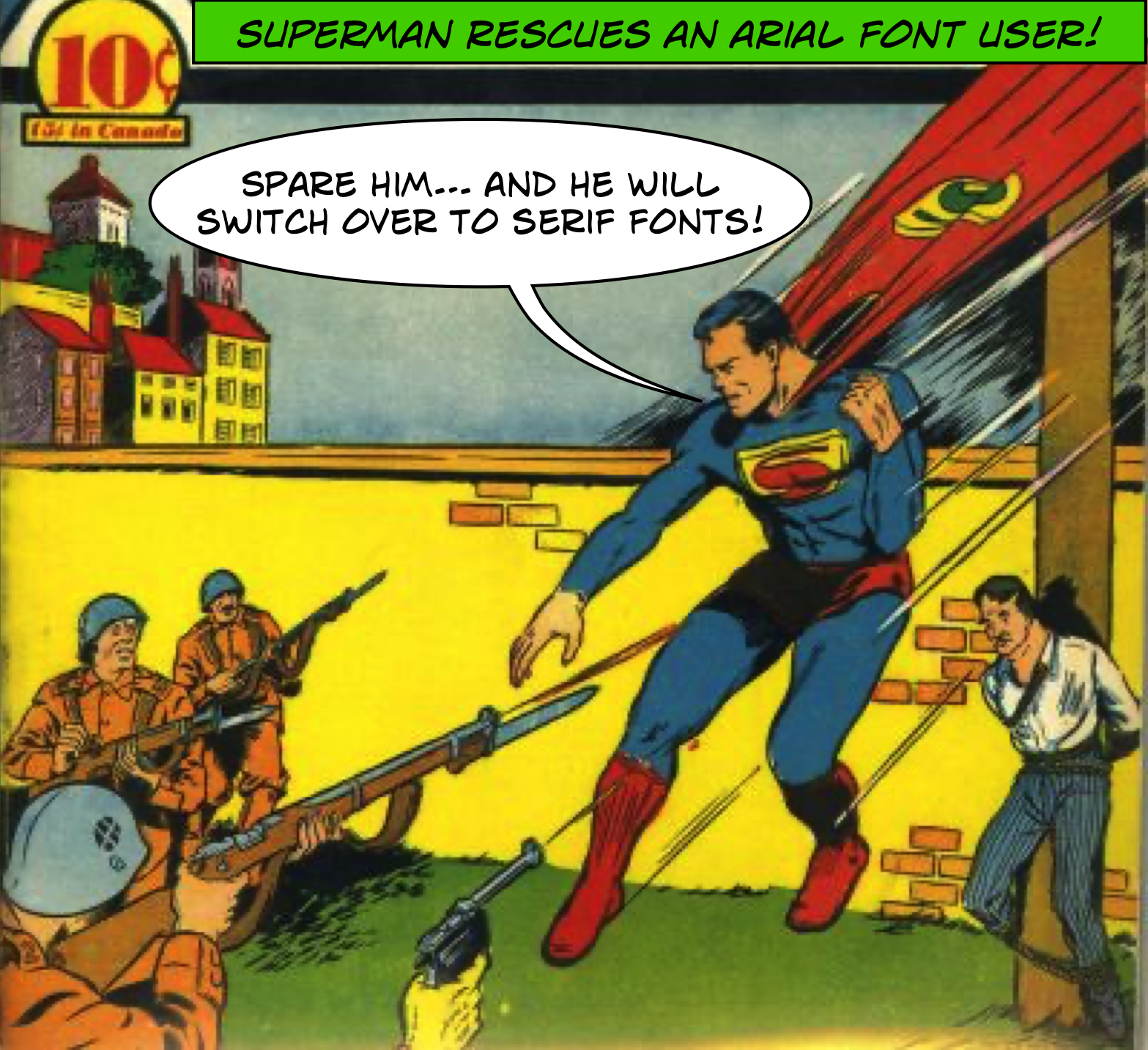
The Court—quite correctly—notes that serif fonts are much more legible than sans serif fonts like Arial.

But that has not saved Garamond, which appears slightly smaller than some other serif fonts. Apparently the fact that all documents must also be printed in a 14 point size does not adequately compensate for the difference.

If you would like to read the formal notice you can find it here.

Consistent with the Court’s magnanimity, while briefs “must be set in a plain, roman style,” they will graciously allow “italics and boldface [to] be used for emphasis.”

C.S. Lewis had a proper respect for the legal system. How could it be otherwise for a man whose own father was a solicitor? Yet one wonders what Lewis would have thought about this strict new requirement in the colonial Courts.

Counting Our Blessings

Since the Court has spoken on the matter of fonts, the question must be settled. After all, to whom could it be appealed?

However, we should be grateful that they have limited their judicial caprice to barring sans serif fonts. After all, they could have reinstated Court Hand.

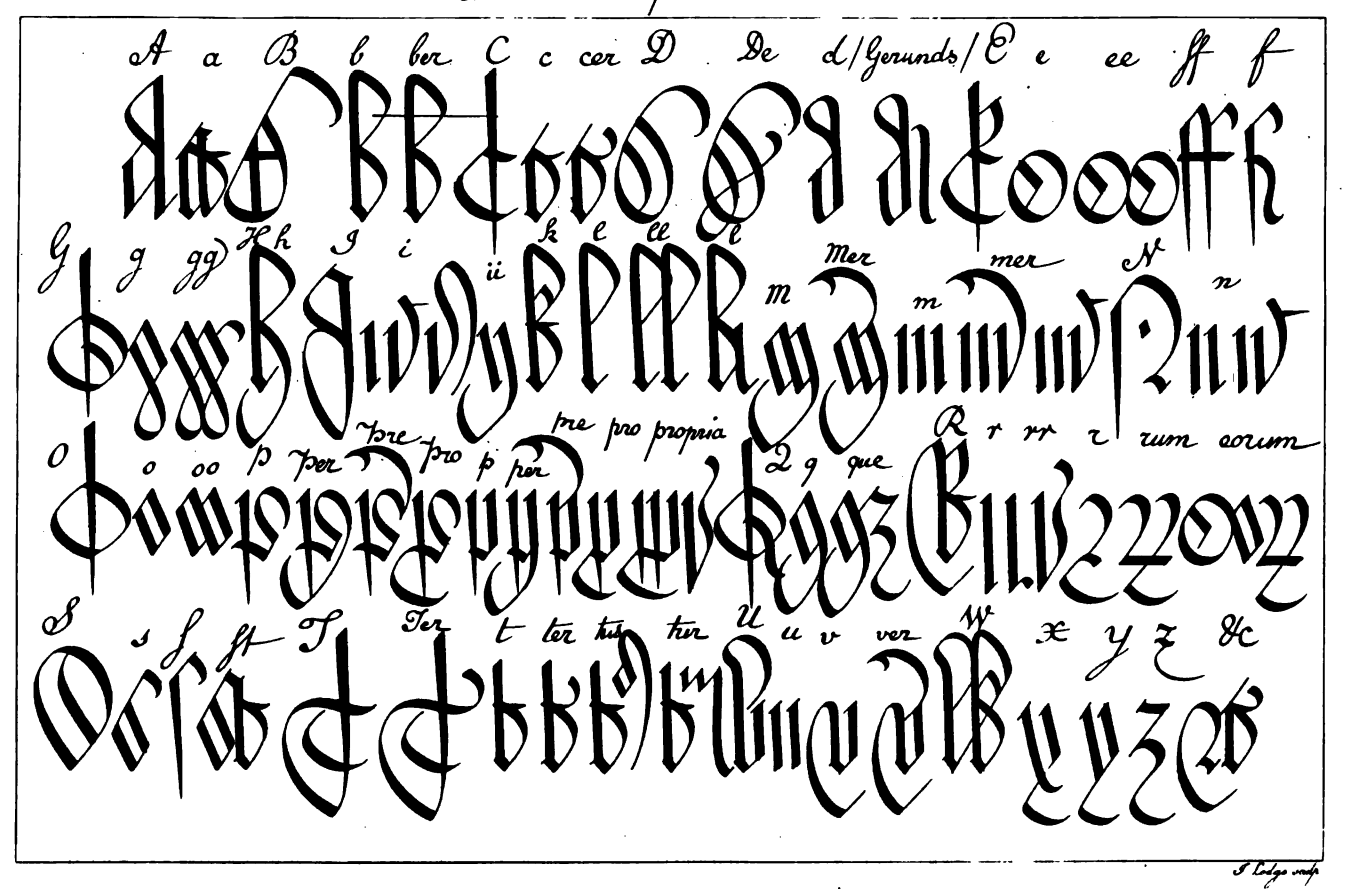
The various forms of writing in which English medieval documents . . . are preserved to us are all derived from an increasingly current writing of the same script which . . . are known to us collectively as Court Hand, that is the writing of the Courts. (Palaeography and the Practical Study of Court Hand).*

Yes, I realize Court Hand dates back to the medieval era, and reinstating it in contemporary American courts would seem asinine on its face, but that certainly doesn’t make it implausible in our current judicial milieu.

C.S. Lewis appreciated the quality of Court Hand. In 1943 he wrote a letter to Gerald Hayes (1889-1955), who was Chief Cartographer for the Admiralty. Hayes had provided some maps for one of C.S. Lewis’ favorite authors, E.R. Eddison. Two of these maps can be found at Inventing Imaginary Worlds.

Hayes gifted C.S. Lewis with a copy of one of these illustrations. Lewis responded with an invitation to visit the Inklings, appreciation for the unique “treasure,” and a compliment about Hayes’ skillful handwriting.

You must come & [visit] our little confraternity if you ever are in Oxford & receive in person my repeated thanks for what is one of my notablest treasures. It has given me again what I have not had for years & years, the old pleasure in a ‘present.’ I wish I could write either modern or court hand as you do!

Fortunately, we live in a digital age when we need not labor to replicate ornate fonts. We can simply add them to our computers and voilà, there they are. In case the Courts resume such a requirement, you may want to add a Court Hand font to your computer today. Even if you do not anticipate being involved in litigation, and simply enjoy elegant fonts, you can find a free copy here.


* You can download a free copy of this book—which belongs in every writer’s library—from the Internet Archive.

And, here is a handy reference sheet for the next time you need to decipher court hand.

An Allied War Crime

During the Second World War, Germany and Japan (leaders of the Axis) committed many loathsome acts. But at least one Allied country was also guilty of an unnecessary atrocity. Genocide and the mass murder of civilians were only part of the Axis’ evil agenda. Germany and Japan also performed horrific medical “experiments” on their innocent captives. No one defends these acts.

The Second World War ended rather abruptly. At the war’s conclusion, a new weapon persuaded the Empire of Japan to surrender unconditionally. The Potsdam Declaration which called on the Emperor to yield offered a grim alternative.

We call upon the government of Japan to proclaim now the unconditional surrender of all Japanese armed forces, and to provide proper and adequate assurances of their good faith in such action. The alternative for Japan is prompt and utter destruction.

Before the use of the two atomic bombs, plans were well underway for Operation Downfall, the invasion of Japan. Massive Allied casualties were anticipated—but due to the nature of warfare, these were dwarfed by the number of Japanese who would have perished.

While few ever praised the total destruction of Hiroshima and Nagasaki, nearly all objective minds recognized that the swift conclusion which followed saved far more lives. This opinion is not only the “military” consensus. It is also shared by those Japanese who were being trained, with bamboo poles, to resist the impending invasion of their islands. (I have had personal conversations with several Japanese citizens who were part of this civilian army.)

Operation Ketsugō (決号作戦), called for the nation’s entire population to resist the invasion. The Japanese Cabinet “essentially called the entire population to military service, while propagandists began ‘The Glorious Death of One Hundred Million’ program to whip up enthusiasm for dying for the Emperor” (A War to Be Won).

While the need for the bombing of Nagasaki is debatable, the use of the atomic bomb in ending the war, saved countless lives. Some have called its use a war crime. They are wrong.

That does not mean, however, that the Allied hands were innocent. In the European theater of the war, the British responded to Germany’s bombing of their civilian populations with terror bombing of their own. Air Chief Marshal Arthur Harris embodied this vile strategy and, as head of the Royal Air Force Bomber Command, he could wage a war of retribution. And, as a leader of the winning army, his criminal behavior would be overlooked.

“Bomber Harris” justified raining fire on civilians because it would abbreviate the war. He said, in my opinion to his lasting shame, “I do not personally regard the whole of the remaining cities of Germany [i.e. all of the citizens abiding in them] as worth the bones of one British Grenadier.”

Air Force Magazine has an informative article available online which addresses Harris’ strategy. It cites Churchill’s acknowledgement that “we hoped to shatter almost every dwelling in almost every German city.” Only with the utter destruction of the city of Dresden, did Churchill admit that “the moment has come when the question of bombing of German cities simply for the sake of increasing the terror, though under other pretexts, should be reviewed” (“The Allied Rift on Strategic Bombing”).

War is a Terrible Thing

Ernest Hemingway was a talented, but deeply troubled, writer. A Boston University article describes his religious outlook in this way: “While raised by devout Christian parents, Hemingway converted to Catholicism at the age of twenty-eight for marriage and proved religiously indifferent throughout his lifetime, despite a preoccupation with biblical themes in many of his works.”⁑

Hemingway addressed the subject of this post in a sober, profound and honest manner. “Never think that war, no matter how necessary, nor how justified, is not a crime.” Even people such as myself, advocates of Just War Theory, can agree with this.

War is a crime against humanity itself, an activity that was never part of our Creator’s original design. War represents a battle in which even the victor is often left scarred, as one of my fellow chaplains describes in his newly released book, Nailed! Moral Injury: A Response from the Cross of Christ for the Combat Veteran.*

Yet, as horrible as war is, it is sometimes necessary. G.K. Chesterton astutely noted the proper motive for soldiers. They don’t seek personal conquest. Nor is the pursuit of personal glory a proper justification. According to Chesterton, “The true soldier fights not because he hates what is in front of him, but because he loves what is behind him.” In the same light, he wisely described war in the following manner in his Autobiography.

The only defensible war is a war of defence. And a war of defence, by its very definition and nature, is one from which a man comes back battered and bleeding and only boasting that he is not dead.

C.S. Lewis was just such a man. Deeply acquainted with the bloody toll of war, he did not glorify combat. In 1939 he wrote in a letter, “My memories of the last war haunted my dreams for years.” Yet, that very same year, Lewis described moments when war was truly unavoidable, saying “if war is ever lawful, then peace is sometimes sinful” (“The Conditions for a Just War”).

Chivalry is the Imperfect Response to War

Chivalry may sound like an archaic word and an obsolete concept. It may be the former, but is definitely not the latter. For C.S. Lewis, it was the principle that could reduce the anguish caused by war.

C.S. Lewis recognized the profound cost of war and acknowledged short of Christ’s return, it will remain unavoidable. The only way its violence can be tempered is through a principle like chivalry, which naturally arises from the belief that though some wars cannot be avoided, all wars can be restrained by humane guidelines. This notion even inspires the Geneva Conventions.

Mere Inkling has discussed the Inkling concept of chivalry in the past, so I will not repeat that discussion here. Instead, allow me to refer you to an excellent article I recently read on this vital subject, “C.S. Lewis, War, and the Christian Character.”

Addressing the familiar canard that C.S. Lewis glorifies war, particularly in the Chronicles of Narnia, Marc LiVecche declares.

For Lewis, the Narnian stories are all about love—not about love despite the battles and wars, but about love that, because it is love, reveals itself in the rescue of the innocent, the defense of justice, and the punishment of evil even, in the last resort, by war and, most crucially, in the character of the warriors who wage those wars.

In a candid manner that could possibly cause the prudish to blush, LiVecche describes how Botticelli’s Venus and Mars illustrates the view that in a fallen world, war can be harnessed to serve positive ends. This painting is significant, in that “a facsimile of the Botticelli masterwork hung in Lewis’ Oxford rooms in Magdalen College.”

In any case, whether through the influence of Venus or the two-aspects of his internal character, Lewis’ Mars—and the martial character he influences in others—is about much more than war and violence. For Lewis, the fullness of the martial character is best communicated by the chivalric idea of “the knight—the Christian in arms for the defence of a good cause,” which Lewis called “one of the great Christian ideas.” This chivalric ideal, in turn, is best understood through those words addressed to the dead Launcelot, the greatest of all the knights, in Malory’s Morte D’Arthur: “Thou wert the meekest man that ever ate in hall among ladies; and thou wert the sternest knight to thy mortal foe.”

Lewis expounds: “The important thing about this ideal is…the double-demand it makes on human nature. The knight is a man of blood and iron, a man familiar with the sight of smashed faces and the ragged stumps of lopped-off limbs; he is also a demure, almost a maidenlike guest in hall, a gentle, modest, unobtrusive man. He is not a compromise or happy mean between ferocity and meekness; he is fierce to the nth and meek to the nth.”

LiVecche discusses how Lewis’ thought reflects the Christian just war tradition. It is a crucial damper to unbridled war, since “human beings are motivated both by love and kindness as well as selfishness and cruelty [requiring that] the use of force must be viewed with skepticism and deployed within carefully prescribed constraints.”

War crimes are criminal precisely because they fall outside the boundaries of what is just and necessary. These offenses should never be ignored or minimized, no matter who commits them . . . be they Nazi bureaucrats, genocidal Japanese commanders, or sophisticated British baronets who serve as military marshals.


* Chaplain Mark Schreiber’s book is available from Amazon and its kindle version will be available soon.

Christianity, Science & C.S. Lewis

Casual readers of C.S. Lewis are not always familiar with his supremely balanced view of science and faith.

In a world where skeptics allege science and religious faith are incompatible, Lewis upheld the orthodox Christian understanding that Christianity and true science are 100% compatible. The problem arises when people attempt to use science to explore matters science cannot address.

In “C.S. Lewis and How Christians Should Think about Science,” we read that “C.S. Lewis has written extensively on science or specifically on how believers should think about science. Lewis himself was not antiscience. But he had grave concerns about the use of science to either manipulate nature or validate worldviews based on reductionism or naturalism.”

I would like to emphasize this warning, by adding three simple letters. C.S. Lewis “had grave concerns about the misuse of science.” And so should we all.

In Mere Christianity, C.S. Lewis describes science’s proper role.

Science works by experiments. It watches how things behave. Every scientific statement in the long run, however complicated it looks, really means something like, “I pointed the telescope to such and such a part of the sky at 2:20 a.m. on January 15th and saw so-and-so,” or, “I put some of this stuff in a pot and heated it to such-and-such a temperature and it did so-and-so.” Do not think I am saying anything against science: I am only saying what its job is.

And the more scientific a man is, the more (I believe) he would agree with me that this is the job of science—and a very useful and necessary job it is too. But why anything comes to be there at all, and whether there is anything behind the things science observes—something of a different kind—this is not a scientific question. If there is “Something Behind,” then either it will have to remain altogether unknown to men or else make itself known in some different way.

The statement that there is any such thing, and the statement that there is no such thing, are neither of them statements that science can make. And real scientists do not usually make them. It is usually the journalists and popular novelists who have picked up a few odds and ends of half-baked science from textbooks who go in for them. After all, it is really a matter of common sense. Supposing science ever became complete so that it knew every single thing in the whole universe. Is it not plain that the questions, “Why is there a universe?” “Why does it go on as it does?” “Has it any meaning?” would remain just as they were?

There are, of course, many, many thousands of scientists who are Christians.

I recently read an interesting article on the Society of Roman Catholic Scientists. I commend it to everyone, whatever your religious affiliation (or lack thereof). It is entitled “Christianity in Scientific Mythology,” and begins with the author saying,

It shocks many people to find out that I am both an astrophysicist and a religious believer.  It shocks some of my fellow astrophysicists and even some of my fellow Catholics. . . . But why should this be?  Why should it be a surprise that someone whose chosen profession is the scientific study of the universe is also a person of faith? Why the perception of conflict?  Is it intrinsic to the business of science that it be “at odds” with religion?

Despite the fact that Professor Clemens fails to mention C.S. Lewis in his essay, he makes many valid points. The first lays a solid foundation for his message, and dispels a patently obvious, but seldom acknowledged, fact.

One of the defects of contemporary culture is the undue and unhealthy reverence we show toward scientists.  The public imagines scientists to be too smart to disagree with, too objective to be swayed by emotion or bias, and experts on every subject they choose to talk about.  None of these things is true, of course, and the unquestioning acceptance of these notions does great harm.

C.S. Lewis’ Concept of Scientism

Like all sane people, C.S. Lewis appreciated the great value of science. What he warned against was a sort of deification [my word] of science. It is like the elevation of scientific mythology to the status of ultimate religious truth, able to answer even metaphysical questions with certitude.

If you would like to read more on this subject, consider the following articles:

Science and Scientism: The Prophetic Vision of C.S. Lewis

C.S. Lewis: Science and Scientism

C.S. Lewis and the Religion of Science

C.S. Lewis on Science, Evolution, and Evolutionism

Another worthwhile article, published in the journal of Science and Christian Belief, is available at “Science and Religion in the Writings of C.S. Lewis.”

As a person of faith, albeit not a scientist, I concur wholeheartedly with C.S. Lewis. In the following passage from The Weight of Glory, Lewis makes a profound point, although it may require more than a single reading to comprehend. You may wish to read the entire essay to see how he builds up to this observation, but I offer it here on its own merits.

The waking world is judged more real because it can thus contain the dreaming world: the dreaming world is judged less real because it cannot contain the waking one. For the same reason I am certain that in passing from the scientific point of view to the theological, I have passed from dream to waking. Christian theology can fit in science, art, morality, and the sub-Christian religious. The scientific point of view cannot fit in any of these things, not even science itself.


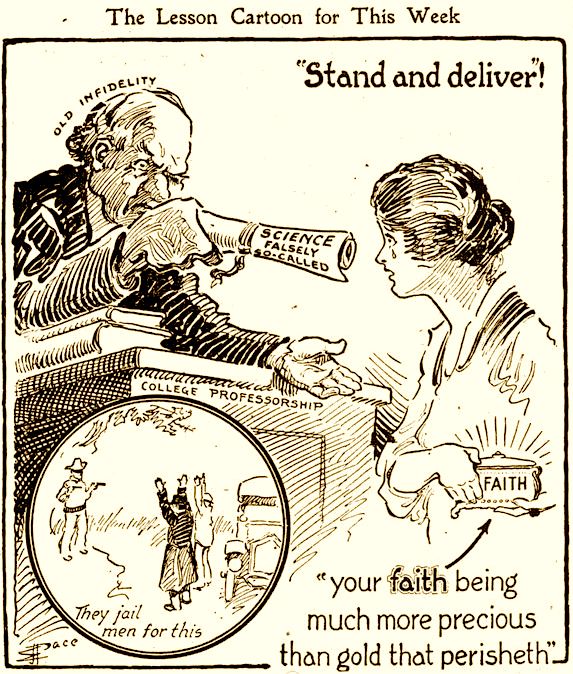
The illustration above was drawn by E.J. Pace and appeared a century ago in The Sunday School Times. You can download a personal copy of a book featuring a hundred of Pace’s cartoons here.

Intentional Mispronunciations

Don’t you find it slightly irritating when people intentionally mispronounce words? Sometimes it isn’t merely a silly affectation. What bothers me are cases where people consciously reject the accurate version and flaunt their personal (inaccurate) alternative. It comes across to me like they are magnifying their ignorance with a sizeable dose of obnoxious stubbornness.

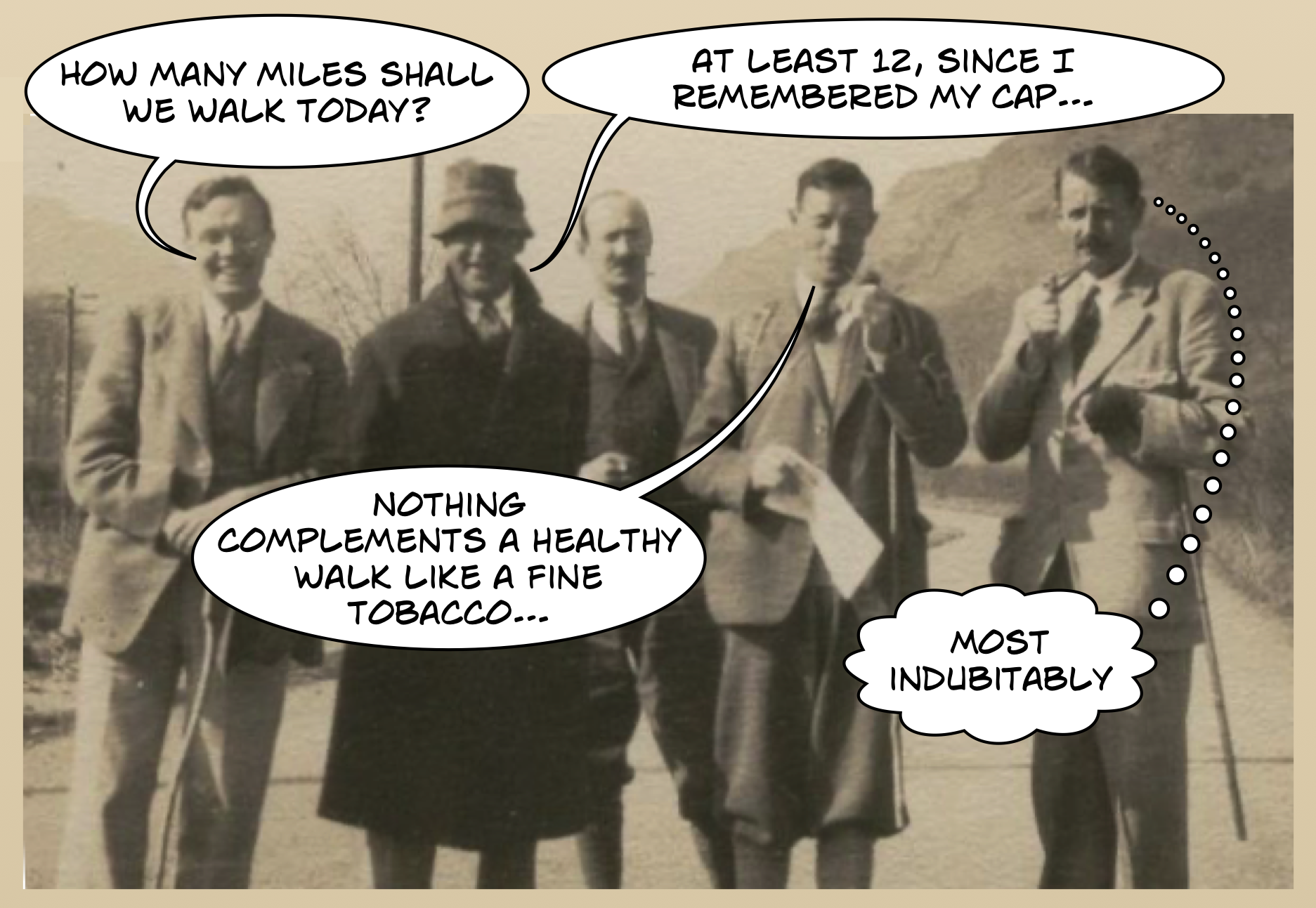
Anyone, of course, can accidentally mispronounce a word. Well, anyone aside from C.S. Lewis and J.R.R. Tolkien, that is.

I don’t enjoy (but don’t object to) simple silliness. In a 1932 American Speech article entitled “Intentional Mispronunciations,” the author says, “the custom is an old one, and in our age of light-hearted youth it is unusually widespread.” She immediately notes one danger.

The use of mispronunciations sometimes becomes habit, and it is often difficult to speak correctly when one is in sophisticated company.

The humble person, when advised on the proper enunciation of a particular word, thanks their friend (only friends should dare to sensitively point out such a slip). After expressing that appreciation, they go forward with the commitment to being a bastion of proper usage of the word in question.

However, there are those obstinate ignoramuses (OIs) who defiantly insist on perpetuating their sins.  

Let us consider a common error. One that is quite easily corrected, unless the OI insists on actively rejecting knowledge. The word is “nuclear,” and you already know what the all too common mistake is. How can anyone, much less a graduate of Yale, entrusted with the Gold Codes, accompanied at all times by a military aide ready to hand them the “nuclear football,” continue to use the non-word nu-cu-lar? I have no idea how common this atrocity is outside the United States, but here in the States, it is far from rare.

A good friend of mine, who does public speaking, insists on pronouncing “recognize” without its “g.” I understand he must have learned it that way, but I will never get used to a person with advanced degrees saying “rec-a-nize.” My father was a curmudgeon, and this conscious affront reinforced his chosen image. He loved to push my buttons by adding an “r” to the state I call home. Warshington doesn’t exist on any map, but it certainly did in his mind.

Why Pronunciations Err

People are prone to mispronunciation when they’ve only read a word, and never heard it pronounced before. This was especially perilous before the existence of online dictionaries.

There is another hazard which can mislead someone in pronouncing a word incorrectly—and it was to this that I succumbed my first year at seminary. This is the case where a word is spelled in a manner that makes the errant pronunciation possible, and you have only heard it pronounced in the wrong way. This is the story of my shame.

I was taking a consortium course on ministry and media, which was taught by professors from four or five different seminaries. In my first “radio” presentation, I cited a passage from one of the Psalms. Everyone said it was well done—until the Roman Catholic professor (with nary a hint of affirmation) declared, ex cathedra: “it’s ‘sahm;’ you don’t pronounce the ‘l.’”

I was so embarrassed that I remained silent and soon as I got home I pulled out my dictionary, and darned if he wasn’t right. I have pronounced it correctly ever since, even in the face of a world that now considers me to be wrong.

My aversion to the intentional-mispronunciators does not extend to people who say “salm.” After all, that’s how the word should be pronounced.* But those people who insist on saying “re-la-ter” when the profession is clearly spelled “re-al-tor,” are begging for some sort of aversion therapy.

There is one additional case I wish to note here. That is when there are two (or more?) legitimate ways to pronounce a word. I’m not referring to homographs, like wind (wĭnd) and wind (wīnd).

C.S. Lewis also discusses pronunciation at great length in his essay “The Alliterative Metre,” where he notes,

In modern English many words, chiefly monosyllables, which end in a single consonant are pronounced differently according to their position in the sentence. If they come at the end of a sentence or other speech-group—that is, if there is a pause after them—the final consonant is so dwelled upon that the syllable becomes long.

If the reader listens carefully he will find that the syllable man is short in ‘Manifold and great mercies’ or ‘The man of property,’ but long in ‘The Invisible Man’ or ‘The Descent of Man.’

Words with multiple formally accepted pronunciations are fair game—as long as a person’s choice is from the list. Here’s one where pronouncing the “l” is optional: almond. Apricot can begin with either the sound “app” or “ape.”

A Playful Game Using Homographs

The following example uses a name, but the principle would be the same for any word with more than one authentic pronunciation. It comes from a book I read many years ago, which has retained a fond place in my memory. Robert McAfee Brown (1920-2001) was a Presbyterian theologian. The title of the volume suggests its satirical bent: The Collect’d Writings of St. Hereticus.

One of the appendices in the book is called “Theological Gamesmanship.” One of the games he features is “How to Win a Theological Discussion Without Knowing Anything.” The following gambit is called “Help from St. Augustine.”

A quiet yet forceful way of demonstrating superiority when Augustine is under discussion is to pronounce his name in contrary fashion to the pronunciation of the Opponent.⁑ Make a point of emphasizing the contrast, so that it will be apparent that you know you are right, and not even for politeness’ sake will you pronounce the name incorrectly as Opponent is doing. Either,

Opponent: . . . leading ideas in Augustine (Ogg-us-teen).
Self: Augustine (uh-Gust’n)may have said that on one or two occasions, but . . .
Or,
Opponent (usually an Anglican in this case): . . . leading ideas in Augustine.
Self: Augustine may have said that on one or two occasions, but the whole Augustinian tradition, following, as I believe, the essential Augustine himself . . .

In this second gambit, it is advisable to maneuver the conversation into a discussion of “the Augustinian tradition” as indicated, so that when Opponent refers to it, as he must, without pronouncing it “the Augustinian tradition,” you can smile deprecatingly, to indicate that your point has been made.

[Brown adds a footnote that reads:] With sensitive Anglicans, it will often be enough simply to raise, ever so slightly, (a) both eyebrows, and (b) the second, third, and fourth fingers of the left hand.

Naturally, I’m not seriously suggesting that one-upmanship is something in which one should engage. On the contrary, Brown (and I) are holding up this sort of petty behavior as beneath the dignity of good people.

I’m sure that some would argue that correcting someone’s pronunciation in even the most glaring examples of verbal atrocities, constitutes bad manners. I, however, appreciate being privately corrected, so that I might not continue making the same mistake. Thus, I consider it the act of a friend.

C.S. Lewis was a patient and gracious man. He was quite tolerant of variation in pronunciation, even when it came to his own creations. In 1952 he responded to a correspondent inquiring how to properly pronounce the name of Aslan. I would guess the most common American version would be “æzˌlæn” opting to pronounce the “s” as a “z.” Here is Lewis’ response:

It is a pleasure to answer your question. I found the name in the notes to Lane’s Arabian Nights: it is the Turkish for Lion. I pronounce it Ass-lan [æsˌlæn] myself. And of course I meant the Lion of Judah. I am so glad you liked the book.

I loved the book, and I affirm its readers, whichever way they pronounce the name of the Great Lion. Well, as long as they don’t intentionally mispronounce it, including an invisible “r.” After all, there is most certainly no beloved image of Christ named Arslan!


* This waiver does not extend, however, to what may be the most common biblical mistake. The Book of Revelation does not have an “s.” Yet, how often do you hear it cited as Revelations?

⁑ This brazen technique is equally effective, no matter which pronunciation the person you seek to upstage has used.

The cartoon at the top of this post is used with the permission of xkcd.

Climbing Ladders of Faith

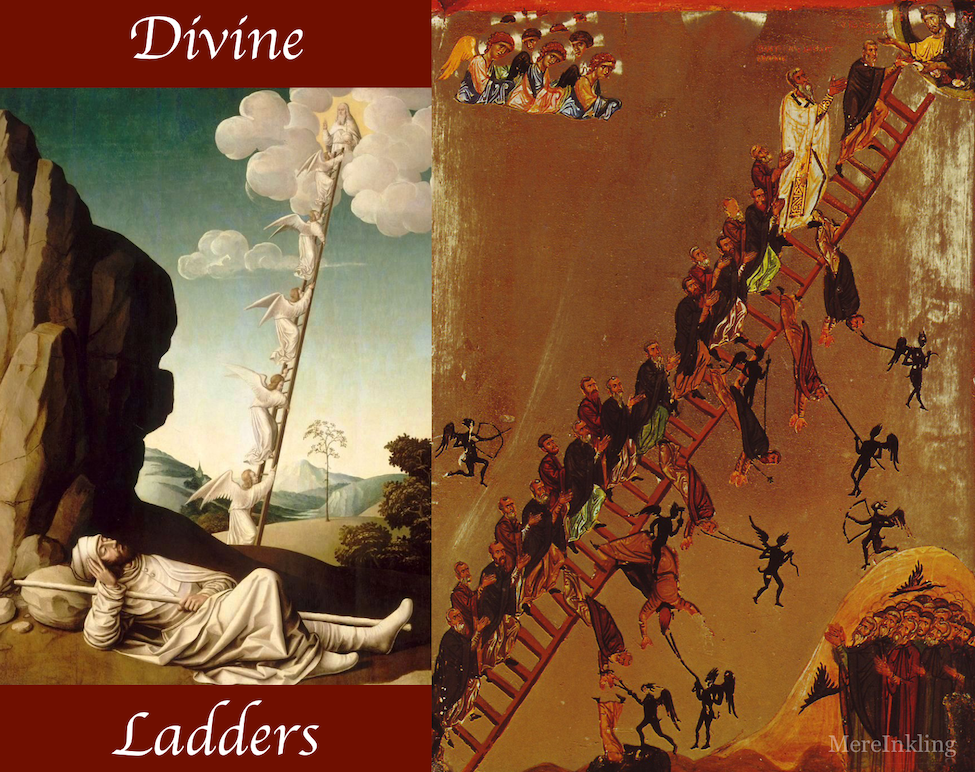
One of the pivotal events in the history of God’s grace is found in the Torah account of a dream. Jacob was the heir of Abraham, through whom the Lord promised to redeem the world. But Jacob was far from noble.

Nevertheless, because of the Lord’s mercy (the same mercy he offers to us), he forgave Jacob and promised to bless his descendants. In his dream, Jacob saw a ladder extending from earth all the way to heaven. “And behold, the angels of God were ascending and descending on it!” (Genesis 28).

This dynamic connection between heaven and earth reveals God’s constant concern for his creation. Some, such as Martin Luther, have seen in the dream a foreshadowing of the Incarnation itself.

This ladder or stairway can be interpreted in a variety of ways. One thing it is not, however, is a guide to human ascent from our fallen world to the presence of our Creator. (The Lord is the one who comes to us.)

Having acknowledged that the dream’s purpose is not to model sanctification or individual spiritual ascent, it is easy to see why the metaphor of ladders, and the action of climbing, give way to other applications.

The most vivid contemporary example comes in the form of a Christian spiritual entitled “We are Climbing Jacob’s Ladder.” A number of versions of the lyrics exist. This is quite unsurprising since it began as part of an oral tradition. According to one website devoted to spirituals, the following lyrics are typical.*

We are climbing Jacob’s ladder
Soldier of the Cross

Ev’ry round goes higher ‘n’ higher
Soldier of the Cross

Brother do you love my Jesus
Soldier of the Cross

If you love him why not serve him
Soldier of the Cross

While there are longer versions, this one aptly illustrates how the metaphor of the ladder—in this case, explicitly Jacob’s ladder—offered a powerful image of deliverance. Climbing the ladder with Jesus, was tantamount to experiencing deliverance from the ills of this world.

America’s Library of Congress offers a useful page which describes “African American Gospel music [as] a form of euphoric, rhythmic, spiritual music rooted in the solo and responsive church singing of the African American South.” They add that “its development coincided with—and is germane to—the development of rhythm and blues.” The site offers links to four 1943 recordings of spirituals. None of these, however, is the hymn we are discussing.

“We are Climbing Jacob’s Ladder” was one of the earliest spirituals to be widely adopted by the interracial faith community. It is familiar in many denominations, and was recently sung in my own Lutheran congregation. Hymnary.org states the song has been “published in 79 hymnals.” Even those who consider themselves unfamiliar with the hymn often recognize its rousing refrain: “Rise and shine and give God the glory, glory, Soldiers of the Cross.”

The talented Paul Robeson recorded the hymn on a number of his albums. The inspiring rendition by scholar Bernice Johnson Reagon was included in Ken Burn’s documentary, The Civil War.

C.S. Lewis and the Spiritual Ladder

The ladder offers such a convenient analogy for growth or spiritual maturation that others have also applied it in this manner. The ladders inspired by Jacob’s dream include the following two which continue to influence Christian disciples today, even though they were written many centuries ago. The second of these was considered by C.S. Lewis to be one of the works of faith influential in his life.

John Climacus (579-649) was a Christian teenager when he entered the monastic life at the foot of Mount Sinai. He soon earned the respect of his elders in that barren land. In the words of Fathers of the Desert, “in this ascetic seclusion he became ripe for the designs of God.”

The abbot of a monastery on the Red Sea requested guidance on the ascetic life to use with his monks. John responded with The Ladder of Divine Ascent. You can download a modern translation of this priceless work here. While the treatise was written specifically to guide monastics in their spiritual growth, many other Christians have also found its wisdom helpful in their own, non-monastic settings.

John introduces the virtue of obedience with two vivid images used by the Apostle Paul, the athlete in training and the armor of God.

Our treatise now appropriately touches upon warriors and athletes of Christ [and the manner in which] the holy soul steadily ascends to heaven as upon golden wings. And perhaps it was about this that he who had received the Holy Spirit sang: Who will give me wings like a dove? And I will fly by activity, and be at rest by contemplation and humility.

But let us not fail, if you agree, to describe clearly in our treatise the weapons of these brave warriors: how they hold the shield of faith in God and their trainer, and with it they ward off, so to speak, every thought of unbelief and vacillation; how they constantly raise the drawn sword of the Spirit and slay every wish of their own that approaches them; how, clad in the iron armour of meekness and patience, they avert every insult and injury and missile.

And for a helmet of salvation they have their superior’s protection through prayer. And they do not stand with their feet together, for one is stretched out in service and the other is immovable in prayer.

The following passage will be of particular interest to Christian writers. John advises those drawing closer to God to maintain a journal of their progress and insights. I offer it within its wise context.

Let all of us who wish to fear the Lord struggle with our whole might, so that in the school of virtue we do not acquire for ourselves malice and vice, cunning and craftiness, curiosity and anger. For it does happen, and no wonder!

As long as a man is a private individual, or a seaman, or a tiller of the soil, the King’s enemies do not war so much against him. But when they see him taking the King’s colours, and the shield, and the dagger, and the sword, and the bow, and clad in soldier’s garb, then they gnash at him with their teeth, and do all in their power to destroy him. And so, let us not slumber.

I have seen innocent and most beautiful children come to school for the sake of wisdom, education and profit, but through contact with the other pupils they learn there nothing but cunning and vice. The intelligent will understand this.

It is impossible for those who learn a craft whole-heartedly not to make daily advance in it. But some know their progress, while others by divine providence are ignorant of it. A good banker never fails in the evening to reckon the day’s profit or loss. But he cannot know this clearly unless he enters it every hour in his notebook. For the hourly account brings to light the daily account.

In the fourteenth century, an Augustinian mystic in England wrote a book called The Scale [Ladder] of Perfection.” Walter Hilton (c. 1340-1396) provides spiritual exercises requested by a woman adopting life as an anchoress.⁑ You can download a free copy of Evelyn Underhill’s 1923 edition of Hilton’s counsel at Internet Archive.

In 1940, C.S. Lewis wrote to Roman Catholic monk Bede Griffiths in response to the latter’s question about his familiarity with Hilton’s work. “Yes, I’ve read the Scale of Perfection with much admiration. I think of sending the anonymous translator a list of passages that he might reconsider for the next edition.” That same decade Lewis’ collected correspondence reveals he recommended the title to at least two individuals.

Of greatest interest to students of C.S. Lewis will be his mention of the medieval treatise in his autobiography, Surprised by Joy. Here the great author describes his worldly understanding of prayer served as a terrible stumbling block to his faith.

To these nagging suggestions my reaction was, on the whole, the most foolish I could have adopted. I set myself a standard. No clause of my prayer was to be allowed to pass muster unless it was accompanied by what I called a “realization,” by which I meant a certain vividness of the imagination and the affections.

My nightly task was to produce by sheer will power a phenomenon which will power could never produce, which was so ill-defined that I could never say with absolute confidence whether it had occurred, and which, even when it did occur, was of very mediocre spiritual value.

If only someone had read to me old Walter Hilton’s warning that we must never in prayer strive to extort “by maistry” what God does not give! But no one did; and night after night, dizzy with desire for sleep and often in a kind of despair, I endeavored to pump up my “realizations.” The thing threatened to become an infinite regress.

One began of course by praying for good “realizations.” But had that preliminary prayer itself been “realized”? This question I think I still had enough sense to dismiss; otherwise it might have been as difficult to begin my prayers as to end them.

How it all comes back! The cold oilcloth, the quarters chiming, the night slipping past, the sickening, hopeless weariness. This was the burden from which I longed with soul and body to escape. It had already brought me to such a pass that the nightly torment projected its gloom over the whole evening, and I dreaded bedtime as if I were a chronic sufferer from insomnia. Had I pursued the same road much further I think I should have gone mad.

This ludicrous burden of false duties in prayer provided, of course, an unconscious motive for wishing to shuffle off the Christian faith; but about the same time, or a little later, conscious causes of doubt arose.

David Downing, co-director of the Wade Center wrote an excellent essay entitled “Into the Region of Awe: Mysticism in C.S. Lewis” which describes in the broader context what C.S. Lewis wrote in Surprised by Joy.

Note for example a passage in Surprised by Joy in which Lewis discusses the loss of his childhood faith while at Wynyard School in England. He explains that his schoolboy faith did not provide him with assurance or comfort, but created rather self-condemnation.

He fell into an internalized legalism, such that his private prayers never seemed good enough. He felt his lips were saying the right things, but his mind and heart were not in the words. Lewis adds “if only someone had read me old Walter Hilton’s warning that we must never in prayer strive to extort ‘by maistry’ [mastery] what God does not give.”

This is one of those casual references in Lewis which reveals a whole other side to him which may surprise those who think of him mainly as a Christian rationalist. “Old Walter Hilton” is the fourteenth-century author of a manual for contemplatives called The Scale of Perfection. This book is sometimes called The Ladder of Perfection, as it presents the image of a ladder upon which one’s soul may ascend to a place of perfect unity and rest in the Spirit of God . . . [passage continued in footnotes]. ⁂

We’ve considered four separate ladders today. Despite their differences, they all share a common trait—they are meaningful to those who are earnest about growing in the faith. Whether slave or free, wise or simple, or hermit or cosmopolitan—each of these ladders affirms eternal truths.

Underhill described Hilton’s motivation for writing in this way: “It is for those who crave for this deeper consciousness of reality, and feel this impulse to a complete consecration, that Hilton writes.” I believe this is true for the authors of each of these four treasures.


* The following, simpler version appears to follow an earlier tradition. A musical accompaniment for this example can be found in The Books of American Negro Spirituals. The author, James Weldon Johnson (1876-1938), provides a rich and earnest introduction to the book, originally published in two volumes. He expresses his hope that collection “will further endear these sons to those who love Spirituals, and will awaken an interest in many others.”

We am clim’in’ Jacob’s ladder
Soldiers of the cross

O

Ev’ry roun’ goes higher, higher
Soldiers of the cross

⁑ An anchoress (or anchorite) was a religious woman (or man) who would often be walled off in their monastic cell near a church, to foster their life of prayer by freeing them from interruption.

⁂ Downing’s discussion of C.S. Lewis’ reference to Walter Hinton’s insights on prayer is so valuable that I am compelled to offer the rest of it here. You can read the entire essay via the link on the article’s title.

The passage about “maistry” Lewis wished he’d known as a boy comes early in The Scale of Perfection, a section about different kinds of prayer, including liturgical prayers, spontaneous prayers, and “prayers in the heart alone” which do not use words.

Hilton’s advice for people “who are troubled by vain thoughts in their prayer” is not to feel alone. He notes it is very common to be distracted in prayer by thoughts of what “you have done or will do, other people’s actions, or matters hindering or vexing you.”

Hilton goes on to explain that no one can keep fully the Lord’s command to love the Lord your God with all your heart, soul, strength, and mind. The best you can do is humbly acknowledge your weakness and ask for mercy. However badly one’s first resolve fades, says Hilton, you should not get “too fearful, too angry with yourself, or impatient with God for not giving you savor and spiritual sweetness in devotion.”

Instead of feeling wretched, it is better to leave off and go do some other good or useful work, resolving to do better next time. Hilton concludes that even if you fail in prayer a hundred times, or a thousand, God in his charity will reward you for your labor. Walter Hilton was the canon of a priory in the Midlands of England and an experienced spiritual director of those who had taken monastic vows. His book is full of mellow wisdom about spiritual growth, and Lewis considered it one of “great Christian books” that is too often neglected by modern believers.

Hilton’s recurring theme—do what you know to be right and don’t worry about your feelings—is one that appears often in Lewis’s own Christian meditations. But, alas, Lewis as a boy did not have the benefit of Hilton’s advice.

In those boyhood years at Wynyard, he was trapped in a religion of guilt, not grace. More and more he came to associate Christianity with condemnation of others, as in Northern Ireland, or condemnation of oneself, for not living up to God’s standards.


A Note on the Illustration

Nicolas Dipre was a French early Renaissance painter, who flourished 1495-1532. His painting of Jacob’s Ladder portrays the biblical account of the Jewish patriarch’s dream. The icon Ladder of Divine Ascent was painted four centuries earlier by an anonymous iconographer. It is from Saint Catherine’s Monastery beside Mount Sinai, and portrays the ascent of saints in the pursuit of holiness. While fallen angels (devils) seek to drag them from the path, John Climacus leads other in the path to heaven.


Free Storytelling Class

If you are a storyteller—and if, like me, you’re interested in screenwriting—there is a free class you may find valuable.

John Paul the Great Catholic University focuses on degrees related to the creative arts. They are currently offering a five session “crash course” discussing the key elements of storytelling. And the teachers apparently possess genuine credentials, being “veterans of Pixar’s Braintrust, Warner Bros. Script Department, and Hollywood writers’ rooms.”

You can learn more about the self-paced course here.

The final session on “adaptations” looks particularly intriguing.

What makes a good adaptation? In this lesson, Professor Chris Riley guides you through the basic principles of adapting source material (such as novels and true stories) for film and television. . . . Recommended for anyone with a curiosity for how novels and real life stories are distilled and written into movies. Especially recommended for writers interested in making movies from short stories, novels, or real life stories.

C.S. Lewis and the rest of the Oxford Inklings were gifted storytellers. Lewis began honing his skills when he a child and collaborated with his brother Warnie to compose the tales of Boxen.

J.R.R. Tolkien’s Lord of the Rings relates an overarching saga of humble heroism. Its skilled creator weaves into the Fellowship’s quest many other fascinating tales. The trilogy is a series that spawns fresh wonders, reading after reading. As one reviewer notes, Tolkien showcases “duty, honor, perseverance, and friendship.” He continues:

That, my friends, is the power of great stories. But a good story alone isn’t good enough either. One reason that Tolkien remains popular is because his stories were about important ideas, ideas that stand the test of time.

In a rather more scholarly article, “J.R.R. Tolkien and the Telling of a Traditional Narrative,” the writer says “the literary critical question is, why would Tolkien spend so much time and effort telling such an old story?” He answers that question in the following manner.

The answer lies . . . in the purpose of traditional narrative and the intent of the traditional tale teller. The traditional tale teller, like any traditional performer, is recreative rather than creative, doing those things that the community wants (and perhaps needs) over and over again, striving not to do something totally inventive and perceptually new but rather to do the traditional thing well and, perhaps, with some special, individual flair.

Turning to C.S. Lewis, we find numerous reference to his storytelling skills. In one aptly named work, we discover why Lewis became a writer rather than a sculptor.

C.S. Lewis loved stories. Throughout his life he found it really had to make anything by hand.* He could, though, hold a pencil or a pen and was driven to write stories instead. It was a blessing in disguise! Many years later C.S. Lewis wrote that you can do more with a castle in a story than with the best cardboard castle that ever stood on a nursery table (C.S. Lewis: The Story Teller).

Encouraging Another Storyteller

One of the main reasons for the Inkling’s very existence was their mutual encouragement in writing. Members often read their works in progress and offered (occasionally gentle) constructive criticism.

As a popular author, C.S. Lewis was approached by many aspiring writers. He patiently and encouragingly responded to these contacts. Some of these correspondents were former students and friends.

One such dear friend was Roger Lancelyn Green (1918-1987). Green had been a student of Lewis’ and a member of the Inklings while he studied and taught at Oxford. The two were quite close, and he actually joined Lewis and his wife Joy during their holiday in Greece.

As an Inkling and an English professor himself, Green was destined to become a writer. In addition to his other biographies—he co-authored one of the best on C.S. Lewis—he was a noted children’s writer. In fact, among his popular retellings of various mythologies, he compiled the stories of the Greeks, Egyptians and Norse. Many of his works can be “borrowed” from the Internet Archives library.

However, years before he wrote these volumes, Green shared one of his earliest efforts with his mentor. In September of 1945, C.S. Lewis offered him a significant amount of specific advice, but begins—as all good critiquing should—with encouragement.

My dear Green– I have now read The Wood That Time Forgot and this is what I think. The general narrative power is excellent: i.e. on the question whether you have in general the story-telling talent, you may (in my opinion) set your mind at rest. I read it on a railway journey and it carried me as far as Bletchley (which was at chapter VII) without a single flagging of interest.

I particularly admired the transition from the natural to the supernatural part. This went just gradually enough to elicit one’s faith and by the right stages. I thank you for giving me the authentic thrill: as you did several times.

As noted, Lewis follows this introductory affirmation with explicit comments on various facets of the manuscript. In June of 1949, Lewis offered his friend comments on a revised version of the story.⁑

Too bad we don’t all have a mentor like C.S. Lewis. I can’t imagine what it would be like to be encouraged by such an anointed storyteller.

Chances are that you, like Tolkien and Lewis, are a storyteller as well. Which is why I shared with you the invitation to the free storytelling course linked above. I will likely sign up for it myself, since I too have a screenplay I would someday like to write.


* This was due to a the lack of a metacarpophalangeal joint in his thumb. He shared this syndrome with his father and brother. If interested, you can read “Symphalangism, C.S. Lewis Type” in an online catalog of genetic disorders.

⁑ Lewis’ comments regarding the revised manuscript are included in volume two of The Collected Letters of C.S. Lewis, with the following introduction.

Roger Lancelyn Green, in an attempt to turn his story The Wood That Time Forgot into “a fairy tale for grown-ups,” had revised it . . . to give it a completely new ending—of which Lewis approved. The book, however, remains unpublished as it would appear to owe too much to The Lion, The Witch and the Wardrobe.

All of Green’s mythologies appear to currently be in print. In the introduction to his Norse mythology  volume, he provides an interesting contrast with his previous work closer to the Mediterranean.

Norse mythology is the very antithesis of Greek from the reteller’s point of view. The wealth of literature and legend available for studying the gods of Olympus is positively embarrassing, and the problem there is one of selection. The gods of Asgard, on the other hand, remain strangely aloof: the difficulty here is to find enough about them. And when the scanty material is collected, it is still harder to fit together the incomplete jigsaw-puzzle which is all that remains to us.

The White Christ, Red Thor & C.S. Lewis

If you were a Scandinavian living a millennia ago, you would be faced with a critical decision. Would you embrace Jesus Christ and a new life based on mercy, or would you cling to Odin and the Norse pantheon, with its glorification of bloodshed?

When I first heard this choice posed as a choice between the “White Christ” and the blood-drenched Thor, I assumed the white color alluded to traits commonly associated with it today—e.g. purity, innocence, and holiness.*

To my surprise, I recently learned there was a completely different to the Vikings. For them, referring to Christ as “white” was a term of derision.

Before returning to the Northmen, let’s consider for a moment the Inklings. These brilliant writers were well acquainted with white as a biblical metaphor for holiness, etc. They understood how the miracle of the Transfiguration described Jesus’ radiant face shining “like the sun” as the “bright cloud overshadowed them.”

As Mark records in his Gospel, Jesus “was transfigured before them, and his clothes became radiant, intensely white, as no one on earth could bleach them.”

It is no accident Tolkien’s Gandalf the Grey returns as Gandalf the White following his deadly battle with the Balrog.

In C.S. Lewis’ Voyage of the Dawn Treader, Aslan manifests himself to the children as an unblemished lamb.

But between them and the foot of the sky there was something so white on the green grass that even with their eagles’ eyes they could hardly look at it. They came on and saw that it was a Lamb. “Come and have breakfast,” said the Lamb in its sweet milky voice. . . .

“Please Lamb,” said Lucy, “is this the way to Aslan’s country?”

“Not for you,” said the Lamb. “For you the door into Aslan’s country is from your own world.”

“What!” said Edmund. “Is there a way into Aslan’s country from our world too?”

“There is a way into my country from all the worlds,” said the Lamb; but as he spoke his snowy white flushed into tawny gold and his size changed and he was Aslan himself, towering above them and scattering light from his mane.

On the other hand, C.S. Lewis tosses us a curve with the White Witch in his Chronicles of Narnia. The reason for her identification with white is obvious, since she is holding Narnia in an austere, perpetual winter. The witch’s hue carries other messages. Her unthreatening appearance moves Edmund to drop his defenses during their initial encounter.

[Queen Jadis was] a great lady, taller than any woman that Edmund had ever seen. She also was covered in white fur up to her throat and held a long straight golden wand in her right hand and wore a golden crown on her head. Her face was white—not merely pale, but white like snow or paper or icing-sugar, except for her very red mouth. It was a beautiful face in other respects, but proud and cold and stern.

Northern Mythologies

C.S. Lewis was enraptured by Northernness. He and Tolkien spent many hours reading Viking sagas.

However, Lewis was inspired not by the warrior Thor, but the person of Baldur. Several of my online friends and acquaintances have also written about Lewis’ affinity for Baldur. These include Brenton Dickieson, Eleanor Parker, and Bradley Birzer.

Turning from Baldur (Baldr) the Brave to Thor (Þórr), the god of thunder, we find the Norse deity with the largest number of followers. Thor was the ideal divinity for independent adventurers, warriors and violent raiders.

The story of the heroic thunder god still resonates today, as the success of the recent cinematic blockbusters attests. To suit contemporary tastes, the bloody red giant-slayer of myth has shed his more gruesome traits. They have been replaced by nobler aspects, as befitting a modern superhero protecting Midgard (Earth) from danger.

But the medieval period was not the relatively safe world we know. And pleas to turn the other cheek sounded like utter foolishness. The belligerent nature of the Germanic and Scandinavian chieftains of the era, resulted in a modification of the Gospel which was shared by some evangelists. In order to impress a militant population, the pacific nature of Jesus was downplayed. In “Why Trust the White Christ?” we read, “Not until the 1100s did the concept of the suffering Christ take root in Scandinavia; before that Christ was depicted as a triumphant prince—even on the cross!”

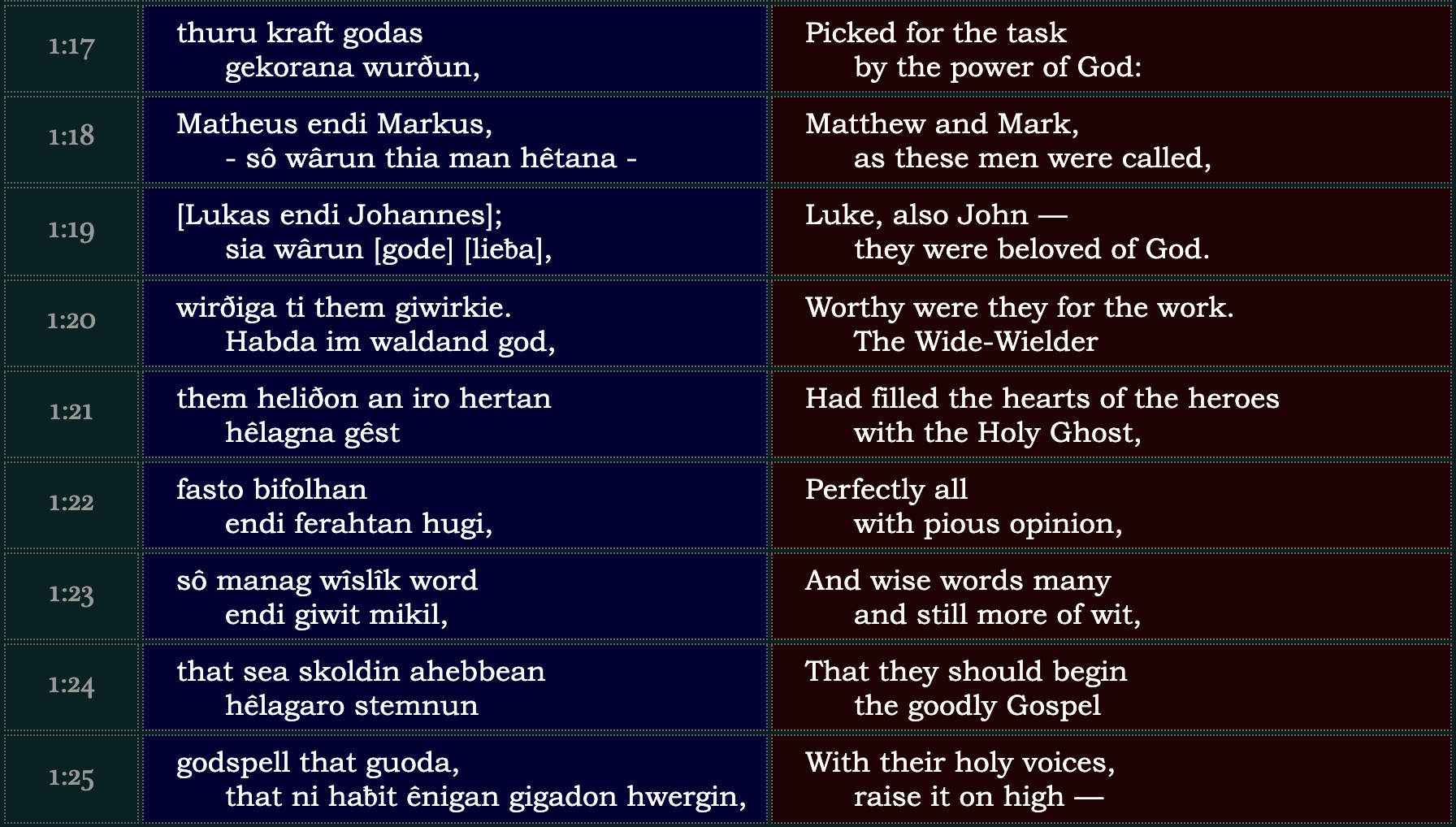
Eventually the Gospel would triumph, but one of its first effective renditions for the northern barbarians came in a gospel harmony⁑ entitled the Heliand. A number of references to the Gospel in J.R.R. Tolkien’s academic writings reveals his familiarity with the Old Saxon work, which he also mentioned in his lectures. The Heliand was commissioned by Charlemagne’s grandson Louis the German (806-876) to reach the Franks’ fellow Germanic tribes who remained Pagan. It was written by a Benedictine monk named Notker, who also wrote The Life of Charlemagne.⁂

The fact that this alliterative Gospel (in poetic form) was composed for the Saxon warrior class (their nobility), makes it particularly interesting.  Knowing it was recited not only in monasteries, but also mead halls, makes one’s personal reading of it feel like a journey into the ancient past.

Mariana Scott’s 1966 translation ⁑⁑ is available here. This site posits her translation beside the original Old Saxon. One of my favorite passages comes in the “introduction,” as the context of the Gospel proper is set for the hearers. It is very serious and describes the four Evangelists as inspired by God.

[The Lord] had filled the hearts of the heroes,
     with the Holy Ghost.
Perfectly all,
     with pious opinion,
And wise words many
     and still more of wit.
That they should begin
     the goodly Gospel
With their holy voices,
     raise it on high—

The Question of the White Christ

Referring to Jesus as the “White Christ” may have been related to the association of white baptismal robes worn by the newly baptized. But it involved more than that.

Apparently, the appellation “white,” especially when linked to Christ, was a Pagan insult. In a Scandinavian Studies article entitled “The Contemptuous Sense of the Old Norse Adjective Hvítr, ‘White, Fair’” we learn that it possessed a pejorative sense.

The [Old Icelandic] heathen religion glorified physical strength and courage in combat, a direct antithesis to the Christian ideal of pacifism based upon the Golden Rule. Hence, the heathen Icelanders interpreted the Christian Hvítakristr ‘The White Christ’ as a cowardly, contemptible counterpart of Thor, the god of courage and strength . . .

And this negative connotation continued, even after the triumph of the new faith.

[Even] after Christianity had become established as the national religion in Iceland, this heathen conception of Christian ‘cowardice’ disappeared but left its traces in the epithet hvítr, especially when one wished to belittle or vilify a personal enemy.

. . .

The double sense (‘fair’ : ‘cowardly’)was characteristic of skaldic poetry and served to enhance the sarcastic effect.

And thus my youthful innocence about the meaning of the White Christ has been dispelled. But, at the same time, my insight into the historic prejudice against the sacrificial Son and Lamb of God has grown.

Jesus was no coward, but he is—now and forever—pure, innocent, and holy.


* It should go without being said that associating the color white with Jesus has absolutely nothing to do with ethnicity. The Incarnation of our Lord makes it abundantly clear that Jesus was a Jew born in Bethlehem and raised in Nazareth. The Bible describes nothing noteworthy about his appearance that would distinguish him from the rest of the Jewish people in ancient Palestine. Thus, whatever Jesus’ complexion, he would have looked little like the pale Anglo-Saxon messiah we have often seen in paintings and cinema.

⁑ A Gospel harmony is a blending together of the four canonical Gospels into a single account. Tatian (c. 120-180), an Assyrian theologian, compiled the Diatessaron, which was prominent in the Syrian church, and is thought to have directly influenced the Germanic harmony, the Heliand.

 ⁂ Notker (c. 840-912) who also composed hymns and poetry. As mentioned above, the Benedictine monk also wrote The Life of Charlemagne which records many fascinating stories about Frankish and Germanic Christianity. Apparently a poor precedent was set by Frankish generosity when a group of Northmen serving as envoys received baptism.

As I have mentioned the Northmen I will show by an incident drawn from the reign of your grandfather in what slight estimation they hold faith and baptism. . . .

The nobles of the palace adopted them almost as children, and each received from the emperor’s chamber a white robe and from their sponsors a full Frankish attire, of costly robes and arms and other decorations.

This was often done and from year to year they came in increasing numbers, not for the sake of Christ but for earthly advantage.

A very enlightening and sadly entertaining account. But what happens when the gifts run out?

⁑⁑ In the foreword to her translation, Scott shares some intriguing thoughts on the challenging labor of translation.

It was important for me to remember that the Heliand was originally intended for recitation. This accounts for the very great emphasis on rhythm. While the exact form of the old alliterative verse, though common to both early English and German poetry, proved too confining, a freer adaptation was possible. Let us remember that much of the effect of modern free verse depends on the interplay of sounds: assonance and alliteration.

Keeping in mind the purpose of the original, I read my translation aloud as I worked, repeating lines several times, varying and checking rhythms, trying to imitate the surge of the meter and yet avoid monotony. The end result was a line of variable feet, usually a rather free alternation of anapests and iambics with a few scattered tribrachs and spondees, divided by the traditional caesura.

I aimed for an alliteration of at least one accented syllable in the first half line with one accented syllable in the second half. If more sounded right, I was delighted. If none worked, I tried to make the rhythm carry the line along to the next cadence. Not all of it, I painedly admit, turned out to be poetry—but then not all of the Old Saxon is!