Learning New Words

When you encounter an unfamiliar word, do you consider that inconvenient, or exciting?

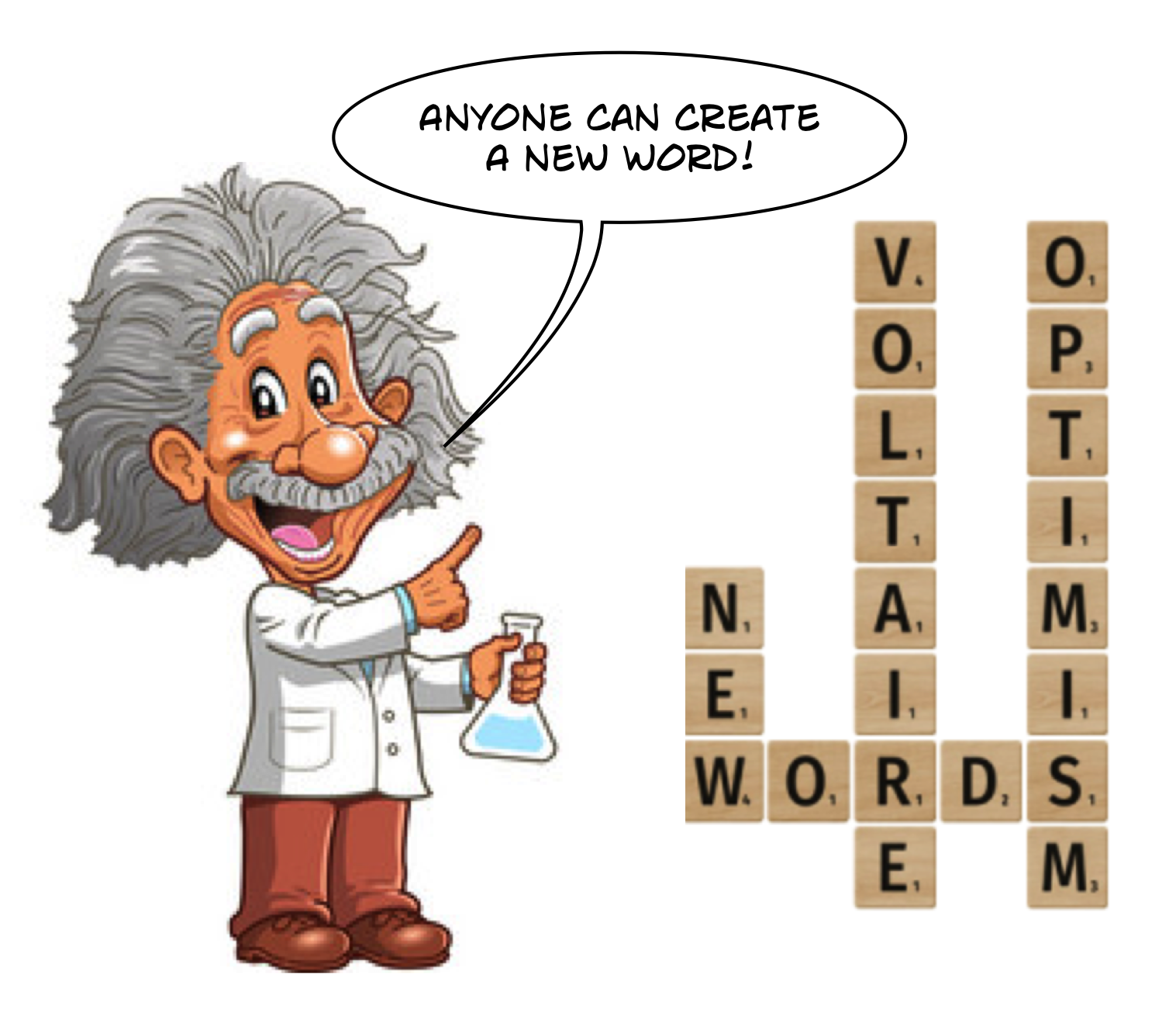
I encountered a new word today. I read a lot, but rarely do I encounter an unfamiliar word.* I share it with you because of its peculiar meaning. You may want to use it sometime. The drawback is that it is a tad antiquated (thus its unfamiliarity). The word is “Panglossian.”

My “passing” grade in the study of Classical Greek in 1977 suggested the word might mean multi-lingual, since pan means “all,” and glossa means languages or tongues. I was wrong—but for a very odd reason.

Panglossian, you see, doesn’t refer to the literal meaning of its root words. It is based on the qualities of a character created by Voltaire for his satirical novella, Candide. Ironically, Voltaire presumably christened his professor of métaphysico-théologo-cosmolonigologie with this nomen⁑ because of its actual meaning.

The adjective Panglossian, however, has a completely distinct definition. Its difference was signaled for me by the capitalization of the first letter. Fans of Voltaire (among whom I do not count myself, or C.S. Lewis, for that matter) may already know its meaning. a definition, trust me, we shall get to momentarily.

First, I want to share C.S. Lewis’ observation about Voltaire, a Deist who was a savage critic of Christianity. In his autobiography Lewis includes the philosopher in a list of people he considered allies during his own season of atheism.

All the books were beginning to turn against me. Indeed, I must have been as blind as a bat not to have seen, long before, the ludicrous contradiction between my theory of life and my actual experiences as a reader.

George MacDonald had done more to me than any other writer; of course it was a pity he had that bee in his bonnet about Christianity. He was good in spite of it. Chesterton had more sense than all the other moderns put together; bating, of course, his Christianity. Johnson was one of the few authors whom I felt I could trust utterly; curiously enough, he had the same kink. Spenser and Milton by a strange coincidence had it too.

Even among ancient authors the same paradox was to be found. The most religious (Plato, Aeschylus, Virgil) were clearly those on whom I could really feed.

On the other hand, those writers who did not suffer from religion and with whom in theory my sympathy ought to have been complete—Shaw and Wells and Mill and Gibbon and Voltaire—all seemed a little thin; what as boys we called “tinny.” It wasn’t that I didn’t like them. They were all (especially Gibbon) entertaining; but hardly more. There seemed to be no depth in them. They were too simple. (Surprised by Joy).

Voltaire’s religious views aside, in Dr. Pangloss he devised a character energized by an incurable optimism. From that characterization, fifty years after Voltaire’s work another writer derived the adjective. If you are like me, knowing a word’s etymology—its origin and history—is intrinsically satisfying.

So, as Merriam Webster says: Pan·​gloss·​ian | pan-ˈglä-sē-ən was first used in 1831 to describe someone or something as being “marked by the view that all is for the best in this best of possible worlds: excessively optimistic.”

And, since the minting of new words is an ongoing process, it comes as no surprise panglossian has spawned variations.

According to a word research site, “writers have since made several compounds out of his name, such as Panglossic and Panglossism, but the adjective Panglossian is by far the most common and is frequently found even today.”

I encountered the word in an interesting First Things essay entitled “The Gospel According to Dickens.” The author describes Dickens’ hopeful tone and confidence, but declares “Dickens was not Panglossian, however. He expressed scorn for the society that insults and injures the weak and vulnerable.”

While I’m neither panglossic nor inclined in the least to panglossism, I’m glad such people exist. Their naiveté makes this world of ours far more interesting.⁂


* This is true, aside from specific “names” of things like an animal genus (e.g. trochilidae for hummingbirds or urochordate for the beloved sea squirt), or a pharmaceutical (e.g. Unituxin or Tecfidera). The business channel CNBC reports:

“If it seems as if drug names have been getting weirder, it’s because, in some cases, they have. . . . drug names use the letter Q three times as often as words in the English language. For Xs, it’s 16 times as much. Zs take the cake, at more than 18 times the frequency you’d find them in English words. And Ws? You’ll rarely see one in a drug name.” And, shockingly, the cost ranges from $75,000 to $250,000 for developing a single drug brand name.”

⁑ I studied Latin too, way back in 1969-71. The grades for my Latin scholarship were also “satisfactory.”

⁂ No offense intended to any readers of Mere Inkling who count themselves among the excessively optimistic! But, as for me, I’ve yet to be panglossterized.

Climbing Ladders of Faith

One of the pivotal events in the history of God’s grace is found in the Torah account of a dream. Jacob was the heir of Abraham, through whom the Lord promised to redeem the world. But Jacob was far from noble.

Nevertheless, because of the Lord’s mercy (the same mercy he offers to us), he forgave Jacob and promised to bless his descendants. In his dream, Jacob saw a ladder extending from earth all the way to heaven. “And behold, the angels of God were ascending and descending on it!” (Genesis 28).

This dynamic connection between heaven and earth reveals God’s constant concern for his creation. Some, such as Martin Luther, have seen in the dream a foreshadowing of the Incarnation itself.

This ladder or stairway can be interpreted in a variety of ways. One thing it is not, however, is a guide to human ascent from our fallen world to the presence of our Creator. (The Lord is the one who comes to us.)

Having acknowledged that the dream’s purpose is not to model sanctification or individual spiritual ascent, it is easy to see why the metaphor of ladders, and the action of climbing, give way to other applications.

The most vivid contemporary example comes in the form of a Christian spiritual entitled “We are Climbing Jacob’s Ladder.” A number of versions of the lyrics exist. This is quite unsurprising since it began as part of an oral tradition. According to one website devoted to spirituals, the following lyrics are typical.*

We are climbing Jacob’s ladder
Soldier of the Cross

Ev’ry round goes higher ‘n’ higher
Soldier of the Cross

Brother do you love my Jesus
Soldier of the Cross

If you love him why not serve him
Soldier of the Cross

While there are longer versions, this one aptly illustrates how the metaphor of the ladder—in this case, explicitly Jacob’s ladder—offered a powerful image of deliverance. Climbing the ladder with Jesus, was tantamount to experiencing deliverance from the ills of this world.

America’s Library of Congress offers a useful page which describes “African American Gospel music [as] a form of euphoric, rhythmic, spiritual music rooted in the solo and responsive church singing of the African American South.” They add that “its development coincided with—and is germane to—the development of rhythm and blues.” The site offers links to four 1943 recordings of spirituals. None of these, however, is the hymn we are discussing.

“We are Climbing Jacob’s Ladder” was one of the earliest spirituals to be widely adopted by the interracial faith community. It is familiar in many denominations, and was recently sung in my own Lutheran congregation. Hymnary.org states the song has been “published in 79 hymnals.” Even those who consider themselves unfamiliar with the hymn often recognize its rousing refrain: “Rise and shine and give God the glory, glory, Soldiers of the Cross.”

The talented Paul Robeson recorded the hymn on a number of his albums. The inspiring rendition by scholar Bernice Johnson Reagon was included in Ken Burn’s documentary, The Civil War.

C.S. Lewis and the Spiritual Ladder

The ladder offers such a convenient analogy for growth or spiritual maturation that others have also applied it in this manner. The ladders inspired by Jacob’s dream include the following two which continue to influence Christian disciples today, even though they were written many centuries ago. The second of these was considered by C.S. Lewis to be one of the works of faith influential in his life.

John Climacus (579-649) was a Christian teenager when he entered the monastic life at the foot of Mount Sinai. He soon earned the respect of his elders in that barren land. In the words of Fathers of the Desert, “in this ascetic seclusion he became ripe for the designs of God.”

The abbot of a monastery on the Red Sea requested guidance on the ascetic life to use with his monks. John responded with The Ladder of Divine Ascent. You can download a modern translation of this priceless work here. While the treatise was written specifically to guide monastics in their spiritual growth, many other Christians have also found its wisdom helpful in their own, non-monastic settings.

John introduces the virtue of obedience with two vivid images used by the Apostle Paul, the athlete in training and the armor of God.

Our treatise now appropriately touches upon warriors and athletes of Christ [and the manner in which] the holy soul steadily ascends to heaven as upon golden wings. And perhaps it was about this that he who had received the Holy Spirit sang: Who will give me wings like a dove? And I will fly by activity, and be at rest by contemplation and humility.

But let us not fail, if you agree, to describe clearly in our treatise the weapons of these brave warriors: how they hold the shield of faith in God and their trainer, and with it they ward off, so to speak, every thought of unbelief and vacillation; how they constantly raise the drawn sword of the Spirit and slay every wish of their own that approaches them; how, clad in the iron armour of meekness and patience, they avert every insult and injury and missile.

And for a helmet of salvation they have their superior’s protection through prayer. And they do not stand with their feet together, for one is stretched out in service and the other is immovable in prayer.

The following passage will be of particular interest to Christian writers. John advises those drawing closer to God to maintain a journal of their progress and insights. I offer it within its wise context.

Let all of us who wish to fear the Lord struggle with our whole might, so that in the school of virtue we do not acquire for ourselves malice and vice, cunning and craftiness, curiosity and anger. For it does happen, and no wonder!

As long as a man is a private individual, or a seaman, or a tiller of the soil, the King’s enemies do not war so much against him. But when they see him taking the King’s colours, and the shield, and the dagger, and the sword, and the bow, and clad in soldier’s garb, then they gnash at him with their teeth, and do all in their power to destroy him. And so, let us not slumber.

I have seen innocent and most beautiful children come to school for the sake of wisdom, education and profit, but through contact with the other pupils they learn there nothing but cunning and vice. The intelligent will understand this.

It is impossible for those who learn a craft whole-heartedly not to make daily advance in it. But some know their progress, while others by divine providence are ignorant of it. A good banker never fails in the evening to reckon the day’s profit or loss. But he cannot know this clearly unless he enters it every hour in his notebook. For the hourly account brings to light the daily account.

In the fourteenth century, an Augustinian mystic in England wrote a book called The Scale [Ladder] of Perfection.” Walter Hilton (c. 1340-1396) provides spiritual exercises requested by a woman adopting life as an anchoress.⁑ You can download a free copy of Evelyn Underhill’s 1923 edition of Hilton’s counsel at Internet Archive.

In 1940, C.S. Lewis wrote to Roman Catholic monk Bede Griffiths in response to the latter’s question about his familiarity with Hilton’s work. “Yes, I’ve read the Scale of Perfection with much admiration. I think of sending the anonymous translator a list of passages that he might reconsider for the next edition.” That same decade Lewis’ collected correspondence reveals he recommended the title to at least two individuals.

Of greatest interest to students of C.S. Lewis will be his mention of the medieval treatise in his autobiography, Surprised by Joy. Here the great author describes his worldly understanding of prayer served as a terrible stumbling block to his faith.

To these nagging suggestions my reaction was, on the whole, the most foolish I could have adopted. I set myself a standard. No clause of my prayer was to be allowed to pass muster unless it was accompanied by what I called a “realization,” by which I meant a certain vividness of the imagination and the affections.

My nightly task was to produce by sheer will power a phenomenon which will power could never produce, which was so ill-defined that I could never say with absolute confidence whether it had occurred, and which, even when it did occur, was of very mediocre spiritual value.

If only someone had read to me old Walter Hilton’s warning that we must never in prayer strive to extort “by maistry” what God does not give! But no one did; and night after night, dizzy with desire for sleep and often in a kind of despair, I endeavored to pump up my “realizations.” The thing threatened to become an infinite regress.

One began of course by praying for good “realizations.” But had that preliminary prayer itself been “realized”? This question I think I still had enough sense to dismiss; otherwise it might have been as difficult to begin my prayers as to end them.

How it all comes back! The cold oilcloth, the quarters chiming, the night slipping past, the sickening, hopeless weariness. This was the burden from which I longed with soul and body to escape. It had already brought me to such a pass that the nightly torment projected its gloom over the whole evening, and I dreaded bedtime as if I were a chronic sufferer from insomnia. Had I pursued the same road much further I think I should have gone mad.

This ludicrous burden of false duties in prayer provided, of course, an unconscious motive for wishing to shuffle off the Christian faith; but about the same time, or a little later, conscious causes of doubt arose.

David Downing, co-director of the Wade Center wrote an excellent essay entitled “Into the Region of Awe: Mysticism in C.S. Lewis” which describes in the broader context what C.S. Lewis wrote in Surprised by Joy.

Note for example a passage in Surprised by Joy in which Lewis discusses the loss of his childhood faith while at Wynyard School in England. He explains that his schoolboy faith did not provide him with assurance or comfort, but created rather self-condemnation.

He fell into an internalized legalism, such that his private prayers never seemed good enough. He felt his lips were saying the right things, but his mind and heart were not in the words. Lewis adds “if only someone had read me old Walter Hilton’s warning that we must never in prayer strive to extort ‘by maistry’ [mastery] what God does not give.”

This is one of those casual references in Lewis which reveals a whole other side to him which may surprise those who think of him mainly as a Christian rationalist. “Old Walter Hilton” is the fourteenth-century author of a manual for contemplatives called The Scale of Perfection. This book is sometimes called The Ladder of Perfection, as it presents the image of a ladder upon which one’s soul may ascend to a place of perfect unity and rest in the Spirit of God . . . [passage continued in footnotes]. ⁂

We’ve considered four separate ladders today. Despite their differences, they all share a common trait—they are meaningful to those who are earnest about growing in the faith. Whether slave or free, wise or simple, or hermit or cosmopolitan—each of these ladders affirms eternal truths.

Underhill described Hilton’s motivation for writing in this way: “It is for those who crave for this deeper consciousness of reality, and feel this impulse to a complete consecration, that Hilton writes.” I believe this is true for the authors of each of these four treasures.


* The following, simpler version appears to follow an earlier tradition. A musical accompaniment for this example can be found in The Books of American Negro Spirituals. The author, James Weldon Johnson (1876-1938), provides a rich and earnest introduction to the book, originally published in two volumes. He expresses his hope that collection “will further endear these sons to those who love Spirituals, and will awaken an interest in many others.”

We am clim’in’ Jacob’s ladder
Soldiers of the cross

O

Ev’ry roun’ goes higher, higher
Soldiers of the cross

⁑ An anchoress (or anchorite) was a religious woman (or man) who would often be walled off in their monastic cell near a church, to foster their life of prayer by freeing them from interruption.

⁂ Downing’s discussion of C.S. Lewis’ reference to Walter Hinton’s insights on prayer is so valuable that I am compelled to offer the rest of it here. You can read the entire essay via the link on the article’s title.

The passage about “maistry” Lewis wished he’d known as a boy comes early in The Scale of Perfection, a section about different kinds of prayer, including liturgical prayers, spontaneous prayers, and “prayers in the heart alone” which do not use words.

Hilton’s advice for people “who are troubled by vain thoughts in their prayer” is not to feel alone. He notes it is very common to be distracted in prayer by thoughts of what “you have done or will do, other people’s actions, or matters hindering or vexing you.”

Hilton goes on to explain that no one can keep fully the Lord’s command to love the Lord your God with all your heart, soul, strength, and mind. The best you can do is humbly acknowledge your weakness and ask for mercy. However badly one’s first resolve fades, says Hilton, you should not get “too fearful, too angry with yourself, or impatient with God for not giving you savor and spiritual sweetness in devotion.”

Instead of feeling wretched, it is better to leave off and go do some other good or useful work, resolving to do better next time. Hilton concludes that even if you fail in prayer a hundred times, or a thousand, God in his charity will reward you for your labor. Walter Hilton was the canon of a priory in the Midlands of England and an experienced spiritual director of those who had taken monastic vows. His book is full of mellow wisdom about spiritual growth, and Lewis considered it one of “great Christian books” that is too often neglected by modern believers.

Hilton’s recurring theme—do what you know to be right and don’t worry about your feelings—is one that appears often in Lewis’s own Christian meditations. But, alas, Lewis as a boy did not have the benefit of Hilton’s advice.

In those boyhood years at Wynyard, he was trapped in a religion of guilt, not grace. More and more he came to associate Christianity with condemnation of others, as in Northern Ireland, or condemnation of oneself, for not living up to God’s standards.


A Note on the Illustration

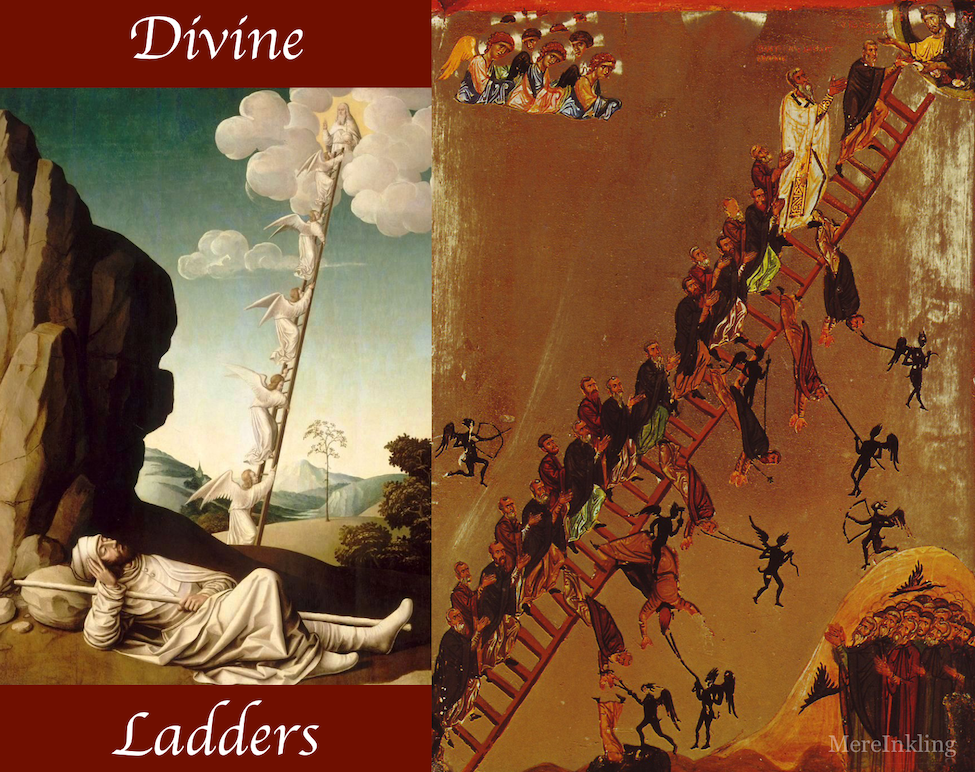
Nicolas Dipre was a French early Renaissance painter, who flourished 1495-1532. His painting of Jacob’s Ladder portrays the biblical account of the Jewish patriarch’s dream. The icon Ladder of Divine Ascent was painted four centuries earlier by an anonymous iconographer. It is from Saint Catherine’s Monastery beside Mount Sinai, and portrays the ascent of saints in the pursuit of holiness. While fallen angels (devils) seek to drag them from the path, John Climacus leads other in the path to heaven.

Free Storytelling Class

If you are a storyteller—and if, like me, you’re interested in screenwriting—there is a free class you may find valuable.

John Paul the Great Catholic University focuses on degrees related to the creative arts. They are currently offering a five session “crash course” discussing the key elements of storytelling. And the teachers apparently possess genuine credentials, being “veterans of Pixar’s Braintrust, Warner Bros. Script Department, and Hollywood writers’ rooms.”

You can learn more about the self-paced course here.

The final session on “adaptations” looks particularly intriguing.

What makes a good adaptation? In this lesson, Professor Chris Riley guides you through the basic principles of adapting source material (such as novels and true stories) for film and television. . . . Recommended for anyone with a curiosity for how novels and real life stories are distilled and written into movies. Especially recommended for writers interested in making movies from short stories, novels, or real life stories.

C.S. Lewis and the rest of the Oxford Inklings were gifted storytellers. Lewis began honing his skills when he a child and collaborated with his brother Warnie to compose the tales of Boxen.

J.R.R. Tolkien’s Lord of the Rings relates an overarching saga of humble heroism. Its skilled creator weaves into the Fellowship’s quest many other fascinating tales. The trilogy is a series that spawns fresh wonders, reading after reading. As one reviewer notes, Tolkien showcases “duty, honor, perseverance, and friendship.” He continues:

That, my friends, is the power of great stories. But a good story alone isn’t good enough either. One reason that Tolkien remains popular is because his stories were about important ideas, ideas that stand the test of time.

In a rather more scholarly article, “J.R.R. Tolkien and the Telling of a Traditional Narrative,” the writer says “the literary critical question is, why would Tolkien spend so much time and effort telling such an old story?” He answers that question in the following manner.

The answer lies . . . in the purpose of traditional narrative and the intent of the traditional tale teller. The traditional tale teller, like any traditional performer, is recreative rather than creative, doing those things that the community wants (and perhaps needs) over and over again, striving not to do something totally inventive and perceptually new but rather to do the traditional thing well and, perhaps, with some special, individual flair.

Turning to C.S. Lewis, we find numerous reference to his storytelling skills. In one aptly named work, we discover why Lewis became a writer rather than a sculptor.

C.S. Lewis loved stories. Throughout his life he found it really had to make anything by hand.* He could, though, hold a pencil or a pen and was driven to write stories instead. It was a blessing in disguise! Many years later C.S. Lewis wrote that you can do more with a castle in a story than with the best cardboard castle that ever stood on a nursery table (C.S. Lewis: The Story Teller).

Encouraging Another Storyteller

One of the main reasons for the Inkling’s very existence was their mutual encouragement in writing. Members often read their works in progress and offered (occasionally gentle) constructive criticism.

As a popular author, C.S. Lewis was approached by many aspiring writers. He patiently and encouragingly responded to these contacts. Some of these correspondents were former students and friends.

One such dear friend was Roger Lancelyn Green (1918-1987). Green had been a student of Lewis’ and a member of the Inklings while he studied and taught at Oxford. The two were quite close, and he actually joined Lewis and his wife Joy during their holiday in Greece.

As an Inkling and an English professor himself, Green was destined to become a writer. In addition to his other biographies—he co-authored one of the best on C.S. Lewis—he was a noted children’s writer. In fact, among his popular retellings of various mythologies, he compiled the stories of the Greeks, Egyptians and Norse. Many of his works can be “borrowed” from the Internet Archives library.

However, years before he wrote these volumes, Green shared one of his earliest efforts with his mentor. In September of 1945, C.S. Lewis offered him a significant amount of specific advice, but begins—as all good critiquing should—with encouragement.

My dear Green– I have now read The Wood That Time Forgot and this is what I think. The general narrative power is excellent: i.e. on the question whether you have in general the story-telling talent, you may (in my opinion) set your mind at rest. I read it on a railway journey and it carried me as far as Bletchley (which was at chapter VII) without a single flagging of interest.

I particularly admired the transition from the natural to the supernatural part. This went just gradually enough to elicit one’s faith and by the right stages. I thank you for giving me the authentic thrill: as you did several times.

As noted, Lewis follows this introductory affirmation with explicit comments on various facets of the manuscript. In June of 1949, Lewis offered his friend comments on a revised version of the story.⁑

Too bad we don’t all have a mentor like C.S. Lewis. I can’t imagine what it would be like to be encouraged by such an anointed storyteller.

Chances are that you, like Tolkien and Lewis, are a storyteller as well. Which is why I shared with you the invitation to the free storytelling course linked above. I will likely sign up for it myself, since I too have a screenplay I would someday like to write.


* This was due to a the lack of a metacarpophalangeal joint in his thumb. He shared this syndrome with his father and brother. If interested, you can read “Symphalangism, C.S. Lewis Type” in an online catalog of genetic disorders.

⁑ Lewis’ comments regarding the revised manuscript are included in volume two of The Collected Letters of C.S. Lewis, with the following introduction.

Roger Lancelyn Green, in an attempt to turn his story The Wood That Time Forgot into “a fairy tale for grown-ups,” had revised it . . . to give it a completely new ending—of which Lewis approved. The book, however, remains unpublished as it would appear to owe too much to The Lion, The Witch and the Wardrobe.

All of Green’s mythologies appear to currently be in print. In the introduction to his Norse mythology  volume, he provides an interesting contrast with his previous work closer to the Mediterranean.

Norse mythology is the very antithesis of Greek from the reteller’s point of view. The wealth of literature and legend available for studying the gods of Olympus is positively embarrassing, and the problem there is one of selection. The gods of Asgard, on the other hand, remain strangely aloof: the difficulty here is to find enough about them. And when the scanty material is collected, it is still harder to fit together the incomplete jigsaw-puzzle which is all that remains to us.

The White Christ, Red Thor & C.S. Lewis

If you were a Scandinavian living a millennia ago, you would be faced with a critical decision. Would you embrace Jesus Christ and a new life based on mercy, or would you cling to Odin and the Norse pantheon, with its glorification of bloodshed?

When I first heard this choice posed as a choice between the “White Christ” and the blood-drenched Thor, I assumed the white color alluded to traits commonly associated with it today—e.g. purity, innocence, and holiness.*

To my surprise, I recently learned there was a completely different to the Vikings. For them, referring to Christ as “white” was a term of derision.

Before returning to the Northmen, let’s consider for a moment the Inklings. These brilliant writers were well acquainted with white as a biblical metaphor for holiness, etc. They understood how the miracle of the Transfiguration described Jesus’ radiant face shining “like the sun” as the “bright cloud overshadowed them.”

As Mark records in his Gospel, Jesus “was transfigured before them, and his clothes became radiant, intensely white, as no one on earth could bleach them.”

It is no accident Tolkien’s Gandalf the Grey returns as Gandalf the White following his deadly battle with the Balrog.

In C.S. Lewis’ Voyage of the Dawn Treader, Aslan manifests himself to the children as an unblemished lamb.

But between them and the foot of the sky there was something so white on the green grass that even with their eagles’ eyes they could hardly look at it. They came on and saw that it was a Lamb. “Come and have breakfast,” said the Lamb in its sweet milky voice. . . .

“Please Lamb,” said Lucy, “is this the way to Aslan’s country?”

“Not for you,” said the Lamb. “For you the door into Aslan’s country is from your own world.”

“What!” said Edmund. “Is there a way into Aslan’s country from our world too?”

“There is a way into my country from all the worlds,” said the Lamb; but as he spoke his snowy white flushed into tawny gold and his size changed and he was Aslan himself, towering above them and scattering light from his mane.

On the other hand, C.S. Lewis tosses us a curve with the White Witch in his Chronicles of Narnia. The reason for her identification with white is obvious, since she is holding Narnia in an austere, perpetual winter. The witch’s hue carries other messages. Her unthreatening appearance moves Edmund to drop his defenses during their initial encounter.

[Queen Jadis was] a great lady, taller than any woman that Edmund had ever seen. She also was covered in white fur up to her throat and held a long straight golden wand in her right hand and wore a golden crown on her head. Her face was white—not merely pale, but white like snow or paper or icing-sugar, except for her very red mouth. It was a beautiful face in other respects, but proud and cold and stern.

Northern Mythologies

C.S. Lewis was enraptured by Northernness. He and Tolkien spent many hours reading Viking sagas.

However, Lewis was inspired not by the warrior Thor, but the person of Baldur. Several of my online friends and acquaintances have also written about Lewis’ affinity for Baldur. These include Brenton Dickieson, Eleanor Parker, and Bradley Birzer.

Turning from Baldur (Baldr) the Brave to Thor (Þórr), the god of thunder, we find the Norse deity with the largest number of followers. Thor was the ideal divinity for independent adventurers, warriors and violent raiders.

The story of the heroic thunder god still resonates today, as the success of the recent cinematic blockbusters attests. To suit contemporary tastes, the bloody red giant-slayer of myth has shed his more gruesome traits. They have been replaced by nobler aspects, as befitting a modern superhero protecting Midgard (Earth) from danger.

But the medieval period was not the relatively safe world we know. And pleas to turn the other cheek sounded like utter foolishness. The belligerent nature of the Germanic and Scandinavian chieftains of the era, resulted in a modification of the Gospel which was shared by some evangelists. In order to impress a militant population, the pacific nature of Jesus was downplayed. In “Why Trust the White Christ?” we read, “Not until the 1100s did the concept of the suffering Christ take root in Scandinavia; before that Christ was depicted as a triumphant prince—even on the cross!”

Eventually the Gospel would triumph, but one of its first effective renditions for the northern barbarians came in a gospel harmony⁑ entitled the Heliand. A number of references to the Gospel in J.R.R. Tolkien’s academic writings reveals his familiarity with the Old Saxon work, which he also mentioned in his lectures. The Heliand was commissioned by Charlemagne’s grandson Louis the German (806-876) to reach the Franks’ fellow Germanic tribes who remained Pagan. It was written by a Benedictine monk named Notker, who also wrote The Life of Charlemagne.⁂

The fact that this alliterative Gospel (in poetic form) was composed for the Saxon warrior class (their nobility), makes it particularly interesting.  Knowing it was recited not only in monasteries, but also mead halls, makes one’s personal reading of it feel like a journey into the ancient past.

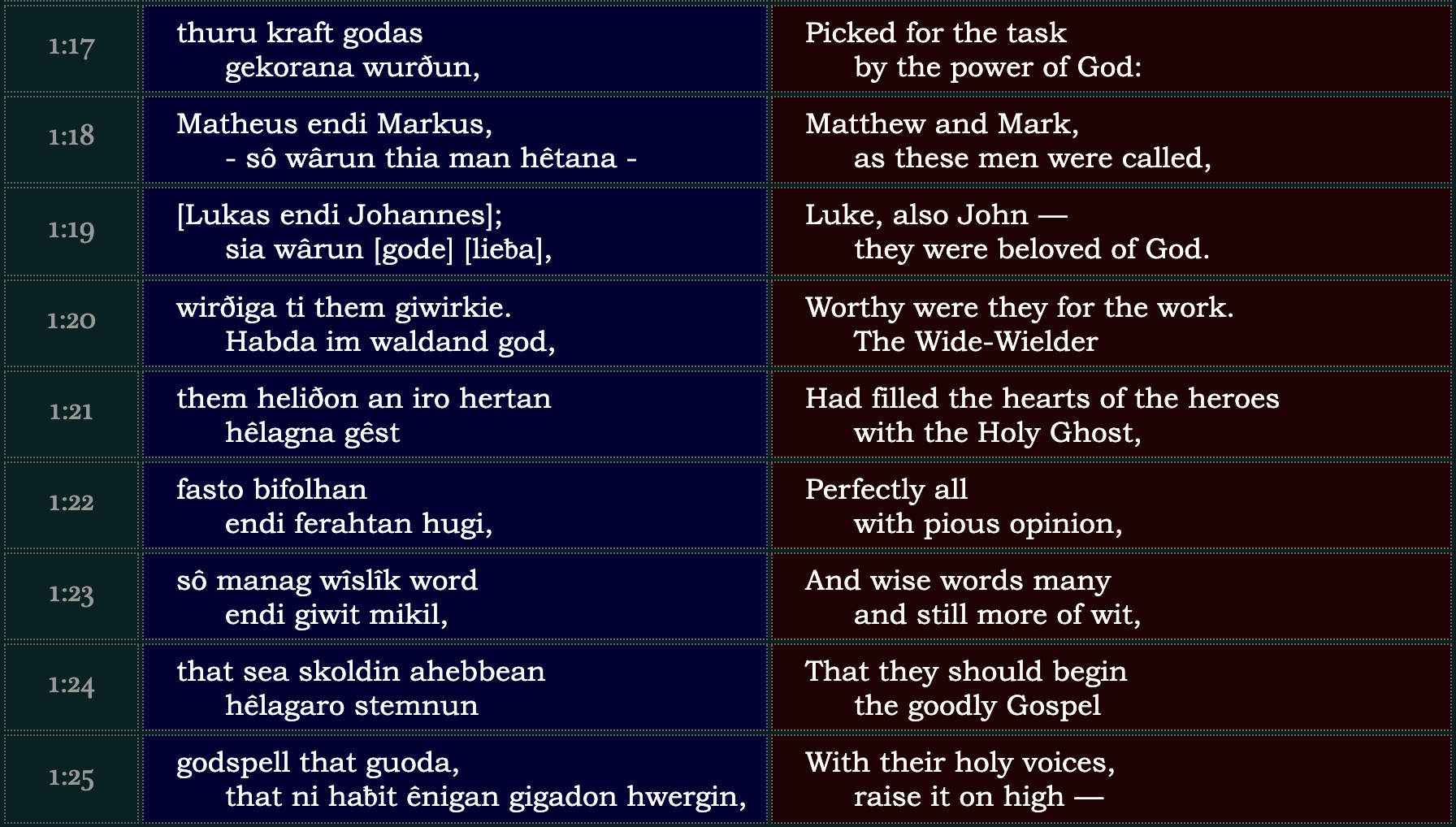
Mariana Scott’s 1966 translation ⁑⁑ is available here. This site posits her translation beside the original Old Saxon. One of my favorite passages comes in the “introduction,” as the context of the Gospel proper is set for the hearers. It is very serious and describes the four Evangelists as inspired by God.

[The Lord] had filled the hearts of the heroes,
     with the Holy Ghost.
Perfectly all,
     with pious opinion,
And wise words many
     and still more of wit.
That they should begin
     the goodly Gospel
With their holy voices,
     raise it on high—

The Question of the White Christ

Referring to Jesus as the “White Christ” may have been related to the association of white baptismal robes worn by the newly baptized. But it involved more than that.

Apparently, the appellation “white,” especially when linked to Christ, was a Pagan insult. In a Scandinavian Studies article entitled “The Contemptuous Sense of the Old Norse Adjective Hvítr, ‘White, Fair’” we learn that it possessed a pejorative sense.

The [Old Icelandic] heathen religion glorified physical strength and courage in combat, a direct antithesis to the Christian ideal of pacifism based upon the Golden Rule. Hence, the heathen Icelanders interpreted the Christian Hvítakristr ‘The White Christ’ as a cowardly, contemptible counterpart of Thor, the god of courage and strength . . .

And this negative connotation continued, even after the triumph of the new faith.

[Even] after Christianity had become established as the national religion in Iceland, this heathen conception of Christian ‘cowardice’ disappeared but left its traces in the epithet hvítr, especially when one wished to belittle or vilify a personal enemy.

. . .

The double sense (‘fair’ : ‘cowardly’)was characteristic of skaldic poetry and served to enhance the sarcastic effect.

And thus my youthful innocence about the meaning of the White Christ has been dispelled. But, at the same time, my insight into the historic prejudice against the sacrificial Son and Lamb of God has grown.

Jesus was no coward, but he is—now and forever—pure, innocent, and holy.


* It should go without being said that associating the color white with Jesus has absolutely nothing to do with ethnicity. The Incarnation of our Lord makes it abundantly clear that Jesus was a Jew born in Bethlehem and raised in Nazareth. The Bible describes nothing noteworthy about his appearance that would distinguish him from the rest of the Jewish people in ancient Palestine. Thus, whatever Jesus’ complexion, he would have looked little like the pale Anglo-Saxon messiah we have often seen in paintings and cinema.

⁑ A Gospel harmony is a blending together of the four canonical Gospels into a single account. Tatian (c. 120-180), an Assyrian theologian, compiled the Diatessaron, which was prominent in the Syrian church, and is thought to have directly influenced the Germanic harmony, the Heliand.

 ⁂ Notker (c. 840-912) who also composed hymns and poetry. As mentioned above, the Benedictine monk also wrote The Life of Charlemagne which records many fascinating stories about Frankish and Germanic Christianity. Apparently a poor precedent was set by Frankish generosity when a group of Northmen serving as envoys received baptism.

As I have mentioned the Northmen I will show by an incident drawn from the reign of your grandfather in what slight estimation they hold faith and baptism. . . .

The nobles of the palace adopted them almost as children, and each received from the emperor’s chamber a white robe and from their sponsors a full Frankish attire, of costly robes and arms and other decorations.

This was often done and from year to year they came in increasing numbers, not for the sake of Christ but for earthly advantage.

A very enlightening and sadly entertaining account. But what happens when the gifts run out?

⁑⁑ In the foreword to her translation, Scott shares some intriguing thoughts on the challenging labor of translation.

It was important for me to remember that the Heliand was originally intended for recitation. This accounts for the very great emphasis on rhythm. While the exact form of the old alliterative verse, though common to both early English and German poetry, proved too confining, a freer adaptation was possible. Let us remember that much of the effect of modern free verse depends on the interplay of sounds: assonance and alliteration.

Keeping in mind the purpose of the original, I read my translation aloud as I worked, repeating lines several times, varying and checking rhythms, trying to imitate the surge of the meter and yet avoid monotony. The end result was a line of variable feet, usually a rather free alternation of anapests and iambics with a few scattered tribrachs and spondees, divided by the traditional caesura.

I aimed for an alliteration of at least one accented syllable in the first half line with one accented syllable in the second half. If more sounded right, I was delighted. If none worked, I tried to make the rhythm carry the line along to the next cadence. Not all of it, I painedly admit, turned out to be poetry—but then not all of the Old Saxon is!

The Patina of the Inklings

Some antiques boast lovely patinas. Some old words do, as well. In fact, I would argue the legacy of, and the deep respect for, the Oxford fellowship known as the Inklings, has created a rich patina of its own.*

The community gifted scholars, especially in the persons of J.R.R. Tolkien and C.S. Lewis, accrued a reputation that continues to gain a deeper luster with each new generation.

When I was a young man, I collected American coins. I also studied what Americans call “World coins.” The latter reinforced my love for geography as well as history.

To me, the most fascinating period of history has long been that of the Roman empire.

 So you can imagine my awe when I learned how simple it was to collect genuine Roman coins.

 This remains true today for common coins, such as bronzes of the fourth century (when the first Christian emperors reigned). This article describes “Collecting Roman Coins on a Budget.”

A surprising number of ancient coins, all readily identifiable and of historical interest, can be acquired for less than $100—and often in the $5-to-$25 range. This is especially true with Roman coins . . .

When I began collecting ancient coins, I learned the multifaceted meaning of a word unfamiliar to me at the time. That word was “patina” (pə’tēnə). As you probably know, it literally refers to the green or brown film (not rust) that appears on bronze and other metals under suitable conditions over a period of time. A handful of coins in my collection possess stunning patinas.

Metaphorical Patina

Many people are also acquainted with the figurative use of the word, as I employed it in my introduction It refers to an appearance or impression of distinction or luster associated with a person, idea or object. It is often linked to esteem held for the past. The following provocative quote comes from a contemporary Swiss artist.

“Life is one long decay, no? There’s a lot of beauty in it. Like the patina in an old city” (Urs Fischer).

Chad Walsh applied it to one of C.S. Lewis’ early books in The Literary Legacy of C.S. Lewis. Writing more than forty years ago, in a discussion of Pilgrim’s Regress, he said:

Regress has permanent value. It is, first of all, a spiritual autobiography, no matter how much Lewis may wish to minimize the personal quality of the quest and make his John into a potential Everyman. . . .

The Regress is already taking on a patina of age, a pleasant chronological quaintness, but time does not render it obsolete.

Four decades after he offered this comment, I believe I am correct in ascribing a warm patina to the Inklings as a fellowship.

Patinas can be added to items, to affect a more aged appearance. While “acquired” patina is always considered desirable, “applied” patina is often quite acceptable. It does not become problematic until the application is used to intentionally misrepresent the age of an item. An example of the proper use of applied patina is seen in these modern busts of C.S. Lewis.

In reviewing Lewis’ writings, I only uncovered one occasion where he used the concept of patina. It occurred in a 1946 letter to his friend, Ruth Pitter. Lewis is contributing to one of their ongoing conversations.

The truth is that there are a great many different kinds of poetry and extreme roughness (or smoothness) evocative epithet (or plain statement), the metaphorical (or literal) the colloquial (or rhetorical) may all, in their place, rise to perfection. . . .

 Once more, read Barfield on Poetic Diction.⁑ That is why Spender’s objection to the ‘willed quality’ in Milton seems to me so bats’-eyed. It is the glory of one kind of poetry to sound un-willed, as if it had dropped out of the sky like Blake or else arisen spontaneously in conversation like Donne.

But then it is equally the glory of another kind to sound willed: to sound as if one were watching, or even sharing, the building of a huge tower.

To demand that Milton should have the spontaneity of Catullus or Blake is like demanding that a King at his coronation or a celebrant approaching the altar should have the same charm as a child dancing in the waves. Don’t we want both: both frolics and rituals? At any rate I do. . . .

Of course you are very right about Patina–again see Barfield. No old French poetry got that peculiar Old-Frenchness which is to us part of the charm. Half the beauties of the Old Testament did not exist for the writers. I wouldn’t be too sure, though, that it is wholly a question of our ‘projecting’ qualities into the old lines.

Ending on a Numismatic Note

Although I have not actively collected coins for many years, I commend it as a rewarding pastime. Seven years ago⁂ I wrote a column about religious likenesses on coins, which included a moving poem written by C.S. Lewis. You can read it here.

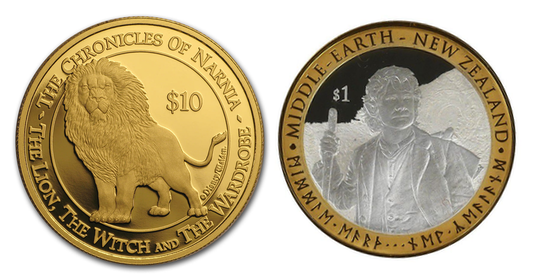
While writing this column I came across some genuine Narnian coins that were minted in New Zealand. They are genuine in the sense that they possess actual face values for legal tender in the island nation, which minted similar coins in honor of Middle Earth.

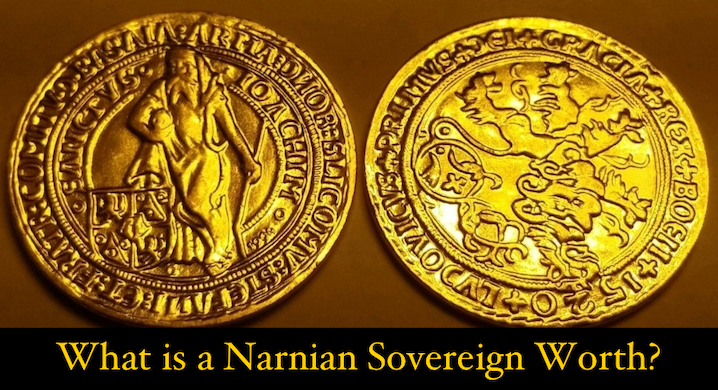
In terms of Narnian coins which circulated in Narnia itself, I learned that you can purchase “coins” which were used as actual props “appearing” in the recent Chronicles of Narnia films.

For an Inkling cinema buff such as myself, deciding to grab one for my personal collection was a no-brainer.


* The writings of the Inklings have even enhanced the patina of Oxford itself. This is especially true for those who live “across the pond,” and will never journey to the city itself. In a succinct review of The Inklings of Oxford: C.S. Lewis, J.R.R. Tolkien, and their Friends, one Aussie architect refers to the stately oxidation of the city’s copper, brass and bronze: Picturesque book of picturesque Oxford focusing on C.S. Lewis and J.R.R. Tolkien and the elegant, much patina-ed Oxford environment that they lived in.” I imagine he would concur with my suggestion that the Inklings themselves also bear a splendid patina.

⁑ Owen Barfield dedicated this book to his good friend with the inscription: “To C.S. Lewis ‘Opposition is true friendship’”

⁂ Seven years of blogging does sound like a lengthy time, but it’s not long enough for even the best of posts to accrue a patina of their own.

Prayers, Barbers & Saints

Barbers, and hairdressers, play a unique role in society. Let’s consider now two barbers whose interactions with great Christians contributed to our understanding of prayer.

Before we do, however, I wish to share another aspect of C.S. Lewis’ life which parallels many of our own. The great professor and author was exceptional for his knowledge, but in most other ways was just like us.

One example of Lewis’ normalness, is seen in his interactions with barbers. Due to the survival of much of his correspondence, we can witness a perennial tension—the desire of fathers that their sons cut their hair.

As a veteran whose adult son had a ponytail for several years, I understand the frustration of Lewis’ father, the Irish solicitor, when his son Jack lacked diligence in maintaining a neat appearance. In my own case, the die had been cast from my youth. Growing up in the late sixties, I did manage to sport a thick contemporary mane which chafed my own father, but too much of my youth was spent with a crewcut, the haircut-of-choice for my dad, the Marine Corps sergeant.

Presumably, while young Jack was still at home, his parents saw to it his hair was attended to. After his mother Florence’s death, and his move to boarding school, haircuts were a curious recurring theme in Lewis’ correspondence with his “Papy.” Below are a few of young Jack’s passing remarks on the subject.

Today I did a thing that would have gladdened your heart: walked to Leatherhead (for Bookham does not boast a barber) to get my hair cut. And am now looking like a convict (1914).

My dear Papy, Thanks very much for the photographs, which I have duly received and studied. They are artistically got up and touched in: in fact everything that could be desired–only, do I really tie my tie like that? Do I really brush my hair like that? Am I really as fat as that? Do I really look so sleepy? However, I suppose that thing in the photo is the one thing I am saddled with for ever and ever, so I had better learn to like it. Isn’t it curious that we know any one else better than we do ourselves? Possibly a merciful delusion (1914).

I am very sorry to hear that you were laid up so long, and hope that you now have quite shaken it off. I have had a bit of a cold, but it is now gone, and beyond the perennial need of having my hair cut, I think you would pass me as ‘all present and correct’ (1921).

I am afraid this has been an egotistical letter. But it is dull work asking questions which you can’t (at any rate for the moment) give a reply to. You do not need to be told that I hope you are keeping fairly well and that I shall be glad to hear if this is the case. For myself—if you came into the room now you would certainly say that I had a cold and that my hair needed cutting: what is more remarkable: you would (this time) be right in both judgements. Your loving son, Jack (1928)

Lewis’ High Street Barber

In the early 1950s, C.S. Lewis developed a meaningful relationship with his barber, based on their shared faith. Before we consider an essay inspired, in part, by this friendship, this 1951 letter reveals the affection Lewis held for the man.

My brother joins me in great thanks for all your kindnesses, and especially on behalf of dear little comical Victor Drewe—our barber, as you know.

When he cut my hair last week he spoke in the most charming way of his wife who has just been ill and (he said) ‘She looks so pretty, Sir, so pretty, but terribly frail.’ It made one want to laugh & cry at the same time—the lover’s speech, and the queer little pot-bellied, grey-headed, unfathomably respectable figure.

You don’t misunderstand my wanting to laugh, do you? We shall, I hope, all enjoy one another’s funniness openly in a better world.

Years later, C.S. Lewis would write a profound essay on “The Efficacy of Prayer.”

Some years ago I got up one morning intending to have my hair cut in preparation for a visit to London, and the first letter I opened made it clear I need not go to London. So I decided to put the haircut off too.

But then there began the most unaccountable little nagging in my mind, almost like a voice saying, “Get it cut all the same. Go and get it cut.” In the end I could stand it no longer. I went.

Now my barber at that time was a fellow Christian and a man of many troubles whom my brother and I had sometimes been able to help. The moment I opened his shop door he said, “Oh, I was praying you might come today.” And in fact if I had come a day or so later I should have been of no use to him.

It awed me; it awes me still. But of course one cannot rigorously prove a causal connection between the barber’s prayers and my visit. It might be telepathy. It might be accident. . . .

Our assurance—if we reach an assurance—that God always hears and sometimes grants our prayers, and that apparent grantings are not merely fortuitous, can only come [through a relationship which knows the promiser’s trustworthiness].

There can be no question of tabulating successes and failures and trying to decide whether the successes are too numerous to be accounted for by chance. Those who best know a man best know whether, when he did what they asked, he did it because they asked.

I think those who best know God will best know whether He sent me to the barber’s shop because the barber prayed.

You can read “The Efficacy of Prayer” in its entirety here. Or, should you prefer, you can hear it expertly read here.

The Story of Another Godly Barber

Four centuries before C.S. Lewis honored his barber by forever associating his name with the subject of prayer, the church reformer Martin Luther did the same. Luther’s friend was named Peter, and he lived during an age when skilled barbers also served as surgeons. According to the Barber Surgeons Guild,

The early versions of the Hippocratic Oath cautioned physicians from practicing surgery due to their limited knowledge on its invasive nature.  During the Renaissance, Universities did not provide education on surgery, which was deemed as a low trade of manual nature.

Barber surgeons who were expertly trained in handling sharp instruments for invasive procedures quickly filled this role in society. Barber surgeons were soon welcomed by the nobility and given residence in the castles of Europe where they continued their practice for the wealthy. These noble tradesmen, armed with the sharpest of blades, performed haircuts, surgeries and even amputations.

One church historian describes the Reformation context in an article entitled “Praying with Peter the Barber.”

Early in the year 1535, Peter Beskendorf became the most famous hairdresser of the reformation. He was Martin Luther’s barber and wrote to the great reformer asking for advice on how to pray.

Peter not only had a reputation as the master barber of Wittenberg, but he had a reputation for godliness and sincerity in his love for the Word of God. He was one of Luther’s oldest and best friends, so his request is not all that surprising.

What is surprising, however, is that Luther took the time out of his immensely busy reformation schedule to write him a thirty-four-page reply with theological reflections and practical suggestions about how he ought to approach prayer to the Almighty God.

In “Cutting Hair and Saying Prayers,” a lay theologian describes the focus of Martin Luther’s counsel.

When Luther’s barber, Peter Beskendorf, asked him how to pray, Luther wrote him an open letter that has become a classic expression of the “when, how, and what” of prayer. It is as instructive today as when it was first penned in 1535. . . .

Luther spends the bulk of his letter discussing what to pray. Implicitly in his letter, Luther teaches that God’s word is the content of our prayers.

Luther graces the beginning of the book with a sincere prayer of blessing. “Dear Master Peter: I will tell you as best I can what I do personally when I pray. May our dear Lord grant to you and to everybody to do it better than I! Amen.”

In a very interesting essay entitled “Warrior Saints,” a Marquette professor commends the “sweet and practical booklet,” writing that “today this work is justly celebrated as a minor classic that both epitomizes Luther’s spirituality and powerfully suggests what a deep and lasting impact he would make on the lives of his many followers.”

Volume 43 of Luther’s Works includes the treatise. In the collection’s introduction to the document, it includes a heartbreaking event that followed its publication.

Luther wrote the book early in 1535 and it was so popular that four editions were printed that year.

At Easter a tragedy befell Peter. He was invited to the home of his son-in-law, Dietrich, for a convivial meal the Saturday before Easter, March 27, 1535. Dietrich, an army veteran, boasted that he had survived battle because he possessed the art of making himself invulnerable to any wound. Thereupon the old barber, doubtlessly intoxicated, plunged a knife into the soldier’s body to test his boast. The stab was fatal.

Master Peter’s friends, including Luther, intervened for him, and the court finally sent him into exile. . . . He lost all his property and, ruined and impoverished, spent the rest of his life in Dessau.

Such was the sad course of Beskendorf’s life. One can only hope that, as his life itself had been spared, Peter experienced some sort of healing and peace. Such blessings, after all, are often the fruit of prayer.

Luther’s humble essay on prayer remains in print today. If you would like to read or own it for free, I have found a London edition entitled The Way to Prayer.

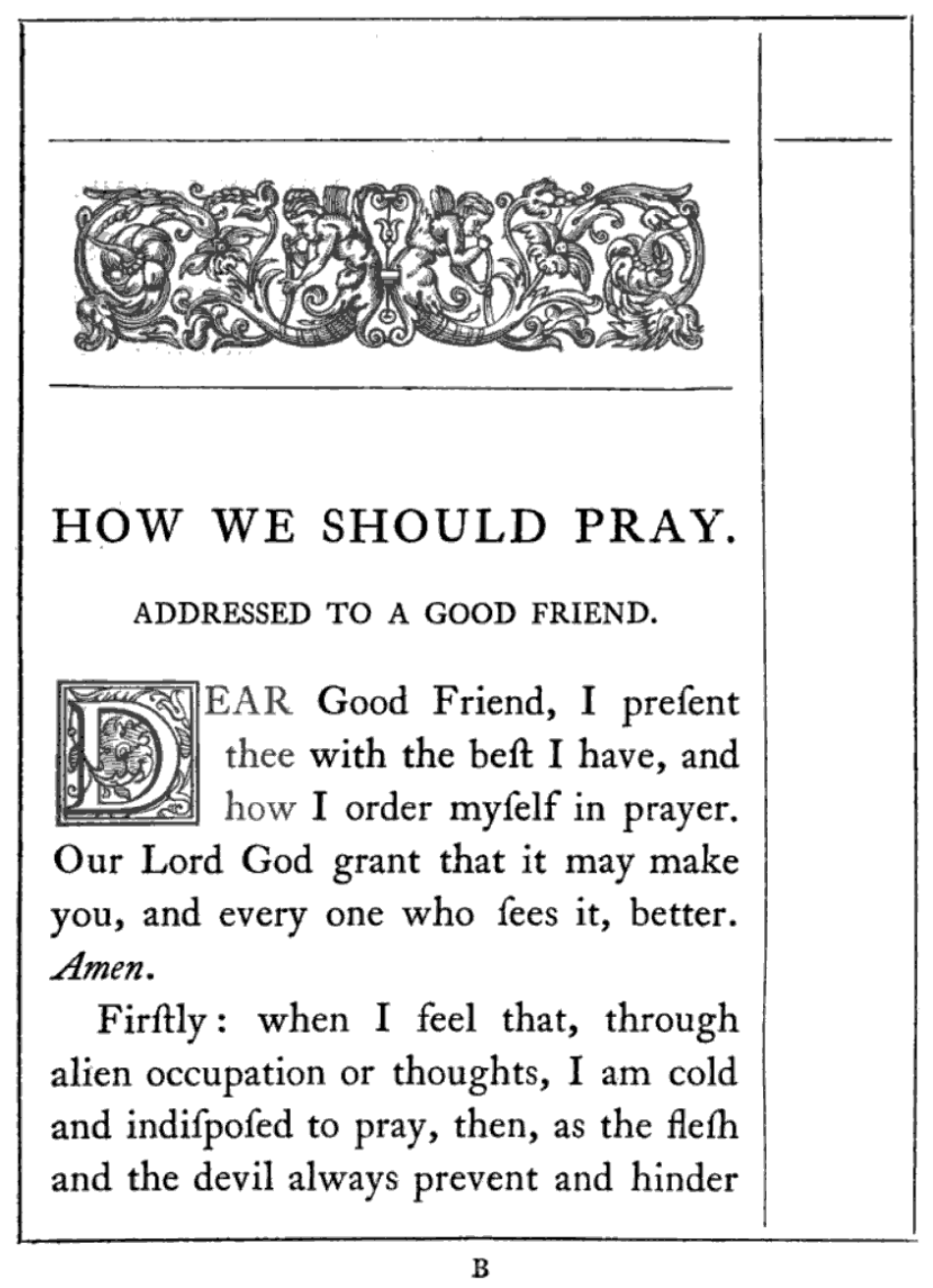
One caveat, which might trouble some readers: since the translation was published in 1846, it employs the “medial S,” the one that looks more like a lower case “F.”* Whichever edition you choose to read, you will not be disappointed.


* The medial S is sometime referred to as the long S. You can read about its history in this interesting article.

The history of S is a twisting, turning path. Until around the 1100s or so, the medial S was the lowercase form of the letter, while the curvy line we use today was the uppercase form. But over time, the regular S, technically known as the “round S” or “short S,” started being used as a lowercase letter, too.

By the 1400s, a new set of S usage rules was established: The medial S would be used at the beginning of a lowercase word or in the middle of a word, while the round S would appear either at the end of a word or after a medial S within a word, as in “Congreſs” (which appears in the first line of Article I of the Constitution).

Using Quotations in Your Writing

Do you consider quotations good or bad? As a reader, do you think quotations enhance what you are reading . . . or do they detract from the text?

My personal opinion is that the educated use of quotations enriches writing. (Sloppy quotation is another matter.) Positive contributions made by quotes would include:

They can offer “authoritative” support of a point being made by the writer.
Quotations can offer a refreshing change of pace in a lengthy work.
The selection of the individuals quoted gives me insight into the mind of the current writer.
A well-chosen epigraph piques my curiosity about the chapter which follows.
And, frankly, I simply enjoy a brilliant turn of phrase or a timeless but fresh insight.

I’m not alone in appreciating quotations. It’s no accident The Oxford Dictionary of Quotations is in its seventh edition. Why Do We Quote? describes it this way:

The demand for ODQ remains substantial. It has also spawned numerous sister dictionaries, many themselves appearing in several editions. We have The Oxford Dictionary of Humorous Quotations,… of Literary Quotations,… of Political Quotations,… of Biographical Quotations,… of Medical Quotations,… of American Legal Quotations,…. of Scientific Quotations.… of Phrase, Saying, and Quotation,… of Thematic Quotations,… of Quotations by Subject,… of Modern Quotation,… of Twentieth-Century Quotations, The Concise Oxford Dictionary of Quotation. A Little Oxford Dictionary of Quotations has gone through successive editions. There have also been several editions of The Oxford Dictionary of English Proverbs, the first in 1936. There is an avid market, it seems, for quotation collections.

The number of quotation collections is staggering. Read on, and I’ll provide links to some of the compilations available for free download, thanks to public domain laws.

The sheer weight of these books reveals their popularity. And quotations collections are marketable today. In “How Inspirational Quotes became a Whole Social Media Industry,” the author cites a Canadian whose “interest in motivational quotes has proven lucrative, and while he still has a day job in the wireless technology industry, he says that he’s recently been taking home two to three times his regular income from advertising on his website.”

And it all began when, “One day when he was a teenager, he was browsing in a book shop and came across a small book of famous quotations. Something about these pithy sayings appealed to him, and he started to compile his own collection of quotes that particularly resonated.”

Before the birth of the internet, I invested in several quotation collections—a not uncommon purchase for pastors. I confess to still referring on occasion to The Quotable Lewis to suggest new themes to explore here at Mere Inkling.

C.S. Lewis and Quotations

A beloved lecturer, C.S. Lewis recognized the value of worthy quotation. While few of us have his “eidetic memory,” we can certainly follow his example in using apt quotations to illustrate our points.

Lewis even regarded quotation collections highly enough to compile one. In 1946, he published George MacDonald: An Anthology. It was a tribute to the writings of his “mentor,” who appears in his fictional masterpiece about heaven and hell, The Great Divorce. The anthology remains in print. However, Canadian readers of Mere Inkling can benefit from it falling into public domain status in their Commonwealth. Canadians will find it available for download at this site.

While every reader is capable of enjoying the 365 selections in the volume, Lewis did have a specific intent in the passages he chose.

This collection, as I have said, was designed not to revive MacDonald’s literary reputation but to spread his religious teaching. Hence most of my extracts are taken from the three volumes of Unspoken Sermons. My own debt to this book is almost as great as one man can owe to another: and nearly all serious inquirers to whom I have introduced it acknowledge that it has given them great help—sometimes indispensable help towards the very acceptance of the Christian faith.

Scores of Free Quotation Collections Available to All

Internet Archive has an enormous (free) lending library of books featuring collections of quotations. Many can be “checked out” for temporary use. Other older books are available for download.

Project Gutenberg offers a smaller number, but includes titles they have edited themselves by gleaning pithy phrases from books in their public domain library. Many* of these free (public domain) compilations are linked below.

The massive selection of quotation collections (I quit counting as I approached 100) is daunting. Among those not available for download (which are still accessible for reading) you will note ever more esoteric subject matter. As a whole, we find a small number are collected from prolific individuals, such as Shakespeare, Mark Twain, or John F. Kennedy. Many are generalist, featuring “popular” quotations on a wide range of subjects. Others are thematic, focusing on subjects such as friendship, humor, women, sports, country music, dog [or cat] lovers, climbers, business, motor racing, the military, lawyers, saints, atheists, rock ‘n’ roll, or any of fourscore more themes. Some featuring national or cultural quotations, for example French, Jewish, Scottish, German, etc. And, for those up to the challenge, you can even read Wit and Wisdom of the American Presidents: A Book of Quotations.

🚧 Feel Free to Ignore Everything Below 🚧

Only the smallest attempt has been made here to sort the free volumes. You will find a few general headings below, and a multitude of similarly titled books. One wonders how many of the quotations cited in the larger volumes are common to all of them. Perhaps as you glance through this list, you will see a title or two you might appreciate perusing.

General Quotation Collections

The Oxford Dictionary Of Quotations
(Second Edition: 1953)

The Book of Familiar Quotations
Unnamed Compiler (London: 1860)

Familiar Quotations
John Bartlett (Boston: 1876)

Dictionary of Contemporary Quotations (English)
Helena Swan (London and New York: 1904)

What Great Men have Said about Great Men: a Dictionary of Quotations
William Wale (London: 1902)

A Cyclopaedia of Sacred Poetical Quotations
H.G. Adams (London: 1854)

The International Encyclopedia of Prose and Poetical Quotations from the Literature of the World
William Shepard Walsh (Philadelphia: 1908)

The Book of Familiar Quotations; being a Collection of Popular Extracts and Aphorisms from the Works of the Best Authors
Unnamed Compiler (London: 1866)

The Book of Familiar Quotations; being a Collection of Popular Extracts and Aphorisms from the Works of the Best Authors
L.C. Gent (London: 1866)

Dictionary of Quotations (English)
Philip Hugh Dalbiac (Long & New York: 1908)

A Dictionary Of Quotations
Everyman’s Library (London: 1868)

Forty Thousand Quotations: Prose and Poetical
by Charles Noel Douglas (New York: 1904)

Three Thousand Selected Quotations From Brilliant Writers
Josiah H. Gilbert (Hartford, Connecticut: 1905)

Stokes’ Encyclopedia of Familiar Quotations: Containing Five Thousand Selections from Six Hundred Authors
Elford Eveleigh Treffry (New York: 1906)

Historical Lights: a Volume of Six Thousand Quotations from Standard Histories and Biographies
Charles Eugene Little (London & New York: 1886)

Great Truths by Great Authors: A Dictionary of Aids to Reflection, Quotations of Maxims, Metaphors, Counsels, Cautions, Aphorisms, Proverbs, &c., &c. from Writers of All Ages and Both Hemispheres
William M. White (Philadelphia: 1856)

Truths Illustrated by Great Authors: A Dictionary of Nearly Four Thousand Aids to Reflection, Quotations of Maxims, Metaphors, Counsels, Cautions, Aphorisms, Proverbs, &c., &c.
William M. White (Philadelphia: 1868)

Handy Dictionary of Prose Quotations
George Whitefield Powers (New York: 1901)

Letters, Sentences and Maxims
Philip Dormer Stanhope Chesterfield (London & New York: 1888)

Poetical Quotations from Chaucer to Tennyson: With Copious Indexes
Samuel Austin Allibone (Philadelphia: 1875)

Prose Quotations from Socrates to Macaulay
Samuel Austin Allibone (Philadelphia: 1880)

Cassell’s Book Of Quotations, Proverbs and Household Words
William Gurney Benham (London & New York, 1907)

Putnam’s Complete Book of Quotations, Proverbs and Household Words
William Gurney Benham (New York, 1926)

Benham’s Book Of Quotations
William Gurney Benham (London: 1949)

Hoyt’s New Cyclopedia Of Practical Quotations
by Kate Louise Roberts (New York: 1927)

Classic Quotations: A Thought-Book of the Wise Spirits of All Ages and all Countries, Fit for All Men and All Hours
James Elmes (New York: 1863)

A Dictionary of Quotations from the English Poets
Henry George Bohn (London: 1902)

A Complete Dictionary Of Poetical Quotations
Sarah Josepha Hale (Philadelphia: 1855)

The Handbook of Quotations: Gleanings from the English and American Fields of Poetic Literature
Edith B. Ordway (New York: 1913)

Carleton’s Hand-Book of Popular Quotations
G.W. Carleton (New York: 1877)

Many Thoughts of Many Minds
George W. Carleton (New York: 1882)

Many Thoughts Of Many Minds
Henry Southgate (London: 1930)

A Manual of Quotations (forming a new and considerably enlarged edition of MacDonnel’s Dictionary of Quotations)
E.H. Michelsen (London: 1856)

A Dictionary of Quotations from Various Authors in Ancient and Modern Languages
Hugh Moore (London: 1831)

Dictionary Of Quotations: from Ancient and Modern, English and Foreign Sources
James Wood (London: 1893)

A Dictionary of Quotations in Prose: from American and Foreign Authors
Anna L. Ward (New York: 1889)

Webster’s Dictionary Of Quotations: A Book of Ready Reference
(London: undated)

Collections of Individual Authors

Quotations from Browning
Ruth White Lawton (Springfield, Massachusetts: 1903)

The Wesley Yearbook: or, Practical Quotations from the Rev. John Wesley
Mary Yandell Kelly (Nashville: 1899)

Quotes and Images From The Works of Mark Twain
David Widger (Project Gutenberg: 2002)

Widger’s Quotations from the Project Gutenberg Editions of Paine’s Writings on Mark Twain
David Widger (Project Gutenberg: 2003)

Quotes and Images From The Diary of Samuel Pepys
David Widger (Project Gutenberg: 2004)

Quotes and Images From Memoirs of Louis XIV
David Widger (Project Gutenberg: 2004)

Quotes and Images From Memoirs of Louis XV and XVI
David Widger (Project Gutenberg: 2005)

Quotes and Images from the Memoirs of Jacques Casanova de Seingalt
David Widger (Project Gutenberg: 2004)

Quotes and Images From Motley’s History of the Netherlands
David Widger (Project Gutenberg: 2004)

Quotes and Images from the Writings of Abraham
David Widger (Project Gutenberg: 2004)

Quotes and Images From The Tales and Novels of Jean de La Fontaine
David Widger (Project Gutenberg: 2004)

Quotes and Images From The Works of George Meredith
David Widger (Project Gutenberg: 2004)

Quotes and Images From Memoirs of Cardinal De Retz
David Widger (Project Gutenberg: 2005)

Quotes and Images From Memoirs of Count Grammont by Count Anthony Hamilton
David Widger (Project Gutenberg: 2005)

Widger’s Quotations from the Project Gutenberg Editions of the Works of Montaigne
David Widger (Project Gutenberg: 2003)

Widger’s Quotations from Project Gutenberg Edition of Memoirs of Napoleon
David Widger (Project Gutenberg: 2003)

Quotes and Images From the Works of John Galsworthy
David Widger (Project Gutenberg: 2005)

Quotes and Images From The Confessions of Jean Jacques Rousseau
David Widger (Project Gutenberg: 2004)

The French Immortals: Quotes and Images
David Widger (Project Gutenberg: 2009)

Quotes and Images From The Works of Charles Dudley Warner
David Widger (Project Gutenberg: 2004)

Quotes and Images From Memoirs of Marie Antoinette
David Widger (Project Gutenberg: 2005)

Quotes and Images From The Works of Gilbert Parker
David Widger (Project Gutenberg: 2004)

Quotes and Images From The Confessions of Harry Lorrequer by Charles James Lever
David Widger (Project Gutenberg: 2004)

Quotes and Images From Memoirs of Madame De Montespan
David Widger (Project Gutenberg: 2005)

Quotes and Images From the Works of Oliver Wendell Holmes, Sr.
David Widger (Project Gutenberg: 2004)

Quotes and Images From The Works of William Dean Howells
David Widger (Project Gutenberg: 2004)

The Spalding Year-Book: Quotations from the Writings of Bishop [John Lancaster] Spalding for Each Day of the Year
Minnie R. Cowan (Chicago: 1905)

Worldly Wisdom; Being Extracts from the Letters of the Earl of Chesterfield to His Son
William L. Sheppard (New York: 1899)

A Year Book of Quotations: From the Writings of Henry Wadsworth Longfellow
with spaces for Autographs and Records (New York: 1896)

The Bernhardt Birthday Book: Being Quotations from the Chief Plays of Madame Sarah Bernhardt’s Repertoire and Other Works
E.M. Evors (London: 1912)

Beauties of Robert Hall
John S. Taylor (New York: 1839)

Shakespeare Gets His Own Section

Everyman’s Dictionary Of Shakespeare Quotations
D.C. Browning (London: 1961)

Shakespearean Quotations
Charles Sheridan Rex (Philadelphia: 1910)

Shakespeare Quotations
Emma Maria Rawlins (New York: 1900)

Quotations from Shakespeare
Edmund Routledge (London: 1867)

A Dictionary of Shakspere Quotations
C.J. Walbran (London: 1849)

The New Shaksperian Dictionary of Quotations
G. Somers Bellamy (London: 1875)

Longer Moral Quotations From Shakespeare
M. Venkatasiah (Mysore/Mysuru, India: 1923)

Dictionary of Shakespearian Quotations: Exhibiting the Most Forceful Passages Illustrative of the Various Passions, Affections and Emotions of the Human Mind
Thomas Dolby (New York: 1880)

Odd, Quaint and Queer Shaksperian Quotations Handsomely and Strikingly Illustrated
Henry McCobb [using pseudonym Shakspere Snug] (New York: 1892)

Thematic Quotation Collections

Quotations from Negro Authors
Katherine D. Tillman (Fort Scott, Kansas: 1921)

Sovereign Woman Versus Mere Man: a Medley of Quotations
Jennie Day Haines (San Francisco: 1905)

About Women: What Men have Said
Rose Porter (New York: 1894)

The Dixie Book of Days
Matthew Page Andrews (London & Philadelphia: 1912)

Living Waters
Alice L. Williams (Boston: 1889)

Green Pastures and Still Waters
Louis Kinney Harlow (Boston: 1887)

Out-of-Doors; Quotations from Nature Lovers
Rosalie Arthur

Ye Gardeyn Boke: a Collection of Quotations Instructive and Sentimental
Jennie Day Haines (San Francisco & New York: 1906)

The Optimist’s Good Morning
Florence Hobart Perin (Boston: 1909)

The Optimist’s Good Night
Florence Hobart Perin (Boston: 1910)

The Book of Love
Jennie Day Haines (Philadelphia: 1911)

Author’s Calendar 1889
Alice Flora McClary Stevens (Boston: 1888)

Proverbs and Quotations for School and Home
John Keitges (Chicago: 1905)

Excellent Quotations for Home and School
Julia B. Hoitt (Boston: 1890)

Borrowings: A Compilation of Helpful Thoughts from Great Authors
Sarah S.B. Yule & Mary S. Keene (San Francisco: 1894)

More Borrowings: the Ladies of First Unitarian Church of Oakland, California
Sarah S.B. Yule & Mary S. Keene (San Francisco: 1891)

Quotations
Norwood Methodist Church (Edmonton, Alberta: 1910).

Goodly Company: a Book of Quotations and Proverbs for Character Development
Jessie E. Logan (Chicago: 1930)

The Atlantic Year Book: Being a Collection of Quotations from the Atlantic Monthly
Teresa J. Fitzpatrick & Elizabeth M. Watts (Boston: 1920)

Here and There: Quaint Quotations, a Book of Wit
H.L. Sidney Lear

Author’s Calendar 1890
Alice Flora McClary Stevens (Boston: 1889)

Catch Words of Cheer
Sara A. Hubbard (Chicago: 1903)

Catch Words of Cheer (new series)
Sara A. Hubbard (Chicago: 1905)

Catch Words of Cheer (third series)
Sara A. Hubbard (Chicago: 1911)

How to Get On, Being, the Book of Good Devices: a Thousand Precepts for Practice
Godfrey Golding (London: 1877)

The Dictionary of Legal Quotations: or, Selected Dicta of English Chancellors and Judges from the Earliest Periods to the Present Time . . . embracing many epigrams and quaint sayings
James William Norton-Kyshe

The Vocabulary of Philosophy, Mental, Moral and Metaphysical: with Quotations and References
William Fleming (Philadelphia: 1860)

Manual of Forensic Quotations
Leon Mead and F. Newell Gilbert (New York: 1903)

Toaster’s Handbook Jokes Stories And Quotations
Peggy Edmund and Harold W. Williams (New York: 1932)

The Banquet Book: A Classified Collection of Quotations Designed for General Reference, and Also an Aid in the Preparation of the Toast List
Cuyler Reynolds (London & New York: 1902)

Like Expressions: a Compilation from Homer to the Present Time
A.B. Black (Chicago: 1900)

Oracles from the Poets: a Fanciful Diversion for the Drawing-Room
Caroline Howard Gilman (London & New York: 1844)

The Sibyl: or, New Oracles from the Poets
Caroline Howard Gilman (New York: 1848)

A Book of Golden Thoughts
Henry Attwell (London & New York: 1888)

A Little Book of Naval Wisdom
Harold Felix Baker Wheeler (London: 1929)

Medical Quotations from English Prose
John Hathaway Lindsey (Boston: 1924)

Psychological Year Book: Quotations Showing the Laws, the Ways, the Means, the Methods for Gaining Lasting Health, Happiness, Peace and Prosperity
Janet Young (San Francisco: 1905)

The Oshawa Book of Favorite Quotations
(Oshawa, Ontario: 1900)

The Pocket Book Of Quotations
Henry Davidoff (New York: 1942)

Quotations for Occasions
Katharine B. Wood (New York: 1896)

Quotations For Special Occasions
Maud Van Buren (New York: 1939)

A Complete Collection of the Quotations and Inscriptions in the Library of Congress
Emily Loiseau Walter

Words and Days: a Table-Book of Prose and Verse
Bowyer Nichols (London: 1895)

The Book of Good Cheer: “A Little Bundle of Cheery Thoughts”
Edwin Osgood Grover (New York: 1916)

The Good Cheer Book
Blanche E. Herbert (Boston: 1919)

Just Being Happy: a Little Book of Happy Thoughts
Edwin Osgood Grover (New York: 1916)

Pastor’s Ideal Funeral Book: Scripture Selections, Topics, Texts and Outlines, Suggestive Themes and Prayers, Quotations and Illustrations
Arthur H. DeLong (New York: 1910)

Quips and Quiddities: a Quintessence of Quirks, Quaint, Quizzical, and Quotable
William Davenport Adams (London: 1881)

The Book of Ready-Made Speeches: with Appropriate Quotations, Toasts, and Sentiments
Charles Hindley (London: 1893)

Suggestive Thoughts on Religious Subjects
Henry Southgate (London: 1881)

Two Thousand Gospel Quotations from the Bible, Book of Mormon, Doctrine and Covenants, and Pearl of Great Price
Henry H. Rolapp (Salt Lake City, Utah: 1918)

Selected Quotations on Peace and War: with Especial Reference to a Course of Lessons on International Peace, a Study in Christian Fraternity
Federal Council of the Churches of Christ in America (New York: 1915)

Book of Science and Nature Quotations
Isaac Asimov & Jason A. Shulman (New York: 1988)
From an Indian Library Collection (not generally public domain)

Foreign (i.e. non-English) Collections

Dictionary of Quotations (Spanish)
[With English Translations]
Thomas Benfield Harbottle and Martin Hume (New York: 1907)

A Literary Manual of Foreign Quotations Ancient and Modern, with Illustrations from American and English Authors
John Devoe Belton (New York: 1891)

Dictionary of Quotations (Classical)
Thomas Benfield Harbottle (London: 1897)

Dictionary of Latin Quotations, Proverbs, Maxims, and Mottos, Classical and Medieval
Henry Thomas Riley (London: 1866)

Treasury of Latin Gems: a Companion Book and Introduction to the Treasures of Latin Literature
Edwin Newton Brown (Hastings, Nebraska: 1894)

A Dictionary of Oriental Quotations (Arabic and Persian)
Claud Field (London & New York: 1911)

A Little Book of German Wisdom
Claud Field (London: 1912)

Dictionary Of Foreign Phrases And Classical Quotations
Hugh Percy Jones (Edinburgh: 1908)

Dictionary Of Quotations: in Most Frequent Use, Taken Chiefly from the Latin and French, but Comprising Many from the Greek, Spanish and Italian Languages
[Translated into English]
D.E. MacDonnel (London: 1826)

A Dictionary Of English Quotations And Proverbs
With translations into Marathi
C.D. Deshmukh (Poona/Pune, India: 1973)

Classical and Foreign Quotations: a Polyglot Manual of Historical and Literary Sayings, Noted Passages in Poetry and Prose Phrases, Proverbs, and Bons Mots
Wm. Francis Henry King (London: 1904)


* Too many.

⁑ A bit of irony in this title, since it was written over 115 years ago.

Writing During the New Year

A new year is dawning, and the future is yours to write. For writers, these optimistic words possess doubled promise.

Metaphorically, 2021 offers all of us a fresh beginning. We can build on the good aspects of our lives, and abandon behaviors that result in less desirable outcomes. Some people do that in the form of making “new year resolutions.”

The new year offers those who write—a large number of those who actively follow Mere Inkling—a new opportunity to pursue our literary dreams. For example, we can begin scheduling regular times for studying the art, and even (I realize this is shocking) for writing itself!

Certainly, many of life’s experiences remain beyond our control, but how we choose to respond to them is not. And it is not too challenging to imagine that these unpleasant days of social isolation might contribute to inherently personal pursuits such as writing.

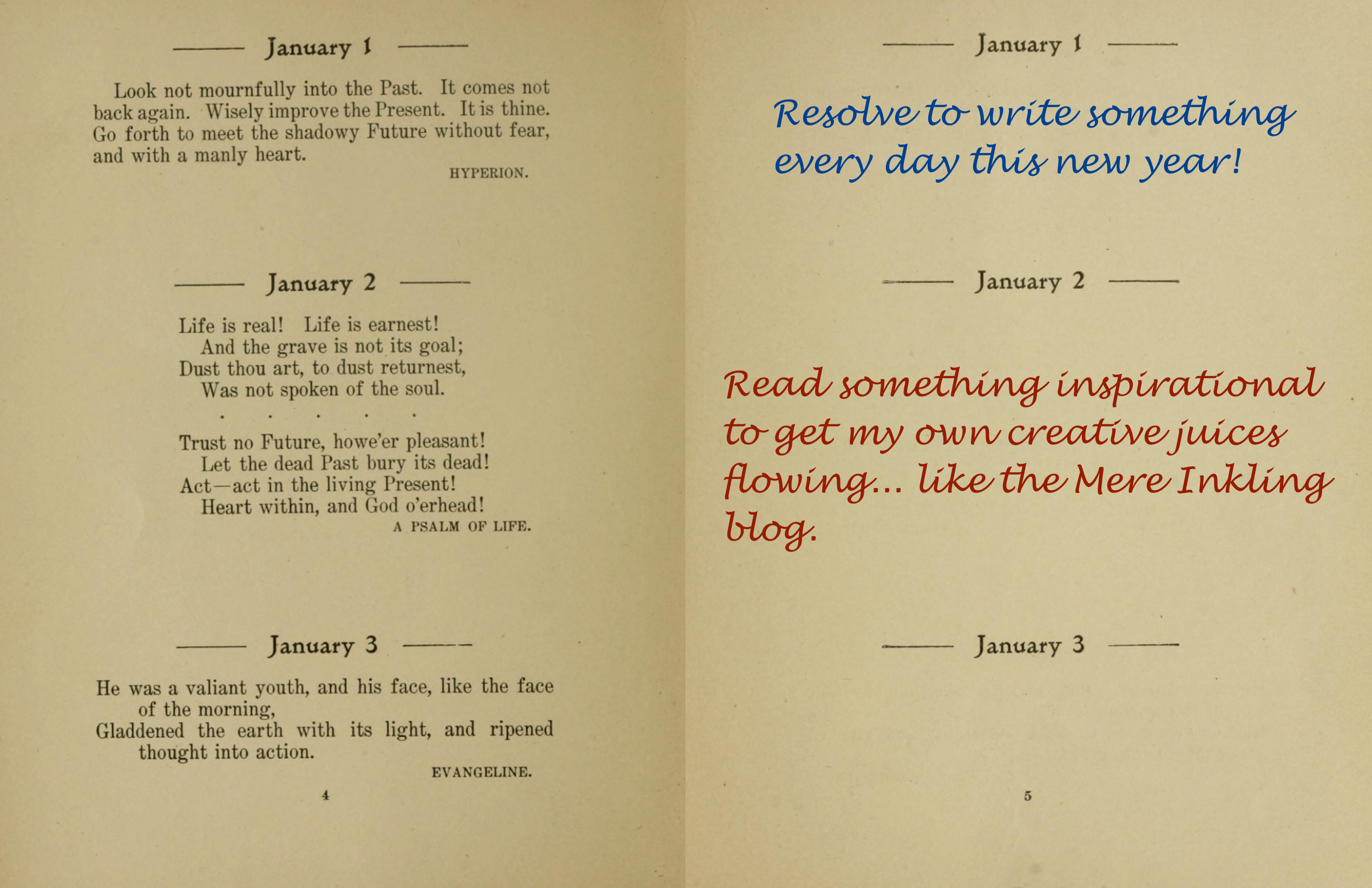
While I was working on an upcoming post about “quotations,” I encountered the volume illustrated at the top of this column. It represents the first two pages of A Year Book of Quotations: From the Writings of Henry Wadsworth Longfellow, with spaces for Autographs and Records (New York: 1896).

Look not mournfully into the Past. It comes not back again. Wisely improve the Present. It is thine. Go forth to meet the shadowy Future without fear, and with a manly* heart. (Hyperion).

These pages commended themselves to me as an ideal exemplar of the point I am attempting to make. New Year’s Day is an ideal time to begin new writing practices. While the hobby of collecting “autographs” may have declined through the years, the value of keeping written “records” has not.

The very structure of this journal invites a reader to preserve their unique insights. And, while the space in the book itself is limited, the blank lines serve to remind us that a few minutes devoted to the keyboard or pen each day can be worthwhile.

Longfellow’s Influence on C.S. Lewis

The epic poetry of Longfellow (1807-1882) was highly regarded during his lifetime. Following the death of his second wife, he wrote less poetry and focused on translating foreign authors into English.

In a 1915 letter to his father, Lewis commented on Rudyard Kipling’s militant promotion of the First World War. As he concluded his thoughts on the subject, he wrote, “I conceive that Kipling is one of those writers who has the misfortune in common with Longfellow, of always being known and liked for his worst works.”

There is one poem in Longfellow’s works—a piece inspired by his translation of a Swedish poet—that greatly impacted a very young C.S. Lewis. In “Tegner’s drapa,” Lewis encountered the essence of “Northernness” which would fuel his imagination the remainder of his life.

The entire poem is available here, but it was the ode’s opening that sparked the flame.⁑ Lewis describes the incident in his autobiography, Surprised by Joy.

It will be clear that at this time—at the age of six, seven, and eight—I was living almost entirely in my imagination; or at least that the imaginative experience of those years now seems to me more important than anything else. . . . I had become fond of Longfellow’s Saga of King Olaf: fond of it in a casual, shallow way for its story and its vigorous rhythms.

But then, and quite different from such pleasures, and like a voice from far more distant regions, there came a moment when I idly turned the pages of the book and found the unrhymed translation of “Tegner’s Drapa” and read,

I heard a voice that cried,
Balder the beautiful
Is dead, is dead.

I knew nothing about Balder; but instantly I was uplifted into huge regions of northern sky, I desired with almost sickening intensity something never to be described (except that it is cold, spacious, severe, pale, and remote) and then, as in the other examples, found myself at the very same moment already falling out of that desire and wishing I were back in it.

In 1927, Lewis penned a lengthy letter to his brother, which included an entertaining discussion of American authors. He highlights the nationalistic bragging to which many Americans succumb. He encourages Warnie to recall the days when the two of them boasted about the accomplishments of Northern Ireland.

If you cast back your mind, when we were at Wynyard we were in exactly that phase: it gave us a pleasure at which I still blush to din into people’s ears the fact that Belfast had the largest gantry in the British isles or had launched the largest ship afloat.

But we have outgrown it: it would now give me no appreciable thrill to convince the fellows of Magdalen that my father was the largest batata⁂ in Europe. If the analogy between peoples and individuals were sound, I suppose we should have to forgive the Americans for being in a state which we once passed through ourselves.

After discussing several others, Lewis confesses, “Hawthorne I admire beyond words: and ‘I have a sneaking affection’ for Longfellow.”

In retrospect, all of us who appreciate the writer C.S. Lewis became, owe a profound debt to Henry Wadsworth Longfellow.

And, if Longfellow’s collection of quotations—with spaces for Autographs and Records—encourages any of us to renew our commitment to becoming better writers, we have another good reason to be grateful.


* Yes, the pronouns are a bit dated, but we all know what Longfellow meant.

⁑ You can find direct inspiration for Longfellow’s poem in his translation of the poetry of Esaias Tegnér (1782-1846).

⁂ In case you are like me, and didn’t know, a batata is a sweet potato. It may also have been used as slang for Irish people, referring to being potato eaters. One can just imagine the two young men touting such a grand accomplishment by their father. (If anyone knows the precise meaning Lewis intended for the word, please let us know!)

An Audience of Angels

Most writers are content to have humans read their works. Not so, William Blake (1757-1827). He indicated on various occasions that his audience included angels.

Blake was a very odd man. Talented, true. Inspired, likely. (Though by whom, debatable.) Christian, I think not. C.S. Lewis had a mixed opinion of him, affirming some of his poetry, and challenging one of his most prominent theological errors.*

True, Blake drew most of his imagery from Christian themes, but that is to be expected by someone writing and painting around the turn of the nineteenth century in Britain. His views of Christian faith were anything but consistent with orthodoxy.

Indeed, Blake appears to have fashioned his own religion, with an unrestrained syncretistic impulse, and an unhealthy measure of sinuous semantics.

The source of many of Blake’s unorthodox musings appears to have been spiritual sources. He reported seeing visions, beginning in his childhood. Apparently, he would sketch the likenesses of spirits that presented themselves to him. At an 1819 séance he saw and communicated with the ghost of a flea (portrayed above).

The British Library offers a brief and informative video about Blake’s spiritual visions which is available here.

He sees angels—they’re angels to him. He sees figures at the window of his bedroom and as life goes on, these visions become more challenging. The old prophets, or Raphael, the painter, or some great figure he wants to discuss things with, appears in his chamber—it’s a kind of séance.

Eventually Blake’s conflated visions of heavenly beings and departed humans, developed into his own peculiar blend of spiritualism. In 1800, he wrote to comfort a friend whose son had died.

I know that our deceased friends are more really with us than when they were apparent to our mortal part. Thirteen years ago I lost a brother, and with his spirit I converse daily and hourly in the spirit, and see him in my remembrance, in the region of my imagination. I hear his advice, and even now write from his dictate.⁑

Despite William Blake’s flaws, C.S. Lewis was capable of appreciating his poetry.

I am just back from my Easter walking tour with Barfield and co., this year in Derbyshire. Have you been there? It is appreciably more like my ideal country than any I have yet been [to].

It is limestone mountains: which means, from the practical point of view, that it has the jagg’d sky lines and deep valleys of ordinary mountainous country, but with this important difference, that owing to the paleness of the rock and the extreme clarity of the rivers, it is light instead of sombre–sublime yet smiling–like the delectable mountains. It gives you something [like] the same sensation as Blake’s songs.

Lewis is referring here to Blake’s collection, Songs of Innocence. From that collection, I particularly enjoy “The Lamb,” which you can read in the footnote section below.⁂

When I previously wrote about C.S. Lewis’ visits to the home of William Butler Yeats (1865-1939), I shared Lewis’ impression of the occultic flavor of the residence. In a 1921 letter to a close friend, Lewis writes the following:

His house is in Broad Street: you go up a long staircase lined with pictures by Blake–chiefly the ‘Book of Job’ and the ‘Paradise Lost’ ones, which thus, en masse, have a somewhat diabolical appearance.

We cannot know exactly which images adorned Yeats’ stairwell, but this sample comes from Blake’s Illustrations of the Book of Job.

Returning to Spiritual Matters

Not only did Blake’s angelic audience laud his work, their praise was so great he could pen this bizarre description of the celestial realms. (How much is irreligious satire, and what part is genuinely inspired by actual visions and belief, remains debatable.)

I am more famed in Heaven for my works than I could well conceive. In my Brain are studies & Chambers filled with books & pictures of old, which I wrote & painted in ages of Eternity before my mortal life; & those works are the delight & Study of Archangels.

Perhaps C.S. Lewis’ most direct response to the confusion promoted by William Blake’s beliefs is found in his classic, The Great Divorce. This illuminating exploration of the gulf between heaven and hell was written, in part, as a response to Blake’s volume, The Marriage of Heaven and Hell. But, the comparison between the two requires an examination more than worthy of its independent discussion.

Suffice it here to include an example of Blake’s advocacy for hell. Blake describes a confrontation between “a Devil in a flame of fire, who arose before an Angel that sat on a cloud.” After their brief argument about God, the Angel “stretched out his arms embracing the flame of fire, and he was consumed . . .” That was not his end, however, for Blake adds a “Note.”

This Angel, who is now become a Devil, is my particular friend; we often read the Bible together in its infernal or diabolical sense . . . (William Blake, The Marriage of Heaven and Hell).

As noted, the matter of whether Blake’s championing of Satan was sincere or simply an arcane literary device is debatable.⁑⁑ However, his correspondence reveals his belief in the supernatural was certainly genuine.

In the end, there’s no question that C.S. Lewis’ assessment of William Blake was accurate. Unsurprisingly, it is one I share. The poet Blake possessed talent, and some of his poetry is quite good. However, as a theologian, this confused mystic is utterly unreliable.

Of course, Christians may be wrong regarding Blake’s spiritual enlightenment. What if, after all, Blake’s vision of his distinguished reputation with the angelic hosts was not a mere delusion? In the unimaginable possibility that this odd man truly is “famed in Heaven,” you must count me among those due to be the most surprised.  


* Even as he challenged one of Blake’s major works, C.S. Lewis wrote, “if I have written [disagreeing with Blake] this is not because I think myself a fit antagonist for so great a genius . . .”

⁑ Some might contend that Blake is referring here to “imagining” the presence of his brother in some sentimental fashion. That is clearly not the case. The fact that he states his brother is, at that moment, advising him on what to write, is intended to be understood as fact. It should be noted he is not referring to the spiritualist practice of “automatic writing,” which is done in a state of trance or spirit possession. Blake’s description of the process is more that of conversational interaction and “advice.”

⁂ “The Lamb,” by William Blake
Little lamb, who made thee?
Dost thou know who made thee,
Gave thee life, and bade thee feed
By the stream and o’er the mead;
Gave thee clothing of delight,
Softest clothing, woolly, bright;
Gave thee such a tender voice,
Making all the vales rejoice?
   Little lamb, who made thee?
   Dost thou know who made thee?
   Little lamb, I’ll tell thee;
   Little lamb, I’ll tell thee:
He is called by thy name,
For He calls Himself a lamb.
He is meek, and He is mild,
He became a little child,
I a child and thou a lamb,
We are called by His name.
  Little lamb, God bless thee!
   Little lamb, God bless thee!

⁑⁑ Like most literary expressions, Blake’s was likely an amalgam of his beliefs and his fancies. A fascinating article on this subject is Peter A. Schock’s, “The Marriage of Heaven and Hell: Blake’s Myth of Satan and Its Cultural Matrix,” published in 1993. Shock says, “The Marriage of Heaven and Hell presents a programmatic expression of [Blake’s] interconnected political, moral and metaphysical thought . . .”

C.S. Lewis and the History of Words

Like many of you, I love words. Like C.S. Lewis, I recognize the value of understanding each word’s etymology—its origin and history.

That’s why I was hooked right from the beginning by a short essay on “Language and the Bible” that I read in a magazine to which I subscribe. Dr. Mark Ward’s column goes by the heading Word Nerd. (Yes, I recognize the title is dweebish, but bear with me, his insights are worthwhile).

Word histories are for precocious nine-year-old homeschoolers who enjoy presenting irrelevant factoids to bemused adults. But word histories are history, and they come with all the drama that human life does.

You don’t have to be a geek to have fun with etymologies. Right here at Mere Inkling we enjoyed exploring Viking words that found their way into English. We also discussed the importance of using the etymological meanings of one’s name when determining how that name is properly rendered in the Elvish tongues of Middle Earth.

Etymology is serious business to those of us who study history and, especially, theology. The article I just cited is available online in a delightful video presentation. I’ll link to it below, for those interested in language as it relates to the Bible. Yet, even for those without these theological or historical interests, learning the life story of words can be fascinating, and even inspiring.

Listen to C.S. Lewis’ thoughts on the importance of philology, the broader study of languages which incorporates etymology.

I am sometimes told that there are people who want a study of literature wholly free from philology; that is, from the love and knowledge of words. Perhaps no such people exist. If they do, they are either crying for the moon or else resolving on a lifetime of persistent and carefully guarded delusion.

If we read an old poem with insufficient regard for change in the overtones, and even the dictionary meanings, of words since its date—if, in fact, we are content with whatever effect the words accidentally produce in our modern minds—then of course we do not read the poem the old writer intended.

What we get may still be, in our opinion, a poem; but it will be our poem, not his. If we call this tout court “reading” the old poet, we are deceiving ourselves. If we reject as “mere philology” every attempt to restore for us his real poem, we are safeguarding the deceit.

Of course any man is entitled to say he prefers the poems he makes for himself out of his mistranslations to the poems the writers intended. I have no quarrel with him. He need have none with me. Each to his taste. (Studies in Words)

Exciting News for Word Lovers

The Oxford English Dictionary (OED) provides an unrivaled treasure-trove of information about the world’s most influential language. And—it is currently being expanded. The second edition, published in 1989, consists of twenty volumes (21,728 pages). The new edition will, of course, eclipse that.

Best of all, will be the OED’s deeper exploration of each word’s etymology. As they say in the already-released Preface to the Third Edition of the OED:

The revision of the Oxford English Dictionary’s etymological component is a substantial undertaking. In the First Edition many entries whose origin was taken to be self-evident (typically native English formations) were not provided with etymologies.

In the revised material each entry has a formal etymology. . . . the most significant changes relate to the analytical content of the revised etymologies, which for the most part update text which appeared in the First Edition of the Dictionary, and therefore represented the state of scholarly knowledge approximately one hundred years ago.

Your reward for reading this far: At the beginning of this post, I quoted from the Bible Study Magazine article that inspired it. This is a link to the article itself . . . but I strongly recommend you follow this link to the video version by the author, which I mentioned earlier.

A Bonus Surprise from C.S. Lewis

I suspect most fans of C.S. Lewis would imagine him to be very fastidious, even punctilious, about spelling. The following letter will prove otherwise.

Lewis recognized the purpose of language is to communicate, and although there are valid reasons to investigate their etymologies, such pursuits need not muddy the conversation, so to speak. This letter was published on New Year’s Day in 1960 in the London Times Educational Supplement. It was written in response to a contemporary debate about “spelling reform.”

Nearly everything I have ever read about spelling reform assumes from the outset that it is necessary for us all to spell alike. Why? We got on for centuries without an agreed common orthography.

Most men of my age [i.e. officers serving during WWI] remember censoring the letters of soldiers and know that even the wildest idiosyncrasies of spelling hardly ever made them unintelligible.

Printing houses will always have, as they have now, their own rules, whether authors like them or not. Scholars, who know the ancestry of the words they use, will generally spell them accordingly.

A few hard words will still have to be learned by everyone. But for the rest, who would be a penny the worse if though and tho, existence and existance, sieze, seize and seeze were all equally tolerated?

If our spelling were either genuinely phonetic or genuinely etymological, or if any reform that made it either the one or the other were worth the trouble, it would be another matter.

As things are, surely Liberty is the simple and inexpensive ‘Reform’ we need? This would save children and teachers thousands of hours’ work. It would also force those to whom applications for jobs are made to exercise their critical faculties on the logic and vocabulary of the candidate instead of tossing his letter aside with the words “can’t even spell.”

So, console yourself today with the knowledge that C.S. Lewis would not judge you for accidentally writing “sieze,” or using personal shorthand like “tho” or “thru.” Lewis respected the value of etymology, but he also understood quite well its proper place.