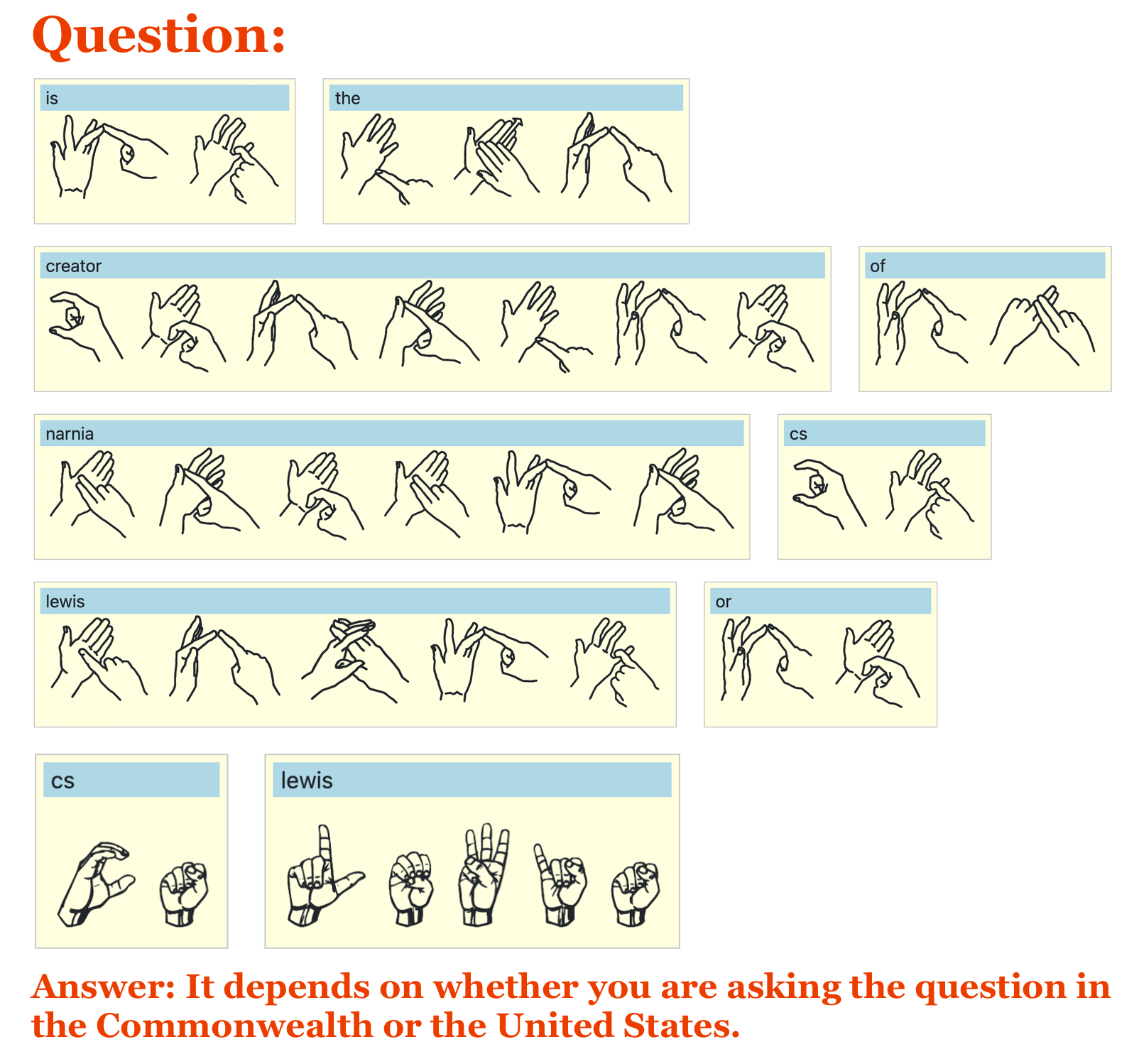
Writing a Biography

What kind of writer are you? A poet, journalist, essayist or, perhaps, a minimalist? (By “minimalist” I mean someone who writes the bare minimum they have to.)

Many readers of Mere Inkling are, in fact, writers in their own right. Even ignoring the profusion of texts ricocheting around the globe (which are, in fact, literary creations), a fair number of Mere Inkling subscribers have blogs of their own.

The preeminent position of physical letters as the medium for correspondence has been usurped by email. People still write to one another, but – to the woe of the struggling United States Postal Service – they do it digitally.

More serious writers gravitate toward a varieties of genres. Often we try our hands at the sort of literature we prefer reading. That’s why I seldom write poetry. (And, when I do, it’s usually because I’m consciously stretching myself.)

My poetic skills may be limited – you can decide for yourself – but I don’t experience any of the disappointment that befell C.S. Lewis when his poetic dreams were dashed.

Poets are fine. Until they become snobs. If they treat other genres with respect, they stand on an equal footing with everyone else. But when they claim primacy for their preference, they lose me. Consider “William Faulkner Makes Us Wonder: What’s So Great About Poetry, Anyhow?

There’s a reason I can call poetry the highest form of artistic expression without thinking twice about it. And even though most Americans today don’t acknowledge the art form all that much, you’d be hard-pressed to find a sensible person who doesn’t respect or – if only from a distance – admire the magic in it.*

I guess I am one of the Americans who doesn’t possess a special reverence for poetry. And, as for “admiring the magic in it,” please. Wait, I don’t desire to offend you poets out there. Unless, of course, you consider yourself better than everyone else. In that case, consider my words a gentle rebuke (and encouragement to consider the virtue of humility).  

I hope that everyone will read on, and forgive me for maligning “the highest form of artistic expression.”

A Less Honored Literary Genre

I write nonfiction, unsurprising for someone who is basically a historian. Theologically, I neglect the conjecture of systematic theological considerations and focus on what’s usually called “practical theology.” It too, is unpretentious, and intended to make sense to “regular” people.

Recent years have found me dabbling in the memoir, or versions of autobiography, as I consider the potential value of such documents to my descendants.

One arena I’ve never really considered is biography. I suspect it would be a comfortable literary form, for a historian. I mean, you’re simply telling the story of a single life, relating facts and explaining the context of various events. That doesn’t sound too challenging, does it?

I suppose almost anyone could write a biography. The question is, could we write a good one?

Writing a Biography

I have been thinking about this subject ever since my research for my previous post introduced me to the work of David Cecil,⁑ one of the Oxford Inklings who shared the company of C.S. Lewis and J.R.R. Tolkien.

Cecil wrote several biographies. At Internet Archives you can read his lives of William Cowper, Charles Lamb, or Max Beerbohm, or his two-volume biography of Lord Melbourne (1 and 2).

If those individuals don’t tickle your proverbial fancy, you might want to look at the book that piqued my interest: An Anthology of Modern Biography. In it, Cecil explores the work of sixteen biographers. One of the chapters is his own portrayal of the evangelical Anglican cleric, John Newton (an extract from his biography of Cowper).

What intrigues me most about the volume is not the biographical material itself. Rather, it is Cecil’s very informative introduction. Here is his opening, which may whet the interest of future biographers . . . one of whom could be you?

Biography is not an important form of literary art. But it has a special interest to the student of modern literature. For it is the only new form. We can talk of modern poetry and modern novels, but these are only new variations on old forms. . . . Not so biography.

Art is primarily the expression of the artist’s creative powers; he writes to express his personal vision; he chooses as his subject that which he thinks will best exhibit his particular talent.

Now this is not true of the biographer of the past. His aim was not artistic, it was useful; he wanted to give people information. If he was a man of literary talent . . . his book was a work of art. But even if it had not been, it would not have failed. For its primary purpose had been, not to give an artistic impression, but to tell the truth.

This desire for the truth over ostentation resonates with me. But, mind you, he is referring to biographers “of the past.” Now (the book was published in 1936), other influences are at work.

But for the typical modern biographer literature comes first. Mr. Lytton Strachey writes about Queen Victoria, not in order to give us information about her, but because he thinks her life an excellent subject for a work of art. . . .

He does not set out his facts . . . complete with reference and proof, he weaves them into a story, grouping them in order and proportion that will make his picture as vivid and entertaining as possible.

Cecil’s explanation for this transformation is fascinating, and I encourage you to read it yourself, whether or not you are interested in writing a biography yourself. The book is available here, and thanks to the Public Library of India, you can download a complete copy for free.

In a 1932 letter to Arthur Greeves, C.S. Lewis contrasts biographies with the evidence from people’s daily lives. He shares with his lifelong friend a question this raises in his own minid.

It is a very consoling fact that so many books about real lives – biographies, autobiographies, letters etc. – give one such an impression of happiness, in spite of the tragedies they all contain. What could be more tragic than the main outlines of Lamb’s or Cowper’s lives?

But as soon as you open the letters of either, and see what they were writing from day to day and what a relish they got out of it, you almost begin to envy them.

Perhaps the tragedies of real life contain more consolation and fun and gusto than the comedies of literature?

Biography. Considering trying it. And, Poetry, it’s not that bad, either.


* The article does include interesting information about Faulkner. It appears his disappointed poetic dream shifted him to more productive fields. This parallels C.S. Lewis’ literary career.

For all of [Faulkner’s] achievements, his Nobel Prize for Literature, his Pulitzers and National Book Awards, his mug on a 22-cent postage stamp – the man still fell short. And it wasn’t that he dropped out of high school and did only a few semesters of college, or that he was once fired by an employer for reading on the job.

These were small missteps and shortcomings that were basically inconsequential in the long run. The larger issue is that, in his own view, William Faulkner was a failed poet. Failed.

“Maybe every novelist wants to write poetry first,” he told The Paris Review in 1956, “finds he can’t, and then tries the short story, which is the most demanding form after poetry. And, failing at that, only then does he take up novel writing.”

What you may not know is that before his first novel, Soldier’s Pay, Faulkner had written two books of poetry, Vision in Spring in 1921 and The Marble Faun in 1924. While he’d long dreamed of being taken seriously as a poet, the verse was always second-rate and not particularly significant. Eventually he abandoned his efforts as a poet to focus solely on his fiction.

⁑ In the spirit of most colonials who shook off the reigns of monarchial rule, I tend to respect the Queen as a head of state, and disregard the affectations of an aristocracy they once “lorded” it over. Thus, I can take or leave Cecil’s normative citation as “Lord David Cecil.

Looking Toward the New Year with the Inklings

If we were to ask C.S. Lewis, J.R.R. Tolkien and the rest of the Inklings for insights about a New Year, what wisdom might they share?

Read on. Mere Inkling answers that question with a few select quotations from their writings. We also include comments from several other writers associated, in spirit, with the Oxford Inklings.

While some of the pithiest of the quotations below are well represented at quotation websites, your humble host has secured the less familiar quotations through the diligent search of obscure manuscripts.

J.R.R. Tolkien:

From a holiday letter to a friend.

“There is small chance of this reaching you tomorrow Jan. 1 to wish you a Happy New Year. I hope you have plenty of food in store! It is my birthday on Jan. 3rd, and I look like spending it in the isolation of a house turned igloo; but the companionship of several bottles of what has turned out a most excellent burgundy (since I helped to select it in its infancy) will no doubt mitigate that: Clos de Tart 1949, just at its top. With that hobbit-like note I will close, wishing you and your wife and children all blessings in 1962.”

As the world conflict raged on, Tolkien wrote to his son Christopher who was serving in the Royal Air Force. “This empty year is fading into a dull grey mournful darkness: so slow-footed and yet so swift and evanescent. What of the new year and the spring? I wonder.”

Christopher Tolkien:

A scholar in his own right, Christopher devoted much of his life to editing his father’s published and unpublished works. In The End of the Third Age, he reminds us that sometimes the jobs on which we embark end up being far more involved than we anticipated. “With this book, my account of the writing of The Lord of the Rings is completed. I regret that I did not manage to keep it even within the compass of three fat volumes.

C.S. Lewis:

“What wonderful adventures we shall have, now that we are all in it together.”

“You are never too old to set another goal or dream a new dream.”

“Isn’t it funny how day by day nothing changes, but when you look back, everything is different.”

“I must keep alive in myself the desire for my true country, which I shall not find till after death; I must never let it get snowed under or turned aside; I must make it the main object of life to press on to that other country and help others to do the same.”

“If you live for the next world, you get this one in the deal; but if you live only for this world, you lose them both.”

“There are far, far better things ahead than any we leave behind.”

“I think that if God forgives us we must forgive ourselves. Otherwise, it is almost like setting up ourselves as a higher tribunal than Him.”

Charles Williams:

“I think in order to move forward into the future, you need to know where you’ve been.”

“Play and pray; but on the whole do not pray when you are playing and do not play when you are praying.”

Owen Barfield:

“. . . the poet, while creating anew, is likely to be in a sense restoring something old.”

In a short story entitled “The Devastated Area,” Barfield, a veteran of WWI, described the way a soldier can view an uncertain future. “Armistice day; the last shot; and the hushed, doubtful little group in the dug-out at 11 o’clock. He is sitting there in uniform, willing for the first time in three years to let his thoughts run on into the future. But they will go back to the past instead . . .”

Adam Fox:

In his history of English hymnody, Fox praises his nation’s people and offers timely advice regarding musical accompaniment. “It takes no long argument to prove that Hymn Singing is a national institution in Great Britain. It is so rather in the same way as cricket. . . . The singing is usually accompanied on an organ, or if there is no organ, then on a piano. The harmonium, though sometimes used for the purpose, cannot be recommended, and is falling into disuse.”

Jack A.W. Bennett:

In The Humane Medievalist, Bennett praises his friend and fellow Inkling, C.S. Lewis. Coincidentally, this essay was his own inaugural lecture as he assumed the Cambridge chair which had been created for Lewis himself. “C.S. Lewis died a year ago today, and the year has deepened not diminished our sense of loss. Those of us who had the good fortune to call him master must feel as the prentice Hoccleve felt about Chaucer: ‘Fain he would me have taught, But I was dull, and learned little or naught.’”

Lord David Cecil:

He begins his biography of Lord Melbourne with a curious sentence suggesting that even we who have lived the most average of lives, may still have great things ahead of us. “William Lamb, second son of the first Viscount Melbourne, had arrived at the age of forty-seven without achieving anything of significance in the world.”

Hugo Dyson:

Discussing the Tragedies written by Shakespeare, Dyson reminds us to recognize potential blessings in the coming year’s challenges. “Our awareness both of ourselves and of the world at large is intensified by confrontation with an unexpected or serious or painful situation. Our wits and imaginations alike grow more acute under difficulties.”

Nevill Coghill:

Referring to Chaucer’s portrayal of the Knight, Coghill describes an ongoing goal for those who will to live nobly. “There is a fundamental answer to those who want to think the Knight’s moral nature . . . was too good to be true, and so can be no better than a romantic illusion. People who think thus can never have thought about Christianity at all; that we can live up to the moral demands that it makes on us, and that at any moment we may fall into the pit that opens beneath us, does not lessen the love we are taught . . . to have, and to attempt. Christianity plainly tells us to be perfect, impossible as it seems, impossible as it proves; but this does not make that demand less real, or even less realistic . . . Coming to the aid of human imperfection, there is grace.”

A Special Bonus for Mere Inkling Readers as the Year Ends

And a few additional thoughts from writers with connections to our favorite Inklings.

George MacDonald:

“A man’s real belief is that which he lives by. What a man believes is the thing he does, not the thing he thinks.”

A reminder to trust God for his daily provision. “It is not the cares of today, but the cares of tomorrow, that weigh a man down. For the needs of today we have corresponding strength given. For the morrow we are told to trust. It is not ours yet. It is when tomorrow’s burden is added to the burden of today that the weight is more than a man can bear.”

“Past tears are present strength.”

Dorothy Sayers:

“Paradoxical as it may seem, to believe in youth is to look backward; to look forward we must believe in age.”

G.K. Chesterton:

“When it comes to life, the critical thing is whether you take things for granted or take them with gratitude.”

Joy Davidman:

“Being a fool for God was not merely alright but liberating.”

“We do not need a world in which there is nothing to be afraid of . . . Nor can we have such a world, for all our strivings; no matter pleasant and safe we make the journey, the end of it is death. What we do need is to remember that we have been redeemed from death and the fear of death, and at a rather high price too.”

Douglas Gresham:

“I am beginning to realize that every point in one’s life at which one loses everything is far more a beginning than an end, for one has lost merely the past, and one has yet to gain the future, and eternity itself.”

And, encouragement for those among us who are writers: “Don’t forget, the rejection by a publisher of a book that you’ve written is not a failure.”

One Final Bit of Wisdom for the New Year

The internet offers lots of valuable information, accessible with the click of a key. Unfortunately, a significant amount of it is unsubstantiated, and downright false. This includes the quotations attributed to various people.

Some largescale quotation “aggregators” consider attribution on other unvalidated sites sufficient justification for loading the questionable citations to their own pages. For example, check out the quotations attributed online to Lord David Cecil. Or, better yet, don’t.

During my research for this post I discovered many of them – or, at least those most beneficial to reflective minds – actually come from the pen of Richard Cecil (1748-1810), an Anglican priest. Here is a grand example of misattribution, particularly appealing to a pastor such as myself: “It requires as much reflection and wisdom to know what is not to be put into a sermon, as what is.”

We’ll close now with an apocryphal C.S. Lewis quote. Despite scores of sites attributing the following thought to Lewis, no one can find it anywhere in his work. It is, however, consistent with his wisdom, and leaves us with an optimistic truth as 2021 draws to a close.

“You can’t go back and change the beginning, but you can start where you are and change the ending.”

Amen. Lord, grant all those who read these words of wisdom, both now and during years to come, a blessed New Year.

Respecting Animals We Kill

Sometimes even a moral sluggard can say something profoundly true. I was recently visiting the uplifting site of a British pet photographer, and came across this wonderful insight:

“Until one has loved an animal a part of one’s soul remains unawakened.”

As I spent a moment reflecting on the quote, having just enjoyed a morning game with our border collie, it dawned on me these words are not only philosophically true. The more I consider them the stronger the case, it seems to me, can be made for their theological truth.

Turn the statement around. Can someone be considered spiritually awake if they have never possessed a moment of genuine affection for an animal, the pinnacle of God’s natural creation? I tend to think not.

Cultural matters certainly influence one’s connection with nature. It may be that people surviving on the edge of food sufficiency would view animals primarily as a resource. Yet even then, the best among us still possess a regard for the creatures whose lives we curtail to extend our own.

An outstanding example of this is found in a common practice among North America’s first peoples. (First Nations is the common term in Canada). Many of these people would include prayer on behalf of the prey they sought.

In the Cherokee legend “The Little Dear, Awi Usdi,” describes how hunters were taught to only take life when necessary, and to “ask pardon when an animal was killed.”

Another site explains how “Coast Salish women were forbidden from stepping over deer meat, and the men had to look away when uncovering it. All bones had to be thrown into the water, and the viscera not consumed were buried so the dogs would not eat it.”

Post-Kill Rituals: Matters of the Heart,” describes how this “ancient reverence” for hunted animals extended beyond the Americas. It concludes with a valuable thought.

Rituals aren’t a bad idea . . . But you show the utmost respect by concentrating on killing the animal quickly. Hunters’ conduct toward wildlife and nature should be consistent with their conduct toward other humans.

While Christians will necessarily overlook the religious elements of these various traditions,* those most attuned to the love of God – a Creator who viewed the “living creatures” he had fashioned and proclaimed, “it was good” – will possess at least a glimmer of reverence or affection for wildlife.

Not that Christians can’t be avid hunters. The Roman Catholic Church even has a Patron Saint for hunting. St. Hubert, pictured above, was (before his canonization, of course) a worldly nobleman. In the seventh century, Hubert had ignored invitations to attend worship on one of the holiest of days, Good Friday. Yet the Lord met him there, in the forest. His conversion occurred when he saw a vision of a crucifix while hunting. Hubert would later use his skill with a bow to draw crowds for his preaching of the Gospel.

C.S. Lewis & the Hunting of Deer

In an essay entitled “The Seeing Eye,” C.S. Lewis turns the analogy of hunting upside down. Using his own life, in which searching for God was the farthest thing from his desires, Lewis describes his conversion in a fascinating manner. It is interesting that while Lewis reveals he wasn’t desirous of faith, he was seeking honesty within his own conscience. He was also seeking truth.

I never had the experience of looking for God. It was the other way round; He was the hunter (or so it seemed to me) and I was the deer. He stalked me like a [hunter], took unerring aim, and fired. And I am very thankful that that is how the first (conscious) meeting occurred. It forearms one against subsequent fears that the whole thing was only wish fulfilment. Something one didn’t wish for can hardly be that.

But it is significant that this long-evaded encounter happened at a time when I was making a serious effort to obey my conscience. No doubt it was far less serious than I supposed, but it was the most serious I had made for a long time.

So, Who was the Author of the Initial Quote?

I began by saying even moral sluggards can occasionally make a good point. The person who drew the connection between our regard for animals and our souls is Anatole France. Not only was he a serial adulterer, he was a devout atheist. (Not all atheists are adulterers, of course, but rejecting the God of the Bible does make it a lot easier to justify one’s immorality.)

Anatole wrote some curious works ridiculing Christianity, and until I was writing this post I had completely forgotten about my 2014 post about his advocacy for Satan.

Returning to Positive Subjects . . . Like Animals

The site that used the great quotation with which we began, is excellent. It is called “Mad about Greys,” and is the work of a British photographer.

Liz Coleman does an amazing job capturing the hearts and – dare I say, souls – of the pets she shoots. Even though Surrey is quite a ways for most Mere Inkling readers to visit her studio, I encourage you to visit her website today.


* There were additional Native American beliefs and taboos. For example, “the Pentlatch and Squamish buried or hid all deer bones. The West Sanetch were not permitted to eat deer meat and fish at the same meal.”

First the Machines Kill the Weeds

Machinery, one of the fruits of scientific research, is intended to benefit humanity. It often does. However, even machines with totally peaceful purposes – hay balers, for example – can be deadly.

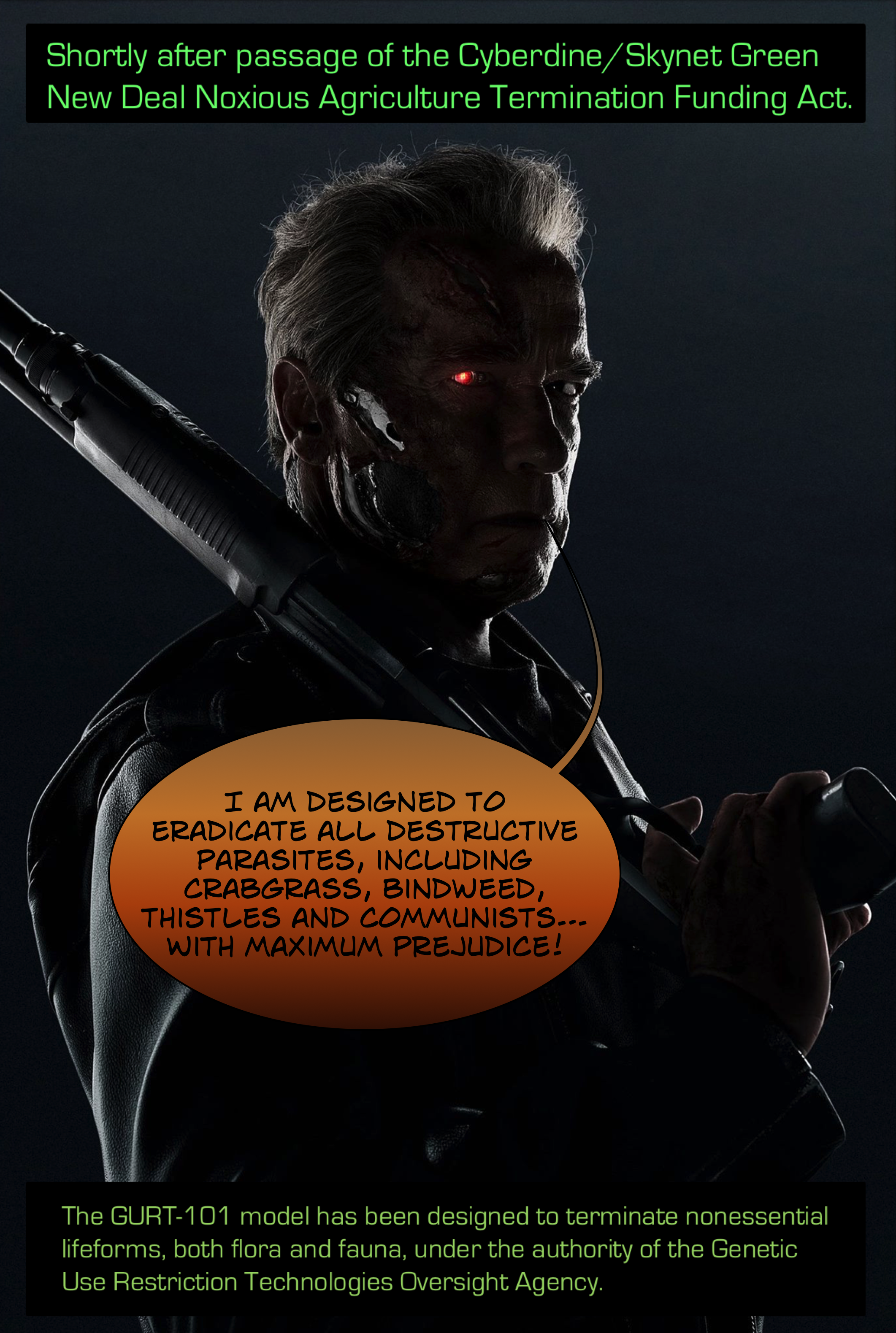
Machines-run-amuck populate many dystopian novels and films. One of the most successful franchises is Terminator. Humanity is brought to the precipice of extinction, after devising machines – and their perilous companion Artificial Intelligence. The very first film, The Terminator (1984) brilliantly uses the biblical allusion “Judgement Day,” to mark the sentience of the genocidal Skynet.

Nearly forty years later, debates about weaponized autonomous systems have moved far beyond speculation. And it does not require a doctorate in computer science to recognize that given a potentially lethal machine the power to make its “own” decisions poses a deadly risk. After all, if software programs can be virally infected, and secure systems can be locked tight and held for ransom, there are no guarantees that “terminators” will not be part of our future.

We’ve seen how weapons can easily be mounted on the robotic dogs that are currently accompanying our troops.

And in a recent Air Force Magazine article, “Unmanned Flying Teammates,” we read the promise that “Robots will join the Combat Air Forces within the next decade.”

The common nomenclature for the current generation of these machines is Lethal Autonomous Weapons Systems. You can read about “slaughterbots” at the Future of Life Institute site.

Whereas in the case of unmanned military drones the decision to take life is made remotely by a human operator, in the case of lethal autonomous weapons the decision is made by algorithms alone.

Slaughterbots are pre-programmed to kill a specific “target profile.” The weapon is then deployed into an environment where its AI searches for that “target profile” using sensor data, such as facial recognition.

While the first generation of such weapons are still being designed, a genuinely wonderful new machine foreshadows what might be an ominous future.

In response to the destructive necessity for pesticides, scientists have come up with a new self-driving farm machine that avoids the need for poisons by selectively zapping individual weeds with lasers. Forbes has a great article on the subject, with the unwieldly but informative title, “Self-Driving Farm Robot Uses Lasers To Kill 100,000 Weeds An Hour, Saving Land And Farmers From Toxic Herbicides.”

The weeding machine is a beast at almost 10,000 pounds. It boasts no fewer than eight independently-aimed 150-watt lasers, typically used for metal cutting, that can fire 20 times per second.

They’re guided by 12 high-resolution cameras connected to AI systems that can recognize good crops from bad weeds. The Laserweeder drives itself with computer vision, finding the furrows in the fields, positioning itself with GPS, and searching for obstacles with LIDAR.

I applaud this invention, with one major caveat. How large a step is required between zapping weeds and burning holes through human bodies?

Ironically, they have even named this agricultural prototype for human-hunting machines “Terminator technology.”

Terminator technology is the genetic modification of plants to make them produce sterile seeds. They are also known as suicide seeds. Terminator’s official name – used by the UN and scientists – is Genetic Use Restriction Technologies (GURTs).

Actually, this is a very positive breakthrough in terms of increasing harvests while preserving the natural health of the earth (and the Earth). C.S. Lewis, I believe, would have welcomed this new technological achievement.

The affinity of C.S. Lewis and fellow Inkling J.R.R. Tolkien for nature is well recognized. The two WWI veterans were averse to industrialized landscapes, and much preferred bucolic images. You can see that in Lewis’ fiction, although it’s much more evident in Tolkien’s Lord of the Rings. (Even Tolkien’s truest fans must admit that some readers find his elaborate discussion of the Hobbits’ harmony with nature almost mundane.)

True science is a good thing, but one must remain vigilant against an idolatry that masks itself as science.

Beware of Scientism

C.S. Lewis’ role as a an apologist for Christianity – and for what was worthwhile in past history – brought him into more direct conflict with technology. Of course, it was not scientific advances per se of which he was wary. It was the creeping idolatry of scientism, which assumes the trappings of faith in its disciples’ eyes. Tolkien shared his concerns regarding the matter, but confronting such lies was not part of his vocation.

Lewis’ clearest exposition of humanity’s lust for progress may be his 1954 Inaugural Lecture as the Chair of Mediaeval and Renaissance Literature at Cambridge University. De Descriptione Temporum (A Description of the Times) should be read in one sitting, as it was delivered. It is included in several collections, but available online here. The quotation below offers a very small slice of his influential lecture. (Coincidentally, A Pilgrim in Narnia featured a superb column on the address just yesterday.)

[The birth of the machines] is on a level with the change from stone to bronze, or from a pastoral to an agricultural economy. It alters Man’s place in nature. . . . What concerns us . . . is its psychological effect. How has it come about that we use the highly emotive word “stagnation,” with all its malodorous and malarial overtones, for what other ages would have called “permanence”?

Why does the word “primitive” at once suggest to us clumsiness, inefficiency, barbarity? When our ancestors talked of the primitive church or the primitive purity of our constitution they meant nothing of that sort. . . . Why does “latest” in advertisements mean “best”?

Well, let us admit that these semantic developments owe something to the nineteenth-century belief in spontaneous progress which itself owes something either to Darwin’s theorem of biological evolution or to that myth of universal evolutionism which is really so different from it, and earlier. . . . But I submit that what has imposed this climate of opinion so firmly on the human mind is a new archetypal image.

It is the image of old machines being superseded by new and better ones. For in the world of machines the new most often really is better and the primitive really is the clumsy. And this image, potent in all our minds, reigns almost without rival in the minds of the uneducated. For to them, after their marriage and the births of their children, the very milestones of life are technical advances. . . .

Our assumption that everything is provisional and soon to be superseded, that the attainment of goods we have never yet had, rather than the defence and conservation of those we have already, is the cardinal business of life, would most shock and bewilder [all of those who have gone before us.]

A thought-provoking article, “The Folly of Scientism,” offers the argument of a professor of Biology, which is independent of C.S. Lewis, while echoing many of his cautions.*

Of all the fads and foibles in the long history of human credulity, scientism in all its varied guises — from fanciful cosmology to evolutionary epistemology and ethics – seems among the more dangerous, both because it pretends to be something very different from what it really is and because it has been accorded widespread and uncritical adherence.

An excellent work on this subject is available for purchase, entitled The Restoration of Man: C.S. Lewis and the Continuing Case Against Scientism. Michael Aeschliman’s excellent treatment is evidenced by the fact the 2019 version is the third edition of the title.

But why should this central civilizing truth about the “res sacra homo,” [the fact that “humanity is a sacred thing”] . . . need C.S. Lewis’s [reaffirmation]? The answer to that question is philosophical, historical, and complex, but it should not be as obscure or little understood as it is today.

Although there was never a “golden age” of civilization within historical time, this radically noble idea was often better understood in the past, even the recent past.

Back to the Robots

Wait, I just noticed some armed drones flying overhead, and what appeared to be a silhouette resembling a GURT-101 Terminator skulking through the woods outside my office . . . Perhaps I’ve already written too much.


* This article appears in The New Atlantis, where they say “Our aim is a culture in which science and technology work for, not on, human beings.”

For the Love of Words

Most writers, including the majority of bloggers, share a common affection. We love words, don’t we?

That love extends beyond mere fondness. We can find ourselves in a state of genuine wonder as we ponder definitions, etymologies (evolutions through diverse languages), and phonesthetics (how they sound). As C.S. Lewis once wrote, “Isn’t it funny the way some combinations of words can give you – almost apart from their meaning – a thrill like music?”

This is one aspect of a great article in the current issue of The Lutheran Witness.* In “For the Love of Words,” editor Roy Askins uses C.S. Lewis’ classic The Four Loves to explore the relationship we have with words. He does so from a Christian perspective shared by the Oxford don.

Words shape us in profound ways. God formed creation and continues to sustain it by the Word of His mouth. . . . Words, then, are not incidental to our lives, but form a central part and core of our identity as God’s people. It’s certainly appropriate for us to talk about “loving words.”

The very word for a lover of words – logophile – combines the Greek logos (word) with philia, which Lewis deems priceless, like “that Philia which Aristotle classified among the virtues or that Amicitia on which Cicero wrote a book.”

[Coincidentally, I have an article about ministry to those who are mourning in the current issue of The Lutheran Witness, as well. I assure you, however, that’s not why I’m citing “For the Love of Words.”] Longtime readers of Mere Inkling are well acquainted with my personal fascination with words and wordplay.

Many of you share this predilection. C.S. Lewis describes us in Studies in Words.

I am sometimes told, that there are people who want a study of literature wholly free from philology; that is, from the love and knowledge of words. Perhaps no such people exist. If they do, they are either crying for the moon or else resolving on a lifetime of persistent and carefully guarded delusion.

Literature, Lewis argues, is not simply the sum of its words. It involves the history of the words, their complex shades of meaning, and even what those very words meant to their original writers.

The Uniquely Christian Perspective

God pours out his gifts of writing quite broadly. Countless styluses, quills and pens have been wielded by talented pagans and atheists over the centuries.

Still, as Askins’ article alludes, Christians have a unique connection to words. Not only did God speak all creation into existence through his Word, but that Logos, that Word became incarnate and suffered an innocent death so that humanity might be redeemed. Askins concludes his article with a joyful truth.

When we seek to love words, then, we do not seek to love them as words in themselves. This danger we editors and writers must mark and avoid. No, we love words because in them and by them, we hear of and share God’s love for us in Christ. He alone makes words holy and precious; He alone makes words worth loving.

I love these closing words. And I strongly believe C.S. Lewis would too.


* The Lutheran Witness is the magazine of the Lutheran Church – Missouri Synod.

The Value of Money

America exerts a major influence on global financial health. And our current unrestrained printing of new dollars will doubtless have repercussions around the world.

I’m no economist myself, but there seems to be growing concern among professionals of that persuasion that we’re headed for über-inflation. And, if our dollar drops in value the way some people predict . . . well, it seems many nations may be in for the proverbial “rough time of it.”

Shortly after WWII, C.S. Lewis commiserated with an American friend about the effects of inflation on the price of commodities.

I take it that your [comment] indicates not a saturation of the home market, but a shortage of purchasing power due to inflation? That is the situation with which we are faced at the moment; I see that the clothing concessions for instance have not resulted in an increased sale of home market goods.

The stuff is in the shops, but people can’t buy. Though with us the problem is complicated by the inferior quality of so much of the stuff on the home market.

Years later, in 1951, Lewis could still write “war and inflation are still the background of all ordinary conversation over here.”

. . . to which has just been added the railway jam; our new railway organization has succeeded, so far as I can understand, in blocking every goods depot in the country. The trades people are grumbling, and the effect is just becoming apparent to the consumer.

When I was in high school, collecting coins from around the world, I purchased samples of German currency when hyperinflation was destroying their already-shattered economy. These bills were called notgeld, which means “emergency money.”

So much of the worthless paper was printed that you can still purchase genuine pieces for reasonable prices. Many of them are quite interesting, and you can see a variety of examples online.

Some are quite lovely, like this 1 Mark note printed in Prien am Chiemsee in 1920. Lovely indeed, but virtually worthless in terms of its initial value.

Postwar Germany offers a cautionary example. Similarly, Robert Mugabe’s destruction of Zimbabwe after he gained dictatorial powers shows the danger. You can read about the unbelievable crisis in a variety of places, including this thorough article published in a European economics journal.

You might have thought that the picture at the top of this column was a joke. After all, what country prints a one million dollar bill? Well, Zimbabwe did!

In fact, with an inflation rate of 231,000,000% they ended up printing off one hundred billion dollar bills. That’s not a typo. $100,000,000,000 – you can see one in this Guardian article.

And we won’t even consider the one hundred trillion dollar bill.

Inflation Aside, Is Money Moral?

That’s a false question of course. Morality cannot be attributed to objects. After all, it is not money itself that is “the root of all evil.” It is a fallen human being’s love of possessing wealth that may lead “into ruin and destruction.”

C.S. Lewis expands on this truth, and wisely points out that the danger of idolatry and false security extends beyond money itself.

Christ said ‘Blessed are the poor’ and ‘How hard it is for the rich to enter the Kingdom,’ and no doubt He primarily meant the economically rich and economically poor. But do not His words also apply to another kind of riches and poverty?

One of the dangers of having a lot of money is that you may be quite satisfied with the kinds of happiness money can give and so fail to realise your need for God. If everything seems to come simply by signing cheques, you may forget that you are at every moment totally dependent on God.

Now quite plainly, natural gifts carry with them a similar danger. If you have sound nerves and intelligence and health and popularity and a good upbringing, you are likely to be quite satisfied with your character as it is. ‘Why drag God into it?’ you may ask (Mere Christianity).

C.S. Lewis powerfully portrays this peril in his fiction. In Voyage of the Dawn Treader, a boy named Eustace has surrendered to his lust for treasure and the corruption of his soul becomes quite visible.

He had turned into a dragon while he was asleep. Sleeping on a dragon’s hoard with greedy, dragonish thoughts in his heart, he had become a dragon himself.

You can include me among those who like money. First, for its function – allowing free commerce, in contrast to crippled systems of barter. And, for its intrinsic curiosities – I am, after all, a numismatist.

Still, appreciating the existence of money is a far cry from echoing John D. Rockefeller who said “I believe it is a religious duty to get all the money you can.” (To be fair to the robber baron, his full quote was “I believe it is a religious duty to get all the money you can, fairly and honestly; to keep all you can, and to give away all you can.”)

To gain riches honestly is, of course, not objectionable. But as to reconciling the keeping and the giving away . . . Rockefeller’s logic eludes me.

Bonus Insight

As I noted above, I’m no economist. C.S. Lewis declared the very same statement in Mere Christianity as he explored the concept of usury (loaning money with significant interest charges). His thoughts on the matter speak to the entire subject we have been discussing.

As for the entire section you can find Lewis’ position at an interesting site called Generosity Monk, which “is committed to serving the Church by providing spiritual and strategic guidance to help people understand and practice biblical generosity.”

C.S. Lewis & Arguing Civilly

“When I was in high school in Oklahoma in the 1960s, my best friend was a fellow adolescent intellectual. We had lots in common, but at the time I was a liberal . . . and he was a conservative.” Thus begins a recent post from a scholar named Gene Veith, whose work I follow. But listen to the shocking statement which follows.

“We loved to argue politics. (You might think by today’s standards that it is impossible for people who disagree with each other politically to be friends, let alone best friends, but trust me, this happened back in those days.)”

It happened in those days . . .

I pity those too young to have experienced this wonder. In today’s viciously partisan culture, it is difficult to imagine we once shared such authentic humanity. As I recently wrote, even families are being torn apart by the spirit of judgment and division that reigns today.

There is one being who rejoices at this bitterness, vitriol and hatred.

Meanwhile, Jesus weeps.

Mutual Respect in the Olden Days

It used to be normal for people of goodwill to respect the consciences of those who thought differently.

People of strong convictions, like C.S. Lewis, could publicly and privately debate others without reproach or ad hominem arguments. There was a desire to persuade one’s counterpart to see things as you did. But it was absent the vile bile that spews every day across America and much of the rest of our angry world.

During WWII, C.S. Lewis began the Socratic Club, a debate society, at Oxford University. I have mentioned the group briefly in the past. Lewis explained his reasoning for helping establish the group in the first issue of the Socratic Digest.

In any fairly large and talkative community such as a university, there is always the danger that those who think alike should gravitate together into coteries where they will henceforth encounter opposition only in the emasculated form of rumour that the outsiders say thus and thus.

The absent are easily refuted, complacent dogmatism thrives, and differences of opinion are embittered by group hostility. Each group hears not the best, but the worst, that the other groups can say.

I commend to you two articles available online that (1) reveal the rich history of the Socratic Club, and (2) a biographical sketch of Chaplain Stella Aldwinckle, who first envisioned and shepherded the organization.

Four years ago I wrote a column encouraging greater civility in religious conversations. I said:

It would be a good thing for us individually and as members of a pluralistic world, to treat one another with civility. As a Christian, I can confess for my brothers and sisters that we do not always do so. Let us strive to do better.

Today I wish to extend that thought to all conversations, political, medical, and otherwise. We must reverse the path we are on. And, with God’s grace, we must do so sooner rather than later.


[In the article “My Experience with Conservative Atheism,” source of the anecdote with which I began, Veith discusses Libertarian atheist Ayn Rand. I have written about her in the past at Mere Inkling, noting how deeply she despised C.S. Lewis.]

We Are All Hard of Hearing

Do you have any Deaf friends or family members? If so, I cannot think of any more inspiring reason to learn sign language.

Even if you don’t already know someone Deaf, gaining familiarity with American Sign Language (ASL), or one of its British, French, Chinese, Japanese, Arabic, Spanish, Mexican, etc. alternatives – is worthwhile.

According to one major translation and captioning corporation, the use of sign language extends not only throughout nations, but also to a variety of populations.

It’s the main form of communication for the Deaf and Hard-of-Hearing community, but sign language can be useful for other groups of people as well. People with disabilities including Autism, Apraxia of speech, Cerebral Palsy, and Down Syndrome may also find sign language beneficial for communicating.

My wife, a special education teacher, recognized this early in her career. One of her greatest joys came from introducing a deaf, severely autistic teenager to a world where she could communicate for the first time. Although she could see, and learned to read with some comprehension, her transformation through learning ASL called to mind the miracle that was Helen Keller.

Before proceeding, it is helpful to clarify some terminology. According to the National Association of the Deaf website, “we use the lowercase deaf when referring to the audiological condition of not hearing, and the uppercase Deaf when referring to a particular group of deaf people who share a language.”

The members of this group have inherited their sign language, use it as a primary means of communication among themselves, and hold a set of beliefs about themselves and their connection to the larger society.

We distinguish them from, for example, those who find themselves losing their hearing because of illness, trauma or age; although these people share the condition of not hearing, they do not have access to the knowledge, beliefs, and practices that make up the culture of Deaf people.

This is an extremely significant distinction. So, people like me whose progressive hearing loss could conceivably lead to deafness, would not be members of the Deaf community. Unless, I suppose, we were to immerse ourselves in the Deaf (sign) language and culture. Even then, I imagine we would always be recognizable as “immigrants,” rather than native members of the Deaf family.

Another semantic consideration is the obsolete usage of the term “hearing-impaired.” This term is offensive to the Deaf community, and efforts continue to update the language of pertinent laws. The Cogswell Macy Act, which outlines educational rights for the Deaf and the Blind, is currently being revised.

In fact, the National Association for the Deaf is asking everyone to serve as advocates. One small element of the revision  will be to “change outdated terminology in current educational law from ‘hearing impaired’ to ‘deaf, hard of hearing, and DeafBlind.’”

Sign language is certainly not limited to spelling out words with individual letters. There are numerous words that have their own sign. A company named Start ASL offers online courses, and they offer video examples of 150 basic ASL words on their website.

One fascinating practice of the Deaf is the way many of them possess a unique “name sign” which identifies them in the community. Very Well Health has a great explanation about the way these names are given.

One aspect of Deaf culture is the use of unique, personal “name signs” as a way to identify someone without fully spelling out their name. . . . These names often reflect the person’s character and are usually devised by someone within the Deaf community.

Some people have a combination of initialized and descriptive name signs, like the first letter of their name that is swirling like a fish for someone who is a swimmer.

If you love a specific animal, like cats, your name sign may be the first letter of your birth name to then sign “cat’s whiskers” on your cheek. If you enjoy birds, your name sign could be the first letter of your birth name combined with the sign for bird.

The name sign given to my wife, Delores, was the letter “d” beside her “smile.” Quite fitting, since she is an extremely compassionate person who is seldom without one.

C.S. Lewis & the Deaf

Obviously, C.S. Lewis encountered a number of people who were deaf or hard of hearing. He mentions some of them in his correspondence. While there are now a “few students with hearing loss at Oxford,” I don’t know what accommodations would have been available during Lewis’ residency.

In “Oxford Student on Being Hearing Impaired at University,” we read “Deaf and hard of hearing students need to speak up at their universities if they want their needs to be taken more seriously and reach their full academic potential.” (Curiously, this 2019 article uses the outdated term “hearing impaired.” Perhaps the British find it less irritating than Americans?)

In 1953, C.S. Lewis responded to a letter from a student who had explained the Gospel to one of her Deaf classmates. She asked “how much of the teaching about Christ” she could present with the Gospel story itself. In his response he begins with a disclaimer about having little knowledge of the Deaf.

It is difficult to one, who, like me, has no experience, to give an opinion of these problems, which, I see, are very intricate. The story about the girl who had reached the age of 16 under Christian teachers without hearing of the Incarnation is an eye-opener.

For ordinary children (I don’t know about the Deaf) I don’t see any advantage in presenting the Gospels without some doctrinal comment. After all, they weren’t written for people who did not know the doctrine, but for converts, already instructed, who now wanted to know a bit more about the life and sayings of the Master.

Shortly before his death he explained to a writer that he had no personal photo to share. In his response, he uses the word “deaf” to explain (or exaggerate) the fact he was hard of hearing.

Sorry, but I’m out of photos. Which is perhaps just as well, for I look awful. Imagine a marsh-wiggle gone fat and red in the face. And deaf and bald. I talk far too loud. I’m so glad you liked the Narnian series.

Humanity’s Universal Deafness

Shifting our view from the physical to the spiritual, we see that all of us truly are Hard-of-Hearing. Christians understand the human inclination toward selfishness and sin as a consequence of “original sin.” We can be rescued from our sinful state, of course, and that is what the doctrine of the atonement is all about.

We’re not discussing theology here, but I say that to explain why deafness and blindness are metaphors in the Scriptures for being unable to hear or see the Truth.

For example, through the Prophet Isaiah, God describes unfaithfulness of his people in the following way.

Hear, you deaf,
    and look, you blind, that you may see!
Who is blind but my servant,
    or deaf as my messenger whom I send?
Who is blind as my dedicated one,
    or blind as the servant of the Lord?
He sees many things, but does not observe them;
    his ears are open, but he does not hear. (Isaiah 42:18-20).

When Jesus says “he who has ears to hear, let him hear” (Matthew 11:15) he is saying that we should not be deaf to God’s call. And the deafness he refers to is our conscious choice not to hear God’s words.

It seems to me that most of us are at least slightly hard of hearing when it comes to listening to our Creator. If we weren’t – if we heeded God’s words – this world of ours would be a vastly different place.

C.S. Lewis describes the tragic end of someone who insists on remaining utterly deaf to God.

In The Great Divorce, he describes the withered soul of a person who had resisted every attempt of God to alleviate their suffering and lift them from death, to life.

A damned soul is nearly nothing: it is shrunk, shut up in itself. Good beats upon the damned incessantly as sound waves beat on the ears of the deaf, but they cannot receive it. Their fists are clenched, their teeth are clenched, their eyes fast shut.

First they will not, in the end they cannot, open their hands for gifts, or their mouths for food, or their eyes to see.

No one reading this is at that point. So long as we breathe, we can uncover our spiritually blind eyes and unstop our spiritually dead ears, to receive his words of life. Admitting that we are all sometimes hard of hearing is a good step toward growing in our faith and anticipating the gift of eternal life.

You will find a list of resources below, but before exploring them, there is one more amazing C.S. Lewis connection that needs to be mentioned. In 2018, the Pennsylvania School for the Deaf adapted The Lion, the Witch, and the Wardrobe for the stage in ASL. Pretty amazing! “Narnia’s Latest Adaptation: Sign Language” tells the story and includes a delightful short video featuring several of the performers.


Resources

There are a number of interesting and useful resources available for those interested in this subject.

For charts displaying different sign language alphabets, you will find one collection here.

For those who share my interest in fonts, you can download a free ASL font at this website. And, for those Down Under, you can find a free font featuring your version of sign language here.

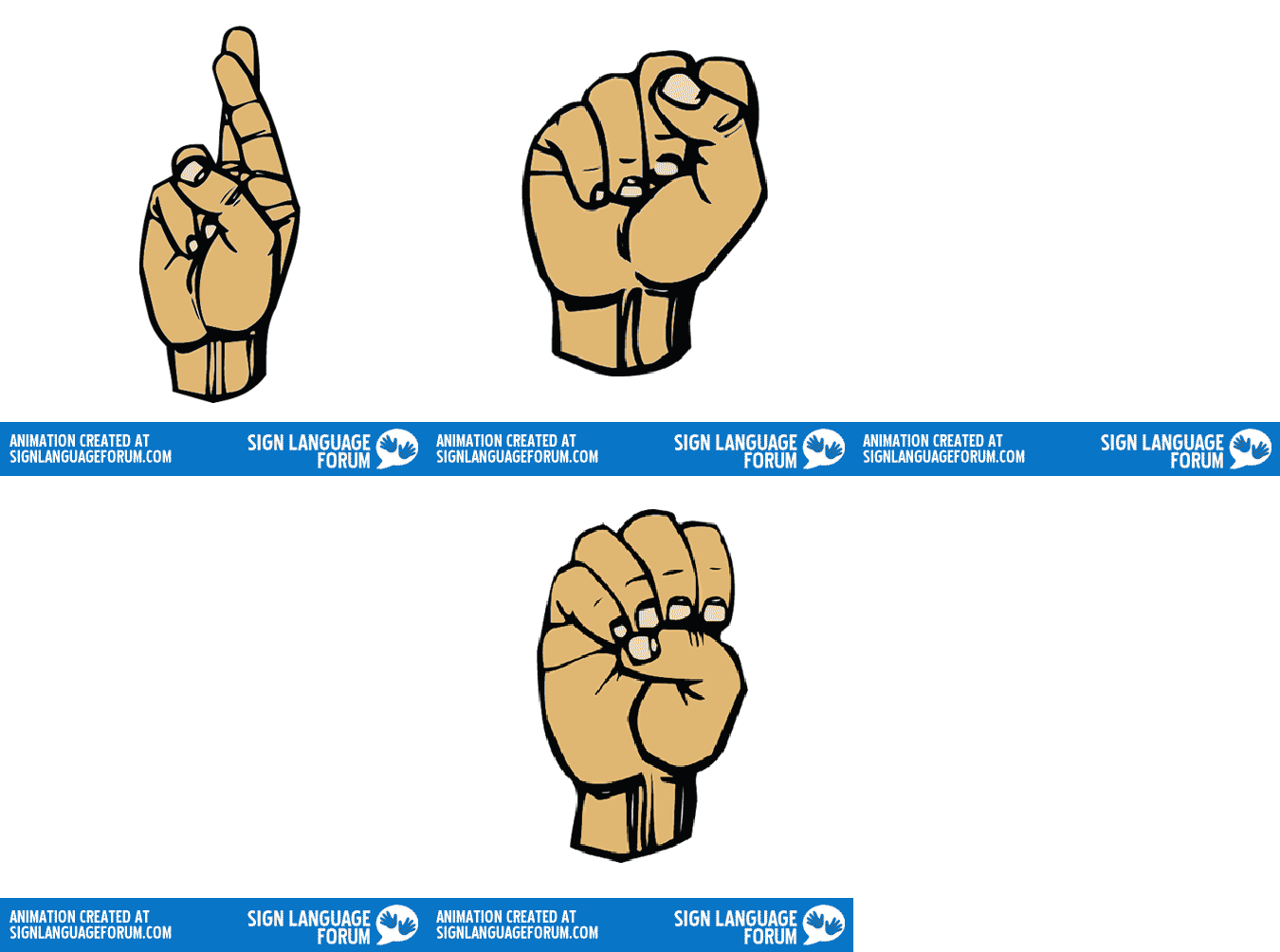
As you can see from the animated graphic above this section an example of the ASL animation generator available at signlanguageforum.com – This one spells “resources.”

There are several sites online where you can type in your own words or phrases using fingerspelling. For example, with either American Sign Language or British Sign Language (BSL).

Please Shorten that Sermon

How long should a sermon be? There’s no universal answer to that question – unless you opt for the Holy Spirit gambit and claim you or your pastor preach inerrantly as the Spirit dictates.

The truth is, I can tell a lot about a person’s religious background or current preferences by their honest answer. That’s one of the first lessons a military chaplain learns. Different traditions possess vastly different expectations about sermon lengths.

There are plenty of individual exceptions to the rule, of course. But let me throw out a couple generalizations. People in mainline churches think the sweet spot is around 15 minutes. For many, 12 would be even more desirable, although most can tolerate 20 minutes before beginning incessant time checks on their watches or other devices. In the minds of some, brevity is next to godliness.

For many evangelicals, particularly pentecostals and more fundamentalist communions, a 15 minute sermon is an oxymoron. Anything less than half an hour is simply a devotion or meditation, and any preacher worthy of the title should be able to preach a 45 minute sermon without working up a sweat.

So, in the case of a chaplain preaching for two to three different congregations on a Sunday morning, you would need to tailor your sermons differently for various congregations. Otherwise, if you attempted to strike a happy medium, you ran the risk of having your evangelicals feeling shortchanged and your mainline protestants with eyes glazing over.

Recognizing these differences is helpful, lest we slip into that normal misconception that our assumptions/experiences/logic are shared by others. One evangelical seminary professor, clearly writing for others from a similar tradition as his own, illustrates my point.

The average sermon length, according to one poll, ranges 20 to 28 minutes. If this statistic is accurate, it is a telling indicator of the spiritual depth of today’s churches. Many churches have already discontinued their evening services. With the trend of reducing the length of Sunday morning sermons, our generation is receiving less than half the biblical teaching our parents sat under.

The better a person understands the Word of God, the more they will grow spiritually. . . . I find it difficult to believe that current pastors and their 20 minute sermon-ettes can reach any level of comparable depth to the 80 minutes (or more) pastors used to be given (between the morning and evening services).

I have been pondering this subject not because my own pastor’s sermons are too long. Actually, a few days ago the delightful newsnote, “Today in Christian History,” featured an intriguing note. It is one of Christianity Today’s free newsletters.

It described an incipient Crusade that was derailed before it set out, due to too much of a good thing (too much preaching).

September 26, 1460: Pope Pius II assembles European leaders, then delivers a three-hour sermon to inspire them to launch a new crusade against the Turks. The speech works, but then another speaker, Cardinal Bessarion, adds a three-hour sermon of his own. After six hours of preaching, the European princes lose all interest in the cause; they never mount the called-for crusade.

This is precisely the sort of event I cannot resist learning more about. In short, Pius was a talented orator who had written popular erotic literature during his pre-papal years. Bessarion was a Greek priest who coordinated the effort of Byzantine Emperor John VIII Palaeologus to reunite the Eastern and Western churches to protect Constantinople from the Turks. In 1463, a decade after the city fell to the Ottomans, Bessarion was appointed the Latin Patriarch of Constantinople.

If only Cardinal Bessarion had preached a shorter sermon, perhaps the glorious Hagia Sophia would still resound with the praise of Christ.

How to Measure Sermons

One of the worst ways to weigh a sermon, to consider its worth, is by considering its duration. There is nothing intrinsically better about a sermon that lasts 20 minutes than one of half that length. Barring extremes (e.g. Pius’ and Bassarion’s extended monologues or some jargon-laced, religious pop message modeled after fleeting modern commercials), duration matters little.

I think we could all agree that it is the substance of the message which is shared, that matters. This is where the Holy Spirit leads the way. The sermon should be based on God’s truths. It should be tailored to meet the needs of its particular hearers. And it should be timely, attuned to this specific moment.

Unfortunately, we do tend to associate sermons with extended lectures. In a 1962 letter to one of his regular correspondents, Lewis responds to her question about animals and heaven. After explaining his view, he concludes the letter with an apologetic “But this is turning into a sermon!” In truth, his comments are of the ideal duration to address the question at hand.

And that – an ideal length for the specific context – is the goal for which all preachers should strive.

A Mere Inkling Bonus

I’ve written about the importance of listening to sermons in the past. It includes an entertaining account of C.S. Lewis’ boredom during some of the sermons in his home parish. You can also read here about Lewis’ own experiences as a preacher.

One of C.S. Lewis’ rewarding essays is entitled “The Sermon and the Lunch.” Lewis uses the occasion of a sermon to explore the nature of family. The pastor offers a textbook endorsement of the importance of family, where “we can fling aside the weary disguises of the outer world and be ourselves.” Thereupon, he quickly loses the congregation’s attention.

Lewis’ own thoughts are distracted by his awareness of the pastor’s own family. Having been a guest in the home, Lewis knows the family dynamics fall far short of the ideal he is presenting. However, it is not hypocrisy which disturbs him. It is the fallacious premise upon which the sermon is based. You can read the entire essay at the link on its title in the previous paragraph, or you can listen to a reading of the essay on the link below. Here, however, is the reason for Lewis’ discomfort.

The memory of that lunch worries me during the last few minutes of the sermon. I am not worried by the fact that the Vicar’s practice differs from his precept. That is, no doubt, regrettable, but it is nothing to the purpose. As Dr. Johnson said, precept may be very sincere (and, let us add, very profitable) where practice is very imperfect, and no one but a fool would discount a doctor’s warnings about alcoholic poisoning because the doctor himself drank too much.

What worries me is the fact that the Vicar is not telling us at all that home life is difficult and has, like every form of life, its own proper temptations and corruptions. He keeps on talking as if ‘home’ were a panacea, a magical charm which of itself was bound to produce happiness and virtue. The trouble is not that he is insincere but that he is a fool. He is not talking from his own experience of family life at all: he is automatically reproducing a sentimental tradition – and it happens to be a false tradition. That is why the congregation have stopped listening to him.

Humorous Examinations

Could you pass this examination?

Sketch the development of human thought, estimate its significance. Compare with the development of any other kind of thought.

In contrast to the serious tone of the last two posts, today I am offering some edifying entertainment. As a gift to you, I have edited a perennial favorite of internet humorists. I recently came across my copy of this comprehensive knowledge examination, which motivated me to tweak it for Mere Inkling’s erudite audience.

You have probably seen versions of this exam in the past. The basic questions have remained surprisingly stable despite its age. I encountered it in the University of Washington campus paper in 1973. One writer claims “the Graduation Exam—Authentic Assessment has been in circulation since at least the 1950’s.”

The exam certainly makes the rounds, as this Navy veteran described.

The pressures of comprehensive exams were apparent to many, which resulted in one of the few officially sanctioned jokes in Naval Nuclear Power. In one of the official publications of Naval Reactors, someone inserted a sample “final exam” from Nuclear Power School.

In 2012 elements of the examination created confusion in the People’s Republic of China. It was included in an article about how Chinese nationals could prepare for an American State Department exam required for positions at the United States embassy in Beijing. According to China’s Global Times, “US embassy spokesman Richard Buangan made clear on his Sina microblog Sunday that an alleged ‘recruitment test for expatriate employees at the US embassy’ is fake.”

A June 2008 issue of Foreign Service Journal carried a story, which includes an English version of the [exam stating] the questions are from the US State Department’s entrance exam, in a bid to “measure the stability of perspective Foreign Service officers and to weed out the dummies.”

The Function of Examinations

Testing and documenting competence is obviously important. This is especially true for people in critical roles, such as prescribing drugs, designing aircraft engines, and manufacturing ice cream.

Of course, not everyone is able to pass every test. Which is precisely how things should be.

C.S. Lewis noted how educators truly familiar with their students readily recognize when it is a waste of time for them to continue repeating an exam they obviously cannot pass. He said an academic “master often knows, when boys and parents do not, that it is really useless to send a boy in for a certain examination again” (The Problem of Pain).

I have met very few people who enjoy being tested. Yet, for many faculty members (C.S. Lewis included), being on the “other side” of exams is not particularly enjoyable either. This delightful passage comes from a 1927 letter to his brother, Warnie.

My period of examining passed over with its usual accompaniment of neuralgia and oaths, relieved by the one excellent boy who defined ‘a genie’ correctly, yet more than correctly, as ‘an eastern spirit inhabiting bottles and buttons and rings.’ Pretty good for a boy.

I was also pleased with a youth who, being asked to write a letter to a friend recommending Guy Mannering,* wrote to his brother recommending it and saying ‘I think you would be interested in the character of Colonel Mannering, he is so like our father’: and then later in a paper on Guy Mannering in which I had set the question ‘Would you have liked Colonel Mannering as a father?’—illustrate your answer etc.—began decisively ‘I would not have liked Colonel Mannering as a father in the least.’

Well, it’s time now to offer you the opportunity to prove your worthiness. If you wish to evidence the breadth and depth of your knowledge, proceed now to the exam. (Astute readers will note I’ve added a personal twist to a couple of the exam questions.)

Comprehensive Knowledge Exam

HISTORY: Describe the history of the papacy from its origins to the present day, concentrating especially, but not exclusively, on its social, political, economic, religious, and philosophical impact on Europe, Asia, North and South America, and Africa. Be brief, concise, and specific. Now do the same for the Zoroastrian priesthood. [Bonus credit for including Antarctica in your response.]

MEDICINE: You have been provided with a razor blade, a piece of gauze and a bottle of scotch. Remove your appendix. Do not suture until your work has been inspected. You have fifteen minutes. [Option: if you feel the scotch would impair your responses to the remaining questions, you may defer this portion of the exam to the end of the exam.]

PUBLIC SPEAKING: Two thousand riot-crazed anarchists are storming the campus. Calm them. You may use any ancient language except Latin, Greek or Sanskrit. [Pig Latin is allowed.]

BIOLOGY: Postulate the 500 million year progression of a life form based on silicon, ranking its likely preference for form of government Enumerate the pros and cons it would associate with democracy, monarchy, socialism, theocracy, and totalitarianism. [Caution: any references to the Horta of Janus VI will result in disqualification of your answer, since Star Trek is a fictional resource.]

MUSIC: Write a piano concerto. Orchestrate and perform it with flute and digeridoo. You will find a piano under your seat. The wind instruments, of course, were among the items you were directed to bring with you to the examination.

PSYCHOLOGY: Based on your knowledge of their works, evaluate the emotional stability, degree of adjustment, and repressed frustrations of each of the following: Alexander of Aphrodisias, Hildegard of Bingen, Rābi’a bint Ka’b al-Quzdārī and Simeon the Stylite. Support your evaluation with quotations from each individual’s work, citing original sources. It is not necessary to translate.

SOCIOLOGY: Using the pretext of Planet of the Apes, where homo sapiens have been subordinated to various primate species, assess the prospects for achieving mutual toleration and equilibrium before one group is driven to extinction. [Caution: confusion of apes (which lack tails) and monkeys (which lack an appendix) will result in disqualification of your response.]

CHEMISTRY: Transform lead into gold. You will find a beaker, a three hundred count box of matches and five lead sinkers under your seat. Show all work including Feynman diagrams and quantum functions for all steps. [Transformation into silver will provide half credit.]

ENGINEERING: The disassembled parts of a high-powered rifle have been placed on your desk. You will also find an instruction manual, printed in Swahili. In 10 minutes a hungry Bengal tiger will be admitted to the room. [Special Consideration: Satisfactorily explain the differences between Fahrenheit and Celsius to the tiger, and it will be replaced by a rabid ferret.]

ECONOMICS: Develop a realistic plan for refinancing global debt, without hypothesizing a benevolent intergalactic alliance with unlimited resources coming to the planet’s aid. Trace the possible effects of your plan in the following areas: Cubism, the Donatist controversy, and the 1913 foundation of Hôpital Albert Schweitzer in Gabon.

POLITICAL SCIENCE: Devise an infallible, seven-step plan to transform the United Nations into an organization that will successfully foster peace and goodwill in all international relationships. [Bonus credit for providing a major role for two of the following nations: Dominica, Liechtenstein, Tuvalu.]

AGRICULTURAL SCIENCE: Outline the steps involved in breeding your own super high yield, all weather hybrid strain of wheat. Describe its chemical and physical properties and estimate its impact on world food supplies. Construct a model for dealing with world-wide surpluses. Draft your Nobel Prize acceptance speech.

PHYSICS: Explain the nature of matter. Include in your answer an evaluation of the impact of the development of mathematics on astronomy, botany and numismatics. [Bonus Credit: write today’s date in metric.]

PHILOSOPHY: Sketch the development of human thought, estimate its significance. Compare with the development of any other kind of thought. Be sure to include an analysis of the influence exerted on philosophy by Diogenes the Cynic.

CREATIVE WRITING: Compose an epic poem based on the events of your own life in which you see and footnote allusions from T.S. Eliot, Titus Lucretius Carus, Miguel de Cervantes, Dante Alighieri, Þorbjörn Hornklofi, Gilgamesh and Stephen King. Critique your poem with a full discussion of its syntax and metrics. [Bonus Credit for writing alternating stanzas between free and rhyming verse.]

EDUCATION: Formulate an examination which accurately measures an individual’s comprehensive knowledge base without cultural or linguistic prejudice. Limit the question parameters to what can reasonably be covered during a four hour testing block.

LITERATURE: Discuss in detail at least three major literary figures from each of the following civilizations: the Xia Dynasty, the Akkadian Empire, the Mayan Empire, the Aksumite Empire, the Polynesian Tuʻi Tonga Empire, and nineteenth century United Kingdom. [Caution: failure to include J.R.R. Tolkien and/or C.S. Lewis will result in disqualification of your answer to this question.]

Congratulations on finishing the exam. You are encouraged to use any remaining time to review your answers in light of the fact that grammatical errors and misspellings will significantly impact your final grade.


* You can download a personal copy of Guy Mannering, one of Sir Walter Scott’s Waverly novels, at Internet Archive.

If you should question the distinctions I noted between apes and monkeys, please know that the facts are genuine. However, for future examinations, you should be aware that not all monkeys have tails.