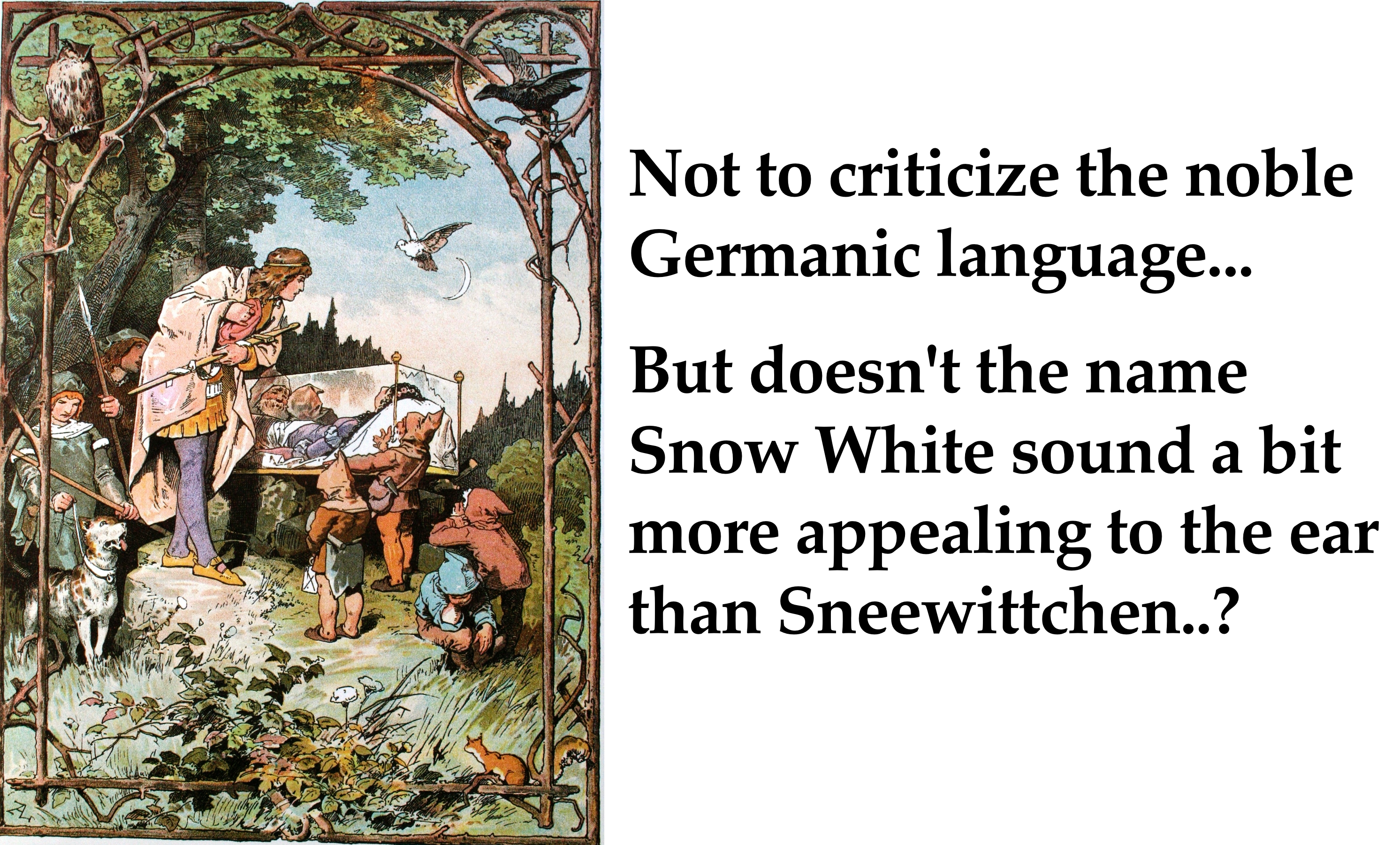
C.S. Lewis, the Brothers Grimm & Snow White

You may blame the recent cinematic debacle that is Snow White on a declining Film Studio or the Brothers Grimm, but C.S. Lewis is innocent.

That’s not to say the Grimms didn’t have an influence on the great Oxbridge professor, a subject we’ll explore momentarily. But it was the German folk tales published by academics Jacob and Wilhelm Grimm who published the classic fairy tales that Walt Disney mined so effectively. 

They also popularized CinderellaHansel and GretelLittle Red Riding HoodThe Princess and the Frog, and Rapunzel. Disney began the transformation of these tales into visual treasures as early as 1921 when he founded Laugh-O-Gram Studio in Kansas City, Missouri.

In addition to films, over the years Walt gleaned memorable Grimm stories for a multitude of cartoon shorts, including The Brave Little Tailor and The Four Musicians of Bremen.

Obviously, Walt Disney himself respected the source material for the stories and wielded his editorial prerogative in an appropriate manner. Tragically, the same cannot be said for his corporate heirs. Likewise, the Brothers Grimm bear no culpability in this area.

C.S. Lewis, J.R.R. Tolkien & Snow White

The truth is, although Lewis and Tolkien appreciated literary fairy tales, neither of the preeminent Inklings were enamored with Disney’s animated treatment of the stories. Curiously, the two distinguished dons actually attended the theater together to view the trailblazing novelty that was Snow White.

They were particularly disappointed with the dwarves, seeing just how different they were from the genuine legends about them. Lewis even wrote “Dwarfs ought to be ugly of course, but not in that way.” Atlas Obscura has an entertaining article about their “movie date” and notes some of the elements they also enjoyed in the feature.

In his lectures published as A preface to Paradise lost, C.S. Lewis elaborates on his response to the Disney version of the tale.

That strange blend of genius and vulgarity, the film of Snow-White, will illustrate the point. There was good unorginality in the drawing of the Queen. She was the very archetype of all beautiful, cruel queens: the thing one expected to see, save that it was truer to type than one dared to hope for.

There was bad originality in the bloated, drunken, low-comedy faces of the dwarfs. Neither the earthiness, the avarice, nor the wisdom of true dwarfs was there, but an imbecility of arbitrary invention.

But in the scene where Snow-White wakes in the woods both the right originality and the right unoriginality were used together. The good unoriginality lay in the use of small, delicate animals as comforters, in the true Märchen [fairy tale] style. The good originality lay in letting us at first mistake their eyes for the eyes of monsters.

If you want to read more about the subject, you can do no better than read Joe Christopher’s article on the subject.

For an interesting argument that fellow Brit G.K. Chesterton would have loved Snow White for the very reason that moved the Inklings to criticize it, see “Tolkien and Lewis disliked Snow White. You know who wouldn’t have?

C.S. Lewis & Grimm’s Fairy Tales

Like his friend, J.R.R. Tolkien, C.S. Lewis was a champion of classical fairy tales. Neither was apologetic for it, although Lewis admitted to being shy about it when he was young. In an essay titled “On Three Ways of Writing For Children,” he wrote,

When I was ten, I read fairy tales in secret and would have been ashamed if I had been found doing so. Now that I am fifty I read them openly. When I became a man I put away childish things, including the fear of childishness and the desire to be very grown up.

In a great post called “Old Enough For Fairy Tales: C.S. Lewis’ “The Chronicles of Narnia” the writer describes this distinction to which Lewis alludes.

The Chronicles of Narnia are not children’s stories. They are fairy tales—but that is precisely why they are not children’s stories. If you can’t understand, you haven’t been listening. Go back and read the quote from Lewis’ essay again. Children are not the only audience for fairy tales.

In 1954, C.S. Lewis apologized to a German professor for being unable to understand the nuances of his volume on philosophy. In doing so, he referred to his youthful reading of the Brothers Grimm in their original German (available at Internet Archive).

I look forward to reading the book (when the translation arrives! My German is wretched, and what there is of it belongs chiefly to the libretto of the Ring and Grimm’s Märchen – works whose style and vocabulary you very possibly do not closely follow).

If you are in the mood for reading Grimm’s Fairy tales today, and your German is sadly lacking, Project Gutenberg has just the translation for you . . . as long as you can read English.


Addendum [added 10 April 2025]

The Brothers Grimm were far more than simply folklorists. They were respected professors at the University of Göttingen. They were devout Christians and worked with other prominent Germans. 

Goethe assisted them at a crucial moment in collecting their tales, and the philosopher Friedrich Schleiermacher provided copyediting assistance. Jacob’s work on German mythology had a pronounced influence on the composer Richard Wagner (World Magazine).

They also began compiling the Deutsches Wörterbuch (Germany dictionary) in 1838, with the first volumes published in 1854. It was the first dictionary to include historical usages of each word, preceding the Oxford English Dictionary, which was initiated in 1857 with its first edition published in 1884.


Bonus Trivia: The dwarves were unnamed until their debut on Broadway in 1912. And on that day they were christened Blick, Flick, Glick, Plick, Snick, Whick and Quee.

Blackout Writing

Do you have trouble coming up with ideas for your poems or stories? How about starting with an interesting collection of words and winnowing them down to a creation of your own? Read on to learn more about a simple process.

A few years ago a fellow pastor told me he could write, even short articles like blog posts. Since he had successfully completed a challenging graduate program, I was a bit shocked at this disclosure. “The problem,” he said, “is that I just can’t come up with any ideas for what to write.”

I had two reactions. First, I was amazed, since I can’t get through a day without encountering at least a handful of observations that beg to be explored. Second, I wondered just what sort of sermons his congregation was exposed to, if creative imagery and fresh ways of expressing God’s timeless truths were not coming from their pulpit.

One of the ways I attempt to improve my own writing is by stretching. In my personal shorthand, this refers to engaging in new forms of writing. Principally that means voluntarily jumping into sometimes ominous literary waters. I stretch myself by humbly engaging in genres which I may, in all honesty, find intimidating.

For example, occasionally, when bored with outlining books that may never get written, I’ll just scribble out some “impromptu verse.” Some of it turns out rather decent. (You’ll notice I didn’t say “excellent.”)

Blacking Out Words to Compose New Literature

I had heard of Blackout Poetry before, but never attempted to “write” any. Actually, it seems to me that “decompose” might be a more accurate word for this type of creating. Although most commonly used to create brief works, such as poetry, the concept can be used for narratives as well.

If you are unfamiliar with the process, you may enjoy the following, introductory articles.

Teach Kids Art” explains the basic process and then adds some visual artistry to the mix.

Blackout Poetry is a form of “found poetry” where you select words that catch your interest from a newspaper, book, or other printed text – along with a few additional words to make it flow. Then you “redact” all the words you don’t want. This is often (but not always) done with a black marker, hence the name “blackout poetry.” Your chosen words will form a new message, giving the text a whole new meaning.

Take your Blackout Poetry a step further by adding patterns, designs, or a drawing to the areas you’re “redacting.” For example, instead of just filling in around your chosen words with solid black, you could create a drawing or design that relates to your poem. Just as with any illustration, your art should support the remaining text and add to its meaning.

Looking Beyond the Comfort Zone” discusses a reservation many will have about pursuing blackout writing.

I really wanted to give it a try. There were however a few obstacles to overcome. First was my ingrained prohibition of defacing books. Although I owned a highlighter in college I rarely used it. It seemed wrong. . . .

Secondly the blackout poetry requires making the page unreadable for the original words. I felt a lot of good old-fashioned guilt in the prospect of destroying someone’s story. Lastly, I didn’t have any books that I felt so little regard for that I could take a sharpie marker to the pages.

I, personally, have eliminated the second reservation by scanning an image of each experimental page and blacking words out digitally. It would be just as simple to print out such an image, or simply use a copier with a physical book, if you prefer to create your work manually. My method eliminates another potential problem for bibliophiles, the damage often caused to a book’s spine when attempting to flatten the page for copying.

5 Tips for Creating Blackout Poetry” claims the genre is “the best cure for writer’s block.” To enhance miscellany, they suggest “when picking an article to use, it’s best not to read it too closely.”

That way, you aren’t overly influenced by the author’s original work and you can create something uniquely your own.

This suggestion will certainly be beneficial in liberating the creativity of many writers. For my own purposes, I disregarded this advice, since I intentionally desired to use words by or about particular authors. I honestly want the original context to be in my mind during the metamorphosis.

A final source, “A blackout poem on the Trinity,” reveals how a writer in Europe found inspiration in the writings of C.S. Lewis for her own poem about the Trinity. Check out Christine’s verse at the link above.

This is the first time I’ve tried a blackout poem. They work by taking a page of text and then blacking it out until only the remaining words give you the poem.

In the end, I chose “It all began with a picture . . .” published in the Junior Section of The Radio Times on 15 July 1960. It’s a short and sweet description of how Lewis was inspired to write the Narnia stories.

My Initial Attempts

As I mentioned above, I scanned printed pages that you can easily find at Internet Archives, Google Books, Project Gutenberg and various other sites.

I did not attempt to write poetry. Rather, I used each page to write a brief, new narrative. Of my first three efforts, I was most pleased with “Savage Editing,” displayed above. Below, I will place it beside the original page, from The Collected Poems Of  G.K. Chesterton.

I’ll close by passing on to you the experience of the author who composed an ode on the Trinity, using an article about C.S. Lewis. My guess is that you too – should you be so bold as to attempt writing your own blackout works – will experience a similar satisfaction.

It’s hard being constrained by the page of text in front of you. The more you black out, the less you say; but the less you black out, the less impact each word has. It’s a game of compromise, striking the balance between being artistic and understandable.

But I think the end result is a celebration of both Lewis’ work and the Trinity.


The illustration below shows my blackout, which I entitled “Savage Editing,” beside the original page, which includes a portion of “The Scouring of the Horse,” from The Collected Poems Of  G.K. Chesterton. “The Scouring” is the final book in Chesterton’s Ballad of the White Horse.

George MacDonald’s Poetry

George MacDonald (1824-1905) was a prolific Scot writer. His legacy was amplified due to his influence on G.K. Chesterton and C.S. Lewis. (He was also a friend of Mark Twain.) An essay, originally presented as a speech by G.K. Chesterton, is available online.

Chesterton goes so far as to say, “if to be a great man is to hold the universe in one’s head or heart, Dr. MacDonald is great. No man has carried about with him so naturally heroic an atmosphere.” Listen to his description of that special type of literature that inspired many Inklings, chiefly C.S. Lewis and J.R.R. Tolkien.

Many religious writers have written allegories and fairy tales, which have gone to creating the universal conviction that there is nothing that shows so little spirituality as an allegory, and nothing that contains so little imagination as a fairy tale. But from all these Dr. MacDonald is separated by an abyss of profound originality of intention.

The difference is that the ordinary moral fairy tale is an allegory of real life. Dr. MacDonald’s tales of real life are allegories, or disguised versions, of his fairy tales.

It is not that he dresses up men and movements as knights and dragons, but that he thinks that knights and dragons, really existing in the eternal world, are dressed up here as men and movements.

C.S. Lewis, for his part, praised MacDonald as instrumental in tilling the soil for his eventual conversion to Christianity. He was on the defensive, since the writers which most inspired him shared a common flaw – they were Christians.

All the books were beginning to turn against me. Indeed, I must have been as blind as a bat not to have seen, long before, the ludicrous contradiction between my theory of life and my actual experiences as a reader.

George MacDonald had done more to me than any other writer; of course it was a pity he had that bee in his bonnet about Christianity. He was good in spite of it.

Chesterton had more sense than all the other moderns put together; bating, of course, his Christianity. Johnson was one of the few authors whom I felt I could trust utterly; curiously enough, he had the same kink. Spenser and Milton by a strange coincidence had it too (Surprised by Joy).

Lewis would actually come to edit a selection of MacDonald’s passages for an edifying anthologyThis post includes a link for downloading a copy of George MacDonald: An Anthology.

This week I was reading one of MacDonald’s excellent essays, which appears in The Imagination and Other Essays. I intend to discuss some of his thoughts on age and writing soon. Although I am not an aficionado of poetry – despite having composed poetry from time to time, including quintains, I turned to another of MacDonald’s books.

On to His Poetry

I decided to follow up MacDonald’s brilliant essay with a dip into his poetry. Fortunately, Internet Archive allows you to freely download a complete copy of MacDonald’s Scotch Songs and Ballads, published in 1893. My conscience forces me, however, to provide a single caveat. Be forewarned that the tome is not suited for those intimidated by pronounced dialects.

Before looking at one of his poems in its entirety, allow me to share with you a passage from “The Waesome Carl” which I particularly enjoyed (due to its portrait of a preacher). 

The minister wasna fit to pray
And lat alane to preach;
He nowther had the gift o’ grace
Nor yet the gift o’ speech!
He mind’t him o’ Balaäm’s ass,
Wi’ a differ we micht ken:
The Lord he opened the ass’s mou,
The minister opened’s ain!
He was a’ wrang, and a’ wrang,
And a’thegither a’ wrang;
There wasna a man aboot the toon
But was a’thegither a’ wrang!
The puir precentor couldna sing,
He gruntit like a swine . . .

Not that I claim able to decipher it all, but my impression is that it’s not especially flattering. It is definitely entertaining. And I humbly think I interpret it significantly more accurately than Google’s online translator, which provided the following version.

The minister was not fit to pray
And lat alane to preach;
He nowther had the gift o’ grace
Nor yet the gift o’ speech!
He mind’t him o’ Balaam’s ass,
Wi’ a differ we micht ken:
The Lord he opened the ass’s mou,
The minister opened his eyes!
He was a’ wrang, and a’ wrang,
And a’thegither a’wrang;
There was a man aboot the toon
But thegither was wrong!
The puir precentor couldna sing,
He grunted like a swine. . .

Using the Dictionars o the Scots Leid, you can make perfect sense of the words about which you may be uncertain. (Thank you, Scotland.)

Dialects are interesting things indeed. I will close with another of MacDonald’s poems. I submit it for (1) those who comprehend the dialect, (2) those who deem precious their Scottish ancestry, (3) those with an affinity for Connor MacLeod, and (4) those who simply enjoy a challenge.

Nannie Braw

I like ye weel upo Sundays, Nannie,
I’ yer goon and yer ribbons and a’;
But I like ye better on Mondays, Nannie,
Whan ye’re no sae buskit and braw.

For whan we’re sittin sae douce, Nannie,
Wi’ the lave o’ the worshippin fowk,
That aneth the haly hoose, Nannie,
Ye micht hear a moudiwarp howk,

It will come into my heid, Nannie,
O’ yer braws ye are thinkin a wee;
No alane o’ the Bible-seed, Nannie,
Nor the minister nor me!

Syne hame athort the green, Nannie,
Ye gang wi’ a toss o’ yer chin;
And there walks a shadow atween ‘s, Nannie,
A dark ane though it be thin!

But noo, whan I see ye gang, Nannie,
Eident at what’s to be dune,
Liltin a haiveless sang, Nannie,
I wud kiss yer verra shune!

Wi’ yer silken net on yer hair, Nannie,
I’ yer bonnie blue petticoat,
Wi’ yer kin’ly arms a’ bare, Nannie,
On yer ilka motion I doat.

For, oh, but ye’re canty and free, Nannie,
Airy o’ hert and o’ fit!
A star-beam glents frae yer ee, Nannie–
O’ yersel ye’re no thinkin a bit!

Fillin the cogue frae the coo, Nannie,
Skimmin the yallow ream,
Pourin awa the het broo, Nannie,
Lichtin the lampie’s leme,

Turnin or steppin alang, Nannie,
Liftin and layin doon,
Settin richt what’s aye gaein wrang, Nannie,
Yer motion’s baith dance and tune!

I’ the hoose ye’re a licht and a law, Nannie,
A servan like him ‘at’s abune:
Oh, a woman’s bonniest o’ a’, Nannie,
Doin what maun be dune!

Cled i’ yer Sunday claes, Nannie,
Fair kythe ye to mony an ee;
But cled i’ yer ilka-day’s, Nannie,
Ye draw the hert frae me!

Addendum:

For those interested in pursuing this linguistic subject, I just came across a delightful 1896 collection of works you can download for free. Legends of the Saints: in the Scottish Dialect of the Fourteenth Century is “edited from the unique manuscript in the University Library, Cambridge.”


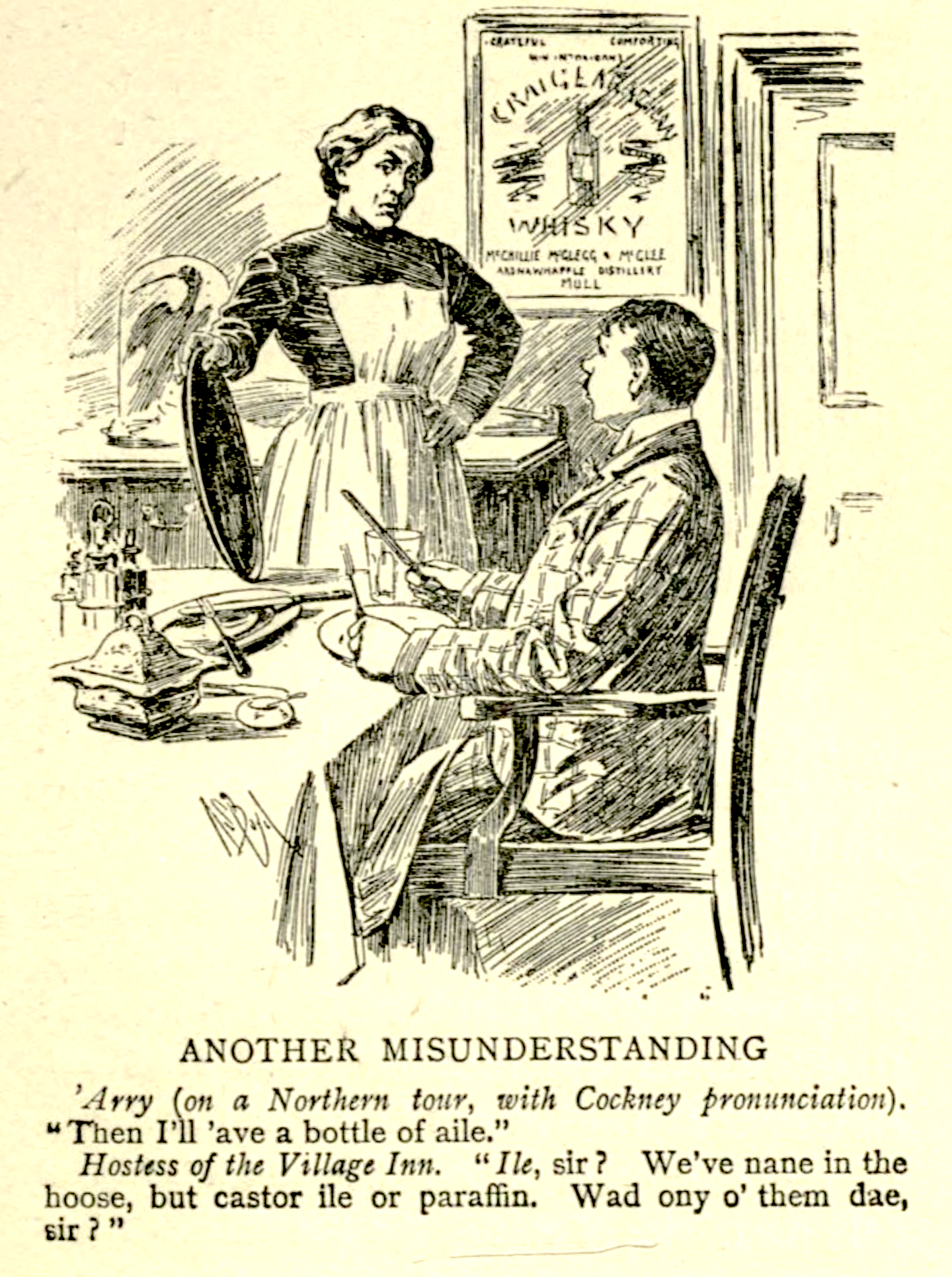
The cartoon above comes from Mr. Punch in the Highlands which was published “with 140 illustrations” more than a century ago. You can download your personal copy of humorous work at Internet Archive.

The Church at War

Why would Christian Scriptures commend people for waging war? War, after all, is nearly universally condemned – even as it remains a relentless curse in various corners of our world.

One young pastor was “charged” with a duty that belongs, by biblical extension, to all believers. “This charge I entrust to you [that] you may wage the good warfare, holding faith and a good conscience” (1 Timothy 1).

The reason followers of Jesus are encouraged to actively train for and engage in war is because our enemies are not other human beings. We discussed this fact in our last conversation, as we considered the theological concept of the Church Militant.

To call the Body of Christ “militant” is misleading to those who don’t understand spiritual warfare, the fact that “we do not wrestle against flesh and blood, but against . . . the cosmic powers over this present darkness . . .” (Ephesians 6).

Unfortunately, because all of us are imperfect (i.e. fallen), Christians can sometimes fail to distinguish between our true enemies and those who witlessly follow their banner. For an excellent discussion of this, from a Roman Catholic perspective, I recommend you read “The Church Militant or the Church Belligerent?

Another worthwhile read is “G.K. Chesterton and the March of the Church Militant.” There, Joseph Pearce shares Chesterton’s vivid description about how Gothic cathedrals visualize the martial aspect of the Christian Church.

The truth about Gothic [architecture] is, first, that it is alive, and second, that it is on the march. It is the Church Militant; it is the only fighting architecture.

All its spires are spears at rest; and all its stones are stones asleep in a catapult. In that instant of illusion, I could hear the arches clash like swords as they crossed each other. The might and numberless columns seemed to go swinging by like the huge feet of imperial elephants.

The graven foliage wreathed and blew like banners going into battle; the silence was deafening with all the mingled noises of a military march; the great bell shook down, as the organ shook up its thunder.

The thirsty-throated gargoyles shouted like trumpets from all the roofs and pinnacles as they passed; and from the lectern in the core of the cathedral the eagle of the awful evangelist crashed his wings of brass (“The Architect of Spears”).

As a master of words and wit, Chesterton’s writing rarely disappoints. You can download a free copy of The Man Who was Chesterton, which includes this essay, from Internet Archive.

C.S. Lewis did more to equip us for spiritual warfare with The Screwtape Letters than a thousand clergy with a hundred thousand sermons. As one Baptist theologian summed it up in an article about spiritual warfare:

On the subject of spiritual warfare, Lewis is a helpful guide. I’ll remember what he taught: There is an enemy. He seeks my destruction. And this is war.

There is a brilliant quote about this supernatural confrontation, ascribed (apparently in error) to the historical Martin Luther.

If I profess, with the loudest voice and the clearest exposition, every portion of the truth of God except precisely that little point which the world and the devil are at that moment attacking, I am not confessing Christ, however boldly I may be professing Christianity.

Where the battle rages the loyalty of the soldier is proved; and to be steady on all the battle-field besides is mere flight and disgrace to him if he flinches at that one point.

C.S. Lewis echoes this sentiment in The Magician’s Nephew. When Aslan questions the humble man whom he would crown the first King of Narnia, he poses a query which reveals the man’s courage and humility.

“And if enemies came against the land (for enemies will arise) and there was war, would you be the first in the charge and the last in the retreat?”

“Well, sir,” said the Cabby very slowly, “a chap don’t exactly know till he’s been tried. I dare say I might turn out ever such a soft ’un. Never did no fighting except with my fists. I’d try – that is, I ’ope I’d try – to do my bit.”

“Then,” said Aslan, “you will have done all that a King should do.”

If anyone would follow Christ, neutrality is not an option. Though some temporary retreats are inevitable, in God’s strength, we are empowered to continue our (in reality, the Lord’s) advance.

The battlelines are drawn, and they are real. As C.S. Lewis proclaimed in “Christianity and Culture” – “There is no neutral ground in the universe. Every square inch, every split second is claimed by God, and counterclaimed by Satan.”


The image above, “Livonian Sword Brother” (a member of a military monastic order) was created by JLazarusEB and is used here in compliance with the Creative Commons CC BY-NC-ND 3.0 License.

Looking Toward the New Year with the Inklings

If we were to ask C.S. Lewis, J.R.R. Tolkien and the rest of the Inklings for insights about a New Year, what wisdom might they share?

Read on. Mere Inkling answers that question with a few select quotations from their writings. We also include comments from several other writers associated, in spirit, with the Oxford Inklings.

While some of the pithiest of the quotations below are well represented at quotation websites, your humble host has secured the less familiar quotations through the diligent search of obscure manuscripts.

J.R.R. Tolkien:

From a holiday letter to a friend.

“There is small chance of this reaching you tomorrow Jan. 1 to wish you a Happy New Year. I hope you have plenty of food in store! It is my birthday on Jan. 3rd, and I look like spending it in the isolation of a house turned igloo; but the companionship of several bottles of what has turned out a most excellent burgundy (since I helped to select it in its infancy) will no doubt mitigate that: Clos de Tart 1949, just at its top. With that hobbit-like note I will close, wishing you and your wife and children all blessings in 1962.”

As the world conflict raged on, Tolkien wrote to his son Christopher who was serving in the Royal Air Force. “This empty year is fading into a dull grey mournful darkness: so slow-footed and yet so swift and evanescent. What of the new year and the spring? I wonder.”

Christopher Tolkien:

A scholar in his own right, Christopher devoted much of his life to editing his father’s published and unpublished works. In The End of the Third Age, he reminds us that sometimes the jobs on which we embark end up being far more involved than we anticipated. “With this book, my account of the writing of The Lord of the Rings is completed. I regret that I did not manage to keep it even within the compass of three fat volumes.

C.S. Lewis:

“What wonderful adventures we shall have, now that we are all in it together.”

“You are never too old to set another goal or dream a new dream.”

“Isn’t it funny how day by day nothing changes, but when you look back, everything is different.”

“I must keep alive in myself the desire for my true country, which I shall not find till after death; I must never let it get snowed under or turned aside; I must make it the main object of life to press on to that other country and help others to do the same.”

“If you live for the next world, you get this one in the deal; but if you live only for this world, you lose them both.”

“There are far, far better things ahead than any we leave behind.”

“I think that if God forgives us we must forgive ourselves. Otherwise, it is almost like setting up ourselves as a higher tribunal than Him.”

Charles Williams:

“I think in order to move forward into the future, you need to know where you’ve been.”

“Play and pray; but on the whole do not pray when you are playing and do not play when you are praying.”

Owen Barfield:

“. . . the poet, while creating anew, is likely to be in a sense restoring something old.”

In a short story entitled “The Devastated Area,” Barfield, a veteran of WWI, described the way a soldier can view an uncertain future. “Armistice day; the last shot; and the hushed, doubtful little group in the dug-out at 11 o’clock. He is sitting there in uniform, willing for the first time in three years to let his thoughts run on into the future. But they will go back to the past instead . . .”

Adam Fox:

In his history of English hymnody, Fox praises his nation’s people and offers timely advice regarding musical accompaniment. “It takes no long argument to prove that Hymn Singing is a national institution in Great Britain. It is so rather in the same way as cricket. . . . The singing is usually accompanied on an organ, or if there is no organ, then on a piano. The harmonium, though sometimes used for the purpose, cannot be recommended, and is falling into disuse.”

Jack A.W. Bennett:

In The Humane Medievalist, Bennett praises his friend and fellow Inkling, C.S. Lewis. Coincidentally, this essay was his own inaugural lecture as he assumed the Cambridge chair which had been created for Lewis himself. “C.S. Lewis died a year ago today, and the year has deepened not diminished our sense of loss. Those of us who had the good fortune to call him master must feel as the prentice Hoccleve felt about Chaucer: ‘Fain he would me have taught, But I was dull, and learned little or naught.’”

Lord David Cecil:

He begins his biography of Lord Melbourne with a curious sentence suggesting that even we who have lived the most average of lives, may still have great things ahead of us. “William Lamb, second son of the first Viscount Melbourne, had arrived at the age of forty-seven without achieving anything of significance in the world.”

Hugo Dyson:

Discussing the Tragedies written by Shakespeare, Dyson reminds us to recognize potential blessings in the coming year’s challenges. “Our awareness both of ourselves and of the world at large is intensified by confrontation with an unexpected or serious or painful situation. Our wits and imaginations alike grow more acute under difficulties.”

Nevill Coghill:

Referring to Chaucer’s portrayal of the Knight, Coghill describes an ongoing goal for those who will to live nobly. “There is a fundamental answer to those who want to think the Knight’s moral nature . . . was too good to be true, and so can be no better than a romantic illusion. People who think thus can never have thought about Christianity at all; that we can live up to the moral demands that it makes on us, and that at any moment we may fall into the pit that opens beneath us, does not lessen the love we are taught . . . to have, and to attempt. Christianity plainly tells us to be perfect, impossible as it seems, impossible as it proves; but this does not make that demand less real, or even less realistic . . . Coming to the aid of human imperfection, there is grace.”

A Special Bonus for Mere Inkling Readers as the Year Ends

And a few additional thoughts from writers with connections to our favorite Inklings.

George MacDonald:

“A man’s real belief is that which he lives by. What a man believes is the thing he does, not the thing he thinks.”

A reminder to trust God for his daily provision. “It is not the cares of today, but the cares of tomorrow, that weigh a man down. For the needs of today we have corresponding strength given. For the morrow we are told to trust. It is not ours yet. It is when tomorrow’s burden is added to the burden of today that the weight is more than a man can bear.”

“Past tears are present strength.”

Dorothy Sayers:

“Paradoxical as it may seem, to believe in youth is to look backward; to look forward we must believe in age.”

G.K. Chesterton:

“When it comes to life, the critical thing is whether you take things for granted or take them with gratitude.”

Joy Davidman:

“Being a fool for God was not merely alright but liberating.”

“We do not need a world in which there is nothing to be afraid of . . . Nor can we have such a world, for all our strivings; no matter pleasant and safe we make the journey, the end of it is death. What we do need is to remember that we have been redeemed from death and the fear of death, and at a rather high price too.”

Douglas Gresham:

“I am beginning to realize that every point in one’s life at which one loses everything is far more a beginning than an end, for one has lost merely the past, and one has yet to gain the future, and eternity itself.”

And, encouragement for those among us who are writers: “Don’t forget, the rejection by a publisher of a book that you’ve written is not a failure.”

One Final Bit of Wisdom for the New Year

The internet offers lots of valuable information, accessible with the click of a key. Unfortunately, a significant amount of it is unsubstantiated, and downright false. This includes the quotations attributed to various people.

Some largescale quotation “aggregators” consider attribution on other unvalidated sites sufficient justification for loading the questionable citations to their own pages. For example, check out the quotations attributed online to Lord David Cecil. Or, better yet, don’t.

During my research for this post I discovered many of them – or, at least those most beneficial to reflective minds – actually come from the pen of Richard Cecil (1748-1810), an Anglican priest. Here is a grand example of misattribution, particularly appealing to a pastor such as myself: “It requires as much reflection and wisdom to know what is not to be put into a sermon, as what is.”

We’ll close now with an apocryphal C.S. Lewis quote. Despite scores of sites attributing the following thought to Lewis, no one can find it anywhere in his work. It is, however, consistent with his wisdom, and leaves us with an optimistic truth as 2021 draws to a close.

“You can’t go back and change the beginning, but you can start where you are and change the ending.”

Amen. Lord, grant all those who read these words of wisdom, both now and during years to come, a blessed New Year.

Writing Styles Revisited (What is Yours?)

If you were to liken your personal writing to that of a famous author, who would you name? Are you similar to Emily Dickinson, or are you an echo of Charles Dickens?

Perhaps your words flow like Shakespeare’s or erupt in staccato, like Hemingway’s. If you are a member of a writing critique group – which I highly recommend – your friends may have offered their own suggestions about authors you resemble.

It just so happens there are a couple of tools that can offer hints as to the answer to this question. When I looked back at an earlier post on this subject, I was shocked to find I had written it all the way back in 2012. Yes, I know some of you were in grammar school then.

I shared then a site which was relatively new. The “I Write Like” site invites you to submit samples of your writing, which it compares to a range of famous authors. I am curious to try the process today, since the programmer continued to update it until 2016. Perhaps my results will be different than those from 2012.

Programs such as this are frankly quite limited. For those of you interested in the programmer who designed this one, you can check out an interview conducted when it was initially released. In the interview, Dmitry Chestnykh explains how his “algorithm is not a rocket science, and you can find it on every computer today. It’s a Bayesian classifier, which is widely used to fight spam on the Internet.”

My Own Results

I’m unsure how many authors our Russian friend has included in the comparison files. It does include historical and contemporary authors. I have no idea whether my favorite author, C.S. Lewis, found his way into the database or not. My results do reveal, however, that at least one of his fellow Inklings did make the cut.

Without further conversation, allow me to share the results from my experiment nearly a decade ago.

Make sure you include lengthy selections from your work. Also, testing the program with different genres (assuming you write in different styles) will actually give you new matches. (That is, of course, as it should be.)

I tried a number of times (no, not fishing for results I wanted, but using a variety of types of my writing) and here were the repeated results:

For my blog posts: H.P. Lovecraft or J.R.R. Tolkien
For my more formal essays: J.R.R. Tolkien or Jonathan Swift

These were admirable results with which I have been happy to live. Thus, it is with some trepidation that I revisited the astonishing program today. And the results – For my blog posts: Arthur C. Clarke – For my more formal essays: Ditto.

Very interesting. Aside from the possibility that the program has been contaminated by some spaceborne virus, or intemperate Clarkean fans, I have to assume that Clarke may have been added after my initial venture into the unfathomable world of I Write Like.

In case any of you try out the program, I’d enjoy hearing your results – especially if they are someone other than a science fiction writer who died in 2008.

Another Way to Look at Writing Styles

There are a multitude of different elements involved in assessing a writer’s style – that which constitutes your “voice.” Vocabulary, sentence length, cadence, tone and a myriad of additional elements meld together in unique ways.

As David Downing’s fine article on C.S. Lewis’ advice to writers points out, the skilled writer considers how their words “sound.”

Lewis also believed that one should always write for the ear as well as for the eye. He recommended that a piece of prose be read aloud, to make sure that its sounds reinforce its sense.

Naturally, when we write for different audiences or purposes our voice can shift accordingly. That is why I fed the program selections from my blogs and my more considered essays. And, if they differ somewhat, you can imagine how distinctive my devotions are from my catechesis, or my fiction from my satire.

Speaking of satire, check out my recent report on Chinese Olympic results and the Uyghur people published last week in the Damascus Dropbear, a site similar to the Babylon Bee from the Land Down Under.

Back now to a second online program for assessing one’s writing. It can be found on a curious site called MySocialBrain. There you can participate in a variety of “research projects” that forfeit structured controls for broader access. The scientific benefit is obviously debatable, but the personal insights may well be beneficial.

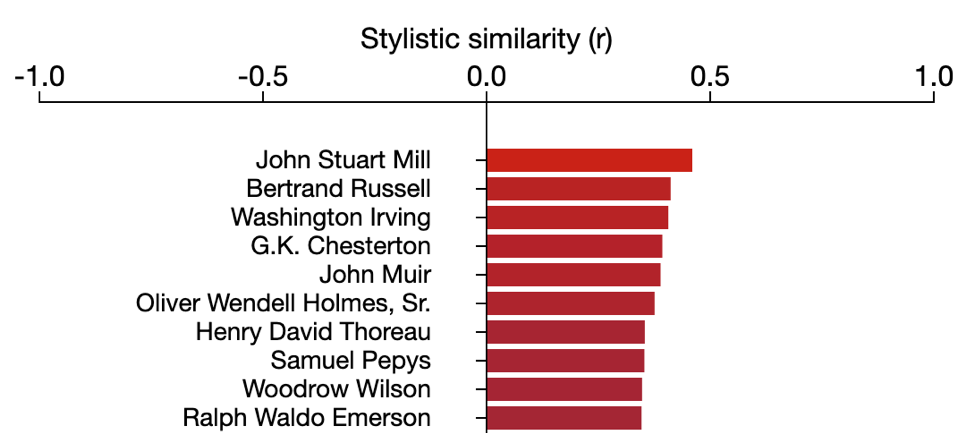
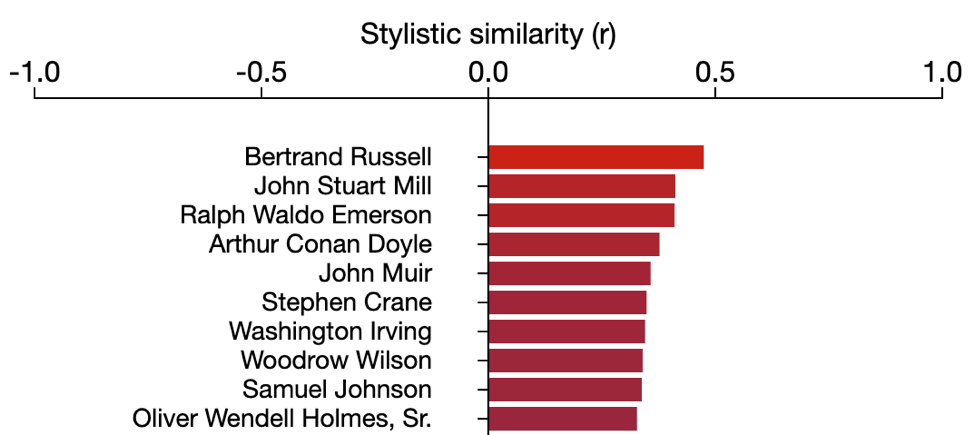
One study entitled “Who do you write like?” compares the writing you submit with a number of famous authors. (As with “I Write Like,” your text is not retained on the system. Likewise, neither site requires that you enter your name or any other identifying information.)

This research project focuses narrowly on one dimension of stylometric study, a field explored in great depth in “Quantitative Patterns of Stylistic Influence in the Evolution of Literature,” available online in the Proceedings of the National Academy of Sciences of the United States of America.

MySocialBrain bases its study on a reasonable premise. “Despite the seemingly ineffable qualities of style, great progress has been made in measuring writing quantitatively. This process, known as stylometry, can identify the influence of one writer on another or reveal the author of unattributed work.”

You can have your writing compared to that of others at this site.

I used two different samples of my writing (blog, then essay) and came up with fairly similar results. I haven’t read much from every one of these authors, but my gut suggests there may be a valid correlation here. And that impression is reinforced by how little correlation my submission had with the writing of Beatrix Potter, R.M. Ballantyne and Baroness Orczy (of whom I had never heard).

If you have a few free minutes, and are curious about what this stylometry tool might conclude about your writing, give it a try.


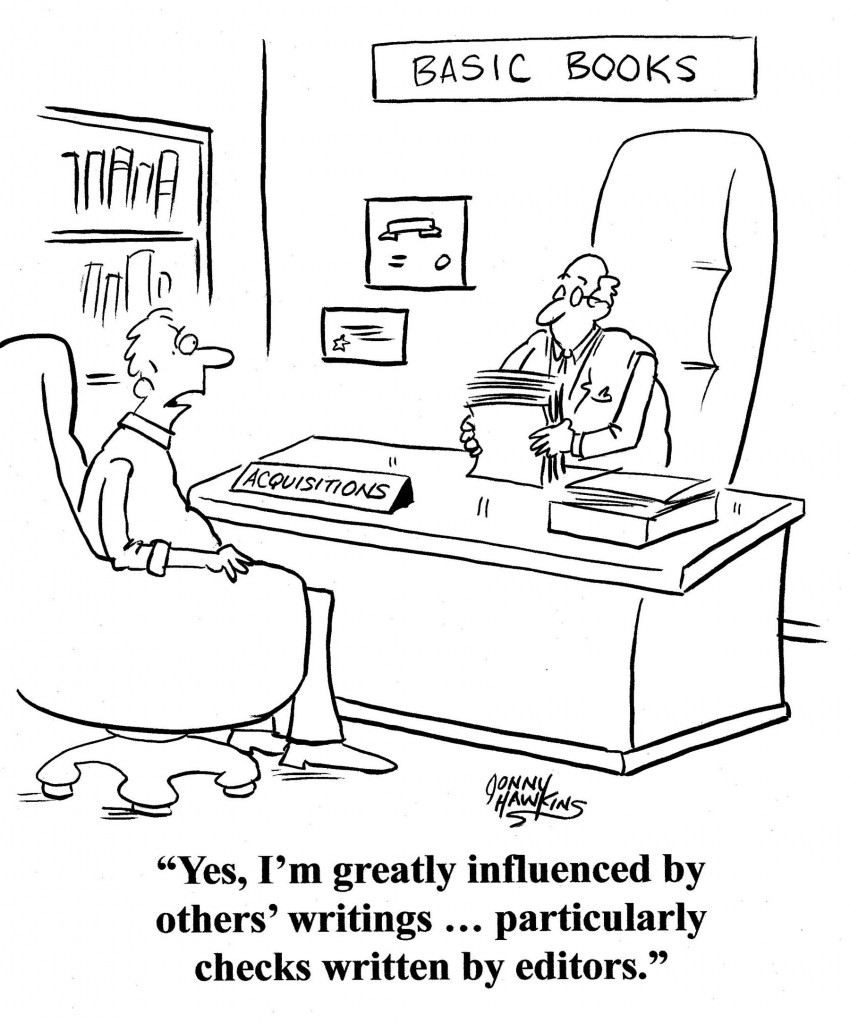
The cartoon at the top of this column is used with the permission of its talented creator, Jonny Hawkins. He is both talented and prolific. Enjoy a humorous jaunt through his personal website today.

An Allied War Crime

During the Second World War, Germany and Japan (leaders of the Axis) committed many loathsome acts. But at least one Allied country was also guilty of an unnecessary atrocity. Genocide and the mass murder of civilians were only part of the Axis’ evil agenda. Germany and Japan also performed horrific medical “experiments” on their innocent captives. No one defends these acts.

The Second World War ended rather abruptly. At the war’s conclusion, a new weapon persuaded the Empire of Japan to surrender unconditionally. The Potsdam Declaration which called on the Emperor to yield offered a grim alternative.

We call upon the government of Japan to proclaim now the unconditional surrender of all Japanese armed forces, and to provide proper and adequate assurances of their good faith in such action. The alternative for Japan is prompt and utter destruction.

Before the use of the two atomic bombs, plans were well underway for Operation Downfall, the invasion of Japan. Massive Allied casualties were anticipated—but due to the nature of warfare, these were dwarfed by the number of Japanese who would have perished.

While few ever praised the total destruction of Hiroshima and Nagasaki, nearly all objective minds recognized that the swift conclusion which followed saved far more lives. This opinion is not only the “military” consensus. It is also shared by those Japanese who were being trained, with bamboo poles, to resist the impending invasion of their islands. (I have had personal conversations with several Japanese citizens who were part of this civilian army.)

Operation Ketsugō (決号作戦), called for the nation’s entire population to resist the invasion. The Japanese Cabinet “essentially called the entire population to military service, while propagandists began ‘The Glorious Death of One Hundred Million’ program to whip up enthusiasm for dying for the Emperor” (A War to Be Won).

While the need for the bombing of Nagasaki is debatable, the use of the atomic bomb in ending the war, saved countless lives. Some have called its use a war crime. They are wrong.

That does not mean, however, that the Allied hands were innocent. In the European theater of the war, the British responded to Germany’s bombing of their civilian populations with terror bombing of their own. Air Chief Marshal Arthur Harris embodied this vile strategy and, as head of the Royal Air Force Bomber Command, he could wage a war of retribution. And, as a leader of the winning army, his criminal behavior would be overlooked.

“Bomber Harris” justified raining fire on civilians because it would abbreviate the war. He said, in my opinion to his lasting shame, “I do not personally regard the whole of the remaining cities of Germany [i.e. all of the citizens abiding in them] as worth the bones of one British Grenadier.”

Air Force Magazine has an informative article available online which addresses Harris’ strategy. It cites Churchill’s acknowledgement that “we hoped to shatter almost every dwelling in almost every German city.” Only with the utter destruction of the city of Dresden, did Churchill admit that “the moment has come when the question of bombing of German cities simply for the sake of increasing the terror, though under other pretexts, should be reviewed” (“The Allied Rift on Strategic Bombing”).

War is a Terrible Thing

Ernest Hemingway was a talented, but deeply troubled, writer. A Boston University article describes his religious outlook in this way: “While raised by devout Christian parents, Hemingway converted to Catholicism at the age of twenty-eight for marriage and proved religiously indifferent throughout his lifetime, despite a preoccupation with biblical themes in many of his works.”⁑

Hemingway addressed the subject of this post in a sober, profound and honest manner. “Never think that war, no matter how necessary, nor how justified, is not a crime.” Even people such as myself, advocates of Just War Theory, can agree with this.

War is a crime against humanity itself, an activity that was never part of our Creator’s original design. War represents a battle in which even the victor is often left scarred, as one of my fellow chaplains describes in his newly released book, Nailed! Moral Injury: A Response from the Cross of Christ for the Combat Veteran.*

Yet, as horrible as war is, it is sometimes necessary. G.K. Chesterton astutely noted the proper motive for soldiers. They don’t seek personal conquest. Nor is the pursuit of personal glory a proper justification. According to Chesterton, “The true soldier fights not because he hates what is in front of him, but because he loves what is behind him.” In the same light, he wisely described war in the following manner in his Autobiography.

The only defensible war is a war of defence. And a war of defence, by its very definition and nature, is one from which a man comes back battered and bleeding and only boasting that he is not dead.

C.S. Lewis was just such a man. Deeply acquainted with the bloody toll of war, he did not glorify combat. In 1939 he wrote in a letter, “My memories of the last war haunted my dreams for years.” Yet, that very same year, Lewis described moments when war was truly unavoidable, saying “if war is ever lawful, then peace is sometimes sinful” (“The Conditions for a Just War”).

Chivalry is the Imperfect Response to War

Chivalry may sound like an archaic word and an obsolete concept. It may be the former, but is definitely not the latter. For C.S. Lewis, it was the principle that could reduce the anguish caused by war.

C.S. Lewis recognized the profound cost of war and acknowledged short of Christ’s return, it will remain unavoidable. The only way its violence can be tempered is through a principle like chivalry, which naturally arises from the belief that though some wars cannot be avoided, all wars can be restrained by humane guidelines. This notion even inspires the Geneva Conventions.

Mere Inkling has discussed the Inkling concept of chivalry in the past, so I will not repeat that discussion here. Instead, allow me to refer you to an excellent article I recently read on this vital subject, “C.S. Lewis, War, and the Christian Character.”

Addressing the familiar canard that C.S. Lewis glorifies war, particularly in the Chronicles of Narnia, Marc LiVecche declares.

For Lewis, the Narnian stories are all about love—not about love despite the battles and wars, but about love that, because it is love, reveals itself in the rescue of the innocent, the defense of justice, and the punishment of evil even, in the last resort, by war and, most crucially, in the character of the warriors who wage those wars.

In a candid manner that could possibly cause the prudish to blush, LiVecche describes how Botticelli’s Venus and Mars illustrates the view that in a fallen world, war can be harnessed to serve positive ends. This painting is significant, in that “a facsimile of the Botticelli masterwork hung in Lewis’ Oxford rooms in Magdalen College.”

In any case, whether through the influence of Venus or the two-aspects of his internal character, Lewis’ Mars—and the martial character he influences in others—is about much more than war and violence. For Lewis, the fullness of the martial character is best communicated by the chivalric idea of “the knight—the Christian in arms for the defence of a good cause,” which Lewis called “one of the great Christian ideas.” This chivalric ideal, in turn, is best understood through those words addressed to the dead Launcelot, the greatest of all the knights, in Malory’s Morte D’Arthur: “Thou wert the meekest man that ever ate in hall among ladies; and thou wert the sternest knight to thy mortal foe.”

Lewis expounds: “The important thing about this ideal is…the double-demand it makes on human nature. The knight is a man of blood and iron, a man familiar with the sight of smashed faces and the ragged stumps of lopped-off limbs; he is also a demure, almost a maidenlike guest in hall, a gentle, modest, unobtrusive man. He is not a compromise or happy mean between ferocity and meekness; he is fierce to the nth and meek to the nth.”

LiVecche discusses how Lewis’ thought reflects the Christian just war tradition. It is a crucial damper to unbridled war, since “human beings are motivated both by love and kindness as well as selfishness and cruelty [requiring that] the use of force must be viewed with skepticism and deployed within carefully prescribed constraints.”

War crimes are criminal precisely because they fall outside the boundaries of what is just and necessary. These offenses should never be ignored or minimized, no matter who commits them . . . be they Nazi bureaucrats, genocidal Japanese commanders, or sophisticated British baronets who serve as military marshals.


* Chaplain Mark Schreiber’s book is available from Amazon and its kindle version will be available soon.

Elegies, Eulogies & C.S. Lewis

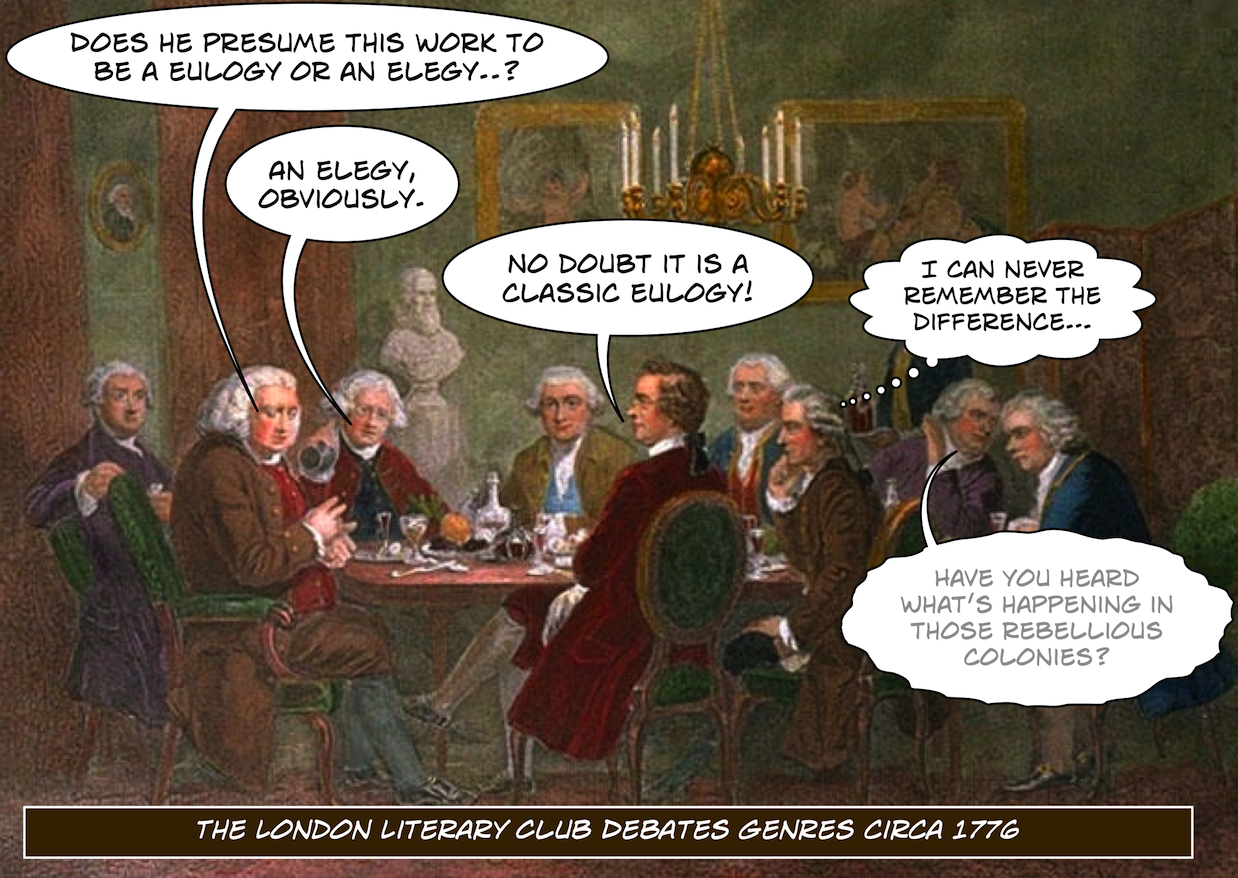
For a long time I was puzzled by the difference between the two words, elegy and eulogy. My confusion was not simply due to their obvious visual and aural similarities. My puzzlement was increased by their use in similar contexts (e.g. death). Even worse, they are sometimes (mis)used interchangeably.

If you are confused, let me clarify the matter—the words have significantly different definitions. The fact they are both three syllables and share four letters, is simply coincidence. Both are frequently written, but only eulogies are intended to be delivered as an oration.

A eulogy (ˈyü-lə-jē) is a message of commendation and praise, typically offered in honor of someone who has died. (It originates from the Greek word eulogia which means praise.)

An elegy (ˈe-lə-jē) is a poem, or possibly a song, with a melancholy tone. It can, but does not have to, be about someone who is deceased. (It finds its origin in elegos, the Greek word for a song of mourning.)

Thus, even when both eulogies and elegies are offered in response to the same person’s passing, they remain quite distinct from one another. The eulogy focuses on praise, and is positive in tone. The elegy focuses on sorrow and is like a lamentation.

As a young man, C.S. Lewis wrote to his father about the nature of exaggeration often found in eulogies.

I was sorry to see the other day news of our friend Heineman’s sudden death. The papers have been so covering him with eulogy since he went that I begin to feel glad I met him, if only for once—Vergilium vidi tantum! [“I have seen the great Virgil!” (Ovid, Tristia)]

In this case however I think the virtues are not wholly of the tombstone nature: a great publisher is really something more than a mere machine for making money: he has opportunities for doing things for the best of motives, and if one looks round most of our English houses, I think he avails himself of them as well as anyone can expect. I always put up a fight for the tribe of publishers here where so many young men with manuscripts have nothing too bad to say of them.

The close companionship of the Inklings meant that they took one another’s death quite hard. C.S. Lewis’ brother Warren wrote a moving eulogy when Charles Williams passed. In it he said, “the blackout has fallen, and the Inklings can never be the same again.”

The talented Christian writer, Dorothy Sayers, shared a dynamic friendship with C.S. Lewis. Lewis wrote a heartfelt eulogy for her when she died in 1957. Her son wrote back thanking him for the warm and uplifting gift.

Lewis was unable to present it in person at the funeral, so his eulogy was read to the congregation by the Lord Bishop of Chichester. It is quite substantial and because Sayers’ son preserved a copy, it is now preserved in the essay collection On Stories. It is entitled “A Panegyric for Dorothy L. Sayers,” panegyric being another word for publicly rendered praise. At the conclusion of the sensitive tribute, Lewis praises her translation of Dante’s Divine Comedy. Unfortunately, Sayers died before completing the final section of the work. After complimenting her work on the initial section, the Inferno, he concludes:

. . . when I came to the Purgatorio, a little miracle seemed to be happening. She had risen, just as Dante himself rose in his second part: growing richer, more liquid, more elevated. Then first I began to have great hopes of her Paradiso. Would she go on rising? Was it possible? Dared we hope?

Well. She died instead; went, as one may in all humility hope, to learn more of Heaven than even the Paradiso could tell her. For all she did and was, for delight and instruction, for her militant loyalty as a friend, for courage and honesty, for the richly feminine qualities which showed through a port and manner superficially masculine and even gleefully ogreish—let us thank the Author who invented her.

As a literary historian, C.S. Lewis was extremely familiar with elegies. In an essay, “Donne and Love Poetry in the Seventeenth Century,” he critically analyzes that author’s elegies. (You can download the complete collection of Donne’s poems in two volumes here: 12.)

In another essay, “Shelley, Dryden, and Mr. Eliot,” Lewis praises Shelley’s “Witch of Atlas,” and moves on to an interesting critique of Adonais: An Elegy on the Death of John Keats.

If Shelley had written only such poems he would have shown his genius: his artistry, the discipline and power of obedience which makes genius universal, are better shown elsewhere. Adonais naturally occurs to the mind, for here we see Shelley fruitfully submitting to the conventions of a well-established form.

It has all the traditional features of the elegy—the opening dirge, the processional allegory, and the concluding consolation. There is one bad error of taste. The Muse, lamenting Adonais, is made to lament her own immortality,

     I would give All that I am to be as thou now art!
     But I am chained to Time, and cannot thence depart! (xxvi)

This is to make a goddess speak like a new-made human widow, and to dash the public solemnity of elegy with the violent passions of a personal lyric. How much more fitting are the words of the Roman poet:

Immortales mortales si foret fas flere
Flerent divae Camenae Naevium poetam.

[Gnaeus Naevius (c. 270-199 BC) was a Roman poet who composed this modest epitaph for his tomb:
If it would be lawful for immortals to weep for mortals,
the divine Muses would weep for the poet Naevius.]

A Special Bonus

For readers who have continued to this point, I have a special treat. It is a satirical elegy written by G.K. Chesterton (1874-1936), who was a popular English writer, and staunch defender of Christianity (particularly of the Roman Catholic flavor).

This excellent column describes the influence Chesterton had on the Inklings, especially Lewis and J.R.R. Tolkien. Chesterton often launched his work from current events or twists on common knowledge, creatively manipulating it to provide new insights. He did this very thing with the following, famous elegy.

In 1751, English poet Thomas Gray wrote “Elegy Written in a Country Churchyard.”  It grew in fame, and was memorized by many English schoolchildren. It consists of more than thirty stanzas. The link offers the entire poem, but eight lines will suffice to illustrate for our purpose here.

Elegy Written in a Country Churchyard
by Thomas Gray

Far from the madding crowd’s ignoble strife,
     Their sober wishes never learn’d to stray;
Along the cool sequester’d vale of life
     They kept the noiseless tenor of their way.

Yet ev’n these bones from insult to protect,
     Some frail memorial still erected nigh,
With uncouth rhymes and shapeless sculpture deck’d,
     Implores the passing tribute of a sigh.

Their name, their years, spelt by th’ unletter’d muse,
     The place of fame and elegy supply:
And many a holy text around she strews,
     That teach the rustic moralist to die.

And here we close with Chesterton’s brief version, intentionally bearing the same title. It is both somber (in the first two sincere stanzas) and scathing (in the last verse). I am certain citizens of many nations would nod in agreement if this elegy was applied to their own countries.

Elegy in a Country Churchyard
by G.K. Chesterton

The men that worked for England
They have their graves at home:
And birds and bees of England
About the cross can roam.

But they that fought for England,
Following a falling star,
Alas, alas for England
They have their graves afar.

And they that rule in England,
In stately conclave met,
Alas, alas for England
They have no graves as yet.

Learning New Words

When you encounter an unfamiliar word, do you consider that inconvenient, or exciting?

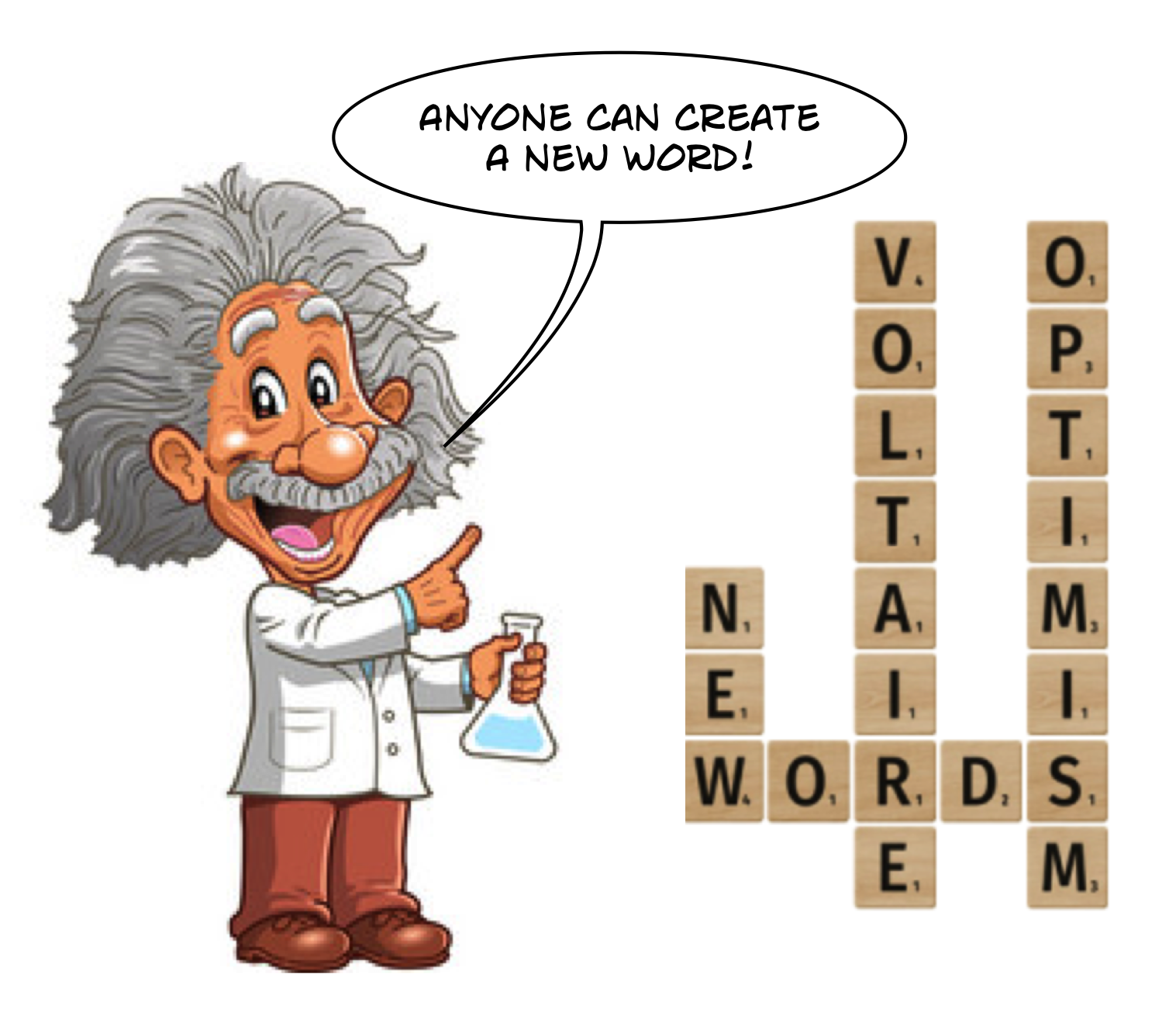
I encountered a new word today. I read a lot, but rarely do I encounter an unfamiliar word.* I share it with you because of its peculiar meaning. You may want to use it sometime. The drawback is that it is a tad antiquated (thus its unfamiliarity). The word is “Panglossian.”

My “passing” grade in the study of Classical Greek in 1977 suggested the word might mean multi-lingual, since pan means “all,” and glossa means languages or tongues. I was wrong—but for a very odd reason.

Panglossian, you see, doesn’t refer to the literal meaning of its root words. It is based on the qualities of a character created by Voltaire for his satirical novella, Candide. Ironically, Voltaire presumably christened his professor of métaphysico-théologo-cosmolonigologie with this nomen⁑ because of its actual meaning.

The adjective Panglossian, however, has a completely distinct definition. Its difference was signaled for me by the capitalization of the first letter. Fans of Voltaire (among whom I do not count myself, or C.S. Lewis, for that matter) may already know its meaning. a definition, trust me, we shall get to momentarily.

First, I want to share C.S. Lewis’ observation about Voltaire, a Deist who was a savage critic of Christianity. In his autobiography Lewis includes the philosopher in a list of people he considered allies during his own season of atheism.

All the books were beginning to turn against me. Indeed, I must have been as blind as a bat not to have seen, long before, the ludicrous contradiction between my theory of life and my actual experiences as a reader.

George MacDonald had done more to me than any other writer; of course it was a pity he had that bee in his bonnet about Christianity. He was good in spite of it. Chesterton had more sense than all the other moderns put together; bating, of course, his Christianity. Johnson was one of the few authors whom I felt I could trust utterly; curiously enough, he had the same kink. Spenser and Milton by a strange coincidence had it too.

Even among ancient authors the same paradox was to be found. The most religious (Plato, Aeschylus, Virgil) were clearly those on whom I could really feed.

On the other hand, those writers who did not suffer from religion and with whom in theory my sympathy ought to have been complete—Shaw and Wells and Mill and Gibbon and Voltaire—all seemed a little thin; what as boys we called “tinny.” It wasn’t that I didn’t like them. They were all (especially Gibbon) entertaining; but hardly more. There seemed to be no depth in them. They were too simple. (Surprised by Joy).

Voltaire’s religious views aside, in Dr. Pangloss he devised a character energized by an incurable optimism. From that characterization, fifty years after Voltaire’s work another writer derived the adjective. If you are like me, knowing a word’s etymology—its origin and history—is intrinsically satisfying.

So, as Merriam Webster says: Pan·​gloss·​ian | pan-ˈglä-sē-ən was first used in 1831 to describe someone or something as being “marked by the view that all is for the best in this best of possible worlds: excessively optimistic.”

And, since the minting of new words is an ongoing process, it comes as no surprise panglossian has spawned variations.

According to a word research site, “writers have since made several compounds out of his name, such as Panglossic and Panglossism, but the adjective Panglossian is by far the most common and is frequently found even today.”

I encountered the word in an interesting First Things essay entitled “The Gospel According to Dickens.” The author describes Dickens’ hopeful tone and confidence, but declares “Dickens was not Panglossian, however. He expressed scorn for the society that insults and injures the weak and vulnerable.”

While I’m neither panglossic nor inclined in the least to panglossism, I’m glad such people exist. Their naiveté makes this world of ours far more interesting.⁂


* This is true, aside from specific “names” of things like an animal genus (e.g. trochilidae for hummingbirds or urochordate for the beloved sea squirt), or a pharmaceutical (e.g. Unituxin or Tecfidera). The business channel CNBC reports:

“If it seems as if drug names have been getting weirder, it’s because, in some cases, they have. . . . drug names use the letter Q three times as often as words in the English language. For Xs, it’s 16 times as much. Zs take the cake, at more than 18 times the frequency you’d find them in English words. And Ws? You’ll rarely see one in a drug name.” And, shockingly, the cost ranges from $75,000 to $250,000 for developing a single drug brand name.”

⁑ I studied Latin too, way back in 1969-71. The grades for my Latin scholarship were also “satisfactory.”

⁂ No offense intended to any readers of Mere Inkling who count themselves among the excessively optimistic! But, as for me, I’ve yet to be panglossterized.

C.S. Lewis & the Inklings Seated at the Round Table

arthur.png

This book belongs in the library of every fan of the Inklings and each devotee of King Arthur. The truth is that anyone interested in British literature or the Dark Ages will find much that appeals to their curiosity. King Arthur is known around the world as an archetypal hero, and he was a central fixture in the minds of the Inklings.

The Inklings & King Arthur (TIKA) is impressive in every way. However, it’s 555 rich pages should not intimidate potential readers. Editor Sørina Higgins masterfully gathered diverse insights from a score of scholars, and the individual chapters can be approached in any manner the reader desires. Even if a few of the chapter titles fail to resonate with a particular reader, the solid value of the remainder far exceed the price of the work.

Mere Inkling seldom offers reviews of books, despite the “libraries” of new Inkling literature published every year. The Inklings & King Arthur is the exception, for two reasons.*

TIKA does not require a familiarity with its subject. The academic background of the contributors allows them to usher readers into rewarding discussions without additional research. C.S. Lewis described “the task of the modern educator [as] not to cut down jungles, but to irrigate deserts.” The writers in this volume have written so clearly that even if your knowledge of King Arthur is the Mojave, and your familiarity with the Inklings is the Sahara, you will enjoy reading this book.

Truth be told, much has been written about King Arthur. Likewise, films have explored the myths, with varying degrees of faithfulness. Some make no effort at all to be faithful to the inspiring story. An extreme example would be the ludicrous storyline of the 2017 film, Transformers: The Last Knight. In striking contrast to this, the Inklings sought to penetrate the mists of time and discern the reasons Arthur’s story has inspired men and women for so many generations.

In the book’s introduction, Higgins says her hope was “to fill a sizeable hole in the field of Inkling studies” (2). She surely achieved this task. She also says “the present collection endeavors to usher the field of Inklings studies into more rigorous theoretical territory” (3). This goal, the contributors have surpassed.

Proceeding to some specific comments, my first would be to point out the accuracy of the volume’s title. It is an exploration of “the Inklings,” rather than simply Lewis and/or Tolkien. The fact that less well-known members of the literary group wrote the most Arthuriana means their works are particularly well represented in the current collection.

This fact might discourage a potential reader who is disinterested in the lesser known authors. However, the truth is, exposure to work of these friends and influencers of the two über-Inklings helps us better understand them and the confluences that flowed together in that unique literary fellowship.

Most articles consider the Inklings as group in relationship to a theme. For example, Christopher Gaertner discusses, “Shape and Direction: Human Consciousness in the Inklings’ Mythological Geographies.” The author identifies their differing viewpoints and how they influenced one another. Despite “their shared resistance to a scientistic worldview” (150), Tolkien, Lewis and Owen Barfield did not share identical understandings of how the world should be perceived.

Beyond the Eagle & Child

One pleasant surprise is the inclusion of an essay on G.K. Chesterton (1874-1936). Chesterton’s The Everlasting Man contributed to the conversion of C.S. Lewis.

In his TIKA essay “All Men Live by Tales,” J. Cameron Moore reveals how Chesterton’s poetry about Arthur is rooted in England. Arthur was important enough for Chesterton to return several times to the story of this hero who is “Mythic, Roman, and Christian (205). You can download a free copy of The Ballad of St. Barbara which includes “The Myth of Arthur” here. You can read “The Grave of Arthur” at this site.

Benjamin Shogren explores the significance of the addition of two new names—Pendragon and Fisher-king” to the protagonist of C.S. Lewis’ space trilogy. Elwin Ransom “represents Arthur by . . . evoking the primary imagery associated with the role of Arthur” (399). Ransom is now imbued with a mythological aura of royal leadership and courageous chivalry.

This volume overflows with richness. In “On Fairy Stories,” J.R.R. Tolkien describes the dense blend of mythologies present in the story of Arthur, using the image of a pot of soup with various ingredients added over time.

It seems fairly plain that Arthur, once historical (but perhaps as such not of great importance), was also put into the Pot. There he was boiled for a long time, together with many other older figures and devices, of mythology and Faerie, and even some other stray bones of history (such as Alfred’s defence against the Danes), until he emerged as a King of Faerie.

The situation is similar in the great Northern “Arthurian” court of the Shield-Kings of Denmark, the Scyldingas of ancient English tradition. King Hrothgar and his family have many manifest marks of true history, far more than Arthur; yet even in the older (English) accounts of them they are associated with many figures and events of fairy-story: they have been in the Pot.

The soup or stew pot may also serve as a fitting metaphor for The Inklings & King Arthur. This exceptional volume offers a potent mix of wisdom and insights that go beyond the boundaries of its title. Readers will be rewarded, in fact, with many satisfying literary meals.


* The first reason is that the academic weight of the work merits the undertaking. The second is because I have received a review copy, which obligates me in a sense, to providing a review—not a positive review, of course, but an honest assessment of its value, from my personal perspective.

Honest reviewers, of course, are mandated to acknowledge the fact that they received a particular volume gratis. This is done to protect one’s integrity. At the same time, a writer’s honor is also protected by their pledge to provide an honest evaluation of each work, for good or ill. This is what you will discover here.

The volume’s editor, Sørina Higgins, gathered an impressive group of Inkling scholars to contribute. She is a poet who is Chair of Language and Literature at Signum University.

It would be challenging to find any flaw in this amazing volume. Its sole weakness, in this reviewer’s opinion, is that it is so detailed and thorough, that it transcends the reading skills (or perhaps, “tastes”) of some of today’s readers. Despite that, the authors have gone to significant effort to write clearly and make their extremely detailed subject matter accessible to all.