Divine Christmas Gifts

I hope everyone was pleased with the gifts they may have received during their Christmas celebrations. As grandparents, my wife and I delighted in the presence of our children and grandchildren as we celebrated together Jesus’ Nativity.

Which raises the subject of the proverbial “reason for the season.” My hope is that Mere Inkling’s friends will know the deep and lasting joy of receiving our Creator’s most precious gift.

In 1958, C.S. Lewis wrote to an American correspondent about one obstacle to receiving God’s gifts. He cited an observation by Saint Augustine that if we are too busy grasping less important things, we can miss out on what is truly priceless.

St. Augustine says “God gives where He finds empty hands.” A man whose hands are full of parcels can’t receive a gift.

Augustine was an ancient African bishop. One of his Christmas sermons has survived and remains quite inspiring sixteen centuries after it was first preached. I encourage you to bask in the glow of the following excerpt.

So then, let us celebrate the birthday of the Lord with all due festive gatherings. Let men rejoice, let women rejoice. Christ has been born, a man; he has been born of a woman; and each sex has been honored.

Now therefore, let everyone, having been condemned in the first man [Adam], pass over to the second. It was a woman who sold us death; a woman who bore us life. The likeness of the flesh of sin [Romans 8] has been born, so that the flesh of sin might be cleansed and purified.

And thus it is not the flesh that is to be faulted, but the fault that must die in order that the nature may live; because One has been born without fault, in whom the other who was at fault may be reborn.

Rejoice, you just; it is the birthday of the Justifier. Rejoice, you who are weak and sick; it is the birthday of the Savior, the Healer. Rejoice, captives; it is the birthday of the Redeemer.

Rejoice, slaves; it is the birthday of the one who makes you lords. Rejoice, free people; it is the birthday of the one who makes you free. Rejoice, all Christians; it is the birthday of Christ.

Rejoice, one and all. God’s undeserved gift to each of us, for all those willing to receive it, is forgiveness and eternal life. 

In his book The Problem of Pain, C.S. Lewis elaborates on the Augustinian analogy shared above.

Everyone has noticed how hard it is to turn our thoughts to God when everything is going well with us. We “have all we want” is a terrible saying when “all” does not include God. We find God an interruption.

As St Augustine says somewhere, “God wants to give us something, but cannot, because our hands are full – there’s nowhere for Him to put it.” Or as a friend of mine said, “We regard God as an airman regards his parachute; it’s there for emergencies but he hopes he’ll never have to use it.”

Now God, who has made us, knows what we are and that our happiness lies in Him. Yet we will not seek it in Him as long as He leaves us any other resort where it can even plausibly be looked for. While what we call “our own life” remains agreeable we will not surrender it to Him.

What then can God do in our interests but make “our own life” less agreeable to us, and take away the plausible sources of false happiness? It is just here, where God’s providence seems at first to be most cruel, that the Divine humility, the stooping down of the Highest, most deserves praise.

Remember friends, our celebration of the Messiah’s entrance into our world is not limited to a single day, or even a brief season. Every single day we can rejoice at the miracle of the Incarnation and the fact that God loved us enough to send his Son to redeem us.

Theological Humor

Pope Francis jokes with a newlywed couple in Rome.

Don’t be surprised, but many clergy possess keen senses of humor. Sure, there are staid, grimacing ministers who consider acting dour to be a virtue. (They’re often legalistic.) But most of the pastors and military chaplains I’ve worked beside, love to laugh. I think I’ve written enough about humor to verify that.

C.S. Lewis maintained strong bonds with a number of clergy, from a variety of denominations, and that would hardly have been true if they had lacked a sense of humor. Humor, to Lewis, is an essential part of life. He proclaims this truth from the lips of Aslan himself, as the newly created Talking Animals hear the first (accidental) joke.

“Laugh and fear not, creatures. Now that you are no longer dumb and witless, you need not always be grave. For jokes as well as justice come in with speech.” (The Magician’s Nephew)

I recently read about a fascinating incident one historian described as “perhaps the only really satisfactory practical joke in the whole history of theology.” Allow me to set the scene.

The Byzantine Empire lasted for a thousand years, before being defeated and desecrated* by Islamic armies. During the centuries surrounding its apex, it suffered from the political intrigue and competition with which we are all too familiar.

Photios I was a Byzantine scholar who was twice the Patriarch of Constantinople during the ninth century. Twice is unusual, but it was due to the machinations of emperors and empresses who meddled in the affairs of the church.

He had a troubled relationship with another priest named Ignatius, who also served two times as Patriarch. The good news is that the men were eventually reconciled and both are regarded by Orthodox Christians as saints.

The anecdote comes from the period of their rivalry. Photios, whose brilliance was widely acknowledged, and presumably envied by Ignatius, decided to pull an embarrassing public prank on his nemesis.

Photios devised a bizarre theory that human beings have two souls. His goal was to trick Ignatius into taking it seriously, whereupon Photius withdrew the thesis and admitted he had not been serious. Apparently, everyone unsatisfied with Ignatius’ leadership found it quite entertaining.

Fortunately, among clergy the humiliation of others is rarely the object of humor. Yet, sadly, I have seen it attempted. I personally repent of ever having done so myself, and regard it as sharing, along with vulgarity and blasphemy, the lowest level of “humor.” 

The Wisdom of Lewis

In Reflections on the Psalms, C.S. Lewis relates something I know to be true from my own experience.

A little comic relief in a discussion does no harm, however serious the topic may be. (In my own experience the funniest things have occurred in the gravest and most sincere conversations.) 

Clergy deal with serious topics, like death, quite frequently. Perhaps that is one reason a well-developed sense of humor is common among their ranks.


Skip this footnote if you want to end on a “happy” note.

* “Desecration” may sound like a harsh word to our interfaith-sensitive ears, but it is accurate here. Islam is rarely a gentle master for Christians, and it has been common to see churches and holy places seized and converted to foreign religious uses. For example, in the capital Constantinople (now called Istanbul), Orthodox Christianity’s most magnificent church, Hagia Sophia, saw much of its glorious and historic iconography destroyed when it was converted to a mosque. Many years later, in 1934, an enlightened Turkish government ended the insult, and chose to treat the holy place as a museum. Sadly, the current regressive government under Recep Tayyip Erdoğan, reversed that decision, and in 2020 the Church of Holy Wisdom was returned to its usage as a mosque.

The Goodness of Good Friday

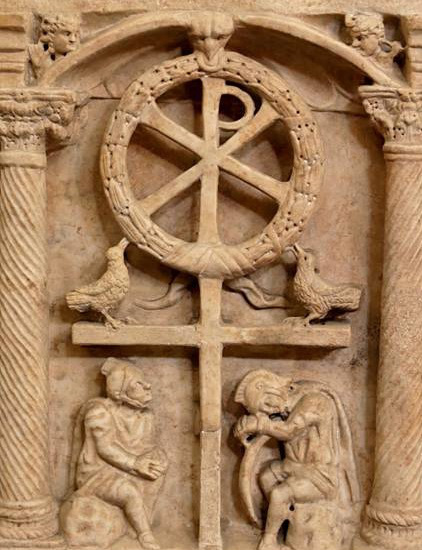
Jesus died on a cross. So why in the world would his followers choose the image of a cross to identify their faith?

The answer comes via a paradox. The cross is about two, superficially-contradictory realities. (1) Jesus bled, suffered and died on the cross. (2) On that very cross, Jesus purchased for all who call upon his name, eternal life.

This seeming paradox between simultaneous truths is sometimes referred to as a theological dialectic.

C.S. Lewis brilliantly illustrates this dynamic in his description of Death in his book Miracles.

On the one hand Death is the triumph of Satan, the punishment of the Fall, and the last enemy. Christ shed tears at the grave of Lazarus and sweated blood in Gethsemane: the Life of Lives that was in Him detested this penal obscenity not less than we do, but more.

On the other hand, only he who loses his life will save it. We are baptized into the death of Christ, and it is the remedy for the Fall. Death is, in fact, what some modern people call “ambivalent.”

It is Satan’s great weapon and also God’s great weapon: it is holy and unholy; our supreme disgrace and our only hope; the thing Christ came to conquer and the means by which He conquered (Miracles).

Thus, the grim suffering of Good Friday . . . becomes Good. It is not an accident. Nor is it a mistake. It was the necessary consequence of humanity’s fall and our costly, divine rescue. As C.S. Lewis writes in The Four Loves:

He creates the universe, already foreseeing – or should we say “seeing”? there are no tenses in God – the buzzing cloud of flies about the cross, the flayed back pressed against the uneven stake, the nails driven through the mesial nerves, the repeated torture of back and arms as it is time after time, for breath’s sake, hitched up. . . .

Herein is love. This is the diagram of Love Himself, the inventor of all loves.

Of course, this truth is only recognizable to those who have knelt before Jesus the Messiah and received his grace.

To unbelievers, “the world,” the cross makes no sense at all. Those in spiritual blindness reject it as the epitome of Christian absurdity.

Just such claims were made from the very beginning. Not long after Christ’s resurrection, these challenges were addressed by Paul, the Pharisee turned Apostle. Proclaiming the miracle of the cross, he reminds the young church in Corinth how they cannot expect the lost to comprehend its glory, its untainted goodness.

For the word of the cross is folly to those who are perishing, but to us who are being saved it is the power of God. . . .

Where is the one who is wise? Where is the scribe? Where is the debater of this age? Has not God made foolish the wisdom of the world? For since, in the wisdom of God, the world did not know God through wisdom, it pleased God through the folly of what we preach to save those who believe.

For Jews demand signs and Greeks seek wisdom, but we preach Christ crucified, a stumbling block to Jews and folly to Gentiles, but to those who are called, both Jews and Greeks, Christ the power of God and the wisdom of God. For the foolishness of God is wiser than men, and the weakness of God is stronger than men (1 Corinthians).

The crucifixion and resurrection of the only begotten Son of God are the sole means by which you and I may be cleansed, healed, and restored to the unending life for which our Lord created us.

Good & Bad Memories

We humans are fascinating creatures. Our capacity to remember both the good and the ill from our past, exerts a powerful influence on the course of our future.

I’ve been reflecting on this contrast since our lectionary readings from worship this past Sunday. (I’ll note the particular passage that triggered my thoughts in a moment.)

The question I’ve pondered is whether good memories are more powerful than bad memories. By bad, I’m not referring to horrific experiences which our minds sometimes actively suppress or bury.

I’m thinking of unpleasant, disappointing memories. Things that we regret having happened, either to us, or because of us.

When I use the word “powerful” in my question, I’m referring to the ability of a given memory to continue actively impacting our lives.

In too many lives, it seems the joy and light emanating from positive recollections is often shaded or eclipsed by the clouds of painful memories.

Perhaps our lives would be happier if we consciously spent time recalling good experiences, and taught ourselves to reject – rather than dwell upon – negative thoughts when they force their way onto the stage?

C.S. Lewis provides a curious insight into the nature of memories. Their overarching essence often seem to magnify as time passes. Listen to his words, penned after a vacation in 1921, in which he describes how the joyful memories will grow ever sharper as they are recalled in the future.

I still feel that the real value of such a holiday is still to come, in the images and ideas which we have put down to mature in the cellarage of our brains, thence to come up with a continually improving bouquet.

Already the hills are getting higher, the grass greener, and the sea bluer than they really were; and thanks to the deceptive working of happy memory our poorest stopping places will become haunts of impossible pleasure and Epicurean repast.

Sadly, though, even glorious memories can sometimes fade away. This is the grimmest tragedy of many forms of dementia.

Memory in the Chronicles

C.S. Lewis does some curious things with memory in his Chronicles of Narnia. While the Pevensie children grow to adulthood reigning over Narnia, they end up forgetting about their earlier lives. Only when they stumble upon the Lamp-post, do they recall the land of their birth.

“By the Lion’s Mane, a strange device,” said King Peter, “to set a lantern here where the trees cluster so thick about it and so high above it that if it were lit it should give light to no man!”

So these Kings and Queens entered the thicket, and before they had gone a score of paces they all remembered that the thing they had seen was called a lamp-post, and before they had gone twenty more they noticed that they were making their way not through branches but through coats.

And next moment they all came tumbling out of a wardrobe door into the empty room, and they were no longer Kings and Queens in their hunting array but just Peter, Susan, Edmund and Lucy in their old clothes.

It was the same day and the same hour of the day on which they had all gone into the wardrobe to hide. Mrs. Macready and the visitors were still talking . . . (The Lion, the Witch and the Wardrobe).

In Prince Caspian, a wise advisor, Doctor Cornelius, secretly informs the heir to the Narnian throne that the old stories were not simply myths. The evil Telmarines had actively labored to erase all memory of Narnia’s true nature.

“Listen,” said the Doctor. “All you have heard about Old Narnia is true. It is not the land of Men. It is the country of Aslan, the country of the Waking Trees and Visible Naiads, of Fauns and Satyrs, of Dwarfs and Giants, of the gods and the Centaurs, of Talking Beasts. It was against these that the first Caspian fought.

It is you Telmarines who silenced the beasts and the trees and the fountains, and who killed and drove away the Dwarfs and Fauns, and are now trying to cover up even the memory of them. The King does not allow them to be spoken of.”

I find the following description of a renewed memory particularly picturesque. It takes place after the Pevensie children return to Narnia years after their initial visit.

Everyone except Lucy went to sleep at once. Lucy, being far less tired, found it hard to get comfortable. Also, she had forgotten till now that all Dwarfs snore. She knew that one of the best ways of getting to sleep is to stop trying, so she opened her eyes.

Through a gap in the bracken and branches she could just see a patch of water in the Creek and the sky above it. Then, with a thrill of memory, she saw again, after all those years, the bright Narnian stars. She had once known them better than the stars of our own world, because as a Queen in Narnia she had gone to bed much later than as a child in England.

And there they were – at least, three of the summer constellations could be seen from where she lay: the Ship, the Hammer, and the Leopard. “Dear old Leopard,” she murmured happily to herself (Prince Caspian)

Forgetting the Past

Every one of us has made mistakes. And far too often we allow those poor decisions and choices to haunt us the rest of our lives. That delights the Devil, one of whose titles is Accuser.

He wants us mired in the past, thinking there is no way we could ever earn God’s love.

The simple fact is that we don’t earn our Creator’s love. It’s a free gift. It is pure grace, and utterly unmerited.

Once we have confessed our sins, God washes them away and cleanses us from all unrighteousness.

To emphasize how God no longer holds our past sins against us, consider some of the ways he expresses his capacity to permanently forgive our confessed sins.

He does not deal with us according to our sins, nor repay us according to our iniquities… so great is his steadfast love toward those who fear him; as far as the east is from the west, so far does he remove our transgressions from us (Psalm 103).

Who is a God like you, pardoning iniquity and passing over transgression..? You will cast all our sins into the depths of the sea. (Micah 7:18-19).

And now, for the verse which inspired my thoughts. It struck me as particularly helpful for our Christian lives, given the fact that God does not keep a permanent record of our sins. Wouldn’t our lives be better if we followed the Lord’s example?

Not that I… am already perfect, but I press on to make it my own, because Christ Jesus has made me his own… one thing I do: forgetting what lies behind and straining forward to what lies ahead, I press on toward the goal for the prize of the upward call of God in Christ Jesus (Philippians 3:12-14).

“Forgetting what lies behind,” our past failings which have been forgiven, liberates us to live the life to which God calls us.

That’s seldom easy to do, but knowing how “far [God] removes our transgressions from us,” makes that possibility much more likely. Let us press on.

Join C.S. Lewis for Lent

If you would like to join C.S. Lewis in one of his Lenten experiences, read on, because I have the perfect suggestion for you.

During Lent, the forty days preceding Easter, many Christians undertake special “disciplines.” This practice is different from the familiar exercise of “giving things up” for the season.

These disciplines often include fasting and devoting more time to reading the Scriptures and inspiring Christian literature.

Two of C.S. Lewis’ letters mention that he was rereading, as part of his Lenten pilgrimage, two ancient classics that have inspired believers for nearly seventeen centuries.

In 1936, he wrote to Dom Bede Griffiths, a regular correspondent who was a Roman Catholic priest.

I re-read St. Augustine’s Confessions during Lent, and found it better than I remember, tho’ still it is the explicitly devotional parts that edify me least.

The following year he wrote the following in a letter to his childhood friend, Arthur Greeves.

I have been progressing all this lent through the first volume of a v[ery] nice edition of St Augustine’s City of God only to find that the other volume has been so wrongly bound that it begins and ends in the middle of sentences. What a tragedy this would once have been!

Lewis’ regard for Augustine lasted throughout his life. In 1961, Lewis responded to a correspondent who asked what books he would recommend to a recent convert. He included Augustine in that list, writing “St. Augustine’s Confessions will give you the record of an earlier adult convert, with many v. great devotional passages intermixed.”

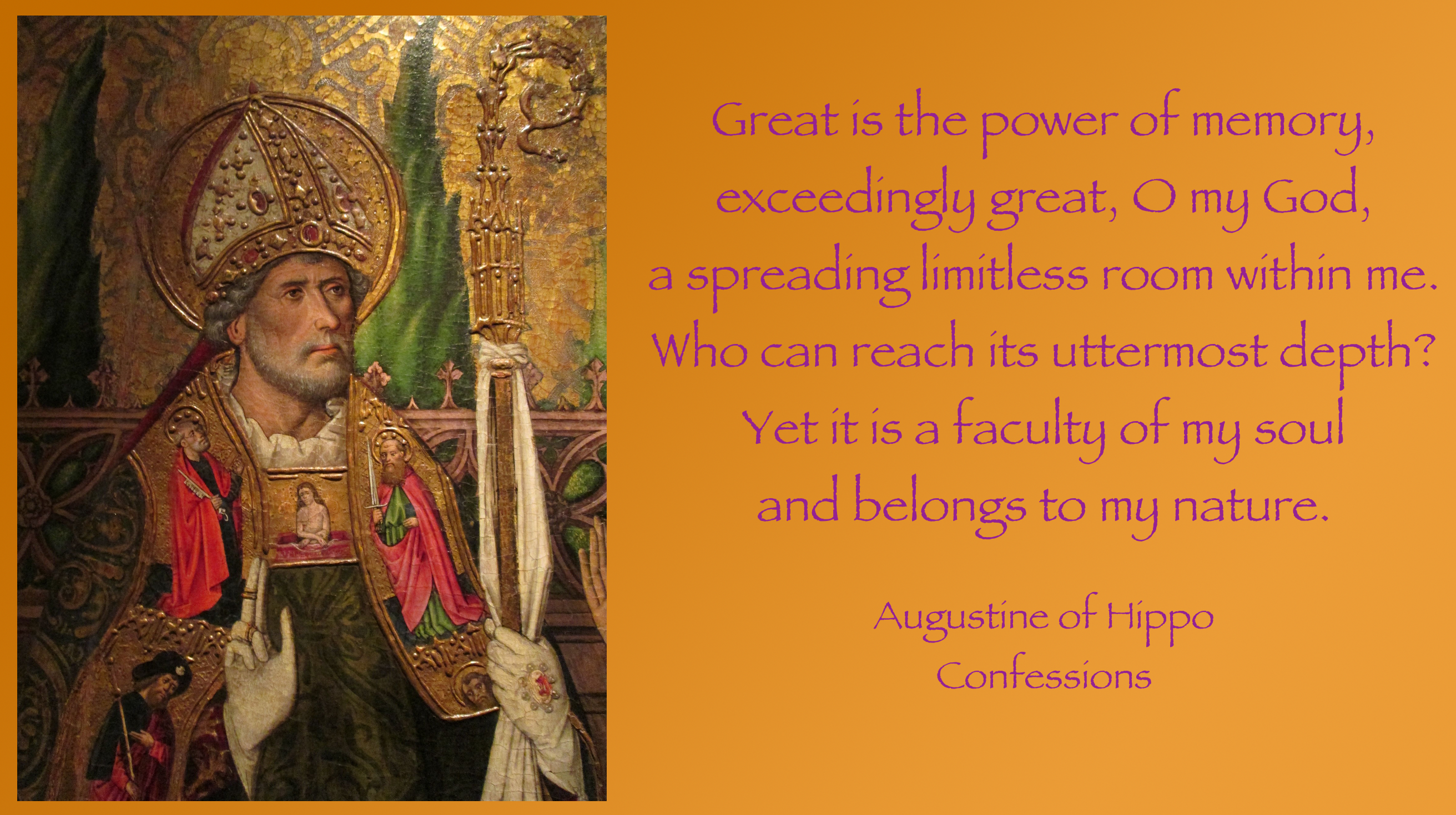
Saint Augustine was a bishop in Hippo Regius, a city in north Africa. Augustine was a brilliant scholar who desperately sought the truth, and intently studied many religions and philosophies before finding Truth in the person of Jesus Christ.

His life is fascinating, in part because he lived during the turbulent era when Rome itself was sacked by the Vandals, who went on to conquer North Africa.

Augustine was a native African, a member of the Christian Berbers, who along with the Romans in the regions were destined to be overrun by Islamic armies.

Augustine was a prolific writer, and due to their spiritual value, many of his works are readily available today.

If you would like to read one of the volumes mentioned by C.S. Lewis, you can download copies of early translations at Internet Archives. Here are the links, with two biographical studies thrown in for good measure.

Confessions

The City of God

Lives of the Fathers

Saint Augustine and his Age

If you choose to follow C.S. Lewis’ example of reading one of these works for Lent, you will have the added joy of sharing with him a Lenten discipline which he found rewarding.


If you prefer listening to the Confessions, you can download a free Librivox version here.

Humorous Examinations

Could you pass this examination?

Sketch the development of human thought, estimate its significance. Compare with the development of any other kind of thought.

In contrast to the serious tone of the last two posts, today I am offering some edifying entertainment. As a gift to you, I have edited a perennial favorite of internet humorists. I recently came across my copy of this comprehensive knowledge examination, which motivated me to tweak it for Mere Inkling’s erudite audience.

You have probably seen versions of this exam in the past. The basic questions have remained surprisingly stable despite its age. I encountered it in the University of Washington campus paper in 1973. One writer claims “the Graduation Exam—Authentic Assessment has been in circulation since at least the 1950’s.”

The exam certainly makes the rounds, as this Navy veteran described.

The pressures of comprehensive exams were apparent to many, which resulted in one of the few officially sanctioned jokes in Naval Nuclear Power. In one of the official publications of Naval Reactors, someone inserted a sample “final exam” from Nuclear Power School.

In 2012 elements of the examination created confusion in the People’s Republic of China. It was included in an article about how Chinese nationals could prepare for an American State Department exam required for positions at the United States embassy in Beijing. According to China’s Global Times, “US embassy spokesman Richard Buangan made clear on his Sina microblog Sunday that an alleged ‘recruitment test for expatriate employees at the US embassy’ is fake.”

A June 2008 issue of Foreign Service Journal carried a story, which includes an English version of the [exam stating] the questions are from the US State Department’s entrance exam, in a bid to “measure the stability of perspective Foreign Service officers and to weed out the dummies.”

The Function of Examinations

Testing and documenting competence is obviously important. This is especially true for people in critical roles, such as prescribing drugs, designing aircraft engines, and manufacturing ice cream.

Of course, not everyone is able to pass every test. Which is precisely how things should be.

C.S. Lewis noted how educators truly familiar with their students readily recognize when it is a waste of time for them to continue repeating an exam they obviously cannot pass. He said an academic “master often knows, when boys and parents do not, that it is really useless to send a boy in for a certain examination again” (The Problem of Pain).

I have met very few people who enjoy being tested. Yet, for many faculty members (C.S. Lewis included), being on the “other side” of exams is not particularly enjoyable either. This delightful passage comes from a 1927 letter to his brother, Warnie.

My period of examining passed over with its usual accompaniment of neuralgia and oaths, relieved by the one excellent boy who defined ‘a genie’ correctly, yet more than correctly, as ‘an eastern spirit inhabiting bottles and buttons and rings.’ Pretty good for a boy.

I was also pleased with a youth who, being asked to write a letter to a friend recommending Guy Mannering,* wrote to his brother recommending it and saying ‘I think you would be interested in the character of Colonel Mannering, he is so like our father’: and then later in a paper on Guy Mannering in which I had set the question ‘Would you have liked Colonel Mannering as a father?’—illustrate your answer etc.—began decisively ‘I would not have liked Colonel Mannering as a father in the least.’

Well, it’s time now to offer you the opportunity to prove your worthiness. If you wish to evidence the breadth and depth of your knowledge, proceed now to the exam. (Astute readers will note I’ve added a personal twist to a couple of the exam questions.)

Comprehensive Knowledge Exam

HISTORY: Describe the history of the papacy from its origins to the present day, concentrating especially, but not exclusively, on its social, political, economic, religious, and philosophical impact on Europe, Asia, North and South America, and Africa. Be brief, concise, and specific. Now do the same for the Zoroastrian priesthood. [Bonus credit for including Antarctica in your response.]

MEDICINE: You have been provided with a razor blade, a piece of gauze and a bottle of scotch. Remove your appendix. Do not suture until your work has been inspected. You have fifteen minutes. [Option: if you feel the scotch would impair your responses to the remaining questions, you may defer this portion of the exam to the end of the exam.]

PUBLIC SPEAKING: Two thousand riot-crazed anarchists are storming the campus. Calm them. You may use any ancient language except Latin, Greek or Sanskrit. [Pig Latin is allowed.]

BIOLOGY: Postulate the 500 million year progression of a life form based on silicon, ranking its likely preference for form of government Enumerate the pros and cons it would associate with democracy, monarchy, socialism, theocracy, and totalitarianism. [Caution: any references to the Horta of Janus VI will result in disqualification of your answer, since Star Trek is a fictional resource.]

MUSIC: Write a piano concerto. Orchestrate and perform it with flute and digeridoo. You will find a piano under your seat. The wind instruments, of course, were among the items you were directed to bring with you to the examination.

PSYCHOLOGY: Based on your knowledge of their works, evaluate the emotional stability, degree of adjustment, and repressed frustrations of each of the following: Alexander of Aphrodisias, Hildegard of Bingen, Rābi’a bint Ka’b al-Quzdārī and Simeon the Stylite. Support your evaluation with quotations from each individual’s work, citing original sources. It is not necessary to translate.

SOCIOLOGY: Using the pretext of Planet of the Apes, where homo sapiens have been subordinated to various primate species, assess the prospects for achieving mutual toleration and equilibrium before one group is driven to extinction. [Caution: confusion of apes (which lack tails) and monkeys (which lack an appendix) will result in disqualification of your response.]

CHEMISTRY: Transform lead into gold. You will find a beaker, a three hundred count box of matches and five lead sinkers under your seat. Show all work including Feynman diagrams and quantum functions for all steps. [Transformation into silver will provide half credit.]

ENGINEERING: The disassembled parts of a high-powered rifle have been placed on your desk. You will also find an instruction manual, printed in Swahili. In 10 minutes a hungry Bengal tiger will be admitted to the room. [Special Consideration: Satisfactorily explain the differences between Fahrenheit and Celsius to the tiger, and it will be replaced by a rabid ferret.]

ECONOMICS: Develop a realistic plan for refinancing global debt, without hypothesizing a benevolent intergalactic alliance with unlimited resources coming to the planet’s aid. Trace the possible effects of your plan in the following areas: Cubism, the Donatist controversy, and the 1913 foundation of Hôpital Albert Schweitzer in Gabon.

POLITICAL SCIENCE: Devise an infallible, seven-step plan to transform the United Nations into an organization that will successfully foster peace and goodwill in all international relationships. [Bonus credit for providing a major role for two of the following nations: Dominica, Liechtenstein, Tuvalu.]

AGRICULTURAL SCIENCE: Outline the steps involved in breeding your own super high yield, all weather hybrid strain of wheat. Describe its chemical and physical properties and estimate its impact on world food supplies. Construct a model for dealing with world-wide surpluses. Draft your Nobel Prize acceptance speech.

PHYSICS: Explain the nature of matter. Include in your answer an evaluation of the impact of the development of mathematics on astronomy, botany and numismatics. [Bonus Credit: write today’s date in metric.]

PHILOSOPHY: Sketch the development of human thought, estimate its significance. Compare with the development of any other kind of thought. Be sure to include an analysis of the influence exerted on philosophy by Diogenes the Cynic.

CREATIVE WRITING: Compose an epic poem based on the events of your own life in which you see and footnote allusions from T.S. Eliot, Titus Lucretius Carus, Miguel de Cervantes, Dante Alighieri, Þorbjörn Hornklofi, Gilgamesh and Stephen King. Critique your poem with a full discussion of its syntax and metrics. [Bonus Credit for writing alternating stanzas between free and rhyming verse.]

EDUCATION: Formulate an examination which accurately measures an individual’s comprehensive knowledge base without cultural or linguistic prejudice. Limit the question parameters to what can reasonably be covered during a four hour testing block.

LITERATURE: Discuss in detail at least three major literary figures from each of the following civilizations: the Xia Dynasty, the Akkadian Empire, the Mayan Empire, the Aksumite Empire, the Polynesian Tuʻi Tonga Empire, and nineteenth century United Kingdom. [Caution: failure to include J.R.R. Tolkien and/or C.S. Lewis will result in disqualification of your answer to this question.]

Congratulations on finishing the exam. You are encouraged to use any remaining time to review your answers in light of the fact that grammatical errors and misspellings will significantly impact your final grade.


* You can download a personal copy of Guy Mannering, one of Sir Walter Scott’s Waverly novels, at Internet Archive.

If you should question the distinctions I noted between apes and monkeys, please know that the facts are genuine. However, for future examinations, you should be aware that not all monkeys have tails.

Climbing Ladders of Faith

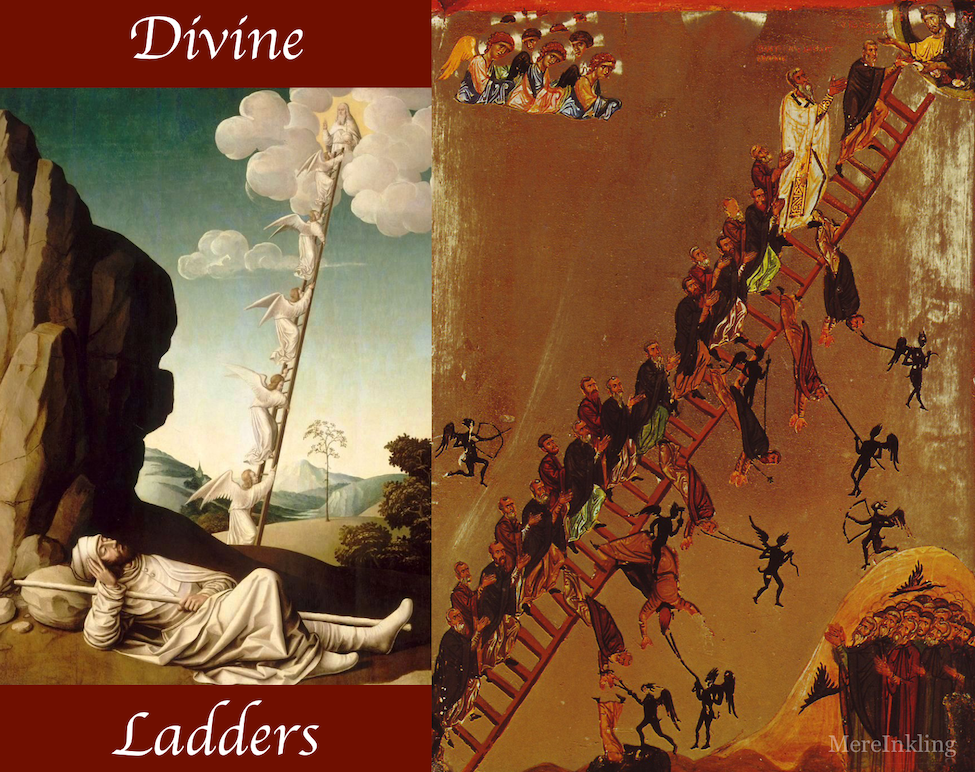
One of the pivotal events in the history of God’s grace is found in the Torah account of a dream. Jacob was the heir of Abraham, through whom the Lord promised to redeem the world. But Jacob was far from noble.

Nevertheless, because of the Lord’s mercy (the same mercy he offers to us), he forgave Jacob and promised to bless his descendants. In his dream, Jacob saw a ladder extending from earth all the way to heaven. “And behold, the angels of God were ascending and descending on it!” (Genesis 28).

This dynamic connection between heaven and earth reveals God’s constant concern for his creation. Some, such as Martin Luther, have seen in the dream a foreshadowing of the Incarnation itself.

This ladder or stairway can be interpreted in a variety of ways. One thing it is not, however, is a guide to human ascent from our fallen world to the presence of our Creator. (The Lord is the one who comes to us.)

Having acknowledged that the dream’s purpose is not to model sanctification or individual spiritual ascent, it is easy to see why the metaphor of ladders, and the action of climbing, give way to other applications.

The most vivid contemporary example comes in the form of a Christian spiritual entitled “We are Climbing Jacob’s Ladder.” A number of versions of the lyrics exist. This is quite unsurprising since it began as part of an oral tradition. According to one website devoted to spirituals, the following lyrics are typical.*

We are climbing Jacob’s ladder
Soldier of the Cross

Ev’ry round goes higher ‘n’ higher
Soldier of the Cross

Brother do you love my Jesus
Soldier of the Cross

If you love him why not serve him
Soldier of the Cross

While there are longer versions, this one aptly illustrates how the metaphor of the ladder—in this case, explicitly Jacob’s ladder—offered a powerful image of deliverance. Climbing the ladder with Jesus, was tantamount to experiencing deliverance from the ills of this world.

America’s Library of Congress offers a useful page which describes “African American Gospel music [as] a form of euphoric, rhythmic, spiritual music rooted in the solo and responsive church singing of the African American South.” They add that “its development coincided with—and is germane to—the development of rhythm and blues.” The site offers links to four 1943 recordings of spirituals. None of these, however, is the hymn we are discussing.

“We are Climbing Jacob’s Ladder” was one of the earliest spirituals to be widely adopted by the interracial faith community. It is familiar in many denominations, and was recently sung in my own Lutheran congregation. Hymnary.org states the song has been “published in 79 hymnals.” Even those who consider themselves unfamiliar with the hymn often recognize its rousing refrain: “Rise and shine and give God the glory, glory, Soldiers of the Cross.”

The talented Paul Robeson recorded the hymn on a number of his albums. The inspiring rendition by scholar Bernice Johnson Reagon was included in Ken Burn’s documentary, The Civil War.

C.S. Lewis and the Spiritual Ladder

The ladder offers such a convenient analogy for growth or spiritual maturation that others have also applied it in this manner. The ladders inspired by Jacob’s dream include the following two which continue to influence Christian disciples today, even though they were written many centuries ago. The second of these was considered by C.S. Lewis to be one of the works of faith influential in his life.

John Climacus (579-649) was a Christian teenager when he entered the monastic life at the foot of Mount Sinai. He soon earned the respect of his elders in that barren land. In the words of Fathers of the Desert, “in this ascetic seclusion he became ripe for the designs of God.”

The abbot of a monastery on the Red Sea requested guidance on the ascetic life to use with his monks. John responded with The Ladder of Divine Ascent. You can download a modern translation of this priceless work here. While the treatise was written specifically to guide monastics in their spiritual growth, many other Christians have also found its wisdom helpful in their own, non-monastic settings.

John introduces the virtue of obedience with two vivid images used by the Apostle Paul, the athlete in training and the armor of God.

Our treatise now appropriately touches upon warriors and athletes of Christ [and the manner in which] the holy soul steadily ascends to heaven as upon golden wings. And perhaps it was about this that he who had received the Holy Spirit sang: Who will give me wings like a dove? And I will fly by activity, and be at rest by contemplation and humility.

But let us not fail, if you agree, to describe clearly in our treatise the weapons of these brave warriors: how they hold the shield of faith in God and their trainer, and with it they ward off, so to speak, every thought of unbelief and vacillation; how they constantly raise the drawn sword of the Spirit and slay every wish of their own that approaches them; how, clad in the iron armour of meekness and patience, they avert every insult and injury and missile.

And for a helmet of salvation they have their superior’s protection through prayer. And they do not stand with their feet together, for one is stretched out in service and the other is immovable in prayer.

The following passage will be of particular interest to Christian writers. John advises those drawing closer to God to maintain a journal of their progress and insights. I offer it within its wise context.

Let all of us who wish to fear the Lord struggle with our whole might, so that in the school of virtue we do not acquire for ourselves malice and vice, cunning and craftiness, curiosity and anger. For it does happen, and no wonder!

As long as a man is a private individual, or a seaman, or a tiller of the soil, the King’s enemies do not war so much against him. But when they see him taking the King’s colours, and the shield, and the dagger, and the sword, and the bow, and clad in soldier’s garb, then they gnash at him with their teeth, and do all in their power to destroy him. And so, let us not slumber.

I have seen innocent and most beautiful children come to school for the sake of wisdom, education and profit, but through contact with the other pupils they learn there nothing but cunning and vice. The intelligent will understand this.

It is impossible for those who learn a craft whole-heartedly not to make daily advance in it. But some know their progress, while others by divine providence are ignorant of it. A good banker never fails in the evening to reckon the day’s profit or loss. But he cannot know this clearly unless he enters it every hour in his notebook. For the hourly account brings to light the daily account.

In the fourteenth century, an Augustinian mystic in England wrote a book called The Scale [Ladder] of Perfection.” Walter Hilton (c. 1340-1396) provides spiritual exercises requested by a woman adopting life as an anchoress.⁑ You can download a free copy of Evelyn Underhill’s 1923 edition of Hilton’s counsel at Internet Archive.

In 1940, C.S. Lewis wrote to Roman Catholic monk Bede Griffiths in response to the latter’s question about his familiarity with Hilton’s work. “Yes, I’ve read the Scale of Perfection with much admiration. I think of sending the anonymous translator a list of passages that he might reconsider for the next edition.” That same decade Lewis’ collected correspondence reveals he recommended the title to at least two individuals.

Of greatest interest to students of C.S. Lewis will be his mention of the medieval treatise in his autobiography, Surprised by Joy. Here the great author describes his worldly understanding of prayer served as a terrible stumbling block to his faith.

To these nagging suggestions my reaction was, on the whole, the most foolish I could have adopted. I set myself a standard. No clause of my prayer was to be allowed to pass muster unless it was accompanied by what I called a “realization,” by which I meant a certain vividness of the imagination and the affections.

My nightly task was to produce by sheer will power a phenomenon which will power could never produce, which was so ill-defined that I could never say with absolute confidence whether it had occurred, and which, even when it did occur, was of very mediocre spiritual value.

If only someone had read to me old Walter Hilton’s warning that we must never in prayer strive to extort “by maistry” what God does not give! But no one did; and night after night, dizzy with desire for sleep and often in a kind of despair, I endeavored to pump up my “realizations.” The thing threatened to become an infinite regress.

One began of course by praying for good “realizations.” But had that preliminary prayer itself been “realized”? This question I think I still had enough sense to dismiss; otherwise it might have been as difficult to begin my prayers as to end them.

How it all comes back! The cold oilcloth, the quarters chiming, the night slipping past, the sickening, hopeless weariness. This was the burden from which I longed with soul and body to escape. It had already brought me to such a pass that the nightly torment projected its gloom over the whole evening, and I dreaded bedtime as if I were a chronic sufferer from insomnia. Had I pursued the same road much further I think I should have gone mad.

This ludicrous burden of false duties in prayer provided, of course, an unconscious motive for wishing to shuffle off the Christian faith; but about the same time, or a little later, conscious causes of doubt arose.

David Downing, co-director of the Wade Center wrote an excellent essay entitled “Into the Region of Awe: Mysticism in C.S. Lewis” which describes in the broader context what C.S. Lewis wrote in Surprised by Joy.

Note for example a passage in Surprised by Joy in which Lewis discusses the loss of his childhood faith while at Wynyard School in England. He explains that his schoolboy faith did not provide him with assurance or comfort, but created rather self-condemnation.

He fell into an internalized legalism, such that his private prayers never seemed good enough. He felt his lips were saying the right things, but his mind and heart were not in the words. Lewis adds “if only someone had read me old Walter Hilton’s warning that we must never in prayer strive to extort ‘by maistry’ [mastery] what God does not give.”

This is one of those casual references in Lewis which reveals a whole other side to him which may surprise those who think of him mainly as a Christian rationalist. “Old Walter Hilton” is the fourteenth-century author of a manual for contemplatives called The Scale of Perfection. This book is sometimes called The Ladder of Perfection, as it presents the image of a ladder upon which one’s soul may ascend to a place of perfect unity and rest in the Spirit of God . . . [passage continued in footnotes]. ⁂

We’ve considered four separate ladders today. Despite their differences, they all share a common trait—they are meaningful to those who are earnest about growing in the faith. Whether slave or free, wise or simple, or hermit or cosmopolitan—each of these ladders affirms eternal truths.

Underhill described Hilton’s motivation for writing in this way: “It is for those who crave for this deeper consciousness of reality, and feel this impulse to a complete consecration, that Hilton writes.” I believe this is true for the authors of each of these four treasures.


* The following, simpler version appears to follow an earlier tradition. A musical accompaniment for this example can be found in The Books of American Negro Spirituals. The author, James Weldon Johnson (1876-1938), provides a rich and earnest introduction to the book, originally published in two volumes. He expresses his hope that collection “will further endear these sons to those who love Spirituals, and will awaken an interest in many others.”

We am clim’in’ Jacob’s ladder
Soldiers of the cross

O

Ev’ry roun’ goes higher, higher
Soldiers of the cross

⁑ An anchoress (or anchorite) was a religious woman (or man) who would often be walled off in their monastic cell near a church, to foster their life of prayer by freeing them from interruption.

⁂ Downing’s discussion of C.S. Lewis’ reference to Walter Hinton’s insights on prayer is so valuable that I am compelled to offer the rest of it here. You can read the entire essay via the link on the article’s title.

The passage about “maistry” Lewis wished he’d known as a boy comes early in The Scale of Perfection, a section about different kinds of prayer, including liturgical prayers, spontaneous prayers, and “prayers in the heart alone” which do not use words.

Hilton’s advice for people “who are troubled by vain thoughts in their prayer” is not to feel alone. He notes it is very common to be distracted in prayer by thoughts of what “you have done or will do, other people’s actions, or matters hindering or vexing you.”

Hilton goes on to explain that no one can keep fully the Lord’s command to love the Lord your God with all your heart, soul, strength, and mind. The best you can do is humbly acknowledge your weakness and ask for mercy. However badly one’s first resolve fades, says Hilton, you should not get “too fearful, too angry with yourself, or impatient with God for not giving you savor and spiritual sweetness in devotion.”

Instead of feeling wretched, it is better to leave off and go do some other good or useful work, resolving to do better next time. Hilton concludes that even if you fail in prayer a hundred times, or a thousand, God in his charity will reward you for your labor. Walter Hilton was the canon of a priory in the Midlands of England and an experienced spiritual director of those who had taken monastic vows. His book is full of mellow wisdom about spiritual growth, and Lewis considered it one of “great Christian books” that is too often neglected by modern believers.

Hilton’s recurring theme—do what you know to be right and don’t worry about your feelings—is one that appears often in Lewis’s own Christian meditations. But, alas, Lewis as a boy did not have the benefit of Hilton’s advice.

In those boyhood years at Wynyard, he was trapped in a religion of guilt, not grace. More and more he came to associate Christianity with condemnation of others, as in Northern Ireland, or condemnation of oneself, for not living up to God’s standards.


A Note on the Illustration

Nicolas Dipre was a French early Renaissance painter, who flourished 1495-1532. His painting of Jacob’s Ladder portrays the biblical account of the Jewish patriarch’s dream. The icon Ladder of Divine Ascent was painted four centuries earlier by an anonymous iconographer. It is from Saint Catherine’s Monastery beside Mount Sinai, and portrays the ascent of saints in the pursuit of holiness. While fallen angels (devils) seek to drag them from the path, John Climacus leads other in the path to heaven.


The Patina of the Inklings

Some antiques boast lovely patinas. Some old words do, as well. In fact, I would argue the legacy of, and the deep respect for, the Oxford fellowship known as the Inklings, has created a rich patina of its own.*

The community gifted scholars, especially in the persons of J.R.R. Tolkien and C.S. Lewis, accrued a reputation that continues to gain a deeper luster with each new generation.

When I was a young man, I collected American coins. I also studied what Americans call “World coins.” The latter reinforced my love for geography as well as history.

To me, the most fascinating period of history has long been that of the Roman empire.

 So you can imagine my awe when I learned how simple it was to collect genuine Roman coins.

 This remains true today for common coins, such as bronzes of the fourth century (when the first Christian emperors reigned). This article describes “Collecting Roman Coins on a Budget.”

A surprising number of ancient coins, all readily identifiable and of historical interest, can be acquired for less than $100—and often in the $5-to-$25 range. This is especially true with Roman coins . . .

When I began collecting ancient coins, I learned the multifaceted meaning of a word unfamiliar to me at the time. That word was “patina” (pə’tēnə). As you probably know, it literally refers to the green or brown film (not rust) that appears on bronze and other metals under suitable conditions over a period of time. A handful of coins in my collection possess stunning patinas.

Metaphorical Patina

Many people are also acquainted with the figurative use of the word, as I employed it in my introduction It refers to an appearance or impression of distinction or luster associated with a person, idea or object. It is often linked to esteem held for the past. The following provocative quote comes from a contemporary Swiss artist.

“Life is one long decay, no? There’s a lot of beauty in it. Like the patina in an old city” (Urs Fischer).

Chad Walsh applied it to one of C.S. Lewis’ early books in The Literary Legacy of C.S. Lewis. Writing more than forty years ago, in a discussion of Pilgrim’s Regress, he said:

Regress has permanent value. It is, first of all, a spiritual autobiography, no matter how much Lewis may wish to minimize the personal quality of the quest and make his John into a potential Everyman. . . .

The Regress is already taking on a patina of age, a pleasant chronological quaintness, but time does not render it obsolete.

Four decades after he offered this comment, I believe I am correct in ascribing a warm patina to the Inklings as a fellowship.

Patinas can be added to items, to affect a more aged appearance. While “acquired” patina is always considered desirable, “applied” patina is often quite acceptable. It does not become problematic until the application is used to intentionally misrepresent the age of an item. An example of the proper use of applied patina is seen in these modern busts of C.S. Lewis.

In reviewing Lewis’ writings, I only uncovered one occasion where he used the concept of patina. It occurred in a 1946 letter to his friend, Ruth Pitter. Lewis is contributing to one of their ongoing conversations.

The truth is that there are a great many different kinds of poetry and extreme roughness (or smoothness) evocative epithet (or plain statement), the metaphorical (or literal) the colloquial (or rhetorical) may all, in their place, rise to perfection. . . .

 Once more, read Barfield on Poetic Diction.⁑ That is why Spender’s objection to the ‘willed quality’ in Milton seems to me so bats’-eyed. It is the glory of one kind of poetry to sound un-willed, as if it had dropped out of the sky like Blake or else arisen spontaneously in conversation like Donne.

But then it is equally the glory of another kind to sound willed: to sound as if one were watching, or even sharing, the building of a huge tower.

To demand that Milton should have the spontaneity of Catullus or Blake is like demanding that a King at his coronation or a celebrant approaching the altar should have the same charm as a child dancing in the waves. Don’t we want both: both frolics and rituals? At any rate I do. . . .

Of course you are very right about Patina–again see Barfield. No old French poetry got that peculiar Old-Frenchness which is to us part of the charm. Half the beauties of the Old Testament did not exist for the writers. I wouldn’t be too sure, though, that it is wholly a question of our ‘projecting’ qualities into the old lines.

Ending on a Numismatic Note

Although I have not actively collected coins for many years, I commend it as a rewarding pastime. Seven years ago⁂ I wrote a column about religious likenesses on coins, which included a moving poem written by C.S. Lewis. You can read it here.

While writing this column I came across some genuine Narnian coins that were minted in New Zealand. They are genuine in the sense that they possess actual face values for legal tender in the island nation, which minted similar coins in honor of Middle Earth.

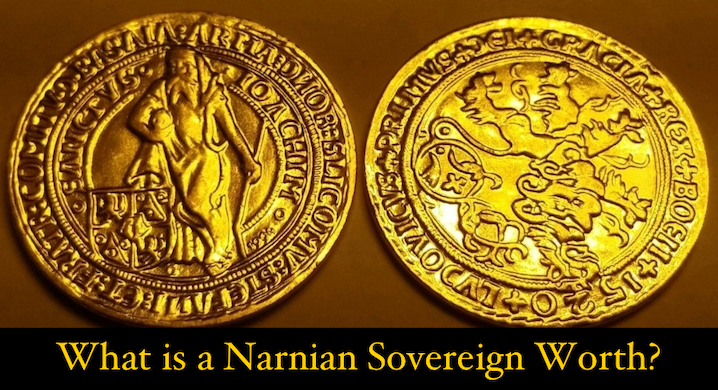
In terms of Narnian coins which circulated in Narnia itself, I learned that you can purchase “coins” which were used as actual props “appearing” in the recent Chronicles of Narnia films.

For an Inkling cinema buff such as myself, deciding to grab one for my personal collection was a no-brainer.


* The writings of the Inklings have even enhanced the patina of Oxford itself. This is especially true for those who live “across the pond,” and will never journey to the city itself. In a succinct review of The Inklings of Oxford: C.S. Lewis, J.R.R. Tolkien, and their Friends, one Aussie architect refers to the stately oxidation of the city’s copper, brass and bronze: Picturesque book of picturesque Oxford focusing on C.S. Lewis and J.R.R. Tolkien and the elegant, much patina-ed Oxford environment that they lived in.” I imagine he would concur with my suggestion that the Inklings themselves also bear a splendid patina.

⁑ Owen Barfield dedicated this book to his good friend with the inscription: “To C.S. Lewis ‘Opposition is true friendship’”

⁂ Seven years of blogging does sound like a lengthy time, but it’s not long enough for even the best of posts to accrue a patina of their own.

Translating Foreign Languages

How many languages can you translate into English? If the answer is >0, I envy you. I’ve studied four,* and passed all the tests, but have an actual aptitude in none.

If I were thus gifted, I would be transferring some of the world’s literary wealth into my native tongue—and vice versa.

One of my granddaughters is currently fascinated by language. She wants to speak a dozen or more, and has begun some study in Spanish and Japanese. However, I attribute most of her dream to a young teenager’s excitement at having the entire world before them. In time, we all learn that finite concerns, such as time, finances and obligations, erode our options.

I’ve written about translation before, most extensively in “C.S. Lewis’ School of Translation.”⁑

This week, while writing an article about a Lutheran approach to ministry with the newly bereaved, I came across an entertaining reference to translation, in the letters of Martin Luther. Luther, of course, was the Reformation leader who, among other things, strongly believed the Bible should be accessible to lay people in their own language.

Translating the Holy Scriptures

Martin Luther was a scholar. Yet, even scholars lack expertise in all subjects. Thus, when translating the Bible into German, he welcomed the cooperation of others. This was particularly wise, since the so-called “Luther Bible” was the first German translation from the original languages rather than the Latin Vulgate. Unsurprisingly, the New Testament was published first. The longer Jewish Scriptures required more time.

The following letter was written in 1524 to Luther’s friend George Spalatin, another German theologian. Luther playfully explains how faithfulness to the original Hebrew text has delayed the publication of the final portion of the Bible.  

All is well with us. We have so much trouble in translating Job, on account of the grandeur of his sublime style, that he seems to be much more impatient of our efforts to turn him into German than he was of the consolation of his friends.

Either he always wishes to sit on his dunghill, or else he is jealous of the translator who would share with him the credit of writing his book. This keeps the third part of the Bible from being printed.

This casual identification with Job, one of God’s most faithful followers, appeals to me. The older I become, the greater is my sense of connection with the “cloud of witnesses,” the saints who have gone before us. In fact, I am also growing progressively more eager to fellowship with the angels. Though different from humanity in countless ways, we share the wonder of being beloved creatures of God.

In The Four Loves, Lewis writes that “friendship . . . This love, free from instinct, free from all duties but those which love has freely assumed, almost wholly free from jealousy, and free without qualification from the need to be needed, is eminently spiritual. It is the sort of love one can imagine between angels.” In my mind, phileo is also the sort of love we will one day experience between angels and humans.

C.S. Lewis’ Work with the Hebrew Language

Lewis did not read Hebrew. That shortcoming is certainly quite forgivable, given the numerous arenas in which his talents excelled. In his Reflections on the Psalms, he acknowledges his limitation. At the same time, he notes that we have many accessible resources by those acquainted with the ancient language.

I have worked in the main from the translation which Anglicans find in their Prayer Book; that of Coverdale. Even of the old translators he is by no means the most accurate; and of course a sound modern scholar has more Hebrew in his little finger than poor Coverdale had in his whole body. But in beauty, in poetry, he, and St. Jerome, the great Latin translator, are beyond all whom I know. I have usually checked, and sometimes corrected, his version from that of Dr. Moffatt.

In his explanation, Lewis notes the value in referring to several authoritative sources. This is especially wise when words are rare or unclear in their usage. Even people fluent in various languages would be negligent to ignore such resources where there is a question regarding significant interpretations.

In the meantime, Luther’s reminder of Job’s “grandeur of his sublime style,” along with the book’s remarkable message, has me preparing to read that book once again. In translation, of course.


* Spanish in junior high, Latin in high school, classical Greek in college, and Hebrew in seminary. As the Austrian-British philosopher, Ludwig Wittgenstein, said: “the limits of my language mean the limits of my world.” I am quite impressed by the fact that many of Mere Inkling’s readers from outside the States are at least bilingual.

⁑ If you’re interested in the subject, you might want to also (re)visit “C.S. Lewis as a Translator.”

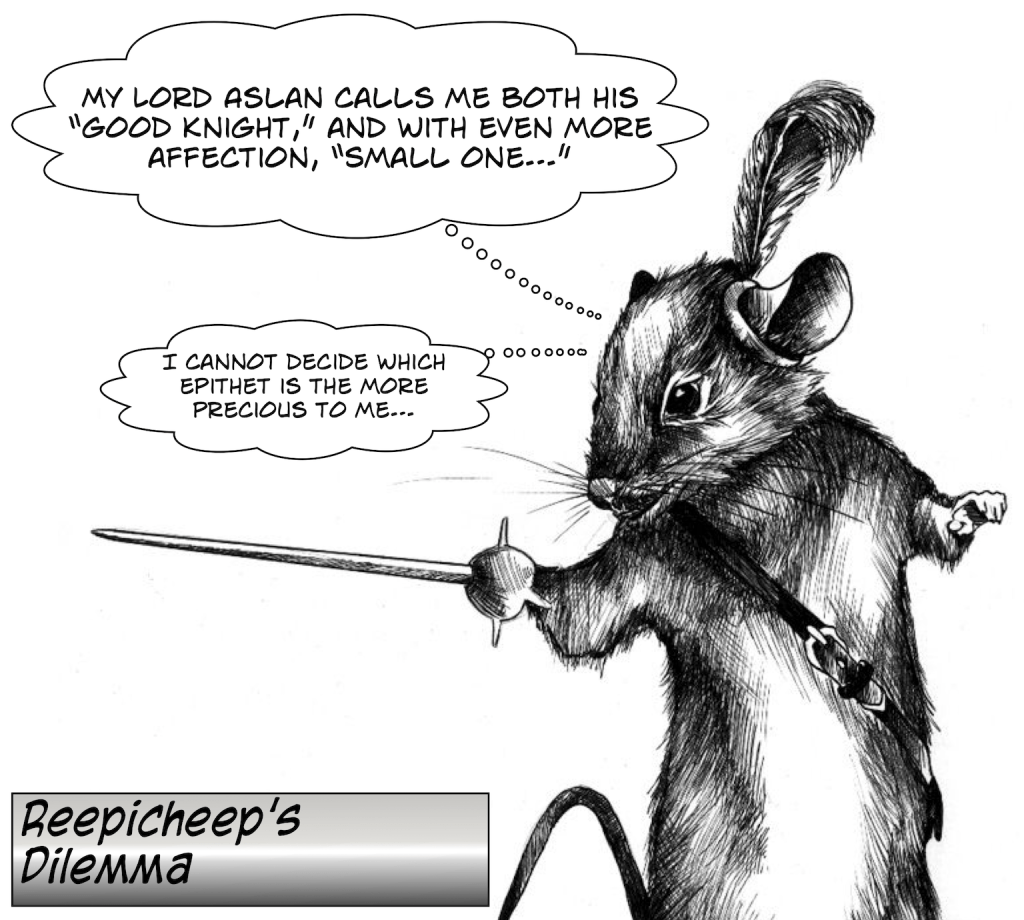
What is Your Epithet?

Everyone has epithets, even though we’re probably not aware of most of them. Some might be unflattering, but we could be pleasantly surprised by positive descriptive phrases people associate with our names.

First, it’s necessary for us to clear the air. Although the modern usage of the word “epithet” is usually negative, that is not the sole—or even primary—use of epithet. Far from being derogatory, most epithets are affirming. That’s because “epithet” is derived from the Greek verb epitithenai which simply means “to put on.” Basically, an epithet is anything that’s added to a person’s name to distinguish them as a particular individual.

Let me offer a simple quiz. What common epithet is often linked to all of the following historical figures?

Charlemagne, King of the Franks
Catherine, the Empress of Russia
Peter, Tsar of Russia
Alexander, the King of Macedonia
Kamehameha I, King of Hawaii
Constantine I, first Christian Emperor of Rome
Frederick, King of Prussia
Rhodri, King of Gwynedd

We can expand this list with several historical figures recorded in the holy Scriptures:

Herod, King of Judea
Cyrus, Founder of the Persian Empire
Darius, Third Shahanshah of the Persian Empire

Obviously, I provided far more options than necessary for you to discern the common epithet. Each of them is, of course, called “the Great.” (Bonus points to anyone recognizing Rhodri the Great; I assume only Mere Inkling’s Welsh readers will know who he was.)

If you think my list is lengthy, check out the wikipedia list of people referred to as “the Great.” And feel free to supplement it, if you recall someone they missed.

A common Christian epithet is “Apostle.” It’s not really a title, though it’s frequently used that way, especially when applied to the original fourteen.⁑ This Orthodox Christian website provides a list of early missionaries who earned the same epithet, including Patrick the Apostle to Ireland and Ansgar, the Apostle to the North.

Back to the Question

So, given that epithets can be neutral or positive, are you aware of any of yours? Our ten grandchildren are developing wonderful senses of humor. I’ve joked with them all ever since they were tiny. More than once they’ve called me their “Funny Grandpa.” That’s an epithet I can be proud of.

Back in my high school years, because I spoke with (assumed) authority on nearly any subject, a couple people called me the “Voice of Experience.” Which just reminded me—literally, as I was typing this—that back at my first active duty assignment, our wing commander publicly bestowed on me an epithet.

There at Reese Air Force Base we were conducting our very first Military Tattoo ceremony. Quite unexpectedly, after doing the yeoman’s work* in composing the lengthy ceremony, he selected me to be the emcee for the extravagant community event. The event flowed flawlessly. The next day, Colonel (later General) Lillard referred to me as the “Voice of Reese.” My wife was suitably impressed!

Now, I have no doubt I’ve accumulated a number of pejorative epithets during my life as well. The good thing about those though, is that people usually don’t share them to our face.

As for your own epithets, you might think of words that friends repeatedly use to describe you. If you’ve been called humble, trustworthy, brave, patient or witty by more than one person, you might be surprised to learn how many others associate that trait with you as well. Talented and smart are also common appellations from those who admire your your various skills or intellect. Sensitive is a nice epithet to own, although I confess it’s seldom applied to me.

Ruth Pitter, C.S. Lewis’ Friend

Pitter (1897-1992) was a highly regarded British poet. Living in artistic circles, it’s unsurprising that she describes her early life as “bohemian.” Bohemians tend to regard that epithet as admirable, while practical people such as myself consider it a negative term. Bohemian, of course, refers to “socially unconventional” behavior which may cover a multitude of alternative lifestyles.

Pitter, however, was also a friend of C.S. Lewis. And it was through his writings and their conversations that she became a Christian. In 1985, two decades after his death, she wrote,

As to my faith, I owe it to C.S. Lewis. For much of my life I lived more or less as a Bohemian, but when the second war broke out, Lewis broadcast several times, and also published some little books (notably The Screwtape Letters), and I was fairly hooked. I came to know him personally, and he came here several times. Lewis’s stories, so very entertaining but always about the war between good and evil, became a permanent part of my mental and spiritual equipment.

At one point in Lewis’ life he said although he was a confirmed bachelor, if he were to propose marriage, it would be to Ruth.

The two writers often critiqued one another’s works. In 1946, Lewis sent the following letter to Pitter. I reproduce the first half of it here not for its content per se, but because of its literary use of the word “epithet.” Presumably, seventy years ago its deprecatory usage had not gained dominance. (What strikes me as the most amazing thing about this letter, is the way in which the two share such a comprehensive knowledge that Lewis did not even need to cite the sources of the quotations to which he refers!)

Dear Miss Pitter–

Certainly a great many good lines have an epithet in them and depend principally on that epithet. But by no means all. Sometimes the work is done by a special use of a Noun:

multosque per annos sustentata ruet moles et machina mundi. (a)

or

how sweetly flows
That liquefaction of her clothes. (b)

sometimes by a verb:

J’ai mendiee la mort chez les peuples sauvages (c)
—where to get the effect one would almost have to translate “I have begged death as bread.” Or

Forever climbing up the climbing wave (d)

Though here something else, the “Figure” of repetition, comes in. Sometimes it turns on a Noun metaphorical:

Oh my America, my Newfoundland! (e)

Again and again it turns on Metaphor:

The expense of spirit in a waste of shame. (f)

That from the nunnery
Of thy chaste breast. (g)

But I beneath a rougher sea
And whelmed in deeper gulfs than he. (h)

But in all these there is something you may regard as equivalent to an epithet. There is another kind of poetry which seems to do it by simple statement:

Thou’ll break my heart, thou bonnie bird,
That sings on yonder bough. (i)

or

Twenty days and twenty nights
They went in red blood to the knee,
And he saw neither sun nor moon
But heard the roaring of the sea. (j)

No one will say that bonnie in the first or red in the second has much to do with the result. One might at a pinch say that the apostrophe to a bird in the first and the whole myth in the second are the same kind of thing as an epithet. But then there are still passages where the statement is of the most factual kind and yet (in its context) it is very poetry:

Ronsard me célébrait du temps que j’étais belle (k)

or

Fulsere quondam candidi tibi soles
Cum uentitabas quo puella ducebat
Amata tantum quantum amabitur nulla. (l)

Oh, and what about the chansons de gestes?

Roland is dead. God has his soul to Heaven (m)
(Roland est mort. Dieux en ad l’anme aux cieulx)

or

Paien unt tort et Chestien unt dreit
(Paynims [non-Christians] are wrong and Christians are right) (n)

The truth is that there are a great many different kinds of poetry and extreme roughness (or smoothness) evocative epithet (or plain statement), the metaphorical (or literal) the colloquial (or rhetorical) may all, in their place, rise to perfection.

And Finally, For Dessert

That was a lengthy quotation—particularly for readers who don’t thrive on poetry or literary criticism. Here, however, is a delightful use of the word epithet from C.S. Lewis’ youth. In a 1915 letter to his closest friend, Arthur Greeves, Lewis gently chides him for his application of an “impertinent epithet.”

It may be true that it is easier to assign music to people we know, than to conjure up people to fit the music, but I deny that anyone’s character is really unlike their appearance. The physical appearance, to my mind, is the expression and result of the other thing—soul, ego, psyche, intellect—call it what you will. And this outward expression cannot really differ from the soul.

If the correspondence between a soul & body is not obvious at first, then your conception either of that soul or that body must be wrong. Thus, I am “chubby”—to use your impertinent epithet, because I have a material side to me: because I like sleeping late, good food & clothes etc. as well as sonnets & thunderstorms.


* Yes, I’m consciously mixing my military metaphors. While I served as a USAF “airman,” the term yeoman is a junior Navy rating or rank (i.e. the people who do most of the work).
⁑ The original fourteen include Matthias, who replaced Judas, and Paul, the Apostle to the Gentiles.

Sources for the citations in Lewis’ letter to Pitter:
(a) Lucretius, De Rerum Natura: “The mighty and complex system of the world, upheld through many years, shall crash into ruins.”
(b) Robert Herrick, “Upon Julia’s Clothes” (1648).
(c) “I begged for death among the savages.”
(d) Tennyson, “The Lotus-Eaters” (1833).
(e) John Donne, Elegies, “To His Mistress Going to Bed” (c. 1595).
(f) Shakespeare, Sonnet 129 (1609).
(g) Richard Lovelace, “To Lucasta, Going to the Wars” (1649).
(h) William Cowper, “The Cast-Away.”
(i) Robert Burns, “The Banks o’ Doon” (1791).
(j) Thomas Rymer and Queen of Elfland.
(k) Pierre de Ronsard, Sonnets pour Hélène: “Ronsard would sing my praise at the time when I was beautiful.”
(l) Catullus, Carmen: “Once the sun shone bright for you,/when you would go whither your sweetheart led,/she who was loved by me as none will ever be loved.”
(m) The Song of Roland (12th century).
(n) The Song of Roland.