It’s often said that “writing is a solitary task.” I find that’s only half true.
Sure, each individual is responsible for putting the words on the page (AI-cheats aside), but sharing your work with others before publishing it provides amazing dividends.
Not only can “other eyes” see flaws we are too close to the piece to recognize, good critiques often include suggestions to make our writing stronger.
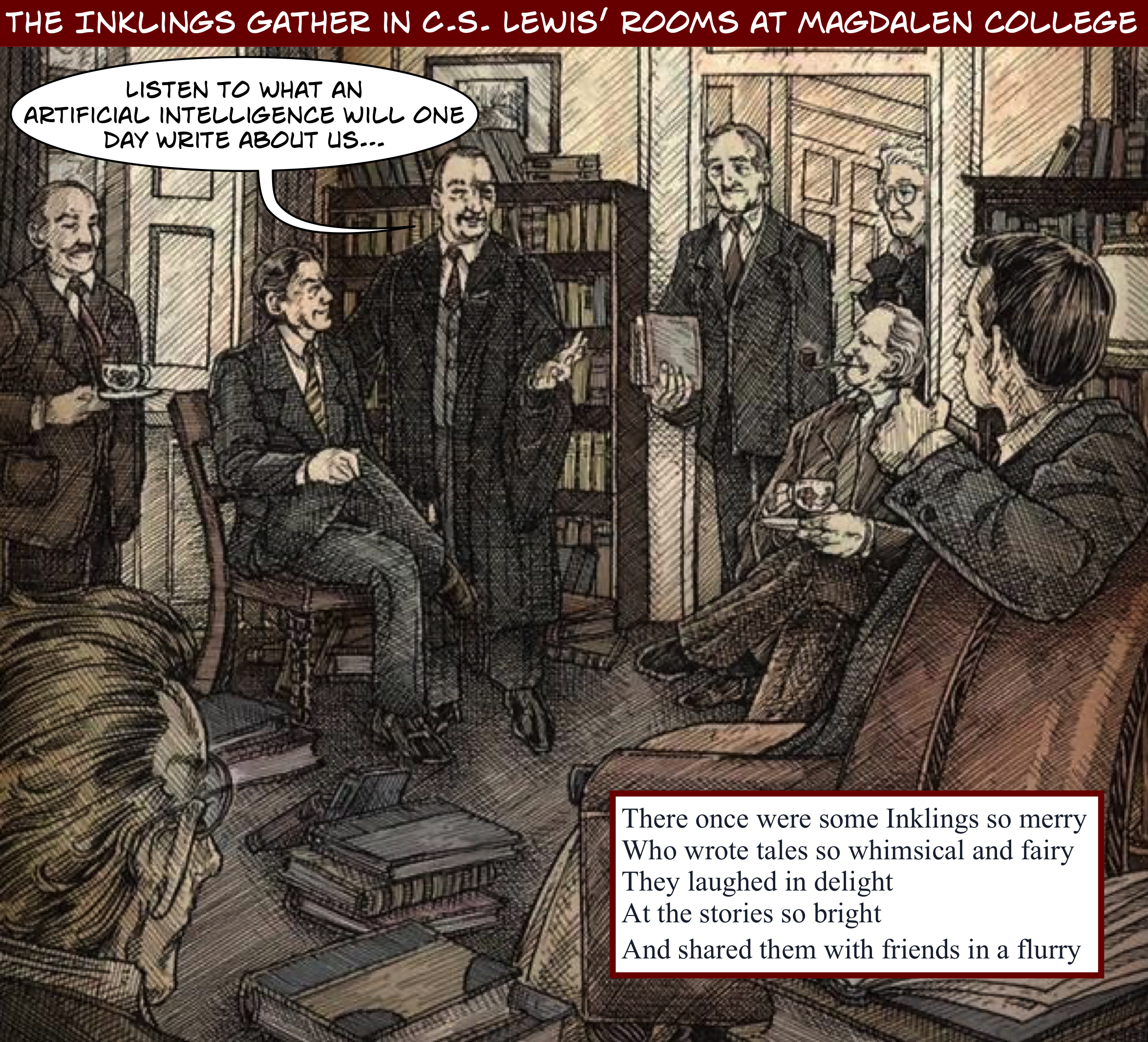
I’ve occasionally described the benefits I’ve received from being a member of writers [critique] groups around the globe. I titled one of my posts “Be an Inkling,” because this mutual sharing was central to those brilliant minds who gathered together in Oxford.
In 1967, J.R.R. Tolkien described his reason for using that particular word in just such settings. He said he used the word Inkling as “a ‘jest,’ because it was a pleasantly ingenious pun in its way, suggesting people with vague or half-formed intimations and ideas plus those who dabble in ink.”
I too find it “pleasantly ingenious” and have echoed it here in my own domain.
Conferences can be helpful too, but my experience is that nothing surpasses the encouragement that emanates from the mutual commitment shared by writers who physically gather to share their creations.
I noted above two concrete ways writing friends can contribute to strengthening our work. However, this third element – encouragement – cannot be underestimated. It was precisely this element that brought that masterpiece, The Lord of the Rings, to the world’s attention.
A Pilgrim in Narnia provides a superb account of C.S. Lewis’ essential role in boosting the confidence of his friend J.R.R. Tolkien. He cites a letter in which Tolkien describes how Lewis’ most precious gift was in challenging him to complete his opus.
The unpayable debt that I owe to him was not ‘influence’ as it is ordinarily understood, but sheer encouragement. He was for long my only audience. Only from him did I ever get the idea that my ‘stuff’ could be more than a private hobby. But for his interest and unceasing eagerness for more I should never have brought The L. of the R. to a conclusion.
Melancholy Transitions
Critique groups are weighing on my mind, since the one I’ve been part of for many years has come to its end. The passing of various members during the past decade left too few of us to continue, and we few who were left are mourning the fact that it was not sensible to continue meeting regularly.
It is another reminder of Solomon’s wisdom when he wrote, “For everything there is a season, and a time for every matter under heaven.”
Sadly, I lack the energy to help establish another new writing fellowship at this point in my life. Perhaps I will join one of the online communities. Christian Writers looks promising.
I actually participated in an online critique community back when primitive “bulletin board systems” were giving way to the nascent internet. No doubt the modern equivalent would be far better in every way.
In the meantime, I do have a few readers I trust to review my work before submitting it to an editor. One is my very talented wife. The problem there, however, is that her love (and compassionate nature) make her too gentle when she critiques my work.
This drawback is one side of the coin to which author Dan Brown refers when he says: “I learned early on not to listen to either critique – the people who love you or the people who don’t like you.”
This does not mean, of course, that those who love us are unsuitable candidates. It simply suggests that we need to (often repeatedly) give them permission to offer genuinely critical comments, especially when they are accompanied by suggestions for how we might improve a given passage.
In essence although people like William Faulkner are correct in stating that “writing is a solitary job,” most of us can benefit from sharing our drafts with others.
And fortunate are those of us who discover such friendship, where our writing companions are like-minded, trustworthy, self-confident, and honest. (I personally find having a sense of humor an essential trait, as well.)
In a word, we are greatly blessed to personally become part of our own fellowship of Inklings.
The United States is schizophrenic about its religious heritage, and the armed forces provide us with today’s example. Most people, including veterans themselves, are unaware of the fact that while we have official songs for the different branches of the armed forces, we don’t have any official hymns.
C.S. Lewis and J.R.R. Tolkien, both combat veterans, were quite familiar with martial music. However, as members of a (nominally) Christian kingdom, neither would have been uncomfortable with explicitly Christian elements in their military’s hymnody. Across the ocean in the former colonies, it’s a different matter.
Here, the confusion about the “official” status of religious military hymns abounds because spiritual hymnody has been part of our nation’s martial history ever since the colonies decided to band together and seek independence. Yet, some consider that to be unlawful.
The rejection of music expressing faith in God can be attributed to the modern crusade against such hymns by strident anti-theists. Many in this camp are practicing atheists, who misinterpret the two clauses of the First Amendment which the nation’s founders did not consider mutually exclusive.
Congress shall make no law respecting an establishment of religion, or prohibiting the free exercise thereof . . .
Since most of the creators of the Constitution – and the majority of American citizens up to this day – have been theists (believing in a Supreme Being), it is self-evident that they did not intend to exorcise all expressions of faith from the public forum. Some states, in fact, already had their own “established churches when the First Amendment was ratified.”
Up until this generation, generic references to a heavenly Father or a benevolent Creator have traditionally remained welcome at civic events.
Even the non-Christian Thomas Jefferson (who argued against religious establishment) was essentially a Deist, acknowledging “the god who gave us life, gave us liberty at the same time . . .”
Jefferson even edited the New Testament Gospels, deleting “objectionable passages” and producing his personally-sanctioned Life and Morals of Jesus of Nazareth.
So, What about the Music?
My goal is not to discuss the First Amendment per se – though I included the introductory note above for the benefit of the many international readers who find their way to Mere Inkling.
Rather, I wish to discuss the premise above, that America celebrates generally secular martial music, while remaining wary of military hymnody with religious themes.
Ironically, soldiers throughout the nation’s history passively assumed that the songs they heard at rallies and civic events had the government’s tacit imprimatur, that was questionable. Take the “Battle Hymn of the Republic,” for example. Composed in 1861 by abolitionist Julia Ward Howe, Union soldiers would have been shocked to learn that some would deem its use in the ranks as a violation of the First Amendment.
Mine eyes have seen the glory of the coming of the Lord; He is trampling out the vintage where the grapes of wrath are stored; He hath loosed the fateful lightning of His terrible swift sword: His truth is marching on.
I have read a fiery gospel writ in burnished rows of steel: “As ye deal with My contemners, so with you My grace shall deal;” Let the Hero, born of woman, crush the serpent with His heel, Since God is marching on.
Whether you like jazz music, a marching band or orchestra music, the U.S. military has you covered. Each branch of the military boasts a diverse offering of musical talent that serves for ceremonial purposes but also for entertainment and outreach. Check out these bands to stay in tune with military music.
One Christian hymn has deep roots in the military community. The song traditionally referred to as “The Navy Hymn” in America, originated in Britain. It is also used by the French. Its maritime themes make it popular in civilian communities as well.
Eternal Father, strong to save, Whose arm does bind the restless wave, Who bids the mighty ocean deep Its own appointed limits keep; O hear us when we cry to Thee For those in peril on the sea.
O Savior, whose almighty word The winds and waves submissive heard, Who walked upon the foaming deep, And calm amid the rage did sleep; O hear us when we cry to Thee For those in peril on the sea.
“There exist a myriad of alternate verses to the hymn. One, for example, was written by David B. Miller in 1965 and specially dedicated to naval submariners.”
Musicians were not just present for official ceremonies and off-duty entertainment. They could also inspire the troops in the violent din of battle. More common in distant ages, even in twentieth century Europe, we find a dramatic illustration.
In the military archives of the Irish Republican Army, Michael J. Crowley described the inspiration provided by the brigade’s musician in the heat of the battle called the “Battle of Crossbarry” and the “Crossbarry Ambush,” by the IRA and the Brits respectively.
From the opening shot of the engagement, our piper, Florrie Begley of Brandon, played warlike airs on the bagpipes until the last shot was fired.
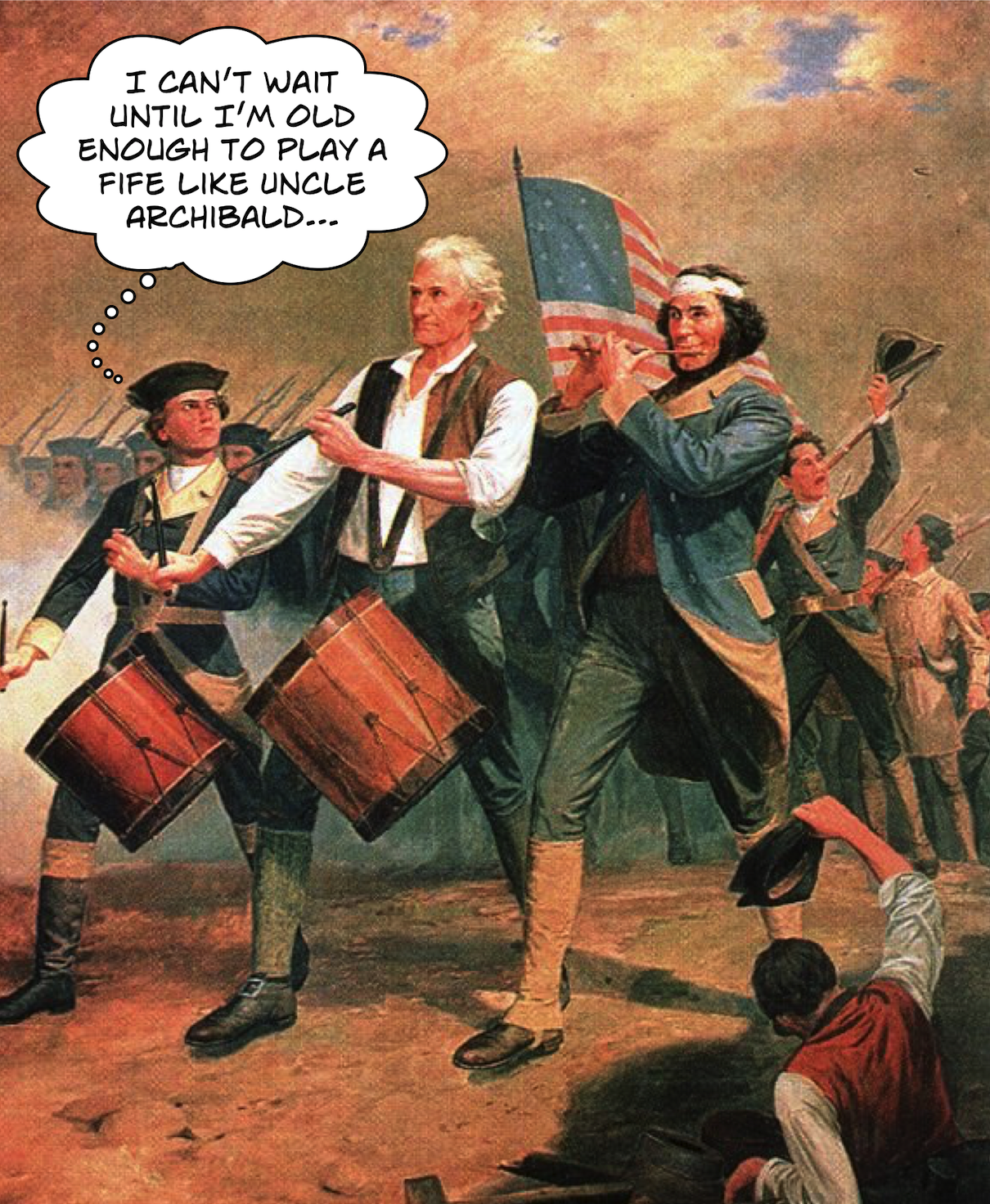
The illustration above provides an idealized portrait of military musicians bravely facing enemy fire. “The Spirit of ’76,” painted for the centenary of the American Revolution, met with tepid enthusiasm during the 1876 Centennial Exposition in Philadelphia. However, it rose in popularity when it subsequently toured the country.
For centuries, armies used music as the means to communicate the military orders of the day to soldiers. The high pitch of the fife and the sharp sound of the drum allowed messages to be heard at great distance . . .
Leaping from the Revolution to the twenty-first century, the recently birthed United States Space Force now has a hymn. Well, sort of. It is an unsolicited hymn composed by a former Air Force officer. You can hear “Creator of the Universe” here.
For more space music, check out the official anthem of “the mighty watchful eye.” Some consider this proposed anthem far more inspiring.
My personal favorite is the version of the Space Force Anthem proposed by its original, cinematic commander, General Naird, played by Steve Carell. (Carell even plays his own fife in the episode.)
The Middle Earth Military March
Howard Shore composed a powerful soundtrack for Lord of the Rings. Yet he wasn’t the first to create music for the great saga. One Tolkienist writes:
My first contact with Tolkien-inspired music dates back to the late 1980s . . . I was watching TV with my parents seeing a performance of Military Bands. Later I would discover that it was the Dutch composer Johan de Meij’s Symphony No. 1 (The Lord of the Rings) I’d heard.
From among the ranks of the Inklings, only one writer wrote an explicit military song. J.R.R. Tolkien provided the timeless Ents with a somber marching song as they face the powers of Isengard.
We come, we come with roll of drum: ta-runda runda runda rom! We come, we come with horn and drum: ta-rūna rūna rūna rom!
To Isengard! Though Isengard be ringed and barred with doors of stone; Though Isengard be strong and hard, as cold as stone and bare as bone, We go, we go, we go to war, to hew the stone and break the door; For bole and bough are burning now, the furnace roars – we go to war! To land of gloom with tramp of doom, with roll of drum, we come, we come; To Isengard with doom we come! With doom we come, with doom we come!
If you have a moment, you will likely enjoy the performance of this song as arranged by Clamavi De Profundis.
When a great author, say of the magnitude of J.R.R. Tolkien, creates ingenious new words, and even entire languages, there are several common reactions. Most readers simply respond with silent awe. Others are inspired to emulate their efforts. A small number reuse those very words as a sincere homage.
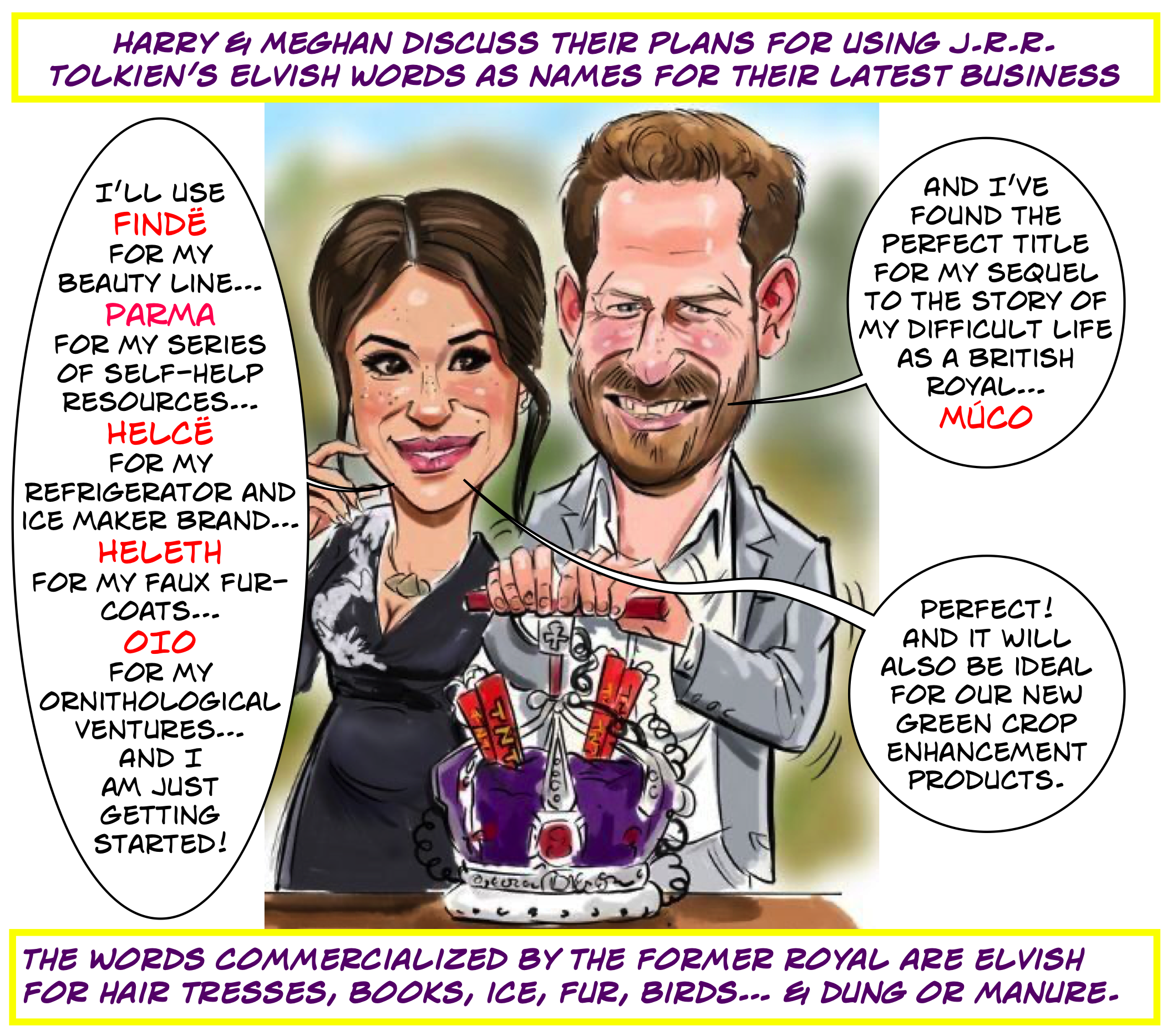
And a handful of “admirers” go so far as to “appropriate” the words themselves, for their personal benefit.
C.S. Lewis, no mean linguist himself, recognized his friend Tolkien’s brilliance. In his preface to That Hideous Strength he praised Tolkien’s yet-to-be-published Silmarillion. In a 1951 letter he mentions misspelling the word Numenor.
My Numinor was a mispelling: it ought to be Numenor. The private mythology to which it belongs grew out of the private language which Tolkien had invented: a real language with roots and sound-laws such as only a great philologist could invent.
He says he found that it was impossible to invent a language without at the same time inventing a mythology.
J.R.R. Tolkien was an internationally renowned philologist, and his impressive skill is one of the great wonders we encounter in Middle Earth. A number of words from his created languages – particularly his ethereal Elvish tongues – have been lifted to be used in commercial activities unconnected to Tolkien’s interests.
For example, Palantir. This was the word for the “seeing stone,” which played a prominent role in The Two Towers. In light of Tolkien’s love of nature, and corresponding suspicion of technological advancement, it is especially odd that the company adopting this label is on the leading edge of Artificial Intelligence.
Perhaps Tolkien’s dread would have been dispelled by one of Palantir’s disarming mottos: “We believe in augmenting human intelligence, not replacing it.”
A combat veteran of WWI, like his fellow Inkling C.S. Lewis, Tolkien was appalled by war’s horrors. Even in the War of the Rings, with its moments of glorious heroism and sacrifice, the bloody heart of Mars remains nearly invincible. Because of this mixed attitude toward war, some have wondered how he would have felt about a defense (i.e. military) corporation adopting one of his creations.
Andúril was the name of the most important weapon forged in Middle Earth. It was actually reforged from the broken fragments of Narsil, the longsword which defeated Sauron by severing the One Ring from his hand.
While this description from the Anduril company resonates with our modern ear, I am not convinced that it sounds very Tolkienesque. Anduril: “Transforming defense capabilities with advanced technology. The battlefield has changed. How we deter & defend needs to change too.”
In a 1965 letter, written after Lewis’ death, Tolkien commented on how his friend had used subtle variations of several Elvish words in several of his fictional works.
Tolkien says Lewis “had the peculiarity that he liked to be read to. All that he knew of my ‘matter’ was what his capacious but not infallible memory retained from my reading to him as sole audience.” Thus, he surmises that:
C.S. Lewis was one of the only three persons who have so far read all or a considerable part of my ‘mythology’ of the First and Second Ages, which had already been in the main lines constructed before we met. . . . His spelling numinor is a hearing error, aided, no doubt, by his association of the name with Latin nūmen, nūmina, and the adjective ‘numinous.’
Lewis was, I think, impressed by ‘the Silmarillion and all that,’ and certainly retained some vague memories of it and of its names in mind. For instance, since he had heard it, before he composed or thought of Out of the Silent Planet, I imagine that Eldil is an echo of the Eldar; in Perelandra ‘Tor and Tinidril’ are certainly an echo, since Tuor and Idril, parents of Eärendil, are major characters in ‘The Fall of Gondolin,’ the earliest written of the legends of the First Age. But his own mythology (incipient and never fully realized) was quite different.
An Entertaining Diversion
Years ago I linked to an entertaining game that plays on the linguistic eloquence and mystery Tolkien exhibited in naming his characters. I was delighted to see now that it is still available online.
Antidepressants or Tolkien challenges players – you can play solo, but it’s more fun with others – to guess if a given word is an antidepressant drug or the name of one of Tolkien’s characters. Don’t expect to score 100%, but do expect to smile at some of the examples.
Poor Tinker Bell. The political prejudices of our day have caught up with the sparkling fairy, and relegated her to a significantly reduced presence in the Disney universe.
Inside the Magic reported “Tinker Bell seems to have left Walt Disney World and is now on her way back to Neverland following a recent change at Walt Disney World Resort.” You can read the tragic tale on their site.
. . . once more, Disney’s animated classic, Peter Pan (1953), is under scrutiny, with Disney issuing a statement regarding Captain Hook and Tinker Bell as characters with potential concerns.
Linking poor Tink to a murderous pirate seems a bit of a stretch, and she has not been fully banished, but she has definitely been demoted. According to TMZ, Disney alleges the company’s “own people felt she wasn’t a good role model for girls in the 21st century.”
Well, eventually she too will be in the public domain, like Mickey Mouse. Actually, her literary portrait as introduced in the play, coincidentally just entered the public domain this year (2024)!
However, should you reside in the United Kingdom, beware that in 1988, the copyright holder, Great Ormond Street Hospital, was granted the rights to Peter Pan “in perpetuity.”
The Creator of Tinker Bell & Peter Pan
Tinker Bell is one of the most memorable characters in Neverland, the creation of James Matthew Barrie (1860-1937). He was a prolific Scottish writer and is best known for his 1911 novel, Peter and Wendy – which initially debuted in the form of a stage play in 1904, as Peter Pan; or, the Boy Who Wouldn’t Grow Up.
Peter Pan was actually introduced to the world as a baby in The Little White Bird. Tinker Bell does not appear in the novel, but the following description of J.M. Barrie’s fairy mythology is quite fanciful.
One of the great differences between the fairies and us is that they never do anything useful. When the first baby laughed for the first time, his laugh broke into a million pieces, and they all went skipping about. That was the beginning of fairies.
They look tremendously busy, you know, as if they had not a moment to spare, but if you were to ask them what they are doing, they could not tell you in the least. They are frightfully ignorant, and everything they do is make-believe.
They have a postman, but he never calls except at Christmas with his little box, and though they have beautiful schools, nothing is taught in them; the youngest child being chief person is always elected mistress, and when she has called the roll, they all go out for a walk and never come back.
It is a very noticeable thing that, in fairy families, the youngest is always chief person, and usually becomes a prince or princess; and children remember this, and think it must be so among humans also, and that is why they are often made uneasy when they come upon their mother furtively putting new frills on the basinette.
Barrie continues, describing how infants are simply following fairy “ways” when they misbehave, and they naturally experience “exasperation, because we don’t understand [them], though [they are] talking an intelligible language . . . fairy.”
Returning to the person of Tinker Bell herself, she outgrew her supporting role as, in the words of her creator, “a common fairy.” She was literally a tinker, who died following the departure of Wendy and her brothers from Neverland.
Presumably, some of the gatekeepers at Disney would have preferred that the affection of the crowds had not restored her to life.
The Inklings
The Imaginative Conservative offers an interesting take on C.S. Lewis’ view of fairies. I quote a portion related to our present subject.
Lewis treats the subject of fairies in . . . The Discarded Image. . . . After explaining the medieval understanding of the heavens and planetary systems, Lewis turns to what he calls the Longaevi. He avoids the term “fairies” because it is “tarnished by pantomime and bad children’s books with worse illustrations.” (Probably referring to Barrie’s popular play and Princess Mary’s Gift Book – the book from which Elsie and Frances clipped the pictures they used in their fake photos.)
Jane Douglass, an American actress and playwright, contributed a fascinating essay to C.S. Lewis at the Breakfast Table, and Other Reminiscences. One wonderful portion of “An Enduring Friendship” describes Lewis’ thoughts about the possible dramatization of The Lion, the Witch, and the Wardrobe.
C.S. Lewis deemed the prospect absurd on its face, saying “I believe plays should be plays, poems, poems, novels, novels, stories, stories, and certainly the book you mention is pure narrative.” So much for a partially surviving 1967 series, the 1979 animation, the 1988 BBC television series, and the cinematic version(s) which began in 2005. Oh, and there is the matter of the impending Netflix telling which remains a closely guarded secret. Douglass continued with a reference to Disney.
He repeated his dread of such things as radio and television apparatus and expressed his dislike of talking films. I said I quite understood this, and that nothing would distress me more than that he should think that I had in mind anything like the Walt Disney shows; I hoped nobody had suggested the book to Mr. Disney.
This seemed to relieve Mr. Lewis to such an extent that I thought perhaps Mr. Disney had been after the book, but of course I did not ask. And in his usual generous way, Mr. Lewis said, “Too bad we didn’t know Walt Disney before he was spoiled, isn’t it?”
Author Jim Denney has a nice article on “What C.S. Lewis and J.R.R. Tolkien Thought of Walt Disney” in which he describes parallels between the live of Lewis and Disney and concludes, “you might think that, with all that C.S. Lewis and Walt Disney had in common, they might have been mutual admirers – but that was not the case.”
Disney’s Snow White and the Seven Dwarfs debuted in the United States in 1937 and in the United Kingdom in 1938. . . . A few months later, Lewis went to see it again, this time with his good friend (and fellow Oxford professor) J.R.R. Tolkien.
Coincidentally, Tolkien’s first novel The Hobbit had been published in September 1937, just three months before the American debut of Snow White.
Their greatest disappointment was in Disney’s utterly comical take on dwarves and the absence of the slightest air of “the mythic nobility of the dwarves from Germanic folklore.”
Although Snow White is itself a fairy tale, fairy characters are not to be found in the film. In the same way, J.R.R. Tolkien referred to the Lord of the Rings as a “fairy story” for adults, yet they do not appear to dwell in Middle Earth.
In fact, according to The Encyclopedia of Arda, “the name ‘Faerie’ belongs to an early period of Tolkien’s writings, and is never seen in The Lord of the Rings, but it does survive in a single usage in the earlier book The Hobbit.” And even in that case, it refers not to a population, but to a place.
On the Effect of Tinker Bell
Tinker Bell’s significance in the world is not confined to literature, or the interests of children. There is a brilliant application of her legend which has been transposed into the psychological realm.
It’s call the “Tinker Bell Effect,” and “Be(lie)ve It or Not,” from Psychology Today, offers the following description.
One theory manifesting connections among belief, psychology, and mythology is the Tinkerbell effect named for the fairy Tinker Bell of Peter Pan whose resuscitation depends upon the audience expressing their belief in fairies through clapping . . .
The Tinkerbell effect refers to those things that exist only through imaginative acts and because people believe in them. The Reverse Tinkerbell effect maintains that, somewhat paradoxically, the more people believe in something the more likely it is to disappear.
In their article, the psychologists parenthetically offer an additional application of Tinker Bell’s nature to their area of study. (It actually appears in the paragraph above, where I replaced it with an ellipsis.)
(because she is so small that she can only hold one feeling at a time, Tinkerbell is also a model for mood disorders and difficulties with emotional self-regulation)
Fascinating. It seems to me this insight opens the door to further literary exploration of the Tinker Bell Phenomenon that would be of interest to writers and literary critics alike. I close with my proposal for a new label for an ancient plague afflicting fictional works. If it interests any scholars among you, I invite you to develop it further and claim it as your own.
Tinker Bell (var. Tinkerbell) Crippling Character Creation Complete Content Complexity Phenomenon: The invention of fictional characters who lack depth and bear no resemblance to real people. Literary tropes that are often referred to as one-dimensional or “flat” characters. (See nearly all Marvel supervillains.)
P.S. – Feel free to abbr. the admittedly verbose proposed title; keeping in mind most readers prefer brief reads.
Would you be interested in owning a copy of an attractive new font called Middle Earth? If so, read on and you’ll find a link to download this typeface created by Swedish designer Måns Grebäck.
When it comes to fonts, there are basically two types of people – those who pay no attention to them as they read, and others who notice the nuances between similar fonts and are fascinated by extraordinary examples.
The reason for my current interest in fonts is due to Microsoft’s decision to jettison Calibri as their default font for Office products. They needed to make room for its replacement, Aptos. Seriously, when you view the two sans serif* fonts, side-by-side, you may be surprised at how little they differ.
To make matters even more confusing, CNBC describes a curious aspect of Aptos saga.
Aptos will remain available in the font list under the old Bierstadt name for people who are accustomed to it. Users can also choose to set any other font as the default.
Apple’s mac computers also allow users to choose their own defaults. One typography community discusses this selection opportunity, even as they bemoan the fact that in many programs, the standard installations include suboptimal fonts.
Unfortunately, many of us work on computers where we have no control over what fonts are loaded onto the machine, so we have created a list of the top 10 most common system fonts everyone should know and how to handle them.
This website offers a brief description and history of ten of the most common fonts we typically encounter. For example:
Times New Roman is a serif typeface designed by Stanley Morison and Victor Lardent in 1931. It was commissioned by the British newspaper The Times, which wanted a new typeface to replace its existing font, Times Old Roman.
And I love their estimation of Comic Sans, one of my wife’s favorite fonts, which I avoid like the proverbial plague. (Delores is a young at heart special education teacher, and I’m more of a Lewisian dinosaur.)
Do use: if you are designing a comic for 6-year-olds. Don’t use: if you want to be taken seriously by work colleagues.
Another pastor, who learned this lesson the hard way, shared his advice with the warning: “pastors don’t let your bulletins print out in Comic Sans!”
Apparently, his astute wife preserved his professional reputation by telling him to (1) avoid using a “smorgasbord of fonts” in a single document, and (2) “resist the temptation to print serious things in less than serious fonts.”
Advice for Writers
While authors have little control over the fonts in which their work is published by commercial publishers, they do have freedom to choose the typeface they use for the actual composition. “How To Choose the Best Font for Your Writing” addresses that latitude in the following way.
Do you have a favorite font? Are you dedicated to Times New Roman, or are you more of an “anything-but-Wingdings” kind of writer? Maybe you haven’t given your choice of font much thought.
Quite simply, as research shows, texts that look good make you feel good while interacting with them. This is why it’s so important to choose a font that not only is easy to read, optimizes line length, and has the right mood, but also is one that you like!
MasterClass describes the various aspects of each font that will contribute to your overall impression of each font. In “Typography for Writers: How to Pick the Best Type for Writing,” they explain the significance of bowls, ascenders, spines, counters, and more.
Typographers and type designers have their own universe of special terms, each of which refers to a specific part of a given letter. Understanding these basic elements of typography can help you decide precisely what typographic style you want to employ to grab your reader’s attention.
InDesignSkills goes so far as to match a number of typefaces to specific genres, saying “we judged the legibility, beauty, simplicity and variety of weights available of a huge range of fonts, and whittled them down to these faithful five.” They even offer an ironclad promise, proclaiming their selection will “never let your typesetting down, guaranteed.”
Obviously, personal tastes play a large role in appreciating or disapproving of various fonts. One author describes how the quest for the perfect font is integral to writers’ creativity.
Let’s talk about one of our favourite writing avoidance devices: picking the right font for your manuscript.
“The Best and Worst Fonts (and why they’re good or bad),” describes the bond a writer can develop with their typographic fancies.
Fonts are one of the most important design choices to make when developing your brand identity. The best fonts leave you feeling like you’ve made an instant friend while the worst fonts are like a stranger who won’t leave you alone.
The writer offers her personal preferences (and prejudices). I don’t agree with all of her judgments, but I am forced to concur with her inclusion of Jokerman and Bleeding Cowboys on the list of “worst fonts.” And I am pretty sure that C.S. Lewis would agree.
Write in the Spirit of Middle Earth
If you have read this far, your reward is to receive the download link for Middle Earth.
As noted aboved, Måns Grebäck is a prolific Swedish typographer. He makes many of his creations freely available to individuals for non-commercial use. (Commercial licenses are available as well.) The independent FontSpace describes it thusly:
With the historic charm of ancient manuscripts and the ethereal beauty of elven realms, Middle Earth typeface weaves tales of valor and legends. Its calligraphic allure is accentuated by rounded contours, reminiscent of Tolkien’s enchanted worlds.
Middle Earth truly is ethereally elegant. Enjoy.
* Sans serif fonts are those without serifs, which are the tiny lines or marks that appear at the end of a character’s stroke. Arial would be a common sans serif font, while Times New Roman is a familiar serif font.
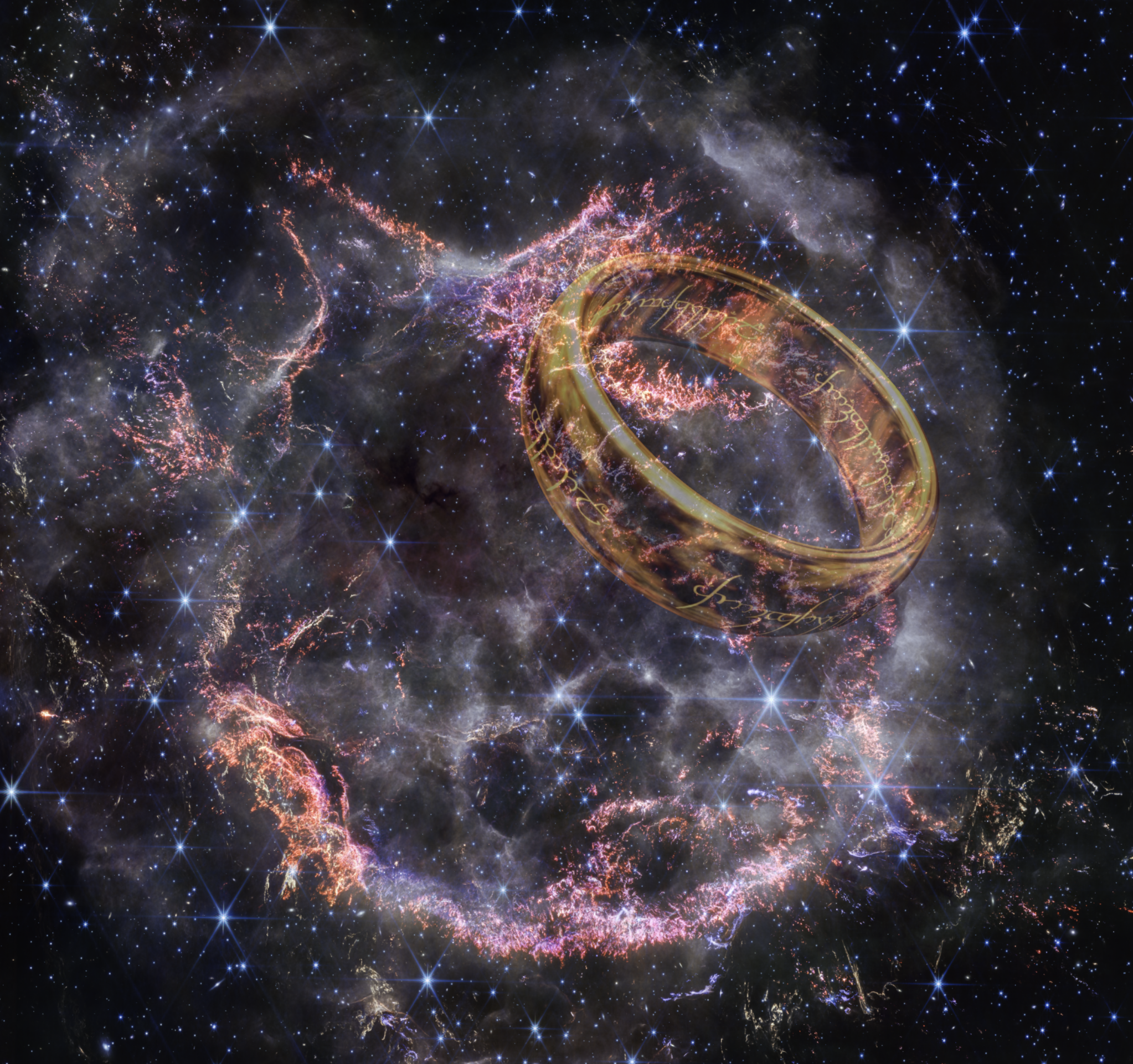
A newly captured image of a supernova remnant in our Milky Way galaxy has me curious about where J.R.R. Tolkien may have gained inspiration for the elegant style of his Elvish scripts.*
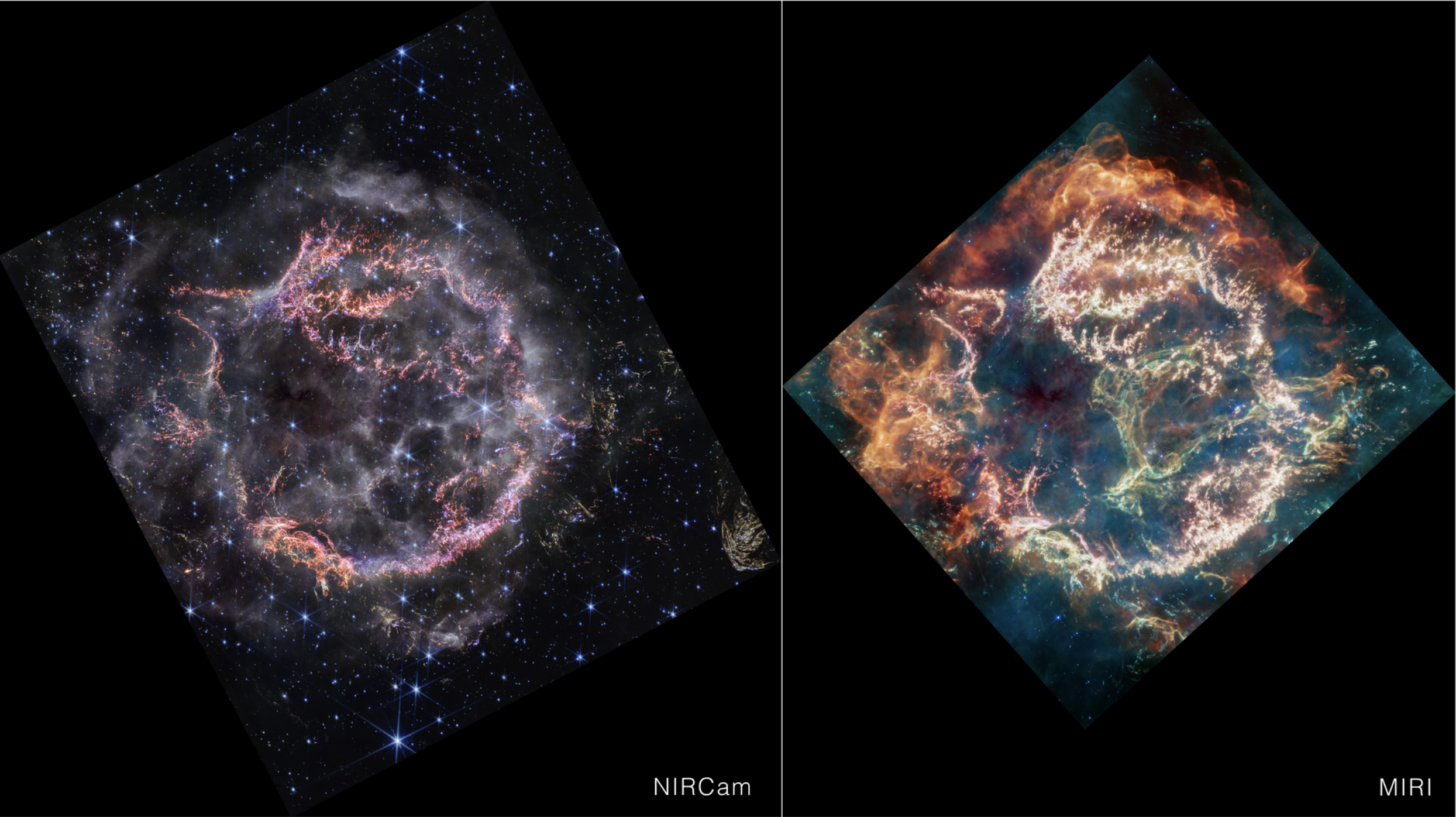
America’s NASA has gifted all of Earth’s citizens with an array of stunning, and enlightening images. Recently, the James Webb Space Telescope directed its focus to Cassiopeia A, created thousands of years ago when a star 11,000 light years away went supernova.
It may be my imagination, or perhaps its an elevated mental talent for “core object recognition,” but for some inscrutable reason, I have recognized in the aftermath of the explosion faint echoes of Elvishscript.
The light from Cassiopeia A (or Cas A, as we pseudo-astronomers refer to it) “first reached us around 340 years ago. As that was approximately 272 years before The Lord of the Rings was published, Tolkien had ample time to analyze the spectacular light source. Even factoring in the fact that the stories were composed between 1937 and 1949, the supernova’s existence had been known for a millennia and a half before LOR was written.
I will leave it to other researchers to determine just how Tolkien was able to gain a detailed view of the explosion’s aftermath. My purpose here is to simply alert the public to the unexplainable parallel between the cosmic residue and Tolkien’s own renditions of Elvish writing as he perceived it.
In a moment, I will allow the self-evident facts to speak for themselves.
Like his friend C.S. Lewis, Tolkien was a student of astronomy. As Professor Kristine Larsen says, “J.R.R. Tolkien based the stars and constellations of his created world of Middle-earth on ‘real world’ astronomy.” Dr. Larsen, a preeminent “Tolkienian Astronomer,” has published widely on the subject.
Of particular interest to readers of Mere Inkling will be “Medieval Cosmology and Middle-earth: A Lewisian Walk Under Tolkienian Skies,” which can be downloaded here. In the essay, Larsen points out,
. . . as is well known in Tolkien scholarship, during and after writing The Lord of the Rings Tolkien made various attempts to more closely align his cosmology with 20th century astronomical knowledge.
Fortunately for those of us who are drawn to the mythological textures of his legendarium, Tolkien never completed this “radical transformation of the astronomical myth” (as son Christopher termed it), but it is important to understand that this tension existed within Tolkien’s mind.
Having narrowly escaped the snare of surrendering to twentieth century astronomical theories, Tolkien preserved the mythical spirit of his cosmology. Larsen’s essay considers “whether or not Tolkien’s subcreation would, in reality, pass muster as a medieval cosmology, as defined by Lewis.” Thesis established, she takes readers on a pleasing journey. “So let us take a stroll under Middle-earth skies, and observe just how well the Dome of Varda matches with Lewis’s challenge.”
Returning to Cas A
As the images below will clearly illustrate, the preservation of the medieval nature of Middle Earth’s heavens does not mean that Tolkien ignored the realities of interstellar space. As I said a moment ago, the visual proof is definitive.
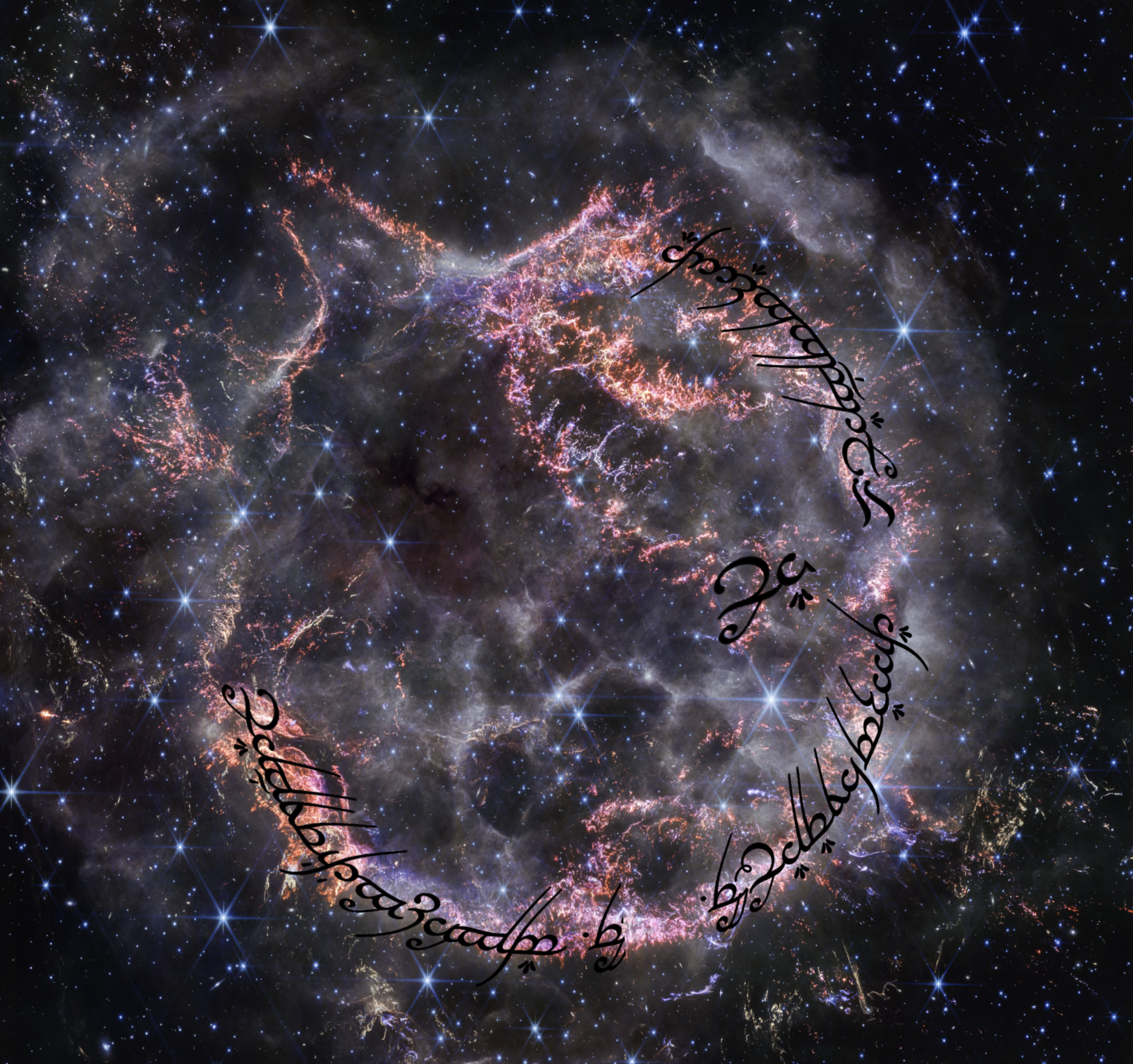
The fluid strokes of Tolkien’s Elven scripts are clearly foreshadowed in the plumes of this cosmic canvas.
This image speaks fluently for itself.
This pair of images from NASA contrasts the Near-Infrared and Mid-Infrared observations. It is quite possible the second influenced J.R.R. Tolkien’s perceptualization of Sauron’s eye. (Admit it, you see the dramatic similarities.)
We may never learn how Tolkien was able vividly see the details of Cassiopeia A with the earthbound telescopes accessible eighty years ago. Nevertheless, the evidence provided herein is irrefutable.
It seems fitting, when pondering the majesty of the stars as echoed in a masterpiece of literary subcreation, to close with an observation by Tolkien’s friend, C.S. Lewis. In an early letter to a close friend, Lewis described the wonder he experienced in reading Dante’sParadise.
Here Lewis lyrically shares an experience of spiritual ecstasy which, this writer humbly suggests, can be shared by many, as we stand in awe of the majestic intricacy of the universe our Creator has fashioned.
[I read] Aristotle’s Ethics all morning, walk after lunch, and then Dante’s Paradiso for the rest of the day. The latter has really opened a new world to me. I don’t know whether it is really very different from the Inferno [Owen Barfield] says it’s as different as chalk from cheese – heaven from hell, would be more appropriate!) or whether I was specially receptive, but it certainly seemed to me that I had never seen at all what Dante was like before.
Unfortunately the impression is one so unlike anything else that I can hardly describe it for your benefit – a sort of mixture of intense, even crabbed, complexity in language and thought with (what seems impossible) at the very same time a feeling of spacious gliding movement, like a slow dance, or like flying. It is like the stars – endless mathematical subtility of orb, cycle, epicycle and ecliptic, unthinkable & unpicturable, & yet at the same time the freedom and liquidity of empty space and the triumphant certainty of movement.
I should describe it as feeling more important than any poetry I have ever read. . . . Its blend of complexity and beauty is very like Catholic theology – wheel within wheel, but wheels of glory, and the One radiated through the Many (The Letters of C.S. Lewis to Arthur Greeves).
Perhaps it was one of these very wheels – or rings – that Tolkien observed so many years ago in the heavens?
* For those who are interested in fonts for your computers, you can download Tolkien-inspired typefaces here.
We live in an age where our courage matters more than ever. With social, cultural and international relationships all in terrible disarray, facing the future is not for the timid.
Courage is essential for living a life of integrity. Without it, we bend and fold whenever the pressure grows too great. Some people even go so far as to compromise their conscience.
In The Screwtape Letters, C.S. Lewis described how it is only when courage is required, that a person’s true values come into focus.
Courage is not simply one of the virtues, but the form of every virtue at the testing point, which means, at the point of highest reality.
A chastity or honesty or mercy which yields to danger will be chaste or honest or merciful only on conditions. Pilate was merciful till it became risky.
Samuel Johnson, an eighteenth century English writer, was highly esteemed by C.S. Lewis. His words on this subject foreshadow Lewis’ own thoughts. “Courage,” according to Johnson, “is the greatest of all virtues, because if you haven’t courage, you may not have an opportunity to use any of the others.”
Two millennia earlier, an influential Greek philosopher described this same truth. Aristotle, who did not look to the Greek pantheon for inspiration, also deduced that courage is a necessary attribute for the virtuous.
You will never do anything in this world without courage. It is the greatest quality of the mind next to honor.
Examining Ourselves
As a boy, I used to imagine myself playing heroic roles. These often involved rescuing innocent people from barbarians or tyrants, often in ancient settings. As a man I shed those imaginations and pondered realities. In the military, I witnessed courage up close, and I became persuaded that Mark Twain was correct when he declared “Courage is resistance to fear, mastery of fear, not absence of fear.”
True courage is not found in the cloying display of heroics, especially when arising from an ignorance of genuine danger. Neither is simple risk-taking an evidence of courage, since it may merely be the mark of an adrenaline junkie.
I haven’t personally been confronted with many situations which required physical courage, and when I have, I’ve been tempted to feel a little like I was “pretending.” But then I recall that truly courageous men and women also need to overcome their fear.
And, I honestly suspect that even those who have done the most selfless and courageous things possible, also recognized their limits. They ventured forth because they were truly courageous, not because they lacked fear. This is precisely what happened in a garden on Jerusalem’s Mount of Olives called Gethsemane.
Although encounters with physical dangers have been rare, my courage has been tested numerous times in the service of maintaining my integrity. I can recall a number of academic, professional, and personal occasions where standing for truth came at a very real cost. And, who knows how many times to which we are oblivious, that enemies have wished (and worked) us ill, because we did not surrender to their coercive manipulations.
Happy are those – I am sure Lewis, Johnson, Aristotle and Twain, would agree – who do not compromise their convictions. It appears that courage is a matter of character, not of the moment.
Two uplifting insights provide a fitting end to our meditation on this subject. While the courageous sometimes feel like they stand alone, Billy Graham reminds us of an encouraging fact.
Courage is contagious. When a brave man [or woman] takes a stand, the spines of others are often stiffened.
And, C.S. Lewis’ dear friend J.R.R. Tolkien provides us with another keen observation. In The Fellowship of the Rings, an elf named Gildor protects the hobbits at the outset of their journey, and observes, “courage is found in unlikely places.” Indeed, it is.
Artificial intelligence is on the rise. It’s IQ is somewhere above 75, and presumably still climbing. And some very intelligent human beings, are issuing apocalypticwarnings.
“Mitigating the risk of extinction from A.I. should be a global priority alongside other societal-scale risks, such as pandemics and nuclear war,” reads a one-sentence statement released by the Center for AI Safety, a nonprofit organization. The open letter was signed by more than 350 executives, researchers and engineers working in A.I.
Presently, I’m more wary of Russia, China and Iran igniting an end of the world scenario.
But there is one particular aspect of artificial intelligence that intrigues me. And that is the creation of literary works by these programs, which are themselves creations of humankind.
Some people, such as copywriters, feel their livelihoods are being threatened. “My amusement turned to horror: it took ChatGPT 30 seconds to create, for free, an article that would have taken me hours to write.” (And that was clocked way back in January; no telling how quickly the AI could perform the feat today.)
Others – think teachers – are alarmed by how simply this new technology can seduce students to take self-crippling shortcuts. One article refers to this as “the elephant in the room.”
Perhaps all questions centered on AI are inherently questions of ethics, and at the forefront of many teachers’ minds is cheating and plagiarism.
Cheating and plagiarism are two separate concerns, of course. AI is capable of not only drawing together already existing material, and generating new word combinations that cannot be tracked back to any unique original source.
I feel confident that the Inklings would be extremely suspicious of computer-generated “literature.” Yet, at the same time, I think it is a subject they too would find intriguing.
Test-Driving AI
There are a myriad of free sites where a person can enter some basic parameters or directions and await the product of text generated by a synthetic “mind.” I share below some examples of the input—output results of my initial experiment.
I asked Open AI, creators of ChatGPT, to write two limericks, about the Oxford Inklings and C.S. Lewis, respectively.
In Oxford, the Inklings did meet, With words and with wisdom so sweet. Tolkien and Lewis, Their minds in a breeze, Inkling tales made our imaginations fleet.
⁂
C.S. Lewis, a writer so grand, In Narnia’s magical land. With Aslan the Lion, In tales that inspire, He showed us the way to understand.
Next I asked for an Inkling sonnet, followed by two haikus, addressing the Inklings as a fellowship and C.S. Lewis the individual.
In Oxford’s hallowed halls, they gathered ‘round, The Inklings, minds of genius, so profound. With ink-stained fingers, in their fellowship, They wove their tales, from wisdom’s well to sip.
Tolkien, the philologist of ancient lore, In Elvish tongues, his stories did explore. Lewis, the Christian apologist true, In Narnia’s world, he brought God’s message through.
Williams, Barfield, Dyson, and the rest, In literature and faith, they were blessed. Their words a beacon in a world so dark, Igniting minds with sparks from wisdom’s arc.
Oxford’s Inklings, their legacy remains, In timeless tales, where inspiration reigns.
⁂
Inklings’ minds aflame, Oxford’s thinkers left their mark, Words and wisdom’s claim.
⁂
C.S. Lewis penned grace, Faith and fantasy embraced, Words that still embrace.
And finally, I requested: “write a story about C.S. Lewis really traveling to Narnia.” The program has a “regenerate” button to address the same query with a fresh response. Due to their lengths, I’ve included them as “footnotes” below.
Shockingly, to me at least, it took less than 10 minutes to complete all of this. Each response, in fact, took mere seconds . . . not much longer than the time required to type the requests.
There are a growing number of companies offering AI services. Most offer free opportunities to test their wares. I decided to try one such vendor.
WriterHand declares “our tool is 100% free, allowing you to create limitless text and blog content with the assistance of artificial intelligence.” I requested of them a sonnet and haiku, as well. The first follows, with two other variants in the footnotes below.
The Oxford Inklings, a literary group Of J.R.R. Tolkien, C.S. Lewis and more Created stories that still make us droop And have us seeking out their lore.
Their works of fantasy and myth Fill our imaginations with delight We all search for the answers they lit To the depths of our inner sight.
They wrote of worlds we can explore Of knights, dragons and magical things We follow their tales and come back for more And find joy in their musings.
The Oxford Inklings have a special charm Their words bring us together in song And we are forever in their warm Enchanting arms of wonder and long.
⁂
Inklings of Oxford Stories of fantasy told Enchantment forever
As with ChatGPT, I ended by requesting a brief, fictional story. My request was for a story about:
C.S. Lewis Meeting an Actual Talking Marsupial
On a recent summer day, C.S. Lewis, the famed author of the Chronicles of Narnia series, had a very extraordinary encounter. He had the chance to meet an actual talking marsupial.
The marsupial was a small wallaby, and it was found on the grounds of Lewis’ estate. It was not long before the wallaby began speaking to Lewis in a highly sophisticated manner. The wallaby spoke in a dialect that sounded similar to English, and was even able to converse with Lewis about the various topics he enjoyed discussing.
The wallaby was quite curious about Lewis and seemed to be quite eager to learn more about him and his works. It asked numerous questions about the Narnia series and the world that Lewis had created. It seemed to be quite fascinated by the various creatures and wonders that he had described.
The wallaby seemed to be quite intelligent and even asked for Lewis’ advice on certain topics. Lewis found the wallaby’s interest in the Narnia series quite amusing and was quite impressed by its intelligence and wit.
This meeting between Lewis and the talking marsupial was one that Lewis would never forget. It was an experience that he found both fascinating and enlightening. He was amazed by the marsupial’s intelligence and ability to converse on a level that exceeded many humans.
Lewis was quite taken aback by the talking marsupial’s presence and the conversation that ensued. He was quite intrigued by the creature’s intelligence and the fact that it could understand complex topics. This experience would later serve to further inspire Lewis’ writing and help him create some of the most beloved characters in literature.
This experience between Lewis and the talking marsupial was truly extraordinary and one that will never be forgotten. It was a meeting that allowed Lewis to learn more about the creatures that inhabit his beloved Narnia and to gain a better understanding of the power of imagination and creativity.
A Final Thought from C.S. Lewis
One of C.S. Lewis’ countless correspondents was the famous British author Arthur C. Clarke. In 1954, they exchanged letters discussing the human element of literature. I suppose it’s a subject for philosophers to explore, but one wonders how clearly the “humanity” element is communicated through a nonhuman mechanism. Sadly, Lewis’ letter is not so prescient as to address our current question, but it was sufficient to raise the matter in my own thoughts.
Dear Clarke,
Human interest, yes. But that is inevitably present if the fears and hopes and wonders of the astronauts are vividly realised – e.g. as in Bedford & Cavor on the Moon [he refers here to H.G. Wells’ The First Men in the Moon] or even Crusoe on the island. And an author who can’t do that won’t mend matters by dragging in Crooks, Crutches, or Conspiracies: for the sort of story he drags in will be just as lacking in Human interest as his space story.
About ‘escapism,’ never let that flea stick in your ear. I was liberated from it once & for all when a friend said ‘These critics are v. sensitive to the least hint of Escape. Now what class of men would one expect to be thus worked-up about Escape? – Jailers.’ Turn-key critics: people who want to keep the world in some ideological prison because a glimpse at any remote prospect would make their stuff seem less exclusively important.
Fantasy & S-F. is by miles the best. Some of the most serious satire of our age appears in it. What is called ‘serious’ literature now – Dylan Thomas & Pound and all that – is really the most frivolous. All the best. Yours C.S. Lewis
The two brief stories below were generated by ChatGPT in response to the request for a story about Lewis actually visiting Narnia.
In the quiet confines of his cozy Oxford study, C.S. Lewis sat by his flickering fireplace, a manuscript of his latest book on theology resting on his desk. The clock on the wall ticked away the minutes, marking the time as late evening gave way to the inky embrace of night. Lewis’s eyes grew heavy, and he decided it was time to retire to bed.
As he settled into his comfortable bed, he couldn’t shake the feeling of restlessness that had gripped him that evening. He stared at the wardrobe across the room, the same wardrobe that had once belonged to his grandparents and had always fascinated him as a child. He closed his eyes and drifted into a dream, or so he thought.
To his astonishment, Lewis found himself standing before the wardrobe, which now seemed more magnificent than ever. It loomed like a gateway to another world, and he couldn’t resist the urge to open its creaking doors. With a sense of wonder and trepidation, he stepped inside.
Instead of feeling wood beneath his feet, Lewis’s toes sank into soft, cool earth. He looked around and found himself standing in a dense, snow-covered forest. The air was crisp and carried a scent of pine and adventure. He realized that he was in Narnia.
Before him stood a lamppost, its light casting a warm and inviting glow. Lewis recognized it from his own stories. He couldn’t help but smile, realizing that he had somehow stepped into the world he had created through his Chronicles of Narnia.
As he ventured deeper into the forest, Lewis encountered creatures of myth and magic—talking animals, fauns, and even a majestic lion named Aslan. They welcomed him with open arms, for they knew him as the one who had brought their world to life through his words.
Days turned into weeks, and Lewis explored Narnia with childlike wonder. He sailed on the Dawn Treader, encountered the White Witch, and witnessed the coronation of King Caspian. He marveled at the beauty of Narnia’s landscapes, the bravery of its inhabitants, and the profound wisdom of Aslan.
Throughout his journey, Lewis engaged in deep conversations with the creatures of Narnia, discussing matters of faith, morality, and the nature of storytelling. Each encounter enriched his understanding of the Christian faith he had embraced in the real world.
Eventually, Lewis knew that he had to return to his own world. With a heavy heart, he stood before the same lamppost where he had first arrived and closed his eyes. When he opened them again, he was back in his Oxford bedroom, the wardrobe standing silent and ordinary once more.
He sat at his desk, the manuscript still awaiting him, but now with a newfound sense of purpose and inspiration. The memories of Narnia, his journey, and the lessons he had learned would forever shape his writing and his faith.
C.S. Lewis had indeed traveled to Narnia, not in body, but in spirit and imagination, and his stories would continue to transport readers to that magical world for generations to come.
⁂
Using the “regenerate” option with the same command: “write a story about C.S. Lewis really traveling to Narnia.”
Once upon a time in the quiet town of Oxford, C.S. Lewis, the renowned author and scholar, found himself embarking on a remarkable adventure. It was a crisp, autumn evening when he was invited to attend a secret gathering by a mysterious stranger who had slipped an enigmatic note under his door. The note simply read, “Come, Narnia awaits.”
Intrigued and a bit skeptical, Lewis decided to follow the call. He put on his overcoat, grabbed his umbrella, and stepped out into the cool night. The moon was a silvery crescent in the sky, casting an eerie glow on the cobblestone streets.
As he followed the directions given in the note, Lewis found himself walking through an old, secluded part of Oxford that he had never seen before. The air seemed to grow colder, and the world around him took on an otherworldly quality. Suddenly, he stumbled upon a large, ancient wardrobe tucked away in the corner of a park.
With a sense of déjà vu, Lewis remembered writing about such a wardrobe in one of his stories. He cautiously opened the wardrobe door, half-expecting it to be filled with coats and mothballs. To his astonishment, the wardrobe seemed to stretch and expand, and he found himself tumbling headfirst into a land covered in snow and surrounded by towering fir trees.
He had arrived in Narnia.
The moment his feet touched the snowy ground, Mr. Tumnus, the faun, rushed forward with a smile and exclaimed, “Welcome, dear friend! We’ve been waiting for you.”
Lewis was both bewildered and delighted. As he explored Narnia, he met talking animals, dwarves, and even the great lion, Aslan, whom he had created in his own stories. The world he had once imagined had come to life before his eyes.
Days turned into weeks, and Lewis became a beloved member of the Narnian community. He marveled at the beauty and wonder of this magical land. He listened to the tales of its inhabitants, learned from their wisdom, and shared stories of his own.
But as all adventures must come to an end, Lewis knew he couldn’t stay in Narnia forever. With a heavy heart, he approached the wardrobe once more and stepped back into his own world, leaving Narnia behind.
Back in Oxford, Lewis couldn’t help but wonder if his journey to Narnia had been a dream or a product of his imagination. Yet, the memories were vivid, and the lessons he had learned about faith, courage, and the power of imagination remained with him for the rest of his days.
And so, the story of C.S. Lewis’s extraordinary voyage to Narnia remained a secret he carried with him, a testament to the enduring magic of literature and the boundless possibilities of the human imagination.
⁂
Variants of the sonnet and haiku produced by WriterHand follow.
The Oxford Inklings were a group of friends Whose conversations filled the air with wit and wit; Their words of wisdom still live on to this day, Their legacy of literature still stands tall and lit.
From C.S. Lewis to J.R.R. Tolkien They bantered and debated through the night; Their words and stories filled us all with joy, A source of inspiration, both dark and light.
From fantasy to science fiction, The Inklings had a way with words; Their genres and stories still stand the test of time, And their influence still continues to be heard.
The Oxford Inklings and their works Will live on in the hearts of many; Their words will inspire generations to come, A lasting legacy of literary plenty.
⁂
The Inkling’s works shine A legacy of wisdom still In our hearts, forever
⁂
The Oxford Inklings were a unique group Formed in the city of dreaming spires A gathering of friends with a shared goal To explore the depths of their desires
A fellowship of authors, poets, and more Including Tolkien, Lewis, and Williams Discussing literature, theology, and lore In the Eagle and Child’s hidden realms
From the Inklings came works of great fame The Chronicles of Narnia and The Lord of the Rings Legends of Middle Earth and tales of great shame A legacy that will last through the ages
The Oxford Inklings were a brilliant crew Inspiring writers and readers anew.
⁂
Oxford Inklings’ lore In tales of fantasy and truth Lives on forever
C.S. Lewis and J.R.R. Tolkien are two of the countless authors who have immortalized the beauty and majesty of eagles in their books.
In Narnia, talking eagles such as Farsight serve in Aslan’s councils of war, while their speechless brethren go about their instinctual activities.
There would have been a splendid view . . . but among all those trees you could see nothing – only, every now and then, some huge pinnacle of rock above the tree-tops, and an eagle or two wheeling high up in the blue air.
“They smell battle,” said Corin, pointing at the birds. “They know we’re preparing a feed for them” (The Horse and His Boy).
Eagles feature even more prominently in Middle Earth. The sapient Great Eagles appear at various key moments, including the rescue of doomed heroes. After the One Ring has been destroyed, an eagle bears news of the defeat of Sauron to Minas Tirith. Its proclamation is voiced in poetry.
Sing now, ye people of the Tower of Anor, for the Realm of Sauron is ended for ever, and the Dark Tower is thrown down.
Sing and rejoice, ye people of the Tower of Guard, for your watch hath not been in vain, and the Black Gate is broken, and your King hath passed through, and he is victorious.
Sing and be glad, all ye children of the West, for your King shall come again, and he shall dwell among you all the days of your life.
And the Tree that was withered shall be renewed, and he shall plant it in the high places, and the City shall be blessed.
Sing all ye people!
If that sounds biblical, don’t be surprised. Although Tolkien scrupulously avoided Judeo-Christian references, so his work would not be misconstrued as allegory, the Psalms have exerted great influence on Western literature. The Lord’s entrance into the holy city is celebrated in the following words in Psalms 33 and 24.
Rejoice in the Lord, O ye righteous: for praise is comely for the upright. . . . Lift up your heads, O ye gates; and be ye lifted up, ye everlasting doors; and the King of glory shall come in. Who is this King of glory? The Lord strong and mighty, the Lord mighty in battle. Lift up your heads, O ye gates; even lift them up, ye everlasting doors; and the King of glory shall come in.
Eagles in Our Earthly Realm
My thoughts today rose toward the sky because of an eagle I encountered while enjoying nature with my border collie this morning.
I’m blessed to live in a community near the Hood Canal, one of America’s longest fjords, extending about fifty miles. Near my home, is a nesting ground for Bald Eagles, our national bird and one of the world’s grandest raptors. Their aeries, or nests, are massive.
Even after their crowded gathering to raise their young each year, we have eagles who remain in the area. It was one of these that I contemplated today.
I was almost mesmerized as I watched the creature circle around in the sky. Even with its unrivaled vision, it appeared to be above its normal hunting altitude. Rather, it looked for all the world like it was simply enjoying its nature, celebrating its eaglehood.
Such sightings are impressive, but not rare. However, one thing truly amazed me. As I watched that eagle soar for many long minutes, not once did it flap its wings. It simply danced in the thermals.
During that riveting time it neither departed its unmapped path in pursuit of food, nor tired of its aerial ecstasy. It savored the gifts of its Creator, and I vicariously experienced shalom as I rested and beheld.
The Lord is the everlasting God, the Creator of the ends of the earth. He does not faint or grow weary; his understanding is unsearchable. He gives power to the faint, and to him who has no might he increases strength. Even youths shall faint and be weary, and young men shall fall exhausted; but they who wait for the Lord shall renew their strength; they shall mount up with wings like eagles; they shall run and not be weary; they shall walk and not faint (Isaiah 40).
Thank you, Lord, for granting me this reminder – and experience – of your holy promise this day.
Here at Mere Inkling our admiration for C.S. Lewis moves us to emulate some of his practices. Thus, we are avid readers and we also enjoy learning new words.
Some of us even enjoy inventing new words. No, we’re not so presumptuous as to desire to wend our ways into the dictionary. We just find this creative game to be both fun and useful for promoting mental health.
The challenge is providing rational definitions for our neologisms. These meanings can be serious or absurd; that doesn’t matter. Here are four I recently devised. (More, from years past, are available in the links I have included above.)
: Zambaloney : noun
A succulent cut of meat served only in skating rinks while the ice is being resurfaced during formal sporting competitions.
: Teguchigulper : noun
The indigenous name for the Honduran species of Chupacabra.
: Belladonut : noun
The presentation of poison derived from the perennial Atropa belladonna in appealing confectionaries. See also, doughnut.
: Sinderella : noun
The Brothers Grimm story about a beneficent stepmother who learns her two biological daughters are being terrorized by their physically beautiful yet wicked stepsister.
We’re Not Alone
If you have tried your hand at this, or at least think it’s curious, you might be surprised to learn there are online “word generators” that perform at least part of this function. Let me mention a couple before sharing some more of my own inventions.
Unfortunately, some only toss out made up words, in literary isolation. This is the case of Random Word Generator, which did, however, suggest the intriguing word “picneted.”
Nonsense Word Generator “generates nonsense words based on a frequency list of phonemes as they occur in legitimate English words.” They claim “an actual word may slip through occasionally but it should mostly generate pronounceable gibberish.”
Since gibberish isn’t what I’m after, and I haven’t yet found an artificial intelligence website offering what I seek, it’s up to human beings to fill the gap. I hope you enjoy at least one or two of my other neologisms which follow.
New Words & Apropos Definitions
: Dramadairy : noun
A business offering various products created from camelid milk. Suspense is generated by the uncertainty as to the particular species from the genus Camelus that provided the day’s primary ingredient.
: Sir Mize : proper noun
A minor noble of the Carolingian dynasty noted for his skill at accurately assessing situations despite lacking clear evidence for his hypotheses.
: Fleedom : verb
The attempt to escape restrictions imposed by an autocratic government.
: Califate : noun
The final destiny awaiting those who seek to impose their religion on others by means of violence rather than through thoughtful conversation and compassionate service.
: Hippocampus : noun
Commonly considered a region of the brain, the word originally referred to the special academies where priestesses of Taweret schooled Egypt’s hippopotami to serve Pharaoh.
: Integreation : verb
The process through which individuals or different groups are incorporated into a common whole, resulting in a truly synergistic benefit to all.
: Sinergy : noun
The crippling illusion that one should embrace diverse expressions of evil simply because they have become a standard practice under a decadent worldview.
: Laboratorinthine : adjective
Applied to extremely complex, often inescapable, research and medical facilities hosting arcane experiments on human subjects. See also, “science fiction and horror tropes.”
: Confort : noun, verb
noun : The false sense of security felt by a vulnerable individual who is being successfully deceived by a criminal. See conforter.
verb : The act of pretending to render aid or support to someone in need while laying the groundwork for a malevolent action toward them.
: Pintacostal : noun
Members of an ecstatic religious sect who allege that their ancestors arrived in America in the fifteenth century aboard one of Christopher Columbus’ smaller caravels.
: Calumknee : noun
Defamatory statements, especially directed toward athletes, related to the largest joint in a particular person’s anatomy.
: Commaraderie : noun
The collegiality felt by writers who advocate the use of the Oxford comma in lists of three or more items.
: Peripathetic : adjective
Traveling from place to place and job to job without ever finding the right fit.
: Lyberry : noun
A fruit concoction comprised of berries cleansed with minute amounts of lye water, which can be fatal if mismeasured. Not to be confused with the tragic mispronunciation of “library.”
: Indogtrination : noun
The process of training people to uncritically embrace a canine belief system and obedience to arbitrary and sometimes self-injurious commands. Antonym of catechesis.
: Banalgesic : noun
A drug designed to reduce the pain induced by participating in a banal conversation.
: Farmageddon : noun
Subterranean postapocalyptic nutrient harvesting plants specializing in either edible algae or plant-based meat alternatives (derived from algae).
: Olympipad : noun
Special edition of Apple’s iPad scheduled for release in conjunction with Olympiad XXXIV in Los Angeles in 2028.
And, as a final tribute to that great writers and saints, C.S. Lewis and J.R.R. Tolkien:
: Nearnia : noun
A fantastical world which does not require a Wardrobe to discover, but is as close as one’s own inspired imagination. See also, “Median Earth.”





 Mere Inkling Press