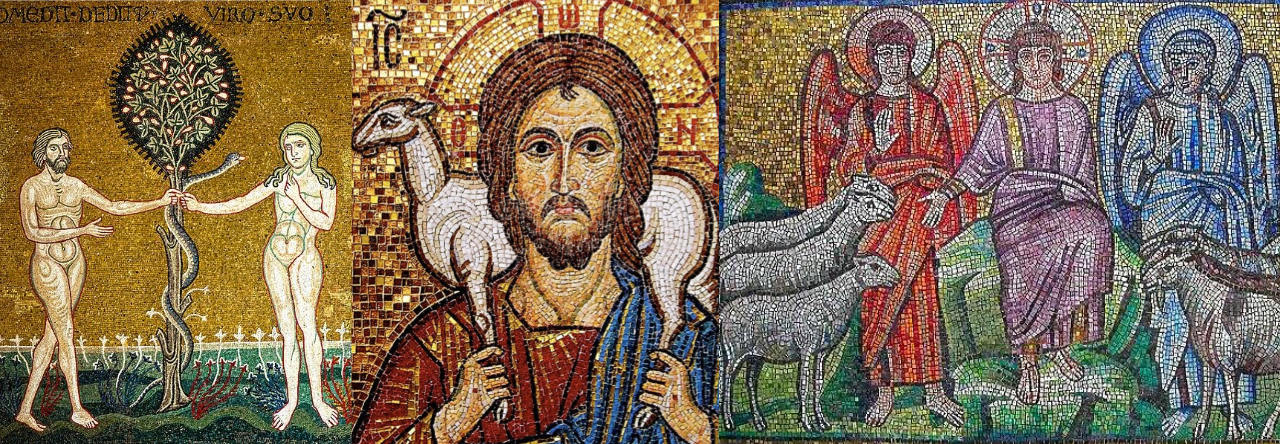
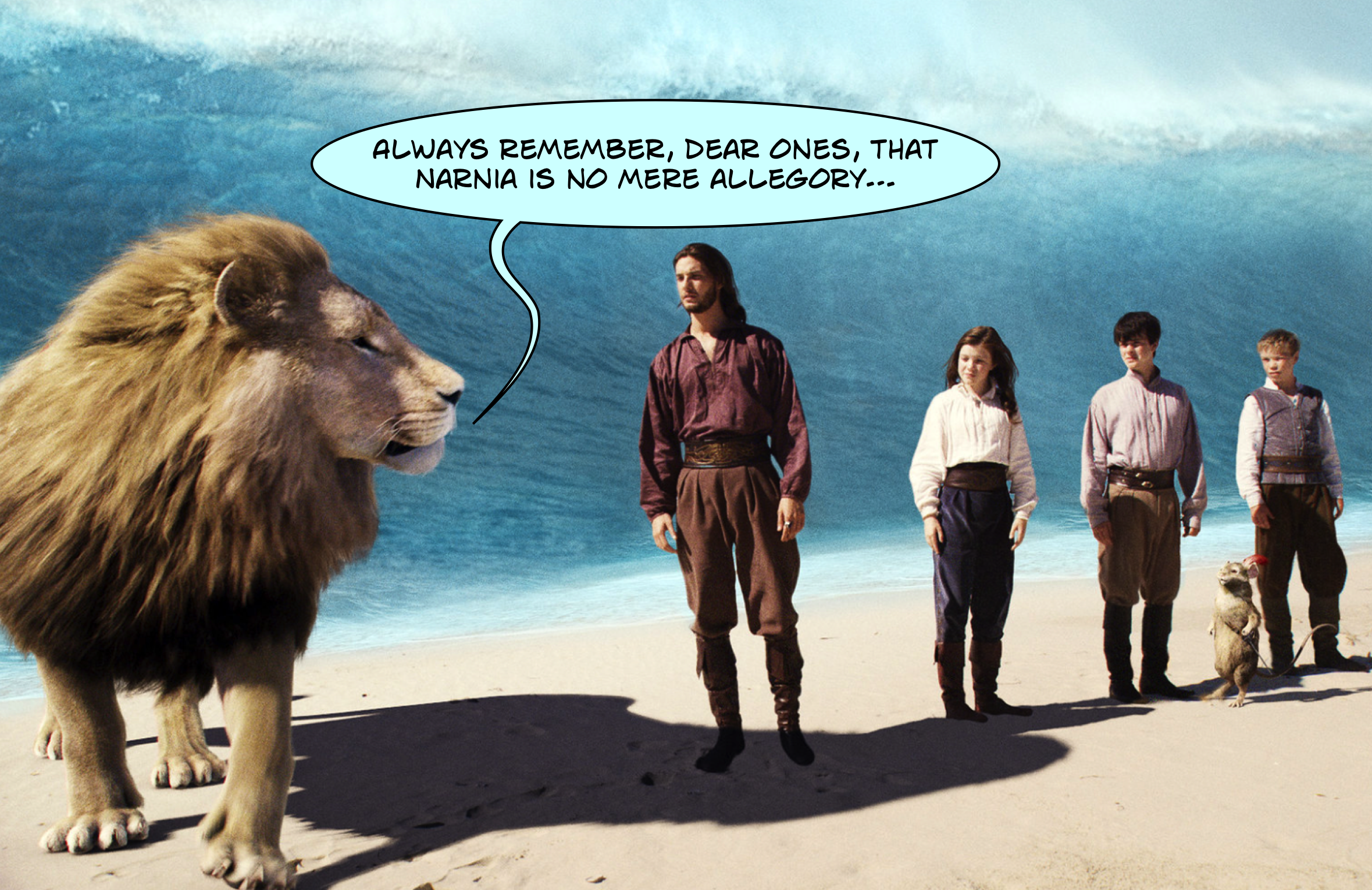
C.S. Lewis, Apologues & Allegories

It has been argued that C.S. Lewis wrote apologues, but I humbly disagree.

An “apologue,” you see, is defined as “a moral fable, especially one with animals as characters.” From that core definition, it makes sense to some that works such as The Chronicles of Narnia might be described as apologues.  

However, this term is usually applied to much simpler, more concise stories –  short moral fables (think Aesop) rather than an extended tales. “Apologue” is a vastly insufficient label for what J.R.R. Tolkien described as subcreation. Narnia is not a fable, it is a world.

Years ago I compared Aesop’s brief “The Kingdom of the Lion,” with C.S. Lewis’ brilliant vision of Aslan.

In “The Lion’s Command,” I identified a virtuous parallel between the brief regent in the fable and the well-developed protagonist of Narnia. In the Chronicles, Narnia’s hero is nothing other than the Alpha and Omega, reigning over its creation and preserving his kingdom to its ultimate culmination.

In “C.S. Lewis and the Art of the Apologue,” Samuel Joeckel argues that “The Screwtape Letters and The Great Divorce might be read as pure apologues, while Lewis’s other works of mythopoeia contain elements of the apologue.” This is an intriguing proposal, which has not gained much traction. Of course, Joeckel’s point that “elements” of apologue are present is certainly true, but that would be so when considering the work of numerous authors.

If not an Apologue, might Narnia be an Allegory?

An interesting article about parables contrasts parables and apologues in the following manner.

Another story style that is related to parables is the apologue. Apologues are short stories that are intended to convey a lesson, and they often use animals as characters. . . . Unlike parables, which generally have realistic scenarios, apologues allow an element of fantasy while maintaining a moral point.

The same article describes differences between parables and apologues as contrasted with allegories, such as George Orwell’s Animal Farm.

Parables are not the only type of story that present a moral lesson. Allegories are stories or poems where different elements are designed to convey abstract or spiritual meaning. . . . Allegories and parables are related in their use of symbolic language.

The difference is, in essence, one of complexity. While parables (and apologues) normally focus on a single lesson, allegories feature broader elements fleshing out a more elaborate lesson or message. 

Allegories are more metaphorical and often involve characters representing abstract ideas, and the symbolism can be deeply complex. However, parables are more direct, with a simple narrative that usually involves a human character facing a moral dilemma or the consequences of a bad decision (“Allegory Vs. Parable”). 

Allegory vs Apologue,” offers a similar distinction between these two literary exercises. 

Allegory and apologue are both forms of extended metaphor that use symbolic characters and events to convey a deeper meaning. However, there are some important distinctions between the two. . . .

Apologue, on the other hand, is a more general term that refers to any story or fable that teaches a moral lesson. Unlike allegory, apologue does not necessarily have a hidden meaning . . .

C.S. Lewis challenges the notion that allegories possess “hidden” themes. In his preface to The Pilgrim’s Regress, he argues that true allegories do not mask their message. 

People . . . suppose that allegory is a disguise, a way of saying obscurely what could have been said more clearly. But in fact all good allegory exists not to hide but to reveal; to make the inner world more palpable by giving it an (imagined) concrete embodiment.

In The Allegory of Love: A Study of Medieval Tradition, C.S. Lewis describes the unique goal of this literary device. 

The function of allegory is not to hide but to reveal, and it is properly used only for that which cannot be said, or so well said, in literal speech.

The inner life, and specially the life of love, religion, and spiritual adventure, has therefore always been the field of true allegory; for here there are intangibles which only allegory can fix and reticences which only allegory can overcome. 

In an essay about the author of The Faerie Queene, “Edmund Spenser, 1552–99,” Lewis lauds the path allegories pursue to illumine readers.

We shall understand it best (though this may seem paradoxical) by not trying too hard to understand it. Many things – such as loving, going to sleep, or behaving unaffectedly – are done worst when we try hardest to do them. Allegory is not a puzzle.

With C.S. Lewis’ genuine appreciation for good allegory, it is unsurprising that some readers are tempted to label The Chronicles of Narnia as such. After all, too brief and far too elaborate to be a collection of mere apologues, it seems logical. Yet, Lewis himself dispelled that conclusion. His opinion is expressed clearly in the following passage from a letter written in 1958.

If Aslan represented the immaterial Deity in the same way in which Giant Despair represents Despair [in The Pilgrim’s Progress], he would be an allegorical figure.

In reality however he is an invention giving an imaginary answer to the question, “What might Christ become like, if there really were a world like Narnia and He chose to be incarnate and die and rise again in that world as He actually has done in ours?” This is not allegory at all.

No, the Chronicles offer no mere allegory. Aslan and Narnia are something altogether more rare and precious . . . and uniquely inspiring.


Bonus:

For those inclined to see how the AI at ChatGPT might compose an analogue, consider the following examples. I offered three brief prompts and amazingly swift apologues. 

Certainly! Here’s an apologue in the style of ancient Roman moral tales – think Aesop with a Roman flavor (e.g., Phaedrus) – explaining why the porcupine is hard to get along with. This style uses simple characters, a brief narrative, and a moral at the end.

Apologue: The Porcupine and the Burrowers

Characters:
~ Porcupine (Hystrix)
~ Mole (Talpa)
~ Hedgehog (Erinaceus)
Moralitas at the end.

In the time when the earth still whispered secrets to beasts, a bitter winter approached. The animals who dwelt below ground gathered to find warmth together.

The Mole, who dug deep and dark tunnels, said, “Let us share one chamber, and none shall freeze.”

The Hedgehog, with bristles soft enough in the cold, agreed. “We are small and spined, but kindred in spirit.”

Then came the Porcupine, bristling with long, sharp quills. “I seek shelter,” he said. “Let me in.”

The others, though wary, welcomed him. “There is warmth in many bodies, if none poke too hard.”

But when the Porcupine curled to sleep, his quills pricked every side of the burrow. The Mole winced. The Hedgehog bled. They shifted, gave him space – but no space was enough.

“Friend Porcupine,” said the Mole, “can you not soften your stance?”

The Porcupine replied, “My quills are my nature. I mean no harm, yet I cannot change.”

So, one by one, the others left, seeking colder but safer places.

The Porcupine remained, alone in warmth – but with no friend near.

Moralitas:
He who cannot bend his nature to spare his neighbors must be content with solitude, for warmth of company is given only to those who wound not.

Having delivered the moral of the fable, the AI was so thoughtful as to ask: “Would you like a Latin version of the apologue as well?”

~ ~ ~ ~ ~ ~ ~

Certainly! Here is an apologue in the style of C.S. Lewis – reminiscent of his storytelling in The Screwtape LettersThe Chronicles of Narnia, and The Pilgrim’s Regress. Lewis often used allegory and fable to convey theological or philosophical arguments through richly imagined, morally charged tales.

Apologue: The Two Gardens

In an ancient land that bordered both silence and song, there lived two brothers: Eldarion and Ruckus.

Their father, the Keeper of Harmony, was a master gardener who tended to two great gardens, each grown from a different seed of music.

One garden was called Lyrion, and it bloomed with strange and delicate flowers. Trees sang there – not with words, but with symphonies. The air was always filled with the faint sound of strings, like something half-remembered from a dream. This was the realm of Classica, the music that had deep roots and slow unfolding blossoms.

The other garden, Thundra, was younger, wilder. Vines twisted with fire, and great drums beat like the hearts of giants. Flames leapt from the leaves when touched. This was the realm of Rocka, born of storm and impulse. It throbbed with noise and power.

One day, the father called his sons. “Each of you shall choose a garden to tend,” he said. “But take heed: a garden grows into the likeness of its gardener.”

Eldarion, quiet and curious, chose Lyrion. He studied the old scores carved into the bark of the elder trees. He listened for the faintest cadences hidden in the wind. His garden grew slowly, but with order and depth. Some who visited said they heard truth in its song – though they could not explain it.

Ruckus chose Thundra. He brought iron tools and thunderous machines. He shouted into the wind and danced among the fire-vines. His garden grew quickly, wildly, and it drew many visitors who loved its power. But the soil became hard, and the songs repeated themselves. At night, when the fire died, there was silence – and the silence frightened him.

Years passed.

One evening, Ruckus visited his brother’s garden. It was still and strange, yet somehow more alive. The music there did not grab the ear – it waited, like a cathedral waits for a footstep.

“I do not understand this,” said Ruckus.

“You’re not meant to at first,” Eldarion said gently. “But if you sit long enough, you may find it is not music you hear – but yourself.”

Moral:
Not all noise is music, and not all music is noise. That which is deep may not dazzle, but it endures.

~ ~ ~ ~ ~ ~ ~

Certainly! Here’s an apologue in the style of C.S. Lewis, with his characteristic blend of gentle allegory, rational argument, and spiritual insight. Think of something akin to The Great Divorce or The Pilgrim’s Regress – a story that carries philosophical weight through symbolic characters and a clear moral undercurrent.

Apologue: The Library of the Lantern

There was once a Traveller who came upon an ancient Library, tucked between the hills of two realms: Factland, where the roads were straight and numbered, and Fablemere, where the paths curled like ivy and sometimes moved when you weren’t looking.

The Traveller, weary from debate and burdened with questions, was greeted by an old librarian named Lucidus, who wore a cloak woven from both parchment and ink.

“You may read whatever you like here,” said Lucidus. “But I warn you: some shelves are straight, others crooked – and both are true.”

The Traveller began in the Hall of Records, where volumes bore names like The History of the WorldNatural LawsThe Mind Explained, and Economics in Twelve Systems. The books were hard, clear, and bright like winter ice. Every sentence pointed like an arrow, and the Traveller felt smarter with every page. “Here,” he thought, “is what I came for: answers.”

But after a time, the light grew harsh, and the words – though sharp – offered no rest. He felt he had learned much, and yet not grown.

So he wandered next into the Chamber of Tales. Here were strange books that spoke of dragons and dying stars, of heroes who were cowards and cowards who became saints. The logic bent like a rainbow, and the truth came sideways.

At first he scoffed. “These things never happened!”

Lucidus appeared beside him and said quietly, “No – but they always happen.”

So the Traveller read on. And he wept when the fox died, and laughed when the king made a fool of himself. He saw his pride in the villain and his longing in the wandering knight. He saw the world as it might be – and in doing so, saw more clearly what the world was.

Time passed. The Traveller read from both wings of the library, sometimes walking the marble floors of Factland, sometimes lying on the mossy rugs of Fablemere. One sharpened his mind; the other softened his heart. One taught him how things work; the other, why they matter.

At last, he approached Lucidus.

“Which was truer?” the Traveller asked. “The world I could measure, or the one I could feel?”

Lucidus smiled. “Ah. One is the lamp, the other the flame. But both are needed to see.”

Moral:
Fiction teaches the soul what nonfiction explains to the mind – and wisdom lives where both meet.

This proved to be a very interesting exercise, indeed.
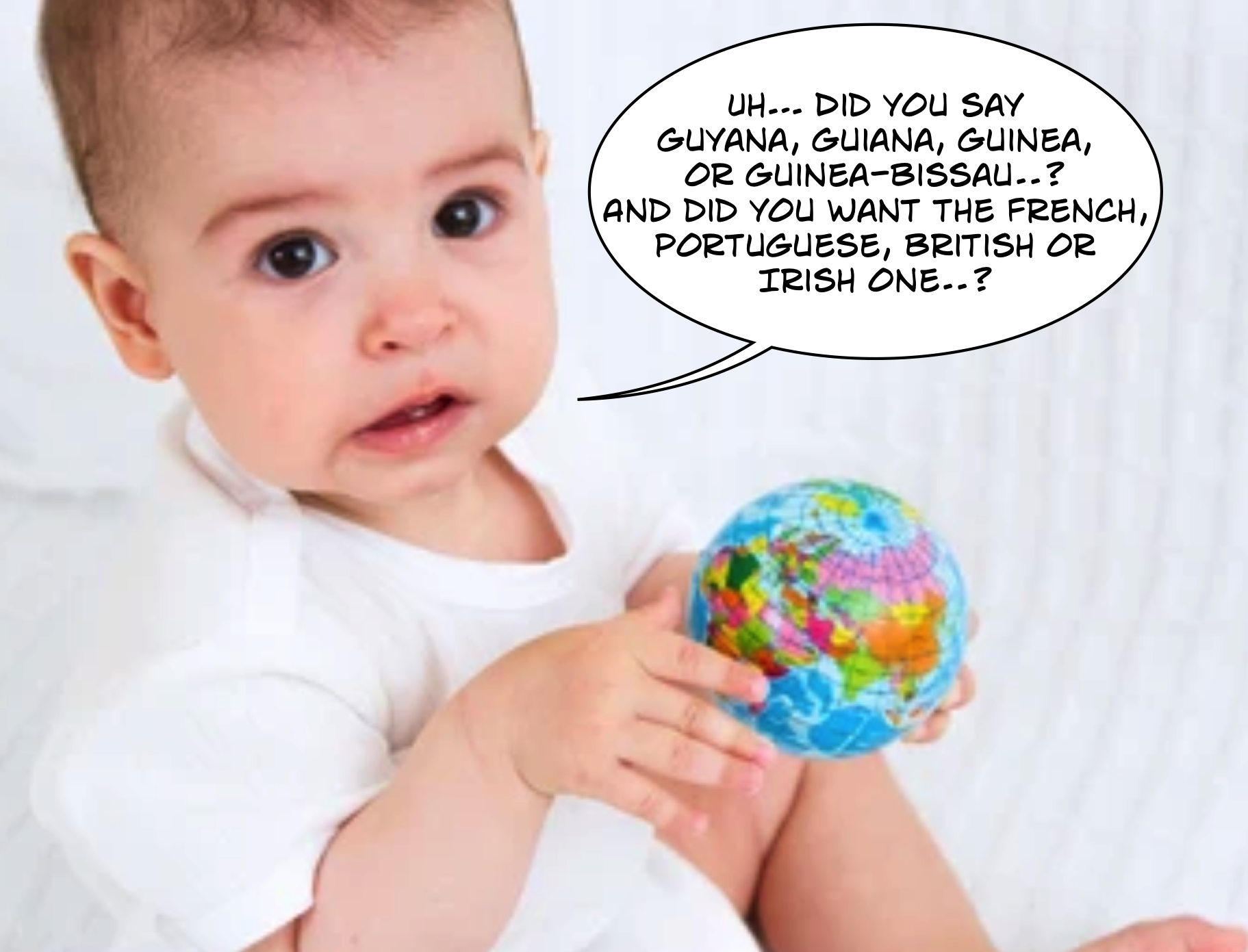
C.S. Lewis & Ethnic Ancestry

Most American think C.S. Lewis was English. But that’s not quite right, is it? After all, he was born in Belfast, which is in Northern Ireland. And that makes him Irish, doesn’t it? Well, yes but not exactly.

The most accurate description is that C.S. Lewis was Anglo-Irish, with an identity linked to both English and Irish identities. Unfortunately, even that designation is subject to potential confusion, since it holds more than one definition. It is sometimes used for persons of English descent living in Ireland, Irish folks living in England, or those of mixed Irish and English ancestry. 

The classical definition, directly applicable to C.S. Lewis, is: “of English descent but born or resident in Ireland, or a member of such a family, and associated particularly with the Protestant Ascendancy” (Oxford Reference).

The Emerald Isle is particularly confusing to most Americans. Only a minority possess any awareness of the history which led to the division of Ireland into today’s Republic of Ireland and Northern Ireland, which is part of the United Kingdom. (Read to the end and discover a little known aspect about America’s dominant ethnicities.)

If Ireland is a mystery to those in the United States, so too are other identifications. The “United Kingdom” itself is perplexing to many on “this side of the pond” (i.e. the Atlantic). 

People find it baffling that a nation consists of three one-time kingdoms (England, Wales and Scotland) and the northeast counties on the island of Ireland. Add to that the fact that the initial three also comprise “Great Britain,” and eyes can glaze over.

Why does it matter? Because a person’s background and heritage often influences many aspects of their personality and values. And the outcome of this blending is particularly manifest in the unique combination of the Irish and English cultures. The Hiberno-English dialect provides a colorful example, with words like the adjective “cats” (awful), “amn’t” (am not), plámás (flattery), and “the jacks” (bathroom), plus phrases such as “acting the maggot” (misbehaving). 

Like all other tongues, Hiberno-English continues to evolve.

Anglo-Irish Writers

Anglo-Irish literature constitutes a distinct category of poetry and prose. Ironically, it is the essential Irishness of the style in “Anglo-Irish literature [which] registers itself [as] the most difficult . . . and the most important” element to be identified.

Few non-Europeans recognize there are many prominent Anglo-Irish writers.* Many, including C.S. Lewis who studied and taught in England, celebrated their Irish heritage. An example taken from a letter written in 1917 to his friend Arthur Greeves provides an illustration of this pride. Describing a day spent walking with a classmate while debating the merits of various authors, he wrote:

Like all Irish people who meet in England we ended by criticisms on the invincible flippancy and dulness of the Anglo-Saxon race. After all, there is no doubt, ami, that the Irish are the only people: with all their faults I would not gladly live or die among another folk.

While this tongue in cheek remark reflects Lewis’ youthful humor, you can read a more brilliant study of the subject in “C.S. Lewis: An Irish Writer.

It discusses, among other matters, why “Lewis, a proud Irishman, [chose] not to promote himself as an Irish writer or write more regularly about Irish themes.”

American Geographical Eccentricities

Sadly, geography is quite undervalued in the American educational system. The common ignorance about the makeup of other continents is nothing less than embarrassing. Of course, Americans aren’t the only people ignorant about such matters, as GeoCurrents notes.

But if geographical ignorance is pronounced in the United States . . . the problem does seem to be even more extreme in some other parts of the world.

The United States as it exists today, is the product of constant immigration. During the early years of the colonies and Republic, most arrivals were Europeans, with nearly eleven million Africans brought involuntarily to North America, most during the rule of the British (Gilder Lehrman Institute of American History).

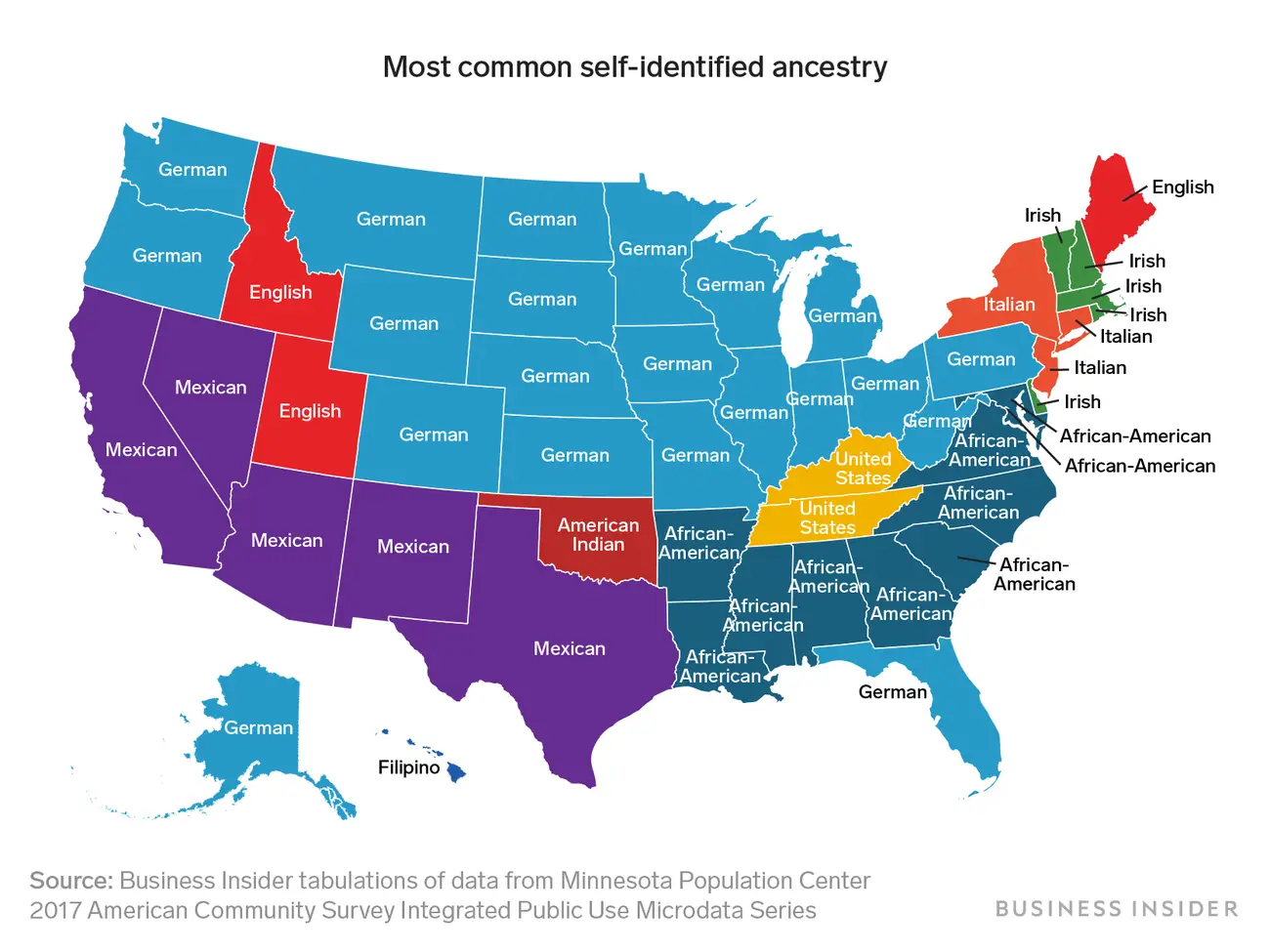
As a result of this influx of foreigners, each state possesses its own unique identity (or, more accurately, identities). The following map shows the largest single ancestral ethnicity of the residents of each state. It contains a few surprises.

The fact that Irish descendants represent a plurality in five states raises the question of just how many talented Irish-American writer may have shared the intercultural experiences of C.S. Lewis.


* A list of noteworthy Anglo-Irish writers would include, in addition to C.S. Lewis:

Jonathan Swift (1667 – 1745)
Oliver Goldsmith (c. 1730 – 1774)
Maria Edgeworth (1768 – 1849)
Joseph Sheridan LeFanu (1814 – 1873)
Dionysius Boucicault (1820 – 1890)
Lady Augusta Gregory (1852 – 1932)
Oscar Wilde (1854 – 1900)
George Bernard Shaw (1856 – 1950)
John Bagnell Bury (1861 – 1927)
William Butler Yeats (1865 – 1939)
James Owen Hannay (aka George A. Birmingham) (1865 – 1950)
John M. Synge (1871 – 1909)
Edward John Moreton Drax Plunkett (aka Lord Dunsany) (1878 – 1957)
Lady Clodagh Beresford (1879 – 1957)
Emily Lorimer (1881 – 1911)
James Joyce (1882 – 1941)
Terence James Stannus Gray (aka Wei Wu Wei) (1895 – 1986)
Elizabeth Bowen (1899 – 1973)
Cecil Day-Lewis (1904 – 1972)
Samuel Beckett (1906 – 1989)
Louis MacNeice (1907 – 1963)
Mitch Teemley

Literary Translators Beware

Translating literature from one language to another is a valuable, yet often undervalued, skill. It breaks the linguistic shackles restricting the benefits of good books to those literate in the language in which they are composed.

You can think of it this way. Without the dedicated efforts of translators, someone familiar only with English – e.g. as is, sadly, the case with most Americans – could never read the works of ancient Greeks or Romans. Asian philosophy such as the Four Books and Five Classics of Confucianism would be virtually unknown in the West.

Even contemporary literature from most of the world would be beyond our access. And, obviously, God’s written Word would only be accessible to those who mastered Hebrew, Aramaic, and Greek.

While C.S. Lewis is seldom thought of as a translator, it was indeed one of his talents. That doesn’t mean he devoted serious energy to translation. That was not his vocation. On the contrary, in 1945 he wrote: “People praise me as a ‘translator,’ but what I want is to be the founder of a school of ‘translation.’” (I discussed this a number of years ago in “C.S. Lewis’ School of Translation.”)

Dedicated translators have played an invaluable role throughout recorded history. A number of people still make translation their life’s labor. Yet, there are dark clouds on their horizon.

Is there a Future for Translation by Human Beings?

A recent literary journal alerted me to advances in artificial intelligence, which now jeopardize the future of professional translators. 

Back in 2023, an article in Forbes compared the respective advantages and challenges of the two methods. They accurately identified one distinction between a truly fluent human and an artificial substitute.

Language is complex, and culturally specific expressions such as idioms and metaphors, as well as ambiguous or ungrammatical sentences and other context-dependent word choices, can be challenging for AI algorithms.

Unsurprisingly, that same year the American Translators Association offered a more critical opinion in “Machine Translation vs. Human Translation: Will Artificial Intelligence Replace the World’s Second Oldest Profession?

We already mentioned that computers don’t possess our human capacity to comprehend meaning. The creative process, especially when it comes to translation, is the pinnacle of meaning. Human translators translate meaning, not words. The art of translation is understanding the meaning of the original text and then transforming it into something that communicates the same message (or evokes the intended emotion) but might not superficially look like an exact equivalent. . . .

But both now and then, professional translators are here to stay. Equipped with unique human skill and a toolbox full of tech, they’re ready to continue helping the world navigate the tricky business of multilingual communication – transporting messages appropriately, creatively, consistently, and securely to whatever audience you aim to reach. 

In short: machine translation can help when it doesn’t count, but professional human translation is there for you when it does.

Related to expressly literary translations, in contrast to mundane subject matter, the current issue of Poets & Writers contains a piece titled “AI Threatens Literary Translation.” When a European subsidiary of Simon & Schuster announced they would begin limited use of AI for this purpose,

Reactions rose in a flurry: Writers, publishers, and translators contended that AI would produce “bland” work. They lamented the possibility of lost jobs. The European Council of Literary Translators’ Associations resisted the standardization of an idiosyncratic process, stating that the imagination, understanding, and creativity that translation demands are “intrinsically human.”

This informative essay acknowledges that “AI isn’t new to translation either. Literary translators sometimes input segments of their source text into AI-based technologies . . . to generate ideas for particularly thorny passages. But these tools have to be used ‘very carefully . . . because the translations it produces are error-ridden and devoid of flow or beauty.’”

A Quick Experiment with AI Translation

Before completing this post I took a brief (less than ten minute) excursion to ChatGPT to experiment with their translation tool.

The results appear below (all produced in a mere handful of minutes). First I asked the AI to compose a sonnet on the subject of translation. Then I requested translations of that sonnet in five different languages. I have included the sonnet and the final two lines of each translation below.

You can perform a more elaborate experiment yourself, especially if you are familiar with more than one language. This would enable you to compare the accuracy of the translation. Or, perhaps one might take a translated version and translate that back into the original language, to see how closely it relates to the starting point.

In my experiment, the AI was constrained by needing to maintain the original’s form as a sonnet. I assume that if it were simply a literal translation, it may have modified the vocabulary and grammar. Each translation included footnotes. To illustrate how elaborate some of these notes were, I’ve reproduced those which appeared with the translation into Aramaic.

Frankly, if this is what these early AI prototypes are capable of, it appears to me that professional translators may truly have something to be worried about.

The Sonnet

In languages vast, where meanings hide and shift,
A translator’s art gives voice to what is known.
Through words, they bridge the gap, a timely gift,
To carry thought from one to others’ throne.

The rhythm, tone, and essence all must stay,
Though words may bend, they still must hold their grace.
A careful hand must guide the text’s relay,
To keep its heart while moving through time and space.

Yet oft the meaning’s lost in fleeting sound,
Or tangled in the strings of foreign speech.
But still they strive, where words and thoughts are bound,
To bring the message close, within our reach.

A translation’s not just words that blend –
It’s worlds revealed, with meaning without end.

~ Latin ~

Translatio non est solum verba iuncta –
Sed mundi patent, et mens non est puncta.

~ Old English ~

Nis anginn of wordum gemenged anum –
Ac worulda onwreah, and andgit ne swylt.

~ Classical Greek ~

Οὐ γάρ μόνον λέξεις αἱ μεταφράσεις,
ἀλλὰ κόσμοι φαίνονται, ἄνοια οὐδέποτε.

~ Middle Egyptian ~

𓏏𓂋 𓅓𓏏 𓊪 𓏏𓏤 𓆑𓏏 𓊵𓏤,
t r mt ḏbꜥ t ft ḏbꜥ
(“A translation’s not just words that blend –”)

𓂋 𓅓𓏏 𓆑𓏏 𓊵𓏤 𓏏𓏏𓀀.
r mt ft ḏbꜥ t t
(“It’s worlds revealed, with meaning without end.”)

~ Classical Aramaic ~

ܬܪܓܡܐ ܠܐ ܗܘܐ ܒܠܚܘܕ ܡܠܐ ܕܡܬܚܠܛܢ,
ܐܠܐ ܥܠܡܐ ܡܬܓܠܝܢ، ܘܡܕܡ ܠܐ ܚܒܠ.

Notes on the Translation:
1. Classical Aramaic Grammar & Style: The sentence structure follows Classical Aramaic syntax as used in ancient texts. Some phrases had to be adapted poetically since direct translations of modern concepts do not always exist.
2. Vocabulary Adjustments: “Translator” = ܡܬܪܓܡܢܐ (metargemana), a direct and historically accurate term. “Translation” is expressed as ܗܫܬܘܪܬܐ (hishtorta), meaning “interpretation, explanation.” “Essence” is translated as ܡܗܘܬܐ (mehutā), meaning “nature, essence.” “To bridge the gap” = ܡܫܬܪܝܢ ܓܦܐ (meshatrin gapé), literally meaning “to stretch wings” (a poetic expression).
3. Preserving the Poetic Flow: The rhythm and parallel structure of the original sonnet were carefully kept. Adjustments were made for metrical and phonetic balance in Aramaic.
4. This version captures the spiritual and poetic depth of the original while remaining faithful to the Classical Aramaic linguistic style.
5. Would you like an audio recording or a version in Syriac script for authenticity? Let me know how you’d like to refine it!

And all of this in ten minutes. Unfathomable . . .

Must Writing be a Solitary Endeavor?

It’s often said that “writing is a solitary task.” I find that’s only half true.

Sure, each individual is responsible for putting the words on the page (AI-cheats aside), but sharing your work with others before publishing it provides amazing dividends.

Not only can “other eyes” see flaws we are too close to the piece to recognize, good critiques often include suggestions to make our writing stronger.

I’ve occasionally described the benefits I’ve received from being a member of writers [critique] groups around the globe. I titled one of my posts “Be an Inkling,” because this mutual sharing was central to those brilliant minds who gathered together in Oxford.

In 1967, J.R.R. Tolkien described his reason for using that particular word in just such settings. He said he used the word Inkling as “a ‘jest,’ because it was a pleasantly ingenious pun in its way, suggesting people with vague or half-formed intimations and ideas plus those who dabble in ink.”

I too find it “pleasantly ingenious” and have echoed it here in my own domain. 

Conferences can be helpful too, but my experience is that nothing surpasses the encouragement that emanates from the mutual commitment shared by writers who physically gather to share their creations.

I noted above two concrete ways writing friends can contribute to strengthening our work. However, this third element – encouragement – cannot be underestimated. It was precisely this element that brought that masterpiece, The Lord of the Rings, to the world’s attention.

A Pilgrim in Narnia provides a superb account of C.S. Lewis’ essential role in boosting the confidence of his friend J.R.R. Tolkien. He cites a letter in which Tolkien describes how Lewis’ most precious gift was in challenging him to complete his opus.

The unpayable debt that I owe to him was not ‘influence’ as it is ordinarily understood, but sheer encouragement. He was for long my only audience. Only from him did I ever get the idea that my ‘stuff’ could be more than a private hobby. But for his interest and unceasing eagerness for more I should never have brought The L. of the R. to a conclusion.

Melancholy Transitions

Critique groups are weighing on my mind, since the one I’ve been part of for many years has come to its end. The passing of various members during the past decade left too few of us to continue, and we few who were left are mourning the fact that it was not sensible to continue meeting regularly.

It is another reminder of Solomon’s wisdom when he wrote, “For everything there is a season, and a time for every matter under heaven.”

Sadly, I lack the energy to help establish another new writing fellowship at this point in my life. Perhaps I will join one of the online communities. Christian Writers looks promising.

I actually participated in an online critique community back when primitive “bulletin board systems” were giving way to the nascent internet. No doubt the modern equivalent would be far better in every way.

In the meantime, I do have a few readers I trust to review my work before submitting it to an editor. One is my very talented wife. The problem there, however, is that her love (and compassionate nature) make her too gentle when she critiques my work. 

This drawback is one side of the coin to which author Dan Brown refers when he says: “I learned early on not to listen to either critique – the people who love you or the people who don’t like you.”

This does not mean, of course, that those who love us are unsuitable candidates. It simply suggests that we need to (often repeatedly) give them permission to offer genuinely critical comments, especially when they are accompanied by suggestions for how we might improve a given passage.

In essence although people like William Faulkner are correct in stating that “writing is a solitary job,” most of us can benefit from sharing our drafts with others. 

And fortunate are those of us who discover such friendship, where our writing companions are like-minded, trustworthy, self-confident, and honest. (I personally find having a sense of humor an essential trait, as well.)

In a word, we are greatly blessed to personally become part of our own fellowship of Inklings.

Fiction or Nonfiction: Which is Best?

Which is better for a person to write, fiction or nonfiction? That, of course, is an absurd question on its face. Every one recognizes nonfiction is best. (Just joking.)

Few of us are talented in the manner of C.S. Lewis — who excelled in both genres. Typically we have a knack for one or the other.

Which is best, becomes a question with a quite personal answer. And that response is determined by a number of interrelated elements. In which form are we more adept? Which do we prefer to read? For which are there greater avenues to experience publication? Through which do we receive more reward, extrinsic or intrinsic? 

Christian writers consider another, hopefully overriding, factor. What type of writing does the Lord desire us to pursue? And, it should be noted that just like the daily Christian walk, this is a dynamic matter. It can change at any given moment, depending upon how the Holy Spirit leads. Once again, C.S. Lewis offers an ideal example of this truth. God may lead us to write something factual one afternoon, imaginative the next, and perhaps poetry on the succeeding morning. 

What about the Prestige Factor?

There is a subtle prejudice among writers, I fear. While it’s natural to think that the genre most challenging to one may require additional skill or discipline, it seems to me most writers tacitly accept the notion that fiction requires more talent. 

While I personally disagree with that assessment, I understand it. After all, “facts” are readily available, and don’t rely on one’s imagination to devise. Still, good nonfiction is not inherently simpler to produce than quality fiction. (I mean, AI is proving every day that mediocrity can be reached in either genre in mere seconds.) 

As an example of this subtle prejudice, see this (quite helpful) article by promising young historical fictionist Cheyenne van Langevelde.

In an insightful article entitled “Genre ~ What Christian Writers Should be Aware of,” she introduces the subject with the following observation: 

As someone who hasn’t written nonfiction, I will not be discussing that branch of literature — though I’m sure it’s obvious how one could glorify God in their nonfiction writing. What I am going to talk about is the more challenging of the two branches: fiction.

I graduated from the University of Washington with an Editorial Journalism degree. While some argue Communication degrees are “worthless,” they may “set you up for life.” (That has certainly been my experience.)

Still, journalism doesn’t have the panache of “creative writing.” This, I suspect, is one reason that Master of Fine Arts (MFA) degrees exploded on the scene several decades ago.

When I open each issue of Poets & Writers, I’m overwhelmed by the number of ads for MFA programs, all over the globe. However, the October issue features a melancholy article titled “More MFA Programs Closing.” This is “despite all the value and prestige they bring to the university . . .”

The article cites “monetary pressures on universities and waning interest in the humanities” as major problems. Obvious to any non-MFA observer, the unbridled proliferation of MFA programs themselves might be the primary cause. 

Combine with that the evidence that a younger generation is more concerned about their prospects of making a living, and one might anticipate a further winnowing of such programs. 

For a balanced discussion of the subject, I commend “The MFA Degree: A Bad Decision?” — written by a writer who earned one, and subsequently “taught undergraduate and graduate courses in creative writing.”

I don’t believe MFA programs are inherently evil and have destroyed contemporary American literature. The majority of people teaching and taking creative writing classes are all trying to do good things. Nonetheless, I’ve begun to wonder if the MFA is, in fact, a bad decision.

It’s an interesting discussion, of value especially to those contemplating an MFA path. I leave that choice to the individual — as I leave to them the decision regarding whether to write fiction or nonfiction . . . or poetry, convincing historical fiction, satire, etc.

In order to expand their pool of prospective students, some MFA programs added “creative nonfiction” to their offerings. The focus of this genre is on training participants to consciously implement literary styles and techniques in order to make their factually accurate narratives more engaging.

While there is no doubt consciously taking these tools into consideration can improve the quality of many nonfiction works, it seems a bit exaggerated to label it “creative.” I would simply describe it as “good” or “well written” nonfiction. 

For a description of how creative nonfiction can be implemented in memoirs and essays, you might enjoy an introduction to the subject from Writers.com. You may wish to follow that up with “The Five R’s of Creative Nonfiction.” (Mere Inkling applies at least four of them.)

C.S. Lewis offered an aspiring young writer some wonderful advice in 1959. “Write about what really interests you,” he suggested, “whether it is real things or imaginary things, and nothing else.” He added the parenthetical note that “if you are interested only in writing you will never be a writer, because you will have nothing to write about . . .”

Excellent advice for the young wordsmith. I would add that for the maturing scribe it is often productive (and even fun) to experiment with a variety of genres.

Who knows? Perhaps you will follow the Inkling tradition established by C.S. Lewis and J.R.R. Tolkien, being exceptional in fiction and nonfiction alike. Best of luck to those of you who embark on this journey!

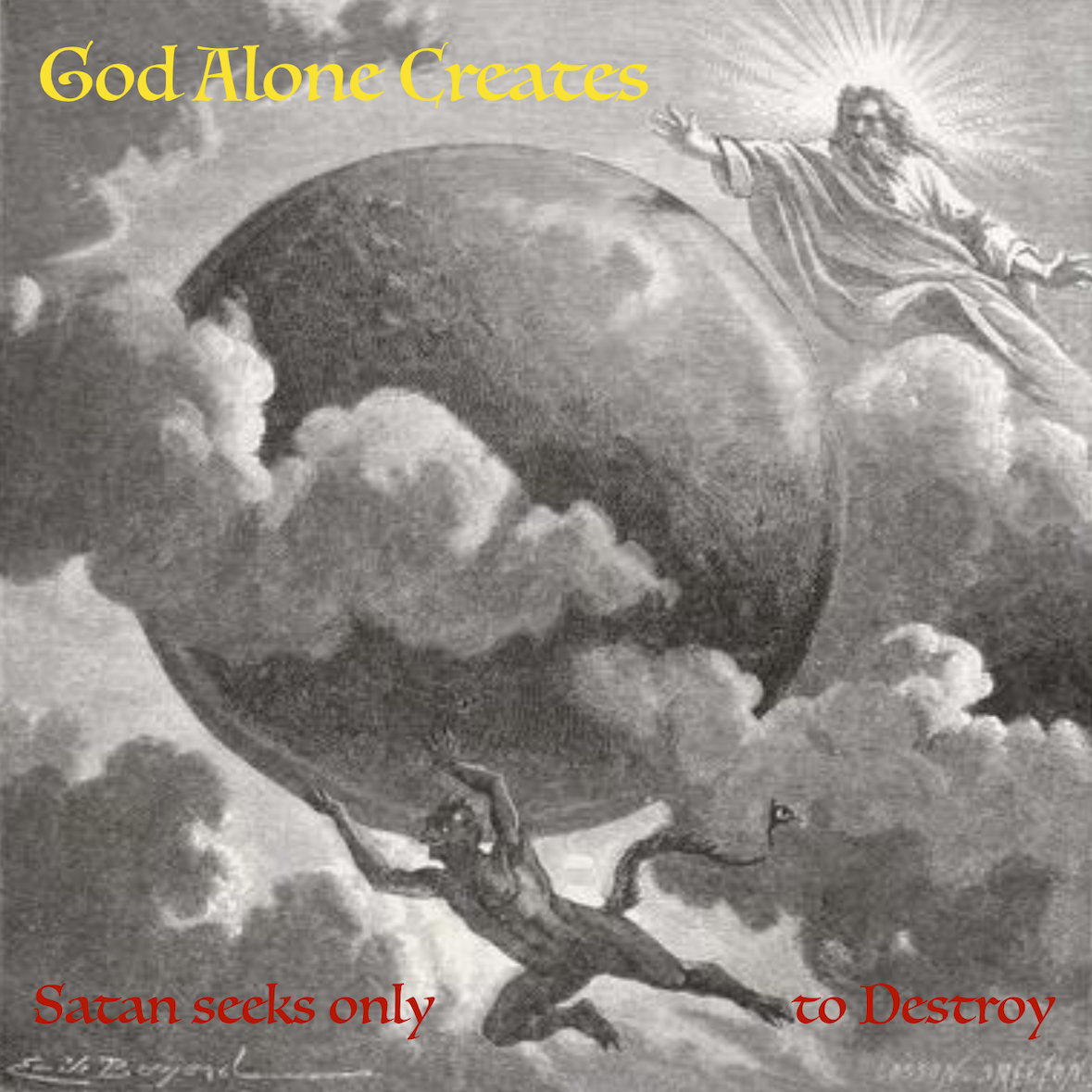
Only God Can Create

Satan has many disciples in this world. Some know him by other names, or worship him in spirit without recognizing his actual existence (e.g. Mammon). The irony, of course, is that the Devil is simply a posturer, or in modern parlance, a poser. And the presence of the Holy Spirit makes any single Christian more than his match.

A prime evidence of Satan’s weakness is that he is a mere created being, without any creative powers of his own. Although some would grant the Adversary a glory he does not own, the truth is that since his expulsion from Heaven, he has devolved into the Great Pretender.

C.S. Lewis never pretended to be a theologian (for whatever authority that debatable title might convey). Instead, he was a brilliant disciple of Jesus with a sincere desire to follow the teachings of the Scriptures. Lewis certainly wasn’t infallible (and he has many critics who delight in pointing out that obvious fact).

Nevertheless, Lewis’ private insights on the subject of Lucifer’s noncreative limitation are right on the biblical target. Responding to a question posed by a reader, Lewis offered his opinion. 

Dear Mrs [Belle] Allen, I think it would be dangerous to suppose that Satan had created all the creatures that are disagreeable or dangerous to us for (a) those creatures, if they could think, would have just the same reason for thinking that we were created by Satan. (b) I don’t think evil, in the strict sense, can create.

It can spoil something that Another has created. Satan may have corrupted other creatures as well as us. Part of the corruption in us might be the unreasoning horror and disgust we feel at some creatures quite apart from any harm they can do us. (I can’t abide a spider myself.) (correspondence, 11 January 1954).

No, God alone creates . . . and redeems. The impotent Devil can never create, or rescue. His utter corruption results in an admittedly powerful spiritual being (a fallen angel) who is devoted to twisting, breaking, tainting, warping, spoiling, corrupting, rotting, perverting, and ruining all that God loves.

Granted, in our fallen world, Satan can fashion an abomination from some preexisting thing he corrupts – for example, Ophiocordyceps unilateralis the parasitic fungus that turns ants into zombies – but he can never create something out of nothing. These poor abominations are an excellent example of what Lewis referred to when he described the “horror and disgust we feel at some creatures . . .”

Meanwhile, Human Beings Can Create

Well, not exactly “create” on the creatio ex nihilo (created out of nothing) sense. Only God can do that, as he did when he spoke all things into existence. Just as Aslan echoed, when he sang Narnia into being in Lewis’ Chronicles.

“And God said, ‘Let there be light,’ and there was light” (Genesis 1).

“In the beginning was the Word [Logos], and the Word was with God, and the Word was God. . . . All things were made through him . . .” (John 1)

The Lion was pacing to and fro about empty land and singing his new song. It was softer and more lilting than the song by which he had called up the stars and the sun; a gentle, rippling music. And as he walked and sang the valley grew green with grass. It spread out from the Lion like a pool. It ran up the sides of the little hills like a wave” (The Magician’s Nephew)

As for humans like you and me being able to create, that is one of God’s most precious gifts to us. In truth, we use elements already created by the Lord: clay and stone to sculpt, pigments to paint, quill and ink to write.

The Inklings understood this creative impulse quite well. They not only understood it; they lived it. 

Like Christians before and since, they recognized that our creative capacity is based in the fact that we are created imago Dei, in the image of God.

Many people mistakenly believe J.R.R. Tolkien coined the word subcreation (or sub-creation, for the hyphen-infatuated). He certainly applied it for the first time to the intentional creation of what the Oxford English Dictionary calls “the action or process of creating a fully realized and internally consistent imaginary (or ‘secondary’) world.” 

Subcreation may be considered a form of “creation by a created being.” But even the most talented of writers and artists should remember this truth, stated by a Canadian astrophysicist: “God did not grant to the devil or any of his creatures the power to create.”

There is much more to consider on this subject, but Mere Inkling readers will need to wait until my next post, when we will conclude our discussion of this fascinating matter. 

There are two equal and opposite errors into which our race can fall about the devils. One is to disbelieve in their existence. The other is to believe, and to feel an excessive and unhealthy interest in them.

They themselves are equally pleased by both errors, and hail a materialist or a magician with the same delight. (The Screwtape Letters).


The image above is based on the work of Émile Bayard (1837-1891), a French illustrator who was born in Cairo, Egypt.

Damnable Typos & the Bible

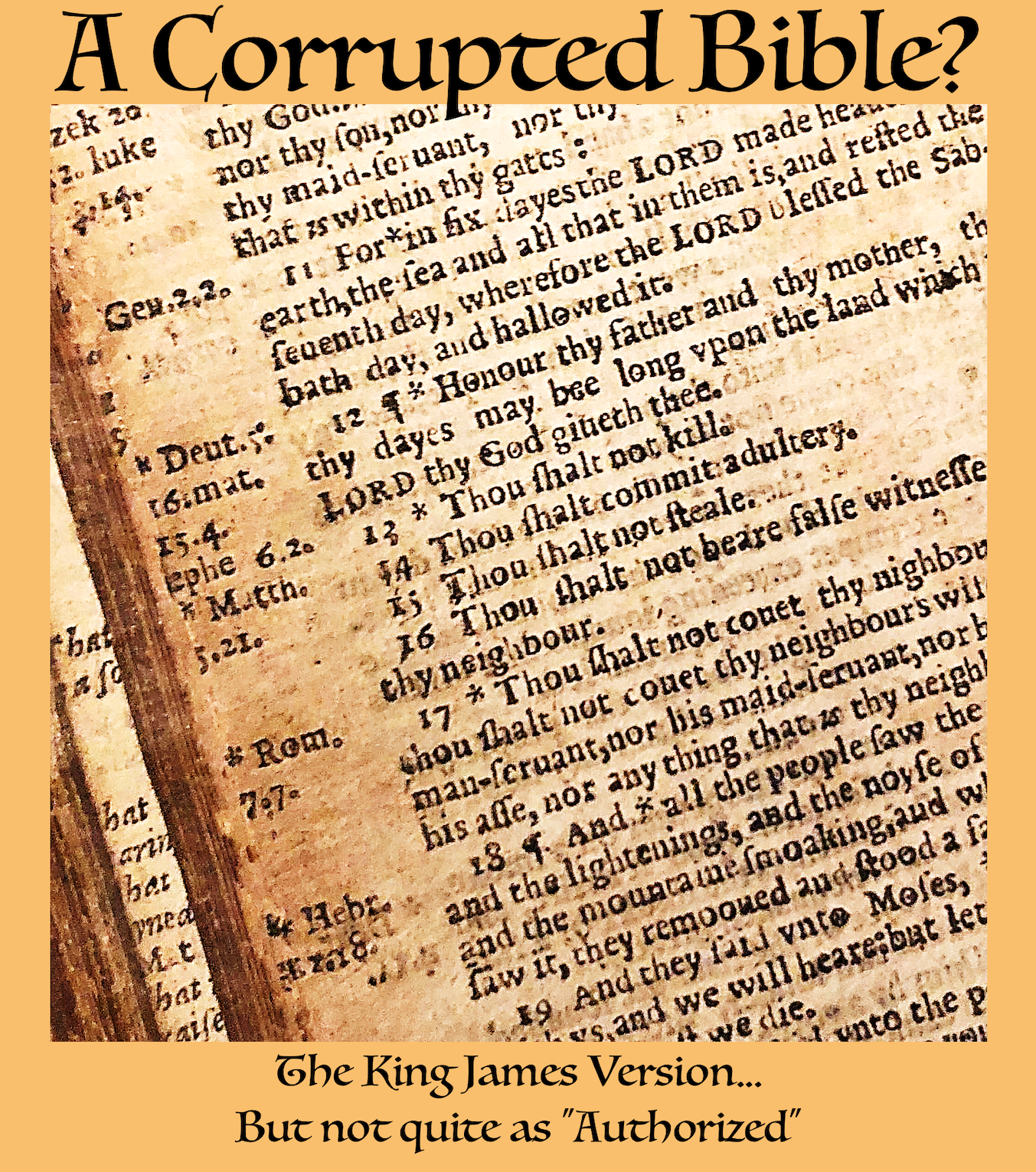
While the title of this post will be shocking to some, it’s far less scandalous than the typographical error discussed below. Due to two misprints appearing in a 1641 edition of the King James Bible (KJV), the publication has been labeled the “Wicked Bible.”

Translating the Scriptures is a necessary, and demanding, task. The early editions of the KJV (which was preceded by the Wycliffe Bible) reveal how vulnerable the words themselves were to being altered during the typesetting process.

I’ve written about this subject a number of times during the past decade, and even devoted a column to “C.S. Lewis’ School of Translation,” which is about something even more important than merely translating words. There I quote one of the great author’s deepest hopes.

What I want is to be the founder of a school of ‘translation . . .’ Where are my successors? (correspondence, 7 October 1945).

Returning to the seventeenth century book with its unfortunate errors, we witness an example of how even a solid translation can be derailed by careless (or malevolent) typesetters.

The magnitude of the mistake discovered in this particular edition caused its suppression, and most copies were destroyed. While some still exist in private hands, only fifteen remain in public collections. One of these made its way to New Zealand before being identified in 2018.

A Truly Scandalous Misprint

It would be one thing if a printer accidently dropped the final “e” from “breathe,” leaving the word “breath.” Even substituting an errant “w” for the “b,” would create an alternate word that would greatly muddle a passage . . . but still not appear remotely “wicked.” 

However, a 1631 mistake in an English Bible literally turned a passage – one of the Ten Commandments, no less – on its head. Rather than reading “Thou shalt not commit adultery,” this edition declares, “Thou shalt commit adultery” (Exodus 20:14).

The consequences of this disaster were significant, particularly for His Majesty’s official printers. In Cyprianus Anglicanus by royalist priest Peter Heylyn (1599-1662), we learn the details. (You can download a free facsimile of the volume which includes many other fascinating facts.) The passage related to the misbegotten tome reads as follows:

His Majesties Printers, at or about this time [1632], had committed a scandalous mistake in our English Bibles, by leaving out the word Not in the Seventh Commandment.

His Majesty being made acquainted with it by the Bishop of London, Order was given for calling the Printers into the High-Commission where upon the Evidence of the Fact, the whole Impression was called in, and the Printers deeply fined, as they justly merited.

Reports of Cases in the Courts of Star Chamber and High Commission, penned by Samuel Rawson Gardiner in 1886, includes a detailed account of the court’s findings. (Due to their uniqueness, I have transposed the full account, as found in two sections, as a footnote below.) One passage describes a second “gross error.”

. . . showed the two grossest errors, vizt. “Shalt commit adultery” and “great asse:” for “shalt not commit adultery” and “greatnesse…”

The second of these blunders occurs in Deuteronomy 5:24, which properly reads “Behold, the Lord our God hath shewed us his glory and his greatness.” (It should be noted that the word asse would most commonly be associated with donkeys.)

The magnitude of these mistakes can only be understood when one recognizes how reverentially the Scriptures were regarded at this time. C.S. Lewis would suggest that during an age when the Bible has been relegated to historic literature, it is difficult for us to comprehend the seriousness of this matter.

It is very generally implied that those who have rejected its theological pretensions nevertheless continue to enjoy it as a treasure house of English prose. It may be so. There may be people who, not having been forced upon familiarity with it by believing parents, have yet been drawn to it by its literary charms and remained as constant readers.

But I never happen to meet them. Perhaps it is because I live in the provinces. But I cannot help suspecting, if I may make an Irish bull, that those who read the Bible as literature do not read the Bible. (“The Literary Impact of the Authorised Version”).

In “Challenges in Printing Early English Bibles,” you can read about other Bibles featuring noteworthy mistakes. In two, “peacemakers” become “placemakers,” and “murmurers” are transformed into “murderers.” Another example, in the very first edition of the KJV, finds Jesus’ ancestor Ruth referred to by the male pronoun, due to the accidental dropping of an “s.”

More troubling is another early KJV Bible where “the text of Psalm 14 [reads], “The fool hath said in his heart there is a God,” rather than “The fool hath said in his heart there is no God.”

Worst of all, in terms of blasphemous connotations, would likely be the so-called “Judas Bible.”

In the 1609 Geneva Bible, the typesetters mistakenly replaced Jesus’s name with that of Judas. John 6:67 reads: “From that time many of his disciples went back, and walked no more with him. Then said Judas unto the twelve, Will ye also go away?”

Fortunately, modern editions of the Jewish and Christian Scriptures undergo thorough proofreading, so this sort of error is rare today. Still, typos will persist as long as the remotest possibility of error exists.

Those among us who have sought to have our writing published by traditional publishers may relate to the example with which we end. C.S. Lewis and J.R.R. Tolkien and even Mark Twain faced challenges working with some of their editors and publishers.

With all of the printing mishaps in the early English Bible, it is only appropriate that one of the editions was called “The Printers Bible.”

This text, published in about 1702, takes its name from a typesetting error found in Psalm 119, which should have read “Princes have per­secuted me without a cause” but was mistakenly printed as “Printers have persecuted me.”


Full references from Reports of Cases in the Courts of Star Chamber and High Commission by Samuel Rawson Gardiner (1886).

Mr Barker the printer. There is a cause begunne against him for false printeing of the Bible in divers places of it, in the Edition of 1631, vizt., in the 20 of Exod[us], “Thou shalt committ adultery”; and in the fifte of Deut[eronomy] “The Lord has shewed his glory, and his great asse”; and for divers other faults; and that they had printed it in very bad paper. And the Bishop of London showed that this would undoe the trade, and was a most dishonorable thing; that they of the church of Rome are soe carefull, that not a word or letter is to be found amisse in their Ladie’s Psalter and other superstitious books; and that we should not be soe carefull in printinge the sacred Scriptures; and that they in Holland, at Amsterdam, had gott up an English presse, and had printed the Bible in better paper, and with a better letter, and can undersell us 18d. in a Bible. Mr Barker and his partners endeavored in partt to excuse themselves, and had advocates to speake for them, and were willing to submitt, and promised to amend their faults; but the Court would not remitt their offense, but the cause was ordered to goe on.

The Printers having answered move the Court to passe by their oversight being the fault of the workmen but the King’s Advocate desired they might make their defense legally and the cause to go onto hearing: and that he might have liberty to put in additional articles against them. The Bishop of London would have the Church sett upright in her reputacion, that we are as carefull in printeing the Bible as they are of their Jesus’ psalter : and whereas the Printers say this is stirred up by the malice of one man against them; The Bishop saith he stirred not till the Bible was sould into his house, bought by his footman: and he saith the printinge is soe bbad and the paper too that, if it be not mended shortlie, they wilbe put downe by those of Amsterdam and their trade spoyled, and showed for the two grossest errors, vizt. “Shalt commit adultery” and “great asse:” for “shalt not commit adultery” and “greatnesse…” The Arch Bishop of Canterbury saith, that the Printers that print for his Matie have a very profitable place, and therefore should be more carefull. I knew the tyme when greater care was had about printeing, the Bibles especiallie, good compositors and the best correctors were gotten being grave and learned men, and the paper and letter rare and faire every way of the best; but now the paper is naught, the composers boyes, and the correctors unlearned: There is a farmer and he makes the benefit, and careth for nothing about it. They heretofore spent their whole time in printeing, but these looke to gaine, gaine, gaine, then they are not to be commended: Well, let them looke to it: and let the cause proceed, saith the ArchBishop. London. “There was a great deale of doo between you of this Citty and those of Cambridge heretofore about the priviledge of printeing the Bible and psalms which they of Cambridge claymed; then the Bible was exactlie printed, now you have forced the Cambridg printer to an agreement, now noe bible is right printed.

[It appears this volume itself would have benefited from having more diligent “correctors.” Perhaps most curiously, two spellings of the word printing – “printinge” and “printeing” – appear in this publication.]

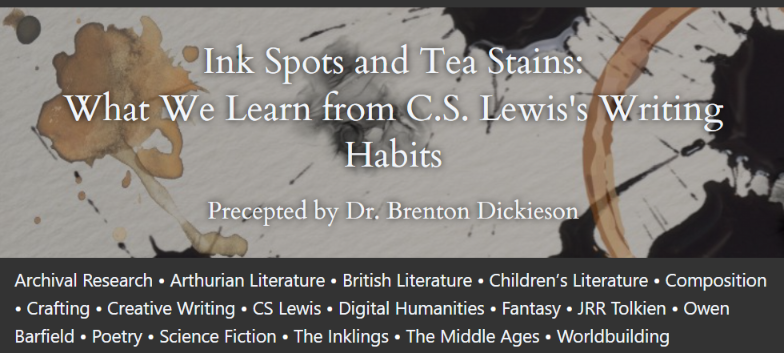
Brilliant New Course on C.S. Lewis

Fans of C.S. Lewis who would relish a month-long journey through his work must consider a brand new course designed by Dr. Brenton Dickieson of Signum University. 

Ink Spots and Tea Stains offers the very best of combinations: “academically serious but . . .  focused purely on the love of learning and the joy of studying the material.”

And what an amazing subject you will explore – a unique view of C.S. Lewis’ archival treasures (many still unpublished), in the context of his more familiar works. And there is no need to feel intimidated. According to Signum

No specific knowledge or background is necessary, though it is recommended that students have a general knowledge of Lewis’s writings.

Writers should be especially intrigued by the course which will discuss the literary imagination and the shape of personal discipline in the writing process.

I enthusiastically commend Ink Spots and Tea Stains to you. I also encourage you to share this news with your friends who are fans of C.S. Lewis’ work.

In fact, you might also wish to pass the invitation on to all of the writers you know who would enjoy an inspired exploration into the writing processes of one of the most respected authors of the twentieth century.

All of our lives are busy, but consider giving yourself this uplifting gift this autumn. If you do, I’m confident you’ll not regret it.

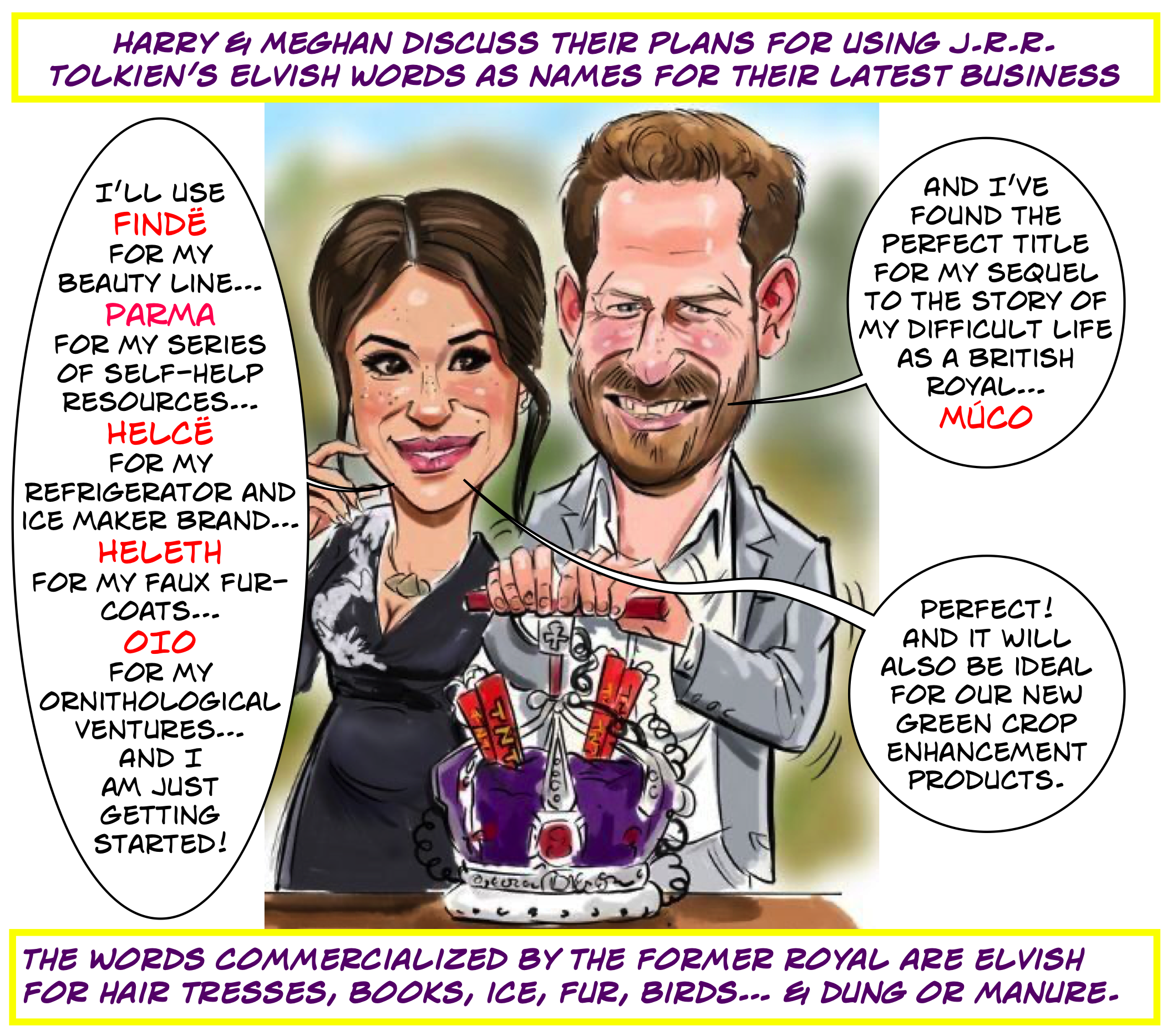
Pilfering Tolkien Linguistics

When a great author, say of the magnitude of J.R.R. Tolkien, creates ingenious new words, and even entire languages, there are several common reactions. Most readers simply respond with silent awe. Others are inspired to emulate their efforts. A small number reuse those very words as a sincere homage

And a handful of “admirers” go so far as to “appropriate” the words themselves, for their personal benefit.

C.S. Lewis, no mean linguist himself, recognized his friend Tolkien’s brilliance. In his preface to That Hideous Strength he praised Tolkien’s yet-to-be-published Silmarillion. In a 1951 letter he mentions misspelling the word Numenor.

My Numinor was a mispelling: it ought to be Numenor. The private mythology to which it belongs grew out of the private language which Tolkien had invented: a real language with roots and sound-laws such as only a great philologist could invent.

He says he found that it was impossible to invent a language without at the same time inventing a mythology.

J.R.R. Tolkien was an internationally renowned philologist, and his impressive skill is one of the great wonders we encounter in Middle Earth. A number of words from his created languages – particularly his ethereal Elvish tongues – have been lifted to be used in commercial activities unconnected to Tolkien’s interests.

For example, Palantir. This was the word for the “seeing stone,” which played a prominent role in The Two Towers. In light of Tolkien’s love of nature, and corresponding suspicion of technological advancement, it is especially odd that the company adopting this label is on the leading edge of Artificial Intelligence.

Perhaps Tolkien’s dread would have been dispelled by one of Palantir’s disarming mottos: “We believe in augmenting human intelligence, not replacing it.”

A combat veteran of WWI, like his fellow Inkling C.S. Lewis, Tolkien was appalled by war’s horrors. Even in the War of the Rings, with its moments of glorious heroism and sacrifice, the bloody heart of Mars remains nearly invincible. Because of this mixed attitude toward war, some have wondered how he would have felt about a defense (i.e. military) corporation adopting one of his creations.

Andúril was the name of the most important weapon forged in Middle Earth. It was actually reforged from the broken fragments of Narsil, the longsword which defeated Sauron by severing the One Ring from his hand.

While this description from the Anduril company resonates with our modern ear, I am not convinced that it sounds very Tolkienesque. Anduril: “Transforming defense capabilities with advanced technology. The battlefield has changed. How we deter & defend needs to change too.”

For an article about a billionaire investor who is consumed by mining Tolkien’s tomes for the businesses he founds (PayPal excepted), check out “The hidden logic of Peter Thiel’s ‘Lord of the Rings’-inspired company names.”

C.S. Lewis’ Unconscious Sharing

In a 1965 letter, written after Lewis’ death, Tolkien commented on how his friend had used subtle variations of several Elvish words in several of his fictional works.

Tolkien says Lewis “had the peculiarity that he liked to be read to. All that he knew of my ‘matter’ was what his capacious but not infallible memory retained from my reading to him as sole audience.” Thus, he surmises that:

C.S. Lewis was one of the only three persons who have so far read all or a considerable part of my ‘mythology’ of the First and Second Ages, which had already been in the main lines constructed before we met. . . . His spelling numinor is a hearing error, aided, no doubt, by his association of the name with Latin nūmennūmina, and the adjective ‘numinous.’

Lewis was, I think, impressed by ‘the Silmarillion and all that,’ and certainly retained some vague memories of it and of its names in mind. For instance, since he had heard it, before he composed or thought of Out of the Silent Planet, I imagine that Eldil is an echo of the Eldar; in Perelandra ‘Tor and Tinidril’ are certainly an echo, since Tuor and Idril, parents of Eärendil, are major characters in ‘The Fall of Gondolin,’ the earliest written of the legends of the First Age. But his own mythology (incipient and never fully realized) was quite different.

An Entertaining Diversion

Years ago I linked to an entertaining game that plays on the linguistic eloquence and mystery Tolkien exhibited in naming his characters. I was delighted to see now that it is still available online.

Antidepressants or Tolkien challenges players – you can play solo, but it’s more fun with others – to guess if a given word is an antidepressant drug or the name of one of Tolkien’s characters. Don’t expect to score 100%, but do expect to smile at some of the examples.

Blackout Writing

Do you have trouble coming up with ideas for your poems or stories? How about starting with an interesting collection of words and winnowing them down to a creation of your own? Read on to learn more about a simple process.

A few years ago a fellow pastor told me he could write, even short articles like blog posts. Since he had successfully completed a challenging graduate program, I was a bit shocked at this disclosure. “The problem,” he said, “is that I just can’t come up with any ideas for what to write.”

I had two reactions. First, I was amazed, since I can’t get through a day without encountering at least a handful of observations that beg to be explored. Second, I wondered just what sort of sermons his congregation was exposed to, if creative imagery and fresh ways of expressing God’s timeless truths were not coming from their pulpit.

One of the ways I attempt to improve my own writing is by stretching. In my personal shorthand, this refers to engaging in new forms of writing. Principally that means voluntarily jumping into sometimes ominous literary waters. I stretch myself by humbly engaging in genres which I may, in all honesty, find intimidating.

For example, occasionally, when bored with outlining books that may never get written, I’ll just scribble out some “impromptu verse.” Some of it turns out rather decent. (You’ll notice I didn’t say “excellent.”)

Blacking Out Words to Compose New Literature

I had heard of Blackout Poetry before, but never attempted to “write” any. Actually, it seems to me that “decompose” might be a more accurate word for this type of creating. Although most commonly used to create brief works, such as poetry, the concept can be used for narratives as well.

If you are unfamiliar with the process, you may enjoy the following, introductory articles.

Teach Kids Art” explains the basic process and then adds some visual artistry to the mix.

Blackout Poetry is a form of “found poetry” where you select words that catch your interest from a newspaper, book, or other printed text – along with a few additional words to make it flow. Then you “redact” all the words you don’t want. This is often (but not always) done with a black marker, hence the name “blackout poetry.” Your chosen words will form a new message, giving the text a whole new meaning.

Take your Blackout Poetry a step further by adding patterns, designs, or a drawing to the areas you’re “redacting.” For example, instead of just filling in around your chosen words with solid black, you could create a drawing or design that relates to your poem. Just as with any illustration, your art should support the remaining text and add to its meaning.

Looking Beyond the Comfort Zone” discusses a reservation many will have about pursuing blackout writing.

I really wanted to give it a try. There were however a few obstacles to overcome. First was my ingrained prohibition of defacing books. Although I owned a highlighter in college I rarely used it. It seemed wrong. . . .

Secondly the blackout poetry requires making the page unreadable for the original words. I felt a lot of good old-fashioned guilt in the prospect of destroying someone’s story. Lastly, I didn’t have any books that I felt so little regard for that I could take a sharpie marker to the pages.

I, personally, have eliminated the second reservation by scanning an image of each experimental page and blacking words out digitally. It would be just as simple to print out such an image, or simply use a copier with a physical book, if you prefer to create your work manually. My method eliminates another potential problem for bibliophiles, the damage often caused to a book’s spine when attempting to flatten the page for copying.

5 Tips for Creating Blackout Poetry” claims the genre is “the best cure for writer’s block.” To enhance miscellany, they suggest “when picking an article to use, it’s best not to read it too closely.”

That way, you aren’t overly influenced by the author’s original work and you can create something uniquely your own.

This suggestion will certainly be beneficial in liberating the creativity of many writers. For my own purposes, I disregarded this advice, since I intentionally desired to use words by or about particular authors. I honestly want the original context to be in my mind during the metamorphosis.

A final source, “A blackout poem on the Trinity,” reveals how a writer in Europe found inspiration in the writings of C.S. Lewis for her own poem about the Trinity. Check out Christine’s verse at the link above.

This is the first time I’ve tried a blackout poem. They work by taking a page of text and then blacking it out until only the remaining words give you the poem.

In the end, I chose “It all began with a picture . . .” published in the Junior Section of The Radio Times on 15 July 1960. It’s a short and sweet description of how Lewis was inspired to write the Narnia stories.

My Initial Attempts

As I mentioned above, I scanned printed pages that you can easily find at Internet Archives, Google Books, Project Gutenberg and various other sites.

I did not attempt to write poetry. Rather, I used each page to write a brief, new narrative. Of my first three efforts, I was most pleased with “Savage Editing,” displayed above. Below, I will place it beside the original page, from The Collected Poems Of  G.K. Chesterton.

I’ll close by passing on to you the experience of the author who composed an ode on the Trinity, using an article about C.S. Lewis. My guess is that you too – should you be so bold as to attempt writing your own blackout works – will experience a similar satisfaction.

It’s hard being constrained by the page of text in front of you. The more you black out, the less you say; but the less you black out, the less impact each word has. It’s a game of compromise, striking the balance between being artistic and understandable.

But I think the end result is a celebration of both Lewis’ work and the Trinity.


The illustration below shows my blackout, which I entitled “Savage Editing,” beside the original page, which includes a portion of “The Scouring of the Horse,” from The Collected Poems Of  G.K. Chesterton. “The Scouring” is the final book in Chesterton’s Ballad of the White Horse.