George MacDonald’s Poetry

George MacDonald (1824-1905) was a prolific Scot writer. His legacy was amplified due to his influence on G.K. Chesterton and C.S. Lewis. (He was also a friend of Mark Twain.) An essay, originally presented as a speech by G.K. Chesterton, is available online.

Chesterton goes so far as to say, “if to be a great man is to hold the universe in one’s head or heart, Dr. MacDonald is great. No man has carried about with him so naturally heroic an atmosphere.” Listen to his description of that special type of literature that inspired many Inklings, chiefly C.S. Lewis and J.R.R. Tolkien.

Many religious writers have written allegories and fairy tales, which have gone to creating the universal conviction that there is nothing that shows so little spirituality as an allegory, and nothing that contains so little imagination as a fairy tale. But from all these Dr. MacDonald is separated by an abyss of profound originality of intention.

The difference is that the ordinary moral fairy tale is an allegory of real life. Dr. MacDonald’s tales of real life are allegories, or disguised versions, of his fairy tales.

It is not that he dresses up men and movements as knights and dragons, but that he thinks that knights and dragons, really existing in the eternal world, are dressed up here as men and movements.

C.S. Lewis, for his part, praised MacDonald as instrumental in tilling the soil for his eventual conversion to Christianity. He was on the defensive, since the writers which most inspired him shared a common flaw – they were Christians.

All the books were beginning to turn against me. Indeed, I must have been as blind as a bat not to have seen, long before, the ludicrous contradiction between my theory of life and my actual experiences as a reader.

George MacDonald had done more to me than any other writer; of course it was a pity he had that bee in his bonnet about Christianity. He was good in spite of it.

Chesterton had more sense than all the other moderns put together; bating, of course, his Christianity. Johnson was one of the few authors whom I felt I could trust utterly; curiously enough, he had the same kink. Spenser and Milton by a strange coincidence had it too (Surprised by Joy).

Lewis would actually come to edit a selection of MacDonald’s passages for an edifying anthologyThis post includes a link for downloading a copy of George MacDonald: An Anthology.

This week I was reading one of MacDonald’s excellent essays, which appears in The Imagination and Other Essays. I intend to discuss some of his thoughts on age and writing soon. Although I am not an aficionado of poetry – despite having composed poetry from time to time, including quintains, I turned to another of MacDonald’s books.

On to His Poetry

I decided to follow up MacDonald’s brilliant essay with a dip into his poetry. Fortunately, Internet Archive allows you to freely download a complete copy of MacDonald’s Scotch Songs and Ballads, published in 1893. My conscience forces me, however, to provide a single caveat. Be forewarned that the tome is not suited for those intimidated by pronounced dialects.

Before looking at one of his poems in its entirety, allow me to share with you a passage from “The Waesome Carl” which I particularly enjoyed (due to its portrait of a preacher). 

The minister wasna fit to pray
And lat alane to preach;
He nowther had the gift o’ grace
Nor yet the gift o’ speech!
He mind’t him o’ Balaäm’s ass,
Wi’ a differ we micht ken:
The Lord he opened the ass’s mou,
The minister opened’s ain!
He was a’ wrang, and a’ wrang,
And a’thegither a’ wrang;
There wasna a man aboot the toon
But was a’thegither a’ wrang!
The puir precentor couldna sing,
He gruntit like a swine . . .

Not that I claim able to decipher it all, but my impression is that it’s not especially flattering. It is definitely entertaining. And I humbly think I interpret it significantly more accurately than Google’s online translator, which provided the following version.

The minister was not fit to pray
And lat alane to preach;
He nowther had the gift o’ grace
Nor yet the gift o’ speech!
He mind’t him o’ Balaam’s ass,
Wi’ a differ we micht ken:
The Lord he opened the ass’s mou,
The minister opened his eyes!
He was a’ wrang, and a’ wrang,
And a’thegither a’wrang;
There was a man aboot the toon
But thegither was wrong!
The puir precentor couldna sing,
He grunted like a swine. . .

Using the Dictionars o the Scots Leid, you can make perfect sense of the words about which you may be uncertain. (Thank you, Scotland.)

Dialects are interesting things indeed. I will close with another of MacDonald’s poems. I submit it for (1) those who comprehend the dialect, (2) those who deem precious their Scottish ancestry, (3) those with an affinity for Connor MacLeod, and (4) those who simply enjoy a challenge.

Nannie Braw

I like ye weel upo Sundays, Nannie,
I’ yer goon and yer ribbons and a’;
But I like ye better on Mondays, Nannie,
Whan ye’re no sae buskit and braw.

For whan we’re sittin sae douce, Nannie,
Wi’ the lave o’ the worshippin fowk,
That aneth the haly hoose, Nannie,
Ye micht hear a moudiwarp howk,

It will come into my heid, Nannie,
O’ yer braws ye are thinkin a wee;
No alane o’ the Bible-seed, Nannie,
Nor the minister nor me!

Syne hame athort the green, Nannie,
Ye gang wi’ a toss o’ yer chin;
And there walks a shadow atween ‘s, Nannie,
A dark ane though it be thin!

But noo, whan I see ye gang, Nannie,
Eident at what’s to be dune,
Liltin a haiveless sang, Nannie,
I wud kiss yer verra shune!

Wi’ yer silken net on yer hair, Nannie,
I’ yer bonnie blue petticoat,
Wi’ yer kin’ly arms a’ bare, Nannie,
On yer ilka motion I doat.

For, oh, but ye’re canty and free, Nannie,
Airy o’ hert and o’ fit!
A star-beam glents frae yer ee, Nannie–
O’ yersel ye’re no thinkin a bit!

Fillin the cogue frae the coo, Nannie,
Skimmin the yallow ream,
Pourin awa the het broo, Nannie,
Lichtin the lampie’s leme,

Turnin or steppin alang, Nannie,
Liftin and layin doon,
Settin richt what’s aye gaein wrang, Nannie,
Yer motion’s baith dance and tune!

I’ the hoose ye’re a licht and a law, Nannie,
A servan like him ‘at’s abune:
Oh, a woman’s bonniest o’ a’, Nannie,
Doin what maun be dune!

Cled i’ yer Sunday claes, Nannie,
Fair kythe ye to mony an ee;
But cled i’ yer ilka-day’s, Nannie,
Ye draw the hert frae me!

Addendum:

For those interested in pursuing this linguistic subject, I just came across a delightful 1896 collection of works you can download for free. Legends of the Saints: in the Scottish Dialect of the Fourteenth Century is “edited from the unique manuscript in the University Library, Cambridge.”


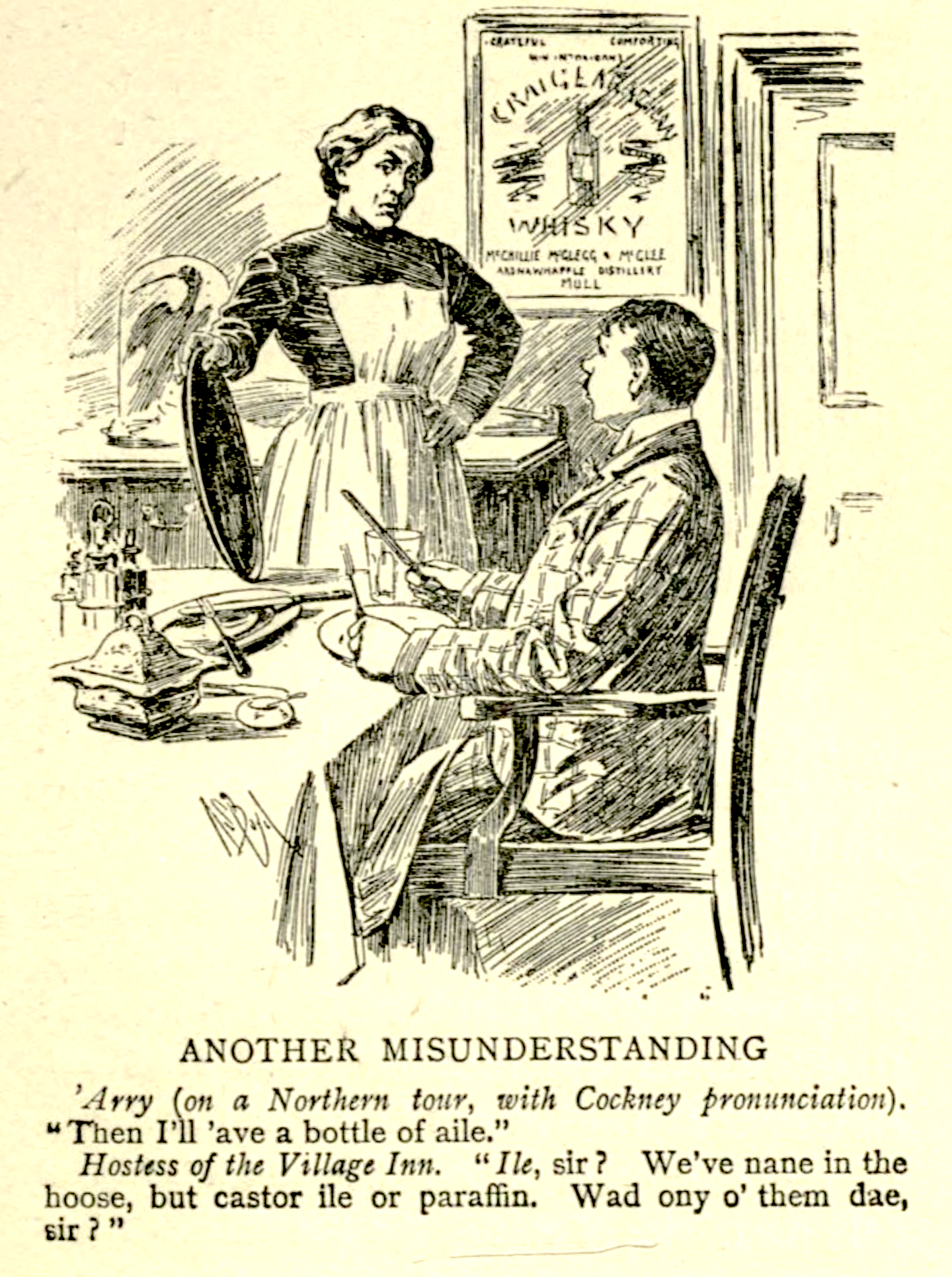
The cartoon above comes from Mr. Punch in the Highlands which was published “with 140 illustrations” more than a century ago. You can download your personal copy of humorous work at Internet Archive.

C.S. Lewis, Puritanism & Prudes

Puritans often get a bad rap from people who don’t know their true history. Reading C.S. Lewis can help correct that error.

Digital History describes the problem in the following way.

Few people, however, have been as frequently subjected to caricature and ridicule. The journalist H.L. Mencken defined Puritanism as “the haunting fear that someone, somewhere, might be happy.”

In truth, Puritans enjoyed having a good time as much as anyone. They only objected to sinful activities. Drinking, fine. Drunkenness, sinful. Sexual intimacy in marriage, wonderful. Fornication and promiscuity, iniquitous. As C.S. Lewis writes in his essay “Tasso,” the Puritans were not about eliminating pleasure.

Asceticism is far more characteristic of Catholicism than of the Puritans. Celibacy and the praise of virginity are Catholic: the honour of the marriage bed is Puritan. (Studies in Medieval and Renaissance Literature)

In English Literature in the Sixteenth Century, C.S. Lewis includes Puritans in his description of the broader Protestant Reformation landscape.

Nearly every association which now clings to the word puritan has to be eliminated when we are thinking of the early Protestants. Whatever they were, they were not sour, gloomy, or severe; nor did their enemies bring any such charge against them. . . .

For [Thomas] More, a Protestant was one “dronke of the new must of lewd lightnes of minde and vayne gladnesse of harte.” Luther, he said, had made converts precisely because “he spiced al the poison” with “libertee.” Protestantism was not too grim, but too glad, to be true. . . . Protestants are not ascetics but sensualists.

Within the contemporary American Christian community, Puritanism has many defenders. This is due, I believe, to the prominence of Reformed theology within Protestant churches, something traceable to the nation’s beginnings.

Contrary to common understanding, the Puritans were not “separatists” who rejected the established church. In contrast, they remained members of the Church of England throughout the late sixteenth century. They did, however, believe that the Anglican Church retained too many extrabiblical Roman Catholic Church elements and ceremonies.

Much confusion derives from failing to distinguish between the Pilgrims and Puritans.

The main difference between the Pilgrims and the Puritans is that the Puritans did not consider themselves separatists. They called themselves “nonseparating congregationalists,” by which they meant that they had not repudiated the Church of England as a false church.

But in practice they acted – from the point of view of Episcopalians and even Presbyterians at home – exactly as the separatists were acting (History.com).

While the far more numerous Puritans began arriving in the colonies in the 1630s, the Pilgrims (who referred to themselves as “Saints,” not “Pilgrims”) arrived on the Mayflower a decade earlier. The previously quoted article describes the denigration of the Puritan theology, in the following manner.

As they gained strength, Puritans were portrayed by their enemies as hairsplitters who slavishly followed their Bibles as guides to daily life or hypocrites who cheated the very neighbors they judged inadequate Christians.

Sadly, nowadays any serious Christian – anyone who honestly reads the Bible and tries to live according to God’s teachings – is regarded with similar disdain. This sad fact was recognized by C.S. Lewis long ago.

To be sure, there are standards by which the early Protestants could be called “puritanical;” they held adultery, fornication, and perversion for deadly sins. But then so did the Pope. If that is puritanism, all Christendom was then puritanical together (English Literature in the Sixteenth Century).

So From Where Does the Puritan Label Come?

C.S. Lewis answers this question in an essay, “Edmund Spenser, 1552–99.”

By purity the Elizabethan Puritan meant not chastity but “pure” theology and, still more, “pure” church discipline (Studies in Medieval and Renaissance Studies).

In “Donne and Love Poetry” he elaborates on Puritan focus on ecclesiastical, rather than moral, matters.

We have come to use the word “Puritan” to mean what should rather be called “rigorist” or “ascetic,” and we tend to assume that the sixteenth-century Puritans were “puritanical” in this sense. Calvin’s rigorist theocracy at Geneva lends colour to the error.

But there is no understanding the period of the Reformation in England until we have grasped the fact that the quarrel between the Puritans and the Papists was not primarily a quarrel between rigorism and indulgence, and that, in so far as it was, the rigorism was on the Roman side (Selected Literary Essays).

Returning to the essay on Edmund Spencer, we see Lewis elaborating on the ecclesiastical hopes of the Puritans.

We must picture these Puritans as the very opposite of those who bear that name today: as young, fierce, progressive intellectuals, very fashionable and up-to-date. They were not teetotallers; bishops, not beer, were their special aversion. . . .


There was no necessary enmity between Puritans and humanists. They were often the same people, and nearly always the same sort of people: the young men “in the Movement,” the impatient progressives demanding a “clean sweep.” And they were united by a common (and usually ignorant) hatred for everything medieval . . . (Studies in Medieval and Renaissance Studies).

Some readers may be surprised to see Lewis, an Anglican, speak so favorably of Puritans. To those of us who are interested in genuine history, his words are illuminating. And, his warning – which is applicable to many other historical movements – is appreciated.

I must immediately guard against a possible misunderstanding. Both words have so changed their sense that puritan now means little more than ‘rigorist’ or ‘ascetic’ and humanist little more than ‘the opposite of puritan.’

The more completely we can banish these modern senses from our minds while studying the sixteenth century the better we shall understand it.

That is sound advice for every circumstance. Accurately understanding what we are discussing is a necessity. Just think how much disagreement could be dispelled in our polarized world, if we only followed C.S. Lewis’ example.

We Are All Hard of Hearing

Do you have any Deaf friends or family members? If so, I cannot think of any more inspiring reason to learn sign language.

Even if you don’t already know someone Deaf, gaining familiarity with American Sign Language (ASL), or one of its British, French, Chinese, Japanese, Arabic, Spanish, Mexican, etc. alternatives – is worthwhile.

According to one major translation and captioning corporation, the use of sign language extends not only throughout nations, but also to a variety of populations.

It’s the main form of communication for the Deaf and Hard-of-Hearing community, but sign language can be useful for other groups of people as well. People with disabilities including Autism, Apraxia of speech, Cerebral Palsy, and Down Syndrome may also find sign language beneficial for communicating.

My wife, a special education teacher, recognized this early in her career. One of her greatest joys came from introducing a deaf, severely autistic teenager to a world where she could communicate for the first time. Although she could see, and learned to read with some comprehension, her transformation through learning ASL called to mind the miracle that was Helen Keller.

Before proceeding, it is helpful to clarify some terminology. According to the National Association of the Deaf website, “we use the lowercase deaf when referring to the audiological condition of not hearing, and the uppercase Deaf when referring to a particular group of deaf people who share a language.”

The members of this group have inherited their sign language, use it as a primary means of communication among themselves, and hold a set of beliefs about themselves and their connection to the larger society.

We distinguish them from, for example, those who find themselves losing their hearing because of illness, trauma or age; although these people share the condition of not hearing, they do not have access to the knowledge, beliefs, and practices that make up the culture of Deaf people.

This is an extremely significant distinction. So, people like me whose progressive hearing loss could conceivably lead to deafness, would not be members of the Deaf community. Unless, I suppose, we were to immerse ourselves in the Deaf (sign) language and culture. Even then, I imagine we would always be recognizable as “immigrants,” rather than native members of the Deaf family.

Another semantic consideration is the obsolete usage of the term “hearing-impaired.” This term is offensive to the Deaf community, and efforts continue to update the language of pertinent laws. The Cogswell Macy Act, which outlines educational rights for the Deaf and the Blind, is currently being revised.

In fact, the National Association for the Deaf is asking everyone to serve as advocates. One small element of the revision  will be to “change outdated terminology in current educational law from ‘hearing impaired’ to ‘deaf, hard of hearing, and DeafBlind.’”

Sign language is certainly not limited to spelling out words with individual letters. There are numerous words that have their own sign. A company named Start ASL offers online courses, and they offer video examples of 150 basic ASL words on their website.

One fascinating practice of the Deaf is the way many of them possess a unique “name sign” which identifies them in the community. Very Well Health has a great explanation about the way these names are given.

One aspect of Deaf culture is the use of unique, personal “name signs” as a way to identify someone without fully spelling out their name. . . . These names often reflect the person’s character and are usually devised by someone within the Deaf community.

Some people have a combination of initialized and descriptive name signs, like the first letter of their name that is swirling like a fish for someone who is a swimmer.

If you love a specific animal, like cats, your name sign may be the first letter of your birth name to then sign “cat’s whiskers” on your cheek. If you enjoy birds, your name sign could be the first letter of your birth name combined with the sign for bird.

The name sign given to my wife, Delores, was the letter “d” beside her “smile.” Quite fitting, since she is an extremely compassionate person who is seldom without one.

C.S. Lewis & the Deaf

Obviously, C.S. Lewis encountered a number of people who were deaf or hard of hearing. He mentions some of them in his correspondence. While there are now a “few students with hearing loss at Oxford,” I don’t know what accommodations would have been available during Lewis’ residency.

In “Oxford Student on Being Hearing Impaired at University,” we read “Deaf and hard of hearing students need to speak up at their universities if they want their needs to be taken more seriously and reach their full academic potential.” (Curiously, this 2019 article uses the outdated term “hearing impaired.” Perhaps the British find it less irritating than Americans?)

In 1953, C.S. Lewis responded to a letter from a student who had explained the Gospel to one of her Deaf classmates. She asked “how much of the teaching about Christ” she could present with the Gospel story itself. In his response he begins with a disclaimer about having little knowledge of the Deaf.

It is difficult to one, who, like me, has no experience, to give an opinion of these problems, which, I see, are very intricate. The story about the girl who had reached the age of 16 under Christian teachers without hearing of the Incarnation is an eye-opener.

For ordinary children (I don’t know about the Deaf) I don’t see any advantage in presenting the Gospels without some doctrinal comment. After all, they weren’t written for people who did not know the doctrine, but for converts, already instructed, who now wanted to know a bit more about the life and sayings of the Master.

Shortly before his death he explained to a writer that he had no personal photo to share. In his response, he uses the word “deaf” to explain (or exaggerate) the fact he was hard of hearing.

Sorry, but I’m out of photos. Which is perhaps just as well, for I look awful. Imagine a marsh-wiggle gone fat and red in the face. And deaf and bald. I talk far too loud. I’m so glad you liked the Narnian series.

Humanity’s Universal Deafness

Shifting our view from the physical to the spiritual, we see that all of us truly are Hard-of-Hearing. Christians understand the human inclination toward selfishness and sin as a consequence of “original sin.” We can be rescued from our sinful state, of course, and that is what the doctrine of the atonement is all about.

We’re not discussing theology here, but I say that to explain why deafness and blindness are metaphors in the Scriptures for being unable to hear or see the Truth.

For example, through the Prophet Isaiah, God describes unfaithfulness of his people in the following way.

Hear, you deaf,
    and look, you blind, that you may see!
Who is blind but my servant,
    or deaf as my messenger whom I send?
Who is blind as my dedicated one,
    or blind as the servant of the Lord?
He sees many things, but does not observe them;
    his ears are open, but he does not hear. (Isaiah 42:18-20).

When Jesus says “he who has ears to hear, let him hear” (Matthew 11:15) he is saying that we should not be deaf to God’s call. And the deafness he refers to is our conscious choice not to hear God’s words.

It seems to me that most of us are at least slightly hard of hearing when it comes to listening to our Creator. If we weren’t – if we heeded God’s words – this world of ours would be a vastly different place.

C.S. Lewis describes the tragic end of someone who insists on remaining utterly deaf to God.

In The Great Divorce, he describes the withered soul of a person who had resisted every attempt of God to alleviate their suffering and lift them from death, to life.

A damned soul is nearly nothing: it is shrunk, shut up in itself. Good beats upon the damned incessantly as sound waves beat on the ears of the deaf, but they cannot receive it. Their fists are clenched, their teeth are clenched, their eyes fast shut.

First they will not, in the end they cannot, open their hands for gifts, or their mouths for food, or their eyes to see.

No one reading this is at that point. So long as we breathe, we can uncover our spiritually blind eyes and unstop our spiritually dead ears, to receive his words of life. Admitting that we are all sometimes hard of hearing is a good step toward growing in our faith and anticipating the gift of eternal life.

You will find a list of resources below, but before exploring them, there is one more amazing C.S. Lewis connection that needs to be mentioned. In 2018, the Pennsylvania School for the Deaf adapted The Lion, the Witch, and the Wardrobe for the stage in ASL. Pretty amazing! “Narnia’s Latest Adaptation: Sign Language” tells the story and includes a delightful short video featuring several of the performers.


Resources

There are a number of interesting and useful resources available for those interested in this subject.

For charts displaying different sign language alphabets, you will find one collection here.

For those who share my interest in fonts, you can download a free ASL font at this website. And, for those Down Under, you can find a free font featuring your version of sign language here.

As you can see from the animated graphic above this section an example of the ASL animation generator available at signlanguageforum.com – This one spells “resources.”

There are several sites online where you can type in your own words or phrases using fingerspelling. For example, with either American Sign Language or British Sign Language (BSL).

Covid’s Ancillary Destruction (Updated)

Have you severed ties with a friend or relative because you view the question of vaccination policies differently?

Apparently this tragedy is growing in frequency. Just last week, a person very, very dear to me declared that we had “come to a parting of the ways.” I pray for a restoration of the relationship when emotions cool, but for the moment, it seems I am “dead” to my sister.

She is one of the people who find themselves at one end of the vaccination spectrum. There are, of course, some who believe those who receive vaccinations are dupes, endangering their health with possibly unnecessary medicine that may have lasting side effects. At the opposite end, stand those who consider anyone unwilling to be vaccinated as tantamount to being a heartless murderer.

Sadly, those of us who lie midway along said spectrum—who understand precisely how others might arrive at those extreme positions, and call for reasonable, respectful conversation—are typically regarded with contempt by each extreme.

Ironically, my wife and I eagerly received our injections at the first possible opportunity. Yet, because our adult children (intelligent and mature, one and all) have made a different decision, we have suffered this separation from some of our extended family.

A report published this week revealed 14% of vaccinated respondents said “they ended things with friends who refused to get vaccinated.” That suggests that approximately one out of seven people are unwilling to place friendships on pause; they apparently prefer to terminate them.

“Stress from the Pandemic Can Destroy Relationships with Friends—Even Families” describes the tragedy in the following way.

The pandemic’s toll on friendships goes deeper than mere political polarization — the confusion of a mask with support for “big government.” It’s more about discovering personality differences between you and your relatives and friends, including different levels of risk-tolerance and what might seem like irrational optimism on one side vs. hysterical alarmism on the other.

At a time when many of us are losing sleep, picturing ourselves or someone we love gasping for air in a crowded emergency room, these differences are painfully relevant.

Taking these words to heart should help us all be more tolerant of our varying responses to the strain of living during this pandemic.

I hope that you have not experienced the pain of ruined relationships. And, I beg you, if you are inclined to write off friends who disagree with you on this controversial subject, please reconsider. After all, as C.S. Lewis wisely said to those who claim to be followers of Jesus, “to be a Christian means to forgive the inexcusable, because God has forgiven the inexcusable in you” (The Weight of Glory).

You Should Read This

I just finished the best article I’ve read on this subject, and commend it to you. Pastor Peter Leithart authored the provocatively titled “Why I Didn’t Get the Covid Vaccine.”

The title is a little misleading, since Leithart’s rationale is that as a covid survivor he currently has the resulting “natural immunity.”

The article is quite enlightening, however, because it is not an argument for or against the treatment per se. Rather, it is a very brief historical reminder of a perhaps more perilous ailment. He approaches the subject through the work of an Italian philosopher.

As Roberto Esposito put it in Biopolitics, political authority was traditionally the authority to kill. Under the reign of biopolitics, rulers care for and manage life. Once upon a time, the ruler bore a sword; now, a syringe.

“Body politic” is an ancient metaphor, but in biopolitical regimes the body becomes the real place “where the exercise of power [is] concentrated.” Public health takes center stage in a “limitless process of medicalization” as health care is “superimposed” on politics. It’s now the government’s job—its primary job—to keep us safe and healthy.

“Life becomes government business,” Esposito writes, and “government becomes first and foremost the governance of life.” To manage life, governments have to exercise social control, keep populations under surveillance, maintain constantly-updated databases, and, as necessary, isolate and separate sectors deemed dangerous to the corporate body.

In an article written more than a year ago, entitled “Biopolitics in the Time of Coronavirus,” the writer describes the evolution of the concept of biopolitics since the 1970s. He warned then, “Instead of worrying about the increase of surveillance mechanisms and indiscriminate control under a new state of exception, I therefore tend to worry about the fact that we already are docile, obedient biopolitical subjects.” One can only imagine what he might say today.

Back to Relationships

I am no philosopher, and it is not the purpose of this post to answer the big questions. What I believe is simple. The vaccine is good for some, but not all. And disease is terrifying, especially when it can be terminal.

Oh, and I believe one other thing. We should discuss such matters civilly. Graciously, even. Because differences of honest opinion about debatable matters are insufficient grounds for destroying lifelong relationships. After all, true friendships are precious . . . and rare.

C.S. Lewis discerned a little-known truth about the importance of friendships. One that reminds us they should not be discarded in the passion of a moment. Lewis describes here how there are eternal repercussions related to our actions. Refer to salvation, the resurrection and heaven as the “glory” God desires for all people, Lewis writes:

It may be possible for each to think too much of his own potential glory hereafter; it is hardly possible for him to think too often or too deeply about that of his neighbour. The load, or weight, or burden of my neighbour’s glory should be laid on my back, a load so heavy that only humility can carry it, and the backs of the proud will be broken. . . .

All day long we are, in some degree, helping each other to one or other of these destinations [heaven or hell].

It is in the light of these overwhelming possibilities, it is with the awe and the circumspection proper to them, that we should conduct all our dealings with one another, all friendships, all loves, all play, all politics.

There are no ordinary people. You have never met a mere mortal. Nations, cultures, arts, civilisations—these are mortal, and their life is to ours as the life of a gnat.

But it is immortals whom we joke with, work with, marry, snub, and exploit—immortal horrors or everlasting splendours (The Weight of Glory).

Update

[April 2024] When I originally posted this, I expressly shared that “I pray for a restoration of the relationship…” God has answered that prayer. My sister had been under great pressure when we had initially spoken; her youngest grandson was severely ill from the virus. Thus her quite understandable intensity in her concern about the potential role of the unvaccinated at that time.

Our meeting this week was filled with grace and healing. She was wounded not only by my children’s decisions, but also by this post itself. I had no intention to embarrass anyone, but instead to caution others about the dangers of argumentation that substitutes for discourse—which is something that to which both political parties in the United States have inexcusably contributed.

One reason for adding this update is to encourage anyone who reads this column to pursue reconciliation and healing in all of your damaged relationships. Though deeply saddened during the months of estrangement, I knew that God specializes in healing… and the Lord loves each one of us more than we will ever know. As long as you live, don’t give up hope. Keep praying and extending a humble and loving invitation to the friends and loved ones with whom you differ.

Oh, we didn’t discuss vaccinations per se, since that wasn’t the important concern. It was all about relationship.

On the Nature of Digressions

It’s nearly impossible to avoid digressions – those temporary departures from the current subject of conversation. While many digressions are interesting in the own right, they occasionally cause the speaker (or writer) to lose track of the actual point they are attempting to establish.

It’s like when I would be reading something the Emperor Constantine the Great, and at the mention of the Persian Empire, I would put the current article on hold while I explored the subject of just how the current regime in Iran reflects the religious fundamentalism of Zoroastrianism as it resisted during the Abbasid Caliphate. Ah, but forgive me, I digress.

The reason I am thinking about digressions today is because I recently encountered a massive one in one of Mark Twain’s works. But before we look at it, let’s consider a more recent example, in an article about C.S. Lewis.

In “The Uses of Ignorance,” literary critic Alan Jacobs explores a number of themes, including the way Lewis’ presentation of Christianity’s core resonates with believers from diverse theological backgrounds.

One lesson to be learned . . . is just how carefully Lewis articulated his “mere Christianity” so that it seemed “mere” indeed – recognizable to Christians from many different traditions as the faith they understood and practiced. But we also see . . . “that the lasting appeal of Mere Christianity is not based so much on Lewis’s genius as on his ability to point readers to the luminosity of the gospel message itself.” Which, I might add, is a kind of genius in itself.

The article is well worth reading, but the specific reason I mention it now, is because the author includes a lengthy (315 word) departure from his main theme which he brackets with the words “A digression:” and “End of digression”.) It’s rare to see something this straightforward.

C.S. Lewis as a Digresser

If the average woman or man is prone to digression, it seems apparent a genius – with voluminous knowledge on diverse subjects – would occasionally succumb to the same temptation. For someone like C.S. Lewis this is not a major problem, as he would never lose his place in the original conversation. On the contrary, Lewis’ digressions would invariably enrich the discussion, as they illuminated his points.

One of the only books written by C.S. Lewis which has entered the public domain is Spirits in Bondage. When it was published in 1919 (while he was an atheist), Lewis wrote to a friend: “The sub-title ‘A cycle of lyrical poems’ was not given without a reason: the reason is that the book is not a collection of really independent pieces, but the working out, loosely of course and with digressions, of a general idea.” (You can download a free copy of Spirits in Bondage at Project Gutenberg.)

Mark Twain’s Masterful Digression

I’ve written about Mark Twain in the past. In one column I shared his humorous reflections on the nature of editors. Writers will find the post particularly entertaining.

Editors played a major (usually unwelcome) role in Twain’s existence. Thus, it is unsurprising that a major digression in “How to Make History Dates Stick” involves these denizens of the publishing world.

One book I was reading this week includes an extensive and, of course, intentional example of digression. Although he doesn’t bracket it with the word “digression,” it is probably one of the best examples in existence. (We would expect nothing less from Samuel Clemens!)

In his novel Roughing It, Twain describes a pervasive blight to the western frontier, sagebrush.

I do not remember where we first came across “sage-brush,” but as I have been speaking of it I may as well describe it. This is easily done, for if the reader can imagine a gnarled and venerable live oak tree reduced to a little shrub two feet high, with its rough bark, its foliage, its twisted boughs, all complete, he can picture the “sage-brush” exactly.

Often, on lazy afternoons in the mountains I have lain on the ground with my face under a sage-bush, and entertained myself with fancying that the gnats among its foliage were Lilliputian birds, and that the ants marching and countermarching about its base were Lilliputian flocks and herds, and myself some vast loafer from Brobdingnag waiting to catch a little citizen and eat him.

Twain’s description of his daydreaming about sagebrush is entertaining, but this is not the quintessential digression I wish to share. After this brief digression, Twain writes a page and a half about the plant’s actual physical attributes and utility (e.g. for fires and tea). But then, when the reader least expects it, Twain goes off on another extended ramble.

Sage-brush is very fair fuel, but as a vegetable it is a distinguished failure. Nothing can abide the taste of it but the jackass and his illegitimate child, the mule. But their testimony to its nutritiousness is worth nothing, for they will eat pine knots, or anthracite coal, or brass filings, or lead pipe, or old bottles, or anything that comes handy, and then go off looking as grateful as if they had had oysters for dinner. Mules and donkeys and camels have appetites that anything will relieve temporarily, but nothing satisfy.

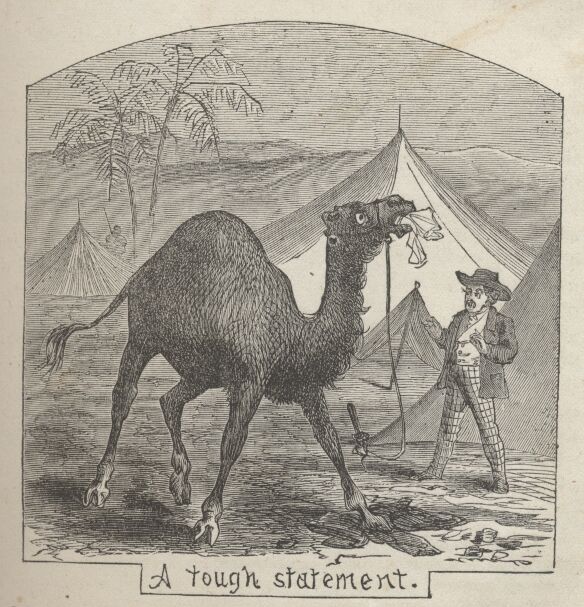
In Syria, once, at the head-waters of the Jordan, a camel took charge of my overcoat while the tents were being pitched, and examined it with a critical eye, all over, with as much interest as if he had an idea of getting one made like it; and then, after he was done figuring on it as an article of apparel, he began to contemplate it as an article of diet. He put his foot on it, and lifted one of the sleeves out with his teeth, and chewed and chewed at it, gradually taking it in, and all the while opening and closing his eyes in a kind of religious ecstasy, as if he had never tasted anything as good as an overcoat before in his life.

Then he smacked his lips once or twice, and reached after the other sleeve. Next he tried the velvet collar, and smiled a smile of such contentment that it was plain to see that he regarded that as the daintiest thing about an overcoat. The tails went next, along with some percussion caps and cough candy, and some fig-paste from Constantinople.

And then my newspaper correspondence dropped out, and he took a chance in that – manuscript letters written for the home papers. But he was treading on dangerous ground, now. He began to come across solid wisdom in those documents that was rather weighty on his stomach; and occasionally he would take a joke that would shake him up till it loosened his teeth; it was getting to be perilous times with him, but he held his grip with good courage and hopefully, till at last he began to stumble on statements that not even a camel could swallow with impunity.

He began to gag and gasp, and his eyes to stand out, and his forelegs to spread, and in about a quarter of a minute he fell over as stiff as a carpenter’s work-bench, and died a death of indescribable agony. I went and pulled the manuscript out of his mouth, and found that the sensitive creature had choked to death on one of the mildest and gentlest statements of fact that I ever laid before a trusting public.

At that point, the writer pretends to realize he has digressed and concludes the chapter in the persona of the naturalist he has earlier assumed.

I was about to say, when diverted from my subject that occasionally one finds sage-bushes five or six feet high, and with a spread of branch and foliage in proportion, but two or two and a half feet is the usual height.

Well, that’s probably more than enough of a diversion from your day’s responsibilities. I hope you enjoyed reading these words, and that your own skills as a digresser will be correspondingly enhanced.

C.S. Lewis’ Nemesis: F.R. Leavis

leavis.png

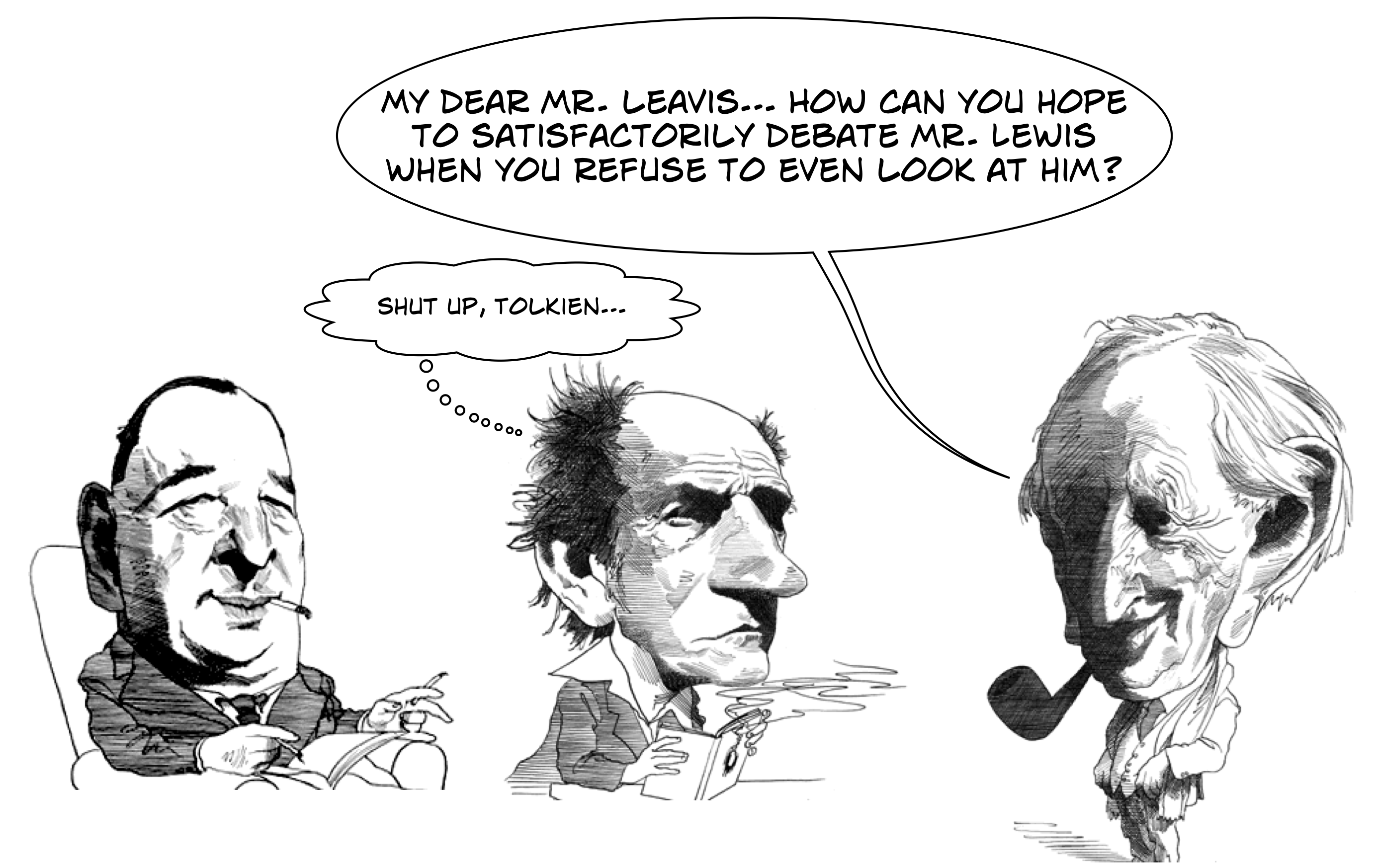
When C.S. Lewis died, one of his Cambridge colleagues uttered a shocking statement—to his Cambridge students.

“C.S. Lewis is dead,” announced F.R. Leavis to his English literature students at Cambridge University a few days later, while the world mourned for Kennedy (the President was assassinated the same day).

American novelist and essayist D. Keith Mano, then studying at Cambridge, remembers Leavis continuing his brief commentary on Lewis’ passing as follows: “They said in the Times that we will miss him. We will not. We will not.

Who knew the world of literary criticism could be so ill-mannered?

In my readings about C.S. Lewis and his life I’ve noted references to a fellow English professor at Cambridge who waged a lengthy academic argument with Lewis over the heart of English education.

The challenger to Lewis’ history-oriented approach advocated a critical position, which diluted concern for the intentions of the original writers. I’m not a lit major, so I’ll leave the description at that.*

F.R. Leavis, a dynamic influence at Cambridge, dreaded the arrival of Lewis when he moved from Oxford to a distinguished chair tailor-made for him. The two scholars shared several traits which might have disposed them to friendship.

Both were veterans of the Great War.** One difference between the veterans is curious. Leavis declined to join the Officers’ Training Corps while a student, and chose ambulance service when conscription began. Lewis, on the other hand, voluntarily joined the OTC, even though he (as an Irishman) was exempt from the conscription.***

Another similarity between the two was that they inspired many students. Far from the caricature of droning academicians, Lewis and Leavis drew fans and even disciples from the student body. (In a recent post I mentioned the affectionate nickname some of the former’s students had for him: Papa Lewis.)

The Problem

Most writers believe this second “similarity” factored into the strained relationship between the two. Both had strong personalities, and bold convictions. They did not, however, share a common temperament. Lewis was normally respectful of his philosophical adversaries. Leavis, not so much. The following comes from “C.S. Lewis and the Art of Disagreement.”

The fact that Lewis could approve of atheists [and] liberals . . . reinforces Brewer’s point that Lewis would not allow disagreement to become personal. He could always distinguish the man from the man’s opinion, and he knew the difference between an argument and a quarrel. He would not allow himself to be betrayed into aggression, but would, where necessary, draw rein on a dispute with a wry smile and an agreement to disagree.

His public written controversy on literature with E.M.W. Tillyard (later published as The Personal Heresy) was conducted with pugnacity but without personal animus. And though Lewis laid into the arguments of another colleague, F.R. Leavis, with great forcefulness in the pages of An Experiment in Criticism, he never named Leavis within those pages, but covered his opponent in a thoughtfully woven cloak of pseudonymity.

Contrast that to Leavis’ comment with which we began, in which he “celebrates” Lewis’ passing.

Lewis was quite aware of Leavis’ animosity. In a 1961 letter to the publisher of The Screwtape Letters and Screwtape Proposes a Toast, the author strikes the Cambridge Review from the publications scheduled to receive review copies.

I’ve not additions to make, but one subtraction. Delete Cambridge Review. It’s mainly in the hands of Leavisites who will blackguard any book of mine, and I don’t know why we should let them have a free copy for their sport!

Lewis scholar Brenton Dickieson wrote a column about George Watson’s critique of Lewis. Watson met Lewis at Oxford and later joined him on the faculty at Cambridge.

Here are George Watson’s first evaluative words of Lewis: “Like F.R. Leavis, he was an offensive critic.” Awesome. I think it is an evaluation that would have made Lewis chuckle, particularly in his positive comparison with Leavis, the closest thing Lewis ever got to having a Sherlockian arch-nemesis.

However, Watson (note the name) is careful to remind us that Lewis “reveled in diversity as much as Leavis detested it.” That diversity in Lewis is one of the features that (I believe) most draws and repels readers today.

In the aforementioned article, “Lewis and Cambridge,” Barbour candidly describes the disparity between the spirit of the two nemeses.

“[Lewis’] controversies were always impersonal and often ended with the participants finding a good deal of common ground, whereas Leavis’s controversies . . . tended to end in anathematizing and deeply personal wounding.”

Leavis’ reputation for engendering conflict was so pronounced The Guardian actually included the following in his obituary:

Perhaps the most telling counter-assault on him was by C.S. Lewis, who said that the use of subliminal code words like “maturity” and “relevance” smuggled in an entire value system that was never made explicit for scrutiny. Others accused him of being a crypto-Marxist.

Leavis never replied, which was a pity, but then his weapons during his long career of humiliations in the Cambridge English faculty also included silence, internal exile and cunning.

His most murderous and underestimated weapon was ridicule, which he deployed in lectures with the virtuosity of a music-hall star and with an insensitivity verging on paranoia.

The Essence of Their Differences

Exploding English: Criticism, Theory, Culture includes a chapter entitled “Leavis, Lewis, and Other Oppositions.” It’s précis suggests one reason Lewis’ criticisms have possessed a longer lifespan than those of Leavis.

Lewis and Leavis . . . were the dominant figures in literary study in the middle decades of the twentieth century. . . . it is Lewis’s arguments and assumptions that seem to be the more challenging and which have something to contribute to contemporary debates.

This assessment echoes Lewis’ own view that the Leavis tsunami may have crested. Just a month before his death, he wrote to Basil Willey about his retirement. Willey would retire from his own chair two years later.

My dear Basil . . . I have an idea that Cambridge ten years’ hence might suit us both [better] than the Cambridge we have known. . . .

I hope your success will follow you . . . [if not], then our English school, with its neglect of language, becomes purely a school of literary criticism. And criticism, thus isolated, seems to me a positively mischievous instrument of education.

In “C.S. Lewis, Literary Critic: A Reassessment,” which appeared in Mythlore, William Calin describes Lewis’ passionate defense of English authors whose reputations were in jeopardy.

A Preface to Paradise Lost does for Milton what The Allegory of Love did for Spenser, and Lewis does for epic what he had previously done for allegory and fin’ amor [courtly love]. . . . In sum, Lewis defends his authors language from the strictures of Eliot and Leavis; he defends his worldview and its artistic embodiment from the prejudice of 1930s agnostic university faculty in English. . . .

When he tells students “Don’t read criticism” [Lewis] alludes again to Leavis and his disciples, who fetishized the term “critic.” Lewis would have called himself a scholar or an historian.

The following passage from A Preface to Paradise Lost is telling. Leavis is the unnamed standard bearer for the worldview he rejects. It reveals Lewis’ keen discernment in understanding of his unbridgeable difference with Leavis.

It is not that [Leavis] and I see different things when we look at Paradise Lost. He sees and hates the very same that I see and love. Hence the disagreement between us tends to escape from the realm of literary criticism.

We differ not about the nature of Milton’s poetry, but about the nature of man, or even the nature of joy itself.

The Apostle Paul described this difference in his correspondence with the Corinthians.

Now we have received not the spirit of the world, but the Spirit who is from God, that we might understand the things freely given us by God. . . .

The natural person does not accept the things of the Spirit of God, for they are folly to him, and he is not able to understand them because they are spiritually discerned. . . . But we have the mind of Christ.

In an excellent article entitle “Three Great Critics: F.R. Leavis, T.S. Eliot, and C.S. Lewis,” Michael Aeschliman**** closes with a gospel-oriented thought.

It is pleasing to conclude by imagining C.S. Lewis, T.S. Eliot, and F.R. Leavis now conversing together amicably, recollecting emotion in tranquility, in another and better and more luminous realm, toward which all three of them were fervent pilgrims throughout their embattled but noble lives.


* There are ample online sources available to describe the contrast in detail. For example, Brian Barbour’s Modern Philology essay, “Lewis and Cambridge,” provides a superb explanation of the struggle in its broader context.

** Lewis served in the trenches, where he was seriously wounded. Leavis was fortunate enough to avoid frontline combat by serving in the Friends Ambulance Unit. This site provides a helpful account of his service on an Ambulance Train which shuttled the wounded to ports.

*** There is no record of which ambulance train carried Lewis homeward after his injury, but wouldn’t it be ironic he and Leavis had unknowingly encountered one another at that time?

**** Aeschliman is the author of The Restitution of Man: C.S. Lewis and the Case Against Scientism.

C.S. Lewis & Conversation

Luther & Mic.jpg

The most effective way to influence another person is through a fruitful conversation. This is especially true when one is attempting to persuade someone that a given point is true.

One drawback to conversations is that they are, by definition, rather intimate. After all, a person can only carry on a genuine conversation with a small audience. The ebb and flow of the spoken words, exchanged between parties, is utterly different than a speech or sermon. (This is one reason I prefer to teach in a conversational manner—soliciting questions, insights and even challenges during the delivery of whatever material I had prepared in advance.)

I recently read an interview conducted with a friend of mine who is an officer and a gentleman in the literal sense of those two words. Michael Zeigler and I served together at Fairchild AFB, after which he entered the ministry.

What most struck me in the interview, was a part of his response to a question about a book he has written. In it, he mentioned a theologian that I too have had the joy of studying under. That professor offered some invaluable advice for those of us who write. As Michael related:

My teacher [Seminary Professor Emeritus] Robert Kolb told us that, when we write, we should not seek to have the last word, but to contribute to the conversation.

This is contrary to the way most writers approach the keyboard. Having the last word is precisely what so many of us strive to do. And that very attitude undermines the opportunity for truly productive conversations.

Writing is inherently prone to unidirectional communication. Conversation can enter in through comments to authors, and this is one of the things that makes blogging somewhat more emotionally satisfying than traditional publishing.

The radio offers another example of one-way communication.* There are, of course, ways to offer feedback to commentators, but these are rather limited, and always consequent to the original message. But, it does possess a singular advantage over the printed media.

The graphic above pictures Martin Luther at a microphone. Had he lived in the appropriate era, I have no doubt he would have engaged in broadcasting . . . just as he embraced Gutenberg’s press to spread his message.

Lewis’ Broadcasts

My friend Michael has recently embarked on a new journey with a widely respected radio ministry. And, in this, he bears a striking resemblance to the great C.S. Lewis.

(Evan Rosa offers a rare example of Lewis’ broadcasts here.)

The similarity between Zeigler and Lewis is that their broadcasts are conversations, rather than presentations. Their conversational essence extends far beyond their friendly, approachable tone. They are truly engaged with their hearers. You know that they would welcome an actual interchange beyond the limitations of their microphones.

It is a rare talent to be able to touch the individual members of a mass audience so they feel like you are speaking to them alone. With both of the aforementioned individuals, I believe a key element of their effectiveness is their unfeigned humility. In 1941 Lewis wrote to a correspondent about his upcoming BBC radio talks.

I’ve given talks to the RAF [Royal Air Force] at Abingdon already, and so far as I can judge they were a complete failure. . . . Yes, jobs one dare neither refuse nor perform.

One must take comfort in remembering that God used an ass to convert the prophet; perhaps if we do our poor best we shall be allowed a stall near it in the celestial stable.

This is a good reminder not only to broadcasters, but to all who write as well. Picking up our pens in a spirit of humility goes a long way towards receiving a warm welcome for our words. And, if we are truly fortunate, our readers will recognize we are not seeking to have the last word, but merely hoping to contribute to the conversation.

Addendum

The Rev. Dr. Michael Zeigler is a long-time friend. We met years ago when he was a young Air Force officer, a first-class product of the Air Force Academy. After completing his active duty commitment, Michael and his wife journeyed to Concordia Seminary where he first earned his M.Div. and continued on to receive a Ph.D. For years they served a wonderfully diverse urban congregation in St. Louis.

Now Michael has received a singular “honor” in being chosen as the speaker for The Lutheran Hour.

The Lutheran Hour is the world’s longest running continuously broadcast Christian radio program. It began in 1930 and currently airs on more than 1,800 stations. Lutheran Hour Ministries currently reaches into more than 50 countries through its various ministries.

You can sign up to listen to podcasts of the program for free on iTunes here.


* I wish I could take some credit for Michael’s pursuit of a pastoral vocation, but I can’t. It was purely a matter of the Holy Spirit calling him to ministry. However, I cling to the notion that at least my example as a chaplain did not discourage him from answering God’s call.

** The exceptions would be when there is a studio audience or a “call in” option. However, one would be hard-pressed to identify radio or television broadcasts as “dialog.”

Communicating with Conviction

bold cmu.png

It is sad that a lie spoken with conviction can often mislead, while truths communicated timidly are frequently overlooked or doubted.

It was 20 July 1940. C.S. Lewis wrote to his brother Warnie about his thoughts after listening to one of Hitler’s many speeches. The German Army had already occupied the Bailiwicks of Jersey and Guernsey in the Channel Islands.

Unbeknownst to the two veterans of World War One, just four days before Lewis wrote this letter, Hitler issued Führer Directive #16, setting into motion Operation Sea Lion—initiating planning for the invasion of Britain itself.

The fact that both men recognized the malignancy* that was Adolf Hitler, makes Lewis’ candid comment which follows, all the more powerful.

Humphrey came up to see me last night (not in his medical capacity) and we listened to Hitler’s speech together. [The BBC offered a running translation.] I don’t know if I’m weaker than other people: but it is a positive revelation to me how while the speech lasts it is impossible not to waver just a little.

I should be useless as a schoolmaster or a policeman. Statements which I know to be untrue all but convince me, at any rate for the moment, if only the man says them unflinchingly.

The same weakness is why I am a slow examiner: if a candidate with a bold, mature handwriting attributed Paradise Lost to Wordsworth, I should feel a tendency to go and look it up for fear he might be right after all.

Lewis recognized as a flaw his particular susceptibility to implicitly trusting boldly made statements.

This human vulnerability lies at the heart of the infamous declaration of another demagogue, Vladimir Lenin, that “a lie told often enough becomes the truth.”

I suspect many of us share this inclination to trust words we hear spoken with conviction. At the same time, we are probably much less vulnerable to their manipulation than Lewis was, if for no other reason than because our modern ears have become dulled to the incessant and strident lies flooding the public forum.

A Note for Christian Writers

Skillfully treading the line between the modern deities of Pluralism and Tolerance becomes more challenging each day.

The temptation is to temper our message, to timidly whisper what we know to be true. Thus, we dilute Jesus’ clear declaration that he is the Truth (John 14:6), by adding qualifiers such as “at least, he’s the truth for me.”

Speaking boldly is not arrogant. It has been a vital quality of apostolic preaching since the beginning. Peter and John were seized for preaching the Gospel.

Now when they saw the boldness of Peter and John, and perceived that they were uneducated, common men, they were astonished. . . . So they called them and charged them not to speak or teach at all in the name of Jesus. But Peter and John answered them, “Whether it is right in the sight of God to listen to you rather than to God, you must judge, for we cannot but speak of what we have seen and heard.”

[After their release, they prayed:] “Lord, look upon their threats and grant to your servants to continue to speak your word with all boldness . . .” (Acts 4, ESV).

Just so, we who know Christ “cannot but speak” about how he is at work in the world and in our lives.

Though our boldness is tempered by humility arising from our awareness that we have no righteousness of our own, we must still offer the truth we know, with confidence. “For God has not given us a spirit of timidity, but of power and love and discipline.” (2 Timothy 1:7, NASB).


* There is evidence Adolf Hitler did not appreciate C.S. Lewis’ wartime service.


Brevity & Clear Communication

facts.png

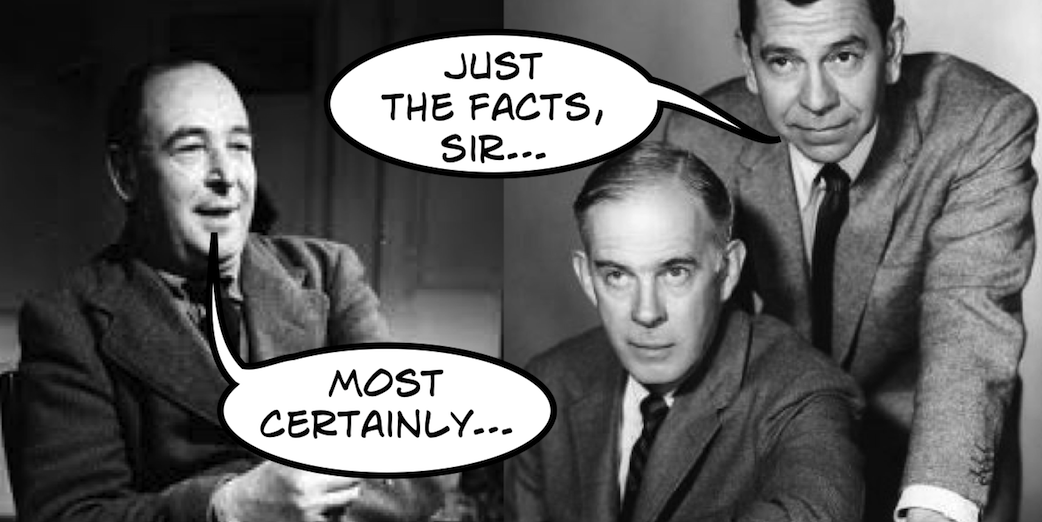
There is something to be said for brevity. But I won’t belabor that here.

In an essay entitled “Before We Can Communicate,” C.S. Lewis explores the frequently overlooked necessity of using commonly agreed upon definitions. He cites examples where apparent disagreement could be traced to differing assumptions about how others would interpret a given word.

We’ve all experienced that sort of confusion and if emotions become involved in the dispute, it can result in more than simple frustration.

As a military chaplain, working in an extremely diverse and pluralistic environment, I devoted much attention to communicating clearly. As an example, when dealing with “theological matters,” I always inquired into the religious background of the person with whom I was speaking.

I did not do so with the intention of altering an iota of the conversation that followed. I learned early on that the religious training each person received carried with it a sort of doctrinal dictionary, where the words carried particular meaning. One problematic example is “baptism,” which means something quite different for different parts of Christ’s Body. When focusing on communication, the question is not which understanding is most biblical. It is, what does the word mean in its present usage in this conversation.

In Lewis’ essay on communication, he describes something that should be a core skill of every pastor.

What we want to see in every ordination exam is a compulsory paper on (simply) translation; a passage from some theological work to be turned into plain vernacular English. Just turned; not adorned, nor diluted, nor made “matey.”

The exercise is very like doing Latin prose. Instead of saying, “How would Cicero have said that?” you have to ask yourself, “How would my scout or bedmaker have said that?”

Lewis cites multiple benefits from this effort. Foremost among them is the usefulness of a commonly understood vocabulary, which he refers to as “learned language.”

In the very process of eliminating from your matter all that is technical, learned, or allusive, you will discover, perhaps for the first time, the true value of learned language: namely, brevity.

It can say in ten words what popular speech can hardly get into a hundred. Your popularisation of the passage set will have to be very much longer than the original. And this we must just put up with.

People who know (and love) me, consider me wordy. I confess to the crime. But in my defense, I declare that with misunderstandings resulting from even the simplest conversations, I strive to dispel as thoroughly as possible, all clouds of potential confusion.

A Note on the Future of Mere Inkling

As is natural in dynamic or living things, such as active blogs, change naturally occurs over time. Such drifting, or even radical alteration, is normal. While altering course results from a conscious decision, drift typically takes place subtly, and slowly.

Over the past year or two, the columns posted here at Mere Inkling have grown in length. While this has allowed for deeper exposition of complex subjects, and a more nuanced treatment of C.S. Lewis’ contributions to the ideas discussed, the increased length has had other unhappy consequences.

The first is that it has, I believe, modestly decreased the readership of Mere Inkling. The internet, by its very nature, favors shorter treatments, and that is a simple truism. Combined with our rapidly decreasing attention spans, an online writer must consciously weigh the tradeoffs.

The second reason is that it takes significantly longer to write a more thorough “essay.” Increasing demands on my time have made the “long form” posting more of a hardship.

So, in light of these considerations, it is my desire to return Mere Inkling to its roots. I will endeavor to keep the posts shorter—along the lines of today’s column above this “note.”

I hope this minor reorientation will be welcomed by you, dear member of the Mere Inkling family.

Civil Atheism and C.S. Lewis

bennett

Some Christians are obnoxious. Well, okay, quite a few Christians are insufferable when they persistently “witness” to those who are deaf to their appeals. But, truth be told, many atheists are becoming increasingly obnoxious in their attitudes towards Christians as well. Let’s consider which group is worse.

First, some definitions. By Christians I don’t mean people who have some vague deistic notion that there is a God, and Jesus is somehow connected to this divinity because he was such a holy prophet.

By Christian I mean someone who has placed their faith and trust in Jesus the Christ, the only begotten Son of God who declared he was the Way, the Truth and the Life… The Logos (Word) through whom the universe was created.

By Atheist, I don’t mean people who do not share that faith, but who consider it an unprovable thesis. Most people with this viewpoint are ambivalent about whether or not others “believe.” The majority of these folks, many of whom do not feel threatened by religious conversations, are better understood as Agnostics.

By Atheist I mean people who are so convinced that Christianity is fallacious that they feel they must do what they can to stamp it out. They are so emotionally engrossed in the matter that they are genuinely unable to recognize that their own belief is based on nothing other than faith itself.

I can respect the fact that Atheists have historically been mistreated by “Christendom.” By my definition, this institutional entity is not synonymous with actual Christianity. In fact, it’s persecuted far more Christians of different denominational allegiances, than it has unbelievers who simply kept their mouths closed. But that’s a subject for another day.

Christians do not hate agnostics, or even atheists. Their motivation for sharing the Gospel inclines them towards the opposite attitude. Certainly they do it in obedience to their Lord’s command. Most possess a genuine concern and compassion for those they consider to be lost and facing eternal separation from God.

On the other hand, an increasing number of Atheists are insultingly dismissive of Christians who they consider—as a group—to be ignorant and prejudiced.

An Atheist columnist acknowledged this fact, and the discomfort it causes him, in a recent essay. David Harsanyi wrote the following in “Political Idols,” an article about a broader subject.

Unlike many of my fellow non-believers, I don’t feel especially enlightened or rational for my apostasy; I feel kind of unlucky, actually.

The typical non-believer sees the strictures of Christianity or Judaism [the faith in which Harsanyi was raised] as a punishment—mythical limitations set to inconvenience him—but I see people who take profound comfort in a beautiful fate that awaits them as long as they treat people as they would want to be treated themselves.

As a man who believes his story ends in a pile of dirt rather than celestial salvation, I have many reasons to be envious.

Yet, for my entire atheistic life, I’ve been nudged to mock the believer. The unifying doctrine of atheism is a reflexive antagonism toward faith and all the ideas it has dragged along with it through the centuries.

If all Atheists recognized this, and all Christians acknowledged that they are no more deserving of God’s mercy than their neighbor, oh what wonderful conversations about matters of eternal significance we could have!

C.S. Lewis’ Comment about an Atheist Writer

In a 1916 letter to his friend Arthur Greeves, Lewis comments on a book that Greeves had mentioned. He says the particular volume is of little value, without remarking on the author’s work in fiction, for which he as better known.

What is most significant about this particular letter is Lewis’ reference to the writer’s atheism, and the allusion to his own. It must be remembered that Lewis would not experience his conversion to Christianity for another fifteen years!

The book you refer to is ‘How to Form a Literary Taste’ by Arnold Benett: the edition is pretty but the book is not of any value. The very title—as if you set out to ‘learn’ literature the way you learn golf—shews that the author is not a real book-lover but only a priggish hack.

I never read any of his novels & don’t want to. Have you? By the way, he is a rather violent atheist, so I suppose I shall meet him by

‘The fiery, flaming flood of Phlegethon,’ as good old Spenser has it.

Before we look at Arnold Bennett (1867-1931), the author Lewis is describing, let us take a moment to consider the literary allusion Lewis includes in this passage.

“The fiery, flaming flood of Phlegethon” comes from The Faerie Queene, an epic poem which was the masterpiece of Edmund Spenser (1552-1599). Various editions of the fantasy poem are available.

In Spenser’s poem, the Phlegethon is a river found in Hell. The name itself means “flaming,” and it initially appears in Greek mythology as one of the Underworld’s five rivers. In The Faerie Queene, the terrible place where “the damned ghosts in torments fry.”

While his agnosticism assumes there is no afterlife, he acknowledges he may be wrong. And, if so, it is precisely to this tragic, fiery end that the unbelieving Lewis delivers Bennett . . . and himself.

So, who was Arnold Bennett?

Bennett was a versatile writer, and found success not only as a novelist, but also in theater and journalism. He even served as the Director of Propaganda for France during WWI, even though he was English. (He had resided in France since 1903.)

He was outspoken in his view that religious faith was not for the wise. Ironically, he died of typhoid after ignoring a French waiter’s counsel not to drink the “ordinary [tap] water from a carafe,” which was unsafe.

In 1932, Bennett’s widow began editing and publishing his journals. In a review that year, a literary magazine noted his antagonism towards Christianity.

Through it all one gets the impression of a terribly self-centered personality. Perhaps the artist is necessarily self-centered, though I cannot believe that Shakespeare was.

There have been artists like Dante, like Milton, whom it would be absurd to call selfish in the usual sense of the term because, colossal as their egos were, they yet consecrated themselves and all their pride of art and pride of soul to something for which, in the final analysis, their inmost spirits cared immensely more than they cared for self or for art or for any other thing on the earth below or in the heavens above it. . . .

Probably he was as great an artist as a man can be without religion, and the measure of his greatness is to be found in his straining against the limitations he so needlessly imposed upon himself. . . .

He had nothing of the mystic in him. In a moment of illumination he declares that “there is no such thing as ugliness in the world,” but this is as far as he gets. Yet he holds out against Christianity as he holds out against what he thinks of as sentimentalism, and his wife was probably right in her feeling that he might have made a very good Christian if he had only been willing to let himself go.

Civil Atheism

It would be a good thing for us individually and as members of a pluralistic world, to treat one another with civility. As a Christian, I can confess for my brothers and sisters that we do not always do so. Let us strive to do better.

And, as for those who identify themselves as Atheists, perhaps there is some room for improvement in this area as well. If more people resisted atheism’s “reflexive antagonism toward faith,” the world would definitely become a more friendly place.

A final note for those who would read more about Bennett. G.K. Chesterton wrote an essay about morality and punishment, in which he responds to a proposal offered by Bennett that society should not “judge” criminals. You can read “The Mercy of Mr. Arnold Bennett” here.

Since it relates to our discussion here, I must share a portion of Chesterton’s witty introduction to his essay.

Mr. Arnold Bennett recently wrote one of his humorous and humane “causeries” pleading very properly for social imagination and the better understanding of our fellows. He carried it, however, to the point of affirming, as some fatalists do, that we should never judge anybody in the sense of condemning anybody, in connexion with his moral conduct.

Some time ago the same distinguished writer showed that his mercy and magnanimity were indeed on a heroic scale by reviewing a book of mine, and even saying many kind things about it.

But to these he added a doubt about whether true intelligence could be consistent with the acceptance of any dogma. In truth there are only two kinds of people; those who accept dogmas and know it, and those who accept dogmas and don’t know it. My only advantage over the gifted novelist lies in my belonging to the former class.

I suspect that his unconsciousness of his dogmas extends to an unconsciousness of what he means by a dogma. If it means merely the popular idea of being dogmatic, it might be suggested that saying that all dogmatism is unintelligent is itself somewhat dogmatic.

And something of what is true of his veto on dogma is also true of his veto on condemnation; which is really a veto on vetoes.


The photograph above is of a statue of Arnold Bennett unveiled this summer in his home town of Stoke-on-Trent.