
Gathering Palms & Preparing for War

The Christian church has just celebrated Palm Sunday, and I recalled one of my favorite memories in preparing for the journey through Holy Week.

When I was stationed in Guam a few years ago (in the nineties), I enjoyed the annual tradition of gathering all of the palms to decorate the chapel and provide for worshippers in our very own jungle. Each year the chaplains and chaplain assistants, our whole team, would spend half a day gathering leaves that would put to shame any stateside palms.

Taking place in a tropical jungle, the event was sweaty, but fun. Good fellowship and even some seasonal early-Easter music. Fortunately, this didn’t take place during the typhoon season, as when the island was smashed by Super Typhoon Paka during our residency.

Jungles are fascinating places. Because the word possesses some rather ominous and even threatening overtones, a number of years ago they were rechristened “rainforests.” Even though most are tropical, there are temperate rainforests, such as in the Olympic National Forest, whose mountains I admire daily from our backyard.

C.S. Lewis alluded to the negative connotation of jungles in his study of “Vivisection,” with its repudiation of animal cruelty.

In justifying cruelty to animals we put ourselves also on the animal level. We choose the jungle and must abide by our choice.

A Modern Use for Jungles

In recent years, the jungles of Guam have been put to a military use. Unsurprisingly, soldiers and their Marine, Navy and Air Force cousins, must be prepared to do their jobs in a wide range of environments. That results in the existence of a variety of training settings, tuned to the specific needs of particular career fields.

For example, I served as the Wing Chaplain at Fairchild AFB where the USAF trains its pilots and aircrew members how to survive when they find themselves in unfriendly settings. Survival, Evasion, Resistance and Escape (SERE) training saves lives.

Anyway, not long ago the Air Force established a Jungle Agile Combat Employment (JACE) Course in, of all places, Guam.

This new course took knowledge from the U.S. Marine Corps Jungle Warfare Training Center and the Lightning Academy in Hawaii and tweaked it for non-combatant career fields to be prepared under the USAF’s Agile Combat Employment (ACE) concept.

This is part of America’s shift in focus to the threats in the Pacific theater. China has never renounced, and constantly proclaims, its intent to force the Republic of China (Taiwan) into their fascist empire. Of course, the fate of Hong Kong reveals just how unbenevolent the so-called People’s Republic is when it comes to maintaining any semblance of democratic freedoms. 

C.S. Lewis, of course, had much to say about the tragedies of fascism and war. However, that is not the focus of this reflection. Instead, the theme of this post reflects two thoughts. 

The less important idea, to which I have paradoxically devoted the most space, is the value of memories. Guam occupies a very special place in my family’s history, in part because all three of our kids were there during their teens. Lifechanging events occurred there.

And it was the wonderful people, military friends and wonderful Chamorro residents that made the most lasting impressions. Remembering the harvesting of palms, and recently learning about the jungle training course turned my thoughts back to that Micronesian paradise.

What’s Truly Vital

The infinitely more important message in this post is to acknowledge the holiest of seasons in which we find ourselves. Beginning with Palm Sunday’s celebration of the joy experienced by God’s people as they welcomed their Messiah into Jerusalem, we have the opportunity now to also join together with Jesus and our brothers and sisters in the faith as we:
~ commemorate the institution of the Lord’s Supper on Maundy Thursday,
~ contemplate the despair of the disciples as they stood at the foot of the cross as Jesus breathed his last mortal breath on Good Friday, and
~ celebrate in awe and wonder how our Savior rose from the grave and encouraged his disciples before ascending to Heaven and resuming his place at the right hand of God the Father. 

Christ’s atoning death, and his glorious resurrection, give us hope in the depths of our despair. And his promised return ensures us that there truly will come a day when we need never again prepare for war – or ever taste the pain of death.

We do well to heed C.S. Lewis’ encouragement to his friend Don Giovanni Calabria in 1948, when the priest was distraught over the troubles transpiring around the world.

Tomorrow [Easter] we shall celebrate the glorious Resurrection of Christ. I shall be remembering you in the Holy Communion. Away with tears and fears and troubles!

United in wedlock with the eternal Godhead Itself, our nature ascends into the Heaven of Heaven. So it would be impious to call ourselves “miserable.”

On the contrary, Man is a creature whom the Angels – were they capable of envy – would envy. Let us lift up our hearts! At some future time perhaps even these things it will be a joy to recall.


C.S. Lewis on Translating Poetry

“A poetic translation is always to some extent a new work of art.”
C.S. Lewis
English Literature in the Sixteenth Century

C.S. Lewis was a gifted translator. One who recognized well the challenges of skillful rendition, including the differing requirements imposed by prose and poetry. Thus, in his essay “The Literary Impact of the Authorised Version,” he offers the following insight.

No translation can preserve the qualities of its original unchanged. On the other hand, except where lyrical poetry is in question, the literary effect of any good translation must be more indebted to the original than to anything else.

In his autobiography, Surprised by Joy, C.S. Lewis describes his transformative encounter with translated poetry that introduced him to the “northern sky.” Before he became a skilled translator in his own right, he describes how a major part of his awakening,

. . . came through poetry. I had become fond of Longfellow’s “Saga of King Olaf:” fond of it in a casual, shallow way for its story and its vigorous rhythms.

But then, and quite different from such pleasures, and like a voice from far more distant regions, there came a moment when I idly turned the pages of the book and found the

unrhymed translation of Tegner’s Drapa and read

I heard a voice that cried,
Balder the beautiful
Is dead, is dead

I knew nothing about Balder; but instantly I was uplifted into huge regions of northern sky, I desired with almost sickening intensity something never to be described (except that it is cold, spacious, severe, pale, and remote) and then, as in the other examples, found myself at the very same moment already falling out of that desire and wishing I were back in it.

One of Lewis’ most involved explanations of the subject is found in Reflections on the Psalms. As Mere Inkling has noted in the past, C.S. Lewis was a distinguished member of a committee appointed to “revise the Psalter.” Being poetry, the Psalms demanded the proper mindset in their translators.

What must be said, however, is that the Psalms are poems, and poems intended to be sung: not doctrinal treatises, nor even sermons. . . . Most emphatically the Psalms must be read as poems; as lyrics, with all the licences and all the formalities, the hyperboles, the emotional rather than logical connections, which are proper to lyric poetry.

They must be read as poems if they are to be understood; no less than French must be read as French or English as English. Otherwise we shall miss what is in them and think we see what is not.

Some translations, unfortunately, are intentionally corrupted. I described in 2020 the Communist Chinese twisting of the Christian Scriptures. Fortunately, this sort of intentional crime is rare, and most translation efforts are well motivated. That does not mean, however, that even gifted linguists are up to every challenge.

In a letter to the editor of The Christian Century, C.S. Lewis contrasted academic and vernacular translations. Declaring that “any fool can write learned language,” he argues that clergy in particular are faced with the challenge of translating languages into prose which is understandable to the general population. He begins by demurring that he cannot respond to a request for an article written for a popular American audience.

An article on “translation” such as Dr. Pittenger suggests . . . certainly needs doing, but I could not usefully do it for Americans. The vernacular into which they would have to translate is not quite the same as that into which I have translated. Small differences, in addressing proletarians, may be all-important.

In both countries an essential part of the ordination exam ought to be a passage from some recognized theological work set for translation into vulgar English – just like doing Latin prose. Failure on this exam should mean failure on the whole exam.

It is absolutely disgraceful that we expect missionaries to the Bantus to learn Bantu but never ask whether our missionaries to the Americans or English can speak American or English. Any fool can write learned language. The vernacular is the real test.

C.S. Lewis remained an avid reader and critic until his death. In 1961, he received some translations of “modern” Greek poetry from his friend, Muriel Bradbrook (1909-1993), a Professor of English at Cambridge. After thanking her for the gift, he offers his personal response to the intercultural translations.

Dear Muriel,

What a nice thing for a man half drowned in compulsory leisure [due to poor health] . . . It has set me a problem. I find I get a good deal of pleasure out of many of these poems, but am at a loss to say why. One is not getting the “numbers” – and so far as I can judge from the notes the metres of the originals would not much please me.

Nor am I much in sympathy with many of the poets’ moods. The pleasure is like – at least rather like – what I get out of most translations of Chinese lyric. But that isn’t a solution, but merely another problem of the same sort. Anyway, thanks very much indeed.

Advice to Budding Translators

So many good works of literature remain to be translated so they can benefit those unfamiliar with their original tongue. Several years ago, I wrote a column entitled “C.S. Lewis’ School of Translation,” assembling some of the great writer’s wisdom.

I recently encountered a curiously brilliant observation on the subject of translating poetry in C.S. Lewis’ English Literature in the Sixteenth Century. Although he refers here to advising others, it would be wise for any of us who are considering the task to reflect long on Lewis’ acumen.

Most of us, I suspect, would advise a mediocre poet, if he must translate, to avoid the greater originals and choose the less, as if these would be easier. But this is probably a mistake.

The great poets have so much wealth that even if you lose two-thirds of it on the voyage home you can still be rich on the remainder: slighter art, when it loses the perfection of its original form, loses all power of pleasing.

As I think about it, this advice likely applies to prose as well. If you or I someday attempt to translate a work, we should consider working with the richest possible source material. That way, even if it loses value in the process, the quality that remains will still possess value for our translation’s readers.

Even if we do not pen “a new work of art.”

Caring for Nature with an Inkling Spirit

I never thought I would become an apiarist, but living in forests of America’s Pacific Northwest made this a logical stage in my growth as a naturalist. And I’m convinced that if he had known how simple it is to promote healthy bee populations, C.S. Lewis would have joined me in the hobby.

After all, he delighted in their work ethic, describing the moment of their Narnian creation with the words, “Butterflies fluttered [and] Bees got to work on the flowers as if they hadn’t a second to lose.”

In “An Experiment in Criticism” Lewis discussed the value of seeing the world through the eyes of others. In awe of the majesty of creation he expressed a yearning to explore its myriad facets from perspectives other than his own.

The man who is contented to be only himself, and therefore less a self, is in prison. My own eyes are not enough for me, I will see through those of others. Reality, even seen through the eyes of many, is not enough. . . .

Even the eyes of all humanity are not enough. I regret that the brutes cannot write books. Very gladly would I learn what face things present to a mouse or a bee: more gladly still would I perceive the olfactory world charged with all the information and emotion it carries for a dog.

Like most people, I grew up thinking of beekeepers as the people who dress in protective gear and harvest the honey produced by those tireless little workers. Honeybees, however, are only one type of bee. The Treehugger site offers an illustrated page featuring the bee types, with Hoverflies (good, and in more than 6,000 species) and Wasps (bad, and in more that 100,000 species) thrown in.

The bees I help to encourage in our area are not honeybees or bumblebees, who form colonies. They are mason bees, who are solitary by nature. They don’t have an aggressive bone in their tiny bodies and they are excellent at their jobs. They “pollinate around 95% of the flowers they visit, whereas honey bees generally only pollinate about 5%.” 

C.S. Lewis, like his close friend J.R.R. Tolkien, loved nature. Like most people Lewis either knew nothing about solitary bees, or his attention was directed by default to the honeybees we prize for the honey refined in their hives. In 1930, he wrote to his friend Arthur Greeves about the deeper motivations that drive people such as themselves to become writers.

As for the real motives for writing after one has ‘got over’ the desire for acknowledgement . . . I found and find, that precisely at the moment when you have really put all that out of your mind and decided not to write again . . . precisely then the ideas – which came so rarely in the days when you regarded yourself officially as an author – begin to bubble and simmer, and sooner or later you will have to write . . .

Who knows . . . what will in the end reach the ear of humanity? The successes of our own age may be speedily forgotten: some poem scribbled in pencil on the fly leaf of a schoolbook may survive and be read and be an influence when English is a dead language. . . .

So . . . whether the necessity and duty of writing is laid on a man or not can soon be discovered by his own feelings. With remote consequences we have no concern. We never know enough. I think the thing is to obey the ordinary rules of morality . . . but for ultimate justifications & results to trust to God.

The bee builds its cell and the bird its nest, probably with no knowledge of what purpose they will serve: another sees to that. Nobody knows what the result of your writing, or mine . . . will be. But I think we may depend upon it that endless and devoted work on an object to which a man feels seriously impelled will tell somewhere or other: himself or others, in this world or others, will reap a harvest exactly proportional to the output.

In 1914, C.S. Lewis shared with his father a humorous anecdote from the Roman poet Virgil. 

Did you ever at Lurgan read the 4th Georgic? It is the funniest example of the colossal ignorance of a great poet that I know. It’s about bees, and Virgil’s natural history is very quaint: bees, he thinks, are all males: they find the young in the pollen of flowers. They must be soothed by flute playing when anything goes wrong etc., etc.

C.S. Lewis enjoyed his laugh at Virgil’s poetic ignorance about bees. Coincidentally, he would discuss the humble creatures in a poem of his own. It appears in his posthumous Poems collection, as the fourth and fifth of his “Five Sonnets.”

Pitch your demands heaven-high and they’ll be met.
Ask for the Morning Star and take (thrown in)
Your earthly love. Why, yes; but how to set
One’s foot on the first rung, how to begin?
The silence of one voice upon our ears
Beats like the waves; the coloured morning seems
A lying brag; the face we loved appears
Fainter each night, or ghastlier, in our dreams.
“That long way round which Dante trod was meant
For mighty saints and mystics not for me,”
So Nature cries. Yet if we once assent
To Nature’s voice, we shall be like the bee
That booms against the window-pane for hours
Thinking that way to reach the laden flowers.

“If we could speak to her,” my doctor said,
“And told her, “Not that way! All, all in vain
You weary out your wings and bruise your head,”
Might she not answer, buzzing at the pane,
“Let queens and mystics and religious bees
Talk of such inconceivables as glass;
The blunt lay worker flies at what she sees,
Look there—ahead, ahead—the flowers, the grass!”
We catch her in a handkerchief (who knows
What rage she feels, what terror, what despair?)
And shake her out—and gaily out she goes
Where quivering flowers stand thick in summer air,
To drink their hearts. But left to her own will
She would have died upon the window-sill.”

British Bees

The British are quite enamored with quaint names for their public houses. Because of that, I knew I would be able to find a suitable pub to feature at the top of this post. I was, however, caught off guard by an embarrassment of riches in the return to my google search.

In addition to “The Bumble Bee” in Quedgeley pictured above (which I chose because of the lamppost in the garden), I found images of similarly named pubs in Blackwood, Flitwick, Gloucester, Gwent, Westoning, and Fleur-de-lis, Wales.

I’m sure I could find many other tributes to buzzing pollinators, if I broadened my search to include pubs like “The Beehive” in Egham or “The Golden Bee” in Stratford-upon-Avon.

The story of one more bee will bring our reflections to an end. In his early diary, All My Road Before Me, C.S. Lewis mentioned a number of visits to Bee Cottage, where some of his friends occasionally resided. For example, one summer Sunday in 1922, he recorded:

After lunch I bicycled to Beckley and called at Bee Cottage where I found [Cecil] Harwood alone and reading in a pleasant, stumpy 18th Century Bible. He quoted from Genesis “Whatever Adam called anything, that was the name of the thing,” as an excellent definition of poetry.

Once lost to the mysteries of time, the precise location of Bee Cottage has been discovered, as we can read in Bee and Church Cottage.

Laurence Harwood, C.S. Lewis’s godson, was a lecturer at [the 2009] Summer Seminar on C.S. Lewis Remembered.  His father, Cecil Harwood, was a close personal friend of Lewis as well as fellow Inkling Owen Barfield. 

Harwood and Barfield had often rented a small cottage-Bee Cottage-in Beckley, a few miles from Lewis’s home in the Kilns, and Lewis often visited the place (perhaps while on walking tours though the countryside just like his character Elwin Ransom).  Unfortunately its precise location was lost and remained unknown.

Following the lectures, “Laurence decided that searching for the cottage would be a . . . great way to remember Lewis.” He and several friends “managed to locate the small house, and found that it looked just as anyone would have expected-the waning summer sun sinking behind it, and the bees buzzing about the lavender plants alongside the stairs.”

Bees are important members of our environment. Many would argue they are essential and famine would certainly follow if they became extinct. The Environmentor says,

If all the bees died, humans would become responsible for taking up the slack. This is already happening in China, where a majority of the bees have already died. People take buckets full of pollen and “paint” the pollen on with a paintbrush.

But, this could only be done with a few of the plants that require pollination because there simply aren’t enough humans to perform the task.

The alternative, offered by Brittanica is that we could “robo-pollinate.” But I have already written about where that ominous trend might lead. 

I think it’s best that we diligently care for bees we currently enjoy, and nurture all their future generations. And I believe C.S. Lewis would agree.

C.S. Lewis & Karl Marx

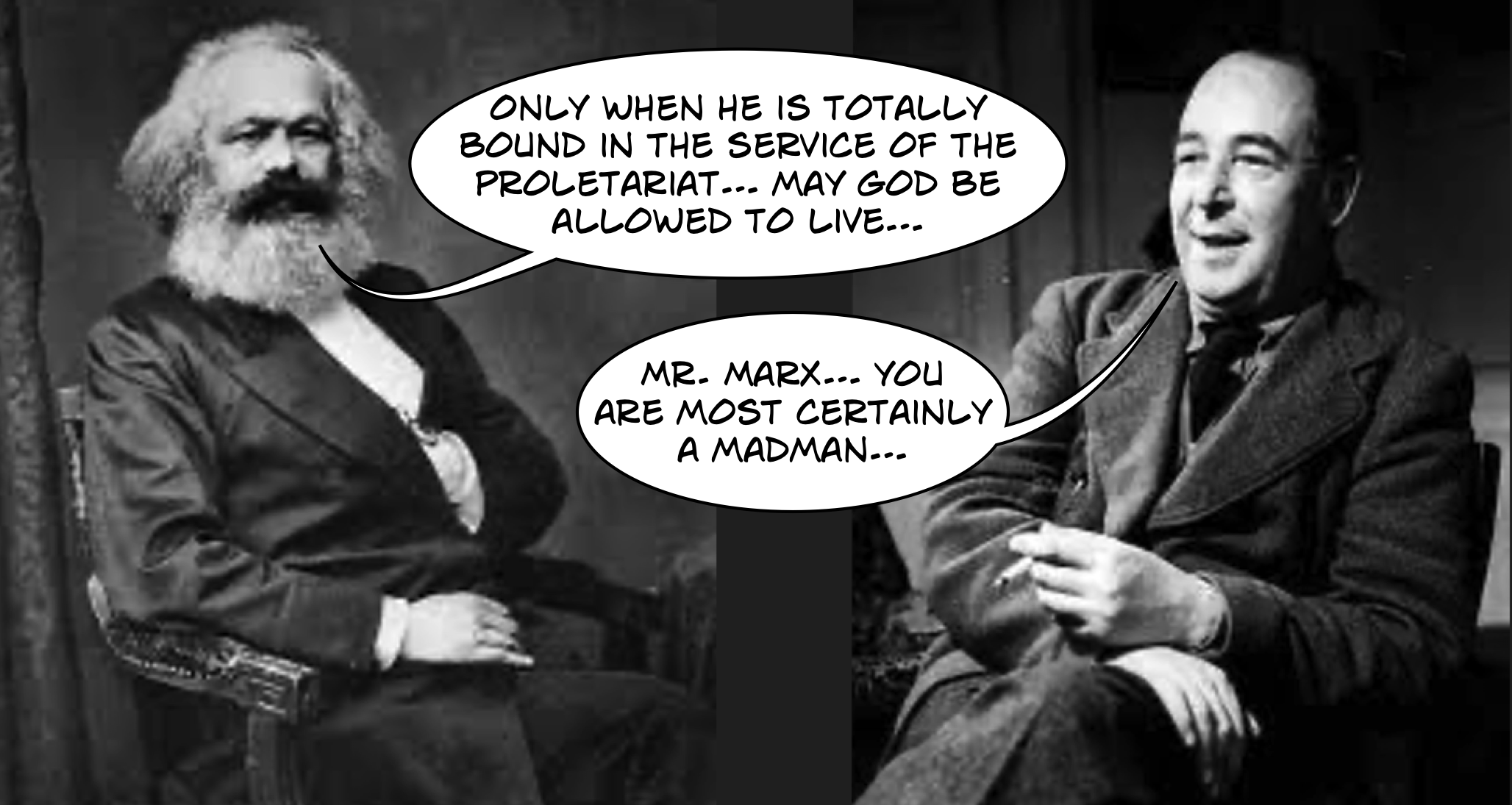
C.S. Lewis recognized quite early how Karl Marx’s philosophy, a “potent evil,” would justify terrible crimes.

The greatest threats to humanity’s future are the two major Communist powers. We see Russia’s brazen criminal ambitions currently on display in Ukraine.

Communist China’s malevolent intentions are more insidious and far more dangerous.

Aside from its nuclear arsenal, we now recognize how vastly overrated Russia’s military has been. China, by contrast, possesses an army and navy that grow deadlier each day.

C.S. Lewis understood the evil at the core of Marxism. Communists and, to a lesser degree, Socialists, seek to strip away individual rights for the illusory betterment of the whole.

But, because human beings are sinful and self-centered, even true Marxist idealists invariably end up devolving into fascist totalitarians. That’s why every one of these so-called “people’s republics” reflect nothing of republican or democratic values.

They invariably become corrupt oligarchies, typically led by ironfisted dictators. In addition to the aforementioned regimes, consider Cuba and Venezuela. When was the last time any of these four beacons of Socialism held free elections?

Karl Marx was a very troubled man. This essay in a recent publication addresses not only his insane economic theories, but his extensive personal failures as well.

The sufferings of the Marx family, and especially of poor faithful Jenny, are difficult to describe. Though they did have a housekeeper and though Friedrich Engels spent in the course of the years at least 4000 Pounds on Karl Marx, they lived in abject misery.

The death of one child, a boy, is directly attributable to poverty and neglect. Family life must have been absolutely terrible, but Marx could not be moved – neither by entreaties, nor by tears, nor by cries of despair. . . .

Yet it would be a mistake to think that Marx suffered silently and proudly. By no means! In his letters and in his conversations he never failed to complain and to lament. He had a colossal amount not only of self-hatred, but also of self-pity, but no human feelings for others, least of all for his wife whose health he had ruined completely.

In a 1946 essay entitled “Modern Man and His Categories of Thought,” C.S. Lewis discussed the atheistic core of Communism. He noted that its advocates can use “religion” as a puppet to bolster their power. Read here about the official position of the Russian Orthodox Church, and the sad fact that “Patriarch Kirill is a staunch ally of Mr. Putin.”

Such is the fruit of the Marxist mind. Here is C.S. Lewis’ description.

Proletarianism, in its various forms ranging from strict Marxism to vague “democracy” . . . [is] self-satisfied to a degree perhaps beyond the self-satisfaction of any recorded aristocracy.

They are convinced that whatever may be wrong with the world it cannot be themselves. Someone else must be to blame for every evil.

Hence, when the existence of God is discussed, they by no means think of Him as their Judge. On the contrary, they are His judges. If He puts up a reasonable defence they will consider it and perhaps acquit Him. They have no feelings of fear, guilt, or awe.

They think, from the very outset, of God’s duties to them, not their duties to Him. And God’s duties to them are conceived not in terms of salvation but in purely secular terms – social security, prevention of war, a higher standard of life. “Religion” is judged exclusively by its contribution to these ends (“Modern Man and His Categories of Thought”).

As destructive as Marxism is wearing its true, secular garb, it becomes far more calamitous when it infiltrates the Christian Church. As C.S. Lewis observed, Marxism can use and abuse the Church, but that is done from an external position.

When actual members of the Church are deceived to the degree they adopt this error, it is beyond tragic. In 1940 Lewis warned of this danger in a letter to a Roman Catholic priest with whom he corresponded.

Fascism and Communism, like all other evils, are potent because of the good they contain or imitate. Diabolus simius Dei.* And, of course, their occasion is the failure of those who left humanity starved of that particular good.

This does not for me alter the conviction that they are very bad indeed. One of the things we must guard against is the penetration of both into Christianity-availing themselves of that very truth you have suggested and I have admitted.

Mark my words: you will presently see both a Leftist and a Rightist pseudo-theology developing – the abomination will stand where it ought not.

C.S. Lewis was an honest man, who was capable of acknowledging his own shortcomings. Thirteen years after the previous letter, he wrote to another priest in the wake of massive suppression of Christianity in China.

After lamenting the persecution, he acknowledges the failure of the Church to live according to its calling. To this failure he attributes the rise of “other evils” such as Communism.

At last, dearest Father, there has come to hand that copy of . . . your article on that Chinese disaster. I used myself to entertain many hopes for that nation, since the missionaries have served there for many years not unsuccessfully: now it is clear, as you write, that all is on the ebb.

Many have reported to me too, in letters on this subject, many atrocities, nor was this misery absent from our thoughts and prayers.

But it did not happen, however, without sins on our part: for that justice and that care for the poor which (most mendaciously) the Communists advertise, we in reality ought to have brought about ages ago. But far from it: we Westerners preached Christ with our lips, with our actions we brought the slavery of Mammon.

We are more guilty than the infidels: for to those that know the will of God and do it not, the greater the punishment. Now the only refuge lies in contrition and prayer. Long have we erred.

In reading the history of Europe, its destructive succession of wars, of avarice, of fratricidal persecutions of Christians by Christians, of luxury, of gluttony, of pride, who could detect any but the rarest traces of the Holy Spirit?

Christians, I encourage you to join me in repenting of our failures. We must still challenge the lies, such as those of Karl Marx. But, we should never do so without remaining conscious of our own failures which too often provide fertile soil for such deceptions.


* Diabolus simius Dei means “the Devil is the ape of God.” This refers to Satan’s attempts to imitate or counterfeit divine actions and principles. The observation was first made by Tertullian, and echoed by Augustine and others.

We Are All Hard of Hearing

Do you have any Deaf friends or family members? If so, I cannot think of any more inspiring reason to learn sign language.

Even if you don’t already know someone Deaf, gaining familiarity with American Sign Language (ASL), or one of its British, French, Chinese, Japanese, Arabic, Spanish, Mexican, etc. alternatives – is worthwhile.

According to one major translation and captioning corporation, the use of sign language extends not only throughout nations, but also to a variety of populations.

It’s the main form of communication for the Deaf and Hard-of-Hearing community, but sign language can be useful for other groups of people as well. People with disabilities including Autism, Apraxia of speech, Cerebral Palsy, and Down Syndrome may also find sign language beneficial for communicating.

My wife, a special education teacher, recognized this early in her career. One of her greatest joys came from introducing a deaf, severely autistic teenager to a world where she could communicate for the first time. Although she could see, and learned to read with some comprehension, her transformation through learning ASL called to mind the miracle that was Helen Keller.

Before proceeding, it is helpful to clarify some terminology. According to the National Association of the Deaf website, “we use the lowercase deaf when referring to the audiological condition of not hearing, and the uppercase Deaf when referring to a particular group of deaf people who share a language.”

The members of this group have inherited their sign language, use it as a primary means of communication among themselves, and hold a set of beliefs about themselves and their connection to the larger society.

We distinguish them from, for example, those who find themselves losing their hearing because of illness, trauma or age; although these people share the condition of not hearing, they do not have access to the knowledge, beliefs, and practices that make up the culture of Deaf people.

This is an extremely significant distinction. So, people like me whose progressive hearing loss could conceivably lead to deafness, would not be members of the Deaf community. Unless, I suppose, we were to immerse ourselves in the Deaf (sign) language and culture. Even then, I imagine we would always be recognizable as “immigrants,” rather than native members of the Deaf family.

Another semantic consideration is the obsolete usage of the term “hearing-impaired.” This term is offensive to the Deaf community, and efforts continue to update the language of pertinent laws. The Cogswell Macy Act, which outlines educational rights for the Deaf and the Blind, is currently being revised.

In fact, the National Association for the Deaf is asking everyone to serve as advocates. One small element of the revision  will be to “change outdated terminology in current educational law from ‘hearing impaired’ to ‘deaf, hard of hearing, and DeafBlind.’”

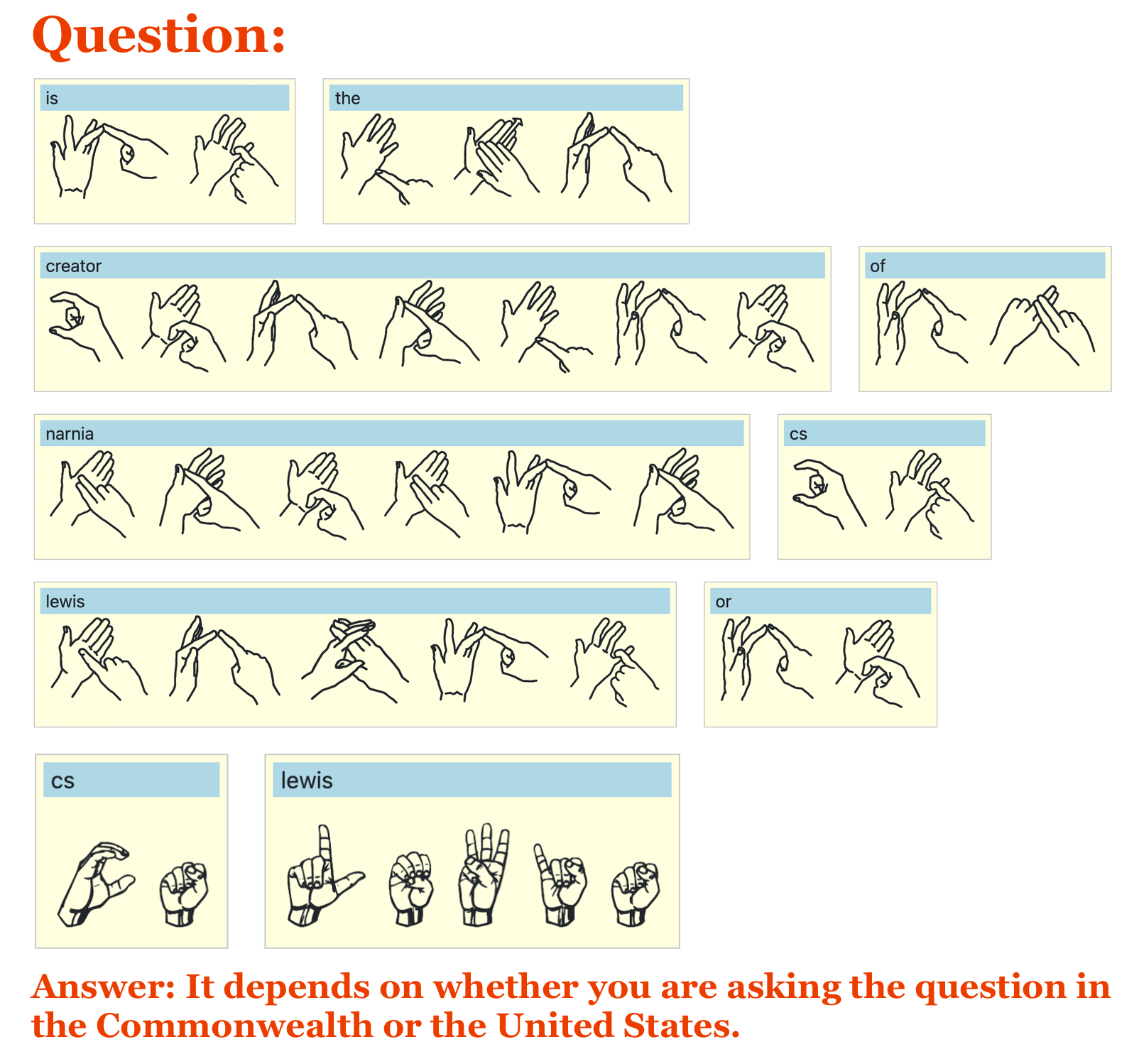
Sign language is certainly not limited to spelling out words with individual letters. There are numerous words that have their own sign. A company named Start ASL offers online courses, and they offer video examples of 150 basic ASL words on their website.

One fascinating practice of the Deaf is the way many of them possess a unique “name sign” which identifies them in the community. Very Well Health has a great explanation about the way these names are given.

One aspect of Deaf culture is the use of unique, personal “name signs” as a way to identify someone without fully spelling out their name. . . . These names often reflect the person’s character and are usually devised by someone within the Deaf community.

Some people have a combination of initialized and descriptive name signs, like the first letter of their name that is swirling like a fish for someone who is a swimmer.

If you love a specific animal, like cats, your name sign may be the first letter of your birth name to then sign “cat’s whiskers” on your cheek. If you enjoy birds, your name sign could be the first letter of your birth name combined with the sign for bird.

The name sign given to my wife, Delores, was the letter “d” beside her “smile.” Quite fitting, since she is an extremely compassionate person who is seldom without one.

C.S. Lewis & the Deaf

Obviously, C.S. Lewis encountered a number of people who were deaf or hard of hearing. He mentions some of them in his correspondence. While there are now a “few students with hearing loss at Oxford,” I don’t know what accommodations would have been available during Lewis’ residency.

In “Oxford Student on Being Hearing Impaired at University,” we read “Deaf and hard of hearing students need to speak up at their universities if they want their needs to be taken more seriously and reach their full academic potential.” (Curiously, this 2019 article uses the outdated term “hearing impaired.” Perhaps the British find it less irritating than Americans?)

In 1953, C.S. Lewis responded to a letter from a student who had explained the Gospel to one of her Deaf classmates. She asked “how much of the teaching about Christ” she could present with the Gospel story itself. In his response he begins with a disclaimer about having little knowledge of the Deaf.

It is difficult to one, who, like me, has no experience, to give an opinion of these problems, which, I see, are very intricate. The story about the girl who had reached the age of 16 under Christian teachers without hearing of the Incarnation is an eye-opener.

For ordinary children (I don’t know about the Deaf) I don’t see any advantage in presenting the Gospels without some doctrinal comment. After all, they weren’t written for people who did not know the doctrine, but for converts, already instructed, who now wanted to know a bit more about the life and sayings of the Master.

Shortly before his death he explained to a writer that he had no personal photo to share. In his response, he uses the word “deaf” to explain (or exaggerate) the fact he was hard of hearing.

Sorry, but I’m out of photos. Which is perhaps just as well, for I look awful. Imagine a marsh-wiggle gone fat and red in the face. And deaf and bald. I talk far too loud. I’m so glad you liked the Narnian series.

Humanity’s Universal Deafness

Shifting our view from the physical to the spiritual, we see that all of us truly are Hard-of-Hearing. Christians understand the human inclination toward selfishness and sin as a consequence of “original sin.” We can be rescued from our sinful state, of course, and that is what the doctrine of the atonement is all about.

We’re not discussing theology here, but I say that to explain why deafness and blindness are metaphors in the Scriptures for being unable to hear or see the Truth.

For example, through the Prophet Isaiah, God describes unfaithfulness of his people in the following way.

Hear, you deaf,
    and look, you blind, that you may see!
Who is blind but my servant,
    or deaf as my messenger whom I send?
Who is blind as my dedicated one,
    or blind as the servant of the Lord?
He sees many things, but does not observe them;
    his ears are open, but he does not hear. (Isaiah 42:18-20).

When Jesus says “he who has ears to hear, let him hear” (Matthew 11:15) he is saying that we should not be deaf to God’s call. And the deafness he refers to is our conscious choice not to hear God’s words.

It seems to me that most of us are at least slightly hard of hearing when it comes to listening to our Creator. If we weren’t – if we heeded God’s words – this world of ours would be a vastly different place.

C.S. Lewis describes the tragic end of someone who insists on remaining utterly deaf to God.

In The Great Divorce, he describes the withered soul of a person who had resisted every attempt of God to alleviate their suffering and lift them from death, to life.

A damned soul is nearly nothing: it is shrunk, shut up in itself. Good beats upon the damned incessantly as sound waves beat on the ears of the deaf, but they cannot receive it. Their fists are clenched, their teeth are clenched, their eyes fast shut.

First they will not, in the end they cannot, open their hands for gifts, or their mouths for food, or their eyes to see.

No one reading this is at that point. So long as we breathe, we can uncover our spiritually blind eyes and unstop our spiritually dead ears, to receive his words of life. Admitting that we are all sometimes hard of hearing is a good step toward growing in our faith and anticipating the gift of eternal life.

You will find a list of resources below, but before exploring them, there is one more amazing C.S. Lewis connection that needs to be mentioned. In 2018, the Pennsylvania School for the Deaf adapted The Lion, the Witch, and the Wardrobe for the stage in ASL. Pretty amazing! “Narnia’s Latest Adaptation: Sign Language” tells the story and includes a delightful short video featuring several of the performers.


Resources

There are a number of interesting and useful resources available for those interested in this subject.

For charts displaying different sign language alphabets, you will find one collection here.

For those who share my interest in fonts, you can download a free ASL font at this website. And, for those Down Under, you can find a free font featuring your version of sign language here.

As you can see from the animated graphic above this section an example of the ASL animation generator available at signlanguageforum.com – This one spells “resources.”

There are several sites online where you can type in your own words or phrases using fingerspelling. For example, with either American Sign Language or British Sign Language (BSL).

Humorous Examinations

Could you pass this examination?

Sketch the development of human thought, estimate its significance. Compare with the development of any other kind of thought.

In contrast to the serious tone of the last two posts, today I am offering some edifying entertainment. As a gift to you, I have edited a perennial favorite of internet humorists. I recently came across my copy of this comprehensive knowledge examination, which motivated me to tweak it for Mere Inkling’s erudite audience.

You have probably seen versions of this exam in the past. The basic questions have remained surprisingly stable despite its age. I encountered it in the University of Washington campus paper in 1973. One writer claims “the Graduation Exam—Authentic Assessment has been in circulation since at least the 1950’s.”

The exam certainly makes the rounds, as this Navy veteran described.

The pressures of comprehensive exams were apparent to many, which resulted in one of the few officially sanctioned jokes in Naval Nuclear Power. In one of the official publications of Naval Reactors, someone inserted a sample “final exam” from Nuclear Power School.

In 2012 elements of the examination created confusion in the People’s Republic of China. It was included in an article about how Chinese nationals could prepare for an American State Department exam required for positions at the United States embassy in Beijing. According to China’s Global Times, “US embassy spokesman Richard Buangan made clear on his Sina microblog Sunday that an alleged ‘recruitment test for expatriate employees at the US embassy’ is fake.”

A June 2008 issue of Foreign Service Journal carried a story, which includes an English version of the [exam stating] the questions are from the US State Department’s entrance exam, in a bid to “measure the stability of perspective Foreign Service officers and to weed out the dummies.”

The Function of Examinations

Testing and documenting competence is obviously important. This is especially true for people in critical roles, such as prescribing drugs, designing aircraft engines, and manufacturing ice cream.

Of course, not everyone is able to pass every test. Which is precisely how things should be.

C.S. Lewis noted how educators truly familiar with their students readily recognize when it is a waste of time for them to continue repeating an exam they obviously cannot pass. He said an academic “master often knows, when boys and parents do not, that it is really useless to send a boy in for a certain examination again” (The Problem of Pain).

I have met very few people who enjoy being tested. Yet, for many faculty members (C.S. Lewis included), being on the “other side” of exams is not particularly enjoyable either. This delightful passage comes from a 1927 letter to his brother, Warnie.

My period of examining passed over with its usual accompaniment of neuralgia and oaths, relieved by the one excellent boy who defined ‘a genie’ correctly, yet more than correctly, as ‘an eastern spirit inhabiting bottles and buttons and rings.’ Pretty good for a boy.

I was also pleased with a youth who, being asked to write a letter to a friend recommending Guy Mannering,* wrote to his brother recommending it and saying ‘I think you would be interested in the character of Colonel Mannering, he is so like our father’: and then later in a paper on Guy Mannering in which I had set the question ‘Would you have liked Colonel Mannering as a father?’—illustrate your answer etc.—began decisively ‘I would not have liked Colonel Mannering as a father in the least.’

Well, it’s time now to offer you the opportunity to prove your worthiness. If you wish to evidence the breadth and depth of your knowledge, proceed now to the exam. (Astute readers will note I’ve added a personal twist to a couple of the exam questions.)

Comprehensive Knowledge Exam

HISTORY: Describe the history of the papacy from its origins to the present day, concentrating especially, but not exclusively, on its social, political, economic, religious, and philosophical impact on Europe, Asia, North and South America, and Africa. Be brief, concise, and specific. Now do the same for the Zoroastrian priesthood. [Bonus credit for including Antarctica in your response.]

MEDICINE: You have been provided with a razor blade, a piece of gauze and a bottle of scotch. Remove your appendix. Do not suture until your work has been inspected. You have fifteen minutes. [Option: if you feel the scotch would impair your responses to the remaining questions, you may defer this portion of the exam to the end of the exam.]

PUBLIC SPEAKING: Two thousand riot-crazed anarchists are storming the campus. Calm them. You may use any ancient language except Latin, Greek or Sanskrit. [Pig Latin is allowed.]

BIOLOGY: Postulate the 500 million year progression of a life form based on silicon, ranking its likely preference for form of government Enumerate the pros and cons it would associate with democracy, monarchy, socialism, theocracy, and totalitarianism. [Caution: any references to the Horta of Janus VI will result in disqualification of your answer, since Star Trek is a fictional resource.]

MUSIC: Write a piano concerto. Orchestrate and perform it with flute and digeridoo. You will find a piano under your seat. The wind instruments, of course, were among the items you were directed to bring with you to the examination.

PSYCHOLOGY: Based on your knowledge of their works, evaluate the emotional stability, degree of adjustment, and repressed frustrations of each of the following: Alexander of Aphrodisias, Hildegard of Bingen, Rābi’a bint Ka’b al-Quzdārī and Simeon the Stylite. Support your evaluation with quotations from each individual’s work, citing original sources. It is not necessary to translate.

SOCIOLOGY: Using the pretext of Planet of the Apes, where homo sapiens have been subordinated to various primate species, assess the prospects for achieving mutual toleration and equilibrium before one group is driven to extinction. [Caution: confusion of apes (which lack tails) and monkeys (which lack an appendix) will result in disqualification of your response.]

CHEMISTRY: Transform lead into gold. You will find a beaker, a three hundred count box of matches and five lead sinkers under your seat. Show all work including Feynman diagrams and quantum functions for all steps. [Transformation into silver will provide half credit.]

ENGINEERING: The disassembled parts of a high-powered rifle have been placed on your desk. You will also find an instruction manual, printed in Swahili. In 10 minutes a hungry Bengal tiger will be admitted to the room. [Special Consideration: Satisfactorily explain the differences between Fahrenheit and Celsius to the tiger, and it will be replaced by a rabid ferret.]

ECONOMICS: Develop a realistic plan for refinancing global debt, without hypothesizing a benevolent intergalactic alliance with unlimited resources coming to the planet’s aid. Trace the possible effects of your plan in the following areas: Cubism, the Donatist controversy, and the 1913 foundation of Hôpital Albert Schweitzer in Gabon.

POLITICAL SCIENCE: Devise an infallible, seven-step plan to transform the United Nations into an organization that will successfully foster peace and goodwill in all international relationships. [Bonus credit for providing a major role for two of the following nations: Dominica, Liechtenstein, Tuvalu.]

AGRICULTURAL SCIENCE: Outline the steps involved in breeding your own super high yield, all weather hybrid strain of wheat. Describe its chemical and physical properties and estimate its impact on world food supplies. Construct a model for dealing with world-wide surpluses. Draft your Nobel Prize acceptance speech.

PHYSICS: Explain the nature of matter. Include in your answer an evaluation of the impact of the development of mathematics on astronomy, botany and numismatics. [Bonus Credit: write today’s date in metric.]

PHILOSOPHY: Sketch the development of human thought, estimate its significance. Compare with the development of any other kind of thought. Be sure to include an analysis of the influence exerted on philosophy by Diogenes the Cynic.

CREATIVE WRITING: Compose an epic poem based on the events of your own life in which you see and footnote allusions from T.S. Eliot, Titus Lucretius Carus, Miguel de Cervantes, Dante Alighieri, Þorbjörn Hornklofi, Gilgamesh and Stephen King. Critique your poem with a full discussion of its syntax and metrics. [Bonus Credit for writing alternating stanzas between free and rhyming verse.]

EDUCATION: Formulate an examination which accurately measures an individual’s comprehensive knowledge base without cultural or linguistic prejudice. Limit the question parameters to what can reasonably be covered during a four hour testing block.

LITERATURE: Discuss in detail at least three major literary figures from each of the following civilizations: the Xia Dynasty, the Akkadian Empire, the Mayan Empire, the Aksumite Empire, the Polynesian Tuʻi Tonga Empire, and nineteenth century United Kingdom. [Caution: failure to include J.R.R. Tolkien and/or C.S. Lewis will result in disqualification of your answer to this question.]

Congratulations on finishing the exam. You are encouraged to use any remaining time to review your answers in light of the fact that grammatical errors and misspellings will significantly impact your final grade.


* You can download a personal copy of Guy Mannering, one of Sir Walter Scott’s Waverly novels, at Internet Archive.

If you should question the distinctions I noted between apes and monkeys, please know that the facts are genuine. However, for future examinations, you should be aware that not all monkeys have tails.

Writing Styles Revisited (What is Yours?)

If you were to liken your personal writing to that of a famous author, who would you name? Are you similar to Emily Dickinson, or are you an echo of Charles Dickens?

Perhaps your words flow like Shakespeare’s or erupt in staccato, like Hemingway’s. If you are a member of a writing critique group – which I highly recommend – your friends may have offered their own suggestions about authors you resemble.

It just so happens there are a couple of tools that can offer hints as to the answer to this question. When I looked back at an earlier post on this subject, I was shocked to find I had written it all the way back in 2012. Yes, I know some of you were in grammar school then.

I shared then a site which was relatively new. The “I Write Like” site invites you to submit samples of your writing, which it compares to a range of famous authors. I am curious to try the process today, since the programmer continued to update it until 2016. Perhaps my results will be different than those from 2012.

Programs such as this are frankly quite limited. For those of you interested in the programmer who designed this one, you can check out an interview conducted when it was initially released. In the interview, Dmitry Chestnykh explains how his “algorithm is not a rocket science, and you can find it on every computer today. It’s a Bayesian classifier, which is widely used to fight spam on the Internet.”

My Own Results

I’m unsure how many authors our Russian friend has included in the comparison files. It does include historical and contemporary authors. I have no idea whether my favorite author, C.S. Lewis, found his way into the database or not. My results do reveal, however, that at least one of his fellow Inklings did make the cut.

Without further conversation, allow me to share the results from my experiment nearly a decade ago.

Make sure you include lengthy selections from your work. Also, testing the program with different genres (assuming you write in different styles) will actually give you new matches. (That is, of course, as it should be.)

I tried a number of times (no, not fishing for results I wanted, but using a variety of types of my writing) and here were the repeated results:

For my blog posts: H.P. Lovecraft or J.R.R. Tolkien
For my more formal essays: J.R.R. Tolkien or Jonathan Swift

These were admirable results with which I have been happy to live. Thus, it is with some trepidation that I revisited the astonishing program today. And the results – For my blog posts: Arthur C. Clarke – For my more formal essays: Ditto.

Very interesting. Aside from the possibility that the program has been contaminated by some spaceborne virus, or intemperate Clarkean fans, I have to assume that Clarke may have been added after my initial venture into the unfathomable world of I Write Like.

In case any of you try out the program, I’d enjoy hearing your results – especially if they are someone other than a science fiction writer who died in 2008.

Another Way to Look at Writing Styles

There are a multitude of different elements involved in assessing a writer’s style – that which constitutes your “voice.” Vocabulary, sentence length, cadence, tone and a myriad of additional elements meld together in unique ways.

As David Downing’s fine article on C.S. Lewis’ advice to writers points out, the skilled writer considers how their words “sound.”

Lewis also believed that one should always write for the ear as well as for the eye. He recommended that a piece of prose be read aloud, to make sure that its sounds reinforce its sense.

Naturally, when we write for different audiences or purposes our voice can shift accordingly. That is why I fed the program selections from my blogs and my more considered essays. And, if they differ somewhat, you can imagine how distinctive my devotions are from my catechesis, or my fiction from my satire.

Speaking of satire, check out my recent report on Chinese Olympic results and the Uyghur people published last week in the Damascus Dropbear, a site similar to the Babylon Bee from the Land Down Under.

Back now to a second online program for assessing one’s writing. It can be found on a curious site called MySocialBrain. There you can participate in a variety of “research projects” that forfeit structured controls for broader access. The scientific benefit is obviously debatable, but the personal insights may well be beneficial.

One study entitled “Who do you write like?” compares the writing you submit with a number of famous authors. (As with “I Write Like,” your text is not retained on the system. Likewise, neither site requires that you enter your name or any other identifying information.)

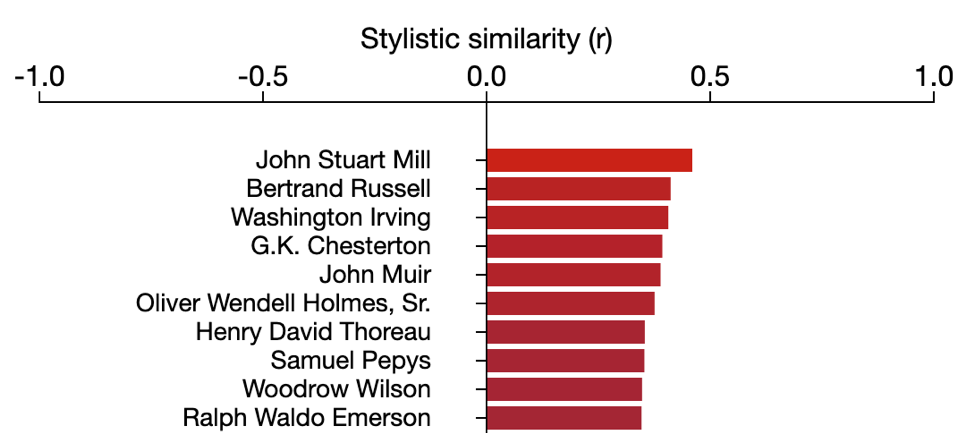
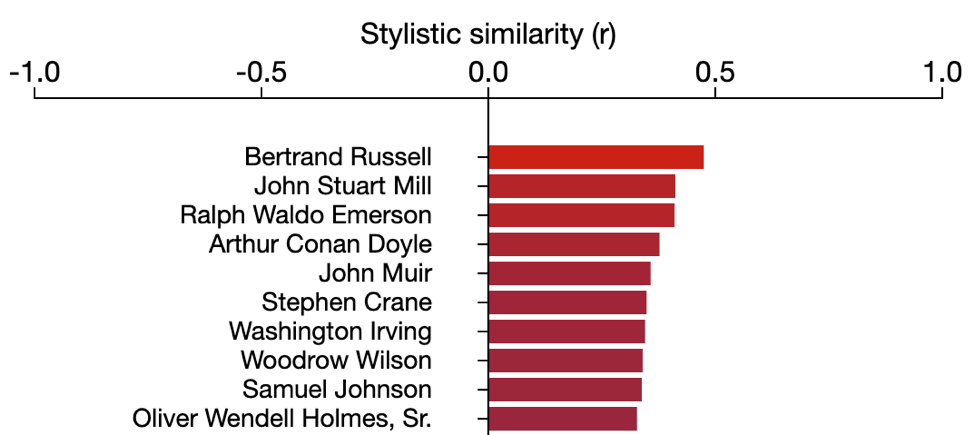
This research project focuses narrowly on one dimension of stylometric study, a field explored in great depth in “Quantitative Patterns of Stylistic Influence in the Evolution of Literature,” available online in the Proceedings of the National Academy of Sciences of the United States of America.

MySocialBrain bases its study on a reasonable premise. “Despite the seemingly ineffable qualities of style, great progress has been made in measuring writing quantitatively. This process, known as stylometry, can identify the influence of one writer on another or reveal the author of unattributed work.”

You can have your writing compared to that of others at this site.

I used two different samples of my writing (blog, then essay) and came up with fairly similar results. I haven’t read much from every one of these authors, but my gut suggests there may be a valid correlation here. And that impression is reinforced by how little correlation my submission had with the writing of Beatrix Potter, R.M. Ballantyne and Baroness Orczy (of whom I had never heard).

If you have a few free minutes, and are curious about what this stylometry tool might conclude about your writing, give it a try.


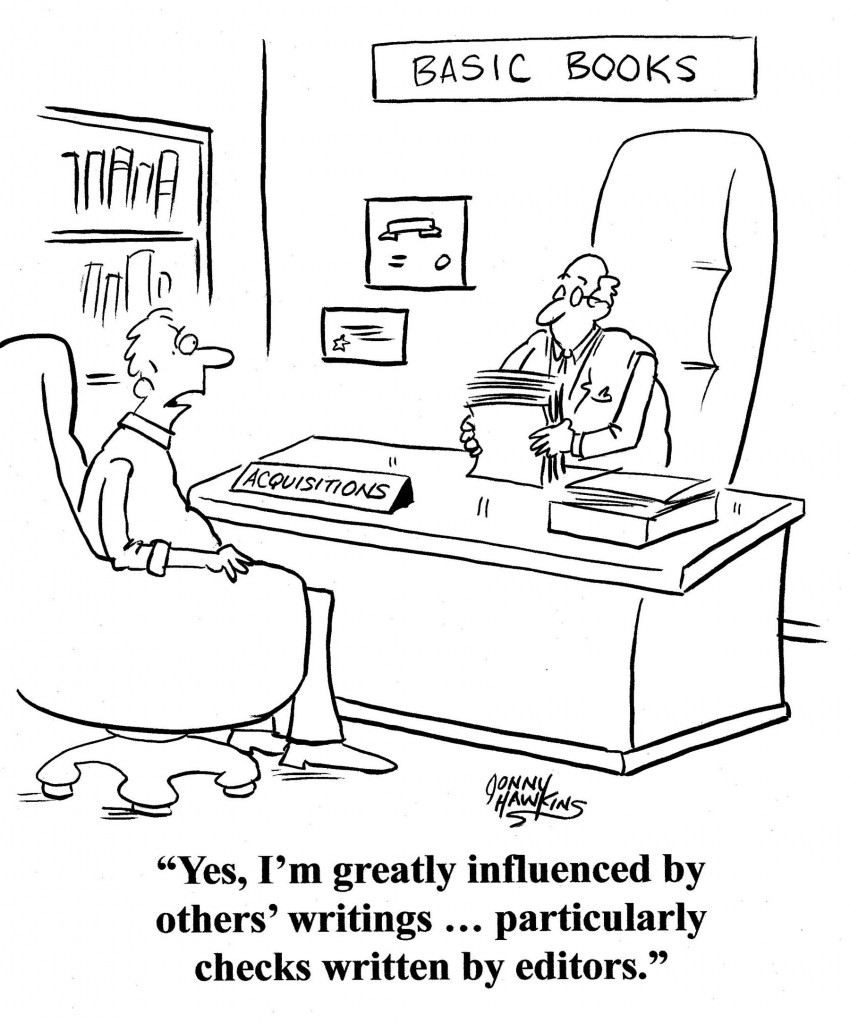
The cartoon at the top of this column is used with the permission of its talented creator, Jonny Hawkins. He is both talented and prolific. Enjoy a humorous jaunt through his personal website today.

Beijing’s Murderous Jesus

Communist China* hates Christianity. They do everything they can to destroy the Gospel, with its power to free people from bondage. That’s because China is all about keeping human beings in bondage.

Mere Inkling is not a political blog, so I have no incentive to go through the litany of communist China’s demagoguery. Besides, listing their crimes would take far too long.

In terms of their persecution of the Christian Church, however, many agnostics know little.⁑ The Red Chinese began their war against Christianity in the days of Mao. Millions have been denied their civil rights, imprisoned, and even murdered. Even with their “enlightened” and “tolerant” policies, they continue to deface and destroy church buildings and harass and imprison believers.

But now, they have done the unimaginable.

They have sought to replace the various Chinese translations of the Bible with a new, official edition. The regime’s Bible, though, is not a genuine translation.

It is an intentional corruption of God’s Word, and it is no exaggeration that some of its inspiration comes from the Father of Lies,  an honored commissar in all Communist nations.

In a superb essay discussing the pseudo-bible, Cameron Hilditch reveals how the Communists are attempting to co-opt the Messiah and present him as the herald of the Marxist gospel.

Put simply, the Chinese Communist Party “plans to turn the Scriptures into another piece of regime propaganda by rewriting them beyond all recognition.”

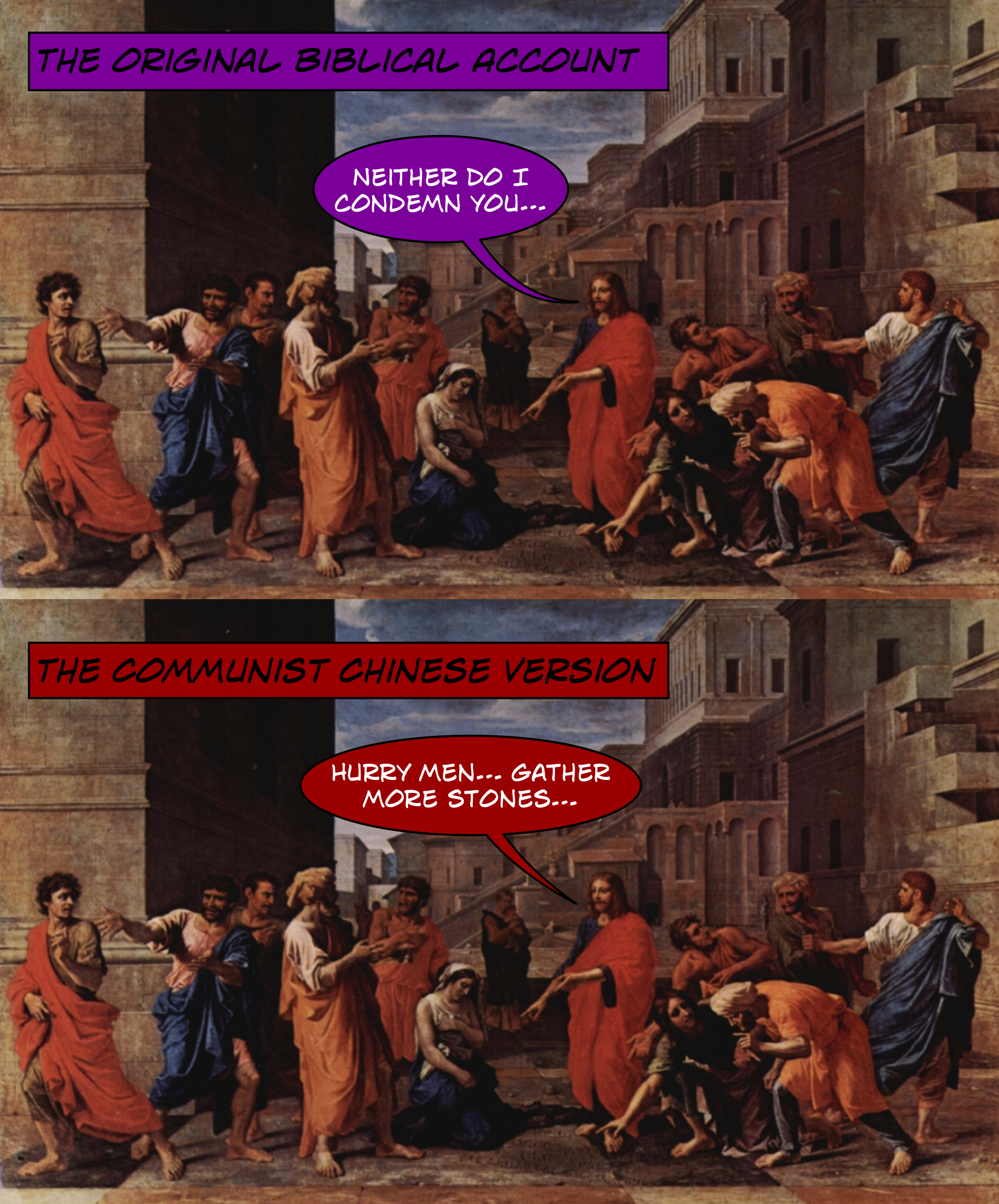
Beyond all recognition indeed. Before looking at their perversion of Jesus’ message of mercy, let’s consider the actual biblical account. We read that in Jerusalem,

Jesus went to the Mount of Olives. Early in the morning he came again to the temple. All the people came to him, and he sat down and taught them. The scribes and the Pharisees brought a woman who had been caught in adultery, and placing her in their midst they said to him, “Teacher, this woman has been caught in the act of adultery. Now in the Law, Moses commanded us to stone such women. So what do you say?”

This they said to test him, that they might have some charge to bring against him. Jesus bent down and wrote with his finger on the ground. And as they continued to ask him, he stood up and said to them, “Let him who is without sin among you be the first to throw a stone at her.”

And once more he bent down and wrote on the ground. But when they heard it, they went away one by one, beginning with the older ones, and

Jesus was left alone with the woman standing before him. Jesus stood up and said to her, “Woman, where are they? Has no one condemned you?” She said, “No one, Lord.” And Jesus said, “Neither do I condemn you; go, and from now on sin no more.”

Here is the communist mistranslation⁂ of the end of this powerful example of God’s grace and mercy.

When the crowd disappeared, Jesus stoned the sinner to death saying, “I too am a sinner. But if the law could only be executed by men without blemish, the law would be dead.”

Twisting the Scriptures

The act of translating the Scriptures is not controversial. In fact, it is necessary. C.S. Lewis noted this in his essay “Modern Translations of the Bible.”

The truth is that if we are to have translation at all we must have periodical re-translation. There is no such thing as translating a book into another language once and for all, for a language is a changing thing.

If your son is to have clothes it is no good buying him a suit once and for all: he will grow out of it and have to be re-clothed.

However, the re-translation must be an honest one.

There are several warnings in the Bible itself not to alter the words in the Scriptures either by deleting or adding to the text. Substituting the actual words, as the Communist Chinese have done, would violate both of those prohibitions.

Some people argue that mainland China exerts a benign influence on the world. “We have short memories,” says Christian attorney and advocate for the poor, Anna Waldherr. Rather than praise China for its increased engagement with the world, she reminds us of the true situation.

These days, the United States and China have mutual economic, political, and security interests.  But China remains a Communist nation with a totalitarian government and unresolved issues involving human rights.

The evil purposes of communist China’s ruling elite do not extend to their people. On the contrary the residents of that historic nation are its primary victims. The Chinese people and their culture possess much nobility. As I have written before, “C.S. Lewis held great respect for Chinese civilization. He was interested in the Chinese philosophical concept of the Tao.”

I share Lewis’ high regard for all that is good in China along with a genuine compassion for the Chinese people. May God deliver them from the dark principalities that reign over them.


* The communist People’s Republic of China is not to be confused with the democratic Republic of China, which is usually called Taiwan, due to the PRC’s coercive actions. For the same reason, the 23 million people living in the Republic of China are denied representation in the United Nations.

⁑ The Communists persecute other religious groups as well, most notably the Uighur (Islamic) people, who are being placed in vast reeducation and labor camps. In addition to rewriting the Jewish and Christian Scriptures, they are presumably also rewriting the Quran with the same, pro-regime agenda. Unsurprisingly, when asked their specific plans, “the Chinese Embassy in Washington declined to comment.”

⁂ As reported in Hilditch’s article, “China’s Communist Christ,” linked to above.

The original painting featured in the illustration above, “Christ and the Woman Taken in Adultery,” was painted in 1653 by Nicolas Poussin.

Teaching English in China

CSL China

If C.S. Lewis had desired to teach English in China he would probably have succeeded. However, due to some rather peculiar requirements, he may not have passed muster.

In that Asian nation, you need four years of college to become a teacher. At 山西师范大学 (Shaanxi Normal University) they include another odd requirement. Shaanxi has a minimal height standard. Men must be at least 5-foot-1 and women must be no shorter than 4-foot-7.

C.S. Lewis would have passed this mandate; he was just shy of 5-foot-11. But who knows what other arbitrary dictates may have barred him from sharing his brilliant mind.

The university’s policy came to international attention when the plight of a young student who completed her studies only to be informed that she was four inches too short to receive her diploma. As the BBC reports, there is a waiver for those who wish to teach the very young.

Those wanting to teach at nursery are able to apply for special accreditation if they are five centimetres shorter.

The school’s, albeit flimsy, rationale is that teachers may need to reach high on blackboards when they are teaching their students. (So much for using modern technology to compensate.)*

It would be bad enough if they failed to admit such candidates to their program, but obviously some are not informed of the standard until they have completed their university studies. One can hardly imagine how that unfortunate graduate felt.

C.S. Lewis spent his academic life at Oxford and Cambridge. Although he lectured in a variety of venues, no international university was blessed to have him serve as a visiting scholar.

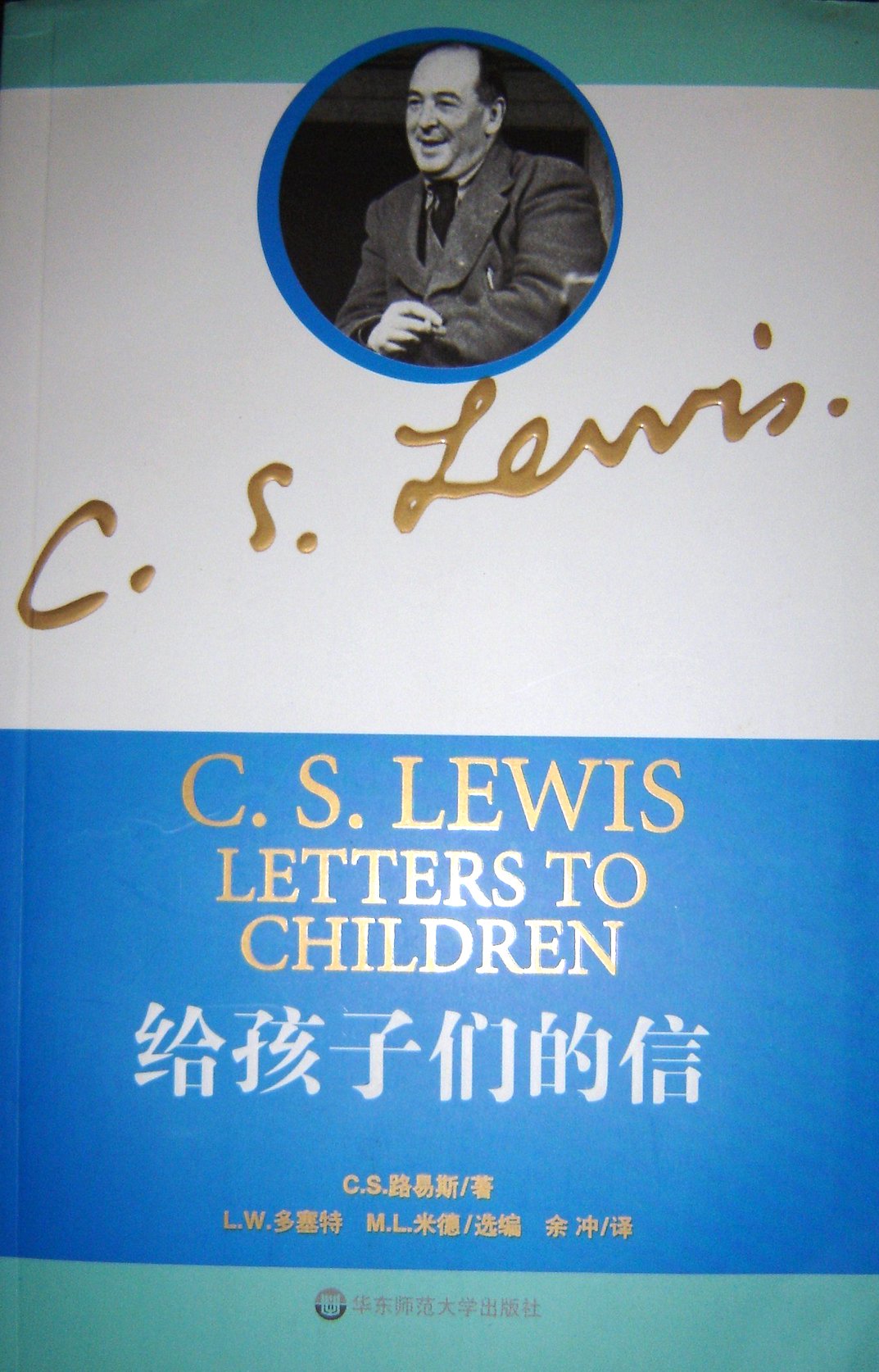
Fortunately, however, his words reached far beyond the campuses of Oxbridge. And, even though Lewis never taught in China (or in Chinese), his words are available today via translation. At Wheaton College, the Marion E. Wade Center preserves a great deal of information about the Inklings, including some original material.

The Wade’s translation collection has a diverse amount of languages represented, even if only by one book. The languages at the Wade include: Afrikaans, Albanian, Arabic, Bulgarian, Catalan, Chinese, Croatian, Czech,  Danish, Dutch, Esperanto, Estonian, Faroese, Finnish, French, Gaelic, German, Greek, Hebrew, Hungarian, Indonesian, Italian, Japanese, Korean, Latin, Latvian, Lithuanian, Norwegian, Polish, Portuguese, Romanian, Russian, Serbian, Slovak, Slovenian, Spanish, Swedish, Thai, Turkish, Ukrainian, and Welsh.

A Two-Way Street

Those of us who have taught realize better than others that teachers often learn as much from their students as they offer to them. Preparing to teach demands that we study to know the subject matter as intimately as we can, so we might convey it effectively to others.

Although he was a brilliant teacher, C.S. Lewis was also a diligent lifelong learner.

Lewis held great respect for Chinese civilization. He was interested in the Chinese philosophical concept of the Tao. I’ve written about his thoughts on this subject before.

Lewis viewed the Tao as being similar to what Christian theologians traditionally refer to as Natural Law.

The Tao, which others may call Natural Law or Traditional Morality or the First Principles of Practical Reason or the First Platitudes, is not one among a series of possible systems of value. It is the sole source of all value judgments.

If it is rejected, all value is rejected. If any value is retained, it is retained. The effort to refute it and raise a new system of value in its place is self-contradictory. There has never been, and never will be, a radically new judgment of value in the history of the world.

What purport to be new systems or . . . ideologies . . . all consist of fragments from the Tao itself, arbitrarily wrenched from their context in the whole and then swollen to madness in their isolation, yet still owing to the Tao and to it alone such validity as they possess. (The Abolition of Man)

Lewis was an advocate of what some refer to as Classical Education. It involves loftier goals than simply communicating data. In his essay “Our English Syllabus,” Lewis “propagated education’s end, rather than as the filling of students’ heads with information or their muscles with habits, as the inculcation of virtue.”

Lewis treasured the essence of knowledge rather than its trappings. He was patient with those genuinely hungry for knowledge. But you could also readily apply to him the maxim that he did not suffer fools gladly.

It does not take a genius to discern what C.S. Lewis would have thought about this Chinese height requirement. To prevent a motivated and capable educator from pursuing her vocation simply because she may lack the reach of someone taller, does not pass the test of common sense.


* “The first interactive whiteboard was released in 1991,” and I assume The People’s Republic “magically” secured that very technology no later than 1992.


Robotic Religion

robot monkClergy can be irritating. I know that better than most . . . because I am one.

While a tiny minority bear some striking similarities to humble saints of the past, far more carry all of the common marks of fallen humanity. They can be argumentative, vain, manipulative, and even vindictive.

It’s not pretty.

Ministers aren’t unique. Being on the “inside” of any community—be it construction workers, educators, soldiers, bankers and politicians—allows one to see unpleasant attributes that are often shielded from the general population.

But, getting back to clergy . . . Since their role is unique in conveying “divine” counsel to others, it is especially important that they be approachable and amicable.

Scientists in China are working on a means of getting around the built-in limitations of the human mediation of divine wisdom.*

They have devised a “robot monk.” It is quite versatile. Not only can it chant Buddhist mantras, something an iPod could do at least as well, it is able to carry on a conversation! Well, the conversation is presently limited to 20 set questions about Buddhism. And the use of a touch screen “held” against his chest makes the comparison with an iPad a bit more accurate.

The automaton’s creator predicts the robot in the yellow robe of a novice will have a major impact, even though he spends most of his day “meditating” on an office shelf.

Enthusiastically agreeing, one worshiper said, “He looks really cute and adorable. He’ll spread Buddhism to more people, since they will think he’s very interesting, and will make them really want to understand Buddhism.”

Now, how can a Christian pastor hope to compete with that. After all, not many are considered to be “cute and adorable.”

What Would C.S. Lewis Think?

That’s a question I sometimes ponder when confronted by particularly odd realities that few of his day could have foreseen.

Lewis was quite respectful of clergy. Read, for example, this account of the way that even religious leaders can succumb to a type of patriotism that is far from biblical.

Patriotism . . . is not a sentiment but a belief: a firm, even prosaic belief that our own nation, in sober fact, has long been, and still is markedly superior to all others. I once ventured to say to an old clergyman who was voicing this sort of patriotism, “But, sir, aren’t we told that every people thinks its own men the bravest and its own women the fairest in the world?”

He replied with total gravity—he could not have been graver if he had been saying the Creed at the altar—“Yes, but in England it’s true.” To be sure, this conviction had not made my friend (God rest his soul) a villain; only an extremely lovable old ass. It can however produce asses that kick and bite. On the lunatic fringe it may shade off into that popular Racialism which Christianity and science equally forbid. (The Four Loves)

Now, it was not the personality or demeanor of this elderly priest that made his comment inappropriate. It was the comment itself. But for a prime example of clerical pride that drives people away from the Gospel, one needs look no farther than the “Episcopal Ghost” in Lewis’ The Great Divorce.

In Mere Christianity, Lewis concisely states the distinctive purpose of clergy. “The clergy are those particular people within the whole Church who have been specially trained and set aside to look after what concerns us as creatures who are going to live for ever.”

Could any other role demand so much integrity and goodwill? I think not. And it is precisely because this role is so unique and significant, that our shortcomings are doubly damning.

Perhaps, given the failings of sinful (i.e. all) ministers, it’s time to consider substituting a robot?

shermanI have no doubt that in no few cases it would be an improvement.

Of course, Christian churches would require a different model. Perhaps one that looks like Sherman on the Mount (minus the bird)?

_____

* You can read a Reuters article about this marvel of Chinese technology here.