C.S. Lewis & Tattoos

How is this for an odd New Year resolution? Getting a new tattoo—with a connection to the writings of C.S. Lewis.

I suppose I’m betraying my age here. Being a retired pastor, my body remains a totally uninked canvas. Not that I’ve never considered getting a tattoo. In fact, if I end up making a pilgrimage to Jerusalem before I journey to the New Jerusalem, I may still opt to get inked. In Jerusalem there is a tattooist whose family traces their art back for 700 years to when their Coptic family lived in Egypt.

Our ancestors  used tattoos to mark Christian Copts with a small cross on the inside of the wrist to grant them access to churches . . and from a very young age (sometimes even a few months old) Christians would tattoo their children with the cross identifying them as Copts. . . .

One of the most famous of Christian types of tattoos, however, is still in use today—that of the pilgrimage tattoo. At least as early as the 1500s, visitors to the Holy Land . . . often acquired a Christian tattoo symbol to commemorate their visit, particularly the Jerusalem Cross.

In Bethlehem, another Christian tattooist practices his art “near the Church of the Nativity, offering pilgrims ink to permanently mark their visit.” He offers designs featuring scriptural texts in Hebrew and Aramaic, the language spoken by Jesus.

Tattoos have a fascinating history, and it should be noted some people consider Torah prohibition to bar even religious tattoos. “You shall not make any cuts on your body for the dead or tattoo yourselves: I am the Lord” (Leviticus 19:28). However, most Christians* and increasing numbers of Jews do not agree that the passage forbids the current practice.

That doesn’t mean all tattoos are appropriate, of course. Most tattoos are innocuous. Some are humorous. A small number are actually witty. Yet some tattoos can be downright malevolent.

Like so many human activities, the significance of a tattoo depends in great part on the intention of the person asking for this permanent mark. For example, my wife and I approved of our son and his wife having their wedding rings tattooed in recognition of God’s desire⁑ that a marriage will last as long as both individuals live.

What has this to do with C.S. Lewis?

Precious few writers have penned more inspiring and enlightening words than Lewis, that great scholar of Oxford and Cambridge. Because of this, it should come as no surprise that there are many Lewis-inspired tattoos gracing bodies. There is even a website devoted to C.S. Lewis-inspired body ink.

I imagine that Lewis himself would regard this as quite peculiar. I don’t believe he had any tattoos of his own, but it’s quite possible his brother Warnie—a retired veteran of the Royal Army—may have sported one or more.

In 1932, Lewis wrote to Warnie about his recent walking trip. Warnie was his frequent companion, when he was not elsewhere deployed. In this fascinating piece of correspondence, Lewis described his most recent excursion. I include a lengthy excerpt (comprising the first half of the journey) not because of its single passing mention of tattoos. Rather, because of the portrait it paints of the young and vigorous scholar in the prime of life. If you would prefer to skip to the mention of inking, see the sixth paragraph.

Since last writing I have had my usual Easter walk. It was in every way an abnormal one. First of all, Harwood was to bring a new Anthroposophical Anthroposophical member (not very happily phrased!) and I was bringing a new Christian one to balance him, in the person of my ex-pupil Griffiths. Then Harwood and his satellite ratted, and the walk finally consisted of Beckett, Barfield, Griffiths, and me.

As Harwood never missed before, and Beckett seldom comes, and Griffiths was new, the atmosphere I usually look for on these jaunts was lacking. At least that is how I explain a sort of disappointment I have been feeling ever since. Then, owing to some affairs of Barfield’s, we had to alter at the last minute our idea of going to Wales, and start (of all places!) from Eastbourne instead.

All the same, I would not have you think it was a bad walk: it was rather like Hodge who, though nowhere in a competition of Johnsonian cats, was, you will remember, ‘a very fine cat, a very fine cat indeed.’

The first day we made Lewes, walking over the bare chalky South Downs all day. The country, except for an occasional gleam of the distant sea—we were avoiding the coast for fear of hikers—is almost exactly the same as the Berkshire downs or the higher parts of Salisbury Plain. The descent into Lewes offered a view of the kind I had hitherto seen only on posters—rounded hill with woods on the top, and one side quarried into a chalk cliff: sticking up dark and heavy against this a little town climbing up to a central Norman castle.

We had a very poor inn here, but I was fortunate in sharing a room with Griffiths who carried his asceticism so far as to fling off his eiderdown—greatly to my comfort. Next day we had a delicious morning—just such a day as downs are made for, with endless round green slopes in the sunshine, crossed by cloud shadows. The landscape was less like the Plain now. The sides of the hill—we were on a ridgeway—were steep and wooded, giving rather the same effect as the narrower parts of Malvern hills beyond the Wych.

We had a fine outlook over variegated blue country to the North Downs. After we had dropped into a village for lunch and climbed onto the ridge again for the afternoon, our troubles began. The sun disappeared: an icy wind took us in the flank: and soon there came a torrent of the sort of rain that feels as if one’s face were being tattooed and turns the mackintosh on the weather side into a sort of wet suit of tights.

At the same time Griffiths began to show his teeth (as I learned afterwards) having engaged Barfield in a metaphysico-religious conversation of such appalling severity and egotism that it included the speaker’s life history and a statement that most of us were infallibly damned. As Beckett and I, half a mile ahead, looked back over that rain beaten ridgeway we could always see the figures in close discussion. Griffiths very tall, thin, high-shouldered, stickless, with enormous pack: arrayed in perfectly cylindrical knickerbockers, very tight in the crutch. Barfield, as you know, with that peculiarly blowsy air, and an ever more expressive droop and shuffle.

For two mortal hours we walked nearly blind in the rain, our shoes full of water, and finally limped into the ill omened village of Bramber. Here, as we crowded to the fire in our inn, I tried to make room for us by shoving back a little miniature billiard table which stood in our way.

I was in that state of mind in which I discovered without the least surprise, a moment too late, that it was only a board supported on trestles. The trestles, of course, collapsed, and the board crashed to the ground. Slate broken right across. I haven’t had the bill yet, but I suppose it will equal the whole expences of the tour.

Wouldn’t it have been amazing to join C.S. Lewis on one of these walking trips? A Lewisian tattoo is no substitute, to be sure, but I imagine it does offer certain people a sense of connection to the great author. Perhaps, if I were a younger man . . .


* Two recent converts to Christianity, Kanye West and Justin Bieber have made public their recent religious additions to their vast tattoo collections.

⁑ As Jesus said, “So they are no longer two but one flesh. What therefore God has joined together, let not man separate.”

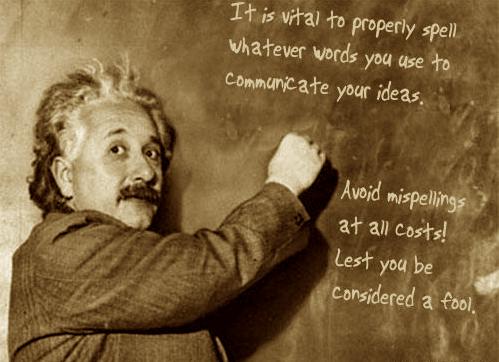
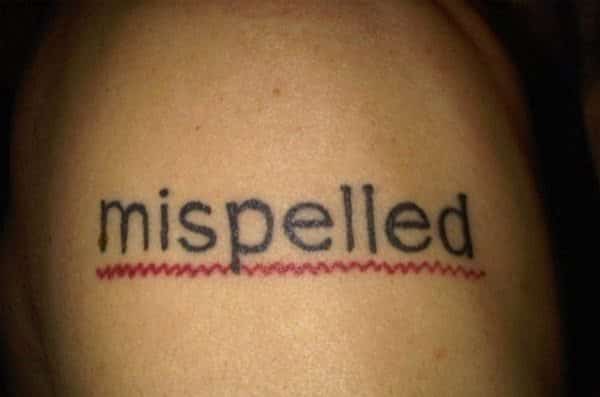
The motivational poster above was created by Mere Inkling, and represents only an infinitesimal number of the misspelled tattoos adorning human bodies. What a travesty . . . one that may have been prevented by remaining sober. The tattoo below, on the other hand, strikes me (being a writer) as quite clever.
C.S. Lewis and Ghost Stories

C.S. Lewis did not write ghost stories, but he lived in a country that celebrated the strange genre. For some bizarre reason, the telling of ghost stories became associated with Christmas Eve. It’s a wonder to me why Lewis didn’t include this impropriety in his brilliant essay on Xmas.

“Christmas Eve was traditionally the time to tell scary stories round the hearth,” opens an article in The Guardian. I had never before associated Charles Dickens’ A Christmas Carol with this bizarre tradition. Nor had I connected it with Amy Grant’s “It’s the Most Wonderful Time of the Year.” (Far better the theme of Grant’s Nativity song “Breath of Heaven.”)

I presume I can thank my Scandinavian heritage for the absence of ghost stories in our Christmas season traditions. Mercifully we also avoided the plague of seasonal trolls and gnomes.

One of the most noted of authors of ghost stories had much in common with C.S. Lewis. M.R. James (1862-1936) was a medievalist scholar who taught at Cambridge. In fact, “James came to sharpen his craft – by telling his stories after the Christmas service at King’s College, Cambridge (where he was provost) to an audience of uneasy fellows.” In the same article no less than H.P. Lovecraft himself is cited as describing James as “a literary weird fictionist of the very first rank.”

I suppose it is a sign of his minimal interest in ghost stories that I cannot find any reference to James’ fiction in C.S. Lewis’ writing. Lewis does, however, refer to one of James’ scholarly works, The Apocryphal New Testament: Being the Apocryphal Gospels, Acts, Epistles and Apocalypses.

In a 1955 letter, Lewis describes how experiencing a relationship with Christ is different than simply knowing about him.

Yes, Jesus Himself, of course: the heart. Not only the God in Him but the historical Man. I don’t know that I ever got much from reading things about Him. Perhaps, in a queer way, I got most from reading the Apocryphal Gospels (The whole Apocryphal N.T. is done in one vol. ed. M.R. James). For there you find things attributed to Him that couldn’t be true. You even find wise & beautiful sayings which nevertheless just don’t ring true. And have you noticed–reading the true sayings in the real Gospels–how hardly one of them could have been guessed in advance?*

References to Ghosts

As befits a person writing over a fifty year period, C.S. Lewis’ comments about ghosts vary. This is emphasized by the change in his worldview which accompanied his conversion from atheism to Christianity.

A 1915 letter to Arthur Greeves reveals Lewis’ affinity for the supernatural. He is describing his reading of “Roots of the Mountains” by William Morris (1834-1896).

Tho’ more ordinary than the [“Well at the World’s End” here and here], it is still utterly different from any novel you ever read. Apart from the quaint and beautiful old English, which means so much to me, the supernatural element, tho’ it does not enter into the plot, yet hovers on the margin all the time: we have ‘the wildwood wherein dwell wights that love not men, to whom the groan of the children of men is as the scrape of a fiddle-bow: there too abide the kelpies, and the ghosts of them that rest not . . .’

In Lewis’ essay “The Novels of Charles Williams,” he describes the uniqueness of Williams’ work.

We meet in them, on the one hand, very ordinary modern people who talk the slang of our own day, and live in the suburbs: on the other hand, we also meet the supernatural—ghosts, magicians, and archetypal beasts.

The first thing to grasp is that this is not a mixture of two literary kinds . . . Williams is really writing a third kind of book which belongs to neither class and has a different value from either.

He is writing that sort of book in which we begin by saying, ‘Let us suppose that this everyday world were, at some point, invaded by the marvellous. Let us, in fact, suppose a violation of frontier.’

In 1939 he wrote to his brother about a play by W.B. Yeats featuring a ghost.

The plays were worth seeing: one, by Yeats [“Purgatory” in Last Poems and Two Plays], his last one, was really powerful: conversation between a tramp and his son outside the ruins of a great house and then the ghost of its last mistress at the window, re-enacting her past life-she being the one who had finally let the whole thing down, marrying a horse-dealer . . . all the usual tragedy of the Irish aristocracy.

Not quite true, of course, because probably most of the preceding generations had been pretty good wasters too: but an effective play.

I have previously explored C.S. Lewis’ actual encounter with Yeats. It was quite odd. In 1921, he had written to his father.

I have been taken recently to see the mighty Yeats. It was the weirdest show you ever saw, and I fear he is a Kod [slang, I believe, for a fraud or a hoaxer]. You sit on hard antique chairs by candlelight in an oriental looking room and listen in silence while the great man talks about magic and ghosts and mystics . . .

What fluttering of the dovecote! It is a pity that the real romance of meeting a man who has written great poetry and who has known William Morris and Tagore and Symons should be so overlaid with the sham romance of flame coloured curtains and mumbo-jumbo.

In 1940 Lewis shared with Warnie his notion that if the seances were real — they had been popular during England’s flirtations with spiritualism — it did not suggest the spirits are particularly bright.

Part of Thursday afternoon I spent with unusual pleasure in the dark, pleasantly smelling, warmth of the old library with a slow dampish snow falling outside-flakes the size of matchboxes. I had gone in to look for something quite different, but became intrigued by the works of Dr Dee [(1527-1608) of Trinity College Cambridge], a mysterious magician and astrologer of Queen Elizabeth’s time.

The interesting thing about this was the fact that it was so uninteresting: I mean that the spirit conversations displayed, so far as I could see from turning over a few pages, just exactly the same fatuity which one observes in those recorded by modern spiritualists. What can be the explanation of this?

I suppose that both are hallucinations resulting from the same kind of mental weakness which, at all periods, produces the same rubbish. One can’t help, however, toying with the hypothesis that they are all real spirits in the case, and that we tap either a ghostly college of buffoons or a ghostly home for imbeciles.

In 1946 he complimented Ruth Pitter (1897-1992), a longtime friend and correspondent. Pitter’s First Poems are available here.

I’m not sure I’ve understood The Bridge as a whole: but I love ‘shapes of sorrow and empty vessels,’ etc. Nice things in Seaborn. The Cygnet comes off as well as things like air-raids can come off in poetry. I don’t mean because they’re modern.

But as a rule, the bigger a thing is, physically the less it works in literature. One ghost is always more disquieting than ten: no good fight in a story can have more than a dozen or so combatants: the death of a million men is less tragic than that of one.

By the way, that final comment will prove of great value to any modern writer!

I’ve accumulated several other Lewisian references to ghosts, so what say we continue this discussion in our next post? In the meantime, perhaps you will care to read some of the linked volumes, or to comment on the odd link between ghost stories and Christmas Eve.


* The Apocrypha Anecdota: A Collection of Thirteen Apocryphal Books and Fragments by Montague Rhodes James is available here. He also wrote The Lost Apocrypha of the Old Testament: Their Titles and Fragments.

Several of James’ ghost stories are available in these collections: The Five Jars and A Thin Ghost and Others. Dr. Dewi Evans has compiled The Collected Ghost Stories of M.R. James and made them available in several formats on his website.

Does Sincerity Result in Good Writing?

Most aspiring writers are sincere. The question is, does the earnestness of their work translate into excellence? In other words, does honesty correlate to quality?

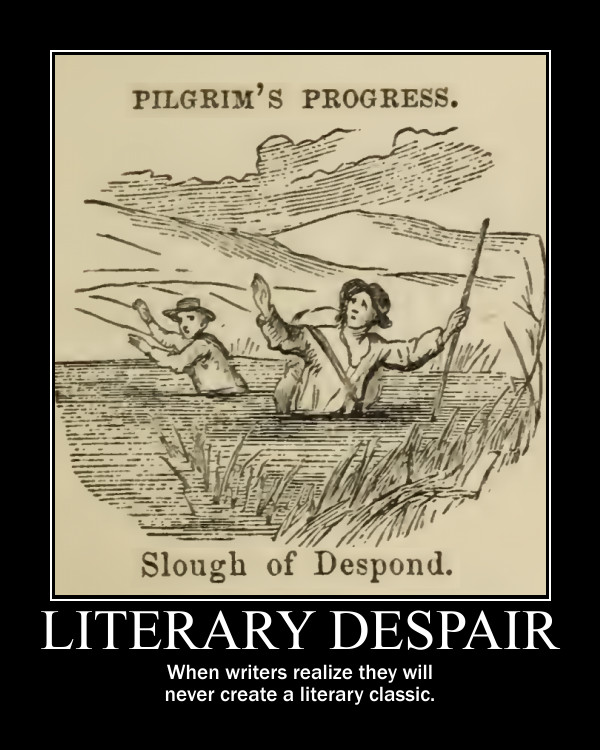
C.S. Lewis addressed this question in an essay about John Bunyan (1628-1688). Bunyan was the English writer and Puritan preacher best known for The Pilgrim’s Progress. At the outset of the allegory Bunyan attempts to “show the profit of my book,” and encourage its reading.

This book is writ in such a dialect
As may the minds of listless men affect:
It seems a novelty, and yet contains
Nothing but sound and honest gospel strains.

While C.S. Lewis respected this classic work, he argues that its value is not simply a consequence of Bunyan’s honesty.

The other thing we must not say is that Bunyan wrote well because he was a sincere, forthright man who had no literary affectations and simply said what he meant. I do not doubt that is the account of the matter that Bunyan would have given himself. But it will not do. (“The Vision of John Bunyan”)

Lewis is not, of course, challenging Bunyan’s claim to honesty. What Lewis does, in fact, is challenge a common misconception. He dismantles the excuse for any who would dismiss grammar and literary rules as unimportant because they are writing earnestly. Basically, Lewis suggests we cannot justify creating a mediocre product and by burnishing it with the declaration that “it is an outpouring of our deepest passion.”

“If [candid honesty] were the real explanation,” states Lewis, “then every sincere, forthright, unaffected man could write as well.”

And we all know that is not the case. Lewis proceeds to offer an illuminating and curious illustration. It recalls the days of the First World War when one of the responsibilities of the officers was to review the correspondence of the troops before they accidentally divulged classified military information to their family at home.

But most people of my age learned from censoring the letters of the troops, when we were subalterns [lieutenants] in the first war, that unliterary people, however sincere and forthright in their talk, no sooner take a pen in hand than cliché and platitude flow from it. The shocking truth is that, while insincerity may be fatal to good writing, sincerity, of itself, never taught anyone to write well. It is a moral virtue, not a literary talent. We may hope it is rewarded in a better world: it is not rewarded on Parnassus.*

Lewis continues, praising Bunyan’s writing.

We must attribute Bunyan’s style to a perfect natural ear, a great sensibility for the idiom and cadence of popular speech, a long experience in addressing unlettered audiences, and a freedom from bad models. I do not add ‘to an intense imagination,’ for that also can shipwreck if a man does not find the right words.

A Lesson for Modern Writers

C.S. Lewis’ keen analysis of Bunyan’s writing is more than a mere history lesson. It offers a lesson to those of us who take up the pen today. By all means, we should exercise the moral virtue of sincerity in our writing. However, we should not rest on the strength of our integrity to ensure the quality of our writing.

We should hone our skills. Likewise, we should welcome the constructive criticism of our peers, as did the Inklings themselves.

Our work will also benefit when we intently listen. Learning the idiom and cadence of our characters (real or fictional) enables them to rise alive from the page.

Lewis’ essay on Bunyan offers another suggestion I would highlight. This will be true for any writer, but I think it is of particular import to Christian authors. Lewis affirms a forthright, honest, and powerful presentation of the truth as we perceive it. He cautions against pulling our punches because we are timid about how the austere truth may be received.

For some readers the ‘unpleasant side’ of The Pilgrim’s Progress [lies] in the intolerable terror which is never far away. Indeed unpleasant is here a ludicrous understatement. The dark doctrine has never been more horrifyingly stated than in the words that conclude Part I: Then I saw that there was a way to Hell, even from the Gates of Heaven, as well as from the City of Destruction.

In my opinion the book would be immeasurably weakened as a work of art if the flames of Hell were not always flickering on the horizon. I do not mean merely that if they were not it would cease to be true to Bunyan’s own vision and would therefore suffer all the effects which a voluntary distortion or expurgation of experience might be expected to produce. I mean also that the image of this is necessary to us while we read.

The urgency, the harsh woodcut energy, the continual sense of momentousness, depend on it. We might even say that, just as Bunyan’s religious theme demanded for its vehicle this kind of story, so the telling of such a story would have required on merely artistic grounds to be thus loaded with a further significance, a significance which is believed by only some, but can be felt (while they read) by all, to be of immeasurable importance.

Keeping this in mind—that we should be faithful to the truth of what we are professing—will serve us well in the final accounting. After all, it is the compromises of the tepid of which we must beware.


* Parnassus refers to a Greek mountain associated by the ancients with Apollo, the Muses and poetry.

The Pilgrim’s Progress is available in a variety of free versions.

The Pilgrim’s Progress, an Allegory features a “Biographical Sketch of the author, by Lord Macaullay.”

In an 1834 edition, we have Bunyan’s Pilgrim’s Progress, Metrically Condensed: In Six Cantos.

The version with the most entertaining title has to be: The Pilgrim’s Progress [by John Bunyan] In Words of One Syllable.

The Child’s Pilgrim’s Progress can be downloaded in not one, but two volumes. It was published in 1860, with the preface:

No endeavour has been made in this little book to improve Bunyan’s Pilgrim’s Progress. To do so would be simply absurd. To bring prominently into view scenes supposed most attractive to children has been attempted; and, while the Dreamer’s narrative is preserved, others of less striking character have been thrown into the back ground. The quaint, simple language of the incomparable Bunyan is, for the most part, retained.

The Pilgrim’s Progress: for the Young was published in 1850. Its introduction includes commentary that echoes the theme of the post above.

John Bunyan, though a very pious and good man, was not a learned one ; for he was by trade a tinker, and had no opportunity to learn much more than to read, in his youth, and when a boy he was wild and wicked. But he made very good use afterward of what he knew ; and very diligently studied his Bible and other good books.

He was also what is called a genius, which means that he had great natural talent. He wrote many works, and one of his books, called the Pilgrim’s Progress, has been read and admired by more people than any other book except the Bible. Learned and unlearned men have read it again and again, and it has been translated into all modern languages.

Peculiarities of Punctuation

I question how we can ever secure world peace, when we can’t even agree on how to punctuate. And this is not only an international controversy—although it certainly possesses intercontinental ramifications.

Writers who have submitted their work to editors know exactly what I’m talking about. The world abounds with critics who are positive they know how to “fix” your manuscript, so you can more effectively communicate what you are trying to say.

A fine example of this is found in the case of Samuel Clemons. As I described several years ago, Mark Twain considered editors to be a plague. He sums up his irritation in a letter to a friend.

I give it up. These printers pay no attention to my punctuation. Nine-tenths of the labor & vexation put upon me by [them] consists in annihilating their ignorant & purposeless punctuation & restoring my own. This latest batch [also has] my punctuation ignored & their insanities substituted for it.

C.S. Lewis experienced similar challenges in working with his editors. In 1959, Lewis was responding to edits made by his longtime editor, Jocelyn Gibb, on the manuscript of The Four Loves.

I enclose my emendations, concessions, and resistances. . . . as regards my emendations, will you be so kind as to type them and send them to Harcourt Brace for the American edition. Otherwise we shall create a ‘textual problem.’

After arguing for several points of substance, Lewis offers a preemptive surrender on the field of punctuation. “Do anything you like (in reason) to the punctuation.” Lewis’ qualified capitulation was in response to this editorial comment from Gibb:

Do you really favour a comma before an “and” which seems to run all through? If so, why not: The Lion, the Witch, and the Wardrobe?

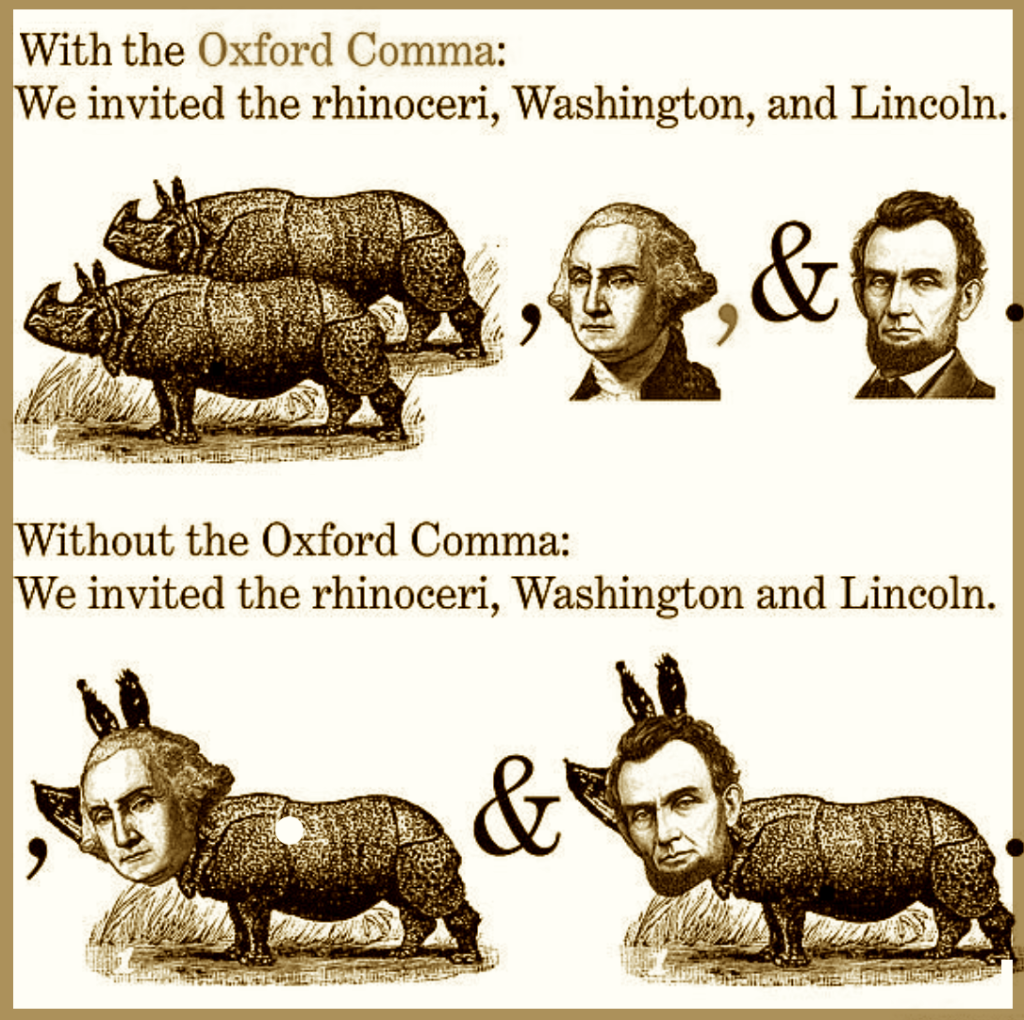
It’s curious Lewis’ editor would question his inclusion of commas in this manner, since it is not uncommon in British literature. In fact, punctuation in this context is often called an “Oxford comma.” You can read a decent discussion of the subject here. And, lest you deem it an inconsequential matter, check out this interesting article describing how it became “the crux of a $10 million class-action lawsuit . . .” The author of the article notes:

Many style guides, including the Chicago Manual of Style, American Psychological Association (APA), and American Medical Association (AMA), recommend the use of the Oxford comma to prevent ambiguity.

Yet others, including the AP style guide, Canadian Press (CP) style guide, and (shockingly) the University of Oxford style guide itself, use the Oxford comma only when a sentence could be misinterpreted by the reader without it.

Here’s the problem, though, for those who do not consistently use the Oxford comma: when writing a sentence, you don’t always realize that what you’re writing could be misinterpreted.

A Nineteenth Century Tribute to Punctuation

Punctuation can provide insights into a writer’s personality, as I have discussed here. Recently I encountered this personally published poem from 1861. You can download Ephemeral Effusions, the quaint volume in which it appears, at no cost via Internet Archive.

Easy Rules for Punctuation

Written for the amusement
of a valued Friend,
who was a great stickler
for correct punctuation.

I.
Whene’er you pause, to dip the pen,
A comma you must place;
If at a loss to find a word,
A semicolon trace.

II.
Should thoughts flow slowly, fill the gap
With colon, or with rest;
And when the sentence is complete,
A period answers best.

III.
A bright idea always claims
A note of admiration;
And, if you doubt, a crooked mark
Implies interrogation.

IV.
Inverted commas indicate,
Your wits are at an end;
And, your ideas failing,
You borrow from a friend.

V.
Parenthesis (example take),
I won’t say much about;
It guards a sentence, which sometimes
Had better be left out.

VI.
The little star of secrecy,
Tho’ last, not least in fame,
Is aide-de-camp to mystery,
And asterisk its name.

These rules are all so clear,
they need no explanation;
And constitute the art
of modern punctuation.

Saved by a Misspelling

Recently I came across a sad record from the American Civil War. It described a too-common occasion during the later years of the war—the execution of Union deserters. Yet this story was unique. One of the three men sentenced to death, was spared. And this wonder occurred because of a simple misspelling.

As we know, most misspellings are inconsequential, while others are significant, such as making a mistake with the Lord’s name.

On New Year’s Day in 1960 The Times Educational Supplement published a letter from C.S. Lewis on the subject of spelling.

Nearly everything I have ever read about spelling reform assumes from the outset that it is necessary for us all to spell alike. Why? We got on for centuries without an agreed common orthography. Most men of my age remember censoring the letters of soldiers and know that even the wildest idiosyncrasies of spelling hardly ever made them unintelligible

In the case of the Civil War deserter, the misspelled name was not significant. Everyone in the regiment knew the three guilty parties. After their initial arrests, the men had escaped from confinement, and then been recaptured. Not once, but twice.

According to the regimental history of the Sixth Connecticut Infantry, the circumstances followed a common pattern.

Volunteering having partially subsided in the State, and as the government was in need of more troops, drafting commenced in other States as well as in Connecticut. The Sixth received about 200 men in October; some were conscripts and others drafted men, as but few volunteered for the service. Their advent was not hailed with much pleasure or satisfaction by the old regiment, as they claimed that “forced” men would not fight and could not be trusted in case of an emergency.

Some were vile roughs and were frequently in the guard house; while others manifested a disposition to do their duty, and did make very good soldiers. Three of the substitutes deserted from the regiment while on picket . . . (The Old Sixth Regiment by Charles K. Cadwell)

The three deserters shared a common background, and were destined for a common fate.

[Following their first escape] they were tried for desertion before a court martial . . . found guilty and sentenced to be shot to death by musketry. They were then chained hand and foot to a post inside of the provost quarters; and, notwithstanding these precautions, together with a strong guard, they succeeded in getting away again.

They took a boat near the pier and made off; but while in Warsaw Sound near the shore, their boat grounded and they were captured by a picket boat from the gunboat Patapsco. They were very bold, ingenious men, and their skill and perseverance might have won them honor if rightly applied. The culprits were Germans by birth: privates Henry Schumaker, of Co. C, Henry Stark, of Co. E, and Gustav Hoofan, of Co. B. (The Old Sixth)

The execution was conducted in the traditional, solemn manner of the era. However, one of the condemned soldiers would survive another day.

[Two of] the prisoners were taken from their cells at about two o-clock, placed in army wagons and seated on the coffins in which they were to be buried. . . . The funeral escort, consisting of a corporal and eight men, marched to funeral music, with arms reversed.

Slowly the procession proceeded to the appointed place; the square was formed on three sides, and the victims were driven around once that all might see them and avoid their fate. They maintained a calm demeanor to all, except as they passed our regiment they took off their caps several times to their old comrades. On reaching the end of the square they were assisted to alight from the wagons, the coffins were placed on the ground, the culprits sitting down upon them while the Provost Marshal read the charges, findings and sentence.

After a short prayer by the priest they were blindfolded and their hands tied behind them and made to kneel upon their coffins, facing the center of the square. The firing party came up and were halted at six paces distant, when, at a signal from Capt. Babcock, they fired and the victims fell upon their coffins. . . . They lay just as they had fallen till the whole command marched past them on the way to camp, when they were put into the coffins and buried. (The Old Sixth)

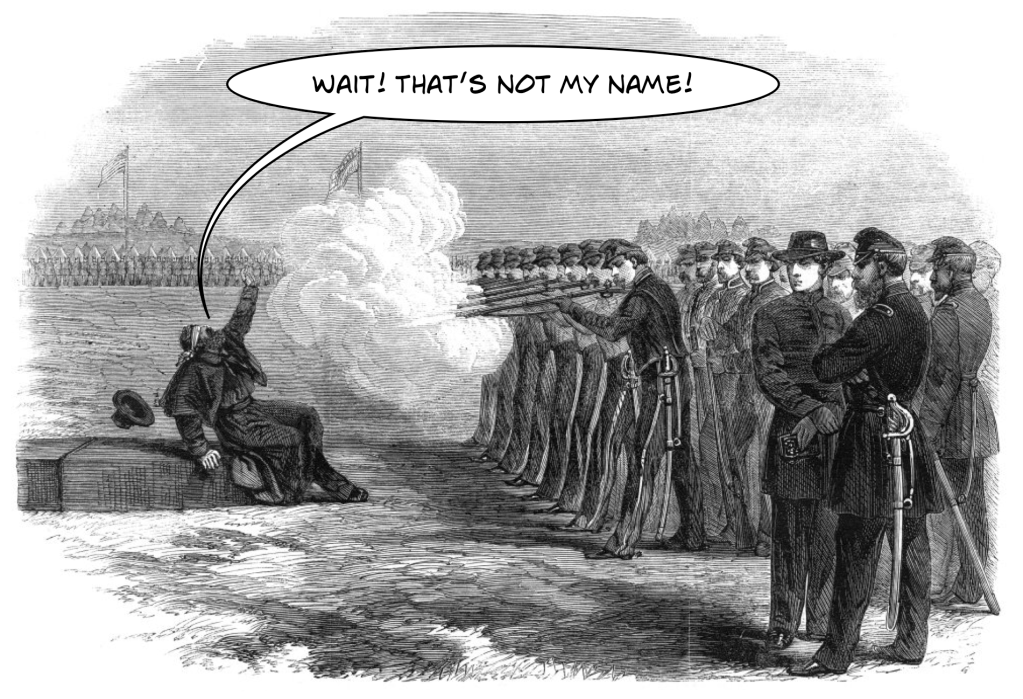
Only two of the three deserters had perished in the fusillade that riddled their bodies. Gustav Hoofan survived. Alternative spellings in Civil War records were common. In the rosters as maintained by the National Park Service, Hoofan’s name was also spelled Hoffan and Hofen. The unfamiliarity of Hoofan’s name—combined with the mercy of a commander—were his salvation.

In the case of the [the third deserter] an error was discovered in writing his name, the name Hoofan having been written Hoffman by the Judge Advocate. Col. Duryee wishing to be merciful to the full extent consistent with duty, availed himself of this technical error and protested against his execution. This protest was allowed, and he was saved from death and ordered to return to duty with his regiment. The man was more than pleased at this announcement, but the Judge Advocate, a lieutenant of the Eighty-fifth Pennsylvania regiment, was severely censured in general orders for his inexcusable carelessness and fatal error. (The Old Sixth)

I was unable to ascertain what eventually became of Private Hoofan. Apparently he completed the rest of this service commitment and returned to civilian life with a profound sense of gratitude.

C.S. Lewis’ Thoughts on Spelling

I shared above the beginning of Lewis’ letter to The Times Educational Supplement. The remainder of it is well worth reading. It is clear that he regarded the communication of information (i.e. the actual function of writing) to be far more important than the execution of arbitrary rules.

Printing houses will always have, as they have now, their own rules, whether authors like them or not. Scholars, who know the ancestry of the words they use, will generally spell them accordingly. A few hard words will still have to be learned by everyone. But for the rest, who would be a penny the worse if though and tho, existence and existance, sieze, seize and seeze were all equally tolerated?

If our spelling were either genuinely phonetic or genuinely etymological, or if any reform that made it either the one or the other were worth the trouble, it would be another matter.

As things are, surely Liberty is the simple and inexpensive ‘Reform’ we need? This would save children and teachers thousands of hours’ work. It would also force those to whom applications for jobs are made to exercise their critical faculties on the logic and vocabulary of the candidate instead of tossing his letter aside with the words “can’t even spell.”

It’s so refreshing to see that even a renowned scholar can exercise such common sense.

What’s Behind the Cover?

csl book cover.png

Have you ever wondered if publishers change the covers on their books trying to trick you into buying an extra copy? While I’m sure some unscrupulous publishing houses may have engaged in such questionable practices, surely they would never do so with the books of so honest a man as C.S. Lewis!

Over the past forty years I’ve purchased multiple copies of various works by C.S. Lewis. Occasionally I’ve needed to replace a loan copy that was never returned. A number of times when I’ve taught a class on one of his works, I’ve provided everyone with a personal copy. Sometimes I’ve purchased them with the sole intent to give them to the curious—I have some on my bookshelf right now waiting for the right home.

Through the years I have been struck by the frequency with which covers change. Sometimes, of course, it’s due to different publishers gaining rights to the titles. Often, though, it seems to be based almost on whim. Consider, for example, the diversity in covers for the final volume in C.S. Lewis’ space trilogy. (I picked this title arbitrarily, because of the interplanetary subject matter.)

If you examine the collage of covers, you’ll note some similarities and image reuse. However, the thing that surprised me was the way that a single publisher, Pan Books, had no fewer than four different covers. (Perhaps there is something to the suspicion that booksellers are more than happy to sell multiple copies to inattentive readers?)

It’s no secret that book covers are extremely important. They can increase the sales of marginal works and suppress the distribution of exceptional books. Their enormous influence gave rise to the wise maxim: “Don’t judge a book by its cover.” Jesus applied a variation of this theme to the publicly righteous hypocrites of his day when he said, “woe to you, scribes and Pharisees, hypocrites! For you are like whitewashed tombs, which outwardly appear beautiful, but within are full of dead people’s bones and all uncleanness” (Matthew 23:27, ESV).

Sadly, I’ve begun reading more than one book that bore an inviting cover and was filled with decomposing grammar, decaying plotlines and putrid characters.

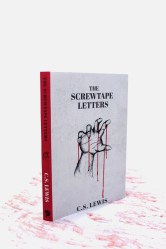
On a website for creative artists, a fan of C.S. Lewis’ works recently experimented with creating innovative covers for three of Lewis’ most popular books.

Will Jacott explains,

screwtape cover.jpg I wanted to convey an accurate image of the book, while also allowing for some ambiguity so the reader could project their own meaning onto the cover. C.S. Lewis books are traditionally marketed toward Christian audiences, and often have light-hearted covers. . . . I wanted the books to appeal to a non-Christian audience, and I wanted the books to have a gritty and more emotional feeling, while also alluding to the extraordinary qualities inside the book.

I believe Will succeeded in his goals . . . and also made the covers simpler and more striking than many of the cluttered covers that adorn my shelf.

C.S. Lewis’ Thoughts on Book Covers

In 1915, Lewis wrote to his closest friend, Arthur Greeves, about hoping to get a library-worthy copy of The Faerie Queene by Edmund Spenser.* Unfortunately, he found the most suitable edition unappealing. “The pictures are tolerable but the print, if I remember, rather coarse (you know what I mean) and the cover detestable.”

In 1936, Lewis was writing to a friend in which he recommends the books of Charles Williams. After commending Williams’ skill in portraying virtuous characters, he adds, “the fact that Gollancz publishes them (in lurid covers) suggests that all this substantial edification—for it is nothing less—must be reaching the ordinary thriller-reader.” The comment makes me wonder what Lewis would have thought of some of the contemporary covers chosen for his own books.

Pauline Baynes was the illustrator with whom Lewis worked for The Chronicles of Narnia. In 1951 Lewis provided her with a sketch of the map of Narnia and its surroundings. The next week he wrote to her.

My idea was that the map should be more like a medieval map than an Ordnance Survey–mountains and castles drawn–perhaps winds blowing at the corners–and a few heraldic-looking ships, whales and dolphins in the sea. Aslan gazing at the moon would make an excellent cover design (to be repeated somewhere in the book; but do as you please about that.)

In a 1958 letter to Jocelyn Gibb, Lewis discusses his changes to the editing proofs of Reflections. His remarks about the cover of the book are interesting, particularly as they reveal his distaste for handwriting fonts, at least in that context.

About the Dust Cover, I like the colour scheme and wouldn’t object. If you have it, I should go for the best design, and archaeology be damned. But I don’t like the letters. We have very nice plain Roman Capitals now . . . and I think it a bad fashion to substitute printed mimicry of ugly handwriting. I wish all publishers would stop it.

Even if the handwriting were a beautiful script, which this is not, the whole idea that decoration consists in making everything masquerade as something else, is surely wrong. Do you like smoking-rooms on ships made up to look like Scotch baronial halls?

There is no better way to end this column than by quoting C.S. Lewis’ glorious description at the finale of The Chronicles of Narnia. As the stories end, the children are ushered into heaven by Aslan who, as he spoke, “no longer looked to them like a lion; but the things that began to happen after that were so great and beautiful that I cannot write them.”

All their life in this world and all their adventures had only been the cover and the title page: now at last they were beginning Chapter One of the Great Story which no one on earth has read: which goes on for ever: in which every chapter is better than the one before (The Last Battle).

__________________

* Lewis would have loved to own this critical edition of The Fairie Queene, which would not be published until seventeen years after he wrote this letter. And, today, you can download volume one for free!


C.S. Lewis & Humanity’s Tragic Flaw

achilles

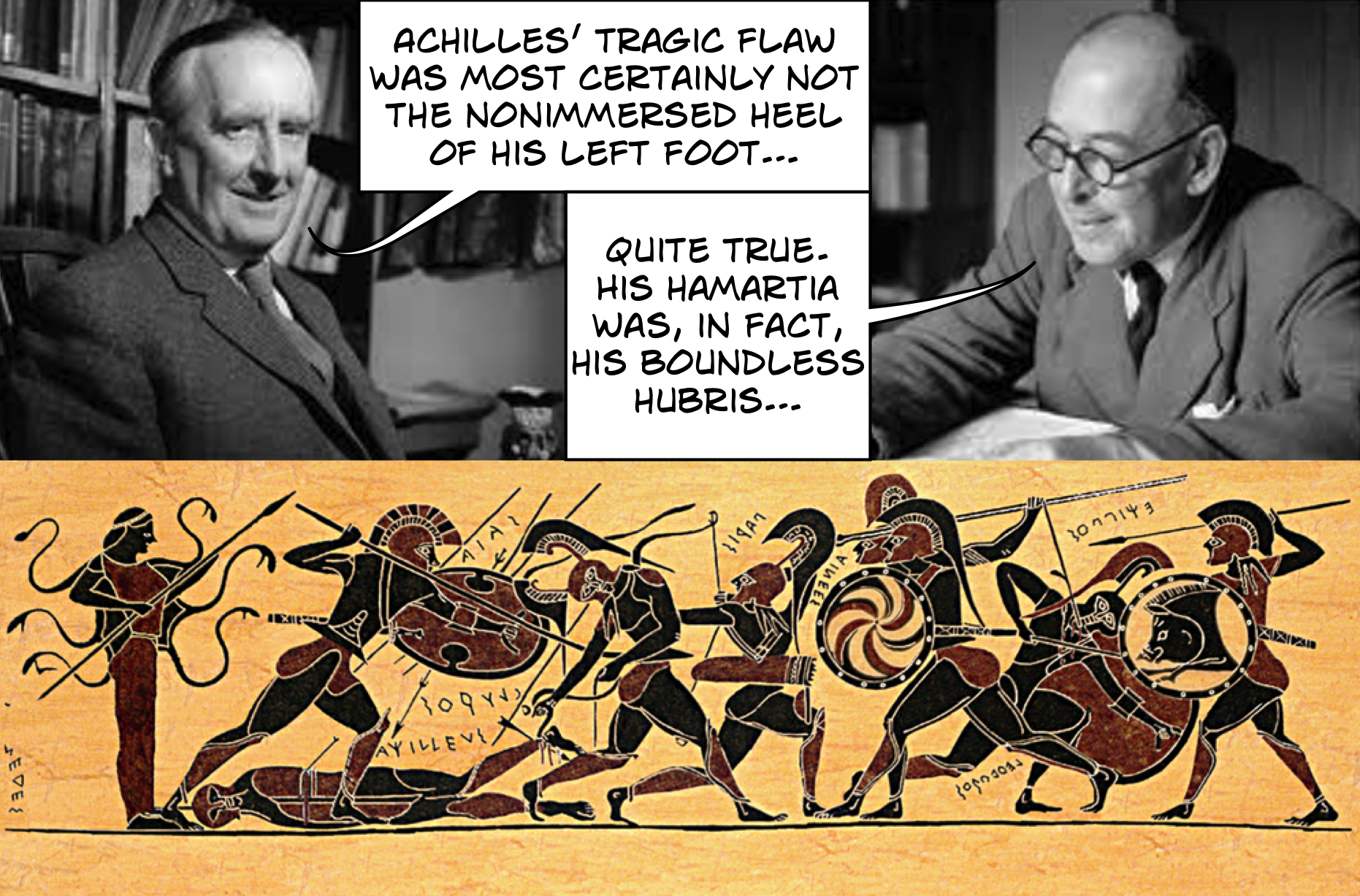
If you don’t know the meaning of “hamartia,” you’re not alone. But it’s a very important word, for more than one reason, so read on.

Hamartia describes a feature many writers of fiction or drama instill in their most memorable characters. It simply means “tragic flaw.” The deep character defect which cannot be overcome by sincere intention or persistent effort.

Merriam-Webster describes it this way.

Aristotle introduced the term in the Poetics to describe the error of judgment which ultimately brings about the tragic hero’s downfall. As you can imagine, the word is most often found in literary criticism.

However, news writers occasionally employ the word when discussing the unexplainable misfortune or missteps of übercelebrities regarded as immortal gods and goddesses before being felled by their own shortcomings.

Despite being a thespian in high school, I never formally studied drama. So I didn’t encounter the word there.

Likewise, I have written consistently since earning a Journalism degree four decades ago. However, since I have a 37:1 nonfiction to fiction ratio, I did not know this Greek word had found its way into the English lexicon.

I was surprised to discover its English meaning in my usually-familiar word of the day email (from The Free Dictionary).

While I was unfamiliar with its English usage, I already knew the word. I originally met hamartia (ἁμαρτία) while studying the New Testament in Greek. Hamartia literally refers to “missing the mark,” and it is the primary biblical Greek word for sin.

The first usage of the word in the sense of being an inner quality, occurs in Aristotle’s Poetics.  Aristotle writing as a pre-Christian philosopher, naturally perceived the literary device in a pagan manner.

The Greek word hamartia translates pretty directly as “error” or “shortcoming” without any necessary overtones of guilt or moral failure. Our modern conception of tragedy and the “tragic flaw” of the hero usually involves the concept of hubris, or overweening pride, that leads to disaster.

Macbeth, for instance, has the arrogance to think he can overstep the laws of God and state, and ultimately pays dearly for this arrogance. Macbeth is a tragic hero with a clear tragic flaw: his downfall results from a moral failing and can be seen as divine retribution proportional to his guilt. But Macbeth also contains heavy Christian overtones that would of course be found nowhere in Greek tragedy.

An understanding of Aristotle’s concept of hamartia—and indeed an understanding of Greek tragedy in general—relies on an understanding of the ethics and cosmology of the ancient Greeks. . . . Greek ethics are based more on the notion of virtue than obligation.

What of the Consequences?

In a 2014 article entitled “C.S. Lewis: The Anti-Platonic Platonist,” Grace Tiffany skillfully explores the Platonic echoes in Lewis’ writings. In discussing his literary examples of human failings, she writes:

There are of course Biblical models justifying Lewis’ “negatively capable” presentations of misguided characters . . . An older philosophical source, if not a Platonic one, also justifies mimetic representations of evil by the argument that these are morally purgative.

Imitations of hamartia, or tragic error, produce “fear and pity” (Aristotle, Poetics 1453b)—compassion for the character elicited by a skilled simulation of his psychology, naturally accompanied by a healthy fear of ourselves making similar mistakes. What ensures the fear is, of course, the dramatization of the horrible end to which hamartia has led . . . (Christianity and Literature 63.3).

In 1953, C.S. Lewis wrote to a correspondent that sin was more than merely making a mistake. In doing so, he alludes to the change in the meaning of the word ἁμαρτία.

No. I don’t think sin is completely accounted for by faulty reasoning nor that it can be completely cured by re-education. That view has, indeed, been put forward: by Socrates and, in the early 19th Century, by Godwin.

But I think it overlooked the (to me) obviously central fact that our will is not necessarily determined by our reason. If it were, then, as you say, what are called ‘sins’ would not be sins at all but only mistakes, and would require not repentances but merely correction.

Returning to the literary or dramatic definition of hamartia as a tragic flaw, it seems to me that this term offers a fitting parallel to the word sin.

Ever since humanity’s fall, we suffer the curse of bearing original sin, a tragic flaw. It is a scar that no medical or psychological treatment can cure and no amount of determination can repair. This tragic flaw will be our doom. Unless, that is, there is One who is capable and desirous of restoring us to our original health and purity. One, perhaps, in whose own image you and I were created . . .

This wonder is something well worth pondering—and perhaps one day, writing about.

The Inklings of Mount Hermon

mount hermon.png

Few writers attain their full potential without the advice and encouragement of others.

C.S. Lewis and J.R.R. Tolkien recognized that fact.

For many years they gathered regularly with a number of other keen minds, almost all of whom shared their Christian faith. (Notably, Owen Barfield who was an Anthroposophist, was a notable exception.)  Some writers visited the community as guests.

I’ve written in the past about the great benefit provided by Inkling-style literary criticism. It’s all about synergy.

Mount Hermon Christian Writer’s Conference is one of the premier gatherings of its sort. After many years of hoping to attend, my wife and I journeyed to California for its Fiftieth Anniversary this past week. What a blessing!

In addition to hundreds of zealous writers, the conference was attended by twoscore publishers, agents and writing experts who generously shared their vast knowledge. And I use that word “generously” in a literal sense. The faculty made itself accessible to a degree I have never before witnessed (and I am a veteran of innumerable professional conferences). The speakers were sincerely interested in encouraging each and every participant.

Classes were available for writing novices, journeymen and experts. I found the track on screenwriting to be the most helpful for my own current needs. I hope to put these new lessons into practice in the next few years.

I can confidently assure you that Mount Hermon will also offer the sort of advice and encouragement that you need to advance your own skills to the proverbial “next level.” If you are interested in attending Mount Hermon, you can learn more here.

Back on the Home Front

If you have never enjoyed the benefits of gathering locally with other writers, I strongly encourage you to consider it now.

If you’re on a critique-group-hiatus due to past disappointments, why not look for a fresh group with a healthier focus?

I sincerely believe most of us become better writers while growing together, than we do wandering on our own. Mount Hermon reinforced that conviction.

I encourage each of you to reach your own full potential—with a little help from some new friends.

C.S. Lewis and the Academics

acadamians.jpg

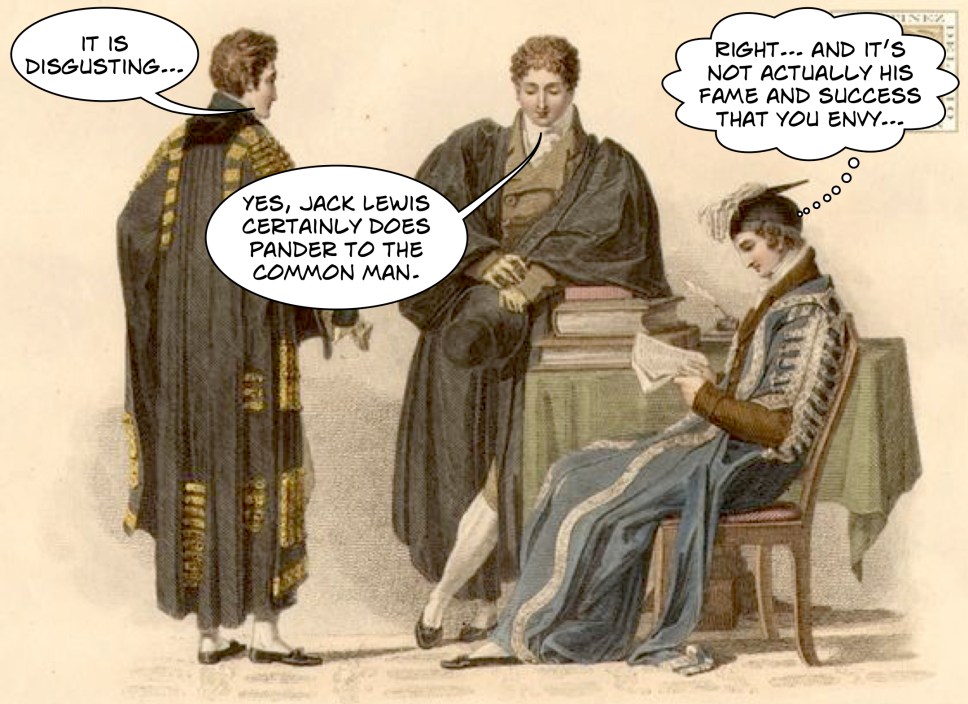
When it comes to writing for a popular audience, the elite strata of academia possess no shortage of disdain.

C.S. Lewis was only one of many professors who found writing for the common people diminished them in the eyes of their snobbish peers. In Lewis’ case, his lay theological essays were considered bad enough. His fantasy and science fiction works were regarded as particularly gauche.

I have a personal theory about the way self-important scholars treat their colleagues who reach down to interact with the hoi polloi. It seems to me that they deride people like Lewis and J.R.R. Tolkien because of envy. The envy is twofold.

First, they covet the large audience and expanded influence of the scholar who successfully transcends the university. These elements arouse their lust far more than the potential wealth that such success might bring, although I have no doubt some resent being criminally underpaid as educators.

The second aspect of the envy is directed at the genuine talent of the belittled author. The majority of faculty would not possess the skill to write successfully for a popular audience. Thus, the significance of such publication needs to be diminished.

Harlan Ellison (1934-2018) was not an academic, but even he did not appreciate being relegated to the ranks of pulp writers. Despite writing screenplays and more than 100 books, he was best known for his science fiction. Nevertheless, he once threatened: “Call me a science fiction writer and I’ll hit you so hard your ancestors will die.”

Returning to Lewis, one biographer devotes an entire chapter to the condescending attitude of his Oxford peers. He entitles it, “A Prophet without Honour?” This is a reference to Jesus’ saying that “a prophet has no honor in his own hometown” (John 4:44)

Lewis, then, was famous by the time the Second World War ended in the summer of 1945. If the simple philosophy of life propounded by modern celebrity culture has any validity, Lewis at that point should have been a happy and fulfilled person. Yet Lewis’s personal history for the next nine years tells a quite different story. Fame may have raised Lewis’s profile, but in the first place, this just made him a more obvious target for those who disliked his religious beliefs.

And in the second, many of his academic colleagues came to believe that he had sold out to popular culture to secure that fame. He had sold his academic birthright for a populist pottage. (C.S. Lewis—A Life: Eccentric Genius, Reluctant Prophet by Alister McGrath)

The disdain of his Oxford colleagues prevented him from receiving a full professorship at the university. This is why Lewis eventually accepted a chair at Cambridge, which was much more receptive to his unashamed sharing of the Gospel. Tolkien was stunned by the “extraordinary animosity” of the English Faculty towards his friend.

An Endnote

The fact that C.S. Lewis wrote some science fiction—and encouraged his friend Tolkien to do so as well—does not mean that he had an exaggerated opinion of the genre’s quality. He was quite aware of the great range between the good and the bad. In fact, in 1955 he ended a lengthy letter to a correspondent with the sentence: “We must talk about Science Fiction some other time (most of it is atrocious).”

I have posted about Lewis’ connection to science fiction in the past. Perhaps one of these topics will interest you.

Learn about the genuine Martian crater named Malacandra in honor of Lewis’ space trilogy.

Explore the place of robots in science fiction and reality.

Ponder the ramifications of post-apocalyptic faith.

Consider Lewis’ compliment to H.G. Wells.


The Ugliest Book

mayan image.png

Every reader knows “not all books are created equal.” This fact has two applications. Most importantly, since books are built from words, the comparison refers to comparing the content or message of different works. In a totally distinct sense, it may distinguish between the differing presentation or physical aspects of the book itself.

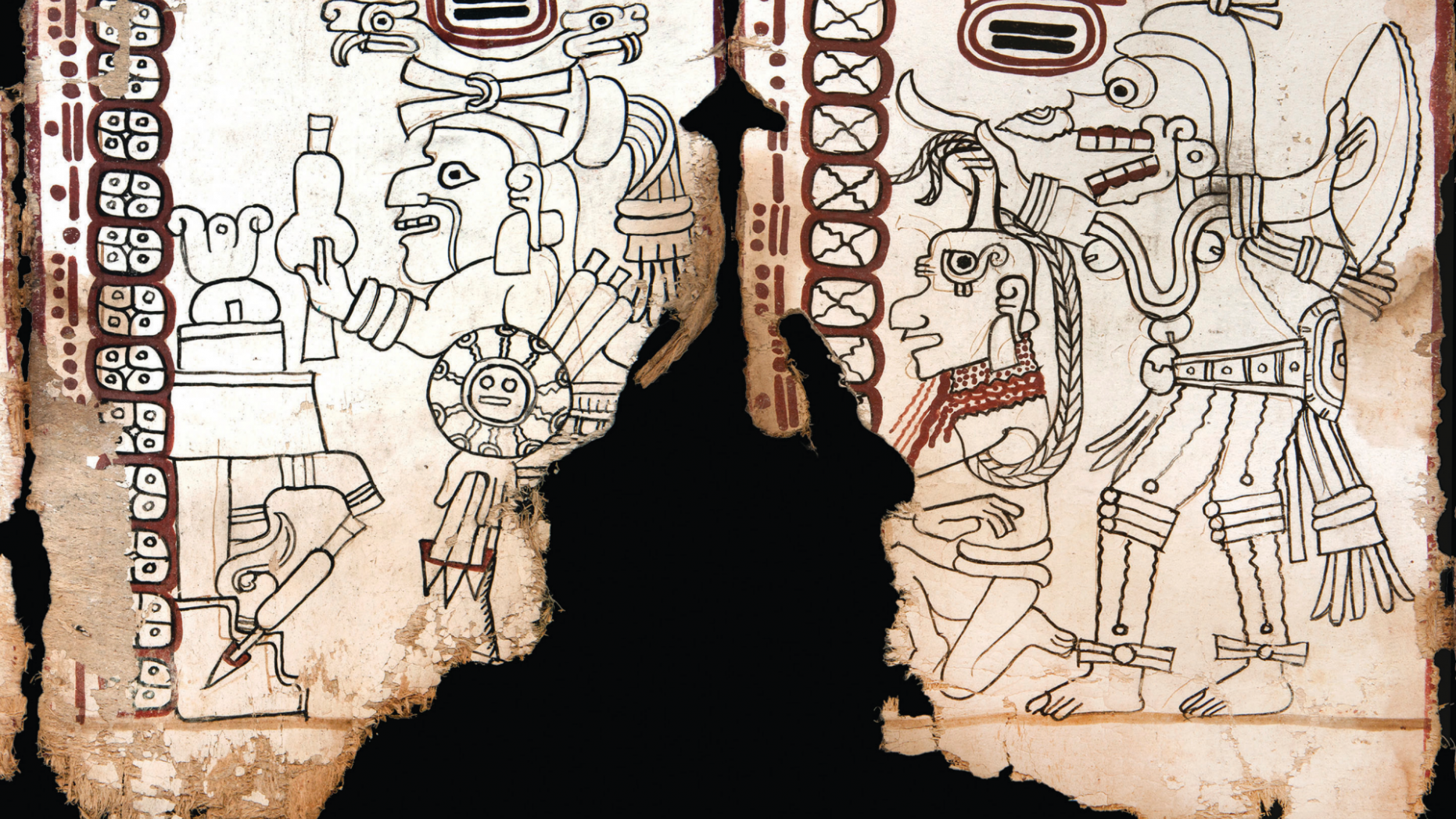
Fifty-four years after its discovery, the oldest surviving Mayan text has been officially authenticated. One of the reasons for the delay was that “for a long time, critics of the codex said the style wasn’t Mayan and that it was ‘the ugliest’ of them in terms of figures and color.”

What does that mean? It means that just because the tree bark pages were composed by a less skilled artist . . . in a more primitive age . . . living in a relatively impoverished region . . . with a smaller pallet of colors available . . . its authenticity was questioned.

Not quite what I would consider top flight analysis. Fortunately, Mexico’s National Institute of History and Anthropology has finally righted that wrong. They declared, “The Mayan Codex is authentic and the oldest, legible pre-Hispanic manuscript in the Americas,”

Seriously, the only flaw I can find in the facsimile of the pictograph portrayed above is the attachment of a right hand to a left arm. Then again, if Mark Twain could make the very same mistake roughly eight centuries later, I can forgive the ancient Mayan illustrator.

Illustrative Options

Frankly, the more one learns about the publishing industry, the less responsible we can hold authors for the final look of their works. Rarely do they even get to choose the cover art for their books, although sometimes particularly prominent authors such as J.R.R. Tolkien or C.S. Lewis are granted that privilege. That is how the artwork of Pauline Baynes became intimately associated with the two Oxbridge giants.

The lucky few may even be able to select their own fonts, with many wisely opting for the more trustworthy serif families.

For the common woman or man, we are lucky if our publishers even let us have a veto over the artwork that they commission. The exception to this comes with the nature of the self-publishing industry, where the author possesses sole authority in choosing their cover, illustrations, fonts and format.

Still, those hoping for “traditional” publication should recognize in advance how much control over their book they will forfeit to editors and publishers.

With Paper at a Premium

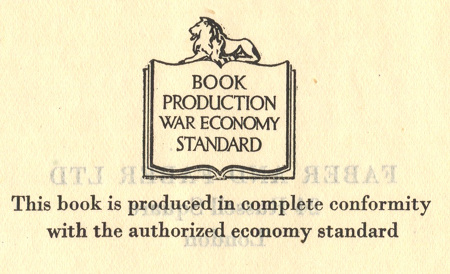
Even with influence in the selection of artwork, some aspects of publishing lie outside the control of writers. A perfect example of this is found in rationing of paper in Britain during the Second World War. The British War Economy Standard meant books visually declined in production quality.

Paper was rationed, beginning in March 1940, when publishers were allowed only 60 percent of what they had used in 1938-39. The proportion fell to 37.5 percent by January 1, 1942, when the Book Production War Economy Agreement took effect.

rationing

The scheme mandated smaller type, less white space, and inferior papers and bindings. It resulted in some remarkably ugly books, but it conserved raw materials. (“Modernity and Print I: Britain 1890-1970” by Jonathan Rose)

A number of Lewis’ books appeared in these wartime editions. They are quite collectible.

Scarce first impression of the true first edition, produced on wartime economy standard paper, and thin boards, published during the Second World War, especially hard to find in its complete original dustwrapper in collectable condition.

Let’s consider an unlikely scenario. In eight centuries, C.S. Lewis’ writings have been forgotten. Then, one archaeologist stumbles across a rare physical copy of a book, that survived the universal “grand purging” following the transfer of such items to some post-digital, post-electronic format.

What would historians assume about the value placed on Lewis’ work if it was a wartime edition compared to other “regular” books by other authors? They could not be faulted for assuming that the people of our day valued the inferior publication less than the “nicer” editions. (This is assuming that the acid-laden paper of the war years would not simply flake apart in their hands.)

The quality of the paper and print make a strong impression on readers. Just as we often judge books by their cover.

C.S. Lewis, a true bibliophile, illustrates how even a modest book (in terms of content) can be deemed “exquisite.” In a 1935 letter to his friend Arthur Greeves, he humorously describes the impending publication of The Allegory of Love.

I have finished my book which is called The Allegorical Love Poem, and is dedicated to Barfield. The Clarendon Press have accepted it and hope to have it out by May.

As I am to get 12 free copies (Dents only give one 6) you and Tchanie shall each have one and save your silver: and whatever you think of the matter, I hope, from experience of the Clarendon Press, that binding, paper etc will be—in our old formula—excellent, exquisite, and admirable.

In other words, if you can’t read it, you will enjoy looking at it, smelling it, and stroking it. If not a good book, it will be a good pet! It will be about 400 pp, they say. (It will be funny, after this, if they do it in double columns and a paper cover.)

Returning to the Mayan pages with which we began, we sadly are unable to judge them by their original codex in its pristine state. However, the extant pieces possess great historical value, even if scholars took a long time determining the fact . . . and whether or not they would ever consider it to be “a good pet.”


In case you are interested, Mere Inkling has explored Mayan books before, in “One Weakness of Modern Books.”