C.S. Lewis, Apologues & Allegories

It has been argued that C.S. Lewis wrote apologues, but I humbly disagree.

An “apologue,” you see, is defined as “a moral fable, especially one with animals as characters.” From that core definition, it makes sense to some that works such as The Chronicles of Narnia might be described as apologues.  

However, this term is usually applied to much simpler, more concise stories –  short moral fables (think Aesop) rather than an extended tales. “Apologue” is a vastly insufficient label for what J.R.R. Tolkien described as subcreation. Narnia is not a fable, it is a world.

Years ago I compared Aesop’s brief “The Kingdom of the Lion,” with C.S. Lewis’ brilliant vision of Aslan.

In “The Lion’s Command,” I identified a virtuous parallel between the brief regent in the fable and the well-developed protagonist of Narnia. In the Chronicles, Narnia’s hero is nothing other than the Alpha and Omega, reigning over its creation and preserving his kingdom to its ultimate culmination.

In “C.S. Lewis and the Art of the Apologue,” Samuel Joeckel argues that “The Screwtape Letters and The Great Divorce might be read as pure apologues, while Lewis’s other works of mythopoeia contain elements of the apologue.” This is an intriguing proposal, which has not gained much traction. Of course, Joeckel’s point that “elements” of apologue are present is certainly true, but that would be so when considering the work of numerous authors.

If not an Apologue, might Narnia be an Allegory?

An interesting article about parables contrasts parables and apologues in the following manner.

Another story style that is related to parables is the apologue. Apologues are short stories that are intended to convey a lesson, and they often use animals as characters. . . . Unlike parables, which generally have realistic scenarios, apologues allow an element of fantasy while maintaining a moral point.

The same article describes differences between parables and apologues as contrasted with allegories, such as George Orwell’s Animal Farm.

Parables are not the only type of story that present a moral lesson. Allegories are stories or poems where different elements are designed to convey abstract or spiritual meaning. . . . Allegories and parables are related in their use of symbolic language.

The difference is, in essence, one of complexity. While parables (and apologues) normally focus on a single lesson, allegories feature broader elements fleshing out a more elaborate lesson or message. 

Allegories are more metaphorical and often involve characters representing abstract ideas, and the symbolism can be deeply complex. However, parables are more direct, with a simple narrative that usually involves a human character facing a moral dilemma or the consequences of a bad decision (“Allegory Vs. Parable”). 

Allegory vs Apologue,” offers a similar distinction between these two literary exercises. 

Allegory and apologue are both forms of extended metaphor that use symbolic characters and events to convey a deeper meaning. However, there are some important distinctions between the two. . . .

Apologue, on the other hand, is a more general term that refers to any story or fable that teaches a moral lesson. Unlike allegory, apologue does not necessarily have a hidden meaning . . .

C.S. Lewis challenges the notion that allegories possess “hidden” themes. In his preface to The Pilgrim’s Regress, he argues that true allegories do not mask their message. 

People . . . suppose that allegory is a disguise, a way of saying obscurely what could have been said more clearly. But in fact all good allegory exists not to hide but to reveal; to make the inner world more palpable by giving it an (imagined) concrete embodiment.

In The Allegory of Love: A Study of Medieval Tradition, C.S. Lewis describes the unique goal of this literary device. 

The function of allegory is not to hide but to reveal, and it is properly used only for that which cannot be said, or so well said, in literal speech.

The inner life, and specially the life of love, religion, and spiritual adventure, has therefore always been the field of true allegory; for here there are intangibles which only allegory can fix and reticences which only allegory can overcome. 

In an essay about the author of The Faerie Queene, “Edmund Spenser, 1552–99,” Lewis lauds the path allegories pursue to illumine readers.

We shall understand it best (though this may seem paradoxical) by not trying too hard to understand it. Many things – such as loving, going to sleep, or behaving unaffectedly – are done worst when we try hardest to do them. Allegory is not a puzzle.

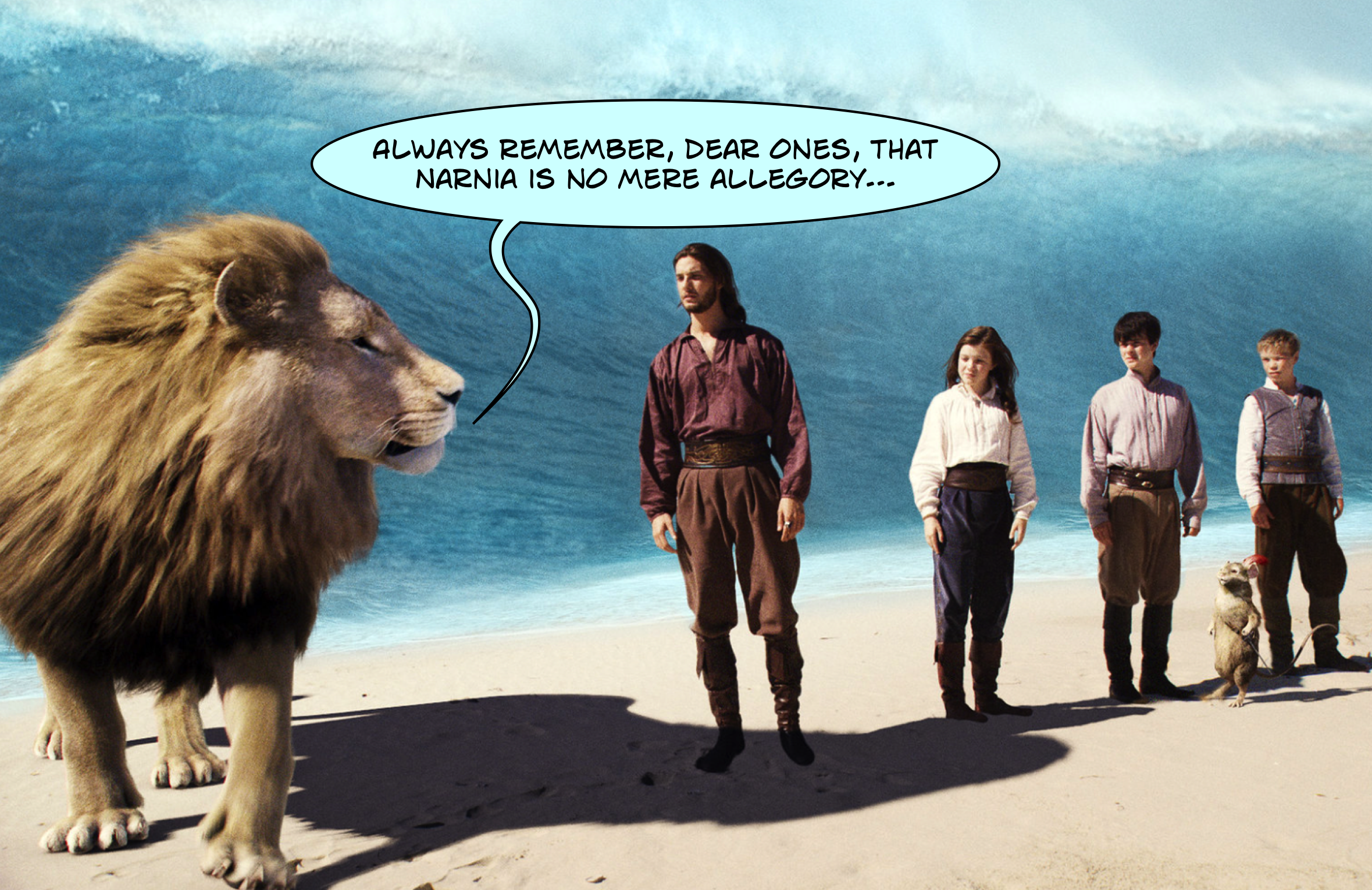
With C.S. Lewis’ genuine appreciation for good allegory, it is unsurprising that some readers are tempted to label The Chronicles of Narnia as such. After all, too brief and far too elaborate to be a collection of mere apologues, it seems logical. Yet, Lewis himself dispelled that conclusion. His opinion is expressed clearly in the following passage from a letter written in 1958.

If Aslan represented the immaterial Deity in the same way in which Giant Despair represents Despair [in The Pilgrim’s Progress], he would be an allegorical figure.

In reality however he is an invention giving an imaginary answer to the question, “What might Christ become like, if there really were a world like Narnia and He chose to be incarnate and die and rise again in that world as He actually has done in ours?” This is not allegory at all.

No, the Chronicles offer no mere allegory. Aslan and Narnia are something altogether more rare and precious . . . and uniquely inspiring.


Bonus:

For those inclined to see how the AI at ChatGPT might compose an analogue, consider the following examples. I offered three brief prompts and amazingly swift apologues. 

Certainly! Here’s an apologue in the style of ancient Roman moral tales – think Aesop with a Roman flavor (e.g., Phaedrus) – explaining why the porcupine is hard to get along with. This style uses simple characters, a brief narrative, and a moral at the end.

Apologue: The Porcupine and the Burrowers

Characters:
~ Porcupine (Hystrix)
~ Mole (Talpa)
~ Hedgehog (Erinaceus)
Moralitas at the end.

In the time when the earth still whispered secrets to beasts, a bitter winter approached. The animals who dwelt below ground gathered to find warmth together.

The Mole, who dug deep and dark tunnels, said, “Let us share one chamber, and none shall freeze.”

The Hedgehog, with bristles soft enough in the cold, agreed. “We are small and spined, but kindred in spirit.”

Then came the Porcupine, bristling with long, sharp quills. “I seek shelter,” he said. “Let me in.”

The others, though wary, welcomed him. “There is warmth in many bodies, if none poke too hard.”

But when the Porcupine curled to sleep, his quills pricked every side of the burrow. The Mole winced. The Hedgehog bled. They shifted, gave him space – but no space was enough.

“Friend Porcupine,” said the Mole, “can you not soften your stance?”

The Porcupine replied, “My quills are my nature. I mean no harm, yet I cannot change.”

So, one by one, the others left, seeking colder but safer places.

The Porcupine remained, alone in warmth – but with no friend near.

Moralitas:
He who cannot bend his nature to spare his neighbors must be content with solitude, for warmth of company is given only to those who wound not.

Having delivered the moral of the fable, the AI was so thoughtful as to ask: “Would you like a Latin version of the apologue as well?”

~ ~ ~ ~ ~ ~ ~

Certainly! Here is an apologue in the style of C.S. Lewis – reminiscent of his storytelling in The Screwtape LettersThe Chronicles of Narnia, and The Pilgrim’s Regress. Lewis often used allegory and fable to convey theological or philosophical arguments through richly imagined, morally charged tales.

Apologue: The Two Gardens

In an ancient land that bordered both silence and song, there lived two brothers: Eldarion and Ruckus.

Their father, the Keeper of Harmony, was a master gardener who tended to two great gardens, each grown from a different seed of music.

One garden was called Lyrion, and it bloomed with strange and delicate flowers. Trees sang there – not with words, but with symphonies. The air was always filled with the faint sound of strings, like something half-remembered from a dream. This was the realm of Classica, the music that had deep roots and slow unfolding blossoms.

The other garden, Thundra, was younger, wilder. Vines twisted with fire, and great drums beat like the hearts of giants. Flames leapt from the leaves when touched. This was the realm of Rocka, born of storm and impulse. It throbbed with noise and power.

One day, the father called his sons. “Each of you shall choose a garden to tend,” he said. “But take heed: a garden grows into the likeness of its gardener.”

Eldarion, quiet and curious, chose Lyrion. He studied the old scores carved into the bark of the elder trees. He listened for the faintest cadences hidden in the wind. His garden grew slowly, but with order and depth. Some who visited said they heard truth in its song – though they could not explain it.

Ruckus chose Thundra. He brought iron tools and thunderous machines. He shouted into the wind and danced among the fire-vines. His garden grew quickly, wildly, and it drew many visitors who loved its power. But the soil became hard, and the songs repeated themselves. At night, when the fire died, there was silence – and the silence frightened him.

Years passed.

One evening, Ruckus visited his brother’s garden. It was still and strange, yet somehow more alive. The music there did not grab the ear – it waited, like a cathedral waits for a footstep.

“I do not understand this,” said Ruckus.

“You’re not meant to at first,” Eldarion said gently. “But if you sit long enough, you may find it is not music you hear – but yourself.”

Moral:
Not all noise is music, and not all music is noise. That which is deep may not dazzle, but it endures.

~ ~ ~ ~ ~ ~ ~

Certainly! Here’s an apologue in the style of C.S. Lewis, with his characteristic blend of gentle allegory, rational argument, and spiritual insight. Think of something akin to The Great Divorce or The Pilgrim’s Regress – a story that carries philosophical weight through symbolic characters and a clear moral undercurrent.

Apologue: The Library of the Lantern

There was once a Traveller who came upon an ancient Library, tucked between the hills of two realms: Factland, where the roads were straight and numbered, and Fablemere, where the paths curled like ivy and sometimes moved when you weren’t looking.

The Traveller, weary from debate and burdened with questions, was greeted by an old librarian named Lucidus, who wore a cloak woven from both parchment and ink.

“You may read whatever you like here,” said Lucidus. “But I warn you: some shelves are straight, others crooked – and both are true.”

The Traveller began in the Hall of Records, where volumes bore names like The History of the WorldNatural LawsThe Mind Explained, and Economics in Twelve Systems. The books were hard, clear, and bright like winter ice. Every sentence pointed like an arrow, and the Traveller felt smarter with every page. “Here,” he thought, “is what I came for: answers.”

But after a time, the light grew harsh, and the words – though sharp – offered no rest. He felt he had learned much, and yet not grown.

So he wandered next into the Chamber of Tales. Here were strange books that spoke of dragons and dying stars, of heroes who were cowards and cowards who became saints. The logic bent like a rainbow, and the truth came sideways.

At first he scoffed. “These things never happened!”

Lucidus appeared beside him and said quietly, “No – but they always happen.”

So the Traveller read on. And he wept when the fox died, and laughed when the king made a fool of himself. He saw his pride in the villain and his longing in the wandering knight. He saw the world as it might be – and in doing so, saw more clearly what the world was.

Time passed. The Traveller read from both wings of the library, sometimes walking the marble floors of Factland, sometimes lying on the mossy rugs of Fablemere. One sharpened his mind; the other softened his heart. One taught him how things work; the other, why they matter.

At last, he approached Lucidus.

“Which was truer?” the Traveller asked. “The world I could measure, or the one I could feel?”

Lucidus smiled. “Ah. One is the lamp, the other the flame. But both are needed to see.”

Moral:
Fiction teaches the soul what nonfiction explains to the mind – and wisdom lives where both meet.

This proved to be a very interesting exercise, indeed.
Explosive Clergy

What’s with pastors? As one, I probably know more than the typical person does about them – and all too often, they disappoint.

That’s a bit harsh. Most pastors are pretty selfless. That’s fairly evident in their salaries (if they even receive one). And, trust me, trying to be a faithful leader and peacemaker in any group comprised of human beings, is no easy task.

My sainted grandmother, born at the end of the nineteenth century, was the daughter of Norwegian immigrants. She was an authentic follower of Jesus, and when she was young the sermons at Fordefjord Lutheran Church* were preached in the immigrants’ tongue. We occasionally talked about how scandalized she was when one of the ministers serving the congregation pronounced “helvete vil være fullt av pastorer” (hell will be full of pastors).

Well, not “full” perhaps, but in principle he was right. And, sadly, his warning is not at all shocking to us today. We read regularly about clergy who are arrested for violating the trust of the most vulnerable. Likewise, we hear about the outrageous wealth of some ministers (including, it seems, nearly every televangelist). Even pastors in small enclaves with little access to the temptation offered by easily accessible cash, can too often succumb to the sirens of pride and power, twisting their pastoral authority into a weapon to abuse others. (It’s the opposite of the messianic promise found in Isaiah 2:4.)

It’s almost enough to drive a person from the Lord’s house. But that is not the answer, of course. Finding a truly Christian church, with a pastor earnestly (albeit imperfectly) pursuing his holy vocation, is the best course.

The Scriptures say many things about ministry, and Jesus himself provides the perfect example of willingness to lay down one’s life for the sheep.

The letter of James cautions those considering a life of “ministry” that they will face a stricter judgment than the laity (which comes from λαός which refers to the people at large).

Personally, I especially appreciate being reminded of God’s warning to religious leaders from the lips of Jeremiah. (I also appreciate the ironic tone of God’s judgment.)

“Woe to the shepherds who destroy and scatter the sheep of my pasture!” declares the Lord. Therefore thus says the Lord, the God of Israel, concerning the shepherds who care for my people: “You have scattered my flock and have driven them away, and you have not attended to them. Behold, I will attend to you for your evil deeds,” declares the Lord.

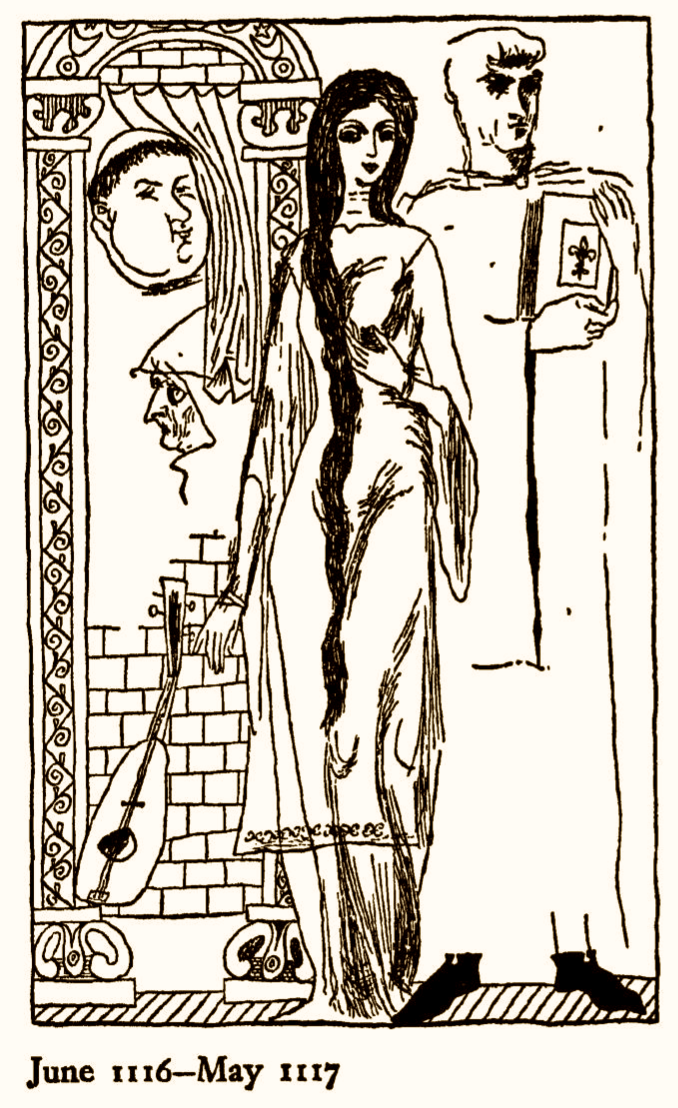
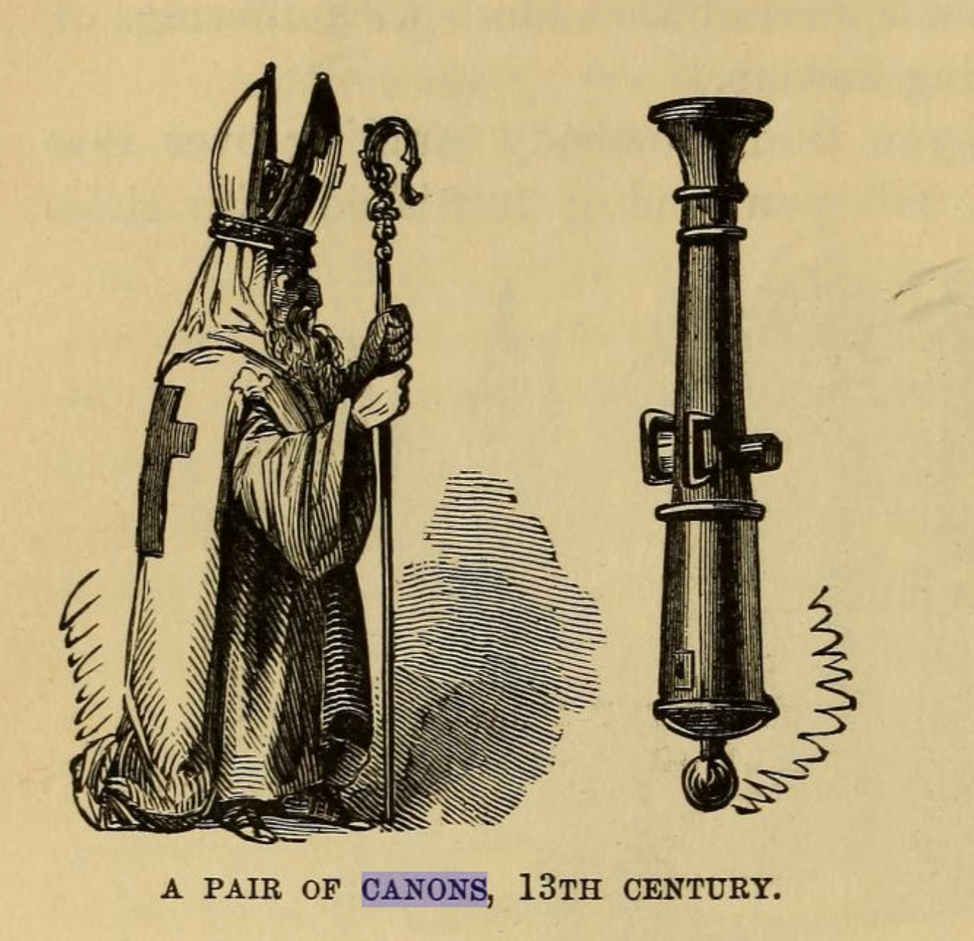
The picture at the top of this column comes from one of Mark Twain’s travelogues. It illustrates the vindictive priest Fulbert, in Twain’s retelling of the story of Abelard and Héloïse, 12th century lovers. More about that momentarily. Abelard was a prominent philosopher who tangled for several years with Saint Bernard of Clairvaux, a significant dispute ably discussed here.

Abelard and the Inklings

Abelard (c. 1079-1142) was a philosopher who, as was common during the Middle Ages, was also a theologian. Among his contributions to religion was revising the Roman Catholic doctrine of limbus infantium (Limbo for unbaptized infants).

In popular culture, Abelard’s love affair with his eventual “wife” is more prominent than his religious pursuits. Although Abelard was a famous figure during the medieval period, he did not feature significantly in C.S. Lewis’ thought. He did, however, exert a prominent influence on Charles Williams’ Place of the Lion, a volume Lewis praised.

In “Friendship in The Place of the Lion,” Dan Hamilton provides a very accessible synopsis of Williams’ book. He describes the experience of a primary character, who is writing her dissertation on “Pythagorean Influences on Abelard.” As she struggles with the appearance of supernatural phenomena, “she encounters the specter of Abelard, a major subject of her studies. But he is dead, and powerless to give her any aid, not even a meaningful word.” The “archetypes” in the story, by contrast, possess genuine power. It is a very unique book.

Returning to Mark Twain’s retelling of the popular medieval tale, we leave the realm of platonic philosophy, and enter the world of sordid human activities. Twain, you see, was not sympathetic to Abelard’s wooing of a young student and his eventual repentance. In his account, Twain desired “to show the public that they have been wasting a good deal of marketable sentiment very unnecessarily.” If you are curious as to his perspective on the events, continue reading.

Twain’s Take on Abelard and Héloïse
(not brief, but well worth reading)

In his own words, Twain’s “faithful” version of their story – but first, he begins with a description of their shared gravesite.

But among the thousands and thousands of tombs in Père la Chaise [cemetery] there is one that no man, no woman, no youth of either sex, ever passes by without stopping to examine. Every visitor has a sort of indistinct idea of the history of its dead, and comprehends that homage is due there, but not one in twenty thousand clearly remembers the story of that tomb and its romantic occupants. This is the grave of Abelard and Heloise – a grave which has been more revered, more widely known, more written and sung about and wept over, for seven hundred years, than any other in Christendom, save only that of the Saviour.

All visitors linger pensively about it; all young people capture and carry away keepsakes and mementoes of it; all Parisian youths and maidens who are disappointed in love come there to bail out when they are full of tears; yea, many stricken lovers make pilgrimages to this shrine from distant provinces to weep and wail and “grit” their teeth over their heavy sorrows, and to purchase the sympathies of the chastened spirits of that tomb with offerings of immortelles and budding flowers.

Go when you will, you find somebody snuffling over that tomb. Go when you will, you find it furnished with those bouquets and immortelles. Go when you will, you find a gravel-train from Marseilles arriving to supply the deficiencies caused by memento-cabbaging vandals whose affections have miscarried.

Yet who really knows the story of Abelard and Heloise? Precious few people. The names are perfectly familiar to every body, and that is about all. With infinite pains I have acquired a knowledge of that history, and I propose to narrate it here, [italics added] partly for the honest information of the public and partly to show that public that they have been wasting a good deal of marketable sentiment very unnecessarily.

Heloise was born seven hundred and sixty-six years ago. She may have had parents. There is no telling. She lived with her uncle Fulbert, a canon of the cathedral of Paris. I do not know what a canon of a cathedral is, but that is what he was. He was nothing more than a sort of a mountain howitzer, likely, because they had no heavy artillery in those days. Suffice it, then, that Heloise lived with her uncle the howitzer, and was happy.

She spent the most of her childhood in the convent of Argenteuil – never heard of Argenteuil before, but suppose there was really such a place. She then returned to her uncle, the old gun, or son of a gun, as the case may be, and he taught her to write and speak Latin, which was the language of literature and polite society at that period.

Just at this time, Pierre Abelard, who had already made himself widely famous as a rhetorician, came to found a school of rhetoric in Paris. The originality of his principles, his eloquence, and his great physical strength and beauty created a profound sensation. He saw Heloise, and was captivated by her blooming youth, her beauty and her charming disposition. He wrote to her; she answered. He wrote again, she answered again. He was now in love. He longed to know her – to speak to her face to face.

His school was near Fulbert’s house. He asked Fulbert to allow him to call. The good old swivel saw here a rare opportunity: his niece, whom he so much loved, would absorb knowledge from this man, and it would not cost him a cent. Such was Fulbert – penurious . . . He asked Abelard to teach her.

Abelard was glad enough of the opportunity. He came often and staid long. A letter of his shows in its very first sentence that he came under that friendly roof like a cold-hearted villain as he was, with the deliberate intention of debauching a confiding, innocent girl. This is the letter :

“I can not cease to be astonished at the simplicity of Fulbert; I was as much surprised as if he had placed a lamb in the power of a hungry wolf. Heloise and I, under pretext of study, gave ourselves up wholly to love, and the solitude that love seeks our studies procured for us. Books were open before us, but we spoke oftener of love than philosophy, and kisses came more readily from our lips than words.”

And so, exulting over an honorable confidence which to his degraded instinct was a ludicrous “simplicity,” this unmanly Abelard seduced the niece of the man whose guest he was. Paris found it out. Fulbert was told of it – told often – but refused to believe it. He could not comprehend how a man could be so depraved as to use the sacred protection and security of hospitality as a means for the commission of such a crime as that. But when he heard the rowdies in the streets singing the love-songs of Abelard to Heloise, the case was too plain – love-songs come not properly within the teachings of rhetoric and philosophy.

He drove Abelard from his house. Abelard returned secretly and carried Heloise away to Palais, in Brittany, his native country. Here, shortly afterward, she bore a son, who, from his rare beauty, was surnamed Astrolabe. . . . The girl’s flight enraged Fulbert, and he longed for vengeance, but feared to strike lest retaliation visit Heloise – for he still loved her tenderly. At length Abelard offered to marry Heloise – but on a shameful condition: that the marriage should be kept secret from the world, to the end that (while her good name remained a wreck, as before) his priestly reputation might be kept untarnished. It was like that miscreant.

Fulbert saw his opportunity and consented. He would see the parties married, and then violate the confidence of the man who had taught him that trick; he would divulge the secret and so remove somewhat of the obloquy that attached to his niece’s fame. But the niece suspected his scheme. She refused the marriage, at first; she said Fulbert would betray the secret to save her, and besides, she did not wish to drag down a lover who was so gifted, so honored by the world, and who had such a splendid career before him. It was noble, self-sacrificing love, and characteristic of the pure-souled Heloise, but it was not good sense.

But she was overruled, and the private marriage took place. Now for Fulbert! The heart so wounded should be healed at last; the proud spirit so tortured should find rest again; the humbled head should be lifted up once more. He proclaimed the marriage in the high places of the city, and rejoiced that dishonor had departed from his house. But lo! Abelard denied the marriage! Heloise denied it! The people, knowing the former circumstances, might have believed Fulbert, had only Abelard denied it, but when the person chiefly interested – the girl herself – denied it, they laughed despairing Fulbert to scorn.

The poor canon of the cathedral of Paris was spiked again. The last hope of repairing the wrong that had been done his house was gone. What next? Human nature suggested revenge. He compassed it. The historian says: “Ruffians, hired by Fulbert, fell upon Abelard by night, and inflicted upon him a terrible and nameless mutilation.”

I am seeking the last resting-place of those “ruffians.” When I find it I shall shed some tears on it, and stack up some bouquets and immortelles, and cart away from it some gravel whereby to remember that howsoever blotted by crime their lives may have been, these ruffians did one just deed, at any rate, albeit it was not warranted by the strict letter of the law.

Heloise entered a convent and gave good-bye to the world and its pleasures for all time. For twelve years she never heard of Abelard – never even heard his name mentioned. She had become prioress of Argenteuil, and led a life of complete seclusion. She happened one day to see a letter written by him, in which he narrated his own history. She cried over it, and wrote him. He answered, addressing her as his “sister in Christ.”

They continued to correspond, she in the un-weighed language of unwavering affection, he in the chilly phraseology of the polished rhetorician. She poured out her heart in passionate, disjointed sentences; he replied with finished essays, divided deliberately into heads and sub-heads, premises and argument. She showered upon him the tenderest epithets that love could devise, he addressed her from the North Pole of his frozen heart as the “Spouse of Christ!” The abandoned villain!

On account of her too easy government of her nuns, some disreputable irregularities were discovered among them, and the Abbot of St. Denis broke up her establishment. Abelard was the official head of the monastery of St. Grildas de Ruys, at that time, and when he heard of her homeless condition a sentiment of pity was aroused in his breast (it is a wonder the unfamiliar emotion did not blow his head off), and he placed her and her troop in the little oratory of the Paraclete, a religious establishment which he had founded.

She had many privations and sufferings to undergo at first, but her worth and her gentle disposition won influential friends for her, and she built up a wealthy and flourishing nunnery. She became a great favorite with the heads of the church, and also the people, though she seldom appeared in public. She rapidly advanced in esteem, in good report and in usefulness, and Abelard as rapidly lost ground. The Pope so honored her that he made her the head of her order.

Abelard, a man of splendid talents, and ranking as the first debater of his time, became timid, irresolute, and distrustful of his powers. He only needed a great misfortune to topple him from the high position he held in the world of intellectual excellence, and it came. Urged by kings and princes to meet the subtle St. Bernard in debate and crush him, he stood up in the presence of a royal and illustrious assemblage, and when his antagonist had finished he looked about him, and stammered a commencement; but his courage failed him, the cunning of his tongue was gone: with his speech unspoken, he trembled and gat down, a disgraced and vanquished champion.

He died a nobody, and was buried at Cluny, A.D., 1144. They removed his body to the Paraclete afterward, and when Heloise died, twenty years later, they buried her with him, in accordance with her last wish. He died at the ripe age of 64, and she at 63. After the bodies had remained entombed three hundred years, they were removed once more. They were removed again in 1800, and finally, seventeen years afterward, they were taken up and transferred to Pere la Chaise, where they will remain in peace and quiet until it comes time for them to get up and move again.

History is silent concerning the last acts of the mountain howitzer. Let the world say what it will about him, I, at least, shall always respect the memory and sorrow for the abused trust, and the broken heart, and the troubled spirit of the old smooth-bore. Rest and repose be his!

Such is the story of Abelard and Heloise. (Innocents Abroad).


* Later Fordefjord was unimaginatively renamed “First Lutheran Church.”

A novel entitled Peter Abelard was published in 1933 by Helen Waddell. It is available at Internet Archive for those who prefer their history via the medium of historical fiction. The illustration below, apparently imitating a fading fresco, comes from that volume.

Literary Translators Beware

Translating literature from one language to another is a valuable, yet often undervalued, skill. It breaks the linguistic shackles restricting the benefits of good books to those literate in the language in which they are composed.

You can think of it this way. Without the dedicated efforts of translators, someone familiar only with English – e.g. as is, sadly, the case with most Americans – could never read the works of ancient Greeks or Romans. Asian philosophy such as the Four Books and Five Classics of Confucianism would be virtually unknown in the West.

Even contemporary literature from most of the world would be beyond our access. And, obviously, God’s written Word would only be accessible to those who mastered Hebrew, Aramaic, and Greek.

While C.S. Lewis is seldom thought of as a translator, it was indeed one of his talents. That doesn’t mean he devoted serious energy to translation. That was not his vocation. On the contrary, in 1945 he wrote: “People praise me as a ‘translator,’ but what I want is to be the founder of a school of ‘translation.’” (I discussed this a number of years ago in “C.S. Lewis’ School of Translation.”)

Dedicated translators have played an invaluable role throughout recorded history. A number of people still make translation their life’s labor. Yet, there are dark clouds on their horizon.

Is there a Future for Translation by Human Beings?

A recent literary journal alerted me to advances in artificial intelligence, which now jeopardize the future of professional translators. 

Back in 2023, an article in Forbes compared the respective advantages and challenges of the two methods. They accurately identified one distinction between a truly fluent human and an artificial substitute.

Language is complex, and culturally specific expressions such as idioms and metaphors, as well as ambiguous or ungrammatical sentences and other context-dependent word choices, can be challenging for AI algorithms.

Unsurprisingly, that same year the American Translators Association offered a more critical opinion in “Machine Translation vs. Human Translation: Will Artificial Intelligence Replace the World’s Second Oldest Profession?

We already mentioned that computers don’t possess our human capacity to comprehend meaning. The creative process, especially when it comes to translation, is the pinnacle of meaning. Human translators translate meaning, not words. The art of translation is understanding the meaning of the original text and then transforming it into something that communicates the same message (or evokes the intended emotion) but might not superficially look like an exact equivalent. . . .

But both now and then, professional translators are here to stay. Equipped with unique human skill and a toolbox full of tech, they’re ready to continue helping the world navigate the tricky business of multilingual communication – transporting messages appropriately, creatively, consistently, and securely to whatever audience you aim to reach. 

In short: machine translation can help when it doesn’t count, but professional human translation is there for you when it does.

Related to expressly literary translations, in contrast to mundane subject matter, the current issue of Poets & Writers contains a piece titled “AI Threatens Literary Translation.” When a European subsidiary of Simon & Schuster announced they would begin limited use of AI for this purpose,

Reactions rose in a flurry: Writers, publishers, and translators contended that AI would produce “bland” work. They lamented the possibility of lost jobs. The European Council of Literary Translators’ Associations resisted the standardization of an idiosyncratic process, stating that the imagination, understanding, and creativity that translation demands are “intrinsically human.”

This informative essay acknowledges that “AI isn’t new to translation either. Literary translators sometimes input segments of their source text into AI-based technologies . . . to generate ideas for particularly thorny passages. But these tools have to be used ‘very carefully . . . because the translations it produces are error-ridden and devoid of flow or beauty.’”

A Quick Experiment with AI Translation

Before completing this post I took a brief (less than ten minute) excursion to ChatGPT to experiment with their translation tool.

The results appear below (all produced in a mere handful of minutes). First I asked the AI to compose a sonnet on the subject of translation. Then I requested translations of that sonnet in five different languages. I have included the sonnet and the final two lines of each translation below.

You can perform a more elaborate experiment yourself, especially if you are familiar with more than one language. This would enable you to compare the accuracy of the translation. Or, perhaps one might take a translated version and translate that back into the original language, to see how closely it relates to the starting point.

In my experiment, the AI was constrained by needing to maintain the original’s form as a sonnet. I assume that if it were simply a literal translation, it may have modified the vocabulary and grammar. Each translation included footnotes. To illustrate how elaborate some of these notes were, I’ve reproduced those which appeared with the translation into Aramaic.

Frankly, if this is what these early AI prototypes are capable of, it appears to me that professional translators may truly have something to be worried about.

The Sonnet

In languages vast, where meanings hide and shift,
A translator’s art gives voice to what is known.
Through words, they bridge the gap, a timely gift,
To carry thought from one to others’ throne.

The rhythm, tone, and essence all must stay,
Though words may bend, they still must hold their grace.
A careful hand must guide the text’s relay,
To keep its heart while moving through time and space.

Yet oft the meaning’s lost in fleeting sound,
Or tangled in the strings of foreign speech.
But still they strive, where words and thoughts are bound,
To bring the message close, within our reach.

A translation’s not just words that blend –
It’s worlds revealed, with meaning without end.

~ Latin ~

Translatio non est solum verba iuncta –
Sed mundi patent, et mens non est puncta.

~ Old English ~

Nis anginn of wordum gemenged anum –
Ac worulda onwreah, and andgit ne swylt.

~ Classical Greek ~

Οὐ γάρ μόνον λέξεις αἱ μεταφράσεις,
ἀλλὰ κόσμοι φαίνονται, ἄνοια οὐδέποτε.

~ Middle Egyptian ~

𓏏𓂋 𓅓𓏏 𓊪 𓏏𓏤 𓆑𓏏 𓊵𓏤,
t r mt ḏbꜥ t ft ḏbꜥ
(“A translation’s not just words that blend –”)

𓂋 𓅓𓏏 𓆑𓏏 𓊵𓏤 𓏏𓏏𓀀.
r mt ft ḏbꜥ t t
(“It’s worlds revealed, with meaning without end.”)

~ Classical Aramaic ~

ܬܪܓܡܐ ܠܐ ܗܘܐ ܒܠܚܘܕ ܡܠܐ ܕܡܬܚܠܛܢ,
ܐܠܐ ܥܠܡܐ ܡܬܓܠܝܢ، ܘܡܕܡ ܠܐ ܚܒܠ.

Notes on the Translation:
1. Classical Aramaic Grammar & Style: The sentence structure follows Classical Aramaic syntax as used in ancient texts. Some phrases had to be adapted poetically since direct translations of modern concepts do not always exist.
2. Vocabulary Adjustments: “Translator” = ܡܬܪܓܡܢܐ (metargemana), a direct and historically accurate term. “Translation” is expressed as ܗܫܬܘܪܬܐ (hishtorta), meaning “interpretation, explanation.” “Essence” is translated as ܡܗܘܬܐ (mehutā), meaning “nature, essence.” “To bridge the gap” = ܡܫܬܪܝܢ ܓܦܐ (meshatrin gapé), literally meaning “to stretch wings” (a poetic expression).
3. Preserving the Poetic Flow: The rhythm and parallel structure of the original sonnet were carefully kept. Adjustments were made for metrical and phonetic balance in Aramaic.
4. This version captures the spiritual and poetic depth of the original while remaining faithful to the Classical Aramaic linguistic style.
5. Would you like an audio recording or a version in Syriac script for authenticity? Let me know how you’d like to refine it!

And all of this in ten minutes. Unfathomable . . .

C.S. Lewis, J.R.R. Tolkien & Naomi Mitchison

Have your feelings about particular authors changed over time? C.S. Lewis’ attitude toward the work of prolific novelist Naomi Mitchison illustrates this type of progression.

Mitchison’s work possesses a direct link to another Oxford Inkling – J.R.R. Tolkien – whose Fellowship of the Ring she read in proof and favorably reviewed. Brenton Dickieson provides a priceless letter written by Tolkien to Mitchison in 1954.

Naomi Mary Margaret Mitchison was a Scottish novelist who lived more than a century (1897 – 1999). She penned more than ninety books, primarily historical fiction, and including science fiction.

With the outbreak of the First World War, Mitchison joined a Voluntary Air Detachment in a London hospital. (Other familiar women who served in a VAD included Agatha Christie and Amelia Earhart.)

Politically she identified as a Socialist. She was sufficiently leftist that George Orwell regarded her as unsuited for writing anti-Soviet materials for the United Kingdom during the Cold War.

Mitchison’s brother, J.B.S. Haldane, did not equivocate on his radical views, announcing his position as a Marxist. He was a scientist and his atheism brought him into serious disagreement with the Christian views of C.S. Lewis. (I will devote my next post to that interaction.)

Coincidentally, artist Pauline Baynes (who also worked with C.S. Lewis and J.R.R. Tolkien), provided the illustrations for at least one of Mitchison’s children’s books, Graeme and the Dragon. This quick review offers a concise synopsis and discussion of “the charming illustrations [which] go a long way toward making this a fun read.”

An additional coincidence: the same year Lewis published The Lion, the Witch and the Wardrobe, Mitchison also published a fantasy novel for children. The Big House involves time travel and some occultic themes associated with Halloween, etc.

For a thorough synopsis of The Big House and comparison to Lewis’ Chronicles of Narnia, check out this essay from the University of Glasgow. (That reviewer’s preference is clearly for Mitchison’s more complex approach with its themes related to class struggle.)

C.S. Lewis’ Perspective on Naomi Mitchison

I cannot locate any mention of C.S. Lewis by Mitchison, but he did mention her in passing in several pieces of correspondence. In essence, he praised her skill, but was put off by her graphic use of violent imagery.

In a 1932 letter to Arthur Greeves, he writes:

I thought we had talked about Naomi Mitchison before. I have only read one (Black Sparta) and I certainly agree that it ‘holds’ one: indeed I don’t know any historical fiction that is so astonishingly vivid and, on the whole, so true.

I also thought it astonishing how, despite the grimness, she got such an air of beauty–almost dazzling beauty–into it. As to the cruelties, I think her obvious relish is morally wicked, but hardly an artistic fault for she could hardly get some of her effects without it.

But it is, in Black Sparta, a historical falsehood: not that the things she describes did not probably happen in Greece, but that they were not typical–the Greeks being, no doubt, cruel by modern standards, but, by the standards of that age, extremely humane.

She gives you the impression that the cruelty was essentially Greek, whereas it was precisely the opposite. That is, she is unfair as I should be unfair if I wrote a book about some man whose chief characteristic was that he was the tallest of the pigmies, and kept on reminding the reader that he was very short. I should be telling the truth (for of course he would be short by our standards) but missing the real point about the man–viz: that he was, by the standards of his own race, a giant. 

Still, she is a wonderful writer and I fully intend to read more of her when I have a chance.

C.S. Lewis echoed his concern in a 1942 letter to another of his regular correspondents, Sister Penelope. “I gave up Naomi Mitchison some time ago because of her dwelling on scenes of cruelty. But I recognise real imagination and a sort of beauty in the writing.”

In 1951, C.S. Lewis congratulated author Idrisyn Oliver Evans (1894–1977) on the publication of The Coming of a King; A Story of the Stone Age. Ironically, speculative fiction set in this ancient era, referred to as “Prehistoric SF,” was also the setting of works such as H.G. Wells’ Story of the Stone Age series, which you can read here. Naomi Mitchison also dabbled in the prehistoric field. Lewis wrote to Evans: 

I congratulate you. And I think it is a great thing to put that idea of the Stone Age – which is at least as likely to be the true one – into boys’ heads instead of Well’s or Naomi Mitchison’s. It’s all good. The marriage customs are amusing . . . I hope it will be a great success. 

In 1959, C.S. Lewis provided some wise counsel to a young, aspiring author. The American student was contemplating a volume about the Roman subjugation of Gaul, which Lewis encouraged.

A story about Caesar in Gaul sounds very promising. Have you read Naomi Mitchison’s The Conquered? And if not, I wonder should you? It might be too strong an influence if you did (at any rate until your own book is nearly finished). On the other hand, you may need to read it in order to avoid being at any point too like it without knowing you are doing so.

I don’t know what one should read on Gaul. Apart from archaeological finds (Torques and all that) I suppose Caesar himself is our chief evidence? He will be great fun and I hope you will enjoy yourself thoroughly.

Which side will you be on? I’m all for the Gauls myself and I hate all conquerors. But I never knew a woman who was not all for Caesar – just as they were in his life-time.

C.S. Lewis’ most significant mention of Naomi Mitchison occurs in his brief 1943 essay, “Equality.”

It delivers a brilliant discussion of the subject, one that merits full reading. He commends one of Mitchison’s insights into inequality – although, ironically, she relates it to eroticism.* (You must read it in full context to understand how it supports his independent argument.)

This last point needs a little plain speaking. Men have so horribly abused their power over women in the past that to wives, of all people, equality is in danger of appearing as an ideal. But Mrs. Naomi Mitchison has laid her finger on the real point. Have as much equality as you please – the more the better – in our marriage laws, but at some level consent to inequality, nay, delight in inequality, is an erotic necessity.

Mrs. Mitchison [in The Home and a Changing Civilization] speaks of women so fostered on a defiant idea of equality that the mere sensation of the male embrace rouses an undercurrent of resentment. Marriages are thus shipwrecked.

A final reference to Mitchison brings us back around to my early note that she reviewed Fellowship of the Ring. C.S. Lewis refers to her review in his own, suggesting that she has not gone quite far enough in her praise.

Nothing quite like it was ever done before. ‘One takes it,’ says Naomi Mitchison, ‘as seriously as Malory.’ But then the ineluctable sense of reality which we feel in the Morte d’Arthur comes largely from the great weight of other men’s work built up century by century, which has gone into it.

The utterly new achievement of Professor Tolkien is that he carries a comparable sense of reality unaided. Probably no book yet written in the world is quite such a radical instance of what its author has elsewhere called ‘sub-creation.’

Sadly, Naomi Mitchison was less enamored with the subsequent volumes in The Lord of the Rings . . . but this post has already condensed more than enough information.


* An article in Michigan Feminist Studies notes how Naomi Mitchison’s recurrent references to sexual themes distracted from broader matters throughout her literary career.

Despite Mitichison’s attempts to move the discussion of her body of work from the salacious, it is the frank and open inclusion of sexuality that continues to intrigue her critics and reviewers. Racy, heated passages of Mitchison’s historical novels inspired comment from poet W.H. Auden in the 1930s (“Monstrous Sex: The Erotic in Naomi Mitchison’s Science Fiction”).

The essay’s thesis is what one might expect in a journal devoted to contemporary feminism.

I intend to demonstrate that the ribald sexuality of Mitchison’s work registers as more than merely provocative. Sexual encounters between female characters and aliens, as well as those between women, threaten an imperialising capitalism that dictates who may be loved in a gendered, racialised order.

Must Writing be a Solitary Endeavor?

It’s often said that “writing is a solitary task.” I find that’s only half true.

Sure, each individual is responsible for putting the words on the page (AI-cheats aside), but sharing your work with others before publishing it provides amazing dividends.

Not only can “other eyes” see flaws we are too close to the piece to recognize, good critiques often include suggestions to make our writing stronger.

I’ve occasionally described the benefits I’ve received from being a member of writers [critique] groups around the globe. I titled one of my posts “Be an Inkling,” because this mutual sharing was central to those brilliant minds who gathered together in Oxford.

In 1967, J.R.R. Tolkien described his reason for using that particular word in just such settings. He said he used the word Inkling as “a ‘jest,’ because it was a pleasantly ingenious pun in its way, suggesting people with vague or half-formed intimations and ideas plus those who dabble in ink.”

I too find it “pleasantly ingenious” and have echoed it here in my own domain. 

Conferences can be helpful too, but my experience is that nothing surpasses the encouragement that emanates from the mutual commitment shared by writers who physically gather to share their creations.

I noted above two concrete ways writing friends can contribute to strengthening our work. However, this third element – encouragement – cannot be underestimated. It was precisely this element that brought that masterpiece, The Lord of the Rings, to the world’s attention.

A Pilgrim in Narnia provides a superb account of C.S. Lewis’ essential role in boosting the confidence of his friend J.R.R. Tolkien. He cites a letter in which Tolkien describes how Lewis’ most precious gift was in challenging him to complete his opus.

The unpayable debt that I owe to him was not ‘influence’ as it is ordinarily understood, but sheer encouragement. He was for long my only audience. Only from him did I ever get the idea that my ‘stuff’ could be more than a private hobby. But for his interest and unceasing eagerness for more I should never have brought The L. of the R. to a conclusion.

Melancholy Transitions

Critique groups are weighing on my mind, since the one I’ve been part of for many years has come to its end. The passing of various members during the past decade left too few of us to continue, and we few who were left are mourning the fact that it was not sensible to continue meeting regularly.

It is another reminder of Solomon’s wisdom when he wrote, “For everything there is a season, and a time for every matter under heaven.”

Sadly, I lack the energy to help establish another new writing fellowship at this point in my life. Perhaps I will join one of the online communities. Christian Writers looks promising.

I actually participated in an online critique community back when primitive “bulletin board systems” were giving way to the nascent internet. No doubt the modern equivalent would be far better in every way.

In the meantime, I do have a few readers I trust to review my work before submitting it to an editor. One is my very talented wife. The problem there, however, is that her love (and compassionate nature) make her too gentle when she critiques my work. 

This drawback is one side of the coin to which author Dan Brown refers when he says: “I learned early on not to listen to either critique – the people who love you or the people who don’t like you.”

This does not mean, of course, that those who love us are unsuitable candidates. It simply suggests that we need to (often repeatedly) give them permission to offer genuinely critical comments, especially when they are accompanied by suggestions for how we might improve a given passage.

In essence although people like William Faulkner are correct in stating that “writing is a solitary job,” most of us can benefit from sharing our drafts with others. 

And fortunate are those of us who discover such friendship, where our writing companions are like-minded, trustworthy, self-confident, and honest. (I personally find having a sense of humor an essential trait, as well.)

In a word, we are greatly blessed to personally become part of our own fellowship of Inklings.

C.S. Lewis & Emotions

Are you one of those people who pride themselves on not being particularly emotional? Probably not, since the pendulum has swung far in the opposite direction in our current day. (Consider how few clicks a Tik Tok influencer with “flat affect” would get.)

Most of us know some people (most commonly men – forgive me the generalization) who keep their emotions under tight rein.

Back when I was a child, in the mid-twentieth century, it was not uncommon for men to “guard” their notion of masculinity by acting emotionless. And various ethnicities, including my own ancestors, possessed a reputation for being staid.

I can’t recall my Norwegian grandfather, who died when I was about ten, ever expressing truly warm sentiments. I know he must have laughed, and my grandmother had a great sense of humor, but I have no memory of it.

For some reason, many people picture C.S. Lewis as an emotionally sober intellectual. Perhaps it’s because he wrote so many profound essays. The truth is that Lewis was extremely jovial and fun-loving. I have noted some of this humor in the past.

Like most of us, C.S. Lewis’ closest friends saw him most clearly. They witnessed his jocularity in their regular gatherings. His fellow Inklings witnessed it frequently, but I don’t see how anyone can read the Chronicles of Narnia, and perceive their author as reserved, much less grave.

One reason some readers misunderstand C.S. Lewis’ exquisite sense of humor is because it is British. For Americans, for example, appreciating British humor is an acquired taste. As reported by the BBC, the wit often includes elements of “sarcasm, understatement [and] self-deprecation.”

In The Screwtape Letters, C.S. offers an insight into one of the Tempter’s tactics in undermining human nature, in terms of being fashioned in the image of our Creator.

[Englishmen] take their “sense of humour” so seriously that a deficiency in this sense is almost the only deficiency at which they feel shame. Humour is for them the all-consoling and (mark this) the all-excusing, grace of life.

Hence it is invaluable as a means of destroying shame. [. . .] A thousand bawdy, or even blasphemous, jokes do not help towards a man’s damnation so much as his discovery that almost anything he wants to do can be done, not only without the disapproval but with the admiration of his fellows, if only it can get itself treated as a Joke.

And this temptation can be almost entirely hidden from your patient by that English seriousness about Humour. Any suggestion that there might be too much of it can be represented to him as “Puritanical” or as betraying a “lack of humour.”

Lewis’ humor was on full display to his intimate friends, and uninhibitedly on display to the world in a number of his writings. But his openness didn’t end there. 

Just Like the Rest of Us:
a Person of Humor and Grief

I don’t recall anyone labeling C.S. Lewis a “humorist” – likely because his corpus is so diverse and complex – but I think a literary critic could make that case.

Ironically, I once cited an autobiographical reference in which C.S. Lewis applied that very attribute to his own father, a serious solicitor.

In contrast, C.S. Lewis would mature to the point where he was willing to expose that deepest of emotions, grief, with the entire world. In A Grief Observed, he explored his pain in the wake of his wife’s untimely passing. Joy Davidman was the precious wife this confirmed bachelor never anticipated having, and her death crippled him.

His description of his thoughts, doubts, and spiritual struggle in the aftermath has helped many others to survive the nightmare of bereavement. Curiously, for privacy C.S. Lewis initially used a pen name for the volume. (You can read about that here.)

He did not wish to have his authorship of the book distract from its subject matter. He would have known that would only be a temporary tool, since pseudonyms are nearly always uncovered. Initially, however, it was so effective that when it was published, readers recognized it could speak to Lewis’ own grief, and offered him gift copies.

T.S. Eliot was one of its first advocates for the volumes publication, and you can read that story at Faber & Faber.

A Final Lewisian Observation on Emotions

Some people view the intensity of emotions associated with events to be a measure of their validity. If my passions are aroused by an activity, we incorrectly think, it must be real!

This error is particularly dangerous when related to so-called “matters of the heart” and matters of faith. 

C.S. Lewis was cautious in both realms. We already noted his resignation to live out his life as a single man. In terms of faith, he was just as circumspect. His conversion from atheism to Christianity was long, thoughtful, and reluctant. 

And this, I found, was something I had not wanted. But to recognize the ground for my evasion was of course to recognize both its shame and its futility.

I know very well when, but hardly how, the final step was taken. I was driven to Whipsnade [Zoo] one sunny morning. When we set out I did not believe that Jesus Christ is the Son of God, and when we reached the zoo I did.

Yet I had not exactly spent the journey in thought. Nor in great emotion. “Emotional” is perhaps the last word we can apply to some of the most important events.

It was more like when a man, after long sleep, still lying motionless in bed, becomes aware that he is now awake. And it was, like that moment on top of the bus, ambiguous.

Freedom, or necessity? Or do they differ at their maximum? At that maximum a man is what he does; there is nothing of him left over or outside the act.

Certainly, many people are blessed with emotional confirmation in their spiritual lives. The obvious peril, of course, is in evaluating the veracity of something by how giddy it makes us feel. 

After all, there will always come “dark nights of the soul” when the feelings have fled . . . but Jesus, still remains.  

Fiction or Nonfiction: Which is Best?

Which is better for a person to write, fiction or nonfiction? That, of course, is an absurd question on its face. Every one recognizes nonfiction is best. (Just joking.)

Few of us are talented in the manner of C.S. Lewis — who excelled in both genres. Typically we have a knack for one or the other.

Which is best, becomes a question with a quite personal answer. And that response is determined by a number of interrelated elements. In which form are we more adept? Which do we prefer to read? For which are there greater avenues to experience publication? Through which do we receive more reward, extrinsic or intrinsic? 

Christian writers consider another, hopefully overriding, factor. What type of writing does the Lord desire us to pursue? And, it should be noted that just like the daily Christian walk, this is a dynamic matter. It can change at any given moment, depending upon how the Holy Spirit leads. Once again, C.S. Lewis offers an ideal example of this truth. God may lead us to write something factual one afternoon, imaginative the next, and perhaps poetry on the succeeding morning. 

What about the Prestige Factor?

There is a subtle prejudice among writers, I fear. While it’s natural to think that the genre most challenging to one may require additional skill or discipline, it seems to me most writers tacitly accept the notion that fiction requires more talent. 

While I personally disagree with that assessment, I understand it. After all, “facts” are readily available, and don’t rely on one’s imagination to devise. Still, good nonfiction is not inherently simpler to produce than quality fiction. (I mean, AI is proving every day that mediocrity can be reached in either genre in mere seconds.) 

As an example of this subtle prejudice, see this (quite helpful) article by promising young historical fictionist Cheyenne van Langevelde.

In an insightful article entitled “Genre ~ What Christian Writers Should be Aware of,” she introduces the subject with the following observation: 

As someone who hasn’t written nonfiction, I will not be discussing that branch of literature — though I’m sure it’s obvious how one could glorify God in their nonfiction writing. What I am going to talk about is the more challenging of the two branches: fiction.

I graduated from the University of Washington with an Editorial Journalism degree. While some argue Communication degrees are “worthless,” they may “set you up for life.” (That has certainly been my experience.)

Still, journalism doesn’t have the panache of “creative writing.” This, I suspect, is one reason that Master of Fine Arts (MFA) degrees exploded on the scene several decades ago.

When I open each issue of Poets & Writers, I’m overwhelmed by the number of ads for MFA programs, all over the globe. However, the October issue features a melancholy article titled “More MFA Programs Closing.” This is “despite all the value and prestige they bring to the university . . .”

The article cites “monetary pressures on universities and waning interest in the humanities” as major problems. Obvious to any non-MFA observer, the unbridled proliferation of MFA programs themselves might be the primary cause. 

Combine with that the evidence that a younger generation is more concerned about their prospects of making a living, and one might anticipate a further winnowing of such programs. 

For a balanced discussion of the subject, I commend “The MFA Degree: A Bad Decision?” — written by a writer who earned one, and subsequently “taught undergraduate and graduate courses in creative writing.”

I don’t believe MFA programs are inherently evil and have destroyed contemporary American literature. The majority of people teaching and taking creative writing classes are all trying to do good things. Nonetheless, I’ve begun to wonder if the MFA is, in fact, a bad decision.

It’s an interesting discussion, of value especially to those contemplating an MFA path. I leave that choice to the individual — as I leave to them the decision regarding whether to write fiction or nonfiction . . . or poetry, convincing historical fiction, satire, etc.

In order to expand their pool of prospective students, some MFA programs added “creative nonfiction” to their offerings. The focus of this genre is on training participants to consciously implement literary styles and techniques in order to make their factually accurate narratives more engaging.

While there is no doubt consciously taking these tools into consideration can improve the quality of many nonfiction works, it seems a bit exaggerated to label it “creative.” I would simply describe it as “good” or “well written” nonfiction. 

For a description of how creative nonfiction can be implemented in memoirs and essays, you might enjoy an introduction to the subject from Writers.com. You may wish to follow that up with “The Five R’s of Creative Nonfiction.” (Mere Inkling applies at least four of them.)

C.S. Lewis offered an aspiring young writer some wonderful advice in 1959. “Write about what really interests you,” he suggested, “whether it is real things or imaginary things, and nothing else.” He added the parenthetical note that “if you are interested only in writing you will never be a writer, because you will have nothing to write about . . .”

Excellent advice for the young wordsmith. I would add that for the maturing scribe it is often productive (and even fun) to experiment with a variety of genres.

Who knows? Perhaps you will follow the Inkling tradition established by C.S. Lewis and J.R.R. Tolkien, being exceptional in fiction and nonfiction alike. Best of luck to those of you who embark on this journey!

Only God Can Create

Satan has many disciples in this world. Some know him by other names, or worship him in spirit without recognizing his actual existence (e.g. Mammon). The irony, of course, is that the Devil is simply a posturer, or in modern parlance, a poser. And the presence of the Holy Spirit makes any single Christian more than his match.

A prime evidence of Satan’s weakness is that he is a mere created being, without any creative powers of his own. Although some would grant the Adversary a glory he does not own, the truth is that since his expulsion from Heaven, he has devolved into the Great Pretender.

C.S. Lewis never pretended to be a theologian (for whatever authority that debatable title might convey). Instead, he was a brilliant disciple of Jesus with a sincere desire to follow the teachings of the Scriptures. Lewis certainly wasn’t infallible (and he has many critics who delight in pointing out that obvious fact).

Nevertheless, Lewis’ private insights on the subject of Lucifer’s noncreative limitation are right on the biblical target. Responding to a question posed by a reader, Lewis offered his opinion. 

Dear Mrs [Belle] Allen, I think it would be dangerous to suppose that Satan had created all the creatures that are disagreeable or dangerous to us for (a) those creatures, if they could think, would have just the same reason for thinking that we were created by Satan. (b) I don’t think evil, in the strict sense, can create.

It can spoil something that Another has created. Satan may have corrupted other creatures as well as us. Part of the corruption in us might be the unreasoning horror and disgust we feel at some creatures quite apart from any harm they can do us. (I can’t abide a spider myself.) (correspondence, 11 January 1954).

No, God alone creates . . . and redeems. The impotent Devil can never create, or rescue. His utter corruption results in an admittedly powerful spiritual being (a fallen angel) who is devoted to twisting, breaking, tainting, warping, spoiling, corrupting, rotting, perverting, and ruining all that God loves.

Granted, in our fallen world, Satan can fashion an abomination from some preexisting thing he corrupts – for example, Ophiocordyceps unilateralis the parasitic fungus that turns ants into zombies – but he can never create something out of nothing. These poor abominations are an excellent example of what Lewis referred to when he described the “horror and disgust we feel at some creatures . . .”

Meanwhile, Human Beings Can Create

Well, not exactly “create” on the creatio ex nihilo (created out of nothing) sense. Only God can do that, as he did when he spoke all things into existence. Just as Aslan echoed, when he sang Narnia into being in Lewis’ Chronicles.

“And God said, ‘Let there be light,’ and there was light” (Genesis 1).

“In the beginning was the Word [Logos], and the Word was with God, and the Word was God. . . . All things were made through him . . .” (John 1)

The Lion was pacing to and fro about empty land and singing his new song. It was softer and more lilting than the song by which he had called up the stars and the sun; a gentle, rippling music. And as he walked and sang the valley grew green with grass. It spread out from the Lion like a pool. It ran up the sides of the little hills like a wave” (The Magician’s Nephew)

As for humans like you and me being able to create, that is one of God’s most precious gifts to us. In truth, we use elements already created by the Lord: clay and stone to sculpt, pigments to paint, quill and ink to write.

The Inklings understood this creative impulse quite well. They not only understood it; they lived it. 

Like Christians before and since, they recognized that our creative capacity is based in the fact that we are created imago Dei, in the image of God.

Many people mistakenly believe J.R.R. Tolkien coined the word subcreation (or sub-creation, for the hyphen-infatuated). He certainly applied it for the first time to the intentional creation of what the Oxford English Dictionary calls “the action or process of creating a fully realized and internally consistent imaginary (or ‘secondary’) world.” 

Subcreation may be considered a form of “creation by a created being.” But even the most talented of writers and artists should remember this truth, stated by a Canadian astrophysicist: “God did not grant to the devil or any of his creatures the power to create.”

There is much more to consider on this subject, but Mere Inkling readers will need to wait until my next post, when we will conclude our discussion of this fascinating matter. 

There are two equal and opposite errors into which our race can fall about the devils. One is to disbelieve in their existence. The other is to believe, and to feel an excessive and unhealthy interest in them.

They themselves are equally pleased by both errors, and hail a materialist or a magician with the same delight. (The Screwtape Letters).


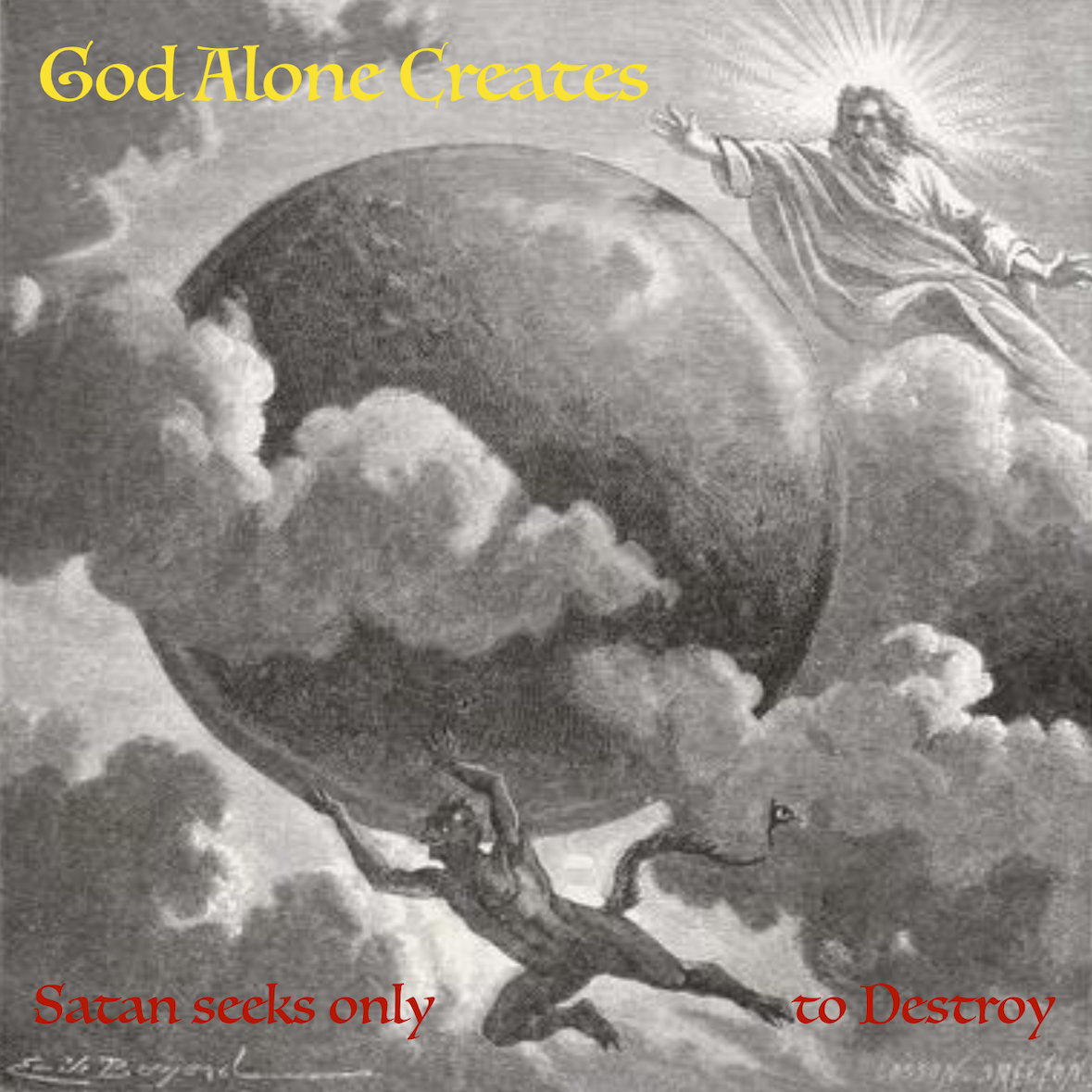
The image above is based on the work of Émile Bayard (1837-1891), a French illustrator who was born in Cairo, Egypt.

Damnable Typos & the Bible

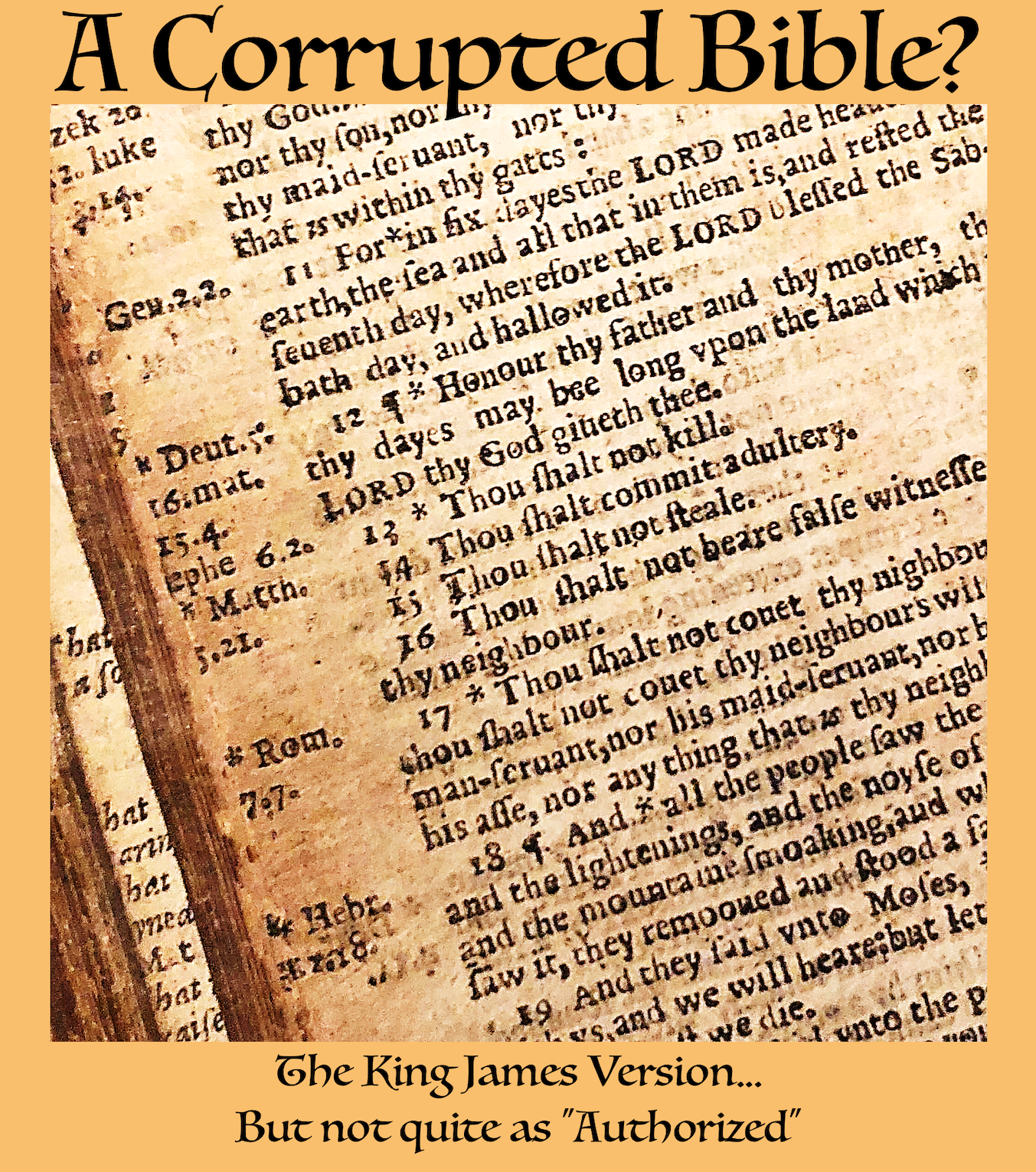
While the title of this post will be shocking to some, it’s far less scandalous than the typographical error discussed below. Due to two misprints appearing in a 1641 edition of the King James Bible (KJV), the publication has been labeled the “Wicked Bible.”

Translating the Scriptures is a necessary, and demanding, task. The early editions of the KJV (which was preceded by the Wycliffe Bible) reveal how vulnerable the words themselves were to being altered during the typesetting process.

I’ve written about this subject a number of times during the past decade, and even devoted a column to “C.S. Lewis’ School of Translation,” which is about something even more important than merely translating words. There I quote one of the great author’s deepest hopes.

What I want is to be the founder of a school of ‘translation . . .’ Where are my successors? (correspondence, 7 October 1945).

Returning to the seventeenth century book with its unfortunate errors, we witness an example of how even a solid translation can be derailed by careless (or malevolent) typesetters.

The magnitude of the mistake discovered in this particular edition caused its suppression, and most copies were destroyed. While some still exist in private hands, only fifteen remain in public collections. One of these made its way to New Zealand before being identified in 2018.

A Truly Scandalous Misprint

It would be one thing if a printer accidently dropped the final “e” from “breathe,” leaving the word “breath.” Even substituting an errant “w” for the “b,” would create an alternate word that would greatly muddle a passage . . . but still not appear remotely “wicked.” 

However, a 1631 mistake in an English Bible literally turned a passage – one of the Ten Commandments, no less – on its head. Rather than reading “Thou shalt not commit adultery,” this edition declares, “Thou shalt commit adultery” (Exodus 20:14).

The consequences of this disaster were significant, particularly for His Majesty’s official printers. In Cyprianus Anglicanus by royalist priest Peter Heylyn (1599-1662), we learn the details. (You can download a free facsimile of the volume which includes many other fascinating facts.) The passage related to the misbegotten tome reads as follows:

His Majesties Printers, at or about this time [1632], had committed a scandalous mistake in our English Bibles, by leaving out the word Not in the Seventh Commandment.

His Majesty being made acquainted with it by the Bishop of London, Order was given for calling the Printers into the High-Commission where upon the Evidence of the Fact, the whole Impression was called in, and the Printers deeply fined, as they justly merited.

Reports of Cases in the Courts of Star Chamber and High Commission, penned by Samuel Rawson Gardiner in 1886, includes a detailed account of the court’s findings. (Due to their uniqueness, I have transposed the full account, as found in two sections, as a footnote below.) One passage describes a second “gross error.”

. . . showed the two grossest errors, vizt. “Shalt commit adultery” and “great asse:” for “shalt not commit adultery” and “greatnesse…”

The second of these blunders occurs in Deuteronomy 5:24, which properly reads “Behold, the Lord our God hath shewed us his glory and his greatness.” (It should be noted that the word asse would most commonly be associated with donkeys.)

The magnitude of these mistakes can only be understood when one recognizes how reverentially the Scriptures were regarded at this time. C.S. Lewis would suggest that during an age when the Bible has been relegated to historic literature, it is difficult for us to comprehend the seriousness of this matter.

It is very generally implied that those who have rejected its theological pretensions nevertheless continue to enjoy it as a treasure house of English prose. It may be so. There may be people who, not having been forced upon familiarity with it by believing parents, have yet been drawn to it by its literary charms and remained as constant readers.

But I never happen to meet them. Perhaps it is because I live in the provinces. But I cannot help suspecting, if I may make an Irish bull, that those who read the Bible as literature do not read the Bible. (“The Literary Impact of the Authorised Version”).

In “Challenges in Printing Early English Bibles,” you can read about other Bibles featuring noteworthy mistakes. In two, “peacemakers” become “placemakers,” and “murmurers” are transformed into “murderers.” Another example, in the very first edition of the KJV, finds Jesus’ ancestor Ruth referred to by the male pronoun, due to the accidental dropping of an “s.”

More troubling is another early KJV Bible where “the text of Psalm 14 [reads], “The fool hath said in his heart there is a God,” rather than “The fool hath said in his heart there is no God.”

Worst of all, in terms of blasphemous connotations, would likely be the so-called “Judas Bible.”

In the 1609 Geneva Bible, the typesetters mistakenly replaced Jesus’s name with that of Judas. John 6:67 reads: “From that time many of his disciples went back, and walked no more with him. Then said Judas unto the twelve, Will ye also go away?”

Fortunately, modern editions of the Jewish and Christian Scriptures undergo thorough proofreading, so this sort of error is rare today. Still, typos will persist as long as the remotest possibility of error exists.

Those among us who have sought to have our writing published by traditional publishers may relate to the example with which we end. C.S. Lewis and J.R.R. Tolkien and even Mark Twain faced challenges working with some of their editors and publishers.

With all of the printing mishaps in the early English Bible, it is only appropriate that one of the editions was called “The Printers Bible.”

This text, published in about 1702, takes its name from a typesetting error found in Psalm 119, which should have read “Princes have per­secuted me without a cause” but was mistakenly printed as “Printers have persecuted me.”


Full references from Reports of Cases in the Courts of Star Chamber and High Commission by Samuel Rawson Gardiner (1886).

Mr Barker the printer. There is a cause begunne against him for false printeing of the Bible in divers places of it, in the Edition of 1631, vizt., in the 20 of Exod[us], “Thou shalt committ adultery”; and in the fifte of Deut[eronomy] “The Lord has shewed his glory, and his great asse”; and for divers other faults; and that they had printed it in very bad paper. And the Bishop of London showed that this would undoe the trade, and was a most dishonorable thing; that they of the church of Rome are soe carefull, that not a word or letter is to be found amisse in their Ladie’s Psalter and other superstitious books; and that we should not be soe carefull in printinge the sacred Scriptures; and that they in Holland, at Amsterdam, had gott up an English presse, and had printed the Bible in better paper, and with a better letter, and can undersell us 18d. in a Bible. Mr Barker and his partners endeavored in partt to excuse themselves, and had advocates to speake for them, and were willing to submitt, and promised to amend their faults; but the Court would not remitt their offense, but the cause was ordered to goe on.

The Printers having answered move the Court to passe by their oversight being the fault of the workmen but the King’s Advocate desired they might make their defense legally and the cause to go onto hearing: and that he might have liberty to put in additional articles against them. The Bishop of London would have the Church sett upright in her reputacion, that we are as carefull in printeing the Bible as they are of their Jesus’ psalter : and whereas the Printers say this is stirred up by the malice of one man against them; The Bishop saith he stirred not till the Bible was sould into his house, bought by his footman: and he saith the printinge is soe bbad and the paper too that, if it be not mended shortlie, they wilbe put downe by those of Amsterdam and their trade spoyled, and showed for the two grossest errors, vizt. “Shalt commit adultery” and “great asse:” for “shalt not commit adultery” and “greatnesse…” The Arch Bishop of Canterbury saith, that the Printers that print for his Matie have a very profitable place, and therefore should be more carefull. I knew the tyme when greater care was had about printeing, the Bibles especiallie, good compositors and the best correctors were gotten being grave and learned men, and the paper and letter rare and faire every way of the best; but now the paper is naught, the composers boyes, and the correctors unlearned: There is a farmer and he makes the benefit, and careth for nothing about it. They heretofore spent their whole time in printeing, but these looke to gaine, gaine, gaine, then they are not to be commended: Well, let them looke to it: and let the cause proceed, saith the ArchBishop. London. “There was a great deale of doo between you of this Citty and those of Cambridge heretofore about the priviledge of printeing the Bible and psalms which they of Cambridge claymed; then the Bible was exactlie printed, now you have forced the Cambridg printer to an agreement, now noe bible is right printed.

[It appears this volume itself would have benefited from having more diligent “correctors.” Perhaps most curiously, two spellings of the word printing – “printinge” and “printeing” – appear in this publication.]

Brilliant New Course on C.S. Lewis

Fans of C.S. Lewis who would relish a month-long journey through his work must consider a brand new course designed by Dr. Brenton Dickieson of Signum University. 

Ink Spots and Tea Stains offers the very best of combinations: “academically serious but . . .  focused purely on the love of learning and the joy of studying the material.”

And what an amazing subject you will explore – a unique view of C.S. Lewis’ archival treasures (many still unpublished), in the context of his more familiar works. And there is no need to feel intimidated. According to Signum

No specific knowledge or background is necessary, though it is recommended that students have a general knowledge of Lewis’s writings.

Writers should be especially intrigued by the course which will discuss the literary imagination and the shape of personal discipline in the writing process.

I enthusiastically commend Ink Spots and Tea Stains to you. I also encourage you to share this news with your friends who are fans of C.S. Lewis’ work.

In fact, you might also wish to pass the invitation on to all of the writers you know who would enjoy an inspired exploration into the writing processes of one of the most respected authors of the twentieth century.

All of our lives are busy, but consider giving yourself this uplifting gift this autumn. If you do, I’m confident you’ll not regret it.