Blackout Writing

Do you have trouble coming up with ideas for your poems or stories? How about starting with an interesting collection of words and winnowing them down to a creation of your own? Read on to learn more about a simple process.

A few years ago a fellow pastor told me he could write, even short articles like blog posts. Since he had successfully completed a challenging graduate program, I was a bit shocked at this disclosure. “The problem,” he said, “is that I just can’t come up with any ideas for what to write.”

I had two reactions. First, I was amazed, since I can’t get through a day without encountering at least a handful of observations that beg to be explored. Second, I wondered just what sort of sermons his congregation was exposed to, if creative imagery and fresh ways of expressing God’s timeless truths were not coming from their pulpit.

One of the ways I attempt to improve my own writing is by stretching. In my personal shorthand, this refers to engaging in new forms of writing. Principally that means voluntarily jumping into sometimes ominous literary waters. I stretch myself by humbly engaging in genres which I may, in all honesty, find intimidating.

For example, occasionally, when bored with outlining books that may never get written, I’ll just scribble out some “impromptu verse.” Some of it turns out rather decent. (You’ll notice I didn’t say “excellent.”)

Blacking Out Words to Compose New Literature

I had heard of Blackout Poetry before, but never attempted to “write” any. Actually, it seems to me that “decompose” might be a more accurate word for this type of creating. Although most commonly used to create brief works, such as poetry, the concept can be used for narratives as well.

If you are unfamiliar with the process, you may enjoy the following, introductory articles.

Teach Kids Art” explains the basic process and then adds some visual artistry to the mix.

Blackout Poetry is a form of “found poetry” where you select words that catch your interest from a newspaper, book, or other printed text – along with a few additional words to make it flow. Then you “redact” all the words you don’t want. This is often (but not always) done with a black marker, hence the name “blackout poetry.” Your chosen words will form a new message, giving the text a whole new meaning.

Take your Blackout Poetry a step further by adding patterns, designs, or a drawing to the areas you’re “redacting.” For example, instead of just filling in around your chosen words with solid black, you could create a drawing or design that relates to your poem. Just as with any illustration, your art should support the remaining text and add to its meaning.

Looking Beyond the Comfort Zone” discusses a reservation many will have about pursuing blackout writing.

I really wanted to give it a try. There were however a few obstacles to overcome. First was my ingrained prohibition of defacing books. Although I owned a highlighter in college I rarely used it. It seemed wrong. . . .

Secondly the blackout poetry requires making the page unreadable for the original words. I felt a lot of good old-fashioned guilt in the prospect of destroying someone’s story. Lastly, I didn’t have any books that I felt so little regard for that I could take a sharpie marker to the pages.

I, personally, have eliminated the second reservation by scanning an image of each experimental page and blacking words out digitally. It would be just as simple to print out such an image, or simply use a copier with a physical book, if you prefer to create your work manually. My method eliminates another potential problem for bibliophiles, the damage often caused to a book’s spine when attempting to flatten the page for copying.

5 Tips for Creating Blackout Poetry” claims the genre is “the best cure for writer’s block.” To enhance miscellany, they suggest “when picking an article to use, it’s best not to read it too closely.”

That way, you aren’t overly influenced by the author’s original work and you can create something uniquely your own.

This suggestion will certainly be beneficial in liberating the creativity of many writers. For my own purposes, I disregarded this advice, since I intentionally desired to use words by or about particular authors. I honestly want the original context to be in my mind during the metamorphosis.

A final source, “A blackout poem on the Trinity,” reveals how a writer in Europe found inspiration in the writings of C.S. Lewis for her own poem about the Trinity. Check out Christine’s verse at the link above.

This is the first time I’ve tried a blackout poem. They work by taking a page of text and then blacking it out until only the remaining words give you the poem.

In the end, I chose “It all began with a picture . . .” published in the Junior Section of The Radio Times on 15 July 1960. It’s a short and sweet description of how Lewis was inspired to write the Narnia stories.

My Initial Attempts

As I mentioned above, I scanned printed pages that you can easily find at Internet Archives, Google Books, Project Gutenberg and various other sites.

I did not attempt to write poetry. Rather, I used each page to write a brief, new narrative. Of my first three efforts, I was most pleased with “Savage Editing,” displayed above. Below, I will place it beside the original page, from The Collected Poems Of  G.K. Chesterton.

I’ll close by passing on to you the experience of the author who composed an ode on the Trinity, using an article about C.S. Lewis. My guess is that you too – should you be so bold as to attempt writing your own blackout works – will experience a similar satisfaction.

It’s hard being constrained by the page of text in front of you. The more you black out, the less you say; but the less you black out, the less impact each word has. It’s a game of compromise, striking the balance between being artistic and understandable.

But I think the end result is a celebration of both Lewis’ work and the Trinity.


The illustration below shows my blackout, which I entitled “Savage Editing,” beside the original page, which includes a portion of “The Scouring of the Horse,” from The Collected Poems Of  G.K. Chesterton. “The Scouring” is the final book in Chesterton’s Ballad of the White Horse.

Tortured Writing & the Inklings

Amanda McKittrick Ros (1860-1939) was an Irish poet and novelist beloved by the Oxford Inklings. “Beloved” here is used in the sense of treasured for its distinctiveness, rather than admired for its artistry.

An article about Ros in Smithsonian Magazine is subtitled: “Amanda McKittrick Ros predicted she would achieve lasting fame as a novelist. Unfortunately, she did.”

So how is it that a writer described by the Oxford Companion to Irish Literature (OCIL) as authoring “unconscious comedy of a very high order” came to occupy a special place within the company of C.S. Lewis, J.R.R. Tolkien and their literary fellows? Why did they begin reading her works as a sort of contest, with the challenge of neither laughing nor smiling as they did so?

It was not because her mother (or she herself) christened her after a character in The Children of the Abbey, published in 1796. (Her initial name was “Anna.”)

No, it was due to an intrinsic element of her frequently alliterative artistry, described by OCIL in the following manner.

She published two sentimental romances, Irene Iddlesleigh (1897) and Delina Delany (1898), both in an idiosyncratic manner that provides unconscious comedy of a very high order. . . .

Most of her published writings appeared posthumously as a result of literary curiosity.

Many writers would agree that writing comedy is quite challenging. Comedy Crowd is devoted to helping writers gain some skill in this arena, and if you take a moment to check out their video about failed puns – after you finish reading this post – you won’t be disappointed. 

As one commenter on SleuthSayers puts it, “. . . writing humor isn’t easy. It’s even dangerous: trying to be funny and failing would be almost as bad as being funny when you’re trying to be serious.” Sadly, the worst of these options proved to be the fortune of poor Amanda.

Even her native Northern Ireland Library Authority confesses that her “writing style can only be described as elaborate, melodramatic, using startling descriptions with mixed metaphors and inappropriate alliteration with the result being unintentionally hilarious.”

In her collection “Poems of Puncture,” I came across a piece titled “Reverend Goliath Ginbottle.” Being a reverend myself, I eagerly listened to a LibriVox recording of the poem (which you can download for free from Internet Archive), and I was not disappointed. Her description of this “viper of vanity” and her joy at his ultimate judgment was delightfully colorful. Or, should you prefer to hear a diatribe against a corrupt lawyer, listen to Mickey Monkeyface McBlear, who bore “a mouth like a moneybox.”

TV Tropes has an article about Ros which attributes a dozen tropes to her pen.

In the Style of: Aldous Huxley noted that Ros wrote in the 16th century style of Euphuism. Susan Sontag decades later stated that Euphuism was the progenitor of camp, which would explain why literary greats found her writing so hilarious.

Those curious about euphuism can read John Lyly’s Euphues: the Anatomy of Wit; Euphues and His England which is filled with delights unnumbered. Originally two volumes, the books were published in the sixteenth century.

C.S. Lewis was a serious enough “fan” of Ros’ writings to share his affection for them with Cambridge Classicist Nan Dunbar. C.S. Lewis scholar Joel Heck has written a worthwhile article about the ongoing friendship between the two professors.

For a detailed study of the literary relationship between Amanda McKittrick Ros and the Inklings, I highly recommend the article by Anita Gorman and Leslie R. Mateer which appeared in Mythlore.

As they describe, even before the Inklings added occasional readings of her work to their gatherings, as early as 1907 there was in Oxford a society devoted to weekly readings of her works. The authors pose, and then proceed to answer, the following question.

What . . . impelled C.S. Lewis and his mates to read aloud Ros’s work? Yes, the improbable plots, silly characters, and nonexistent themes may have played a role, but were those enough to captivate the Inklings and to give rise to Delina Delaney dinners and Amanda Ros societies?

After all, many writers have written improbable plots about improbable people, and these writers have enjoyed short-lived reputations, if any reputations at all. Yet Amanda lives on.

For Those with Stout Constitutions

Mere Inkling offers one final look back at the transcendent poetry of Amanda McKittrick Ros. This infamous selection can be found at the aptly named Pity the Readers: Horribly Excellent Writing website.

“Visiting Westminster Abbey”
(from Fumes of Formation)

Holy Moses! Have a look!
Flesh decayed in every nook!
Some rare bits of brain lie here,
Mortal loads of beef and beer,

Some of whom are turned to dust,
Every one bids lost to lust;
Royal flesh so tinged with ‘blue’
Undergoes the same as you.

These morose words bring to mind another verse, composed in the form of a song by the artists of Monty Python. It appeared on Monty Python’s Contractual Obligation Album as “Decomposing Composers.”

They’re decomposing composers.
There’s nothing much anyone can do.
You can still hear Beethoven,
But Beethoven cannot hear you. . . .

Verdi and Wagner delighted the crowds
With their highly original sound.
The pianos they played are still working,
But they’re both six feet underground.

They’re decomposing composers.
There’s less of them every year.
You can say what you like to Debussy,
But there’s not much of him left to hear.

Yes, similarly morbid verse, but offered here to provide a sharp contrast between types of humor. Monty Python is the epitome of Camp, which according to Susan Sontag,

sees everything in quotation marks. It’s not a lamp, but a “lamp;” not a woman, but a “woman.” To perceive Camp in objects and persons is to understand Being-as-Playing-a-Role. It is the farthest extension, in sensibility, of the metaphor of life as theater.

Although Sontag notes “one must distinguish between naïve and deliberate Camp,” she argues the “pure examples of Camp are unintentional.” She considers self-conscious efforts, such as Noel Coward (and presumably Monty Python as well) as “usually less satisfying.”

Another perspective offers a helpful dichotomy to distinguish between “intentionality: whether camp deliberately cultivated (‘high’ camp) is the same to that of the unintentional kind (‘low’ camp).”

Personally, I often enjoy high (nonvulgar) camp humor – witty silliness that scoffs at life’s peculiarities. As for unintentional, “low” camp such as we find in Ros, I typically feel a flash of guilt at hurting (even posthumously) the feelings of a writer. Most of us writers are, after all, a sensitive and vulnerable breed.


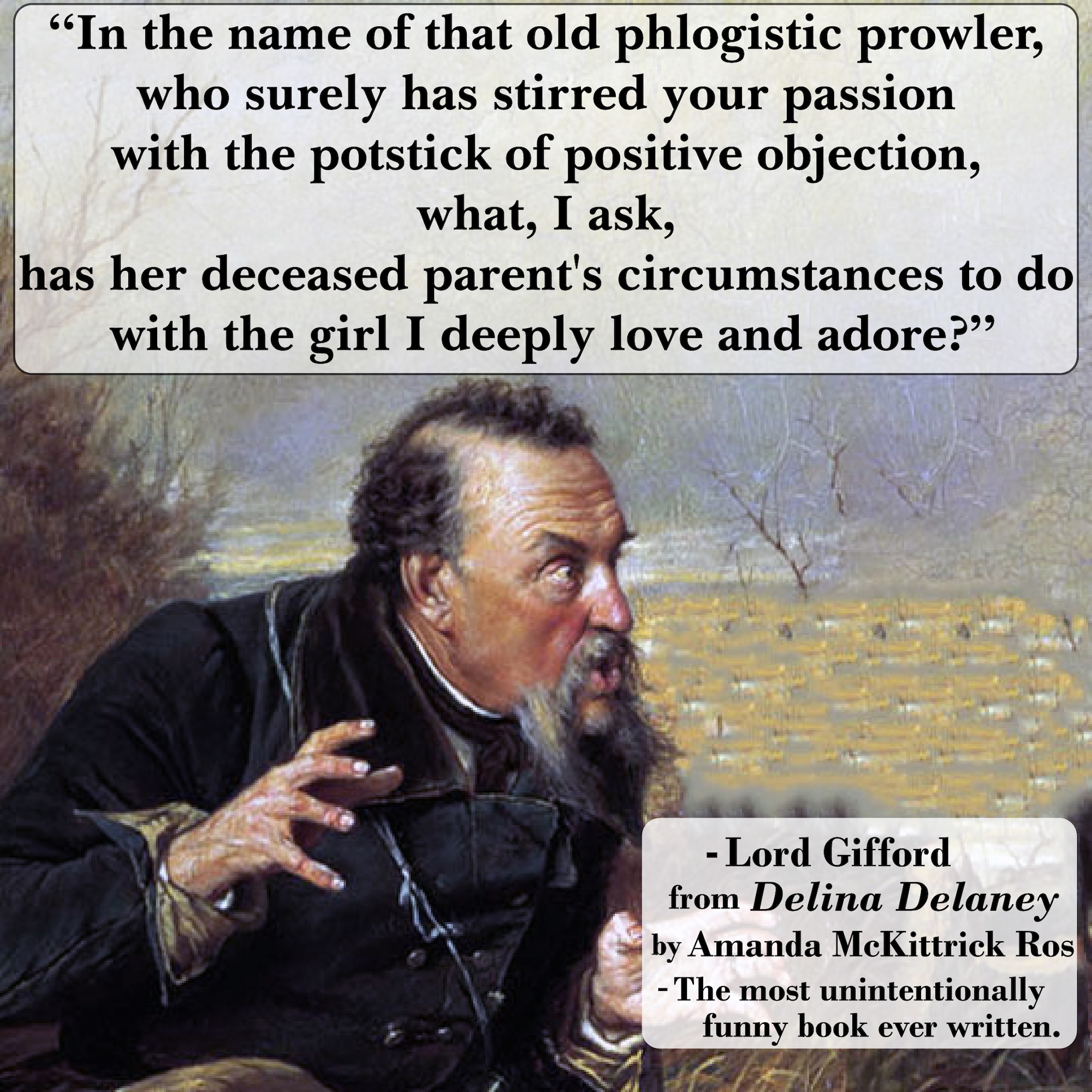
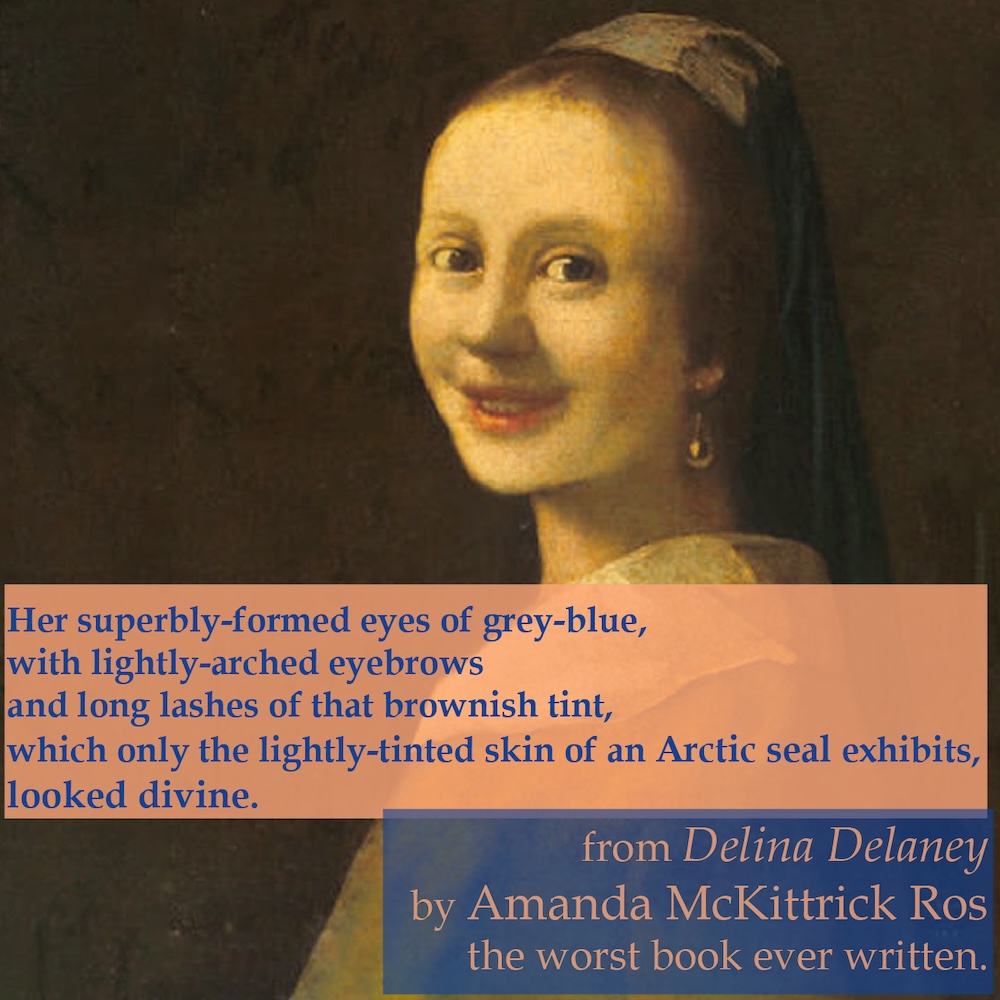
The enlightening illustrations accompanying this article are from Amanda McKittrick Ros Society Promotional Memes, ably captained by Dan Morgan.

George MacDonald’s Poetry

George MacDonald (1824-1905) was a prolific Scot writer. His legacy was amplified due to his influence on G.K. Chesterton and C.S. Lewis. (He was also a friend of Mark Twain.) An essay, originally presented as a speech by G.K. Chesterton, is available online.

Chesterton goes so far as to say, “if to be a great man is to hold the universe in one’s head or heart, Dr. MacDonald is great. No man has carried about with him so naturally heroic an atmosphere.” Listen to his description of that special type of literature that inspired many Inklings, chiefly C.S. Lewis and J.R.R. Tolkien.

Many religious writers have written allegories and fairy tales, which have gone to creating the universal conviction that there is nothing that shows so little spirituality as an allegory, and nothing that contains so little imagination as a fairy tale. But from all these Dr. MacDonald is separated by an abyss of profound originality of intention.

The difference is that the ordinary moral fairy tale is an allegory of real life. Dr. MacDonald’s tales of real life are allegories, or disguised versions, of his fairy tales.

It is not that he dresses up men and movements as knights and dragons, but that he thinks that knights and dragons, really existing in the eternal world, are dressed up here as men and movements.

C.S. Lewis, for his part, praised MacDonald as instrumental in tilling the soil for his eventual conversion to Christianity. He was on the defensive, since the writers which most inspired him shared a common flaw – they were Christians.

All the books were beginning to turn against me. Indeed, I must have been as blind as a bat not to have seen, long before, the ludicrous contradiction between my theory of life and my actual experiences as a reader.

George MacDonald had done more to me than any other writer; of course it was a pity he had that bee in his bonnet about Christianity. He was good in spite of it.

Chesterton had more sense than all the other moderns put together; bating, of course, his Christianity. Johnson was one of the few authors whom I felt I could trust utterly; curiously enough, he had the same kink. Spenser and Milton by a strange coincidence had it too (Surprised by Joy).

Lewis would actually come to edit a selection of MacDonald’s passages for an edifying anthologyThis post includes a link for downloading a copy of George MacDonald: An Anthology.

This week I was reading one of MacDonald’s excellent essays, which appears in The Imagination and Other Essays. I intend to discuss some of his thoughts on age and writing soon. Although I am not an aficionado of poetry – despite having composed poetry from time to time, including quintains, I turned to another of MacDonald’s books.

On to His Poetry

I decided to follow up MacDonald’s brilliant essay with a dip into his poetry. Fortunately, Internet Archive allows you to freely download a complete copy of MacDonald’s Scotch Songs and Ballads, published in 1893. My conscience forces me, however, to provide a single caveat. Be forewarned that the tome is not suited for those intimidated by pronounced dialects.

Before looking at one of his poems in its entirety, allow me to share with you a passage from “The Waesome Carl” which I particularly enjoyed (due to its portrait of a preacher). 

The minister wasna fit to pray
And lat alane to preach;
He nowther had the gift o’ grace
Nor yet the gift o’ speech!
He mind’t him o’ Balaäm’s ass,
Wi’ a differ we micht ken:
The Lord he opened the ass’s mou,
The minister opened’s ain!
He was a’ wrang, and a’ wrang,
And a’thegither a’ wrang;
There wasna a man aboot the toon
But was a’thegither a’ wrang!
The puir precentor couldna sing,
He gruntit like a swine . . .

Not that I claim able to decipher it all, but my impression is that it’s not especially flattering. It is definitely entertaining. And I humbly think I interpret it significantly more accurately than Google’s online translator, which provided the following version.

The minister was not fit to pray
And lat alane to preach;
He nowther had the gift o’ grace
Nor yet the gift o’ speech!
He mind’t him o’ Balaam’s ass,
Wi’ a differ we micht ken:
The Lord he opened the ass’s mou,
The minister opened his eyes!
He was a’ wrang, and a’ wrang,
And a’thegither a’wrang;
There was a man aboot the toon
But thegither was wrong!
The puir precentor couldna sing,
He grunted like a swine. . .

Using the Dictionars o the Scots Leid, you can make perfect sense of the words about which you may be uncertain. (Thank you, Scotland.)

Dialects are interesting things indeed. I will close with another of MacDonald’s poems. I submit it for (1) those who comprehend the dialect, (2) those who deem precious their Scottish ancestry, (3) those with an affinity for Connor MacLeod, and (4) those who simply enjoy a challenge.

Nannie Braw

I like ye weel upo Sundays, Nannie,
I’ yer goon and yer ribbons and a’;
But I like ye better on Mondays, Nannie,
Whan ye’re no sae buskit and braw.

For whan we’re sittin sae douce, Nannie,
Wi’ the lave o’ the worshippin fowk,
That aneth the haly hoose, Nannie,
Ye micht hear a moudiwarp howk,

It will come into my heid, Nannie,
O’ yer braws ye are thinkin a wee;
No alane o’ the Bible-seed, Nannie,
Nor the minister nor me!

Syne hame athort the green, Nannie,
Ye gang wi’ a toss o’ yer chin;
And there walks a shadow atween ‘s, Nannie,
A dark ane though it be thin!

But noo, whan I see ye gang, Nannie,
Eident at what’s to be dune,
Liltin a haiveless sang, Nannie,
I wud kiss yer verra shune!

Wi’ yer silken net on yer hair, Nannie,
I’ yer bonnie blue petticoat,
Wi’ yer kin’ly arms a’ bare, Nannie,
On yer ilka motion I doat.

For, oh, but ye’re canty and free, Nannie,
Airy o’ hert and o’ fit!
A star-beam glents frae yer ee, Nannie–
O’ yersel ye’re no thinkin a bit!

Fillin the cogue frae the coo, Nannie,
Skimmin the yallow ream,
Pourin awa the het broo, Nannie,
Lichtin the lampie’s leme,

Turnin or steppin alang, Nannie,
Liftin and layin doon,
Settin richt what’s aye gaein wrang, Nannie,
Yer motion’s baith dance and tune!

I’ the hoose ye’re a licht and a law, Nannie,
A servan like him ‘at’s abune:
Oh, a woman’s bonniest o’ a’, Nannie,
Doin what maun be dune!

Cled i’ yer Sunday claes, Nannie,
Fair kythe ye to mony an ee;
But cled i’ yer ilka-day’s, Nannie,
Ye draw the hert frae me!

Addendum:

For those interested in pursuing this linguistic subject, I just came across a delightful 1896 collection of works you can download for free. Legends of the Saints: in the Scottish Dialect of the Fourteenth Century is “edited from the unique manuscript in the University Library, Cambridge.”


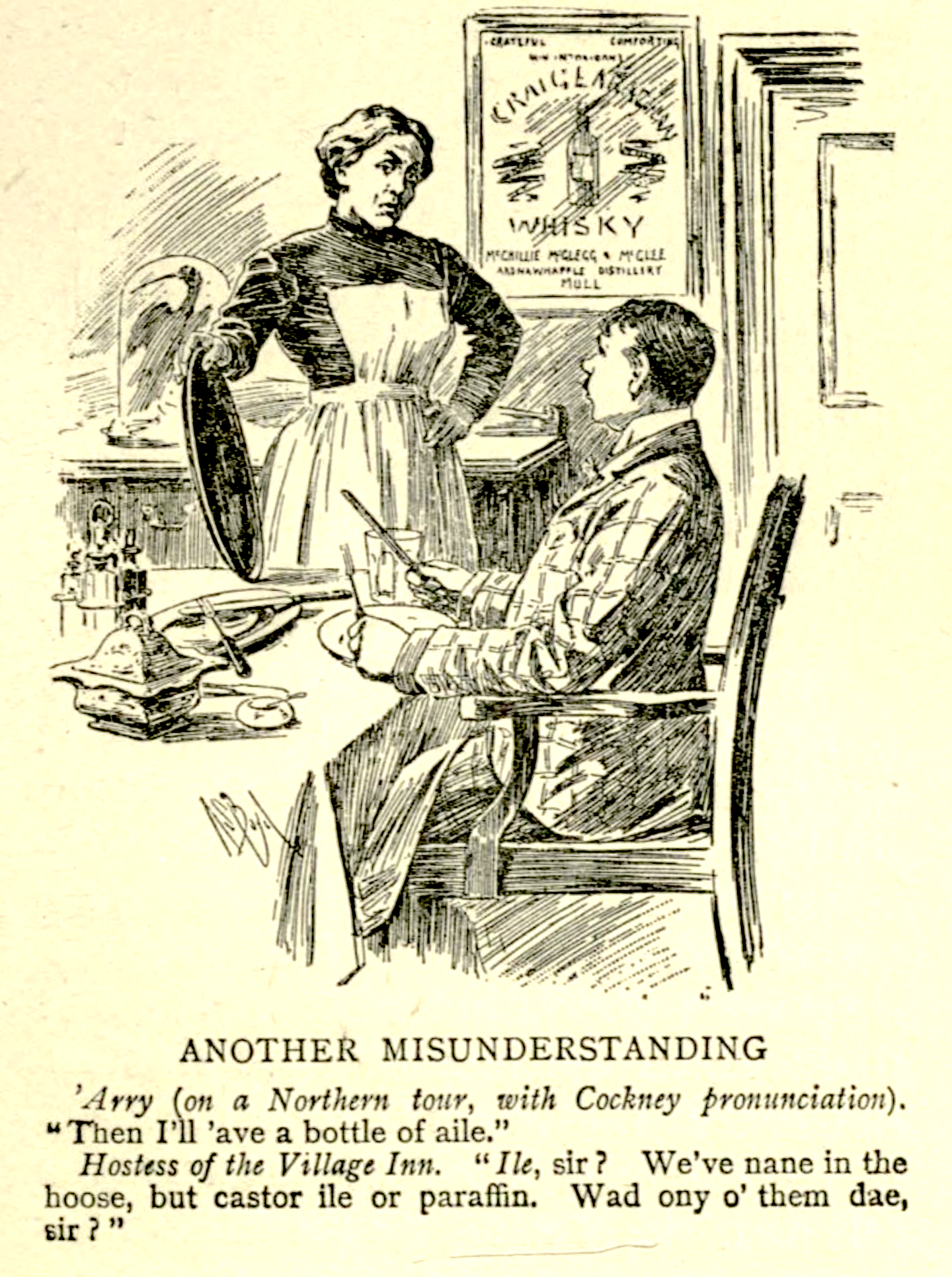
The cartoon above comes from Mr. Punch in the Highlands which was published “with 140 illustrations” more than a century ago. You can download your personal copy of humorous work at Internet Archive.

Peculiar Poetic Themes

Would you purchase a collection of poetry inspired by pigs? It was certainly not what I was looking for, but my local library has once again seduced me by conducting one of their periodic “used book sales.” 

I find them irresistible. Just as I was unable to bypass, without browsing, any “secondhand bookshop” while I lived in the United Kingdom.

One never knows what treasures are buried in the stacks, since many of the volumes came from personal libraries where they may have rested for decades.

We had just finished our regular writing critique meeting when I accompanied two of my companions into the wilderness of temptation. Alas, on one of the first shelves I perused, I encountered an oddity I was unable to resist. 

The title attracted my interest – The Porcine Legacy. The minimalist sketches of pigs illustrating the text drew me in. And the final element, which captured me, was that it was autographed by both the author and the artist. The bargain price sealed the deal.

Scanning the poems I saw curious mentions of God, which I considered intriguing. The swinish images reminded me of some of DaVinci’s quick sketches of animals.

Sadly, although he professes the love he had for his hogs and piglets, the author did consign them to the market. I understand that’s their intended fate, and I do enjoy lean bacon, but it seems sad. Especially in an ode to porcine intelligence and their congeniality as pets.

The author, David Lee, moved on from animal husbandry to teaching at a university in Utah. Presumably it was his contributions there, rather than on his farmstead, which earned him the honor of becoming the very first poet laureate of Utah.

A Taste of Porcine Poetry

The poem which follows is entitled “Jubilate Agno, 1975.” As often happens when I expose myself to unfamiliar works, I learned far more than I anticipated. In this case, I discovered the “1975” in the title was included because the poem was based upon a religious poem originally penned between 1759 and 1763, while its author, Christopher Smart, was convalescing as a “Curable Patient” at London’s St. Luke’s Hospital for Lunatics.

Lee’s version follows the basic structure of Smart’s 1200 line work. Cat lovers will enjoy a section of seventy-four lines where the original author praises the wonders of his cat, Jeoffry. This is the portion of the original which most closely resembles the copy, since the latter extols its author’s favorite sow. Lee also proposes a shift in the deity upon whom the creature focuses.

For I will consider my Cat Jeoffry.
For he is the servant of the Living God duly and daily serving him.
For at the first glance of the glory of God in the East he worships in his Way.

~~~~~~

For I will consider my black sow Blackula.
For she is the servant of the god of the feed bucket and serveth him.
For she worships the god in him and the secret of his pail in her way.

The title, “Jubilate Agno” actually translates as “Rejoice in the Lamb.” And, while Lee includes no such reference, the beginning lines of Smart’s work proclaim its vision in inspiring terms.

Rejoice in God, O ye Tongues; give the glory to the Lord, and the Lamb.
Nations, and languages, and every Creature, in which is the breath of Life.
Let man and beast appear before him, and magnify his name together.

I encourage interested readers to read the edifying “Jubilate Agno” by Christopher Smart, which is available here. Ailurophiles (cat lovers) can go directly to the feline section here. The complete text of  “Jubilate Agno, 1975” is available at the Poetry Foundation.

Although I don’t believe C.S. Lewis ever wrote porcine poetry, there is an interesting passage which appears in Boxen, the collection of his childhood stories. Apparently, the first king of the northern region of Animal-Land, set out to add Pig-Land to his domain.

The pigs under their various chiefs (who had now united against Hacom, as a common enemy) advanced to meet him. The 2 armies met at a place called Kuckton (near where Marston now stands). Hacom fought well, and would have won had he not been outwitted by a clever feint on the part of the pigs.

The [invading] force was beaten, but still, much had been done towards the subjection of the pigs. Hacom was severely wounded by a stray arrow, but might have recovered, had he not been obliged to spend the night in the fields. It was winter, and the wound froze causing instant death. He had been an excellent king.

Surprisingly, to me at least, there are many other poems inspired by pigs. Since I’ve written in the past about Roald Dahl (and his slight connection to C.S. Lewis), seeing his poem entitled “The Pig” incited my curiosity. The All Poetry website includes the poem, and offers as part of its analysis:

“The Pig” by Roald Dahl is a humorous and macabre poem that explores the existential crisis of a highly intelligent pig. The poem is characterized by its playful language, which contrasts with the gruesome subject matter. . . .

The pig’s realization that he is destined for slaughter also highlights the existential themes of meaninglessness and the inevitability of death. Overall, “The Pig” is a clever and thought-provoking poem that combines humor, darkness, and a touch of existential angst, showcasing Dahl’s versatility as a storyteller.

So, if you want to end this peculiar discussion with a bit of existential porcine angst, ponder Dahl’s poem, “The Pig.”

In England once there lived a big,
A wonderfully clever pig.
To everybody it was plain
That Piggy had a massive brain.
He worked out sums inside his head,
There was no book he hadn’t read.
He knew what made an airplane fly,
He knew how engines worked and why.
He knew all this, but in the end
One question drove him round the bend:
He simply couldn’t puzzle out
What LIFE was really all about.

What was the reason for his birth?
Why was he placed upon this earth?
His giant brain went round and round.
Alas, no answer could be found.
Till suddenly one wondrous night.
All in a flash he saw the light.
He jumped up like a ballet dancer
And yelled, “By gum, I’ve got the answer!”
“They want my bacon slice by slice
“To sell at a tremendous price!
“They want my tender juicy chops
“To put in all the butcher’s shops!
“They want my pork to make a roast
“And that’s the part’ll cost the most!
“They want my sausages in strings!
“They even want my chitterlings!
“The butcher’s shop! The carving knife!
“That is the reason for my life!”

Such thoughts as these are not designed
To give a pig great peace of mind.
Next morning, in comes Farmer Bland,
A pail of pigswill in his hand,
And piggy with a mighty roar,
Bashes the farmer to the floor . . .
Now comes the rather grizzly bit
So let’s not make too much of it,
Except that you must understand
That Piggy did eat Farmer Bland,
He ate him up from head to toe,
Chewing the pieces nice and slow.
It took an hour to reach the feet,
Because there was so much to eat,
And when he finished, Pig, of course,
Felt absolutely no remorse.

Slowly he scratched his brainy head
And with a little smile he said,
“I had a fairly powerful hunch
“That he might have me for his lunch.
“And so, because I feared the worst,
“I thought I’d better eat him first.”

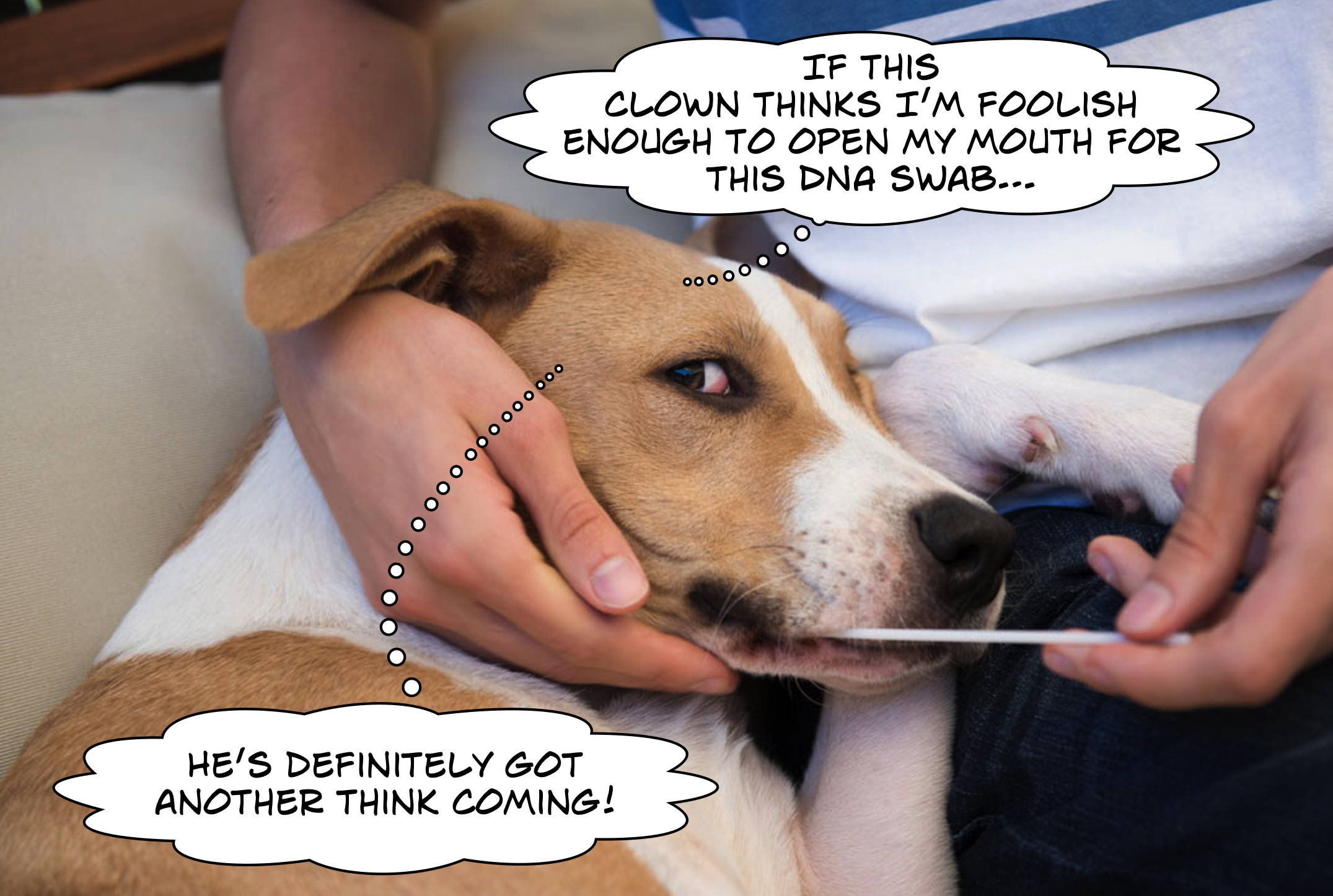
Dog DNA Determines Guilt

It is surprising how inexpensive and accessible DNA testing has become. Many readers of Mere Inkling have submitted samples ourselves. But how many of us have had our pets tested?

The science of genetics is quite recent. Gregor Mendel (1822-1884) is considered the father of such studies. As Britannica describes the history, “The word genetics was introduced in 1905 by English biologist William Bateson, who was one of the discoverers of Mendel’s work and who became a champion of Mendel’s principles of inheritance.”

Molecular genetics did not begin in earnest until 1941 . . . A major landmark was attained in 1953 when American geneticist and biophysicist James D. Watson and British biophysicists Francis Crick and Maurice Wilkins devised a double helix model for DNA structure.

The Human Genome Project didn’t begin until 1990, and didn’t reach its goal until the new millennia. The astute reader will recognize that C.S. Lewis lived before these genetic studies reached their current status, so we should not expect comment from him on DNA per se. Nevertheless, as Francis Sellers Collins, director of the Human Genome Project (2009-2018), says his work is quite compatible with C.S. Lewis’ writings.

In fact, in a lecture at Cambridge, he described how Mere Christianity was pivotal in his conversion from agnosticism to Christianity. According to this preeminent geneticist, “even in the first few pages, all my arguments about faith just fell apart. It was breathtaking . . . Lewis remains my best teacher.”

There is some question as to whether the DNA testing market has peaked. Unsurprising, since it isn’t like tobacco, coffee or rich desserts that “addict” customers to generate repeated purchases. As Advisory Board says, “given one’s genetic data is unlikely to change, most consumers may not see a reason to purchase another DNA testing kit.”

So, how might these corporations remain profitable? Why, by expanding their offerings to the animal kingdom. One such company called Embark claims to offer the “most accurate dog DNA test available.” 

Some people purchase the service to satisfy their curiosity about a pet’s breed (often a blend of several). A more valuable benefit is gaining insights into their health and traits. The oddest aspect of the process appears to be Embark’s boast that they offer “the world’s first canine relative finder.”

Like many of us, C.S. Lewis loved dogs. He didn’t, however, go so far as to worship them. I suspect that C.S. Lewis would opt out of the chance to DNA-define his pets. Best to just love them and savor their companionship.

In his essay “The Personal Heresy,” C.S. Lewis proposes an interesting argument about expressing love only to those capable of receiving it.

There is a reaction at present going on against the excessive love of pet animals. We have been taught to despise the rich, barren woman who loves her lap dog too much and her neighbor too little. It may be that when once the true impulse is inhibited, a dead poet is a nobler substitute than a live Peke, but this is by no means obvious.

You can do something for the Peke, and it can make some response to you. It is at least sentient; but most poetolaters hold that a dead man has no consciousness, and few indeed suppose that he has any which we are likely to modify.*

DNA service businesses are probably licking their lips at the prospects offered by a new market. The French are blazing a new trail for the rest of us. According to Euronews, Béziers will require pet owners to “carry a ‘genetic passport’ for their dog.”

The reason is simple. Too many dog walkers are failing to perform their civic (and humane) duty of cleaning up after their pets. 

Dog excrement found on the streets would be collected and tested then sent to the police. They would match the DNA to national pet registers, locate the owner and charge them up to €122 for cleaning up the streets.

Apparently, similar efforts have been attempted in Valencia, Tel Aviv and portions of London.

It sounds like a rather extreme way to address what superficially appears to be a simple problem. But, sadly, in many places, public sanitation has declined to unbelievable depths. In San Francisco, for example, the once picturesque metropolis has voluntarily surrendered many areas to criminals and addicts who feel no compunction about defecating in public. While I can’t speak for European, Asian, African or Latin American countries, in the U.S. a similar story of decay is repeated in many urban centers.

San Franciscans can’t be criticized for not throwing money at the problem. Nevertheless, when progressive Slate magazine reported last year on the city’s newest public toilet, they said “cities shouldn’t need $1.7 million and years of design review to build a municipal toilet.” 

Not that San Francisco treats such facilities with care. One space age toilet lasted only a few days before malfunctioning. But it was expensive, stainless steel, and bore the upgraded title of “kiosk.”

A highly hyped new SF bathroom hailed as “the future of public toilets” lasted only three days into said future, as the high-tech bathroom kiosk quickly had to be relieved of its duty and found itself closed for repairs.

Since these are manufactured by a Paris-based company, perhaps they can design a canine kiosk to solve the Béziers dilemma? After all, the cost might well be equivalent to the sum of all of the DNA tests the citizens are being forced to cover. 

A Final Thought about Animal DNA

Many of us, like C.S. Lewis, are pet lovers. And many also care about the suffering of other animals, domesticated and wild. There may come a day when DNA testing offers ways to enhance the lives of these other creations of God.

However, it does seem frivolous, does it not, to apply such advanced (and not inexpensive) processes for the purpose of tracking down derelict dog walkers? Or, in other judicatories, which have not yet embraced that level of surveillance, simply to attempt to track down doggie-relatives?

As to the matter of checking pet DNA for genetic abnormalities, “Should you get your pet’s DNA tested? Scientists urge caution” counsels careful consideration.

In the interview, Elinor Karlsson, director of vertebrate genomics at the Broad Institute in Cambridge, Massachusetts says,

With genetic tests for humans, there have been so many studies that look at whether or not a certain mutation in your genes actually leads to you developing a certain disease. There just isn’t this massive body of work on dog genomes. So many of these tests are telling owners that their dog could get a certain disease without any major studies on how likely that is to happen. The science needs to catch up.

In response to the question “what are the dangers of potentially inaccurate test results?” Lisa Moses, a veterinarian affiliated with Harvard Medical School in Boston advises,

In my veterinary practice, I’ve seen more and more people coming in with results that show their dog has a chance of developing conditions like epilepsy, heart disease, and degenerative muscular disorders, and they want to make treatment decisions right away.

They’re ready to pay for more tests or medical interventions that the dog might not actually need, that could be quite expensive, and that could be invasive for the dog. In some cases, people preemptively end their dog’s life if they think their dog is predisposed to a degenerative disease, because don’t they want their pet to suffer.

So once again we see that, as they often do, silly scenarios can lead to serious subjects.


* The passage from “The Personal Heresy” continues: 

Unless you hold beliefs which enable you to obey the colophons of the old books by praying for the authors’ souls, there is nothing that you can do for a dead poet: and certainly he will do nothing for you. He did all he could for you while he lived: nothing more will ever come.

 I do not say that a personal emotion towards the author will not sometimes arise spontaneously while we read; but if it does we should let it pass swiftly over the mind like a ripple that leaves no trace. If we retain it we are cosseting with substitutes an emotion whose true object is our neighbour. Hence it is not surprising that those who most amuse themselves with personality after this ghostly fashion often show little respect for it in their parents, their servants, or their wives. 

C.S. Lewis on Translating Poetry

“A poetic translation is always to some extent a new work of art.”
C.S. Lewis
English Literature in the Sixteenth Century

C.S. Lewis was a gifted translator. One who recognized well the challenges of skillful rendition, including the differing requirements imposed by prose and poetry. Thus, in his essay “The Literary Impact of the Authorised Version,” he offers the following insight.

No translation can preserve the qualities of its original unchanged. On the other hand, except where lyrical poetry is in question, the literary effect of any good translation must be more indebted to the original than to anything else.

In his autobiography, Surprised by Joy, C.S. Lewis describes his transformative encounter with translated poetry that introduced him to the “northern sky.” Before he became a skilled translator in his own right, he describes how a major part of his awakening,

. . . came through poetry. I had become fond of Longfellow’s “Saga of King Olaf:” fond of it in a casual, shallow way for its story and its vigorous rhythms.

But then, and quite different from such pleasures, and like a voice from far more distant regions, there came a moment when I idly turned the pages of the book and found the

unrhymed translation of Tegner’s Drapa and read

I heard a voice that cried,
Balder the beautiful
Is dead, is dead

I knew nothing about Balder; but instantly I was uplifted into huge regions of northern sky, I desired with almost sickening intensity something never to be described (except that it is cold, spacious, severe, pale, and remote) and then, as in the other examples, found myself at the very same moment already falling out of that desire and wishing I were back in it.

One of Lewis’ most involved explanations of the subject is found in Reflections on the Psalms. As Mere Inkling has noted in the past, C.S. Lewis was a distinguished member of a committee appointed to “revise the Psalter.” Being poetry, the Psalms demanded the proper mindset in their translators.

What must be said, however, is that the Psalms are poems, and poems intended to be sung: not doctrinal treatises, nor even sermons. . . . Most emphatically the Psalms must be read as poems; as lyrics, with all the licences and all the formalities, the hyperboles, the emotional rather than logical connections, which are proper to lyric poetry.

They must be read as poems if they are to be understood; no less than French must be read as French or English as English. Otherwise we shall miss what is in them and think we see what is not.

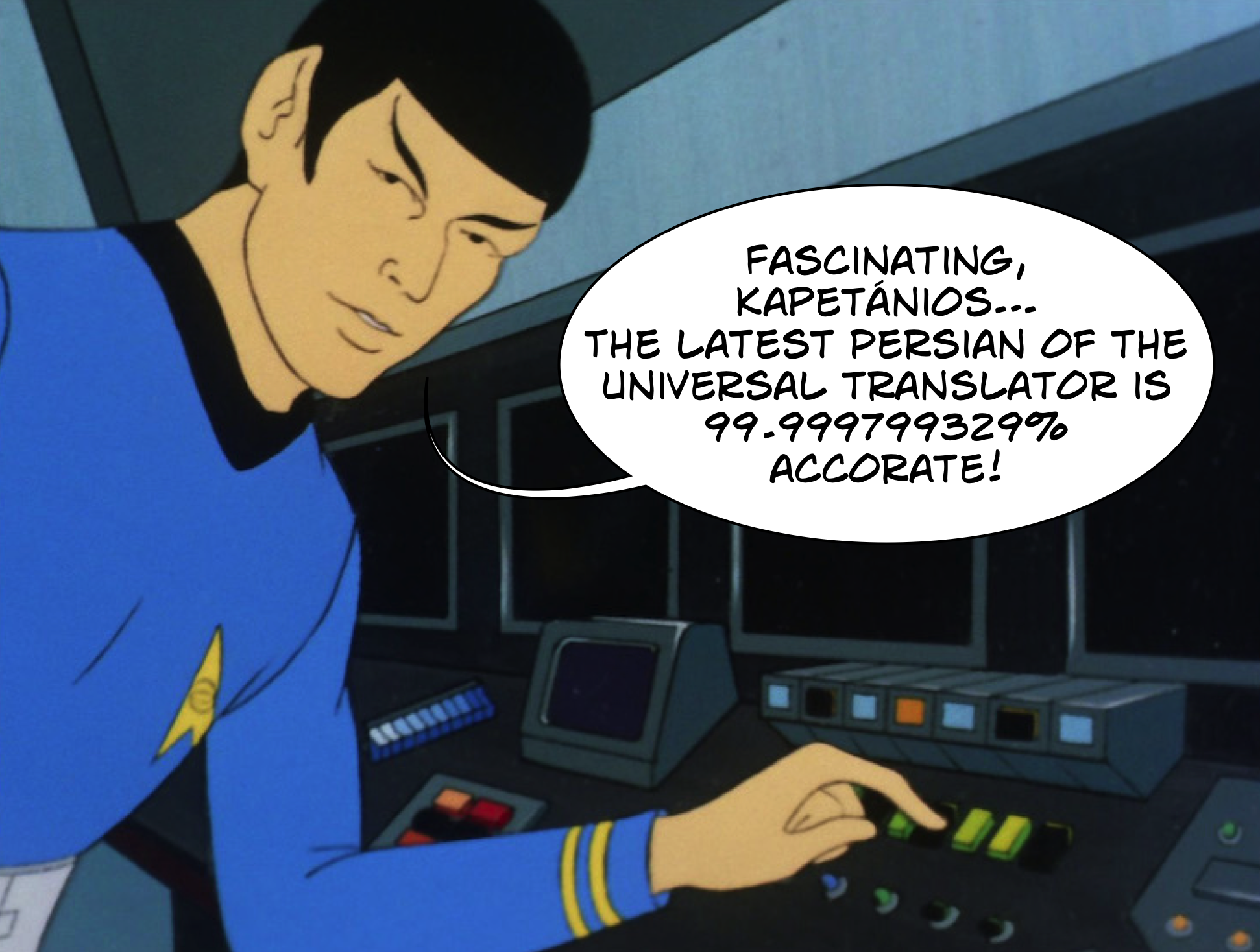
Some translations, unfortunately, are intentionally corrupted. I described in 2020 the Communist Chinese twisting of the Christian Scriptures. Fortunately, this sort of intentional crime is rare, and most translation efforts are well motivated. That does not mean, however, that even gifted linguists are up to every challenge.

In a letter to the editor of The Christian Century, C.S. Lewis contrasted academic and vernacular translations. Declaring that “any fool can write learned language,” he argues that clergy in particular are faced with the challenge of translating languages into prose which is understandable to the general population. He begins by demurring that he cannot respond to a request for an article written for a popular American audience.

An article on “translation” such as Dr. Pittenger suggests . . . certainly needs doing, but I could not usefully do it for Americans. The vernacular into which they would have to translate is not quite the same as that into which I have translated. Small differences, in addressing proletarians, may be all-important.

In both countries an essential part of the ordination exam ought to be a passage from some recognized theological work set for translation into vulgar English – just like doing Latin prose. Failure on this exam should mean failure on the whole exam.

It is absolutely disgraceful that we expect missionaries to the Bantus to learn Bantu but never ask whether our missionaries to the Americans or English can speak American or English. Any fool can write learned language. The vernacular is the real test.

C.S. Lewis remained an avid reader and critic until his death. In 1961, he received some translations of “modern” Greek poetry from his friend, Muriel Bradbrook (1909-1993), a Professor of English at Cambridge. After thanking her for the gift, he offers his personal response to the intercultural translations.

Dear Muriel,

What a nice thing for a man half drowned in compulsory leisure [due to poor health] . . . It has set me a problem. I find I get a good deal of pleasure out of many of these poems, but am at a loss to say why. One is not getting the “numbers” – and so far as I can judge from the notes the metres of the originals would not much please me.

Nor am I much in sympathy with many of the poets’ moods. The pleasure is like – at least rather like – what I get out of most translations of Chinese lyric. But that isn’t a solution, but merely another problem of the same sort. Anyway, thanks very much indeed.

Advice to Budding Translators

So many good works of literature remain to be translated so they can benefit those unfamiliar with their original tongue. Several years ago, I wrote a column entitled “C.S. Lewis’ School of Translation,” assembling some of the great writer’s wisdom.

I recently encountered a curiously brilliant observation on the subject of translating poetry in C.S. Lewis’ English Literature in the Sixteenth Century. Although he refers here to advising others, it would be wise for any of us who are considering the task to reflect long on Lewis’ acumen.

Most of us, I suspect, would advise a mediocre poet, if he must translate, to avoid the greater originals and choose the less, as if these would be easier. But this is probably a mistake.

The great poets have so much wealth that even if you lose two-thirds of it on the voyage home you can still be rich on the remainder: slighter art, when it loses the perfection of its original form, loses all power of pleasing.

As I think about it, this advice likely applies to prose as well. If you or I someday attempt to translate a work, we should consider working with the richest possible source material. That way, even if it loses value in the process, the quality that remains will still possess value for our translation’s readers.

Even if we do not pen “a new work of art.”

Caring for Nature with an Inkling Spirit

I never thought I would become an apiarist, but living in forests of America’s Pacific Northwest made this a logical stage in my growth as a naturalist. And I’m convinced that if he had known how simple it is to promote healthy bee populations, C.S. Lewis would have joined me in the hobby.

After all, he delighted in their work ethic, describing the moment of their Narnian creation with the words, “Butterflies fluttered [and] Bees got to work on the flowers as if they hadn’t a second to lose.”

In “An Experiment in Criticism” Lewis discussed the value of seeing the world through the eyes of others. In awe of the majesty of creation he expressed a yearning to explore its myriad facets from perspectives other than his own.

The man who is contented to be only himself, and therefore less a self, is in prison. My own eyes are not enough for me, I will see through those of others. Reality, even seen through the eyes of many, is not enough. . . .

Even the eyes of all humanity are not enough. I regret that the brutes cannot write books. Very gladly would I learn what face things present to a mouse or a bee: more gladly still would I perceive the olfactory world charged with all the information and emotion it carries for a dog.

Like most people, I grew up thinking of beekeepers as the people who dress in protective gear and harvest the honey produced by those tireless little workers. Honeybees, however, are only one type of bee. The Treehugger site offers an illustrated page featuring the bee types, with Hoverflies (good, and in more than 6,000 species) and Wasps (bad, and in more that 100,000 species) thrown in.

The bees I help to encourage in our area are not honeybees or bumblebees, who form colonies. They are mason bees, who are solitary by nature. They don’t have an aggressive bone in their tiny bodies and they are excellent at their jobs. They “pollinate around 95% of the flowers they visit, whereas honey bees generally only pollinate about 5%.” 

C.S. Lewis, like his close friend J.R.R. Tolkien, loved nature. Like most people Lewis either knew nothing about solitary bees, or his attention was directed by default to the honeybees we prize for the honey refined in their hives. In 1930, he wrote to his friend Arthur Greeves about the deeper motivations that drive people such as themselves to become writers.

As for the real motives for writing after one has ‘got over’ the desire for acknowledgement . . . I found and find, that precisely at the moment when you have really put all that out of your mind and decided not to write again . . . precisely then the ideas – which came so rarely in the days when you regarded yourself officially as an author – begin to bubble and simmer, and sooner or later you will have to write . . .

Who knows . . . what will in the end reach the ear of humanity? The successes of our own age may be speedily forgotten: some poem scribbled in pencil on the fly leaf of a schoolbook may survive and be read and be an influence when English is a dead language. . . .

So . . . whether the necessity and duty of writing is laid on a man or not can soon be discovered by his own feelings. With remote consequences we have no concern. We never know enough. I think the thing is to obey the ordinary rules of morality . . . but for ultimate justifications & results to trust to God.

The bee builds its cell and the bird its nest, probably with no knowledge of what purpose they will serve: another sees to that. Nobody knows what the result of your writing, or mine . . . will be. But I think we may depend upon it that endless and devoted work on an object to which a man feels seriously impelled will tell somewhere or other: himself or others, in this world or others, will reap a harvest exactly proportional to the output.

In 1914, C.S. Lewis shared with his father a humorous anecdote from the Roman poet Virgil. 

Did you ever at Lurgan read the 4th Georgic? It is the funniest example of the colossal ignorance of a great poet that I know. It’s about bees, and Virgil’s natural history is very quaint: bees, he thinks, are all males: they find the young in the pollen of flowers. They must be soothed by flute playing when anything goes wrong etc., etc.

C.S. Lewis enjoyed his laugh at Virgil’s poetic ignorance about bees. Coincidentally, he would discuss the humble creatures in a poem of his own. It appears in his posthumous Poems collection, as the fourth and fifth of his “Five Sonnets.”

Pitch your demands heaven-high and they’ll be met.
Ask for the Morning Star and take (thrown in)
Your earthly love. Why, yes; but how to set
One’s foot on the first rung, how to begin?
The silence of one voice upon our ears
Beats like the waves; the coloured morning seems
A lying brag; the face we loved appears
Fainter each night, or ghastlier, in our dreams.
“That long way round which Dante trod was meant
For mighty saints and mystics not for me,”
So Nature cries. Yet if we once assent
To Nature’s voice, we shall be like the bee
That booms against the window-pane for hours
Thinking that way to reach the laden flowers.

“If we could speak to her,” my doctor said,
“And told her, “Not that way! All, all in vain
You weary out your wings and bruise your head,”
Might she not answer, buzzing at the pane,
“Let queens and mystics and religious bees
Talk of such inconceivables as glass;
The blunt lay worker flies at what she sees,
Look there—ahead, ahead—the flowers, the grass!”
We catch her in a handkerchief (who knows
What rage she feels, what terror, what despair?)
And shake her out—and gaily out she goes
Where quivering flowers stand thick in summer air,
To drink their hearts. But left to her own will
She would have died upon the window-sill.”

British Bees

The British are quite enamored with quaint names for their public houses. Because of that, I knew I would be able to find a suitable pub to feature at the top of this post. I was, however, caught off guard by an embarrassment of riches in the return to my google search.

In addition to “The Bumble Bee” in Quedgeley pictured above (which I chose because of the lamppost in the garden), I found images of similarly named pubs in Blackwood, Flitwick, Gloucester, Gwent, Westoning, and Fleur-de-lis, Wales.

I’m sure I could find many other tributes to buzzing pollinators, if I broadened my search to include pubs like “The Beehive” in Egham or “The Golden Bee” in Stratford-upon-Avon.

The story of one more bee will bring our reflections to an end. In his early diary, All My Road Before Me, C.S. Lewis mentioned a number of visits to Bee Cottage, where some of his friends occasionally resided. For example, one summer Sunday in 1922, he recorded:

After lunch I bicycled to Beckley and called at Bee Cottage where I found [Cecil] Harwood alone and reading in a pleasant, stumpy 18th Century Bible. He quoted from Genesis “Whatever Adam called anything, that was the name of the thing,” as an excellent definition of poetry.

Once lost to the mysteries of time, the precise location of Bee Cottage has been discovered, as we can read in Bee and Church Cottage.

Laurence Harwood, C.S. Lewis’s godson, was a lecturer at [the 2009] Summer Seminar on C.S. Lewis Remembered.  His father, Cecil Harwood, was a close personal friend of Lewis as well as fellow Inkling Owen Barfield. 

Harwood and Barfield had often rented a small cottage-Bee Cottage-in Beckley, a few miles from Lewis’s home in the Kilns, and Lewis often visited the place (perhaps while on walking tours though the countryside just like his character Elwin Ransom).  Unfortunately its precise location was lost and remained unknown.

Following the lectures, “Laurence decided that searching for the cottage would be a . . . great way to remember Lewis.” He and several friends “managed to locate the small house, and found that it looked just as anyone would have expected-the waning summer sun sinking behind it, and the bees buzzing about the lavender plants alongside the stairs.”

Bees are important members of our environment. Many would argue they are essential and famine would certainly follow if they became extinct. The Environmentor says,

If all the bees died, humans would become responsible for taking up the slack. This is already happening in China, where a majority of the bees have already died. People take buckets full of pollen and “paint” the pollen on with a paintbrush.

But, this could only be done with a few of the plants that require pollination because there simply aren’t enough humans to perform the task.

The alternative, offered by Brittanica is that we could “robo-pollinate.” But I have already written about where that ominous trend might lead. 

I think it’s best that we diligently care for bees we currently enjoy, and nurture all their future generations. And I believe C.S. Lewis would agree.

C.S. Lewis & Rigmarole

I hope my confusion is not due to a decline in my mental faculties. But it seems to me politicians are becoming even more incoherent than they’ve always been.

Is it me? Or, are you also amazed at how some of them appear to be babbling half the time?

C.S. Lewis was a master of communication. And some of his observations about how poorly some people communicate can be insightful.

Listen to this verse from a poem entitled “The Prudent Jailer” which he wrote in 1947. (It deserves to be read out loud.)

Some walls cannot a prison make
Half so secure as rigmarole.*

Lewis wasn’t referring to political jargon when he wrote this poem, but it seems quite apropos in a number of contexts.

For example, consider a recent article from the American Institute for Economic Research. Jon Sanders applies Lewis’ poem to foreboding aspects the government’s response to the pandemic.

The poem originated not in political allegory, but as a critique of unimaginative literary criticism. Notwithstanding, the Jailer is a diabolical figure, and his prudence is this: he imprisons with words, not walls. . . .

The Jailer has them imprisoned by their own thoughts, while he keeps them focused ever on the presumption of a prison. He doesn’t want them thinking of anything else.

This post isn’t about politics. I detest the subject as a whole, and find it particularly corrosive to conversation as elections draw near.

The verse I cited above simply evoked for me the power of words to distort and, yes, imprison. Lewis’ use of rigmarole⁑ (a word sadly out of vogue) highlights the fact that the crippling words themselves are often nonsensical.

Other colorful synonyms that we might hear in the company of our seniors could include balderdash, poppycock, or perhaps even malarkey.

In a 1940 letter to Dom Bede Griffiths, Lewis applies “balderdash” to describe art and literature done “for their own sake.”

I do most thoroughly agree with what you say about Art and Literature. To my mind they are only healthy when they are either (a) Definitely the handmaids of religious, or at least moral, truth – or (b) Admittedly aiming at nothing but innocent recreation or entertainment. . . .

But the great serious irreligious art – art for art’s sake – is all balderdash; and, incidentally, never exists when art is really flourishing.

Fortunately, such words rarely become completely obsolete.

A noteworthy mythopoeic⁂ scholar, Brenton Dickieson, used “balderdash” quite skillfully not that long ago.

“The Prudent Jailer” was originally published in 1947 under the mundane title, “The Romantics.”

Since you’ve read this column to its conclusion, allow me to reward your diligence by presenting the poem in its entirety.

The Prudent Jailer

Always the old nostalgia? Yes.
We still remember times before
We had learned to wear the prison dress
Or steel rings rubbed our ankles sore.

Escapists? Yes. Looking at bars
And chains, we think of files; and then
Of black nights without moon or stars
And luck befriending hunted men.

Still when we hear the trains at night
We envy the free travelers, whirled
In how few moments past the sight
Of the blind wall that bounds our world.

Our Jailer (well may he) prefers
Our thoughts should keep a narrower range.
‘The proper study of prisoners
is prison,’ he tells us. Is it strange?

And if old freedom in our glance
Betrays itself, he calls it names
‘Dope’-‘Wishful thinking’-or ‘Romance,’
Till tireless propaganda tames.

All but the strong whose hearts they break,
All but the few whose faith is whole.
Some walls cannot a prison make
Half so secure as rigmarole.


* Thank you to Jon whose comment below pointed out the connection between Lewis’ allusion to the very famous poem “To Althea, from Prison,” written by Richard Lovelace in 1642. “Stone walls doe not a prison make, Nor iron bars a cage…”

⁑ Some people in the States will be more familiar with the variant “rigamarole.”

⁂ Mythopoeia is a modern literary genre in which the author creates a fictional mythology. The finest example of such writing comes from the pen of J.R.R. Tolkien, the creator of Middle Earth.

C.S. Lewis, the Psalms, and Penitence

When do you feel closest to God? When you’ve been about holy business all day and are now praying at your bedside? Or, when everything in your life seems to have imploded, and you look about you helplessly, with nowhere else to turn than your heavenly Father?

In The Four Loves, C.S. Lewis provides a brilliant insight into the nature of our souls.

Man approaches God most nearly when he is in one sense least like God. For what can be more unlike than fullness and need, sovereignty and humility, righteousness and penitence, limitless power and cry for help?

This rings true as I ponder my own spiritual pilgrimage. Tribulation and suffering clear my vision of material distractions in a way that allows me to recognize more vividly my need for God’s grace. And, in relying more consciously on his mercy and compassion, I draw closer to my Lord.

It’s no accident, in my opinion, that among the Psalms of David most treasured by God’s people, are those in which he cries out to the Lord for deliverance and salvation. Verses where David places no trust in his own strength or even in God’s previous beneficence. Poetry where this anointed king acknowledges that even the drawing of his next breath depends wholly on the providence of his Creator.

Seven of David’s songs are traditionally identified as the Penitential Psalms.* The great Saint Augustine’s regard for these Psalms is revealed in the manner in which he spent his final days.

As Augustine lay dying . . . he ordered those psalms of David which are especially penitential to be copied out [for example, “Have mercy on me according to thy steadfast love . . . For I know my transgressions, and my sin is ever before me,” Psalm 51], and when he was very weak, he used to lie in bed facing the wall where the sheets of paper were put up, gazing at them and reading, and copiously and continually weeping as he read (Robert Wilken, The First Thousand Years).

Like this ancient saint, C.S. Lewis knew the Psalms – and the English language – intimately. This led to his appointment to a distinguished “Committee to Revise the Psalter” for the Anglican Book of Common Prayer. Joint service on this committee facilitated the healing of a previously strained relationship with the poet T.S. Eliot.

Lewis had largely taken on this task in order to discourage revisions, since he thought the Miles Coverdale version that had been in use for four hundred years more than adequate.

His opinion was shared by another member of the committee, T.S. Eliot, whom Lewis finally got to know. (They had met only once, very briefly, in the forties, though they had corresponded for a while about Charles Williams after their mutual friend’s death.)

The two men got along very well indeed; bygones could at last be bygones, it seems. (The Narnian: The Life and Imagination of C. S. Lewis)

One of C.S. Lewis’ books is devoted to his thoughts about various themes in the Psalms. One such theme is judgment.

The “just” judge, then, is primarily he who rights a wrong in a civil case. He would, no doubt, also try a criminal case justly, but that is hardly ever what the Psalmists are thinking of. Christians cry to God for mercy instead of justice;’ they cried to God for justice instead of injustice. The Divine Judge is the defender, the rescuer. (Reflections on the Psalms)

In the introduction to this work, Lewis explains, “This is not a work of scholarship. I am no Hebraist, no higher critic, no ancient historian, no archaeologist. I write for the unlearned about things in which I am unlearned myself.” This, readers, is not false humility. It’s the real thing.

One of his most valuable observations comes in the following passage:

What must be said, however, is that the Psalms are poems, and poems intended to be sung: not doctrinal treatises, nor even sermons. Those who talk of reading the Bible “as literature” sometimes mean, I think, reading it without attending to the main thing it is about; like reading Burke with no interest in politics, or reading the Aeneid with no interest in Rome. That seems to me to be nonsense.

But there is a saner sense in which the Bible, since it is after all literature, cannot properly be read except as literature; and the different parts of it as the different sorts of literature they are. Most emphatically the Psalms must be read as poems; as lyrics, with all the licences and all the formalities, the hyperboles, the emotional rather than logical connections, which are proper to lyric poetry.

They must be read as poems if they are to be understood; no less than French must be read as French or English as English. Otherwise we shall miss what is in them and think we see what is not (Reflections on the Psalms).

In C.S. Lewis’ monumental study of English Literature in the Sixteenth Century (Excluding Drama), Lewis does not discuss the Psalms per se. He does, however, refer to them as the occasional subjects of Renaissance writers.

The most interesting such discussion involves John Fisher (1469-1535), a Roman Catholic bishop who was executed by Henry VIII. Fisher was a scholar, whose works included Commentary on the Seven Penitential Hymns.⁑

His vernacular works include devotional treatises – a Consolation to his sister and The Ways to Perfect Religion – and sermons, a series on the Penitential Psalms, funeral orations for Henry VII, and for the Countess of Richmond, and the famous sermon against [Martin] Luther in 1521.

Fisher’s style is grave and a little diffuse, never comic (though the pulpit then admitted that excellence), mildly rhetorical, and at times really eloquent. . . . His chief weakness is that he is too leisurely he is in no hurry to end a sentence or to let an idea go. . . .

Some of the medieval sweetness and richness still hangs about the prose of Fisher . . . but for our present purpose he matters less as a literary figure than as a convenient representative of the religion in possession at the very beginning of the English Reformation. He was a bishop and died for his faith. In him we ought to find what men like Tyndale were attacking. It was not in all respects what they imagined it to be. The Pelagianism of which they implicitly accused the Roman Church is, like the antinomianism of which the Papists accused them, a figment of controversy.

Some of Fisher’s statements seem, at least to a layman, to be very close to Tyndale’s own, as when Fisher writes: ‘From the eyen of almyghty God whiche may be called his grace shyneth forth a meruaylous bryghtnes lyke as the beme that cometh from the sonne. And that lyght of grace stereth and setteth forthwarde the soules to brynge forth the fruyte of good werkes.’ (Sermon on Psalm xxxii)

And again, on Psalm li, ‘no creature of himself hath power to do good werkes without the grace and help of God’ What Tyndale would have regarded as the cloven hoof appears chiefly when Fisher is talking of penance By penance, on his view, sinners can ‘make due satysfacion’ so as to be ‘clene out of dette’ (Sermon on Psalm xxxii), and so ‘mstyfyed by the sacrament of penaunce’ that ‘God can ask no more of them’ (ibid). . . .

One merit, very unusual in that age, Fisher can claim he is hardly at all scurrilous. His attack on Luther is not, indeed, masked under those forms of politeness which are usual between theological (though not between political) opponents today. But there is hardly any real abuse, compared with More, or even with Tyndale, Fisher is almost courteous.

Many readers of Mere Inkling already possess a high regard for the Psalms. In light of the affection felt for them by saints (including C.S. Lewis) for millennia, perhaps those who do not yet appreciate them, will reconsider their appraisals.


* They are Psalms 6, 32, 38, 51, 102, 130 and 143. The opening of the first expresses a theme common to all: “O Lord, rebuke me not in your anger, nor discipline me in your wrath” (ESV).

Likewise, the beginning of Psalm 130: “Out of the depths I cry to you, O Lord! O Lord, hear my voice! Let your ears be attentive to the voice of my pleas for mercy!” (ESV).

⁑ You can download John Fisher’s Commentary in two volumes at no cost, from Internet Archive (1 and 2).

Renaissance Fashions

Although it does not relate to the topic of this post directly, the following information from the “Medieval Manuscripts Blog” of the British Library is quite interesting. It describes “Girdle Books,” which frequently included selections from the Psalms.

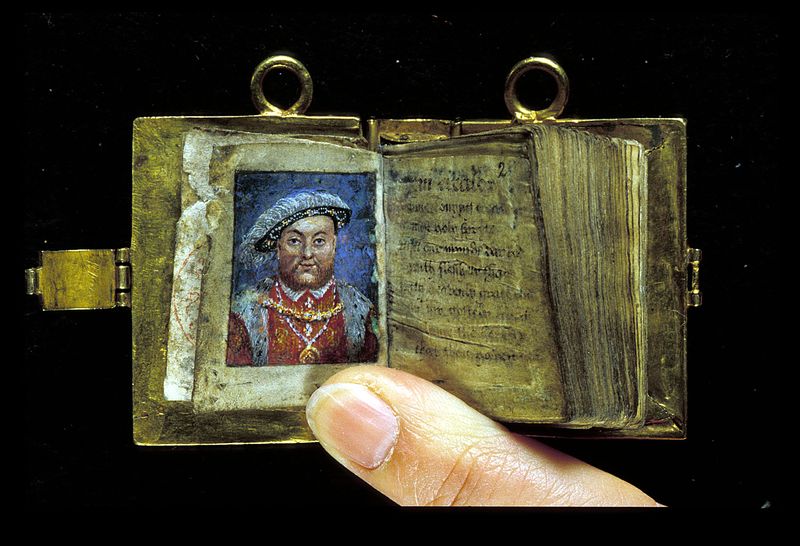
In the 16th century, it became fashionable for aristocratic women to wear miniature prayer books bound in elaborate metalwork covers hanging from their girdles (i.e. belts). These girdle books provided them with handy reading material as well as fashionable dress accessories, allowing them to display their literacy and piety to the world.

The images on the page are fascinating. Of special historical interest is one that once belonged to Anne Boleyn (shown above), a gift from her murderous husband.

A particularly luxurious example is a girdle book with covers of gold filigree . . . It contains selected Psalms in English verse, translated and apparently written out by John Croke, one of Henry VIII’s clerks in Chancery, with a portrait of Henry VIII at the beginning.

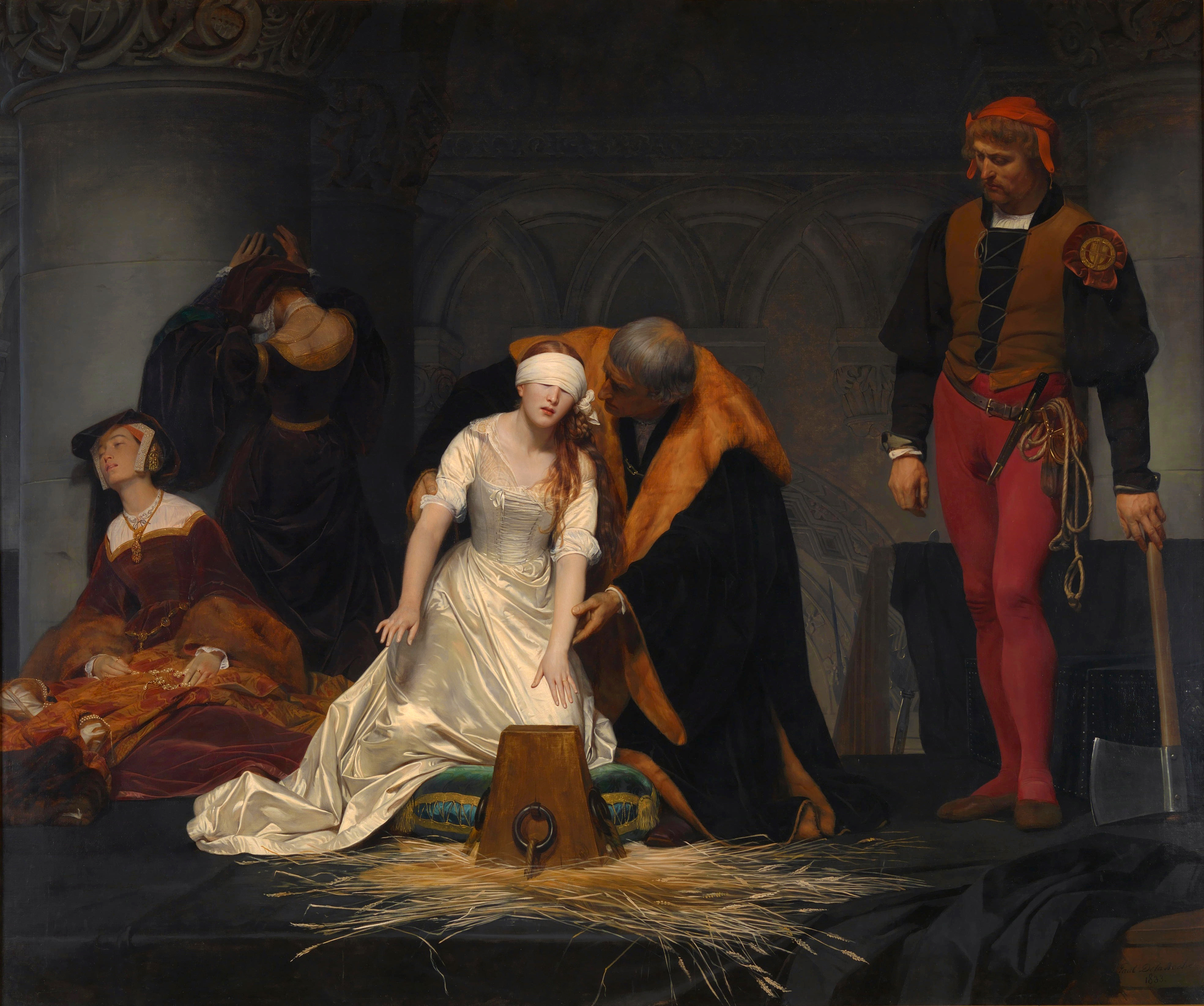
The volume is traditionally thought to have belonged to Anne Boleyn, who is said to have handed it to one of her maids of honour when she was standing on the scaffold before her execution in 1536.

Inventing Poetry Forms

Would you like to leave your mark on literary history? Why not invent a new poetic form? It just might catch on.

If it did, you could become as famous as Adelaide Crapsey (1878-1914). She lived a privileged but brief life. Adelaide is remembered today as the creator of the American Cinquain. She also wrote a book entitled A Study in English Metrics which you can download for free.

C.S. Lewis describes the imaginative aspect of writing poetry as a creative act. “For poetry too is a little incarnation, giving body to what had been before invisible and inaudible” (Reflections on the Psalms).

LitCharts offers a description of the form itself, and notes an alternative name for the poetic invention.

The American cinquain is an unrhymed, five-line poetic form defined by the number of syllables in each line—the first line has two syllables, the second has four, the third six, the fourth eight, and the fifth two (2-4-6-8-2). They are typically written using iambs.

In the early twentieth century the American poet Adelaide Crapsey, inspired by the five-line Japanese poetic form of tanka, began to write five-line poems that followed a distinct form. This poetic form soon came to be known as an American cinquain (though it’s also sometimes referred to as a Crapseian cinquain, after its creator).

I think I’ll stick with “American.”

Oddly, one of the reasons Crapsey’s story drew me in is the fact she was the daughter of a prominent Episcopal clergyman. Algernon Sidney Crapsey (1847-1927) had aspirations of becoming a bishop, only to end up defrocked for heresy.

Writer’s Digest offers a list of 168 poetic forms, including “a few fun super new nonce forms.” I advise reviewing this listing so you don’t go to the effort of birthing your own form, only to find out that someone beat you to it.

I’ve written in the past about the benefit of writing outside of our normal styles. As a nonfiction writer, I’ve never desired to be considered a poet.

But I have enjoyed dabbling in a variety of poetic forms as a literary exercise. On occasion, I’ve actually been pleased with the results. And, due to its Inkling inspiration, my personal favorite is probably “A Foreshadowing of Epics.”

In a moment I’ll share my modest attempts at American Cinquains. But first, allow me to offer a Sijo that I wrote to introduce my Cinquains. A Sijo is “a Korean verse form related to haiku and tanka and comprised of three lines of 14-16 syllables each, for a total of 44-46 syllables.”

Immortalize your poetic memory this novel way.
Inventing a new form of poetry is easy to do.
With meter, hyperbole and rhyme – make your fame last for all time.

What follows is a medley of American Cinquains that I composed yesterday while waiting for an optometry appointment. My goal was not to awe readers, but to stretch my writing – what Chuck Palahniuk (the author of Fight Club) refers to as one’s “writing chops.”

The last story you should write is the most important story. You should start with a story that is just an amusing, entertaining, fun story to write and learn your writing chops with the least important things before you start applying them to the most important things.

I intentionally attempted to write cinquains evoking a variety of emotions. Here you will find examples that are thoughtful and frivolous, serious and sentimental.

Cudgel
Beaten by words
Angry themes beget hate
Eardrums torn by condemnation
Wounds last.

Pet dogs
Each breed a joy
Humanity’s best friends
Frolicking with unbounded joy
Precious.

Just War
Tragic option
For innocents still die
Theology deems it okay
Last choice.

Poets
Can be stuck up
Denigrating others
Counting fine prose lower than verse
Vain pride.

Dinner
Fresh fare tonight
Feasting on each choice cut
Cannibals toast missionaries
Dessert.

Comfort
Love wraps its arms
About the wayward lamb
Carried safely back to the fold
Rescued.

Try your own hand at writing an American Cinquain. Or, better yet, establish your own unique poetry form. If you promote it well – say by getting someone like Oprah to endorse it – you could one day become as famous as Adelaide Crapsey.