Music, Muses & C.S. Lewis

Why do so many modern musicians – including some who are commercially successful – appear to suffer from amusia?

Well, I suppose that diagnosis is a matter of opinion, since “amusia” has come to refer to a particular medical disorder related to “the inability to recognize musical tones or to reproduce them.” More on that in a moment. First let’s consider the original meaning of the word.

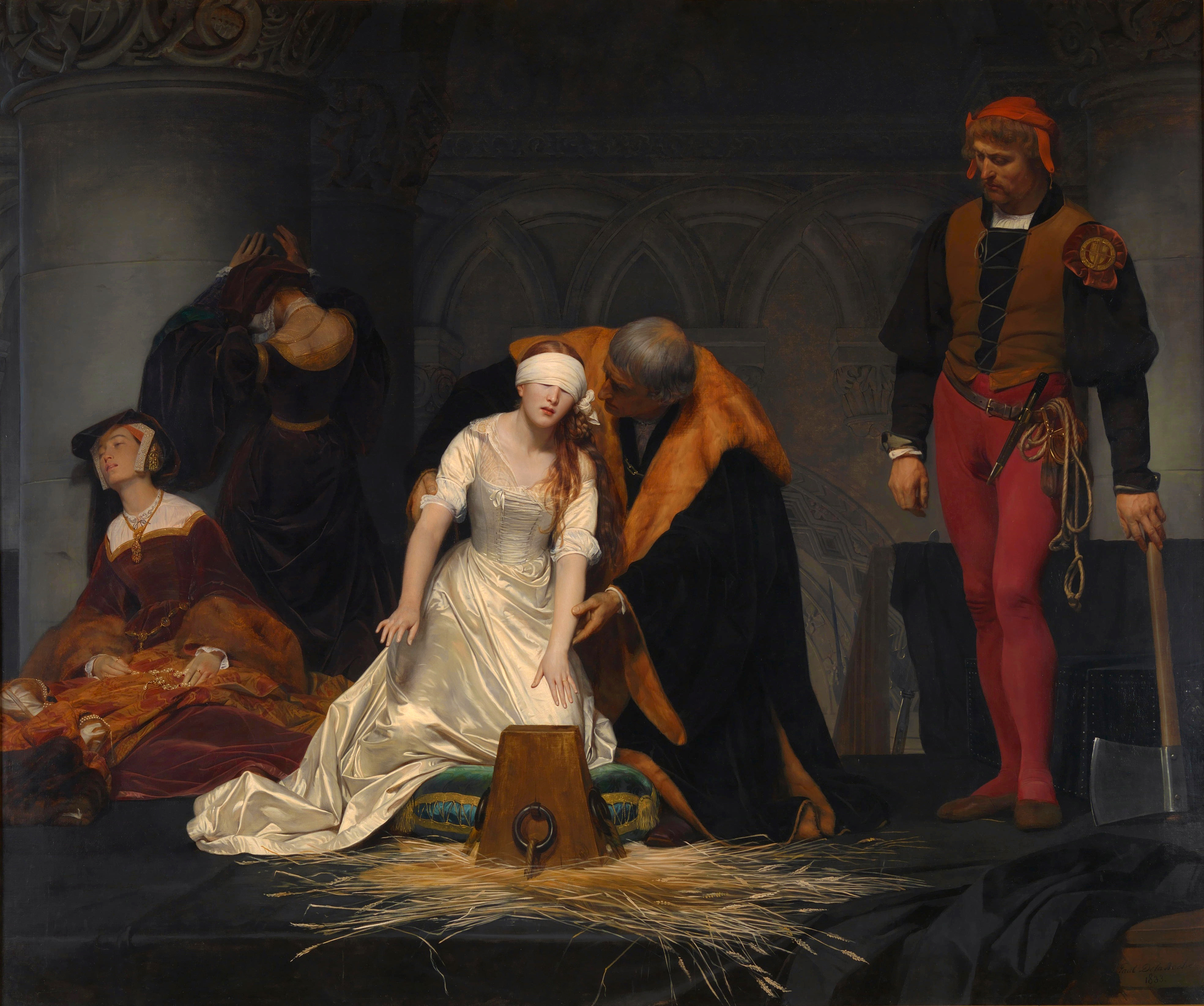
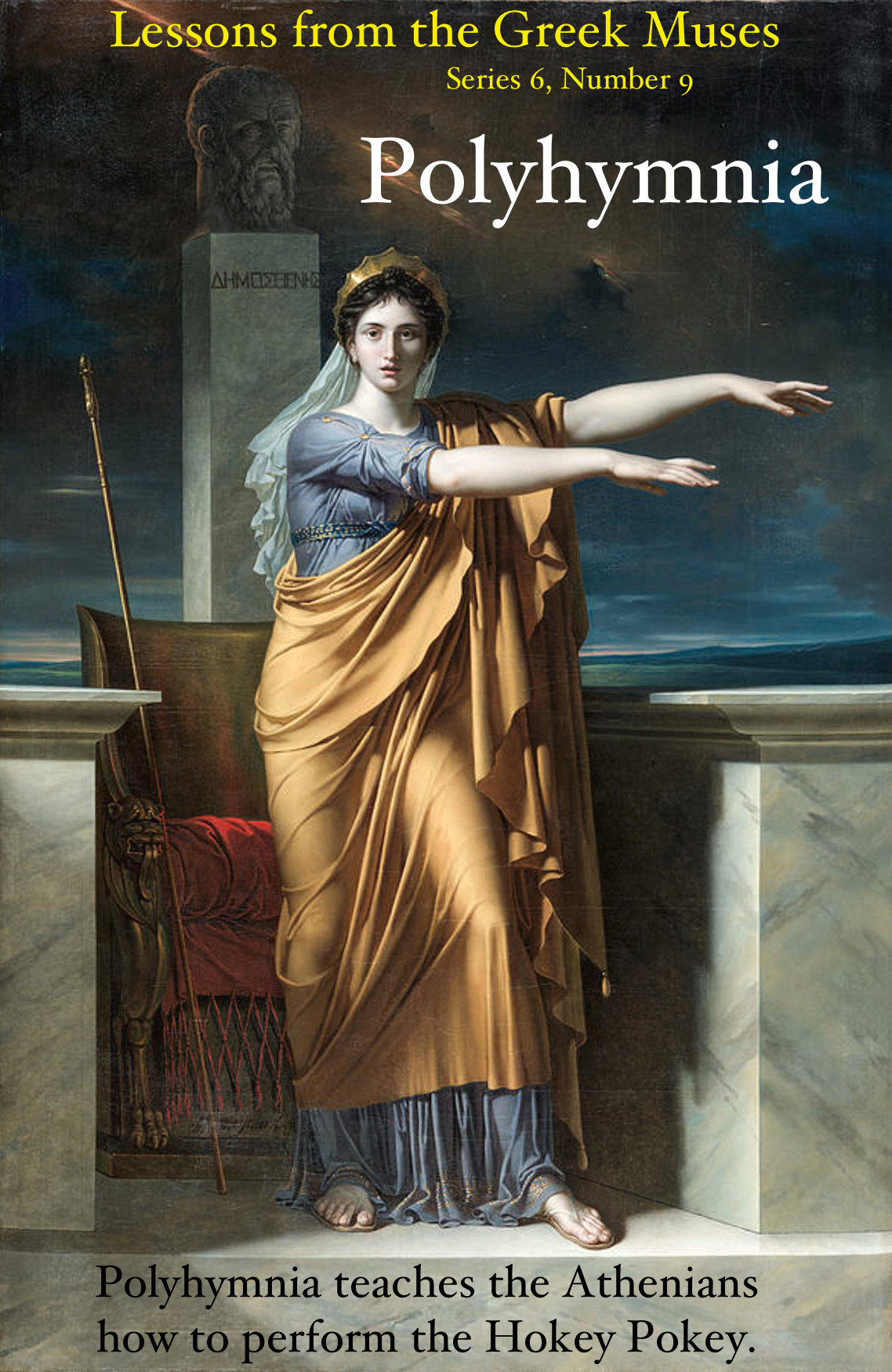
It begins with the Greek Muses. While “muse” has morphed into anything that inspires a creative soul, it did not begin that way. The Muses began as personifications devoted to nine children of Zeus and Mnemosyne (Memory). During Europe’s revival of Classical themes, they were associated not only with the arts, but with culture and refinement in general.

In Surprised by Joy, C.S. Lewis records his admiration for one of his early teachers. This man taught him to love poetry, and although he practiced corporal punishment (standard for the era), embodied “perfect courtesy.” On an occasion he was sent to the headmaster, who misperceived that Lewis had acted inappropriately. After dispelling the confusion, this teacher, who treated his students as “gentlemen,” matter-of-factly said “you will have to be whipped if you don’t do better at your Greek Grammar next week, but naturally that has nothing to do with your manners or mine.”

The idea that the tone of conversation between one gentleman and another should be altered by a flogging (any more than by a duel) was ridiculous. His manner was perfect: no familiarity, no hostility, no threadbare humor; mutual respect; decorum.

“Never let us live with amousia” was one of his favorite maxims: amousia, the absence of the Muses. And he knew, as Spenser knew, that courtesy was of the Muses. 

Muses, from this perspective, undergird civilization. But the Muses are fickle. One cannot create their own Muse. Inspiration comes to us of its own volition. It can’t be commanded.

Nearly four years ago, I posed this question in Mere Inkling: “Who is Your Muse?” Various literary figures have written paeans to the muses which inspire their work. In that column I also noted how our animal companions* often exert an influence on our own creativity.

The link between inspirational Muses and music itself is strongly intertwined. Consider, for instance, Friedrich Nietzsche (1844-1900), who was brilliant, but much to be pitied. He despised God, but he did love music. In “Amousia: Living Without the Muses,” Classicist Stephen Halliwell discusses the importance of music for enjoying a meaningful existence. He begins with a quote from Nietzsche, and points out a Platonic corollary. 

Without music life would be a mistake . . . So, famously, wrote Friedrich Nietzsche in . . . Twilight of the Idols. As always, Nietzsche had deeply personal reasons for the force and pathos of this aphorism; music did indeed help to keep him alive. . . .

[W]e can detect in Nietzsche’s stark utterance, I would like to suggest, a trace and resonance of Greek feeling. We might even wonder whether in formulating his maxim Nietzsche was subconsciously remembering the passage in Plato’s Philebus where Protarchus, asked by Socrates whether music, as one of the ‘impure’ arts, is needed for the mixture of a humanly desirable life, says that he certainly takes it to be necessary – ‘at any rate,’ as he puts it, ‘if our life is really to be a life of some kind.’

Without music, Protarchus . . . seems to take the idea to be practically self-evident, human ‘life’ would hardly be worth the name at all.

Amusia as a Medical Condition

I suggested above that the caterwauling of some musicians suggests they are tone deaf, but in fact there is a genuine medical condition called amusia. It traces its beginning to the Muses we have been speaking about, and suggests their absence.

In “The Genetics of Congenital Amusia (Tone Deafness),” we learn that “congenital amusia . . . is a lifelong impairment of music perception that affects 4% of the population.” What’s more, “the pitch disorder has a hereditary component.”

In amusic families, 39% of first-degree relatives have the same cognitive disorder, whereas only 3% have it in the control families.

As the husband of a gifted music teacher, the father-in-law of another, and the grandfather of a number of extremely talented children, I understand the Greek principle. While I would miss music’s grace if I was stricken with amusia, I know a number of precious people for whom that would be one of the most terrible fates imaginable.

C.S. Lewis and Music

Like most of us, C.S. Lewis enjoyed some forms of music while others left him exasperated. Wagner, bravo. Church hymnody, not so much. A recent article by John MacInnis, a professor of music, goes so far as to claim: “music listening and discussion factored regularly in C.S. Lewis’s relationships, and love for music inspired his creative endeavors and prompted his best thinking.”

I agree with the first part of this, and will attribute the “best thinking” declaration to the hyperbole of one who has devoted his own life to music.

The author of “A Medium for Meeting God” explores in  detail the effect of Wagner’s work, and the sense of Northernness it imprinted on Lewis’ psyche.

In 1934, Lewis, along with his brother Warnie and J.R.R. Tolkien read Wagner’s operas together in German, in anticipation of attending performances of the Ring cycle. MacInnis points out that Lewis enjoyed the music of Sibelius (also “evocative of Northern landscapes) and likened it to Wagner as an expression of natural or earthy music. This he contrasted to Beethoven, which he also enjoyed, and thought of as “noble” and even spiritual.

As for church music, Lewis had mixed feelings. I’ve written about that in the past, in “Good, Bad and Ugly Hymns.” Most of us would agree that music enriches our lives. Our tastes vary, of course, just as they do with literature.

And, speaking of which, just as there are tone deaf individuals who should avoid recording music . . . most of us have encountered writers who suffer from a literary variant of amusia. And, lacking the influence of anything remotely like a muse, would not the world be a more harmonious place if they simply laid down their pens.


* When we got our youngest border collie as a puppy, I named her Calli. Actually, that’s what we call her, but her given name is actually Calliope. I named her after the Muse of epic poetry with the hope she might inspire my writing.

Since she’s our fifth border collie, I should have known better. The very last thing Calli wants me to do is sit at the computer composing documents (no matter how interesting or edifying). “Get out of that chair and get some exercise with me,” she says plaintively with her body, voice, and pleading eyes.

She’s plenty loving, and her insistence on activity may well add years to my life, but if I look to her to help me write more productively, I’m guaranteed disappointment.

CS Lewis | Academic Tam

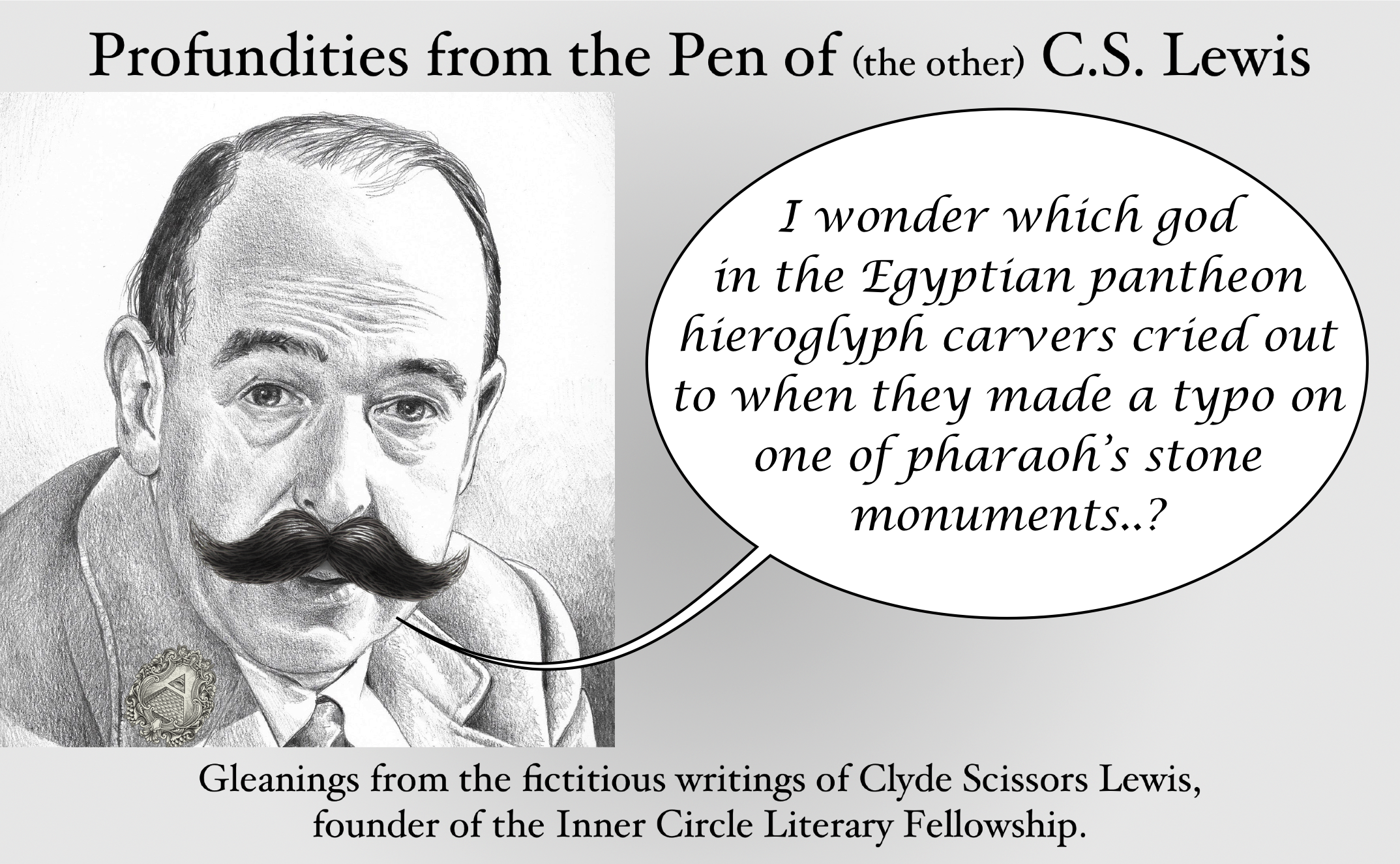
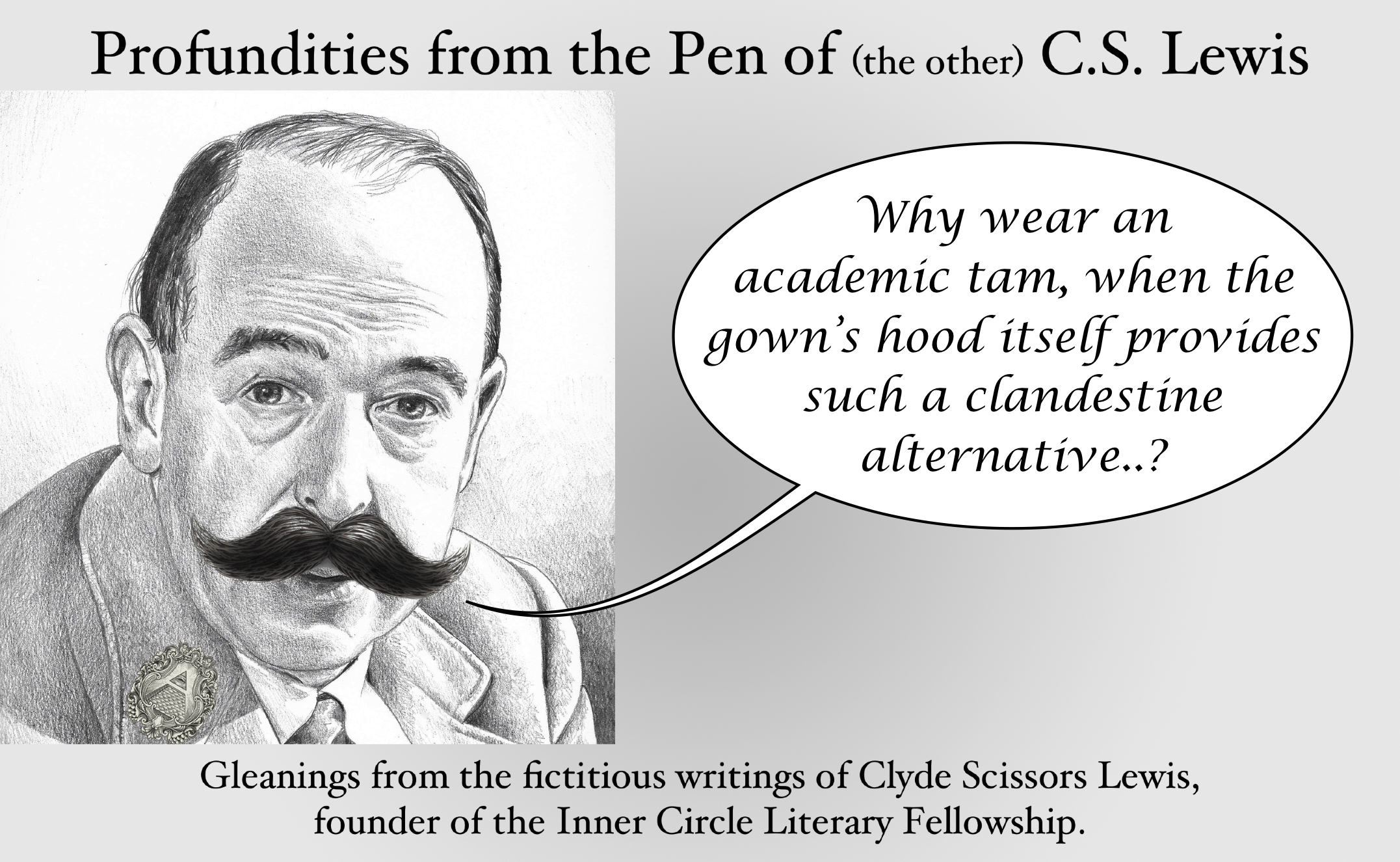
Deep Thoughts from the Quill of the Other C.S. Lewis

Welcome to another in an occasional series of fictitious quotations from a fabricated contemporary of the great Oxbridge professor, Clive Staples Lewis.

The C.S. Lewis who authored these questionable observations, Clyde Scissors Lewis, possessed a worldview enigmatically different from that of the esteemed Christian author. Despite the fact that their two lives overlapped in a variety of ways, the similarities were superficial.

A brief biography of the lesser Lewis is available at this link.

The Other C.S. Lewis: A Brief Biography

By all means, do not confuse the wisdom of the genuine article with his shadowy counterfeit. Despite any cursory similarities between the two men, this is most definitely not the C.S. Lewis readers have come to know and love.

Please Forgive My Sesquipedalianism

Long words can be daunting. Even for native speakers. The illustration above comes from The Japan Times, and reveals how the challenge is magnified for others.

I love learning new words. And, since these treasures frequently drift out of my vocabulary because I fail to use them, I often have the joy of re-learning unique words.

Sesquipedalianism is actually a genuine word which can be validly applied in a variety of settings. After all, haven’t we all encountered a sesquipedalianist or two, who uses especially long, and occasionally obscure words?

How many syllables are required before a word grows too long? To a monosyllabic individual, two might be deemed excessive.

Seriously, it’s not the length of a word that matters, it’s the word’s familiarity. For example, “familiarity” has six syllables, and everyone reading Mere Inkling knows its meaning. (I resisted saying “is familiar with . . .”) On the other hand, “carbuncle” is only trisyllabic, and yet the only people likely to know its definition are either those in medical professions, or unfortunate individuals who have suffered from one.

But it’s not only unfamiliarity that causes confusion; misunderstanding can result from a lack of context. Let’s take “trisyllabic,” a word even an active reader seldom encounters. As used in the paragraph above, the context (along with the prefix and root), provide us with more information than a person needs to recognize its meaning.

In a famous letter from 1956, C.S. Lewis included the following advice:

Don’t use words too big for the subject. Don’t say “infinitely” when you mean “very”; otherwise you’ll have no word left when you want to talk about something really infinite.

Great advice, just as one would expect. However, this does not constitute a blanket rejection of “big words.” Lewis is simply reminding us that our prose must not be more complicated than it needs to be. Thus, the title of this column uses a precise word – rather than saying “Please Forgive My Practice of Using Long and Sometimes Obscure Words” – since Mere Inkling readers are quite capable of uncovering a definition if a particular word is unfamiliar.

Plus, as I hinted above, many of us enjoy expanding our vocabularies.

In the aforementioned correspondence, Lewis offered additional useful advice. Another dictum is: “Always prefer the plain direct word to the long, vague one. Don’t implement promises, but keep them.”

Here too the great writer is astute. However, this caution is not actually about the length of words. Lewis’ desire for clarity in communication leads him to reject “vague” words, which coincidentally happen to be longer than those he refers to as “direct.”

Using longer words than necessary is not, of course, always a good thing. While it comprises neuron-stretching play for word lovers, it can easily be misperceived by others as “showing off.” (Note: I’m not defending those cases in which the writer or speaker really are attempting to impress others with their verbal dexterity.*)

You can easily find collections of the longest words in English. While some cheat, including “supercalifragilisticexpialidocious,” others are more scrupulous. Despite doing just that, I like the list at grammarly because of their definition of one of the words they include.

Floccinaucinihilipilification
The estimation of something as valueless. Ironically, floccinaucinihilipilification is a pretty valueless word itself; it’s almost never used except as an example of a long word.

I’m not currently planning on adding floccinaucinihilipilification to my personal vocabulary, but don’t let me dissuade you from doing so.

Learning new words often reaps extrinsic benefits. As a historian who enjoys learning about the Latin language, I found the following definition, and illustration, from the Cambridge dictionary quite interesting.

The act of considering something to be not at all important or useful – used mainly as an example of a very long word:

The honor of being the longest non-technical word goes to floccinaucinihilipilification.

The word . . . is “an 18th-century coinage that combines four Latin prefixes meaning ‘nothing.’”

Oh, and one final suggestion. When visiting the Cambridge site, in the likelihood you’ll someday wish to use this word in conversation, take a moment to make certain you learn to pronounce in the U.K. or American manner, as appropriate for your location.


* I am not here referring to the Irish bred Bay Colt for some curious reason named “Verbal Dexterity.”

Academic Expenses

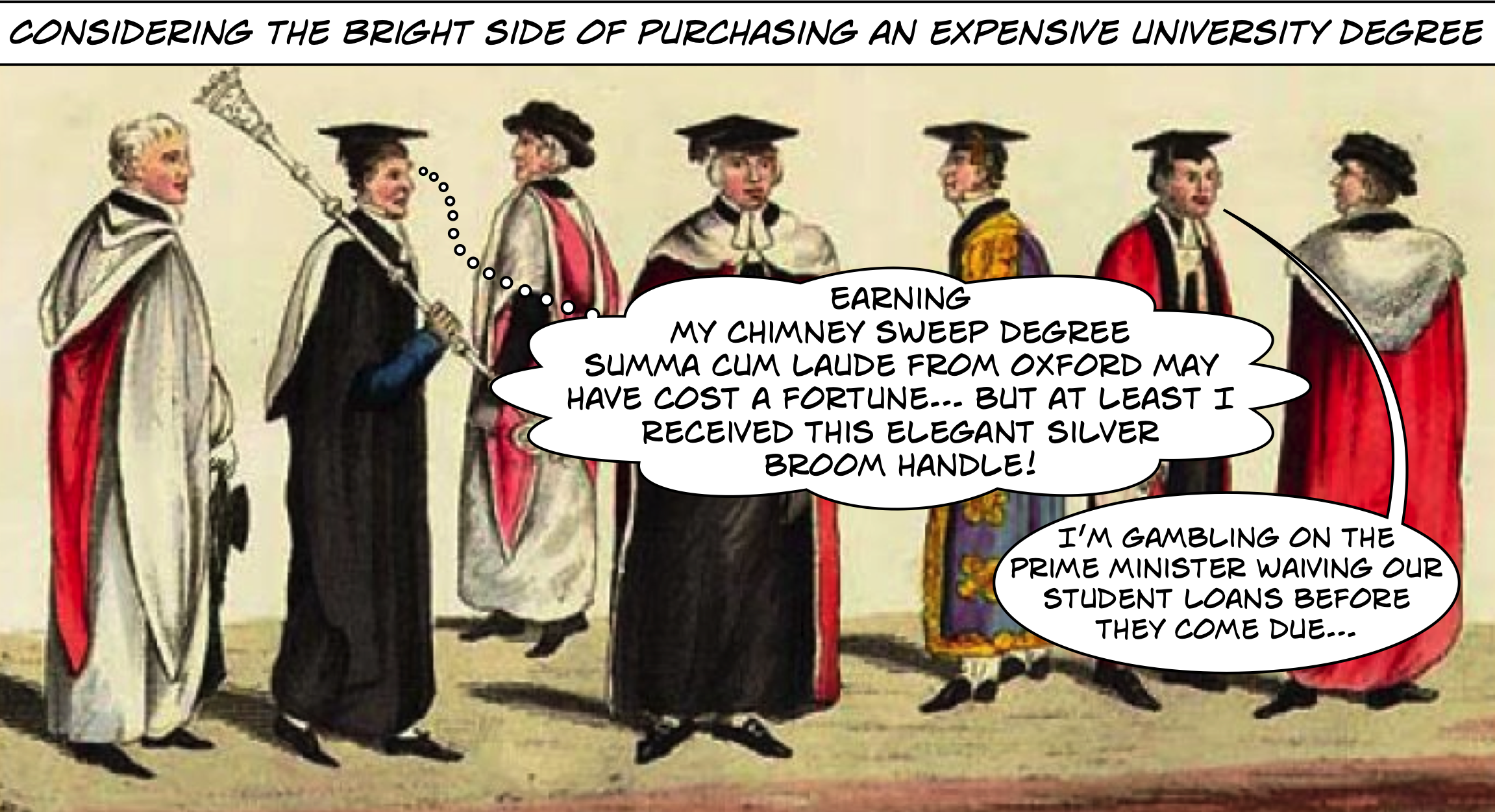
Rich people don’t need to worry about the cost of college educations. The rest of us do (or, at least, we should). C.S. Lewis could not rely on family wealth to pursue his academic dreams, and we can learn from his example.

My wife and I were the first members of our respective families to attend college. Without assistance from our parents, we did chose the most fiscally responsible path. We opted for a public university (in my own case, via “community college”) and worked as many hours a week as we could while maintaining our grades.

Even this would have been far more difficult without receiving student loans, which we diligently repaid following our graduations.

Years later, we were in a position to help our own children pursue their higher educational aspirations. Still, graduate degrees are not inexpensive, and all three of them received government-backed loans to get them to the finish line.

They have been diligently repaying that borrowed money since graduation and never complained about the debt, since no one coerced them to accept it.

Our daughter, in fact, made significant sacrifices to pay off her student loans as quickly as possible, and accomplished that goal far earlier than we imagined she would.

Here at Mere Inkling, we go to great lengths to avoid political partisanship. In addition to that, I’ve made it quite clear I have no illusions about understanding economics.

Nevertheless, it requires no genius intellect to imagine how people who sacrificed to pay off their personal debts feel about now having to (thorough their taxes) also pay off the sometimes-delinquent debts of their peers. Our middle class family is only one of presumably millions who are experiencing this personally today.

Who Paid for C.S. Lewis’ Collegiate Studies?

The world has changed much since C.S. Lewis left home for boarding school and ultimately, for the university. It was unsurprising that when his father was widowed while his sons were young, he entrusted them to schools where he assumed they would be safe, and well prepared for their future professions.

Once the boys were old enough to choose career paths, Warnie (1895-1973) pursued a military profession. Following graduation from the U.K.’s Royal Military Academy Sandhurst, he served in both World Wars. However, as one writer accurately notes, “perhaps Warnie could have accomplished far more, but his lifelong struggles with alcoholism kept him from doing so. Some have speculated Warnie’s alcoholism resulted in an earlier retirement from the military than he would have wished.”

As for the younger Lewis scion, Clive would eventually make major contributions on the faculties of both Oxford and Cambridge Universities.

Getting there took some time, and was interrupted by the First World War. After his recuperation as a seriously wounded veteran of the trenches, Lewis renewed his academic studies. Discovery Institute has an excellent article describing “C.S. Lewis and the Ceremonies at Oxford University (1917-1925).” I particularly enjoy Kathryn Lindskoog’s understatement that “Oxford University, in Lewis’s time and since, is not the best place to learn Christian humility . . .”

As a student, Lewis was reliant on continuing support from his father. Only after graduating and beginning to receive a stipend as a Fellow of Magdalen College in 1925, did Lewis consider himself financially independent. (The year prior he had received a modest salary from the college, as an employee of the College, but it was inadequate to meet his needs.)

During his college studies, despite a scholarship, he relied on his father’s generosity. His opening in a 1919 letter to his father illustrates this relationship.

Many thanks for your letter and also for the enclosed cheque for £19.12.8. That amount includes all the charges both for tuition and college expenses and may serve as a base for future calculation, tho’ of course there may be slight differences from term to term.

Still, even in the best of families, financial considerations may become a matter of concern. Five years later, as he was at the end of his life as a student, his father was wondering when he would become satisfactorily employed. (That’s a conversation replayed around the globe on a daily basis.) The first two paragraphs illustrate the theme, but you won’t be disappointed if you have the time to read the entire passage.

And now to business. The Univ. Fellowship has not been filled up. You may have read in the papers that a new ‘Chaplain Fellow’ has been elected, but that of course is a different job. If I don’t mention it, it is because there is nothing new to say about it. Just at present a new and very good vacancy at Trinity (I mean Trinity, Oxford of course) has appeared, for which an election is to be held in the summer, and I shall certainly go in for it.

As to money: I had rather you had explained in detail what you ‘don’t follow’ in my arithmetic, but I trust there is nothing seriously wrong with the figures I gave you and will proceed accordingly. What is more serious is your reference to £30 extras last year. The only part of this which I can at present identify are the extra tuition and the book bill. The former of course was purely abnormal and will not occur again. The book bill was naturally increased by my turning to a new subject.

I try to use the libraries as much as possible: but when one is reading for a particular exam there are over a hundred other people taking the same books out of the libraries – and of course there are some things one must have at command. My expenditure on books will be less in future. I have a book bill due to be paid some time soon which is under five pounds: if you will pay that I think I can undertake to find myself for books in the future – tho’ since you tell me to be frank, I will say that this may not always be easy.

The rest of the £30 you mention is, I suppose, made up by items of clothing. I presume it does not include my two suits? As to clothing, I’m afraid that even if you increase my allowance as you suggest, I cannot undertake to find myself.

I mean that my loss of the scholarship and my outlay on clothes would not be balanced by an addition of £40 or £50. I cannot see how to cut down my expenses on clothing. You know I think that it does not go to fancy waistcoats or kid gloves. And I have some ties that date from before the war!

Flannel trousers are an item that I have to repeat pretty often: they ARE ill wearing things, but if I didn’t wear them I should need suits more often than I do. On shoes I admit that I am hard and have to get a good deal of ‘soling’ done: but I am afraid this reads rather as if I were defending myself against a charge of extravagance, which you will justly reply you never made: but you must not think that. I am only trying to put down the facts of the question as they actually occur to me from day to day in order to make my conclusion more reasonable and intelligible to you.

And the conclusion is this. You ask me where £85 a term to ‘cover everything’ would be sufficient. If by ‘covering everything’ you mean covering my books, shoes, shirts, socks and other items that I have hitherto sent you, I am afraid it would not. As I said, if you wish it, I will try to undertake my own books in the future, and, at any rate to cut them down.

I will also abandon the new dinner jacket suit that was mooted, and you must not imagine that I would feel that sort of curtailment as any hardship. As for a new overcoat, the one you gave me when I left home suits and fits me so well that the question need not be considered. But I do not think that I can manage to keep myself in minor articles of clothing.

I’m afraid this may seem to you but a charter of indefinite expenses for the future. Well then, to say all, if it is too much, you must tell me so. You have done all and more than all I can expect of you, and if you tell me that these extra years are too heavy, I assure you that I shall never, even in my secret thought, criticise such a decision.

If on the other hand, you see fit to lodge £85 a year and to pay for such extras in the way of clothing, etc. as may occur, I will try to make them as little as I can. I must point out however that it is much easier to save on the big items I have mentioned – the dress suit and overcoat – than on those necessary articles which have so often to be replaced.

If you will give me a dress suit when I get a job, I ought to be able to tide over these years without any more ‘suitings’ from you at all. If, till they are over, you can lodge £85 a term and make it retrospective for the present year, while paying for my smaller articles of clothing, I think I can manage. And whether you can do this or not, I have nothing but deepest gratitude for the past.

So, once again we see that C.S. Lewis’ experiences were not all that different from our own. Most people who have accepted their parents’ financial aid during their adulthood, can identify with Lewis’ mixture of sincere gratitude and muted frustration.

Perhaps it is a very good thing that today we have so many different assistance programs for potential students. Good things, I believe, as long as they are not abused – and borrowers pay them back, as they promised.

Inklings, Libraries & Architecture

If you were to embark on a university education today, which sort of campus would you prefer?

(1) A university featuring “vaulted ceilings that draw the eye upwards and outwards . . . the frivolous artistic detail that announces the importance of the unimportant [or] the interplay of light and shade that marks the great Gothic masterpieces, the brilliant proportions of the best classical buildings, and the elaborate grandeur of the Baroque.”

(2) A modern campus comprised of “buildings entirely lacking in charm, grace, or playfulness [featuring] the boxy utilitarian grimness of official educational architecture.”

A second question clearly betrays my own preference. Which academic setting do you imagine C.S. Lewis, J.R.R. Tolkien, and their fellow Inklings would most esteem? Tolkien, after all, was not complaining in a letter to his future bride when he wrote “I have got to go to the college library now and get filthy amongst dusty books . . .”

The quotations included in the choices above come from a thought-provoking essay just posted on the website of First Things. The British writer, Niall Gooch, melds wit and genuine insight as he offers an answer to the question “Why are Universities So Ugly?” I highly commend it to you.

Libraries are of particular interest to many of us who treasure the Inkling ethos. And the article includes a delightful discussion of the treasure houses “now called ‘Information Centers’ or ‘Knowledge Hubs.’”

Books increasingly appear to be an afterthought, squeezed into the small spaces not occupied by banks of computers or the glass rooms designated as group work areas. Quiet has been banished to special Silent Study rooms, where those dangerous oddballs who wish to sit still by themselves and concentrate on one thing for a long period can be safely segregated from the normal people.

Inkling Libraries at Cambridge and Oxford

In 1959, C.S. Lewis wrote to T.S. Eliot. Both men served on the Commission to Revise the Psalter. Lewis mentions that he will be hosting an upcoming meeting of the Commission at Cambridge, and that he had secured one of the libraries for their use.

I can’t find the name and address of the secretary of our Commission on the Psalms. As you are in London could you kindly let her know that I have rescued the use of the inner library at Magdalene for our July session? It would be convenient if she told me – for the benefit of the servants – what our daily hours of sitting are likely to be. I also look forward to it.

Although Magdalene College has a distinguished history, it too has joined the revolution offering more contemporary Information Centers. They proudly declare “The New Library is . . . a purpose-built space in College for Magdalene students to meet, work, relax and find inspiration.”

As for the “Inner Library,” to which Lewis referred, I believe it to be what is presently called “The Old Library.” It fittingly includes among its special collections, “the books and manuscripts of T.S. Eliot (Honorary Fellow).”

A revealing history of “The Architectural Evolution of Libraries” begins with the question: “Can you have a civilized society without a library?”

In this article, we trace the typology of the library through history, highlighting twelve of the most important libraries in the world, from Ancient Alexandria to Raleigh, North Carolina, where robots retrieve books from storage.

A fitting close to our consideration of libraries comes from a letter written by J.R.R. Tolkien in 1966. The English Faculty of Oxford University had commissioned a bust of Tolkien – to be sculpted by his daughter-in-law. It presently resides in the English Faculty Library, which undoubtedly displays the elegant architecture of the classical university.

I feel much honoured, and so also does my daughter-in-law (the sculptress), by the Faculty’s wish to place the bust of me in the English Library in some prominent position – if on second thoughts you do not think a storied urn would be better. I shall be most pleased to present it to the Faculty.

It occurs to me that the plaster bust is rather fragile and very easily damaged. I suggest, therefore, that I should have it cast in bronze for presentation (at my own cost). I have already referred the matter to the sculptress who knows how these things are done.

Once in bronze it would then be unaffected by any dignities or indignities offered to it. I often used to hang my hat on the Tsar of Russia’s bust, which he graciously presented to Merton.


The illustration accompanying today’s post is the bust of Tolkien referred to in his correspondence. (In light of this column’s discussion, one can hardly ignore the rather utilitarian architecture revealed through the window behind the celebrated author.)

C.S. Lewis & Rigmarole

I hope my confusion is not due to a decline in my mental faculties. But it seems to me politicians are becoming even more incoherent than they’ve always been.

Is it me? Or, are you also amazed at how some of them appear to be babbling half the time?

C.S. Lewis was a master of communication. And some of his observations about how poorly some people communicate can be insightful.

Listen to this verse from a poem entitled “The Prudent Jailer” which he wrote in 1947. (It deserves to be read out loud.)

Some walls cannot a prison make
Half so secure as rigmarole.*

Lewis wasn’t referring to political jargon when he wrote this poem, but it seems quite apropos in a number of contexts.

For example, consider a recent article from the American Institute for Economic Research. Jon Sanders applies Lewis’ poem to foreboding aspects the government’s response to the pandemic.

The poem originated not in political allegory, but as a critique of unimaginative literary criticism. Notwithstanding, the Jailer is a diabolical figure, and his prudence is this: he imprisons with words, not walls. . . .

The Jailer has them imprisoned by their own thoughts, while he keeps them focused ever on the presumption of a prison. He doesn’t want them thinking of anything else.

This post isn’t about politics. I detest the subject as a whole, and find it particularly corrosive to conversation as elections draw near.

The verse I cited above simply evoked for me the power of words to distort and, yes, imprison. Lewis’ use of rigmarole⁑ (a word sadly out of vogue) highlights the fact that the crippling words themselves are often nonsensical.

Other colorful synonyms that we might hear in the company of our seniors could include balderdash, poppycock, or perhaps even malarkey.

In a 1940 letter to Dom Bede Griffiths, Lewis applies “balderdash” to describe art and literature done “for their own sake.”

I do most thoroughly agree with what you say about Art and Literature. To my mind they are only healthy when they are either (a) Definitely the handmaids of religious, or at least moral, truth – or (b) Admittedly aiming at nothing but innocent recreation or entertainment. . . .

But the great serious irreligious art – art for art’s sake – is all balderdash; and, incidentally, never exists when art is really flourishing.

Fortunately, such words rarely become completely obsolete.

A noteworthy mythopoeic⁂ scholar, Brenton Dickieson, used “balderdash” quite skillfully not that long ago.

“The Prudent Jailer” was originally published in 1947 under the mundane title, “The Romantics.”

Since you’ve read this column to its conclusion, allow me to reward your diligence by presenting the poem in its entirety.

The Prudent Jailer

Always the old nostalgia? Yes.
We still remember times before
We had learned to wear the prison dress
Or steel rings rubbed our ankles sore.

Escapists? Yes. Looking at bars
And chains, we think of files; and then
Of black nights without moon or stars
And luck befriending hunted men.

Still when we hear the trains at night
We envy the free travelers, whirled
In how few moments past the sight
Of the blind wall that bounds our world.

Our Jailer (well may he) prefers
Our thoughts should keep a narrower range.
‘The proper study of prisoners
is prison,’ he tells us. Is it strange?

And if old freedom in our glance
Betrays itself, he calls it names
‘Dope’-‘Wishful thinking’-or ‘Romance,’
Till tireless propaganda tames.

All but the strong whose hearts they break,
All but the few whose faith is whole.
Some walls cannot a prison make
Half so secure as rigmarole.


* Thank you to Jon whose comment below pointed out the connection between Lewis’ allusion to the very famous poem “To Althea, from Prison,” written by Richard Lovelace in 1642. “Stone walls doe not a prison make, Nor iron bars a cage…”

⁑ Some people in the States will be more familiar with the variant “rigamarole.”

⁂ Mythopoeia is a modern literary genre in which the author creates a fictional mythology. The finest example of such writing comes from the pen of J.R.R. Tolkien, the creator of Middle Earth.

CS Lewis | Mistakes

Deep Thoughts from the Quill of the Other C.S. Lewis

Welcome to another in an occasional series of fictitious quotations from a fabricated contemporary of the great Oxbridge professor, Clive Staples Lewis.

The C.S. Lewis who authored these questionable observations, Clyde Scissors Lewis, possessed a worldview enigmatically different from that of the esteemed Christian author. Despite the fact that their two lives overlapped in a variety of ways, the similarities were superficial.

A brief biography of the lesser Lewis is available at this link.

The Other C.S. Lewis: A Brief Biography

By all means, do not confuse the wisdom of the genuine article with his shadowy counterfeit. Despite any cursory similarities between the two men, this is most definitely not the C.S. Lewis readers have come to know and love.

C.S. Lewis & a Horse Named Fledge

C.S. Lewis was not alone in recognizing horses are magnificent creatures. Many of us share his appreciation for the more than 300 breeds that comprise the equine family.

Horses hold a prominent place in Lewis’ zoologically rich fantasies. In the Chronicles of Narnia, we encounter many Talking Horses. Among them are Bree, the titular hero of The Horse and His Boy, and Hwin, the heroine who teaches Bree what it means to be a Narnian.

But before Bree and Hwin galloped across the fields and plains of Narnia, a horse from Earth was transported to that Land at the hour of its very creation.* And there, Aslan anointed this modest draft horse⁑ to become the progenitor of a race of pegasi. Fledge’s story is quite inspiring.

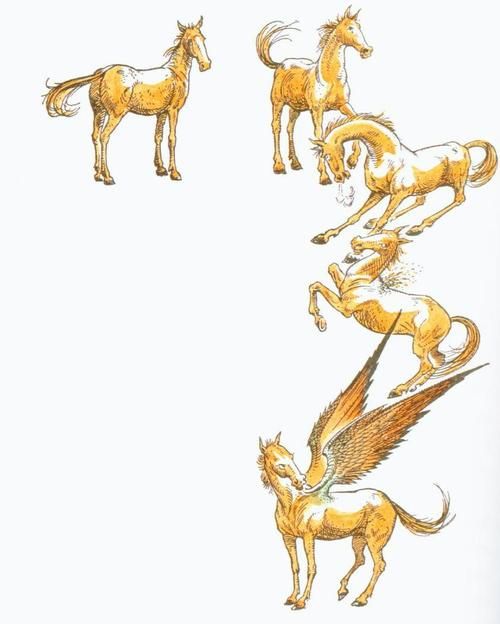
Fledge was once named Strawberry, and pulled a Hansom cab in London. But after journeying to Narnia, Aslan chose him to be one of the very first Talking Animals, and granted him wings.

Would You Like Wings?” offers an illuminating meditation on this transformation.

So Strawberry, in this first stage, goes from beast to person. From a dream to wakefulness. From slavery to freedom. From silence to speech, from witless to intelligent.

From C.S. Lewis’ account of the “miraculous” event:

He then turned to the Horse who had been standing quietly beside them all this time, swishing his tail to keep the flies off, and listening with his head on one side as if the conversation were a little difficult to understand. “My dear,” said Aslan to the Horse, “would you like to be a winged horse?”

You should have seen how the Horse shook its mane and how its nostrils widened, and the little tap it gave the ground with one back hoof. Clearly it would very much like to be a winged horse. But it only said: “If you wish, Aslan – if you really mean – I don’t know why it should be me – I’m not a very clever horse.”

“Be winged. Be the father of all flying horses,” roared Aslan in a voice that shook the ground. “Your name is Fledge.” The horse shied . . . It strained its neck back as if there were a fly biting its shoulders and it wanted to scratch them. And then, just as the beasts had burst out of the earth, there burst out from the shoulders of Fledge wings that spread and grew, larger than eagles’, larger than swans’, larger than angels’ wings in church windows. . . .

“Is it good, Fledge?” said Aslan.

“It is very good, Aslan,” said Fledge.

When Aslan sends Polly and Digory on a quest with Fledge, they camp for the night and enjoy a delightful human~animal conversation (much like I would anticipate having with the deer that visit our yard daily, should they be graced with speech).

“And my wings are beginning to ache,” said Fledge. “There’s no sign of the valley with a Lake in it, like what Aslan said. What about coming down and looking out for a decent spot to spend the night in? We shan’t reach that place tonight.”

“Yes, and surely it’s about time for supper?” said Digory. So Fledge came lower and lower. As they came down nearer to the earth and among the hills, the air grew warmer and after traveling so many hours with nothing to listen to but the beat of Fledge’s wings . . .

A warm, good smell of sun-baked earth and grass and flowers came up to them. . . . “I am hungry,” said Digory.

“Well, tuck in,” said Fledge, taking a big mouthful of grass. Then he raised his head, still chewing and with bits of grass sticking out on each side of his mouth like whiskers, and said, “Come on, you two. Don’t be shy. There’s plenty for us all.”

“But we can’t eat grass,” said Digory.

“H’m, h’m,” said Fledge, speaking with his mouth full. “Well—h’m—don’t know quite what you’ll do then. Very good grass too.”

Polly and Digory stared at one another in dismay. “Well, I do think someone might have arranged about our meals,” said Digory.

“I’m sure Aslan would have, if you’d asked him,” said Fledge. “Wouldn’t he know without being asked?” said Polly. “I’ve no doubt he would,” said the Horse (still with his mouth full). “But I’ve a sort of idea he likes to be asked.”

“But what on earth are we to do?” asked Digory.

“I’m sure I don’t know,” said Fledge. “Unless you try the grass. You might like it better than you think.” (The Magician’s Nephew).⁂

In C.S. Lewis’ first story about Narnia, The Lion, the Witch and the Wardrobe, we read about the “statues” that surround the castle of the White Witch. Edmund has been corrupted by the Witch, and told that Aslan is dangerous.

The Witch has the power to turn living creatures to stone. When Edmund discovers a lion in her garden, he is delighted. But the lion is not alone.

The relief which Edmund felt was so great that in spite of the cold he suddenly got warm all over right down to his toes, and at the same time there came into his head what seemed a perfectly lovely idea. “Probably,” he thought, “this is the great Lion Aslan that they were all talking about. She’s caught him already and turned him into stone. So that’s the end of all their fine ideas about him! Pooh! Who’s afraid of Aslan?”

And he stood there gloating over the stone lion, and presently he did something very silly and childish. He took a stump of lead pencil out of his pocket and scribbled a mustache on the lion’s upper lip and then a pair of spectacles on its eyes. Then he said, “Yah! Silly old Aslan! How do you like being a stone? You thought yourself mighty fine, didn’t you?”

But in spite of the scribbles on it the face of the great stone beast still looked so terrible, and sad, and noble, staring up in the moonlight, that Edmund didn’t really get any fun out of jeering at it. He turned away and began to cross the courtyard.

As he got into the middle of it he saw that there were dozens of statues all about – standing here and there rather as the pieces stand on a chessboard when it is halfway through the game. There were stone satyrs, and stone wolves, and bears and foxes and cat-a-mountains of stone. . . . a winged horse and a long lithe creature that Edmund took to be a dragon (The Lion, the Witch and the Wardrobe).

I find the description of the lion quite provocative. “. . . so terrible, and sad, and noble.” That is exactly what I experienced when I saw the model for a “war horse” memorial in Romsey, England. The artists have done a brilliant job. The sorrow overflows from it eyes.

True, my impression is influenced by the outstanding 2011 film titled War Horse. If you’ve never seen this Spielberg gem, I encourage you to watch it and challenge you to do so without shedding a tear.

Horses have long been used in war. That is not what God created them for, but fallen humanity has often harnessed their power for combat. Some of their names are remembered today, including Bucephalus, Copenhagen, Cincinnati, and Traveler.

Returning to Fledge, we find a horse not only experiencing the fullness of his equine nature, but receiving blessings unimagined.


* C.S. Lewis did not compose the seven volumes of the Chronicles of Narnia chronologically. This has led to different opinions on the order in which the books should be read.

⁑ Draught horse, to you Brits.

⁂ While I typed this, a doe and her two fawns were peacefully grazing on our clover-seeded lawn, just a few feet away, outside my office window. [I’m sure they would have happily shared with me.]

Keeping the Peace, Finn Style

The war in Ukraine trudges on, but the world has become safer with the imminent expansion of the North Atlantic Treaty Organization (NATO).

Recognizing the expansionist aspirations of Dictator Putin’s Russia, Sweden and Finland have decided to request formal admission to the peacekeeping alliance. Their reception has tentatively been approved, although just today another dictator, Recep Tayyip Erdogan of Turkey is threatening to “freeze” them out if they don’t support his efforts to suppress Kurdish independence.

I have my own experiences with NATO. Foremost among them was the small part I played in helping bring about the Intermediate-Range Nuclear Forces Treaty. (I even served as one of the “escort officers” for a Soviet verification team when it visited RAF Greenham Common.)

I mentioned the treaty on Mere Inkling and lauded its success.

The great thing about NATO’s cruise missiles is that they were deployed to bring the Soviet Union to the negotiating table, where the Intermediate Nuclear Forces Treaty led to the elimination of all such munitions from Europe!

Alas, this monumental treaty has expired.

It is a casualty of Russian Federation dreams to restore the Soviet Union’s former borders in Europe. Combined with the “defection” of the former Warsaw Pact nations, it is easy to understand why a suspicious Russia postures so aggressively.

Which, of course, encourages the democratic nations to draw closer in mutual defense.

How are the Finns Celebrating

Finns are different.

Not quite what you would expect. Many people – certainly most Americans, the ones who are not totally geographically ignorant – mistakenly think Finland is a Scandinavian country. Not quite. True, they are a Nordic nation, but Nordic Perspective offers an insightful discussion, replete with great maps, on the subject.

Being a Nordic people, it comes as no surprise many Finns are welcoming their entry into NATO with a beer. In fact, a brewing company named “Olaf” has opted to use the French acronym for NATO – OTAN – as a play on words. “The beer’s name is a play on the Finnish expression ‘Otan olutta,’ which means ‘I’ll have a beer…’”

Good for them. (So long as they remember to drink in moderation.)

Now, this OTAN-business raises a question in my mind. Is it merely a coincidence, or might the French have a passive aggression purpose in mind with this heteropalindrome?

After all, the headquarters of NATO had to be moved from Paris to Belgium when Charles de Gaulle withdrew from the military alliance.

Wondering about French subliminal messages got me thinking about C.S. Lewis’ thoughts on the subject. Lewis loved all people, but was no one’s fool. He understood many of the influences exerted upon culture are destructive. Decadent societies (e.g. pre-war Berlin) sow seeds that ultimately bear tragic fruit.

As the Second World War was just beginning, and Lewis’ brother Warnie had safely returned home after the Dunkirk evacuation, Lewis mentioned France in one of his 1940 letters to his veteran brother. It is quite entertaining, as long one is not an über-Francophile.

I am also working on a book sent me to review, Le Mystere de la Poesie*by a professor at Dijon, of which my feeling is “If this is typical of modern France, nothing that has happened in the last three months surprises me” – such a mess of Dadaists, Surrealists, nonsense, blasphemy and decadence, as I could hardly have conceived possible.

But one ought to have known for, now that I come to think of it, all the beastliest traits of our intelligentsia have come to them from France.

Well, that’s enough of that. It’s time to pop the tab on an OTAN and toast the NATO, and its expanding protection of world democracies.


* Volume two of The Collected Letters of C.S. Lewis has a footnote reading “This work cannot be traced.” I believe the likely object of Lewis’ disdain may have been written by André Vovard and published in 1951 in Paris and Montreal by Fides.

C.S. Lewis, the Psalms, and Penitence

When do you feel closest to God? When you’ve been about holy business all day and are now praying at your bedside? Or, when everything in your life seems to have imploded, and you look about you helplessly, with nowhere else to turn than your heavenly Father?

In The Four Loves, C.S. Lewis provides a brilliant insight into the nature of our souls.

Man approaches God most nearly when he is in one sense least like God. For what can be more unlike than fullness and need, sovereignty and humility, righteousness and penitence, limitless power and cry for help?

This rings true as I ponder my own spiritual pilgrimage. Tribulation and suffering clear my vision of material distractions in a way that allows me to recognize more vividly my need for God’s grace. And, in relying more consciously on his mercy and compassion, I draw closer to my Lord.

It’s no accident, in my opinion, that among the Psalms of David most treasured by God’s people, are those in which he cries out to the Lord for deliverance and salvation. Verses where David places no trust in his own strength or even in God’s previous beneficence. Poetry where this anointed king acknowledges that even the drawing of his next breath depends wholly on the providence of his Creator.

Seven of David’s songs are traditionally identified as the Penitential Psalms.* The great Saint Augustine’s regard for these Psalms is revealed in the manner in which he spent his final days.

As Augustine lay dying . . . he ordered those psalms of David which are especially penitential to be copied out [for example, “Have mercy on me according to thy steadfast love . . . For I know my transgressions, and my sin is ever before me,” Psalm 51], and when he was very weak, he used to lie in bed facing the wall where the sheets of paper were put up, gazing at them and reading, and copiously and continually weeping as he read (Robert Wilken, The First Thousand Years).

Like this ancient saint, C.S. Lewis knew the Psalms – and the English language – intimately. This led to his appointment to a distinguished “Committee to Revise the Psalter” for the Anglican Book of Common Prayer. Joint service on this committee facilitated the healing of a previously strained relationship with the poet T.S. Eliot.

Lewis had largely taken on this task in order to discourage revisions, since he thought the Miles Coverdale version that had been in use for four hundred years more than adequate.

His opinion was shared by another member of the committee, T.S. Eliot, whom Lewis finally got to know. (They had met only once, very briefly, in the forties, though they had corresponded for a while about Charles Williams after their mutual friend’s death.)

The two men got along very well indeed; bygones could at last be bygones, it seems. (The Narnian: The Life and Imagination of C. S. Lewis)

One of C.S. Lewis’ books is devoted to his thoughts about various themes in the Psalms. One such theme is judgment.

The “just” judge, then, is primarily he who rights a wrong in a civil case. He would, no doubt, also try a criminal case justly, but that is hardly ever what the Psalmists are thinking of. Christians cry to God for mercy instead of justice;’ they cried to God for justice instead of injustice. The Divine Judge is the defender, the rescuer. (Reflections on the Psalms)

In the introduction to this work, Lewis explains, “This is not a work of scholarship. I am no Hebraist, no higher critic, no ancient historian, no archaeologist. I write for the unlearned about things in which I am unlearned myself.” This, readers, is not false humility. It’s the real thing.

One of his most valuable observations comes in the following passage:

What must be said, however, is that the Psalms are poems, and poems intended to be sung: not doctrinal treatises, nor even sermons. Those who talk of reading the Bible “as literature” sometimes mean, I think, reading it without attending to the main thing it is about; like reading Burke with no interest in politics, or reading the Aeneid with no interest in Rome. That seems to me to be nonsense.

But there is a saner sense in which the Bible, since it is after all literature, cannot properly be read except as literature; and the different parts of it as the different sorts of literature they are. Most emphatically the Psalms must be read as poems; as lyrics, with all the licences and all the formalities, the hyperboles, the emotional rather than logical connections, which are proper to lyric poetry.

They must be read as poems if they are to be understood; no less than French must be read as French or English as English. Otherwise we shall miss what is in them and think we see what is not (Reflections on the Psalms).

In C.S. Lewis’ monumental study of English Literature in the Sixteenth Century (Excluding Drama), Lewis does not discuss the Psalms per se. He does, however, refer to them as the occasional subjects of Renaissance writers.

The most interesting such discussion involves John Fisher (1469-1535), a Roman Catholic bishop who was executed by Henry VIII. Fisher was a scholar, whose works included Commentary on the Seven Penitential Hymns.⁑

His vernacular works include devotional treatises – a Consolation to his sister and The Ways to Perfect Religion – and sermons, a series on the Penitential Psalms, funeral orations for Henry VII, and for the Countess of Richmond, and the famous sermon against [Martin] Luther in 1521.

Fisher’s style is grave and a little diffuse, never comic (though the pulpit then admitted that excellence), mildly rhetorical, and at times really eloquent. . . . His chief weakness is that he is too leisurely he is in no hurry to end a sentence or to let an idea go. . . .

Some of the medieval sweetness and richness still hangs about the prose of Fisher . . . but for our present purpose he matters less as a literary figure than as a convenient representative of the religion in possession at the very beginning of the English Reformation. He was a bishop and died for his faith. In him we ought to find what men like Tyndale were attacking. It was not in all respects what they imagined it to be. The Pelagianism of which they implicitly accused the Roman Church is, like the antinomianism of which the Papists accused them, a figment of controversy.

Some of Fisher’s statements seem, at least to a layman, to be very close to Tyndale’s own, as when Fisher writes: ‘From the eyen of almyghty God whiche may be called his grace shyneth forth a meruaylous bryghtnes lyke as the beme that cometh from the sonne. And that lyght of grace stereth and setteth forthwarde the soules to brynge forth the fruyte of good werkes.’ (Sermon on Psalm xxxii)

And again, on Psalm li, ‘no creature of himself hath power to do good werkes without the grace and help of God’ What Tyndale would have regarded as the cloven hoof appears chiefly when Fisher is talking of penance By penance, on his view, sinners can ‘make due satysfacion’ so as to be ‘clene out of dette’ (Sermon on Psalm xxxii), and so ‘mstyfyed by the sacrament of penaunce’ that ‘God can ask no more of them’ (ibid). . . .

One merit, very unusual in that age, Fisher can claim he is hardly at all scurrilous. His attack on Luther is not, indeed, masked under those forms of politeness which are usual between theological (though not between political) opponents today. But there is hardly any real abuse, compared with More, or even with Tyndale, Fisher is almost courteous.

Many readers of Mere Inkling already possess a high regard for the Psalms. In light of the affection felt for them by saints (including C.S. Lewis) for millennia, perhaps those who do not yet appreciate them, will reconsider their appraisals.


* They are Psalms 6, 32, 38, 51, 102, 130 and 143. The opening of the first expresses a theme common to all: “O Lord, rebuke me not in your anger, nor discipline me in your wrath” (ESV).

Likewise, the beginning of Psalm 130: “Out of the depths I cry to you, O Lord! O Lord, hear my voice! Let your ears be attentive to the voice of my pleas for mercy!” (ESV).

⁑ You can download John Fisher’s Commentary in two volumes at no cost, from Internet Archive (1 and 2).

Renaissance Fashions

Although it does not relate to the topic of this post directly, the following information from the “Medieval Manuscripts Blog” of the British Library is quite interesting. It describes “Girdle Books,” which frequently included selections from the Psalms.

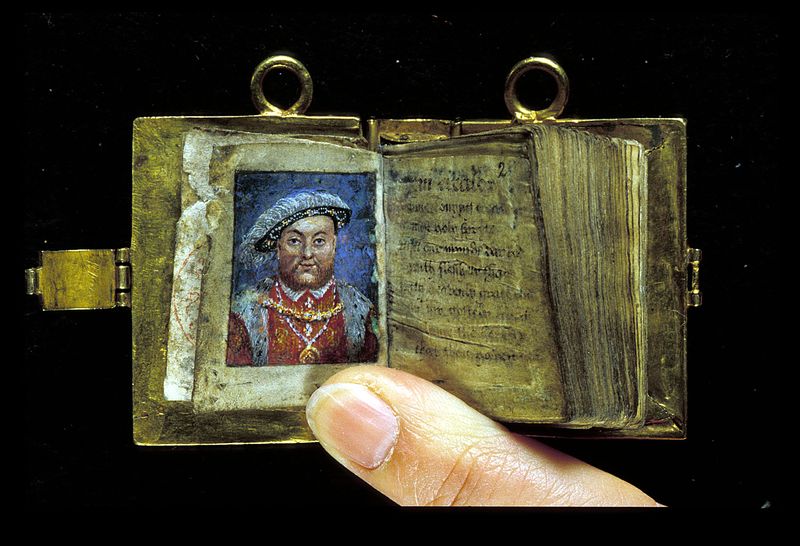
In the 16th century, it became fashionable for aristocratic women to wear miniature prayer books bound in elaborate metalwork covers hanging from their girdles (i.e. belts). These girdle books provided them with handy reading material as well as fashionable dress accessories, allowing them to display their literacy and piety to the world.

The images on the page are fascinating. Of special historical interest is one that once belonged to Anne Boleyn (shown above), a gift from her murderous husband.

A particularly luxurious example is a girdle book with covers of gold filigree . . . It contains selected Psalms in English verse, translated and apparently written out by John Croke, one of Henry VIII’s clerks in Chancery, with a portrait of Henry VIII at the beginning.

The volume is traditionally thought to have belonged to Anne Boleyn, who is said to have handed it to one of her maids of honour when she was standing on the scaffold before her execution in 1536.