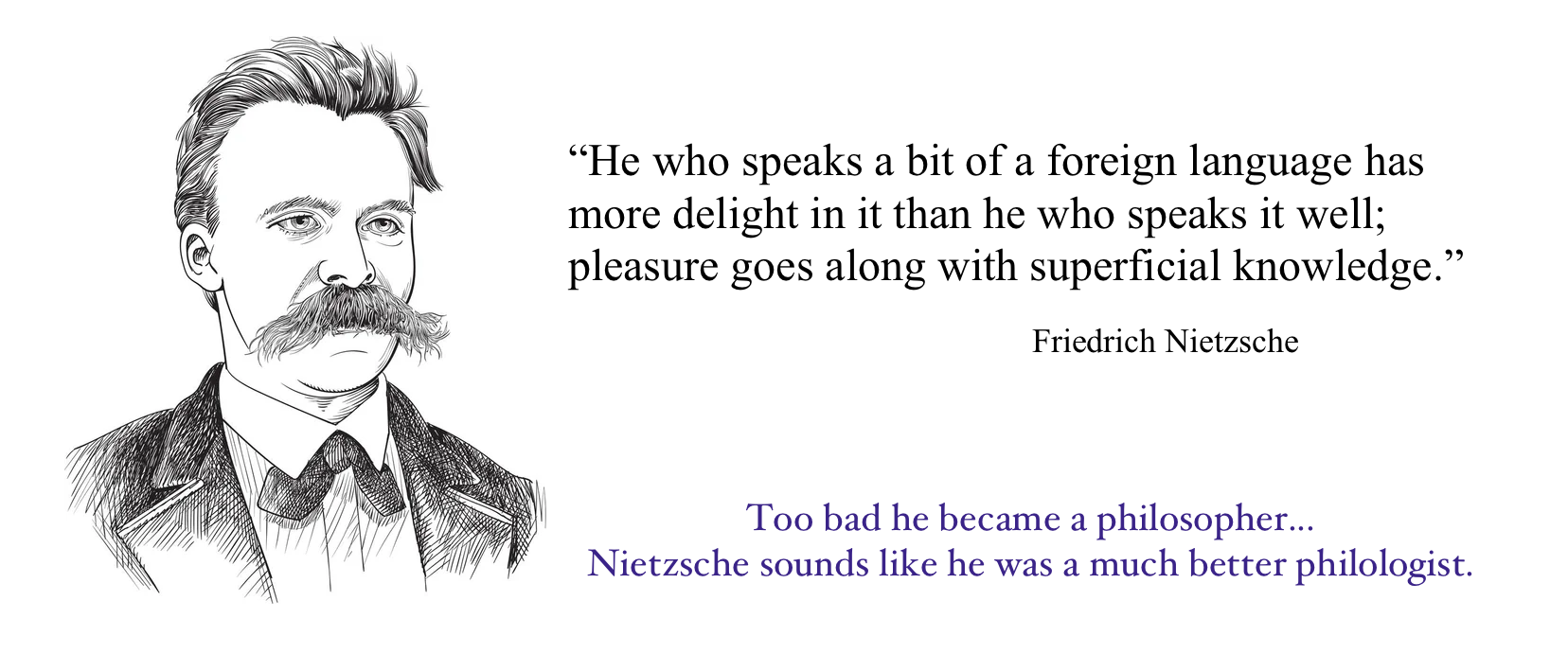
Learning Languages

C.S. Lewis possessed a gift for languages. Although he was not a philologist like his friend J.R.R. Tolkien, Lewis was well educated and read and spoke a variety of languages.

In fact, when he and his wife played Scrabble, they allowed for the use of words from any language! For the record, though, he does confess to a German professor that his grasp of that tongue is “wretched.”

The only bona fide genius I’ve known was a classmate at the University of Washington. While I was struggling with classical Greek, in preparation for seminary, at the age of 23 Bruce already possessed four master’s degrees and was closing in on his PhD in Linguistics. He spoke fifteen languages, but could read nineteen.

Of course, that is still a small portion of the 7,168 languages Ethnologue tells us are in use today.

This enormous number – which doesn’t include unknown languages spoken among untouched people groups – accounts for the fact that thousands of Christians are laboring now in groups such as Lutheran Bible Translators to make the Scriptures available to all people.

Sometimes this involves creating a written language itself, where only an oral version exists. The largest such organization, Wycliffe Global Alliance, reports that “Bible translation is currently happening in 2,846 languages in 157 countries.”

While the Bible’s translation is certainly of utmost importance, it is wonderful to know that other valuable literature is also made available to readers who could not decipher the language in which it was originally composed. 

Lewis, in fact, was a translator in his own right. Beyond the literal translation of works from one tongue to another, Lewis also functioned as a “translator” of complex concepts and eternal truths. I once described this as C.S. Lewis’ bilingualism.

How many extremely intelligent and well educated people do you know . . . who can actually communicate with those of us possessing normal human intelligence? That talent is a rarity.

And it is precisely what makes C.S. Lewis such an unusual man. He was brilliant. Yet he could communicate with the common person – even the child – just as easily as he conversed with his fellow university dons.

C.S. Lewis mastered a number of modern languages, but it was his study of historic languages that especially inspired him. Icelandic, with its similarity to Old Norse, is one example about which I have written. 

. . . J.R.R. Tolkien and his friend C.S. Lewis established a group called Kolbitár which was devoted to reading Icelandic and Norse sagas. The word itself means “coal biter” and refers to those in a harsh environment drawing so close to the fire’s warmth they can almost bite the coals.

Another example is Old English. Along with Middle English, birthed by the Norman Conquest, these were essential elements of his training as one of the preeminent English scholars of Oxford and Cambridge. And these languages were not merely dusty relics. I encourage the curious to read “C.S. Lewis’s Unpublished Letter in Old English,” which appeared in the journal VII.

In 1926 C.S. Lewis wrote his friend Nevill Coghill a letter in Old English, a language also known as Anglo-Saxon. Unreadable for most current readers of Lewis, it understandably does not appear in his three-volume Collected Letters.

In the essay, George Musacchio provides an illuminating outline of Lewis’ diverse expertise with languages, both “foreign and domestic.” Lewis began the letter to his friend with the following salutation.

“Leowis ceorl hateð gretan Coghill eoorl luflice ond freondlice.”
Which translates as: “Lewis the churl bids to greet Coghill the earl.”

Is English Really that Difficult to Learn?

English is reputed to be one of the most challenging languages to learn. (More on this in a moment.) For example, the simple sentence which follows consists of a mere seven words, but holds seven different meanings, dependent upon which word is emphasized.

“I never said she stole my money.”

This example comes from an article entitled “English is Hard, But Can Be Understood Through Tough Thorough Thought Though.”

Rosetta Stone answers the question of how hard it is to learn English by saying “it depends on your first language.” 

In addition to the fact that “spelling is a poor indicator of pronunciation,” English possesses numerous “specific rules,” and complements this burden with the fact that “some rules have lots of exceptions.” The complexity is due to the language’s history, which also gave rise to its mammoth vocabulary.

English has a lot of words—Webster’s English Dictionary includes approximately 470,000 entries, and it’s estimated that the broader English vocabulary may include around a million words. . . .

English has such a broad vocabulary because it’s a blend of several different root languages. While English is a West Germanic language in its sounds and grammar, much of the vocabulary also stems from Romance languages, such as Latin, Italian, Spanish, and Portuguese.

One result of combining these various root languages is that the English vocabulary includes a ton of synonyms . . . And unfortunately, most of these synonyms aren’t fully interchangeable, so the exact word you choose does have an impact on the overall meaning.

It turns out English doesn’t even rank in the top three most difficult languages for the speakers of the five largest language groups. The ranked listings do include, however, Arabic, Japanese, Russian, and Mandarin.

So, let’s reverse the question for a moment. Which languages are the most difficult for a native English speaker to learn? Unbabel lists ten. Fortunately, only one of them is on my wish list.

Babbel Magazine has an article approaching that question from the opposite end. Which language is easiest for English speakers to learn.

This may come as a surprise, but we have ranked Norwegian as the easiest language to learn for English speakers. Norwegian is a member of the Germanic family of languages — just like English! This means the languages share quite a bit of vocabulary, such as the seasons vinter and sommer (we’ll let you figure out those translations).

Another selling point for Norwegian: the grammar is pretty straightforward, with only one form of each verb per tense. And the word order closely mimics English. For example, “Can you help me?” translates to Kan du hjelpe meg? — the words are in the same order in both languages, so mastering sentence structure is a breeze!

Finally, you’ll have a lot more leeway with pronunciation when learning Norwegian. That’s because there are a vast array of different accents in Norway and, therefore, more than one “correct way” to pronounce words.

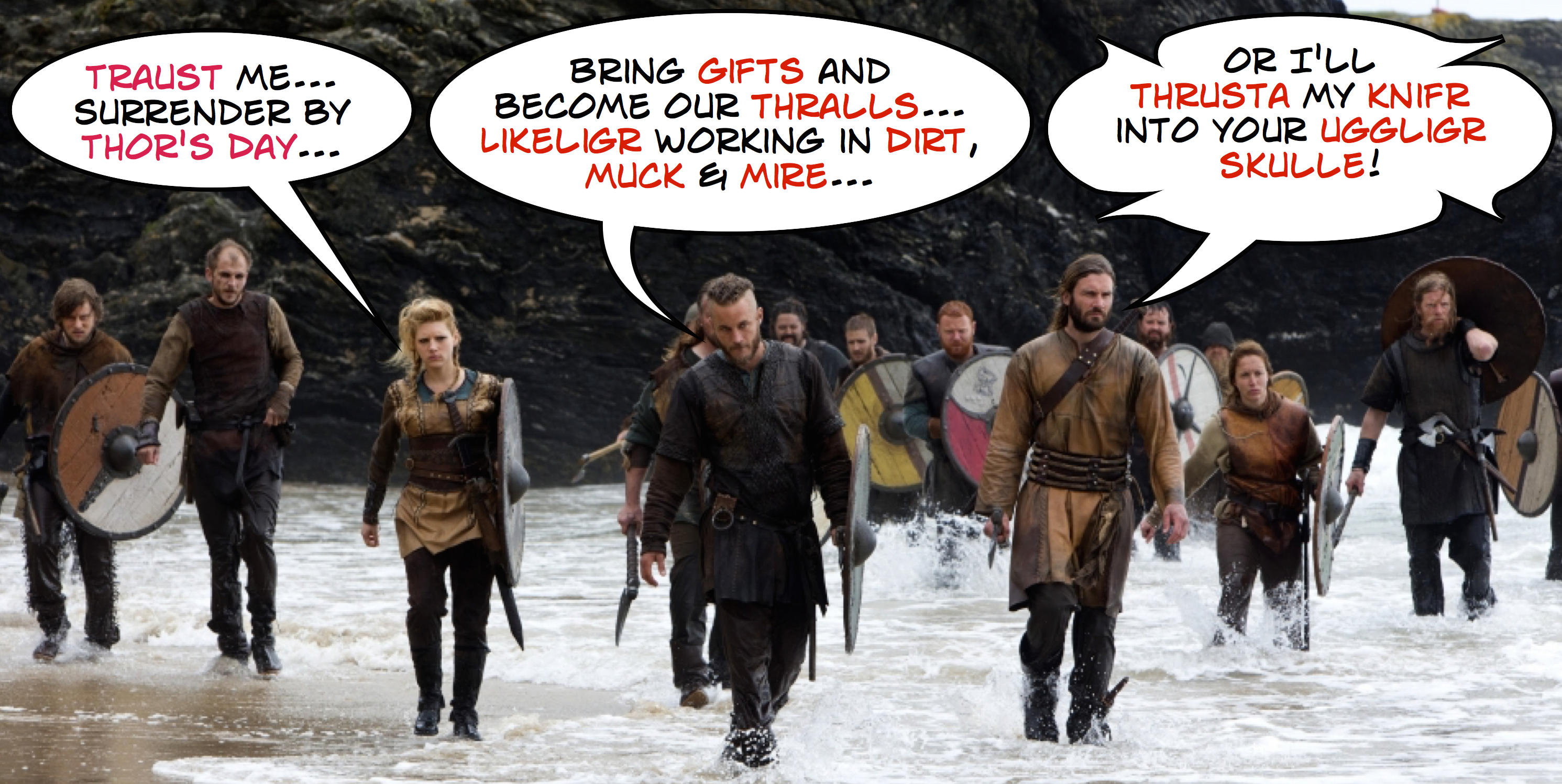
An article I wrote seven years ago hints at that same conclusion. I made this informative, and mildly threatening, illustration for “Norse Linguistic Invasion.”
Oxford Royale Academy lists several reasons why English is especially challenging to new students. The following issue of “irregularities” also plagues countless native speakers.

One of the hardest things about English is that although there are rules, there are lots of exceptions to those rules – so just when you think you’ve got to [come to] grips with a rule, something comes along to shatter what you thought you knew by contradicting it.

A good example is the rule for remembering whether a word is spelt “ie” or “ei:” “I before E except after C.” Thus “believe” and “receipt.”

But this is English – it’s not as simple as that. What about “science?” Or “weird?” Or “seize?”

There are loads of irregular verbs, too, such as “fought”, which is the past tense of “fight”, while the past tense of “light” is “lit.” So learning English isn’t just a question of learning the rules – it’s about learning the many exceptions to the rules.

The numerous exceptions make it difficult to apply existing knowledge and use the same principle with a new word, so it’s harder to make quick progress.

And even some of the normative “rules” are difficult to grasp. One example is that there’s a very specific order that adjectives must be listed ahead of a noun. According to Rosetta Stone,

The adjective order is: quantity, opinion, size, age, shape, color, origin/material, qualifier, and then noun. For example, “I love my big old yellow dog.” Saying these adjectives in any other order, like “I love my yellow old big dog,” will sound wrong, even when otherwise the sentences are exactly the same and communicate the same thing. Keeping rules like this in mind can be tricky, and it takes a lot of practice to get it right.

Adjective order is seldom considered, in part because it’s not considered good writing to string too many such words together. But apparently there are right and wrong ways to organize any such list.

Royal Order of Adjectives

Most students aren’t taught about adjective order in school and instead learn it through listening and reading. In English, the rules regarding adjective order are more specific than they are in other languages; that is why saying adjectives in a specific order sounds “right,” and deviating from that order makes a statement sound “wrong,” even if it’s otherwise grammatically perfect.

And, since we’re talking about English, even this Royal Order of Adjectives rule has exceptions

The hierarchy is not absolute, and there is some wiggle room among the “fact” categories – size, age, and so on – in the middle.

Native speakers are often delighted when they learn about this law and discover how flawlessly they apply it. It even went viral in 2016 . . . The tweet attached a paragraph by etymologist Mark Forsyth . . . giving an example that uses all the categories according to the OSASCOMP hierarchy: “a lovely little old rectangular green French silver whittling knife.”

I do not ever recall being taught (or reading on my own) about the “Royal Order of Adjectives.” Nevertheless, I don’t feel too embarrassed at acknowledging my previous ignorance, since even Lewis himself was comfortable in expressing gratitude for being introduced to new words. For example, when he thanked Dorothy Sayers for enlarging his vocabulary with her work on Dante.

So, is English all that challenging? Well, C.S. Lewis did his part to make it less daunting, joining a public debate in Britain, with an unexpected argument. Discussing English’s previously noted problem with inconsistencies and confusion in spelling, the don offered a simple solution.

In a column on Lewis and the history of words, I included an extended passage from a letter Lewis wrote challenging a contemporary British effort to “reform” spelling. Surprisingly, he argued against the necessity for uniformity in spelling. After explaining why our language functions as it does, he advocates:

As things are, surely Liberty is the simple and inexpensive ‘Reform’ we need? This would save children and teachers thousands of hours’ work.

Surely all but the most diehard grammarians would be sympathetic to his argument.

Next week I plan to write about another linguistic matter closely associated with the Inklings – the creation of new words and languages.

Thoughts on the Church Militant

C.S. Lewis understood better than most the spiritual warfare that rages, unseen for the most part, around all human beings.

And, as veterans of the bloody trenches of the First World War, Lewis and his good friend J.R.R. Tolkien had learned more than they desired about the tactics and sheer violence of combat.

Many of those wartime lessons translated directly into a spiritual context. However, I recently realized how poorly the concept of immobile trenches relates to our challenge to take up our crosses and follow our Savior.

You see, the Christian life is many things, but there is one thing discipleship never is – static. As theologian Tilemann Heshusius (1527-1588) wrote: “Christian soldiers always either advance or retreat.”

In battle there is nearly always an ebb and a flow, as forces advance on one front and temporarily shift back on another. In his essay “The World’s Last Night,” C.S. Lewis observes “In battle men save their lives sometimes by advancing and sometimes by retreating.” The same is true for the Christian life in general. We are either advancing, or falling back. Our relationship with God is not stagnant.

The New Testament includes many military metaphors and allusions, intended to equip us for victory in our spiritual battles.

The Apostle Paul refers to believers as “fellow soldiers.” In a letter to a young pastor, he extols the model of the soldier, who keeps his focus on the mission.

Share in suffering as a good soldier of Christ Jesus. No soldier gets entangled in civilian pursuits, since his aim is to please the one who enlisted him.

Then there is the familiar passage which uses the image of the “whole armor of God” to describe in detail how Christians are to be prepared for faithful service. You can read the entire passage here.

These military accoutrements are necessary because “we do not wrestle against flesh and blood, but against the rulers, against the authorities, against the cosmic powers over this present darkness, against the spiritual forces of evil in the heavenly places” (Ephesians 6:12).

This is the reason one aspect of the Christian Church’s nature has been described as the “Church Militant.” This describes the Church battling evil while awaiting Christ’s return, for the Final Judgment, when it will become the “Church Triumphant.” The former is the context for familiar hymns such as “Onward Christian Soldiers,” composed by a prolific Anglican priest in the nineteenth century.

Onward, Christian soldiers,
   marching as to war,
With the cross of Jesus
   going on before!

Christ, the royal Master,
leads against the foe;
Forward into battle,
see his banner go!
     . . .

At the sign of triumph
   Satan’s host doth flee;
On, then, Christian soldiers,
   on to victory!

Hell’s foundations quiver
   at the shout of praise;
Brothers, lift your voices,
   loud your anthems raise.

The WWI trenches are the archetype of static, immobile frontlines. Disease festered, and morale decayed like the muck sucking at the soldiers’ boots. As recognized by sixteenth century theologians and C.S. Lewis alike, wars are rarely won simply by maintaining a defensive position. Movement is an essential element of warfare.

Hopefully more of that movement consists of advances against the enemy, than retreats. But we will consider that aspect of spiritual war in our next post.

Until Then

Those interested in learning more about military strategy, particularly as explored by another veteran of the War to End All Wars, Sir B.H. Liddell Hart,* like Lewis and Tolkien, returned home to Britain from the front lines, as a casualty. (Britannica states more than a third of the British forces became casualties, in contrast to 76% of Russians, 73% of French, and 8% of Americans.)

Liddell Hart’s wisdom extends beyond the battlefield itself.

The downfall of civilized states tends to come not from the direct assaults of foes, but from internal decay combined with the consequences of exhaustion in war (“The Objective in War,” a lecture delivered in 1952 to the United States Naval War College).


* Sir Basil Henry Liddell Hart (1895-1970) was a military historian and theoretician. A number of his works are in the public domain and available for free download from Internet Archives. These include A Greater than Napoleon, Scipio Africanus and Why Don’t We Learn from History?

Judging by Appearances

If books should not be judged by their covers, how much more true is it that we should avoid judging people by their initial appearance?

We don’t want others to be hasty in determining who we are, right? We need to take some time to get to know people before coming to “conclusions” about what they are like.

Yet we still tend to look at someone and – right away – assess whether they are trustworthy or not. I confess it is sometimes challenging for me to maintain an open mind. For example, teardrop tattoos (especially when accompanied by neck ink that combines letters and numbers), make me nervous.

First impressions are usually by their very nature superficial. Which means they often prove to be wrong. That’s true about people . . . and books.

Lewis scholar Dale Nelson recently sent me an interesting review of the book The Inklings, written by Humphrey Carpenter in 1978. The fascinating thing about the piece was that it was written by Lord David Cecil (1902-1986), who was himself an Inkling.

One of the things which drew my attention was his physical description of several of the members, especially C.S. Lewis. Without citing the maxim, he declares how misleading first impressions may be.

[Charles] Williams was the most obviously odd. Very tall, and indisputably ugly with a high forehead and with gleaming spectacles, he yet diffused a curious charm that came from an enthusiastic warmth of spirit united to a comic lack of inhibition. . . .

Lewis at first sight appeared less unusual; stocky, red-faced, loud-voiced, he might indeed have been taken for an innkeeper or even a butcher.

Such a mistake would not have displeased him, he liked to think of himself as representing the common man, in contrast to the sophisticated intellectual.

These observations were interesting, but there was something far more thought-provoking in the (excellent, by the way) review. More about that in a moment. First let’s return for a moment to the issue of book covers.

What about the Cover of the Book You are Writing?

I discussed covers, and Lewis’ thoughts thereon, in this post.

It’s unsurprising that with all of their many reprintings, the writings of C.S. Lewis have been published with a wide range of covers. Some of this can be attributed to the artistic fads of the decade in which particular editions saw print. More important, I believe, are the arbitrary tastes of publishers.

When it comes to self-publishing, authors are in complete control over the image that graces their literary creations. While I make no pretense of being an artist, I must confess at being shocked by the shoddy quality of many such works. Surely they are aware that the very best of writing can be marred by dreadful packaging. By the same token, even weak literature has received wider dissemination than it merited, due to stunning or alluring graphics.

The internet is filled with posts on this subject. These are representative:

Against Popular Advice, Books Continue to Be Judged by Their Covers” says, “for some, this can be a bitter pill to swallow, because writers want to believe that their work will speak for itself.”

The reality is that every person who steps into a book shop or browses books online is judging books by their cover, even if only subconsciously. I’m not saying that the judgment is always correct. Some books have amazing covers but are comprised of some pretty bad writing. I’d guess that many more amazing books are hiding behind bad cover art. The challenge is to get readers to pick up your book in the first place. That’s where the artwork comes in.

Another writer contends that potential readers do consider a host of matters. In “Why ‘Don’t Judge a Book by its Cover’ is Bad Advice,” the writer nevertheless admits it is the single most important element in winning an audience (short of a celebrity endorsement).

Readers are going to keep on reading and judging based on a whole host of criteria. The cover is just one of the many factors that are taken into account. Like other aspects of a book, it holds valuable information about the story kept inside.

Disregarding it is bad advice. Instead, why not try judging a book by its cover? Maybe next time you peruse the shelves of your neighborhood bookstore or scroll through the numerous titles listed online, you can select books purely based on the cover.

You never know, that could tell you everything you need to give that book a chance.

Covers are not the only factor in enhancing your book’s reception. Consider as well the nature of the paper in printed copies, as I discussed in “The Ugliest Book,” about a Mayan codex.

Now, back to the book reviewer.

David Cecil’s Thoughts on His Own Identity as an Inkling

After graduating from Oxford, Cecil briefly taught Rhetoric in London, before returning to Oxford, where he taught English. During his career, he wrote various works, including a number of literary biographies. These include: The Stricken Deer or The Life of Cowper, English Poets, Hardy the Novelist.

David Cecil was an accomplished man, and a true Oxford Inkling. The curious aspect is how, as the son of a marquess (bearing a courtesy title), socializing with a different caste, so to speak, would bond so well with the rest of the Inklings. Fortunately, Cecil briefly explains why he valued the fellowship in this book review.

Usually one of them would read aloud a piece from some book he was writing. . . . The meetings were also occasionally attended by persons who did not share The Inklings’ distinctive point of view but who liked spending an evening in their company.

I myself was one of these; I found such evenings enjoyable and stimulating; and all the more because the spirit of The Inklings was in piquant contrast to those of the Oxford circles in which I spent most of my time.

A final gift to those who treasure Lewis and his companions comes in Cecil’s incisive understanding of their unifying bond.

The qualities . . . that gave The Inklings their distinctive personality were not primarily their opinion; rather it was a feeling for literature, which united, in an unusual way, scholarship and imagination.

Their standard of learning was very high. To study a book in translation or without a proper knowledge of its historic background would have been to them unthinkable; they were academic in the best sense of the word.

But – and this is what made them different from most academics – they also read imaginatively. The great books of the past were to them living in the same way as the work of a contemporary. . . .

Simply they read their books in the spirit in which they were written. And they could communicate their sense of this spirit to their hearers so that, for these also, these great books sprang to fresh, full life.

This was a unique achievement in the Oxford of their time.

It appears the Inklings would be among the last to judge a book, or a person, by their cover.

Free Lecture Series Explores the Inklings

If you would like to learn more about C.S. Lewis, J.R.R. Tolkien, and their fellow Inklings, a free series of five lectures has just been produced. I am in the midst of the first, introductory lecture, and am eager to listen to the entire series.

You can receive links to the series from Hillsdale College by completing a small form at this link.

The subjects addressed in the series include:

  1. “Who Are the Inklings?” by Bradley J. Birzer
  2. “C.S. Lewis’s The Abolition of Man” by Michael Ward
  3. “J.R.R. Tolkien’s Scholarship” by Michael Drout
  4. “Themes of Lewis’s Fiction” by Jason Lepojärvi
  5. “Tolkien and the Christian Imagination” by Holly Ordway

Hillsdale College is an independent Christian institution, founded in 1844. They currently have 1,573 undergraduates, “representing 49 states, D.C., and 13 foreign countries,” complemented by more than one hundred graduate students.

Several years ago, they offered a free online course about C.S. Lewis, which we promoted on Mere Inkling in this post.

That course – along with thirty more – is still available at no cost. (Donations are welcome, of course.) You can learn about all of these courses here.

And, if you’re in the mood for reading a free issue of Christian History on the subject of “Heaven and the Christian Imagination,” look no further than this link. (The issue includes several references to the thought of C.S. Lewis.)

Music, Muses & C.S. Lewis

Why do so many modern musicians – including some who are commercially successful – appear to suffer from amusia?

Well, I suppose that diagnosis is a matter of opinion, since “amusia” has come to refer to a particular medical disorder related to “the inability to recognize musical tones or to reproduce them.” More on that in a moment. First let’s consider the original meaning of the word.

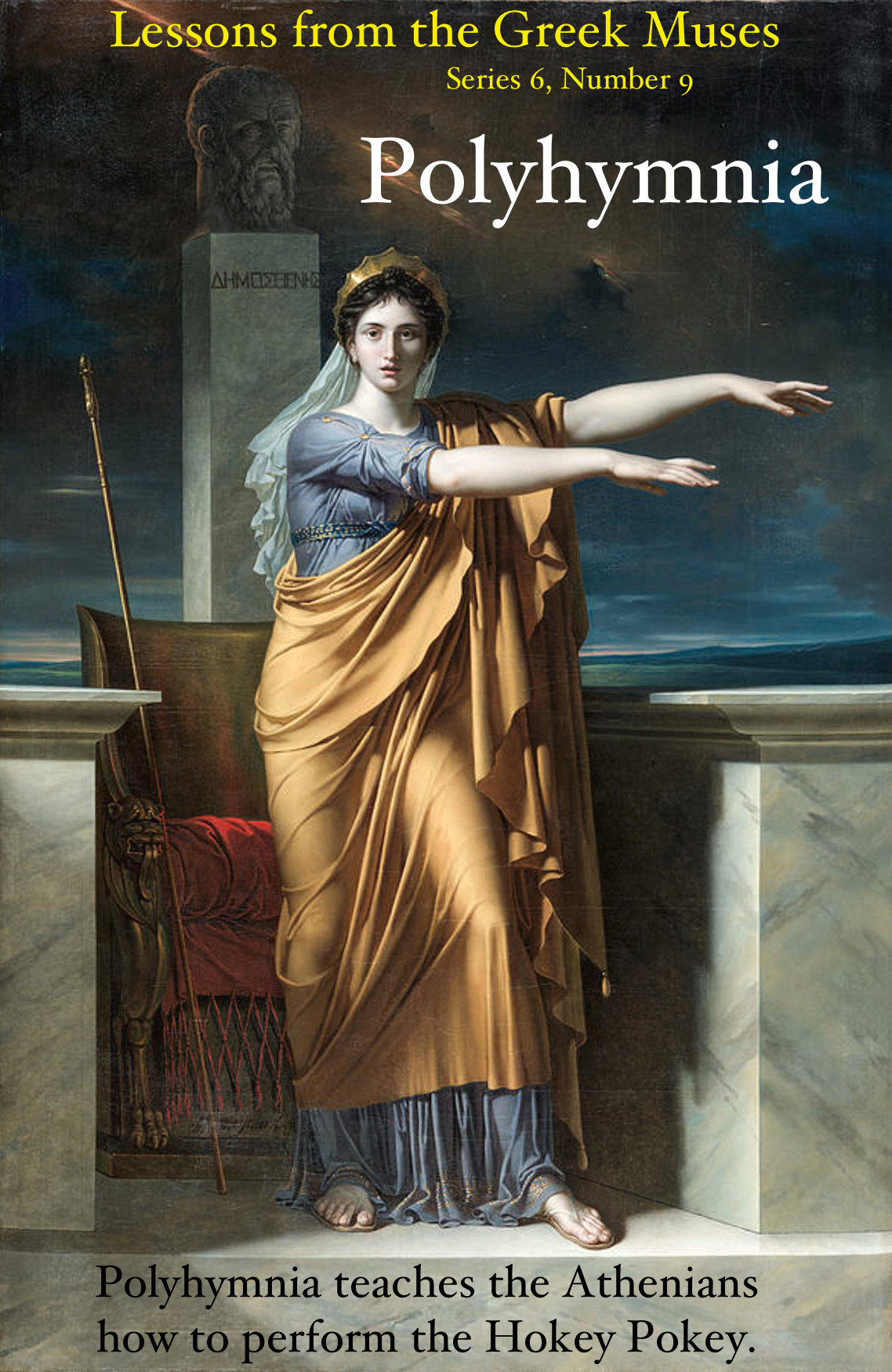
It begins with the Greek Muses. While “muse” has morphed into anything that inspires a creative soul, it did not begin that way. The Muses began as personifications devoted to nine children of Zeus and Mnemosyne (Memory). During Europe’s revival of Classical themes, they were associated not only with the arts, but with culture and refinement in general.

In Surprised by Joy, C.S. Lewis records his admiration for one of his early teachers. This man taught him to love poetry, and although he practiced corporal punishment (standard for the era), embodied “perfect courtesy.” On an occasion he was sent to the headmaster, who misperceived that Lewis had acted inappropriately. After dispelling the confusion, this teacher, who treated his students as “gentlemen,” matter-of-factly said “you will have to be whipped if you don’t do better at your Greek Grammar next week, but naturally that has nothing to do with your manners or mine.”

The idea that the tone of conversation between one gentleman and another should be altered by a flogging (any more than by a duel) was ridiculous. His manner was perfect: no familiarity, no hostility, no threadbare humor; mutual respect; decorum.

“Never let us live with amousia” was one of his favorite maxims: amousia, the absence of the Muses. And he knew, as Spenser knew, that courtesy was of the Muses. 

Muses, from this perspective, undergird civilization. But the Muses are fickle. One cannot create their own Muse. Inspiration comes to us of its own volition. It can’t be commanded.

Nearly four years ago, I posed this question in Mere Inkling: “Who is Your Muse?” Various literary figures have written paeans to the muses which inspire their work. In that column I also noted how our animal companions* often exert an influence on our own creativity.

The link between inspirational Muses and music itself is strongly intertwined. Consider, for instance, Friedrich Nietzsche (1844-1900), who was brilliant, but much to be pitied. He despised God, but he did love music. In “Amousia: Living Without the Muses,” Classicist Stephen Halliwell discusses the importance of music for enjoying a meaningful existence. He begins with a quote from Nietzsche, and points out a Platonic corollary. 

Without music life would be a mistake . . . So, famously, wrote Friedrich Nietzsche in . . . Twilight of the Idols. As always, Nietzsche had deeply personal reasons for the force and pathos of this aphorism; music did indeed help to keep him alive. . . .

[W]e can detect in Nietzsche’s stark utterance, I would like to suggest, a trace and resonance of Greek feeling. We might even wonder whether in formulating his maxim Nietzsche was subconsciously remembering the passage in Plato’s Philebus where Protarchus, asked by Socrates whether music, as one of the ‘impure’ arts, is needed for the mixture of a humanly desirable life, says that he certainly takes it to be necessary – ‘at any rate,’ as he puts it, ‘if our life is really to be a life of some kind.’

Without music, Protarchus . . . seems to take the idea to be practically self-evident, human ‘life’ would hardly be worth the name at all.

Amusia as a Medical Condition

I suggested above that the caterwauling of some musicians suggests they are tone deaf, but in fact there is a genuine medical condition called amusia. It traces its beginning to the Muses we have been speaking about, and suggests their absence.

In “The Genetics of Congenital Amusia (Tone Deafness),” we learn that “congenital amusia . . . is a lifelong impairment of music perception that affects 4% of the population.” What’s more, “the pitch disorder has a hereditary component.”

In amusic families, 39% of first-degree relatives have the same cognitive disorder, whereas only 3% have it in the control families.

As the husband of a gifted music teacher, the father-in-law of another, and the grandfather of a number of extremely talented children, I understand the Greek principle. While I would miss music’s grace if I was stricken with amusia, I know a number of precious people for whom that would be one of the most terrible fates imaginable.

C.S. Lewis and Music

Like most of us, C.S. Lewis enjoyed some forms of music while others left him exasperated. Wagner, bravo. Church hymnody, not so much. A recent article by John MacInnis, a professor of music, goes so far as to claim: “music listening and discussion factored regularly in C.S. Lewis’s relationships, and love for music inspired his creative endeavors and prompted his best thinking.”

I agree with the first part of this, and will attribute the “best thinking” declaration to the hyperbole of one who has devoted his own life to music.

The author of “A Medium for Meeting God” explores in  detail the effect of Wagner’s work, and the sense of Northernness it imprinted on Lewis’ psyche.

In 1934, Lewis, along with his brother Warnie and J.R.R. Tolkien read Wagner’s operas together in German, in anticipation of attending performances of the Ring cycle. MacInnis points out that Lewis enjoyed the music of Sibelius (also “evocative of Northern landscapes) and likened it to Wagner as an expression of natural or earthy music. This he contrasted to Beethoven, which he also enjoyed, and thought of as “noble” and even spiritual.

As for church music, Lewis had mixed feelings. I’ve written about that in the past, in “Good, Bad and Ugly Hymns.” Most of us would agree that music enriches our lives. Our tastes vary, of course, just as they do with literature.

And, speaking of which, just as there are tone deaf individuals who should avoid recording music . . . most of us have encountered writers who suffer from a literary variant of amusia. And, lacking the influence of anything remotely like a muse, would not the world be a more harmonious place if they simply laid down their pens.


* When we got our youngest border collie as a puppy, I named her Calli. Actually, that’s what we call her, but her given name is actually Calliope. I named her after the Muse of epic poetry with the hope she might inspire my writing.

Since she’s our fifth border collie, I should have known better. The very last thing Calli wants me to do is sit at the computer composing documents (no matter how interesting or edifying). “Get out of that chair and get some exercise with me,” she says plaintively with her body, voice, and pleading eyes.

She’s plenty loving, and her insistence on activity may well add years to my life, but if I look to her to help me write more productively, I’m guaranteed disappointment.

An Author with the Heart of an Inkling

C.S. Lewis and Frederick Buechner never met, yet they are “friends” because they share so many similarities as authors writing from a Christian perspective. In terms of Buechner’s themes and range of his writings, this award winning American author and ordained Presbyterian minister may have as much in common with C.S. Lewis as his own British Inklings. So let me introduce Frederick Buechner and his writings.

Do you read primarily to relax and allow your imagination to soar? Or, do you normally select “useful” books, with the potential to be applicable to meeting the challenges of real life?

During my college years, I enjoyed scifi and fantasy. I still have a weak spot for alternative histories. But my seminary years had a subtle effect on my reading. With time always at a premium as a young pastor with a family, I had so many practical, pastoral books and journals to study, that I seldom had time for something so frivolous as “fiction.” Fortunately, semi-retirement has released me from that restrictive literary diet.

I’ve finally found some time to unpack a few of the boxes of books sitting in my garage. (The fact we moved them into the garage around 2010 would be embarrassing if it got out, so I ought not to mention it here.)

As one would expect, I’ve encountered many pleasant surprises. A number of books I had been missing have turned up, I’ve found some that are even more timely today than when they were stored, and—best of all in the minds of my adult children—I’ve been able to part with about two-thirds of the titles, and recently donated about 150 volumes to a local charity.

One of the titles I am currently reading is Frederick Buechner’s Telling Secrets. I had picked up a copy when it was highly recommended to me, only to discover it was a memoir. Being a “practical pastor” who always had too many utilitarian books to read, I set it aside . . . only to pick it up twenty years later.

And what a joyous surprise it has been. Buechner is in his nineties, and is widely respected. He has been a prolific writer, and has received numerous awards for his fictional works. Readers, particularly from the Reformed branch of Christianity have been especially fervent fans of the Presbyterian pastor and theologian. My friend, Brenton Dickieson is quite fond of Buechner and has written about him in A Pilgrim in Narnia on several occasions. He notes that Buechner quotes a number of the Inklings, including Tolkien, Williams and Lewis.

I vaguely recall the Lewis connection being one reason my fellow Air Force chaplain recommended Telling Secrets to me. But I had forgotten that the first section is entitled “The Dwarves in the Stable.” This is, of course, an allusion to an extremely momentous scene in The Final Battle, the final volume of the Chronicles of Narnia. It was originally published as an independent essay, as this entertaining post points out.

Buechner shares a dark family secret, the consequences of his father’s suicide in 1936. Listen to how movingly he describes the secret’s power:

His suicide was a secret we nonetheless tried to keep as best we could, and after a while my father himself became such a secret. There were times when he almost seemed a secret we were trying to keep from each other.

Buechner moves on to relate the suffering the family experienced during his daughter’s battle with anorexia. He shares few details, since “it is not mine to tell but hers.” Nevertheless, he describes setbacks in the struggle causing him to feel as though he “was in hell.”

I choose the term hell with some care. Hell is where there is no light but only darkness, and I was so caught up in my fear for her life, which had become in a way my life too, that none of the usual sources of light worked any more, and light was what I was starving for. . . .

I remained so locked inside myself that I was not really present with them at all. Toward the end of C.S. Lewis’s The Last Battle there is a scene where a group of dwarves sit huddled together in a tight little knot thinking that they are in a pitch black, malodorous stable when the truth of it is that they are out in the midst of an endless grassy countryside as green as Vermont with the sun shining and blue sky overhead.

The huge golden lion, Aslan himself, stands nearby with all the other dwarves “kneeling in a circle around his forepaws” as Lewis writes, “and burying their hands and faces in his mane as he stooped his great head to touch them with his tongue.” When Aslan offers the dwarves food, they think it is offal.

When he offers them wine, they take it for ditch water. “Perfect love casteth out fear,” John writes (1 John 4:18), and the other side of that is that fear like mine casteth out love, even God’s love. The love I had for my daughter was lost in the anxiety I had for my daughter.

This is just a single example of the sensitive wisdom Buechner shares throughout this grace-filled work.

After I finish Telling Secrets, I look forward to reading two of Buechner’s novels already on my shelf, Godric and Brendan. They are both historical fiction, telling the stories of two sainted monks from the twelfth and sixth centuries respectively.

I encourage any of you unfamiliar with his writings to explore his work. If an autobiography can be this good, I’m eager to take a journey through what I have no doubt will be quite an adventure in his fiction.

Buechner possesses an additional connection to C.S. Lewis, which has the potential to last centuries. He describes his decision to offer his personal papers to Wheaton College, where they are available in the archives. The theologian describes his decision in this humble manner.

Wheaton College [has] a great collection there of the manuscripts and papers of people like C.S. Lewis, G.K. Chesterton, George MacDonald, J.R.R. Tolkien, Dorothy Sayers, and the like, and because I could think of no more distinguished company than theirs among whom to have my own literary remains molder, a year earlier I had offered them everything I had stowed away over the years in cardboard boxes and scrapbooks and manila folders; and to my delight they said that they would be delighted to have it.

If you would enjoy learning more about the relationship between Buechner and the Inklings, check out this fine article; “C.S. Lewis and Frederick Buechner: Literary Expression of Faith” is available for download. It’s quite enlightening.


Bonus Insight

The second chapter of Telling Secrets is entitled “The White Tower.” Many Inkling fans will jump to the conclusion (especially after reading this post) that it is a reference to the citadel of Minas Tirith, the capital of Gondor. Like me, they would be incorrect.

Buechner is not alluding here to Tolkien’s masterpiece. On the contrary, he is referring to the central tower which was the old keep of the Tower of London. Ironically, that very keep, the White Tower, was built by a Norman monk who became the Bishop of Rochester. His name . . . Gundulf.

Buechner chose this metaphor for the human condition for the following reason.

I think here of the Tower of London. More particularly I think of that oldest part of it, known as the White Tower, which was built by William the Conqueror in the eleventh century. On the second floor of it there is a small Norman chapel called the Chapel of Saint John. It is very bare and very simple. It is built all of stone with twelve stone pillars and a vaulted ceiling.

There is a cool, silvery light that comes in through the arched windows. . . . The chapel is very silent, very still. It is almost a thousand years old. You cannot enter it without being struck by the feeling of purity and peace it gives. If there is any such thing in the world, it is a holy place.

But that is not all there is in the White Tower. Directly below the chapel is the most terrible of all the tower’s dungeons. It has a heavy oak door that locks out all light and ventilation. It measures only four feet square by four feet high so that a prisoner has no way either to stand upright in it or to lie down at full length. There is almost no air to breathe in it, almost no room to move. It is known as the Little Ease.

I am the White Tower of course. To one degree or another all of us are.

Literary Pasta

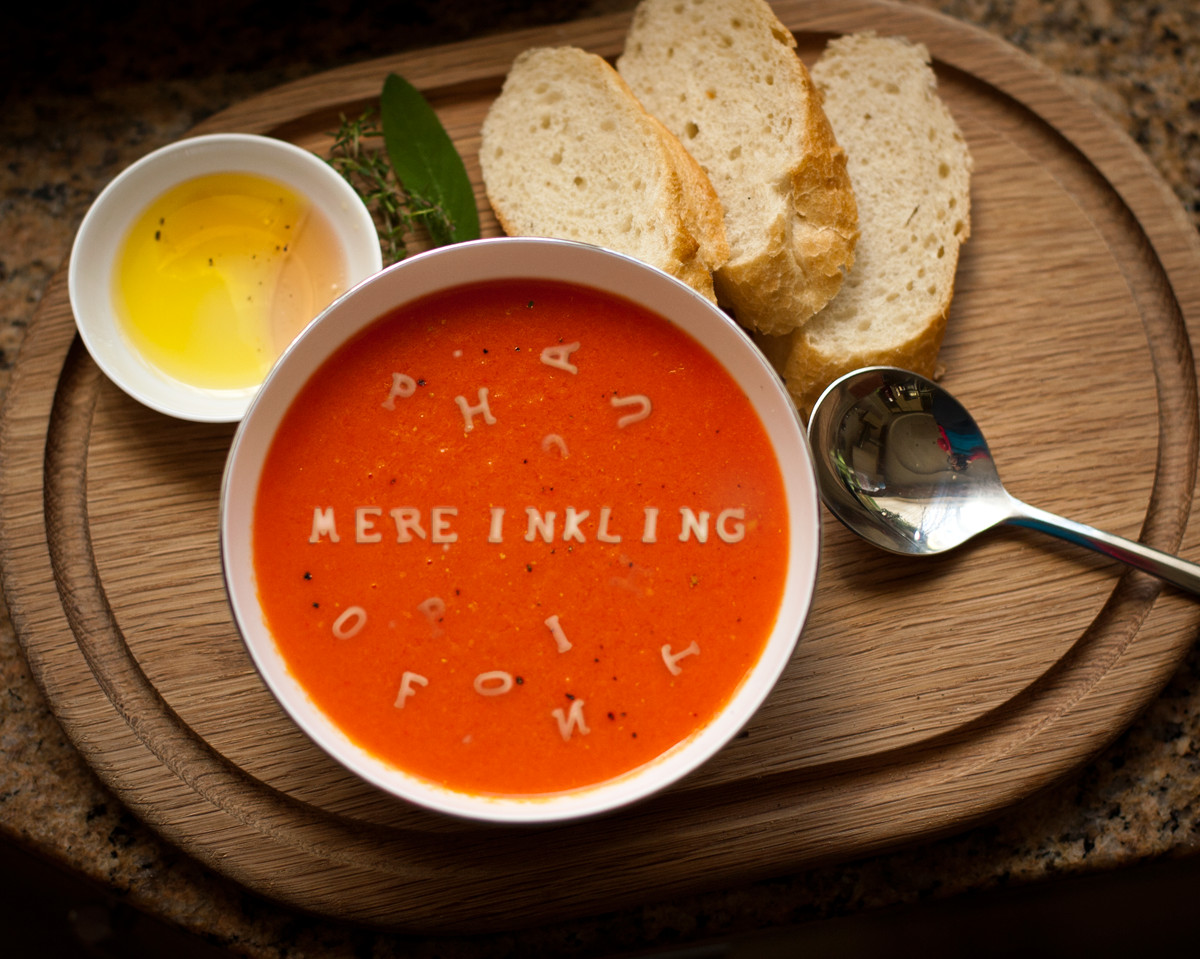
How many cans of SpaghettiOs would you need to purchase to be able to write the entire Lord of the Rings trilogy in their noodley alphabet?

What, you’ve never pondered that quandary? Well, now that the question has been posed, you may as well learn the answer.

The purveyor of this revelation is an online personality who analyzed the ratio of letters in cans of the SpaghettiOs A to Zs. He then devised a computer “program that converts books to SpaghettiOs.” [An inarguably valuable pursuit.]

It involved identifying the typical shapes of the pasta fonts.

Ah, to the solution to the puzzle. An individual seeking to replicate the Lord of the Rings would require 8,795 cans. The price would be slightly more than $2,000 and as a bonus, you would be left with more than eight million characters to devour.

Having labored to create the complex algorithms in his computer program, he has applied the versatile tool to other publications.

The King James Bible, for example, would demand 51, 214,669 cans to reproduce. At a price of approximately seventy-one billion dollars. [Editor’s note: the cost would probably be prohibitive, so don’t expect to see a physical attempt made in the near future.]

J.R.R. Tolkien was an extraordinary philologist. He loved languages, and he actually created more than one.

The creator of Middle Earth actually fashioned an alphabet for his Elven tongues. I have had my own name (by virtue of its meaning) rendered in Tengwar alphabet here.

Nevertheless, as inspired by linguistics and alphabets as he was, I doubt Tolkien would have been the least bit impressed by the canned pasta research.

In a 1956 letter, Tolkien described the process of completing his masterpiece for publication. I share the letter now, due to its reference to alphabets. However, due to its illuminating insight into the broader subject, I offer here a more extended rendition.

As ‘research students’ always discover, however long they are allowed, and careful their work and notes, there is always a rush at the end, when the last date suddenly approaches on which their thesis must be presented.

So it was with this book, and the maps. I had to call in the help of my son – the C.T. or C.J.R.T. of the modest initials on the maps – an accredited student of hobbit-lore. And neither of us had an entirely free hand.

I remember that when it became apparent that the ‘general map’ would not suffice for the final Book, or sufficiently reveal the courses of Frodo, the Rohirrim, and Aragorn, I had to devote many days, the last three virtually without food or bed, to drawing re-scaling and adjusting a large map, at which he then worked for 24 hours (6 a.m. to 6 a.m. without bed) in re-drawing just in time.

Inconsistencies of spelling are due to me. It was only in the last stages that (in spite of my son’s protests: he still holds that no one will ever pronounce Cirith right, it appears as Kirith in his map, as formerly also in the text) I decided to be ‘consistent’ and spell Elvish names and words throughout without k. There are no doubt other variations. . . .

I am, however, primarily a philologist and to some extent a calligrapher (though this letter may make that difficult to believe). And my son after me. To us far and away the most absorbing interest is the Elvish tongues, and the nomenclature based on them; and the alphabets.

My plans for the ‘specialist volume’ were largely linguistic. An index of names was to be produced, which by etymological interpretation would also provide quite a large Elvish vocabulary; this is of course a first requirement. I worked at it for months, and indexed the first two vols. (it was the chief cause of the delay of Vol iii) until it became clear that size and cost were ruinous.

Back to the noodle font. I doubt it Tolkien would have been impressed. What about his fellow Inkling, C.S. Lewis? What might he have said about the quantity of pasta-based “moveable type” required to reproduce Tolkien’s trilogy?

Allow me to take two simple words (out of context) from a letter he wrote in 1956. I think the Oxbridge don would have labeled the effort (and today’s post itself) “infinitely unimportant.”

Please forgive me if this sojourn into current trivia wasted your time. (But I hope, at least, that you enjoyed learning more about Tolkien’s linguistic and cartographic expertise.)

Inklings, Libraries & Architecture

If you were to embark on a university education today, which sort of campus would you prefer?

(1) A university featuring “vaulted ceilings that draw the eye upwards and outwards . . . the frivolous artistic detail that announces the importance of the unimportant [or] the interplay of light and shade that marks the great Gothic masterpieces, the brilliant proportions of the best classical buildings, and the elaborate grandeur of the Baroque.”

(2) A modern campus comprised of “buildings entirely lacking in charm, grace, or playfulness [featuring] the boxy utilitarian grimness of official educational architecture.”

A second question clearly betrays my own preference. Which academic setting do you imagine C.S. Lewis, J.R.R. Tolkien, and their fellow Inklings would most esteem? Tolkien, after all, was not complaining in a letter to his future bride when he wrote “I have got to go to the college library now and get filthy amongst dusty books . . .”

The quotations included in the choices above come from a thought-provoking essay just posted on the website of First Things. The British writer, Niall Gooch, melds wit and genuine insight as he offers an answer to the question “Why are Universities So Ugly?” I highly commend it to you.

Libraries are of particular interest to many of us who treasure the Inkling ethos. And the article includes a delightful discussion of the treasure houses “now called ‘Information Centers’ or ‘Knowledge Hubs.’”

Books increasingly appear to be an afterthought, squeezed into the small spaces not occupied by banks of computers or the glass rooms designated as group work areas. Quiet has been banished to special Silent Study rooms, where those dangerous oddballs who wish to sit still by themselves and concentrate on one thing for a long period can be safely segregated from the normal people.

Inkling Libraries at Cambridge and Oxford

In 1959, C.S. Lewis wrote to T.S. Eliot. Both men served on the Commission to Revise the Psalter. Lewis mentions that he will be hosting an upcoming meeting of the Commission at Cambridge, and that he had secured one of the libraries for their use.

I can’t find the name and address of the secretary of our Commission on the Psalms. As you are in London could you kindly let her know that I have rescued the use of the inner library at Magdalene for our July session? It would be convenient if she told me – for the benefit of the servants – what our daily hours of sitting are likely to be. I also look forward to it.

Although Magdalene College has a distinguished history, it too has joined the revolution offering more contemporary Information Centers. They proudly declare “The New Library is . . . a purpose-built space in College for Magdalene students to meet, work, relax and find inspiration.”

As for the “Inner Library,” to which Lewis referred, I believe it to be what is presently called “The Old Library.” It fittingly includes among its special collections, “the books and manuscripts of T.S. Eliot (Honorary Fellow).”

A revealing history of “The Architectural Evolution of Libraries” begins with the question: “Can you have a civilized society without a library?”

In this article, we trace the typology of the library through history, highlighting twelve of the most important libraries in the world, from Ancient Alexandria to Raleigh, North Carolina, where robots retrieve books from storage.

A fitting close to our consideration of libraries comes from a letter written by J.R.R. Tolkien in 1966. The English Faculty of Oxford University had commissioned a bust of Tolkien – to be sculpted by his daughter-in-law. It presently resides in the English Faculty Library, which undoubtedly displays the elegant architecture of the classical university.

I feel much honoured, and so also does my daughter-in-law (the sculptress), by the Faculty’s wish to place the bust of me in the English Library in some prominent position – if on second thoughts you do not think a storied urn would be better. I shall be most pleased to present it to the Faculty.

It occurs to me that the plaster bust is rather fragile and very easily damaged. I suggest, therefore, that I should have it cast in bronze for presentation (at my own cost). I have already referred the matter to the sculptress who knows how these things are done.

Once in bronze it would then be unaffected by any dignities or indignities offered to it. I often used to hang my hat on the Tsar of Russia’s bust, which he graciously presented to Merton.


The illustration accompanying today’s post is the bust of Tolkien referred to in his correspondence. (In light of this column’s discussion, one can hardly ignore the rather utilitarian architecture revealed through the window behind the celebrated author.)

C.S. Lewis & Rigmarole

I hope my confusion is not due to a decline in my mental faculties. But it seems to me politicians are becoming even more incoherent than they’ve always been.

Is it me? Or, are you also amazed at how some of them appear to be babbling half the time?

C.S. Lewis was a master of communication. And some of his observations about how poorly some people communicate can be insightful.

Listen to this verse from a poem entitled “The Prudent Jailer” which he wrote in 1947. (It deserves to be read out loud.)

Some walls cannot a prison make
Half so secure as rigmarole.*

Lewis wasn’t referring to political jargon when he wrote this poem, but it seems quite apropos in a number of contexts.

For example, consider a recent article from the American Institute for Economic Research. Jon Sanders applies Lewis’ poem to foreboding aspects the government’s response to the pandemic.

The poem originated not in political allegory, but as a critique of unimaginative literary criticism. Notwithstanding, the Jailer is a diabolical figure, and his prudence is this: he imprisons with words, not walls. . . .

The Jailer has them imprisoned by their own thoughts, while he keeps them focused ever on the presumption of a prison. He doesn’t want them thinking of anything else.

This post isn’t about politics. I detest the subject as a whole, and find it particularly corrosive to conversation as elections draw near.

The verse I cited above simply evoked for me the power of words to distort and, yes, imprison. Lewis’ use of rigmarole⁑ (a word sadly out of vogue) highlights the fact that the crippling words themselves are often nonsensical.

Other colorful synonyms that we might hear in the company of our seniors could include balderdash, poppycock, or perhaps even malarkey.

In a 1940 letter to Dom Bede Griffiths, Lewis applies “balderdash” to describe art and literature done “for their own sake.”

I do most thoroughly agree with what you say about Art and Literature. To my mind they are only healthy when they are either (a) Definitely the handmaids of religious, or at least moral, truth – or (b) Admittedly aiming at nothing but innocent recreation or entertainment. . . .

But the great serious irreligious art – art for art’s sake – is all balderdash; and, incidentally, never exists when art is really flourishing.

Fortunately, such words rarely become completely obsolete.

A noteworthy mythopoeic⁂ scholar, Brenton Dickieson, used “balderdash” quite skillfully not that long ago.

“The Prudent Jailer” was originally published in 1947 under the mundane title, “The Romantics.”

Since you’ve read this column to its conclusion, allow me to reward your diligence by presenting the poem in its entirety.

The Prudent Jailer

Always the old nostalgia? Yes.
We still remember times before
We had learned to wear the prison dress
Or steel rings rubbed our ankles sore.

Escapists? Yes. Looking at bars
And chains, we think of files; and then
Of black nights without moon or stars
And luck befriending hunted men.

Still when we hear the trains at night
We envy the free travelers, whirled
In how few moments past the sight
Of the blind wall that bounds our world.

Our Jailer (well may he) prefers
Our thoughts should keep a narrower range.
‘The proper study of prisoners
is prison,’ he tells us. Is it strange?

And if old freedom in our glance
Betrays itself, he calls it names
‘Dope’-‘Wishful thinking’-or ‘Romance,’
Till tireless propaganda tames.

All but the strong whose hearts they break,
All but the few whose faith is whole.
Some walls cannot a prison make
Half so secure as rigmarole.


* Thank you to Jon whose comment below pointed out the connection between Lewis’ allusion to the very famous poem “To Althea, from Prison,” written by Richard Lovelace in 1642. “Stone walls doe not a prison make, Nor iron bars a cage…”

⁑ Some people in the States will be more familiar with the variant “rigamarole.”

⁂ Mythopoeia is a modern literary genre in which the author creates a fictional mythology. The finest example of such writing comes from the pen of J.R.R. Tolkien, the creator of Middle Earth.

Narnian Numismatics

I’m a numismatist, and you may be one as well.

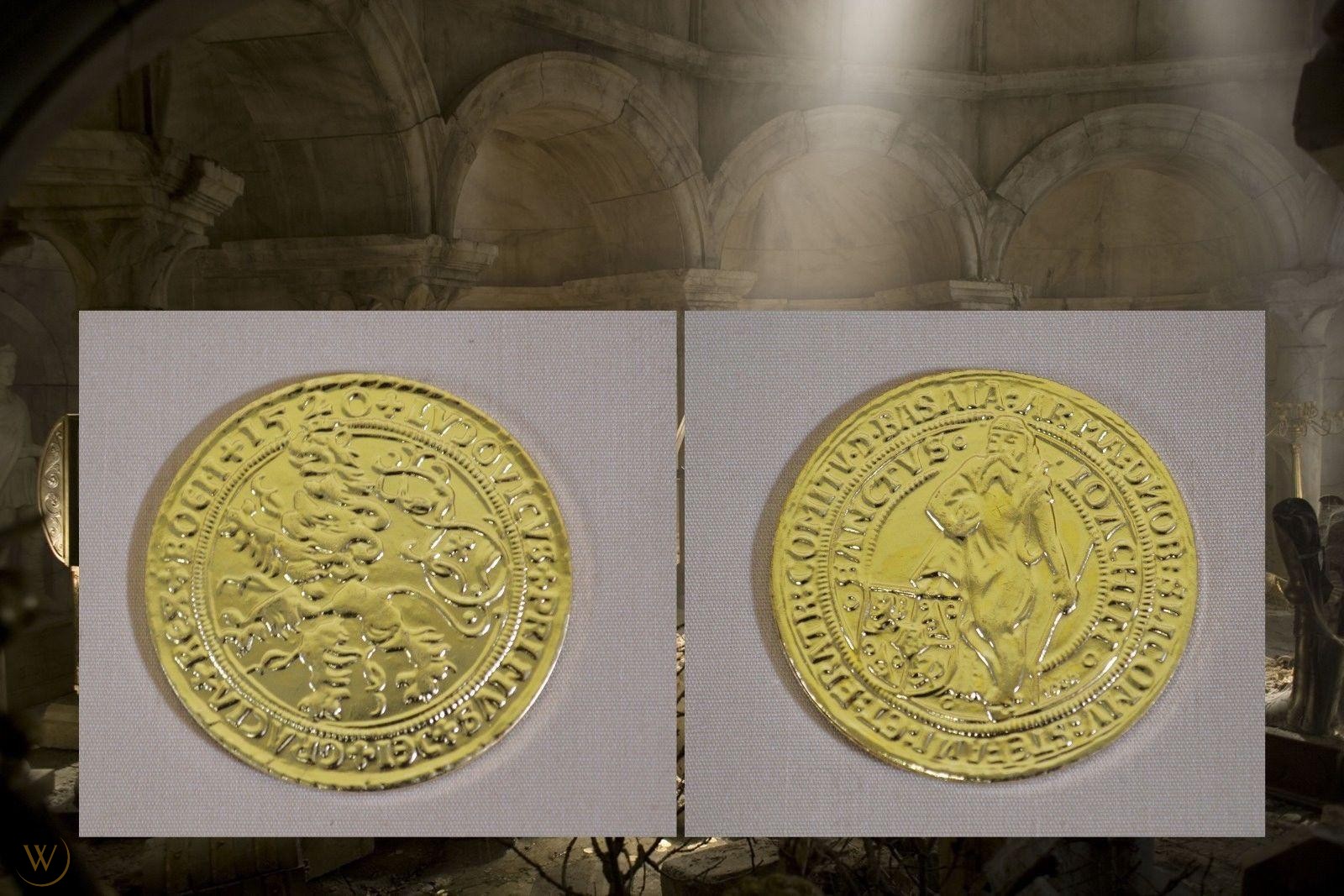
Although I haven’t actively accumulated coins for some years, I do have as a prize piece of my collection a Narnia coin used in the production of Prince Caspian (2008). Technically, since it isn’t a true, earthly coin, it is considered exonumia, but we coin collectors still recognize just how truly special these treasures are.

Speaking of treasures, that is precisely where my Narnian medallion comes from. The treasure chamber scene had a surfeit of the pieces, and some were sold in collectible frames. The obverse and reverse of the coin can be seen above. I’ve actually written about “my precious” piece of Narnia in the past but just this morning I woke up with the word “numismatist” on my mind, crying out for a Mere Inkling post. (More on this in a moment.)

First, those interested in the history of money may wish to skim a few of my other related columns. These include: inflationary currency such as German notgeld and Zimbabwe’s more recent $1,000,000 bills, a comparison of the women in the life of Constantine the Great and the prominent women in the life of C.S. Lewis, and the misspelling of the name of Jesus on a papal medallion.

Coins Have Given Way in My Life, to Words

As I said above, I awoke today with the word “numismatic” fluttering across my thoughts. And it was not alone. It was linked to the wordplay I recently discussed in “Creative Definitions.”

Before pondering where my mental gyrations on the word in question carried me, allow me to share two additional examples I scribbled out on my bedside tablet before rising to brush my teeth and begin the day.

Provocatours: excursions to politically explosive environs where travelers can accurately anticipate their guides will provide an explosively entertaining adventure.

Methics: the ethical perversion which allows people to justify creating pharmaceuticals with the primary function of destroying lives. [See chemistry teacher Walter White on “Breaking Bad.”]

From there my mind jumped to the pecuniary avarice of drug dealers as associated with the word numismatics – and it coined the related word,

Numethmatics: wherein the potential temporal gains associated with drug dealing outweighs the cost to society, oneself and an individual’s soul.

And in relatively rapid sequence came the following.

Flumismatics: when viral contagions disrupt the entire global economy.

Cluemismatics: either the determination of the financial motivations for murder mysteries or the funding required for law enforcement agencies who determine the criminals’ identities.

Numismantics: when economic theory is dominated by traditionally masculine concepts and values (e.g. profit and greed).

Numissmatics: economic theory which is strongly influenced by traditionally feminine values (e.g. charity and compassion).

If the last two culturally antiquated examples haven’t lost you, read on.

Gloomismatics: the prospect for economic survival in light of crushed hopes for the future due to unbridled inflation (e.g. the insanity of some economists and politicians who advocate simply “printing more money” to solve the problem).

Newmismatics: novel currencies and specie that seek to deceive citizens through the pretense that they actually possess some value.

Bluemismatics: the depressive condition elicited when one’s financial holdings inadequately counterbalance one’s debts; historically, applied to cabin boys in sailing days who only realized they would not be fiscally compensated for their services after the ship had left port.

Pneumismatics: pecuniary considerations based on spiritual rather an material considerations.

Numismetrics: the partly scientific, partly fanciful art of exchanging international currencies.

Nufistmatics: the shocking rise of unprovoked blindsided blows to strangers in urban jungles, frequently without any apparent desire to steal property.

Truemismatics: the actual value of monies before economists get involved in the matter.

Gluemismatics: the tight-fisted relationship misers have with their monetary hordes (see Ebenezer Scrooge, or dragons such as described by C.S. Lewis and J.R.R. Tolkien).

Nuclearmismatics: the grim cost calculation involved by world powers when weighing the “benefits” of a possible nuclear conflagration.

There were a couple of other scribblings I was unable to decipher once I was fully awake, but near the end of my meanderings, I came upon,

Zoomismatics: the financial resources required to provide a healthy environment, as close as possible to their natural habitat, for animals residing in zoological parks.

Unsurprisingly, this neologism gave rapid birth to Gnumismatics and Moomismatics . . . well, you get the idea. For the sake of my on sanity, I had to forcibly end the spontaneous exercise.

Returning to Narnia

It is fitting to end this numismatic revelry with a return to the scene for which my coin was minted. As noted earlier, it appeared in Prince Caspian. The Pevensie children have returned to Narnia, and are reawakened to their former life which had become but a dream.

Rediscovering their treasure chamber, in the now-ruins of the castle Cair Paravel (time runs differently in Narnia) is pivotal in their reawakening.

“There’s one thing,” said Lucy. “If this is Cair Paravel there ought to be a door at this end of the dais. In fact we ought to be sitting with our backs against it at this moment. You know – the door that led down to the treasure chamber.”

“I suppose there isn’t a door,” said Peter, getting up. The wall behind them was a mass of ivy.

“We can soon find out,” said Edmund . . .

They worked at the ivy with their hands and with Peter’s pocket-knife till the knife broke. After that they used Edmund’s. Soon the whole place where they had been sitting was covered with ivy; and at last they had the door cleared. “Locked, of course,” said Peter. “But the wood’s all rotten,” said Edmund. “We can pull it to bits in no time . . .

[Descending into the chamber, Peter who is bringing up the rear tells Edmund to count the steps.] “One—two—three,” said Edmund, as he went cautiously down, and so up to sixteen. “And this is the bottom,” he shouted back.

“Then it really must be Cair Paravel,” said Lucy. “There were sixteen.” Nothing more was said till all four were standing in a knot together at the foot of the stairway.

Then Edmund flashed his torch slowly round. “O—o—o—oh!!” said all the children at once. For now all knew that it was indeed the ancient treasure chamber of Cair Paravel where they had once reigned as Kings and Queens of Narnia. There was a kind of path up the middle (as it might be in a greenhouse), and along each side at intervals stood rich suits of armor, like knights guarding the treasures.

In between the suits of armor, and on each side of the path, were shelves covered with precious things – necklaces and arm rings and finger rings and golden bowls and dishes and long tusks of ivory, brooches and coronets and chains of gold, and heaps of unset stones lying piled anyhow as if they were marbles or potatoes – diamonds, rubies, carbuncles, emeralds, topazes, and amethysts. Under the shelves stood great chests of oak strengthened with iron bars and heavily padlocked.

The tale continues, as with each returning memory, the children resumed their stature and confidence as the Kings and Queens of Narnia. Their character, you see, was restored, but they remained only a year older (in Earth age) than they had been when they had previously left the wonderland.

Much to the disappointment of the dwarf Trumpkin. “Well, then – no offense,” said Trumpkin. “But, you know, the King and Trufflehunter and Doctor Cornelius were expecting – well, if you see what I mean, help. To put it in another way, I think they’d been imagining you as great warriors. As it is – we’re awfully fond of children and all that, but just at the moment, in the middle of a war – but I’m sure you understand.”

Lesser children may have filled their pockets with gold coins and diamonds and sought a return to their native land and a life of leisure. Not so these four young heroes. And, due in part to their immunity to avarice, the glory of Narnia is eventually reestablished.