C.S. Lewis & Emotions

Are you one of those people who pride themselves on not being particularly emotional? Probably not, since the pendulum has swung far in the opposite direction in our current day. (Consider how few clicks a Tik Tok influencer with “flat affect” would get.)

Most of us know some people (most commonly men – forgive me the generalization) who keep their emotions under tight rein.

Back when I was a child, in the mid-twentieth century, it was not uncommon for men to “guard” their notion of masculinity by acting emotionless. And various ethnicities, including my own ancestors, possessed a reputation for being staid.

I can’t recall my Norwegian grandfather, who died when I was about ten, ever expressing truly warm sentiments. I know he must have laughed, and my grandmother had a great sense of humor, but I have no memory of it.

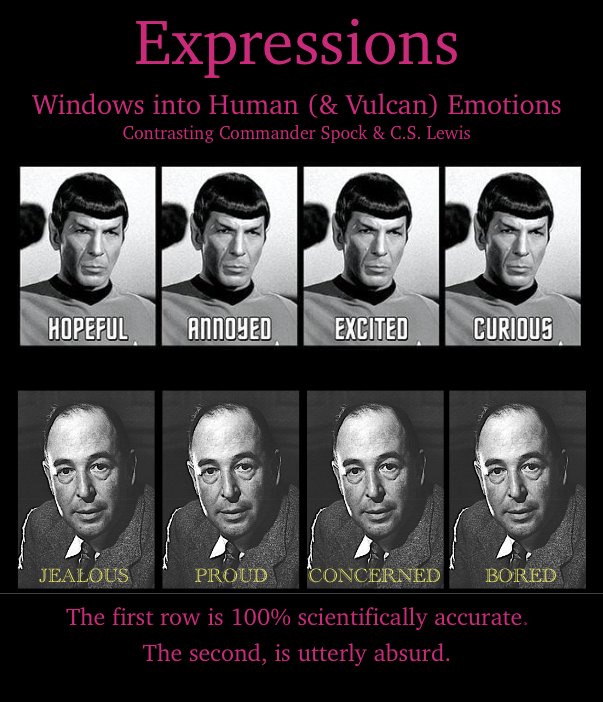
For some reason, many people picture C.S. Lewis as an emotionally sober intellectual. Perhaps it’s because he wrote so many profound essays. The truth is that Lewis was extremely jovial and fun-loving. I have noted some of this humor in the past.

Like most of us, C.S. Lewis’ closest friends saw him most clearly. They witnessed his jocularity in their regular gatherings. His fellow Inklings witnessed it frequently, but I don’t see how anyone can read the Chronicles of Narnia, and perceive their author as reserved, much less grave.

One reason some readers misunderstand C.S. Lewis’ exquisite sense of humor is because it is British. For Americans, for example, appreciating British humor is an acquired taste. As reported by the BBC, the wit often includes elements of “sarcasm, understatement [and] self-deprecation.”

In The Screwtape Letters, C.S. offers an insight into one of the Tempter’s tactics in undermining human nature, in terms of being fashioned in the image of our Creator.

[Englishmen] take their “sense of humour” so seriously that a deficiency in this sense is almost the only deficiency at which they feel shame. Humour is for them the all-consoling and (mark this) the all-excusing, grace of life.

Hence it is invaluable as a means of destroying shame. [. . .] A thousand bawdy, or even blasphemous, jokes do not help towards a man’s damnation so much as his discovery that almost anything he wants to do can be done, not only without the disapproval but with the admiration of his fellows, if only it can get itself treated as a Joke.

And this temptation can be almost entirely hidden from your patient by that English seriousness about Humour. Any suggestion that there might be too much of it can be represented to him as “Puritanical” or as betraying a “lack of humour.”

Lewis’ humor was on full display to his intimate friends, and uninhibitedly on display to the world in a number of his writings. But his openness didn’t end there. 

Just Like the Rest of Us:
a Person of Humor and Grief

I don’t recall anyone labeling C.S. Lewis a “humorist” – likely because his corpus is so diverse and complex – but I think a literary critic could make that case.

Ironically, I once cited an autobiographical reference in which C.S. Lewis applied that very attribute to his own father, a serious solicitor.

In contrast, C.S. Lewis would mature to the point where he was willing to expose that deepest of emotions, grief, with the entire world. In A Grief Observed, he explored his pain in the wake of his wife’s untimely passing. Joy Davidman was the precious wife this confirmed bachelor never anticipated having, and her death crippled him.

His description of his thoughts, doubts, and spiritual struggle in the aftermath has helped many others to survive the nightmare of bereavement. Curiously, for privacy C.S. Lewis initially used a pen name for the volume. (You can read about that here.)

He did not wish to have his authorship of the book distract from its subject matter. He would have known that would only be a temporary tool, since pseudonyms are nearly always uncovered. Initially, however, it was so effective that when it was published, readers recognized it could speak to Lewis’ own grief, and offered him gift copies.

T.S. Eliot was one of its first advocates for the volumes publication, and you can read that story at Faber & Faber.

A Final Lewisian Observation on Emotions

Some people view the intensity of emotions associated with events to be a measure of their validity. If my passions are aroused by an activity, we incorrectly think, it must be real!

This error is particularly dangerous when related to so-called “matters of the heart” and matters of faith. 

C.S. Lewis was cautious in both realms. We already noted his resignation to live out his life as a single man. In terms of faith, he was just as circumspect. His conversion from atheism to Christianity was long, thoughtful, and reluctant. 

And this, I found, was something I had not wanted. But to recognize the ground for my evasion was of course to recognize both its shame and its futility.

I know very well when, but hardly how, the final step was taken. I was driven to Whipsnade [Zoo] one sunny morning. When we set out I did not believe that Jesus Christ is the Son of God, and when we reached the zoo I did.

Yet I had not exactly spent the journey in thought. Nor in great emotion. “Emotional” is perhaps the last word we can apply to some of the most important events.

It was more like when a man, after long sleep, still lying motionless in bed, becomes aware that he is now awake. And it was, like that moment on top of the bus, ambiguous.

Freedom, or necessity? Or do they differ at their maximum? At that maximum a man is what he does; there is nothing of him left over or outside the act.

Certainly, many people are blessed with emotional confirmation in their spiritual lives. The obvious peril, of course, is in evaluating the veracity of something by how giddy it makes us feel. 

After all, there will always come “dark nights of the soul” when the feelings have fled . . . but Jesus, still remains.  

Individualism, License Plates & C.S. Lewis

One of the peculiar things about the United States is the extreme degree to which people are driven to stand out from the crowd. We are able to do this with our automobiles, for example, in a rather odd way.

C.S. Lewis was immune to the temptation discussed here, since he was never a fan of cars, as I discussed in “C.S. Lewis & Automobiles.”

In his autobiography, Lewis declared “I number it among my blessings that my father had no car, while yet most of my friends had, and sometimes took me for a drive.” Those who are curious about Lewis’ dichotomy concerning vehicles, should refer to that post.

I don’t know how many other countries do this, but in most of the United States states, people have the option of getting random numbers and letters on their license plates – or opting for so-called vanity plates.

These individually emblazoned metallic placards perform a sort of Third Estate heraldic device. They often include variations on surnames or words significant to the bearer.

Obviously, offensive words are prohibited, but they are frequently quite creative. Here are a few examples: SO 4CHN8 and its opposite, EN-V ~  GONA B L8 which is probably an insufficient excuse to the cop who pulls you over ~ IBMEUBU with its live and let live philosophy versus URAMESS ~ UH AS IF from California, of course ~ IOU DAD from a grateful child ~ BWAHAHA and the clearer message from Vermont, BBRRRR ~ TWOCUTE can either refer to attractive twins, or to an illiterate narcissist ~ BBQ=LUV celebrates a common American favorite ~ and, this provocative phrase ITS A SIN. Hundreds more examples are online if you’re curious.

It’s fascinating that Americans will pay often exorbitant surcharges to individuate their auto plates. Especially in light of the fact that we already have different plates for each of the 50 states and a Federal District (for our national capital), as well as others for Territories and Protectorates. Prepare yourself. Seriously, prepare for a shock.

All of the 8,331 License Plates in America

States now offer a vast menu of personalized plate options for a dizzying array of organizations, professions, sports teams, causes and other groups.

Such plates typically include a surcharge to support the theme identified on each choice, as for Maryland’s Beekeepers, Barbershop Quartet Singers, or the Baltimore Bicycling Club. And we mustn’t forget their plate promoting the museum of the B&O Railroad (of Monopoly fame).

How can we arrive at that unbelievable number? Well, consider Illinois, for example. They boast no fewer than forty different options related to military alone. Hawaii has the fewest overall varieties at fourteen. Maryland, likely desperate for revenue, actually has nine hundred and eighty-nine. I am curious why they bothered to stop short of an even thousand.

Add to that the fact that nineteen states do not require a license on the front of the car, which invites the substitution of an individualized alternative. Consequently, there are statutes ensuring “most states also require that you do not mount your plate upside down.” In many of these, you would be legally allowed to mount decorative or business plates, but not alternative license plates, misleadingly different from your true registration.

Individuality run amok. The chaos sadly seems strikingly American.

Which brings me to the reason I was thinking about this unusual topic. Heading to church on Sunday I saw a plate with a curious message. It was one of my state’s options for Fire Fighters. The message it bore consisted of just three letters: UGH.

What does that convey to you? Since it appeared on a vocational emblem, my thought is that it reflects the feelings of someone who has grown tired of their profession. The best construction I can imagine is someone frustrated by the fact that after every fire they suppress there will come another. Resulting in a sense of futility or ennui. If you interpret it differently, please let me know.

I mean, we’ve all had ugh-days. But to feel ugh enough about life to indelibly express it this way . . . well, all I could do was hope it was an unconventional joke, and offer a quick prayer for the driver, in case it wasn’t.

C.S. Lewis offered many insights about our God-given individuality and uniqueness. Individualism, as a driving force, however, is something different. I recently read a wonderful article about how Lewis assessed individualism’ interplay with collectivism – two relentless forces in many Western cultures. “C.S. Lewis on Individualism, Equality and the Church” focuses on a World War Two speech delivered at Oxford and published as “Membership.”

Our personal uniqueness is not accidental. As C.S. Lewis wrote in The Problem of Pain,”

[God] makes each soul unique. If He had no use for all these differences, I do not see why He should have created more souls than one. Be sure that the ins and outs of your individuality are no mystery to Him; and one day they will no longer be a mystery to you.

In contrast, hyper-individualism is normally deleterious. Yet, the fact that God regards us as precious, irreplaceable beings, and calls each of us by our personal name, is wondrous news. It can accomplish two things related to the discussion above: (1) it puts personalized license plates in their proper perspective, and (2) it reminds us that even though we occasionally feel frustrated or despondent, our overall life attitude should never be summed up with an ugh.


Editor’s Note: In the interest of journalistic transparency, yours truly, while experiencing many moves, has participated in the automotive bacchanalia described above. Twice I secured military-related plates, Alabama’s Desert Shield/Desert Storm veterans and Illinois’ POW/MIA remembrance commemorations. In addition, while stationed in Guam, I secured plates with my surname.

I have asked my children to have me hospitalized for dementia should I ever decide to order our Washington State J.P. Patches Pal license plate. The reasons for that decision are obvious.

Tortured Writing & the Inklings

Amanda McKittrick Ros (1860-1939) was an Irish poet and novelist beloved by the Oxford Inklings. “Beloved” here is used in the sense of treasured for its distinctiveness, rather than admired for its artistry.

An article about Ros in Smithsonian Magazine is subtitled: “Amanda McKittrick Ros predicted she would achieve lasting fame as a novelist. Unfortunately, she did.”

So how is it that a writer described by the Oxford Companion to Irish Literature (OCIL) as authoring “unconscious comedy of a very high order” came to occupy a special place within the company of C.S. Lewis, J.R.R. Tolkien and their literary fellows? Why did they begin reading her works as a sort of contest, with the challenge of neither laughing nor smiling as they did so?

It was not because her mother (or she herself) christened her after a character in The Children of the Abbey, published in 1796. (Her initial name was “Anna.”)

No, it was due to an intrinsic element of her frequently alliterative artistry, described by OCIL in the following manner.

She published two sentimental romances, Irene Iddlesleigh (1897) and Delina Delany (1898), both in an idiosyncratic manner that provides unconscious comedy of a very high order. . . .

Most of her published writings appeared posthumously as a result of literary curiosity.

Many writers would agree that writing comedy is quite challenging. Comedy Crowd is devoted to helping writers gain some skill in this arena, and if you take a moment to check out their video about failed puns – after you finish reading this post – you won’t be disappointed. 

As one commenter on SleuthSayers puts it, “. . . writing humor isn’t easy. It’s even dangerous: trying to be funny and failing would be almost as bad as being funny when you’re trying to be serious.” Sadly, the worst of these options proved to be the fortune of poor Amanda.

Even her native Northern Ireland Library Authority confesses that her “writing style can only be described as elaborate, melodramatic, using startling descriptions with mixed metaphors and inappropriate alliteration with the result being unintentionally hilarious.”

In her collection “Poems of Puncture,” I came across a piece titled “Reverend Goliath Ginbottle.” Being a reverend myself, I eagerly listened to a LibriVox recording of the poem (which you can download for free from Internet Archive), and I was not disappointed. Her description of this “viper of vanity” and her joy at his ultimate judgment was delightfully colorful. Or, should you prefer to hear a diatribe against a corrupt lawyer, listen to Mickey Monkeyface McBlear, who bore “a mouth like a moneybox.”

TV Tropes has an article about Ros which attributes a dozen tropes to her pen.

In the Style of: Aldous Huxley noted that Ros wrote in the 16th century style of Euphuism. Susan Sontag decades later stated that Euphuism was the progenitor of camp, which would explain why literary greats found her writing so hilarious.

Those curious about euphuism can read John Lyly’s Euphues: the Anatomy of Wit; Euphues and His England which is filled with delights unnumbered. Originally two volumes, the books were published in the sixteenth century.

C.S. Lewis was a serious enough “fan” of Ros’ writings to share his affection for them with Cambridge Classicist Nan Dunbar. C.S. Lewis scholar Joel Heck has written a worthwhile article about the ongoing friendship between the two professors.

For a detailed study of the literary relationship between Amanda McKittrick Ros and the Inklings, I highly recommend the article by Anita Gorman and Leslie R. Mateer which appeared in Mythlore.

As they describe, even before the Inklings added occasional readings of her work to their gatherings, as early as 1907 there was in Oxford a society devoted to weekly readings of her works. The authors pose, and then proceed to answer, the following question.

What . . . impelled C.S. Lewis and his mates to read aloud Ros’s work? Yes, the improbable plots, silly characters, and nonexistent themes may have played a role, but were those enough to captivate the Inklings and to give rise to Delina Delaney dinners and Amanda Ros societies?

After all, many writers have written improbable plots about improbable people, and these writers have enjoyed short-lived reputations, if any reputations at all. Yet Amanda lives on.

For Those with Stout Constitutions

Mere Inkling offers one final look back at the transcendent poetry of Amanda McKittrick Ros. This infamous selection can be found at the aptly named Pity the Readers: Horribly Excellent Writing website.

“Visiting Westminster Abbey”
(from Fumes of Formation)

Holy Moses! Have a look!
Flesh decayed in every nook!
Some rare bits of brain lie here,
Mortal loads of beef and beer,

Some of whom are turned to dust,
Every one bids lost to lust;
Royal flesh so tinged with ‘blue’
Undergoes the same as you.

These morose words bring to mind another verse, composed in the form of a song by the artists of Monty Python. It appeared on Monty Python’s Contractual Obligation Album as “Decomposing Composers.”

They’re decomposing composers.
There’s nothing much anyone can do.
You can still hear Beethoven,
But Beethoven cannot hear you. . . .

Verdi and Wagner delighted the crowds
With their highly original sound.
The pianos they played are still working,
But they’re both six feet underground.

They’re decomposing composers.
There’s less of them every year.
You can say what you like to Debussy,
But there’s not much of him left to hear.

Yes, similarly morbid verse, but offered here to provide a sharp contrast between types of humor. Monty Python is the epitome of Camp, which according to Susan Sontag,

sees everything in quotation marks. It’s not a lamp, but a “lamp;” not a woman, but a “woman.” To perceive Camp in objects and persons is to understand Being-as-Playing-a-Role. It is the farthest extension, in sensibility, of the metaphor of life as theater.

Although Sontag notes “one must distinguish between naïve and deliberate Camp,” she argues the “pure examples of Camp are unintentional.” She considers self-conscious efforts, such as Noel Coward (and presumably Monty Python as well) as “usually less satisfying.”

Another perspective offers a helpful dichotomy to distinguish between “intentionality: whether camp deliberately cultivated (‘high’ camp) is the same to that of the unintentional kind (‘low’ camp).”

Personally, I often enjoy high (nonvulgar) camp humor – witty silliness that scoffs at life’s peculiarities. As for unintentional, “low” camp such as we find in Ros, I typically feel a flash of guilt at hurting (even posthumously) the feelings of a writer. Most of us writers are, after all, a sensitive and vulnerable breed.


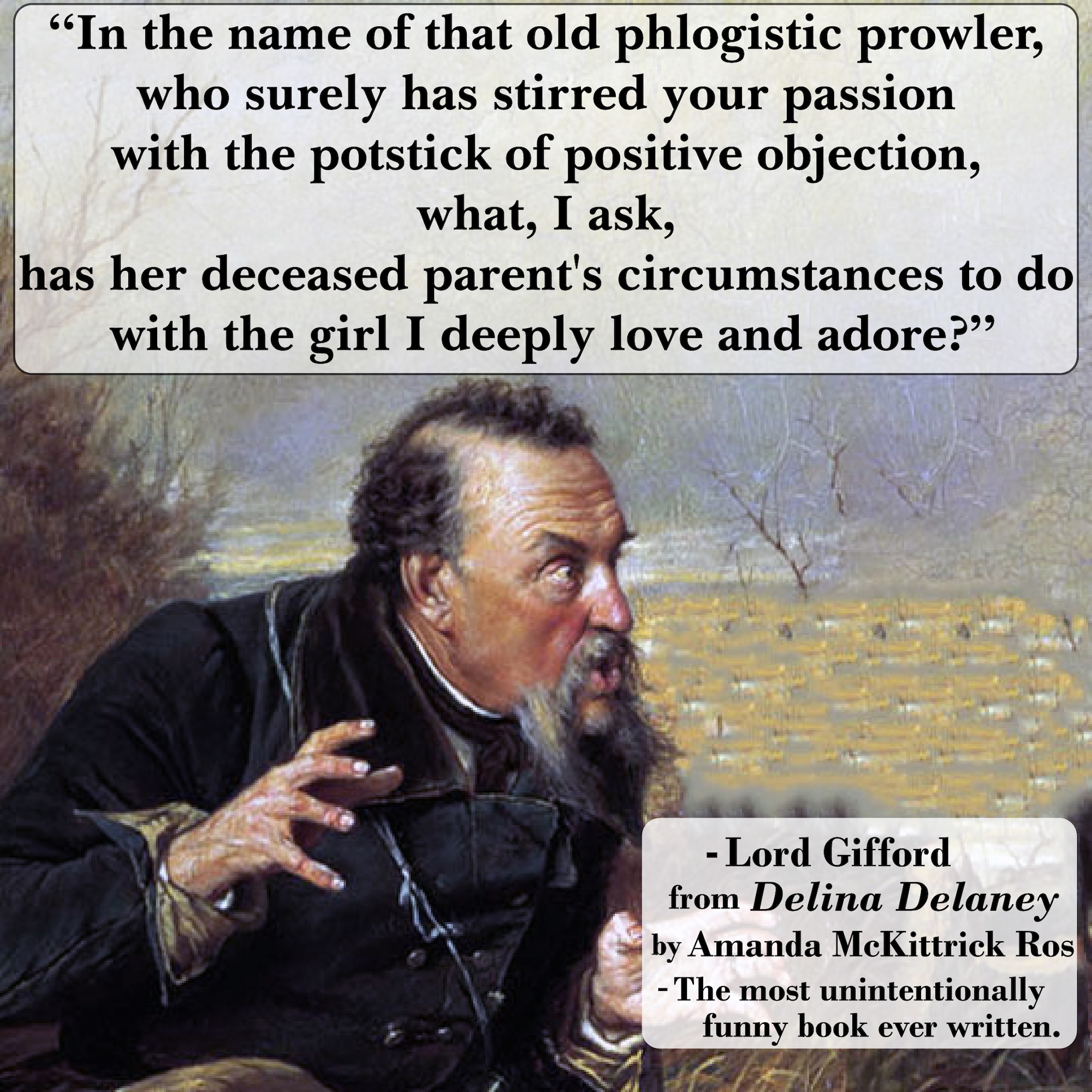
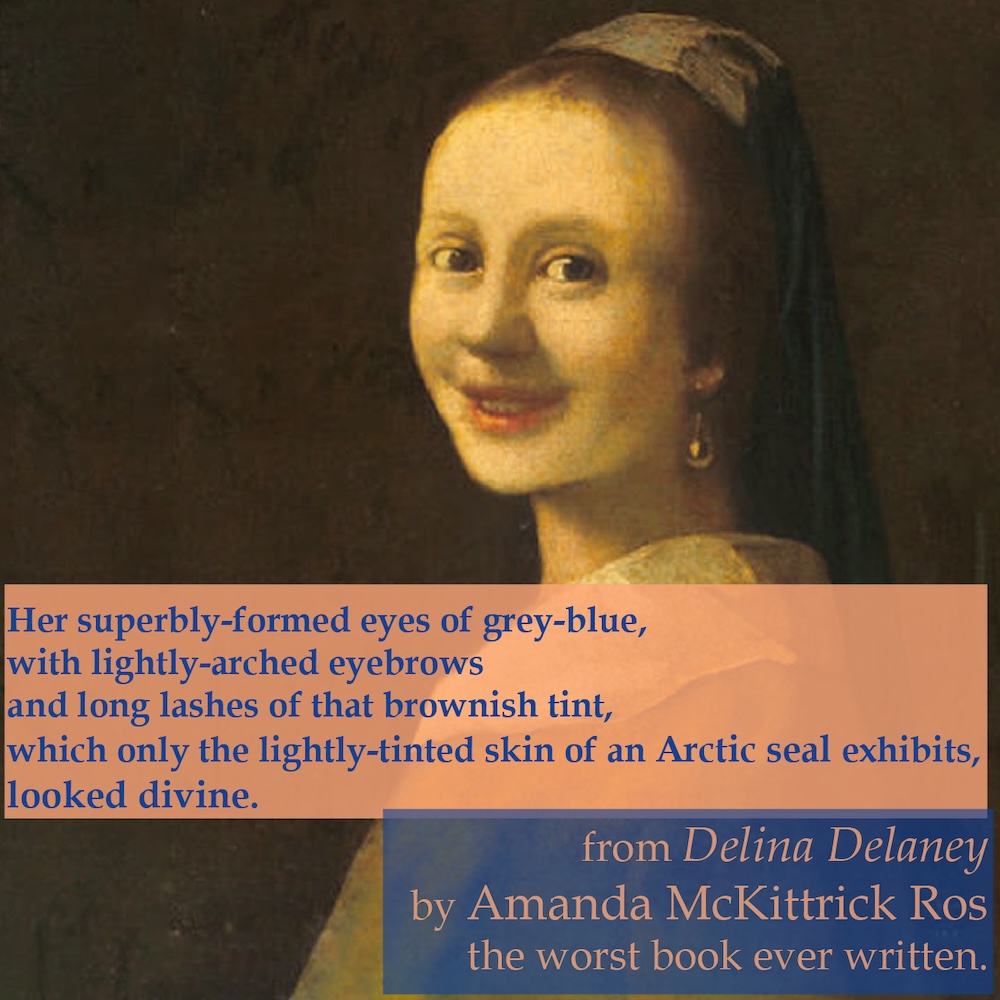
The enlightening illustrations accompanying this article are from Amanda McKittrick Ros Society Promotional Memes, ably captained by Dan Morgan.

Theological Humor

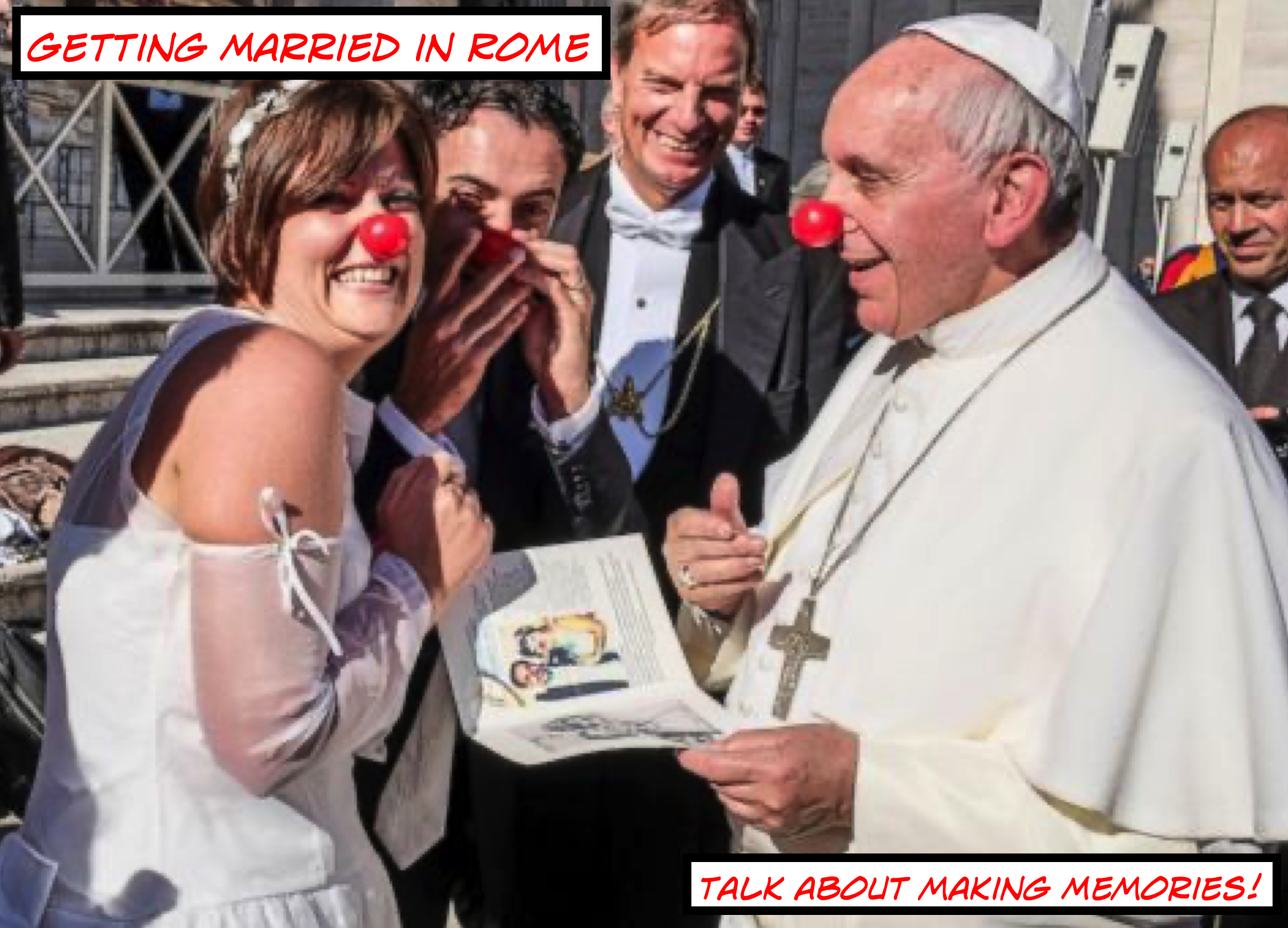
Pope Francis jokes with a newlywed couple in Rome.

Don’t be surprised, but many clergy possess keen senses of humor. Sure, there are staid, grimacing ministers who consider acting dour to be a virtue. (They’re often legalistic.) But most of the pastors and military chaplains I’ve worked beside, love to laugh. I think I’ve written enough about humor to verify that.

C.S. Lewis maintained strong bonds with a number of clergy, from a variety of denominations, and that would hardly have been true if they had lacked a sense of humor. Humor, to Lewis, is an essential part of life. He proclaims this truth from the lips of Aslan himself, as the newly created Talking Animals hear the first (accidental) joke.

“Laugh and fear not, creatures. Now that you are no longer dumb and witless, you need not always be grave. For jokes as well as justice come in with speech.” (The Magician’s Nephew)

I recently read about a fascinating incident one historian described as “perhaps the only really satisfactory practical joke in the whole history of theology.” Allow me to set the scene.

The Byzantine Empire lasted for a thousand years, before being defeated and desecrated* by Islamic armies. During the centuries surrounding its apex, it suffered from the political intrigue and competition with which we are all too familiar.

Photios I was a Byzantine scholar who was twice the Patriarch of Constantinople during the ninth century. Twice is unusual, but it was due to the machinations of emperors and empresses who meddled in the affairs of the church.

He had a troubled relationship with another priest named Ignatius, who also served two times as Patriarch. The good news is that the men were eventually reconciled and both are regarded by Orthodox Christians as saints.

The anecdote comes from the period of their rivalry. Photios, whose brilliance was widely acknowledged, and presumably envied by Ignatius, decided to pull an embarrassing public prank on his nemesis.

Photios devised a bizarre theory that human beings have two souls. His goal was to trick Ignatius into taking it seriously, whereupon Photius withdrew the thesis and admitted he had not been serious. Apparently, everyone unsatisfied with Ignatius’ leadership found it quite entertaining.

Fortunately, among clergy the humiliation of others is rarely the object of humor. Yet, sadly, I have seen it attempted. I personally repent of ever having done so myself, and regard it as sharing, along with vulgarity and blasphemy, the lowest level of “humor.” 

The Wisdom of Lewis

In Reflections on the Psalms, C.S. Lewis relates something I know to be true from my own experience.

A little comic relief in a discussion does no harm, however serious the topic may be. (In my own experience the funniest things have occurred in the gravest and most sincere conversations.) 

Clergy deal with serious topics, like death, quite frequently. Perhaps that is one reason a well-developed sense of humor is common among their ranks.


Skip this footnote if you want to end on a “happy” note.

* “Desecration” may sound like a harsh word to our interfaith-sensitive ears, but it is accurate here. Islam is rarely a gentle master for Christians, and it has been common to see churches and holy places seized and converted to foreign religious uses. For example, in the capital Constantinople (now called Istanbul), Orthodox Christianity’s most magnificent church, Hagia Sophia, saw much of its glorious and historic iconography destroyed when it was converted to a mosque. Many years later, in 1934, an enlightened Turkish government ended the insult, and chose to treat the holy place as a museum. Sadly, the current regressive government under Recep Tayyip Erdoğan, reversed that decision, and in 2020 the Church of Holy Wisdom was returned to its usage as a mosque.

C.S. Lewis & the Playful God

When my grandchildren were younger, we played a game where everything would be “normal” and I would without warning say “you don’t need to be afraid of me, because I’m not…” [transformational pause, followed with a growl] “… an ogre!”

The kids would squeal and hightail it for cover where they were safe while I briefly lumbered about for a moment. It was much fun, and if Jesus tarries, perhaps I’ll play a similar game with their children.

I recently read an interesting article about Martin Luther’s understanding of God’s playfulness. You can read the entire article here: “Deus Ludens: God at Play in Luther’s Theology.”

Finally, and perhaps most importantly, Luther knows a kind of unstructured play, especially between parents and children, that may involve . . . a kind of pretending which then gives way to the revelation of reality.

C.S. Lewis was a confirmed bachelor when he was surprised by encountering Joy, who would become his wife. He did a commendable job as a stepfather after her death, but wasn’t well equipped for the job.

In The Abolition of Man, Lewis confessed “I myself do not enjoy the society of small children . . . I recognize this as a defect in myself.” Yet he did enjoy other forms of play – of the mental and imaginary varieties – that many young people also savor.

One pastor encourages us to apply Lewis’ observation to ourselves.

Do you recognize that an inability to enjoy children is not representative of a defect in the children, but of a defect in us? I hope that you do. And if not, I hope that you will.

In “C.S. Lewis on Pretending,” the author touches on this theme. After quoting the following passage from Mere Christianity, he writes, “Lewis is drawing out two key elements of change. The role of imagination in faith. The necessity of visionary faith for change.”

Very often the only way to get a quality in reality is to start behaving as if you had it already. That is why children’s games are so important. They are always pretending to be grown-ups – playing soldiers, playing shop.

But all the time, they are hardening their muscles and sharpening their wits so that the pretence of being grown-up helps them grow up in earnest.”

Poet Malcolm Guite challenges (accurately, in my opinion) Lewis’ self-diagnosed disconnect from children.

That Lewis could write immortal children’s tales in late middle age, and weave into those tales such truth and vision that the children who first read them at 8 or 9 keep returning to them in adult life and finding more and more, is a sign that he retained to the end, ‘the child within,’ to borrow George Macdonald’s phrase. And yet in those very stories he provides for both children and grown-ups some very searching truths about what it is both to be a child and to grow up.

Other Christians have identified with Lewis’ challenge. One pastor repeated Lewis’ words about his “defect,” admitted he felt similarly, and responded:

Do you recognize that an inability to enjoy children is not representative of a defect in the children, but of a defect in us? I hope that you do. And if not, I hope that you will.

Because children, just like the poor, offer us another unique opportunity to see what it means to live inside God’s kingdom.

Like it or not, children are going to be who they are. With zero nuance or subtlety, they are going to be consistent – the authentic version of themselves – in every situation.

Ironically, despite his supposed handicap, C.S. Lewis directly blessed more children than it would be possible to number. The follow article, “A Playful Romp with God,” reveals an excellent example of his accomplishment.

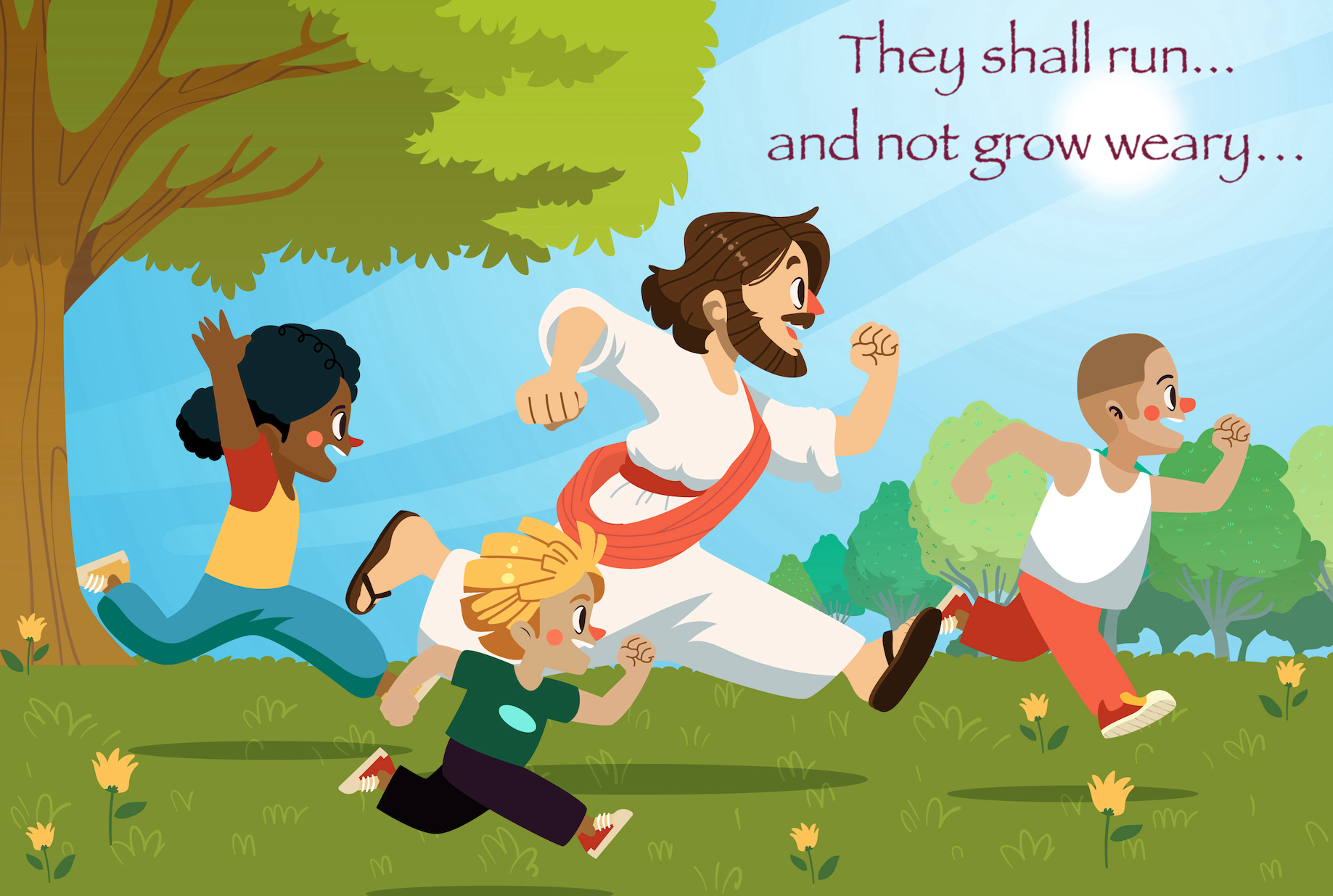
The first time I encountered this scene – as an adult, reading the Narnia books to my own kids – I cried. The possibility that God might laugh, romp, and play with his children stopped me in my tracks. How could such a scandalous thing be true?

Growing up, I never heard a word about God laughing, joking, or doing anything for fun. No one invited me to imagine the Jesus of the Gospels smiling, much less goofing around with his disciples, playing hide-and-seek with the children who flocked to him, or basking in the sunshine on a gorgeous summer day.

The list of characteristics I associated with God – omniscience, holiness, transcendence, righteousness – did not include playfulness.

The writer of these words is not alone. Too many people have been raised with the image of a stern, humorless Christ. That’s one of the reasons I am so pleased with the new series, “The Chosen.”

While they may carry the image of Jesus’ playfulness a bit too far – who can say – it is a truly refreshing and convincing portrayal of the Lamb who came to lay down his life as a sacrifice for each of us.

C.S. Lewis portrays this aspect of God brilliantly in The Lion, the Witch, and the Wardrobe. After his resurrection, Aslan reveals himself first to Susan and Lucy. And, rather than rush off to prepare Narnia for the approaching battle with the Witch . . . he plays.

“Oh, children,” said the Lion, “I feel my strength coming back to me. Oh, children, catch me if you can!” He stood for a second, his eyes very bright, his limbs quivering, lashing himself with his tail. Then he made a leap high over their heads and landed on the other side of the Table.

Laughing, though she didn’t know why, Lucy scrambled over it to reach him. Aslan leaped again. A mad chase began. Round and round the hilltop he led them, now hopelessly out of their reach, now letting them almost catch his tail, now diving between them, now tossing them in the air with his huge and beautifully velveted paws and catching them again, and now stopping unexpectedly so that all three of them rolled over together in a happy laughing heap of fur and arms and legs.

It was such a romp as no one has ever had except in Narnia; and whether it was more like playing with a thunderstorm or playing with a kitten Lucy could never make up her mind. And the funny thing was that when all three finally lay together panting in the sun the girls no longer felt in the least tired or hungry or thirsty.

Do we have a playful God? If you still think not, you have my sympathy, my prayers, and my encouragement to read this helpful article, “The Role of Laughter in the Christian Life,” written by the author of Surprised by Laughter: The Comic World of C.S. Lewis.

When the Learnèd Deserve Gentle Ridicule

The halls of academia are a curious place. Dark wooden walls and well-worn stairways hearken back to legions of students and professors who have invested portions of their lives in the academies’ life. Some of us are drawn to the air of knowledge and residue of research that made them what they are.

At the same time, however, many universities have become parodies of what they once were. Some self-important leaders and faculty cry out for satire and parody. As one liberal American journalist, a defender of academic elitism, admitted: “academics can be condescending and arrogant.”

Through the years I’ve known many brilliant men and women who retained their humility. Sadly, I’ve also encountered many whose view of themselves was so exaggerated that one could only respond with disbelief. Do they really believe no one sees through the façade?

Rather than write a longer column here, I want to provide a link to an unusual article I recently wrote related to this subject. If you have a sense of humor, and are not afflicted with academic grandiosity, please check it out. It appeared this past week in the latest issue of CSL: The Bulletin of the New York C.S. Lewis Society.

CSL is a small but mighty (think Reepicheep) publication. It’s worth subscribing to, even for those of us thousands of miles from their regular meetings in the Empire State.

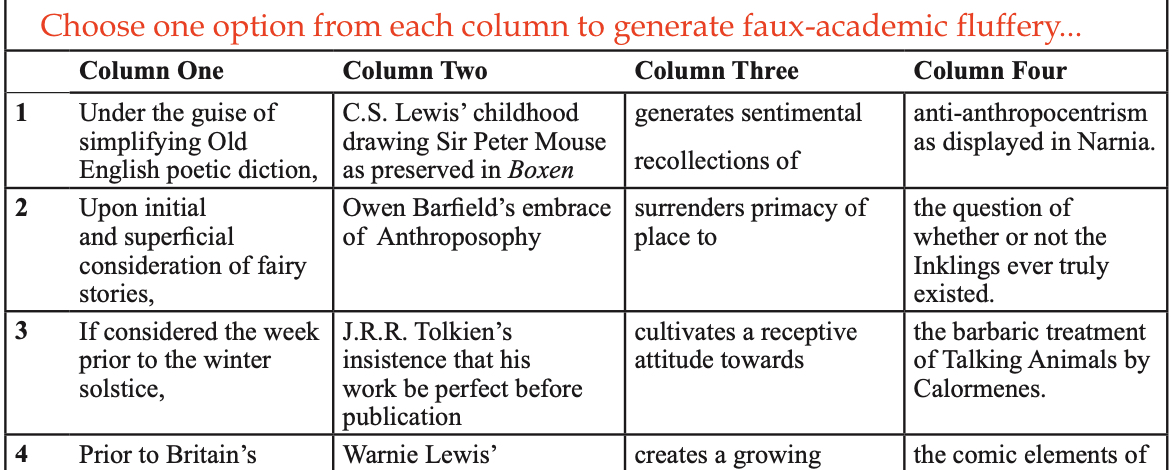
My article is brief, but it includes “the Mere Oxford Inkling Erudition Chart,” which promises countless hours of educational entertainment.

The people my satire seeks to unmask are the type of academics who attempted to make Oxford and Cambridge Universities so inhospitable to C.S. Lewis. Read this interview with one of his former student who critiques the opinions of lesser minds.

The BBC [invited him to broadcast the] talks that ultimately became Mere Christianity. The BBC was astounded by the response to these talks. As you know, Mere Christianity has never been out of print since.

He then became very unpopular with the senior faculty at Magdalen College. Magdalen was a godless college and a very famous college, very atheistical. . . . So [Lewis] got a rough ride there. He never made professor at Oxford.

So much for the civility one would expect in such environs.

You can read my modest article, “Mastering Inkling Erudition,” at this link today.

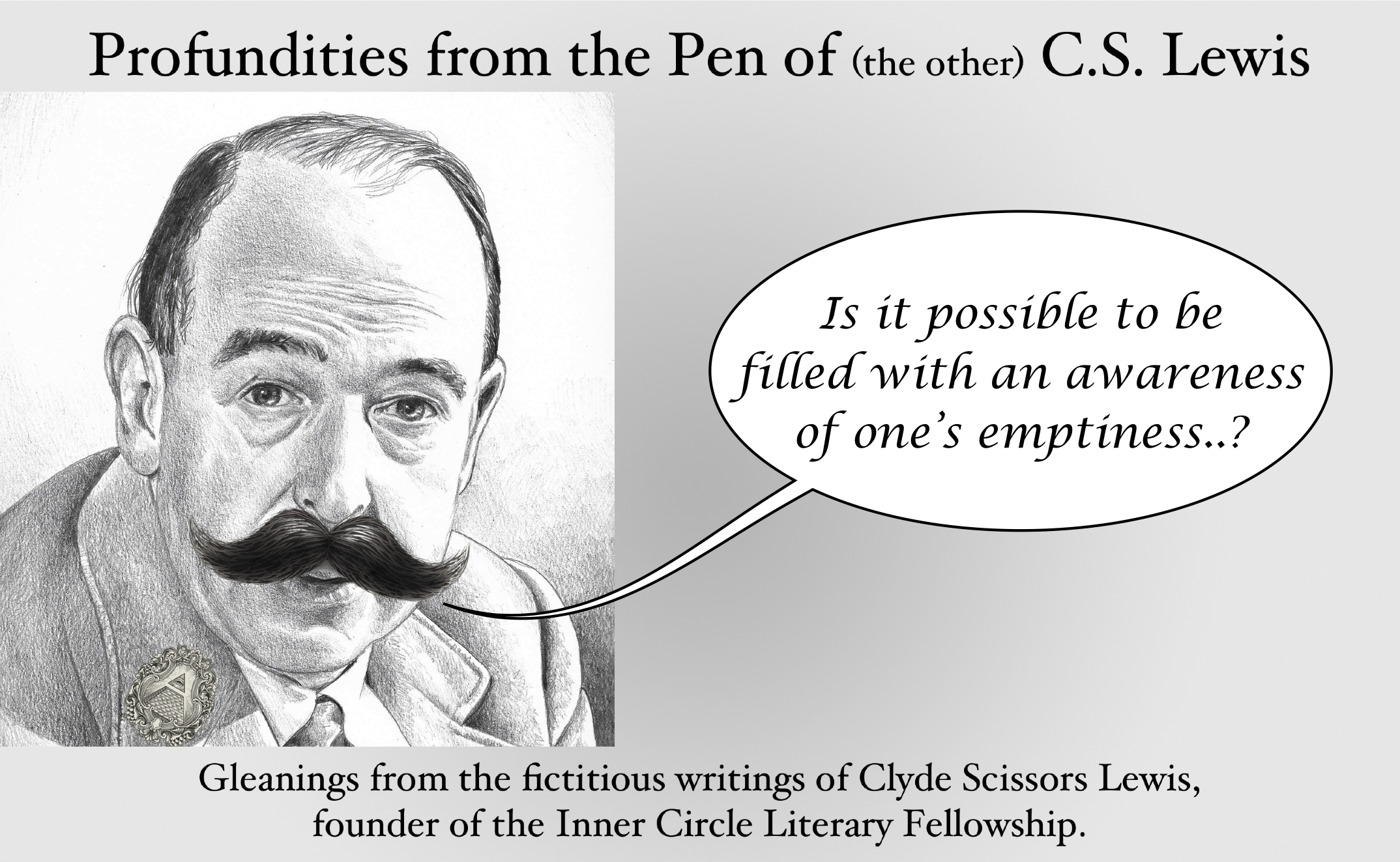
CS Lewis | Emptiness

Deep Thoughts from the Quill of the Other C.S. Lewis

Welcome to another in an occasional series of fictitious quotations from a fabricated contemporary of the great Oxbridge professor, Clive Staples Lewis.

The C.S. Lewis who authored these questionable observations, Clyde Scissors Lewis, possessed a worldview enigmatically different from that of the esteemed Christian author. Despite the fact that their two lives overlapped in a variety of ways, the similarities were superficial.

A brief biography of the lesser Lewis is available at this link.

The Other C.S. Lewis: A Brief Biography

By all means, do not confuse the wisdom of the genuine article with his shadowy counterfeit. Despite any cursory similarities between the two men, this is most definitely not the C.S. Lewis readers have come to know and love.

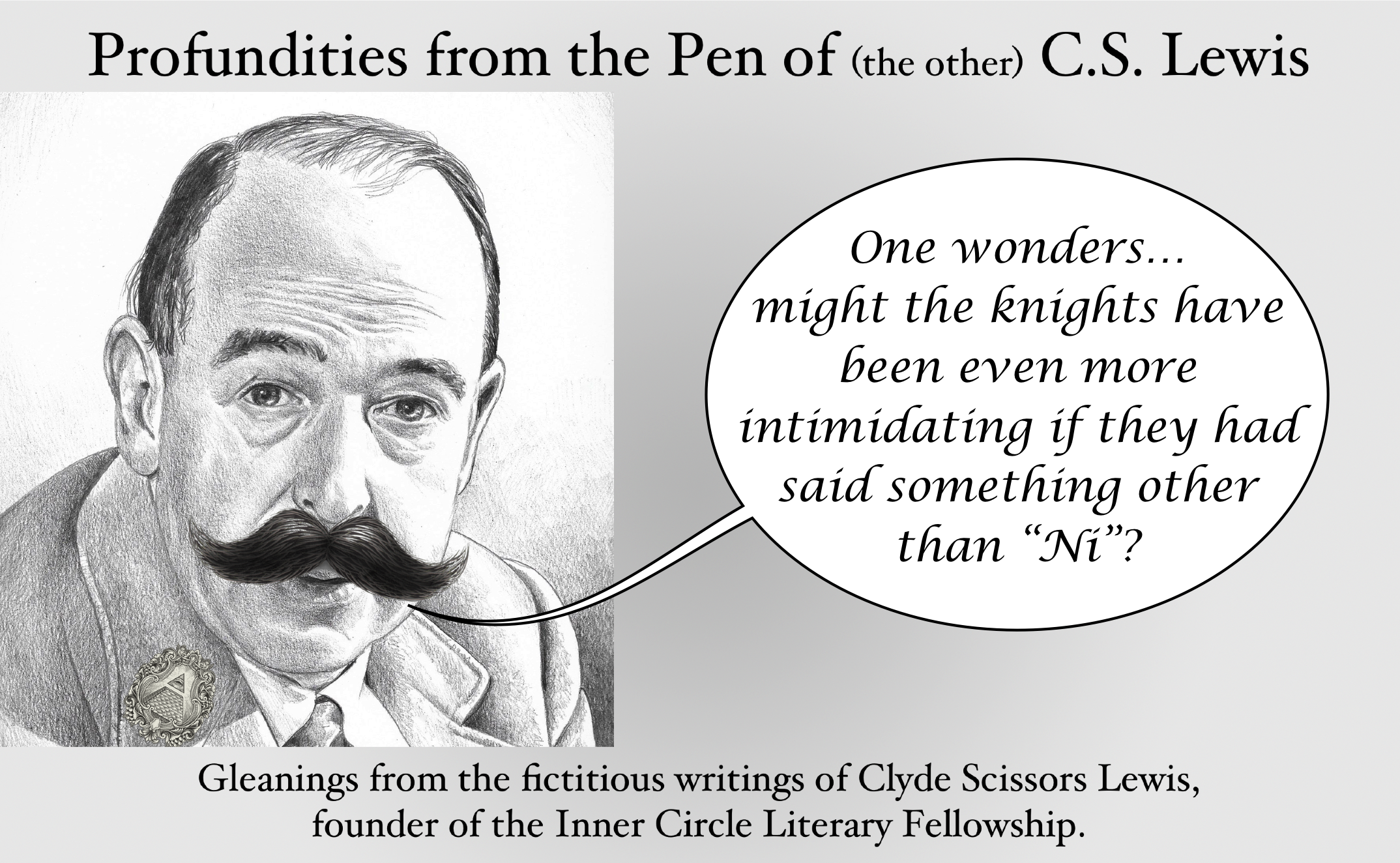
CS Lewis | Intimidation

Deep Thoughts from the Quill of the Other C.S. Lewis

Welcome to the first in an occasional series of fictitious quotations from a fabricated contemporary of the great Oxbridge professor, Clive Staples Lewis.

The C.S. Lewis who authored these questionable observations, Clyde Scissors Lewis, possessed a worldview enigmatically different from that of the esteemed Christian author. Despite the fact that their two lives overlapped in a variety of ways, the similarities were superficial.

A brief biography of the lesser Lewis is available at this link.

The Other C.S. Lewis: A Brief Biography

By all means, do not confuse the wisdom of the genuine article with his shadowy counterfeit. Despite any cursory similarities between the two men, this is most definitely not the C.S. Lewis readers have come to know and love.

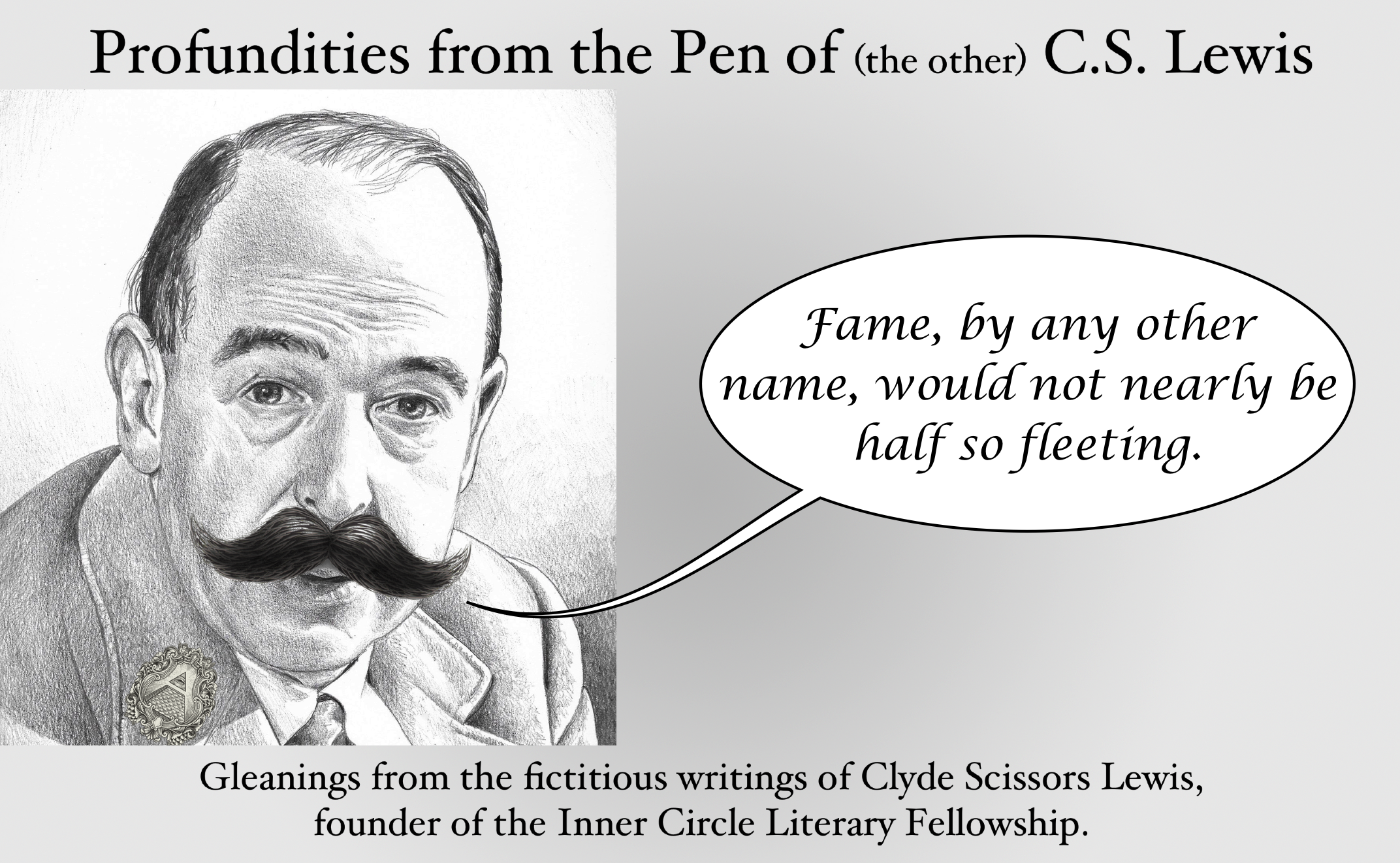
C.S. Lewis | Fame

Deep Thoughts from the Quill of the Other C.S. Lewis

Welcome to the first in an occasional series of fictitious quotations from a fabricated contemporary of the great Oxbridge professor, Clive Staples Lewis.

The C.S. Lewis who authored these questionable observations, Clyde Scissors Lewis, possessed a worldview enigmatically different from that of the esteemed Christian author. Despite the fact that their two lives overlapped in a variety of ways, the similarities were superficial.

A brief biography of the lesser Lewis is available at this link.

The Other C.S. Lewis: A Brief Biography

By all means, do not confuse the wisdom of the genuine article with his shadowy counterfeit. Despite any cursory similarities between the two men, this is most definitely not the C.S. Lewis readers have come to know and love.

Humorous Examinations

Could you pass this examination?

Sketch the development of human thought, estimate its significance. Compare with the development of any other kind of thought.

In contrast to the serious tone of the last two posts, today I am offering some edifying entertainment. As a gift to you, I have edited a perennial favorite of internet humorists. I recently came across my copy of this comprehensive knowledge examination, which motivated me to tweak it for Mere Inkling’s erudite audience.

You have probably seen versions of this exam in the past. The basic questions have remained surprisingly stable despite its age. I encountered it in the University of Washington campus paper in 1973. One writer claims “the Graduation Exam—Authentic Assessment has been in circulation since at least the 1950’s.”

The exam certainly makes the rounds, as this Navy veteran described.

The pressures of comprehensive exams were apparent to many, which resulted in one of the few officially sanctioned jokes in Naval Nuclear Power. In one of the official publications of Naval Reactors, someone inserted a sample “final exam” from Nuclear Power School.

In 2012 elements of the examination created confusion in the People’s Republic of China. It was included in an article about how Chinese nationals could prepare for an American State Department exam required for positions at the United States embassy in Beijing. According to China’s Global Times, “US embassy spokesman Richard Buangan made clear on his Sina microblog Sunday that an alleged ‘recruitment test for expatriate employees at the US embassy’ is fake.”

A June 2008 issue of Foreign Service Journal carried a story, which includes an English version of the [exam stating] the questions are from the US State Department’s entrance exam, in a bid to “measure the stability of perspective Foreign Service officers and to weed out the dummies.”

The Function of Examinations

Testing and documenting competence is obviously important. This is especially true for people in critical roles, such as prescribing drugs, designing aircraft engines, and manufacturing ice cream.

Of course, not everyone is able to pass every test. Which is precisely how things should be.

C.S. Lewis noted how educators truly familiar with their students readily recognize when it is a waste of time for them to continue repeating an exam they obviously cannot pass. He said an academic “master often knows, when boys and parents do not, that it is really useless to send a boy in for a certain examination again” (The Problem of Pain).

I have met very few people who enjoy being tested. Yet, for many faculty members (C.S. Lewis included), being on the “other side” of exams is not particularly enjoyable either. This delightful passage comes from a 1927 letter to his brother, Warnie.

My period of examining passed over with its usual accompaniment of neuralgia and oaths, relieved by the one excellent boy who defined ‘a genie’ correctly, yet more than correctly, as ‘an eastern spirit inhabiting bottles and buttons and rings.’ Pretty good for a boy.

I was also pleased with a youth who, being asked to write a letter to a friend recommending Guy Mannering,* wrote to his brother recommending it and saying ‘I think you would be interested in the character of Colonel Mannering, he is so like our father’: and then later in a paper on Guy Mannering in which I had set the question ‘Would you have liked Colonel Mannering as a father?’—illustrate your answer etc.—began decisively ‘I would not have liked Colonel Mannering as a father in the least.’

Well, it’s time now to offer you the opportunity to prove your worthiness. If you wish to evidence the breadth and depth of your knowledge, proceed now to the exam. (Astute readers will note I’ve added a personal twist to a couple of the exam questions.)

Comprehensive Knowledge Exam

HISTORY: Describe the history of the papacy from its origins to the present day, concentrating especially, but not exclusively, on its social, political, economic, religious, and philosophical impact on Europe, Asia, North and South America, and Africa. Be brief, concise, and specific. Now do the same for the Zoroastrian priesthood. [Bonus credit for including Antarctica in your response.]

MEDICINE: You have been provided with a razor blade, a piece of gauze and a bottle of scotch. Remove your appendix. Do not suture until your work has been inspected. You have fifteen minutes. [Option: if you feel the scotch would impair your responses to the remaining questions, you may defer this portion of the exam to the end of the exam.]

PUBLIC SPEAKING: Two thousand riot-crazed anarchists are storming the campus. Calm them. You may use any ancient language except Latin, Greek or Sanskrit. [Pig Latin is allowed.]

BIOLOGY: Postulate the 500 million year progression of a life form based on silicon, ranking its likely preference for form of government Enumerate the pros and cons it would associate with democracy, monarchy, socialism, theocracy, and totalitarianism. [Caution: any references to the Horta of Janus VI will result in disqualification of your answer, since Star Trek is a fictional resource.]

MUSIC: Write a piano concerto. Orchestrate and perform it with flute and digeridoo. You will find a piano under your seat. The wind instruments, of course, were among the items you were directed to bring with you to the examination.

PSYCHOLOGY: Based on your knowledge of their works, evaluate the emotional stability, degree of adjustment, and repressed frustrations of each of the following: Alexander of Aphrodisias, Hildegard of Bingen, Rābi’a bint Ka’b al-Quzdārī and Simeon the Stylite. Support your evaluation with quotations from each individual’s work, citing original sources. It is not necessary to translate.

SOCIOLOGY: Using the pretext of Planet of the Apes, where homo sapiens have been subordinated to various primate species, assess the prospects for achieving mutual toleration and equilibrium before one group is driven to extinction. [Caution: confusion of apes (which lack tails) and monkeys (which lack an appendix) will result in disqualification of your response.]

CHEMISTRY: Transform lead into gold. You will find a beaker, a three hundred count box of matches and five lead sinkers under your seat. Show all work including Feynman diagrams and quantum functions for all steps. [Transformation into silver will provide half credit.]

ENGINEERING: The disassembled parts of a high-powered rifle have been placed on your desk. You will also find an instruction manual, printed in Swahili. In 10 minutes a hungry Bengal tiger will be admitted to the room. [Special Consideration: Satisfactorily explain the differences between Fahrenheit and Celsius to the tiger, and it will be replaced by a rabid ferret.]

ECONOMICS: Develop a realistic plan for refinancing global debt, without hypothesizing a benevolent intergalactic alliance with unlimited resources coming to the planet’s aid. Trace the possible effects of your plan in the following areas: Cubism, the Donatist controversy, and the 1913 foundation of Hôpital Albert Schweitzer in Gabon.

POLITICAL SCIENCE: Devise an infallible, seven-step plan to transform the United Nations into an organization that will successfully foster peace and goodwill in all international relationships. [Bonus credit for providing a major role for two of the following nations: Dominica, Liechtenstein, Tuvalu.]

AGRICULTURAL SCIENCE: Outline the steps involved in breeding your own super high yield, all weather hybrid strain of wheat. Describe its chemical and physical properties and estimate its impact on world food supplies. Construct a model for dealing with world-wide surpluses. Draft your Nobel Prize acceptance speech.

PHYSICS: Explain the nature of matter. Include in your answer an evaluation of the impact of the development of mathematics on astronomy, botany and numismatics. [Bonus Credit: write today’s date in metric.]

PHILOSOPHY: Sketch the development of human thought, estimate its significance. Compare with the development of any other kind of thought. Be sure to include an analysis of the influence exerted on philosophy by Diogenes the Cynic.

CREATIVE WRITING: Compose an epic poem based on the events of your own life in which you see and footnote allusions from T.S. Eliot, Titus Lucretius Carus, Miguel de Cervantes, Dante Alighieri, Þorbjörn Hornklofi, Gilgamesh and Stephen King. Critique your poem with a full discussion of its syntax and metrics. [Bonus Credit for writing alternating stanzas between free and rhyming verse.]

EDUCATION: Formulate an examination which accurately measures an individual’s comprehensive knowledge base without cultural or linguistic prejudice. Limit the question parameters to what can reasonably be covered during a four hour testing block.

LITERATURE: Discuss in detail at least three major literary figures from each of the following civilizations: the Xia Dynasty, the Akkadian Empire, the Mayan Empire, the Aksumite Empire, the Polynesian Tuʻi Tonga Empire, and nineteenth century United Kingdom. [Caution: failure to include J.R.R. Tolkien and/or C.S. Lewis will result in disqualification of your answer to this question.]

Congratulations on finishing the exam. You are encouraged to use any remaining time to review your answers in light of the fact that grammatical errors and misspellings will significantly impact your final grade.


* You can download a personal copy of Guy Mannering, one of Sir Walter Scott’s Waverly novels, at Internet Archive.

If you should question the distinctions I noted between apes and monkeys, please know that the facts are genuine. However, for future examinations, you should be aware that not all monkeys have tails.