C.S. Lewis, Apologues & Allegories

It has been argued that C.S. Lewis wrote apologues, but I humbly disagree.

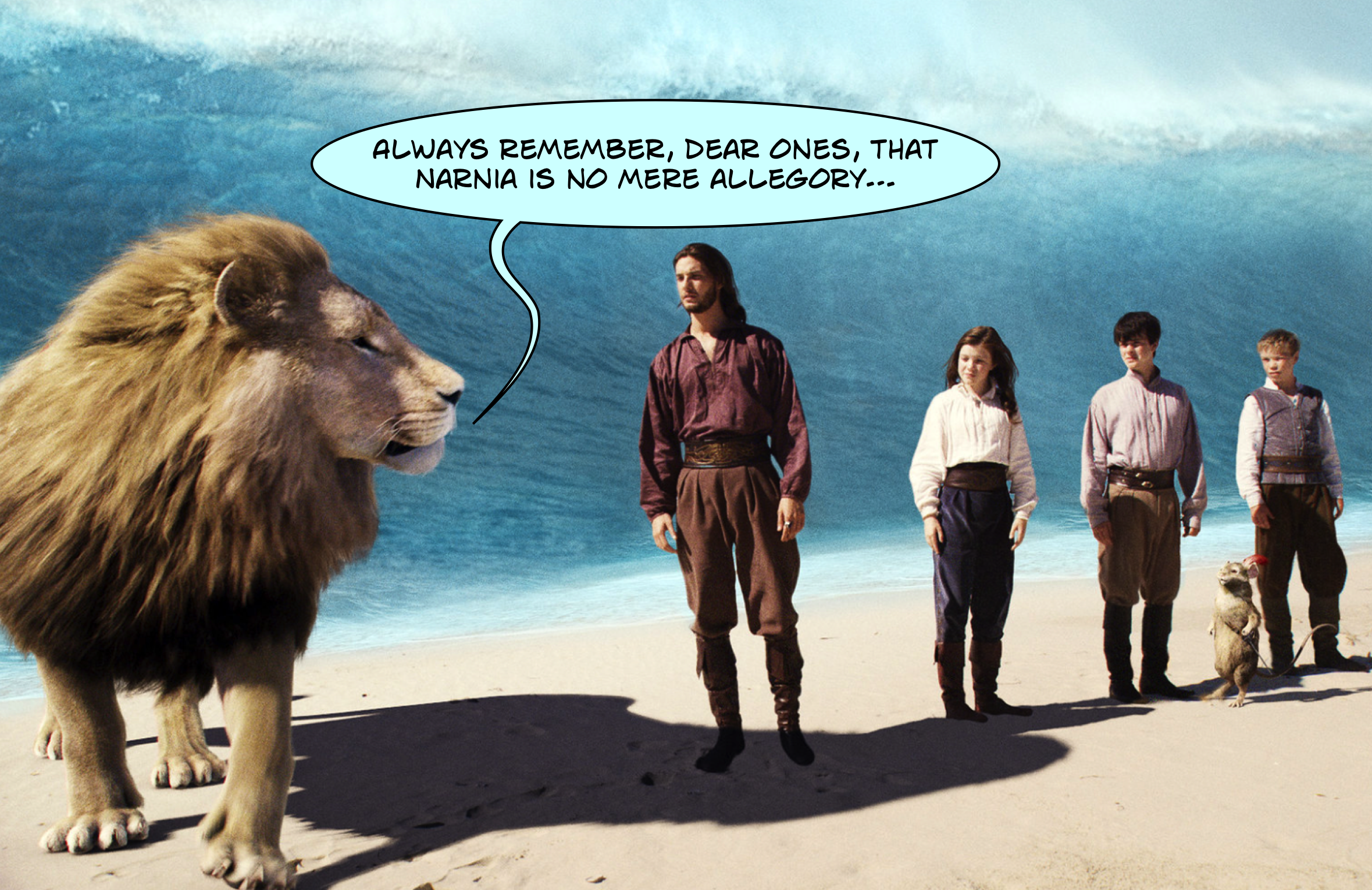
An “apologue,” you see, is defined as “a moral fable, especially one with animals as characters.” From that core definition, it makes sense to some that works such as The Chronicles of Narnia might be described as apologues.  

However, this term is usually applied to much simpler, more concise stories –  short moral fables (think Aesop) rather than an extended tales. “Apologue” is a vastly insufficient label for what J.R.R. Tolkien described as subcreation. Narnia is not a fable, it is a world.

Years ago I compared Aesop’s brief “The Kingdom of the Lion,” with C.S. Lewis’ brilliant vision of Aslan.

In “The Lion’s Command,” I identified a virtuous parallel between the brief regent in the fable and the well-developed protagonist of Narnia. In the Chronicles, Narnia’s hero is nothing other than the Alpha and Omega, reigning over its creation and preserving his kingdom to its ultimate culmination.

In “C.S. Lewis and the Art of the Apologue,” Samuel Joeckel argues that “The Screwtape Letters and The Great Divorce might be read as pure apologues, while Lewis’s other works of mythopoeia contain elements of the apologue.” This is an intriguing proposal, which has not gained much traction. Of course, Joeckel’s point that “elements” of apologue are present is certainly true, but that would be so when considering the work of numerous authors.

If not an Apologue, might Narnia be an Allegory?

An interesting article about parables contrasts parables and apologues in the following manner.

Another story style that is related to parables is the apologue. Apologues are short stories that are intended to convey a lesson, and they often use animals as characters. . . . Unlike parables, which generally have realistic scenarios, apologues allow an element of fantasy while maintaining a moral point.

The same article describes differences between parables and apologues as contrasted with allegories, such as George Orwell’s Animal Farm.

Parables are not the only type of story that present a moral lesson. Allegories are stories or poems where different elements are designed to convey abstract or spiritual meaning. . . . Allegories and parables are related in their use of symbolic language.

The difference is, in essence, one of complexity. While parables (and apologues) normally focus on a single lesson, allegories feature broader elements fleshing out a more elaborate lesson or message. 

Allegories are more metaphorical and often involve characters representing abstract ideas, and the symbolism can be deeply complex. However, parables are more direct, with a simple narrative that usually involves a human character facing a moral dilemma or the consequences of a bad decision (“Allegory Vs. Parable”). 

Allegory vs Apologue,” offers a similar distinction between these two literary exercises. 

Allegory and apologue are both forms of extended metaphor that use symbolic characters and events to convey a deeper meaning. However, there are some important distinctions between the two. . . .

Apologue, on the other hand, is a more general term that refers to any story or fable that teaches a moral lesson. Unlike allegory, apologue does not necessarily have a hidden meaning . . .

C.S. Lewis challenges the notion that allegories possess “hidden” themes. In his preface to The Pilgrim’s Regress, he argues that true allegories do not mask their message. 

People . . . suppose that allegory is a disguise, a way of saying obscurely what could have been said more clearly. But in fact all good allegory exists not to hide but to reveal; to make the inner world more palpable by giving it an (imagined) concrete embodiment.

In The Allegory of Love: A Study of Medieval Tradition, C.S. Lewis describes the unique goal of this literary device. 

The function of allegory is not to hide but to reveal, and it is properly used only for that which cannot be said, or so well said, in literal speech.

The inner life, and specially the life of love, religion, and spiritual adventure, has therefore always been the field of true allegory; for here there are intangibles which only allegory can fix and reticences which only allegory can overcome. 

In an essay about the author of The Faerie Queene, “Edmund Spenser, 1552–99,” Lewis lauds the path allegories pursue to illumine readers.

We shall understand it best (though this may seem paradoxical) by not trying too hard to understand it. Many things – such as loving, going to sleep, or behaving unaffectedly – are done worst when we try hardest to do them. Allegory is not a puzzle.

With C.S. Lewis’ genuine appreciation for good allegory, it is unsurprising that some readers are tempted to label The Chronicles of Narnia as such. After all, too brief and far too elaborate to be a collection of mere apologues, it seems logical. Yet, Lewis himself dispelled that conclusion. His opinion is expressed clearly in the following passage from a letter written in 1958.

If Aslan represented the immaterial Deity in the same way in which Giant Despair represents Despair [in The Pilgrim’s Progress], he would be an allegorical figure.

In reality however he is an invention giving an imaginary answer to the question, “What might Christ become like, if there really were a world like Narnia and He chose to be incarnate and die and rise again in that world as He actually has done in ours?” This is not allegory at all.

No, the Chronicles offer no mere allegory. Aslan and Narnia are something altogether more rare and precious . . . and uniquely inspiring.


Bonus:

For those inclined to see how the AI at ChatGPT might compose an analogue, consider the following examples. I offered three brief prompts and amazingly swift apologues. 

Certainly! Here’s an apologue in the style of ancient Roman moral tales – think Aesop with a Roman flavor (e.g., Phaedrus) – explaining why the porcupine is hard to get along with. This style uses simple characters, a brief narrative, and a moral at the end.

Apologue: The Porcupine and the Burrowers

Characters:
~ Porcupine (Hystrix)
~ Mole (Talpa)
~ Hedgehog (Erinaceus)
Moralitas at the end.

In the time when the earth still whispered secrets to beasts, a bitter winter approached. The animals who dwelt below ground gathered to find warmth together.

The Mole, who dug deep and dark tunnels, said, “Let us share one chamber, and none shall freeze.”

The Hedgehog, with bristles soft enough in the cold, agreed. “We are small and spined, but kindred in spirit.”

Then came the Porcupine, bristling with long, sharp quills. “I seek shelter,” he said. “Let me in.”

The others, though wary, welcomed him. “There is warmth in many bodies, if none poke too hard.”

But when the Porcupine curled to sleep, his quills pricked every side of the burrow. The Mole winced. The Hedgehog bled. They shifted, gave him space – but no space was enough.

“Friend Porcupine,” said the Mole, “can you not soften your stance?”

The Porcupine replied, “My quills are my nature. I mean no harm, yet I cannot change.”

So, one by one, the others left, seeking colder but safer places.

The Porcupine remained, alone in warmth – but with no friend near.

Moralitas:
He who cannot bend his nature to spare his neighbors must be content with solitude, for warmth of company is given only to those who wound not.

Having delivered the moral of the fable, the AI was so thoughtful as to ask: “Would you like a Latin version of the apologue as well?”

~ ~ ~ ~ ~ ~ ~

Certainly! Here is an apologue in the style of C.S. Lewis – reminiscent of his storytelling in The Screwtape LettersThe Chronicles of Narnia, and The Pilgrim’s Regress. Lewis often used allegory and fable to convey theological or philosophical arguments through richly imagined, morally charged tales.

Apologue: The Two Gardens

In an ancient land that bordered both silence and song, there lived two brothers: Eldarion and Ruckus.

Their father, the Keeper of Harmony, was a master gardener who tended to two great gardens, each grown from a different seed of music.

One garden was called Lyrion, and it bloomed with strange and delicate flowers. Trees sang there – not with words, but with symphonies. The air was always filled with the faint sound of strings, like something half-remembered from a dream. This was the realm of Classica, the music that had deep roots and slow unfolding blossoms.

The other garden, Thundra, was younger, wilder. Vines twisted with fire, and great drums beat like the hearts of giants. Flames leapt from the leaves when touched. This was the realm of Rocka, born of storm and impulse. It throbbed with noise and power.

One day, the father called his sons. “Each of you shall choose a garden to tend,” he said. “But take heed: a garden grows into the likeness of its gardener.”

Eldarion, quiet and curious, chose Lyrion. He studied the old scores carved into the bark of the elder trees. He listened for the faintest cadences hidden in the wind. His garden grew slowly, but with order and depth. Some who visited said they heard truth in its song – though they could not explain it.

Ruckus chose Thundra. He brought iron tools and thunderous machines. He shouted into the wind and danced among the fire-vines. His garden grew quickly, wildly, and it drew many visitors who loved its power. But the soil became hard, and the songs repeated themselves. At night, when the fire died, there was silence – and the silence frightened him.

Years passed.

One evening, Ruckus visited his brother’s garden. It was still and strange, yet somehow more alive. The music there did not grab the ear – it waited, like a cathedral waits for a footstep.

“I do not understand this,” said Ruckus.

“You’re not meant to at first,” Eldarion said gently. “But if you sit long enough, you may find it is not music you hear – but yourself.”

Moral:
Not all noise is music, and not all music is noise. That which is deep may not dazzle, but it endures.

~ ~ ~ ~ ~ ~ ~

Certainly! Here’s an apologue in the style of C.S. Lewis, with his characteristic blend of gentle allegory, rational argument, and spiritual insight. Think of something akin to The Great Divorce or The Pilgrim’s Regress – a story that carries philosophical weight through symbolic characters and a clear moral undercurrent.

Apologue: The Library of the Lantern

There was once a Traveller who came upon an ancient Library, tucked between the hills of two realms: Factland, where the roads were straight and numbered, and Fablemere, where the paths curled like ivy and sometimes moved when you weren’t looking.

The Traveller, weary from debate and burdened with questions, was greeted by an old librarian named Lucidus, who wore a cloak woven from both parchment and ink.

“You may read whatever you like here,” said Lucidus. “But I warn you: some shelves are straight, others crooked – and both are true.”

The Traveller began in the Hall of Records, where volumes bore names like The History of the WorldNatural LawsThe Mind Explained, and Economics in Twelve Systems. The books were hard, clear, and bright like winter ice. Every sentence pointed like an arrow, and the Traveller felt smarter with every page. “Here,” he thought, “is what I came for: answers.”

But after a time, the light grew harsh, and the words – though sharp – offered no rest. He felt he had learned much, and yet not grown.

So he wandered next into the Chamber of Tales. Here were strange books that spoke of dragons and dying stars, of heroes who were cowards and cowards who became saints. The logic bent like a rainbow, and the truth came sideways.

At first he scoffed. “These things never happened!”

Lucidus appeared beside him and said quietly, “No – but they always happen.”

So the Traveller read on. And he wept when the fox died, and laughed when the king made a fool of himself. He saw his pride in the villain and his longing in the wandering knight. He saw the world as it might be – and in doing so, saw more clearly what the world was.

Time passed. The Traveller read from both wings of the library, sometimes walking the marble floors of Factland, sometimes lying on the mossy rugs of Fablemere. One sharpened his mind; the other softened his heart. One taught him how things work; the other, why they matter.

At last, he approached Lucidus.

“Which was truer?” the Traveller asked. “The world I could measure, or the one I could feel?”

Lucidus smiled. “Ah. One is the lamp, the other the flame. But both are needed to see.”

Moral:
Fiction teaches the soul what nonfiction explains to the mind – and wisdom lives where both meet.

This proved to be a very interesting exercise, indeed.
Fiction or Nonfiction: Which is Best?

Which is better for a person to write, fiction or nonfiction? That, of course, is an absurd question on its face. Every one recognizes nonfiction is best. (Just joking.)

Few of us are talented in the manner of C.S. Lewis — who excelled in both genres. Typically we have a knack for one or the other.

Which is best, becomes a question with a quite personal answer. And that response is determined by a number of interrelated elements. In which form are we more adept? Which do we prefer to read? For which are there greater avenues to experience publication? Through which do we receive more reward, extrinsic or intrinsic? 

Christian writers consider another, hopefully overriding, factor. What type of writing does the Lord desire us to pursue? And, it should be noted that just like the daily Christian walk, this is a dynamic matter. It can change at any given moment, depending upon how the Holy Spirit leads. Once again, C.S. Lewis offers an ideal example of this truth. God may lead us to write something factual one afternoon, imaginative the next, and perhaps poetry on the succeeding morning. 

What about the Prestige Factor?

There is a subtle prejudice among writers, I fear. While it’s natural to think that the genre most challenging to one may require additional skill or discipline, it seems to me most writers tacitly accept the notion that fiction requires more talent. 

While I personally disagree with that assessment, I understand it. After all, “facts” are readily available, and don’t rely on one’s imagination to devise. Still, good nonfiction is not inherently simpler to produce than quality fiction. (I mean, AI is proving every day that mediocrity can be reached in either genre in mere seconds.) 

As an example of this subtle prejudice, see this (quite helpful) article by promising young historical fictionist Cheyenne van Langevelde.

In an insightful article entitled “Genre ~ What Christian Writers Should be Aware of,” she introduces the subject with the following observation: 

As someone who hasn’t written nonfiction, I will not be discussing that branch of literature — though I’m sure it’s obvious how one could glorify God in their nonfiction writing. What I am going to talk about is the more challenging of the two branches: fiction.

I graduated from the University of Washington with an Editorial Journalism degree. While some argue Communication degrees are “worthless,” they may “set you up for life.” (That has certainly been my experience.)

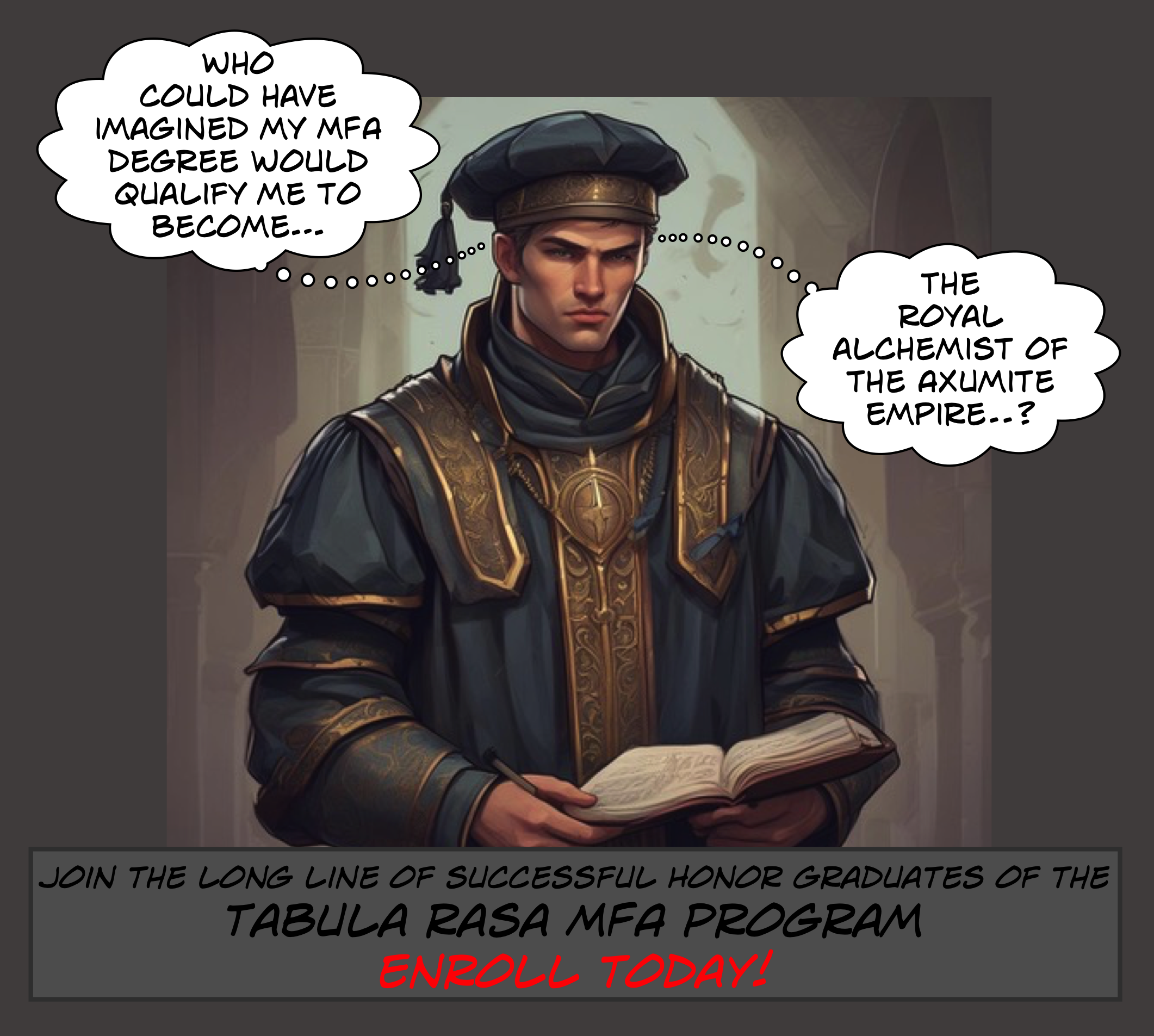
Still, journalism doesn’t have the panache of “creative writing.” This, I suspect, is one reason that Master of Fine Arts (MFA) degrees exploded on the scene several decades ago.

When I open each issue of Poets & Writers, I’m overwhelmed by the number of ads for MFA programs, all over the globe. However, the October issue features a melancholy article titled “More MFA Programs Closing.” This is “despite all the value and prestige they bring to the university . . .”

The article cites “monetary pressures on universities and waning interest in the humanities” as major problems. Obvious to any non-MFA observer, the unbridled proliferation of MFA programs themselves might be the primary cause. 

Combine with that the evidence that a younger generation is more concerned about their prospects of making a living, and one might anticipate a further winnowing of such programs. 

For a balanced discussion of the subject, I commend “The MFA Degree: A Bad Decision?” — written by a writer who earned one, and subsequently “taught undergraduate and graduate courses in creative writing.”

I don’t believe MFA programs are inherently evil and have destroyed contemporary American literature. The majority of people teaching and taking creative writing classes are all trying to do good things. Nonetheless, I’ve begun to wonder if the MFA is, in fact, a bad decision.

It’s an interesting discussion, of value especially to those contemplating an MFA path. I leave that choice to the individual — as I leave to them the decision regarding whether to write fiction or nonfiction . . . or poetry, convincing historical fiction, satire, etc.

In order to expand their pool of prospective students, some MFA programs added “creative nonfiction” to their offerings. The focus of this genre is on training participants to consciously implement literary styles and techniques in order to make their factually accurate narratives more engaging.

While there is no doubt consciously taking these tools into consideration can improve the quality of many nonfiction works, it seems a bit exaggerated to label it “creative.” I would simply describe it as “good” or “well written” nonfiction. 

For a description of how creative nonfiction can be implemented in memoirs and essays, you might enjoy an introduction to the subject from Writers.com. You may wish to follow that up with “The Five R’s of Creative Nonfiction.” (Mere Inkling applies at least four of them.)

C.S. Lewis offered an aspiring young writer some wonderful advice in 1959. “Write about what really interests you,” he suggested, “whether it is real things or imaginary things, and nothing else.” He added the parenthetical note that “if you are interested only in writing you will never be a writer, because you will have nothing to write about . . .”

Excellent advice for the young wordsmith. I would add that for the maturing scribe it is often productive (and even fun) to experiment with a variety of genres.

Who knows? Perhaps you will follow the Inkling tradition established by C.S. Lewis and J.R.R. Tolkien, being exceptional in fiction and nonfiction alike. Best of luck to those of you who embark on this journey!

CS Lewis | Mountains

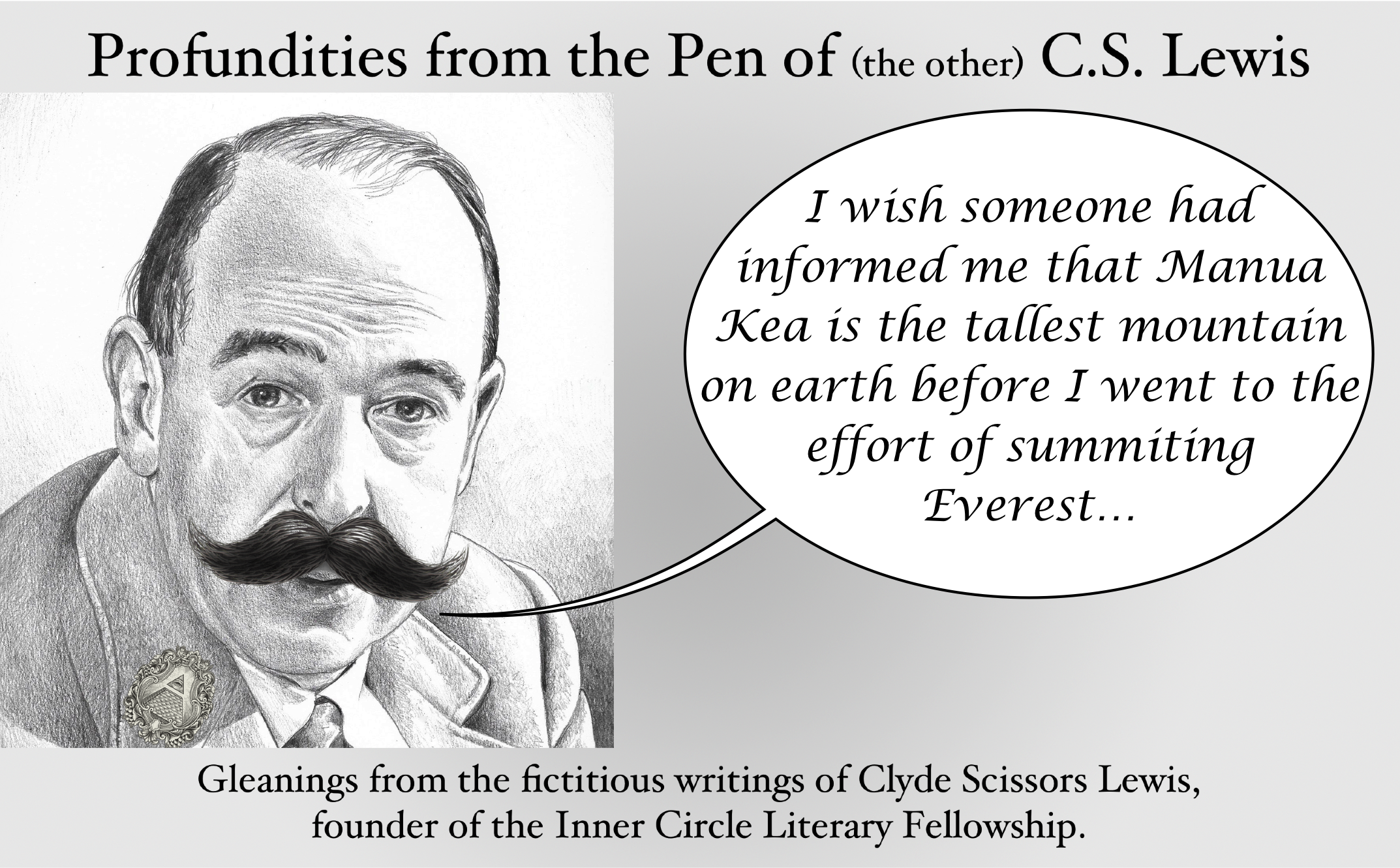
Deep Thoughts from the Quill of the Other C.S. Lewis

Welcome to another in an occasional series of fictitious quotations from a fabricated contemporary of the great Oxbridge professor, Clive Staples Lewis.

The C.S. Lewis who authored these questionable observations, Clyde Scissors Lewis, possessed a worldview enigmatically different from that of the esteemed Christian author. Despite the fact that their two lives overlapped in a variety of ways, the similarities were superficial.

A brief biography of the lesser Lewis is available at this link.

The Other C.S. Lewis: A Brief Biography

By all means, do not confuse the wisdom of the genuine article with his shadowy counterfeit. Despite any cursory similarities between the two men, this is most definitely not the C.S. Lewis readers have come to know and love.


If one measures from the center of the planet, due to the equatorial bulge, Mount Chimborazo in Ecuador is the “tallest” mountain on our planet.

Humorous Examinations

Could you pass this examination?

Sketch the development of human thought, estimate its significance. Compare with the development of any other kind of thought.

In contrast to the serious tone of the last two posts, today I am offering some edifying entertainment. As a gift to you, I have edited a perennial favorite of internet humorists. I recently came across my copy of this comprehensive knowledge examination, which motivated me to tweak it for Mere Inkling’s erudite audience.

You have probably seen versions of this exam in the past. The basic questions have remained surprisingly stable despite its age. I encountered it in the University of Washington campus paper in 1973. One writer claims “the Graduation Exam—Authentic Assessment has been in circulation since at least the 1950’s.”

The exam certainly makes the rounds, as this Navy veteran described.

The pressures of comprehensive exams were apparent to many, which resulted in one of the few officially sanctioned jokes in Naval Nuclear Power. In one of the official publications of Naval Reactors, someone inserted a sample “final exam” from Nuclear Power School.

In 2012 elements of the examination created confusion in the People’s Republic of China. It was included in an article about how Chinese nationals could prepare for an American State Department exam required for positions at the United States embassy in Beijing. According to China’s Global Times, “US embassy spokesman Richard Buangan made clear on his Sina microblog Sunday that an alleged ‘recruitment test for expatriate employees at the US embassy’ is fake.”

A June 2008 issue of Foreign Service Journal carried a story, which includes an English version of the [exam stating] the questions are from the US State Department’s entrance exam, in a bid to “measure the stability of perspective Foreign Service officers and to weed out the dummies.”

The Function of Examinations

Testing and documenting competence is obviously important. This is especially true for people in critical roles, such as prescribing drugs, designing aircraft engines, and manufacturing ice cream.

Of course, not everyone is able to pass every test. Which is precisely how things should be.

C.S. Lewis noted how educators truly familiar with their students readily recognize when it is a waste of time for them to continue repeating an exam they obviously cannot pass. He said an academic “master often knows, when boys and parents do not, that it is really useless to send a boy in for a certain examination again” (The Problem of Pain).

I have met very few people who enjoy being tested. Yet, for many faculty members (C.S. Lewis included), being on the “other side” of exams is not particularly enjoyable either. This delightful passage comes from a 1927 letter to his brother, Warnie.

My period of examining passed over with its usual accompaniment of neuralgia and oaths, relieved by the one excellent boy who defined ‘a genie’ correctly, yet more than correctly, as ‘an eastern spirit inhabiting bottles and buttons and rings.’ Pretty good for a boy.

I was also pleased with a youth who, being asked to write a letter to a friend recommending Guy Mannering,* wrote to his brother recommending it and saying ‘I think you would be interested in the character of Colonel Mannering, he is so like our father’: and then later in a paper on Guy Mannering in which I had set the question ‘Would you have liked Colonel Mannering as a father?’—illustrate your answer etc.—began decisively ‘I would not have liked Colonel Mannering as a father in the least.’

Well, it’s time now to offer you the opportunity to prove your worthiness. If you wish to evidence the breadth and depth of your knowledge, proceed now to the exam. (Astute readers will note I’ve added a personal twist to a couple of the exam questions.)

Comprehensive Knowledge Exam

HISTORY: Describe the history of the papacy from its origins to the present day, concentrating especially, but not exclusively, on its social, political, economic, religious, and philosophical impact on Europe, Asia, North and South America, and Africa. Be brief, concise, and specific. Now do the same for the Zoroastrian priesthood. [Bonus credit for including Antarctica in your response.]

MEDICINE: You have been provided with a razor blade, a piece of gauze and a bottle of scotch. Remove your appendix. Do not suture until your work has been inspected. You have fifteen minutes. [Option: if you feel the scotch would impair your responses to the remaining questions, you may defer this portion of the exam to the end of the exam.]

PUBLIC SPEAKING: Two thousand riot-crazed anarchists are storming the campus. Calm them. You may use any ancient language except Latin, Greek or Sanskrit. [Pig Latin is allowed.]

BIOLOGY: Postulate the 500 million year progression of a life form based on silicon, ranking its likely preference for form of government Enumerate the pros and cons it would associate with democracy, monarchy, socialism, theocracy, and totalitarianism. [Caution: any references to the Horta of Janus VI will result in disqualification of your answer, since Star Trek is a fictional resource.]

MUSIC: Write a piano concerto. Orchestrate and perform it with flute and digeridoo. You will find a piano under your seat. The wind instruments, of course, were among the items you were directed to bring with you to the examination.

PSYCHOLOGY: Based on your knowledge of their works, evaluate the emotional stability, degree of adjustment, and repressed frustrations of each of the following: Alexander of Aphrodisias, Hildegard of Bingen, Rābi’a bint Ka’b al-Quzdārī and Simeon the Stylite. Support your evaluation with quotations from each individual’s work, citing original sources. It is not necessary to translate.

SOCIOLOGY: Using the pretext of Planet of the Apes, where homo sapiens have been subordinated to various primate species, assess the prospects for achieving mutual toleration and equilibrium before one group is driven to extinction. [Caution: confusion of apes (which lack tails) and monkeys (which lack an appendix) will result in disqualification of your response.]

CHEMISTRY: Transform lead into gold. You will find a beaker, a three hundred count box of matches and five lead sinkers under your seat. Show all work including Feynman diagrams and quantum functions for all steps. [Transformation into silver will provide half credit.]

ENGINEERING: The disassembled parts of a high-powered rifle have been placed on your desk. You will also find an instruction manual, printed in Swahili. In 10 minutes a hungry Bengal tiger will be admitted to the room. [Special Consideration: Satisfactorily explain the differences between Fahrenheit and Celsius to the tiger, and it will be replaced by a rabid ferret.]

ECONOMICS: Develop a realistic plan for refinancing global debt, without hypothesizing a benevolent intergalactic alliance with unlimited resources coming to the planet’s aid. Trace the possible effects of your plan in the following areas: Cubism, the Donatist controversy, and the 1913 foundation of Hôpital Albert Schweitzer in Gabon.

POLITICAL SCIENCE: Devise an infallible, seven-step plan to transform the United Nations into an organization that will successfully foster peace and goodwill in all international relationships. [Bonus credit for providing a major role for two of the following nations: Dominica, Liechtenstein, Tuvalu.]

AGRICULTURAL SCIENCE: Outline the steps involved in breeding your own super high yield, all weather hybrid strain of wheat. Describe its chemical and physical properties and estimate its impact on world food supplies. Construct a model for dealing with world-wide surpluses. Draft your Nobel Prize acceptance speech.

PHYSICS: Explain the nature of matter. Include in your answer an evaluation of the impact of the development of mathematics on astronomy, botany and numismatics. [Bonus Credit: write today’s date in metric.]

PHILOSOPHY: Sketch the development of human thought, estimate its significance. Compare with the development of any other kind of thought. Be sure to include an analysis of the influence exerted on philosophy by Diogenes the Cynic.

CREATIVE WRITING: Compose an epic poem based on the events of your own life in which you see and footnote allusions from T.S. Eliot, Titus Lucretius Carus, Miguel de Cervantes, Dante Alighieri, Þorbjörn Hornklofi, Gilgamesh and Stephen King. Critique your poem with a full discussion of its syntax and metrics. [Bonus Credit for writing alternating stanzas between free and rhyming verse.]

EDUCATION: Formulate an examination which accurately measures an individual’s comprehensive knowledge base without cultural or linguistic prejudice. Limit the question parameters to what can reasonably be covered during a four hour testing block.

LITERATURE: Discuss in detail at least three major literary figures from each of the following civilizations: the Xia Dynasty, the Akkadian Empire, the Mayan Empire, the Aksumite Empire, the Polynesian Tuʻi Tonga Empire, and nineteenth century United Kingdom. [Caution: failure to include J.R.R. Tolkien and/or C.S. Lewis will result in disqualification of your answer to this question.]

Congratulations on finishing the exam. You are encouraged to use any remaining time to review your answers in light of the fact that grammatical errors and misspellings will significantly impact your final grade.


* You can download a personal copy of Guy Mannering, one of Sir Walter Scott’s Waverly novels, at Internet Archive.

If you should question the distinctions I noted between apes and monkeys, please know that the facts are genuine. However, for future examinations, you should be aware that not all monkeys have tails.

Epic Literature & C.S. Lewis

Which type of epic are you most likely to write? The two basic choices are either a natural epic, or a literary epic.

Actually, it’s a bit of a trick question, since it would be extremely challenging to draw together all of the pieces necessary to compose a natural epic. You can see just why, in this passage from one of C.S. Lewis’ early letters to his father.

I came across it while searching for references to elegies in Lewis’ writings, as I discussed in my previous post. Lewis mentions an elegy in a letter to his father. One of Lewis students referred to Thomas Gray’s “Elegy Written in a Country Churchyard,” from which I had included an excerpt. As I mentioned there, it was common for schoolchildren to be required to memorize the poem at the time.

I include a portion of Lewis’ letter, however, not because of the elegy reference, but due to the distinction he draws between the two types of epics. In addition, it is entertaining and ends on a positive note despite the disappointing performance of the student in question.

I have got quite recently one pupil [who] is a youth of eighteen who is trying to get a Classical scholarship. I am to coach him in essay writing and English for the essay paper and general papers which these exams always include. I fear we shall win no laurels by him.

I questioned him about his classical reading: our dialogue was something like this:

Self: ‘Well Sandeman, what Greek authors have you been reading?’
Sand: (cheerfully): ‘I never can remember. Try a few names and I’ll see if I can get on to any.’
Self: (a little damped:) ‘Have you read any Euripides?’
Sand: ‘No.’
Self: ‘Any Sophocles?’
Sand: ‘Oh yes.’
Self: ‘What plays of his have you read?’
Sand: (after a pause): ‘Well–the Alcestis.’
Self: (apologetically): ‘But isn’t that by Euripides?’
Sand: (with the genial surprise of a man who finds £1 where he thought there was a 10 [shilling] note): ‘Really? Is it now? By Jove, then I have read some Euripides.’

My next . I asked him if he were familiar with the distinction that critics draw between a natural and a literary epic. He was not: you may not be either, but it makes no difference.

I then explained to him that when a lot of old war songs about some mythological hero were handed down by aural tradition and gradually welded into one whole by successive minstrels (as in the case of ‘Homer’) the result was called a natural epic: but when an individual poet sat down with pen in hand to write Paradise Lost, that was a literary epic.

He listened with great attention and then observed ‘I suppose “Grey’s Elegy” is the natural kind.’ What idiots can have sent him in for a Scholarship? However, he is one of the cheeriest, healthiest, and most perfectly contented creations I have ever met with.

I have often thought how pleasant it would have been to enjoy C.S. Lewis’ company. Yet, when I read about his expectations for his students, I’m not confident I would have measured up. (If I didn’t possess so much respect for teachers, I suppose I could just blame mine.)

Currently, it appears that the two types of epics are usually referred to as folk epics and literary epics. I prefer the word “folk” to “natural” in this regard. It elicits the image of older cultures sitting around the fire telling tales (as some of the Inklings replicated in kolbitar).

And so, we arrive at a question. Not the question of which Greek authors we’ve read. Nor the question of whether we know the difference between folk and literary epics—since we have all now mastered that distinction.

The question is this: will your personal epic be of the literary variety? Or, will you lay aside all of your responsibilities and journey to some primitive environment like a sociologist conducting field research for their PhD—and compile ancient oral traditions into a monumental folk epic destined to be celebrated by one and all?

Actually, it does not have to be one or the other. Since they are not mutually exclusive, perhaps you should be one of the first people in history to ever create both.

A Final Caveat When Authoring Epics

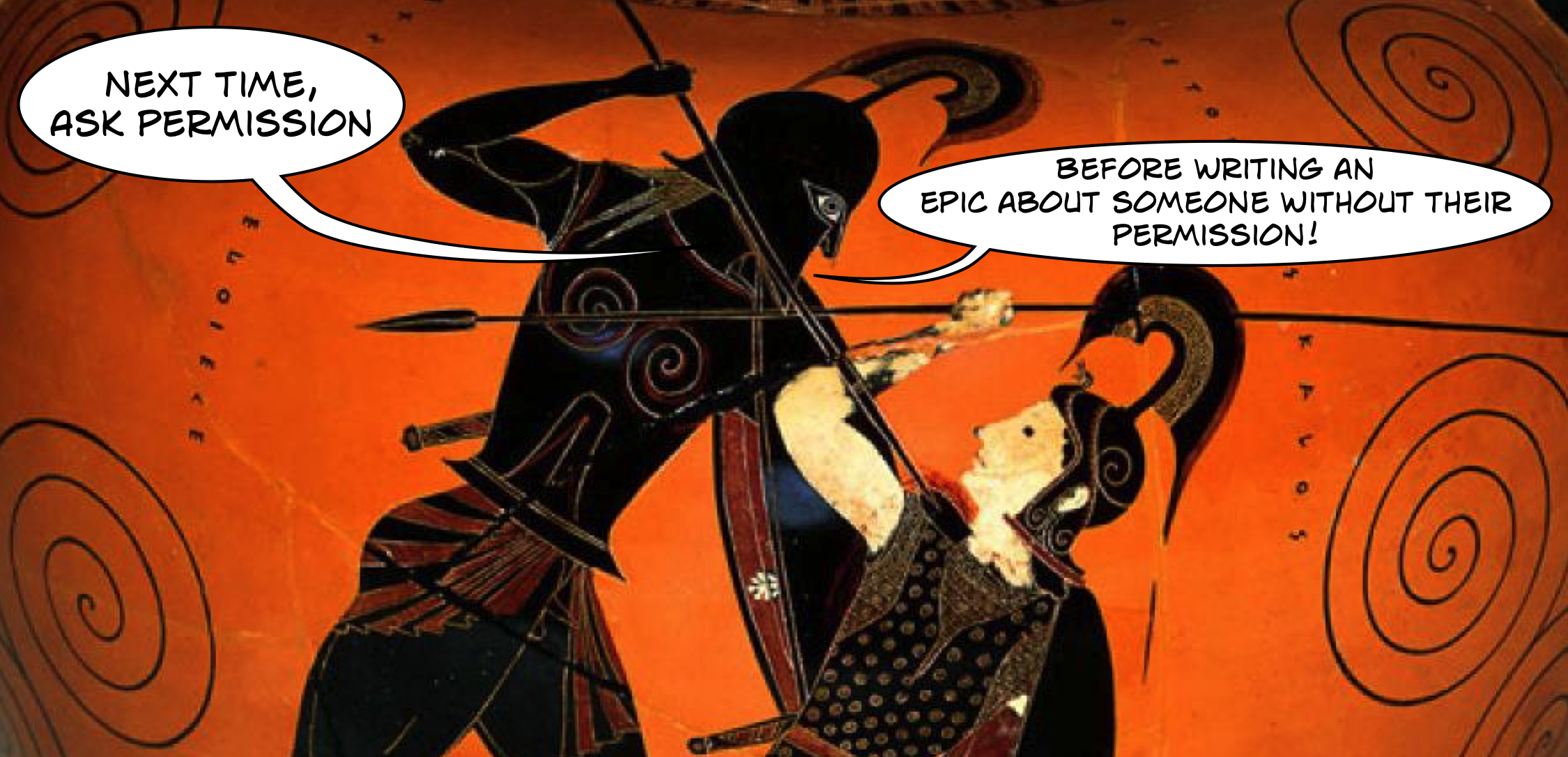
Whatever your path in pursuing your epic dreams, do not fall into the same trap as James Macpherson (1736-1796). He was the first Scottish poet to become widely famous in Europe. Unfortunately, his fame was built on the foundation of a Scottish folk epic attributed to Ossian.

Fortunately for Macpherson, he was already interred in Westminster Abbey by the time his Gaelic “originals” were published. It is widely recognized they were back translations from his English “translation” to create the supposed source material. Not the legacy one would desire.

At least C.S. Lewis evaluated Macpherson’s legacy temperately. In his essay “Addison,” he mentions the poet in passing.   

If [we suppose that] sublime genius lies all in the past, before civilization began, we naturally look for it in the past. We long to recover the work of those sublime prehistoric bards and druids who must have existed. But their work is not to be found; and the surviving medieval literature conspicuously lacks the sublimity and mysteriousness we desire.

In the end one begins inventing what the ‘bards,’ ‘druids,’ and ‘minstrels’ ought to have written. Ossian, Rowley, and Otranto are wish-fulfilments. It is always to be remembered that Macpherson had written original epics about prehistoric Scotland before he invented Ossian. By a tragic chance he and Chatterton discovered that their work was marketable, and so make-believe turned into fraud.

But there was a sincere impulse behind it: they were seeking in the past that great romantic poetry which really lay in the future, and from intense imagination of what it must be like if only they could find it they slipped into making it themselves.

Should you decide to compose a fictional folk epic, feel free to do so. It could end up being quite well received. Please though, for the sake of your future literary reputation, don’t pretend that it is anything but a work of fiction.

The Inklings of Mount Hermon

mount hermon.png

Few writers attain their full potential without the advice and encouragement of others.

C.S. Lewis and J.R.R. Tolkien recognized that fact.

For many years they gathered regularly with a number of other keen minds, almost all of whom shared their Christian faith. (Notably, Owen Barfield who was an Anthroposophist, was a notable exception.)  Some writers visited the community as guests.

I’ve written in the past about the great benefit provided by Inkling-style literary criticism. It’s all about synergy.

Mount Hermon Christian Writer’s Conference is one of the premier gatherings of its sort. After many years of hoping to attend, my wife and I journeyed to California for its Fiftieth Anniversary this past week. What a blessing!

In addition to hundreds of zealous writers, the conference was attended by twoscore publishers, agents and writing experts who generously shared their vast knowledge. And I use that word “generously” in a literal sense. The faculty made itself accessible to a degree I have never before witnessed (and I am a veteran of innumerable professional conferences). The speakers were sincerely interested in encouraging each and every participant.

Classes were available for writing novices, journeymen and experts. I found the track on screenwriting to be the most helpful for my own current needs. I hope to put these new lessons into practice in the next few years.

I can confidently assure you that Mount Hermon will also offer the sort of advice and encouragement that you need to advance your own skills to the proverbial “next level.” If you are interested in attending Mount Hermon, you can learn more here.

Back on the Home Front

If you have never enjoyed the benefits of gathering locally with other writers, I strongly encourage you to consider it now.

If you’re on a critique-group-hiatus due to past disappointments, why not look for a fresh group with a healthier focus?

I sincerely believe most of us become better writers while growing together, than we do wandering on our own. Mount Hermon reinforced that conviction.

I encourage each of you to reach your own full potential—with a little help from some new friends.

C.S. Lewis was Not a Dramatist

shakespeare-and-lewisC.S. Lewis’ prolific, genre-crossing success teaches us two things. First, that a very good writer can fruitfully write in a variety of fields. Second, that even the most gifted of authors cannot write with equal talent in all genres.

Students of C.S. Lewis are well acquainted with the fact that one of the great disappointments of his life was failing to succeed as a poet. Although he did write a reasonable amount of poetry, it failed to elicit the response for which he hoped.

Lewis did, of course, receive well-deserved kudos for his literary fiction and children’s stories. His fiction and nonfiction are extraordinary, and over the years I have appreciated the value of his many essays to be among the most precious of his works.

Finally, as a correspondent, Lewis stood in the first ranks. He regarded the responsibility of personally responding to the letters he received as something not to be shirked.

Fortunately, the excellent collections of his letters offer us many insights into Lewis’ life and career. For his Christian fans, they reveal insights into how a disciple of Jesus can gracefully navigate life.

The following letter was written in 1959, to a man who was apparently the editor of a small newspaper. He had requested an article from the exceedingly busy professor. Lewis’ response is quite interesting.

Dear Mr. Aylard,

Yes! my handwriting is awful. It used to be nice but my muscles have stiffened up and the strokes no longer come out as I intend. I give ‘this generation’ all I can in the way of books and articles. Particular articles by request are not usually the good ones: and, you know, I should reach more readers through other organs than your paper. I hope this doesn’t sound stand-offish or conceited, for it is not meant to be. It is really common sense to speak where one can be most widely heard.

I agree that drama is a good medium for our purpose. In this country Dorothy Sayers’ broadcast set of plays on the life and death of Our Lord (The Man Born to be King) did a great deal of good. I don’t attempt this form myself because any talent I may have is narrative, not dramatic. With all good wishes.

I draw several observations from reading this letter.

  • Lewis took the time to personally pen many of his letters, despite the fact that this presented an uncomfortable challenge to him.
  • Lewis preferred to address subjects as he felt moved by the Holy Spirit to do so, rather than on demand.
  • He did not have the time to dress it up in gentle fluff, but candidly expressed the fact that if he had sufficient time and energy to write, it would not be the wisest stewardship to send the piece to a publication with a limited distribution.
  • Even though he did not intend for that remark to be curt or “conceited,” Lewis still felt compelled to offer his “I hope this doesn’t sound…” apology.
  • Lewis appreciated drama, and recognized Sayers’ work as quite noteworthy.
  • He recognized that drama would not be his forte, and wisely preferred to stick with the type of writing wherein he was most accomplished.

Even this final thought is offered with C.S. Lewis’ characteristic—and genuine—humility.

I don’t attempt this form myself because any talent I may have is narrative, not dramatic.

As a writer myself, I find this sentence quite comforting. And not simply because my own extremely modest talents also lie in the narrative realm. Even if I were a poet or a dramatist I would recognize how liberating it is to acknowledge that one cannot be fairly expected to excel at more than one genre.

And “excel” is not really the best word to use here. Perhaps it’s sufficient that writers think of themselves like children of Lake Wobegon, where Garrison Keillor tells us “all the women are strong, all the men are good-looking, and all the children are above average.”

Ultimately, whether we consider ourselves to be adequate or exceptional writers, it is necessary to understand where our skills reside, and to transgress those boundaries only with the greatest trepidation.

Tolkien, Lewis & Barth on Myth

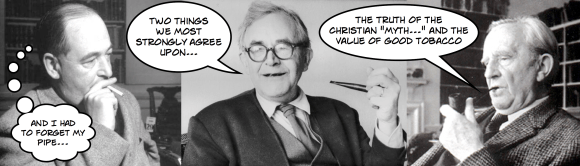
barthOne wonders what sort of fireworks might have erupted if J.R.R. Tolkien and C.S. Lewis had spent an evening with theologian Karl Barth. Although their lives overlapped, and all three were Christian academics, it is questionable how much they would have agreed upon.

And yet, there were several subjects where I think they would have enjoyed firm consensus.

Tolkien (1892-1973) was a devout Roman Catholic. Lewis (1898-1963) was a committed “low church” Anglican. Barth (1886-1968) was a Reformed theologian who rejected the liberalism that had become dominant in European academies. All three thus believed in the reality of the Christian gospel of salvation through Jesus Christ.

All three men hated war, and the two Brits had served in the trenches of WWI. All opposed Nazism and Barth was the primary author of the Barmen Declaration which challenged the Christian faith of all who supported the Nazi government.

And we’ll consider another shared attribute in just a moment.

First, though, we need to acknowledge that presumably the Inklings never met the Swiss clergyman. Their circles did not overlap. I have not been able to uncover any evidence of Tolkien referring to Barth, or of Barth mentioning either of the Inklings.

Lewis did, however mention Barth in his prolific correspondence. From his exposure to Barth it’s clear he did not share the opinion of Pope Pius XII that he was “the greatest theologian since Thomas Aquinas.” Heady praise . . . especially coming from a Roman Catholic.

In a 1940 letter to his brother Warren, Lewis reacted against what he perceived as legalism in some quarters of Protestantism that was alien to his understanding of the liberty of the Christian.

I am afraid the truth is . . . that the world, as it is now becoming and has partly become, is simply too much for people of the old square-rigged type like you and me. I don’t understand its economics, or its politics, or . . . Even its theology—for that is a most distressing discovery I have been making these last two terms as I have been getting to know more and more of the Christian element in Oxford.

Did you fondly believe—as I did—that where you got among Christians, there, at least, you would escape (as behind a wall from a keen wind) from the horrible ferocity and grimness of modern thought.

Not a bit of it. I blundered into it all, imagining that I was the upholder of the old, stern doctrines against modern quasi-Christian slush: only to find that my ‘sternness’ was their ‘slush.’ They’ve all been reading a dreadful man called Karl Barth, who seems the right opposite number to Karl Marx. ‘Under judgment’ is their great expression.

They all talk like Covenanters or Old Testament prophets. They don’t think human reason or human conscience of any value at all: they maintain, as stoutly as Calvin, that there’s no reason why God’s dealings should appear just (let alone, merciful) to us: and they maintain the doctrine that all our righteousness is filthy rags with a fierceness and sincerity which is like a blow in the face.

Sometimes the results are refreshing: as when Canon Raven (whom you and Dyson and I sat under at Ely) is sharply told in a review in Theology that ‘it is high time persons of this sort learned that the enjoyment of a chair of theology at Cambridge does not carry with it a right to criticise the Word of God’—that’s the kind of rap on the knuckles which has not been delivered for a hundred years!

Comparing Their Thoughts on the Nature of Myth

Many readers of Mere Inkling will know Tolkien and Lewis were deeply influenced by the significance of myth. They were also, in the creation of Middle Earth and Narnia, active in the act of mythopoeia, creating imaginary lands whose stories convey profound meaning.

But, despite the fact their literary products are fictional, that does not mean that all myth is “untrue,” in the sense of being unhistorical. Myth, for these great thinkers, is something far more complex and wonderful.

Without going into depth on this involved subject, I offer here the familiar story of how Lewis’ epiphany about true myth was key to his conversion.

I was by now too experienced in literary criticism to regard the Gospels as myths. They had not the mythical taste. And yet the very matter which they set down in their artless, historical fashion . . . was precisely the matter of the great myths. If ever a myth had become fact, had been incarnated, it would be just like this. And nothing else in all literature was just like this.

Myths were like it in one way. Histories were like it in another. But nothing was simply like it.

And no person was like the Person it depicted; as real, as recognizable, through all that depth of time, as Plato’s Socrates . . . yet also numinous, lit by a light from beyond the world, a god.

But if a god—we are no longer polytheists—then not a god, but God. Here and here only in all time the myth must have become fact; the Word, flesh; God, Man. This is not “a religion,” nor “a philosophy.” It is the summing up and actuality of them all. (Surprised by Joy)

This epiphany took place in 1931, during an all-night discussion (it lasted until 4:00 am) with Tolkien, and other Inkling, Hugo Dyson. Here’s how Lewis related the moment to his lifelong friend, Arthur Greeves.

It was really a memorable talk. We began (in Addison’s walk just after dinner) on metaphor and myth–interrupted by a rush of wind which came so suddenly on the still, warm evening and sent so many leaves pattering down that we thought it was raining.

We all held our breath, the other two appreciating the ecstasy of such a thing almost as you would. We continued (in my room) on Christianity: a good long satisfying talk in which I learned a lot . . .

A month later he elaborated on how the insights gained that evening were gestating in his mind and heart.

Now what Dyson and Tolkien showed me was this: that if I met the idea of sacrifice in a Pagan story I didn’t mind it at all: again, that if I met the idea of a god sacrificing himself to himself (cf. the quotation opposite the title page of Dymer) I liked it very much and was mysteriously moved by it: again, that the idea of the dying and reviving god (Balder, Adonis, Bacchus) similarly moved me provided I met it anywhere except in the Gospels.

The reason was that in Pagan stories I was prepared to feel the myth as profound and suggestive of meanings beyond my grasp even tho’ I could not say in cold prose ‘what it meant.’

Now the story of Christ is simply a true myth: a myth working on us in the same way as the others, but with this tremendous difference that it really happened: and one must be content to accept it in the same way, remembering that it is God’s myth where the others are men’s myths: i.e. the Pagan stories are God expressing Himself through the minds of poets, using such images as He found there, while Christianity is God expressing Himself through what we call ‘real things.’

Therefore it is true, not in the sense of being a ‘description’ of God (that no finite mind could take in) but in the sense of being the way in which God chooses to (or can) appear to our faculties. The ‘doctrines’ we get out of the true myth are of course less true: they are translations into our concepts and ideas of that which God has already expressed in a language more adequate, namely the actual incarnation, crucifixion, and resurrection.

Does this amount to a belief in Christianity? At any rate I am now certain (a) That this Christian story is to be approached, in a sense, as I approach the other myths. (b) That it is the most important and full of meaning. I am also nearly certain that it really happened.

In a different setting, Barth argued for the very same truth. His context was a theological environment greatly influenced by the liberal doctrines of Rudolf Bultmann, who dismissively regarded anything miraculous in the Scriptures as primitive and ignorant thinking.

The Christian Church confesses that [what the world calls] “myth” is history itself. She recognizes herself by this myth, she recognizes her life, her true reality. She is the witness of witnesses, she recognizes through the Holy Spirit that this is the one really interesting story.

Then she turns back the historians’ weapon: She says to them: What you call “myth,” that is history! She will also add: What you call history, that is a myth! A myth, a made-up history, that fancies the fate of man as depending on his earthly vicissitudes, a myth, a made-up history, that confuses the immediate success of a cause with its truth, and so on.

The only true history is the history of Christ, in which the Church participates, and which is already the secret reality of all history, since it is history itself. (The Faith of the Church)

Now, there’s an argument the Inklings could truly have appreciated.

A Bonus, for Fans of Dietrich Bonhoeffer

Barth was not the only Christian seminary professor who rejected the heresies of Bultmann, who sought to “demythologize” the Scriptures. Dietrich Bonhoeffer, a fellow German, repudiated Bultmann’s rejection of the supernatural in God’s Word. In a recent book, Taking Hold of the Real, Barry Harvey writes:

In a prison letter [Bonhoeffer] criticizes Rudolf Bultmann for excising the “mythological” elements in an attempt to reduce Christianity to its “essence.” “My view,” he writes, “is that the full content, including the ‘mythological’ concepts, must remain—the New Testament is not a mythological dressing up of a universal truth, but this mythology (resurrection and so forth) is the thing itself.”

Bonhoeffer thus acknowledges that describing a way of seeing the world as mythic thus does not summarily dismiss it either as deceptive or as an archaic and feeble attempt at doing “science.” Indeed, a truthful description of the world and especially of human existence ultimately requires mythic form.

The tales that women and men have fashioned and passed down through the centuries to discern the overall sense and significance of their existence are “never just ‘lies,’” says Tolkien, as “there is always something of the truth in them.”

Literary Martial Arts

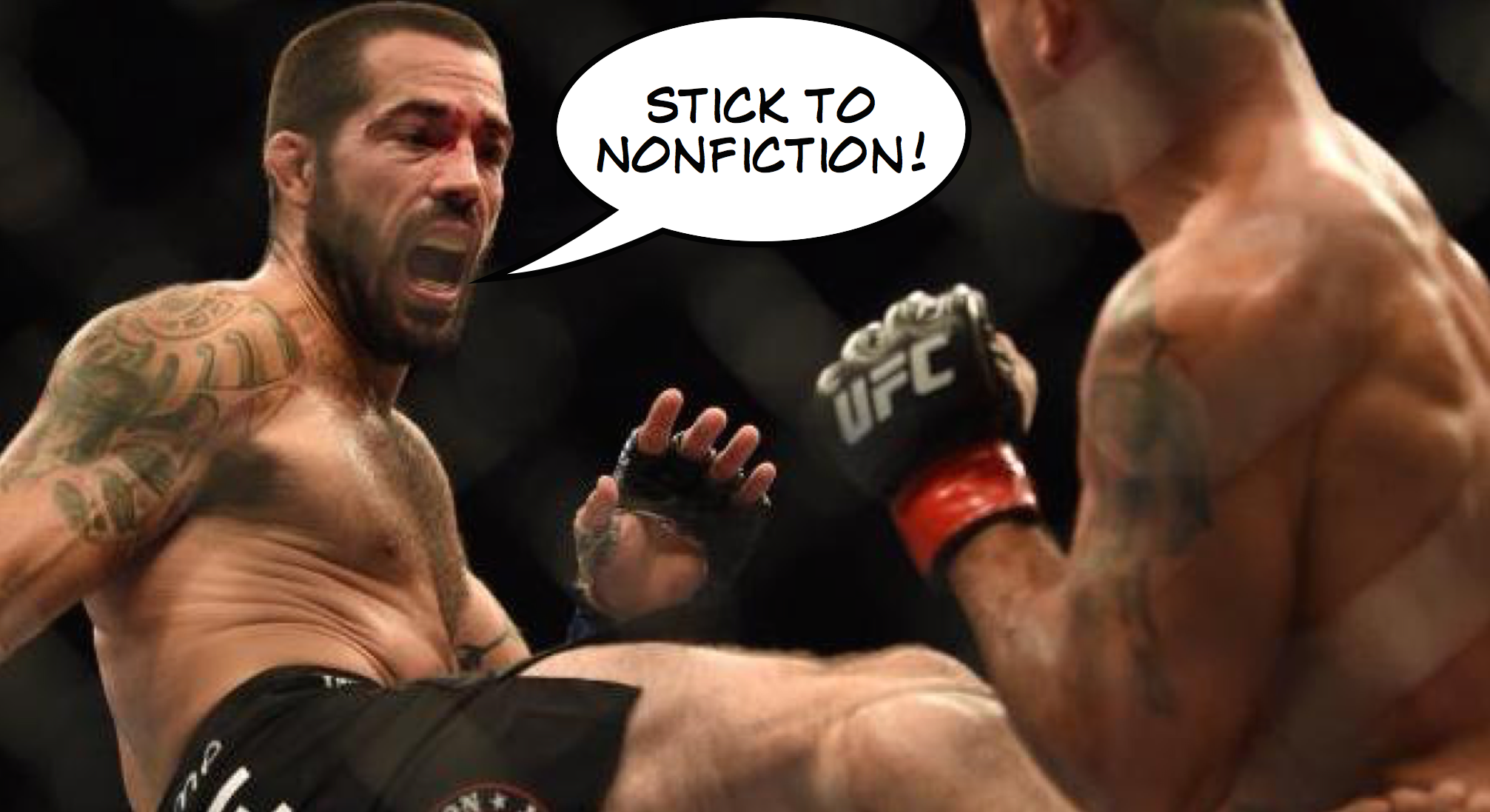
nonficOne of the lowest moments in my writing life occurred when a creative writing professor advised me to “stick with nonfiction.” Oh, she said it gently, but it still struck me with the power of a mixed martial arts (MMA) hammerfist.

I was majoring in editorial journalism at the University of Washington. Attempting to expand my scope, I took a short story writing course. It was a mistake.

I thought I had done adequately during the course. I was even moderately pleased with a couple of my stories. The instructor, on the other hand, well let’s just say she was not impressed with my effort.

She was right. At the time, my ear for good fiction was quite immature. I do not claim that it’s particularly well developed today, but I have written a story about a medieval pilgrimage that I hope to unveil in a year or two.

I was reminded of my literature professor’s grim assessment as I recently read an interview with a pastor, who is also a lawyer, and happens to be a writer as well. His name is Randy Singer.

Singer describes the similarity of his professions by saying “They all require skills in persuasion, in telling stories to illustrate things.” I guess he’s right.

The difference being that pastors tell true stories, authors of fiction write imaginary stories, and attorneys weave tales that lie somewhere in between.

The part of the interview, which appeared in World Magazine, that I found particularly insightful was this:

When your only desire is to tell the story so people don’t even notice the wording, at that point you’ve become a fiction author.

Singer’s description struck me with the force of an MMA ridge hand (a reverse knife-hand). When I came to, I finally knew why composing fiction does not come naturally to me.

I love words too much. Too much to sacrifice them simply for the sake of the story. Oh, I value the message also, but getting there is half the fun.

Although I don’t love words to the degree many poets lust after them, I still possess an affection that does not allow me to view them through purely utilitarian lenses.

To add insult to his literary injury, Singer adds the following, in response to the question of what he learned while writing several successful novels.

Third, to be less verbose and let the action carry the story instead of thinking, “What are some really flowery and cool phrases and words that I can weave into this?”

That’s enough, friend. You made your point. I would have responded a bit more colorfully and fragrantly, but I hear you.

Singer doesn’t cite C.S. Lewis in the interview, but his counsel is consistent with that of the Oxford don. Lewis advised using clear and concrete language, “so as to make quite clear what you mean and make sure your sentence couldn’t mean anything else.” (Personal Correspondence, 1956).

Similarly, Lewis would always argue for the words not to draw attention to themselves. Essentially, they need to get out of the way so the message can come through. “Don’t use adjectives which merely tell us how you want us to feel about the things you are describing. I mean, instead of telling us a thing was “terrible,” describe it so that we’ll be terrified.”

It’s wisdom like that which causes us to recognize C.S. Lewis as the brilliant, gifted, creative, versatile and anointed writer that he was.

As for Singer, perhaps I’ll have to check out one of his legal thrillers. The latest is set in antiquity, with a Roman jurist defending Paul before Nero. Should be quite interesting. Not so good as a nonfiction account of such a trial would be . . . but probably worth reading.

Avoiding Gadzookeries

gadzookeryWriting quality historical fiction is challenging. This is especially true if one wishes to avoid the common crutch that a talented writer of the last century first labeled “gadzookery.”

And just what is this faux pas we should avoid when writing about the past? Well, it relates most directly to the dialog placed on the lips of historical figures. The offensive technique involves the overuse of archaic expressions or phrases. (Some would argue it includes any use of any archaisms.)

If the word gadzookery sounds a tad, how shall I put it, “goofy” to you, you may prefer using another word that means the same thing: “tushery.” Tushery was coined by Robert Louis Stevenson. Way back in the nineteenth century.

Gadzookery is a newer version, insulting the same lazy writing technique. I believe it may have been coined by Rosemary Sutcliff (1920-1992). Sutcliff’s historical influence has exerted a literary influence on my life second only to C.S. Lewis.*

The article about Sutcliff in The Oxford Encyclopedia of Children’s Literature praises her work, saying, “She carefully creates dialogue in her novels that recollects the speech of a bygone era without falling into what she termed ‘gadzookery.’”

Having tested the waters of historical fiction myself, I know this to be far more difficult that it may sound.

Sutcliff had several things in common with C.S. Lewis. Both wrote for adults and for children. (It was her young adult series about the decline of Roman influence in Britain that sparked my own lifelong interest in Rome.)

Both authors also received the Carnegie Medal for their work. When Lewis was awarded his, he received a congratulatory letter from Pauline Baynes, who had illustrated several of his books. He responded quite graciously.

Dear Miss Baynes, Very nice to hear from you again, and thanks for sending on the book, which I have returned to Lane. Thanks for your congratulations on the Carnegie, but is it not rather ‘our’ Medal? I’m sure the illustrations were taken into consideration as well as the text. I am well, and as happy as a man can be whose wife is desperately ill.

Although C.S. Lewis had married, quite late in life, the two authors were alike in spending most of their life single. Sutcliff, in fact, lived with her parents during most of her life, having suffered crippling arthritis as a child. She did not resent remaining unmarried. In a 1992 interview she said,

Beatrix Potter wrote all her gorgeous stories when she was very lonely and not very happy—after she married, she never wrote another thing. Nothing worth reading, anyway.

Another similarity between the two was that they both fell under the powerful sway of myth during their childhoods. They used their familiarity with its rich echoes to imbue their own work with themes that flowed far beyond the familiar channels travelled by other writers.

Each of them took their readers seriously, and refused to speak down to them. That is why they share one more quality I wish to mention in closing—their high standards. Neither Lewis nor Sutcliff could tolerate poor writing. And their finely tuned skills meant neither ever needed to resort to gadzookery.

______

* Excepting, of course, the Bible itself, which is literature of an entirely different sort. I don’t consider it fair to compare mortal writers, no matter how inspired, to a volume I regard as God’s written word.