Tesla & the Inklings

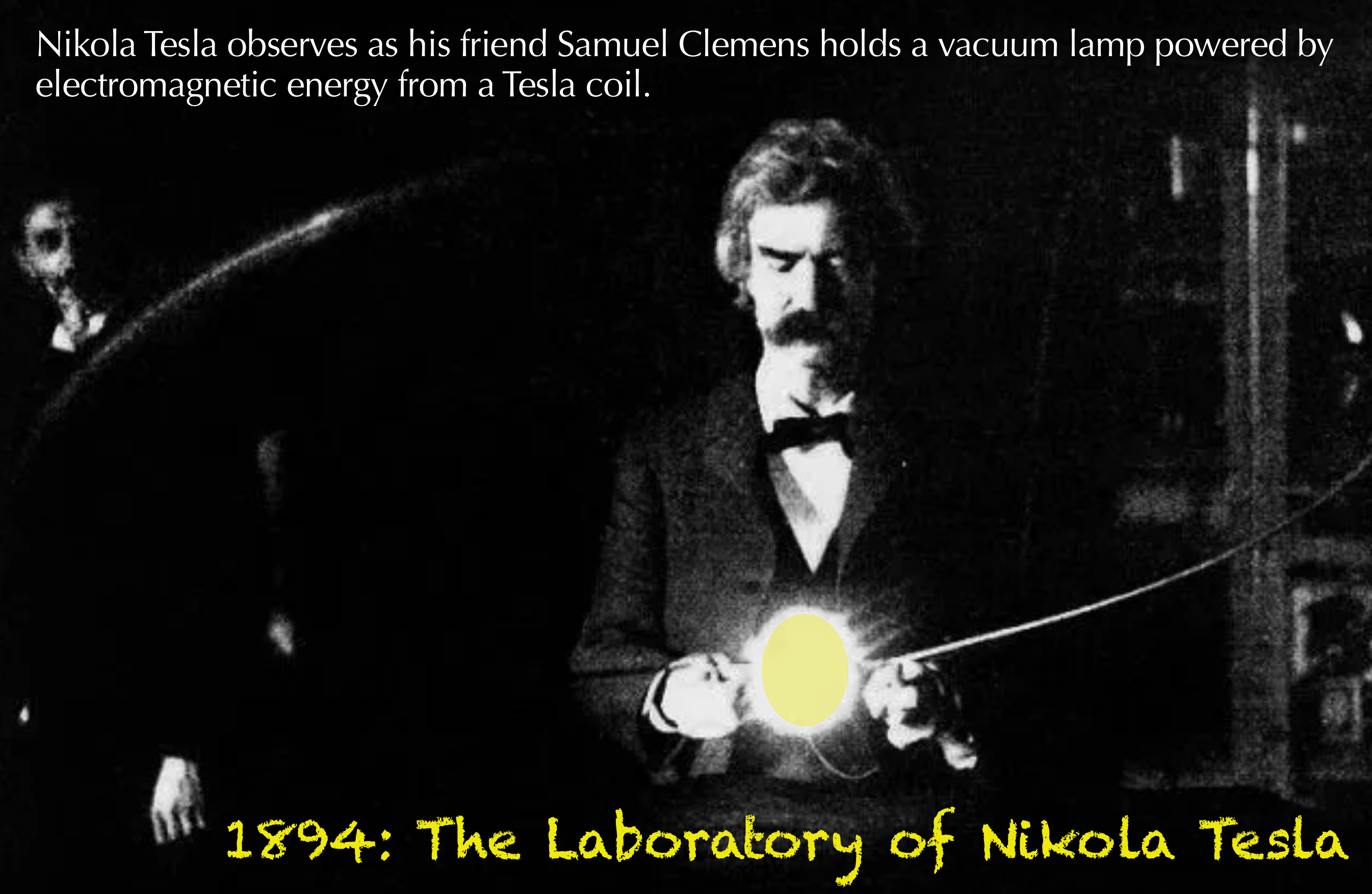
I recently uncovered a curious connection between C.S. Lewis and Tesla. (Not the current target of anarchist vandalism, the scientist.) While researching scientists living in the early twentieth century, a photograph of Tesla and his friend Mark Twain ignited my curiosity as to whether or not there might have been any connection between Lewis and Tesla.

C.S. Lewis (1898 – 1963) and Nikola Tesla (1856 – 1943) never met or corresponded. And yet, they do possess a rather tenuous, speculative connection.

Their connection isn’t based on any similarities. Tesla was a radically innovative scientist. Lewis was a grounded literary master who was wisely suspicious of misplaced faith in scientism. 

Despite the fact Tesla’s father and uncle were both Serbian Orthodox priests, and he maintained an interest in various religious traditions throughout his life, his adult beliefs were eclectic.

Lewis, the grandson of a Church of Ireland priest, went through a period of atheism before returning to Christianity as a devout member of the Anglican communion.

So, how might the two men have been connected? Before exploring the notion that they shared a mysterious source of inspiration, consider the application of a modern theory.

Six Degrees of Separation

Various experiments have supported the idea that people (in Western nations, at least) find it “truly possible to trace a social connection between any two random people within just six steps” (This is far more refined than the overlapping of lifespans as discussed here.)

But the pressing question remained: Why six? The answer has finally been revealed in a paper published in the journal Physical Review X. The study authors include researchers from Israel, Spain, Italy, Russia, Slovenia, and Chile. 

For an academic study of the phenomenon check out “Why Are There Six Degrees of Separation in a Social Network?

Even without the existence of social media, which some have argued may reduce “6 Degrees of Separation [to] 2,” I uncovered a pair of paths connecting Tesla and Lewis.

The first example is the more “direct,” but the second includes as an intermediate link, a writer of great importance to C.S. Lewis.

Nikola Tesla (1856 – 1943)
Had as a friend who visited his laboratory, and later invited the inventor to attend his daughter’s wedding

Mark Twain (1835 – 1910)
Who, after offering a scathing indictment of British colonialism, officially introduced to deliver a 1900 speech in New York…

Winston Churchill (1874 – 1965)
Who offered “the honour of becoming a Commander of the Most Excellent Order of the British Empire (CBE)” to…

C.S. Lewis (1898 – 1963)
one of the most renowned scholars to ever teach at Oxford and Cambridge.

And an alternate path:

Nikola Tesla (1856 – 1943)
Had as a friend who visited his laboratory, and later invited the inventor to attend his daughter’s wedding…

Mark Twain (1835 – 1910)
Who maintained a longtime literary and personal friendship with…

George MacDonald (1824 – 1905)
Who received as a gift A Speech and Two Poems with a personal letter from Irish poet…

William Butler Yeats (1865 – 1939)
Who, on more than one occasion, entertained in his home

C.S. Lewis (1898 – 1963)
who, coincidentally, regarded the very same George MacDonald as one of his greatest mentors.

Tracking down these relationship paths was not that difficult. It was actually fun. If I wasn’t so busy, I would create a few more examples.

Was there Another Connection?

Nikola Tesla (Никола Тесла) was a Serbian-American inventor and futurist. His design of the alternating current (AC) electricity system was a breakthrough. As noted above, he was not a credal Christian. In “A Machine to End War,” he described his beliefs in the following manner.

To me, the universe is simply a great machine which never came into being and never will end. The human being is no exception . . . Man, like the universe, is a machine. . . . what we call “soul “ or “spirit,” is nothing more than the sum of the functionings of the body. When this functioning ceases, the “soul” or the “spirit” ceases likewise.

The possible connection between Tesla and the Inklings, postulated by a sensationalist Anglican priest, is offered in Secrets of Rennes Le Chateau. The author, R. Lionel Fanthorpe, an Anglican priest who believes “there are as many roads to the loving God of all mankind as there are individual human beings,” has written about many offbeat subjects. 

In the aforementioned work, he references passages from J.R.R. Tolkien, C.S. Lewis, Charles Williams and George MacDonald as writers whose fiction may “contain hints about the Rennes-le-Château enigma.” He immediately follows this discussion with the case of “another contemporary of theirs [who] was one of the strangest and most brilliant men” of his age, Nikola Tesla.

He ends the chapter with the question, “what if the enigma with which all our Men of Mystery seem to have been involved was some form of superior communication? But communication with what? Or with whom?”

I doubt there is any connection in the source of the inspiration experienced by the Inklings, Tesla and the church at Rennes-le-Château. That said, it is an odd place of worship, due to the renovations made by its eccentric Roman Catholic priest, François-Bérenger Saunière (1852 – 1917).

Among the alterations made was the addition of a holy water font resting on the back of a devil or demon. That certainly qualifies as a “mysterious” decision. A mystery with which the Inklings bear no connection. 

Ultimately, Fanthorpe’s odd musings are illusory. Better to dismiss them and focus on the actual connection between C.S. Lewis and Nikola Tesla – one documented through the Six Degrees of Separation model.

C.S. Lewis, the Brothers Grimm & Snow White

You may blame the recent cinematic debacle that is Snow White on a declining Film Studio or the Brothers Grimm, but C.S. Lewis is innocent.

That’s not to say the Grimms didn’t have an influence on the great Oxbridge professor, a subject we’ll explore momentarily. But it was the German folk tales published by academics Jacob and Wilhelm Grimm who published the classic fairy tales that Walt Disney mined so effectively. 

They also popularized CinderellaHansel and GretelLittle Red Riding HoodThe Princess and the Frog, and Rapunzel. Disney began the transformation of these tales into visual treasures as early as 1921 when he founded Laugh-O-Gram Studio in Kansas City, Missouri.

In addition to films, over the years Walt gleaned memorable Grimm stories for a multitude of cartoon shorts, including The Brave Little Tailor and The Four Musicians of Bremen.

Obviously, Walt Disney himself respected the source material for the stories and wielded his editorial prerogative in an appropriate manner. Tragically, the same cannot be said for his corporate heirs. Likewise, the Brothers Grimm bear no culpability in this area.

C.S. Lewis, J.R.R. Tolkien & Snow White

The truth is, although Lewis and Tolkien appreciated literary fairy tales, neither of the preeminent Inklings were enamored with Disney’s animated treatment of the stories. Curiously, the two distinguished dons actually attended the theater together to view the trailblazing novelty that was Snow White.

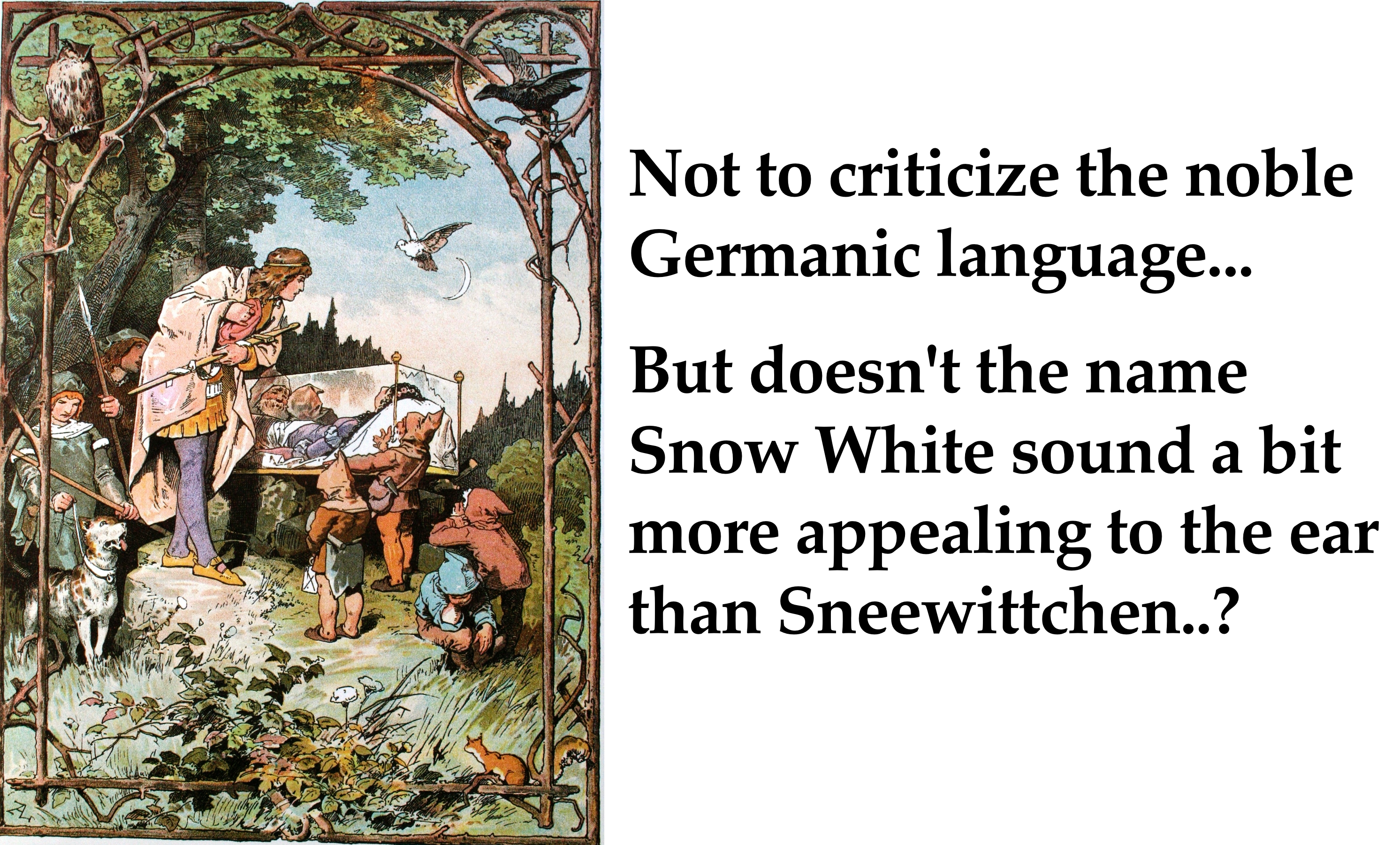
They were particularly disappointed with the dwarves, seeing just how different they were from the genuine legends about them. Lewis even wrote “Dwarfs ought to be ugly of course, but not in that way.” Atlas Obscura has an entertaining article about their “movie date” and notes some of the elements they also enjoyed in the feature.

In his lectures published as A preface to Paradise lost, C.S. Lewis elaborates on his response to the Disney version of the tale.

That strange blend of genius and vulgarity, the film of Snow-White, will illustrate the point. There was good unorginality in the drawing of the Queen. She was the very archetype of all beautiful, cruel queens: the thing one expected to see, save that it was truer to type than one dared to hope for.

There was bad originality in the bloated, drunken, low-comedy faces of the dwarfs. Neither the earthiness, the avarice, nor the wisdom of true dwarfs was there, but an imbecility of arbitrary invention.

But in the scene where Snow-White wakes in the woods both the right originality and the right unoriginality were used together. The good unoriginality lay in the use of small, delicate animals as comforters, in the true Märchen [fairy tale] style. The good originality lay in letting us at first mistake their eyes for the eyes of monsters.

If you want to read more about the subject, you can do no better than read Joe Christopher’s article on the subject.

For an interesting argument that fellow Brit G.K. Chesterton would have loved Snow White for the very reason that moved the Inklings to criticize it, see “Tolkien and Lewis disliked Snow White. You know who wouldn’t have?

C.S. Lewis & Grimm’s Fairy Tales

Like his friend, J.R.R. Tolkien, C.S. Lewis was a champion of classical fairy tales. Neither was apologetic for it, although Lewis admitted to being shy about it when he was young. In an essay titled “On Three Ways of Writing For Children,” he wrote,

When I was ten, I read fairy tales in secret and would have been ashamed if I had been found doing so. Now that I am fifty I read them openly. When I became a man I put away childish things, including the fear of childishness and the desire to be very grown up.

In a great post called “Old Enough For Fairy Tales: C.S. Lewis’ “The Chronicles of Narnia” the writer describes this distinction to which Lewis alludes.

The Chronicles of Narnia are not children’s stories. They are fairy tales—but that is precisely why they are not children’s stories. If you can’t understand, you haven’t been listening. Go back and read the quote from Lewis’ essay again. Children are not the only audience for fairy tales.

In 1954, C.S. Lewis apologized to a German professor for being unable to understand the nuances of his volume on philosophy. In doing so, he referred to his youthful reading of the Brothers Grimm in their original German (available at Internet Archive).

I look forward to reading the book (when the translation arrives! My German is wretched, and what there is of it belongs chiefly to the libretto of the Ring and Grimm’s Märchen – works whose style and vocabulary you very possibly do not closely follow).

If you are in the mood for reading Grimm’s Fairy tales today, and your German is sadly lacking, Project Gutenberg has just the translation for you . . . as long as you can read English.


Addendum [added 10 April 2025]

The Brothers Grimm were far more than simply folklorists. They were respected professors at the University of Göttingen. They were devout Christians and worked with other prominent Germans. 

Goethe assisted them at a crucial moment in collecting their tales, and the philosopher Friedrich Schleiermacher provided copyediting assistance. Jacob’s work on German mythology had a pronounced influence on the composer Richard Wagner (World Magazine).

They also began compiling the Deutsches Wörterbuch (Germany dictionary) in 1838, with the first volumes published in 1854. It was the first dictionary to include historical usages of each word, preceding the Oxford English Dictionary, which was initiated in 1857 with its first edition published in 1884.


Bonus Trivia: The dwarves were unnamed until their debut on Broadway in 1912. And on that day they were christened Blick, Flick, Glick, Plick, Snick, Whick and Quee.

Pilfering Tolkien Linguistics

When a great author, say of the magnitude of J.R.R. Tolkien, creates ingenious new words, and even entire languages, there are several common reactions. Most readers simply respond with silent awe. Others are inspired to emulate their efforts. A small number reuse those very words as a sincere homage

And a handful of “admirers” go so far as to “appropriate” the words themselves, for their personal benefit.

C.S. Lewis, no mean linguist himself, recognized his friend Tolkien’s brilliance. In his preface to That Hideous Strength he praised Tolkien’s yet-to-be-published Silmarillion. In a 1951 letter he mentions misspelling the word Numenor.

My Numinor was a mispelling: it ought to be Numenor. The private mythology to which it belongs grew out of the private language which Tolkien had invented: a real language with roots and sound-laws such as only a great philologist could invent.

He says he found that it was impossible to invent a language without at the same time inventing a mythology.

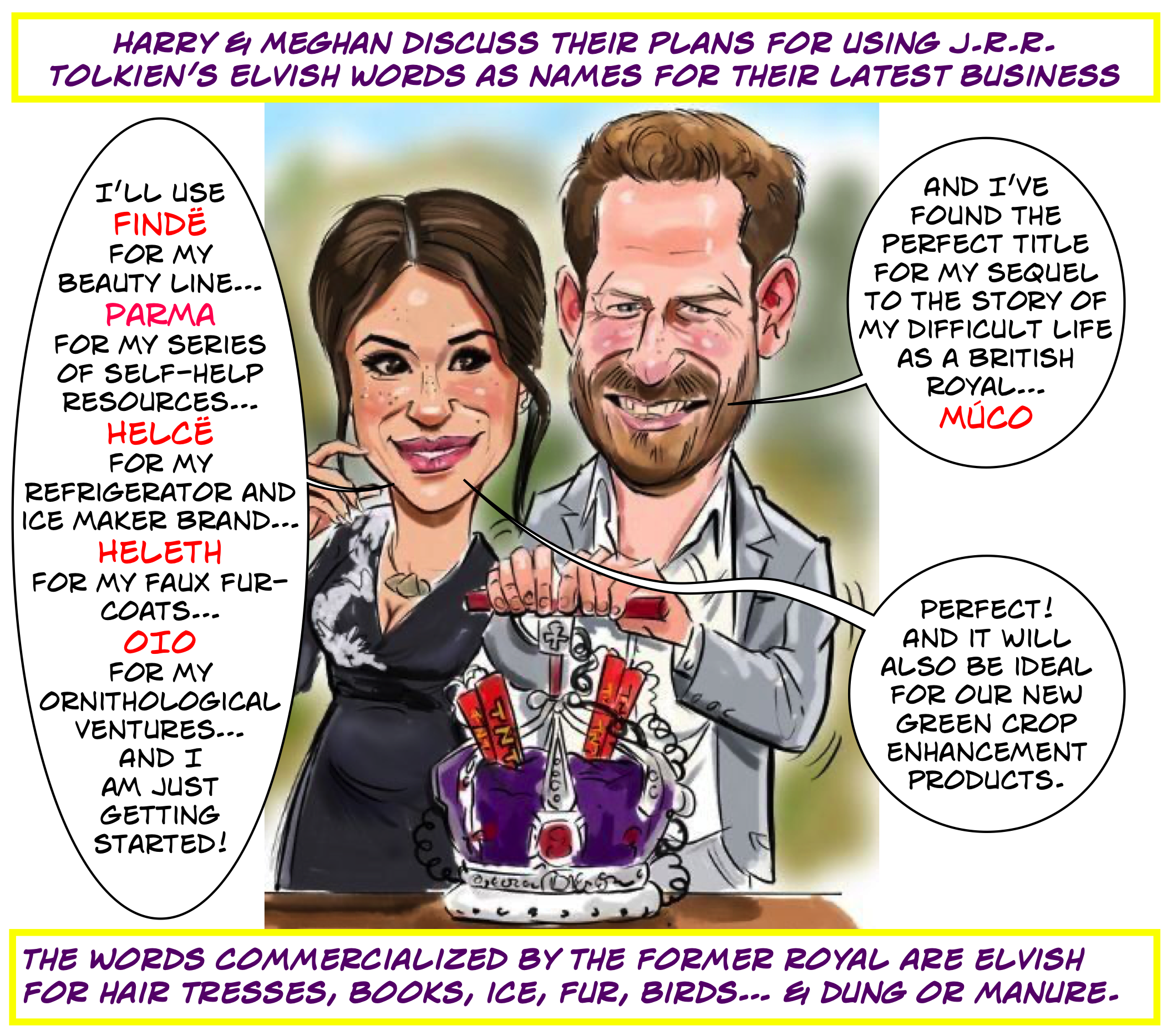
J.R.R. Tolkien was an internationally renowned philologist, and his impressive skill is one of the great wonders we encounter in Middle Earth. A number of words from his created languages – particularly his ethereal Elvish tongues – have been lifted to be used in commercial activities unconnected to Tolkien’s interests.

For example, Palantir. This was the word for the “seeing stone,” which played a prominent role in The Two Towers. In light of Tolkien’s love of nature, and corresponding suspicion of technological advancement, it is especially odd that the company adopting this label is on the leading edge of Artificial Intelligence.

Perhaps Tolkien’s dread would have been dispelled by one of Palantir’s disarming mottos: “We believe in augmenting human intelligence, not replacing it.”

A combat veteran of WWI, like his fellow Inkling C.S. Lewis, Tolkien was appalled by war’s horrors. Even in the War of the Rings, with its moments of glorious heroism and sacrifice, the bloody heart of Mars remains nearly invincible. Because of this mixed attitude toward war, some have wondered how he would have felt about a defense (i.e. military) corporation adopting one of his creations.

Andúril was the name of the most important weapon forged in Middle Earth. It was actually reforged from the broken fragments of Narsil, the longsword which defeated Sauron by severing the One Ring from his hand.

While this description from the Anduril company resonates with our modern ear, I am not convinced that it sounds very Tolkienesque. Anduril: “Transforming defense capabilities with advanced technology. The battlefield has changed. How we deter & defend needs to change too.”

For an article about a billionaire investor who is consumed by mining Tolkien’s tomes for the businesses he founds (PayPal excepted), check out “The hidden logic of Peter Thiel’s ‘Lord of the Rings’-inspired company names.”

C.S. Lewis’ Unconscious Sharing

In a 1965 letter, written after Lewis’ death, Tolkien commented on how his friend had used subtle variations of several Elvish words in several of his fictional works.

Tolkien says Lewis “had the peculiarity that he liked to be read to. All that he knew of my ‘matter’ was what his capacious but not infallible memory retained from my reading to him as sole audience.” Thus, he surmises that:

C.S. Lewis was one of the only three persons who have so far read all or a considerable part of my ‘mythology’ of the First and Second Ages, which had already been in the main lines constructed before we met. . . . His spelling numinor is a hearing error, aided, no doubt, by his association of the name with Latin nūmennūmina, and the adjective ‘numinous.’

Lewis was, I think, impressed by ‘the Silmarillion and all that,’ and certainly retained some vague memories of it and of its names in mind. For instance, since he had heard it, before he composed or thought of Out of the Silent Planet, I imagine that Eldil is an echo of the Eldar; in Perelandra ‘Tor and Tinidril’ are certainly an echo, since Tuor and Idril, parents of Eärendil, are major characters in ‘The Fall of Gondolin,’ the earliest written of the legends of the First Age. But his own mythology (incipient and never fully realized) was quite different.

An Entertaining Diversion

Years ago I linked to an entertaining game that plays on the linguistic eloquence and mystery Tolkien exhibited in naming his characters. I was delighted to see now that it is still available online.

Antidepressants or Tolkien challenges players – you can play solo, but it’s more fun with others – to guess if a given word is an antidepressant drug or the name of one of Tolkien’s characters. Don’t expect to score 100%, but do expect to smile at some of the examples.

Tinker Bell, the Inklings, and Disney

Poor Tinker Bell. The political prejudices of our day have caught up with the sparkling fairy, and relegated her to a significantly reduced presence in the Disney universe.

Inside the Magic reported “Tinker Bell seems to have left Walt Disney World and is now on her way back to Neverland following a recent change at Walt Disney World Resort.” You can read the tragic tale on their site.

. . . once more, Disney’s animated classic, Peter Pan (1953), is under scrutiny, with Disney issuing a statement regarding Captain Hook and Tinker Bell as characters with potential concerns.

Linking poor Tink to a murderous pirate seems a bit of a stretch, and she has not been fully banished, but she has definitely been demoted. According to TMZ, Disney alleges the company’s “own people felt she wasn’t a good role model for girls in the 21st century.”

Well, eventually she too will be in the public domain, like Mickey Mouse. Actually, her literary portrait as introduced in the play, coincidentally just entered the public domain this year (2024)!

However, should you reside in the United Kingdom, beware that in 1988, the copyright holder, Great Ormond Street Hospital, was granted the rights to Peter Pan “in perpetuity.”

The Creator of Tinker Bell & Peter Pan

Tinker Bell is one of the most memorable characters in Neverland, the creation of James Matthew Barrie (1860-1937). He was a prolific Scottish writer and is best known for his 1911 novel, Peter and Wendy – which initially debuted in the form of a stage play in 1904, as Peter Pan; or, the Boy Who Wouldn’t Grow Up.

Peter Pan was actually introduced to the world as a baby in The Little White Bird. Tinker Bell does not appear in the novel, but the following description of J.M. Barrie’s fairy mythology is quite fanciful.

One of the great differences between the fairies and us is that they never do anything useful. When the first baby laughed for the first time, his laugh broke into a million pieces, and they all went skipping about. That was the beginning of fairies.

They look tremendously busy, you know, as if they had not a moment to spare, but if you were to ask them what they are doing, they could not tell you in the least. They are frightfully ignorant, and everything they do is make-believe.

They have a postman, but he never calls except at Christmas with his little box, and though they have beautiful schools, nothing is taught in them; the youngest child being chief person is always elected mistress, and when she has called the roll, they all go out for a walk and never come back.

It is a very noticeable thing that, in fairy families, the youngest is always chief person, and usually becomes a prince or princess; and children remember this, and think it must be so among humans also, and that is why they are often made uneasy when they come upon their mother furtively putting new frills on the basinette.

Barrie continues, describing how infants are simply following fairy “ways” when they misbehave, and they naturally experience “exasperation, because we don’t understand [them], though [they are] talking an intelligible language . . . fairy.”

Returning to the person of Tinker Bell herself, she outgrew her supporting role as, in the words of her creator, “a common fairy.” She was literally a tinker, who died following the departure of Wendy and her brothers from Neverland. 

Presumably, some of the gatekeepers at Disney would have preferred that the affection of the crowds had not restored her to life. 

The Inklings

The Imaginative Conservative offers an interesting take on C.S. Lewis’ view of fairies. I quote a portion related to our present subject.

Lewis treats the subject of fairies in . . . The Discarded Image. . . . After explaining the medieval understanding of the heavens and planetary systems, Lewis turns to what he calls the Longaevi. He avoids the term “fairies” because it is “tarnished by pantomime and bad children’s books with worse illustrations.” (Probably referring to Barrie’s popular play and Princess Mary’s Gift Book – the book from which Elsie and Frances clipped the pictures they used in their fake photos.)

Jane Douglass, an American actress and playwright, contributed a fascinating essay to C.S. Lewis at the Breakfast Table, and Other Reminiscences. One wonderful portion of “An Enduring Friendship” describes Lewis’ thoughts about the possible dramatization of The Lion, the Witch, and the Wardrobe

C.S. Lewis deemed the prospect absurd on its face, saying “I believe plays should be plays, poems, poems, novels, novels, stories, stories, and certainly the book you mention is pure narrative.” So much for a partially surviving 1967 series, the 1979 animation, the 1988 BBC television series, and the cinematic version(s) which began in 2005. Oh, and there is the matter of the impending Netflix telling which remains a closely guarded secret. Douglass continued with a reference to Disney.

He repeated his dread of such things as radio and television apparatus and expressed his dislike of talking films. I said I quite understood this, and that nothing would distress me more than that he should think that I had in mind anything like the Walt Disney shows; I hoped nobody had suggested the book to Mr. Disney.

This seemed to relieve Mr. Lewis to such an extent that I thought perhaps Mr. Disney had been after the book, but of course I did not ask. And in his usual generous way, Mr. Lewis said, “Too bad we didn’t know Walt Disney before he was spoiled, isn’t it?”

Author Jim Denney has a nice article on “What C.S. Lewis and J.R.R. Tolkien Thought of Walt Disney” in which he describes parallels between the live of Lewis and Disney and concludes, “you might think that, with all that C.S. Lewis and Walt Disney had in common, they might have been mutual admirers – but that was not the case.”

Disney’s Snow White and the Seven Dwarfs debuted in the United States in 1937 and in the United Kingdom in 1938. . . . A few months later, Lewis went to see it again, this time with his good friend (and fellow Oxford professor) J.R.R. Tolkien.

Coincidentally, Tolkien’s first novel The Hobbit had been published in September 1937, just three months before the American debut of Snow White.

Their greatest disappointment was in Disney’s utterly comical take on dwarves and the absence of the slightest air of “the mythic nobility of the dwarves from Germanic folklore.”

Although Snow White is itself a fairy tale, fairy characters are not to be found in the film. In the same way, J.R.R. Tolkien referred to the Lord of the Rings as a “fairy story” for adults, yet they do not appear to dwell in Middle Earth.

In fact, according to The Encyclopedia of Arda, “the name ‘Faerie’ belongs to an early period of Tolkien’s writings, and is never seen in The Lord of the Rings, but it does survive in a single usage in the earlier book The Hobbit.” And even in that case, it refers not to a population, but to a place.

On the Effect of Tinker Bell

Tinker Bell’s significance in the world is not confined to literature, or the interests of children. There is a brilliant application of her legend which has been transposed into the psychological realm. 

It’s call the “Tinker Bell Effect,” and “Be(lie)ve It or Not,” from Psychology Today, offers the following description.

One theory manifesting connections among belief, psychology, and mythology is the Tinkerbell effect named for the fairy Tinker Bell of Peter Pan whose resuscitation depends upon the audience expressing their belief in fairies through clapping . . .

The Tinkerbell effect refers to those things that exist only through imaginative acts and because people believe in them. The Reverse Tinkerbell effect maintains that, somewhat paradoxically, the more people believe in something the more likely it is to disappear. 

In their article, the psychologists parenthetically offer an additional application of Tinker Bell’s nature to their area of study. (It actually appears in the paragraph above, where I replaced it with an ellipsis.)

(because she is so small that she can only hold one feeling at a time, Tinkerbell is also a model for mood disorders and difficulties with emotional self-regulation)

Fascinating. It seems to me this insight opens the door to further literary exploration of the Tinker Bell Phenomenon that would be of interest to writers and literary critics alike. I close with my proposal for a new label for an ancient plague afflicting fictional works. If it interests any scholars among you, I invite you to develop it further and claim it as your own.

Tinker Bell (var. Tinkerbell) Crippling Character Creation Complete Content Complexity Phenomenon: The invention of fictional characters who lack depth and bear no resemblance to real people. Literary tropes that are often referred to as one-dimensional or “flat” characters. (See nearly all Marvel supervillains.)

P.S. – Feel free to abbr. the admittedly verbose proposed title; keeping in mind most readers prefer brief reads.

Individualism, License Plates & C.S. Lewis

One of the peculiar things about the United States is the extreme degree to which people are driven to stand out from the crowd. We are able to do this with our automobiles, for example, in a rather odd way.

C.S. Lewis was immune to the temptation discussed here, since he was never a fan of cars, as I discussed in “C.S. Lewis & Automobiles.”

In his autobiography, Lewis declared “I number it among my blessings that my father had no car, while yet most of my friends had, and sometimes took me for a drive.” Those who are curious about Lewis’ dichotomy concerning vehicles, should refer to that post.

I don’t know how many other countries do this, but in most of the United States states, people have the option of getting random numbers and letters on their license plates – or opting for so-called vanity plates.

These individually emblazoned metallic placards perform a sort of Third Estate heraldic device. They often include variations on surnames or words significant to the bearer.

Obviously, offensive words are prohibited, but they are frequently quite creative. Here are a few examples: SO 4CHN8 and its opposite, EN-V ~  GONA B L8 which is probably an insufficient excuse to the cop who pulls you over ~ IBMEUBU with its live and let live philosophy versus URAMESS ~ UH AS IF from California, of course ~ IOU DAD from a grateful child ~ BWAHAHA and the clearer message from Vermont, BBRRRR ~ TWOCUTE can either refer to attractive twins, or to an illiterate narcissist ~ BBQ=LUV celebrates a common American favorite ~ and, this provocative phrase ITS A SIN. Hundreds more examples are online if you’re curious.

It’s fascinating that Americans will pay often exorbitant surcharges to individuate their auto plates. Especially in light of the fact that we already have different plates for each of the 50 states and a Federal District (for our national capital), as well as others for Territories and Protectorates. Prepare yourself. Seriously, prepare for a shock.

All of the 8,331 License Plates in America

States now offer a vast menu of personalized plate options for a dizzying array of organizations, professions, sports teams, causes and other groups.

Such plates typically include a surcharge to support the theme identified on each choice, as for Maryland’s Beekeepers, Barbershop Quartet Singers, or the Baltimore Bicycling Club. And we mustn’t forget their plate promoting the museum of the B&O Railroad (of Monopoly fame).

How can we arrive at that unbelievable number? Well, consider Illinois, for example. They boast no fewer than forty different options related to military alone. Hawaii has the fewest overall varieties at fourteen. Maryland, likely desperate for revenue, actually has nine hundred and eighty-nine. I am curious why they bothered to stop short of an even thousand.

Add to that the fact that nineteen states do not require a license on the front of the car, which invites the substitution of an individualized alternative. Consequently, there are statutes ensuring “most states also require that you do not mount your plate upside down.” In many of these, you would be legally allowed to mount decorative or business plates, but not alternative license plates, misleadingly different from your true registration.

Individuality run amok. The chaos sadly seems strikingly American.

Which brings me to the reason I was thinking about this unusual topic. Heading to church on Sunday I saw a plate with a curious message. It was one of my state’s options for Fire Fighters. The message it bore consisted of just three letters: UGH.

What does that convey to you? Since it appeared on a vocational emblem, my thought is that it reflects the feelings of someone who has grown tired of their profession. The best construction I can imagine is someone frustrated by the fact that after every fire they suppress there will come another. Resulting in a sense of futility or ennui. If you interpret it differently, please let me know.

I mean, we’ve all had ugh-days. But to feel ugh enough about life to indelibly express it this way . . . well, all I could do was hope it was an unconventional joke, and offer a quick prayer for the driver, in case it wasn’t.

C.S. Lewis offered many insights about our God-given individuality and uniqueness. Individualism, as a driving force, however, is something different. I recently read a wonderful article about how Lewis assessed individualism’ interplay with collectivism – two relentless forces in many Western cultures. “C.S. Lewis on Individualism, Equality and the Church” focuses on a World War Two speech delivered at Oxford and published as “Membership.”

Our personal uniqueness is not accidental. As C.S. Lewis wrote in The Problem of Pain,”

[God] makes each soul unique. If He had no use for all these differences, I do not see why He should have created more souls than one. Be sure that the ins and outs of your individuality are no mystery to Him; and one day they will no longer be a mystery to you.

In contrast, hyper-individualism is normally deleterious. Yet, the fact that God regards us as precious, irreplaceable beings, and calls each of us by our personal name, is wondrous news. It can accomplish two things related to the discussion above: (1) it puts personalized license plates in their proper perspective, and (2) it reminds us that even though we occasionally feel frustrated or despondent, our overall life attitude should never be summed up with an ugh.


Editor’s Note: In the interest of journalistic transparency, yours truly, while experiencing many moves, has participated in the automotive bacchanalia described above. Twice I secured military-related plates, Alabama’s Desert Shield/Desert Storm veterans and Illinois’ POW/MIA remembrance commemorations. In addition, while stationed in Guam, I secured plates with my surname.

I have asked my children to have me hospitalized for dementia should I ever decide to order our Washington State J.P. Patches Pal license plate. The reasons for that decision are obvious.

Tortured Writing & the Inklings

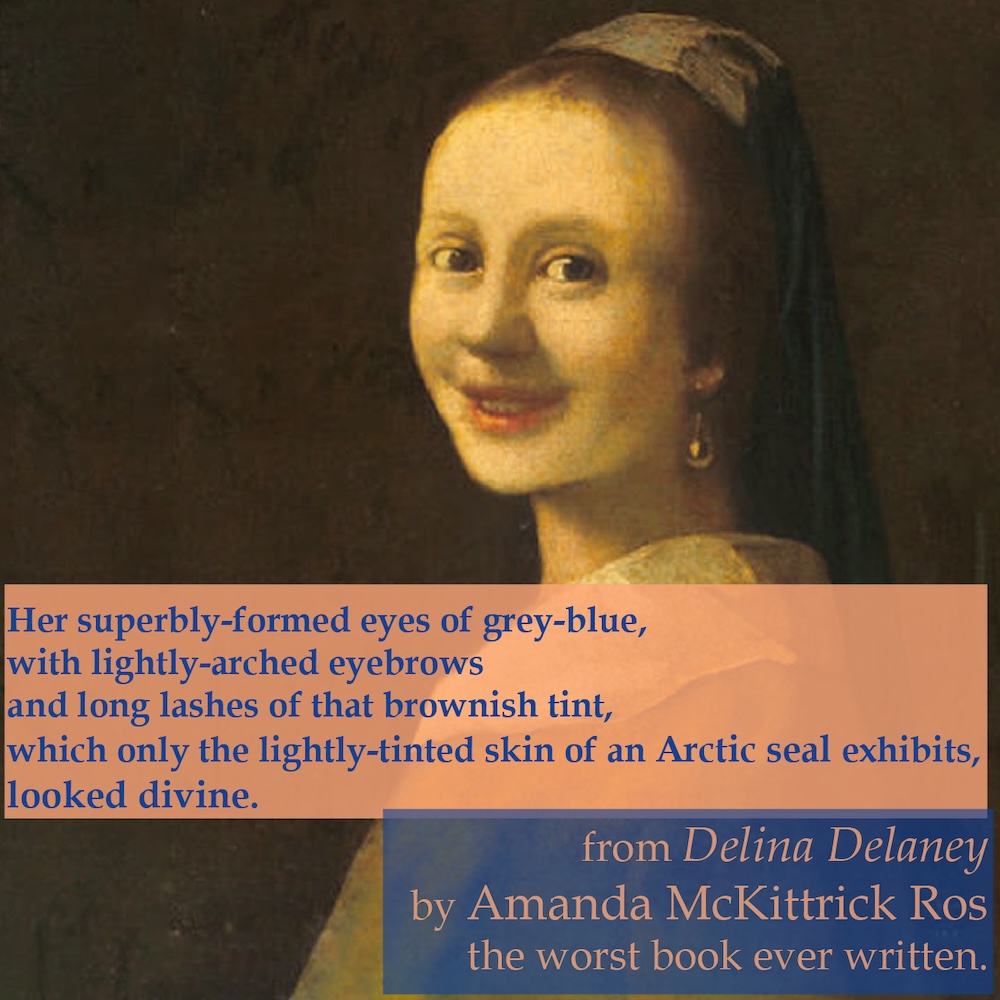
Amanda McKittrick Ros (1860-1939) was an Irish poet and novelist beloved by the Oxford Inklings. “Beloved” here is used in the sense of treasured for its distinctiveness, rather than admired for its artistry.

An article about Ros in Smithsonian Magazine is subtitled: “Amanda McKittrick Ros predicted she would achieve lasting fame as a novelist. Unfortunately, she did.”

So how is it that a writer described by the Oxford Companion to Irish Literature (OCIL) as authoring “unconscious comedy of a very high order” came to occupy a special place within the company of C.S. Lewis, J.R.R. Tolkien and their literary fellows? Why did they begin reading her works as a sort of contest, with the challenge of neither laughing nor smiling as they did so?

It was not because her mother (or she herself) christened her after a character in The Children of the Abbey, published in 1796. (Her initial name was “Anna.”)

No, it was due to an intrinsic element of her frequently alliterative artistry, described by OCIL in the following manner.

She published two sentimental romances, Irene Iddlesleigh (1897) and Delina Delany (1898), both in an idiosyncratic manner that provides unconscious comedy of a very high order. . . .

Most of her published writings appeared posthumously as a result of literary curiosity.

Many writers would agree that writing comedy is quite challenging. Comedy Crowd is devoted to helping writers gain some skill in this arena, and if you take a moment to check out their video about failed puns – after you finish reading this post – you won’t be disappointed. 

As one commenter on SleuthSayers puts it, “. . . writing humor isn’t easy. It’s even dangerous: trying to be funny and failing would be almost as bad as being funny when you’re trying to be serious.” Sadly, the worst of these options proved to be the fortune of poor Amanda.

Even her native Northern Ireland Library Authority confesses that her “writing style can only be described as elaborate, melodramatic, using startling descriptions with mixed metaphors and inappropriate alliteration with the result being unintentionally hilarious.”

In her collection “Poems of Puncture,” I came across a piece titled “Reverend Goliath Ginbottle.” Being a reverend myself, I eagerly listened to a LibriVox recording of the poem (which you can download for free from Internet Archive), and I was not disappointed. Her description of this “viper of vanity” and her joy at his ultimate judgment was delightfully colorful. Or, should you prefer to hear a diatribe against a corrupt lawyer, listen to Mickey Monkeyface McBlear, who bore “a mouth like a moneybox.”

TV Tropes has an article about Ros which attributes a dozen tropes to her pen.

In the Style of: Aldous Huxley noted that Ros wrote in the 16th century style of Euphuism. Susan Sontag decades later stated that Euphuism was the progenitor of camp, which would explain why literary greats found her writing so hilarious.

Those curious about euphuism can read John Lyly’s Euphues: the Anatomy of Wit; Euphues and His England which is filled with delights unnumbered. Originally two volumes, the books were published in the sixteenth century.

C.S. Lewis was a serious enough “fan” of Ros’ writings to share his affection for them with Cambridge Classicist Nan Dunbar. C.S. Lewis scholar Joel Heck has written a worthwhile article about the ongoing friendship between the two professors.

For a detailed study of the literary relationship between Amanda McKittrick Ros and the Inklings, I highly recommend the article by Anita Gorman and Leslie R. Mateer which appeared in Mythlore.

As they describe, even before the Inklings added occasional readings of her work to their gatherings, as early as 1907 there was in Oxford a society devoted to weekly readings of her works. The authors pose, and then proceed to answer, the following question.

What . . . impelled C.S. Lewis and his mates to read aloud Ros’s work? Yes, the improbable plots, silly characters, and nonexistent themes may have played a role, but were those enough to captivate the Inklings and to give rise to Delina Delaney dinners and Amanda Ros societies?

After all, many writers have written improbable plots about improbable people, and these writers have enjoyed short-lived reputations, if any reputations at all. Yet Amanda lives on.

For Those with Stout Constitutions

Mere Inkling offers one final look back at the transcendent poetry of Amanda McKittrick Ros. This infamous selection can be found at the aptly named Pity the Readers: Horribly Excellent Writing website.

“Visiting Westminster Abbey”
(from Fumes of Formation)

Holy Moses! Have a look!
Flesh decayed in every nook!
Some rare bits of brain lie here,
Mortal loads of beef and beer,

Some of whom are turned to dust,
Every one bids lost to lust;
Royal flesh so tinged with ‘blue’
Undergoes the same as you.

These morose words bring to mind another verse, composed in the form of a song by the artists of Monty Python. It appeared on Monty Python’s Contractual Obligation Album as “Decomposing Composers.”

They’re decomposing composers.
There’s nothing much anyone can do.
You can still hear Beethoven,
But Beethoven cannot hear you. . . .

Verdi and Wagner delighted the crowds
With their highly original sound.
The pianos they played are still working,
But they’re both six feet underground.

They’re decomposing composers.
There’s less of them every year.
You can say what you like to Debussy,
But there’s not much of him left to hear.

Yes, similarly morbid verse, but offered here to provide a sharp contrast between types of humor. Monty Python is the epitome of Camp, which according to Susan Sontag,

sees everything in quotation marks. It’s not a lamp, but a “lamp;” not a woman, but a “woman.” To perceive Camp in objects and persons is to understand Being-as-Playing-a-Role. It is the farthest extension, in sensibility, of the metaphor of life as theater.

Although Sontag notes “one must distinguish between naïve and deliberate Camp,” she argues the “pure examples of Camp are unintentional.” She considers self-conscious efforts, such as Noel Coward (and presumably Monty Python as well) as “usually less satisfying.”

Another perspective offers a helpful dichotomy to distinguish between “intentionality: whether camp deliberately cultivated (‘high’ camp) is the same to that of the unintentional kind (‘low’ camp).”

Personally, I often enjoy high (nonvulgar) camp humor – witty silliness that scoffs at life’s peculiarities. As for unintentional, “low” camp such as we find in Ros, I typically feel a flash of guilt at hurting (even posthumously) the feelings of a writer. Most of us writers are, after all, a sensitive and vulnerable breed.


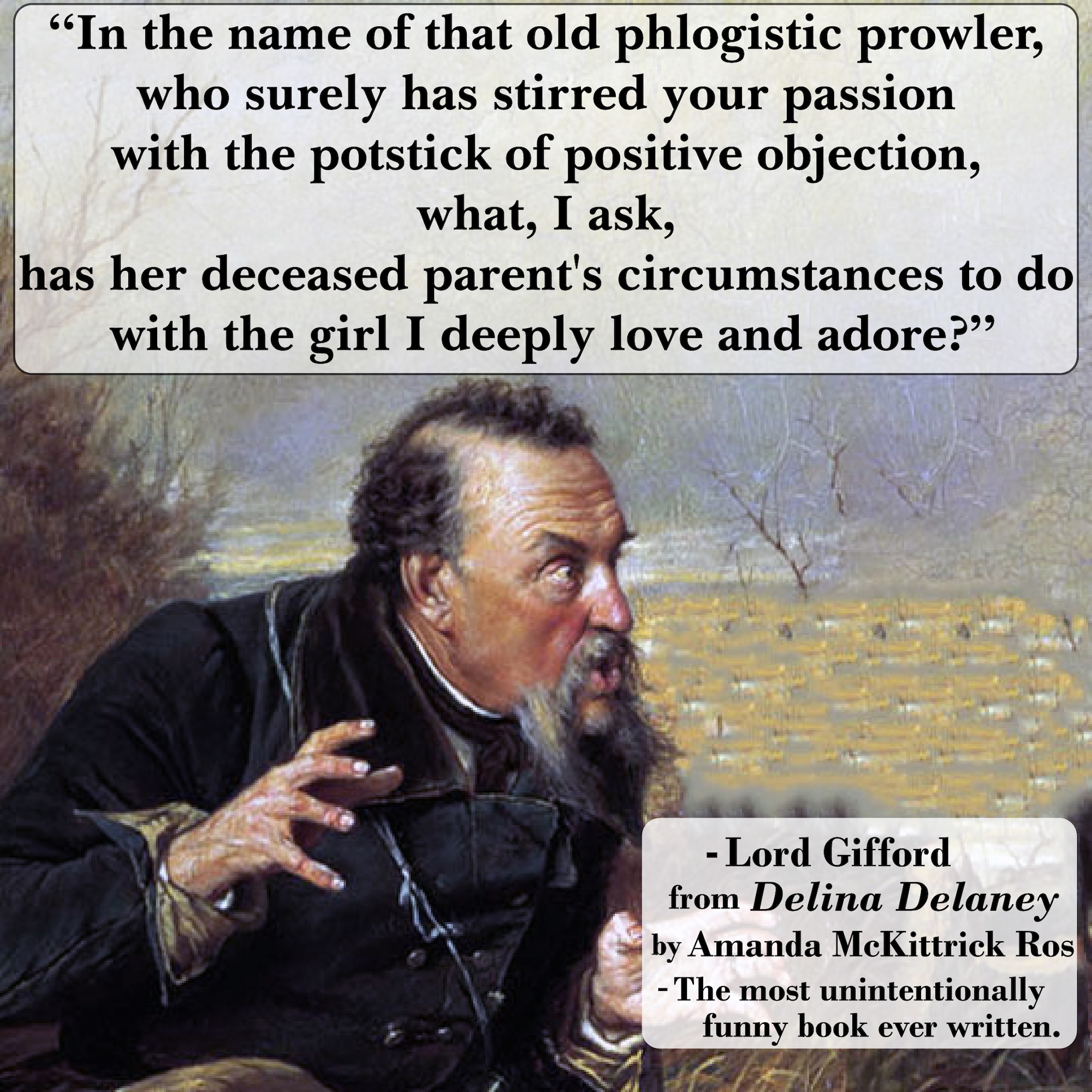
The enlightening illustrations accompanying this article are from Amanda McKittrick Ros Society Promotional Memes, ably captained by Dan Morgan.

Chocolate Fuels Armies

“An army marches on its stomach.”* Military leaders have long recognized that it is difficult to arouse soldiers weakened by deprivation. Sadly, though, even a king of Israel could be foolish enough to ignore that and order his soldiers to fast before a battle.

While logisticians rarely receive the accolades of their peers who serve directly in combat, they have always been vital members of successful military ventures.

While they are concerned with securing and transporting all requirements, such as ammunition and medical supplies, there is a single necessary requirement for all campaigns. Without sustenance, soldiers will desert the flag and even the most steadfast will fall.

Nutritional value is the first priority. Palatability has historically been a distant afterthought. This has given rise to innumerable jokes made by veterans about the “combat rations” provided to them. While these “menus” have vastly improved in recent years, they remain fodder for much humor.

And even the most delicious food choices become monotonous when they are limited to a small range. In 2002, I visited a remote military detachment supplied with adequate pallets of Meals Ready to Eat, but begging for variety. They had hundreds of meals available, but only two or three different meal options! Civilians, in contrast, can readily purchase a far wider range of entrees.

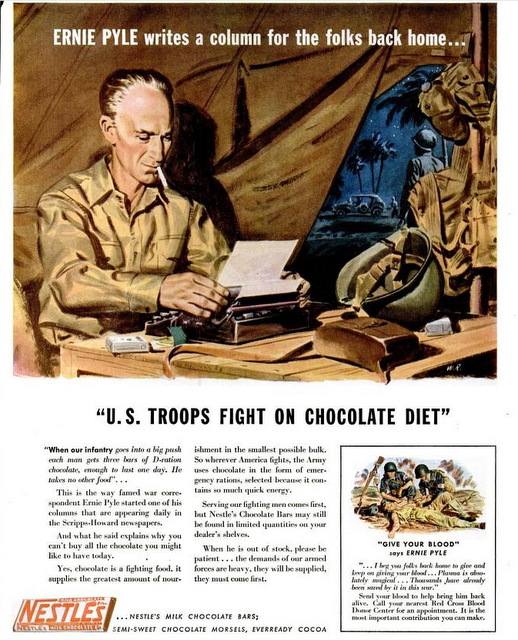
During the Second World War, the United States invested major efforts in making the combat meals more appealing. Various candies found their way into K-rations, in addition to necessities like toilet paper and cigarettes. In a comprehensive overview of the history of rations, the U.S. Army Quartermaster Foundation points to the main reason for complaint during WWII.

Like other unpopular items, misuse was a contributing factor to the waning popularity of the K ration. Although designed to be used for a period of two or three days only, the ration occasionally subsisted troops for weeks on end. . . . Continued use reduced the acceptability and diminished the value of the ration.

Adding confectionaries to rations made the meals more welcome. Chocolate was always a favorite, but the initial American versions left much to be desired.

My research was, in fact, prompted by a recent post on “Chocolate in WWII” in Pacific Paratrooper. (It is one of the very best military blogs on the internet.) They describe how the military approached a major American confectioner with a simple list of requirements (the last one is best appreciated by older veterans).

The Hershey Chocolate company was approached back in 1937 about creating a specially designed bar just for U.S. Army emergency rations. According to Hershey’s chief chemist, Sam Hinkle, the U.S. government had just four requests about their new chocolate bars: (1) they had to weigh 4 ounces; (2) be high in energy; (3) withstand high temperatures; (4) “taste a little better than a boiled potato.”

Sadly, many “who tried it said they would rather have eaten the boiled potato.” Well, it was the thought that counted, right?

There is a legend that during the war a German officer was confronted with American desserts and determined that the abundant resources of the United States signaled doom for the Nazi cause. The story likely has a fictional origin.

In the 1965 film Battle of the Bulge, Wehrmacht Colonel Hessler, shows his commanding general a treasure confiscated from American soldiers.

Hessler: “General, before you go, may I show you something?”

General: “What is it?”

Hessler: “A chocolate cake.”

Kohler: “Well?”

Hessler: “It was taken from a captured American private. It’s still fresh. If you will look at the wrapping, general, you will see it comes from Boston.”

Kohler: “And?”

Hessler: “General, do you realize what this means? It means that the Americans have fuel and planes to fly cake across the Atlantic Ocean. They have no conception of defeat.”

C.S. Lewis & Rations

Military rations during the First World War were more primitive than those provided twenty years later. One difference for the British is that they were granted a half gill of rum (or a pint of porter) each day.

This alcohol distribution was at the discretion of the commanding general, which meant that it was not available in the trenches. This was in the spirit of the American “General Order Number 1,” which typically applies to alcohol, and sometimes prohibits its presence throughout an entire theater. (I can personally attest to the ability of some elements, such as Special Ops, to circumvent such restrictions.)

C.S. Lewis wrote with some frequency about the rationing endured by the British public, during and after the world wars.⁑

Unfortunately, I’ve only uncovered one Lewisian reference to his own experience with military cuisine. In a 1917 letter to his father, he reveals that meals were not always appealing, even during training, prior to deploying to the war zone.

First of all came the week at Warwick, which was a nightmare. I was billeted with five others in the house of an undertaker and memorial sculptor. We had three beds between six of us, there was of course no bath, and the feeding was execrable.

The little back yard full of tomb stones, which we christened ‘the quadrangle,’ was infinitely preferable to the tiny dining room with its horse hair sofa and family photos.

When all six of us sat down to meals there together, there was scarcely room to eat, let alone swing the traditional cat round. Altogether it was a memorable experience.

A Hobbit, a Wardrobe, and a Great War describes how WWI affected C.S. Lewis and J.R.R. Tolkien. After relating a passage following Miraz’s defeat of Caspian’s force, when the momentarily defeated were “a gloomy company that huddled under the dripping trees to eat their scanty supper,” the author observes:

The military blunders, the fruitless acts of bravery, the bone-chilling rain, the meager rations: there were many days and nights just like these along the Western Front. Imaginary beasts aside, such scenes could have been lifted from the journal of any front-line soldier.

Like Tolkien, though, Lewis includes these images not for their own sake, but to provide the matrix for the moral and spiritual development of his characters . . .

Rations in Ukraine

Although the eyes of the world are riveted today on the war in Ukraine, there are currently 110 armed conflicts being monitored by the Geneva Academy. However, since Ukraine is in the news daily, it is worth noting both modern armies are employing military rations.

Apparently, Ukrainian troops have great Meals Ready to Eat (MREs). “Most importantly, when making, eating, or even talking about the food, the men seem to be genuinely happy.” The MRE link in this paragraph contains the details, including the note that “among the contents, you’ll find a small packet of dried apricots and a dark chocolate bar.”

There is also a vendor on ebay who sells what are purported to be captured Russian supplies, including a confiscated chocolate bar. The candy appears to be conventionally purchased, but could be part of an illicit chocolate conspiracy finding its way to the Russians from Latvia. “The Russian confectionery company ‘Pobeda’ ПОБЕДА has been producing chocolates, truffles, waffles and other types of sweets for more than six years in Ventspils, via a Latvian subsidiary.”

A month ago in Russia, “Pobeda” received thanks from an organization called the “Battle Brotherhood” for the fact that since the beginning of the Ukrainian war, the company has sent at least 15 tonnes of its products to Russian soldiers.

Chocolate does indeed appear to fuel armies. For a fascinating article on how chocolate can also be used to promote propaganda, check out this Ukrainian site.

Russian propaganda continues to dehumanize Ukrainians with the help of outright fakes.

Another “proof” of our apparent bloodthirstiness was the image of a chocolate bar with a remarkable name “Death of Alyoshka.” A portrait of a boy in a helmet with a mourning ribbon is placed on the wrapper of the confectionery. Propagandists claim that Ukrainians wish Russian children dead.

Become an MRE Connoisseur

If you are curious about the contents of various international MREs that are available for purchase by civilians, visit MREmountain, which began “in 2017 when people discovered the hobby of trying army rations.”

Most veterans, I suspect, would find the “hobby” of eating military rations rather peculiar. But then again, you can check out the French options, which the site labels “The best MRE in the world.” Only there, I imagine, could one discover “meals not found in any other MRE like Kebob Meatballs, Duck Confit, Deer Pate, Wild Boar.”

And, of course, France’s 24-hour ration also includes chocolat müesli, chocolate biscuits, five snack bars (at least one of which is pure chocolate), and a hot cacao packet. Yummy. It appears that les Français also consider chocolate to be a staple of modern soldiers.


* This quotation has been attributed to Napoleon and Frederick the Great. Whatever its modern origin, it is obvious starvation and its frequent companion, disease, have crippled as many armies as blade and shot.

⁑ “Mock Goose and Other Dishes of the War-Rations Diet” offers some interesting thoughts on this subject.

A Portuguese Pope & C.S. Lewis

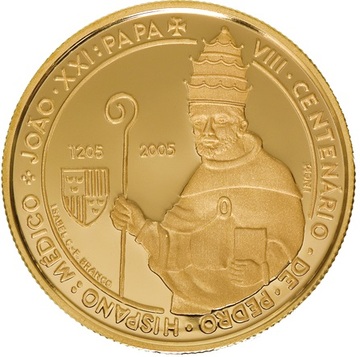
A few days ago marked the anniversary of the 1277 death of Pope John XXI. I knew nothing about this particular Pontiff, but the mention I read described his passing due to the collapse of the ceiling of his residence. That piqued my interest, but the following forced me to spend some time researching to learn more: “The name was a mistake – there was never a John XX.”

One of the very few email lists I’ve never regretted signing up for is “Today in Christian History” produced by Christianity Today.

Each day it provides brief notes about several historical events that happened on that particular day. Most of the notes describe historically watershed incidents. Others are simply curious, though they were naturally momentous to those involved.

The opening of this post offers an example from the latter category. Unlike the reign of Pope Francis, who ascended a decade ago and has indicated he has no intention of “retiring” before death (as did his humble predecessor Benedict XVI), the unfortunate John XXI sat on the papal throne for a mere nine months.

Despite this brief reign, there are several interesting things about Pedro Julião. (I’ll save the one I regard as most important for last.)

First of all, John XXI was Portuguese. Hailing from the Iberian Peninsula, he represents no less than 50% of the popes who came from Portugal. The first, Damasus I (305-84), came from the Roman province of Lusitania, which included a portion of Spain in addition to modern Portugal.

One paradox of the Papacy is that the Pope is the Bishop of the diocese of Rome, presiding over a physical geographic locale, while he is simultaneously the Bishop of the “Holy See,” meaning that he serves as the episcopal head of the entire international Roman Catholic communion.

Due to the physical location of the Roman Patriarchate, it is unsurprising that a majority of the individuals who have followed Saint Peter as Pontiff have been Italian. World Population Review says 217 of the 266 Popes have been from Italy. “A distant second is France, which has had a total of 16 popes.”

J.R.R. Tolkien was a truly devout Roman Catholic, but C.S. Lewis recognized that the church headquartered in Rome was merely one part of the Body of Christ whose unity he argued was founded in an understanding of the Mere Christianity Lewis propounded. Much to Tolkien’s chagrin, his good friend Lewis never converted to Roman Catholicism.

Roman Catholics still seek C.S. Lewis’ imprimatur. One prominent Roman Catholic apologist, Joe Heschmeyer, has a personal blog delightfully titled Shameless Popery. (I highly respect truth in advertising like his website exhibits.) In “C.S. Lewis’ Surprising Argument for the Papacy,” he argues that Lewis’ argument for a traditional view of marriage offers support to the rationale for papal authority.

Unlike some Protestants, C.S. Lewis was not tempted to construct a strawman out of the papacy. In an interesting passage from his monumental history of English Literature in the Sixteenth Century, he emphasizes the shared legacy of Roman Catholicism and robust Protestantism. 

To be sure, there are standards by which the early Protestants could be called “puritanical;” they held adultery, fornication, and perversion for deadly sins. But then so did the Pope. If that is puritanism, all Christendom was then puritanical together.

In much the same way that C.S. might argue that “all Christendom” shared not only a common moral awareness, but also a mutual understanding of God’s self-revealed Triune nature.

In addition to being a rare specimen as a Portuguese Pope, John XXI studied medicine and is thought to have been a noteworthy pharmacologist. In fact, the apartment in the papal palace in Viterbo which collapsed on him was constructed so he would have a quiet place in which to pursue his medical studies.

Second, as already mentioned, another peculiar thing about John XXI, is the choice of his papal name. There never was a Pope John XX. One would imagine the church bureaucracy would keep accurate records of these sorts of things. Even more strangely, there is more than one explanation for why Pedro Julião became John XXI at his consecration.

According to Brittanica “Marianus Scotus and other 11th-century historians mistakenly believed that there had been a pope named John between antipope Boniface VII and the true John XV.” Consequently, “they mistakenly numbered the real popes John XV to XIX as John XVI to XX” requiring that they subsequently be “renumbered XV to XIX.” Yet, for some reason, “John XXI and John XXII continue to bear numbers that they themselves formally adopted on the assumption that there had indeed been 20 Johns before them.”

As a result, the title John XX presumably remains available for any future Bishop of Rome who might wish to further confuse the matter. We may have to wait until the Parousia to learn the full facts in this convoluted matter.

A third distinctive of John XXI is that he rescinded a very common sense decree established by his predecessor Gregory X, only two years prior to John’s ascension. (Actually, Adrian V was elected pope between the two, but Ottobuono de’ Fieschi died shortly after his election, before he could even be ordained to the priesthood. (There must be another interesting tale there.)

Returning to the story of the rescinded canon . . . Apparently there was a long papal vacancy (nearly three years) before Gregory X was elected. To avoid such predicaments in the future, at the Second Council of Lyon Gregory pushed for this sensible rule: if the new pope is not elected in a reasonable time frame, encouragement would be provided to the conclave by having their episcopal meals and other rewards gradually diminish!

The entire, fascinating “constitution” is available at Eternal World Television Network. Here is the essence:

We learn from the past how heavy are the losses sustained by the Roman church in a long vacancy, how perilous it is . . . We intend in no way to detract from [previous rules primarily instituted by Pope Alexander III], but to supply by the present constitution what experience has shown to be missing.

If, which God forbid, within three days after the cardinals have entered the said conclave, the church has not been provided with a shepherd, they are to be content for the next five days, every day both at dinner and supper, with one dish only. If these days also pass without the election of a pope, henceforth only bread, wine and water are to be served to the cardinals until they do provide a pope.

While the election is in process, the cardinals are to receive nothing from the papal treasury, nor any other revenue coming from whatever source to the church while the see is vacant.

For some unrevealed reason, John XXI revoked this rule, and it was back to business as usual. The decision to do so was one of John’s few official acts.

C.S. Lewis, Once Again

One reason Christians of all denominational traditions find much to appreciate in C.S. Lewis comes from the fact he was much more interested in edifying believers than tearing them down. He preferred to promote Christian unity over division.

One of his close friends, with whom he carried on a long term correspondence was a Benedictine monk named Bede Griffiths. Ironically, while Griffiths became renowned for his embrace of elements of Hindu spirituality, the priest appeared less tolerant of C.S. Lewis’ Protestant doctrines. In a letter from 1936, Lewis’ frustration on that score comes through loud and clear.

One of the most important differences between us is our estimate of the importance of the differences. You, in your charity, are anxious to convert me: but I am not in the least anxious to convert you.

You think my specifically Protestant beliefs a tissue of damnable errors: I think your specifically Catholic beliefs a mass of comparatively harmless human tradition which may be fatal to certain souls under special conditions, but which I think suitable for you. . . .

As well – who wants to debate with a man who begins by saying that no argument can possibly move him? Talk sense, man! With other Catholics I find no difficulty in deriving much edification from religious talk on the common ground: but you refuse to show any interest except in differences.

These words were written (1) privately, to a friend, (2) in the form of an extemporaneous letter, and (3) tinged with the frustration of returning to a familiar “debate” with a recalcitrant disputant.

Fortunately, however, we possess an essay written by Lewis on the same subject which was composed in the opposite context. It was intentionally composed for a general audience, written in C.S. Lewis’ natural painstakingly logical and clear literary voice, and composed in his conciliatory spirit with a focus on affirming what is shared and illuminating – but not dwelling upon – differences.

In 1944 C.S. Lewis penned an essay entitled “Christian Reunion.” Sadly, it was never completed for publication during his lifetime. This brief work reveals his deeper thoughts on interdenominational distinctives, and the overriding unity Christians possess through our relationship in Jesus Christ. It is written primarily to a Roman Catholic audience, in a respectful and genuinely compassionate tone.

A Pilgrim in Narnia has provided the universal (“catholic” with a small “c”) Church a great service in reproducing the full text of the essay here.

Dr. Dickieson also provides a concise and helpful introduction. I offer only a selection from Lewis’ essay here, as befits the nature of our current discussion.

I know no way of bridging this gulf [between the major Christian traditions]. Nor do I think it the business of the private layman to offer much advice on bridge-building to his betters. My only function as a Christian writer is to preach “mere Christianity” not ad clerum [to the clergy] but ad populum [to the people].

Any success that has been given me has, I believe, been due to my strict observance of those limits. By attempting to do otherwise I should only add one more recruit (and a very ill qualified recruit) to the ranks of the controversialists. After that I should be no more use to anyone.

When therefore we find a certain heavenly unity existing between really devout persons of differing creeds – a mutual understanding and even a power of mutual edification which each may lack towards a lukewarm member of his own denomination – we must ascribe this to the work of Christ . . . 

Ultimately, C.S. Lewis’ reservations about Roman Catholicism rested where they do for most thinking Christians who belong to other denominations. Its focus can be distilled down to a “disagreement about the seat and nature of doctrinal Authority.” Although he does not expressly state the conviction here that Scripture supersedes the ultimate weight of a single opinion, say of someone such as Pope John XXI, that is the concern.

We will end with C.S. Lewis’ astute analysis of the two parts of the Christian family as they view one another across the proverbial Tiber. In doing so, I offer the fruits of my own recent theological quest. Precipitated by a contemporarily trivial event during the thirteenth century, it culminated in another deep draught from the wisdom of C.S. Lewis.

The difficulty that remains . . . is our disagreement about the seat and nature of doctrinal Authority. The real reason, I take it, why you cannot be in communion with us is not your disagreement with this or that particular Protestant doctrine, so much as the absence of any real “Doctrine,” in your sense of the word, at all.

It is, you feel, like asking a man to say he agrees not with a speaker but with a debating society.

And the real reason why I cannot be in communion with you is not my disagreement with this or that Roman doctrine, but that to accept your Church means, not to accept a given body of doctrine, but to accept in advance any doctrine your Church hereafter produces. It is like being asked to agree not only to what a man has said but to what he’s going to say.

Postscript

As an illustration of the C.S. Lewis’ point about authority resting in the current “successor of Peter,” consider the decisions rendered by Gregory X and John XXI about papal enclaves. It seems to me that the first admonition about not indulging those in attendance was wiser than the subsequent decision to restore the earlier policies. But then, that may simply be due to the fact that I’m a Protestant. Unless the rules have been revised since John’s passing, I assume most Roman Catholics would agree that he was led by the Holy Spirit in reversing the decree of the Second Council of Lyon.

Inkling Linguistics

Last week I wrote about “Learning Languages,” and I promised to follow up with a related theme – the creation of new words and languages. Let’s consider the simple matter first.

Adding New Words

Anyone can make up a new word. The problem is whether we have enough influence to have it adopted and used by another human being. (I add this qualifier to eliminate those who might attempt to skirt the question by simply training parrots to mimic the new word.) As Scientific American relates, 

When parrots are kept as pets, they learn their calls from their adoptive human social partners. Part of their appeal as pets is their ability to sing lower notes than smaller birds and so better reproduce human voices.

So, while you may be able to trick one of your parrots into repeating a novel “word,” that doesn’t count for our purposes here.

Likewise, any other birds who mimic speech, including musk ducks and corvids (ravens, crows and their ilk). In fact, let’s exclude all nonhuman “speakers” from consideration. After all, AZ Animals introduces readers to seven specific animals of different species (only one of which is avian) whose “forebrain is . . . responsible for some animals’ ability to mimic speech.” 

So, animals aside, who embraces and disseminates newly invented new words? Some words, of course, find a partially prepared or receptive audience because they are imported from other tongues. The global influence of English makes other languages especially vulnerable to its influence, which can be deeply resented. The “corruption” of mother tongues sometimes elicits reactionary responses – such as Italy’s current effort to purge English from the Italian Republic.

And some Italians are extremely serious about the task, proposing fines up to €100000. (That is not a typo; at today’s exchange rate it would be $109,857.50.) Their animus toward English follows the path established by the French, who frequently default to Napoléon’s order to refer to Britain as “perfidious Albion.” The Académie Française goes so far as to repudiate specific words, including business, cash, digital, vintage, label, and deadline.

Vocabulary adopted from other nation’s may be “new” to their most recent users, but such importation is certainly not the same as fabricating novel words from the proverbial “whole cloth.”

True Neologisms

I wrote a moment ago that creating words is easy, but persuading others to use them is quite another thing. I’ve discussed this subject in the past, in “Create a Word Today” and “Creative Definitions.” Sadly – and fittingly – none of my personal neologisms have caught on.

Popular creative writers may, however, find their fancies adopted by larger audiences. Shakespeare’s “bedazzled” was birthed in The Taming of the Shrew. The “chortle” was first heard in Lewis Carol’s “Jabberwocky.” “Pandemonium” was revealed as the capital of Hell in Milton’s Paradise Lost. And the first “Nerd” was encountered in Dr. Seuss’ If I Ran the Zoo.

Some neologists were particularly prolific. How about these few additional examples from the Bard: 

Bandit ~ Henry VI
Dauntless ~ Henry VI
Lackluster ~ As You Like It
Dwindle ~ Henry IV

Oh, and Grammarly adds, “Shakespeare must have loved the prefix un- because he created or gave new meaning to more than 300 words that begin with it.” Can you imagine a world without:

Unaware ~ Venus & Adonis
Uncomfortable ~ Romeo & Juliet
Undress ~ Taming of the Shrew
Unearthly ~ The Winter’s Tale
Unreal ~ Macbeth

Before moving on, it would be fair to note that some voices consider this achievement by Shakespeare to be “a common myth.”

It turns out that Shakespeare’s genius was not in coining new words – it was in hearing new words and writing them down before they became widespread, and in wringing new meaning out of old, worn-out words: turning “elbow” into a verb and “where” into a noun. He didn’t invent the words, but he knew how to use them better than anyone.

C.S. Lewis was not a philologist, but he did create a few novel words. The Inkling scholar who pens A Pilgrim in Narnia has written on this subject here and here.

J.R.R. Tolkien was no slouch at inventing English words himself. Some which now reside in our common vocabulary include hobbit and orc. The latter he derived from an Old English word, orcþyrs, a devouring monster associated with Hell. More surprisingly, Tolkien created the modern word “tween,” albeit in the context of hobbits, who lived longer lives than we.

At that time Frodo was still in his tweens, as the hobbits called the irresponsible twenties between childhood and coming of age at thirty-three.

Envisioning novel words is relatively simple, but inventing an entire language, is an infinitely more complex challenge. The universally acknowledged master is J.R.R. Tolkien, whose Elvish tongue has become a “living” language.* But he was not alone in building internally consistent linguistic systems. Albeit, no philologist came near to Tolkien’s expertise, which included elaborate etymologies.

Before considering Tolkien himself, we will note several other efforts of a similar kind. And, following a discussion of Tolkien, we will conclude with a note about his good friend, C.S. Lewis. For, despite the fact that Lewis was not a philologist himself, it is interesting to note that he too dabbled in creatio linguarum.

Inventing New Languages

Some “constructed languages” are formed with practical purposes. Esperanto, birthed in 1887, incorporated elements from existing languages and was envisioned as a common “international auxiliary language.” It boasts its own flag, and claims to be the native language of approximately a thousand people.

One curious use of Esperanto came in its adoption by the United States Army as the “Aggressor Language” used in twentieth century wargames. The curious can download a copy of the now-rescinded Field Manual 30-101-1, which provided guidance for its usage “which will enhance intelligence play and add realism to field exercises.”

Another genuine constructed language is Interlingua. Developed between 1937 and 1951, it is based primarily on the shared (and simplified) grammar and vocabulary of Western European languages. 

In addition to languages constructed for international use, there are a variety of tongues created for fictional applications. “To learn Klingon or Esperanto” describes how linguistic anthropologist Christine Schreyer “invented several languages for the movie industry: the Kryptonian language for ‘Man of Steel,’ Eltarian for ‘Power Rangers,’ Beama (Cro-Magnon) for “Alpha” and Atlantean for ‘Zack Snyder’s Justice League.’” While none of these could ever rival the languages of Middle Earth, her bona fide linguistic credentials place her in a context similar to J.R.R. Tolkien. The interview reveals how Schreyer balances her creative impulses with her anthropological concerns.

I teach a course on linguistic anthropology, in which I give my students the task of creating new languages as they learn about the parts of languages. Around the time I started doing that, “Avatar” came out. The Na’vi language from that movie was very popular at the time and had made its way into many news stories about people learning the language – and doing it quickly.

My other academic research is on language revitalization, with indigenous or minority communities. One of the challenges we have is it takes people a long time to learn a language. I was interested to know what endangered-language communities could learn from these created-language fan communities, to learn languages faster.

Other fictional languages that exist include R’lyehian (from Lovecraft’s nightmare cosmos), Lapine (from Watership Down), Fremen, the Arabic/alien blending (from Dune), Parseltongue (ala Harry Potter), Dothraki (from Game of Thrones), Ewokese, etc. (from Star Wars), Goa’uld and others (from Stargate), Minbari and more (from Babylon 5), and the gutturally combative Klingon and others (from Star Trek). This brief list is far from exhaustive.

Tolkien, Lewis & New Languages

The languages forged by J.R.R. Tolkien are unrivaled by any conceivable measure one might employ. They are no mere stage dressing, like some of the aforementioned examples. Even those with developed vocabularies and consistent grammar fall far short of Tolkien’s creation. In terms of the histories of his languages, his diligent etymologies beggar all other such efforts. Of course, for Tolkien this was no competition. He was driven to make his languages as flawless – not “perfect,” but realistic – as humanly possible. It was a linchpin in his subcreative labor.

As a skilled calligrapher, Tolkien devised unique alphabets to complement his languages. The letters in his alphabets were not devised as mere adornments. Tolkien left that to lesser imaginations. Nor were his scripts restricted to Tolkien’s fiction. The Tolkien Estate offers an insightful essay on “Writing Systems.”

Tolkien also used invented scripts that were not associated with any of his fictional worlds. An early example is the Privata Kodo Skauta (Private Scout Code), which appears in a still unpublished notebook from 1909 called the Book of the Foxrook. This makes use of a phonetic code-alphabet, as well as a number of ideographic symbols representing full words. . . .

Toward the end of his life, Tolkien made use of the New English Alphabet, a phonetic script that combined the logical structural principles of the Angerthas and the Tengwar with letters that looked more like Greek or Latin. The alphabet has not yet been published in full, but examples can be seen in . . . J.R.R. Tolkien: Artist & Illustrator.

The footnote below links to some resources for those who would like to learn how to speak the languages of the elves. By way of help with pronunciations, remember the following advice:

Use an Italian accent to pull off Quenya speech patterns. In general, you can kind of sound Elvish – even without following the rules of the language – by applying an Italian accent when pronouncing Quenyan words. Native Italian speakers tend to use speech patterns from their native tongues to interpret English words, which can make your Elvish sound practiced even when it isn’t.

Speak with an Irish or Scottish accent to pull off a natural Sindarin accent. Irish and Scottish speakers tend to speak English by emphasizing sounds in the front of a word regardless of the standard pronunciation. This is a pretty good method for pronouncing Sindarin words, since the vast majority of them stress the first syllable.

For those who want to quickly capture some Elvish script without the effort of studying, consider the English to Elvish online translator, which is offered by the company that fashioned The One Ring for Peter Jackson’s cinematic epics. I decided to test the translation tool and posed the question: “Does AI translation of English to Quenya actually work?” The software swiftly complied.

It looks elegantly correct, but unfortunately, I’m unable to personally verify its accuracy. And I must confess to modest trepidation since the site advises:

USE CAUTION BEFORE COMMITTING TO ANY TATTOOS, INSCRIPTIONS AND ENGRAVINGS” [triple emphasis in original].

The Jens Hansen site sells jewelry, as befits the fasioners of The One Ring. In addition to hosting the translator, they offer a free pdf document called Elvish 101 in 5 Minutes. It’s an interesting document, but it reveals a limitation I assume is shared by the online generator. It is a resource for transliterating, not translating, words. Not quite the same thing . . . but the script still looks elegant. 

Tolkien was the master of creating languages for his subcreation, but C.S. Lewis also used the same technique in the writing of his Space Trilogy. Each work focuses on an individual planet in our solar system, which is referred to in the books as the Field of Arbol.

While a number of languages have developed over time, the original language, known as Old Solar, is retained by some, and learned by the series’ protagonist Dr. Elwin Ransom. Ransom is a philologist at Cambridge, and as he is modeled after Tolkien, it’s no surprise his first name means “elf friend.”

In Perelandra, Ransom describes how a language he learned on Mars was once shared by all.

“It appears we were quite mistaken in thinking Hressa-Hlab the peculiar speech of Mars. It is really what may be called Old Solar, Hlab-Eribol-ef-Cordi. . . . there was originally a common speech for all rational creatures inhabiting the planets of our system: those that were ever inhabited, I mean – what the eldila (angels) call the Low Worlds. . . .

That original speech was lost on Thulcandra, our own world, when our whole tragedy [the Fall] took place. No human language now known in the world is descended from it.”

Lewis’ use of Old Solar is sparing, but a partial lexicon can be found at FrathWiki. There, for example, you will learn that “honodraskrud” is Old Solar for a “Groundweed; an edible pinkish-white kind of weed, found all over the handramit” of Malacandra (Mars).

The accomplishments of Tolkien and Lewis are difficult to compare. These two brilliant scholars shared a great many interests, but wrote with far different goals. We rightfully expect genius to vary between such individuals. This is well illustrated by their differing treatments of constructed languages, as Martha Sammons describes so well in War of the Fantasy Worlds.

Tolkien began with invented languages and then developed an elaborate mythology to create a world where his languages could exist. Lewis’s works began with mental pictures; he would then find the appropriate ‘‘form’’ to tie together the images. . . .

[Tolkien’s] penchant for historical and linguistic detail is unparalleled. In contrast . . . Lewis uses just enough language, geography, and science to make his novels believable.

While either approach may inspire those among us who aspire to writing, we best avoid attempting to emulate either author. Best, I believe, to compose our epics with the language that most naturally flows from our pen.


* While some fans of Klingon and Na’vi may learn to speak in those tongues, the students of the languages of Arda, typically possess greater ardor for the languages of Middle Earth. For example, an online guide to learning Elven languages begins by answering the question, “why study Elvish?” And a free online course for learning Quenya is offered here. Among the Quenya dictionaries, the finest free example is available at Quenya-English Dictionary English-Quenya Dictionary.

Music, Muses & C.S. Lewis

Why do so many modern musicians – including some who are commercially successful – appear to suffer from amusia?

Well, I suppose that diagnosis is a matter of opinion, since “amusia” has come to refer to a particular medical disorder related to “the inability to recognize musical tones or to reproduce them.” More on that in a moment. First let’s consider the original meaning of the word.

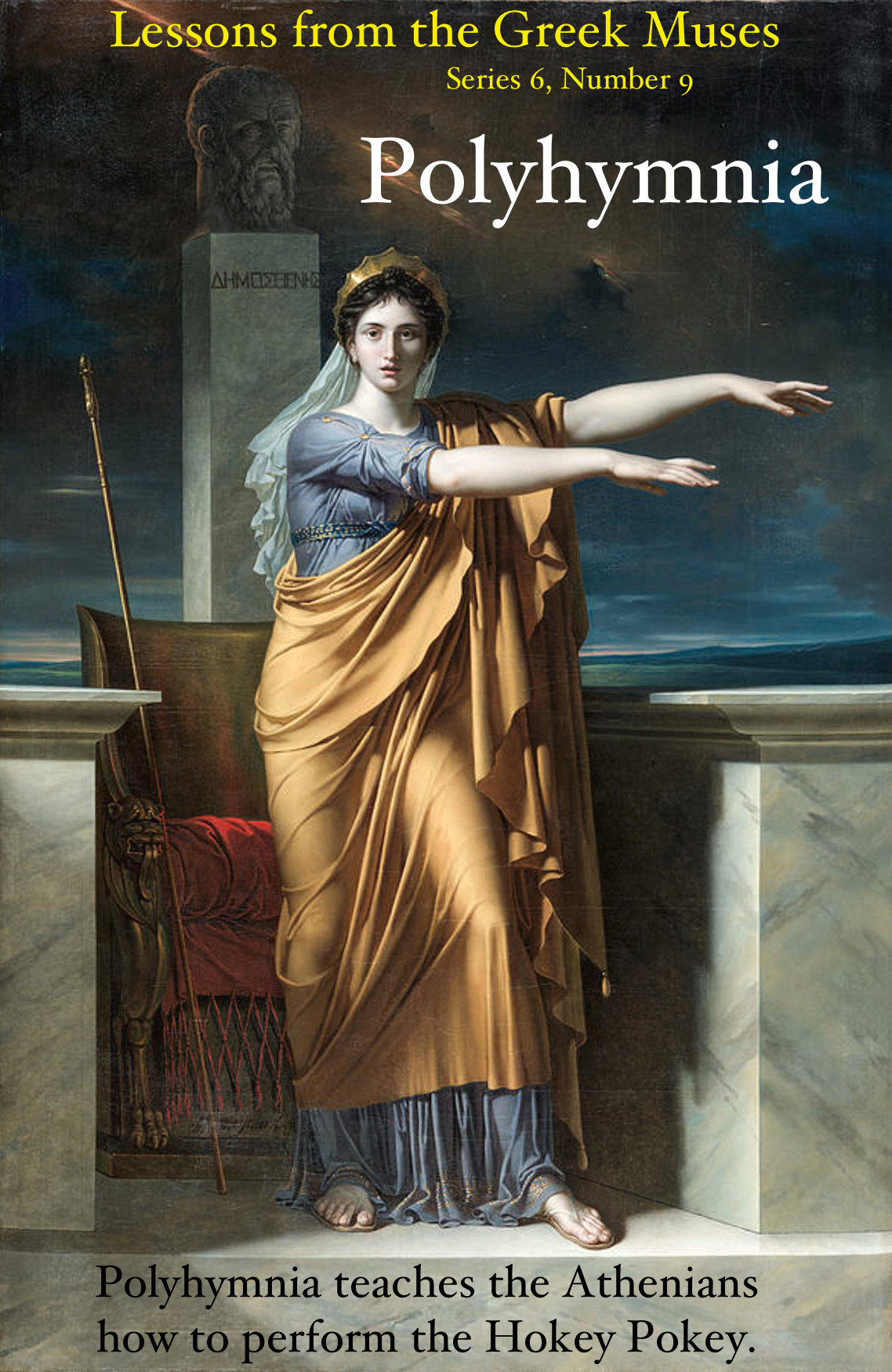
It begins with the Greek Muses. While “muse” has morphed into anything that inspires a creative soul, it did not begin that way. The Muses began as personifications devoted to nine children of Zeus and Mnemosyne (Memory). During Europe’s revival of Classical themes, they were associated not only with the arts, but with culture and refinement in general.

In Surprised by Joy, C.S. Lewis records his admiration for one of his early teachers. This man taught him to love poetry, and although he practiced corporal punishment (standard for the era), embodied “perfect courtesy.” On an occasion he was sent to the headmaster, who misperceived that Lewis had acted inappropriately. After dispelling the confusion, this teacher, who treated his students as “gentlemen,” matter-of-factly said “you will have to be whipped if you don’t do better at your Greek Grammar next week, but naturally that has nothing to do with your manners or mine.”

The idea that the tone of conversation between one gentleman and another should be altered by a flogging (any more than by a duel) was ridiculous. His manner was perfect: no familiarity, no hostility, no threadbare humor; mutual respect; decorum.

“Never let us live with amousia” was one of his favorite maxims: amousia, the absence of the Muses. And he knew, as Spenser knew, that courtesy was of the Muses. 

Muses, from this perspective, undergird civilization. But the Muses are fickle. One cannot create their own Muse. Inspiration comes to us of its own volition. It can’t be commanded.

Nearly four years ago, I posed this question in Mere Inkling: “Who is Your Muse?” Various literary figures have written paeans to the muses which inspire their work. In that column I also noted how our animal companions* often exert an influence on our own creativity.

The link between inspirational Muses and music itself is strongly intertwined. Consider, for instance, Friedrich Nietzsche (1844-1900), who was brilliant, but much to be pitied. He despised God, but he did love music. In “Amousia: Living Without the Muses,” Classicist Stephen Halliwell discusses the importance of music for enjoying a meaningful existence. He begins with a quote from Nietzsche, and points out a Platonic corollary. 

Without music life would be a mistake . . . So, famously, wrote Friedrich Nietzsche in . . . Twilight of the Idols. As always, Nietzsche had deeply personal reasons for the force and pathos of this aphorism; music did indeed help to keep him alive. . . .

[W]e can detect in Nietzsche’s stark utterance, I would like to suggest, a trace and resonance of Greek feeling. We might even wonder whether in formulating his maxim Nietzsche was subconsciously remembering the passage in Plato’s Philebus where Protarchus, asked by Socrates whether music, as one of the ‘impure’ arts, is needed for the mixture of a humanly desirable life, says that he certainly takes it to be necessary – ‘at any rate,’ as he puts it, ‘if our life is really to be a life of some kind.’

Without music, Protarchus . . . seems to take the idea to be practically self-evident, human ‘life’ would hardly be worth the name at all.

Amusia as a Medical Condition

I suggested above that the caterwauling of some musicians suggests they are tone deaf, but in fact there is a genuine medical condition called amusia. It traces its beginning to the Muses we have been speaking about, and suggests their absence.

In “The Genetics of Congenital Amusia (Tone Deafness),” we learn that “congenital amusia . . . is a lifelong impairment of music perception that affects 4% of the population.” What’s more, “the pitch disorder has a hereditary component.”

In amusic families, 39% of first-degree relatives have the same cognitive disorder, whereas only 3% have it in the control families.

As the husband of a gifted music teacher, the father-in-law of another, and the grandfather of a number of extremely talented children, I understand the Greek principle. While I would miss music’s grace if I was stricken with amusia, I know a number of precious people for whom that would be one of the most terrible fates imaginable.

C.S. Lewis and Music

Like most of us, C.S. Lewis enjoyed some forms of music while others left him exasperated. Wagner, bravo. Church hymnody, not so much. A recent article by John MacInnis, a professor of music, goes so far as to claim: “music listening and discussion factored regularly in C.S. Lewis’s relationships, and love for music inspired his creative endeavors and prompted his best thinking.”

I agree with the first part of this, and will attribute the “best thinking” declaration to the hyperbole of one who has devoted his own life to music.

The author of “A Medium for Meeting God” explores in  detail the effect of Wagner’s work, and the sense of Northernness it imprinted on Lewis’ psyche.

In 1934, Lewis, along with his brother Warnie and J.R.R. Tolkien read Wagner’s operas together in German, in anticipation of attending performances of the Ring cycle. MacInnis points out that Lewis enjoyed the music of Sibelius (also “evocative of Northern landscapes) and likened it to Wagner as an expression of natural or earthy music. This he contrasted to Beethoven, which he also enjoyed, and thought of as “noble” and even spiritual.

As for church music, Lewis had mixed feelings. I’ve written about that in the past, in “Good, Bad and Ugly Hymns.” Most of us would agree that music enriches our lives. Our tastes vary, of course, just as they do with literature.

And, speaking of which, just as there are tone deaf individuals who should avoid recording music . . . most of us have encountered writers who suffer from a literary variant of amusia. And, lacking the influence of anything remotely like a muse, would not the world be a more harmonious place if they simply laid down their pens.


* When we got our youngest border collie as a puppy, I named her Calli. Actually, that’s what we call her, but her given name is actually Calliope. I named her after the Muse of epic poetry with the hope she might inspire my writing.

Since she’s our fifth border collie, I should have known better. The very last thing Calli wants me to do is sit at the computer composing documents (no matter how interesting or edifying). “Get out of that chair and get some exercise with me,” she says plaintively with her body, voice, and pleading eyes.

She’s plenty loving, and her insistence on activity may well add years to my life, but if I look to her to help me write more productively, I’m guaranteed disappointment.