Robotic Religion

robot monkClergy can be irritating. I know that better than most . . . because I am one.

While a tiny minority bear some striking similarities to humble saints of the past, far more carry all of the common marks of fallen humanity. They can be argumentative, vain, manipulative, and even vindictive.

It’s not pretty.

Ministers aren’t unique. Being on the “inside” of any community—be it construction workers, educators, soldiers, bankers and politicians—allows one to see unpleasant attributes that are often shielded from the general population.

But, getting back to clergy . . . Since their role is unique in conveying “divine” counsel to others, it is especially important that they be approachable and amicable.

Scientists in China are working on a means of getting around the built-in limitations of the human mediation of divine wisdom.*

They have devised a “robot monk.” It is quite versatile. Not only can it chant Buddhist mantras, something an iPod could do at least as well, it is able to carry on a conversation! Well, the conversation is presently limited to 20 set questions about Buddhism. And the use of a touch screen “held” against his chest makes the comparison with an iPad a bit more accurate.

The automaton’s creator predicts the robot in the yellow robe of a novice will have a major impact, even though he spends most of his day “meditating” on an office shelf.

Enthusiastically agreeing, one worshiper said, “He looks really cute and adorable. He’ll spread Buddhism to more people, since they will think he’s very interesting, and will make them really want to understand Buddhism.”

Now, how can a Christian pastor hope to compete with that. After all, not many are considered to be “cute and adorable.”

What Would C.S. Lewis Think?

That’s a question I sometimes ponder when confronted by particularly odd realities that few of his day could have foreseen.

Lewis was quite respectful of clergy. Read, for example, this account of the way that even religious leaders can succumb to a type of patriotism that is far from biblical.

Patriotism . . . is not a sentiment but a belief: a firm, even prosaic belief that our own nation, in sober fact, has long been, and still is markedly superior to all others. I once ventured to say to an old clergyman who was voicing this sort of patriotism, “But, sir, aren’t we told that every people thinks its own men the bravest and its own women the fairest in the world?”

He replied with total gravity—he could not have been graver if he had been saying the Creed at the altar—“Yes, but in England it’s true.” To be sure, this conviction had not made my friend (God rest his soul) a villain; only an extremely lovable old ass. It can however produce asses that kick and bite. On the lunatic fringe it may shade off into that popular Racialism which Christianity and science equally forbid. (The Four Loves)

Now, it was not the personality or demeanor of this elderly priest that made his comment inappropriate. It was the comment itself. But for a prime example of clerical pride that drives people away from the Gospel, one needs look no farther than the “Episcopal Ghost” in Lewis’ The Great Divorce.

In Mere Christianity, Lewis concisely states the distinctive purpose of clergy. “The clergy are those particular people within the whole Church who have been specially trained and set aside to look after what concerns us as creatures who are going to live for ever.”

Could any other role demand so much integrity and goodwill? I think not. And it is precisely because this role is so unique and significant, that our shortcomings are doubly damning.

Perhaps, given the failings of sinful (i.e. all) ministers, it’s time to consider substituting a robot?

shermanI have no doubt that in no few cases it would be an improvement.

Of course, Christian churches would require a different model. Perhaps one that looks like Sherman on the Mount (minus the bird)?

_____

* You can read a Reuters article about this marvel of Chinese technology here.
The Nones Have It

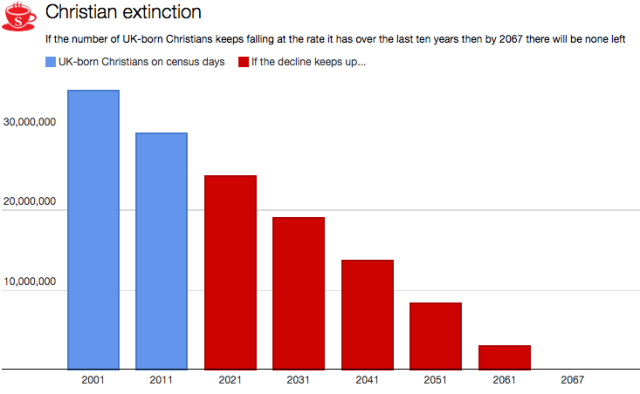
noneThe arrival of the “post-Christian” Western world is ahead of schedule. Great Britain just passed the point where those with “no religious preference” actually outnumber those who profess to be Christians.

With Europe leading the way, can North America be far behind?

You know what makes this even more shocking? The results come from a survey where all the people claiming to be disciples of Jesus needed to do, was simply check a box. One wonders how many among that 48% would still claim to be Christians if they lived in Iraq.

Ponder for a moment the sobering title of an article in London’s The Spectator.

“Britain Really is Ceasing to be a Christian Country.”

The secularization of the United Kingdom was a matter of great concern to C.S. Lewis. And this erosion was well underway during his lifetime.

The truth is that although Lewis excelled as a Christian apologist (defender of the faith), it was not a role he coveted. He much preferred to write speculative fiction, literary criticism and devotional works.

Yet, because the need to reach people with the simple truth of the Gospel had grown so dire, Lewis felt forced to offer a persuasive rationale for belief. Consider the following description of his self-understanding. These words were written in response to a public attack of his work by a theologian. The final sentence bears directly on the subject of this column.

When I began, Christianity came before the great mass of my unbelieving fellow-countrymen either in the highly emotional form offered by revivalists or in the unintelligible language of highly cultured clergymen.

Most men were reached by neither. My task was therefore simply that of a translator—one turning Christian doctrine, or what he believed to be such, into the vernacular, into language that unscholarly people would attend to and could understand. For this purpose a style more guarded, more nuance, finelier shaded, more rich in fruitful ambiguities . . . would have been worse than useless. It would not only have failed to enlighten the common reader’s understanding; it would have aroused his suspicion. He would have thought, poor soul, that I was facing both ways, sitting on the fence, offering at one moment what I withdrew the next, and generally trying to trick him.

I may have made theological errors. My manner may have been defective. Others may do better hereafter. I am ready, if I am young enough, to learn. Dr. Pittenger would be a more helpful critic if he advised a cure as well as asserting many diseases. How does he himself do such work? What methods, and with what success, does he employ when he is trying to convert the great mass of storekeepers, lawyers, realtors, morticians, policemen and artisans who surround him in his own city? One thing at least is sure.

If the real theologians had tackled this laborious work of translation about a hundred years ago, when they began to lose touch with the people (for whom Christ died), there would have been no place for me. (“Rejoinder to Dr. Pittenger”)

It is the duty of each generation of Christians to share the faith with their neighbors. Likewise, it is the responsibility of each new generation of clergy to teach faithfully . . . and to live a God-pleasing life.

Whenever we fail to tackle the “laborious work of translation,” God is able to raise up another to do it. Still, men and women of the caliber of C.S. Lewis are few and far between.

May God have mercy on Britain, America, and all of those lands where we have taken for granted the heritage of faith bequeathed to us.

_____

If this subject interests you in the least, take a moment to read “Having Pity on Pittenger.” Anglican priest Dwight Longenecker describes a chance encounter with Dr. Pittenger decades after Lewis’ death.

I was alerted to this news account by Gene Veith’s fine blog, Cranach. The good doctor does an outstanding job of bringing newsworthy stories to the attention of those interested in Church and State relations.

C.S. Lewis’ Personality

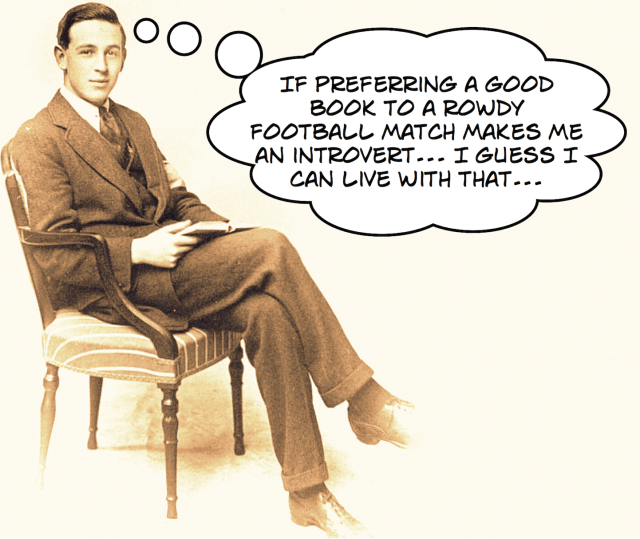
csl introvertLearning about ourselves is a lifelong quest. And the more actively we pursue self-knowledge, the wiser we become.

A well known sixteenth century Christian mystic wrote:

“Self-knowledge is so important that even if you were raised right up to the heavens, I should like you never to relax your cultivation of it.” (Saint Teresa of Ávila, Interior Castle).

This self-knowledge leads to a greater recognition of our dependence on God. She continues, “so long as we are on this earth, nothing matters more to us than humility. . . . As I see it, we shall never succeed in knowing ourselves unless we seek to know God: let us think of His greatness and then come back to our own baseness; by looking at His purity we shall see our foulness; by meditating on His humility, we shall see how far we are from being humble.”

C.S. Lewis echoes this sentiment.

If anyone would like to acquire humility, I can, I think, tell him the first step. The first step is to realise that one is proud. And a biggish step, too. At least, nothing whatever can be done before it. If you think you are not conceited, it means you are very conceited indeed. (Mere Christianity).

As part of my self-examination, I have recently revisited my “personality type” as assessed by the well known Myers Briggs Personality Indicator (MBTI).

Without over-explaining the MBTI, it measures an individual’s preference related to four ways by which we experience and make sense of the world. (News Flash: Not everyone perceives reality the same way!)

These dichotomies are:

Extraversion (E) or Introversion (I)

Whether your preferred focus is outward or inward.

Sensing (S) or Intuition (N)

How you focus on information and process it.

Thinking (T) or Feeling (F)

Primary preference in your decision-making.

Judging (J) or Perceiving (P)

Your orientation towards making sense of existence.

You can get some additional authoritative information here. There are also numerous “unofficial” websites related to the subject.

Sixteen combinations are possible, and each has its respective strengths. (None are “better” than others, of course, since we’re all created in the image of God.)

Speaking of which, I’ve also been studying the different combinations that are more common to Christian ministers than they are within the general population.

For example, the following types (with their shorthand title) range from two to six times more common for male clergy than the general male American population:

ENFJ (The Teacher)

ENFP (The Provider)

INFP (The Healer)

INFJ (The Counselor)

ENTJ (The Field Marshal)

Which type of pastor do you prefer?

Online Surveys to Visit after you finish this post

There are a number of free MBTI-type tests online. Naturally, they are not as reliable as the official inventory given through a certified provider. Nevertheless, the following sites did render accurate assessments for me, based on my formal scoring.

I have mentioned in the past that I am an *NTJ… with the asterisk representing that my I/E preference is too close to call. A previous post shows how that makes me a blend of Middle Earth’s Elrond and Théoden.

Humanmetrics Jung Typology Test

CelebrityTypes Personality Type Test

So, What Is C.S. Lewis’ Personality Type?

This is a subjective question. The MBTI is a self-reported assessment, so guessing the type of another person is by nature dicey.

In Lewis’ case, however, there is a fair degree of consensus. This is due to his openness about his personal life and his extensive writings. The general agreement does not mean though that there are not minority opinions.

The most common argument is that C.S. Lewis was INTJ. I find the reasons persuasive, and not just because it matches my own type!

One student of the subject says “Check out this quote—how INTJ is this?!”

Five senses; an incurably abstract intellect; a haphazardly selective memory; a set of preconceptions and assumptions so numerous that I can never examine more than a minority of them—never become even conscious of them all. How much of total reality can such an apparatus let through? (A Grief Observed)

One blogger writes, “There is no doubt in my mind that Lewis was an INTJ. It seeps off all his writing and is blatant in his behavior in all of his biographies.” She continues:

Highly imaginative child who lived in a dream world? Check.

Someone highly emotional/sensitive but that never showed it on the surface? Check.

A prolific writer who blazed through finishing projects at an astounding rate, who was so successful at everything he did, despite never having done it before, that he quickly rose to the top? Check.

Another site considers both C.S. Lewis and his fellow inkling J.R.R. Tolkien to be INFPs. The aptly titled CelebrityTypes.com offers a brief selection of quotations to illustrate the reasons for their identification.

If the site’s identifications are accurate, the two are in good company. Other writers include John Milton, Augustine of Hippo, Hans Christian Andersen, William Shakespeare, Søren Kierkegaard, George Orwell, A.A. Milne, Edgar Allan Poe, William Blake, J.K. Rowling and George R.R. Martin.

A Warning from Lewis Himself

Understanding ourselves better than we already do, is a good thing.

Being overly curious about the personality of someone who is deceased is another matter. Lewis’ point in the passage that follows is that such concerns must never supersede our regard for others, in the spirit of Matthew 8:22.*

There is a reaction at present going on against the excessive love of pet animals. We have been taught to despise the rich, barren woman who loves her lap dog too much and her neighbor too little. It may be that when once the true impulse is inhibited, a dead poet is a nobler substitute than a live Peke, but this is by no means obvious.

You can do something for the Peke, and it can make some response to you. It is at least sentient; but most poetolaters [worshippers of poets] hold that a dead man has no consciousness, and few indeed suppose that he has any which we are likely to modify. Unless you hold beliefs which enable you to obey the colophons of the old books by praying for the authors’ souls, there is nothing that you can do for a dead poet: and certainly he will do nothing for you. He did all he could for you while he lived: nothing more will ever come.

I do not say that a personal emotion towards the author will not sometimes arise spontaneously while we read; but if it does we should let it pass swiftly over the mind like a ripple that leaves no trace. If we retain it we are cosseting with substitutes an emotion whose true object is our neighbour.

Hence it is not surprising that those who most amuse themselves with personality after this ghostly fashion often show little respect for it in their parents, their servants, or their wives. (The Personal Heresy: A Controversy).

Reflecting on our own nature, and pondering the personalities of those we respect, are worthwhile activities. However, it’s best to remember that all we can see are mere glimpses into the depths of who we truly are.**

_____

* Matthew 8:22 quotes Jesus’ response to a disciple who demurred that he could not follow the Lord until after he attended to his father’s burial. “And Jesus said to him, ‘Follow me, and leave the dead to bury their own dead.’”

** As Paul words in Romans 8:27 are paraphrased in The Message Bible: God “knows us far better than we know ourselves . . .”

I Don’t Need No Forgiveness

repentanceC.S. Lewis foresaw one of the greatest plagues of the post-modern world. He knew that humanity’s insistence on its own “goodness” would undermine our love for God

Believing the lie that we do not require forgiveness causes us to rely on a deception that will ultimately disappoint. As Lewis wrote, “a man who admits no guilt can accept no forgiveness” (The Problem of Pain).

In the United States we have a sad propensity to worship celebrity. Famous people possess an allure that many find irresistible.

I am amazed so many people who lived for American Idol never recognized the irony of the program’s name.*

I suspect most famous people recognize fame’s fickle and fleeting nature. Some avoid the dangers of fame’s flames, but many rush headlong into the furnace.

Some allow the illusory nature of celebrity to deceive them into thinking they rise above the concerns of normal human beings. Why, you might even find one of them professing to be a Christian while denying the very core of the faith.

One of our presidential candidates (unnamed here, because this post is not about politics) went so far as to profess his love for God and when asked if he has ever asked God for forgiveness responded, “I am not sure I have. I just go on and try to do a better job from there. I don’t think so. . . . I don’t bring God into that picture.”**

It is vitally important for all of us to understand that (1) we need forgiveness and (2) God is eager to extend it to us.

Most Christians understand this.

It is second nature, for example, to orthodox Lutherans. Lutheran preaching is based on the Law/Gospel dialectic. While it’s often short on the “How Then Shall We Live?” counsel, it goes to great lengths to avoid any intermingling of the Law and the Gospel.

This sharp divide between the two is proclaimed throughout the Scriptures, but clearly seen in the following passage: “For the wages of sin is death, but the free gift of God is eternal life in Christ Jesus our Lord” (Romans 7:23).

A proper understanding of the Law, and our sinfulness, lays the solid foundation for understanding the Gospel. It declares we cannot—under any circumstances—rescue ourselves.

“None is righteous, no, not one; no one understands; no one seeks for God. All have turned aside; together they have become worthless; no one does good, not even one. . . . But now the righteousness of God has been manifested apart from the law, although the Law and the Prophets bear witness to it the righteousness of God through faith in Jesus Christ for all who believe. For there is no distinction: for all have sinned and fall short of the glory of God, and are justified by his grace as a gift, through the redemption that is in Christ Jesus, whom God put forward as a propitiation by his blood, to be received by faith. (Romans 3:10-12, 21-25).

Or, as the Apostle John cautions us: “If we say we have no sin, we deceive ourselves, and the truth is not in us. 9 If we confess our sins, he is faithful and just to forgive us our sins and to cleanse us from all unrighteousness. 10 If we say we have not sinned, we make him a liar, and his word is not in us” (1 John 1:8-10).

I need not belabor here our need for God’s mercy. God help those who choose to rely on their own corrupt “holiness!”

C.S. Lewis’ Take on Rejecting Mercy

In one of Lewis’ most amazing books, The Great Divorce, he addresses a common excuse for atheism. How could a loving God allow Hell to exist? He illustrates with a number of fascinating vignettes the sad truth.

There are only two kinds of people in the end: those who say to God, “Thy will be done,” and those to whom God says, in the end, “Thy will be done.” All that are in Hell, choose it. Without that self-choice there could be no Hell. No soul that seriously and constantly desires joy will ever miss it. Those who seek, find. Those who knock, it is opened.

My favorite encounter in the book involves a liberal, atonement-denying theologian, but there is another that perfectly illustrates the point of this column.

We all require mercy.

One of the lost souls has been approached by a redeemed saint who attempts to persuade him to continue journeying towards the presence of God. It so happens that the “ghost” (as the insubstantial disbelievers are called, knew the forgiven man while both were alive. And the redeemed person had committed murder. The perceived “injustice” of the forgiveness of that sin only reinforces the intransigence of the ghost towards God’s mercy.

‘Look at me, now,’ said the Ghost, slapping its chest (but the slap made no noise). ‘I gone straight all my life. I don’t say I was a religious man and I don’t say I had no faults, far from it. But I done my best all my life, see? I done my best by everyone, that’s the sort of chap I was. I never asked for anything that wasn’t mine by rights. If I wanted a drink I paid for it and if I took my wages I done my job, see? That’s the sort I was and I don’t care who knows it.’

‘It would be much better not to go on about that now.’

‘Who’s going on? I’m not arguing. I’m just telling you the sort of chap I was, see? I’m asking for nothing but my rights. . . . But I got to have my rights same as you, see?’

‘Oh no. It’s not so bad as that. I haven’t got my rights, or I should not be here. You will not get yours either. You’ll get something far better. Never fear.’

‘That’s just what I say. I haven’t got my rights. I always done my best and I never done nothing wrong. . . . I’m only telling you the sort of chap I am. I only want my rights. I’m not asking for anybody’s bleeding charity.’

‘Then do. At once. Ask for the Bleeding Charity. Everything is here for the asking and nothing can be bought.’

‘That may do very well for you, I daresay. If they choose to let in a bloody murderer all because he makes a poor mouth at the last moment, that’s their look out. But I don’t see myself going in the same boat as you, see? Why should I? I don’t want charity. I’m a decent man and if I had my rights I’d have been here long ago and you can tell them I said so.’

Every time I read those words I am reminded of the truth that I am not a perfect man . . . I don’t want to pay the price the Law demands . . . I want, and need, to receive the bloody Charity of God that flowed from the wounds of my Lord on Golgotha.

It is my hope and prayer that you share this joy with me.

_____

* Yes, I realize it was based on a British show with a similar title; that may suggest that some other Western nations succumbed even more dangerously to secularism than America. Talent competitions make fine entertainment, but a little more thought should have gone into naming the two series.

** Ironically, this individual professes to be Presbyterian, and I am confident that if Calvin were still alive, he would have a few facts he would like to teach him.

Not Wholly Contemptible

cornwallisEveryone loves a compliment. Allow me to rephrase that. Most people appreciate a sincere compliment when it is genuinely flattering.

Actually, “flattering” isn’t a good word choice here. Flattery has a bad rep. The way it’s currently used, it hints of exaggeration and manipulation.

So let’s return to the concept of “compliments” in general. Most, we know, are welcome. It’s nice to have someone tell us we did a commendable job or had a good idea.

Then there are those less sincere “compliments” that require a bit of intelligence or wit to offer. The go by different names, but are commonly referred to as “left-handed compliments” or “backhanded compliments.”

This type of statement might sound on its surface like a compliment, but includes an element that undermines the praise. The Urban Dictionary offers the following example:

“Boy, you’re pretty hot . . . for a fat (or skinny) chick!”

Now, that is nothing but an insult. And it’s an insult of the crassest variety. One that demands no wit at all.

The British, on the other hand, are often capable of offering highly refined backhanded compliments.

I just came across a delightful one, delivered by the commander of the King’s forces during America’s War of Independence. What makes this exquisite is that it was offered in the wake of the general’s defeat at the close of the war.

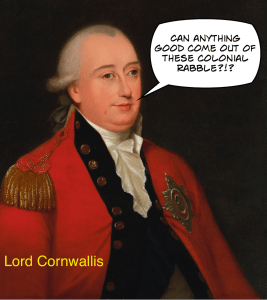
When finally brought to heel at Yorktown, Lord Cornwallis reported, “I will not say much in praise of the Militia of the Southern Colonies, but the list of British officers and Soldiers killed or wounded by them since last June, proves but too fatally that they are not wholly contemptible.”

You can read more about the context for that statement in an excellent article about the American legacy of “citizen soldiers” published in Hallowed Ground magazine. This excellent journal is published by the Civil War Trust, which works diligently to preserve battlefields from the Civil War. They have recently expanded those efforts to include the Revolutionary War.

C.S. Lewis & Compliments

Lewis included backhanded compliments in his fictional works. Two simple examples follow. The first is found in The Screwtape Letters, where the tempter frequently commends the skill of God (“the Enemy”) in redeeming the lost.

Never forget that when we are dealing with any pleasure in its healthy and normal and satisfying form, we are, in a sense, on the Enemy’s ground. I know we have won many a soul through pleasure. All the same, it is His invention, not ours.

Here is an offhanded compliment that Lewis places on the lips of Prince Corin in The Chronicles of Narnia. He is asked where Queen Susan is, on the eve of a battle and he responds like a typical young boy (which he still is at the time). He praises the martial spirit of her sister, Queen Lucy, who is a young adult at this point in the series.

At Cair Paravel. She’s not like Lucy [her sister who is in the ranks of the archers], you know, who’s as good as a man, or at any rate as good as a boy. Queen Susan is more like an ordinary grown-up lady. She doesn’t ride to wars, though she is an excellent archer. (The Horse and His Boy).

The late Bruce Edwards described how C.S. Lewis offered H.G. Wells a backhanded compliment. He did so by following the structure of Wells’ works, but devoting them to a vastly different philosophical purpose.

In Out of the Silent Planet (1938), Lewis adapted the general plot outline from H.G. Wells’s First Men in the Moon in order to tell an essentially anti-Wellsian tale. In Perelandra, Lewis pays a similar backhanded compliment to the man he admired as a speculative writer, but not as a philosopher.

The broad narrative structure of Perelandra resembles another novel by H.G. Wells, The Time Machine (1895). . . . In Wells’s novel, this narrative outline provides the basis of a quasi-Marxist fable about effete bourgeoisie and surly proletariat. In Lewis’s hands, a similar story structure tells a very different tale, one in which the ultimate battles are not economic and political, but rather cosmic and spiritual. (C.S. Lewis: Fantasist, Mythmaker, and Poet).

Compliments: the Good & the Bad

Lewis’ use of Wells’ science fiction template was not meant to slight him. It was actually a tribute. Likewise, in the examples from his fiction, Lewis is simply representing (effectively) the attitudes of the speakers.

Returning for a moment to the abject General Cornwall, we recognize as well the grudging nature of his praise of the enemy. They were certainly rabble—possessing no great military skill, in his estimation. Yet, in terms of bringing the army of the greatest power in the world at that time to its surrender, “they are not wholly contemptible.”

And that, when it came to winning the war, apparently proved quite sufficient.

Puppies in Heaven

pupWill dogs and other fauna have a place in the new creation? It’s an interesting—and controversial—subject.

I just reread a delightful essay in which the author, an Orthodox theologian, describes a debate he had with a Roman Catholic scholastic on the subject.* I enjoyed the following description of the discussion so much that I had to share it.

I was once told by a young, ardently earnest Thomist . . . you know, one of those manualist neo-paleo-neo-Thomists of the baroque persuasion you run across ever more frequently these days, gathered in the murkier corners of coffee bars around candles in wine bottles, clad in black turtlenecks and berets, sipping espresso . . . this young Thomist told me that not only could my dog not love me (since he lacks a rational nature), but I could not love my dog (something about there needing to be some rational equality between lover and beloved).

Now, while I admitted that I could only presume the former claim to be incorrect . . . I was adamant that I could be absolutely certain of the falsity of the latter. But my friend was not deterred: “Oh, no,” he insisted, “you don’t really love him; you just think you do because of your deep emotional attachment to him.”

Of course. Foolish of me. Leave it to a two-tier Thomist to devise a definition of love that does not actually involve love. If you can believe in pure nature, I suppose you can believe anything.

{More on the question of animals in paradise below . . .}

Debates (civilized variants of arguments) can be fascinating when they are dissected and examined. Theological debates are particularly enthralling.

C.S. Lewis appreciated the value of debate in sharpening one’s position. This approach to learning can be traced back to the Socratic Method, which is based upon asking and answering questions.

In 1941, the Oxford Socratic Club was formed to “follow the argument wherever it led them.” C.S. Lewis was its first president (faculty sponsor), serving until 1955 when he moved to Cambridge University. In the first issue of the Socratic Digest, Lewis wrote:

In any fairly large and talkative community such as a university, there is always the danger that those who think alike should gravitate together into coteries where they will henceforth encounter opposition only in the emasculated form of rumour that the outsiders say thus and thus.

The absent are easily refuted, complacent dogmatism thrives, and differences of opinion are embittered by group hostility. Each group hears not the best, but the worst, that the other groups can say.

Some of the debates conducted by the club were legendary. You can read a fine article about these “University Battles” here.

Returning to the Question of Animals in Heaven

I wrote on this subject several years ago. That post is worth checking out if only for the amazing graphic that graces it.

You can read my own perspective on the question there, if you are interested.

Today I wish to end, instead, with the summary of my kindred spirit, who debated the philosopher.

The final sentence in this next section is priceless.

The occasion of the exchange, incidentally, was a long and rather tediously circular conversation concerning Christian eschatology. My interlocutor was an adherent to a particularly colorless construal of the beatific vision, one that allows for no real participation of animal creation (except eminently, through us) in the final blessedness of the Kingdom; I, by contrast, hope to see puppies in paradise, and persevere in faith principally for that reason.

His sentiment reminds me of C.S. Lewis’ thoughts in Mere Christianity.

I sometimes like to imagine that I can just see how it might apply to other things. I think I can see how the higher animals are in a sense drawn into Man when he loves them and makes them (as he does) much more nearly human than they would otherwise be.

Hart offers another delightfully sarcastic comment about the weight of different authorities the two debaters were citing. And with that observation, we shall end.

On his side, all the arguments were drawn from Thomas and his expositors; on mine, they were drawn from Scripture; naturally, limited to the lesser source of authority, I was at a disadvantage. . . . [arguing] that the biblical imagery of the redeemed state is cosmic in scope and positively teeming with fauna (lions lying down with lambs and such)—that Paul’s vision of salvation in Romans 8 is of the entirety of creation restored and glorified—things of that sort. All in vain, though; nothing I said could rival the dialectical force of his ringing sic Thomas dixit [so Thomas said].

_____

* The author, David Bentley Hart, is not anti-Catholic. In fact, he has taught at several Roman Catholic universities. The article quoted appears here.


Trivial Finale

catechicAll good things must draw to an end . . . and so it is that we wrap up our running review of interesting trivia questions from Catéchic, “the Catholic trivia game” by Tyco®.

Today we move beyond the miscellaneous historical and ecclesiastical subjects we have thus far considered. Prepare yourself for some serious literary and theological matters.

There were a fair number of questions asked about literary matters. Most related to authors (religious and secular) I have never read. However, some were of greater interest to me.

Who wrote the religious sonnet “Death Be Not Proud?”

John Donne

I hadn’t read that classic poem for years, and I’m grateful to the game for encouraging me to pause to reread it. If you are unfamiliar with this timeless verse, you can read it here.

Was the Gutenberg Bible the first book to be printed?

No. (Printing already existed in China.)

Actually, printing via woodblocks existed in various places. The great breakthrough came in the development of moveable type, and it did indeed exist in China before Gutenberg refined it in the West.

Was the first Bible printed in the New World in the English language?

No. (Algonquian, the predominant language of Northeastern Native Americans)

Now there is an edifying fact which reminds us of the importance of sharing the Good News with all people

Which alphabet is named after a saint?

The Cyrillic alphabet, developed by St. Cyril

And, ironically, used most prominently in the formerly atheistic republics of the Soviet Union.

A triad of questions about Roman Catholic periodicals.

What newspaper is generally thought of as the most liberal American Catholic weekly?

The National Catholic Reporter

Something I believe they are quite proud of. They offer online news here.

What newspaper is generally thought of as the most conservative American Catholic weekly?

The Wanderer

I had never heard of this lay publication, but you can read it online here.

How much does an issue of The Catholic Worker cost?

One cent

Amazing. I disagree with most of its political positions, but I have to admire the statement they make in continuing this practice.

The Catholic Worker newspaper is not online. Subscription or copy requests must be sent by regular mail . . . The newspaper was started by Dorothy Day herself in New York City in the 1930s. The price has been and will remain a penny a copy, excluding mailing costs. It is issued seven times per year and a year’s subscription is available for 25 cents (30 cents for foreign subscriptions) . . .

When the game addresses Roman Catholic history and dogma, it stays close to doctrinal boundaries. However, when it addresses interfaith and “Protestant” subject matter, it raises some issues which require comment.

Saint Olaf is the patron saint of which country?

Norway

I had to include this because my own heritage is half Norwegian. This despite the fact that dear Olaf was free in his use of the sword as an instrument for converting the Norse heathen. My hometown is Poulsbo, Washington, and its nickname is “Little Norway.” It is no surprise Poulsbo’s Roman Catholic parish is named in honor of Saint Olaf.

As far as we know, who erected the first Christian cross in the New World?

Christopher Columbus

Perhaps, but the first Christians setting foot in the so-called New World were likely Leif Erikson and those who accompanied him on the voyage from Greenland.

Name the politically influential American Catholic family sometimes known as “America’s Royal Family?”

The Kennedys

Although sadly some prominent Kennedys have not lived and served in a manner consistent with their religious profession.

As a Lutheran Christian, I was particularly eager to discover what sort of questions dealt with so-called “Protestant” matters. Here are a couple, with my personal observations added:

Before the Protestant Reformation, how many Christian Churches were there?

Two, Catholic and Orthodox

Sorry, only one. Both Roman Catholic and Eastern Orthodox communions confess a belief that there is only “one, holy, catholic and apostolic church.” It’s true that there was a schism* between the two, but there remains only one Christian Church, comprised of all who “believe and are baptized.”

During the 19th century, what Protestant group played a key role in settling the American West?

Church of Jesus Christ Latter-Day Saints (The Mormons)

The LDS Church is a distinct religion in and of itself. They would not regard themselves as “Protestant,” nor would Trinitarian Protestant traditions regard the LDS religion as belonging under that admittedly stretched label.

What is a member of any of the various Protestant groups characterized by their rejection of military service called?

A Mennonite

Hmmm . . . it’s a bit more complicated than that. Various Christian denominations (e.g. Quakers) discourage military service, along with non-Christian religions (e.g. Jehovah’s Witnesses). They, along with other individuals from more traditional church bodies whose consciences prevent them from serving in the armed forces, are more accurately called “pacifists.”

What was condemned as heresy at The Council of Trent?

The teachings of Protestant reformers such as Martin Luther.

And then there are those who would consider the Council of Trent itself to be a fount of heresy . . .

For which institution did Johann Sebastian Bach write his magnificent cantatas?

The Lutheran Church in Leipzig.

A gracious (ecumenical) acknowledgment of a musical genius who composed his works “soli Deo gloria.”

It will surprise no regular readers of Mere Inkling to see that we are closing with another reference to our favorite Inkling.

Which British author of children’s fantasies wrote an allegory about the Devil called The Screwtape Letters?

C.S. Lewis

One of C.S. Lewis’ masterpieces. I have blogged on them in the past, as the search bar to the right will reveal. Here is one column I’m particularly proud of, since it contributes a new piece of correspondence to the Screwtape corpus.

_____

* Schism is one of the most mispronounced words in the English language. Although “skizuh m” has become so commonplace that it is now “accepted,” the proper pronunciation is “sizuh m.” Of course, if you say it correctly everyone will think you are wrong . . . just like when you leave the “s” off of the biblical book of Revelation or properly pronounce psalm without the “l” (“sahm” instead of “salhm”).

If you missed the first two columns dealing with Roman Catholic trivia, you can check them out here: A Trivial Windstorm and Curious Christian Trivia.

Curious Christian Trivia

beatlesHow many of these Christian trivia questions can you answer?

In my last post I shared a number of fascinating facts that I learned reviewing Catéchic, “the Catholic trivia game” by Tyco®. Read on and discover some intriguing information about the history and theology of the largest denomination in the Christian world.

How are the following for odd facts?

Question: What Iowa city has a name which means “of the monks” in French?

Answer: Des Moines

Here in Washington State we have city named Des Moines (pronounced with the final “s”) which is named after the Iowa township and not the monks who first helped established it.

What New York museum was built entirely from stones of Christian shrines imported from France by John D. Rockefeller?

The Cloisters

Leave it to the Americans to denude a country of their historic shrines to aggrandize a civil monument to a political dynasty.

Was St. Patrick Irish?

No

Now there’s a fact with which many Irishmen would take umbrage. The truth is, of course, that Patrick was Romano-British, enslaved by the Irish, who willingly chose to return to Ireland after his liberation to share the Gospel with his former captors.

The game includes a fair representation of literary questions. Two of them even deal with the esteemed author of The Chronicles of Narnia. Just one for now, with the promise of more literary insights in my next, and final, column about trivia.

Who is the Anglican children’s author that wrote the apologia The Case for Christianity?

C.S. Lewis

I can overlook the inappropriately limiting label “children’s author” since they have had the wisdom to include this reference to the Oxford don.

Students of history, including recent history, will have an advantage in answering the following questions.

Who designed the colorful uniforms of the Swiss Guard at the Vatican?

Michelangelo

They still look dandy. Fortunately for the security of the Papal See, they have advanced from relying on pikes to using modern weaponry.

Who was the most famous Bishop of Hippo?
Saint Augustine

Who in the world could name any other Bishop of Hippo?

Besides Richard M. Nixon, what other U.S. president was a Quaker?

Herbert Hoover

Didn’t know that. And, as memorable as Herbert Hoover was, I fear I’ve already forgotten . . .

Who was the Catholic, four-term mayor of Chicago known as “Boss?”

Richard J. Daley

Ugh. Two dishonest politicians in a row! I don’t believe I would want to claim Daley as a Roman Catholic if I was one . . . or Nixon as a Quaker, if I professed that creed.

According to the Beatles song “Let It Be,” who whispers words of wisdom?

Mother Mary

This must have been before the Beatles jettisoned any lip service to Christianity, claimed their renown exceeded that of Jesus, and entrusted their spiritual destiny to the philosophy of Maharishi Mahesh Yogi.

Naturally the questions include a variety of details about Roman Catholic faith and practices themselves.

Should Catholics genuflect whenever they enter a Catholic Church?

No, only if the blessed Sacrament is present in the church.

Interesting. I had never thought about it, but it makes sense, since the obeisance is actually being offered to Jesus, present in the consecrated elements.

For what group is the annual Red Mass celebrated?

Lawyers

Observation: What? Whose idea was that, and do Roman Catholics grace all other professions with their own dedicated masses? If so, what color Masses are dedicated to insurance brokers, microbiologists and wig makers?

What was the name of the portable throne once used to carry the pope so that everyone could see him?

Sedia Gestatoria

Replaced by the bulletproof Popemobile.

When was the last time that a pope proclaimed a Catholic teaching infallible?

1954 (the Assumption, Pope Pius XII)

A good reminder to countless misguided Protestants who think Roman Catholics believe that most or all of what the popes say is “infallible.” The lesson would be better taught, however, if the cited instance was not for an extra-biblical doctrine with which most Protestants strongly disagree.

What is the day on which Judas received his payment for betraying Jesus sometimes called?

Spy Wednesday

That’s a new one for me, but it sounds like a great title for a new movie about the wayward disciple.

Who was the first Roman Emperor to convert to Christianity?

Constantine the Great

It is good to see Constantine’s conversion affirmed here, although it is often maligned by critics. (Constantine was a child of his brutal age and after his conversion remained an imperfect sinner, just like the rest of us.) Only in the Eastern (Orthodox) Church is Constantine acclaimed a saint.

I will end with a question that holds a special place in my life, since I have spent the majority of my public ministry as a military chaplain.

What was the name of the Catholic chaplain on the TV show M*A*S*H?

Father Mulcahy

My favorite chaplain. I had the “blessed” experience of interviewing him for an article. I posted on William Christopher here and you can download a copy of the interview here.

A Trivial Windstorm

bellsIt’s amazing what we can accomplish during a multi-day power outage. Over the Thanksgiving holiday I learned a few new religious tidbits you may find interesting as well.

Several years ago I obtained a copy of Catéchic, “the Catholic trivia game” by Tyco®. While the power was out, I read all 1,000 trivia questions. It proved to be an interesting diversion.

The question of whether or not considering trivialities is a waste of time was addressed by C.S. Lewis at the outset of WWII.

Every Christian who comes to a university must at all times face a question compared with which the questions raised by the war are relatively unimportant. He must ask himself how it is right, or even psychologically possible, for creatures who are every moment advancing either to heaven or to hell, to spend any fraction of the little time allowed them in this world on such comparative trivialities as literature or art, mathematics or biology. (The Weight of Glory)

Lewis’ point is well made. When we contrast the matters which occupy our minds and energies with the things we ignore—including our eternal destiny and whether we are drawing closer to our Creator or drifting farther from him—the things of this world grow dim.

Perhaps that will be slightly less true in the case of trivia gleaned from the history of the largest denomination in the Christian Church.

Test Your Knowledge

A few questions were dated, not surprising I suppose, since the game was copyrighted in 1991. What was surprising is why they would choose to include questions about the names of prominent American archbishops of that decade, knowing it would date the product.

Question: Who is the Archbishop of San Antonio, Texas?

Answer: Archbishop Patrick Flores

Comment: He was historic, being the first Roman Catholic bishop of Mexican American heritage, and service as archbishop was lengthy (1979-2004), but the question as posed has passed its expiration date.

Name the Native American woman who may soon be canonized.

Blessed Kateri Tekakwitha

Tekakwitha (1656-1680) was canonized in 2012 and led a tragically short but interesting life. She was an Algonquin-Mohawk, the first Native American to be canonized.

Most other questions remain valid.

What is the name of Emperor Constantine’s decree that legalized Christianity in the Roman Empire in 313 A.D.?

The Edict of Milan

Bravo. As a student of ancient history and a Constantinian numismatist, I am pleased to see this vital moment in church history acknowledged.

Was St. Francis of Assisi a priest?

No

Good one! Most of us who’ve studied medieval history would probably get that right, but I assume the majority of Christians (Protestants, Catholic and Orthodox) would likely err on the side of ordaining Francis.

Which pope authorized the use of torture during the Inquisition?

Innocent IV

The irony of his chosen papal name is almost torturous. Admittedly, it was an improvement on his given name, Sinibaldo Fieschi.

A fair number of questions about ecclesiastical paraphernalia appear. To advance in the game, it helps to know your patens, piscina, and cinctures from your purificators, pyxes and cruets.

Is a “stermutatory” a piece of furniture found in a church?

No. A stermutatory is something that makes you sneeze.

That said, if some of the pews have grown so musty that they aggravate worshipers’ allergies, wouldn’t they qualify?

Some of the trivia provides arcane information sure to surprise one’s peers.

What is a cardinal who observers believe may have a chance of becoming pope called?

Papabile.

Nice to know . . . Now I just have to think of a way to work that into a typical conversation.

Seriously, using a word like this to show off one’s knowledge of obscure things reminds me of a passage I read many years ago attributed to St. Hereticus.* It offers satirical advice on how to upstage others in religious conversations.

The Superior Knowledge Gambit (not for beginners). Easier to illustrate than explain:

Opponent: I think my interpretation of the church has full historical precedent in Augustine.

Self: (starting hesitantly, but gradually gaining assurance until the final words are spoken with complete authority, in an ex cathedra tone of voice): But surely, much as I admire your exposition, really now, which interpretation of Augustine’s do you mean? There are at least five (eyes to the ceiling for a brief moment of counting), yes five . . . (pause, then confidently) There are at least five interpretations of the church in Augustine’s extant writings. (Give ever so slightly more emphasis to the word “extant.”)

. . .

Help from St. Augustine. A quiet yet forceful way of demonstrating superiority when Augustine is under discussion is to pronounce his name in contrary fashion to the pronunciation of Opponent. Make a point of emphasizing the contrast, so that it will be apparent that you know you are right, and that not even for politeness’ sake will you pronounce the name incorrectly as Opponent is doing. Either,

Opponent: . . . leading ideas in Augustine.”

Self: Augustine may have said that on one or two occasions, but . . .

Or,

Opponent (usually an Anglican in this case): . . . leading ideas in Augustine.

Self:Augustine may have said that on one or two occasions, but the whole Augustinian tradition, following, as I believe, the essential Augustine himself . . .

In this second gambit, it is advisable to maneuver the conversation into a discussion of “the Augustinian tradition” as indicated, so that when Opponent refers to it, as he must, without pronouncing it “the Augustinian tradition,” you can smile deprecatingly, to indicate your point has been made.

Well, that is enough trivia for one day. In my next post I’ll discuss some more substantial literary and theological concerns that emerge in the questions. Until then, one final trifle to entertain.

What 1975 film tells the story of King Arthur’s search for the Holy Grail as a comedy?

Monty Python and the Holy Grail

Some Python humor is too irreverent (or even blasphemous**) for my tastes, but this historic fantasy is one of my guilty pleasures. (I especially love the Killer Rabbit of Caerbannog which can only be dispatched by the “holy hand grenade of Antioch.”)

_____

* The Collected Writings of St. Hereticus by Robert McAfee Brown. An irreverent look at many aspects of ecumenical life in the mid twentieth century.

** Some (perhaps much) of the Python corpus leans towards vulgarity, but if you still enjoy the humor—and you are offended by blatant blasphemy, avoid reading the lyrics to their song, “All Things Dull and Ugly.”

There is a more positive connection between Monty Python and C.S. Lewis, however. John Cleese recorded The Screwtape Letters in 1995, lending his voice to the devilish “author” of the correspondence.

Using Your Entire Brain

Brain1
Have you ever wondered just how much of your own brain you effectively use?

Unfortunately, the percentage of our brains harnessed for daily work remains a bit of a mystery, based upon unproven theories.

One thing is certain though—the frequently repeated notion that human beings only utilize 10% of their brains is nonsense. Despite the fact that this myth has never been supported by scientists, it has gained a proverbial life of its own.

Though an alluring idea, the “10 percent myth” is so wrong it is almost laughable, says neurologist Barry Gordon at Johns Hopkins School of Medicine . . .*

Another neurologist adds another interesting perspective.

Although it’s true that at any given moment all of the brain’s regions are not concurrently firing, brain researchers using imaging technology have shown that, like the body’s muscles, most are continually active over a 24-hour period. “Evidence would show over a day you use 100 percent of the brain,” says John Henley, a neurologist at the Mayo Clinic . . .

Which Half Runs the Show?

Assuming you use nearly all of the gray and white matter stuffed in your cranium, there is another question that begs an answer. Which hemisphere is dominant?

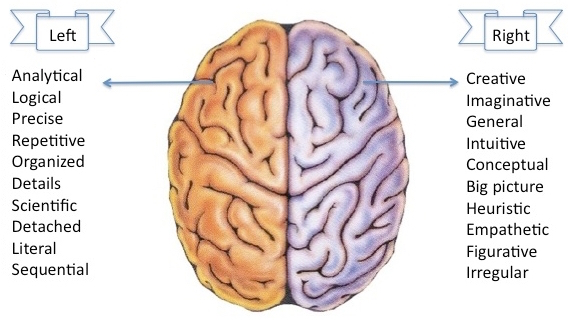
Medical scientists have identified numerous mental functions with particular regions of the brain. As the illustration above suggests, because of that the human mind relies on different hemispheres for different activities.

Most of us have already determined whether we are “right-brained” or “left-brained.” And, since we often know ourselves rather well, we’re probably correct in our assessment.

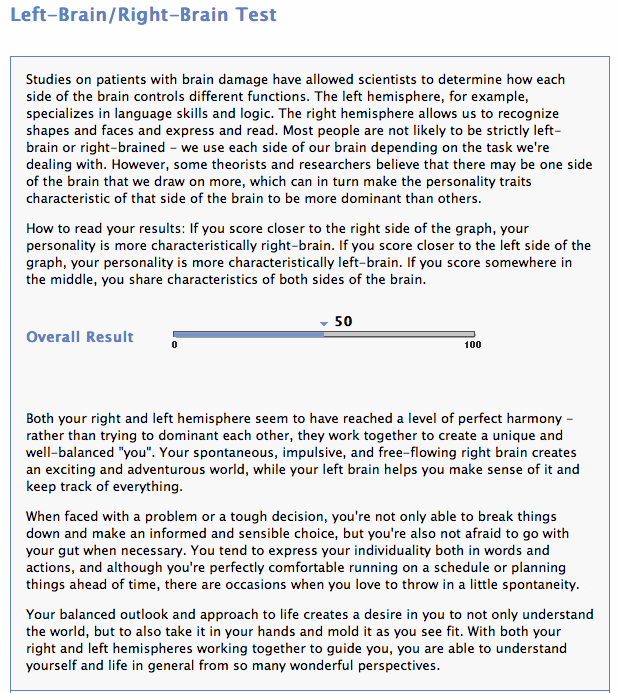
Still, there are some online tests capable of answering the question of just how well balanced we are in using whatever portion of our minds to which we have access. I recently took two of the assessment instruments and learned that I am a reasonably balanced individual.

You just may be more balanced than you think. Not that “balanced” is better than having one or the other side dominant. In fact, it feels a bit like being a “jack of all trades.”

Brain 2The first test—available for you to take here—gave me the wonderful news that my “right and left hemispheres seem to have reached a level of perfect harmony.”

It sounds almost like attaining Nirvana, if one believes in such things.

It was amazing what they were able to discern about my deepest being with twelve simple questions.

Brain 3

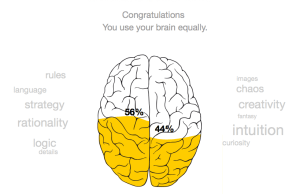
The second test—available here—gave me the following result. It reveals the mental equilibrium I have achieved with this informative graphic.

I really enjoyed the image (yellow is my second favorite color) . . . until I realized the uncolored portions of my brain suggested they were dormant. (I suspect the very fact that I’m concerned about the possibility implies it might be true.)

Lewis on the Human Mind

C.S. Lewis wrote about many aspects of human nature. That included, of course, the least understood organ, the brain. In the following passage from a 1921 letter, he describes the way our memories possess the power to transform the realities of the past.

I still feel that the real value of such a holiday is still to come, in the images and ideas which we have put down to mature in the cellarage [cellar or basement] of our brains, thence to come up with a continually improving bouquet.

Already the hills are getting higher, the grass greener, and the sea bluer than they really were; and thanks to the deceptive working of happy memory our poorest stopping places will become haunts of impossible pleasure and Epicurean repast.

The following argument is found in 1944’s “Is Theology Poetry?” His thoughts on how the human brain supports the existence of a Creator are well worth considering.

When I accept Theology I may find difficulties, at this point or that, in harmonising it with some particular truths which are imbedded in the mythical cosmology derived from science. But I can get in, or allow for, science as a whole. Granted that Reason is prior to matter and that the light of that primal Reason illuminates finite minds. I can understand how men should come, by observation and inference, to know a lot about the universe they live in.

If, on the other hand, I swallow the scientific cosmology as a whole, then not only can I not fit in Christianity, but I cannot even fit in science. If minds are wholly dependent on brains, and brains on bio-chemistry, and bio-chemistry (in the long run) on the meaningless flux of the atoms, I cannot understand how the thought of those minds should have any more significance than the sound of the wind in the trees.

And this is to me the final test.

This is how I distinguish dreaming and waking. When I am awake I can, in some degree, account for and study my dream. The dragon that pursued me last night can be fitted into my waking world. I know that there are such things as dreams: I know that I had eaten an indigestible dinner: I know that a man of my reading might be expected to dream of dragons. But while in the nightmare I could not have fitted in my waking experience. The waking world is judged more real because it can thus contain the dreaming world: the dreaming world is judged less real because it cannot contain the waking one.

For the same reason I am certain that in passing from the scientific point of view to the theological, I have passed from dream to waking. Christian theology can fit in science, art, morality, and the sub-Christian religious. The scientific point of view cannot fit in any of these things, not even science itself.

Even with my limited mind, which too often seems to run on only six of its eight cylinders, I recognize the wisdom of Lewis’ contrast between dreaming and waking. He is brilliant.

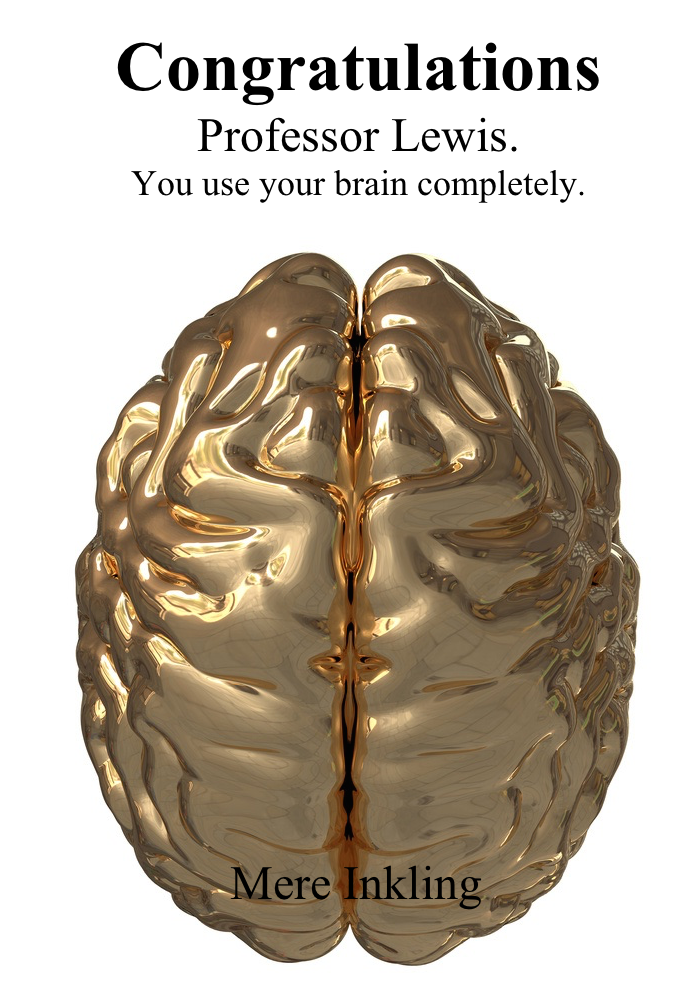
I imagine that our favorite Oxford dean’s online results might have looked something like this.

Lewis Brain

_____

* This quotation, and the one which follows it, come from Scientific American.

I have blogged in the past about the human brain. You might find one of the following posts interesting:

Engage Brain

Distant Fathers

Mensa & C.S. Lewis

Malapropistic Entertainment