Respecting Animals We Kill

Sometimes even a moral sluggard can say something profoundly true. I was recently visiting the uplifting site of a British pet photographer, and came across this wonderful insight:

“Until one has loved an animal a part of one’s soul remains unawakened.”

As I spent a moment reflecting on the quote, having just enjoyed a morning game with our border collie, it dawned on me these words are not only philosophically true. The more I consider them the stronger the case, it seems to me, can be made for their theological truth.

Turn the statement around. Can someone be considered spiritually awake if they have never possessed a moment of genuine affection for an animal, the pinnacle of God’s natural creation? I tend to think not.

Cultural matters certainly influence one’s connection with nature. It may be that people surviving on the edge of food sufficiency would view animals primarily as a resource. Yet even then, the best among us still possess a regard for the creatures whose lives we curtail to extend our own.

An outstanding example of this is found in a common practice among North America’s first peoples. (First Nations is the common term in Canada). Many of these people would include prayer on behalf of the prey they sought.

In the Cherokee legend “The Little Dear, Awi Usdi,” describes how hunters were taught to only take life when necessary, and to “ask pardon when an animal was killed.”

Another site explains how “Coast Salish women were forbidden from stepping over deer meat, and the men had to look away when uncovering it. All bones had to be thrown into the water, and the viscera not consumed were buried so the dogs would not eat it.”

Post-Kill Rituals: Matters of the Heart,” describes how this “ancient reverence” for hunted animals extended beyond the Americas. It concludes with a valuable thought.

Rituals aren’t a bad idea . . . But you show the utmost respect by concentrating on killing the animal quickly. Hunters’ conduct toward wildlife and nature should be consistent with their conduct toward other humans.

While Christians will necessarily overlook the religious elements of these various traditions,* those most attuned to the love of God – a Creator who viewed the “living creatures” he had fashioned and proclaimed, “it was good” – will possess at least a glimmer of reverence or affection for wildlife.

Not that Christians can’t be avid hunters. The Roman Catholic Church even has a Patron Saint for hunting. St. Hubert, pictured above, was (before his canonization, of course) a worldly nobleman. In the seventh century, Hubert had ignored invitations to attend worship on one of the holiest of days, Good Friday. Yet the Lord met him there, in the forest. His conversion occurred when he saw a vision of a crucifix while hunting. Hubert would later use his skill with a bow to draw crowds for his preaching of the Gospel.

C.S. Lewis & the Hunting of Deer

In an essay entitled “The Seeing Eye,” C.S. Lewis turns the analogy of hunting upside down. Using his own life, in which searching for God was the farthest thing from his desires, Lewis describes his conversion in a fascinating manner. It is interesting that while Lewis reveals he wasn’t desirous of faith, he was seeking honesty within his own conscience. He was also seeking truth.

I never had the experience of looking for God. It was the other way round; He was the hunter (or so it seemed to me) and I was the deer. He stalked me like a [hunter], took unerring aim, and fired. And I am very thankful that that is how the first (conscious) meeting occurred. It forearms one against subsequent fears that the whole thing was only wish fulfilment. Something one didn’t wish for can hardly be that.

But it is significant that this long-evaded encounter happened at a time when I was making a serious effort to obey my conscience. No doubt it was far less serious than I supposed, but it was the most serious I had made for a long time.

So, Who was the Author of the Initial Quote?

I began by saying even moral sluggards can occasionally make a good point. The person who drew the connection between our regard for animals and our souls is Anatole France. Not only was he a serial adulterer, he was a devout atheist. (Not all atheists are adulterers, of course, but rejecting the God of the Bible does make it a lot easier to justify one’s immorality.)

Anatole wrote some curious works ridiculing Christianity, and until I was writing this post I had completely forgotten about my 2014 post about his advocacy for Satan.

Returning to Positive Subjects . . . Like Animals

The site that used the great quotation with which we began, is excellent. It is called “Mad about Greys,” and is the work of a British photographer.

Liz Coleman does an amazing job capturing the hearts and – dare I say, souls – of the pets she shoots. Even though Surrey is quite a ways for most Mere Inkling readers to visit her studio, I encourage you to visit her website today.


* There were additional Native American beliefs and taboos. For example, “the Pentlatch and Squamish buried or hid all deer bones. The West Sanetch were not permitted to eat deer meat and fish at the same meal.”

Out of Context

Journalists quickly learn the skill of taking the words of people they dislike out of context. By doing this, they can make absolutely brilliant men and women sound like simpletons.

If the person is a public figure, with lots of material to sort through, you can find partial quotations (or obviously humorous or sarcastic remarks) that make the object of their ridicule sound like nearly anything – from a compassionate philanthropist to a conniving fascist.

That’s one reason some people who hope to tarnish the reputation of C.S. Lewis consciously avoid citing his work in its totality (or each piece in its honest context). Thus, as this article suggests, intelligent readers understand Lewis’ writing is “exceptionally good,” while some infantile critics regard it as “dodgy and unpleasant.”

(Do you appreciate my skillful use of adjectives in the previous sentence? They, of course, represent another dishonest method of undermining the arguments of people with whom one disagrees.)

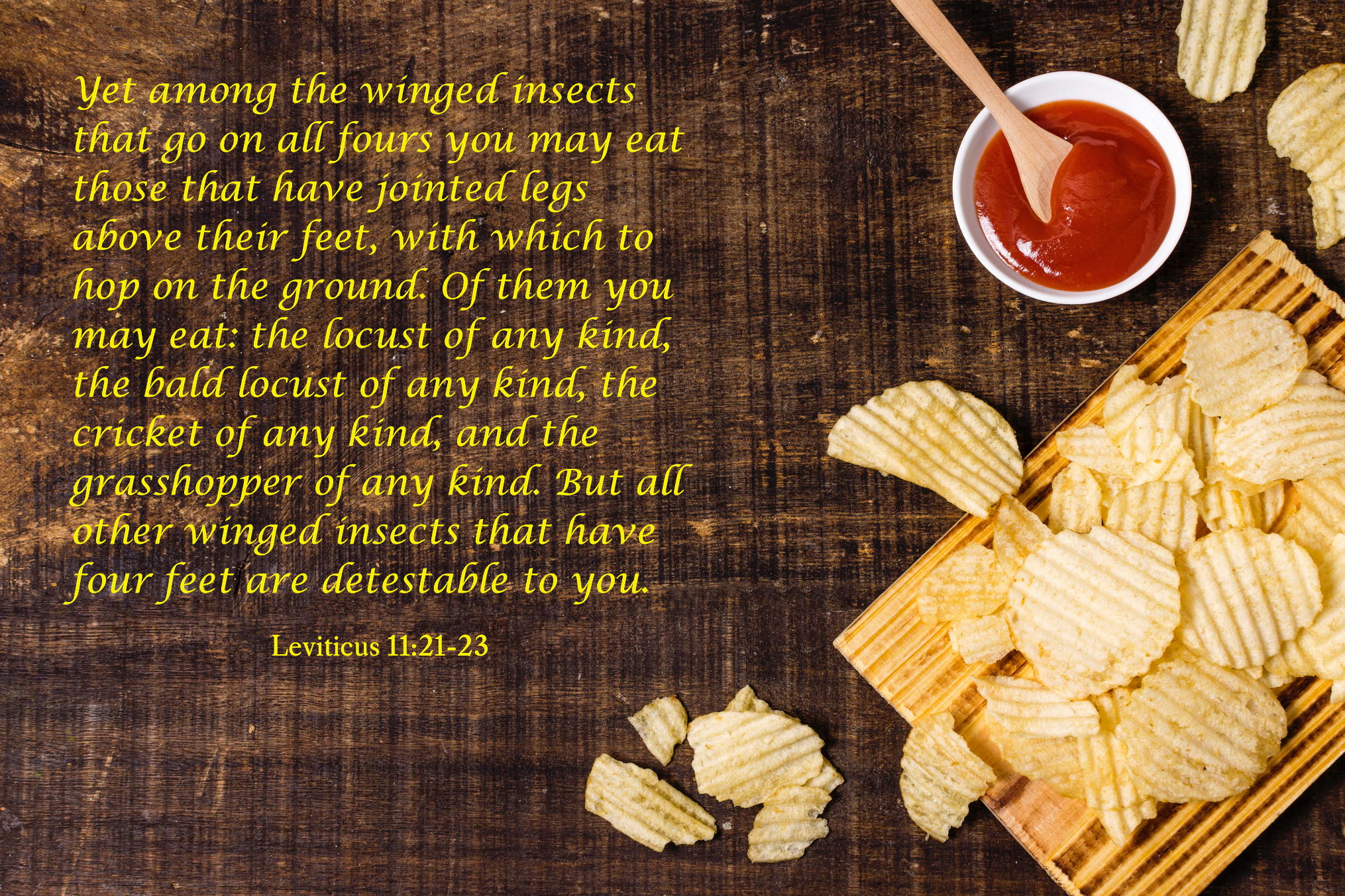
Returning to the idea of taking things out of their context, I offer the graphic (meme, if you will) that I created for the top of this column. It was inspired by “The 12 Most Inspiring Verses In The Bible” in the Babylon Bee. The brief article humorously illustrates how excising words from their context can make them sound rather bizarre.

These examples (mine included) are offered in a light-hearted way. However, the internet teems with examples of malicious attacks on God’s written Word. And many of these rely on the tried and true[false] technique of ignoring the immediate or full context to construct their strawman.

Strawmen or strawwomen are another dishonest form of argument, as “Logical Fallacies 101” explains.

Strawmen, scarecrows, and mannequins all have one thing in common: they are, by nature, flimsy objects that are easy to knock down. In the context of logical fallacies, a “straw man” argument is an argument that is framed in such a way that it is easy to “knock down” or dismantle.

How many times have you been in conversation with someone—someone who holds an opposing viewpoint to yours—who frames your position in a way that you have not? Then once they frame your position in that way, they attack it, supposing that by doing so they have won the argument?

In “Lewis on the Atheist’s Straw Man,” the author quotes a concise argument provided by C.S. Lewis “in Mere Christianity, [where] Lewis warns about over simplifying Christianity (something some people who call themselves Christians sometimes do), and the straw man Atheists often build from this. It’s definitely worth the read.

Biblical Verses that Demand Knowledge of Their Context

Admittedly, there are some passages in the Scriptures that are challenging to comprehend, apart from the whole. Intervarsity Press even has a website “Hard Sayings of the Bible,” subtitled “A Difficult Passage Explained Each Day.”

In “Encountering Difficult Passages,” the author charts a helpful course in how to discover their meaning. Here’s a sample of their sound advice:

Be extra careful with Google. I know. It’s so easy. It’s so tempting. You think, “Google tells me where to go when I’m physically lost; why can’t it help when I’m lost in the Bible?”

The problem is that Google only shows you what’s popular; it cannot differentiate between sites that provide truth and sites that provide ignorance. Avoid your natural impulse to click the first link that appears in a search. There are good websites out there to find answers, but you have to be discerning.

Some of Jesus’ own teachings were difficult for the disciples to comprehend. This was especially true of his announcement that he must die as part of the divine plan to deliver us all from the consequences of sin. When he announced the marvelous mystery of the eucharist (Lord’s Supper) he said “I am the bread of life. . . . Whoever feeds on my flesh and drinks my blood has eternal life, and I will raise him up on the last day. . . . This is the bread that came down from heaven, not like the bread the fathers ate, and died. Whoever feeds on this bread will live forever” (John 6).

While the twelve who become the Apostles continued to follow the Lord, some fell away in confusion because “When many of his disciples heard it, they said, ‘This is a hard saying; who can listen to it?’”

The Bible Truly “In Context”

Christians understand that the Incarnation, Life, Death, Resurrection and Return of Jesus Christ is the final, ultimate Word of the Bible. The Word himself, through whom all things were created, is the central, life-giving message of the holy Scriptures.

Because of this truth, we can evaluate the entire, comprehensive meaning of the Scriptures. We recognize the clear significance of those passages dealing with the Savior of humanity are vital, while those dealing with the nutritional value of locusts are rather less so.

While many people consciously practice this Christocentric reading of the God’s Word, one of its great champions was Martin Luther. If you wish to explore this subject in detail, I commend to you “All Scripture is Pure Christ: Luther’s Christocentric Interpretation in the Context of Reformation Exegesis.” You can find the entire volume in which this essay appears here.

As Martin Luther puts it, “To him who has the Son, Scripture is an open book; and the stronger his faith in Christ becomes, the more brightly will the light of Scripture shine for him.”

Christians are not Gnostics, who believe the Bible is hiding divine secrets from the uninitiated. Quite the contrary. However, the only way to truly understand the meaning of the Scriptures is to read them in their full context. And that context is Jesus, “the Lamb of God, who takes away the sin of the world!”

Christians & Retirement

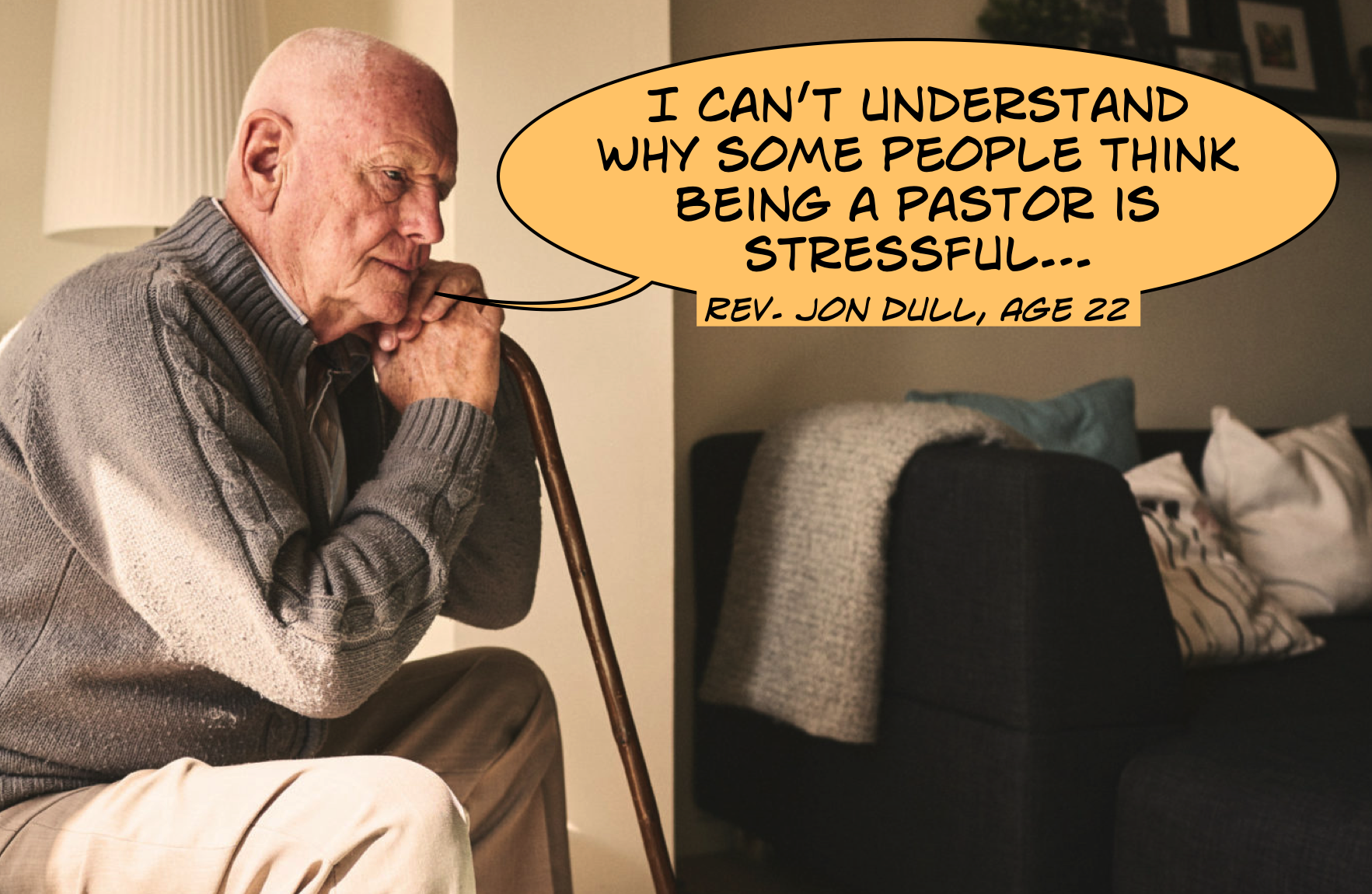
When do pastors retire? Or, in the opinion of some, can Christian pastors actually retire?

If you’re looking for answers to this question in the Bible, you will find it’s not specifically addressed. Retirement is a relatively modern concept. In earlier ages, women and men were expected to continue contributing to the family and common good as they were able, even during their winter years.

This added a type of dignity to many of their lives. It is not that the crippled or dependent were viewed as something less, but there was an expectation that as long as a person had something valuable to offer to others, it was wrong to waste it.

Pastors are in a unique position. Most believe they have been “called” by God in some manner to serve the Lord and our brothers and sisters, created in his image. If God actively calls you, does that vocation (from vocatio, calling) expire on some set timeline?

It’s curious how people refer to some arbitrary age such as sixty-five as time to retire. Many Western nations have institutionalized that rather capricious practice by determining an age at which you can begin collecting money from the government’s coffers.

Some, like the U.S., have recently adjusted that beneficent accomplishment (i.e. becoming a senior citizen eligible to receive “social security” payments), in light of increasing lifespans, and political policies not suitable for discussion among the genteel audience of Mere Inkling.

Most secularists naturally think retirement – like everything else – is about them. One financial adviser said, “Retirement is like a long vacation in Las Vegas. The goal is to enjoy it the fullest, but not so fully that you run out of money.”

C.S. Lewis described one such person in a 1921 letter to his brother. He describes a mutual friend’s in-laws as ironic.

As you will never meet them (nor indeed will I), it is no breach of confidence to touch on the grim humours of his future ‘in-laws.’ A mother . . . who has all the money but is nevertheless incapable of resisting her husband, a retired army officer, busily engaged in trying to see if his constitution will ‘keep’ by being sufficiently soaked in spirits.

This indeed has been his life work, and the devil of it is that it seems likely to ‘keep’ a good bit yet.

Semi-Retirement

The frame on my auto license says “Semi-Retired Military Chaplain.” After retiring from active duty in the Air Force, I anticipated providing “pulpit supply” for vacationing pastors and serving an occasional “vacancy.” An interim or vacancy pastor covers the months between the departure of a congregation’s pastor and the call of a new pastor. I’ve served three, one of which was more than a year long.

Now that I’m a bona fide senior, I thought my vacancy days were over. It appears, however, that God may have other plans. This week I’ve been approached by a congregation interested in calling me to serve them in that role.

Please pray that God leads them in whether or not they should formalize that call. And, please pray that I will clearly discern God’s desire in this matter. Right now it appears to be one of those “Matthew 26” moments where “the spirit indeed is willing, but the flesh is weak.”

Can Anyone Truly Retire?

So, do pastors ever really retire, in the sense of ending their ministry? The answer is an unequivocal “no.” What’s more, if you are a Christian, you don’t get to retire either.

Here’s the catch – this vocation to actively serve God all of our days doesn’t just apply to pastors. You see, all Christians are called to “let your light shine before others, so that they may see your good works and give glory to your Father who is in heaven” (Matthew 5:16).

Consider 1 Peter 2:5 where the apostle writes: “You yourselves like living stones are being built up as a spiritual house, to be a holy priesthood, to offer spiritual sacrifices acceptable to God through Jesus Christ.”

While you usually hear the truth of the “priesthood of all believers” from Protestants, the fact is that it comes directly from the Bible and applies to us all. As one prominent Roman Catholic journal puts it:

The priesthood of all believers is a call to ministry and service; it is a barometer of the quality of the life of God’s people in the body of Christ and of the coherence of our witness in the world, the world for which Christ died. . . . this teaching is a summons to faithfulness on the part of all Christians, Protestants and Catholics alike.

Retirements or Transitions?

So, whatever we would like to be true, the fact remains that retirement is not part of God’s plan for his children. But that shouldn’t trouble us. Because the Lord not only promises to give us the strength to do anything he asks of us, he also leads us into different fields of harvest at different points in our pilgrimage.

Thankfully, he doesn’t expect me to be as effective working with youth as I was in my thirties (although some of the best youth workers I’ve seen were in their seventies).

Just as I can’t rapidly deploy to a warzone with members of my flock as I once did, I possess the maturity, patience and compassion to care for those in the twilight of their lives far better than I did decades ago.

An interesting testimony to these shifts in ministry focus is found in the Old Testament. God set the tribe of Levi apart to oversee all details related to the worship of God in the Temple. But their ministry in the holy place (the Temple and the Tent of Meeting which preceded it) was of a specified duration.

And the Lord spoke to Moses, saying, “This applies to the Levites: from twenty-five years old and upward they shall come to do duty in the service of the tent of meeting. And from the age of fifty years they shall withdraw from the duty of the service and serve no more.

They minister to their brothers in the tent of meeting by keeping guard, but they shall do no service. Thus shall you do to the Levites in assigning their duties” (Numbers 8).

This passage is fascinating. At fifty, the priest step down from their ceremonial religious duties. But they do not drift off into some lazy retirement. They assume new responsibilities. A role God deemed better suited to this stage of their lives.

So too, wizened old pastors still have a role in God’s church. For some it may be serving during seasons of congregational vacancies. For others it may simply be to pray.

In a 1930 letter to his closest friend, Arthur Greeves, C.S. Lewis offers a delightful description of a “retired” pastor who is still about the business of caring for others. The fact that Lewis wrote this while an avowed atheist makes it all the more moving.

I walked as usual after lunch, dropping in on the way to see if old Foord-Kelsie would accompany me. I think I have mentioned him to you – a retired country parson of 80, who drives his own car, carpenters, and mends everyone’s wireless.

He is an irreplaceable character . . . as redolent of English country life as an old apple in a barn. He is deliciously limited: cares for no poetry but Shakespeare, distrusts all mysticism and imagination, and all overstrained moods.

Yet you could not wish him to be otherwise: and inside this almost defiantly human and mundane framework there is such tenderness of heart that one never feels it bleak.

He was in his workshop when I arrived, with shavings all about his ankles, making a cover for the font of old Headington Church.

He would not come out, and I stayed to shout conversation for fifteen minutes above the thudding and singing of his circular saw. We had a bit of everything: an outburst against Shaw, a broad story, and then, as always, onto Tristram Shandy. ‘Wonderful book–oh a wonderful book. You feel snug when you read that–you get in among them all in that little parlour. . . .’

I wish you could have seen him saying all this, bending down as he shoved a beam of wood against the saw, with one dear old wrinkled eye screwed up and held close to the work. You must hurry up and come and see me before he dies, for he of all people should be added to our stock characters.

Lewis does, indeed, portray his walking companion, the Reverend Foord-Kelcey, as a “stock character.” But he does so with evident and sincere affection.

So, our vocations do not forever remain constant. They may change over time, but God’s call on our lives does not wane.

We may approach these transitions with some trepidation. I am not ashamed to admit I do so at the present moment. I hope you will join me in seeking to hear God’s call and respond with joy and enthusiasm, just as the saints before us – “Here I am! Send me.

First the Machines Kill the Weeds

Machinery, one of the fruits of scientific research, is intended to benefit humanity. It often does. However, even machines with totally peaceful purposes – hay balers, for example – can be deadly.

Machines-run-amuck populate many dystopian novels and films. One of the most successful franchises is Terminator. Humanity is brought to the precipice of extinction, after devising machines – and their perilous companion Artificial Intelligence. The very first film, The Terminator (1984) brilliantly uses the biblical allusion “Judgement Day,” to mark the sentience of the genocidal Skynet.

Nearly forty years later, debates about weaponized autonomous systems have moved far beyond speculation. And it does not require a doctorate in computer science to recognize that given a potentially lethal machine the power to make its “own” decisions poses a deadly risk. After all, if software programs can be virally infected, and secure systems can be locked tight and held for ransom, there are no guarantees that “terminators” will not be part of our future.

We’ve seen how weapons can easily be mounted on the robotic dogs that are currently accompanying our troops.

And in a recent Air Force Magazine article, “Unmanned Flying Teammates,” we read the promise that “Robots will join the Combat Air Forces within the next decade.”

The common nomenclature for the current generation of these machines is Lethal Autonomous Weapons Systems. You can read about “slaughterbots” at the Future of Life Institute site.

Whereas in the case of unmanned military drones the decision to take life is made remotely by a human operator, in the case of lethal autonomous weapons the decision is made by algorithms alone.

Slaughterbots are pre-programmed to kill a specific “target profile.” The weapon is then deployed into an environment where its AI searches for that “target profile” using sensor data, such as facial recognition.

While the first generation of such weapons are still being designed, a genuinely wonderful new machine foreshadows what might be an ominous future.

In response to the destructive necessity for pesticides, scientists have come up with a new self-driving farm machine that avoids the need for poisons by selectively zapping individual weeds with lasers. Forbes has a great article on the subject, with the unwieldly but informative title, “Self-Driving Farm Robot Uses Lasers To Kill 100,000 Weeds An Hour, Saving Land And Farmers From Toxic Herbicides.”

The weeding machine is a beast at almost 10,000 pounds. It boasts no fewer than eight independently-aimed 150-watt lasers, typically used for metal cutting, that can fire 20 times per second.

They’re guided by 12 high-resolution cameras connected to AI systems that can recognize good crops from bad weeds. The Laserweeder drives itself with computer vision, finding the furrows in the fields, positioning itself with GPS, and searching for obstacles with LIDAR.

I applaud this invention, with one major caveat. How large a step is required between zapping weeds and burning holes through human bodies?

Ironically, they have even named this agricultural prototype for human-hunting machines “Terminator technology.”

Terminator technology is the genetic modification of plants to make them produce sterile seeds. They are also known as suicide seeds. Terminator’s official name – used by the UN and scientists – is Genetic Use Restriction Technologies (GURTs).

Actually, this is a very positive breakthrough in terms of increasing harvests while preserving the natural health of the earth (and the Earth). C.S. Lewis, I believe, would have welcomed this new technological achievement.

The affinity of C.S. Lewis and fellow Inkling J.R.R. Tolkien for nature is well recognized. The two WWI veterans were averse to industrialized landscapes, and much preferred bucolic images. You can see that in Lewis’ fiction, although it’s much more evident in Tolkien’s Lord of the Rings. (Even Tolkien’s truest fans must admit that some readers find his elaborate discussion of the Hobbits’ harmony with nature almost mundane.)

True science is a good thing, but one must remain vigilant against an idolatry that masks itself as science.

Beware of Scientism

C.S. Lewis’ role as a an apologist for Christianity – and for what was worthwhile in past history – brought him into more direct conflict with technology. Of course, it was not scientific advances per se of which he was wary. It was the creeping idolatry of scientism, which assumes the trappings of faith in its disciples’ eyes. Tolkien shared his concerns regarding the matter, but confronting such lies was not part of his vocation.

Lewis’ clearest exposition of humanity’s lust for progress may be his 1954 Inaugural Lecture as the Chair of Mediaeval and Renaissance Literature at Cambridge University. De Descriptione Temporum (A Description of the Times) should be read in one sitting, as it was delivered. It is included in several collections, but available online here. The quotation below offers a very small slice of his influential lecture. (Coincidentally, A Pilgrim in Narnia featured a superb column on the address just yesterday.)

[The birth of the machines] is on a level with the change from stone to bronze, or from a pastoral to an agricultural economy. It alters Man’s place in nature. . . . What concerns us . . . is its psychological effect. How has it come about that we use the highly emotive word “stagnation,” with all its malodorous and malarial overtones, for what other ages would have called “permanence”?

Why does the word “primitive” at once suggest to us clumsiness, inefficiency, barbarity? When our ancestors talked of the primitive church or the primitive purity of our constitution they meant nothing of that sort. . . . Why does “latest” in advertisements mean “best”?

Well, let us admit that these semantic developments owe something to the nineteenth-century belief in spontaneous progress which itself owes something either to Darwin’s theorem of biological evolution or to that myth of universal evolutionism which is really so different from it, and earlier. . . . But I submit that what has imposed this climate of opinion so firmly on the human mind is a new archetypal image.

It is the image of old machines being superseded by new and better ones. For in the world of machines the new most often really is better and the primitive really is the clumsy. And this image, potent in all our minds, reigns almost without rival in the minds of the uneducated. For to them, after their marriage and the births of their children, the very milestones of life are technical advances. . . .

Our assumption that everything is provisional and soon to be superseded, that the attainment of goods we have never yet had, rather than the defence and conservation of those we have already, is the cardinal business of life, would most shock and bewilder [all of those who have gone before us.]

A thought-provoking article, “The Folly of Scientism,” offers the argument of a professor of Biology, which is independent of C.S. Lewis, while echoing many of his cautions.*

Of all the fads and foibles in the long history of human credulity, scientism in all its varied guises — from fanciful cosmology to evolutionary epistemology and ethics – seems among the more dangerous, both because it pretends to be something very different from what it really is and because it has been accorded widespread and uncritical adherence.

An excellent work on this subject is available for purchase, entitled The Restoration of Man: C.S. Lewis and the Continuing Case Against Scientism. Michael Aeschliman’s excellent treatment is evidenced by the fact the 2019 version is the third edition of the title.

But why should this central civilizing truth about the “res sacra homo,” [the fact that “humanity is a sacred thing”] . . . need C.S. Lewis’s [reaffirmation]? The answer to that question is philosophical, historical, and complex, but it should not be as obscure or little understood as it is today.

Although there was never a “golden age” of civilization within historical time, this radically noble idea was often better understood in the past, even the recent past.

Back to the Robots

Wait, I just noticed some armed drones flying overhead, and what appeared to be a silhouette resembling a GURT-101 Terminator skulking through the woods outside my office . . . Perhaps I’ve already written too much.


* This article appears in The New Atlantis, where they say “Our aim is a culture in which science and technology work for, not on, human beings.”

Delicious Words

Have you ever wondered what colors people see when they read what you write? If so, you are not (necessarily) insane. And we’re not talking about coloring your fonts to evoke certain responses.

The fact is, some people honestly do see colors when they read – or hear – particular words.

Perhaps even more oddly, some people actually taste specific words. And the flavor(s) they sense are not necessarily related in any reasonable way. For example, we might think that if someone heard the word “orange,” or saw an orange color, that some psychological trick might cause them to think they can taste an orange citrus flavor. But that’s not how it works. There may not be any fathomable connection at all.

This phenomena is called “synesthesia.” Healthline describes synesthesia as “a neurological condition in which information meant to stimulate one of your senses stimulates several of your senses.” Although they are rare, “synesthetes” are not unique.

A study entitled “Survival of the Synesthesia Gene: Why Do People Hear Colors and Taste Words?” alleges the condition is experienced by 2% to 4% of the population.

While a proven genetic basis for synesthesia remains elusive, the phenomenon tends to run in families, as ∼40% of synesthetes report a first-degree relative with the condition. Pedigree analyses of synesthesia suggest high transmissibility from parent to offspring . . .

I have a confession to make. Through the years I’ve met a handful of people who told me they could taste colors, or the like. They were describing to me their sincere experiences of synesthesia. Unfortunately, since I’d never read about the validity of the phenomenon, I dismissed it. I assumed that the more playful of the advocates were trying to trick me. And I attributed the other cases to people tricking themselves, due to odd imaginations or to gullibility manipulated by the power of suggestion.

Mea culpa. The awkwardness was my fault. I am sorry for any hurt I may have caused. I, of all people, should have accepted their testimony. You see, for many years I was stunned that people voluntarily ate cilantro. To me, the herb tastes like soap – exactly like picking up a bar of soap and taking a big bite. Everyone laughed and me. But one day I met someone whose eyes widened before they declared “me too!”

Britannica explains the problem: ‘for those cilantro-haters for whom the plant tastes like soap, the issue is genetic. These people have a variation in a group of olfactory-receptor genes that allows them to strongly perceive the soapy-flavored aldehydes in cilantro leaves.” The frequency of this “genetic quirk” varies by ethnicity. Trust me, if you knew what it tastes like to “us,” you would never force the unpalatable cleanser on anyone but your worst enemy.

You see, because of my dismissal of their revelation, I could very well have caused some people to consider themselves defective, or discourage them from being open in their lives after that time. Healthline describes it this way:

On the other hand, some synesthetes feel that their condition isolates them from others. They may have trouble explaining their sensory experiences because they are very different. Finding communities of other synesthetes online may help ease this feeling of isolation.

Fortunately, on the other hand, “many people seem to enjoy perceiving the world in a different way than the general population.” There are even artistic efforts which attempt to replicate the experience of these unique individuals.

For a simple guide to the numerous types of synesthesia experienced by your fellow human beings (which may or may not parallel animal phenomena), check out this article.

There is a short scene from the film Ratatouille that creatively illustrates the experience of the synesthete, who is, in this case, Remy the rat. (We’ll link to it at the end of the post.)

What about the Inklings?

I don’t believe any member of the Inklings experienced synesthesia. It is possible, of course.

Nevertheless, there are echoes of synesthesia in their works. Consider for a moment the following description of Lewis’ work as a literary critic in C.S. Lewis at Poet’s Corner.

What I want to call attention to here is yet another example of what one might call Lewis’s narrative synaesthesia. . . . I am not arguing that this kind of movement between genres is unique to Lewis – far from it, I think we all do it to some extent, if only in our imaginations rather than on paper. . . .

[Lewis] is a writer whose perceptions just jostle against each other, and are so interconnected that it is almost impossible to separate one strand from the next. These are characteristics more common in the poet than the critic, and not for nothing did Lewis see himself as primarily a poet.

C.S. Lewis could also skillfully energize his fiction with synesthetic elements. An excellent example is found in Voyage of the Dawn Treader. An article on Encyclopedia.com describes it in the following way.

As they sail nearer to Aslan’s country, references to Christ and our heavenly home accumulate quickly. Reepicheep discovers that the water is sweet! Caspian describes the phenomenon with synesthesia, using the terms of one sense experience to describe another: “It – it’s like light more than anything else.”

In the novel itself we see Reepicheep being pulled from the sea, after falling overboard.

“Sweet!” he cheeped. . . . “I tell you the water’s sweet,” said the Mouse. “Sweet, fresh. It isn’t salt.” For a moment no one quite took in the importance of this. But then Reepicheep once more repeated the old prophecy:

Where the waves grow sweet,
Doubt not, Reepicheep,
There is the utter East.

Then at last everyone understood. “Let me have a bucket, Rynelf,” said Drinian [the ship’s captain]. It was handed him and he lowered it and up it came again. The water shone in it like glass.

“Perhaps your Majesty would like to taste it first?” said Drinian to Caspian. The King took the bucket in both hands, raised it to his lips, sipped, then drank deeply and raised his head. His face was changed. Not only his eyes but everything about him seemed to be brighter. “Yes,” he said, “it is sweet. That’s real water, that. I’m not sure that it isn’t going to kill me. But it is the death I would have chosen . . .”

“What do you mean?” asked Edmund.

“It – it’s like light more than anything else,” said Caspian.

“That is what it is,” said Reepicheep. “Drinkable light. We must be very near the end of the world now.”

There was a moment’s silence and then Lucy knelt down on the deck and drank from the bucket. “It’s the loveliest thing I have ever tasted,” she said with a kind of gasp. “But oh – it’s strong. We shan’t need to eat anything now.” And one by one everybody on board drank. And for a long time they were all silent. They felt almost too well and strong to bear it, and presently they began to notice another result.

As I have said before, there had been too much light ever since they left the island of Ramandu – the sun too large (though not too hot), the sea too bright, the air too shining. Now, the light grew no less – if anything, it increased – but they could bear it. They could look straight up at the sun without blinking.

They could see more light than they had ever seen before. And the deck and the sail and their own faces and bodies became brighter and brighter and every rope shone. And the next morning, when the sun rose, now five or six times its old size, they stared hard into it and could see the very feathers of the birds that came flying from it.

Synesthetic Rodents

The dashing Reepicheep is not the only cute little rodent who experiences reality synesthetically. That should come as no surprise, since Rodentia such as mice like our hero, Remy the rat chef and their cousins like beavers and porcupines constitute about 40% of all mammal species. God alone knows how many rabbits, prairie dogs and pikas share these sensory delights.

The aforementioned scene from Ratatouille offers a “taste” of what life is like for a synesthete. Enjoy.

On the Nature of Digressions

It’s nearly impossible to avoid digressions – those temporary departures from the current subject of conversation. While many digressions are interesting in the own right, they occasionally cause the speaker (or writer) to lose track of the actual point they are attempting to establish.

It’s like when I would be reading something the Emperor Constantine the Great, and at the mention of the Persian Empire, I would put the current article on hold while I explored the subject of just how the current regime in Iran reflects the religious fundamentalism of Zoroastrianism as it resisted during the Abbasid Caliphate. Ah, but forgive me, I digress.

The reason I am thinking about digressions today is because I recently encountered a massive one in one of Mark Twain’s works. But before we look at it, let’s consider a more recent example, in an article about C.S. Lewis.

In “The Uses of Ignorance,” literary critic Alan Jacobs explores a number of themes, including the way Lewis’ presentation of Christianity’s core resonates with believers from diverse theological backgrounds.

One lesson to be learned . . . is just how carefully Lewis articulated his “mere Christianity” so that it seemed “mere” indeed – recognizable to Christians from many different traditions as the faith they understood and practiced. But we also see . . . “that the lasting appeal of Mere Christianity is not based so much on Lewis’s genius as on his ability to point readers to the luminosity of the gospel message itself.” Which, I might add, is a kind of genius in itself.

The article is well worth reading, but the specific reason I mention it now, is because the author includes a lengthy (315 word) departure from his main theme which he brackets with the words “A digression:” and “End of digression”.) It’s rare to see something this straightforward.

C.S. Lewis as a Digresser

If the average woman or man is prone to digression, it seems apparent a genius – with voluminous knowledge on diverse subjects – would occasionally succumb to the same temptation. For someone like C.S. Lewis this is not a major problem, as he would never lose his place in the original conversation. On the contrary, Lewis’ digressions would invariably enrich the discussion, as they illuminated his points.

One of the only books written by C.S. Lewis which has entered the public domain is Spirits in Bondage. When it was published in 1919 (while he was an atheist), Lewis wrote to a friend: “The sub-title ‘A cycle of lyrical poems’ was not given without a reason: the reason is that the book is not a collection of really independent pieces, but the working out, loosely of course and with digressions, of a general idea.” (You can download a free copy of Spirits in Bondage at Project Gutenberg.)

Mark Twain’s Masterful Digression

I’ve written about Mark Twain in the past. In one column I shared his humorous reflections on the nature of editors. Writers will find the post particularly entertaining.

Editors played a major (usually unwelcome) role in Twain’s existence. Thus, it is unsurprising that a major digression in “How to Make History Dates Stick” involves these denizens of the publishing world.

One book I was reading this week includes an extensive and, of course, intentional example of digression. Although he doesn’t bracket it with the word “digression,” it is probably one of the best examples in existence. (We would expect nothing less from Samuel Clemens!)

In his novel Roughing It, Twain describes a pervasive blight to the western frontier, sagebrush.

I do not remember where we first came across “sage-brush,” but as I have been speaking of it I may as well describe it. This is easily done, for if the reader can imagine a gnarled and venerable live oak tree reduced to a little shrub two feet high, with its rough bark, its foliage, its twisted boughs, all complete, he can picture the “sage-brush” exactly.

Often, on lazy afternoons in the mountains I have lain on the ground with my face under a sage-bush, and entertained myself with fancying that the gnats among its foliage were Lilliputian birds, and that the ants marching and countermarching about its base were Lilliputian flocks and herds, and myself some vast loafer from Brobdingnag waiting to catch a little citizen and eat him.

Twain’s description of his daydreaming about sagebrush is entertaining, but this is not the quintessential digression I wish to share. After this brief digression, Twain writes a page and a half about the plant’s actual physical attributes and utility (e.g. for fires and tea). But then, when the reader least expects it, Twain goes off on another extended ramble.

Sage-brush is very fair fuel, but as a vegetable it is a distinguished failure. Nothing can abide the taste of it but the jackass and his illegitimate child, the mule. But their testimony to its nutritiousness is worth nothing, for they will eat pine knots, or anthracite coal, or brass filings, or lead pipe, or old bottles, or anything that comes handy, and then go off looking as grateful as if they had had oysters for dinner. Mules and donkeys and camels have appetites that anything will relieve temporarily, but nothing satisfy.

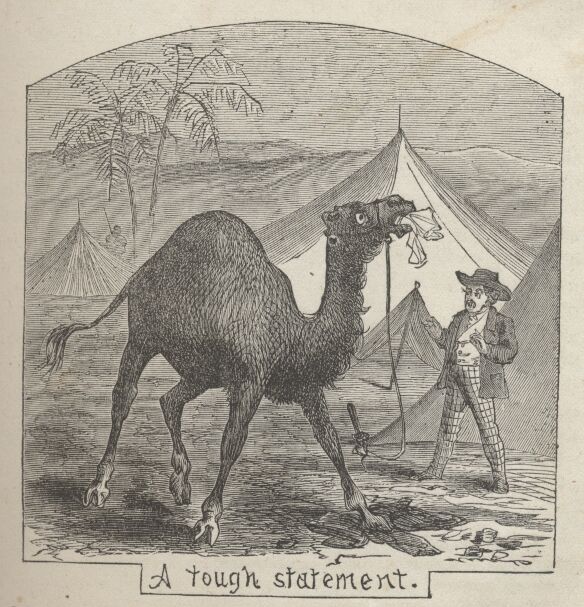
In Syria, once, at the head-waters of the Jordan, a camel took charge of my overcoat while the tents were being pitched, and examined it with a critical eye, all over, with as much interest as if he had an idea of getting one made like it; and then, after he was done figuring on it as an article of apparel, he began to contemplate it as an article of diet. He put his foot on it, and lifted one of the sleeves out with his teeth, and chewed and chewed at it, gradually taking it in, and all the while opening and closing his eyes in a kind of religious ecstasy, as if he had never tasted anything as good as an overcoat before in his life.

Then he smacked his lips once or twice, and reached after the other sleeve. Next he tried the velvet collar, and smiled a smile of such contentment that it was plain to see that he regarded that as the daintiest thing about an overcoat. The tails went next, along with some percussion caps and cough candy, and some fig-paste from Constantinople.

And then my newspaper correspondence dropped out, and he took a chance in that – manuscript letters written for the home papers. But he was treading on dangerous ground, now. He began to come across solid wisdom in those documents that was rather weighty on his stomach; and occasionally he would take a joke that would shake him up till it loosened his teeth; it was getting to be perilous times with him, but he held his grip with good courage and hopefully, till at last he began to stumble on statements that not even a camel could swallow with impunity.

He began to gag and gasp, and his eyes to stand out, and his forelegs to spread, and in about a quarter of a minute he fell over as stiff as a carpenter’s work-bench, and died a death of indescribable agony. I went and pulled the manuscript out of his mouth, and found that the sensitive creature had choked to death on one of the mildest and gentlest statements of fact that I ever laid before a trusting public.

At that point, the writer pretends to realize he has digressed and concludes the chapter in the persona of the naturalist he has earlier assumed.

I was about to say, when diverted from my subject that occasionally one finds sage-bushes five or six feet high, and with a spread of branch and foliage in proportion, but two or two and a half feet is the usual height.

Well, that’s probably more than enough of a diversion from your day’s responsibilities. I hope you enjoyed reading these words, and that your own skills as a digresser will be correspondingly enhanced.

C.S. Lewis & Automobiles

I just read something funny about automobile commercials. This anonymous comment resonated with me, and may with you as well: “car advertisers grossly overestimate how much time I spend driving across the desert.”

It’s a versatile joke, since the final location is interchangeable. Despite the fact I live off a gravel road in the woods, they also grossly overestimate the time I spend summiting snowy mountains. Despite the “all wheel drive” in our two RAV4s,* I have no desire to race through dangerous or hostile environments.

Well, with one possible exception. I really enjoyed this entertaining advertisement from years ago. Trust me, watching this witty Jeep ad will be a worthwhile use of 31 seconds.

Cars are a ubiquitous presence in our world. In the States, getting a personal driver’s license is a traditional rite of passage for sixteen-year-olds. Even in many developing nations, automobile ownership is commonplace. While some urbanites consider the expenses associated with vehicles a foolish investment, most people find the alternative inconceivable. And, whether one owns, leases, rents, or borrows cars, having a driver’s license is a necessity.

That wasn’t always true. When my mother was learning to drive, the brakes went out on the car. She was so traumatized, she never drove again.

C.S. Lewis, on the other hand, had no interest in learning to drive. In fact, the brilliant Oxbridge professor was generally dismissive of automobiles. Presumably this did not carry over to his view of motorcycles, as his conversion while riding in brother Warnie’s sidecar attests.

On the Disadvantage of Traveling by Car

In his autobiography, C.S. Lewis declares “I number it among my blessings that my father had no car, while yet most of my friends had, and sometimes took me for a drive.”

The second half of the sentence makes ready sense. If our family lacks a car, it is fortuitous that generous friends compensated for its absence. But what could Lewis have meant by considering growing up without an automobile to be a “blessing?”

Fortunately, Lewis doesn’t leave us guessing—and his rationale provides a thought-provoking question. What might we sacrifice for the convenience of instantly accessible access to transportation that can carry us hundreds of miles in a handful of hours?

This meant that all these distant objects could be visited just enough to clothe them with memories and not impossible desires, while yet they remained ordinarily as inaccessible as the Moon.

The deadly power of rushing about wherever I pleased had not been given me [emphasis added].

I measure distances by the standard of man, man walking on his two feet, not by the standard of the internal combustion engine. I had not been allowed to deflower the very idea of distance . . .

The truest and most horrible claim made for modern transport is that it “annihilates space.” It does. It annihilates one of the most glorious gifts we have been given. It is a vile inflation which lowers the value of distance, so that a modern boy travels a hundred miles with less sense of liberation and pilgrimage and adventure than his grandfather got from traveling ten (Surprised by Joy).

This final idea of feeling adventure with modest travel opened my eyes to one of the “oddities” I experienced as a child. One year while I was young, my father was stationed overseas with the USMC, and my mother relocated us so we would be near her parents.

My grandparents had a practice that struck me, already a fairly well-traveled lad, as very strange. Each Sunday, after church, we would all pile into the family sedan and go for “a drive.” The cause for this special event was not to get from point A to point B. No, the purpose was simply to enjoy the simple experience of traveling. I don’t recall ever driving more than thirty miles from home, but setting out in random directions to savor the beauty of God’s creation did produce a unique type of satisfaction.

Human Perceptions of Distance

Distance can be considered in a variety of ways. We commonly think of distance in visual terms. Depth perception is made possible by binocular vision. Monocular (single eye) vision is poor at recognizing depths, although it can still be useful for comprehending distances and sizes. However, we are not reliant solely on our eyes.

An obvious alternative is found in the phenomenon of auditory distance perception. Not as efficient as its visual cousin, this medical article notes it does possess one significant advantage.

A normal-hearing person has an immediate appreciation of auditory space in the sense that orientation toward acoustic events is natural, rapid, and in general, accurate. Although spatial acuity is poorer by up to two orders of magnitude in the auditory than in the visual domain, the auditory world has the advantage of extending in all directions around the observer, while the visual world is restricted to frontal regions.

In “The Various Perceptions of Distance: An Alternative View of How Effort Affects Distance Judgments,” scientists discuss the even broader complexity of the subject.

Direct judgments of spatial relations are key to a variety of research domains, both inside and outside the discipline of psychology (e.g., spatial cognition, neuropsychology, exercise science, medical diagnosis, human factors). Thus, the lessons learned from this work have implications extending well beyond visual space perception.

Having noted there are psychological aspects of perceiving distances, I recommend QGIS. QGIS is a free, open source, cross-platform application which supports viewing and editing of geospatial data. It’s actually less complicated than it may sound, and a quick look at their “lesson” on “Spatial Thinking” is extremely informative.

“There are three fundamental concepts of spatial analysis: space, location, and distance.” Each of these perspectives includes absolute, relative and cognitive dimensions. It is the cognitive aspect that most fascinates me and, I sincerely believe, intrigued C.S. Lewis.

Absolute distance is a physical unit of measure, for instance, the number of miles between downtown Houston and downtown Toronto. Relative distance is calculated measuring distance, using metrics such as time, effort, or cost. For instance, the distance of two cities may be 2000 miles apart, which is an absolute description of distance, becomes the distance of two cities measured in tanks of gas, or mileage charge.

Last, let’s discuss the cognitive perception of distance. This refers to an individual’s perception of how far things are apart. For instance, to some, driving 200 miles between Houston and San Antonio Texas is a reasonable drive. However, for others, a 200 mile drive may seem like a very, very far distance to travel if they are not used to traveling such a distance regularly.

This final example, of the varying perceptions of distance by people with different experiences is precisely what Lewis identified in Surprised by Joy.

The truest and most horrible claim made for modern transport is that it “annihilates space.” It . . . is a vile inflation which lowers the value of distance, so that a modern boy travels a hundred miles with less sense of liberation and pilgrimage and adventure than his grandfather got from traveling ten.

Perhaps the Most Significant Matter of Distance

An article entitled “Closest Proximity And Infinite Distance” discusses Lewis’ insight into matters of distance. The author includes the following passage from Lewis’ Letters to Malcolm.

I fully agree that the relationship between God and a man is more private and intimate than any possible relation between two fellow creatures. Yes, but at the same time there is, in another way, a greater distance between the participants.

We are approaching—well I won’t say “the Wholly Other,” for I suspect that is meaningless, but the Unimaginably and Insupportably Other. We ought to be—sometimes I hope one is—simultaneously aware of closest proximity and infinite distance.

Once again, we witness C.S. Lewis’ brilliance. An awareness of both our Lord’s proximity to us and the vast distance between Creator and humankind, is a fundamental truth of Christian faith. And, here I will be bold in love, if either element is lacking in your personal relationship with God, I strongly encourage you to pursue such a balance.


* Lest anyone think we are extravagant, the “new” car is a 2013, and its older garage-mate is a 2004, complete with a manual transmission.

Satirical Scottish Birds

C.S. Lewis has introduced me to many fascinating writers. Authors I never would have learned about without Lewis’ reference to them.

Sometimes Lewis praises their work. At other times, being an honest literary critic, he is compelled to provide a less flattering appraisal. He typically offers the latter evaluation with a novel flair.

In my previous post I shared the sad tale of a blackbird tapping at our window. I promised to discuss today some other curious birds. These creatures, in contrast to the forlorn blackbird, arise from the imagination of a Scottish poet named Sir David Lyndsay* of the Mount. He lived around 1490 to 1555.

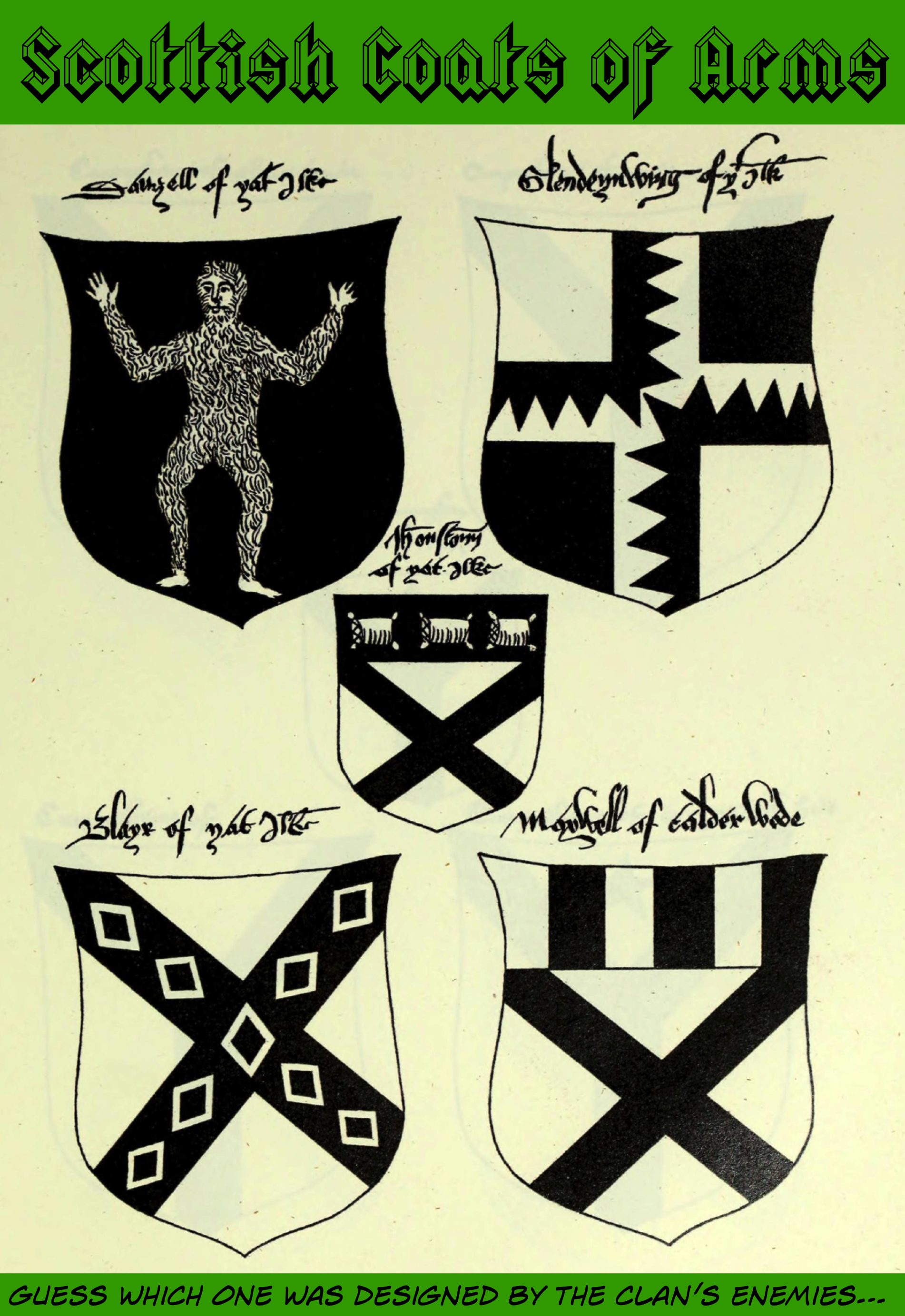
Lyndsay rose to the ceremonial rank of “The Right Honourable the Lord Lyon King of Arms,” which sounds quite impressive. In that capacity, he compiled 400 Scottish coats of arms, which was quite an achievement. You can download a rare facsimile of that document for your personal library from Internet Archive. The central shield may belong to my wife’s ancestors, “Jhonstoun of that ilke.”

Sir Lyndsay was a tutor to James V and served in his Court after his ascendancy to Scotland’s throne. However, it is for his poetry that David Lyndsay is remembered. Which is precisely why C.S. Lewis included him in the volume he wrote for the Oxford History of English Literature. English Literature in the Sixteenth Century Excluding Drama was published in 1944. While this authoritative volume is certainly not casual reading, it is extremely interesting. Just listen to how Lewis introduces Scottish writers of the “close of the Middle Ages.”

Sir David Lyndsay’s Legacy

This academic work is the place our favorite Inkling introduced me to “the last major poet of the old Scotch tradition.” I was on a quest for something interesting about birds, and I learned of a delightful piece of satire written by this Renaissance “Lion King.”

His works are a beautiful example of the ‘single talent well employed.’ The Satyre of the Thrie Estaitis, which holds an important place among our scanty materials for a history of the allegorical drama in Scotland, will be dealt with in another volume of this series . . . stands apart from the rest of Lyndsay’s output by the looseness of the metre and the general popularity of the style, and that it is rich in pathos and low humour.

In his remaining works he everywhere keeps well within the lines marked out for him by his great predecessors, there is no novelty in them . . . But what there is of him is good all through.

I am quite receptive to satire that skewers hypocritical clergy. That’s why the “episcopal ghost”⁑ in The Great Divorce is my favorite example of someone who has rejected the Truth.

This is what appealed to me about Lyndsay’s satire The Testament and Complaynt of our Soverane Lordis Papyngo.

The Complaynt [an earlier work] records, in a brisk, mocking fashion . . . the marked improvement in social order and general well-being throughout the kingdom, except as regards the “spiritualitie.” On the doings of the ecclesiastics he advises [the young king] to keep a watchful eye, and see that they preach with “unfeyneit intentis,” use the sacraments as Christ intended and leave such vain traditions as superstitious pilgrimages and praying to images. . . .

In The Testament and Complaynt of our Soverane Lordis Papyngo (parrot) he exposed more particularly the corruptions and worldliness of the spirituality, and this in a more comprehensive and scathing fashion than in his two previous pieces . . . (Cambridge History of English and American Literature).

And here are the ecclesiastical nemeses of the poem, “religious men, of gret devotioun.”

Here, also, all is pure satire—much of it of a very clever and trenchant character . . . the wise bird [the king’s parrot] with its “holy executors,” who appear in the form of a pyot [magpie] (representing a canon regular), a raven (a black monk) and a gled or hawk (a holy friar). The disposition and aims of these ghostly counsellors are sufficiently manifest; and they act entirely in keeping with their reputed character.

The poor parrot would have much preferred to have, at her death-bed, attendants of a less grovelling type of character, such as the nightingale, the jay, the mavis [song thrush], the goldfinch, the lark, etc.; but, since none of them has come, she has to be content with the disreputable birds who have offered her their services.

After a piquant discussion with them on the growth of ecclesiastical sensuality and greed, she thereupon proceeds to dispose of her personality—her “galbarte of grene” to the owl, her eyes to the bat, her beak to the pelican, her music to the cuckoo, her “toung rhetoricall” to the goose and her bones to the phoenix.

Her heart she bequeaths to the king; and she leaves merely her entrails, including her liver and lungs, to her executors who, however, immediately on her death, proceed to devour her whole body, after which the ged flies away with her heart, pursued by the two other birds of prey.

I can picture the assembled clergy in their avian forms offering their pseudo-comfort to the dying parrot. In English Literature in the Sixteenth Century, C.S. Lewis describes the misbegotten flock in the following manner.

[The parrot’s] testament is made in the unwelcome presence of certain birds of prey who turn out to be monks and friars of the feathered world. The dying parrot inveighs against their hypocrisy and avarice . . . while they vigorously defend themselves by throwing the blame on the secular clergy.

So far, the satire has been ordinary enough; but we find real satiric invention, and even a strange beauty, when the popinjay, having provided for the poor by leaving her gay coat to the owl, her eyes to the bat, and her voice to the cuckoo, and for herself by committing her spirit to the Quene of Farie, is torn in pieces by her carrion executors the moment the breath is out of her body—hir angell fedderis fleying in the air.

It is not without reason an article in Studies in Scottish Literature opens with this praise:

Lindsay’s concern for morality and truthfulness, in an age when political and religious institutions were notoriously corrupt, earned him a considerable reputation in his lifetime. Indeed for later generations of Scottish readers, Lindsay’s name became a byword for reliability and truthfulness, at times even rivalling divine Scripture.

You can read the original poem, along with all of Lyndsay’s other poetic works, in this 1871 collection.


* Just a caution for those looking for more information about Lyndsay: be aware that his surname is also spelled Lindsay, Lindesay and Lyndesay. Also, he should not be confused with Robert Lindsay of Pitscottie, a roughly contemporary author who compiled The Historie and Chronicles of Scotland. (Robert’s family name is also spelled with similar variants.)

⁑ Lewis’ use of the word “episcopal” here does not refer to a denomination. It suggests a churchly, or more accurately, a high-churchly theologian.

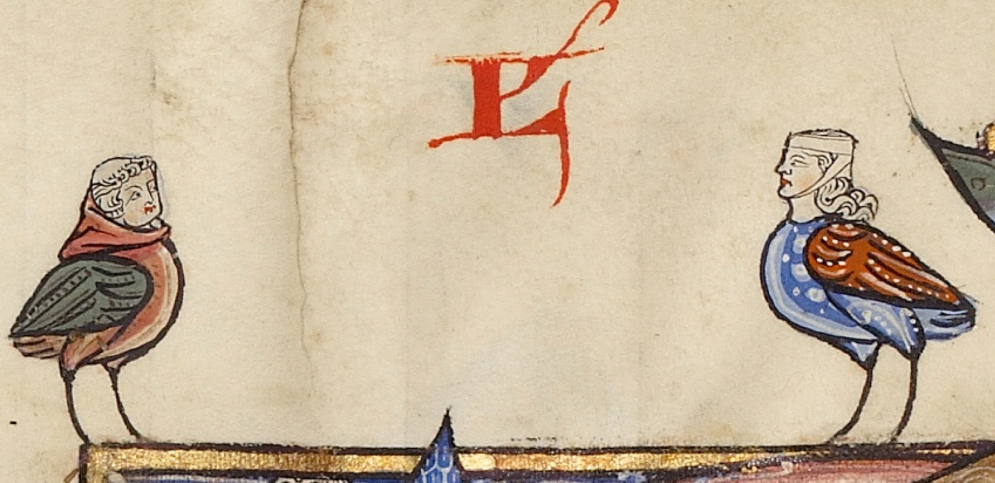
Noble Birds of Aragon, circa AD 1290

A Lesson Taught by a Blackbird

My wife and I love birds. Perhaps we enjoy them too much.

I say that because our backyard includes four different feeders. They are different types, and appeal to a variety of species. (We also have a hummingbird feeder on the other side of the house, just outside my office window.)

Blessed as we are to live in the Puget Sound area, we see a variety of avifauna.* Nearly every day we see doves, robins, sparrows, chickadees, juncos, finches, Steller’s jays, thrushes, flickers, towhees, red-winged blackbirds and hummingbirds. Oh, and starlings too, that are the only birds our border collie chases (because of their darting taunts, I suppose).

Occasionally we have goldfinches, quail, band-tailed pigeons, woodpeckers, and various other guests I’m not quite positive about. In the sky, and on the nearby shoreline, we see many seagulls, mallards, great blue herons, Canadian geese, and—particularly during the current season—bald eagles.

As I said, we are definitely blessed to enjoy so many lovely creatures surrounding us. But this post isn’t really about birds; it concerns a particular bird who has recently joined our community. It is (I’m pretty confident) a Brewer’s blackbird.

He boasts magnificent sheen on his jet black plumage. Sadly, though, he appears to be quite unhappy.

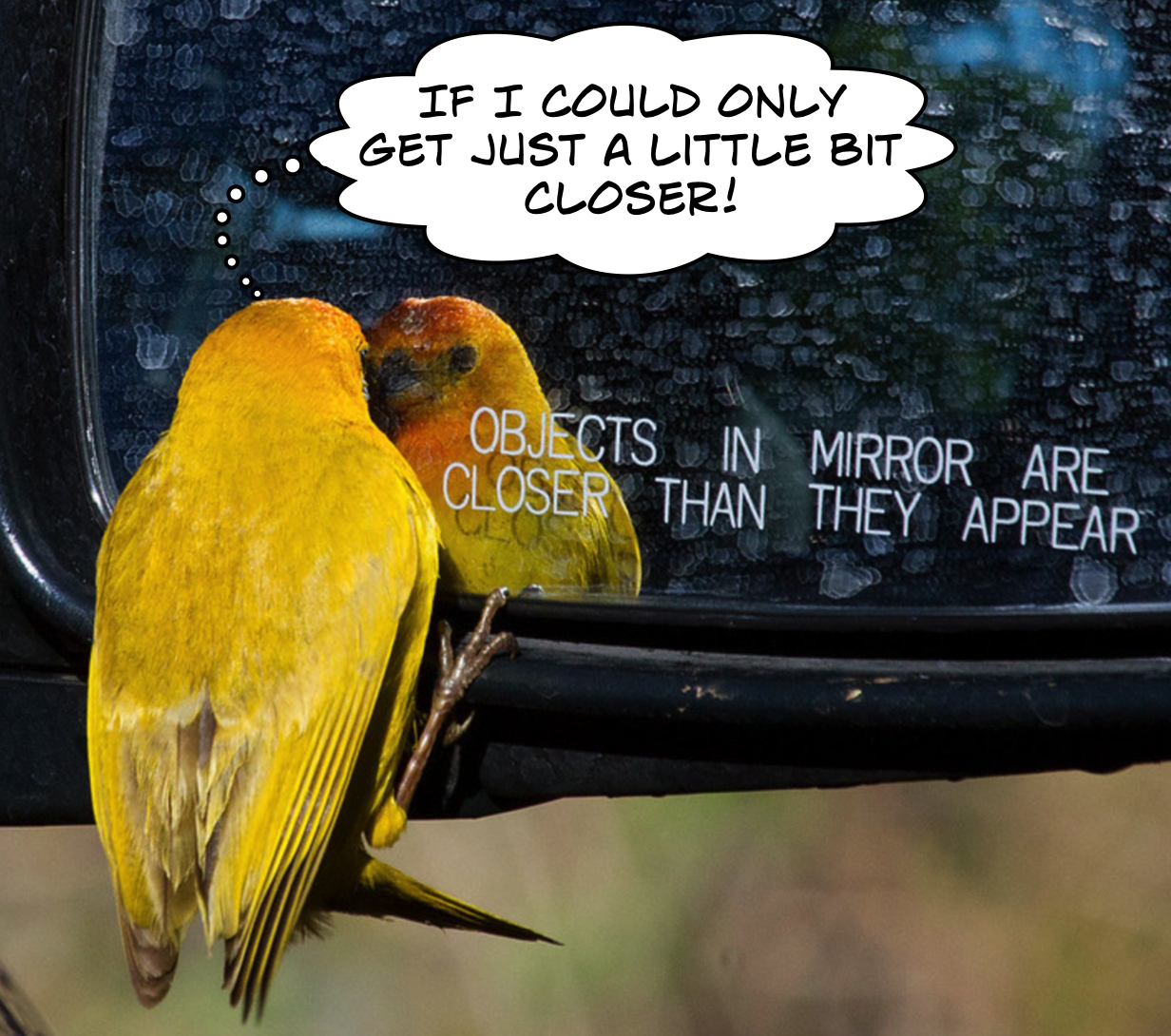
His unhappiness is due to unrequited love. A tragic condition shared by many human beings. You see, each morning he comes to a bird bath near our bedroom window where he can perch and view his own reflection on the glass.

Seeing a potential companion, he does a sort of courting dance, which the reflection presumably imitates. He bumps into the glass, often repeatedly. Despite his zealous efforts, he inevitably ends up disappointed. And yet, there he is, the next morning, delighted that his friend is willing to give him another chance.

We Are Like the Blackbird

One recent morning I awoke to his antics, and it struck my waking mind that that poor bird’s futile efforts are a metaphor of our lives.

We perceive idealized reflections of ourselves, so flawless we become enraptured. We think of ourselves as the most important thing in the world. In a sense, we begin to believe the universe revolves around us.

I remembered the Greek story of Narcissus. It is a myth offering many insights, not solely the dangers of unbridled self-love. It was because of his contempt for others that Narcissus was cursed to see in a pool a reflection of the only person he considered worthy of his attention. At first, when he fell “in love,” he did not recognize the image as being himself. The tragedy leads to his destruction.⁑

We too, I think as a I watch that small bird vainly striving to find fulfillment in an illusion, experience only disappointment and ultimate despair.

For days Narcissus knelt by the pool, hopelessly in love with the beauty of his own reflection. Before his eyes he saw the image grow pale and thin, weep tears, stretch out its arms, and look at him. Still he could not hear it, could not touch it, no matter how he implored.

While reflecting on this subject, I found a couple of articles I recommend to those desiring to ponder it further. And, next week we will consider other birds, from another perspective—their use in a Renaissance work of fiction, included by C.S. Lewis in his volume from Oxford History of English Literature.

C.S. Lewis on the Bible: Myth, Truth, Fact, and Genesis” explores C.S. Lewis’ contribution to comprehending the complexity inherent in mythology. He cites the simplistic interpretation of the story of Narcissus as a misleading reduction of the myth’s deeper message.

Understanding and Dealing with Today’s Culture of Narcissism” notes how C.S. Lewis offered a non-narcissian prescription for addressing the “hungry soul.”

Self-Centeredness Isn’t Narcissism’s Central Problem,” discusses the myth and the culture of Narcissism in which we are immersed. Author Angela Franks, a professor at St. John’s Seminary, then moves into a brilliant discussion of Till We Have Faces, which C.S. Lewis considered his finest book.

C. S. Lewis’s unjustly neglected rewriting of the myth of Cupid and Psyche, in his novel Till We Have Faces, provides a profound insight into the narcissistic spectrum. . . .

So it appears [in Lewis’ myth] that the beloved of the gods is not only the beautiful and wise Psyche, but also the tormented and ugly Orual. In the divine plan, the hideous older half-sister suffers in order to aid the beautiful maiden, but the beautiful maiden also goes through the greatest trials in order to purify Orual. The god, it appears, is willing to sacrifice his beloved in order to be united to the one who hates him. “What’s mine is yours!” Psyche and the god proclaim to Orual, but this time not in vengeance; in Lewis’s new myth, just retribution gives way to undeserved love.

To discourage our obsidian-feathered friend from squandering his brief life in pursuit of his own reflection, my wife and I just placed some decals on the window. It appears to have worked.

Would that our own echoes of Narcissus were addressed so simply.


* Don’t feel bad if this word is unfamiliar to you, don’t feel bad. I didn’t know it before I wrote this post. It means “the birds of a particular region, habitat, or geological period.”

⁑ The versions of this myth end in different ways, ranging from his divine transformation into a flower, to his despair and suicide.

Using Quotations in Your Writing

Do you consider quotations good or bad? As a reader, do you think quotations enhance what you are reading . . . or do they detract from the text?

My personal opinion is that the educated use of quotations enriches writing. (Sloppy quotation is another matter.) Positive contributions made by quotes would include:

They can offer “authoritative” support of a point being made by the writer.
Quotations can offer a refreshing change of pace in a lengthy work.
The selection of the individuals quoted gives me insight into the mind of the current writer.
A well-chosen epigraph piques my curiosity about the chapter which follows.
And, frankly, I simply enjoy a brilliant turn of phrase or a timeless but fresh insight.

I’m not alone in appreciating quotations. It’s no accident The Oxford Dictionary of Quotations is in its seventh edition. Why Do We Quote? describes it this way:

The demand for ODQ remains substantial. It has also spawned numerous sister dictionaries, many themselves appearing in several editions. We have The Oxford Dictionary of Humorous Quotations,… of Literary Quotations,… of Political Quotations,… of Biographical Quotations,… of Medical Quotations,… of American Legal Quotations,…. of Scientific Quotations.… of Phrase, Saying, and Quotation,… of Thematic Quotations,… of Quotations by Subject,… of Modern Quotation,… of Twentieth-Century Quotations, The Concise Oxford Dictionary of Quotation. A Little Oxford Dictionary of Quotations has gone through successive editions. There have also been several editions of The Oxford Dictionary of English Proverbs, the first in 1936. There is an avid market, it seems, for quotation collections.

The number of quotation collections is staggering. Read on, and I’ll provide links to some of the compilations available for free download, thanks to public domain laws.

The sheer weight of these books reveals their popularity. And quotations collections are marketable today. In “How Inspirational Quotes became a Whole Social Media Industry,” the author cites a Canadian whose “interest in motivational quotes has proven lucrative, and while he still has a day job in the wireless technology industry, he says that he’s recently been taking home two to three times his regular income from advertising on his website.”

And it all began when, “One day when he was a teenager, he was browsing in a book shop and came across a small book of famous quotations. Something about these pithy sayings appealed to him, and he started to compile his own collection of quotes that particularly resonated.”

Before the birth of the internet, I invested in several quotation collections—a not uncommon purchase for pastors. I confess to still referring on occasion to The Quotable Lewis to suggest new themes to explore here at Mere Inkling.

C.S. Lewis and Quotations

A beloved lecturer, C.S. Lewis recognized the value of worthy quotation. While few of us have his “eidetic memory,” we can certainly follow his example in using apt quotations to illustrate our points.

Lewis even regarded quotation collections highly enough to compile one. In 1946, he published George MacDonald: An Anthology. It was a tribute to the writings of his “mentor,” who appears in his fictional masterpiece about heaven and hell, The Great Divorce. The anthology remains in print. However, Canadian readers of Mere Inkling can benefit from it falling into public domain status in their Commonwealth. Canadians will find it available for download at this site.

While every reader is capable of enjoying the 365 selections in the volume, Lewis did have a specific intent in the passages he chose.

This collection, as I have said, was designed not to revive MacDonald’s literary reputation but to spread his religious teaching. Hence most of my extracts are taken from the three volumes of Unspoken Sermons. My own debt to this book is almost as great as one man can owe to another: and nearly all serious inquirers to whom I have introduced it acknowledge that it has given them great help—sometimes indispensable help towards the very acceptance of the Christian faith.

Scores of Free Quotation Collections Available to All

Internet Archive has an enormous (free) lending library of books featuring collections of quotations. Many can be “checked out” for temporary use. Other older books are available for download.

Project Gutenberg offers a smaller number, but includes titles they have edited themselves by gleaning pithy phrases from books in their public domain library. Many* of these free (public domain) compilations are linked below.

The massive selection of quotation collections (I quit counting as I approached 100) is daunting. Among those not available for download (which are still accessible for reading) you will note ever more esoteric subject matter. As a whole, we find a small number are collected from prolific individuals, such as Shakespeare, Mark Twain, or John F. Kennedy. Many are generalist, featuring “popular” quotations on a wide range of subjects. Others are thematic, focusing on subjects such as friendship, humor, women, sports, country music, dog [or cat] lovers, climbers, business, motor racing, the military, lawyers, saints, atheists, rock ‘n’ roll, or any of fourscore more themes. Some featuring national or cultural quotations, for example French, Jewish, Scottish, German, etc. And, for those up to the challenge, you can even read Wit and Wisdom of the American Presidents: A Book of Quotations.

🚧 Feel Free to Ignore Everything Below 🚧

Only the smallest attempt has been made here to sort the free volumes. You will find a few general headings below, and a multitude of similarly titled books. One wonders how many of the quotations cited in the larger volumes are common to all of them. Perhaps as you glance through this list, you will see a title or two you might appreciate perusing.

General Quotation Collections

The Oxford Dictionary Of Quotations
(Second Edition: 1953)

The Book of Familiar Quotations
Unnamed Compiler (London: 1860)

Familiar Quotations
John Bartlett (Boston: 1876)

Dictionary of Contemporary Quotations (English)
Helena Swan (London and New York: 1904)

What Great Men have Said about Great Men: a Dictionary of Quotations
William Wale (London: 1902)

A Cyclopaedia of Sacred Poetical Quotations
H.G. Adams (London: 1854)

The International Encyclopedia of Prose and Poetical Quotations from the Literature of the World
William Shepard Walsh (Philadelphia: 1908)

The Book of Familiar Quotations; being a Collection of Popular Extracts and Aphorisms from the Works of the Best Authors
Unnamed Compiler (London: 1866)

The Book of Familiar Quotations; being a Collection of Popular Extracts and Aphorisms from the Works of the Best Authors
L.C. Gent (London: 1866)

Dictionary of Quotations (English)
Philip Hugh Dalbiac (Long & New York: 1908)

A Dictionary Of Quotations
Everyman’s Library (London: 1868)

Forty Thousand Quotations: Prose and Poetical
by Charles Noel Douglas (New York: 1904)

Three Thousand Selected Quotations From Brilliant Writers
Josiah H. Gilbert (Hartford, Connecticut: 1905)

Stokes’ Encyclopedia of Familiar Quotations: Containing Five Thousand Selections from Six Hundred Authors
Elford Eveleigh Treffry (New York: 1906)

Historical Lights: a Volume of Six Thousand Quotations from Standard Histories and Biographies
Charles Eugene Little (London & New York: 1886)

Great Truths by Great Authors: A Dictionary of Aids to Reflection, Quotations of Maxims, Metaphors, Counsels, Cautions, Aphorisms, Proverbs, &c., &c. from Writers of All Ages and Both Hemispheres
William M. White (Philadelphia: 1856)

Truths Illustrated by Great Authors: A Dictionary of Nearly Four Thousand Aids to Reflection, Quotations of Maxims, Metaphors, Counsels, Cautions, Aphorisms, Proverbs, &c., &c.
William M. White (Philadelphia: 1868)

Handy Dictionary of Prose Quotations
George Whitefield Powers (New York: 1901)

Letters, Sentences and Maxims
Philip Dormer Stanhope Chesterfield (London & New York: 1888)

Poetical Quotations from Chaucer to Tennyson: With Copious Indexes
Samuel Austin Allibone (Philadelphia: 1875)

Prose Quotations from Socrates to Macaulay
Samuel Austin Allibone (Philadelphia: 1880)

Cassell’s Book Of Quotations, Proverbs and Household Words
William Gurney Benham (London & New York, 1907)

Putnam’s Complete Book of Quotations, Proverbs and Household Words
William Gurney Benham (New York, 1926)

Benham’s Book Of Quotations
William Gurney Benham (London: 1949)

Hoyt’s New Cyclopedia Of Practical Quotations
by Kate Louise Roberts (New York: 1927)

Classic Quotations: A Thought-Book of the Wise Spirits of All Ages and all Countries, Fit for All Men and All Hours
James Elmes (New York: 1863)

A Dictionary of Quotations from the English Poets
Henry George Bohn (London: 1902)

A Complete Dictionary Of Poetical Quotations
Sarah Josepha Hale (Philadelphia: 1855)

The Handbook of Quotations: Gleanings from the English and American Fields of Poetic Literature
Edith B. Ordway (New York: 1913)

Carleton’s Hand-Book of Popular Quotations
G.W. Carleton (New York: 1877)

Many Thoughts of Many Minds
George W. Carleton (New York: 1882)

Many Thoughts Of Many Minds
Henry Southgate (London: 1930)

A Manual of Quotations (forming a new and considerably enlarged edition of MacDonnel’s Dictionary of Quotations)
E.H. Michelsen (London: 1856)

A Dictionary of Quotations from Various Authors in Ancient and Modern Languages
Hugh Moore (London: 1831)

Dictionary Of Quotations: from Ancient and Modern, English and Foreign Sources
James Wood (London: 1893)

A Dictionary of Quotations in Prose: from American and Foreign Authors
Anna L. Ward (New York: 1889)

Webster’s Dictionary Of Quotations: A Book of Ready Reference
(London: undated)

Collections of Individual Authors

Quotations from Browning
Ruth White Lawton (Springfield, Massachusetts: 1903)

The Wesley Yearbook: or, Practical Quotations from the Rev. John Wesley
Mary Yandell Kelly (Nashville: 1899)

Quotes and Images From The Works of Mark Twain
David Widger (Project Gutenberg: 2002)

Widger’s Quotations from the Project Gutenberg Editions of Paine’s Writings on Mark Twain
David Widger (Project Gutenberg: 2003)

Quotes and Images From The Diary of Samuel Pepys
David Widger (Project Gutenberg: 2004)

Quotes and Images From Memoirs of Louis XIV
David Widger (Project Gutenberg: 2004)

Quotes and Images From Memoirs of Louis XV and XVI
David Widger (Project Gutenberg: 2005)

Quotes and Images from the Memoirs of Jacques Casanova de Seingalt
David Widger (Project Gutenberg: 2004)

Quotes and Images From Motley’s History of the Netherlands
David Widger (Project Gutenberg: 2004)

Quotes and Images from the Writings of Abraham
David Widger (Project Gutenberg: 2004)

Quotes and Images From The Tales and Novels of Jean de La Fontaine
David Widger (Project Gutenberg: 2004)

Quotes and Images From The Works of George Meredith
David Widger (Project Gutenberg: 2004)

Quotes and Images From Memoirs of Cardinal De Retz
David Widger (Project Gutenberg: 2005)

Quotes and Images From Memoirs of Count Grammont by Count Anthony Hamilton
David Widger (Project Gutenberg: 2005)

Widger’s Quotations from the Project Gutenberg Editions of the Works of Montaigne
David Widger (Project Gutenberg: 2003)

Widger’s Quotations from Project Gutenberg Edition of Memoirs of Napoleon
David Widger (Project Gutenberg: 2003)

Quotes and Images From the Works of John Galsworthy
David Widger (Project Gutenberg: 2005)

Quotes and Images From The Confessions of Jean Jacques Rousseau
David Widger (Project Gutenberg: 2004)

The French Immortals: Quotes and Images
David Widger (Project Gutenberg: 2009)

Quotes and Images From The Works of Charles Dudley Warner
David Widger (Project Gutenberg: 2004)

Quotes and Images From Memoirs of Marie Antoinette
David Widger (Project Gutenberg: 2005)

Quotes and Images From The Works of Gilbert Parker
David Widger (Project Gutenberg: 2004)

Quotes and Images From The Confessions of Harry Lorrequer by Charles James Lever
David Widger (Project Gutenberg: 2004)

Quotes and Images From Memoirs of Madame De Montespan
David Widger (Project Gutenberg: 2005)

Quotes and Images From the Works of Oliver Wendell Holmes, Sr.
David Widger (Project Gutenberg: 2004)

Quotes and Images From The Works of William Dean Howells
David Widger (Project Gutenberg: 2004)

The Spalding Year-Book: Quotations from the Writings of Bishop [John Lancaster] Spalding for Each Day of the Year
Minnie R. Cowan (Chicago: 1905)

Worldly Wisdom; Being Extracts from the Letters of the Earl of Chesterfield to His Son
William L. Sheppard (New York: 1899)

A Year Book of Quotations: From the Writings of Henry Wadsworth Longfellow
with spaces for Autographs and Records (New York: 1896)

The Bernhardt Birthday Book: Being Quotations from the Chief Plays of Madame Sarah Bernhardt’s Repertoire and Other Works
E.M. Evors (London: 1912)

Beauties of Robert Hall
John S. Taylor (New York: 1839)

Shakespeare Gets His Own Section

Everyman’s Dictionary Of Shakespeare Quotations
D.C. Browning (London: 1961)

Shakespearean Quotations
Charles Sheridan Rex (Philadelphia: 1910)

Shakespeare Quotations
Emma Maria Rawlins (New York: 1900)

Quotations from Shakespeare
Edmund Routledge (London: 1867)

A Dictionary of Shakspere Quotations
C.J. Walbran (London: 1849)

The New Shaksperian Dictionary of Quotations
G. Somers Bellamy (London: 1875)

Longer Moral Quotations From Shakespeare
M. Venkatasiah (Mysore/Mysuru, India: 1923)

Dictionary of Shakespearian Quotations: Exhibiting the Most Forceful Passages Illustrative of the Various Passions, Affections and Emotions of the Human Mind
Thomas Dolby (New York: 1880)

Odd, Quaint and Queer Shaksperian Quotations Handsomely and Strikingly Illustrated
Henry McCobb [using pseudonym Shakspere Snug] (New York: 1892)

Thematic Quotation Collections

Quotations from Negro Authors
Katherine D. Tillman (Fort Scott, Kansas: 1921)

Sovereign Woman Versus Mere Man: a Medley of Quotations
Jennie Day Haines (San Francisco: 1905)

About Women: What Men have Said
Rose Porter (New York: 1894)

The Dixie Book of Days
Matthew Page Andrews (London & Philadelphia: 1912)

Living Waters
Alice L. Williams (Boston: 1889)

Green Pastures and Still Waters
Louis Kinney Harlow (Boston: 1887)

Out-of-Doors; Quotations from Nature Lovers
Rosalie Arthur

Ye Gardeyn Boke: a Collection of Quotations Instructive and Sentimental
Jennie Day Haines (San Francisco & New York: 1906)

The Optimist’s Good Morning
Florence Hobart Perin (Boston: 1909)

The Optimist’s Good Night
Florence Hobart Perin (Boston: 1910)

The Book of Love
Jennie Day Haines (Philadelphia: 1911)

Author’s Calendar 1889
Alice Flora McClary Stevens (Boston: 1888)

Proverbs and Quotations for School and Home
John Keitges (Chicago: 1905)

Excellent Quotations for Home and School
Julia B. Hoitt (Boston: 1890)

Borrowings: A Compilation of Helpful Thoughts from Great Authors
Sarah S.B. Yule & Mary S. Keene (San Francisco: 1894)

More Borrowings: the Ladies of First Unitarian Church of Oakland, California
Sarah S.B. Yule & Mary S. Keene (San Francisco: 1891)

Quotations
Norwood Methodist Church (Edmonton, Alberta: 1910).

Goodly Company: a Book of Quotations and Proverbs for Character Development
Jessie E. Logan (Chicago: 1930)

The Atlantic Year Book: Being a Collection of Quotations from the Atlantic Monthly
Teresa J. Fitzpatrick & Elizabeth M. Watts (Boston: 1920)

Here and There: Quaint Quotations, a Book of Wit
H.L. Sidney Lear

Author’s Calendar 1890
Alice Flora McClary Stevens (Boston: 1889)

Catch Words of Cheer
Sara A. Hubbard (Chicago: 1903)

Catch Words of Cheer (new series)
Sara A. Hubbard (Chicago: 1905)

Catch Words of Cheer (third series)
Sara A. Hubbard (Chicago: 1911)

How to Get On, Being, the Book of Good Devices: a Thousand Precepts for Practice
Godfrey Golding (London: 1877)

The Dictionary of Legal Quotations: or, Selected Dicta of English Chancellors and Judges from the Earliest Periods to the Present Time . . . embracing many epigrams and quaint sayings
James William Norton-Kyshe

The Vocabulary of Philosophy, Mental, Moral and Metaphysical: with Quotations and References
William Fleming (Philadelphia: 1860)

Manual of Forensic Quotations
Leon Mead and F. Newell Gilbert (New York: 1903)

Toaster’s Handbook Jokes Stories And Quotations
Peggy Edmund and Harold W. Williams (New York: 1932)

The Banquet Book: A Classified Collection of Quotations Designed for General Reference, and Also an Aid in the Preparation of the Toast List
Cuyler Reynolds (London & New York: 1902)

Like Expressions: a Compilation from Homer to the Present Time
A.B. Black (Chicago: 1900)

Oracles from the Poets: a Fanciful Diversion for the Drawing-Room
Caroline Howard Gilman (London & New York: 1844)

The Sibyl: or, New Oracles from the Poets
Caroline Howard Gilman (New York: 1848)

A Book of Golden Thoughts
Henry Attwell (London & New York: 1888)

A Little Book of Naval Wisdom
Harold Felix Baker Wheeler (London: 1929)

Medical Quotations from English Prose
John Hathaway Lindsey (Boston: 1924)

Psychological Year Book: Quotations Showing the Laws, the Ways, the Means, the Methods for Gaining Lasting Health, Happiness, Peace and Prosperity
Janet Young (San Francisco: 1905)

The Oshawa Book of Favorite Quotations
(Oshawa, Ontario: 1900)

The Pocket Book Of Quotations
Henry Davidoff (New York: 1942)

Quotations for Occasions
Katharine B. Wood (New York: 1896)

Quotations For Special Occasions
Maud Van Buren (New York: 1939)

A Complete Collection of the Quotations and Inscriptions in the Library of Congress
Emily Loiseau Walter

Words and Days: a Table-Book of Prose and Verse
Bowyer Nichols (London: 1895)

The Book of Good Cheer: “A Little Bundle of Cheery Thoughts”
Edwin Osgood Grover (New York: 1916)

The Good Cheer Book
Blanche E. Herbert (Boston: 1919)

Just Being Happy: a Little Book of Happy Thoughts
Edwin Osgood Grover (New York: 1916)

Pastor’s Ideal Funeral Book: Scripture Selections, Topics, Texts and Outlines, Suggestive Themes and Prayers, Quotations and Illustrations
Arthur H. DeLong (New York: 1910)

Quips and Quiddities: a Quintessence of Quirks, Quaint, Quizzical, and Quotable
William Davenport Adams (London: 1881)

The Book of Ready-Made Speeches: with Appropriate Quotations, Toasts, and Sentiments
Charles Hindley (London: 1893)

Suggestive Thoughts on Religious Subjects
Henry Southgate (London: 1881)

Two Thousand Gospel Quotations from the Bible, Book of Mormon, Doctrine and Covenants, and Pearl of Great Price
Henry H. Rolapp (Salt Lake City, Utah: 1918)

Selected Quotations on Peace and War: with Especial Reference to a Course of Lessons on International Peace, a Study in Christian Fraternity
Federal Council of the Churches of Christ in America (New York: 1915)

Book of Science and Nature Quotations
Isaac Asimov & Jason A. Shulman (New York: 1988)
From an Indian Library Collection (not generally public domain)

Foreign (i.e. non-English) Collections

Dictionary of Quotations (Spanish)
[With English Translations]
Thomas Benfield Harbottle and Martin Hume (New York: 1907)

A Literary Manual of Foreign Quotations Ancient and Modern, with Illustrations from American and English Authors
John Devoe Belton (New York: 1891)

Dictionary of Quotations (Classical)
Thomas Benfield Harbottle (London: 1897)

Dictionary of Latin Quotations, Proverbs, Maxims, and Mottos, Classical and Medieval
Henry Thomas Riley (London: 1866)

Treasury of Latin Gems: a Companion Book and Introduction to the Treasures of Latin Literature
Edwin Newton Brown (Hastings, Nebraska: 1894)

A Dictionary of Oriental Quotations (Arabic and Persian)
Claud Field (London & New York: 1911)

A Little Book of German Wisdom
Claud Field (London: 1912)

Dictionary Of Foreign Phrases And Classical Quotations
Hugh Percy Jones (Edinburgh: 1908)

Dictionary Of Quotations: in Most Frequent Use, Taken Chiefly from the Latin and French, but Comprising Many from the Greek, Spanish and Italian Languages
[Translated into English]
D.E. MacDonnel (London: 1826)

A Dictionary Of English Quotations And Proverbs
With translations into Marathi
C.D. Deshmukh (Poona/Pune, India: 1973)

Classical and Foreign Quotations: a Polyglot Manual of Historical and Literary Sayings, Noted Passages in Poetry and Prose Phrases, Proverbs, and Bons Mots
Wm. Francis Henry King (London: 1904)


* Too many.

⁑ A bit of irony in this title, since it was written over 115 years ago.