C.S. Lewis & Longevity

How long is it good for us to live? That’s a strange question, I know. But, do you have an answer? C.S. Lewis had some thoughts on the subject that you may find provocative.

Aging is on my mind this week. I had never thought about myself becoming a septuagenarian – but this week I became one. Well, I still think of myself as being in my fifties, but that appears to be more common than one would guess. When I entered my fifties, I told my dad (then in his seventies) that “I still picture myself as being in my thirties.”

My dad responded without a moment’s thought: “That doesn’t surprise me at all. I still think of myself as being in my fifties.” 

Many people become preoccupied with age. The only time I recall it mattering to me, was when I turned eighteen – able to vote, and registered for the draft (with Vietnam still a war zone) . . . and when I turned twenty-one, for reasons I prefer not to divulge at this time.

People are living longer, and I’m not convinced that translates into living better. Listen to C.S. Lewis, as he writes in his essay “Is Progress Possible?”

I care far more how humanity lives than how long. Progress, for me, means increasing goodness and happiness of individual lives. For the species, as for each man, mere longevity seems to me a contemptible ideal.

Lewis elaborates on this concept – that long life and happiness do not always intertwine – in the Screwtape Letters. The words which follow are the advice of a senior Tempter (devil) to a less experienced junior.

The truth is that the Enemy [i.e. the true God], having oddly destined these mere animals to life in His own eternal world, has guarded them pretty effectively from the danger of feeling at home anywhere else. That is why we must often wish long life to our patients; seventy years is not a day too much for the difficult task of unravelling their souls from Heaven and building up a firm attachment to the Earth.

While they are young we find them always shooting off at a tangent. Even if we contrive to keep them ignorant of explicit religion, the incalculable winds of fantasy and music and poetry . . . are always blowing our whole structure away. They will not apply themselves steadily to worldly advancement, prudent connections, and the policy of safety first.

So inveterate is their appetite for Heaven, that our best method, at this stage, of attaching them to Earth is to make them believe that Earth can be turned into Heaven at some future date by politics or eugenics or “science” or psychology or what not.

Real worldliness is a work of time. . . . How valuable time is to us may be gauged by the fact that the Enemy allows us so little of it. . . .

We are allowed to work only on a selected minority of the race, for what humans call a “normal life” is the exception. Apparently He wants some – but only a very few – of the human animals with which He is peopling Heaven to have had the experience of resisting us through an earthly life of sixty or seventy years. Well, there is our opportunity. The smaller it is, the better we must use it. (Letter XXVIII).

Sadly, far too many people grow far too attached to this world. They lose sight of the promise of Resurrection (if they had ever known it), and as death approaches crave just one more year, another month, another week, another day, even another hour.

Now, I’m not saying long life is a negative, per se. I agree with C.S. Lewis when he wrote “I must never, like the Stoics, say that death does not matter. Nothing is less Christian than that” (“The Grand Miracle”). The danger is not in enjoying the Lord’s wonderful creation. It is in growing too attached to this fallen version of it – in losing touch with the truth proclaimed by musician Larry Norman, that this sin-stained world is not our ultimate home.

Dying

Having been at the bedside of too many people as they face their mortality, I have witnessed many final days. Some literally go, trembling and cursing. Others depart with grim resignation, and no evidence of hope. And then there are those who die with faith, experiencing true peace and joyous anticipation, despite the pain they may be enduring. 

I wish everyone could die in such a state, at peace and earnestly desiring to see the glory of God unblurred by our mortal eyes (1 Corinthians 13). 

On that day we will enter into the fullness of life, into eternal life. (Dr. Michael Zeigler offers an encouraging sermon you can read or listen to at “The Problem and Promise of Deathbed Conversion.”)

The Screwtape Letters is one of C.S. Lewis’ most imitated books. I have even experimented with his model myself. But, rather than emulate these letters, today I would be so bold as to offer an addition to this demonic epistle. 

My supplement is not intended for Christians, except as a truth they may wish to share with others who are walking through the valley of the shadow of death.

And never, my dear Wormwood, at the risk of your own torment, forget this one dire threat. Even after a long life, lived in hedonistic pleasure, deeply tethered to this decaying world, it is still possible for these wretches to be rescued from our claws.

The Enemy is so blindly compassionate that he will foolishly overlook a magnitude of savory sins sown during a carnal life. The dissolute lives we have toiled so steadfastly to soil with uncountable depravities and unrelenting selfishness, remain vulnerable until the patients’ final breath is exhaled.

The Gordian Knot we have so skillfully twisted can be undone in an instant, if they cry out to the Enemy for forgiveness. That is why we must remain vigilant to the very end. It is ideal to have them railing at the end against a God who has allowed them to suffer.

Yet it is sufficient that they die without that rage. A hopeless resignation to what they foolishly consider the end of their existence, still provides fodder for the insatiable appetite of Our Father Below quite adequately.

Final Encouragement

God’s mercy is beyond our ability to comprehend it. While there is breath, there remains hope. Even at the end of a squandered life, God’s love in Jesus Christ is sufficient to wash away every failing, and usher a penitent soul into the glory of everlasting life. 

Remember that, if you find yourself feeling too defiled to come to Christ at the end, that is a lie of Satan. Every single one of us Christians was in similar straits – “while we were still sinners, Christ died for us.”

And, should you ever have the experience of traveling beside a dying friend who sees only darkness ahead, share with them this gospel hope.


Tinker Bell, the Inklings, and Disney

Poor Tinker Bell. The political prejudices of our day have caught up with the sparkling fairy, and relegated her to a significantly reduced presence in the Disney universe.

Inside the Magic reported “Tinker Bell seems to have left Walt Disney World and is now on her way back to Neverland following a recent change at Walt Disney World Resort.” You can read the tragic tale on their site.

. . . once more, Disney’s animated classic, Peter Pan (1953), is under scrutiny, with Disney issuing a statement regarding Captain Hook and Tinker Bell as characters with potential concerns.

Linking poor Tink to a murderous pirate seems a bit of a stretch, and she has not been fully banished, but she has definitely been demoted. According to TMZ, Disney alleges the company’s “own people felt she wasn’t a good role model for girls in the 21st century.”

Well, eventually she too will be in the public domain, like Mickey Mouse. Actually, her literary portrait as introduced in the play, coincidentally just entered the public domain this year (2024)!

However, should you reside in the United Kingdom, beware that in 1988, the copyright holder, Great Ormond Street Hospital, was granted the rights to Peter Pan “in perpetuity.”

The Creator of Tinker Bell & Peter Pan

Tinker Bell is one of the most memorable characters in Neverland, the creation of James Matthew Barrie (1860-1937). He was a prolific Scottish writer and is best known for his 1911 novel, Peter and Wendy – which initially debuted in the form of a stage play in 1904, as Peter Pan; or, the Boy Who Wouldn’t Grow Up.

Peter Pan was actually introduced to the world as a baby in The Little White Bird. Tinker Bell does not appear in the novel, but the following description of J.M. Barrie’s fairy mythology is quite fanciful.

One of the great differences between the fairies and us is that they never do anything useful. When the first baby laughed for the first time, his laugh broke into a million pieces, and they all went skipping about. That was the beginning of fairies.

They look tremendously busy, you know, as if they had not a moment to spare, but if you were to ask them what they are doing, they could not tell you in the least. They are frightfully ignorant, and everything they do is make-believe.

They have a postman, but he never calls except at Christmas with his little box, and though they have beautiful schools, nothing is taught in them; the youngest child being chief person is always elected mistress, and when she has called the roll, they all go out for a walk and never come back.

It is a very noticeable thing that, in fairy families, the youngest is always chief person, and usually becomes a prince or princess; and children remember this, and think it must be so among humans also, and that is why they are often made uneasy when they come upon their mother furtively putting new frills on the basinette.

Barrie continues, describing how infants are simply following fairy “ways” when they misbehave, and they naturally experience “exasperation, because we don’t understand [them], though [they are] talking an intelligible language . . . fairy.”

Returning to the person of Tinker Bell herself, she outgrew her supporting role as, in the words of her creator, “a common fairy.” She was literally a tinker, who died following the departure of Wendy and her brothers from Neverland. 

Presumably, some of the gatekeepers at Disney would have preferred that the affection of the crowds had not restored her to life. 

The Inklings

The Imaginative Conservative offers an interesting take on C.S. Lewis’ view of fairies. I quote a portion related to our present subject.

Lewis treats the subject of fairies in . . . The Discarded Image. . . . After explaining the medieval understanding of the heavens and planetary systems, Lewis turns to what he calls the Longaevi. He avoids the term “fairies” because it is “tarnished by pantomime and bad children’s books with worse illustrations.” (Probably referring to Barrie’s popular play and Princess Mary’s Gift Book – the book from which Elsie and Frances clipped the pictures they used in their fake photos.)

Jane Douglass, an American actress and playwright, contributed a fascinating essay to C.S. Lewis at the Breakfast Table, and Other Reminiscences. One wonderful portion of “An Enduring Friendship” describes Lewis’ thoughts about the possible dramatization of The Lion, the Witch, and the Wardrobe

C.S. Lewis deemed the prospect absurd on its face, saying “I believe plays should be plays, poems, poems, novels, novels, stories, stories, and certainly the book you mention is pure narrative.” So much for a partially surviving 1967 series, the 1979 animation, the 1988 BBC television series, and the cinematic version(s) which began in 2005. Oh, and there is the matter of the impending Netflix telling which remains a closely guarded secret. Douglass continued with a reference to Disney.

He repeated his dread of such things as radio and television apparatus and expressed his dislike of talking films. I said I quite understood this, and that nothing would distress me more than that he should think that I had in mind anything like the Walt Disney shows; I hoped nobody had suggested the book to Mr. Disney.

This seemed to relieve Mr. Lewis to such an extent that I thought perhaps Mr. Disney had been after the book, but of course I did not ask. And in his usual generous way, Mr. Lewis said, “Too bad we didn’t know Walt Disney before he was spoiled, isn’t it?”

Author Jim Denney has a nice article on “What C.S. Lewis and J.R.R. Tolkien Thought of Walt Disney” in which he describes parallels between the live of Lewis and Disney and concludes, “you might think that, with all that C.S. Lewis and Walt Disney had in common, they might have been mutual admirers – but that was not the case.”

Disney’s Snow White and the Seven Dwarfs debuted in the United States in 1937 and in the United Kingdom in 1938. . . . A few months later, Lewis went to see it again, this time with his good friend (and fellow Oxford professor) J.R.R. Tolkien.

Coincidentally, Tolkien’s first novel The Hobbit had been published in September 1937, just three months before the American debut of Snow White.

Their greatest disappointment was in Disney’s utterly comical take on dwarves and the absence of the slightest air of “the mythic nobility of the dwarves from Germanic folklore.”

Although Snow White is itself a fairy tale, fairy characters are not to be found in the film. In the same way, J.R.R. Tolkien referred to the Lord of the Rings as a “fairy story” for adults, yet they do not appear to dwell in Middle Earth.

In fact, according to The Encyclopedia of Arda, “the name ‘Faerie’ belongs to an early period of Tolkien’s writings, and is never seen in The Lord of the Rings, but it does survive in a single usage in the earlier book The Hobbit.” And even in that case, it refers not to a population, but to a place.

On the Effect of Tinker Bell

Tinker Bell’s significance in the world is not confined to literature, or the interests of children. There is a brilliant application of her legend which has been transposed into the psychological realm. 

It’s call the “Tinker Bell Effect,” and “Be(lie)ve It or Not,” from Psychology Today, offers the following description.

One theory manifesting connections among belief, psychology, and mythology is the Tinkerbell effect named for the fairy Tinker Bell of Peter Pan whose resuscitation depends upon the audience expressing their belief in fairies through clapping . . .

The Tinkerbell effect refers to those things that exist only through imaginative acts and because people believe in them. The Reverse Tinkerbell effect maintains that, somewhat paradoxically, the more people believe in something the more likely it is to disappear. 

In their article, the psychologists parenthetically offer an additional application of Tinker Bell’s nature to their area of study. (It actually appears in the paragraph above, where I replaced it with an ellipsis.)

(because she is so small that she can only hold one feeling at a time, Tinkerbell is also a model for mood disorders and difficulties with emotional self-regulation)

Fascinating. It seems to me this insight opens the door to further literary exploration of the Tinker Bell Phenomenon that would be of interest to writers and literary critics alike. I close with my proposal for a new label for an ancient plague afflicting fictional works. If it interests any scholars among you, I invite you to develop it further and claim it as your own.

Tinker Bell (var. Tinkerbell) Crippling Character Creation Complete Content Complexity Phenomenon: The invention of fictional characters who lack depth and bear no resemblance to real people. Literary tropes that are often referred to as one-dimensional or “flat” characters. (See nearly all Marvel supervillains.)

P.S. – Feel free to abbr. the admittedly verbose proposed title; keeping in mind most readers prefer brief reads.

Individualism, License Plates & C.S. Lewis

One of the peculiar things about the United States is the extreme degree to which people are driven to stand out from the crowd. We are able to do this with our automobiles, for example, in a rather odd way.

C.S. Lewis was immune to the temptation discussed here, since he was never a fan of cars, as I discussed in “C.S. Lewis & Automobiles.”

In his autobiography, Lewis declared “I number it among my blessings that my father had no car, while yet most of my friends had, and sometimes took me for a drive.” Those who are curious about Lewis’ dichotomy concerning vehicles, should refer to that post.

I don’t know how many other countries do this, but in most of the United States states, people have the option of getting random numbers and letters on their license plates – or opting for so-called vanity plates.

These individually emblazoned metallic placards perform a sort of Third Estate heraldic device. They often include variations on surnames or words significant to the bearer.

Obviously, offensive words are prohibited, but they are frequently quite creative. Here are a few examples: SO 4CHN8 and its opposite, EN-V ~  GONA B L8 which is probably an insufficient excuse to the cop who pulls you over ~ IBMEUBU with its live and let live philosophy versus URAMESS ~ UH AS IF from California, of course ~ IOU DAD from a grateful child ~ BWAHAHA and the clearer message from Vermont, BBRRRR ~ TWOCUTE can either refer to attractive twins, or to an illiterate narcissist ~ BBQ=LUV celebrates a common American favorite ~ and, this provocative phrase ITS A SIN. Hundreds more examples are online if you’re curious.

It’s fascinating that Americans will pay often exorbitant surcharges to individuate their auto plates. Especially in light of the fact that we already have different plates for each of the 50 states and a Federal District (for our national capital), as well as others for Territories and Protectorates. Prepare yourself. Seriously, prepare for a shock.

All of the 8,331 License Plates in America

States now offer a vast menu of personalized plate options for a dizzying array of organizations, professions, sports teams, causes and other groups.

Such plates typically include a surcharge to support the theme identified on each choice, as for Maryland’s Beekeepers, Barbershop Quartet Singers, or the Baltimore Bicycling Club. And we mustn’t forget their plate promoting the museum of the B&O Railroad (of Monopoly fame).

How can we arrive at that unbelievable number? Well, consider Illinois, for example. They boast no fewer than forty different options related to military alone. Hawaii has the fewest overall varieties at fourteen. Maryland, likely desperate for revenue, actually has nine hundred and eighty-nine. I am curious why they bothered to stop short of an even thousand.

Add to that the fact that nineteen states do not require a license on the front of the car, which invites the substitution of an individualized alternative. Consequently, there are statutes ensuring “most states also require that you do not mount your plate upside down.” In many of these, you would be legally allowed to mount decorative or business plates, but not alternative license plates, misleadingly different from your true registration.

Individuality run amok. The chaos sadly seems strikingly American.

Which brings me to the reason I was thinking about this unusual topic. Heading to church on Sunday I saw a plate with a curious message. It was one of my state’s options for Fire Fighters. The message it bore consisted of just three letters: UGH.

What does that convey to you? Since it appeared on a vocational emblem, my thought is that it reflects the feelings of someone who has grown tired of their profession. The best construction I can imagine is someone frustrated by the fact that after every fire they suppress there will come another. Resulting in a sense of futility or ennui. If you interpret it differently, please let me know.

I mean, we’ve all had ugh-days. But to feel ugh enough about life to indelibly express it this way . . . well, all I could do was hope it was an unconventional joke, and offer a quick prayer for the driver, in case it wasn’t.

C.S. Lewis offered many insights about our God-given individuality and uniqueness. Individualism, as a driving force, however, is something different. I recently read a wonderful article about how Lewis assessed individualism’ interplay with collectivism – two relentless forces in many Western cultures. “C.S. Lewis on Individualism, Equality and the Church” focuses on a World War Two speech delivered at Oxford and published as “Membership.”

Our personal uniqueness is not accidental. As C.S. Lewis wrote in The Problem of Pain,”

[God] makes each soul unique. If He had no use for all these differences, I do not see why He should have created more souls than one. Be sure that the ins and outs of your individuality are no mystery to Him; and one day they will no longer be a mystery to you.

In contrast, hyper-individualism is normally deleterious. Yet, the fact that God regards us as precious, irreplaceable beings, and calls each of us by our personal name, is wondrous news. It can accomplish two things related to the discussion above: (1) it puts personalized license plates in their proper perspective, and (2) it reminds us that even though we occasionally feel frustrated or despondent, our overall life attitude should never be summed up with an ugh.


Editor’s Note: In the interest of journalistic transparency, yours truly, while experiencing many moves, has participated in the automotive bacchanalia described above. Twice I secured military-related plates, Alabama’s Desert Shield/Desert Storm veterans and Illinois’ POW/MIA remembrance commemorations. In addition, while stationed in Guam, I secured plates with my surname.

I have asked my children to have me hospitalized for dementia should I ever decide to order our Washington State J.P. Patches Pal license plate. The reasons for that decision are obvious.

Meandering Words

Sometimes we read for business. Other times we read for pleasure. Few people are so fortunate as to have these two purposes overlap.

When the goal is the former – the necessity of reading a particular document, our desire is usually to simply “get it done.” We want to arrive quickly at the point, so we can move on to some other project. In this context, digressions are definitely something to be avoided.

This is how military writers are taught to do their job. Deliver the goods immediately, with zero interest in the prose. (Well, apart from proper grammar and spelling.) This principle is frequently described with the acronym BLUF – bottom line up front. This approach makes sense, when lives can literally be on the line and the need to make sound decisions swiftly is urgent.

The Harvard Business Review puts it bluntly: “In the military, a poorly formatted email may be the difference between mission accomplished and mission failure.” Being the HBR, they naturally translate this concept for application in the business world.

If you are curious, you can freely download some of the military writing manuals available online. Warning: these manuals tend to include lots of tedious details that ironically appear to violate the BLUF principle itself!

Army Regulation 25–50 Preparing and Managing Correspondence

DOD Manual 5110.04, Correspondence Management

Canadian Armed Forces Junior Officer Development Programme

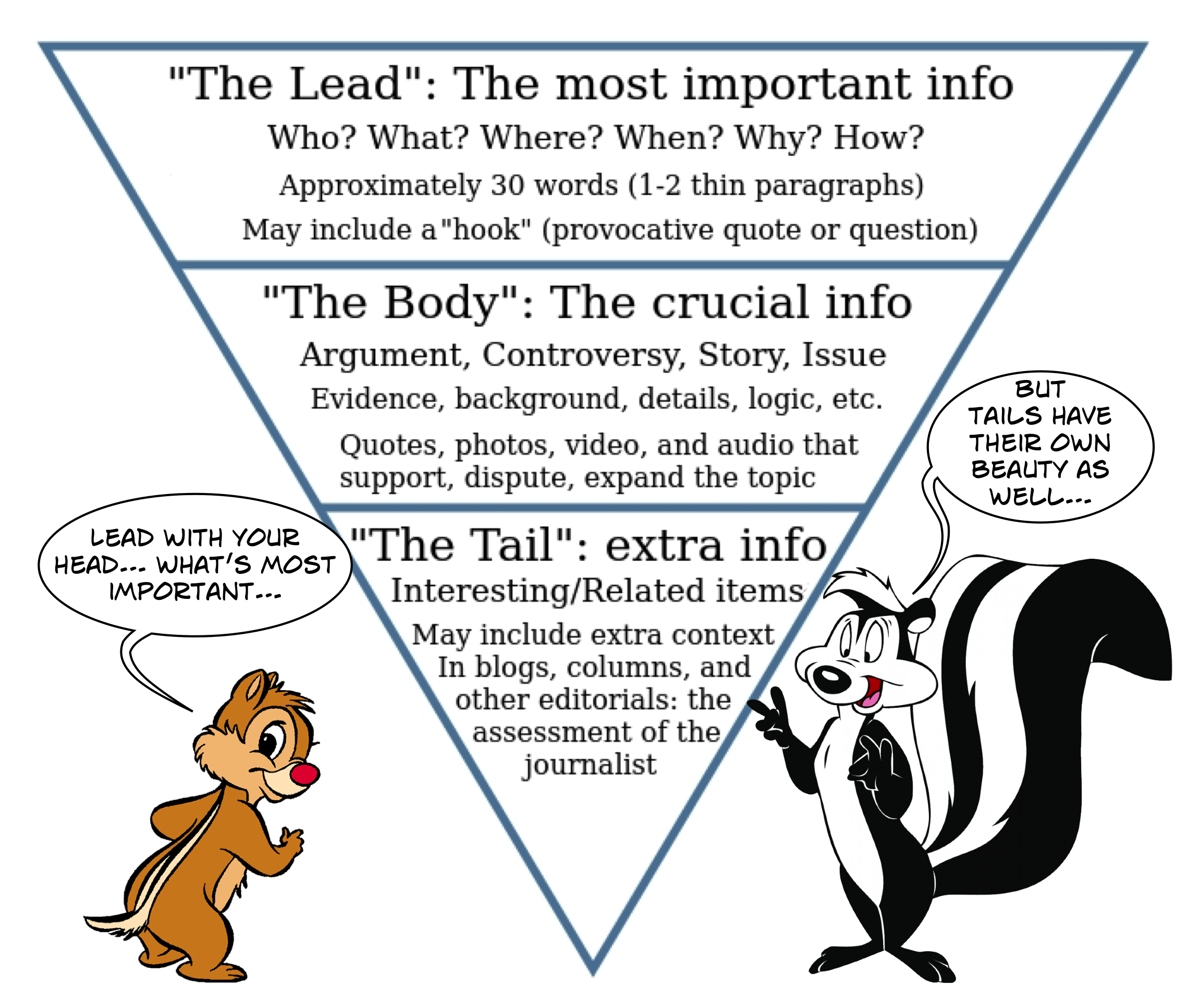
Similar to the military approach, we have the civilian version, which remains common in traditional journalism. (Even though printed newspapers continue to vanish, this approach is still found in many digital outlets.) This technique is referred to as the Inverted Pyramid Structure. Here is one concise definition:

The inverted pyramid is the model for news writing. It simply means that the heaviest or most important information should be at the top – the beginning – of your story, and the least important information should go at the bottom. And as you move from top to bottom, the information presented should gradually become less important.

The benefit of this strategy is that readers immediately learn the primary “news.” Only when they desire to supplement that information do they need to continue reading. Presumably the material follows in descending significance until they either finish the piece or it descends into minutiae of no interest to that particular reader.

The previously linked article notes one extremely important aspect of the inverted pyramid [emphasis added].

The inverted pyramid format turns traditional storytelling on its head. In a short story or novel, the most important moment – the climax – typically comes about two-thirds of the way through, closer to the end. But in news writing, the most important moment is right at the start of the lede.

And it is this traditional sort of storytelling to which we most often turn when we read for pleasure rather than as an obligation.

Reading for Enjoyment

Pleasurable reading is not, by definition, expeditious. It takes its time to tell a story, rather than rushing into a rapid information dump. In fact, when the narrative is savaged by unloading too much background or too many facts, it becomes hard to enjoy even when we want to like it.

Literature, even brief poetry, takes us on a journey. We go somewhere. We are transformed, albeit usually in an unmeasurable way. While the change may be small, it is quite distinct from the difference made by simply learning new facts.

While the journey itself may appear straightforward, in most cases there are often subtle alterations in its course. You might say a story intentionally tends to meander, which is why I titled this post as I have. Meander itself is a curious word.

Like so many words, meander has a literal and a figurative application. In a moment we will see each of these meanings entertainingly illustrated in C.S. Lewis’ correspondence.

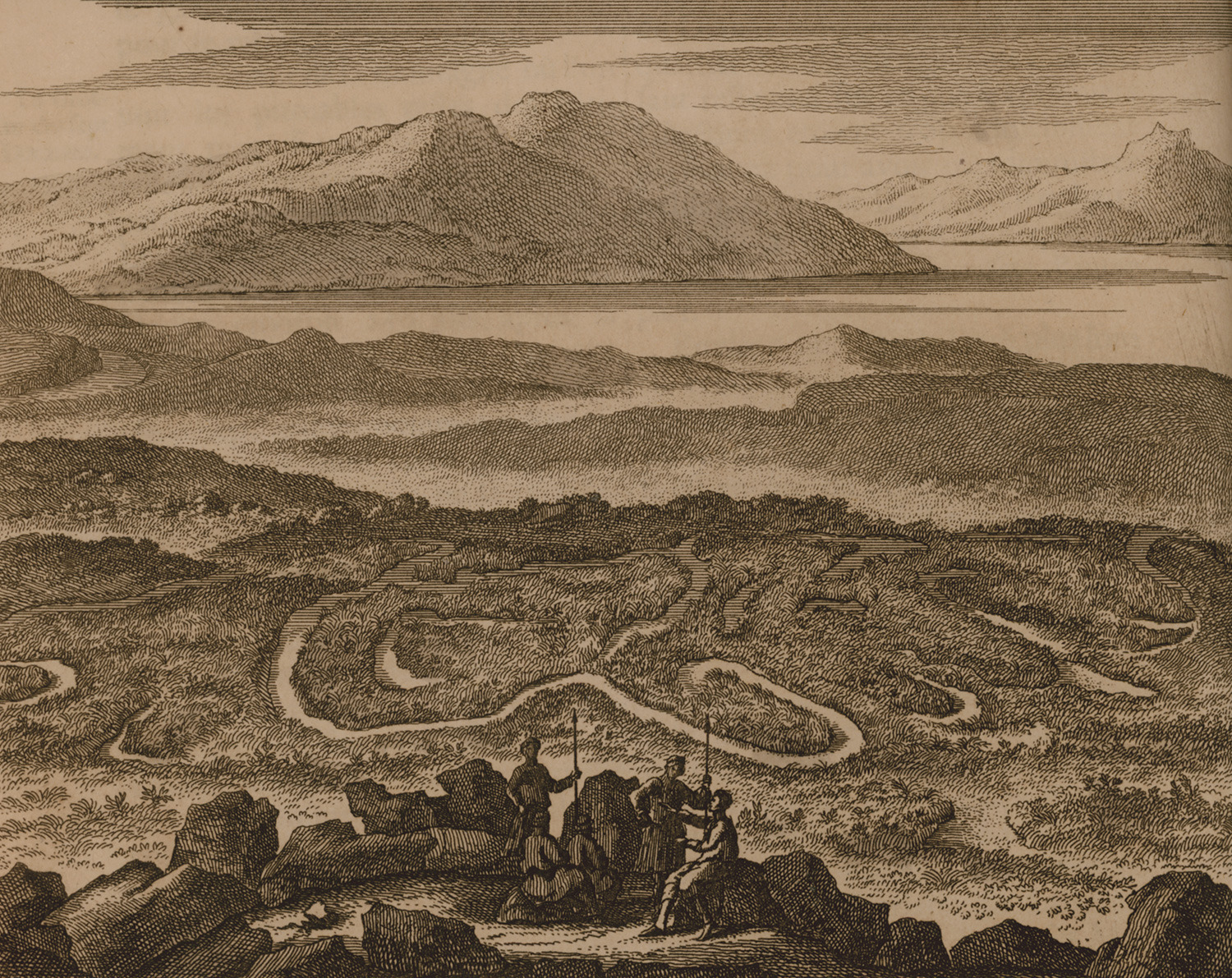
I began thinking about this intriguing word when I recently read about its source. It begins with an ancient kingdom in Asia Minor (modern day Türkiye). Lydia was independent for half a millennia before its king, Croesus, was defeated by Cyrus of Persia. One of Lydia’s lasting contributions to civilization came in the form of the minting of coinage.

Herodotus tells us they were the first to do so. This is, of course, a captivating story in its own right.One of the images used on one of their early coins was of the Maeander River, which meandered through their kingdom. The picture above, View of Maeander Valley, was published by Flemish artist Cornelis de Bruyn in 1714.

Did C.S. Lewis Meander?

Searching through Lewis’ writings, I did not find any examples of his use of this winding word. (Let me know if you’re aware of one.)

However, here are two enjoyable examples of his informal use of “meander” in his correspondence. The first, in a 1920 letter to his father, uses the word in its figurative sense.

I have two tutors now that I am doing ‘Greats,’ one for history and one for philosophy. . . . We go to the philosophy one in pairs: then one of us reads an essay and all three discuss it. . . . it is very amusing.

Luckily I find that my previous dabbling in the subject stands me in good stead and for some time I shall have only to go over more carefully ground through which I have already meandered on my own.

In the second occurrence, we find C.S. Lewis writing to his Brother Warnie in 1932. He describes, at some humorous length, the condition of the pond on their property. You can visit this same setting today in the C.S. Lewis Nature Reserve.

I have included the full discussion below. Suburbanites (and even more so, city-dwellers) may not be able to appreciate this story the way that people who have lived in the country can. Still, those with a minute to read the entire passage will likely enjoy the way Lewis meanders through his description of events. Oh, and lest you suffer unnecessary shock, be forewarned that Lewis uses the word “bathe” here not to refer to a “bath,” but to a plunge in the pond.

You will gather from this that summer has arrived: in fact last Sunday (it is Tuesday to day) I had my first bathe. You will be displeased to hear that in spite of my constant warnings the draining of the swamp has not been carried out without a fall in the level of the pond.

I repeatedly told both [the workmen] that the depth of water in the pond was sacrosanct: that nothing which might have even the remotest tendency to interfere with that must be attempted: that I would rather have the swamp as swampy as ever than lose an inch of pond.

But of course I might have known that it is quite vain ever to get anything you want carried out: and the pond is lower. However, don’t be too alarmed. I don’t think it can get any lower than it is now.

I don’t know how much of the draining operations Minto [Janie Moore] has described to you nor whether you understood them. In fact, remembering what a mechanical process described by Minto is like I may assume that the more she has said the less you know about it.

The scheme was a series of deep holes filled with rubble and covered over with earth. Into each of these a number of trenches drain: and from each of these pipes lead into the main pipe now occupying the old ditch between the garden and the swamp, which in its turn, by pipes under the lawn, drains into the ditch beside the avenue.

It was however useless to do all this as long as the overflow outlet from the pond (you know – the tiny runnel with the tiny bridge over near the Philips end of the pond) was meandering – as it did – over all the lower parts of the swampy bit. Nor was it possible to stop this up and deny the pond any outlet, as it would then have been stagnant and stinking in summer, and overflowing in winter.

It was therefore decided to substitute a pipe outlet for the mere channel outlet – which pipe could carry the overflow from the pond, through the swampy bit without wetting it, to the rest of the drainage system. When they first laid this pipe I said that its mouth (i.e. at the pond end) was too low and that it would therefore carry off more water than the old channel and so lower the pond.

The workmen shortly denied this but I stuck to my point and actually made them raise it. Even after they had raised it I was still not sure that it wasn’t taking off more water than the old channel did: so I have now had a stopper made which is in the mouth of the pipe at this moment. I have also given the spring-tap up beyond the small pond a night turned on, and I trust that by thus controlling in-flow and outflow of water I can soon nurse the pond back to its old level.

At any rate I don’t see how it can sink as long as its escape is bunged up. As to the degree of loss at present, as there are no perpendicular banks anywhere it is hard to gauge. I should think that the most pessimistic episode could hardly be more than ¾ of a foot: i.e. a difference one is unconscious of in bathing. Still I grudge every inch.

By the way, it has just occurred to me that the sinking may not be due to the draining at all: for the old ‘channel’ escape, when I looked at it just before the operations began, had certainly widened itself extremely from what I first remembered, and must have been letting out more than it ought. In that case the new pipe may have arrested rather than created a wastage.

One criticism some short-attention-span readers levy against Tolkien’s masterpiece, Lord of the Rings, is that too much time is spent traveling. Such critics overlook the reasons the author presented his saga in the manner he did. Well, for those desiring to simply jump from battle to battle, we now have graphic novels. All of the journeying in LOR has a purpose; it is far from mere “meandering.”

Tolkien detailed the travails of the Fellowship during their quest, and his maps allow students of the mythos to discern “Frodo and Sam traveled over a thousand miles from the Shire to Mount Doom in the Lord of the Rings trilogy, over multiple landscapes and terrains.” One of the colorful words created by Tolkien, that rolls off the tongue like a babbling brook, is the name of a river that crosses the Old Forest: Withywindle. (A withy is an Old English word for a willow, or slender twigs or branches.) Its course may not have been especially winding, but it definitely sounds like it should have been.

No one can deny the influence of J.R.R. Tolkien on fantasy literature. But the aforementioned shortening attention spans do deter some readers. Make no mistake about it, however, the traveling in the writings of the Inklings is not without purpose. Nor does it disrupt the story. Still, the less skilled among us should be cautious about mimicking their techniques. One author describes this hazard in the following way.

Ultimately, when you write, your goal should be to make sure that everything you write doesn’t meander, or in other words, moves in some way towards the conclusion of your story. Be that taking care of a subplot, a character arc . . . whatever, it needs to hit a step, or move towards it, on the path to the ultimate ending of your story.

Remember both pacing and the up and down of rising and falling tension. A meandering story stretches out a low point and breaks the pacing. You always want to keep your plot on a straight line to the ending. The characters, they can wander, as long as the plot doesn’t.

Thanks for meandering with Mere Inkling today. Isn’t it wonderful that God allows us these carefree moments, and life isn’t all about “getting things done?”

Following C.S. Lewis’ Military Example

Like his friend J.R.R. Tolkien, and many of the British men of their generation, C.S. Lewis served in the grim battlefields of the First World War. (However, since Lewis was actually Irish, he could not be drafted, and instead volunteered to serve.)

In recent years a number of books have appeared related to the military service of the Inklings. In A Hobbit, a Wardrobe, and a Great War, the author introduces his discussion with a succinct summary.

For a generation of men and women, [WWI] brought the end of innocence – and the end of faith. Yet for two extraordinary authors and friends, J.R.R. Tolkien and C.S. Lewis, the Great War deepened their spiritual quest. Both men served as soldiers on the Western Front, survived the trenches, and used the experience of that conflict to shape their Christian imagination. . . .

By the time of the Armistice, more than nine million soldiers lay dead and roughly thirty-seven million wounded. On average, there were about 6,046 men killed every day of the war, a war that lasted 1,566 days. In Great Britain, almost six million men—a quarter of Britain’s adult male population – passed through the ranks of the army. About one in eight perished. Tolkien and Lewis might easily have been among their number.

In 1939, a correspondent inquired if Lewis was going to reassume his commission in the army for the new conflict, and he responded with sentiments I have heard voiced by a number of other combat veterans.

No, I haven’t joined the Territorials. I am too old. It would be hypocrisy to say that I regret this. My memories of the last war haunted my dreams for years.

C.S. Lewis proceeded to graphically explain the cost of serving under such pressure. 

Military service, to be plain, includes the threat of every temporal evil: pain and death which is what we fear from sickness: isolation from those we love which is what we fear from exile: toil under arbitrary masters, injustice and humiliation, which is what we fear from slavery: hunger, thirst, cold and exposure which is what we fear from poverty.

I’m not a pacifist. If it’s got to be, it’s got to be. But the flesh is weak and selfish and I think death would be much better than to live through another war.

A new announcement from the United States’ Department of Defense brought Lewis’ situation to mind. It appears that due to a number of factors – not least of which the emphasis on Diversity, Equity and Inclusion,* which (imo) has discouraged veterans from encouraging their children to serve in the armed forces – some services are repeatedly falling short of their recruiting goals. 

In light of the fact that the world is inarguably growing more dangerous – the Doomsday Clock is set at “90 seconds to midnight” – it is alarming that we are unable to fully staff our shrunken military.

Just today my sixteen year old grandson expressed concerns about the resumption of a draft. I could not muster a persuasive argument that it won’t happen. Ironically, the last time the U.S. involuntarily conscripted troops was 1972, the year I turned eighteen. Oh, in the process of including a link to the Selective Service Sytem, I was surprised to learn that a “Medical Draft is in Standby Mode.” 

It is designed to be implemented in connection with a national mobilization in an emergency, and then only if Congress and the President approve the plan and pass and sign legislation to enact it. . . .

[The plan will] provide a fair and equitable draft of doctors, nurses, medical technicians and those with certain other health care skills if, in some future emergency, the military’s existing medical capability proved insufficient and there is a shortage of volunteers. . . .

[If implemented, the plan will] begin a mass registration of male and female health care workers between the ages of 20 and 45. . . . HCPDS [the innocuously named Health Care Personnel Delivery System] would provide medical personnel from a pool of 3.4 million doctors, nurses, specialists and allied health professionals in more than 60 fields of medicine.

No Draft Yet

Since we are not currently at war, the specter of a draft remains ephemeral. Still, the shortage of volunteers has led to a variety of initiatives, such as lowering service qualification standards. These efforts have proven inadequate, resulting in the aforementioned announcement.

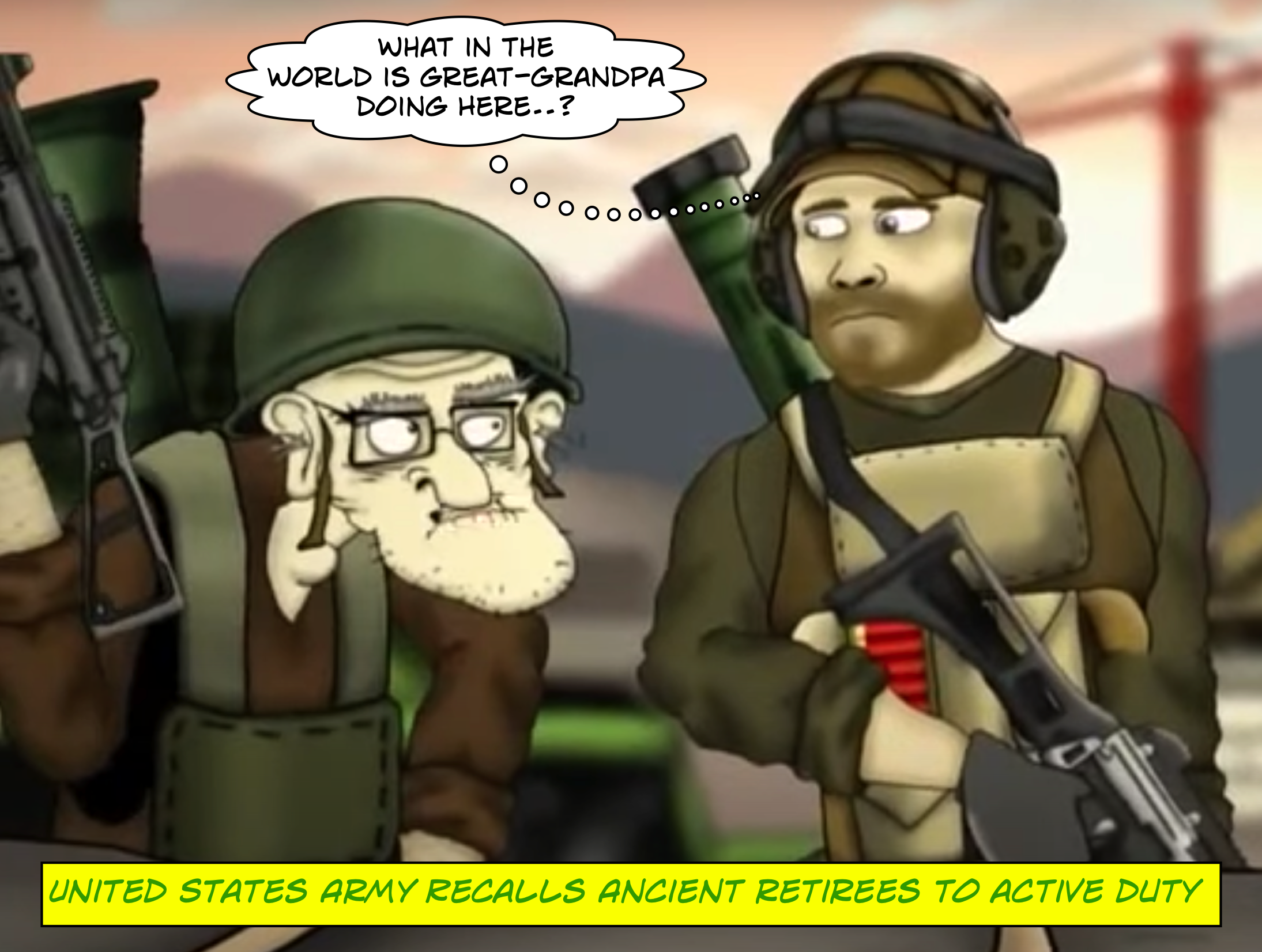
Both the Army and the Air Force have begun Retiree Recalls. Yes, that is just what it sounds like. People who have actually retired from the armed forces, normally after 20+ years of active duty, are being recalled to serve again. 

When I heard this news I was stunned. It is legally possible for the military to recall former members via a tiered process, but the first thing that came to my mind was my favorite high school teacher. He had served in Viet Nam as a draftee and finished his enlistment. He once told me that he felt safe, having survived, because now he was in the same call-up status as a “pregnant nun.” (Rather hyperbolic, but comforting to him.)

Fortunately, the current recalls are all voluntary. Only retirees whose personal circumstances make the offer appealing, will respond. As the Air Force Times reports, “Regret retiring? Here’s your shot at a second chance in the Air Force.”

I suspect that even vets who enjoyed their military service will be inclined to consider redonning the uniform as “too much of a good thing.” And if they witnessed the bloody horrors of war, as seen by C.S. Lewis, returning to the ranks would be even less tempting.

Since I, myself, have no desire to resume the demands of military life, I haven’t researched the age requirements for the Air Force recall program. Like Lewis, “I am too old.” 

But amazingly, depending on individual factors, the Army is willing to recall retired volunteers up to the age of seventy. That’s not a typo. As someone reaching that very milestone this summer, I can’t imagine returning to work side-by-side with troops half a century younger than me. 

Now, I pray for peace, knowing that being prepared for war is one way to increase that likelihood. So, I hope the military can throw off some of its political shackles and return to its necessary focus.

Furthermore, like C.S. Lewis, I have a pragmatic view of the effects of war. In “Learning in War-Time,” Lewis summarized the effects of military service during a war. As always, his insights are profound.

What does war do to death? It certainly does not make it more frequent: 100 per cent of us die, and the percentage cannot be increased. . . . Does it increase our chances of painful death? I doubt it. . . .

Does it decrease our chances of dying at peace with God? I cannot believe it. If active service does not persuade a man to prepare for death, what conceivable concatenation of circumstances would?


* This reference is to the convoluted and inequitable DEI philosophy and program(s) being mandated today. In truth, most people value diversity, and all people of goodwill believe in the importance of equity and inclusion. Along with Martin Luther King, Jr., they long for a day when people are not “judged by the color of their skin, but by the content of their character.”

C.S. Lewis as a Weaver of Words

If you like to expand your vocabulary while opening up your mind with profound insights, search no farther than C.S. Lewis.

The celebrated Oxbridge professor possessed a great respect for words. Like his friend J.R.R. Tolkien, he believed they should never be summarily detached from the history which imbues them with meaning. In “Studies in Words,” he describes the poverty of such an approach.

I am sometimes told that there are people who want a study of literature wholly free from philology; that is, from the love and knowledge of words. Perhaps no such people exist. If they do, they are either crying for the moon or else resolving on a lifetime of persistent and carefully guarded delusion.

If we read an old poem with insufficient regard for change in the overtones, and even the dictionary meanings, of words since its date – if, in fact, we are content with whatever effect the words accidentally produce in our modern minds – then of course we do not read the poem the old writer intended. What we get may still be, in our opinion, a poem; but it will be our poem, not his. If we call this tout court [too short or shallow] “reading” the old poet, we are deceiving ourselves. If we reject as “mere philology” every attempt to restore for us his real poem, we are safeguarding the deceit.

Of course any man is entitled to say he prefers the poems he makes for himself out of his mistranslations to the poems the writers intended. I have no quarrel with him. He need have none with me. Each to his taste.

If you too are a logophile, a lover of words, there’s no need to hide it. Well, with a single exception. Like everyone else, I find it off-putting when I run into people who learn complex new words simply with the goal of using them in order to “impress” others.

It amazes me how some individuals who consider themselves quite intelligent, and wish to advertise their brilliance, fail to comprehend that ostentatious speech elicits the opposite impression. [Don’t mistake my writing style where I intentionally use the fullest range of our shared vocabulary – which I believe enriches our reading and minds – with the vanity I’m describing. The latter insults readers when self-important posers attempt to intimidate others with words that are unlikely to be known by their audience.]

If you would like to read a satirical piece I wrote ridiculing this tactic, you can download “Mastering Inkling Erudition” at academia.edu. It appeared in CSL, published by the New York C.S. Lewis Society and is subtitled “Sounding Like an Expert Without Accumulating Multiple Ph.D.s.”

C.S. Lewis, of course, possessed no such pretentions. At least none I am aware of after his conversion to Christianity. His use of language is rich and satisfying. It is also instructive. I’ve lost count of the number of words to which Lewis introduced me. 

One of my favorites, though I have never dared to use it, is “bathetic.” Upon reading this note from Merriam-Webster, I suspect you too may find it applicable to much that passes for contemporary literature.

When English speakers turned apathy into apathetic in the late 17th century, using the suffix -etic to turn the noun into the adjective, they were inspired by pathetic, the adjectival form of pathos, from Greek pathētikos.

People also applied that bit of linguistic transformation to coin bathetic. English speakers added the suffix -etic to bathos, the Greek word for “depth,” which in English has come to mean “triteness” or “excessive sentimentalism.” The result: the ideal adjective for the incredibly commonplace or the overly sentimental.

The word appears in The Abolition of Man, in which C.S. Lewis critiques the poor practices of some current authors of educational resources. I will italicize the specific text, but provide the full context because of its own merits.

[They] quote a silly advertisement of a pleasure cruise and proceed to inoculate their pupils against the sort of writing it exhibits. The advertisement tells us that those who buy tickets for this cruise will go ‘across the Western Ocean where Drake of Devon sailed,’ ‘adventuring after the treasures of the Indies,’ and bringing home themselves also a ‘treasure’ of ‘golden hours’ and ‘glowing colours.’

It is a bad bit of writing, of course: a venal and bathetic exploitation of those emotions of awe and pleasure which men feel in visiting places that have striking associations with history or legend. If [they] were to stick to their last and teach their readers (as they promised to do) the art of English composition, it was their business to put this advertisement side by side with passages from great writers in which the very emotion is well expressed, and then show where the difference lies.

They might have used Johnson’s famous passage from the Western Islands, which concludes: ‘That man is little to be envied, whose patriotism would not gain force upon the plain of Marathon, or whose piety would not grow warmer among the ruins of Iona.’ They might have taken that place in The Prelude where Wordsworth describes how the antiquity of London first descended on his mind with ‘Weight and power, Power growing under weight.’

A lesson which had laid such literature beside the advertisement and really discriminated the good from the bad would have been a lesson worth teaching. There would have been some blood and sap in it – the trees of knowledge and of life growing together. It would also have had the merit of being a lesson in literature . . .

And a Double Bonus: A New Word & a Psychological Disorder

A newly forged word is referred to as a neologism, and they can be fascinating. Modern technology has caused their number to explode. Some –  think “crowdsourcing” or “app” – are now ubiquitous.

Word lovers sometimes invent words. These, of course, rarely if ever find their way into public discourse. Take this example from a letter a young C.S. Lewis penned to his friend Arthur Greeves in 1916.

I know quite well that feeling of something strange and wonderful that ought to happen, and wish I could think like you that this hope will someday be fulfilled. . . . Perhaps indeed the chance of a change into some world of Terreauty (a word I’ve coined to mean terror and beauty) is in reality in some allegorical way daily offered to us if we had the courage to take it.

One final caution. If you do decide to become a neologist, run your ideas by people you trust. I just discovered the American Psychological Association has linked one expression of the practice to serious mental disorders!

neologism (updated on 04/19/2018)
n. a newly coined word or expression. In a neurological or psychopathological context, neologisms, whose origins and meanings are usually nonsensical and unrecognizable (e.g., klipno for watch), are typically associated with aphasia or schizophrenia. – neologistic adj.

Fonts that Can Make Your Literary Dreams Come True

Would you be interested in owning a copy of an attractive new font called Middle Earth? If so, read on and you’ll find a link to download this typeface created by Swedish designer Måns Grebäck.

When it comes to fonts, there are basically two types of people – those who pay no attention to them as they read, and others who notice the nuances between similar fonts and are fascinated by extraordinary examples.

Longtime readers of Mere Inkling know I am in the latter category. Every year or two I actually write on the subject. I’ve discussed monastic fonts, legal fonts, trustworthy fonts, uninhibited fonts, a dyslexia font, a memory-enhancing font, fonts based on the handwriting of historical figures, and being a fontaholic.

The reason for my current interest in fonts is due to Microsoft’s decision to jettison Calibri as their default font for Office products. They needed to make room for its replacement, Aptos. Seriously, when you view the two sans serif* fonts, side-by-side, you may be surprised at how little they differ.

To make matters even more confusing, CNBC describes a curious aspect of Aptos saga.

Aptos will remain available in the font list under the old Bierstadt name for people who are accustomed to it. Users can also choose to set any other font as the default.

Apple’s mac computers also allow users to choose their own defaults. One typography community discusses this selection opportunity, even as they bemoan the fact that in many programs, the standard installations include suboptimal fonts.

Unfortunately, many of us work on computers where we have no control over what fonts are loaded onto the machine, so we have created a list of the top 10 most common system fonts everyone should know and how to handle them.

This website offers a brief description and history of ten of the most common fonts we typically encounter. For example:

Times New Roman is a serif typeface designed by Stanley Morison and Victor Lardent in 1931. It was commissioned by the British newspaper The Times, which wanted a new typeface to replace its existing font, Times Old Roman.

And I love their estimation of Comic Sans, one of my wife’s favorite fonts, which I avoid like the proverbial plague. (Delores is a young at heart special education teacher, and I’m more of a Lewisian dinosaur.) 

Do use: if you are designing a comic for 6-year-olds.
Don’t use: if you want to be taken seriously by work colleagues.

Another pastor, who learned this lesson the hard way, shared his advice with the warning: “pastors don’t let your bulletins print out in Comic Sans!”

Apparently, his astute wife preserved his professional reputation by telling him to (1) avoid using a “smorgasbord of fonts” in a single document, and (2) “resist the temptation to print serious things in less than serious fonts.”

Advice for Writers

While authors have little control over the fonts in which their work is published by commercial publishers, they do have freedom to choose the typeface they use for the actual composition. “How To Choose the Best Font for Your Writing” addresses that latitude in the following way.

Do you have a favorite font? Are you dedicated to Times New Roman, or are you more of an “anything-but-Wingdings” kind of writer? Maybe you haven’t given your choice of font much thought.

Quite simply, as research shows, texts that look good make you feel good while interacting with them. This is why it’s so important to choose a font that not only is easy to read, optimizes line length, and has the right mood, but also is one that you like!

MasterClass describes the various aspects of each font that will contribute to your overall impression of each font. In “Typography for Writers: How to Pick the Best Type for Writing,” they explain the significance of bowls, ascenders, spines, counters, and more.

Typographers and type designers have their own universe of special terms, each of which refers to a specific part of a given letter. Understanding these basic elements of typography can help you decide precisely what typographic style you want to employ to grab your reader’s attention.

InDesignSkills goes so far as to match a number of typefaces to specific genres, saying “we judged the legibility, beauty, simplicity and variety of weights available of a huge range of fonts, and whittled them down to these faithful five.” They even offer an ironclad promise, proclaiming their selection will “never let your typesetting down, guaranteed.”

Obviously, personal tastes play a large role in appreciating or disapproving of various fonts. One author describes how the quest for the perfect font is integral to writers’ creativity.

Let’s talk about one of our favourite writing avoidance devices: picking the right font for your manuscript.

The Best and Worst Fonts (and why they’re good or bad),” describes the bond a writer can develop with their typographic fancies.

Fonts are one of the most important design choices to make when developing your brand identity. The best fonts leave you feeling like you’ve made an instant friend while the worst fonts are like a stranger who won’t leave you alone.

The writer offers her personal preferences (and prejudices). I don’t agree with all of her judgments, but I am forced to concur with her inclusion of Jokerman and Bleeding Cowboys on the list of “worst fonts.” And I am pretty sure that C.S. Lewis would agree.

Write in the Spirit of Middle Earth

If you have read this far, your reward is to receive the download link for Middle Earth. 

As noted aboved, Måns Grebäck is a prolific Swedish typographer. He makes many of his creations freely available to individuals for non-commercial use. (Commercial licenses are available as well.) The independent FontSpace describes it thusly:

With the historic charm of ancient manuscripts and the ethereal beauty of elven realms, Middle Earth typeface weaves tales of valor and legends. Its calligraphic allure is accentuated by rounded contours, reminiscent of Tolkien’s enchanted worlds.

Middle Earth truly is ethereally elegant. Enjoy.


* Sans serif fonts are those without serifs, which are the tiny lines or marks that appear at the end of a character’s stroke. Arial would be a common sans serif font, while Times New Roman is a familiar serif font.

C.S. Lewis and Time’s Meaning

What is time, and why are we subject to its ofttimes harsh burdens? After his conversion from atheism, C.S. Lewis discovered some comforting truths about time, and the limits of time’s constraints.

Each year the four seasons seem to pass more rapidly. Before we know it, our parents have gown old, and we may well have children of our own. In retrospect, it all happens in the proverbial flash.

Ultimately, there will come a day when our lives reach their own “winter,” and even our most precious memories may drift away from us in time’s relentless breeze.

The C.S. Lewis Institute has an interesting article titled “The Point at which Time Touches Eternity.” They quote some wisdom from The Screwtape Letters, and end with a query which can help us live happier lives.

As you think about your own life, do you sometimes think too much about the Past or the Future, and not chiefly attend to the Present and Eternity?

Lewis answers that very question in his essay “Historicism.” He acknowledges that too often we become slaves to the regrets of our past and the dread of challenges awaiting us in the future. He reminds Christians that “God will supply every need of yours according to his riches in glory in Christ Jesus” (Philippians 4).* Therefore, Lewis encourages us to throw off the bondage of past and future, since “where, except in the present, can the Eternal be met?”

Janie Cheaney recently wrote “Eternity in Our Hearts” for World Magazine. Inspired by Saint Augustine and C.S. Lewis, it is subtitled “What if time astonishes us because we are meant to one day live outside of it.”

More of Lewis’ Thoughts about Time

In Mere Christianity, Lewis describes our universal human experience. “Our life comes to us moment by moment. One moment disappears before the next comes along: and there is room for very little in each. That is what Time is like.” He then describes just how limited our perspective is.

And of course you and I tend to take it for granted that this Time series – this arrangement of past, present, and future – is not simply the way life comes to us but the way all things really exist. We tend to assume that the whole universe and God himself are always moving on from past to future just as we do. But many learned men do not agree with that. Almost certainly God is not in Time. His life does not consist of moments following one another . . .

If you picture Time as a straight line along which we have to travel, then you must picture God as the whole page on which the line is drawn. We come to the parts of the line one by one: we have to leave A behind before we get to B, and cannot reach C until we leave B behind. God, from above or outside or all around, contains the whole line, and sees it all.

In Miracles, C.S. Lewis describes God’s transcendence over time as our Creator’s “eternal Now.”

It is probable that Nature is not really in Time and almost certain that God is not. Time is probably (like perspective) the mode of our perception. There is therefore in reality no question of God’s at one point in time (the moment of creation) adapting the material history of this universe in advance to free acts which you or I are to perform at a later point in Time.

To Him all the physical events and all the human acts are present in an eternal Now. The liberation of finite wills and the creation of the whole material history of the universe (related to the acts of those wills in all the necessary complexity) is to Him a single operation. In this sense God did not create the universe long ago but creates it at this minute – at every minute.

That is pretty deep. The sort of stuff that philosophers love to ponder and debate. Even before his conversion to Christianity, while still clinging to his formal atheism, Lewis contemplated time’s role in existence. In 1918 he wrote to his close friend Arthur Greeves about these matters. 

You see the conviction is gaining ground on me that after all Spirit does exist; and that we come in contact with the spiritual element by means of these “thrills.” I fancy that there is Something right outside time & place, which did not create matter, as the Christians say, but is matter’s great enemy: and that Beauty is the call of the spirit in that something to the spirit in us. You see how frankly I admit that my views have changed.

Sheldon Vanauken (1914-1996) was an American author who preserved in A Severe Mercy several of C.S. Lewis’ letters of consolation following the death of Sheldon’s wife. In some ways, the Vanauken story foreshadowed Lewis’ own marriage and widowhood. Pointing toward the Resurrection, Lewis wrote the following.

You say the materialist universe is “ugly.” I wonder how you discovered that! If you are really a product of a materialistic universe, how is it you don’t feel at home there? Do fish complain of the sea for being wet? Or if they did, would that fact itself not strongly suggest that they had not always been, or would not always be, purely aquatic creatures?

Notice how we are perpetually surprised at Time. (“How time flies! Fancy John being grown-up & married! I can hardly believe it!”) In heaven’s name, why? Unless, indeed, there is something in us which is not temporal.

C.S. Lewis writes much more about time, but we will conclude here with two passages that use the metaphor of author to describe God’s nature. The first comes from an essay entitled “The Seeing Eye.”

My point is that, if God does exist, He is related to the universe more as an author is related to a play than as one object in the universe is related to another. If God created the universe, He created space-time, which is to the universe as the metre is to a poem or the key is to music.

To look for Him as one item within the framework which He Himself invented is nonsensical. If God – such a God as any adult religion believes in – exists, mere movement in space will never bring you any nearer to Him or any farther from Him than you are at this very moment.

You can neither reach Him nor avoid Him by travelling to Alpha Centauri or even to other galaxies. A fish is no more, and no less, in the sea after it has swum a thousand miles than it was when it set out.

This final quotation appears in Mere Christianity. It is most certainly true, and my hope is that all who read this post will come to celebrate this joy. Both now, and for eternity.

God is not hurried along in the Time-stream of this universe any more than an author is hurried along in the imaginary time of his own novel. He has infinite attention to spare for each one of us.

He does not have to deal with us in the mass. You are as much alone with Him as if you were the only being He had ever created. When Christ died, He died for you individually just as much as if you had been the only man in the world.


* This gracious, eternal gift is available to all people.

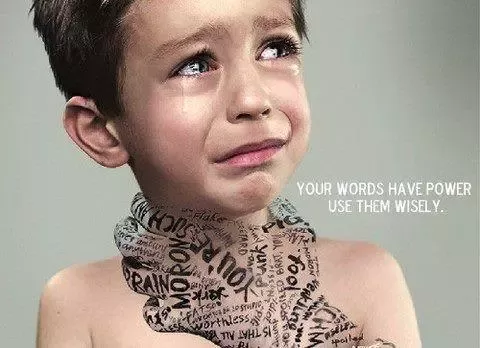
Suffering Caused by Labeling Children

Kids are often cruel, dishing out insults and rude nicknames to those they deem “different.” Sadly, not everyone outgrows this ugly behavior. As C.S. Lewis wrote in The Four Loves,

We hear a great deal about the rudeness of the rising generation. I am an oldster myself and might be expected to take the oldsters’ side, but in fact I have been far more impressed by the bad manners of parents to children than by those of children to parents.

I recently discovered an artist whose music reveals the pain caused by this cruelty. In “Not My Name,” Matt Sassano describes how we can move beyond the wounds of our past. For we all understand these hurtful words possess power.

These are the scars
     that I’m forced to live with,
These are the scars
     that mark me as a misfit . . .

Who among us does not bear scars from past struggles? Who among us has never been ridiculed by others?

Despite having a loving mother who sheltered me from much of life’s traumas, I bear my own scars. That’s one reason this song powerfully resonated with me. 

But there is a stronger reason I am touched by “Not My Name.” It’s because, as a pastor I have seen far, far too many women and men who remain buried beneath their pain.

I found healing in God’s grace. The scars now cause me little discomfort, though the memories remain. And I have found healing often begins when people who have endured life’s onslaughts learn they are not alone. 

This man shares a heart just like their own.

These are the scars
     that I am forced to live with
So pick me apart
I won’t fit the mold that you fit
But thеre’s a warrior inside me
That you playеd a part in building
Because you made me understand.

About staying strong when you’ve fought so long
In a world that tells you you don’t belong
Living in the shadow of all your flaws
Where it’s hard to be seen for who you are.

And, the emotionally and spiritually wounded can see how someone suffering like them can proclaim this liberating truth:

So label me
Call me by my pain
That’s not my name
That’s not my name.

I’m so much more
     than your throw away
That’s not my name
That’s not my name. . . .

You won’t sentence me
Your words are dead to me
I know my suffering
     is not my identity.

As impressed as I was with this song, it means all the more now that I learned something about Sassano’s life.

The Sins of the Father

A short biography reveals some of the reason for Sassano’s plaintive spirit. 

He was the son of an unfit pastor, whose anger and abuse crushed his childhood faith. His search for meaning “was intensified by the experience of living with two disabilities: Cerebral Palsy and dyscalculia (which impairs brain functions like navigation and mathematics).

“I spent much of my early life in and out of doctor’s offices and disability meetings, which led me to struggle with my self-perception and self-esteem.”

It is this tragic youth which directly inspires his video “Dear God.” Released in 2022, it reminds me of the lamentations we find in the Scriptures, particularly the Psalms and Jeremiah. In Madeleine L’Engle’s forward to C.S. Lewis’  lamentations in A Grief Observed, she expresses gratitude for his honest treatment of grief’s violence. 

I am grateful to Lewis for the honesty of his journal of grief, because it makes quite clear that the human being is allowed to grieve, that it is normal, it is right to grieve, and the Christian is not denied this natural response to loss.

I am grateful, too, to Lewis for having the courage to yell, to doubt, to kick at God . . . This is a part of healthy grief not often encouraged. It is helpful indeed that C.S. Lewis, who has been such a successful apologist for Christianity, should have the courage to admit doubt about what he has so superbly proclaimed. It gives us permission to admit our own doubts, our own angers and anguishes, and to know that they are part of the soul’s growth.

The video amplifies the power of the lyrics of “Dear God.” So, do watch it.

I’ve got questions, confessions
I just want peace of mind
Time’s fading and I’m waiting
For something I can’t find
I am overwhelmed
Can I endure this hell?
No way to break the spell
I’ll spill my heart again

Dear God
I’ve lost the will to fight
Please give me a sign
I’m empty inside
Got no strength to carry on
The plague has multiplied
It’s eating me alive
How can I survive?
Dear God

Much like C.S. Lewis’ book describing the loss of his wife, Sassano’s songs can help bring healing to those in similar pain. Even if you don’t need to listen to these songs . . . trust me, there is someone you know and care about, who does!

Choosing a Career

Do you remember when you were making decisions about your future career? C.S. Lewis’ comment on the subject of careers remains quite valuable in today’s rapidly changing world.

Toward the end of high school, I recall filling out some educational assessments that projected how successful I might be in a number of different pursuits. Employability appeared to be the primary focus for the assessments. 

Not taken into much account at that time (a half century ago), was what sort of job satisfaction one might anticipate following those various pursuits. 

This “graduation” life milestone is on my mind, since several of my grandchildren are presently finishing their own high school years. None have yet “chosen” a career – they are approaching their futures with open minds. However, we have chatted about the major options before them: college, vocational training, directly entering the workplace, the military, or burying themselves in social media and living off of their parents for the next decade or two.

Most lean towards college, without specific programs in mind. Still, I have encouraged them to consider the marketability of various studies. As most are aware, AI is a growing threat. In “ChatGPT May be Coming for Our Jobs,” you can see ten particularly vulnerable fields.

Goldman Sachs estimates “300 million full-time jobs globally” could well be automated.

A Pair of Options

I’ve been thinking about two career fields at opposite ends of the spectrum, in regard to the viability of their futures: Newspaper Reporters (that’s not the positive example) and Security (and not just cyber-security).

The United States Department of Labor enthusiastically declares “the cybersecurity field is booming.”

As of August 2022, there were over 700,000 open roles in cybersecurity in the United States and, according to Bureau of Labor Statistics projections, jobs for information security analysts are expected to grow 32% from 2022 to 2032. It’s clear that cyber talent is in demand.

Compare that to opportunities for newspaper reporters. Just last week the Los Angeles Times (established in 1881) and the Baltimore Sun (1837) announced (additional) major job cuts for their editorial staffs. Whether these two “venerable” publications will exist in print form a decade or two from now is a valid question. And they are simply part of an unrelenting media transformation.

My undergrad degree in editorial journalism has served me well, but would I recommend a similar path to my grandkids? Hardly. I believe the Georgetown University Center on Education and the Workforce is overly optimistic in stating “journalism employment is projected to decrease about 3 percent from 2022 to 2031.” But even with that minor drop, “it will have decreased by 35 percent since 2002.”

Now, many people may say, “of course cyber-security is expanding, but I am not computer literate enough to pursue that.” Well, that is not the only type of security opportunity that’s exploding.

It turns out that the U.S. is not the only place where criminals often roam the streets with little fear of a defanged judicial system. Here, the ill-advised “defund the police” movement has given rise to the need for many more private security firms. Private security is an established norm in many countries. Their expansion in Western nations is more recent.

In one American city, at least, the police welcome the addition of security guards to the safety mix.

Detroit Police’s top brass do not view the growth in private security as any sort of affront or threat to officers’ jobs. In fact, Chief James Craig has encouraged officers to work off-duty security as a way to earn extra cash.

Your Job is not You

Fortunately, as C.S. Lewis reminds us, our job does not define who we are. Nor does it affect the attitudes of those who regard us as friends. In The Four Loves, Lewis reveals how little such considerations mean among “true friends” (and who needs any more of the other, pretend, variety?).

In a circle of true Friends each man is simply what he is: stands for nothing but himself. No one cares twopence about any one else’s family, profession, class, income, race, or previous history. . . .

That is the kingliness of Friendship. We meet like sovereign princes of independent states, abroad, on neutral ground, freed from our contexts. This love (essentially) ignores not only our physical bodies but that whole embodiment which consists of our family, job, past and connections.

In Perelandra, a work of fiction, C.S. Lewis includes a sobering insight for those of us who may be tempted to think that our profession or job makes us “better” than someone else. If you ever begin to feel like your position marks you as someone who is uniquely special, remember these words:

One never can see, or not till long afterwards, why any one was selected for any job. And when one does, it is usually some reason that leaves no room for vanity.

I am sympathetic to young people today as they seek the right path for their life. The future appears more uncertain and convoluted than ever before. One piece of advice that I can confidently offer to those who are Christian, is to pray and seek God’s leading in your quest. And know that whatever vocation the Lord leads you to, will be the ideal one for you.