Who Said That?

thoms and lewisWho said that? It’s a question people ask when they recall a familiar saying and don’t remember the source.
Occasionally when we are reminded of the source, we shake our heads and think that’s right; how could I have forgotten!

At other times though, discovering the source of the maxim doesn’t help at all. It could be because the proverb is anonymous, or it might be due to the fact that it’s originator was not particularly well known.

That’s the case of the following statement, which is familiar to many Christians.

“Be careful how you live; you will be the only Bible some people ever read.”

When I thought of this phrase several weeks ago, I had a bit of trouble tracking it down. I actually found it on a number of sites, but the problem was that the author’s name was so unfamiliar it was almost always misspelled.

He was usually cited as “William Toms.” Yet I was pretty sure the saying hadn’t originated, however, with an Irish footballer.*

Just when I assumed I had encountered a clichéd brick wall, I stumbled upon the truth. Like so many classic maxims, the quotation did indeed originate from the British Isles.

The British writer William J. Thoms penned this thoughtful maxim, and it isn’t the only wise thing he wrote.

William John Thoms (1803 – 1885) was a British writer credited with coining the term “folklore” in the 1840s. Thoms’ investigation of folklore and myth led to a later career of debunking longevity myths. Hence, he is an early advocate of “validation research” when examining demographics.

Several of Thoms’ works are available online. They include:

C.S. Lewis had more in common with Thoms than simply being British and engaging in literary pursuits. The two men shared an interest in simple tales that intrigued and inspired men and women through the ages.

It was Thoms, in fact, who in 1846 introduced into English the term “folklore.”

A shared interest in legends and even the supernatural, suggests that the two may well have enjoyed one another’s company, had their lives intersected.

Sadly, Thoms’ desire to compile a comprehensive “Folk-Lore of England” was never realized, as this superb article describes.

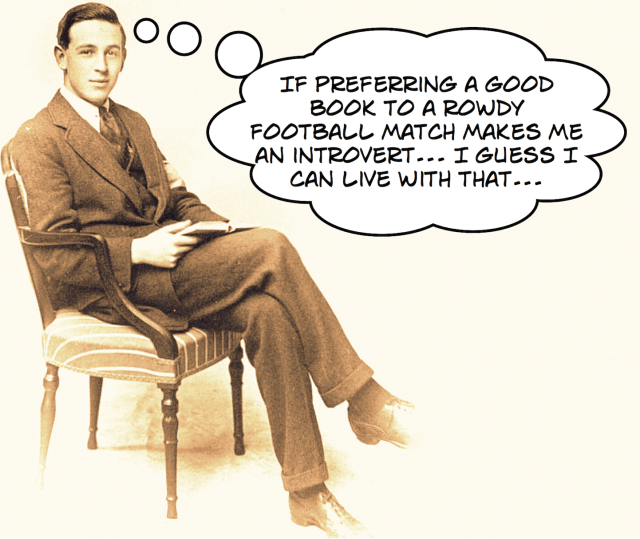
The two scholars shared another trait of bookish people. (“Bookish,” by the way, is a compliment here at Mere Inkling.) Neither man sought out the frivolities of popular society. They were both content to socialize with similar minds in more intimate community. The following description of Thoms, from the Dictionary of National Biography,could just as naturally have been written about Lewis.

Thoms went little into society, but at congenial resorts, such as the ‘Cocked Hat Club,’ he was remarkable for a ready play of wit and an almost inexhaustible fund of humorous anecdote and reminiscence.

Can’t you just picture the Cocked Hat Club meeting at one table in the Eagle and Child while the Inklings shared their own warm friendship at their table at the other end of the pub?

_____

* Not that I follow English football, but I learned an athlete by that name played forward for Plymouth Argyle and Manchester United.

** The Book of the Court, published in 1838 with the second edition, linked here, printed six years later, has the delightful, if rather lengthy, subtitle: Exhibiting the History, Duties, and Privileges of the Several Ranks of the English Nobility and Gentry, Particularly of the Great Officers of State and members of the Royal Household; Including Vaious Forms of Court Etiquette, Tables of Precedency, Rules to be Observed at Levers and Drawing Rooms, Etc.

Tolkien’s Inspiration

night patrolThe poetry of a dead veteran spoke to me today. He was a close friend of J.R.R. Tolkien, and in a sense his life lives on in the descriptions of Middle Earth.

In a recent column my Canadian friend Brenton Dickieson, introduced me to one of the many poets whose lives tragically ended on the battlefields of WWI.

Professor Dickieson describes the context of a new film about the impact of the war on J.R.R. Tolkien. It is called Tolkien’s Great War. It is based on the book Tolkien and the Great War: The Threshold of Middle-earth.

You will find a link to the half hour documentary below, and I strongly—yes, strongly—encourage you to watch it. It is quite moving.

Like most members of their generation, Tolkien and C.S. Lewis were deeply moved by the horrors of the First World War. Both served on the front lines, in the grim trenches, during the bloody conflict. And they lost friends. I’ve written in the past about their military service, including posts herehere, and here.

The Deceased Poet

The documentary describes the untimely deaths of two of Tolkien’s closest friends during the war. One of them, Geoffrey Bache Smith, was a poet.

Following his death, Tolkien gathered together his writings and published them as a tribute to his friend. It was one of the earliest contributions to a wealth of soldier’s poetry that would deluge grieving Europeans by the close of the conflict.

Due to the brevity of his life, the collection, published as A Spring Harvest, is short. Tolkien also penned an introduction to the work which is equally Spartan. The literary austerity is fitting, given the sad reason for the volume’s brevity. The introduction, in full, reads:

The poems of this book were written at very various times, one (“Wind over the Sea”) I believe even as early as 1910, but the order in which they are here given is not chronological beyond the fact that the third part contains only poems written after the outbreak of the war. Of these some were written in England (at Oxford in particular), some in Wales and very many during a year in France from November 1915 to December 1916, which was broken by one leave in the middle of May.

“The Burial of Sophocles,” which is here placed at the end, was begun before the war and continued at odd times and in various circumstances afterwards; the final version was sent me from the trenches.

Beyond these few facts no prelude and no envoi is needed other than those here printed as their author left them.

J.R.R.T., 1918.

The poems themselves run the gamut of emotions. This is unsurprising, given that some were born during the idyll dreams of youth, while others were forged by the anvil of war.

The limited press run of the book has made it difficult to find. Fortunately, it is now available for free via Project Gutenberg.

While the poems include the familiar references to the “old gods” so common to the period, there are also some moving references to a more Christian ethos.

Creator Spiritus

The wind that scatters dying leaves

And whirls them from the autumn tree

Is grateful to the ship that cleaves

With stately prow the scurrying sea.

Heedless about the world we play

Like children in a garden close:

A postern bars the outward way

And what’s beyond it no man knows:

For careless days, a life at will,

A little laughter, and some tears,

These are sufficiency to fill

The early, vain, untroubled years,

Till at the last the wind upheaves

His unimagined strength, and we

Are scattered far, like autumn leaves,

Or proudly sail, like ships at sea.

Tolkien and Smith formed half of the T.C.B.S., a communion knit together during the school years. The war would cut that number in half, as poignantly described in Tolkien and the Great War. The first of the companions had already died, and five months later Smith was spending the final moments of his own life encouraging his friend to press on, whatever might befall him.

Before reading Smith’s “So We Lay Down the Pen,” consider his final letter to Tolkien. He wrote it as he prepared to lead a night scout through dead man’s land at the front. It was dangerous duty which did indeed, that very evening, cost him his life.

My chief consolation is that if I am scuppered [ambushed and killed] tonight—I am off on duty in a few minutes—there will still be left a member of the great T.C.B.S. to voice what I dreamed and what we all agreed upon. For the death of one of its members cannot, I am determined, dissolve the T.C.B.S.

Death can make us loathsome and helpless as individuals, but it cannot put an end to the immortal four! A discovery I am going to communicate to Rob before I go off tonight. And do you write it also to Christopher. May God bless you my dear John Ronald and may you say things I have tried to say long after I am not there to say them if such be my lot.

Yours ever,

G.B.S.

Tolkien compiled Smith’s poems as a tribute. And, when he wrote his masterpieces, there is a profound sense in which he truly did say things his friends had tried to say, long after they were not there to say them.

So We Lay Down the Pen

So we lay down the pen,

So we forbear the building of the rime,

And bid our hearts be steel for times and a time

Till ends the strife, and then,

When the New Age is verily begun,

God grant that we may do the things undone.


Enlarging C.S. Lewis’ Vocabulary

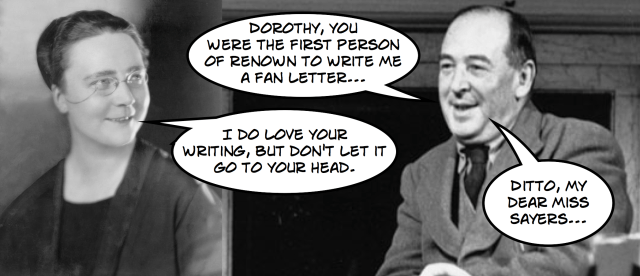
csl sayersCan you imagine receiving a compliment like this from C.S. Lewis? Your work “even enlarged my vocabulary.”

Shocking . . . but another writer did receive that rare praise.

In 1954, Lewis wrote a lengthy letter to his friend Dorothy Sayers, praising her recent publication of Introductory Papers on Dante. Lewis’ opening sentence reveals his delight. “Your Introductory Papers have given me a regular feast.”

Lewis specifically comments on a number of insights he found particularly worthwhile. And remember, Lewis was an expert on Dante in his own right.

One evidence that Lewis’ praise is sincere, and not mere flattery, comes in his comment that “every essay and nearly every page enriched me.” Not every page, mind you, but very nearly every one of them.

Offering Gentle Criticism

Consistent with the nature of friendly literary criticism (like one receives in a healthy writers group), Lewis does offer some specific advice on how to strengthen a specific point that he regards as overemphasized. In this case it relates to a classical Latin phrase.

At one point Lewis expresses awe about a portion of the book, and then immediately proceeds to make an enjoyable comment about the limitations of the English language.

P. 52 is a blaze of (just) splendour. (Drat our homophones: by just I don’t mean ‘nothing but,’ I mean ‘justified,’ ‘veracious.’)

Toward the close of his letter, Lewis raises a profound notion about our perception of humor. He cautions Sayers, in her interpretation of Dante’s Comedy, not to read it directly through the lens of our own day. “I’ve a feeling that in handling particular passages you are too certain that whatever is comic to us was, and was meant to be, comic at the time.” He continues:

Because, as any one can see even from the old Punches,* nothing changes so quickly as the sense of humour: so that in reading any old book there is nothing we are less sure of than which places wd. welcome a smile. And oughtn’t we to start by a recognition that our generation (yours & mine) was quite abnormally ‘tickle o’ the sere’** (already the young people are less so).

A Poetic Postscript

Lewis ends his letter to Sayers with some advice for her subsequent work with Dante. He courteously writes, “Don’t give me the next set, I’ll buy it.”

Then he makes a suggestion to protect her from the spurious criticisms of ignorant literary critics. (Note that he doesn’t use the choice descriptive in a vulgar sense common today, but in more classical sense of extreme foolishness.)

And do put in an essay on D. as ‘poet’ in the old, narrowest sense—his sheer poeticalness. Otherwise we shall have some ass saying that because you like so many other qualities, you are oblivious to that.

_____

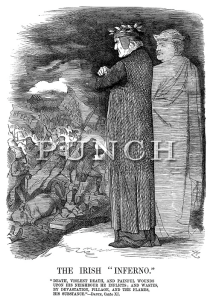
* Punch Magazine was published in England until 1992. The 1881 image below is inspired by Dante’s Inferno, and applied to the violence in Ireland.

** Easily made to laugh. From Hamlet: “The clown shall makes those laugh whose lungs are tickle o’ the sere.” The seare, or sere, was part of the trigger of old matchlock guns, so arranged that the slightest movement would make the gun discharge. Lungs, then, “tickle o’ the sere,” are those easily moved to laughter.

punch dante

C.S. Lewis’ Personality

csl introvertLearning about ourselves is a lifelong quest. And the more actively we pursue self-knowledge, the wiser we become.

A well known sixteenth century Christian mystic wrote:

“Self-knowledge is so important that even if you were raised right up to the heavens, I should like you never to relax your cultivation of it.” (Saint Teresa of Ávila, Interior Castle).

This self-knowledge leads to a greater recognition of our dependence on God. She continues, “so long as we are on this earth, nothing matters more to us than humility. . . . As I see it, we shall never succeed in knowing ourselves unless we seek to know God: let us think of His greatness and then come back to our own baseness; by looking at His purity we shall see our foulness; by meditating on His humility, we shall see how far we are from being humble.”

C.S. Lewis echoes this sentiment.

If anyone would like to acquire humility, I can, I think, tell him the first step. The first step is to realise that one is proud. And a biggish step, too. At least, nothing whatever can be done before it. If you think you are not conceited, it means you are very conceited indeed. (Mere Christianity).

As part of my self-examination, I have recently revisited my “personality type” as assessed by the well known Myers Briggs Personality Indicator (MBTI).

Without over-explaining the MBTI, it measures an individual’s preference related to four ways by which we experience and make sense of the world. (News Flash: Not everyone perceives reality the same way!)

These dichotomies are:

Extraversion (E) or Introversion (I)

Whether your preferred focus is outward or inward.

Sensing (S) or Intuition (N)

How you focus on information and process it.

Thinking (T) or Feeling (F)

Primary preference in your decision-making.

Judging (J) or Perceiving (P)

Your orientation towards making sense of existence.

You can get some additional authoritative information here. There are also numerous “unofficial” websites related to the subject.

Sixteen combinations are possible, and each has its respective strengths. (None are “better” than others, of course, since we’re all created in the image of God.)

Speaking of which, I’ve also been studying the different combinations that are more common to Christian ministers than they are within the general population.

For example, the following types (with their shorthand title) range from two to six times more common for male clergy than the general male American population:

ENFJ (The Teacher)

ENFP (The Provider)

INFP (The Healer)

INFJ (The Counselor)

ENTJ (The Field Marshal)

Which type of pastor do you prefer?

Online Surveys to Visit after you finish this post

There are a number of free MBTI-type tests online. Naturally, they are not as reliable as the official inventory given through a certified provider. Nevertheless, the following sites did render accurate assessments for me, based on my formal scoring.

I have mentioned in the past that I am an *NTJ… with the asterisk representing that my I/E preference is too close to call. A previous post shows how that makes me a blend of Middle Earth’s Elrond and Théoden.

Humanmetrics Jung Typology Test

CelebrityTypes Personality Type Test

So, What Is C.S. Lewis’ Personality Type?

This is a subjective question. The MBTI is a self-reported assessment, so guessing the type of another person is by nature dicey.

In Lewis’ case, however, there is a fair degree of consensus. This is due to his openness about his personal life and his extensive writings. The general agreement does not mean though that there are not minority opinions.

The most common argument is that C.S. Lewis was INTJ. I find the reasons persuasive, and not just because it matches my own type!

One student of the subject says “Check out this quote—how INTJ is this?!”

Five senses; an incurably abstract intellect; a haphazardly selective memory; a set of preconceptions and assumptions so numerous that I can never examine more than a minority of them—never become even conscious of them all. How much of total reality can such an apparatus let through? (A Grief Observed)

One blogger writes, “There is no doubt in my mind that Lewis was an INTJ. It seeps off all his writing and is blatant in his behavior in all of his biographies.” She continues:

Highly imaginative child who lived in a dream world? Check.

Someone highly emotional/sensitive but that never showed it on the surface? Check.

A prolific writer who blazed through finishing projects at an astounding rate, who was so successful at everything he did, despite never having done it before, that he quickly rose to the top? Check.

Another site considers both C.S. Lewis and his fellow inkling J.R.R. Tolkien to be INFPs. The aptly titled CelebrityTypes.com offers a brief selection of quotations to illustrate the reasons for their identification.

If the site’s identifications are accurate, the two are in good company. Other writers include John Milton, Augustine of Hippo, Hans Christian Andersen, William Shakespeare, Søren Kierkegaard, George Orwell, A.A. Milne, Edgar Allan Poe, William Blake, J.K. Rowling and George R.R. Martin.

A Warning from Lewis Himself

Understanding ourselves better than we already do, is a good thing.

Being overly curious about the personality of someone who is deceased is another matter. Lewis’ point in the passage that follows is that such concerns must never supersede our regard for others, in the spirit of Matthew 8:22.*

There is a reaction at present going on against the excessive love of pet animals. We have been taught to despise the rich, barren woman who loves her lap dog too much and her neighbor too little. It may be that when once the true impulse is inhibited, a dead poet is a nobler substitute than a live Peke, but this is by no means obvious.

You can do something for the Peke, and it can make some response to you. It is at least sentient; but most poetolaters [worshippers of poets] hold that a dead man has no consciousness, and few indeed suppose that he has any which we are likely to modify. Unless you hold beliefs which enable you to obey the colophons of the old books by praying for the authors’ souls, there is nothing that you can do for a dead poet: and certainly he will do nothing for you. He did all he could for you while he lived: nothing more will ever come.

I do not say that a personal emotion towards the author will not sometimes arise spontaneously while we read; but if it does we should let it pass swiftly over the mind like a ripple that leaves no trace. If we retain it we are cosseting with substitutes an emotion whose true object is our neighbour.

Hence it is not surprising that those who most amuse themselves with personality after this ghostly fashion often show little respect for it in their parents, their servants, or their wives. (The Personal Heresy: A Controversy).

Reflecting on our own nature, and pondering the personalities of those we respect, are worthwhile activities. However, it’s best to remember that all we can see are mere glimpses into the depths of who we truly are.**

_____

* Matthew 8:22 quotes Jesus’ response to a disciple who demurred that he could not follow the Lord until after he attended to his father’s burial. “And Jesus said to him, ‘Follow me, and leave the dead to bury their own dead.’”

** As Paul words in Romans 8:27 are paraphrased in The Message Bible: God “knows us far better than we know ourselves . . .”

Is Fantasy Foolish?

lion of lyonSome of the smartest people around dismiss reading fantasy as a crazy waste of time. At the same time, many of the most brilliant people I know love nothing more than passing from their mundane lives through a magical wardrobe into a land of wonder.

On a recent episode of the television series Castle, the eponymous Richard Castle,* a best-selling author and private eye, has a great line. Castle is defending his hyperactive imagination (which frequently leads to the solving of the crime of the week).

A suspect calls him “reality-challenged.”

To which he responds, “I prefer fantasy-augmented.”

Now, there’s a description that would fit most readers of Mere Inkling. We’re “fantasy-augmented.”

It would also fit most of the Oxford Inklings. Not all of them, of course. Some of them, like C.S. Lewis’ brother Warnie, were more oriented towards factual, historical literature.

The fantasists among their ranks were not lacking as writers of nonfiction either.

However, it was the fact that they were “fantasy-augmented” that has led to the inclusion of several of their members in the first ranks of twentieth century writers.

Narnia and Middle Earth are as real to many people today as Ogre, Latvia, Humpty Do, Australia, Llanfairpwllgwyngyllgogerychwyrndrobwllllantysiliogogogoch, Wales, and Frankenstein, Missouri. (Perhaps more real!)

In 1936, C.S. Lewis wrote a letter to Charles Williams, praising his recent novel.**

A book sometimes crosses ones path which is so like the sound of ones native language in a strange country that it feels almost uncivil not to wave some kind of flag in answer.

I have just read your Place of the Lion and it is to me one of the major literary events of my life–comparable to my first discovery of George Macdonald, G. K. Chesterton, or Wm. Morris.

The following day, Williams wrote a letter of his own to C.S. Lewis. It began:

My dear Mr Lewis, If you had delayed writing another 24 hours our letters would have crossed. It has never before happened to me to be admiring an author of a book while he at the same time was admiring me. My admiration for the staff work of the Omnipotence rises every day. To be exact, I finished on Saturday looking—too hastily—at proofs of your Allegorical Love Poem.

William’s reference to coincidence is poetic. He doesn’t rely on the timeworn “divine Providence,” which is so prevalent in literature of the eighteenth and nineteenth centuries.

Returning to Lewis’ missive, we learn exactly how Williams’ fantasy so deeply impressed him.

A book sometimes crosses ones path which is so like the sound of ones native language in a strange country that it feels almost uncivil not to wave some kind of flag in answer. I have just read your Place of the Lion and it is to me one of the major literary events of my life—comparable to my first discovery of George Macdonald, G.K. Chesterton, or Wm. Morris.

There are layers and layers—first the pleasure that any good fantasy gives me: then, what is rarely (tho’ not so very rarely) combined with this, the pleasure of a real philosophical and theological stimulus: thirdly, characters: fourthly, what I neither expected nor desired, substantial edification.

It’s unlikely that any of us should ever author a work that would equally impress C.S. Lewis. Still, what a grand goal for any fantasy-augmented writer to strive for!

_____

* Castle is played by Nathan Fillion, who captained the spacecraft “Serenity,” in a delightful series entitled Firefly.

** You can download The Place of the Lion in a variety of formats at ManyBooks.

The illustration above is used with the permission of its creator, Charis Tsevis.


Metaphysical Poetry (it’s better than it sounds)

quarlesI had to add the parenthetical comment to the title of this column or it would have been dismissed on its surface by readers like me. Although I dabble at poetry myself, I never voluntarily choose that genre for reading. And metaphysics? As a practical pastoral theologian, I have little interest in abstract philosophies.

I have just discovered metaphysical poetry, and it is quite intriguing.

How well read are you? Do you read broadly, deeply, or both? Unfortunately, most of us restrict our reading to a rather narrow scope. This is due to two factors.

First of all is our lack of time. Few enjoy the leisure hours to indulge in the sheer pleasure of reading simply for joy.

A second dilemma arises from the deluge of new books being published every day.

It is tempting to retreat in the spirit of C.S. Lewis to the classics, and not waste our time on a volume until it has proven its worth by remaining in print. Alas, digital technology devastates that metric, since even the most worthless tripe can remain in virtual print indefinitely.

As a semi-retired pastor, I enjoy more time than I did when I was serving full time, but I still limit my reading primarily to theology, history, current events, and anything related to C.S. Lewis. I seldom have time to explore the treasure of literature that is freely available to us.

I recently spent some time doing just that.

I read some writing advice from the pen of Francis Quarles (1592-1644) who is best known for his book Emblems. It is representative of a genre (called “emblem books”) that flourished in Europe during the sixteenth and seventeenth centuries. Here are two enjoyable observations:

If thou desire to make the best advantage of the muses, either by reading, to benefit thy selfe, or by writing, others, keep a peacefull soul in a temperate body: a full belly makes a dull brain; and a turbulent spirit, a distracted judgement: the muses starve in a cook’s shop, and a lawyer’s study. (LXXIX).

If thou intend thy writings for the publique view, lard them not too much with the choice lines of another author, lest thou lose thy own gravy: what thou hast read and digested being delivered in thy owne stile becomes thine: it is more decent to weare a plaine suit of one entire cloth, than a gaudy garment checquered with divers richer fragments. (XCVII).

Lewis was, of course, intimately acquainted with Quarles’ work. Like everyone else, however, he was more influenced by the literary contribution of John Donne (1572-1631). Like Quarles, Donne is considered one of the English “metaphysical poets.”

These writers offered used “conceits,” which were similar to analogies, but compared things that were clearly different from one another. It requires significant skill to convince a reader of the similarities of things that are deeply unlike one another.

In his essay “Dante’s Similes,” Lewis discusses the subject in detail.

It will be easily seen in what sense Dante’s similes are ‘metaphysical.’ The connexion between the two members is real, ontological, intelligible, and the material need not be in itself beautiful or may be even grotesque—as when Time is represented as a tree growing downwards with its roots in a vase which is the Primum Mobile (Paradiso, XXVII, 118). And this certainly connects them, in one way, with what literary critics call ‘Metaphysical’ conceits, meaning the conceits used by Donne and his followers.

But there are only two points of contact—first, the difficult and (at first sight) unpoetical nature of the material, and, secondly, the intellectual rather than emotional connexion between this material and the thing compared with it. The spirit in which they are used is not the same in Donne and in Dante. In Donne, the connexion, though intellectual as in Dante, is as momentary, as incapable of life beyond the immediate context, as the connexions in Homer or Virgil.

It may be true that Donne cannot court a mistress without bringing in scholastic philosophy, law, chemistry, and cosmography. But he has no interest in these things except as toys and does not care in the least what place they have, if any, in the real universe—if, indeed, there is a real universe outside the present emotion. The longer you look at Donne’s comparison of the lovers to the compasses, the less alike they will seem, and the more certain you will become that the innumerable differences between them are a more interesting and fruitful field for thought than the single analogy.

But in the greatest Dantesque similes, the longer you look the greater the likeness becomes and the more fruitful in thoughts that are interesting as long as you live. This, of course, is no disparagement to Donne: a witty love song, whether salacious or saturnine, is not meant to be chewed over like the great Comedy which made its author lean. If I seem to be breaking a butterfly upon a wheel, it is only because I want to avoid a misunderstanding which would hinder our reading both of the great and of the little poet.

Sample Their Works (for free)

If you are able to carve out a few hours of your time to delight in the rich banquet provided by the three writers mentioned above, visit these links to download their books in the digital version of your choice.

Francis Quarles’ Emblems

(This edition is elegantly illustrated!)

The Poems of John Donne

(Volume I)

The Divine Comedy of Dante Alighieri

_____

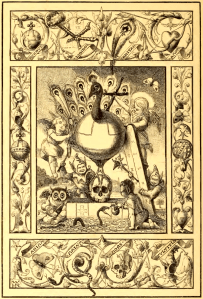
The elaborate image at the top of this column is one of the illustrations found in the copy of Emblems linked to above.

Reading Into an Author’s Work

shakespeareSometimes authors are not quite so brilliant as we think them to be.

It is possible to read into someone’s work ideas, and even profundity, that was not present when they were originally composed.

That’s an odd thought, I will admit. But the truth is that each of us as readers carry with us our own knowledge and personalities.

Imposing those upon a text is a subconscious reality, and it may even be unavoidable. Minimizing our presuppositions is one of the key elements of honest literary criticism.

This is one of the reasons that it is insanity to impose contemporary “political correctness” on writers who lived before such constraints were imposed. Intelligent people recognize that we must read Twain as an iconoclastic nineteenth century author, and Bunyan as a Baptist preacher of the seventeenth.

I just read a letter in which C.S. Lewis describes how this works. He wrote to a Roman Catholic correspondent, a priest, on Christmas Day 1959. In the letter he responds to his friend’s reference to something he had not consciously included in a particular book.

It is a fascinating letter, and even though it is the final portion that pertains to the subject I’ve been discussing, I will share it in whole.

The Kilns, Headington Quarry, Oxford   Christmas Day 1959

I hope my last letter to you did not sound chilling: still less (heaven help us!) as if I were offended by criticism. I think the chief reason why I am less disposed than you for large-scale discussion by letter is the difference of our ages. In youth we conduct (at least I did) long and deep disputations through the post. It is indeed a most valuable part of our education. We put into it quite as much thought and labour as would go to writing a book. But later, when one has become a writer of books, it is hard to keep it up. One can’t fill one’s leisure with the v. same activity which is one’s main work. And in my case not only the mind but the hand needs rest. Penmanship is increasingly laborious, and the results (as you see) increasingly illegible!

If you sometimes read into my books what I did not know I had put there, neither of us need be surprised, for greater readers have doubtless done the same to far greater authors. Shakespeare would, I suspect, read with astonishment what Goethe, Coleridge, Bradley and Wilson Knight have found in him! Perhaps a book ought to have more meanings than the writer intends? But then the writer will not necessarily be the best person with whom to discuss them.

You are in my daily prayers. Will you pray much for me at present? The cancer from which my wife was (as I believe, miraculously) delivered 2½ years ago, when death in a few weeks was predicted, is returning. Can one without presumption ever ask for a second miracle? The prophet turned back the shadow for Hezekiah once: not twice. Lazarus, raised from the dead, presently died again.

Yours

C.S. Lewis

P.S. I never thought of it before, but how Lazarus was sacrificed. To have it all to do over again–bis Stygios innare lacus!

_____

Father Peter Milward, SJ, taught English Literature at Sophia University in Tokyo. He has extensively published on his major subject, and A Challenge to C.S. Lewis (1995), which I just now ordered for my library. A curious title, however, for a student and “fan” of Lewis.

As a Shakespeare scholar, he has persuasively argued that the bard was Roman Catholic. “When the archbishop of Canterbury recently broke his church’s long silence and acknowledged that William Shakespeare was probably a Catholic, it was a moment of quiet satisfaction for Father Peter Milward, the author who began researching this subject a half century ago.” Read the article here.

A Dire Norwegian Crime

pulpitrockActually, the title may be slightly misleading, since we don’t know the nationality of the people who risked their child’s life over a 2,000 foot cliff . . . but the scene of their crime was one of Norway’s amazing natural wonders.

Preikestolen, is known in English as Pulpit Rock. It is a rare geological feature, a pillar of rock thrusting 1,982 feet from the ground, with three sides a sheer drop to the rocks. It stands majestic, adjacent to a picturesque fjord.

It’s lovely to behold. But only a fool would want to walk out on it, right?

I mean, just look at it. Doesn’t anyone else notice the huge fissure that splits the pulpit right in half? As I look at it, I can just imagine it splitting down the middle with the exposed side crashing down like an enormously oversized and exponentially elongated domino . . . but a domino made out of granite exposed for eons to the frigid Nordic winters so when it strikes the earth it will shatter into a million and a half fragments like a sheet of ice. Well, that’s what I see when I look at the pictures.

What I don’t see is a tourist site where I would like to prance out and pose for a photo beside the edge, or pretend to have accidentally fallen off the side.

Nope, not by a long shot.

As one visitor said, “It’s a straight drop. You don’t want to go too close because it’s pretty scary. You’d be pretty much dead if you fall down there.”

Yes, “pretty much.’

Nevertheless, scores of thousands of people every year prove how few cautionary genes they and I share by doing just that. Of course, I do share with C.S. Lewis the conviction that courage is utterly necessary for living a Christian life in an anti-Christian world. Even Screwtape understands that!

Courage is not simply one of the virtues, but the form of every virtue at the testing point, which means, at the point of highest reality. A chastity or honesty or mercy which yields to danger will be chaste or honest or merciful only on conditions. Pilate was merciful till it became risky. (The Screwtape Letters).

But this sort of courage does not necessarily translate into foolhardy risking of one’s fragile body.

Back to Scandinavia

Apparently, Preikestolen is quite a popular spot.

I offer links below to a several videos of crazy stunts people have pulled on the small bluff. Some people apparently also like to go there for picnics. That reminded me of a column I posted about “Rational Fears” related to another frightening dining experience.

Tragically, in 2013 a tourist fell from the precipice while shooting photos. But here is the amazing part of that story: “Local sheriff Odd-Bjørn Næss said it was the first time anyone had accidentally fallen over the edge of Preikestolen.”

Up until I read the sheriff’s statement I had always taken pride in my 50% Norse lineage. One reason was because I considered my ancestors sturdy and honest folk. Yes, I see the sheriff’s “accidentally” disclaimer, and I suspect they do experience a number of suicides . . . but I believe that with all of the foolish behavior transpiring at Preikestolen there must be more fatal accidents . . .

The Crime With Which We Began

Accidents, of course, are not crimes. But this, most certainly is. Some adults, presumably the baby’s parents, put their small child at terrible risk by posing her or him beside the edge of the cliff simply to take some shocking photographs.

Yes, you read that right.

They set their little child, who was crawling at the time, on the brink of a 2,000 foot drop!

cliffchildIf you’re familiar with precious little ones, you know that babies do not always crawl in a straight line. Nor do they always continue moving in the direction you plan for them. Not only that, but they are prone to taking occasional tumbles–perhaps even rolling over onto their side or back. And on this rugged pillar top, mind you, the baby was on an extremely uneven, and possibly slippery, surface.

Simply put, these parents are criminals. In every civilized country I’m aware of, “child endangerment” is a crime. You can read the story about their foolhardy action here, and see the frightening photo from which this small image is cropped. (You can see the original picture and the the accompanying article here.)

Unfortunately, they pixilated the adults’ faces, so they can’t be recognized. Seems to me that they should have allowed them to be identified . . . if not for trial, for public shaming so they would be forced to reflect on the responsibilities one assumes as a parent.

Epilogue

trolltonguePreikestolen is not the only deadly sightseeing destination in Norway. Another goes by the more foreboding name of Trolltunga, Troll’s Tongue. It too has claimed at least one life, and from the photo of the small spit of rock, I can’t imagine why anyone would want to walk out on it.


As promised:

A Base Jumper Who Nearly Dies

Free Hanging Off of the Cliff

Insane Italians Slack Lining

There are more examples of the craziness evoked by the image of Preikestolen, but these are representative. I thank God I don’t feel the slightest envy as I watch people base jumping, free hanging, or slack lining.

I’m content to get my adrenaline rushes from reading a great book.

C.S. Lewis & Women

hermeneuticDid C.S. Lewis disrespect women? Some of his detractors make that argument, but two new books reveal just how weak the notion is.

There is a great book review in the herŸ.menenutics column of the current issue of Christianity Today. You can read it here, but please finish reading this post before checking it out.

Readers of Mere Inkling who are only familiar with Lewis through the Chronicles of Narnia or his classic Mere Christianity, may be surprised to learn that there are some who claim he was a misogynist. While they pull decontextualized examples from his works, the essence of their arguments seem to arise from an animosity to Lewis’ Christian worldview.

Even if you do not go on to read either of the books discussed, taking a moment to read the review itself will be worthwhile. For example, they cite one of Lewis’ longtime friendships.

Lewis’s good friend the detective novelist Dorothy L. Sayers once remarked that when it came to women as a whole, “he had a complete blank in his mind.” But this didn’t keep her from liking and corresponding with him, often in the form of cheerful and vigorous argument . . .it was friendships like hers that “blew away Lewis’ assumptions about women,” helping his ideas to change and develop over time.

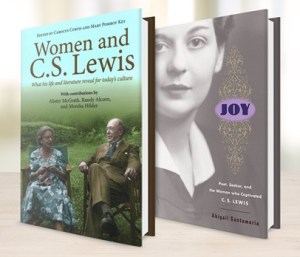
The first text discussed in the review is Women and C.S. Lewis: What His Life and Literature Reveal for Today’s Culture, edited by Carolyn Curtis and Mary Pomroy Key. The volume has a diverse collection of contributors and portrays the writer honestly. Many of the chapters are written by well respected authors who have written their own works on Lewis.

The book offers no foolish attempt to make a feminist of Lewis. The contributions are thoughtful and nuanced. Lewis’ views were a product of his era and upbringing. Yet, to that stodgy context, he added a Christian appreciation for the all of humanity, male and female, created in the image of God.

The second volume examines the life of the woman who played the most significant role in C.S. Lewis’ life. This is a true biography of Joy Davidman, not restricted to the years she spent with Lewis, who was her second husband. It is no hagiography of this convert from atheism to Christianity. Precisely because of that, it promises to provide valuable insights into the woman, Lewis, and Lewis’ attitudes towards women.

And, great news for those interested in this subject. The Kindle version of Joy: Poet, Seeker, and the Woman Who Captivated C. S. Lewis is currently on sale for only $2.99, a price any student of the Oxford Inkling can scarcely ignore.

If you don’t recall my post several months ago about Lewis and “dating,” you may find it interesting.

I will close now with a quotation from a letter Lewis wrote to a Benedictine monk in 1952. I chose it because it juxtaposes two aspects of his experience with women. The first is based on his daily experience with the discipline of carrying on an excessive correspondence with readers. The second was a remark in passing about Jane Austen which compliments her for both her substance and her strength.

It isn’t chiefly men I am kept in touch with by my huge mail: it is women. The female, happy or unhappy, agreeing or disagreeing, is by nature a much more epistolary animal than the male. . . . I am glad you think J. Austen a sound moralist. I agree. And not platitudinous, but subtle as well as firm.

Just one small example of what the linked book review praises as “his ability to see and appreciate a woman as a whole, multifaceted person.”

2019 Addendum: Last year a new, well-reviewed book was published on this subject: Becoming Mrs. Lewis: The Improbable Love Story of Joy Davidman and C. S. Lewis by Patti Callahan.

A Mastery of Words

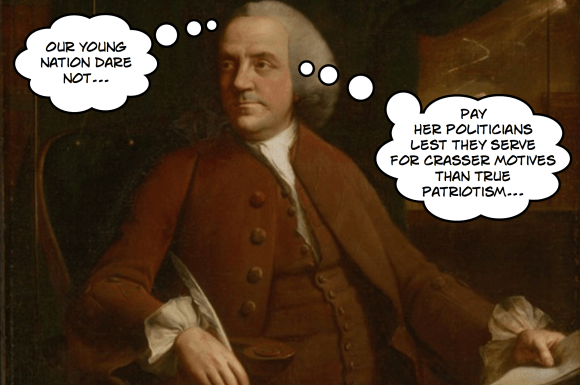
ben franklinOh the curse of so many fascinating things to read . . . and so little time. The following pieces of wisdom come from a free volume, The World’s Famous Orations, by William Jennings Bryan.*

Bryan (1860-1925) was one of the most prominent American orators and politicians. In his study of rhetoric he collected a wide range of speeches given throughout Western history.

The collection is fascinating. It includes moments from well known historical events and from obscure yet intriguing occasions. For example, you can hear the words of Hannibal spoken to his army after its successful crossing of the Alps, or the republican speech offered by the falsely condemned Algernon Sidney from the scaffold.**

Public speaking used to be a cornerstone of education. In colleges today, “speech” is often merely an elective.

C.S. Lewis relates a funny story about one of his first experiences speaking in a formal setting. The occasion was the annual Encaenia at Oxford University, which commemorated founders and benefactors. Honorary degrees were given and excerpts from prize compositions were recited.

Lewis wrote to his father about the event. “I had almost forgotten, if I had ever known, that ‘prizemen’ have to read portions of their compositions at our ceremony of the Encaenia.”

After the honorary degrees [one of which was received by Georges Clemenceau], the Professor of Poetry made an ‘oration’ in Latin, chiefly about colleagues who had died during the last year: this was my first experience of spoken Latin and I was pleased to find that I could follow and enjoy it. The performance of us prizemen was of course very small beer after all this. We had been instructed to read for about two minutes each: I had some difficulty in finding a short passage which would be intelligible by itself. I was, of course, nervous: I am also told that I was the first of our little band whom Clemenceau looked at: but as I do not know with what expression he looked, nor whether he speaks English, we must remain in doubt whether this was a compliment or not.

I have had a good lesson in modesty from thus seeing my fellow prize men. I was hardly prepared for such a collection of scrubby, beetle-like, bespectacled oddities: only one of them appeared to be a gentleman. Any I spoke to sounded very like fools, perhaps like Goldsmith, they ‘writ like an angel and talked like poor Poll’. 76 It brings home to one how very little I know of Oxford: I am apt to regard my own set, which consists mainly of literary gents, with a smattering of political, musical and philosophical–as being central, normal, and representative. But step out of it, into the athletes on one side or the pale pot hunters**** on the other, and it is a strange planet.

The World’s Famous Orations combines a number of separate volumes that run from classical Greece and Rome, on through most of the European nations, including their “colonies” in the Western Hemisphere. President Teddy Roosevelt is the final orator whose words are included.

I invite you to sample some of the rich banquet included in this volume. The speeches themselves are fairly short, and these excerpts the more so. Mere teasers. If you perchance become bored, skip to the final passage—Benjamin Franklin provides his fellow Americans a warning that we sadly failed to heed.

Socrates (470-399 BC) upon being condemned wittily insults his judges.

For the sake of no long space of time, O Athenians, you will incur the character and reproach at the hands of those who wish to defame the city, of having put that wise man, Socrates, to death. For those who wish to defame you will assert that I am wise, though I am not. If, then, you had waited for a short time, this would have happened of its own accord; for observe my age, that it is far advanced in life, and near death. . . .

But if, on the other hand, death is a removal from hence to another place, and what is said be true, that all the dead are there, what greater blessing can there be than this, my judges? For if, on arriving at Hades, released from these who pretend to be judges, one shall find those who are true judges, and who are said to judge there. . . . At what price would you not estimate a conference with Orpheus and Musæus, Hesiod and Homer? I indeed should be willing to die often, if this be true. For to me the sojourn there would be admirable, when I should meet with Palamedes, and Ajax son of Telamon, and any other of the ancients who has died by an unjust sentence.

The comparing my sufferings with theirs would, I think, be no unpleasing occupation. But the greatest pleasure would be to spend my time in questioning and examining the people there as I have done those here, and discovering who among them is wise, and who fancies himself to be so but is not.

“Enough with the insults, philosopher; drink the hemlock.”

Seneca (the Younger, 4 BC-AD 65) before being ordered to commit suicide by Nero, whom he had tutored.

This is the fourteenth year, Cæsar, since I was summoned to train you for your high destiny; and the eighth since your advancement to the empire. During the intervening period, you have showered such honors and riches upon me, that nothing is wanting to complete my felicity but the capacity to use them with moderation. . . .

But both of us have now filled up our measure— you, of all that the bounty of a prince could confer upon his friend; I, of all that a friend could accept from the bounty of his prince. Every addition can only furnish fresh materials for envy; which, indeed, like all other earthly things, lies prostrate beneath your towering greatness, but weighs heavily on me. I require assistance. Thus, in the same manner as, were I weary and faint with the toils of a warfare or a journey, I should implore indulgence; so in this journey of life, old as I am, and unequal even to the lightest cares, since I am unable longer to sustain the weight of my own riches, I seek protection.

Order your own stewards to undertake the direction of my fortune, and to annex it to your own; nor shall I by this plunge myself into poverty, but having surrendered those things by whose splendor I am exposed to the assaults of envy, all the time which is set apart for the care of gardens and villas, I shall apply once more to the cultivation of my mind.

“Did you forget, noble tutor, that I Nero am insane enough to demand both your wealth and your life?”

Thomas Cranmer (1489-1556) at his execution, following his renunciation of a forced recantation. (Yes, that sounds confusing, but under duress he had bent to the will of bloody Queen Mary.)

And now I come to the great thing which so much troubleth my conscience, more than anything that ever I did or said in my whole life, and that is the setting abroad of a writing contrary to the truth—which now I here renounce and refuse, as things written with my hand contrary to the truth which I thought in my heart, and written for fear of death, and to save my life if it might be—and that is, all such bills and papers which I have written or signed with my hand since my degradation, wherein I have written many things untrue.

And forasmuch as my hand hath offended, writing contrary to my heart, therefore my hand shall first be punished; for when I come to the fire, it shall be first burned.

“Darn that troublesome archbishop! That wasn’t the speech we approved in advance for him to give.”

Maximilien François Marie Isidore Robespierre (1758-94) denying King Louis was entitled to a trial.

Louis was king and the Republic is founded; the great question which occupies you is decided by these words alone. Louis has been dethroned for his crimes; Louis denounced the French people as rebels; to chastise them he has invoked the arms of his brother tyrants. Victory and the people have decided that he was the rebel: hence Louis can not be judged; he is judged already. He is condemned, or the Republic is not absolved.

To propose a trial for Louis XVI. in any way whatever is to retrograde toward royal and constitutional despotism; it is a counter-revolutionary idea, for it is putting the revolution itself on trial.

“We’ll see how you feel about allowing trials for tyrants two years into your reign of terror, when we take you to the guillotine.”

Benjamin Franklin (1706-90) warns about the dangers of providing salaries to bureaucrats.

I think I see inconveniences in the appointment of salaries [for those in the Executive Branch]; I see none in refusing them, but, on the contrary, great advantages.

Sir, there are two passions which have a powerful influence in the affairs of men. These are ambition and avarice—the love of power and the love of money. Separately, each of these has great force in prompting men to action; but, when united in view of the same object, they have, in many minds, the most violent effects.

Place before the eyes of such men a post of honor, that shall, at the same time, be a place of profit, and they will move heaven and earth to obtain it.

The vast number of such places it is that renders the British government so tempestuous. The struggles for them are the true source of all those factions which are perpetually dividing the nation, distracting its councils, hurrying it sometimes into fruitless and mischievous wars, and often compelling a submission to dishonorable terms of peace.

And of what kind are the men that will strive for this profitable preeminence, through all the bustle of cabal, the heat of contention, the infinite mutual abuse of parties, tearing to pieces the best of characters? It will not be the wise and moderate, the lovers of peace and good order, the men fittest for the trust.

It will be the bold and the violent, the men of strong passions and indefatigable activity in their selfish pursuits. These will thrust themselves into your government and be your rulers.

“Oh that we had listened to your sage counsel. Now we are reaping what we have sown in our political machinations.”

_____

* You can download a personal copy of the book in a variety of versions here.

** Algernon Sidney (1622-83) fought honorably for the republican cause in the English Civil War. The fact that he opposed the execution of Charles I did not deliver him from the vengeance of the hedonist Charles II.

*** Georges Clemenceau (1841-1929) was the French prime minister who helped set the stage for World War II by demanding excessive concessions with Germany during the Versailles peace talks.

**** A “pothunter” is someone who hunts game without a concern for rules of sport. Lewis is likely applying it here in the sense of a person who participates in competitions primarily with the goal of accumulating prizes.