C.S. Lewis, the Brothers Grimm & Snow White

You may blame the recent cinematic debacle that is Snow White on a declining Film Studio or the Brothers Grimm, but C.S. Lewis is innocent.

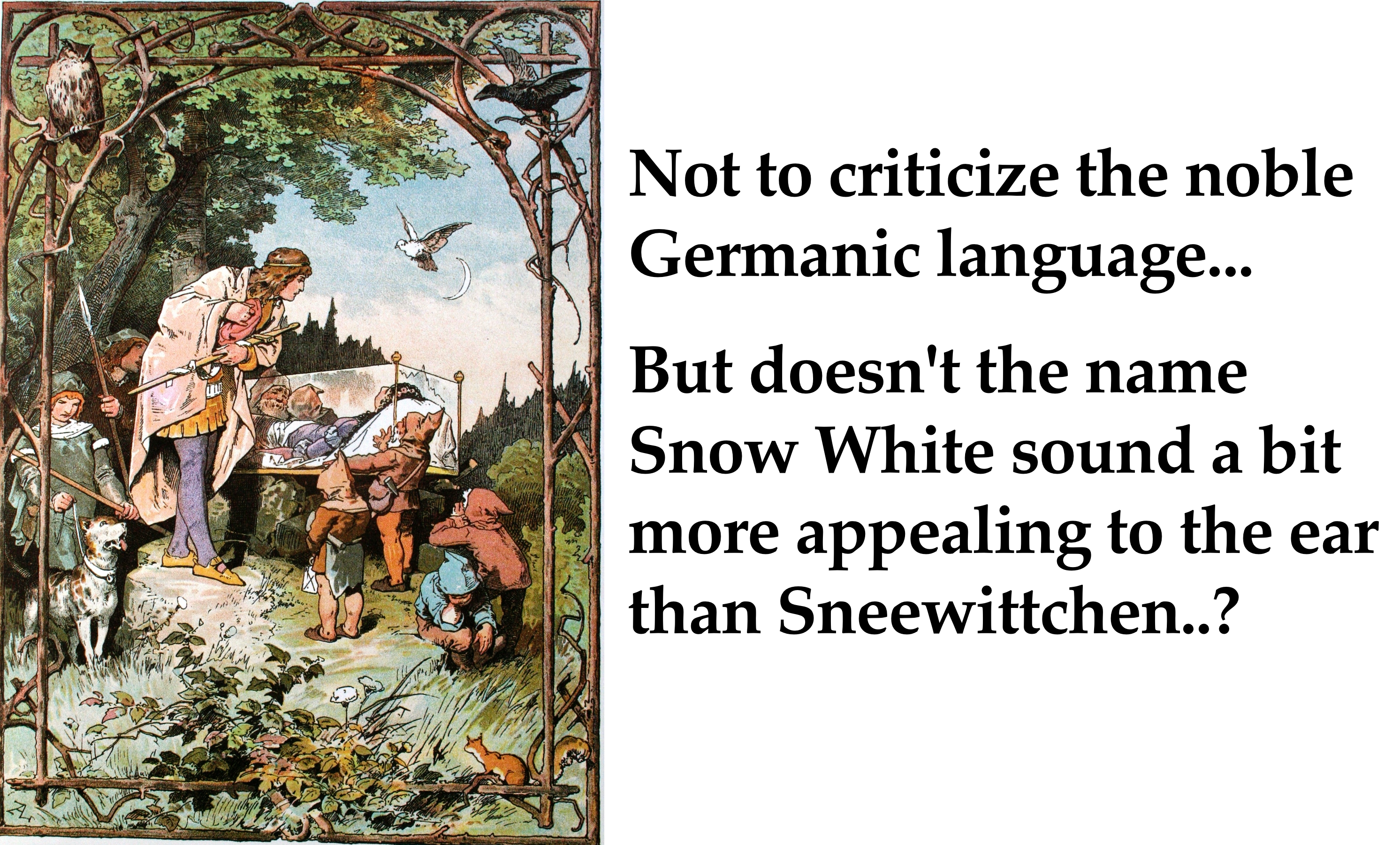
That’s not to say the Grimms didn’t have an influence on the great Oxbridge professor, a subject we’ll explore momentarily. But it was the German folk tales published by academics Jacob and Wilhelm Grimm who published the classic fairy tales that Walt Disney mined so effectively. 

They also popularized CinderellaHansel and GretelLittle Red Riding HoodThe Princess and the Frog, and Rapunzel. Disney began the transformation of these tales into visual treasures as early as 1921 when he founded Laugh-O-Gram Studio in Kansas City, Missouri.

In addition to films, over the years Walt gleaned memorable Grimm stories for a multitude of cartoon shorts, including The Brave Little Tailor and The Four Musicians of Bremen.

Obviously, Walt Disney himself respected the source material for the stories and wielded his editorial prerogative in an appropriate manner. Tragically, the same cannot be said for his corporate heirs. Likewise, the Brothers Grimm bear no culpability in this area.

C.S. Lewis, J.R.R. Tolkien & Snow White

The truth is, although Lewis and Tolkien appreciated literary fairy tales, neither of the preeminent Inklings were enamored with Disney’s animated treatment of the stories. Curiously, the two distinguished dons actually attended the theater together to view the trailblazing novelty that was Snow White.

They were particularly disappointed with the dwarves, seeing just how different they were from the genuine legends about them. Lewis even wrote “Dwarfs ought to be ugly of course, but not in that way.” Atlas Obscura has an entertaining article about their “movie date” and notes some of the elements they also enjoyed in the feature.

In his lectures published as A preface to Paradise lost, C.S. Lewis elaborates on his response to the Disney version of the tale.

That strange blend of genius and vulgarity, the film of Snow-White, will illustrate the point. There was good unorginality in the drawing of the Queen. She was the very archetype of all beautiful, cruel queens: the thing one expected to see, save that it was truer to type than one dared to hope for.

There was bad originality in the bloated, drunken, low-comedy faces of the dwarfs. Neither the earthiness, the avarice, nor the wisdom of true dwarfs was there, but an imbecility of arbitrary invention.

But in the scene where Snow-White wakes in the woods both the right originality and the right unoriginality were used together. The good unoriginality lay in the use of small, delicate animals as comforters, in the true Märchen [fairy tale] style. The good originality lay in letting us at first mistake their eyes for the eyes of monsters.

If you want to read more about the subject, you can do no better than read Joe Christopher’s article on the subject.

For an interesting argument that fellow Brit G.K. Chesterton would have loved Snow White for the very reason that moved the Inklings to criticize it, see “Tolkien and Lewis disliked Snow White. You know who wouldn’t have?

C.S. Lewis & Grimm’s Fairy Tales

Like his friend, J.R.R. Tolkien, C.S. Lewis was a champion of classical fairy tales. Neither was apologetic for it, although Lewis admitted to being shy about it when he was young. In an essay titled “On Three Ways of Writing For Children,” he wrote,

When I was ten, I read fairy tales in secret and would have been ashamed if I had been found doing so. Now that I am fifty I read them openly. When I became a man I put away childish things, including the fear of childishness and the desire to be very grown up.

In a great post called “Old Enough For Fairy Tales: C.S. Lewis’ “The Chronicles of Narnia” the writer describes this distinction to which Lewis alludes.

The Chronicles of Narnia are not children’s stories. They are fairy tales—but that is precisely why they are not children’s stories. If you can’t understand, you haven’t been listening. Go back and read the quote from Lewis’ essay again. Children are not the only audience for fairy tales.

In 1954, C.S. Lewis apologized to a German professor for being unable to understand the nuances of his volume on philosophy. In doing so, he referred to his youthful reading of the Brothers Grimm in their original German (available at Internet Archive).

I look forward to reading the book (when the translation arrives! My German is wretched, and what there is of it belongs chiefly to the libretto of the Ring and Grimm’s Märchen – works whose style and vocabulary you very possibly do not closely follow).

If you are in the mood for reading Grimm’s Fairy tales today, and your German is sadly lacking, Project Gutenberg has just the translation for you . . . as long as you can read English.


Addendum [added 10 April 2025]

The Brothers Grimm were far more than simply folklorists. They were respected professors at the University of Göttingen. They were devout Christians and worked with other prominent Germans. 

Goethe assisted them at a crucial moment in collecting their tales, and the philosopher Friedrich Schleiermacher provided copyediting assistance. Jacob’s work on German mythology had a pronounced influence on the composer Richard Wagner (World Magazine).

They also began compiling the Deutsches Wörterbuch (Germany dictionary) in 1838, with the first volumes published in 1854. It was the first dictionary to include historical usages of each word, preceding the Oxford English Dictionary, which was initiated in 1857 with its first edition published in 1884.


Bonus Trivia: The dwarves were unnamed until their debut on Broadway in 1912. And on that day they were christened Blick, Flick, Glick, Plick, Snick, Whick and Quee.
God as the Author of Creation

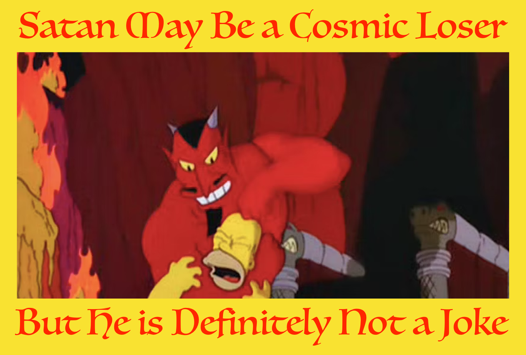
Satan is powerless versus Christians, especially those who know he exists. Yet, vis-à-vis unbelievers, he “prowls around like [an invisible] lion, seeking someone to devour” (1 Peter 5). Christian “immunity” to Lucifer’s power, if not his temptations, is due to the indwelling presence of God’s Holy Spirit.

Still, for every human being, whatever their personal belief, the Devil is no mere cartoon, with whom to be trifled. I discussed this briefly in my previous post, “Only God Can Create,” which you might want to read before continuing here.

As for humanity’s vulnerability to the Devil’s influence, the consensus in paradoxically-labeled “enlightened” cultures is that he doesn’t even exist. Sadly, this cosmic lie even tricks self-described “Christians.”

This illusion plays directly into his purposes, as C.S. Lewis described in The Screwtape Letters. Screwtape, a senior demon, instructs his protégée Wormwood in the preferred method of dispelling human wariness about Evil.

The fact that “devils” are predominantly comic figures in the modern imagination will help you. If any faint suspicion of your existence begins to arise in his mind, suggest to him a picture of something in red tights, and persuade him that since he cannot believe in that (it is an old textbook method of confusing them) he therefore cannot believe in you.

Ironically, the populations of less Westernized cultures possess some immunity to this deception. Even in their traditional religions, there is a keen awareness of the existence of evil presences. In the words of The African Study Bible, “we Africans understand instinctively the stories of angelic visitations, spiritual warfare, and demonic oppression that are in the Bible.”

Christians believe in God, not the Devil. While the Scriptures attest to the personal identity of this fallen angel, acknowledgment of his existence is not salvific (i.e. it is not essential to salvation). Thus, C.S. Lewis is correct in his 1944 essay “Answers to Questions on Christianity” when he writes:

No reference to the Devil or devils is included in any Christian Creeds, and it is quite possible to be a Christian without believing in them. I do believe such beings exist, but that is my own affair.

Supposing there to be such beings, the degree to which humans were conscious of their presence would presumably vary very much. I mean, the more a man was in the Devil’s power, the less he would be aware of it, on the principle that a man is still fairly sober as long as he knows he’s drunk. It is the people who are fully awake and trying hard to be good who would be most aware of the Devil. It is when you start arming against Hitler that you first realize your country is full of Nazi agents.

Of course, they don’t want you to believe in the Devil. If devils exist, their first aim is to give you an anaesthetic – to put you off your guard. Only if that fails, do you become aware of them.

On the Matter of Creative Power

Only God can create. That was the core message of our previous discussion. C.S. Lewis recognized, as do biblically-grounded believers, that Satan is merely a sinful, fallen being, little different from humanity in that regard. This truth shatters the pagan philosophy of dualism, or the misguided notion that two equal and opposite forces (e.g. good and evil) exist in some sort of equilibrium. 

In “The Seeing Eye,” C.S. Lewis described the way in which God is beyond his creation. 

Looking for God – or Heaven – by exploring space is like reading or seeing all Shakespeare’s plays in the hope that you will find Shakespeare as one of the characters . . . Shakespeare is in one sense present at every moment in every play. But he is never present in the same way as Falstaff or Lady Macbeth. . . .

If there were an idiot who thought plays existed on their own, without an author . . . our belief in Shakespeare would not be much affected by his saying, quite truly, that he had studied all the plays and never found Shakespeare in them. . . .

My point is that, if God does exist, He is related to the universe more as an author is related to a play than as one object in the universe is related to another. If God created the universe, He created space-time, which is to the universe as the metre is to a poem or the key is to music.

To look for Him as one item within the framework which He Himself invented is nonsensical. If God – such a God as any adult religion believes in – exists, mere movement in space will never bring you any nearer to Him or any farther from Him than you are at this very moment. You can neither reach Him nor avoid Him by travelling to Alpha Centauri or even to other galaxies.

Mark Twain’s Divinized Satan

I had intended to mention Samuel Clemens in my previous article, as one who advanced the assertion that Satan possesses creative ability. Whether Twain regarded the Devil as an actual entity is certainly debatable. What is undeniable, however, is his devoted defense of Lucifer.

As Twain famously wrote in his autobiographical writings, “But who prays for Satan? Who, in eighteen centuries, has had the common humanity to pray for the one sinner that needed it most?” 

Mark Twain was (in)famous for his atheism, or his agnostic antipathy of the Christian understanding of our Creator. Not content to disbelieve, Samuel Clemens actively worked to undermine Christian faith. One of his books, Letters from the Earth, had to be printed posthumously, due its irreverent (or blasphemous) nature.

It bears a superficial resemblance to C.S. Lewis’ amazing Screwtape Letters – insofar as both fictional works present themselves as demonic correspondence. 

The similarity ends there. While Lewis provides keen insight into Evil’s tactics in wreaking havoc in human lives, Twain’s letters present Satan in a positive, even noble, light.

Letters from the Earth is only one of Mark Twain’s anti-Christian works. The Mysterious Stranger is one of his most bizarre. It evidences his long-term preoccupation with Satan, in that it was composed (in various versions) between 1897 and 1908.

The first serious rendition, The Chronicle of Young Satan, was completed in 1900. I mention it here because there is a scene in which the Devil “creates” a miniature world. Obviously it errs in attributing to Lucifer the power to create life – but to its credit, it does reveal Satan as a capricious, vain, cruel, and compassionless lord.

In 1985 a claymation film was released titled The Adventures of Mark Twain. It features the mock scene from Chronicle of Young Satan. It is quite disturbing. However, if one is curious about the subject, and wishes to be forearmed regarding such deceptions, you can view the excerpt here.

Especially for those who do choose to view Twain’s portrayal of the Devil in his fictional “youth,” I desire to end our current discussion on a positive note.

Claymation was also the medium for a long-lived Christian television series. Davey & Goliath, the story of a regular kid and his dog, ran between 1964 and 1975. Many of the episodes can be seen here.

And finally (and forever), we can celebrate with C.S. Lewis the wonder that this world we currently inhabit will not be God’s sole creation. In fact, because of Jesus’ redemptive sacrifice, we can look forward to a new cosmos, untainted by sin.

The New Testament writers speak as if Christ’s achievement in rising from the dead was the first event of its kind in the whole history of the universe. He is the “first fruits”, the “pioneer of life”.

He has forced open a door that has been locked since the death of the first man. He has met, fought, and beaten the King of Death. Everything is different because He has done so. This is the beginning of the New Creation: a new chapter in cosmic history has opened (Miracles).

C.S. Lewis, Stereotypes & Polarization

Do you think in terms of stereotypes? Be careful before answering, since nary an adult is free of them. (Case in point, you may well have preconceptions or prejudices about a writer who would use the word “nary” in an opening sentence.)

Stereotyping is common, despite the fact most of us would disavow its use. Most of us would agree with C.S. Lewis who described how stereotypes bar us from embracing new knowledge. In his inaugural lecture on the faculty of Cambridge University, he cautioned that “a stereotyped image can obliterate a man’s own experience” (“De Desciptione Temporum”).

Oddly, while most of us would intuit that thinking stereotypically is a pattern for “the less intelligent,” it appears the reverse is true. According to one study,

Superior cognitive abilities are often associated with positive outcomes, such as academic achievement and social mobility . . . However, our work shows that some cognitive abilities can have negative consequences – specifically, that people who are adept at detecting patterns are especially quick to learn and apply social stereotypes.

Fortunately, although “people with better pattern detection abilities are at greater risk of picking up on and applying stereotypes about social groups,” there is still hope for those “afflicted” with cognitive skill. Fortunately, “these individuals are better able to diminish their stereotyping when presented with new patterns that challenge existing stereotypical associations.”

Another study argues that “our brains want our expectations to be supported . . . Because of that reward engagement, we can start becoming addicted, in a way, to stereotyping.” The researchers offer this suggestion for combatting the addiction: “simply understanding that this happens is an important way to check those assumptions and not let them influence your judgment.”

Generalizing by way of stereotypes can indeed be addictive, if its endemic presence in western culture is any indication. In America, for example, if there is ever a season when nasty stereotypes run unbridled, it is during political campaigns. Especially during presidential elections, where a person of faith would hope to witness the greatest amount of compassion and earnest intercession for God’s guidance.

Stereotypes give way to even uglier projections when we come to despise others. Several years ago I wrote an article about how wartime propaganda often strives to portray a nation’s enemies as evil, and unworthy of treatment in a humane way. It is titled “Demonizing Our Enemies & Dehumanizing Ourselves.”

When nations war, it is in the interests of the leaders of the opposing causes to engage their people in that effort heart, mind and (if possible) soul. A soldier who cognitively recognizes the need for fighting, but does not  possess a visceral animus for the foe, will only be a half-hearted warrior.

On the other hand, if rulers can generate a mental and emotional disgust, or even hatred, for the enemy, they have a winning formula. Soldiers who not only understand their cause, but also desire the utter destruction of their opponent, are single-minded in their purpose. Such fighters win wars.

You can see this sort of us/them polarization during peacetime too, even in non-election years. Sadly, it seems to be manifesting more and more frequently. And, surprisingly, it appears to have become just as common within national populations, as in international contexts. The results can be catastrophic, which is why First Lady Eleanor Roosevelt pled: 

Pit race against race, religion against religion, prejudice against prejudice. Divide and conquer! We must not let that happen here.

Stereotyping the Inklings

Although none of the Inklings have been spared, I believe C.S. Lewis has been the subject of the worst stereotyping. (I have an educated suspicion why that is true.)

Diana Pavlac Glyer has an excellent article which addresses this injustice head on.

There’s a rumor going around that C. S. Lewis was an irritable introvert, isolated and lonely and scared to death of girls. Maybe it all comes from some grim stereotype of smart people or college professors or, maybe, published writers.

That whole image is completely wrong. Lewis wasn’t an introvert. Or a loner. No – he was a large man with a booming voice, a hearty laugh, a robust enjoyment of everyday life. And that is why he was a man with friends.

At A Pilgrim in Narnia, Brenton Dickieson dispels another common misperception of the great author – that he was narrow-minded. 

So much of C.S. Lewis’ uniqueness comes down to his sheer love of diversity. He loved variability, colour, the exchange, the alienation of encounter and unity with others. His weird dystopia That Hideous Strength was, in many ways, a protest against the tendency of totalitarianism to create monoculture by erasing the individual. . . .

Lewis loved difference and diversity and freedom of expression–doctrines in danger in today’s culture war. It doesn’t take long within any of today’s major social movements to find out that diversity is fine and great as long as everyone acts like us or looks like us or thinks like us or uses the same secret words we use.

Most readers of Mere Inkling would be exceptions to the rule that human beings (especially those with “superior cognitive abilities”) default to stereotyping. Most of you, I sincerely believe, share my appreciation for respectful conversation and debate with others who do not share my opinions. 

Such interaction – with unique individuals, and not cardboard caricatures – often result in my own growth. And I dare to hope that those with whom I dialog might also feel the same.

Pilfering Tolkien Linguistics

When a great author, say of the magnitude of J.R.R. Tolkien, creates ingenious new words, and even entire languages, there are several common reactions. Most readers simply respond with silent awe. Others are inspired to emulate their efforts. A small number reuse those very words as a sincere homage

And a handful of “admirers” go so far as to “appropriate” the words themselves, for their personal benefit.

C.S. Lewis, no mean linguist himself, recognized his friend Tolkien’s brilliance. In his preface to That Hideous Strength he praised Tolkien’s yet-to-be-published Silmarillion. In a 1951 letter he mentions misspelling the word Numenor.

My Numinor was a mispelling: it ought to be Numenor. The private mythology to which it belongs grew out of the private language which Tolkien had invented: a real language with roots and sound-laws such as only a great philologist could invent.

He says he found that it was impossible to invent a language without at the same time inventing a mythology.

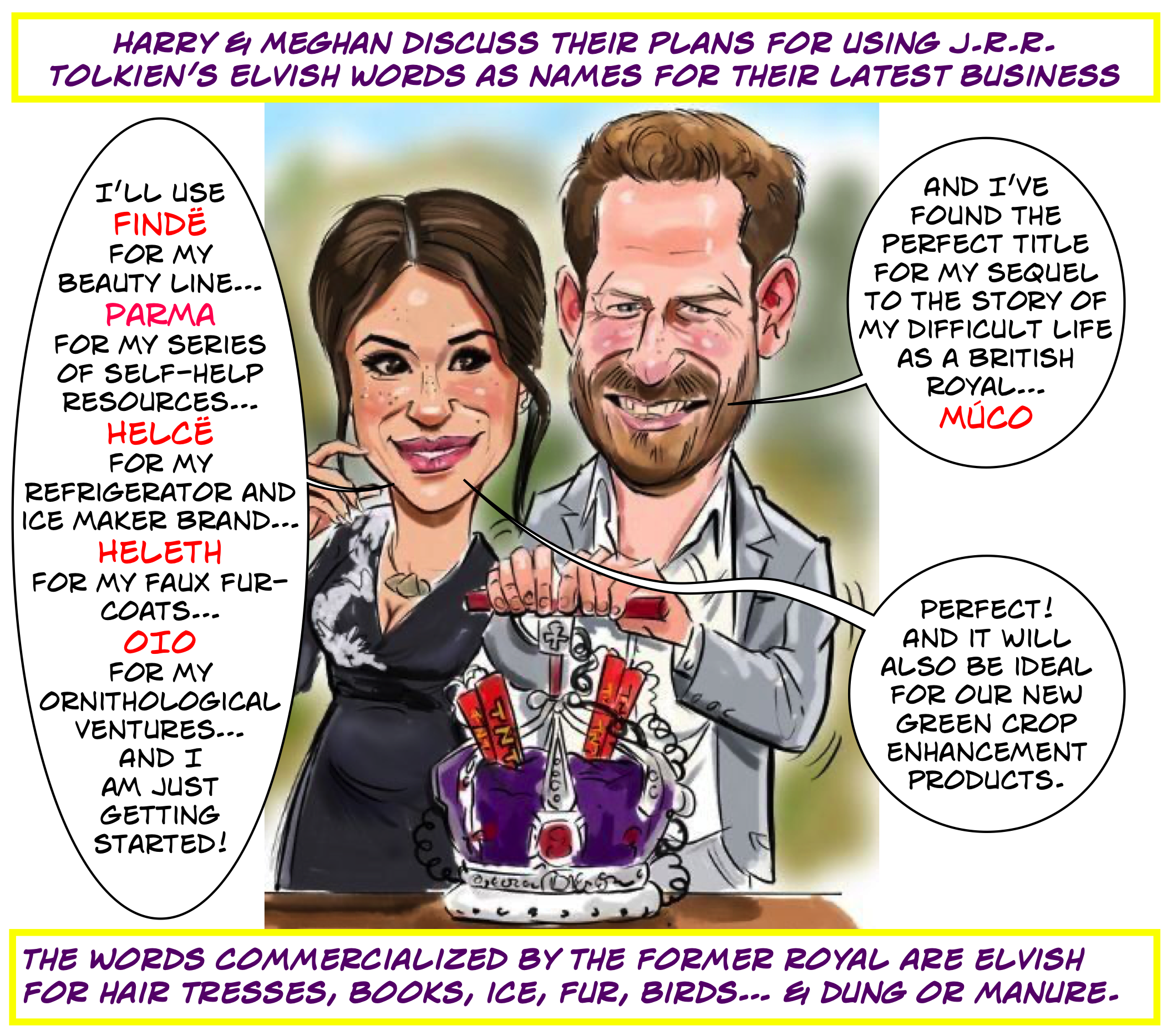
J.R.R. Tolkien was an internationally renowned philologist, and his impressive skill is one of the great wonders we encounter in Middle Earth. A number of words from his created languages – particularly his ethereal Elvish tongues – have been lifted to be used in commercial activities unconnected to Tolkien’s interests.

For example, Palantir. This was the word for the “seeing stone,” which played a prominent role in The Two Towers. In light of Tolkien’s love of nature, and corresponding suspicion of technological advancement, it is especially odd that the company adopting this label is on the leading edge of Artificial Intelligence.

Perhaps Tolkien’s dread would have been dispelled by one of Palantir’s disarming mottos: “We believe in augmenting human intelligence, not replacing it.”

A combat veteran of WWI, like his fellow Inkling C.S. Lewis, Tolkien was appalled by war’s horrors. Even in the War of the Rings, with its moments of glorious heroism and sacrifice, the bloody heart of Mars remains nearly invincible. Because of this mixed attitude toward war, some have wondered how he would have felt about a defense (i.e. military) corporation adopting one of his creations.

Andúril was the name of the most important weapon forged in Middle Earth. It was actually reforged from the broken fragments of Narsil, the longsword which defeated Sauron by severing the One Ring from his hand.

While this description from the Anduril company resonates with our modern ear, I am not convinced that it sounds very Tolkienesque. Anduril: “Transforming defense capabilities with advanced technology. The battlefield has changed. How we deter & defend needs to change too.”

For an article about a billionaire investor who is consumed by mining Tolkien’s tomes for the businesses he founds (PayPal excepted), check out “The hidden logic of Peter Thiel’s ‘Lord of the Rings’-inspired company names.”

C.S. Lewis’ Unconscious Sharing

In a 1965 letter, written after Lewis’ death, Tolkien commented on how his friend had used subtle variations of several Elvish words in several of his fictional works.

Tolkien says Lewis “had the peculiarity that he liked to be read to. All that he knew of my ‘matter’ was what his capacious but not infallible memory retained from my reading to him as sole audience.” Thus, he surmises that:

C.S. Lewis was one of the only three persons who have so far read all or a considerable part of my ‘mythology’ of the First and Second Ages, which had already been in the main lines constructed before we met. . . . His spelling numinor is a hearing error, aided, no doubt, by his association of the name with Latin nūmennūmina, and the adjective ‘numinous.’

Lewis was, I think, impressed by ‘the Silmarillion and all that,’ and certainly retained some vague memories of it and of its names in mind. For instance, since he had heard it, before he composed or thought of Out of the Silent Planet, I imagine that Eldil is an echo of the Eldar; in Perelandra ‘Tor and Tinidril’ are certainly an echo, since Tuor and Idril, parents of Eärendil, are major characters in ‘The Fall of Gondolin,’ the earliest written of the legends of the First Age. But his own mythology (incipient and never fully realized) was quite different.

An Entertaining Diversion

Years ago I linked to an entertaining game that plays on the linguistic eloquence and mystery Tolkien exhibited in naming his characters. I was delighted to see now that it is still available online.

Antidepressants or Tolkien challenges players – you can play solo, but it’s more fun with others – to guess if a given word is an antidepressant drug or the name of one of Tolkien’s characters. Don’t expect to score 100%, but do expect to smile at some of the examples.

Choosing a Career

Do you remember when you were making decisions about your future career? C.S. Lewis’ comment on the subject of careers remains quite valuable in today’s rapidly changing world.

Toward the end of high school, I recall filling out some educational assessments that projected how successful I might be in a number of different pursuits. Employability appeared to be the primary focus for the assessments. 

Not taken into much account at that time (a half century ago), was what sort of job satisfaction one might anticipate following those various pursuits. 

This “graduation” life milestone is on my mind, since several of my grandchildren are presently finishing their own high school years. None have yet “chosen” a career – they are approaching their futures with open minds. However, we have chatted about the major options before them: college, vocational training, directly entering the workplace, the military, or burying themselves in social media and living off of their parents for the next decade or two.

Most lean towards college, without specific programs in mind. Still, I have encouraged them to consider the marketability of various studies. As most are aware, AI is a growing threat. In “ChatGPT May be Coming for Our Jobs,” you can see ten particularly vulnerable fields.

Goldman Sachs estimates “300 million full-time jobs globally” could well be automated.

A Pair of Options

I’ve been thinking about two career fields at opposite ends of the spectrum, in regard to the viability of their futures: Newspaper Reporters (that’s not the positive example) and Security (and not just cyber-security).

The United States Department of Labor enthusiastically declares “the cybersecurity field is booming.”

As of August 2022, there were over 700,000 open roles in cybersecurity in the United States and, according to Bureau of Labor Statistics projections, jobs for information security analysts are expected to grow 32% from 2022 to 2032. It’s clear that cyber talent is in demand.

Compare that to opportunities for newspaper reporters. Just last week the Los Angeles Times (established in 1881) and the Baltimore Sun (1837) announced (additional) major job cuts for their editorial staffs. Whether these two “venerable” publications will exist in print form a decade or two from now is a valid question. And they are simply part of an unrelenting media transformation.

My undergrad degree in editorial journalism has served me well, but would I recommend a similar path to my grandkids? Hardly. I believe the Georgetown University Center on Education and the Workforce is overly optimistic in stating “journalism employment is projected to decrease about 3 percent from 2022 to 2031.” But even with that minor drop, “it will have decreased by 35 percent since 2002.”

Now, many people may say, “of course cyber-security is expanding, but I am not computer literate enough to pursue that.” Well, that is not the only type of security opportunity that’s exploding.

It turns out that the U.S. is not the only place where criminals often roam the streets with little fear of a defanged judicial system. Here, the ill-advised “defund the police” movement has given rise to the need for many more private security firms. Private security is an established norm in many countries. Their expansion in Western nations is more recent.

In one American city, at least, the police welcome the addition of security guards to the safety mix.

Detroit Police’s top brass do not view the growth in private security as any sort of affront or threat to officers’ jobs. In fact, Chief James Craig has encouraged officers to work off-duty security as a way to earn extra cash.

Your Job is not You

Fortunately, as C.S. Lewis reminds us, our job does not define who we are. Nor does it affect the attitudes of those who regard us as friends. In The Four Loves, Lewis reveals how little such considerations mean among “true friends” (and who needs any more of the other, pretend, variety?).

In a circle of true Friends each man is simply what he is: stands for nothing but himself. No one cares twopence about any one else’s family, profession, class, income, race, or previous history. . . .

That is the kingliness of Friendship. We meet like sovereign princes of independent states, abroad, on neutral ground, freed from our contexts. This love (essentially) ignores not only our physical bodies but that whole embodiment which consists of our family, job, past and connections.

In Perelandra, a work of fiction, C.S. Lewis includes a sobering insight for those of us who may be tempted to think that our profession or job makes us “better” than someone else. If you ever begin to feel like your position marks you as someone who is uniquely special, remember these words:

One never can see, or not till long afterwards, why any one was selected for any job. And when one does, it is usually some reason that leaves no room for vanity.

I am sympathetic to young people today as they seek the right path for their life. The future appears more uncertain and convoluted than ever before. One piece of advice that I can confidently offer to those who are Christian, is to pray and seek God’s leading in your quest. And know that whatever vocation the Lord leads you to, will be the ideal one for you. 

Writing Styles Revisited (What is Yours?)

If you were to liken your personal writing to that of a famous author, who would you name? Are you similar to Emily Dickinson, or are you an echo of Charles Dickens?

Perhaps your words flow like Shakespeare’s or erupt in staccato, like Hemingway’s. If you are a member of a writing critique group – which I highly recommend – your friends may have offered their own suggestions about authors you resemble.

It just so happens there are a couple of tools that can offer hints as to the answer to this question. When I looked back at an earlier post on this subject, I was shocked to find I had written it all the way back in 2012. Yes, I know some of you were in grammar school then.

I shared then a site which was relatively new. The “I Write Like” site invites you to submit samples of your writing, which it compares to a range of famous authors. I am curious to try the process today, since the programmer continued to update it until 2016. Perhaps my results will be different than those from 2012.

Programs such as this are frankly quite limited. For those of you interested in the programmer who designed this one, you can check out an interview conducted when it was initially released. In the interview, Dmitry Chestnykh explains how his “algorithm is not a rocket science, and you can find it on every computer today. It’s a Bayesian classifier, which is widely used to fight spam on the Internet.”

My Own Results

I’m unsure how many authors our Russian friend has included in the comparison files. It does include historical and contemporary authors. I have no idea whether my favorite author, C.S. Lewis, found his way into the database or not. My results do reveal, however, that at least one of his fellow Inklings did make the cut.

Without further conversation, allow me to share the results from my experiment nearly a decade ago.

Make sure you include lengthy selections from your work. Also, testing the program with different genres (assuming you write in different styles) will actually give you new matches. (That is, of course, as it should be.)

I tried a number of times (no, not fishing for results I wanted, but using a variety of types of my writing) and here were the repeated results:

For my blog posts: H.P. Lovecraft or J.R.R. Tolkien
For my more formal essays: J.R.R. Tolkien or Jonathan Swift

These were admirable results with which I have been happy to live. Thus, it is with some trepidation that I revisited the astonishing program today. And the results – For my blog posts: Arthur C. Clarke – For my more formal essays: Ditto.

Very interesting. Aside from the possibility that the program has been contaminated by some spaceborne virus, or intemperate Clarkean fans, I have to assume that Clarke may have been added after my initial venture into the unfathomable world of I Write Like.

In case any of you try out the program, I’d enjoy hearing your results – especially if they are someone other than a science fiction writer who died in 2008.

Another Way to Look at Writing Styles

There are a multitude of different elements involved in assessing a writer’s style – that which constitutes your “voice.” Vocabulary, sentence length, cadence, tone and a myriad of additional elements meld together in unique ways.

As David Downing’s fine article on C.S. Lewis’ advice to writers points out, the skilled writer considers how their words “sound.”

Lewis also believed that one should always write for the ear as well as for the eye. He recommended that a piece of prose be read aloud, to make sure that its sounds reinforce its sense.

Naturally, when we write for different audiences or purposes our voice can shift accordingly. That is why I fed the program selections from my blogs and my more considered essays. And, if they differ somewhat, you can imagine how distinctive my devotions are from my catechesis, or my fiction from my satire.

Speaking of satire, check out my recent report on Chinese Olympic results and the Uyghur people published last week in the Damascus Dropbear, a site similar to the Babylon Bee from the Land Down Under.

Back now to a second online program for assessing one’s writing. It can be found on a curious site called MySocialBrain. There you can participate in a variety of “research projects” that forfeit structured controls for broader access. The scientific benefit is obviously debatable, but the personal insights may well be beneficial.

One study entitled “Who do you write like?” compares the writing you submit with a number of famous authors. (As with “I Write Like,” your text is not retained on the system. Likewise, neither site requires that you enter your name or any other identifying information.)

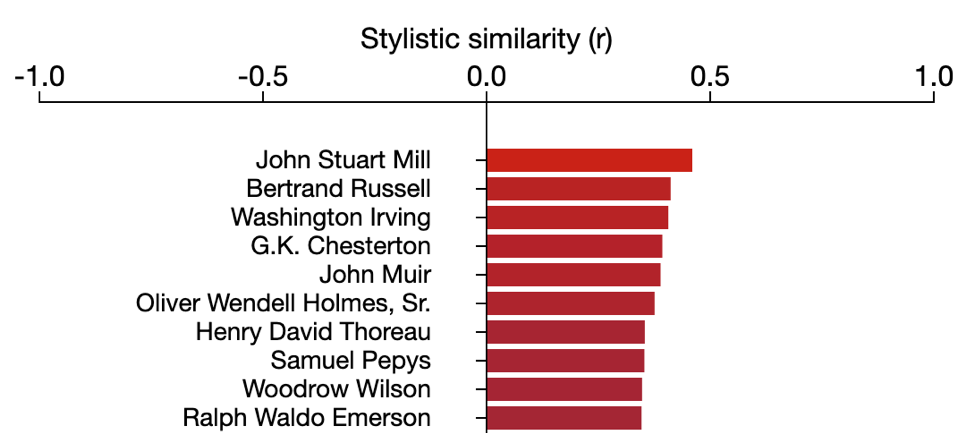
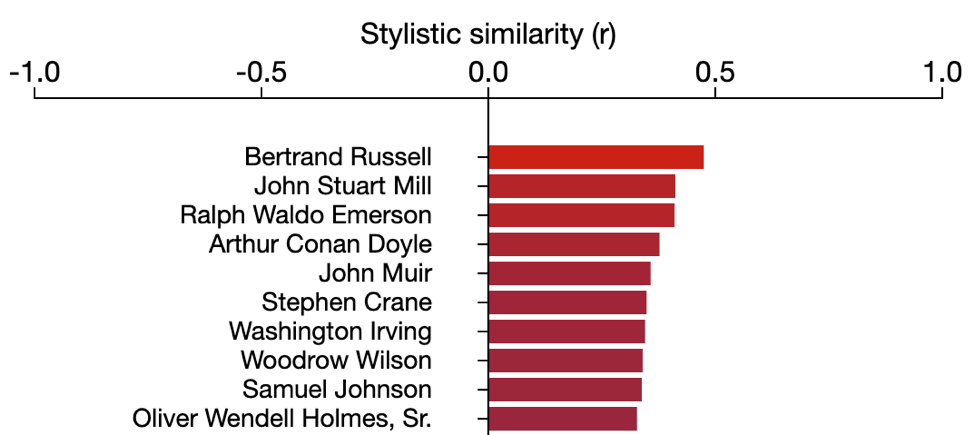
This research project focuses narrowly on one dimension of stylometric study, a field explored in great depth in “Quantitative Patterns of Stylistic Influence in the Evolution of Literature,” available online in the Proceedings of the National Academy of Sciences of the United States of America.

MySocialBrain bases its study on a reasonable premise. “Despite the seemingly ineffable qualities of style, great progress has been made in measuring writing quantitatively. This process, known as stylometry, can identify the influence of one writer on another or reveal the author of unattributed work.”

You can have your writing compared to that of others at this site.

I used two different samples of my writing (blog, then essay) and came up with fairly similar results. I haven’t read much from every one of these authors, but my gut suggests there may be a valid correlation here. And that impression is reinforced by how little correlation my submission had with the writing of Beatrix Potter, R.M. Ballantyne and Baroness Orczy (of whom I had never heard).

If you have a few free minutes, and are curious about what this stylometry tool might conclude about your writing, give it a try.


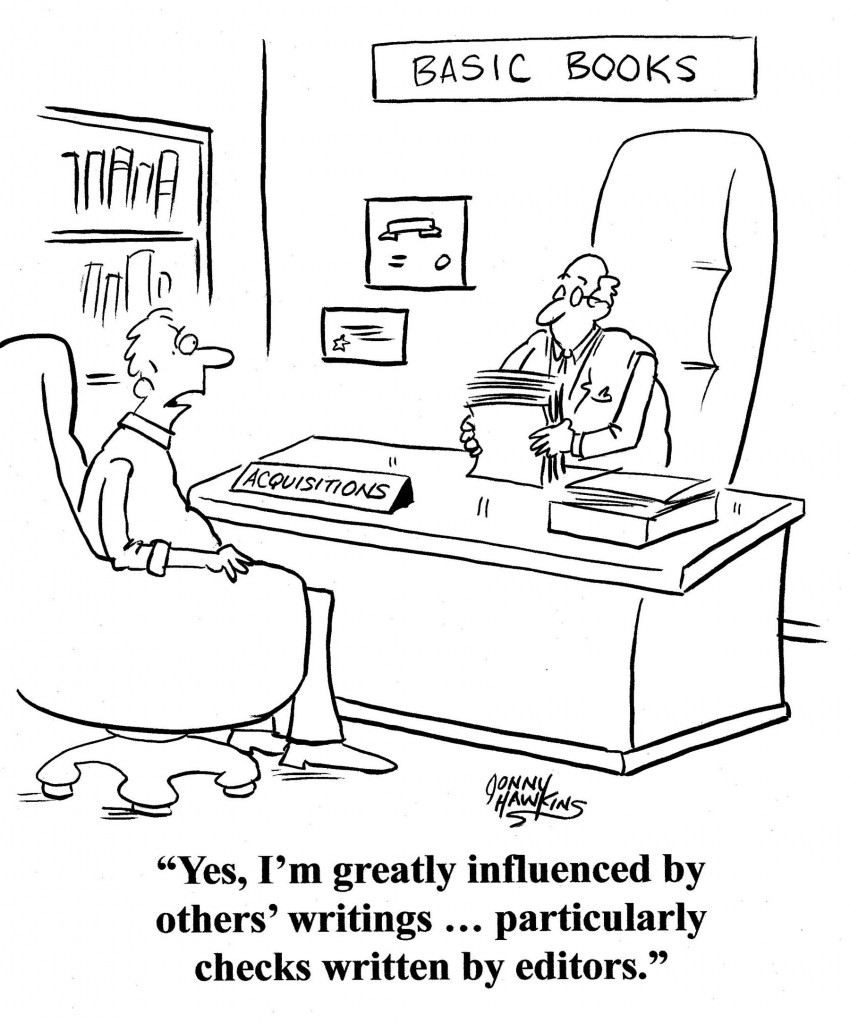
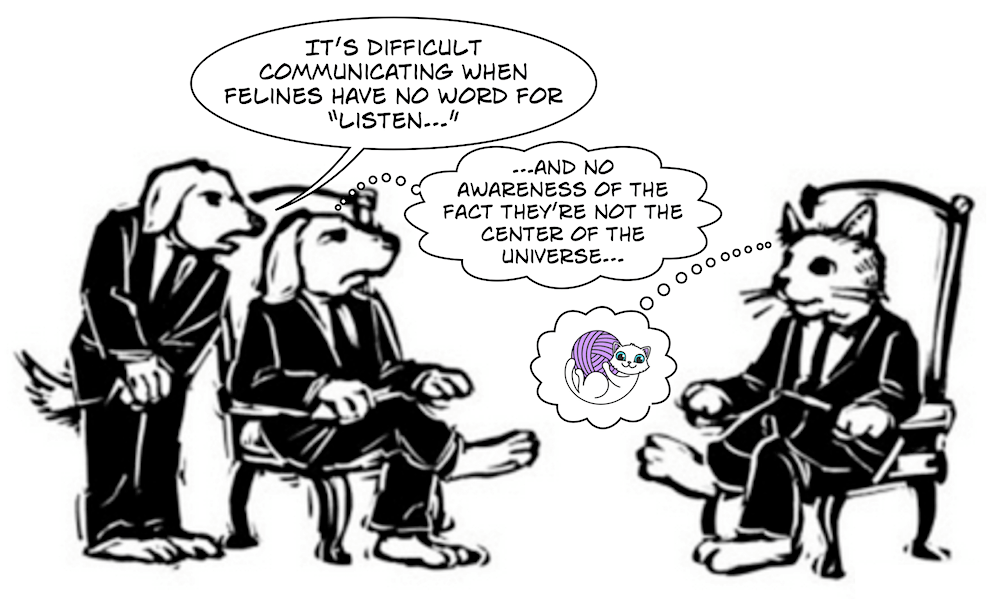
The cartoon at the top of this column is used with the permission of its talented creator, Jonny Hawkins. He is both talented and prolific. Enjoy a humorous jaunt through his personal website today.

Peculiarities of the German Language

Mark Twain wrote some entertaining travelogues about his overseas travel. In A Tramp Abroad, he relates a conversation he and a friend had with an American who had been studying veterinary medicine in Germany. The expatriate complains about how long his studies have taken – nearly two years – and proclaims how good it is to hear his native tongue.

The student’s most humorous words relate to his impression of the German language. It’s unusual in its nineteenth century phrasing. However, he does note one rather common opinion in his earthy observation.

“I spotted you for my kind [fellow Americans] the minute I heard your clack. . . .” The young fellow hooked his arm into the Reverend’s, now, with the confiding and grateful air of a waif who has been longing for a friend, and a sympathetic ear, and a chance to lisp once more the

sweet accents of the mother tongue, — and then he limbered up the muscles of his mouth and turned himself loose, — and with such a relish!

Some of his words were not Sunday-school words, so I am obliged to put blanks where they occur. . . . “when I heard you fellows gassing away in the good old American language, I’m – if it wasn’t all I could do to keep from hugging you! My tongue’s all warped with trying to curl it around these forsaken wind-galled nine-jointed, German words here; now I tell you it’s awful good to lay it over a Christian word once more and kind of let the old taste soak in. . . .

“I’m learning to be a horse-doctor! I like that part of it, you know, but ____ these people, they won’t learn a fellow in his own language, they make him learn in German; so before I could tackle the horse-doctoring I had to tackle this miserable language.”

And, as if mastering German wasn’t difficult enough in itself, he continues:

“First-off, I thought it would certainly give me the botts, but I don’t mind it now. I’ve got it where the hair’s short, I think; and dontchuknow, they made me learn Latin, too. Now between you and me, I wouldn’t give a ____ for all the Latin that was ever jabbered; and the first thing I calculate to do when I get through, is to just sit down and forget it. ’Twon’t take me long . . .”

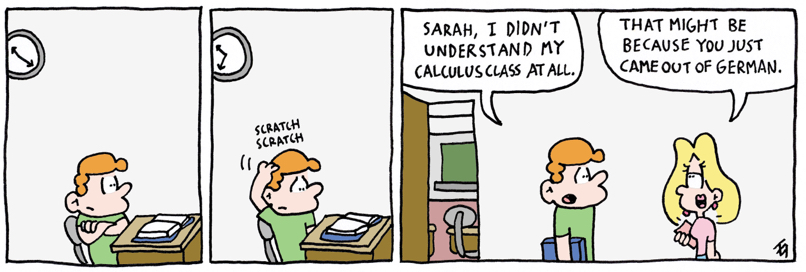
I don’t intend to offend Germans for the challenge their language poses to some. (In fact, one set of my grand-parents named Vonderohe originally came from Pomerania.) But the nature of agglutinative languages is so alien to most of us that the very length of the glued-together words becomes daunting.

Since I’m not a linguist, I had to research to discover as I wrote this post that German is not a truly agglutinative language. It merely uses agglutination. Apparently, the distinction involves distinctions with which most non-linguists need not concern themselves. We can be satisfied with the simplified definition provided by Glottopedia.org – “Agglutinating language is a language which has a morphological system in which words as a rule are polymorphemic and where each morpheme corresponds to a single lexical meaning.”

In truth, it’s quite logical to make new words by stringing them together. Most English compound words are a combination of two elements. Longer Germanic words seem more common. Kraftfahrzeug-Haftpflichtversicherung, for example, sounds “nine-jointed,” but is actually only two words, meaning motor vehicle liability insurance.

C.S. Lewis and the German Language

C.S. Lewis was multilingual, and studied German while relatively young. He and his wife used every language as a source when playing Scrabble.

Nevertheless, Lewis was quite modest about his grasp of German. In 1954, while thanking a German professor for the offer of a philosophy book he had written, Lewis wrote,

I look forward to reading the book (when the translation arrives! My German is wretched, and what there is of it belongs chiefly to the libretto of the Ring and Grimm’s Märchen – works whose style and vocabulary you very possibly do not closely follow).

The following year Lewis wrote once again to Helmut Kuhn. This time it was to thank him for a review Lewis’ works. Lewis said, “it certainly seems to me that your grasp of the whole situation in which I have written and of the relation of my ideas both to it and to each other, goes far beyond any criticism I have yet had.” Before he makes that noteworthy statement, Lewis makes a playful comment relating to the presumed dignity implicit in the German language itself.

To be written about in the German language is, for an Englishman, a grave temptation to spiritual pride. The sentences are so massive and the words so long that, even if the content were less flattering than it is in your article, the subject can hardly resist feeling that he must be a much weightier phenomenon than he had ever supposed!

Eucestoda Words: Well Worth a Postscript

Germans are an accomplished, literate people who take pride in their language. They have gone so far as to coin a word that specifically identifies these sometimes lengthy compound words. Germans call them bandwurmwörter, which literally means “tapeworm words.” (Mark Twain would have delighted in knowing that.)

Friedrich Akademie, an education website, devotes a page on their website to “Beautiful German Tapeworm Words.”

Tapeworm words . . . what a fascinatinglyinventivesemanticnovelty!

Sharing the Blessings of Books

Oh, the curse of being  a book lover. How can we thin the shelves of our libraries to make room for new additions we absolutely must add?

Digital copies have resolved the worst of that problem for many of us. Yes, holding a physical book in our hands is different altogether from reading off a screen, but when you compare the space requirements . . . or the accessibility when away from home or office . . . well, it is to me a worthwhile tradeoff.

I have always invested a significant (read “huge”) portion of my discretionary income in books. Like C.S. Lewis, I regard a good library as a treasure. While we both appreciate the extensive collections available in public and academic libraries, borrowing a text is not the same as owning it. Lewis alludes to this in a slightly off-handed manner in a 1952 letter to fellow Inkling, Roger Lancelyn Green.

I have re-read The Luck and liked it very much, as I had felt at the first reading . . . As luck would have it I met a lady who was looking for things to “read to the children” & The Luck is now on her list. I think she’s a buyer too, not a library addict.

The full title of the book to which Lewis refers is The Luck of the Lynns, and it was written by Green himself. This essay offers an excellent discussion of the book, and the author himself.

Books shaped Lewis’ life, particularly its beginning. In Surprised by Joy he describes visits to the home of Irish relatives. “In some ways Mountbracken was like our father’s house. There too we found the attics, the indoor silences, the endless bookshelves.”

Unpacking Book Boxes Twenty Years Later

Life has settled down to the point where I have been able to attack the forty to fifty boxes of books that were pulled out of storage when I retired and built our home. They weren’t actually removed from storage. It was more like a transfer—from a commercial storage unit to two-thirds of our three-car garage.

It’s been liberating to feel free to donate about 80% of the books to local charities. Some of those I’m retaining will join them in new libraries after I’ve had a chance to glean a few details from them. Coincidentally, this week one book box I unsealed included a few files, and among them was “Before the Book Sale,” from a 1995 issue of Christian Century.

The author, James M. Wall, was a Methodist pastor. His death this March, at the age of ninety-two, makes the article’s pull quote exceptionally poignant: “As I choose which books go and which stay, I confront my past and my mortality.”

Since the article is not available online, I will make it available as a one page pdf to anyone who requests a copy. The essay begins casually, but moves into a serious conversation that is well worth the read.

My town puts on a book sale every fall. Proceeds go to a worthy cause, and I am told the event is well attended. I never go because I already have too many books on my crowded shelves. But I do participate in the sale as a supplier.

It is for this reason that each summer as the time to turn books in approaches I am seized by an intense feeling of anxiety. I know I have to prune my shelves and I also know that there is no reason to hold onto all the books I have.

As I choose what goes and what stays, I confront my mortality—Who will want all these books when I am gone?—and my past. Each title evokes a memory of an earlier time of intense interest in a particular topic . . . and when I reject a book I once thought had to remain with me forever, I wonder in what ways I’ve changed.

The Final Disposition of One’s Books

In years past, it was not uncommon for exceptional personal libraries to be presented, in toto, to a university library. Today, the largest collection of books that originally graced the office and home of C.S. Lewis are housed at the Wade Center of Wheaton College.

A complete list of titles in the Lewis archive comes replete with indications whether a title includes a signature, underlining, and/or a handwritten annotation.

As for my own library, I hope my children and grandchildren will want to hold onto most of it. I have a feeling that ultimately the bulk of physical texts I still own will relate to the Inklings and related subjects. (I also have a substantial digital library in Logos, but that is primarily theological, and presently beyond the interests of those not headed to a seminary.)

Whatever the shape and size of your own library, the key is to actually use it. And it’s even more fun when you share it (with people who know how to respect books, of course).

Even if you have no funds available to purchase books, there are vast numbers of amazing volumes in the public domain that you can download for free.*

And finally, don’t hesitate to use your local library. Neither C.S. Lewis nor I would ever honestly desire to disparage a “library addict.” After all, he probably spent a hundredfold more hours reading library books than all the regular readers of Mere Inkling combined.


* Internet Archive and Project Gutenberg are my go to sites for public domain titles. Google Books is another option, for those already ensnared in the behemoth’s tentacles. (Just joking, Google. I know you’re watching…)


The cartoon above is used with the permission of its creator, Doug Savage. You can enjoy more of his comics at Savage Chickens.

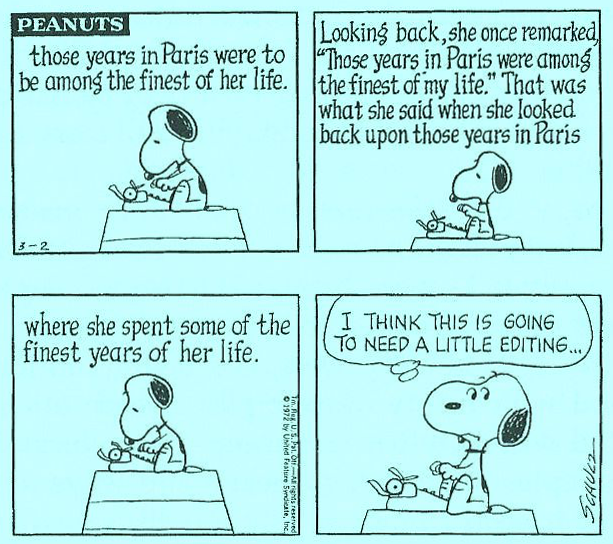
Are You an Author or an Editor?

Each writer brings a unique balance of talents to the task before them. Some excel at the initial writings. Others are especially talented at sharpening their work after the first draft has been created.

Understanding where we fit on that spectrum of author or editor, can be very empowering. Knowing our strengths and non-strengths is a major step in becoming a better writer.

Andy Le Peau worked for four decades at InterVarsity Press. His excellent blog, Andy Unedited, explores “books, life, and writing.” Five years ago he penned a short post that I still find extremely enlightening.

In “Authors are Like Pioneers—Editors Are Like Settlers,” Le Peau uses that unusual analogy to explain a creative tension at play in the lives of most writers I know. And, once we understand this fluid dichotomy, I believe it makes us better writers.

Authors tend to come up with new ideas and push them forward. They like to move into literary territories not explored before. Creating something new is like a shot of caffeine to their systems.

Good editors see how to improve a book, make it read better, clearer. They don’t try to shape the book in their own image. Rather they see the good that is already there and find ways to make it even more effective, better organized, clearer.

Good writers are usually pretty decent editors. Not expert, but adequate enough to recognize ways in which their own work can be improved. That’s why we call the “first draft” a first draft.

Now, if you consider your initial draft a finished product, you are definitely not a settler!

C.S. Lewis was a gifted writer. He also knew a great deal about editing, as I’ve discussed here in the past. I’ve even described his astonishment with the practices of some editors.

Lewis was quite open to revising his own work, even after it was published. In 1959, he wrote to one of his publishers, “Yes, there is one chapter of Miracles that needs revision. The result of the revision will, I think, make it shorter rather than longer. I’ll get onto this job as soon as I can.”

My Perspective on the Writing Process

While I embrace the pioneer or settler symbolism, I expand the analogy by thinking about my own writing process. I tend to think of it in three categories, with

Researching – Writing – Editing

To this process, if we desire to actually share our work, should be added at its end, “Submitting/Publishing.” Submitting refers to presenting it for potential publication in various media. By publishing, I refer to skipping the proverbial middle person, and posting your work online or using one of the self-publishing options readily available today.

In my personal context, I regard researching as a semi-independent stage of the writing process.

This may be due to the fact I focus on nonfiction. (Fiction writers can devote meager attention to it, and get away with it—not that they should ever ignore it.)

There are two additional reasons researching earns its own place in my writing process. First, because it is in my innate nature to be thorough and accurate. Second, I simply love the process. I know I’m in the minority.

Most writers prefer to get on with the task as soon as possible. I, however, am enslaved by my inherent curiosity to learn as much as possible about the undertaking as I can, before embarking on the actual writing. (And, yes, I recognize this may be exaggerated by my mortal tendency to procrastinate.)

To maintain the original analogy, in the spirit of Leif Erikson, I think of it this way:

Explorer – Pioneer – Settler

This works well for me, and I hope this post offers some insight and encouragement to you, as well.

Translating Foreign Languages

How many languages can you translate into English? If the answer is >0, I envy you. I’ve studied four,* and passed all the tests, but have an actual aptitude in none.

If I were thus gifted, I would be transferring some of the world’s literary wealth into my native tongue—and vice versa.

One of my granddaughters is currently fascinated by language. She wants to speak a dozen or more, and has begun some study in Spanish and Japanese. However, I attribute most of her dream to a young teenager’s excitement at having the entire world before them. In time, we all learn that finite concerns, such as time, finances and obligations, erode our options.

I’ve written about translation before, most extensively in “C.S. Lewis’ School of Translation.”⁑

This week, while writing an article about a Lutheran approach to ministry with the newly bereaved, I came across an entertaining reference to translation, in the letters of Martin Luther. Luther, of course, was the Reformation leader who, among other things, strongly believed the Bible should be accessible to lay people in their own language.

Translating the Holy Scriptures

Martin Luther was a scholar. Yet, even scholars lack expertise in all subjects. Thus, when translating the Bible into German, he welcomed the cooperation of others. This was particularly wise, since the so-called “Luther Bible” was the first German translation from the original languages rather than the Latin Vulgate. Unsurprisingly, the New Testament was published first. The longer Jewish Scriptures required more time.

The following letter was written in 1524 to Luther’s friend George Spalatin, another German theologian. Luther playfully explains how faithfulness to the original Hebrew text has delayed the publication of the final portion of the Bible.  

All is well with us. We have so much trouble in translating Job, on account of the grandeur of his sublime style, that he seems to be much more impatient of our efforts to turn him into German than he was of the consolation of his friends.

Either he always wishes to sit on his dunghill, or else he is jealous of the translator who would share with him the credit of writing his book. This keeps the third part of the Bible from being printed.

This casual identification with Job, one of God’s most faithful followers, appeals to me. The older I become, the greater is my sense of connection with the “cloud of witnesses,” the saints who have gone before us. In fact, I am also growing progressively more eager to fellowship with the angels. Though different from humanity in countless ways, we share the wonder of being beloved creatures of God.

In The Four Loves, Lewis writes that “friendship . . . This love, free from instinct, free from all duties but those which love has freely assumed, almost wholly free from jealousy, and free without qualification from the need to be needed, is eminently spiritual. It is the sort of love one can imagine between angels.” In my mind, phileo is also the sort of love we will one day experience between angels and humans.

C.S. Lewis’ Work with the Hebrew Language

Lewis did not read Hebrew. That shortcoming is certainly quite forgivable, given the numerous arenas in which his talents excelled. In his Reflections on the Psalms, he acknowledges his limitation. At the same time, he notes that we have many accessible resources by those acquainted with the ancient language.

I have worked in the main from the translation which Anglicans find in their Prayer Book; that of Coverdale. Even of the old translators he is by no means the most accurate; and of course a sound modern scholar has more Hebrew in his little finger than poor Coverdale had in his whole body. But in beauty, in poetry, he, and St. Jerome, the great Latin translator, are beyond all whom I know. I have usually checked, and sometimes corrected, his version from that of Dr. Moffatt.

In his explanation, Lewis notes the value in referring to several authoritative sources. This is especially wise when words are rare or unclear in their usage. Even people fluent in various languages would be negligent to ignore such resources where there is a question regarding significant interpretations.

In the meantime, Luther’s reminder of Job’s “grandeur of his sublime style,” along with the book’s remarkable message, has me preparing to read that book once again. In translation, of course.


* Spanish in junior high, Latin in high school, classical Greek in college, and Hebrew in seminary. As the Austrian-British philosopher, Ludwig Wittgenstein, said: “the limits of my language mean the limits of my world.” I am quite impressed by the fact that many of Mere Inkling’s readers from outside the States are at least bilingual.

⁑ If you’re interested in the subject, you might want to also (re)visit “C.S. Lewis as a Translator.”