Explosive Clergy

What’s with pastors? As one, I probably know more than the typical person does about them – and all too often, they disappoint.

That’s a bit harsh. Most pastors are pretty selfless. That’s fairly evident in their salaries (if they even receive one). And, trust me, trying to be a faithful leader and peacemaker in any group comprised of human beings, is no easy task.

My sainted grandmother, born at the end of the nineteenth century, was the daughter of Norwegian immigrants. She was an authentic follower of Jesus, and when she was young the sermons at Fordefjord Lutheran Church* were preached in the immigrants’ tongue. We occasionally talked about how scandalized she was when one of the ministers serving the congregation pronounced “helvete vil være fullt av pastorer” (hell will be full of pastors).

Well, not “full” perhaps, but in principle he was right. And, sadly, his warning is not at all shocking to us today. We read regularly about clergy who are arrested for violating the trust of the most vulnerable. Likewise, we hear about the outrageous wealth of some ministers (including, it seems, nearly every televangelist). Even pastors in small enclaves with little access to the temptation offered by easily accessible cash, can too often succumb to the sirens of pride and power, twisting their pastoral authority into a weapon to abuse others. (It’s the opposite of the messianic promise found in Isaiah 2:4.)

It’s almost enough to drive a person from the Lord’s house. But that is not the answer, of course. Finding a truly Christian church, with a pastor earnestly (albeit imperfectly) pursuing his holy vocation, is the best course.

The Scriptures say many things about ministry, and Jesus himself provides the perfect example of willingness to lay down one’s life for the sheep.

The letter of James cautions those considering a life of “ministry” that they will face a stricter judgment than the laity (which comes from λαός which refers to the people at large).

Personally, I especially appreciate being reminded of God’s warning to religious leaders from the lips of Jeremiah. (I also appreciate the ironic tone of God’s judgment.)

“Woe to the shepherds who destroy and scatter the sheep of my pasture!” declares the Lord. Therefore thus says the Lord, the God of Israel, concerning the shepherds who care for my people: “You have scattered my flock and have driven them away, and you have not attended to them. Behold, I will attend to you for your evil deeds,” declares the Lord.

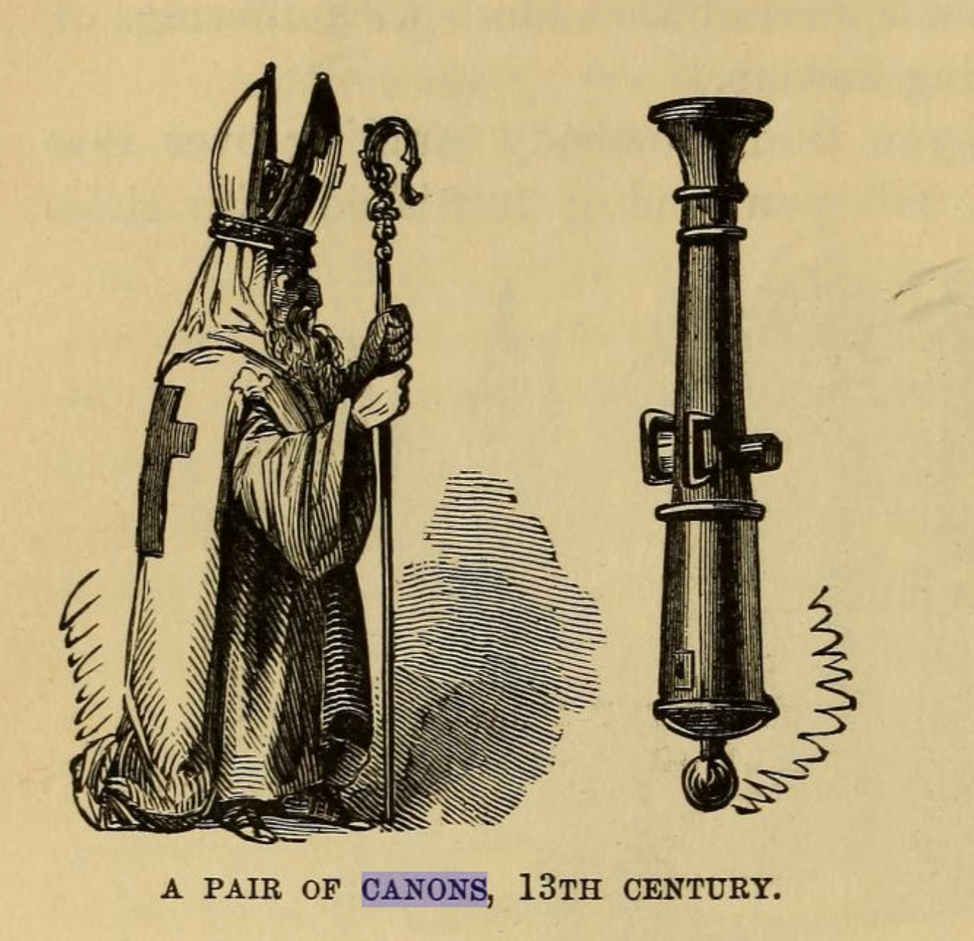
The picture at the top of this column comes from one of Mark Twain’s travelogues. It illustrates the vindictive priest Fulbert, in Twain’s retelling of the story of Abelard and Héloïse, 12th century lovers. More about that momentarily. Abelard was a prominent philosopher who tangled for several years with Saint Bernard of Clairvaux, a significant dispute ably discussed here.

Abelard and the Inklings

Abelard (c. 1079-1142) was a philosopher who, as was common during the Middle Ages, was also a theologian. Among his contributions to religion was revising the Roman Catholic doctrine of limbus infantium (Limbo for unbaptized infants).

In popular culture, Abelard’s love affair with his eventual “wife” is more prominent than his religious pursuits. Although Abelard was a famous figure during the medieval period, he did not feature significantly in C.S. Lewis’ thought. He did, however, exert a prominent influence on Charles Williams’ Place of the Lion, a volume Lewis praised.

In “Friendship in The Place of the Lion,” Dan Hamilton provides a very accessible synopsis of Williams’ book. He describes the experience of a primary character, who is writing her dissertation on “Pythagorean Influences on Abelard.” As she struggles with the appearance of supernatural phenomena, “she encounters the specter of Abelard, a major subject of her studies. But he is dead, and powerless to give her any aid, not even a meaningful word.” The “archetypes” in the story, by contrast, possess genuine power. It is a very unique book.

Returning to Mark Twain’s retelling of the popular medieval tale, we leave the realm of platonic philosophy, and enter the world of sordid human activities. Twain, you see, was not sympathetic to Abelard’s wooing of a young student and his eventual repentance. In his account, Twain desired “to show the public that they have been wasting a good deal of marketable sentiment very unnecessarily.” If you are curious as to his perspective on the events, continue reading.

Twain’s Take on Abelard and Héloïse
(not brief, but well worth reading)

In his own words, Twain’s “faithful” version of their story – but first, he begins with a description of their shared gravesite.

But among the thousands and thousands of tombs in Père la Chaise [cemetery] there is one that no man, no woman, no youth of either sex, ever passes by without stopping to examine. Every visitor has a sort of indistinct idea of the history of its dead, and comprehends that homage is due there, but not one in twenty thousand clearly remembers the story of that tomb and its romantic occupants. This is the grave of Abelard and Heloise – a grave which has been more revered, more widely known, more written and sung about and wept over, for seven hundred years, than any other in Christendom, save only that of the Saviour.

All visitors linger pensively about it; all young people capture and carry away keepsakes and mementoes of it; all Parisian youths and maidens who are disappointed in love come there to bail out when they are full of tears; yea, many stricken lovers make pilgrimages to this shrine from distant provinces to weep and wail and “grit” their teeth over their heavy sorrows, and to purchase the sympathies of the chastened spirits of that tomb with offerings of immortelles and budding flowers.

Go when you will, you find somebody snuffling over that tomb. Go when you will, you find it furnished with those bouquets and immortelles. Go when you will, you find a gravel-train from Marseilles arriving to supply the deficiencies caused by memento-cabbaging vandals whose affections have miscarried.

Yet who really knows the story of Abelard and Heloise? Precious few people. The names are perfectly familiar to every body, and that is about all. With infinite pains I have acquired a knowledge of that history, and I propose to narrate it here, [italics added] partly for the honest information of the public and partly to show that public that they have been wasting a good deal of marketable sentiment very unnecessarily.

Heloise was born seven hundred and sixty-six years ago. She may have had parents. There is no telling. She lived with her uncle Fulbert, a canon of the cathedral of Paris. I do not know what a canon of a cathedral is, but that is what he was. He was nothing more than a sort of a mountain howitzer, likely, because they had no heavy artillery in those days. Suffice it, then, that Heloise lived with her uncle the howitzer, and was happy.

She spent the most of her childhood in the convent of Argenteuil – never heard of Argenteuil before, but suppose there was really such a place. She then returned to her uncle, the old gun, or son of a gun, as the case may be, and he taught her to write and speak Latin, which was the language of literature and polite society at that period.

Just at this time, Pierre Abelard, who had already made himself widely famous as a rhetorician, came to found a school of rhetoric in Paris. The originality of his principles, his eloquence, and his great physical strength and beauty created a profound sensation. He saw Heloise, and was captivated by her blooming youth, her beauty and her charming disposition. He wrote to her; she answered. He wrote again, she answered again. He was now in love. He longed to know her – to speak to her face to face.

His school was near Fulbert’s house. He asked Fulbert to allow him to call. The good old swivel saw here a rare opportunity: his niece, whom he so much loved, would absorb knowledge from this man, and it would not cost him a cent. Such was Fulbert – penurious . . . He asked Abelard to teach her.

Abelard was glad enough of the opportunity. He came often and staid long. A letter of his shows in its very first sentence that he came under that friendly roof like a cold-hearted villain as he was, with the deliberate intention of debauching a confiding, innocent girl. This is the letter :

“I can not cease to be astonished at the simplicity of Fulbert; I was as much surprised as if he had placed a lamb in the power of a hungry wolf. Heloise and I, under pretext of study, gave ourselves up wholly to love, and the solitude that love seeks our studies procured for us. Books were open before us, but we spoke oftener of love than philosophy, and kisses came more readily from our lips than words.”

And so, exulting over an honorable confidence which to his degraded instinct was a ludicrous “simplicity,” this unmanly Abelard seduced the niece of the man whose guest he was. Paris found it out. Fulbert was told of it – told often – but refused to believe it. He could not comprehend how a man could be so depraved as to use the sacred protection and security of hospitality as a means for the commission of such a crime as that. But when he heard the rowdies in the streets singing the love-songs of Abelard to Heloise, the case was too plain – love-songs come not properly within the teachings of rhetoric and philosophy.

He drove Abelard from his house. Abelard returned secretly and carried Heloise away to Palais, in Brittany, his native country. Here, shortly afterward, she bore a son, who, from his rare beauty, was surnamed Astrolabe. . . . The girl’s flight enraged Fulbert, and he longed for vengeance, but feared to strike lest retaliation visit Heloise – for he still loved her tenderly. At length Abelard offered to marry Heloise – but on a shameful condition: that the marriage should be kept secret from the world, to the end that (while her good name remained a wreck, as before) his priestly reputation might be kept untarnished. It was like that miscreant.

Fulbert saw his opportunity and consented. He would see the parties married, and then violate the confidence of the man who had taught him that trick; he would divulge the secret and so remove somewhat of the obloquy that attached to his niece’s fame. But the niece suspected his scheme. She refused the marriage, at first; she said Fulbert would betray the secret to save her, and besides, she did not wish to drag down a lover who was so gifted, so honored by the world, and who had such a splendid career before him. It was noble, self-sacrificing love, and characteristic of the pure-souled Heloise, but it was not good sense.

But she was overruled, and the private marriage took place. Now for Fulbert! The heart so wounded should be healed at last; the proud spirit so tortured should find rest again; the humbled head should be lifted up once more. He proclaimed the marriage in the high places of the city, and rejoiced that dishonor had departed from his house. But lo! Abelard denied the marriage! Heloise denied it! The people, knowing the former circumstances, might have believed Fulbert, had only Abelard denied it, but when the person chiefly interested – the girl herself – denied it, they laughed despairing Fulbert to scorn.

The poor canon of the cathedral of Paris was spiked again. The last hope of repairing the wrong that had been done his house was gone. What next? Human nature suggested revenge. He compassed it. The historian says: “Ruffians, hired by Fulbert, fell upon Abelard by night, and inflicted upon him a terrible and nameless mutilation.”

I am seeking the last resting-place of those “ruffians.” When I find it I shall shed some tears on it, and stack up some bouquets and immortelles, and cart away from it some gravel whereby to remember that howsoever blotted by crime their lives may have been, these ruffians did one just deed, at any rate, albeit it was not warranted by the strict letter of the law.

Heloise entered a convent and gave good-bye to the world and its pleasures for all time. For twelve years she never heard of Abelard – never even heard his name mentioned. She had become prioress of Argenteuil, and led a life of complete seclusion. She happened one day to see a letter written by him, in which he narrated his own history. She cried over it, and wrote him. He answered, addressing her as his “sister in Christ.”

They continued to correspond, she in the un-weighed language of unwavering affection, he in the chilly phraseology of the polished rhetorician. She poured out her heart in passionate, disjointed sentences; he replied with finished essays, divided deliberately into heads and sub-heads, premises and argument. She showered upon him the tenderest epithets that love could devise, he addressed her from the North Pole of his frozen heart as the “Spouse of Christ!” The abandoned villain!

On account of her too easy government of her nuns, some disreputable irregularities were discovered among them, and the Abbot of St. Denis broke up her establishment. Abelard was the official head of the monastery of St. Grildas de Ruys, at that time, and when he heard of her homeless condition a sentiment of pity was aroused in his breast (it is a wonder the unfamiliar emotion did not blow his head off), and he placed her and her troop in the little oratory of the Paraclete, a religious establishment which he had founded.

She had many privations and sufferings to undergo at first, but her worth and her gentle disposition won influential friends for her, and she built up a wealthy and flourishing nunnery. She became a great favorite with the heads of the church, and also the people, though she seldom appeared in public. She rapidly advanced in esteem, in good report and in usefulness, and Abelard as rapidly lost ground. The Pope so honored her that he made her the head of her order.

Abelard, a man of splendid talents, and ranking as the first debater of his time, became timid, irresolute, and distrustful of his powers. He only needed a great misfortune to topple him from the high position he held in the world of intellectual excellence, and it came. Urged by kings and princes to meet the subtle St. Bernard in debate and crush him, he stood up in the presence of a royal and illustrious assemblage, and when his antagonist had finished he looked about him, and stammered a commencement; but his courage failed him, the cunning of his tongue was gone: with his speech unspoken, he trembled and gat down, a disgraced and vanquished champion.

He died a nobody, and was buried at Cluny, A.D., 1144. They removed his body to the Paraclete afterward, and when Heloise died, twenty years later, they buried her with him, in accordance with her last wish. He died at the ripe age of 64, and she at 63. After the bodies had remained entombed three hundred years, they were removed once more. They were removed again in 1800, and finally, seventeen years afterward, they were taken up and transferred to Pere la Chaise, where they will remain in peace and quiet until it comes time for them to get up and move again.

History is silent concerning the last acts of the mountain howitzer. Let the world say what it will about him, I, at least, shall always respect the memory and sorrow for the abused trust, and the broken heart, and the troubled spirit of the old smooth-bore. Rest and repose be his!

Such is the story of Abelard and Heloise. (Innocents Abroad).


* Later Fordefjord was unimaginatively renamed “First Lutheran Church.”

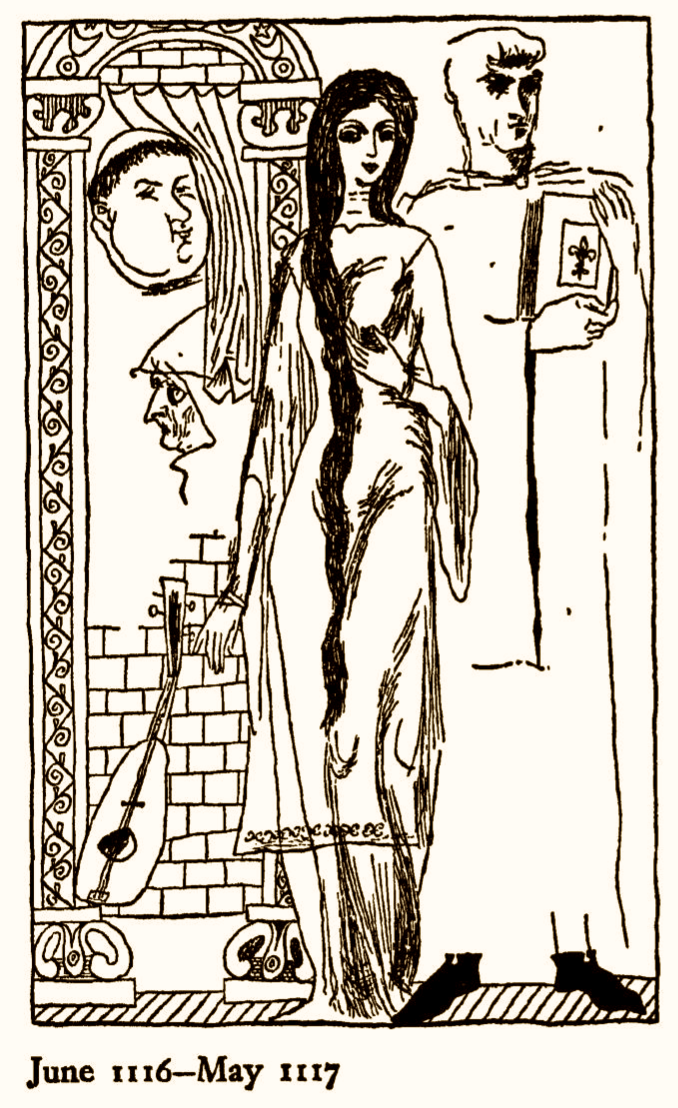
A novel entitled Peter Abelard was published in 1933 by Helen Waddell. It is available at Internet Archive for those who prefer their history via the medium of historical fiction. The illustration below, apparently imitating a fading fresco, comes from that volume.
Do Lay People Think?

Attending seminary was shocking. Having grown up in Lutheran communities with a high view of the Scriptures, I anticipated entering an environment where I would grow in my knowledge and regard for God’s word. A setting consistent with our Reformation theology which confessed “Sola Scriptura,” the Scriptures alone, as the ultimate authority for doctrine and life.

I was amazed at the theology taught by a few of the faculty who were disciples of Bultmann’s radically skeptical interpretation of Christianity.

One morning I was in the seminary cafeteria – the aptly named Diet of Worms – commiserating over this situation with several other students who shared my astonishment. I said something to the effect of “Is Lutheranism what liberal theologians think, or what the majority of Confessionally-grounded lay people in the pews think?”

Apparently one of the New Testament professors had overheard our conversation. He could not resist walking over, leaning over our table, and asking – “Do lay people think?”

I’ve never forgotten the vanity and unintentional irony in that rhetorical comment. As I recall, it elicited a complicit chuckle from the entourage of liberal students already falling under his spell.

The greatest Christian apologist of the twentieth century, C.S. Lewis, was neither a cleric nor a theologian. Lewis described himself as “a very ordinary layman of the Church of England” (Mere Christianity). In the same work he expressed his lifelong position. Since he was not theologically trained, he was constrained from making authoritative declarations about complex matters.

I am only a layman, and at this point we are getting into deep water. I can only tell you, for what it is worth, how I, personally, look at the matter.

Pastors & Theologians, What are they Good For?

Some will answer that question echoing the words of the 1970 classic by the Temptations: “absolutely nothing.”

In an over-reaction to the errors of the medieval Papacy, some Protestants threw out all of the legitimate practices which had developed in the early church, including the ordination of pastors. The anti-clerical communities vary in their attitudes toward higher education for “teachers and elders,” but rarely regard such studies as necessary, or even a plus.

Most denominations, however, have maintained an awareness that having future pastors devote several years to biblical and theological studies is vital to the church’s wellbeing. Add to that additional subjects such as counseling and homiletics – skills that are essential – and you should get well-rounded pastors. 

Sadly, there are plenty of exceptions. I have written about wolves in sheep’s clothing in the past. Still, discerning students attending trustworthy seminaries invariably become better equipped to fulfill the demands of pastoral ministry. Check out “The Relevance of Theological Education” in the (free) journal Themelios which is published by the Gospel Coalition. Themelios is the Greek word for “foundation.” The article begins:

Most theological students have doubts at some time about the usefulness of their theological training. Some of these doubts are justified, since most theological courses leave plenty of room for improvement. But some of our doubts reflect a lack of understanding of the purpose and function of theological training.

What about Lay People?

Before the word “lay” became associated with distinguishing the mass of people from those within particular professions, it originated to distinguish the believing “laity” who adhere to a faith from clergy of that tradition.

Are clergy holier than laypeople? Definitely not. However, in the Christian faith we acknowledge that they are expected to live with greater moral integrity than those they serve. 

“Not many of you should become teachers, my brothers, for you know that we who teach will be judged with greater strictness” (James 3:1).

It is quite sobering for those who take God’s word seriously. In Paul’s letter to Titus we read a relatively explicit description of the requirements for pastors. 

“This is why I left you in Crete, so that you might . . . appoint elders in every town as I directed you – if anyone is above reproach, the husband of one wife, and his children are believers and not open to the charge of debauchery or insubordination. For an overseer, as God’s steward, must be above reproach.

“He must not be arrogant or quick-tempered or a drunkard or violent or greedy for gain, but hospitable, a lover of good, self-controlled, upright, holy, and disciplined. He must hold firm to the trustworthy word as taught, so that he may be able to give instruction in sound doctrine . . .” (Titus 1).

Different Roles

The inspiration for my post on this subject is an article I read in the 2024 Logos Bible Software Seminary Guide. A PhD theologian wrote “Do Theological Writers Need Theological Education?” which answered its own question in its subtitle: “Yes and No.” The writer states that degrees are most definitely not required.

There is nothing sacrosanct about sitting in a classroom . . . You can be educated through other means, with diligent reading being at the top of the list.

Simultaneously, he defends the values of a solid education. I love the way that he responds to the way some people denigrate theological education (because I’ve met more of these folks than I can number).

Today’s many populists might beg to differ. They mock “edumucation” and deride the arrogant eggheads who get too much of it. They flout the norms of academic discourse . . . they seem proud of their misspellings.

It’s not as if there is no truth at all in their complaints: educated people do indeed often give in to arrogance. But it’s not at all clear to me that arrogance about one’s ignorance is any better.

I concur. I’m against arrogance altogether – along with C.S. Lewis. “Lewis on Intellectual Pride” speaks directly to the question I’ve addressed herein. Discussing Lewis’ warnings about pursuing academia, the author says:

Why is intellectual arrogance so quick to rise within us? It makes us feel important. We understand more than others (we think). That makes us better than the ignorant masses (we boast).

Martin Luther described the centrality of God’s self-revelation in determining who is most fit to teach. And that has nothing to do with an individual’s ecclesiastical status.

The Bible is alive, it speaks to me; it has feet, it runs after me; it has hands, it lays hold of me. . . . A simple layman armed with Scripture is to be believed above a pope or a cardinal without it.

So, returning to the question with which I began, do lay people think? I am as scandalized by those very words as I was when I first heard them voiced. That particular professor is no longer alive. But, sadly, his prideful thinking remains with us today. And it’s not only evident in religion; humanity is plagued by an intelligentsia that dismisses the “lay” views of common people across the board. 

The actual truth is that education has its values, and its limitations. And there are innumerable laymen and women who possess wisdom on nearly every subject which is superior to the supposed “experts.” Yes, esteemed doctor of de-supernaturalized theology, lay people can indeed comprehend and share the wisdom of God.

A Portuguese Pope & C.S. Lewis

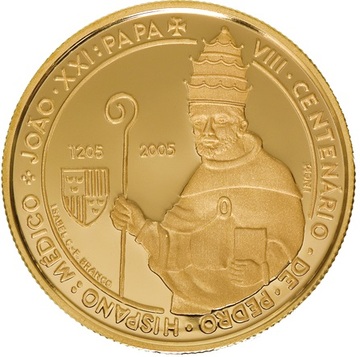
A few days ago marked the anniversary of the 1277 death of Pope John XXI. I knew nothing about this particular Pontiff, but the mention I read described his passing due to the collapse of the ceiling of his residence. That piqued my interest, but the following forced me to spend some time researching to learn more: “The name was a mistake – there was never a John XX.”

One of the very few email lists I’ve never regretted signing up for is “Today in Christian History” produced by Christianity Today.

Each day it provides brief notes about several historical events that happened on that particular day. Most of the notes describe historically watershed incidents. Others are simply curious, though they were naturally momentous to those involved.

The opening of this post offers an example from the latter category. Unlike the reign of Pope Francis, who ascended a decade ago and has indicated he has no intention of “retiring” before death (as did his humble predecessor Benedict XVI), the unfortunate John XXI sat on the papal throne for a mere nine months.

Despite this brief reign, there are several interesting things about Pedro Julião. (I’ll save the one I regard as most important for last.)

First of all, John XXI was Portuguese. Hailing from the Iberian Peninsula, he represents no less than 50% of the popes who came from Portugal. The first, Damasus I (305-84), came from the Roman province of Lusitania, which included a portion of Spain in addition to modern Portugal.

One paradox of the Papacy is that the Pope is the Bishop of the diocese of Rome, presiding over a physical geographic locale, while he is simultaneously the Bishop of the “Holy See,” meaning that he serves as the episcopal head of the entire international Roman Catholic communion.

Due to the physical location of the Roman Patriarchate, it is unsurprising that a majority of the individuals who have followed Saint Peter as Pontiff have been Italian. World Population Review says 217 of the 266 Popes have been from Italy. “A distant second is France, which has had a total of 16 popes.”

J.R.R. Tolkien was a truly devout Roman Catholic, but C.S. Lewis recognized that the church headquartered in Rome was merely one part of the Body of Christ whose unity he argued was founded in an understanding of the Mere Christianity Lewis propounded. Much to Tolkien’s chagrin, his good friend Lewis never converted to Roman Catholicism.

Roman Catholics still seek C.S. Lewis’ imprimatur. One prominent Roman Catholic apologist, Joe Heschmeyer, has a personal blog delightfully titled Shameless Popery. (I highly respect truth in advertising like his website exhibits.) In “C.S. Lewis’ Surprising Argument for the Papacy,” he argues that Lewis’ argument for a traditional view of marriage offers support to the rationale for papal authority.

Unlike some Protestants, C.S. Lewis was not tempted to construct a strawman out of the papacy. In an interesting passage from his monumental history of English Literature in the Sixteenth Century, he emphasizes the shared legacy of Roman Catholicism and robust Protestantism. 

To be sure, there are standards by which the early Protestants could be called “puritanical;” they held adultery, fornication, and perversion for deadly sins. But then so did the Pope. If that is puritanism, all Christendom was then puritanical together.

In much the same way that C.S. might argue that “all Christendom” shared not only a common moral awareness, but also a mutual understanding of God’s self-revealed Triune nature.

In addition to being a rare specimen as a Portuguese Pope, John XXI studied medicine and is thought to have been a noteworthy pharmacologist. In fact, the apartment in the papal palace in Viterbo which collapsed on him was constructed so he would have a quiet place in which to pursue his medical studies.

Second, as already mentioned, another peculiar thing about John XXI, is the choice of his papal name. There never was a Pope John XX. One would imagine the church bureaucracy would keep accurate records of these sorts of things. Even more strangely, there is more than one explanation for why Pedro Julião became John XXI at his consecration.

According to Brittanica “Marianus Scotus and other 11th-century historians mistakenly believed that there had been a pope named John between antipope Boniface VII and the true John XV.” Consequently, “they mistakenly numbered the real popes John XV to XIX as John XVI to XX” requiring that they subsequently be “renumbered XV to XIX.” Yet, for some reason, “John XXI and John XXII continue to bear numbers that they themselves formally adopted on the assumption that there had indeed been 20 Johns before them.”

As a result, the title John XX presumably remains available for any future Bishop of Rome who might wish to further confuse the matter. We may have to wait until the Parousia to learn the full facts in this convoluted matter.

A third distinctive of John XXI is that he rescinded a very common sense decree established by his predecessor Gregory X, only two years prior to John’s ascension. (Actually, Adrian V was elected pope between the two, but Ottobuono de’ Fieschi died shortly after his election, before he could even be ordained to the priesthood. (There must be another interesting tale there.)

Returning to the story of the rescinded canon . . . Apparently there was a long papal vacancy (nearly three years) before Gregory X was elected. To avoid such predicaments in the future, at the Second Council of Lyon Gregory pushed for this sensible rule: if the new pope is not elected in a reasonable time frame, encouragement would be provided to the conclave by having their episcopal meals and other rewards gradually diminish!

The entire, fascinating “constitution” is available at Eternal World Television Network. Here is the essence:

We learn from the past how heavy are the losses sustained by the Roman church in a long vacancy, how perilous it is . . . We intend in no way to detract from [previous rules primarily instituted by Pope Alexander III], but to supply by the present constitution what experience has shown to be missing.

If, which God forbid, within three days after the cardinals have entered the said conclave, the church has not been provided with a shepherd, they are to be content for the next five days, every day both at dinner and supper, with one dish only. If these days also pass without the election of a pope, henceforth only bread, wine and water are to be served to the cardinals until they do provide a pope.

While the election is in process, the cardinals are to receive nothing from the papal treasury, nor any other revenue coming from whatever source to the church while the see is vacant.

For some unrevealed reason, John XXI revoked this rule, and it was back to business as usual. The decision to do so was one of John’s few official acts.

C.S. Lewis, Once Again

One reason Christians of all denominational traditions find much to appreciate in C.S. Lewis comes from the fact he was much more interested in edifying believers than tearing them down. He preferred to promote Christian unity over division.

One of his close friends, with whom he carried on a long term correspondence was a Benedictine monk named Bede Griffiths. Ironically, while Griffiths became renowned for his embrace of elements of Hindu spirituality, the priest appeared less tolerant of C.S. Lewis’ Protestant doctrines. In a letter from 1936, Lewis’ frustration on that score comes through loud and clear.

One of the most important differences between us is our estimate of the importance of the differences. You, in your charity, are anxious to convert me: but I am not in the least anxious to convert you.

You think my specifically Protestant beliefs a tissue of damnable errors: I think your specifically Catholic beliefs a mass of comparatively harmless human tradition which may be fatal to certain souls under special conditions, but which I think suitable for you. . . .

As well – who wants to debate with a man who begins by saying that no argument can possibly move him? Talk sense, man! With other Catholics I find no difficulty in deriving much edification from religious talk on the common ground: but you refuse to show any interest except in differences.

These words were written (1) privately, to a friend, (2) in the form of an extemporaneous letter, and (3) tinged with the frustration of returning to a familiar “debate” with a recalcitrant disputant.

Fortunately, however, we possess an essay written by Lewis on the same subject which was composed in the opposite context. It was intentionally composed for a general audience, written in C.S. Lewis’ natural painstakingly logical and clear literary voice, and composed in his conciliatory spirit with a focus on affirming what is shared and illuminating – but not dwelling upon – differences.

In 1944 C.S. Lewis penned an essay entitled “Christian Reunion.” Sadly, it was never completed for publication during his lifetime. This brief work reveals his deeper thoughts on interdenominational distinctives, and the overriding unity Christians possess through our relationship in Jesus Christ. It is written primarily to a Roman Catholic audience, in a respectful and genuinely compassionate tone.

A Pilgrim in Narnia has provided the universal (“catholic” with a small “c”) Church a great service in reproducing the full text of the essay here.

Dr. Dickieson also provides a concise and helpful introduction. I offer only a selection from Lewis’ essay here, as befits the nature of our current discussion.

I know no way of bridging this gulf [between the major Christian traditions]. Nor do I think it the business of the private layman to offer much advice on bridge-building to his betters. My only function as a Christian writer is to preach “mere Christianity” not ad clerum [to the clergy] but ad populum [to the people].

Any success that has been given me has, I believe, been due to my strict observance of those limits. By attempting to do otherwise I should only add one more recruit (and a very ill qualified recruit) to the ranks of the controversialists. After that I should be no more use to anyone.

When therefore we find a certain heavenly unity existing between really devout persons of differing creeds – a mutual understanding and even a power of mutual edification which each may lack towards a lukewarm member of his own denomination – we must ascribe this to the work of Christ . . . 

Ultimately, C.S. Lewis’ reservations about Roman Catholicism rested where they do for most thinking Christians who belong to other denominations. Its focus can be distilled down to a “disagreement about the seat and nature of doctrinal Authority.” Although he does not expressly state the conviction here that Scripture supersedes the ultimate weight of a single opinion, say of someone such as Pope John XXI, that is the concern.

We will end with C.S. Lewis’ astute analysis of the two parts of the Christian family as they view one another across the proverbial Tiber. In doing so, I offer the fruits of my own recent theological quest. Precipitated by a contemporarily trivial event during the thirteenth century, it culminated in another deep draught from the wisdom of C.S. Lewis.

The difficulty that remains . . . is our disagreement about the seat and nature of doctrinal Authority. The real reason, I take it, why you cannot be in communion with us is not your disagreement with this or that particular Protestant doctrine, so much as the absence of any real “Doctrine,” in your sense of the word, at all.

It is, you feel, like asking a man to say he agrees not with a speaker but with a debating society.

And the real reason why I cannot be in communion with you is not my disagreement with this or that Roman doctrine, but that to accept your Church means, not to accept a given body of doctrine, but to accept in advance any doctrine your Church hereafter produces. It is like being asked to agree not only to what a man has said but to what he’s going to say.

Postscript

As an illustration of the C.S. Lewis’ point about authority resting in the current “successor of Peter,” consider the decisions rendered by Gregory X and John XXI about papal enclaves. It seems to me that the first admonition about not indulging those in attendance was wiser than the subsequent decision to restore the earlier policies. But then, that may simply be due to the fact that I’m a Protestant. Unless the rules have been revised since John’s passing, I assume most Roman Catholics would agree that he was led by the Holy Spirit in reversing the decree of the Second Council of Lyon.

The Church at War

Why would Christian Scriptures commend people for waging war? War, after all, is nearly universally condemned – even as it remains a relentless curse in various corners of our world.

One young pastor was “charged” with a duty that belongs, by biblical extension, to all believers. “This charge I entrust to you [that] you may wage the good warfare, holding faith and a good conscience” (1 Timothy 1).

The reason followers of Jesus are encouraged to actively train for and engage in war is because our enemies are not other human beings. We discussed this fact in our last conversation, as we considered the theological concept of the Church Militant.

To call the Body of Christ “militant” is misleading to those who don’t understand spiritual warfare, the fact that “we do not wrestle against flesh and blood, but against . . . the cosmic powers over this present darkness . . .” (Ephesians 6).

Unfortunately, because all of us are imperfect (i.e. fallen), Christians can sometimes fail to distinguish between our true enemies and those who witlessly follow their banner. For an excellent discussion of this, from a Roman Catholic perspective, I recommend you read “The Church Militant or the Church Belligerent?

Another worthwhile read is “G.K. Chesterton and the March of the Church Militant.” There, Joseph Pearce shares Chesterton’s vivid description about how Gothic cathedrals visualize the martial aspect of the Christian Church.

The truth about Gothic [architecture] is, first, that it is alive, and second, that it is on the march. It is the Church Militant; it is the only fighting architecture.

All its spires are spears at rest; and all its stones are stones asleep in a catapult. In that instant of illusion, I could hear the arches clash like swords as they crossed each other. The might and numberless columns seemed to go swinging by like the huge feet of imperial elephants.

The graven foliage wreathed and blew like banners going into battle; the silence was deafening with all the mingled noises of a military march; the great bell shook down, as the organ shook up its thunder.

The thirsty-throated gargoyles shouted like trumpets from all the roofs and pinnacles as they passed; and from the lectern in the core of the cathedral the eagle of the awful evangelist crashed his wings of brass (“The Architect of Spears”).

As a master of words and wit, Chesterton’s writing rarely disappoints. You can download a free copy of The Man Who was Chesterton, which includes this essay, from Internet Archive.

C.S. Lewis did more to equip us for spiritual warfare with The Screwtape Letters than a thousand clergy with a hundred thousand sermons. As one Baptist theologian summed it up in an article about spiritual warfare:

On the subject of spiritual warfare, Lewis is a helpful guide. I’ll remember what he taught: There is an enemy. He seeks my destruction. And this is war.

There is a brilliant quote about this supernatural confrontation, ascribed (apparently in error) to the historical Martin Luther.

If I profess, with the loudest voice and the clearest exposition, every portion of the truth of God except precisely that little point which the world and the devil are at that moment attacking, I am not confessing Christ, however boldly I may be professing Christianity.

Where the battle rages the loyalty of the soldier is proved; and to be steady on all the battle-field besides is mere flight and disgrace to him if he flinches at that one point.

C.S. Lewis echoes this sentiment in The Magician’s Nephew. When Aslan questions the humble man whom he would crown the first King of Narnia, he poses a query which reveals the man’s courage and humility.

“And if enemies came against the land (for enemies will arise) and there was war, would you be the first in the charge and the last in the retreat?”

“Well, sir,” said the Cabby very slowly, “a chap don’t exactly know till he’s been tried. I dare say I might turn out ever such a soft ’un. Never did no fighting except with my fists. I’d try – that is, I ’ope I’d try – to do my bit.”

“Then,” said Aslan, “you will have done all that a King should do.”

If anyone would follow Christ, neutrality is not an option. Though some temporary retreats are inevitable, in God’s strength, we are empowered to continue our (in reality, the Lord’s) advance.

The battlelines are drawn, and they are real. As C.S. Lewis proclaimed in “Christianity and Culture” – “There is no neutral ground in the universe. Every square inch, every split second is claimed by God, and counterclaimed by Satan.”


The image above, “Livonian Sword Brother” (a member of a military monastic order) was created by JLazarusEB and is used here in compliance with the Creative Commons CC BY-NC-ND 3.0 License.

C.S. Lewis, the Psalms, and Penitence

When do you feel closest to God? When you’ve been about holy business all day and are now praying at your bedside? Or, when everything in your life seems to have imploded, and you look about you helplessly, with nowhere else to turn than your heavenly Father?

In The Four Loves, C.S. Lewis provides a brilliant insight into the nature of our souls.

Man approaches God most nearly when he is in one sense least like God. For what can be more unlike than fullness and need, sovereignty and humility, righteousness and penitence, limitless power and cry for help?

This rings true as I ponder my own spiritual pilgrimage. Tribulation and suffering clear my vision of material distractions in a way that allows me to recognize more vividly my need for God’s grace. And, in relying more consciously on his mercy and compassion, I draw closer to my Lord.

It’s no accident, in my opinion, that among the Psalms of David most treasured by God’s people, are those in which he cries out to the Lord for deliverance and salvation. Verses where David places no trust in his own strength or even in God’s previous beneficence. Poetry where this anointed king acknowledges that even the drawing of his next breath depends wholly on the providence of his Creator.

Seven of David’s songs are traditionally identified as the Penitential Psalms.* The great Saint Augustine’s regard for these Psalms is revealed in the manner in which he spent his final days.

As Augustine lay dying . . . he ordered those psalms of David which are especially penitential to be copied out [for example, “Have mercy on me according to thy steadfast love . . . For I know my transgressions, and my sin is ever before me,” Psalm 51], and when he was very weak, he used to lie in bed facing the wall where the sheets of paper were put up, gazing at them and reading, and copiously and continually weeping as he read (Robert Wilken, The First Thousand Years).

Like this ancient saint, C.S. Lewis knew the Psalms – and the English language – intimately. This led to his appointment to a distinguished “Committee to Revise the Psalter” for the Anglican Book of Common Prayer. Joint service on this committee facilitated the healing of a previously strained relationship with the poet T.S. Eliot.

Lewis had largely taken on this task in order to discourage revisions, since he thought the Miles Coverdale version that had been in use for four hundred years more than adequate.

His opinion was shared by another member of the committee, T.S. Eliot, whom Lewis finally got to know. (They had met only once, very briefly, in the forties, though they had corresponded for a while about Charles Williams after their mutual friend’s death.)

The two men got along very well indeed; bygones could at last be bygones, it seems. (The Narnian: The Life and Imagination of C. S. Lewis)

One of C.S. Lewis’ books is devoted to his thoughts about various themes in the Psalms. One such theme is judgment.

The “just” judge, then, is primarily he who rights a wrong in a civil case. He would, no doubt, also try a criminal case justly, but that is hardly ever what the Psalmists are thinking of. Christians cry to God for mercy instead of justice;’ they cried to God for justice instead of injustice. The Divine Judge is the defender, the rescuer. (Reflections on the Psalms)

In the introduction to this work, Lewis explains, “This is not a work of scholarship. I am no Hebraist, no higher critic, no ancient historian, no archaeologist. I write for the unlearned about things in which I am unlearned myself.” This, readers, is not false humility. It’s the real thing.

One of his most valuable observations comes in the following passage:

What must be said, however, is that the Psalms are poems, and poems intended to be sung: not doctrinal treatises, nor even sermons. Those who talk of reading the Bible “as literature” sometimes mean, I think, reading it without attending to the main thing it is about; like reading Burke with no interest in politics, or reading the Aeneid with no interest in Rome. That seems to me to be nonsense.

But there is a saner sense in which the Bible, since it is after all literature, cannot properly be read except as literature; and the different parts of it as the different sorts of literature they are. Most emphatically the Psalms must be read as poems; as lyrics, with all the licences and all the formalities, the hyperboles, the emotional rather than logical connections, which are proper to lyric poetry.

They must be read as poems if they are to be understood; no less than French must be read as French or English as English. Otherwise we shall miss what is in them and think we see what is not (Reflections on the Psalms).

In C.S. Lewis’ monumental study of English Literature in the Sixteenth Century (Excluding Drama), Lewis does not discuss the Psalms per se. He does, however, refer to them as the occasional subjects of Renaissance writers.

The most interesting such discussion involves John Fisher (1469-1535), a Roman Catholic bishop who was executed by Henry VIII. Fisher was a scholar, whose works included Commentary on the Seven Penitential Hymns.⁑

His vernacular works include devotional treatises – a Consolation to his sister and The Ways to Perfect Religion – and sermons, a series on the Penitential Psalms, funeral orations for Henry VII, and for the Countess of Richmond, and the famous sermon against [Martin] Luther in 1521.

Fisher’s style is grave and a little diffuse, never comic (though the pulpit then admitted that excellence), mildly rhetorical, and at times really eloquent. . . . His chief weakness is that he is too leisurely he is in no hurry to end a sentence or to let an idea go. . . .

Some of the medieval sweetness and richness still hangs about the prose of Fisher . . . but for our present purpose he matters less as a literary figure than as a convenient representative of the religion in possession at the very beginning of the English Reformation. He was a bishop and died for his faith. In him we ought to find what men like Tyndale were attacking. It was not in all respects what they imagined it to be. The Pelagianism of which they implicitly accused the Roman Church is, like the antinomianism of which the Papists accused them, a figment of controversy.

Some of Fisher’s statements seem, at least to a layman, to be very close to Tyndale’s own, as when Fisher writes: ‘From the eyen of almyghty God whiche may be called his grace shyneth forth a meruaylous bryghtnes lyke as the beme that cometh from the sonne. And that lyght of grace stereth and setteth forthwarde the soules to brynge forth the fruyte of good werkes.’ (Sermon on Psalm xxxii)

And again, on Psalm li, ‘no creature of himself hath power to do good werkes without the grace and help of God’ What Tyndale would have regarded as the cloven hoof appears chiefly when Fisher is talking of penance By penance, on his view, sinners can ‘make due satysfacion’ so as to be ‘clene out of dette’ (Sermon on Psalm xxxii), and so ‘mstyfyed by the sacrament of penaunce’ that ‘God can ask no more of them’ (ibid). . . .

One merit, very unusual in that age, Fisher can claim he is hardly at all scurrilous. His attack on Luther is not, indeed, masked under those forms of politeness which are usual between theological (though not between political) opponents today. But there is hardly any real abuse, compared with More, or even with Tyndale, Fisher is almost courteous.

Many readers of Mere Inkling already possess a high regard for the Psalms. In light of the affection felt for them by saints (including C.S. Lewis) for millennia, perhaps those who do not yet appreciate them, will reconsider their appraisals.


* They are Psalms 6, 32, 38, 51, 102, 130 and 143. The opening of the first expresses a theme common to all: “O Lord, rebuke me not in your anger, nor discipline me in your wrath” (ESV).

Likewise, the beginning of Psalm 130: “Out of the depths I cry to you, O Lord! O Lord, hear my voice! Let your ears be attentive to the voice of my pleas for mercy!” (ESV).

⁑ You can download John Fisher’s Commentary in two volumes at no cost, from Internet Archive (1 and 2).

Renaissance Fashions

Although it does not relate to the topic of this post directly, the following information from the “Medieval Manuscripts Blog” of the British Library is quite interesting. It describes “Girdle Books,” which frequently included selections from the Psalms.

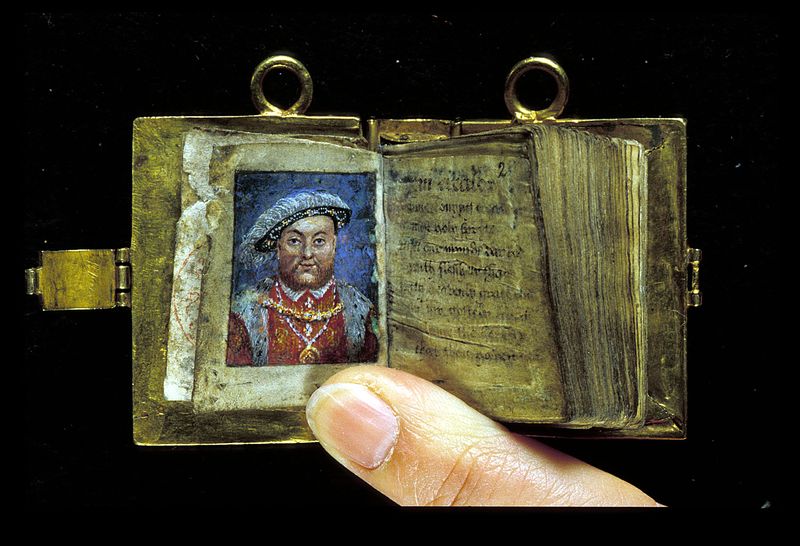
In the 16th century, it became fashionable for aristocratic women to wear miniature prayer books bound in elaborate metalwork covers hanging from their girdles (i.e. belts). These girdle books provided them with handy reading material as well as fashionable dress accessories, allowing them to display their literacy and piety to the world.

The images on the page are fascinating. Of special historical interest is one that once belonged to Anne Boleyn (shown above), a gift from her murderous husband.

A particularly luxurious example is a girdle book with covers of gold filigree . . . It contains selected Psalms in English verse, translated and apparently written out by John Croke, one of Henry VIII’s clerks in Chancery, with a portrait of Henry VIII at the beginning.

The volume is traditionally thought to have belonged to Anne Boleyn, who is said to have handed it to one of her maids of honour when she was standing on the scaffold before her execution in 1536.

Respecting Animals We Kill

Sometimes even a moral sluggard can say something profoundly true. I was recently visiting the uplifting site of a British pet photographer, and came across this wonderful insight:

“Until one has loved an animal a part of one’s soul remains unawakened.”

As I spent a moment reflecting on the quote, having just enjoyed a morning game with our border collie, it dawned on me these words are not only philosophically true. The more I consider them the stronger the case, it seems to me, can be made for their theological truth.

Turn the statement around. Can someone be considered spiritually awake if they have never possessed a moment of genuine affection for an animal, the pinnacle of God’s natural creation? I tend to think not.

Cultural matters certainly influence one’s connection with nature. It may be that people surviving on the edge of food sufficiency would view animals primarily as a resource. Yet even then, the best among us still possess a regard for the creatures whose lives we curtail to extend our own.

An outstanding example of this is found in a common practice among North America’s first peoples. (First Nations is the common term in Canada). Many of these people would include prayer on behalf of the prey they sought.

In the Cherokee legend “The Little Dear, Awi Usdi,” describes how hunters were taught to only take life when necessary, and to “ask pardon when an animal was killed.”

Another site explains how “Coast Salish women were forbidden from stepping over deer meat, and the men had to look away when uncovering it. All bones had to be thrown into the water, and the viscera not consumed were buried so the dogs would not eat it.”

Post-Kill Rituals: Matters of the Heart,” describes how this “ancient reverence” for hunted animals extended beyond the Americas. It concludes with a valuable thought.

Rituals aren’t a bad idea . . . But you show the utmost respect by concentrating on killing the animal quickly. Hunters’ conduct toward wildlife and nature should be consistent with their conduct toward other humans.

While Christians will necessarily overlook the religious elements of these various traditions,* those most attuned to the love of God – a Creator who viewed the “living creatures” he had fashioned and proclaimed, “it was good” – will possess at least a glimmer of reverence or affection for wildlife.

Not that Christians can’t be avid hunters. The Roman Catholic Church even has a Patron Saint for hunting. St. Hubert, pictured above, was (before his canonization, of course) a worldly nobleman. In the seventh century, Hubert had ignored invitations to attend worship on one of the holiest of days, Good Friday. Yet the Lord met him there, in the forest. His conversion occurred when he saw a vision of a crucifix while hunting. Hubert would later use his skill with a bow to draw crowds for his preaching of the Gospel.

C.S. Lewis & the Hunting of Deer

In an essay entitled “The Seeing Eye,” C.S. Lewis turns the analogy of hunting upside down. Using his own life, in which searching for God was the farthest thing from his desires, Lewis describes his conversion in a fascinating manner. It is interesting that while Lewis reveals he wasn’t desirous of faith, he was seeking honesty within his own conscience. He was also seeking truth.

I never had the experience of looking for God. It was the other way round; He was the hunter (or so it seemed to me) and I was the deer. He stalked me like a [hunter], took unerring aim, and fired. And I am very thankful that that is how the first (conscious) meeting occurred. It forearms one against subsequent fears that the whole thing was only wish fulfilment. Something one didn’t wish for can hardly be that.

But it is significant that this long-evaded encounter happened at a time when I was making a serious effort to obey my conscience. No doubt it was far less serious than I supposed, but it was the most serious I had made for a long time.

So, Who was the Author of the Initial Quote?

I began by saying even moral sluggards can occasionally make a good point. The person who drew the connection between our regard for animals and our souls is Anatole France. Not only was he a serial adulterer, he was a devout atheist. (Not all atheists are adulterers, of course, but rejecting the God of the Bible does make it a lot easier to justify one’s immorality.)

Anatole wrote some curious works ridiculing Christianity, and until I was writing this post I had completely forgotten about my 2014 post about his advocacy for Satan.

Returning to Positive Subjects . . . Like Animals

The site that used the great quotation with which we began, is excellent. It is called “Mad about Greys,” and is the work of a British photographer.

Liz Coleman does an amazing job capturing the hearts and – dare I say, souls – of the pets she shoots. Even though Surrey is quite a ways for most Mere Inkling readers to visit her studio, I encourage you to visit her website today.


* There were additional Native American beliefs and taboos. For example, “the Pentlatch and Squamish buried or hid all deer bones. The West Sanetch were not permitted to eat deer meat and fish at the same meal.”

Please Shorten that Sermon

How long should a sermon be? There’s no universal answer to that question – unless you opt for the Holy Spirit gambit and claim you or your pastor preach inerrantly as the Spirit dictates.

The truth is, I can tell a lot about a person’s religious background or current preferences by their honest answer. That’s one of the first lessons a military chaplain learns. Different traditions possess vastly different expectations about sermon lengths.

There are plenty of individual exceptions to the rule, of course. But let me throw out a couple generalizations. People in mainline churches think the sweet spot is around 15 minutes. For many, 12 would be even more desirable, although most can tolerate 20 minutes before beginning incessant time checks on their watches or other devices. In the minds of some, brevity is next to godliness.

For many evangelicals, particularly pentecostals and more fundamentalist communions, a 15 minute sermon is an oxymoron. Anything less than half an hour is simply a devotion or meditation, and any preacher worthy of the title should be able to preach a 45 minute sermon without working up a sweat.

So, in the case of a chaplain preaching for two to three different congregations on a Sunday morning, you would need to tailor your sermons differently for various congregations. Otherwise, if you attempted to strike a happy medium, you ran the risk of having your evangelicals feeling shortchanged and your mainline protestants with eyes glazing over.

Recognizing these differences is helpful, lest we slip into that normal misconception that our assumptions/experiences/logic are shared by others. One evangelical seminary professor, clearly writing for others from a similar tradition as his own, illustrates my point.

The average sermon length, according to one poll, ranges 20 to 28 minutes. If this statistic is accurate, it is a telling indicator of the spiritual depth of today’s churches. Many churches have already discontinued their evening services. With the trend of reducing the length of Sunday morning sermons, our generation is receiving less than half the biblical teaching our parents sat under.

The better a person understands the Word of God, the more they will grow spiritually. . . . I find it difficult to believe that current pastors and their 20 minute sermon-ettes can reach any level of comparable depth to the 80 minutes (or more) pastors used to be given (between the morning and evening services).

I have been pondering this subject not because my own pastor’s sermons are too long. Actually, a few days ago the delightful newsnote, “Today in Christian History,” featured an intriguing note. It is one of Christianity Today’s free newsletters.

It described an incipient Crusade that was derailed before it set out, due to too much of a good thing (too much preaching).

September 26, 1460: Pope Pius II assembles European leaders, then delivers a three-hour sermon to inspire them to launch a new crusade against the Turks. The speech works, but then another speaker, Cardinal Bessarion, adds a three-hour sermon of his own. After six hours of preaching, the European princes lose all interest in the cause; they never mount the called-for crusade.

This is precisely the sort of event I cannot resist learning more about. In short, Pius was a talented orator who had written popular erotic literature during his pre-papal years. Bessarion was a Greek priest who coordinated the effort of Byzantine Emperor John VIII Palaeologus to reunite the Eastern and Western churches to protect Constantinople from the Turks. In 1463, a decade after the city fell to the Ottomans, Bessarion was appointed the Latin Patriarch of Constantinople.

If only Cardinal Bessarion had preached a shorter sermon, perhaps the glorious Hagia Sophia would still resound with the praise of Christ.

How to Measure Sermons

One of the worst ways to weigh a sermon, to consider its worth, is by considering its duration. There is nothing intrinsically better about a sermon that lasts 20 minutes than one of half that length. Barring extremes (e.g. Pius’ and Bassarion’s extended monologues or some jargon-laced, religious pop message modeled after fleeting modern commercials), duration matters little.

I think we could all agree that it is the substance of the message which is shared, that matters. This is where the Holy Spirit leads the way. The sermon should be based on God’s truths. It should be tailored to meet the needs of its particular hearers. And it should be timely, attuned to this specific moment.

Unfortunately, we do tend to associate sermons with extended lectures. In a 1962 letter to one of his regular correspondents, Lewis responds to her question about animals and heaven. After explaining his view, he concludes the letter with an apologetic “But this is turning into a sermon!” In truth, his comments are of the ideal duration to address the question at hand.

And that – an ideal length for the specific context – is the goal for which all preachers should strive.

A Mere Inkling Bonus

I’ve written about the importance of listening to sermons in the past. It includes an entertaining account of C.S. Lewis’ boredom during some of the sermons in his home parish. You can also read here about Lewis’ own experiences as a preacher.

One of C.S. Lewis’ rewarding essays is entitled “The Sermon and the Lunch.” Lewis uses the occasion of a sermon to explore the nature of family. The pastor offers a textbook endorsement of the importance of family, where “we can fling aside the weary disguises of the outer world and be ourselves.” Thereupon, he quickly loses the congregation’s attention.

Lewis’ own thoughts are distracted by his awareness of the pastor’s own family. Having been a guest in the home, Lewis knows the family dynamics fall far short of the ideal he is presenting. However, it is not hypocrisy which disturbs him. It is the fallacious premise upon which the sermon is based. You can read the entire essay at the link on its title in the previous paragraph, or you can listen to a reading of the essay on the link below. Here, however, is the reason for Lewis’ discomfort.

The memory of that lunch worries me during the last few minutes of the sermon. I am not worried by the fact that the Vicar’s practice differs from his precept. That is, no doubt, regrettable, but it is nothing to the purpose. As Dr. Johnson said, precept may be very sincere (and, let us add, very profitable) where practice is very imperfect, and no one but a fool would discount a doctor’s warnings about alcoholic poisoning because the doctor himself drank too much.

What worries me is the fact that the Vicar is not telling us at all that home life is difficult and has, like every form of life, its own proper temptations and corruptions. He keeps on talking as if ‘home’ were a panacea, a magical charm which of itself was bound to produce happiness and virtue. The trouble is not that he is insincere but that he is a fool. He is not talking from his own experience of family life at all: he is automatically reproducing a sentimental tradition – and it happens to be a false tradition. That is why the congregation have stopped listening to him.

Satirical Scottish Birds

C.S. Lewis has introduced me to many fascinating writers. Authors I never would have learned about without Lewis’ reference to them.

Sometimes Lewis praises their work. At other times, being an honest literary critic, he is compelled to provide a less flattering appraisal. He typically offers the latter evaluation with a novel flair.

In my previous post I shared the sad tale of a blackbird tapping at our window. I promised to discuss today some other curious birds. These creatures, in contrast to the forlorn blackbird, arise from the imagination of a Scottish poet named Sir David Lyndsay* of the Mount. He lived around 1490 to 1555.

Lyndsay rose to the ceremonial rank of “The Right Honourable the Lord Lyon King of Arms,” which sounds quite impressive. In that capacity, he compiled 400 Scottish coats of arms, which was quite an achievement. You can download a rare facsimile of that document for your personal library from Internet Archive. The central shield may belong to my wife’s ancestors, “Jhonstoun of that ilke.”

Sir Lyndsay was a tutor to James V and served in his Court after his ascendancy to Scotland’s throne. However, it is for his poetry that David Lyndsay is remembered. Which is precisely why C.S. Lewis included him in the volume he wrote for the Oxford History of English Literature. English Literature in the Sixteenth Century Excluding Drama was published in 1944. While this authoritative volume is certainly not casual reading, it is extremely interesting. Just listen to how Lewis introduces Scottish writers of the “close of the Middle Ages.”

Sir David Lyndsay’s Legacy

This academic work is the place our favorite Inkling introduced me to “the last major poet of the old Scotch tradition.” I was on a quest for something interesting about birds, and I learned of a delightful piece of satire written by this Renaissance “Lion King.”

His works are a beautiful example of the ‘single talent well employed.’ The Satyre of the Thrie Estaitis, which holds an important place among our scanty materials for a history of the allegorical drama in Scotland, will be dealt with in another volume of this series . . . stands apart from the rest of Lyndsay’s output by the looseness of the metre and the general popularity of the style, and that it is rich in pathos and low humour.

In his remaining works he everywhere keeps well within the lines marked out for him by his great predecessors, there is no novelty in them . . . But what there is of him is good all through.

I am quite receptive to satire that skewers hypocritical clergy. That’s why the “episcopal ghost”⁑ in The Great Divorce is my favorite example of someone who has rejected the Truth.

This is what appealed to me about Lyndsay’s satire The Testament and Complaynt of our Soverane Lordis Papyngo.

The Complaynt [an earlier work] records, in a brisk, mocking fashion . . . the marked improvement in social order and general well-being throughout the kingdom, except as regards the “spiritualitie.” On the doings of the ecclesiastics he advises [the young king] to keep a watchful eye, and see that they preach with “unfeyneit intentis,” use the sacraments as Christ intended and leave such vain traditions as superstitious pilgrimages and praying to images. . . .

In The Testament and Complaynt of our Soverane Lordis Papyngo (parrot) he exposed more particularly the corruptions and worldliness of the spirituality, and this in a more comprehensive and scathing fashion than in his two previous pieces . . . (Cambridge History of English and American Literature).

And here are the ecclesiastical nemeses of the poem, “religious men, of gret devotioun.”

Here, also, all is pure satire—much of it of a very clever and trenchant character . . . the wise bird [the king’s parrot] with its “holy executors,” who appear in the form of a pyot [magpie] (representing a canon regular), a raven (a black monk) and a gled or hawk (a holy friar). The disposition and aims of these ghostly counsellors are sufficiently manifest; and they act entirely in keeping with their reputed character.

The poor parrot would have much preferred to have, at her death-bed, attendants of a less grovelling type of character, such as the nightingale, the jay, the mavis [song thrush], the goldfinch, the lark, etc.; but, since none of them has come, she has to be content with the disreputable birds who have offered her their services.

After a piquant discussion with them on the growth of ecclesiastical sensuality and greed, she thereupon proceeds to dispose of her personality—her “galbarte of grene” to the owl, her eyes to the bat, her beak to the pelican, her music to the cuckoo, her “toung rhetoricall” to the goose and her bones to the phoenix.

Her heart she bequeaths to the king; and she leaves merely her entrails, including her liver and lungs, to her executors who, however, immediately on her death, proceed to devour her whole body, after which the ged flies away with her heart, pursued by the two other birds of prey.

I can picture the assembled clergy in their avian forms offering their pseudo-comfort to the dying parrot. In English Literature in the Sixteenth Century, C.S. Lewis describes the misbegotten flock in the following manner.

[The parrot’s] testament is made in the unwelcome presence of certain birds of prey who turn out to be monks and friars of the feathered world. The dying parrot inveighs against their hypocrisy and avarice . . . while they vigorously defend themselves by throwing the blame on the secular clergy.

So far, the satire has been ordinary enough; but we find real satiric invention, and even a strange beauty, when the popinjay, having provided for the poor by leaving her gay coat to the owl, her eyes to the bat, and her voice to the cuckoo, and for herself by committing her spirit to the Quene of Farie, is torn in pieces by her carrion executors the moment the breath is out of her body—hir angell fedderis fleying in the air.

It is not without reason an article in Studies in Scottish Literature opens with this praise:

Lindsay’s concern for morality and truthfulness, in an age when political and religious institutions were notoriously corrupt, earned him a considerable reputation in his lifetime. Indeed for later generations of Scottish readers, Lindsay’s name became a byword for reliability and truthfulness, at times even rivalling divine Scripture.

You can read the original poem, along with all of Lyndsay’s other poetic works, in this 1871 collection.


* Just a caution for those looking for more information about Lyndsay: be aware that his surname is also spelled Lindsay, Lindesay and Lyndesay. Also, he should not be confused with Robert Lindsay of Pitscottie, a roughly contemporary author who compiled The Historie and Chronicles of Scotland. (Robert’s family name is also spelled with similar variants.)

⁑ Lewis’ use of the word “episcopal” here does not refer to a denomination. It suggests a churchly, or more accurately, a high-churchly theologian.

Noble Birds of Aragon, circa AD 1290

Climbing Ladders of Faith

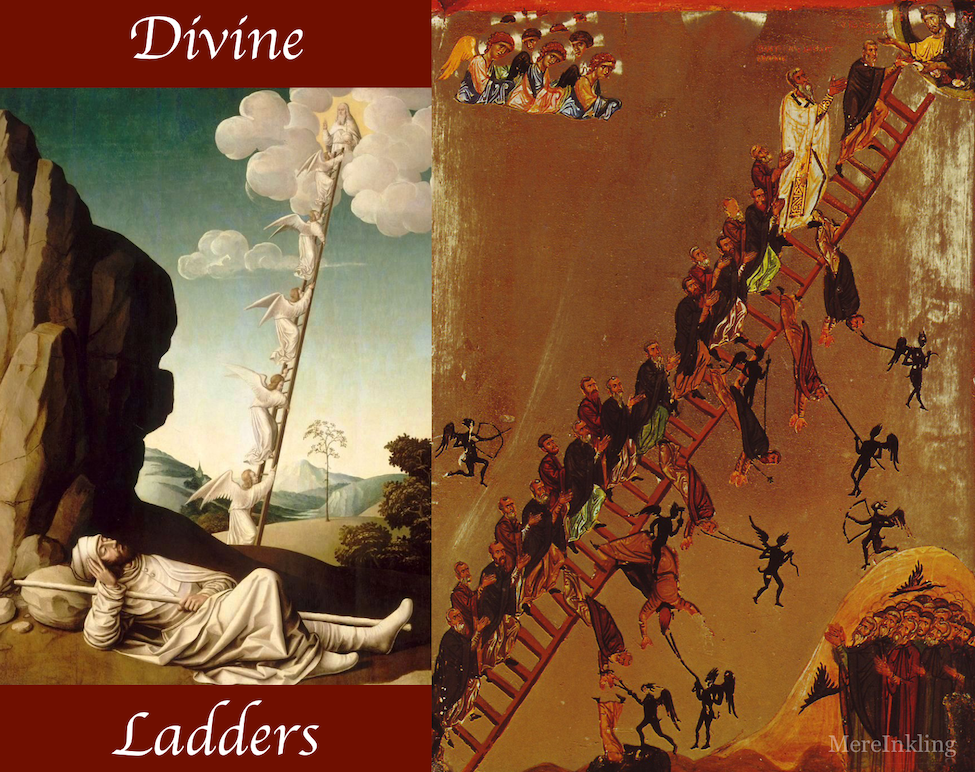
One of the pivotal events in the history of God’s grace is found in the Torah account of a dream. Jacob was the heir of Abraham, through whom the Lord promised to redeem the world. But Jacob was far from noble.

Nevertheless, because of the Lord’s mercy (the same mercy he offers to us), he forgave Jacob and promised to bless his descendants. In his dream, Jacob saw a ladder extending from earth all the way to heaven. “And behold, the angels of God were ascending and descending on it!” (Genesis 28).

This dynamic connection between heaven and earth reveals God’s constant concern for his creation. Some, such as Martin Luther, have seen in the dream a foreshadowing of the Incarnation itself.

This ladder or stairway can be interpreted in a variety of ways. One thing it is not, however, is a guide to human ascent from our fallen world to the presence of our Creator. (The Lord is the one who comes to us.)

Having acknowledged that the dream’s purpose is not to model sanctification or individual spiritual ascent, it is easy to see why the metaphor of ladders, and the action of climbing, give way to other applications.

The most vivid contemporary example comes in the form of a Christian spiritual entitled “We are Climbing Jacob’s Ladder.” A number of versions of the lyrics exist. This is quite unsurprising since it began as part of an oral tradition. According to one website devoted to spirituals, the following lyrics are typical.*

We are climbing Jacob’s ladder
Soldier of the Cross

Ev’ry round goes higher ‘n’ higher
Soldier of the Cross

Brother do you love my Jesus
Soldier of the Cross

If you love him why not serve him
Soldier of the Cross

While there are longer versions, this one aptly illustrates how the metaphor of the ladder—in this case, explicitly Jacob’s ladder—offered a powerful image of deliverance. Climbing the ladder with Jesus, was tantamount to experiencing deliverance from the ills of this world.

America’s Library of Congress offers a useful page which describes “African American Gospel music [as] a form of euphoric, rhythmic, spiritual music rooted in the solo and responsive church singing of the African American South.” They add that “its development coincided with—and is germane to—the development of rhythm and blues.” The site offers links to four 1943 recordings of spirituals. None of these, however, is the hymn we are discussing.

“We are Climbing Jacob’s Ladder” was one of the earliest spirituals to be widely adopted by the interracial faith community. It is familiar in many denominations, and was recently sung in my own Lutheran congregation. Hymnary.org states the song has been “published in 79 hymnals.” Even those who consider themselves unfamiliar with the hymn often recognize its rousing refrain: “Rise and shine and give God the glory, glory, Soldiers of the Cross.”

The talented Paul Robeson recorded the hymn on a number of his albums. The inspiring rendition by scholar Bernice Johnson Reagon was included in Ken Burn’s documentary, The Civil War.

C.S. Lewis and the Spiritual Ladder

The ladder offers such a convenient analogy for growth or spiritual maturation that others have also applied it in this manner. The ladders inspired by Jacob’s dream include the following two which continue to influence Christian disciples today, even though they were written many centuries ago. The second of these was considered by C.S. Lewis to be one of the works of faith influential in his life.

John Climacus (579-649) was a Christian teenager when he entered the monastic life at the foot of Mount Sinai. He soon earned the respect of his elders in that barren land. In the words of Fathers of the Desert, “in this ascetic seclusion he became ripe for the designs of God.”

The abbot of a monastery on the Red Sea requested guidance on the ascetic life to use with his monks. John responded with The Ladder of Divine Ascent. You can download a modern translation of this priceless work here. While the treatise was written specifically to guide monastics in their spiritual growth, many other Christians have also found its wisdom helpful in their own, non-monastic settings.

John introduces the virtue of obedience with two vivid images used by the Apostle Paul, the athlete in training and the armor of God.

Our treatise now appropriately touches upon warriors and athletes of Christ [and the manner in which] the holy soul steadily ascends to heaven as upon golden wings. And perhaps it was about this that he who had received the Holy Spirit sang: Who will give me wings like a dove? And I will fly by activity, and be at rest by contemplation and humility.

But let us not fail, if you agree, to describe clearly in our treatise the weapons of these brave warriors: how they hold the shield of faith in God and their trainer, and with it they ward off, so to speak, every thought of unbelief and vacillation; how they constantly raise the drawn sword of the Spirit and slay every wish of their own that approaches them; how, clad in the iron armour of meekness and patience, they avert every insult and injury and missile.

And for a helmet of salvation they have their superior’s protection through prayer. And they do not stand with their feet together, for one is stretched out in service and the other is immovable in prayer.

The following passage will be of particular interest to Christian writers. John advises those drawing closer to God to maintain a journal of their progress and insights. I offer it within its wise context.

Let all of us who wish to fear the Lord struggle with our whole might, so that in the school of virtue we do not acquire for ourselves malice and vice, cunning and craftiness, curiosity and anger. For it does happen, and no wonder!

As long as a man is a private individual, or a seaman, or a tiller of the soil, the King’s enemies do not war so much against him. But when they see him taking the King’s colours, and the shield, and the dagger, and the sword, and the bow, and clad in soldier’s garb, then they gnash at him with their teeth, and do all in their power to destroy him. And so, let us not slumber.

I have seen innocent and most beautiful children come to school for the sake of wisdom, education and profit, but through contact with the other pupils they learn there nothing but cunning and vice. The intelligent will understand this.

It is impossible for those who learn a craft whole-heartedly not to make daily advance in it. But some know their progress, while others by divine providence are ignorant of it. A good banker never fails in the evening to reckon the day’s profit or loss. But he cannot know this clearly unless he enters it every hour in his notebook. For the hourly account brings to light the daily account.

In the fourteenth century, an Augustinian mystic in England wrote a book called The Scale [Ladder] of Perfection.” Walter Hilton (c. 1340-1396) provides spiritual exercises requested by a woman adopting life as an anchoress.⁑ You can download a free copy of Evelyn Underhill’s 1923 edition of Hilton’s counsel at Internet Archive.

In 1940, C.S. Lewis wrote to Roman Catholic monk Bede Griffiths in response to the latter’s question about his familiarity with Hilton’s work. “Yes, I’ve read the Scale of Perfection with much admiration. I think of sending the anonymous translator a list of passages that he might reconsider for the next edition.” That same decade Lewis’ collected correspondence reveals he recommended the title to at least two individuals.

Of greatest interest to students of C.S. Lewis will be his mention of the medieval treatise in his autobiography, Surprised by Joy. Here the great author describes his worldly understanding of prayer served as a terrible stumbling block to his faith.

To these nagging suggestions my reaction was, on the whole, the most foolish I could have adopted. I set myself a standard. No clause of my prayer was to be allowed to pass muster unless it was accompanied by what I called a “realization,” by which I meant a certain vividness of the imagination and the affections.

My nightly task was to produce by sheer will power a phenomenon which will power could never produce, which was so ill-defined that I could never say with absolute confidence whether it had occurred, and which, even when it did occur, was of very mediocre spiritual value.

If only someone had read to me old Walter Hilton’s warning that we must never in prayer strive to extort “by maistry” what God does not give! But no one did; and night after night, dizzy with desire for sleep and often in a kind of despair, I endeavored to pump up my “realizations.” The thing threatened to become an infinite regress.

One began of course by praying for good “realizations.” But had that preliminary prayer itself been “realized”? This question I think I still had enough sense to dismiss; otherwise it might have been as difficult to begin my prayers as to end them.

How it all comes back! The cold oilcloth, the quarters chiming, the night slipping past, the sickening, hopeless weariness. This was the burden from which I longed with soul and body to escape. It had already brought me to such a pass that the nightly torment projected its gloom over the whole evening, and I dreaded bedtime as if I were a chronic sufferer from insomnia. Had I pursued the same road much further I think I should have gone mad.

This ludicrous burden of false duties in prayer provided, of course, an unconscious motive for wishing to shuffle off the Christian faith; but about the same time, or a little later, conscious causes of doubt arose.

David Downing, co-director of the Wade Center wrote an excellent essay entitled “Into the Region of Awe: Mysticism in C.S. Lewis” which describes in the broader context what C.S. Lewis wrote in Surprised by Joy.

Note for example a passage in Surprised by Joy in which Lewis discusses the loss of his childhood faith while at Wynyard School in England. He explains that his schoolboy faith did not provide him with assurance or comfort, but created rather self-condemnation.

He fell into an internalized legalism, such that his private prayers never seemed good enough. He felt his lips were saying the right things, but his mind and heart were not in the words. Lewis adds “if only someone had read me old Walter Hilton’s warning that we must never in prayer strive to extort ‘by maistry’ [mastery] what God does not give.”

This is one of those casual references in Lewis which reveals a whole other side to him which may surprise those who think of him mainly as a Christian rationalist. “Old Walter Hilton” is the fourteenth-century author of a manual for contemplatives called The Scale of Perfection. This book is sometimes called The Ladder of Perfection, as it presents the image of a ladder upon which one’s soul may ascend to a place of perfect unity and rest in the Spirit of God . . . [passage continued in footnotes]. ⁂

We’ve considered four separate ladders today. Despite their differences, they all share a common trait—they are meaningful to those who are earnest about growing in the faith. Whether slave or free, wise or simple, or hermit or cosmopolitan—each of these ladders affirms eternal truths.

Underhill described Hilton’s motivation for writing in this way: “It is for those who crave for this deeper consciousness of reality, and feel this impulse to a complete consecration, that Hilton writes.” I believe this is true for the authors of each of these four treasures.


* The following, simpler version appears to follow an earlier tradition. A musical accompaniment for this example can be found in The Books of American Negro Spirituals. The author, James Weldon Johnson (1876-1938), provides a rich and earnest introduction to the book, originally published in two volumes. He expresses his hope that collection “will further endear these sons to those who love Spirituals, and will awaken an interest in many others.”

We am clim’in’ Jacob’s ladder
Soldiers of the cross

O

Ev’ry roun’ goes higher, higher
Soldiers of the cross

⁑ An anchoress (or anchorite) was a religious woman (or man) who would often be walled off in their monastic cell near a church, to foster their life of prayer by freeing them from interruption.

⁂ Downing’s discussion of C.S. Lewis’ reference to Walter Hinton’s insights on prayer is so valuable that I am compelled to offer the rest of it here. You can read the entire essay via the link on the article’s title.

The passage about “maistry” Lewis wished he’d known as a boy comes early in The Scale of Perfection, a section about different kinds of prayer, including liturgical prayers, spontaneous prayers, and “prayers in the heart alone” which do not use words.

Hilton’s advice for people “who are troubled by vain thoughts in their prayer” is not to feel alone. He notes it is very common to be distracted in prayer by thoughts of what “you have done or will do, other people’s actions, or matters hindering or vexing you.”

Hilton goes on to explain that no one can keep fully the Lord’s command to love the Lord your God with all your heart, soul, strength, and mind. The best you can do is humbly acknowledge your weakness and ask for mercy. However badly one’s first resolve fades, says Hilton, you should not get “too fearful, too angry with yourself, or impatient with God for not giving you savor and spiritual sweetness in devotion.”

Instead of feeling wretched, it is better to leave off and go do some other good or useful work, resolving to do better next time. Hilton concludes that even if you fail in prayer a hundred times, or a thousand, God in his charity will reward you for your labor. Walter Hilton was the canon of a priory in the Midlands of England and an experienced spiritual director of those who had taken monastic vows. His book is full of mellow wisdom about spiritual growth, and Lewis considered it one of “great Christian books” that is too often neglected by modern believers.

Hilton’s recurring theme—do what you know to be right and don’t worry about your feelings—is one that appears often in Lewis’s own Christian meditations. But, alas, Lewis as a boy did not have the benefit of Hilton’s advice.

In those boyhood years at Wynyard, he was trapped in a religion of guilt, not grace. More and more he came to associate Christianity with condemnation of others, as in Northern Ireland, or condemnation of oneself, for not living up to God’s standards.


A Note on the Illustration

Nicolas Dipre was a French early Renaissance painter, who flourished 1495-1532. His painting of Jacob’s Ladder portrays the biblical account of the Jewish patriarch’s dream. The icon Ladder of Divine Ascent was painted four centuries earlier by an anonymous iconographer. It is from Saint Catherine’s Monastery beside Mount Sinai, and portrays the ascent of saints in the pursuit of holiness. While fallen angels (devils) seek to drag them from the path, John Climacus leads other in the path to heaven.

The White Christ, Red Thor & C.S. Lewis

If you were a Scandinavian living a millennia ago, you would be faced with a critical decision. Would you embrace Jesus Christ and a new life based on mercy, or would you cling to Odin and the Norse pantheon, with its glorification of bloodshed?

When I first heard this choice posed as a choice between the “White Christ” and the blood-drenched Thor, I assumed the white color alluded to traits commonly associated with it today—e.g. purity, innocence, and holiness.*

To my surprise, I recently learned there was a completely different to the Vikings. For them, referring to Christ as “white” was a term of derision.

Before returning to the Northmen, let’s consider for a moment the Inklings. These brilliant writers were well acquainted with white as a biblical metaphor for holiness, etc. They understood how the miracle of the Transfiguration described Jesus’ radiant face shining “like the sun” as the “bright cloud overshadowed them.”

As Mark records in his Gospel, Jesus “was transfigured before them, and his clothes became radiant, intensely white, as no one on earth could bleach them.”

It is no accident Tolkien’s Gandalf the Grey returns as Gandalf the White following his deadly battle with the Balrog.

In C.S. Lewis’ Voyage of the Dawn Treader, Aslan manifests himself to the children as an unblemished lamb.

But between them and the foot of the sky there was something so white on the green grass that even with their eagles’ eyes they could hardly look at it. They came on and saw that it was a Lamb. “Come and have breakfast,” said the Lamb in its sweet milky voice. . . .

“Please Lamb,” said Lucy, “is this the way to Aslan’s country?”

“Not for you,” said the Lamb. “For you the door into Aslan’s country is from your own world.”

“What!” said Edmund. “Is there a way into Aslan’s country from our world too?”

“There is a way into my country from all the worlds,” said the Lamb; but as he spoke his snowy white flushed into tawny gold and his size changed and he was Aslan himself, towering above them and scattering light from his mane.

On the other hand, C.S. Lewis tosses us a curve with the White Witch in his Chronicles of Narnia. The reason for her identification with white is obvious, since she is holding Narnia in an austere, perpetual winter. The witch’s hue carries other messages. Her unthreatening appearance moves Edmund to drop his defenses during their initial encounter.

[Queen Jadis was] a great lady, taller than any woman that Edmund had ever seen. She also was covered in white fur up to her throat and held a long straight golden wand in her right hand and wore a golden crown on her head. Her face was white—not merely pale, but white like snow or paper or icing-sugar, except for her very red mouth. It was a beautiful face in other respects, but proud and cold and stern.

Northern Mythologies

C.S. Lewis was enraptured by Northernness. He and Tolkien spent many hours reading Viking sagas.

However, Lewis was inspired not by the warrior Thor, but the person of Baldur. Several of my online friends and acquaintances have also written about Lewis’ affinity for Baldur. These include Brenton Dickieson, Eleanor Parker, and Bradley Birzer.

Turning from Baldur (Baldr) the Brave to Thor (Þórr), the god of thunder, we find the Norse deity with the largest number of followers. Thor was the ideal divinity for independent adventurers, warriors and violent raiders.

The story of the heroic thunder god still resonates today, as the success of the recent cinematic blockbusters attests. To suit contemporary tastes, the bloody red giant-slayer of myth has shed his more gruesome traits. They have been replaced by nobler aspects, as befitting a modern superhero protecting Midgard (Earth) from danger.

But the medieval period was not the relatively safe world we know. And pleas to turn the other cheek sounded like utter foolishness. The belligerent nature of the Germanic and Scandinavian chieftains of the era, resulted in a modification of the Gospel which was shared by some evangelists. In order to impress a militant population, the pacific nature of Jesus was downplayed. In “Why Trust the White Christ?” we read, “Not until the 1100s did the concept of the suffering Christ take root in Scandinavia; before that Christ was depicted as a triumphant prince—even on the cross!”

Eventually the Gospel would triumph, but one of its first effective renditions for the northern barbarians came in a gospel harmony⁑ entitled the Heliand. A number of references to the Gospel in J.R.R. Tolkien’s academic writings reveals his familiarity with the Old Saxon work, which he also mentioned in his lectures. The Heliand was commissioned by Charlemagne’s grandson Louis the German (806-876) to reach the Franks’ fellow Germanic tribes who remained Pagan. It was written by a Benedictine monk named Notker, who also wrote The Life of Charlemagne.⁂

The fact that this alliterative Gospel (in poetic form) was composed for the Saxon warrior class (their nobility), makes it particularly interesting.  Knowing it was recited not only in monasteries, but also mead halls, makes one’s personal reading of it feel like a journey into the ancient past.

Mariana Scott’s 1966 translation ⁑⁑ is available here. This site posits her translation beside the original Old Saxon. One of my favorite passages comes in the “introduction,” as the context of the Gospel proper is set for the hearers. It is very serious and describes the four Evangelists as inspired by God.

[The Lord] had filled the hearts of the heroes,
     with the Holy Ghost.
Perfectly all,
     with pious opinion,
And wise words many
     and still more of wit.
That they should begin
     the goodly Gospel
With their holy voices,
     raise it on high—

The Question of the White Christ

Referring to Jesus as the “White Christ” may have been related to the association of white baptismal robes worn by the newly baptized. But it involved more than that.

Apparently, the appellation “white,” especially when linked to Christ, was a Pagan insult. In a Scandinavian Studies article entitled “The Contemptuous Sense of the Old Norse Adjective Hvítr, ‘White, Fair’” we learn that it possessed a pejorative sense.

The [Old Icelandic] heathen religion glorified physical strength and courage in combat, a direct antithesis to the Christian ideal of pacifism based upon the Golden Rule. Hence, the heathen Icelanders interpreted the Christian Hvítakristr ‘The White Christ’ as a cowardly, contemptible counterpart of Thor, the god of courage and strength . . .

And this negative connotation continued, even after the triumph of the new faith.

[Even] after Christianity had become established as the national religion in Iceland, this heathen conception of Christian ‘cowardice’ disappeared but left its traces in the epithet hvítr, especially when one wished to belittle or vilify a personal enemy.

. . .

The double sense (‘fair’ : ‘cowardly’)was characteristic of skaldic poetry and served to enhance the sarcastic effect.

And thus my youthful innocence about the meaning of the White Christ has been dispelled. But, at the same time, my insight into the historic prejudice against the sacrificial Son and Lamb of God has grown.

Jesus was no coward, but he is—now and forever—pure, innocent, and holy.


* It should go without being said that associating the color white with Jesus has absolutely nothing to do with ethnicity. The Incarnation of our Lord makes it abundantly clear that Jesus was a Jew born in Bethlehem and raised in Nazareth. The Bible describes nothing noteworthy about his appearance that would distinguish him from the rest of the Jewish people in ancient Palestine. Thus, whatever Jesus’ complexion, he would have looked little like the pale Anglo-Saxon messiah we have often seen in paintings and cinema.

⁑ A Gospel harmony is a blending together of the four canonical Gospels into a single account. Tatian (c. 120-180), an Assyrian theologian, compiled the Diatessaron, which was prominent in the Syrian church, and is thought to have directly influenced the Germanic harmony, the Heliand.

 ⁂ Notker (c. 840-912) who also composed hymns and poetry. As mentioned above, the Benedictine monk also wrote The Life of Charlemagne which records many fascinating stories about Frankish and Germanic Christianity. Apparently a poor precedent was set by Frankish generosity when a group of Northmen serving as envoys received baptism.

As I have mentioned the Northmen I will show by an incident drawn from the reign of your grandfather in what slight estimation they hold faith and baptism. . . .

The nobles of the palace adopted them almost as children, and each received from the emperor’s chamber a white robe and from their sponsors a full Frankish attire, of costly robes and arms and other decorations.

This was often done and from year to year they came in increasing numbers, not for the sake of Christ but for earthly advantage.

A very enlightening and sadly entertaining account. But what happens when the gifts run out?

⁑⁑ In the foreword to her translation, Scott shares some intriguing thoughts on the challenging labor of translation.

It was important for me to remember that the Heliand was originally intended for recitation. This accounts for the very great emphasis on rhythm. While the exact form of the old alliterative verse, though common to both early English and German poetry, proved too confining, a freer adaptation was possible. Let us remember that much of the effect of modern free verse depends on the interplay of sounds: assonance and alliteration.

Keeping in mind the purpose of the original, I read my translation aloud as I worked, repeating lines several times, varying and checking rhythms, trying to imitate the surge of the meter and yet avoid monotony. The end result was a line of variable feet, usually a rather free alternation of anapests and iambics with a few scattered tribrachs and spondees, divided by the traditional caesura.

I aimed for an alliteration of at least one accented syllable in the first half line with one accented syllable in the second half. If more sounded right, I was delighted. If none worked, I tried to make the rhythm carry the line along to the next cadence. Not all of it, I painedly admit, turned out to be poetry—but then not all of the Old Saxon is!