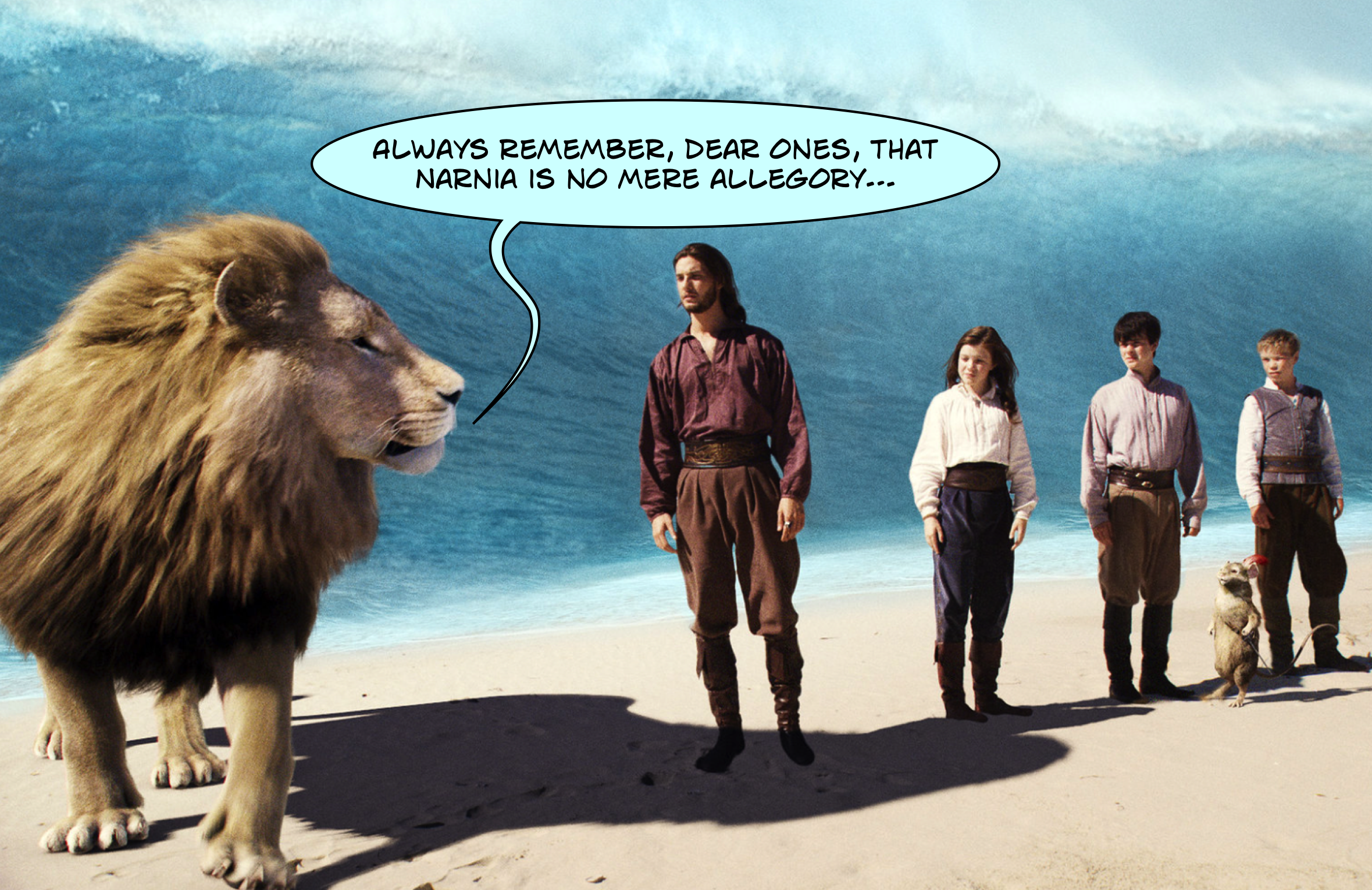
C.S. Lewis, Apologues & Allegories

It has been argued that C.S. Lewis wrote apologues, but I humbly disagree.

An “apologue,” you see, is defined as “a moral fable, especially one with animals as characters.” From that core definition, it makes sense to some that works such as The Chronicles of Narnia might be described as apologues.  

However, this term is usually applied to much simpler, more concise stories –  short moral fables (think Aesop) rather than an extended tales. “Apologue” is a vastly insufficient label for what J.R.R. Tolkien described as subcreation. Narnia is not a fable, it is a world.

Years ago I compared Aesop’s brief “The Kingdom of the Lion,” with C.S. Lewis’ brilliant vision of Aslan.

In “The Lion’s Command,” I identified a virtuous parallel between the brief regent in the fable and the well-developed protagonist of Narnia. In the Chronicles, Narnia’s hero is nothing other than the Alpha and Omega, reigning over its creation and preserving his kingdom to its ultimate culmination.

In “C.S. Lewis and the Art of the Apologue,” Samuel Joeckel argues that “The Screwtape Letters and The Great Divorce might be read as pure apologues, while Lewis’s other works of mythopoeia contain elements of the apologue.” This is an intriguing proposal, which has not gained much traction. Of course, Joeckel’s point that “elements” of apologue are present is certainly true, but that would be so when considering the work of numerous authors.

If not an Apologue, might Narnia be an Allegory?

An interesting article about parables contrasts parables and apologues in the following manner.

Another story style that is related to parables is the apologue. Apologues are short stories that are intended to convey a lesson, and they often use animals as characters. . . . Unlike parables, which generally have realistic scenarios, apologues allow an element of fantasy while maintaining a moral point.

The same article describes differences between parables and apologues as contrasted with allegories, such as George Orwell’s Animal Farm.

Parables are not the only type of story that present a moral lesson. Allegories are stories or poems where different elements are designed to convey abstract or spiritual meaning. . . . Allegories and parables are related in their use of symbolic language.

The difference is, in essence, one of complexity. While parables (and apologues) normally focus on a single lesson, allegories feature broader elements fleshing out a more elaborate lesson or message. 

Allegories are more metaphorical and often involve characters representing abstract ideas, and the symbolism can be deeply complex. However, parables are more direct, with a simple narrative that usually involves a human character facing a moral dilemma or the consequences of a bad decision (“Allegory Vs. Parable”). 

Allegory vs Apologue,” offers a similar distinction between these two literary exercises. 

Allegory and apologue are both forms of extended metaphor that use symbolic characters and events to convey a deeper meaning. However, there are some important distinctions between the two. . . .

Apologue, on the other hand, is a more general term that refers to any story or fable that teaches a moral lesson. Unlike allegory, apologue does not necessarily have a hidden meaning . . .

C.S. Lewis challenges the notion that allegories possess “hidden” themes. In his preface to The Pilgrim’s Regress, he argues that true allegories do not mask their message. 

People . . . suppose that allegory is a disguise, a way of saying obscurely what could have been said more clearly. But in fact all good allegory exists not to hide but to reveal; to make the inner world more palpable by giving it an (imagined) concrete embodiment.

In The Allegory of Love: A Study of Medieval Tradition, C.S. Lewis describes the unique goal of this literary device. 

The function of allegory is not to hide but to reveal, and it is properly used only for that which cannot be said, or so well said, in literal speech.

The inner life, and specially the life of love, religion, and spiritual adventure, has therefore always been the field of true allegory; for here there are intangibles which only allegory can fix and reticences which only allegory can overcome. 

In an essay about the author of The Faerie Queene, “Edmund Spenser, 1552–99,” Lewis lauds the path allegories pursue to illumine readers.

We shall understand it best (though this may seem paradoxical) by not trying too hard to understand it. Many things – such as loving, going to sleep, or behaving unaffectedly – are done worst when we try hardest to do them. Allegory is not a puzzle.

With C.S. Lewis’ genuine appreciation for good allegory, it is unsurprising that some readers are tempted to label The Chronicles of Narnia as such. After all, too brief and far too elaborate to be a collection of mere apologues, it seems logical. Yet, Lewis himself dispelled that conclusion. His opinion is expressed clearly in the following passage from a letter written in 1958.

If Aslan represented the immaterial Deity in the same way in which Giant Despair represents Despair [in The Pilgrim’s Progress], he would be an allegorical figure.

In reality however he is an invention giving an imaginary answer to the question, “What might Christ become like, if there really were a world like Narnia and He chose to be incarnate and die and rise again in that world as He actually has done in ours?” This is not allegory at all.

No, the Chronicles offer no mere allegory. Aslan and Narnia are something altogether more rare and precious . . . and uniquely inspiring.


Bonus:

For those inclined to see how the AI at ChatGPT might compose an analogue, consider the following examples. I offered three brief prompts and amazingly swift apologues. 

Certainly! Here’s an apologue in the style of ancient Roman moral tales – think Aesop with a Roman flavor (e.g., Phaedrus) – explaining why the porcupine is hard to get along with. This style uses simple characters, a brief narrative, and a moral at the end.

Apologue: The Porcupine and the Burrowers

Characters:
~ Porcupine (Hystrix)
~ Mole (Talpa)
~ Hedgehog (Erinaceus)
Moralitas at the end.

In the time when the earth still whispered secrets to beasts, a bitter winter approached. The animals who dwelt below ground gathered to find warmth together.

The Mole, who dug deep and dark tunnels, said, “Let us share one chamber, and none shall freeze.”

The Hedgehog, with bristles soft enough in the cold, agreed. “We are small and spined, but kindred in spirit.”

Then came the Porcupine, bristling with long, sharp quills. “I seek shelter,” he said. “Let me in.”

The others, though wary, welcomed him. “There is warmth in many bodies, if none poke too hard.”

But when the Porcupine curled to sleep, his quills pricked every side of the burrow. The Mole winced. The Hedgehog bled. They shifted, gave him space – but no space was enough.

“Friend Porcupine,” said the Mole, “can you not soften your stance?”

The Porcupine replied, “My quills are my nature. I mean no harm, yet I cannot change.”

So, one by one, the others left, seeking colder but safer places.

The Porcupine remained, alone in warmth – but with no friend near.

Moralitas:
He who cannot bend his nature to spare his neighbors must be content with solitude, for warmth of company is given only to those who wound not.

Having delivered the moral of the fable, the AI was so thoughtful as to ask: “Would you like a Latin version of the apologue as well?”

~ ~ ~ ~ ~ ~ ~

Certainly! Here is an apologue in the style of C.S. Lewis – reminiscent of his storytelling in The Screwtape LettersThe Chronicles of Narnia, and The Pilgrim’s Regress. Lewis often used allegory and fable to convey theological or philosophical arguments through richly imagined, morally charged tales.

Apologue: The Two Gardens

In an ancient land that bordered both silence and song, there lived two brothers: Eldarion and Ruckus.

Their father, the Keeper of Harmony, was a master gardener who tended to two great gardens, each grown from a different seed of music.

One garden was called Lyrion, and it bloomed with strange and delicate flowers. Trees sang there – not with words, but with symphonies. The air was always filled with the faint sound of strings, like something half-remembered from a dream. This was the realm of Classica, the music that had deep roots and slow unfolding blossoms.

The other garden, Thundra, was younger, wilder. Vines twisted with fire, and great drums beat like the hearts of giants. Flames leapt from the leaves when touched. This was the realm of Rocka, born of storm and impulse. It throbbed with noise and power.

One day, the father called his sons. “Each of you shall choose a garden to tend,” he said. “But take heed: a garden grows into the likeness of its gardener.”

Eldarion, quiet and curious, chose Lyrion. He studied the old scores carved into the bark of the elder trees. He listened for the faintest cadences hidden in the wind. His garden grew slowly, but with order and depth. Some who visited said they heard truth in its song – though they could not explain it.

Ruckus chose Thundra. He brought iron tools and thunderous machines. He shouted into the wind and danced among the fire-vines. His garden grew quickly, wildly, and it drew many visitors who loved its power. But the soil became hard, and the songs repeated themselves. At night, when the fire died, there was silence – and the silence frightened him.

Years passed.

One evening, Ruckus visited his brother’s garden. It was still and strange, yet somehow more alive. The music there did not grab the ear – it waited, like a cathedral waits for a footstep.

“I do not understand this,” said Ruckus.

“You’re not meant to at first,” Eldarion said gently. “But if you sit long enough, you may find it is not music you hear – but yourself.”

Moral:
Not all noise is music, and not all music is noise. That which is deep may not dazzle, but it endures.

~ ~ ~ ~ ~ ~ ~

Certainly! Here’s an apologue in the style of C.S. Lewis, with his characteristic blend of gentle allegory, rational argument, and spiritual insight. Think of something akin to The Great Divorce or The Pilgrim’s Regress – a story that carries philosophical weight through symbolic characters and a clear moral undercurrent.

Apologue: The Library of the Lantern

There was once a Traveller who came upon an ancient Library, tucked between the hills of two realms: Factland, where the roads were straight and numbered, and Fablemere, where the paths curled like ivy and sometimes moved when you weren’t looking.

The Traveller, weary from debate and burdened with questions, was greeted by an old librarian named Lucidus, who wore a cloak woven from both parchment and ink.

“You may read whatever you like here,” said Lucidus. “But I warn you: some shelves are straight, others crooked – and both are true.”

The Traveller began in the Hall of Records, where volumes bore names like The History of the WorldNatural LawsThe Mind Explained, and Economics in Twelve Systems. The books were hard, clear, and bright like winter ice. Every sentence pointed like an arrow, and the Traveller felt smarter with every page. “Here,” he thought, “is what I came for: answers.”

But after a time, the light grew harsh, and the words – though sharp – offered no rest. He felt he had learned much, and yet not grown.

So he wandered next into the Chamber of Tales. Here were strange books that spoke of dragons and dying stars, of heroes who were cowards and cowards who became saints. The logic bent like a rainbow, and the truth came sideways.

At first he scoffed. “These things never happened!”

Lucidus appeared beside him and said quietly, “No – but they always happen.”

So the Traveller read on. And he wept when the fox died, and laughed when the king made a fool of himself. He saw his pride in the villain and his longing in the wandering knight. He saw the world as it might be – and in doing so, saw more clearly what the world was.

Time passed. The Traveller read from both wings of the library, sometimes walking the marble floors of Factland, sometimes lying on the mossy rugs of Fablemere. One sharpened his mind; the other softened his heart. One taught him how things work; the other, why they matter.

At last, he approached Lucidus.

“Which was truer?” the Traveller asked. “The world I could measure, or the one I could feel?”

Lucidus smiled. “Ah. One is the lamp, the other the flame. But both are needed to see.”

Moral:
Fiction teaches the soul what nonfiction explains to the mind – and wisdom lives where both meet.

This proved to be a very interesting exercise, indeed.
C.S. Lewis & Iran’s Nuclear Program

Connecting C.S. Lewis to the pursuit of nuclear weapons by Iran’s mullahs admittedly sounds like a protracted stretch. Yet the current conflict between Iran and Israel does have one astonishing element that does link the great Oxbridge professor with the conflict.

If you’re familiar with Lewis’ writings, you might logically assume the connection relates to his writing on nuclear weapons. After all, in 1948 he wrote an essay entitled “On Living in an Atomic Age.” The matter is even more acute since we moved from the era of relatively minuscule A-bombs into a time when humanity’s H-bombs, employing fusion rather than mere fission, are thousands of times more deadly.

Lewis discusses some interesting philosophical (and theological) questions in his article. He begins by placing the question within the context of our inherent physical mortality. He writes, “do not let us begin by exaggerating the novelty of our situation.”

Believe me, dear sir or madam, you and all whom you love were already sentenced to death before the atomic bomb was invented: and quite a high percentage of us were going to die in unpleasant ways. . . .

It is perfectly ridiculous to go about whimpering and drawing long faces because the scientists have added one more chance of painful and premature death to a world which already bristled with such chances and in which death itself was not a chance at all, but a certainty.

Don’t let the stoic beginning of his thoughts deter you from reading the essay itself, because C.S. Lewis does not leave us despairing. On the contrary, he offers hope and practical advice for maximizing the meaning of our lives. 

Although C.S. Lewis lived into the beginning of the MAD (Mutually Assured Destruction) era, he chose not to inject himself into political subjects, lest it detract from his advocacy for the simple Gospel.

Nevertheless, the brief note “C.S. Lewis and Nuclear Weapons,”penned forty years ago by a “peace activist” pastor, conjectures on what the author’s opinion may have been. It is thought-provoking, especially in mentioning a possible link between nuclear destruction and the “deplorable word” referred to in The Chronicles of Narnia. 

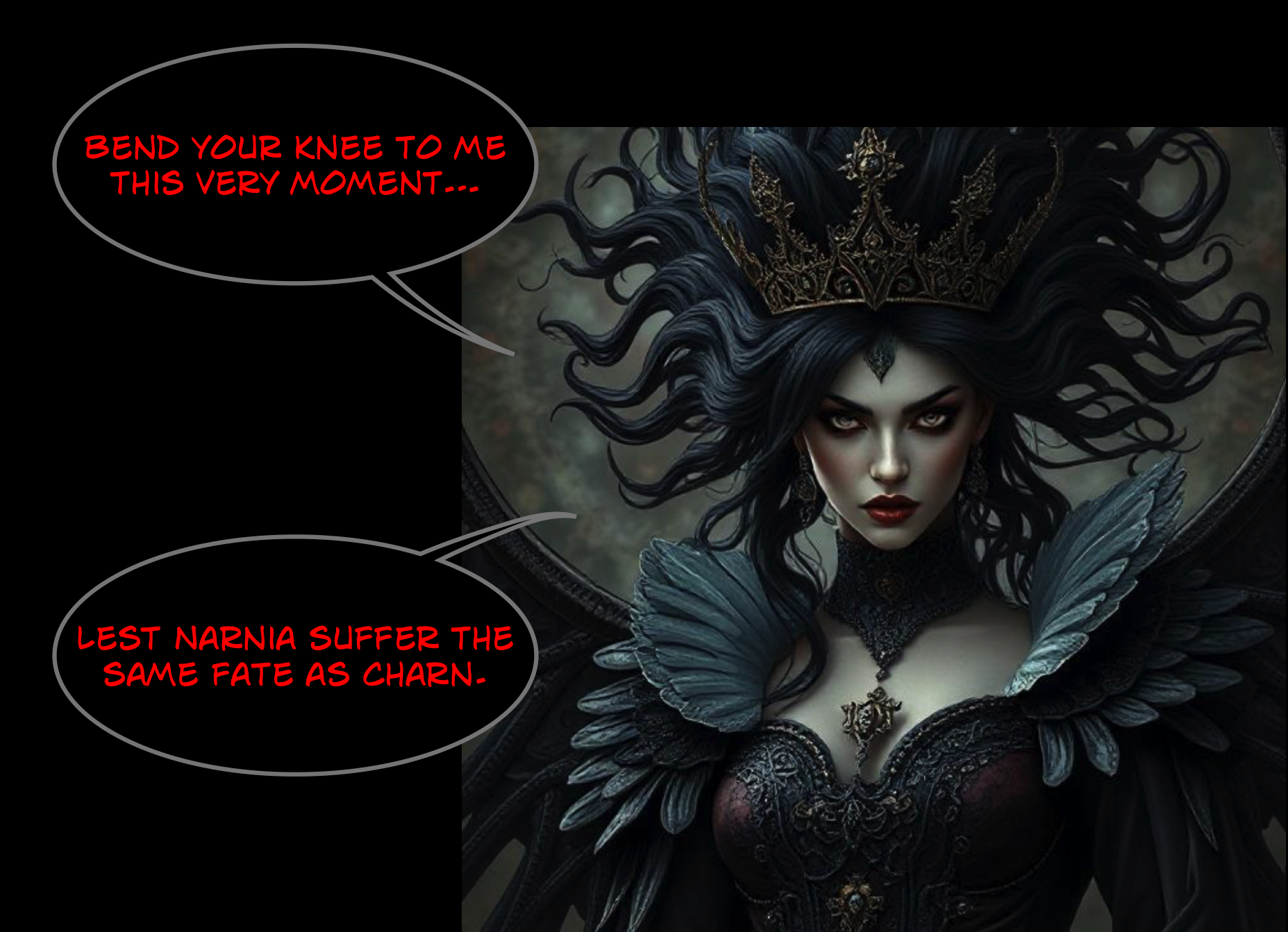
In The Magician’s Nephew, Lewis’ child protagonists encounter a witch queen on the devasted world of Charn. Queen Jadis, when denied the power to rule over the planet, chose to invoke a curse that destroyed every living thing other than herself. “Then I spoke the Deplorable Word. A moment later I was the only living thing beneath the sun.”

While Lewis does not elaborate on the nature of the destructive nature of this most deplorable of powers, Aslan does offer the following caution near the end of the novel.

It is not certain that some wicked one of your race will not find out a secret as evil as the Deplorable Word and use it to destroy all living things. And soon, very soon, before you are an old man and an old woman, great nations in your world will be ruled by tyrants who care no more for joy and justice and mercy than the Empress Jadis. Let your world beware.

So, what does this have to do with Iran & Israel?

Frankly, I find the connection to be especially odd. As you may know, military entities have a propensity to apply nicknames or euphemisms to various things, such as their weapon systems.

This is true for military campaigns or discrete operations. For example, the United States has employed labels like Operation Linebacker (in Vietnam) and Operation Crossroads (for 1946 nuclear weapons tests).

Sadly, Operation Enduring Freedom (in which I personally took part) did not live up to its name. Under the Taliban, Afghanistan has degenerated once again into a primitive morass which abuses its women and children.

A number of distinct operations have taken place during the current war between Iran (and its proxies) and Israel. Operation Rising Lion is Israel’s nomenclature for the various elements of their direct attack on Iran. One independent Jewish news site points out how Benjamin Netanyahu foreshadowed the campaign in May when he said, “the verse in the Tanach that most fits with an existential war? That’s our war – a war of existence . . . A people that rises like a lion, leaps up like the king of beasts.”

Every Israeli military operation has a name, and the Iran attack is now called Am K’lavi, or “a people like a lion” – the exact wording Netanyahu used six weeks ago. English-language publications now refer to the operation as “Rising Lion.”

While this is quite interesting, it is the name assigned to one of the subsidiary operations encompassed by Rising Lion which possesses a genuinely shocking designation.

One initial focus of Israel’s campaign was to eliminate the leading scientists leading Iran’s efforts to pursue a nuclear arsenal. They named this particular facet Operation Narnia.

When I first saw that, I immediately thought I must have misread the title. But no, they actually chose Narnia as the name for the assassinations. At that point I thought they might be referring to some other Narnia. Alas, it doesn’t appear they were alluding to the medieval Italian city whose name inspired C.S. Lewis.

The reason for choosing Narnia as the operation’s title was apparently an intentional reference to the amazing world where so many of us met the awesome and compassionate Aslan. In “‘Operation Narnia:’ How Israeli Intelligence Targeted Key Iranian Nuclear Scientists,” we read:

Israel kicked off Operation “Rising Lion” last Friday, launching a sweeping military assault that dealt a major blow to Iran’s leadership and nuclear infrastructure. . . .

In a surprising detail, the Jerusalem Post reports, the component of the mission aimed at Iran’s nuclear scientists was codenamed “Narnia” by Israeli forces – a reference to the fantasy realm, underscoring how bold and unlikely such a strike might have seemed before it was executed.

Another intriguing rationale for entitling the Operation after C.S. Lewis’ creation is even more provocative. The Substack blog Wardrobe Door proposes a supernatural consideration for the choice of “Narnia.”

The [Jerusalem] Post says the name “reflects the operation’s improbable nature, like something out of a fantasy tale rather than a real-world event.” One could also imagine it involved deep espionage tactics that may have had soldiers sneaking in areas as if through a magical wardrobe.

Whatever tactics may have been used in Operation Narnia, it is intriguing to consider how the power of C.S. Lewis’ vision has spread across national boundaries. May all people heed Lewis’ witness to humanity’s Savior, for surely,

God cannot give us a happiness and peace apart from Himself, because it is not there. There is no such thing (Mere Christianity).

A Curious Papal Funerary Tradition

Several unique items are buried with modern popes when they die. Most, including their vestments, point to their spiritual role as the Bishop of Rome and patriarch of the Roman Catholic Church. One, however, highlights his secular role as the leader of the world’s smallest independent nation state.

This post is not about Pope Francis’ reign, or the papacy in general. As C.S. Lewis noted in a letter to an American poet, Mary Willis Shelburne, opinions on such matters differ in sometimes unproductive ways. In response to a comment she had written about the passing of Pope John XXIII (1881 – 1963), who had convened the Second Vatican Council, Lewis astutely observed,

God’s purposes are terribly obscure. I am thinking both of your [physical] sufferings and of the removal of such a Pope at such a moment. And the horrid conclusions which some bigots on both sides will probably draw from it.

Rather than discussing the role of the Bishop of Rome, I am considering one specific aspect of the office of the Bishop of Rome – the formalities associated with the funeral and burial/interment of a deceased pope. My focus is further restricted to a single unique facet of that process. This involves the coinage of the Vatican City State issued during their reign.

Despite its status as a nation, Vatican City has declined full membership in the United Nations. This is due to the admirable goal of remaining detached from the official political tentacles associated with having an official vote. Instead, through the Holy See, the papacy’s ecclesiastical office, the Roman Catholic Church maintains a presence and voice in the UN.

Vatican City is one of the few independent states that has not become a member of the United Nations. It does hold permanent observer status, with all the rights of a full member except for having a vote in the General Assembly.

On April 6, 1964, the Holy See became a Permanent Observer Mission to the United Nations and established its Mission in New York City. This was fitting, not only because of the growing involvement of the Holy See in UN deliberations, but above all because the four pillars of the UN as enshrined in its Charter dovetail very well with four main pillars of Catholic Social Teaching . . .

The Holy See enjoys by its own choice the status of Permanent Observer at the United Nations, rather than of a full Member. This is due primarily to the desire of the Holy See to maintain absolute neutrality in specific political problems.

In accordance with tradition, “preparations are also being made for a numismatic commemoration of the Sede Vacante.” The Latin term  means “vacant seat,” and refers to the transitional period between popes. Thus, in addition to the papal coins minted for each pope, special issues are normally released during the interims. However, due to a reorganization of the Vatican’s coinage office, CoinsWeekly reports it remains “uncertain whether a 2-euro commemorative coin” will be produced for this papal interregnum.

NumismaticNews echoes the fact that due to their rarity, Sede Vacante issues rapidly increase in value. Fortunately due to their infrequency, they “ are seldom at the center of a collector’s radar. That’s probably a good thing, as it means we are not losing popes quickly or routinely.”

A number of items are traditionally included in a pope’s casket. Unsurprisingly, these include a miter, crozier, and rosary. They also include coins minted during their reign, reflecting their role as ruler of the Papal State. This last fact surprised me.

So, precisely what is the precedent being set with Pope Francis’ funeral? First, he was not buried in the Vatican, but in a basilica dedicated to St. Mary.

There was another, more significant symbol of the simplicity that characterized his papacy. While popes traditionally have three elaborate caskets nestled inside one another, Francis asked to have only one simple wooden casket with a modest zinc inner lid.

Pope Francis’ 2017 Revision of Vatican Coinage

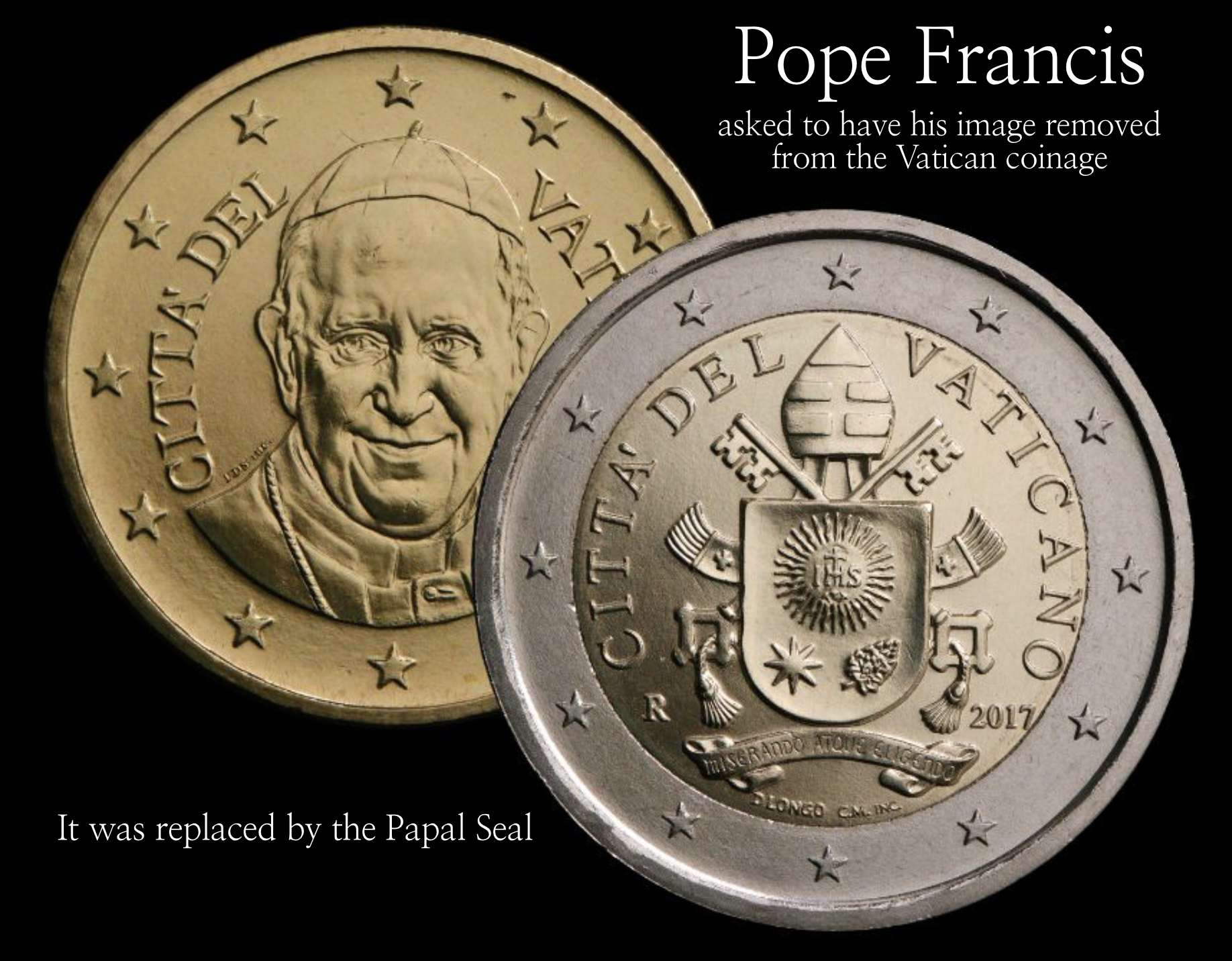
For centuries, the portrait of the current Bishop of Rome graced coins in Rome. That tradition ended with Pope Francis. In 2017, he personally requested that his visage no longer appear on coins. This is commendable, since it was presumably based on Francis’ humility. 

This then, his image has been replaced by the papal coat of arms. Notably, every other country minting euros bears the head of its head of state. It will be interesting to see whether or not Francis’ successor follows his example.

A Brief Note on Protestant Coinage

Although there have been some historical attempts to create governmental structures led by religious leaders besides Roman Catholicism, they have been the rare exception. (The claimed leadership of the Church by sovereigns such as King Henry VIII is another case.) 

In Zurich, Huldrych Zwingli (1484 – 1531) sought to establish a theocracy, and actually perished on the battlefield resisting the Roman Catholic armies of several Swiss cantons. John Calvin (1509 – 1564) pursued similar goals in Geneva, and beyond. Calvin, however, never bore arms in his effort.

Fortunately, the “two kingdoms” theology of Martin Luther became dominant in primarily Protestant realms. It is based on the declaration Jesus made during his trial before Pontius Pilate that “My kingdom is not of this world” (John 19).

For a fascinating discussion of the implications of this theological position, consider “Martin Luther’s Farewell to Arms: The Two Kingdoms and the Rejection of Crusading.”

Turning to numismatics, it is not rare to find religious leaders portrayed on historical coinage. However, these portrayals serve as commemorations of individuals who have made a cultural or ethical contribution to a particular society – not because they sat upon a throne.

For example, Switzerland minted a 20 franc coin with the images of Zwingli and Calvin during the 500th anniversary of the Reformation.

Likewise, in 1965, the Communist government of Czechoslovakia produced a 10 korun coin in honor of the 550th anniversary of the martyrdom of Jan Hus. This particular coin, like many similar pieces, was actually minted as a non-circulating coin, intended for collectors rather than daily commerce.

This leads us to note that most coin-like pieces of metal bearing the likeness of reformers are actually medallions, not coins. As such, the vast majority of the commemoratives have been fashioned by organizations, rather than governments.

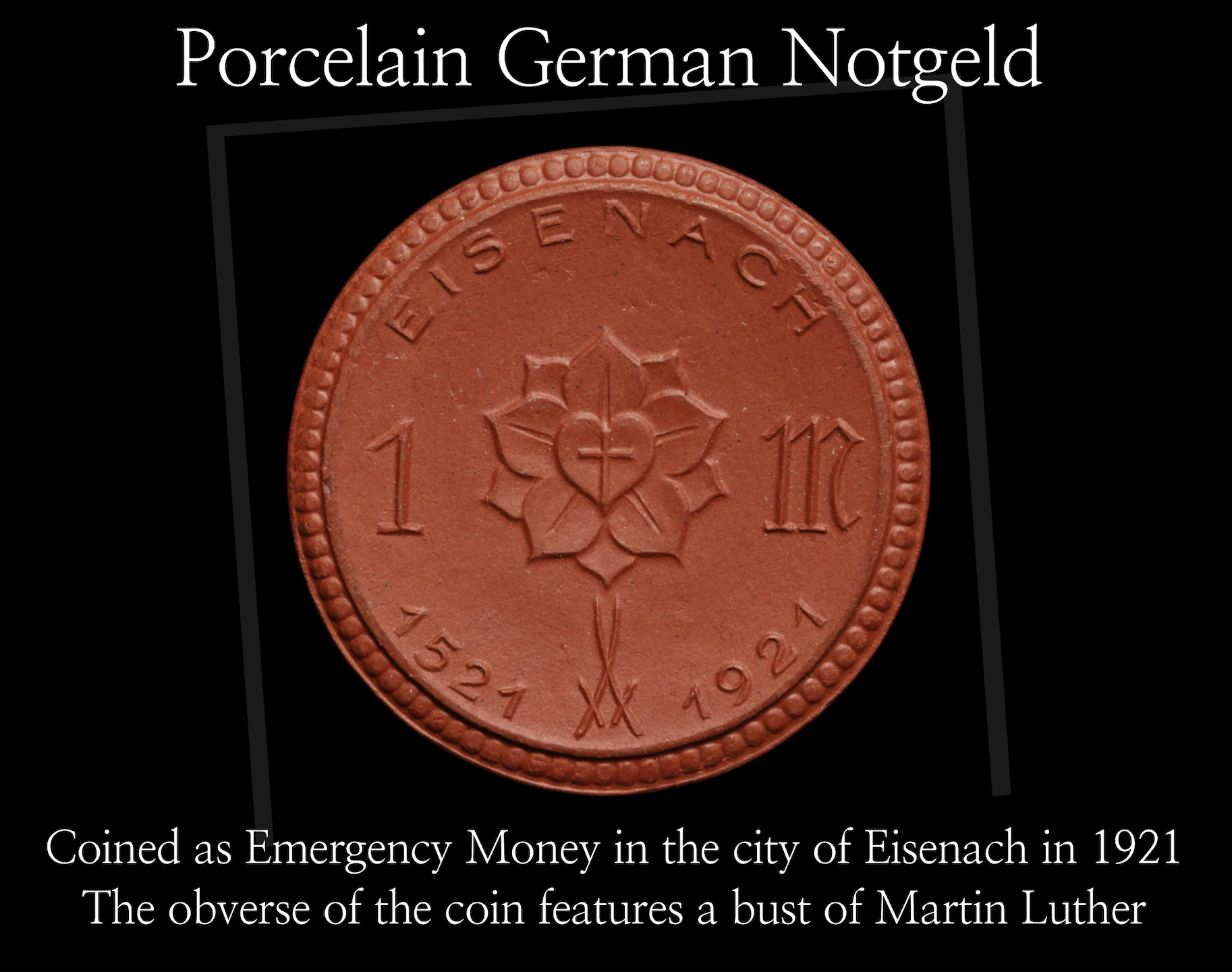
Being an amateur numismatist and a Lutheran pastor myself, I have several related items in my personal collection (none of which were costly, of course . . . since it’s just a hobby). One of my favorite items is a genuine 1 Mark coin minted in Eisenach in Weimar Germany in 1921 (pictured below). What makes it especially unusual is that due to postwar metal shortages, it was actually struck in porcelain!

This emergency coinage and currency was called “Notgeld,” which means “necessity money” because individual cities found it necessary to provide their own money when the Reichsbank succumbed to hyperinflation between the world wars.

The city of Eisenach chose the centennial of Martin Luther’s work because of his historic ties to the city. The Lutherhaus Eisenach cultural center commemorates, among other events, Luther’s early schooldays there, and his stay at Wartburg Castle where he translated the New Testament into German.

Conclusion

In light of Pope Francis’ funeral and the association it has with numismatics, it is a good time to consider how coinage has often carried a religious message. Although this was more frequent in past centuries, it still occurs today. It will be interesting to see just how many nations eventually mint coins in honor of Pope Francis. The Philippines, Samoa and the Cook Islands already have.

And even Narnia, the home of Aslan, minted coins in honor of its heroes, didn’t it?

C.S. Lewis, the Brothers Grimm & Snow White

You may blame the recent cinematic debacle that is Snow White on a declining Film Studio or the Brothers Grimm, but C.S. Lewis is innocent.

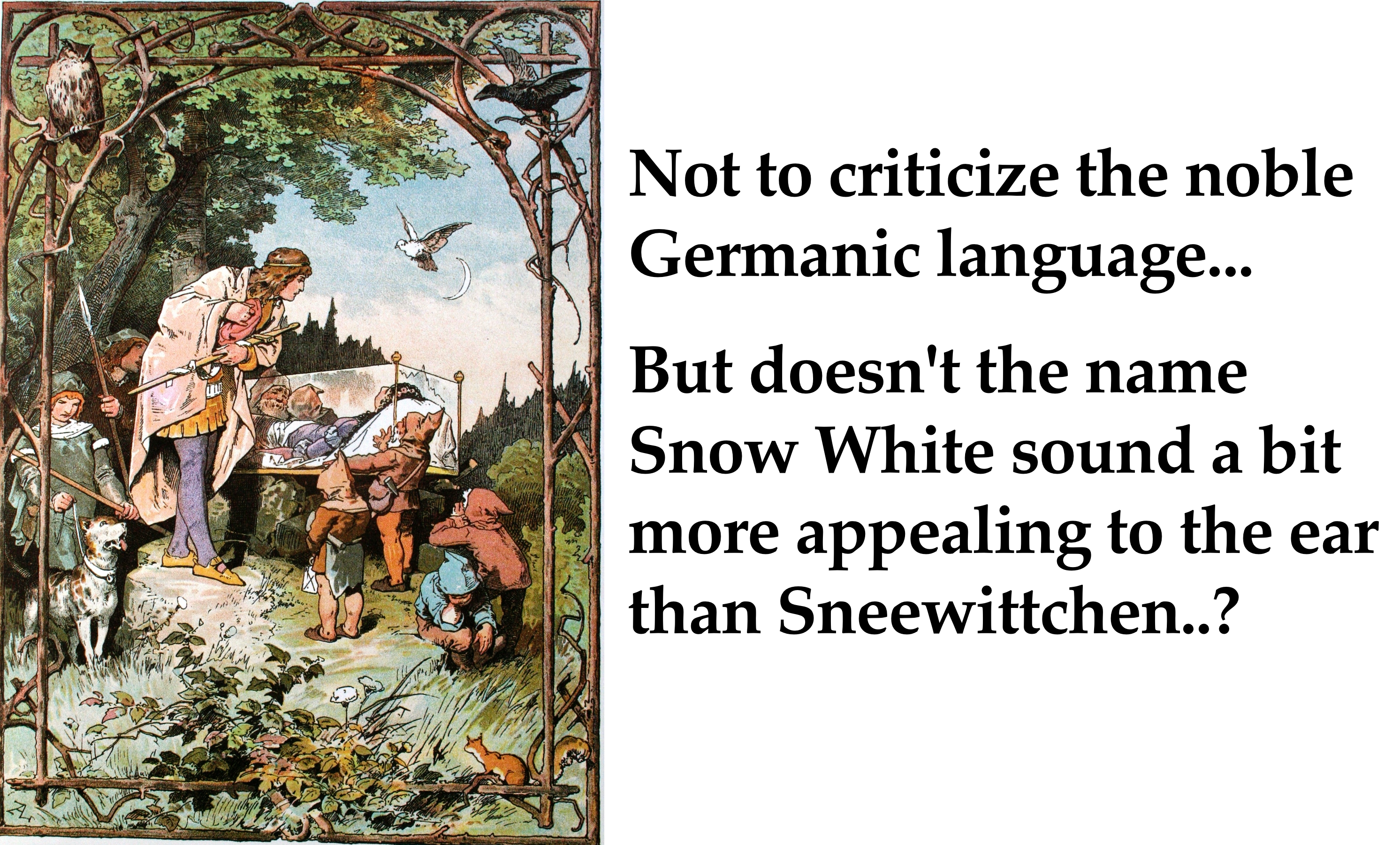
That’s not to say the Grimms didn’t have an influence on the great Oxbridge professor, a subject we’ll explore momentarily. But it was the German folk tales published by academics Jacob and Wilhelm Grimm who published the classic fairy tales that Walt Disney mined so effectively. 

They also popularized CinderellaHansel and GretelLittle Red Riding HoodThe Princess and the Frog, and Rapunzel. Disney began the transformation of these tales into visual treasures as early as 1921 when he founded Laugh-O-Gram Studio in Kansas City, Missouri.

In addition to films, over the years Walt gleaned memorable Grimm stories for a multitude of cartoon shorts, including The Brave Little Tailor and The Four Musicians of Bremen.

Obviously, Walt Disney himself respected the source material for the stories and wielded his editorial prerogative in an appropriate manner. Tragically, the same cannot be said for his corporate heirs. Likewise, the Brothers Grimm bear no culpability in this area.

C.S. Lewis, J.R.R. Tolkien & Snow White

The truth is, although Lewis and Tolkien appreciated literary fairy tales, neither of the preeminent Inklings were enamored with Disney’s animated treatment of the stories. Curiously, the two distinguished dons actually attended the theater together to view the trailblazing novelty that was Snow White.

They were particularly disappointed with the dwarves, seeing just how different they were from the genuine legends about them. Lewis even wrote “Dwarfs ought to be ugly of course, but not in that way.” Atlas Obscura has an entertaining article about their “movie date” and notes some of the elements they also enjoyed in the feature.

In his lectures published as A preface to Paradise lost, C.S. Lewis elaborates on his response to the Disney version of the tale.

That strange blend of genius and vulgarity, the film of Snow-White, will illustrate the point. There was good unorginality in the drawing of the Queen. She was the very archetype of all beautiful, cruel queens: the thing one expected to see, save that it was truer to type than one dared to hope for.

There was bad originality in the bloated, drunken, low-comedy faces of the dwarfs. Neither the earthiness, the avarice, nor the wisdom of true dwarfs was there, but an imbecility of arbitrary invention.

But in the scene where Snow-White wakes in the woods both the right originality and the right unoriginality were used together. The good unoriginality lay in the use of small, delicate animals as comforters, in the true Märchen [fairy tale] style. The good originality lay in letting us at first mistake their eyes for the eyes of monsters.

If you want to read more about the subject, you can do no better than read Joe Christopher’s article on the subject.

For an interesting argument that fellow Brit G.K. Chesterton would have loved Snow White for the very reason that moved the Inklings to criticize it, see “Tolkien and Lewis disliked Snow White. You know who wouldn’t have?

C.S. Lewis & Grimm’s Fairy Tales

Like his friend, J.R.R. Tolkien, C.S. Lewis was a champion of classical fairy tales. Neither was apologetic for it, although Lewis admitted to being shy about it when he was young. In an essay titled “On Three Ways of Writing For Children,” he wrote,

When I was ten, I read fairy tales in secret and would have been ashamed if I had been found doing so. Now that I am fifty I read them openly. When I became a man I put away childish things, including the fear of childishness and the desire to be very grown up.

In a great post called “Old Enough For Fairy Tales: C.S. Lewis’ “The Chronicles of Narnia” the writer describes this distinction to which Lewis alludes.

The Chronicles of Narnia are not children’s stories. They are fairy tales—but that is precisely why they are not children’s stories. If you can’t understand, you haven’t been listening. Go back and read the quote from Lewis’ essay again. Children are not the only audience for fairy tales.

In 1954, C.S. Lewis apologized to a German professor for being unable to understand the nuances of his volume on philosophy. In doing so, he referred to his youthful reading of the Brothers Grimm in their original German (available at Internet Archive).

I look forward to reading the book (when the translation arrives! My German is wretched, and what there is of it belongs chiefly to the libretto of the Ring and Grimm’s Märchen – works whose style and vocabulary you very possibly do not closely follow).

If you are in the mood for reading Grimm’s Fairy tales today, and your German is sadly lacking, Project Gutenberg has just the translation for you . . . as long as you can read English.


Addendum [added 10 April 2025]

The Brothers Grimm were far more than simply folklorists. They were respected professors at the University of Göttingen. They were devout Christians and worked with other prominent Germans. 

Goethe assisted them at a crucial moment in collecting their tales, and the philosopher Friedrich Schleiermacher provided copyediting assistance. Jacob’s work on German mythology had a pronounced influence on the composer Richard Wagner (World Magazine).

They also began compiling the Deutsches Wörterbuch (Germany dictionary) in 1838, with the first volumes published in 1854. It was the first dictionary to include historical usages of each word, preceding the Oxford English Dictionary, which was initiated in 1857 with its first edition published in 1884.


Bonus Trivia: The dwarves were unnamed until their debut on Broadway in 1912. And on that day they were christened Blick, Flick, Glick, Plick, Snick, Whick and Quee.

C.S. Lewis, J.R.R. Tolkien & Naomi Mitchison

Have your feelings about particular authors changed over time? C.S. Lewis’ attitude toward the work of prolific novelist Naomi Mitchison illustrates this type of progression.

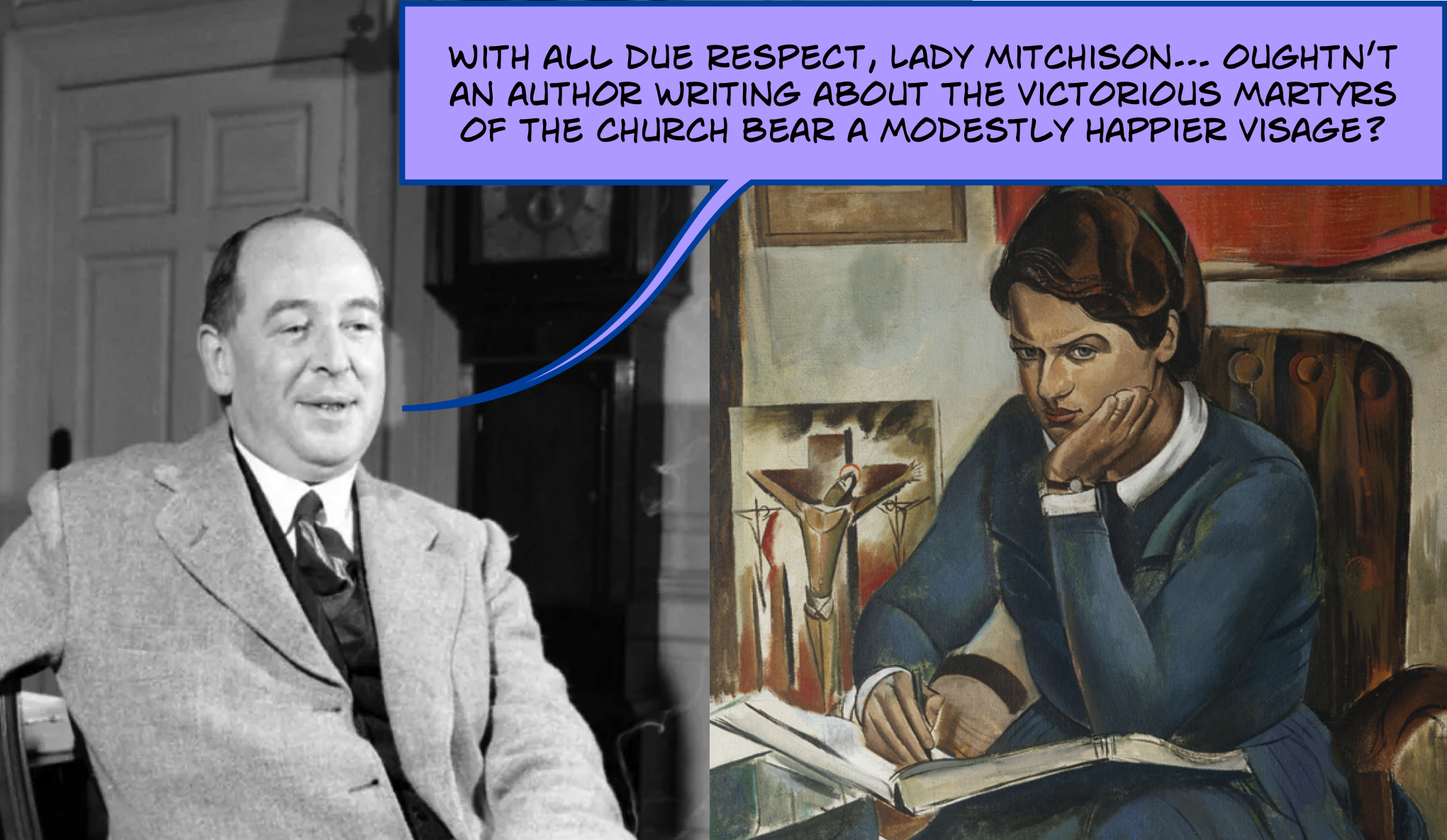
Mitchison’s work possesses a direct link to another Oxford Inkling – J.R.R. Tolkien – whose Fellowship of the Ring she read in proof and favorably reviewed. Brenton Dickieson provides a priceless letter written by Tolkien to Mitchison in 1954.

Naomi Mary Margaret Mitchison was a Scottish novelist who lived more than a century (1897 – 1999). She penned more than ninety books, primarily historical fiction, and including science fiction.

With the outbreak of the First World War, Mitchison joined a Voluntary Air Detachment in a London hospital. (Other familiar women who served in a VAD included Agatha Christie and Amelia Earhart.)

Politically she identified as a Socialist. She was sufficiently leftist that George Orwell regarded her as unsuited for writing anti-Soviet materials for the United Kingdom during the Cold War.

Mitchison’s brother, J.B.S. Haldane, did not equivocate on his radical views, announcing his position as a Marxist. He was a scientist and his atheism brought him into serious disagreement with the Christian views of C.S. Lewis. (I will devote my next post to that interaction.)

Coincidentally, artist Pauline Baynes (who also worked with C.S. Lewis and J.R.R. Tolkien), provided the illustrations for at least one of Mitchison’s children’s books, Graeme and the Dragon. This quick review offers a concise synopsis and discussion of “the charming illustrations [which] go a long way toward making this a fun read.”

An additional coincidence: the same year Lewis published The Lion, the Witch and the Wardrobe, Mitchison also published a fantasy novel for children. The Big House involves time travel and some occultic themes associated with Halloween, etc.

For a thorough synopsis of The Big House and comparison to Lewis’ Chronicles of Narnia, check out this essay from the University of Glasgow. (That reviewer’s preference is clearly for Mitchison’s more complex approach with its themes related to class struggle.)

C.S. Lewis’ Perspective on Naomi Mitchison

I cannot locate any mention of C.S. Lewis by Mitchison, but he did mention her in passing in several pieces of correspondence. In essence, he praised her skill, but was put off by her graphic use of violent imagery.

In a 1932 letter to Arthur Greeves, he writes:

I thought we had talked about Naomi Mitchison before. I have only read one (Black Sparta) and I certainly agree that it ‘holds’ one: indeed I don’t know any historical fiction that is so astonishingly vivid and, on the whole, so true.

I also thought it astonishing how, despite the grimness, she got such an air of beauty–almost dazzling beauty–into it. As to the cruelties, I think her obvious relish is morally wicked, but hardly an artistic fault for she could hardly get some of her effects without it.

But it is, in Black Sparta, a historical falsehood: not that the things she describes did not probably happen in Greece, but that they were not typical–the Greeks being, no doubt, cruel by modern standards, but, by the standards of that age, extremely humane.

She gives you the impression that the cruelty was essentially Greek, whereas it was precisely the opposite. That is, she is unfair as I should be unfair if I wrote a book about some man whose chief characteristic was that he was the tallest of the pigmies, and kept on reminding the reader that he was very short. I should be telling the truth (for of course he would be short by our standards) but missing the real point about the man–viz: that he was, by the standards of his own race, a giant. 

Still, she is a wonderful writer and I fully intend to read more of her when I have a chance.

C.S. Lewis echoed his concern in a 1942 letter to another of his regular correspondents, Sister Penelope. “I gave up Naomi Mitchison some time ago because of her dwelling on scenes of cruelty. But I recognise real imagination and a sort of beauty in the writing.”

In 1951, C.S. Lewis congratulated author Idrisyn Oliver Evans (1894–1977) on the publication of The Coming of a King; A Story of the Stone Age. Ironically, speculative fiction set in this ancient era, referred to as “Prehistoric SF,” was also the setting of works such as H.G. Wells’ Story of the Stone Age series, which you can read here. Naomi Mitchison also dabbled in the prehistoric field. Lewis wrote to Evans: 

I congratulate you. And I think it is a great thing to put that idea of the Stone Age – which is at least as likely to be the true one – into boys’ heads instead of Well’s or Naomi Mitchison’s. It’s all good. The marriage customs are amusing . . . I hope it will be a great success. 

In 1959, C.S. Lewis provided some wise counsel to a young, aspiring author. The American student was contemplating a volume about the Roman subjugation of Gaul, which Lewis encouraged.

A story about Caesar in Gaul sounds very promising. Have you read Naomi Mitchison’s The Conquered? And if not, I wonder should you? It might be too strong an influence if you did (at any rate until your own book is nearly finished). On the other hand, you may need to read it in order to avoid being at any point too like it without knowing you are doing so.

I don’t know what one should read on Gaul. Apart from archaeological finds (Torques and all that) I suppose Caesar himself is our chief evidence? He will be great fun and I hope you will enjoy yourself thoroughly.

Which side will you be on? I’m all for the Gauls myself and I hate all conquerors. But I never knew a woman who was not all for Caesar – just as they were in his life-time.

C.S. Lewis’ most significant mention of Naomi Mitchison occurs in his brief 1943 essay, “Equality.”

It delivers a brilliant discussion of the subject, one that merits full reading. He commends one of Mitchison’s insights into inequality – although, ironically, she relates it to eroticism.* (You must read it in full context to understand how it supports his independent argument.)

This last point needs a little plain speaking. Men have so horribly abused their power over women in the past that to wives, of all people, equality is in danger of appearing as an ideal. But Mrs. Naomi Mitchison has laid her finger on the real point. Have as much equality as you please – the more the better – in our marriage laws, but at some level consent to inequality, nay, delight in inequality, is an erotic necessity.

Mrs. Mitchison [in The Home and a Changing Civilization] speaks of women so fostered on a defiant idea of equality that the mere sensation of the male embrace rouses an undercurrent of resentment. Marriages are thus shipwrecked.

A final reference to Mitchison brings us back around to my early note that she reviewed Fellowship of the Ring. C.S. Lewis refers to her review in his own, suggesting that she has not gone quite far enough in her praise.

Nothing quite like it was ever done before. ‘One takes it,’ says Naomi Mitchison, ‘as seriously as Malory.’ But then the ineluctable sense of reality which we feel in the Morte d’Arthur comes largely from the great weight of other men’s work built up century by century, which has gone into it.

The utterly new achievement of Professor Tolkien is that he carries a comparable sense of reality unaided. Probably no book yet written in the world is quite such a radical instance of what its author has elsewhere called ‘sub-creation.’

Sadly, Naomi Mitchison was less enamored with the subsequent volumes in The Lord of the Rings . . . but this post has already condensed more than enough information.


* An article in Michigan Feminist Studies notes how Naomi Mitchison’s recurrent references to sexual themes distracted from broader matters throughout her literary career.

Despite Mitichison’s attempts to move the discussion of her body of work from the salacious, it is the frank and open inclusion of sexuality that continues to intrigue her critics and reviewers. Racy, heated passages of Mitchison’s historical novels inspired comment from poet W.H. Auden in the 1930s (“Monstrous Sex: The Erotic in Naomi Mitchison’s Science Fiction”).

The essay’s thesis is what one might expect in a journal devoted to contemporary feminism.

I intend to demonstrate that the ribald sexuality of Mitchison’s work registers as more than merely provocative. Sexual encounters between female characters and aliens, as well as those between women, threaten an imperialising capitalism that dictates who may be loved in a gendered, racialised order.

C.S. Lewis & Emotions

Are you one of those people who pride themselves on not being particularly emotional? Probably not, since the pendulum has swung far in the opposite direction in our current day. (Consider how few clicks a Tik Tok influencer with “flat affect” would get.)

Most of us know some people (most commonly men – forgive me the generalization) who keep their emotions under tight rein.

Back when I was a child, in the mid-twentieth century, it was not uncommon for men to “guard” their notion of masculinity by acting emotionless. And various ethnicities, including my own ancestors, possessed a reputation for being staid.

I can’t recall my Norwegian grandfather, who died when I was about ten, ever expressing truly warm sentiments. I know he must have laughed, and my grandmother had a great sense of humor, but I have no memory of it.

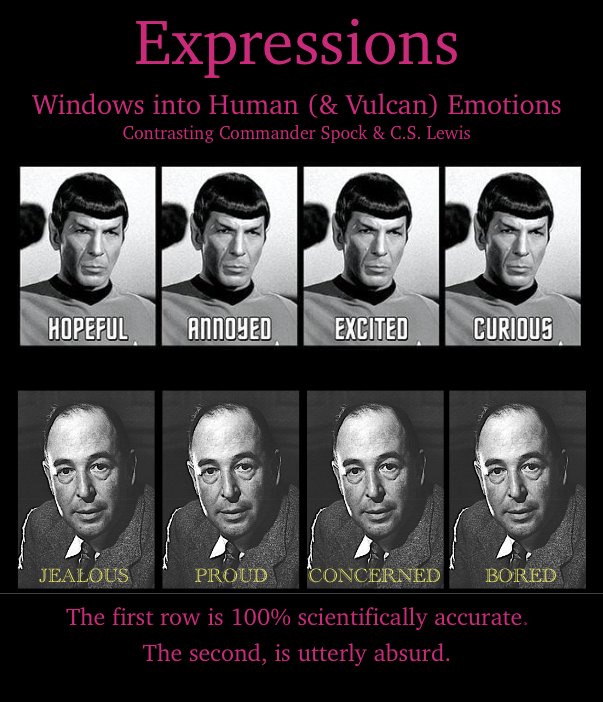
For some reason, many people picture C.S. Lewis as an emotionally sober intellectual. Perhaps it’s because he wrote so many profound essays. The truth is that Lewis was extremely jovial and fun-loving. I have noted some of this humor in the past.

Like most of us, C.S. Lewis’ closest friends saw him most clearly. They witnessed his jocularity in their regular gatherings. His fellow Inklings witnessed it frequently, but I don’t see how anyone can read the Chronicles of Narnia, and perceive their author as reserved, much less grave.

One reason some readers misunderstand C.S. Lewis’ exquisite sense of humor is because it is British. For Americans, for example, appreciating British humor is an acquired taste. As reported by the BBC, the wit often includes elements of “sarcasm, understatement [and] self-deprecation.”

In The Screwtape Letters, C.S. offers an insight into one of the Tempter’s tactics in undermining human nature, in terms of being fashioned in the image of our Creator.

[Englishmen] take their “sense of humour” so seriously that a deficiency in this sense is almost the only deficiency at which they feel shame. Humour is for them the all-consoling and (mark this) the all-excusing, grace of life.

Hence it is invaluable as a means of destroying shame. [. . .] A thousand bawdy, or even blasphemous, jokes do not help towards a man’s damnation so much as his discovery that almost anything he wants to do can be done, not only without the disapproval but with the admiration of his fellows, if only it can get itself treated as a Joke.

And this temptation can be almost entirely hidden from your patient by that English seriousness about Humour. Any suggestion that there might be too much of it can be represented to him as “Puritanical” or as betraying a “lack of humour.”

Lewis’ humor was on full display to his intimate friends, and uninhibitedly on display to the world in a number of his writings. But his openness didn’t end there. 

Just Like the Rest of Us:
a Person of Humor and Grief

I don’t recall anyone labeling C.S. Lewis a “humorist” – likely because his corpus is so diverse and complex – but I think a literary critic could make that case.

Ironically, I once cited an autobiographical reference in which C.S. Lewis applied that very attribute to his own father, a serious solicitor.

In contrast, C.S. Lewis would mature to the point where he was willing to expose that deepest of emotions, grief, with the entire world. In A Grief Observed, he explored his pain in the wake of his wife’s untimely passing. Joy Davidman was the precious wife this confirmed bachelor never anticipated having, and her death crippled him.

His description of his thoughts, doubts, and spiritual struggle in the aftermath has helped many others to survive the nightmare of bereavement. Curiously, for privacy C.S. Lewis initially used a pen name for the volume. (You can read about that here.)

He did not wish to have his authorship of the book distract from its subject matter. He would have known that would only be a temporary tool, since pseudonyms are nearly always uncovered. Initially, however, it was so effective that when it was published, readers recognized it could speak to Lewis’ own grief, and offered him gift copies.

T.S. Eliot was one of its first advocates for the volumes publication, and you can read that story at Faber & Faber.

A Final Lewisian Observation on Emotions

Some people view the intensity of emotions associated with events to be a measure of their validity. If my passions are aroused by an activity, we incorrectly think, it must be real!

This error is particularly dangerous when related to so-called “matters of the heart” and matters of faith. 

C.S. Lewis was cautious in both realms. We already noted his resignation to live out his life as a single man. In terms of faith, he was just as circumspect. His conversion from atheism to Christianity was long, thoughtful, and reluctant. 

And this, I found, was something I had not wanted. But to recognize the ground for my evasion was of course to recognize both its shame and its futility.

I know very well when, but hardly how, the final step was taken. I was driven to Whipsnade [Zoo] one sunny morning. When we set out I did not believe that Jesus Christ is the Son of God, and when we reached the zoo I did.

Yet I had not exactly spent the journey in thought. Nor in great emotion. “Emotional” is perhaps the last word we can apply to some of the most important events.

It was more like when a man, after long sleep, still lying motionless in bed, becomes aware that he is now awake. And it was, like that moment on top of the bus, ambiguous.

Freedom, or necessity? Or do they differ at their maximum? At that maximum a man is what he does; there is nothing of him left over or outside the act.

Certainly, many people are blessed with emotional confirmation in their spiritual lives. The obvious peril, of course, is in evaluating the veracity of something by how giddy it makes us feel. 

After all, there will always come “dark nights of the soul” when the feelings have fled . . . but Jesus, still remains.  

Only God Can Create

Satan has many disciples in this world. Some know him by other names, or worship him in spirit without recognizing his actual existence (e.g. Mammon). The irony, of course, is that the Devil is simply a posturer, or in modern parlance, a poser. And the presence of the Holy Spirit makes any single Christian more than his match.

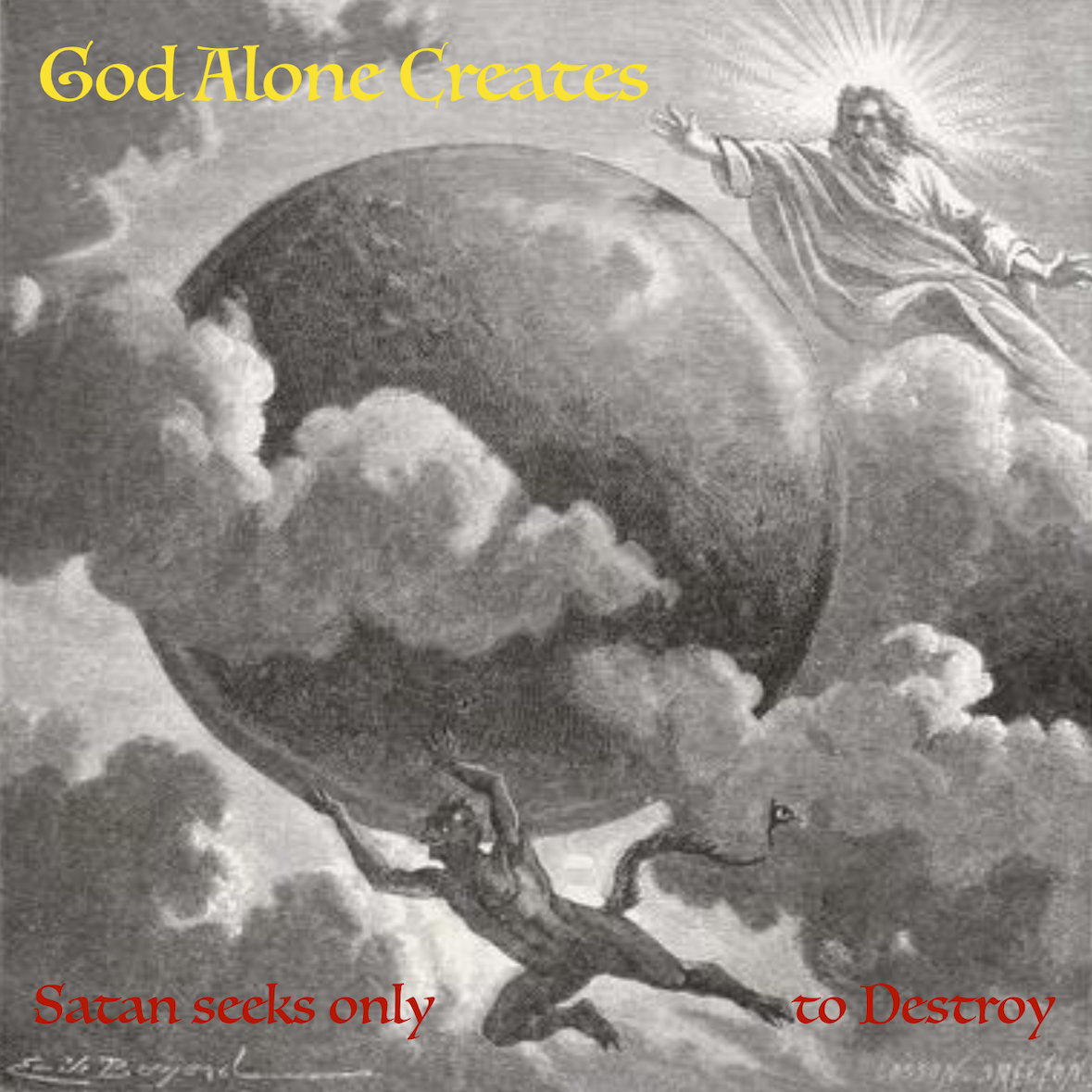
A prime evidence of Satan’s weakness is that he is a mere created being, without any creative powers of his own. Although some would grant the Adversary a glory he does not own, the truth is that since his expulsion from Heaven, he has devolved into the Great Pretender.

C.S. Lewis never pretended to be a theologian (for whatever authority that debatable title might convey). Instead, he was a brilliant disciple of Jesus with a sincere desire to follow the teachings of the Scriptures. Lewis certainly wasn’t infallible (and he has many critics who delight in pointing out that obvious fact).

Nevertheless, Lewis’ private insights on the subject of Lucifer’s noncreative limitation are right on the biblical target. Responding to a question posed by a reader, Lewis offered his opinion. 

Dear Mrs [Belle] Allen, I think it would be dangerous to suppose that Satan had created all the creatures that are disagreeable or dangerous to us for (a) those creatures, if they could think, would have just the same reason for thinking that we were created by Satan. (b) I don’t think evil, in the strict sense, can create.

It can spoil something that Another has created. Satan may have corrupted other creatures as well as us. Part of the corruption in us might be the unreasoning horror and disgust we feel at some creatures quite apart from any harm they can do us. (I can’t abide a spider myself.) (correspondence, 11 January 1954).

No, God alone creates . . . and redeems. The impotent Devil can never create, or rescue. His utter corruption results in an admittedly powerful spiritual being (a fallen angel) who is devoted to twisting, breaking, tainting, warping, spoiling, corrupting, rotting, perverting, and ruining all that God loves.

Granted, in our fallen world, Satan can fashion an abomination from some preexisting thing he corrupts – for example, Ophiocordyceps unilateralis the parasitic fungus that turns ants into zombies – but he can never create something out of nothing. These poor abominations are an excellent example of what Lewis referred to when he described the “horror and disgust we feel at some creatures . . .”

Meanwhile, Human Beings Can Create

Well, not exactly “create” on the creatio ex nihilo (created out of nothing) sense. Only God can do that, as he did when he spoke all things into existence. Just as Aslan echoed, when he sang Narnia into being in Lewis’ Chronicles.

“And God said, ‘Let there be light,’ and there was light” (Genesis 1).

“In the beginning was the Word [Logos], and the Word was with God, and the Word was God. . . . All things were made through him . . .” (John 1)

The Lion was pacing to and fro about empty land and singing his new song. It was softer and more lilting than the song by which he had called up the stars and the sun; a gentle, rippling music. And as he walked and sang the valley grew green with grass. It spread out from the Lion like a pool. It ran up the sides of the little hills like a wave” (The Magician’s Nephew)

As for humans like you and me being able to create, that is one of God’s most precious gifts to us. In truth, we use elements already created by the Lord: clay and stone to sculpt, pigments to paint, quill and ink to write.

The Inklings understood this creative impulse quite well. They not only understood it; they lived it. 

Like Christians before and since, they recognized that our creative capacity is based in the fact that we are created imago Dei, in the image of God.

Many people mistakenly believe J.R.R. Tolkien coined the word subcreation (or sub-creation, for the hyphen-infatuated). He certainly applied it for the first time to the intentional creation of what the Oxford English Dictionary calls “the action or process of creating a fully realized and internally consistent imaginary (or ‘secondary’) world.” 

Subcreation may be considered a form of “creation by a created being.” But even the most talented of writers and artists should remember this truth, stated by a Canadian astrophysicist: “God did not grant to the devil or any of his creatures the power to create.”

There is much more to consider on this subject, but Mere Inkling readers will need to wait until my next post, when we will conclude our discussion of this fascinating matter. 

There are two equal and opposite errors into which our race can fall about the devils. One is to disbelieve in their existence. The other is to believe, and to feel an excessive and unhealthy interest in them.

They themselves are equally pleased by both errors, and hail a materialist or a magician with the same delight. (The Screwtape Letters).


The image above is based on the work of Émile Bayard (1837-1891), a French illustrator who was born in Cairo, Egypt.

Short-term Sale on C.S. Lewis Study

C.S. Lewis was a champion of the historic version of the atonement wherein Jesus pays the price for our disobedience, and by his sacrificial death offers us eternal life though faith in him.

There is an excellent new book that is temporarily on sale for a mere three dollars in the Kindle format. (This low price is not due to its value, but to the occasional sales offered by publisher Wipf and Stock.) Check it out right now, because the sale ends on 24 September.

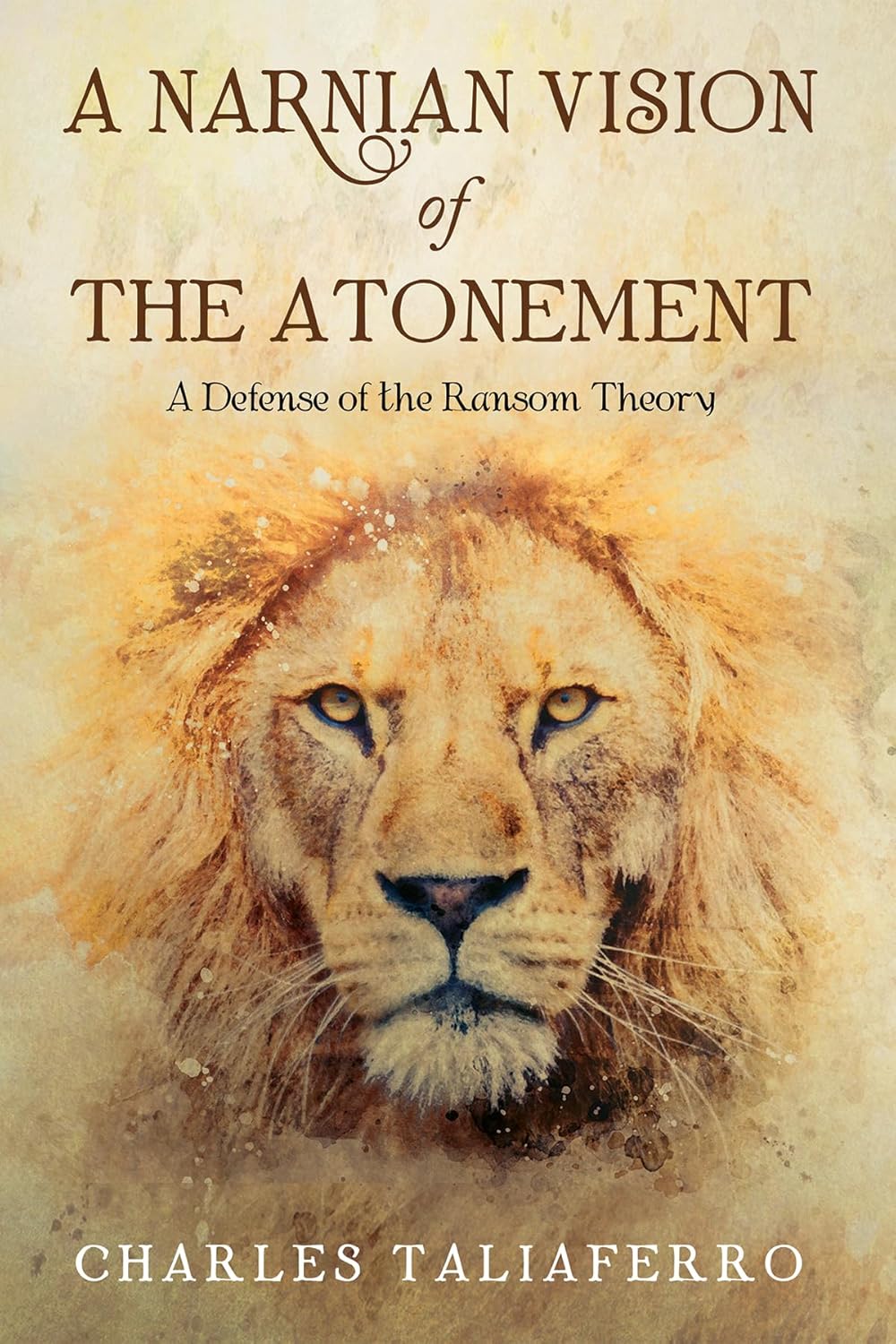
A Narnian Vision of the Atonement: A Defense of the Ransom Theory  was written by Charles Taliaferro, Professor Emeritus of Philosophy at St. Olaf College.

I’m enjoying the volume right now, although “philosophy” per se is far from my passion. But Jesus of Nazareth is. And I am passionate, as well, about the work of Yeshua’s disciple, C.S. Lewis. And Jesus and Lewis are the central characters in Taliaferro’s book.

He makes the subject of doctrine and philosophy quite accessible. I find this especially beneficial in his chapter on “the Ransom Theory and Rival Accounts of the Atonement.” Whereas some theologians are dismissive of the earliest Christian view of the atonement, this volume argues that it is far from incompatible with modern emphases (e.g. the Exemplar Model).

Since the early medieval era (roughly, the eleventh century), theories of the atonement have been any version except the ransom theory. In this chapter we will consider a host of them. I will be painting with a broad brush, with minimal references, in an effort to favorably sketch these accounts.

Afterwards, I will suggest that these accounts are not only compatible with the ransom theory, the ransom theory can provide important support for these so-called rivals.

I strongly commend this volume – especially at this unbelievable price – to anyone interested in C.S. Lewis’ faith or even in basic historic Christianity.

I will close with a wonderful passage from a letter C.S. Lewis wrote in 1954. Discussing theodicy, why God allows the suffering of innocents, Lewis offers this profound insight, inspired by Hebrews 2:10, and, it seems to me, 2 Corinthians 12:9.

Do you know, the suffering of the innocent is less of a problem to me v. often than that of the wicked. It sounds absurd; but I’ve met so many innocent sufferers who seem to be gladly offering their pain to God in Christ as part of the Atonement, so patient, so meek, even so at peace, and so unselfish that we can hardly doubt they are being, as St. Paul says, “made perfect by suffering.”

On the other hand I meet selfish egoists in whom suffering seems to produce only resentment, hate, blasphemy, and more egoism. They are the real problem (11 November 1954).

The Atonement – the restoration of humanity’s proper relationship with our Creator – is the greatest of miracles. And, A Narnian Vision of the Atonement, can help us to better celebrate its wonders.

Brilliant New Course on C.S. Lewis

Fans of C.S. Lewis who would relish a month-long journey through his work must consider a brand new course designed by Dr. Brenton Dickieson of Signum University. 

Ink Spots and Tea Stains offers the very best of combinations: “academically serious but . . .  focused purely on the love of learning and the joy of studying the material.”

And what an amazing subject you will explore – a unique view of C.S. Lewis’ archival treasures (many still unpublished), in the context of his more familiar works. And there is no need to feel intimidated. According to Signum

No specific knowledge or background is necessary, though it is recommended that students have a general knowledge of Lewis’s writings.

Writers should be especially intrigued by the course which will discuss the literary imagination and the shape of personal discipline in the writing process.

I enthusiastically commend Ink Spots and Tea Stains to you. I also encourage you to share this news with your friends who are fans of C.S. Lewis’ work.

In fact, you might also wish to pass the invitation on to all of the writers you know who would enjoy an inspired exploration into the writing processes of one of the most respected authors of the twentieth century.

All of our lives are busy, but consider giving yourself this uplifting gift this autumn. If you do, I’m confident you’ll not regret it.

C.S. Lewis & the Colors of Heaven

What wonders await the color blind in Heaven! That thought recently occurred to me out of the proverbial blue. 

I was sitting on my patio, tossing a ball to my border collie, when she decided to explore some of the local forest scents, as she is wont to do. As I normally do, I used that peaceful, shalom moment, to pray.

I don’t recall whether I closed my eyes, or gazed at the brilliantly white clouds dancing above me. In either case, my mind and spirit were focused on prayer. Prayer for those I love, and for strangers I have never met.

What wonders await the color blind in the presence of God. Too profound for me to take credit for thinking, but perhaps one of those serendipitous epiphanies God offers unexpectedly to his children.

In The Great Divorce, C.S. Lewis describes an excursion to the foothills of Heaven. The sheer reality of Heaven exceeds fallen humanity’s ability to comprehend it.

Before me green slopes made a wide amphitheatre, enclosing a frothy and pulsating lake into which, over many-coloured rocks, a waterfall was pouring.

Here once again I realised that something had happened to my senses so that they were now receiving impressions which would normally exceed their capacity. On Earth, such a waterfall could not have been perceived at all as a whole; it was too big. Its sound would have been a terror in the woods for twenty miles. Here, after the first shock, my sensibility ‘took’ both as a well-built ship takes a huge wave. I exulted. . . .

Near the place where the fall plunged into the lake there grew a tree. Wet with the spray, half-veiled in foam-bows, flashing with the bright, innumerable birds that flew among its branches, it rose in many shapes of billowy foliage, huge as a fen-land cloud. From every point apples of gold gleamed through the leaves.

When the Narnians sail to the “edge of the world,” they are greeted by a wonder that hints at the beauty of Heaven beyond. Barring their way into that place it rose “between them and the sky, a greenish-gray, trembling, shimmering wall.”

Then up came the sun, and at its first rising they say it through the wall and it turned into wonderful rainbow colors. Then they knew that the wall was really a long, tall wave – a wave endlessly fixed in one place . . . (Voyage of the Dawn Treader).

At the end of the Chronicles of Narnia, C.S. Lewis ushers his heroes into Heaven. They too experience the overwhelming awe inspired by their divine surroundings. 

It is as hard to explain how this sunlit land was different from the old Narnia as it would be to tell you how the fruits of that country taste. Perhaps you will get some idea of it if you think like this. You may have been in a room in which there was a window that looked out on a lovely bay of the sea or a green valley that wound away among mountains.

And in the wall of that room opposite to the window there may have been a looking-glass. And as you turned away from the window you suddenly caught sight of that sea or that valley, all over again, in the looking-glass. And the sea in the mirror, or the valley in the mirror, were in one sense just the same as the real ones: yet at the same time they were somehow different – deeper, more wonderful, more like places in a story: in a story you have never heard but very much want to know.

The difference between the old Narnia and the new Narnia was like that. The new one was a deeper country: every rock and flower and blade of grass looked as if it meant more. I can’t describe it any better than that: if you ever get there you will know what I mean (The Last Battle).

I find Lewis’ fictional visions of Heaven inspiring in their self-confessed inadequacies. Heaven, no doubt, is profoundly more glorious than any human being can imagine.

The Bible employs brilliant colors to help describe Heaven’s beauty. In John’s vision of Heaven we find these descriptions:

And he who sat [upon the throne] had the appearance of jasper and carnelian, and around the throne was a rainbow that had the appearance of an emerald. Around the throne were twenty-four thrones, and seated on the thrones were twenty-four elders, clothed in white garments, with golden crowns on their heads.

From the throne came flashes of lightning, and rumblings and peals of thunder . . . and before the throne there was as it were a sea of glass, like crystal (Revelation 4).

[An angel] showed me the holy city Jerusalem coming down out of Heaven from God, having the glory of God, its radiance like a most rare jewel, like a jasper, clear as crystal. . . .

The wall was built of jasper, while the city was pure gold, like clear glass. The foundations of the wall of the city were adorned with every kind of jewel. The first was jasper, the second sapphire, the third agate, the fourth emerald, the fifth onyx, the sixth carnelian, the seventh chrysolite, the eighth beryl, the ninth topaz, the tenth chrysoprase, the eleventh jacinth, the twelfth amethyst. And the twelve gates were twelve pearls, each of the gates made of a single pearl, and the street of the city was pure gold, like transparent glass (Revelation 21).

The Power of Color

Colors are not merely aesthetic. Their influence on human perception has been studied for many years. One key researcher, Faber Birren (1900-88), served as a respected consultant on the subject for numerous businesses and even the United States government itself. 

Shades of Meaning” relates that “in 1939, Walt Disney invited Birren to work as a color consultant. He ended up advising Disney animators on the design of BambiFantasia, and Pinocchio.” 

In Color Psychology and Color Therapy, Birren begins his discussion of the subject with the proposal that “it is perhaps a mistaken notion that man in his love of color was impelled by some aesthetic urge.” He contends that:

The greatest weight of evidence points to the fact that color was involved with the supernatural and therefore had significance that went beyond what might be thought of as mere sensuous delight. . . .

Color, being a manifestation of light, held divine meaning. Historical records of color show little interest in the physical nature of color, nor yet in its abstract beauty, but in a symbolism that attempted to resolve the strange workings of creation and give it personal and human meaning.

If this spiritual aspect of color is actual, then being colorblind carries a liability beyond simply missing out on one of life’s simple pleasures.

Color Blindness Among Humanity

You may not know anyone who is color blind. That’s not surprising, since it isn’t a common subject of conversation. Nevertheless, in the general population, approximately eight percent – or 1 in 12 – men suffer from some form of it. Meanwhile, the rate of this condition, which is most frequently genetic, for women is far lower. Only about one in two hundred.

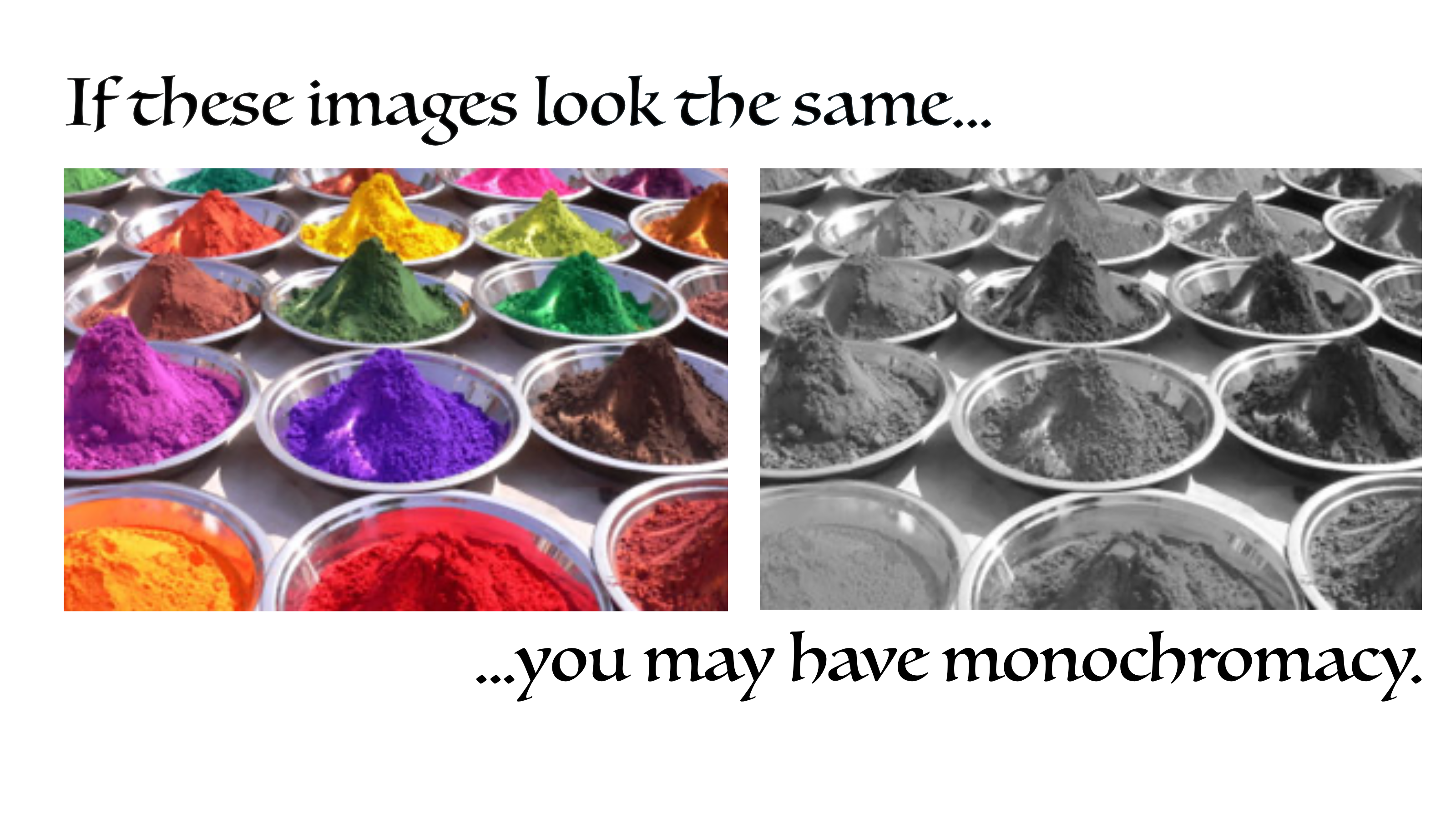
There are several varieties of color vision deficiency, with most people able to perceive some shades of certain colors. The most severe form of the problem involves a failure to see any colors. Only shades of gray distinguish between different hues. It’s called achromatopsia, and is quite rare. 

Achromatopsia is a congenital hereditary condition found in only one birth in every 33,000 to 50,000 births.  Thus less than 10,000 Americans may have achromatopsia. There are two basic forms . . . Rod Monochromatism, . . . is the most common [and] routinely occurs in both men and women. . . .

Blue Cone Monochromatism has an incidence of 1 in 50,000-100,000 births in males and could be as rare as 1 in 10 billion in females.

If you are curious about achromatopsia, you should definitely read about research on a Micronesian Island where ten percent of the people share this affliction.

Many individuals first learned of achromatopsia in 1997, when Oliver Sacks published his classic book, Island of the Color Blind.  This story beautifully chronicles Oliver Sack’s 1994 quest with Knut Nordby and Bob Wasserman to the isolated atoll of Pingelap in Micronesia, where 10% of the population have rod monochromatism. A video of the journey is available here.

Possible Visions of Heaven

Although I am quite wary of so-called near death experiences (with some being spurious, and others, spiritual deception), it is intriguing how color has entered into a number of the stories. The following examples appear in the accounts of several different individuals in Imagine Heaven: Near-Death Experiences, God’s Promises, and the Exhilarating Future that Awaits You.

The entire city was bathed in light, an opaque whiteness in which the light was intense but diffused. In that dazzling light every color imaginable seemed to exist and – what’s the right word? – played. The colors seemed to be alive, dancing in the air. I had never seen so many different colors. It was breathtaking.

Below me lay the purest, most perfect grass, precisely the right length and not a blade that was bent or even out of place. It was the most vibrant green I had ever seen. If a color can be said to be alive, the green I saw was alive, slightly transparent and emitting light and life from within each blade. The iridescent grass stretched endlessly over gently rolling hills upon which were sprinkled the most colorful wild flowers, lifting their soft-petaled beauty skyward, almost as if they were a chorus of flowers caught up in their own way of praising God.

The most gorgeous sky ever seen here on earth cannot even come close to the atmosphere in Heaven.  It is bright because of the glory of our God. . . .  The atmosphere is something you experience, not just see.  It is golden, yellow, white, and had more colors moving throughout it . . . like the Aurora Borealis lights.

The sky [and] the firmament surrounding the heavens, were a wilder and bluer yonder than you would ever believe. . . . The closest shade I can associate this otherworldly blue with is the surreal tones of the water in the Caribbean or off the coast of Hawaii at sunset. . . . That color is waiting for you and me on the other side.

The colors and lights in Heaven were simply sublime. . . . They were the deepest, richest, most gloriously lush colors I had ever seen, and some I had never seen before. Heaven is a dream-come-true for those who love all things colorful, and our home there is lit by the Father of Lights. . . . [There were] robust and bold and vigorous beams that were somehow gentle to my eyes. I simply don’t think those colors and lights exist on earth.

I saw the most dazzling colors, which was all the more surprising because I’m color-blind. I can distinguish the primary colors, but pastels all look the same to me. But suddenly I could see them, all kinds of different shades. Don’t ask me to name them because I lack the necessary experience for that.

Take a Moment to Test Your Own Color Vision

There are a number of simple, free vision tests available online. If you want to assure yourself that you can see all of the normal colors – though not necessarily all of the heavenly colors awaiting us – check out one of the following.

Color Blind Test

EnChroma Color Blind Test

X-Rite Color Challenge and Hue Test

Colorlite Collection of Tests

Final Thoughts

When I described the wonders awaiting the color blind in Heaven, I was referring to all of us. (In this life, as the Scriptures say, “For now we see in a mirror dimly . . .” (1 Corinthians 13).

All who trust in the love of Jesus Christ, and thereby enter Heaven’s environs by the unmerited grace of God’s mercy, will be overwhelmed by its beauty and wonder.

The million or more colors a person with full vision can now see, will be eclipsed by the infinite tapestry of hues in our Creator’s mind. Even those with the scientifically-presumed capability to currently perceive distinctions between up to 100 million will surely be in awe.

C.S. Lewis closes our discussion of Heaven’s colors with a fascinating thought related to the angels who worship God in that divine place. Lewis begins by noting a significant distinction between God’s angels and humanity.

But for our body one whole realm of God’s glory – all that we receive through the senses-would go unpraised. For the beasts can’t appreciate it and the angels are, I suppose, pure intelligences.

They understand colors and tastes better than our greatest scientists; but have they retinas or palates? 

I fancy the “beauties of nature” are a secret God has shared with us alone. That may be one of the reasons why we were made-and why the resurrection of the body is an important doctrine (Letters to Malcolm: Chiefly on Prayer).