Literary Translators Beware

Translating literature from one language to another is a valuable, yet often undervalued, skill. It breaks the linguistic shackles restricting the benefits of good books to those literate in the language in which they are composed.

You can think of it this way. Without the dedicated efforts of translators, someone familiar only with English – e.g. as is, sadly, the case with most Americans – could never read the works of ancient Greeks or Romans. Asian philosophy such as the Four Books and Five Classics of Confucianism would be virtually unknown in the West.

Even contemporary literature from most of the world would be beyond our access. And, obviously, God’s written Word would only be accessible to those who mastered Hebrew, Aramaic, and Greek.

While C.S. Lewis is seldom thought of as a translator, it was indeed one of his talents. That doesn’t mean he devoted serious energy to translation. That was not his vocation. On the contrary, in 1945 he wrote: “People praise me as a ‘translator,’ but what I want is to be the founder of a school of ‘translation.’” (I discussed this a number of years ago in “C.S. Lewis’ School of Translation.”)

Dedicated translators have played an invaluable role throughout recorded history. A number of people still make translation their life’s labor. Yet, there are dark clouds on their horizon.

Is there a Future for Translation by Human Beings?

A recent literary journal alerted me to advances in artificial intelligence, which now jeopardize the future of professional translators. 

Back in 2023, an article in Forbes compared the respective advantages and challenges of the two methods. They accurately identified one distinction between a truly fluent human and an artificial substitute.

Language is complex, and culturally specific expressions such as idioms and metaphors, as well as ambiguous or ungrammatical sentences and other context-dependent word choices, can be challenging for AI algorithms.

Unsurprisingly, that same year the American Translators Association offered a more critical opinion in “Machine Translation vs. Human Translation: Will Artificial Intelligence Replace the World’s Second Oldest Profession?

We already mentioned that computers don’t possess our human capacity to comprehend meaning. The creative process, especially when it comes to translation, is the pinnacle of meaning. Human translators translate meaning, not words. The art of translation is understanding the meaning of the original text and then transforming it into something that communicates the same message (or evokes the intended emotion) but might not superficially look like an exact equivalent. . . .

But both now and then, professional translators are here to stay. Equipped with unique human skill and a toolbox full of tech, they’re ready to continue helping the world navigate the tricky business of multilingual communication – transporting messages appropriately, creatively, consistently, and securely to whatever audience you aim to reach. 

In short: machine translation can help when it doesn’t count, but professional human translation is there for you when it does.

Related to expressly literary translations, in contrast to mundane subject matter, the current issue of Poets & Writers contains a piece titled “AI Threatens Literary Translation.” When a European subsidiary of Simon & Schuster announced they would begin limited use of AI for this purpose,

Reactions rose in a flurry: Writers, publishers, and translators contended that AI would produce “bland” work. They lamented the possibility of lost jobs. The European Council of Literary Translators’ Associations resisted the standardization of an idiosyncratic process, stating that the imagination, understanding, and creativity that translation demands are “intrinsically human.”

This informative essay acknowledges that “AI isn’t new to translation either. Literary translators sometimes input segments of their source text into AI-based technologies . . . to generate ideas for particularly thorny passages. But these tools have to be used ‘very carefully . . . because the translations it produces are error-ridden and devoid of flow or beauty.’”

A Quick Experiment with AI Translation

Before completing this post I took a brief (less than ten minute) excursion to ChatGPT to experiment with their translation tool.

The results appear below (all produced in a mere handful of minutes). First I asked the AI to compose a sonnet on the subject of translation. Then I requested translations of that sonnet in five different languages. I have included the sonnet and the final two lines of each translation below.

You can perform a more elaborate experiment yourself, especially if you are familiar with more than one language. This would enable you to compare the accuracy of the translation. Or, perhaps one might take a translated version and translate that back into the original language, to see how closely it relates to the starting point.

In my experiment, the AI was constrained by needing to maintain the original’s form as a sonnet. I assume that if it were simply a literal translation, it may have modified the vocabulary and grammar. Each translation included footnotes. To illustrate how elaborate some of these notes were, I’ve reproduced those which appeared with the translation into Aramaic.

Frankly, if this is what these early AI prototypes are capable of, it appears to me that professional translators may truly have something to be worried about.

The Sonnet

In languages vast, where meanings hide and shift,
A translator’s art gives voice to what is known.
Through words, they bridge the gap, a timely gift,
To carry thought from one to others’ throne.

The rhythm, tone, and essence all must stay,
Though words may bend, they still must hold their grace.
A careful hand must guide the text’s relay,
To keep its heart while moving through time and space.

Yet oft the meaning’s lost in fleeting sound,
Or tangled in the strings of foreign speech.
But still they strive, where words and thoughts are bound,
To bring the message close, within our reach.

A translation’s not just words that blend –
It’s worlds revealed, with meaning without end.

~ Latin ~

Translatio non est solum verba iuncta –
Sed mundi patent, et mens non est puncta.

~ Old English ~

Nis anginn of wordum gemenged anum –
Ac worulda onwreah, and andgit ne swylt.

~ Classical Greek ~

Οὐ γάρ μόνον λέξεις αἱ μεταφράσεις,
ἀλλὰ κόσμοι φαίνονται, ἄνοια οὐδέποτε.

~ Middle Egyptian ~

𓏏𓂋 𓅓𓏏 𓊪 𓏏𓏤 𓆑𓏏 𓊵𓏤,
t r mt ḏbꜥ t ft ḏbꜥ
(“A translation’s not just words that blend –”)

𓂋 𓅓𓏏 𓆑𓏏 𓊵𓏤 𓏏𓏏𓀀.
r mt ft ḏbꜥ t t
(“It’s worlds revealed, with meaning without end.”)

~ Classical Aramaic ~

ܬܪܓܡܐ ܠܐ ܗܘܐ ܒܠܚܘܕ ܡܠܐ ܕܡܬܚܠܛܢ,
ܐܠܐ ܥܠܡܐ ܡܬܓܠܝܢ، ܘܡܕܡ ܠܐ ܚܒܠ.

Notes on the Translation:
1. Classical Aramaic Grammar & Style: The sentence structure follows Classical Aramaic syntax as used in ancient texts. Some phrases had to be adapted poetically since direct translations of modern concepts do not always exist.
2. Vocabulary Adjustments: “Translator” = ܡܬܪܓܡܢܐ (metargemana), a direct and historically accurate term. “Translation” is expressed as ܗܫܬܘܪܬܐ (hishtorta), meaning “interpretation, explanation.” “Essence” is translated as ܡܗܘܬܐ (mehutā), meaning “nature, essence.” “To bridge the gap” = ܡܫܬܪܝܢ ܓܦܐ (meshatrin gapé), literally meaning “to stretch wings” (a poetic expression).
3. Preserving the Poetic Flow: The rhythm and parallel structure of the original sonnet were carefully kept. Adjustments were made for metrical and phonetic balance in Aramaic.
4. This version captures the spiritual and poetic depth of the original while remaining faithful to the Classical Aramaic linguistic style.
5. Would you like an audio recording or a version in Syriac script for authenticity? Let me know how you’d like to refine it!

And all of this in ten minutes. Unfathomable . . .
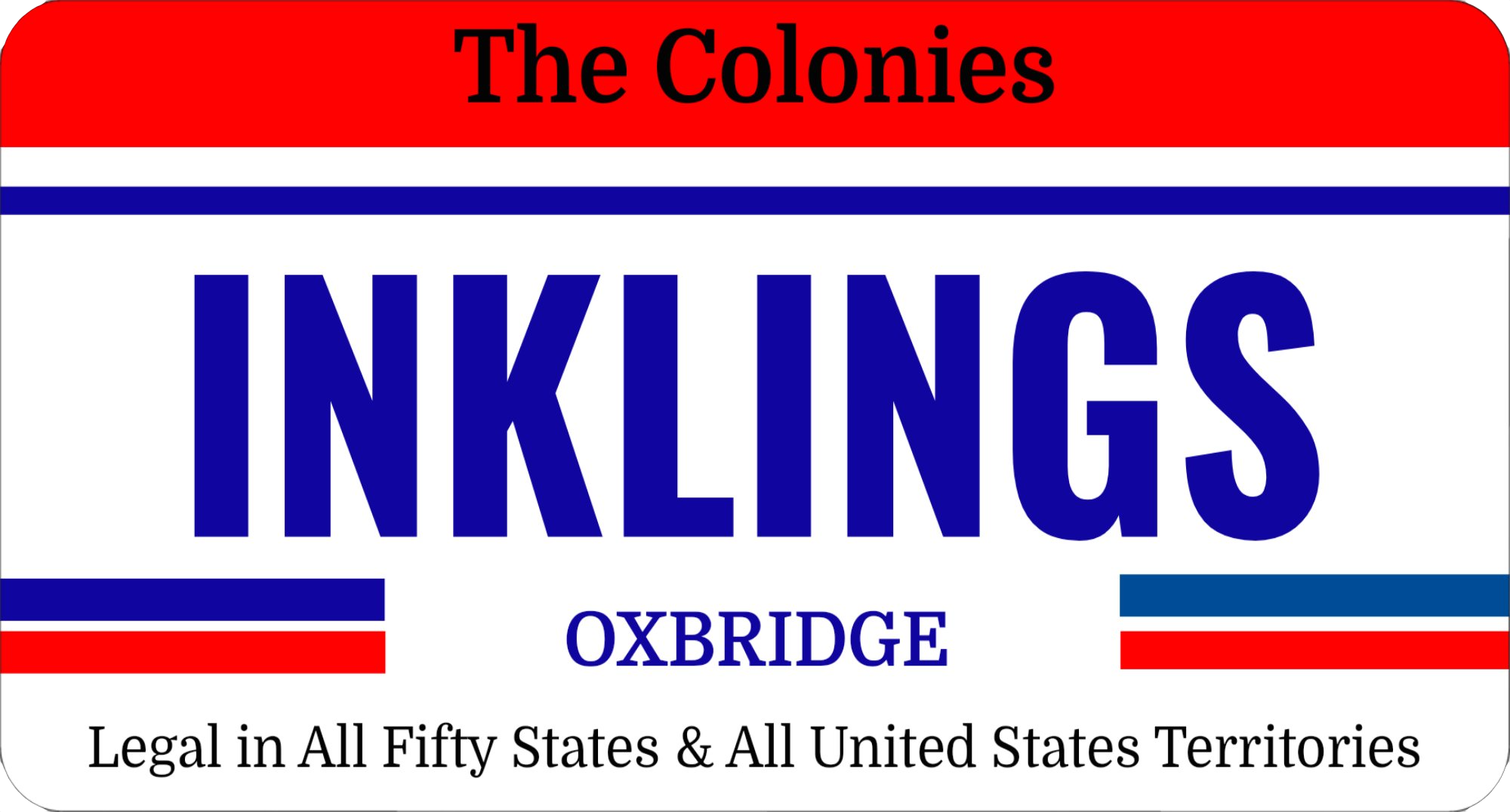
Individualism, License Plates & C.S. Lewis

One of the peculiar things about the United States is the extreme degree to which people are driven to stand out from the crowd. We are able to do this with our automobiles, for example, in a rather odd way.

C.S. Lewis was immune to the temptation discussed here, since he was never a fan of cars, as I discussed in “C.S. Lewis & Automobiles.”

In his autobiography, Lewis declared “I number it among my blessings that my father had no car, while yet most of my friends had, and sometimes took me for a drive.” Those who are curious about Lewis’ dichotomy concerning vehicles, should refer to that post.

I don’t know how many other countries do this, but in most of the United States states, people have the option of getting random numbers and letters on their license plates – or opting for so-called vanity plates.

These individually emblazoned metallic placards perform a sort of Third Estate heraldic device. They often include variations on surnames or words significant to the bearer.

Obviously, offensive words are prohibited, but they are frequently quite creative. Here are a few examples: SO 4CHN8 and its opposite, EN-V ~  GONA B L8 which is probably an insufficient excuse to the cop who pulls you over ~ IBMEUBU with its live and let live philosophy versus URAMESS ~ UH AS IF from California, of course ~ IOU DAD from a grateful child ~ BWAHAHA and the clearer message from Vermont, BBRRRR ~ TWOCUTE can either refer to attractive twins, or to an illiterate narcissist ~ BBQ=LUV celebrates a common American favorite ~ and, this provocative phrase ITS A SIN. Hundreds more examples are online if you’re curious.

It’s fascinating that Americans will pay often exorbitant surcharges to individuate their auto plates. Especially in light of the fact that we already have different plates for each of the 50 states and a Federal District (for our national capital), as well as others for Territories and Protectorates. Prepare yourself. Seriously, prepare for a shock.

All of the 8,331 License Plates in America

States now offer a vast menu of personalized plate options for a dizzying array of organizations, professions, sports teams, causes and other groups.

Such plates typically include a surcharge to support the theme identified on each choice, as for Maryland’s Beekeepers, Barbershop Quartet Singers, or the Baltimore Bicycling Club. And we mustn’t forget their plate promoting the museum of the B&O Railroad (of Monopoly fame).

How can we arrive at that unbelievable number? Well, consider Illinois, for example. They boast no fewer than forty different options related to military alone. Hawaii has the fewest overall varieties at fourteen. Maryland, likely desperate for revenue, actually has nine hundred and eighty-nine. I am curious why they bothered to stop short of an even thousand.

Add to that the fact that nineteen states do not require a license on the front of the car, which invites the substitution of an individualized alternative. Consequently, there are statutes ensuring “most states also require that you do not mount your plate upside down.” In many of these, you would be legally allowed to mount decorative or business plates, but not alternative license plates, misleadingly different from your true registration.

Individuality run amok. The chaos sadly seems strikingly American.

Which brings me to the reason I was thinking about this unusual topic. Heading to church on Sunday I saw a plate with a curious message. It was one of my state’s options for Fire Fighters. The message it bore consisted of just three letters: UGH.

What does that convey to you? Since it appeared on a vocational emblem, my thought is that it reflects the feelings of someone who has grown tired of their profession. The best construction I can imagine is someone frustrated by the fact that after every fire they suppress there will come another. Resulting in a sense of futility or ennui. If you interpret it differently, please let me know.

I mean, we’ve all had ugh-days. But to feel ugh enough about life to indelibly express it this way . . . well, all I could do was hope it was an unconventional joke, and offer a quick prayer for the driver, in case it wasn’t.

C.S. Lewis offered many insights about our God-given individuality and uniqueness. Individualism, as a driving force, however, is something different. I recently read a wonderful article about how Lewis assessed individualism’ interplay with collectivism – two relentless forces in many Western cultures. “C.S. Lewis on Individualism, Equality and the Church” focuses on a World War Two speech delivered at Oxford and published as “Membership.”

Our personal uniqueness is not accidental. As C.S. Lewis wrote in The Problem of Pain,”

[God] makes each soul unique. If He had no use for all these differences, I do not see why He should have created more souls than one. Be sure that the ins and outs of your individuality are no mystery to Him; and one day they will no longer be a mystery to you.

In contrast, hyper-individualism is normally deleterious. Yet, the fact that God regards us as precious, irreplaceable beings, and calls each of us by our personal name, is wondrous news. It can accomplish two things related to the discussion above: (1) it puts personalized license plates in their proper perspective, and (2) it reminds us that even though we occasionally feel frustrated or despondent, our overall life attitude should never be summed up with an ugh.


Editor’s Note: In the interest of journalistic transparency, yours truly, while experiencing many moves, has participated in the automotive bacchanalia described above. Twice I secured military-related plates, Alabama’s Desert Shield/Desert Storm veterans and Illinois’ POW/MIA remembrance commemorations. In addition, while stationed in Guam, I secured plates with my surname.

I have asked my children to have me hospitalized for dementia should I ever decide to order our Washington State J.P. Patches Pal license plate. The reasons for that decision are obvious.

Tortured Writing & the Inklings

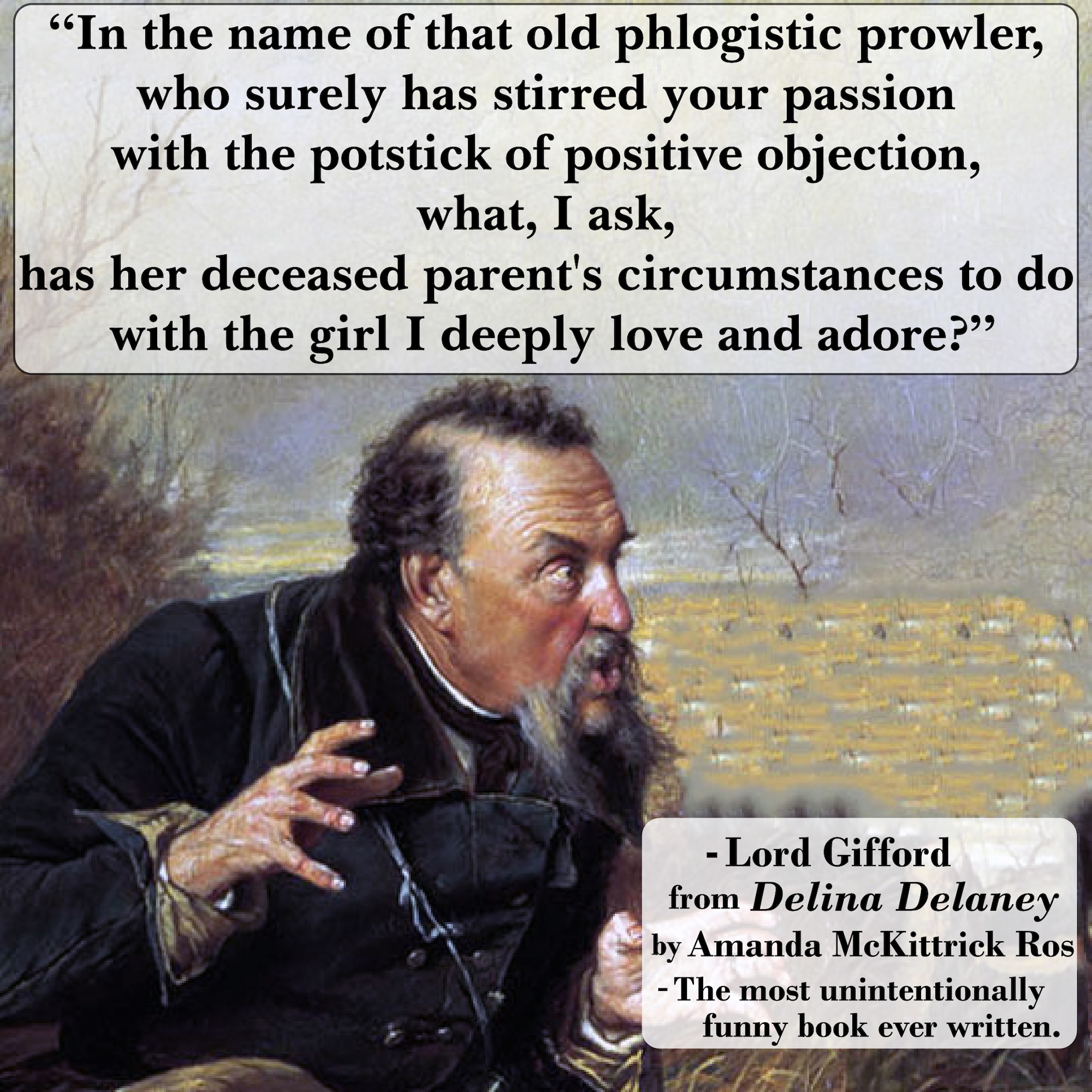
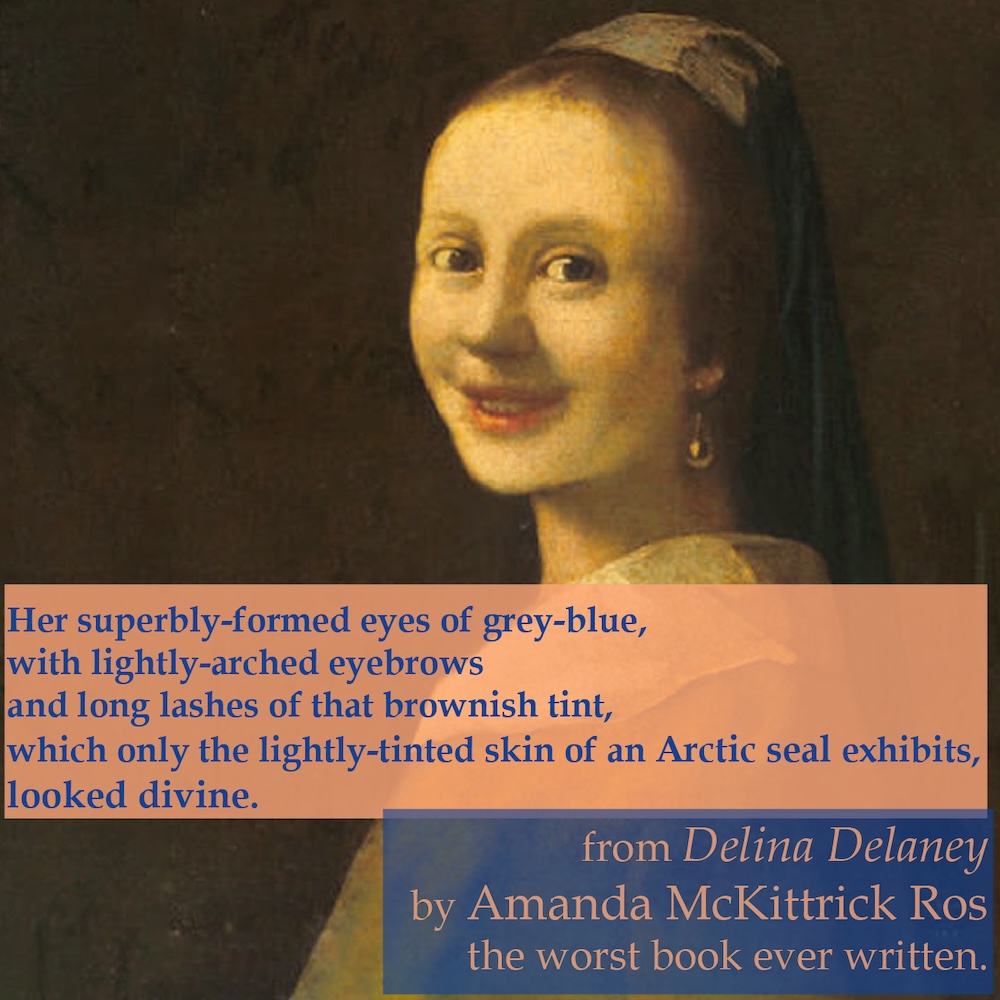
Amanda McKittrick Ros (1860-1939) was an Irish poet and novelist beloved by the Oxford Inklings. “Beloved” here is used in the sense of treasured for its distinctiveness, rather than admired for its artistry.

An article about Ros in Smithsonian Magazine is subtitled: “Amanda McKittrick Ros predicted she would achieve lasting fame as a novelist. Unfortunately, she did.”

So how is it that a writer described by the Oxford Companion to Irish Literature (OCIL) as authoring “unconscious comedy of a very high order” came to occupy a special place within the company of C.S. Lewis, J.R.R. Tolkien and their literary fellows? Why did they begin reading her works as a sort of contest, with the challenge of neither laughing nor smiling as they did so?

It was not because her mother (or she herself) christened her after a character in The Children of the Abbey, published in 1796. (Her initial name was “Anna.”)

No, it was due to an intrinsic element of her frequently alliterative artistry, described by OCIL in the following manner.

She published two sentimental romances, Irene Iddlesleigh (1897) and Delina Delany (1898), both in an idiosyncratic manner that provides unconscious comedy of a very high order. . . .

Most of her published writings appeared posthumously as a result of literary curiosity.

Many writers would agree that writing comedy is quite challenging. Comedy Crowd is devoted to helping writers gain some skill in this arena, and if you take a moment to check out their video about failed puns – after you finish reading this post – you won’t be disappointed. 

As one commenter on SleuthSayers puts it, “. . . writing humor isn’t easy. It’s even dangerous: trying to be funny and failing would be almost as bad as being funny when you’re trying to be serious.” Sadly, the worst of these options proved to be the fortune of poor Amanda.

Even her native Northern Ireland Library Authority confesses that her “writing style can only be described as elaborate, melodramatic, using startling descriptions with mixed metaphors and inappropriate alliteration with the result being unintentionally hilarious.”

In her collection “Poems of Puncture,” I came across a piece titled “Reverend Goliath Ginbottle.” Being a reverend myself, I eagerly listened to a LibriVox recording of the poem (which you can download for free from Internet Archive), and I was not disappointed. Her description of this “viper of vanity” and her joy at his ultimate judgment was delightfully colorful. Or, should you prefer to hear a diatribe against a corrupt lawyer, listen to Mickey Monkeyface McBlear, who bore “a mouth like a moneybox.”

TV Tropes has an article about Ros which attributes a dozen tropes to her pen.

In the Style of: Aldous Huxley noted that Ros wrote in the 16th century style of Euphuism. Susan Sontag decades later stated that Euphuism was the progenitor of camp, which would explain why literary greats found her writing so hilarious.

Those curious about euphuism can read John Lyly’s Euphues: the Anatomy of Wit; Euphues and His England which is filled with delights unnumbered. Originally two volumes, the books were published in the sixteenth century.

C.S. Lewis was a serious enough “fan” of Ros’ writings to share his affection for them with Cambridge Classicist Nan Dunbar. C.S. Lewis scholar Joel Heck has written a worthwhile article about the ongoing friendship between the two professors.

For a detailed study of the literary relationship between Amanda McKittrick Ros and the Inklings, I highly recommend the article by Anita Gorman and Leslie R. Mateer which appeared in Mythlore.

As they describe, even before the Inklings added occasional readings of her work to their gatherings, as early as 1907 there was in Oxford a society devoted to weekly readings of her works. The authors pose, and then proceed to answer, the following question.

What . . . impelled C.S. Lewis and his mates to read aloud Ros’s work? Yes, the improbable plots, silly characters, and nonexistent themes may have played a role, but were those enough to captivate the Inklings and to give rise to Delina Delaney dinners and Amanda Ros societies?

After all, many writers have written improbable plots about improbable people, and these writers have enjoyed short-lived reputations, if any reputations at all. Yet Amanda lives on.

For Those with Stout Constitutions

Mere Inkling offers one final look back at the transcendent poetry of Amanda McKittrick Ros. This infamous selection can be found at the aptly named Pity the Readers: Horribly Excellent Writing website.

“Visiting Westminster Abbey”
(from Fumes of Formation)

Holy Moses! Have a look!
Flesh decayed in every nook!
Some rare bits of brain lie here,
Mortal loads of beef and beer,

Some of whom are turned to dust,
Every one bids lost to lust;
Royal flesh so tinged with ‘blue’
Undergoes the same as you.

These morose words bring to mind another verse, composed in the form of a song by the artists of Monty Python. It appeared on Monty Python’s Contractual Obligation Album as “Decomposing Composers.”

They’re decomposing composers.
There’s nothing much anyone can do.
You can still hear Beethoven,
But Beethoven cannot hear you. . . .

Verdi and Wagner delighted the crowds
With their highly original sound.
The pianos they played are still working,
But they’re both six feet underground.

They’re decomposing composers.
There’s less of them every year.
You can say what you like to Debussy,
But there’s not much of him left to hear.

Yes, similarly morbid verse, but offered here to provide a sharp contrast between types of humor. Monty Python is the epitome of Camp, which according to Susan Sontag,

sees everything in quotation marks. It’s not a lamp, but a “lamp;” not a woman, but a “woman.” To perceive Camp in objects and persons is to understand Being-as-Playing-a-Role. It is the farthest extension, in sensibility, of the metaphor of life as theater.

Although Sontag notes “one must distinguish between naïve and deliberate Camp,” she argues the “pure examples of Camp are unintentional.” She considers self-conscious efforts, such as Noel Coward (and presumably Monty Python as well) as “usually less satisfying.”

Another perspective offers a helpful dichotomy to distinguish between “intentionality: whether camp deliberately cultivated (‘high’ camp) is the same to that of the unintentional kind (‘low’ camp).”

Personally, I often enjoy high (nonvulgar) camp humor – witty silliness that scoffs at life’s peculiarities. As for unintentional, “low” camp such as we find in Ros, I typically feel a flash of guilt at hurting (even posthumously) the feelings of a writer. Most of us writers are, after all, a sensitive and vulnerable breed.


The enlightening illustrations accompanying this article are from Amanda McKittrick Ros Society Promotional Memes, ably captained by Dan Morgan.

C.S. Lewis as a Weaver of Words

If you like to expand your vocabulary while opening up your mind with profound insights, search no farther than C.S. Lewis.

The celebrated Oxbridge professor possessed a great respect for words. Like his friend J.R.R. Tolkien, he believed they should never be summarily detached from the history which imbues them with meaning. In “Studies in Words,” he describes the poverty of such an approach.

I am sometimes told that there are people who want a study of literature wholly free from philology; that is, from the love and knowledge of words. Perhaps no such people exist. If they do, they are either crying for the moon or else resolving on a lifetime of persistent and carefully guarded delusion.

If we read an old poem with insufficient regard for change in the overtones, and even the dictionary meanings, of words since its date – if, in fact, we are content with whatever effect the words accidentally produce in our modern minds – then of course we do not read the poem the old writer intended. What we get may still be, in our opinion, a poem; but it will be our poem, not his. If we call this tout court [too short or shallow] “reading” the old poet, we are deceiving ourselves. If we reject as “mere philology” every attempt to restore for us his real poem, we are safeguarding the deceit.

Of course any man is entitled to say he prefers the poems he makes for himself out of his mistranslations to the poems the writers intended. I have no quarrel with him. He need have none with me. Each to his taste.

If you too are a logophile, a lover of words, there’s no need to hide it. Well, with a single exception. Like everyone else, I find it off-putting when I run into people who learn complex new words simply with the goal of using them in order to “impress” others.

It amazes me how some individuals who consider themselves quite intelligent, and wish to advertise their brilliance, fail to comprehend that ostentatious speech elicits the opposite impression. [Don’t mistake my writing style where I intentionally use the fullest range of our shared vocabulary – which I believe enriches our reading and minds – with the vanity I’m describing. The latter insults readers when self-important posers attempt to intimidate others with words that are unlikely to be known by their audience.]

If you would like to read a satirical piece I wrote ridiculing this tactic, you can download “Mastering Inkling Erudition” at academia.edu. It appeared in CSL, published by the New York C.S. Lewis Society and is subtitled “Sounding Like an Expert Without Accumulating Multiple Ph.D.s.”

C.S. Lewis, of course, possessed no such pretentions. At least none I am aware of after his conversion to Christianity. His use of language is rich and satisfying. It is also instructive. I’ve lost count of the number of words to which Lewis introduced me. 

One of my favorites, though I have never dared to use it, is “bathetic.” Upon reading this note from Merriam-Webster, I suspect you too may find it applicable to much that passes for contemporary literature.

When English speakers turned apathy into apathetic in the late 17th century, using the suffix -etic to turn the noun into the adjective, they were inspired by pathetic, the adjectival form of pathos, from Greek pathētikos.

People also applied that bit of linguistic transformation to coin bathetic. English speakers added the suffix -etic to bathos, the Greek word for “depth,” which in English has come to mean “triteness” or “excessive sentimentalism.” The result: the ideal adjective for the incredibly commonplace or the overly sentimental.

The word appears in The Abolition of Man, in which C.S. Lewis critiques the poor practices of some current authors of educational resources. I will italicize the specific text, but provide the full context because of its own merits.

[They] quote a silly advertisement of a pleasure cruise and proceed to inoculate their pupils against the sort of writing it exhibits. The advertisement tells us that those who buy tickets for this cruise will go ‘across the Western Ocean where Drake of Devon sailed,’ ‘adventuring after the treasures of the Indies,’ and bringing home themselves also a ‘treasure’ of ‘golden hours’ and ‘glowing colours.’

It is a bad bit of writing, of course: a venal and bathetic exploitation of those emotions of awe and pleasure which men feel in visiting places that have striking associations with history or legend. If [they] were to stick to their last and teach their readers (as they promised to do) the art of English composition, it was their business to put this advertisement side by side with passages from great writers in which the very emotion is well expressed, and then show where the difference lies.

They might have used Johnson’s famous passage from the Western Islands, which concludes: ‘That man is little to be envied, whose patriotism would not gain force upon the plain of Marathon, or whose piety would not grow warmer among the ruins of Iona.’ They might have taken that place in The Prelude where Wordsworth describes how the antiquity of London first descended on his mind with ‘Weight and power, Power growing under weight.’

A lesson which had laid such literature beside the advertisement and really discriminated the good from the bad would have been a lesson worth teaching. There would have been some blood and sap in it – the trees of knowledge and of life growing together. It would also have had the merit of being a lesson in literature . . .

And a Double Bonus: A New Word & a Psychological Disorder

A newly forged word is referred to as a neologism, and they can be fascinating. Modern technology has caused their number to explode. Some –  think “crowdsourcing” or “app” – are now ubiquitous.

Word lovers sometimes invent words. These, of course, rarely if ever find their way into public discourse. Take this example from a letter a young C.S. Lewis penned to his friend Arthur Greeves in 1916.

I know quite well that feeling of something strange and wonderful that ought to happen, and wish I could think like you that this hope will someday be fulfilled. . . . Perhaps indeed the chance of a change into some world of Terreauty (a word I’ve coined to mean terror and beauty) is in reality in some allegorical way daily offered to us if we had the courage to take it.

One final caution. If you do decide to become a neologist, run your ideas by people you trust. I just discovered the American Psychological Association has linked one expression of the practice to serious mental disorders!

neologism (updated on 04/19/2018)
n. a newly coined word or expression. In a neurological or psychopathological context, neologisms, whose origins and meanings are usually nonsensical and unrecognizable (e.g., klipno for watch), are typically associated with aphasia or schizophrenia. – neologistic adj.

Suffering Caused by Labeling Children

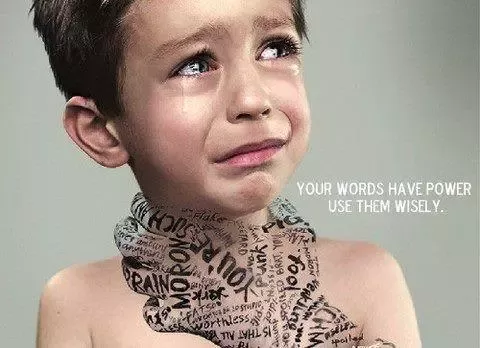
Kids are often cruel, dishing out insults and rude nicknames to those they deem “different.” Sadly, not everyone outgrows this ugly behavior. As C.S. Lewis wrote in The Four Loves,

We hear a great deal about the rudeness of the rising generation. I am an oldster myself and might be expected to take the oldsters’ side, but in fact I have been far more impressed by the bad manners of parents to children than by those of children to parents.

I recently discovered an artist whose music reveals the pain caused by this cruelty. In “Not My Name,” Matt Sassano describes how we can move beyond the wounds of our past. For we all understand these hurtful words possess power.

These are the scars
     that I’m forced to live with,
These are the scars
     that mark me as a misfit . . .

Who among us does not bear scars from past struggles? Who among us has never been ridiculed by others?

Despite having a loving mother who sheltered me from much of life’s traumas, I bear my own scars. That’s one reason this song powerfully resonated with me. 

But there is a stronger reason I am touched by “Not My Name.” It’s because, as a pastor I have seen far, far too many women and men who remain buried beneath their pain.

I found healing in God’s grace. The scars now cause me little discomfort, though the memories remain. And I have found healing often begins when people who have endured life’s onslaughts learn they are not alone. 

This man shares a heart just like their own.

These are the scars
     that I am forced to live with
So pick me apart
I won’t fit the mold that you fit
But thеre’s a warrior inside me
That you playеd a part in building
Because you made me understand.

About staying strong when you’ve fought so long
In a world that tells you you don’t belong
Living in the shadow of all your flaws
Where it’s hard to be seen for who you are.

And, the emotionally and spiritually wounded can see how someone suffering like them can proclaim this liberating truth:

So label me
Call me by my pain
That’s not my name
That’s not my name.

I’m so much more
     than your throw away
That’s not my name
That’s not my name. . . .

You won’t sentence me
Your words are dead to me
I know my suffering
     is not my identity.

As impressed as I was with this song, it means all the more now that I learned something about Sassano’s life.

The Sins of the Father

A short biography reveals some of the reason for Sassano’s plaintive spirit. 

He was the son of an unfit pastor, whose anger and abuse crushed his childhood faith. His search for meaning “was intensified by the experience of living with two disabilities: Cerebral Palsy and dyscalculia (which impairs brain functions like navigation and mathematics).

“I spent much of my early life in and out of doctor’s offices and disability meetings, which led me to struggle with my self-perception and self-esteem.”

It is this tragic youth which directly inspires his video “Dear God.” Released in 2022, it reminds me of the lamentations we find in the Scriptures, particularly the Psalms and Jeremiah. In Madeleine L’Engle’s forward to C.S. Lewis’  lamentations in A Grief Observed, she expresses gratitude for his honest treatment of grief’s violence. 

I am grateful to Lewis for the honesty of his journal of grief, because it makes quite clear that the human being is allowed to grieve, that it is normal, it is right to grieve, and the Christian is not denied this natural response to loss.

I am grateful, too, to Lewis for having the courage to yell, to doubt, to kick at God . . . This is a part of healthy grief not often encouraged. It is helpful indeed that C.S. Lewis, who has been such a successful apologist for Christianity, should have the courage to admit doubt about what he has so superbly proclaimed. It gives us permission to admit our own doubts, our own angers and anguishes, and to know that they are part of the soul’s growth.

The video amplifies the power of the lyrics of “Dear God.” So, do watch it.

I’ve got questions, confessions
I just want peace of mind
Time’s fading and I’m waiting
For something I can’t find
I am overwhelmed
Can I endure this hell?
No way to break the spell
I’ll spill my heart again

Dear God
I’ve lost the will to fight
Please give me a sign
I’m empty inside
Got no strength to carry on
The plague has multiplied
It’s eating me alive
How can I survive?
Dear God

Much like C.S. Lewis’ book describing the loss of his wife, Sassano’s songs can help bring healing to those in similar pain. Even if you don’t need to listen to these songs . . . trust me, there is someone you know and care about, who does!

Some Fresh Words

Here at Mere Inkling our admiration for C.S. Lewis moves us to emulate some of his practices. Thus, we are avid readers and we also enjoy learning new words.

Some of us even enjoy inventing new words. No, we’re not so presumptuous as to desire to wend our ways into the dictionary. We just find this creative game to be both fun and useful for promoting mental health.

The challenge is providing rational definitions for our neologisms. These meanings can be serious or absurd; that doesn’t matter. Here are four I recently devised. (More, from years past, are available in the links I have included above.)

: Zambaloney : noun

A succulent cut of meat served only in skating rinks while the ice is being resurfaced during formal sporting competitions.

: Teguchigulper : noun

The indigenous name for the Honduran species of Chupacabra.

: Belladonut : noun

The presentation of poison derived from the perennial Atropa belladonna in appealing confectionaries. See also, doughnut. 

: Sinderella : noun

The Brothers Grimm story about a beneficent stepmother who learns her two biological daughters are being terrorized by their physically beautiful yet wicked stepsister.

We’re Not Alone

If you have tried your hand at this, or at least think it’s curious, you might be surprised to learn there are online “word generators” that perform at least part of this function. Let me mention a couple before sharing some more of my own inventions.

Unfortunately, some only toss out made up words, in literary isolation. This is the case of Random Word Generator, which did, however, suggest the intriguing word “picneted.”

Nonsense Word Generator “generates nonsense words based on a frequency list of phonemes as they occur in legitimate English words.” They claim “an actual word may slip through occasionally but it should mostly generate pronounceable gibberish.”

Since gibberish isn’t what I’m after, and I haven’t yet found an artificial intelligence website offering what I seek, it’s up to human beings to fill the gap. I hope you enjoy at least one or two of my other neologisms which follow.

New Words & Apropos Definitions 

: Dramadairy : noun

A business offering various products created from camelid milk. Suspense is generated by the uncertainty as to the particular species from the genus Camelus that provided the day’s primary ingredient.

: Sir Mize : proper noun

A minor noble of the Carolingian dynasty noted for his skill at accurately assessing situations despite lacking clear evidence for his hypotheses.

: Fleedom : verb

The attempt to escape restrictions imposed by an autocratic government.

: Califate : noun

The final destiny awaiting those who seek to impose their religion on others by means of violence rather than through thoughtful conversation and compassionate service.

: Hippocampus : noun

Commonly considered a region of the brain, the word originally referred to the special academies where priestesses of Taweret schooled Egypt’s hippopotami to serve Pharaoh.

: Integreation : verb

The process through which individuals or different groups are incorporated into a common whole, resulting in a truly synergistic benefit to all.

: Sinergy : noun

The crippling illusion that one should embrace diverse expressions of evil simply because they have become a standard practice under a decadent worldview.

: Laboratorinthine : adjective

Applied to extremely complex, often inescapable, research and medical facilities hosting arcane experiments on human subjects. See also, “science fiction and horror tropes.”

: Confort : noun, verb

noun : The false sense of security felt by a vulnerable individual who is being successfully deceived by a criminal. See conforter.

verb : The act of pretending to render aid or support to someone in need while laying the groundwork for a malevolent action toward them.

: Pintacostal : noun

Members of an ecstatic religious sect who allege that their ancestors arrived in America in the fifteenth century aboard one of Christopher Columbus’ smaller caravels.

: Calumknee : noun

Defamatory statements, especially directed toward athletes, related to the largest joint in a particular person’s anatomy.

: Commaraderie : noun

The collegiality felt by writers who advocate the use of the Oxford comma in lists of three or more items.

: Peripathetic : adjective

Traveling from place to place and job to job without ever finding the right fit.

: Lyberry : noun

A fruit concoction comprised of berries cleansed with minute amounts of lye water, which can be fatal if mismeasured. Not to be confused with the tragic mispronunciation of “library.”

: Indogtrination : noun

The process of training people to uncritically embrace a canine belief system and obedience to arbitrary and sometimes self-injurious commands. Antonym of catechesis.

: Banalgesic : noun

A drug designed to reduce the pain induced by participating in a banal conversation.

: Farmageddon : noun

Subterranean postapocalyptic nutrient harvesting plants specializing in either edible algae or plant-based meat alternatives (derived from algae).

: Olympipad : noun

Special edition of Apple’s iPad scheduled for release in conjunction with Olympiad XXXIV in Los Angeles in 2028.

And, as a final tribute to that great writers and saints, C.S. Lewis and J.R.R. Tolkien:

: Nearnia : noun

A fantastical world which does not require a Wardrobe to discover, but is as close as one’s own inspired imagination. See also, “Median Earth.”

Inkling Linguistics

Last week I wrote about “Learning Languages,” and I promised to follow up with a related theme – the creation of new words and languages. Let’s consider the simple matter first.

Adding New Words

Anyone can make up a new word. The problem is whether we have enough influence to have it adopted and used by another human being. (I add this qualifier to eliminate those who might attempt to skirt the question by simply training parrots to mimic the new word.) As Scientific American relates, 

When parrots are kept as pets, they learn their calls from their adoptive human social partners. Part of their appeal as pets is their ability to sing lower notes than smaller birds and so better reproduce human voices.

So, while you may be able to trick one of your parrots into repeating a novel “word,” that doesn’t count for our purposes here.

Likewise, any other birds who mimic speech, including musk ducks and corvids (ravens, crows and their ilk). In fact, let’s exclude all nonhuman “speakers” from consideration. After all, AZ Animals introduces readers to seven specific animals of different species (only one of which is avian) whose “forebrain is . . . responsible for some animals’ ability to mimic speech.” 

So, animals aside, who embraces and disseminates newly invented new words? Some words, of course, find a partially prepared or receptive audience because they are imported from other tongues. The global influence of English makes other languages especially vulnerable to its influence, which can be deeply resented. The “corruption” of mother tongues sometimes elicits reactionary responses – such as Italy’s current effort to purge English from the Italian Republic.

And some Italians are extremely serious about the task, proposing fines up to €100000. (That is not a typo; at today’s exchange rate it would be $109,857.50.) Their animus toward English follows the path established by the French, who frequently default to Napoléon’s order to refer to Britain as “perfidious Albion.” The Académie Française goes so far as to repudiate specific words, including business, cash, digital, vintage, label, and deadline.

Vocabulary adopted from other nation’s may be “new” to their most recent users, but such importation is certainly not the same as fabricating novel words from the proverbial “whole cloth.”

True Neologisms

I wrote a moment ago that creating words is easy, but persuading others to use them is quite another thing. I’ve discussed this subject in the past, in “Create a Word Today” and “Creative Definitions.” Sadly – and fittingly – none of my personal neologisms have caught on.

Popular creative writers may, however, find their fancies adopted by larger audiences. Shakespeare’s “bedazzled” was birthed in The Taming of the Shrew. The “chortle” was first heard in Lewis Carol’s “Jabberwocky.” “Pandemonium” was revealed as the capital of Hell in Milton’s Paradise Lost. And the first “Nerd” was encountered in Dr. Seuss’ If I Ran the Zoo.

Some neologists were particularly prolific. How about these few additional examples from the Bard: 

Bandit ~ Henry VI
Dauntless ~ Henry VI
Lackluster ~ As You Like It
Dwindle ~ Henry IV

Oh, and Grammarly adds, “Shakespeare must have loved the prefix un- because he created or gave new meaning to more than 300 words that begin with it.” Can you imagine a world without:

Unaware ~ Venus & Adonis
Uncomfortable ~ Romeo & Juliet
Undress ~ Taming of the Shrew
Unearthly ~ The Winter’s Tale
Unreal ~ Macbeth

Before moving on, it would be fair to note that some voices consider this achievement by Shakespeare to be “a common myth.”

It turns out that Shakespeare’s genius was not in coining new words – it was in hearing new words and writing them down before they became widespread, and in wringing new meaning out of old, worn-out words: turning “elbow” into a verb and “where” into a noun. He didn’t invent the words, but he knew how to use them better than anyone.

C.S. Lewis was not a philologist, but he did create a few novel words. The Inkling scholar who pens A Pilgrim in Narnia has written on this subject here and here.

J.R.R. Tolkien was no slouch at inventing English words himself. Some which now reside in our common vocabulary include hobbit and orc. The latter he derived from an Old English word, orcþyrs, a devouring monster associated with Hell. More surprisingly, Tolkien created the modern word “tween,” albeit in the context of hobbits, who lived longer lives than we.

At that time Frodo was still in his tweens, as the hobbits called the irresponsible twenties between childhood and coming of age at thirty-three.

Envisioning novel words is relatively simple, but inventing an entire language, is an infinitely more complex challenge. The universally acknowledged master is J.R.R. Tolkien, whose Elvish tongue has become a “living” language.* But he was not alone in building internally consistent linguistic systems. Albeit, no philologist came near to Tolkien’s expertise, which included elaborate etymologies.

Before considering Tolkien himself, we will note several other efforts of a similar kind. And, following a discussion of Tolkien, we will conclude with a note about his good friend, C.S. Lewis. For, despite the fact that Lewis was not a philologist himself, it is interesting to note that he too dabbled in creatio linguarum.

Inventing New Languages

Some “constructed languages” are formed with practical purposes. Esperanto, birthed in 1887, incorporated elements from existing languages and was envisioned as a common “international auxiliary language.” It boasts its own flag, and claims to be the native language of approximately a thousand people.

One curious use of Esperanto came in its adoption by the United States Army as the “Aggressor Language” used in twentieth century wargames. The curious can download a copy of the now-rescinded Field Manual 30-101-1, which provided guidance for its usage “which will enhance intelligence play and add realism to field exercises.”

Another genuine constructed language is Interlingua. Developed between 1937 and 1951, it is based primarily on the shared (and simplified) grammar and vocabulary of Western European languages. 

In addition to languages constructed for international use, there are a variety of tongues created for fictional applications. “To learn Klingon or Esperanto” describes how linguistic anthropologist Christine Schreyer “invented several languages for the movie industry: the Kryptonian language for ‘Man of Steel,’ Eltarian for ‘Power Rangers,’ Beama (Cro-Magnon) for “Alpha” and Atlantean for ‘Zack Snyder’s Justice League.’” While none of these could ever rival the languages of Middle Earth, her bona fide linguistic credentials place her in a context similar to J.R.R. Tolkien. The interview reveals how Schreyer balances her creative impulses with her anthropological concerns.

I teach a course on linguistic anthropology, in which I give my students the task of creating new languages as they learn about the parts of languages. Around the time I started doing that, “Avatar” came out. The Na’vi language from that movie was very popular at the time and had made its way into many news stories about people learning the language – and doing it quickly.

My other academic research is on language revitalization, with indigenous or minority communities. One of the challenges we have is it takes people a long time to learn a language. I was interested to know what endangered-language communities could learn from these created-language fan communities, to learn languages faster.

Other fictional languages that exist include R’lyehian (from Lovecraft’s nightmare cosmos), Lapine (from Watership Down), Fremen, the Arabic/alien blending (from Dune), Parseltongue (ala Harry Potter), Dothraki (from Game of Thrones), Ewokese, etc. (from Star Wars), Goa’uld and others (from Stargate), Minbari and more (from Babylon 5), and the gutturally combative Klingon and others (from Star Trek). This brief list is far from exhaustive.

Tolkien, Lewis & New Languages

The languages forged by J.R.R. Tolkien are unrivaled by any conceivable measure one might employ. They are no mere stage dressing, like some of the aforementioned examples. Even those with developed vocabularies and consistent grammar fall far short of Tolkien’s creation. In terms of the histories of his languages, his diligent etymologies beggar all other such efforts. Of course, for Tolkien this was no competition. He was driven to make his languages as flawless – not “perfect,” but realistic – as humanly possible. It was a linchpin in his subcreative labor.

As a skilled calligrapher, Tolkien devised unique alphabets to complement his languages. The letters in his alphabets were not devised as mere adornments. Tolkien left that to lesser imaginations. Nor were his scripts restricted to Tolkien’s fiction. The Tolkien Estate offers an insightful essay on “Writing Systems.”

Tolkien also used invented scripts that were not associated with any of his fictional worlds. An early example is the Privata Kodo Skauta (Private Scout Code), which appears in a still unpublished notebook from 1909 called the Book of the Foxrook. This makes use of a phonetic code-alphabet, as well as a number of ideographic symbols representing full words. . . .

Toward the end of his life, Tolkien made use of the New English Alphabet, a phonetic script that combined the logical structural principles of the Angerthas and the Tengwar with letters that looked more like Greek or Latin. The alphabet has not yet been published in full, but examples can be seen in . . . J.R.R. Tolkien: Artist & Illustrator.

The footnote below links to some resources for those who would like to learn how to speak the languages of the elves. By way of help with pronunciations, remember the following advice:

Use an Italian accent to pull off Quenya speech patterns. In general, you can kind of sound Elvish – even without following the rules of the language – by applying an Italian accent when pronouncing Quenyan words. Native Italian speakers tend to use speech patterns from their native tongues to interpret English words, which can make your Elvish sound practiced even when it isn’t.

Speak with an Irish or Scottish accent to pull off a natural Sindarin accent. Irish and Scottish speakers tend to speak English by emphasizing sounds in the front of a word regardless of the standard pronunciation. This is a pretty good method for pronouncing Sindarin words, since the vast majority of them stress the first syllable.

For those who want to quickly capture some Elvish script without the effort of studying, consider the English to Elvish online translator, which is offered by the company that fashioned The One Ring for Peter Jackson’s cinematic epics. I decided to test the translation tool and posed the question: “Does AI translation of English to Quenya actually work?” The software swiftly complied.

It looks elegantly correct, but unfortunately, I’m unable to personally verify its accuracy. And I must confess to modest trepidation since the site advises:

USE CAUTION BEFORE COMMITTING TO ANY TATTOOS, INSCRIPTIONS AND ENGRAVINGS” [triple emphasis in original].

The Jens Hansen site sells jewelry, as befits the fasioners of The One Ring. In addition to hosting the translator, they offer a free pdf document called Elvish 101 in 5 Minutes. It’s an interesting document, but it reveals a limitation I assume is shared by the online generator. It is a resource for transliterating, not translating, words. Not quite the same thing . . . but the script still looks elegant. 

Tolkien was the master of creating languages for his subcreation, but C.S. Lewis also used the same technique in the writing of his Space Trilogy. Each work focuses on an individual planet in our solar system, which is referred to in the books as the Field of Arbol.

While a number of languages have developed over time, the original language, known as Old Solar, is retained by some, and learned by the series’ protagonist Dr. Elwin Ransom. Ransom is a philologist at Cambridge, and as he is modeled after Tolkien, it’s no surprise his first name means “elf friend.”

In Perelandra, Ransom describes how a language he learned on Mars was once shared by all.

“It appears we were quite mistaken in thinking Hressa-Hlab the peculiar speech of Mars. It is really what may be called Old Solar, Hlab-Eribol-ef-Cordi. . . . there was originally a common speech for all rational creatures inhabiting the planets of our system: those that were ever inhabited, I mean – what the eldila (angels) call the Low Worlds. . . .

That original speech was lost on Thulcandra, our own world, when our whole tragedy [the Fall] took place. No human language now known in the world is descended from it.”

Lewis’ use of Old Solar is sparing, but a partial lexicon can be found at FrathWiki. There, for example, you will learn that “honodraskrud” is Old Solar for a “Groundweed; an edible pinkish-white kind of weed, found all over the handramit” of Malacandra (Mars).

The accomplishments of Tolkien and Lewis are difficult to compare. These two brilliant scholars shared a great many interests, but wrote with far different goals. We rightfully expect genius to vary between such individuals. This is well illustrated by their differing treatments of constructed languages, as Martha Sammons describes so well in War of the Fantasy Worlds.

Tolkien began with invented languages and then developed an elaborate mythology to create a world where his languages could exist. Lewis’s works began with mental pictures; he would then find the appropriate ‘‘form’’ to tie together the images. . . .

[Tolkien’s] penchant for historical and linguistic detail is unparalleled. In contrast . . . Lewis uses just enough language, geography, and science to make his novels believable.

While either approach may inspire those among us who aspire to writing, we best avoid attempting to emulate either author. Best, I believe, to compose our epics with the language that most naturally flows from our pen.


* While some fans of Klingon and Na’vi may learn to speak in those tongues, the students of the languages of Arda, typically possess greater ardor for the languages of Middle Earth. For example, an online guide to learning Elven languages begins by answering the question, “why study Elvish?” And a free online course for learning Quenya is offered here. Among the Quenya dictionaries, the finest free example is available at Quenya-English Dictionary English-Quenya Dictionary.

Learning Languages

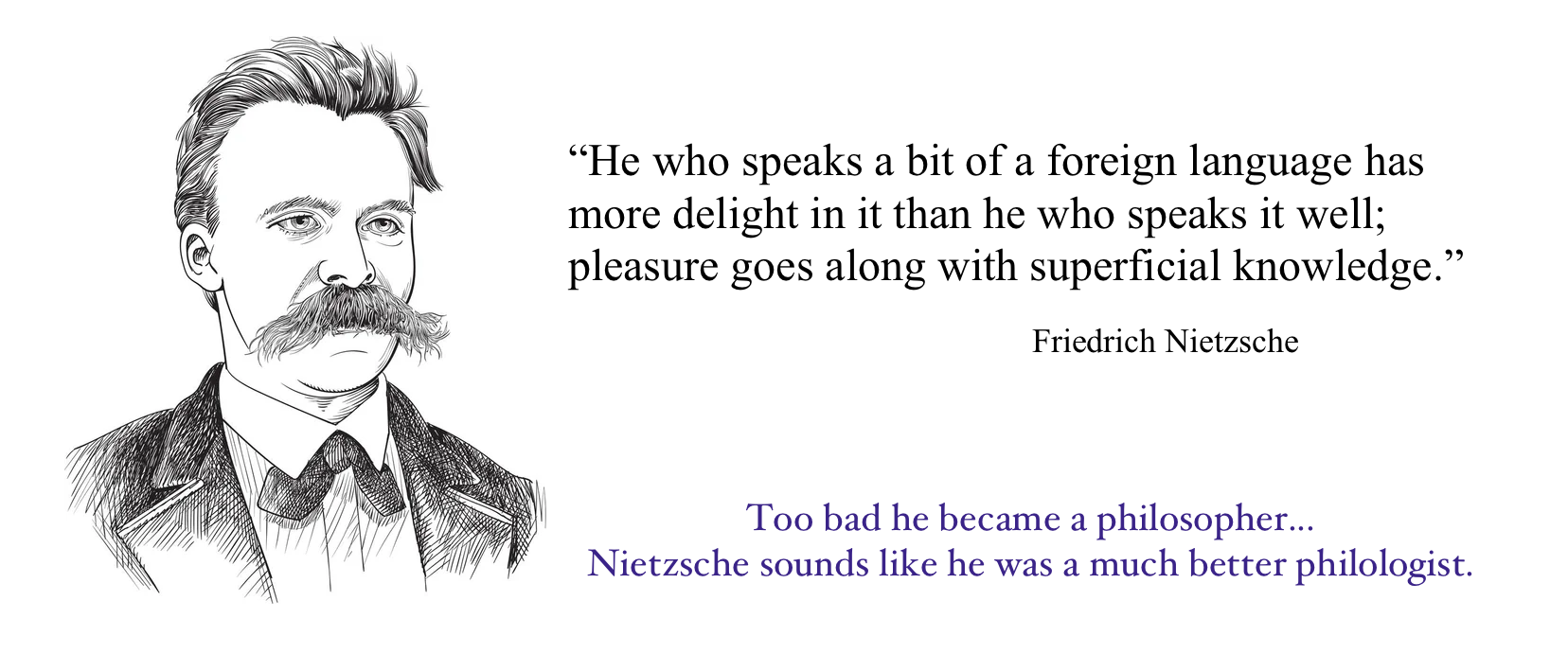
C.S. Lewis possessed a gift for languages. Although he was not a philologist like his friend J.R.R. Tolkien, Lewis was well educated and read and spoke a variety of languages.

In fact, when he and his wife played Scrabble, they allowed for the use of words from any language! For the record, though, he does confess to a German professor that his grasp of that tongue is “wretched.”

The only bona fide genius I’ve known was a classmate at the University of Washington. While I was struggling with classical Greek, in preparation for seminary, at the age of 23 Bruce already possessed four master’s degrees and was closing in on his PhD in Linguistics. He spoke fifteen languages, but could read nineteen.

Of course, that is still a small portion of the 7,168 languages Ethnologue tells us are in use today.

This enormous number – which doesn’t include unknown languages spoken among untouched people groups – accounts for the fact that thousands of Christians are laboring now in groups such as Lutheran Bible Translators to make the Scriptures available to all people.

Sometimes this involves creating a written language itself, where only an oral version exists. The largest such organization, Wycliffe Global Alliance, reports that “Bible translation is currently happening in 2,846 languages in 157 countries.”

While the Bible’s translation is certainly of utmost importance, it is wonderful to know that other valuable literature is also made available to readers who could not decipher the language in which it was originally composed. 

Lewis, in fact, was a translator in his own right. Beyond the literal translation of works from one tongue to another, Lewis also functioned as a “translator” of complex concepts and eternal truths. I once described this as C.S. Lewis’ bilingualism.

How many extremely intelligent and well educated people do you know . . . who can actually communicate with those of us possessing normal human intelligence? That talent is a rarity.

And it is precisely what makes C.S. Lewis such an unusual man. He was brilliant. Yet he could communicate with the common person – even the child – just as easily as he conversed with his fellow university dons.

C.S. Lewis mastered a number of modern languages, but it was his study of historic languages that especially inspired him. Icelandic, with its similarity to Old Norse, is one example about which I have written. 

. . . J.R.R. Tolkien and his friend C.S. Lewis established a group called Kolbitár which was devoted to reading Icelandic and Norse sagas. The word itself means “coal biter” and refers to those in a harsh environment drawing so close to the fire’s warmth they can almost bite the coals.

Another example is Old English. Along with Middle English, birthed by the Norman Conquest, these were essential elements of his training as one of the preeminent English scholars of Oxford and Cambridge. And these languages were not merely dusty relics. I encourage the curious to read “C.S. Lewis’s Unpublished Letter in Old English,” which appeared in the journal VII.

In 1926 C.S. Lewis wrote his friend Nevill Coghill a letter in Old English, a language also known as Anglo-Saxon. Unreadable for most current readers of Lewis, it understandably does not appear in his three-volume Collected Letters.

In the essay, George Musacchio provides an illuminating outline of Lewis’ diverse expertise with languages, both “foreign and domestic.” Lewis began the letter to his friend with the following salutation.

“Leowis ceorl hateð gretan Coghill eoorl luflice ond freondlice.”
Which translates as: “Lewis the churl bids to greet Coghill the earl.”

Is English Really that Difficult to Learn?

English is reputed to be one of the most challenging languages to learn. (More on this in a moment.) For example, the simple sentence which follows consists of a mere seven words, but holds seven different meanings, dependent upon which word is emphasized.

“I never said she stole my money.”

This example comes from an article entitled “English is Hard, But Can Be Understood Through Tough Thorough Thought Though.”

Rosetta Stone answers the question of how hard it is to learn English by saying “it depends on your first language.” 

In addition to the fact that “spelling is a poor indicator of pronunciation,” English possesses numerous “specific rules,” and complements this burden with the fact that “some rules have lots of exceptions.” The complexity is due to the language’s history, which also gave rise to its mammoth vocabulary.

English has a lot of words—Webster’s English Dictionary includes approximately 470,000 entries, and it’s estimated that the broader English vocabulary may include around a million words. . . .

English has such a broad vocabulary because it’s a blend of several different root languages. While English is a West Germanic language in its sounds and grammar, much of the vocabulary also stems from Romance languages, such as Latin, Italian, Spanish, and Portuguese.

One result of combining these various root languages is that the English vocabulary includes a ton of synonyms . . . And unfortunately, most of these synonyms aren’t fully interchangeable, so the exact word you choose does have an impact on the overall meaning.

It turns out English doesn’t even rank in the top three most difficult languages for the speakers of the five largest language groups. The ranked listings do include, however, Arabic, Japanese, Russian, and Mandarin.

So, let’s reverse the question for a moment. Which languages are the most difficult for a native English speaker to learn? Unbabel lists ten. Fortunately, only one of them is on my wish list.

Babbel Magazine has an article approaching that question from the opposite end. Which language is easiest for English speakers to learn.

This may come as a surprise, but we have ranked Norwegian as the easiest language to learn for English speakers. Norwegian is a member of the Germanic family of languages — just like English! This means the languages share quite a bit of vocabulary, such as the seasons vinter and sommer (we’ll let you figure out those translations).

Another selling point for Norwegian: the grammar is pretty straightforward, with only one form of each verb per tense. And the word order closely mimics English. For example, “Can you help me?” translates to Kan du hjelpe meg? — the words are in the same order in both languages, so mastering sentence structure is a breeze!

Finally, you’ll have a lot more leeway with pronunciation when learning Norwegian. That’s because there are a vast array of different accents in Norway and, therefore, more than one “correct way” to pronounce words.

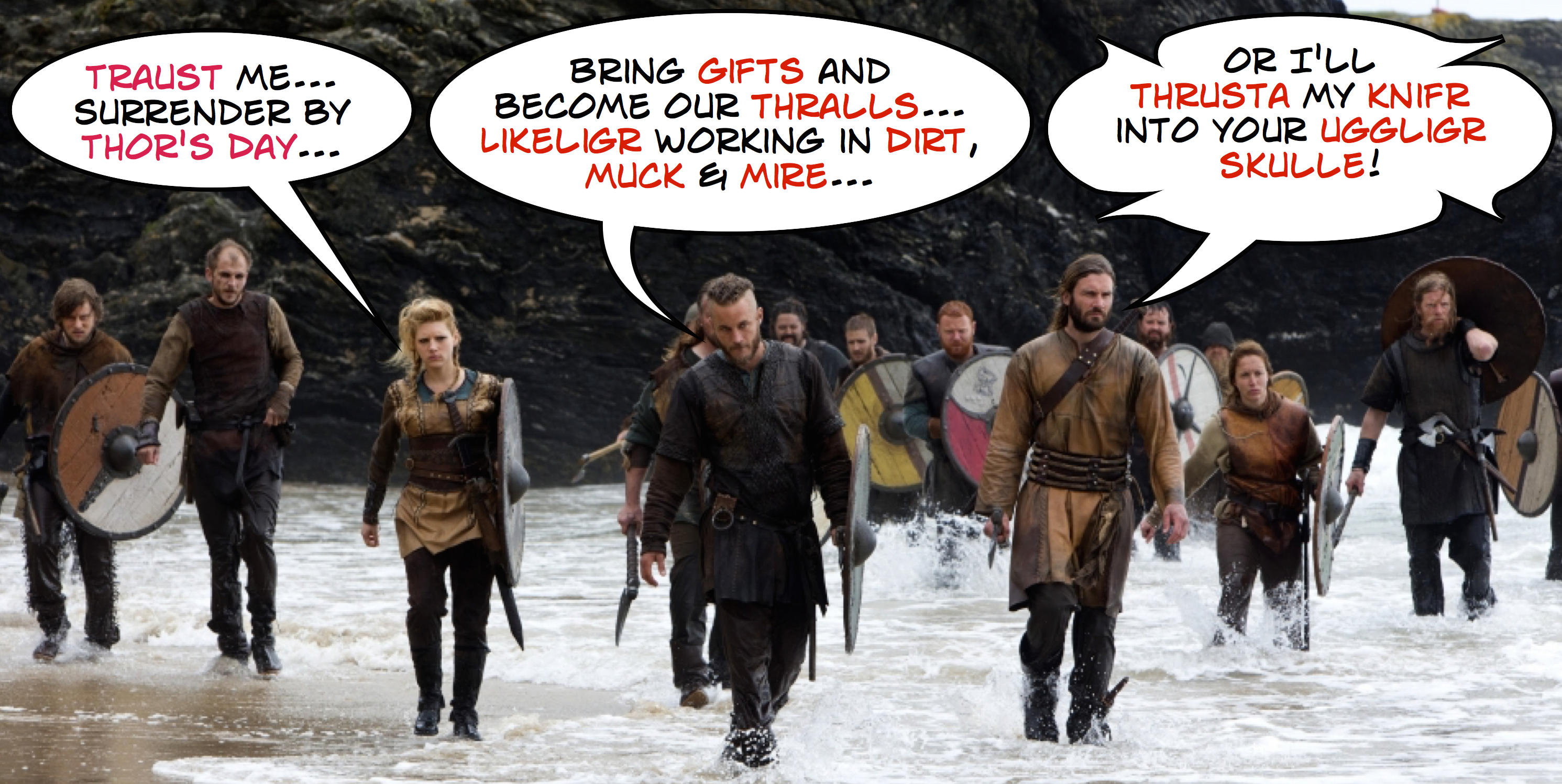
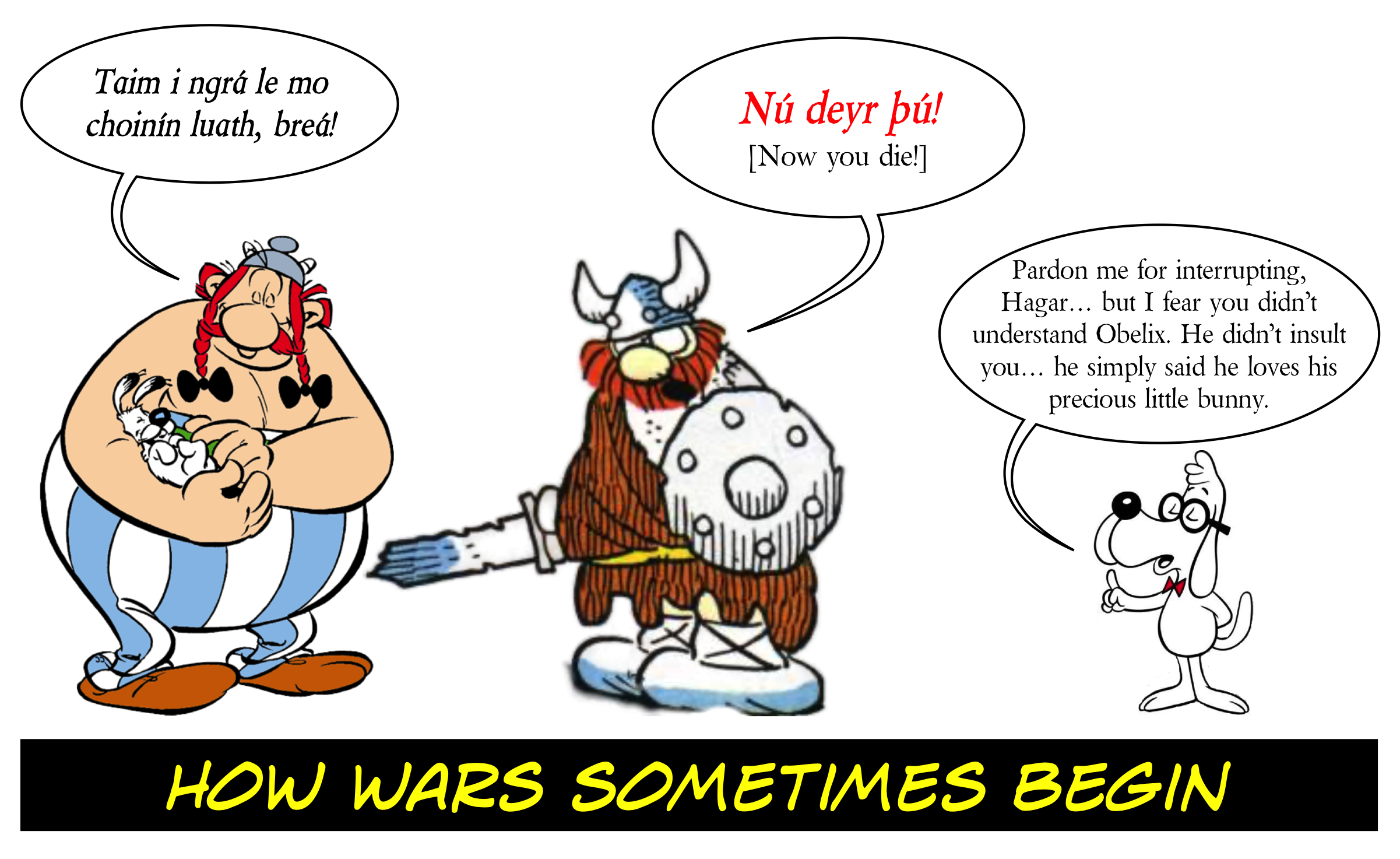
An article I wrote seven years ago hints at that same conclusion. I made this informative, and mildly threatening, illustration for “Norse Linguistic Invasion.”

Oxford Royale Academy lists several reasons why English is especially challenging to new students. The following issue of “irregularities” also plagues countless native speakers.

One of the hardest things about English is that although there are rules, there are lots of exceptions to those rules – so just when you think you’ve got to [come to] grips with a rule, something comes along to shatter what you thought you knew by contradicting it.

A good example is the rule for remembering whether a word is spelt “ie” or “ei:” “I before E except after C.” Thus “believe” and “receipt.”

But this is English – it’s not as simple as that. What about “science?” Or “weird?” Or “seize?”

There are loads of irregular verbs, too, such as “fought”, which is the past tense of “fight”, while the past tense of “light” is “lit.” So learning English isn’t just a question of learning the rules – it’s about learning the many exceptions to the rules.

The numerous exceptions make it difficult to apply existing knowledge and use the same principle with a new word, so it’s harder to make quick progress.

And even some of the normative “rules” are difficult to grasp. One example is that there’s a very specific order that adjectives must be listed ahead of a noun. According to Rosetta Stone,

The adjective order is: quantity, opinion, size, age, shape, color, origin/material, qualifier, and then noun. For example, “I love my big old yellow dog.” Saying these adjectives in any other order, like “I love my yellow old big dog,” will sound wrong, even when otherwise the sentences are exactly the same and communicate the same thing. Keeping rules like this in mind can be tricky, and it takes a lot of practice to get it right.

Adjective order is seldom considered, in part because it’s not considered good writing to string too many such words together. But apparently there are right and wrong ways to organize any such list.

Royal Order of Adjectives

Most students aren’t taught about adjective order in school and instead learn it through listening and reading. In English, the rules regarding adjective order are more specific than they are in other languages; that is why saying adjectives in a specific order sounds “right,” and deviating from that order makes a statement sound “wrong,” even if it’s otherwise grammatically perfect.

And, since we’re talking about English, even this Royal Order of Adjectives rule has exceptions

The hierarchy is not absolute, and there is some wiggle room among the “fact” categories – size, age, and so on – in the middle.

Native speakers are often delighted when they learn about this law and discover how flawlessly they apply it. It even went viral in 2016 . . . The tweet attached a paragraph by etymologist Mark Forsyth . . . giving an example that uses all the categories according to the OSASCOMP hierarchy: “a lovely little old rectangular green French silver whittling knife.”

I do not ever recall being taught (or reading on my own) about the “Royal Order of Adjectives.” Nevertheless, I don’t feel too embarrassed at acknowledging my previous ignorance, since even Lewis himself was comfortable in expressing gratitude for being introduced to new words. For example, when he thanked Dorothy Sayers for enlarging his vocabulary with her work on Dante.

So, is English all that challenging? Well, C.S. Lewis did his part to make it less daunting, joining a public debate in Britain, with an unexpected argument. Discussing English’s previously noted problem with inconsistencies and confusion in spelling, the don offered a simple solution.

In a column on Lewis and the history of words, I included an extended passage from a letter Lewis wrote challenging a contemporary British effort to “reform” spelling. Surprisingly, he argued against the necessity for uniformity in spelling. After explaining why our language functions as it does, he advocates:

As things are, surely Liberty is the simple and inexpensive ‘Reform’ we need? This would save children and teachers thousands of hours’ work.

Surely all but the most diehard grammarians would be sympathetic to his argument.

Next week I plan to write about another linguistic matter closely associated with the Inklings – the creation of new words and languages.

Please Forgive My Sesquipedalianism

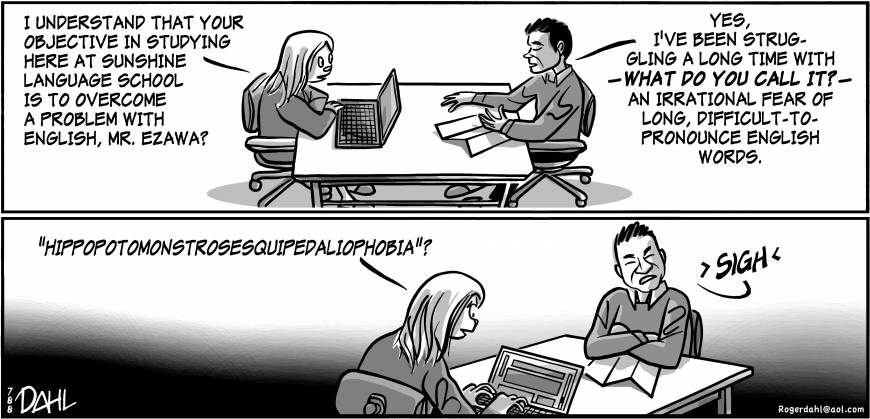
Long words can be daunting. Even for native speakers. The illustration above comes from The Japan Times, and reveals how the challenge is magnified for others.

I love learning new words. And, since these treasures frequently drift out of my vocabulary because I fail to use them, I often have the joy of re-learning unique words.

Sesquipedalianism is actually a genuine word which can be validly applied in a variety of settings. After all, haven’t we all encountered a sesquipedalianist or two, who uses especially long, and occasionally obscure words?

How many syllables are required before a word grows too long? To a monosyllabic individual, two might be deemed excessive.

Seriously, it’s not the length of a word that matters, it’s the word’s familiarity. For example, “familiarity” has six syllables, and everyone reading Mere Inkling knows its meaning. (I resisted saying “is familiar with . . .”) On the other hand, “carbuncle” is only trisyllabic, and yet the only people likely to know its definition are either those in medical professions, or unfortunate individuals who have suffered from one.

But it’s not only unfamiliarity that causes confusion; misunderstanding can result from a lack of context. Let’s take “trisyllabic,” a word even an active reader seldom encounters. As used in the paragraph above, the context (along with the prefix and root), provide us with more information than a person needs to recognize its meaning.

In a famous letter from 1956, C.S. Lewis included the following advice:

Don’t use words too big for the subject. Don’t say “infinitely” when you mean “very”; otherwise you’ll have no word left when you want to talk about something really infinite.

Great advice, just as one would expect. However, this does not constitute a blanket rejection of “big words.” Lewis is simply reminding us that our prose must not be more complicated than it needs to be. Thus, the title of this column uses a precise word – rather than saying “Please Forgive My Practice of Using Long and Sometimes Obscure Words” – since Mere Inkling readers are quite capable of uncovering a definition if a particular word is unfamiliar.

Plus, as I hinted above, many of us enjoy expanding our vocabularies.

In the aforementioned correspondence, Lewis offered additional useful advice. Another dictum is: “Always prefer the plain direct word to the long, vague one. Don’t implement promises, but keep them.”

Here too the great writer is astute. However, this caution is not actually about the length of words. Lewis’ desire for clarity in communication leads him to reject “vague” words, which coincidentally happen to be longer than those he refers to as “direct.”

Using longer words than necessary is not, of course, always a good thing. While it comprises neuron-stretching play for word lovers, it can easily be misperceived by others as “showing off.” (Note: I’m not defending those cases in which the writer or speaker really are attempting to impress others with their verbal dexterity.*)

You can easily find collections of the longest words in English. While some cheat, including “supercalifragilisticexpialidocious,” others are more scrupulous. Despite doing just that, I like the list at grammarly because of their definition of one of the words they include.

Floccinaucinihilipilification
The estimation of something as valueless. Ironically, floccinaucinihilipilification is a pretty valueless word itself; it’s almost never used except as an example of a long word.

I’m not currently planning on adding floccinaucinihilipilification to my personal vocabulary, but don’t let me dissuade you from doing so.

Learning new words often reaps extrinsic benefits. As a historian who enjoys learning about the Latin language, I found the following definition, and illustration, from the Cambridge dictionary quite interesting.

The act of considering something to be not at all important or useful – used mainly as an example of a very long word:

The honor of being the longest non-technical word goes to floccinaucinihilipilification.

The word . . . is “an 18th-century coinage that combines four Latin prefixes meaning ‘nothing.’”

Oh, and one final suggestion. When visiting the Cambridge site, in the likelihood you’ll someday wish to use this word in conversation, take a moment to make certain you learn to pronounce in the U.K. or American manner, as appropriate for your location.


* I am not here referring to the Irish bred Bay Colt for some curious reason named “Verbal Dexterity.”

C.S. Lewis & Rigmarole

I hope my confusion is not due to a decline in my mental faculties. But it seems to me politicians are becoming even more incoherent than they’ve always been.

Is it me? Or, are you also amazed at how some of them appear to be babbling half the time?

C.S. Lewis was a master of communication. And some of his observations about how poorly some people communicate can be insightful.

Listen to this verse from a poem entitled “The Prudent Jailer” which he wrote in 1947. (It deserves to be read out loud.)

Some walls cannot a prison make
Half so secure as rigmarole.*

Lewis wasn’t referring to political jargon when he wrote this poem, but it seems quite apropos in a number of contexts.

For example, consider a recent article from the American Institute for Economic Research. Jon Sanders applies Lewis’ poem to foreboding aspects the government’s response to the pandemic.

The poem originated not in political allegory, but as a critique of unimaginative literary criticism. Notwithstanding, the Jailer is a diabolical figure, and his prudence is this: he imprisons with words, not walls. . . .

The Jailer has them imprisoned by their own thoughts, while he keeps them focused ever on the presumption of a prison. He doesn’t want them thinking of anything else.

This post isn’t about politics. I detest the subject as a whole, and find it particularly corrosive to conversation as elections draw near.

The verse I cited above simply evoked for me the power of words to distort and, yes, imprison. Lewis’ use of rigmarole⁑ (a word sadly out of vogue) highlights the fact that the crippling words themselves are often nonsensical.

Other colorful synonyms that we might hear in the company of our seniors could include balderdash, poppycock, or perhaps even malarkey.

In a 1940 letter to Dom Bede Griffiths, Lewis applies “balderdash” to describe art and literature done “for their own sake.”

I do most thoroughly agree with what you say about Art and Literature. To my mind they are only healthy when they are either (a) Definitely the handmaids of religious, or at least moral, truth – or (b) Admittedly aiming at nothing but innocent recreation or entertainment. . . .

But the great serious irreligious art – art for art’s sake – is all balderdash; and, incidentally, never exists when art is really flourishing.

Fortunately, such words rarely become completely obsolete.

A noteworthy mythopoeic⁂ scholar, Brenton Dickieson, used “balderdash” quite skillfully not that long ago.

“The Prudent Jailer” was originally published in 1947 under the mundane title, “The Romantics.”

Since you’ve read this column to its conclusion, allow me to reward your diligence by presenting the poem in its entirety.

The Prudent Jailer

Always the old nostalgia? Yes.
We still remember times before
We had learned to wear the prison dress
Or steel rings rubbed our ankles sore.

Escapists? Yes. Looking at bars
And chains, we think of files; and then
Of black nights without moon or stars
And luck befriending hunted men.

Still when we hear the trains at night
We envy the free travelers, whirled
In how few moments past the sight
Of the blind wall that bounds our world.

Our Jailer (well may he) prefers
Our thoughts should keep a narrower range.
‘The proper study of prisoners
is prison,’ he tells us. Is it strange?

And if old freedom in our glance
Betrays itself, he calls it names
‘Dope’-‘Wishful thinking’-or ‘Romance,’
Till tireless propaganda tames.

All but the strong whose hearts they break,
All but the few whose faith is whole.
Some walls cannot a prison make
Half so secure as rigmarole.


* Thank you to Jon whose comment below pointed out the connection between Lewis’ allusion to the very famous poem “To Althea, from Prison,” written by Richard Lovelace in 1642. “Stone walls doe not a prison make, Nor iron bars a cage…”

⁑ Some people in the States will be more familiar with the variant “rigamarole.”

⁂ Mythopoeia is a modern literary genre in which the author creates a fictional mythology. The finest example of such writing comes from the pen of J.R.R. Tolkien, the creator of Middle Earth.