Literary Translators Beware

Translating literature from one language to another is a valuable, yet often undervalued, skill. It breaks the linguistic shackles restricting the benefits of good books to those literate in the language in which they are composed.

You can think of it this way. Without the dedicated efforts of translators, someone familiar only with English – e.g. as is, sadly, the case with most Americans – could never read the works of ancient Greeks or Romans. Asian philosophy such as the Four Books and Five Classics of Confucianism would be virtually unknown in the West.

Even contemporary literature from most of the world would be beyond our access. And, obviously, God’s written Word would only be accessible to those who mastered Hebrew, Aramaic, and Greek.

While C.S. Lewis is seldom thought of as a translator, it was indeed one of his talents. That doesn’t mean he devoted serious energy to translation. That was not his vocation. On the contrary, in 1945 he wrote: “People praise me as a ‘translator,’ but what I want is to be the founder of a school of ‘translation.’” (I discussed this a number of years ago in “C.S. Lewis’ School of Translation.”)

Dedicated translators have played an invaluable role throughout recorded history. A number of people still make translation their life’s labor. Yet, there are dark clouds on their horizon.

Is there a Future for Translation by Human Beings?

A recent literary journal alerted me to advances in artificial intelligence, which now jeopardize the future of professional translators. 

Back in 2023, an article in Forbes compared the respective advantages and challenges of the two methods. They accurately identified one distinction between a truly fluent human and an artificial substitute.

Language is complex, and culturally specific expressions such as idioms and metaphors, as well as ambiguous or ungrammatical sentences and other context-dependent word choices, can be challenging for AI algorithms.

Unsurprisingly, that same year the American Translators Association offered a more critical opinion in “Machine Translation vs. Human Translation: Will Artificial Intelligence Replace the World’s Second Oldest Profession?

We already mentioned that computers don’t possess our human capacity to comprehend meaning. The creative process, especially when it comes to translation, is the pinnacle of meaning. Human translators translate meaning, not words. The art of translation is understanding the meaning of the original text and then transforming it into something that communicates the same message (or evokes the intended emotion) but might not superficially look like an exact equivalent. . . .

But both now and then, professional translators are here to stay. Equipped with unique human skill and a toolbox full of tech, they’re ready to continue helping the world navigate the tricky business of multilingual communication – transporting messages appropriately, creatively, consistently, and securely to whatever audience you aim to reach. 

In short: machine translation can help when it doesn’t count, but professional human translation is there for you when it does.

Related to expressly literary translations, in contrast to mundane subject matter, the current issue of Poets & Writers contains a piece titled “AI Threatens Literary Translation.” When a European subsidiary of Simon & Schuster announced they would begin limited use of AI for this purpose,

Reactions rose in a flurry: Writers, publishers, and translators contended that AI would produce “bland” work. They lamented the possibility of lost jobs. The European Council of Literary Translators’ Associations resisted the standardization of an idiosyncratic process, stating that the imagination, understanding, and creativity that translation demands are “intrinsically human.”

This informative essay acknowledges that “AI isn’t new to translation either. Literary translators sometimes input segments of their source text into AI-based technologies . . . to generate ideas for particularly thorny passages. But these tools have to be used ‘very carefully . . . because the translations it produces are error-ridden and devoid of flow or beauty.’”

A Quick Experiment with AI Translation

Before completing this post I took a brief (less than ten minute) excursion to ChatGPT to experiment with their translation tool.

The results appear below (all produced in a mere handful of minutes). First I asked the AI to compose a sonnet on the subject of translation. Then I requested translations of that sonnet in five different languages. I have included the sonnet and the final two lines of each translation below.

You can perform a more elaborate experiment yourself, especially if you are familiar with more than one language. This would enable you to compare the accuracy of the translation. Or, perhaps one might take a translated version and translate that back into the original language, to see how closely it relates to the starting point.

In my experiment, the AI was constrained by needing to maintain the original’s form as a sonnet. I assume that if it were simply a literal translation, it may have modified the vocabulary and grammar. Each translation included footnotes. To illustrate how elaborate some of these notes were, I’ve reproduced those which appeared with the translation into Aramaic.

Frankly, if this is what these early AI prototypes are capable of, it appears to me that professional translators may truly have something to be worried about.

The Sonnet

In languages vast, where meanings hide and shift,
A translator’s art gives voice to what is known.
Through words, they bridge the gap, a timely gift,
To carry thought from one to others’ throne.

The rhythm, tone, and essence all must stay,
Though words may bend, they still must hold their grace.
A careful hand must guide the text’s relay,
To keep its heart while moving through time and space.

Yet oft the meaning’s lost in fleeting sound,
Or tangled in the strings of foreign speech.
But still they strive, where words and thoughts are bound,
To bring the message close, within our reach.

A translation’s not just words that blend –
It’s worlds revealed, with meaning without end.

~ Latin ~

Translatio non est solum verba iuncta –
Sed mundi patent, et mens non est puncta.

~ Old English ~

Nis anginn of wordum gemenged anum –
Ac worulda onwreah, and andgit ne swylt.

~ Classical Greek ~

Οὐ γάρ μόνον λέξεις αἱ μεταφράσεις,
ἀλλὰ κόσμοι φαίνονται, ἄνοια οὐδέποτε.

~ Middle Egyptian ~

𓏏𓂋 𓅓𓏏 𓊪 𓏏𓏤 𓆑𓏏 𓊵𓏤,
t r mt ḏbꜥ t ft ḏbꜥ
(“A translation’s not just words that blend –”)

𓂋 𓅓𓏏 𓆑𓏏 𓊵𓏤 𓏏𓏏𓀀.
r mt ft ḏbꜥ t t
(“It’s worlds revealed, with meaning without end.”)

~ Classical Aramaic ~

ܬܪܓܡܐ ܠܐ ܗܘܐ ܒܠܚܘܕ ܡܠܐ ܕܡܬܚܠܛܢ,
ܐܠܐ ܥܠܡܐ ܡܬܓܠܝܢ، ܘܡܕܡ ܠܐ ܚܒܠ.

Notes on the Translation:
1. Classical Aramaic Grammar & Style: The sentence structure follows Classical Aramaic syntax as used in ancient texts. Some phrases had to be adapted poetically since direct translations of modern concepts do not always exist.
2. Vocabulary Adjustments: “Translator” = ܡܬܪܓܡܢܐ (metargemana), a direct and historically accurate term. “Translation” is expressed as ܗܫܬܘܪܬܐ (hishtorta), meaning “interpretation, explanation.” “Essence” is translated as ܡܗܘܬܐ (mehutā), meaning “nature, essence.” “To bridge the gap” = ܡܫܬܪܝܢ ܓܦܐ (meshatrin gapé), literally meaning “to stretch wings” (a poetic expression).
3. Preserving the Poetic Flow: The rhythm and parallel structure of the original sonnet were carefully kept. Adjustments were made for metrical and phonetic balance in Aramaic.
4. This version captures the spiritual and poetic depth of the original while remaining faithful to the Classical Aramaic linguistic style.
5. Would you like an audio recording or a version in Syriac script for authenticity? Let me know how you’d like to refine it!

And all of this in ten minutes. Unfathomable . . .
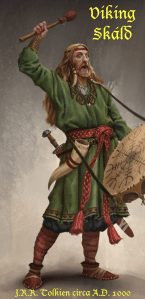
The Viking Explanation for Lame Poetry

During the middle ages, Scandinavia’s skálds were poets, storytellers and even musicians. They were the equivalent of bards in medieval British and Gaelic culture. They were oral historians, committed to memorizing their paeans verbatim, which was simpler since they were in poetic form. Not all skálds possessed the talents to create their own memorable epics. These lesser poets, so to speak, could still memorize and recite the classic or popular songs.

A graphic explanation for the difference in the talents of the first tier skálds and their inferiors is found in the Prose Edda which was written by Snorri Sturluson (1179-1241). Sturluson compiled Norse myths in his Edda, and the sagas of her kings in Heimskringla.

The second part of the Prose Edda is entitled Skáldskaparmál, which means the language of poetry. One of the myths it contains describes the Mead of Poetry. Mead, of course, is the rich Viking beverage created by fermenting honey.

As for poetry, I’ve written about it fairly often. (Most recently in respect to my “winning” entry in a Terrible Poetry Contest.) I’ve even offered genuine, albeit feeble, attempts at the art myself. Alas, if I were a classical Greek I would say my Muse is Clio (the Muse of History), rather than Thalia or Erato, Muses of various genres of poetry.

It is well known that C.S. Lewis himself was a frustrated poet. While his literary criticism and historical work was highly respected—and his Christian works are still revered—his poetry never received a warm reception. The Poetry Foundation offers a useful article on the subject here.

My personal opinion is that I am thankful Lewis’ energies were devoted to more profitable fields of writing.

Back to the Vikings

C.S. Lewis and several other Inklings were enamored with Northern sagas. I have touched on this in the past, and discussed the amazing fellowship gathered by J.R.R. Tolkien, as a sort of precursor to the Inklings.

Tolkien named the group Kolbítar, which denoted “Coalbiters,” or Norse storytellers who gathered close to the fire as they discussed the stories of their ancestors. This exploration of Icelandic literature was connected to Tolkien’s conviction, as a professor of Anglo-Saxon, that these works belonged within the study of the English canon.* Old Norse definitely left a mark on English, as I’ve discussed here at Mere Inkling.

In Song of the Vikings: Snorri and the Making of Norse Myths, Nancy Marie Brown gleans some insights about Kolbítar from Lewis correspondence. They gathered to read the literature aloud.

They began with Snorri’s Edda. Reading it in Icelandic was slow going but addictive, Lewis recalls: “Hammered my way through a couple of pages in about an hour, but I am making some headway. It is an exciting experience.” Lewis . . . had also been smitten as a boy by “pure ‘Northernness’” [and] popular versions of Snorri’s tales had inspired Lewis to write an adolescent tragedy about the Norse gods, “Loki Bound.”

There is no record of what the members of the Kolbítars thought of the myth of the Mead of Poetry, but I would imagine that they found its crass distinction between gifted and stumbling poets quite—Norse. To set the stage for the following passage, one should know: (1) the Aesir were the Old Norse gods, (2) Suttung was a Jötunn (belonging to a race of giants at war with the Aesir), (3) Suttung was in possession of the magical mead of poetry, which Odin stole through cunning but immoral means, swallowing all of it, (4) Odin changed into an eagle to effect his escape, and Suttung followed him in the same form, and (5) the Aesir prepared large vessels to receive the disgorged magical mead. Now, from the Edda itself:

When the Æsir saw Odin flying, they placed their vats in the courtyard, and when Odin entered Asgard he spat the mead into the vats. It was such a close call, with Suttung almost catching him, that he blew some of the mead out of his rear. No one paid attention to this part, and whoever wanted it took it; we call this the bad poets’ portion. Odin gave Suttung’s mead to the Æsir and to those men who know how to make poetry. For this reason we call poetry Odin’s catch, find, drink or gift, as well as the drink of the Æsir.

No one said the Norse were above using crass humor. Still, it does offer a quite imaginative explanation for the differences between exceptional and mediocre poets, doesn’t it?


* Tolkien “loved the cold, crisp, unsentimental language of the sagas, their bare, straightforward tone like wind keening over ice. Reading Snorri and his peers was more important than reading Shakespeare, Tolkien argued, because their books were more central to our language and our modern world” (Song of the Vikings).

Norse Linguistic Invasion

vik
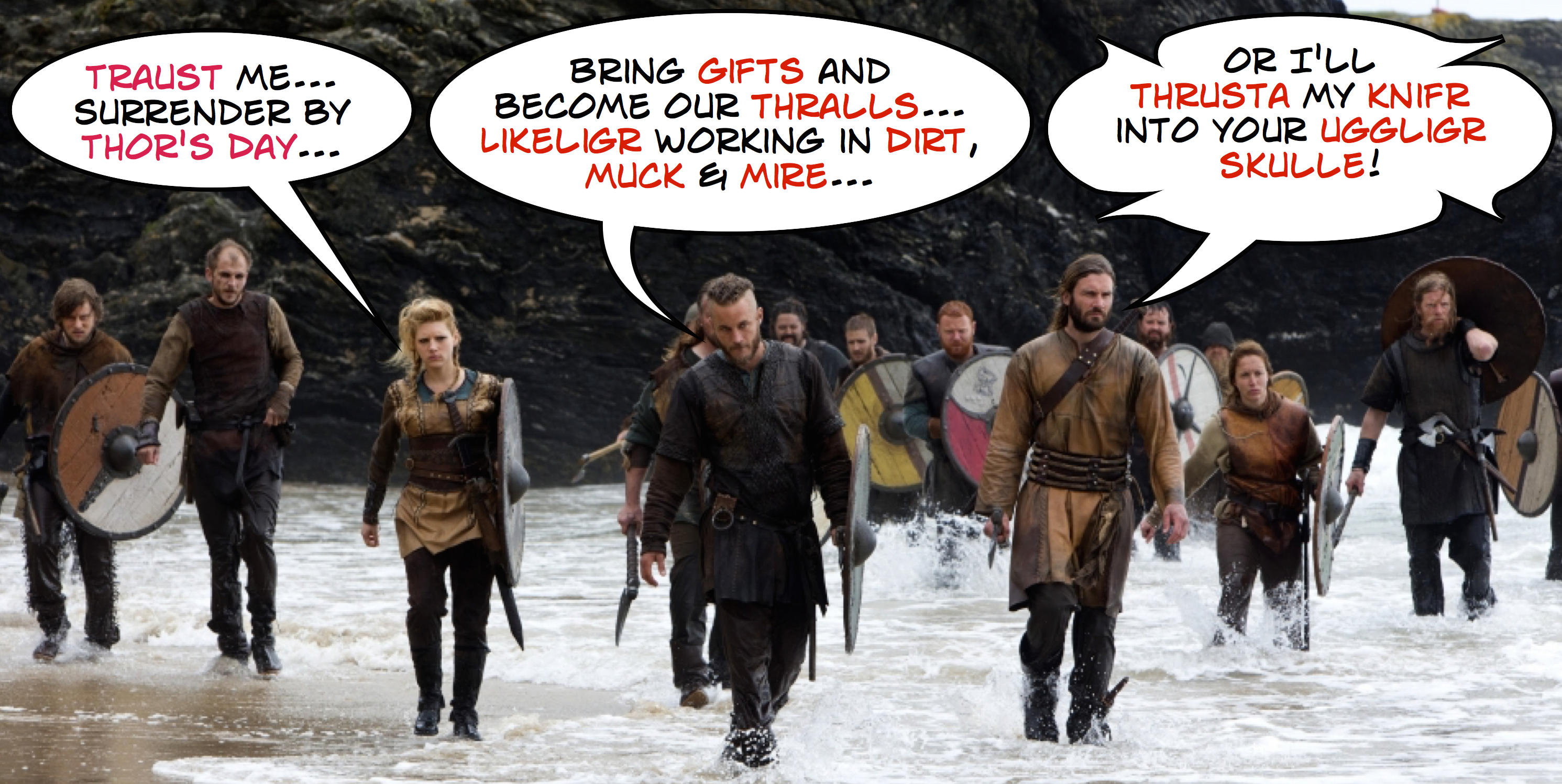
The initial Viking incursions into England were violent, but they left a colorful linguistic legacy in their wake.

Victims of the onslaught, like the unfortunate monks of Lindisfarne, paid a steep price, but the Norse eventually became farmers and craftsmen like the people they initially displaced.

Their contribution to the British gene pool was small, as was their donation to the English language, but it was not insignificant.

Some of the words fit the Viking mystique. Klubba becomes club (as in the weapon, not the association). Rannsaka may have initially meant searching the house for something like your missing keys, but the English experienced it as ransack. And slatra transfers into slaughter. The original word means “to butcher,” and one wonders if it originally applied to meal preparation. It so, the decades of Norse raids modified that focus.

Other adopted words arose from the more peaceful pursuits of the Scandinavians. Bylög meant the laws of the village and became bylaw. Law itself comes from the Norse lag. Husband, skill, thrift, litmus and loan have Viking roots. Those who enjoy a great slice of beef can thank them for their “steak” as well, since steik was their term for frying meat.

The Inkling Affection for the Sagas

J.R.R. Tolkien was actually a Professor of Anglo-Saxon at Oxford. He founded a society devoted to the study of Icelandic and Norse sagas called Kolbitar (Coalbiters).* C.S. Lewis joined him in the group, which preceded the development of the Inklings fellowship.

As a young student, Lewis was attracted to Norse myth and experimented with writing his contribution to the tales. He penned over 800 lines of a massive epic he entitled “Loki Bound.” Only fragments have survived, but the following passage is especially intriguing. In it, Loki criticizes Odin for the manner in which he created humanity.

Odin! And who art thou to make a soul

And force it into being? Who art thou

To bring forth men to suffer in the world

Without their own desire? Remember this,

In all the universe the harshest law,

No soul must ever die: it can but change

Its form and thro’ the myriad years

Must still drag on for aye its weary course,

Enduring dreadful things for thy caprice.

The echoes of teenaged angst are clear in this tirade. The words describe (well, I believe) the fatalistic despair of many people. Fortunately, this young man eventually encountered the One who rescues us from “harshest law” and “dreadful things” that are the lot of fallen mortals.

A Few More Norse>English Words

Here are some more of the seven score words that are identified as having a Scandinavian origin.

An interesting collection of verbs include: bark, blunder, choose, crawl, glitter, race, scare, stagger, stammer and whirl.

The following words associated with people: Guest, kid, lad, oaf, foot, leg, skin, freckles, ill, and weak.

The gamut of emotions: anger, awe, and happy.

And, without their Norse contribution, who knows what we would call these articles today.

axle   ~   window   ~   cake   ~   bag

glove   ~   mug   ~   plow   ~   link

they   ~   trust   ~   same   ~   gift

and even Hell

One final example, as quoted in the source of the comprehensive list of Norse words.

Even though the gun wasn’t invented until centuries after the Viking era, the word comes from Old Norse. The most common usage was in the female name Gunnhildr: gunn and hildr both can translate as “war” or “battle.” Only truly [ferocious] Vikings named their infant daughters “Warbattle.”

_____

*You can read a bit more about Kolbitar here. I have also mentioned Kolbitar in this column.


Iceland’s Real Elves

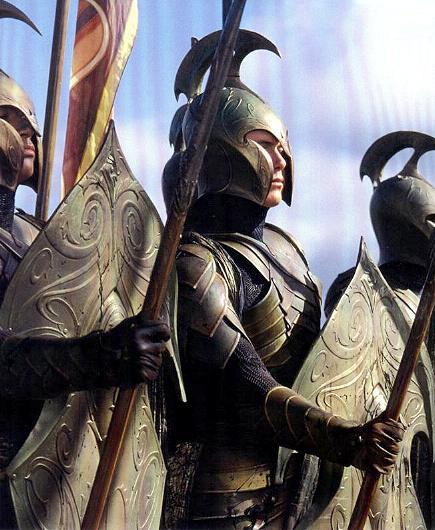
warrior elvesI’ve always wanted to visit Iceland.

Not simply because it’s the most sparsely populated country in Europe . . . even though I’m not big on crowds.

Not simply because of its spectacular glaciers and volcanic activity . . . even though these natural wonders inspire genuine awe.

Not simply because it is home to the world’s most ancient parliamentary democracy . . . even though I believe representative democracy is the best sort of government available.

Not simply because they colonized Greenland, from which the Norse were the first Europeans to discover the Americas . . . even though Leif Erikson deserves the accolades rendered to others.

Not simply because 40,000 of my fellow citizens are of Icelandic descent . . . even though I’m pleased they have contributed to our national “melting pot.”

Not simply because Iceland’s tenth largest city is called Fjarðabyggð . . . even though that vivid name is sure to capture the imagination of any writer.

Not simply because the Icelandic alphabet actually includes a runic letter (Þ, þ) named thorn . . . even though this too makes the nation of Iceland unique.

And, not simply because J.R.R. Tolkien and his friend C.S. Lewis established a group called Kolbitar which was devoted to reading Icelandic and Norse sagas. The word itself means “coal biter” and refers to those in a harsh environment drawing so close to the fire’s warmth they can almost bite the coals.

When the Lord of the Rings (as a work in progress) was being in read at meetings of the Inklings, one of the groups members at some point blurted out, “Oh no, not another –– elf!” [I only mention this here because that impetuous comment is often incorrectly attributed to Lewis—a genuine fan of Tolkien’s masterpiece. It was actually voiced by Hugo Dyson, another WWI veteran who taught English at Merton College.]

In the past, all of these reasons have contributed to my curiosity about the Land of Ice, but now I have added one more reason to someday visit.

It turns out that some Icelanders believe that elves, called by them Huldufólk (hidden folk), are real!

The elves have a large enough human constituency, that they are able to block highway construction due to the impact on the local Huldufólk!

Technically, the preservation of the elvish solitude is only the secondary concern in the lawsuits, the first being protection of one of Iceland’s numerous lava fields. Iceland’s Supreme Court has vacillated on the case, which can only raise the ire of any elves that may reside there.

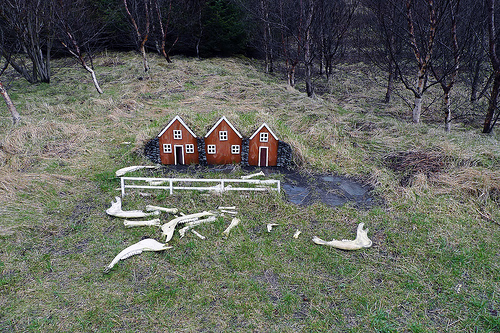
elf houseIf the proponents of the reality of the Huldufólk are right, there remains one shortcoming to the Icelandic elves. Apparently, if the elf homes that dot the countryside are any indication, the northern island breed are a diminutive race. As in tiny, what Americans would think of more as a gnome or perhaps even a fairy.

My problem is that I’ve been spoiled by J.R.R. Tolkien’s version of the elvish races. I see them a tall, noble, and wise. The kind of folk you’d want for a friend, if you could get past the aloofness that is apparently characteristic of beings who live centuries rather than decades.

I fear that these Icelandic elves are (pardon me, any Huldufólk who may be reading this) a rather inferior lot. More like leprechauns than warriors. If you live in Iceland and can correct my errors about the hidden folk there, please contact me. Even better if you happen to know some elves personally.

Worshiping Thor

thorI have a confession to make. One that is particularly awkward for a pastor.

The current success of the recent films about the Norse god of thunder have reminded me of one of the “errors” of my youth.

As a young boy I discovered great delight in reading comic books. And among all of the countless Marvel and DC titles I read during my youth, none was more precious to me than Thor. I never really “worshiped” him, of course, but I was enraptured by his saga.

I loved the comic, and it was difficult to wait each long, long month for the next issue to be published. I followed Thor’s adventures with intense devotion. An intense loyalty that was probably inappropriate since it was directed towards a pagan deity.

To make matters worse, the part of the magazine that appealed most to me was not the contemporary escapades of the otherworldly hero. The feature that most captivated my imagination was a smaller story included in each issue and entitled “Tales of Asgard.”

These stories were terribly brief, only five short pages, and didn’t introduce contemporary terrestrial or interstellar villains. Instead, they recounted the historic tales of Norse myth and religion. Their very earthiness—their historical authenticity—impressed me far more profoundly than did the 1960s superhero fare so commonplace during that era.

In fact, in Thor’s two cinematic blockbusters, I find the same to hold true. I find the mythological elements, the portions of the story set in Asgard far more captivating than the familiar, run of the mill heroic landscape of Midgard (Earth).*

I doubt  I am alone in my appreciation of the mythical over the scientific or magical elements. In the preface to The Pilgrim’s Regress, C.S. Lewis wrote, “When allegory is at its best, it approaches myth, which must be grasped with the imagination, not with the intellect.”

C.S. Lewis wrote a great deal about the power of myth. Like his close friend, J.R.R. Tolkien, author of Lord of the Rings, Lewis brought myth to life in The Chronicles of Narnia. In 1944, Lewis wrote an essay entitled “Myth Became Fact.” In it he explores the notion that in a sense Christianity too, is a myth—with one distinction from all of the rest.

Now as myth transcends thought, Incarnation transcends myth. The heart of Christianity is a myth which is also a fact. The old myth of the Dying God, without ceasing to be myth comes down from the heaven of legend and imagination to the earth of history. It happens—at a particular date, in a particular place, followed by definable historical consequences.

We pass from a Balder or an Osiris, dying nobody knows when or where, to a historical Person crucified (it is all in order) under Pontius Pilate. By becoming fact it does not cease to be myth: that is the miracle.

I began by saying I was making a confession of sorts. In truth, fascination with myth is nothing to be ashamed of. Lewis describes how it was precisely his own interest in such matters that played a primary role in his conversion to Christianity. In a 1931 letter to his friend Arthur Greeves, he describes the incipient process. These words foreshadow the message of the essay referred to above.

Now what [Hugo] Dyson and Tolkien showed me was this: that if I met the idea of sacrifice in a Pagan story I didn’t mind it at all: again, that if I met the idea of a god sacrificing himself to himself . . . I liked it very much and was mysteriously moved by it: again, that the idea of the dying and reviving god (Balder, Adonis, Bacchus) similarly moved me provided I met it anywhere except in the Gospels.

The reason was that in Pagan stories I was prepared to feel the myth as profound and suggestive of meanings beyond my grasp even tho’ I could not say in cold prose “what it meant.” Now the story of Christ is simply a true myth: a myth working on us in the same way as the others, but with this tremendous difference that it really happened: and one must be content to accept it in the same way, remembering that it is God’s myth where the others are men’s myths: i.e. the Pagan stories are God expressing Himself through the minds of poets, using such images as He found there, while Christianity is God expressing Himself through what we call “real things.”

Therefore it is true, not in the sense of being a “description” of God (that no finite mind could take in) but in the sense of being the way in which God chooses to (or can) appear to our faculties. The “doctrines” we get out of the true myth are of course less true: they are translations into our concepts and ideas of that which God has already expressed in a language more adequate, namely the actual incarnation, crucifixion, and resurrection.

Does this amount to a belief in Christianity? At any rate I am now certain (a) That this Christian story is to be approached, in a sense, as I approach the other myths. (b) That it is the most important and full of meaning. I am also nearly certain that it really happened.

The awareness that a mind so brilliant (and sanctified) as Lewis’ recognized the value of myth comforts me. I guess, in retrospect, that my youth was not entirely misspent reading those amazing stories. Thor still occupies a special place in my life journey, albeit not in a pantheon.

_____

* There are nine worlds in Norse cosmology. Midgard lies between the noble worlds of Asgard, Vanaheim and Alfheim . . . and Jotunheim, home of the frost giants, Svartalfheim, realm of the Dark Elves, and Muspelheim, abode of the Fire Giants and demons.