Typing is Not Writing

chimp

How is this for an absurd waste of time? A foolish man wanted “to feel what it was like to write like F. Scott Fitzgerald.” So, what did he do? Take writing classes? No, he had a better idea. He sat down at the keyboard and proceeded to type out a verbatim copy of The Great Gatsby.

Some of you may have heard this story, from the life of Hunter S. Thompson. He founded the “gonzo journalism” movement which dispenses with the pretense of objectivity. Sarcasm, humor and even profanity abound in this type of writing.

Thompson was apparently well suited to gonzoism, summarizing his life philosophy in this way: “I hate to advocate drugs, alcohol, violence, or insanity to anyone, but they’ve always worked for me.” Which is, presumably, a personal endorsement, rather than advocacy.

Apparently, typing the same words as literary icons also “worked” for Thompson. He also retyped Hemingway’s A Farewell to Arms to learn how to emulate his style.

I wonder what C.S. Lewis and his fellow Inklings would think of this approach to learning how to write. Lewis, of course, treasured good writing and recognized wide reading as a valuable inspiration for successful writing.

Nevertheless, if Lewis and Tolkien heard about Thompson’s exercise, I imagine they would enjoy a good laugh.

Reproducing typed facsimilies cannot be considered writing. Even an utterly illiterate person (or probably even a chimpanzee) could be trained to reproduce an original, key stroke by key stroke. (The monkey would probably benefit from a keyboard tailored to its particularly physiology.)

Emulating is Writing

When a lesser writer seeks to imitate the style of a renowned author, using their own creative skills and not plagiarizing, they are composing something original. There are several considerations to keep in mind.

Copyright restrictions may bar the work from publication. For example, it’s not yet legal for people to publish new Narnia stories.

Trademarks can also limit options for such works. Speaking of which, you don’t need to register a trademark to use TM in the United States, as we at MereInkling(TM) recently learned.

If registered with the USPTO, use the ® symbol after your mark.  If not yet registered, you may use TM for goods or SM for services, to indicate that you have adopted this as a “common law” trademark or service mark.

Works written as an homage—without any compensation or profit—is typically allowed. Thus we see innumerable variations on the Screwtape Letters. I have contributed to that mountain myself.

Basing a piece on the themes or voice of a masterpiece is altogether different from plagiarism.

There is one more critical point to make about a legitimate literary “tribute.” It can be based on the most anointed writing of the most impressive author . . . and still not be worth reading at all.

Which returns us to the typescripts reproduced by Thompson. Assuming he reproduced them faithfully, he is immune at least to the charge that the product of his typewriter is inferior to the original text.

That said, I find the two minutes I just invested in writing the following modest haiku more beneficial to my creativity than the hundreds of hours I might have spent literally copying a book I prize.

Retyping fixed words

Rather than shaping one’s own

Is a game for fools.

Narnia, Oz & an Odd Link Between the Two

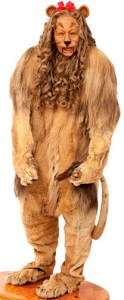
oz-lionFew people know this peculiar fact about The Wizard of Oz. And this oddity shares an interesting link to one of C.S. Lewis’ most familiar novels.

Filmmaking has changed greatly since 1939 when Dorothy first tapped together her ruby slippers. One of those modifications involves the treatment of animals.

Some of us are old enough to remember the initial appearance of the disclaimers: “No animals were injured in the making of this film.” Those announcements disappeared long ago, as people have long supposed the humane treatment of animals required.

As far as I know, no one has alleged the mistreatment of animals in The Wizard of Oz. But the odd fact mentioned above refers to one of the costumes worn by a major character in the film.

Bert Lahr played the Cowardly Lion, who continued acting until he died during the filming of The Night They Raided Minsky’s in 1968. Fortunately, he was in his prime while traipsing across Oz, because his costume weighed at least sixty pounds.

Apparently the costume designer was going for accuracy—in the case of the Cowardly Lion, if not for the citizens of Munchkinland. He opted for using an actual lion pelt. At least two, in fact, since there was a least one backup.

Cinema memorabilia often provides unbelievable dividends. MGM sold the primary costume in 1970 for a mere $2,400. In 2005, after some restoration by a taxidermist, the costume sold for $826,000. Nine years later, in 2014, it became the highest valued male performer’s costume, selling for $3,100,000.

It is quite fitting that Leo the Lion is the mascot for Metro-Goldwyn-Mayer film studio. While there have been seven “Leos” since 1916, it is doubtful that any of them contributed their hide to costuming the Cowardly Lion.

What Has Oz to do with Narnia?

Oz and Narnia resemble one another in the obvious sense that both are fantasy lands. I’m ill-equipped to compare the two beyond that, having no desire to read about the former. Here you’ll find an interesting article that offers some insights into the realm of the Wizard. The literary critics of The Telegraph offer the following contrast.

Even so, [Oz is] a strangely amorphous creation, originally reached by cyclone but in later books by shipwreck (twice), by earthquake and by simply getting lost. As a fantasy land, it has none of the depth or authority of Tolkien’s Middle Earth nor even the physicality of CS Lewis’s Narnia.

Reaching back to the turn of the millennia, you might enjoy reading “Oz vs. Narnia.” Comparing the promotion of the two realms on their respective hundredth and fiftieth anniversaries, the author finds Narnia’s treatment by HarperCollins wanting.

But however much the tribute to Oz exceeds the tribute to Narnia in sumptuousness, it can’t disguise the superiority of Lewis’ book. As a child, I loved Oz’s endless cavalcade of strange creatures and, especially, John R. Neil’s trippy art nouveau illustrations and extravagant marginalia; I still like the books today. But the first time I read “The Lion, the Witch and the Wardrobe” in second grade, I knew that I’d stumbled into a whole new league.

A Tale of Two Lions

The odd overlap in the two stories is not due to the prominent presence of lions in each world. The Cowardly Lion and Aslan have nothing in common, save perhaps, compassion for others.

But the real life costume of Oz’s lion does relate directly to one of Lewis’ most amazing fictional creations.

In the final Chronicle, The Last Battle, we find many people are led astray by a false prophet. There is a liar masquerading as the true king. The horror that he is able to mislead so many vulnerable souls is magnified by the fact that he too wears an obvious costume—the pelt of a lion.

Lewis’ account of the deception is skillful. One of the most brilliant aspects is that the “king” himself (a donkey) is actually tricked into playing the role by the true deceiver (an ape).

“All the same, Shift,” said Puzzle [the donkey], “even if the skin only belonged to a dumb, wild lion, oughtn’t we to give it a decent burial? I mean, aren’t all lions rather— well, rather solemn? Because of you know Who. Don’t you see?”

“Don’t you start getting ideas into your head, Puzzle,” said Shift. “Because, you know, thinking isn’t your strong point. We’ll make this skin into a fine warm winter coat for you.”

“Oh, I don’t think I’d like that,” said the Donkey. “It would look—I mean, the other Beasts might think—that is to say, I shouldn’t feel—”

“What are you talking about?” said Shift, scratching himself the wrong way up as Apes do.

“I don’t think it would be respectful to the Great Lion, to Aslan himself, if an ass like me went about dressed up in a lion-skin,” said Puzzle. “Now don’t stand arguing, please,” said Shift.

“What does an ass like you know about things of that sort? You know you’re no good at thinking, Puzzle, so why don’t you let me do your thinking for you?”

Obviously, a comparison between real and fictional characters wearing lion skins can only go so far. Still, I assume some readers will find the use of a lion’s pelt to camouflage a completely different species, to be a rather peculiar parallel between Oz and Narnia.

Those Lazy Males

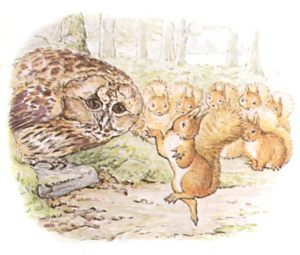
squirrelIn some places a debate rages over the question of who works the hardest, men or women. In our family, there is no such disagreement. We all recognize that the typical woman works far more than her male counterpart.

Take my case. I’m a Type A workaholic who lost (unused) leave every year of my military career. I still keep extremely busy, but when it comes to work ethic and effort, I don’t even pretend to hold a candle to my wife.

Now another example from the animal kingdom has confirmed what most people have suspected—females do far more than their share of the work.

Men have been embarrassed for generations by the example of lazy lions who rely on the lionesses to do nearly all of the hunting. Not to mention taking care of the family’s domestic responsibilities.

And now men have been betrayed by a more modest mammal—the squirrel.

I happen to like squirrels. I always have, even when they try to hijack the birdseed we always have available at our home. I hate hearing people refer to them as “tree rats,” and considered it good fortune that the street where we built our home is named “Squirrel Place.”

C.S. Lewis loved small animals. Reepicheep, a mouse, is one of the great heroes of Narnia. But it was a squirrel who played a role in one of his earliest “mystical” experiences. Fittingly, it also relates to Autumn, the season those of us in the Northern Hemisphere currently enjoy.

The following passage comes from Lewis’ autobiography, Surprised by Joy: The Shape of My Early Life. It describes the impression left on him after reading one of Beatrix Potter’s children’s books.

It will be clear that at this time—at the age of six, seven, and eight—I was living almost entirely in my imagination; or at least that the imaginative experience of those years now seems to me more important than anything else. . . .

But imagination is a vague word and I must make some distinctions. It may mean the world of reverie, daydream, wish-fulfilling fantasy. . . .

The . . . glimpse came through Squirrel Nutkin; through it only, though I loved all the Beatrix Potter books. But the rest of them were merely entertaining; it administered the shock, it was a trouble. It troubled me with what I can only describe as the Idea of Autumn.

It sounds fantastic to say that one can be enamored of a season, but that is something like what happened; and, as before, the experience was one of intense desire. And one went back to the book, not to gratify the desire (that was impossible— how can one possess Autumn?) but to reawake it.

And in this experience also there was the same surprise and the same sense of incalculable importance. It was something quite different from ordinary life and even from ordinary pleasure; something, as they would now say, “in another dimension.”

Squirrely Dads

Returning to the recent research that proved beyond any shadow of doubt that even among industrious, nut-gathering rodents, the males cop out. Don’t be put off by the study’s title—“The secret life of ground squirrels: accelerometry reveals sex-dependent plasticity in above-ground activity”—this is serious.

Apparently, while mom is down in a dark burrow nursing the kids, dad’s out lounging in the sunshine. It’s inexcusable.

And don’t try to use some lame excuse or misogynist argument that these findings are only true for Urocitellus parryii, semi-fossorial arctic ground squirrels, but they’re only fooling themselves. We all know that women work harder than men, especially when it comes to raising kids.

The female squirrels are literally so drained by the demands put upon them that they have to begin their hibernations before the males and end them after the males emerge from their hibernacula!

Following the termination of heterothermy in spring, male arctic ground squirrels remain below ground for a three to five week interval during which they consume a food cache to regain body mass lost during hibernation . . . Males intercept and mate-guard newly emergent females that become pregnant within a few days of emergence; gestation lasts for approximately 25 days, and lactation is another approximately 28–35 days.

Unlike males, females do not cache food and, with the exception of early gestation when they continue to lose body fat, they appear to fuel their reproduction using energy gained concurrently through foraging. [Note: it doesn’t appear the males share. Another strike against them.]

In addition, females are delivering energy to pups as milk during lactation . . . Once their young have been weaned, females undergo a moult and fatten; autumn immergence occurs in August [while] males that fatten and cache food later in the autumn immerge in early- to mid-October.

And there is no doubt that the people who conducted this research are right, after all, they used “collar-mounted light loggers and triaxial accelerometers!”


On Being Aptly Named

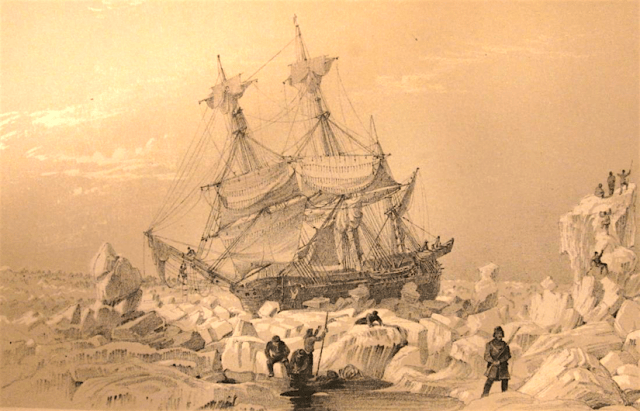
terrorIf you were going to embark on a lengthy, dangerous journey of exploration, how would you feel about signing onto the crew of the HMS Terror? Doesn’t that strike anyone else as a tad ominous?

The HMS Terror suffered a horrific fate. No surprise there. Its demise was so great, though, that it ranks among the worst ever suffered by the Royal Navy. And its ultimate fate remained unconfirmed until this past week when the wreck was found, resting on the ocean floor, 168 years after it perished during the ill-fated Franklin Expedition.

Along with the HMS Erebus, the Terror was supposed to traverse the Northwest Passage. The evidence shows, however, the ice trapped the ships, and both crews perished trying to make their way south across the floes. (There is evidence of cannibalism during that doomed journey, something attested to by Inuit oral traditions.)

The voyage had begun well enough. The vessels had been fitted for the harsh environment after a rather auspicious exploration of the coast of Antarctica. There they had discovered the Ross Ice Shelf, and in honor of their mission, two Antarctic features were named for them Mounts Erebus & Terror, on Ross Island.

Upon their return to London, iron plate was added to their hulls and coal-fueled steam engines were installed.

Sadly, the Arctic proved less hospitable, and their entrance into Baffin Bay in August 1845 marked the final time either ship was seen until now. An extensive search at the time proved futile. Their respective discoveries are announced here, and here.

Around 130 men abandoned the ships when they became icebound. Some of their bones were recovered from King William Island. The sad story has been recited in many places, including this article which was written when the wreck of the Erebus was discovered.

As in the Antarctic, here too the ships were honored by having natural features named after them. Fittingly, Erebus Bay and Terror Bay hug the west coast of King William Island, just north of which marked the estimated position where the ships were abandoned.

Read on, and learn something quite interesting about the names of these two ill-fated ships.

Naming Ships

I have written about the importance of names in the past.*

There are a variety of conventions for christening ships. Some result in creative names, but others are quite mundane. In the United States, with plenty of exceptions, the contemporary patterns for naming ships vary by their type of class. For example:

Aircraft Carriers – are now named after Presidents

Amphibious Assault Ships – early Ships or USMC Battles

Ballistic Missile Submarines – States

Fast Attack Submarines – Cities

Cruisers – Past Battles

Frigates – Navy, Marine or Coast Guard Heroes

Patrol Boats – Weather Phenomena like Squall, Monsoon and Cyclone

Of course, like everything else in the United States, the naming of ships is prone to becoming politicized, as this entertaining article reveals.

Other nations have followed comparable christening patterns throughout recent centuries. Grouping similarly functioning vessels with particular themes makes sense. That way if you encountered a ship named Blue Dwarf or Yellow Dwarf, you could make a well educated guess that the vessel was a mining ship, and part of the Jupiter Mining conglomerate.

I suppose even garbage scows are named in some logical fashion, perhaps after politicians?

Unsurprisingly, in addition to battles, heroes, and major cities, aquatic life has been a common feature. Thus pre-Soviet Russian subs were named things like Walrus or Shark (albeit, in Cyrillic).

The Royal Navy shared an affinity for marine life, and Dolphin was a popular example. There were no fewer than a dozen ships, thus named, although some were fairly modest (including a convict ship used in the first have of the nineteenth century).

I actually possess the altar rail from the ship’s chapel in the HMS Dolphin that was commissioned in 1882. But that’s a sea tale for another day . . .

C.S. Lewis christened a ship of his own. He even included its name in the title of the Chronicle of Narnia which describes its quest: The Voyage of the Dawn Treader. The ship herself was modest, but marked a new age of Narnia exploration.

The name of the ship was Dawn Treader. She was only a little bit of a thing compared with one of our ships, or even with the cogs, dromonds, carracks and galleons which Narnia had owned when Lucy and Edmund had reigned there under Peter as the High King, for nearly all navigation had died out in the reigns of Caspian’s ancestors. . . .

But now Caspian had begun to teach the Narnians to be sea-faring folk once more, and the Dawn Treader was the finest ship he had built yet.

She was so small that, forward of the mast, there was hardly any deck room between the central hatch and the ship’s boat on one side and the hen-coop (Lucy fed the hens) on the other.

But she was a beauty of her kind, a “lady” as sailors say, her lines perfect, her colors pure, and every spar and rope and pin lovingly made.

In his Middle Earth sagas, J.R.R. Tolkien includes the names of a number of ships.

Eärrámë – Sea Wing

Númerrámar – Sunset Wings

Palarran – Far-Wanderer

Vingilótë – Foam Flower

Hirilondë – Haven Finder

Entulessë – Return (sailed by Vëantur during the Númenórean’s return to Middle Earth)

The Inklings appear to have given the decision of naming their ships the attention the activity merits.

More about the HMS Terror and the HMS Erebus

The name of the HMS Terror was, of course, not chosen to jinx its future. It was thus named to instill fear in those it opposed. This was natural, since it was originally commissioned as a warship, as was the Erebus. In fact, the two vessels were the same exact type of warship.

So, how might “Terror” and “Erebus,” the mythological Greek deity of darkness, who shared his name with an abode of the dead? It becomes clearer when we learn that both of the ships originally served as “bomb ships.” Like later battleships, these vessels were designed to rain fire from the sky—something terrifying to stationary garrisons.

The names of some of their sister ships whose mortars fired upon enemies of the British Empire included Thunder, Vesuvius, and Hecla (the Icelandic volcano).

The HMS Terror actually saw combat, prior to its conversion to peaceful pursuits. Amazingly, it was among the bomb ships—accompanied by the Volcano, Meteor, Devastation and Aetna—during the Battle of Baltimore in the War of 1812. Thus, the Terror is also memorialized in the national anthem of the United States: “the bombs bursting in air.”

Curiously, the predecessor of the HMS Erebus we have been discussing, a “rocket vessel” with the same name, inspired the lyrics “by the rocket’s red glare,” at the same historic battle.

_____

* The importance of naming has led me to address the subject from a number of angles through the years.

The Power of Names

Crying for Attention

From Ear to Quill

Pet Names

Powerful Names

Sharing Surnames

Fleeting Fame

red-dwarfAnd, for those who recognized the homage to Red Dwarf


Tolkien, C.S. Lewis and Music

albumHave you ever written something that inspired a musician to compose new music? J.R.R. Tolkien hoped to do so one day, and had he lived to hear the scores of the Lord of the Rings trilogy created by Howard Shore, he would have been in awe.

I was reading Tolkien’s correspondence last week and came across a fascinating letter he wrote to a musician who was requesting permission to write a serious composition based on The Hobbit.

This would have been quite different than the quaint “Ballad of Bilbo Baggins,” made famous by Leonard Nimoy. (I wish their choreographer had read the book, so we could have been spared the tiny T-Rex arms sported during the chorus by the dancers.)

Anyway, returning to more serious musical ventures, in 1964 Tolkien received a request for permission to write a “Hobbit Overture.” It came from British composer Carey Blyton (1932-2002) who would become best known for his song “Bananas in Pyjamas.”

Tolkien’s response to the composer’s query is fascinating, on several levels. First, he is gracious in extending his permission, without any restrictions. And, in 1967 Blyton did compose “The Hobbit” Overture, opus 52a. It appears on the CD, British Light Overtures 3.

Secondly, he shares his unspoken desire that his work might someday inspire music. Then he makes a curious comment about the illustrations of Pauline Baynes, which would similarly grace the work of C.S. Lewis.

After that, Tolkien describes his own, musically impoverished, upbringing. Finally he expresses his deep appreciation for good music, despite his lack of knowledge on the subject.

And Tolkien accomplishes all of this in just a handful of sentences!

You certainly have my permission to compose any work that you wished based on The Hobbit. . . . . As an author I am honoured to hear that I have inspired a composer. I have long hoped to do so, and hoped also that I might perhaps find the result intelligible to me, or feel that it was akin to my own inspiration—as much as are, say, some (but not all) of Pauline Baynes’ illustrations. . . . .

I have little musical knowledge. Though I come of a musical family, owing to defects of education and opportunity as an orphan, such music as was in me was submerged (until I married a musician), or transformed into linguistic terms. Music gives me great pleasure and sometimes inspiration, but I remain in the position in reverse of one who likes to read or hear poetry but knows little of its technique or tradition, or of linguistic structure.

It is common for people of sincere Christian devotion, such as Tolkien and Lewis, to express an appreciation for the divine capacity of music to touch the human spirit.

luteMartin Luther, for example, wrote much about music. “Music is God’s greatest gift,” he proclaimed. He was not only a composer of hymns, but also an acceptable player of the lute, which he used to accompany his children during their family devotions.

Music is deeply intertwined with the heart of Christian worship.

C.S. Lewis on the Subject of Music

One of the modest challenges in contrasting fellow Inklings J.R.R. Tolkien and C.S. Lewis results from the significantly different natures of their literary corpora. While they both wrote fantasy, though of a vastly different magnitude, Lewis’ vocation as one of Christianity’s chief modern apologists necessitated that he defend the faith in diverse contexts. Thus, he wrote numerous essays and a number of texts addressing a wide range of considerations that his friend Tolkien never discussed in print.

Because of this distinction, it is relatively simple to discover what Lewis thought about the nature and powers of music. Typical of the man’s practical orientation, Lewis appears little interested in the abstract attributes of music. What interests him is its confluence with human existence. The following profound insight comes from his essay “On Church Music.”

There are two musical situations on which I think we can be confident that a blessing rests. One is where a priest or an organist, himself a man of trained and delicate taste, humbly and charitably sacrifices his own (aesthetically right) desires and gives the people humbler and coarser fare than he would wish, in a belief (even, as it may be, the erroneous belief) that he can thus bring them to God. The other is where the stupid and unmusical layman humbly and patiently, and above all silently, listens to music which he cannot, or cannot fully, appreciate, in the belief that it somehow glorifies God, and that if it does not edify him this must be his own defect.

Neither such a High Brow nor such a Low Brow can be far out of the way. To both, Church Music will have been a means of grace; not the music they have liked, but the music they have disliked. They have both offered, sacrificed, their taste in the fullest sense.

But where the opposite situation arises, where the musician is filled with the pride of skill or the virus of emulation and looks with contempt on the unappreciative congregation, or where the unmusical, complacently entrenched in their own ignorance and conservatism, look with the restless and resentful hostility of an inferiority complex on all who would try to improve their taste—there, we may be sure, all that both offer is unblessed and the spirit that moves them is not the Holy Ghost.

This discussion about church music is particularly interesting due to Lewis’ personal dislike for much of the music used in worship, which I’ve written about before.

Lewis described his own church music pilgrimage in “Answers to Questions on Christianity.”

My own experience is that when I first became a Christian, about fourteen years ago, I thought that I could do it on my own, by retiring to my rooms and reading theology, and I wouldn’t go to the churches . . .

If there is anything in the teaching of the New Testament which is in the nature of a command, it is that you are obliged to take the Sacrament [holy communion], and you can’t do it without going to Church. I disliked very much their hymns, which I considered to be fifth-rate poems set to sixth-rate music. But as I went on I saw the great merit of it.

I came up against different people of quite different outlooks and different education, and then gradually my conceit just began peeling off. I realized that the hymns (which were just sixth-rate music) were, nevertheless, being sung with devotion and benefit by an old saint in elastic-side boots in the opposite pew, and then you realize that you aren’t fit to clean those boots. It gets you out of your solitary conceit.

In “The Weight of Glory,” Lewis addresses this notion that we must look beyond the music itself, to assess its influence on our humanity.

The books or the music in which we thought the beauty was located will betray us if we trust to them; it was not in them, it only came through them, and what came through them was longing. These things—the beauty, the memory of our own past—are good images of what we really desire; but if they are mistaken for the thing itself they turn into dumb idols, breaking the hearts of their worshippers.

For they are not the thing itself; they are only the scent of a flower we have not found, the echo of a tune we have not heard, news from a country we have never yet visited.

Lewis recognized the deep influence and mystery with which music communicates and inspires. It is no accident that Narnia’s creation itself comes through Aslan’s song.

The Lion was pacing to and fro about that empty land and singing his new song. It was softer and more lilting than the song by which he had called up the stars and the sun; a gentle, rippling music. And as he walked and sang the valley grew green with grass. It spread out from the Lion like a pool.

It ran up the sides of the little hills like a wave. In a few minutes it was creeping up the lower slopes of the distant mountains, making that young world every moment softer.

Returning to “On Church Music,” Lewis expands on the importance of our intentions as we approach music.

It seems to me that we must define rather carefully the way, or ways, in which music can glorify God. There is . . . a sense in which all natural agents, even inanimate ones, glorify God continually by revealing the powers He has given them. . . . An excellently performed piece of music, as natural operation which reveals in a very high degree the peculiar powers given to man, will thus always glorify God whatever the intention of the performers may be. But that is a kind of glorifying which we share with the ‘dragons and great deeps,’ with the ‘frost and snows.’

What is looked for in us, as men, is another kind of glorifying, which depends on intention. How easy or how hard it may be for a whole choir to preserve that intention through all the discussions and decisions, all the corrections and the disappointments, all the temptations to pride, rivalry and ambition, which precede the performance of a great work, I (naturally) do not know. But it is on the intention that all depends.

When it succeeds, I think the performers are the most enviable of men; privileged while mortals to honor God like angels and, for a few golden moments, to see spirit and flesh, delight and labour, skill and worship, the natural and the supernatural, all fused into that unity they would have had before the Fall. . . .

We must beware of the naïve idea that our music can ‘please’ God as it would please a cultivated human hearer. That is like thinking, under the old Law, that He really needed the blood of bulls and goats. To which an answer came, ‘mine are the cattle upon a thousand hills,’ and ‘if I am hungry, I will not tell thee.’ If God (in that sense) wanted music, He would not tell us. For all our offerings, whether of music or martyrdom, are like the intrinsically worthless present of a child, which a father values indeed, but values only for the intention.

At the outset of this column I declared Tolkien would have been “in awe” of the musical score written to accompany the Lord of the Rings movies. Lewis too, I believe, would have been impressed by the scores composed for the three Chronicles of Narnia films made thus far. We owe a debt of gratitude to three composers: Howard Shore,* Harry Gregson-Williams,** and David Arnold***.

An Historical Postscript

In the spirit of Lewis and Tolkien, who appreciated the importance of music, we’ll close now with another engaging quotation from the wry pen of Doctor Martin Luther.

I wish all lovers of the unshackled art of music grace and peace from God the Father and from our Lord Jesus Christ! I truly desire that all Christians would love and regard as worthy the lovely gift of music, which is a precious, worthy, and costly treasure given to mankind by God.

The riches of music are so excellent and so precious that words fail me whenever I attempt to discuss and describe them…. In summa, next to the Word of God, the noble art of music is the greatest treasure in the world.

A person who gives this some thought and yet does not regard music as a marvelous creation of God, must be a clodhopper indeed and does not deserve to be called a human being; he should be permitted to hear nothing but the braying of asses and the grunting of hogs.

_____

* Howard Shore has nearly a hundred credits as a composer, conductor and orchestrator on the Internet Movie Database (IMDb). In addition to the Tolkien cinema projects, he has also worked on a number of other very successful films and ninety-six episodes of Saturday Night Live. Shore won three Oscars for his work on Lord of the Rings.

** Harry Gregson-Williams has nearly a hundred credits on the IMDb, including a number of box office successes, a variety of popular video games, and several productions in the Shrek series. He won awards for his work on the Chronicles of Narnia series and another of my favorite films, Kingdom of Heaven.

*** David Arnold, wrote the score for the third Narnia film, The Chronicles of Narnia: The Voyage of the Dawn Treader. He has seventy-three credits listed on IMDb, ranging from this year’s Independence Day: Resurgence, all the way back to a BBC made for tv picture entitled Mr. Stink.


Not Wholly Contemptible

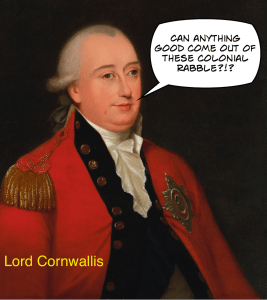
cornwallisEveryone loves a compliment. Allow me to rephrase that. Most people appreciate a sincere compliment when it is genuinely flattering.

Actually, “flattering” isn’t a good word choice here. Flattery has a bad rep. The way it’s currently used, it hints of exaggeration and manipulation.

So let’s return to the concept of “compliments” in general. Most, we know, are welcome. It’s nice to have someone tell us we did a commendable job or had a good idea.

Then there are those less sincere “compliments” that require a bit of intelligence or wit to offer. The go by different names, but are commonly referred to as “left-handed compliments” or “backhanded compliments.”

This type of statement might sound on its surface like a compliment, but includes an element that undermines the praise. The Urban Dictionary offers the following example:

“Boy, you’re pretty hot . . . for a fat (or skinny) chick!”

Now, that is nothing but an insult. And it’s an insult of the crassest variety. One that demands no wit at all.

The British, on the other hand, are often capable of offering highly refined backhanded compliments.

I just came across a delightful one, delivered by the commander of the King’s forces during America’s War of Independence. What makes this exquisite is that it was offered in the wake of the general’s defeat at the close of the war.

When finally brought to heel at Yorktown, Lord Cornwallis reported, “I will not say much in praise of the Militia of the Southern Colonies, but the list of British officers and Soldiers killed or wounded by them since last June, proves but too fatally that they are not wholly contemptible.”

You can read more about the context for that statement in an excellent article about the American legacy of “citizen soldiers” published in Hallowed Ground magazine. This excellent journal is published by the Civil War Trust, which works diligently to preserve battlefields from the Civil War. They have recently expanded those efforts to include the Revolutionary War.

C.S. Lewis & Compliments

Lewis included backhanded compliments in his fictional works. Two simple examples follow. The first is found in The Screwtape Letters, where the tempter frequently commends the skill of God (“the Enemy”) in redeeming the lost.

Never forget that when we are dealing with any pleasure in its healthy and normal and satisfying form, we are, in a sense, on the Enemy’s ground. I know we have won many a soul through pleasure. All the same, it is His invention, not ours.

Here is an offhanded compliment that Lewis places on the lips of Prince Corin in The Chronicles of Narnia. He is asked where Queen Susan is, on the eve of a battle and he responds like a typical young boy (which he still is at the time). He praises the martial spirit of her sister, Queen Lucy, who is a young adult at this point in the series.

At Cair Paravel. She’s not like Lucy [her sister who is in the ranks of the archers], you know, who’s as good as a man, or at any rate as good as a boy. Queen Susan is more like an ordinary grown-up lady. She doesn’t ride to wars, though she is an excellent archer. (The Horse and His Boy).

The late Bruce Edwards described how C.S. Lewis offered H.G. Wells a backhanded compliment. He did so by following the structure of Wells’ works, but devoting them to a vastly different philosophical purpose.

In Out of the Silent Planet (1938), Lewis adapted the general plot outline from H.G. Wells’s First Men in the Moon in order to tell an essentially anti-Wellsian tale. In Perelandra, Lewis pays a similar backhanded compliment to the man he admired as a speculative writer, but not as a philosopher.

The broad narrative structure of Perelandra resembles another novel by H.G. Wells, The Time Machine (1895). . . . In Wells’s novel, this narrative outline provides the basis of a quasi-Marxist fable about effete bourgeoisie and surly proletariat. In Lewis’s hands, a similar story structure tells a very different tale, one in which the ultimate battles are not economic and political, but rather cosmic and spiritual. (C.S. Lewis: Fantasist, Mythmaker, and Poet).

Compliments: the Good & the Bad

Lewis’ use of Wells’ science fiction template was not meant to slight him. It was actually a tribute. Likewise, in the examples from his fiction, Lewis is simply representing (effectively) the attitudes of the speakers.

Returning for a moment to the abject General Cornwall, we recognize as well the grudging nature of his praise of the enemy. They were certainly rabble—possessing no great military skill, in his estimation. Yet, in terms of bringing the army of the greatest power in the world at that time to its surrender, “they are not wholly contemptible.”

And that, when it came to winning the war, apparently proved quite sufficient.

Inkling Chivalry

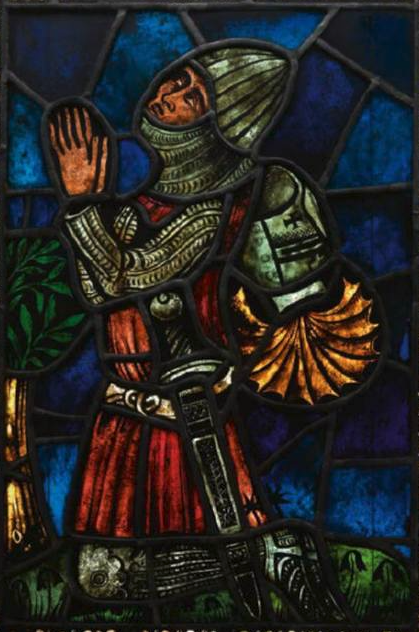
praying knightJ.R.R. Tolkien and C.S. Lewis practiced what they preached.

While most people are content to sit back while others battle for just causes. Sadly, cowardice appears to outweigh bravery in our modern age. We have, Lewis says, “having grown up among the ruins of the chivalrous tradition . . .” (“The Necessity of Chivalry”).

Lewis and Tolkien, by contrast, were genuine heroes. Peaceful academics by nature, each of them responded to their nation’s call to defend their homeland against the Huns.

In the world of the modern university—inhospitable to those who would defend the veracity of the Scriptures—each man counted the cost, and willingly bore the ridicule of skeptics and secularists.

Not only were these two Inklings paragons of courage, they engaged in their battles with a code of chivalry. Neither desired the destruction of their foes. Instead, they sought the preservation of truth, justice, peace and mercy.

Chivalry is a concept alien to the modern era. In an age when there is so little mercy and forgiveness, it seems a more and more archaic notion each day.

Yet, chivalry is not dead.

Both of these men not only modeled the virtue, they imbued their works with its spirit. The heroes of Middle Earth and Narnia are chivalrous almost to a fault. And the spiritual heirs of both fictional domains, still yearn to be chivalrous in their own lives.

So, precisely what is it? As Lewis begins his essay on the subject, he writes, “The word chivalry has meant at different times a good many different things—from heavy cavalry to giving a woman a seat in a train.”

Lewis considers the “double demand it makes on human nature” through an exploration of the Middle Ages.

The knight is a man of blood and iron, a man familiar with the sight of smashed faces and the ragged stumps of lopped-off limbs; he is also a demure, almost a maidenlike, guest in hall, a gentle, modest, unobtrusive man. He is not a compromise or happy mean between ferocity and meekness; he is fierce to the nth and meek to the nth.

Gentle toward the innocent and vulnerable. Relentless versus evil.

What, you may ask, is the relevance of this ideal to the modern world? It is terribly relevant. It may or may not be practicable—the Middle Ages notoriously failed to obey it—but it is certainly practical; practical as the fact that men in a desert must find water or die.

We live in a violent world, and the beheading of even children suggest things are growing worse. So, more than ever, Lewis tells us, we need chivalrous people like Lancelot, who combined these conflicting qualities. We need gentle men, like Lewis and Tolkien, who are willing to lay aside their books to face the specter of war on the front lines.

Lewis forcefully describes the three divisions of humanity bereft of chivalry.

If we cannot produce Launcelots, humanity falls into two sections—those who can deal in blood and iron but cannot be “meek in hall”, and those who are “meek in hall” but useless in battle—for the third class, who are both brutal in peace and cowardly in war, need not here be discussed. When this dissociation of the two halves of Launcelot occurs, history becomes a horribly simple affair.

Lewis wrote the essay during the Second World War. He and others among the Inklings had stood in the gap during the “war to end all wars.” Now he was observing a glimmer of hope in the witness of a successive generation doing its part.

Launcelot is not yet irrecoverable. To some of us this war brought a glorious surprise in the discovery that after twenty years of cynicism and cocktails the heroic virtues were still unimpaired in the younger generation and ready for exercise the moment they were called upon.

In the face of the contemporary ferocity of global terrorism, we see many young men and women following their example. Surely, they are a minority among the population, but we are all deeply fortunate they exist.

Our prayers should accompany those of all nationalities who are courageous enough to face the blade of modern barbarians. And our prayer should be that they are not merely brave, but also meek.

Volcano Hurricane

volcanoVolcano hurricane. An epic disaster film! No sharks, but copious amounts of lava flung by gale force winds across the globe. And all from the mind of a six year old boy.

Imaginations are great. They are one of the most precious gifts of God (which makes it all the more tragic when the human imagination is diverted towards carnal ends).

The minds of young boys, thankfully, have yet to turn to such lamentable matters. Their innocence shields them from the worst of human corruption. They, instead, are consumed with thoughts of spiders and other things that creep out girls . . . and especially their moms.

Our almost-seven-year-old grandson was here for the weekend with his family. We had a wonderful time. We had actually found the ideal book to include as part of his birthday celebration: How to Convince Your Parents You Can Care for a Pet Tarantula. Perfect.

Young male imaginations seem to revolve around things that shock—and also things that gross others out.

Our kids have trained their own children well. For example, they always excuse themselves when they experience flatulence. It’s a natural experience, of course, and as we mature, adults learn to ignore potentially embarrassing moments related to it. That’s part of becoming “civilized.”

Six year olds . . . not so much. Our grandson properly excuses himself, but he typically does so in the midst of enthusiastic laughter. It’s as though he relishes just how uncultured the moment seems.

During this particular visit, he leaped into my lap in a semi-ninja attack. As we wrestled, there was a minor explosion. Not quite volcanic, but close enough. He apologized, amidst great hilarity. “Sorry about my little gas,” he added.

And here’s where I made the mistake. I reinforced his innate boyhood grossness by saying, “little! . . . that sounded like it was a buffalo!”

Not quite the right thing to say, since it simply encouraged the precocious guy. But what I can say . . . time may change a boy into a man, but in most of us . . . somewhere deep in the recesses of our psyches . . . that boyhood irreverence lingers.

Not that I enjoy the crass “body humor” that pervades so much comedy (on tv and film). I steadfastly avoid it. It insults my mind and viewing it constitutes a total waste of time. Still, with my grandson wrapped in my arms, laughing away, it all seemed so genuine and innocently funny.

Of course, I recognize one needed to be there—and probably to also be related by bloodline to the participants—to find any humor in the moment. But it certainly seemed funny to us.

C.S. Lewis and Children

I was thinking about that moment as I sat down to write this post. I intended to focus on the amazing imaginations of children, and my grandson’s current preoccupation with gigantic volcanoes.

But whim or muse redirected the column. In the end, it turns out to be a reflection on the simple pleasure that we adults experience when we interact with kids. Especially when they are children who are precious to us.

I wish that C.S. Lewis had been able to experience that joy. He wasn’t. His awkwardness with children is well known. Most attribute it to the early passing of his mother, and the emotional distance his father maintained from his sons.

In a 1935 letter he wrote to a close friend, “I theoretically hold that one ought to like children, but am shy with them in practice.”

In The Abolition of Man he was even more forthcoming, sharing that, “I myself do not enjoy the society of small children: . . . I recognize this as a defect in myself.”

So, Lewis recognized his discomfort with children as a shortcoming. It was something he wished could be dispelled. Unfortunately, we can’t simply wish (or pray) away our ingrained personality traits. We’re lucky if we can tame them or reshape them.

We work hard to strengthen our positive traits and the wise deny nourishment to their weaker qualities. People often use the analogy of wearing off one’s rough edges, and that’s an apt image.

Lewis’ reticence with children makes his creation of Narnia all the more wondrous. The Chronicles of Narnia have captivated the hearts and imaginations of innumerable children, and adults alike. Certainly Lewis was correct when he wrote the following in “On Stories.”

No book is really worth reading at the age of ten which is not equally (and often far more) worth reading at the age of fifty—except, of course, books of information. The only imaginative works we ought to grow out of are those which it would have been better not to have read at all.

With his marriage, late in life, Lewis became a step-father. He did the very best he could, but was conscious of just how ill-equipped he was to raise Douglas and David. Both became successful men. Doug shares his parents’ love of Christ, and helps direct the course of various Lewisian projects today.

Allow me to close with another evidence of the greatness of C.S. Lewis. He was able to rise far above his innate uneasiness with children. In fact, his fabled correspondence included many children who had written to him seeking his attention. In 1951 he wrote to one of them, saying:

I am glad you all liked The Lion. A number of mothers, and still more, schoolmistresses, have decided that it is likely to frighten children, so it is not selling very well. But the real children like it, and I am astonished how some very young ones seem to understand it. I think it frightens some adults, but v[ery] few children.

Lewis did not disappoint the many children who wrote to him during those terribly busy years. Nor do his writings disappoint us today. Unlike the transience of youthful volcano hurricanes, Lewis’ legacy will forever remain alive in the imaginations of child and adult alike.

Really Creative Writing

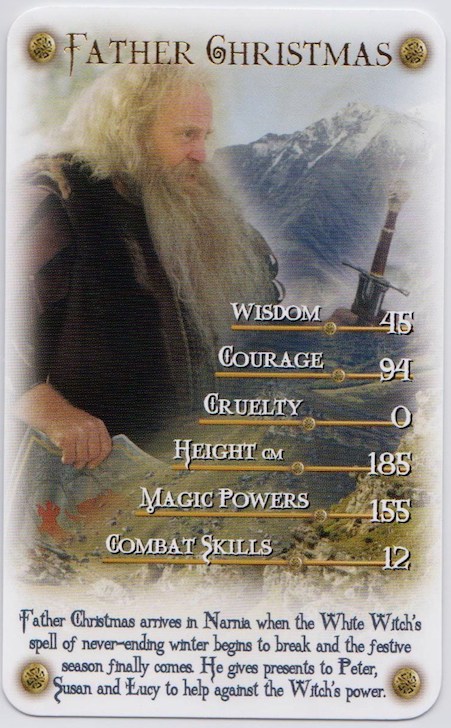
father christmasWhen did you first learn how to express yourself creatively? Some of us were blessed with parents who recognized the importance of things like music, art and literature. Others, alas, were not.

Most readers of Mere Inkling like to dabble in writing themselves. Many are quite skilled, and disciplined enough to persist with the demanding task of regularly composing interesting pieces for their own online columns. Some, in fact, are quite accomplished and successful in their personal literary efforts.

Becoming a good, truly good, writer requires experience. One may be born with the innate ability to become a Shakespeare or a Hemingway, but the skills need to be sharpened through effort. Study often helps, but it can never replace the necessity of practice in honing our writing.

It seems to me that the sooner we begin the process of unbridling our imaginations, translating our visions into words, and writing it all down in a way that engages the imaginings of others, the better we can become.

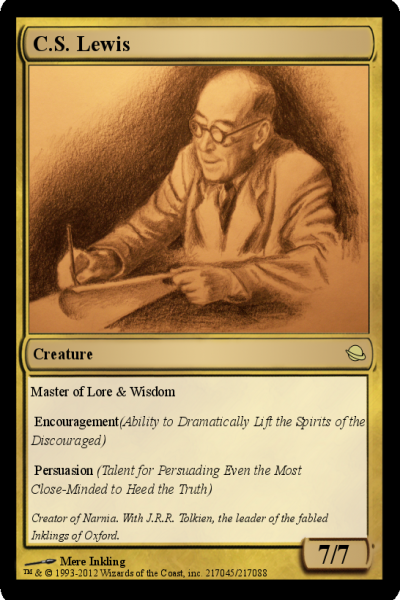
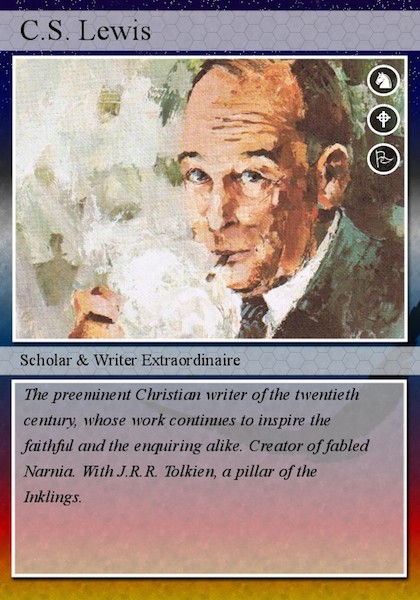
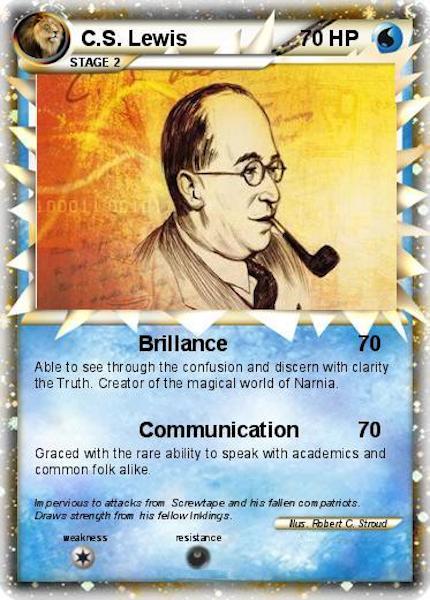
Many of you, especially Europeans, will be familiar with a gaming product that arose in the United Kingdom. They are called Top Trumps, and the cards come in a wide variety of themes. One set that I own is Narnia, from which the image at the top of this page comes.

Tolkien fans will be delighted to learn they just reissued a Lord of the Rings set that comes in an amazing Eye of Sauron tin. You can learn more about that unique item here.

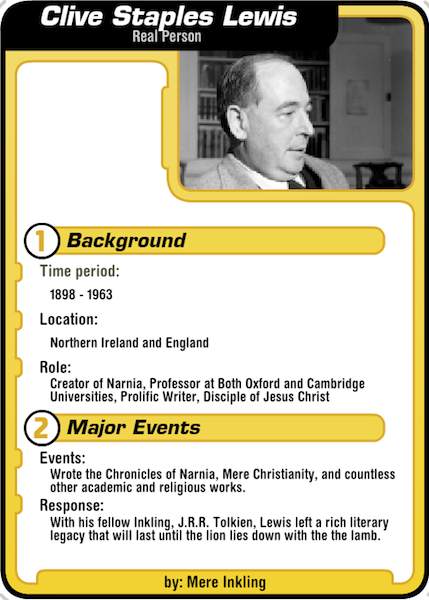
It was while thinking about my Narnia cards when I got the idea to see if there was an online mechanism for making one’s own playing cards. I was toying with the idea of fashioning a C.S. Lewis card to illustrate one of my posts.

I was actually searching online for a site where I could “create” such a card. I found several. Only later did I consider the irony of using that particular word.

For theologians, the word create bears profound significance. When it comes to the human activity of bringing together in some novel shape pre-existing images or ideas, it is not truly accurate. Lewis wrote about that in a 1943 letter to Sister Penelope.

‘Creation’ as applied to human authorship . . . seems to me an entirely misleading term. We . . . re-arrange elements He has provided. There is not a vestige of real creativity de novo in us. Try to imagine a new primary colour, a third sex, a fourth dimension, or even a monster which does not consist of bits of existing animals stuck together! Nothing happens.

And that surely is why our works (as you said) never mean to others quite what we intended: because we are re-combining elements made by Him and already containing His meanings. Because of those divine meanings in our materials it is impossible we should ever know the whole meaning of our own works, and the meaning we never intended may be the best and truest one.

Writing a book is much less like creation than it is like planting a garden or begetting a child: in all three cases we are only entering as one cause into a causal stream which works, so to speak, in its own way. I would not wish it to be otherwise.

Still, even though we are not true “creators,” it is enjoyable to rearrange the mundane elements (or words) of this life in fresh ways.

That’s one reason I was pleased to discover a website devoted to offering a “Trading Card Creator” hosted by the International Reading Association. It “gives students an alternative way to demonstrate their literacy knowledge and skill when writing about popular culture texts or real world examples.”
Why didn’t they have cool stuff like this when I was growing up? (If they did, I might be able to express myself better than by having to rely on phrases like “cool stuff.”)

Below you will find their website, along with a second option. I was thinking that my grandchildren might find it interesting to create a set of cards about our family tree. Their own sketches could be used for ancestors for whom we have no photograph. The comprehensive trading card creator maker offers a variety of templates, including for people, places, events and objects.

The template offered by the second site is generic enough that the cards can be produced in similar categories.

Unleash your imagination. And, after you’ve had some fun, consider sharing these links with a child you may know.

ReadWriteThink Trading Cards

Big Huge Labs Trading Cards

C.S. Lewis Card 3C.S. Lewis Card 2C.S. Lewis Card 1C.S. Lewis Card 4

Impromptu Poetry

eye

I had to endure a to and fro transcontinental trip this week. Endure is the right word, when flying miles above what would otherwise be a scenic, albeit lengthy, journey.

One positive thing about flying is that I have time to catch up on some of my “pleasure” reading. This week it included an article about cinquains.

A quintain is a poem with five verses. A cinquain is a specific form which has the following number of syllables in each of the lines: two, four, six, eight, and two.

I took a break from my reading and drafted a few of these small poems. I found it quite simple, and it’s likely you may as well.

I make no promises about the quality of my verse, but perhaps you’ll find one or more of them interesting. Or, at least they may inspire you to write some of your own.

Springtime
Narnian hope
Delayed by the White Witch
Borne by Aslan’s Resurrection
New dawn

Pilgrim
Traveling through
This world is not my home
Destined for a new creation
With Christ

True hope
He died for us
Emancipation now
Washed clean by the blood of the Lamb
New life

Inklings
Lewis, Tolkien
Friends rounded out the group
Imaginations unfettered
Wonder