Explosive Clergy

What’s with pastors? As one, I probably know more than the typical person does about them – and all too often, they disappoint.

That’s a bit harsh. Most pastors are pretty selfless. That’s fairly evident in their salaries (if they even receive one). And, trust me, trying to be a faithful leader and peacemaker in any group comprised of human beings, is no easy task.

My sainted grandmother, born at the end of the nineteenth century, was the daughter of Norwegian immigrants. She was an authentic follower of Jesus, and when she was young the sermons at Fordefjord Lutheran Church* were preached in the immigrants’ tongue. We occasionally talked about how scandalized she was when one of the ministers serving the congregation pronounced “helvete vil være fullt av pastorer” (hell will be full of pastors).

Well, not “full” perhaps, but in principle he was right. And, sadly, his warning is not at all shocking to us today. We read regularly about clergy who are arrested for violating the trust of the most vulnerable. Likewise, we hear about the outrageous wealth of some ministers (including, it seems, nearly every televangelist). Even pastors in small enclaves with little access to the temptation offered by easily accessible cash, can too often succumb to the sirens of pride and power, twisting their pastoral authority into a weapon to abuse others. (It’s the opposite of the messianic promise found in Isaiah 2:4.)

It’s almost enough to drive a person from the Lord’s house. But that is not the answer, of course. Finding a truly Christian church, with a pastor earnestly (albeit imperfectly) pursuing his holy vocation, is the best course.

The Scriptures say many things about ministry, and Jesus himself provides the perfect example of willingness to lay down one’s life for the sheep.

The letter of James cautions those considering a life of “ministry” that they will face a stricter judgment than the laity (which comes from λαός which refers to the people at large).

Personally, I especially appreciate being reminded of God’s warning to religious leaders from the lips of Jeremiah. (I also appreciate the ironic tone of God’s judgment.)

“Woe to the shepherds who destroy and scatter the sheep of my pasture!” declares the Lord. Therefore thus says the Lord, the God of Israel, concerning the shepherds who care for my people: “You have scattered my flock and have driven them away, and you have not attended to them. Behold, I will attend to you for your evil deeds,” declares the Lord.

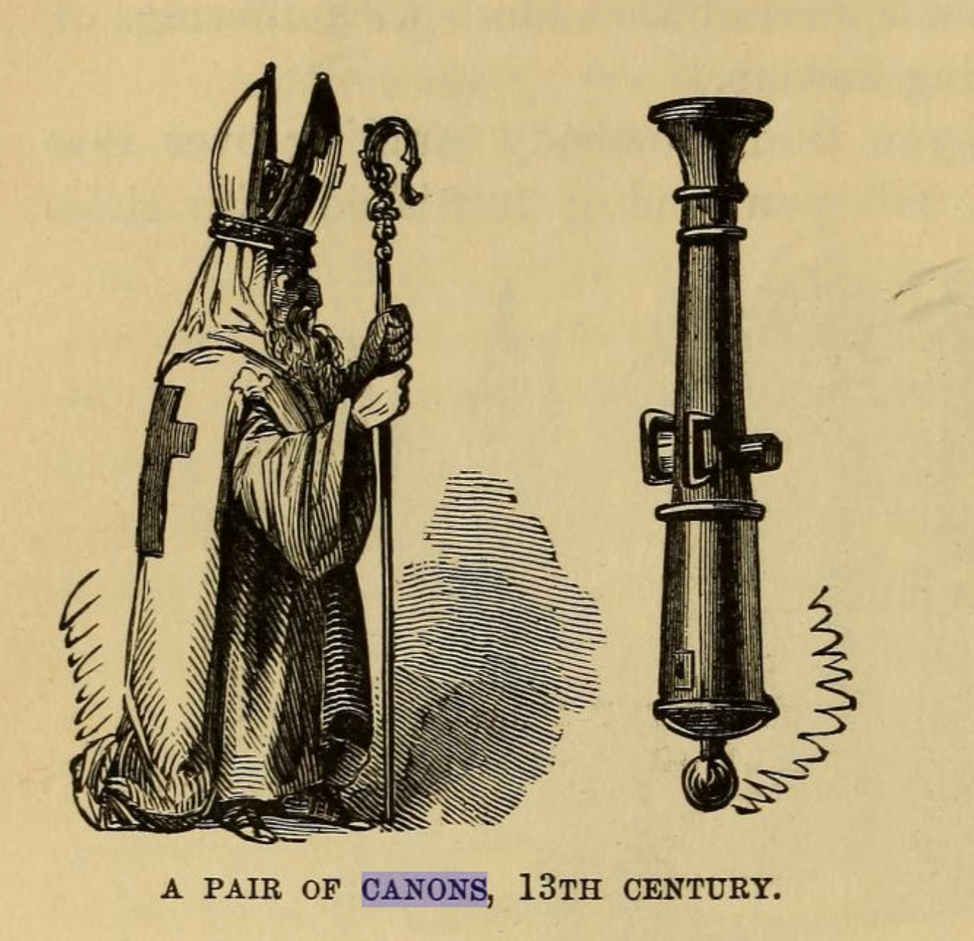
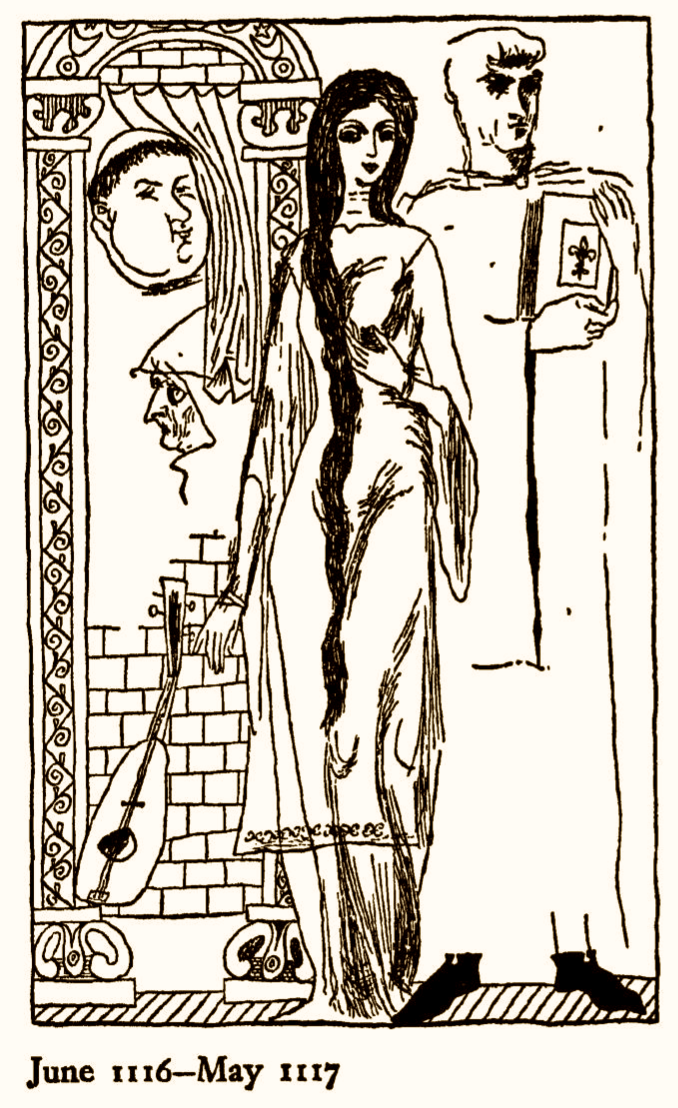
The picture at the top of this column comes from one of Mark Twain’s travelogues. It illustrates the vindictive priest Fulbert, in Twain’s retelling of the story of Abelard and Héloïse, 12th century lovers. More about that momentarily. Abelard was a prominent philosopher who tangled for several years with Saint Bernard of Clairvaux, a significant dispute ably discussed here.

Abelard and the Inklings

Abelard (c. 1079-1142) was a philosopher who, as was common during the Middle Ages, was also a theologian. Among his contributions to religion was revising the Roman Catholic doctrine of limbus infantium (Limbo for unbaptized infants).

In popular culture, Abelard’s love affair with his eventual “wife” is more prominent than his religious pursuits. Although Abelard was a famous figure during the medieval period, he did not feature significantly in C.S. Lewis’ thought. He did, however, exert a prominent influence on Charles Williams’ Place of the Lion, a volume Lewis praised.

In “Friendship in The Place of the Lion,” Dan Hamilton provides a very accessible synopsis of Williams’ book. He describes the experience of a primary character, who is writing her dissertation on “Pythagorean Influences on Abelard.” As she struggles with the appearance of supernatural phenomena, “she encounters the specter of Abelard, a major subject of her studies. But he is dead, and powerless to give her any aid, not even a meaningful word.” The “archetypes” in the story, by contrast, possess genuine power. It is a very unique book.

Returning to Mark Twain’s retelling of the popular medieval tale, we leave the realm of platonic philosophy, and enter the world of sordid human activities. Twain, you see, was not sympathetic to Abelard’s wooing of a young student and his eventual repentance. In his account, Twain desired “to show the public that they have been wasting a good deal of marketable sentiment very unnecessarily.” If you are curious as to his perspective on the events, continue reading.

Twain’s Take on Abelard and Héloïse
(not brief, but well worth reading)

In his own words, Twain’s “faithful” version of their story – but first, he begins with a description of their shared gravesite.

But among the thousands and thousands of tombs in Père la Chaise [cemetery] there is one that no man, no woman, no youth of either sex, ever passes by without stopping to examine. Every visitor has a sort of indistinct idea of the history of its dead, and comprehends that homage is due there, but not one in twenty thousand clearly remembers the story of that tomb and its romantic occupants. This is the grave of Abelard and Heloise – a grave which has been more revered, more widely known, more written and sung about and wept over, for seven hundred years, than any other in Christendom, save only that of the Saviour.

All visitors linger pensively about it; all young people capture and carry away keepsakes and mementoes of it; all Parisian youths and maidens who are disappointed in love come there to bail out when they are full of tears; yea, many stricken lovers make pilgrimages to this shrine from distant provinces to weep and wail and “grit” their teeth over their heavy sorrows, and to purchase the sympathies of the chastened spirits of that tomb with offerings of immortelles and budding flowers.

Go when you will, you find somebody snuffling over that tomb. Go when you will, you find it furnished with those bouquets and immortelles. Go when you will, you find a gravel-train from Marseilles arriving to supply the deficiencies caused by memento-cabbaging vandals whose affections have miscarried.

Yet who really knows the story of Abelard and Heloise? Precious few people. The names are perfectly familiar to every body, and that is about all. With infinite pains I have acquired a knowledge of that history, and I propose to narrate it here, [italics added] partly for the honest information of the public and partly to show that public that they have been wasting a good deal of marketable sentiment very unnecessarily.

Heloise was born seven hundred and sixty-six years ago. She may have had parents. There is no telling. She lived with her uncle Fulbert, a canon of the cathedral of Paris. I do not know what a canon of a cathedral is, but that is what he was. He was nothing more than a sort of a mountain howitzer, likely, because they had no heavy artillery in those days. Suffice it, then, that Heloise lived with her uncle the howitzer, and was happy.

She spent the most of her childhood in the convent of Argenteuil – never heard of Argenteuil before, but suppose there was really such a place. She then returned to her uncle, the old gun, or son of a gun, as the case may be, and he taught her to write and speak Latin, which was the language of literature and polite society at that period.

Just at this time, Pierre Abelard, who had already made himself widely famous as a rhetorician, came to found a school of rhetoric in Paris. The originality of his principles, his eloquence, and his great physical strength and beauty created a profound sensation. He saw Heloise, and was captivated by her blooming youth, her beauty and her charming disposition. He wrote to her; she answered. He wrote again, she answered again. He was now in love. He longed to know her – to speak to her face to face.

His school was near Fulbert’s house. He asked Fulbert to allow him to call. The good old swivel saw here a rare opportunity: his niece, whom he so much loved, would absorb knowledge from this man, and it would not cost him a cent. Such was Fulbert – penurious . . . He asked Abelard to teach her.

Abelard was glad enough of the opportunity. He came often and staid long. A letter of his shows in its very first sentence that he came under that friendly roof like a cold-hearted villain as he was, with the deliberate intention of debauching a confiding, innocent girl. This is the letter :

“I can not cease to be astonished at the simplicity of Fulbert; I was as much surprised as if he had placed a lamb in the power of a hungry wolf. Heloise and I, under pretext of study, gave ourselves up wholly to love, and the solitude that love seeks our studies procured for us. Books were open before us, but we spoke oftener of love than philosophy, and kisses came more readily from our lips than words.”

And so, exulting over an honorable confidence which to his degraded instinct was a ludicrous “simplicity,” this unmanly Abelard seduced the niece of the man whose guest he was. Paris found it out. Fulbert was told of it – told often – but refused to believe it. He could not comprehend how a man could be so depraved as to use the sacred protection and security of hospitality as a means for the commission of such a crime as that. But when he heard the rowdies in the streets singing the love-songs of Abelard to Heloise, the case was too plain – love-songs come not properly within the teachings of rhetoric and philosophy.

He drove Abelard from his house. Abelard returned secretly and carried Heloise away to Palais, in Brittany, his native country. Here, shortly afterward, she bore a son, who, from his rare beauty, was surnamed Astrolabe. . . . The girl’s flight enraged Fulbert, and he longed for vengeance, but feared to strike lest retaliation visit Heloise – for he still loved her tenderly. At length Abelard offered to marry Heloise – but on a shameful condition: that the marriage should be kept secret from the world, to the end that (while her good name remained a wreck, as before) his priestly reputation might be kept untarnished. It was like that miscreant.

Fulbert saw his opportunity and consented. He would see the parties married, and then violate the confidence of the man who had taught him that trick; he would divulge the secret and so remove somewhat of the obloquy that attached to his niece’s fame. But the niece suspected his scheme. She refused the marriage, at first; she said Fulbert would betray the secret to save her, and besides, she did not wish to drag down a lover who was so gifted, so honored by the world, and who had such a splendid career before him. It was noble, self-sacrificing love, and characteristic of the pure-souled Heloise, but it was not good sense.

But she was overruled, and the private marriage took place. Now for Fulbert! The heart so wounded should be healed at last; the proud spirit so tortured should find rest again; the humbled head should be lifted up once more. He proclaimed the marriage in the high places of the city, and rejoiced that dishonor had departed from his house. But lo! Abelard denied the marriage! Heloise denied it! The people, knowing the former circumstances, might have believed Fulbert, had only Abelard denied it, but when the person chiefly interested – the girl herself – denied it, they laughed despairing Fulbert to scorn.

The poor canon of the cathedral of Paris was spiked again. The last hope of repairing the wrong that had been done his house was gone. What next? Human nature suggested revenge. He compassed it. The historian says: “Ruffians, hired by Fulbert, fell upon Abelard by night, and inflicted upon him a terrible and nameless mutilation.”

I am seeking the last resting-place of those “ruffians.” When I find it I shall shed some tears on it, and stack up some bouquets and immortelles, and cart away from it some gravel whereby to remember that howsoever blotted by crime their lives may have been, these ruffians did one just deed, at any rate, albeit it was not warranted by the strict letter of the law.

Heloise entered a convent and gave good-bye to the world and its pleasures for all time. For twelve years she never heard of Abelard – never even heard his name mentioned. She had become prioress of Argenteuil, and led a life of complete seclusion. She happened one day to see a letter written by him, in which he narrated his own history. She cried over it, and wrote him. He answered, addressing her as his “sister in Christ.”

They continued to correspond, she in the un-weighed language of unwavering affection, he in the chilly phraseology of the polished rhetorician. She poured out her heart in passionate, disjointed sentences; he replied with finished essays, divided deliberately into heads and sub-heads, premises and argument. She showered upon him the tenderest epithets that love could devise, he addressed her from the North Pole of his frozen heart as the “Spouse of Christ!” The abandoned villain!

On account of her too easy government of her nuns, some disreputable irregularities were discovered among them, and the Abbot of St. Denis broke up her establishment. Abelard was the official head of the monastery of St. Grildas de Ruys, at that time, and when he heard of her homeless condition a sentiment of pity was aroused in his breast (it is a wonder the unfamiliar emotion did not blow his head off), and he placed her and her troop in the little oratory of the Paraclete, a religious establishment which he had founded.

She had many privations and sufferings to undergo at first, but her worth and her gentle disposition won influential friends for her, and she built up a wealthy and flourishing nunnery. She became a great favorite with the heads of the church, and also the people, though she seldom appeared in public. She rapidly advanced in esteem, in good report and in usefulness, and Abelard as rapidly lost ground. The Pope so honored her that he made her the head of her order.

Abelard, a man of splendid talents, and ranking as the first debater of his time, became timid, irresolute, and distrustful of his powers. He only needed a great misfortune to topple him from the high position he held in the world of intellectual excellence, and it came. Urged by kings and princes to meet the subtle St. Bernard in debate and crush him, he stood up in the presence of a royal and illustrious assemblage, and when his antagonist had finished he looked about him, and stammered a commencement; but his courage failed him, the cunning of his tongue was gone: with his speech unspoken, he trembled and gat down, a disgraced and vanquished champion.

He died a nobody, and was buried at Cluny, A.D., 1144. They removed his body to the Paraclete afterward, and when Heloise died, twenty years later, they buried her with him, in accordance with her last wish. He died at the ripe age of 64, and she at 63. After the bodies had remained entombed three hundred years, they were removed once more. They were removed again in 1800, and finally, seventeen years afterward, they were taken up and transferred to Pere la Chaise, where they will remain in peace and quiet until it comes time for them to get up and move again.

History is silent concerning the last acts of the mountain howitzer. Let the world say what it will about him, I, at least, shall always respect the memory and sorrow for the abused trust, and the broken heart, and the troubled spirit of the old smooth-bore. Rest and repose be his!

Such is the story of Abelard and Heloise. (Innocents Abroad).


* Later Fordefjord was unimaginatively renamed “First Lutheran Church.”

A novel entitled Peter Abelard was published in 1933 by Helen Waddell. It is available at Internet Archive for those who prefer their history via the medium of historical fiction. The illustration below, apparently imitating a fading fresco, comes from that volume.
A Curious Papal Funerary Tradition

Several unique items are buried with modern popes when they die. Most, including their vestments, point to their spiritual role as the Bishop of Rome and patriarch of the Roman Catholic Church. One, however, highlights his secular role as the leader of the world’s smallest independent nation state.

This post is not about Pope Francis’ reign, or the papacy in general. As C.S. Lewis noted in a letter to an American poet, Mary Willis Shelburne, opinions on such matters differ in sometimes unproductive ways. In response to a comment she had written about the passing of Pope John XXIII (1881 – 1963), who had convened the Second Vatican Council, Lewis astutely observed,

God’s purposes are terribly obscure. I am thinking both of your [physical] sufferings and of the removal of such a Pope at such a moment. And the horrid conclusions which some bigots on both sides will probably draw from it.

Rather than discussing the role of the Bishop of Rome, I am considering one specific aspect of the office of the Bishop of Rome – the formalities associated with the funeral and burial/interment of a deceased pope. My focus is further restricted to a single unique facet of that process. This involves the coinage of the Vatican City State issued during their reign.

Despite its status as a nation, Vatican City has declined full membership in the United Nations. This is due to the admirable goal of remaining detached from the official political tentacles associated with having an official vote. Instead, through the Holy See, the papacy’s ecclesiastical office, the Roman Catholic Church maintains a presence and voice in the UN.

Vatican City is one of the few independent states that has not become a member of the United Nations. It does hold permanent observer status, with all the rights of a full member except for having a vote in the General Assembly.

On April 6, 1964, the Holy See became a Permanent Observer Mission to the United Nations and established its Mission in New York City. This was fitting, not only because of the growing involvement of the Holy See in UN deliberations, but above all because the four pillars of the UN as enshrined in its Charter dovetail very well with four main pillars of Catholic Social Teaching . . .

The Holy See enjoys by its own choice the status of Permanent Observer at the United Nations, rather than of a full Member. This is due primarily to the desire of the Holy See to maintain absolute neutrality in specific political problems.

In accordance with tradition, “preparations are also being made for a numismatic commemoration of the Sede Vacante.” The Latin term  means “vacant seat,” and refers to the transitional period between popes. Thus, in addition to the papal coins minted for each pope, special issues are normally released during the interims. However, due to a reorganization of the Vatican’s coinage office, CoinsWeekly reports it remains “uncertain whether a 2-euro commemorative coin” will be produced for this papal interregnum.

NumismaticNews echoes the fact that due to their rarity, Sede Vacante issues rapidly increase in value. Fortunately due to their infrequency, they “ are seldom at the center of a collector’s radar. That’s probably a good thing, as it means we are not losing popes quickly or routinely.”

A number of items are traditionally included in a pope’s casket. Unsurprisingly, these include a miter, crozier, and rosary. They also include coins minted during their reign, reflecting their role as ruler of the Papal State. This last fact surprised me.

So, precisely what is the precedent being set with Pope Francis’ funeral? First, he was not buried in the Vatican, but in a basilica dedicated to St. Mary.

There was another, more significant symbol of the simplicity that characterized his papacy. While popes traditionally have three elaborate caskets nestled inside one another, Francis asked to have only one simple wooden casket with a modest zinc inner lid.

Pope Francis’ 2017 Revision of Vatican Coinage

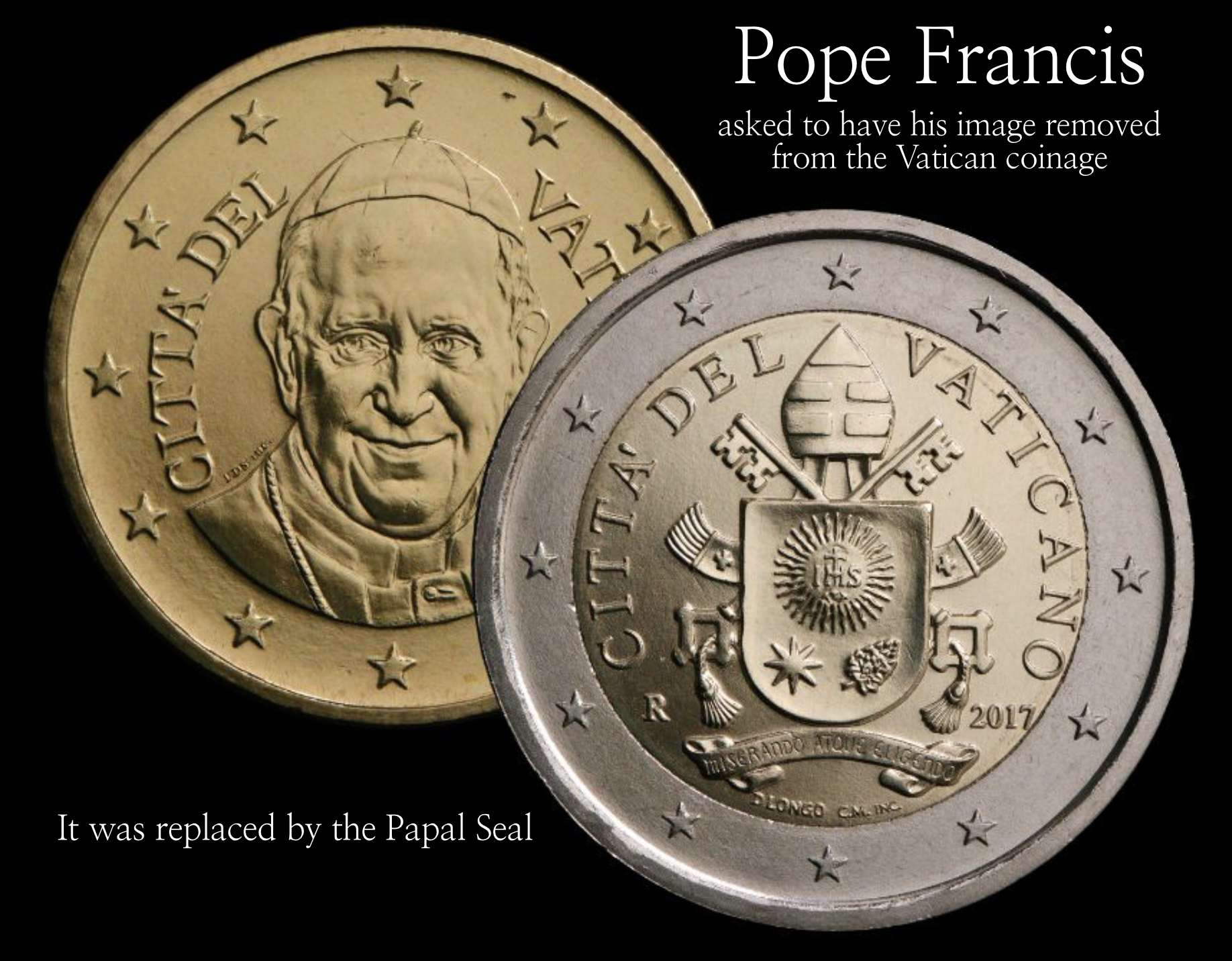
For centuries, the portrait of the current Bishop of Rome graced coins in Rome. That tradition ended with Pope Francis. In 2017, he personally requested that his visage no longer appear on coins. This is commendable, since it was presumably based on Francis’ humility. 

This then, his image has been replaced by the papal coat of arms. Notably, every other country minting euros bears the head of its head of state. It will be interesting to see whether or not Francis’ successor follows his example.

A Brief Note on Protestant Coinage

Although there have been some historical attempts to create governmental structures led by religious leaders besides Roman Catholicism, they have been the rare exception. (The claimed leadership of the Church by sovereigns such as King Henry VIII is another case.) 

In Zurich, Huldrych Zwingli (1484 – 1531) sought to establish a theocracy, and actually perished on the battlefield resisting the Roman Catholic armies of several Swiss cantons. John Calvin (1509 – 1564) pursued similar goals in Geneva, and beyond. Calvin, however, never bore arms in his effort.

Fortunately, the “two kingdoms” theology of Martin Luther became dominant in primarily Protestant realms. It is based on the declaration Jesus made during his trial before Pontius Pilate that “My kingdom is not of this world” (John 19).

For a fascinating discussion of the implications of this theological position, consider “Martin Luther’s Farewell to Arms: The Two Kingdoms and the Rejection of Crusading.”

Turning to numismatics, it is not rare to find religious leaders portrayed on historical coinage. However, these portrayals serve as commemorations of individuals who have made a cultural or ethical contribution to a particular society – not because they sat upon a throne.

For example, Switzerland minted a 20 franc coin with the images of Zwingli and Calvin during the 500th anniversary of the Reformation.

Likewise, in 1965, the Communist government of Czechoslovakia produced a 10 korun coin in honor of the 550th anniversary of the martyrdom of Jan Hus. This particular coin, like many similar pieces, was actually minted as a non-circulating coin, intended for collectors rather than daily commerce.

This leads us to note that most coin-like pieces of metal bearing the likeness of reformers are actually medallions, not coins. As such, the vast majority of the commemoratives have been fashioned by organizations, rather than governments.

Being an amateur numismatist and a Lutheran pastor myself, I have several related items in my personal collection (none of which were costly, of course . . . since it’s just a hobby). One of my favorite items is a genuine 1 Mark coin minted in Eisenach in Weimar Germany in 1921 (pictured below). What makes it especially unusual is that due to postwar metal shortages, it was actually struck in porcelain!

This emergency coinage and currency was called “Notgeld,” which means “necessity money” because individual cities found it necessary to provide their own money when the Reichsbank succumbed to hyperinflation between the world wars.

The city of Eisenach chose the centennial of Martin Luther’s work because of his historic ties to the city. The Lutherhaus Eisenach cultural center commemorates, among other events, Luther’s early schooldays there, and his stay at Wartburg Castle where he translated the New Testament into German.

Conclusion

In light of Pope Francis’ funeral and the association it has with numismatics, it is a good time to consider how coinage has often carried a religious message. Although this was more frequent in past centuries, it still occurs today. It will be interesting to see just how many nations eventually mint coins in honor of Pope Francis. The Philippines, Samoa and the Cook Islands already have.

And even Narnia, the home of Aslan, minted coins in honor of its heroes, didn’t it?

Timothy Keller & C.S. Lewis

The spiritual legacy of C.S. Lewis continues to bear abundant fruit. And, although his humility would prevent him from accepting it, Lewis shares credit in the blessings being passed on to new generations by those whose lives he directly touched.

Some of these gifted Gospel communicators have publicly praised Lewis for his role in their own conversions or moments of deeper epiphany into the work of our Creator. 

One such Christian leader was Timothy Keller, who recently died at the age of 72. Although he was just a few years older than me, Keller and I shared a number of traits. Raised Lutheran, we accepted the truths about Jesus’s work as kids, but it wasn’t until our young adulthood that we were confronted with the fact that trusting Christ as a loving Savior falls far short of taking up our own crosses and following him as Lord.

It’s no accident that our mutual spiritual awakenings coincided with our introduction to the writings of C.S. Lewis during our collegiate years. Both of us became pastors, although the paths of ministry we followed differed, as befits children of a heavenly Father who guides each of his children as the unique person he has created them to be. 

Keller was ordained in the Presbyterian tradition, and devoted most of his energy to helping the Christian Church establish a far more intentional ministry in cities. I was ordained in the Lutheran branch of the Body of Christ, and served much of my ministry as a military chaplain. Both of us were pastors in evangelical, Scripture-affirming denominations within our respective traditions.

I’m sure there are other parallels, such as both being married since the mid-70s and having three kids, but the last similarity I wish to note is that we both have writing as part of our vocations. Not that I would compare my own modest talents to Keller’s.

Tim Keller was a prolific author. And the influence of C.S. Lewis on his thinking, and writing, is pervasive in Keller’s work. Last year The Evangelical Christian Publishers Association presented him with the prestigious “Pinnacle Award.”

Timothy Keller has written more than 35 books, published by a variety of companies, with some co-authored by his wife Kathy.  His published body of work represents a variety of categories including apologetics, biblical studies, theology, prayer, devotionals, marriage, Bible study, the Church, and cultural engagement – with sales exceeding 7.5 million units and translated into more than 25 languages.

Keller’s prodigious literary output is one reason he has been likened to C.S. Lewis. Another obvious reason is the subject matter, particularly the prominent place occupied by Christian apologetics.

Like Lewis, Keller was an avid reader. This trait provided the foundation for both authors’ literary contributions to Christian thinking. “A Reading List to Understand Tim Keller” includes a number of the works of great importance to him.

Read This Twice, which gathers book endorsements found on the internet, provides a list of 64 books endorsed by Tim Keller. What makes this curious site special is they provide quotations for his recommendations and the sources from which they are gleaned. Oddly, the aggregator appears to lean heavily on contemporary Twitter sources. Consequently, it includes not a single book written by C.S. Lewis himself, belying the Inkling’s seminal influence on Keller.

The endorsement website also offers access to book recommendations on subjects of a visitor’s choice, compliments of Sona. Sona, as a caution to those among us who are wary of artificial intelligence, is an “AI-driven book recommendation assistant that makes it easy for you to discover your next read. Just provide your specific preferences, and [she] will quickly search through a large database of books to offer you options that closely align with your request.” The invitation closes with: “Try ‘Sona’ and enjoy a seamless, personalized book-finding experience.”

In “Remembering Tim Keller – Today’s C.S. Lewis,” the writer plays with his title.

It is often said that Dr. Timothy Keller, who died last Friday at his home in Manhattan, was this generation’s C.S. Lewis. The dust jacket for The Reason for God says so.

Tim would have had none of it. He just wasn’t that kind of person. I remember sitting down with him after yet another remarkable talk that he had delivered, sparkling with ideas and insight, with lots more to explore, and all he wanted to talk about was his kids and how great they were. Tim was a simple child of God with, like all of us, the normal joys and worries in life.

And yet . . . that impact! It was enormous. Although it might be an overstatement to ascribe C.S. Lewis status to his contribution, it would only be a slight overstatement.

Tim Keller certainly shared some of C.S. Lewis’ righteous qualities, but some writers are adamant about acknowledging their distinctions. A fellow Presbyterian pastor has a great post on this subject titled “Tim Keller is NOT this generation’s C.S. Lewis.” The author persuasively argues that their vocations were too different to make such a claim. 

But please, can we not call him another C.S. Lewis?  Any time we call a great person “another” anybody, we are doing disservice to both figures.  Lewis’ vocation was to serve as a man of letters who wove his faith into his writing.  Keller’s vocation is to be a pastor and equipper who employs writing as but one of his tools.

There are even some conservative Reformed authorities who view Keller (and C.S. Lewis) with suspicion. According to Christian Network Europe “Laurens van der Tang . . . wrote in De Wachter Sions (The Watchman of Sion) . . . that the books of Christian writers, such as Lewis, Dietrich Bonhoeffer and Tim Keller” may possess positive elements but are incomplete. “He argues that they did not pay enough attention to man’s death state, the need for repentance and God’s holy wrath on sin.”

He concludes that “distancing is appropriate” and that these “authors cannot replace theologians from the Reformation or the Dutch Second Reformation.” Also, the Dutch Rev. A. Schreuder writes that “whoever reads the works of the Big Three misses the ultimate point of the personal appropriation of salvation.”

Fortunately, such opinions are in the minority. Most Christians find all three writers inspiring. As this very article reports, “the combination of reason, feeling and imagination is also why Christians in many different surveys indicate that they see Lewis . . . as one of the most influential theologians of the 20th century.”

A glance at virtually any one of Keller’s books will reveal at least one reference to the writings of C.S. Lewis. In Shaped by the Gospel, he references four of Lewis’ books and essays. In his book On Death, Keller discusses that when we stand in God’s very presence – a joy he even now knows – and alludes to a powerful metaphor offered by C.S. Lewis in The Weight of Glory.

C.S. Lewis says if these lower reaches of the stream of God’s glory are so intoxicating, what will it be like to drink from the fountainhead?

The Atlantic published a poignant essay by Keller as he faced his impending death. “Growing My Faith in the Face of Death: I spent a lifetime counseling others before my diagnosis. Will I be able to take my own advice?”

The subtitle says it all. It’s a challenge many Christians one day face, and it is particularly sobering for pastors. In the article, Keller relates an acutely tragic conversation.

A significant number of believers in God find their faith shaken or destroyed when they learn that they will die at a time and in a way that seems unfair to them. Before my diagnosis, I had seen this in people of many faiths. One woman with cancer told me years ago, “I’m not a believer anymore—that doesn’t work for me. I can’t believe in a personal God who would do something like this to me.” Cancer killed her God.

Yes, reality and the suffering consequences of the Fall may have shattered the spectral image of her god (lower case “g”), but I hope that through the ministry of Keller and others that unfortunate woman came to know the true God before she stood in his presence.

For I am sure that neither death nor life, nor angels nor rulers, nor things present nor things to come, nor powers, nor height nor depth, nor anything else in all creation, will be able to separate us from the love of God in Christ Jesus our Lord (Romans 8).

Timothy Keller, like C.S. Lewis before him, who served as one of Keller’s mentors, left us with a treasure trove of edifying literature. In the past I’ve often been too busy to read much of Keller’s work. However, as of now I am in the process of rectifying that problem. If you join me in that journey, I’m sure neither of us will be disappointed.

Filling the Shoes of Giants

One thing all humans have in common, is that we are mortal. Immortality is not inherent to our nature, and eternal life can only come as a gift from our Creator. All men and women live and die. In the words of Ecclesiastes:

It is the same for all, since the same event [i.e. death] happens to the righteous and the wicked, to the good and the evil, to the clean and the unclean, to him who sacrifices and him who does not sacrifice. As the good one is, so is the sinner, and he who swears is as he who shuns an oath (Ecclesiastes 9:2).

Naturally, there are many metrics by which to measure a person’s life. For my purpose today, I’m thinking about people who exerted an outsized* influence on culture through their testimony for Christ.

Richard John Neuhaus was such a man. Neuhaus served an integrated Lutheran congregation in Brooklyn during the 1960s, where his reputation as a socially conscious pastor began. Following the Roe versus Wade decision, Neuhaus’ involvement in liberal politics ebbed. However, his commitment to applying Christian ethics to society remained strong. In 1990, he became a Roman Catholic. He also founded the Institute on Religion and Public Life which continues to publish its ecumenical journal First Things.⁑

In his tribute to his uncle, “Can the Shoes of Richard John Neuhaus Be Filled?” Pastor Peter A. Speckhard acknowledges the sad prospects of lesser voices.

Sincerely Christian intellectuals who can articulate a solid orthodox take on any subject, but to whom nobody but their students and blog followers feel any urge to listen, are also a dime a dozen.⁂

Speckhard’s point is that there are many who are brilliant and devout, but few who can fill the shoes of giants. Speckhard offers this stark appraisal, however, without seeking to discourage other Christians from speaking to whomever might listen. (Which is much-needed encouragement to bloggers who are disappointed at how few read their posts.)

C.S. Lewis, an Even Taller Giant

As great as Neuhaus’ contribution to the advance of Christianity has been, it cannot match that of C.S. Lewis. Lewis, after all, was the great Christian apologist of the twentieth century. (An “apologist” is a person who argues in the defense of something that is controversial, in this case, the claim of Jesus himself that he “is the way, the truth, and the life [and] no one comes to the Father except through me” (John 14:6).

While Neuhaus’ witness has continued to influence many Americans, Lewis’ impact has been felt around the world. Not only has God used his works to convert many readers, Lewis’ writings continue to teach and encourage those seeking the truth today.

I have not yet had an opportunity to read The Fame of C.S. Lewis. From the reviews, it is not so much about Lewis’ writing, but the way in which his reputation has grown. Thus the subtitle: A Controversialist’s Reception in Britain and America. The author addresses one of the myths that has bothered me for years.

You may have heard the contention that Lewis is more popular in American than he is in Britain. It often carries a negative innuendo and comes across (to me, at least) like: “Lewis is more popular in the naïve, religiously unsophisticated colonies, than he is in enlightened, theologically cultured Britain.” In fact, Stephanie Derrick concludes, “the scale of Lewis’ renown was greater in the States than in Britain in large part because the difference in population there amounted to a much larger audience.”

Derrick addresses “larger question: how is renown made and kept?” She argues that “much of Lewis’s popularity is properly attributed to factors besides Lewis’s talents.”

Indeed, much of The Fame of C.S. Lewis is devoted to exploring the external factors that shaped Lewis’s success—the many actors and circumstances that have contributed to his popularity. Institutions, editors, changing social forces, and audiences have all had a hand in moulding Lewis’s image.

She is certainly correct that a wide range of factors, recognized and unknown, influence how we view people. This is particularly true after the individual (e.g. Rev. Richard Neuhaus) has become a part of history, once death has extinguished them, as Ecclesiastes might say.

However, I disagree that Lewis’ fame is an accident, the result of a unique combination of uncontrolled variables. On the contrary, I believe his reputation is based upon (1) his literary talents, (2) his humility and transparency, and—most importantly—because, (3) at the core of his most significant work, we find truth. The foundation of Lewis’ most precious writing is based on an unchanging, even eternally, relevant foundation.

I have no doubt God will continue to raise up other Christian apologists with anointed and far-reaching ministries. Ravi Zacharias, ⁑⁑ who recently died, is such a champion. There will be others to fill the shoes of C.S. Lewis and Zacharias, but their successors will require very remarkable gifts.

Bonus

One final link. This one is to the Moral Apologetics website, which has some very good articles on C.S. Lewis. And, if you decide to subscribe to their free newsletter, they allow you download The Ichabod Letters: Epistles from a Junior Demon. (Author Elton Higgs says his “study in demonic subterfuge [is] modeled on C.S. Lewis’s Screwtape Letters.”)


* That’s the first time I’ve ever used that word. Seems too slangish for my tastes. But apparently it has been around since it dates to the early 1800s. (By the way, I hope you appreciated my facetious use of “slangish,” which is considerably younger and more slangy.)

First Things is an ecumenical publication, but my subjective estimate is that about 70% of the articles relate rather directly to Roman Catholicism. They offer a worthwhile newsletter featuring free access to a number of their articles.

⁂ Peter A. Speckhard, “Can the Shoes of Richard John Neuhaus Be Filled?” Concordia Theological Quarterly 77 (2013), 342-53. The article is available here.

⁑⁑ Zacharias leaves behind a lasting legacy, particularly in the form of the ministry he founded, RZIM. Check it out for some thoughtful resources from Zacharias and other like minded contemporary Christian apologists.

C.S. Lewis and Self-Awareness

Who are you? If you were to fully answer that question, it would require serious introspection. However, if you were to answer it completely, it would also require an honesty that is extremely rare.

That’s because anyone who reveals everything about themself, comes to a point where the qualities and actions are no longer flattering. They ultimately arrive at the place where the exposé becomes a confession.

The truth is that no one actually knows everything about themself. But some of the things we are aware of . . . some of the secrets we desire to hide, even from ourselves . . . are seldom shared. That is one great value of the “confessional.” There, one can unburden themselves and face their demons, so to speak, in a setting where they know their confidence won’t be violated.

As a Protestant pastor, who has never used a physical confessional stall or screen, I note that I have nevertheless heard thousands of confessions. They are, as one would expect, a common element of counseling as people seek to experience healing and restoration. As a Lutheran, I belong to a tradition that guarantees the privacy of these confessions, or what is considered “privileged communication.” Moreover, as a military chaplain, I was grateful to serve a nation that enshrines the same promise in the Uniform Code of Military Justice.

As Lewis wrote, “if there is a particular sin on your conscience, repent and confess it” (Letters to an American Lady). Once that is done, the pastor (or any “confessor”) can assist the individual with working to make as right as possible in the future what was damaged or destroyed by their choices in the past.

From the Psychological Vantage Point

If you have never encountered it before, I commend to you the model called the Johari Window. I have written about it in the past in the context of honesty and dishonesty.

The model illustrates just how complex our personalities are. The arrows on the model below reveal how we can expand the “open” part of ourselves. Naturally, there are some “hidden” aspects that should only be disclosed in certain contexts.

When it comes to the darkness in our lives, that which we strive to keep veiled, psychologists describe it in a variety of ways. One chaplain with whom I worked was particularly enamored with the work of Carl Jung. He loved to toss around the word “shadow,” and suggest there was some dark psychological significance to even the most offhand comment or expression. In essence, the shadow is the part of our personality we don’t want to admit to having. In terms of the Johari Window, you might think of it as the sinister stuff in the Hidden quadrant.*

C.S. Lewis wrote about Jung in an essay entitled “Psycho-Analysis and Literary Criticism.” Lewis disparages the Freudian theory, saying “poetry is not a substitute for sexual satisfaction, nor sexual satisfaction for poetry.” Jung, he argues, presents “a much more civil and humane interpretation of myth and imagery.” Of course, Lewis is discussing these psychoanalysts from the perspective of a literary critic, not a psychologist. In that regard, we can appreciate his assessment of one of Jung’s major works.

Thanks to my training I can suspend my judgement about the scientific value of Jung’s essay on “Mind and the Earth:” but I perceive at once that even if it turns out to be bad science it is excellent poetry.

From the Christian Point of View

I have already described how confession can serve as a means of expanding our self-awareness in a constructive and healing way. That’s why confession and absolution are a formal part of many worship service, going back to the earliest times. If we want to read the finest primer on confession, we need look no further than the book of Psalms.

As King David, in recognition of this great sins, prays in the fifty-first psalm:

Have mercy on me, O God,
according to your steadfast love;
according to your abundant mercy
    blot out my transgressions.
Wash me thoroughly from my iniquity,
    and cleanse me from my sin!

One of the earliest Christian classics (outside the Bible itself) was aptly entitled Confessions. It was written by Augustine, the bishop of a North African city called Hippo. His description of our self-awareness is so deep and profound, it will likely require more than a single reading.

No one knows what he himself is made of, except his own spirit within him, yet there is still some part of him which remains hidden even from his own spirit; but you, Lord, know everything about a human being because you have made him . . .

Let me, then, confess what I know about myself, and confess too what I do not know, because what I know of myself I know only because you shed light on me, and what I do not know I shall remain ignorant about until my darkness becomes like bright noon before your face. (Augustine, The Confessions, translation by Maria Boulding)

One of C.S. Lewis’ many correspondents was a man who was acutely troubled by his own self-awareness, and in particular, the consciousness of his own selfishness and egotism. Lewis offered some comforting and sound spiritual direction to the man. Since I believe the letter has a message for us all, I choose to close with it.

You are of course perfectly right in defining your problem (which is also mine and everyone’s) as “excessive selfness.” But perhaps you don’t fully realise how far you have got by so defining it. All have this disease: fortunate are the minority who know they have it.

To know that one is dreaming is to be already nearly awake, even if, for the present, one can’t wake up fully. And you have actually got further than that. You have got beyond the illusion (very common) that to recognise a chasm is the same thing as building a bridge over it.

Your danger now is that of being hypnotized by the mere sight of the chasm, of constantly looking at this excessive selfness. The important thing now is to go steadily on acting, so far as you can—and you certainly can to some extent, however small—as if it wasn’t there. You can, and I expect you daily do—behave with some degree of unselfishness. You can and do make some attempt at prayer.

The continual voice which tells you that your best actions are secretly filled with subtle self-regard, and your best prayers still wholly egocentric—must for the most part be simply disregarded—as one disregards the impulse to keep on looking under the bandage to see whether the cut is healing. If you are always fidgeting with the bandage, it never will

A text you should keep much in mind is I John iii, 20: “If our heart condemns us God is greater than our heart.” I sometimes pray “Lord give me no more and no less self-knowledge than I can at this moment make a good use of.” Remember He is the artist and you are only the picture. You can’t see it. So quietly submit to be painted—i.e. keep on fulfilling all the obvious duties of your station (you really know quite well enough what they are!), asking forgiveness for each failure and then leaving it alone. You are in the right way. Walk—don’t keep on looking at it.


* In contrast to the insignificant or embarrassing things we are aware of that we may prefer to keep to ourselves. For example, although I sing decently, I am an exceptionally poor instrumentalist. This despite the fact I married a talented and patient music teacher. It’s not my lack of talent which motivates my secrecy, it is the sad fact that I am a total sluggard when it comes to practicing. And this reveals a major flaw in my personality—if something is not inherently fun or doesn’t come easily to me, I have a terribly difficult time applying myself to the task. (And this shortcoming has very real consequences, both in terms of professional success and interpersonal relationships.)

⁑ Several years ago, a member of our Mere Inkling described in her blog how everyone experiences seasons of restlessness.

In his Confessions, Augustine wrote, “Thou hast made us for thyself, O Lord, and our heart is restless until it finds its rest in thee.” Yet even those who have found Christ feel restless at certain times, and these times lead us to a salutary discovery.

Augustine’s Confessions is a Christian classic. You can download a free copy here.

C.S. Lewis & Nuns

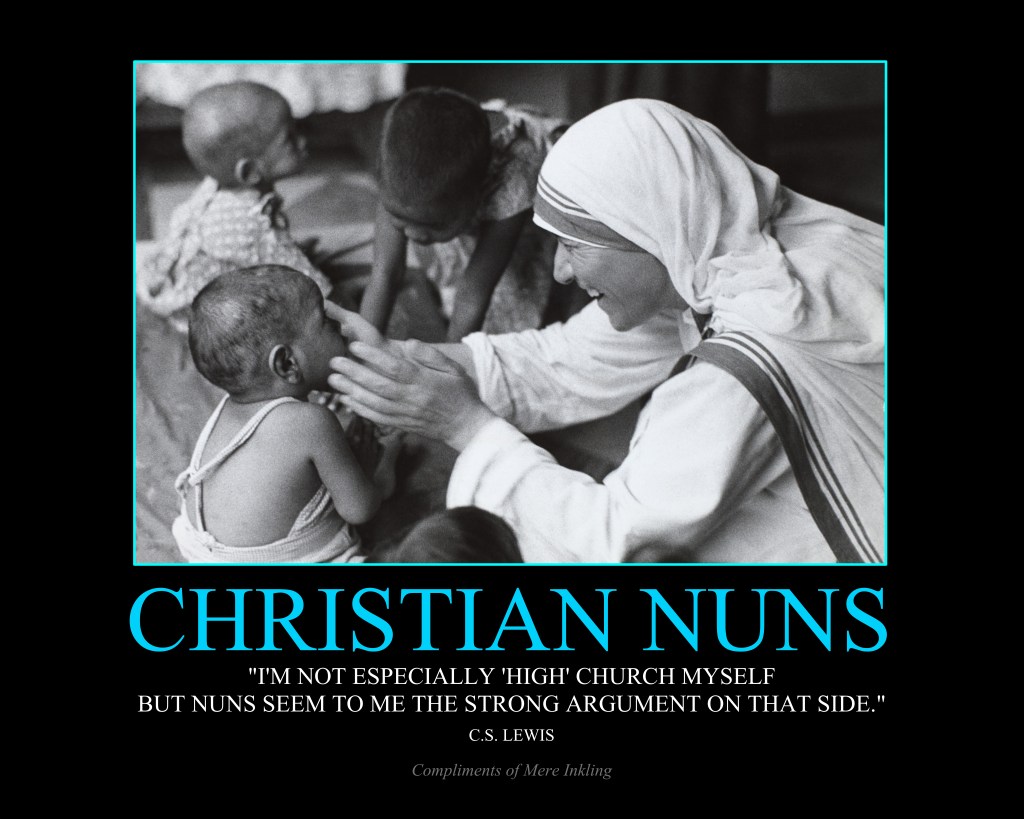
One of the great disappointments of Roman Catholic fans of C.S. Lewis is that he never converted to their communion. Lewis did, however, sincerely respect Roman Catholic nuns. In fact, he considered the reverence and joy of the nuns he encountered to be one of the church’s most commendable elements.

In 1947 he wrote to one of his regular correspondents who wondered why he had not forsaken his “low church” loyalties for a more elevated perspective. His response reveals his perception of the virtues of consecrated nuns.

I am particularly pleased to have been of any help as a bridge between the parish and the convent. I’m not especially ‘high’ Church myself but Nuns seem to me the strong argument on that side.

They are in my experience almost invariably so very nice—and so happy: much more so either than the same number of married women picked at random or the same number of monks. I don’t know why this should be so.

One does not have to be Catholic to appreciate people who consecrate their lives to God, willing to make radical sacrifices like living a life of celibacy. Nearly four decades ago, while I was serving a congregation in Citrus Heights, California, I earned a (post-M.Div.) Master of Theology degree. Since I was focused on Patristics, I was enrolled at a Jesuit seminary in the Bay area.

One day during my studies, an Episcopal priest and I were having lunch with a half dozen Roman Catholics, most of whom were religious sisters.* The conversation turned to a celebration by the sisters present that they no longer had to wear habits. The respectful person I am, I remained silent as they discussed their “family” business. Apparently, though, I was softly grinning, because of one them (it may even have been my thesis advisor) asked, “what are you smiling about?”

My response was that it wasn’t my place to offer an opinion, but when they pressed, I said, “well, throughout my life, whenever I’ve seen a nun in her habit, it’s been an encouraging thing, and I think—there goes a life that is consecrated to God.” My companions were shocked and at a loss for words. In retrospect, I believe that C.S. Lewis might have offered a similar comment.

Due to the century during which he lived, and his setting in the British Isles, Lewis encountered nuns far more frequently than I do. In fact, since their “liberation” from the habit, we can’t know precisely how many religious sisters cross our paths. In 1947 he describes to a close friend a trip to see his brother who was hospitalized in Ireland. His colorful description of the town he visited ends with an uplifting remark.

My Brother, thank God, was out of danger when I reached him on Monday morning last but was at the unearthly city of Drogheda where almost every building is a church or a tavern⁑  and what men do but pray and drink or how life is supported in their bodies I can’t conceive. . . . And you hear more wit and humour in one day of London than in a week of Drogheda. My Brother was in the care of the most charming nuns.

Nuns are found in various Christian traditions. In addition to those who take such vows in the Roman Catholic Church, the Eastern Orthodox churches trace the lineage of these female monastics back to the ancient eremites. ⁂ There are also Anglican and Lutheran convents. In fact, one of C.S. Lewis’ close friends was an Anglican nun. Sister Penelope, CSMV (1890-1977), was a member of the Community of St Mary the Virgin. Lewis dedicated his novel, Perelandra, “to some ladies at Wantage,” her convent.

In a 1941 letter to the BBC, Lewis pleads that he is unable to add to his current speaking commitments. These apparently included specific presentations to nuns.  

I’m afraid in view of my other commitments I should be ‘over-talked’ if I accepted the job you kindly suggest for me. I’m talking already to the R.A.F., to the general public, to nuns, to undergraduates, to societies. The gramophone will wear out if I don’t take care! With thanks and much regret.

Lewis’ Three Theses

Mary Willis Shelburne was a widow in Washington, D.C., with whom Lewis corresponded for a number of years. Beginning in 1950, they exchanged more than a hundred letters, which were collected in the volume Letters to an American Lady. Lewis arranged for her to receive financial support from the sales of his books in the United States. This support continued after his own passing. In 1952 Shelburne converted to Roman Catholicism, and proposed that Lewis follow her example. His response was gracious.

It is a little difficult to explain how I feel that tho’ you have taken a way which is not for me. I nevertheless can congratulate you—I suppose because your faith and joy are so obviously increased. Naturally, I do not draw from that the same conclusions as you—but there is no need for us to start a controversial correspondence! I believe we are very near to one another, but not because I am at all on the Romeward frontier of my own communion.

In a short note written four years later, Lewis thanks her for a picture of herself and a nun. He uses the occasion to voice his sentiment that nuns are happy and pleasant. He then proposes three curious theses, noting that his presumption is subjective and she may disagree with him. Do you agree with his opinions here?

Problem: why are nuns nicer than monks and schoolgirls nicer than schoolboys, when women are not in general nicer than men? But perhaps you deny all three statements! All blessings.

My own experience with the first category are limited, but the monks I’ve met have all been very kind, as have the nuns. I fully agree with his second contention. Girls are much nicer than boys. That seems to me a no-brainer . . . although I assume there are many girls who have been bullied by their peers and would disagree.

As for the final thesis, that neither women nor men are better than each other as a group, I would strongly disagree. While it is only a generalization, of course, I believe men tend far more toward cruelty and greed than do women. On the other end of the spectrum, experience tells me that women are significantly more disposed toward virtues such as nurture, mercy and compassion, than their Y chromosome counterparts.

Obviously, C.S. Lewis proposed this question to his correspondent off the cuff. Given the opportunity to discuss it at greater length, say over a pint at the Eagle and Child, it’s certainly possible he could persuade me that his ideas on this matter are correct. After all, we both share a respect for women who feel called to a religious life.


* The essential difference between nuns and sisters is that the former normally live in monasteries, while the latter takes a more tempered vow and often serves in a non-cloistered setting.

⁑ Although this article focuses on England, it provides details on a sad trend in which church buildings are being converted for use as pubs and bars.

⁂ Eremites are Christian hermits. This was the earliest form of monasticism, with individuals removing themselves from secular society. Communal monasticism developed later.

Timing the Reformation

wristwatch

I had an entrepreneurial epiphany on how to get rich during the 500th anniversary of the Reformation, and since I’m not an entrepreneur, I’m passing the idea on gratis, to readers of Mere Inkling.

Inspired by the shocking success of the Playmobil Martin Luther—their fastest-selling item ever—I wondered what other commemorative items might result in a windfall for investors.

The insight struck like the lightning bolt that dropped Luther to his knees and sent him off to the monastery.

Since this celebration hearkens back to the beginning of the Reformation . . . back to the day when the 95 Theses were nailed to the door of the Castle Church in Wittenberg . . . it dawned on me that we so indebted to what happened that moment that we are, in a true sense, living on Wittenberg time.

What better item to remind us of the significance of this than to turn to expert horologists* and design a Wittenberg Watch? Ideally it would be permanently linked to Wittenberg time. The wearer would also benefit from learning more about time zones and mathematics, trying to sort out the local time, especially when traveling.

More about the details in a moment.

C.S. Lewis and the Importance of Time

The nature and passage of time was of great importance to C.S. Lewis. He devoted an entire chapter to the subject in Mere Christianity. In “Time and Beyond Time,” he explores how God acts within history, but is not subject to time’s constraints.

If you picture Time as a straight line along which we have to travel, then you must picture God as the whole page on which the line is drawn. We come to the parts of the line one by one: we have to leave A behind before we get to B, and cannot reach C until we leave B behind. God, from above or outside or all round, contains the whole line, and sees it all.

Lewis then proceeds to explain his understanding by saying this “idea has helped me a good deal. If it does not help you, leave it alone. It is a ‘Christian idea’ in the sense that great and wise Christians have held it and there is nothing in it contrary to Christianity. But it is not in the Bible or any of the creeds. You can be a perfectly good Christian without accepting it, or indeed without thinking of the matter at all.”

Another difficulty we get if we believe God to be in time is this. Everyone who believes in God at all believes that He knows what you and I are going to do tomorrow. But if He knows I am going to do so-and-so, how can I be free to do otherwise?

Well, here once again, the difficulty comes from thinking that God is progressing along the Time-line like us: the only difference being that He can see ahead and we cannot. Well, if that were true, if God foresaw our acts, it would be very hard to understand how we could be free not to do them.

But suppose God is outside and above the Time-line. In that case, what we call “tomorrow” is visible to Him in just the same way as what we call “today.” All the days are “Now” for Him. He does not remember you doing things yesterday; He simply sees you doing them, because, though you have lost yesterday, He has not. He does not “foresee” you doing things tomorrow; He simply sees you doing them: because, though tomorrow is not yet there for you, it is for Him.

You never supposed that your actions at this moment were any less free because God knows what you are doing. Well, He knows your tomorrow’s actions in just the same way—because He is already in tomorrow and can simply watch you.

In a sense, He does not know your action till you have done it: but then the moment at which you have done it is already “Now” for Him.

Since God was/is witness to that day in Wittenberg, just as he knows our tomorrows today, we see his placing of creation within the linear progression of history is intentional. It does not restrict our Lord in any way, but it enables us to comprehend our existence. And thus, we are compelled to mark the passage of time.

What Might the Wittenberg Watch be Like?

Something elegant and tasteful, yet modest and unobtrusive. A watch like the one pictured above. It’s produced by Swisstime and has the added benefit that it is part of their “Rebellion” line, which means that Roman Catholics shouldn’t be excluded from the market. The only minor drawback is the price, $930,000.

It seems to me that a wise businessperson could undercut that by thirty or forty thousand, and only need to sell two or three watches to retire in comfort.

An alternative to this timepiece, for the less prosperous, would be to get a regular Timex or Casio and just set the time to that of Wittenberg! That’s the key anyway—the Wittenberg Watch measures the hour based on the time there in hallowed birthplace of the Reformation. (For those who like details, that would be the Central European Time Zone, UTC/GMT +1.)

An astute investor will recognize that the Wittenberg Watch concept easily translates for an ecumenical audience. One easily imagines other editions for various denominations.

Aldersgate Watch for Methodists (Greenwich Mean, GMT)

Azuza Street Timepiece for Pentecostals (Pacific Standard, UTC/GMT -9)

Canterbury Timepiece for Anglicans (Greenwich Mean, GMT)

Geneva Timepiece for Calvinists (Central European, UTC/GMT +1)

Edinburgh Edition for Presbyterians (Greenwich Mean, GMT)

Hollywood Timepiece for Televangelists** (Pacific Standard, UTC/GMT -9)

London Chronometer for Quakers (Greenwich Mean, GMT)

Münster Timepiece for Anabaptists (Central European, UTC/GMT +1)

Rome Timepiece for Roman Catholics (Central European, UTC/GMT +1)

Anyone who desires can feel free to run with this idea. I relinquish all rights to the concept of religious timepieces.

As for now, I’ve been rethinking the idea altogether. I’ve decided it’s best for me to reset my own watch to Jerusalem time.

_____

* Horology relates to the science of measuring time and making timepieces. (Yes, I had to look it up also, even though I remembered enough Latin to know hora means hour.)

** It’s quite possible that televangelists already own the Rebellion Reb 5 Diamond timepiece pictured above, however, the members of their digital congregations may be in the market for something more modest.

Trivial Finale

catechicAll good things must draw to an end . . . and so it is that we wrap up our running review of interesting trivia questions from Catéchic, “the Catholic trivia game” by Tyco®.

Today we move beyond the miscellaneous historical and ecclesiastical subjects we have thus far considered. Prepare yourself for some serious literary and theological matters.

There were a fair number of questions asked about literary matters. Most related to authors (religious and secular) I have never read. However, some were of greater interest to me.

Who wrote the religious sonnet “Death Be Not Proud?”

John Donne

I hadn’t read that classic poem for years, and I’m grateful to the game for encouraging me to pause to reread it. If you are unfamiliar with this timeless verse, you can read it here.

Was the Gutenberg Bible the first book to be printed?

No. (Printing already existed in China.)

Actually, printing via woodblocks existed in various places. The great breakthrough came in the development of moveable type, and it did indeed exist in China before Gutenberg refined it in the West.

Was the first Bible printed in the New World in the English language?

No. (Algonquian, the predominant language of Northeastern Native Americans)

Now there is an edifying fact which reminds us of the importance of sharing the Good News with all people

Which alphabet is named after a saint?

The Cyrillic alphabet, developed by St. Cyril

And, ironically, used most prominently in the formerly atheistic republics of the Soviet Union.

A triad of questions about Roman Catholic periodicals.

What newspaper is generally thought of as the most liberal American Catholic weekly?

The National Catholic Reporter

Something I believe they are quite proud of. They offer online news here.

What newspaper is generally thought of as the most conservative American Catholic weekly?

The Wanderer

I had never heard of this lay publication, but you can read it online here.

How much does an issue of The Catholic Worker cost?

One cent

Amazing. I disagree with most of its political positions, but I have to admire the statement they make in continuing this practice.

The Catholic Worker newspaper is not online. Subscription or copy requests must be sent by regular mail . . . The newspaper was started by Dorothy Day herself in New York City in the 1930s. The price has been and will remain a penny a copy, excluding mailing costs. It is issued seven times per year and a year’s subscription is available for 25 cents (30 cents for foreign subscriptions) . . .

When the game addresses Roman Catholic history and dogma, it stays close to doctrinal boundaries. However, when it addresses interfaith and “Protestant” subject matter, it raises some issues which require comment.

Saint Olaf is the patron saint of which country?

Norway

I had to include this because my own heritage is half Norwegian. This despite the fact that dear Olaf was free in his use of the sword as an instrument for converting the Norse heathen. My hometown is Poulsbo, Washington, and its nickname is “Little Norway.” It is no surprise Poulsbo’s Roman Catholic parish is named in honor of Saint Olaf.

As far as we know, who erected the first Christian cross in the New World?

Christopher Columbus

Perhaps, but the first Christians setting foot in the so-called New World were likely Leif Erikson and those who accompanied him on the voyage from Greenland.

Name the politically influential American Catholic family sometimes known as “America’s Royal Family?”

The Kennedys

Although sadly some prominent Kennedys have not lived and served in a manner consistent with their religious profession.

As a Lutheran Christian, I was particularly eager to discover what sort of questions dealt with so-called “Protestant” matters. Here are a couple, with my personal observations added:

Before the Protestant Reformation, how many Christian Churches were there?

Two, Catholic and Orthodox

Sorry, only one. Both Roman Catholic and Eastern Orthodox communions confess a belief that there is only “one, holy, catholic and apostolic church.” It’s true that there was a schism* between the two, but there remains only one Christian Church, comprised of all who “believe and are baptized.”

During the 19th century, what Protestant group played a key role in settling the American West?

Church of Jesus Christ Latter-Day Saints (The Mormons)

The LDS Church is a distinct religion in and of itself. They would not regard themselves as “Protestant,” nor would Trinitarian Protestant traditions regard the LDS religion as belonging under that admittedly stretched label.

What is a member of any of the various Protestant groups characterized by their rejection of military service called?

A Mennonite

Hmmm . . . it’s a bit more complicated than that. Various Christian denominations (e.g. Quakers) discourage military service, along with non-Christian religions (e.g. Jehovah’s Witnesses). They, along with other individuals from more traditional church bodies whose consciences prevent them from serving in the armed forces, are more accurately called “pacifists.”

What was condemned as heresy at The Council of Trent?

The teachings of Protestant reformers such as Martin Luther.

And then there are those who would consider the Council of Trent itself to be a fount of heresy . . .

For which institution did Johann Sebastian Bach write his magnificent cantatas?

The Lutheran Church in Leipzig.

A gracious (ecumenical) acknowledgment of a musical genius who composed his works “soli Deo gloria.”

It will surprise no regular readers of Mere Inkling to see that we are closing with another reference to our favorite Inkling.

Which British author of children’s fantasies wrote an allegory about the Devil called The Screwtape Letters?

C.S. Lewis

One of C.S. Lewis’ masterpieces. I have blogged on them in the past, as the search bar to the right will reveal. Here is one column I’m particularly proud of, since it contributes a new piece of correspondence to the Screwtape corpus.

_____

* Schism is one of the most mispronounced words in the English language. Although “skizuh m” has become so commonplace that it is now “accepted,” the proper pronunciation is “sizuh m.” Of course, if you say it correctly everyone will think you are wrong . . . just like when you leave the “s” off of the biblical book of Revelation or properly pronounce psalm without the “l” (“sahm” instead of “salhm”).

If you missed the first two columns dealing with Roman Catholic trivia, you can check them out here: A Trivial Windstorm and Curious Christian Trivia.

Sanctified Languages

petrusOne major difference between Christianity and Islam is their view of language. For the Muslim, Arabic is the language by which the Quran is to be known. For the Christian, there is a great impulse to translate the Scriptures into every tongue in the world.

In Islamic worship, the Quran is properly recited only in Arabic, whether the individual understands Arabic or not. This is similar to the way that most Hindus chant mantras in ancient Sanskrit.

A parallel can be drawn with the medieval practice in the Western branches of Christianity where Latin continued to be used for worship, even after it lost its role as the shared language.

The fact, however, that the Bible had even been translated into Latin was due to the Christian desire to make God’s word accessible to all people. Jerome, an early Christian theologian, became a linguistic scholar with the goal of translating the Vulgate, into the common language of his day.

It would have been a great shock to him, and to Pope Damasus I who commissioned his effort, to see the Latin so ingrained in the church’s usage that their heirs in leadership lost sight of the desire to bring the Lord’s words directly to the people so that all could understand them.

One of the great successes of the Reformation was the successful translation and distribution of the Scriptures into the vernacular of various language groups. Martin Luther’s translation, in fact, standardized the German language which had evolved into several different dialects.

Coincidentally, Lutherans have remained at the forefront of Bible translation, and Lutheran Bible Translators continue that vital work today. They currently have twenty-two Bible translations in process. LBT works in conjunction with Wycliffe Bible Translators, which is an even larger organization.

C.S. Lewis delivered a lecture at the University of London entitled “The Literary Impact of The Authorised Version.” In one portion he addressed the influence of the King James translation on the English language. While not nearly so pronounced as Luther’s on German, it is measurable.

The history of the Authorised Version has been told so often that I will not attempt to re-tell it, and its beauties praised so lavishly that I will not praise them. Instead, I will proceed at once to its influence as an English book. I shall attempt to define that influence, for I think there has been misunderstanding about it and even a little exaggeration.

Lewis’ argument is that the Bible has a profound influence on English literature, the particular translation, less so.

Ideally, all Christians would understand Hebrew and Greek, and be able to read the Scriptures in their original languages. However, there is no stigma in reading a translation. In fact, there are small pockets of people who do not understand the history of the Bible who believe that one particular translation (i.e. the King James Version) is the only authoritative text.

Sadly, I once saw an advertisement in a newspaper inviting worshipers that read: “Are you tired of people changing the Authorized Version of God’s Word with Greek and other languages? If so, come and join us at . . .”

Fortunately, the vast majority of Jesus’ disciples celebrate the translation of God’s word of life into every language spoken today.

Meanwhile, memorization of the Quran in Arabic (even when that is not the reciter’s actual language) remains highly regarded in Islam. Arabic has been regarded as so holy, in fact, that there was great reluctance to contaminate the Quran by using a printing press.

During the Ottoman Empire, until 1729, printing anything in Arabic was a crime. Somewhat ironically, the first printing utilizing Arabic movable type was done by Pope Julius II in the first decade of the sixteenth century. It was created for the benefit of Christians living in Arabic lands.

To provide a powerful illustration of a Christian validation of the authentic inspiration and power of God’s words—in any language—we turn once again to the German reformer.

Since it becomes Christians then to make good use of the Holy Scriptures as their one and only book and it is a sin and a shame not to know our own book or to understand the speech and words of our God, it is a still greater sin and loss that we do not study languages, especially in these days when God is offering and giving us men and books and every facility and inducement to this study, and desires his Bible to be an open book. . . .

In proportion then as we value the gospel, let us zealously hold to the languages. For it was not without purpose that God caused his Scriptures to be set down in these two languages alone—the Old Testament in Hebrew, the New in Greek. Now if God did not despise them but chose them above all others for his word, then we too ought to honor them above all others. St. Paul declared it to be the peculiar glory and distinction of Hebrew that God’s word was given in that language, when he said in Romans 3, “What advantage or profit have those who are circumcised? Much indeed. To begin with, God’s speech is entrusted to them. . . .”

Similarly, the Greek language too may be called sacred, because it was chosen above all others as the language in which the New Testament was to be written, and because by it other languages too have been sanctified as it spilled over into them like a fountain through the medium of translation. (Martin Luther, “To the Councilmen of Germany”).

_____

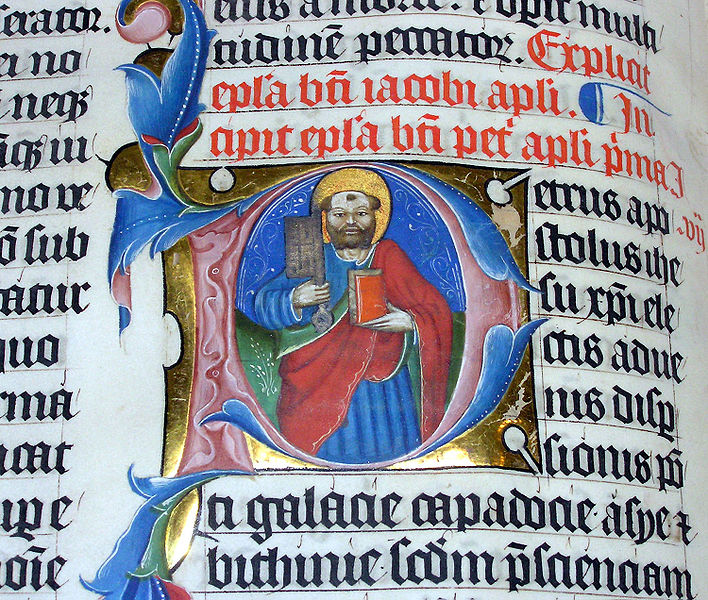
The image above is an illuminated “P” which begins the name Petrus (Peter). The manuscript is displayed in Malmesbury Abbey in England, but was originally transcribed in Belgium circa 1400.

A Caveat about Caveats

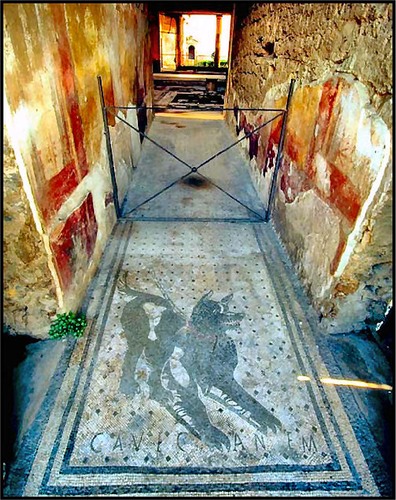
cave canemA caveat, most readers will know, is a warning. One of my favorite usages comes from ancient Rome, where many villa owners procured guard dogs to protect their property. Cave Canem–beware of the dog–became a common motif for entryway mosaics.

One of the most familiar caveats is caveat emptor—buyer beware. Not only is this warning well known, it is absolutely true. Without an express warranty, you may have little hope recouping your loss when something you purchase fails.

Caveats, however, need not infer that the subjects they refer to are dangerous.

For example, the guard dog may well be an affectionate “member of the family,” who warms up quickly, even to strangers who have been invited into the home. Likewise, the new car I’m contemplating purchasing may be ideal for me. Fairly priced, economical to drive, and not so dated in appearance that it shouts, “yes, I’m a grandpa.”

Caveats don’t mean “stay away.” They merely advise us all to think before we act. (And, as universal rules go, this is a very good one.) Caveats, and good parenting, remind us to read the “fine print” before signing anything.

I want to encourage all readers of Mere Inkling to use their God-given intelligence to evaluate what you read on these pages. In the same way, I hope you will all apply your God-instilled conscience to measure my words.

In light of this sincere desire, I encourage you to read the gentle caveats offered below.

General Caveats for Readers

What should readers of Mere Inkling keep in mind as they peruse these posts? First of all, there are a number of general considerations—applicable to everything each of us reads and hears.

1.  Understand the perspective of the writer. What are the assumptions and worldview of the person who wrote the piece? It can be hazardous to simply assume that a writer shares your own values—or even definitions. Many people would be shocked at the diversity of definitions for a word like “church” that roam the internet.

2.  Ensure we read what we think we did. By this I mean that we should reread sections that we find confusing or offensive. It may be we have misread what the author intended. (This is especially true when a writer seeks to play with the English language, and uses phrasing unfamiliar to our ear.) In cases where we have normally enjoyed the writing, but now find ourselves bothered by something, it is always good to ask the writer to clarify what they meant. More often than not, I’ve found this opportunity to elaborate dispels the problem.

3.  Reject the myth that anything you read is absolutely objective. Objectivity, except for mathematics, is essentially impossible. Our education, values, experiences and mood all affect the words we write. The best we can hope for in what we read—something Mere Inkling strives for—is personal honesty and fairness.

Mere Inkling Caveats

1.  Mere Inkling’s author is a fallen human being. By definition, that means that I am imperfect. Not all-knowing, nor always gracious. Imperfect though I am, I try my best to speak here in a forthright, considerate, modestly entertaining and, most importantly, a truthful way. When I fall short of that, feel free to write to me about it.

2.  I am a Christian. I certainly don’t apologize for this. Nor do I apologize for the wish of all disciples of Jesus that everyone might know the joy, forgiveness and peace that comes from abiding in the Vine (a metaphor for Jesus, as described in John 15).

3.  Your host at Mere Inkling is an evangelical Christian. This is a hazy adjective, often used in mutually contradictory ways. I apply it here to myself in the context of holding fast to the basic Christian truths, including the aforementioned desire of God that all people might come to him through his only begotten Son.

4.  I am a catholic Christian. Not a Roman Catholic (with a capital C), but catholic in the word’s creedal sense—a member of the one universal Church. As a catholic Christian, I subscribe to the ecumenical creeds, agreed upon as the fundamental doctrines of the faith during its earliest years. These include the Triune nature of God, the Incarnation miracle, and the atonement. Like my mentor, C.S. Lewis, here at Mere Inkling we focus on “Mere Christianity,” the common core of the faith. I consistently attempt to qualify my words on subjects where there is not a clear consensus.

Each of us has his individual emphasis: each holds, in addition to the Faith, many opinions which seem to him to be consistent with it and true and important. And so perhaps they are. But as apologists it is not our business to defend them. We are defending Christianity; not “my religion.” When we mention our personal opinions we must always make quite clear the difference between them and the Faith itself. (C.S. Lewis, “Christian Apologetics”).

5.  I am a Lutheran Christian. Again, I do not apologize. Lutherans understand we are only a small part of the “one holy catholic and apostolic faith.” Each denomination (indeed, each individual) possesses a distinctive interpretation of the Christian faith. We are free, of course, to associate with that community we believe follows God’s leading most faithfully. (It is a given that no community is without flaw, since no human being is.) I have written more on this aspect of my identity in the next point, and on the “Mercy” tab you will find at the top of the page.

6.  I am an evangelical Lutheran Christian. This is not a formal category, but means that I subscribe to historic Lutheranism as it has been taught and held since the Reformation, rather than some of the current expressions of “religion” that may be labeled Lutheran. In essence, this can be summarized in the “solas” of Lutheran doctrine.

Sola Scripture – Scripture Alone meaning that the Bible, the Jewish and Christian Scriptures, are the ultimate authority for determining true faith.

Sola Gratia – Grace Alone meaning salvation is an unearned gift of God, given not because we have earned it.

Sola Fides – Faith Alone meaning that God’s grace is apprehended not through wisdom, good works, or any means other than a simple trust in the promise. Ironically, this faith itself is also a gift of God.

7.  I am a pastor. While pastors with seminary educations do study Greek, Hebrew, Theology and assorted other subjects, we are not the same as what most people mean by the word “theologians.” Pastoral Theology is distinct from Systematic Theology. The former focuses on practical ministry to individuals, while the latter is most concerned with abstract matters. While I also possess a second graduate degree, my Master of Theology degree (much different than an M.A. in theology) was earned in the study of Early Church History. My concern remained the work of God among everyday human beings, rather than scholastic philosophy.

8.  While I never intentionally write anything with the goal of offending any reader, I recognize it is impossible to avoid all offense. (Even the least controversial prose is capable of offending.)

Allow me to illustrate how simple truths can elicit dramatically different responses, with two simple declarations.

God loves all people. This is true, and inoffensive. Most people today, and all orthodox (biblical) Christians would agree with the statement.

Not all people will go to heaven. This too is true. However, it provokes great outcries from many quarters, including some religious organizations that arise out of the Judeo-Christian tradition. Jesus himself offered “hard sayings” that elicited grumbling. John’s Gospel records a powerful account of this, occurring immediately after the Feeding of the Five Thousand.

When many of his disciples heard it, they said, “This is a hard saying; who can listen to it?” But Jesus, knowing in himself that his disciples were grumbling about this, said to them, “Do you take offense at this? . . . The words that I have spoken to you are spirit and life. But there are some of you who do not believe.” . . . “This is why I told you that no one can come to me unless it is granted him by the Father.” After this many of his disciples turned back and no longer walked with him.

C.S. Lewis referred to the alienating nature of some truths when he wrote the essay, “Cross-Examination.”

I believe that there are many accommodating preachers, and too many practitioners in the church who are not believers. Jesus Christ did not say “Go into all the world and tell the world that it is quite right.” The Gospel is something completely different. In fact, it is directly opposed to the world.

9.  I am an American. Again, no apologies. I applaud much of what this nation has valued and shared during its history. I regret many of the mistakes the United States has made, and continues to make. I recognize how fortunate I have been to live in a nation with access to educational and medical resources not available to all. I genuinely appreciate other cultures and have been privileged to live in Europe, Asia and the Pacific. The right I treasure most—and one I pray will be extended to all people—is freedom of religion.

10.  I welcome offline correspondence. I recognize many people are reluctant to post a comment on a blog, which is visible to the public. I also realize that some readers would appreciate privately offering a comment or posing a question. I welcome this, and encourage you to use the form below to write to me. I will respond from my personal email account and we can discuss sensitive matters in greater depth. I must say in advance, however, that I do not have the leisure time to aid with any research. Similarly, while I am happy to offer general pastoral advice, only a fool or con artist would presume to conduct serious counseling or therapy via email. (You need a local pastor or counselor for that.) That said, I do enjoy spirited and honest discourse, so d feel free to contact me.

Go back

Your message has been sent

Warning
Warning
Warning
Warning
Warning

Warning.

_____

The picture at the top of the page comes from the entryway to the “House of the Tragic Poet” in Pompeii.