Consider Planting a Tree

treebeard & groot

Not only do trees cleanse the air we breathe, there’s more evidence they contribute to our mental health as well.

An article entitled “Greener Childhood Associated with Happier Adulthood,” describes research from Denmark’s Aarhus University discovering that “growing up near vegetations is associated with an up to 55 percent lower risk of mental health disorders in adulthood.” An American researcher commented on the findings.

“The scale of this study is quite something,” says Kelly Lambert, a neuroscientist at the University of Richmond who studies the psychological effects of natural spaces. Smaller studies have hinted that lack of green space increases the risk of mood disorders and schizophrenia and can even affect cognitive development.

In a rapidly urbanizing world, this data is particularly troubling. Most of us must live “where the work is,” and our children sometimes grow up in places where trees are few and far between (and I wouldn’t really count Joshua “trees” which are Monocotyledons, and not true trees).*

This research confirms my own, personal experience. I have always found lush greenery energizing. I used to attribute this association with family—while growing up in a USMC family, we would try to make an annual trip “home” to Puget Sound. The nearer we got to my grandparents, the greener the Puget Sound terrain grew.

In my affection for trees, I am akin to the Inklings. Much has been written about J.R.R. Tolkien’s description of the forests of Middle Earth. The terrible damage to the Fangorn forest done by the army of Saruman is one of the tragedies of The Lord of the Rings.

C.S. Lewis and his friends enjoyed walking trips. Much of the countryside they covered in these treks was adorned by healthy copses, but they do not appear to have ventured into any deep forests.

In a 1953 letter to a correspondent who was attempting to lure Lewis to visit America, he paints a clear picture of what he finds alluring.

How wrong you are when you think that streamlined planes and trains would attract me to America. What I want to see there is yourself and 3 or 4 other good friends, after New England, the Rip Van Winkle Mts., Nantucket, the Huckleberry Finn country, the Rockies, Yellowstone Park, and a sub-Arctic winter.

And I should never come if I couldn’t manage to come by sea instead of air: preferably on a cargo boat that took weeks on the voyage.

I’m a rustic animal and a maritime animal: no good at great cities, big hotels, or all that. But this is becoming egotistical. And here comes my first pupil of the morning.

All blessings, and love to all. Yours, C.S. Lewis

I’d love to see a bear, a snow-shoe, and a real forest.

Lewis wrote a fascinating poem about the spiritual price of deforestation.

The Future of Forestry

How will the legend of the age of trees
Feel, when the last tree falls in England?

When the concrete spreads and the town conquers
The country’s heart; when contraceptive
Tarmac’s laid where farm has faded,
Tramline flows where slept a hamlet,
And shop-fronts, blazing without a stop from
Dover to [Cape] Wrath, have glazed us over?

Simplest tales will then bewilder
The questioning children, “What was a chestnut?
Say what it means to climb a Beanstalk,
Tell me, grandfather, what an elm is.
What was Autumn? They never taught us.”

Then, told by teachers how once from mould
Came growing creatures of lower nature
Able to live and die, though neither
Beast nor man, and around them wreathing
Excellent clothing, breathing sunlight –
Half understanding, their ill-acquainted
Fancy will tint their wonder-paintings
Trees as men walking, wood-romances
Of goblins stalking in silky green,
Of milk-sheen froth upon the lace of hawthorn’s
Collar, pallor in the face of birchgirl.

So shall a homeless time, though dimly
Catch from afar (for soul is watchfull)
A sight of tree-delighted Eden.

Plant a Tree

In “The Arbor of God,” the physician who founded Blessed Earth poses a thoughtful question: “Trees are everywhere in Scripture. Why have they gone missing from Christian theology?”

I’ve always loved trees. I love their look, their shade, the sound of wind in their leaves, and the taste of every fruit they produce. As a grade-schooler, I first planted trees with my father and grandfather. I’ve been planning them ever since. . . .

But a dozen years ago, when I offered to plant trees at our church, one of the pastors told me I had the theology of a tree-hugger.

This was not meant as a compliment.

There is a possibly apocryphal statement credited to Martin Luther during the Reformation. In a spirit of faith and commendable actions for Christians, Luther said, “If I knew the world was to end tomorrow, I would still plant an apple tree today.”

As I gaze out the window now, at the four blossoming apple trees we planted just three years ago, I’m inspired to plant some more trees. This year, I think, it will be some bushes and plants that provide year-round nectar for the hummingbirds that grace our woodlands. Even the anticipation of planting them brings me joy.


* Joshua trees, such as those which surrounded our home at Edwards AFB, are actually “flowering plants.” As such, they do have green growth and even fruit. So, in a generous spirit, I’ll credit them with 50% of the positive effect on mental health that a maple or fir might offer.
Return with Me to Middle Earth

tolkien.pngJ.R.R. Tolkien’s tales of Middle Earth will once more be displayed in all of their digital radiance when a new series begins in two years. Yes, I said “series,” because it will not be coming to theaters. Instead it will be developed for subscribers to Amazon’s subscription service.

Some fans of Tolkien are understandably wary. Will it remain faithful to Tolkien’s vision (insofar as any heathen international corporation can understand it)? However, I’m inclined to feel optimistic.

One reason for my optimism is Amazon’s commitment to the quality of the production—they anticipate investing around one billion dollars in the property during the next five years. Beyond that, I suspect Amazon will protect this massive investment by not straying too far afield from the true spirit of Middle Earth.

The Hollywood Reporter states it’s up to Peter Jackson* whether or not he will be involved in the project. His attorney said Amazon was wise to bid high for this “property.”

We are in an era where [online] streamers are bidding up the price of programming. I think Amazon is taking a page out of the studios’ emphasis on franchises. They also are realizing that with the overproduction of television, you need to get the eyeballs to the screen, and you can do that with franchise titles.

Another technology news site points to the example of Game of Thrones upping the value of the Lord of the Rings project.

In a world where Disney has laid out impressive, interconnected franchises with its Marvel and Star Wars properties, and HBO is considering anywhere between three and five spinoffs for Game of Thrones, Middle-earth could be a property that gives Amazon a significant boost in the coming streaming wars, one that could entice even more people to sign up for Amazon’s Prime service.

This is wonderfully ironic, since G.R.R. Martin readily acknowledges his debt to Tolkien. In a solid article on this subject, “Is George R.R. Martin the ‘American Tolkien?’” the author identifies a significant difference between the two writers.

Tolkien’s creation displays a sense of depth yet unrivaled in the fantasy genre. In this way, Lord of the Rings is to Game of Thrones as the Atlantic Ocean is to Lake Michigan. In contrast to the invention of Martin’s world, which is secondary to his plotline, Tolkien built his reality from the ground up starting with languages.

The Rotten Tomatoes media review site offers some tantalizing details about what we can anticipate in the new series.

Amazon’s first map rendered a number of geographic features specific to the Third Age, including the East Bight of Mirkwood Forest . . . But fans who were hoping to see some of the great stories from earlier days dramatized with Amazon’s production values are in luck.

Stories like the sinking of Númenor—Tolkien’s take on the Atlantis myth, in which Sauron corrupted an island of seafaring men to invade the forbidden shores of the world’s far West—and the founding of the kingdoms of Arnor and Gondor could make for some spectacular television. . . .

So what does this mean? For one, the series will undoubtedly focus on Númenor** over other regions of Middle-earth. To understand the island’s significance, we need to go back to the end of the First Age and the downfall of the Dark Lord Morgoth.***

Wow.

This is going to be great. And to think, we owe it all to C.S. Lewis!


* Peter Jackson, of course, is the director who brought The Hobbit and The Lord of the Rings to the big screen.

** Númenor was the great island kingdom of humankind.

*** Morgoth is the greatest of the Ainur (angels in the Middle Earth cosmology). He fell from grace when he resisted the will of the Creator. He was an even greater Evil than his servant Sauron, who plagues the world in the Lord of the Rings trilogy.

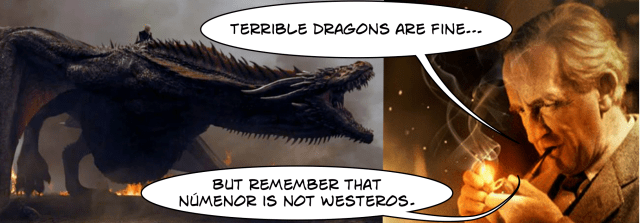
The reference to Westeros in the illustration above is to the island in the Game of Thrones ruled by the Seven Kingdoms.

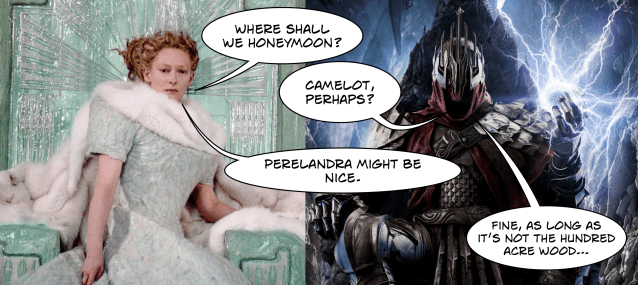
C.S. Lewis & the Inklings Seated at the Round Table

arthur.png

This book belongs in the library of every fan of the Inklings and each devotee of King Arthur. The truth is that anyone interested in British literature or the Dark Ages will find much that appeals to their curiosity. King Arthur is known around the world as an archetypal hero, and he was a central fixture in the minds of the Inklings.

The Inklings & King Arthur (TIKA) is impressive in every way. However, it’s 555 rich pages should not intimidate potential readers. Editor Sørina Higgins masterfully gathered diverse insights from a score of scholars, and the individual chapters can be approached in any manner the reader desires. Even if a few of the chapter titles fail to resonate with a particular reader, the solid value of the remainder far exceed the price of the work.

Mere Inkling seldom offers reviews of books, despite the “libraries” of new Inkling literature published every year. The Inklings & King Arthur is the exception, for two reasons.*

TIKA does not require a familiarity with its subject. The academic background of the contributors allows them to usher readers into rewarding discussions without additional research. C.S. Lewis described “the task of the modern educator [as] not to cut down jungles, but to irrigate deserts.” The writers in this volume have written so clearly that even if your knowledge of King Arthur is the Mojave, and your familiarity with the Inklings is the Sahara, you will enjoy reading this book.

Truth be told, much has been written about King Arthur. Likewise, films have explored the myths, with varying degrees of faithfulness. Some make no effort at all to be faithful to the inspiring story. An extreme example would be the ludicrous storyline of the 2017 film, Transformers: The Last Knight. In striking contrast to this, the Inklings sought to penetrate the mists of time and discern the reasons Arthur’s story has inspired men and women for so many generations.

In the book’s introduction, Higgins says her hope was “to fill a sizeable hole in the field of Inkling studies” (2). She surely achieved this task. She also says “the present collection endeavors to usher the field of Inklings studies into more rigorous theoretical territory” (3). This goal, the contributors have surpassed.

Proceeding to some specific comments, my first would be to point out the accuracy of the volume’s title. It is an exploration of “the Inklings,” rather than simply Lewis and/or Tolkien. The fact that less well-known members of the literary group wrote the most Arthuriana means their works are particularly well represented in the current collection.

This fact might discourage a potential reader who is disinterested in the lesser known authors. However, the truth is, exposure to work of these friends and influencers of the two über-Inklings helps us better understand them and the confluences that flowed together in that unique literary fellowship.

Most articles consider the Inklings as group in relationship to a theme. For example, Christopher Gaertner discusses, “Shape and Direction: Human Consciousness in the Inklings’ Mythological Geographies.” The author identifies their differing viewpoints and how they influenced one another. Despite “their shared resistance to a scientistic worldview” (150), Tolkien, Lewis and Owen Barfield did not share identical understandings of how the world should be perceived.

Beyond the Eagle & Child

One pleasant surprise is the inclusion of an essay on G.K. Chesterton (1874-1936). Chesterton’s The Everlasting Man contributed to the conversion of C.S. Lewis.

In his TIKA essay “All Men Live by Tales,” J. Cameron Moore reveals how Chesterton’s poetry about Arthur is rooted in England. Arthur was important enough for Chesterton to return several times to the story of this hero who is “Mythic, Roman, and Christian (205). You can download a free copy of The Ballad of St. Barbara which includes “The Myth of Arthur” here. You can read “The Grave of Arthur” at this site.

Benjamin Shogren explores the significance of the addition of two new names—Pendragon and Fisher-king” to the protagonist of C.S. Lewis’ space trilogy. Elwin Ransom “represents Arthur by . . . evoking the primary imagery associated with the role of Arthur” (399). Ransom is now imbued with a mythological aura of royal leadership and courageous chivalry.

This volume overflows with richness. In “On Fairy Stories,” J.R.R. Tolkien describes the dense blend of mythologies present in the story of Arthur, using the image of a pot of soup with various ingredients added over time.

It seems fairly plain that Arthur, once historical (but perhaps as such not of great importance), was also put into the Pot. There he was boiled for a long time, together with many other older figures and devices, of mythology and Faerie, and even some other stray bones of history (such as Alfred’s defence against the Danes), until he emerged as a King of Faerie.

The situation is similar in the great Northern “Arthurian” court of the Shield-Kings of Denmark, the Scyldingas of ancient English tradition. King Hrothgar and his family have many manifest marks of true history, far more than Arthur; yet even in the older (English) accounts of them they are associated with many figures and events of fairy-story: they have been in the Pot.

The soup or stew pot may also serve as a fitting metaphor for The Inklings & King Arthur. This exceptional volume offers a potent mix of wisdom and insights that go beyond the boundaries of its title. Readers will be rewarded, in fact, with many satisfying literary meals.


* The first reason is that the academic weight of the work merits the undertaking. The second is because I have received a review copy, which obligates me in a sense, to providing a review—not a positive review, of course, but an honest assessment of its value, from my personal perspective.

Honest reviewers, of course, are mandated to acknowledge the fact that they received a particular volume gratis. This is done to protect one’s integrity. At the same time, a writer’s honor is also protected by their pledge to provide an honest evaluation of each work, for good or ill. This is what you will discover here.

The volume’s editor, Sørina Higgins, gathered an impressive group of Inkling scholars to contribute. She is a poet who is Chair of Language and Literature at Signum University.

It would be challenging to find any flaw in this amazing volume. Its sole weakness, in this reviewer’s opinion, is that it is so detailed and thorough, that it transcends the reading skills (or perhaps, “tastes”) of some of today’s readers. Despite that, the authors have gone to significant effort to write clearly and make their extremely detailed subject matter accessible to all.

C.S. Lewis’ Nemesis: F.R. Leavis

leavis.png

When C.S. Lewis died, one of his Cambridge colleagues uttered a shocking statement—to his Cambridge students.

“C.S. Lewis is dead,” announced F.R. Leavis to his English literature students at Cambridge University a few days later, while the world mourned for Kennedy (the President was assassinated the same day).

American novelist and essayist D. Keith Mano, then studying at Cambridge, remembers Leavis continuing his brief commentary on Lewis’ passing as follows: “They said in the Times that we will miss him. We will not. We will not.

Who knew the world of literary criticism could be so ill-mannered?

In my readings about C.S. Lewis and his life I’ve noted references to a fellow English professor at Cambridge who waged a lengthy academic argument with Lewis over the heart of English education.

The challenger to Lewis’ history-oriented approach advocated a critical position, which diluted concern for the intentions of the original writers. I’m not a lit major, so I’ll leave the description at that.*

F.R. Leavis, a dynamic influence at Cambridge, dreaded the arrival of Lewis when he moved from Oxford to a distinguished chair tailor-made for him. The two scholars shared several traits which might have disposed them to friendship.

Both were veterans of the Great War.** One difference between the veterans is curious. Leavis declined to join the Officers’ Training Corps while a student, and chose ambulance service when conscription began. Lewis, on the other hand, voluntarily joined the OTC, even though he (as an Irishman) was exempt from the conscription.***

Another similarity between the two was that they inspired many students. Far from the caricature of droning academicians, Lewis and Leavis drew fans and even disciples from the student body. (In a recent post I mentioned the affectionate nickname some of the former’s students had for him: Papa Lewis.)

The Problem

Most writers believe this second “similarity” factored into the strained relationship between the two. Both had strong personalities, and bold convictions. They did not, however, share a common temperament. Lewis was normally respectful of his philosophical adversaries. Leavis, not so much. The following comes from “C.S. Lewis and the Art of Disagreement.”

The fact that Lewis could approve of atheists [and] liberals . . . reinforces Brewer’s point that Lewis would not allow disagreement to become personal. He could always distinguish the man from the man’s opinion, and he knew the difference between an argument and a quarrel. He would not allow himself to be betrayed into aggression, but would, where necessary, draw rein on a dispute with a wry smile and an agreement to disagree.

His public written controversy on literature with E.M.W. Tillyard (later published as The Personal Heresy) was conducted with pugnacity but without personal animus. And though Lewis laid into the arguments of another colleague, F.R. Leavis, with great forcefulness in the pages of An Experiment in Criticism, he never named Leavis within those pages, but covered his opponent in a thoughtfully woven cloak of pseudonymity.

Contrast that to Leavis’ comment with which we began, in which he “celebrates” Lewis’ passing.

Lewis was quite aware of Leavis’ animosity. In a 1961 letter to the publisher of The Screwtape Letters and Screwtape Proposes a Toast, the author strikes the Cambridge Review from the publications scheduled to receive review copies.

I’ve not additions to make, but one subtraction. Delete Cambridge Review. It’s mainly in the hands of Leavisites who will blackguard any book of mine, and I don’t know why we should let them have a free copy for their sport!

Lewis scholar Brenton Dickieson wrote a column about George Watson’s critique of Lewis. Watson met Lewis at Oxford and later joined him on the faculty at Cambridge.

Here are George Watson’s first evaluative words of Lewis: “Like F.R. Leavis, he was an offensive critic.” Awesome. I think it is an evaluation that would have made Lewis chuckle, particularly in his positive comparison with Leavis, the closest thing Lewis ever got to having a Sherlockian arch-nemesis.

However, Watson (note the name) is careful to remind us that Lewis “reveled in diversity as much as Leavis detested it.” That diversity in Lewis is one of the features that (I believe) most draws and repels readers today.

In the aforementioned article, “Lewis and Cambridge,” Barbour candidly describes the disparity between the spirit of the two nemeses.

“[Lewis’] controversies were always impersonal and often ended with the participants finding a good deal of common ground, whereas Leavis’s controversies . . . tended to end in anathematizing and deeply personal wounding.”

Leavis’ reputation for engendering conflict was so pronounced The Guardian actually included the following in his obituary:

Perhaps the most telling counter-assault on him was by C.S. Lewis, who said that the use of subliminal code words like “maturity” and “relevance” smuggled in an entire value system that was never made explicit for scrutiny. Others accused him of being a crypto-Marxist.

Leavis never replied, which was a pity, but then his weapons during his long career of humiliations in the Cambridge English faculty also included silence, internal exile and cunning.

His most murderous and underestimated weapon was ridicule, which he deployed in lectures with the virtuosity of a music-hall star and with an insensitivity verging on paranoia.

The Essence of Their Differences

Exploding English: Criticism, Theory, Culture includes a chapter entitled “Leavis, Lewis, and Other Oppositions.” It’s précis suggests one reason Lewis’ criticisms have possessed a longer lifespan than those of Leavis.

Lewis and Leavis . . . were the dominant figures in literary study in the middle decades of the twentieth century. . . . it is Lewis’s arguments and assumptions that seem to be the more challenging and which have something to contribute to contemporary debates.

This assessment echoes Lewis’ own view that the Leavis tsunami may have crested. Just a month before his death, he wrote to Basil Willey about his retirement. Willey would retire from his own chair two years later.

My dear Basil . . . I have an idea that Cambridge ten years’ hence might suit us both [better] than the Cambridge we have known. . . .

I hope your success will follow you . . . [if not], then our English school, with its neglect of language, becomes purely a school of literary criticism. And criticism, thus isolated, seems to me a positively mischievous instrument of education.

In “C.S. Lewis, Literary Critic: A Reassessment,” which appeared in Mythlore, William Calin describes Lewis’ passionate defense of English authors whose reputations were in jeopardy.

A Preface to Paradise Lost does for Milton what The Allegory of Love did for Spenser, and Lewis does for epic what he had previously done for allegory and fin’ amor [courtly love]. . . . In sum, Lewis defends his authors language from the strictures of Eliot and Leavis; he defends his worldview and its artistic embodiment from the prejudice of 1930s agnostic university faculty in English. . . .

When he tells students “Don’t read criticism” [Lewis] alludes again to Leavis and his disciples, who fetishized the term “critic.” Lewis would have called himself a scholar or an historian.

The following passage from A Preface to Paradise Lost is telling. Leavis is the unnamed standard bearer for the worldview he rejects. It reveals Lewis’ keen discernment in understanding of his unbridgeable difference with Leavis.

It is not that [Leavis] and I see different things when we look at Paradise Lost. He sees and hates the very same that I see and love. Hence the disagreement between us tends to escape from the realm of literary criticism.

We differ not about the nature of Milton’s poetry, but about the nature of man, or even the nature of joy itself.

The Apostle Paul described this difference in his correspondence with the Corinthians.

Now we have received not the spirit of the world, but the Spirit who is from God, that we might understand the things freely given us by God. . . .

The natural person does not accept the things of the Spirit of God, for they are folly to him, and he is not able to understand them because they are spiritually discerned. . . . But we have the mind of Christ.

In an excellent article entitle “Three Great Critics: F.R. Leavis, T.S. Eliot, and C.S. Lewis,” Michael Aeschliman**** closes with a gospel-oriented thought.

It is pleasing to conclude by imagining C.S. Lewis, T.S. Eliot, and F.R. Leavis now conversing together amicably, recollecting emotion in tranquility, in another and better and more luminous realm, toward which all three of them were fervent pilgrims throughout their embattled but noble lives.


* There are ample online sources available to describe the contrast in detail. For example, Brian Barbour’s Modern Philology essay, “Lewis and Cambridge,” provides a superb explanation of the struggle in its broader context.

** Lewis served in the trenches, where he was seriously wounded. Leavis was fortunate enough to avoid frontline combat by serving in the Friends Ambulance Unit. This site provides a helpful account of his service on an Ambulance Train which shuttled the wounded to ports.

*** There is no record of which ambulance train carried Lewis homeward after his injury, but wouldn’t it be ironic he and Leavis had unknowingly encountered one another at that time?

**** Aeschliman is the author of The Restitution of Man: C.S. Lewis and the Case Against Scientism.

The Inklings of Mount Hermon

mount hermon.png

Few writers attain their full potential without the advice and encouragement of others.

C.S. Lewis and J.R.R. Tolkien recognized that fact.

For many years they gathered regularly with a number of other keen minds, almost all of whom shared their Christian faith. (Notably, Owen Barfield who was an Anthroposophist, was a notable exception.)  Some writers visited the community as guests.

I’ve written in the past about the great benefit provided by Inkling-style literary criticism. It’s all about synergy.

Mount Hermon Christian Writer’s Conference is one of the premier gatherings of its sort. After many years of hoping to attend, my wife and I journeyed to California for its Fiftieth Anniversary this past week. What a blessing!

In addition to hundreds of zealous writers, the conference was attended by twoscore publishers, agents and writing experts who generously shared their vast knowledge. And I use that word “generously” in a literal sense. The faculty made itself accessible to a degree I have never before witnessed (and I am a veteran of innumerable professional conferences). The speakers were sincerely interested in encouraging each and every participant.

Classes were available for writing novices, journeymen and experts. I found the track on screenwriting to be the most helpful for my own current needs. I hope to put these new lessons into practice in the next few years.

I can confidently assure you that Mount Hermon will also offer the sort of advice and encouragement that you need to advance your own skills to the proverbial “next level.” If you are interested in attending Mount Hermon, you can learn more here.

Back on the Home Front

If you have never enjoyed the benefits of gathering locally with other writers, I strongly encourage you to consider it now.

If you’re on a critique-group-hiatus due to past disappointments, why not look for a fresh group with a healthier focus?

I sincerely believe most of us become better writers while growing together, than we do wandering on our own. Mount Hermon reinforced that conviction.

I encourage each of you to reach your own full potential—with a little help from some new friends.

C.S. Lewis and the Academics

acadamians.jpg

When it comes to writing for a popular audience, the elite strata of academia possess no shortage of disdain.

C.S. Lewis was only one of many professors who found writing for the common people diminished them in the eyes of their snobbish peers. In Lewis’ case, his lay theological essays were considered bad enough. His fantasy and science fiction works were regarded as particularly gauche.

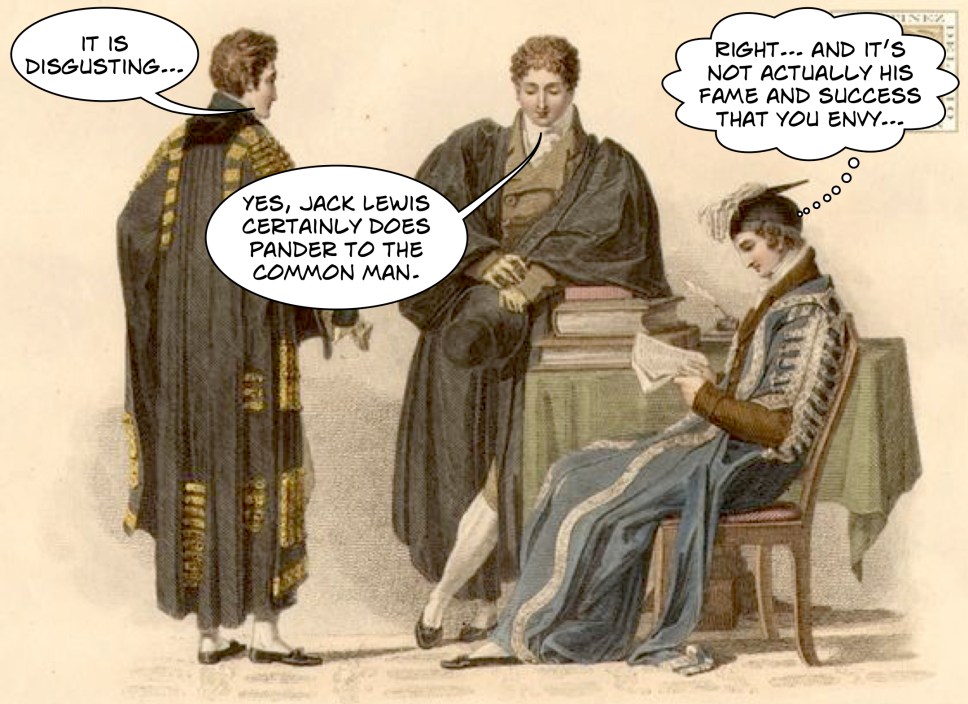
I have a personal theory about the way self-important scholars treat their colleagues who reach down to interact with the hoi polloi. It seems to me that they deride people like Lewis and J.R.R. Tolkien because of envy. The envy is twofold.

First, they covet the large audience and expanded influence of the scholar who successfully transcends the university. These elements arouse their lust far more than the potential wealth that such success might bring, although I have no doubt some resent being criminally underpaid as educators.

The second aspect of the envy is directed at the genuine talent of the belittled author. The majority of faculty would not possess the skill to write successfully for a popular audience. Thus, the significance of such publication needs to be diminished.

Harlan Ellison (1934-2018) was not an academic, but even he did not appreciate being relegated to the ranks of pulp writers. Despite writing screenplays and more than 100 books, he was best known for his science fiction. Nevertheless, he once threatened: “Call me a science fiction writer and I’ll hit you so hard your ancestors will die.”

Returning to Lewis, one biographer devotes an entire chapter to the condescending attitude of his Oxford peers. He entitles it, “A Prophet without Honour?” This is a reference to Jesus’ saying that “a prophet has no honor in his own hometown” (John 4:44)

Lewis, then, was famous by the time the Second World War ended in the summer of 1945. If the simple philosophy of life propounded by modern celebrity culture has any validity, Lewis at that point should have been a happy and fulfilled person. Yet Lewis’s personal history for the next nine years tells a quite different story. Fame may have raised Lewis’s profile, but in the first place, this just made him a more obvious target for those who disliked his religious beliefs.

And in the second, many of his academic colleagues came to believe that he had sold out to popular culture to secure that fame. He had sold his academic birthright for a populist pottage. (C.S. Lewis—A Life: Eccentric Genius, Reluctant Prophet by Alister McGrath)

The disdain of his Oxford colleagues prevented him from receiving a full professorship at the university. This is why Lewis eventually accepted a chair at Cambridge, which was much more receptive to his unashamed sharing of the Gospel. Tolkien was stunned by the “extraordinary animosity” of the English Faculty towards his friend.

An Endnote

The fact that C.S. Lewis wrote some science fiction—and encouraged his friend Tolkien to do so as well—does not mean that he had an exaggerated opinion of the genre’s quality. He was quite aware of the great range between the good and the bad. In fact, in 1955 he ended a lengthy letter to a correspondent with the sentence: “We must talk about Science Fiction some other time (most of it is atrocious).”

I have posted about Lewis’ connection to science fiction in the past. Perhaps one of these topics will interest you.

Learn about the genuine Martian crater named Malacandra in honor of Lewis’ space trilogy.

Explore the place of robots in science fiction and reality.

Ponder the ramifications of post-apocalyptic faith.

Consider Lewis’ compliment to H.G. Wells.


Tolkien’s Dinosaur Discovered

sauron dino

The “new” dinosaur illustrated above is impressive enough to merit its naming in honor of Sauron in Tolkien’s Lord of the Rings. Sauroniops, which means “eye of Sauron,” was one of those enormous bipedal predators that Jurassic Park keeps reproducing despite numerous warnings and unnumbered devoured guests. 

Fittingly, the new genus was identified through the discovery of a bone related to the eye socket of the beast. And, as all fans of Middle Earth know, Sauron’s piercing eye marks his terrible presence in the world.

Tolkien isn’t the only author to receive this sort of homage. In a humorous post celebrating the discovery of this new dinosaur in 2012, one writer pointed out:

Last week, the colossal Moroccan theropod Sauroniops joined the ranks of Mojoceratops and Dracorex Hogwarsti, recently discovered dinosaurs named after nerd icons.

sauron skull

As for the Sauronic fossil itself, and its full story of its identification, you can download the complete official report in Acta Palaeontologica Polonica

One of the things that most amazes me about paleontology is the skill (imagination?) they have when they reconstruct ancient life forms with very few fossils. In fact, in the case of Sauroniops, there is only a single bone fragment!

Despite the lack of evidence, it’s probably safe to suppose that Sauroniops was binocular, like other related species. However, that remains conjecture, and it is utterly possible that this new genus was a cyclops variety, more akin to Sauron non corporeal

C.S. Lewis & Dinosaurs

Lewis readily recognized that his deep appreciation for the past made him an oddity in Oxford. He eschewed the essence of the modernism that enraptured most of his peers. Lewis was a man rooted in history. He praised its merits and avoided its pitfalls. All of this, he confessed, made him a “dinosaur.”

He used the image as a metaphor for himself and his vocation, “explaining as clearly as I can the way in which I approach my work.” When he assumed his chair at Cambridge University, he delivered a memorable lecture, entitled De Descriptione Temporum. The text of the entire lecture is available here, but only the pertinent portion is quoted below.

And now for the claim: which sounds arrogant but, I hope, is not really so. I have said that the vast change which separates you from Old Western has been gradual and is not even now complete. Wide as the chasm is, those who are native to different sides of it can still meet; are meeting in this room. This is quite normal at times of great change.

The correspondence of Henry More* and Descartes is an amusing example; one would think the two men were writing in different centuries. And here comes the rub. I myself belong far more to that Old Western order than to yours. I am going to claim that this, which in one way is a disqualification for my task, is yet in another a qualification. The disqualification is obvious. You don’t want to be lectured on Neanderthal Man by a Neanderthaler, still less on dinosaurs by a dinosaur. And yet, is that the whole story?

If a live dinosaur dragged its slow length into the laboratory, would we not all look back as we fled? What a chance to know at last how it really moved and looked and smelled and what noises it made!

And if the Neanderthaler could talk, then, though his lecturing technique might leave much to be desired, should we not almost certainly learn from him some things about him which the best modern anthropologist could never have told us? He would tell us without knowing he was telling.

One thing I know: I would give a great deal to hear any ancient Athenian, even a stupid one, talking about Greek tragedy. He would know in his bones so much that we seek in vain. At any moment some chance phrase might, unknown to him, show us where modern scholarship had been on the wrong track for years.

Ladies and gentlemen, I stand before you somewhat as that Athenian might stand. I read as a native texts that you must read as foreigners. You see why I said that the claim was not really arrogant; who can be proud of speaking fluently his mother tongue or knowing his way about his father’s house?

It is my settled conviction that in order to read Old Western literature aright you must suspend most of the responses and unlearn most of the habits you have acquired in reading modern literature. And because this is the judgement of a native, I claim that, even if the defence of my conviction is weak, the fact of my conviction is a historical datum to which you should give full weight.

That way, where I fail as a critic, I may yet be useful as a specimen. I would even dare to go further. Speaking not only for myself but for all other Old Western men whom you may meet, I would say, use your specimens while you can. There are not going to be many more dinosaurs.

As Lewis was preparing to broadcast this inaugural lecture, the BBC sent him an edited copy of the presentation “designed more than anything else to remove the lecture from the special Cambridge setting.” In his response, Lewis indicated that the dinosaurian references had already gained some public traction.

I return one copy with my corrections which, as you see, embody most of yours. Strictly speaking, if we want to detach it as cleanly as possible from its original academic context, it ought to end with the end of the second para. on p. 17: but as the dinosaur has already achieved some popularity, you may want to keep the rest. I don’t mind either way.

Fortunately, Lewis was not the only dinosaur roaming around, reminding us of important truths. In his closing in a 1955 letter to Dorothy Sayers, Lewis writes:

My brother joins me in all good wishes for Easter. Shd. [should] we someday form a Dinosaurs’ Club (with an annual dinner in the Victoria & Albert)?

In 1957 he would address his renowned friend as “sister Dinosaur.” It would have been fascinating to see who would have joined Sayers on the roster of the Dinosaurs’ Club Lewis imagines.

Sadly, as Lewis’ health seriously declined in 1963, he wrote to a correspondent a sort of epitaph.

Thanks for the kind things you say, but look for no help from me. I am but a fossil dinosaur now.

C.S. Lewis recognized himself to be a dinosaur, as he defined it. And in this comment, he suggests that he is becoming a simple fossil. Fortunately, however, this is one of the cases where he was wrong. Just as Lewis is alive, even now, in the presence of his Savior, so too his words continue to speak life and wisdom to our confused world.

Writing with the Materials at Hand

wedding.pngIf you know the meaning of bricolage and understand its application to C.S. Lewis, I doff my cap to you.


Since I’m not an artist (the field in which the word is most common), “bricolage” was foreign to me before I encountered it during my doctoral studies. I read there that it constitutes a valid “approach to qualitative research.”

The term “bricolage” was taken from the work of the French anthropologist Claude Lévi-Strauss (1968), who used it to distinguish mythological from scientific thought. . . . Levi-Strauss described the bricoleur as someone who uses whatever tools and materials are at hand to complete a project.

The key idea is that rather than developing a logically consistent plan in advance and then systematically using the materials and tools that the plan and the norms of the community prescribe (as science is widely, though I think somewhat incorrectly, believed to do), the bricoleur spontaneously adapts to the situation, creatively employing the available tools and materials to come up with unique solutions to a problem. (Qualitative Research Design: An Interactive Approach)

If you picked up on the “mythological” reference within the definition—and drew a connection to the creator of Narnia—you may have the makings of a fine bricoleur. (But don’t add it to your résumé quite yet.)

Lévi-Strauss contrasted this mythological approach with the technological dominance of modern thinking.

The characteristic feature of mythical thought is that it expresses itself by means of a heterogeneous repertoire which, even if extensive, is nevertheless limited. It has to use this repertoire, however, whatever the task in hand because it has nothing else at its disposal. Mythical thought is therefore a kind of intellectual “bricolage.” (The Savage Mind)

Fordham University has a comparative literature journal entitled Bricolage, inspired by “literary bricoleurs [who] produced stories, ones with historical and cultural significance and unique relevance attached to them, that colored the past with intentional highlights and included questions, ideas, and voices that were never part of the frozen time period they wrote about, but always had the potential to be.”

If that makes sense to you, and even inspires you, they have a list of prompts on the website to guide your own submission to the periodical. (I particularly like open-ended: “Describe the problem.”)

They even solicit suggestions for future prompts, if you would like to game the system by suggesting a subject for which you already possess some bricoleurological notions.

I don’t wish to suggest that this literary journal does not include some genuinely insightful work. Consider the following, from “Imagination: An Internal Reality” by Brittany Gilmartin.

While reality is an external landscape for our bodies and senses, the imagination is an internal landscape for our minds and thoughts. A limitless realm that only we ourselves can control, the imagination is a space for us to think freely about the outside world and create a new reality inside of us.

This mental reality is a place that we can escape to when we are not satisfied with the real world, as in “Leaf by Niggle” by J.R.R. Tolkien, or find the real world too hard to bear, as in “An Occurrence at Owl Creek Bridge” by Ambrose Bierce.

Some may argue that instead of escaping into the fantasy of our imaginations, we should focus on factual knowledge; however, the imagination can teach us about the facts in a new light. Indeed, L. Frank Baum, in The Wonderful Wizard of Oz, and C. S. Lewis, in The Chronicles of Narnia, use their imaginations to redefine their external realities through allegories, allowing their readers to gain a deeper understanding of these realities than they could have gained through a textbook.

Great writers, such as the Inklings, did not bring newborn imaginations to the task of writing their diverse works. They were nourished and stirred by their lifelong consumption of a rich banquet of literature. And the way in which these themes are intentionally (and accidentally) woven into new texts displays their great talent.

Intertextuality as a Tool for the Bricoleur

Skilled writers frequently use devices to enrich their work. Quotations, allusions, pastiche and parody are obvious examples. Some critics would even include plagiarism as an intertextual exercise, and in the strictest sense, it is. While unacknowledged direct quotations are inappropriate, many readers savor reading volumes filled with well-done allusions.

By their very nature, shaped as they are by each culture’s history and ethos, fairy tales provide fertile soil for bricolage.

C.S. Lewis pointed out that fairy tales don’t have to be great works of fiction, or even especially well written, to be unforgettable. . . . The libretti of ballets such as The Sleeping Beauty, Swan Lake, and many others invent this and borrow that, crystallizing various elements from national folklore (Russian folk tales) and literary classics (Perrault, E.T.A. Hoffmann).

The raw materials are not, however, always readily identifiable, but have been transformed freely by the creators’ imagination: The Firebird and Giselle are original dramatic works in their own right.

Yet they are also essentially fairy tales, composed by bricolage with features that define the genre: supernatural and mysterious beings, a prevailing atmosphere of enchantment and vulnerability to destiny, and opening to another, imaginary world that is only accessible through the work of art. (Once Upon a Time: A Short History of Fairy Tale)

When the Bricoleur Denies External Influences

Many, if not most, examples of intertextual dependence or allusion are intentional. And, since few of us possess perfect memory, there will be cases where we “borrow” from other works unconsciously.

Many writers find their path to success by following well-worn paths and adding some new twist of their own. To be called “derivative” is not flattering, but carrying bags full of cash to the bank can take the sting out of the label.

In any case, it is disingenuous to deny the influence of others on your work—when their voice is recognizable to all.

The Harry Potter books are, without question, the outstanding British literary phenomenon of the last twenty years. Not everybody likes them, though. . . .  surely nobody can deny that, when it comes to her prose, Rowling is not remotely in the same league as, say, T.H. White or J.R.R. Tolkien, let alone Kenneth Grahame or Edith Nesbit.

So, why are her books so successful? The obvious answer is that, as the critic Wendy Doniger puts it, Rowling “is a wizard herself at the magic art of bricolage: new stores crafted out of recycled pieces of old stories.”

Long after she had become a multi-millionaire, Rowling tried to play down her borrowings from earlier authors, insisting that she was “not a huge fan of fantasy,” had never finished The Lord of the Rings and had a “big problem” with C.S. Lewis’s Narnia stories, which she had never finished either.

Perhaps her memory was playing her false, though, for in earlier interviews she had talked warmly of her affections for The Lord of the Rings . . . In 1998 she even told an interviewer that she “loved” C.S. Lewis, whom she considered a “genius,” and actively reread his Narnia books.

None of this, though, would surprise an attentive reader of her work. Indeed, I suspect much of the attraction of the Harry Potter stories is the fun of spotting the allusions, as well as the nostalgic reassurance of seeing old devices and even familiar characters in a new context. (The Great British Dream Factory: The Strange History of Our National Imagination)

On the opposite end of the humility spectrum, consider C.S. Lewis. Although his Chronicles of Narnia were in many ways groundbreaking, he readily offered gratitude to his various sources of inspiration.

Lewis was generous in thanking thinkers to whom he was indebted, and only failed to do so when he assumed any educated reader would recognize the source of an image or phrase.

With the contemporary state of literary education, this is an assumption modern writers are unwise to share. Sadly, this ignorance of formerly pervasive ideas and expressions is most visible in the realm of biblical literacy. But that is a subject for another day.

Stay Tuned

Our next post will consider an aspect of “unintentional bricolage” that C.S. Lewis found quite entertaining. I suspect many of us will agree.

C.S. Lewis Compared J.R.R. Tolkien to What?

polyps

These two great Oxford giants were good friends. As such, they accepted each other’s eccentricities. But that doesn’t mean that they couldn’t find humor in those peculiarities.

The Inklings were notorious for their candid critiques and their not-so-subtle teasing of one another. That’s what we all do with our good friends, right?

It’s humor offered not to wound, but to gently discombobulate our companion. And it’s success is measured in the laughter generated among colleagues who share goodwill.

I recently came across a reference, however, where Lewis may have transgressed the bounds of propriety. I leave the assessment of that fact to you.

In a 1947 letter to Margaret Douglas, who had recently lost her mother, Lewis offers warm words of consolation. In addition, he briefly references two publications that she had apparently alluded to in her own letter. The first was his Preface to Essays Presented to Charles Williams, which he refers to as the memoir. The second is Tolkien’s sequel to The Hobbit, which would become The Lord of the Rings.

Dear Miss Douglas, Accept my deepest sympathy on the death of your mother: for I think the bond between you was unusually close. You have one great consolation which few bereaved people have—a clear conscience towards the dead.

It was apparent that you were spending yourself largely upon her. I remember her very vividly, and much admired that blend of the playful and the stately, of which only old ladies have the secret.

I am so glad that you approved of the memoir. Professor Tolkien’s second Hobbit is still unfinished: he works like a coral insect you know!

With all good wishes, yours sincerely, C. S. Lewis

Just How Unflattering is the Comparison?

To compare Tolkien to a minute sea creature of sedentary nature may not, at first read, seem offensive. One might wonder though whether it is quite so innocuous as it might appear.

The National Ocean Service, here in the U.S. provides an answer to the frequently posed question, “are corals animals or plants?” Like Lewis, we already know the answer to that—“a coral insect you know!”—but their colorful description illuminates said insect in a curious manner.

Corals actually comprise an ancient and unique partnership, called symbiosis, that benefits both animal and plant life in the ocean. Corals are animals, though, because they do not make their own food, as plants do. Corals have tiny, tentacle-like arms that they use to capture their food from the water and sweep it into their inscrutable mouths.

I wasn’t aware that they had tentacles. And I don’t think I want to know what makes their mouths “inscrutable.” However, the description adds one more element that I certainly don’t recall from my childhood science classes . . . it’s what the tiny creatures that create such lovely exoskeletons are called.

Most structures that we call “coral” are, in fact, made up of hundreds to thousands of tiny coral creatures called polyps. Each soft-bodied polyp—most no thicker than a nickel—secretes a hard outer skeleton of limestone (calcium carbonate) that attaches either to rock or the dead skeletons of other polyps.

Either I never knew the zoological definition of the word polyp, or it’s been pushed aside in my mind by the more common pathological meaning of the word. It just makes the association of someone with these “columnar bod[ied] . . . mouth and tentacles” oddities seem even more disturbing.

Fortunately, it’s obvious Lewis wasn’t equating the creator of Middle Earth with invertebrate coelenterates. The creator of Narnia was simply likening Tolkien’s publication pace to the secretion rate of the polyps that populate the corals themselves.

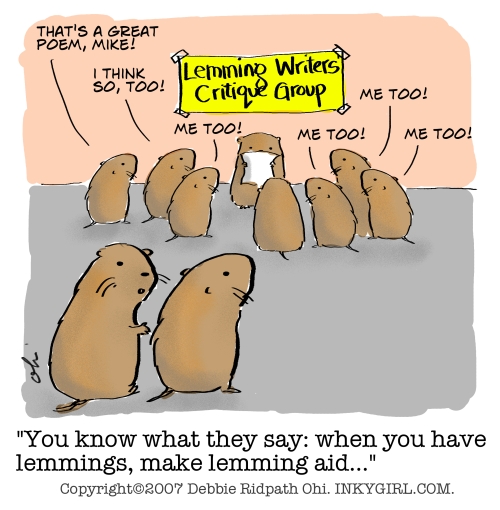
Over the years, some of my best friends have labeled me in what an outsider might regard as an unflattering way. While I taught at USAF Chaplain School, my teammates called me “Lemming.” (On occasion, they still do.) The reference had nothing to do with me following the crowd . . . and everything to do with being directed to march off any number of cliffs.

I doubt that Lewis ever shared this association with Tolkien himself. It’s likely that he freely associated the idea at the moment he wrote it, and never thought about it again.

That was one of Lewis’ gifts, being able to use creative analogies to make his points. It is simply one of his talents I would love to share.

And, as for Lewis’ use of the word “insect” here, he is obviously alluding to the polyp’s small size. It would not surprise me to learn that there is an archaic British precedent for such usage. Or, is it just possible that he knew the proper word for the creature, and was too cultured to use it in this context? Perhaps we will never know.

coralpolyp.jpg

Be an Inkling

Lemming Critique

Do you invite others to critique your writing before you publish it? If you want to be successful, you definitely should.

I never cease to be amazed at how presumptuous some writers are. I’m referring to those who deny their work could be improved by having others offer suggestions for improving it.

When I reflect on the fact that C.S. Lewis and J.R.R. Tolkien subjected their own work to the critical eyes (and ears) of their peers, I realize I must do no less.

Just as their involvement in the Inklings made them better authors, in the same way our participating in writing or critiquing fellowship is vital to our advancing in the art.

Lewis recognized this early in life. Long before the birth of the Inklings, he exchanged “works in progress” with his lifelong friend, Arthur Greeves.

Lewis went so far as to declare, in a 1916 letter to Greeves: “It is impossible to write one’s best if nobody else ever has a look at the result.”

Benefits of Writing Fellowships

Some profitable results that come from participating in a support group are obvious. Depending on the group, your compatriots identify places where your writing is not as clear as you intend it to be. Some participants may also be good copy editors, and willing to share their skills.

Then there are the proverbial “grammar Nazis” whose contributions are actually valuable, if you desire to write well. (Of course, the comments of others are only suggestions, and all writers are free to implement, or dismiss, the advice.)

In longer works, your writing companions can help you identify when your pace is erratic or your story is going off track. It’s not uncommon for them to offer worthwhile ideas that would never have come to you if you relied solely on your own cranium.

Another benefit comes from gaining new insights into the writing life. For example, one of my writing partners made this observation that continues to guide me. Discussing how frequently I digress to extinguish any possibility of misunderstanding, he said, “The instinct of the journalist is to be concise. The instinct of the historian is to be thorough. You’re a historian.” Realizing that I invariably default to the latter, the historian, helps me to consciously attempt to temper that orientation. (I know, I don’t succeed too well with that, but just imagine what my writing would be like if I surrendered unconditionally to my innate inclination.)

Encouraging Others

Participating in a writing collective means we never have to be isolated, alone with words destined never to be seen by another human eye. At the very least, we share them with our friends. And, potentially, the collaborative process helps see them through to publication

It is well known that without C.S. Lewis’ persistent encouragement, Tolkien’s Lord of the Rings and The Hobbit would never have seen print.

Lewis revealed his nature as an encourager early in his life. The quotation above comes, in fact, from a letter when he is challenging Greeves to continue faithfully sending his work for Lewis to comment upon.

I do really want to see something of yours, and you must know that it is impossible to write one’s best if nobody else ever has a look at the result.

However, I told you I would proceed to serious measures, so here is my manifesto. I, Clive Staples Lewis, student, do hereby give notice that unless some literary composition of Arthur Greeves be in my possession on or before midnight on the last night of June in the year nineteen hundred and sixteen, I shall discontinue from that date forward, all communication to the said Arthur Greeves of every kind, manner, and description whatsoever, until such composition or compositions be forwarded. ‘So there’ as the children say. Now let us go on.

This amusing passage reminds us of two final things. First, if we have difficulty connecting with a local writing group, remember that we are not limited by geographic proximity. (Never truer than in today’s wired world.)

A second lesson is that, as in most human relations, humor makes good things even better. Oh, how the halls of Magdalen College and the Eagle and Child must have echoed with their laughter.