Anxiety & Nighttime

Everyone experiences some anxiety, but it is only considered a “disorder” when it negatively affects one’s quality of life. Sadly, that level has been reached by nearly twenty percent of Americans.

An estimated 19.1% of U.S. adults had an anxiety disorder in the past year. Past year prevalence of any anxiety disorder was higher for females (23.4%) than for males (14.3%). An estimated 31.1% of U.S. adults experience any anxiety disorder at some time in their lives (National Institute of Mental Health).

As one specialist puts it, “there’s a very strong, well-documented bidirectional link between sleep and mental health issues like anxiety.” And it can become a vicious cycle: “If you have poor sleep, you’re at greater risk of a mental health issue. And if you have a mental health condition like anxiety, you’re more likely to develop a sleep disorder.”

Those “disorder” figures are only for anxiety passing a problematic threshold. Feeling some anxiety is a normal part of life, even for Christians. (Fortunately, however, we have an Intercessor who alleviates anxiety in our fallen lives.)

Do not be anxious about anything, but in everything by prayer and supplication with thanksgiving let your requests be made known to God. And the peace of God, which surpasses all understanding, will guard your hearts and your minds in Christ Jesus (Philippians 4:6-7).

The universality of experiencing anxiety is evidenced by the etymology of the word itself. The Latin anxius simply means troubled or worried (i.e. anxious). 

In his classic Letters to Malcolm: Chiefly on Prayer, C.S. Lewis addresses the negativity associated with being anxious, that actually worsens the problem.

Some people feel guilty about their anxieties and regard them as a defect of faith. I don’t agree at all. They are afflictions, not sins. Like all afflictions, they are, if we can so take them, our share in the Passion of Christ.

So, if most of us admit to experiencing some worry, the question posed by a recent article in TIME is whether the anxiety peaks at night. While not universal, “research has long suggested that, for many people, anxiety symptoms spike and mental health otherwise suffers at night.” While the piece cited several reasons, it left out two causes I consider self-evident.

The article points to studies about how substance abuse and suicidal behavior rise “after midnight,” and how “the racing thoughts that plague many anxiety sufferers are at their worst in the evening.” While I didn’t read the linked research, these statements are simply descriptive of the problem.

As for identified causes, the studies point to our diminished ability to “regulate emotions” as we tire. The issue of isolation is noted as a second factor, since “the rest of the world is asleep.” Further, the lack of daytime distractions may set the stage for “runaway anxiety” as we ponder the “what ifs” of the future. Another logical finding is that anxiety builds as we sleep poorly because we are worrying, which makes us prone to becoming even more anxious.

So What are the Uncited Factors?

First, it seems to me that the darkness of night itself is a major consideration. Since primordial times, night was foreboding. Sharpened wooden or stone-tipped weapons offered little enough defense when we could see predators (beast or human). Our ability to make fires and light candles ignited trifling circles of light that barely penetrated the shadows.

The uncertainty about what lurks in those shadows remains with us today. Just consider how quickly chaos can arise when there are power outages and the “protection” offered by light instantly evaporates.

Related to this is the simple fact that bad things (like crimes), increase during darkness. While many unlawful acts certainly occur during daylight hours, many of the most violent and heinous crimes, such as rape, occur after the sun sets. You can compare many variables at this website

It is simply common sense to recognize we are more vulnerable to violent attack when darkness masks attackers’ identities. The Book of Job vividly describes this lawless predilection.

There are those who rebel against the light,
    are not acquainted with its ways,
    and do not stay in its paths.
The murderer rises before it is light,
    that he may kill the poor and needy,
    in the night he is like a thief.
The eye of the adulterer also waits for the twilight,
    saying, ‘No eye will see me;’
    he veils his face.
In the dark they dig through houses;
    by day they shut themselves up;
    they do not know the light.
For deep darkness is morning to all of them;
for they are friends with the terrors of deep darkness (Job 24:13-17).

While the increased criminal behavior during darkness may have been omitted due to the tacit acknowledgment that it is a factor, my second observation was quite possibly overlooked due to ignorance or prejudice.

The Spiritual Consideration

I am convinced there is a spiritual component to our wariness related to darkness. Even those secularists dismissive of this reality would likely recognize this as a common perception. After all, it is no accident that stories (ancient and modern) depict wicked gatherings and malevolent supernatural events as taking place primarily at night.

The Scriptures discuss this Light/Dark dichotomy extensively. One of the clearest examples comes in the explanation for why sinful people choose to reject the coming of Christ.

In the beginning was the Word, and the Word was with God, and the Word was God. . . . In him was life, and the life was the light of men. The light shines in the darkness, and the darkness has not overcome it. . . .

[Jesus said] “For God so loved the world, that he gave his only Son, that whoever believes in him should not perish but have eternal life. For God did not send his Son into the world to condemn the world, but in order that the world might be saved through him. Whoever believes in him is not condemned . . . the light has come into the world, and people loved the darkness rather than the light because their works were evil.

For everyone who does wicked things hates the light and does not come to the light, lest his works should be exposed. But whoever does what is true comes to the light, so that it may be clearly seen that his works have been carried out in God” (John 1–3, selected verses).

Because darkness helps mask unsavory behavior, author Dave Jenkins advises people to be vigilant regarding their own temptations. He shares his personal story attesting to his contention that “night time for many men and women is danger time.”

This certainly is not God’s desire for any of us. As “The Godliness of a Good Night’s Sleep” concludes, “sleep, it seems, is no fallen necessity, nor merely a fleshly temptation, but a divine gift.”

In The Screwtape Letters, C.S. Lewis’ brilliant exploration of diabolic strategies, the senior demon advises his protégé, how to rob humanity of this blessing.

There is nothing like suspense and anxiety for barricading a human’s mind against the Enemy. He wants men to be concerned with what they do; our business is to keep them thinking about what will happen to them.

But fortunately, humanity’s first Enemy does not have the final say in the matter.

Even During the Darkest Night

We need never be alone nor despair in the night. In fact, even the trials posed by anxiety can become a pathway to a more intimate reliance and relationship with God.

Perhaps most famously, this concept has been associated in Christian circles with “Dark Night of the Soul,” a poem written by Saint John of the Cross in the sixteenth century. In an upcoming post, we will consider John’s life and the controversial actions which followed his death.
Do Not Read the Bible

How would you respond if the government prohibited you from reading the Holy Scriptures? That was the situation in Great Britain when the Parliament passed the ironically named “Act for the Advancement of True Religion.”

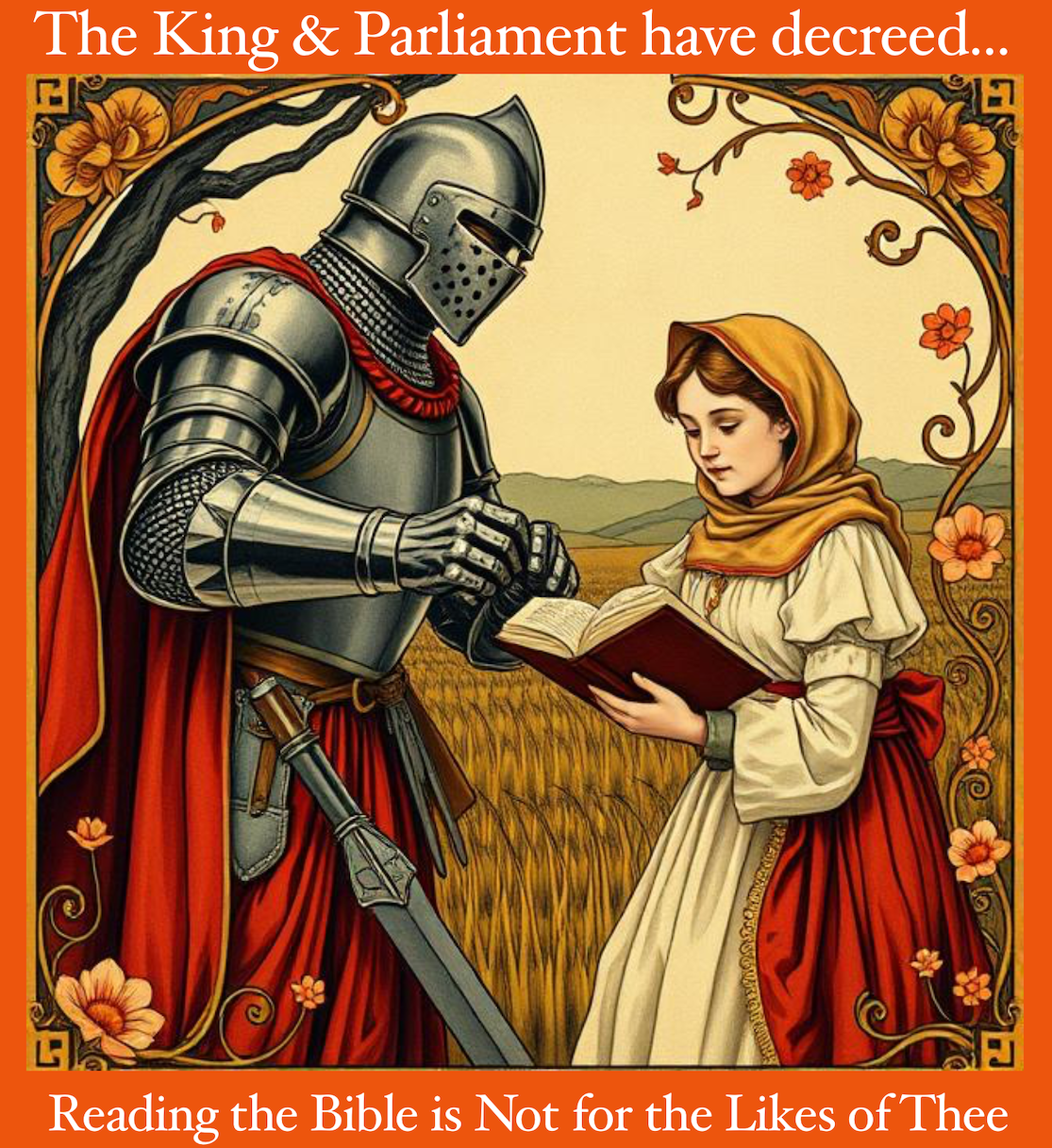
Nearly five centuries ago, on May 12, 1543, Britain’s enlightened politicians and bishops determined that people of the “lower sort” needed to be protected from reading and interpreting the Bible themselves. 

Just sixty-one years later, King James VI/I would commission the translation of the Authorized Version, making God’s Word more accessible to all who could read English. William Tyndale (c. 1494 – 1536) had actually translated a fair portion of the Scriptures a decade prior to Parliament’s restrictive law. For this, and similar “Protestant” sins, Tyndale was strangled and burned at the stake in Belgium.

Even the so-called Great Bible had been authorized by Henry VIII in 1539. The approval decreed “one book of the bible of the largest volume in English, and the same set up in some convenient place within the said church that ye have care of, whereas your parishioners may most commodiously resort to the same and read it [emphasis mine].”

Nevertheless, not all of the powers that be apparently agreed with making the text of the Bible accessible to the common folk. We will consider this category of “inadequates” momentarily.

First let’s consider the distaste expressed by some for any modern translation of the Scriptures. (If you’ve ever attended a Bible study group you have probably encountered at least one person who insists on using the true KJV, despite the archaic language.

C.S. Lewis addressed this reticence for clear translations in an essay entitled “Christian Apologetics.” It was originally presented to Anglican priests and youth leaders in 1945.

“Do we not already possess,” [some will say] “in the Authorised Version the most beautiful rendering which any language can boast?” Some people whom I have met go even further and feel that a modern translation is not only unnecessary but even offensive.

They cannot bear to see the time-honoured words altered; it seems to them irreverent. There are several answers to such people. In the first place the kind of objection which they feel to a new translation is very like the objection which was once felt to any English translation at all.

Dozens of sincerely pious people in the sixteenth century shuddered at the idea of turning the time-honoured Latin of the Vulgate into our common and (as they thought) ‘barbarous’ English. A sacred truth seemed to them to have lost its sanctity when it was stripped of the polysyllabic Latin, long heard at Mass and at Hours, and put into . . . language steeped in all the commonplace associations of the nursery, the inn, the stable, and the street.

The Biblically Unworthy

So, who were these “lower sort” of individuals deemed unsuited for reading the Scriptures already translated into their native tongue? Well, they included “women, artificers, apprentices, journeymen, serving-men of the rank of yeoman and under, husbandmen and laborers.” Women of the gentry class were allowed an exception, being able to read the Scriptures, but only in private.

Fortunately, the law was short-lived. Henry’s son, Edward VI/I would have it repealed in the Treason Act of 1547. (Of course, this goodwill did not prevent Edward from condemning the translations of the aforementioned martyr, William Tyndale.)

Who Should Read the Bible?

The short answer is “everyone.” Yet the fact exists that some individuals are susceptible to confusion – or even to intentional twisting of the clear meaning of God’s Word. So, while the Scriptures should be accessible to all, it is wise to guide children and the easily-confused in their studies. After all, what we all desire is honest understanding and enlightenment.

This direct access is one reason Martin Luther, William Tyndale and others labored so tirelessly to translate the Bible into the vernacular. Cheerfully, “believers no longer had to read Latin [or Greek, Hebrew or Aramaic] to understand the word of God.”

As for those who would directly attempt to distort God’s inspired words, a clear example is found in the New World version paraphrase invented by Jehovah’s Witnesses. Another example, which I have discussed in the past, is the distorted abomination created by the Chinese Communist Party

There are also “abbreviated” versions of the Bible, which contain properly translated passages, but leave out passages that challenge preconceived positions. This would include Thomas Jefferson’s cut and paste Bible and an edition of the Scriptures developed for teaching slaves to read.


If you are interested in receiving daily notes about Christian history such as the one which prompted this post, visit the Christian History Institute.

A Curious Papal Funerary Tradition

Several unique items are buried with modern popes when they die. Most, including their vestments, point to their spiritual role as the Bishop of Rome and patriarch of the Roman Catholic Church. One, however, highlights his secular role as the leader of the world’s smallest independent nation state.

This post is not about Pope Francis’ reign, or the papacy in general. As C.S. Lewis noted in a letter to an American poet, Mary Willis Shelburne, opinions on such matters differ in sometimes unproductive ways. In response to a comment she had written about the passing of Pope John XXIII (1881 – 1963), who had convened the Second Vatican Council, Lewis astutely observed,

God’s purposes are terribly obscure. I am thinking both of your [physical] sufferings and of the removal of such a Pope at such a moment. And the horrid conclusions which some bigots on both sides will probably draw from it.

Rather than discussing the role of the Bishop of Rome, I am considering one specific aspect of the office of the Bishop of Rome – the formalities associated with the funeral and burial/interment of a deceased pope. My focus is further restricted to a single unique facet of that process. This involves the coinage of the Vatican City State issued during their reign.

Despite its status as a nation, Vatican City has declined full membership in the United Nations. This is due to the admirable goal of remaining detached from the official political tentacles associated with having an official vote. Instead, through the Holy See, the papacy’s ecclesiastical office, the Roman Catholic Church maintains a presence and voice in the UN.

Vatican City is one of the few independent states that has not become a member of the United Nations. It does hold permanent observer status, with all the rights of a full member except for having a vote in the General Assembly.

On April 6, 1964, the Holy See became a Permanent Observer Mission to the United Nations and established its Mission in New York City. This was fitting, not only because of the growing involvement of the Holy See in UN deliberations, but above all because the four pillars of the UN as enshrined in its Charter dovetail very well with four main pillars of Catholic Social Teaching . . .

The Holy See enjoys by its own choice the status of Permanent Observer at the United Nations, rather than of a full Member. This is due primarily to the desire of the Holy See to maintain absolute neutrality in specific political problems.

In accordance with tradition, “preparations are also being made for a numismatic commemoration of the Sede Vacante.” The Latin term  means “vacant seat,” and refers to the transitional period between popes. Thus, in addition to the papal coins minted for each pope, special issues are normally released during the interims. However, due to a reorganization of the Vatican’s coinage office, CoinsWeekly reports it remains “uncertain whether a 2-euro commemorative coin” will be produced for this papal interregnum.

NumismaticNews echoes the fact that due to their rarity, Sede Vacante issues rapidly increase in value. Fortunately due to their infrequency, they “ are seldom at the center of a collector’s radar. That’s probably a good thing, as it means we are not losing popes quickly or routinely.”

A number of items are traditionally included in a pope’s casket. Unsurprisingly, these include a miter, crozier, and rosary. They also include coins minted during their reign, reflecting their role as ruler of the Papal State. This last fact surprised me.

So, precisely what is the precedent being set with Pope Francis’ funeral? First, he was not buried in the Vatican, but in a basilica dedicated to St. Mary.

There was another, more significant symbol of the simplicity that characterized his papacy. While popes traditionally have three elaborate caskets nestled inside one another, Francis asked to have only one simple wooden casket with a modest zinc inner lid.

Pope Francis’ 2017 Revision of Vatican Coinage

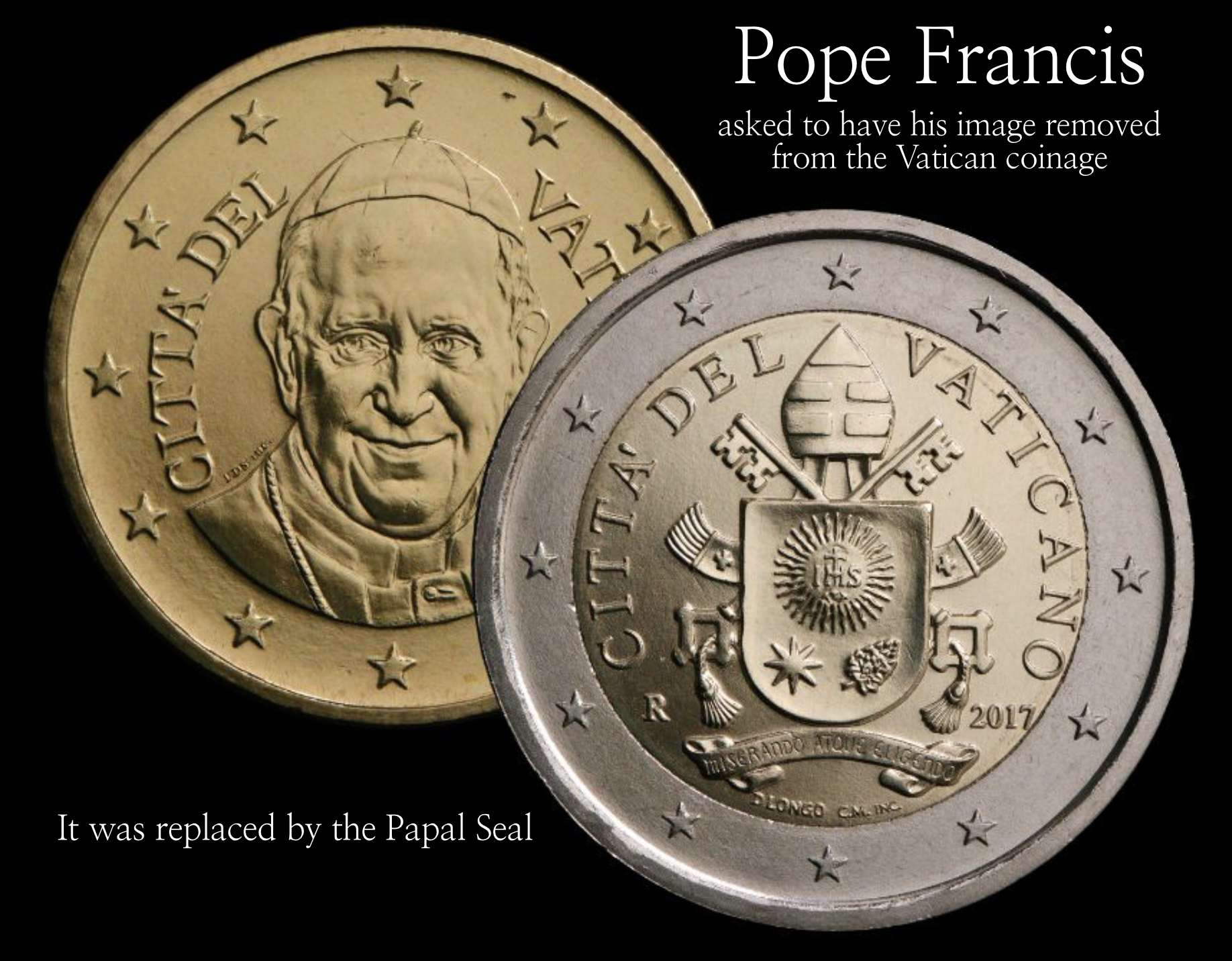
For centuries, the portrait of the current Bishop of Rome graced coins in Rome. That tradition ended with Pope Francis. In 2017, he personally requested that his visage no longer appear on coins. This is commendable, since it was presumably based on Francis’ humility. 

This then, his image has been replaced by the papal coat of arms. Notably, every other country minting euros bears the head of its head of state. It will be interesting to see whether or not Francis’ successor follows his example.

A Brief Note on Protestant Coinage

Although there have been some historical attempts to create governmental structures led by religious leaders besides Roman Catholicism, they have been the rare exception. (The claimed leadership of the Church by sovereigns such as King Henry VIII is another case.) 

In Zurich, Huldrych Zwingli (1484 – 1531) sought to establish a theocracy, and actually perished on the battlefield resisting the Roman Catholic armies of several Swiss cantons. John Calvin (1509 – 1564) pursued similar goals in Geneva, and beyond. Calvin, however, never bore arms in his effort.

Fortunately, the “two kingdoms” theology of Martin Luther became dominant in primarily Protestant realms. It is based on the declaration Jesus made during his trial before Pontius Pilate that “My kingdom is not of this world” (John 19).

For a fascinating discussion of the implications of this theological position, consider “Martin Luther’s Farewell to Arms: The Two Kingdoms and the Rejection of Crusading.”

Turning to numismatics, it is not rare to find religious leaders portrayed on historical coinage. However, these portrayals serve as commemorations of individuals who have made a cultural or ethical contribution to a particular society – not because they sat upon a throne.

For example, Switzerland minted a 20 franc coin with the images of Zwingli and Calvin during the 500th anniversary of the Reformation.

Likewise, in 1965, the Communist government of Czechoslovakia produced a 10 korun coin in honor of the 550th anniversary of the martyrdom of Jan Hus. This particular coin, like many similar pieces, was actually minted as a non-circulating coin, intended for collectors rather than daily commerce.

This leads us to note that most coin-like pieces of metal bearing the likeness of reformers are actually medallions, not coins. As such, the vast majority of the commemoratives have been fashioned by organizations, rather than governments.

Being an amateur numismatist and a Lutheran pastor myself, I have several related items in my personal collection (none of which were costly, of course . . . since it’s just a hobby). One of my favorite items is a genuine 1 Mark coin minted in Eisenach in Weimar Germany in 1921 (pictured below). What makes it especially unusual is that due to postwar metal shortages, it was actually struck in porcelain!

This emergency coinage and currency was called “Notgeld,” which means “necessity money” because individual cities found it necessary to provide their own money when the Reichsbank succumbed to hyperinflation between the world wars.

The city of Eisenach chose the centennial of Martin Luther’s work because of his historic ties to the city. The Lutherhaus Eisenach cultural center commemorates, among other events, Luther’s early schooldays there, and his stay at Wartburg Castle where he translated the New Testament into German.

Conclusion

In light of Pope Francis’ funeral and the association it has with numismatics, it is a good time to consider how coinage has often carried a religious message. Although this was more frequent in past centuries, it still occurs today. It will be interesting to see just how many nations eventually mint coins in honor of Pope Francis. The Philippines, Samoa and the Cook Islands already have.

And even Narnia, the home of Aslan, minted coins in honor of its heroes, didn’t it?

Gathering Palms & Preparing for War

The Christian church has just celebrated Palm Sunday, and I recalled one of my favorite memories in preparing for the journey through Holy Week.

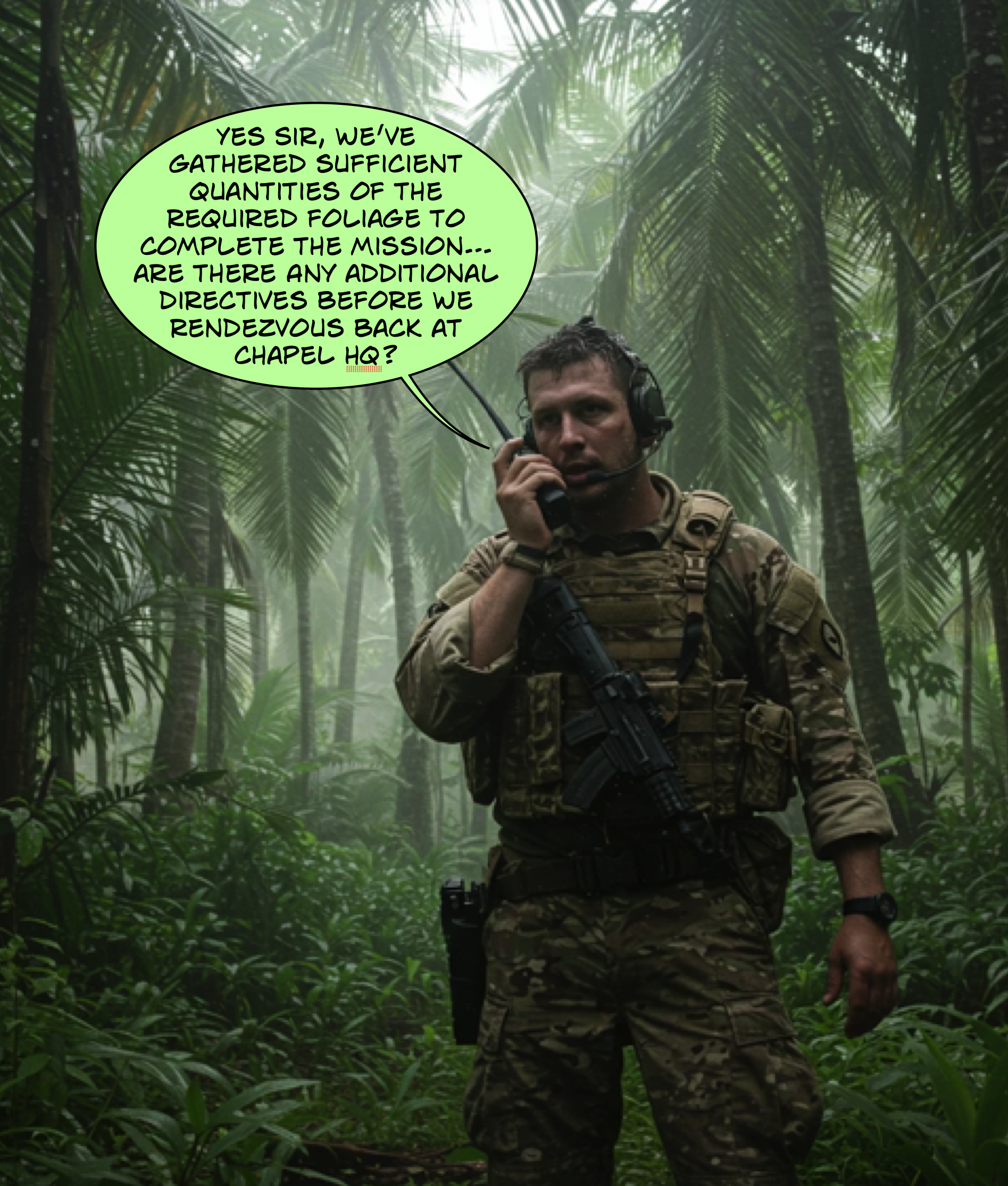
When I was stationed in Guam a few years ago (in the nineties), I enjoyed the annual tradition of gathering all of the palms to decorate the chapel and provide for worshippers in our very own jungle. Each year the chaplains and chaplain assistants, our whole team, would spend half a day gathering leaves that would put to shame any stateside palms.

Taking place in a tropical jungle, the event was sweaty, but fun. Good fellowship and even some seasonal early-Easter music. Fortunately, this didn’t take place during the typhoon season, as when the island was smashed by Super Typhoon Paka during our residency.

Jungles are fascinating places. Because the word possesses some rather ominous and even threatening overtones, a number of years ago they were rechristened “rainforests.” Even though most are tropical, there are temperate rainforests, such as in the Olympic National Forest, whose mountains I admire daily from our backyard.

C.S. Lewis alluded to the negative connotation of jungles in his study of “Vivisection,” with its repudiation of animal cruelty.

In justifying cruelty to animals we put ourselves also on the animal level. We choose the jungle and must abide by our choice.

A Modern Use for Jungles

In recent years, the jungles of Guam have been put to a military use. Unsurprisingly, soldiers and their Marine, Navy and Air Force cousins, must be prepared to do their jobs in a wide range of environments. That results in the existence of a variety of training settings, tuned to the specific needs of particular career fields.

For example, I served as the Wing Chaplain at Fairchild AFB where the USAF trains its pilots and aircrew members how to survive when they find themselves in unfriendly settings. Survival, Evasion, Resistance and Escape (SERE) training saves lives.

Anyway, not long ago the Air Force established a Jungle Agile Combat Employment (JACE) Course in, of all places, Guam.

This new course took knowledge from the U.S. Marine Corps Jungle Warfare Training Center and the Lightning Academy in Hawaii and tweaked it for non-combatant career fields to be prepared under the USAF’s Agile Combat Employment (ACE) concept.

This is part of America’s shift in focus to the threats in the Pacific theater. China has never renounced, and constantly proclaims, its intent to force the Republic of China (Taiwan) into their fascist empire. Of course, the fate of Hong Kong reveals just how unbenevolent the so-called People’s Republic is when it comes to maintaining any semblance of democratic freedoms. 

C.S. Lewis, of course, had much to say about the tragedies of fascism and war. However, that is not the focus of this reflection. Instead, the theme of this post reflects two thoughts. 

The less important idea, to which I have paradoxically devoted the most space, is the value of memories. Guam occupies a very special place in my family’s history, in part because all three of our kids were there during their teens. Lifechanging events occurred there.

And it was the wonderful people, military friends and wonderful Chamorro residents that made the most lasting impressions. Remembering the harvesting of palms, and recently learning about the jungle training course turned my thoughts back to that Micronesian paradise.

What’s Truly Vital

The infinitely more important message in this post is to acknowledge the holiest of seasons in which we find ourselves. Beginning with Palm Sunday’s celebration of the joy experienced by God’s people as they welcomed their Messiah into Jerusalem, we have the opportunity now to also join together with Jesus and our brothers and sisters in the faith as we:
~ commemorate the institution of the Lord’s Supper on Maundy Thursday,
~ contemplate the despair of the disciples as they stood at the foot of the cross as Jesus breathed his last mortal breath on Good Friday, and
~ celebrate in awe and wonder how our Savior rose from the grave and encouraged his disciples before ascending to Heaven and resuming his place at the right hand of God the Father. 

Christ’s atoning death, and his glorious resurrection, give us hope in the depths of our despair. And his promised return ensures us that there truly will come a day when we need never again prepare for war – or ever taste the pain of death.

We do well to heed C.S. Lewis’ encouragement to his friend Don Giovanni Calabria in 1948, when the priest was distraught over the troubles transpiring around the world.

Tomorrow [Easter] we shall celebrate the glorious Resurrection of Christ. I shall be remembering you in the Holy Communion. Away with tears and fears and troubles!

United in wedlock with the eternal Godhead Itself, our nature ascends into the Heaven of Heaven. So it would be impious to call ourselves “miserable.”

On the contrary, Man is a creature whom the Angels – were they capable of envy – would envy. Let us lift up our hearts! At some future time perhaps even these things it will be a joy to recall.

C.S. Lewis, J.R.R. Tolkien & Naomi Mitchison

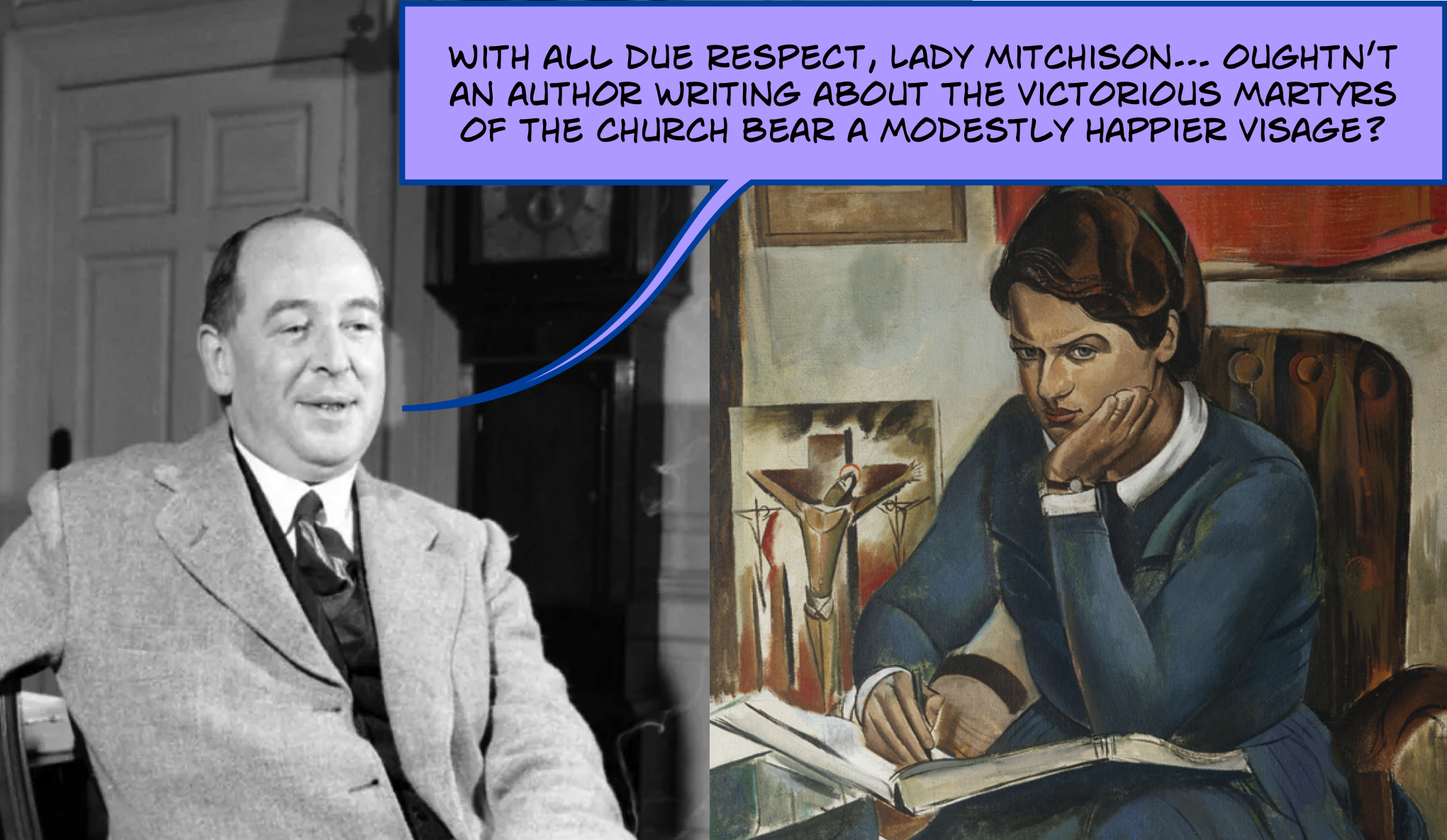
Have your feelings about particular authors changed over time? C.S. Lewis’ attitude toward the work of prolific novelist Naomi Mitchison illustrates this type of progression.

Mitchison’s work possesses a direct link to another Oxford Inkling – J.R.R. Tolkien – whose Fellowship of the Ring she read in proof and favorably reviewed. Brenton Dickieson provides a priceless letter written by Tolkien to Mitchison in 1954.

Naomi Mary Margaret Mitchison was a Scottish novelist who lived more than a century (1897 – 1999). She penned more than ninety books, primarily historical fiction, and including science fiction.

With the outbreak of the First World War, Mitchison joined a Voluntary Air Detachment in a London hospital. (Other familiar women who served in a VAD included Agatha Christie and Amelia Earhart.)

Politically she identified as a Socialist. She was sufficiently leftist that George Orwell regarded her as unsuited for writing anti-Soviet materials for the United Kingdom during the Cold War.

Mitchison’s brother, J.B.S. Haldane, did not equivocate on his radical views, announcing his position as a Marxist. He was a scientist and his atheism brought him into serious disagreement with the Christian views of C.S. Lewis. (I will devote my next post to that interaction.)

Coincidentally, artist Pauline Baynes (who also worked with C.S. Lewis and J.R.R. Tolkien), provided the illustrations for at least one of Mitchison’s children’s books, Graeme and the Dragon. This quick review offers a concise synopsis and discussion of “the charming illustrations [which] go a long way toward making this a fun read.”

An additional coincidence: the same year Lewis published The Lion, the Witch and the Wardrobe, Mitchison also published a fantasy novel for children. The Big House involves time travel and some occultic themes associated with Halloween, etc.

For a thorough synopsis of The Big House and comparison to Lewis’ Chronicles of Narnia, check out this essay from the University of Glasgow. (That reviewer’s preference is clearly for Mitchison’s more complex approach with its themes related to class struggle.)

C.S. Lewis’ Perspective on Naomi Mitchison

I cannot locate any mention of C.S. Lewis by Mitchison, but he did mention her in passing in several pieces of correspondence. In essence, he praised her skill, but was put off by her graphic use of violent imagery.

In a 1932 letter to Arthur Greeves, he writes:

I thought we had talked about Naomi Mitchison before. I have only read one (Black Sparta) and I certainly agree that it ‘holds’ one: indeed I don’t know any historical fiction that is so astonishingly vivid and, on the whole, so true.

I also thought it astonishing how, despite the grimness, she got such an air of beauty–almost dazzling beauty–into it. As to the cruelties, I think her obvious relish is morally wicked, but hardly an artistic fault for she could hardly get some of her effects without it.

But it is, in Black Sparta, a historical falsehood: not that the things she describes did not probably happen in Greece, but that they were not typical–the Greeks being, no doubt, cruel by modern standards, but, by the standards of that age, extremely humane.

She gives you the impression that the cruelty was essentially Greek, whereas it was precisely the opposite. That is, she is unfair as I should be unfair if I wrote a book about some man whose chief characteristic was that he was the tallest of the pigmies, and kept on reminding the reader that he was very short. I should be telling the truth (for of course he would be short by our standards) but missing the real point about the man–viz: that he was, by the standards of his own race, a giant. 

Still, she is a wonderful writer and I fully intend to read more of her when I have a chance.

C.S. Lewis echoed his concern in a 1942 letter to another of his regular correspondents, Sister Penelope. “I gave up Naomi Mitchison some time ago because of her dwelling on scenes of cruelty. But I recognise real imagination and a sort of beauty in the writing.”

In 1951, C.S. Lewis congratulated author Idrisyn Oliver Evans (1894–1977) on the publication of The Coming of a King; A Story of the Stone Age. Ironically, speculative fiction set in this ancient era, referred to as “Prehistoric SF,” was also the setting of works such as H.G. Wells’ Story of the Stone Age series, which you can read here. Naomi Mitchison also dabbled in the prehistoric field. Lewis wrote to Evans: 

I congratulate you. And I think it is a great thing to put that idea of the Stone Age – which is at least as likely to be the true one – into boys’ heads instead of Well’s or Naomi Mitchison’s. It’s all good. The marriage customs are amusing . . . I hope it will be a great success. 

In 1959, C.S. Lewis provided some wise counsel to a young, aspiring author. The American student was contemplating a volume about the Roman subjugation of Gaul, which Lewis encouraged.

A story about Caesar in Gaul sounds very promising. Have you read Naomi Mitchison’s The Conquered? And if not, I wonder should you? It might be too strong an influence if you did (at any rate until your own book is nearly finished). On the other hand, you may need to read it in order to avoid being at any point too like it without knowing you are doing so.

I don’t know what one should read on Gaul. Apart from archaeological finds (Torques and all that) I suppose Caesar himself is our chief evidence? He will be great fun and I hope you will enjoy yourself thoroughly.

Which side will you be on? I’m all for the Gauls myself and I hate all conquerors. But I never knew a woman who was not all for Caesar – just as they were in his life-time.

C.S. Lewis’ most significant mention of Naomi Mitchison occurs in his brief 1943 essay, “Equality.”

It delivers a brilliant discussion of the subject, one that merits full reading. He commends one of Mitchison’s insights into inequality – although, ironically, she relates it to eroticism.* (You must read it in full context to understand how it supports his independent argument.)

This last point needs a little plain speaking. Men have so horribly abused their power over women in the past that to wives, of all people, equality is in danger of appearing as an ideal. But Mrs. Naomi Mitchison has laid her finger on the real point. Have as much equality as you please – the more the better – in our marriage laws, but at some level consent to inequality, nay, delight in inequality, is an erotic necessity.

Mrs. Mitchison [in The Home and a Changing Civilization] speaks of women so fostered on a defiant idea of equality that the mere sensation of the male embrace rouses an undercurrent of resentment. Marriages are thus shipwrecked.

A final reference to Mitchison brings us back around to my early note that she reviewed Fellowship of the Ring. C.S. Lewis refers to her review in his own, suggesting that she has not gone quite far enough in her praise.

Nothing quite like it was ever done before. ‘One takes it,’ says Naomi Mitchison, ‘as seriously as Malory.’ But then the ineluctable sense of reality which we feel in the Morte d’Arthur comes largely from the great weight of other men’s work built up century by century, which has gone into it.

The utterly new achievement of Professor Tolkien is that he carries a comparable sense of reality unaided. Probably no book yet written in the world is quite such a radical instance of what its author has elsewhere called ‘sub-creation.’

Sadly, Naomi Mitchison was less enamored with the subsequent volumes in The Lord of the Rings . . . but this post has already condensed more than enough information.


* An article in Michigan Feminist Studies notes how Naomi Mitchison’s recurrent references to sexual themes distracted from broader matters throughout her literary career.

Despite Mitichison’s attempts to move the discussion of her body of work from the salacious, it is the frank and open inclusion of sexuality that continues to intrigue her critics and reviewers. Racy, heated passages of Mitchison’s historical novels inspired comment from poet W.H. Auden in the 1930s (“Monstrous Sex: The Erotic in Naomi Mitchison’s Science Fiction”).

The essay’s thesis is what one might expect in a journal devoted to contemporary feminism.

I intend to demonstrate that the ribald sexuality of Mitchison’s work registers as more than merely provocative. Sexual encounters between female characters and aliens, as well as those between women, threaten an imperialising capitalism that dictates who may be loved in a gendered, racialised order.

C.S. Lewis & Emotions

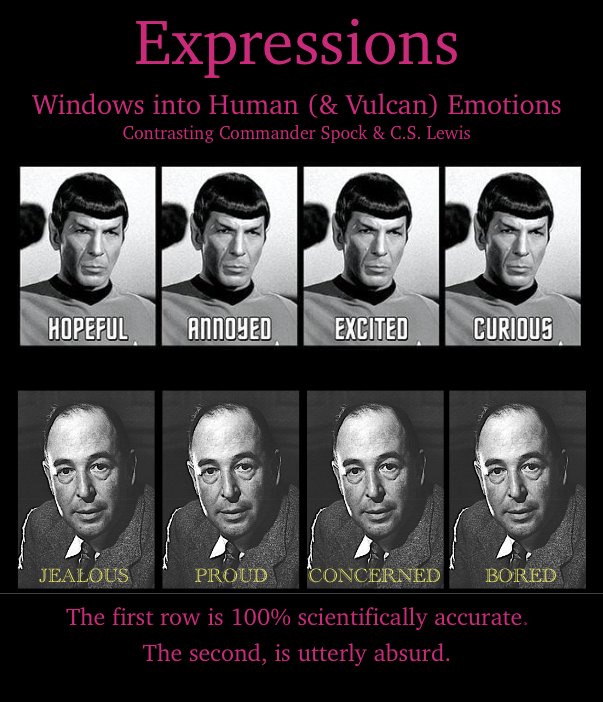
Are you one of those people who pride themselves on not being particularly emotional? Probably not, since the pendulum has swung far in the opposite direction in our current day. (Consider how few clicks a Tik Tok influencer with “flat affect” would get.)

Most of us know some people (most commonly men – forgive me the generalization) who keep their emotions under tight rein.

Back when I was a child, in the mid-twentieth century, it was not uncommon for men to “guard” their notion of masculinity by acting emotionless. And various ethnicities, including my own ancestors, possessed a reputation for being staid.

I can’t recall my Norwegian grandfather, who died when I was about ten, ever expressing truly warm sentiments. I know he must have laughed, and my grandmother had a great sense of humor, but I have no memory of it.

For some reason, many people picture C.S. Lewis as an emotionally sober intellectual. Perhaps it’s because he wrote so many profound essays. The truth is that Lewis was extremely jovial and fun-loving. I have noted some of this humor in the past.

Like most of us, C.S. Lewis’ closest friends saw him most clearly. They witnessed his jocularity in their regular gatherings. His fellow Inklings witnessed it frequently, but I don’t see how anyone can read the Chronicles of Narnia, and perceive their author as reserved, much less grave.

One reason some readers misunderstand C.S. Lewis’ exquisite sense of humor is because it is British. For Americans, for example, appreciating British humor is an acquired taste. As reported by the BBC, the wit often includes elements of “sarcasm, understatement [and] self-deprecation.”

In The Screwtape Letters, C.S. offers an insight into one of the Tempter’s tactics in undermining human nature, in terms of being fashioned in the image of our Creator.

[Englishmen] take their “sense of humour” so seriously that a deficiency in this sense is almost the only deficiency at which they feel shame. Humour is for them the all-consoling and (mark this) the all-excusing, grace of life.

Hence it is invaluable as a means of destroying shame. [. . .] A thousand bawdy, or even blasphemous, jokes do not help towards a man’s damnation so much as his discovery that almost anything he wants to do can be done, not only without the disapproval but with the admiration of his fellows, if only it can get itself treated as a Joke.

And this temptation can be almost entirely hidden from your patient by that English seriousness about Humour. Any suggestion that there might be too much of it can be represented to him as “Puritanical” or as betraying a “lack of humour.”

Lewis’ humor was on full display to his intimate friends, and uninhibitedly on display to the world in a number of his writings. But his openness didn’t end there. 

Just Like the Rest of Us:
a Person of Humor and Grief

I don’t recall anyone labeling C.S. Lewis a “humorist” – likely because his corpus is so diverse and complex – but I think a literary critic could make that case.

Ironically, I once cited an autobiographical reference in which C.S. Lewis applied that very attribute to his own father, a serious solicitor.

In contrast, C.S. Lewis would mature to the point where he was willing to expose that deepest of emotions, grief, with the entire world. In A Grief Observed, he explored his pain in the wake of his wife’s untimely passing. Joy Davidman was the precious wife this confirmed bachelor never anticipated having, and her death crippled him.

His description of his thoughts, doubts, and spiritual struggle in the aftermath has helped many others to survive the nightmare of bereavement. Curiously, for privacy C.S. Lewis initially used a pen name for the volume. (You can read about that here.)

He did not wish to have his authorship of the book distract from its subject matter. He would have known that would only be a temporary tool, since pseudonyms are nearly always uncovered. Initially, however, it was so effective that when it was published, readers recognized it could speak to Lewis’ own grief, and offered him gift copies.

T.S. Eliot was one of its first advocates for the volumes publication, and you can read that story at Faber & Faber.

A Final Lewisian Observation on Emotions

Some people view the intensity of emotions associated with events to be a measure of their validity. If my passions are aroused by an activity, we incorrectly think, it must be real!

This error is particularly dangerous when related to so-called “matters of the heart” and matters of faith. 

C.S. Lewis was cautious in both realms. We already noted his resignation to live out his life as a single man. In terms of faith, he was just as circumspect. His conversion from atheism to Christianity was long, thoughtful, and reluctant. 

And this, I found, was something I had not wanted. But to recognize the ground for my evasion was of course to recognize both its shame and its futility.

I know very well when, but hardly how, the final step was taken. I was driven to Whipsnade [Zoo] one sunny morning. When we set out I did not believe that Jesus Christ is the Son of God, and when we reached the zoo I did.

Yet I had not exactly spent the journey in thought. Nor in great emotion. “Emotional” is perhaps the last word we can apply to some of the most important events.

It was more like when a man, after long sleep, still lying motionless in bed, becomes aware that he is now awake. And it was, like that moment on top of the bus, ambiguous.

Freedom, or necessity? Or do they differ at their maximum? At that maximum a man is what he does; there is nothing of him left over or outside the act.

Certainly, many people are blessed with emotional confirmation in their spiritual lives. The obvious peril, of course, is in evaluating the veracity of something by how giddy it makes us feel. 

After all, there will always come “dark nights of the soul” when the feelings have fled . . . but Jesus, still remains.  

Divine Christmas Gifts

I hope everyone was pleased with the gifts they may have received during their Christmas celebrations. As grandparents, my wife and I delighted in the presence of our children and grandchildren as we celebrated together Jesus’ Nativity.

Which raises the subject of the proverbial “reason for the season.” My hope is that Mere Inkling’s friends will know the deep and lasting joy of receiving our Creator’s most precious gift.

In 1958, C.S. Lewis wrote to an American correspondent about one obstacle to receiving God’s gifts. He cited an observation by Saint Augustine that if we are too busy grasping less important things, we can miss out on what is truly priceless.

St. Augustine says “God gives where He finds empty hands.” A man whose hands are full of parcels can’t receive a gift.

Augustine was an ancient African bishop. One of his Christmas sermons has survived and remains quite inspiring sixteen centuries after it was first preached. I encourage you to bask in the glow of the following excerpt.

So then, let us celebrate the birthday of the Lord with all due festive gatherings. Let men rejoice, let women rejoice. Christ has been born, a man; he has been born of a woman; and each sex has been honored.

Now therefore, let everyone, having been condemned in the first man [Adam], pass over to the second. It was a woman who sold us death; a woman who bore us life. The likeness of the flesh of sin [Romans 8] has been born, so that the flesh of sin might be cleansed and purified.

And thus it is not the flesh that is to be faulted, but the fault that must die in order that the nature may live; because One has been born without fault, in whom the other who was at fault may be reborn.

Rejoice, you just; it is the birthday of the Justifier. Rejoice, you who are weak and sick; it is the birthday of the Savior, the Healer. Rejoice, captives; it is the birthday of the Redeemer.

Rejoice, slaves; it is the birthday of the one who makes you lords. Rejoice, free people; it is the birthday of the one who makes you free. Rejoice, all Christians; it is the birthday of Christ.

Rejoice, one and all. God’s undeserved gift to each of us, for all those willing to receive it, is forgiveness and eternal life. 

In his book The Problem of Pain, C.S. Lewis elaborates on the Augustinian analogy shared above.

Everyone has noticed how hard it is to turn our thoughts to God when everything is going well with us. We “have all we want” is a terrible saying when “all” does not include God. We find God an interruption.

As St Augustine says somewhere, “God wants to give us something, but cannot, because our hands are full – there’s nowhere for Him to put it.” Or as a friend of mine said, “We regard God as an airman regards his parachute; it’s there for emergencies but he hopes he’ll never have to use it.”

Now God, who has made us, knows what we are and that our happiness lies in Him. Yet we will not seek it in Him as long as He leaves us any other resort where it can even plausibly be looked for. While what we call “our own life” remains agreeable we will not surrender it to Him.

What then can God do in our interests but make “our own life” less agreeable to us, and take away the plausible sources of false happiness? It is just here, where God’s providence seems at first to be most cruel, that the Divine humility, the stooping down of the Highest, most deserves praise.

Remember friends, our celebration of the Messiah’s entrance into our world is not limited to a single day, or even a brief season. Every single day we can rejoice at the miracle of the Incarnation and the fact that God loved us enough to send his Son to redeem us.

C.S. Lewis & Mining Minds

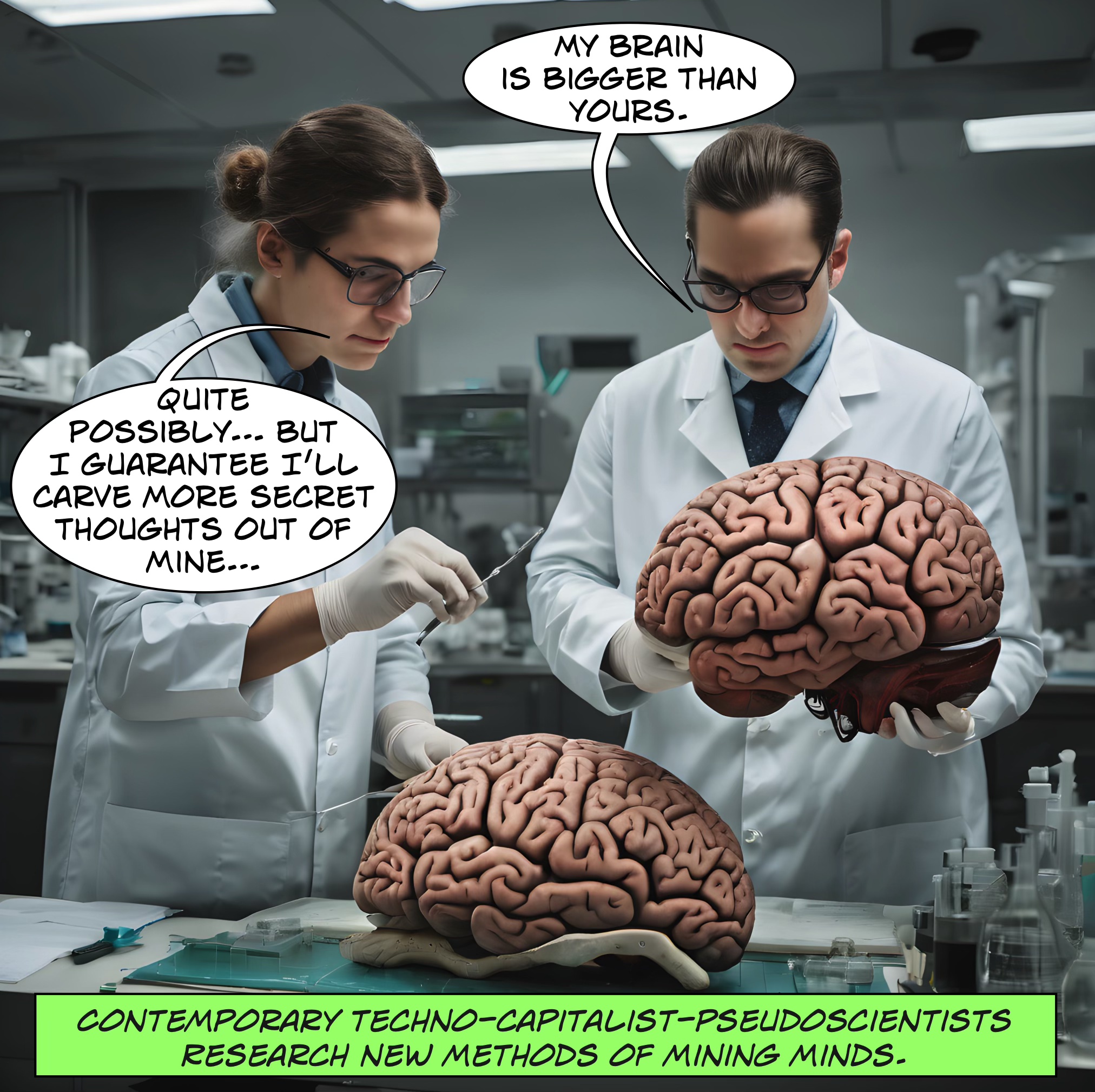
When we are young, it is common for us to think of “brain” and “mind” as synonyms. Today, (potentially nefarious) scientific advances are probing the brain, to gain commercially beneficial access to the mind.

What would C.S. Lewis think? Perhaps his 1955 comment about commercialism provides a hint?

I wish we didn’t live in a world where buying and selling things (especially selling) seems to have become almost more important than either producing or using them.

Seventy years later it is strange to apply this economic principle to the ineffable nature of the mind. And it’s even more odd to apply Lewis’ observation to this situation. He would definitely consider using one’s brain more important than marketing it.

As a young man, C.S. Lewis used the word “brain” when referring to dredging up pleasant memories of past holidays. Even in 1921 he realized that memories are capable of adding a resplendent glow to past experiences.

I still feel that the real value of such a holiday is still to come, in the images and ideas which we have put down to mature in the cellarage of our brains, thence to come up with a continually improving bouquet.

Already the hills are getting higher, the grass greener, and the sea bluer than they really were; and thanks to the deceptive working of happy memory our poorest stopping places will become haunts of impossible pleasure and Epicurean repast.

It is certainly no accident one neurologist calls the relationship between brain and mind “the enchanted loom.”

So, why is it that we began with a question about the commercial incentive to secure the “brain data” of willing – and unsuspecting – people? 

Well, it turns out that since “tech companies [already] collect brain data that could be used to infer our thoughts,” it is “vital we get legal protections right” (MIT Technology Review).

Two months ago, California amended their Consumer Privacy statute to include neural data. It quite appropriately immediately follows the protection of “a consumer’s genetic data.) According to the MIT report:

The law prevents companies from selling or sharing a person’s data and requires them to make efforts to deidentify the data. It also gives consumers the right to know what information is collected and the right to delete it.

Which is crucial because:

Brain data is precious. It’s not the same as thought, but it can be used to work out how we’re thinking and feeling, and reveal our innermost preferences and desires (emphasis in original).

Brain Versus Mind

Before proceeding, let’s clarify the difference between the brain and the mind. The brain is a physical organ which controls our autonomous (typically unconscious) bodily functions such as our heart rate and digestion. It also controls our movements and, to a degree, our emotions. 

The mind, on the other hand, is not physical. It cannot be seen or touched, due to its intangible nature. It can, however, be examined and manipulated, which is another subject I have addressed elsewhere.

The mind is involved with thinking and deciding actions. When they are physical actions, such as whether to indulge in a second helping of dessert, the physical actions involved in that indulgence are relayed by the brain to the appropriate muscles required to perform the act.

The mind is commonly equated with our consciousness. As such, it exists in that realm where we can make moral evaluations and arrive at good decisions, even when they may be against our own self-interest.

Here is a simple illustration of the difference. The brain enables a body (person) to rise and possess the balance to walk along a winding path. The mind allows the person to determine which path is the noble or life-affirming option among the innumerable paths before us.

The brain can only assess a path in the physical sense, through vision, balance, etc. The mind comprehends that “path” means far more than physical orientation.

In C.S. Lewis’ address “Transposition,” he discusses his concept of how simpler concepts and knowledge are sometimes forced to attempt to convey greater knowledge. This can only be accomplished imperfectly. Britain’s monthly The Critic offers an excellent discussion of how transposition illuminates Lewis’ “philosophy of the mind.”

A transposition occurs, he argues, when a richer set of conceptual categories must necessarily be represented by a poorer set of conceptual categories.

In his essay “Is Theology Poetry?” Lewis describes how the mind transcends the physical limitations of the brain itself.

If minds are wholly dependent on brains, and brains on bio-chemistry, and bio-chemistry (in the long run) on the meaningless flux of the atoms, I cannot understand how the thought of those minds should have any more significance than the sound of the wind in the trees.

I might summarize this by declaring “we are more than our brains.” Atheists, sadly, will disagree. They acknowledge our accomplishments may leave behind some ephemeral residue, but once that brain perishes due to the lack of oxygen, everything that is/was us, evaporates, never to exist again. 

As the leader of the Church in Jerusalem wrote, without Christ and the promise of the resurrection, what hope exists? 

What is your life? For you are a mist that appears for a little time and then vanishes. (James 4).

And this returns us to the question of precisely what these mind scientists are after. Knowing more about the brain is valuable, so that we might prevent and treat the diseases which assail it. 

But far more valuable, I suspect, is a window into the mind. So we might discover keys to how we exercise the miracle of thought.

Knowing fallen humanity’s propensity to abuse science and technology, forgive me if I remain a bit leery of experiments such as this. And, for those who may be tempted to get involved with developing technologies and allow their brains/minds to be probed for a pittance, I encourage you to ponder the ramifications a little longer.

C.S. Lewis Bonus Material

The quotation above from “Is Theology Poetry?” may have whetted your curiosity about the broader context of the sentence. For those who are interested, read on. [Personal note: I absolutely love his phrase “mythical cosmology derived from science…”]

When I accept Theology I may find difficulties, at this point or that, in harmonising it with some particular truths which are imbedded in the mythical cosmology derived from science. But I can get in, or allow for, science as a whole.

Granted that Reason is prior to matter and that the light of that primal Reason illuminates finite minds. I can understand how men should come, by observation and inference, to know a lot about the universe they live in. 

If, on the other hand, I swallow the scientific cosmology as a whole, then not only can I not fit in Christianity, but I cannot even fit in science.

If minds are wholly dependent on brains, and brains on bio-chemistry, and bio-chemistry (in the long run) on the meaningless flux of the atoms, I cannot understand how the thought of those minds should have any more significance than the sound of the wind in the trees.

And this is to me the final test. This is how I distinguish dreaming and waking. When I am awake I can, in some degree, account for and study my dream. The dragon that pursued me last night can be fitted into my waking world.

I know that there are such things as dreams: I know that I had eaten an indigestible dinner: I know that a man of my reading might be expected to dream of dragons.

But while in the nightmare I could not have fitted in my waking experience. The waking world is judged more real because it can thus contain the dreaming world: the dreaming world is judged less real because it cannot contain the waking one.

For the same reason I am certain that in passing from the scientific point of view to the theological, I have passed from dream to waking. Christian theology can fit in science, art, morality, and the sub-Christian religious. The scientific point of view cannot fit in any of these things, not even science itself (“Is Theology Poetry?”).

Those who wish to read more about C.S. Lewis’ thoughts on Transposition and the mind are invited to read the following excerpt, in its fuller context.

. . . Transposition occurs whenever the higher reproduces itself in the lower. Thus, to digress for a moment, it seems to me very likely that the real relation between mind and body is one of Transposition.

We are certain that, in this life at any rate, thought is intimately connected with the brain. The theory that thought therefore is merely a movement in the brain is, in my opinion, nonsense; for if so, that theory itself would be merely a movement, an event among atoms, which may have speed and direction but of which it would be meaningless to use the words “true” or “false.”

. . . We now see that if the spiritual is richer than the natural (as no one who believes in its existence would deny) then this is exactly what we should expect. And the sceptic’s conclusion that the so-called spiritual is really derived from the natural, that it is a mirage or projection or imaginary extension of the natural, is also exactly what we should expect; for, as we have seen, this is the mistake which an observer who knew only the lower medium would be bound to make in every case of Transposition.

The brutal man never can by analysis find anything but lust in love; the Flatlander never can find anything but flat shapes in a picture; physiology never can find anything in thought except twitchings of the grey matter.

It is no good browbeating the critic who approaches a Transposition from below. On the evidence available to him his conclusion is the only one possible. . . .

I have tried to stress throughout the inevitableness of the error made about every transposition by one who approaches it from the lower medium only. The strength of such a critic lies in the words “merely” or “nothing but.” He sees all the facts but not the meaning.

Quite truly, therefore, he claims to have seen all the facts. There is nothing else there; except the meaning. He is therefore, as regards the matter in hand, in the position of an animal.

You will have noticed that most dogs cannot understand pointing. You point to a bit of food on the floor: the dog, instead of looking at the floor, sniffs at your finger. A finger is a finger to him, and that is all. His world is all fact and no meaning. And in a period when factual realism is dominant we shall find people deliberately inducing upon themselves this doglike mind (“Transposition”).

C.S. Lewis & Gluttony

Gluttony. If you were guilty of committing this sin, would you admit it? How, in fact, can we determine whether we (much less someone else) is a glutton? 

And, even if we do fit the description of a glutton, is it all that bad? I mean, it’s not like it is nearly as bad as any of the other so-called “seven deadly sins,” right?

Perhaps C.S. Lewis can offer some illumination on this subject? Our investigation could lead us to a curious, yet edifying, discovery. Just as it enlightened the author of “Ok Google, Who’s Fatter, Me or C.S. Lewis?

Like many of us, in his prime C.S. Lewis did not consider himself beset with the problem of gluttony. Historically, people have been more physically active when they are young – at least that was true before “addiction” to screens, keyboards and game controls became endemic.

Even a quarter century ago this trend was being seriously studied, as in “Computer Use and Physical Inactivity in Young Adults: Public Health Perils and Potentials of New Information Technologies,” which appeared in the Annals of Behavioral Medicine.

As the capacities of the new information technologies for delivering targeted, tailored health behavior change programs are developed, the issues for physical activity promotion will become particularly salient.

The emerging paradox is that this new behavior setting for physical activity program delivery is also a setting that strongly promotes long periods of sedentariness.

C.S. Lewis, obviously, lived prior to the ravages of this plague. Yet, he was not immune to the temptations of the Seven Eight Deadly Sins, as identified by the Desert Father Evagrius Ponticus.

As already mentioned, C.S. Lewis did not consider himself particularly vulnerable to gluttony. This is illustrated by a witty (and fascinating) postscript to a letter written to his lifelong friend Arthur Greeves in 1930.

P.S. When I said that your besetting sin was Indolence and mine Pride I was thinking of the old classification of the seven deadly sins: They are Gula (Gluttony), Luxuria (Unchastity), Accidia (Indolence), Ira (Anger), Superbia (Pride), Invidia (Envy), Avaricia (Avarice).

Accidia, which is sometimes called Tristicia (despondence) is the kind of indolence which comes from indifference to the good – the mood in which though it tries to play on us we have no string to respond.

Pride, on the other hand, is the mother of all sins, and the original sin of Lucifer – so you are rather better off than I am. You at your worst are an instrument unstrung: I am an instrument strung but preferring to play itself because it thinks it knows the tune better than the Musician.

GULA – J.A.G.
LUXURIA – J.A.G., C.S.L.
ACCIDIA – J.A.G.
IRA – C.S.L.
SUPERBIA – C.S.L.
INVIDIA – C.S.L.
AVARICIA – (neither, I hope)

Two decades later, C.S. Lewis would make a related observation in a letter to his friend Don Giovanni Calabria. Apologizing for the delay of his correspondence, Lewis wrote:

Nothing else was responsible for it except the perpetual labour of writing and (lest I should seem to exonerate myself too much) a certain Accidia [sloth], an evil disease and, I believe, of the Seven Deadly Sins that one which in me is the strongest – though few believe this of me.

Gluttony is Not Synonymous with Being Overweight

I meet few people who do not wish that they weighed a few pounds less than they do. That would include the elder C.S. Lewis. Listen to his self-description in a letter to a young admirer in 1954.

Self-effacing, as always, he said he was nothing special to behold: “I’m tall, fat, rather bald, red-faced, double-chinned, black-haired, have a deep voice, and wear glasses for reading . . .” (I hope this is not the only dimension of Lewis that I come to resemble more as the years pass by.)

The United Kingdom and Ireland have an historically odd manner of assessing a person’s weight. I suspect there is a bit of intentional obfuscation involved when they use the archaic measurement of “stone” rather than pounds or kilograms. 

As Britannica says, “the stone is still commonly used in Britain to designate the weights of people and large animals.” Ironically, babies are not weighed this way, presumably because few of them weigh a full stone – fourteen pounds – at birth.

In the military it was important to remain below your maximum allowable weight. This becomes a problem for a fair number of folks (a dilemma with which I’m personally familiar).

Due to the aforementioned problem with sedentary activities, meeting these height and weight guidelines has become a serious issue for many young recruits.

Still, gluttony is not synonymous with weighing more than is healthy for us. Not so, according to a great column at Intellectual Takeout.

It’s typical to associate gluttony with overconsumption, or, an excess of food or drink. But according to C.S. Lewis, that’s only one form the vice takes. The broader definition of gluttony is any inordinate desire related to food or drink. That includes overconsumption, but it also includes overselectivity regarding the type or quality of food and drink.

Derek Rishmawy discusses this Lewisian distinction as well. 

I have to admit that I struggle with gluttony. Yet those who know me probably wouldn’t suspect it. Indeed, I’m tempted to deny it myself because I don’t tend to have a weight issue . . . All the same, this is a sin I’m beginning to realize I need to be increasingly watchful against.

Of course, that confession only makes sense when you understand that there’s more than one way of being a glutton. I’ll let C.S. Lewis explain what I mean.

He cites Screwtape’s letter to his demonic protégé reveling in one of the seldom noticed “victories” of humanity’s Enemy.

One of the great achievements of the last hundred years has been to deaden the human conscience on that subject, so that by now you will hardly find a sermon preached or a conscience troubled about it in the whole length and breadth of Europe.

This has largely been effected by concentrating all our efforts on gluttony of Delicacy, not gluttony of Excess. Your patient’s mother . . . She would be astonished . . . to learn that her whole life is enslaved to this kind of sensuality, which is quite concealed from her by the fact that the quantities involved are small.

But what do quantities matter, provided we can use a human belly and palate to produce querulousness, impatience, uncharitableness, and self-concern? (The Screwtape Letters)

Now, there is something for us to examine in our own lives.

As for those troubled by their physical weight (be it higher or lower than they would like), I discovered an entertaining site where you can find out how much you would weigh on any of the other planets in our solar system.

Exploratorium lifted my spirits by informing me that on Mars I would weigh a mere 96.1 pounds! And best of all, that’s less than seven stone!


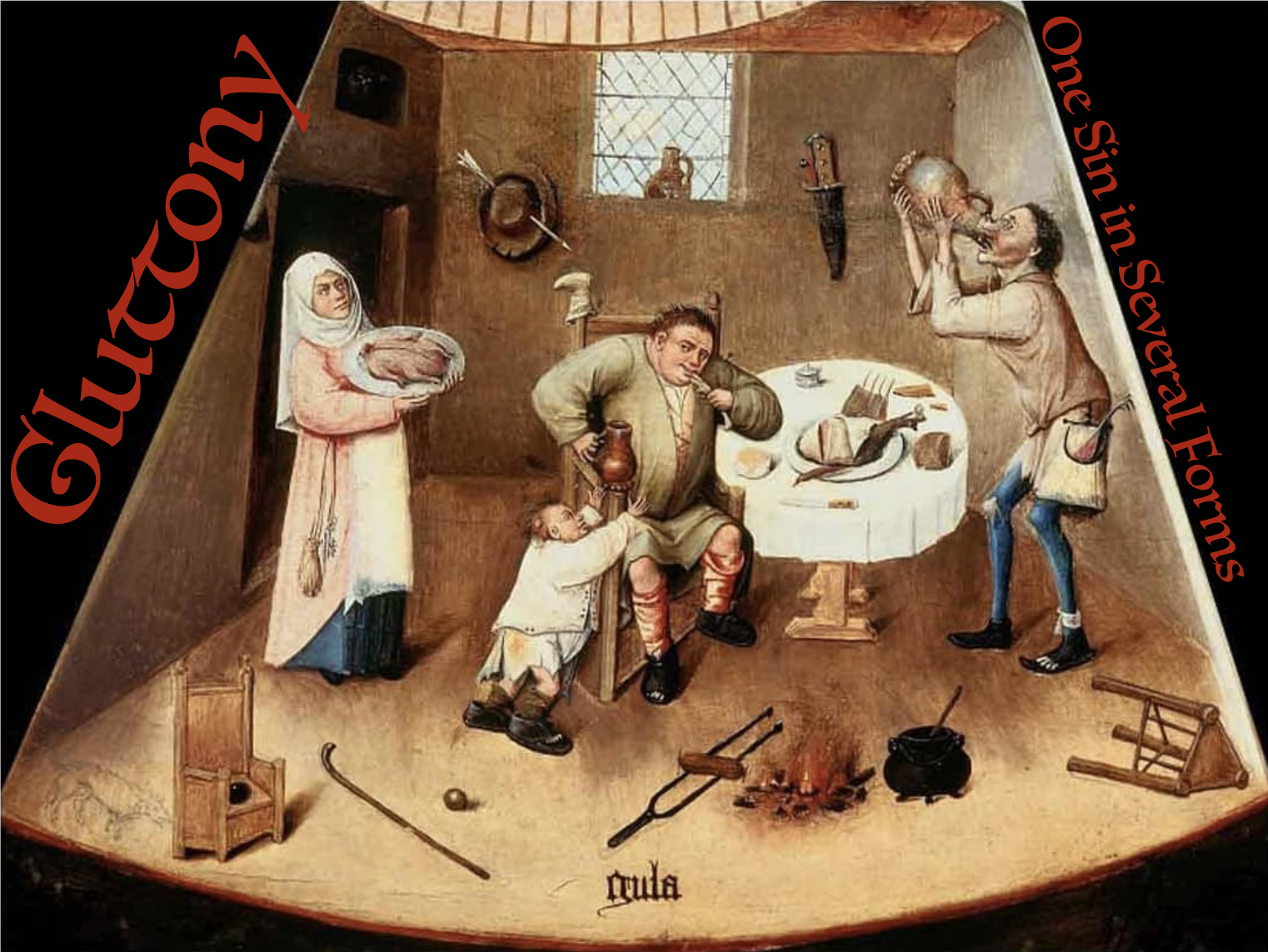
The illustration above is based on a detail from The Seven Deadly Sins and the Four Last Things painted c. 1500 by Hieronymus Bosch.

Fiction or Nonfiction: Which is Best?

Which is better for a person to write, fiction or nonfiction? That, of course, is an absurd question on its face. Every one recognizes nonfiction is best. (Just joking.)

Few of us are talented in the manner of C.S. Lewis — who excelled in both genres. Typically we have a knack for one or the other.

Which is best, becomes a question with a quite personal answer. And that response is determined by a number of interrelated elements. In which form are we more adept? Which do we prefer to read? For which are there greater avenues to experience publication? Through which do we receive more reward, extrinsic or intrinsic? 

Christian writers consider another, hopefully overriding, factor. What type of writing does the Lord desire us to pursue? And, it should be noted that just like the daily Christian walk, this is a dynamic matter. It can change at any given moment, depending upon how the Holy Spirit leads. Once again, C.S. Lewis offers an ideal example of this truth. God may lead us to write something factual one afternoon, imaginative the next, and perhaps poetry on the succeeding morning. 

What about the Prestige Factor?

There is a subtle prejudice among writers, I fear. While it’s natural to think that the genre most challenging to one may require additional skill or discipline, it seems to me most writers tacitly accept the notion that fiction requires more talent. 

While I personally disagree with that assessment, I understand it. After all, “facts” are readily available, and don’t rely on one’s imagination to devise. Still, good nonfiction is not inherently simpler to produce than quality fiction. (I mean, AI is proving every day that mediocrity can be reached in either genre in mere seconds.) 

As an example of this subtle prejudice, see this (quite helpful) article by promising young historical fictionist Cheyenne van Langevelde.

In an insightful article entitled “Genre ~ What Christian Writers Should be Aware of,” she introduces the subject with the following observation: 

As someone who hasn’t written nonfiction, I will not be discussing that branch of literature — though I’m sure it’s obvious how one could glorify God in their nonfiction writing. What I am going to talk about is the more challenging of the two branches: fiction.

I graduated from the University of Washington with an Editorial Journalism degree. While some argue Communication degrees are “worthless,” they may “set you up for life.” (That has certainly been my experience.)

Still, journalism doesn’t have the panache of “creative writing.” This, I suspect, is one reason that Master of Fine Arts (MFA) degrees exploded on the scene several decades ago.

When I open each issue of Poets & Writers, I’m overwhelmed by the number of ads for MFA programs, all over the globe. However, the October issue features a melancholy article titled “More MFA Programs Closing.” This is “despite all the value and prestige they bring to the university . . .”

The article cites “monetary pressures on universities and waning interest in the humanities” as major problems. Obvious to any non-MFA observer, the unbridled proliferation of MFA programs themselves might be the primary cause. 

Combine with that the evidence that a younger generation is more concerned about their prospects of making a living, and one might anticipate a further winnowing of such programs. 

For a balanced discussion of the subject, I commend “The MFA Degree: A Bad Decision?” — written by a writer who earned one, and subsequently “taught undergraduate and graduate courses in creative writing.”

I don’t believe MFA programs are inherently evil and have destroyed contemporary American literature. The majority of people teaching and taking creative writing classes are all trying to do good things. Nonetheless, I’ve begun to wonder if the MFA is, in fact, a bad decision.

It’s an interesting discussion, of value especially to those contemplating an MFA path. I leave that choice to the individual — as I leave to them the decision regarding whether to write fiction or nonfiction . . . or poetry, convincing historical fiction, satire, etc.

In order to expand their pool of prospective students, some MFA programs added “creative nonfiction” to their offerings. The focus of this genre is on training participants to consciously implement literary styles and techniques in order to make their factually accurate narratives more engaging.

While there is no doubt consciously taking these tools into consideration can improve the quality of many nonfiction works, it seems a bit exaggerated to label it “creative.” I would simply describe it as “good” or “well written” nonfiction. 

For a description of how creative nonfiction can be implemented in memoirs and essays, you might enjoy an introduction to the subject from Writers.com. You may wish to follow that up with “The Five R’s of Creative Nonfiction.” (Mere Inkling applies at least four of them.)

C.S. Lewis offered an aspiring young writer some wonderful advice in 1959. “Write about what really interests you,” he suggested, “whether it is real things or imaginary things, and nothing else.” He added the parenthetical note that “if you are interested only in writing you will never be a writer, because you will have nothing to write about . . .”

Excellent advice for the young wordsmith. I would add that for the maturing scribe it is often productive (and even fun) to experiment with a variety of genres.

Who knows? Perhaps you will follow the Inkling tradition established by C.S. Lewis and J.R.R. Tolkien, being exceptional in fiction and nonfiction alike. Best of luck to those of you who embark on this journey!