George MacDonald’s Poetry

George MacDonald (1824-1905) was a prolific Scot writer. His legacy was amplified due to his influence on G.K. Chesterton and C.S. Lewis. (He was also a friend of Mark Twain.) An essay, originally presented as a speech by G.K. Chesterton, is available online.

Chesterton goes so far as to say, “if to be a great man is to hold the universe in one’s head or heart, Dr. MacDonald is great. No man has carried about with him so naturally heroic an atmosphere.” Listen to his description of that special type of literature that inspired many Inklings, chiefly C.S. Lewis and J.R.R. Tolkien.

Many religious writers have written allegories and fairy tales, which have gone to creating the universal conviction that there is nothing that shows so little spirituality as an allegory, and nothing that contains so little imagination as a fairy tale. But from all these Dr. MacDonald is separated by an abyss of profound originality of intention.

The difference is that the ordinary moral fairy tale is an allegory of real life. Dr. MacDonald’s tales of real life are allegories, or disguised versions, of his fairy tales.

It is not that he dresses up men and movements as knights and dragons, but that he thinks that knights and dragons, really existing in the eternal world, are dressed up here as men and movements.

C.S. Lewis, for his part, praised MacDonald as instrumental in tilling the soil for his eventual conversion to Christianity. He was on the defensive, since the writers which most inspired him shared a common flaw – they were Christians.

All the books were beginning to turn against me. Indeed, I must have been as blind as a bat not to have seen, long before, the ludicrous contradiction between my theory of life and my actual experiences as a reader.

George MacDonald had done more to me than any other writer; of course it was a pity he had that bee in his bonnet about Christianity. He was good in spite of it.

Chesterton had more sense than all the other moderns put together; bating, of course, his Christianity. Johnson was one of the few authors whom I felt I could trust utterly; curiously enough, he had the same kink. Spenser and Milton by a strange coincidence had it too (Surprised by Joy).

Lewis would actually come to edit a selection of MacDonald’s passages for an edifying anthologyThis post includes a link for downloading a copy of George MacDonald: An Anthology.

This week I was reading one of MacDonald’s excellent essays, which appears in The Imagination and Other Essays. I intend to discuss some of his thoughts on age and writing soon. Although I am not an aficionado of poetry – despite having composed poetry from time to time, including quintains, I turned to another of MacDonald’s books.

On to His Poetry

I decided to follow up MacDonald’s brilliant essay with a dip into his poetry. Fortunately, Internet Archive allows you to freely download a complete copy of MacDonald’s Scotch Songs and Ballads, published in 1893. My conscience forces me, however, to provide a single caveat. Be forewarned that the tome is not suited for those intimidated by pronounced dialects.

Before looking at one of his poems in its entirety, allow me to share with you a passage from “The Waesome Carl” which I particularly enjoyed (due to its portrait of a preacher). 

The minister wasna fit to pray
And lat alane to preach;
He nowther had the gift o’ grace
Nor yet the gift o’ speech!
He mind’t him o’ Balaäm’s ass,
Wi’ a differ we micht ken:
The Lord he opened the ass’s mou,
The minister opened’s ain!
He was a’ wrang, and a’ wrang,
And a’thegither a’ wrang;
There wasna a man aboot the toon
But was a’thegither a’ wrang!
The puir precentor couldna sing,
He gruntit like a swine . . .

Not that I claim able to decipher it all, but my impression is that it’s not especially flattering. It is definitely entertaining. And I humbly think I interpret it significantly more accurately than Google’s online translator, which provided the following version.

The minister was not fit to pray
And lat alane to preach;
He nowther had the gift o’ grace
Nor yet the gift o’ speech!
He mind’t him o’ Balaam’s ass,
Wi’ a differ we micht ken:
The Lord he opened the ass’s mou,
The minister opened his eyes!
He was a’ wrang, and a’ wrang,
And a’thegither a’wrang;
There was a man aboot the toon
But thegither was wrong!
The puir precentor couldna sing,
He grunted like a swine. . .

Using the Dictionars o the Scots Leid, you can make perfect sense of the words about which you may be uncertain. (Thank you, Scotland.)

Dialects are interesting things indeed. I will close with another of MacDonald’s poems. I submit it for (1) those who comprehend the dialect, (2) those who deem precious their Scottish ancestry, (3) those with an affinity for Connor MacLeod, and (4) those who simply enjoy a challenge.

Nannie Braw

I like ye weel upo Sundays, Nannie,
I’ yer goon and yer ribbons and a’;
But I like ye better on Mondays, Nannie,
Whan ye’re no sae buskit and braw.

For whan we’re sittin sae douce, Nannie,
Wi’ the lave o’ the worshippin fowk,
That aneth the haly hoose, Nannie,
Ye micht hear a moudiwarp howk,

It will come into my heid, Nannie,
O’ yer braws ye are thinkin a wee;
No alane o’ the Bible-seed, Nannie,
Nor the minister nor me!

Syne hame athort the green, Nannie,
Ye gang wi’ a toss o’ yer chin;
And there walks a shadow atween ‘s, Nannie,
A dark ane though it be thin!

But noo, whan I see ye gang, Nannie,
Eident at what’s to be dune,
Liltin a haiveless sang, Nannie,
I wud kiss yer verra shune!

Wi’ yer silken net on yer hair, Nannie,
I’ yer bonnie blue petticoat,
Wi’ yer kin’ly arms a’ bare, Nannie,
On yer ilka motion I doat.

For, oh, but ye’re canty and free, Nannie,
Airy o’ hert and o’ fit!
A star-beam glents frae yer ee, Nannie–
O’ yersel ye’re no thinkin a bit!

Fillin the cogue frae the coo, Nannie,
Skimmin the yallow ream,
Pourin awa the het broo, Nannie,
Lichtin the lampie’s leme,

Turnin or steppin alang, Nannie,
Liftin and layin doon,
Settin richt what’s aye gaein wrang, Nannie,
Yer motion’s baith dance and tune!

I’ the hoose ye’re a licht and a law, Nannie,
A servan like him ‘at’s abune:
Oh, a woman’s bonniest o’ a’, Nannie,
Doin what maun be dune!

Cled i’ yer Sunday claes, Nannie,
Fair kythe ye to mony an ee;
But cled i’ yer ilka-day’s, Nannie,
Ye draw the hert frae me!

Addendum:

For those interested in pursuing this linguistic subject, I just came across a delightful 1896 collection of works you can download for free. Legends of the Saints: in the Scottish Dialect of the Fourteenth Century is “edited from the unique manuscript in the University Library, Cambridge.”


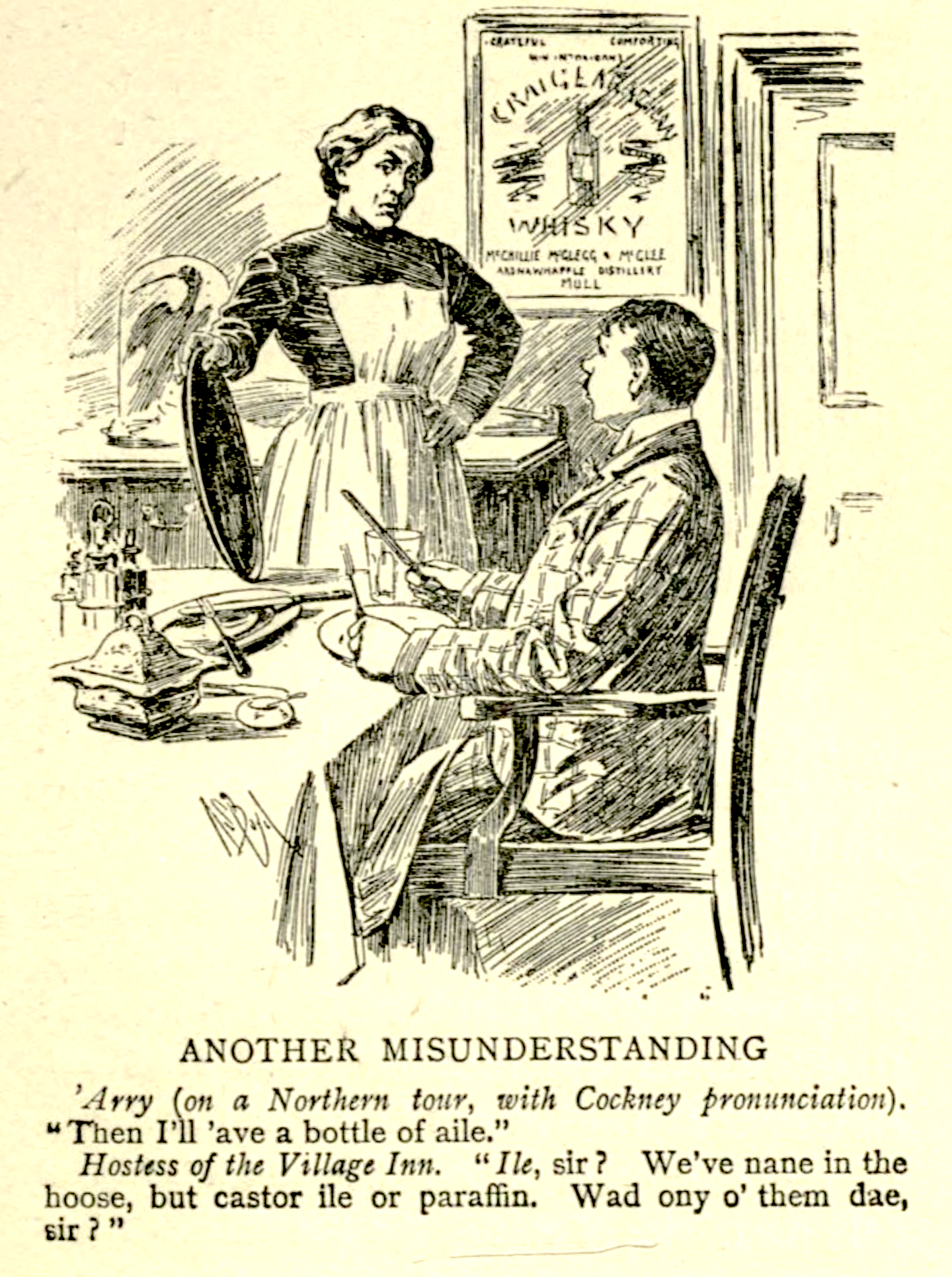
The cartoon above comes from Mr. Punch in the Highlands which was published “with 140 illustrations” more than a century ago. You can download your personal copy of humorous work at Internet Archive.

Following C.S. Lewis’ Military Example

Like his friend J.R.R. Tolkien, and many of the British men of their generation, C.S. Lewis served in the grim battlefields of the First World War. (However, since Lewis was actually Irish, he could not be drafted, and instead volunteered to serve.)

In recent years a number of books have appeared related to the military service of the Inklings. In A Hobbit, a Wardrobe, and a Great War, the author introduces his discussion with a succinct summary.

For a generation of men and women, [WWI] brought the end of innocence – and the end of faith. Yet for two extraordinary authors and friends, J.R.R. Tolkien and C.S. Lewis, the Great War deepened their spiritual quest. Both men served as soldiers on the Western Front, survived the trenches, and used the experience of that conflict to shape their Christian imagination. . . .

By the time of the Armistice, more than nine million soldiers lay dead and roughly thirty-seven million wounded. On average, there were about 6,046 men killed every day of the war, a war that lasted 1,566 days. In Great Britain, almost six million men—a quarter of Britain’s adult male population – passed through the ranks of the army. About one in eight perished. Tolkien and Lewis might easily have been among their number.

In 1939, a correspondent inquired if Lewis was going to reassume his commission in the army for the new conflict, and he responded with sentiments I have heard voiced by a number of other combat veterans.

No, I haven’t joined the Territorials. I am too old. It would be hypocrisy to say that I regret this. My memories of the last war haunted my dreams for years.

C.S. Lewis proceeded to graphically explain the cost of serving under such pressure. 

Military service, to be plain, includes the threat of every temporal evil: pain and death which is what we fear from sickness: isolation from those we love which is what we fear from exile: toil under arbitrary masters, injustice and humiliation, which is what we fear from slavery: hunger, thirst, cold and exposure which is what we fear from poverty.

I’m not a pacifist. If it’s got to be, it’s got to be. But the flesh is weak and selfish and I think death would be much better than to live through another war.

A new announcement from the United States’ Department of Defense brought Lewis’ situation to mind. It appears that due to a number of factors – not least of which the emphasis on Diversity, Equity and Inclusion,* which (imo) has discouraged veterans from encouraging their children to serve in the armed forces – some services are repeatedly falling short of their recruiting goals. 

In light of the fact that the world is inarguably growing more dangerous – the Doomsday Clock is set at “90 seconds to midnight” – it is alarming that we are unable to fully staff our shrunken military.

Just today my sixteen year old grandson expressed concerns about the resumption of a draft. I could not muster a persuasive argument that it won’t happen. Ironically, the last time the U.S. involuntarily conscripted troops was 1972, the year I turned eighteen. Oh, in the process of including a link to the Selective Service Sytem, I was surprised to learn that a “Medical Draft is in Standby Mode.” 

It is designed to be implemented in connection with a national mobilization in an emergency, and then only if Congress and the President approve the plan and pass and sign legislation to enact it. . . .

[The plan will] provide a fair and equitable draft of doctors, nurses, medical technicians and those with certain other health care skills if, in some future emergency, the military’s existing medical capability proved insufficient and there is a shortage of volunteers. . . .

[If implemented, the plan will] begin a mass registration of male and female health care workers between the ages of 20 and 45. . . . HCPDS [the innocuously named Health Care Personnel Delivery System] would provide medical personnel from a pool of 3.4 million doctors, nurses, specialists and allied health professionals in more than 60 fields of medicine.

No Draft Yet

Since we are not currently at war, the specter of a draft remains ephemeral. Still, the shortage of volunteers has led to a variety of initiatives, such as lowering service qualification standards. These efforts have proven inadequate, resulting in the aforementioned announcement.

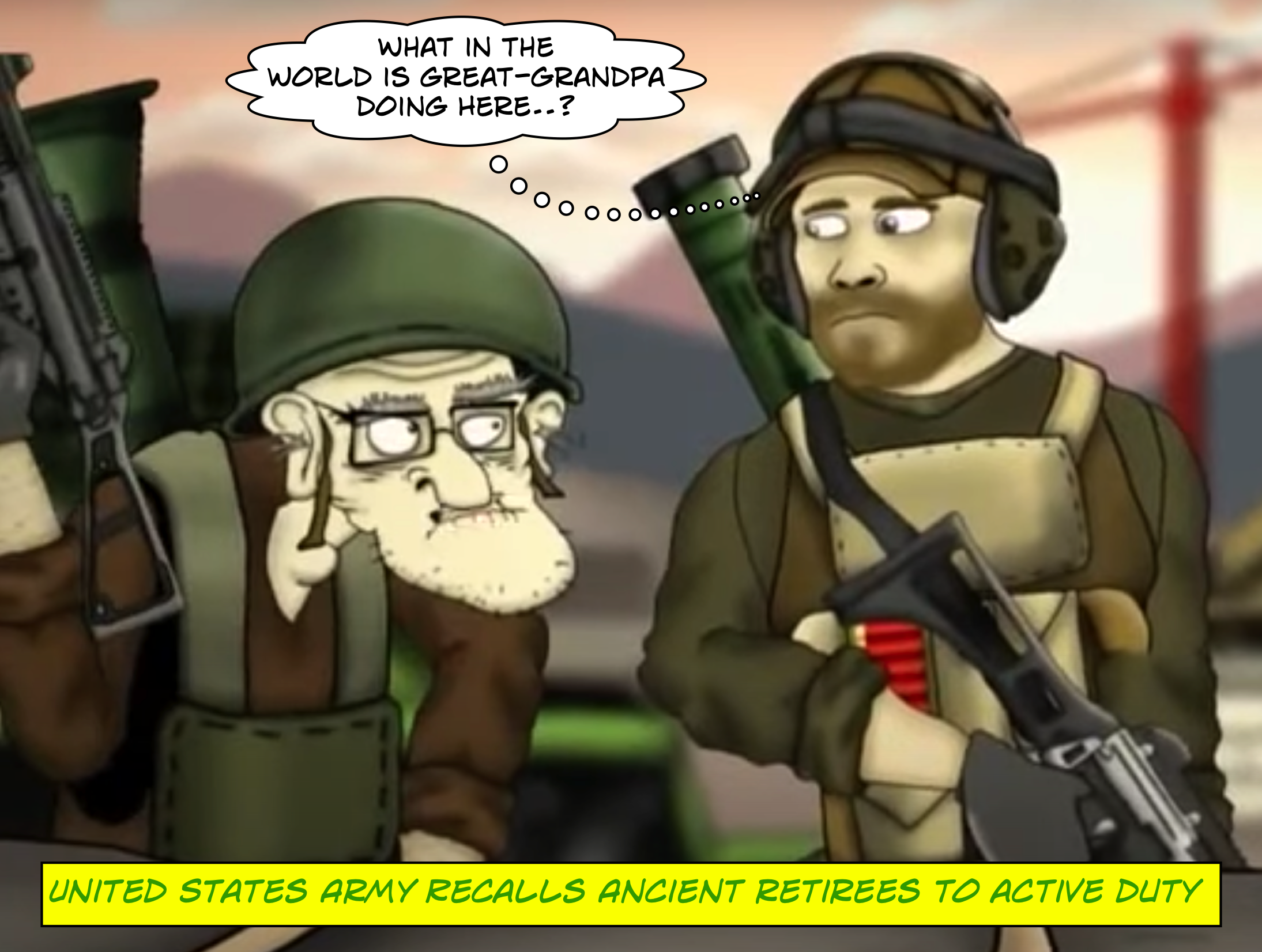
Both the Army and the Air Force have begun Retiree Recalls. Yes, that is just what it sounds like. People who have actually retired from the armed forces, normally after 20+ years of active duty, are being recalled to serve again. 

When I heard this news I was stunned. It is legally possible for the military to recall former members via a tiered process, but the first thing that came to my mind was my favorite high school teacher. He had served in Viet Nam as a draftee and finished his enlistment. He once told me that he felt safe, having survived, because now he was in the same call-up status as a “pregnant nun.” (Rather hyperbolic, but comforting to him.)

Fortunately, the current recalls are all voluntary. Only retirees whose personal circumstances make the offer appealing, will respond. As the Air Force Times reports, “Regret retiring? Here’s your shot at a second chance in the Air Force.”

I suspect that even vets who enjoyed their military service will be inclined to consider redonning the uniform as “too much of a good thing.” And if they witnessed the bloody horrors of war, as seen by C.S. Lewis, returning to the ranks would be even less tempting.

Since I, myself, have no desire to resume the demands of military life, I haven’t researched the age requirements for the Air Force recall program. Like Lewis, “I am too old.” 

But amazingly, depending on individual factors, the Army is willing to recall retired volunteers up to the age of seventy. That’s not a typo. As someone reaching that very milestone this summer, I can’t imagine returning to work side-by-side with troops half a century younger than me. 

Now, I pray for peace, knowing that being prepared for war is one way to increase that likelihood. So, I hope the military can throw off some of its political shackles and return to its necessary focus.

Furthermore, like C.S. Lewis, I have a pragmatic view of the effects of war. In “Learning in War-Time,” Lewis summarized the effects of military service during a war. As always, his insights are profound.

What does war do to death? It certainly does not make it more frequent: 100 per cent of us die, and the percentage cannot be increased. . . . Does it increase our chances of painful death? I doubt it. . . .

Does it decrease our chances of dying at peace with God? I cannot believe it. If active service does not persuade a man to prepare for death, what conceivable concatenation of circumstances would?


* This reference is to the convoluted and inequitable DEI philosophy and program(s) being mandated today. In truth, most people value diversity, and all people of goodwill believe in the importance of equity and inclusion. Along with Martin Luther King, Jr., they long for a day when people are not “judged by the color of their skin, but by the content of their character.”

Father Christmas & Crackers

J.R.R. Tolkien wrote, for his children’s enjoyment, an entertaining little story about Father Christmas’ stash of explosives. Read on to see what a mischievous polar bear did with them.

Merry Christmas. No, I’m not late in wishing you a blessed celebration of Christ’s Nativity. The church calendar recognizes Christmas is too big to celebrate just for a single day. The Inklings knew it – Christmas is a season.

One nineteenth century invention has become a part of many families’ celebration of the season. They’re called “Christmas crackers,” and although birthed in Britain, they’ve found a home in many other countries. We adopted them as an annual tradition after living in England for several years.

Their beginning was modest. While many now lack edible treats, they were conceived as a means for selling confectionaries. Their inventor wanted to increase sales of a French treat.

For seven years he worked to develop the bon-bon into something more exciting, but it was not until he sat one evening in front of his fireplace that his great idea came to him. Watching the logs crackle, he imagined a bon-bon with a pop.

He made a coloured paper wrapper and put in it another strip of paper impregnated with chemicals which, when rubbed, created enough friction to produce a noise. He knew that bangs excited children (and were said to frighten evil spirits) – and the mottoes and poems he inserted inside the crackers amused adults (BBC).

Sadly, many of the crackers marketed today have been neutered. To improve their safety (and, no doubt, save production costs), some crackers no longer crack. They contain no “chemicals” to produce the customary bang. Seems like a misnomer to call these variants crackers, at all.

Tolkien’s Father Christmas Letters

Tolkien and his wife were blessed with four children, and they were doting parents. Each Christmas between 1920 and 1943, the famed author wrote and illustrated a pseudonymous letter to his kids. In 1976 they were posthumously published, and facsimiles of the correspondence appears in some editions of the letters.

They offer an intimate insight into the secular side of a Christian family’s celebration of the holiday (holy day). In fact, on Christmas Eve this very year, a selection from the letters was part of the Royal Carol Service, celebrated at Westminster Abbey.

The Christmas story was told in readings from Luke 2 given by The Prince of Wales and by Michael Ward. Jim Broadbent read from JRR Tolkien’s The Father Christmas Letters, and Leonie Elliot read Growing Tomorrow, a poem by Children’s Laureate Joseph Coelho commissioned specially for the service.

The following excerpt from the 1931 letter comes from the pen of Father Christmas himself. (It also features a fun notation from North Pole Bear.)

I should hardly feel it was Christmas if [the North Polar Bear] didn’t do something ridiculous. You will never guess what he did this time! I sent him down into one of my cellars – the Cracker-hole we call it – where I keep thousands of boxes of crackers (you would like to see them, rows upon rows, all with their lids off to show the kinds of colours.)

Well, I wanted 20 boxes, and was busy sorting soldiers and farm things, so I sent him; and he was so lazy he took his two Snowboys (who aren’t allowed down there) to help him. 

They started pulling crackers out of boxes, and he tried to box them (the boys’ ears I mean), and they dodged and he fell over, and let his candle fall right POOF! into my firework crackers and boxes of sparklers.

I could hear the noise, and smell the smell in the hall and when I rushed down I saw nothing but smoke and fizzing stars, and old Polar Bear was rolling over on the floor with sparks sizzling in his coat: he has quite a bare patch burnt on his back.

[NPB] It looked fine! That’s where Father Christmas spilled the gravy on my back at dinner!

The Snowboys roared with laughter and then ran away. They said it was a splendid sight – but they won’t come to my party on St. Stephen’s Day; they have had more than their share already.

The story goes on, relating the troublesome exploits of “two of the Polar Bear’s nephews” who have been visiting. However, the passage above suffices to illustrate the humor resident in the Tolkien household.

And, in light of this vignette, we just may have uncovered why modern manufacturers are forgoing the more explosive elements of Christmas crackers. No “pop,” no “poof.”

And, if you have a creative bent, consider making your own for next year!

Caring for Nature with an Inkling Spirit

I never thought I would become an apiarist, but living in forests of America’s Pacific Northwest made this a logical stage in my growth as a naturalist. And I’m convinced that if he had known how simple it is to promote healthy bee populations, C.S. Lewis would have joined me in the hobby.

After all, he delighted in their work ethic, describing the moment of their Narnian creation with the words, “Butterflies fluttered [and] Bees got to work on the flowers as if they hadn’t a second to lose.”

In “An Experiment in Criticism” Lewis discussed the value of seeing the world through the eyes of others. In awe of the majesty of creation he expressed a yearning to explore its myriad facets from perspectives other than his own.

The man who is contented to be only himself, and therefore less a self, is in prison. My own eyes are not enough for me, I will see through those of others. Reality, even seen through the eyes of many, is not enough. . . .

Even the eyes of all humanity are not enough. I regret that the brutes cannot write books. Very gladly would I learn what face things present to a mouse or a bee: more gladly still would I perceive the olfactory world charged with all the information and emotion it carries for a dog.

Like most people, I grew up thinking of beekeepers as the people who dress in protective gear and harvest the honey produced by those tireless little workers. Honeybees, however, are only one type of bee. The Treehugger site offers an illustrated page featuring the bee types, with Hoverflies (good, and in more than 6,000 species) and Wasps (bad, and in more that 100,000 species) thrown in.

The bees I help to encourage in our area are not honeybees or bumblebees, who form colonies. They are mason bees, who are solitary by nature. They don’t have an aggressive bone in their tiny bodies and they are excellent at their jobs. They “pollinate around 95% of the flowers they visit, whereas honey bees generally only pollinate about 5%.” 

C.S. Lewis, like his close friend J.R.R. Tolkien, loved nature. Like most people Lewis either knew nothing about solitary bees, or his attention was directed by default to the honeybees we prize for the honey refined in their hives. In 1930, he wrote to his friend Arthur Greeves about the deeper motivations that drive people such as themselves to become writers.

As for the real motives for writing after one has ‘got over’ the desire for acknowledgement . . . I found and find, that precisely at the moment when you have really put all that out of your mind and decided not to write again . . . precisely then the ideas – which came so rarely in the days when you regarded yourself officially as an author – begin to bubble and simmer, and sooner or later you will have to write . . .

Who knows . . . what will in the end reach the ear of humanity? The successes of our own age may be speedily forgotten: some poem scribbled in pencil on the fly leaf of a schoolbook may survive and be read and be an influence when English is a dead language. . . .

So . . . whether the necessity and duty of writing is laid on a man or not can soon be discovered by his own feelings. With remote consequences we have no concern. We never know enough. I think the thing is to obey the ordinary rules of morality . . . but for ultimate justifications & results to trust to God.

The bee builds its cell and the bird its nest, probably with no knowledge of what purpose they will serve: another sees to that. Nobody knows what the result of your writing, or mine . . . will be. But I think we may depend upon it that endless and devoted work on an object to which a man feels seriously impelled will tell somewhere or other: himself or others, in this world or others, will reap a harvest exactly proportional to the output.

In 1914, C.S. Lewis shared with his father a humorous anecdote from the Roman poet Virgil. 

Did you ever at Lurgan read the 4th Georgic? It is the funniest example of the colossal ignorance of a great poet that I know. It’s about bees, and Virgil’s natural history is very quaint: bees, he thinks, are all males: they find the young in the pollen of flowers. They must be soothed by flute playing when anything goes wrong etc., etc.

C.S. Lewis enjoyed his laugh at Virgil’s poetic ignorance about bees. Coincidentally, he would discuss the humble creatures in a poem of his own. It appears in his posthumous Poems collection, as the fourth and fifth of his “Five Sonnets.”

Pitch your demands heaven-high and they’ll be met.
Ask for the Morning Star and take (thrown in)
Your earthly love. Why, yes; but how to set
One’s foot on the first rung, how to begin?
The silence of one voice upon our ears
Beats like the waves; the coloured morning seems
A lying brag; the face we loved appears
Fainter each night, or ghastlier, in our dreams.
“That long way round which Dante trod was meant
For mighty saints and mystics not for me,”
So Nature cries. Yet if we once assent
To Nature’s voice, we shall be like the bee
That booms against the window-pane for hours
Thinking that way to reach the laden flowers.

“If we could speak to her,” my doctor said,
“And told her, “Not that way! All, all in vain
You weary out your wings and bruise your head,”
Might she not answer, buzzing at the pane,
“Let queens and mystics and religious bees
Talk of such inconceivables as glass;
The blunt lay worker flies at what she sees,
Look there—ahead, ahead—the flowers, the grass!”
We catch her in a handkerchief (who knows
What rage she feels, what terror, what despair?)
And shake her out—and gaily out she goes
Where quivering flowers stand thick in summer air,
To drink their hearts. But left to her own will
She would have died upon the window-sill.”

British Bees

The British are quite enamored with quaint names for their public houses. Because of that, I knew I would be able to find a suitable pub to feature at the top of this post. I was, however, caught off guard by an embarrassment of riches in the return to my google search.

In addition to “The Bumble Bee” in Quedgeley pictured above (which I chose because of the lamppost in the garden), I found images of similarly named pubs in Blackwood, Flitwick, Gloucester, Gwent, Westoning, and Fleur-de-lis, Wales.

I’m sure I could find many other tributes to buzzing pollinators, if I broadened my search to include pubs like “The Beehive” in Egham or “The Golden Bee” in Stratford-upon-Avon.

The story of one more bee will bring our reflections to an end. In his early diary, All My Road Before Me, C.S. Lewis mentioned a number of visits to Bee Cottage, where some of his friends occasionally resided. For example, one summer Sunday in 1922, he recorded:

After lunch I bicycled to Beckley and called at Bee Cottage where I found [Cecil] Harwood alone and reading in a pleasant, stumpy 18th Century Bible. He quoted from Genesis “Whatever Adam called anything, that was the name of the thing,” as an excellent definition of poetry.

Once lost to the mysteries of time, the precise location of Bee Cottage has been discovered, as we can read in Bee and Church Cottage.

Laurence Harwood, C.S. Lewis’s godson, was a lecturer at [the 2009] Summer Seminar on C.S. Lewis Remembered.  His father, Cecil Harwood, was a close personal friend of Lewis as well as fellow Inkling Owen Barfield. 

Harwood and Barfield had often rented a small cottage-Bee Cottage-in Beckley, a few miles from Lewis’s home in the Kilns, and Lewis often visited the place (perhaps while on walking tours though the countryside just like his character Elwin Ransom).  Unfortunately its precise location was lost and remained unknown.

Following the lectures, “Laurence decided that searching for the cottage would be a . . . great way to remember Lewis.” He and several friends “managed to locate the small house, and found that it looked just as anyone would have expected-the waning summer sun sinking behind it, and the bees buzzing about the lavender plants alongside the stairs.”

Bees are important members of our environment. Many would argue they are essential and famine would certainly follow if they became extinct. The Environmentor says,

If all the bees died, humans would become responsible for taking up the slack. This is already happening in China, where a majority of the bees have already died. People take buckets full of pollen and “paint” the pollen on with a paintbrush.

But, this could only be done with a few of the plants that require pollination because there simply aren’t enough humans to perform the task.

The alternative, offered by Brittanica is that we could “robo-pollinate.” But I have already written about where that ominous trend might lead. 

I think it’s best that we diligently care for bees we currently enjoy, and nurture all their future generations. And I believe C.S. Lewis would agree.

Inkling Linguistics

Last week I wrote about “Learning Languages,” and I promised to follow up with a related theme – the creation of new words and languages. Let’s consider the simple matter first.

Adding New Words

Anyone can make up a new word. The problem is whether we have enough influence to have it adopted and used by another human being. (I add this qualifier to eliminate those who might attempt to skirt the question by simply training parrots to mimic the new word.) As Scientific American relates, 

When parrots are kept as pets, they learn their calls from their adoptive human social partners. Part of their appeal as pets is their ability to sing lower notes than smaller birds and so better reproduce human voices.

So, while you may be able to trick one of your parrots into repeating a novel “word,” that doesn’t count for our purposes here.

Likewise, any other birds who mimic speech, including musk ducks and corvids (ravens, crows and their ilk). In fact, let’s exclude all nonhuman “speakers” from consideration. After all, AZ Animals introduces readers to seven specific animals of different species (only one of which is avian) whose “forebrain is . . . responsible for some animals’ ability to mimic speech.” 

So, animals aside, who embraces and disseminates newly invented new words? Some words, of course, find a partially prepared or receptive audience because they are imported from other tongues. The global influence of English makes other languages especially vulnerable to its influence, which can be deeply resented. The “corruption” of mother tongues sometimes elicits reactionary responses – such as Italy’s current effort to purge English from the Italian Republic.

And some Italians are extremely serious about the task, proposing fines up to €100000. (That is not a typo; at today’s exchange rate it would be $109,857.50.) Their animus toward English follows the path established by the French, who frequently default to Napoléon’s order to refer to Britain as “perfidious Albion.” The Académie Française goes so far as to repudiate specific words, including business, cash, digital, vintage, label, and deadline.

Vocabulary adopted from other nation’s may be “new” to their most recent users, but such importation is certainly not the same as fabricating novel words from the proverbial “whole cloth.”

True Neologisms

I wrote a moment ago that creating words is easy, but persuading others to use them is quite another thing. I’ve discussed this subject in the past, in “Create a Word Today” and “Creative Definitions.” Sadly – and fittingly – none of my personal neologisms have caught on.

Popular creative writers may, however, find their fancies adopted by larger audiences. Shakespeare’s “bedazzled” was birthed in The Taming of the Shrew. The “chortle” was first heard in Lewis Carol’s “Jabberwocky.” “Pandemonium” was revealed as the capital of Hell in Milton’s Paradise Lost. And the first “Nerd” was encountered in Dr. Seuss’ If I Ran the Zoo.

Some neologists were particularly prolific. How about these few additional examples from the Bard: 

Bandit ~ Henry VI
Dauntless ~ Henry VI
Lackluster ~ As You Like It
Dwindle ~ Henry IV

Oh, and Grammarly adds, “Shakespeare must have loved the prefix un- because he created or gave new meaning to more than 300 words that begin with it.” Can you imagine a world without:

Unaware ~ Venus & Adonis
Uncomfortable ~ Romeo & Juliet
Undress ~ Taming of the Shrew
Unearthly ~ The Winter’s Tale
Unreal ~ Macbeth

Before moving on, it would be fair to note that some voices consider this achievement by Shakespeare to be “a common myth.”

It turns out that Shakespeare’s genius was not in coining new words – it was in hearing new words and writing them down before they became widespread, and in wringing new meaning out of old, worn-out words: turning “elbow” into a verb and “where” into a noun. He didn’t invent the words, but he knew how to use them better than anyone.

C.S. Lewis was not a philologist, but he did create a few novel words. The Inkling scholar who pens A Pilgrim in Narnia has written on this subject here and here.

J.R.R. Tolkien was no slouch at inventing English words himself. Some which now reside in our common vocabulary include hobbit and orc. The latter he derived from an Old English word, orcþyrs, a devouring monster associated with Hell. More surprisingly, Tolkien created the modern word “tween,” albeit in the context of hobbits, who lived longer lives than we.

At that time Frodo was still in his tweens, as the hobbits called the irresponsible twenties between childhood and coming of age at thirty-three.

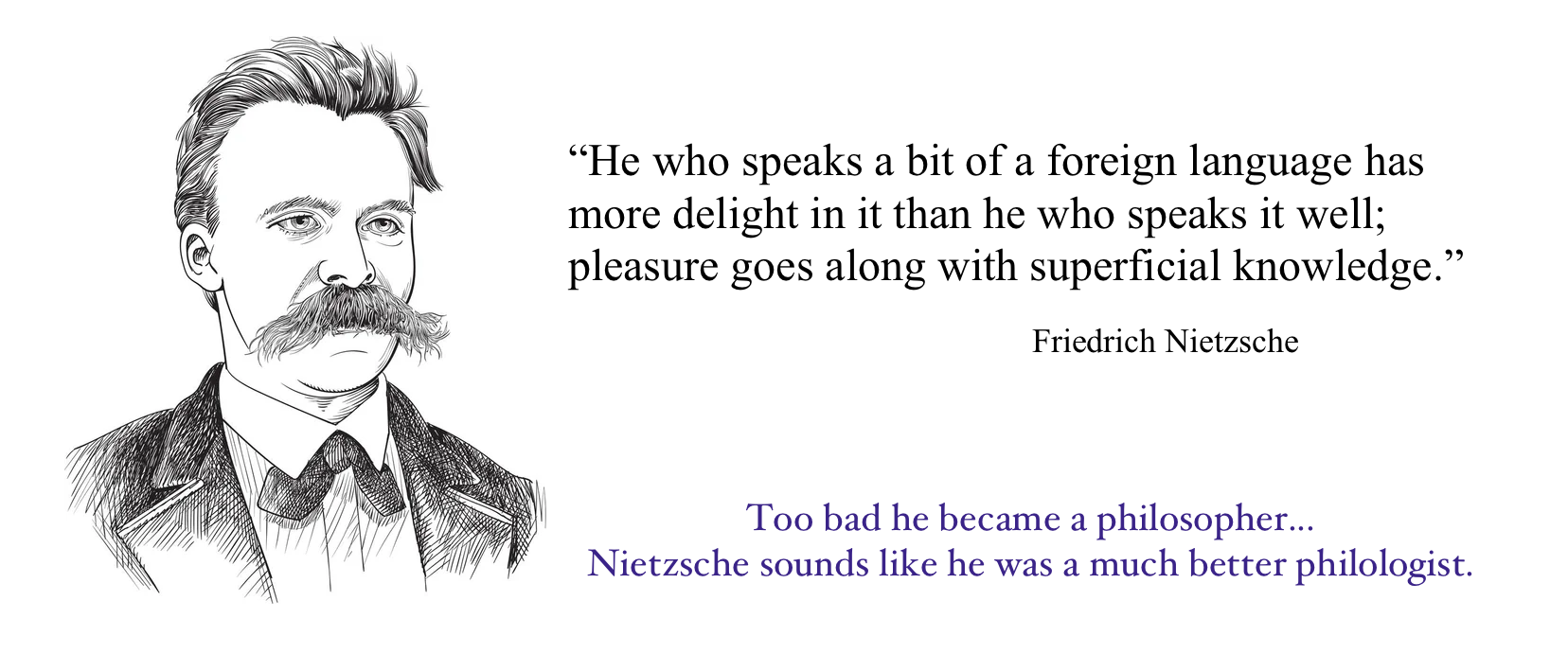
Envisioning novel words is relatively simple, but inventing an entire language, is an infinitely more complex challenge. The universally acknowledged master is J.R.R. Tolkien, whose Elvish tongue has become a “living” language.* But he was not alone in building internally consistent linguistic systems. Albeit, no philologist came near to Tolkien’s expertise, which included elaborate etymologies.

Before considering Tolkien himself, we will note several other efforts of a similar kind. And, following a discussion of Tolkien, we will conclude with a note about his good friend, C.S. Lewis. For, despite the fact that Lewis was not a philologist himself, it is interesting to note that he too dabbled in creatio linguarum.

Inventing New Languages

Some “constructed languages” are formed with practical purposes. Esperanto, birthed in 1887, incorporated elements from existing languages and was envisioned as a common “international auxiliary language.” It boasts its own flag, and claims to be the native language of approximately a thousand people.

One curious use of Esperanto came in its adoption by the United States Army as the “Aggressor Language” used in twentieth century wargames. The curious can download a copy of the now-rescinded Field Manual 30-101-1, which provided guidance for its usage “which will enhance intelligence play and add realism to field exercises.”

Another genuine constructed language is Interlingua. Developed between 1937 and 1951, it is based primarily on the shared (and simplified) grammar and vocabulary of Western European languages. 

In addition to languages constructed for international use, there are a variety of tongues created for fictional applications. “To learn Klingon or Esperanto” describes how linguistic anthropologist Christine Schreyer “invented several languages for the movie industry: the Kryptonian language for ‘Man of Steel,’ Eltarian for ‘Power Rangers,’ Beama (Cro-Magnon) for “Alpha” and Atlantean for ‘Zack Snyder’s Justice League.’” While none of these could ever rival the languages of Middle Earth, her bona fide linguistic credentials place her in a context similar to J.R.R. Tolkien. The interview reveals how Schreyer balances her creative impulses with her anthropological concerns.

I teach a course on linguistic anthropology, in which I give my students the task of creating new languages as they learn about the parts of languages. Around the time I started doing that, “Avatar” came out. The Na’vi language from that movie was very popular at the time and had made its way into many news stories about people learning the language – and doing it quickly.

My other academic research is on language revitalization, with indigenous or minority communities. One of the challenges we have is it takes people a long time to learn a language. I was interested to know what endangered-language communities could learn from these created-language fan communities, to learn languages faster.

Other fictional languages that exist include R’lyehian (from Lovecraft’s nightmare cosmos), Lapine (from Watership Down), Fremen, the Arabic/alien blending (from Dune), Parseltongue (ala Harry Potter), Dothraki (from Game of Thrones), Ewokese, etc. (from Star Wars), Goa’uld and others (from Stargate), Minbari and more (from Babylon 5), and the gutturally combative Klingon and others (from Star Trek). This brief list is far from exhaustive.

Tolkien, Lewis & New Languages

The languages forged by J.R.R. Tolkien are unrivaled by any conceivable measure one might employ. They are no mere stage dressing, like some of the aforementioned examples. Even those with developed vocabularies and consistent grammar fall far short of Tolkien’s creation. In terms of the histories of his languages, his diligent etymologies beggar all other such efforts. Of course, for Tolkien this was no competition. He was driven to make his languages as flawless – not “perfect,” but realistic – as humanly possible. It was a linchpin in his subcreative labor.

As a skilled calligrapher, Tolkien devised unique alphabets to complement his languages. The letters in his alphabets were not devised as mere adornments. Tolkien left that to lesser imaginations. Nor were his scripts restricted to Tolkien’s fiction. The Tolkien Estate offers an insightful essay on “Writing Systems.”

Tolkien also used invented scripts that were not associated with any of his fictional worlds. An early example is the Privata Kodo Skauta (Private Scout Code), which appears in a still unpublished notebook from 1909 called the Book of the Foxrook. This makes use of a phonetic code-alphabet, as well as a number of ideographic symbols representing full words. . . .

Toward the end of his life, Tolkien made use of the New English Alphabet, a phonetic script that combined the logical structural principles of the Angerthas and the Tengwar with letters that looked more like Greek or Latin. The alphabet has not yet been published in full, but examples can be seen in . . . J.R.R. Tolkien: Artist & Illustrator.

The footnote below links to some resources for those who would like to learn how to speak the languages of the elves. By way of help with pronunciations, remember the following advice:

Use an Italian accent to pull off Quenya speech patterns. In general, you can kind of sound Elvish – even without following the rules of the language – by applying an Italian accent when pronouncing Quenyan words. Native Italian speakers tend to use speech patterns from their native tongues to interpret English words, which can make your Elvish sound practiced even when it isn’t.

Speak with an Irish or Scottish accent to pull off a natural Sindarin accent. Irish and Scottish speakers tend to speak English by emphasizing sounds in the front of a word regardless of the standard pronunciation. This is a pretty good method for pronouncing Sindarin words, since the vast majority of them stress the first syllable.

For those who want to quickly capture some Elvish script without the effort of studying, consider the English to Elvish online translator, which is offered by the company that fashioned The One Ring for Peter Jackson’s cinematic epics. I decided to test the translation tool and posed the question: “Does AI translation of English to Quenya actually work?” The software swiftly complied.

It looks elegantly correct, but unfortunately, I’m unable to personally verify its accuracy. And I must confess to modest trepidation since the site advises:

USE CAUTION BEFORE COMMITTING TO ANY TATTOOS, INSCRIPTIONS AND ENGRAVINGS” [triple emphasis in original].

The Jens Hansen site sells jewelry, as befits the fasioners of The One Ring. In addition to hosting the translator, they offer a free pdf document called Elvish 101 in 5 Minutes. It’s an interesting document, but it reveals a limitation I assume is shared by the online generator. It is a resource for transliterating, not translating, words. Not quite the same thing . . . but the script still looks elegant. 

Tolkien was the master of creating languages for his subcreation, but C.S. Lewis also used the same technique in the writing of his Space Trilogy. Each work focuses on an individual planet in our solar system, which is referred to in the books as the Field of Arbol.

While a number of languages have developed over time, the original language, known as Old Solar, is retained by some, and learned by the series’ protagonist Dr. Elwin Ransom. Ransom is a philologist at Cambridge, and as he is modeled after Tolkien, it’s no surprise his first name means “elf friend.”

In Perelandra, Ransom describes how a language he learned on Mars was once shared by all.

“It appears we were quite mistaken in thinking Hressa-Hlab the peculiar speech of Mars. It is really what may be called Old Solar, Hlab-Eribol-ef-Cordi. . . . there was originally a common speech for all rational creatures inhabiting the planets of our system: those that were ever inhabited, I mean – what the eldila (angels) call the Low Worlds. . . .

That original speech was lost on Thulcandra, our own world, when our whole tragedy [the Fall] took place. No human language now known in the world is descended from it.”

Lewis’ use of Old Solar is sparing, but a partial lexicon can be found at FrathWiki. There, for example, you will learn that “honodraskrud” is Old Solar for a “Groundweed; an edible pinkish-white kind of weed, found all over the handramit” of Malacandra (Mars).

The accomplishments of Tolkien and Lewis are difficult to compare. These two brilliant scholars shared a great many interests, but wrote with far different goals. We rightfully expect genius to vary between such individuals. This is well illustrated by their differing treatments of constructed languages, as Martha Sammons describes so well in War of the Fantasy Worlds.

Tolkien began with invented languages and then developed an elaborate mythology to create a world where his languages could exist. Lewis’s works began with mental pictures; he would then find the appropriate ‘‘form’’ to tie together the images. . . .

[Tolkien’s] penchant for historical and linguistic detail is unparalleled. In contrast . . . Lewis uses just enough language, geography, and science to make his novels believable.

While either approach may inspire those among us who aspire to writing, we best avoid attempting to emulate either author. Best, I believe, to compose our epics with the language that most naturally flows from our pen.


* While some fans of Klingon and Na’vi may learn to speak in those tongues, the students of the languages of Arda, typically possess greater ardor for the languages of Middle Earth. For example, an online guide to learning Elven languages begins by answering the question, “why study Elvish?” And a free online course for learning Quenya is offered here. Among the Quenya dictionaries, the finest free example is available at Quenya-English Dictionary English-Quenya Dictionary.

Learning Languages

C.S. Lewis possessed a gift for languages. Although he was not a philologist like his friend J.R.R. Tolkien, Lewis was well educated and read and spoke a variety of languages.

In fact, when he and his wife played Scrabble, they allowed for the use of words from any language! For the record, though, he does confess to a German professor that his grasp of that tongue is “wretched.”

The only bona fide genius I’ve known was a classmate at the University of Washington. While I was struggling with classical Greek, in preparation for seminary, at the age of 23 Bruce already possessed four master’s degrees and was closing in on his PhD in Linguistics. He spoke fifteen languages, but could read nineteen.

Of course, that is still a small portion of the 7,168 languages Ethnologue tells us are in use today.

This enormous number – which doesn’t include unknown languages spoken among untouched people groups – accounts for the fact that thousands of Christians are laboring now in groups such as Lutheran Bible Translators to make the Scriptures available to all people.

Sometimes this involves creating a written language itself, where only an oral version exists. The largest such organization, Wycliffe Global Alliance, reports that “Bible translation is currently happening in 2,846 languages in 157 countries.”

While the Bible’s translation is certainly of utmost importance, it is wonderful to know that other valuable literature is also made available to readers who could not decipher the language in which it was originally composed. 

Lewis, in fact, was a translator in his own right. Beyond the literal translation of works from one tongue to another, Lewis also functioned as a “translator” of complex concepts and eternal truths. I once described this as C.S. Lewis’ bilingualism.

How many extremely intelligent and well educated people do you know . . . who can actually communicate with those of us possessing normal human intelligence? That talent is a rarity.

And it is precisely what makes C.S. Lewis such an unusual man. He was brilliant. Yet he could communicate with the common person – even the child – just as easily as he conversed with his fellow university dons.

C.S. Lewis mastered a number of modern languages, but it was his study of historic languages that especially inspired him. Icelandic, with its similarity to Old Norse, is one example about which I have written. 

. . . J.R.R. Tolkien and his friend C.S. Lewis established a group called Kolbitár which was devoted to reading Icelandic and Norse sagas. The word itself means “coal biter” and refers to those in a harsh environment drawing so close to the fire’s warmth they can almost bite the coals.

Another example is Old English. Along with Middle English, birthed by the Norman Conquest, these were essential elements of his training as one of the preeminent English scholars of Oxford and Cambridge. And these languages were not merely dusty relics. I encourage the curious to read “C.S. Lewis’s Unpublished Letter in Old English,” which appeared in the journal VII.

In 1926 C.S. Lewis wrote his friend Nevill Coghill a letter in Old English, a language also known as Anglo-Saxon. Unreadable for most current readers of Lewis, it understandably does not appear in his three-volume Collected Letters.

In the essay, George Musacchio provides an illuminating outline of Lewis’ diverse expertise with languages, both “foreign and domestic.” Lewis began the letter to his friend with the following salutation.

“Leowis ceorl hateð gretan Coghill eoorl luflice ond freondlice.”
Which translates as: “Lewis the churl bids to greet Coghill the earl.”

Is English Really that Difficult to Learn?

English is reputed to be one of the most challenging languages to learn. (More on this in a moment.) For example, the simple sentence which follows consists of a mere seven words, but holds seven different meanings, dependent upon which word is emphasized.

“I never said she stole my money.”

This example comes from an article entitled “English is Hard, But Can Be Understood Through Tough Thorough Thought Though.”

Rosetta Stone answers the question of how hard it is to learn English by saying “it depends on your first language.” 

In addition to the fact that “spelling is a poor indicator of pronunciation,” English possesses numerous “specific rules,” and complements this burden with the fact that “some rules have lots of exceptions.” The complexity is due to the language’s history, which also gave rise to its mammoth vocabulary.

English has a lot of words—Webster’s English Dictionary includes approximately 470,000 entries, and it’s estimated that the broader English vocabulary may include around a million words. . . .

English has such a broad vocabulary because it’s a blend of several different root languages. While English is a West Germanic language in its sounds and grammar, much of the vocabulary also stems from Romance languages, such as Latin, Italian, Spanish, and Portuguese.

One result of combining these various root languages is that the English vocabulary includes a ton of synonyms . . . And unfortunately, most of these synonyms aren’t fully interchangeable, so the exact word you choose does have an impact on the overall meaning.

It turns out English doesn’t even rank in the top three most difficult languages for the speakers of the five largest language groups. The ranked listings do include, however, Arabic, Japanese, Russian, and Mandarin.

So, let’s reverse the question for a moment. Which languages are the most difficult for a native English speaker to learn? Unbabel lists ten. Fortunately, only one of them is on my wish list.

Babbel Magazine has an article approaching that question from the opposite end. Which language is easiest for English speakers to learn.

This may come as a surprise, but we have ranked Norwegian as the easiest language to learn for English speakers. Norwegian is a member of the Germanic family of languages — just like English! This means the languages share quite a bit of vocabulary, such as the seasons vinter and sommer (we’ll let you figure out those translations).

Another selling point for Norwegian: the grammar is pretty straightforward, with only one form of each verb per tense. And the word order closely mimics English. For example, “Can you help me?” translates to Kan du hjelpe meg? — the words are in the same order in both languages, so mastering sentence structure is a breeze!

Finally, you’ll have a lot more leeway with pronunciation when learning Norwegian. That’s because there are a vast array of different accents in Norway and, therefore, more than one “correct way” to pronounce words.

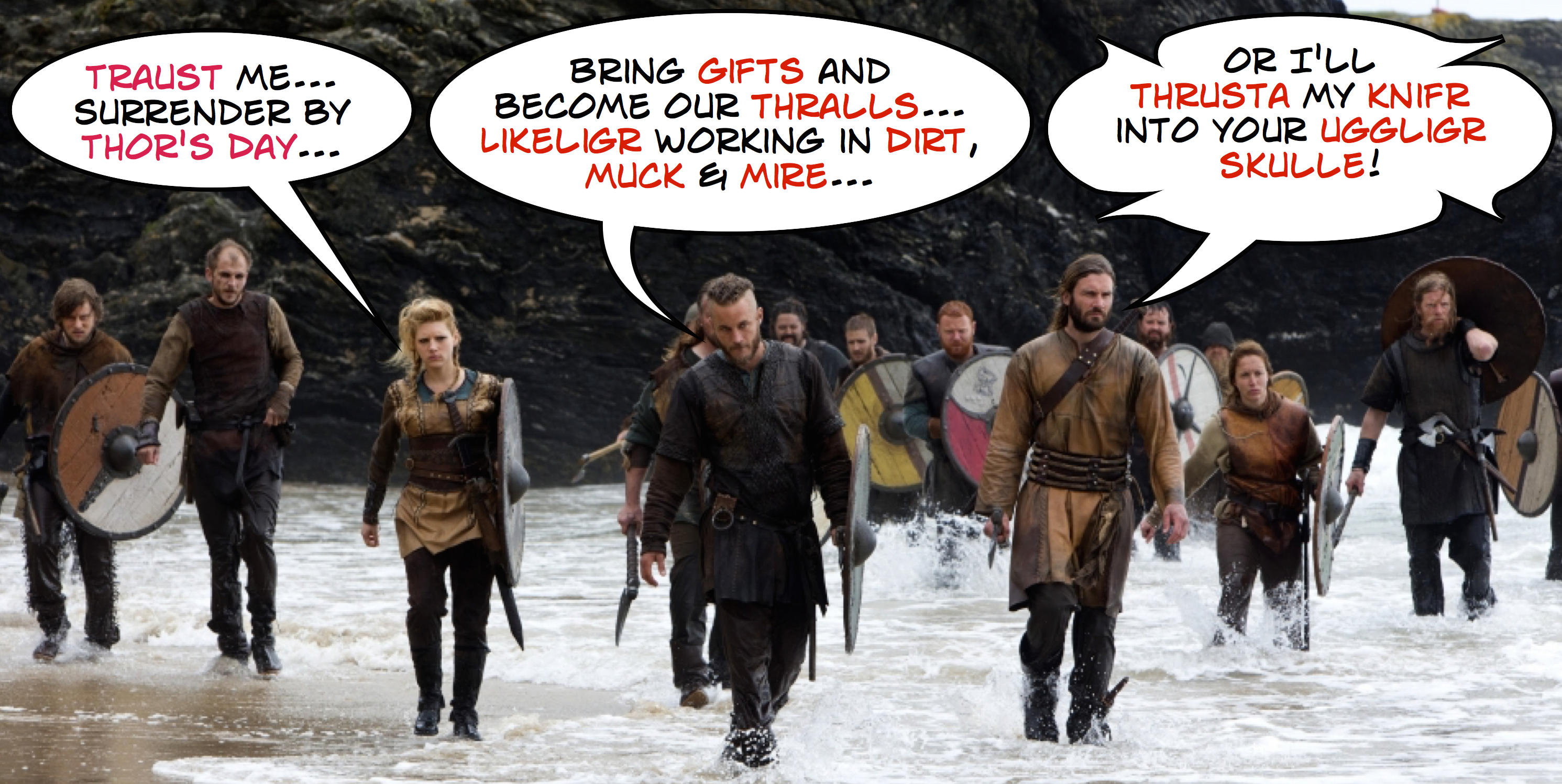
An article I wrote seven years ago hints at that same conclusion. I made this informative, and mildly threatening, illustration for “Norse Linguistic Invasion.”

Oxford Royale Academy lists several reasons why English is especially challenging to new students. The following issue of “irregularities” also plagues countless native speakers.

One of the hardest things about English is that although there are rules, there are lots of exceptions to those rules – so just when you think you’ve got to [come to] grips with a rule, something comes along to shatter what you thought you knew by contradicting it.

A good example is the rule for remembering whether a word is spelt “ie” or “ei:” “I before E except after C.” Thus “believe” and “receipt.”

But this is English – it’s not as simple as that. What about “science?” Or “weird?” Or “seize?”

There are loads of irregular verbs, too, such as “fought”, which is the past tense of “fight”, while the past tense of “light” is “lit.” So learning English isn’t just a question of learning the rules – it’s about learning the many exceptions to the rules.

The numerous exceptions make it difficult to apply existing knowledge and use the same principle with a new word, so it’s harder to make quick progress.

And even some of the normative “rules” are difficult to grasp. One example is that there’s a very specific order that adjectives must be listed ahead of a noun. According to Rosetta Stone,

The adjective order is: quantity, opinion, size, age, shape, color, origin/material, qualifier, and then noun. For example, “I love my big old yellow dog.” Saying these adjectives in any other order, like “I love my yellow old big dog,” will sound wrong, even when otherwise the sentences are exactly the same and communicate the same thing. Keeping rules like this in mind can be tricky, and it takes a lot of practice to get it right.

Adjective order is seldom considered, in part because it’s not considered good writing to string too many such words together. But apparently there are right and wrong ways to organize any such list.

Royal Order of Adjectives

Most students aren’t taught about adjective order in school and instead learn it through listening and reading. In English, the rules regarding adjective order are more specific than they are in other languages; that is why saying adjectives in a specific order sounds “right,” and deviating from that order makes a statement sound “wrong,” even if it’s otherwise grammatically perfect.

And, since we’re talking about English, even this Royal Order of Adjectives rule has exceptions

The hierarchy is not absolute, and there is some wiggle room among the “fact” categories – size, age, and so on – in the middle.

Native speakers are often delighted when they learn about this law and discover how flawlessly they apply it. It even went viral in 2016 . . . The tweet attached a paragraph by etymologist Mark Forsyth . . . giving an example that uses all the categories according to the OSASCOMP hierarchy: “a lovely little old rectangular green French silver whittling knife.”

I do not ever recall being taught (or reading on my own) about the “Royal Order of Adjectives.” Nevertheless, I don’t feel too embarrassed at acknowledging my previous ignorance, since even Lewis himself was comfortable in expressing gratitude for being introduced to new words. For example, when he thanked Dorothy Sayers for enlarging his vocabulary with her work on Dante.

So, is English all that challenging? Well, C.S. Lewis did his part to make it less daunting, joining a public debate in Britain, with an unexpected argument. Discussing English’s previously noted problem with inconsistencies and confusion in spelling, the don offered a simple solution.

In a column on Lewis and the history of words, I included an extended passage from a letter Lewis wrote challenging a contemporary British effort to “reform” spelling. Surprisingly, he argued against the necessity for uniformity in spelling. After explaining why our language functions as it does, he advocates:

As things are, surely Liberty is the simple and inexpensive ‘Reform’ we need? This would save children and teachers thousands of hours’ work.

Surely all but the most diehard grammarians would be sympathetic to his argument.

Next week I plan to write about another linguistic matter closely associated with the Inklings – the creation of new words and languages.

An Evolutionary Fluke

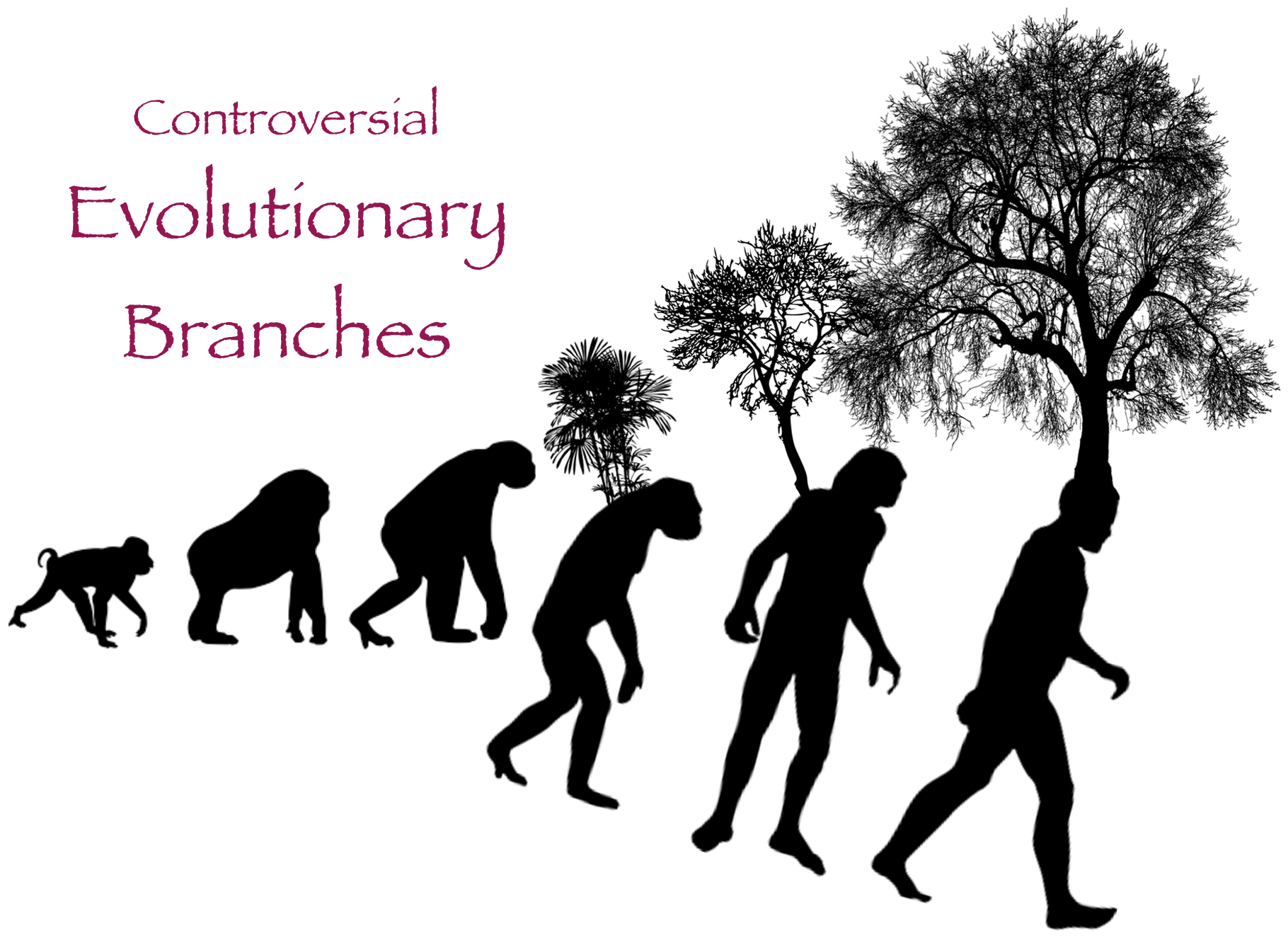
Did trees evolve from apes? An odd question, to be sure, but one humorously posed by C.S. Lewis in a letter to his father.

While this column does discuss the theory of evolution, it’s not doctrinaire. So, whatever your opinion of Darwin’s notions, read on, and you may enjoy a pleasant surprise.

C.S. Lewis, the brilliant Christian apologist was not an ironclad “evangelical” in the American sense of the word. Here in the U.S., that typically requires adherence to a handful of doctrines, usually including the affirmation of the infallibility of the Scriptural autographs and of the creation of humanity in the persons of our first parents, Adam and Eve.

As important as these matters are, very few Christians would deem them salvific, in the sense that people holding less “vigorous” views on these issues will be excluded from heaven.

C.S. Lewis was one of those who focused on the core of the Christian faith, rather than secondary doctrines. He referred to this as “mere Christianity,” and it was based on a trusting relationship with God through the Person of Jesus, God present with us in the Incarnate Word.

As for doctrines per se, like all good defenders of the faith, C.S. Lewis preferred not to get bogged down with secondary matters. This is consistent with the spirit of Paul’s advice to the young pastor, Timothy.

Remind them of these things, and charge them before God not to quarrel about words, which does no good, but only ruins the hearers. . . . Have nothing to do with foolish, ignorant controversies; you know that they breed quarrels. And the Lord’s servant must not be quarrelsome but kind to everyone . . . (2 Timothy 2:14, 23-24).

Lewis’ 1927 Evolutionary Conversation

In March of 1927, C.S. Lewis wrote one of his eclectic letters to his father in Northern Ireland. As usual, he commented on his father’s previous correspondence and shared about his current health and activities. While his relationship with his father grew strained after his mother’s untimely death while he was still a child, Lewis’ letters to his father exude familial respect framed in the context of early twentieth century British sensibilities.

That said, Lewis was always eager to share curious or silly experiences he knew would amuse his solicitor father. He takes a humorous approach, for instance, to advising his father to consult a more skilled doctor to diagnose an ailment, rather than suffering with the incomplete work of the physician he has always known, he will simply be “offer[ing] up several months of pain as a sacrifice on the altar of an old acquaintance.”

At the same time, he acknowledges his personal inclination toward doing the same, stating that “if I lived at home [I] would continue to use Gillespie all my life.” Gillespie, it turns out, ran a taxi service long favored by the family despite his bumpy transportation. “I have never regretted Gillespie and his hexagonal wheel,” Lewis shares.

He returns to his argument, however, by saying his father’s health demands the attention of a competent physician rather than relying on past ties. He concludes with an illustration based on his own brother. “Hang it all, even you wouldn’t suggest that because I’ve known Warnie a long time I ought to trust him as an interpreter on a holiday in Spain.”

C.S. Lewis proceeds to share with his father current events at Magdalen College (“we are putting up a new building”) and a recent nightmare (“it was the sense of being on the moon . . . the complete desolateness, which gave the extraordinary effect”).

The letter includes other fascinating elements, but it is time now to consider the reference to evolution.

An Absurd Age

I absolutely love the way C.S. Lewis invites us to experience the following moment. His story is so vivid, it still lives a century after the described events transpired.

We live in the most absurd age. I met a girl the other day who had been teaching in an infant school (boys and girls up to the age of six) where the infants are taught the theory of Evolution. Or rather the Headmistress’s version of it.

Simple people like ourselves had an idea that Darwin said that life developed from simple organisms up to the higher plants and animals, finally to the monkey group, and from the monkey group to man.

The infants however seem to be taught that ‘in the beginning was the Ape’ from whom all other life developed – including such dainties as the Brontosaurus and the Iguanodon.

Whether the plants were supposed to be descendants of the ape I didn’t gather. And then people talk about the credulity of the middle ages! À propos of this can you tell me who said ‘Before you begin these studies, I should warn you that you need much more faith in science than in theology.’ It was Huxley or Clifford or one of the nineteenth century scientists, I think.

Another good remark I read long ago in one of E. Nesbitt’s fairy tales –‘Grown ups know that children can believe almost anything: that’s why they tell you that the earth is round and smooth like an orange when you can see perfectly well for yourself that it’s flat and lumpy.’

Ironically, immediately after this, Lewis introduces his next subject with the words: “Almost the only interesting thing that has happened to me lately was a visit from a young German.” You see, I wasn’t misleading you when I said his letters are filled with fascinating material.

One must assume that times have changed, and that English children are no longer being taught such simplistic distortions of actual theories. But that’s not the theme of this current post. Rather, I wish to show how wonderfully entertaining a simple family letter can be – especially when it comes from the pen of C.S. Lewis.

Respecting Animals We Kill

Sometimes even a moral sluggard can say something profoundly true. I was recently visiting the uplifting site of a British pet photographer, and came across this wonderful insight:

“Until one has loved an animal a part of one’s soul remains unawakened.”

As I spent a moment reflecting on the quote, having just enjoyed a morning game with our border collie, it dawned on me these words are not only philosophically true. The more I consider them the stronger the case, it seems to me, can be made for their theological truth.

Turn the statement around. Can someone be considered spiritually awake if they have never possessed a moment of genuine affection for an animal, the pinnacle of God’s natural creation? I tend to think not.

Cultural matters certainly influence one’s connection with nature. It may be that people surviving on the edge of food sufficiency would view animals primarily as a resource. Yet even then, the best among us still possess a regard for the creatures whose lives we curtail to extend our own.

An outstanding example of this is found in a common practice among North America’s first peoples. (First Nations is the common term in Canada). Many of these people would include prayer on behalf of the prey they sought.

In the Cherokee legend “The Little Dear, Awi Usdi,” describes how hunters were taught to only take life when necessary, and to “ask pardon when an animal was killed.”

Another site explains how “Coast Salish women were forbidden from stepping over deer meat, and the men had to look away when uncovering it. All bones had to be thrown into the water, and the viscera not consumed were buried so the dogs would not eat it.”

Post-Kill Rituals: Matters of the Heart,” describes how this “ancient reverence” for hunted animals extended beyond the Americas. It concludes with a valuable thought.

Rituals aren’t a bad idea . . . But you show the utmost respect by concentrating on killing the animal quickly. Hunters’ conduct toward wildlife and nature should be consistent with their conduct toward other humans.

While Christians will necessarily overlook the religious elements of these various traditions,* those most attuned to the love of God – a Creator who viewed the “living creatures” he had fashioned and proclaimed, “it was good” – will possess at least a glimmer of reverence or affection for wildlife.

Not that Christians can’t be avid hunters. The Roman Catholic Church even has a Patron Saint for hunting. St. Hubert, pictured above, was (before his canonization, of course) a worldly nobleman. In the seventh century, Hubert had ignored invitations to attend worship on one of the holiest of days, Good Friday. Yet the Lord met him there, in the forest. His conversion occurred when he saw a vision of a crucifix while hunting. Hubert would later use his skill with a bow to draw crowds for his preaching of the Gospel.

C.S. Lewis & the Hunting of Deer

In an essay entitled “The Seeing Eye,” C.S. Lewis turns the analogy of hunting upside down. Using his own life, in which searching for God was the farthest thing from his desires, Lewis describes his conversion in a fascinating manner. It is interesting that while Lewis reveals he wasn’t desirous of faith, he was seeking honesty within his own conscience. He was also seeking truth.

I never had the experience of looking for God. It was the other way round; He was the hunter (or so it seemed to me) and I was the deer. He stalked me like a [hunter], took unerring aim, and fired. And I am very thankful that that is how the first (conscious) meeting occurred. It forearms one against subsequent fears that the whole thing was only wish fulfilment. Something one didn’t wish for can hardly be that.

But it is significant that this long-evaded encounter happened at a time when I was making a serious effort to obey my conscience. No doubt it was far less serious than I supposed, but it was the most serious I had made for a long time.

So, Who was the Author of the Initial Quote?

I began by saying even moral sluggards can occasionally make a good point. The person who drew the connection between our regard for animals and our souls is Anatole France. Not only was he a serial adulterer, he was a devout atheist. (Not all atheists are adulterers, of course, but rejecting the God of the Bible does make it a lot easier to justify one’s immorality.)

Anatole wrote some curious works ridiculing Christianity, and until I was writing this post I had completely forgotten about my 2014 post about his advocacy for Satan.

Returning to Positive Subjects . . . Like Animals

The site that used the great quotation with which we began, is excellent. It is called “Mad about Greys,” and is the work of a British photographer.

Liz Coleman does an amazing job capturing the hearts and – dare I say, souls – of the pets she shoots. Even though Surrey is quite a ways for most Mere Inkling readers to visit her studio, I encourage you to visit her website today.


* There were additional Native American beliefs and taboos. For example, “the Pentlatch and Squamish buried or hid all deer bones. The West Sanetch were not permitted to eat deer meat and fish at the same meal.”

The Value of Money

America exerts a major influence on global financial health. And our current unrestrained printing of new dollars will doubtless have repercussions around the world.

I’m no economist myself, but there seems to be growing concern among professionals of that persuasion that we’re headed for über-inflation. And, if our dollar drops in value the way some people predict . . . well, it seems many nations may be in for the proverbial “rough time of it.”

Shortly after WWII, C.S. Lewis commiserated with an American friend about the effects of inflation on the price of commodities.

I take it that your [comment] indicates not a saturation of the home market, but a shortage of purchasing power due to inflation? That is the situation with which we are faced at the moment; I see that the clothing concessions for instance have not resulted in an increased sale of home market goods.

The stuff is in the shops, but people can’t buy. Though with us the problem is complicated by the inferior quality of so much of the stuff on the home market.

Years later, in 1951, Lewis could still write “war and inflation are still the background of all ordinary conversation over here.”

. . . to which has just been added the railway jam; our new railway organization has succeeded, so far as I can understand, in blocking every goods depot in the country. The trades people are grumbling, and the effect is just becoming apparent to the consumer.

When I was in high school, collecting coins from around the world, I purchased samples of German currency when hyperinflation was destroying their already-shattered economy. These bills were called notgeld, which means “emergency money.”

So much of the worthless paper was printed that you can still purchase genuine pieces for reasonable prices. Many of them are quite interesting, and you can see a variety of examples online.

Some are quite lovely, like this 1 Mark note printed in Prien am Chiemsee in 1920. Lovely indeed, but virtually worthless in terms of its initial value.

Postwar Germany offers a cautionary example. Similarly, Robert Mugabe’s destruction of Zimbabwe after he gained dictatorial powers shows the danger. You can read about the unbelievable crisis in a variety of places, including this thorough article published in a European economics journal.

You might have thought that the picture at the top of this column was a joke. After all, what country prints a one million dollar bill? Well, Zimbabwe did!

In fact, with an inflation rate of 231,000,000% they ended up printing off one hundred billion dollar bills. That’s not a typo. $100,000,000,000 – you can see one in this Guardian article.

And we won’t even consider the one hundred trillion dollar bill.

Inflation Aside, Is Money Moral?

That’s a false question of course. Morality cannot be attributed to objects. After all, it is not money itself that is “the root of all evil.” It is a fallen human being’s love of possessing wealth that may lead “into ruin and destruction.”

C.S. Lewis expands on this truth, and wisely points out that the danger of idolatry and false security extends beyond money itself.

Christ said ‘Blessed are the poor’ and ‘How hard it is for the rich to enter the Kingdom,’ and no doubt He primarily meant the economically rich and economically poor. But do not His words also apply to another kind of riches and poverty?

One of the dangers of having a lot of money is that you may be quite satisfied with the kinds of happiness money can give and so fail to realise your need for God. If everything seems to come simply by signing cheques, you may forget that you are at every moment totally dependent on God.

Now quite plainly, natural gifts carry with them a similar danger. If you have sound nerves and intelligence and health and popularity and a good upbringing, you are likely to be quite satisfied with your character as it is. ‘Why drag God into it?’ you may ask (Mere Christianity).

C.S. Lewis powerfully portrays this peril in his fiction. In Voyage of the Dawn Treader, a boy named Eustace has surrendered to his lust for treasure and the corruption of his soul becomes quite visible.

He had turned into a dragon while he was asleep. Sleeping on a dragon’s hoard with greedy, dragonish thoughts in his heart, he had become a dragon himself.

You can include me among those who like money. First, for its function – allowing free commerce, in contrast to crippled systems of barter. And, for its intrinsic curiosities – I am, after all, a numismatist.

Still, appreciating the existence of money is a far cry from echoing John D. Rockefeller who said “I believe it is a religious duty to get all the money you can.” (To be fair to the robber baron, his full quote was “I believe it is a religious duty to get all the money you can, fairly and honestly; to keep all you can, and to give away all you can.”)

To gain riches honestly is, of course, not objectionable. But as to reconciling the keeping and the giving away . . . Rockefeller’s logic eludes me.

Bonus Insight

As I noted above, I’m no economist. C.S. Lewis declared the very same statement in Mere Christianity as he explored the concept of usury (loaning money with significant interest charges). His thoughts on the matter speak to the entire subject we have been discussing.

As for the entire section you can find Lewis’ position at an interesting site called Generosity Monk, which “is committed to serving the Church by providing spiritual and strategic guidance to help people understand and practice biblical generosity.”

We Are All Hard of Hearing

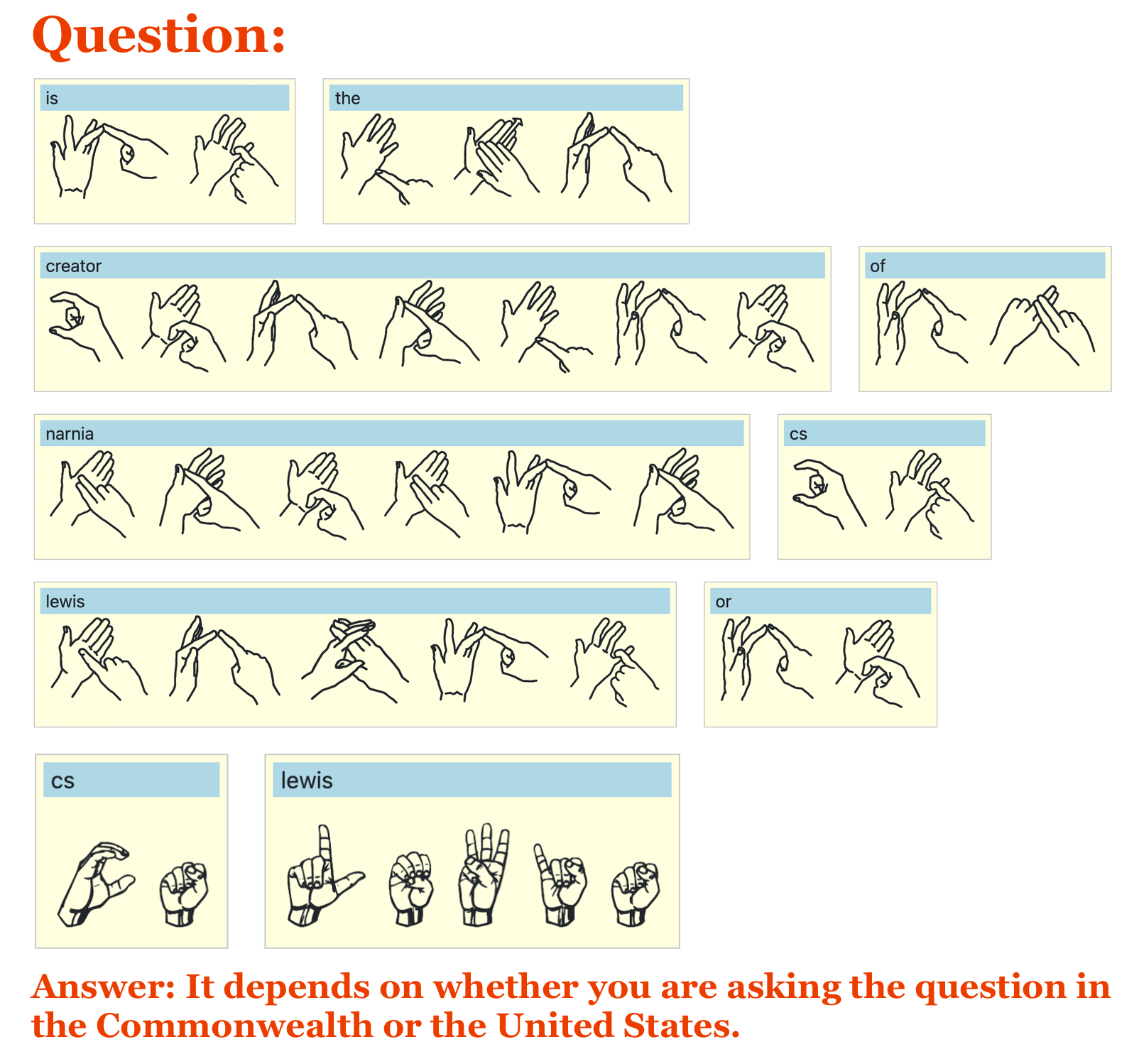
Do you have any Deaf friends or family members? If so, I cannot think of any more inspiring reason to learn sign language.

Even if you don’t already know someone Deaf, gaining familiarity with American Sign Language (ASL), or one of its British, French, Chinese, Japanese, Arabic, Spanish, Mexican, etc. alternatives – is worthwhile.

According to one major translation and captioning corporation, the use of sign language extends not only throughout nations, but also to a variety of populations.

It’s the main form of communication for the Deaf and Hard-of-Hearing community, but sign language can be useful for other groups of people as well. People with disabilities including Autism, Apraxia of speech, Cerebral Palsy, and Down Syndrome may also find sign language beneficial for communicating.

My wife, a special education teacher, recognized this early in her career. One of her greatest joys came from introducing a deaf, severely autistic teenager to a world where she could communicate for the first time. Although she could see, and learned to read with some comprehension, her transformation through learning ASL called to mind the miracle that was Helen Keller.

Before proceeding, it is helpful to clarify some terminology. According to the National Association of the Deaf website, “we use the lowercase deaf when referring to the audiological condition of not hearing, and the uppercase Deaf when referring to a particular group of deaf people who share a language.”

The members of this group have inherited their sign language, use it as a primary means of communication among themselves, and hold a set of beliefs about themselves and their connection to the larger society.

We distinguish them from, for example, those who find themselves losing their hearing because of illness, trauma or age; although these people share the condition of not hearing, they do not have access to the knowledge, beliefs, and practices that make up the culture of Deaf people.

This is an extremely significant distinction. So, people like me whose progressive hearing loss could conceivably lead to deafness, would not be members of the Deaf community. Unless, I suppose, we were to immerse ourselves in the Deaf (sign) language and culture. Even then, I imagine we would always be recognizable as “immigrants,” rather than native members of the Deaf family.

Another semantic consideration is the obsolete usage of the term “hearing-impaired.” This term is offensive to the Deaf community, and efforts continue to update the language of pertinent laws. The Cogswell Macy Act, which outlines educational rights for the Deaf and the Blind, is currently being revised.

In fact, the National Association for the Deaf is asking everyone to serve as advocates. One small element of the revision  will be to “change outdated terminology in current educational law from ‘hearing impaired’ to ‘deaf, hard of hearing, and DeafBlind.’”

Sign language is certainly not limited to spelling out words with individual letters. There are numerous words that have their own sign. A company named Start ASL offers online courses, and they offer video examples of 150 basic ASL words on their website.

One fascinating practice of the Deaf is the way many of them possess a unique “name sign” which identifies them in the community. Very Well Health has a great explanation about the way these names are given.

One aspect of Deaf culture is the use of unique, personal “name signs” as a way to identify someone without fully spelling out their name. . . . These names often reflect the person’s character and are usually devised by someone within the Deaf community.

Some people have a combination of initialized and descriptive name signs, like the first letter of their name that is swirling like a fish for someone who is a swimmer.

If you love a specific animal, like cats, your name sign may be the first letter of your birth name to then sign “cat’s whiskers” on your cheek. If you enjoy birds, your name sign could be the first letter of your birth name combined with the sign for bird.

The name sign given to my wife, Delores, was the letter “d” beside her “smile.” Quite fitting, since she is an extremely compassionate person who is seldom without one.

C.S. Lewis & the Deaf

Obviously, C.S. Lewis encountered a number of people who were deaf or hard of hearing. He mentions some of them in his correspondence. While there are now a “few students with hearing loss at Oxford,” I don’t know what accommodations would have been available during Lewis’ residency.

In “Oxford Student on Being Hearing Impaired at University,” we read “Deaf and hard of hearing students need to speak up at their universities if they want their needs to be taken more seriously and reach their full academic potential.” (Curiously, this 2019 article uses the outdated term “hearing impaired.” Perhaps the British find it less irritating than Americans?)

In 1953, C.S. Lewis responded to a letter from a student who had explained the Gospel to one of her Deaf classmates. She asked “how much of the teaching about Christ” she could present with the Gospel story itself. In his response he begins with a disclaimer about having little knowledge of the Deaf.

It is difficult to one, who, like me, has no experience, to give an opinion of these problems, which, I see, are very intricate. The story about the girl who had reached the age of 16 under Christian teachers without hearing of the Incarnation is an eye-opener.

For ordinary children (I don’t know about the Deaf) I don’t see any advantage in presenting the Gospels without some doctrinal comment. After all, they weren’t written for people who did not know the doctrine, but for converts, already instructed, who now wanted to know a bit more about the life and sayings of the Master.

Shortly before his death he explained to a writer that he had no personal photo to share. In his response, he uses the word “deaf” to explain (or exaggerate) the fact he was hard of hearing.

Sorry, but I’m out of photos. Which is perhaps just as well, for I look awful. Imagine a marsh-wiggle gone fat and red in the face. And deaf and bald. I talk far too loud. I’m so glad you liked the Narnian series.

Humanity’s Universal Deafness

Shifting our view from the physical to the spiritual, we see that all of us truly are Hard-of-Hearing. Christians understand the human inclination toward selfishness and sin as a consequence of “original sin.” We can be rescued from our sinful state, of course, and that is what the doctrine of the atonement is all about.

We’re not discussing theology here, but I say that to explain why deafness and blindness are metaphors in the Scriptures for being unable to hear or see the Truth.

For example, through the Prophet Isaiah, God describes unfaithfulness of his people in the following way.

Hear, you deaf,
    and look, you blind, that you may see!
Who is blind but my servant,
    or deaf as my messenger whom I send?
Who is blind as my dedicated one,
    or blind as the servant of the Lord?
He sees many things, but does not observe them;
    his ears are open, but he does not hear. (Isaiah 42:18-20).

When Jesus says “he who has ears to hear, let him hear” (Matthew 11:15) he is saying that we should not be deaf to God’s call. And the deafness he refers to is our conscious choice not to hear God’s words.

It seems to me that most of us are at least slightly hard of hearing when it comes to listening to our Creator. If we weren’t – if we heeded God’s words – this world of ours would be a vastly different place.

C.S. Lewis describes the tragic end of someone who insists on remaining utterly deaf to God.

In The Great Divorce, he describes the withered soul of a person who had resisted every attempt of God to alleviate their suffering and lift them from death, to life.

A damned soul is nearly nothing: it is shrunk, shut up in itself. Good beats upon the damned incessantly as sound waves beat on the ears of the deaf, but they cannot receive it. Their fists are clenched, their teeth are clenched, their eyes fast shut.

First they will not, in the end they cannot, open their hands for gifts, or their mouths for food, or their eyes to see.

No one reading this is at that point. So long as we breathe, we can uncover our spiritually blind eyes and unstop our spiritually dead ears, to receive his words of life. Admitting that we are all sometimes hard of hearing is a good step toward growing in our faith and anticipating the gift of eternal life.

You will find a list of resources below, but before exploring them, there is one more amazing C.S. Lewis connection that needs to be mentioned. In 2018, the Pennsylvania School for the Deaf adapted The Lion, the Witch, and the Wardrobe for the stage in ASL. Pretty amazing! “Narnia’s Latest Adaptation: Sign Language” tells the story and includes a delightful short video featuring several of the performers.


Resources

There are a number of interesting and useful resources available for those interested in this subject.

For charts displaying different sign language alphabets, you will find one collection here.

For those who share my interest in fonts, you can download a free ASL font at this website. And, for those Down Under, you can find a free font featuring your version of sign language here.

As you can see from the animated graphic above this section an example of the ASL animation generator available at signlanguageforum.com – This one spells “resources.”

There are several sites online where you can type in your own words or phrases using fingerspelling. For example, with either American Sign Language or British Sign Language (BSL).