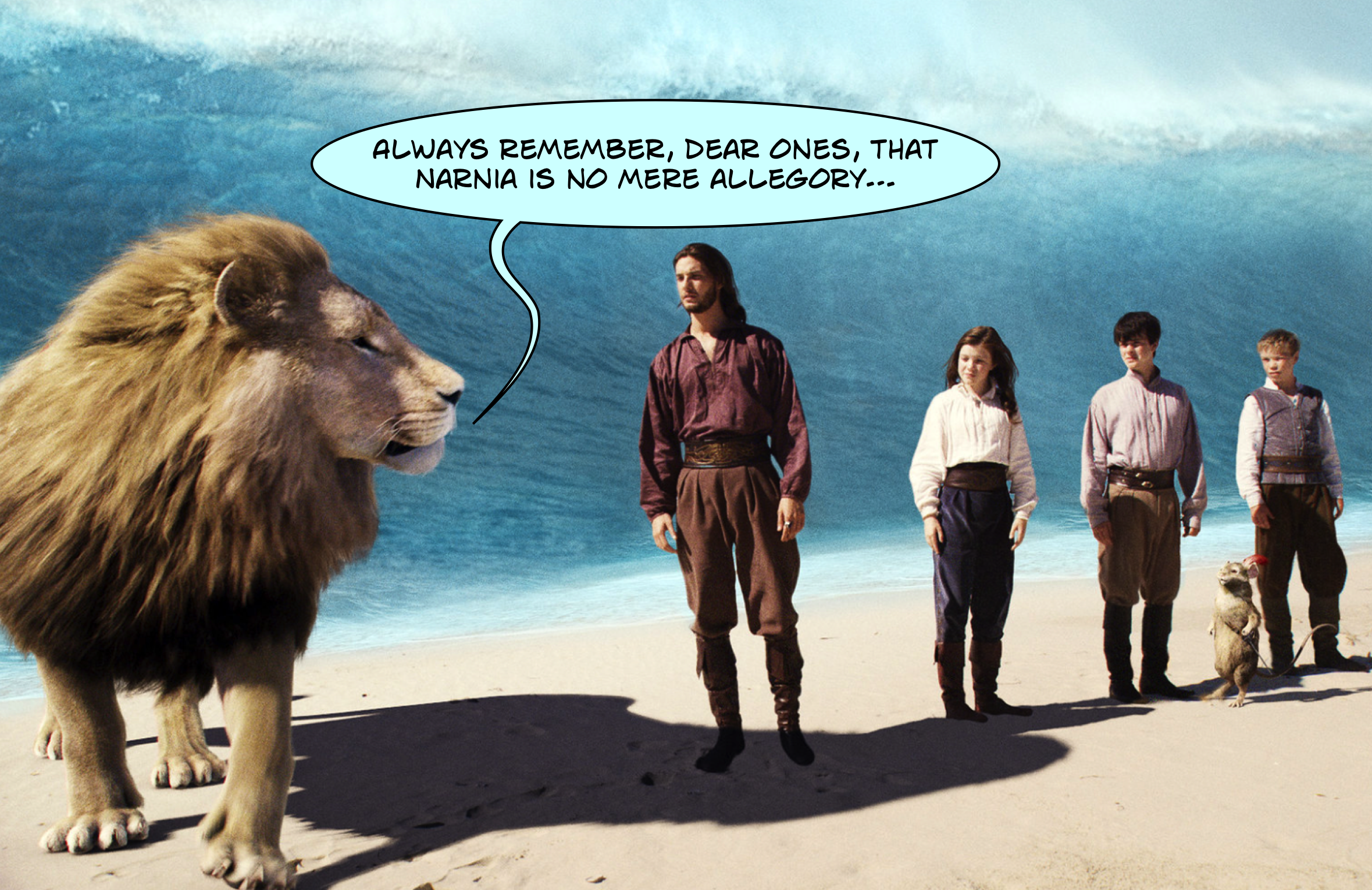
C.S. Lewis, Apologues & Allegories

It has been argued that C.S. Lewis wrote apologues, but I humbly disagree.

An “apologue,” you see, is defined as “a moral fable, especially one with animals as characters.” From that core definition, it makes sense to some that works such as The Chronicles of Narnia might be described as apologues.  

However, this term is usually applied to much simpler, more concise stories –  short moral fables (think Aesop) rather than an extended tales. “Apologue” is a vastly insufficient label for what J.R.R. Tolkien described as subcreation. Narnia is not a fable, it is a world.

Years ago I compared Aesop’s brief “The Kingdom of the Lion,” with C.S. Lewis’ brilliant vision of Aslan.

In “The Lion’s Command,” I identified a virtuous parallel between the brief regent in the fable and the well-developed protagonist of Narnia. In the Chronicles, Narnia’s hero is nothing other than the Alpha and Omega, reigning over its creation and preserving his kingdom to its ultimate culmination.

In “C.S. Lewis and the Art of the Apologue,” Samuel Joeckel argues that “The Screwtape Letters and The Great Divorce might be read as pure apologues, while Lewis’s other works of mythopoeia contain elements of the apologue.” This is an intriguing proposal, which has not gained much traction. Of course, Joeckel’s point that “elements” of apologue are present is certainly true, but that would be so when considering the work of numerous authors.

If not an Apologue, might Narnia be an Allegory?

An interesting article about parables contrasts parables and apologues in the following manner.

Another story style that is related to parables is the apologue. Apologues are short stories that are intended to convey a lesson, and they often use animals as characters. . . . Unlike parables, which generally have realistic scenarios, apologues allow an element of fantasy while maintaining a moral point.

The same article describes differences between parables and apologues as contrasted with allegories, such as George Orwell’s Animal Farm.

Parables are not the only type of story that present a moral lesson. Allegories are stories or poems where different elements are designed to convey abstract or spiritual meaning. . . . Allegories and parables are related in their use of symbolic language.

The difference is, in essence, one of complexity. While parables (and apologues) normally focus on a single lesson, allegories feature broader elements fleshing out a more elaborate lesson or message. 

Allegories are more metaphorical and often involve characters representing abstract ideas, and the symbolism can be deeply complex. However, parables are more direct, with a simple narrative that usually involves a human character facing a moral dilemma or the consequences of a bad decision (“Allegory Vs. Parable”). 

Allegory vs Apologue,” offers a similar distinction between these two literary exercises. 

Allegory and apologue are both forms of extended metaphor that use symbolic characters and events to convey a deeper meaning. However, there are some important distinctions between the two. . . .

Apologue, on the other hand, is a more general term that refers to any story or fable that teaches a moral lesson. Unlike allegory, apologue does not necessarily have a hidden meaning . . .

C.S. Lewis challenges the notion that allegories possess “hidden” themes. In his preface to The Pilgrim’s Regress, he argues that true allegories do not mask their message. 

People . . . suppose that allegory is a disguise, a way of saying obscurely what could have been said more clearly. But in fact all good allegory exists not to hide but to reveal; to make the inner world more palpable by giving it an (imagined) concrete embodiment.

In The Allegory of Love: A Study of Medieval Tradition, C.S. Lewis describes the unique goal of this literary device. 

The function of allegory is not to hide but to reveal, and it is properly used only for that which cannot be said, or so well said, in literal speech.

The inner life, and specially the life of love, religion, and spiritual adventure, has therefore always been the field of true allegory; for here there are intangibles which only allegory can fix and reticences which only allegory can overcome. 

In an essay about the author of The Faerie Queene, “Edmund Spenser, 1552–99,” Lewis lauds the path allegories pursue to illumine readers.

We shall understand it best (though this may seem paradoxical) by not trying too hard to understand it. Many things – such as loving, going to sleep, or behaving unaffectedly – are done worst when we try hardest to do them. Allegory is not a puzzle.

With C.S. Lewis’ genuine appreciation for good allegory, it is unsurprising that some readers are tempted to label The Chronicles of Narnia as such. After all, too brief and far too elaborate to be a collection of mere apologues, it seems logical. Yet, Lewis himself dispelled that conclusion. His opinion is expressed clearly in the following passage from a letter written in 1958.

If Aslan represented the immaterial Deity in the same way in which Giant Despair represents Despair [in The Pilgrim’s Progress], he would be an allegorical figure.

In reality however he is an invention giving an imaginary answer to the question, “What might Christ become like, if there really were a world like Narnia and He chose to be incarnate and die and rise again in that world as He actually has done in ours?” This is not allegory at all.

No, the Chronicles offer no mere allegory. Aslan and Narnia are something altogether more rare and precious . . . and uniquely inspiring.


Bonus:

For those inclined to see how the AI at ChatGPT might compose an analogue, consider the following examples. I offered three brief prompts and amazingly swift apologues. 

Certainly! Here’s an apologue in the style of ancient Roman moral tales – think Aesop with a Roman flavor (e.g., Phaedrus) – explaining why the porcupine is hard to get along with. This style uses simple characters, a brief narrative, and a moral at the end.

Apologue: The Porcupine and the Burrowers

Characters:
~ Porcupine (Hystrix)
~ Mole (Talpa)
~ Hedgehog (Erinaceus)
Moralitas at the end.

In the time when the earth still whispered secrets to beasts, a bitter winter approached. The animals who dwelt below ground gathered to find warmth together.

The Mole, who dug deep and dark tunnels, said, “Let us share one chamber, and none shall freeze.”

The Hedgehog, with bristles soft enough in the cold, agreed. “We are small and spined, but kindred in spirit.”

Then came the Porcupine, bristling with long, sharp quills. “I seek shelter,” he said. “Let me in.”

The others, though wary, welcomed him. “There is warmth in many bodies, if none poke too hard.”

But when the Porcupine curled to sleep, his quills pricked every side of the burrow. The Mole winced. The Hedgehog bled. They shifted, gave him space – but no space was enough.

“Friend Porcupine,” said the Mole, “can you not soften your stance?”

The Porcupine replied, “My quills are my nature. I mean no harm, yet I cannot change.”

So, one by one, the others left, seeking colder but safer places.

The Porcupine remained, alone in warmth – but with no friend near.

Moralitas:
He who cannot bend his nature to spare his neighbors must be content with solitude, for warmth of company is given only to those who wound not.

Having delivered the moral of the fable, the AI was so thoughtful as to ask: “Would you like a Latin version of the apologue as well?”

~ ~ ~ ~ ~ ~ ~

Certainly! Here is an apologue in the style of C.S. Lewis – reminiscent of his storytelling in The Screwtape LettersThe Chronicles of Narnia, and The Pilgrim’s Regress. Lewis often used allegory and fable to convey theological or philosophical arguments through richly imagined, morally charged tales.

Apologue: The Two Gardens

In an ancient land that bordered both silence and song, there lived two brothers: Eldarion and Ruckus.

Their father, the Keeper of Harmony, was a master gardener who tended to two great gardens, each grown from a different seed of music.

One garden was called Lyrion, and it bloomed with strange and delicate flowers. Trees sang there – not with words, but with symphonies. The air was always filled with the faint sound of strings, like something half-remembered from a dream. This was the realm of Classica, the music that had deep roots and slow unfolding blossoms.

The other garden, Thundra, was younger, wilder. Vines twisted with fire, and great drums beat like the hearts of giants. Flames leapt from the leaves when touched. This was the realm of Rocka, born of storm and impulse. It throbbed with noise and power.

One day, the father called his sons. “Each of you shall choose a garden to tend,” he said. “But take heed: a garden grows into the likeness of its gardener.”

Eldarion, quiet and curious, chose Lyrion. He studied the old scores carved into the bark of the elder trees. He listened for the faintest cadences hidden in the wind. His garden grew slowly, but with order and depth. Some who visited said they heard truth in its song – though they could not explain it.

Ruckus chose Thundra. He brought iron tools and thunderous machines. He shouted into the wind and danced among the fire-vines. His garden grew quickly, wildly, and it drew many visitors who loved its power. But the soil became hard, and the songs repeated themselves. At night, when the fire died, there was silence – and the silence frightened him.

Years passed.

One evening, Ruckus visited his brother’s garden. It was still and strange, yet somehow more alive. The music there did not grab the ear – it waited, like a cathedral waits for a footstep.

“I do not understand this,” said Ruckus.

“You’re not meant to at first,” Eldarion said gently. “But if you sit long enough, you may find it is not music you hear – but yourself.”

Moral:
Not all noise is music, and not all music is noise. That which is deep may not dazzle, but it endures.

~ ~ ~ ~ ~ ~ ~

Certainly! Here’s an apologue in the style of C.S. Lewis, with his characteristic blend of gentle allegory, rational argument, and spiritual insight. Think of something akin to The Great Divorce or The Pilgrim’s Regress – a story that carries philosophical weight through symbolic characters and a clear moral undercurrent.

Apologue: The Library of the Lantern

There was once a Traveller who came upon an ancient Library, tucked between the hills of two realms: Factland, where the roads were straight and numbered, and Fablemere, where the paths curled like ivy and sometimes moved when you weren’t looking.

The Traveller, weary from debate and burdened with questions, was greeted by an old librarian named Lucidus, who wore a cloak woven from both parchment and ink.

“You may read whatever you like here,” said Lucidus. “But I warn you: some shelves are straight, others crooked – and both are true.”

The Traveller began in the Hall of Records, where volumes bore names like The History of the WorldNatural LawsThe Mind Explained, and Economics in Twelve Systems. The books were hard, clear, and bright like winter ice. Every sentence pointed like an arrow, and the Traveller felt smarter with every page. “Here,” he thought, “is what I came for: answers.”

But after a time, the light grew harsh, and the words – though sharp – offered no rest. He felt he had learned much, and yet not grown.

So he wandered next into the Chamber of Tales. Here were strange books that spoke of dragons and dying stars, of heroes who were cowards and cowards who became saints. The logic bent like a rainbow, and the truth came sideways.

At first he scoffed. “These things never happened!”

Lucidus appeared beside him and said quietly, “No – but they always happen.”

So the Traveller read on. And he wept when the fox died, and laughed when the king made a fool of himself. He saw his pride in the villain and his longing in the wandering knight. He saw the world as it might be – and in doing so, saw more clearly what the world was.

Time passed. The Traveller read from both wings of the library, sometimes walking the marble floors of Factland, sometimes lying on the mossy rugs of Fablemere. One sharpened his mind; the other softened his heart. One taught him how things work; the other, why they matter.

At last, he approached Lucidus.

“Which was truer?” the Traveller asked. “The world I could measure, or the one I could feel?”

Lucidus smiled. “Ah. One is the lamp, the other the flame. But both are needed to see.”

Moral:
Fiction teaches the soul what nonfiction explains to the mind – and wisdom lives where both meet.

This proved to be a very interesting exercise, indeed.
Dogs & Rescues

When we add an un-homed dog to our family, who is the true “rescuer?” In the States, we call many of our agencies placing orphaned pets “rescue centers.” But I believe most of us who have welcomed such creatures into our homes feel less pride in doing what’s noble, than we do appreciation for what these loving animals bring into our lives.

Long ago, I learned that the best way to tell about a person’s true character and compassion is to observe how they treat animals.

 Nothing I’ve witnessed in the past decades has caused me to question that conviction.

Recently I saw a quote attributed to Abraham Lincoln which expresses the same sentiment. 

While the attribution of these words to America’s sixteenth president may be questioned, they are certainly consistent with his regard for dogs . . . and, as the quotation declared, cats as well.

Four of our most recent six dogs have been rescues. All but one has been a border collie.

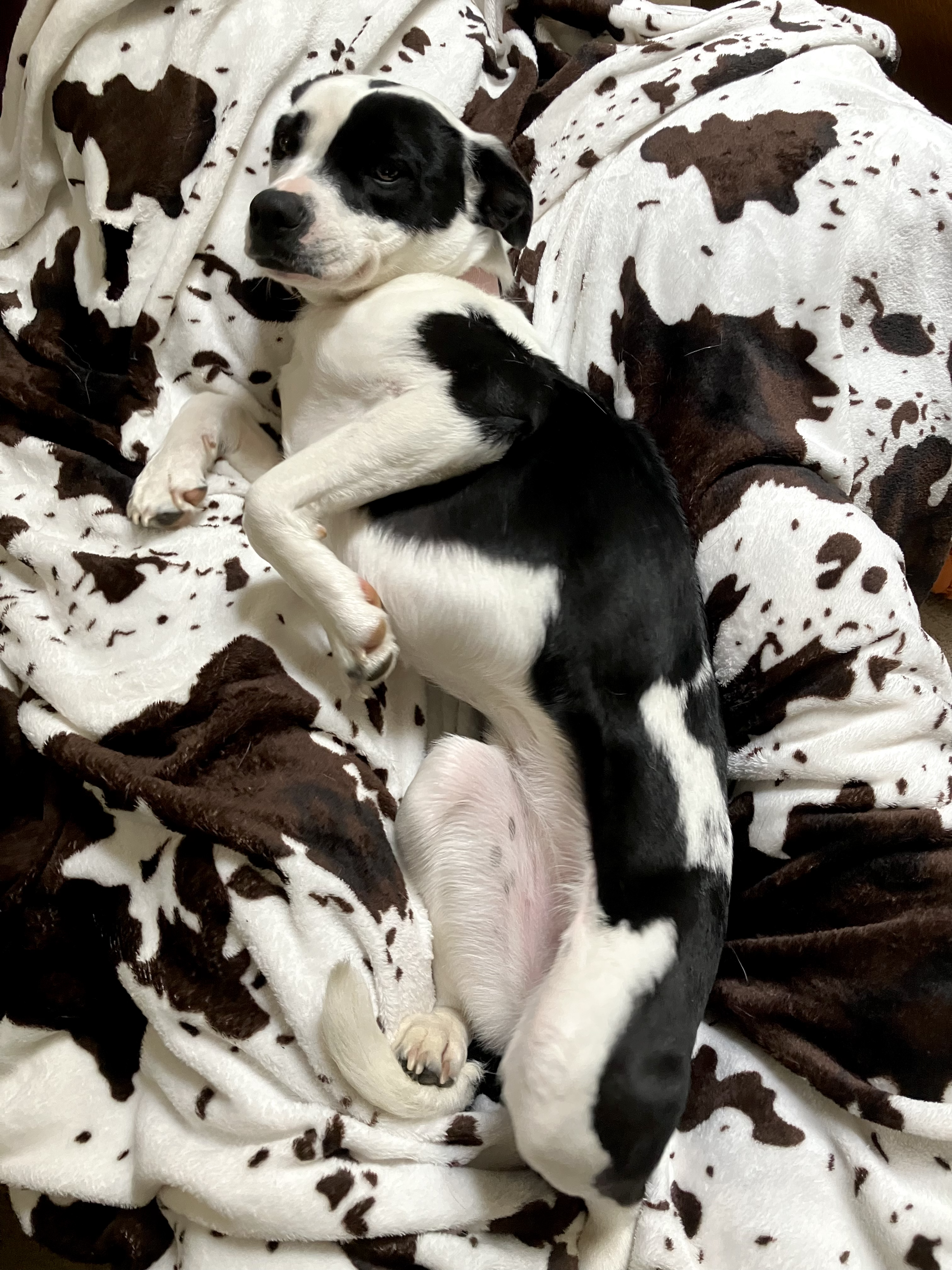
The latest girl who joined our family, just last year, was promoted on a Border Collie Rescue page. She appeared to be a young mix with, of all things, a dalmatian.

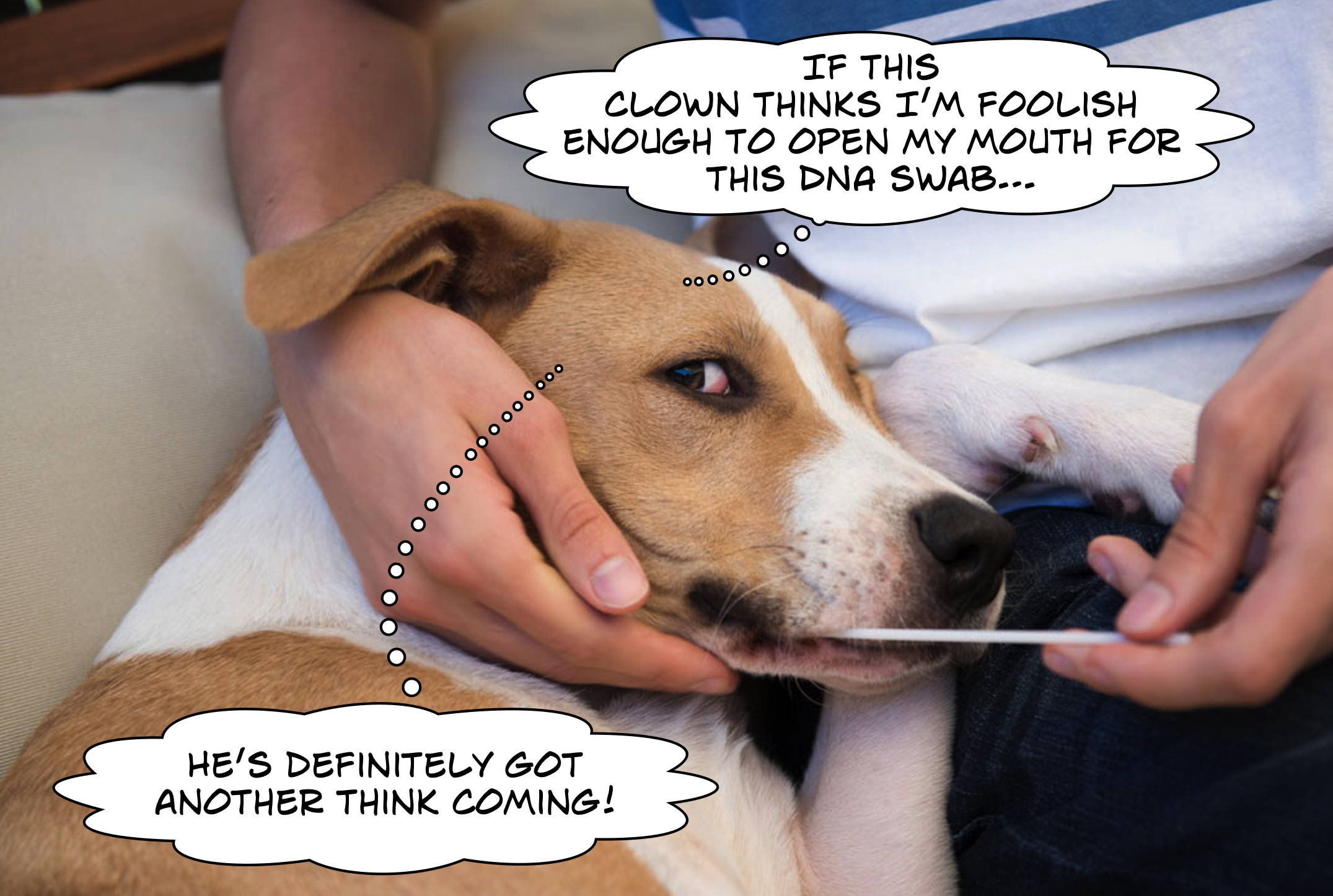
When we traveled to meet her, we immediately suspected she lacked any border collie DNA, but we (and our older border collie) connected with her that day and she came home with us. A year later, we’re certain she’s just, as our vet assessed, a mutt – but that’s fine with us. The picture at the top of this page shows her resting on her adoptive mom’s lap. (Many of her black spots have spread since we first got her when she resembled the victims of Cruella de Vil.)

I’ve written in the past about how C.S. Lewis loved dogs. It’s no surprise, of course, that a good-natured man of faith like Lewis would love animals.

J.R.R. Tolkien also loved dogs. They are featured in a number of his books, and a canine named Rover featured as the protagonist of his 1925 children’s story, Roverandom.

A Caution

Pay attention to how people treat animals. It is a clue to their psyche and a window into their soul. 

While some people are indifferent to animals, which is normal, there are those who treat them with cold disregard or animosity. The message of “The Link Between Cruelty to Animals and Violence Toward Humans” confirms what we all recognize intuitively.

People who hurt animals don’t stop with animals. There is an established link between cruelty to animals and violence toward humans . . .

This link makes it critically important that cruelty toward animals be taken seriously by law enforcement, and by society at large. This is for the sake of the animals themselves, and for people who are also at risk. . . .

Ample research backs up the finding that there is a direct link between acts of cruelty to animals and violence toward humans. This includes child abuse, domestic violence, elder abuse and other violent behavior.

There are good people, and bad people. Fortunately, in the case of the treatment of pets, the former outnumber the latter. One day, when Earth is made new and restored to its initial goodness, all life will once again be in harmony. As we hear in Psalm 148 and Revelation 5,

Praise the Lord from the earth,
    you great sea creatures and all deeps,
fire and hail, snow and mist,
    stormy wind fulfilling his word!
Mountains and all hills,
    fruit trees and all cedars!
Beasts and all livestock,
    creeping things and flying birds!

And I heard every creature in heaven and on earth and under the earth and in the sea, and all that is in them, saying, “To him who sits on the throne and to the Lamb
be blessing and honor and glory and might forever and ever!”

Until that day, let us each act with compassion toward the creatures that enrich our lives, particularly those who trust us to protect their welfare.

A Closing Thought

Sometimes the word “rescue” applies literally. More than one lonely and clinically depressed person has stopped contemplating the ending of their life when a gentle support animal brought light to their dark world. 

Then there is the recent case of Buford, a ranch dog who found a two-year-old boy lost in a desert wilderness and remained with him overnight until he could lead him safely home.

As for who rescues whom, count me in the camp of those who believe the gift is mutual.

Dog DNA Determines Guilt

It is surprising how inexpensive and accessible DNA testing has become. Many readers of Mere Inkling have submitted samples ourselves. But how many of us have had our pets tested?

The science of genetics is quite recent. Gregor Mendel (1822-1884) is considered the father of such studies. As Britannica describes the history, “The word genetics was introduced in 1905 by English biologist William Bateson, who was one of the discoverers of Mendel’s work and who became a champion of Mendel’s principles of inheritance.”

Molecular genetics did not begin in earnest until 1941 . . . A major landmark was attained in 1953 when American geneticist and biophysicist James D. Watson and British biophysicists Francis Crick and Maurice Wilkins devised a double helix model for DNA structure.

The Human Genome Project didn’t begin until 1990, and didn’t reach its goal until the new millennia. The astute reader will recognize that C.S. Lewis lived before these genetic studies reached their current status, so we should not expect comment from him on DNA per se. Nevertheless, as Francis Sellers Collins, director of the Human Genome Project (2009-2018), says his work is quite compatible with C.S. Lewis’ writings.

In fact, in a lecture at Cambridge, he described how Mere Christianity was pivotal in his conversion from agnosticism to Christianity. According to this preeminent geneticist, “even in the first few pages, all my arguments about faith just fell apart. It was breathtaking . . . Lewis remains my best teacher.”

There is some question as to whether the DNA testing market has peaked. Unsurprising, since it isn’t like tobacco, coffee or rich desserts that “addict” customers to generate repeated purchases. As Advisory Board says, “given one’s genetic data is unlikely to change, most consumers may not see a reason to purchase another DNA testing kit.”

So, how might these corporations remain profitable? Why, by expanding their offerings to the animal kingdom. One such company called Embark claims to offer the “most accurate dog DNA test available.” 

Some people purchase the service to satisfy their curiosity about a pet’s breed (often a blend of several). A more valuable benefit is gaining insights into their health and traits. The oddest aspect of the process appears to be Embark’s boast that they offer “the world’s first canine relative finder.”

Like many of us, C.S. Lewis loved dogs. He didn’t, however, go so far as to worship them. I suspect that C.S. Lewis would opt out of the chance to DNA-define his pets. Best to just love them and savor their companionship.

In his essay “The Personal Heresy,” C.S. Lewis proposes an interesting argument about expressing love only to those capable of receiving it.

There is a reaction at present going on against the excessive love of pet animals. We have been taught to despise the rich, barren woman who loves her lap dog too much and her neighbor too little. It may be that when once the true impulse is inhibited, a dead poet is a nobler substitute than a live Peke, but this is by no means obvious.

You can do something for the Peke, and it can make some response to you. It is at least sentient; but most poetolaters hold that a dead man has no consciousness, and few indeed suppose that he has any which we are likely to modify.*

DNA service businesses are probably licking their lips at the prospects offered by a new market. The French are blazing a new trail for the rest of us. According to Euronews, Béziers will require pet owners to “carry a ‘genetic passport’ for their dog.”

The reason is simple. Too many dog walkers are failing to perform their civic (and humane) duty of cleaning up after their pets. 

Dog excrement found on the streets would be collected and tested then sent to the police. They would match the DNA to national pet registers, locate the owner and charge them up to €122 for cleaning up the streets.

Apparently, similar efforts have been attempted in Valencia, Tel Aviv and portions of London.

It sounds like a rather extreme way to address what superficially appears to be a simple problem. But, sadly, in many places, public sanitation has declined to unbelievable depths. In San Francisco, for example, the once picturesque metropolis has voluntarily surrendered many areas to criminals and addicts who feel no compunction about defecating in public. While I can’t speak for European, Asian, African or Latin American countries, in the U.S. a similar story of decay is repeated in many urban centers.

San Franciscans can’t be criticized for not throwing money at the problem. Nevertheless, when progressive Slate magazine reported last year on the city’s newest public toilet, they said “cities shouldn’t need $1.7 million and years of design review to build a municipal toilet.” 

Not that San Francisco treats such facilities with care. One space age toilet lasted only a few days before malfunctioning. But it was expensive, stainless steel, and bore the upgraded title of “kiosk.”

A highly hyped new SF bathroom hailed as “the future of public toilets” lasted only three days into said future, as the high-tech bathroom kiosk quickly had to be relieved of its duty and found itself closed for repairs.

Since these are manufactured by a Paris-based company, perhaps they can design a canine kiosk to solve the Béziers dilemma? After all, the cost might well be equivalent to the sum of all of the DNA tests the citizens are being forced to cover. 

A Final Thought about Animal DNA

Many of us, like C.S. Lewis, are pet lovers. And many also care about the suffering of other animals, domesticated and wild. There may come a day when DNA testing offers ways to enhance the lives of these other creations of God.

However, it does seem frivolous, does it not, to apply such advanced (and not inexpensive) processes for the purpose of tracking down derelict dog walkers? Or, in other judicatories, which have not yet embraced that level of surveillance, simply to attempt to track down doggie-relatives?

As to the matter of checking pet DNA for genetic abnormalities, “Should you get your pet’s DNA tested? Scientists urge caution” counsels careful consideration.

In the interview, Elinor Karlsson, director of vertebrate genomics at the Broad Institute in Cambridge, Massachusetts says,

With genetic tests for humans, there have been so many studies that look at whether or not a certain mutation in your genes actually leads to you developing a certain disease. There just isn’t this massive body of work on dog genomes. So many of these tests are telling owners that their dog could get a certain disease without any major studies on how likely that is to happen. The science needs to catch up.

In response to the question “what are the dangers of potentially inaccurate test results?” Lisa Moses, a veterinarian affiliated with Harvard Medical School in Boston advises,

In my veterinary practice, I’ve seen more and more people coming in with results that show their dog has a chance of developing conditions like epilepsy, heart disease, and degenerative muscular disorders, and they want to make treatment decisions right away.

They’re ready to pay for more tests or medical interventions that the dog might not actually need, that could be quite expensive, and that could be invasive for the dog. In some cases, people preemptively end their dog’s life if they think their dog is predisposed to a degenerative disease, because don’t they want their pet to suffer.

So once again we see that, as they often do, silly scenarios can lead to serious subjects.


* The passage from “The Personal Heresy” continues: 

Unless you hold beliefs which enable you to obey the colophons of the old books by praying for the authors’ souls, there is nothing that you can do for a dead poet: and certainly he will do nothing for you. He did all he could for you while he lived: nothing more will ever come.

 I do not say that a personal emotion towards the author will not sometimes arise spontaneously while we read; but if it does we should let it pass swiftly over the mind like a ripple that leaves no trace. If we retain it we are cosseting with substitutes an emotion whose true object is our neighbour. Hence it is not surprising that those who most amuse themselves with personality after this ghostly fashion often show little respect for it in their parents, their servants, or their wives. 

How Precious, Is Memory

What would you do if tomorrow you awoke never again able to remember the births of your three children? Never to remember your marriage or your college years? How would you rebuild your life with children and a husband you no longer knew?

In Out of the Silent Planet, C.S. Lewis described a fundamental expectation we possess – “Every day in a life fills the whole life with expectation and memory.” this makes the fragility of the human brain and mind all the more sad.

The question above sounds like the plot to some novel or film, but this was a real life experience for Marcy Gregg. She has written a detailed account of the amazing story in Blank Canvas, and an account of the experience is available online at Focus on the Family

Before you rush to read it, though, I would like to share a few thoughts about memory. Today, increasing life expectancies make senility and dementia far too familiar to families. Dismissing such disorders related to causes such as brain injuries or drug abuse, we still hear of so many cases of Alzheimer’s and other neurodegenerative diseases. Many of us have been touched by this pain, as it has destroyed the lives of people we love. 

Happily, there are growing options for residences equipped with skilled nursing care trained especially for “memory care.” The problem, of course, is not just the availability, but also the significant cost. AARP reported that in 2021, “the average memory care monthly rent is $6,935 in the U.S.”

That’s significantly more than assisted living, which averages $5,380 a month, but a lot less than the $10,562 average monthly cost of a nursing home.

Since we identify our personhood so heavily with our minds, we do not like to think about things like the multiple types of amnesia. Some are terrible, and one is nearly universal. WebMD includes six in their list. The woman above experienced anterograde amnesia which they describe as the loss of “your ability to recall events that happened just before the event that caused your amnesia.” Fortunately, though not the case for Marcy, they add, “usually this affects recently made memories, not those from years ago.‌”

One form of amnesia listed by WebMD may come as a surprise to you, as it did to me. It is referred to as infantile or childhood amnesia. It describes how our young brains were not yet developed well enough to consolidate and store memories for retrieval. Many of us lack early memories, and rely on stories and media to fill in that long gap in our lives.‌

A brief article from the University of Queensland describes how “memories aren’t stored in just one part of the brain.” Differing types are stored “across different, interconnected brain regions.”

Cedars-Sinai has “discovered two types of brain cells that play a key role in creating memories.”

“One of the reasons we can’t offer significant help for somebody who suffers from a memory disorder is that we don’t know enough about how the memory system works,” said [a] senior author of the study, adding that memory is foundational to us as human beings.

Human experience is continuous, but psychologists believe, based on observations of people’s behavior, that memories are divided by the brain into distinct events, a concept known as event segmentation.

Forgetfulness is, for most who live long enough, an unavoidable aspect of aging. But it may not be quite so bad as it appears to us, as C.S. Lewis related in a letter written several years before his death.

About forgetting things. Dr. Johnson* said “If, on leaving the company, a young man cannot remember where he has left his hat, it is nothing. But when an old man forgets, everyone says, Ah, his memory is going.”

So with ourselves. We have always been forgetting things: but now, when we do so, we attribute it to our age.

Why, it was years ago that, on finishing my work before lunch, I stopped myself only just in time from putting my cigarette-end into my spectacle case and throwing my spectacles into the fire!

Forgetfulness is a common part of human experience, but clinical amnesia is something altogether different.

Tragically, some suffer from anterograde amnesia. One of the saintly matrons at our church carries this cross, assisted by her loving daughter and son-in-law. This cruel disease prevents the retention of new memories. While it is often linked with geriatric considerations, and can affect all of one’s memories, this article from the National Library of Medicine describes a particularly tragic case in which a child “had an abrupt onset of amnesia due to a respiratory arrest at the age of 8 years.”

Cases such as this move Christians to prayer, and many others to despair. While miracles do happen, they are rarer than we desire. Ultimately the Christian hope is in a Lord who keeps his promises, and one of these is that he will come again and will take us to himself, so that where he is, we may be also (John 14). And, in heaven, we will receive a new body like Christ’s resurrection body (Philippians 3).


* Samuel Johnson (1709-1784), a prolific and influential English writer, was often referred to simply as “Dr. Johnson.” Many volumes of the good doctor’s writings are available as free downloads from Internet Archive. For example, volume 7 of the 1810 collection, includes the following essay discussing human shallowness. He begins by contemplating the ability of animals to remember and to anticipate the future.

The Idler
Numb. 24. Saturday, September 30, 1758.

When man sees one of the inferiour creatures perched upon a tree, or basking in the sunshine, without any apparent endeavour or pursuit, he often asks himself or his companion, On what that animal can be supposed to be thinking?

Of this question, since neither bird nor beast can answer it, we must be content to live without the resolution. We know not how much the brutes recollect of the past, or anticipate of the future; what power they have of comparing and preferring; or whether their faculties may not rest in motionless indifference, till they are moved by the presence of their proper object, or stimulated to act by corporal sensations.

I am the less inclined to these superfluous inquiries, because I have always been able to find sufficient matter for curiosity in my own species. It is useless to go far in quest of that which may be found at home; a very narrow circle of observation will supply a sufficient number of men and women, who might be asked, with equal propriety, On what they can be thinking?

It is reasonable to believe, that thought, like every thing else, has its causes and effects; that, it must proceed from something known, done, or suffered; and must produce some action or event. Yet how great is the number of those in whose minds no source of thought has ever been opened, in whose life no consequence of thought is ever discovered; who have learned nothing upon which they can reflect; who have neither seen nor felt any thing which could leave its traces on the memory; who neither foresee nor desire any change of their condition, and have therefore neither fear, hope, nor design, and yet are supposed to be thinking beings.

To every act a subject is required. He that thinks must think upon something. But tell me, ye that pierce deepest into nature, ye that take the widest surveys of life, inform me, kind shades of Malbranche [Nicolas Malebranche] and of [John] Locke, what that something can be, which excites and continues thoughts in maiden aunts with small fortunes; in younger brothers that live upon annuities; in traders retired from business; in soldiers absent from their regiments; or in widows, that have no children?

Life is commonly considered as either active or contemplative; but surely this division, how long soever it has been received, is inadequate and fallacious. There are mortals whose life is certainly not active, for they do neither good nor evil; and whose life cannot be properly called contemplative, for they never attend either to the conduct of men, or the works of nature, but rise in the morning, look round them till night: in careless stupidity, go to bed and sleep, and rise again in the morning.

Johnson’s essay continues with a discussion of the soul and its distinction from the mental processes themselves. Obviously, he is not considering the subject of amnesia, but he reminds us never to become too doctrinaire, since that “supposes what cannot be proved, that the nature of mind is properly defined.” 

His purpose in the essay is not to discuss the abilities of the brain but, at least in part, to critique those who choose to be unthinking. Those who spend not a moment in reflection or contemplation.

I encourage you to read the entire essay, as it demonstrates Johnson’s brilliance. I close this extended “footnote” with a passage in his concluding section which keenly describes our common human experience with memory.

We every day do something which we forget when it is done, and know to have been done only by consequence. The waking hours are not denied to have been passed in thought; yet he that shall endeavour to recollect on one day the ideas of the former, will only turn the eye of reflection upon vacancy; he will find, that the greater part is irrevocably vanished, and wonder how the moments could come and go, and leave so little behind them.

Narnian Numismatics

I’m a numismatist, and you may be one as well.

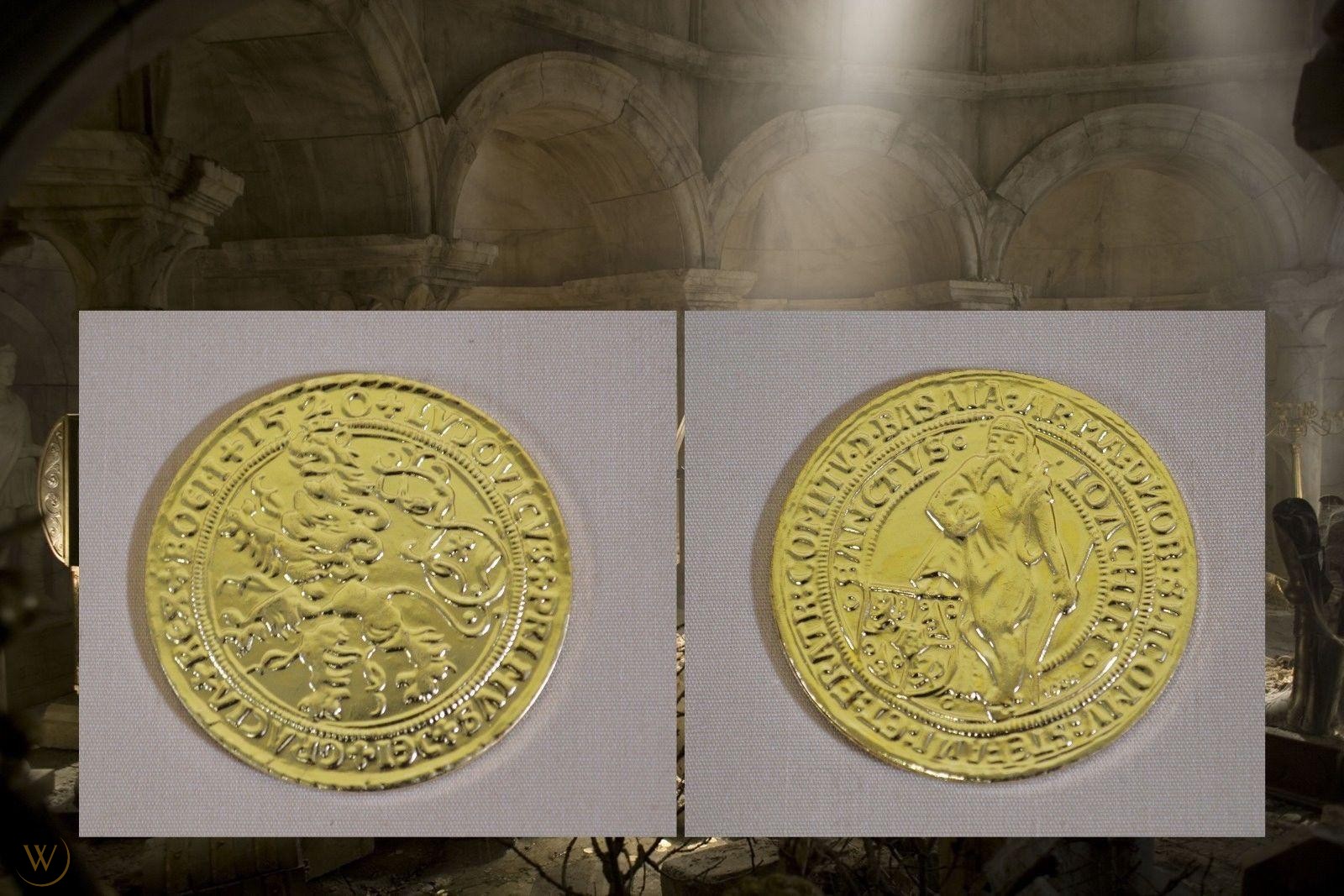
Although I haven’t actively accumulated coins for some years, I do have as a prize piece of my collection a Narnia coin used in the production of Prince Caspian (2008). Technically, since it isn’t a true, earthly coin, it is considered exonumia, but we coin collectors still recognize just how truly special these treasures are.

Speaking of treasures, that is precisely where my Narnian medallion comes from. The treasure chamber scene had a surfeit of the pieces, and some were sold in collectible frames. The obverse and reverse of the coin can be seen above. I’ve actually written about “my precious” piece of Narnia in the past but just this morning I woke up with the word “numismatist” on my mind, crying out for a Mere Inkling post. (More on this in a moment.)

First, those interested in the history of money may wish to skim a few of my other related columns. These include: inflationary currency such as German notgeld and Zimbabwe’s more recent $1,000,000 bills, a comparison of the women in the life of Constantine the Great and the prominent women in the life of C.S. Lewis, and the misspelling of the name of Jesus on a papal medallion.

Coins Have Given Way in My Life, to Words

As I said above, I awoke today with the word “numismatic” fluttering across my thoughts. And it was not alone. It was linked to the wordplay I recently discussed in “Creative Definitions.”

Before pondering where my mental gyrations on the word in question carried me, allow me to share two additional examples I scribbled out on my bedside tablet before rising to brush my teeth and begin the day.

Provocatours: excursions to politically explosive environs where travelers can accurately anticipate their guides will provide an explosively entertaining adventure.

Methics: the ethical perversion which allows people to justify creating pharmaceuticals with the primary function of destroying lives. [See chemistry teacher Walter White on “Breaking Bad.”]

From there my mind jumped to the pecuniary avarice of drug dealers as associated with the word numismatics – and it coined the related word,

Numethmatics: wherein the potential temporal gains associated with drug dealing outweighs the cost to society, oneself and an individual’s soul.

And in relatively rapid sequence came the following.

Flumismatics: when viral contagions disrupt the entire global economy.

Cluemismatics: either the determination of the financial motivations for murder mysteries or the funding required for law enforcement agencies who determine the criminals’ identities.

Numismantics: when economic theory is dominated by traditionally masculine concepts and values (e.g. profit and greed).

Numissmatics: economic theory which is strongly influenced by traditionally feminine values (e.g. charity and compassion).

If the last two culturally antiquated examples haven’t lost you, read on.

Gloomismatics: the prospect for economic survival in light of crushed hopes for the future due to unbridled inflation (e.g. the insanity of some economists and politicians who advocate simply “printing more money” to solve the problem).

Newmismatics: novel currencies and specie that seek to deceive citizens through the pretense that they actually possess some value.

Bluemismatics: the depressive condition elicited when one’s financial holdings inadequately counterbalance one’s debts; historically, applied to cabin boys in sailing days who only realized they would not be fiscally compensated for their services after the ship had left port.

Pneumismatics: pecuniary considerations based on spiritual rather an material considerations.

Numismetrics: the partly scientific, partly fanciful art of exchanging international currencies.

Nufistmatics: the shocking rise of unprovoked blindsided blows to strangers in urban jungles, frequently without any apparent desire to steal property.

Truemismatics: the actual value of monies before economists get involved in the matter.

Gluemismatics: the tight-fisted relationship misers have with their monetary hordes (see Ebenezer Scrooge, or dragons such as described by C.S. Lewis and J.R.R. Tolkien).

Nuclearmismatics: the grim cost calculation involved by world powers when weighing the “benefits” of a possible nuclear conflagration.

There were a couple of other scribblings I was unable to decipher once I was fully awake, but near the end of my meanderings, I came upon,

Zoomismatics: the financial resources required to provide a healthy environment, as close as possible to their natural habitat, for animals residing in zoological parks.

Unsurprisingly, this neologism gave rapid birth to Gnumismatics and Moomismatics . . . well, you get the idea. For the sake of my on sanity, I had to forcibly end the spontaneous exercise.

Returning to Narnia

It is fitting to end this numismatic revelry with a return to the scene for which my coin was minted. As noted earlier, it appeared in Prince Caspian. The Pevensie children have returned to Narnia, and are reawakened to their former life which had become but a dream.

Rediscovering their treasure chamber, in the now-ruins of the castle Cair Paravel (time runs differently in Narnia) is pivotal in their reawakening.

“There’s one thing,” said Lucy. “If this is Cair Paravel there ought to be a door at this end of the dais. In fact we ought to be sitting with our backs against it at this moment. You know – the door that led down to the treasure chamber.”

“I suppose there isn’t a door,” said Peter, getting up. The wall behind them was a mass of ivy.

“We can soon find out,” said Edmund . . .

They worked at the ivy with their hands and with Peter’s pocket-knife till the knife broke. After that they used Edmund’s. Soon the whole place where they had been sitting was covered with ivy; and at last they had the door cleared. “Locked, of course,” said Peter. “But the wood’s all rotten,” said Edmund. “We can pull it to bits in no time . . .

[Descending into the chamber, Peter who is bringing up the rear tells Edmund to count the steps.] “One—two—three,” said Edmund, as he went cautiously down, and so up to sixteen. “And this is the bottom,” he shouted back.

“Then it really must be Cair Paravel,” said Lucy. “There were sixteen.” Nothing more was said till all four were standing in a knot together at the foot of the stairway.

Then Edmund flashed his torch slowly round. “O—o—o—oh!!” said all the children at once. For now all knew that it was indeed the ancient treasure chamber of Cair Paravel where they had once reigned as Kings and Queens of Narnia. There was a kind of path up the middle (as it might be in a greenhouse), and along each side at intervals stood rich suits of armor, like knights guarding the treasures.

In between the suits of armor, and on each side of the path, were shelves covered with precious things – necklaces and arm rings and finger rings and golden bowls and dishes and long tusks of ivory, brooches and coronets and chains of gold, and heaps of unset stones lying piled anyhow as if they were marbles or potatoes – diamonds, rubies, carbuncles, emeralds, topazes, and amethysts. Under the shelves stood great chests of oak strengthened with iron bars and heavily padlocked.

The tale continues, as with each returning memory, the children resumed their stature and confidence as the Kings and Queens of Narnia. Their character, you see, was restored, but they remained only a year older (in Earth age) than they had been when they had previously left the wonderland.

Much to the disappointment of the dwarf Trumpkin. “Well, then – no offense,” said Trumpkin. “But, you know, the King and Trufflehunter and Doctor Cornelius were expecting – well, if you see what I mean, help. To put it in another way, I think they’d been imagining you as great warriors. As it is – we’re awfully fond of children and all that, but just at the moment, in the middle of a war – but I’m sure you understand.”

Lesser children may have filled their pockets with gold coins and diamonds and sought a return to their native land and a life of leisure. Not so these four young heroes. And, due in part to their immunity to avarice, the glory of Narnia is eventually reestablished.

Anachronistic Military Imagery

Peace is almost universally valued. Ironically, it cannot be achieved without holding militaristic forces at bay. And preventing them from crushing the weak, requires that a more “benevolent” be strong enough to stand up to the international bullies.

If there is no champion for those unable to defend themselves, the wolves tear their prey apart and the only limits placed on their appetites are the threats posed by other predators. The fate of the small ranges from domination by ruthless powers to domination by less ruthless overlords.

If there is no benevolent “superpower,” or if it is viewed as feeble and indecisive, the Third Reichs of the world will reign.

Historically, imperialistic agendas have been checked by other empires or alliances. Some alliances are small, such as the North American Aerospace Defense Command (NORAD) which includes only Canada and the U.S. Others are intercontinental, such as the North Atlantic Treaty Organization (NATO), with its thirty members. Further growth of this alliance is at the heart of global tensions as this post is published.

The alliances I have mentioned are established for mutual defense. NATO has not secreted away a covert plan for world domination.

My thoughts turn to the possibility of war because (in view of many) the power of the United States is waning. Wolves are licking their proverbial chops, eager to expand their spheres of influence.

Even as we pray that God would preserve Europe from conflict around Ukraine, remember that there are nations where civil wars have raged for generations. God have mercy.

War & Peace

The “collectable plate” pictured at the top of this post was purchased by my mother when she visited our family in the U.K. in 1990. A decade after my retirement from the USAF, I am still unpacking some of the boxes I accumulated during decades, and after my mom’s passing, this souvenir joined the archives.

It really is beautifully ornate. Such an attractive setting for an awesomely combative image.

Lest they be misperceived as “conventional” weapons, it should be noted that Ground Launched Cruise Missiles were expressly devised to deliver intermediate range nuclear explosives. Deadly.

The great thing about NATO’s cruise missiles is that they were deployed to bring the Soviet Union to the negotiating table, where the Intermediate Nuclear Forces Treaty led to the elimination of all such munitions from Europe!

Combining military and peace imagery has a long tradition. I wrote about “Powerful Names” and how Iran chose the classic name “Peacekeeper” for one of its deadly missiles. But you can find in my post many other, stranger labels. (I’m still confused why the Brits named of their 1950s missiles “Green Cheese.”)

My assignment at Royal Air Force Greenham Common was a joy. And it was a genuine privilege to be part of a mission that literally made the world a safer place.

I hope all people who desire lasting peace will join me in supporting the allied nations of democratic countries as they counterbalance the world’s totalitarians. And if they can combine the power of necessary arms with artistry that celebrates the pastimes of peace, all the better.

C.S. Lewis worked his own magic combining frightening images with peaceful pursuits. Included in the ranks of Aslan’s army, after all, we see not only cute badgers and prickly hedgehogs. Fierce (even beastly) satyrs are found in the ranks of Good. (Think super-gross, goat-faced fauns . . . with axes). Still, when they are aligned in the ranks beside Narnia, they appear noble. I can even imagine them, during seasons of peace, tilling the soil and tending the orchards.

We will close with a piece of trivia about Narnian warriors. In the books, the Minotaurs (nasty creatures these), are all portrayed in a negative light. They are among the troops of the White Witch celebrating Aslan’s death. However, in the films they have been redeemed and some fight beside Aslan and Narnia’s kings. C.S. Lewis’ son, Doug Gresham, explained the change in an interview:

There are several reasons for that. Firstly, we felt that we needed to show that in Narnia as here, old foes can be forgiven and can reconcile and work together, given the will to do so. Secondly, that in Narnia as also it is here, a common adversary will bring even the worst of enemies together and unite them.

Also, that the shapes and colours of a species’ body do not necessarily denote their character, that just because someone is a Minotaur does not have to mean that they are all bad. Finally, we kind of like Minotaurs.

Not Quite Christmas

Sadly, most people miss out on the true meaning of Christmas. But then, there are some people who really miss the mark altogether. That was the case with many Brits during the Victorian era.

Today I read in Philosopher Mouse of the Hedge about Victorian Christmas cards. Phil’s great post was inspired by a BBC article, “Frog Murder and Boiled Children: ‘Merry Christmas’ Victorian style.” As Phil writes, “and you thought that sinister Elf on the Shelf was creepy.”

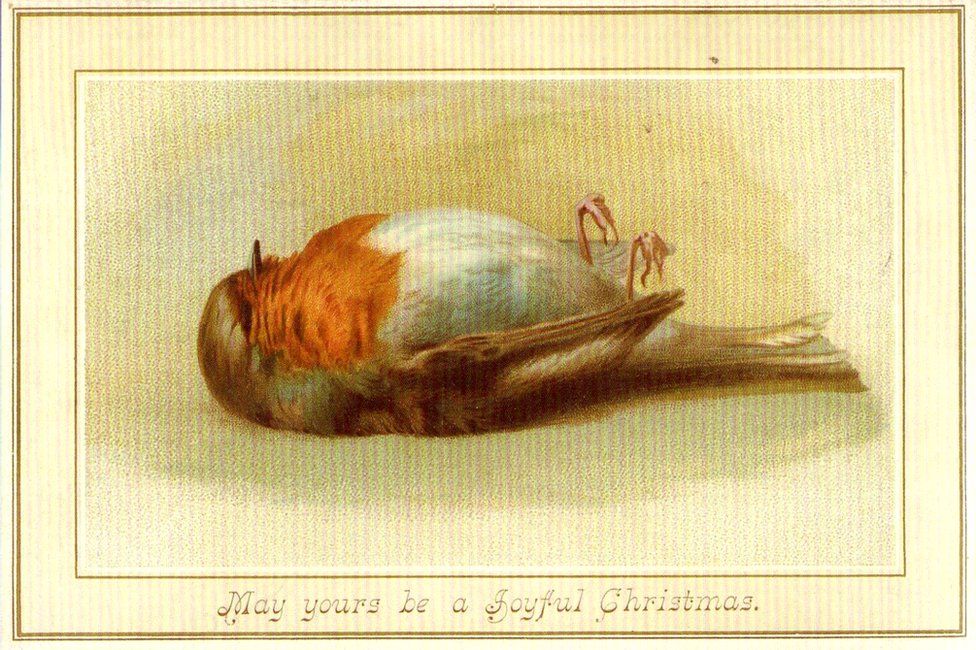
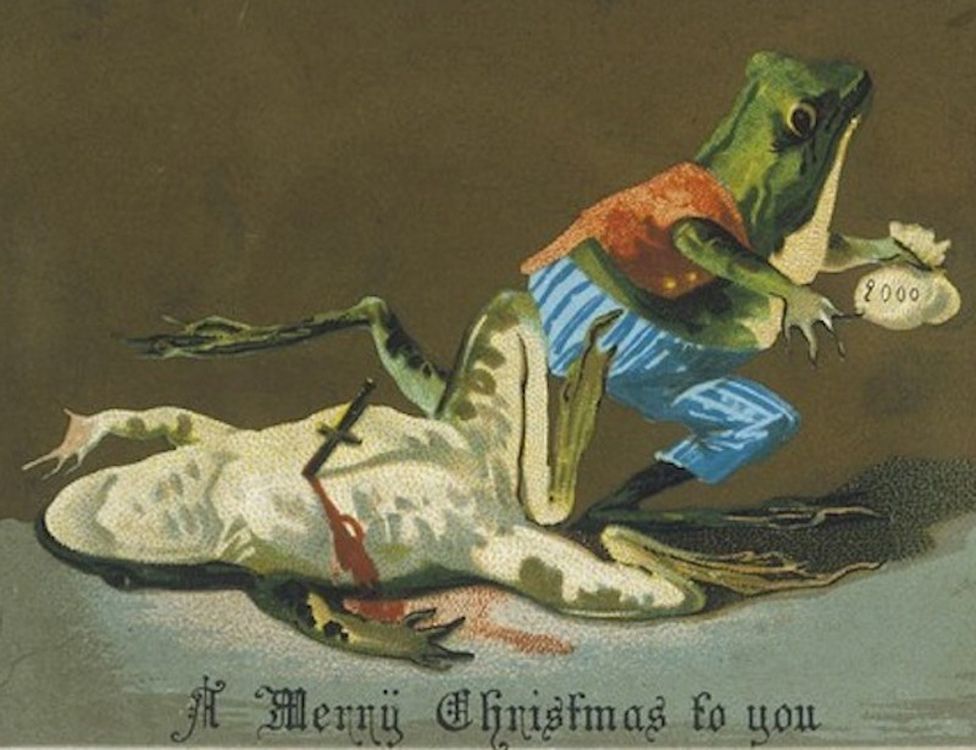
The card at the top of my post comes from the BBC collection. Pretty morbid. Where does the “Joyful Christmas” enter in? One might think this is the kind of card a passive aggressive victim of ornithophobia might send an enemy—but that was not its original design.

The Robin redbreast is a treasured resident of Britain, as this interesting article describes in detail. Just a few years ago, in fact, “it won a BBC Springwatch poll to choose the UK’s national bird.” The author describes their distinctive association with Christmas, although I am positive he did not have the image of this unfortunate creature in mind when he penned these words.

Another reason we connect robins with Christmas is that the early postmen wore red uniforms, and so were nicknamed ‘robins.’ And, as the cards pop through your letter box over the coming days, note how many feature a robin!

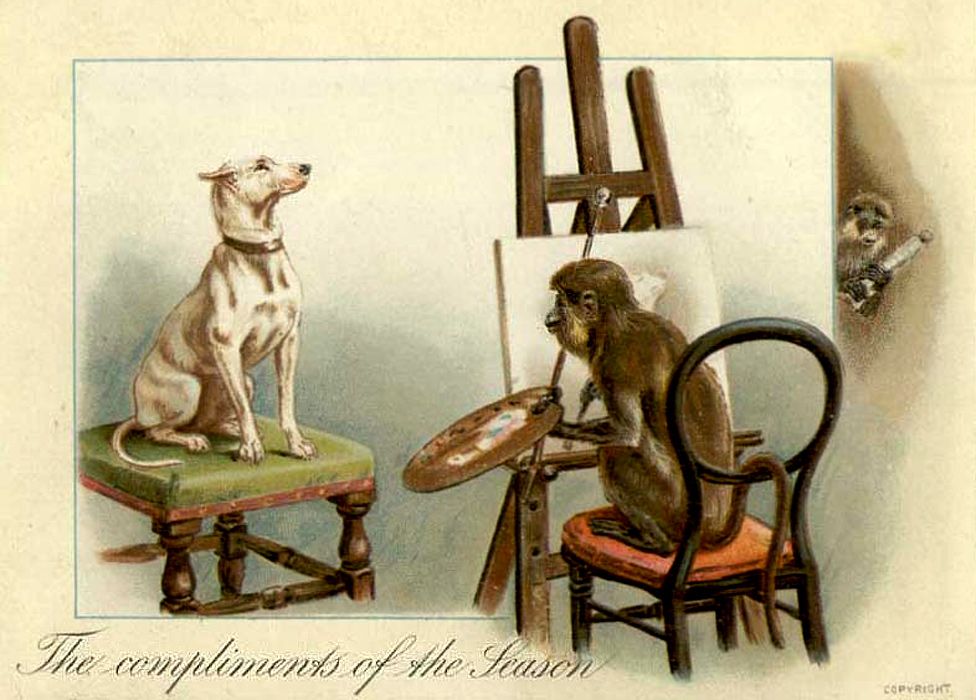
Here’s another peculiar card that has nothing to do with Christmas. At least it simply refers to “the Season,” and doesn’t tarnish the word “Christmas” itself.

Such a modicum of good taste did not deter the creator of the next card from associating robbery and homicide (actually frogicide) with the day celebrating Christ’s birth. One must hope that the grim illustration was originally fashioned for a different context.

C.S. Lewis knew that the British had a problem comprehending Christmas’ meaning. Why, they even twisted things sufficiently to link telling ghost stories to the commemoration of the Nativity.

It may have something to do with a confused relationship between church and state. Nations with “state religions” typically see those religious faiths morph into distortions of their true selves. Thus history is filled with examples of total secularists or hedonists who were the “titular head” of a state church.

Henry VIII set the bar for hypocrisy quite high, with adultery and murder his bywords. C.S. Lewis includes a tribute (of damning sorts) to this despicable ruler in his sequel to The Screwtape Letters, “Screwtape Proposes a Toast.” In the address, fictitiously delivered by the devil Screwtape, the Tempter bemoans the mediocre vices of the humans whose anguish provides the main course.

The scene is in Hell at the annual dinner of the Tempters’ Training College for young Devils. The Principal, Dr Slubgob, has just proposed the health of the guests. Screwtape, who is the guest of honour, rises . . .

Your dreaded Principal has included in a speech full of points something like an apology for the banquet which he has set before us. Well, gentledevils, no one blames him. But it would be vain to deny that the human souls on whose anguish we have been feasting tonight were of pretty poor quality.

Not all the most skilful cookery of our tormentors could make them better than insipid. Oh to get one’s teeth again into a Farinata,* a Henry VIII, or even a Hitler! There was real crackling there; something to crunch; a rage, an egotism, a cruelty only just less robust than our own. It put up a delicious resistance to being devoured. It warmed your innards when you’d got it down.

So much for Henry VIII and the peculiarities of Church and State relations in England. Whatever the origin of this confusion about Christmas, it is quite tragic and disturbing.

So, What is the Proper Focus?

For an entertaining take on the proper focus during Christmas, you might want to check out “Martin Luther Yells about Anglican Christmas Hymns.” (Apologies to those who love English hymns for sentimental reasons.)

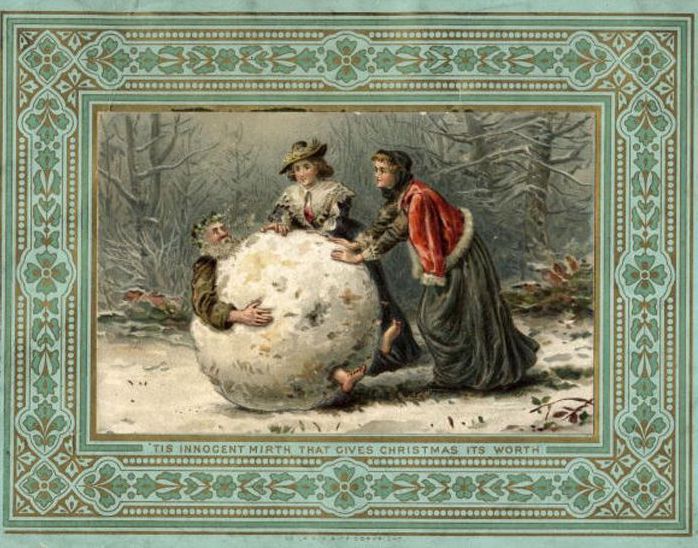
And now, one final Victorian card which serves as a fitting capstone to today’s conversation. ’Tis innocent mirth that gives Christmas its worth. (Or not.)


* Manente degli Uberti (aka Farinata delgi Uberti, 1212-1264) was an Italian heretic mentioned by Dante in Inferno.

On the Nature of Mascots

Brits and Americans share many things. That includes English as a primary language. Well, sort of.

Aside from some people’s inclination to misspell words—such as adding a superfluous letter “u” to words like colour and humour—we agree on most things. Well, add quotation marks to the arena of dissimilarities. Nevertheless, we’re normally able to decipher one another’s literature.

There is another striking difference between the two cultures. Academic institutions in the United States invariably choose an emblematic mascot to represent the school. Meanwhile, in the United Kingdom, such a practice seems a tad juvenile. (But what would a reasonable person expect from a country a mere 254 years old?)

Alas, because of this absence, C.S. Lewis missed out on the questionable pleasure of having a mascot of which to sing its praises. However, his wife Joy was a graduate of two American colleges and could boast of two mascots, accordingly. More about that in a moment.

There does appear to be a single renegade exception to the lack of mascots at Oxford. Regent’s Park College, Oxford, apparently claims Emmanuelle the Tortoise as their own.

Dangerous Mascots

The majority of mascots are animals. The largest group consists of felines, particularly predators like lions, cougars, pumas and tigers. Some are rather less intimidating. My alma mater, the University of Washington, uses “Huskies,” and has a real live pup (pictured above) as its embodiment. I chuckle whenever I think about our rival universities in Oregon, whose schools are represented by the Ducks and the Beavers.

Finn Mirva Lempiäinen cautions Europeans headed to the States for studies to be forewarned about mascots. Her description of this one is particularly disgusting:

In a sea of mascots representing strength and resilience–such as hawks, dogs and panthers–the slow Banana Slug of the University of California Santa Cruz really stands out. This slimy, shell-less yellow mollusc [mollusk] is relevant to Santa Cruz as it lives in the nearby redwood forests.

It also showcases the softer values of the university: that athletics should be for everyone and participating matters more than winning. The Banana Slug has been the school’s official mascot since 1986. 

Okay. Years ago a pastor friend told me about a Texas high school in Kerrville that had an animal “part” as their mascot. They were (and still are) the “Antlers.” Not the Deer, Elk, Moose, or Bighorn Sheep. The antlers. And, pièce de résistance comes in the adaptation of the mascot for female students (since in most species only males bear antlers). They are elegantly referred to as the “Lady Antlers.” Lest you consider this a unique aberration, consider the fact there are other schools that look to antlers for inspiration. And at least one, in appropriately named Elkhorn, Nebraska, that uses the term “Antler Girls.”

Surprisingly, mascots can be quite controversial. In the U.S. a number of historical mascots have recently been ushered into oblivion because of their potential to make people uncomfortable. This has been especially true with mascots identified with Native American peoples. The angriest current debate relates to the National Football (not soccer) team in our nation’s capital: the Washington Redskins. Some Europeans are aware of this development, as reported in The Guardian.

A Menagerie of Mascots

Moving biennially in my military family, I had too many mascots to remember. Being an avid dog lover, I enjoyed the UW choice of huskies. Imagine when I learned our initial mascot was a play on the fact that Seattle is known for its rain and long, overcast winters. The university’s first football game (akin to modern rugby) was played in 1889. Before 1922, the nickname for the team was the Sundodgers.

That’s not a typo. And the name has been resurrected for Seattle’s collegiate USA Ultimate (aka Ultimate Frisbee) team. The University of Washington Sundodgers go the extra mile. Their motto is “We hate the sun.”

Mascots and C.S. Lewis

The fact that Lewis’ life was personally devoid of mascots hasn’t deterred (American) schools inspired by him from adopting their own. Oregon’s C.S. Lewis Academy athletes are called the Watchmen.

A Christian school in Georgia chose Lions, in homage to the Lion of Judah and Narnia’s Aslan. Southwestern Baptist Seminary has its own college and they not only chose a Lion, but “named” that mascot “Lewis.”

“The lion was chosen [as our mascot] because of some factors that make [Scarborough College] unique: our Great Books classical education and our emphases on apologetics and biblical studies,” says Michael Wilkinson, dean of Scarborough College. “These three things combined make C.S. Lewis the quintessential representative for our program. Thus, Aslan, his most well-known character, proved to be the model for the mascot.”

Mascots in the Life of Joy Davidman Lewis

Joy attended two colleges, Hunter College CUNY with the Hunter Hawks and Columbia University with its Lions. I doubt she took much notice.

There was, though, a fascinating point where Joy’s life intersected with an internationally recognized cinematic mascot—the MGM Lion! The following story comes from Joy: Poet, Seeker, and the Woman Who Captivated C. S. Lewis. This excellent biography included an extended section on the six months Joy spent in Hollywood, hoping to insinuate some Communist perspectives into a medium for which she had little regard.

She regarded the other script writers with disdain, and won no friends before she was released in December of 1939.

Joy made sure the other junior writers knew she was too accomplished to be accounted an equal. She had solid grounds for bragging, too. On July 5 the esteemed New Republic published her poem “Jews of No Man’s Land.” Joy didn’t hesitate to spread the word . . . At the same time, she was being condescended to by MGM’s hack staff writers. She resented being treated as anything less than a recognized talent.

“I gloated over my writer-colleagues,” she told Jim Still after her novel sold, “none of whom were capable of producing more than a ten-page screen story.” This attitude did not endear Joy to the other junior writers. Walter Doniger, a twenty-one-year-old from Duke who would go on to become a successful director and producer, remembered her as loud, unattractive, unlikable, and “bossy bossy bossy,” he said.

Her stint at MGM was not all bad.

One of the saving graces of her stint at MGM was Leo Jr., a cuddly lion cub cast as the mascot for the short subjects department. At a studio party, for the amusement of all, their leading writer, Robert Benchley, fed Leo from a bottle. The little show wasn’t entirely successful. The bottle’s nipple slid off, spilling milk on Benchley’s pants, and the chin strap on Leo’s crown slipped into his mouth. There was much squealing from the spectators, but Joy took the cub into a corner and soothed it to sleep. They developed a friendship.

Joy liked hiking in the California hills, which she considered beautiful despite being “disfigured with film stars’ Tudor mansions and French chateaux.” Still, returning to New York, she carried fond memories of her relationship with a real, live, mascot and star in his own right.

“A lion is like a steel spring when you feel him,” she said, “but he acts like a dog. When Leo became affectionate, I’d bat him down, and then look for damage. Invariably there would be another run in my stockings.”

As pets do, Leo became a blank slate for Joy’s projections. He didn’t like the starlets, she determined. They wore too much perfume and smelled awful. He was playful, almost like a neglected child starved for attention. “The nicest person I met [in Hollywood] was Leo the Lion,” Joy later said.

C.S. Lewis and Rabbits

C.S. Lewis loved rabbits. His affection for the cuddly rodents went all the way back to his childhood. And it continued through the whole of his life. In fact, you can read about “C.S. Lewis as an Advocate for Animals” at a Humane Society link below.*

Despite this affection, rabbits do not feature prominently in The Chronicles of Narnia. They are among the “statues” turned to stone by the Witch. In the description of Aslan breathing life back into them, it says, “then [Aslan] pounced on a tall stone dryad which stood beyond the dwarf, turned rapidly aside to deal with a stone rabbit on his right, and rushed on to two centaurs” (The Lion, the Witch and the Wardrobe).

Rabbits helped spread the word about an impending attack on Archenland in The Horse and His Boy. Shasta urges the animals to spread the word.

“Oughtn’t your High King to be told?”

“Certain sure, something ought to be done about it,” said the Hedgehog. “But you see I’m just on my way to bed for a good day’s sleep. Hullo, neighbor!”

The last words were addressed to an immense biscuit-colored rabbit whose head had just popped up from somewhere beside the path. The Hedgehog immediately told the Rabbit what it had just learned from Shasta.

The Rabbit agreed that this was very remarkable news and that somebody ought to tell someone about it with a view to doing something. And so it went on. Every few minutes they were joined by other creatures, some from the branches overhead and some from little underground houses at their feet, till the party consisted of five rabbits, a squirrel, two magpies, a goat-foot faun, and a mouse, who all talked at the same time and all agreed with the Hedgehog.

For the truth was that in that golden age when the Witch and the Winter had gone and Peter the High King ruled at Cair Paravel, the smaller woodland people of Narnia were so safe and happy that they were getting a little careless.

In The Last Battle we see a clear contrast between the types of animals which populate Narnia. Tirian, the last king of Narnia, is leading the children toward their destiny.

First, he had given Jill some practice in archery and found that, though not up to Narnian standards, she was really not too bad.

Indeed she had succeeded in shooting a rabbit (not a Talking rabbit, of course: there are lots of the ordinary kind about in Western Narnia) and it was already skinned, cleaned, and hanging up.

Back to the Beginning

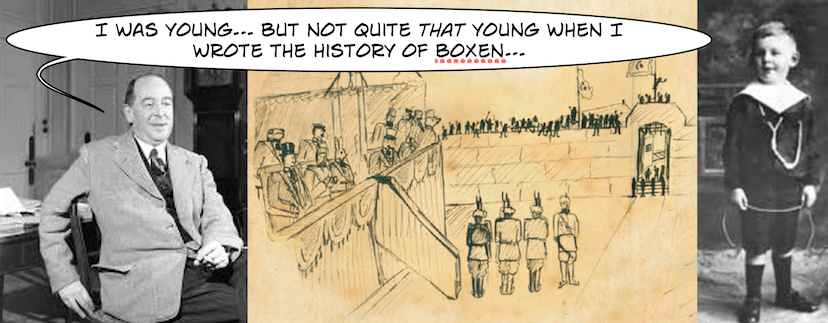
When he was a child, beginning at age eight, Lewis began writing stories about “Animal Land.” His brother Warnie, several years older, joined him in composing stories inspired in part by their reading of the words of Beatrix Potter.

Animal Land is clearly the product of young children—children with wonderful imaginations—but children nonetheless. These various works have been published by Lewis’ stepson in a collection called Boxen. As Douglas Gresham writes, “In developing the world of Boxen, Jack appropriated the ‘dressed animals’ of Beatrix Potter and that part of their fictional world they called ‘Animal-Land,’ while Warnie (whose interests were always a touch more prosaic than Jack’s) made his half ‘India.’”

The world was thoroughly thought out, complete with maps and a historic chronology.

Animal-land is divided into 13 provinces. Bear-land, Wolf-land, Squirrel-land, Mouse-land, Rabbit-land, Pig-land, Bird-land, Horse-land, Fox-land, Land of Typical Animals, Insect-land, Rat-land, With the island of Piscia, or Fishland. . . . Rabbit-land is the first provence in learning and art.

Rabbits feature prominently in Boxen. The very first element is a script, entitled “The King’s Ring (A Comedy).” The introduction is delightfully childlike: “Interesting carictars. Famous ones. For instance, Sir Big, a world-famed gentleman. A very good choreus and nice scenry. (Slight comic tints in and out threw it.)”

The two protagonists are King Bunny, whose ring is stolen, and Sir Peter Mouse, his “knight in waiting” who aids him in finding it. It is filled with silly dialog, despite the serious plot. For example:

KING BUNNY: Tell Sir Goose to tell Sir Big to tell Mr Gold Fish to tell Gollywog to tell Mr Icthus-oress to tell Dorimie to tell the sailors to take Hit [the villain] away.

In his autobiography, Lewis wrote of his childhood home. “Here my first stories were written, and illustrated, with enormous satisfaction. They were an attempt to combine my two chief literary pleasures—‘dressed animals’ and ‘knights-in-armour.’

Drawing Pleasure from Real Life Rabbits

Lewis’ correspondence includes passing references to rabbits, always expressed in an approving way. For instance, in 1947 he mentions enjoying a memorable event during a boring time. “I wonder how you are all getting on? Nothing much has happened to me except that I saw a rabbit yawn. I suppose people who keep tame ones have seen it often but this was a wild rabbit and I thought it a very curious sight. It was a very bored triangular yawn in the middle of a long hot afternoon.”

During WWII, he penned a curious comment about rabbits recently added to his home.

We are keeping rabbits at the Kilns now, in addition to the hens! But they are very much nicer. As I passed the enclosure in which all the young ones are the other evening, I saw they had all got into a box which happened to be lying there.

They were all standing (or sitting) up on their hind legs and all facing in the same direction: so that they looked exactly as if they were conducting some kind of evening service—the box looked just like a pew.

While the rabbits were almost certainly present to supplement food rations during the war, they were not treated as commodities. Lewis appreciated them in the way he respected other creatures designed by God’s hand. Thus, he had what my wife and I would consider to be a well-rounded family—including one or more members of the non-human variety.

Lewis described this diverse household in a 1943 letter to June Flewett,⁑ one of the children evacuated to his home during the war.

Bruce [Lewis’ dog] behaved with great lack of fortitude during the thunderstorm last night and two of the rabbits made it an excuse for absenting themselves without leave. Pushkin [his cat] behaved better, but not well. In fact there is a general lack of keenness and discipline among the four-footed members of the household which I deplore.

One more story about an actual rabbit with which the great author developed an ongoing relationship.

In a 1942 letter to Sister Penelope CSMV, he says, “I am establishing quite a friendship with one of the rabbits which we now keep along with the deer in Magdalen grove. It was done by the discovery that he relishes chestnut leaves which grow too high for his reach. He doesn’t yet allow me any familiarities but he comes and eats from my hand.”

Lewis continues to describe his new friend, and adds a keen theological observation. “But oh!, the great lollipop eyes and the twitching velvet nose! How does [God] come to create both this and the scorpion?”

Later that same year, Lewis updates the Anglican nun on the status of his animal-friend.

The Rabbit and I have quarrelled. I don’t know why, unless I gave him something that disagreed with him. At any rate, he has cut me dead several times lately—so fair and so fickle! Life is full of disappointments.”

At that time he shared his disappointment with his lifelong friend, Arthur Greeves. “Did I tell you in my last letter that I’d struck up quite an acquaintance (almost a friendship) with a rabbit in Magdalen Grove who used to come and eat leaves from my hand? Alas, I must have given something that disagreed with him, for he disappeared for about 10 days, and since his reappearance has refused to look at me.”

It may be that same rabbit, or one of its kin, renewed its relationship with Lewis, because he referred to a similar experience in two 1944 letters to other children.

I live in a College here: a college is something rather like a castle and also like a church. It stands just beside a bridge  over a river. At the back of the part I live in there is a nice grove of Trees. There are a lot of Rabbits there. One very old rabbit is so tame that it will run after me and take things out of my hand. I call her Baroness Bisket because she is a kind of biscuit colour.

It’s not easy, nor is it usually relevant, to determine a bunny’s gender. So, Lewis may be excused for writing the following to the second young correspondent, six months earlier.

I am getting to be quite friends with an old Rabbit who lives in the Wood at Magdalen. I pick leaves off the trees for him because he can’t reach up to the branches and he eats them out of my hand. One day he stood up on his hind legs and put his front paws against me, he was so greedy. I wrote this about it:

A funny old man had a habit
Of giving a leaf to a rabbit.
At first it was shy
But then, by and by,
It got rude and would stand up to grab it.

But it’s a very nice Rabbit all the same: I call him ‘Baron Biscuit.’

Like C.S. Lewis, I adore rabbits. Years ago we had an indoor bunny, appropriately named “Sweetheart.” In her youth she acted like the cartoon character Ricochet Rabbit, pinging from place to place. In her senior years she settled down and was contented to be a cuddly lap bunny. I add my own “thank you” to Lewis’ for these precious parts of God’s creation.


* The Humane Society pdf is available here.

⁑ June Flewett is regarded as the inspiration for Lucy Pevensie in the Chronicles, and grew up to become an actress and theater director. C.S. Lewis paid for her tuition at the Royal Academy of Dramatic Art. When she and her two sisters were sent from London to the Kilns, her favorite author was C.S. Lewis. Ironically, it was a while before she learned that he and their host were one and the same.

The Most Vulnerable Astronauts

Before human beings ventured into space, the possibility of surviving in this alien realm was tested by sending animals as their surrogates. Fruit flies blazed the trail, as passengers on a V-2 launch in 1947.

In our previous cosmic conversation, we considered space debris cemeteries. Today we will consider space exploration’s cost in lives, as it was driven by the space race.

Two years after the fruit flies passed beyond Earth’s atmosphere, Albert II, a rhesus monkey became the first primate to survive space, only to have his parachute fail upon reentry. His predecessor, Albert I, had failed to reach space when his rocket failed before reaching the 50-mile boundary which marks the space threshold.* Monkeys were probably not great fans of the early space race, since about two-thirds of their space veterans failed to survive the experience.

Presumably for emotional distance, animals were frequently given impersonal names. For example, the first monkeys to survive a spaceflight (in 1959) were Able and Baker.** Out of deference to their gender, their full names were Miss Able and Miss Baker. They were accompanied on their flight by onions, yeast, and sea urchin eggs.

Miss Baker was an exception to the rule of increased mortality for astronauts. She lived until 1984 and her tombstone at the United States Space and Rocket Center is often adorned with memorial bananas.

Human astronauts and cosmonauts competed among their peers for space flights. The animals who journeyed there, did not. Animals in Space: From Research Rockets to the Space Shuttle journals their stories. The volume does not shy away from the costs of the experiments, but it focuses on the rewards. The story of Ham, the first chimpanzee to return from space is told in a detailed and entertaining manner.

A little wobbly in the legs and slightly dehydrated, Ham was otherwise in excellent physical condition . . . The next day he was flown back to Cape Canaveral where hordes of reporters and photographers were eagerly waiting . . . for a glimpse of America’s newest space hero. Ham was quick to show his displeasure at this noisy, unwanted intrusion . . .

The handlers tried to get the reluctant chimp to pose next to a Mercury training capsule but he rebelled; he didn’t want to go anywhere near the darned thing. . . .

Ham later trained for a second mission, but it seems he’d had his taste of glory and showed very little enthusiasm for another ride on a rocket. Another chimp would make the flight.

Ham retired and died in 1983, in the company of two female chimps half his age. But other animals, including monkeys perished in accidents in the United States and the Soviet Union. Some were euthanized prior to takeoff. It is a complex story, and painful for a lover of animals to hear.

The Sad Story of Laika (Лайка)

One of the first animals to fly in space was a small dog who perished on Sputnik 2, in 1957. Laika is celebrated as a hero and a memorial with her likeness was erected near the research facility in which she was trained. In Moscow, the Monument to the Conquerors of Space also bears her image.

Sadly, Laika carried a one way ticket aboard Sputnik. There was no provision made for her survival. It is unfortunate enough that her body incinerated along with the spacecraft upon reentry, but her actual death was perhaps even more horrific. The Soviet government falsely reported that she was euthanized prior to the depletion of the oxygen. In fact, the temperature aboard the spacecraft rose to unsurvivable rates and little Laika was . . . well, it was certainly terrifying for the trusting dog strapped into tight restraints.

Laika had been a stray roaming Moscow. The Soviets felt that homeless dogs possessed stronger constitutions than those cared for by families. This website describes “10 Tragic Facts about Laika.”

The day before the launch, Dr. Vladimir Yazdovsky brought Laika home. For the last four weeks, he had been closer to her than anyone. He had led the team that picked Laika. After [life on]the streets, he’d trained her, and he’d personally chosen her to go into space.

Dr. Yazdovsky brought her home so that his children could play with her. For one last moment before her last day on Earth, he let her experience life as a domesticated dog with a loving family. “I wanted to do something nice for her,” Dr. Yazdovsky said. “She had so little time left to live.”

As if Laika’s final hours were not poignant enough, the pitiable canine was restrained in her space coffin for three days before Sputnik 2 was able to launch. For seventy-two relentless hours she was trapped in the spacecraft as they made repairs to conclude the launch protocols. One can only imagine what fear and confusion she suffered as she waited for her human friends to remove her from the duress.

Although it would be years before the full details of Laika’s pain would be revealed, there were many animal lovers who recognized the barbarity of the event from day one. C.S. Lewis was a man who loved dogs. And not only dogs, Lewis was opposed to all cruelty to animals.

Several months after Laika’s death, Lewis referred to her passing in a letter to a friend. His comment is offered sardonically, but it reveals his genuine compassion for the innocent victim of humanity’s actions.

I shall be glad when people begin talking about other things than Sputniks, won’t you? One gets quite sick of the whole subject. The pity is that some cosmic rays didn’t produce a mutation in the dog which would have made it super-rational: then it might have found its way back alive and started taking revenge on the humans!⁂

When I witness tragedy in terms of the suffering of people and sentient animals, I grieve. At those times I seek comfort in God’s promise of the redemption not only of humanity, but also of nature.

For I consider that the sufferings of this present time are not worth comparing with the glory that is to be revealed to us. For the creation waits with eager longing for the revealing of the sons of God. For the creation was subjected to futility, not willingly, but because of him who subjected it, in hope that the creation itself will be set free from its bondage to corruption and obtain the freedom of the glory of the children of God.

For we know that the whole creation has been groaning together in the pains of childbirth until now. And not only the creation, but we ourselves, who have the first fruits of the Spirit, groan inwardly as we wait eagerly for adoption as sons, the redemption of our bodies. (Romans 8:18-25)

I’ve discussed in the past whether animals will be welcomed into heaven. I am not alone in pondering this subject. Likewise, I suspect I am not alone in hoping that innocent Laika will join us where the tears are wiped away from all of our eyes.


* The United States boundary for space is 50 miles, while the international threshold is the Kármán Line, established at 100 kilometers.

** Able was a resus macaque and Baker was a squirrel monkey. Able did not survive the postflight medical procedures.

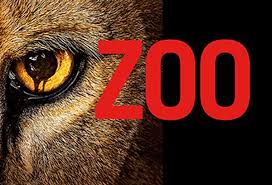
⁂ This revenge of the animal kingdom against humankind is the premise of a television series entitled “Zoo,” which aired 2015-17. For those who find the notion provocative, be forewarned. The series does not live up to its potential.