C.S. Lewis & the Colors of Heaven

What wonders await the color blind in Heaven! That thought recently occurred to me out of the proverbial blue. 

I was sitting on my patio, tossing a ball to my border collie, when she decided to explore some of the local forest scents, as she is wont to do. As I normally do, I used that peaceful, shalom moment, to pray.

I don’t recall whether I closed my eyes, or gazed at the brilliantly white clouds dancing above me. In either case, my mind and spirit were focused on prayer. Prayer for those I love, and for strangers I have never met.

What wonders await the color blind in the presence of God. Too profound for me to take credit for thinking, but perhaps one of those serendipitous epiphanies God offers unexpectedly to his children.

In The Great Divorce, C.S. Lewis describes an excursion to the foothills of Heaven. The sheer reality of Heaven exceeds fallen humanity’s ability to comprehend it.

Before me green slopes made a wide amphitheatre, enclosing a frothy and pulsating lake into which, over many-coloured rocks, a waterfall was pouring.

Here once again I realised that something had happened to my senses so that they were now receiving impressions which would normally exceed their capacity. On Earth, such a waterfall could not have been perceived at all as a whole; it was too big. Its sound would have been a terror in the woods for twenty miles. Here, after the first shock, my sensibility ‘took’ both as a well-built ship takes a huge wave. I exulted. . . .

Near the place where the fall plunged into the lake there grew a tree. Wet with the spray, half-veiled in foam-bows, flashing with the bright, innumerable birds that flew among its branches, it rose in many shapes of billowy foliage, huge as a fen-land cloud. From every point apples of gold gleamed through the leaves.

When the Narnians sail to the “edge of the world,” they are greeted by a wonder that hints at the beauty of Heaven beyond. Barring their way into that place it rose “between them and the sky, a greenish-gray, trembling, shimmering wall.”

Then up came the sun, and at its first rising they say it through the wall and it turned into wonderful rainbow colors. Then they knew that the wall was really a long, tall wave – a wave endlessly fixed in one place . . . (Voyage of the Dawn Treader).

At the end of the Chronicles of Narnia, C.S. Lewis ushers his heroes into Heaven. They too experience the overwhelming awe inspired by their divine surroundings. 

It is as hard to explain how this sunlit land was different from the old Narnia as it would be to tell you how the fruits of that country taste. Perhaps you will get some idea of it if you think like this. You may have been in a room in which there was a window that looked out on a lovely bay of the sea or a green valley that wound away among mountains.

And in the wall of that room opposite to the window there may have been a looking-glass. And as you turned away from the window you suddenly caught sight of that sea or that valley, all over again, in the looking-glass. And the sea in the mirror, or the valley in the mirror, were in one sense just the same as the real ones: yet at the same time they were somehow different – deeper, more wonderful, more like places in a story: in a story you have never heard but very much want to know.

The difference between the old Narnia and the new Narnia was like that. The new one was a deeper country: every rock and flower and blade of grass looked as if it meant more. I can’t describe it any better than that: if you ever get there you will know what I mean (The Last Battle).

I find Lewis’ fictional visions of Heaven inspiring in their self-confessed inadequacies. Heaven, no doubt, is profoundly more glorious than any human being can imagine.

The Bible employs brilliant colors to help describe Heaven’s beauty. In John’s vision of Heaven we find these descriptions:

And he who sat [upon the throne] had the appearance of jasper and carnelian, and around the throne was a rainbow that had the appearance of an emerald. Around the throne were twenty-four thrones, and seated on the thrones were twenty-four elders, clothed in white garments, with golden crowns on their heads.

From the throne came flashes of lightning, and rumblings and peals of thunder . . . and before the throne there was as it were a sea of glass, like crystal (Revelation 4).

[An angel] showed me the holy city Jerusalem coming down out of Heaven from God, having the glory of God, its radiance like a most rare jewel, like a jasper, clear as crystal. . . .

The wall was built of jasper, while the city was pure gold, like clear glass. The foundations of the wall of the city were adorned with every kind of jewel. The first was jasper, the second sapphire, the third agate, the fourth emerald, the fifth onyx, the sixth carnelian, the seventh chrysolite, the eighth beryl, the ninth topaz, the tenth chrysoprase, the eleventh jacinth, the twelfth amethyst. And the twelve gates were twelve pearls, each of the gates made of a single pearl, and the street of the city was pure gold, like transparent glass (Revelation 21).

The Power of Color

Colors are not merely aesthetic. Their influence on human perception has been studied for many years. One key researcher, Faber Birren (1900-88), served as a respected consultant on the subject for numerous businesses and even the United States government itself. 

Shades of Meaning” relates that “in 1939, Walt Disney invited Birren to work as a color consultant. He ended up advising Disney animators on the design of BambiFantasia, and Pinocchio.” 

In Color Psychology and Color Therapy, Birren begins his discussion of the subject with the proposal that “it is perhaps a mistaken notion that man in his love of color was impelled by some aesthetic urge.” He contends that:

The greatest weight of evidence points to the fact that color was involved with the supernatural and therefore had significance that went beyond what might be thought of as mere sensuous delight. . . .

Color, being a manifestation of light, held divine meaning. Historical records of color show little interest in the physical nature of color, nor yet in its abstract beauty, but in a symbolism that attempted to resolve the strange workings of creation and give it personal and human meaning.

If this spiritual aspect of color is actual, then being colorblind carries a liability beyond simply missing out on one of life’s simple pleasures.

Color Blindness Among Humanity

You may not know anyone who is color blind. That’s not surprising, since it isn’t a common subject of conversation. Nevertheless, in the general population, approximately eight percent – or 1 in 12 – men suffer from some form of it. Meanwhile, the rate of this condition, which is most frequently genetic, for women is far lower. Only about one in two hundred.

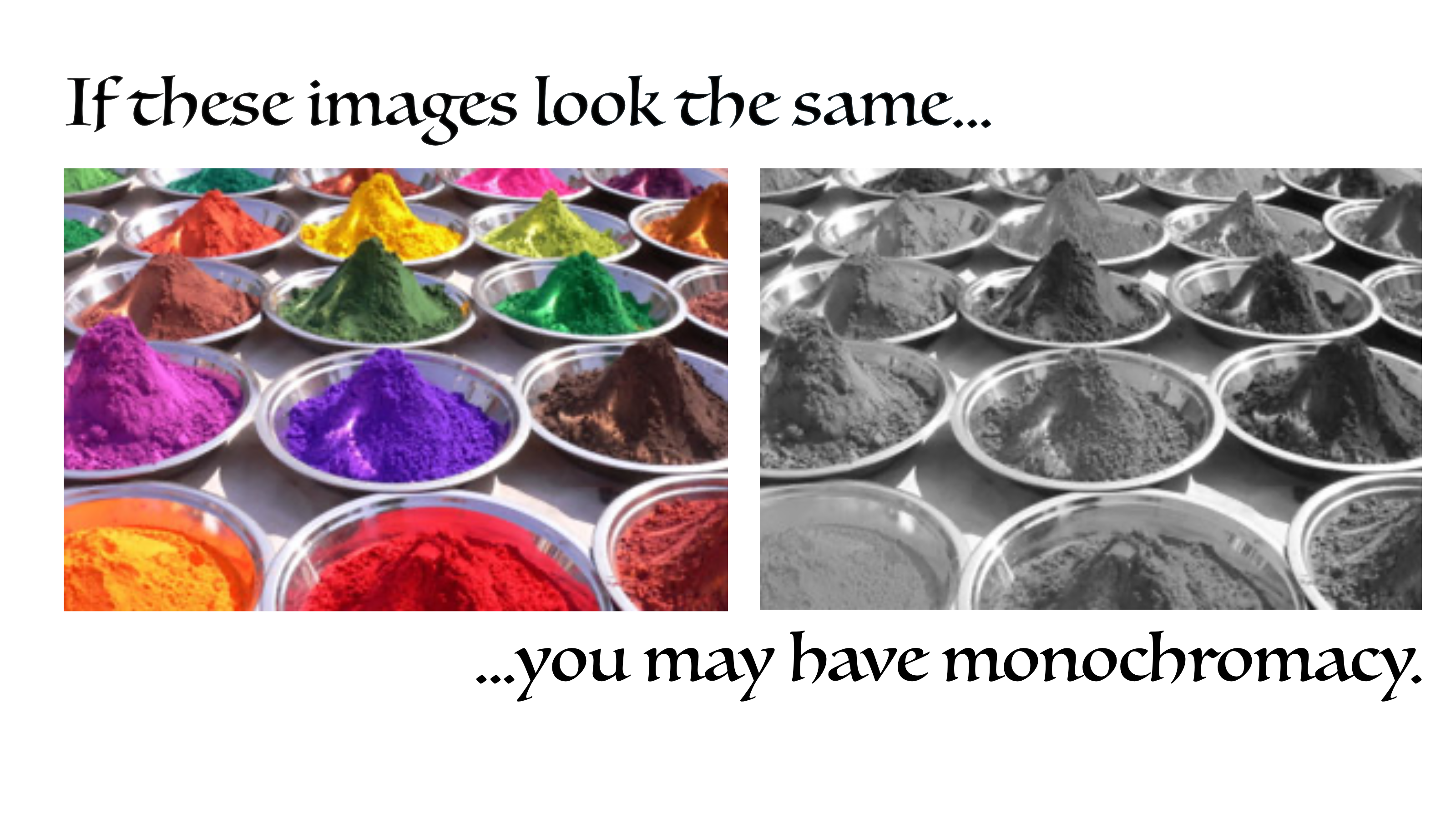
There are several varieties of color vision deficiency, with most people able to perceive some shades of certain colors. The most severe form of the problem involves a failure to see any colors. Only shades of gray distinguish between different hues. It’s called achromatopsia, and is quite rare. 

Achromatopsia is a congenital hereditary condition found in only one birth in every 33,000 to 50,000 births.  Thus less than 10,000 Americans may have achromatopsia. There are two basic forms . . . Rod Monochromatism, . . . is the most common [and] routinely occurs in both men and women. . . .

Blue Cone Monochromatism has an incidence of 1 in 50,000-100,000 births in males and could be as rare as 1 in 10 billion in females.

If you are curious about achromatopsia, you should definitely read about research on a Micronesian Island where ten percent of the people share this affliction.

Many individuals first learned of achromatopsia in 1997, when Oliver Sacks published his classic book, Island of the Color Blind.  This story beautifully chronicles Oliver Sack’s 1994 quest with Knut Nordby and Bob Wasserman to the isolated atoll of Pingelap in Micronesia, where 10% of the population have rod monochromatism. A video of the journey is available here.

Possible Visions of Heaven

Although I am quite wary of so-called near death experiences (with some being spurious, and others, spiritual deception), it is intriguing how color has entered into a number of the stories. The following examples appear in the accounts of several different individuals in Imagine Heaven: Near-Death Experiences, God’s Promises, and the Exhilarating Future that Awaits You.

The entire city was bathed in light, an opaque whiteness in which the light was intense but diffused. In that dazzling light every color imaginable seemed to exist and – what’s the right word? – played. The colors seemed to be alive, dancing in the air. I had never seen so many different colors. It was breathtaking.

Below me lay the purest, most perfect grass, precisely the right length and not a blade that was bent or even out of place. It was the most vibrant green I had ever seen. If a color can be said to be alive, the green I saw was alive, slightly transparent and emitting light and life from within each blade. The iridescent grass stretched endlessly over gently rolling hills upon which were sprinkled the most colorful wild flowers, lifting their soft-petaled beauty skyward, almost as if they were a chorus of flowers caught up in their own way of praising God.

The most gorgeous sky ever seen here on earth cannot even come close to the atmosphere in Heaven.  It is bright because of the glory of our God. . . .  The atmosphere is something you experience, not just see.  It is golden, yellow, white, and had more colors moving throughout it . . . like the Aurora Borealis lights.

The sky [and] the firmament surrounding the heavens, were a wilder and bluer yonder than you would ever believe. . . . The closest shade I can associate this otherworldly blue with is the surreal tones of the water in the Caribbean or off the coast of Hawaii at sunset. . . . That color is waiting for you and me on the other side.

The colors and lights in Heaven were simply sublime. . . . They were the deepest, richest, most gloriously lush colors I had ever seen, and some I had never seen before. Heaven is a dream-come-true for those who love all things colorful, and our home there is lit by the Father of Lights. . . . [There were] robust and bold and vigorous beams that were somehow gentle to my eyes. I simply don’t think those colors and lights exist on earth.

I saw the most dazzling colors, which was all the more surprising because I’m color-blind. I can distinguish the primary colors, but pastels all look the same to me. But suddenly I could see them, all kinds of different shades. Don’t ask me to name them because I lack the necessary experience for that.

Take a Moment to Test Your Own Color Vision

There are a number of simple, free vision tests available online. If you want to assure yourself that you can see all of the normal colors – though not necessarily all of the heavenly colors awaiting us – check out one of the following.

Color Blind Test

EnChroma Color Blind Test

X-Rite Color Challenge and Hue Test

Colorlite Collection of Tests

Final Thoughts

When I described the wonders awaiting the color blind in Heaven, I was referring to all of us. (In this life, as the Scriptures say, “For now we see in a mirror dimly . . .” (1 Corinthians 13).

All who trust in the love of Jesus Christ, and thereby enter Heaven’s environs by the unmerited grace of God’s mercy, will be overwhelmed by its beauty and wonder.

The million or more colors a person with full vision can now see, will be eclipsed by the infinite tapestry of hues in our Creator’s mind. Even those with the scientifically-presumed capability to currently perceive distinctions between up to 100 million will surely be in awe.

C.S. Lewis closes our discussion of Heaven’s colors with a fascinating thought related to the angels who worship God in that divine place. Lewis begins by noting a significant distinction between God’s angels and humanity.

But for our body one whole realm of God’s glory – all that we receive through the senses-would go unpraised. For the beasts can’t appreciate it and the angels are, I suppose, pure intelligences.

They understand colors and tastes better than our greatest scientists; but have they retinas or palates? 

I fancy the “beauties of nature” are a secret God has shared with us alone. That may be one of the reasons why we were made-and why the resurrection of the body is an important doctrine (Letters to Malcolm: Chiefly on Prayer).

Errors that Seem to be True (Angels)

Many people have been taught so little about biblical Truth that they believe many errors. For example, many people (and no offense intended if you are among them) mistakenly believe that when people die, they become angels.

That connection is so blatantly contrary to the fact that angels who “see the face [of God] who is in heaven” are completely different creations than the Sons of Adam and Daughters of Eve who are actually human beings, created in the image of God.

In his preface to The Screwtape Letters, C.S. Lewis alludes to how this confusion is reinforced by humanity’s lack of familiarity with angels in their true or natural (for them) form. While there are clear examples in the Bible where God has his angels appear in the likeness of human beings (e,g. before Sodom’s judgment and at the empty tomb), there are also times when their celestial radiance is not disguised (i.e. when the shepherds are informed about birth of the Savior or in John’s visions as recorded in the Book of Revelation).

[Angels] are given human form because man is the only rational creature we know. Creatures higher in the natural order than ourselves, either incorporeal or animating bodies of a sort we cannot experience, must be represented symbolically if they are to be represented at all (Screwtape Letters).

Nevertheless, this myth permeates the thinking of our secular culture. Once, some years past, a pastor friend was relating to me that one of his distant relatives had recently died. He said it comforted him to know that she was now an angel. I started to chuckle in response to his humorous way of lightening his own mood, until I realized he wasn’t joking. This poor, genuinely compassionate minister had been tricked by the spirit of this world into buying into a lie.

C.S. Lewis famously said that anything worth reading once is worth reading again. I’m clearing out some magazines from several years ago, and rereading insightful articles as I go. In a short piece about a complex subject, “What Happens to the Dead?” Ryan Pemberton makes a troubling comment.

Pop culture has done more to shape modern views about death than biblical teaching has.

The brevity of the article prevents the author from exploring other subjects, but his observation is applicable to a wide array of concerns.

I’m confident I could state, without fear of contradiction, that contemporary culture has done more to shape modern views about marriage than biblical teaching has. And, adding only a few additional examples, more about . . . justice . . . demons . . . love . . . mental health . . . responsibility . . . heaven . . . labor . . . creation . . . and Jesus himself.

It’s Not All Bad

It should be admitted that not all contemporary insights have been 100% misguided. One area where modern sensibilities have restored balance to truthful thinking is in the area of care for the environment. Ignoring extreme notions about nature being more important than human life, we can applaud the work of Christian environmentalists who have helped restore a biblical (i.e. true) view of the world around us.

Reacting to twisted notions that humanity’s “dominion” over the earth allows for nature’s misuse and abuse, these men and women helped open our eyes to the fact that God calls us to be trustworthy stewards in our care of, and appreciation for, this amazing world he has made.

The Inklings, C.S. Lewis and J.R.R. Tolkien, in particular, possessed a profound love for nature. Their general antipathy to the ugly and polluting trappings of industrialization are grounded in their belief that the world God created was truly “good.” With that came the recognition that man does little to enhance, and much to undermine, that initial goodness.

When two ideas clash, go with the one that is correct. And, when one of those authorities is the Word of the Creator of all that exists, well, isn’t it obvious which is the right choice?

Angels & People

For more on the angelic subject with which we began, check out the provocatively titled “People Aren’t Downgraded to Angels When They Die.” As the author there so rightly explains,

When Christians die, heaven does not “get another angel.” We cannot become angels any more than we can become giraffes or ocean waves or stars. We are people and will remain so after this present life. God did not make a mistake when he made us human.

The Church at War

Why would Christian Scriptures commend people for waging war? War, after all, is nearly universally condemned – even as it remains a relentless curse in various corners of our world.

One young pastor was “charged” with a duty that belongs, by biblical extension, to all believers. “This charge I entrust to you [that] you may wage the good warfare, holding faith and a good conscience” (1 Timothy 1).

The reason followers of Jesus are encouraged to actively train for and engage in war is because our enemies are not other human beings. We discussed this fact in our last conversation, as we considered the theological concept of the Church Militant.

To call the Body of Christ “militant” is misleading to those who don’t understand spiritual warfare, the fact that “we do not wrestle against flesh and blood, but against . . . the cosmic powers over this present darkness . . .” (Ephesians 6).

Unfortunately, because all of us are imperfect (i.e. fallen), Christians can sometimes fail to distinguish between our true enemies and those who witlessly follow their banner. For an excellent discussion of this, from a Roman Catholic perspective, I recommend you read “The Church Militant or the Church Belligerent?

Another worthwhile read is “G.K. Chesterton and the March of the Church Militant.” There, Joseph Pearce shares Chesterton’s vivid description about how Gothic cathedrals visualize the martial aspect of the Christian Church.

The truth about Gothic [architecture] is, first, that it is alive, and second, that it is on the march. It is the Church Militant; it is the only fighting architecture.

All its spires are spears at rest; and all its stones are stones asleep in a catapult. In that instant of illusion, I could hear the arches clash like swords as they crossed each other. The might and numberless columns seemed to go swinging by like the huge feet of imperial elephants.

The graven foliage wreathed and blew like banners going into battle; the silence was deafening with all the mingled noises of a military march; the great bell shook down, as the organ shook up its thunder.

The thirsty-throated gargoyles shouted like trumpets from all the roofs and pinnacles as they passed; and from the lectern in the core of the cathedral the eagle of the awful evangelist crashed his wings of brass (“The Architect of Spears”).

As a master of words and wit, Chesterton’s writing rarely disappoints. You can download a free copy of The Man Who was Chesterton, which includes this essay, from Internet Archive.

C.S. Lewis did more to equip us for spiritual warfare with The Screwtape Letters than a thousand clergy with a hundred thousand sermons. As one Baptist theologian summed it up in an article about spiritual warfare:

On the subject of spiritual warfare, Lewis is a helpful guide. I’ll remember what he taught: There is an enemy. He seeks my destruction. And this is war.

There is a brilliant quote about this supernatural confrontation, ascribed (apparently in error) to the historical Martin Luther.

If I profess, with the loudest voice and the clearest exposition, every portion of the truth of God except precisely that little point which the world and the devil are at that moment attacking, I am not confessing Christ, however boldly I may be professing Christianity.

Where the battle rages the loyalty of the soldier is proved; and to be steady on all the battle-field besides is mere flight and disgrace to him if he flinches at that one point.

C.S. Lewis echoes this sentiment in The Magician’s Nephew. When Aslan questions the humble man whom he would crown the first King of Narnia, he poses a query which reveals the man’s courage and humility.

“And if enemies came against the land (for enemies will arise) and there was war, would you be the first in the charge and the last in the retreat?”

“Well, sir,” said the Cabby very slowly, “a chap don’t exactly know till he’s been tried. I dare say I might turn out ever such a soft ’un. Never did no fighting except with my fists. I’d try – that is, I ’ope I’d try – to do my bit.”

“Then,” said Aslan, “you will have done all that a King should do.”

If anyone would follow Christ, neutrality is not an option. Though some temporary retreats are inevitable, in God’s strength, we are empowered to continue our (in reality, the Lord’s) advance.

The battlelines are drawn, and they are real. As C.S. Lewis proclaimed in “Christianity and Culture” – “There is no neutral ground in the universe. Every square inch, every split second is claimed by God, and counterclaimed by Satan.”


The image above, “Livonian Sword Brother” (a member of a military monastic order) was created by JLazarusEB and is used here in compliance with the Creative Commons CC BY-NC-ND 3.0 License.

Resurrection Bodies, Angels & C.S. Lewis

And just what will those heavenly bodies be like..? And what about those angels..?

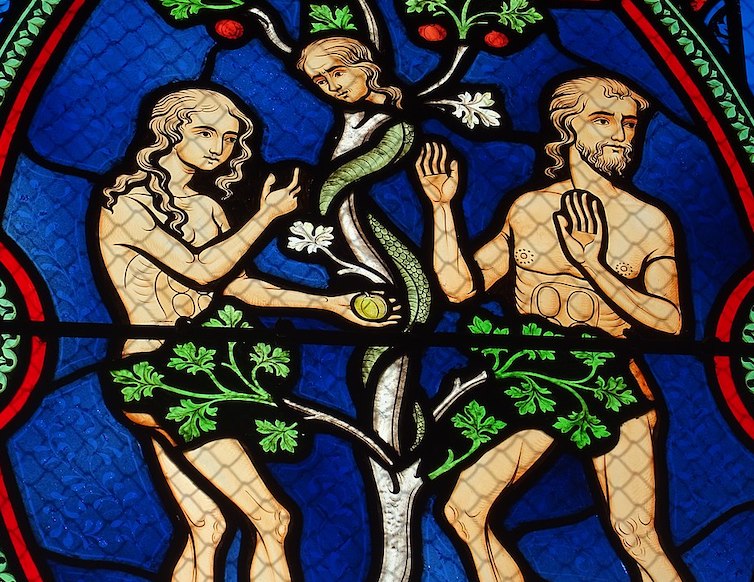
Among the many things that Christians look forward to, as an unearned gift from God, is a new body. This resurrected body will not be like our old (i.e. former) body… but it will be similar to the bodies of our first parents, Eve and Adam. So, in a sense, one might say it’s a bit like that old, old (i.e. original) body.

Sadly, there’s a lot of unnecessary confusion about what awaits us after death. While the Lord doesn’t give us all the details (which we wouldn’t be able to comprehend right now anyway), he does make the big picture clear. Here are some facts (based on the Scriptures as interpreted for 2,000 years within the orthodox Christian faith).

1.  You can’t do enough good works to deserve to enter heaven. It’s all about God’s mercy and grace.

If you think you can be good enough to get there on your own . . . sorry. If you therefore don’t think it matters at all how you live… you will end up just as sorry.

2. In heaven, God’s redeemed will not be incorporeal spirits. We’ll have bodies, just as our Maker intended from the day he breathed life into Adam’s lungs. Christians affirm belief in the “resurrection of the body.”

As to the nature of the bodies, God doesn’t leave us ignorant. One of the best New Testament descriptions is found in First Corinthians.

Even the Old Testament prophet Job proclaimed the wonders of a bodily resurrection when, in his own flesh, he would see the Lord.

God’s written word includes more about our resurrection bodies. One, from the letter to the Christians in Philippi, says, “the Lord Jesus Christ . . . will transform our lowly body to be like his glorious body.” This verse, like the stained glass image above, inspires me to wonder what that body will be like. Like Jesus’ own resurrection body, we learn.

Perhaps also like humanity’s unfallen human bodies portrayed here in colored glass. If the artist’s vision is accurate, I’m eager to welcome back the hair that once adorned my head, and to enjoy those stunningly defined abs, that I unfortunately never possessed.

Writing to his friend Arthur Greeves, Lewis clarified the biblical definition of resurrection.

I agree that we don’t know what a spiritual body is. But I don’t like contrasting it with (your words) “an actual, physical body.” This suggests that the spiritual body wd. be the opposite of “actual” – i.e. some kind of vision or imagination. And I do think most people imagine it as something that looks like the present body and isn’t really there.

Our Lord’s eating the boiled fish seems to put the boots on that idea, don’t you think? I suspect the distinction is the other way round—that it is something compared with which our present bodies are half real and phantasmal. (19 August 1947)

3. Human beings never become angels. One of most common mistakes about heaven is that people (“good” ones, at least) become angels after they die. They don’t. Period. Angels are angels and people are people – two separate beings, each with their own nature. Angels are majestic, most certainly, but they were not blessed like humanity to be created in the very image of God.

And never forget, not all angels are good. Those fallen ones, in fact, no longer merit their identification as angels. Better to label them as what they’ve become, demons.

As for people being intrinsically distinct from angels, C.S. Lewis wrote a poem that contrasts angelic and human personhood.

On Being Human by C. S. Lewis

Angelic minds, they say, by simple intelligence
Behold the Forms of nature. They discern
Unerringly the Archetypes, all the verities
Which mortals lack or indirectly learn.
Transparent in primordial truth, unvarying,
Pure Earthness and right Stonehood from their clear,
High eminence are seen; unveiled, the seminal
Huge Principles appear.

The Tree-ness of the tree they know – the meaning of
Arboreal life, how from earth’s salty lap
The solar beam uplifts it; all the holiness
Enacted by leaves’ fall and rising sap;

But never an angel knows the knife-edged severance
Of sun from shadow where the trees begin,
The blessed cool at every pore caressing us
– An angel has no skin.

They see the Form of Air; but mortals breathing it
Drink the whole summer down into the breast.
The lavish pinks, the field new-mown, the ravishing
Sea-smells, the wood-fire smoke that whispers Rest.
The tremor on the rippled pool of memory
That from each smell in widening circles goes,
The pleasure and the pang – can angels measure it?
An angel has no nose.

The nourishing of life, and how it flourishes
On death, and why, they utterly know; but not
The hill-born, earthy spring, the dark cold bilberries.
The ripe peach from the southern wall still hot
Full-bellied tankards foamy-topped, the delicate
Half-lyric lamb, a new loaf’s billowy curves,
Nor porridge, nor the tingling taste of oranges.
– An angel has no nerves.

Far richer they! I know the senses’ witchery
Guards us like air, from heavens too big to see;
Imminent death to man that barb’d sublimity
And dazzling edge of beauty unsheathed would be.
Yet here, within this tiny, charmed interior,
This parlour of the brain, their Maker shares
With living men some secrets in a privacy
Forever ours, not theirs.

Heaven will be wondrous. Not only will we get to worship the One who created and redeemed us, there is so much more we have to look forward to. Enjoying a new, unflawed body . . . hobnobbing with angels who sang to celebrate Christ’s Nativity . . . and waiting in line to enjoy a beverage with C.S. Lewis.


The picture above is of a stained glass window in the Basilica of Our Lady of the Children in Châteauneuf-sur-Cher, France. Olive Titus, CC BY 2.0, via Wikimedia Commons

Glorifying the Evil One

One perplexing behavior of humanity, is seen in the inclination of some to glorify our greatest enemy. Some people sincerely adore a being who desires nothing more than humanity’s suffering and eternal separation from our loving Creator.

I once heard the difference between God and Satan put this way: even when you hate him, God still loves you, and even when you love him, Lucifer still hates you.

Yet some still idealize this fallen angel who has earned many corrupt titles, including Tempter and Father of Lies.

In literature and other media you can readily find positive treatments of the Devil. John Milton’s Paradise Lost presents Lucifer as the classic tragic figure. Even his arrogance and vanity about his beauty are presented in a sympathetic fashion. In “Why Satan’s Character in Paradise Lost is the Original Antihero,” Lisa Ampleman says “at the 350th anniversary of its publication, Milton’s masterpiece seems ever more relevant.”

The Romantic poet William Blake even said that Milton was “of the Devil’s party without knowing it.” For the first few books, the charismatic demon’s concerns are front and center, and God seems authoritarian and legalistic.

Fortunately, Milton does not leave us with this sympathetic portrayal of Lucifer. As the article’s author writes, Satan “is not the absolute evil we may have expected, and a sympathetic devil is a dangerous devil.” In Book IX, the Devil even confesses his grim obsession.

But neither here seek I, no nor in Heaven
To dwell, unless by mastering Heaven’s Supreme;
Nor hope to be myself less miserable
By what I seek, but others to make such
As I, though thereby worse to me redound:

For only in destroying I find ease
To my relentless thoughts; and, him destroyed,
Or won to what may work his utter loss,
For whom all this was made, all this will soon
Follow, as to him linked in weal or woe;

In woe then; that destruction wide may range:
To me shall be the glory sole among
The infernal Powers, in one day to have marred
What he, Almighty styled, six nights and days
Continued making . . .

In his Preface to Paradise Lost, C.S. Lewis astutely describes Milton’s depiction of the Devil’s eternal dilemma.

What we see in Satan is the horrible co-existence of a subtle and incessant intellectual activity with an incapacity to understand anything. This doom he has brought upon himself; in order to avoid seeing one thing he has, almost voluntarily, incapacitated himself from seeing at all.

And thus, throughout the poem, all his torments come, in a sense, at his own bidding, and the Divine judgement might have been expressed in the words “thy will be done.” He says “Evil be thou my good” (which includes “Nonsense be thou my sense”) and his prayer is granted.

Turning to one of America’s most renowned authors, we encounter in Mark Twain an unabashedly positive portrayal of Lucifer. In Letters from the Earth (which was too controversial for publication during his lifetime), Satan remains a trusted member of God’s Grand Council. It is left to Satan to question God’s arbitrary creation of violent and flawed creatures.

After a long time and many questions, Satan said, “The spider kills the fly, and eats it; the bird kills the spider and eats it; the wildcat kills the goose; the — well, they all kill each other. It is murder all along the line. Here are countless multitudes of creatures, and they all kill, kill, kill, they are all murderers. And they are not to blame, Divine One?”

“They are not to blame. It is the law of their nature. And always the law of nature is the Law of God. Now – observe – behold! A new creature – and the masterpiece – Man!”

Far from humanity being created in the Divine image, Twain’s twisted version of the Creator has God throwing together all of the positive, and negative, traits he had bestowed on the imperfect animals.

“Put into each individual, in differing shades and degrees, all the various Moral Qualities, in mass, that have been distributed, a single distinguishing characteristic at a time, among the nonspeaking animal world – courage, cowardice, ferocity, gentleness, fairness, justice, cunning, treachery, magnanimity, cruelty, malice, malignity, lust, mercy, pity, purity, selfishness, sweetness, honor, love, hate, baseness, nobility, loyalty, falsity, veracity, untruthfulness – each human being shall have all of these in him, and they will constitute his nature.

“In some, there will be high and fine characteristics which will submerge the evil ones, and those will be called good men; in others the evil characteristics will have dominion, and those will be called bad men.”

Satan later offered some sarcastic compliments about creation and is exiled briefly to Earth. There, Twain’s hero pens a number of letters to archangels sympathetic to his views. A single passage is adequate to illustrate the whole.

Man is a marvelous curiosity. When he is at his very very best he is a sort of low grade nickel-plated angel; at his worst he is unspeakable, unimaginable; and first and last and all the time he is a sarcasm. Yet he blandly and in all sincerity calls himself the “noblest work of God. . . .”

Moreover – if I may put another strain upon you – he thinks he is the Creator’s pet. He believes the Creator is proud of him; he even believes the Creator loves him; has a passion for him; sits up nights to admire him; yes, and watch over him and keep him out of trouble. He prays to Him, and thinks He listens. Isn’t it a quaint idea?

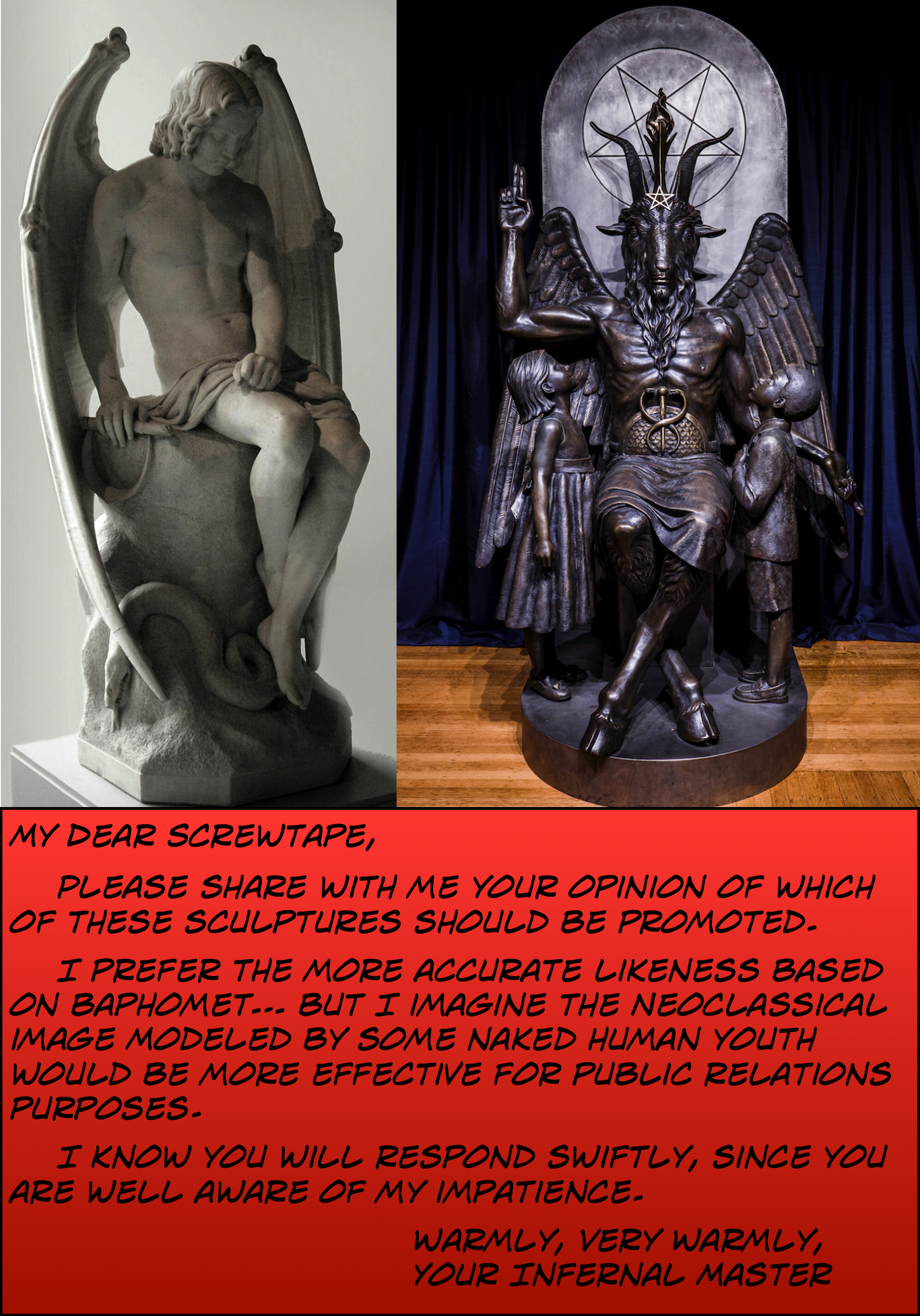
For an accurate illustration of Satan’s activities and purposes, one need look no further than C.S. Lewis’ Screwtape Letters. In one letter, Screwtape highlights the progress Satan’s minions have made in desensitizing humanity to what was recognized as provocative in an earlier age.

We have engineered a great increase in the licence which society allows to the representation of the apparent nude (not the real nude) in art, and its exhibition on the stage or the bathing beach. It is all a fake, of course; the figures in the popular art are falsely drawn; the real women in bathing suits or tights are actually pinched in and propped up to make them appear firmer and more slender and more boyish than nature allows a full-grown woman to be.

Yet at the same time, the modern world is taught to believe that it is being ‘frank’ and ‘healthy’ and getting back to nature. As a result we are more and more directing the desires of men to something which does not exist – making the rôle of the eye in sexuality more and more important and at the same time making its demands more and more impossible. What follows you can easily forecast!

Artistic Presentations of a Sympathetic Devil

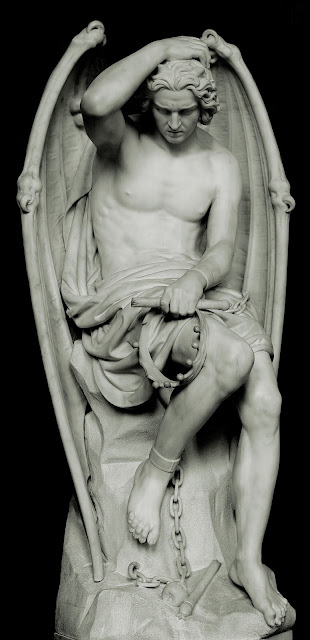
It was actually a nineteenth century Belgian sculpture of Lucifer which is part of the elaborate pulpit of St. Paul’s Cathedral in Liège which inspired today’s reflections. Guillaume Geefs was commissioned to create the piece as part of a general theme of the triumph of religion over evil. The Devil as he portrayed the rebel angel, is rather too appealing for those acquainted with his actual biblical portrait.

Even though his wings have devolved to appear more like those of a bat than a bird, and his foot is chained, the sculpture’s physique is attractive. His apparent regret, evident in his expression and the presence of a tear, invite sympathy. It is regarded as an outstanding example of Romanticism. In a word, it serves as an attractive personification of a vile and malignant being. And this presents a dangerously misleading view of the very real spiritual warfare raging about us.

Curiously, Guillaume’s nude (with a robe safely draped over his lap) was actually a more modest and religious alternative to the image originally intended for the space. Ironically, it was the artist’s younger brother, Joseph, who originally received the commission. Joseph’s sculpture was regarded as even more titillating, and it was replaced. The Royal Museums of Fine Arts of Belgium admits “Joseph created one of the most disturbing works of the period.”

When it was revealed, the initial version of “Le Génie du Mal” (The Genius of Evil) raised questions about its positive portrayal. One publication reported the cathedral’s administrators determined “this devil is too sublime.”

The last thing imperfect human beings living in a fallen world need are sublime and alluring depictions of evil. In the words of C.S. Lewis,

To admire Satan, then, is to give one’s vote not only for a world of misery, but also for a world of lies and propaganda, of wishful thinking, of incessant autobiography. Yet the choice is possible. Hardly a day passes without some slight movement towards it in each one of us.

That is what makes Paradise Lost so serious a poem. The thing is possible, and the exposure of it is resented. Where Paradise Lost is not loved, it is deeply hated. (A Preface to “Paradise Lost”).

Replacement Sculpture by Guillaume Geefs.

An Audience of Angels

Most writers are content to have humans read their works. Not so, William Blake (1757-1827). He indicated on various occasions that his audience included angels.

Blake was a very odd man. Talented, true. Inspired, likely. (Though by whom, debatable.) Christian, I think not. C.S. Lewis had a mixed opinion of him, affirming some of his poetry, and challenging one of his most prominent theological errors.*

True, Blake drew most of his imagery from Christian themes, but that is to be expected by someone writing and painting around the turn of the nineteenth century in Britain. His views of Christian faith were anything but consistent with orthodoxy.

Indeed, Blake appears to have fashioned his own religion, with an unrestrained syncretistic impulse, and an unhealthy measure of sinuous semantics.

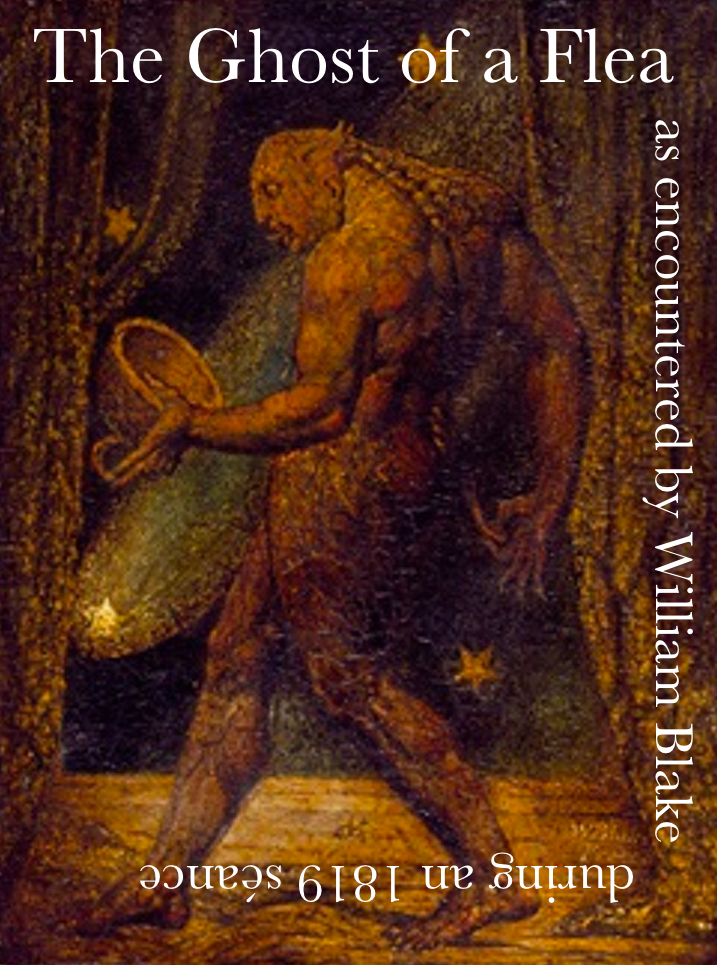
The source of many of Blake’s unorthodox musings appears to have been spiritual sources. He reported seeing visions, beginning in his childhood. Apparently, he would sketch the likenesses of spirits that presented themselves to him. At an 1819 séance he saw and communicated with the ghost of a flea (portrayed above).

The British Library offers a brief and informative video about Blake’s spiritual visions which is available here.

He sees angels—they’re angels to him. He sees figures at the window of his bedroom and as life goes on, these visions become more challenging. The old prophets, or Raphael, the painter, or some great figure he wants to discuss things with, appears in his chamber—it’s a kind of séance.

Eventually Blake’s conflated visions of heavenly beings and departed humans, developed into his own peculiar blend of spiritualism. In 1800, he wrote to comfort a friend whose son had died.

I know that our deceased friends are more really with us than when they were apparent to our mortal part. Thirteen years ago I lost a brother, and with his spirit I converse daily and hourly in the spirit, and see him in my remembrance, in the region of my imagination. I hear his advice, and even now write from his dictate.⁑

Despite William Blake’s flaws, C.S. Lewis was capable of appreciating his poetry.

I am just back from my Easter walking tour with Barfield and co., this year in Derbyshire. Have you been there? It is appreciably more like my ideal country than any I have yet been [to].

It is limestone mountains: which means, from the practical point of view, that it has the jagg’d sky lines and deep valleys of ordinary mountainous country, but with this important difference, that owing to the paleness of the rock and the extreme clarity of the rivers, it is light instead of sombre–sublime yet smiling–like the delectable mountains. It gives you something [like] the same sensation as Blake’s songs.

Lewis is referring here to Blake’s collection, Songs of Innocence. From that collection, I particularly enjoy “The Lamb,” which you can read in the footnote section below.⁂

When I previously wrote about C.S. Lewis’ visits to the home of William Butler Yeats (1865-1939), I shared Lewis’ impression of the occultic flavor of the residence. In a 1921 letter to a close friend, Lewis writes the following:

His house is in Broad Street: you go up a long staircase lined with pictures by Blake–chiefly the ‘Book of Job’ and the ‘Paradise Lost’ ones, which thus, en masse, have a somewhat diabolical appearance.

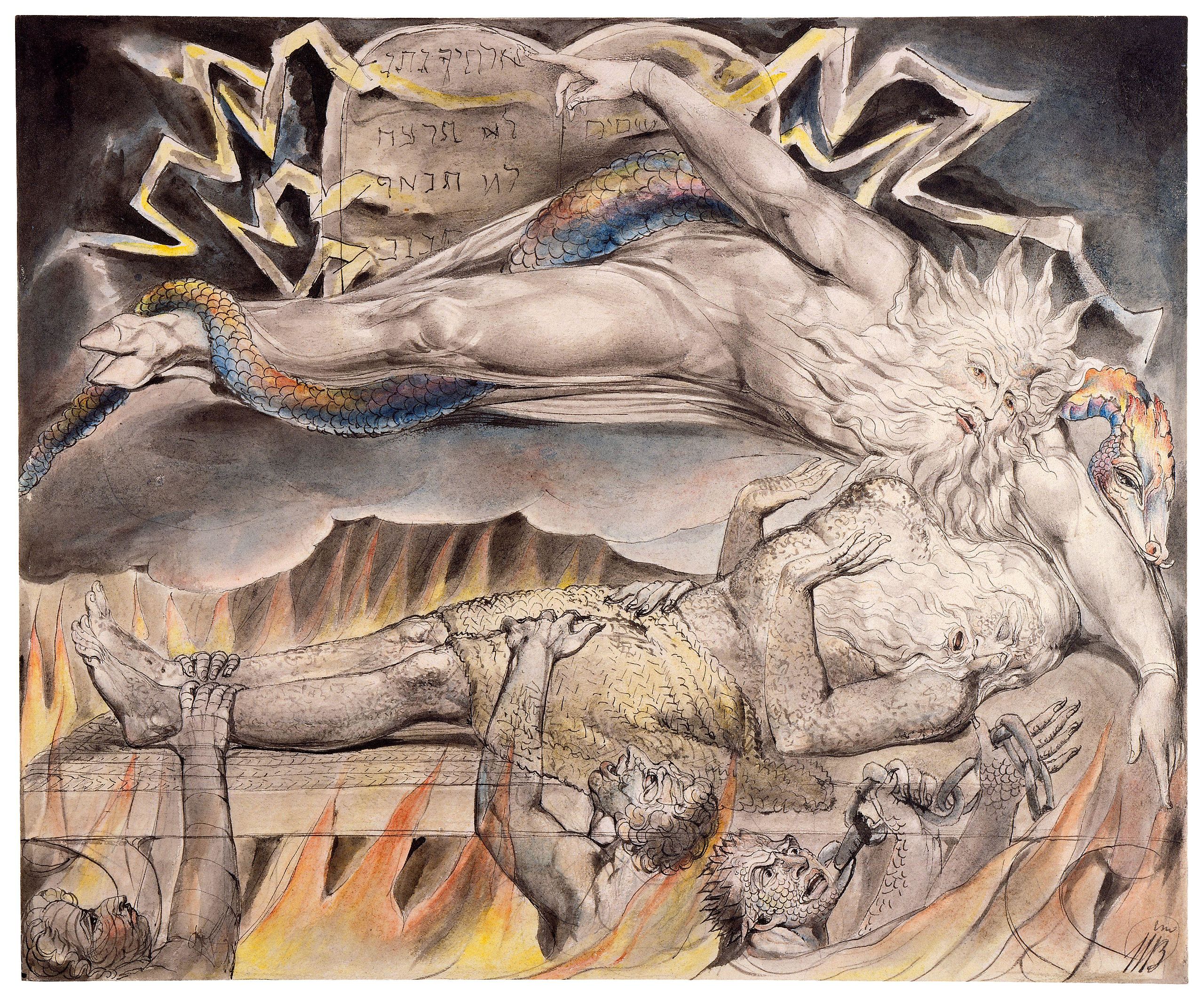
We cannot know exactly which images adorned Yeats’ stairwell, but this sample comes from Blake’s Illustrations of the Book of Job.

Returning to Spiritual Matters

Not only did Blake’s angelic audience laud his work, their praise was so great he could pen this bizarre description of the celestial realms. (How much is irreligious satire, and what part is genuinely inspired by actual visions and belief, remains debatable.)

I am more famed in Heaven for my works than I could well conceive. In my Brain are studies & Chambers filled with books & pictures of old, which I wrote & painted in ages of Eternity before my mortal life; & those works are the delight & Study of Archangels.

Perhaps C.S. Lewis’ most direct response to the confusion promoted by William Blake’s beliefs is found in his classic, The Great Divorce. This illuminating exploration of the gulf between heaven and hell was written, in part, as a response to Blake’s volume, The Marriage of Heaven and Hell. But, the comparison between the two requires an examination more than worthy of its independent discussion.

Suffice it here to include an example of Blake’s advocacy for hell. Blake describes a confrontation between “a Devil in a flame of fire, who arose before an Angel that sat on a cloud.” After their brief argument about God, the Angel “stretched out his arms embracing the flame of fire, and he was consumed . . .” That was not his end, however, for Blake adds a “Note.”

This Angel, who is now become a Devil, is my particular friend; we often read the Bible together in its infernal or diabolical sense . . . (William Blake, The Marriage of Heaven and Hell).

As noted, the matter of whether Blake’s championing of Satan was sincere or simply an arcane literary device is debatable.⁑⁑ However, his correspondence reveals his belief in the supernatural was certainly genuine.

In the end, there’s no question that C.S. Lewis’ assessment of William Blake was accurate. Unsurprisingly, it is one I share. The poet Blake possessed talent, and some of his poetry is quite good. However, as a theologian, this confused mystic is utterly unreliable.

Of course, Christians may be wrong regarding Blake’s spiritual enlightenment. What if, after all, Blake’s vision of his distinguished reputation with the angelic hosts was not a mere delusion? In the unimaginable possibility that this odd man truly is “famed in Heaven,” you must count me among those due to be the most surprised.  


* Even as he challenged one of Blake’s major works, C.S. Lewis wrote, “if I have written [disagreeing with Blake] this is not because I think myself a fit antagonist for so great a genius . . .”

⁑ Some might contend that Blake is referring here to “imagining” the presence of his brother in some sentimental fashion. That is clearly not the case. The fact that he states his brother is, at that moment, advising him on what to write, is intended to be understood as fact. It should be noted he is not referring to the spiritualist practice of “automatic writing,” which is done in a state of trance or spirit possession. Blake’s description of the process is more that of conversational interaction and “advice.”

⁂ “The Lamb,” by William Blake
Little lamb, who made thee?
Dost thou know who made thee,
Gave thee life, and bade thee feed
By the stream and o’er the mead;
Gave thee clothing of delight,
Softest clothing, woolly, bright;
Gave thee such a tender voice,
Making all the vales rejoice?
   Little lamb, who made thee?
   Dost thou know who made thee?
   Little lamb, I’ll tell thee;
   Little lamb, I’ll tell thee:
He is called by thy name,
For He calls Himself a lamb.
He is meek, and He is mild,
He became a little child,
I a child and thou a lamb,
We are called by His name.
  Little lamb, God bless thee!
   Little lamb, God bless thee!

⁑⁑ Like most literary expressions, Blake’s was likely an amalgam of his beliefs and his fancies. A fascinating article on this subject is Peter A. Schock’s, “The Marriage of Heaven and Hell: Blake’s Myth of Satan and Its Cultural Matrix,” published in 1993. Shock says, “The Marriage of Heaven and Hell presents a programmatic expression of [Blake’s] interconnected political, moral and metaphysical thought . . .”

Translating Foreign Languages

How many languages can you translate into English? If the answer is >0, I envy you. I’ve studied four,* and passed all the tests, but have an actual aptitude in none.

If I were thus gifted, I would be transferring some of the world’s literary wealth into my native tongue—and vice versa.

One of my granddaughters is currently fascinated by language. She wants to speak a dozen or more, and has begun some study in Spanish and Japanese. However, I attribute most of her dream to a young teenager’s excitement at having the entire world before them. In time, we all learn that finite concerns, such as time, finances and obligations, erode our options.

I’ve written about translation before, most extensively in “C.S. Lewis’ School of Translation.”⁑

This week, while writing an article about a Lutheran approach to ministry with the newly bereaved, I came across an entertaining reference to translation, in the letters of Martin Luther. Luther, of course, was the Reformation leader who, among other things, strongly believed the Bible should be accessible to lay people in their own language.

Translating the Holy Scriptures

Martin Luther was a scholar. Yet, even scholars lack expertise in all subjects. Thus, when translating the Bible into German, he welcomed the cooperation of others. This was particularly wise, since the so-called “Luther Bible” was the first German translation from the original languages rather than the Latin Vulgate. Unsurprisingly, the New Testament was published first. The longer Jewish Scriptures required more time.

The following letter was written in 1524 to Luther’s friend George Spalatin, another German theologian. Luther playfully explains how faithfulness to the original Hebrew text has delayed the publication of the final portion of the Bible.  

All is well with us. We have so much trouble in translating Job, on account of the grandeur of his sublime style, that he seems to be much more impatient of our efforts to turn him into German than he was of the consolation of his friends.

Either he always wishes to sit on his dunghill, or else he is jealous of the translator who would share with him the credit of writing his book. This keeps the third part of the Bible from being printed.

This casual identification with Job, one of God’s most faithful followers, appeals to me. The older I become, the greater is my sense of connection with the “cloud of witnesses,” the saints who have gone before us. In fact, I am also growing progressively more eager to fellowship with the angels. Though different from humanity in countless ways, we share the wonder of being beloved creatures of God.

In The Four Loves, Lewis writes that “friendship . . . This love, free from instinct, free from all duties but those which love has freely assumed, almost wholly free from jealousy, and free without qualification from the need to be needed, is eminently spiritual. It is the sort of love one can imagine between angels.” In my mind, phileo is also the sort of love we will one day experience between angels and humans.

C.S. Lewis’ Work with the Hebrew Language

Lewis did not read Hebrew. That shortcoming is certainly quite forgivable, given the numerous arenas in which his talents excelled. In his Reflections on the Psalms, he acknowledges his limitation. At the same time, he notes that we have many accessible resources by those acquainted with the ancient language.

I have worked in the main from the translation which Anglicans find in their Prayer Book; that of Coverdale. Even of the old translators he is by no means the most accurate; and of course a sound modern scholar has more Hebrew in his little finger than poor Coverdale had in his whole body. But in beauty, in poetry, he, and St. Jerome, the great Latin translator, are beyond all whom I know. I have usually checked, and sometimes corrected, his version from that of Dr. Moffatt.

In his explanation, Lewis notes the value in referring to several authoritative sources. This is especially wise when words are rare or unclear in their usage. Even people fluent in various languages would be negligent to ignore such resources where there is a question regarding significant interpretations.

In the meantime, Luther’s reminder of Job’s “grandeur of his sublime style,” along with the book’s remarkable message, has me preparing to read that book once again. In translation, of course.


* Spanish in junior high, Latin in high school, classical Greek in college, and Hebrew in seminary. As the Austrian-British philosopher, Ludwig Wittgenstein, said: “the limits of my language mean the limits of my world.” I am quite impressed by the fact that many of Mere Inkling’s readers from outside the States are at least bilingual.

⁑ If you’re interested in the subject, you might want to also (re)visit “C.S. Lewis as a Translator.”

C.S. Lewis and the Five Senses

One of the earliest lessons children learn is how many senses the human being possesses. You know the answer off the top of your head, right? Five. But, apparently, that’s no longer correct. Oh, you may think I must be including that long-time poser, extrasensory perception (ESP), which purports to be a sense of sorts beyond the five we all experience. If you thought that . . . sorry, but you are wrong again.

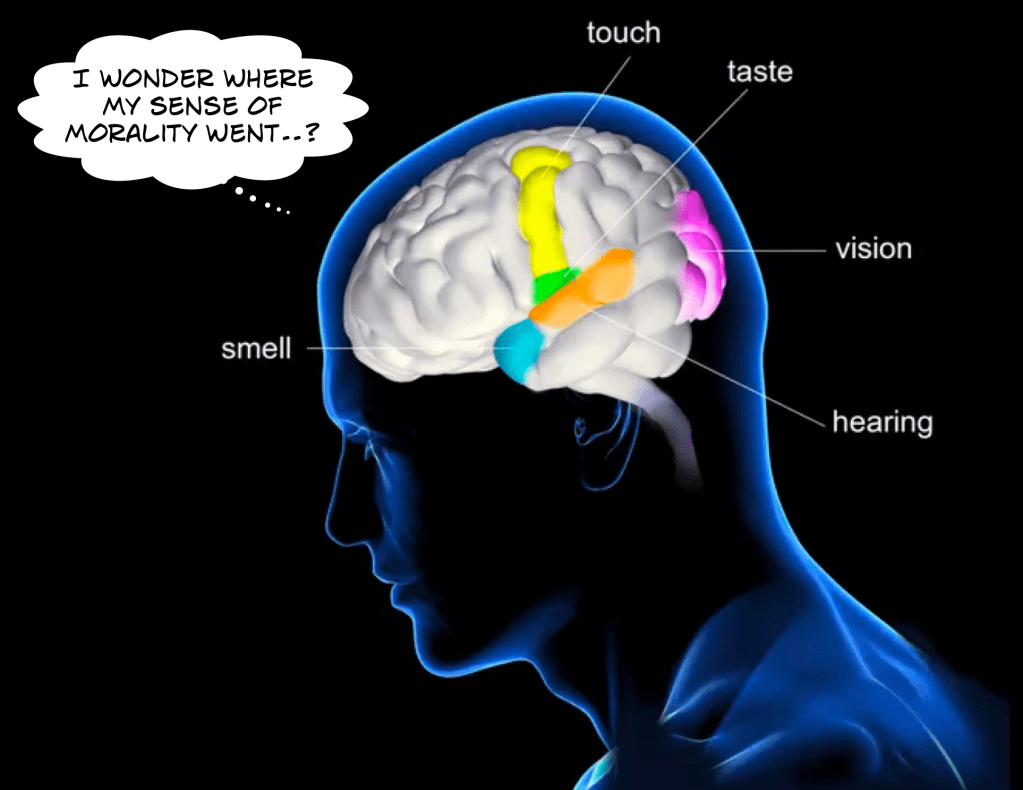
We all agree on the basic five: the faculties of sight, hearing, taste, smell, and touch. To this list, science has recently added several other senses we experience. They’re not actually new; Adam and Eve knew them too (with the possible exception of nociception). They actually make sense (in the other use of the word), as well. Here they are:

Proprioception – perceiving where your body parts are relative to one another, and the strength of effort being employed in movement

Thermoception – sensing temperature

Equilibrioception – perception of balance

Chronoception – sensing the passage of time

Interoception – feeling internal needs such as hunger and thirst

Nociception – experiencing pain

More expansive lists exist as well. Some are discussed online at The United Kingdom’s Sensory Trust. The Trust is devoted to “sensory design . . . [using] nature and the outdoors to improve the health and wellbeing of people living with disability and health issues.” They describe how “neurological classification” can result in numbers up to fifty-three. (It makes one long for the simplicity of the past when we followed Aristotle’s citation of only five.)

C.S. Lewis’ Celebration of Life

You can pick up nearly any one of Lewis’ essays or fiction, open to any page of his autobiography, read almost any of his letters, and you will see his love for nature. And Lewis is often quite vivid in his description of his encounter with God’s creation. The sights, sounds and smells he describes make the depictions real. Consider his description of Tash, the “god” worshipped by the Calormenes, in The Last Battle.

[King Tirian said] “What foul smell is this?”

“Phew!” gasped Eustace. “It’s like something dead. Is there a dead bird somewhere about? And why didn’t we notice it before?”

With a great upheaval Jewel [the unicorn] scrambled to his feet and pointed with his horn. “Look!” he cried. “Look at it! Look, look!” Then all six of them saw; and over all their faces there came an expression of uttermost dismay.

In the shadow of the trees on the far side of the clearing something was moving. It was gliding very slowly Northward. At a first glance you might have mistaken it for smoke, for it was gray and you could see things through it. But the deathly smell was not the smell of smoke. Also, this thing kept its shape instead of billowing and curling as smoke would have done. It was roughly the shape of a man but it had the head of a bird; some bird of prey with a cruel, curved beak. . . . It floated on the grass instead of walking, and the grass seemed to wither beneath it. . . .

[They] watched it for perhaps a minute, until it streamed away into the thicker trees on their right and disappeared. Then the sun came out again, and the birds once more began to sing. Everyone started breathing properly again and moved. They had all been still as statues while it was in sight.

From a more philosophical, even metaphysical perspective, Lewis ponders the senses experienced by angels in his poem, “On Being Human.” He describes the differences between how angels and humanity experience God’s creation. Lewis suggests that in exchange for their unblurred perception of cosmic reality, they lack the more mundane (i.e. earthly) experience of physical perception of creation.*

Angelic minds, they say, by simple intelligence
Behold the Forms of nature. They discern
Unerringly the Archtypes, all the verities
Which mortals lack or indirectly learn.
Transparent in primordial truth, unvarying,
Pure Earthness and right Stonehood from their clear,
High eminence are seen; unveiled, the seminal
Huge Principles appear.

The Tree-ness of the tree they know—the meaning of
Arboreal life, how from earth’s salty lap
The solar beam uplifts it, all the holiness
Enacted by leaves’ fall and rising sap;
But never an angel knows the knife-edged severance
Of sun from shadow where the trees begin,
The blessed cool at every pore caressing us
—An angel has no skin.

They see the Form of Air; but mortals breathing it
Drink the whole summer down into the breast.
The lavish pinks, the field new-mown, the ravishing
Sea-smells, the wood-fire smoke that whispers Rest.
The tremor on the rippled pool of memory
That from each smell in widening circles goes,
The pleasure and the pang—can angels measure it?
An angel has no nose.

The nourishing of life, and how it flourishes
On death, and why, they utterly know; but not
The hill-born, earthy spring, the dark cold bilberries
The ripe peach from the southern wall still hot,
Full-bellied tankards foamy-topped, the delicate
Half-lyric lamb, a new loaf’s billowy curves,
Nor porridge, nor the tingling taste of oranges—
An angel has no nerves.

Far richer they! I know the senses’ witchery
Guards us, like air, from heavens too big to see;
Imminent death to man that barb’d sublimity
And dazzling edge of beauty unsheathed would be.
Yet here, within this tiny, charm’d interior,
This parlour of the brain, their Maker shares
With living men some secrets in a privacy
Forever ours, not theirs.

This notion that we comprehend things the angels cannot—for example, the indwelling of God’s Holy Spirit—is expressed in the spirit of the First Epistle of Peter. These wondrous miracles are “things into which angels long to look.”

As amazing as our human senses are, we should never delude ourselves into thinking they are infallible. Far from it. As precious as they are, due to our fallen nature, they possess two shortcomings. First, they may misperceive reality. Such is the case with allodynia, in which a person “feels pain from non-painful stimuli,” such as a light touch or a cool temperature.⁑

The second limitation comes in the obvious fact of our finite nature. We are simply incapable of perceiving, much less processing, all the information that washes over us. Perhaps you would join me in identifying with C.S. Lewis’ description of himself in A Grief Observed.

Five senses; an incurably abstract intellect; a haphazardly selective memory; a set of preconceptions and assumptions so numerous that I can never examine more than a minority of them-never become even conscious of them all. How much of total reality can such an apparatus let through?

The number of human senses is not important. Our recognition of their divine source is, however, of eternal import.


* Chris Armstrong, Senior Editor of the Christian History Institute, wrote an exceptional article on the importance of our senses. Citing C.S. Lewis’ “On Being Human,” he declares our senses are the only means by which we can “know God.”

Nor is sense-knowledge about God through his Creation, second-class knowledge. Lewis expresses this idea memorably in his poem “On Being Human,” which compares the angels’ incorporeal way of knowing with our way—to the advantage of the latter.

The Christian History Institute publishes the exceptional Christian History magazine, which is offered for a simple donation. They also provide free, downloadable copies of past issues. I strongly encourage your support of this superb ministry.

⁑ From Medical News Today. “Some people feel extreme pain from something minor, such as a paper cut. Feeling increased pain or being hypersensitive to mild pain is called hyperalgesia. Individuals with allodynia, however, feel pain when something is ordinarily painless.”

Return with Me to Middle Earth

tolkien.pngJ.R.R. Tolkien’s tales of Middle Earth will once more be displayed in all of their digital radiance when a new series begins in two years. Yes, I said “series,” because it will not be coming to theaters. Instead it will be developed for subscribers to Amazon’s subscription service.

Some fans of Tolkien are understandably wary. Will it remain faithful to Tolkien’s vision (insofar as any heathen international corporation can understand it)? However, I’m inclined to feel optimistic.

One reason for my optimism is Amazon’s commitment to the quality of the production—they anticipate investing around one billion dollars in the property during the next five years. Beyond that, I suspect Amazon will protect this massive investment by not straying too far afield from the true spirit of Middle Earth.

The Hollywood Reporter states it’s up to Peter Jackson* whether or not he will be involved in the project. His attorney said Amazon was wise to bid high for this “property.”

We are in an era where [online] streamers are bidding up the price of programming. I think Amazon is taking a page out of the studios’ emphasis on franchises. They also are realizing that with the overproduction of television, you need to get the eyeballs to the screen, and you can do that with franchise titles.

Another technology news site points to the example of Game of Thrones upping the value of the Lord of the Rings project.

In a world where Disney has laid out impressive, interconnected franchises with its Marvel and Star Wars properties, and HBO is considering anywhere between three and five spinoffs for Game of Thrones, Middle-earth could be a property that gives Amazon a significant boost in the coming streaming wars, one that could entice even more people to sign up for Amazon’s Prime service.

This is wonderfully ironic, since G.R.R. Martin readily acknowledges his debt to Tolkien. In a solid article on this subject, “Is George R.R. Martin the ‘American Tolkien?’” the author identifies a significant difference between the two writers.

Tolkien’s creation displays a sense of depth yet unrivaled in the fantasy genre. In this way, Lord of the Rings is to Game of Thrones as the Atlantic Ocean is to Lake Michigan. In contrast to the invention of Martin’s world, which is secondary to his plotline, Tolkien built his reality from the ground up starting with languages.

The Rotten Tomatoes media review site offers some tantalizing details about what we can anticipate in the new series.

Amazon’s first map rendered a number of geographic features specific to the Third Age, including the East Bight of Mirkwood Forest . . . But fans who were hoping to see some of the great stories from earlier days dramatized with Amazon’s production values are in luck.

Stories like the sinking of Númenor—Tolkien’s take on the Atlantis myth, in which Sauron corrupted an island of seafaring men to invade the forbidden shores of the world’s far West—and the founding of the kingdoms of Arnor and Gondor could make for some spectacular television. . . .

So what does this mean? For one, the series will undoubtedly focus on Númenor** over other regions of Middle-earth. To understand the island’s significance, we need to go back to the end of the First Age and the downfall of the Dark Lord Morgoth.***

Wow.

This is going to be great. And to think, we owe it all to C.S. Lewis!


* Peter Jackson, of course, is the director who brought The Hobbit and The Lord of the Rings to the big screen.

** Númenor was the great island kingdom of humankind.

*** Morgoth is the greatest of the Ainur (angels in the Middle Earth cosmology). He fell from grace when he resisted the will of the Creator. He was an even greater Evil than his servant Sauron, who plagues the world in the Lord of the Rings trilogy.

The reference to Westeros in the illustration above is to the island in the Game of Thrones ruled by the Seven Kingdoms.

Oxymoronic Misunderstanding

guardian angelOxymoron is a great word. Too bad so few people understand what it means.

In America, at least, nine times out of ten you will hear it misused. Most folks seem to think it means a “contradiction in terms.”

One common example is “military intelligence.” Perhaps I am sensitive to it, being a veteran, but I would enjoy never again hearing people guffaw at that term.

In actuality, the oxymoron is a much more sophisticated rhetorical device.

An oxymoron is the combination of two incongruous words or images to create a unique effect. Often it hints of irony. For example, “she was a poor little rich girl.”

Further examples suggest complex circumstances. “Cruel kindness” and “making haste slowly,” are quite intriguing. The context would provide greater illumination, but these phrases suggest a painful treatment given in love . . . and urgency, tempered by caution.

Another example, apropos for an age in which zombies have become so popular, is the phrase “living death.” Reanimated corpses aside, this oxymoron is extremely powerful.

It evokes the sense of a person’s life having become deathlike in some way. Perhaps it is physical, emotional, psychological or spiritual. In any case, drawing together life and death in this epigram is provocative.

In his most vulnerable work, A Grief Observed, C.S. Lewis describes humanity itself as an oxymoron. Most certainly, he uses the word appropriately.

Sometimes, Lord, one is tempted to say that if you wanted us to behave like the lilies of the field you might have given us an organization more like theirs. But that, I suppose, is just your grand experiment. Or no; not an experiment, for you have no need to find things out. Rather, your grand enterprise. To make an organism which is also a spirit; to make that terrible oxymoron, a ‘spiritual animal.’

Lewis’ point is well taken. That the Creator of the cosmos would make flesh bound human beings with a spiritual nature that allows him to describe as made in his own image, is incomprehensible.

Animals are animals. That is what modern secularists argue that we are. Yet it is evident to the vast majority of humans throughout all times and cultures, that we are unlike beasts. For we possess a spirit. And we are, accordingly, that unique thing among all beings—a spiritual animal.

So peculiar are we in the universe that even the angels themselves—spirits, never “animals”—are curious about the nature of our redemption. As Peter writes in his first epistle:

Concerning this salvation, the prophets who prophesied about the grace that was to be yours searched and inquired carefully, inquiring what person or time the Spirit of Christ in them was indicating when he predicted the sufferings of Christ and the subsequent glories.

It was revealed to them that they were serving not themselves but you, in the things that have now been announced to you through those who preached the good news to you by the Holy Spirit sent from heaven, things into which angels long to look.

From one oxymoron to another, I hope that this new year brings you many blessings. Most especially, I pray that if you have not already experienced this wondrous miracle which amazes even the angels of heaven . . . that you would come to know God’s love.