Governmental Coersion

bookThe title of the book is provocative. And it’s message is sure to offend some. But at the same time, its theme will provide encouragement to those who resist the pressure to conform to the spirit of this age.

You Will be Made to Care is due for release this week. It’s subtitle describes its focus: The War on Faith, Family and Your Freedom to Believe. The authors are evangelical Christians who have also been active in the political realm.

I’ve never offered a formal “book review” on this blog, and this will sound decidedly “Christian,” so fair warning for whether or not you wish to read on.

Like the majority of evangelical Christians in the United States, Erick Erickson and Bill Blankschaen advocate what are commonly called “traditional” values. In essence, that means their position reflects the one that was normative in the country until the past couple of decades.

I must acknowledge up front that in light of my review, I will be offered a signed copy of the book itself. I mention that fact because integrity requires me to do so. At the same time, I assure you that my own integrity would not allow me to offer an insincere recommendation, for any inducement. (Besides, having written book reviews for several military and civilian publications in the past, I am aware of the fact that receiving gratis copies of the texts is not uncommon.)

The initial chapter of the book describes the rapid shift in American moral values during the recent past.

After decades of culture wars, failed leadership in both parties, and almost eight years of a progressive president committed to fundamentally transforming America, there’s a sense that we are no longer slouching toward Gomorrah, as Robert Bork famously put it, but rushing headlong toward inevitable decline.

The authors make a persuasive argument that not only are citizens now pressured to tolerate lifestyles with which they disagree (something we understand is a fact of life in a democracy) . . . they are increasingly being pressured to act affirmatively to support and promote those very alternatives. They will be made to care!

My Personal Experience

I served twenty-four years as an Air Force chaplain, with twenty two of that on active duty. The armed forces are considered a bastion of conservative culture. That’s a good thing when it comes to patriotism (something becoming less common in the general culture). It can have some downsides also, but they are outweighed by the stability that is provided for this community that discharges the most important responsibility of any government, protecting the nation (i.e. the people, and in the case here in the United States, of the Constitution itself which enshrines their rights).

Because the president is the commander in chief, and the executive branch controls the military, it is vulnerable to excessive interference. One form of this comes in “social engineering,” where the political powers impose revisions they deem appropriate, with little or no regard for the utility or ethics of that intervention.

In some cases this is a good thing. The Republican dictate that African-Americans should be allowed to serve in the military was one such triumph. Another came more than eighty years later, when President Truman desegregated the armed forces in 1948.

In 1994, President Clinton implemented a “don’t ask, don’t tell” policy to allow homosexuals to serve in the military. This simply formalized the existing reality. However, in 2011 President Obama removed the ban to public practice of this previously “alternative” lifestyle. But this has not proven adequate for those who would “make others care.”

Through aggressive indoctrination and ruthless suppression of any competing voices, social engineers press forward their goal of eradicating any “traditional” voice on this subject.

And here is where Erickson’s and Blankschaen’s warning becomes most frighteningly accurate. When they have stilled any contrary voices, they notch the pressure up one more degree and say it is no longer sufficient to tolerate a given activity, now you must actively support or even celebrate it.

The pressure is being ratcheted up on chaplains even as you read this. The goal of some would be to purge all evangelicals from the ranks, and replace them with clergy from religious bodies that affirm the new policies. Either that, or dispense with chaplains altogether. After all, to many inquisitors of the new age the very notion of the world having a Creator is itself archaic and regressive.

Do Not Despair

This book would not be worth the read if it merely diagnosed the disease. But the authors also offer a remedy.

Now is not the time for quitting. Now is the time for engaging culture strategically with an understanding of the times in which we live and a reinvigorated faith in God. Now is the time for building up our own faith and intentionally surrounding ourselves with a community that shares our beliefs. These may well be “times that try men’s souls . . . Such times can produce a new generation of heroes because they offer an opportunity for clarity, authentic community, and courageous leadership.

C.S. Lewis, whose words and thoughts frequent the columns here at Mere Inkling, waged a cultural battle during his life. He paid a price for his defense of the Gospel and of traditional values. He was ridiculed for his “simple” faith that trusted the words of Jesus and the Scriptures.

Lewis knew the truth of the Lord’s warning. “If the world hates you, know that it has hated me before it hated you. If you were of the world, the world would love you as its own; but because you are not of the world, but I chose you out of the world, therefore the world hates you. Remember the word that I said to you: ‘A servant is not greater than his master.’ If they persecuted me, they will also persecute you.” (John 15:18-20)

Lewis did not bemoan this fact. Rather than be shunned into silence he championed the truth. This book advises we follow the same course (and even includes a couple of pertinent Lewis quotes). The following sounds like something that Lewis would have written if he were alive today (in either Europe or America).

In addition to supporting live-and-let-live legislation and leaders who demonstrate the courage to stand for your freedom of conscience, there is really something much more basic to Christianity that each of us should do as citizens—love your neighbor. I don’t mean love them in some sort of philosophical or esoteric way, but really and truly connect with the people in the community in which you live and do good to and for them.

Right now the publishers are offering a special incentive to preorder the book. By going to this link, You Will Be Made to Care, you will find details about the bonus materials. It’s quite an eclectic list, including a collection of devotions, a sermon entitled “The Believer in the Public Square,” an audio collection, and a PDF cookbook. (Invite me over if you decide to make some of the cappuccino knots; they look delicious.)

A Final Lewis Thought on Government Oppression

I recently read some correspondence between C.S. Lewis and fellow writer Idrisyn Oliver Evans in 1954. Apparently Evans had taken a government job that involved the oversight of some government publications. Lewis’ fictitious titles are entertaining and insightful.

You inflict, as well as suffering, the punishment of Tantalus in your description of your new job. I can’t imagine what sort of books that library contains. Is it titles like Seven Ways of Spoiling a Landscape, The War Against Agriculture, Amenities are Bunk and Liberty: Its Cause and Cure? But I expect you would commit the sin of Tantalus if you told me.

Liberty: Its Cause and Cure. Brilliant!

Lewis was not able to preserve the letter he received, but we do have a copy of this subsequent letter to his friend. I was taken aback by his comment about the civil service. Lewis must certainly have been writing in the context of governmental bureaucracy and the growth of regulations restricting freedom.

The previous criticism, quoted above, is referred to in passing, but Lewis hastens to note it included a “grain of seriousness.”

The words are sobering, especially for those of us who align with civic institutions. And they provide a fitting close for the review of a book warning about the government’s growing predilection to use its coercive power so that we would all be made to care . . .

There was a grain of seriousness in my rally against the Civil Service. I don’t think you have worse taste or worse hearts than other men. But I do think that the State is increasingly tyrannical and you, inevitably, are among the instruments of that tyranny . . .

Beware of British Cows

cowMad Cow Disease is no laughing matter. Because my family and I resided in the United Kingdom during the early nineties, we have never been eligible to donate blood back home in the States.

Bovine Spongiform Encephalopathy is a truly terrible, and always fatal, affliction. In a grotesque abuse of these docile herbivores, it turns out that the disease was introduced to cattle via mixing contaminated bone and tissue from sheep into their feed. (Whoever came up with that idea should be in prison.)

I seldom think about the possibility of this disease lying dormant in my body’s cells, and each year the likelihood of that being true diminishes. Frankly, since I’ve never heard of any of the Americans stationed there during that period contracting the disease, I consider it nearly certain that it is not present.

Still, just when I’ve finally accepted the notion that British cows are not a threat to me, I come face to face with the fact that they actually are.

Recently, an official report in the United Kingdom revealed that during the past fifteen years, cattle are responsible for the deaths of seventy-four people. Seventy-four!

That means they kill more Brits than sharks! And I doubt that most of those victims were taunting the cattle like the foolish young woman pictured above.

If you’ve never spent much time around cows, you may not realize how large and heavy they are. They can trample or crush people accidentally, and since they are not aggressive by nature, I assume that most of the deaths they are responsible for are just that, accidents.

Best, I suppose, to avoid farms, unless you crave a life of adrenalin-fueled risk on the edge of disaster.

C.S. Lewis reveals how deceptively innocent cattle can appear. In a letter written to a close friend in 1916, he described the calm pastoral setting for his life.

In fact, taking all things round, the world is smiling for me quite pleasantly just at present. The country round here is looking absolutely lovely: not with the stern beauty we like of course: but still, the sunny fields full of buttercups and nice clean cows, the great century old shady trees, and the quaint steeples and tiled roofs of the villages peeping up in their little valleys–all these are nice too, in their humble way.

Lewis should have been more cautious. It seems to me the cleanliness of the cows was a clear evidence they may have been up to no good.

In 1925 Lewis wrote to his father that the deer at Magdalen College were taking the place of the cattle he had left at home.

My external surroundings are beautiful beyond expectation and beyond hope. . . . My big sitting room looks north and from it I see nothing, not even a gable or spire, to remind me that I am in a town. I look down on a stretch of level grass which passes into a grove of immemorial forest trees, at present coloured with autumn red. Over this stray the deer.

They are erratic in their habits. Some mornings when I look out there will be half a dozen chewing the cud just underneath me, and on others there will be none in sight–or one little stag (not much bigger than a calf and looking too slender for the weight of its own antlers) standing still and sending through the fog that queer little bark or hoot which is these beasts’ ‘moo.’ It is a sound that will soon be as familiar to me as the cough of the cows in the field at home, for I hear it day and night.

Lewis obviously possessed a fondness for the cattle that framed his youthful memories. Likewise the deer that meandered through college grounds without fear for their safety.

Having an uncle who was a farmer, I enjoyed some small exposure to gentle, albeit not quite “clean,” cows when a boy. Today I enjoy many a day when deer leisurely cross in front of my study window to munch on some of the thick grass that we planted more for their benefit than our own.

Obviously, I do not hold bovine diseases against the poor cattle. And, at least for the present, I choose to believe that cattle (unlike cats) do not harbor any plans for world domination.

That doesn’t mean, of course, that I’m foolish enough to trust them where I haven’t already planned a potential escape route . . . especially when I’m in the U.K.

_____

Check out this post for another entertaining C.S. Lewis observation about cows!

I’m informed by my lovely wife that “clean cows” are dairy cows that need to be kept clean for hygiene reasons. Makes sense to me, but I still think that it’s an odd adjective to associate with cattle.

Choose Your Adjectives Carefully

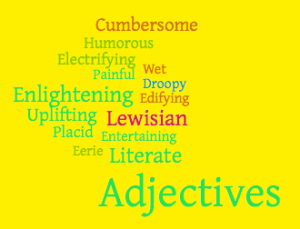
adjectivesMark Twain was a fount of wit and wisdom.* I recently encountered this astute maxim attributed to him.

A man’s character may be learned from the adjectives which he habitually uses in conversation.

While the statement rings true, it turns out that Mark Twain is not the person who coined it.

That honor belongs to Henry Theodore Tuckerman (1813-71). The confusion is apparently due to the fact that Twain’s future bride, Olivia Langdon, began compiling a commonplace book while a teenager, in which she included this paraphrase of one of Tuckerman’s observations.

The actual quotation comes from an 1850 volume in which he wrote:

It is amusing to detect character in the vocabulary of each person. The adjectives habitually used, like the inscriptions on a thermometer, indicate the temperament. (The Optimist, “Conversation”)**

C.S. Lewis was not a fan of the excessive use of adjectives, as I have written about in the past.

Don’t use adjectives which merely tell us how you want us to feel about the things you are describing. I mean, instead of telling us a thing was “terrible,” describe it so that we’ll be terrified. Don’t say it was “delightful;” make us say “delightful” when we’ve read the description. You see, all those words (horrifying, wonderful, hideous, exquisite) are only like saying to your readers, “Please, will you do my job for me?”

Despite Lewis’ warning, I have to confess that I love adjectives. When they are creatively chosen, I find them illuminating, provocative and welcome. In fact, the ideal adjective accomplishes Lewis’ goal of conveying an emotion, not simply describing it.

And, as we have been reminded today, adjectives have the additional benefit of giving us glimpses into the personality of the authors themselves. “It is amusing to detect character in the vocabulary of each person. The adjectives habitually used, like the inscriptions on a thermometer, indicate the temperament.”

Meeting a New Author

Researching this subject I encountered an interesting quote from a popular Chilean-American writer, Isabel Allende.

I want to have an epic life. I want to tell my life with big adjectives. I want to forget all the grays in between, and remember the highlights and the dark moments.

While I can understand her desire to live an epic life, and applaud the accompany image of living one’s life with “big adjectives,” I have to say I am a bit disappointed in her choice of adjective itself. “Big” adjectives? “Vast,” “immense,” “deep,” and “complex” are just a handful of the substitutes that might convey different aspects of the concept “big.”

Perhaps she originally penned this in Spanish, and chose just such a “bigger” word? But then again, I assume she would do all of her own translation work. So it could be she was striving for irony? Not having read her work, I cannot say with any confidence.

Still, if I do expose myself to a greater quantity of her “adjectives habitually used” . . . I have no doubt I can gain some insight into her literary temperament.

_____

* If you are curious as to whether Twain was a “fount” or a “font,” check this out.

** You can find more of his wisdom by downloading a free copy of Selections from the Writings of Henry Theodore Tuckerman.

C.S. Lewis & Women

hermeneuticDid C.S. Lewis disrespect women? Some of his detractors make that argument, but two new books reveal just how weak the notion is.

There is a great book review in the herŸ.menenutics column of the current issue of Christianity Today. You can read it here, but please finish reading this post before checking it out.

Readers of Mere Inkling who are only familiar with Lewis through the Chronicles of Narnia or his classic Mere Christianity, may be surprised to learn that there are some who claim he was a misogynist. While they pull decontextualized examples from his works, the essence of their arguments seem to arise from an animosity to Lewis’ Christian worldview.

Even if you do not go on to read either of the books discussed, taking a moment to read the review itself will be worthwhile. For example, they cite one of Lewis’ longtime friendships.

Lewis’s good friend the detective novelist Dorothy L. Sayers once remarked that when it came to women as a whole, “he had a complete blank in his mind.” But this didn’t keep her from liking and corresponding with him, often in the form of cheerful and vigorous argument . . .it was friendships like hers that “blew away Lewis’ assumptions about women,” helping his ideas to change and develop over time.

The first text discussed in the review is Women and C.S. Lewis: What His Life and Literature Reveal for Today’s Culture, edited by Carolyn Curtis and Mary Pomroy Key. The volume has a diverse collection of contributors and portrays the writer honestly. Many of the chapters are written by well respected authors who have written their own works on Lewis.

The book offers no foolish attempt to make a feminist of Lewis. The contributions are thoughtful and nuanced. Lewis’ views were a product of his era and upbringing. Yet, to that stodgy context, he added a Christian appreciation for the all of humanity, male and female, created in the image of God.

The second volume examines the life of the woman who played the most significant role in C.S. Lewis’ life. This is a true biography of Joy Davidman, not restricted to the years she spent with Lewis, who was her second husband. It is no hagiography of this convert from atheism to Christianity. Precisely because of that, it promises to provide valuable insights into the woman, Lewis, and Lewis’ attitudes towards women.

And, great news for those interested in this subject. The Kindle version of Joy: Poet, Seeker, and the Woman Who Captivated C. S. Lewis is currently on sale for only $2.99, a price any student of the Oxford Inkling can scarcely ignore.

If you don’t recall my post several months ago about Lewis and “dating,” you may find it interesting.

I will close now with a quotation from a letter Lewis wrote to a Benedictine monk in 1952. I chose it because it juxtaposes two aspects of his experience with women. The first is based on his daily experience with the discipline of carrying on an excessive correspondence with readers. The second was a remark in passing about Jane Austen which compliments her for both her substance and her strength.

It isn’t chiefly men I am kept in touch with by my huge mail: it is women. The female, happy or unhappy, agreeing or disagreeing, is by nature a much more epistolary animal than the male. . . . I am glad you think J. Austen a sound moralist. I agree. And not platitudinous, but subtle as well as firm.

Just one small example of what the linked book review praises as “his ability to see and appreciate a woman as a whole, multifaceted person.”

2019 Addendum: Last year a new, well-reviewed book was published on this subject: Becoming Mrs. Lewis: The Improbable Love Story of Joy Davidman and C. S. Lewis by Patti Callahan.

Puppies in Heaven

pupWill dogs and other fauna have a place in the new creation? It’s an interesting—and controversial—subject.

I just reread a delightful essay in which the author, an Orthodox theologian, describes a debate he had with a Roman Catholic scholastic on the subject.* I enjoyed the following description of the discussion so much that I had to share it.

I was once told by a young, ardently earnest Thomist . . . you know, one of those manualist neo-paleo-neo-Thomists of the baroque persuasion you run across ever more frequently these days, gathered in the murkier corners of coffee bars around candles in wine bottles, clad in black turtlenecks and berets, sipping espresso . . . this young Thomist told me that not only could my dog not love me (since he lacks a rational nature), but I could not love my dog (something about there needing to be some rational equality between lover and beloved).

Now, while I admitted that I could only presume the former claim to be incorrect . . . I was adamant that I could be absolutely certain of the falsity of the latter. But my friend was not deterred: “Oh, no,” he insisted, “you don’t really love him; you just think you do because of your deep emotional attachment to him.”

Of course. Foolish of me. Leave it to a two-tier Thomist to devise a definition of love that does not actually involve love. If you can believe in pure nature, I suppose you can believe anything.

{More on the question of animals in paradise below . . .}

Debates (civilized variants of arguments) can be fascinating when they are dissected and examined. Theological debates are particularly enthralling.

C.S. Lewis appreciated the value of debate in sharpening one’s position. This approach to learning can be traced back to the Socratic Method, which is based upon asking and answering questions.

In 1941, the Oxford Socratic Club was formed to “follow the argument wherever it led them.” C.S. Lewis was its first president (faculty sponsor), serving until 1955 when he moved to Cambridge University. In the first issue of the Socratic Digest, Lewis wrote:

In any fairly large and talkative community such as a university, there is always the danger that those who think alike should gravitate together into coteries where they will henceforth encounter opposition only in the emasculated form of rumour that the outsiders say thus and thus.

The absent are easily refuted, complacent dogmatism thrives, and differences of opinion are embittered by group hostility. Each group hears not the best, but the worst, that the other groups can say.

Some of the debates conducted by the club were legendary. You can read a fine article about these “University Battles” here.

Returning to the Question of Animals in Heaven

I wrote on this subject several years ago. That post is worth checking out if only for the amazing graphic that graces it.

You can read my own perspective on the question there, if you are interested.

Today I wish to end, instead, with the summary of my kindred spirit, who debated the philosopher.

The final sentence in this next section is priceless.

The occasion of the exchange, incidentally, was a long and rather tediously circular conversation concerning Christian eschatology. My interlocutor was an adherent to a particularly colorless construal of the beatific vision, one that allows for no real participation of animal creation (except eminently, through us) in the final blessedness of the Kingdom; I, by contrast, hope to see puppies in paradise, and persevere in faith principally for that reason.

His sentiment reminds me of C.S. Lewis’ thoughts in Mere Christianity.

I sometimes like to imagine that I can just see how it might apply to other things. I think I can see how the higher animals are in a sense drawn into Man when he loves them and makes them (as he does) much more nearly human than they would otherwise be.

Hart offers another delightfully sarcastic comment about the weight of different authorities the two debaters were citing. And with that observation, we shall end.

On his side, all the arguments were drawn from Thomas and his expositors; on mine, they were drawn from Scripture; naturally, limited to the lesser source of authority, I was at a disadvantage. . . . [arguing] that the biblical imagery of the redeemed state is cosmic in scope and positively teeming with fauna (lions lying down with lambs and such)—that Paul’s vision of salvation in Romans 8 is of the entirety of creation restored and glorified—things of that sort. All in vain, though; nothing I said could rival the dialectical force of his ringing sic Thomas dixit [so Thomas said].

_____

* The author, David Bentley Hart, is not anti-Catholic. In fact, he has taught at several Roman Catholic universities. The article quoted appears here.


Echoes of Christmas

Rosary Basilica LourdesI love greeting people with “Merry Christmas” after the day itself has passed.

Most people are surprised—probably thinking that I slept through the celebration. Many Christians, however, respond with their own best wishes, in recognition that the celebration of Jesus’ nativity marks the beginning of a season of wonder.

The celebration of the Incarnation miracle is far too wondrous to be confined to a single day.

People often ask “how was your Christmas?” By that, most are inquiring as to whether it was enjoyable.

It is a profound question, if one truly reflects upon it.

As a child, I must confess that the quality of my “Christmas” was probably determined to large extent by the presents I received. I don’t remember many of the particular gifts—these many years later—but I do recall the anticipation I felt as we awaited Christmas Day and the glorious unwrapping.

As a parish pastor my perceptions of a “good” Christmas were determined in large part by the number and enthusiasm of the individuals attending the season’s special worship services. (I am not proud, of course, to confess this.)

In later, semi-retired days, I gauge the joy of each Christmas by the time spent with family. To have all the kids and grandkids near is magnificent. To be able to connect with our “extended family” is icing on the cake.

Obviously, I’m not alone in measuring the quality of my “Christmas experience” by the presence of family.

At the close of the First World War, as C.S. Lewis had finished recuperating from his wounds, he longed to be able to return home to Ireland to celebrate with his father and brother. The Armistice had been signed a month earlier, but delays prevented his arrival by December 25th. Nevertheless, he did manage to arrive for the Christmas season, as Warnie recorded in his diary two days later.

A red letter day. We were sitting in the study about eleven o’clock this morning when we saw a cab coming up the avenue. It was Jack! He had been demobilized, thank God. Needless to say there were great doings. He is looking pretty fit . . . In the evening there was bubbly for dinner in honour of the event: the first time I have ever had champagne at home.

Family can be a wonderful thing, although there seem to be an increasing number of people in our day who are a scourge to their families. My heart goes out to those who have lost their loved ones, or who have never experienced familial love in the first place.

These holiday seasons—filled with laughter and champagne for most—can be a barren emotional wasteland for many.

It is good for us all to remember that fact, and remain vigilant to draw the lonely into the light of our family campfires.

The Deep Joy of Christmas

I have said that as a child, I relished the anticipation of my gifts. Later in life I have focused on other matters in assessing whether or not my Christmas has been an exceptional one.

The fact is that the foundation for all of my happiness comes from an awareness of Christmas’ true meaning.

In a word, Emmanuel. God with us.

For me and my family, it simply would not be Christmas if we were not able to gather with our sisters and brothers in Christ to celebrate Jesus’ birth. That said, for believers in some Islamic and Buddhist nations where Christians are not free, the miracle of Christmas rings no less true.

The presence of the Holy Spirit, and the constancy of Christ’s grace are such an indivisible part of my life, that I often take them for granted. And so it is during Christmas.

The gift-giving and family can occupy the forefront of my thoughts. However, it is only because of the life-giving sacrifice of that innocent Child that events in this life possess the potential to have eternal significance.

Jesus came in humility. He came to serve. He came to suffer. He came to offer his own pure life to redeem our imperfect and corrupt lives.

That’s what Christmas is about, and that is why it is too wondrous for its celebration to be relegated to one brief day.

A Mastery of Words

ben franklinOh the curse of so many fascinating things to read . . . and so little time. The following pieces of wisdom come from a free volume, The World’s Famous Orations, by William Jennings Bryan.*

Bryan (1860-1925) was one of the most prominent American orators and politicians. In his study of rhetoric he collected a wide range of speeches given throughout Western history.

The collection is fascinating. It includes moments from well known historical events and from obscure yet intriguing occasions. For example, you can hear the words of Hannibal spoken to his army after its successful crossing of the Alps, or the republican speech offered by the falsely condemned Algernon Sidney from the scaffold.**

Public speaking used to be a cornerstone of education. In colleges today, “speech” is often merely an elective.

C.S. Lewis relates a funny story about one of his first experiences speaking in a formal setting. The occasion was the annual Encaenia at Oxford University, which commemorated founders and benefactors. Honorary degrees were given and excerpts from prize compositions were recited.

Lewis wrote to his father about the event. “I had almost forgotten, if I had ever known, that ‘prizemen’ have to read portions of their compositions at our ceremony of the Encaenia.”

After the honorary degrees [one of which was received by Georges Clemenceau], the Professor of Poetry made an ‘oration’ in Latin, chiefly about colleagues who had died during the last year: this was my first experience of spoken Latin and I was pleased to find that I could follow and enjoy it. The performance of us prizemen was of course very small beer after all this. We had been instructed to read for about two minutes each: I had some difficulty in finding a short passage which would be intelligible by itself. I was, of course, nervous: I am also told that I was the first of our little band whom Clemenceau looked at: but as I do not know with what expression he looked, nor whether he speaks English, we must remain in doubt whether this was a compliment or not.

I have had a good lesson in modesty from thus seeing my fellow prize men. I was hardly prepared for such a collection of scrubby, beetle-like, bespectacled oddities: only one of them appeared to be a gentleman. Any I spoke to sounded very like fools, perhaps like Goldsmith, they ‘writ like an angel and talked like poor Poll’. 76 It brings home to one how very little I know of Oxford: I am apt to regard my own set, which consists mainly of literary gents, with a smattering of political, musical and philosophical–as being central, normal, and representative. But step out of it, into the athletes on one side or the pale pot hunters**** on the other, and it is a strange planet.

The World’s Famous Orations combines a number of separate volumes that run from classical Greece and Rome, on through most of the European nations, including their “colonies” in the Western Hemisphere. President Teddy Roosevelt is the final orator whose words are included.

I invite you to sample some of the rich banquet included in this volume. The speeches themselves are fairly short, and these excerpts the more so. Mere teasers. If you perchance become bored, skip to the final passage—Benjamin Franklin provides his fellow Americans a warning that we sadly failed to heed.

Socrates (470-399 BC) upon being condemned wittily insults his judges.

For the sake of no long space of time, O Athenians, you will incur the character and reproach at the hands of those who wish to defame the city, of having put that wise man, Socrates, to death. For those who wish to defame you will assert that I am wise, though I am not. If, then, you had waited for a short time, this would have happened of its own accord; for observe my age, that it is far advanced in life, and near death. . . .

But if, on the other hand, death is a removal from hence to another place, and what is said be true, that all the dead are there, what greater blessing can there be than this, my judges? For if, on arriving at Hades, released from these who pretend to be judges, one shall find those who are true judges, and who are said to judge there. . . . At what price would you not estimate a conference with Orpheus and Musæus, Hesiod and Homer? I indeed should be willing to die often, if this be true. For to me the sojourn there would be admirable, when I should meet with Palamedes, and Ajax son of Telamon, and any other of the ancients who has died by an unjust sentence.

The comparing my sufferings with theirs would, I think, be no unpleasing occupation. But the greatest pleasure would be to spend my time in questioning and examining the people there as I have done those here, and discovering who among them is wise, and who fancies himself to be so but is not.

“Enough with the insults, philosopher; drink the hemlock.”

Seneca (the Younger, 4 BC-AD 65) before being ordered to commit suicide by Nero, whom he had tutored.

This is the fourteenth year, Cæsar, since I was summoned to train you for your high destiny; and the eighth since your advancement to the empire. During the intervening period, you have showered such honors and riches upon me, that nothing is wanting to complete my felicity but the capacity to use them with moderation. . . .

But both of us have now filled up our measure— you, of all that the bounty of a prince could confer upon his friend; I, of all that a friend could accept from the bounty of his prince. Every addition can only furnish fresh materials for envy; which, indeed, like all other earthly things, lies prostrate beneath your towering greatness, but weighs heavily on me. I require assistance. Thus, in the same manner as, were I weary and faint with the toils of a warfare or a journey, I should implore indulgence; so in this journey of life, old as I am, and unequal even to the lightest cares, since I am unable longer to sustain the weight of my own riches, I seek protection.

Order your own stewards to undertake the direction of my fortune, and to annex it to your own; nor shall I by this plunge myself into poverty, but having surrendered those things by whose splendor I am exposed to the assaults of envy, all the time which is set apart for the care of gardens and villas, I shall apply once more to the cultivation of my mind.

“Did you forget, noble tutor, that I Nero am insane enough to demand both your wealth and your life?”

Thomas Cranmer (1489-1556) at his execution, following his renunciation of a forced recantation. (Yes, that sounds confusing, but under duress he had bent to the will of bloody Queen Mary.)

And now I come to the great thing which so much troubleth my conscience, more than anything that ever I did or said in my whole life, and that is the setting abroad of a writing contrary to the truth—which now I here renounce and refuse, as things written with my hand contrary to the truth which I thought in my heart, and written for fear of death, and to save my life if it might be—and that is, all such bills and papers which I have written or signed with my hand since my degradation, wherein I have written many things untrue.

And forasmuch as my hand hath offended, writing contrary to my heart, therefore my hand shall first be punished; for when I come to the fire, it shall be first burned.

“Darn that troublesome archbishop! That wasn’t the speech we approved in advance for him to give.”

Maximilien François Marie Isidore Robespierre (1758-94) denying King Louis was entitled to a trial.

Louis was king and the Republic is founded; the great question which occupies you is decided by these words alone. Louis has been dethroned for his crimes; Louis denounced the French people as rebels; to chastise them he has invoked the arms of his brother tyrants. Victory and the people have decided that he was the rebel: hence Louis can not be judged; he is judged already. He is condemned, or the Republic is not absolved.

To propose a trial for Louis XVI. in any way whatever is to retrograde toward royal and constitutional despotism; it is a counter-revolutionary idea, for it is putting the revolution itself on trial.

“We’ll see how you feel about allowing trials for tyrants two years into your reign of terror, when we take you to the guillotine.”

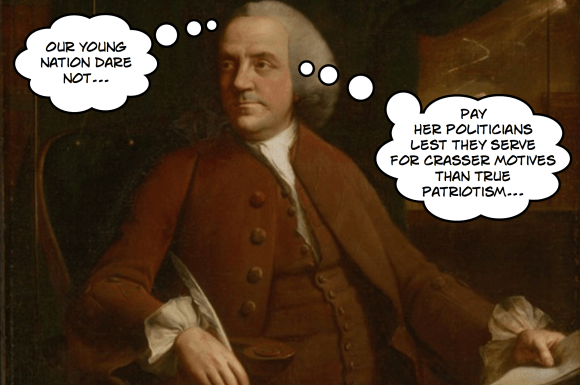
Benjamin Franklin (1706-90) warns about the dangers of providing salaries to bureaucrats.

I think I see inconveniences in the appointment of salaries [for those in the Executive Branch]; I see none in refusing them, but, on the contrary, great advantages.

Sir, there are two passions which have a powerful influence in the affairs of men. These are ambition and avarice—the love of power and the love of money. Separately, each of these has great force in prompting men to action; but, when united in view of the same object, they have, in many minds, the most violent effects.

Place before the eyes of such men a post of honor, that shall, at the same time, be a place of profit, and they will move heaven and earth to obtain it.

The vast number of such places it is that renders the British government so tempestuous. The struggles for them are the true source of all those factions which are perpetually dividing the nation, distracting its councils, hurrying it sometimes into fruitless and mischievous wars, and often compelling a submission to dishonorable terms of peace.

And of what kind are the men that will strive for this profitable preeminence, through all the bustle of cabal, the heat of contention, the infinite mutual abuse of parties, tearing to pieces the best of characters? It will not be the wise and moderate, the lovers of peace and good order, the men fittest for the trust.

It will be the bold and the violent, the men of strong passions and indefatigable activity in their selfish pursuits. These will thrust themselves into your government and be your rulers.

“Oh that we had listened to your sage counsel. Now we are reaping what we have sown in our political machinations.”

_____

* You can download a personal copy of the book in a variety of versions here.

** Algernon Sidney (1622-83) fought honorably for the republican cause in the English Civil War. The fact that he opposed the execution of Charles I did not deliver him from the vengeance of the hedonist Charles II.

*** Georges Clemenceau (1841-1929) was the French prime minister who helped set the stage for World War II by demanding excessive concessions with Germany during the Versailles peace talks.

**** A “pothunter” is someone who hunts game without a concern for rules of sport. Lewis is likely applying it here in the sense of a person who participates in competitions primarily with the goal of accumulating prizes.

Trivial Finale

catechicAll good things must draw to an end . . . and so it is that we wrap up our running review of interesting trivia questions from Catéchic, “the Catholic trivia game” by Tyco®.

Today we move beyond the miscellaneous historical and ecclesiastical subjects we have thus far considered. Prepare yourself for some serious literary and theological matters.

There were a fair number of questions asked about literary matters. Most related to authors (religious and secular) I have never read. However, some were of greater interest to me.

Who wrote the religious sonnet “Death Be Not Proud?”

John Donne

I hadn’t read that classic poem for years, and I’m grateful to the game for encouraging me to pause to reread it. If you are unfamiliar with this timeless verse, you can read it here.

Was the Gutenberg Bible the first book to be printed?

No. (Printing already existed in China.)

Actually, printing via woodblocks existed in various places. The great breakthrough came in the development of moveable type, and it did indeed exist in China before Gutenberg refined it in the West.

Was the first Bible printed in the New World in the English language?

No. (Algonquian, the predominant language of Northeastern Native Americans)

Now there is an edifying fact which reminds us of the importance of sharing the Good News with all people

Which alphabet is named after a saint?

The Cyrillic alphabet, developed by St. Cyril

And, ironically, used most prominently in the formerly atheistic republics of the Soviet Union.

A triad of questions about Roman Catholic periodicals.

What newspaper is generally thought of as the most liberal American Catholic weekly?

The National Catholic Reporter

Something I believe they are quite proud of. They offer online news here.

What newspaper is generally thought of as the most conservative American Catholic weekly?

The Wanderer

I had never heard of this lay publication, but you can read it online here.

How much does an issue of The Catholic Worker cost?

One cent

Amazing. I disagree with most of its political positions, but I have to admire the statement they make in continuing this practice.

The Catholic Worker newspaper is not online. Subscription or copy requests must be sent by regular mail . . . The newspaper was started by Dorothy Day herself in New York City in the 1930s. The price has been and will remain a penny a copy, excluding mailing costs. It is issued seven times per year and a year’s subscription is available for 25 cents (30 cents for foreign subscriptions) . . .

When the game addresses Roman Catholic history and dogma, it stays close to doctrinal boundaries. However, when it addresses interfaith and “Protestant” subject matter, it raises some issues which require comment.

Saint Olaf is the patron saint of which country?

Norway

I had to include this because my own heritage is half Norwegian. This despite the fact that dear Olaf was free in his use of the sword as an instrument for converting the Norse heathen. My hometown is Poulsbo, Washington, and its nickname is “Little Norway.” It is no surprise Poulsbo’s Roman Catholic parish is named in honor of Saint Olaf.

As far as we know, who erected the first Christian cross in the New World?

Christopher Columbus

Perhaps, but the first Christians setting foot in the so-called New World were likely Leif Erikson and those who accompanied him on the voyage from Greenland.

Name the politically influential American Catholic family sometimes known as “America’s Royal Family?”

The Kennedys

Although sadly some prominent Kennedys have not lived and served in a manner consistent with their religious profession.

As a Lutheran Christian, I was particularly eager to discover what sort of questions dealt with so-called “Protestant” matters. Here are a couple, with my personal observations added:

Before the Protestant Reformation, how many Christian Churches were there?

Two, Catholic and Orthodox

Sorry, only one. Both Roman Catholic and Eastern Orthodox communions confess a belief that there is only “one, holy, catholic and apostolic church.” It’s true that there was a schism* between the two, but there remains only one Christian Church, comprised of all who “believe and are baptized.”

During the 19th century, what Protestant group played a key role in settling the American West?

Church of Jesus Christ Latter-Day Saints (The Mormons)

The LDS Church is a distinct religion in and of itself. They would not regard themselves as “Protestant,” nor would Trinitarian Protestant traditions regard the LDS religion as belonging under that admittedly stretched label.

What is a member of any of the various Protestant groups characterized by their rejection of military service called?

A Mennonite

Hmmm . . . it’s a bit more complicated than that. Various Christian denominations (e.g. Quakers) discourage military service, along with non-Christian religions (e.g. Jehovah’s Witnesses). They, along with other individuals from more traditional church bodies whose consciences prevent them from serving in the armed forces, are more accurately called “pacifists.”

What was condemned as heresy at The Council of Trent?

The teachings of Protestant reformers such as Martin Luther.

And then there are those who would consider the Council of Trent itself to be a fount of heresy . . .

For which institution did Johann Sebastian Bach write his magnificent cantatas?

The Lutheran Church in Leipzig.

A gracious (ecumenical) acknowledgment of a musical genius who composed his works “soli Deo gloria.”

It will surprise no regular readers of Mere Inkling to see that we are closing with another reference to our favorite Inkling.

Which British author of children’s fantasies wrote an allegory about the Devil called The Screwtape Letters?

C.S. Lewis

One of C.S. Lewis’ masterpieces. I have blogged on them in the past, as the search bar to the right will reveal. Here is one column I’m particularly proud of, since it contributes a new piece of correspondence to the Screwtape corpus.

_____

* Schism is one of the most mispronounced words in the English language. Although “skizuh m” has become so commonplace that it is now “accepted,” the proper pronunciation is “sizuh m.” Of course, if you say it correctly everyone will think you are wrong . . . just like when you leave the “s” off of the biblical book of Revelation or properly pronounce psalm without the “l” (“sahm” instead of “salhm”).

If you missed the first two columns dealing with Roman Catholic trivia, you can check them out here: A Trivial Windstorm and Curious Christian Trivia.

Curious Christian Trivia

beatlesHow many of these Christian trivia questions can you answer?

In my last post I shared a number of fascinating facts that I learned reviewing Catéchic, “the Catholic trivia game” by Tyco®. Read on and discover some intriguing information about the history and theology of the largest denomination in the Christian world.

How are the following for odd facts?

Question: What Iowa city has a name which means “of the monks” in French?

Answer: Des Moines

Here in Washington State we have city named Des Moines (pronounced with the final “s”) which is named after the Iowa township and not the monks who first helped established it.

What New York museum was built entirely from stones of Christian shrines imported from France by John D. Rockefeller?

The Cloisters

Leave it to the Americans to denude a country of their historic shrines to aggrandize a civil monument to a political dynasty.

Was St. Patrick Irish?

No

Now there’s a fact with which many Irishmen would take umbrage. The truth is, of course, that Patrick was Romano-British, enslaved by the Irish, who willingly chose to return to Ireland after his liberation to share the Gospel with his former captors.

The game includes a fair representation of literary questions. Two of them even deal with the esteemed author of The Chronicles of Narnia. Just one for now, with the promise of more literary insights in my next, and final, column about trivia.

Who is the Anglican children’s author that wrote the apologia The Case for Christianity?

C.S. Lewis

I can overlook the inappropriately limiting label “children’s author” since they have had the wisdom to include this reference to the Oxford don.

Students of history, including recent history, will have an advantage in answering the following questions.

Who designed the colorful uniforms of the Swiss Guard at the Vatican?

Michelangelo

They still look dandy. Fortunately for the security of the Papal See, they have advanced from relying on pikes to using modern weaponry.

Who was the most famous Bishop of Hippo?
Saint Augustine

Who in the world could name any other Bishop of Hippo?

Besides Richard M. Nixon, what other U.S. president was a Quaker?

Herbert Hoover

Didn’t know that. And, as memorable as Herbert Hoover was, I fear I’ve already forgotten . . .

Who was the Catholic, four-term mayor of Chicago known as “Boss?”

Richard J. Daley

Ugh. Two dishonest politicians in a row! I don’t believe I would want to claim Daley as a Roman Catholic if I was one . . . or Nixon as a Quaker, if I professed that creed.

According to the Beatles song “Let It Be,” who whispers words of wisdom?

Mother Mary

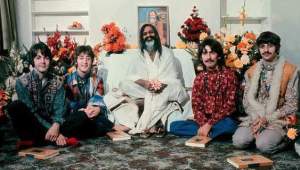
This must have been before the Beatles jettisoned any lip service to Christianity, claimed their renown exceeded that of Jesus, and entrusted their spiritual destiny to the philosophy of Maharishi Mahesh Yogi.

Naturally the questions include a variety of details about Roman Catholic faith and practices themselves.

Should Catholics genuflect whenever they enter a Catholic Church?

No, only if the blessed Sacrament is present in the church.

Interesting. I had never thought about it, but it makes sense, since the obeisance is actually being offered to Jesus, present in the consecrated elements.

For what group is the annual Red Mass celebrated?

Lawyers

Observation: What? Whose idea was that, and do Roman Catholics grace all other professions with their own dedicated masses? If so, what color Masses are dedicated to insurance brokers, microbiologists and wig makers?

What was the name of the portable throne once used to carry the pope so that everyone could see him?

Sedia Gestatoria

Replaced by the bulletproof Popemobile.

When was the last time that a pope proclaimed a Catholic teaching infallible?

1954 (the Assumption, Pope Pius XII)

A good reminder to countless misguided Protestants who think Roman Catholics believe that most or all of what the popes say is “infallible.” The lesson would be better taught, however, if the cited instance was not for an extra-biblical doctrine with which most Protestants strongly disagree.

What is the day on which Judas received his payment for betraying Jesus sometimes called?

Spy Wednesday

That’s a new one for me, but it sounds like a great title for a new movie about the wayward disciple.

Who was the first Roman Emperor to convert to Christianity?

Constantine the Great

It is good to see Constantine’s conversion affirmed here, although it is often maligned by critics. (Constantine was a child of his brutal age and after his conversion remained an imperfect sinner, just like the rest of us.) Only in the Eastern (Orthodox) Church is Constantine acclaimed a saint.

I will end with a question that holds a special place in my life, since I have spent the majority of my public ministry as a military chaplain.

What was the name of the Catholic chaplain on the TV show M*A*S*H?

Father Mulcahy

My favorite chaplain. I had the “blessed” experience of interviewing him for an article. I posted on William Christopher here and you can download a copy of the interview here.

A Trivial Windstorm

bellsIt’s amazing what we can accomplish during a multi-day power outage. Over the Thanksgiving holiday I learned a few new religious tidbits you may find interesting as well.

Several years ago I obtained a copy of Catéchic, “the Catholic trivia game” by Tyco®. While the power was out, I read all 1,000 trivia questions. It proved to be an interesting diversion.

The question of whether or not considering trivialities is a waste of time was addressed by C.S. Lewis at the outset of WWII.

Every Christian who comes to a university must at all times face a question compared with which the questions raised by the war are relatively unimportant. He must ask himself how it is right, or even psychologically possible, for creatures who are every moment advancing either to heaven or to hell, to spend any fraction of the little time allowed them in this world on such comparative trivialities as literature or art, mathematics or biology. (The Weight of Glory)

Lewis’ point is well made. When we contrast the matters which occupy our minds and energies with the things we ignore—including our eternal destiny and whether we are drawing closer to our Creator or drifting farther from him—the things of this world grow dim.

Perhaps that will be slightly less true in the case of trivia gleaned from the history of the largest denomination in the Christian Church.

Test Your Knowledge

A few questions were dated, not surprising I suppose, since the game was copyrighted in 1991. What was surprising is why they would choose to include questions about the names of prominent American archbishops of that decade, knowing it would date the product.

Question: Who is the Archbishop of San Antonio, Texas?

Answer: Archbishop Patrick Flores

Comment: He was historic, being the first Roman Catholic bishop of Mexican American heritage, and service as archbishop was lengthy (1979-2004), but the question as posed has passed its expiration date.

Name the Native American woman who may soon be canonized.

Blessed Kateri Tekakwitha

Tekakwitha (1656-1680) was canonized in 2012 and led a tragically short but interesting life. She was an Algonquin-Mohawk, the first Native American to be canonized.

Most other questions remain valid.

What is the name of Emperor Constantine’s decree that legalized Christianity in the Roman Empire in 313 A.D.?

The Edict of Milan

Bravo. As a student of ancient history and a Constantinian numismatist, I am pleased to see this vital moment in church history acknowledged.

Was St. Francis of Assisi a priest?

No

Good one! Most of us who’ve studied medieval history would probably get that right, but I assume the majority of Christians (Protestants, Catholic and Orthodox) would likely err on the side of ordaining Francis.

Which pope authorized the use of torture during the Inquisition?

Innocent IV

The irony of his chosen papal name is almost torturous. Admittedly, it was an improvement on his given name, Sinibaldo Fieschi.

A fair number of questions about ecclesiastical paraphernalia appear. To advance in the game, it helps to know your patens, piscina, and cinctures from your purificators, pyxes and cruets.

Is a “stermutatory” a piece of furniture found in a church?

No. A stermutatory is something that makes you sneeze.

That said, if some of the pews have grown so musty that they aggravate worshipers’ allergies, wouldn’t they qualify?

Some of the trivia provides arcane information sure to surprise one’s peers.

What is a cardinal who observers believe may have a chance of becoming pope called?

Papabile.

Nice to know . . . Now I just have to think of a way to work that into a typical conversation.

Seriously, using a word like this to show off one’s knowledge of obscure things reminds me of a passage I read many years ago attributed to St. Hereticus.* It offers satirical advice on how to upstage others in religious conversations.

The Superior Knowledge Gambit (not for beginners). Easier to illustrate than explain:

Opponent: I think my interpretation of the church has full historical precedent in Augustine.

Self: (starting hesitantly, but gradually gaining assurance until the final words are spoken with complete authority, in an ex cathedra tone of voice): But surely, much as I admire your exposition, really now, which interpretation of Augustine’s do you mean? There are at least five (eyes to the ceiling for a brief moment of counting), yes five . . . (pause, then confidently) There are at least five interpretations of the church in Augustine’s extant writings. (Give ever so slightly more emphasis to the word “extant.”)

. . .

Help from St. Augustine. A quiet yet forceful way of demonstrating superiority when Augustine is under discussion is to pronounce his name in contrary fashion to the pronunciation of Opponent. Make a point of emphasizing the contrast, so that it will be apparent that you know you are right, and that not even for politeness’ sake will you pronounce the name incorrectly as Opponent is doing. Either,

Opponent: . . . leading ideas in Augustine.”

Self: Augustine may have said that on one or two occasions, but . . .

Or,

Opponent (usually an Anglican in this case): . . . leading ideas in Augustine.

Self:Augustine may have said that on one or two occasions, but the whole Augustinian tradition, following, as I believe, the essential Augustine himself . . .

In this second gambit, it is advisable to maneuver the conversation into a discussion of “the Augustinian tradition” as indicated, so that when Opponent refers to it, as he must, without pronouncing it “the Augustinian tradition,” you can smile deprecatingly, to indicate your point has been made.

Well, that is enough trivia for one day. In my next post I’ll discuss some more substantial literary and theological concerns that emerge in the questions. Until then, one final trifle to entertain.

What 1975 film tells the story of King Arthur’s search for the Holy Grail as a comedy?

Monty Python and the Holy Grail

Some Python humor is too irreverent (or even blasphemous**) for my tastes, but this historic fantasy is one of my guilty pleasures. (I especially love the Killer Rabbit of Caerbannog which can only be dispatched by the “holy hand grenade of Antioch.”)

_____

* The Collected Writings of St. Hereticus by Robert McAfee Brown. An irreverent look at many aspects of ecumenical life in the mid twentieth century.

** Some (perhaps much) of the Python corpus leans towards vulgarity, but if you still enjoy the humor—and you are offended by blatant blasphemy, avoid reading the lyrics to their song, “All Things Dull and Ugly.”

There is a more positive connection between Monty Python and C.S. Lewis, however. John Cleese recorded The Screwtape Letters in 1995, lending his voice to the devilish “author” of the correspondence.