C.S. Lewis and Digital Books

book head

Would C.S. Lewis have embraced digital books if he had lived to see them? Or, would the Oxford and Cambridge scholar have deemed them an abomination?

Posing questions like this—about how prominent historical figures would have regarded technologies invented after they died—relies on conjecture. In most cases, one can only “assume” the likeliest answer.

A recent essay entitled “The Screen and the Book” sounds like something C.S. Lewis could have written about the encroachment of digital media on the domain formerly commanded by print.

The contention of the author is that:

Books are solid. This is at once a physical description and a metaphysical one, and it is on this metaphysical solidity that we ought to ground our loyalty to the book over and against the allure of the ever-changing screen.

When it comes to the notion of Lewis comparing heavily loaded bookshelves to a text laden hard drive, there is absolutely no question which he would prefer.

As Lewis declared in one essay, “an unliterary man may be defined as one who reads books once only.” (“On Stories”)

Lewis would without any doubt have despised the way ebooks have been displacing “real” books.

Lewis’ affection for modern and ancient codices enshrining the written word is legendary. In fact, one cannot possibly navigate the internet without repeatedly crashing into this single quotation: “You can never get a cup of tea large enough or a book long enough to suit me.”

One could fill volumes with Lewis’ comments about books. And that’s not simply because he was an astute literary critic. The simple truth is that C.S. Lewis loved books. A few less familiar quotations follow.

Some Bookish Thoughts Penned by C.S. Lewis

Lewis expressed his affection for devotional literature in a 1930 letter to Arthur Greeves.

All private reading has ceased, except for 20 minutes before bed (if alone) when I drink a cup of cocoa and try to wash the day off with MacDonald’s Diary of an Old Soul.

I shall soon have finished it and must look round for another book. Luckily the world is full of books of that general type: that is another of the beauties of coming, I won’t say, to religion but to an attempt at religion—one finds oneself on the main road with all humanity, and can compare notes with an endless succession of previous travellers. It is emphatically coming home: as Chaucer says “Returneth home from worldly vanitee.”

Books are vital to the preservation of what is good.

Every age has its own outlook. It is specially good at seeing certain truths and specially liable to make certain mistakes. We all, therefore, need the books that will correct the characteristic mistakes of our own period. And that means the old books. (“On the Reading of Old Books”)

Lewis describes classical education’s focus on the ancients, and the natural affection readers had for poetic works they encountered on their own.

The great authors of the past wrote to entertain the leisure of their adult contemporaries, and a man who cared for literature needed no spur and expected no good conduct marks for sitting down to the food provided for him. Boys at school were taught to read Latin and Greek poetry by the birch, and discovered the English poets as accidentally and naturally as they now discover the local cinema.

Most of my own generation, and many, I hope, of yours, tumbled into literature in that fashion. . . . Shall we be thought immodest if we claim that most of the books we loved from the first were good books and our earliest loves are still unrepented? (“High Brows and Low Brows”)

In the following letter from 1953, Lewis praises existing volumes on the subject of prayer and explains his hope for Letters to Malcolm: Chiefly on Prayer.

I invite your prayers about a work which I now have in hand. I am trying to write a book about private prayers for the use of the laity, especially for those who have been recently converted to the Christian faith and so far are without any sustained and regular habit of prayer.

I tackled the job because I saw many no doubt very beautiful books written on this subject of prayer for the religious but few which instruct tiros and those still babes (so to say) in the Faith. I find many difficulties nor do I definitely know whether God wishes me to complete this task or not.

In his essay “George Orwell,” Lewis relates his strong preference for Animal Farm over 1984. In addition to being prescient, he refers in a creative manner to his appetite for good books.

What puzzles me is the marked preference of the public for 1984 [over Animal Farm]. For it seems to me (apart from its magnificent, and fortunately detachable, Appendix on “Newspeak”) to be merely a flawed, interesting book; but the Farm is a work of genius which may well outlive the particular and (let us hope) temporary conditions that provoked it.

To begin with, it is very much the shorter of the two. This in itself would not, of course, show it to be the better. I am the last person to think so. . . .

My appetite is hearty and when I sit down to read I like a square meal. But in this instance the shorter book seems to do all that the longer one does; and more. The longer book does not justify its greater length. There is dead wood in it.

In 1928 Lewis mentioned a project that would have made fascinating reading if he had pursued it. He describes how an engaging volume can capture our attention in such a way that it leads us on a continuing quest of literary exploration.

My studies in the XVIth century—you will remember my idea of a book about Erasmus—have carried me much further back than I anticipated. Indeed it is the curse and the fascination of literary history that there are no real beginnings.

Take what point you will for the start of some new chapter in the mind and imaginations of man, and you will invariably find that it has always begun a bit earlier; or rather, it branches so imperceptibly out of something else that you are forced to go back to the something else. The only satisfactory opening for any study is the first chapter of Genesis.

Did Lewis Write the Following?

I’ll tell you the answer up front. No, he didn’t. But to my ear it sounds like it could easily have come from his lips.

In actuality, it is the closing statement of the essay referred to above. And, since it so clearly echoes the sentiments of C.S. Lewis, I deemed it fitting to close with it.

If you want to destroy a child’s love for learning, get rid of books. Serve him Plato from a PDF and E.B. White from an e-reader. Banish from his formative years any experience of objects that incarnate immaterial thought.

Remove the impractical, antiquated book in all its stubborn solidity, and encourage the child to dive into the flux wherein everything could be otherwise.

If we do this absolutely, if we ensure that not even the rumor of books reaches our rising generation, we will create a new man for the digital age: a puddle of disconnected thoughts pretending to have a head.
A Rare C.S. Lewis Book

readers

Just because you read a book doesn’t mean you need to purchase it for your library. Yet some of us do feel compelled to add almost every volume we enjoy to our personal collections. The dilemma arises when the cost of a particular book may exceed its “long-term” value to us.

Faced with this question a few weeks ago, I pursued a course open to many readers of Mere Inkling. I simply borrowed the book from my local library, which in turn borrowed it via interlibrary loan from a university in a neighboring state. Most libraries offer this service without charge. I regularly use it when researching obscure subjects I don’t anticipate I will continue to follow.

The subject of the particular text I am currently reading, of course, C.S. Lewis. While I believe I own a copy of every work ever written by Lewis that has been published, I doubt any human being could gather together every book written about the Oxford and Cambridge professor.

The Volume in Question

So, I have been spending some time during recent days reading notes and essays on Lewis that were written in a variety of periodicals and collected in 1992. Critical Thought Series 1: Critical Essays on C.S. Lewis was edited by George Watson, and published by Scolar Press. Watson also served as General Editor of the Series, compiled “in an attempt to recover the controversies that have surrounded the great critics of the modern age.”

The material is of particular interest to those interested in Lewis’ work as a literary critic. In addition to general reviews, there are special sections for critiques of The Allegory of Love, A Preface to Paradise Lost, and English Literature in the Sixteenth Century. Allow me to share a small taste of CEoCSL.

In the editor’s introductory article, he argues that Lewis possessed an “essential modernity, which was seldom if ever noticed in his lifetime.” An example he offers is Lewis’ “mingling of formalism and fantasy.” This facet of Lewis’ genius has a peculiar result.

[Lewis] belongs to that rare breed of critics who are more original than they would wish to be.

Watson also provides an intriguing view of how Lewis’ faith and literary community were perceived by those outside its influence.

Early and late, critics and reviewers found [Lewis] a hard nut to crack. In his middle years, from the late 1930s till his removal to Cambridge in 1954, the critical reception of his works was admiring of his style but wary of his matter.

It was vaguely understood by the late 1930s that a neo-Christian group of story-tellers and critics existed at Oxford, even that they were known as Inklings; but they formed no part of London literary life and were widely seen as a reactionary clique all to apt to a remote, rainy place celebrated for its devotion to lost causes and impossible loyalties.

Lewis, though a best seller, belonged wholly to that remote world, and his sales only made matters worse. They made him look formidable. He and his friends were occasionally dismissed as new-romantics, since a label can be an easy excuse for declining discussion; and the suspected association with Chesterton was not, to avant-garde opinion, endearing. The Inklings were anti-Modernist, anti-modern, backward-looking and deliberately unfashionable.

As I hinted above, this book contains a number of interesting pieces not readily accessible elsewhere. It is no hagiography, and includes essays that offer criticisms of some of Lewis’ writing.

In one review of English Literature in the Sixteenth Century, American poet and literary critic Yvor Winters enumerates problems he has with Lewis’ arguments. He then wraps up his review with an analysis of the cause of the disagreements.

There are many men who have re more in this field than I have, and Lewis is certainly one of them. Some of them will find errors in Lewis which have overlooked. I have found more errors in my own few publications than I have found in Lewis. It is not the errors in scholarship which trouble me, primarily, however, for those are inevitable. It is the critical mind that bothers me. . . .

There is a great deal in Lewis’s book which is valuable, and I may as well confess a great deal which has added to my own education. . . . But what is the function of this kind of book? No single man is competent to write it. . . .

Because it is impossible to write a flawless survey] the book is, as I have said, misleading, and so is every other book of the kind which I have ever read. And within twenty years it will doubtless be superseded by another book on the same subject, which will be better in some ways and worse in others.

The first-rate monograph, or the first-rate critical essay, is never superseded; it becomes a part of literature; but the text-book is a hugger-mugger affair, no matter who writes it. Lewis undertook a thankless task, and a hopeless one.

Personal Libraries

You are fortunate if you have this volume in your library. But don’t let its absence rob you of the chance to read it. There are many fascinating insights to be gleaned from its pages . . . and I am certainly glad that I borrowed it.

Oh, and as to Winters’ prediction that Lewis’ treatment of sixteenth century English literature would be superseded . . . thanks to the marvels of Kindle, it remains in print more than sixty years after his prognostication.

_____

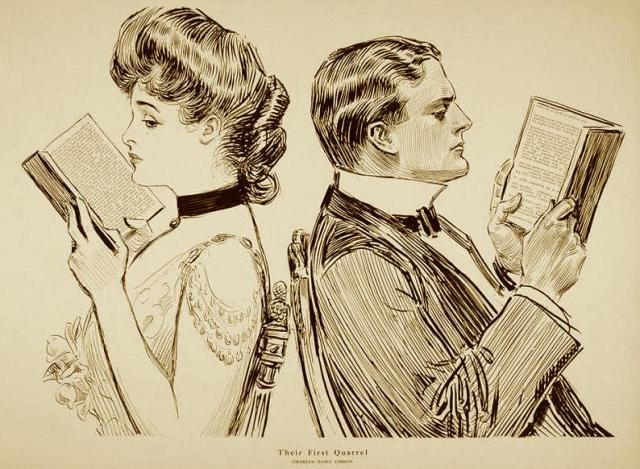
The picture on this page is a drawing entitled, “Their First Quarrel.” It was obviously sketched prior to the invention of the television and cellphone.

C.S. Lewis and his Secretary

hooper

Upon Lewis’ death, Walter Hooper assisted Inkling Owen Barfield (1898-1997) in overseeing Lewis’ literary estate. He continues to serve as a literary advisor to the estate. Hooper’s Lewisian contributions have grown in magnitude over the years.

He began by co-authoring a biography of Lewis in 1974, written jointly with Roger Lancelyn Green (1918-87). Green had been a student of Lewis, and a member of the Inklings. After writing several other works through the years, in the late nineties he penned C.S. Lewis: A Companion and Guide and C.S. Lewis: A Complete Guide to His Life and Works. Priceless resources!

The list of material edited by Hooper is quite impressive. He dutifully, and brilliantly, edited many of Lewis’ writings. The world should be particularly grateful for the three-volume compilation of Lewis’ correspondence. A humble man, Hooper writes sincerely in the preface to the volumes: “The eight years I have spent editing the letters would not have been as fruitful nor as pleasant were it not for the help of many others. My debts are numerous, and nothing I can say can adequately reflect my gratitude.”

Hooper’s meeting with Lewis was providential, coming as it did so near the end of the great author’s life. The following letter describes their arrangement. It reveals how much Lewis appreciated the initial assistance provided by Hooper, and how hopeful he was that Hooper would be able to resume his secretarial duties in the summer of 1963. Lewis remained, however, concerned about how he would meet all of his financial responsibilities in the wake of his medical retirement.

[The Kilns] 20 Sept 63

My dear Walter

We get on reasonably well, tho’ we all greatly miss, not only your utility, but your companionship. No one has ever so endeared himself to the whole household.

The noble Arthurian volumes continue to arrive, but are not yet on the shelves. The work of arranging all my books in their new homes, tho’ delightful, goes on v[ery] slowly, for I am not strong enough to do more than a little each day.

Now, about the future. It is entirely reasonable that you shd have a salary and a darn good one, and I feel I have been rather sponging on your kindness. But what it may be proper for you to ask may also be impossible for me to do.

I dare not at present increase my expenses. In this country one is taxed each year on the income of the previous year. One’s first year in retirement is therefore very alarming. And if, on top of the drop in income, there are the expenses of an illness, and some rather heavy and unexpected expenses for David–well you see.

I am v. ashamed, not of confessing the situation, but of refusing the wholly just demand from a man to whom I already owe more than any money could repay.

But you see, having you as a paid secretary wd. be a luxury, and I’ve no right to imperil those who depend on me for the sake of a luxury to myself.

On other grounds, I couldn’t recommend you to come in January. Mrs Miller and I talked it over and both concluded that an English house in an English winter wd. be misery for you. Our central-heating apparatus is v. primitive (nothing like yours) and we can afford to use it only during very cold snaps.

If you can afford to come in June, you will be thrice welcome. W. is still away. I fear he’ll kill himself if this goes on much longer.

Our plums are splendid this year. With all our loves. Yours Jack

A Wonderful Interview with Hooper

Walter Hooper has been very content to remain behind the scene, and deep in the shadow of the man whose memory he preserves.

Fortunately, in addition to his personal writings and editorial work, Hooper has been willing to speak in various settings. The photograph at the top of the page comes from the unveiling of Lewis’ memorial in Westminster Abbey’s Poets’ Corner.

We owe a debt of gratitude to “Socrates in the City: Conversations on the Examined Life,” which is produced by Eric Metaxas, a Christian writer and syndicated radio host.

Metaxas took his program from the city of New York, to the city of Oxford to avail himself of the wealth of brilliant speakers accessible there. Among those he interviewed in this casual setting is Walter Hooper. Wonderfully, the Hooper interview was substantial enough that it is presented in three parts. Do check it out.

Who Said That?

thoms and lewisWho said that? It’s a question people ask when they recall a familiar saying and don’t remember the source.

Occasionally when we are reminded of the source, we shake our heads and think that’s right; how could I have forgotten!

At other times though, discovering the source of the maxim doesn’t help at all. It could be because the proverb is anonymous, or it might be due to the fact that it’s originator was not particularly well known.

That’s the case of the following statement, which is familiar to many Christians.

“Be careful how you live; you will be the only Bible some people ever read.”

When I thought of this phrase several weeks ago, I had a bit of trouble tracking it down. I actually found it on a number of sites, but the problem was that the author’s name was so unfamiliar it was almost always misspelled.

He was usually cited as “William Toms.” Yet I was pretty sure the saying hadn’t originated, however, with an Irish footballer.*

Just when I assumed I had encountered a clichéd brick wall, I stumbled upon the truth. Like so many classic maxims, the quotation did indeed originate from the British Isles.

The British writer William J. Thoms penned this thoughtful maxim, and it isn’t the only wise thing he wrote.

William John Thoms (1803 – 1885) was a British writer credited with coining the term “folklore” in the 1840s. Thoms’ investigation of folklore and myth led to a later career of debunking longevity myths. Hence, he is an early advocate of “validation research” when examining demographics.

Several of Thoms’ works are available online. They include:

C.S. Lewis had more in common with Thoms than simply being British and engaging in literary pursuits. The two men shared an interest in simple tales that intrigued and inspired men and women through the ages.

It was Thoms, in fact, who in 1846 introduced into English the term “folklore.”

A shared interest in legends and even the supernatural, suggests that the two may well have enjoyed one another’s company, had their lives intersected.

Sadly, Thoms’ desire to compile a comprehensive “Folk-Lore of England” was never realized, as this superb article describes.

The two scholars shared another trait of bookish people. (“Bookish,” by the way, is a compliment here at Mere Inkling.) Neither man sought out the frivolities of popular society. They were both content to socialize with similar minds in more intimate community. The following description of Thoms, from the Dictionary of National Biography,could just as naturally have been written about Lewis.

Thoms went little into society, but at congenial resorts, such as the ‘Cocked Hat Club,’ he was remarkable for a ready play of wit and an almost inexhaustible fund of humorous anecdote and reminiscence.

Can’t you just picture the Cocked Hat Club meeting at one table in the Eagle and Child while the Inklings shared their own warm friendship at their table at the other end of the pub?

_____

* Not that I follow English football, but I learned an athlete by that name played forward for Plymouth Argyle and Manchester United.

** The Book of the Court, published in 1838 with the second edition, linked here, printed six years later, has the delightful, if rather lengthy, subtitle: Exhibiting the History, Duties, and Privileges of the Several Ranks of the English Nobility and Gentry, Particularly of the Great Officers of State and members of the Royal Household; Including Vaious Forms of Court Etiquette, Tables of Precedency, Rules to be Observed at Levers and Drawing Rooms, Etc.

Is Fantasy Foolish?

lion of lyonSome of the smartest people around dismiss reading fantasy as a crazy waste of time. At the same time, many of the most brilliant people I know love nothing more than passing from their mundane lives through a magical wardrobe into a land of wonder.

On a recent episode of the television series Castle, the eponymous Richard Castle,* a best-selling author and private eye, has a great line. Castle is defending his hyperactive imagination (which frequently leads to the solving of the crime of the week).

A suspect calls him “reality-challenged.”

To which he responds, “I prefer fantasy-augmented.”

Now, there’s a description that would fit most readers of Mere Inkling. We’re “fantasy-augmented.”

It would also fit most of the Oxford Inklings. Not all of them, of course. Some of them, like C.S. Lewis’ brother Warnie, were more oriented towards factual, historical literature.

The fantasists among their ranks were not lacking as writers of nonfiction either.

However, it was the fact that they were “fantasy-augmented” that has led to the inclusion of several of their members in the first ranks of twentieth century writers.

Narnia and Middle Earth are as real to many people today as Ogre, Latvia, Humpty Do, Australia, Llanfairpwllgwyngyllgogerychwyrndrobwllllantysiliogogogoch, Wales, and Frankenstein, Missouri. (Perhaps more real!)

In 1936, C.S. Lewis wrote a letter to Charles Williams, praising his recent novel.**

A book sometimes crosses ones path which is so like the sound of ones native language in a strange country that it feels almost uncivil not to wave some kind of flag in answer.

I have just read your Place of the Lion and it is to me one of the major literary events of my life–comparable to my first discovery of George Macdonald, G. K. Chesterton, or Wm. Morris.

The following day, Williams wrote a letter of his own to C.S. Lewis. It began:

My dear Mr Lewis, If you had delayed writing another 24 hours our letters would have crossed. It has never before happened to me to be admiring an author of a book while he at the same time was admiring me. My admiration for the staff work of the Omnipotence rises every day. To be exact, I finished on Saturday looking—too hastily—at proofs of your Allegorical Love Poem.

William’s reference to coincidence is poetic. He doesn’t rely on the timeworn “divine Providence,” which is so prevalent in literature of the eighteenth and nineteenth centuries.

Returning to Lewis’ missive, we learn exactly how Williams’ fantasy so deeply impressed him.

A book sometimes crosses ones path which is so like the sound of ones native language in a strange country that it feels almost uncivil not to wave some kind of flag in answer. I have just read your Place of the Lion and it is to me one of the major literary events of my life—comparable to my first discovery of George Macdonald, G.K. Chesterton, or Wm. Morris.

There are layers and layers—first the pleasure that any good fantasy gives me: then, what is rarely (tho’ not so very rarely) combined with this, the pleasure of a real philosophical and theological stimulus: thirdly, characters: fourthly, what I neither expected nor desired, substantial edification.

It’s unlikely that any of us should ever author a work that would equally impress C.S. Lewis. Still, what a grand goal for any fantasy-augmented writer to strive for!

_____

* Castle is played by Nathan Fillion, who captained the spacecraft “Serenity,” in a delightful series entitled Firefly.

** You can download The Place of the Lion in a variety of formats at ManyBooks.

The illustration above is used with the permission of its creator, Charis Tsevis.


Metaphysical Poetry (it’s better than it sounds)

quarlesI had to add the parenthetical comment to the title of this column or it would have been dismissed on its surface by readers like me. Although I dabble at poetry myself, I never voluntarily choose that genre for reading. And metaphysics? As a practical pastoral theologian, I have little interest in abstract philosophies.

I have just discovered metaphysical poetry, and it is quite intriguing.

How well read are you? Do you read broadly, deeply, or both? Unfortunately, most of us restrict our reading to a rather narrow scope. This is due to two factors.

First of all is our lack of time. Few enjoy the leisure hours to indulge in the sheer pleasure of reading simply for joy.

A second dilemma arises from the deluge of new books being published every day.

It is tempting to retreat in the spirit of C.S. Lewis to the classics, and not waste our time on a volume until it has proven its worth by remaining in print. Alas, digital technology devastates that metric, since even the most worthless tripe can remain in virtual print indefinitely.

As a semi-retired pastor, I enjoy more time than I did when I was serving full time, but I still limit my reading primarily to theology, history, current events, and anything related to C.S. Lewis. I seldom have time to explore the treasure of literature that is freely available to us.

I recently spent some time doing just that.

I read some writing advice from the pen of Francis Quarles (1592-1644) who is best known for his book Emblems. It is representative of a genre (called “emblem books”) that flourished in Europe during the sixteenth and seventeenth centuries. Here are two enjoyable observations:

If thou desire to make the best advantage of the muses, either by reading, to benefit thy selfe, or by writing, others, keep a peacefull soul in a temperate body: a full belly makes a dull brain; and a turbulent spirit, a distracted judgement: the muses starve in a cook’s shop, and a lawyer’s study. (LXXIX).

If thou intend thy writings for the publique view, lard them not too much with the choice lines of another author, lest thou lose thy own gravy: what thou hast read and digested being delivered in thy owne stile becomes thine: it is more decent to weare a plaine suit of one entire cloth, than a gaudy garment checquered with divers richer fragments. (XCVII).

Lewis was, of course, intimately acquainted with Quarles’ work. Like everyone else, however, he was more influenced by the literary contribution of John Donne (1572-1631). Like Quarles, Donne is considered one of the English “metaphysical poets.”

These writers offered used “conceits,” which were similar to analogies, but compared things that were clearly different from one another. It requires significant skill to convince a reader of the similarities of things that are deeply unlike one another.

In his essay “Dante’s Similes,” Lewis discusses the subject in detail.

It will be easily seen in what sense Dante’s similes are ‘metaphysical.’ The connexion between the two members is real, ontological, intelligible, and the material need not be in itself beautiful or may be even grotesque—as when Time is represented as a tree growing downwards with its roots in a vase which is the Primum Mobile (Paradiso, XXVII, 118). And this certainly connects them, in one way, with what literary critics call ‘Metaphysical’ conceits, meaning the conceits used by Donne and his followers.

But there are only two points of contact—first, the difficult and (at first sight) unpoetical nature of the material, and, secondly, the intellectual rather than emotional connexion between this material and the thing compared with it. The spirit in which they are used is not the same in Donne and in Dante. In Donne, the connexion, though intellectual as in Dante, is as momentary, as incapable of life beyond the immediate context, as the connexions in Homer or Virgil.

It may be true that Donne cannot court a mistress without bringing in scholastic philosophy, law, chemistry, and cosmography. But he has no interest in these things except as toys and does not care in the least what place they have, if any, in the real universe—if, indeed, there is a real universe outside the present emotion. The longer you look at Donne’s comparison of the lovers to the compasses, the less alike they will seem, and the more certain you will become that the innumerable differences between them are a more interesting and fruitful field for thought than the single analogy.

But in the greatest Dantesque similes, the longer you look the greater the likeness becomes and the more fruitful in thoughts that are interesting as long as you live. This, of course, is no disparagement to Donne: a witty love song, whether salacious or saturnine, is not meant to be chewed over like the great Comedy which made its author lean. If I seem to be breaking a butterfly upon a wheel, it is only because I want to avoid a misunderstanding which would hinder our reading both of the great and of the little poet.

Sample Their Works (for free)

If you are able to carve out a few hours of your time to delight in the rich banquet provided by the three writers mentioned above, visit these links to download their books in the digital version of your choice.

Francis Quarles’ Emblems

(This edition is elegantly illustrated!)

The Poems of John Donne

(Volume I)

The Divine Comedy of Dante Alighieri

_____

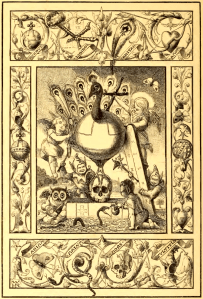
The elaborate image at the top of this column is one of the illustrations found in the copy of Emblems linked to above.

A Mastery of Words

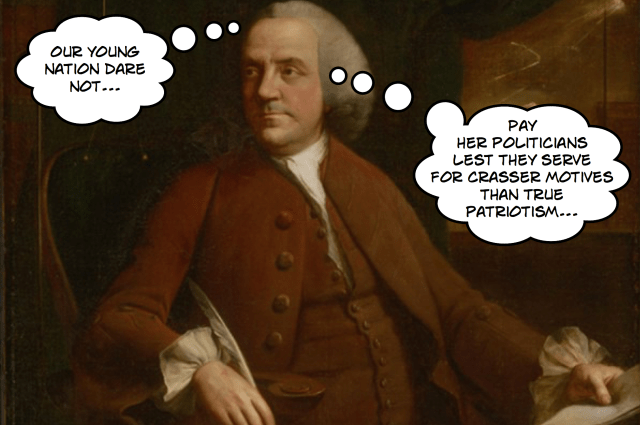
ben franklinOh the curse of so many fascinating things to read . . . and so little time. The following pieces of wisdom come from a free volume, The World’s Famous Orations, by William Jennings Bryan.*

Bryan (1860-1925) was one of the most prominent American orators and politicians. In his study of rhetoric he collected a wide range of speeches given throughout Western history.

The collection is fascinating. It includes moments from well known historical events and from obscure yet intriguing occasions. For example, you can hear the words of Hannibal spoken to his army after its successful crossing of the Alps, or the republican speech offered by the falsely condemned Algernon Sidney from the scaffold.**

Public speaking used to be a cornerstone of education. In colleges today, “speech” is often merely an elective.

C.S. Lewis relates a funny story about one of his first experiences speaking in a formal setting. The occasion was the annual Encaenia at Oxford University, which commemorated founders and benefactors. Honorary degrees were given and excerpts from prize compositions were recited.

Lewis wrote to his father about the event. “I had almost forgotten, if I had ever known, that ‘prizemen’ have to read portions of their compositions at our ceremony of the Encaenia.”

After the honorary degrees [one of which was received by Georges Clemenceau], the Professor of Poetry made an ‘oration’ in Latin, chiefly about colleagues who had died during the last year: this was my first experience of spoken Latin and I was pleased to find that I could follow and enjoy it. The performance of us prizemen was of course very small beer after all this. We had been instructed to read for about two minutes each: I had some difficulty in finding a short passage which would be intelligible by itself. I was, of course, nervous: I am also told that I was the first of our little band whom Clemenceau looked at: but as I do not know with what expression he looked, nor whether he speaks English, we must remain in doubt whether this was a compliment or not.

I have had a good lesson in modesty from thus seeing my fellow prize men. I was hardly prepared for such a collection of scrubby, beetle-like, bespectacled oddities: only one of them appeared to be a gentleman. Any I spoke to sounded very like fools, perhaps like Goldsmith, they ‘writ like an angel and talked like poor Poll’. 76 It brings home to one how very little I know of Oxford: I am apt to regard my own set, which consists mainly of literary gents, with a smattering of political, musical and philosophical–as being central, normal, and representative. But step out of it, into the athletes on one side or the pale pot hunters**** on the other, and it is a strange planet.

The World’s Famous Orations combines a number of separate volumes that run from classical Greece and Rome, on through most of the European nations, including their “colonies” in the Western Hemisphere. President Teddy Roosevelt is the final orator whose words are included.

I invite you to sample some of the rich banquet included in this volume. The speeches themselves are fairly short, and these excerpts the more so. Mere teasers. If you perchance become bored, skip to the final passage—Benjamin Franklin provides his fellow Americans a warning that we sadly failed to heed.

Socrates (470-399 BC) upon being condemned wittily insults his judges.

For the sake of no long space of time, O Athenians, you will incur the character and reproach at the hands of those who wish to defame the city, of having put that wise man, Socrates, to death. For those who wish to defame you will assert that I am wise, though I am not. If, then, you had waited for a short time, this would have happened of its own accord; for observe my age, that it is far advanced in life, and near death. . . .

But if, on the other hand, death is a removal from hence to another place, and what is said be true, that all the dead are there, what greater blessing can there be than this, my judges? For if, on arriving at Hades, released from these who pretend to be judges, one shall find those who are true judges, and who are said to judge there. . . . At what price would you not estimate a conference with Orpheus and Musæus, Hesiod and Homer? I indeed should be willing to die often, if this be true. For to me the sojourn there would be admirable, when I should meet with Palamedes, and Ajax son of Telamon, and any other of the ancients who has died by an unjust sentence.

The comparing my sufferings with theirs would, I think, be no unpleasing occupation. But the greatest pleasure would be to spend my time in questioning and examining the people there as I have done those here, and discovering who among them is wise, and who fancies himself to be so but is not.

“Enough with the insults, philosopher; drink the hemlock.”

Seneca (the Younger, 4 BC-AD 65) before being ordered to commit suicide by Nero, whom he had tutored.

This is the fourteenth year, Cæsar, since I was summoned to train you for your high destiny; and the eighth since your advancement to the empire. During the intervening period, you have showered such honors and riches upon me, that nothing is wanting to complete my felicity but the capacity to use them with moderation. . . .

But both of us have now filled up our measure— you, of all that the bounty of a prince could confer upon his friend; I, of all that a friend could accept from the bounty of his prince. Every addition can only furnish fresh materials for envy; which, indeed, like all other earthly things, lies prostrate beneath your towering greatness, but weighs heavily on me. I require assistance. Thus, in the same manner as, were I weary and faint with the toils of a warfare or a journey, I should implore indulgence; so in this journey of life, old as I am, and unequal even to the lightest cares, since I am unable longer to sustain the weight of my own riches, I seek protection.

Order your own stewards to undertake the direction of my fortune, and to annex it to your own; nor shall I by this plunge myself into poverty, but having surrendered those things by whose splendor I am exposed to the assaults of envy, all the time which is set apart for the care of gardens and villas, I shall apply once more to the cultivation of my mind.

“Did you forget, noble tutor, that I Nero am insane enough to demand both your wealth and your life?”

Thomas Cranmer (1489-1556) at his execution, following his renunciation of a forced recantation. (Yes, that sounds confusing, but under duress he had bent to the will of bloody Queen Mary.)

And now I come to the great thing which so much troubleth my conscience, more than anything that ever I did or said in my whole life, and that is the setting abroad of a writing contrary to the truth—which now I here renounce and refuse, as things written with my hand contrary to the truth which I thought in my heart, and written for fear of death, and to save my life if it might be—and that is, all such bills and papers which I have written or signed with my hand since my degradation, wherein I have written many things untrue.

And forasmuch as my hand hath offended, writing contrary to my heart, therefore my hand shall first be punished; for when I come to the fire, it shall be first burned.

“Darn that troublesome archbishop! That wasn’t the speech we approved in advance for him to give.”

Maximilien François Marie Isidore Robespierre (1758-94) denying King Louis was entitled to a trial.

Louis was king and the Republic is founded; the great question which occupies you is decided by these words alone. Louis has been dethroned for his crimes; Louis denounced the French people as rebels; to chastise them he has invoked the arms of his brother tyrants. Victory and the people have decided that he was the rebel: hence Louis can not be judged; he is judged already. He is condemned, or the Republic is not absolved.

To propose a trial for Louis XVI. in any way whatever is to retrograde toward royal and constitutional despotism; it is a counter-revolutionary idea, for it is putting the revolution itself on trial.

“We’ll see how you feel about allowing trials for tyrants two years into your reign of terror, when we take you to the guillotine.”

Benjamin Franklin (1706-90) warns about the dangers of providing salaries to bureaucrats.

I think I see inconveniences in the appointment of salaries [for those in the Executive Branch]; I see none in refusing them, but, on the contrary, great advantages.

Sir, there are two passions which have a powerful influence in the affairs of men. These are ambition and avarice—the love of power and the love of money. Separately, each of these has great force in prompting men to action; but, when united in view of the same object, they have, in many minds, the most violent effects.

Place before the eyes of such men a post of honor, that shall, at the same time, be a place of profit, and they will move heaven and earth to obtain it.

The vast number of such places it is that renders the British government so tempestuous. The struggles for them are the true source of all those factions which are perpetually dividing the nation, distracting its councils, hurrying it sometimes into fruitless and mischievous wars, and often compelling a submission to dishonorable terms of peace.

And of what kind are the men that will strive for this profitable preeminence, through all the bustle of cabal, the heat of contention, the infinite mutual abuse of parties, tearing to pieces the best of characters? It will not be the wise and moderate, the lovers of peace and good order, the men fittest for the trust.

It will be the bold and the violent, the men of strong passions and indefatigable activity in their selfish pursuits. These will thrust themselves into your government and be your rulers.

“Oh that we had listened to your sage counsel. Now we are reaping what we have sown in our political machinations.”

_____

* You can download a personal copy of the book in a variety of versions here.

** Algernon Sidney (1622-83) fought honorably for the republican cause in the English Civil War. The fact that he opposed the execution of Charles I did not deliver him from the vengeance of the hedonist Charles II.

*** Georges Clemenceau (1841-1929) was the French prime minister who helped set the stage for World War II by demanding excessive concessions with Germany during the Versailles peace talks.

**** A “pothunter” is someone who hunts game without a concern for rules of sport. Lewis is likely applying it here in the sense of a person who participates in competitions primarily with the goal of accumulating prizes.

Life in Middle Earth

theodenIf you resided in Middle Earth during the Third Age,* which of the major characters might you have been? Boromir,** Pippin, or perhaps Gandalf himself?

And, we’re only talking about the “good guys and gals.” We’ll have no one identifying with villains like Saruman, the Nazgûl ringwraiths or Grima Wormtongue here at Mere Inkling!

In a moment, I’ll help you answer that question.

Unfortunately, the internet abounds with time-consuming black holes. Pouring minutes and hours of our lives into the abyss of mindless videos or addictive games is the sad result.

Some entertaining diversions, however, possess merit. Case in point, an analysis of the leaders of Lord of the Rings, arranged according to their personality types.

Visiting a website such as this is not only fun, it offers insight into human differences. And, for the unwary, it may even reveal some new insights into our own nature.

I believe in the general validity of the best known personality inventory, the Myers-Briggs Type Indicator. I have posted in the past about C.S. Lewis’ (likely) personality type being an INFP. That appropriately identifies him with none other than Frodo, “the idealist.”

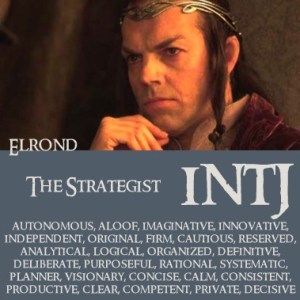
elrondMy own type is ENTJ, which matches with King Théoden above. As I age, however, I am finding myself less extraverted and more desirous of solitude. That means I am progressively becoming an INTJ, and that aligns me with Elrond. Frankly, both of the characterizations suit me quite well.
A person’s type is determined by which of four polarities is dominant.

Extraversion/Introversion

Sensing/Intuition

Thinking/Feeling

Judging/Perceiving

If you don’t know your type, and have the time to take an online assessment now, you can do so for free here.

You don’t need to do it to enjoy the Lord of the Rings chart though. So, which are Middle Earth leader are you? Find out here.

A Note of Caution

While instructive, tools such as this should never be used to put people into boxes (which is ironic, since the MBTI is graphically presented in that fashion).

The last thing we need is someone thinking they are defined by a psychological instrument such as this. After all, today’s Gimli may just well be tomorrow’s Bilbo.

_____

* The complete timeline of Middle Earth is available here.

** I have written in the past about the hero Boromir.


The Devil’s Printing Press

pressIf the devil has used the printing press so effectively to advance his purposes, one can only imagine how easily the internet can be twisted to his purposes.

Whether or not you believe Satan is an actual (fallen angelic) person, we all recognize the web provides a ready conduit for unimaginable evil. Recent discussions of the traffic that occurs on the Dark Web is sobering. Actually, not “sobering,” but frightening.

While a small fraction of the data is innocent, the majority deals with criminal and dehumanizing material. Some investigators suggest more than half of the data transfers involve pedophilia.

I’ve been doing some personal research into parallels between the advent of the printing press and the rise of the internet. I’m approaching it from the perspective of how each has provided access to competing faith claims.

Martin Luther viewed the “recent” invention of Gutenberg’s press as divinely appointed to coincide with what would come to be known as the Reformation.

Roman Catholics also published treatises and pamphlets opposing the calls for institutional change within the church. The persuasiveness of arguments aside, one reason for their lack of success against the evangelical leaders was simple.

Rather than writing for the German people in their own tongue, they directed nearly all of their initial energies at writing for the elite, in Latin. While only a minority of sixteenth century Germans were literate, only a small percentage of these were able to read Latin.

During the first half century of the existence of movable type for the press, the majority of published titles were religious. Only later did popular and secular titles eclipse them.

However, they did. Many were wonderful. Scientific and literary knowledge blossomed.

Foremost among the good fruits disseminated by the press, we would have to include the works of the Inklings, especially C.S. Lewis and J.R.R. Tolkien. (Consecrated imaginations are capable of wondrous creations!)

Eventually, of course—given humanity’s imperfect nature—this neutral device was harnessed to baser purposes.

This would lead a nineteenth century minister to write an essay with the title of this column, “The Devil’s Printing Press.” Thomas Green described the dilemma vividly.

The first book printed in Europe had six hundred leaves, and it took nearly ten years to make it. Now books are written, printed, sold, read and forgotten in one-fourth the time. A single century ago, and a man well to do, thought himself fortunate if he had one book in this wild western world.

Today there are books in well kept rank upon almost every cottage shelf It is little wonder that the powers of evil should have invaded the province of the influence of the book shelf and bound up in attractive colors and insidious page the poison of wickedness and sin.

Later in his address, available to read at your leisure here, he contrasts the noble and corrupt purposes for which the press (or internet) might be used.

There are papers of every shape and for every use; daily, tri-daily and almost hourly, weekly and semi-weekly, monthly and quarterly, and filled with everything. You have no idea unless you have given it especial attention, of the magnitude and wondrous dimensions of the newspaper as a factor in civilization. You have little idea, unless you have studied it, of the influence, the formative power of this outwardly ephemeral agency upon human life.

You have little idea, unless you have sought it, of the labor, the enterprise, the energy, the talent, the outlay necessary to plan and execute this gigantic result. You have little conception of the influence of the printing press, as an enlightener, as a pioneer of civilization, as a promoter, a creator, a conservator of purity and virtue; and you have little idea of the magnitude of the devil’s work through this mighty agency, as in a thousand ways he uses it for pollution and ruin.

Green’s florid and dated verbiage may weaken the impact of his argument. Likewise the revivalist tones of his message. Still, as the existence of the dark web reminds us, even the good can be touched by corruption. Perhaps our vigilance can reduce this danger.

We will close now with another description by the author of the lurid material which preceded the pornography which abounds today. Would that our dulled sensitivities remained innocent enough to “blush” at explicit material, as he says.

But the devil has a channel by which he ruins life and character, in a specialty in the newspaper line that panders to the low and more bestial part of man’s being. Broadcast over the land there are sown every day almost countless thousands of papers filled with the corrupt, lascivious, the impure, gathered from all the fact and fancy that a filthy mind can contrive.

Facts that transpire often in the lowest slums of life are here placarded with all the embellishment of illustration and seductive coloring; language and recitals no man would read without a blush are hidden in its folds. It is a slimy, salacious mosaic of filth and wickedness, and yet go up and down the city streets and in every news-dealer’s window and on every corner stand they are spread out for inspection and sale.

_____

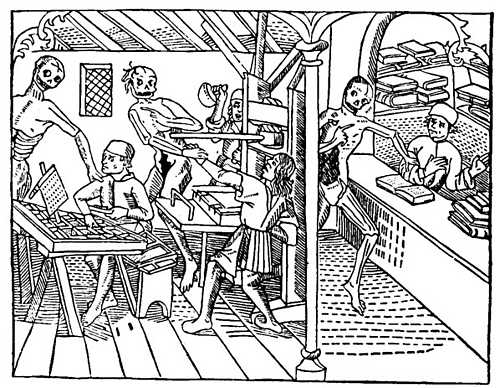
The woodcut illustration above comes from a book entitled The Dance of Death, and is the first representation of a printing press. The point being made was not to associate death with printing, but to reveal how death comes to all, unanticipated, regardless of who they are.

Fleeting Fame

fameIt’s likely that the names of 98.6% of authors who top the bestseller charts today will be unremembered a century from now.

This weekend I posted the latest issue of Curtana: Sword of Mercy, a journal I edit about military chaplains. (If you are interested in checking it out, you can download a free copy here.)

The current issue includes an interesting article about two chaplains from Vermont who served during the War of 1812. (For international readers, that was the war following the winning of America’s independence when they British got their revenge—they captured our national capital and burned the capitol.)

In the biographical portion of the article, the author included a final summary of the life of one of the chaplains. Solomon Aiken (1758-1833) left his civilian pulpit to serve soldiers and sailors.

Aiken was quite prominent in his day. Not only was he a well known preacher and writer, he actually served as a member of Vermont’s legislature. Yet, I doubt that even Vermonters would recognize his name today.

Here is the quotation from a nineteenth century tribute published after his passing.

Mr. Aiken enjoyed uncommon health and vigor. He never took a particle of medicine, or lost a relish for food, until his final and brief sickness—a pleurisy fever. He possessed peculiar power as a logician, and was very popular as a preacher. He was kind-hearted and benevolent, almost to a fault. But it is chiefly as a political writer that Mr. Aiken is remembered. He was sent as a representative for two years, by the town of Dracut. He published several sermons and pamphlets, chiefly upon political themes, which excited much attention in their season.

The words that seized my attention were the conclusion, “. . . which excited much attention in their season.”

“In their season . . .” That season must have been brief, since the history was written just twenty years after Aiken’s death. By then his works had either withered or, more optimistically, gone to seed. In either case, their day was passed.

Translating that to our modern era, where things become obsolete almost as soon as they are envisioned, it would imply that our “season” of fame or reputation will last little more than a handful of months. And that, of course, assumes that a person actually achieves some level of renown.

Fame is fleeting. It has always been so, and the good Reverend Aiken is simply another example of that truth.

Thank God (literally) that there is more to life than notoriety.

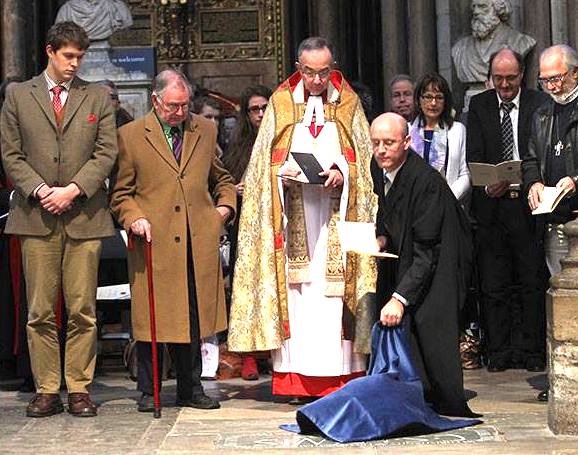
C.S. Lewis is one of the 1.4% whose fame lasts. His has not diminished; it continues to grow. Just a year ago, on the fiftieth anniversary of his death, he was honored by having a plaque dedicated in Poet’s Corner in Westminster Abbey.

Lewis never sought fame, as the following discussion from his essay “The Weight of Glory” clearly reveals.

I turn next to the idea of glory. There is no getting away from the fact that this idea is very prominent in the New Testament and in early Christian writings. Salvation is constantly associated with palms, crowns, white robes, thrones, and splendour like the sun and stars. All this makes no immediate appeal to me at all, and in that respect I fancy I am a typical modern.

Glory suggests two ideas to me, of which one seems wicked and the other ridiculous. Either glory means to me fame, or it means luminosity. As for the first, since to be famous means to be better known than other people, the desire for fame appears to me as a competitive passion and therefore of hell rather than heaven. As for the second, who wishes to become a kind of living electric light bulb?

When I began to look into this matter I was stocked to find such different Christians as Milton, Johnson and Thomas Aquinas taking heavenly glory quite frankly in the sense of fame or good report. But not fame conferred by our fellow creatures—fame with God, approval or (I might say) “appreciation’ by God.

And then, when I had thought it over, I saw that this view was scriptural; nothing can eliminate from the parable the divine accolade, “Well done, thou good and faithful servant.” With that, a good deal of what I had been thinking all my life fell down like a house of cards.

This exceptional work merits consideration not only by people of faith. It invites all honest readers to gaze within themselves at their deepest yearnings.

Another passage from C.S. Lewis that relates strongly to the subject at hand comes from The Great Divorce. You can read the entire passage here, but the heart of it is this. Lewis views a simple woman, presently in heaven, receiving magnificent praise and celebration. He naturally assumes she must have been some well known saint.

He is, however, informed that she lived an obscure life, despite the fact that she touched countless nondescript people and animals with her compassion. Lewis’ heavenly guide is rather surprised that the Oxford professor has overlooked a simple truth:

Fame in heaven “and fame on Earth are two quite different things.”

Only the second will last.