C.S. Lewis, Apologues & Allegories

It has been argued that C.S. Lewis wrote apologues, but I humbly disagree.

An “apologue,” you see, is defined as “a moral fable, especially one with animals as characters.” From that core definition, it makes sense to some that works such as The Chronicles of Narnia might be described as apologues.  

However, this term is usually applied to much simpler, more concise stories –  short moral fables (think Aesop) rather than an extended tales. “Apologue” is a vastly insufficient label for what J.R.R. Tolkien described as subcreation. Narnia is not a fable, it is a world.

Years ago I compared Aesop’s brief “The Kingdom of the Lion,” with C.S. Lewis’ brilliant vision of Aslan.

In “The Lion’s Command,” I identified a virtuous parallel between the brief regent in the fable and the well-developed protagonist of Narnia. In the Chronicles, Narnia’s hero is nothing other than the Alpha and Omega, reigning over its creation and preserving his kingdom to its ultimate culmination.

In “C.S. Lewis and the Art of the Apologue,” Samuel Joeckel argues that “The Screwtape Letters and The Great Divorce might be read as pure apologues, while Lewis’s other works of mythopoeia contain elements of the apologue.” This is an intriguing proposal, which has not gained much traction. Of course, Joeckel’s point that “elements” of apologue are present is certainly true, but that would be so when considering the work of numerous authors.

If not an Apologue, might Narnia be an Allegory?

An interesting article about parables contrasts parables and apologues in the following manner.

Another story style that is related to parables is the apologue. Apologues are short stories that are intended to convey a lesson, and they often use animals as characters. . . . Unlike parables, which generally have realistic scenarios, apologues allow an element of fantasy while maintaining a moral point.

The same article describes differences between parables and apologues as contrasted with allegories, such as George Orwell’s Animal Farm.

Parables are not the only type of story that present a moral lesson. Allegories are stories or poems where different elements are designed to convey abstract or spiritual meaning. . . . Allegories and parables are related in their use of symbolic language.

The difference is, in essence, one of complexity. While parables (and apologues) normally focus on a single lesson, allegories feature broader elements fleshing out a more elaborate lesson or message. 

Allegories are more metaphorical and often involve characters representing abstract ideas, and the symbolism can be deeply complex. However, parables are more direct, with a simple narrative that usually involves a human character facing a moral dilemma or the consequences of a bad decision (“Allegory Vs. Parable”). 

Allegory vs Apologue,” offers a similar distinction between these two literary exercises. 

Allegory and apologue are both forms of extended metaphor that use symbolic characters and events to convey a deeper meaning. However, there are some important distinctions between the two. . . .

Apologue, on the other hand, is a more general term that refers to any story or fable that teaches a moral lesson. Unlike allegory, apologue does not necessarily have a hidden meaning . . .

C.S. Lewis challenges the notion that allegories possess “hidden” themes. In his preface to The Pilgrim’s Regress, he argues that true allegories do not mask their message. 

People . . . suppose that allegory is a disguise, a way of saying obscurely what could have been said more clearly. But in fact all good allegory exists not to hide but to reveal; to make the inner world more palpable by giving it an (imagined) concrete embodiment.

In The Allegory of Love: A Study of Medieval Tradition, C.S. Lewis describes the unique goal of this literary device. 

The function of allegory is not to hide but to reveal, and it is properly used only for that which cannot be said, or so well said, in literal speech.

The inner life, and specially the life of love, religion, and spiritual adventure, has therefore always been the field of true allegory; for here there are intangibles which only allegory can fix and reticences which only allegory can overcome. 

In an essay about the author of The Faerie Queene, “Edmund Spenser, 1552–99,” Lewis lauds the path allegories pursue to illumine readers.

We shall understand it best (though this may seem paradoxical) by not trying too hard to understand it. Many things – such as loving, going to sleep, or behaving unaffectedly – are done worst when we try hardest to do them. Allegory is not a puzzle.

With C.S. Lewis’ genuine appreciation for good allegory, it is unsurprising that some readers are tempted to label The Chronicles of Narnia as such. After all, too brief and far too elaborate to be a collection of mere apologues, it seems logical. Yet, Lewis himself dispelled that conclusion. His opinion is expressed clearly in the following passage from a letter written in 1958.

If Aslan represented the immaterial Deity in the same way in which Giant Despair represents Despair [in The Pilgrim’s Progress], he would be an allegorical figure.

In reality however he is an invention giving an imaginary answer to the question, “What might Christ become like, if there really were a world like Narnia and He chose to be incarnate and die and rise again in that world as He actually has done in ours?” This is not allegory at all.

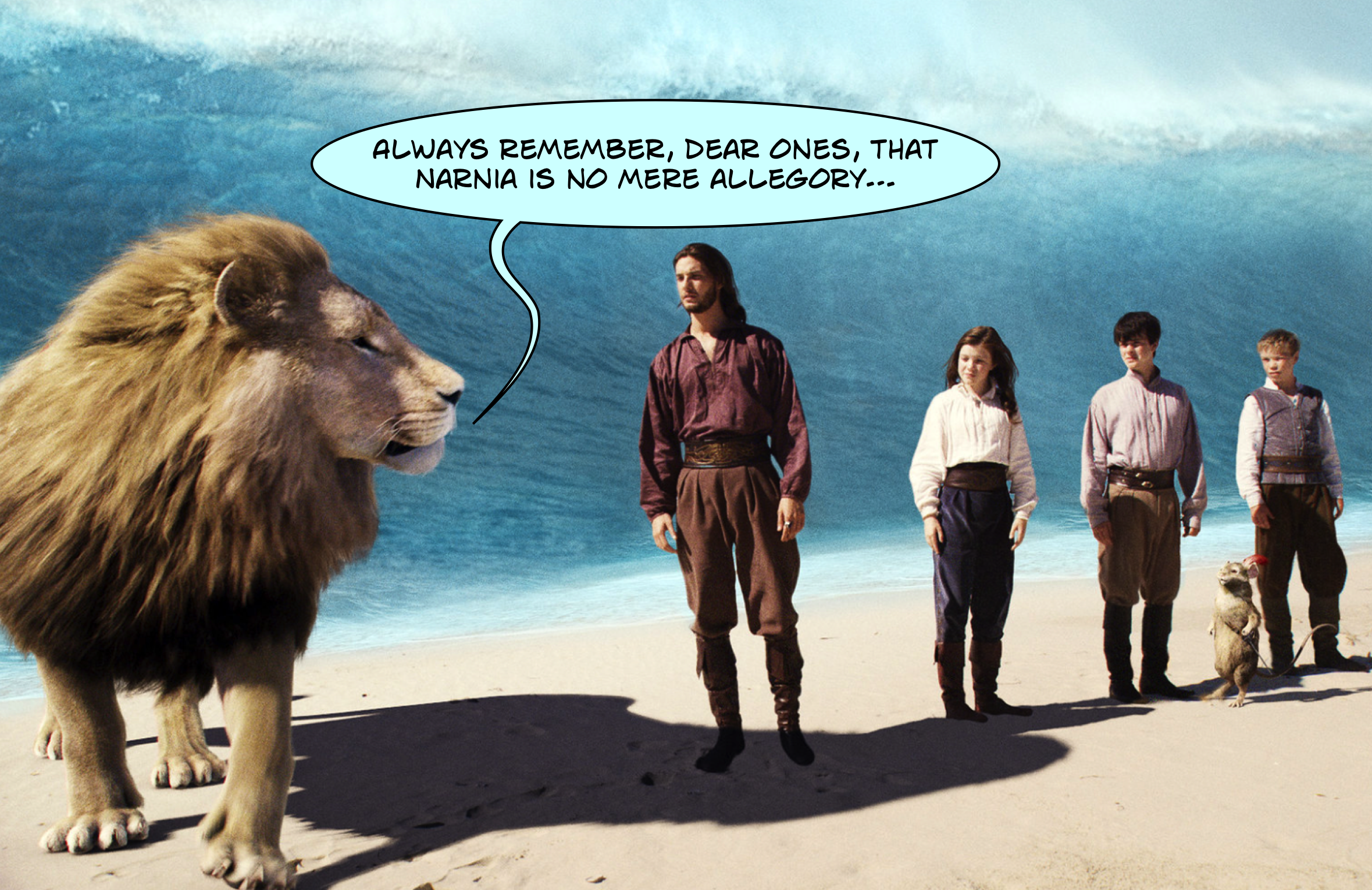
No, the Chronicles offer no mere allegory. Aslan and Narnia are something altogether more rare and precious . . . and uniquely inspiring.


Bonus:

For those inclined to see how the AI at ChatGPT might compose an analogue, consider the following examples. I offered three brief prompts and amazingly swift apologues. 

Certainly! Here’s an apologue in the style of ancient Roman moral tales – think Aesop with a Roman flavor (e.g., Phaedrus) – explaining why the porcupine is hard to get along with. This style uses simple characters, a brief narrative, and a moral at the end.

Apologue: The Porcupine and the Burrowers

Characters:
~ Porcupine (Hystrix)
~ Mole (Talpa)
~ Hedgehog (Erinaceus)
Moralitas at the end.

In the time when the earth still whispered secrets to beasts, a bitter winter approached. The animals who dwelt below ground gathered to find warmth together.

The Mole, who dug deep and dark tunnels, said, “Let us share one chamber, and none shall freeze.”

The Hedgehog, with bristles soft enough in the cold, agreed. “We are small and spined, but kindred in spirit.”

Then came the Porcupine, bristling with long, sharp quills. “I seek shelter,” he said. “Let me in.”

The others, though wary, welcomed him. “There is warmth in many bodies, if none poke too hard.”

But when the Porcupine curled to sleep, his quills pricked every side of the burrow. The Mole winced. The Hedgehog bled. They shifted, gave him space – but no space was enough.

“Friend Porcupine,” said the Mole, “can you not soften your stance?”

The Porcupine replied, “My quills are my nature. I mean no harm, yet I cannot change.”

So, one by one, the others left, seeking colder but safer places.

The Porcupine remained, alone in warmth – but with no friend near.

Moralitas:
He who cannot bend his nature to spare his neighbors must be content with solitude, for warmth of company is given only to those who wound not.

Having delivered the moral of the fable, the AI was so thoughtful as to ask: “Would you like a Latin version of the apologue as well?”

~ ~ ~ ~ ~ ~ ~

Certainly! Here is an apologue in the style of C.S. Lewis – reminiscent of his storytelling in The Screwtape LettersThe Chronicles of Narnia, and The Pilgrim’s Regress. Lewis often used allegory and fable to convey theological or philosophical arguments through richly imagined, morally charged tales.

Apologue: The Two Gardens

In an ancient land that bordered both silence and song, there lived two brothers: Eldarion and Ruckus.

Their father, the Keeper of Harmony, was a master gardener who tended to two great gardens, each grown from a different seed of music.

One garden was called Lyrion, and it bloomed with strange and delicate flowers. Trees sang there – not with words, but with symphonies. The air was always filled with the faint sound of strings, like something half-remembered from a dream. This was the realm of Classica, the music that had deep roots and slow unfolding blossoms.

The other garden, Thundra, was younger, wilder. Vines twisted with fire, and great drums beat like the hearts of giants. Flames leapt from the leaves when touched. This was the realm of Rocka, born of storm and impulse. It throbbed with noise and power.

One day, the father called his sons. “Each of you shall choose a garden to tend,” he said. “But take heed: a garden grows into the likeness of its gardener.”

Eldarion, quiet and curious, chose Lyrion. He studied the old scores carved into the bark of the elder trees. He listened for the faintest cadences hidden in the wind. His garden grew slowly, but with order and depth. Some who visited said they heard truth in its song – though they could not explain it.

Ruckus chose Thundra. He brought iron tools and thunderous machines. He shouted into the wind and danced among the fire-vines. His garden grew quickly, wildly, and it drew many visitors who loved its power. But the soil became hard, and the songs repeated themselves. At night, when the fire died, there was silence – and the silence frightened him.

Years passed.

One evening, Ruckus visited his brother’s garden. It was still and strange, yet somehow more alive. The music there did not grab the ear – it waited, like a cathedral waits for a footstep.

“I do not understand this,” said Ruckus.

“You’re not meant to at first,” Eldarion said gently. “But if you sit long enough, you may find it is not music you hear – but yourself.”

Moral:
Not all noise is music, and not all music is noise. That which is deep may not dazzle, but it endures.

~ ~ ~ ~ ~ ~ ~

Certainly! Here’s an apologue in the style of C.S. Lewis, with his characteristic blend of gentle allegory, rational argument, and spiritual insight. Think of something akin to The Great Divorce or The Pilgrim’s Regress – a story that carries philosophical weight through symbolic characters and a clear moral undercurrent.

Apologue: The Library of the Lantern

There was once a Traveller who came upon an ancient Library, tucked between the hills of two realms: Factland, where the roads were straight and numbered, and Fablemere, where the paths curled like ivy and sometimes moved when you weren’t looking.

The Traveller, weary from debate and burdened with questions, was greeted by an old librarian named Lucidus, who wore a cloak woven from both parchment and ink.

“You may read whatever you like here,” said Lucidus. “But I warn you: some shelves are straight, others crooked – and both are true.”

The Traveller began in the Hall of Records, where volumes bore names like The History of the WorldNatural LawsThe Mind Explained, and Economics in Twelve Systems. The books were hard, clear, and bright like winter ice. Every sentence pointed like an arrow, and the Traveller felt smarter with every page. “Here,” he thought, “is what I came for: answers.”

But after a time, the light grew harsh, and the words – though sharp – offered no rest. He felt he had learned much, and yet not grown.

So he wandered next into the Chamber of Tales. Here were strange books that spoke of dragons and dying stars, of heroes who were cowards and cowards who became saints. The logic bent like a rainbow, and the truth came sideways.

At first he scoffed. “These things never happened!”

Lucidus appeared beside him and said quietly, “No – but they always happen.”

So the Traveller read on. And he wept when the fox died, and laughed when the king made a fool of himself. He saw his pride in the villain and his longing in the wandering knight. He saw the world as it might be – and in doing so, saw more clearly what the world was.

Time passed. The Traveller read from both wings of the library, sometimes walking the marble floors of Factland, sometimes lying on the mossy rugs of Fablemere. One sharpened his mind; the other softened his heart. One taught him how things work; the other, why they matter.

At last, he approached Lucidus.

“Which was truer?” the Traveller asked. “The world I could measure, or the one I could feel?”

Lucidus smiled. “Ah. One is the lamp, the other the flame. But both are needed to see.”

Moral:
Fiction teaches the soul what nonfiction explains to the mind – and wisdom lives where both meet.

This proved to be a very interesting exercise, indeed.

C.S. Lewis, Liturgy & a Dash of Theology

C.S. Lewis wrote: “There is no subject in the world (always excepting sport) on which I have less to say than liturgiology” (Letters to Malcolm: Chiefly on Prayer).

In Christian usage, the word “liturgy” – derived from leitourgia, and translated “work of the people” or “work for the people” – corresponds to the public worship service.

For some, “liturgy” is regarded as a negative word. It may evoke, in such cases, a sense of sterile ritual or what the Scriptures refer to (in the King James Version) as “vain repetitions” (Matthew 6). The irony is that human beings generally prefer familiarity, and almost all worship is essentially liturgical. 

Nondenominational churches sometimes claim they do not possess a liturgy. In truth, every nonspontaneous worship experience possesses liturgical elements. They may be simple – a welcome or greeting followed by music, prayer, the reading of a Bible passage, often followed by some form of sermon or reflection. Oh, and for American Protestants at least, it appears most consider “announcements” are essential to worship services.

The particular elements vary, but the “liturgical” aspects, normally occur in the same sequence at regular services.

C.S. Lewis was a faithful member of the Church of England. He was also respectful of tradition, and genuinely content with the Book of Common Prayer. While he did not prefer conventional church hymnody, he acknowledged that it blessed others. In “The Classical Anglicanism of C.S. Lewis,” the author says Lewis challenged “the assumptions of a liberal theology which undermined the Church’s confidence in its proclamation” of the Gospel. However, he continues, Lewis “was no reactionary.”

C.S. Lewis loved the simplicity of church worship in its unostentatious form. That was one reason he faithfully attended services at his modest local parish. He referred to himself as a “very ordinary layman.” This was his humble confession, although there was precious little about the scholar that was “ordinary.” Still, he was reticent to comment on ecclesiastical subjects where he possessed no expertise. Thus his complacency with time proven liturgical matters, and his academic disinterest in commenting on them formally.

This, of course, did not apply to theological truths such as the doctrinal core of “Mere Christianity.” C.S. Lewis was deeply troubled by challenges to historic Christian orthodoxy. His devotion to the faith he had once rejected forced him to come to its defense when theologians diverged from “the path of life” (Psalm 16).

In 1959, C.S. Lewis delivered an address now entitled “Fern Seed and Elephants.” It is profound. [You can listen to a reading of “Fern Seed and Elephants” at C.S. Lewis Essays.]

Invited to speak to some clergy about the threat of liberal theologies undermining the Christian faith, Lewis begins by acknowledging his lack of formal theological training.

I am a sheep, telling shepherds what only a sheep can tell them. And now I begin my bleating.

Many of us who have attended seminary, can attest to his fear that what passes for illumination is too often the opposite.

I find in these theologians a constant use of the principle that the miraculous does not occur. Thus any statement put into our Lord’s mouth by the old texts, which, if he had really made it, would constitute a prediction of the future, is taken to have been put in after the occurrence which it seemed to predict.

This is very sensible if we start by knowing that inspired prediction can never occur. Similarly in general, the rejection as unhistorical of all passages which narrate miracles is sensible if we start by knowing that the miraculous in general never occurs.

Now I do not here want to discuss whether the miraculous is possible. I only want to point out that this is a purely philosophical question. Scholars, as scholars, speak on it with no more authority than anyone else. The canon ‘If miraculous, then unhistorical’ is one they bring to their study of the texts, not one they have learned from it.

If one is speaking of authority, the united authority of all the biblical critics in the world counts here for nothing. On this they speak simply as men; men obviously influenced by, and perhaps insufficiently critical of, the spirit of the age they grew up in.

In Lewis’ The Great Divorce, he describes just such a theologian. If you would like to read my article on this subject, “Confused Clerics: The Landlord’s Stewards in C.S. Lewis’s The Pilgrim’s Regress,” just click on the article’s title.

C.S. Lewis ends his essay “Fern Seeds and Elephants” with a sort of apology. Yet, despite his reluctance to venture into the ecclesiastical realm, he shares the compulsion of the Prophet Jeremiah to speak truth. The prophet, who suffered greatly for his faithfulness, said “If I say, ‘I will not mention [God], or speak any more in his name,’ there is in my heart as it were a burning fire shut up in my bones, and I am weary with holding it in, and I cannot” (Jeremiah 20).

Missionary to the priests of one’s own church is an embarrassing role; though I have a horrid feeling that if such mission work is not soon undertaken the future history of the Church of England is likely to be short.

More Liturgical Wisdom from C.S. Lewis

C.S. Lewis did not begin his vocation as a voice of reason for the clergy when he wrote this essay. On the contrary, his concern for the erosion of sound theology began much earlier. A decade earlier he weighed in on a public discussion of arbitrary liturgical changes in the church. Lewis’ concerns at that time remain valid, more than seventy years later.

Sir,– I agree with Dean Hughes that the connection of belief and liturgy is close, but doubt if it is ‘inextricable.’ I submit that the relation is healthy when liturgy expresses the belief of the Church, morbid when liturgy creates in the people by suggestion beliefs which the Church has not publicly professed, taught, and defended.

If the mind of the Church is, for example, that our fathers erred in abandoning the Romish invocations of saints and angels, by all means let our corporate recantation, together with its grounds in scripture, reason and tradition be published, our solemn act of penitence be performed, the laity re-instructed, and the proper changes in liturgy be introduced.

What horrifies me is the proposal that individual priests should be encouraged to behave as if all this had been done when it has not been done.

One correspondent compared such changes to the equally stealthy and (as he holds) irresistible changes in a language. But that is just the parallel that terrifies me, for even the shallowest philologist knows that the unconscious linguistic process is continually degrading good words and blunting useful distinctions. Absit omen!

Whether an ‘enrichment’ of liturgy which involves a change of doctrine is allowable, surely depends on whether our doctrine is changing from error to truth or from truth to error. Is the individual priest the judge of that? (Church Times, 1 July 1949).

In The Screwtape Letters, an experienced devilish tempter is training a subordinate. In Letter XVI, he discusses attending a church with which his target “is not wholly pleased.”

Laying aside the matter of the futility of ever finding a perfect church – after all, they are made up of people – the letter cautions us about some of the criticisms related to the topic at hand. Since many aspects of Screwtape’s vile advice relate to our own vulnerabilities, I will close with an admittedly lengthy excerpt from the correspondence.

My dear Wormwood, You mentioned casually in your last letter that the patient has continued to attend one church, and one only, since he was converted, and that he is not wholly pleased with it. May I ask what you are about? Why have I no report on the causes of his fidelity to the parish church? Do you realise that unless it is due to indifference it is a very bad thing?

Surely you know that if a man can’t be cured of churchgoing, the next best thing is to send him all over the neighbourhood looking for the church that ‘suits’ him until he becomes a taster or connoisseur of churches. The reasons are obvious. In the first place the parochial organisation should always be attacked, because, being a unity of place and not of likings, it brings people of different classes and psychology together in the kind of unity the Enemy [in Screwtape’s case, the Enemy to whom he refers, is God] desires. The congregational principle, on the other hand, makes each church into a kind of club, and finally, if all goes well, into a coterie or faction.

In the second place, the search for a ‘suitable’ church makes the man a critic where the Enemy wants him to be a pupil. . . . [One nearby congregation boasts a] Vicar is a man who has been so long engaged in watering down the faith to make it easier for a supposedly incredulous and hard-headed congregation that it is now he who shocks his parishioners with his unbelief, not vice versa. He has undermined many a soul’s Christianity. His conduct of the services is also admirable. In order to spare the laity all ‘difficulties’ he has deserted both the lectionary and the appointed psalms and now, without noticing it, revolves endlessly round the little treadmill of his fifteen favourite psalms and twenty favourite lessons. . . .

[While encouraging church shopping], all the purely indifferent things – candles and clothes and what not – are an admirable ground for our activities. We have quite removed from men’s minds what that pestilent fellow Paul used to teach about food and other unessentials – namely, that the human without scruples should always give in to the human with scruples.

You would think they could not fail to see the application. You would expect to find the ‘low’ churchman genuflecting and crossing himself lest the weak conscience of his ‘high’ brother should be moved to irreverence, and the ‘high’ one refraining from these exercises lest he should betray his ‘low’ brother into idolatry.

And so it would have been but for our ceaseless labour. Without that the variety of usage within the Church of England might have become a positive hotbed of charity and humility.

Suffering Caused by Labeling Children

Kids are often cruel, dishing out insults and rude nicknames to those they deem “different.” Sadly, not everyone outgrows this ugly behavior. As C.S. Lewis wrote in The Four Loves,

We hear a great deal about the rudeness of the rising generation. I am an oldster myself and might be expected to take the oldsters’ side, but in fact I have been far more impressed by the bad manners of parents to children than by those of children to parents.

I recently discovered an artist whose music reveals the pain caused by this cruelty. In “Not My Name,” Matt Sassano describes how we can move beyond the wounds of our past. For we all understand these hurtful words possess power.

These are the scars
     that I’m forced to live with,
These are the scars
     that mark me as a misfit . . .

Who among us does not bear scars from past struggles? Who among us has never been ridiculed by others?

Despite having a loving mother who sheltered me from much of life’s traumas, I bear my own scars. That’s one reason this song powerfully resonated with me. 

But there is a stronger reason I am touched by “Not My Name.” It’s because, as a pastor I have seen far, far too many women and men who remain buried beneath their pain.

I found healing in God’s grace. The scars now cause me little discomfort, though the memories remain. And I have found healing often begins when people who have endured life’s onslaughts learn they are not alone. 

This man shares a heart just like their own.

These are the scars
     that I am forced to live with
So pick me apart
I won’t fit the mold that you fit
But thеre’s a warrior inside me
That you playеd a part in building
Because you made me understand.

About staying strong when you’ve fought so long
In a world that tells you you don’t belong
Living in the shadow of all your flaws
Where it’s hard to be seen for who you are.

And, the emotionally and spiritually wounded can see how someone suffering like them can proclaim this liberating truth:

So label me
Call me by my pain
That’s not my name
That’s not my name.

I’m so much more
     than your throw away
That’s not my name
That’s not my name. . . .

You won’t sentence me
Your words are dead to me
I know my suffering
     is not my identity.

As impressed as I was with this song, it means all the more now that I learned something about Sassano’s life.

The Sins of the Father

A short biography reveals some of the reason for Sassano’s plaintive spirit. 

He was the son of an unfit pastor, whose anger and abuse crushed his childhood faith. His search for meaning “was intensified by the experience of living with two disabilities: Cerebral Palsy and dyscalculia (which impairs brain functions like navigation and mathematics).

“I spent much of my early life in and out of doctor’s offices and disability meetings, which led me to struggle with my self-perception and self-esteem.”

It is this tragic youth which directly inspires his video “Dear God.” Released in 2022, it reminds me of the lamentations we find in the Scriptures, particularly the Psalms and Jeremiah. In Madeleine L’Engle’s forward to C.S. Lewis’  lamentations in A Grief Observed, she expresses gratitude for his honest treatment of grief’s violence. 

I am grateful to Lewis for the honesty of his journal of grief, because it makes quite clear that the human being is allowed to grieve, that it is normal, it is right to grieve, and the Christian is not denied this natural response to loss.

I am grateful, too, to Lewis for having the courage to yell, to doubt, to kick at God . . . This is a part of healthy grief not often encouraged. It is helpful indeed that C.S. Lewis, who has been such a successful apologist for Christianity, should have the courage to admit doubt about what he has so superbly proclaimed. It gives us permission to admit our own doubts, our own angers and anguishes, and to know that they are part of the soul’s growth.

The video amplifies the power of the lyrics of “Dear God.” So, do watch it.

I’ve got questions, confessions
I just want peace of mind
Time’s fading and I’m waiting
For something I can’t find
I am overwhelmed
Can I endure this hell?
No way to break the spell
I’ll spill my heart again

Dear God
I’ve lost the will to fight
Please give me a sign
I’m empty inside
Got no strength to carry on
The plague has multiplied
It’s eating me alive
How can I survive?
Dear God

Much like C.S. Lewis’ book describing the loss of his wife, Sassano’s songs can help bring healing to those in similar pain. Even if you don’t need to listen to these songs . . . trust me, there is someone you know and care about, who does!

Music, Muses & C.S. Lewis

Why do so many modern musicians – including some who are commercially successful – appear to suffer from amusia?

Well, I suppose that diagnosis is a matter of opinion, since “amusia” has come to refer to a particular medical disorder related to “the inability to recognize musical tones or to reproduce them.” More on that in a moment. First let’s consider the original meaning of the word.

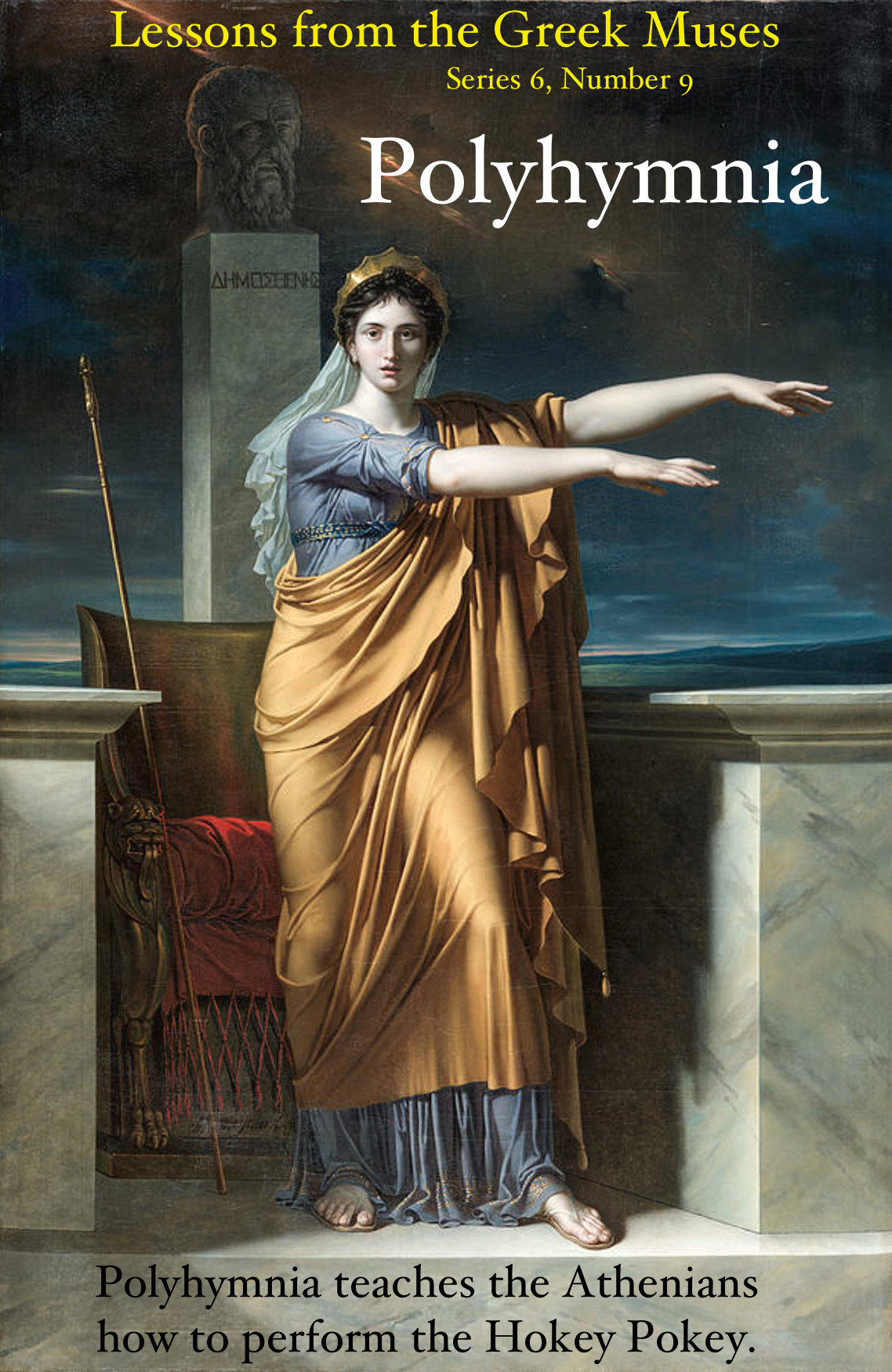
It begins with the Greek Muses. While “muse” has morphed into anything that inspires a creative soul, it did not begin that way. The Muses began as personifications devoted to nine children of Zeus and Mnemosyne (Memory). During Europe’s revival of Classical themes, they were associated not only with the arts, but with culture and refinement in general.

In Surprised by Joy, C.S. Lewis records his admiration for one of his early teachers. This man taught him to love poetry, and although he practiced corporal punishment (standard for the era), embodied “perfect courtesy.” On an occasion he was sent to the headmaster, who misperceived that Lewis had acted inappropriately. After dispelling the confusion, this teacher, who treated his students as “gentlemen,” matter-of-factly said “you will have to be whipped if you don’t do better at your Greek Grammar next week, but naturally that has nothing to do with your manners or mine.”

The idea that the tone of conversation between one gentleman and another should be altered by a flogging (any more than by a duel) was ridiculous. His manner was perfect: no familiarity, no hostility, no threadbare humor; mutual respect; decorum.

“Never let us live with amousia” was one of his favorite maxims: amousia, the absence of the Muses. And he knew, as Spenser knew, that courtesy was of the Muses. 

Muses, from this perspective, undergird civilization. But the Muses are fickle. One cannot create their own Muse. Inspiration comes to us of its own volition. It can’t be commanded.

Nearly four years ago, I posed this question in Mere Inkling: “Who is Your Muse?” Various literary figures have written paeans to the muses which inspire their work. In that column I also noted how our animal companions* often exert an influence on our own creativity.

The link between inspirational Muses and music itself is strongly intertwined. Consider, for instance, Friedrich Nietzsche (1844-1900), who was brilliant, but much to be pitied. He despised God, but he did love music. In “Amousia: Living Without the Muses,” Classicist Stephen Halliwell discusses the importance of music for enjoying a meaningful existence. He begins with a quote from Nietzsche, and points out a Platonic corollary. 

Without music life would be a mistake . . . So, famously, wrote Friedrich Nietzsche in . . . Twilight of the Idols. As always, Nietzsche had deeply personal reasons for the force and pathos of this aphorism; music did indeed help to keep him alive. . . .

[W]e can detect in Nietzsche’s stark utterance, I would like to suggest, a trace and resonance of Greek feeling. We might even wonder whether in formulating his maxim Nietzsche was subconsciously remembering the passage in Plato’s Philebus where Protarchus, asked by Socrates whether music, as one of the ‘impure’ arts, is needed for the mixture of a humanly desirable life, says that he certainly takes it to be necessary – ‘at any rate,’ as he puts it, ‘if our life is really to be a life of some kind.’

Without music, Protarchus . . . seems to take the idea to be practically self-evident, human ‘life’ would hardly be worth the name at all.

Amusia as a Medical Condition

I suggested above that the caterwauling of some musicians suggests they are tone deaf, but in fact there is a genuine medical condition called amusia. It traces its beginning to the Muses we have been speaking about, and suggests their absence.

In “The Genetics of Congenital Amusia (Tone Deafness),” we learn that “congenital amusia . . . is a lifelong impairment of music perception that affects 4% of the population.” What’s more, “the pitch disorder has a hereditary component.”

In amusic families, 39% of first-degree relatives have the same cognitive disorder, whereas only 3% have it in the control families.

As the husband of a gifted music teacher, the father-in-law of another, and the grandfather of a number of extremely talented children, I understand the Greek principle. While I would miss music’s grace if I was stricken with amusia, I know a number of precious people for whom that would be one of the most terrible fates imaginable.

C.S. Lewis and Music

Like most of us, C.S. Lewis enjoyed some forms of music while others left him exasperated. Wagner, bravo. Church hymnody, not so much. A recent article by John MacInnis, a professor of music, goes so far as to claim: “music listening and discussion factored regularly in C.S. Lewis’s relationships, and love for music inspired his creative endeavors and prompted his best thinking.”

I agree with the first part of this, and will attribute the “best thinking” declaration to the hyperbole of one who has devoted his own life to music.

The author of “A Medium for Meeting God” explores in  detail the effect of Wagner’s work, and the sense of Northernness it imprinted on Lewis’ psyche.

In 1934, Lewis, along with his brother Warnie and J.R.R. Tolkien read Wagner’s operas together in German, in anticipation of attending performances of the Ring cycle. MacInnis points out that Lewis enjoyed the music of Sibelius (also “evocative of Northern landscapes) and likened it to Wagner as an expression of natural or earthy music. This he contrasted to Beethoven, which he also enjoyed, and thought of as “noble” and even spiritual.

As for church music, Lewis had mixed feelings. I’ve written about that in the past, in “Good, Bad and Ugly Hymns.” Most of us would agree that music enriches our lives. Our tastes vary, of course, just as they do with literature.

And, speaking of which, just as there are tone deaf individuals who should avoid recording music . . . most of us have encountered writers who suffer from a literary variant of amusia. And, lacking the influence of anything remotely like a muse, would not the world be a more harmonious place if they simply laid down their pens.


* When we got our youngest border collie as a puppy, I named her Calli. Actually, that’s what we call her, but her given name is actually Calliope. I named her after the Muse of epic poetry with the hope she might inspire my writing.

Since she’s our fifth border collie, I should have known better. The very last thing Calli wants me to do is sit at the computer composing documents (no matter how interesting or edifying). “Get out of that chair and get some exercise with me,” she says plaintively with her body, voice, and pleading eyes.

She’s plenty loving, and her insistence on activity may well add years to my life, but if I look to her to help me write more productively, I’m guaranteed disappointment.

Delicious Words

Have you ever wondered what colors people see when they read what you write? If so, you are not (necessarily) insane. And we’re not talking about coloring your fonts to evoke certain responses.

The fact is, some people honestly do see colors when they read – or hear – particular words.

Perhaps even more oddly, some people actually taste specific words. And the flavor(s) they sense are not necessarily related in any reasonable way. For example, we might think that if someone heard the word “orange,” or saw an orange color, that some psychological trick might cause them to think they can taste an orange citrus flavor. But that’s not how it works. There may not be any fathomable connection at all.

This phenomena is called “synesthesia.” Healthline describes synesthesia as “a neurological condition in which information meant to stimulate one of your senses stimulates several of your senses.” Although they are rare, “synesthetes” are not unique.

A study entitled “Survival of the Synesthesia Gene: Why Do People Hear Colors and Taste Words?” alleges the condition is experienced by 2% to 4% of the population.

While a proven genetic basis for synesthesia remains elusive, the phenomenon tends to run in families, as ∼40% of synesthetes report a first-degree relative with the condition. Pedigree analyses of synesthesia suggest high transmissibility from parent to offspring . . .

I have a confession to make. Through the years I’ve met a handful of people who told me they could taste colors, or the like. They were describing to me their sincere experiences of synesthesia. Unfortunately, since I’d never read about the validity of the phenomenon, I dismissed it. I assumed that the more playful of the advocates were trying to trick me. And I attributed the other cases to people tricking themselves, due to odd imaginations or to gullibility manipulated by the power of suggestion.

Mea culpa. The awkwardness was my fault. I am sorry for any hurt I may have caused. I, of all people, should have accepted their testimony. You see, for many years I was stunned that people voluntarily ate cilantro. To me, the herb tastes like soap – exactly like picking up a bar of soap and taking a big bite. Everyone laughed and me. But one day I met someone whose eyes widened before they declared “me too!”

Britannica explains the problem: ‘for those cilantro-haters for whom the plant tastes like soap, the issue is genetic. These people have a variation in a group of olfactory-receptor genes that allows them to strongly perceive the soapy-flavored aldehydes in cilantro leaves.” The frequency of this “genetic quirk” varies by ethnicity. Trust me, if you knew what it tastes like to “us,” you would never force the unpalatable cleanser on anyone but your worst enemy.

You see, because of my dismissal of their revelation, I could very well have caused some people to consider themselves defective, or discourage them from being open in their lives after that time. Healthline describes it this way:

On the other hand, some synesthetes feel that their condition isolates them from others. They may have trouble explaining their sensory experiences because they are very different. Finding communities of other synesthetes online may help ease this feeling of isolation.

Fortunately, on the other hand, “many people seem to enjoy perceiving the world in a different way than the general population.” There are even artistic efforts which attempt to replicate the experience of these unique individuals.

For a simple guide to the numerous types of synesthesia experienced by your fellow human beings (which may or may not parallel animal phenomena), check out this article.

There is a short scene from the film Ratatouille that creatively illustrates the experience of the synesthete, who is, in this case, Remy the rat. (We’ll link to it at the end of the post.)

What about the Inklings?

I don’t believe any member of the Inklings experienced synesthesia. It is possible, of course.

Nevertheless, there are echoes of synesthesia in their works. Consider for a moment the following description of Lewis’ work as a literary critic in C.S. Lewis at Poet’s Corner.

What I want to call attention to here is yet another example of what one might call Lewis’s narrative synaesthesia. . . . I am not arguing that this kind of movement between genres is unique to Lewis – far from it, I think we all do it to some extent, if only in our imaginations rather than on paper. . . .

[Lewis] is a writer whose perceptions just jostle against each other, and are so interconnected that it is almost impossible to separate one strand from the next. These are characteristics more common in the poet than the critic, and not for nothing did Lewis see himself as primarily a poet.

C.S. Lewis could also skillfully energize his fiction with synesthetic elements. An excellent example is found in Voyage of the Dawn Treader. An article on Encyclopedia.com describes it in the following way.

As they sail nearer to Aslan’s country, references to Christ and our heavenly home accumulate quickly. Reepicheep discovers that the water is sweet! Caspian describes the phenomenon with synesthesia, using the terms of one sense experience to describe another: “It – it’s like light more than anything else.”

In the novel itself we see Reepicheep being pulled from the sea, after falling overboard.

“Sweet!” he cheeped. . . . “I tell you the water’s sweet,” said the Mouse. “Sweet, fresh. It isn’t salt.” For a moment no one quite took in the importance of this. But then Reepicheep once more repeated the old prophecy:

Where the waves grow sweet,
Doubt not, Reepicheep,
There is the utter East.

Then at last everyone understood. “Let me have a bucket, Rynelf,” said Drinian [the ship’s captain]. It was handed him and he lowered it and up it came again. The water shone in it like glass.

“Perhaps your Majesty would like to taste it first?” said Drinian to Caspian. The King took the bucket in both hands, raised it to his lips, sipped, then drank deeply and raised his head. His face was changed. Not only his eyes but everything about him seemed to be brighter. “Yes,” he said, “it is sweet. That’s real water, that. I’m not sure that it isn’t going to kill me. But it is the death I would have chosen . . .”

“What do you mean?” asked Edmund.

“It – it’s like light more than anything else,” said Caspian.

“That is what it is,” said Reepicheep. “Drinkable light. We must be very near the end of the world now.”

There was a moment’s silence and then Lucy knelt down on the deck and drank from the bucket. “It’s the loveliest thing I have ever tasted,” she said with a kind of gasp. “But oh – it’s strong. We shan’t need to eat anything now.” And one by one everybody on board drank. And for a long time they were all silent. They felt almost too well and strong to bear it, and presently they began to notice another result.

As I have said before, there had been too much light ever since they left the island of Ramandu – the sun too large (though not too hot), the sea too bright, the air too shining. Now, the light grew no less – if anything, it increased – but they could bear it. They could look straight up at the sun without blinking.

They could see more light than they had ever seen before. And the deck and the sail and their own faces and bodies became brighter and brighter and every rope shone. And the next morning, when the sun rose, now five or six times its old size, they stared hard into it and could see the very feathers of the birds that came flying from it.

Synesthetic Rodents

The dashing Reepicheep is not the only cute little rodent who experiences reality synesthetically. That should come as no surprise, since Rodentia such as mice like our hero, Remy the rat chef and their cousins like beavers and porcupines constitute about 40% of all mammal species. God alone knows how many rabbits, prairie dogs and pikas share these sensory delights.

The aforementioned scene from Ratatouille offers a “taste” of what life is like for a synesthete. Enjoy.

Healing Laughter in Our World & Narnia

If you are like me, you could benefit from a rich, genuine laugh right about now. Las year was stressful on all of us, and many are wary the new year may not be dramatically better.

For many of us, humor is an integral part of our lives. In our extended family, it is an ever ready tool for lifting the spirits of others. Just the other day our son and his six-year-old son dropped by, and as they entered the front door I said, “enter, most welcome king and prince.” Without missing a proverbial beat, my grandson responded, “I’m the king, and he’s the prince.” It was a hilarious, spontaneous moment. My wife and I are deeply blessed because our lives are filled with these moments.

We have all heard about the healing powers of laughter. One Mayo Clinic article on the subject, “Stress Relief from Laughter? It’s No Joke,” lists a number of short- and long-term benefits. For example:

Laughter enhances your intake of oxygen-rich air, stimulates your heart, lungs and muscles, and increases the endorphins that are released by your brain. . . . [It can] improve your immune system. Negative thoughts manifest into chemical reactions that can affect your body by bringing more stress into your system and decreasing your immunity.

By contrast, positive thoughts can actually release neuropeptides that help fight stress and potentially more-serious illnesses. [And laughter can] relieve pain . . . by causing the body to produce its own natural painkillers.

Since laughter has indisputable mental—and physical—benefits, promoting it is a worthwhile avocation. That effort is complicated by the fact our individual sense(s) of humor differ significantly. For example, some people find slapstick humor wildly funny. I find it funny (in the sense of “odd”), that they consider it witty.

On the other hand, some people appreciate the “subtleties” of so-called British humor. Many of my relatives have never understood how much I have enjoyed Monty Python. To them, the Python approach is bizarre and unpalatable. Meanwhile, they enjoyed the clumsy stumblings of Jerry Lewis.*

Ricky Gervais, an English comedian who has met great success on both sides of the pond, wrote an interesting piece for Time. He offers very thoughtful observations on “The Difference Between American and British Humour.” Having lived in the United Kingdom, and counting some Brits as friends today, the following comment rings true with me.

There’s a received wisdom in the U.K. that Americans don’t get irony. This is, of course, not true. But what is true is that they don’t use it all the time. It shows up in the smarter comedies but Americans don’t use it as much socially as Brits.

We use it as liberally as prepositions in every day speech. We tease our friends. We use sarcasm as a shield and a weapon. We avoid sincerity until it’s absolutely necessary. We mercilessly [verbally assault] people we like or dislike basically.

And ourselves. This is very important. Our brashness and swagger is laden with equal portions of self-deprecation. This is our license to hand it out.

Perhaps my affinity for British humor comes from a flaw in my personal psyche, I mean, an innate appreciation for irony.

Another consideration is whether laughter is genuine or feigned. The latter presumably produces no positive results. Researchers in Japan conducted some laughter studies. One professor noted that honest laughter reaches down to a person’s diaphragm. He devised a machine to measure it.

Sensors placed near the diaphragm transmit waves to a computer screen, and these waves apparently reflect not only the intensity of a subject’s laughter but also its sincerity. A genuine laugh, straight from the heart, weighs in at 5 or more “aHs” per second –the “aH” (read “aha” in Japanese) being the unit of measurement Kimura devised in his quest to quantify laughter. Fake laughter makes no waves. The sensors ignore it, and the graph-lines on the screen remain unmoved.

Most of us, I suspect, can usually tell the difference between sincere responses, be they simple chuckles or raucous belly laughs, and the fake stuff. Fortunately, the inauthentic laughter is rarely malicious. An interesting dissertation entitled “The Meaningless Laugh,” explores laughter’s use to ease tension and “cover-up,” or mask, true opinions. It seems to me that insincere laughter has much in common with “white lies.”

Humor in the Life of C.S. Lewis

C.S. Lewis had a healthy sense of humor. Laughter abounded at gatherings of the Inklings. In light of Gervais’ comment about the British propensity for “teasing our friends,” check out “C.S. Lewis Compared J.R.R. Tolkien to What?

Our sense of humor is shaped and refined (or dulled) throughout our lives. An interesting letter from 1914, before Lewis was scarred in the trenches of the First World War, reveals his entertainment preferences as a young man.  

Last week I was up with these people to the Coliseum: and, though of course (which by the way I see no prospect of) I had sooner have gone to some musical thing, yet I enjoyed myself. The Russian Ballet–and especially the music to it–was magnificent, and G.P. Huntley* in a new sketch provoked some laughter.

The rest of the show trivial & boring as music halls usually are. At ‘Gastons’ however, I have no lack of entertainment, having been recently introduced to Chopin’s Mazurkas, & Beethoven’s ‘Sonate Pathétique.’

The mature Lewis made a profound observation about humor in Reflections on the Psalms.

A little comic relief in a discussion does no harm, however serious the topic may be. (In my own experience the funniest things have occurred in the gravest and most sincere conversations.)

I have found this to be true in my own life and ministry. In the words of the Mayo Clinic piece, “Laughter can also make it easier to cope with difficult situations. It also helps you connect with other people” even during the most trying of times.

Can Laughter Be Dangerous?

We all recognize that when humor is pursued at the expense of others, it is often destructive. Sarcasm is a dangerous, and often cruel, weapon. Healthy laughter, though, possesses a divine quality.

Laughter can, in fact, be such a positive thing that even the Tempter Screwtape⁂ warns his protégé to undermine it. (Remember, when reading Screwtape, that since Screwtape, the fictional writer of the infernal advice, serves the Devil, and thus the language is reversed.)

I am specially glad to hear that the two new friends have now made [your patient] acquainted with their whole set. All these, as I find from the [infernal] record office, are thoroughly reliable people; steady, consistent scoffers and worldlings who without any spectacular crimes are progressing quietly and comfortably towards Our Father’s house.

You speak of their being great laughers. I trust this does not mean that you are under the impression that laughter as such is always in our favour. The point is worth some attention. I divide the causes of human laughter into Joy, Fun, the Joke Proper, and Flippancy.

You will see the first among friends and lovers reunited on the eve of a holiday. Among adults some pretext in the way of Jokes is usually provided, but the facility with which the smallest witticisms produce laughter at such a time shows that they are not the real cause. What that real cause is we do not know.

Something like it is expressed in much of that detestable art which the humans call Music, and something like it occurs in Heaven—a meaningless acceleration in the rhythm of celestial experience, quite opaque to us. Laughter of this kind does us no good and should always be discouraged. Besides, the phenomenon is of itself disgusting and a direct insult to the realism, dignity, and austerity of Hell (The Screwtape Letters).

As to whether or not laughter can nudge a person towards a negative end, Screwtape singles out flippancy.

But flippancy is the best of all. In the first place it is very economical. Only a clever human can make a real Joke about virtue, or indeed about anything else; any of them can be trained to talk as if virtue were funny. Among flippant people the Joke is always assumed to have been made. No one actually makes it; but every serious subject is discussed in a manner which implies that they have already found a ridiculous side to it.

If prolonged, the habit of Flippancy builds up around a man the finest armour-plating against the Enemy that I know, and it is quite free from the dangers inherent in the other sources of laughter. It is a thousand miles away from joy: it deadens, instead of sharpening, the intellect; and it excites no affection between those who practise it (The Screwtape Letters).

Forewarned about the potential pitfalls of unhealthy humor, we can choose to avoid it. Meanwhile, we can rejoice with laughter that our Creator has bestowed upon us the ability to laugh.

C.S. Lewis celebrated this gift in his echo of our own creation in the story of Narnia’s birth. From the very first day, laughter was meant to resound throughout the world.

“Creatures, I give you yourselves,” said the strong, happy voice of Aslan. “I give to you forever this land of Narnia. I give you the woods, the fruits, the rivers. I give you the stars and I give you myself. The Dumb Beasts whom I have not chosen are yours also. Treat them gently and cherish them but do not go back to their ways lest you cease to be Talking Beasts. For out of them you were taken and into them you can return. Do not so.”

“No, Aslan, we won’t, we won’t,” said everyone. But one perky jackdaw added in a loud voice, “No fear!” and everyone else had finished just before he said it so that his words came out quite clear in a dead silence; and perhaps you have found out how awful that can be—say, at a party.

The Jackdaw became so embarrassed that it hid its head under its wing as if it were going to sleep. And all the other animals began making various queer noises which are their ways of laughing and which, of course, no one has ever heard in our world.

They tried at first to repress it, but Aslan said: “Laugh and fear not, creatures. Now that you are no longer dumb and witless, you need not always be grave. For jokes as well as justice come in with speech.”

So they all let themselves go. And there was such merriment that the Jackdaw himself plucked up courage again and perched on the cab-horse’s head, between its ears, clapping its wings, and said: “Aslan! Aslan! Have I made the first joke? Will everybody always be told how I made the first joke?”

“No, little friend,” said the Lion. “You have not made the first joke; you have only been the first joke.” Then everyone laughed more than ever; but the Jackdaw didn’t mind and laughed just as loud till the horse shook its head and the Jackdaw lost its balance and fell off, but remembered its wings (they were still new to it) before it reached the ground.

Laughter is a gift from God. I believe it is one of his best.


* The warm appreciation of comedian Jerry Lewis (1926-2017) by the French has always been a mystery to me. Talk about different ways to view humor. An interesting discussion of that enigmatic fact is found in “Why France Understood Jerry Lewis as America Never Did.”

Jerry Lewis was always a subject of a deep trans-Atlantic misunderstanding, one that triggered sarcasm in the United States, and bewilderment in France. While some Americans felt embarrassed by this contortionist comic, the French embraced Mr. Lewis’s humor as both an abstract art and social satire of American life.

Americans mocked the French for falling for this crass clown, while the French couldn’t understand why Mr. Lewis’s genius was not obvious to his compatriots.

⁑ George Patrick Huntley (1868–1927) was an Irish actor, known for comic performances in the theatre and the music halls.

⁂ The fictional author of C.S. Lewis’ book, The Screwtape Letters. Screwtape, the senior Tempter serves his master, the Devil. He refers to him as “Our Father Below,” accordingly.


The graphic above comes from the blog of a very talented writer and producer. Mitch Teemley included in a recent post at The Power of Story. I agree with my friend that “laughter has healing properties.” If you believe the same, you absolutely need to spend a few minutes reading his hilarious post.

The Viking Explanation for Lame Poetry

During the middle ages, Scandinavia’s skálds were poets, storytellers and even musicians. They were the equivalent of bards in medieval British and Gaelic culture. They were oral historians, committed to memorizing their paeans verbatim, which was simpler since they were in poetic form. Not all skálds possessed the talents to create their own memorable epics. These lesser poets, so to speak, could still memorize and recite the classic or popular songs.

A graphic explanation for the difference in the talents of the first tier skálds and their inferiors is found in the Prose Edda which was written by Snorri Sturluson (1179-1241). Sturluson compiled Norse myths in his Edda, and the sagas of her kings in Heimskringla.

The second part of the Prose Edda is entitled Skáldskaparmál, which means the language of poetry. One of the myths it contains describes the Mead of Poetry. Mead, of course, is the rich Viking beverage created by fermenting honey.

As for poetry, I’ve written about it fairly often. (Most recently in respect to my “winning” entry in a Terrible Poetry Contest.) I’ve even offered genuine, albeit feeble, attempts at the art myself. Alas, if I were a classical Greek I would say my Muse is Clio (the Muse of History), rather than Thalia or Erato, Muses of various genres of poetry.

It is well known that C.S. Lewis himself was a frustrated poet. While his literary criticism and historical work was highly respected—and his Christian works are still revered—his poetry never received a warm reception. The Poetry Foundation offers a useful article on the subject here.

My personal opinion is that I am thankful Lewis’ energies were devoted to more profitable fields of writing.

Back to the Vikings

C.S. Lewis and several other Inklings were enamored with Northern sagas. I have touched on this in the past, and discussed the amazing fellowship gathered by J.R.R. Tolkien, as a sort of precursor to the Inklings.

Tolkien named the group Kolbítar, which denoted “Coalbiters,” or Norse storytellers who gathered close to the fire as they discussed the stories of their ancestors. This exploration of Icelandic literature was connected to Tolkien’s conviction, as a professor of Anglo-Saxon, that these works belonged within the study of the English canon.* Old Norse definitely left a mark on English, as I’ve discussed here at Mere Inkling.

In Song of the Vikings: Snorri and the Making of Norse Myths, Nancy Marie Brown gleans some insights about Kolbítar from Lewis correspondence. They gathered to read the literature aloud.

They began with Snorri’s Edda. Reading it in Icelandic was slow going but addictive, Lewis recalls: “Hammered my way through a couple of pages in about an hour, but I am making some headway. It is an exciting experience.” Lewis . . . had also been smitten as a boy by “pure ‘Northernness’” [and] popular versions of Snorri’s tales had inspired Lewis to write an adolescent tragedy about the Norse gods, “Loki Bound.”

There is no record of what the members of the Kolbítars thought of the myth of the Mead of Poetry, but I would imagine that they found its crass distinction between gifted and stumbling poets quite—Norse. To set the stage for the following passage, one should know: (1) the Aesir were the Old Norse gods, (2) Suttung was a Jötunn (belonging to a race of giants at war with the Aesir), (3) Suttung was in possession of the magical mead of poetry, which Odin stole through cunning but immoral means, swallowing all of it, (4) Odin changed into an eagle to effect his escape, and Suttung followed him in the same form, and (5) the Aesir prepared large vessels to receive the disgorged magical mead. Now, from the Edda itself:

When the Æsir saw Odin flying, they placed their vats in the courtyard, and when Odin entered Asgard he spat the mead into the vats. It was such a close call, with Suttung almost catching him, that he blew some of the mead out of his rear. No one paid attention to this part, and whoever wanted it took it; we call this the bad poets’ portion. Odin gave Suttung’s mead to the Æsir and to those men who know how to make poetry. For this reason we call poetry Odin’s catch, find, drink or gift, as well as the drink of the Æsir.

No one said the Norse were above using crass humor. Still, it does offer a quite imaginative explanation for the differences between exceptional and mediocre poets, doesn’t it?


* Tolkien “loved the cold, crisp, unsentimental language of the sagas, their bare, straightforward tone like wind keening over ice. Reading Snorri and his peers was more important than reading Shakespeare, Tolkien argued, because their books were more central to our language and our modern world” (Song of the Vikings).

Good, Bad and Ugly Hymns

There’s good “church music.” There’s mediocre church music. (And, there’s even terrible church music.) Read on and I’ll provide a link to an article I wrote about one questionable ditty that wormed its way into a military hymnal.

C.S. Lewis was not a fan of most church music. I’ve written about his musical tastes previously.

His assessment is no secret. He deemed most hymns to be “fifth-rate poems set to sixth-rate music.”

When it comes to hymns, there is general agreement on what’s good. These songs have passed the test of time. They have proven edifying and inspirational for generations. Some contemporary music is also biblically faithful and possesses the potential to join the ranks of the church’s lasting hymnody.

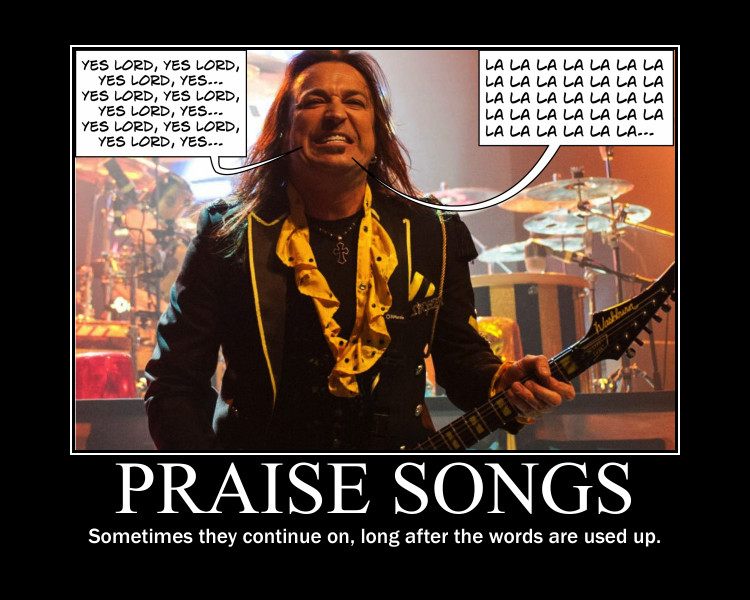
Then there are the others. Uninhibited redundancy, for example, suggests a corresponding shallowness. I forego the idiom about something being broad but shallow, since such songs are actually narrow and shallow. Case in point, the song “Yes, Lord.”

It begins promisingly enough:
I’m trading my sorrow
I’m trading my shame
I’m laying it down for the joy of the Lord

Then the theology gets a wee bit blurrier, especially for believers who still suffer after praying for healing:

I’m trading my sickness
I’m trading my pain
I’m laying it down for the joy of the Lord

But it’s the chorus that undermines the song’s edificatory potential.

And we say
Yes Lord yes Lord yes yes Lord
Yes Lord yes Lord yes yes Lord Amen

Yes Lord yes Lord yes yes Lord
Yes Lord yes Lord yes yes Lord Amen

The last two chorus breaks are replaced by the less challenging:

La la la la la la
La la la la la
La la la la la la
La la la la la
La la la la la la la la la
La la la la

La la la laLa la
La la la la la
La la la la la la
La la la la la
La la la la la la la la la
La la la laLa la la la

To those of you who adore this particular song—please accept my apologies for singling it out. Yet I stand by my view of these lyrics. And I can certainly imagine what C.S. Lewis would have thought of it.

The Power of Music

Various Christian leaders have expressed the opinion it’s more important to write the church’s hymns than its theological books. Hopefully that’s hyperbole, but few would deny the words we sing directly influence our thinking.

Arius, one of the early heretics who denied the divinity of Christ, knew this. His movement created tremendous confusion and resulted in much persecution. One of his most successful tools consisted of composing heretical songs. The words were “religious,” and the tunes were catchy, so people were singing them even when they didn’t agree with his doctrine.

C.S. Lewis & Church Music

As mentioned above, C.S. Lewis was very candid about his own disaffection for most church hymnody. In “Answers to Questions on Christianity,” Lewis answers the question of whether it’s necessary to attend worship services. He describes how duty rather than desire brought him to congregational worship.

When I first became a Christian . . . I thought that I could do it on my own, by retiring to my rooms and reading theology, and I wouldn’t go to the churches and Gospel Halls; and then later I found that it was the only way of flying your flag . . .

[However,] I disliked very much their hymns, which I considered to be fifth-rate poems set to sixth-rate music. But as I went on I saw the great merit of it. I came up against different people of quite different outlooks and different education, and then gradually my conceit just began peeling off.

I realized that the hymns (which were just sixth-rate music) were, nevertheless, being sung with devotion and benefit by an old saint in elastic-side boots in the opposite pew, and then you realize that you aren’t fit to clean those boots. It gets you out of your solitary conceit.

In light of Lewis’ attitude toward religious hymnody, it’s ironic that in 1946 he was invited to help evaluate new hymns.

The Hymn Society of Great Britain and Ireland is opening a file of new hymns to which modern hymn-writers are to be asked to contribute. I have been asked to write to you and ask if you will be a member of the panel to whom new hymns may be submitted in order that their merit may be assessed . . .

Lewis’ response to the invitation is as revealing as it is (unintentionally, I’m sure) curt.

The truth is that I’m not in sufficient sympathy with the project to help you. I know that many of the congregation like singing hymns: but I am not yet convinced that their enjoyment is of a spiritual kind. It may be: I don’t know.

To the minority, of whom I am one, the hymns are mostly the dead wood of the service. Recently in a party of six people I found that all without exception would like fewer hymns. Naturally, one holding this view can’t help you.

Two months later, the men exchanged letters again, and Lewis clarified his thoughts.

I can’t quite remember my own last letter; but I was wrong if I said or implied that . . . hymns, were bad in principle. . . . In modern England, however, we can’t sing—as the Welsh and Germans can. Also (a great pity, but a fact) the art of poetry has developed for two centuries in a private and subjective direction.

That is why I find hymns ‘dead wood.’ But I spoke only for myself and a few others. If an improved hymnody—or even the present hymnody—does edify other people, of course it is an elementary duty of charity and humility for me to submit. I have never spoken in public against the use of hymns . . .

The Gospel Coalition has an informative essay on Lewis’ broader view of worship here.

The Armed Forces Hymnal Scandal

At the outset of this column I promised readers a link to a recently published article. If you would like to read about a bizarre hymn that (temporarily) slithered into the Book of Worship for United States Forces, check it out here. The article begins on page fifteen of the new issue of Curtana: Sword of Mercy.

The hymn in question may be thought-provoking, but it belongs in a discussion group, not in a worship service. The lyrics are placed on the tongue of thief crucified beside Jesus. The criminal who was not invited by Jesus to “be with [him] in paradise” (Luke 23). The first stanza will amply illustrate the spirit of the piece.

It was on a Friday morning that they took me from my cell,
And I saw they had a carpenter to crucify as well
You can blame it on to Pilate, you can blame it on the Jews,
You can blame it on the Devil, It’s God I accuse.
(Refrain)
It’s God they ought to crucify, instead of you and me.
I said to the carpenter a-hanging on the tree.

If you read the article, and consider me unfair to the song’s writer, please leave a comment below. I would love the chance to respond. Likewise, if you think I’ve been too harsh in my evaluation of “Yes, Lord.” Given a choice between mediocre and terrible hymns, there’s no contest.

One wonders how Lewis would have rated “It was on a Friday Morning.” I suspect it would not even rise to the bar of being a “fifth-rate poem.”

Dangers of Our Modern Age

csl dragon.png

In 1957, C.S. Lewis wrote an encouraging letter to a young author whose first book had been written at the age of fourteen. Jane Gaskell’s Strange Evil was described by the Times Literary Supplement as “a fantasy of macabre and gorgeous nonsense.” The review even alluded to Lewis himself in its description of the novel.

Judith, who poses nude for a living, is carried off to a C.S. Lewis-ish land where a monster called Baby conducts his reign of terror and where one extravagantly gory battle follows another.

Miss Gaskell is eloquently fascinated by words, the longer and more lush the better, and her book reveals an undoubted talent for fanciful description.

Gaskell went on to become a journalist. She also authored several more novels, and ultimately became a professional astrologer.

But, returning to the young girl and her first publication . . . Lewis considered the young girl worthy of encouragement.

My wife and I have just been reading your book and I want to tell you that I think it a quite amazing achievement–incomparably beyond anything I could have done at that age. The story runs, on the whole, very well and there is some real imagination in it.

The idea of the gigantic spoiled brat (had you a horrid baby brother once?) is really excellent: perhaps even profound. Unlike most modern fantasies your book also has a firm core of civilised ethics. On all these grounds, hearty congratulations.

Lewis does, however, offer a suggestion for how the book may have been improved. “I hope you will not think it impertinent if I mention (this is only one man’s opinion of course) some mistakes you can avoid in future.”

In a fantasy every precaution must be taken never to break the spell, to do nothing which will wake the reader and bring him back with a bump to the common earth. But this is what you sometimes do.

The moving bar on which they travel is a dull invention at best, because we can’t help conceiving it as mechanical. But when you add upholstered seats, lavatories, and restaurants, I can’t go on believing in faerie for a moment. It has all turned into commonplace technological luxury!

This concept is noteworthy for writers—especially writers of fiction, for whom imagination is an indispensable ingredient. We must avoid elements that derail the story, as inappropriate technology can sometimes do.

Beware of the Temptation

I suspect most writers today experience technology as a more concrete threat to their vocation than the inopportune example Lewis was noting. It’s not that we include too many or too few mechanical or scientific references in our work. The problem is that we are so distracted by the wonders of the world in which we live, that we never get around to putting the pen to paper.

Some of us can lose ourselves in the internet or social media. One fascinating read leads to another and we wonder “where the time has gone.” Vast programming “on demand,” is ready at a moment’s notice to occupy (or, sometimes, numb) our minds. And even when we do sit down at the keyboard, emails and messages interrupt our concentration.*

Technology, of course, is not only dangerous to writers. It can distract any of us from what is most important in life. How many hours have we squandered when we could have spent our time with family or friends? Why do we prefer to anesthetize ourselves with digital opiates, rather than helping a neighbor?

Not long ago, Christianity Today conducted an interview with Richard Foster. Foster’s 1978 book, A Celebration of Discipline, has been extremely influential in calling believers to lives of deeper simplicity and prayer. In their article they mentioned a revision in the preface that speaks powerfully to me.

Oh, for the day when all we had to do was turn off the television if we wanted solitude and silence! . . . we are bombarded by the broad distractions of constant noise, constant demands, constant news. Everyone, it seems, wants us to be accessible 24/7 and to respond instantly to any and every request.

Neuroscience studies are now showing us that the neural pathways of our brains are being rewired accordingly, so that our physical capacity for sustained attention is decreasing.

We, of course, complain endlessly about our wired world. But—let’s be honest—we do enjoy our technological gluttony. There is, however, a better way to live.

I’m going to close this post with a personal prayer. Feel free to join me in it, if you desire.

Gracious Father, forgive me my trespasses, and deliver me from the sin of technological gluttony to which I so often surrender. Draw me away from the table of excess, and lead me on that better path . . . the way that leads to life, and to you. Amen.


* Many of these distractions can be significantly decreased by setting your software to provide fewer “notifications” when various things occur. For example, I recently had to reset my iTunes because the program was throwing up a message every time a new song began.

When I am listening to the soundtrack of The Lord of the Rings, I don’t care to be told that “The Foot of Orthanc” is coming up as the strains of “The Road to Isengard” are fading away.

Renaissance Rap Music

renaissance rap

If you never listen to classical music, you are missing out on one of life’s greatest pleasures. If you have been exposed to small doses, and developed an unfortunate distaste for historic music from the past several centuries, give it a second chance.

The fact is there are so many varieties, with exciting variations introduced by countless gifted composers, that almost anyone can find something in the field that inspires them.

It was probably classical works that C.S. Lewis had in mind when he wrote to Arthur Greeves in 1916, “Isn’t it funny the way some combinations of words can give you—almost apart from their meaning—a thrill like music?”

Our Director of Parish Music recently shared some interesting facts that I had not known. Although I’ve sung in a number of choirs through the years, I never mastered any “instrument.”

Sure, teachers attempted to teach me about music back in the days of the flutophone. (Yes, I was introduced to instrumental music way back in the day before most elementary schools upgraded to plastic instruments properly called “recorders.”)

A flutophone may look like a toy, but it is actually a legitimate “pre-band instrument” belonging to the wind family.

Returning to the class I attended . . . our Music Director introduced us to one of the seventeenth century’s finest composers, Heinrich Schütz. This German Lutheran studied with the Italian Roman Catholic Giovanni Pierluigi da Palestrina, a master of polyphony. Curiously, their shared devotion to religious music allowed for a genuine friendship, despite the Thirty Years War which raged across Central Europe at the time.

In addition to learning some history about composers, I was stunned to learn that rap music had been invented as long ago as 1635-45.

It was called “recitative,” and is a style of vocal music that alternated between speaking and singing. We listened to some examples, and I immediately realized that even fans of modern rap (among whom I do not include myself) can find some classical music they would likely enjoy.

C.S. Lewis and the Blessings of Music

Luther famously declared, “next to the Word of God, the noble art of music is the greatest treasure in the world.”

C.S. Lewis also regarded music as a gift of God. In his essay, “On Church Music,” he ponders the blessing received by those who listen to religious music. He finds that humility is the key.

There are two musical situations on which I think we can be confident that a blessing rests. One is where a priest or an organist, himself a man of trained and delicate taste, humbly and charitably sacrifices his own (aesthetically right) desires and gives the people humbler and coarser fare than he would wish, in a belief (even, as it may be, the erroneous belief) that he can thus bring them to God.

The other is where the stupid and unmusical layman humbly and patiently, and above all silently, listens to music which he cannot, or cannot fully, appreciate, in the belief that it somehow glorifies God, and that if it does not edify him this must be his own defect.

Neither such a High Brow nor such a Low Brow can be far out of the way. To both, Church Music will have been a means of grace: not the music they have liked, but the music they have disliked. They have both offered, sacrificed, their taste in the fullest sense.

But where the opposite situation arises, where the musician is filled with the pride of skill or the virus of emulation and looks with contempt on the unappreciative congregation, or where the unmusical, complacently entrenched in their own ignorance and conservatism, look with the restless and resentful hostility of an inferiority complex on all who would try to improve their taste—there, we may be sure, all that both offer is unblessed and the spirit that moves them is not the Holy Ghost.

Lewis continues his thoughts, turning to the practical application of his thoughts to the local parish. Members of a typical congregation, of course, do not all share the same musical tastes.

These highly general reflections will not, I fear, be of much practical use to any priest or organist in devising a working compromise for a particular church. The most they can hope to do is to suggest that the problem is never a merely musical one.

Where both the choir and the congregation are spiritually on the right road no insurmountable difficulties will occur. Discrepancies of taste and capacity will, indeed, provide matter for mutual charity and humility.

What wise advice. The presence of love and humility, essential elements of Christian spirituality, can see a congregation through discrepancies of taste. We should each remind ourselves of this, the next time we hear something in worship that does not appeal to our personal preferences.

The question should not be whether we “like” specific music or not, but rather whether or not it truly glorifies God.


The unattributed photograph below suggests C.S. Lewis may have enjoyed a periodic musical interlude as he toiled over piles of correspondence.

Lewis and recorder